

How seeing Earth from space transforms human awareness, inspires awe, and reveals the extraordinary beauty of our shared home.
Imagine traveling beyond the familiar blue sky, leaving the clouds beneath you, and looking back at the planet you have called home your entire life.
There, suspended against the immense darkness of space, is Earth.
Brilliant blue oceans shimmer beneath swirling white clouds. Continents stretch across the surface. Sunlight illuminates the atmosphere, revealing a delicate ribbon of color surrounding the planet.
From this extraordinary distance, the world appears whole, beautiful, and astonishingly alive.
Every person you have ever known lives somewhere within that magnificent sphere.
Every sunrise, every forest, every ocean, every human story unfolds upon the same world.
For many astronauts, seeing Earth from space has become one of the most meaningful experiences of their lives. Some describe overwhelming wonder. Others speak of a profound connection to humanity, a renewed appreciation for creation, or an entirely different understanding of their place in the universe.
Scientists have begun studying the emotional, psychological, and neurological dimensions of these experiences.
The phenomenon is known as the Overview Effect.
It reveals something extraordinary about human awareness: sometimes a change in perspective can transform the meaning of everything we thought we already understood.
What Is the Overview Effect?
The Overview Effect is a profound shift in awareness that some astronauts experience when viewing Earth from space.
The term was introduced by space philosopher and author Frank White in his 1987 book The Overview Effect: Space Exploration and Human Evolution.
White explored how seeing Earth from beyond its surface could influence human consciousness, identity, values, and our understanding of the planet.
His work brought attention to something astronauts had been describing since the earliest days of human spaceflight.
From Earth's surface, life unfolds within familiar surroundings. We recognize cities, neighborhoods, countries, and cultures. We experience oceans as boundaries between continents and mountains as barriers between regions.
But from space, those familiar divisions become less prominent.
The planet reveals itself as a connected whole.
Astronauts describe several recurring realizations:
Earth is one interconnected planetary home.
The atmosphere sustaining life is remarkably thin.
Humanity shares the same natural environment.
Political and cultural boundaries do not appear as lines drawn across the planet.
Life on Earth is both extraordinary and precious.
Personal concerns can take on a different meaning when viewed within a larger cosmic perspective.
For some astronauts, these realizations become a lasting influence on their understanding of life.
The Overview Effect is more than the recognition that Earth is beautiful.
It is the experience of seeing that beauty, understanding one's place within it, and sometimes returning home with a fundamentally expanded perspective.
The Moment Earth Becomes Something More
Human beings have always known Earth as the ground beneath their feet.
We experience its landscapes, seasons, oceans, and weather from within the environment itself.
Spaceflight introduced something entirely new to human experience.
For the first time, people could leave the surface and look back at their home as a planet.
The familiar became extraordinary.
From orbit, enormous cloud systems move across oceans. Deserts form sweeping patterns of gold and red. Mountain ranges appear as intricate textures. The atmosphere glows against the darkness.
At night, cities shine like delicate networks of light.
The view reveals both the vastness of Earth and its smallness within the surrounding universe.
This contrast can be deeply moving.
A planet that feels almost limitless when experienced from its surface becomes a single luminous world suspended in space.
And everything human beings have built, discovered, loved, and remembered exists somewhere upon it.
A World Without Visible Borders
One of the most frequently described aspects of the Overview Effect is the absence of visible political boundaries.
Countries remain important expressions of history, culture, language, and identity. Yet most of the lines dividing them on maps cannot be seen from orbit.
Instead, astronauts observe oceans, continents, atmospheric systems, and natural landscapes extending across those boundaries.
Clouds move between nations.
Ocean currents carry warmth around the planet.
Dust travels across continents and seas.
Migrating animals move between ecosystems.
The natural systems sustaining life operate on a planetary scale.
From space, these relationships become easier to appreciate.
The view does not diminish the uniqueness of human cultures.
It reveals that beneath our differences, we share something fundamental.
We belong to the same world.
The Astronauts Who Experienced a New Perspective
The Overview Effect has been described by astronauts from different generations, missions, and backgrounds.
Their experiences are not identical. Some emphasize spiritual connection, others environmental awareness, human unity, or the sheer beauty of Earth.
Together, their accounts reveal the remarkable range of meaning that can emerge from seeing our planet from space.
Edgar Mitchell and the Experience of Universal Connection
During the Apollo 14 mission in 1971, astronaut Edgar Mitchell traveled to the Moon and returned to Earth.
While contemplating the planet, stars, and surrounding cosmos during his journey home, Mitchell experienced an extraordinary sense of interconnectedness.
He later described the experience as deeply spiritual.
The familiar separation between himself and the surrounding universe seemed less significant. He felt an overwhelming sense of belonging within a much larger existence.
Mitchell's experience became a major influence on his subsequent exploration of consciousness and spirituality.
He went on to establish the Institute of Noetic Sciences in 1973, an organization dedicated to investigating consciousness and human experience.
His interpretation reflected his personal understanding of the event. The experience inspired questions about consciousness that he would explore for the rest of his life.
His account remains one of the most compelling examples of how space exploration can inspire profound questions about existence.
The journey outward became a journey inward.
William Anders and the Photograph That Changed How We Saw Earth
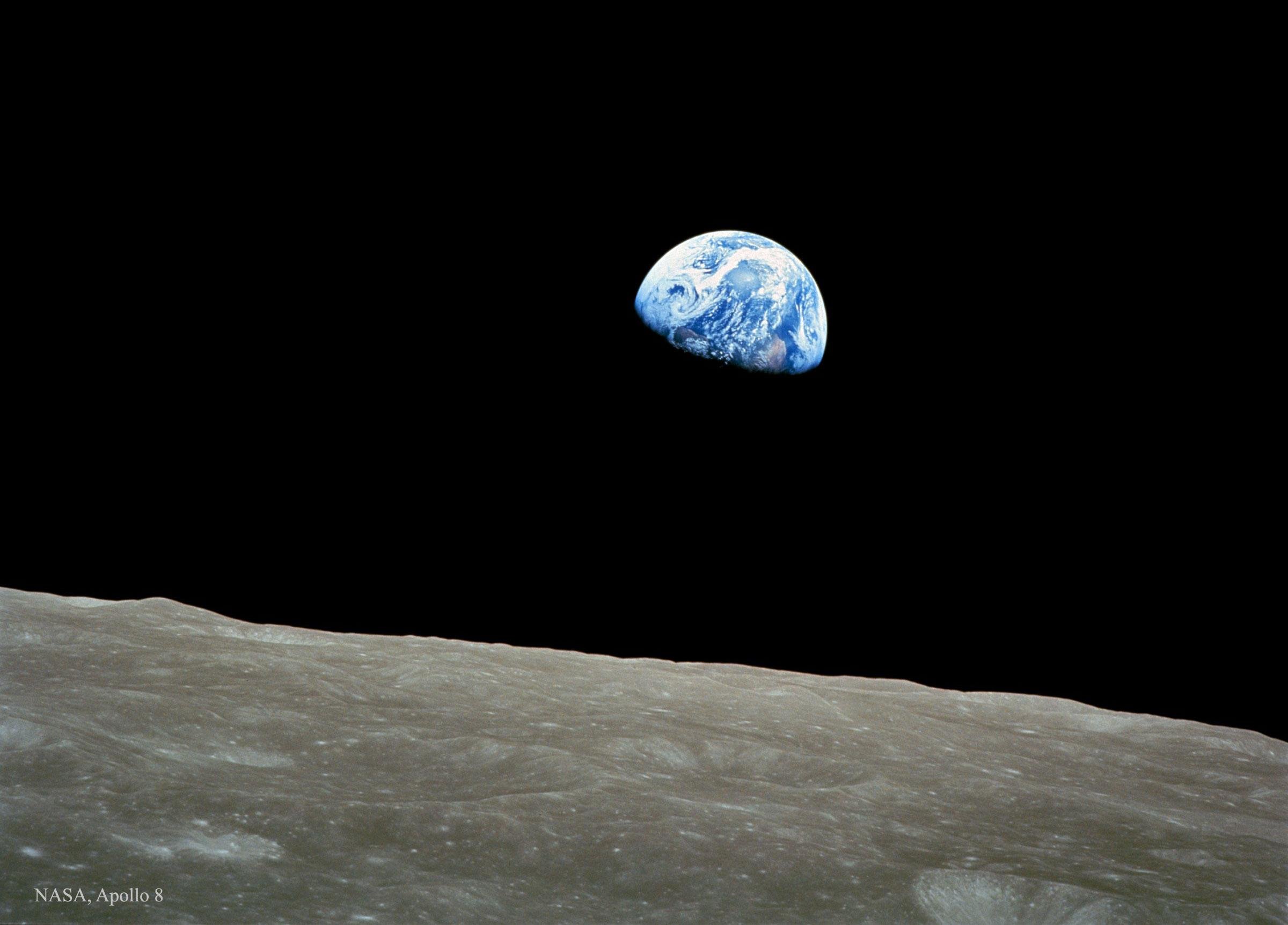
On December 24, 1968, Apollo 8 became the first crewed spacecraft to enter orbit around the Moon.
The three astronauts aboard were Frank Borman, Jim Lovell, and William Anders.
During the mission, astronaut William Anders captured one of the most influential photographs ever taken.
It became known as Earthrise.
Against the stark gray surface of the Moon, Earth appeared as a luminous world of blue oceans, white clouds, and sunlight.
The contrast was extraordinary.
The Moon appeared barren and silent. Earth glowed with the colors of a planet capable of sustaining life.
The photograph offered humanity a perspective that had never before been so vividly shared with the public.
Millions of people could contemplate their home from the vicinity of another world.
The image later became closely associated with the growth of modern environmental awareness.
It also inspired a deeper appreciation for the beauty and uniqueness of Earth.
Apollo 8, Christmas Eve, and the Wonder of Creation
The Earthrise photograph carries another meaningful historical connection.
On Christmas Eve in 1968, the Apollo 8 astronauts participated in a televised broadcast from lunar orbit.
During the broadcast, they read passages from the opening chapter of Genesis.
Their words accompanied an extraordinary moment in human exploration.
Human beings had traveled farther from home than ever before, looked upon another world, and discovered a breathtaking new perspective on their own.
For people of faith, the moment offered a powerful expression of gratitude for creation.
For others, it represented the shared human experience of wonder when encountering something larger than ourselves.
The connection between exploration, scientific discovery, and spiritual reflection remains one of the most moving elements of the Apollo 8 story.
The astronauts journeyed toward the Moon, yet one of the greatest gifts of their mission was a new appreciation for Earth.
Christina Koch and the Thin Line That Holds Humanity
NASA astronaut Christina Koch spent 328 consecutive days aboard the International Space Station during her 2019–2020 mission.
From orbit, she witnessed Earth through the station's extraordinary Cupola observation module.
The Cupola contains seven windows, offering panoramic views of the planet and surrounding space.
Koch has described the profound realization that every person she knows lives within the thin atmospheric envelope surrounding Earth.
From the station, that atmosphere appears as a slender illuminated layer between the planet and the darkness beyond.
The realization is both scientific and deeply personal.
All of humanity depends on that shared environment.
Every family, community, and civilization exists within the same planetary system.
What appears almost limitless from the ground becomes visibly delicate from space.
The experience transforms the atmosphere from an ordinary part of everyday life into something magnificent and precious.
Victor Glover and Bringing the Perspective Home
NASA astronaut Victor Glover has reflected on the perspective gained through spaceflight and the importance of carrying that awareness into life on Earth.
The experience of seeing the planet from space can be powerful, but its meaning also depends on how that perspective influences life afterward.
The question becomes whether someone carries that expanded awareness into their relationships, choices, and understanding of humanity.
This introduces an important dimension of the Overview Effect.
The transformation is not necessarily complete when the astronaut first looks through a spacecraft window.
For some, its meaning continues unfolding long after the mission ends.
Nicole Stott and the Beauty of Our Shared Home
Astronaut Nicole Stott has frequently spoken about the extraordinary beauty of Earth and the sense of connection inspired by seeing it from space.
Her reflections emphasize that the planet is not simply a collection of separate countries and landscapes.
It is a shared home.
Stott has also connected her experiences in space with creativity, art, and environmental stewardship.
Her perspective demonstrates how a powerful experience of awe can become a lasting source of inspiration.
What begins as wonder can grow into a deeper appreciation for the world and the people who inhabit it.
The Thin Blue Atmosphere and the Miracle of Life
From Earth's surface, the atmosphere appears immense.
The sky stretches toward the horizon. Clouds move overhead. Weather systems surround us.
Yet from space, the atmosphere looks like a delicate ribbon of light.
Its apparent thinness is one of the most striking sights astronauts describe.
Earth's atmosphere extends outward through several layers, becoming progressively thinner with altitude. Most atmospheric mass is concentrated relatively close to the surface.
This envelope of gases supports the conditions necessary for life.
It provides the oxygen used by humans and many other organisms, helps regulate planetary temperature, participates in the water cycle, and protects the surface from much of the Sun's harmful ultraviolet radiation.
Its appearance from space reveals an extraordinary contrast.
The atmosphere is physically thin compared with Earth's enormous diameter, yet it plays an essential role in sustaining life across the planet.
Why the Atmosphere Appears Blue
The familiar blue color of Earth's sky results primarily from the scattering of sunlight by molecules in the atmosphere.
Shorter wavelengths of visible light, particularly blue light, are scattered more strongly than longer wavelengths.
When viewed from space, sunlight passing through the atmosphere can create a brilliant blue glow along Earth's curved horizon.
At sunrise and sunset, longer atmospheric paths and other optical effects can produce bands of orange, red, violet, and gold.
Astronauts witness these colors from a perspective unavailable on the ground.
The atmosphere becomes visible as a luminous boundary between Earth and the surrounding darkness.
For many, this sight inspires gratitude and an increased awareness of the delicate systems supporting life.
Sixteen Sunrises and a New Appreciation for Time
Life aboard the International Space Station offers another remarkable perspective.
The station travels around Earth approximately once every 90 minutes.
As a result, astronauts can witness around 16 sunrises and 16 sunsets during a 24-hour period.
Imagine looking through a spacecraft window as the planet's horizon begins to glow.
A narrow ribbon of sunlight appears.
Colors spread through the atmosphere as the Sun rises into view.
Below, enormous cloud systems and oceans emerge from darkness.
A short time later, the station moves toward Earth's shadow, and another sunset unfolds.
This extraordinary rhythm reveals something fascinating about the nature of day and night.
On Earth's surface, we experience sunrise and sunset according to the planet's rotation and our location.
From orbit, the spacecraft's rapid movement creates an entirely different sequence of light and darkness.
Time itself has not changed in the way the experience might suggest.
What changes is the perspective from which familiar astronomical events are observed.
Awe and the Perception of Time
Psychological research suggests that awe can influence how people experience time.
In some experiments, people who experienced awe reported a greater sense of available time and less impatience.
Researchers have proposed that awe may draw attention toward the present moment, changing how people perceive their ordinary concerns.
The connection is especially meaningful when considering astronauts who repeatedly witness Earth's changing light, weather, and movement.
Their view offers a reminder that our experience of time is shaped not only by clocks but also by attention, emotion, and perspective.
A single extraordinary moment can remain meaningful for decades.
The Science of Awe and Expanded Awareness
The Overview Effect is closely associated with the psychological experience of awe.
Awe is an emotional response that arises when people encounter something vast, extraordinary, or difficult to fit into their existing understanding of the world.
Psychologists Dacher Keltner and Jonathan Haidt identified two important characteristics of awe.
Perceived Vastness
Vastness refers to encountering something that feels larger than our ordinary frame of reference.
It may involve physical size, such as the scale of a mountain range or the night sky.
It may also involve intellectual or spiritual magnitude, such as contemplating the history of the universe or the complexity of life.
Viewing Earth from space combines several forms of vastness.
Astronauts see the immense scale of the planet while simultaneously recognizing its smallness within the cosmos.
The experience challenges ordinary assumptions about size, distance, and human importance.
The Need to Expand Our Understanding
The second characteristic is called accommodation.
This occurs when an experience challenges our existing mental understanding and encourages us to develop a broader perspective.
An astronaut may already understand Earth's size, shape, and place in the solar system.
But directly witnessing the planet from space can give that knowledge an entirely new emotional meaning.
A familiar scientific fact becomes a deeply personal experience.
The mind is invited to expand its understanding of something it previously knew only from another perspective.
This is one reason awe can feel transformative.
It introduces a larger framework through which familiar experiences can be understood.
The Small Self and the Larger Whole
Researchers studying awe have identified a fascinating phenomenon known as the small-self effect.
During powerful experiences of awe, people may become less focused on their individual concerns and more aware of something larger than themselves.
This does not mean they lose their identity or sense of personal value.
Instead, their attention expands.
A person standing beneath a vast night sky may feel less absorbed in everyday frustrations.
Someone watching an immense ocean may experience a greater sense of connection to nature.
For astronauts, seeing the entire planet can evoke this shift on an extraordinary scale.
Their individual lives remain meaningful, but those lives are understood within a larger picture.
Research has associated awe with greater humility, social connection, and prosocial attitudes in certain settings.
The Overview Effect offers a particularly powerful example of how an expanded perspective can influence our sense of self.
We do not become less meaningful when we recognize something greater than ourselves. We become more aware of the extraordinary whole to which we belong.
What Happens in the Brain During an Overview-Like Experience?
Researchers have begun investigating whether the psychological changes associated with the Overview Effect are accompanied by measurable changes in brain activity.
A 2024 study published in the journal Virtual Reality examined participants experiencing a simulated journey into space.
Researchers used electroencephalography, or EEG, to measure electrical activity in the brain while participants viewed an immersive virtual reality environment.
The reported EEG analyses involved 41 participants.
Changes in Beta and Gamma Brain Activity
During moments designed to evoke the Overview Effect, researchers observed reductions in spectral power within certain beta and gamma frequency bands.
Beta activity is involved in a variety of cognitive processes, including attention and active information processing.
Gamma activity has been studied in relation to perception, memory, and the integration of information.
The researchers proposed that the observed changes might reflect cognitive adjustments involved when people encounter an experience that challenges their existing mental framework.
Participants also reported feelings associated with awe and the Overview Effect.
These results are significant because they provide a way to examine the experience through both subjective reports and measurable brain activity.
These findings offer researchers a promising way to investigate how extraordinary visual experiences, emotional responses, and patterns of brain activity may be connected.
Why These Findings Matter
For decades, much of the evidence surrounding the Overview Effect came from astronauts describing their experiences.
Those accounts remain invaluable.
Modern research adds another dimension by examining how the brain responds during carefully designed simulations.
This creates opportunities to explore questions such as:
How does awe influence attention?
What happens when our usual understanding of the world is challenged?
How does the brain process extraordinary visual experiences?
Why do some experiences create a lasting emotional impression?
Can immersive environments encourage greater feelings of connection?
The research is helping scientists investigate the relationship between what people experience internally and what can be measured physiologically.
The Heart, Nervous System, and Physical Experience of Awe
Awe is not experienced only as a thought.
It can also involve physical sensations.
People sometimes describe feeling breathless, experiencing goosebumps, becoming emotional, or sensing an unusual stillness when confronted with something magnificent.
Researchers are investigating these responses in simulated Overview Effect experiences.
A 2026 study published in Behaviour & Information Technology examined physiological responses during an immersive virtual reality journey.
Researchers considered measurements including heart rate, heart-rate variability, respiration, and skin conductance, which reflects changes in the electrical properties of the skin associated with physiological arousal.
What the Researchers Observed
The study reported measurable changes in heart rate and heart-rate variability associated with the simulated space experience.
Researchers also observed peaks in skin conductance during moments intended to evoke the Overview Effect.
These findings suggest that powerful experiences of awe and expanded perspective can involve emotional and physiological responses.
Heart-rate variability reflects changes in the intervals between successive heartbeats and is influenced by autonomic nervous system activity.
Skin conductance provides another window into physiological arousal.
Together, these measurements help researchers investigate how the body responds when people encounter extraordinary visual and emotional experiences.
The findings demonstrate that overview-like experiences can involve measurable changes in bodily activity.
The Connection Between Emotion and the Body
The human nervous system continuously responds to the meaning of our experiences.
A beautiful landscape, moving music, an unexpected act of kindness, or an extraordinary discovery can produce emotional and physiological responses.
The Overview Effect offers an especially powerful setting for studying this relationship.
The experience combines visual magnificence, unusual scale, personal meaning, and a profound awareness of one's place within the world.
Scientists are beginning to understand how these elements interact.
What a Major 2026 Scientific Review Revealed
In September 2026, researchers Laura Krug, Laura Henn, and Laura S. Loy published a comprehensive review in the Journal of Environmental Psychology.
The paper, Seeing Earth, Saving Earth? The Overview Effect and Its Role in Inspiring Environmental Protection, examined existing scientific literature on the phenomenon.
The review considered 34 individual studies reported across 32 research records, bringing together research involving astronaut experiences and simulations designed to reproduce aspects of seeing Earth from space.
The Most Important Findings
The researchers identified several recurring themes.
Astronauts frequently describe increased appreciation for Earth. Many accounts connect the experience with a stronger awareness of planetary beauty and environmental responsibility.
Simulated Earth views can evoke powerful emotions. Virtual reality and other visual experiences have produced feelings of awe and self-transcendence in research participants.
The Overview Effect may influence how people understand their relationship with the planet. Some astronaut accounts describe changes in values, priorities, and environmental awareness.
Emotional transformation and behavioral change are distinct outcomes. Although participants may experience powerful emotions, research has not consistently demonstrated that simulations produce lasting changes in environmental behavior.
The experience deserves continued scientific investigation. Researchers are increasingly able to examine how visual perspective, emotion, identity, and values interact.
This review represents an important step in understanding the Overview Effect as a subject of scientific inquiry.
It also reinforces something astronauts have described for generations.
Seeing Earth as a whole can make its beauty and interconnectedness extraordinarily vivid.
The Overview Effect and the Transformation of Human Identity
One of the most profound aspects of the Overview Effect involves the way human beings understand who they are.
Identity is often shaped by familiar relationships and experiences.
We identify with our families, communities, cultures, professions, and countries.
These connections provide meaning and belonging.
Yet seeing Earth from space introduces another dimension of identity.
We are inhabitants of one planet.
This realization can be extraordinarily powerful because it brings a planetary perspective into direct experience.
From Individual Awareness to Planetary Awareness
Ordinarily, we experience the world from a particular location.
Our daily concerns naturally occupy much of our attention.
From space, the familiar landscape of human activity becomes part of an immense interconnected system.
Cities appear as tiny points of light.
Oceans connect distant continents.
Cloud systems move across entire regions.
The planet itself becomes the dominant reality.
For some astronauts, this perspective inspires a shift from thinking primarily about individual or national concerns toward recognizing humanity's shared existence.
This does not require abandoning personal identity.
It means recognizing another level of belonging.
We are individuals, members of communities, and inhabitants of Earth.
Each identity can coexist within the larger whole.
A New Understanding of What It Means to Belong
Belonging is often associated with particular people and places.
We belong to families, friendships, communities, and traditions.
The Overview Effect introduces the possibility of experiencing belonging on a planetary scale.
The same atmosphere surrounds every nation.
The same sunlight illuminates Earth's surface.
The oceans, weather systems, and natural cycles that sustain life extend far beyond the boundaries of individual communities.
This recognition can encourage a sense of shared humanity without diminishing the importance of personal relationships.
It expands the meaning of home.
Home becomes not only the place where we live, but also the extraordinary planet that makes every earthly home possible.
The Spiritual Meaning of the Overview Effect
The Overview Effect has inspired spiritual reflection since the earliest days of space exploration.
For some astronauts, the experience evokes a profound sense of unity with the universe.
Others describe gratitude, reverence, humility, or a greater appreciation for creation.
These responses reveal something beautiful about human awareness.
We can encounter a scientifically understandable reality and still experience it as deeply sacred.
The planet's atmosphere, oceans, and orbit can be described through physics and astronomy.
Yet understanding those processes does not diminish their beauty.
For many people, it makes them even more extraordinary.
Seeing Creation From a New Perspective
Imagine looking back at Earth and recognizing the astonishing complexity of the world beneath you.
The planet is approximately 4.54 billion years old.
Across immense stretches of time, geological, chemical, and biological processes shaped the world we inhabit.
Oceans formed.
Continents changed.
Life emerged and evolved into extraordinary diversity.
Today, countless living organisms participate in Earth's interconnected ecosystems.
From space, much of that complexity is hidden within a beautiful blue-and-white sphere.
For those who view the world through faith, this perspective can inspire gratitude for God's creation.
The intricate relationships sustaining life become a source of wonder.
The world is not merely the background of human existence.
It is the extraordinary home in which existence unfolds.
The Feeling of Being Part of Something Greater
Some astronauts describe the Overview Effect in terms resembling self-transcendent experiences.
Self-transcendence involves an expansion of awareness beyond the usual focus on one's individual identity.
It may include feelings of connection, reverence, humility, and belonging.
These experiences can occur during spiritual contemplation, encounters with nature, and moments of extraordinary awe.
The Overview Effect offers a distinctive setting because the object of wonder is Earth itself.
A person sees the planet containing their entire earthly life while simultaneously recognizing its place within the cosmos.
This combination of familiarity and vastness can create an unusually powerful emotional experience.
For some, it becomes a spiritual awakening.
For others, it is a moment of profound human connection.
Both interpretations reflect the remarkable capacity of perspective to deepen our understanding of life.
The Difference Between Knowing and Truly Seeing
There is a meaningful distinction between intellectually understanding something and experiencing its significance.
We know that Earth is our home.
We know that the atmosphere sustains life.
We know that humanity shares one planet.
Yet these familiar truths can remain ordinary background knowledge until something makes their meaning vivid.
The Overview Effect transforms familiar information into direct experience.
The knowledge itself may not change.
What changes is the depth of awareness surrounding it.
Sometimes a truth becomes transformative not because it is new, but because we finally experience what it means.
The Overview Effect and the Beauty of Interconnection
From space, Earth reveals countless examples of natural interconnection.
The water cycle transports moisture between oceans, atmosphere, and land.
Ocean currents distribute heat.
Plants and microscopic marine organisms participate in global carbon and oxygen cycles.
Weather systems move across continents.
Living organisms depend on complex relationships within their environments.
These systems operate across boundaries that human beings often experience as separate.
The Overview Effect makes the larger pattern visible.
A Planet of Relationships
Consider the journey of water.
Moisture evaporates from oceans and other surfaces, enters the atmosphere, forms clouds, and eventually returns as precipitation.
Some of that water flows through rivers.
Some enters groundwater.
Some becomes part of living organisms.
Eventually, much of it returns to the atmosphere or oceans, continuing through Earth's hydrological cycle.
This is one example of the planet's interconnected processes.
The same world that appears unified from space is connected through countless physical and biological relationships.
Recognizing these relationships can inspire a deeper appreciation for the natural world.
It also reveals that interconnectedness is not only a spiritual idea.
It is a fundamental characteristic of Earth's physical systems.
Can We Experience the Overview Effect Without Traveling Into Space?
Only a relatively small number of people have viewed Earth directly from space.
Yet researchers are exploring whether some aspects of the Overview Effect can be experienced through other forms of visual immersion and contemplation.
Virtual Reality and Simulated Spaceflight
Virtual reality technology can create immersive experiences that simulate traveling away from Earth and looking back toward the planet.
Participants may experience the apparent scale of Earth, the darkness of space, and the visual contrast between the two.
Research has shown that these simulations can evoke feelings of awe and connectedness.
Some studies have also identified measurable neurological and physiological responses.
Although virtual reality cannot reproduce every aspect of actual spaceflight, it offers researchers a valuable way to investigate how extraordinary visual perspectives influence awareness.
Photographs of Earth From Space
Photographs captured during space missions offer another opportunity to contemplate the planet.
Three images are particularly meaningful.
Earthrise, 1968
Captured during Apollo 8, this photograph shows Earth appearing above the Moon's horizon. It became a defining image of planetary beauty and unity.
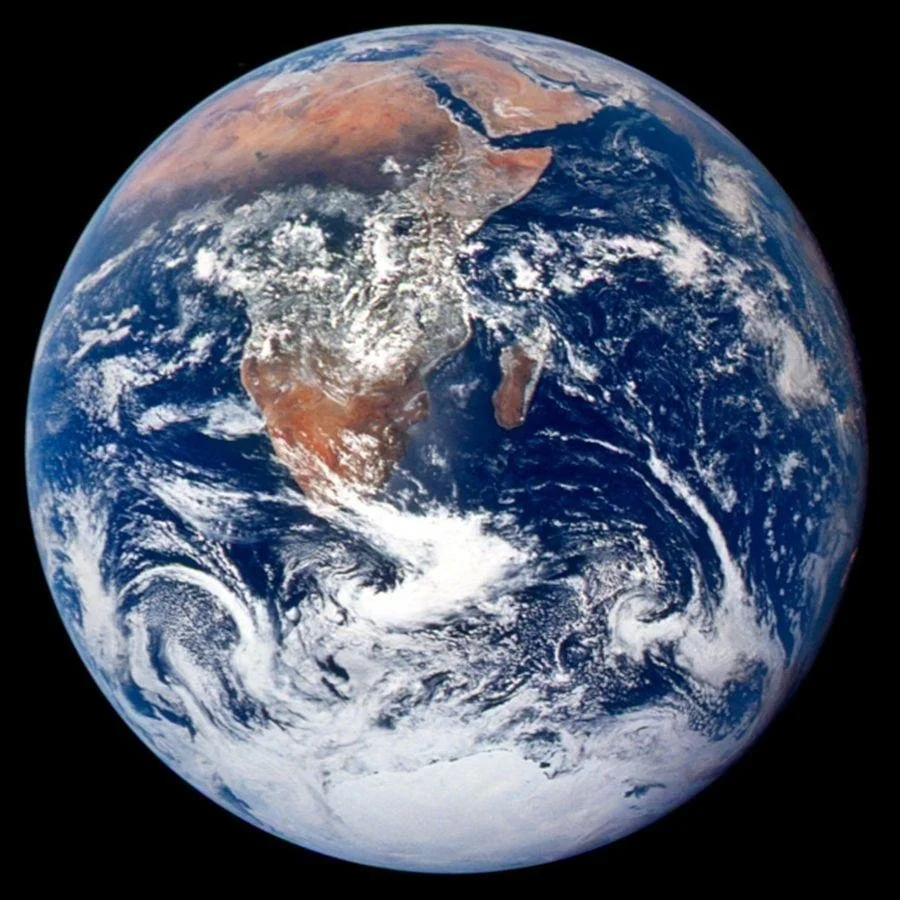
The Blue Marble, 1972
Captured during Apollo 17, this famous photograph presents a nearly fully illuminated Earth against the darkness of space.

The Pale Blue Dot, 1990
Captured by Voyager 1 from approximately 6 billion kilometers away, this image reveals Earth as a tiny point of light within the vastness of space.
Each image offers a different perspective on our planetary home.
Together, they reveal the extraordinary relationship between Earth's beauty and its place within the immense universe.
The Pale Blue Dot and the Perspective of Distance
The Pale Blue Dot image inspired astronomer Carl Sagan to reflect on humanity's place within the cosmos.
In the photograph, Earth appears as a tiny point of light.
The continents, oceans, cities, and landscapes familiar to us cannot be distinguished.
Yet every human life that had unfolded up to that moment belonged to that distant world.
The image offers a perspective different from the close, detailed views captured by astronauts.
Rather than revealing Earth's colors and natural systems, it emphasizes the immense scale of space and the remarkable fact that our entire civilization occupies one small planet.
It is another powerful invitation to consider the meaning of our shared existence.
Bringing the Overview Effect Into Everyday Life
The full experience of viewing Earth from space is extraordinary.
But its central lesson can enrich everyday life.
Perspective influences what we notice, what we value, and how we understand our experiences.
A wider perspective can reveal beauty and connection that ordinary routines sometimes conceal.
Look at Earth as a Whole
Find a photograph of Earth taken from space.
Spend a few moments observing its oceans, atmosphere, and clouds.
Consider the extraordinary reality represented by the image.
Every person you have ever met lives somewhere on that planet.
Every landscape you have visited belongs to the same world.
The image is not simply a distant photograph.
It is a portrait of home.
Notice the Extraordinary Within the Familiar
The atmosphere that appears so delicate from orbit surrounds us every day.
The sunlight illuminating Earth's surface is the same sunlight that warms our skin.
The clouds visible from space are part of the weather systems moving above our homes.
The oceans photographed by astronauts are connected to the rivers, rain, and water cycles we experience.
Recognizing these relationships can make familiar surroundings feel extraordinary.
Allow Wonder to Expand Your Perspective
Awe does not require a spacecraft.
It can arise while watching a sunrise, contemplating the stars, standing beside the ocean, or witnessing the beauty of nature.
These experiences offer opportunities to become more aware of the larger world.
They may also help us recognize that our immediate concerns exist within a much broader reality.
Carry the Perspective Into Human Relationships
The Overview Effect reminds us that every person belongs to the same planetary home.
People have different histories, beliefs, cultures, and experiences.
Yet we share fundamental needs for connection, belonging, and a world capable of sustaining life.
Remembering this shared existence can encourage compassion and understanding.
The perspective does not require agreement on every issue.
It simply invites us to recognize the humanity we share.
A Reflection for Seeing Earth With New Eyes
Imagine looking back at Earth from far beyond its surface.
See the brilliant oceans.
Notice the white clouds moving across continents.
Observe the thin atmosphere glowing against the darkness.
Remember that every forest, mountain, river, and human life exists somewhere within that beautiful world.
Then consider these questions.
What becomes more meaningful when I view my life as part of the larger world?
What beauty have I grown so accustomed to that I rarely notice it?
How might gratitude change the way I experience ordinary moments?
What does it mean to belong to a planet filled with such extraordinary life?
How can I carry a greater sense of connection into my everyday experiences?
There is no single answer to these reflections.
Their purpose is to open a doorway to wonder.
Sometimes the most meaningful discoveries arise when we allow ourselves to see familiar things differently.
What the Overview Effect May Teach Future Generations
Human space exploration continues to expand.
Future missions may bring astronauts farther from Earth, return humans to the lunar surface, and eventually carry explorers toward Mars.
Commercial spaceflight may also allow more people to experience Earth from beyond its atmosphere.
As these opportunities develop, scientists may gain a deeper understanding of how space travel influences human awareness.
The Overview Effect raises fascinating questions about the future.
Could viewing Earth as a whole encourage a stronger sense of planetary responsibility?
Could immersive educational experiences help young people appreciate the interconnectedness of life?
Could awe inspire greater curiosity about science, nature, and the universe?
Could expanded perspective influence how humanity approaches shared challenges?
Research is beginning to explore these possibilities.
Yet one of the most meaningful contributions of the Overview Effect may already be available to us.
It reminds us that the way we see the world can influence the way we live within it.
Frequently Asked Questions About the Overview Effect
What is the Overview Effect?
The Overview Effect is a shift in awareness experienced by some astronauts when viewing Earth from space. It can involve powerful feelings of awe, interconnectedness, planetary unity, and a deeper appreciation for life.
Who first described the Overview Effect?
Space philosopher Frank White introduced the term in his 1987 book The Overview Effect: Space Exploration and Human Evolution. Astronauts had reported similar experiences before the term was established.
What happens to astronauts when they see Earth from space?
Many astronauts describe intense wonder, emotional connection, and a new appreciation for Earth's beauty. Some report lasting changes in their priorities, environmental awareness, or understanding of humanity.
Does the Overview Effect change the brain?
Research using virtual reality simulations has identified changes in EEG activity during overview-like experiences. A 2024 study observed reductions in beta and gamma spectral power during key moments. Scientists are continuing to investigate what these responses reveal about awe and perception.
Does the Overview Effect affect the heart and nervous system?
Research suggests that simulated Overview Effect experiences can produce measurable physiological responses. A 2026 study reported changes in heart rate and heart-rate variability, along with peaks in skin conductance during significant moments of the experience.
Is the Overview Effect a spiritual experience?
For some astronauts, the experience has profound spiritual significance. Others describe it through feelings of awe, connection, environmental appreciation, or philosophical reflection. Its meaning varies among individuals.
What is the small-self effect?
The small-self effect describes a shift in awareness during awe in which personal concerns become less prominent relative to something larger. It can encourage feelings of humility and connection without diminishing individuality.
Can virtual reality recreate the Overview Effect?
Virtual reality can simulate viewing Earth from space and evoke some of the emotions associated with the Overview Effect. Research has documented awe and measurable physiological responses, although simulations do not fully reproduce actual spaceflight.
Why do astronauts say Earth has no borders?
From space, most political boundaries are not visible as physical lines. Astronauts see continents, oceans, weather systems, and natural landscapes, often inspiring a stronger awareness of humanity's shared planetary home.
What is the connection between the Overview Effect and environmental awareness?
Many astronauts report a greater appreciation for Earth's natural systems after seeing the planet from space. Scientific reviews have found evidence of environmental concern in astronaut accounts, while results from simulated experiences have been less conclusive about lasting behavioral change.
What is the difference between the Overview Effect and awe?
Awe is a broad emotional response to something vast or extraordinary. The Overview Effect refers specifically to the psychological shift associated with seeing Earth from space, often involving awe, planetary connection, and a changed understanding of humanity's place in the universe.
Can the Overview Effect happen on Earth?
People can experience similar feelings of awe and expanded perspective through nature, contemplation, photographs, and virtual reality. These experiences may share characteristics with the Overview Effect, although they are not identical to seeing Earth directly from space.
Why is the Earthrise photograph important?
The 1968 Earthrise photograph captured by William Anders during Apollo 8 offered humanity an extraordinary view of Earth above the Moon's horizon. It became an enduring symbol of planetary beauty, unity, and environmental awareness.
What did Edgar Mitchell experience during Apollo 14?
Edgar Mitchell described a profound feeling of universal connection during his return from the Moon. The experience influenced his later exploration of consciousness, spirituality, and the relationship between human awareness and the universe.
Can the Overview Effect permanently change someone's life?
Some astronauts describe lasting changes in their values, priorities, and sense of connection. The extent and permanence of these changes vary, and researchers are continuing to investigate their long-term effects.
A Final Reflection: The World Was Always Magnificent
Imagine traveling thousands of miles beyond everything familiar.
The cities disappear.
The landscapes merge into sweeping patterns.
The oceans become magnificent expanses of blue.
And there, surrounded by the vastness of space, is the world that has held every moment of your life.
From this extraordinary distance, Earth appears complete.
Its atmosphere glows with delicate color.
Its clouds move across continents.
Its oceans reflect the light of the Sun.
Every living thing exists within the same beautiful planetary home.
The Overview Effect reminds us that sometimes the greatest transformations begin with a change in perspective.
We may spend our lives looking at the world through the details of everyday experience, never fully recognizing the magnificence of the whole.
Yet that magnificence has always been present.
The atmosphere has always surrounded us.
The oceans have always connected distant shores.
The stars have always illuminated the night.
And humanity has always shared one extraordinary home.
Perhaps the greatest gift of the Overview Effect is not simply that astronauts return with a new understanding of Earth.
It is that their experiences invite all of us to look again.
To recognize beauty where we once saw only familiarity.
To discover connection where we once noticed separation.
To appreciate the extraordinary world that holds our ordinary lives.
Earth does not become more magnificent when viewed from space. The view simply reveals a magnificence that has been present all along.
And perhaps we do not need to travel beyond the atmosphere to begin seeing our world with that same sense of wonder.
Sometimes all it takes is opening our eyes to the miracle of where we already are.
Continue Exploring
Awe: What Wonder Does to the Mind, Body and Soul
Explore how extraordinary experiences influence human awareness, emotion, connection, and the way we perceive the world.
Stardust: The Ancient Elements Within the Human Body
Discover the cosmic origins of the elements within us and the remarkable relationship between human life and the universe.
The Fine Balance That Makes Life Possible
Explore the extraordinary natural conditions and relationships that allow life to flourish.
The Observer Within: Awareness, Attention and the Inner Witness
Discover how attention, observation, and inner awareness shape our experience of everyday life.
Sacred Time: Why Some Moments Feel Larger Than the Clock
Explore why certain experiences seem to expand our sense of time and leave a lasting impression on the soul.