

Molybdenum for Enzyme Function, Sulfite Metabolism and Whole-Body Wellness
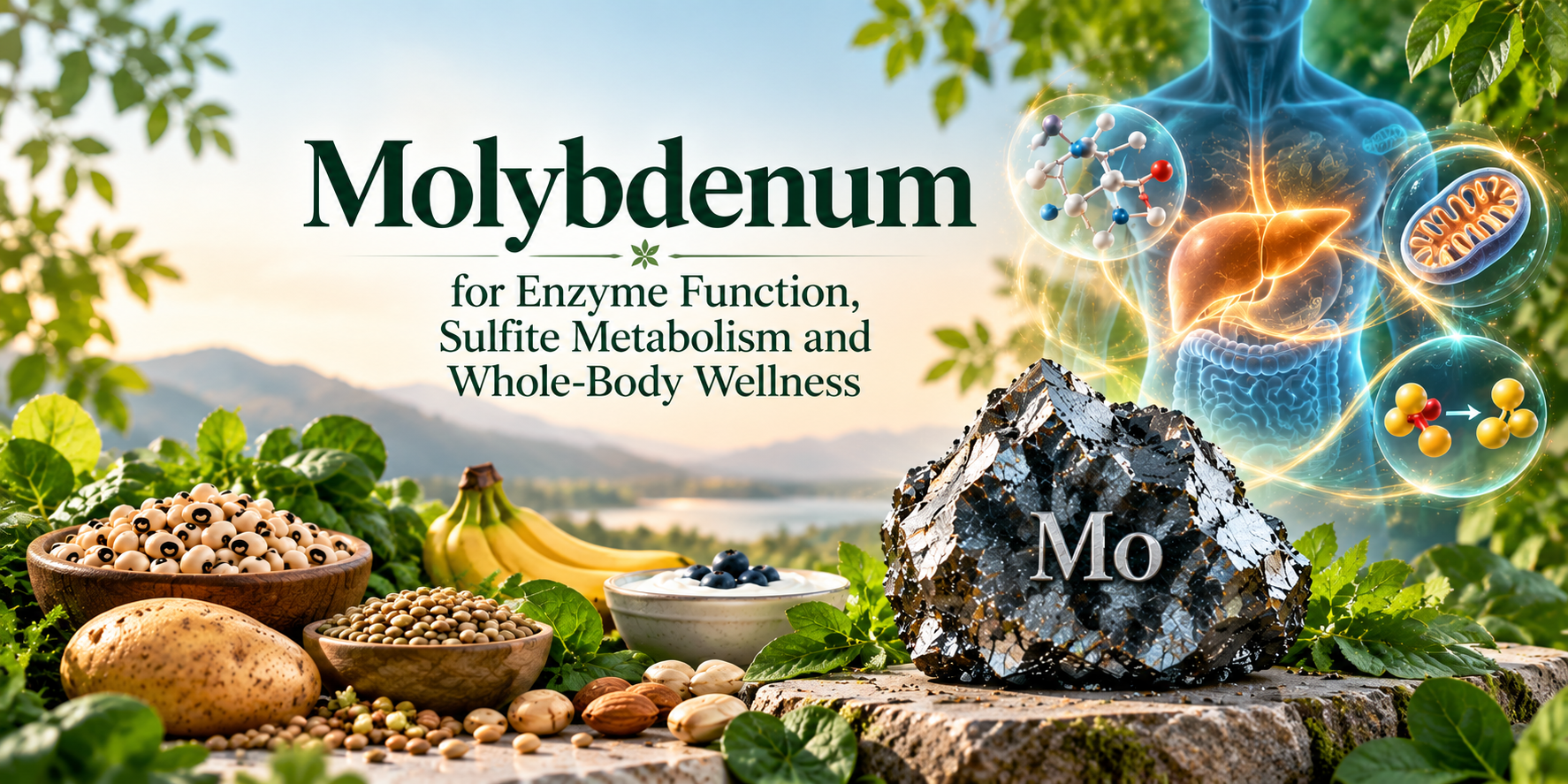
Molybdenum is needed in quantities so small they are measured in micrograms, yet this essential trace mineral helps make some remarkably important chemistry possible throughout the human body.
Rather than building bones or becoming part of a large body structure, molybdenum works primarily behind the scenes. The body incorporates it into a specialized molecule called the molybdenum cofactor, which allows several important enzymes to function.
Through these enzymes, molybdenum participates in sulfur metabolism, the conversion of sulfite into sulfate, the metabolism of purines and pyrimidines, the processing of certain medications and other compounds, and specialized cellular reactions scientists continue to investigate.
Most people obtain plenty of molybdenum through ordinary foods, and true dietary deficiency is extraordinarily rare.
Molybdenum is therefore not a story about needing large amounts.
It is a story about how an almost unimaginably small amount of a nutrient can help essential biological pathways continue working every day.
What Is Molybdenum?
Molybdenum is an essential trace mineral.
The human body cannot manufacture molybdenum, so small amounts must come from the diet.
Unlike calcium, phosphorus or magnesium, relatively little molybdenum is present in the body. But the quantity of a nutrient does not determine its biological importance.
Molybdenum's primary role comes from its incorporation into a remarkable structure known as the molybdenum cofactor, often abbreviated Moco.
This cofactor is required for the function of four known human molybdenum-dependent enzyme systems:
sulfite oxidase
xanthine oxidoreductase, commonly discussed as xanthine oxidase
aldehyde oxidase
mitochondrial amidoxime reducing components, known as mARC proteins
Together, these enzymes participate in sulfur-containing amino-acid metabolism, purine and pyrimidine metabolism, and the transformation of certain medications and other compounds.
The Molybdenum Cofactor
The molybdenum cofactor helps explain how such a tiny amount of this mineral can matter so much.
The body does not simply distribute free molybdenum throughout its cells.
Instead, molybdenum becomes incorporated into a specialized molecular structure involving molybdopterin, creating the molybdenum cofactor.
That cofactor is then incorporated into molybdenum-dependent enzymes.
Within those enzymes, molybdenum participates in oxidation-reduction reactions involving the movement of electrons and oxygen atoms between molecules.
These microscopic reactions allow larger metabolic pathways to proceed.
A trace mineral becomes part of a cofactor.
The cofactor becomes part of an enzyme.
The enzyme transforms another molecule.
And that transformation becomes one step within the enormous interconnected chemistry of the human body.
Sulfite Oxidase
One of molybdenum's clearest and most important roles involves an enzyme called sulfite oxidase.
Sulfite oxidase is located within mitochondria and requires the molybdenum cofactor to function.
Its primary job is to convert:
Sulfite → Sulfate
This conversion matters because sulfite is a reactive sulfur compound produced during normal sulfur metabolism.
Sulfate is a more oxidized form of sulfur that can participate in other biological processes or eventually be eliminated from the body.
Without properly functioning sulfite oxidase, sulfite and related sulfur metabolites can accumulate.
Molybdenum therefore occupies an essential position within this pathway.
Molybdenum and Sulfur-Containing Amino Acids
Sulfur is a natural and essential part of human biology.
Two important amino acids, methionine and cysteine, contain sulfur.
As sulfur-containing amino acids move through normal metabolic pathways, sulfite can be generated. Sulfite oxidase then helps complete an important stage of sulfur metabolism by converting sulfite into sulfate.
Molybdenum therefore participates indirectly in the normal metabolism of sulfur-containing amino acids.
This relationship is sometimes simplified online into descriptions of molybdenum as a "sulfur detox" mineral.
The actual biology is more precise.
Molybdenum is not simply removing sulfur from the body.
It is an essential component of an enzyme responsible for a specific chemical transformation within normal sulfur metabolism.
What About Sulfites in Food?
Sulfites can occur naturally in some foods and beverages and can also be used as preservatives.
Because sulfite oxidase requires molybdenum, molybdenum supplements are sometimes promoted for people who experience reactions to dietary sulfites.
There is a genuine biochemical connection:
Molybdenum is required for normal sulfite oxidase activity.
However, that does not mean ordinary sulfite sensitivity is usually caused by molybdenum deficiency.
Most people already consume adequate molybdenum, and dietary molybdenum deficiency is extraordinarily rare.
Molybdenum supplementation has not been established as a general treatment for sulfite sensitivity.
Understanding the pathway is useful.
Assuming that more molybdenum automatically improves the pathway is a different claim.
Xanthine Oxidoreductase and Purine Metabolism
Another molybdenum-dependent enzyme is xanthine oxidoreductase.
This enzyme participates in the metabolism of purines.
Purines are naturally occurring compounds found throughout the human body and in many foods. They are also important components of DNA and RNA.
During normal purine breakdown, xanthine oxidoreductase helps catalyze reactions that eventually contribute to the production of uric acid.
Molybdenum therefore participates indirectly in this pathway because the enzyme requires a molybdenum-containing cofactor.
This is another example of why essential nutrients are not necessarily more beneficial when consumed in increasingly large amounts.
Molybdenum is required for normal enzyme function.
Once nutritional requirements have been met, more molybdenum does not automatically mean better metabolism.
Molybdenum, Purines and Pyrimidines
Molybdenum-dependent enzymes also participate in the metabolism of heterocyclic compounds that include both purines and pyrimidines.
Purines and pyrimidines form the nitrogen-containing bases used in DNA and RNA.
Purines include adenine and guanine.
Pyrimidines include cytosine, thymine and uracil.
These molecules are constantly being created, used, recycled and broken down as cells maintain and renew themselves.
Molybdenum does not directly build DNA or RNA.
Its role lies within some of the enzyme systems involved in processing compounds associated with these larger metabolic pathways.
Molybdenum and Uric Acid
Because xanthine oxidoreductase participates in uric-acid formation, researchers have long been interested in whether extremely high molybdenum exposure could influence uric-acid levels.
Very high exposure has been associated with elevated uric acid and gout-like symptoms in some reports.
These situations involved unusually high exposure rather than the amounts normally obtained through food.
For most people, naturally molybdenum-rich foods are not a concern.
Instead, this relationship illustrates an important principle of nutrition:
Essential does not mean unlimited.
The body needs enough molybdenum to support normal physiology.
That does not mean increasingly large amounts produce increasingly greater benefits.
Aldehyde Oxidase
Molybdenum is also required by aldehyde oxidase.
Aldehyde oxidase helps transform a variety of molecules and participates in the metabolism of certain medications and other compounds.
Researchers study this enzyme partly because differences in its activity can influence how particular substances are processed.
Its role demonstrates the remarkable specificity of molybdenum biology.
A very small amount of one mineral becomes part of an enzyme that can influence the transformation of entirely different molecules.
Molybdenum and the Body's Natural Processing Systems
Molybdenum is sometimes described as a "detox mineral."
There is some biological reasoning behind this description because several molybdenum-dependent enzymes participate in transforming compounds, including certain drugs and other substances.
But the body's processing and elimination systems involve much more than molybdenum.
The liver, kidneys, digestive tract, lungs, antioxidant systems and numerous enzymes work together continuously to process compounds produced inside the body as well as substances encountered from the environment.
Molybdenum is best understood as one small but essential participant within this much larger metabolic network.
The Emerging Story of mARC
Some of the most fascinating modern molybdenum research involves proteins called mitochondrial amidoxime reducing components, particularly mARC1.
These molybdenum-dependent enzymes were recognized much more recently than sulfite oxidase and xanthine oxidoreductase.
mARC proteins are associated with mitochondria and participate in the metabolism of certain nitrogen-containing compounds, including some medications and naturally occurring molecules.
Research has revealed that their biological story may extend considerably further.
Human genetic studies involving MTARC1, the gene encoding mARC1, have associated certain genetic variants with differences in liver fat, liver enzymes, blood lipids and susceptibility to chronic liver disease.
This has created growing scientific interest in mARC1 and its possible involvement in:
mitochondrial metabolism
lipid handling
lipid-droplet biology
fatty-acid metabolism
liver metabolism
metabolic liver disease
Recent experimental research has strengthened the connection between MTARC1 and the way liver cells store and process fat.
Researchers are investigating how changes in MTARC1 activity influence lipid droplets, triglyceride breakdown, fatty-acid handling, inflammation and other aspects of liver metabolism.
What the mARC Research Does Not Mean
The emerging mARC research is exciting, but an important distinction needs to be maintained.
Research showing that genetic variation or experimental manipulation of MTARC1 changes liver and lipid biology does not demonstrate that taking additional molybdenum will prevent or treat fatty liver disease.
Changing the activity or expression of an enzyme genetically is not the same as increasing dietary intake of the mineral contained within its cofactor.
The research is revealing previously unrecognized dimensions of molybdenum-dependent biology.
It is not currently evidence for treating metabolic liver disease with molybdenum supplements.
The distinction matters because an intriguing biochemical relationship can sometimes become an exaggerated supplement claim long before human evidence exists.
Molybdenum and Nitric Oxide Research
Another intriguing area of research involves nitric oxide.
Several molybdenum-dependent enzymes have demonstrated the ability under certain experimental conditions to convert nitrite into nitric oxide.
Nitric oxide is an important signaling molecule involved in blood-vessel function and numerous other physiological processes.
Researchers have therefore investigated whether molybdenum-dependent enzymes may contribute to alternative nitric-oxide pathways, particularly when oxygen availability is limited.
The physiological importance of these reactions in humans is still being investigated.
At present, this research should be understood as an interesting area of molybdenum enzyme biology rather than evidence that additional dietary molybdenum increases nitric-oxide production or provides cardiovascular benefits.
Molybdenum and DNA and RNA Metabolism
Molybdenum is sometimes described as supporting genetic material.
The relationship is indirect but interesting.
Purines and pyrimidines are fundamental components of DNA and RNA.
Cells continually build, repair, recycle and break down molecules associated with genetic material.
Molybdenum-dependent enzymes participate in some of the metabolic pathways that process these compounds.
It would therefore be misleading to describe molybdenum as a nutrient that directly "builds DNA."
Its role is better understood as supporting enzymes participating in the broader metabolism of compounds associated with DNA and RNA turnover.
Molybdenum and Cellular Metabolism
The enzymes that depend on molybdenum perform specialized oxidation-reduction reactions.
These reactions are fundamental to cellular chemistry.
Cells constantly transform molecules from one chemical form into another.
Some molecules are used.
Some are recycled.
Some become components of other substances.
Others must be modified before additional metabolism or elimination can occur.
Through its enzyme systems, molybdenum participates in:
sulfur metabolism
sulfite-to-sulfate conversion
sulfur-containing amino-acid metabolism
purine and pyrimidine metabolism
normal uric-acid production pathways
metabolism of certain medications and compounds
specialized mitochondrial-associated enzyme activity
cellular oxidation-reduction chemistry
A nutrient can therefore have considerable biological importance without being needed in large quantities.
How Much Molybdenum Do We Need?
The amount of molybdenum required by the human body is remarkably small.
Recommended Dietary Allowance
Adults 19 years and older
45 mcg per day
Pregnancy
50 mcg per day
Breastfeeding
50 mcg per day
Teenagers ages 14–18
43 mcg per day
Children ages 9–13
34 mcg per day
Children ages 4–8
22 mcg per day
Children ages 1–3
17 mcg per day
For infants, Adequate Intake levels rather than RDAs have been established:
Birth through 6 months
2 mcg per day
7–12 months
3 mcg per day
The Daily Value used on U.S. nutrition and supplement labels for adults and children age four and older is 45 mcg.
To appreciate how tiny the adult requirement really is:
45 mcg = 0.045 mg
A thousand micrograms equal only one milligram.
Molybdenum truly earns the description trace mineral.
Foods Rich in Molybdenum
Molybdenum occurs naturally in many foods.
Legumes are among the richest sources.
Approximate amounts found in selected foods include:
FoodApproximate MolybdenumBlack-eyed peas, cooked, ½ cup288 mcgBeef liver, 3 ounces104 mcgLima beans, cooked, ½ cup104 mcgPlain low-fat yogurt, 1 cup26 mcgMilk, 2%, 1 cup22 mcgBaked potato with skin, medium16 mcgBanana, medium15 mcgWhole-wheat bread, 1 slice12 mcgDry-roasted peanuts, 1 ounce11 mcgEgg, large9 mcgCooked spinach, ½ cup8 mcgCheddar cheese, 1 ounce6 mcg
Other sources can include:
lentils
beans
peas
whole grains
nuts
leafy vegetables
dairy products
eggs
poultry
organ meats
The adult requirement is only 45 mcg per day, while a single serving of certain legumes can contain considerably more.
This helps explain why dietary molybdenum deficiency is so uncommon.
Molybdenum values in foods are estimates and can vary considerably because plant concentrations depend partly on the molybdenum content and chemistry of the soil and irrigation water where foods are grown.
From Soil to Food to Human Biology
Molybdenum has a particularly interesting connection with the earth.
The amount found in plant foods can vary according to the molybdenum concentration and chemistry of the soil in which those plants grow.
Irrigation water and local growing conditions can also influence concentrations.
This creates a remarkable nutritional journey.
A mineral begins in the earth.
Plants take it up through their roots.
Those plants enter the food supply.
Molybdenum enters the human body.
And eventually some of those molybdenum atoms become incorporated into cofactors sitting inside microscopic enzymes.
The distance between soil and cellular chemistry is smaller than it appears.
How Well Is Molybdenum Absorbed?
Molybdenum is generally absorbed efficiently, although absorption varies according to dietary source and other conditions.
Adults are estimated to absorb approximately 40% to 100% of dietary molybdenum.
Controlled human experiments have found absorption approaching approximately 90% under certain dietary conditions, but those findings should not be interpreted as a universal absorption rate.
The food itself can matter.
Molybdenum from some foods appears to be highly bioavailable, while absorption from other food matrices can be lower.
This is another example of why the amount of a nutrient present in food does not always tell the entire nutritional story.
What enters the digestive system and what ultimately becomes available to the body are related but not identical measurements.
The Kidneys Help Maintain Molybdenum Balance
The kidneys are the primary regulators of molybdenum levels in the body and are responsible for much of its excretion.
When molybdenum intake rises, urinary excretion generally rises.
When intake falls, the body can conserve more.
This provides a built-in regulatory mechanism that helps maintain molybdenum balance across different levels of dietary intake.
In healthy people, this ability to increase urinary elimination is one reason normal dietary molybdenum intake rarely creates problems.
Molybdenum associated with molybdopterin can also be found in tissues including the:
liver
kidneys
adrenal glands
bones
Yet molybdenum's biological importance comes primarily from its functional role within enzymes rather than from maintaining a large storage reservoir.
Can Molybdenum Status Be Tested?
Molybdenum status is not routinely assessed in clinical practice.
One major reason is simple:
Dietary molybdenum deficiency is extraordinarily rare.
Although molybdenum can be measured in blood or urine, urinary molybdenum primarily reflects exposure and excretion and does not reliably indicate whether someone's nutritional molybdenum status is adequate.
For most people eating a varied diet, routine molybdenum testing is unnecessary.
Molybdenum Deficiency
True dietary molybdenum deficiency is exceptionally rare.
There are currently no recognized groups of otherwise healthy people considered routinely at risk for inadequate molybdenum intake.
A historical case of acquired deficiency was reported in a person receiving long-term intravenous nutrition that did not contain molybdenum. The abnormalities improved when molybdenum was provided.
Outside unusual medical circumstances and rare inherited disorders affecting molybdenum metabolism, clinically meaningful deficiency is rarely encountered.
This makes molybdenum quite different from nutrients such as iron, vitamin D or vitamin B12, where inadequate status is much more common.
For most people, ordinary food supplies more than enough.
Molybdenum Cofactor Deficiency Is Different
There is an extremely rare inherited disorder known as molybdenum cofactor deficiency.
Despite the similar name, this is fundamentally different from failing to consume enough molybdenum.
Genetic changes interfere with the body's ability to produce the molybdenum cofactor required by molybdenum-dependent enzymes.
Loss of normal sulfite oxidase activity is particularly serious because sulfite and related metabolites can accumulate and damage the nervous system.
The disorder usually appears very early in life and can cause severe neurological disease.
For one form of the condition, molybdenum cofactor deficiency type A, a targeted treatment called fosdenopterin can provide a synthetic form of an intermediate needed during molybdenum-cofactor production.
This rare condition demonstrates something extraordinary about nutrient biology.
Having a mineral available is only part of the story.
The body must also possess the molecular machinery required to transform that mineral into a form its enzymes can actually use.
Can You Get Too Much Molybdenum?
Yes.
Molybdenum naturally present in foods is generally not a concern.
Excess becomes more relevant with unusually high supplemental, occupational or environmental exposure.
The tolerable upper intake level for adults is:
2,000 mcg per day
That equals:
2 mg per day
Compare this with the adult recommended intake of only 45 mcg per day.
Extremely high exposure has been associated with elevated uric acid, joint discomfort and gout-like symptoms.
The upper limit should not be confused with an optimal intake.
It represents the highest average daily intake considered unlikely to pose a risk for most healthy people.
It is not a nutritional target.
Molybdenum and Copper
Molybdenum has an interesting relationship with copper.
Very high molybdenum exposure can interact with copper metabolism, particularly in the presence of sulfur.
This relationship is especially well established in ruminant animals, where molybdenum, sulfur and copper can interact strongly enough to influence copper availability.
Human metabolism is different.
It has not been clearly established that ordinary dietary molybdenum intake meaningfully depletes copper in humans.
The animal findings are scientifically important, but they should not automatically be applied to people.
For humans, the practical message remains straightforward:
Normal dietary molybdenum intake is generally safe, while unnecessary high-dose supplementation offers little established advantage.
Molybdenum Supplements
Molybdenum is available in:
multivitamin-mineral products
trace-mineral formulas
combination mineral products
stand-alone molybdenum supplements
Supplemental products commonly provide approximately 50 to 500 mcg of molybdenum.
Forms can include:
molybdenum chloride
sodium molybdate
molybdenum glycinate
molybdenum amino-acid chelates
Research has not established that one commonly marketed supplemental form is meaningfully more bioavailable than another.
This is worth remembering when products use terms such as "highly absorbable" or "superior form."
For most people eating a varied diet, supplementation is unlikely to be necessary because deficiency is so uncommon.
Does Molybdenum Interact With Medications?
There are currently no known clinically relevant interactions between molybdenum and medications.
That does not mean every possible interaction has been studied.
It means that molybdenum is not currently recognized as having established clinically important medication interactions at normal nutritional or supplemental exposures.
Is More Molybdenum Better?
There is no evidence that continually increasing molybdenum intake produces continually increasing health benefits.
This is especially important with trace minerals.
Their biological value often depends on supplying enough for enzymes and other systems to function normally.
Once those needs are satisfied, substantially increasing intake may provide no additional advantage.
For molybdenum, the adult requirement is only 45 mcg per day, dietary deficiency is extraordinarily uncommon, and many ordinary foods provide meaningful amounts.
The goal is therefore best understood as:
Adequacy rather than excess.
What Molybdenum Does Not Need to Become
Molybdenum is fascinating enough without turning it into something it is not.
It does not need to be presented as a miracle detoxifier.
It does not need a long list of unsupported disease claims.
And it does not need to become another nutrient people believe they must consume in enormous supplemental doses.
Its real biology is more interesting.
A microscopic amount of molybdenum becomes incorporated into an exquisitely specialized molecular cofactor.
That cofactor activates enzymes.
Those enzymes process sulfur compounds, participate in purine and pyrimidine metabolism, transform certain molecules and contribute to metabolic pathways scientists are still uncovering.
That is already remarkable.
A Tiny Mineral With Remarkably Important Jobs
Some nutrients announce themselves through their abundance.
Calcium contributes to the mineral structure of bones and teeth.
Iron becomes part of hemoglobin.
Potassium helps establish electrical gradients across cell membranes.
Molybdenum takes a quieter path.
It disappears into enzymes.
There, in quantities almost too small to imagine, it participates in chemistry that allows other molecules to change form.
Through those reactions, molybdenum contributes to:
sulfite-to-sulfate conversion
sulfur-containing amino-acid metabolism
purine and pyrimidine metabolism
normal uric-acid production pathways
metabolism of certain medications and other compounds
specialized mitochondrial-associated enzyme activity
normal cellular oxidation-reduction chemistry
And modern research continues to uncover additional functions of molybdenum-dependent enzymes.
There is still more to learn.
The Bigger Picture
Molybdenum reveals something beautiful about nutrition.
Importance is not measured by size.
The body does not require grams of molybdenum.
It does not even require milligrams.
It requires micrograms.
Yet those micrograms become part of molecular machinery operating continuously inside our cells.
Minerals from the soil become nutrients in food.
Nutrients become components of cofactors.
Cofactors become part of enzymes.
Enzymes transform molecules.
Those molecules move through larger metabolic pathways.
And those pathways become part of the extraordinary chemistry that sustains human life.
Molybdenum may be a trace mineral.
Its presence is tiny.
Its work is anything but insignificant.
Frequently Asked Questions
What does molybdenum do in the body?
Molybdenum becomes part of a specialized cofactor required by several enzymes. These enzymes participate in sulfite and sulfur metabolism, purine and pyrimidine metabolism, uric-acid production pathways and the metabolism of certain drugs and other compounds.
What is the molybdenum cofactor?
The molybdenum cofactor, or Moco, is a specialized molecule containing molybdenum that becomes part of several enzymes and allows them to perform important chemical reactions.
Does molybdenum help process sulfites?
Yes. Molybdenum is required by sulfite oxidase, the enzyme responsible for converting sulfite into sulfate.
Does sulfite sensitivity mean someone is deficient in molybdenum?
Not necessarily. Although molybdenum is required for normal sulfite oxidase activity, ordinary sulfite sensitivity has not been established as evidence of molybdenum deficiency. Dietary deficiency is exceptionally rare.
Does molybdenum help with sulfur metabolism?
Yes. Molybdenum-dependent sulfite oxidase participates in the metabolism of sulfur-containing compounds produced during pathways involving amino acids such as cysteine and methionine.
Is molybdenum a detox mineral?
Molybdenum-dependent enzymes participate in the metabolism of certain drugs and other compounds, but describing molybdenum simply as a detox mineral oversimplifies human physiology. The body's processing and elimination systems involve many organs, enzymes and metabolic pathways.
What foods contain the most molybdenum?
Legumes are among the richest sources. Black-eyed peas, lima beans, lentils and other beans can provide substantial amounts. Whole grains, nuts, dairy foods, potatoes, bananas, leafy vegetables, eggs and organ meats can also contribute molybdenum.
How much molybdenum do adults need?
The recommended dietary allowance for most adults is 45 mcg per day. Pregnancy and breastfeeding increase the recommendation to 50 mcg per day.
Can you be deficient in molybdenum?
Dietary deficiency is extraordinarily rare. There are currently no recognized groups of healthy people considered routinely at risk for inadequate molybdenum intake.
Should molybdenum levels be routinely tested?
Usually not. Molybdenum deficiency is extremely uncommon, so nutritional status is not routinely assessed in clinical practice. Urinary molybdenum also does not reliably indicate nutritional status.
What is molybdenum cofactor deficiency?
Molybdenum cofactor deficiency is a rare inherited metabolic disorder in which the body cannot properly produce the cofactor required by molybdenum-dependent enzymes. It is fundamentally different from dietary molybdenum deficiency.
Does molybdenum affect uric acid?
Molybdenum is required by xanthine oxidoreductase, an enzyme involved in purine metabolism and uric-acid formation. Extremely high molybdenum exposure has been associated with excessive uric acid and gout-like symptoms, but ordinary dietary intake is not generally a concern.
What does mARC1 have to do with molybdenum?
mARC1 is a molybdenum-dependent enzyme associated with mitochondria. Emerging genetic and experimental research is investigating its roles in lipid and liver metabolism. This research does not demonstrate that taking additional molybdenum treats fatty liver disease.
Does molybdenum affect nitric oxide?
Several molybdenum-dependent enzymes can participate in nitrite-to-nitric-oxide reactions under certain experimental conditions. Researchers continue to investigate the physiological importance of these pathways. This does not currently establish additional molybdenum as a way to increase nitric oxide in people.
Does molybdenum affect copper?
Very high molybdenum exposure can interact with copper metabolism, an effect particularly well established in animals. The significance of this interaction at normal dietary molybdenum intakes in humans is much less clear.
Does molybdenum interact with medications?
There are currently no known clinically relevant interactions between molybdenum and medications.
Do most people need a molybdenum supplement?
No. Most people obtain adequate molybdenum from food, and true dietary deficiency is exceptionally uncommon.
Are chelated forms of molybdenum better absorbed?
There is currently insufficient comparative research showing that one commonly marketed supplemental form of molybdenum is more bioavailable than another.
What is the upper limit for molybdenum?
The tolerable upper intake level for adults is 2,000 mcg, or 2 mg, per day. The upper limit is a safety boundary, not an intake goal.
Continue Exploring Trace Minerals and Whole-Body Nutrition
Manganese
Discover how manganese supports enzyme activity, metabolism, connective tissue, bone biology and antioxidant defenses.
Boron
Explore this fascinating trace element and its relationships with bone, mineral metabolism and other areas of human physiology.
Silica and Silicon
Learn about silicon's intriguing connections with connective tissues, bone, skin, hair and whole-body wellness.
Copper
Explore copper's essential roles in energy production, connective tissue formation, iron metabolism and antioxidant enzymes.
Choline
Discover how choline contributes to cell membranes, acetylcholine production, liver function and normal lipid transport.