

The Sacred Geometry of Flowers
Within every blossom, life arranges beauty through pattern, proportion and purpose
A flower may appear soft and effortless, yet beneath its beauty lives an extraordinary architecture.
Petals gather around a center. Seeds form spiraling pathways. Leaves emerge in carefully spaced arrangements. Colors, textures and invisible signals guide pollinators toward the heart of the bloom.
These patterns are not stamped onto flowers like decorations. They arise as the flower grows.
Sacred geometry invites us to see these living patterns as more than measurements. They can become reminders of harmony, relationship and the divine wisdom moving through creation.
A flower does not explain its beauty.
It simply opens.
And perhaps that is one reason flowers have always felt sacred.
Sacred geometry within living form
Sacred geometry is the study and contemplation of meaningful patterns, shapes and proportions found throughout nature, art and spiritual traditions.
Circles, spirals, branching forms, symmetry and repeating arrangements appear in many places:
Flowers and seed heads
Shells and storms
Trees and river systems
Snowflakes and crystals
Human bodies
Sacred art and architecture
The movements of planets and galaxies
In flowers, geometry is alive.
It is shaped by genes, hormones, cell growth, environmental conditions and relationships with pollinators. The resulting form may appear precise, yet it is never rigid. A flower responds to light, weather, soil, injury and the conditions surrounding its growth.
This is one of nature’s great teachings: order does not require lifeless perfection.
Living harmony has room for variation.
How a flower creates its parts
Before a flower displays its petals, its form begins in a tiny region of actively dividing cells called a meristem.
The meristem is a growing center. At first, its cells have not yet become petals, sepals, stamens or carpels. Their identities emerge through carefully timed patterns of genetic activity.
Scientists often explain part of this process through the ABCE model of flower development. Different combinations of developmental regulators help determine which floral structures will form.
These structures generally include:
Sepals, which protect the developing bud
Petals, which often attract and guide pollinators
Stamens, which produce pollen
Carpels, which contain the structures that can develop into seeds and fruit
Ovules, which can become seeds after fertilization
Many of the proteins involved belong to a family known as MADS-box transcription factors. A transcription factor helps regulate which genetic instructions a cell uses.
One scientific explanation, called the floral quartet model, proposes that several of these proteins work together in small groups to help establish the identity of each floral organ.
The wonder is not merely that a flower has the right parts. It is that those parts emerge through relationship.
A petal becomes a petal because many instructions, signals and living processes cooperate.
This offers a beautiful spiritual reflection: identity is not always created in isolation. Sometimes it is revealed through relationship, timing and participation in something greater.
Symmetry within a flower
One of the most recognizable forms of floral geometry is symmetry.
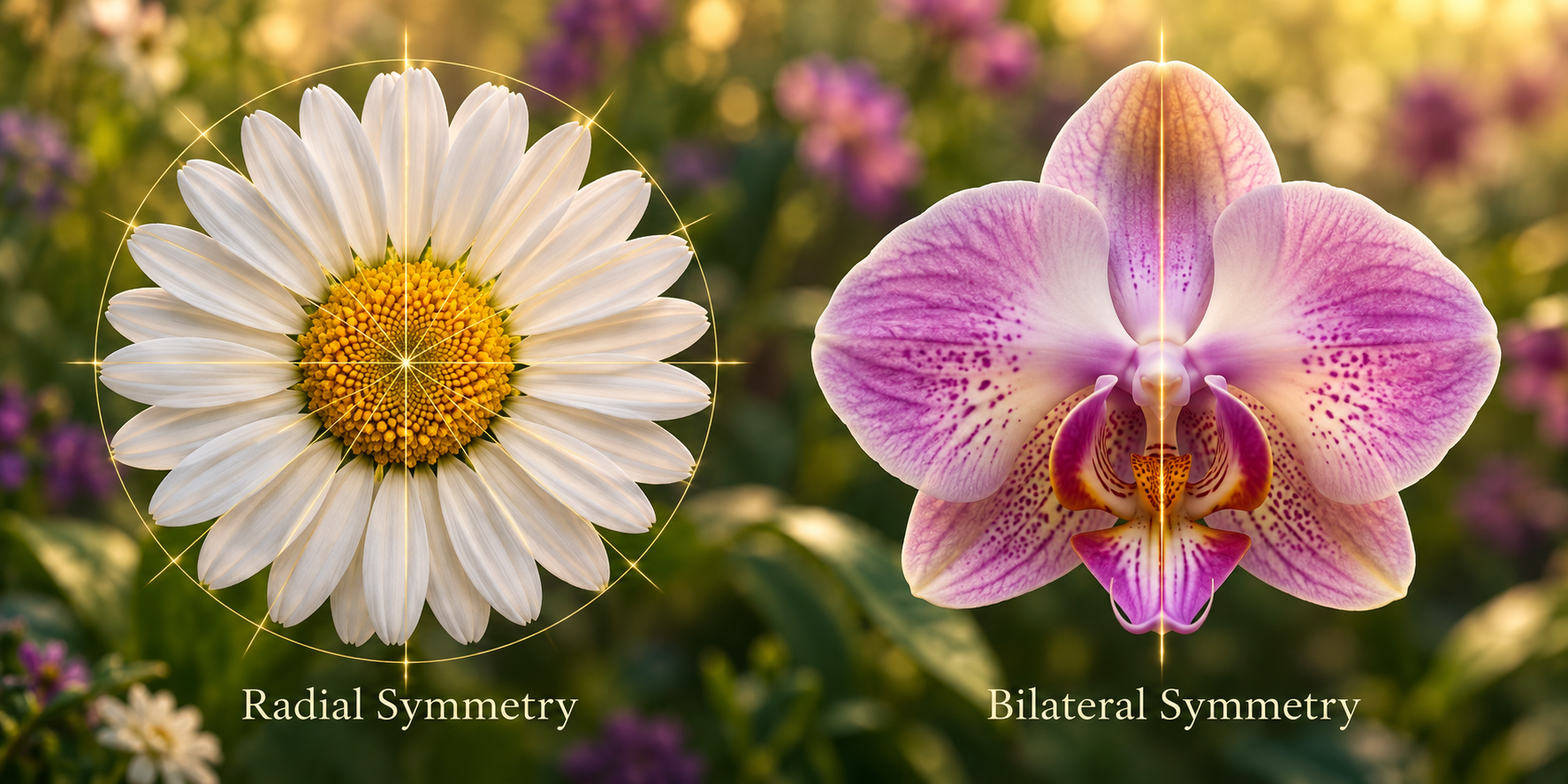
Many flowers possess radial symmetry. Their petals extend outward from a central point, allowing the bloom to be divided into similar sections in several directions.
Daisies, sunflowers, lilies and many wildflowers display variations of this circular organization.
Other flowers have bilateral symmetry. They can be divided into matching halves along one main line. Orchids, snapdragons and many members of the pea family use this more directional design.
These forms are not merely beautiful. They influence how a pollinator approaches the flower.
A radially symmetrical flower may welcome visitors from several directions. A bilaterally symmetrical flower may guide a bee into a more precise position, helping its body contact pollen-bearing structures in a consistent way.
Symmetry therefore becomes both beauty and communication.
It does not only please the human eye. It helps coordinate a relationship between flower and visitor.
Circles, whorls and living centers
Flowers often grow in whorls, with their parts arranged around a central axis.
Sepals may form an outer protective circle. Petals create another circle within it. Reproductive structures occupy circles or spirals closer to the center.
This organization allows many functions to exist within a compact space.
The circle has long represented wholeness, unity, eternity and divine presence. It has no obvious beginning or end. Every point along its edge participates in the same continuous form.
A flower carries this ancient symbol without attempting to symbolize anything.
Its circle is practical, beautiful and alive.
Perhaps that is why standing before a flower can feel like standing before a quiet teaching about belonging. Each petal is distinct, yet each participates in one whole bloom.
Petal numbers and the Fibonacci sequence
Some flowers display numbers connected with the Fibonacci sequence.
The sequence begins simply:
1, 1, 2, 3, 5, 8, 13, 21, 34 and onward.
Each number is created by adding the two preceding numbers.
Flowers are often found with three, five, eight, thirteen or another Fibonacci-related number of petals. Lilies commonly have floral parts arranged in threes. Buttercups often have five petals. Other flowers may display eight, thirteen or many more.
This does not mean every flower follows the sequence.
Petals may be lost, fused, doubled or changed through cultivation and natural variation. Some species regularly use numbers unrelated to the Fibonacci sequence.
The deeper wonder is not that nature obeys a single numerical rule. It is that certain mathematical relationships repeatedly emerge from the process of growth.
The Fibonacci sequence is therefore not a secret code stamped onto every flower. It is one expression of how living forms can organize space efficiently and beautifully.
Spirals within sunflower heads
What appears to be one sunflower is actually a community of many small flowers called florets.
The outer ray florets form the familiar golden “petals,” while the center contains hundreds or sometimes thousands of disk florets. Each disk floret can participate in forming a seed.
These florets are arranged in interwoven spirals. Some appear to curve clockwise, while others curve counterclockwise.
The visible spiral families are called parastichies.
When researchers count these spirals, the totals are often neighboring Fibonacci numbers. This arrangement helps the growing plant place new florets into available spaces without lining them up in wasteful rows.
Large studies of sunflowers have confirmed that Fibonacci-related spiral counts are common. They have also found exceptions and unusual arrangements.
This makes the sunflower even more meaningful.
Its order is real, but it is not mechanical. Its geometry is reliable without becoming absolute. Nature uses pattern while remaining free to respond, adapt and vary.
Golden angle within living growth
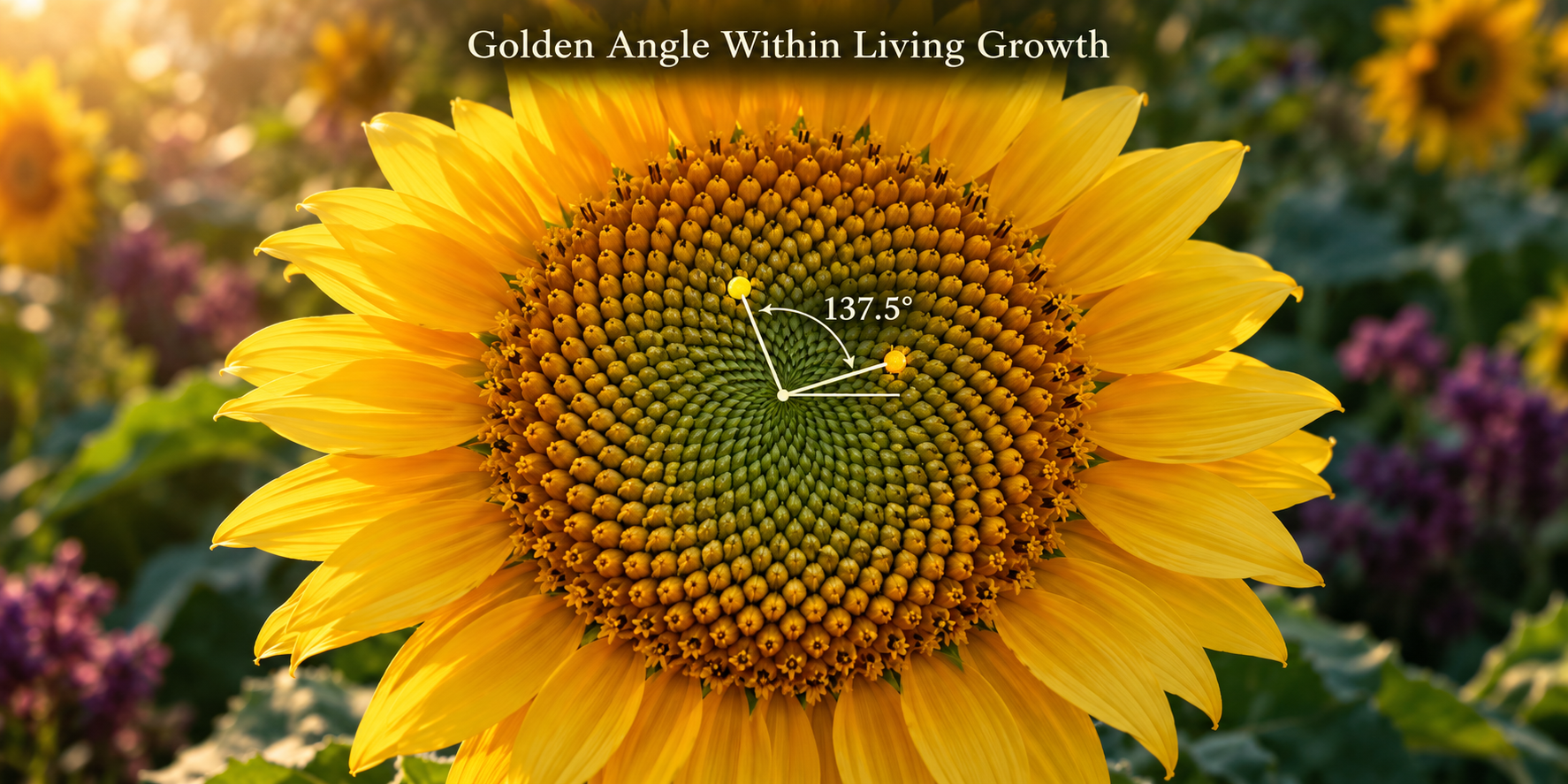
The golden angle is approximately 137.5 degrees.
In many plants, new leaves, florets or other structures emerge at angles close to this value. Because the angle is an irrational fraction of a full circle, successive structures do not repeatedly align in the same direction.
Instead, each new structure tends to occupy an open region.
This can help a plant distribute leaves around a stem or pack florets into a growing flower head without leaving large unused gaps.
The golden angle is related to the golden ratio, a proportion of approximately 1.618. This ratio has fascinated artists, architects, mathematicians and spiritual seekers for centuries.
Yet the beauty of a flower does not depend on a person measuring it and finding a perfect number.
The sacred quality comes from the living process itself: each new part emerges in conversation with what is already there.
Growth honors the past without merely repeating it.
Phyllotaxis and placement of new life
The arrangement of leaves, petals, florets or scales around a growing center is called phyllotaxis.
Phyllotaxis is not planned by a tiny architect inside the plant. It emerges through local interactions among cells, growth and chemical signals.
One important plant hormone is auxin.
Auxin helps regulate growth and development. Within a growing tip, cells transport and concentrate auxin in particular locations. A new leaf, petal or floret can begin where the conditions are favorable.
Once a new structure starts forming, it influences where the next one can appear.
A large pattern is created through many local relationships.
This principle appears throughout life. A community is shaped by individual choices. A path is formed through individual steps. A life becomes visible through moments that may have seemed small while they were happening.
The flower reminds us that the whole can emerge through faithful attention to what is ready to grow next.
Geometry too small for human eyes
The visible outline of a petal is only one layer of its geometry.
Under a microscope, many petals reveal surfaces made of tiny cone-shaped cells. These microscopic forms influence the way light enters and leaves the petal, sometimes making its color appear richer or more intense.
The cones can also provide texture and grip for visiting insects.
Research with snapdragons found that pollinators often preferred flowers with their natural cone-shaped petal cells over altered flowers with flatter cells. What appears to us as a smooth surface can therefore be a meaningful landscape beneath a bee’s feet.
Some flowers possess even smaller ridges that interact with light.
These nanoscale structures can produce subtle structural colors, including a bluish glow sometimes described as a blue halo. Bees can notice these optical effects even when human eyes barely perceive them.
A flower’s beauty is therefore not limited to the scale at which we happen to see.
Beneath the visible pattern is another pattern.
And beneath that may be another.
Creation continues beyond the reach of ordinary sight.
Invisible patterns around a flower
Flowers do not communicate through color alone.
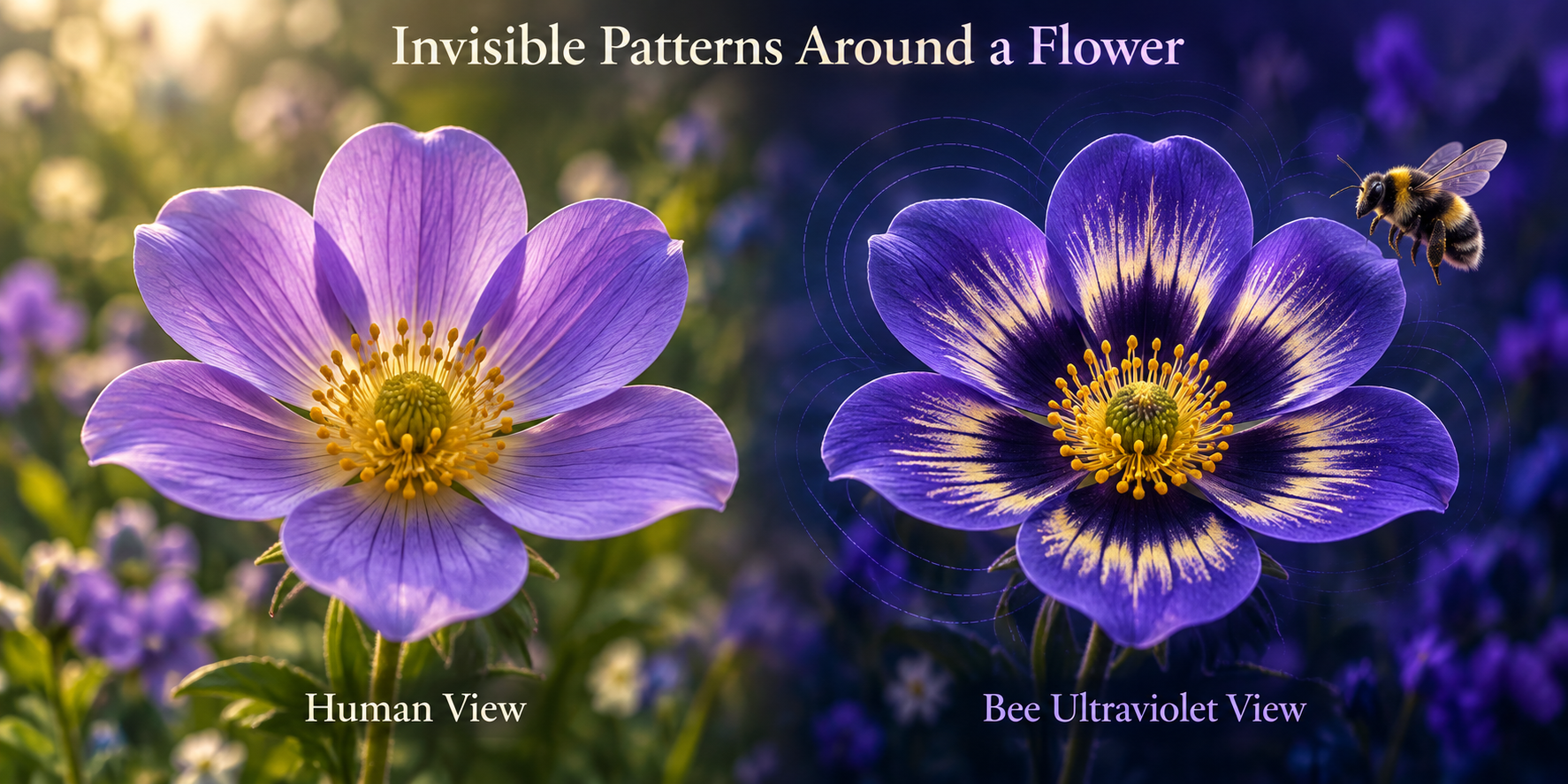
Many petals display ultraviolet patterns that humans cannot naturally see. Bees and certain other pollinators can perceive ultraviolet light, allowing them to notice markings that may resemble rings, pathways or bullseyes.
These patterns often guide the visitor toward nectar and pollen.
A blossom that seems uniformly colored to us may appear richly marked to a bee.
Flowers can also carry weak electric fields.
As bees fly, they can develop a positive electrical charge. Flowers are often electrically negative in relation to the surrounding air and ground. When bee and flower draw near, these differences create delicate electrical interactions.
Studies have shown that bumblebees can learn to distinguish aspects of floral electric fields. Tiny hairs on their bodies can move in response to these fields, helping the bee sense information it cannot see.
A recent visit from another bee may temporarily alter a flower’s electrical condition, adding another subtle layer to the signals surrounding the bloom.
This is a remarkable thought: before a bee even lands, a conversation may already be taking place.
The flower exists within a field of visible and invisible relationship.
Geometry guides the pollinator
Nectar guides are markings that direct pollinators toward a flower’s center. They may be visible to humans, visible only in ultraviolet light or created through differences in color, texture and shape.
The geometry of the bloom helps determine:
Where the pollinator lands
Which direction it faces
How deeply it enters
Where pollen touches its body
How effectively pollen reaches another flower
In some species, bilateral symmetry and the orientation of the blossom guide a visitor into a highly specific position. This can make pollen placement more accurate.
The flower offers nourishment.
The pollinator carries life forward.
Geometry helps bring them together.
This relationship is not based on sameness. Flower and bee are profoundly different beings, yet each participates in the flourishing of the other.
Sacred relationship does not require two lives to become identical. It asks them to meet in a way that allows both to serve life.
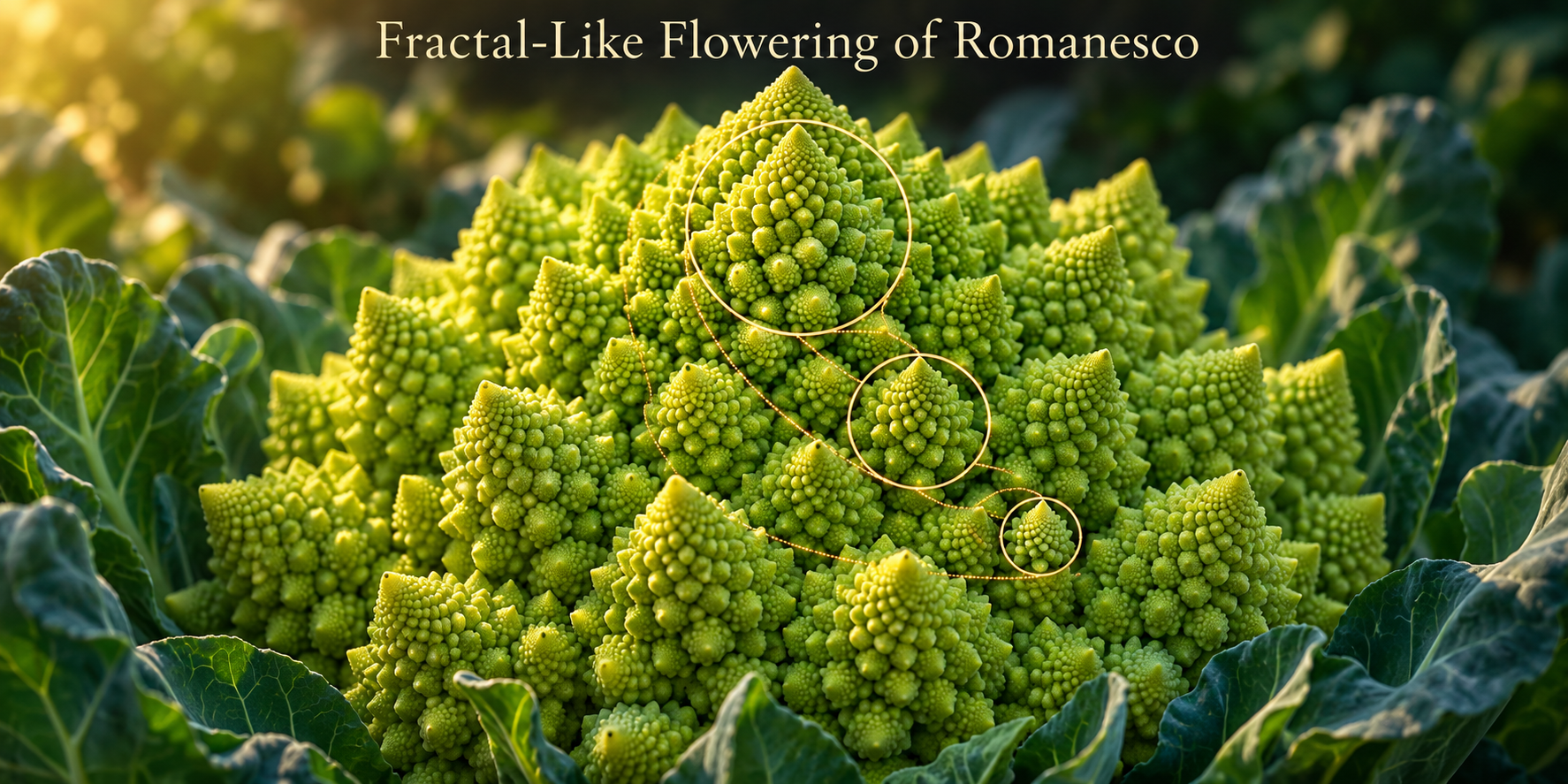
Fractal-like flowering of Romanesco
Romanesco, the luminous green relative of cauliflower and broccoli, offers one of the most striking examples of repeating plant geometry.
Its pointed cones are composed of smaller cones that resemble the larger form. The pattern continues across several scales, creating a structure often described as fractal-like.
A true mathematical fractal may repeat indefinitely. A living Romanesco cannot do that, so “fractal-like” is the more accurate description.
Its unusual shape arises from the behavior of its growing tips, or meristems.
Research suggests that these meristems begin moving toward flower formation but do not complete an ordinary floral identity. They return to a shoot-like pattern and repeat the process. As the growing structures expand at different rates, they form the nested cones associated with Romanesco.
What looks like ornament is the visible history of repeated attempts to grow.
Romanesco offers an unexpected spiritual lesson: a form can become extraordinary through redirection. What does not unfold in the expected way may still create remarkable beauty.
Repetition without exact duplication
Flowers repeat patterns, but they do not create perfect copies.
Two roses from the same plant may differ slightly. One sunflower may have a different spiral count from another. Petals may vary in width, curve, pigment or position.
This variation is not a failure of geometry.
It is part of living geometry.
Machines often repeat by producing identical objects. Life repeats by carrying a recognizable pattern through changing circumstances.
Every daisy is unmistakably a daisy, yet no daisy is required to duplicate another in every detail.
Sacred pattern leaves room for individuality.
We can carry shared values, spiritual truths and ancestral wisdom without losing the particular expression of life entrusted to us.
Flowers and sacred architecture
Across cultures and centuries, builders and artists have used floral geometry in sacred spaces.
Rose windows, mandalas, carved rosettes, mosaics and circular floor plans often echo the radiating organization of flowers.
A rose window gathers individual pieces of colored glass around a center. Light moves through the pattern and fills the interior with color.
The resemblance to a flower is more than visual.
Both forms gather diversity into unity. Both reveal how repeated elements can create a larger harmony. Both invite the eye inward and outward at the same time.
Human beings may have been drawn to floral geometry because flowers already express what sacred architecture hopes to create: a meeting place between matter, light, beauty and meaning.
Consider the lilies
Jesus invited His listeners to “consider the lilies of the field.”
The invitation was not merely to glance at them. To consider is to notice, reflect and allow what we see to teach us.
A flower does not force itself open before its season. It receives light, water and nourishment. It grows according to the life within it.
Its beauty is not earned through anxiety.
The flower participates in creation by becoming what it was made to become.
This does not mean human lives are effortless. It means beauty and worth do not arise only from striving.
There are times to act, build and persevere. There are also times to receive, trust and let faithful growth unfold.
The geometry of a flower can become a gentle reminder that divine wisdom often works through processes we cannot hurry.
Beauty shaped through wisdom
Psalm 104:24 declares:
“How many are your works, Lord! In wisdom you made them all.”
Science helps us examine some of the processes through which flowers form. We can study genes, hormones, cells, symmetry, optics and pollination.
Such knowledge does not have to remove wonder.
It can deepen it.
Knowing that microscopic petal cells help a bee hold on does not make the petal less beautiful. Discovering ultraviolet guides does not make the flower less mysterious. Learning how auxin helps organize growth does not make the process less sacred.
Explanation and reverence can stand together.
Science can describe many of the relationships through which a flower develops. Faith can ask what those relationships awaken within the human soul.
Lessons hidden within the flower
A flower offers its wisdom quietly.
It teaches that a strong center can support an open life.
It shows that growth can follow order without demanding perfection.
It demonstrates that beauty may serve a purpose beyond being admired.
It reminds us that much of reality exists outside our immediate perception.
It reveals that individuality and belonging can coexist.
It shows that relationships can shape identity.
It suggests that divine creativity is not limited to one form, one number or one method.
Perhaps most importantly, the flower does not compare its pattern with the blossom beside it.
It turns toward the light available to it.
A practice of sacred observation
Choose a flower and spend several quiet minutes with it.
If possible, select one you can observe without picking. Let it remain connected to the life supporting it.
Begin with the whole flower.
Notice its overall shape. Is it circular, star-like, cup-shaped or bilaterally symmetrical?
Then look more closely.
Count the petals if they are easy to distinguish. Observe how they overlap. Notice the center, the movement of the veins and the transition from one color to another.
Imagine how the flower might appear to a bee. There may be ultraviolet pathways you cannot see, textures your fingers cannot detect and electrical information beyond ordinary human awareness.
Breathe slowly and offer this prayer:
“Creator of all beauty, help me recognize the wisdom within Your works. Teach me to grow with patience, to remain open to light and to trust the sacred pattern unfolding within my life.”
Remain still for a moment.
You do not have to receive a message or manufacture a spiritual experience.
Attention itself can be an act of reverence.
Sacred pattern of becoming
The sacred geometry of flowers is not only about shapes and numbers.
It is about becoming.
A flower begins as a possibility held within living tissue. Through countless interactions, its form gradually appears. Cells divide. Signals move. Parts take on their identities. Petals expand. Colors deepen. The blossom opens into relationship with sunlight, air and pollinators.
The finished flower was not assembled all at once.
It emerged.
Our own lives may unfold in a similar way.
We rarely see the complete pattern while it is forming. We experience one season, one decision and one act of faith at a time.
Yet something larger may be taking shape.
The flower invites us to trust that growth can possess meaning before its full design becomes visible.
Questions and answers
What is the sacred geometry of flowers?
The sacred geometry of flowers refers to the meaningful shapes, proportions and repeating patterns found within blossoms and other flowering structures. These include circles, symmetry, spirals, whorls, Fibonacci-related arrangements and fractal-like repetition.
Do all flowers follow sacred geometry?
All flowers possess some form of organization, but they do not all follow the same pattern or mathematical relationship. Sacred geometry is best understood as a way of appreciating recurring harmony in nature, not as a rule requiring every flower to match one formula.
Why do flowers have symmetry?
Symmetry develops through genetic and cellular processes. It can help organize the flower’s structures and influence how pollinators recognize, approach and enter the bloom.
What is the difference between radial and bilateral symmetry?
A radially symmetrical flower can be divided into similar sections in several directions around its center. A bilaterally symmetrical flower has one main line that divides it into matching halves.
Why do some flowers have Fibonacci numbers of petals?
Fibonacci-related numbers can emerge from the way plants place new structures around a growing center. These arrangements may help distribute parts efficiently, although not every flower has a Fibonacci number of petals.
Are sunflower spirals really Fibonacci spirals?
Many sunflower heads contain clockwise and counterclockwise spiral counts that correspond with Fibonacci numbers or closely related sequences. Exceptions also occur, demonstrating that living growth includes both recurring order and natural variation.
What is the golden angle?
The golden angle is approximately 137.5 degrees. New leaves or florets appearing near this angle tend not to line up directly with earlier ones, helping the plant distribute them around a stem or growing center.
What is phyllotaxis?
Phyllotaxis is the arrangement of leaves, petals, florets or other plant structures around a stem or growing point. It develops through interactions among cells, hormones, physical growth and the structures already present.
How does a flower know which cells should become petals?
Flowers use networks of developmental genes and regulatory proteins. Different combinations help cells develop as sepals, petals, stamens, carpels or ovules. Scientists describe part of this process through the ABCE and floral quartet models.
Do petals have microscopic geometry?
Yes. Many petals have cone-shaped surface cells and even smaller ridges. These structures can influence color, light reflection, texture and the ability of insects to grip the flower.
Can bees see patterns that humans cannot see?
Many bees can see ultraviolet light. Flowers may contain ultraviolet nectar guides or bullseye-like patterns that lead bees toward pollen and nectar, even when those markings are invisible to human eyes.
Can bees sense a flower’s electric field?
Research indicates that bumblebees can detect and learn differences in weak floral electric fields. Movement of tiny body hairs appears to help them sense this information.
Is Romanesco a fractal?
Romanesco is usually described as fractal-like because similar cone-shaped structures repeat at several scales. It is not an infinite mathematical fractal, but its living pattern provides a beautiful example of self-similarity in nature.
Does science conflict with the spiritual meaning of flowers?
It does not have to. Science investigates how flowers develop and function. Spiritual reflection considers the meaning, wonder and inner response their beauty awakens. The two perspectives can enrich one another.
What can flowers teach us spiritually?
Flowers can remind us to remain centered, receive nourishment, trust gradual growth, honor our individuality and open when the season is right. They also show how beauty can arise through cooperation and relationship.
More light for the journey
Explore these related sacred pages: