

Why Firelight Feels Different
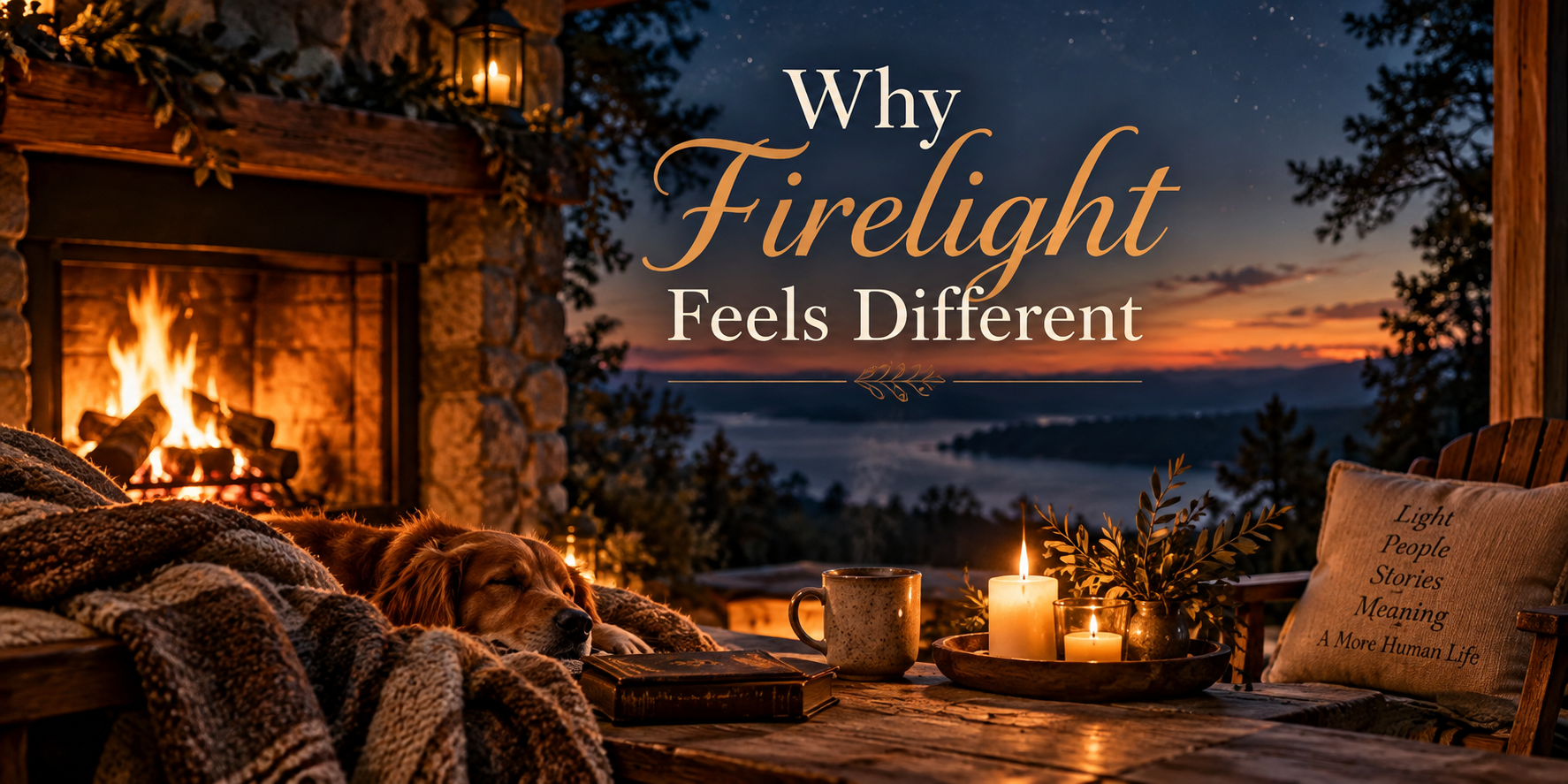
There is something about firelight that electric light rarely recreates.
A lamp can illuminate a room more efficiently. A screen can produce millions of colors. A modern bulb can imitate the amber tones of evening.
Yet when a real flame begins to move, something changes.
Faces soften in its glow. Shadows come alive. Conversation can become quieter. Attention settles. A room that felt ordinary moments before suddenly feels intimate, ancient and almost outside of time.
We often describe this simply as atmosphere.
But firelight really is different.
Its color is different.
Its movement is different.
Its relationship with darkness is different.
The way our eyes and biological rhythms encounter it is different.
And behind all of this lies something much larger: an extraordinarily ancient relationship between human beings and flame.
Fire gave our ancestors warmth, protection, cooked food and light after sunset. Around it, people gathered, talked, remembered, celebrated, sang, prayed and told stories.
Firelight is not merely another kind of illumination.
It is woven into the human story.
Firelight Is Never Completely Still
Most modern lighting is designed to disappear into the background.
Turn on a lamp and its light remains relatively constant.
Fire does the opposite.
A flame bends.
Stretches.
Contracts.
Divides.
Brightens.
Fades.
A log shifts and the entire pattern changes.
An ember collapses and a new flame appears.
Air currents alter the shape of the fire. Fuel changes beneath it. Tiny variations in combustion continually change the amount and direction of light reaching our eyes.
Fire therefore does not simply illuminate a room.
It animates it.
Walls change subtly.
Reflections shimmer.
Faces move between brightness and shadow.
Even when nothing else in the room is moving, a firelit room never looks completely still.
Firelight Has a Different Color
The familiar gold, amber, orange and red colors of fire arise from combustion.
As wood burns, gases and tiny particles become extremely hot. Some particles become incandescent, meaning they grow hot enough to glow visibly.
Different parts of a flame experience different temperatures and chemical reactions, which is why flames can contain yellow, orange, red and sometimes blue.
But the overall experience of ordinary wood fire and candlelight is strongly warm.
That distinguishes it from daylight and from many forms of modern artificial illumination.
And our bodies encounter those differences in ways that extend beyond simply seeing them.
Your Eyes Help Tell Your Body What Time It Is
We usually think of the eyes as instruments of sight.
Light enters.
The brain creates an image.
But the human eye does something else that is remarkable.
It helps the body understand time.
Inside the retina are specialized cells containing a light-sensitive pigment called melanopsin.
These cells help send information about environmental light to the systems involved in regulating the body's internal clock.
That internal timing system contributes to our circadian rhythm, the roughly 24-hour biological pattern influencing sleep and wakefulness, alertness, hormones, body temperature and many other processes.
So when your eyes encounter light, your body is not simply asking:
What can I see?
At another level it is also receiving information about:
What time of day does this light suggest?
Daylight and Firelight Send Different Signals
Daylight is bright and contains abundant shorter-wavelength visible light, including blue.
This is part of the natural rhythm humans have lived within for generations beyond counting.
Day is bright.
Evening grows dimmer.
Sunset arrives.
Then comes darkness.
For most of human existence there was no wall switch capable of turning midnight into something resembling noon.
There was daylight.
There was sunset.
There was moonlight and starlight.
There was darkness.
And there was fire.
Fire occupied an extraordinary place between daylight and complete darkness.
It allowed people to remain awake, see one another and continue interacting after sunset without recreating the brilliant light of day.
Firelight Lets Night Remain Night
This may be one of the most beautiful differences between firelight and modern illumination.
Modern lighting often tries to eliminate darkness.
Fire does not.
A fire creates a center of illumination surrounded by shadow.
Near the flame, colors appear.
A little farther away, details soften.
Beyond that, objects disappear.
Fire does not turn night into day.
It creates a small island of light within night.
The darkness remains part of the experience.
And perhaps some of what we experience as the peace and intimacy of firelight comes from this relationship.
Everything does not need to be illuminated.
Everything does not need to be visible.
The flame shows enough.
Firelight and the Body's Nighttime Rhythm
One of the body's important nighttime signals involves melatonin.
Melatonin is often called the sleep hormone, but its role is broader than simply making us sleepy. It is also part of the body's biological signaling that night has arrived.
Bright evening light can influence normal nighttime melatonin patterns, with brightness, timing and the wavelengths of the light all playing a role.
The human circadian system is especially responsive to shorter-wavelength light.
Traditional firelight creates a much warmer and generally dimmer environment than daylight and many bright modern lighting conditions.
That reveals something fascinating about the environment in which human nighttime biology developed.
For countless generations, light after sunset looked nothing like the brilliantly illuminated evenings many of us experience today.
Our nights were darker.
And the light within them was warmer.
Our Vision Changes Around a Fire
Human vision adapts beautifully as illumination changes.
In brighter conditions, cells in the retina called cones help us see fine detail and color.
As the environment becomes darker, rods, which are extremely sensitive to low levels of light, become increasingly important.
Firelight creates a visual landscape between brightness and darkness.
Near the flame, color remains vivid.
Beyond it, the world becomes progressively less defined.
That creates layers.
Light.
Shadow.
Movement.
Depth.
Mystery.
Bright overhead lighting tends to flatten those differences by illuminating everything.
Firelight preserves them.
Sometimes what the fire does not illuminate is part of what makes it beautiful.
Why Can We Watch Fire for So Long?
Fire presents an unusual kind of visual experience.
It is familiar enough that the brain immediately understands what it is.
Yet it never completely repeats itself.
A flame rises.
Another disappears.
A coal turns red.
A log cracks.
Sparks lift upward and vanish.
The pattern changes again.
There is always something happening, but rarely anything we need to do about it.
That is very different from much of modern stimulation.
There is no notification.
No storyline we have to remember.
No score.
No decision.
No button.
No task.
No demand to respond.
The flame gives attention somewhere to rest without becoming completely predictable.
Perhaps that is part of its quiet power.
Fire Can Hold Attention Without Demanding It
Much of modern life competes aggressively for attention.
Fire does not need to.
It moves.
We notice.
It crackles.
We listen.
Then our thoughts are free to wander again.
This creates a gentle rhythm between attention and reflection.
You can watch the fire.
Look at someone beside you.
Return to the flame.
Think.
Listen.
Remember.
Speak.
Become quiet again.
The fire remains there throughout it all.
It provides a center without requiring that it become the entire experience.
Research Has Found a Fireside Relaxation Response
There is intriguing research behind the familiar feeling of relaxing beside a fire.
In one experimental study involving 226 adults, researchers compared responses to simulated fires under different conditions, including fire with sound, muted fire and control conditions.
The fire-with-sound condition was associated with decreases in blood pressure over time, with longer exposure producing stronger effects in the study.
The researchers explored the possibility that the combination of flickering light, natural sound and absorbed attention contributes to relaxation.
That possibility is especially interesting because a fire is not merely something we watch.
We experience several things at once.
Movement.
Warm color.
Changing brightness.
Crackling sound.
Warmth when the fire is real.
Sometimes the scent of burning wood.
And often stillness.
A fire is not merely an image.
It is an environment.
The Crackle Is Part of the Fire
Imagine a fire with no sound at all.
Something would be missing.
There is the faint hiss of burning wood.
The sudden pop of a pocket of moisture.
The tumble of an ember.
The whispering rush of flame.
The gentle collapse of a log.
None of it follows a rigid rhythm.
There is no chorus repeating every thirty seconds.
The sounds are unpredictable, yet recognizable.
They create activity without demanding interpretation.
The eyes and ears can remain interested while the mind remains free.
Fire Is Multisensory
A real fire reaches us through more than vision.
We see the flame.
We hear it.
We feel radiant warmth on the skin.
We may smell burning wood.
We notice air moving around the heat.
Sometimes we even feel the temperature change when a flame suddenly grows larger.
That may help explain why an actual fire can feel different from a video of one.
A screen can reproduce an image beautifully.
A speaker can reproduce crackling sounds.
But a living fire surrounds the body with a constantly changing physical environment.
You are not simply observing it.
You are sitting within its presence.
Humanity's Relationship With Fire Is Astonishingly Old
The human relationship with fire reaches astonishingly far into the past.
Wonderwerk Cave in South Africa has become especially important in understanding that history.
Earlier research had already provided strong evidence of burning associated with human ancestors approximately one million years ago.
Research published in 2026 extended that story even deeper.
Scientists examining ancient animal bones from the cave found repeated burning associated with hominin occupation in layers dating from roughly 1.07 to 1.79 million years ago.
The location matters.
Some of this evidence comes from deep inside the cave, making ordinary wildfire a poor explanation for the repeated burning.
The findings support an extraordinarily early relationship between human ancestors and fire.
Those distant ancestors may not necessarily have known how to create flame whenever they wanted. They may initially have obtained naturally occurring fire and learned how to preserve, transport and use it.
But even that possibility is extraordinary.
More than a million years ago, our distant ancestors may already have understood that flame was precious enough to carry into darkness.
Before Civilization, There Was Fire
Consider the timeline.
Before cities.
Before farms.
Before written language.
Before roads.
Before books.
Before temples.
Before nations.
Before recorded history.
There was fire.
That places fire in a remarkable category.
It is not simply an old technology.
Its relationship with humanity reaches into a world almost unimaginably distant from our own.
Generation after generation lived in a world where darkness was real and fire mattered.
Fire Changed Human Possibility
Fire offered enormous practical advantages.
It provided warmth.
It helped discourage predators.
It illuminated dark spaces.
It eventually transformed food through cooking.
It helped humans inhabit colder environments.
But there was another consequence that is easy to overlook.
Fire extended the human day.
Without artificial illumination, sunset dramatically limits what people can do.
With fire, something new becomes possible.
Human time after dark.
And that may have changed far more than our schedule.
Fire May Have Created a Different Kind of Human Time
Anthropologist Polly Wiessner explored how social interaction changes after dark through research among Ju/'hoansi hunter-gatherers in southern Africa.
Her analysis compared daytime and nighttime conversations and found a striking shift.
Daytime conversation centered more heavily on practical concerns, economic matters and social issues.
Nighttime activity around fires became different.
Stories became prominent.
There was singing.
There was dancing.
There were religious activities.
People spoke about others who were far away.
They revisited events.
They laughed.
They imagined.
They remembered.
They passed cultural knowledge from one person to another.
The fire had not simply extended daytime work.
It had helped create another kind of social space.
Daylight Was for Doing
Imagine life without electric illumination.
Daylight is precious.
There is food to gather.
Tools to make.
Children to care for.
Shelter to maintain.
Distances to travel.
Problems to solve.
Much of the day naturally centers on the immediate world.
Then the sun disappears.
The useful landscape shrinks.
The world outside the fire becomes difficult to see.
Work slows.
And attention can move somewhere else.
Toward the people sitting nearby.
Toward memory.
Toward imagination.
Toward meaning.
Toward story.
Firelight and Storytelling Belong Naturally Together
There is a reason the image of someone telling a story beside a fire feels almost timeless.
Fire creates a natural stage for storytelling.
The world beyond the circle becomes dark.
The speaker's face remains visible.
Other people are close enough to hear.
There are fewer competing activities.
And the imagination is free to travel far beyond the small illuminated circle.
A storyteller can take everyone somewhere the fire cannot illuminate.
Across a mountain.
Into yesterday.
Into childhood.
Into another person's life.
Into an ancestor's memory.
Into tomorrow.
Into the invisible.
Into the sacred.
Everyone remains physically beside the same flame.
Yet language allows several minds to travel somewhere else together.
That is one of the extraordinary powers of human storytelling.
Fire May Have Expanded the Social World
The nighttime storytelling observed in the Ju/'hoansi research did more than entertain.
Stories could keep distant people psychologically present.
They could convey knowledge about relationships and social life.
They could help listeners understand the experiences and motivations of others.
They could pass knowledge between generations without books or classrooms.
A story told beside a fire could therefore carry something across both distance and time.
Someone absent could become present through memory.
An ancestor could speak again through story.
An experience known by one person could become knowledge shared by many.
Fire gave the storyteller light.
Story gave the group another kind of sight.
The Hearth Became a Human Center
As fire became established within human camps and dwellings, the hearth naturally became a center.
Food was prepared there.
Cold bodies found warmth there.
Children gathered there.
Guests were welcomed there.
Wet clothing dried there.
Stories were told there.
People rested there.
The word hearth eventually came to mean far more than the physical place where a fire burns.
It became a symbol of home.
That meaning survives in the expression hearth and home.
Technology eventually reduced our dependence upon the hearth.
The symbolism remained.
Human culture remembered what the fire had been.
Fire Changes How We See One Another
Firelight also changes faces.
Its warm illumination differs dramatically from cool overhead light.
Highlights and shadows move gently across facial features as the flame changes.
And because the environment beyond the fire is darker, illuminated faces become visually important.
Imagine the ancient nighttime scene.
Beyond the fire is darkness.
Across the fire is another human face.
That face speaks.
Laughs.
Remembers.
Sings.
Tells a story.
For an immense span of human history, this may have been one of the defining experiences of nighttime social life.
The brightest things in the night were often the fire and the people gathered around it.
Fire Creates a Circle
There is something quietly beautiful about the way people gather around a fire.
Usually not in rows.
Not facing a stage.
Not staring in one direction.
They gather around it.
The flame creates a shared center.
People can look into the fire and still see one another.
Someone speaks.
Someone listens.
Another watches the flames.
A child moves closer for warmth.
Someone tends the fire.
The fire belongs to everyone within the circle.
That simple arrangement may be one reason a hearth can feel so naturally communal.
The flame becomes the center without needing to become the entire focus.
Part of Loving Fire Has Always Been Respecting It
There is another part of humanity's relationship with fire that belongs within its story.
We learned not only to appreciate flame, but to tend it.
A hearth was meaningful not simply because a flame burned there.
Someone kept the fire.
Someone understood when it needed fuel.
Someone gave it a proper place.
Someone remained aware of it.
That relationship contains a quiet wisdom.
To value something powerful does not mean approaching it carelessly.
A candle, hearth or campfire can bring warmth, beauty and companionship precisely because flame is given its proper place and treated with respect.
Care does not diminish the wonder.
In its own way, care is part of the wonder.
The fire is not ignored.
It is tended.
Perhaps this is one of the oldest lessons carried by the hearth:
What gives light deserves our presence.
A Real Flame Is Happening Right Now
Modern technology can imitate fire remarkably well.
LED candles flicker.
Electric fireplaces glow.
Screens display burning logs in astonishing detail.
Speakers reproduce the crackling sound.
These can create beautiful atmospheres.
But real fire possesses one characteristic that is difficult to reproduce completely.
It is actually happening.
The next movement of the flame has not been recorded.
The next spark has not been programmed.
A log may shift.
An ember may collapse.
The flame may suddenly brighten.
Every moment appears and disappears.
A real fire is an unfolding physical event.
The flame you are watching now will never exist in precisely that form again.
Perhaps that impermanence is part of why we keep watching.
One Candle Can Transform a Room
One candle produces remarkably little illumination compared with a modern lamp.
Yet one candle can transform the feeling of an entire room.
That tells us something important.
Human experience cannot be measured only by brightness.
Color matters.
Movement matters.
Contrast matters.
Memory matters.
Context matters.
Meaning matters.
A candle beside a quiet dinner feels different from fluorescent ceiling lights.
A candle beside a prayer feels different from a phone flashlight.
A candle lit in remembrance carries another meaning entirely.
The amount of light may be small.
Its presence can be enormous.
And perhaps part of the beauty of candlelight is precisely that it asks us to notice it.
We give the flame a proper place.
We remain present with it.
When its purpose is finished, we extinguish it.
The light is beautiful because it is both appreciated and tended.
Fire Has Always Invited Meaning
Human beings have looked at flame and seen more than combustion for a very long time.
It is easy to understand why.
Fire can transform.
It gives warmth.
It produces light.
It is visible but cannot be held.
It is always moving yet remains recognizably itself.
A tiny flame can illuminate a vast darkness.
One flame can ignite another without becoming smaller.
An ember that appears almost extinguished can suddenly become fire again.
Fire naturally became a language for transformation.
And perhaps the deepest symbolism of fire has never belonged to uncontrolled flame.
It belongs to the flame that gives light.
The hearth that gives warmth.
The candle kept for prayer.
The fire around which people gather.
The ember carefully carried forward.
Fire at its most meaningful is not simply power.
It is power given purpose.
Fire in the Biblical Story
Fire carries profound meaning throughout Scripture.
Moses encounters God through the burning bush.
During the Exodus, a pillar of fire guides the Israelites through the night.
Fire appears in connection with offerings, purification and sacred presence.
At Pentecost, the disciples experience what Scripture describes as tongues "as of fire."
Again and again, flame becomes associated with presence, guidance, transformation and spiritual power.
The imagery carries such force because fire possesses physical qualities that already speak deeply to human experience.
Light within darkness.
Warmth within cold.
Transformation.
Movement.
Power.
Presence.
And importantly, sacred fire is not presented merely as spectacle.
It points beyond itself.
The flame carries meaning because of what it reveals.
The Flame and the Inner Life
Perhaps that is why fire enters our language whenever we try to describe things that cannot easily be seen.
A spark of inspiration.
A flame of hope.
A burning desire.
Keeping faith alive.
Rekindling love.
An inner fire.
The metaphor feels natural because we understand something about flame.
A fire needs tending.
It needs fuel.
It needs air.
Neglected, it can fade.
Tended wisely, it can continue giving warmth and light.
And sometimes what looks almost extinguished is not gone at all.
One ember remains.
Given air and attention, the flame returns.
Faith can be like that.
Hope can be like that.
Love can be like that.
Sometimes the inner life does not need a roaring bonfire.
Sometimes one faithful ember is enough.
Fire Does Not Need to Conquer Darkness
Perhaps one of the deepest lessons of firelight is visible before us.
The flame does not eliminate darkness.
It creates enough light to live within it.
There can be darkness at the edges and warmth at the center.
We do not have to see everything.
We do not have to illuminate the entire horizon.
Sometimes there is enough light for this moment.
Enough light for this conversation.
Enough light for this prayer.
Enough light for the next step.
And perhaps that is one reason flame has carried sacred meaning through so much of human history.
Light becomes especially meaningful when darkness is allowed to remain around it.
Why Firelight Feels Different
So why does firelight feel different?
There is no need to force the answer into one explanation.
It is the warm color.
The changing brightness.
The moving shadows.
The dim nighttime illumination.
The way our eyes experience it.
The crackling sound.
The warmth on the skin.
The attention it gently attracts.
The faces gathered around it.
The stories associated with it.
The memories it awakens.
The care with which it is tended.
The spiritual meaning humanity has given it.
And perhaps something older than any memory we personally possess.
For an extraordinary stretch of human history, fire marked the place where darkness became inhabitable.
It was where food became warm.
Where cold bodies found heat.
Where another human face remained visible after sunset.
Where practical work could give way to conversation.
Where stories crossed generations.
Where songs entered the night.
Where prayer and ceremony gathered around flame.
Where people learned that something powerful could be beautiful precisely because it was respected and given its proper place.
Where people stared into moving light and wondered about things they could not see.
Firelight feels different because fire has never been merely light.
It became part of being human.
And perhaps when we sit quietly before a flame today, surrounded by technology our ancestors could never have imagined, something remarkably old happens again.
The world beyond the fire grows darker.
The flame moves.
Someone tends it.
Conversation slows.
Someone begins telling a story.
Someone else listens.
And the oldest room humanity ever built appears once more.
Not a room made of walls.
A circle made of light.
Questions and Answers
Why does firelight feel different from electric light?
Firelight combines warm color, continually changing brightness, moving shadows and relatively low illumination. A real fire also adds sound, radiant warmth and other sensory experiences, creating an environment very different from steady electric lighting.
Why is firelight so warm in color?
Different combustion processes produce different colors, but much of the familiar yellow and orange appearance of flame comes from extremely hot particles glowing as fuel burns. The overall visual experience is therefore strongly weighted toward warm tones.
Does firelight contain blue light?
Yes. Some regions of a flame can appear blue because of particular combustion reactions. But the overall illumination from ordinary wood fires and candles is generally much warmer than daylight and many modern electric light sources.
What is the circadian rhythm?
The circadian rhythm is the body's approximately 24-hour internal timing system. It helps coordinate sleep and wakefulness, hormone patterns, body temperature, alertness and many other biological processes.
How do our eyes help regulate the body clock?
Specialized cells in the retina contain a light-sensitive pigment called melanopsin. They help communicate information about environmental light to brain systems involved in distinguishing biological day from biological night.
Why does nighttime lighting matter?
Light is one of the body's most important environmental time signals. The brightness, timing and wavelengths of evening light can influence normal nighttime biological rhythms.
Can watching a fire really be relaxing?
Research involving 226 adults found decreases in blood pressure over time during a simulated fire-with-sound condition. The researchers explored whether the combination of flickering light, sound and absorbed attention contributes to the relaxation people often associate with fireside environments.
Why is the sound of fire important?
The crackles, pops and shifting sounds of burning wood create continuously changing but familiar sensory information. In experimental research on simulated fires, the presence of fire sound was associated with stronger relaxation effects than some comparison conditions.
How long have human ancestors used fire?
The exact beginning remains an active area of research. Evidence published in 2026 from Wonderwerk Cave in South Africa supports repeated hominin-associated burning in layers dating from approximately 1.07 to 1.79 million years ago.
Did early human ancestors know how to make fire?
Evidence of early fire use does not necessarily tell us exactly how the fire was started. Some early human ancestors may have obtained naturally occurring fire and learned how to preserve, transport and tend it before reliable fire-making developed.
Did fire change human social life?
Fire provided warmth, light, protection and eventually cooking, but it also extended activity beyond sunset. That created additional time for gathering, conversation, storytelling, singing, ceremony and other forms of social life.
Did people really tell stories around fires?
Anthropological research among Ju/'hoansi hunter-gatherers found that nighttime firelit activity contained substantially more storytelling, singing, dancing and religious activity than practical daytime conversation. It offers a fascinating example of how fire can create a distinctive social environment after dark.
Why is storytelling around a fire so powerful?
A fire creates a shared center while the surrounding environment becomes darker and less visually demanding. Storytelling then allows listeners to imagine people, places and events far beyond the illuminated circle.
Why did the hearth become a symbol of home?
Historically, the hearth brought together warmth, cooking, light and human gathering. Because so much daily and social life happened around it, the hearth naturally became associated with home, family, hospitality and belonging.
Is respecting fire part of its history too?
Yes. Humanity's relationship with fire has always involved more than simply possessing flame. Fire had to be preserved, tended, contained and given an appropriate place. That responsibility became part of the relationship between people and the hearth.
Why can one candle change the feeling of a room?
Atmosphere depends on far more than total brightness. Warm color, movement, contrast, shadow, memory and meaning all influence human experience. A small flame can therefore change a room far more than its amount of light would suggest.
Why is fire spiritually meaningful?
Fire possesses qualities that naturally carry powerful symbolism. It gives light, produces warmth, transforms matter, moves constantly and can spread from one flame to another. Across human traditions it has therefore become associated with transformation, purification, life, presence and illumination.
What does fire symbolize in Christianity?
Biblical fire imagery includes the burning bush, the pillar of fire during the Exodus and the tongues "as of fire" at Pentecost. Fire can represent God's presence, guidance, purification, spiritual power and transformation.
Why are people still drawn to fire when we no longer need it for light?
There is probably no single reason. Fire combines distinctive light, movement, sound and warmth with deep personal, social, historical and spiritual associations. Modern people may no longer depend upon the hearth for survival, but humanity's relationship with flame is vastly older than modern civilization.
More Paths to Explore
Spiritual Meaning of Candles