

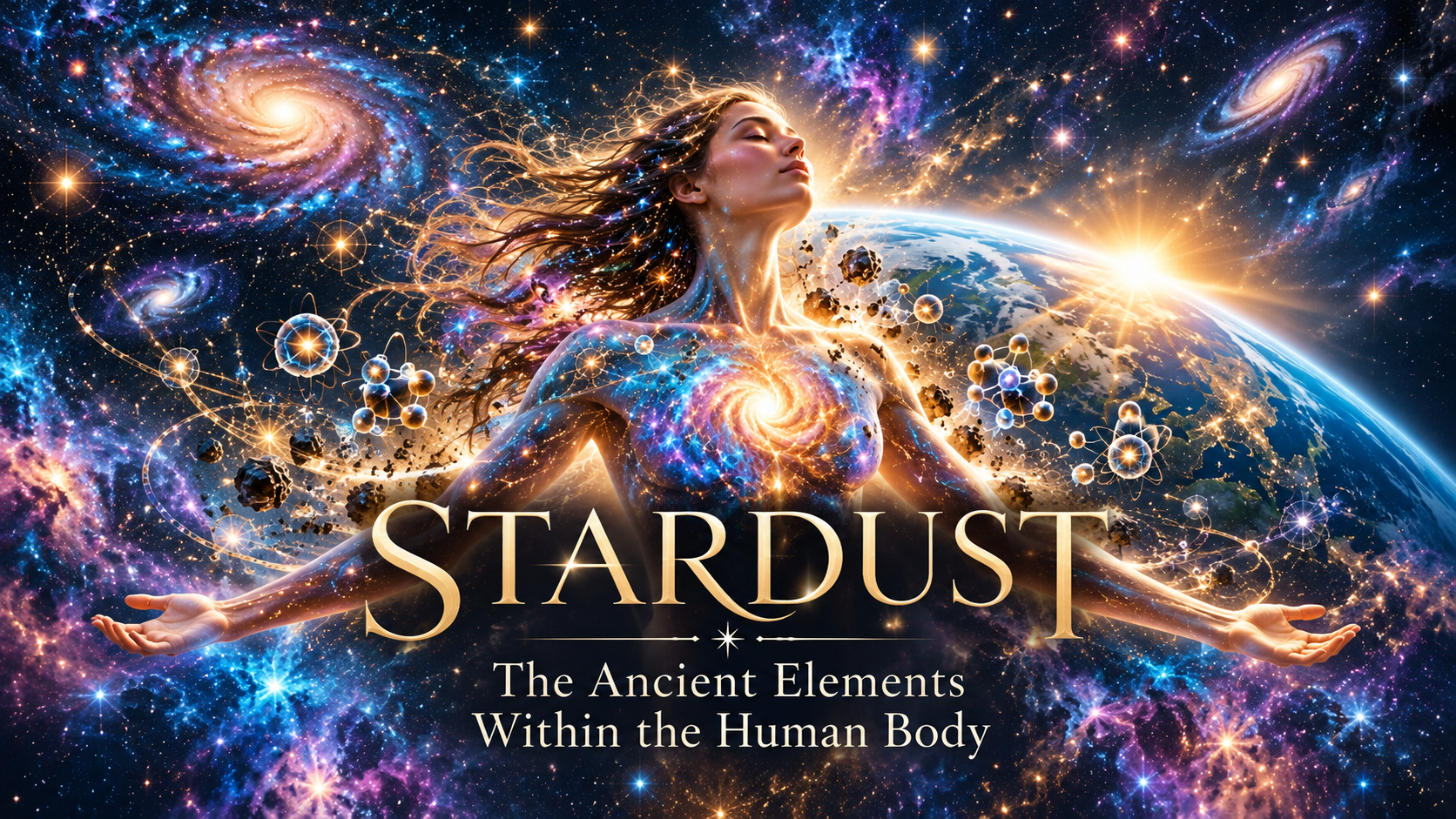
There is an extraordinary story written into every human body, a story that began long before Earth existed, before oceans filled with water, and before the first living cells appeared.
The calcium that strengthens our bones, the iron that helps carry oxygen through our blood, the carbon that forms the foundation of our cells, and the hydrogen within every molecule of water all have histories reaching deep into the universe.
Some of these ancient ingredients originated during the earliest moments of cosmic existence. Others were created within stars or through powerful events that scattered newly formed elements across space.
Over billions of years, those elements became part of new stars, planets, oceans, mountains, forests, and eventually living beings.
And here we are.
Made from matter with an ancient cosmic history, capable of looking into the night sky and wondering where we came from.
The connection between the human body and the stars is more than poetic imagination. It is a remarkable scientific reality.
The elements that make human life possible belong to the same cosmic history that created the stars and planets around us.
What Does It Mean That Humans Are Made of Stardust?
The expression made of stardust describes the cosmic origins of many of the chemical elements within our bodies.
Every human being is composed of atoms. These atoms combine to form molecules, and those molecules form the structures and systems that make life possible.
The elements within those atoms have different origins.
Hydrogen, the simplest and most abundant element in the universe, largely originated during the earliest stages of the Big Bang.
Carbon, oxygen, nitrogen, and many other elements essential to life were produced through nuclear processes within stars.
Some elements formed during explosive stellar events, while others were created through processes involving dying stars or collisions between neutron stars.
These elements eventually became part of the material from which our solar system formed approximately 4.6 billion years ago.
Earth inherited this ancient mixture of cosmic matter.
As our planet developed, its elements participated in geological processes, chemical reactions, and eventually the biological systems that make up living organisms.
When we say humans are made of stardust, we are recognizing that the physical ingredients of our bodies have a history much older than humanity itself.
Not every atom was literally formed inside a star, and not all cosmic elements originated through the same process.
But the essential connection remains.
The human body is made from matter shaped by the history of the universe.
The Beginning of the Elements: Before the First Stars
Approximately 13.8 billion years ago, the universe began expanding from an extremely hot, dense early state.
As it expanded and cooled, fundamental particles formed, and conditions eventually allowed the first atomic nuclei to develop.
During a process known as Big Bang nucleosynthesis, the early universe produced primarily hydrogen and helium nuclei, along with very small quantities of lithium and related light nuclei.
Much of this process occurred during the first few minutes of cosmic history.
These were the earliest chemical building blocks.
However, the first atomic nuclei were not immediately surrounded by electrons in stable neutral atoms.
The early universe remained extremely hot, with matter existing largely as a plasma of charged particles.
As the universe continued expanding and cooling, conditions eventually allowed electrons to combine with atomic nuclei.
Approximately 380,000 years after the Big Bang, neutral hydrogen and helium atoms became abundant during a period known as recombination.
This transition allowed light to travel much more freely through space.
The ancient radiation released from this early period is observed today as the cosmic microwave background, one of the most important sources of evidence about the young universe.
The distinction between the formation of nuclei and the formation of neutral atoms reveals how many stages were involved in creating the matter familiar to us today.
At this stage, the universe did not yet contain the abundance of carbon, oxygen, iron, calcium, and other heavier elements familiar to us today.
There were no rocky planets, no oceans, no forests, and no living organisms.
The universe first had to develop the chemical diversity that would make those things possible.
Hydrogen played an especially important role.
As matter gradually gathered under gravity, enormous clouds of hydrogen and helium began collapsing.
Eventually, some regions became dense and hot enough for nuclear fusion to begin.
The first stars were born.
And with their appearance, a new chapter in the history of matter began.
The First Stars Changed the Universe Forever
The earliest stars are thought to have been profoundly different from many stars we observe today.
Astronomers call this predicted first generation Population III stars.
They would have formed from material composed almost entirely of hydrogen and helium, with tiny amounts of lithium.
Unlike later generations of stars, they would not have begun their lives with significant quantities of carbon, oxygen, iron, or other heavier elements.
Those elements had not yet become widespread.
Astronomers describe these first stars as metal-free or extremely metal-poor.
In astronomy, the word metals has a broader meaning than it does in everyday language. It refers to all chemical elements heavier than helium, including elements such as carbon, oxygen, and nitrogen.
A metal-free star, therefore, is not simply a star without iron or other familiar metals. It is a star formed from material that contains essentially no elements heavier than helium.
Astronomers have gathered substantial evidence about the conditions of the early universe, although individual, completely metal-free Population III stars have not been conclusively identified.
Scientific models indicate that these early stars played an important role in transforming the universe's chemistry.
Within the intense heat and pressure of stellar interiors, nuclear fusion began creating new atomic nuclei.
Hydrogen fused into helium.
Under suitable conditions, helium could participate in reactions that produced carbon.
In massive stars, additional nuclear processes could produce oxygen, neon, magnesium, silicon, sulfur, and elements in the iron group.
As some of these stars aged and died, they returned newly formed elements to surrounding space.
Their contributions changed the chemical composition of the universe.
Later generations of stars formed from gas and dust that already contained material created by earlier stars.
This gradual enrichment helped make rocky planets and complex chemistry possible.
Our Sun belongs to a later stellar generation.
It formed from material containing elements produced by earlier cosmic events.
In that sense, the solar system itself carries an inheritance from stars that existed before it.
How Stars Create the Elements of Life
Stars are enormous environments of nuclear transformation.
Their intense gravity creates the pressure and temperature needed for nuclear reactions.
During fusion, lighter atomic nuclei combine to form heavier nuclei.
Different stages of stellar evolution allow different reactions to occur.
Stars like our Sun spend much of their lives fusing hydrogen into helium.
When stars enter later stages of evolution, some can produce carbon and oxygen through helium-burning reactions.
One of the most fascinating examples is the formation of carbon-12 through the triple-alpha process.
During this process, two helium-4 nuclei can briefly combine to form an unstable beryllium-8 nucleus.
If another helium-4 nucleus interacts with this short-lived nucleus under suitable conditions, carbon-12 can form.
This reaction is especially important because carbon is the foundation of organic chemistry.
Once carbon-12 exists, it can capture another helium-4 nucleus through a reaction known as alpha capture.
This produces oxygen-16.
Through these nuclear processes, stars create two elements that account for an enormous proportion of human body mass.
Carbon forms the structural framework of proteins, fats, carbohydrates, and genetic material.
Oxygen is abundant in water and many biological molecules.
The existence of these elements depends on the nuclear properties of matter and the conditions found within stars.
More massive stars can undergo additional stages of nuclear burning that produce a wider range of elements.
The creation of elements is known as nucleosynthesis.
It is one of the most important processes in cosmic history because it explains how the universe developed the chemical variety found in planets, living organisms, and everyday materials.
Yet no single type of star is responsible for creating every element.
Some elements are produced mainly in evolved stars.
Others arise through explosive nuclear reactions.
Certain heavier elements form through neutron-capture processes, including those associated with neutron star mergers.
The chemical richness of the universe is therefore the result of many different cosmic processes working across immense periods of time.
When Stars Release Their Elements Into Space
Creating elements within stars is only part of the story.
Those elements must also become available to participate in the formation of new objects.
Some aging stars release material through stellar winds.
Others shed their outer layers as they approach the ends of their lives.
Massive stars may experience supernova explosions that disperse enormous quantities of material into surrounding space.
These events enrich the interstellar medium, the gas and dust found between stars.
Over time, enriched material can gather into new clouds.
Gravity may cause portions of those clouds to collapse, eventually forming new stars and planetary systems.
Some of the atoms that became part of Earth passed through these ancient cycles of creation, release, and redistribution.
The iron in our bodies is connected to stellar nuclear processes and explosions.
The carbon in our cells reflects the chemistry of earlier generations of stars.
The calcium in our bones belongs to the same long history of elemental formation and cosmic enrichment.
Our bodies contain elements whose existence depends on events that occurred long before our planet was born.
Iron and the Extraordinary Role of Supernovae
Iron has a particularly fascinating cosmic history.
It is an essential element within the human body, especially because of its role in hemoglobin, the protein that allows red blood cells to transport oxygen.
But iron's story began long before blood or living organisms existed.
Iron-group elements are produced through nuclear processes associated with massive stars and stellar explosions.
One important source is Type Ia supernovae.
These events involve thermonuclear explosions of white dwarfs, often in systems where a white dwarf interacts with another star or merges with another white dwarf.
During these explosions, enormous quantities of iron-group nuclei can be produced, including radioactive nickel-56, which eventually decays into stable iron-56.
Massive stars also contribute iron-group elements through their late evolutionary stages and explosive deaths.
Over cosmic time, these processes enriched the gas and dust from which later stars and planets formed.
Eventually, some of that iron became part of Earth's minerals and biological systems.
Today, iron participates in one of the body's most essential functions.
Every breath we take depends partly on the ability of iron-containing hemoglobin to bind and transport oxygen.
The same element whose cosmic history includes extraordinary stellar events now helps sustain ordinary human life.
Neutron Star Mergers and the Creation of Heavy Elements
Some of the universe's most remarkable elements form through events even more extreme than the nuclear reactions inside ordinary stars.
One important example is the merger of two neutron stars.
Neutron stars are extraordinarily dense remnants left behind after certain massive stars undergo gravitational collapse.
A neutron star can contain more mass than the Sun compressed into a sphere only a few dozen kilometers across.
When two neutron stars orbit one another, they can gradually lose orbital energy through gravitational waves.
Over time, their orbit may shrink until they collide and merge.
These events can release enormous amounts of energy and eject neutron-rich material into space.
Under suitable conditions, the ejected matter undergoes a process known as rapid neutron capture, or the r-process.
During this process, atomic nuclei absorb neutrons so rapidly that they can build up into very heavy, unstable nuclei.
As those nuclei undergo radioactive decay, they can produce stable isotopes of heavy elements.
This process contributes to the formation of elements such as gold, platinum, and some of the heaviest naturally occurring elements.
Neutron star mergers are established sites of heavy-element production, although researchers continue investigating how much different astrophysical events contribute to the universe's total abundance of r-process elements.
In 2017, astronomers observed gravitational waves from a neutron star merger known as GW170817.
Telescopes also detected electromagnetic radiation from the event, including a transient phenomenon called a kilonova.
The observations provided compelling evidence that neutron star mergers produce heavy elements through rapid neutron-capture processes.
These discoveries helped connect gravitational-wave astronomy, nuclear physics, and the chemical history of the universe.
Although many of the elements most abundant in the human body formed through other processes, neutron star mergers reveal how diverse the universe's element-making mechanisms truly are.
The periodic table is the result of many chapters of cosmic history.
Cosmic Rays and the Continuing Transformation of Elements
The formation and transformation of atomic nuclei are not limited to the interiors of stars.
Cosmic rays also contribute to nuclear processes throughout the universe.
Cosmic rays are high-energy particles, many of which originate from energetic astrophysical environments.
When these particles collide with atomic nuclei, they can cause nuclear reactions that produce different isotopes or lighter elements.
One important process is called cosmic-ray spallation.
It contributes to the cosmic abundance of certain light elements, particularly lithium, beryllium, and boron.
Cosmic radiation also participates in processes occurring much closer to home.
When high-energy cosmic rays enter Earth's atmosphere, they collide with atmospheric particles and generate cascades of secondary particles.
Among these secondary particles are neutrons.
Some of these neutrons interact with nitrogen-14 nuclei in the atmosphere, producing carbon-14.
Carbon-14 is a naturally occurring radioactive isotope of carbon.
It becomes incorporated into atmospheric carbon dioxide and enters plants through photosynthesis.
From there, it can move through food webs and become part of living organisms.
While an organism is alive, it continues exchanging carbon with its environment.
After death, that exchange largely ends, and the carbon-14 already present gradually undergoes radioactive decay.
Scientists use this predictable process in radiocarbon dating to estimate the ages of many once-living materials.
This remarkable technique connects cosmic radiation, Earth's atmosphere, biological chemistry, and the scientific study of history.
It is another example of how processes originating beyond our planet continue to influence the matter around us.
Six Ancient Elements That Form the Foundation of Life
Scientists often use the abbreviation CHNOPS to describe six elements fundamental to life as we know it.
These elements are carbon, hydrogen, nitrogen, oxygen, phosphorus, and sulfur.
Together, they form the chemical foundation of many biological molecules.
ElementImportance to lifeCarbonForms the structural framework of organic moleculesHydrogenEssential to water, organic compounds, and cellular chemistryNitrogenFound in proteins, DNA, and RNAOxygenPresent in water and biological molecules; supports aerobic respirationPhosphorusEssential to ATP, DNA, RNA, and cell membranesSulfurFound in certain amino acids, proteins, and important cellular compounds
These six elements are often grouped together because of their fundamental biological roles.
They are not exactly the same as the six most abundant elements in the human body by mass.
Calcium, for example, contributes more to total body mass than sulfur because of its abundance in bones and teeth.
Sulfur is included in CHNOPS because of its importance to biological chemistry, particularly proteins and certain cellular reactions.
Both ways of grouping elements help reveal different aspects of human biology.
Carbon: The Framework of Living Chemistry
Carbon is particularly remarkable because of its ability to form stable chemical bonds with itself and many other elements.
This allows carbon to participate in an enormous variety of molecular structures.
Proteins, carbohydrates, fats, DNA, and many other biological compounds depend on carbon chemistry.
Without carbon's bonding properties, life as we know it would be fundamentally different.
Hydrogen: An Ingredient From the Early Universe
Hydrogen is found throughout the human body, especially in water and organic molecules.
Most hydrogen nuclei originated during the earliest stages of cosmic history.
Every molecule of water in the body contains hydrogen connected to this ancient origin.
Hydrogen also participates in acid-base chemistry, cellular energy processes, and countless biochemical reactions.
Nitrogen: Essential to Genetic Information
Nitrogen is found in amino acids, the building blocks of proteins.
It is also part of the nitrogen-containing bases found in DNA and RNA.
These molecules allow living organisms to store, transmit, and use genetic information.
Nitrogen moves through Earth's atmosphere, soils, microorganisms, plants, and animals through the nitrogen cycle.
Oxygen: Abundant and Biologically Essential
Oxygen is the largest contributor to human body mass.
It is found in water and in many biological molecules.
Molecular oxygen also plays a central role in aerobic cellular respiration, allowing cells to efficiently obtain usable energy from nutrients.
Phosphorus: A Foundation of Cellular Energy
Phosphorus is found in ATP, a molecule central to cellular energy transfer.
It also forms part of the structural backbone of DNA and RNA.
Phospholipids, which contain phosphorus, are important components of cell membranes.
Sulfur: Small Amounts, Essential Functions
Sulfur is present in amino acids such as cysteine and methionine.
It contributes to protein structure and participates in important cellular reactions.
Sulfur-containing compounds also support antioxidant systems and other biological functions.
Together, these six elements demonstrate how ancient cosmic materials became essential components of living chemistry.
What Percentage of the Human Body Is Made of Each Element?
Although dozens of elements can be detected in the human body, six account for approximately 99% of its mass in commonly used reference models.
The percentages vary with hydration, age, body composition, and the reference model used.
The following figures represent approximate percentages by mass, meaning the proportion of the body's total weight contributed by each element.
They do not represent the percentage of individual atoms.
ElementApproximate percentage of body massOxygen65%Carbon18.5%Hydrogen9.5%Nitrogen3%Calcium1.5%Phosphorus1%Other elements combined1.5%
These values are rounded illustrations rather than an exact composition for every person.
Some scientific reference models report different proportions, including higher carbon and lower oxygen percentages.
The important distinction is that oxygen, carbon, hydrogen, and nitrogen account for the overwhelming majority of human body mass.
Calcium and phosphorus contribute substantially to bones and teeth.
Other elements are present in smaller quantities but can have essential biological functions.
Why Oxygen Makes Up Most of Our Body Weight
Oxygen accounts for approximately two-thirds of human body mass in many commonly used estimates.
One major reason is water.
The human body contains a substantial amount of water, and oxygen accounts for approximately 89% of a water molecule's mass.
Water is present within cells, blood, tissues, and the spaces surrounding cells.
Oxygen is also part of proteins, carbohydrates, fats, minerals, and other biological compounds.
This explains why oxygen contributes so much to the body's total weight.
But something even more surprising appears when we stop measuring by weight and begin counting individual atoms.
Hydrogen Is the Most Abundant Element by Atom Count
Oxygen contributes the greatest percentage of human body mass, but hydrogen is the most abundant element by number of atoms.
In a commonly used elemental model, approximately 62% of the atoms in the human body are hydrogen.
Oxygen accounts for roughly 24%, and carbon for approximately 12%.
These percentages describe the relative number of atoms, not their contribution to body weight.
The difference comes from atomic mass.
A hydrogen atom is much lighter than an oxygen atom.
A single oxygen atom has approximately sixteen times the mass of an ordinary hydrogen atom.
Consequently, a relatively small amount of hydrogen by weight can represent an enormous number of individual atoms.
Consider water.
Every water molecule contains two hydrogen atoms and one oxygen atom.
By number, hydrogen accounts for two-thirds of the atoms in water.
By mass, however, oxygen accounts for nearly nine-tenths.
This distinction reveals something remarkable.
The most numerous atoms within the human body are largely connected to the earliest chapter of the universe.
The Cosmic Origins of the Elements Within Us
Different elements have different astrophysical histories.
ElementMajor cosmic originsRole in the human bodyHydrogenPrimarily the Big BangWater and organic moleculesCarbonFusion in stars, including evolved starsDNA, proteins, fats, and carbohydratesOxygenPrimarily massive-star nucleosynthesisWater and cellular chemistryNitrogenStellar nucleosynthesis, including evolved starsProteins and genetic materialCalciumStellar burning and explosive nucleosynthesisBones, teeth, and cell signalingPhosphorusStellar nucleosynthesis and explosive eventsATP, DNA, RNA, and membranesSulfurStellar burning and explosive eventsAmino acids and proteinsIronMassive-star processes and Type Ia supernovaeHemoglobin and enzymesMagnesiumStellar nucleosynthesisEnzyme function and energy metabolismZincMultiple stellar nucleosynthesis processesEnzymes, gene regulation, and immune function
These origins describe the processes responsible for producing the elements.
They do not mean that every atom of a particular element came from one identical type of star or cosmic event.
Many elements have several production pathways.
The universe's chemical history is complex, with different processes contributing to the abundances observed today.
How Scientists Read the Chemical Fingerprints of Stars
One of the most extraordinary discoveries in astronomy is that scientists can identify chemical elements in distant stars without physically visiting them.
They accomplish this through a technique called spectroscopy.
Light carries information.
When light interacts with atoms and ions, particular wavelengths can be absorbed or emitted.
These interactions create characteristic patterns called spectral lines.
Each chemical element has recognizable spectral features associated with its atomic structure.
Astronomers use instruments called spectrographs to separate incoming light into its component wavelengths.
By studying the resulting spectrum, they can identify elements present in a star's atmosphere or other astronomical environments.
For example, hydrogen produces characteristic spectral lines.
So do helium, sodium, calcium, iron, and many other elements.
The strength and appearance of these lines also depend on conditions such as temperature, density, and ionization.
Scientists account for these factors when estimating elemental abundances.
Through spectroscopy, astronomers can study the chemical composition of stars located enormous distances from Earth.
This helps them investigate how different generations of stars enriched the universe.
It also reveals the remarkable consistency of atomic physics across cosmic distances.
The same elements found in the human body can be identified in distant astronomical objects through the light they produce or absorb.
Meteorites Preserve Evidence of Ancient Stars
Another fascinating source of evidence comes from meteorites.
Some meteorites contain microscopic mineral grains that formed before our solar system existed.
These are called presolar grains.
They can include materials such as silicon carbide, graphite, and certain mineral grains whose isotopic compositions reveal origins outside the early solar system.
Isotopes are forms of the same element that contain different numbers of neutrons.
Different nuclear processes can produce distinctive isotopic patterns.
By studying these patterns, scientists can investigate the environments in which ancient grains formed.
Some presolar grains preserve evidence of material originating around evolved stars or in stellar explosions.
These grains survived incorporation into the cloud of material from which the solar system formed.
They offer tangible evidence that matter from earlier stars became part of the ingredients of our planetary system.
The connection between stars and Earth is therefore supported not only by astronomical observations but also by microscopic material that scientists can examine in laboratories.
The Atoms in Your Body Are Not All the Same Age
One of the most fascinating aspects of human chemistry is that the matter within us does not have a single age.
The nuclei of most hydrogen atoms trace their origins to the early universe.
Many carbon and oxygen nuclei formed later, through nuclear reactions in stars.
Iron, calcium, and other elements reflect additional stages of cosmic evolution.
These different origins mean the human body contains matter with a range of cosmic histories.
There is also an important distinction between the age of an atomic nucleus and the age of an atom in its present electronic state.
The first hydrogen nuclei formed during the earliest stages of the universe.
However, neutral hydrogen atoms became abundant much later, approximately 380,000 years after the Big Bang, when the universe had cooled enough for electrons to combine with nuclei.
Throughout cosmic history, atoms have continued to gain and lose electrons, form chemical bonds, and become part of new molecules.
The nuclei may be ancient even when the molecules containing them are relatively new.
Consider the water within the human body.
Its hydrogen nuclei may trace their origins to the early universe.
Its oxygen nuclei may have formed within ancient stars.
Yet the particular water molecules circulating through the body may have formed much more recently.
This reveals an extraordinary relationship between ancient matter and present-day life.
The ingredients can be billions of years old while the living structures they form are constantly changing.
From Ancient Stars to the Formation of Earth
Approximately 4.6 billion years ago, a region within a large cloud of gas and dust began collapsing under gravity.
Most of the material gathered toward the center, eventually forming the Sun.
Other material formed a rotating disk around the young star.
Within this disk, particles collided, stuck together, and gradually accumulated into larger bodies.
Over time, these processes helped form planets, moons, asteroids, and other objects within the solar system.
Earth formed approximately 4.54 billion years ago from material within this developing planetary system.
Its rocky structure depended on elements such as oxygen, silicon, magnesium, and iron.
Its chemistry also included carbon, nitrogen, phosphorus, sulfur, and other ingredients that would later become important to living systems.
As Earth evolved, geological activity, chemical reactions, atmospheric processes, and the presence of liquid water helped create environments in which life could eventually emerge.
The precise sequence through which nonliving chemistry first gave rise to life remains an active area of scientific research.
But the elemental ingredients were already present.
The cosmic history of matter had created the possibility for a planet with remarkable chemical complexity.
Having the Ingredients of Life Is Not the Same as Having Life
Carbon, hydrogen, oxygen, nitrogen, phosphorus, and sulfur are essential to life as we know it.
But simply bringing these elements together does not automatically create a living organism.
A collection of carbon atoms is not a cell.
Water alone is not life.
Even a mixture containing all six foundational elements does not necessarily become biological.
Living systems depend on highly organized chemical processes.
Cells maintain boundaries, regulate internal conditions, obtain and use energy, and carry out complex networks of reactions.
Life on Earth also relies on molecular systems that store and transmit biological information.
Proteins perform structural, catalytic, and regulatory functions.
Cell membranes help separate internal chemistry from the surrounding environment.
Energy-transfer systems support the continuous activity required for life.
The transition from nonliving chemistry to the first living systems remains one of science's great questions.
Researchers investigate how organic molecules, environmental conditions, energy sources, and chemical organization may have contributed to the origin of life.
The elements were necessary.
Their organization into functioning biological systems was another extraordinary development.
This distinction makes the human body's cosmic history even more fascinating.
Ancient matter did not merely arrive on Earth.
Through an immense history of physical, chemical, and biological development, some of that matter became part of living systems capable of growth, adaptation, reproduction, and awareness.
The Human Body Continually Exchanges Matter With the Earth
Although many elements in our bodies have ancient cosmic origins, we obtain them through everyday interactions with Earth's environment.
We breathe oxygen from the atmosphere.
We drink water containing hydrogen and oxygen.
We eat foods containing carbon, nitrogen, phosphorus, sulfur, minerals, and other nutrients.
Plants obtain carbon from atmospheric carbon dioxide.
They absorb water and mineral nutrients through their roots.
Through photosynthesis, plants use sunlight to build energy-rich organic compounds.
Animals obtain elements by eating plants or other organisms.
Microorganisms help recycle nutrients through soil, water, and ecosystems.
Human beings participate in these same cycles.
The atoms in our bodies are continually involved in exchanges with the surrounding world.
Some molecules are broken down and replaced quickly.
Other structures and tissues persist for years.
Certain cells remain with us for much of our lives, while others are renewed frequently.
There is no single schedule on which every atom in the body is replaced.
Instead, the body is a dynamic system that maintains its organization while exchanging matter with its environment.
The elements are ancient.
The living arrangements they form are continually renewed.
Could the Atoms in Your Body Have Been Part of Other Living Things?
Yes.
Earth's elements move through interconnected environmental and biological cycles.
Carbon circulates among the atmosphere, oceans, soils, rocks, and living organisms.
Water moves through evaporation, condensation, precipitation, rivers, groundwater, and biological systems.
Nitrogen cycles through the atmosphere, microorganisms, plants, animals, and soils.
Phosphorus moves through rocks, water, sediments, and food webs.
Because these cycles have operated over immense periods of time, atoms within the human body may previously have been part of other organisms.
A carbon atom in a living cell today may once have participated in a plant, microorganism, or animal.
An oxygen atom in a water molecule may have traveled through oceans, clouds, rivers, and living tissues.
We generally cannot reconstruct the complete history of an individual atom.
But the broader movement of matter through Earth's systems is well established.
The body is not an isolated collection of ingredients.
It participates in the continuing circulation of matter through the living planet.
Do Atoms Carry Memories of Their Previous Lives?
The recycling of atoms through living systems raises an intriguing question.
If an atom in the human body was once part of another organism, does it carry a memory of that earlier existence?
Atoms do not retain biological memories simply because they were previously incorporated into living tissue.
An atom of carbon behaves according to its physical and chemical properties, regardless of whether it was once part of a tree, an animal, a microorganism, or a human body.
Biological memories depend on organized processes within living systems.
In humans, memory involves neural activity, changes in synaptic connections, and other cellular and molecular mechanisms.
Genetic information is stored in the sequence and organization of DNA, not in an individual carbon or phosphorus atom remembering its previous location.
When atoms move into new molecules and organisms, they participate in new structures and functions.
Their chemical identity remains, but the biological information associated with their former arrangement does not automatically travel with them.
This distinction reveals something fascinating about life.
The same elements can participate in countless different living forms.
What makes those forms distinct is not merely which atoms they contain, but how those atoms are organized and how their biological systems function.
The continuity of matter and the individuality of living experience are two different aspects of nature.
The Human Body and the Larger History of the Universe
When we study the elements within our bodies, several branches of science begin to connect.
Astronomy explains how stars form and evolve.
Nuclear physics describes the processes through which elements are created.
Chemistry explains how atoms bond and interact.
Geology explores how Earth's materials formed and changed.
Biology investigates how those materials participate in living systems.
Each field examines a different part of the same extraordinary history.
The oxygen in our tissues is connected to stellar nucleosynthesis and Earth's chemical cycles.
The calcium in our bones connects cosmic element formation with geology, nutrition, and human physiology.
The carbon in our DNA connects stellar processes with organic chemistry and biological information.
These relationships reveal something remarkable about the natural world.
The universe operates through physical principles that remain connected across vastly different scales.
From atomic nuclei to stars, from molecules to living cells, matter participates in processes that can be studied, understood, and appreciated.
The human body is one expression of this larger history.
Stardust and the Mystery of Human Consciousness
Perhaps one of the most thought-provoking aspects of being made of stardust is the existence of consciousness.
The universe existed for billions of years before human beings appeared.
Stars formed and died.
Galaxies developed.
Planets emerged.
Chemical processes unfolded across extraordinary spans of time.
Eventually, on Earth, living systems evolved nervous systems capable of sensing and responding to their environments.
Over evolutionary time, increasingly complex forms of perception, memory, learning, and awareness developed.
The human brain is composed of ordinary chemical elements.
Its cells contain carbon, hydrogen, oxygen, nitrogen, phosphorus, sulfur, and many other elements found throughout the natural world.
Yet the organization and activity of those cells support extraordinary experiences.
We can remember the past.
Imagine the future.
Recognize beauty.
Experience love.
Ask questions about our origins.
And contemplate the universe itself.
Scientists continue to investigate how neural activity gives rise to conscious experience.
The cosmic origins of the brain's elements do not establish that the universe itself is conscious.
But they do reveal an extraordinary relationship.
Matter that participated in ancient cosmic processes now participates in living beings capable of studying those processes.
The universe contains observers who can investigate the history of the very elements from which they are made.
The Spiritual Meaning of Being Made of Stardust
The scientific story of stardust can also inspire spiritual reflection.
For some, it deepens a sense of connection to the natural world.
For others, it awakens gratitude for the extraordinary conditions that allow life to exist.
For people of faith, the intricate history of matter and life may inspire a deeper appreciation for creation.
The elements within us are not separate from the wider universe.
They are part of its history.
The same fundamental laws that govern distant stars also govern the atoms within our bodies.
The physical world contains remarkable relationships between the immense and the microscopic.
A star can illuminate a distant galaxy.
A molecule can participate in the chemistry of a living cell.
A human being can experience compassion, wonder, faith, and love.
Science helps us understand the physical processes involved.
Spiritual reflection allows us to consider what those discoveries mean for our sense of purpose, belonging, and gratitude.
The beauty of the connection does not depend on claiming that scientific discoveries prove a particular spiritual belief.
The reality itself is extraordinary.
We are living beings whose physical ingredients carry an ancient cosmic inheritance.
And within that inheritance, we have the opportunity to experience and appreciate life.
Why Looking at the Stars Can Change Our Perspective
There is something deeply moving about looking into a clear night sky.
The stars appear distant and quiet, yet their light carries information about enormous physical processes.
Some of that light has traveled for years.
Other light has traveled for thousands, millions, or even billions of years before reaching Earth.
Because light takes time to travel, observing distant objects allows us to see them as they existed in the past.
The night sky is a visible record of cosmic history.
And the elements within our bodies belong to that same history.
The carbon in our cells, the oxygen in our tissues, and the minerals supporting our bones are connected to processes that unfolded long before human civilization existed.
This perspective can inspire humility.
It can also inspire appreciation for the extraordinary circumstances that make our lives possible.
We are small compared with the vastness of the universe.
Yet our ability to experience that vastness is remarkable.
We can observe distant stars, investigate their chemistry, and discover relationships between cosmic events and our own existence.
The night sky offers more than a view of distant objects.
It offers an opportunity to recognize the depth of the history to which we belong.
A Quiet Reflection Beneath the Stars
Imagine standing outdoors beneath a sky filled with stars.
Above you are distant suns, enormous clouds of cosmic material, and galaxies whose light has traveled across immense distances.
Within you are elements whose histories began long before Earth existed.
The hydrogen in your body's water reaches back toward the earliest stages of the universe.
The carbon in your cells was produced through ancient stellar processes.
The oxygen supporting your life belongs to a history of nuclear transformation and cosmic enrichment.
The calcium within your bones came from elements created before our planet formed.
And here you are.
Alive in this moment.
Breathing, thinking, remembering, hoping, and experiencing the world.
You do not have to understand every detail of astrophysics to appreciate the extraordinary nature of this connection.
You can simply recognize that your body is part of a much larger story.
One that began billions of years ago.
One that continues through the natural world around you.
And one that is still unfolding within every living cell.
Frequently Asked Questions
Are humans really made of stardust?
Yes. Many elements within the human body were produced through nuclear processes inside stars and during stellar events. Hydrogen largely originated in the early universe, while elements such as carbon, oxygen, calcium, and iron reflect later cosmic processes.
Is every atom in the human body made inside a star?
No. Most hydrogen nuclei originated during the early universe rather than inside stars. Many heavier elements were created through stellar nucleosynthesis and related astrophysical events.
How old are the atoms in our bodies?
Different atomic nuclei have different ages. Most hydrogen nuclei trace their origins to the early universe, approximately 13.8 billion years ago. Many heavier nuclei formed later, before our solar system existed. The molecules containing those atoms can be much younger.
When did the first atoms form after the Big Bang?
The first light atomic nuclei formed during the opening minutes of the universe. Neutral hydrogen and helium atoms became abundant approximately 380,000 years later, after the universe cooled enough for electrons to combine with nuclei.
How did stars create carbon and oxygen?
Carbon-12 can form through the triple-alpha process during helium burning. Oxygen-16 can form when carbon-12 captures an additional helium nucleus. These reactions occur under the extreme conditions found within stars.
What are the six main elements of life?
Carbon, hydrogen, nitrogen, oxygen, phosphorus, and sulfur are commonly grouped as CHNOPS. They are fundamental components of the chemistry of life as we know it.
Why is calcium not included in CHNOPS?
CHNOPS identifies six elements central to biological molecular chemistry, rather than simply ranking elements by abundance. Calcium is essential to bones, teeth, muscle function, and cellular signaling, but sulfur is included because of its fundamental roles in proteins and other biological molecules.
What is the most abundant element in the human body?
Oxygen is the most abundant element by mass in many standard body-composition models. Hydrogen is the most abundant element by number of atoms.
Why is hydrogen more abundant than oxygen by atom count?
Hydrogen atoms are much lighter than oxygen atoms. Consequently, a smaller mass of hydrogen can contain far more individual atoms.
Did the iron in our blood come from stars?
Yes. Iron ultimately originated through cosmic nuclear processes, including massive-star evolution and supernova explosions. The iron in hemoglobin helps red blood cells transport oxygen throughout the body.
Did the calcium in our bones come from stars?
Yes. Calcium was produced through nuclear processes associated with stars and stellar events. It eventually became incorporated into the material that formed Earth, where it entered geological and biological cycles.
What elements are created when neutron stars merge?
Neutron star mergers can create many heavy elements through rapid neutron capture, known as the r-process. These processes contribute to the cosmic production of elements such as gold, platinum, and other heavy nuclei.
Do cosmic rays create elements?
Cosmic-ray interactions can produce certain light elements and isotopes through nuclear reactions. Cosmic-ray spallation contributes to lithium, beryllium, and boron production, while interactions involving secondary cosmic-ray particles in Earth's atmosphere contribute to the formation of carbon-14.
How do scientists know that elements came from stars?
Scientists use spectroscopy, nuclear physics, astronomical observations, computer models, and laboratory studies of meteorites and isotopes. Together, these methods reveal how elements form and become distributed throughout the universe.
What are presolar grains?
Presolar grains are microscopic particles that formed before our solar system existed. Some are preserved in meteorites and contain distinctive isotopic patterns that provide evidence of their stellar origins.
Have scientists discovered the first stars?
Astronomers have identified extremely ancient stars and galaxies and have gathered evidence about early cosmic conditions. However, individual, completely metal-free Population III stars have not yet been conclusively confirmed. Their properties are studied through theoretical models and observations of the early universe.
What does metal-free mean when describing the first stars?
In astronomy, metals are all elements heavier than helium. A metal-free star would have formed from material containing essentially only hydrogen and helium, with trace amounts of primordial light elements, before earlier stars had enriched the universe with heavier elements.
How old is Earth compared with the universe?
The universe is approximately 13.8 billion years old, while Earth formed approximately 4.54 billion years ago. This means the universe had already existed for more than nine billion years before our planet formed.
Can the same atoms be part of different living organisms?
Yes. Matter continually cycles through Earth's environment and living systems. Atoms in our bodies may previously have been part of plants, animals, microorganisms, water, soil, or other natural materials.
Do atoms remember being part of another living organism?
There is no established scientific evidence that atoms retain biological memories of previous organisms. Memories and biological information depend on the organization and activity of living systems, rather than on individual atoms carrying experiences from one organism to another.
Does being made of stardust mean the universe is conscious?
The cosmic origins of human elements do not establish that the universe itself is conscious. Human consciousness is associated with the activity of complex biological systems, and its nature remains an important area of scientific and philosophical investigation.
Does stardust have a spiritual meaning?
Many people find spiritual meaning in the connection between human life and the universe. It may inspire feelings of gratitude, belonging, wonder, and appreciation for creation. These interpretations are personal reflections rather than conclusions established by astrophysics.
Why is being made of stardust important?
It reveals that human biology is connected to the history of the universe. The elements essential to our bodies developed through cosmic processes spanning billions of years, linking astronomy, chemistry, geology, and biology into one extraordinary story.
The Ancient Universe Within Us
The story of stardust is not simply about distant stars.
It is about the history of the matter that makes our lives possible.
Hydrogen from the early universe.
Carbon formed within ancient stars.
Oxygen produced through stellar nuclear reactions.
Iron shaped through cosmic events.
Calcium and phosphorus incorporated into the materials that eventually formed Earth.
Over billions of years, these elements became part of planets, oceans, forests, and living organisms.
They became part of the chemistry of cells.
They became part of bones, blood, tissues, and the human brain.
And through the extraordinary organization of living systems, they now participate in beings capable of memory, curiosity, compassion, and wonder.
There is something beautiful about recognizing that the physical ingredients of our bodies have traveled through such an immense history.
We do not stand outside the universe looking in.
We are part of the same natural world we seek to understand.
And when we look toward the stars, we are looking toward places and processes connected to our own existence.
The ancient universe is not only above us in the night sky. Its elements are here, within the living human body.
Continue Exploring
The Fine Balance That Makes Life Possible
Explore the extraordinary physical conditions that allow stars, planets, chemistry, and living systems to exist.
The Divine Spark Within
Reflect on the inner light, spiritual identity, and deeper meaning of being alive.
Awe: What Wonder Does to the Mind, Body and Soul
Discover how experiences of vastness, beauty, and wonder can influence our emotions, perspective, and sense of connection.
Why Nature Repeats the Spiral
Explore the fascinating appearance of spiral patterns throughout nature, from galaxies and weather systems to plants and living structures.