

Why Nature Repeats the Spiral
Discover why spirals appear in sunflowers, shells, ferns, hurricanes, DNA and galaxies. Explore Fibonacci patterns, sacred geometry, science and the spiritual meaning of nature's spiral.
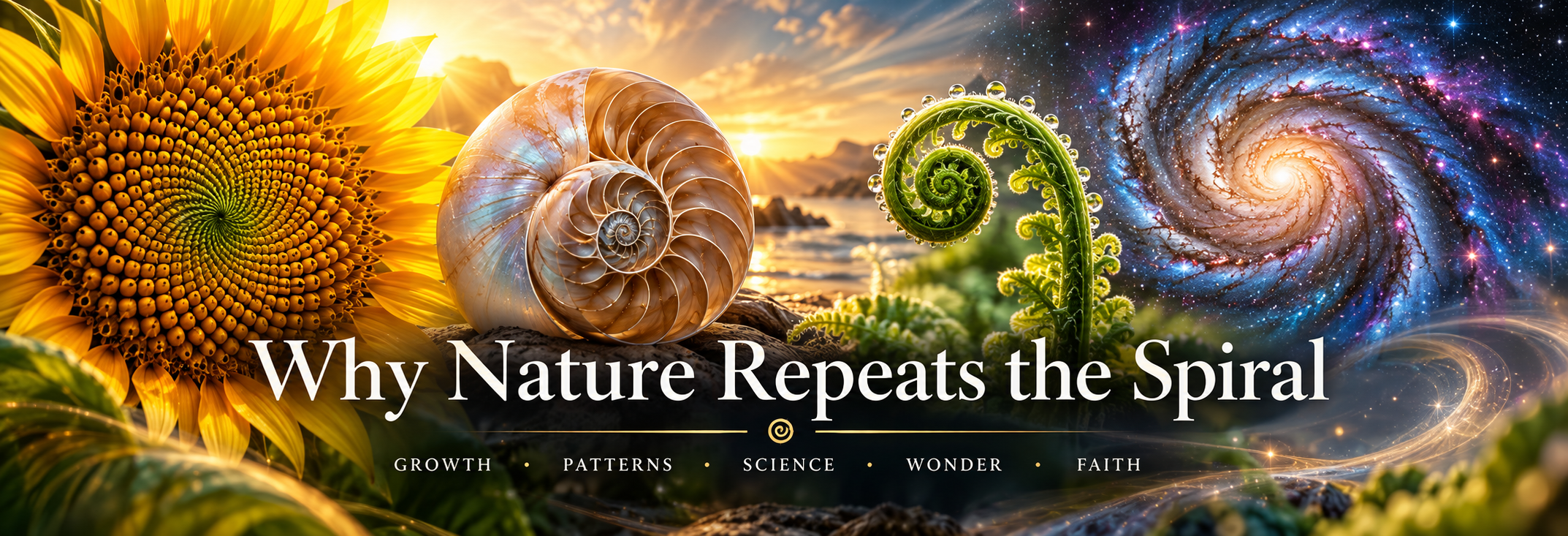
Sunflower, coiled seashell, unfurling fern and spiral galaxy showing recurring spiral forms in nature.
Look closely at the natural world and one shape seems to find us again and again.
A fern slowly unfurls.
A sunflower arranges hundreds of tiny florets around its center.
A climbing vine curls around a branch.
A seashell expands as it grows.
Water turns into a whirlpool.
A hurricane curls around its eye.
A galaxy sweeps luminous arms through the darkness of space.
Even at scales far too small for our eyes to see, nature builds structures that twist and turn.
Again and again, creation turns.
The spiral is so widespread that it can feel almost like a signature written across nature.
Yet the real story is more extraordinary than the popular idea that everything follows one mysterious mathematical formula.
It does not.
A sunflower, shell, hurricane and galaxy do not spiral for the same reason. Different forces are at work. Different materials are involved. Different scales are separated by almost unimaginable distances.
And still, related forms continue to emerge.
The spiral appears again and again because turning is one of the ways matter moves, organisms grow, forces organize and creation unfolds.
A Shape Made for Becoming
A circle closes upon itself.
A spiral does something different.
It turns while moving.
It can expand outward or draw inward while remaining connected to its center.
That combination makes spiral-like forms especially interesting wherever growth, rotation, movement, packing, curvature or changing scale occur together.
This helps explain why nature can create remarkably similar-looking forms through completely different processes.
A shell grows.
A storm flows.
A plant develops.
A galaxy evolves.
DNA twists.
The causes differ.
The geometry sometimes echoes.
Perhaps that is the first lesson hidden inside the spiral.
Things do not have to be identical to share a pattern.
Not Every Spiral Is the Same
There is no single "spiral of nature."
Several different mathematical forms can produce spiral-like shapes.
A logarithmic spiral expands proportionally as it turns. This allows its overall form to remain similar while its size increases.
An Archimedean spiral grows differently, with approximately equal spacing between successive turns.
Then there is the helix.
A spiral generally winds around a center in a plane, while a helix travels through three-dimensional space.
A coiled spring is a helix.
DNA forms a double helix.
Nature uses many variations of turning, twisting, curving and coiling.
That distinction protects us from an attractive but inaccurate idea.
Nature is not repeatedly copying one perfect spiral.
It is repeatedly revealing what curved and rotational forms can do.
Sunflowers and the Mathematics We Can See
Few examples are more mesmerizing than a sunflower.
Look closely at the flower head and you may notice two families of spirals crossing one another, some appearing to turn clockwise and others counterclockwise.
These visible spiral families are known as parastichies.
Their numbers often correspond to neighboring members of the Fibonacci sequence:
1, 1, 2, 3, 5, 8, 13, 21, 34, 55...
Each number is created by adding the previous two.
But the sunflower is not counting.
There is no tiny mathematician hiding inside the flower instructing it to create 34 spirals in one direction and 55 in another.
Something far more interesting is happening.
The mathematics emerges from growth.
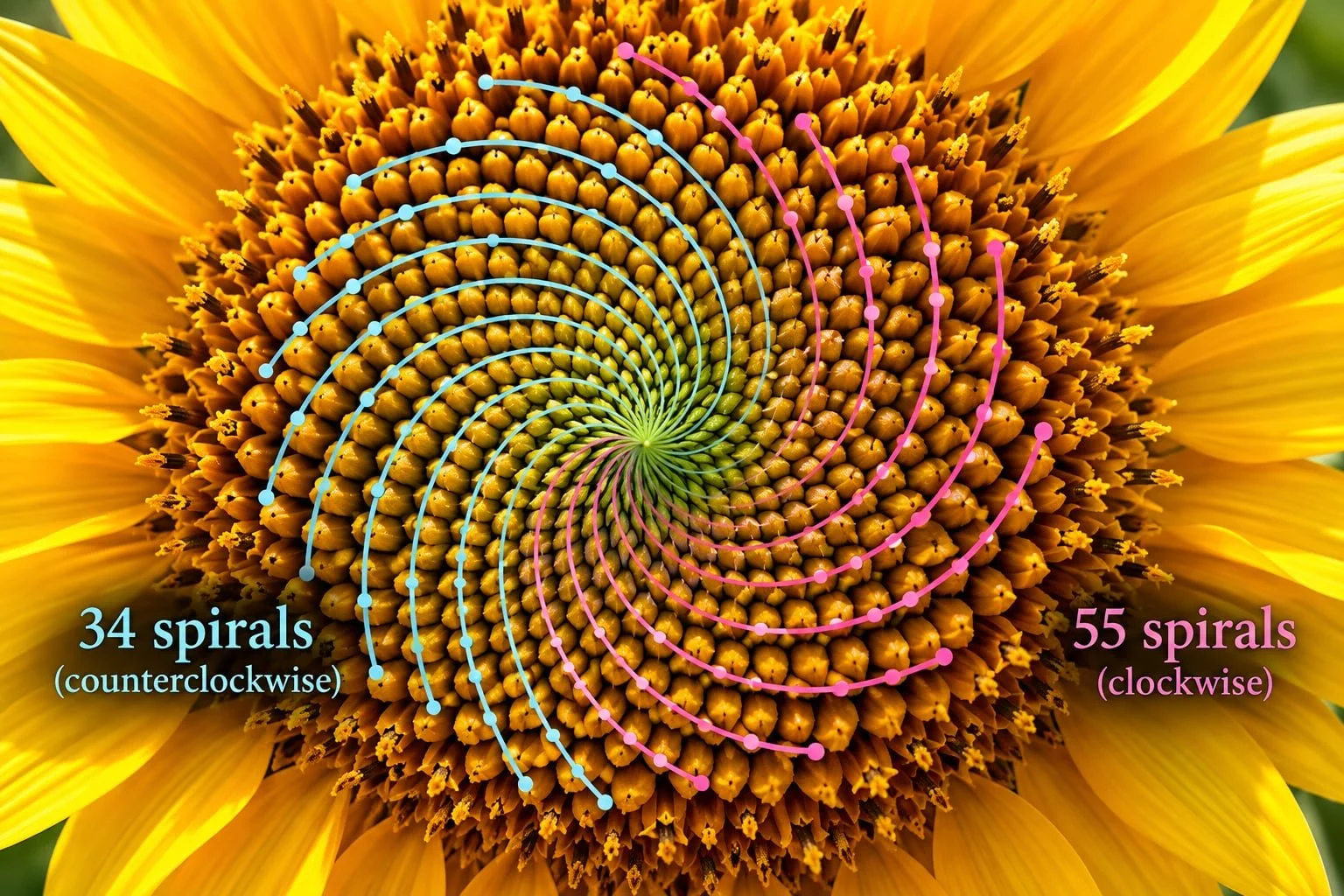
Sunflower center with guide lines showing clockwise and counterclockwise spiral families called parastichies.
How a Plant Builds a Pattern
At the growing regions of plants, new leaves, florets and other structures begin as tiny developing areas called primordia.
Their placement is influenced by structures already forming around them, growth of the surrounding tissue and chemical signaling within the plant.
One especially important participant is auxin, a plant hormone involved in growth and development.
Auxin moves through plant tissues in organized ways. Local concentrations help determine where new plant organs begin to form.
A new structure changes the conditions around it.
That influences where another can emerge.
Then another appears.
And another.
No individual floret contains a blueprint showing the complete sunflower.
Yet gradually an extraordinary larger pattern appears.
This is an example of self-organization.
Large-scale order can emerge through many smaller local interactions.
The sunflower is therefore more interesting than the idea that it merely "follows Fibonacci."
It grows through relationships.
And eventually the mathematics becomes visible.
Golden Angle
In many examples of spiral phyllotaxis, successive plant organs develop at an average angle close to 137.5 degrees from one another.
This is known as the golden angle.
It is mathematically related to the golden ratio, approximately:
1.618
The golden ratio is also connected with the Fibonacci sequence. As Fibonacci numbers become larger, dividing one by the preceding number produces values that increasingly approach the golden ratio.
These mathematical relationships help us understand why Fibonacci numbers, golden-angle arrangements and plant spirals are often discussed together.
But biology adds an important layer of nuance.
Modern research shows that some Fibonacci spiral patterns can emerge through developmental processes involving auxin dynamics and local interactions without requiring an exact golden-angle rule.
The mathematics is real.
So is the biological complexity.
Nature is not following a ruler.
Nature is growing.
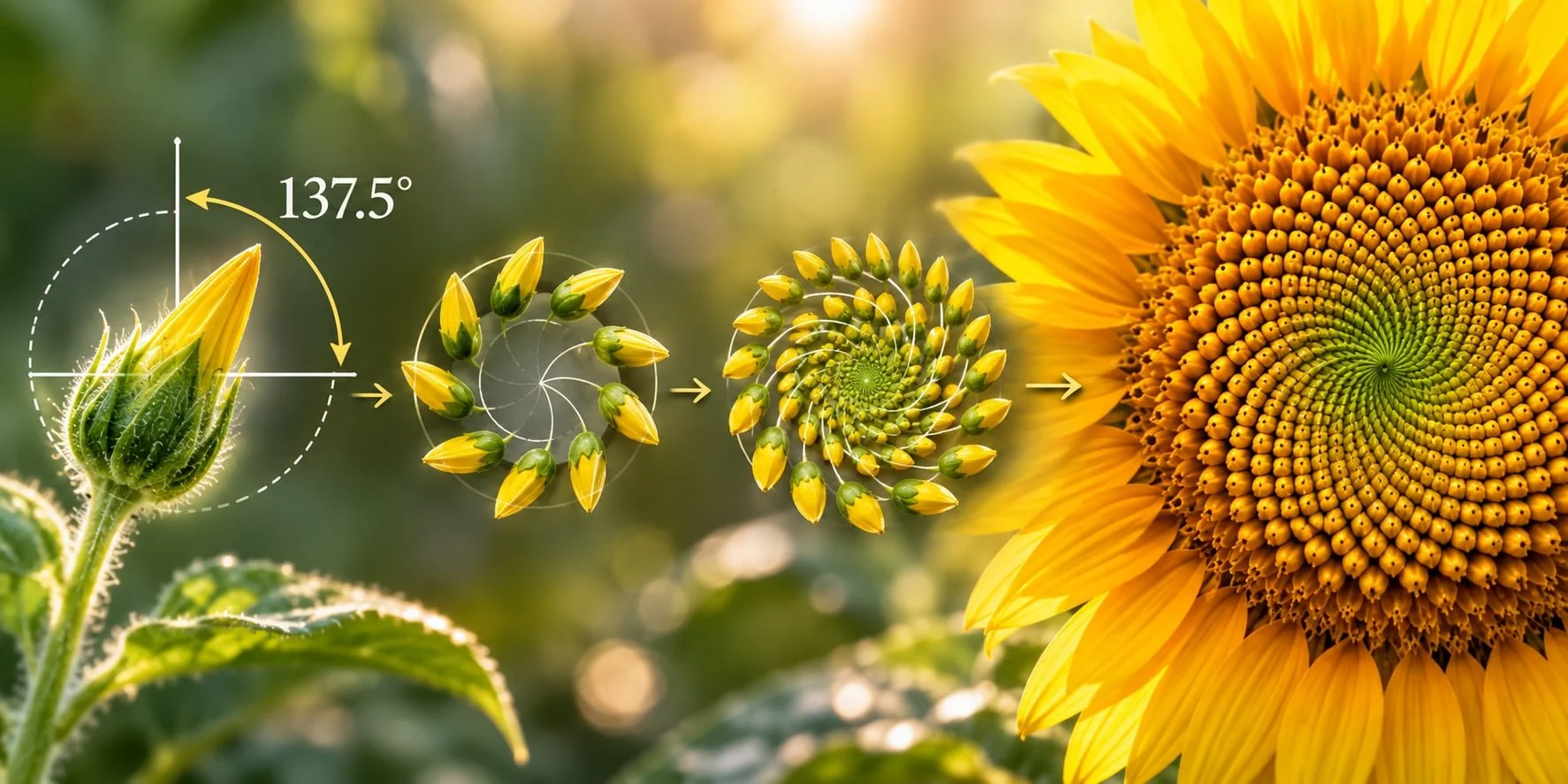
Diagram illustrating the 137.5-degree golden angle and development of a spiral plant pattern.
Nature Is Not Obsessed With the Golden Ratio
The internet has given the golden ratio an almost mythical reputation.
You may encounter claims that every shell, flower, hurricane, galaxy and part of the human body perfectly follows it.
That is not what the evidence shows.
Golden-ratio and Fibonacci relationships genuinely appear in some natural systems, particularly certain plant arrangements.
But they are not a universal blueprint for nature.
Not every flower has a Fibonacci number of petals.
Not every shell is a golden spiral.
Hurricanes are not enormous Fibonacci diagrams.
Spiral galaxies do not universally follow a golden spiral.
None of this makes nature less extraordinary.
It makes nature more interesting.
Creation does not need mathematical exaggeration to be magnificent.
Pinecones, Pineapples and Succulents
Sunflowers are far from alone.
Look carefully at a pinecone and you may see diagonal spirals moving in opposite directions.
A pineapple displays interlocking diagonal patterns across its surface.
Many succulents arrange their leaves in breathtaking rotational forms.
Artichokes, daisies and other plants reveal related arrangements.
Once again, the larger pattern emerges as new structures develop in relation to those already present.
One scale forms.
Then another.
One leaf appears.
Then another.
The completed structure can possess an order that no single part contains on its own.
This is one of nature's recurring wonders:
Simple local interactions can produce astonishing complexity.
Seashells and Growth at the Edge
Seashells tell another version of the spiral story.
A mollusk does not simply stretch its existing shell larger as it grows.
Shell growth occurs largely through the addition of new material along the aperture, the shell's growing opening or edge.
As growth continues, that opening can enlarge and change position while new material is repeatedly added.
This process can create coiled shells whose general proportions remain similar as they become larger.
Many shell forms can be described approximately using logarithmic or related spiral geometry, although real shells vary enormously and often depart from ideal mathematical forms.
There is something beautiful hidden inside this biology.
The shell grows by adding something new to the edge of what already exists.
Yesterday's structure is not discarded.
It becomes part of today's foundation.
Perhaps some human growth happens that way too.

Coiled seashell with a subtle spiral guide illustrating shell growth.
Ferns and the Beauty of Unfolding
Young fern fronds often begin tightly curled.
We commonly call them fiddleheads.
As the frond develops, the curl gradually opens.
What appears tightly contained begins to reveal what was forming within it.
The fern does not unfold all at once.
It opens according to its own development.
That gives us another kind of turning form.
Not simply the spiral of expansion.
The spiral of unfolding.
There are seasons when life looks exactly like that.
Something may already be becoming within us long before anyone else can see its final form.
Vines and the Search for Support
Climbing plants reveal another kind of turning.
Growing stems and tendrils can perform sweeping movements known as circumnutation.
When certain tendrils encounter suitable support, changes in growth can cause them to coil around it.
These structures are usually better described as helical rather than flat spirals.
The geometry serves a purpose.
Instead of constructing an enormous trunk, the plant can use something already standing.
A branch.
A fence.
Another stem.
It finds support and rises.
There is something wonderfully humble in that strategy.
Growth does not always mean doing everything alone.
Sometimes growth means recognizing what can safely support us.

Fiddlehead fern unfurling beside a climbing vine tendril coiled around a support.
Hurricanes and the Spiral of Moving Air
A hurricane can resemble an enormous spiral painted across the ocean.
But its spiral arises from completely different physics than a sunflower or shell.
Tropical cyclones develop around regions of low atmospheric pressure when oceanic and atmospheric conditions are suitable.
Warm, moist air rises.
Air moves toward lower pressure.
Earth's rotation influences moving air through the Coriolis effect.
Heat, moisture, pressure and atmospheric circulation interact within the developing storm.
The result can be a vast rotating system with curved or spiral rainbands surrounding its center.
Here the spiral is not primarily a record of biological growth.
It is a pattern of flow.
Water, Whirlpools and Vortices
Water turns too.
Watch water moving around an obstacle in a river or swirling toward a drain and rotating flows may appear.
These are vortices.
A vortex occurs when fluid rotates around a central region or axis.
Vortices can exist at dramatically different scales, from small eddies behind stones to enormous rotating systems in Earth's atmosphere.
Air and water are both fluids.
When fluids move under the right conditions, rotation and curved flow can emerge naturally.
Here, the spiral becomes movement made visible.
Galaxies and Spirals Written in Starlight
Then the spiral becomes almost unimaginably large.
Spiral galaxies contain stars, gas and dust organized within rotating galactic disks.
Some display spectacular arms sweeping outward from their central regions.
It is tempting to imagine each spiral arm as a permanent structure made from the same collection of stars.
The reality is more interesting.
One useful way astronomers explain some spiral structure is to think of areas of greater density through which material moves.
Imagine a traffic jam.
The individual cars within the traffic jam are constantly changing.
Cars enter.
They slow.
They eventually leave.
Yet the congested region remains recognizable.
In a similar way, stars, gas and dust can move through denser regions associated with spiral arms while the larger pattern persists.
Galaxies are diverse, however, and astronomers continue investigating how different types of spiral arms form and evolve.
The spiral in the heavens is therefore not an enormous sunflower.
It has its own cosmic story.
Gravity.
Motion.
Gas.
Dust.
Stars.
Time.
A spiral written across the darkness in starlight.

Hurricane and spiral galaxy showing similar spiral forms produced by different physical processes.
DNA and the Double Helix
DNA is frequently included in conversations about spirals in nature.
Technically, DNA introduces another geometry.
The double helix.
DNA consists of two complementary molecular strands winding around one another, creating the familiar twisted-ladder form.
The outside portions contain repeating sugar and phosphate groups, while paired chemical bases connect the two strands.
Its complementary double-stranded structure helps DNA store biological information and provides a mechanism through which that information can be accurately copied when cells divide.
DNA should therefore not be presented as evidence that everything follows a single spiral law.
It teaches us something better.
Twisting geometry can be extraordinarily useful.
At molecular scales, twisting contributes to organized biological structures.
At plant scales, tendrils twist around supports.
Across nature, geometry and function repeatedly meet.
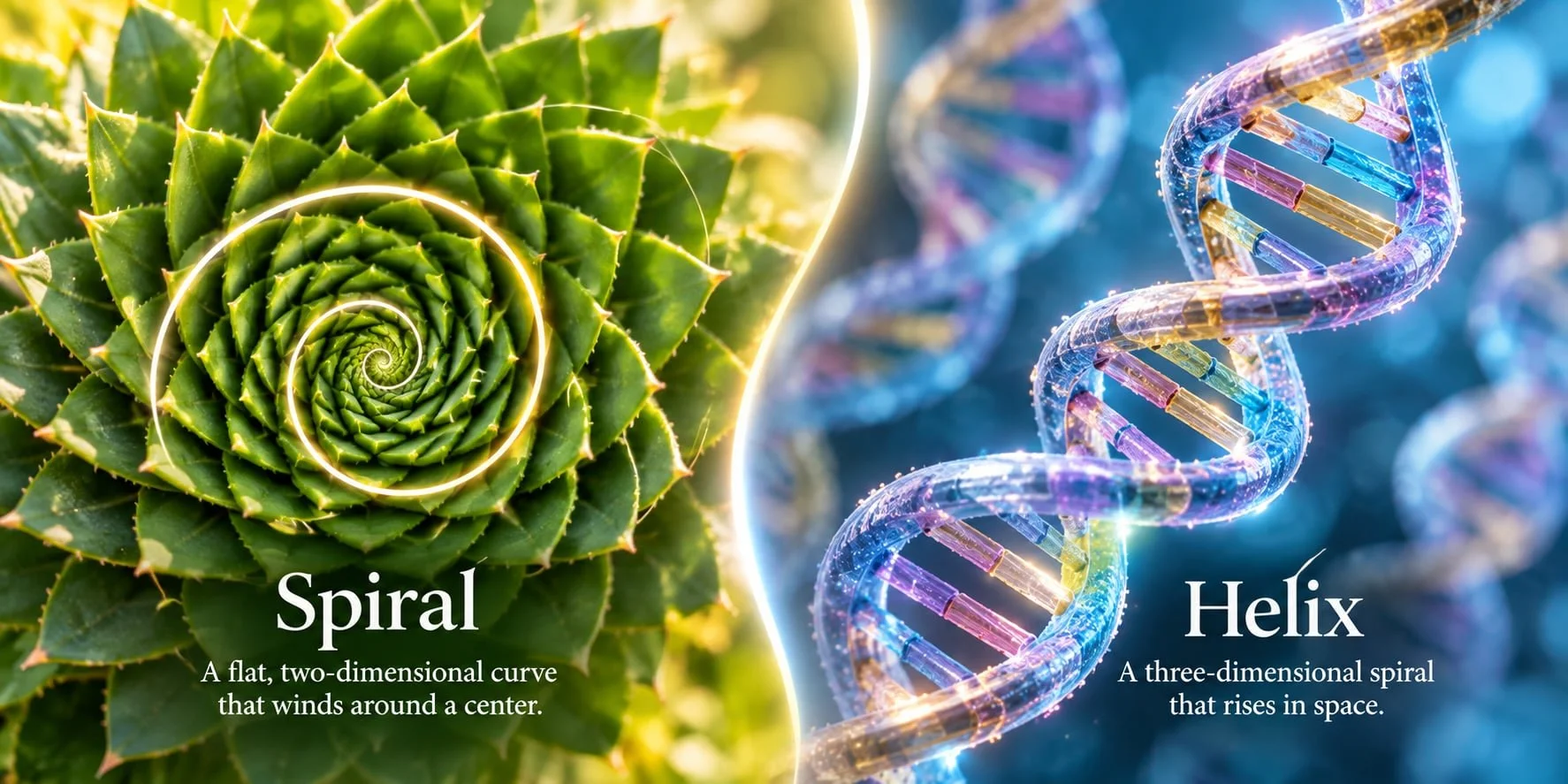
Scientific illustration comparing a two-dimensional spiral with a three-dimensional DNA double helix.
Spirals Within Us
Turning and coiling structures also appear within the human body.
The cochlea of the inner ear is famously coiled.
Proteins can contain helical structures.
Biological fibers can follow complex orientations.
Blood vessels curve and branch.
Connective tissues organize themselves to handle forces arriving from different directions.
Not every curve in the human body is a spiral, and there is no reason to force the comparison.
But living bodies remind us that biology is not built primarily from boxes and straight lines.
Life bends.
Folds.
Twists.
Branches.
Coils.
And grows.
Why Nature Does Not Need Straight Lines
Human beings love straight lines.
We build walls.
Roads.
Shelves.
Buildings.
Boxes.
Nature works under different constraints.
A living structure may need to grow around what already exists.
A fluid must move around obstacles.
A plant must position new organs beside older ones.
A shell must expand while continuing to protect the animal within.
A molecule must organize enormous amounts of biological information within microscopic space.
Curves, spirals, helices and branches offer possibilities that straight lines cannot.
A spiral can expand while remaining connected with its center.
A helix can organize length within a compact space.
A rotating flow can move energy and matter.
A phyllotactic arrangement can organize many structures around a growing region.
Often the geometry is not decoration.
The geometry is part of how the system works.
Emergence
There is a word that deserves a special place in this story:
Emergence.
Emergence describes situations in which larger patterns or behaviors arise through interactions among smaller parts.
No single sunflower floret contains the entire sunflower pattern.
No single star contains the spiral structure of a galaxy.
No single water molecule contains a whirlpool.
Yet when many parts interact under particular conditions, something larger becomes visible.
Nature repeatedly creates wholes whose patterns cannot be appreciated by looking at one isolated piece alone.
That is extraordinary.
Because much of life feels exactly like the isolated piece.
This conversation.
This decision.
This disappointment.
This prayer.
This beginning.
This ordinary Tuesday.
We rarely get to stand far enough away from our own lives to see the complete pattern.
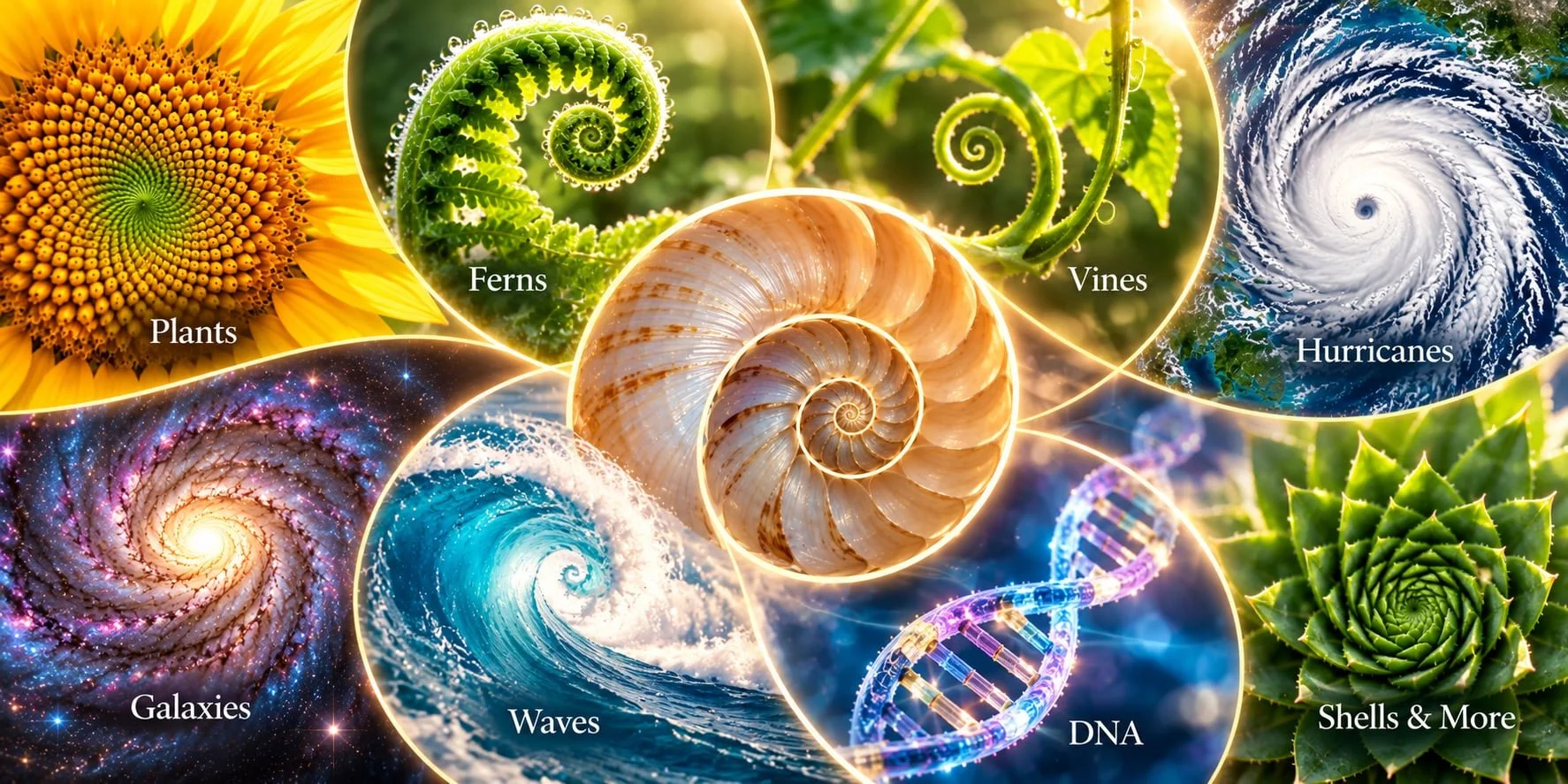
Sunflower, seashell, hurricane and spiral galaxy showing related spiral forms produced by different natural processes.
The Whole Pattern Cannot Be Seen From One Point
A single seed cannot show us the sunflower.
A single star cannot show us the galaxy.
A single drop of water cannot show us the whirlpool.
A single note cannot show us the song.
And a single moment cannot show us a life.
We live inside moments.
We see one small section of the path at a time.
Faith invites another possibility.
We may be standing inside a pattern we cannot yet see.
What appears disconnected from our limited perspective may someday reveal relationships we could not recognize while living through them.
Science does not prove that spiritual interpretation.
Faith does not need science to do so.
But nature gives us a beautiful language for contemplating it.
We see fragments.
God sees more.
Humanity Has Been Drawn to the Spiral for Thousands of Years
Long before anyone spoke about auxin, logarithmic spirals, DNA or galactic dynamics, human beings noticed the turning form.
Spirals appear in ancient pottery, jewelry, carvings, monuments and decorative traditions across different cultures and periods.
We should be careful not to assign one universal spiritual meaning to every ancient spiral.
We cannot know exactly what every spiral meant to the person who created it thousands of years ago.
But their survival tells us something.
Human beings have been fascinated by this form for a very long time.
Perhaps our ancestors saw what we still see.
Movement.
Return.
Expansion.
Mystery.
Life.
Spiritual Meaning of the Spiral
Across different times and traditions, spirals have been interpreted in many ways.
Growth.
Transformation.
Cycles.
Renewal.
Inner journeys.
Outer journeys.
The movement between what was and what is becoming.
Its spiritual power may partly arise from its geometry.
A spiral turns toward familiar directions without returning to exactly the same place.
That feels remarkably close to human experience.
We revisit old questions with new understanding.
We encounter memories from a different perspective.
We meet lessons we thought we had completed.
We return to places within ourselves that feel strangely familiar.
But we are not necessarily back where we began.
Sometimes we are meeting the same place from another turn of the spiral.
Growth Is Not Always Linear
We often imagine progress as a straight line.
Begin here.
Move forward.
Reach the destination.
Nature rarely behaves so neatly.
Seasons return.
Tides rise and fall.
Trees enter dormancy.
Seeds wait beneath soil.
Flowers open and close.
Planets orbit.
Ferns unfurl.
Living systems move through rhythms of activity, rest, expansion and renewal.
The spiral gives us another picture of growth.
Progress can circle.
It can deepen.
It can expand.
It can bring us near something familiar while quietly carrying us somewhere new.
Returning does not always mean going backward.
Faith in the Turns
For a person of faith, nature can become an invitation to notice.
Not because every sunflower contains a hidden theological equation.
Not because a galaxy secretly proves a spiritual theory.
Something quieter is happening.
Creation invites attention.
Scripture repeatedly draws our eyes toward seeds, trees, fields, birds, stars, seasons and flowers.
Nature becomes a place where we can contemplate patience, provision, growth, transformation and the mystery of things happening beyond our immediate sight.
A seed beneath the soil can look like nothing is happening.
A curled fern can look unfinished.
A season of waiting can look empty.
Yet unseen work may already be underway.
Perhaps the spiral offers another reminder.
God can still be leading us forward even when the path does not look straight.
Creation Does Not Hurry Its Becoming
A spiral cannot reach its outer turns without passing through the inner ones.
A sunflower does not apologize for beginning as a seed.
A fern does not force itself open before its tissues are ready.
A shell does not appear at its final size.
A galaxy does not hurry through cosmic time.
Creation makes room for process.
Perhaps we can make room for it too.
We are allowed to grow gradually.
We are allowed to revisit.
We are allowed to rest.
We are allowed to change direction.
We are allowed to learn something twice.
We are allowed to become.
Different Causes, Familiar Beauty
This may be the most important scientific truth on the entire page.
A sunflower's spirals arise through plant development and self-organization.
A shell's coil arises through biological growth.
A whirlpool emerges from fluid motion.
A hurricane's spiral comes from atmospheric circulation and Earth's rotation.
A galaxy's spiral structure emerges through gravitational and galactic dynamics.
DNA forms a molecular double helix.
These things are not obeying one secret equation.
And yet related turning geometries appear.
That does not make the pattern less mysterious.
It makes it more profound.
Across radically different scales, nature repeatedly reveals the possibilities contained within turning, curving, twisting, growing and rotating.
From the Smallest Turn to the Largest
Consider the scale of what we have traveled through.
Molecules.
Cells.
Plants.
Flowers.
Shells.
Bodies.
Water.
Atmospheres.
Galaxies.
The physical processes change dramatically from one level to another.
Yet everywhere we look, nature refuses to remain still.
It grows.
It moves.
It reorganizes.
It responds.
It turns.
The spiral becomes less like a secret mathematical code and more like a recurring visual language of change.
What the Spiral Can Teach Us
Perhaps nature's spirals leave us with a few quiet truths.
Growth does not have to be linear.
Returning is not necessarily regression.
Small actions can participate in patterns larger than themselves.
What begins at the center can expand far beyond it.
Old growth can become the foundation for new growth.
Order can emerge gradually.
Support can help us rise.
Unfolding has its own timing.
And we do not always need to see the complete pattern to trust that something is becoming.
A Sacred Invitation
The next time you encounter a spiral, stop for a moment.
Look into the center of a sunflower.
Hold a shell in your hand.
Notice a fern beginning to unfurl.
Watch water circle around a stone.
Look at the vast turning arms of a spiral galaxy.
Then consider your own journey.
Where are you expanding?
What are you revisiting?
What is still unfolding?
What once felt like going in circles but looks different now because you are different?
Perhaps every return does not carry us backward.
Perhaps some returns carry us deeper.
Perhaps some circles are actually spirals.
And perhaps the path unfolding beneath us is larger than we can see from where we stand.
Final Thought
Nature repeats the spiral not because everything follows one hidden mathematical command, but because growth, rotation, movement, geometry and physical forces repeatedly create turning forms.
That truth does not diminish the wonder.
It deepens it.
We can understand auxin and still marvel at the sunflower.
We can understand shell growth and still hold a seashell with wonder.
We can study atmospheric physics and still be astonished by the enormous turning architecture of a storm.
We can understand gravity and still gaze at a spiral galaxy in awe.
Science can describe mechanisms.
Mathematics can reveal patterns.
Faith can invite gratitude.
Wonder can remain.
Perhaps that is one of the most beautiful lessons hidden within the spiral.
We do not have to choose between understanding creation and being moved by it.
We can do both.
And somewhere between the tiny turning structures of life and the enormous sweep of galaxies, creation leaves us with a gentle reminder:
Keep growing.
Keep unfolding.
Do not be afraid of the turns.
God may be doing beautiful work in places where you cannot yet see the whole pattern.
Questions and Answers
Why are spirals so common in nature?
Spiral-like forms can emerge when growth, rotation, movement, curvature, changing scale or physical forces interact. Different natural systems can therefore produce similar-looking forms through very different mechanisms.
What is phyllotaxis?
Phyllotaxis is the arrangement of leaves, flowers or other plant organs around a stem or growing region. Spiral phyllotaxis is one of its most recognizable forms.
What are the spirals in a sunflower called?
The visible spiral families are called parastichies. They wind in opposite directions across the flower head and often appear in numbers related to the Fibonacci sequence.
Does a sunflower follow the Fibonacci sequence?
Fibonacci-related numbers frequently appear in sunflower spiral counts, but the plant is not literally counting Fibonacci numbers. The pattern emerges through developmental processes involving growth, local interactions and chemical signaling.
What is auxin?
Auxin is a plant hormone involved in growth and development. Its transport and local concentrations play important roles in determining where new leaves, flowers and other plant organs begin forming.
What is the golden angle?
The golden angle is approximately 137.5 degrees. It commonly appears as the average divergence angle between successive organs in spiral phyllotaxis and is mathematically related to the golden ratio.
Do Fibonacci spirals always require the golden angle?
No. Although the golden angle is strongly associated with many examples of spiral phyllotaxis, Fibonacci spiral patterns can also emerge through developmental processes involving local biological interactions without requiring a perfectly exact golden-angle arrangement.
Is everything in nature based on the golden ratio?
No. Golden-ratio and Fibonacci relationships occur in some natural systems, particularly certain plant arrangements, but they do not provide a universal blueprint for shells, storms, galaxies, bodies or all other natural forms.
Are seashells golden spirals?
Not necessarily. Many coiled shells can be described approximately using logarithmic or related spiral geometry, but real shell shapes vary considerably and arise through biological growth processes.
Are hurricanes Fibonacci spirals?
No. Hurricanes are rotating atmospheric systems shaped by heat, moisture, pressure, fluid dynamics and Earth's rotation. Their spiral appearance does not mean they follow Fibonacci mathematics.
Are spiral galaxies golden spirals?
Not as a universal rule. Spiral galaxies vary considerably, and their structures arise through gravitational and galactic dynamics rather than a universal golden-ratio formula.
Is DNA a spiral?
DNA is more precisely described as a double helix. Its two complementary molecular strands wind around one another in three dimensions.
What is emergence in nature?
Emergence occurs when larger patterns or behaviors arise through interactions among smaller parts. A sunflower's overall pattern, for example, develops through many local biological interactions rather than each individual floret possessing a complete map of the finished flower.
What does the spiral mean spiritually?
There is no single universal spiritual meaning. Across different cultures and traditions, spirals have been interpreted as symbols of growth, transformation, cycles, journeys, renewal and becoming. These meanings are spiritual or symbolic interpretations rather than scientific explanations of natural spirals.
What can the spiral teach us about personal growth?
As a metaphor, the spiral reminds us that growth does not always happen in a straight line. We can revisit old experiences from a new perspective, build upon what came before and continue moving forward even when the path appears to circle.
Continue Exploring the Patterns of Creation
Sacred Geometry of Flowers
Discover how symmetry, mathematics, growth and geometry come together in the extraordinary architecture of flowers.
Seeds: The Intelligence Hidden Inside New Beginnings
Explore the remarkable biological potential contained inside a seed and the sacred beauty of beginnings.
How Trees Communicate
Journey into the signals, relationships and living connections operating throughout forests.
Mycelium: The Hidden Networks Beneath the Earth
Explore the fungal networks beneath our feet and their extraordinary relationships throughout ecosystems.
Resonance: Why Some Words, Places and People Stir the Soul
Continue from visible patterns into the fascinating world of resonance, vibration and human experience.
Cymatics
Discover how vibration can organize matter into visible geometric patterns.
The Spiritual Power of Silence Between Sounds
Move from visible patterns into rhythm, stillness and the sacred spaces between sound.

The Sacred Geometry of Flowers
Explore the sacred geometry of flowers through symmetry, Fibonacci spirals, microscopic petal structures, pollinator signals and divine beauty.

Within every blossom, life arranges beauty through pattern, proportion and purpose
A flower may appear soft and effortless, yet beneath its beauty lives an extraordinary architecture.
Petals gather around a center. Seeds form spiraling pathways. Leaves emerge in carefully spaced arrangements. Colors, textures and invisible signals guide pollinators toward the heart of the bloom.
These patterns are not stamped onto flowers like decorations. They arise as the flower grows.
Sacred geometry invites us to see these living patterns as more than measurements. They can become reminders of harmony, relationship and the divine wisdom moving through creation.
A flower does not explain its beauty.
It simply opens.
And perhaps that is one reason flowers have always felt sacred.
Sacred geometry within living form
Sacred geometry is the study and contemplation of meaningful patterns, shapes and proportions found throughout nature, art and spiritual traditions.
Circles, spirals, branching forms, symmetry and repeating arrangements appear in many places:
Flowers and seed heads
Shells and storms
Trees and river systems
Snowflakes and crystals
Human bodies
Sacred art and architecture
The movements of planets and galaxies
In flowers, geometry is alive.
It is shaped by genes, hormones, cell growth, environmental conditions and relationships with pollinators. The resulting form may appear precise, yet it is never rigid. A flower responds to light, weather, soil, injury and the conditions surrounding its growth.
This is one of nature’s great teachings: order does not require lifeless perfection.
Living harmony has room for variation.
How a flower creates its parts
Before a flower displays its petals, its form begins in a tiny region of actively dividing cells called a meristem.
The meristem is a growing center. At first, its cells have not yet become petals, sepals, stamens or carpels. Their identities emerge through carefully timed patterns of genetic activity.
Scientists often explain part of this process through the ABCE model of flower development. Different combinations of developmental regulators help determine which floral structures will form.
These structures generally include:
Sepals, which protect the developing bud
Petals, which often attract and guide pollinators
Stamens, which produce pollen
Carpels, which contain the structures that can develop into seeds and fruit
Ovules, which can become seeds after fertilization
Many of the proteins involved belong to a family known as MADS-box transcription factors. A transcription factor helps regulate which genetic instructions a cell uses.
One scientific explanation, called the floral quartet model, proposes that several of these proteins work together in small groups to help establish the identity of each floral organ.
The wonder is not merely that a flower has the right parts. It is that those parts emerge through relationship.
A petal becomes a petal because many instructions, signals and living processes cooperate.
This offers a beautiful spiritual reflection: identity is not always created in isolation. Sometimes it is revealed through relationship, timing and participation in something greater.
Symmetry within a flower
One of the most recognizable forms of floral geometry is symmetry.
Many flowers possess radial symmetry. Their petals extend outward from a central point, allowing the bloom to be divided into similar sections in several directions.
Daisies, sunflowers, lilies and many wildflowers display variations of this circular organization.
Other flowers have bilateral symmetry. They can be divided into matching halves along one main line. Orchids, snapdragons and many members of the pea family use this more directional design.
These forms are not merely beautiful. They influence how a pollinator approaches the flower.
A radially symmetrical flower may welcome visitors from several directions. A bilaterally symmetrical flower may guide a bee into a more precise position, helping its body contact pollen-bearing structures in a consistent way.
Symmetry therefore becomes both beauty and communication.
It does not only please the human eye. It helps coordinate a relationship between flower and visitor.
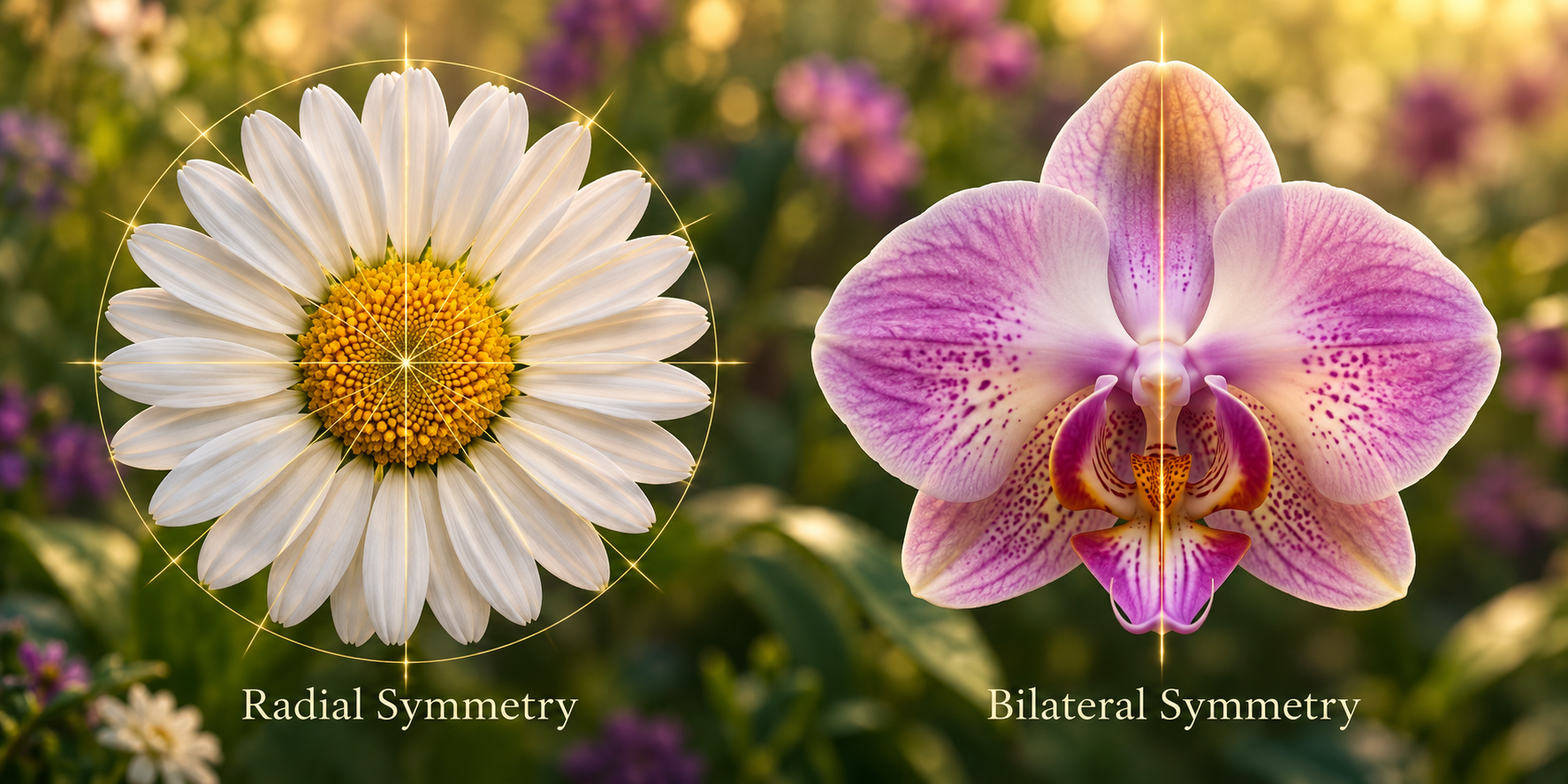
Circles, whorls and living centers
Flowers often grow in whorls, with their parts arranged around a central axis.
Sepals may form an outer protective circle. Petals create another circle within it. Reproductive structures occupy circles or spirals closer to the center.
This organization allows many functions to exist within a compact space.
The circle has long represented wholeness, unity, eternity and divine presence. It has no obvious beginning or end. Every point along its edge participates in the same continuous form.
A flower carries this ancient symbol without attempting to symbolize anything.
Its circle is practical, beautiful and alive.
Perhaps that is why standing before a flower can feel like standing before a quiet teaching about belonging. Each petal is distinct, yet each participates in one whole bloom.
Petal numbers and the Fibonacci sequence
Some flowers display numbers connected with the Fibonacci sequence.
The sequence begins simply:
1, 1, 2, 3, 5, 8, 13, 21, 34 and onward.
Each number is created by adding the two preceding numbers.
Flowers are often found with three, five, eight, thirteen or another Fibonacci-related number of petals. Lilies commonly have floral parts arranged in threes. Buttercups often have five petals. Other flowers may display eight, thirteen or many more.
This does not mean every flower follows the sequence.
Petals may be lost, fused, doubled or changed through cultivation and natural variation. Some species regularly use numbers unrelated to the Fibonacci sequence.
The deeper wonder is not that nature obeys a single numerical rule. It is that certain mathematical relationships repeatedly emerge from the process of growth.
The Fibonacci sequence is therefore not a secret code stamped onto every flower. It is one expression of how living forms can organize space efficiently and beautifully.
Spirals within sunflower heads
What appears to be one sunflower is actually a community of many small flowers called florets.
The outer ray florets form the familiar golden “petals,” while the center contains hundreds or sometimes thousands of disk florets. Each disk floret can participate in forming a seed.
These florets are arranged in interwoven spirals. Some appear to curve clockwise, while others curve counterclockwise.
The visible spiral families are called parastichies.
When researchers count these spirals, the totals are often neighboring Fibonacci numbers. This arrangement helps the growing plant place new florets into available spaces without lining them up in wasteful rows.
Large studies of sunflowers have confirmed that Fibonacci-related spiral counts are common. They have also found exceptions and unusual arrangements.
This makes the sunflower even more meaningful.
Its order is real, but it is not mechanical. Its geometry is reliable without becoming absolute. Nature uses pattern while remaining free to respond, adapt and vary.
Golden angle within living growth
The golden angle is approximately 137.5 degrees.
In many plants, new leaves, florets or other structures emerge at angles close to this value. Because the angle is an irrational fraction of a full circle, successive structures do not repeatedly align in the same direction.
Instead, each new structure tends to occupy an open region.
This can help a plant distribute leaves around a stem or pack florets into a growing flower head without leaving large unused gaps.
The golden angle is related to the golden ratio, a proportion of approximately 1.618. This ratio has fascinated artists, architects, mathematicians and spiritual seekers for centuries.
Yet the beauty of a flower does not depend on a person measuring it and finding a perfect number.
The sacred quality comes from the living process itself: each new part emerges in conversation with what is already there.
Growth honors the past without merely repeating it.
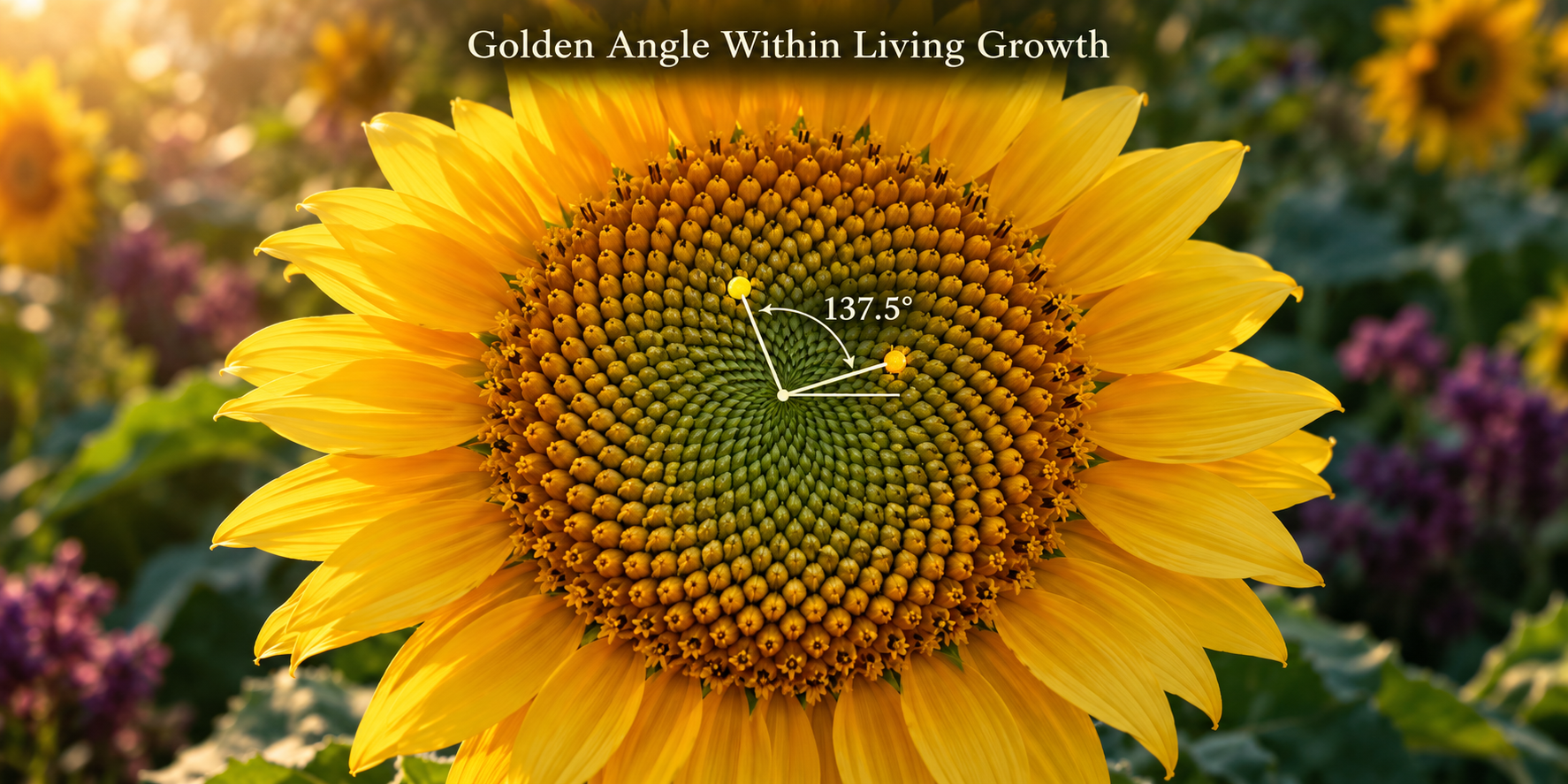
Phyllotaxis and placement of new life
The arrangement of leaves, petals, florets or scales around a growing center is called phyllotaxis.
Phyllotaxis is not planned by a tiny architect inside the plant. It emerges through local interactions among cells, growth and chemical signals.
One important plant hormone is auxin.
Auxin helps regulate growth and development. Within a growing tip, cells transport and concentrate auxin in particular locations. A new leaf, petal or floret can begin where the conditions are favorable.
Once a new structure starts forming, it influences where the next one can appear.
A large pattern is created through many local relationships.
This principle appears throughout life. A community is shaped by individual choices. A path is formed through individual steps. A life becomes visible through moments that may have seemed small while they were happening.
The flower reminds us that the whole can emerge through faithful attention to what is ready to grow next.
Geometry too small for human eyes
The visible outline of a petal is only one layer of its geometry.
Under a microscope, many petals reveal surfaces made of tiny cone-shaped cells. These microscopic forms influence the way light enters and leaves the petal, sometimes making its color appear richer or more intense.
The cones can also provide texture and grip for visiting insects.
Research with snapdragons found that pollinators often preferred flowers with their natural cone-shaped petal cells over altered flowers with flatter cells. What appears to us as a smooth surface can therefore be a meaningful landscape beneath a bee’s feet.
Some flowers possess even smaller ridges that interact with light.
These nanoscale structures can produce subtle structural colors, including a bluish glow sometimes described as a blue halo. Bees can notice these optical effects even when human eyes barely perceive them.
A flower’s beauty is therefore not limited to the scale at which we happen to see.
Beneath the visible pattern is another pattern.
And beneath that may be another.
Creation continues beyond the reach of ordinary sight.
Invisible patterns around a flower
Flowers do not communicate through color alone.
Many petals display ultraviolet patterns that humans cannot naturally see. Bees and certain other pollinators can perceive ultraviolet light, allowing them to notice markings that may resemble rings, pathways or bullseyes.
These patterns often guide the visitor toward nectar and pollen.
A blossom that seems uniformly colored to us may appear richly marked to a bee.
Flowers can also carry weak electric fields.
As bees fly, they can develop a positive electrical charge. Flowers are often electrically negative in relation to the surrounding air and ground. When bee and flower draw near, these differences create delicate electrical interactions.
Studies have shown that bumblebees can learn to distinguish aspects of floral electric fields. Tiny hairs on their bodies can move in response to these fields, helping the bee sense information it cannot see.
A recent visit from another bee may temporarily alter a flower’s electrical condition, adding another subtle layer to the signals surrounding the bloom.
This is a remarkable thought: before a bee even lands, a conversation may already be taking place.
The flower exists within a field of visible and invisible relationship.
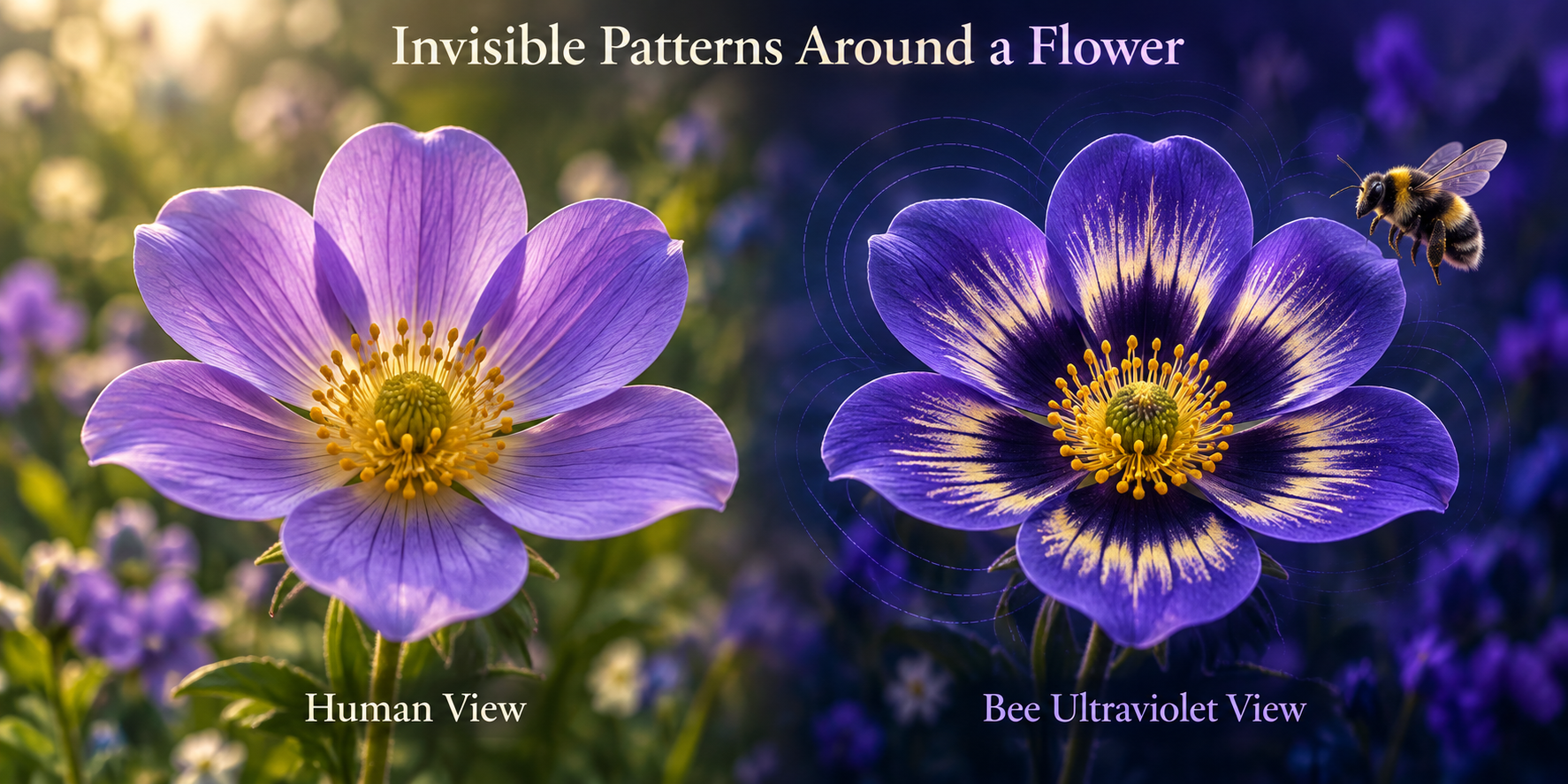
Geometry guides the pollinator
Nectar guides are markings that direct pollinators toward a flower’s center. They may be visible to humans, visible only in ultraviolet light or created through differences in color, texture and shape.
The geometry of the bloom helps determine:
Where the pollinator lands
Which direction it faces
How deeply it enters
Where pollen touches its body
How effectively pollen reaches another flower
In some species, bilateral symmetry and the orientation of the blossom guide a visitor into a highly specific position. This can make pollen placement more accurate.
The flower offers nourishment.
The pollinator carries life forward.
Geometry helps bring them together.
This relationship is not based on sameness. Flower and bee are profoundly different beings, yet each participates in the flourishing of the other.
Sacred relationship does not require two lives to become identical. It asks them to meet in a way that allows both to serve life.
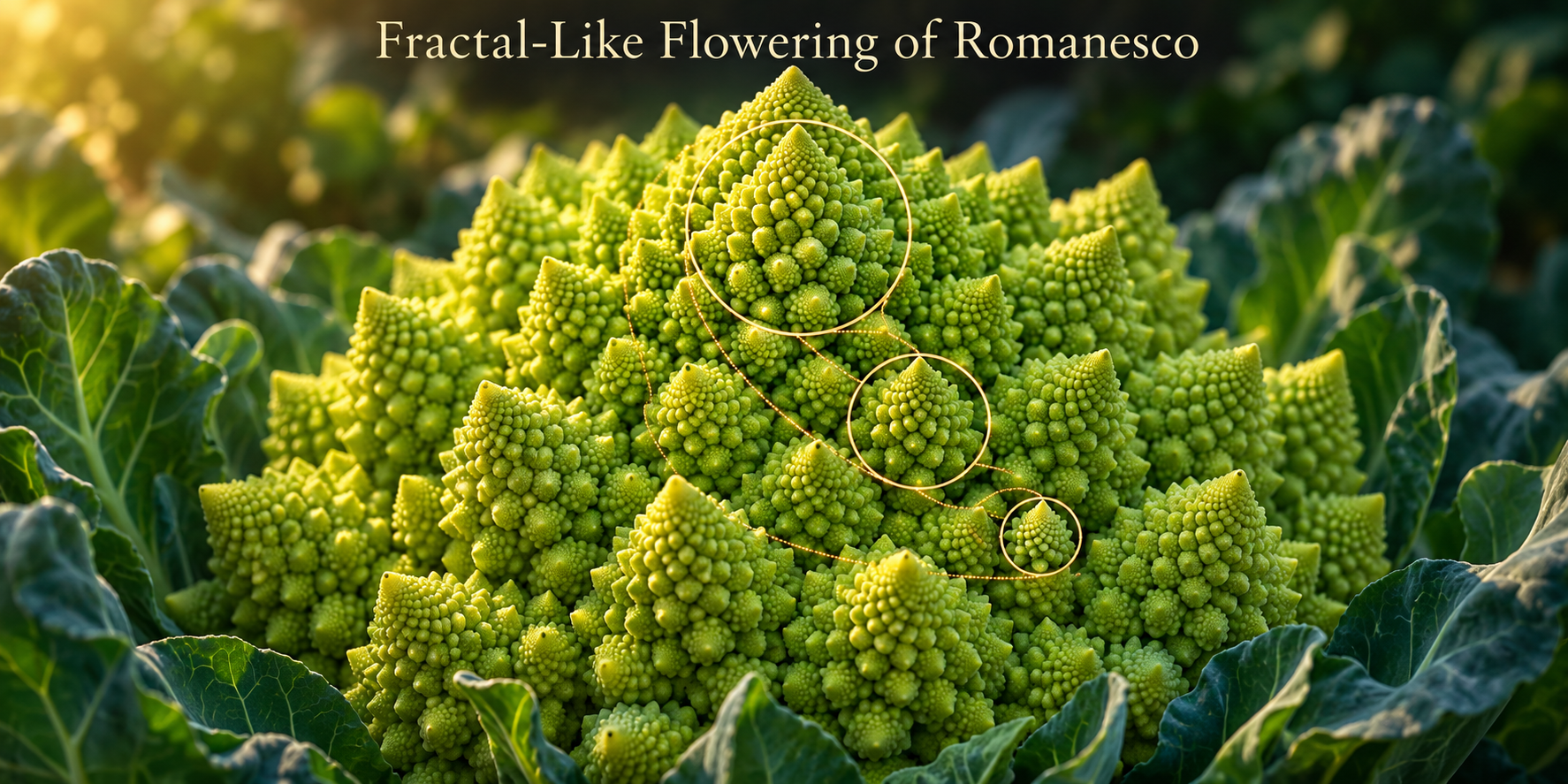
Fractal-like flowering of Romanesco
Romanesco, the luminous green relative of cauliflower and broccoli, offers one of the most striking examples of repeating plant geometry.
Its pointed cones are composed of smaller cones that resemble the larger form. The pattern continues across several scales, creating a structure often described as fractal-like.
A true mathematical fractal may repeat indefinitely. A living Romanesco cannot do that, so “fractal-like” is the more accurate description.
Its unusual shape arises from the behavior of its growing tips, or meristems.
Research suggests that these meristems begin moving toward flower formation but do not complete an ordinary floral identity. They return to a shoot-like pattern and repeat the process. As the growing structures expand at different rates, they form the nested cones associated with Romanesco.
What looks like ornament is the visible history of repeated attempts to grow.
Romanesco offers an unexpected spiritual lesson: a form can become extraordinary through redirection. What does not unfold in the expected way may still create remarkable beauty.
Repetition without exact duplication
Flowers repeat patterns, but they do not create perfect copies.
Two roses from the same plant may differ slightly. One sunflower may have a different spiral count from another. Petals may vary in width, curve, pigment or position.
This variation is not a failure of geometry.
It is part of living geometry.
Machines often repeat by producing identical objects. Life repeats by carrying a recognizable pattern through changing circumstances.
Every daisy is unmistakably a daisy, yet no daisy is required to duplicate another in every detail.
Sacred pattern leaves room for individuality.
We can carry shared values, spiritual truths and ancestral wisdom without losing the particular expression of life entrusted to us.
Flowers and sacred architecture
Across cultures and centuries, builders and artists have used floral geometry in sacred spaces.
Rose windows, mandalas, carved rosettes, mosaics and circular floor plans often echo the radiating organization of flowers.
A rose window gathers individual pieces of colored glass around a center. Light moves through the pattern and fills the interior with color.
The resemblance to a flower is more than visual.
Both forms gather diversity into unity. Both reveal how repeated elements can create a larger harmony. Both invite the eye inward and outward at the same time.
Human beings may have been drawn to floral geometry because flowers already express what sacred architecture hopes to create: a meeting place between matter, light, beauty and meaning.
Consider the lilies
Jesus invited His listeners to “consider the lilies of the field.”
The invitation was not merely to glance at them. To consider is to notice, reflect and allow what we see to teach us.
A flower does not force itself open before its season. It receives light, water and nourishment. It grows according to the life within it.
Its beauty is not earned through anxiety.
The flower participates in creation by becoming what it was made to become.
This does not mean human lives are effortless. It means beauty and worth do not arise only from striving.
There are times to act, build and persevere. There are also times to receive, trust and let faithful growth unfold.
The geometry of a flower can become a gentle reminder that divine wisdom often works through processes we cannot hurry.
Beauty shaped through wisdom
Psalm 104:24 declares:
“How many are your works, Lord! In wisdom you made them all.”
Science helps us examine some of the processes through which flowers form. We can study genes, hormones, cells, symmetry, optics and pollination.
Such knowledge does not have to remove wonder.
It can deepen it.
Knowing that microscopic petal cells help a bee hold on does not make the petal less beautiful. Discovering ultraviolet guides does not make the flower less mysterious. Learning how auxin helps organize growth does not make the process less sacred.
Explanation and reverence can stand together.
Science can describe many of the relationships through which a flower develops. Faith can ask what those relationships awaken within the human soul.
Lessons hidden within the flower
A flower offers its wisdom quietly.
It teaches that a strong center can support an open life.
It shows that growth can follow order without demanding perfection.
It demonstrates that beauty may serve a purpose beyond being admired.
It reminds us that much of reality exists outside our immediate perception.
It reveals that individuality and belonging can coexist.
It shows that relationships can shape identity.
It suggests that divine creativity is not limited to one form, one number or one method.
Perhaps most importantly, the flower does not compare its pattern with the blossom beside it.
It turns toward the light available to it.
A practice of sacred observation
Choose a flower and spend several quiet minutes with it.
If possible, select one you can observe without picking. Let it remain connected to the life supporting it.
Begin with the whole flower.
Notice its overall shape. Is it circular, star-like, cup-shaped or bilaterally symmetrical?
Then look more closely.
Count the petals if they are easy to distinguish. Observe how they overlap. Notice the center, the movement of the veins and the transition from one color to another.
Imagine how the flower might appear to a bee. There may be ultraviolet pathways you cannot see, textures your fingers cannot detect and electrical information beyond ordinary human awareness.
Breathe slowly and offer this prayer:
“Creator of all beauty, help me recognize the wisdom within Your works. Teach me to grow with patience, to remain open to light and to trust the sacred pattern unfolding within my life.”
Remain still for a moment.
You do not have to receive a message or manufacture a spiritual experience.
Attention itself can be an act of reverence.
Sacred pattern of becoming
The sacred geometry of flowers is not only about shapes and numbers.
It is about becoming.
A flower begins as a possibility held within living tissue. Through countless interactions, its form gradually appears. Cells divide. Signals move. Parts take on their identities. Petals expand. Colors deepen. The blossom opens into relationship with sunlight, air and pollinators.
The finished flower was not assembled all at once.
It emerged.
Our own lives may unfold in a similar way.
We rarely see the complete pattern while it is forming. We experience one season, one decision and one act of faith at a time.
Yet something larger may be taking shape.
The flower invites us to trust that growth can possess meaning before its full design becomes visible.
Questions and answers
What is the sacred geometry of flowers?
The sacred geometry of flowers refers to the meaningful shapes, proportions and repeating patterns found within blossoms and other flowering structures. These include circles, symmetry, spirals, whorls, Fibonacci-related arrangements and fractal-like repetition.
Do all flowers follow sacred geometry?
All flowers possess some form of organization, but they do not all follow the same pattern or mathematical relationship. Sacred geometry is best understood as a way of appreciating recurring harmony in nature, not as a rule requiring every flower to match one formula.
Why do flowers have symmetry?
Symmetry develops through genetic and cellular processes. It can help organize the flower’s structures and influence how pollinators recognize, approach and enter the bloom.
What is the difference between radial and bilateral symmetry?
A radially symmetrical flower can be divided into similar sections in several directions around its center. A bilaterally symmetrical flower has one main line that divides it into matching halves.
Why do some flowers have Fibonacci numbers of petals?
Fibonacci-related numbers can emerge from the way plants place new structures around a growing center. These arrangements may help distribute parts efficiently, although not every flower has a Fibonacci number of petals.
Are sunflower spirals really Fibonacci spirals?
Many sunflower heads contain clockwise and counterclockwise spiral counts that correspond with Fibonacci numbers or closely related sequences. Exceptions also occur, demonstrating that living growth includes both recurring order and natural variation.
What is the golden angle?
The golden angle is approximately 137.5 degrees. New leaves or florets appearing near this angle tend not to line up directly with earlier ones, helping the plant distribute them around a stem or growing center.
What is phyllotaxis?
Phyllotaxis is the arrangement of leaves, petals, florets or other plant structures around a stem or growing point. It develops through interactions among cells, hormones, physical growth and the structures already present.
How does a flower know which cells should become petals?
Flowers use networks of developmental genes and regulatory proteins. Different combinations help cells develop as sepals, petals, stamens, carpels or ovules. Scientists describe part of this process through the ABCE and floral quartet models.
Do petals have microscopic geometry?
Yes. Many petals have cone-shaped surface cells and even smaller ridges. These structures can influence color, light reflection, texture and the ability of insects to grip the flower.
Can bees see patterns that humans cannot see?
Many bees can see ultraviolet light. Flowers may contain ultraviolet nectar guides or bullseye-like patterns that lead bees toward pollen and nectar, even when those markings are invisible to human eyes.
Can bees sense a flower’s electric field?
Research indicates that bumblebees can detect and learn differences in weak floral electric fields. Movement of tiny body hairs appears to help them sense this information.
Is Romanesco a fractal?
Romanesco is usually described as fractal-like because similar cone-shaped structures repeat at several scales. It is not an infinite mathematical fractal, but its living pattern provides a beautiful example of self-similarity in nature.
Does science conflict with the spiritual meaning of flowers?
It does not have to. Science investigates how flowers develop and function. Spiritual reflection considers the meaning, wonder and inner response their beauty awakens. The two perspectives can enrich one another.
What can flowers teach us spiritually?
Flowers can remind us to remain centered, receive nourishment, trust gradual growth, honor our individuality and open when the season is right. They also show how beauty can arise through cooperation and relationship.
More light for the journey
Explore these related sacred pages:

Seeds: The Intelligence Hidden Inside New Beginnings
Explore the remarkable science and sacred meaning of seeds, from dormancy and germination to ancient seeds, roots, faith, renewal and the hidden potential within every new beginning.
A seed can look like almost nothing.
It can rest quietly in the palm of your hand, small enough to lose between your fingers. It does not resemble the flower it may become, the fruit it may someday carry, or the tree that may rise from it.
And yet the seed holds a beginning.
Inside a viable seed is a living embryo, biological instructions, protective structures and, in many species, stored nourishment that will help sustain the earliest stages of growth.
Some seeds begin growing quickly.
Others wait.
Some wait through winter.
Some respond to rain.
Some require particular temperatures.
Some respond to light or darkness.
Certain seeds can even respond to chemical signals associated with smoke and fire.
The seed reminds us of something easily forgotten:
A beginning does not have to look like the future it carries.
A Seed Is Already Alive
A dry seed may appear lifeless.
But a viable seed contains a living embryo.
Its metabolism can become extraordinarily low while it waits for conditions that support germination.
Inside the seed is not a miniature finished tree or flower. Instead, there is the beginning of a developing organism with the biological capacity to build what comes next.
That distinction makes the seed even more extraordinary.
The tree is not sitting fully formed inside the seed.
The beginning of the tree is there. The tree itself must still become.
Cells must divide.
Tissues must differentiate.
Roots must form.
Shoots must rise.
Leaves must unfold.
The environment and the developing plant will interact continually as this transformation takes place.
A seed therefore represents more than hidden potential.
It represents becoming.
Dormancy Is Not Emptiness
One of the most fascinating features of seeds is dormancy.
Dormancy is not simply a seed failing to grow.
It is a biological strategy that can help prevent germination at a time when the young plant would have little chance of surviving.
Imagine a seed experiencing several unusually warm winter days.
If warmth alone always triggered germination, a young seedling might emerge only to encounter freezing weather soon afterward.
Many seeds instead respond to combinations of environmental conditions.
Dormancy allows life to wait.
There is something deeply meaningful in that.
We often judge a season by what we can see happening.
But nature reminds us that waiting and lifelessness are not the same thing.
There are seasons for emerging.
There are seasons for growing.
And there are seasons when waiting may protect what is not yet ready to rise.
The Chemistry of Waiting and Awakening
Inside seeds, sophisticated chemical signaling helps regulate the transition between dormancy and germination.
Two plant hormones are particularly important.
Abscisic acid, often abbreviated ABA, generally helps establish and maintain seed dormancy.
Gibberellins, commonly abbreviated GA, generally promote processes associated with germination.
The relationship is more complicated than a simple biological switch.
Hormones interact with genes, proteins, other signaling molecules and environmental information.
Light can matter.
Temperature can matter.
Water availability can matter.
Oxygen can matter.
Chemical conditions can matter.
The transition from dormancy to germination emerges from an intricate interaction between the seed's biology and its environment.
How Does a Seed Know When to Begin?
Scientists would not say that a seed "knows" in the human sense.
Seeds do not need humanlike consciousness to accomplish something remarkable.
Their cells contain receptors, signaling pathways, genes, proteins and hormones capable of responding to environmental information.
Depending upon the species, germination can be influenced by combinations of:
water
temperature
oxygen
light or darkness
nitrate and other chemical signals
seasonal temperature history
conditions experienced while the seed developed
and, in certain species, compounds associated with smoke.
This is the kind of biological sophistication we mean when we speak poetically about the intelligence hidden inside a seed.
It is not human thought.
It is an exquisitely organized responsiveness woven into living systems.
Water Awakens the Seed
For many seeds, one of the first steps toward germination is water absorption.
A dry seed takes in water through a process called imbibition.
The seed swells.
Cellular structures rehydrate.
Metabolism increases.
Enzymes become active.
Stored nutrients begin becoming available to the growing embryo.
What appeared still begins moving toward growth.
Water does not place the potential inside the seed.
It helps create conditions in which that potential can unfold.
The Root Often Comes First
One of the most beautiful events in germination happens where no one can see it.
In many seeds, the first embryonic structure to emerge is the radicle, which develops into the primary root.
Before the young plant reaches upward into sunlight, it begins downward.
The root helps anchor the plant.
It begins exploring its surroundings for water and nutrients.
Only then does the emerging shoot increasingly establish itself above the soil.
There is something profound about that order.
Root before height.
Foundation before visibility.
Depth before display.
Much of what eventually supports a beautiful life is built where nobody is watching.
How Does a Root Find Down?
Plants possess remarkable mechanisms for responding to gravity.
The directional growth response to gravity is called gravitropism.
Specialized cells help a developing plant perceive gravitational direction. Roots generally grow in the direction of gravity, while shoots generally grow away from it.
Plants can also respond to light, moisture, touch and chemical gradients.
They are continually interacting with their environment.
A seedling does not simply unfold according to a rigid blueprint regardless of its surroundings.
Life responds.
Life adjusts.
Life reaches.
The First Reach Toward Light
Eventually the shoot emerges.
Leaves unfold.
Chlorophyll captures light energy.
Photosynthesis allows the young plant to use light energy to help transform carbon dioxide and water into sugars that support its life and growth.
Until then, the seedling has relied heavily upon resources provided within the seed.
Then comes a transition.
The plant begins producing more of the energy-rich compounds it needs through photosynthesis.
There is something beautiful here too.
A beginning may initially survive on what was provided beforehand.
Then it grows capable of participating more fully in sustaining what it is becoming.
The Mother Plant Can Influence the Beginning
A seed carries genetic information inherited from its parents.
But DNA is not the entire story.
Scientists have discovered that conditions experienced by the mother plant while seeds are developing can influence characteristics of those seeds.
One particularly fascinating example comes from Arabidopsis, a small flowering plant extensively studied by scientists.
Research shows that seasonal temperatures experienced by the mother plant can influence the dormancy of her offspring's seeds. These effects involve changes in seed tissues and regulatory processes that include epigenetic mechanisms.
Epigenetics describes changes affecting how genes are regulated without changing the underlying DNA sequence itself.
This does not mean a seed remembers winter or summer the way a person remembers an experience.
It means something subtler and remarkable:
A new generation can begin life carrying biological influences connected to conditions experienced by the generation before it.
Every beginning has a history.
A Seed May Not Travel Alone
There is another fascinating layer to the seed story.
Seeds can harbor communities of microorganisms.
Scientists often refer to these communities as the seed microbiome.
Some seed-associated microorganisms can originate from the parent plant. Others may be acquired from the surrounding environment.
Researchers have found evidence that some bacteria associated with seeds can be carried forward into developing seedlings and, in certain plant systems, across generations.
Scientists are investigating how these microorganisms may influence germination, nutrient acquisition, early plant development, resilience and interactions with plant pathogens.
This field is still developing, and the importance of these relationships differs among species and environments.
But it reveals something beautiful about the biological world.
A seed may carry more into the future than the plant embryo alone.
Life often begins in relationship.
Seeds Carry History Forward
A seed does not remember as we remember.
But it carries information.
DNA.
Developmental instructions.
Chemical signals.
Stored resources.
Influences from the environment in which it developed.
And sometimes microbial companions.
A seed is simultaneously something new and something inherited.
It continues a story that began before it existed.
And if it grows and eventually produces seeds of its own, that story continues again.
A Beginning Can Wait Two Thousand Years
Few examples demonstrate the extraordinary durability of seeds as dramatically as the ancient Judean date palm.
Researchers successfully germinated date-palm seeds recovered from archaeological sites in the Judean Desert.
Some were approximately 2,000 years old.
One of the best-known trees was given the name Methuselah.
Additional ancient seeds were later successfully germinated, allowing researchers to study living plants whose seeds originated around the time of the ancient Roman world.
Consider what passed while those seeds remained still.
Generations were born and died.
Cities changed.
Kingdoms rose and disappeared.
Languages evolved.
The world above them transformed.
Yet under extraordinary preservation conditions, biological potential remained within those seeds.
Eventually water, warmth and careful human attention met the ancient seed.
And life continued.
Not Every Seed Can Wait That Long
The ancient date palms are remarkable precisely because such survival is unusual.
Seed longevity varies enormously among plant species.
Some seeds tolerate drying extremely well and can remain viable for long periods under favorable storage conditions.
Others are much more sensitive.
Scientists often describe seeds that tolerate substantial drying and cold storage as orthodox seeds.
Other seeds, known as recalcitrant seeds, cannot tolerate the drying or freezing conditions commonly used for conventional long-term seed storage.
There is no universal rule about how long a seed can wait.
Different forms of life require different kinds of care.
That may be one of the seed's quieter lessons.
Not everything should be nurtured in exactly the same way.
Some Seeds Listen for Fire
One of the most surprising discoveries in seed biology involves smoke.
Certain plants, particularly those associated with environments shaped by fire, can respond to chemicals produced when vegetation burns.
Scientists discovered a family of smoke-derived compounds called karrikins.
Karrikins can stimulate germination in seeds of various species and can influence early seedling development.
Not every fire-responsive seed responds to the same compounds, and the biology is more complex than simply saying that seeds "need fire."
But the discovery reveals something extraordinary.
For certain plants, chemistry produced by disturbance can become a signal that conditions around them have changed.
Life After Disturbance
Fire can alter vegetation, competition, nutrients and the physical environment.
In ecosystems adapted to recurring fire, those changes can create opportunities for new growth.
But there is an important spiritual distinction.
The fire is not the life.
And suffering does not become good simply because something eventually grows afterward.
Nature gives us a more compassionate lesson.
Life can possess ways of responding even after disturbance.
Something beautiful emerging after hardship does not make the hardship beautiful.
It reveals the resilience of life.
Potential Is Not Destiny
It is tempting to look at a seed and say that everything it will ever become is already inside it.
There is truth in that metaphor.
But biology offers something richer.
A seed contains potential.
Potential still requires relationship.
Water matters.
Temperature matters.
Timing matters.
Soil matters.
Light matters.
Genetics matters.
Microorganisms may matter.
Chance matters.
The surrounding ecosystem matters.
An acorn carries the biological possibility of becoming an oak.
But not every acorn becomes one.
That does not diminish the wonder of the acorn.
It teaches us something important about beginnings.
Potential is something to be cultivated.
Something extraordinary may already be beginning within you.
But becoming is a relationship between what you carry, what surrounds you, what you choose to nurture and what God brings into your life.
One Seed Can Become Thousands
Consider an acorn.
Nothing about its size visually explains an oak tree.
Yet given suitable conditions and enough time, that small beginning can become something towering.
And eventually that tree may produce countless new acorns.
A sunflower seed can become a tall flowering plant whose head produces many more seeds.
A grain can multiply through generations of growth and harvest.
Nature repeatedly demonstrates that the size of a beginning tells us very little about the reach of what may follow.
Small does not mean insignificant.
Invisible does not mean absent.
Early does not mean impossible.
Seeds Are Living Libraries
Humans have come to recognize that seeds are more than agricultural commodities.
They carry biological inheritance.
Seed banks around the world preserve plant genetic diversity so that it may remain available for future generations.
Seeds preserved today may someday contribute to scientific research, ecological restoration, agriculture or the protection of plant diversity.
There is something profoundly hopeful about a seed bank.
People carefully preserve living possibilities they themselves may never need.
They protect something for people they will never meet.
It is stewardship across time.
The Soil Is Alive Too
A seed never truly grows alone.
Healthy soil can contain enormous communities of fungi, bacteria and other organisms.
Roots enter that world as the plant develops.
Many plants eventually form partnerships with fungi called mycorrhizae.
In these relationships, fungi associate with plant roots and can help plants obtain nutrients and water, while receiving carbon compounds produced by the plant.
Bacteria participate in nutrient cycling.
Fungi weave through soil.
Earthworms reshape it.
Water moves through microscopic spaces.
Roots explore.
What looks like ordinary dirt can contain an entire living community.
A seed entering soil is entering relationship.
A Seed Is Part of a Larger Story
Plants have developed extraordinary ways of sending their seeds into the world.
Dandelions release seeds carried by parachute-like structures.
Maple fruits spin through the air.
Burrs attach themselves to passing animals.
Fruit encourages animals to carry seeds elsewhere.
Some seeds float.
Some are buried.
Some are carried great distances by birds.
Some simply fall beneath the plant that produced them.
A seed is therefore not merely the end of one plant's reproductive cycle.
It is a bridge.
One generation reaches toward another.
Seeds and the Bible
Seeds appear throughout Scripture as images of faith, growth, harvest, God's Word, multiplication, death, renewal and the Kingdom of God.
Jesus repeatedly used seeds in His teachings.
His listeners understood agriculture.
They knew what it meant to take something valuable, place it beneath the soil and wait without immediately seeing the outcome.
In the parable of the sower, seed falls upon different kinds of ground, reminding us that what receives the seed matters.
Jesus compared the Kingdom of God with seeds and growth.
He spoke of the mustard seed when teaching about faith.
And in the Gospel of John, the grain of wheat becomes an image of life emerging through surrender.
The spiritual meaning of the seed was never merely about farming.
It spoke to something people recognized intuitively.
Life can begin where the eye sees almost nothing.
Faith Can Begin Small
There are seasons when faith feels enormous.
There are others when it may feel no larger than a seed.
That does not make it meaningless.
A beginning does not need to impress anyone.
Sometimes faith is praying again.
Trying again.
Forgiving.
Opening the door.
Planting something good.
Learning.
Resting.
Beginning the work.
Believing that God can still bring life from a place that looks empty.
A mustard seed does not apologize for being small.
It simply begins where it is.
The Seed Must Open
For germination to continue, the seed cannot remain exactly as it was.
Its structures change.
The seed coat is breached.
The root emerges.
The shoot develops.
Stored reserves are used.
Leaves eventually unfold.
The original form gives way to a growing plant.
This is one of nature's clearest pictures of transformation.
We sometimes ask for a new beginning while hoping nothing will have to change.
The seed tells a different story.
Growth is not simply adding something new to the old form.
Sometimes growth means becoming something the old form could only carry as possibility.
Planting Is an Act of Trust
Every gardener participates in an ancient act.
A person places something small into dark soil.
Then covers it.
For a while there may be no visible evidence that anything is happening.
Still, the gardener waters the soil.
Why?
Because absence from sight is not necessarily absence of activity.
The seed may be absorbing water.
Metabolism may be increasing.
Cells may be dividing.
A root may already be emerging.
The surface can remain quiet while an entire beginning unfolds underneath it.
That is one of the great lessons of seeds.
Not everything real is immediately visible.
Darkness Is Not Always an Ending
A seed beneath the soil has not been abandoned by the light.
It is simply in a stage of life where much of its transformation is happening somewhere we cannot see.
We should be careful not to romanticize every difficult season.
Some darkness needs help.
Some situations need changing.
Some things should never simply be endured.
But there are also quiet seasons that are not punishment.
They are beginnings without an audience.
The root grows before the flower.
What Are You Planting?
Seeds are not only objects in a garden.
They offer a way of thinking about what we place into the world.
A conversation can plant something.
An idea can plant something.
Kindness can plant something.
Encouragement can become a seed.
Knowledge can become a seed.
Prayer can become a seed.
Forgiveness can become a seed.
Gratitude can become a seed.
A decision can become a seed.
A small act of courage can become a seed.
We rarely know how far something good may travel after we release it.
So perhaps one of life's worthwhile questions is simply:
What am I planting today?
A Simple Seed Practice
Choose a seed you can actually grow.
Hold it in your hand for a moment.
Look at its size.
Then think about what is hidden from view.
The embryo.
The genetic inheritance.
The chemistry.
The stored nourishment.
The ability to respond to its surroundings.
The generations that came before it.
And the generations that could potentially come after it.
Plant it.
Water it.
Place it where its particular species can receive what it needs.
Then resist the urge to dig it up tomorrow to see whether it is working.
Tend the soil.
Give it time.
Let the seed remind you that some forms of growth require participation without constant proof.
The Intelligence Hidden Inside New Beginnings
Perhaps that is what makes a seed so extraordinary.
It brings science, time, inheritance, relationship and mystery into something small enough to hold between two fingers.
Science can tell us about embryos.
Hormones.
Genes.
Proteins.
Dormancy.
Germination.
Microorganisms.
Gravity.
Light.
Water.
Chemistry.
We can understand more and more of the mechanisms.
And somehow the understanding does not make the seed less wondrous.
It makes the wonder deeper.
A seed does not need to think like us to astonish us.
It carries an ancient biological pattern:
Wait when conditions require waiting.
Respond when conditions change.
Send down roots.
Reach toward light.
Use what has been given.
Enter relationship with the world around you.
Grow.
And eventually, if life allows, create new beginnings of your own.
The Sacredness of the Seed
Perhaps God placed lessons everywhere.
In forests.
In rivers.
In stars.
In the human heart.
And in something as small as a seed.
A seed reminds us that beginnings can be hidden.
That waiting can have purpose.
That foundations often form before anything becomes visible.
That life is relational.
That small things can multiply.
That what came before us can help shape what comes after us.
And that something placed into darkness can still be moving toward the light.
You can hold the beginning of a future tree in your hand without seeing a single branch.
You can plant something beneath the earth without knowing exactly what tomorrow will bring.
You can tend the soil without controlling the outcome.
That is where the seed becomes more than a lesson about plants.
It becomes a lesson about faith.
We plant.
We tend.
We pray.
We thank God for what is growing and for what He has already given.
We trust.
And sometimes, beneath a surface that appears completely unchanged, the beginning has already begun.
Questions and Answers
Are seeds alive?
Yes. A viable seed contains a living embryo. Its metabolic activity can become extremely low, particularly when the seed is dry, but under suitable conditions it can resume active growth and germinate.
What is seed dormancy?
Seed dormancy is a biological state that prevents or delays germination even when some conditions appear favorable. It can help synchronize germination with environmental conditions that improve a young plant's chances of survival.
How does a seed know when to germinate?
Seeds do not "know" consciously. They contain biological systems capable of responding to environmental information. Depending on the species, water, temperature, oxygen, light and chemical signals can influence whether germination proceeds.
What do ABA and GA do in seeds?
Abscisic acid, or ABA, plays an important role in establishing and maintaining dormancy. Gibberellins, or GA, generally promote processes associated with germination. Their interactions with genes, other signaling systems and environmental conditions help regulate the transition from dormancy to growth.
Why does the root emerge first?
In many species, the embryonic root called the radicle is among the first structures to emerge. It helps anchor the developing seedling and begins accessing water and nutrients from its surroundings.
Can a mother plant's environment affect its seeds?
Yes. Conditions experienced by a mother plant while seeds are developing can influence properties such as dormancy. Research in Arabidopsis, for example, has shown that seasonal temperature experienced by the mother plant can influence dormancy in the next generation through developmental and epigenetic mechanisms.
Can seeds really survive for thousands of years?
Under exceptional circumstances, yes. Researchers successfully germinated ancient Judean date-palm seeds approximately 2,000 years old. This is extraordinary and does not mean that most seeds remain viable for anything close to that length of time.
Can smoke make seeds germinate?
In certain species, yes. Smoke contains chemical compounds capable of stimulating germination. Scientists have extensively studied a family of smoke-derived compounds called karrikins, although responses vary among plant species.
Do seeds contain microorganisms?
Seeds can harbor microorganisms, including bacteria and fungi. Some may come from the parent plant and some from the environment. Research indicates that certain seed-associated microorganisms can continue into developing seedlings, although the composition and importance of the seed microbiome vary considerably among plants.
Do seeds have memory?
Not in the human sense. Seeds carry genetic information and can also show biological effects related to the conditions under which they developed. Maternal and epigenetic influences can affect seed characteristics, but describing these as conscious memories would be misleading.
Are seeds intelligent?
Seeds are not known to possess humanlike consciousness or reasoning. However, they contain highly organized biological systems capable of sensing and responding to environmental conditions and coordinating dormancy, germination and development. "Seed intelligence" can therefore be a meaningful poetic description of this biological responsiveness rather than a claim that seeds think as humans do.
Why are seeds important for conservation?
Seeds preserve genetic diversity. Seed banks can protect seeds from many species and varieties so that this biological inheritance remains available for future conservation, research, ecological restoration and agriculture.
What do seeds symbolize in Christianity?
Seeds can symbolize faith, God's Word, spiritual growth, the Kingdom of God, multiplication, surrender, renewal and new life. Jesus repeatedly used seeds and agricultural imagery when teaching spiritual truths.
What can seeds teach us about new beginnings?
Perhaps their greatest lesson is that beginnings do not need to look impressive. Growth can begin invisibly. Roots can develop before anything appears above the soil. Waiting can be part of life rather than evidence that nothing is happening.
Suggested Internal Links:
Mycelium: The Hidden Networks Beneath the Earth
How Trees Communicate
The Power of Believing Again
The Magic in Everyday Moments
Grace in Every Transition
Sacred Rituals for Everyday Life
Becoming One with the Light
The Language of the Soul
Releasing What No Longer Serves
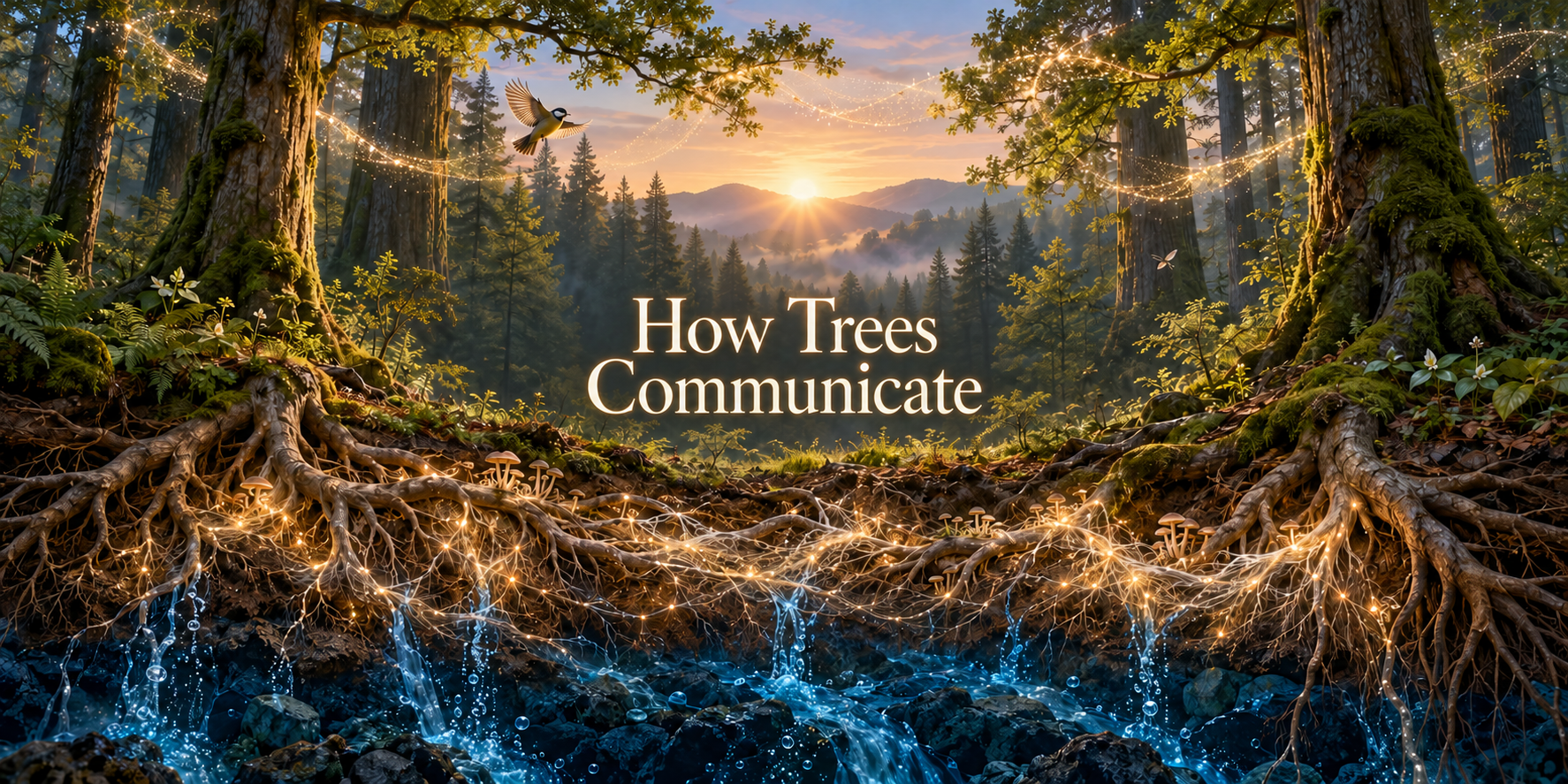
How Trees Communicate
Discover how trees communicate through airborne chemicals, roots, fungal networks, electrical signals and water—and what forests teach us about sacred connection.
A forest is not silent—it is alive with signals, responses and relationships
Walk into a forest and everything may appear still. The trees seem rooted in place, each standing within its own circle of earth and sky.
Yet beneath that stillness, countless exchanges are unfolding.
Trees release chemical signals into the air. Roots respond to changes in soil, moisture and neighboring life. Electrical impulses travel through living tissues. Fungi form partnerships with roots. Water moves through the ground. Insects, birds and microorganisms respond to chemical messages released by leaves and bark.
A tree does not communicate with words, but it is never entirely silent.
The forest is alive with information.
What communication means among trees
In biology, communication generally occurs when one organism produces a signal and another organism detects it and responds.
Trees also participate in other kinds of relationships that are not technically communication. Roots may fuse. Water may move from deeper soil into shallower ground. Carbon and nutrients may travel through fungal pathways. Many trees may respond to the same change in temperature or daylight.
These processes are better described as connection, exchange or synchronization.
Together, they reveal something even larger than communication alone: a forest is shaped by relationships. Every tree is influenced by the soil beneath it, the life surrounding it and the conditions shared by the whole community.
Messages moving within a tree
Before trees communicate with the world around them, they must coordinate life within themselves.
A tree is a vast living body. Its roots may extend through an enormous area of soil while its highest leaves reach sunlight far above the ground. Every part must respond to changing conditions.
Trees use several internal signaling systems.
Chemical messengers help regulate growth, healing, water use and defense. Hydraulic signals communicate changes in water pressure. Electrical signals can travel through living tissues after injury, temperature changes or other disturbances.
These electrical signals are not thoughts or nerve impulses. Trees do not have brains or nervous systems. Their electrical activity is part of a sophisticated biological system that helps distant parts of the tree respond together.
A wound in one location can therefore influence defenses, photosynthesis and water use elsewhere in the same tree.
The tree functions as a coordinated whole.
Airborne messages between trees
Leaves release tiny airborne chemicals known as volatile organic compounds. Volatile means that the compounds can evaporate and travel through the surrounding air.
A tree’s chemical blend changes when its leaves are damaged by insects, drought, disease or physical injury.
Nearby trees may detect some of these compounds and begin preparing their own defenses. They can increase defensive chemicals, strengthen protective responses or become primed to respond more rapidly if an attack arrives.
Experiments with willows, birches, poplars and other trees have shown that exposure to compounds released by damaged neighbors can change how an undamaged tree responds to herbivores.
The receiving tree is not hearing a sentence. It is detecting meaningful chemistry and adjusting its biology.
Some airborne signals travel only a short distance. Wind, humidity, temperature, forest density and the chemical itself all influence how far it moves and how long it remains in the air.
A message in the forest does not need to cross miles to matter. Sometimes it only needs to reach the next branch, the next tree or the next living creature.
Trees communicate with animals too
A tree’s chemical messages are not limited to other trees.
When insects begin eating its leaves, a tree may release a different mixture of airborne compounds. Predatory insects and insect-eating birds can use these odors to locate the herbivores.
In this way, a damaged tree may become easier for the enemies of its attackers to find.
Flowers also communicate through color, shape, fragrance, nectar and timing. Fruit changes its color, scent and sweetness as it ripens, announcing to animals that it is ready to be eaten and its seeds carried elsewhere.
Trees participate in conversations involving pollinators, seed dispersers, birds, mammals, fungi, bacteria and insects.
The forest speaks through more than one language because it has more than one kind of listener.
Roots sensing the living soil
The ground beneath a tree is not empty. It is an active environment known as the rhizosphere—the narrow region of soil directly influenced by roots.
Roots release sugars, amino acids, organic acids and other compounds called root exudates. These substances help shape the community of bacteria and fungi living nearby.
Some root exudates attract helpful microorganisms. Others influence nutrient availability, discourage certain pathogens or affect the growth and behavior of neighboring plants.
Roots can also respond differently when they encounter their own roots, the roots of another tree or changing conditions in the surrounding soil.
They sense moisture, gravity, nutrients, physical barriers and chemical information. Their growth continually adjusts to the world they encounter.
A root does not simply occupy the soil. It participates in it.
Natural root grafts create direct connections
Sometimes the roots of neighboring trees touch, grow together and eventually fuse. These connections are called natural root grafts.
Root grafts are especially common between trees of the same species, although they can occur between closely related species as well.
Once a graft forms, water, minerals, carbon compounds and microorganisms may move through the connected tissues. These are direct tree-to-tree pathways—not connections formed by fungi between separate roots.
One remarkable example involved a living kauri stump with no leaves of its own. The stump remained physiologically active because its roots were grafted to neighboring kauri trees. Its water movement followed the rhythms of the surrounding trees, revealing what scientists described as a kind of communal physiology.
Root grafts can offer stability and connection, although they can also allow certain diseases to move between trees.
They remind us that what looks like an individual above ground may be physically joined to other lives below it.
Deep roots can bring water closer to the surface
Some trees perform a process called hydraulic redistribution.
When deeper layers of soil remain moist while upper layers become dry, water can move upward through a tree’s roots and then pass into the drier soil closer to the surface. Water can also move horizontally between areas with different moisture levels.
The movement is driven by differences in water pressure. It is not a conscious act, yet it can influence an entire community.
Shallow-rooted plants and young seedlings may absorb some of the redistributed water. During drought, this hidden movement can improve the water available near the surface and help sustain neighboring vegetation.
A deeply rooted tree can therefore connect separate layers of the earth, drawing water through places smaller plants cannot reach and changing the conditions in which other life grows.
The tree does not need to decide to share for others to benefit from its presence.
Partnerships between trees and fungi
One of the forest’s most important relationships occurs between roots and mycorrhizal fungi.
Mycorrhizal means “fungus root.” In this partnership, fungal threads called hyphae grow around or within a tree’s fine roots.
The tree supplies the fungus with carbon-rich compounds produced through photosynthesis. In return, the fungus extends far beyond the root’s natural reach and helps gather minerals and water from the soil.
Fungal hyphae are much thinner than roots. They can explore tiny soil spaces and access nutrients that would otherwise be difficult for the tree to obtain.
This relationship is not a small side process. Mycorrhizal partnerships influence tree health, soil structure, nutrient cycling, carbon storage and the composition of entire forests.
Trees feed fungi. Fungi support trees. Both partners influence the soil and the community around them.
Common mycorrhizal networks
A single mycorrhizal fungus can sometimes colonize the roots of more than one plant. When fungal hyphae connect multiple plants, they form what is called a common mycorrhizal network.
Carbon, nitrogen and other substances can move through some of these shared fungal pathways. Experiments have traced carbon along tree–fungus–tree routes and identified fungal species involved in the movement.
The popular name “wood wide web” captures the wonder of these underground relationships, but the network is not a forest-wide internet or a single collective brain.
It is a living marketplace.
Trees, fungi, bacteria, roots, water and soil chemistry all participate. Fungi are not passive cables operated by trees. They are living organisms with their own needs, partnerships and survival strategies.
Some resources may remain within the fungus. Some may reach another tree. The direction and amount of movement depend on the species involved, available nutrients, environmental stress, fungal identity and conditions in the soil.
The deeper truth is not that every tree is constantly sending gifts to every neighbor. It is that forest life is woven together through exchanges no single organism controls alone.
Wisdom surrounding old trees
Large, mature trees are sometimes called mother trees because their roots, canopies and fungal associations can influence many younger trees around them.
The metaphor is beautiful, but the importance of an old tree reaches beyond any single claim about intentional care.
A mature tree may produce thousands of seeds. Its canopy creates shade and moderates temperature. Its roots stabilize soil, guide water movement and contribute carbon to underground life. Its bark, hollows and branches provide habitat. Fallen leaves return nutrients to the earth.
Even after the tree dies, its trunk may shelter animals, hold moisture, feed fungi and become soil for another generation.
Older trees also preserve living history. They have endured storms, droughts, fires, disease and changing seasons. Their established roots and relationships shape the environment into which seedlings emerge.
An ancient tree does not need to think like a human parent to become a source of life.
Its presence is a form of provision.
Competition and cooperation belong together
Forests are not places of endless harmony. Trees compete for sunlight, water, nutrients and space. Vines climb them. Insects consume their leaves. Fungi can be helpful, neutral or harmful. Roots alter the soil around their neighbors.
Yet competition does not erase connection.
A tree may compete for sunlight while participating in fungal relationships below ground. One species may suppress another in one setting while creating shelter that benefits it in another. A large tree may consume enormous resources while also cooling the soil, slowing wind and providing habitat.
Nature does not divide neatly into selfishness or generosity.
The forest is shaped by tension and partnership, loss and renewal, independence and dependence. Its strength comes from the way these forces exist together.
How trees coordinate with the seasons
Some tree populations produce enormous seed crops during the same year and very few seeds during other years. This phenomenon is called mast seeding.
Weather, temperature, rainfall, resource availability, daylight and pollen exchange can all help synchronize reproduction across a population.
When many trees produce seeds together, seed-eating animals cannot consume them all. More seeds survive to germinate and begin the next generation.
This large-scale coordination does not necessarily mean trees are sending one another instructions. Often, they are reading the same signals from the world and responding in similar ways.
A forest may move together because its members share the same light, rain, wind and season.
Sometimes unity begins with listening to the same source.
Can trees make sounds
Plants can create vibrations as water moves through their tissues. Researchers have also recorded ultrasonic clicks from certain plants experiencing drought or physical injury.
Ultrasonic sounds occur at frequencies above the range of normal human hearing. The recorded patterns carried information about the plants’ physical condition.
Most of the strongest airborne-sound research has involved tomato and tobacco plants rather than mature forest trees. Scientists are still exploring which organisms can detect these sounds and whether plants use them as signals.
For now, plant sound offers a fascinating glimpse into a world that human senses do not naturally perceive.
Silence to us does not mean nothing is happening.
Trees respond without brains
Trees do not have brains, nerves or human consciousness. Yet they continually sense and respond to their surroundings.
They detect light, gravity, moisture, touch, temperature, chemicals, pathogens and damage. They change their growth according to what they encounter. They store biological information from earlier conditions and can respond more effectively when some stresses return.
This is not human thought hidden inside wood. It is a different way of being alive.
Trees challenge the idea that meaningful responsiveness must resemble our own. They invite us to recognize forms of intelligence, coordination and adaptation that belong uniquely to rooted life.
A forest is more than its trees
Forest communication does not belong to trees alone.
Fungi carry nutrients and transform organic matter. Bacteria influence roots and soil chemistry. Insects pollinate flowers, prune leaves and become food for other animals. Birds spread seeds and regulate insect populations. Mammals disturb soil and carry fungal spores.
Fallen branches become habitat. Decaying logs store water. Dead roots leave channels through which air, water and new roots can travel.
Life and death remain intertwined.
When we remove every fallen log, isolate every tree or treat the forest as nothing more than standing timber, we interrupt relationships that took decades or centuries to form.
A healthy forest is not simply a collection of healthy trees. It is a community of relationships.
Sacred lessons within the forest
Scripture often uses trees to reveal spiritual truths.
Psalm 1 describes the faithful person as “a tree planted by the rivers of water,” rooted near a sustaining source and bearing fruit in season.
Isaiah 55:12 declares that “all the trees of the field shall clap their hands,” presenting creation as a participant in joy and praise.
Psalm 96:12 calls for “all the trees of the wood” to rejoice before the Lord.
These verses do not require trees to possess human voices. They recognize that creation bears witness to its Creator simply by being fully alive.
A forest reveals abundance without hurry, strength without noise and connection without uniformity.
Every tree reaches toward the light in its own way, yet no tree creates its life alone. It depends on rain it did not summon, soil it did not make, light it did not ignite and relationships it cannot completely control.
So do we.
What trees teach us about community
Trees offer a different vision of strength.
A strong life is not necessarily an isolated life. Roots become more resilient through healthy soil. Growth depends on exchange. Mature lives create conditions in which younger lives can begin.
Not every relationship is visible from the surface.
Someone may be standing because another person quietly encouraged them. A family may endure because faith runs beneath what can be seen. A community may survive because people carried one another through difficult seasons.
Like roots beneath a forest, love often does its greatest work in hidden places.
Trees also teach us that giving does not always require grand gestures. A canopy provides shade simply by being present. Deep roots change the movement of water. Fallen leaves become nourishment. A life faithfully rooted can bless others without needing to control the outcome.
Protecting the relationships that sustain forests
Protecting forests means protecting more than individual trunks.
Soil compaction can damage roots and reduce air and water movement underground. Removing mature trees changes shade, moisture, habitat and fungal communities. Clear-cutting can break apart relationships that developed over generations.
Preserving older trees, connected habitats, healthy soils, native diversity and decaying wood helps conserve the living systems that allow forests to endure.
Genesis 2:15 describes humanity being placed in the garden “to dress it and to keep it.” That calling is not permission to exhaust creation. It is an invitation to tend, protect and participate responsibly.
When we protect forests, we protect water, soil, wildlife, climate stability and forms of life we are only beginning to understand.
Stewardship begins when we stop seeing a forest as a pile of resources and begin recognizing it as a living community entrusted to our care.
A practice for listening among trees
Find a tree and allow yourself to become still near it.
Notice the visible life first—the bark, leaves, branches, shadows and movement of light.
Then consider what you cannot see.
Roots exploring the soil. Water rising through wood. Sugars moving downward from the leaves. Fungal threads surrounding fine roots. Chemical signals entering the air. Birds, insects and microorganisms responding to the tree’s presence.
Offer gratitude to God for the life before you.
You might pray:
Creator of all life, teach me to become deeply rooted in what is true. Help me recognize the relationships that sustain me, care for the lives entrusted to me and become a source of shelter, nourishment and peace. Let my life reach toward Your light and bear good fruit in its season. Amen.
Remain for another moment.
The tree may not speak in words, but its life is already saying something.
Forests reveal a sacred pattern
A forest does not need to think like a human to reveal the holiness of relationship.
Its life is woven through exchange, response, dependence, adaptation and presence. The visible tree reaches into an invisible world of water, minerals, fungi, microorganisms and neighboring roots.
Science continues to uncover how these relationships work. Faith reminds us why they matter.
Creation is not empty matter. It is filled with order, beauty, mystery and life.
The trees are communicating.
And perhaps their deepest message is that nothing truly living exists alone.
Questions and answers
Do trees really communicate with one another?
Yes. Trees can release airborne chemicals that influence neighboring trees, while roots and fungal partnerships create additional pathways for biological exchange. Trees also communicate internally through chemical, hydraulic and electrical signals.
Do trees talk like humans?
Trees communicate through chemistry, electrical activity, changes in growth, root interactions and other biological responses. Their language is different from human speech, but the signals can carry meaningful information.
What is the wood wide web?
The wood wide web is a popular name for underground relationships involving tree roots and mycorrhizal fungi. Some fungi connect with more than one plant, creating pathways through which certain substances can move. It is best understood as a complex living marketplace rather than one unified forest brain.
Do trees share nutrients with other trees?
Carbon, nitrogen and other substances can move between organisms through some fungal networks and natural root grafts. How much reaches another tree depends on the species, fungi, soil conditions and surrounding environment.
What are natural root grafts?
Natural root grafts form when neighboring roots grow together and fuse. They create direct physical connections through which water, minerals, carbon compounds and microorganisms may move.
Can one tree provide water for another?
A deeply rooted tree can redistribute water into drier upper soil, where neighboring plants and seedlings may absorb some of it. Trees joined by root grafts may also exchange water through their connected tissues.
Do mother trees care for their seedlings?
Large old trees can create shade, stabilize soil, influence fungal communities, produce seeds and improve growing conditions for young trees. “Mother tree” is a meaningful metaphor for these life-sustaining ecological relationships.
Can trees warn each other about insects?
Compounds released by damaged trees can prepare defensive responses in nearby trees. These chemical changes may also attract insects or birds that prey upon the herbivores.
Do trees feel pain?
Trees detect injury and respond with chemical, electrical and physical changes. Their experience is different from animal pain because trees do not have brains, nerves or an animal nervous system.
Can trees hear sound?
Plants can detect vibrations, and some stressed plants produce ultrasonic clicks. How sound functions within mature forests remains an emerging area of discovery.
Are forests one living organism?
A forest is made of many distinct organisms whose lives are deeply interconnected. Trees, fungi, animals, microorganisms, water and soil continually influence one another, creating a living ecological community.
More light for your journey
Explore these related Sacred Living pages:
Mycelium: The Hidden Networks Beneath the Earth
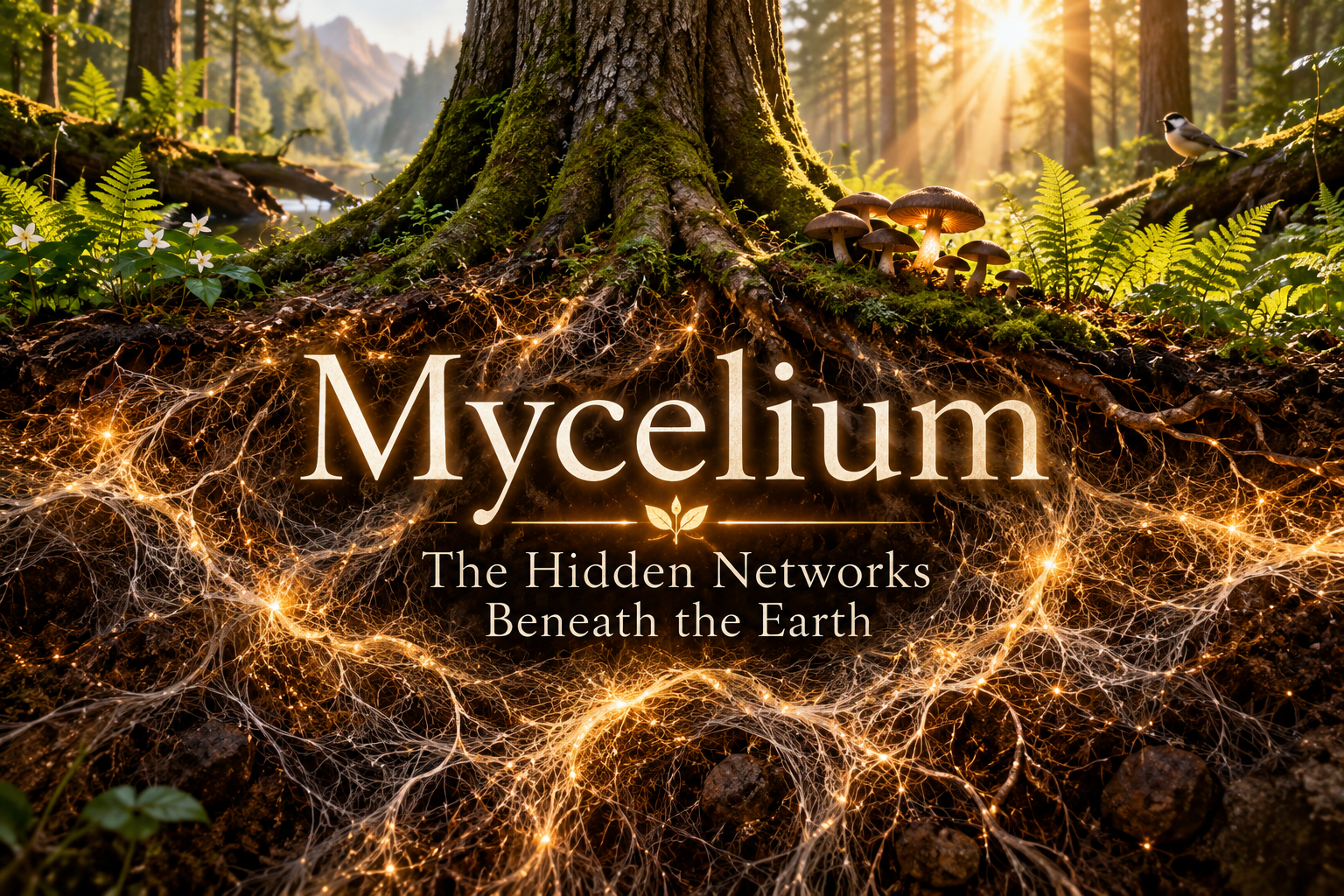
Mycelium: The Hidden Networks Beneath the Earth
Discover mycelium, mycorrhizal fungi, the wood-wide web, tree communication, living soil and the hidden relationships beneath forests, and learn why protecting forests means protecting an entire living world.
Beneath the Forest Is Another Living World
Walk through a forest and your attention naturally rises.
Trees reach toward sunlight. Leaves move in the wind. Birds call from branches. Ferns and wildflowers fill the spaces below.
Yet some of the forest's most extraordinary activity is happening in the opposite direction.
Down.
Beneath fallen leaves, beneath roots, beneath the visible landscape, fungi can form vast networks of microscopic threads.
These threads are called hyphae.
Together, masses of hyphae form mycelium, the vegetative body of many fungi.
A mushroom appearing above the soil may be only a temporary reproductive structure connected to a much larger fungal organism hidden below.
But mycelium is only part of an even greater story.
Around those fungal threads are plant roots, bacteria, microorganisms, water films, minerals, organic matter and chemical compounds.
Above them, trees and other plants release substances into the air.
Within plants, electrical, chemical and hydraulic signals help coordinate responses from one part of the organism to another.
Animals, insects and microorganisms detect and respond to plant-produced compounds.
The forest we see is only one layer.
Another living world exists beneath it.
And between the two is an extraordinary web of relationships.
What Is Mycelium?
Mycelium is composed of branching fungal filaments called hyphae.
Individual hyphae can be extraordinarily thin. As they grow and branch, they create networks capable of spreading through soil, wood, fallen leaves and other materials.
Fungi use these threads to explore their surroundings and obtain nutrients.
Hyphae respond to moisture, temperature, nutrients, chemical conditions and other organisms.
There is no brain directing every branch.
Instead, different parts of a fungal network respond to local conditions.
Some branches continue growing.
Others change direction.
Resources move.
New territory is explored.
The result is an extraordinary form of decentralized biological organization.
A Mushroom Is Only Part of the Story
When most people hear the word fungus, they picture a mushroom.
But a mushroom is often only the visible reproductive structure of a much larger fungal organism.
Mycelium may already extend through soil or wood long before a mushroom appears.
When conditions are favorable, the fungus may produce mushrooms that release spores.
The mushrooms eventually disappear.
The underlying fungus may remain.
What appears suddenly may have been developing quietly for a very long time.
And what disappears from our sight may not actually be gone.
How Large Can a Hidden Fungus Become?
Sometimes the scale of fungal life is difficult to comprehend.
One famous Armillaria individual in Oregon's Malheur National Forest occupies approximately 2,385 acres.
Much of the organism exists underground and within tree roots.
Its age has been estimated at roughly 1,900 to 8,650 years, depending upon assumptions about its growth.
Think about what that means.
A living organism can stretch across thousands of acres and persist for thousands of years while much of its existence remains invisible.
Human beings naturally associate importance with visibility.
Nature repeatedly challenges that assumption.
Mycelium and the Great Work of Renewal
One of the most important things fungi do is decomposition.
Forests continually produce fallen leaves, branches, bark, roots and eventually entire fallen trees.
Many fungi release enzymes that break complex organic materials into substances they can absorb.
Some fungi are particularly important in decomposing wood, including difficult compounds such as lignin, which helps give wood its strength.
Through decomposition, nutrients locked inside once-living material can re-enter ecological cycles.
The fallen leaf is not useless.
The fallen branch has not become meaningless.
Matter changes form.
Nutrients move.
Other organisms use them.
Life continues.
The forest continually transforms yesterday into tomorrow.
Dead Wood Is Still Part of the Forest
A fallen tree can look like something that should be cleaned away.
Ecologically, it may be entering another important stage of its existence.
Dead and decaying wood can provide habitat for fungi, insects, microorganisms, mosses, lichens and other organisms.
It can help hold moisture, contribute organic material to soil and participate in nutrient and carbon cycles.
Different sizes, species and stages of decaying wood can support different communities.
A forest therefore contains more than living trees.
It also contains standing dead trees, fallen logs, branches, leaf litter and decomposing material.
What appears untidy through human eyes may be performing important ecological work.
Fungi and Plant Roots
Some of the most remarkable fungal relationships occur around living roots.
Many plants form associations with mycorrhizal fungi.
The word mycorrhiza essentially means fungus-root.
The plant captures energy from sunlight through photosynthesis and produces carbon-rich compounds.
Some of that plant-derived carbon becomes available to fungal partners.
The fungus extends microscopic hyphae outward through surrounding soil.
Because those filaments are far thinner than roots, they can explore tiny spaces that roots may not easily reach.
The fungi can acquire mineral nutrients, particularly substances such as phosphorus and nitrogen, that can become available within the partnership.
Sunlight captured aboveground helps sustain organisms underground.
Minerals gathered beneath the earth help sustain leaves reaching toward the sky.
The worlds above and below are not separate.
They belong to the same living system.
Most Plants Live With Fungal Partners
Mycorrhizal relationships occur throughout much of the plant kingdom.
Different plants associate with different fungal groups, and the nature of these partnerships varies enormously.
Some fungi enter particular root cells.
Others form structures around roots.
Some relationships become especially important when nutrients are scarce.
The details differ, but the larger realization is remarkable.
When we look at a plant, we are often seeing only part of its biological life.
Some of its most important relationships are underground.
The Conversation Can Begin Before Contact
The relationship between a root and a fungus does not necessarily begin when they touch.
Plant roots release chemical compounds into the surrounding soil.
Fungi also produce chemical signals.
These substances can influence how organisms respond to one another before intimate physical contact occurs.
One group of plant compounds involved in some mycorrhizal relationships is called strigolactones.
These compounds can stimulate branching in certain mycorrhizal fungi and help prepare the biological conditions for association.
Beneath apparently silent soil, chemistry is carrying information.
The introduction can happen before the meeting.
Tiny Threads Reach Where Roots Cannot
Plant roots are extraordinary structures, but they cannot occupy every microscopic space in soil.
Fungal hyphae are much thinner.
They can extend between soil particles and into tiny pores, greatly increasing the area through which resources may be encountered.
This can be particularly valuable for phosphorus.
Plants require phosphorus for fundamental processes involving energy, cell membranes and genetic material, but phosphorus does not always move freely through soil.
Fungal partners can explore soil beyond the immediate root surface.
The fungus reaches farther.
The plant supplies carbon.
Each possesses abilities that can complement the other.
Mycelium and Water
The partnership can extend beyond mineral nutrients.
Mycorrhizal fungi can influence how plants interact with water.
Their tiny hyphae reach spaces in soil that roots may not readily enter.
Depending upon the plant, fungus, soil and environmental conditions, these relationships can influence water uptake, water movement, root development and plant responses to drought.
The fungal network is therefore not simply gathering minerals.
It can become part of the plant's relationship with water itself, extending the biological reach of roots into microscopic spaces they might otherwise never enter.
Fungi Help Build Living Soil
Healthy soil is far more than crushed rock holding plants upright.
Soil possesses structure.
Mineral particles combine with organic matter and biological materials into clusters called soil aggregates.
These aggregates help determine how water and air move through the ground.
Fungal hyphae weave through this environment and can contribute to the formation and stability of soil structure.
That can influence water retention, erosion, microbial habitat and root growth.
Soil is not merely a substance.
It is architecture.
And much of that architecture is alive.
A Network Within the Network
Mycelium does not operate alone.
Around fungal hyphae exists an enormous microscopic community.
Bacteria and other microorganisms interact with fungi, plant roots and soil.
Scientists sometimes call the region directly influenced by fungal hyphae the hyphosphere.
Here, microorganisms participate in nutrient transformations and biological exchanges.
What initially appears to be a partnership between a plant and a fungus can therefore contain an entire community.
Plant.
Fungus.
Bacteria.
Water.
Minerals.
Organic matter.
Countless microscopic organisms.
The network has networks of its own.
Fungal Highways
Some bacteria can even use fungal hyphae as part of their landscape.
Thin films of water can surround fungal filaments.
Certain bacteria can move along these pathways, allowing them to cross otherwise difficult spaces in soil.
Researchers sometimes call them fungal highways.
A fungal thread almost invisible to the human eye can therefore become part of the route traveled by another microscopic organism.
A handful of soil can contain biological journeys taking place at scales we never notice.
The closer science looks at the ground, the less ordinary it becomes.
The Forest Beneath the Forest
Some fungal networks can associate with more than one plant.
These connections are known as common mycorrhizal networks.
They are sometimes described by the memorable phrase:
the wood-wide web.
Scientists have demonstrated movement of substances within plant-fungal systems and continue studying the ecological importance of common mycorrhizal networks in natural forests.
The reality is more complex than simply imagining an underground internet.
These systems involve plants, fungi, microorganisms, water, nutrients, carbon, chemistry, competition and cooperation.
The metaphor is memorable.
The biology is richer.
Do Forests Have a Communication System?
In a broad biological sense, forests contain multiple pathways through which information moves.
There is not one forest telephone line.
There are many overlapping systems.
Plants release airborne chemical compounds that other organisms, including neighboring plants and insects, can detect and respond to.
Roots release compounds into soil.
Microorganisms respond to chemical information.
Mycorrhizal fungi can create physical connections among roots.
Individual plants use electrical, chemical and hydraulic signals internally.
Animals and insects detect plant-produced compounds and become participants in these interactions.
A forest is therefore not silent simply because humans cannot hear what is happening.
Information is continually being produced, detected and responded to.
Trees Can Send Information Through the Air
Plants release substances called volatile organic compounds, often shortened to VOCs.
When leaves are wounded or attacked by insects, the mixture of compounds released by a plant can change.
Nearby plants can sometimes detect these compounds and alter their own physiology.
In certain situations, receiving plants begin preparing defensive responses before they experience the same threat.
Scientists call this priming.
These chemical compounds can also be detected by insects.
Some substances released by damaged plants can attract predators or parasitoids of the insects feeding upon them.
The resulting information network can therefore involve more than two plants.
Plant.
Herbivore.
Neighboring plant.
Predator.
Microorganism.
A biological event can ripple outward through the surrounding community.
Roots Have Their Own Chemical World
Roots also release compounds into their surroundings.
These substances are known collectively as root exudates.
They can include sugars, amino acids, organic acids and many other molecules.
Root exudates can alter the chemical environment surrounding a plant and influence microorganisms, nutrient availability and interactions with neighboring roots.
Soil around a root is therefore not empty space.
It is a chemically active interface between the plant and the world around it.
Even Underground Air Can Carry Information
Chemical interactions belowground do not always require organisms to touch.
Some volatile compounds can move through air-filled pores in soil.
Roots and microorganisms can produce volatile molecules capable of influencing nearby organisms.
That means the underground information landscape can involve physical fungal connections, dissolved chemicals, volatile chemicals, water films, microorganisms, roots, nutrients and changing environmental conditions.
The soil beneath a forest is astonishingly active.
Can Underground Networks Carry Warning Information?
Researchers have studied whether plants associated through common mycorrhizal networks can influence one another's defensive responses.
In some experiments, when one plant experiences insect or pathogen attack, connected plants show biological changes associated with defense.
Researchers continue investigating which compounds and mechanisms are involved and how important these effects are under natural forest conditions.
But the broader discovery is fascinating.
Biological information can move through pathways we cannot see.
Trees Also Communicate Within Themselves
A tree must coordinate its own enormous body.
Plants do not have animal nervous systems, but their cells maintain electrical differences across their membranes.
Changes in electrical activity can propagate through plant tissues.
Plants also use hormones, chemical compounds, hydraulic changes and other signals to coordinate responses among roots, stems and leaves.
A root experiencing changing soil conditions can influence activity elsewhere in the plant.
A wounded leaf can trigger responses in distant tissues.
A tree is therefore not a passive wooden structure.
It is continually sensing and responding to its environment.
Do Fungi Show Electrical Activity?
Fungi show measurable electrical activity.
Researchers are investigating how electrical processes may contribute to coordinating responses across fungal networks.
Fungi do not possess brains or animal nervous systems.
Yet fungal networks still respond to nutrients, moisture, obstacles, competitors and changing environmental conditions.
Understanding how such decentralized organisms coordinate their activity remains a fascinating area of research.
The underground world may be silent to our ears while remaining alive with information.
A Forest Has Many Information Networks
When all of these discoveries are placed together, an extraordinary picture emerges.
There is no single forest communication system.
Instead, a forest contains overlapping biological information networks.
Through the air.
Through roots.
Through fungal connections.
Through soil chemistry.
Through microorganisms.
Through electrical activity within organisms.
Through water.
Through animals and insects.
One organism changes.
Another detects the change.
Another responds.
A forest is not a single mind.
It is something perhaps even more beautiful:
a community filled with relationships.
An Ancient Partnership
Plant-fungal relationships reach astonishingly far into Earth's history.
Fossil evidence reveals intimate associations between early land plants and fungi more than 400 million years ago.
Early plants establishing themselves on land faced enormous challenges obtaining water and mineral nutrients.
Fungal partners capable of exploring soil may have played an important role in the development of early terrestrial ecosystems.
Long before flowering meadows,
long before modern forests,
long before birds filled the branches,
and long before human beings walked beneath trees,
plants and fungi were already forming relationships.
Mycelium and the Carbon Cycle
The fungal world is also connected to one of Earth's great planetary cycles.
Plants remove carbon dioxide from the atmosphere through photosynthesis.
They use sunlight to incorporate that carbon into sugars and other compounds.
Some plant-derived carbon travels belowground through roots.
Mycorrhizal fungi receive part of it.
Carbon can become incorporated into fungal tissue, move through soil food webs, interact with soil organic matter or eventually return to the atmosphere through respiration and decomposition.
Fungi are therefore participants in the movement of carbon through terrestrial ecosystems.
The atmosphere above the forest and the fungal world beneath it are connected.
Why Old Forests Matter Belowground Too
An old forest is more than a collection of large old trees.
Time creates complexity.
Different tree ages.
Standing dead trees.
Fallen logs.
Decaying wood.
Deep organic layers.
Root systems.
Fungal communities.
Microbial communities.
Habitats that have developed over generations.
Research has found that forests with long ecological continuity can be particularly important for some rare wood-inhabiting fungi, while studies of previously logged forests have found differences between their mycorrhizal communities and those of old-growth forests.
This gives us another reason to understand old forests as living systems rather than simply inventories of trees.
When an ancient forest disappears, what is altered can extend far beyond the trees that were visible.
Some of that change happens underground.
A New Forest Is Precious, but It Is Not Instantly an Ancient Forest
Planting trees matters.
Forest restoration matters.
Young forests can provide habitat, stabilize soil, capture carbon and develop tremendous ecological value.
But planting trees does not instantly recreate everything found in a mature or old forest.
Underground fungal communities, dead wood, soil structure, tree-age diversity, microhabitats and complex ecological relationships can take a very long time to develop.
A forest planted today can become part of tomorrow's ecological inheritance.
At the same time, an ancient forest carries something that cannot simply be planted overnight:
time.
Protection and restoration therefore belong together.
We can grow new forests while recognizing the extraordinary complexity already present in forests that have been developing for generations or centuries.
Dead Trees Can Help Keep a Forest Alive
This is one of the beautiful reversals found in forest ecology.
A dead tree is not necessarily useless.
Standing dead trees and fallen logs can provide habitat and eventually become part of the soil-building and nutrient-cycling processes of a forest.
Fungi colonize wood.
Insects arrive.
Microorganisms participate.
Animals find shelter.
Moisture collects.
Nutrients move.
Decomposition continues.
Even the way a tree dies and whether it remains standing or falls can help shape the fungal communities that develop in its wood.
The forest does not divide everything neatly into alive and useless.
Death itself becomes habitat.
Saving Forests Means Saving Relationships
When we speak about protecting forests, it is easy to imagine protecting trees.
But the science invites us to think more deeply.
Protecting a forest can also mean protecting its soil.
Its fungal communities.
Its root systems.
Its dead and decaying wood.
Its microorganisms.
Its water relationships.
Its wildlife habitat.
Its plant diversity.
Its ecological continuity.
And relationships that may have taken generations to develop.
A forest is not simply what stands aboveground.
Protecting only the visible pieces can miss much of what makes the ecosystem function.
Forest Conservation Is Also Fungal Conservation
Fungi are easily overlooked in conservation because so much of their existence can remain hidden.
Yet fungi perform extraordinary ecological work.
They decompose wood and organic matter.
They participate in nutrient cycling.
They form partnerships with plants.
They interact with microorganisms.
They contribute to soil processes.
They participate in carbon cycling.
Research on forest fungi has found relationships between fungal diversity and characteristics such as tree diversity, canopy structure, dead wood and the continuity and complexity of forest habitat.
Forest conservation therefore protects far more than trees and wildlife.
It also protects an extraordinary hidden kingdom beneath them.
What Helps Protect the Hidden Forest?
Forests are diverse ecosystems, and responsible management depends upon the particular forest, its history and its ecological needs.
But research on fungal conservation repeatedly points toward the importance of preserving ecological complexity.
Maintaining diverse vegetation matters.
Protecting soils matters.
Reducing unnecessary disturbance matters.
Retaining appropriate standing and fallen dead wood matters.
Maintaining habitat connections matters.
Protecting forests with long ecological continuity matters.
Restoring degraded forests matters.
In managed forests, lower-impact approaches and retention of structural complexity can help preserve fungal habitat.
Sometimes helping a forest means planting.
Sometimes it means restoring.
Sometimes thoughtful management is appropriate.
And sometimes the greatest gift we can give an established living system is enough space and time to continue being a forest.
A Tree's Living Role Reaches Far Beyond a Single Use
Trees provide resources that have supported human life and civilization for thousands of years.
But a living tree within a forest performs many roles at once.
It captures carbon.
Creates shade.
Influences temperature.
Participates in water movement.
Provides habitat.
Produces food.
Supports insects.
Offers nesting places.
Interacts with fungi.
Adds organic material to soil.
And participates in a larger ecological community.
Even after the tree dies, some of those relationships continue in new forms.
Understanding this does not require seeing human needs and forests as enemies.
It simply asks us to recognize the full value of what is there.
The Sacred Lesson of Hidden Work
Mycelium offers a powerful image for something human beings easily forget.
Not everything important is visible.
Roots are hidden.
Mycelium is hidden.
Seeds begin their transformation in darkness.
Chemical exchanges happen invisibly.
Microorganisms live entire lives beyond our sight.
Much of the work that eventually becomes a forest occurs where no human eye is watching.
Our lives contain seasons like this too.
There are prayers whose answers we cannot yet see.
There are acts of kindness whose influence travels farther than we will ever know.
There are conversations that quietly change someone's direction.
There are lessons taking root before we understand why we needed them.
There are seasons when growth seems invisible because it is happening beneath the surface.
We often judge progress by what has appeared.
Nature invites another possibility.
Something may already be growing before it can be seen.
The Hidden Does Not Mean the Absent
We see the mushroom after it appears.
We do not see every hypha that preceded it.
We see the tree.
We do not see every relationship surrounding its roots.
We hear the forest.
We do not hear its chemistry.
We see today's circumstances.
We cannot always see what they are preparing.
Invisible does not mean nonexistent.
Quiet does not mean inactive.
Hidden does not mean forgotten.
Sometimes what looks like stillness is preparation.
Sometimes what looks empty contains an entire world.
Connection Does Not Require Sameness
A forest does not thrive because every organism performs the same task.
Trees capture sunlight.
Fungi explore soil and transform materials.
Bacteria perform countless chemical processes.
Insects pollinate and decompose.
Birds distribute seeds.
Animals move nutrients.
Earthworms reshape soil.
Their differences contribute to the strength of the whole.
Unity does not require uniformity.
A living community can become richer because its members bring different gifts.
Giving and Receiving Are Both Part of Life
The plant-fungus partnership challenges the idea that strength requires complete independence.
A towering tree can still benefit from relationships underground.
A fungus capable of spreading enormous distances still depends upon its environment.
Life is filled with exchange.
Receiving does not erase strength.
Giving does not diminish worth.
Sometimes one life carries something another needs.
Sometimes we are the giver.
Sometimes we are the receiver.
There is grace in both.
What Falls Can Feed What Rises
Perhaps one of the most beautiful truths of fungal ecology is decomposition.
The forest does not demand that everything remain forever in its original form.
Leaves fall.
Branches break.
Trees eventually die.
Fungi help transform their materials.
Elements that once belonged to one organism can eventually become available to another.
A fallen leaf may contribute nutrients to soil from which another plant grows.
The forest continually transforms endings into beginnings.
Our lives can do something similar.
Wisdom can grow from difficult seasons.
Compassion can grow from pain.
Strength can grow from endurance.
A chapter that has ended can still nourish the person we are becoming.
Nothing has to remain in its original form to retain meaning.
God Often Works Through What Is Hidden
Scripture repeatedly returns to soil, seeds, roots, vines, trees and harvests.
Jesus described a seed growing while the farmer sleeps, its development unfolding beyond the farmer's understanding.
That image becomes even more powerful when we realize how much life actually exists beneath the soil.
We see the field.
God sees everything within it.
We see the tree.
God knows the roots.
We see what has appeared.
God knows what is still becoming.
Faith does not require understanding every hidden process.
Sometimes faith is trusting that unseen does not mean inactive.
A prayer may be working upon us before circumstances change.
A door may be forming before we know where it leads.
A seed may already be alive beneath soil that appears unchanged.
God is not limited to what we can presently see.
Perhaps We Should Look at Forests Differently
Once we understand the hidden forest, it becomes difficult to look at trees in quite the same way.
A forest is more than scenery.
More than acreage.
More than a collection of trunks.
It is generations of relationships.
Some stretch into the sky.
Some travel through the air.
Some crawl across bark.
Some live inside leaves.
Some move through roots.
Some spread through microscopic fungal threads beneath the soil.
Some are only beginning to be understood.
Protecting a forest therefore means protecting something much larger than what our eyes can see.
Look Down
The next time you walk through a forest, garden or quiet woodland, look at the trees.
Then look at the ground.
And remember what you cannot see.
Microscopic fungal threads may be exploring spaces between grains of soil.
Roots may be exchanging resources with fungal partners.
Bacteria may be moving alongside hyphae.
Organic matter may be becoming nourishment.
Water may be moving through tiny pores.
Carbon may be entering the soil.
Chemical information may be passing among organisms.
Ancient biological relationships may be unfolding beneath your feet just as they have for hundreds of millions of years.
The ground is not merely something we walk upon.
It is a living world.
A Final Thought
There is something humbling about discovering how much of a forest exists beyond human sight.
Perhaps that is why mycelium feels so meaningful.
It rearranges our idea of what matters.
We celebrate what we can see.
The blossom.
The tree.
The mushroom.
The harvest.
The answer.
The arrival.
But creation reminds us that visible things often have invisible beginnings.
Before the flower, there was the seed.
Before the tree reached toward heaven, roots reached into darkness.
Before the mushroom appeared, mycelium was already there.
And before we understood forests as communities, all of these relationships were already happening.
Perhaps the greatest lesson beneath the forest is not simply that life is deeply interconnected.
It is that relationship itself is part of how a forest lives.
The visible forest is made of trees.
The living forest is made of relationships.
And once we begin to understand how extraordinary those relationships are, protecting forests becomes about far more than saving trees.
It becomes about honoring an entire living world.
The hidden does not mean the absent.
Sometimes the hidden is where life is doing its greatest work.
Questions People Often Ask
What is mycelium?
Mycelium is the vegetative body of many fungi. It consists of branching microscopic filaments called hyphae that grow through soil, wood and other materials.
Is mycelium the same thing as a mushroom?
No. A mushroom is generally a reproductive structure produced by a fungus. Mycelium is the network of fungal tissue from which mushrooms may emerge.
How large can mycelium become?
Some fungal individuals can become enormous. One famous Armillaria individual in Oregon occupies approximately 2,385 acres.
What are mycorrhizal fungi?
Mycorrhizal fungi form close relationships with plant roots. They can help plants obtain nutrients and influence plant-water relationships while receiving plant-derived carbon.
What is the wood-wide web?
The wood-wide web is a popular term for common mycorrhizal networks in which fungal mycelium can associate with more than one plant. These networks are real biological structures, while scientists continue investigating exactly how materials and information move through them and how important those movements are in natural forests.
Do forests communicate?
Forests contain multiple pathways through which biological information moves. Plants release airborne compounds and root chemicals, fungi can connect roots, microorganisms respond to chemical information, and individual plants use electrical, chemical and hydraulic signaling. It is best understood as many overlapping biological information systems rather than one forest-wide nervous system.
Can trees warn neighboring plants about danger?
Plants damaged by herbivores can release airborne compounds that nearby plants detect, sometimes causing receiving plants to prepare defensive responses. Researchers are also studying defense-related responses associated with common mycorrhizal networks.
Do fungi show electrical activity?
Yes. Researchers have measured electrical activity in fungi and are investigating what roles electrical processes may play in coordinating fungal responses.
Do fungi have brains?
No. Fungi do not have brains or animal nervous systems. Their branching networks can nevertheless sense environmental conditions and alter their growth and activity in response.
Why are old forests important?
Old forests can contain ecological complexity developed over long periods, including diverse tree ages, dead wood, specialized habitats, soils and fungal communities. Some rare wood-inhabiting fungi are particularly associated with forests that have maintained long ecological continuity.
Why is dead wood important?
Dead and decaying wood can provide habitat, retain moisture and support fungi, insects, microorganisms and other organisms while participating in nutrient and carbon cycles.
Can planting trees replace an old forest?
Planting trees and restoring forests are enormously valuable, but a newly planted forest does not instantly reproduce the fungal communities, dead wood, soil characteristics, habitat complexity and ecological history of an old forest.
Can managed forests still support fungi?
Yes. Forest management and fungal conservation do not have to be opposites. Research indicates that lower-impact management, retention of dead wood, tree diversity, structural complexity and habitat connectivity can help conserve fungal communities.
How can forests be protected?
Forest conservation can include protecting forests with long ecological continuity, restoring degraded forests, maintaining native vegetation, protecting soils, retaining ecologically appropriate dead wood, reducing unnecessary disturbance and maintaining connected habitats. Appropriate approaches differ among forest ecosystems.
What is the spiritual meaning of mycelium?
Mycelium can remind us that some of life's most important work happens beyond immediate sight. Growth can be real before it becomes visible. Relationships can exist before we recognize them. An ending can nourish a beginning. And what appears quiet may still be filled with life.
You May Also Enjoy:
Sacred Gardens
Trust the Unseen
The Holy Ordinary
The Beauty of Becoming
Sacred Stones
The Spiritual Power of Silence Between Sounds
The Magic in Everyday Moments
Resonance: Why Some Words, Places and People Stir the Soul
Resonance: Why Some Words, Places and People Stir the Soul
Explore why certain words, places and people stir the soul through resonance, memory, belonging, human connection, spiritual recognition and faith.
Sometimes something outside us awakens something deep within us
A sentence can stop us in the middle of an ordinary day.
A place we have never visited may feel strangely familiar. A person we have only just met can seem to touch a part of us that others have never reached. A song, prayer, voice, fragrance or passage of Scripture can bring tears before we understand why.
We often say these things resonate with us.
Resonance is more than simple agreement. It is the experience of something outside us finding an answering place within us.
Memory, emotion, meaning, longing, faith, belonging and the quiet activity of the nervous system may all participate in that answer. Sometimes the mind understands first. Sometimes the body responds before we have words. Sometimes the soul recognizes something that reason needs more time to explore.
Certain experiences do not merely enter our awareness.
They awaken us.
What Resonance Means
In physics, resonance occurs when a system responds strongly to a frequency that matches one of its natural patterns of vibration.
A familiar example can be found in musical instruments. When one string is played, another string tuned to the same or a harmonically related frequency may begin to vibrate. The first string does not force the second string to become something different. It awakens movement the second string was already capable of making.
The body of a guitar strengthens the sound created by its strings. The shape of a violin transforms small vibrations into rich music. The spaces within the throat, mouth and chest help shape the human voice.
Resonance also appears in pendulums, bridges, buildings, molecules, electrical circuits and the precise workings of atomic clocks. Each physical system has its own properties, and some respond more strongly when the energy reaching them matches those properties.
Human resonance is not identical to physical resonance. A meaningful word does not affect the soul in exactly the same way that sound moves a guitar string.
Yet the physical principle offers us a beautiful way to understand the experience.
Something reaches us.
Something within us answers.
Resonance Is More Than Agreement
Agreement is often intellectual. Resonance is frequently felt through the whole person.
We may notice a change in our breathing, a warmth in the chest, a sudden stillness, tears rising unexpectedly or a sense of clarity that seems to arrive all at once. We may feel peaceful, awakened, challenged, comforted or called forward.
The body continually sends information to the brain about what is happening within us. This inner awareness is sometimes called interoception. It helps us recognize sensations such as a racing heart, relaxed breathing, tension, warmth, hunger or calm.
At the same time, the brain is interpreting voices, facial expressions, memories, surroundings and meaning. Much of this activity unfolds before we have consciously explained our response.
This is one reason we may say, “I felt it before I understood it.”
The experience can be emotional, physical, relational and spiritual at the same time.
Why Certain Words Reach So Deeply
Words are not empty sounds.
They carry meaning, memory, intention, tone and relationship. The same sentence can feel entirely different depending on who speaks it, how it is spoken and what it means within the listener’s life.
Consider the difference between hearing:
“I believe you.”
“I forgive you.”
“You are safe here.”
“I am proud of you.”
“You are not alone.”
“I have been praying for you.”
Each sentence is made of ordinary words, yet those words may reach needs that have been waiting for acknowledgment.
A compassionate sentence can bring relief because it gives language to something the heart has carried silently. A truthful sentence may resonate because it confirms what we have sensed but have been afraid to name. A familiar phrase may awaken memories of a parent, grandparent, teacher, pastor or friend whose voice once made the world feel safer.
Emotionally meaningful language can influence attention, memory and the body’s automatic responses. Words connected with love, fear, grief, belonging or hope are not received as meaningless collections of sounds. They are understood through our experiences, relationships and expectations.
Words matter because people matter.
Meaning matters because the soul listens for meaning.
Shared Values Create Recognition
Sometimes words resonate because they reflect our deepest values.
A message about courage may reach the part of us that wants to live more boldly. A story of forgiveness may awaken our desire for freedom. An act of mercy may move us because compassion is part of the person we believe we are—or the person we are becoming.
This is not only memory. It is recognition.
We are recognizing something we believe to be true, beautiful or worthy.
Certain words stir us because they align with an inner moral compass shaped by faith, experience, love and conscience. They remind us what matters when noise, pressure or disappointment has made us forget.
A sentence does not need to be complicated to change a life.
It only needs to reach the right depth at the right moment.
A Word Can Become a Turning Point
Sometimes one sentence changes the direction of a life.
It may be a teacher who recognizes a gift no one else has seen. It may be a friend who speaks courage when hope is fading. It may be a line of Scripture that suddenly becomes personal after years of reading it.
The words themselves may not be new. What has changed is the moment in which we hear them.
We are ready.
The ground has been prepared by experience, prayer, difficulty, growth or longing. A truth that once passed through the mind now settles into the heart.
This is one of the mysteries of resonance. The right words often arrive when something within us has become able to receive them.
Voice Behind the Words
Meaning is carried not only through vocabulary but also through the human voice.
Tone, pacing, pauses, warmth and rhythm help us understand whether someone is comforting us, warning us, welcoming us or speaking from the heart. Long before children understand every word, they begin responding to the melody and emotional character of familiar voices.
A loved one’s voice can become associated with safety, affection and home. A harsh voice may awaken tension before the sentence is complete. A sincere voice can reach beyond polished language because the listener senses that the words are real.
When people understand one another during conversation, patterns of brain activity involved in speaking and listening can become more closely coordinated. Researchers call this neural coupling. In simple language, parts of the listener’s brain begin following the unfolding pattern of the speaker’s story.
This does not mean two minds become one. It reveals that meaningful communication involves more than sound entering the ears. The listener is following the speaker’s ideas, emotions and unfolding story.
We might describe the human meaning even more simply:
We feel when someone is truly with us.
Why Certain Places Feel Different
Places can also resonate.
A childhood kitchen may seem to hold the warmth of countless meals and conversations. A church may feel filled with the prayers spoken there. A shoreline may bring peace before we have consciously begun to relax. An old road may return us to another season of life within seconds.
The mind does not store every part of an experience separately. Sights, sounds, scents, relationships and emotions can become woven together in memory.
When we return to a meaningful place, those connections may awaken again.
Researchers use the term place attachment to describe the emotional bond people form with meaningful environments. These places can support memory, identity, belonging, comfort, relaxation and a sense of continuity between the past and present.
A place may stir us because:
Something important happened there.
It reminds us who we were.
It connects us with people we love.
Its beauty draws us into wonder.
We experienced prayer, healing or clarity there.
It represents home, freedom, safety or possibility.
Its atmosphere helps the mind become quiet enough to listen.
A meaningful place does not need to be famous. It may be a garden, porch, field, workshop, chapel, forest path or chair beside a window.
Sacredness is not always announced by grandeur.
Sometimes it is discovered through attention.
Scent Can Open a Door to the Past
A fragrance can return us to a place more quickly than thought.
Freshly baked bread may bring back a family kitchen. Woodsmoke may awaken memories of winter evenings. A particular perfume may make someone we love feel close again. Rain, cut grass, old books, candles or church incense can call forth images and emotions that seemed to have disappeared.
Smell has unusually close connections with brain systems involved in emotion and memory. Because scents are often present quietly in the background of important experiences, they can become joined with the people, places and feelings of those moments.
Later, encountering the same scent may awaken the entire memory.
We do not remember only the fragrance. We remember the room, the season, the voices, the people and sometimes the person we were when we first experienced it.
This helps explain why a place may stir us before we have consciously identified what feels familiar.
The soul remembers through more than words.
Place Becomes Part of Identity
Meaningful places do more than preserve memories. They can become part of how we understand ourselves.
A hometown may connect us with family history. A house may represent years of love, sacrifice and growth. A church may hold memories of weddings, funerals, worship, comfort and answered prayer. A landscape may remind us where we learned courage, independence or wonder.
These places support a sense of self-continuity, the feeling that the person we were, the person we are and the person we are becoming belong to one unfolding life.
This is why returning home can feel so powerful. It is also why leaving or losing a beloved place can affect us deeply.
The attachment is rarely to walls, roads or land alone. It is connected with everything the place has come to represent.
Some places hold chapters of our story.
When we return, we meet part of ourselves there.
Holy Ground and God’s Presence
Throughout Scripture, ordinary places become sacred through encounters with God.
Moses was tending sheep when God called to him from the burning bush. The ground became holy not because people had built a monument there, but because God made His presence known.
“Do not come any closer,” God said. “Take off your sandals, for the place where you are standing is holy ground” (Exodus 3:5).
Jacob experienced something similar after dreaming of a stairway reaching toward heaven. When he awoke, he said:
“Surely the Lord is in this place, and I was not aware of it” (Genesis 28:16).
The place had not suddenly entered God’s presence. Jacob had awakened to the presence that was already there.
This is one reason certain places may continue to stir the soul. They become joined with moments when we felt guided, comforted, protected, forgiven or called.
Returning to them may help us remember what God showed us there.
The place does not replace God.
It helps us remember.
Why Some People Reach Us Immediately
There are people whose presence affects us before we know much about their lives.
Conversation flows naturally. Silence does not feel uncomfortable. Something in their voice, kindness, humor or attention feels familiar. We may have the strange impression that we have known them longer than we have.
Part of this experience can be understood through ordinary human perception.
We are constantly noticing subtle information:
Facial expressions
Vocal tone
Eye contact
Timing
Posture
Shared humor
Emotional openness
Familiar patterns of speech
Similar values
Whether we feel welcomed in their presence
The brain brings these signals together rapidly. We may experience the result as comfort, recognition, interest or a feeling that we “click.”
Yet research can describe only part of what a meaningful human encounter feels like.
There are relationships in which we do not simply feel entertained or understood.
We feel seen.
Attunement and the Gift of Being Seen
Attunement occurs when someone notices us accurately and responds with appropriate care.
An attuned person pays attention not only to our words but also to our tone, expression, pauses and emotional needs. Their presence quietly communicates:
“I see you.”
“I hear you.”
“You do not have to carry this moment alone.”
Attunement can help another person feel safe enough to speak honestly. It can soften tension, support trust and make room for emotions that have been waiting to be expressed.
This does not require perfect words. Often it is carried through patience, kindness and the willingness to remain present.
Sometimes another person’s calm helps our own body settle. Their steady voice, unhurried attention and compassionate response may help breathing slow and thoughts become clearer. This relational process is sometimes called co-regulation.
Human beings were not created to experience every part of life alone.
Sometimes peace reaches us through another person’s presence.
Human Beings Naturally Move Toward Synchrony
During comfortable interaction, people often begin coordinating with one another.
Their expressions may respond in rhythm. Their gestures and speech patterns may become more aligned. During shared activities, aspects of movement, breathing or other physiological activity can sometimes show coordination.
Researchers call this interpersonal synchrony.
Synchrony has been studied during conversation, music, movement, shared attention and group experiences. It is often associated with feelings of connection, cooperation and group belonging.
This does not mean that meaningful relationships depend upon perfect biological alignment. It shows that connection is something human beings participate in with the whole person.
We listen with more than our ears.
We respond with more than our words.
People Who Help Us Remember Who We Are
Some people enter our lives and seem to remind us of something we had forgotten.
They may remind us that we are lovable.
They may awaken a gift we stopped using.
They may recognize strength beneath exhaustion.
They may speak to the person we are becoming rather than the person we have been.
Healthy resonance does not diminish identity. It strengthens it. We do not disappear into another person. We become more able to stand in truth, love and purpose.
True harmony does not require two people to be identical.
Music becomes rich because different notes discover a meaningful relationship.
The right relationships do not ask us to silence the voice God placed within us.
They help us hear it more clearly.
When Hearts Recognize One Another
The Bible contains moments of profound recognition between people.
When Mary visited Elizabeth, the child within Elizabeth leaped, and Elizabeth was filled with the Holy Spirit. Before Mary had fully explained what had happened, something sacred was already being recognized (Luke 1:39–45).
On the road to Emmaus, two disciples walked with the risen Jesus without recognizing Him at first. Only later did they say to one another:
“Were not our hearts burning within us while he talked with us on the road and opened the Scriptures to us?” (Luke 24:32).
Their minds had not immediately identified Him, yet their hearts had responded to truth before recognition became complete.
These passages do not separate spiritual understanding from the rest of human experience. They reveal that God can reach the whole person—mind, heart, memory, body and spirit.
Sometimes understanding comes first.
Sometimes the heart begins to awaken before the mind has caught up.
God Calls Us by Name
After the resurrection, Mary Magdalene stood near the empty tomb weeping. She saw Jesus but did not recognize Him.
Then He spoke one word:
“Mary” (John 20:16).
Recognition came through her name spoken by the One who knew her.
The moment reveals something profoundly sacred about being personally known. Jesus did not offer Mary an abstract explanation. He called her by name.
Samuel also heard his name before he understood who was speaking. After receiving guidance from Eli, he answered:
“Speak, Lord, for your servant is listening” (1 Samuel 3:9).
Both stories contain a movement from hearing to recognition.
God’s voice does not only communicate information. It calls people into relationship, purpose and awakening.
There are moments when truth becomes personal—when we no longer feel that a message is only being spoken into the world.
It is speaking to us.
Deep Calls to Deep
Psalm 42 contains one of Scripture’s most beautiful images of resonance:
“Deep calls to deep in the roar of your waterfalls” (Psalm 42:7).
The verse arises from longing. The psalmist is remembering God in the midst of distress, speaking to a soul that feels cast down yet continues to hope.
“Deep calls to deep” has come to express the mystery of one depth answering another.
The depth of grief may respond to the depth of compassion.
The depth of longing may respond to the depth of promise.
The depth of the human soul may answer the call of God.
Surface words rarely satisfy deep hunger. The soul recognizes when something carries truth, love, beauty or the presence of the Holy Spirit.
It may not always have an immediate explanation.
But it knows it has been touched.
Resonance, Memory and Longing
What resonates with us often reveals something about our inner life.
A song may stir grief because it belongs to someone we miss. A home may awaken longing because it represents the belonging we once knew—or the belonging we always wanted. A person’s kindness may affect us deeply because gentleness has been rare in our experience.
Nostalgia is not merely a desire to live in the past. Meaningful memories can strengthen our sense of continuity by reminding us where we came from, who has loved us and what has mattered across the years.
Sometimes resonance points backward toward memory.
Sometimes it points inward toward an unspoken need.
Sometimes it points forward toward possibility.
The question is not only, “Why does this move me?”
It may also be, “What is this showing me?”
Soul Recognizes Beauty
Beauty is one of the most powerful forms of resonance.
Sunlight crossing a field, the architecture of a cathedral, a flower opening, a child laughing, music swelling or a night sky filled with stars may create a sense of awe that feels larger than ordinary enjoyment.
Beauty can interrupt self-absorption. It reminds us that life contains order, mystery and magnificence beyond our immediate concerns.
We may be moved because beauty reflects something we were created to recognize.
Scripture repeatedly joins creation with revelation:
“The heavens declare the glory of God; the skies proclaim the work of his hands” (Psalm 19:1).
Creation does not need human language to speak. Its beauty becomes its testimony.
The soul may resonate with beauty because beauty helps us remember that existence is more than survival.
Life is also wonder, relationship, meaning and praise.
Sacred Meaning of Dissonance
Not every meaningful response feels like harmony.
Sometimes we experience dissonance, a sense that something does not fit.
A conversation may leave us unsettled. A decision may look right on paper yet feel disconnected from our values. A familiar environment may no longer feel like home because we have changed.
Dissonance can invite honest attention.
It may reveal a difference between what we say and how we are living. It may show us that we have outgrown an old pattern. It may uncover a truth that is asking to be acknowledged.
Resonance tells us that something is answering within us.
Dissonance tells us that something is asking to be examined.
Both can become part of spiritual growth.
God’s truth comforts, but it also awakens, corrects and leads. The soul is not only stirred by what feels beautiful. It may also be stirred by what calls it toward greater honesty and alignment.
Resonance Changes as We Grow
Something that once stirred us deeply may become quiet. Something we overlooked years ago may suddenly speak directly to the season we are living now.
This does not mean the earlier response was false.
People grow, heal, grieve, learn and enter new seasons. Our understanding changes. Our needs change. Our relationship with God deepens. Truths that once seemed distant may become personal after life has given us the experience needed to understand them.
A passage of Scripture can remain unchanged while revealing new meaning each time we return to it.
A familiar place can feel different because we are no longer the person who first entered it.
A relationship can develop new depth as trust grows.
Resonance is not always fixed. It can unfold with us.
Some truths wait patiently until we are ready to hear them.
Resonance and Spiritual Discernment
A powerful response is an invitation to listen more deeply.
Sometimes something resonates because it is good and timely. Sometimes it is familiar. Sometimes it touches an old wound, an unmet need or a beautiful hope.
Discernment helps us understand the meaning of the response.
We can pause and ask:
What exactly moved me?
What memory or longing did this awaken?
Does this align with truth and the character of God?
What kind of fruit is beginning to grow from it?
Does the meaning deepen with prayer and time?
Am I becoming more loving, honest and peaceful?
Is this asking me to act, heal, remember or simply pay attention?
Jesus taught that a tree is recognized by its fruit. In the same way, the lasting fruit of an experience can help reveal its meaning.
What comes from God leads toward truth, wisdom, courage, compassion, integrity and love.
Prayer gives resonance somewhere to go.
We can bring what has moved us into God’s presence and allow understanding to unfold.
Recognizing the Shepherd’s Voice
Jesus said:
“My sheep listen to my voice; I know them, and they follow me” (John 10:27).
Recognition grows through relationship.
A child learns a parent’s voice through repeated experiences of presence. Friends recognize one another through countless conversations. In the same way, familiarity with God’s character grows through prayer, Scripture, worship, obedience and lived trust.
The more deeply we know love, the more readily we recognize what sounds like love.
The more deeply we know truth, the more clearly we recognize what carries truth.
Spiritual resonance is not only the pursuit of a powerful feeling. It is the growing recognition of the voice, character and movement of God.
His guidance carries the qualities of truth, wisdom, love and holy purpose.
Becoming a Person Who Resonates With Goodness
We are not only receivers of resonance.
We also create experiences that may resonate within others.
Our words can become part of someone’s inner world. Our presence can help another person feel safe enough to tell the truth. Our encouragement can remain in someone’s memory for years.
We may never know which sentence becomes a lifeline.
We may never see how far a simple kindness travels.
We may never realize that our faith helped someone else believe again.
This gives sacred importance to the way we live among others.
A peaceful presence can invite peace.
A truthful voice can awaken courage.
A grateful heart can remind others of goodness.
A person who has been deeply loved by God can carry that love into rooms where hope has grown quiet.
A Practice for Listening to What Resonates
When something stirs you deeply, resist the urge to explain it too quickly.
Pause.
Notice what is happening within you.
Name the word, person, place, fragrance, image or moment that affected you. Pay attention to the memories, emotions and physical sensations that arose with it.
Then bring the experience into prayer:
“God, show me why this has touched me. Help me receive what is true, understand what is being awakened and recognize what You are inviting me to see.”
You may also wish to write about it.
Record:
What happened
What you felt
What it reminded you of
What value or longing it touched
What truth seemed to emerge
What prayer arose within you
What fruit appeared afterward
Over time, patterns may become visible. You may discover recurring themes of belonging, creativity, healing, service, homecoming or faith.
Resonance can become a doorway into greater self-understanding and deeper listening.
Some Things Reach Us Because We Are Ready
Not every truth enters our lives the first time we encounter it.
Some truths wait at the edge of consciousness until experience gives them meaning. Some prayers unfold slowly. Some people arrive when we have finally become ready to be known. Some places awaken a part of us that everyday noise had kept hidden.
This does not make the earlier years meaningless.
They may have been preparing the inner space that now knows how to answer.
A seed beneath the earth appears still, yet unseen life is taking shape.
In the same way, the soul may be preparing long before the moment of recognition arrives.
Then a word is spoken.
A door opens.
A place feels alive.
A fragrance returns us to love.
A person looks into our eyes with kindness.
God calls our name.
And something deep within us says:
“Yes. This matters.”
When the Soul Is Stirred
Resonance is the meeting between what reaches us and what is ready to answer.
Science helps us understand how sound, memory, emotion, sensory experience, place attachment, bodily awareness and human synchrony contribute to this experience. Faith reminds us that human life also contains relationship, spiritual recognition and sacred mystery.
We are created to recognize love.
We are created to respond to truth.
We are created to be moved by beauty, belonging and the presence of God.
Some words seem to find us.
Some places help us remember.
Some people awaken courage, tenderness or purpose.
Sometimes dissonance reveals where greater alignment is waiting.
Sometimes an ordinary moment opens into something holy.
And sometimes the deep places of the soul begin to move—not because something foreign has been placed within us, but because something true has called to what God has already planted there.
Deep calls to deep.
And the soul answers.
Questions and Answers
What does it mean when something resonates with you?
When something resonates, it creates a strong sense of emotional, intellectual or spiritual recognition. It may connect with a memory, value, longing, need or truth that already carries meaning within you.
Is emotional resonance the same as physical resonance?
Physical resonance is a measurable response within a vibrating system. Emotional resonance is a metaphor describing the way an experience awakens a meaningful response within a person. The metaphor is powerful because both involve something producing an answering response.
Why can certain words cause such a strong reaction?
Words carry meaning, memory, tone and relationship. Emotionally significant language can affect attention, recollection and automatic bodily responses, especially when it connects with experiences involving love, grief, hope, belonging or identity.
Why can a smell instantly bring back a person or place?
Smell has close connections with brain systems involved in memory and emotion. A scent present during an important experience can become linked with the people, places and feelings of that moment. Encountering it again may awaken the larger memory.
Why do some places feel sacred?
A place may feel sacred because it is connected with prayer, beauty, memory, community or an experience of God’s presence. Meaningful places can focus attention and awaken belonging, reverence and spiritual awareness.
Why do some people feel familiar when we have just met them?
Subtle similarities in voice, expression, timing, values, warmth and communication can create a quick sense of familiarity. A person may also awaken qualities, memories or hopes that already matter deeply to us.
Can two people really be on the same wavelength?
People can become coordinated in conversation, movement, emotional expression and certain physiological patterns. Researchers have also observed alignment between speaker and listener brain activity during successful communication. “Being on the same wavelength” remains a metaphor, but it reflects the genuine human experience of attunement and understanding.
What is the difference between resonance, intuition and familiarity?
Resonance is the sense that something awakens a meaningful response within us. Intuition is a form of understanding that may arise before conscious reasoning is complete. Familiarity is the feeling that something resembles what we have previously experienced. These experiences can overlap, but they are not always the same.
Can what resonates with us change over time?
Yes. Growth, healing, grief, experience and changing seasons of life can alter what holds meaning for us. A truth, place or passage of Scripture may affect us differently as our understanding deepens.
Does resonance always feel peaceful?
No. Resonance can feel comforting, joyful, challenging or deeply awakening. Dissonance can also hold meaning by revealing an area of life that needs attention, honesty or greater alignment.
Can God use resonance to guide us?
God can use Scripture, prayer, people, beauty, conviction and meaningful moments to draw our attention. Spiritual guidance becomes clearer through God’s character, biblical truth, prayer, wisdom and the lasting fruit that follows.
How can I become more aware of what resonates with me?
Slow down when something creates a strong inner response. Notice your emotions, bodily sensations, memories and thoughts. Write about the experience, pray over it and observe whether it leads toward truth, love, peace, courage and spiritual growth.
More for Heart and Spirit
The Sacred Meaning of the Human Voice
Why Singing Together Changes Us
The Spiritual Power of Silence Between Sounds
Words, Vibration and the Human Body
Pilgrimage: Why the Soul Is Drawn to Sacred Journeys
Divine Timing
The Peace of Presence
The Spiritual Meaning of Names
The Spiritual Power of Silence Between Sounds
Explore the spiritual power of silence between sounds and discover how stillness, prayer, gratitude, music and sacred listening can deepen awareness, shape our words and draw our attention toward God.
There is the note. There is the fading of the note. And then there is the silence that remains.
A song is not made only of sound.
A conversation is not made only of words.
A prayer is not made only of speaking.
Between sounds are spaces.
Pauses.
Breaths.
Moments when one thing has ended and another has not yet begun.
We naturally pay attention to what we can hear: the voice, the music, the bell, the birdsong, the laughter, the rain.
But sound has another companion.
Silence.
And silence may be far more meaningful than we usually imagine.
Music needs spaces in order to breathe. Language needs pauses in order to make sense. Human beings need moments when we are not simply receiving the next piece of information.
Spiritually, silence can become something deeper still.
A place of listening.
A place of gratitude.
A place of prayer.
A place of awareness.
A place where we stop filling every moment and simply become present with God.
Sometimes the sacred is not found in another sound.
Sometimes it is waiting in the silence after the sound.
Silence Gives Sound Its Shape
Imagine music without a single pause.
Every note continuing without interruption.
There might be plenty of sound, but much of what makes music beautiful would disappear.
Music depends upon relationships.
Sound and silence.
Loud and soft.
Tension and release.
Movement and stillness.
Musicians even have a name for intentional silence written into music.
A rest.
A rest has duration. It occupies time. It belongs to the composition just as surely as the notes surrounding it.
During a rest, the music has not necessarily stopped.
The silence is part of the music.
That is a beautiful thought to carry beyond the concert hall.
There are moments in life when everything seems to be moving.
And there are moments when nothing obvious appears to be happening.
We may be waiting.
Resting.
Listening.
Wondering.
Becoming.
Perhaps some of those spaces are not interruptions in the composition of our lives.
Perhaps they are part of it.
Your Brain Listens to Timing
The human brain does not simply detect sounds.
It looks for relationships between them.
Timing helps us understand speech, recognize rhythms and anticipate what may happen next.
Think about ordinary conversation.
We do not usually speak as one uninterrupted stream.
We pause.
We breathe.
We emphasize.
We slow down.
We leave tiny spaces between thoughts.
The listener's brain uses these patterns to help make sense of what is being heard.
Music works with expectation too.
A melody establishes patterns. Rhythm creates anticipation. Sometimes we sense where the next beat or note should arrive before it actually comes.
Then the composer waits.
Perhaps only for a fraction of a second longer than expected.
And suddenly we are listening more closely.
The absence of sound has captured our attention.
What Happens When the Music Stops
Researchers have discovered something especially fascinating about silence that comes after sound.
In one experiment, researchers studied people's cardiovascular and respiratory responses while they listened to different kinds of music.
Two-minute pauses of silence were placed between the musical selections.
During those pauses, measures including heart rate, blood pressure and breathing-related activity decreased. The researchers found that relaxation was especially evident during the pause.
The silence following stimulation was not simply dead space.
The body responded to the change.
There is something beautiful about that.
Sound can gather us.
And the quiet that follows can give us somewhere to settle.
Outer Silence and Inner Silence
There is an important difference between having silence around us and experiencing quiet within us.
Researchers studying silence sometimes describe these as outer silence and inner silence.
Outer silence means the environment becomes quieter.
Inner silence describes something deeper: a settling of mental activity, less internal chatter and greater inward stillness.
A quiet room and a quiet mind are not necessarily the same thing.
Anyone who has ever lain awake in a perfectly silent room while the mind carried on an entire midnight conversation already understands this.
But intentional practices that cultivate inner quiet can create a very different experience.
This helps us understand something important.
The spiritual power of silence is not simply about removing sound.
It is about what may become possible when our attention settles.
Outer silence creates space.
Inner silence learns how to enter it.
The Brain Keeps Working in the Quiet
One of the most fascinating discoveries about quiet is that apparent inactivity does not necessarily mean nothing is happening.
Researchers have studied something called wakeful rest.
Wakeful rest simply means remaining awake while quietly resting rather than immediately beginning another mentally demanding activity.
Research has found that quiet rest after learning can help the brain retain newly acquired information.
Large scientific reviews examining many studies have found an overall benefit of wakeful rest for memory consolidation.
Memory consolidation is the process through which newly acquired memories become more stable.
In other words, there are times when the brain may benefit not from receiving more information, but from having a quieter period after the information has arrived.
That idea reaches beautifully beyond memory research.
We live in a world that often assumes every empty moment should be filled.
Finish reading something.
Check the phone.
Finish a conversation.
Turn on the television.
Leave one place.
Start thinking about the next.
But the brain is not necessarily doing nothing during the spaces between experiences.
Some things continue settling.
Some things are being integrated.
Some things need room.
Experience enters us.
Silence gives it somewhere to land.
Silence Can Make Us More Aware
Sit somewhere quiet for a moment and something curious happens.
You begin hearing things you had not noticed.
The refrigerator humming.
A clock ticking.
Air moving through a vent.
Rain touching a window.
Leaves moving outside.
A bird somewhere in the distance.
Your own breathing.
Perhaps even your heartbeat.
The world did not suddenly become louder.
Your attention changed.
This may be one of silence's greatest gifts.
It reveals what was already there.
Spiritually, that idea carries enormous meaning.
We sometimes search for extraordinary signs while overlooking quiet ones.
We ask for direction while moving so quickly that there is little room to listen.
We search for something enormous when what we need may arrive gently.
Silence does not have to produce a dramatic experience to be valuable.
Sometimes becoming more present is enough.
Elijah and the Sound of Sheer Silence
One of Scripture's most extraordinary encounters with quiet appears in the story of Elijah.
In 1 Kings 19, Elijah stands before the Lord.
A powerful wind comes.
Then an earthquake.
Then fire.
These are enormous events.
Yet the passage tells us that the Lord was not in the wind, the earthquake or the fire.
Then something very different happens.
The ancient Hebrew expression that follows has been translated into English in several beautiful ways.
A still small voice.
A gentle whisper.
A low whisper.
And in one particularly striking translation:
A sound of sheer silence.
The translations differ because the Hebrew expression is difficult to capture perfectly in English.
But the contrast within the story is remarkable.
Wind.
Earthquake.
Fire.
And then...
quiet.
Elijah listens.
There is something profoundly moving about that sequence.
The dramatic things were not necessarily where the encounter was found.
The sacred arrived quietly enough that listening became necessary.
Be Still and Know
Psalm 46 contains another beloved invitation:
“Be still, and know that I am God.”
These words have comforted people for generations because they remind us that knowing does not always require striving.
There are times to move.
Times to build.
Times to speak.
Times to search.
Times to act.
And there are also times to become still.
Stillness is not necessarily emptiness.
It can be attention without striving.
Trust without constant movement.
Presence without performance.
Sometimes faith speaks.
Sometimes faith sings.
Sometimes faith works.
And sometimes faith becomes quiet enough to listen.
Prayer Does Not Always Need More Words
Prayer can take countless forms.
We can speak to God.
Praise God.
Thank God.
Ask God.
Cry before God.
Sing to God.
Whisper to God.
And sometimes we can simply remain with God.
Christian contemplative traditions have long recognized that prayer can include silence.
This does not diminish spoken prayer.
It reveals another dimension of relationship.
Imagine a loving relationship in which one person never stopped speaking long enough to listen.
Something would be missing.
Prayer can contain that same beautiful movement.
Speaking.
Then listening.
Asking.
Then waiting.
Praising.
Then resting.
Words can carry us toward God.
And sometimes silence allows us simply to remain there.
Silence Can Become Thanksgiving
Silence before God does not mean that we have nothing to say.
Sometimes we become quiet because there is so much to be thankful for that ordinary words seem too small.
Thank You for this day.
Thank You for the people I love.
Thank You for carrying me through what I thought I could not walk through.
Thank You for the prayers already answered.
Thank You for the blessings I noticed.
And thank You for the blessings I almost missed.
Gratitude has a beautiful way of changing what we notice.
When we intentionally thank God, attention begins moving away from everything that is absent and toward what has already been given.
The ordinary becomes visible again.
Breath.
Food.
Shelter.
Morning light.
A conversation.
A second chance.
A moment of peace.
Someone who loves us.
Strength for another day.
Even the ability to stop for a moment and recognize that we are here.
Scripture repeatedly joins prayer with thanksgiving.
Philippians 4:6 teaches us to bring our requests to God with thanksgiving.
Psalm 100 invites us to enter His presence with thanksgiving and praise.
And 1 Thessalonians 5:18 reminds us to give thanks in all circumstances.
Prayer is not only asking God for the next thing.
It is also remembering what He has already done.
Silence can make room for that remembering.
Sometimes we can sit quietly before God and simply say:
Thank You.
Then stop.
Let those words settle.
Think about what they contain.
Thank You for yesterday.
Thank You for today.
Thank You for what I understand.
Thank You for what I am still learning to trust.
Thank You for the doors that opened.
Thank You for the strength that appeared when I needed it.
Thank You for being here.
Perhaps gratitude is one of the most beautiful sounds we can bring into silence.
And perhaps, after saying it, we do not always need another sentence.
Sometimes two words are enough.
Thank You.
Then we can become quiet again.
Not because the prayer is empty.
Because the heart is full.
The Silence After a Bell
A bell teaches this lesson beautifully.
Strike a bell and the sound expands into the room.
The vibration is clear at first.
Then it begins fading.
Softer.
Softer.
Softer still.
Eventually there comes a mysterious point when you cannot quite tell whether you are still hearing the bell or remembering the sound you just heard.
And then there is silence.
But something remains.
Attention.
The bell gathered it.
The fading tone refined it.
The silence received it.
This may help explain why bells have appeared in religious and contemplative practices across cultures.
A bell does not merely announce something.
It can invite listening.
And sometimes the most interesting part begins after the bell can no longer be heard.
The Space Between Breaths
Breathing carries its own rhythm.
Inhale.
A tiny turning point.
Exhale.
Another turning point.
Then another breath arrives.
Breath awareness has appeared in contemplative practices for centuries because breathing gives attention something immediate and gentle to notice.
There is nowhere else you need to go to find it.
Your next breath is already coming.
We do not need to force the spaces between breaths.
Simply noticing the natural rhythm can be enough.
Breathing reminds us that life itself contains movement and pause.
Receiving.
Releasing.
Beginning again.
And perhaps somewhere within that ordinary rhythm is another reason to say:
Thank You, God, for the breath of life.
Silence Between Two People
Silence has a language of its own.
We often become uncomfortable when conversation pauses.
Someone stops talking and we immediately begin searching for words to fill the space.
But not every silence needs rescuing.
Sometimes another person is thinking.
Sometimes they are gathering courage.
Sometimes they are feeling something they cannot yet put into words.
Sometimes they simply need to know that someone is willing to remain beside them without demanding anything.
Listening is more than waiting for our turn to speak.
Deep listening makes room.
A few seconds of silence can communicate:
I'm still here.
I'm listening.
Take your time.
Your words matter.
There are moments when silence between two people becomes an extraordinary form of kindness.
And then comes another question:
What will we do with the words that follow the silence?
Please and Thank You
Some of the smallest words we speak can carry remarkable meaning.
Please.
Thank you.
Many of us first learn them as children.
At first they may seem like simple rules of good manners.
But there is deeper wisdom within them.
Please recognizes that another person is not simply there to fulfill our wishes.
It turns a demand into a request.
It acknowledges another person's dignity, generosity and choice.
And thank you recognizes that something has been given.
Someone held a door.
Prepared a meal.
Offered encouragement.
Shared their time.
Helped when they did not have to.
Listened.
Remembered.
Showed kindness.
Did something ordinary that could easily have gone unnoticed.
Thank you says:
I noticed.
I appreciate what you did.
I do not take your kindness for granted.
And this is where these little words belong within a page about silence.
Silence gives us a moment to notice.
Listening gives us a moment to understand.
Then we choose what sound will come next.
Perhaps it is a kinder answer.
Perhaps it is encouragement.
Perhaps it is:
Please.
Perhaps it is:
Thank you.
The pause matters partly because it can change the words that follow it.
These words matter in families.
They matter between friends.
They matter between strangers.
They matter in marriages, workplaces, stores, restaurants and everyday conversations.
Familiarity should not make gratitude disappear.
Sometimes the people closest to us deserve to hear “please” and “thank you” most of all.
And there is a beautiful spiritual connection.
The habit of noticing goodness in other people can help cultivate a heart that notices goodness everywhere.
We learn to receive without entitlement.
We learn to ask without demanding.
We learn to recognize what has been given.
We learn to appreciate.
And those same movements belong within our relationship with God.
We ask.
Please.
We receive.
Thank You.
Perhaps these words are more than manners.
Perhaps they are small daily practices of humility and gratitude.
And perhaps silence helps us remember to say them.
Silence Gives Wisdom Somewhere to Enter
Noise can encourage reaction.
Something happens.
We respond.
Someone says something.
We answer.
A message appears.
We reply.
An emotion rises.
We act.
But between what happens and what we do next, there can be a pause.
Sometimes only a breath.
That small space can change everything.
In it, we can ask:
What am I actually feeling?
What is true here?
What response reflects love rather than fear?
Do I need to answer immediately?
What would wisdom say?
What might God be showing me?
The pause does not always hand us an instant answer.
But it creates room for discernment.
Sometimes wisdom enters through a door that hurry keeps closed.
And sometimes the greatest spiritual power of the silence between sounds is surprisingly practical.
It changes the next sound.
Nature Is Rarely Silent
Walk into a forest and listen.
It probably isn't silent at all.
Leaves move.
Birds call.
Insects hum.
Branches creak.
Wind passes through grass.
Water moves somewhere nearby.
Your footsteps join the soundscape.
What we call the silence of nature is often not the absence of sound.
It is a different relationship with sound.
Natural sounds often exist without demanding an immediate response.
The bird does not need you to answer.
The wind does not send a notification.
The creek does not require a password.
You are allowed simply to listen.
Perhaps what we seek in nature is not absolute silence.
Perhaps we seek spaciousness.
Sound without demand.
Presence without pressure.
Life continuing around us without constantly asking us to do something.
And in that spaciousness, gratitude can rise almost naturally.
Thank You for the sky.
Thank You for the trees.
Thank You for water.
Thank You for sunlight.
Thank You for this astonishing living world.
Silence and Creativity
There is another place where pauses become valuable.
Creativity.
Ideas have an odd habit of appearing when we stop chasing them.
The sentence comes while washing dishes.
The solution appears on a walk.
The melody emerges while staring through a window.
The connection suddenly becomes obvious after we have stopped trying to force it.
The brain remains active during quiet periods. Memories, associations and ideas can continue interacting even when we are not deliberately working on a problem.
Apparent stillness should not automatically be confused with uselessness.
A field can look quiet while roots are growing beneath it.
Some parts of becoming happen where no one can see them.
The World Between Sounds
Listen carefully and you begin discovering how much of life happens between things.
Between the question and the answer.
Between the prayer and what comes next.
Between one chapter and another.
Between one heartbeat and the next.
Between saying goodbye and discovering what comes afterward.
Between knowing where you have been and understanding where you are going.
We often treat these spaces as inconvenient waiting rooms.
But perhaps some of them are sacred rooms.
A pause is not necessarily a failure of movement.
Sometimes it is where meaning gathers.
Sometimes it is where we remember.
Sometimes it is where gratitude returns.
And sometimes it changes what we say next.
A Simple Practice in Sacred Listening
Find a comfortable place.
You do not need perfect silence.
Ordinary sounds are welcome.
Close your eyes if that feels natural.
Listen first for the most distant sound you can hear.
Do not chase it.
Simply notice.
Now listen for something closer.
Perhaps a car.
A bird.
A fan.
Footsteps.
Wind.
Now notice something very close.
Your breathing.
Clothing moving against your body.
The tiny sounds of being alive.
Then begin noticing something different.
Not only the sounds.
Notice what happens between them.
A bird calls.
Wait.
A car passes.
Wait.
The house makes a tiny sound.
Wait.
Allow the spaces to remain open.
You do not need to fill them.
You do not need to accomplish anything.
Simply listen.
Then allow gratitude to enter the quiet.
Think of one thing for which you are thankful.
It does not have to be enormous.
Perhaps this morning.
Perhaps someone you love.
Perhaps food on the table.
Perhaps a prayer that was answered years ago.
Perhaps simply another day of life.
Then say:
Thank You, God.
And become quiet again.
Listen.
Not because you are demanding an answer.
Simply because you are present.
Silence Is Not Empty
We often associate fullness with addition.
More information.
More activity.
More conversation.
More answers.
More stimulation.
But there is another kind of fullness.
The fullness of a sanctuary before worship begins.
The fullness of a night sky.
The fullness of holding someone's hand without speaking.
The fullness after prayer.
The fullness of remembering God's goodness.
The fullness of the moment when beautiful music ends and no one wants to break the silence.
Nothing has been added.
Yet nothing feels missing.
That is one of silence's quiet mysteries.
Emptiness and absence are not always the same thing.
A space can contain no words and still contain love.
A moment can contain no music and still carry its echo.
A prayer can contain no speech and still contain gratitude.
Silence can be full.
The Sacred Space After the Sound
Perhaps silence has been teaching us something all along.
The note matters.
But so does the rest.
The word matters.
But so does listening.
The prayer matters.
But so does thanksgiving.
What we say matters.
But so does the pause that helps us choose our words.
The movement matters.
But so does stillness.
We do not need to turn every empty space into something else.
We do not need to fill every pause.
Sometimes the space after sound is where the experience becomes complete.
Listen to a bell until it disappears.
Listen to a song until the final note fades.
Listen to someone you love until they have truly finished speaking.
Pause before answering.
Say please.
Say thank you.
Sit quietly after prayer.
Thank God before asking for anything else.
Stand beneath the trees after the wind settles.
Let the moment remain unfinished for just a little longer.
There may be more there than you expected.
Closing Reflection
There is music in sound.
And there is music in waiting.
There is meaning in words.
And there is meaning in the silence surrounding them.
Life continually moves between these worlds.
Sound and silence.
Speaking and listening.
Movement and stillness.
Asking and thanking.
Doing and being.
Perhaps we were never meant to live entirely in one or the other.
Perhaps the beauty is in their rhythm.
So when the next beautiful sound fades away, resist the urge to immediately replace it.
Stay.
Listen.
Notice.
Remember what God has already done.
Say thank You.
And when another person speaks, give their words somewhere to land before rushing to supply your own.
Perhaps the silence will soften what comes next.
Perhaps it will remind you to say please.
Perhaps it will remind you to say thank you.
Perhaps it will remind you simply to listen.
Let the silence have its moment.
Because sometimes God does not need to become louder.
Sometimes we simply become quiet enough to notice what was already there.
And sometimes the most beautiful sound we can bring into that silence is simply:
Thank You, God.
Questions and Answers
What is the spiritual meaning of silence?
Silence can become a place of stillness, listening, reflection, gratitude, reverence and awareness of God's presence. It gives us an opportunity to step away from constant stimulation and become more attentive to what is happening within and around us.
Why does silence after music feel so powerful?
Music creates patterns, expectations and physiological responses. When the sound stops, attention does not necessarily stop with it. Research has found measurable changes in breathing and cardiovascular activity during pauses following music. The contrast between sound and silence can make the quiet especially noticeable.
Is silence actually part of music?
Yes. Musical rests intentionally designate periods without played or sung notes. These rests contribute to rhythm, phrasing, expectation and emotional expression. Silence can therefore function as part of a composition rather than simply an interruption of it.
What is the difference between outer silence and inner silence?
Outer silence refers to reduced sound in the environment. Inner silence describes a quieter internal state with less mental chatter and greater inward stillness. A quiet environment can create space for inner stillness, but the two experiences are not necessarily identical.
Can quiet support relaxation?
Quiet can reduce incoming stimulation, and research on silence, music, meditation and contemplative practices suggests that certain experiences of quiet can accompany changes associated with relaxation. Intentional stillness, prayer and gentle attention can create an environment in which settling becomes easier.
Can quiet rest help memory?
Research on wakeful rest suggests that quietly resting after learning can support memory consolidation, the process through which newly acquired information becomes more stable. This is one fascinating example of how apparently quiet periods can still contain important activity within the brain.
What does “the sound of sheer silence” mean in the story of Elijah?
The expression comes from one English rendering of 1 Kings 19:12. The original Hebrew is difficult to translate precisely, which is why other Bible translations use expressions such as “still small voice” and “gentle whisper.” The powerful contrast remains: after wind, earthquake and fire comes an extraordinarily quiet encounter.
Does the Bible encourage stillness?
Yes. Psalm 46:10 contains the famous invitation, “Be still, and know that I am God.” Scripture also contains many examples of waiting, listening, solitude, prayer, thanksgiving and quiet trust.
Why is thanking God important in prayer?
Thanksgiving reminds us that prayer is not only about what we still need. It also recognizes what God has already provided and done. Scripture repeatedly connects prayer with gratitude, including Philippians 4:6, Psalm 100 and 1 Thessalonians 5:18.
Can silence be prayer?
Silent contemplation has a long history within Christianity. Prayer does not always require continuous speech. Silence can become a form of attentive presence in which a person rests before God, listens, gives thanks and simply remains aware of Him.
Why are “please” and “thank you” important?
These simple expressions can communicate respect, humility and gratitude. “Please” turns a demand into a request, while “thank you” acknowledges what another person has given or done. The pause before speaking can help us remember to choose words that honor other people rather than taking them for granted.
What does “please and thank you” have to do with silence?
Silence creates a small space between hearing and responding. Within that space we can notice what another person has said or done and choose our response intentionally. Sometimes the spiritual value of a pause can be seen in the kinder, more grateful words that follow it.
Can I thank God without saying many words?
Yes. Gratitude does not depend upon the length of a prayer. Sometimes a simple and sincere “Thank You, God” can express what a much longer prayer cannot.
Why can nature feel silent when it actually contains many sounds?
The peacefulness of nature often comes from its spacious soundscape rather than literal silence. Birds, wind, water and leaves may all be audible without demanding the same kind of immediate response as many forms of modern stimulation.
How can I practice sacred listening?
Choose an ordinary environment and listen without trying to eliminate every sound. Notice a sound, follow it until it fades and then notice the space before another sound appears. Allow yourself to become still, remember something for which you are grateful, thank God and remain quietly present for a few moments.
A Final Thought
The world gives us countless sounds.
Some are magnificent.
Some are ordinary.
Some call us toward action.
Some call us home.
But between them are tiny spaces we rarely notice.
Perhaps those spaces are not empty at all.
Perhaps they are invitations.
To breathe.
To listen.
To receive.
To remember.
To choose our words carefully.
To give thanks.
To pray.
To simply be.
The sound will come again.
Until then, let the silence have its moment.
And when it is time to speak again, perhaps we can carry something beautiful out of the silence with us.
Please.
Thank you.
And above all:
Thank You, God.
More for the Journey
The Spiritual Meaning of Bells: Sacred Sound, Calling and Remembrance
This is probably the strongest companion page because it specifically explores how sound and silence belong together.
The Spiritual Meaning of BellsThe Language of the Soul
Beautiful connection for the idea that some of our deepest understanding arrives without words, and that silence gives us room to hear what noise can hide.
The Language of the SoulSacred Rest: Why the Soul Needs Stillness, Sabbath and Renewal
A natural link from sections about stillness, quiet, reflection, and becoming receptive to God's presence.
Sacred RestSound Frequencies and the Human Body: Hertz, Brainwaves, Vibration and Sacred Resonance
This gives readers another direction to explore the relationship between sound, vibration, attention, relaxation, and sacred resonance.
Sound Frequencies and the Human Body
Why Singing Together Changes Us
Discover how singing together influences breathing, heart rhythms, mood, memory, loneliness, belonging and faith—and why shared song can become sacred.
When many voices become one shared expression
There is a moment in communal singing when something changes.
At first, there are individual people—different lives, different stories and different voices. Then the song begins. Breathing starts to follow a common rhythm. Separate words become a shared message. One voice supports another, harmonies gather around the melody and a room filled with individuals begins to sound like one living expression.
We may sing together in a church, choir, stadium, school, family gathering, concert, community circle or beside someone who needs comfort. The setting may be sacred or ordinary. The song may be joyful, grieving, hopeful, peaceful or strong.
Across cultures and generations, people have repeatedly discovered the same thing:
Singing together changes the experience of being together.
Science is beginning to describe some of the physical, emotional and social processes involved. Shared musical phrases influence breathing and heart rhythms. Rhythm organizes attention and movement. Familiar songs awaken memory. Group singing can reduce loneliness and help strangers feel connected. Harmony teaches people to listen while contributing their own distinct voices.
Faith reveals another dimension. A shared song can become prayer, remembrance, praise, testimony and hope carried by many voices at once.
Singing together does not require perfection.
It requires presence.
Singing Is a Whole-Person Experience
Researchers sometimes describe singing as a multimodal activity. This simply means that it engages several parts of human experience at the same time.
Singing involves the body because it requires breathing, posture, vibration and coordinated movement.
It involves the mind because singers follow language, melody, timing and musical patterns.
It involves emotion because music can carry joy, sorrow, gratitude, longing and hope.
It involves memory because familiar words and melodies can remain with us for many years.
It involves relationship because every singer must listen, adjust and respond to the larger sound.
It can involve the spirit because a song may become worship, prayer or a way of reaching toward something greater than ourselves.
Few ordinary activities bring so many dimensions of human life together at once. This may help explain why communal singing can feel both deeply physical and profoundly sacred.
The Body Becomes Part of the Song
Singing is a whole-body act.
Air enters the lungs. The diaphragm—a broad muscle beneath the lungs—helps control the movement of that air. As we breathe out, air passes through the vocal folds in the larynx, commonly called the voice box. The vocal folds vibrate and create sound.
The throat, mouth, tongue and lips help shape the sound into words and tones. The chest, face and other spaces in the body contribute to the sensation of resonance—the way vibration is strengthened and given character.
When people sing together, their bodies enter a shared musical structure. They begin phrases at similar times. They sustain notes. They pause together. They follow the rise and fall of the melody.
Each person remains physically unique, but the song gives many bodies a common pattern to follow.
This is one reason communal singing can feel so different from merely listening to music.
The body is not standing outside the song.
The body is helping create it.
Shared Singing Organizes the Breath
Ordinary breathing changes throughout the day. It may become quick when we are hurried, shallow when we are tense or slow when we feel peaceful.
Singing organizes the breath.
Before a musical phrase begins, singers inhale. While producing the phrase, they release air in a measured way. Longer notes and slower songs can encourage a steadier exhalation than ordinary conversation.
Breathing interacts with the autonomic nervous system—the part of the nervous system that helps regulate automatic functions such as heart rate, digestion and breathing.
This does not mean every song creates the same physical response. A lively celebration and a slow hymn naturally guide the body differently. The important point is that music gives the breath a pattern.
When people follow the same song, they begin breathing within a shared structure.
How Singing Influences Heart Rhythms
Researchers have studied what happens to singers’ heart rhythms when they sing the same musical phrases together.
One important term in this research is heart-rate variability, often shortened to HRV. Heart-rate variability is the natural variation in time between one heartbeat and the next. A healthy heart does not function like a metronome. It continually makes small adjustments in response to breathing, movement, emotion and the needs of the body.
As a person inhales and exhales, the heart naturally speeds up and slows down slightly. Slow, structured singing can make this connection between breathing and heart rhythm especially noticeable.
In a study of group singing, researchers found that different kinds of vocal activity created different heart-rate patterns. Free humming allowed each singer to breathe according to individual preference. A hymn created more shared rhythmic patterns because the singers followed the same musical phrases. A very slow song with breathing points built into each phrase produced the strongest coordination.
The singers’ hearts did not become identical, and every heart did not beat at exactly the same speed. Instead, their heart rates accelerated and slowed in related cycles because their breathing was being guided by the same song.
The music created a shared rhythm that could be observed within the body.
Rhythm Brings Attention Into the Present
Human beings naturally respond to rhythm.
We tap our feet, sway, clap, march and dance when we hear a steady beat. Even when the body appears still, the brain is actively anticipating what comes next.
When people sing together, they listen for the same entrances, hold notes for similar lengths of time and move through the same musical structure. Their attention is no longer directed only inward. Each singer must remain aware of the whole.
Scientists use the word synchrony to describe people moving or acting in coordinated time. Research suggests that synchronized activity can encourage cooperation, closeness and a sense of shared purpose.
Communal singing adds something even richer. The singers are not only keeping time together. They are breathing, listening and giving voice to the same words.
The rhythm gathers scattered attention and brings people into one shared moment.
Singing Helps Strangers Become a Group
One of the most interesting findings in group-singing research has been called the ice-breaker effect.
People who begin singing together can develop feelings of closeness surprisingly quickly—even when they were strangers before the group began. Other shared activities can also create friendships, but singing appears capable of helping that connection form early.
This makes sense when we consider what singing asks people to do.
Everyone enters the same rhythm. Everyone contributes to the same result. Each person must listen to others. No single voice can create the full communal sound alone.
Conversation often begins with the question, “Who are you?”
Singing can begin with a different message:
“We are already making something together.”
The song gives people a shared identity before they have learned every detail of one another’s lives.
Singing Can Ease Loneliness
Loneliness is not simply the absence of people. A person can stand in a crowded room and still feel unseen.
Belonging grows when participation is meaningful—when someone’s presence contributes to what is happening.
A large randomized human trial studied a community choir program involving 390 adults aged 60 and older. After six months, the choir participants experienced greater improvements in loneliness and interest in life than those who had not yet begun the program.
This is important because it moves the conversation beyond a temporary good mood. Regular communal singing can help create continuity, purpose and a place to belong.
A choir gives people a reason to gather. Familiar faces return. Songs develop over time. Individuals learn when to enter, when to listen and how their voices fit into the whole.
The deeper gift may not be simply having somewhere to go.
It is knowing that the song would sound different without you.
Harmony Is a Lesson in Relationship
Harmony offers a beautiful picture of healthy community.
Different notes are sounded at the same time. Each note keeps its own character, yet its meaning changes through relationship with the others. A note that seems unfinished by itself may become luminous when it finds its place within a chord.
A choir does not become one by making every voice identical.
It becomes one when different voices learn to listen, respond and contribute to a shared creation.
Sometimes one section carries the melody while the others support it. Later, another voice may rise. There are moments to be heard clearly and moments to blend. There are times to sing and times to breathe.
Harmony teaches cooperation without requiring the loss of individuality.
It reveals that unity is not sameness.
Unity is difference held together by love, listening and shared purpose.
Music Gives Emotion Somewhere to Go
Some feelings are difficult to explain through ordinary conversation.
Grief can be too deep for a sentence. Joy can overflow the limits of speech. Hope may feel fragile when spoken but stronger when sung.
Music gives emotion structure.
A melody can hold sorrow without rushing it. Rhythm can carry us when we feel tired. Repetition can turn a simple phrase into reassurance. Harmony can surround a lonely feeling with the sound of companionship.
Human studies have found that group singing can increase positive mood and reduce negative mood. In one study involving 193 people affected by cancer—including patients, caregivers and bereaved caregivers—a single choir rehearsal was associated with improved mood and lower cortisol.
Cortisol is a hormone that helps the body respond to stress. Its levels naturally change throughout the day and in response to circumstances. Finding a change after communal singing shows that the experience is not only emotional. The body is participating too.
Researchers have also observed short-term changes in immune-related signaling molecules after singing. These findings are helping scientists understand how emotional expression, social connection and physical participation communicate with the body.
The most grounded message is also the most beautiful:
When people sing together, the mind, body and emotions respond together.
Singing Can Carry What One Person Cannot
The purpose of singing is not always to make a difficult feeling disappear.
Sometimes the gift is that the feeling no longer has to be carried alone.
At a funeral, one grieving person may be unable to sing every word. The voices surrounding them continue. At a hospital bedside, a familiar hymn may express love when conversation has grown tired. During hardship, a community may sing words of hope before anyone feels strong enough to speak them alone.
The group can hold the melody when an individual voice breaks.
That may be one of the most compassionate functions of communal song.
It does not deny sorrow.
It gives sorrow companionship.
Familiar Songs Awaken Memory
Songs are remarkable vessels for memory.
Words joined with melody, rhythm and repetition can become deeply rooted. A few notes may awaken the memory of a person, a season, a childhood room, a place of worship or a moment when life changed.
Music calls upon several processes at once. The brain follows rhythm and pitch, anticipates patterns, retrieves language and connects sound with emotion. These overlapping cues can make a familiar song easier to recognize and remember than an isolated collection of words.
This does not mean that singing universally improves every form of memory or thinking. Its special gift is often more personal.
A song can open a door to something that was still present but difficult to reach.
This is especially meaningful across generations. Children learn songs carried by parents and grandparents. Older adults may remember words they have not spoken in decades. Families and faith communities preserve their stories not only by telling them, but by singing them.
A shared song can become a bridge through time.
Singing Turns Memory Into Living Testimony
Some songs do more than remind us of the past. They allow the past to speak into the present.
Spirituals carried faith through suffering. Hymns preserved theology and hope. Lullabies carried tenderness from one generation to another. Work songs coordinated effort. Songs of freedom gave communities courage. Songs sung beside hospital beds, during worship and at funerals helped people say together what one voice could barely say alone.
When a community continues to sing a song, memory becomes active.
The song does not merely describe what earlier generations believed. It allows new voices to enter that belief, question it, remember it and carry it forward.
A song becomes a vessel traveling through time.
Each generation receives it, adds its own breath and sends it onward.
Communal Song Belongs to Humanity
Music appears across the human story.
Researchers examining ethnographic records and recordings from societies around the world found evidence of music in every society represented. Songs appeared in caregiving, healing, love, dance, ceremony, storytelling and other forms of social life.
The melodies, instruments and musical traditions differed greatly. Yet the impulse to place human meaning inside sound appeared again and again.
Long before recorded music, microphones or concert stages, people gathered and sang. The human voice was an instrument that traveled wherever people traveled. It required no manufactured object. Breath, memory and community were enough.
This helps explain why communal singing can feel ancient even when the song is new.
When we sing together, we participate in something human beings have done across countless generations.
Sacred Song Begins With Remembrance
Scripture repeatedly shows people singing after encountering the faithfulness of God.
In Exodus 15, Moses and the Israelites sing after crossing the sea. Their song remembers deliverance. Miriam then leads the women with tambourines, movement and song.
The people do not merely record what happened.
They give the memory a melody.
A story can be forgotten or altered as years pass. A song returns through repetition. It can be taught to children, carried into worship and remembered during another difficult season.
Sacred singing helps a community remember who God has been so they can trust who God will continue to be.
When Voices Become One
One of the most beautiful pictures of communal singing appears in 2 Chronicles 5.
Musicians and singers gather for the dedication of the temple. Trumpets, cymbals, instruments and voices join in praise. Scripture describes the musicians and singers sounding together as one.
As their united praise rises, the temple is filled with a cloud representing the glory of God.
The passage does not say that only the most talented voice created the sacred moment. The wonder is found in the joining.
Many musicians.
Many singers.
One sound of praise.
Their unity did not make God present, as if human sound could summon Him. Their shared worship opened a moment in which the community recognized and responded to His presence together.
Song Can Hold Joy and Grief at the Same Time
Ezra 3 describes the laying of the foundation for the rebuilt temple.
Some people shout with joy. Others weep because they remember the former temple and all that had been lost. The sounds become so interwoven that those listening from a distance cannot distinguish the joyful shouting from the weeping.
This is one of Scripture’s most honest pictures of communal emotion.
The people are standing in the same sacred moment, but they are not feeling the same thing. One generation sees a beginning. Another remembers what came before. Joy and sorrow rise together.
Communal song does not require everyone to arrive with the same emotional story.
It can hold gratitude and grief, celebration and memory, expectation and loss.
The voices do not have to feel alike in order to belong together.
Singing Encourages the People Beside Us
Ephesians 5:19 describes believers addressing one another through psalms, hymns and spiritual songs. Colossians 3:16 connects singing with wisdom, gratitude and the word of Christ dwelling richly within the community.
These passages reveal that sacred singing moves in more than one direction.
Song rises toward God as worship, but it also moves between people as encouragement.
We sing to God.
We sing truth into our own hearts.
We help the person beside us remember.
Someone may enter worship feeling strong, while someone else arrives carrying fear, weariness or grief. The confident voice can support the uncertain one. On another day, their roles may be reversed.
Sacred singing allows faith to become audible within the community.
Jesus Sang With His Disciples
Matthew 26:30 tells us that Jesus and His disciples sang a hymn together after the Last Supper and before leaving for the Mount of Olives.
The moment matters.
Jesus knew that suffering was approaching. The disciples did not yet understand everything that was about to unfold. Still, before entering the darkness ahead, they sang together.
The song did not mean the night would be easy.
It meant Jesus did not enter it without prayer, sacred memory and the voices of those gathered around Him.
This gives shared singing an extraordinary dignity.
When we sing before an uncertain tomorrow, we are participating in something Jesus Himself chose to do.
A Song Can Rise Before Circumstances Change
Acts 16 tells of Paul and Silas praying and singing hymns while imprisoned. Their bodies were confined, but their praise was not.
The other prisoners listened.
This is an important detail. Their song was personal, but it was not private. Faith became audible within a place of suffering.
Paul and Silas did not wait until the prison doors opened to begin singing. They sang before they could see how the story would end.
Sacred song can become an expression of trust before circumstances change.
It allows hope to have a voice while the answer is still on its way.
God Is Also Described Through Song
Zephaniah 3:17 offers a tender image of God rejoicing over His people with singing.
We often think of worship as humanity singing toward heaven. This passage reverses the direction and gives us the image of divine love singing over human lives.
We sing because joy seeks expression.
We sing because grief seeks companionship.
We sing because faith remembers.
And Scripture suggests that singing is not foreign to the heart of God.
Worship Is Participation
It is possible to stand near singing without fully entering it. A person may admire the musicians, listen to the words or enjoy the atmosphere.
Communal worship carries a deeper invitation.
It asks us to participate.
When a congregation sings, worship is not meant to be a performance given by a few people to an audience. Musicians may guide the melody, but the gathered community becomes the instrument.
One person sings with certainty. Another sings while searching. Someone sings through tears. Someone else can barely whisper the words. Yet all are held within the same song.
The strongest voice does not make the moment sacred.
Shared intention does.
Why Singing Together Can Feel Transcendent
Communal singing can create a sense of transcendence—a feeling of moving beyond the narrow boundaries of the individual self.
Part of this may come from the combination of shared breath, synchronized timing, emotion, memory and belonging. Attention shifts away from private thought and enters a collective experience.
For many people, the experience is also spiritual.
A sacred song can make a room feel filled with more than sound. The individual voice is no longer isolated. It becomes part of praise that began long before the present moment and will continue after it.
We sing with those beside us.
We sing words carried by those who came before us.
We teach those words to voices that may carry them into the future.
The song becomes larger than the singers.
Imperfect Voices Still Belong
Many people stop singing because someone once told them they were not good at it. Others compare themselves with polished voices and decide that silence is safer.
But communal singing was never meant to belong only to professionals.
Technical skill can make music beautiful, and trained singers offer a valuable gift. Yet human singing has always existed beyond the stage.
Parents sing to children. Friends sing in cars. Families sing at birthdays. Communities sing during worship, grief, labor, protest and celebration.
A voice does not have to be flawless to carry love, gratitude or faith.
You may sing softly. You may need time to find the melody. You may hum when words will not come. You may listen during one verse and join during the next.
Belonging does not begin when your voice becomes perfect.
It begins when you allow your honest voice to become part of something shared.
The Quiet After the Final Note
One of the most powerful moments in communal singing can arrive after the sound ends.
The final note fades, but the room does not immediately feel the same as it did before the song began. Breathing settles. Vibration disappears into silence. People become aware of one another again.
That silence is not empty.
It holds the memory of what has just been created—many people breathing, listening, remembering and offering their voices together.
The song may have ended.
The connection it awakened can remain.
A Sacred Practice of Singing Together
You do not need to join a professional choir to experience communal singing.
You might:
Sing during worship instead of only listening.
Learn an older family member’s favorite song.
Sing a hymn with someone who is lonely or ill.
Join a community choir or informal singing group.
Sing simple songs with children.
Gather friends for music without turning it into a performance.
Choose a song of hope during a difficult season.
Sing while working, traveling or preparing a shared meal.
Let familiar sacred music become part of family prayer.
Hum beside someone when spoken comfort feels insufficient.
Begin with one song that means something to you.
Notice your breathing. Listen for the voices around you. Allow your own voice to be present without judging it.
The purpose is not to prove that you can sing.
The purpose is to remember that you do not have to carry every part of life alone.
A Reflection Before You Sing
Take one unhurried breath.
Remember that your voice was never meant to sound like anyone else’s.
Listen for the people around you. Let their voices support yours, and allow your voice to support theirs.
Release the need to be impressive.
Sing with gratitude.
Sing with hope.
Sing with honesty.
Sing as prayer.
Let the song remind you that unity does not erase difference, that shared breath can become shared courage and that even one uncertain voice can find strength inside a faithful chorus.
Questions and Answers About Singing Together
Why does singing together feel so powerful?
Singing together combines breathing, rhythm, language, emotion, memory, listening and social connection. Because so many parts of human experience are participating at once, communal singing can feel more powerful than listening to music or singing alone.
Can singing together help people feel connected?
Yes. Human studies have repeatedly associated group singing with closeness, belonging and social connection. Singing gives people a shared rhythm and meaningful purpose, allowing them to create something together.
What is the ice-breaker effect?
The ice-breaker effect refers to research showing that people in singing groups can begin feeling closer relatively quickly, even when they start as strangers. The shared activity may help a collection of individuals begin experiencing themselves as a group.
Can singing together ease loneliness?
Regular participation in a choir can help. In a randomized study involving 390 older adults, community choir participation was associated with reduced loneliness and greater interest in life after six months.
Do singers’ hearts synchronize?
Singers following the same slow musical phrases can develop related patterns of breathing and heart-rate variability. This does not mean every heart beats at exactly the same speed. It means that the hearts may accelerate and slow in coordinated cycles because the singers are breathing within the same musical structure.
What is heart-rate variability?
Heart-rate variability is the natural variation in time between one heartbeat and the next. These small changes are influenced by breathing, movement, emotion and the autonomic nervous system. Musical phrasing can influence heart-rate variability by shaping the breath.
Can group singing reduce stress?
Group singing has been associated with improved mood and reductions in cortisol during supportive, low-stress singing experiences. Breathing, focused attention, emotional expression and social connection may all contribute.
Does singing affect immune activity?
Researchers have observed short-term changes in immune-related signaling molecules after choir singing. These findings show that the body responds to the experience of singing and provide an interesting direction for continued research.
Does singing improve memory?
Familiar songs can provide powerful cues for personal memories, language and emotion. This is different from claiming that singing improves every kind of memory or thinking ability. Its special gift is often its ability to help people reach memories connected with particular songs.
Is singing in church different from singing in a choir?
Both involve breathing, listening, rhythm and vocal coordination. Sacred singing also carries the intentions of prayer, worship, remembrance and shared faith. The song is not only being performed. It is being offered.
Why is harmony spiritually meaningful?
Harmony allows different notes to retain their individuality while creating something beautiful together. It offers a living picture of unity without sameness—many voices participating in one song.
Can singing help during grief?
Singing can give grief a form of expression when ordinary speech feels insufficient. In a group, other voices can continue carrying the words and melody when a grieving person cannot sing every part.
Do I need a good voice to benefit from group singing?
No. Communal singing can be meaningful without professional vocal ability. Listening, breathing, humming and contributing a quiet voice are all forms of participation.
Why has communal singing appeared across so many cultures?
The human voice is portable, expressive and naturally social. Singing helps communities remember stories, coordinate activity, teach beliefs, celebrate, mourn and create shared identity. It requires no instrument beyond the living body.
What does the Bible say about singing together?
Scripture repeatedly connects communal singing with remembrance, praise, encouragement, gratitude and faith. Israel sang after deliverance, temple musicians praised as one, Jesus sang with His disciples and early believers used hymns and spiritual songs to encourage one another.
A Final Thought
When people sing together, sound becomes relationship.
Breath becomes rhythm.
Memory becomes testimony.
Emotion becomes expression.
Difference becomes harmony.
An individual voice discovers that it can remain completely itself while becoming part of something larger.
Perhaps that is why communal singing has survived every age of human history.
We sing because joy seeks a voice.
We sing because grief needs companionship.
We sing because faith is strengthened when it is remembered together.
And sometimes, when many imperfect voices rise as one, we hear more than music.
We hear what belonging sounds like.
Continue Exploring
The Sacred Meaning of the Human Voice
The Sacred Meaning of the Human Voice
Explore the sacred meaning of the human voice through breath, words, prayer, singing, self-talk, stress, human connection, Scripture and the profound ways our voices can affect one another.
Breath, Expression, Prayer, Presence, the Body and the Power of Being Heard
Before we learn to write, we make sound.
A newborn enters the world and announces life with a cry. Before a child understands grammar, the human voice is already becoming part of the landscape of familiarity, comfort and relationship.
Someone calls our name.
A parent whispers reassurance.
A friend laughs.
A congregation sings.
A grieving person cries out.
Someone we love says, “I’m here.”
The human voice is ordinary because we use it every day, yet extraordinary because no other instrument belongs to us quite so completely.
It is created inside the body. It travels on breath. It carries language, but it also carries things language cannot fully contain: tenderness, uncertainty, joy, conviction, sorrow, humor, affection, longing and prayer.
And our relationship with voice reaches in both directions.
The body creates the voice.
But the voices we hear, including the voice we use with ourselves, can also become part of the psychological and relational environment in which the body lives.
Science can explain much about how voices are produced, how our brains recognize them and how stressful or supportive human experiences can influence physiology.
Faith asks another question.
What does it mean that we were given a voice at all?
Perhaps the sacredness of the human voice begins there.
Your Voice Is a Whole-Body Creation
The voice can seem effortless.
We decide to speak, and sound appears.
Behind that seemingly simple act is an extraordinary collaboration within the body.
Air from the lungs provides the energy. In the larynx, commonly called the voice box, the vocal folds come together and vibrate as air passes through them. The resulting sound travels through the throat, mouth and nose, which help shape its resonance. The tongue, lips and other structures then help transform that sound into recognizable speech.
The brain coordinates the process.
The voice, then, does not come from one tiny place inside us.
It emerges through cooperation.
Lungs.
Breath.
Brain.
Muscles.
Vocal folds.
Throat.
Mouth.
Tongue.
Lips.
Resonating spaces.
Different anatomy helps create different voices. The size and shape of the vocal folds and resonating spaces contribute to qualities such as pitch and tone.
Your voice is something your body creates together.
And then something even more remarkable happens.
What began as air becomes sound.
Sound becomes language.
Language becomes meaning.
And meaning can travel from one human being to another.
Voice Begins with Breath
Every spoken phrase begins with something profoundly simple.
Air.
We breathe in.
Then breath moves outward and helps create sound.
There is something beautiful about that physical reality because breath has carried spiritual symbolism for thousands of years.
In Scripture, breath is repeatedly connected with life. The biblical languages themselves contain rich associations among breath, wind and spirit.
That does not mean ordinary breathing should be turned into a scientific claim about spiritual energy.
The deeper connection is spiritual and symbolic.
Breath is invisible.
Voice is invisible.
Yet both can profoundly affect what happens in a room.
A breath becomes vibration.
Vibration becomes sound.
Sound becomes speech.
Speech becomes meaning.
Something that existed silently within you has entered the shared world.
Before We Understand Words, We Know Voices
Our relationship with the human voice begins astonishingly early.
The developing child encounters sound before birth, including the mother's voice. Research examining prenatal and newborn responses has found evidence that newborns can distinguish the maternal voice from other voices and that prenatal exposure contributes to early auditory learning.
That means our story with voices begins before we understand a single spoken word.
Before a baby knows what the sentence
“I love you”
means linguistically, the baby has already encountered the sound of the person speaking.
Before vocabulary comes familiarity.
Before conversation comes listening.
Before language becomes meaning, voice has already entered human experience.
Perhaps that is one reason voices can reach places within us that written language sometimes cannot.
Your Voice Is More Than Your Words
When someone speaks, we do not hear words alone.
We hear rhythm.
Volume.
Pitch.
Pauses.
Breath.
Emphasis.
Warmth.
Tension.
Laughter between syllables.
The slight trembling that sometimes reveals emotion even when the words sound composed.
Researchers use the term prosody for patterns of pitch, rhythm, timing and emphasis that help give spoken language emotional and social meaning.
Consider one simple sentence:
“I’m fine.”
It can sound peaceful.
Wounded.
Irritated.
Playful.
Exhausted.
The words remain exactly the same.
The message does not.
Human beings are remarkably sensitive to vocal information. Our brains process not only speech but also clues that help us recognize speakers and understand social and emotional meaning.
Your voice therefore carries more than vocabulary.
There is what you say.
And there is how your presence travels through what you say.
A Familiar Voice Is Not Just Another Sound
Imagine being in another room when someone you love begins speaking.
They may say only one word.
You know who it is.
That ability is more remarkable than it seems.
Research on voice recognition indicates that familiar and unfamiliar voices are not processed identically. Familiarity helps the brain develop detailed representations of particular voices and connect the sound we hear with what we already know about a person.
In ordinary language, we could say something much simpler.
We learn the sound of people.
A mother's voice.
A father's laugh.
A child's excited storytelling.
A spouse saying good morning.
A lifelong friend's unmistakable way of telling a story.
Among billions of human beings, certain voices become known to us.
They become woven into our memories.
We do not simply recognize sound.
We recognize someone.
Sometimes We Remember the Sound of Someone Being Here
An old recording can reveal how deeply voice and memory become intertwined.
You may remember someone's face.
You may remember things they said.
You may remember places you went together.
Then one day you hear their voice again.
Suddenly memory has sound.
The cadence returns.
The laugh returns.
The familiar pronunciation of your name returns.
A few seconds of ordinary speech can become extraordinarily precious.
This is one reason saved voicemails and recordings can mean so much after someone is gone.
They contain something a photograph cannot.
Not merely what the person looked like.
Not merely what the person once wrote.
But the sound of that human being occupying a moment in the world.
Every Voice Carries Identity
No two people use their voices in exactly the same way.
Anatomy contributes to individuality, but a voice is also shaped by language, accent, age, speech habits, experience and countless patterns learned across a lifetime.
Some people speak quickly.
Some slowly.
Some fill a room.
Some make you lean closer.
Some laugh before they finish their own jokes.
Some pause carefully before answering.
Some voices seem almost musical.
Some are rough.
Some soft.
Some deep.
Some bright.
None of those qualities determines the worth of the person speaking.
There is no sacred pitch.
No holy accent.
No spiritually superior tone.
The beauty is individuality itself.
Your voice does not need to resemble anyone else's before it is worthy of being heard.
Scripture Gives Extraordinary Importance to the Voice
The Bible is filled with voices.
God speaks.
Prophets speak.
Wisdom calls aloud.
People cry out to God.
Jesus teaches.
He comforts.
He blesses.
He calls people by name.
Crowds praise.
Disciples proclaim.
People pray.
People sing.
Again and again, spiritual life is not portrayed only as something privately thought.
It becomes expressed.
The Psalms repeatedly describe crying out to God, singing, praising and giving thanks with the voice.
Proverbs teaches that the tongue carries the power of life and death.
James uses vivid imagery to show how something as physically small as the tongue can have enormous consequences.
The message does not require us to believe that spoken sentences magically control physical reality.
It gives us something more grounded and perhaps more demanding.
Words have consequences.
A sentence can encourage someone who was ready to quit.
A lie can damage trust built over years.
An apology can begin repairing a relationship.
A cruel remark can remain in someone's memory for decades.
A blessing can be remembered for a lifetime.
And modern research gives us another reason to take human relationships seriously.
What happens between people can sometimes become biologically relevant.
Speech leaves footprints.
The Body Is Listening Too
We sometimes talk about words as though they disappear once they have been spoken.
Physically, the sound waves do.
Human experience is more complicated.
When someone speaks to us with hostility, contempt or threat, the brain can interpret the interaction as stressful or unsafe.
The body can respond.
The autonomic nervous system can become involved.
The HPA axis, a communication system involving the brain and adrenal glands, can participate in the stress response.
Heart rate can change.
Muscles can tense.
Stress hormones can shift.
And when significant stress becomes persistent, it can affect systems involved with sleep, cardiovascular function, digestion, metabolism, immunity and inflammation.
This does not mean that every unpleasant sentence harms someone's health.
Nor does it mean every loving sentence heals disease.
The deeper truth is more interesting.
Human beings are biological creatures who respond to meaning.
A sound enters the ear.
The brain does not simply record it.
It asks, in ways largely outside conscious awareness:
What does this mean?
Is this important?
Is this familiar?
Is this threatening?
Am I supported?
What should I do next?
The meaning of an interaction can therefore matter to the body receiving it.
Relationships Can Reach Into Physiology
One particularly revealing experiment brought healthy married couples into a controlled research setting on two separate occasions.
During one visit, couples participated in a supportive interaction.
During another, they discussed an area of disagreement.
Researchers created tiny standardized blister wounds so they could measure wound healing and biological responses.
The wounds healed more slowly following the conflict interaction than following the supportive interaction.
Couples whose interactions showed consistently greater hostility also healed substantially more slowly than couples showing less hostility, and researchers observed differences involving inflammatory signaling.
That does not mean an argument automatically stops the body from healing.
It demonstrates something much more useful:
The social environment surrounding a person can become physiologically relevant.
Relationships do not exist somewhere outside the body.
We experience them through a living nervous system, brain and body.
Support Can Change the Experience of Stress
Research also points toward the importance of supportive relationships.
Laboratory studies have found that social support can sometimes reduce psychological or physiological responses to stressful experiences, although results differ depending on the people, circumstances and biological measure being studied.
That distinction matters.
We should not turn kindness into a formula such as:
“Say these words and cortisol will fall.”
Human physiology is far more complicated.
But we can say something meaningful.
Feeling supported can change how stress is experienced.
Consider the difference between facing a difficult moment completely alone and hearing someone you trust say:
“I am here.”
“You don't have to do this alone.”
“We'll figure out the next step.”
“I believe you.”
“I am listening.”
The sentences themselves are not medicine.
But genuine human support can become part of the environment in which the nervous system encounters difficulty.
The voice can carry that support.
The Voice Can Become Part of the Environment of the Body
When we hear the word environment, we usually imagine things outside us.
Air.
Water.
Food.
Sunlight.
Temperature.
Buildings.
Nature.
But human beings also live within relational environments.
We live among expressions.
Gestures.
Tone.
Touch.
Voices.
Words.
A home filled with constant hostility does not create the same human experience as one where people generally feel respected, supported and safe.
A child repeatedly hearing
“You're stupid”
is receiving a different relational message from a child repeatedly hearing
“Let's figure this out together.”
A person surrounded by ridicule experiences something different from a person surrounded by encouragement.
Words are not the whole environment.
But they are part of it.
And because human beings respond biologically to social experience, the emotional climate created by relationships can matter.
That gives us another way of understanding why speech deserves care.
There Is Something Sacred About Saying a Name
Names matter.
Think about the difference between speaking generally to a room and looking at one particular person and saying their name.
A name says:
I see you.
I recognize you.
I am speaking to you.
Scripture contains deeply moving moments involving names. Jesus calls people personally. God calls people by name. Human beings call upon the name of God.
Even outside explicitly spiritual settings, saying someone's name with warmth can be an act of recognition.
There are countless voices in the world.
Yet sometimes the sound that reaches us most deeply is our own name spoken lovingly by someone who knows us.
Voice Can Become Blessing
A blessing does not need elaborate language.
Sometimes it sounds like:
“May God guide you.”
“I am praying for you.”
“You can do this.”
“I believe in you.”
“Travel safely.”
“May peace be with you.”
“I am so glad you are here.”
Words cannot guarantee outcomes.
But they can become gifts.
To bless another person is, in part, to intentionally speak goodness toward them.
It is choosing not merely to think love, gratitude or encouragement.
It is allowing those things to become audible.
The Voice Can Carry Truth
There are moments when finding your voice means more than speaking louder.
It means becoming willing to say what is true.
“I need help.”
“I was wrong.”
“I forgive you.”
“That hurt me.”
“I love you.”
“I don't understand.”
“I believe.”
“No.”
“Yes.”
“Thank you.”
Sometimes the most powerful use of a voice is not eloquence.
It is honesty.
Finding your voice does not require saying everything you think. Wisdom includes knowing when to speak, how to speak and when silence is better.
But there is a difference between wise silence and disappearing.
Your voice does not have to dominate a room to belong in it.
You Do Not Have to Be Loud to Have a Voice
Modern life often rewards volume.
The loudest opinion can appear strongest.
The most repeated statement can begin to sound true simply because it is everywhere.
But volume and truth are not the same thing.
Some of the most meaningful sentences we ever hear are spoken quietly.
Strength can speak softly.
Conviction can be calm.
Finding your voice is not necessarily learning to become louder.
Sometimes it is learning to become clearer.
The Voice Within Us Matters Too
There is another voice we encounter repeatedly throughout life.
Our own.
Sometimes we speak to ourselves silently.
Sometimes aloud.
Sometimes with patience.
Sometimes in ways we would never speak to another person.
“I can't do anything right.”
“I'm going to fail.”
“Nobody wants me here.”
“I always ruin everything.”
Now compare those with:
“This is difficult, but I can take the next step.”
“I made a mistake, and I can learn from it.”
“I am allowed to rest.”
“I don't know what happens next, but I do not have to face this moment with cruelty toward myself.”
These are not magic phrases.
The goal is not to lie to ourselves.
It is not pretending pain does not exist.
It is not covering a genuinely difficult life with beautiful words.
It is learning that truth and kindness can occupy the same sentence.
You Can Tell Yourself the Truth Without Speaking Cruelly
Research into self-compassion, which means responding to our own difficulty with understanding rather than relentless self-judgment, has found associations with healthier psychological responses to stress.
Experimental studies have also investigated whether brief self-compassion practices influence physiological stress responses. Some measures have changed in some studies while others, including cortisol in certain experiments, have not.
The science is still developing.
But the larger idea is valuable even without exaggeration.
Our inner dialogue participates in how we interpret experience.
There is a profound difference between:
“I am struggling.”
and
“I am worthless because I am struggling.”
Between:
“I made a mistake.”
and
“I am a mistake.”
Between:
“I don't know how to do this yet.”
and
“I will never be capable of doing this.”
One describes difficulty.
The other turns difficulty into an attack on the self.
Perhaps one of the most compassionate things we can learn is this:
You can tell yourself the truth without speaking to yourself cruelly.
Your Inner Voice Can Become a Place of Refuge
Imagine carrying a companion everywhere you go.
That companion sees every mistake.
Every awkward moment.
Every disappointment.
Every fear.
Every unfinished dream.
Now imagine that companion constantly saying:
“You aren't good enough.”
“You should have done better.”
“Everyone else has figured this out.”
“What is wrong with you?”
Eventually, the journey becomes heavier.
For many people, that companion is their own internal voice.
Changing that voice does not require pretending to be perfect.
It can begin simply:
“I am learning.”
“I can try again.”
“I am still worthy of kindness today.”
“God is with me here too.”
“I can rest and begin again.”
The voice inside you does not have to become another source of hostility.
It can become a place where truth and grace meet.
Singing Gives the Voice Another Dimension
Speech is only one expression of the human voice.
There is also song.
Singing stretches language into melody, rhythm and sustained sound.
Across cultures and generations, human beings have sung during worship, celebration, mourning, storytelling, work and communal gathering.
Research on group and choral singing has explored something people have experienced intuitively for generations: singing together can foster social connection and belonging.
There is something especially beautiful about communal singing.
Every voice remains individual.
Yet each voice also becomes part of something larger.
A congregation illustrates this beautifully.
One person sings powerfully.
Another barely above a whisper.
One lands perfectly on every note.
Another occasionally takes an enthusiastic scenic route around the melody.
And somehow they can still become one act of praise.
Sacred song was never meant to be an audition.
Praise Does Not Require a Perfect Voice
Many people become self-conscious about singing.
They believe their voice is not good enough.
They compare themselves with polished singers and professionally produced recordings.
But praise does not require a recording studio.
A whispered prayer counts.
A trembling hymn counts.
A cracked voice saying thank you counts.
A child singing with complete confidence and questionable pitch counts.
The purpose of praise is not vocal perfection.
It is offering.
There is enormous freedom in remembering that your voice does not have to impress anyone before it can express something true.
Humming Is More Interesting Than It Seems
Humming may be one of the simplest things the human voice can do.
Close the lips gently and allow sound to continue.
Immediately you can feel vibration in the face and head.
There is real physiology behind some of what happens during humming.
Research has shown that humming can temporarily produce a large increase in measured nasal nitric oxide compared with quiet exhalation. Researchers have explained this largely through increased gas exchange between the nasal cavity and the paranasal sinuses, where nitric oxide concentrations can be high.
That finding is fascinating.
It does not mean humming has been proven to cure disease.
We do not need to stretch the science to appreciate the experience.
Humming can be music without lyrics.
Prayer without polished language.
A way of carrying melody when words are unnecessary.
Sometimes a human being simply needs to make a gentle sound.
Spoken Prayer Gives Inner Thought a Voice
Prayer does not have to be spoken aloud.
Silent prayer can be profound.
But spoken prayer offers a different experience.
When a thought becomes audible, it takes form.
You hear yourself asking.
You hear yourself thanking.
You hear yourself surrendering.
You hear yourself believing.
“God, guide me.”
“Thank You.”
“Help me understand.”
“Give me strength.”
“I trust You.”
Research has explored physiological changes during rhythmic forms of prayer and chanting, particularly when they naturally alter breathing patterns.
That is interesting.
But it is not the reason prayer is sacred.
Prayer is not an acoustic formula.
There is no secret frequency required for God to hear you.
The sacredness of prayer lies in relationship, faith, intention and turning toward God.
The voice simply allows an inward movement to become outward expression.
Sometimes Prayer Has No Beautiful Words
Not every prayer sounds composed.
Some prayers are eloquent.
Others are:
“Help.”
“Please.”
“Thank You.”
“God, I don't know what to do.”
Sometimes the voice breaks.
Sometimes tears interrupt the sentence.
Sometimes the words come slowly.
Sometimes there are no words at all.
A sacred voice does not have to sound strong.
It only has to be real.
Tone Changes What Words Become
A gentle voice can make difficult words easier to receive.
A mocking tone can turn harmless words into an insult.
A calm voice can communicate steadiness.
An excited voice can spread enthusiasm.
A frightened voice can immediately command attention.
Listeners do not receive speech as text printed in the air.
They receive a complex human signal.
That is why how something is said matters.
This does not mean we can perfectly diagnose another person's emotions from tone alone. Human communication is too complex for that.
But it does mean that speaking thoughtfully involves more than choosing technically correct words.
It includes considering how those words are being carried.
Speaking Kindly Is a Sacred Practice
Treating the voice as sacred does not mean pretending everything is wonderful.
Kindness is not artificial positivity.
Kind speech can still be firm.
Truth can establish boundaries.
Love can say no.
Justice sometimes requires speaking when silence would be easier.
But truth does not need unnecessary cruelty attached to it.
Before speaking, we can sometimes ask:
Is it true?
Is it necessary?
Can I say it without diminishing another person?
Am I speaking from clarity or merely from the heat of this moment?
Will these words build something that should be built?
Sometimes sacred speech is encouragement.
Sometimes it is correction.
Sometimes apology.
Sometimes advocacy.
Sometimes it is simply refusing to add another harsh voice to an already noisy world.
Voice Can Become Courage
There are times when using the voice becomes an act of courage.
Speaking against injustice.
Defending someone being mistreated.
Asking for help.
Admitting a mistake.
Setting a boundary.
Telling the truth when a lie would be easier.
Saying what happened.
Saying what you need.
Saying what you believe.
The sacredness of voice is not limited to beautiful prayers and songs.
Sometimes the sacred voice is the one that trembles and speaks anyway.
Voice Can Become Refuge
Consider how many ways a human voice can serve another person.
Reading a bedtime story.
Calling someone who lives alone.
Praying with someone who is afraid.
Saying someone's name with affection.
Telling a child you are proud of them.
Speaking encouragement before an important moment.
Standing beside someone who feels unheard.
Singing beside another person in worship.
Saying “I'm sorry.”
Saying “I forgive you.”
Saying “You are welcome here.”
Saying “I am here.”
The voice does not need an audience of thousands to matter.
Sometimes its greatest purpose is reaching one person at exactly the right moment.
Silence Is Part of the Sacred Voice
A page about the human voice would be incomplete without honoring silence.
Voice and silence are not enemies.
They belong together.
Music requires rests.
Conversation requires listening.
Prayer sometimes requires waiting.
Wisdom sometimes requires saying nothing.
If every moment is filled with our own voice, there is little room to receive another person's.
Sacred speech therefore includes sacred listening.
Sometimes love says something.
Sometimes love becomes quiet enough for another person to finally say what they have been carrying.
Listening Honors Another Person's Voice
We often talk about finding our voice.
Perhaps we should talk just as much about making room for someone else's.
Listening tells another person:
You do not have to rush.
You do not have to compete with me.
Your story matters.
I am here.
True listening is not merely waiting for an opening to speak again.
It is a form of attention.
And attention can be a form of love.
Your Voice Will Leave Something Behind
Most of us will never know how many of our words other people remember.
A teacher's encouragement may survive for decades.
A parent's reassurance may become part of a child's inner voice.
A friend's sentence may arrive during exactly the right hour.
A prayer spoken beside a hospital bed may never be forgotten.
A grandparent's favorite expression may be repeated by grandchildren years later.
Our voices disappear into silence almost immediately after we speak.
And yet sometimes the meaning remains.
Perhaps that is one of the strangest things about speech.
The sound is temporary.
The effect may not be.
A Simple Practice for Honoring Your Voice
Sometime today, become aware of your voice without judging it.
Take one slow, comfortable breath.
Notice the quiet before you speak.
Then say something you genuinely mean.
“Thank You, God, for this day.”
“I am grateful.”
“I choose peace.”
“I can begin again.”
“Help me use my words wisely.”
Notice what is physically happening.
Breath moving.
The body participating.
Sound entering the room.
Meaning riding upon sound.
Then allow silence to return.
There is nothing magical you need to make happen.
Simply notice what an extraordinary everyday ability speaking actually is.
Something that existed only within you has entered the shared world.
And perhaps notice something else.
How did you speak to yourself today?
How did you speak to the people around you?
Did your voice add unnecessary tension?
Or did it bring clarity?
Encouragement?
Truth?
Peace?
Grace?
We will never control every word spoken around us.
But we can become more intentional about the voice we contribute.
Questions and Answers
Is the human voice literally vibration?
Yes.
Sound is physical vibration traveling through a medium such as air. During ordinary voiced speech, airflow from the lungs helps the vocal folds vibrate, producing sound waves that are then shaped by the throat, mouth, nose, tongue and lips.
The spiritual meaning human beings give to voice is a different question from the physics of sound.
Can the way people speak to us affect the body?
Potentially, yes, particularly when speech is part of a broader stressful or supportive social experience.
The brain interprets social interactions, and experiences perceived as threatening or highly stressful can activate biological stress responses. Persistent stress can affect multiple body systems.
This does not mean individual words directly cause disease.
The important pathway involves meaning, perception, relationship and the body's response to stress.
Can supportive words be good for health?
Supportive relationships are associated with important health and well-being benefits, and experimental research suggests social support can sometimes buffer psychological or physiological responses to stress.
But a kind sentence should not be treated as medicine or a guaranteed way to change a particular hormone.
Its power is relational.
Sometimes the most important thing a voice communicates is:
You are not facing this alone.
Can arguing actually affect physical healing?
Research involving married couples found that standardized small wounds healed more slowly after conflict interactions than after supportive interactions. Greater hostility was also associated with slower healing and differences in inflammatory activity.
That does not mean every disagreement damages health.
It demonstrates that meaningful social stress can sometimes produce measurable biological effects.
Does negative self-talk damage the body?
The relationship is more complicated than saying a negative thought directly harms the body.
Persistent self-criticism, worry and negative interpretation can contribute to psychological stress, and chronic stress can influence physiological systems.
Learning healthier forms of self-talk and self-compassion may improve how people relate to difficult experiences, although research into specific physiological effects is still developing.
Does positive self-talk lower cortisol?
Not reliably enough to make that general claim.
Some studies of self-compassion and self-talk have found changes in certain psychological or physiological stress measures, while cortisol findings have not been consistent.
Positive self-talk can still be valuable without promising a particular hormonal response.
Is every person's voice unique?
Human voices vary because of anatomy as well as language, accent, age, learned speech patterns and many other influences.
Familiar voices can become highly recognizable because repeated experience helps the brain learn the sound of particular people.
Can babies recognize their mother's voice?
Research indicates that newborns can distinguish and respond differently to their mother's voice, and prenatal exposure to speech appears to contribute to early auditory learning.
Our relationship with voices therefore begins remarkably early.
Why can we recognize familiar voices so quickly?
Familiarity helps the brain develop detailed representations of particular voices and connect them with stored knowledge about people we know.
Essentially, repeated experience teaches the brain the sound of particular human beings.
Why does hearing the voice of someone who has died feel so powerful?
A familiar voice is connected with identity, memory and relationship.
A recording restores information that photographs and written words cannot fully preserve: rhythm, timing, accent, laughter, tone and a person's particular way of speaking.
You are not simply remembering that they had a voice.
For a moment, you are hearing it again.
Can people really hear emotion in someone's voice?
People can perceive emotional and social information through vocal qualities such as pitch, rhythm, intensity and timing.
However, tone is not a perfect window into another person's internal state. Context matters, people differ and vocal cues can be misunderstood.
Does humming have measurable effects on the body?
Yes, some measurable effects have been demonstrated.
Research has shown that humming can substantially increase nasal nitric oxide during the act of humming, apparently because it increases gas exchange between the nasal passages and sinuses.
That does not establish humming as a treatment for disease or prove broad healing claims sometimes made about vocal vibration.
Does speaking positively change reality?
Words can influence attention, relationships, choices, motivation and behavior, and those changes can influence what happens next.
That is different from claiming that merely speaking particular words forces external events to occur through acoustic vibration.
Words can be profoundly powerful without needing to become magic.
Is spoken prayer more powerful than silent prayer?
There is no need to rank them.
Spoken and silent prayer can both be profound expressions of faith.
Speaking aloud may help some people focus or express emotion. Silence may allow deeper contemplation.
God does not require a particular volume.
Do I need a good singing voice for praise?
No.
Technical singing ability and spiritual sincerity are different things.
Praise can be whispered, spoken, sung beautifully, sung imperfectly or offered through a voice that trembles.
What does it mean to find your voice?
Finding your voice often means becoming able to express your thoughts, needs, values, boundaries, creativity or convictions honestly.
It does not mean speaking constantly.
A strong voice also knows how to listen.
The Sacred Meaning of the Human Voice
Perhaps the human voice is sacred not because every sound we make is holy, but because speaking gives us an extraordinary responsibility.
We can use breath to create sound.
Sound to create words.
Words to create meaning.
Meaning to create connection.
And connection is not something that happens outside the body.
We are living beings who respond to one another.
The voices around us can become part of our relational environment.
The voice within us can become part of our inner environment.
So perhaps caring for the human voice means more than protecting vocal cords.
Perhaps it also means caring for what we allow our voices to carry.
We can comfort.
Teach.
Pray.
Sing.
Encourage.
Apologize.
Bless.
Tell the truth.
Defend.
Forgive.
Say someone's name.
Stand beside another person and remind them they are not alone.
We can also learn to speak to ourselves without becoming our own harshest voice.
And sometimes we can become quiet and give someone else the gift of being heard.
The human voice can cross only a room and still change a life.
So use yours thoughtfully.
Let it carry truth without cruelty.
Strength without unnecessary hardness.
Faith without fear.
Correction without humiliation.
Encouragement without pretending.
Joy without apology.
And love whenever love needs to be spoken.
You were not given your voice so that it could sound like everyone else's.
You were given a way to take something invisible within you and allow another human being to hear it.
A thought.
A prayer.
A truth.
A song.
A blessing.
A name.
An “I love you.”
An “I'm here.”
And somewhere between breath and silence, the invisible becomes audible.
Sometimes the words another person most needs to hear are simply waiting for a human voice to give them sound.
More to Nourish the Spirit
Words, Vibration and the Human Body
Explore what science can tell us about sound, vibration, language and the human body.
The Spiritual Meaning of Bells
Discover why sound, ringing and listening have carried spiritual meaning across human history.
The Peace of Presence
Explore the quiet power of being fully present with another person.
Healing Through Stillness
Explore what becomes possible when noise settles and we make room for quiet, reflection and presence.
Sacred Hospitality
Discover how welcoming, listening and making room for another person can become expressions of love.
Affirmations for Your Light
Explore intentional words that encourage hope, self-respect, faith and a more compassionate inner voice.
The Frequency of Gratitude
Explore how gratitude can shape attention, perspective, connection and the way we experience everyday life.
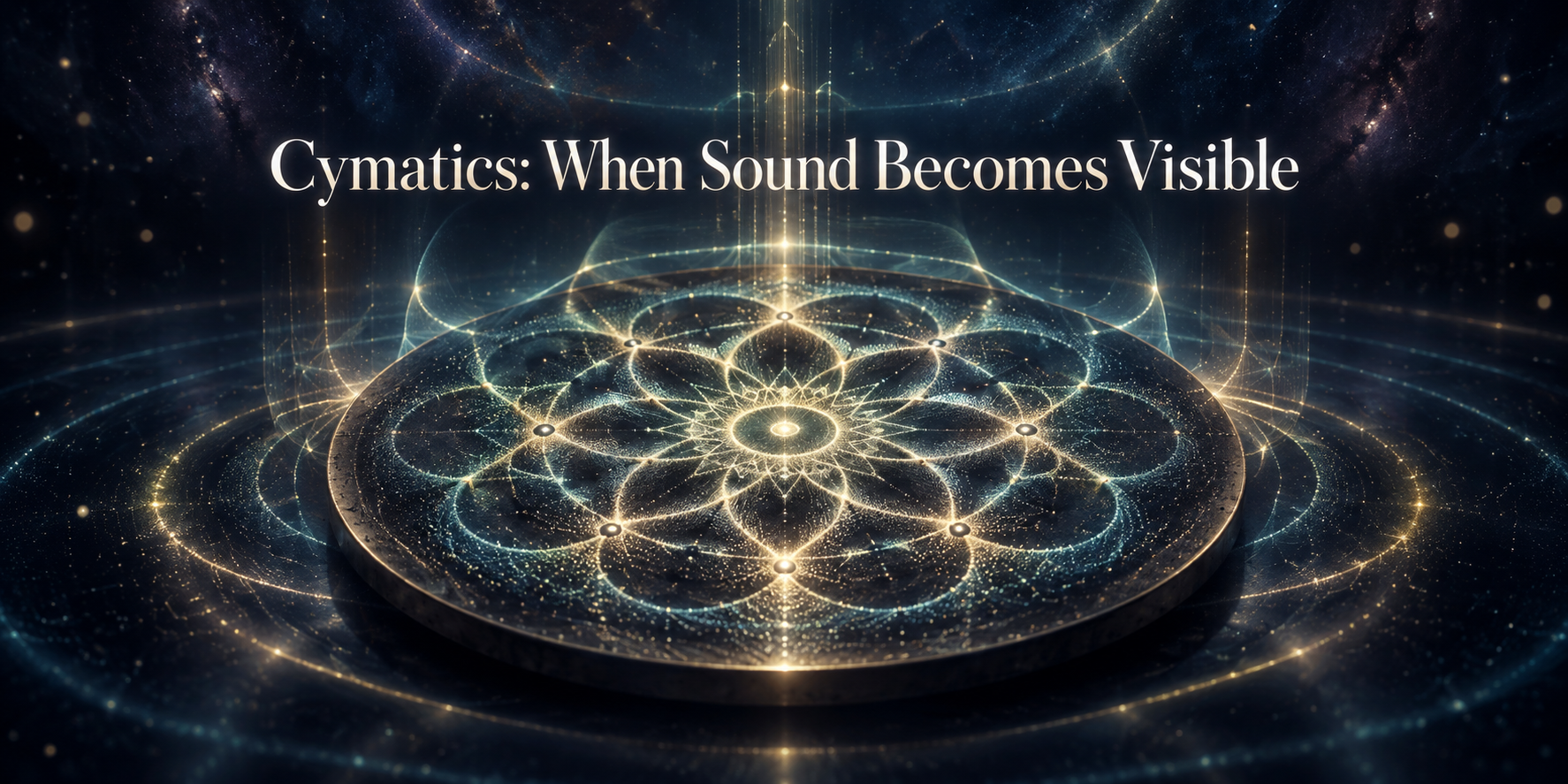
Cymatics: When Sound Becomes Visible
Explore cymatics, Chladni figures, Faraday waves, resonance and the sacred beauty of sound creating visible patterns through vibration and matter.
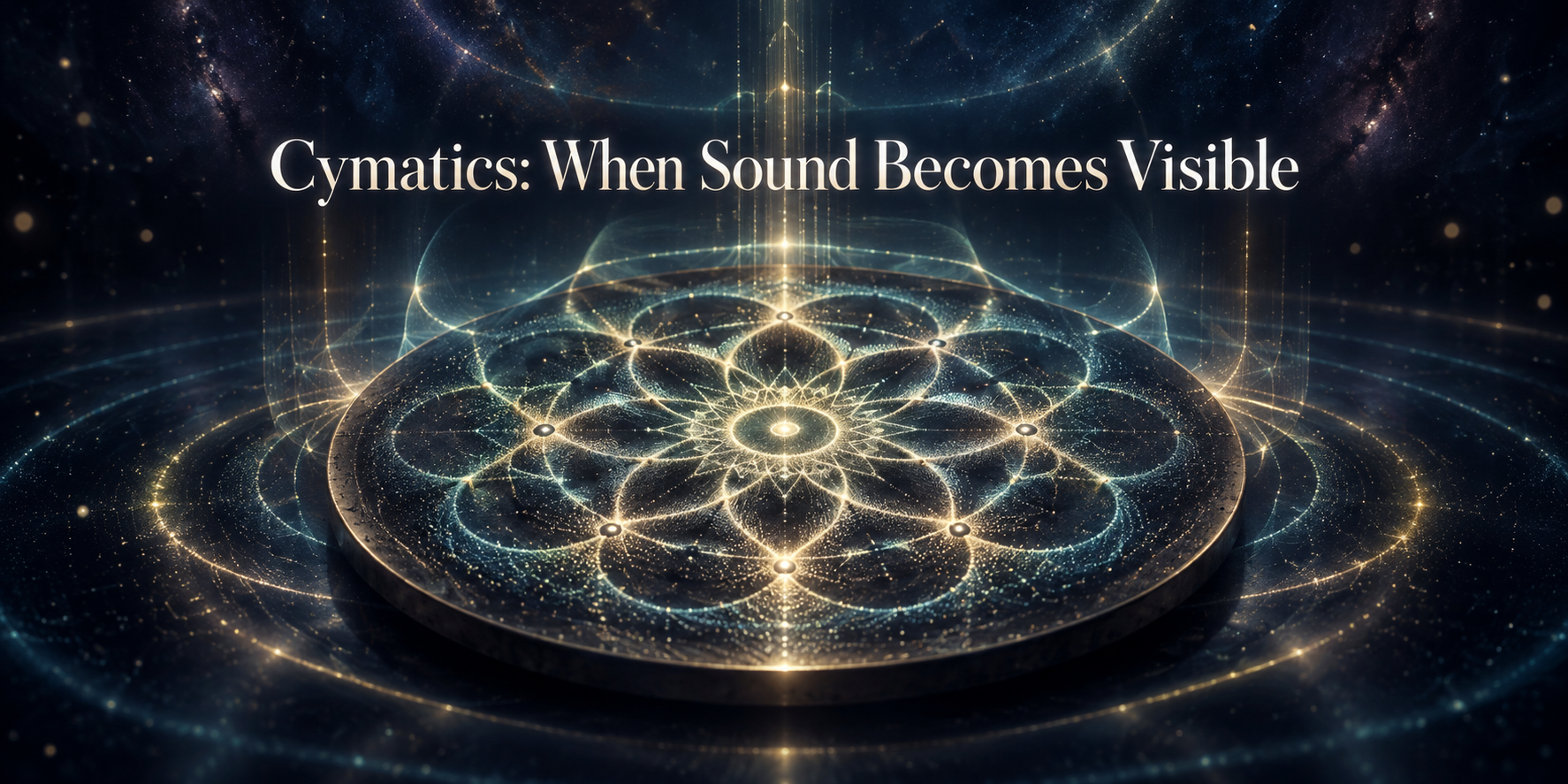
The hidden geometry of vibration and the sacred patterns carried through matter
Sound usually enters our lives invisibly.
We hear a voice, a bell, a bird, a prayer or a piece of music. We recognize its presence, yet we cannot normally see it traveling through the air.
Cymatics changes that.
When vibration passes through a plate, membrane or liquid, it can organize particles and surfaces into visible patterns. Sand gathers into delicate lines. Water rises into repeating forms. Powders separate into curves, circles and intricate geometry.
What was hidden becomes visible.
For the scientific mind, cymatics reveals wave behavior, resonance and the natural modes of matter.
For the sacred imagination, it offers something equally beautiful: a reminder that unseen forces can leave visible traces, that stillness and movement can belong to the same design, and that creation holds possibilities we may not recognize until the right conditions bring them forward.
What is cymatics?
Cymatics is the study and visualization of patterns produced when sound or other mechanical vibrations move through matter.
The word comes from the Greek word kyma, meaning wave.
A cymatics experiment commonly begins with a surface that can vibrate, such as a metal plate, flexible membrane or container of liquid. A tone or mechanical oscillator causes the surface to move. Sand, salt, powder, water or another material reveals how that movement is distributed.
The substance does not arrange itself because it understands the sound. It moves in response to physical forces created by vibration.
Some areas move strongly. Other areas remain comparatively still. Under the right conditions, this difference creates an organized and visible form.
The results can be astonishingly beautiful.
Sound is movement traveling through matter
Sound begins with vibration.
A guitar string moves back and forth. Vocal folds vibrate as air passes through them. A drumhead moves when struck. A speaker repeatedly pushes and pulls the surrounding air.
These movements create changing pressure in a medium—a substance through which the disturbance can travel. Air is the medium for most of the sounds we hear, but sound and mechanical vibration can also travel through water, wood, metal, bone and many other materials.
Sound cannot travel through a perfect vacuum because there are no particles there to carry the mechanical disturbance.
The frequency of a vibration is the number of cycles it completes each second. Frequency is measured in hertz, abbreviated Hz. One hertz means one cycle per second.
Higher frequencies are generally heard as higher pitches. Lower frequencies are generally heard as lower pitches.
Amplitude describes the size or strength of a vibration. Greater amplitude is often experienced as greater loudness, although human hearing involves more than amplitude alone.
Frequency and amplitude help shape a cymatic pattern, but they are only part of the relationship.
Standing waves and the architecture of vibration
Many familiar cymatic forms are produced by standing waves.
A standing wave develops when waves moving through a material interact with reflected waves in a way that creates a stable pattern. The material continues vibrating, but the overall arrangement of movement remains in the same general locations.
Within a standing wave are regions called nodes and antinodes.
Nodes are places where movement is minimal.
Antinodes are places where movement is greater.
On a classic vibrating plate covered with coarse sand, the grains bounce away from strongly moving regions and gather along quieter nodal lines. Those lines create the geometric forms known as Chladni figures.
Very fine particles may sometimes behave differently because currents in the air above a vibrating plate can carry them toward more active regions. This movement of fluid produced by sound is called acoustic streaming.
The substance matters.
Its size, weight and relationship with the surrounding air or liquid help determine how it responds.
Resonance allows the hidden pattern to appear
Every object has natural ways in which it can vibrate. These are called natural frequencies or vibrational modes.
A mode is a particular pattern of movement the object is capable of producing.
When an object is driven near one of its natural frequencies, it can respond with greater vibration. This is resonance.
A familiar example is a playground swing. A push delivered at the right moment builds the swing’s movement. Poorly timed pushes do not strengthen the motion as effectively.
A plate also has preferred ways of vibrating. At particular frequencies, waves travel across it, reflect from its boundaries and combine to create stable arrangements of nodes and antinodes.
When the frequency changes, the vibrational mode may change.
The particles move.
The previous pattern dissolves.
Another pattern emerges.
Cymatics allows us to see that an apparently quiet object may contain many possible forms of movement.
Pattern emerges through relationship
A frequency does not create a cymatic pattern by itself.
The shape, dimensions, thickness and material of a plate affect how it vibrates. So does the place where it is held, clamped or supported. The strength of the vibration matters. The kind and amount of material placed upon the surface matter.
In liquids, depth, temperature, density, viscosity, surface tension and container shape also influence the result.
A tone applied to a circular plate may produce a different form from the same tone applied to a square plate. Changing the mounting point or plate thickness may alter the pattern again.
This means a frequency does not possess one universal geometric image that appears in every material and every experiment.
The frequency matters.
The material matters.
The boundary matters.
The way the system is held matters.
The visible form emerges through relationship.
This is one of the deepest truths cymatics offers.
Vibration does not impose one predetermined image upon everything it touches. It meets the properties and possibilities of the material before it.
Robert Hooke and an early glimpse of vibration
The history of cymatics reaches back centuries.
In 1680, English scientist Robert Hooke experimented with a glass plate covered in flour. By drawing a bow along the plate, he observed particles gathering into patterns produced by vibration.
Hooke had seen an important possibility: loose material could reveal the movement of a solid surface.
His experiment became an early step toward a more systematic exploration of visible sound.
Ernst Chladni and the figures that carry his name
More than a century after Hooke’s observation, German physicist and musician Ernst Chladni greatly expanded the study of vibrating plates.
In the late eighteenth century, Chladni scattered sand across metal plates and made them vibrate, traditionally by drawing a violin bow along an edge.
At resonant frequencies, the sand gathered into symmetrical nodal patterns.
These arrangements became known as Chladni figures.
Chladni experimented with plates of different shapes and carefully documented the forms that appeared. His demonstrations made an invisible physical process visible, repeatable and open to study.
The patterns also offered insight into the vibration of musical instruments. Instrument makers and acousticians could observe how a violin plate, soundboard or other resonant surface moved at particular frequencies.
What appeared to be decorative geometry was actually a map of motion and stillness.
Sophie Germain and the mathematics beneath the beauty
Chladni’s patterns presented scientists with a difficult question.
Why did the lines take those particular forms?
After Chladni demonstrated his plates in Paris, the French Academy of Sciences offered a prize for a mathematical theory that could explain the vibration of elastic surfaces.
French mathematician Sophie Germain devoted years to the problem.
She pursued mathematics during a time when women were largely excluded from formal scientific education. She studied independently, corresponded under a male name and continued refining her work despite obstacles that had little to do with her ability.
Germain’s theory was not the final word on vibrating plates, but it became an important step in the mathematical understanding of elasticity and surface vibration.
In 1816, she received the Academy’s prize, becoming the first woman to receive such an honor from the institution.
Her place in the story of cymatics matters.
The visible beauty of Chladni’s figures inspired a deeper search for the laws beneath them, and Sophie Germain helped open that path.
Michael Faraday and the patterned surface of water
Cymatic forms are not limited to dry particles on metal.
In 1831, English scientist Michael Faraday described patterned waves that appeared when a container of liquid was vibrated vertically.
Today, these forms are known as Faraday waves.
When the vibration becomes strong enough under suitable conditions, a previously flat liquid surface can become unstable and reorganize into a standing-wave pattern.
Depending upon the frequency, acceleration, liquid depth, viscosity, surface tension and container, the surface may display stripes, squares, hexagons or more complex arrangements.
Unlike sand gathering along quieter lines, liquid cymatics involves the surface itself rising and falling.
What looks like a stable shape in a photograph is actually an active relationship repeating through time.
The surprising rhythm of Faraday waves
Faraday waves can display an especially fascinating response.
The liquid surface often oscillates at half the frequency driving the container. This is called a subharmonic response.
In plain language, the container may complete two cycles while the visible surface pattern completes one.
The liquid is responding to the outside vibration, but it is not simply copying it cycle for cycle.
The system has its own dynamics.
This adds another layer to the wonder of cymatics. Matter does not always respond to a force in the simplest or most obvious way. The resulting form emerges from the interaction between the driving vibration and the natural behavior of the responding material.
Hans Jenny and the name cymatics
Swiss physician and natural scientist Hans Jenny introduced the term cymatics in the twentieth century.
Jenny experimented with powders, pastes and liquids placed on vibrating plates and membranes. He used oscillators capable of producing controlled frequencies and documented the resulting forms through photography and film.
His first volume on the subject was published in 1967. A second followed in 1972.
Jenny brought renewed attention to the visual beauty of vibration. He was interested not only in individual patterns but in the dynamic processes through which matter formed, dissolved and reorganized.
His work helped carry the earlier experiments of Hooke, Chladni and Faraday into modern visual culture.
Today, electronic tone generators, high-speed cameras, computer modeling and precision instruments allow researchers and artists to observe vibrational patterns with extraordinary detail.
The tools have changed.
The wonder remains.
Water makes vibration visible in another way
Water responds to vibration differently from dry particles.
Its surface may form ripples, peaks, troughs, rings and repeating geometric arrangements. Under controlled conditions, a vertically driven liquid can display remarkably stable standing-wave patterns.
Water depth matters because it affects how waves travel and interact. Surface tension influences smaller ripples. Gravity becomes more important in larger waves. Viscosity—the resistance of a liquid to flowing—affects how quickly movement is dampened.
The dimensions and shape of the container determine the available boundaries.
A photographed water pattern captures only one instant in an active process.
The water is not frozen into geometry.
It is continually moving through a repeating relationship.
It is form without complete stillness.
It is order carried through change.
Sine tones, musical notes and harmonics
A carefully generated sine tone contains one frequency.
Because it is simple and controlled, a sine tone can make it easier to excite and study a particular vibrational mode.
A note played on a guitar, piano, violin or human voice is more complex. It usually contains a fundamental frequency—the frequency we mainly recognize as the note—along with harmonics.
Harmonics are additional frequencies that occur above the fundamental. Their relative strength helps give an instrument or voice its distinctive sound.
This is why a piano and violin can play the same note yet sound different.
Music adds even more complexity. It contains changing notes, harmonics, rhythm, timing, intensity and often multiple instruments or voices interacting at once.
When music drives a cymatic device, the visible forms may change continuously. The apparatus responds to the physical mixture of frequencies and amplitudes reaching it from moment to moment.
The result is not one permanent image of the song.
It is a moving visual conversation between the music and the material.
Can a spoken word have a cymatic shape?
A spoken word contains changing frequencies, harmonics and intensities.
Different people pronounce the same word with different voices, pitches, accents, timing and volume. Even the same person will not reproduce a word in precisely the same way every time.
A cymatic device can respond to the vibrations within speech, but the image is created by the entire experimental system.
The apparatus is not translating the meaning of the word into a universal symbol.
What it can reveal is still remarkable: the human voice is physical enough to move air, enter matter and create an observable response.
The deeper meaning of a word comes through language, truth, intention, relationship and the spirit in which it is spoken.
Cymatics reveals the physical vibration.
Human experience reveals the meaning it carries.
Beautiful patterns and complex patterns
A visually symmetrical cymatic pattern is not automatically better, healthier or more spiritually powerful than an irregular one.
Some frequencies excite simple modes. Others produce forms with many nodal regions. When several modes interact or conditions shift, the pattern may become increasingly complex.
Complexity is not failure.
It may reflect a richer interaction among frequencies, materials and boundaries.
Cymatics gives us a language of form, but it does not assign moral value to every shape.
The beauty is found in seeing matter respond.
Why cymatic patterns resemble forms in nature
Cymatic patterns may resemble flowers, snowflakes, shells, cells, honeycombs, mandalas and other examples of sacred geometry.
These similarities can be deeply moving.
Nature produces patterns through many processes, including growth, crystallization, fluid flow, gravity, biological development, chemical reaction and wave behavior.
A flower is not simply a cymatic image made solid. A snowflake is shaped through the crystallization of water. A shell grows through biological processes. Honeycomb develops through the activity of living bees and the physical properties of wax.
Yet these different processes may produce related visual qualities—symmetry, repetition, branching, spirals and geometric order.
Creation seems able to arrive at beauty through many pathways.
Cymatics does not need to explain every pattern in nature to deepen our wonder.
It belongs among the many ways order becomes visible.
The science of moving tiny particles with sound
The principles revealed by cymatics now appear in advanced scientific technologies.
Researchers use acoustic fields to move, separate and organize microscopic particles, droplets and cells.
One effect is acoustic radiation force. This is a force produced when sound interacts with an object, guiding it toward particular regions of an acoustic field.
Another effect is acoustic streaming—a steady movement of fluid created by sound. This flowing liquid can transport very small particles.
Scientists can carefully balance or use these effects to control material at tiny scales.
Acoustic tweezers
Acoustic tweezers use sound-generated forces to manipulate small objects without physically gripping them.
Many of these systems use ultrasound—sound at frequencies above the range of human hearing.
Standing surface acoustic waves can create predictable regions where particles or cells gather. By changing the frequency, geometry or arrangement of sound sources, researchers can alter the resulting pattern.
These techniques may be described as label-free because the cells or particles do not always need chemical labels, magnetic beads or other attached markers before they can be moved.
Researchers are exploring acoustic methods for cell sorting, biological analysis, microscopic assembly, droplet control, microrobotics and tissue engineering.
What begins as sand forming lines on a plate leads toward technologies capable of arranging living cells within a tiny chamber.
The invisible becomes practical.
Cymatics as a window into material possibility
A metal plate may appear still while containing many possible modes of vibration.
A bowl of water may appear featureless while holding the ability to form circles, squares or waves.
Sand may appear scattered until resonance reveals a pattern.
The vibration does not place a foreign design onto passive matter.
It encounters the properties already present within the system.
The plate has shape, stiffness and boundaries.
The water has depth, viscosity and surface tension.
The particles have weight, size and texture.
The final pattern arises from the meeting.
Cymatics invites us to look at ordinary matter differently.
What appears still may contain unrealized movement.
What appears scattered may be capable of order.
What appears simple may hold many possible forms.
Movement and stillness belong together
One of the most beautiful truths in a classic Chladni figure is that the visible design traces areas of comparative stillness.
Without movement, the pattern would not form.
Without quieter regions, the pattern would not become visible in the same way.
Both belong to the event.
This can become a sacred lesson.
A meaningful life is not built entirely from action. Stillness is not the absence of life. It can be where experience gathers into understanding.
Prayer, reflection and rest create quiet places within the movement of our days.
The still point does not reject the vibration around it.
It gives the pattern somewhere to appear.
The sacred meaning of resonance
In physics, resonance has a precise meaning. A system responds strongly when it is driven near one of its natural frequencies.
In human life, we also use the word resonance to describe something that reaches us deeply.
A truth resonates.
A song awakens memory.
A prayer feels as though it has found a place already waiting within us.
These experiences are not identical to the vibration of a metal plate, but the shared language is meaningful.
Something outside us meets something within us, and a response emerges.
Discernment matters because not everything that produces a strong reaction is necessarily true or good. Yet genuine resonance can help us recognize beauty, wisdom, calling and connection.
Cymatics offers a physical image for a spiritual experience we already understand.
We are affected by what meets us.
Creation spoken into being
In Genesis, creation unfolds through the speech of God.
God speaks, and light, sky, land and living things come into being.
The biblical meaning reaches far beyond an acoustic wave moving through a plate. Divine speech expresses the authority, will and creative power of God.
The Gospel of John opens with the mystery of the Word—the divine Logos through whom all things were made.
Cymatics is not a scientific demonstration of these passages.
It offers the sacred imagination a visual companion: unseen expression giving rise to visible order.
Science can describe how vibration travels through matter and how physical patterns emerge. Faith asks larger questions about meaning, purpose and the divine source of creation.
These ways of understanding do not have to compete.
Wonder has room for both.
The sacred pattern is not always obvious
Cymatic patterns often become clearest at resonance.
Before that moment, the particles may move without settling into a recognizable form. As the frequency approaches a natural mode, the structure becomes visible.
Human life can feel this way.
There are seasons when events appear scattered. Growth may be happening without a clear design. Pieces may be moving before we understand where they belong.
This does not mean every life event is controlled by a hidden frequency or that every difficulty forms part of a predetermined picture.
It means clarity may sometimes emerge through time, relationship, prayer and patient attention.
The pattern may not be absent.
It may still be becoming visible.
A sacred practice of listening
Choose one sound you can hear clearly.
It might be rainfall, a bird, a bell, a piece of instrumental music or your own voice speaking a short prayer.
Listen without rushing to interpret it.
Notice when the sound begins, how it changes and how it fades. Notice the silence surrounding it. Feel whether the vibration can be sensed in your chest, throat or the surface beneath you.
Then ask:
What am I allowing to shape my inner life?
Which voices help truth, peace and courage emerge within me?
Where do I need more stillness so I can recognize what is forming?
End with a simple prayer:
God, help me listen wisely. Let truth resonate within me. Teach me to use my voice to create comfort, courage and goodness in the lives I touch.
Questions about cymatics
What is cymatics in simple terms?
Cymatics is a way of making the effects of vibration visible. Sound or mechanical vibration moves through a plate, membrane or liquid, causing particles or surfaces to form observable patterns.
Does cymatics actually make sound visible?
Cymatics makes the response of matter to vibration visible. We do not see the sound wave directly. We see sand, water or another substance revealing how vibration moves through a physical system.
What is a Chladni plate?
A Chladni plate is a thin plate covered with particles and made to vibrate. At resonant frequencies, coarse grains commonly gather along relatively still nodal lines, creating geometric patterns called Chladni figures.
Who first observed Chladni-like patterns?
Robert Hooke described an early experiment involving flour on a vibrating glass plate in 1680. Ernst Chladni later studied the phenomenon systematically, documented the patterns and made them widely known.
Who was Sophie Germain?
Sophie Germain was a French mathematician whose work helped advance the mathematical understanding of vibrating elastic surfaces. In 1816, she received a prize from the French Academy of Sciences for her work related to Chladni’s vibrating plates.
What are nodes and antinodes?
Nodes are regions within a standing wave where movement is minimal. Antinodes are regions where movement is greater. In classic Chladni experiments, coarse particles usually gather along nodal lines.
What is a standing wave?
A standing wave is a stable vibration pattern formed when traveling and reflected waves interact. Certain regions repeatedly experience little movement while others experience stronger movement.
What is resonance?
Resonance occurs when a system is driven near one of its natural frequencies and responds with stronger vibration. In cymatics, resonance can allow a distinct vibrational mode to become visible.
Does every frequency have one particular shape?
No single universal shape belongs to a frequency in every setting. The pattern depends upon the entire system, including frequency, amplitude, material, geometry, mounting method and the substance revealing the vibration.
Why do higher frequencies sometimes create more detailed patterns?
Higher-frequency modes may allow more nodal regions to fit across a surface, producing additional lines and divisions. The exact result still depends upon the material, shape and boundaries of the system.
Can cymatics be created with water?
Yes. Vibrating a liquid under controlled conditions can produce ripples and standing-wave patterns. The forms depend upon frequency, acceleration, liquid depth, viscosity, surface tension and container shape.
What are Faraday waves?
Faraday waves are patterned standing waves that can form on a liquid surface when its container is vibrated vertically with sufficient strength. They are named after Michael Faraday, who described them in 1831.
Why can Faraday waves move at half the driving frequency?
Faraday waves often display a subharmonic response. The liquid surface may complete one oscillation for every two cycles of the driving vibration. This behavior emerges from the dynamics of the liquid system.
Who coined the word cymatics?
Swiss physician and natural scientist Hans Jenny introduced the word in the twentieth century. He documented patterns created in powders, pastes and liquids by controlled vibration.
What is the difference between a sine tone and a musical note?
A sine tone contains one frequency. A musical note from a voice or instrument usually contains a fundamental frequency along with harmonics that give the sound its distinctive character.
Can cymatics show the meaning of a spoken word?
A cymatic device can respond to the frequencies and amplitudes within speech, but the meaning of a word is carried through language, context, intention and relationship. There is no single universal cymatic symbol belonging to every spoken word.
Can music create cymatic patterns?
Yes. Because music contains changing frequencies, harmonics, rhythms and intensities, it often creates forms that continually move and transform rather than one permanent image.
Are symmetrical cymatic patterns better than irregular ones?
Not necessarily. Symmetry and complexity reflect the behavior of the physical system. An irregular or rapidly changing pattern is not automatically harmful, and a symmetrical pattern is not automatically healing.
Why do cymatic patterns resemble flowers and sacred geometry?
Wave behavior, boundaries and symmetry can produce repeating geometric forms. Nature also creates similar visual qualities through growth, crystallization, fluid flow and other processes. The resemblance invites wonder without requiring every natural pattern to have the same cause.
What is acoustic streaming?
Acoustic streaming is a steady flow within a fluid caused by sound. It can influence how very small particles move and is important in some modern acoustic technologies.
What are acoustic tweezers?
Acoustic tweezers use carefully controlled sound-generated forces to move particles, droplets or cells without mechanically gripping them. Researchers are studying them for biological analysis, cell sorting, microfluidics and tissue engineering.
Is ultrasound a form of sound?
Yes. Ultrasound is sound with frequencies higher than humans can normally hear. Although it is inaudible, it can still travel through suitable materials and exert physical effects.
What is the spiritual meaning of cymatics?
Cymatics can symbolize unseen influence becoming visible, the relationship between movement and stillness, and the potential that emerges when vibration meets matter. These reflections deepen the meaning of the phenomenon while allowing the physics to remain clear.
Continue exploring
Explore the physical, emotional and sacred influence of language in Words, Vibration and the Human Body.
Discover the relationship between sound and water in Music, Frequency and Water: How Sound Creates Movement, Pattern and Resonance.
Consider the wider mystery of consciousness and the physical world in Can Human Intention Influence Matter?.
When the hidden pattern appears
A tone enters a plate.
The surface begins to move.
Scattered grains travel across it and gather into a form no hand has drawn.
The visible pattern belongs to the whole relationship—the vibration, the plate, its boundaries and the particles responding upon it.
Cymatics does not tell us that every mystery has been solved.
It tells us that the unseen can leave a visible trace.
It reminds us that movement and stillness can belong to one design, that matter holds more possibilities than a quiet surface reveals, and that creation is filled with relationships capable of bringing hidden order into view.
Sometimes wonder begins when something invisible touches the world—and the world responds.

Why Firelight Feels Different
Discover why firelight feels different, from its warm glow and nighttime rhythms to relaxation, ancient human gatherings, storytelling, the hearth and the sacred meaning of flame.

There is something about firelight that electric light rarely recreates.
A lamp can illuminate a room more efficiently. A screen can produce millions of colors. A modern bulb can imitate the amber tones of evening.
Yet when a real flame begins to move, something changes.
Faces soften in its glow. Shadows come alive. Conversation can become quieter. Attention settles. A room that felt ordinary moments before suddenly feels intimate, ancient and almost outside of time.
We often describe this simply as atmosphere.
But firelight really is different.
Its color is different.
Its movement is different.
Its relationship with darkness is different.
The way our eyes and biological rhythms encounter it is different.
And behind all of this lies something much larger: an extraordinarily ancient relationship between human beings and flame.
Fire gave our ancestors warmth, protection, cooked food and light after sunset. Around it, people gathered, talked, remembered, celebrated, sang, prayed and told stories.
Firelight is not merely another kind of illumination.
It is woven into the human story.
Firelight Is Never Completely Still
Most modern lighting is designed to disappear into the background.
Turn on a lamp and its light remains relatively constant.
Fire does the opposite.
A flame bends.
Stretches.
Contracts.
Divides.
Brightens.
Fades.
A log shifts and the entire pattern changes.
An ember collapses and a new flame appears.
Air currents alter the shape of the fire. Fuel changes beneath it. Tiny variations in combustion continually change the amount and direction of light reaching our eyes.
Fire therefore does not simply illuminate a room.
It animates it.
Walls change subtly.
Reflections shimmer.
Faces move between brightness and shadow.
Even when nothing else in the room is moving, a firelit room never looks completely still.
Firelight Has a Different Color
The familiar gold, amber, orange and red colors of fire arise from combustion.
As wood burns, gases and tiny particles become extremely hot. Some particles become incandescent, meaning they grow hot enough to glow visibly.
Different parts of a flame experience different temperatures and chemical reactions, which is why flames can contain yellow, orange, red and sometimes blue.
But the overall experience of ordinary wood fire and candlelight is strongly warm.
That distinguishes it from daylight and from many forms of modern artificial illumination.
And our bodies encounter those differences in ways that extend beyond simply seeing them.
Your Eyes Help Tell Your Body What Time It Is
We usually think of the eyes as instruments of sight.
Light enters.
The brain creates an image.
But the human eye does something else that is remarkable.
It helps the body understand time.
Inside the retina are specialized cells containing a light-sensitive pigment called melanopsin.
These cells help send information about environmental light to the systems involved in regulating the body's internal clock.
That internal timing system contributes to our circadian rhythm, the roughly 24-hour biological pattern influencing sleep and wakefulness, alertness, hormones, body temperature and many other processes.
So when your eyes encounter light, your body is not simply asking:
What can I see?
At another level it is also receiving information about:
What time of day does this light suggest?
Daylight and Firelight Send Different Signals
Daylight is bright and contains abundant shorter-wavelength visible light, including blue.
This is part of the natural rhythm humans have lived within for generations beyond counting.
Day is bright.
Evening grows dimmer.
Sunset arrives.
Then comes darkness.
For most of human existence there was no wall switch capable of turning midnight into something resembling noon.
There was daylight.
There was sunset.
There was moonlight and starlight.
There was darkness.
And there was fire.
Fire occupied an extraordinary place between daylight and complete darkness.
It allowed people to remain awake, see one another and continue interacting after sunset without recreating the brilliant light of day.
Firelight Lets Night Remain Night
This may be one of the most beautiful differences between firelight and modern illumination.
Modern lighting often tries to eliminate darkness.
Fire does not.
A fire creates a center of illumination surrounded by shadow.
Near the flame, colors appear.
A little farther away, details soften.
Beyond that, objects disappear.
Fire does not turn night into day.
It creates a small island of light within night.
The darkness remains part of the experience.
And perhaps some of what we experience as the peace and intimacy of firelight comes from this relationship.
Everything does not need to be illuminated.
Everything does not need to be visible.
The flame shows enough.
Firelight and the Body's Nighttime Rhythm
One of the body's important nighttime signals involves melatonin.
Melatonin is often called the sleep hormone, but its role is broader than simply making us sleepy. It is also part of the body's biological signaling that night has arrived.
Bright evening light can influence normal nighttime melatonin patterns, with brightness, timing and the wavelengths of the light all playing a role.
The human circadian system is especially responsive to shorter-wavelength light.
Traditional firelight creates a much warmer and generally dimmer environment than daylight and many bright modern lighting conditions.
That reveals something fascinating about the environment in which human nighttime biology developed.
For countless generations, light after sunset looked nothing like the brilliantly illuminated evenings many of us experience today.
Our nights were darker.
And the light within them was warmer.
Our Vision Changes Around a Fire
Human vision adapts beautifully as illumination changes.
In brighter conditions, cells in the retina called cones help us see fine detail and color.
As the environment becomes darker, rods, which are extremely sensitive to low levels of light, become increasingly important.
Firelight creates a visual landscape between brightness and darkness.
Near the flame, color remains vivid.
Beyond it, the world becomes progressively less defined.
That creates layers.
Light.
Shadow.
Movement.
Depth.
Mystery.
Bright overhead lighting tends to flatten those differences by illuminating everything.
Firelight preserves them.
Sometimes what the fire does not illuminate is part of what makes it beautiful.
Why Can We Watch Fire for So Long?
Fire presents an unusual kind of visual experience.
It is familiar enough that the brain immediately understands what it is.
Yet it never completely repeats itself.
A flame rises.
Another disappears.
A coal turns red.
A log cracks.
Sparks lift upward and vanish.
The pattern changes again.
There is always something happening, but rarely anything we need to do about it.
That is very different from much of modern stimulation.
There is no notification.
No storyline we have to remember.
No score.
No decision.
No button.
No task.
No demand to respond.
The flame gives attention somewhere to rest without becoming completely predictable.
Perhaps that is part of its quiet power.
Fire Can Hold Attention Without Demanding It
Much of modern life competes aggressively for attention.
Fire does not need to.
It moves.
We notice.
It crackles.
We listen.
Then our thoughts are free to wander again.
This creates a gentle rhythm between attention and reflection.
You can watch the fire.
Look at someone beside you.
Return to the flame.
Think.
Listen.
Remember.
Speak.
Become quiet again.
The fire remains there throughout it all.
It provides a center without requiring that it become the entire experience.
Research Has Found a Fireside Relaxation Response
There is intriguing research behind the familiar feeling of relaxing beside a fire.
In one experimental study involving 226 adults, researchers compared responses to simulated fires under different conditions, including fire with sound, muted fire and control conditions.
The fire-with-sound condition was associated with decreases in blood pressure over time, with longer exposure producing stronger effects in the study.
The researchers explored the possibility that the combination of flickering light, natural sound and absorbed attention contributes to relaxation.
That possibility is especially interesting because a fire is not merely something we watch.
We experience several things at once.
Movement.
Warm color.
Changing brightness.
Crackling sound.
Warmth when the fire is real.
Sometimes the scent of burning wood.
And often stillness.
A fire is not merely an image.
It is an environment.
The Crackle Is Part of the Fire
Imagine a fire with no sound at all.
Something would be missing.
There is the faint hiss of burning wood.
The sudden pop of a pocket of moisture.
The tumble of an ember.
The whispering rush of flame.
The gentle collapse of a log.
None of it follows a rigid rhythm.
There is no chorus repeating every thirty seconds.
The sounds are unpredictable, yet recognizable.
They create activity without demanding interpretation.
The eyes and ears can remain interested while the mind remains free.
Fire Is Multisensory
A real fire reaches us through more than vision.
We see the flame.
We hear it.
We feel radiant warmth on the skin.
We may smell burning wood.
We notice air moving around the heat.
Sometimes we even feel the temperature change when a flame suddenly grows larger.
That may help explain why an actual fire can feel different from a video of one.
A screen can reproduce an image beautifully.
A speaker can reproduce crackling sounds.
But a living fire surrounds the body with a constantly changing physical environment.
You are not simply observing it.
You are sitting within its presence.
Humanity's Relationship With Fire Is Astonishingly Old
The human relationship with fire reaches astonishingly far into the past.
Wonderwerk Cave in South Africa has become especially important in understanding that history.
Earlier research had already provided strong evidence of burning associated with human ancestors approximately one million years ago.
Research published in 2026 extended that story even deeper.
Scientists examining ancient animal bones from the cave found repeated burning associated with hominin occupation in layers dating from roughly 1.07 to 1.79 million years ago.
The location matters.
Some of this evidence comes from deep inside the cave, making ordinary wildfire a poor explanation for the repeated burning.
The findings support an extraordinarily early relationship between human ancestors and fire.
Those distant ancestors may not necessarily have known how to create flame whenever they wanted. They may initially have obtained naturally occurring fire and learned how to preserve, transport and use it.
But even that possibility is extraordinary.
More than a million years ago, our distant ancestors may already have understood that flame was precious enough to carry into darkness.
Before Civilization, There Was Fire
Consider the timeline.
Before cities.
Before farms.
Before written language.
Before roads.
Before books.
Before temples.
Before nations.
Before recorded history.
There was fire.
That places fire in a remarkable category.
It is not simply an old technology.
Its relationship with humanity reaches into a world almost unimaginably distant from our own.
Generation after generation lived in a world where darkness was real and fire mattered.
Fire Changed Human Possibility
Fire offered enormous practical advantages.
It provided warmth.
It helped discourage predators.
It illuminated dark spaces.
It eventually transformed food through cooking.
It helped humans inhabit colder environments.
But there was another consequence that is easy to overlook.
Fire extended the human day.
Without artificial illumination, sunset dramatically limits what people can do.
With fire, something new becomes possible.
Human time after dark.
And that may have changed far more than our schedule.
Fire May Have Created a Different Kind of Human Time
Anthropologist Polly Wiessner explored how social interaction changes after dark through research among Ju/'hoansi hunter-gatherers in southern Africa.
Her analysis compared daytime and nighttime conversations and found a striking shift.
Daytime conversation centered more heavily on practical concerns, economic matters and social issues.
Nighttime activity around fires became different.
Stories became prominent.
There was singing.
There was dancing.
There were religious activities.
People spoke about others who were far away.
They revisited events.
They laughed.
They imagined.
They remembered.
They passed cultural knowledge from one person to another.
The fire had not simply extended daytime work.
It had helped create another kind of social space.
Daylight Was for Doing
Imagine life without electric illumination.
Daylight is precious.
There is food to gather.
Tools to make.
Children to care for.
Shelter to maintain.
Distances to travel.
Problems to solve.
Much of the day naturally centers on the immediate world.
Then the sun disappears.
The useful landscape shrinks.
The world outside the fire becomes difficult to see.
Work slows.
And attention can move somewhere else.
Toward the people sitting nearby.
Toward memory.
Toward imagination.
Toward meaning.
Toward story.
Firelight and Storytelling Belong Naturally Together
There is a reason the image of someone telling a story beside a fire feels almost timeless.
Fire creates a natural stage for storytelling.
The world beyond the circle becomes dark.
The speaker's face remains visible.
Other people are close enough to hear.
There are fewer competing activities.
And the imagination is free to travel far beyond the small illuminated circle.
A storyteller can take everyone somewhere the fire cannot illuminate.
Across a mountain.
Into yesterday.
Into childhood.
Into another person's life.
Into an ancestor's memory.
Into tomorrow.
Into the invisible.
Into the sacred.
Everyone remains physically beside the same flame.
Yet language allows several minds to travel somewhere else together.
That is one of the extraordinary powers of human storytelling.
Fire May Have Expanded the Social World
The nighttime storytelling observed in the Ju/'hoansi research did more than entertain.
Stories could keep distant people psychologically present.
They could convey knowledge about relationships and social life.
They could help listeners understand the experiences and motivations of others.
They could pass knowledge between generations without books or classrooms.
A story told beside a fire could therefore carry something across both distance and time.
Someone absent could become present through memory.
An ancestor could speak again through story.
An experience known by one person could become knowledge shared by many.
Fire gave the storyteller light.
Story gave the group another kind of sight.
The Hearth Became a Human Center
As fire became established within human camps and dwellings, the hearth naturally became a center.
Food was prepared there.
Cold bodies found warmth there.
Children gathered there.
Guests were welcomed there.
Wet clothing dried there.
Stories were told there.
People rested there.
The word hearth eventually came to mean far more than the physical place where a fire burns.
It became a symbol of home.
That meaning survives in the expression hearth and home.
Technology eventually reduced our dependence upon the hearth.
The symbolism remained.
Human culture remembered what the fire had been.
Fire Changes How We See One Another
Firelight also changes faces.
Its warm illumination differs dramatically from cool overhead light.
Highlights and shadows move gently across facial features as the flame changes.
And because the environment beyond the fire is darker, illuminated faces become visually important.
Imagine the ancient nighttime scene.
Beyond the fire is darkness.
Across the fire is another human face.
That face speaks.
Laughs.
Remembers.
Sings.
Tells a story.
For an immense span of human history, this may have been one of the defining experiences of nighttime social life.
The brightest things in the night were often the fire and the people gathered around it.
Fire Creates a Circle
There is something quietly beautiful about the way people gather around a fire.
Usually not in rows.
Not facing a stage.
Not staring in one direction.
They gather around it.
The flame creates a shared center.
People can look into the fire and still see one another.
Someone speaks.
Someone listens.
Another watches the flames.
A child moves closer for warmth.
Someone tends the fire.
The fire belongs to everyone within the circle.
That simple arrangement may be one reason a hearth can feel so naturally communal.
The flame becomes the center without needing to become the entire focus.
Part of Loving Fire Has Always Been Respecting It
There is another part of humanity's relationship with fire that belongs within its story.
We learned not only to appreciate flame, but to tend it.
A hearth was meaningful not simply because a flame burned there.
Someone kept the fire.
Someone understood when it needed fuel.
Someone gave it a proper place.
Someone remained aware of it.
That relationship contains a quiet wisdom.
To value something powerful does not mean approaching it carelessly.
A candle, hearth or campfire can bring warmth, beauty and companionship precisely because flame is given its proper place and treated with respect.
Care does not diminish the wonder.
In its own way, care is part of the wonder.
The fire is not ignored.
It is tended.
Perhaps this is one of the oldest lessons carried by the hearth:
What gives light deserves our presence.
A Real Flame Is Happening Right Now
Modern technology can imitate fire remarkably well.
LED candles flicker.
Electric fireplaces glow.
Screens display burning logs in astonishing detail.
Speakers reproduce the crackling sound.
These can create beautiful atmospheres.
But real fire possesses one characteristic that is difficult to reproduce completely.
It is actually happening.
The next movement of the flame has not been recorded.
The next spark has not been programmed.
A log may shift.
An ember may collapse.
The flame may suddenly brighten.
Every moment appears and disappears.
A real fire is an unfolding physical event.
The flame you are watching now will never exist in precisely that form again.
Perhaps that impermanence is part of why we keep watching.
One Candle Can Transform a Room
One candle produces remarkably little illumination compared with a modern lamp.
Yet one candle can transform the feeling of an entire room.
That tells us something important.
Human experience cannot be measured only by brightness.
Color matters.
Movement matters.
Contrast matters.
Memory matters.
Context matters.
Meaning matters.
A candle beside a quiet dinner feels different from fluorescent ceiling lights.
A candle beside a prayer feels different from a phone flashlight.
A candle lit in remembrance carries another meaning entirely.
The amount of light may be small.
Its presence can be enormous.
And perhaps part of the beauty of candlelight is precisely that it asks us to notice it.
We give the flame a proper place.
We remain present with it.
When its purpose is finished, we extinguish it.
The light is beautiful because it is both appreciated and tended.
Fire Has Always Invited Meaning
Human beings have looked at flame and seen more than combustion for a very long time.
It is easy to understand why.
Fire can transform.
It gives warmth.
It produces light.
It is visible but cannot be held.
It is always moving yet remains recognizably itself.
A tiny flame can illuminate a vast darkness.
One flame can ignite another without becoming smaller.
An ember that appears almost extinguished can suddenly become fire again.
Fire naturally became a language for transformation.
And perhaps the deepest symbolism of fire has never belonged to uncontrolled flame.
It belongs to the flame that gives light.
The hearth that gives warmth.
The candle kept for prayer.
The fire around which people gather.
The ember carefully carried forward.
Fire at its most meaningful is not simply power.
It is power given purpose.
Fire in the Biblical Story
Fire carries profound meaning throughout Scripture.
Moses encounters God through the burning bush.
During the Exodus, a pillar of fire guides the Israelites through the night.
Fire appears in connection with offerings, purification and sacred presence.
At Pentecost, the disciples experience what Scripture describes as tongues "as of fire."
Again and again, flame becomes associated with presence, guidance, transformation and spiritual power.
The imagery carries such force because fire possesses physical qualities that already speak deeply to human experience.
Light within darkness.
Warmth within cold.
Transformation.
Movement.
Power.
Presence.
And importantly, sacred fire is not presented merely as spectacle.
It points beyond itself.
The flame carries meaning because of what it reveals.
The Flame and the Inner Life
Perhaps that is why fire enters our language whenever we try to describe things that cannot easily be seen.
A spark of inspiration.
A flame of hope.
A burning desire.
Keeping faith alive.
Rekindling love.
An inner fire.
The metaphor feels natural because we understand something about flame.
A fire needs tending.
It needs fuel.
It needs air.
Neglected, it can fade.
Tended wisely, it can continue giving warmth and light.
And sometimes what looks almost extinguished is not gone at all.
One ember remains.
Given air and attention, the flame returns.
Faith can be like that.
Hope can be like that.
Love can be like that.
Sometimes the inner life does not need a roaring bonfire.
Sometimes one faithful ember is enough.
Fire Does Not Need to Conquer Darkness
Perhaps one of the deepest lessons of firelight is visible before us.
The flame does not eliminate darkness.
It creates enough light to live within it.
There can be darkness at the edges and warmth at the center.
We do not have to see everything.
We do not have to illuminate the entire horizon.
Sometimes there is enough light for this moment.
Enough light for this conversation.
Enough light for this prayer.
Enough light for the next step.
And perhaps that is one reason flame has carried sacred meaning through so much of human history.
Light becomes especially meaningful when darkness is allowed to remain around it.
Why Firelight Feels Different
So why does firelight feel different?
There is no need to force the answer into one explanation.
It is the warm color.
The changing brightness.
The moving shadows.
The dim nighttime illumination.
The way our eyes experience it.
The crackling sound.
The warmth on the skin.
The attention it gently attracts.
The faces gathered around it.
The stories associated with it.
The memories it awakens.
The care with which it is tended.
The spiritual meaning humanity has given it.
And perhaps something older than any memory we personally possess.
For an extraordinary stretch of human history, fire marked the place where darkness became inhabitable.
It was where food became warm.
Where cold bodies found heat.
Where another human face remained visible after sunset.
Where practical work could give way to conversation.
Where stories crossed generations.
Where songs entered the night.
Where prayer and ceremony gathered around flame.
Where people learned that something powerful could be beautiful precisely because it was respected and given its proper place.
Where people stared into moving light and wondered about things they could not see.
Firelight feels different because fire has never been merely light.
It became part of being human.
And perhaps when we sit quietly before a flame today, surrounded by technology our ancestors could never have imagined, something remarkably old happens again.
The world beyond the fire grows darker.
The flame moves.
Someone tends it.
Conversation slows.
Someone begins telling a story.
Someone else listens.
And the oldest room humanity ever built appears once more.
Not a room made of walls.
A circle made of light.
Questions and Answers
Why does firelight feel different from electric light?
Firelight combines warm color, continually changing brightness, moving shadows and relatively low illumination. A real fire also adds sound, radiant warmth and other sensory experiences, creating an environment very different from steady electric lighting.
Why is firelight so warm in color?
Different combustion processes produce different colors, but much of the familiar yellow and orange appearance of flame comes from extremely hot particles glowing as fuel burns. The overall visual experience is therefore strongly weighted toward warm tones.
Does firelight contain blue light?
Yes. Some regions of a flame can appear blue because of particular combustion reactions. But the overall illumination from ordinary wood fires and candles is generally much warmer than daylight and many modern electric light sources.
What is the circadian rhythm?
The circadian rhythm is the body's approximately 24-hour internal timing system. It helps coordinate sleep and wakefulness, hormone patterns, body temperature, alertness and many other biological processes.
How do our eyes help regulate the body clock?
Specialized cells in the retina contain a light-sensitive pigment called melanopsin. They help communicate information about environmental light to brain systems involved in distinguishing biological day from biological night.
Why does nighttime lighting matter?
Light is one of the body's most important environmental time signals. The brightness, timing and wavelengths of evening light can influence normal nighttime biological rhythms.
Can watching a fire really be relaxing?
Research involving 226 adults found decreases in blood pressure over time during a simulated fire-with-sound condition. The researchers explored whether the combination of flickering light, sound and absorbed attention contributes to the relaxation people often associate with fireside environments.
Why is the sound of fire important?
The crackles, pops and shifting sounds of burning wood create continuously changing but familiar sensory information. In experimental research on simulated fires, the presence of fire sound was associated with stronger relaxation effects than some comparison conditions.
How long have human ancestors used fire?
The exact beginning remains an active area of research. Evidence published in 2026 from Wonderwerk Cave in South Africa supports repeated hominin-associated burning in layers dating from approximately 1.07 to 1.79 million years ago.
Did early human ancestors know how to make fire?
Evidence of early fire use does not necessarily tell us exactly how the fire was started. Some early human ancestors may have obtained naturally occurring fire and learned how to preserve, transport and tend it before reliable fire-making developed.
Did fire change human social life?
Fire provided warmth, light, protection and eventually cooking, but it also extended activity beyond sunset. That created additional time for gathering, conversation, storytelling, singing, ceremony and other forms of social life.
Did people really tell stories around fires?
Anthropological research among Ju/'hoansi hunter-gatherers found that nighttime firelit activity contained substantially more storytelling, singing, dancing and religious activity than practical daytime conversation. It offers a fascinating example of how fire can create a distinctive social environment after dark.
Why is storytelling around a fire so powerful?
A fire creates a shared center while the surrounding environment becomes darker and less visually demanding. Storytelling then allows listeners to imagine people, places and events far beyond the illuminated circle.
Why did the hearth become a symbol of home?
Historically, the hearth brought together warmth, cooking, light and human gathering. Because so much daily and social life happened around it, the hearth naturally became associated with home, family, hospitality and belonging.
Is respecting fire part of its history too?
Yes. Humanity's relationship with fire has always involved more than simply possessing flame. Fire had to be preserved, tended, contained and given an appropriate place. That responsibility became part of the relationship between people and the hearth.
Why can one candle change the feeling of a room?
Atmosphere depends on far more than total brightness. Warm color, movement, contrast, shadow, memory and meaning all influence human experience. A small flame can therefore change a room far more than its amount of light would suggest.
Why is fire spiritually meaningful?
Fire possesses qualities that naturally carry powerful symbolism. It gives light, produces warmth, transforms matter, moves constantly and can spread from one flame to another. Across human traditions it has therefore become associated with transformation, purification, life, presence and illumination.
What does fire symbolize in Christianity?
Biblical fire imagery includes the burning bush, the pillar of fire during the Exodus and the tongues "as of fire" at Pentecost. Fire can represent God's presence, guidance, purification, spiritual power and transformation.
Why are people still drawn to fire when we no longer need it for light?
There is probably no single reason. Fire combines distinctive light, movement, sound and warmth with deep personal, social, historical and spiritual associations. Modern people may no longer depend upon the hearth for survival, but humanity's relationship with flame is vastly older than modern civilization.
More Paths to Explore
Spiritual Meaning of Candles
The Healing Presence of Darkness
Discover the healing presence of darkness through natural night, sacred stillness, prayer, hidden growth and the quiet wonder of creation.
Natural night, sacred stillness and the beauty of life beyond our sight
There is a moment after the lamp goes out when a familiar room becomes something different.
Its edges soften. The objects that asked for your attention become less noticeable. The day’s unfinished work no longer occupies every corner of your vision.
You are still here, but everything does not have to be solved.
Outside, the garden enters another rhythm. Somewhere, an owl begins to hunt. Nocturnal flowers open. Moonlight settles across water. Above the rooftops, stars remain present whether anyone has stopped to look.
Darkness can hold a surprising tenderness.
We often speak of light as a symbol of goodness, truth and the presence of God. Those meanings are beautiful. Yet natural darkness belongs to creation, too. Night makes room for sleep, shelters countless living creatures, reveals the stars and offers the world a rhythm different from the activity of day.
Its healing presence can be found in these ordinary gifts—in restoration, privacy, prayer, contemplation and the freedom to let the day end.
A whole life does not need endless brightness.
It needs a rhythm that makes room for receiving as well as giving.
Night is part of the gift
A peaceful darkness is different from the suffering we sometimes describe with the same word.
The darkness of a quiet bedroom is not despair. The shade surrounding a root is not spiritual separation. The night sky is not the opposite of goodness.
Physical darkness simply means that little or no visible light is present. What it feels like depends upon the place, the circumstances and the person experiencing it.
In a welcoming setting, darkness can become a shelter from constant outward attention. It lets us step away from being watched, answering questions, processing information and managing appearances.
We do not have to give every shadow a fearful meaning.
Sometimes darkness is simply the world making room for rest.
The body knows the rhythm of night
Light does more than help us see.
Specialized light-sensitive cells in the eyes send information to the brain’s central biological clock. This clock helps coordinate circadian rhythms—the roughly 24-hour patterns that influence sleepiness, alertness, body temperature and many other daily functions.
The changing pattern of light and darkness helps these inner rhythms stay aligned with the surrounding world.
As biological night approaches, the body normally increases its production of melatonin, a hormone that helps signal that nighttime has arrived. Light during the evening or night can suppress or delay that signal depending on its brightness, timing, duration and color.
Darkness does not force sleep to happen immediately. Instead, it allows the body’s normal nighttime signals to unfold with less interference from light.
There is something beautiful about that relationship.
Your body belongs to a world with mornings and evenings. It was not made only for effort, productivity and constant availability. It also carries rhythms of slowing, sleeping, restoring and beginning again.
Giving evening back its shape
Electric light is a remarkable gift. It allows us to read after sunset, care for one another through the night and move comfortably through our homes.
It also makes it possible for daytime activity to continue almost indefinitely.
A screen offers another thing to watch. A bright room invites another task. Work remains visible long after the body has begun asking for a different pace.
Human research has found that ordinary room light before bedtime can suppress melatonin compared with very dim light and shorten the duration of the body’s nighttime melatonin signal.
The invitation is gentle: let evening become distinguishable from afternoon.
Lower the lighting as bedtime approaches. Choose a quieter activity. Allow a few moments that are not filled with new information.
You can keep the light you need for comfort and movement while reducing brightness that no longer serves you.
This does not need to become another complicated routine.
It can be as simple as letting the room say what the clock already knows.
The day is ending.
When the eyes learn another way to see
At first, a dim space may seem almost empty of detail. Given time, the eyes become more sensitive to the light that remains.
This process is called dark adaptation.
The retina—the light-sensitive tissue at the back of the eye—contains cells called rods and cones. Cones are especially important for color and detailed vision in brighter conditions. Rods are highly sensitive to low levels of light and help us see in dim surroundings.
As the eyes adjust, outlines, movement and faint details may become easier to notice. Human eyes still need some light to see; complete darkness provides no visible light to detect.
The biology offers a lovely image for reflection.
Sometimes our first impression is not the whole picture. Sometimes we need time before we can recognize what is already present.
This does not mean darkness automatically reveals spiritual truth. It means our perception can change when we stop demanding immediate clarity.
Not everything becomes visible the moment we enter it.
Moonlight and the living rhythm of night
Natural darkness is not always complete blackness.
Moonlight is mostly sunlight reflected from the Moon’s surface. The Moon does not create visible light of its own. Even a full Moon is extraordinarily dim compared with the Sun, yet it can provide enough light to cast shadows and gently reveal the shape of a landscape.
Moonlight does not turn night into day.
It allows darkness to remain darkness while offering a softer kind of illumination.
As the Moon moves through its phases, the amount and timing of moonlight change. A waxing Moon brings increasing light into the evening. A full Moon can illuminate much of the night. As the Moon wanes, its brightest hours arrive later, gradually returning the early evening to deeper darkness.
The night is not a single, unchanging condition. It has phases, signals and rhythms of its own.
These changing levels of natural light matter to the living world.
For some nocturnal animals, moonlight creates opportunities to see, travel, communicate or find food. For others, a brighter night increases the possibility of being seen by predators. Some creatures become more active under moonlight, while others wait for darker conditions.
There is no single response shared by all nighttime life. Each creature meets the Moon according to its body, habitat and way of surviving.
Moonlight also offers a beautiful sacred image.
Not every season gives us the full brightness of understanding. Sometimes we receive only enough light to recognize where we are, notice what is near or take the next faithful step.
The path may not be completely illuminated, but it is not abandoned.
There is grace in a light that does not erase the darkness.
The stars were already there
Darkness can reveal what brightness conceals.
Artificial light scattered through the atmosphere creates skyglow—the brightening of the night sky that makes faint stars harder to see. Where that glow is reduced, more of the sky becomes visible.
The stars have not arrived because the surroundings grew darker.
They were already there.
That image invites a question worth carrying into a quiet evening.
What in your own life becomes easier to notice when the glare softens?
Perhaps it is a gratitude you hurried past. A relationship that deserves more care. A quiet longing you have not allowed yourself to name. A question that needs patient attention rather than an immediate answer.
You do not have to turn stargazing into a search for messages.
Wonder is enough.
There is value in remembering that reality is larger than what occupies our attention.
Prayer beyond appearances
A quiet, dim room can be a beautiful place for prayer.
You do not have to look composed. You do not have to find an impressive sentence. You can bring the part of yourself that is tired, hopeful, grateful or unsure.
Thank You for what carried me today.
Help me with what I cannot carry alone.
Let me rest in Your care.
God’s presence does not depend upon the lighting. Yet fewer distractions may help you become more available to the relationship.
Prayer can become simpler when there is no need to perform it.
You may speak. You may listen. You may remain silent for a while.
The sacredness is in the honest turning of your heart toward God.
Darkness and the mystery of God
Christian contemplative tradition has sometimes used darkness as an image of divine mystery.
Gregory of Nyssa, a fourth-century Christian theologian, explored this meaning through the biblical story of Moses. In his contemplative understanding, darkness could represent an encounter with God beyond what human thought could fully grasp.
Here, darkness does not mean that God is absent or that goodness has disappeared.
It represents the limits of human understanding before a reality greater than our explanations.
This is a deeply comforting possibility.
You can know something of God’s love without knowing everything about God. You can pray without having every question settled. You can remain in relationship while mystery remains.
Faith does not require you to reduce the infinite to something easily explained.
Sometimes reverence begins when certainty reaches its limit and wonder remains.
Fully known when you cannot see
Scripture makes room for night within the life of faith.
In Genesis 1, day and night both receive names, and the rhythm of creation includes evening as well as morning.
Psalm 139:11–12 offers another tender assurance: darkness does not hide us from God. What limits human sight does not limit divine knowing.
There is comfort in remembering this at the end of a demanding day.
A sleeping child is not farther from love because the lamp is off. A garden does not leave creation when the sun sets. Your prayer does not become less reachable because you speak it into a quiet room.
You can be unable to see the whole path and still be fully known.
Life continues beyond our sight
When a garden disappears into the night, its life does not stop.
Plants continue cellular respiration—the process of releasing usable energy from stored sugars to sustain living functions. Respiration occurs during daylight, too. Photosynthesis, the process through which plants use light energy to make sugars, depends on light.
Plants are not simply asleep or inactive after sunset. Living tissues continue using energy, moving water, responding to temperature and carrying out processes necessary for life.
Different plants and seeds have different relationships with light. Some seeds germinate more readily with light, some respond well to darkness and others are influenced more strongly by moisture, temperature and other conditions.
The deeper wonder is not that all growth happens in darkness.
It is that life remains active when we are no longer watching it.
Roots extend beneath the surface. Living cells continue their work. Seeds respond to conditions we may never see.
Our observation is not what keeps the garden alive.
As a spiritual reflection, this can soften the pressure to make every meaningful change immediately visible.
Learning, preparation, healing and growing trust may take shape privately before they become easy to describe.
Some things need care before they are ready for display.
The dignity of hiddenness
Privacy can protect what is still becoming.
A new idea may need time before it is offered to an audience. A prayer may belong between you and God. A personal change may need practice before it needs an announcement.
Darkness offers an image of that protected space.
It reminds us that visibility is not the only measure of value. Something can matter deeply without being witnessed by many people.
The modern world often encourages us to share life while we are still trying to understand it. Yet there is wisdom in allowing some experiences to remain sheltered until they have developed roots.
Not every quiet season guarantees progress, and not every delay carries a hidden purpose. But we can give developing things patient attention rather than demanding constant proof.
You are allowed to tend a life that is not always on display.
The night is someone else’s home
For many creatures, night is a time of activity.
Owls hunt. Bats forage. Moths visit night-blooming flowers. Frogs call. Many insects move through the air. Some migrating birds travel beneath the stars.
Natural patterns of light and darkness help shape navigation, feeding, reproduction and rest across ecosystems. Moonlight adds another changing signal within those patterns.
Artificial lighting can alter the natural night. It may obscure celestial cues, draw animals away from their usual paths or extend brightness into hours that would naturally be dark.
Honoring darkness can therefore become a practical expression of stewardship.
Use outdoor lighting where it is needed. Direct it toward the intended area rather than into the sky or surrounding habitat. Reduce unnecessary glare and switch lights off when they no longer serve a purpose.
We can care for human needs while leaving more of the night intact for other lives.
A darkened garden may look quiet to us while being filled with purposeful activity.
The world has many ways of being alive.
Darkness does not mean emptiness
When we cannot see what surrounds us, it can be easy to imagine that nothing is there.
Yet darkness is rarely empty.
The air is moving. The ground is alive. Distant stars are shining. Animals are listening, searching, resting and traveling. The body continues regulating, repairing and dreaming.
Darkness does not remove the world.
It changes how the world is encountered.
This may be one of night’s most sacred lessons.
The unseen is not necessarily absent.
The quiet is not necessarily empty.
The unfinished is not necessarily lost.
Welcoming darkness gently
A restful relationship with darkness begins with comfort.
A familiar room, a softly lit doorway or the presence of someone you trust may help evening feel welcoming. You do not need complete darkness to experience a quieter atmosphere.
The purpose is not to prove how much darkness you can tolerate.
It is to discover what allows you to settle honestly.
A soft lamp may help you transition from the brightness of the day. Curtains may reduce unwanted outdoor light. A clear walkway can make a dim room feel peaceful and practical.
Darkness can be approached gradually, just as the evening sky gradually deepens after sunset.
Let the setting support your rest, prayer and attention.
A sacred evening practice
Choose a familiar place where you can sit comfortably.
Soften the lighting while keeping enough to feel secure and move easily. Set your phone aside for a few minutes.
Notice the support beneath you. Listen to the sounds already present. Let your breathing follow its natural rhythm.
Then consider three questions.
What am I grateful for today?
What can remain unfinished until tomorrow?
What would I like to place in God’s care tonight?
You may want to write a few words, offer a short prayer or simply sit.
There is nothing you must experience and no insight you must produce.
If moonlight is visible, you might spend a moment noticing how gently it enters the night. If the sky is moonless, you might notice the depth of the darkness and the stars it allows you to see.
Let evening be a place you can enter, not another task you must complete.
Permission to let the day end
You can care deeply and still become less available for a while.
You can be devoted to your work and let the work wait. You can love your family and need rest. You can want to help others without remaining constantly reachable.
Lowering the light can become a small, physical expression of a necessary boundary.
For now, I am resting.
The healing presence of darkness may begin with this ordinary permission.
You do not have to solve tomorrow before you sleep tonight.
A prayer for the quiet hours
God, thank You for the gift of night.
Help me release what does not need to be solved before morning.
Let this room become a place of gentleness. Let my rest be free from the demand to earn it.
When I cannot see the whole path, remind me that I am still known and loved.
Teach me to care for what is growing quietly, to honor the lives beyond my sight and to make room for receiving as well as giving.
Let moonlight remind me that guidance can be gentle. Let the stars remind me that more is present than I can always see.
Let wonder remain where my explanations end.
Stay with me in these quiet hours.
Amen.
Questions about the healing presence of darkness
What does the healing presence of darkness mean?
It describes the restorative possibilities of natural night, quieter surroundings and sacred stillness. Its meaning includes the body’s nighttime rhythms, the life of nocturnal creatures and the space darkness can offer for prayer, wonder and contemplation.
Why does darkness matter to the body?
Light and darkness help align the body’s circadian rhythms—its roughly 24-hour patterns—with the surrounding world. Reducing light during biological night allows normal nighttime signals to unfold with less interference.
Does darkness produce melatonin immediately?
No. Melatonin follows the body’s internal timing system. Darkness allows the normal nighttime signal to occur without light suppressing it, but darkness does not switch melatonin production on at any hour or make sleep happen instantly.
What is dark adaptation?
Dark adaptation is the process through which the eyes become more sensitive in dim conditions. Rod cells in the retina are especially important for low-light vision. They help us detect faint light but cannot create vision where no light is present.
Does the Moon create its own light?
No. Moonlight is primarily sunlight reflected from the Moon’s surface toward Earth. Its low intensity allows it to illuminate parts of the landscape without turning night into day.
Does moonlight affect living creatures?
Yes. Changing lunar illumination can influence the movement, feeding and activity of many animals. The response differs among species. Some make greater use of brighter nights, while others remain hidden to reduce their visibility to predators.
Does the full Moon affect human sleep?
Research has produced mixed results. Some studies have observed changes in sleep timing near the full Moon, while others have found no meaningful connection. Individual experiences may vary, but science has not established one universal human response to the lunar cycle.
Why are more stars visible in darker places?
Artificial skyglow brightens the night sky and makes faint stars harder to distinguish. Where there is less artificial light, more stars become visible. They were present all along; surrounding brightness made them harder to see.
Can physical darkness be sacred in Christian life?
Yes. Night is part of creation, and Scripture includes faith, prayer and divine presence in nighttime settings. Appreciating natural darkness is different from the harmful experiences sometimes described metaphorically as darkness.
What does darkness mean in contemplative spirituality?
In some Christian contemplative traditions, darkness represents the mystery of God beyond the limits of human understanding. It can express reverence before what cannot be fully explained rather than suggesting that God is absent.
Why might prayer feel different at night?
There may be fewer interruptions and less pressure to remain outwardly engaged. This can make prayer feel more private and unguarded. God’s presence is not dependent upon the time of day or the lighting.
Do plants stop living when the sun goes down?
No. Plants continue respiration and many other living processes at night. Respiration releases usable energy from stored sugars and happens during daylight as well. Photosynthesis depends on light.
Why does natural darkness matter for wildlife?
Many species rely on natural patterns of light, darkness and moonlight for navigation, feeding, reproduction and rest. Thoughtful outdoor lighting can meet human needs while reducing unnecessary disruption to those patterns.
Do I need complete darkness for a sacred evening practice?
No. Soft lighting may provide the atmosphere you need. A meaningful practice can happen beneath moonlight, beside a dim lamp or in a comfortably darkened room.
How can I begin welcoming evening?
Soften unnecessary lighting, set aside new information for a little while and choose one quiet activity. A short prayer, a moment of gratitude, stargazing or simply sitting comfortably can help mark the day’s ending.
Continue exploring
Explore the complementary gift of daylight in Morning Light.
When darkness describes an emotionally difficult season, find encouragement in Holding Light in the Darkness.
The quiet gift of night
Some nights, the gift is simply a comfortable bed, a quieter room and nothing more that needs to be done.
Moonlight can cross the floor without asking you to follow it. The stars can remain above you without being counted. The garden can continue its life without being watched. Tomorrow can wait outside the door.
You can rest before everything is finished.
Night has never required the whole world to complete its work before it arrives.

The Human Aura: Energy, Presence and the Light People Perceive
Explore the human aura through aura colors, energy, intuition, spiritual light, sacred traditions, biofields, prayer, perception and the mysterious presence people experience in one another.
Some people seem to enter a room before their words do.
Their presence is felt.
Someone may carry such peace that the people around them begin to settle. Another person may seem joyful, bright and almost luminous. Sometimes we meet someone for the first time and immediately sense warmth, intensity, gentleness, heaviness or something we cannot quite explain.
Human beings have noticed experiences like these for centuries.
Across spiritual traditions and cultures, people have spoken of radiance, sacred light, life force, subtle energy, spirit and an invisible quality of presence associated with living beings.
Today, one of the words often used for this mystery is aura.
Some people describe seeing an aura as light or color surrounding another person. Others never see colors at all but say they can feel someone's energy, warmth, peace, vitality or emotional tone.
The human aura sits at a fascinating meeting place of spirituality, intuition, perception, symbolism, consciousness and human connection.
And perhaps that is why it has remained so captivating.
What Is the Human Aura?
The human aura is generally described in spiritual and metaphysical traditions as a subtle field, radiance or energetic presence associated with a living person.
Descriptions vary widely.
Some people report seeing a soft glow around the body.
Others describe color, haze, brightness or luminous outlines, particularly around the head and shoulders.
Some say colors seem to shift depending upon emotion, health, spiritual state or life circumstances.
Many others do not visually see an aura at all.
They experience it as presence.
Someone feels peaceful.
Someone feels warm.
Someone seems unusually vibrant.
Another person may feel emotionally heavy.
A compassionate person may seem to radiate kindness.
Someone filled with joy may appear to glow.
The word aura has become a way of describing something people have long found difficult to put into ordinary language:
the sense that there is more to another human being than physical appearance alone.
Human Beings Have Long Sensed More Than the Visible
The modern concept of an aura should not be projected backward as though every ancient culture believed exactly the same thing.
They did not.
Different civilizations developed their own ways of understanding life, breath, vitality, spirit and sacred presence.
Indian traditions contain the concept of prana, a Sanskrit word associated with breath and vital life energy.
Traditional Chinese philosophy contains the concept of qi, associated with vitality and the processes of life.
Other traditions developed their own ideas involving spirit, sacred breath, life force, radiance and invisible dimensions of human existence.
These traditions are not interchangeable.
Each deserves to be understood within its own history.
Yet together they reveal an enduring human intuition:
life may contain dimensions that are not immediately visible to the eye.
Humanity Has Long Associated Presence With Light
Another pattern appears again and again throughout human history.
Light.
Sacred art frequently uses radiance to portray unusual spiritual presence.
Christian art often depicts Christ, angels and saints surrounded by halos, gold or luminous backgrounds.
Buddhist and Hindu sacred art also contains forms of radiance around spiritually significant figures.
Other traditions use sacred fire, brilliance, circles of light or glowing forms.
These images do not all express the same belief.
Nor should every halo be interpreted as a literal picture of an aura.
But the recurring symbolism is remarkable.
When humanity wanted to portray holiness, wisdom, transformation or sacred presence, artists repeatedly reached for light.
Light reveals.
Light warms.
Light guides.
Light illuminates.
Light transforms darkness.
And when ordinary paint could not express spiritual presence, artists painted radiance.
Light Throughout Scripture
Christianity does not contain a formal doctrine of colored human auras.
But Scripture is filled with the language of light.
Jesus tells His followers:
"Ye are the light of the world."
And then comes the invitation:
"Let your light so shine before men."
The meaning reaches far beyond visible color.
Something inward becomes outward.
Love becomes action.
Faith becomes courage.
Peace becomes presence.
Compassion becomes tenderness.
Truth becomes character.
Grace becomes something another person can experience.
What lives within us begins to shine through the way we live.
Moses and the Radiance of Encounter
One of Scripture's most remarkable images of human radiance appears in Exodus.
Moses spends time in the presence of God.
When he comes down from Mount Sinai, his face is radiant.
Something about the encounter has become visible.
There is a beautiful truth within this story.
What we continually turn toward shapes what we eventually carry.
A life continually immersed in anger may begin carrying its heaviness.
A person who repeatedly returns to prayer, gratitude, forgiveness and love may gradually carry something very different.
The inner life does not always remain hidden.
Sometimes it reaches the surface.
Jesus and the Transfiguration
The Gospel accounts of the Transfiguration contain an even more extraordinary image of radiance.
Jesus is described as becoming brilliantly transformed before His disciples.
His appearance is portrayed through the language of overwhelming light.
Christian theology understands the Transfiguration as something far greater than the modern concept of an aura.
Yet once again, when ordinary language approaches profound spiritual presence, the imagery becomes radiant.
Light becomes the language of something words alone struggle to contain.
What About Halos?
The halo is one of humanity's most recognizable symbols of sacred presence.
In Christian art, circles of gold or light often surround sacred figures.
The halo essentially communicates:
There is something about this person that physical appearance alone cannot express.
That idea is powerful.
The artist makes an invisible quality visible.
A halo does not need to be interpreted as a scientific diagram of the aura in order to have profound meaning.
Its message is deeper.
Human beings have long understood radiance as a symbol of what someone carries within.
How Modern Aura-Color Teachings Developed
The highly detailed aura-color systems familiar today are more recent than many people realize.
Western spiritualism and Theosophy during the nineteenth and early twentieth centuries helped popularize the idea that a person's aura contains colors reflecting emotion, character and spiritual development.
These teachings became influential and helped shape many of the modern interpretations of aura colors.
This history does not diminish their spiritual meaning for people who find value in them.
It simply gives the tradition a clearer story.
Modern aura teachings became a meeting place where older concepts of spiritual energy, Western esoteric thought, symbolism and color interpretation came together.
Traditional Meanings of Aura Colors
There is no single universally accepted interpretation of aura colors.
Different traditions and practitioners may understand the same color differently.
Still, certain associations have become common in modern aura teachings.
Red
Often associated with vitality, passion, strength, determination and physical energy.
Orange
Frequently connected with creativity, enthusiasm, warmth and emotional expression.
Yellow
Often associated with optimism, joy, confidence, thought and personal power.
Green
Commonly connected with compassion, healing, renewal, growth and balance.
Blue
Often associated with peace, communication, sincerity, truth and spiritual depth.
Indigo
Frequently connected with intuition, contemplation and inner awareness.
Violet
Often associated with spiritual transformation, imagination and higher awareness.
Pink
Commonly connected with affection, tenderness, love and emotional openness.
White
Often associated with purity, clarity, peace and spiritual connection.
Gold
Frequently associated with wisdom, illumination and sacred presence.
These meanings can offer a beautiful language for reflection.
They do not have to become rigid labels.
A human being is much too complex to be contained by a single color.
Aura Colors Are Symbols, Not Rankings
No color makes one person spiritually superior to another.
Someone described as having a violet, white or golden aura is not automatically more enlightened, loving or holy.
There are far better measures of what someone carries.
Love.
Patience.
Kindness.
Integrity.
Compassion.
Faithfulness.
Gentleness.
Courage.
Humility.
Truth.
Aura colors may offer spiritual symbolism.
Character tells the deeper story.
Can Aura Colors Change?
Many aura traditions describe colors as fluid rather than fixed.
The aura may be interpreted as changing with emotion, spiritual development, relationships, fatigue, prayer or major life experiences.
Whether or not someone sees these changes as literal colors, there is an interesting truth beneath the idea:
human beings are continually changing.
Joy changes us.
Grief changes us.
Prayer changes us.
Love changes us.
Stress changes us.
Healing changes us.
Growth changes us.
Our presence can change because we change.
What Does It Mean to Feel Someone's Energy?
Almost everyone understands the expression:
"I could feel their energy."
We may use the phrase without ever stopping to ask what it means.
Someone feels warm and welcoming.
Someone seems restless.
Another person feels deeply peaceful.
Someone may enter a room carrying obvious tension even though they have said nothing.
Human beings communicate through far more than words.
We notice:
facial expressions
eye movement
posture
breathing
voice
pace of speech
movement
attention
muscle tension
distance
rhythm
emotional tone
Much of this information never reaches conscious awareness.
The brain processes it quietly.
Then an impression appears.
Something is troubling them.
I feel safe here.
This person is joyful.
Something doesn't feel right.
We may call the experience intuition.
We may call it perception.
We may call it energy.
Different words may sometimes describe different layers of the same encounter.
Intuition Can Arrive Before Explanation
Human perception reaches beyond conscious thought.
Suppose another person's expression changes for only a fraction of a second.
You may never consciously notice what happened.
You simply feel that something changed.
Your brain may have recognized a pattern before your conscious mind could explain it.
In that sense, intuition can sometimes be:
recognition arriving before explanation.
That does not mean every intuitive experience has been completely explained.
It means the human mind is capable of receiving and processing far more information than we consciously notice.
There is an enormous landscape beneath conscious awareness.
Presence Is Something We Truly Experience
Whether someone understands the aura spiritually, psychologically or both, human presence is powerful.
Think about the people you have known.
Some people make others feel seen.
Some make a room lighter.
Some carry a steadiness that settles everyone around them.
Some seem to possess enormous vitality.
Others bring tension even when they remain silent.
Presence arises from the whole person.
Body.
Emotion.
Attention.
Character.
Experience.
Relationship.
Belief.
Spirit.
We encounter one another as complete living beings.
Human Beings Are Electrically Alive
Modern biology adds another fascinating layer.
The human body depends upon electrical activity.
Nerve cells communicate using electrical and chemical processes.
Muscles respond to electrical signals.
Every heartbeat depends upon carefully coordinated electrical activity.
Doctors routinely measure these signals.
An electrocardiogram, or ECG/EKG, records electrical activity associated with the heart.
An electroencephalogram, or EEG, records electrical activity generated by the brain.
This does not mean that the body's ordinary electrical activity is automatically the spiritual aura.
It means something simpler and still extraordinary:
The living body is electrically active every moment of our lives.
The Heart Produces a Magnetic Field
Moving electrical currents can produce magnetic fields.
Because electrical currents are involved in the heartbeat, the heart generates an extremely weak magnetic field.
Scientists can measure this through a technique called magnetocardiography.
The word sounds complicated, but the idea is simple.
Magneto refers to magnetism.
Cardio refers to the heart.
Sensitive equipment can detect magnetic activity produced by the heart from outside the body.
That is a remarkable physical reality.
Activity occurring inside us can be measured beyond the precise boundary of the skin.
The Brain Produces Magnetic Activity Too
Electrical currents produced by brain cells also create extremely weak magnetic fields.
Scientists can measure them using magnetoencephalography, commonly shortened to MEG.
MEG uses highly sensitive sensors to detect magnetic signals associated with brain activity.
These measurable fields have not been shown to be identical to the spiritual aura.
But they contribute to a larger picture of the human being.
The visible body is only part of what is happening.
The Human Body Emits an Extraordinary Faint Light
There is one scientific discovery that naturally belongs in a conversation about human radiance.
Living cells emit extraordinarily faint particles of light called photons.
Scientists usually call this phenomenon ultraweak photon emission, while the term biophoton is also commonly used.
Human beings produce this faint biological light as part of normal cellular activity.
It is far too dim for ordinary eyesight, so specialized instruments are required to detect it.
This does not establish that biophotons are the spiritual aura people have described throughout history.
But the discovery is still remarkable.
For centuries, humanity has used light as a language for life, spirit and presence.
Modern biology has now revealed that living organisms are literally luminous in a way our unaided eyes cannot perceive.
The relationship between biological light and the much broader mystery of the human aura remains an intriguing question rather than a settled answer.
For a deeper exploration of this remarkable phenomenon, see Biophotons: The Mysterious Light Emitted by Living Cells.
What Is a Biofield?
Another term often encountered in discussions of human energy is biofield.
Different people use the word differently.
In complementary and integrative healing traditions, a biofield may refer to a proposed subtle field of energy or information associated with a living organism.
Practices often placed within the broad category of biofield therapies include:
Reiki
Healing Touch
Therapeutic Touch
external qigong
spiritual healing
laying on of hands
distant or remote healing practices
These practices have attracted research interest for decades.
Findings and proposed mechanisms vary.
The important point for this page is that human interest in subtle-energy healing has remained strong.
The idea of a field around or within the human being continues to inspire spiritual practice, healing traditions and scientific investigation.
The Aura and Healing Traditions
For many people, the aura is not merely something that can be seen.
It is associated with balance, healing and wellbeing.
Some spiritual traditions teach that disturbances in subtle energy may accompany emotional or physical imbalance.
Others focus upon restoring harmony through prayer, touch, meditation, intention or energetic practices.
These traditions should not be confused with medical diagnosis.
But they reveal another dimension of the aura concept.
The aura has often represented wholeness.
Not merely body.
Not merely mind.
Not merely emotion.
The entire person.
This holistic understanding is one reason the aura remains meaningful to so many people.
Human Beings Can Become Synchronized
Modern research into human interaction has uncovered another fascinating phenomenon.
When people engage with one another, aspects of their behavior and physiology can sometimes become coordinated.
Researchers call this interpersonal synchrony.
Synchrony simply means patterns becoming aligned or coordinated over time.
Scientists have studied synchrony involving:
movement
behavior
breathing
heart-related activity
autonomic nervous-system responses
brain activity
This can occur during cooperation, emotional connection, communication and shared attention.
It should not automatically be described as aura-to-aura communication.
But it reveals something beautiful.
Human beings do not encounter one another as completely isolated biological systems.
We respond.
We adjust.
We influence.
We connect.
Empathy Reaches Into the Body
Imagine sitting beside someone you love while they tell you about something painful.
You do not respond only with thoughts.
Your face changes.
Your breathing may change.
Your attention changes.
Your muscles respond.
Your nervous system participates.
Empathy is embodied.
Relationship is embodied.
Human beings affect one another in ways that reach far deeper than spoken language.
Perhaps this is part of what people have always noticed when they describe another person's energy.
Emotional Contagion
Psychologists use the term emotional contagion to describe ways emotional states can spread socially.
Someone begins laughing and soon the room is laughing.
A frightened person can make everyone more alert.
A highly anxious individual may increase tension around them.
A calm person can sometimes help others settle.
This can happen through voice, facial expression, posture, behavior, attention and movement.
Much of it occurs automatically.
We may experience the effect before we understand the cause.
The atmosphere in the room simply changes.
Co-Regulation and Peaceful Presence
Another beautiful idea is co-regulation.
Co-regulation describes how the steadiness and safety of one person can help another person's nervous system settle.
A frightened child relaxes against someone they trust.
Someone grieving finds comfort beside a quiet friend.
A person overwhelmed by fear begins breathing more slowly while another person speaks gently.
Sometimes almost nothing needs to be said.
Presence itself becomes part of the comfort.
Spiritual language may call this peaceful energy.
Psychology may describe part of the experience as co-regulation.
Perhaps these ways of speaking do not always have to compete.
They may illuminate different dimensions of the same deeply human experience.
Why Some People Radiate Peace
Most of us have encountered someone whose presence seems unusually peaceful.
They may not say much.
Their attention is steady.
Their voice is gentle.
They listen completely.
They are not continually throwing anxiety into the room.
Perhaps faith has shaped them.
Perhaps years of prayer have taught them how to become still.
Perhaps hardship has deepened rather than hardened them.
Perhaps they have learned forgiveness.
Perhaps they simply know how to be fully present.
Whatever the path, something has become embodied.
Peace is no longer merely an idea they believe.
It has become something they carry.
Why Some People Feel Draining
The opposite experience can happen too.
Sometimes we leave an interaction feeling exhausted.
Spiritual language may describe this as someone draining our energy.
There are also emotional and physiological ways to understand the experience.
Being around continual anger, criticism, conflict, unpredictability or emotional intensity can keep the nervous system alert.
The body remains watchful.
That vigilance takes energy.
So feeling depleted after certain interactions can be very real.
Whatever language someone chooses, the message is similar:
our relationships affect us.
What Does It Mean to Have a Strong Aura?
People sometimes describe another person as having a particularly strong aura.
They may mean that the person's presence is difficult to ignore.
But strength does not necessarily mean loudness.
A strong presence can be quiet.
It may come from confidence.
Integrity.
Compassion.
Focus.
Wisdom.
Joy.
Spiritual rootedness.
Authenticity.
Someone who is fully present can have extraordinary impact without demanding attention.
The strongest light does not always need to announce itself.
Can People Really See Auras?
Some people sincerely report seeing colors, luminous outlines, haze or light around other human beings.
For them, the experience may feel natural and immediate.
There are several possible ways of understanding aura-like visual experiences.
Known visual processes can create colored edges or afterimages.
Peripheral vision behaves differently from central vision.
Contrast between a person and a background can affect what appears around the body's outline.
Prolonged staring can also produce unusual visual effects.
These mechanisms may explain some experiences.
But the fact that some aura-like experiences have known visual explanations does not require us to assume every report is identical.
Human perception is remarkably varied.
Synesthesia and Colors Around People
One particularly fascinating phenomenon is synesthesia.
Synesthesia occurs when one type of perception automatically produces another experience.
For example, someone may consistently experience letters as colors.
Another person might associate sounds with particular colors or shapes.
Some people experience colors in connection with human faces, identities or emotions.
For that person, the color can be a genuine part of perception.
This does not automatically mean synesthesia and the spiritual aura are the same thing.
But it reveals how varied human consciousness can be.
We do not all experience the world in exactly the same way.
Aura Perception May Not Be One Single Experience
When two people say they "see an aura," they may not necessarily be describing the same phenomenon.
One person may perceive color visually.
Another may sense color intuitively.
Someone may experience an emotional impression that appears in the mind as color.
Another person may see light around the body's outline.
Someone else may use the word aura simply to describe presence.
We should be cautious about forcing all of these experiences into one box.
The richness of the subject may partly come from the fact that aura has become an umbrella word for several kinds of human perception.
Kirlian Photography and the Famous Glow
Kirlian photography became famous because it produces striking images that can appear to show glowing energy surrounding fingers, leaves and other objects.
The images are undeniably beautiful.
For many years, they were popularly associated with the aura.
Kirlian photography actually records a phenomenon called corona discharge.
A strong electrical field creates electrical activity in the surrounding air.
Moisture, conductivity, pressure and other physical conditions influence the resulting pattern.
Even perspiration can dramatically change the image.
This means Kirlian photography should not be treated as definitive photography of the spiritual aura.
But it remains visually fascinating.
Once again, technology allows us to see a phenomenon ordinary eyesight cannot perceive.
Modern Aura Photography
Modern commercial aura photography often produces portraits surrounded by brilliant clouds of color.
For many people, having an aura photograph taken is a meaningful or enjoyable spiritual experience.
Different systems work differently.
Some aura-camera systems use hand sensors or other measurements and then use software to translate the information into color.
The resulting image can function as a symbolic representation for reflection.
Understanding how the image is created does not remove its personal meaning.
It simply helps us distinguish symbolic interpretation from direct photography of an established colored field.
Medical Aura Is Something Different
The word aura is also used in medicine, but this has a completely different meaning.
Some people with migraines experience a neurological aura involving flashing lights, zigzag patterns, temporary blind spots, tingling or other symptoms.
Certain seizures can also be preceded by experiences called auras.
A medical aura refers to neurological symptoms.
It is unrelated to the spiritual human aura discussed on this page.
Animals Remind Us That Human Senses Are Limited
Animals offer one of nature's finest lessons in humility.
Dogs can smell molecules humans cannot detect.
Many animals hear frequencies outside our hearing range.
Some creatures perceive ultraviolet light.
Birds can respond to Earth's magnetic environment.
Other species detect vibrations, electrical signals or sensory information that humans simply cannot experience directly.
The world contains information whether or not human senses can perceive it.
This does not mean animals necessarily see human auras.
It reveals something more fundamental.
Human perception is not the boundary of reality.
We experience only the portions of the world our senses are equipped to receive.
What We Cannot See Can Still Be Real
Much of the physical world is invisible to unaided human senses.
We cannot see radio waves.
We cannot see magnetic fields.
We cannot see most ultraviolet radiation.
We cannot see the electrical signals moving through our nervous system.
We cannot ordinarily see the faint light produced by living cells.
And yet these things exist.
That does not mean every invisible idea should automatically be accepted as physical fact.
But it reminds us that visibility and reality are not the same thing.
Human beings have always depended upon tools, experience and deeper inquiry to discover what ordinary senses miss.
Mystery Is a Place for Curiosity
The human aura does not need to become a battle between belief and disbelief.
There is another possibility.
Curiosity.
We can ask:
What have people experienced?
How have different cultures understood human presence?
Why do some individuals report seeing color?
Why do certain people seem radiant?
What contributes to intuition?
Why can the atmosphere of a room change when someone enters?
What role do emotion and nervous-system responses play?
What spiritual meaning do people find in these experiences?
What remains unexplained?
The most interesting subjects are not always the ones we have completely solved.
Sometimes they are the ones that keep opening doors.
Different Ways of Understanding Human Presence
Human presence can be explored through more than one lens.
Biology asks what the body is doing.
Psychology asks how perception, emotion and relationship shape experience.
Spiritual traditions ask what presence means.
Faith asks what happens when a human life becomes deeply aligned with love, grace and God.
These questions do not have to cancel one another out.
A person can understand the nervous system and still be moved by sacred presence.
A person can value spiritual experience and still respect careful research.
Different forms of knowledge can illuminate different parts of the same human mystery.
Prayer Changes Presence
For people of faith, human presence has another dimension.
Prayer changes the person who prays.
It can quiet inner noise.
Redirect attention.
Strengthen trust.
Deepen gratitude.
Encourage forgiveness.
Release fear.
Awaken compassion.
Return the heart toward God.
A person who repeatedly returns to prayer may gradually carry the fruits of that practice into ordinary life.
They may listen differently.
Respond differently.
Forgive differently.
Walk into difficulty differently.
Love differently.
Other people may feel the change even if they cannot explain it.
Perhaps spiritual radiance is sometimes less about seeing supernatural colors and more about the soul becoming visible through the life.
Fruit of the Spirit and Human Presence
Galatians describes the fruit of the Spirit as:
love
joy
peace
patience
kindness
goodness
faithfulness
gentleness
self-control
Imagine encountering someone deeply shaped by those qualities.
Would their presence feel different?
Very likely.
Would they need to tell everyone how spiritual they were?
No.
Their life would communicate it.
There is a radiance that needs no announcement.
Protecting Your Energy
The expression protect your energy has become common.
It does not have to mean becoming afraid of other people or invisible forces.
It can represent wise care for the inner life.
Protecting your energy may mean:
setting healthy boundaries
resting
praying
spending time outdoors
choosing nourishing relationships
stepping away from unnecessary conflict
limiting continual negativity
forgiving
becoming quiet
being thoughtful about what receives your attention
returning regularly to peace
Protecting your peace does not mean shutting out the world.
It means caring for what you bring into it.
Clearing Energy and Creating Renewal
People throughout history have used practices to create a sense of renewal.
Prayer.
Bathing.
Opening windows.
Cleaning a room.
Lighting candles.
Walking outdoors.
Playing music.
Sitting in silence.
Journaling.
Breathing slowly.
Meditating.
Rearranging a space.
Some people understand these practices energetically.
Others understand them spiritually, emotionally or psychologically.
Sometimes several meanings coexist.
A ritual can create a threshold.
The room changes.
Attention changes.
The body settles.
Something old is released.
Something new begins.
Your Environment Has a Presence Too
People often use the word energy to describe places as well as individuals.
A home may feel peaceful.
A hospital room may feel tense.
A church sanctuary may feel sacred.
A childhood home may awaken emotions immediately.
Part of this comes from memory, sensory cues, architecture, sound, lighting, scent and association.
But whatever the pathway, environments affect human experience.
We are constantly responding to more than words and objects.
We experience atmosphere.
Great Presence Does Not Have to Be Loud
Some of the strongest people in a room say almost nothing.
Presence is not volume.
It is not performance.
It is not demanding attention.
Someone may have extraordinary presence because they are attentive.
Grounded.
Compassionate.
Wise.
Steady.
Confident without dominating.
Peaceful without withdrawing.
Spiritually rooted.
A person who is completely present can be unforgettable.
Why Do Some People Seem to Glow?
Everyday language has always linked inner experience with outward radiance.
We say:
She lit up.
His eyes were shining.
She is glowing.
He radiates joy.
There are biological reasons people look different when they are happy.
Blood flow changes.
Facial muscles change.
Posture changes.
The eyes and expression change.
But perhaps our language is also reaching toward something more holistic.
Inner life becomes outward presence.
Joy inhabits the body.
Love changes expression.
Peace changes movement.
Hope changes the way someone faces the world.
Perhaps Aura Describes More Than One Thing
The aura may remain difficult to define because the word has come to describe several overlapping experiences.
Some aura experiences may involve visual perception.
Some may involve intuitive impressions.
Some may involve subconscious recognition of tiny social signals.
Some may involve emotion.
Some may involve physiological interaction.
Some may involve spiritual symbolism.
Some may occur during profound religious experiences.
Some may involve genuine differences in sensory perception.
And perhaps there are elements we still do not understand.
Human beings are extraordinarily complex.
There is no rule requiring a meaningful experience to have only one layer.
The Light We Cannot See
There is something beautiful about the idea that living biology produces faint light.
It is not proof of the traditional aura.
It does not need to be.
The discovery stands beautifully on its own.
Life itself is luminous.
Some of that light is simply too faint for our eyes.
For readers who want to explore the science more deeply, the companion page Biophotons: The Mysterious Light Emitted by Living Cells follows that mystery much further.
Here, the deeper question is not only whether human beings emit light.
It is why humanity has so often experienced one another in the language of radiance.
The Light We Can See
There is another kind of human radiance that requires no instrument at all.
Joy changes a face.
Love changes a voice.
Compassion changes the way someone listens.
Faith changes the way a person walks through uncertainty.
Peace changes a room.
Kindness changes another person's day.
Hope changes the way someone rises after disappointment.
We have called these qualities radiant for centuries because ordinary language sometimes seems too small for them.
Human Light and Divine Light
Christian faith offers another beautiful understanding of light.
We do not have to manufacture divine light through effort or appearance.
We reflect what we receive.
Love received becomes love offered.
Grace received becomes grace extended.
Peace received becomes peace carried into another room.
Mercy received becomes mercy shown.
Hope received becomes hope shared.
The spiritual life becomes less about trying to look radiant and more about allowing God to transform what we carry.
Perhaps that is one of the deepest forms of human light.
What Do People Experience in Your Presence?
Maybe this is the most meaningful aura question of all.
Not only:
What color is my aura?
But:
What do people experience when they encounter me?
Do they feel unseen?
Judged?
Small?
Afraid?
Or do they encounter:
peace
kindness
attention
hope
compassion
truth
grace
love
There is a form of radiance no camera needs to capture.
It appears when goodness becomes embodied.
Every Person Carries an Atmosphere
We bring something with us wherever we go.
Sometimes we bring worry.
Sometimes exhaustion.
Sometimes laughter.
Sometimes joy.
Sometimes fear.
Sometimes encouragement.
Sometimes extraordinary peace.
Sometimes the quiet steadiness that allows another person to feel safe.
There may be biological dimensions to this.
Psychological dimensions.
Relational dimensions.
Spiritual dimensions.
And perhaps dimensions we have not fully understood.
Whatever language we choose, one truth remains:
Our presence matters.
We affect the spaces we enter.
The Mystery at the Edge of Perception
The aura remains compelling partly because it stands at the edge of what can easily be described.
People have reported light.
Color.
Intuition.
Presence.
Warmth.
Vibrancy.
Spiritual radiance.
A sense of knowing.
Modern research has revealed surprising things about human perception, electrical activity, magnetic activity, nervous-system interaction and biological light.
These things do not have to be squeezed together into one explanation.
Perhaps the wiser response is wonder joined with discernment.
We can appreciate what is known.
Remain curious about what is not.
Listen respectfully to human experience.
And allow mystery to remain mystery where necessary.
Perhaps Our Ancestors Were Reaching Toward Something True
People living centuries ago did not have EEGs.
They did not have MEG scanners.
They could not image ultraweak photon emission.
They did not know the modern language of nervous-system regulation.
They had different words.
Spirit.
Radiance.
Glory.
Breath.
Presence.
Light.
They painted halos.
They wrote about shining faces.
They described people whose presence seemed filled with peace.
We should not automatically claim their language and today's scientific terminology describe exactly the same things.
But we should not overlook the human insight underneath them either.
Across time, people have sensed that there is more to a person than appearance alone reveals.
Today we know that is true in countless ways earlier generations could never have measured.
And perhaps there is still more waiting to be understood.
The Light That Moves Through a Life
Perhaps the deepest meaning of the human aura will never be found only by asking what surrounds the body.
Perhaps we should also ask what moves through the life.
The kindness someone remembers twenty years later.
The words that restored courage.
The peace that steadied someone during grief.
The compassion that entered a painful room.
The faith that remained when circumstances became dark.
The forgiveness that ended a cycle of hurt.
The love that expected nothing in return.
There is still much to explore about perception, presence, consciousness and the unseen dimensions of human experience.
But while those questions remain open, another form of radiance is already available to every one of us.
We can become people whose presence brings more light into the world.
People who listen.
People who encourage.
People who forgive.
People who carry peace.
People who love.
People who leave another human being a little more hopeful than they found them.
Perhaps the mystery of the aura ultimately invites us beyond the question of what may surround us.
It asks something greater.
What shines through us?
And perhaps that is where human light becomes sacred.
Let your light shine.
Frequently Asked Questions
What is the human aura?
The human aura is commonly described in spiritual and metaphysical traditions as a subtle field, radiance or energetic presence associated with a living person. Some people report seeing colors or light around others, while others experience the aura more as a feeling of presence, warmth, vitality or energy.
Is the idea of the aura ancient?
Human cultures have long held concepts involving life force, sacred breath, spiritual radiance and invisible dimensions of living beings. These traditions are not identical to the modern Western concept of a colored aura, but they reveal a long human interest in subtle dimensions of life and presence.
What do aura colors mean?
Modern spiritual traditions commonly associate different aura colors with qualities such as vitality, creativity, peace, compassion, intuition and spiritual awareness. Interpretations vary considerably and are best approached as spiritual symbolism rather than rigid definitions.
Can aura colors change?
Many spiritual traditions describe the aura as changeable rather than fixed. Colors may be interpreted as shifting with emotion, experience, relationships, spiritual growth or life circumstances.
Can people really feel another person's energy?
People genuinely experience powerful impressions of others. Facial expression, posture, voice, nervous-system responses, emotional contagion, unconscious perception and intuition may all contribute. Some people also understand these experiences spiritually.
Can people really see auras?
Some people sincerely report seeing colors, light or luminous outlines around others. Known visual effects and forms of synesthesia can account for some aura-like experiences, while individual descriptions vary widely.
What is synesthesia?
Synesthesia is a neurological phenomenon in which one type of perception automatically produces another experience. Some people consistently experience sounds, letters, emotions or people in association with particular colors.
Do humans really emit light?
Yes. Living cells and human tissues produce extraordinarily faint photons during biological processes. This is known as ultraweak photon emission. The light is normally much too faint for ordinary eyesight.
Are biophotons the human aura?
Ultraweak photon emission has not been established as the same phenomenon spiritual traditions describe as the human aura. Biological light is measurable, while the spiritual aura includes a much broader range of experiences involving color, presence, intuition and energy.
Does the body produce electromagnetic activity?
Yes. Electrical activity in the heart and brain produces very weak magnetic fields that sensitive instruments can measure.
Are the heart and brain's magnetic fields the aura?
They have not been shown to be identical to the spiritual aura. They are established physical phenomena that reveal how much biological activity exists beyond what ordinary eyesight shows.
What is a biofield?
Biofield is a term used in complementary and integrative health discussions for proposed energetic or informational aspects of living systems. The word is often used in connection with practices such as Reiki, Healing Touch, Therapeutic Touch and external qigong.
Why do some people seem to radiate peace?
Peace can become visible through voice, posture, attention, expression and behavior. A calm nervous system may also help others feel safer. For people of faith, prayer, forgiveness, trust in God and spiritual growth may become part of the presence a person carries.
Why do some people feel draining?
Continual exposure to conflict, anger, criticism, unpredictability or emotional intensity can become exhausting. Spiritual traditions may describe this experience in energetic language.
Is Kirlian photography proof of the aura?
Kirlian photography records an electrical phenomenon called corona discharge. Moisture, conductivity, pressure and electrical conditions affect the image, so it should not be treated as definitive photography of a spiritual aura.
What is aura photography?
Commercial aura photography often creates colorful portraits using sensor readings and software interpretations. These images may serve as spiritual or symbolic tools for reflection.
Does Christianity teach human auras?
Christianity does not contain a formal doctrine of colored human auras. Scripture does, however, contain profound imagery involving divine light, radiance and people reflecting God's light through their lives.
What does "let your light shine" mean spiritually?
Within Christianity, letting your light shine means allowing faith, love, goodness and the presence of God to become visible through how you live and treat others.
Can prayer change someone's presence?
Prayer can shape attention, perspective, emotion and behavior. For Christians, prayer is also communion with God. A life deeply shaped by prayer may increasingly express peace, compassion, patience, trust and love.
You May Also Enjoy:
Biophotons: The Mysterious Light Emitted by Living Cells
Energy Clearing in Everyday Life
Attention Is One of Your Mind's Greatest Forces
Words, Vibration and the Human Body

Biophotons: The Mysterious Light Emitted by Living Cells
Explore biophotons, the mysterious light emitted by living cells, how the human body produces it and what it may reveal about energy, life and sacred mystery.
The Science of Cellular Light, Human Energy and the Sacred Mystery of Life
The living body is not dark.
Even without sunlight, flame or electricity, living cells produce extraordinarily faint particles of light.
This light is real.
It has been detected in plants, animals, microorganisms and human beings. It rises and falls with cellular activity, changes across the day and responds when living tissue is injured, stressed or exposed to different conditions.
Scientists call this phenomenon ultraweak photon emission, often shortened to UPE. It is also widely known as biophoton emission.
A photon is a tiny packet of light energy. The word biophoton simply means that the photon came from a biological source—a living organism.
This does not mean that every person visibly shines. Biophotons are far too faint for ordinary human sight. Specialized instruments must be used to detect them.
Yet they are there.
While the eyes see skin, the body is carrying out countless hidden processes beneath it. Cells are producing energy, using oxygen, repairing tissue, sending signals and maintaining the delicate conditions required for life.
Within that activity, light is released.
Life does not merely receive light from the world.
At a level hidden from ordinary sight, life also gives light.
What Biophotons Are
Biophotons are photons released during the natural chemical activity of living cells.
A photon is one of the smallest measurable units of light. It carries electromagnetic energy, the same general kind of energy found in visible light, radio waves, ultraviolet light and infrared radiation.
The word ultraweak refers to the extremely low intensity of the emission. It does not mean that the individual photons are weak or incomplete. It means that very few photons are being emitted compared with the amount of light produced by a lamp, candle or glowing organism.
Biophotons are not a new or unusual type of light particle.
They are ordinary photons arising from extraordinary living processes.
Researchers have detected ultraweak photon emission across an enormous range of living systems, including:
Bacteria
Yeasts and fungi
Seeds
Plants
Animal cells and tissues
Human skin
The human body
The amount and pattern of light can change according to what is happening inside the organism.
This makes biophotons interesting not only because they exist, but because they may carry clues about the condition and activity of living cells.
Biophotons Are Different From Bioluminescence
Biophoton emission is not the same as the visible light produced by fireflies, jellyfish and certain mushrooms or marine organisms.
That visible phenomenon is called bioluminescence.
Bioluminescent organisms possess specialized chemical systems designed to create noticeable light. A firefly, for example, uses a controlled reaction involving a substance called luciferin and an enzyme called luciferase.
An enzyme is a molecule that helps a chemical reaction happen more efficiently.
Ultraweak photon emission is different. It arises at much lower levels during ordinary cellular and oxidative processes. The organism does not need a specialized glowing organ, and the resulting light cannot normally be seen.
A firefly produces light as a recognizable biological ability.
A human body releases light as a quiet consequence of being alive.
How Living Cells Produce Light
Cells are continually performing chemical reactions.
They combine nutrients with oxygen to release usable energy. They build new molecules, break down old ones, send signals, remove waste and respond to changes in their environment.
Some of this activity produces molecules known as reactive oxygen species, or ROS.
Reactive oxygen species are active forms of oxygen. They are not automatically harmful. In balanced amounts, they participate in normal communication, immune activity and cellular regulation.
When their production becomes greater than the body’s ability to manage them, the result is called oxidative stress.
Oxidative stress means that highly reactive molecules are interacting with fats, proteins, DNA and other cellular structures faster than the body’s protective systems can restore balance.
During these reactions, certain molecules can temporarily enter an excited state.
An excited state means that a molecule has absorbed or received extra energy. The molecule cannot remain in that state forever. When it returns to its normal, lower-energy condition, it may release the extra energy as a photon.
A tiny flash of light has occurred.
Countless reactions are happening throughout a living organism. Together, they create an extremely faint but measurable stream of photon emission.
The light is quiet.
The life creating it is anything but still.
Mitochondria and the Production of Cellular Light
Many biophotons appear to be connected with activity involving the mitochondria.
Mitochondria are small structures found inside most human cells. They help turn nutrients and oxygen into a form of energy the cell can use.
They are often called the powerhouses of the cell. In everyday language, they are part of the cellular system that helps keep the body powered.
As mitochondria produce energy, they move electrons through a carefully organized series of reactions called the electron transport chain.
Electrons are tiny electrically charged particles. Their movement helps the mitochondria produce adenosine triphosphate, or ATP—the form of energy cells can readily use.
This process is remarkably efficient, but it is not perfectly sealed. Some electrons can interact with oxygen and contribute to the formation of reactive oxygen species.
These reactive molecules may then interact with cellular fats, proteins and other materials, creating energized compounds.
Two terms that appear in biophoton research are singlet oxygen and excited carbonyls.
Singlet oxygen is an energized form of oxygen.
An excited carbonyl is an energized molecule containing carbon and oxygen.
When these energized molecules settle back into a lower-energy state, they can release photons.
The mitochondria are therefore not tiny lamps inside the body. They are centers of energy-producing chemistry, and some of that chemistry can result in the release of light.
Invisible Does Not Mean Colorless
Biophotons are too faint for the naked eye to see, but the photons still possess measurable wavelengths.
A wavelength describes the spacing of a light wave. Different wavelengths correspond with different portions of the electromagnetic spectrum and, within the visible range, different colors.
Biological photon emission has been measured across portions of ultraviolet, visible and near-infrared light.
Ultraviolet light has wavelengths shorter than the visible light humans can see.
Near-infrared light lies just beyond the red portion of visible light.
Studies of human skin have detected photons within the visible range, including wavelengths associated with green, yellow, orange and red light.
This does not mean that a person’s body visibly glows in these colors. The number of photons is far below the amount required for human vision.
The light possesses wavelengths.
It simply does not possess enough intensity for the eye to perceive them.
Something can be invisible without being imaginary.
It can carry color without appearing colorful.
It can exist beyond the reach of ordinary sight while remaining part of the physical world.
How Scientists Detect Biophotons
Measuring biophotons is not as simple as taking a photograph in a dark room.
The signal is so faint that researchers must reduce nearly every competing source of light and electronic interference.
Two important instruments are commonly used.
A photomultiplier tube, or PMT, can detect and count extremely small numbers of photons. It is excellent for measuring intensity, although it does not create a detailed picture of where every photon originated.
A highly sensitive charge-coupled device camera, or CCD camera, can create an image showing where light is being emitted. Advanced versions of these cameras can detect exceptionally weak signals over long exposure periods.
The cameras are often cooled to very low temperatures. Cooling reduces the electronic noise produced by the camera itself, helping researchers separate actual photon measurements from interference within the equipment.
Human subjects may spend time in complete darkness before a measurement. This allows light retained after previous exposure to fade.
The room must be carefully protected from outside light.
Measurements may require several minutes or longer.
A normal phone camera cannot photograph spontaneous human biophoton emission. Images claiming to show a person’s biophotons through ordinary photography, filters or colorful effects are not the same as laboratory UPE imaging.
Scientific detection requires darkness, sensitive equipment, careful controls and patience.
The body’s light does not perform on demand.
It must be quietly discovered.
Spontaneous Emission and Delayed Luminescence
Not every faint photon leaving living tissue has exactly the same origin.
Researchers distinguish spontaneous ultraweak photon emission from a phenomenon called delayed luminescence.
Spontaneous emission arises through ongoing cellular and oxidative activity without first shining a light onto the tissue.
Delayed luminescence is a temporary afterglow that occurs after a biological material has absorbed light. The stored energy is gradually released as the material returns to its previous state.
The afterglow may continue for seconds, minutes or longer depending on the tissue, the light exposure and the measurement conditions.
This is why dark adaptation is important.
If a person, leaf or tissue sample has recently been exposed to bright light, the instruments could detect that fading afterglow along with the spontaneous photons produced through biological activity.
Allowing the afterglow to fade helps researchers identify the quieter emission arising from the living processes themselves.
Both phenomena are fascinating.
One reveals how living matter responds to light.
The other reveals that living activity can generate faint light from within.
The Human Body Really Does Glimmer
In 2009, researchers in Japan used an extremely sensitive cooled camera to photograph ultraweak photon emission from the human body.
The study involved five healthy men in their twenties. Each person was measured at three-hour intervals between morning and evening over three days.
Before every measurement, the participant spent 15 minutes in darkness. The camera then collected light for 20 minutes.
The researchers discovered that photon emission followed a daily rhythm.
It was weakest during the morning.
It increased during the day.
It reached its highest measured level during the late afternoon.
The face produced more detectable light than the upper body. The cheeks and area around the mouth were among the brighter regions.
The researchers also compared the photon images with thermal images showing body temperature. The patterns were different. This helped demonstrate that the camera was not simply recording heat.
The study was small, but it successfully revealed that the human body emits measurable light and that the emission can change across the day.
The human body does not glow at one fixed level.
Its light moves with life.
Biophotons and the Body’s Inner Rhythm
The body follows an internal timing system known as the circadian rhythm.
Circadian means approximately one day.
This rhythm helps organize sleep, wakefulness, hormone release, body temperature, digestion, metabolism and many other biological functions.
Nearly every tissue in the body contains molecular clocks that help coordinate activity with the larger cycle of day and night.
The changing biophoton measurements observed across the day may reflect these metabolic rhythms.
This does not mean everyone emits exactly the same amount of light at the same hour. Human biology is shaped by sleep, age, nutrition, activity, environment, health and individual differences.
It does suggest that biophoton emission belongs to the rhythmic story of the body.
Life is not merely a collection of parts operating separately.
It is timing.
Movement.
Coordination.
Communication.
A living orchestra playing largely beyond conscious awareness.
The Amount of Light Can Change
Biophoton emission is dynamic.
It can be influenced by:
Time of day
Location on the body
Recent exposure to light
Oxygen availability
Cellular metabolism
Oxidative activity
Ultraviolet exposure
Temperature
Injury
Environmental stress
Differences among individuals
This helps explain why biophoton emission should not be treated as a simple spiritual or health score.
More light does not automatically mean better health, greater spiritual development or higher personal energy.
A higher measurement may reflect increased normal metabolism. It may also reflect greater oxidative activity, ultraviolet stress, injury or another cellular response.
A lower measurement does not automatically mean something is wrong.
Meaning depends upon where the light originated, how it was measured, what happened before the measurement and what was occurring within the tissue.
Biophotons do not offer a simple ranking of human beings.
They reveal movement within life.
Biophotons and Oxidative Balance
Because biophoton emission is closely connected with oxidative reactions, researchers are investigating it as a possible way to observe oxidative activity.
Studies involving human skin have found that ultraviolet exposure can increase ultraweak photon emission.
Ultraviolet light can increase oxidative reactions within skin cells. As reactive oxygen species interact with cellular materials, more energized molecules may be created, followed by greater photon release.
Researchers have also observed reductions in ultraviolet-induced photon emission after applying certain antioxidants and sunscreens to the skin.
An antioxidant is a substance that helps the body manage reactive molecules before they create excessive cellular damage.
This does not mean that biophoton measurements can tell a person everything about their antioxidant levels or overall health.
It means that the faint light may help researchers observe aspects of oxidative chemistry without removing tissue.
The body’s light may become a window through which scientists study the body’s hidden work.
Living Mice, Life’s End and a Changing Glow
In 2025, researchers used highly sensitive cameras to image ultraweak photon emission from living mice and then compare it with emission after the animals had died.
The researchers worked to control temperature so that the difference would not simply be caused by the body becoming cooler.
The living mice produced a much stronger photon signal. After death, the emission fell dramatically.
The study did not photograph a soul leaving the body.
What it revealed was already profound.
A living body carries active metabolism, oxygen use, circulation, cellular regulation and countless coordinated reactions. When those organized processes end, the pattern of photon emission changes.
The light was connected with living activity.
Physical matter remained, but the living processes that had animated it were no longer functioning in the same way.
Science measured the changing photons.
The deeper meaning of life itself remains larger than the measurement.
Plants Reveal Light Under Stress
The 2025 research also examined ultraweak photon emission from plant leaves.
When the leaves were injured or exposed to changes in temperature and chemical conditions, their photon patterns changed.
Damaged areas produced visible patterns when observed through highly sensitive equipment.
A leaf cannot describe what it is experiencing.
Yet its cells respond.
Chemical signals move.
Protective processes begin.
Oxidative reactions change.
And some of that hidden activity becomes visible as faint light.
This offers exciting possibilities for studying plant health, environmental stress, agriculture and injury without destroying the plant.
It also carries a beautiful reminder.
Living things are responsive even when they appear silent.
A plant does not need a voice to reveal that something is happening within it.
Life speaks in more ways than humanity has learned to hear.
Could Biophotons Help Scientists Understand Health?
Researchers are exploring whether ultraweak photon emission could eventually become a noninvasive way to observe biological changes.
Noninvasive means gathering information from outside the body without surgery, needles or removing tissue.
Possible areas of research include:
Oxidative activity in the skin
Ultraviolet stress
Cellular injury
Inflammation
Metabolic changes
Differences between normal and abnormal tissue
Responses to protective treatments
Plant health and crop stress
Changes associated with aging
Activity within the nervous system
Biophoton imaging is still primarily a research method rather than a standard medical test.
The technology must become more sensitive, consistent and practical. Researchers also need larger human studies and clearer standards for comparing results.
The possibilities are exciting.
Perhaps one day the faint light released by the body will help scientists recognize certain changes before they become visible in other ways.
The body may be quietly revealing information we are only beginning to understand.
Can Cells Communicate Through Light?
One of the most compelling questions in biophoton research is whether cells merely release photons or whether they can also receive and use them.
Cells already communicate through electrical signals, chemical messengers, direct contact and mechanical forces.
Could faint light be another form of communication?
Some experiments and theories suggest that cells may respond to photons produced by other cells. If this happens reliably inside living tissues, biophotons could participate in an extremely subtle biological signaling system.
To establish this, researchers would need to show a complete pathway:
A cell produces a particular light signal.
Another cell receives it.
The receiving cell changes its activity because of that signal.
Scientists are still investigating whether this occurs under ordinary conditions inside living organisms.
For now, the best-established understanding is that biophotons arise through metabolism and oxidative reactions.
Whether they are also part of a hidden language of life remains open.
It is a magnificent question.
A Brief History of Biophoton Research
The story of biophoton research began before technology was ready to fully explore it.
During the 1920s, Russian biologist Alexander Gurwitsch proposed that living cells emitted extremely faint radiation. He called it mitogenetic radiation because he believed it might influence cell division.
His observations were debated. The available instruments were not sensitive or consistent enough to settle the question.
Beginning in the mid-1900s, photomultiplier tubes made it possible to detect much smaller amounts of light. Researchers could then study faint biological emission with greater precision.
During the 1970s and 1980s, German physicist Fritz-Albert Popp helped popularize the word biophoton. He proposed that living organisms might produce highly organized light involved in biological regulation and communication.
One concept associated with this work is coherence.
Coherent light has waves that move together in a highly ordered relationship, as they do in a laser. Whether spontaneous biophoton emission throughout living organisms possesses this kind of broad organization remains debated and under investigation.
Modern research most strongly supports the connection between ultraweak photon emission, cellular metabolism and oxidative chemistry.
Questions involving organization, communication and biological information remain part of the frontier.
The history carries an important lesson.
Sometimes a subject waits for human technology to catch up with the question.
Are Biophotons the Same as the Human Aura?
Biophotons and the human aura are sometimes placed in the same category because both involve light or energy associated with a living person.
The connection is understandable.
An aura is generally described as an energetic or spiritual presence surrounding the body. Some people report seeing colors, brightness or layers around others. Some do not see anything visually but sense warmth, heaviness, peace, discomfort or a change in another person’s presence.
Biophotons are more specifically defined. They are measurable particles of light associated with biological activity. They are so faint that specialized instruments are required to detect them.
Science has not established that biophotons create the colored aura some people perceive.
Science has also not fully explained every human experience of energy, presence or spiritual perception.
The two subjects do not need to be carelessly combined or sharply separated.
Biophotons may be one physical aspect of the complex presence generated by a living body. Human presence also includes heat, electrical activity, magnetic activity, scent, movement, expression, voice, emotion and nervous-system communication.
An aura may be understood as something larger—an energetic or spiritual reality that is not represented by any single physical measurement.
The honest answer is beautifully open:
Biophotons are real.
Aura experiences are widely reported.
Whether they are directly connected remains unknown.
Mystery does not need exaggeration to remain mysterious.
A Living Presence Is More Than a Measurement
Every person carries a presence.
We recognize this without scientific instruments.
A peaceful person can calm a room.
An angry person can create tension without speaking.
A grieving person may carry a quiet heaviness.
A joyful person can bring warmth that reaches far beyond their physical body.
Some of this is communicated through posture, expression, breathing, tone of voice and subtle changes recognized by the nervous system.
Some people describe it as energy.
Some call it atmosphere.
Some understand it as spiritual presence.
Some experience it as an aura.
Biophotons do not explain the whole of human presence. They reveal one physical process within a much larger living reality.
A person is not an isolated object.
The body continually exchanges matter, energy and information with the surrounding world.
We receive light.
We reflect light.
We release heat.
We create sound.
We carry electrical activity.
We influence one another through words, emotion, attention and presence.
Life extends through relationship.
Light Has Always Carried Sacred Meaning
Light holds a central place in sacred teaching.
Light reveals what was hidden.
It guides the traveler.
It warms the earth.
It awakens the morning.
It helps living things grow.
It allows beauty to be seen.
In Genesis, light enters the story of creation through the command of God.
The Gospel of John joins life and light, presenting divine life as a light that darkness cannot overcome.
Jesus calls His followers the light of the world—not because their bodies visibly glow, but because truth, love, faith and goodness are meant to become visible through the way they live.
Biophoton research does not prove these spiritual teachings.
It does not need to.
Science describes measurable light released through living chemistry.
Sacred wisdom speaks of the light expressed through truth, divine presence, character, compassion and the life of God within creation.
The two meanings can stand beside each other without being forced into sameness.
The body emits a light too faint for ordinary sight.
The soul may carry gifts that also remain unseen until they are expressed.
The smallest light still belongs to light.
The quietest goodness still belongs to goodness.
Much of what is real begins beyond immediate recognition.
Biological Light and Spiritual Light
Biological light arises through physical processes within living cells.
Spiritual light describes the presence and expression of love, truth, wisdom, courage, faith, hope and divine life.
Honoring the difference protects the beauty of both.
The spiritual life does not become less meaningful because it cannot be fully measured by laboratory equipment.
The scientific discovery of biophotons does not become less magnificent because it does not prove every metaphysical belief.
Biophotons tell us that living chemistry can produce light.
Spiritual wisdom tells us that a human life can become a source of light.
One is measured through sensitive instruments.
The other becomes visible through the way a person lives.
Both invite attention.
Both reveal that life carries more than first appears.
What Science Knows and What Remains Open
Science has established that living cells release ultraweak photons.
Strong evidence connects much of this emission with cellular metabolism, reactive oxygen chemistry and energized molecules returning to lower-energy states.
Researchers have measured changes connected with time of day, ultraviolet exposure, oxygen, injury, biological stress and other conditions.
Many questions remain.
Scientists are continuing to explore:
Why different tissues produce different patterns
How emissions vary among individuals
How age and biological condition influence the light
Whether biophotons can help reveal cellular stress
Whether cells use light to communicate
How much photon activity occurs inside tissues before light reaches the surface
Whether the nervous system produces meaningful optical patterns
How biophoton imaging could be used in medicine and agriculture
Whether other functions remain undiscovered
An unanswered question is not an empty space.
It is an invitation.
There was a time when microorganisms, brain waves, cellular electrical activity and distant chemical communication inside the body were hidden from human observation.
Those realities existed before the instruments capable of detecting them.
Technology did not create them.
Technology helped us notice what was already there.
Biophotons invite that same humility.
We know something.
We do not know everything.
The mystery is still alive.
What Biophotons Teach Us About the Unseen
Human sight is remarkable, but it is not the boundary of existence.
Radio waves move through the air without becoming visible.
The heart creates electrical and magnetic activity.
Nerves carry signals throughout the body.
Cells exchange chemical messages.
The Earth moves through space while the ground beneath our feet feels still.
Living bodies release photons even though our eyes cannot see them.
The unseen should not automatically be mistaken for the unreal.
Discernment still matters. Not every unseen claim is equally supported, and not every mystery has the same kind of evidence.
But humility matters too.
Physical realities exist beyond our senses.
Emotional realities cannot always be photographed.
Spiritual realities may be known through faith, prayer, relationship with God and lived experience.
Wisdom does not close the door on mystery.
It enters with openness, honesty and reverence.
The Light a Person Brings Into the World
The most important light a person carries may never appear on a scientific camera.
It appears when someone brings peace into conflict.
When truth is spoken with love.
When courage rises after fear.
When compassion reaches someone who feels forgotten.
When a hidden gift begins serving others.
When forgiveness interrupts an old pattern.
When hope remains alive through a difficult season.
When faith becomes stronger than despair.
This is how spiritual light becomes visible.
Not only as something surrounding a person, but as something moving through their choices.
The body may quietly release photons as part of being alive.
The soul is invited to release something too.
Love.
Wisdom.
Mercy.
Creativity.
Courage.
Grace.
The light God placed within a person is not meant only to be admired.
It is meant to be lived.
A Sacred Reflection on Living Light
Your body is carrying out immeasurable acts of life at this very moment.
Cells are creating energy.
The heart is moving blood.
The lungs are exchanging gases.
The brain is organizing signals.
Tissues are repairing, communicating and responding.
Mitochondria are carrying out reactions that help sustain nearly everything you do.
And within that living activity, particles of light are being released without your awareness.
You do not have to see the light for it to exist.
You do not have to understand every process for life to continue.
You do not need every answer before you are allowed to stand in wonder.
There is humility in recognizing how much of life happens beyond conscious control.
There is comfort in knowing that creation is deeper than appearance.
There is sacredness in a body carrying out its quiet work while the soul learns, loves, heals, prays and becomes.
You are more alive than you can see.
Creation is more radiant than it first appears.
The world has not run out of mystery.
We are still learning how to notice it.
Questions and Answers About Biophotons
What is a biophoton?
A biophoton is a photon—a tiny unit of light—released by a living organism. Scientists commonly refer to the phenomenon as ultraweak photon emission.
Do human beings really emit light?
Yes. Sensitive scientific instruments have detected extremely faint light from human skin and other living tissues.
Why can we not see it?
The number of photons is far below the sensitivity of the human eye. Specialized photon-counting devices and highly sensitive cooled cameras are required to detect it.
Where do biophotons come from?
Much of the emission appears to arise during cellular metabolism and oxidative reactions. Energized molecules can release photons when they return to a lower-energy state.
What are mitochondria?
Mitochondria are structures inside most cells that help convert nutrients and oxygen into usable cellular energy. Reactions associated with this energy production may contribute to biophoton emission.
Are biophotons the same as body heat?
No. Body heat is largely detected as infrared radiation related to temperature. Biophotons are associated with photons released through biochemical reactions.
Are biophotons the same as bioluminescence?
No. Bioluminescence is visible light produced through specialized biological chemistry, as seen in fireflies and some sea creatures. Biophoton emission is vastly fainter.
What is delayed luminescence?
Delayed luminescence is a temporary afterglow released after biological material has been exposed to light. It is different from spontaneous ultraweak photon emission arising through ongoing cellular activity.
Do biophotons have colors?
Photons occur at different wavelengths, including wavelengths associated with visible colors. Human biophoton emission is too faint for those colors to be seen with the naked eye.
Does greater photon emission mean someone is healthier?
Not necessarily. Greater emission can accompany increased metabolism, oxidative activity, ultraviolet exposure, injury or cellular stress. The meaning depends on the circumstances.
Can biophotons reveal illness?
Researchers are studying their possible use in observing oxidative activity and other biological changes. Biophoton imaging is not currently a standard medical diagnostic test.
Can cells communicate through biophotons?
It has been proposed that cells may use faint light as one form of communication, but a dependable communication pathway inside the human body has not yet been firmly established.
Did researchers find that the light changes after death?
A 2025 experiment found a dramatic reduction in ultraweak photon emission after the death of laboratory mice, even when researchers controlled temperature. The finding supports a close relationship between photon emission and active living processes.
Are biophotons the human aura?
Science has not established that biophotons create the human aura. Biophotons are measurable light particles, while the aura is generally described as a larger energetic or spiritual presence. Whether there is any connection remains an open question.
Can an ordinary camera photograph biophotons?
No. Genuine ultraweak photon imaging requires specialized equipment, controlled darkness, long exposure periods and careful reduction of electronic interference.
Why are biophotons spiritually meaningful?
They remind us that living organisms produce light beyond ordinary sight. They do not prove a particular spiritual belief, but they offer a beautiful place where biology, wonder and sacred reflection can meet.
Continue Exploring

Energy Clearing in Everyday Life
Explore energy clearing through prayer, grounding, nature, water, sound, boundaries and everyday rituals. Learn how to release emotional heaviness, refresh your home, protect your attention and return to peace.
Releasing What Feels Heavy, Restoring Peace and Returning to Yourself
Some days leave fingerprints.
A difficult conversation follows you home. A crowded room leaves you feeling strangely depleted. A peaceful place settles something inside you before anyone says a word. Music changes the atmosphere. A shower feels like more than washing. Stepping outside beneath an open sky somehow makes the world feel larger again.
Human beings are constantly interacting with people, places, memories, emotions, sounds, light, information and experiences.
Spiritual traditions have long described some of these interactions through the language of energy.
Modern psychology and physiology give us additional ways of understanding them through stress responses, emotional contagion, attention, sensory input, memory, social connection and the nervous system.
These perspectives do not have to compete.
Energy clearing can be understood as the intentional practice of releasing what feels mentally, emotionally or spiritually heavy and creating space for peace, clarity and renewal.
Sometimes that looks sacred and ceremonial.
Sometimes it looks wonderfully ordinary.
Prayer.
Fresh air.
Water.
Music.
Movement.
Cleaning.
Nature.
Rest.
A boundary.
A deep breath.
A decision that yesterday does not get to occupy all of today.
Energy clearing is not about becoming afraid of what surrounds you.
It is about remembering that you can return to your center.
What Does Energy Clearing Really Mean?
Energy clearing is a broad term used for practices intended to refresh or restore the atmosphere around a person, object or place.
Across history, people have created rituals of cleansing, purification, blessing and renewal.
Different traditions have used prayer, water, incense, sacred smoke, bells, singing, chanting, herbs, salt, sunlight, ritual washing, movement, fasting, sacred texts, blessings and other practices.
These traditions are not identical, and they should not be blended together as though they all mean the same thing.
Yet a common human instinct runs through many of them:
There are moments when we need to release, cleanse, reset and begin again.
Some people understand energy as a genuine spiritual reality.
Others use the word to describe the emotional atmosphere surrounding a person or place.
Still others understand these experiences primarily through psychology, physiology and the nervous system.
And many people hold more than one of these perspectives at once.
What Do We Mean When We Say Energy?
Energy is one of those words that can mean very different things depending on who is speaking.
In physics, energy has a precise scientific definition and can be measured.
In spiritual language, energy is often used differently. It may describe a sensed quality, presence, atmosphere, vitality or subtle influence associated with a person, place or experience.
Someone might say:
“This room has peaceful energy.”
“That conversation drained my energy.”
“Something about that situation felt off.”
“I feel lighter now.”
These experiences can be genuine even when their cause is uncertain.
What feels like energy may involve emotion, intuition, memory, sensory information, social cues, stress responses, spiritual perception or several of these at once.
We do not always need to force an experience into a single explanation.
Sometimes wisdom begins by noticing what we experience before deciding exactly what it means.
Why People and Places Can Feel Different
Walk into a quiet church.
Then walk into a crowded airport.
Walk into a bright kitchen filled with people laughing.
Then enter a room where an argument has just occurred.
Something feels different.
There are many possible reasons.
Lighting affects perception.
Sound affects attention.
Temperature affects comfort.
Smell can trigger memories.
Clutter increases visual stimulation.
Facial expressions and voices communicate emotional information.
Body language tells us whether others appear relaxed, tense, welcoming or guarded.
Memories become associated with particular places.
Our nervous systems are constantly receiving information about our surroundings.
Spiritual traditions may understand another layer within these experiences and describe people or places as carrying energetic qualities.
Science has not established that human emotions remain behind in rooms as a measurable spiritual energy field.
But that does not mean the experience of atmosphere is imaginary.
Places affect people. People affect places. People affect one another.
The mystery is not whether influence occurs.
It is how many layers of influence may be occurring at once.
Emotional Contagion and the Energy Between People
Have you ever entered a conversation feeling fine and left feeling tense?
Or spent time with someone joyful and found your own mood lifting?
Humans are deeply social beings.
We automatically notice expressions, voices, posture, movement and behavior. Research into emotional contagion explores how emotions and emotional expressions can spread between people through social interaction.
This helps explain why someone else's emotional state can sometimes influence our own.
It does not mean we literally absorb every emotion around us.
It means human beings are responsive to one another.
This can happen in families.
Workplaces.
Crowds.
Relationships.
Online spaces.
Even a tense conversation overheard nearby can change the atmosphere we experience.
The spiritual language of “picking up someone's energy” and the psychological language of emotional influence may sometimes be describing different dimensions of a surprisingly similar human experience.
Stress Can Linger After the Moment Has Passed
The stressful moment may end before the body realizes it has ended.
An argument finishes.
The meeting ends.
The phone call is over.
You leave the crowded building.
But your shoulders remain tight.
Your jaw stays clenched.
Your breathing remains shallow.
Your thoughts continue replaying what happened.
Stress involves more than thought. It can affect breathing, muscle tension, heart rate, attention and other physiological processes.
This is one reason clearing rituals can feel powerful.
They create a transition between:
What happened
and
What is happening now.
The shower.
The walk.
The prayer.
The changed clothes.
The opened window.
The deep breath.
The music.
The moment of silence.
Each can become a signal:
That experience happened. It is not happening now.
Spiritual Energy and the Mystery We Do Not Have to Solve
There are limits to what science currently establishes about spiritual energy.
Science has not demonstrated that thoughts, emotions or difficult people leave behind a measurable form of negative spiritual energy that can be removed from a room through cleansing rituals.
That distinction matters.
But it does not require us to dismiss spirituality.
Science is designed to investigate measurable phenomena. Spiritual traditions often explore meaning, consciousness, relationship with God, sacred experience and questions that may not fit neatly into laboratory measurements.
We can therefore hold several truths carefully.
We can respect spiritual experiences.
We can respect scientific evidence.
We can recognize psychological and physiological explanations where they exist.
And we can allow some questions to remain questions.
Mystery does not require exaggeration.
And evidence does not require cynicism.
Notice Before You Clear
Before deciding that something around you needs to be cleared, pause.
Notice.
Ask yourself:
What am I actually feeling?
When did this begin?
What happened immediately before I noticed it?
Am I tired?
Hungry?
Overstimulated?
Carrying an unfinished conversation?
Have I spent too much time around noise or crowds?
Have I been scrolling through upsetting information?
Does this place remind me of something?
Is someone's mood influencing mine?
Is there a practical problem I need to address?
Do I need prayer?
Do I need quiet?
Do I need sleep?
Do I need a boundary?
Is my intuition asking me to pay attention?
Not everything heavy is mysterious.
And not everything meaningful is easily explained.
Discernment leaves room for both.
Clearing, Grounding and Protection Are Different
These words are often used interchangeably, but they describe different intentions.
Clearing is about releasing what you no longer want to carry.
You might clear after an emotionally intense experience, stressful day or period of mental overload.
Grounding is about returning your awareness to the present.
You reconnect with your body, breath, surroundings, senses and what is actually happening now.
Protection is about boundaries.
It means becoming intentional about what receives continued access to your time, attention, emotional resources and spiritual life.
Sometimes you need clearing.
Sometimes you need grounding.
Sometimes you need a boundary.
Knowing the difference can prevent us from repeatedly trying to cleanse a situation that actually needs to change.
Energy Clearing Without Fear
A healthy spiritual practice creates greater freedom, not greater fear.
You do not need to believe every difficult person contaminates you.
You do not need to interpret every uncomfortable sensation as a spiritual attack.
You do not need to cleanse yourself compulsively after ordinary human interactions.
You do not need to spend your life defending yourself against invisible dangers.
Energy clearing is most helpful when it creates greater peace, discernment and presence.
The goal is not to fear the world.
The goal is to know how to return to yourself when the world becomes noisy.
Clearing Through Breath
Breathing creates one of the simplest bridges between mind and body.
Stress can change breathing without us consciously deciding to change it.
A few minutes of comfortable, slower breathing may help the body begin moving toward a calmer state.
Sit or stand comfortably.
Allow your shoulders to soften.
Relax your jaw.
Breathe naturally.
Gradually allow the rhythm to become slower and easier.
Do not force enormous breaths.
Simply notice the air entering and leaving.
As you exhale, imagine releasing what you no longer need to carry.
The visualization may be spiritual.
The calming effect of slower breathing can also be physiological.
Both can belong in the same moment.
Clearing Through Water
Water has carried sacred meaning across civilizations.
It cleans.
Refreshes.
Sustains life.
Moves.
Renews.
It is therefore unsurprising that water became associated with purification, blessing, rebirth and spiritual renewal in many traditions.
A shower can become a threshold between parts of the day.
Instead of rushing through it, pause.
Feel the water.
Notice your breathing.
Allow the day to loosen its grip.
You might pray:
May what I no longer need be released.
May what is good remain.
May I step forward renewed.
Nothing elaborate is required.
An ordinary act can become sacred when we enter it consciously.
Clearing Through Nature
Nature changes the scale of things.
The mind that felt trapped inside one conversation suddenly stands beneath an enormous sky.
Trees move in the wind without asking us to solve anything.
Water keeps moving.
Birds continue singing.
The world reminds us that life is larger than the thought circling through our minds.
Research examining contact with nature has found promising associations with stress reduction, mood and well-being, although findings vary depending on the type of exposure and study.
Spiritually, nature may offer something even harder to quantify.
Perspective.
Wonder.
Stillness.
Connection.
A sense of creation continuing beyond our immediate concerns.
Walk slowly.
Notice the temperature of the air.
Listen.
Look toward the horizon.
Feel your feet meeting the ground.
Let the world become large again.
Sunlight, Fresh Air and the Atmosphere of a Room
Sometimes a room does not need a ceremony.
It needs a window.
Open the curtains.
Let daylight enter.
Allow fresh air to move through the space when weather and conditions make that comfortable.
Turn off unnecessary noise.
Remove yesterday's coffee cup.
Straighten the blankets.
Change the sheets.
Our environments continually provide sensory information.
Light, sound, smell, temperature and visual order all contribute to how a place feels.
Changing the room can change our experience of the room.
And sometimes that is exactly the reset we needed.
Cleaning Can Be Energy Clearing
There is something deeply satisfying about cleaning after an emotionally heavy period.
Sweep.
Vacuum.
Dust.
Wash the dishes.
Clear the counter.
Take out the trash.
Put things back where they belong.
Physical cleaning creates visible evidence of movement.
Something was cluttered.
Now it is clear.
Something was stale.
Now it feels fresh.
Something was unfinished.
Now it is complete.
Spiritual clearing and household cleaning do not have to be separate concepts.
Sometimes the broom is the spiritual tool.
Decluttering and the Energy of Objects
Objects carry associations.
A photograph may bring warmth.
A letter may awaken grief.
A gift may remind us of love.
An old possession may represent an identity we have outgrown.
This does not necessarily mean objects literally store spiritual energy.
It does mean humans attach memories, emotions and meaning to physical things.
Decluttering can therefore become surprisingly profound.
Ask:
Does this belong in the life I am living now?
Does this still serve a purpose?
Does it bring meaning or simply obligation?
Am I keeping it because I love it?
Or because I feel guilty releasing it?
Sometimes letting go of an object becomes a visible way of acknowledging:
That chapter mattered. And that chapter is complete.
Sound and Music
Sound changes atmosphere quickly.
A silent room feels different from one filled with television.
A home filled with peaceful music feels different from one filled with constant alerts.
Human beings have used sound ceremonially for thousands of years.
Bells.
Drums.
Singing.
Chanting.
Prayer.
Sacred music.
Spoken Scripture.
Research suggests music can influence mood and some stress-related outcomes, although effects vary depending on the person, setting, music and outcome being studied.
Claims that particular frequencies can specifically remove negative spiritual energy have not been scientifically established.
But you do not need a supposedly perfect frequency to use sound intentionally.
Play music that changes the emotional character of the room.
Sing.
Hum.
Pray aloud.
Ring a bell if it holds meaning for you.
Sometimes changing what fills the air changes what fills your attention.
Movement Clears What Thinking Cannot
Stress can appear in the body.
Shoulders rise.
Hands tighten.
The jaw clenches.
The body becomes still and guarded.
Movement gives that tension somewhere to go.
Walk.
Stretch.
Dance.
Roll your shoulders.
Shake out your hands.
Move slowly around the room.
You do not have to imagine that you are physically shaking invisible energy from your body.
Movement can simply help you transition from tension toward ease.
Sometimes the mind cannot think its way into peace.
The body needs to participate.
Prayer as Spiritual Clearing
For people of faith, prayer can be one of the deepest forms of clearing.
Prayer redirects attention.
It gives burdens somewhere to go.
It turns fear toward trust.
It creates space for surrender.
A prayer does not need elaborate language.
God, bring peace into this place.
Help me release what I was never meant to carry.
Give me wisdom about what requires my attention and what I can let go.
Fill this home with love, truth, grace and peace.
Guide my thoughts and guard my heart.
Let what remains serve what is good.
Amen.
Prayer changes the posture of clearing.
Instead of:
I must control every invisible force around me.
it becomes:
I can release what burdens me and return my attention to God.
There is freedom in that distinction.
Sacred Smoke, Incense and Ancient Traditions
Smoke has been associated with sacred ceremony, purification and prayer in many cultures.
Frankincense and incense appear throughout ancient religious traditions, including biblical history and Christian worship.
Other cultures and Indigenous traditions developed their own distinct sacred smoke practices.
These traditions deserve to be understood within their own cultural and spiritual contexts rather than blended together into one generic ritual.
For someone whose faith or tradition includes incense or aromatic plants, smoke may symbolize prayer, blessing, purification or transition.
The physical object is only part of the ritual.
Meaning matters too.
For anyone who prefers not to use smoke or fragrance, there are many alternatives:
Prayer.
Water.
Sound.
Fresh air.
Light.
Movement.
Cleaning.
Silence.
Nothing essential is missing simply because smoke is absent.
Salt and Symbolic Purification
Salt has carried powerful symbolism throughout human history.
It preserves.
Seasons.
Protects food from spoilage.
Appears in religious texts and ceremonies.
Some modern spiritual practices use bowls of salt, salt baths or salt placed symbolically around spaces.
Science has not established that household salt absorbs negative spiritual energy.
Its spiritual use is therefore better understood through symbolism, tradition and personal meaning rather than as a scientifically demonstrated energetic mechanism.
Symbols can still be powerful.
They make an invisible intention visible.
Light as a Sacred Symbol
Few symbols are as enduring as light.
Light reveals.
Warms.
Guides.
Illuminates what was hidden.
Across spiritual traditions, light has represented truth, divine presence, wisdom, hope and goodness.
Within Christianity, its meaning is especially profound.
Jesus says:
“I am the light of the world.” — John 8:12
Opening the curtains in the morning can therefore be both practical and symbolic.
Let the light enter.
Not everything dark must be wrestled into submission.
Sometimes we turn toward what illuminates.
Boundaries May Be the Clearing You Actually Need
Sometimes we keep trying to clear an energy that we continue allowing back into our lives.
No ritual can replace a necessary boundary.
If a conversation repeatedly becomes disrespectful, something may need to change.
If someone continually demands your attention, you may need to say no.
If an online space consistently leaves you agitated, you may need to leave it.
If an environment repeatedly overwhelms you, reducing exposure may be more useful than repeatedly trying to cleanse yourself afterward.
Boundaries determine what receives continued access to you.
That is not the same as rejecting people.
You can love someone without participating in every argument.
You can care without carrying everything.
You can forgive without surrendering discernment.
You can be compassionate without abandoning yourself.
Digital Energy and the Battle for Attention
Not every environment has walls.
Your phone is an environment.
Your inbox is an environment.
Your social feed is an environment.
The nervous system responds to what repeatedly enters our attention.
Outrage.
Comparison.
Arguments.
Notifications.
Disturbing headlines.
Endless commentary.
Constant stimulation.
Twenty opinions before breakfast.
Digital clearing can be remarkably practical.
Turn off unnecessary notifications.
Unfollow accounts that consistently disturb your peace.
Leave arguments that are going nowhere.
Delete apps you no longer want controlling your attention.
Give yourself periods of the day when the phone simply isn't part of the room.
Attention is one of your most valuable resources.
Treat it accordingly.
After Difficult Conversations
Some conversations linger.
You replay what was said.
Think of what you should have said.
Imagine the next conversation.
Continue arguing in your head long after everyone has gone home.
When this happens, create a deliberate transition.
Step away.
Take several slow breaths.
Move your body.
Wash your hands or face.
Drink water.
Go outside.
Pray.
Write down anything that genuinely requires action.
Then release the rest for now.
Remind yourself:
I can care about another person without carrying everything they are carrying.
When You Come Home
The doorway can become a beautiful threshold.
You arrive home carrying groceries, keys, messages, conversations, responsibilities and fragments of the outside world.
Instead of bringing everything through the door emotionally, pause.
Put down your belongings.
Wash your hands.
Change clothes.
Take a breath.
Open a curtain.
Perhaps say:
I am home.
What happened outside does not need to occupy this entire evening.
I welcome peace into this space.
Work can stay at work.
The crowd can stay outside.
The difficult conversation can remain where it occurred.
Home can become home again.
Before Sleep
Night offers another natural threshold.
We were not designed to solve tomorrow while lying in bed tonight.
Create a small closing ritual.
Dim the lights.
Reduce unnecessary screens.
Straighten the room.
Wash your face.
Write down anything you genuinely need to remember tomorrow.
Pray.
Then release the responsibility of continuing the day.
You might say:
This day is complete.
I release what cannot be changed tonight.
May my mind become quiet.
May my body rest.
May tomorrow meet me renewed.
Sleep itself is one of life's great resets.
Why Ritual Can Feel So Powerful
Ritual gives shape to transition.
Psychological research has explored how rituals may support emotional regulation, social connection, meaning and goal-directed behavior.
Spiritually, ritual can carry even deeper significance.
A ritual creates a threshold.
Before.
During.
After.
Before the shower, I was carrying the day.
Afterward, I am preparing for rest.
Before the prayer, my mind was circling the problem.
Afterward, I have placed the problem somewhere larger than myself.
Before opening the windows, the room felt closed.
Afterward, air and light are moving through it.
The physical action creates a marker.
Intention gives direction to the ritual.
Whether someone understands that experience psychologically, symbolically, spiritually or through faith, the ritual says:
Something is changing now.
The Ordinary Sacred
Spirituality does not always arrive wearing ceremonial clothing.
Sometimes it carries a laundry basket.
Energy clearing does not require buying another object.
It can be:
Clean sheets.
A shower.
A walk.
A swept floor.
An opened window.
A quiet cup of tea.
Music while cooking dinner.
A phone placed in another room.
Crying when tears need to come.
Laughing after a difficult week.
Forgiving.
Resting.
Saying no.
Praying.
Starting again.
The sacred is not limited to extraordinary moments.
Sometimes holiness enters through ordinary doors.
Clearing Is Not Avoidance
There is an important difference between releasing something and refusing to face it.
Energy clearing should not become a way to avoid reality.
Grief may need to be grieved.
Anger may contain information.
A difficult conversation may still need to happen.
A relationship problem may require honesty.
A practical problem may require action.
A boundary may need to be established.
An emotion may need to be felt rather than immediately removed.
Healthy clearing does not ask:
How quickly can I stop feeling this?
It asks:
What is this experience asking from me, and what do I no longer need to carry once I have listened?
That is a much deeper kind of release.
Clearing Is Not Only About Removing
Much of the language surrounding energy clearing focuses on getting rid of things.
Remove negativity.
Remove heaviness.
Remove bad energy.
Remove unwanted influences.
But sacred living asks another question:
What are you making room for?
Peace.
Love.
Gratitude.
Truth.
Beauty.
Joy.
Rest.
Wisdom.
Laughter.
Prayer.
God.
A home does not become sacred merely because everything unwanted has been removed.
It becomes sacred through what is welcomed there.
Instead of endlessly asking:
What do I need to get rid of?
we can also ask:
What do I want to cultivate?
That changes everything.
A 60-Second Energy Reset
When life feels heavy, try this simple reset.
Place both feet on the floor.
Notice where you are.
Relax your jaw.
Lower your shoulders.
Take a few comfortable, slower breaths.
Look around the room and notice what is actually present.
Ask:
What am I carrying right now?
Then ask:
Does all of it need to come with me into the next moment?
Release what can be released.
Choose one thing you want to carry forward.
Peace.
Patience.
Courage.
Clarity.
Faith.
Love.
Then continue.
One minute will not solve every problem.
But it can change how you meet the next one.
A Simple Home-Clearing Ritual
You do not need special tools.
Begin by physically tending the space.
Remove trash.
Clear unnecessary clutter.
Open the curtains.
Allow fresh air inside when practical.
Clean one or two surfaces.
Then reduce unnecessary noise.
Take several quiet breaths.
Walk slowly through the room.
Notice how it feels.
If prayer is part of your spiritual life, pray over the space.
You might say:
God, bless this home.
Let peace live here.
Let love be spoken here.
Let truth be welcomed here.
Let those who enter feel safe, valued and cared for.
Help us release resentment, fear and anything that keeps us from living well.
May this be a place of rest, laughter, wisdom, hospitality and grace.
Amen.
Then add something rather than only removing something.
Music.
Flowers.
Light.
A meal.
Laughter.
A candle.
Conversation.
Gratitude.
Energy clearing is complete when the space is not merely emptied but intentionally filled.
When Nothing Needs to Be Cleared
This may be one of the most important lessons.
Sometimes nothing is wrong with the energy.
You are tired.
You had a difficult day.
Someone annoyed you.
The house is messy.
You need food.
You need sleep.
You need quiet.
You need to finish something.
You need to have a conversation.
You are human.
Not every uncomfortable feeling requires spiritual interpretation.
Discernment protects spirituality from becoming fear.
Sometimes the answer is prayer.
Sometimes the answer is a nap.
Wisdom knows that both can be sacred.
You Don't Have to Carry Every Room You Enter
Sensitivity can be a gift.
It helps us notice people.
Atmosphere.
Beauty.
Pain.
Subtle changes.
Things others overlook.
But sensitivity does not require carrying everything you notice.
You can enter a tense room without becoming the tension.
You can listen to someone's pain without making their pain your identity.
You can recognize anger without answering it with anger.
You can witness chaos without inviting chaos to live inside you.
Awareness does not require absorption.
Compassion does not require possession.
You are allowed to notice something and let it pass.
A Sacred Reminder
You do not have to carry every room you enter.
You do not have to carry every emotion someone expresses.
You do not have to carry every headline you read.
You do not have to carry every opinion directed toward you.
You do not have to carry yesterday simply because you lived through it.
Notice what belongs with you.
Learn from what taught you.
Bless what was beautiful.
Address what requires action.
Release what has completed its purpose.
Return to your breath.
Return to your body.
Return to truth.
Return to prayer.
Return to God.
Return to the present moment.
Then make room.
For peace.
For joy.
For love.
For whatever beautiful thing is waiting for somewhere to land.
Questions Readers Often Ask
What is energy clearing?
Energy clearing is a broad spiritual term for intentionally releasing mental, emotional or spiritual heaviness and restoring a sense of peace, clarity or balance. Practices may include prayer, breathing, water, nature, movement, cleaning, sound, boundaries and meaningful rituals.
Is energy clearing scientifically proven?
Science has not established the existence of negative spiritual energy accumulating around people or in rooms in the way some metaphysical traditions describe. However, several experiences associated with feeling “energy” have scientifically studied dimensions, including emotional contagion, stress responses, sensory environments, social influence, attention and memory. Many practices used for clearing may also support relaxation, emotional regulation or a sense of transition.
What does it mean when I can feel someone's energy?
People may use this phrase to describe an intuitive sense of another person's emotional state or presence. Facial expression, tone of voice, posture, behavior, memory, social cues and our own nervous-system responses can all contribute. Some people also interpret these experiences spiritually.
Can another person's mood affect me?
Yes. Humans influence one another emotionally through social interaction, expression, tone, behavior and other cues. Researchers study this phenomenon through areas such as emotional contagion and interpersonal stress.
Can a room have bad energy?
A room can genuinely feel tense, peaceful, welcoming or uncomfortable. Light, noise, smell, temperature, clutter, memories and other people's behavior can contribute to this experience. Spiritual traditions may interpret an additional energetic dimension, although science has not demonstrated that emotions remain in rooms as measurable spiritual energy.
How do I clear my energy after being around someone negative?
Create a transition. Step away, breathe, move, wash your hands or face, spend a few minutes outdoors, pray, listen to music or sit quietly. If the situation happens repeatedly, consider whether a boundary would be more helpful than repeatedly trying to clear yourself afterward.
What is the difference between clearing and grounding?
Clearing focuses on releasing what you no longer want to carry. Grounding focuses on reconnecting with the present moment, your body and your surroundings. Both can be useful, but they serve different purposes.
What is energetic protection?
In a grounded sense, energetic protection can include becoming intentional about what receives access to your attention, time and emotional resources. Healthy boundaries, discernment, prayer and reducing exposure to chronically draining environments can all be part of that practice.
Do I need sage to clear energy?
No. No particular herb or object is required. Prayer, fresh air, sunlight, water, cleaning, music, nature, movement, quiet and intentional transitions can all become meaningful clearing practices.
Does salt absorb negative energy?
There is no scientific evidence that household salt absorbs negative spiritual energy. Salt nevertheless carries long-standing symbolic and religious associations with preservation and purification, so some people use it as part of personal spiritual rituals.
Can music clear energy?
Music can change the emotional atmosphere of a space and influence mood, attention and some stress-related responses. Specific claims that particular frequencies remove negative spiritual energy have not been scientifically established.
Can prayer be used for energy clearing?
Yes. For people of faith, prayer can be used to bless a home, release burdens, seek guidance and intentionally cultivate peace. Christian spiritual practice may frame clearing less as controlling invisible energies and more as surrendering fear, seeking God's presence and orienting oneself toward love, truth and peace.
How often should I clear my energy?
There is no required schedule. Clearing is best approached as an intentional reset rather than an obligation. If a ritual begins creating fear about what might happen when you do not perform it, it may be helpful to return to simpler practices centered on peace, prayer, grounding and discernment.
What is the easiest way to clear the energy in my home?
Start with the ordinary. Clean the space, remove clutter, open the curtains, allow fresh air inside when practical, reduce unnecessary noise and introduce something that makes the home feel peaceful. Then add whatever carries meaning for you, such as prayer, music, flowers or a blessing.
What if energy clearing doesn't make me feel better?
Not every difficult experience needs clearing. Sometimes you may need rest, food, emotional processing, a conversation, practical action, support or a boundary. Clearing is one tool among many, not an explanation for every uncomfortable feeling.
You May Also Enjoy:
Explore how returning to the present moment can quiet mental noise and reconnect you with the life happening now.
Explore the differences between intuition, emotion, fear, desire and spiritual guidance.
Continue exploring spiritual perspectives on energetic well-being, restoration and inner balance.
Protecting Your Soul in a Draining Job
Discover ways to preserve your peace when work or other environments feel emotionally demanding.
Sacred Rest: Why the Soul Needs Stillness, Sabbath and Renewal
Explore the deeper spiritual importance of rest, stillness and renewal.
The Signs You’re Being Divinely Guided
Explore guidance, discernment, timing and the subtle ways direction may appear in everyday life.
Explore what it means to bring your thoughts, choices, values and spiritual life into greater harmony.
The Soul's Relationship with God
Explore the sacred relationship at the heart of faith, surrender, belonging and spiritual life.

Sacred Stones: Memorials, Altars and the Rock of Faith
Explore the spiritual meaning of stones in the Bible, including memorial stones, sacred altars, Ebenezer, David's stones, living stones, Christ the cornerstone and God as our Rock.
When Ordinary Stones Become Reminders of God
Stones are among the oldest witnesses on Earth.
They rest beneath our feet, rise into mountains, line riverbeds, form shelters, support homes, mark graves and become monuments capable of standing long after the people who placed them there have gone.
Throughout Scripture, stones also carry extraordinary spiritual meaning.
They become memorials of encounters with God. They form altars of worship. They mark covenant, remembrance, deliverance and answered prayer. They represent strength, foundation and endurance. Most powerfully, the imagery of stone leads us toward God as our Rock and toward Jesus Christ as the cornerstone upon whom a life of faith can be built.
A stone may appear ordinary.
But throughout sacred history, ordinary stones have repeatedly become reminders of extraordinary moments.
Faith is not only something we believe.
It is also something we remember.
Something we build upon.
Something we carry forward.
Stones as Ancient Symbols of Permanence
Human beings have used stones as markers for thousands of years.
Unlike wood, cloth and many other natural materials, stone can endure across generations. A stone intentionally placed in a meaningful location can remain long after the original event has passed from living memory.
That endurance has made stone a natural symbol of permanence.
Across human history, stones have been used to mark:
Burial places
Boundaries
Sacred locations
Important journeys
Victories
Covenants
Family histories
Places of prayer
Moments of transformation
In the biblical world, stones were everywhere.
People did not need elaborate materials to create a memorial.
They could gather what was already around them.
That simplicity carries a beautiful message.
Sacred remembrance does not require grandeur.
Sometimes a few stones are enough to say:
God met me here.
Jacob and the Stone at Bethel
One of Scripture's most memorable stone stories begins with Jacob.
While traveling, Jacob stopped for the night and rested his head upon a stone.
During the night, he dreamed of a stairway reaching between Earth and Heaven, with angels ascending and descending upon it. God spoke to Jacob and reaffirmed the covenant promises given to Abraham and Isaac.
When Jacob awoke, he realized that something extraordinary had happened.
He said:
"Surely the Lord is in this place, and I was not aware of it."
Genesis 28:16
Jacob took the stone he had used, set it upright as a pillar and poured oil upon it.
He named the place Bethel, meaning "house of God."
The stone became a marker of encounter.
It reminded Jacob that a place he had considered ordinary had become unforgettable because of what happened there.
The sacred meaning did not come from the stone itself.
It came from the story the stone now carried.
Stones of Remembrance at the Jordan River
One of the clearest biblical examples of memorial stones appears in the book of Joshua.
As the Israelites crossed the Jordan River into the Promised Land, God instructed Joshua to choose twelve men, one from each tribe of Israel.
Each man carried a stone from the riverbed.
Those stones became a memorial.
Joshua explained that when future generations saw the stones and asked:
"What do these stones mean?"
The question would open the door for the story to be told.
Parents could tell their children how God brought Israel across the Jordan.
The stones preserved testimony.
They helped one generation pass faith to another.
This reveals one of the deepest purposes of sacred remembrance.
We remember not only for ourselves.
We remember so that someone else may know what God has done.
Memorial Stones Bearing Their Names
Another beautiful use of stones appears in the garments of Israel's high priest.
In Exodus, God instructed that two onyx stones be engraved with the names of the sons of Israel.
Six names were placed upon one stone and six upon the other.
The stones were fastened to the shoulders of the high priest's ephod and carried before the Lord as memorial stones.
The imagery is extraordinary.
The people were represented by name.
They were remembered before God.
These stones did not merely mark a location or commemorate an event.
They carried identity.
Throughout Scripture, stones can preserve memories.
Here, stones preserve names.
It creates a beautiful connection between remembrance and being known.
Faith is not merely about humanity in the abstract.
Scripture repeatedly presents a God who knows people personally, calls them and remembers His covenant with them.
Memorial Stones and the Power of Remembering
Human beings forget.
We forget how frightened we once were.
We forget the prayers we prayed.
We forget the doors that opened.
We forget how far we have traveled.
We forget the strength that appeared when we thought we had none left.
Sometimes we even forget moments when God's presence seemed unmistakably near.
Scripture repeatedly encourages remembrance because remembering strengthens faith.
A stone of remembrance may symbolize:
A prayer that was answered
A season God carried us through
A new beginning
A spiritual turning point
A marriage or family milestone
A moment of surrender
A difficult chapter that became part of our testimony
A promise we made
A moment when hope returned
The stone does not contain the blessing.
It helps us remember the blessing.
Ebenezer: Thus Far the Lord Has Helped Us
In 1 Samuel, Israel experienced an important victory after a time of spiritual renewal.
Samuel placed a stone between Mizpah and Shen and named it Ebenezer.
He declared:
"Thus far the Lord has helped us."
1 Samuel 7:12
Ebenezer is traditionally understood as meaning "stone of help."
Samuel's stone acknowledged something greater than military success.
It acknowledged dependence upon God.
The message was simple:
We did not arrive here alone.
God helped us.
Many of us have our own invisible Ebenezers.
A season we survived.
A door that opened.
A prayer that carried us.
A provision we could not have arranged ourselves.
A moment when strength appeared exactly when we needed it.
There are places in life where we can look backward and say:
Thus far, the Lord has helped me.
Stones and Sacred Altars
Altars appear throughout Scripture as places of worship, sacrifice, covenant, thanksgiving and encounter with God.
Abraham built altars.
Isaac built altars.
Jacob built altars.
Moses built altars.
Joshua built altars.
Many of these altars were made from stone.
In Exodus, God instructed that when an altar was built of stone, the stones were not to be shaped with tools.
Natural stone was enough.
There is something quietly beautiful about that.
The stones did not need to become elaborate before they could become part of worship.
What mattered was the purpose for which they were gathered.
God could take something ordinary from the landscape and allow it to become part of a sacred moment.
When a Stone Points Toward God
The Bible makes an important distinction between stones that serve as memorials of God's faithfulness and stones or pillars used in idolatrous worship.
The difference is not the material.
It is what the stone represents and where worship is directed.
Biblical memorial stones point beyond themselves.
They say:
Remember what God has done.
Remember His covenant.
Remember His provision.
Remember where He met you.
The stone is not the source of power.
God is.
This distinction allows us to appreciate the profound symbolism of biblical stones without confusing a reminder of faith with an object of worship.
An Altar as a Place of Encounter
An altar represented more than a structure.
It marked a place where human devotion met divine presence.
People approached altars to:
Worship
Give thanks
Offer sacrifice
Renew covenant
Seek God
Mark revelation
Remember promises
Altars became visible reminders of invisible commitments.
We may not build ancient biblical altars today, but human beings still create places associated with prayer and reflection.
A chair beside a window.
A quiet corner with a Bible.
A garden bench.
A place beside the water.
A favorite walking path.
A small table used for prayer and Scripture.
When a place repeatedly becomes associated with time spent with God, it can carry deep personal meaning.
The space reminds the heart:
I have met God here before.
The Lord Is My Rock
Stone imagery eventually moves beyond physical memorials.
Throughout Scripture, God Himself is described as a Rock.
David wrote:
"The Lord is my rock, my fortress and my deliverer."
Psalm 18:2
This image speaks of stability, protection, strength and permanence.
Life moves constantly.
Plans change.
People change.
Relationships change.
Seasons begin and end.
Opportunities arrive and disappear.
Circumstances can change in a single day.
Yet faith rests in something deeper than changing circumstances.
Calling God our Rock expresses trust in the One who remains steady when everything around us feels temporary.
Rock as Spiritual Stability
A rock gives the feet something firm to stand upon.
Spiritually, that image asks a powerful question:
What is holding up your life?
Where do you stand when everything else feels uncertain?
Faith does not mean that circumstances never shake.
It means the soul learns where to stand when they do.
God becomes the foundation beneath the uncertainty.
Not because every answer is immediately visible.
Not because every path is easy.
But because trust reaches beyond what the eyes can presently see.
Moses and Water From the Rock
Stone imagery also becomes connected with divine provision.
During Israel's journey through the wilderness, water came forth from a rock when the people were thirsty.
In a dry landscape, the place that appeared least likely to contain water became the place from which provision came.
The story carries a striking spiritual image.
Sometimes provision arrives from places we would never have chosen or expected.
Sometimes what appears barren is not empty.
Sometimes God brings life from what looks impossible.
The rock becomes not only a symbol of strength but also a reminder that divine provision is not limited by human expectations.
Christ the Cornerstone
The New Testament brings stone imagery into even greater focus through Jesus Christ.
Jesus is described as the cornerstone.
In ancient construction, the cornerstone helped establish the alignment of the structure.
The spiritual imagery is powerful.
Christ is not simply another stone placed somewhere within the building of life.
He becomes the reference point.
Relationships.
Character.
Purpose.
Decisions.
Values.
Hope.
Direction.
When Christ becomes the cornerstone, the rest of life is continually brought back into alignment with Him.
Ephesians describes believers as members of God's household:
"Built on the foundation of the apostles and prophets, with Christ Jesus himself as the chief cornerstone."
Ephesians 2:20
The cornerstone tells us where the structure begins.
The Wise Builder and the Rock
Jesus used the image of rock when teaching about the importance of hearing His words and living according to them.
He described two builders.
One built upon rock.
The other built upon sand.
Both houses encountered storms.
That detail matters.
Faith did not prevent the storm.
The difference was the foundation.
The house built upon rock remained standing.
The lesson is simple and profound.
A strong foundation may not prevent every difficulty.
It determines what remains when difficulty arrives.
The Stone the Builders Rejected
Psalm 118 contains another remarkable stone image:
"The stone the builders rejected has become the cornerstone."
This imagery is later applied to Christ in the New Testament.
Something dismissed becomes foundational.
Something overlooked becomes essential.
Something rejected becomes central to God's plan.
That message carries extraordinary hope.
Human beings do not always recognize value correctly.
People may overlook what God intends to use.
Something dismissed by one generation may become foundational to another.
The builders rejected the stone.
God knew exactly where it belonged.
Living Stones
One of the most beautiful transformations of stone imagery appears in 1 Peter.
Believers are described as living stones.
Peter writes:
"You also, like living stones, are being built into a spiritual house."
1 Peter 2:5
The phrase sounds almost contradictory.
Stones are not alive.
Yet that is precisely what makes the image powerful.
God takes individual lives and builds something greater through them.
Every stone is different.
Different stories.
Different gifts.
Different experiences.
Different strengths.
Different wounds.
Different callings.
Yet each can have a place.
Faith is deeply personal, but it was never intended to become completely isolated.
Living stones belong together.
Stones as Witnesses
Stones sometimes appear in Scripture as witnesses to promises and covenants.
Joshua placed a large stone beneath an oak near the sanctuary and declared it a witness to the covenant the people had affirmed.
The stone itself was not conscious.
Its presence symbolized permanence.
Human memories can fade.
Stories can become distorted.
Generations change.
But a stone can remain.
Its physical presence says:
Something happened here.
A promise was made here.
Remember.
Stones and the Memory of Place
Certain places seem to hold memories.
A childhood home.
A church sanctuary.
A cemetery.
A mountaintop.
A shoreline.
A garden.
A hospital chapel.
A favorite path.
A place where an important decision was made.
The physical landscape becomes intertwined with our stories.
Years later, we may return and find the same old stone wall, pathway or riverbank still there.
Suddenly memory wakes.
We remember who we were.
We remember what happened.
We recognize how far we have traveled.
Place becomes part of testimony.
Stones in Cemeteries and Memorials
Gravestones continue an ancient human practice of marking the resting places of those who have died.
A memorial stone quietly declares:
This person lived.
This name mattered.
This life belonged to a story.
The stone does not contain the person.
It preserves remembrance.
Names carved into stone resist disappearance.
They become part of family history and community memory.
In this way, memorials can become acts of love.
They protect memory against the erosion of time.
Stones Carved With Names
Stone and identity appear together repeatedly throughout human history.
Names are carved into monuments, gravestones, memorial walls and buildings because stone endures.
Scripture also connects stones with names.
The high priest carried the names of Israel upon memorial stones.
Revelation later presents the mysterious image of a white stone bearing a new name known to the person who receives it.
Across these passages, stone becomes connected with identity, remembrance and being known.
There is something profoundly comforting in that.
A name may be forgotten by the world.
It is not forgotten by God.
David's Five Smooth Stones
One of the Bible's most famous stone stories involves David and Goliath.
David entered the valley carrying a sling and five smooth stones gathered from a stream.
He did not carry the weapons others expected.
He used what he knew.
He trusted God.
A small stone became part of a much larger story about courage, faith and confronting what appeared overwhelming.
David's victory was not a celebration of the stone itself.
It was a demonstration that visible size is not the final measure of strength.
Sometimes what appears insignificant becomes enough when placed inside a greater purpose.
Smooth Stones and the Work of Time
River stones offer another beautiful image.
A jagged stone can gradually become smooth as water passes over it year after year.
The stone remains stone.
But its edges change.
Life can shape us in similar ways.
Experience can soften harshness.
Forgiveness can smooth bitterness.
Wisdom can reshape certainty.
Compassion can soften judgment.
Faith can transform fear.
Becoming gentler does not necessarily mean becoming weaker.
Sometimes softness is evidence that strength has matured.
Stones as Symbols of Endurance
Stone naturally represents endurance because it changes slowly.
Wind may shape it.
Water may polish it.
Weather may mark it.
Yet it remains.
Our spiritual lives often develop this way.
Faith is not always formed through dramatic moments.
Sometimes it is formed quietly through:
Prayer.
Experience.
Forgiveness.
Patience.
Trust.
Gratitude.
Surrender.
Daily choices accumulate.
Over time, something sturdy begins to grow within us.
Spiritual strength is not always loud.
Sometimes it is simply the ability to remain rooted.
Stones and Mountains
A single stone may fit in the palm of your hand.
A mountain may fill the horizon.
Both are made from the same Earth.
Scripture frequently associates mountains with revelation, prayer and encounters with God.
Mount Sinai.
Mount Carmel.
Mount Zion.
The Mount of Olives.
The Mount of Transfiguration.
Mountains naturally draw the eyes upward.
Stone therefore carries both intimacy and grandeur.
A small stone can become a personal reminder.
A mountain can become a symbol of majesty.
Both can turn human attention toward something greater.
When God Uses What Seems Ordinary
One of the recurring patterns throughout Scripture is God's ability to work through ordinary things.
Bread.
Water.
Oil.
Wood.
Seeds.
Dust.
Stones.
Human beings often search for what appears impressive.
Scripture repeatedly points us toward what is already present.
A stone lying beside a path may appear insignificant.
Yet stones become memorials.
Altars.
Witnesses.
Foundations.
Symbols of identity.
Symbols of strength.
Symbols of Christ.
The sacred often hides within the ordinary until our eyes learn to notice.
The Stone at the Tomb
Stone imagery reaches one of its most powerful moments at the resurrection of Jesus.
Jesus was laid in a tomb.
A large stone was placed across its entrance.
To those who watched His burial, the stone may have appeared to mark finality.
The story seemed closed.
But the resurrection transformed the meaning of the stone.
It was rolled away.
The barrier became part of the testimony.
The stone that seemed to say:
This is finished.
Became part of the announcement:
He is risen.
In Christian faith, stone therefore carries another remarkable meaning.
Not everything that appears sealed is finished.
When the Stone Moves
There are seasons when something in life can feel sealed shut.
A dream.
A purpose.
A relationship.
A calling.
A possibility.
A future we can no longer imagine.
The resurrection reminds believers that God is not limited by what appears immovable.
The stone at the tomb looked final.
It was not.
Sometimes what appears to be the end of a story is only the place where God begins writing something we could not yet see.
Sacred Stones and the Journey of Faith
When we look across Scripture, stones appear again and again.
Jacob's stone at Bethel.
The memorial stones of the Jordan.
The names carried upon the high priest's shoulders.
Samuel's Ebenezer.
The stones of sacred altars.
Water from the rock.
David's smooth stones.
God our Rock.
Christ the cornerstone.
The rejected stone.
Living stones.
The stone rolled away from the tomb.
Together, they form an extraordinary spiritual language.
Stones remember.
Stones witness.
Stones support.
Stones mark encounters.
Stones preserve names.
Stones create foundations.
Stones can symbolize what remains.
And sometimes stones remind us that what looks immovable can still be moved.
Creating Stones of Remembrance Today
The biblical tradition of memorial stones can inspire a simple practice of remembrance.
A person might keep a small stone connected with:
A meaningful journey
A place of prayer
A new beginning
A family milestone
An answered prayer
A season of spiritual growth
A moment of gratitude
A time when God carried them through
The stone can remain completely natural.
Or a date, Scripture reference or meaningful word may be written upon it.
Faith.
Grace.
Remember.
Trust.
Peace.
Hope.
The stone has no spiritual power in itself.
Its purpose is simply to remind the heart.
When we see it, it may ask the same question that once surrounded Israel's memorial stones:
What does this stone mean?
And suddenly, the story returns.
A Garden of Remembrance
A small memorial garden can become another beautiful expression of remembrance.
Stones may represent prayers, people, seasons or milestones.
One stone might represent gratitude.
Another family.
Another healing.
Another a new beginning.
Another an answered prayer.
Another someone deeply loved.
Over time, the garden becomes a quiet map of a life with God.
Flowers bloom and fade.
Leaves change.
Seasons turn.
The stones remain.
That contrast carries its own message.
Life changes.
God remains faithful.
Faith Needs Memory
There is wisdom in remembering.
Every new difficulty can make us forget yesterday's victories.
Every unanswered question can temporarily hide the prayers that were answered before it.
Every uncertain season can make us forget how many uncertain seasons we have already survived.
Memorials interrupt forgetfulness.
They say:
Remember.
Remember the provision.
Remember the strength.
Remember the door that opened.
Remember the peace that came.
Remember the moment you thought you could not continue and somehow did.
Remember the One who carried you.
Faith looks forward.
But it is often strengthened by looking back.
Questions for Reflection
What moments in your life deserve to be remembered?
Where have you experienced unexpected help?
What prayers carried you through difficult seasons?
What spiritual foundation are you building upon today?
Is there a place where you strongly remember feeling close to God?
What would your own Ebenezer represent?
What story would you want future generations to remember?
If someone asked you, "What does this stone mean?" what would you tell them?
A Prayer of Remembrance
God, You have been present in places I recognized and in places I did not.
Help me remember the moments when You carried me, guided me and strengthened me.
When life feels uncertain, remind me that You are my Rock.
Build my life upon a foundation that cannot easily be shaken.
Let the experiences of my past become testimonies rather than forgotten moments.
Help me recognize sacred meaning within ordinary things.
May I remember where You have brought me from, trust where You are leading me and remain rooted in Your presence.
When something appears immovable, remind me that no stone is greater than Your power.
Amen.
Final Reflection
A stone can be ordinary.
Until someone picks it up.
Until someone places it beside another.
Until it marks a prayer, a promise, a journey or an encounter with God.
Then it becomes a reminder.
Scripture is filled with stones because faith needs memory.
We need reminders of where we have been.
We need foundations strong enough to stand upon.
We need stories that can be carried from one generation to another.
We need reminders that our names are known.
And sometimes we need something solid in front of us that quietly whispers:
God was here.
God helped me.
God carried me.
God is still my Rock.
And the story is not finished.
Questions and Answers
What do stones symbolize spiritually in the Bible?
Stones can symbolize strength, permanence, remembrance, covenant, stability and spiritual foundation. Scripture also uses stone imagery for God as our Rock, Jesus Christ as the cornerstone and believers as living stones.
Why did people build memorial stones in the Bible?
Memorial stones helped preserve the memory of important acts of God. They encouraged future generations to ask questions and hear the stories of God's faithfulness.
What were the twelve stones from the Jordan River?
In Joshua 4, twelve stones were taken from the Jordan after the Israelites crossed into the Promised Land. One representative from each tribe carried a stone, and the stones became a memorial of what God had done.
What were the memorial stones on the high priest's garments?
Exodus describes two engraved onyx stones bearing the names of the twelve sons of Israel. They were worn upon the shoulders of the high priest as memorial stones before the Lord.
What is an Ebenezer stone?
In 1 Samuel 7:12, Samuel erected a stone and named it Ebenezer after Israel received God's help. He declared, "Thus far the Lord has helped us." The stone became a lasting reminder of God's faithfulness.
Why were altars sometimes built from stone?
Stone was durable and readily available. Biblical stone altars became places connected with worship, thanksgiving, sacrifice, covenant and encounters with God.
Did people worship memorial stones in the Bible?
Biblical memorial stones were intended to point toward God and remember His works rather than become objects of worship themselves. Scripture distinguishes these memorials from stones or pillars associated with idolatrous worship.
What does it mean that God is our Rock?
Calling God our Rock expresses trust in His strength, protection, stability and faithfulness. The imagery reminds believers that God remains steady even when circumstances change.
What does Jesus as the cornerstone mean?
A cornerstone helped establish the alignment of a structure. Calling Jesus the cornerstone symbolizes His foundational role in Christian faith and the way a life can be aligned around Him.
What are living stones in the Bible?
First Peter describes believers as living stones being built into a spiritual house. The imagery emphasizes individual worth, spiritual community and the idea that God builds something greater through His people.
What is the meaning of the stone at Jesus' tomb?
The stone initially appeared to seal the tomb, but the resurrection transformed its meaning. The rolled-away stone became part of the testimony that death did not have the final word.
Can Christians keep a stone as a spiritual reminder?
A stone can serve as a personal reminder of prayer, gratitude, Scripture, an answered prayer or an important spiritual moment. Its meaning comes from what it helps a person remember rather than from any power within the stone itself.
You May Also Enjoy:
Sacred Wells, Springs and Fountains
Living water and divine provision.
The Spiritual Meaning of Names
Identity, calling and being known by God.
Anointing
The sacred meaning of oil, blessing and consecration.
Sacred Architecture
Why holy spaces speak to the soul.
Sacred Gardens
Cultivating life with God.
Pilgrimage
Why the soul is drawn to sacred journeys.
Sacred Craftsmanship
Creating with skill, purpose and God-given gifts.
The Spiritual Meaning of Thresholds
Doorways, change and sacred beginnings.
Sacred Fire
The spiritual meaning of flame, light and divine presence.
Sacred Wells, Springs and Fountains: Living Water and Divine Provision
Explore the biblical meaning of sacred wells, springs and fountains as places of divine provision, encounter, renewal and living water through Jesus Christ.
Water has always carried the language of life.
A well hidden beneath the ground can sustain a family, a flock or an entire community. A spring rising unexpectedly from the earth can transform a barren place. A fountain can send water outward in a continual movement of refreshment and renewal.
Throughout the Bible, wells, springs and fountains are more than features of the landscape. They become places of provision, meeting, covenant, restoration and revelation. People arrive thirsty and leave carrying promises. Strangers meet beside the water and become part of one another’s stories. Communities gather, conflicts are resolved and weary travelers discover that God has already prepared what they need.
The water itself is not divine. It is part of God’s creation, carrying a sacred message because it points toward the One who gives and sustains life.
From Hagar’s wilderness well to the living water offered by Jesus, Scripture reveals a God who sees the thirsty, provides in barren places and invites every soul to drink deeply from His presence.
Why Water Sources Mattered in the Biblical World
In the lands where much of the Bible takes place, access to dependable water was essential. Rain could be seasonal, journeys could cross dry country and settlements needed reliable water for people, crops and animals.
A productive well or spring made life possible. It influenced where people traveled, settled, planted and raised their families. Protecting a water source was therefore an act of stewardship, while losing access to one could threaten an entire community.
Wells also became natural gathering places. Drawing water was part of daily life, and people regularly met one another while filling jars or watering animals. News was exchanged, travelers were welcomed, agreements were formed and relationships began beside these shared sources.
This history helps us understand why so many important biblical moments unfold near water. A well was never merely scenery. It was a place where life converged.
Wells, Springs, Fountains and Cisterns
Although these words are sometimes used together, each carries a slightly different meaning.
A well is dug into the earth to reach underground water. It can represent hidden provision, patient work, stewardship and the faithful search for what sustains life.
A spring is water that naturally rises or flows from the ground. It suggests freshness, renewal and life emerging where human hands did not create it.
A fountain is a source from which water flows. In Scripture, a fountain can represent life, wisdom, cleansing and the overflowing presence of God.
A cistern is different. It is a human-made reservoir designed to collect and store water. A cistern does not produce water of its own, and a cracked cistern eventually loses everything poured into it.
This distinction gives power to God’s words in Jeremiah:
“My people have committed two sins: They have forsaken me, the spring of living water, and have dug their own cisterns, broken cisterns that cannot hold water.”
God is not a container waiting to be filled. He is the living source. When people turn away from Him and depend entirely upon substitutes, they may work tirelessly to fill something incapable of satisfying the soul.
The First Waters of Creation
The biblical story begins with water.
The Spirit of God moves over the waters in Genesis, and a river flows from Eden to water the garden. Before wells are dug or cities are built, water is already woven into the goodness, fruitfulness and abundance of creation.
Water nourishes what God has made. It moves through the garden and carries life outward. This becomes a pattern that reappears throughout Scripture: water flows from the place of God’s presence, and life flourishes wherever it goes.
The final chapters of Revelation return to this vision. The Bible begins with a river watering a garden and ends with the river of the water of life flowing from the throne of God and the Lamb.
From beginning to end, life originates in God.
Hagar and the God Who Sees
Hagar’s story is one of Scripture’s most tender encounters with God near water.
After fleeing into the wilderness, Hagar is found by the angel of the Lord beside a spring. She is alone, distressed and uncertain about her future, yet she has not disappeared from God’s sight.
There she calls the Lord El Roi, commonly understood as “the God who sees me.” The nearby well becomes known as Beer Lahai Roi, a name associated with the Living One who sees.
Later, Hagar and her son Ishmael face another crisis in the wilderness. Their water is gone, and Hagar cannot bear to watch her child suffer. God hears the boy’s cry, speaks hope to Hagar and opens her eyes to a well of water.
The text does not say that God created the well at that moment. It says that He opened her eyes and she saw it.
Sometimes divine provision arrives as a new miracle. At other times, God helps us perceive what His care has already placed within reach.
Hagar’s well carries a lasting message:
You may feel unseen without being forgotten.
You may feel abandoned while God is drawing near.
You may be surrounded by barrenness and still be closer to provision than you realize.
The God who saw Hagar still sees people in their wilderness places.
Abraham, Beersheba and Wells of Covenant
Wells could become places of disagreement because access to water meant survival. In Genesis 21, Abraham confronts Abimelech concerning a well that Abimelech’s servants had seized.
The matter is addressed through a covenant. Abraham sets apart seven lambs as testimony that he dug the well, and the place becomes known as Beersheba—a name connected with both a well and an oath.
This is an important dimension of sacred provision: what gives life should be approached with truth, justice and responsibility.
Abraham does not treat peace as silence in the face of wrongdoing. He names the problem, establishes the truth and participates in a covenant that allows the future to be built on clearer ground.
A sacred well is not only a place where water is received. It is also a place where relationships can be made right.
Wells as Places of Divine Encounter
Several major biblical relationships begin beside wells.
Abraham’s servant meets Rebekah while seeking a wife for Isaac. Her willingness to draw water for him and his camels reveals generosity, strength and hospitality.
Jacob meets Rachel at a well while shepherds wait nearby with their flocks.
Moses meets Zipporah and her sisters after defending them from shepherds who attempt to drive them away. He then helps water their flock.
Jesus later speaks with the Samaritan woman at Jacob’s well, transforming an ordinary water-gathering journey into a revelation of grace and truth.
These encounters show that wells were places where lives crossed. The need for water brought together people who might otherwise never have met.
God often works through such ordinary intersections. A daily responsibility, an unexpected conversation or a simple act of kindness can become part of a much greater story.
Rebekah and the Generosity That Reveals Character
When Abraham’s servant reaches the well outside Nahor, he prays for guidance. He asks God to reveal the right woman through an act of extraordinary hospitality: she will offer him a drink and volunteer to water his camels as well.
Rebekah does exactly that.
Her response is more than polite. Drawing enough water for multiple camels would have required substantial effort. She gives freely before knowing what the moment may mean for her future.
At the well, Rebekah’s character becomes visible through her actions.
Sacred moments are not always recognized by dramatic signs. Sometimes they are revealed through generosity, diligence and the willingness to serve beyond what is required.
Jacob’s Well and the Memory of Faithfulness
A well can outlive the person who dug it.
Generations after Jacob, the Samaritan woman still draws water from the well associated with him. What once served Jacob, his family and his animals continues to sustain people living long after his lifetime.
This is one of the quiet beauties of a well: it can become an inheritance.
We also leave wells for those who come after us. They may take the form of faithful teachings, loving traditions, honest work, restored relationships, prayers, gardens, stories or places where people are consistently welcomed.
A life rooted in God can create sources of refreshment that continue flowing beyond its own season.
Isaac and the Reopening of Wells
Genesis 26 tells us that Isaac reopened the wells dug during Abraham’s lifetime—wells that had been stopped up by the Philistines after Abraham’s death.
Isaac restores them and gives them the names his father had given them.
This is both practical and deeply meaningful. Isaac is recovering sources of life connected with the faithfulness of an earlier generation. He is not merely remembering Abraham; he is reopening what once sustained Abraham’s household.
There are seasons when we also need to reopen wells that have been neglected or buried.
A well of prayer may have become covered by distraction.
A well of gratitude may have been filled with disappointment.
A well of creativity may have been closed by discouragement.
A well of trust may need to be cleared after a painful experience.
Reopening a well does not mean living in the past. It means recovering what remains life-giving so it can nourish the present.
Esek, Sitnah and Rehoboth
As Isaac’s servants dig, conflict repeatedly follows.
The first disputed well is named Esek, a name associated with contention. The second is called Sitnah, associated with hostility or opposition.
Isaac then moves on and digs another well. No one disputes this one, so he names it Rehoboth, saying that the Lord has made room for them and they will flourish in the land.
Isaac’s story presents a quiet form of spiritual strength. He works, encounters resistance and continues forward without allowing every conflict to become his permanent home.
He does not stop digging because others oppose him. Neither does he remain forever beside wells defined by contention.
Eventually, he reaches spaciousness.
Rehoboth reminds us that God’s provision is not limited to the place where someone resisted us. The loss of one opportunity does not exhaust His possibilities. There may still be another place to dig, another beginning to make and another open space in which life can grow.
Water in the Wilderness
The wilderness repeatedly becomes a setting for divine provision.
At Elim, the Israelites find twelve springs and seventy palm trees. After the hardships of their journey, they camp beside the water.
At other moments, God brings water from a rock. What appears hard, closed and incapable of sustaining life becomes the place from which provision flows.
These stories do not present the wilderness as meaningless. Nor do they suggest that thirst is insignificant. They reveal that barren surroundings do not place people beyond God’s reach.
The landscape may look empty while God is preparing an Elim.
The rock may look unyielding while water waits within God’s command.
The wilderness does not become sacred because deprivation is good. It becomes sacred when God meets His people there.
Spring Up, O Well
Numbers records a remarkable moment when God tells Moses:
“Gather the people together, and I will give them water.”
Israel responds with a song:
“Spring up, O well! Sing about it.”
The leaders and nobles participate in digging the well. God promises the water, the people gather, leaders work and the community sings.
Divine provision and human participation come together.
The people do not create the gift of water, but they make room to receive it. They dig in response to God’s promise. Their work becomes an expression of trust, and their gratitude becomes a song.
This is a beautiful pattern for spiritual life.
God is the source.
Faith gathers around His promise.
Hands participate in the work.
Gratitude recognizes the giver.
There are times to pray for water, times to dig faithfully and times to sing over the evidence of God’s provision.
When God Heals the Source
In 2 Kings 2, the people of Jericho tell Elisha that their city is well situated, but the water is harmful and the land is unfruitful.
Elisha goes to the spring—the source of the water. After throwing salt into it as part of the prophetic sign, he declares the word of the Lord:
“I have healed this water.”
The power does not belong to the salt. God identifies Himself as the healer.
This story reveals that God does more than provide what is missing. He can also restore what has become damaged at its source.
Sometimes we focus only on visible fruit while God desires to work more deeply. He reaches the spring from which patterns, words, choices and relationships flow.
When God brings healing to the source, new life can travel into everything the water touches.
God Is the Fountain of Life
Psalm 36 declares:
“For with you is the fountain of life; in your light we see light.”
This is one of the clearest truths on the page. God is not merely someone who knows where life can be found. Life has its source in Him.
He is not a distant observer of human thirst. He is the fountain from which the soul receives truth, love, grace, wisdom, purpose and eternal life.
The sacred meaning of fountains does not rest in the water itself. A fountain is meaningful because its continual flow helps us imagine the inexhaustible generosity of God.
Human resources can diminish. Seasons can change. Familiar wells can close. Yet the life of God is never exhausted.
Wells of Salvation
Isaiah speaks of drawing water with joy from the wells of salvation.
The image is active. Water is available, yet it is drawn. God provides salvation, and His people receive it with joy.
This is not a picture of people purchasing grace or earning divine favor. It is an image of willing participation in what God freely gives.
Isaiah later extends God’s invitation:
“Come, all you who are thirsty, come to the waters.”
The invitation is not reserved for those who appear spiritually accomplished. It is addressed to the thirsty.
Thirst itself becomes an invitation to come closer.
Broken Cisterns and the Thirst of the Soul
Jeremiah contrasts God, the fountain of living water, with broken cisterns that cannot hold water.
A cistern can represent anything we ask to become our ultimate source when it was never designed to carry that weight.
Achievement can be meaningful without becoming the source of identity.
Relationships can be beautiful without becoming a replacement for God.
Possessions can be enjoyed without being expected to satisfy the soul.
Recognition can be welcomed without becoming the measure of worth.
The problem is not that created things have no value. The problem comes when we expect them to provide the life that flows only from the Creator.
God calls His people back to the fountain—not to diminish life, but to restore its proper order. When the soul drinks first from Him, other gifts can be received with greater freedom and gratitude.
Jesus at Jacob’s Well
In John 4, Jesus rests beside Jacob’s well while traveling through Samaria. A Samaritan woman arrives to draw water, and Jesus asks her for a drink.
The conversation crosses deeply rooted social boundaries. Jesus speaks to her directly, treats her as someone capable of receiving spiritual truth and reveals that He knows the reality of her life.
He does not reduce her to her history.
Instead, He speaks about the gift of God.
Jesus tells her that if she understood who was speaking to her, she would ask Him, and He would give her living water.
At first, she understands His words in an ordinary sense. The well is deep, and Jesus appears to have no bucket. But He is speaking about a source of life no human container can hold:
“The water I give them will become in them a spring of water welling up to eternal life.”
Jacob’s well could temporarily satisfy physical thirst. Jesus offers life that reaches the deepest part of the person.
Living Water
In the biblical world, “living water” could refer to fresh, flowing water—water from a spring or moving source rather than stagnant water held in storage.
Jesus takes this familiar expression and reveals its spiritual fullness.
The living water He gives is not simply inspiration, emotional comfort or positive energy. It is the life of God received through Christ. It cleanses, renews, satisfies and leads toward eternal life.
The woman comes to the well carrying an empty jar. She leaves carrying a testimony.
Her encounter becomes a spring that flows outward as she tells others about Jesus. The one who arrived alone becomes part of bringing a community toward Christ.
Living water does not end with the person who receives it. Grace moves outward.
Worship in Spirit and Truth
The conversation at Jacob’s well moves from water to worship.
The woman asks about the proper place to worship, and Jesus reveals that the Father seeks those who will worship in spirit and truth.
This does not make sacred places meaningless. It reveals that access to God is not confined to one mountain, building or physical source.
The deepest well is not found at a particular geographic location. Through Christ, people are invited into living relationship with the Father.
A person may pray beside a spring, reflect near a fountain or feel wonder at the sight of clear water. Yet God’s presence is not controlled by the location. The created setting can awaken attention, but worship belongs to God.
Rivers of Living Water and the Holy Spirit
In John 7, Jesus stands and calls:
“Let anyone who is thirsty come to me and drink.”
He then speaks of rivers of living water flowing from within those who believe in Him. John explains that Jesus is speaking about the Holy Spirit.
This completes an important movement.
God is the fountain of life.
Jesus gives living water.
The Holy Spirit brings the life of God within His people.
That life then flows outward.
The believer does not become the original source. God remains the source. Yet a life filled with His Spirit can become a channel of compassion, wisdom, encouragement, generosity, peace and truth.
We receive so that life may continue flowing.
A Fountain Opened for Cleansing
The prophet Zechariah speaks of a fountain being opened for cleansing from sin and impurity.
Within Christian faith, this promise belongs to the great biblical movement toward the saving work of Christ. God does not merely refresh tired people. He cleanses, reconciles and restores them.
Living water is therefore connected with more than personal renewal. It belongs to the deeper story of redemption.
The fountain is opened by grace. We do not cleanse ourselves before approaching God. We come because He is the One who makes us clean.
The River From God’s Presence
Ezekiel receives a vision of water flowing from the temple.
At first, the water is shallow. As it continues, it becomes ankle-deep, knee-deep, waist-deep and finally a river too deep to cross.
Where the river flows, life appears. Trees grow along its banks. Their fruit provides food, and their leaves are associated with healing. Even waters once unable to sustain life are transformed.
The vision reveals divine abundance. God’s life is not pictured as a fragile trickle guarded by scarcity. It becomes a river bringing fruitfulness wherever it goes.
Joel also describes a fountain flowing from the house of the Lord, while Zechariah envisions living waters flowing outward from Jerusalem.
Together, these prophetic images anticipate the day when the renewing life of God will reach everything.
The Water of Life in Revelation
Revelation gathers the Bible’s water imagery into its final vision.
The Lamb leads His people to springs of the water of life, and God wipes away every tear from their eyes.
God promises to give water freely from the spring of the water of life to the thirsty.
Then John sees the river of the water of life, bright as crystal, flowing from the throne of God and the Lamb. The tree of life stands beside the river, bearing fruit, and its leaves are for the healing of the nations.
The Bible begins with a garden watered by a river and ends with creation renewed around the river of life.
The final hope of Scripture is not endless thirst. It is life with God.
The invitation remains open:
“Let the one who is thirsty come; and let the one who wishes take the free gift of the water of life.”
Reopening the Wells Within
The image of reopening wells offers a meaningful spiritual practice.
There may be something life-giving that once flowed freely but has gradually become buried beneath exhaustion, disappointment or distraction.
Perhaps prayer once felt natural.
Perhaps gratitude once came easily.
Perhaps creativity once carried joy.
Perhaps hope once rose more quickly.
Perhaps trust was covered by the dust of a difficult season.
The buried well has not necessarily disappeared.
Ask God to show you what needs to be reopened. Begin gently. Remove one layer at a time. Return to a familiar passage of Scripture. Speak honestly in prayer. Resume a meaningful practice. Create without demanding perfection. Make room for wonder again.
We do not dig to manufacture God’s presence. We clear away what prevents us from recognizing and receiving it.
Protecting What Gives Life
A well that sustains a community must be cared for.
In the same way, the life God is cultivating within us deserves faithful attention. This may include protecting time for prayer, tending healthy relationships, creating room for rest and declining patterns that repeatedly drain what God is restoring.
Protection does not have to mean isolation.
A healthy spring receives and releases. Sacred boundaries preserve our ability to love without losing our center. They help ensure that what flows from us comes from peace rather than depletion.
God does not ask us to become closed wells. He teaches us to remain connected to the source.
Becoming a Place of Refreshment
Some people carry the atmosphere of a well.
Others feel less alone near them. Conversations become honest. Hope feels possible again. There is room to rest, be heard and remember God’s goodness.
This kind of presence is not created by pretending to have every answer. It grows through humility, compassion, attentiveness and a life continually refreshed by God.
We become places of refreshment when we:
listen without rushing;
speak words that restore dignity;
offer practical help;
share what we have;
welcome those who feel overlooked;
carry peace into tense places;
remind others of God’s faithfulness;
allow grace to flow beyond us.
We are not called to be everyone’s source. Only God can hold that place. We are invited to help one another find the water.
A Sacred Practice Beside Water
If possible, spend a few quiet moments near a well, spring, fountain, river or simple bowl of clear water.
Let the water turn your attention toward God.
Begin by noticing its movement, clarity and sound. Remember that every physical source depends upon systems God placed within creation—rain, earth, stone, gravity, seasons and renewal.
Then pray slowly:
God, You are the fountain of life.
Show me where You are providing.
Open my eyes to what I have not yet seen.
Reopen what has become buried within me.
Heal what has become troubled at its source.
Fill me with the living water of Christ.
Let Your Spirit flow through my life
so that others may encounter Your love.
Amen.
You may also reflect on these questions:
Where have I experienced God’s provision in an unexpected place?
Is there an old well of faith, creativity, prayer or gratitude that needs to be reopened?
Have I been trying to satisfy a deep spiritual thirst through something unable to hold water?
Is God inviting me to move beyond contention and trust Him for a Rehoboth?
What life-giving gift has God placed within me that could refresh someone else?
Where might God be healing the source rather than merely changing the surface?
A Prayer for Living Water
God of life,
You see every wilderness and know every thirst.
Thank You for the wells You have placed along my journey—the people, places, promises and moments through which Your provision has reached me.
Open my eyes to the water I have not yet noticed.
Reopen every good well that disappointment, fear or weariness has covered. Heal what has become bitter at its source. Lead me away from broken cisterns and bring my heart back to You.
Jesus, give me the living water that satisfies the soul.
Holy Spirit, flow through every part of my life. Bring renewal where I have felt dry, peace where I have carried conflict and hope where the landscape has appeared barren.
Teach me to receive without fear, to protect what is sacred without closing my heart and to share freely without forgetting that You alone are the source.
Make my life a place where others feel seen, welcomed and refreshed.
Let Your river carry life through me and beyond me.
Amen.
A Blessing for the Thirsty
May the God who saw Hagar see you in every wilderness.
May He open your eyes to the provision already near.
May the wells of faithfulness be reopened within you.
May every place of contention give way to the spaciousness of Rehoboth.
May God heal what has become troubled at its source.
May Jesus meet you in the ordinary places where you come carrying your empty jar.
May the living water of Christ satisfy your deepest thirst.
May the Holy Spirit become within you a spring of renewal, hope and eternal life.
And may what God pours into you flow outward as refreshment for the world around you.
Frequently Asked Questions
What do wells symbolize in the Bible?
Wells commonly represent provision, life, inheritance, meeting, covenant and the discovery of what God has placed beneath the surface. They are also settings where people encounter God and one another.
What is the spiritual difference between a well and a spring?
A well is dug to reach hidden underground water, making it a meaningful image for seeking, perseverance and stewardship. A spring rises naturally from the earth and often represents fresh, freely flowing life and renewal.
What does a fountain symbolize in Scripture?
A fountain represents a source from which life flows. God is called the fountain of life and the fountain of living water. Prophetic fountains are also associated with cleansing, fruitfulness and restoration.
What is living water?
In ordinary biblical language, living water could mean fresh or flowing water. Jesus uses the expression to describe the divine life He gives—life that satisfies spiritual thirst, becomes an inner spring and leads to eternal life. John also connects rivers of living water with the Holy Spirit.
Why did important meetings happen at wells?
Wells were essential communal places where people regularly gathered to draw water and care for animals. Because many lives crossed there, wells naturally became settings for hospitality, relationships, agreements and divine appointments.
What does it mean to reopen an old well?
In Genesis, Isaac physically reopens wells dug during Abraham’s lifetime. Spiritually, the image can represent recovering a life-giving practice, truth, gift or inheritance that has become neglected or buried.
What is the meaning of Rehoboth?
Isaac names an uncontested well Rehoboth after declaring that the Lord has made room for them. It represents spaciousness, provision and the freedom to flourish beyond places defined by contention.
What is the meaning of “Spring up, O well”?
In Numbers 21, God promises water, the people gather, leaders dig and Israel sings over the well. The passage joins divine provision, faithful participation, community and gratitude.
Why does Jeremiah compare God with a fountain and human substitutes with broken cisterns?
A fountain produces flowing water, while a cistern can only store what it receives. A broken cistern cannot even retain that. Jeremiah’s image contrasts the living God with substitutes incapable of sustaining the soul.
Can a fountain or spring be a meaningful place to pray?
Yes. Created beauty can help us become attentive to God and remember biblical truths about life, renewal and provision. The water does not contain divine power of its own; it serves as a reminder that God is the source of life.
How is this page different from other sacred-water pages?
This page focuses specifically on the biblical meaning of water sources—wells, springs and fountains—as places of provision, encounter, covenant, restoration and living water. Other pages can explore prayer over water, the physical science of water or questions surrounding water and intention without repeating this page’s central purpose.
Continue Exploring
Explore the sacred role of water in prayer and blessing in Prayer, Blessing and the Sacred Meaning of Water.
Discover how cultivated places can become settings of faith, stewardship and renewal in Sacred Gardens: Cultivating Life With God.
Explore the holiness that can be discovered within daily responsibilities in The Holy Ordinary: Finding God in Everyday Life.
Read about nourishment, welcome and shared presence in The Sacredness of the Table: Food, Fellowship and the Presence of God.
Continue into the spiritual meaning of movement, destination and encounter in Pilgrimage: Why the Soul Is Drawn to Sacred Journeys.
The Spiritual Meaning of Bells: Sacred Sound, Calling and Remembrance
Explore the spiritual meaning of bells in the Bible, sacred sound, spiritual protection, divine calling, prayer, healing, holiness and remembrance.
A bell begins with silence.
Then a single movement sends sound outward, crossing walls, fields, streets and distances. It reaches people who may never see the bell itself, yet they recognize its voice.
Throughout history, bells have called communities to worship, announced moments of joy, marked seasons of sorrow and reminded people to pause. Their sound can awaken memory, gather scattered attention and turn the heart toward something greater than the present moment.
The spiritual meaning of bells is deeply connected with sacred sound, divine calling, remembrance, holiness, prayer, protection and spiritual awakening.
In the Bible, golden bells were placed upon the robe of Israel’s high priest. Silver trumpets gathered the people and sounded an appeal to be remembered before God. The prophets imagined a day when even the bells of ordinary life would bear the words “Holy to the Lord.”
Within Christian tradition, church bells became voices of prayer carried across towns, villages and countryside. Their ringing announced worship, sacred time, celebration, remembrance and the continuing presence of faith within everyday life.
A bell reminds us that what is holy can be heard as well as seen.
Bells in the Bible
The clearest biblical reference to bells appears in the garments of Aaron, Israel’s high priest.
God instructed Moses to place golden bells around the lower hem of the blue robe worn beneath the ephod. Between the bells were woven pomegranates made from blue, purple and crimson yarn.
“A golden bell and a pomegranate, a golden bell and a pomegranate, upon the hem of the robe round about.”
— Exodus 28:34
The sound of the bells accompanied Aaron as he entered and left the holy place before the Lord.
Sacred sound became part of sacred service.
These bells were neither decorative afterthoughts nor ordinary accessories. They belonged to garments created according to divine instruction for ministry in God’s presence.
The high priest did not simply carry sacred responsibility.
His movement gave that responsibility a sound.
Garments Made for Glory and Beauty
Exodus describes the priestly garments as being made “for glory and for beauty.”
Every color, stone, thread and carefully crafted element carried significance.
The garments visually expressed the holiness of the priestly calling, while the bells gave that calling a voice.
Aaron could be seen wearing the sacred garments.
He could also be heard.
This offers a beautiful spiritual insight.
A life devoted to God develops a recognizable presence. Holiness becomes visible through character and audible through words, choices, prayer and the way a person moves through the world.
What we carry within ourselves eventually becomes part of what others experience around us.
Golden Bells on the High Priest’s Robe
The bells on Aaron’s robe were made from pure gold.
Throughout the biblical sanctuary, gold appeared repeatedly in objects associated with sacred service, beauty and the presence of God.
Placed around the hem of the robe, the bells moved whenever Aaron moved.
Every step could release their sound.
Scripture never tells us exactly how many bells surrounded the garment. Later traditions proposed different numbers, but the biblical account directs attention toward their material, placement and sacred purpose.
The bells encircled the robe so that sound accompanied the high priest throughout his ministry.
Spiritually, this creates a powerful picture.
Calling travels with us.
Faith is not reserved for one room, one hour or one ceremony. It moves into our relationships, work, conversations, decisions and the ordinary places our feet take us.
The Hebrew Word Pa’amon
The Hebrew word translated as bell in Exodus is pa’amon.
It refers to the small golden bells attached to the hem of the high priest’s robe.
The image is remarkably simple.
Aaron moved.
The bells responded.
Movement released sound.
Spiritually, this suggests something beautiful about calling.
Purpose may begin quietly within the heart, but its meaning often becomes clearer when we begin walking with it.
A gift becomes visible when it is used.
A calling becomes audible when it is lived.
Faith takes form through faithful steps.
Sacred Sound Before the Lord
Exodus 28:35 explains that the sound of Aaron’s robe would be heard when he entered the holy place before the Lord and when he came out.
The bells belonged to the complete order God established for priestly service.
Their sound accompanied Aaron as he approached sacred space clothed in the garments appointed for his calling.
They expressed reverence, preparation, movement and obedience.
Aaron entered as one who had been called, clothed and consecrated for service.
Sound marked the movement between ordinary space and sacred space.
A bell can still carry this meaning.
Its voice creates a threshold.
It tells the heart that something is beginning.
Prayer.
Worship.
Remembrance.
Attention.
A moment set apart for God.
The Holy Place and the Day of Atonement
The blue robe with golden bells belonged to the high priest’s broader garments of ministry.
Leviticus 16 describes a distinct moment on the Day of Atonement when the high priest entered the innermost sanctuary wearing special linen garments.
That difference adds even greater beauty to the symbolism of sacred clothing.
The golden bells accompanied visible beauty and priestly movement.
The linen garments expressed purity, humility and solemn entrance into the deepest place of atonement.
Together they reveal different dimensions of approaching God.
Beauty and humility.
Sound and silence.
Public ministry and hidden surrender.
There is holiness in the ringing.
There is holiness in the stillness.
Bells and Pomegranates
Around Aaron’s robe, golden bells alternated with woven pomegranates.
Pomegranates were connected with the abundance and beauty of the Promised Land. Filled with many seeds, they naturally became an image of fruitfulness and life held within life.
Placed together, the bells and pomegranates create a beautiful spiritual pattern.
Sound and fruit.
Calling and character.
Proclamation and growth.
Worship and the life it produces.
Words and the spiritual fruit behind them.
A bell releases its sound outward.
A pomegranate quietly carries its fruit within.
The priestly garment joined the two.
There is wisdom here.
Our words carry their greatest spiritual beauty when they grow from a fruitful inner life.
What we announce should be supported by what we are becoming.
Names on the Shoulders and Over the Heart
Aaron’s priestly garments carried more than bells.
The names of the tribes of Israel were engraved upon stones placed on his shoulders and upon the breastpiece over his heart.
He carried the people before God as he ministered.
The shoulders naturally suggest responsibility and strength.
The breastpiece placed the names near the heart.
The bells at the hem made his movement audible.
Together they create a profound picture of spiritual service.
People were carried upon his strength.
Their names were held near his heart.
He entered God’s presence accompanied by sacred sound.
Calling and remembrance belong together.
Those who serve God are continually invited to remember others and to carry their names, needs, hopes and burdens into prayer.
The bell becomes the sound of someone being remembered before God.
Made From Pure Gold
Exodus 39 records the completion of the priestly garments.
Skilled artisans made the bells from pure gold and placed them between the woven pomegranates exactly as instructed.
There is something meaningful in the movement from command to completion.
The bells were envisioned.
They were instructed.
They were crafted.
Then they entered sacred service.
Human skill participated in fulfilling divine design.
Metal had to be refined, shaped and prepared before it could become part of something holy.
Our gifts often pass through a similar process.
Talents develop.
Wisdom grows.
Character deepens.
Experience teaches.
What begins as possibility gradually finds its voice.
Bells and the Healing of Speech
Later Jewish reflection connected the robe of the high priest with the healing of harmful speech.
Because the robe produced sound, some teachers saw it as a symbolic answer to words that injure, divide or diminish.
The symbolism carries a powerful spiritual truth.
Sound can wound.
Sound can also heal.
Words can scatter people.
Words can gather them again.
Cruel speech can remain in someone’s memory for years, while loving words can restore courage, dignity and hope.
A sacred bell calls.
It awakens.
It reminds.
It invites.
The bells at the edge of the priestly garment encourage us to consider the sound our own lives release.
Do our words carry peace?
Do they call people toward truth?
Do they strengthen what is good?
Do they remind others of their dignity and their place within God’s love?
Every life leaves an echo.
Sacred Sound Throughout the Bible
Bells are one expression within the Bible’s much larger world of sacred sound.
Scripture includes trumpets, ram’s horns, cymbals, harps, lyres, singing, clapping, shouting, spoken blessing and the human voice lifted in prayer.
Sound gathers people.
Sound announces movement.
Sound accompanies worship.
Sound celebrates.
Sound warns.
Sound remembers.
Sound often marks transition.
Something is beginning.
Something is changing.
Something is approaching.
Something must be remembered.
Again and again, sacred sound turns human attention toward divine activity.
Silver Trumpets and Divine Remembrance
Numbers 10 describes two silver trumpets made from hammered metal.
They were used to summon the congregation, gather leaders, direct Israel’s movement and accompany festivals and offerings.
They were also sounded when Israel faced an adversary.
Their blast became an appeal that the people would be remembered before the Lord and delivered from their enemies.
This is one of Scripture’s most beautiful connections between sacred sound and remembrance.
The instruments in Numbers were trumpets rather than bells, yet their purpose illuminates the wider spiritual meaning of consecrated sound.
Sacred sound can gather a community, awaken faith and turn collective attention toward God.
To be remembered by God is one of Scripture’s tender themes.
It speaks of covenant.
Mercy.
Relationship.
Faithfulness.
The God who remembers His people has not forgotten their names.
Bells, Trumpets and the Shofar
Bells, silver trumpets and the shofar each have distinct identities within the biblical world.
The high priest’s bells were small golden instruments attached to a sacred garment. Their sound accompanied priestly movement.
The silver trumpets of Numbers 10 were fashioned instruments used to summon, direct and gather the people.
The shofar was made from an animal horn, traditionally a ram’s horn. Its sound announced sacred occasions, warned communities, accompanied worship and called people to attention.
Understanding these distinctions allows each symbol to retain its own beauty.
Yet together they reveal something larger.
Sacred sound awakens people to movement, remembrance, worship and the presence of God.
The Sound at Jericho
Joshua 6 describes priests carrying ram’s-horn trumpets before the Ark of the Covenant as Israel encircled Jericho.
The people followed God’s instructions for seven days.
On the seventh day the priests sounded the horns, the people raised a great shout and the walls fell.
The instruments were shofars rather than bells.
Yet the account became one of the Bible’s most memorable stories of sound accompanying faith, obedience and breakthrough.
The power was God's.
The people followed.
The sound announced the moment.
Long before the visible answer appeared, faith was already moving.
Sirach and the Sound of Remembrance
Sirach, an ancient Jewish wisdom text received as Scripture within Catholic and Orthodox Christianity, reflects upon the garments of the high priest.
Sirach 45 describes golden bells around the priestly robe whose ringing was heard in the temple as a reminder to the people.
This ancient reflection brings together sound, worship and communal remembrance.
The bells announced that sacred ministry was taking place.
Their ringing redirected attention toward God.
Biblical remembrance is deeper than merely recalling information.
To remember spiritually is to bring truth back into the living present.
When people remember God’s faithfulness, courage can return.
Gratitude can return.
Prayer can return.
Hope can return.
The bell becomes the sound of remembrance awakening.
Holy to the Lord
Zechariah 14:20 offers one of Scripture’s most extraordinary images involving bells.
“On that day there shall be inscribed on the bells of the horses, ‘Holy to the Lord.’”
The words “Holy to the Lord” were also engraved upon the gold plate worn by the high priest.
Zechariah imagines those sacred words appearing upon something surprisingly ordinary.
Horse bells.
Bells carried along roads.
Bells heard during movement.
Bells associated with transportation, work and everyday life.
Holiness moves beyond the sanctuary.
It reaches streets.
Fields.
Homes.
Kitchens.
Workplaces.
Journeys.
Ordinary vessels become available for sacred purpose.
The prophecy offers a magnificent vision.
Holiness travels.
When Holiness Travels
The bells on the horses in Zechariah create an image of sacredness in motion.
God’s presence is not confined to one building.
Holiness can be carried through everyday life.
A home can become a place of peace.
Work can become an expression of service.
A meal can become thanksgiving.
A conversation can become encouragement.
A journey can become prayer.
A gift can become service.
A difficult season can become a place where faith grows.
The spiritual meaning of bells includes this movement of holiness into ordinary life.
Wherever love, truth, mercy, faith and divine remembrance are carried, something sacred is sounding.
Do Bells Chase Away Evil?
Across centuries of Christian tradition, blessed church bells became strongly associated with spiritual protection.
Their sound traveled beyond church walls, crossing villages, fields and towns.
For many believers, the ringing proclaimed that the surrounding land, passing hour and gathered community belonged to God.
Historic Western Christian rites for blessing bells sometimes used striking spiritual language.
Prayers asked God to scatter evil influences, drive away spiritual darkness, protect communities, calm threatening storms and strengthen those who heard the bell.
Historic inscriptions also gave voice to the bell’s sacred purpose.
Bells praised God.
They called the people.
They proclaimed peace.
They summoned prayer.
They announced holy days.
They stood against darkness with the sound of worship.
The bell was understood as far more than a musical object.
Once dedicated to sacred service, its voice became a public proclamation of divine order.
The Biblical Foundation for Spiritual Protection
The Bible gives bells a place within consecrated worship while placing spiritual authority firmly in God.
Jesus commanded unclean spirits.
His followers prayed in His name.
James taught believers to submit themselves to God and resist evil.
Ephesians describes spiritual strength through truth, righteousness, faith, salvation, the Word of God and persevering prayer.
Christian spiritual protection therefore flows through relationship with God.
Through Christ.
Through prayer.
Through faith.
Through truth.
Through the Word of God.
Through the Holy Spirit.
Through a life turned toward God.
A sacred bell can proclaim these realities.
Its voice announces worship.
It calls people into prayer.
It reminds a community who it belongs to.
Darkness meets a sound filled with remembrance of God.
Where the Power Comes From
Christian tradition understands the sacred meaning of a blessed bell through the presence and authority of God.
The metal belongs to creation.
Its sacred purpose comes through dedication, prayer and the truth its sound announces.
When a church bell rings, it can proclaim something greater than itself.
God is being worshiped.
Prayer is rising.
Christ is being remembered.
The faithful are gathering.
Sacred time is beginning.
Light is being proclaimed within darkness.
A community is turning its attention toward heaven.
The bell becomes an audible sign of faith.
Its meaning rests in what it announces.
The sovereignty of God.
The worship of Christ.
The awakening of prayer.
The remembrance that darkness does not have the final word.
Bells as Audible Prayer
A church bell can be imagined as prayer given a voice large enough to cross an entire community.
Its sound reaches people who are working, grieving, resting, celebrating, traveling or feeling alone.
It declares that prayer continues.
Worship continues.
Faith continues.
God is still being remembered here.
This helps explain why earlier Christians connected bells with spiritual protection.
When bells rang, people paused.
They prayed.
Communities gathered.
Scripture was proclaimed.
Fear could give way to remembrance.
Scattered attention returned to God.
The sound became an invitation back beneath the peace and authority of Christ.
A bell filled the atmosphere with a summons toward light.
Bells in Christian Tradition
Large church bells developed after the biblical period and eventually became an important part of Christian community life.
Before clocks and personal devices organized daily schedules, bells gave entire communities a shared rhythm.
They announced morning prayer.
Evening prayer.
Worship.
Weddings.
Funerals.
Holy days.
Celebrations.
Warnings.
Public emergencies.
Moments of remembrance.
A single bell could speak to an entire village.
Different ringing patterns carried different meanings. People learned to recognize whether the bells announced worship, rejoicing, mourning or urgent need.
The bell tower became a spiritual landmark.
The bell became a shared voice.
The Signal for the Work of God
The Rule of Saint Benedict instructed that the signal for prayer should be given at the proper time so the monastic community could gather for what Benedict called the Work of God.
Early Christian communities sometimes spoke simply of a signal.
Over time, bells became one of the familiar ways monasteries and churches marked the hours of prayer.
The spiritual meaning is wonderfully practical.
Prayer deserves a place within the rhythm of life.
The bell interrupted ordinary activity with a holy invitation.
Work paused.
Conversation quieted.
People gathered.
Attention returned to God.
The interruption itself became a gift.
Bells and the Hours of Prayer
Christian communities developed patterns of prayer throughout the day.
Bells helped mark these hours, giving spiritual structure to passing time.
The Angelus bell became associated with morning, noon and evening prayer, inviting people to pause and remember the mystery of Christ entering human life.
Ordinary hours became sacred reminders.
Morning belonged to God.
The center of the day belonged to God.
Evening belonged to God.
The bell taught something worth remembering even now.
Prayer does not have to wait outside the day.
It can live within it.
Bells of Joy and Celebration
Bells have long announced weddings, feast days, victories, new beginnings and moments of communal thanksgiving.
Joy naturally wants expression.
It sings.
It laughs.
It claps.
It rings.
A joyful bell allows celebration to travel beyond the people gathered at the center of an event.
Someone walking down a distant street may hear it.
Someone working in a field may hear it.
Someone standing alone may hear it.
The sound announces that something good has happened.
Spiritually, joyful bells remind us that goodness deserves a voice.
Gratitude grows when it is expressed.
Bells of Grief and Remembrance
The slow tolling of a bell has also accompanied death, mourning and memorial observances.
A funeral bell gives sound to grief when ordinary words feel too small.
Each measured strike creates space for a name.
A memory.
A prayer.
A life being honored.
And something beautiful happens between the strikes.
Silence.
The space between the tolls matters almost as much as the sound itself.
Grief has its own rhythm.
It needs room to breathe.
To remember.
To love.
To release.
A memorial bell tells the community that a life matters and that sorrow does not have to be carried alone.
The Sound of Being Remembered
Bells often ring for events a community refuses to allow time to erase.
They mark anniversaries.
Honor lives.
Remember sacrifices.
Celebrate promises.
Preserve moments.
This connects beautifully with the biblical image of names being carried before God.
To remember another person is to declare that their life matters.
The bell says that a person, promise or moment still has meaning.
Sacred remembrance gathers the past into the present.
Love continues speaking.
How a Bell Creates Sound
A bell sounds when its metal body is struck and begins to vibrate.
Those vibrations move through the surrounding air as sound waves and eventually reach the ear.
Yet a bell does not produce only one simple note.
Many tones emerge together.
The ear gathers those interacting tones into the distinctive voice we recognize as a bell.
The first strong impression is often described as the strike tone.
Lower tones provide depth.
Higher tones add brightness and character.
A deeper lingering vibration, sometimes called the hum tone, may continue after the initial strike fades.
The bell’s voice is therefore created by many tones working together.
That physical reality carries a beautiful spiritual metaphor.
A human life also contains many notes.
Joy.
Loss.
Wisdom.
Questions.
Faith.
Love.
Experience.
Transformation.
When they become integrated, many different experiences can still release one meaningful voice.
Resonance and Reverberation
Resonance occurs when something responds strongly to particular vibrations.
Reverberation is the continuation of sound as it reflects through the space around it.
A bell resonates within itself and reverberates through its surroundings.
Spiritually, resonance describes those moments when truth touches something already waiting inside us.
A Scripture passage suddenly feels alive.
A prayer reaches a place words had not reached before.
A song brings forgotten hope back to the surface.
A bell causes us to pause.
Something within us recognizes the sound.
Reverberation speaks of what continues after the original moment has passed.
A loving action continues through the people it affects.
A courageous choice strengthens someone else.
A prayer changes the atmosphere of a home.
A word of encouragement may be remembered years later.
What begins in one place can continue traveling.
Many Tones, One Voice
A bell’s recognizable sound emerges from many partial tones vibrating together.
That gives us another beautiful image of spiritual community.
Unity does not require sameness.
Different people carry different gifts.
One person brings wisdom.
Another brings compassion.
Another brings courage.
Another creates beauty.
Another protects.
Another teaches.
Another repairs.
Another listens.
Another prays.
Together, many lives can participate in one faithful purpose.
A great bell would lose much of its richness if it possessed only one tone.
Community is often the same.
Its beauty comes from many voices learning how to ring together.
Formed Through Fire
Traditional bells are created through heat, molten metal, molds, cooling and careful finishing.
After casting, a bell may be tuned by precisely removing small amounts of metal until its voice becomes clearer.
Its sound emerges through formation.
There is something profoundly human about this.
We are formed too.
Seasons of pressure can uncover strength.
Change can reveal wisdom.
Loss can deepen compassion.
Love can enlarge the heart.
Experience teaches discernment.
Faith becomes tested and strengthened.
The bell carries no shame about having passed through fire.
Its formation becomes part of its voice.
The same can be true of us.
What shaped us may eventually become part of what allows us to serve, comfort, encourage and speak with wisdom.
Can the Ringing of Bells Feel Healing?
There is something deeply affecting about sustained, resonant sound.
A clear bell tone gathers attention into a single moment.
The mind follows the sound as it rises.
The body becomes aware of vibration.
Breathing may naturally slow while the listener waits for the final resonance to disappear.
For centuries, bells, chimes and other resonant instruments have accompanied prayer, meditation and contemplative practice.
Part of their power may come from what they help us do.
Pause.
Listen.
Breathe.
Become present.
Remember.
Return to prayer.
The experience can feel peaceful, grounding and restorative.
There is also an emotional dimension to sacred sound.
A familiar church bell may awaken memories of childhood, family, worship, weddings, funerals or a beloved place.
Another bell may signal safety, belonging or the beginning of prayer.
Sound can reach places within memory that ordinary language sometimes cannot.
The bell does not have to explain itself.
It rings.
The soul listens.
Sound and Silence Belong Together
A bell needs silence around it to be fully heard.
Without space between its strikes, the sound loses shape.
Silence gives the tone room to open, travel and fade.
Spiritual life also needs both sound and silence.
There are times to speak.
Sing.
Testify.
Celebrate.
Pray aloud.
And there are times to listen.
Wait.
Reflect.
Rest.
Sacred sound awakens attention.
Sacred silence receives what has been awakened.
The bell teaches us to value both.
Love Gives Sacred Sound Its Meaning
First Corinthians 13 teaches that even impressive speech becomes empty noise when separated from love.
That truth belongs within every reflection upon bells and sacred sound.
Volume alone does not create holiness.
Beauty alone does not create holiness.
The spiritual value of sound is found in what it carries.
A bell calling people to prayer serves love.
A funeral bell honoring a life serves love.
A joyful bell celebrating union serves love.
A warning bell protecting a community serves love.
A bell announcing worship serves love.
Sacred sound reaches its highest meaning when it helps people remember God, one another and the dignity of life.
Hearing the Bells of Everyday Life
Most sacred calls arrive without the sound of an actual bell.
A moment of compassion can call us.
A recurring idea can call us.
A need within the community can call us.
A Scripture passage can call us.
A dream can awaken something.
A gift waiting to be used can call us.
A door opening at the right moment can call us.
A deep inner peace can confirm a direction.
The spiritual practice is learning to listen with discernment.
Some calls gather us.
Some awaken us.
Some invite movement.
Some ask us to stop.
Some remind us of something sacred we had almost forgotten.
Every life contains bells of its own.
The question is whether we are listening.
A Simple Bell Practice
A small bell or chime can become a gentle signal for prayer.
Sit quietly and allow yourself to become still.
Ring the bell once.
Listen as the sound opens, travels and gradually returns to silence.
As you listen, pray:
“God, gather my attention into Your presence.”
Ring the bell again.
Bring to mind someone who needs prayer, encouragement or remembrance.
Hold that person before God.
Ring the bell a third time.
Offer the coming hours to God.
Ask that your words, actions and presence carry peace.
The practice is simple.
The bell becomes a doorway into attention.
Attention becomes prayer.
Prayer becomes presence.
A Prayer for Sacred Sound
God of truth, beauty and holy remembrance,
Teach me to recognize Your call within my life.
Gather the scattered places within me and bring my attention back to Your presence.
Let my words carry kindness, courage and peace.
Let my actions create a faithful sound in the world.
May my life proclaim Your goodness without losing the wisdom of silence.
Where there is fear, awaken faith.
Where there is confusion, bring clarity.
Where there is heaviness, let hope begin to ring again.
Where darkness has settled, let Your light be remembered.
Fill my home with prayer, my relationships with love and my path with holy purpose.
Help me carry the names of others before You with compassion.
Teach me when to speak and when to listen.
Refine the gifts You have placed within me until they carry the voice they were created to release.
May everything entrusted to me become sacred in Your hands.
Amen.
Reflection Questions
What sounds help you become more aware of God’s presence?
Is there a calling in your life that continues to return?
Whose name are you being invited to carry into prayer?
What kind of sound do your words create in the lives of others?
Where is God inviting you to bring holiness into ordinary life?
What experiences have helped shape the voice you carry today?
Is there a place in your life that needs more silence?
What truth needs to ring more clearly within your heart?
What would it mean for your everyday life to carry the words “Holy to the Lord”?
Final Reflection
A bell is created to be heard.
Its purpose becomes visible through sound, yet its voice emerges only after it has been formed, positioned and moved.
Once struck, it sends something outward that reaches far beyond itself.
The spiritual meaning of bells invites us to live in much the same way.
We are called to carry remembrance.
We are called to gather rather than scatter.
We are called to speak with love.
We are called to bring holiness into ordinary places.
We are called to remember those who need prayer.
We are called to proclaim light in the presence of darkness.
We are called to listen for God in both sound and silence.
The bell does not keep its song within itself.
It releases what it was created to carry.
Perhaps that is one of its deepest spiritual invitations.
Become a life that rings true.
A life through which faith travels.
A life through which love travels.
A life through which prayer travels.
A life through which hope travels.
A life that reminds others that God is still present.
Long after the first sound has faded, its resonance remains.
So can ours.
Questions and Answers
What is the spiritual meaning of bells?
Bells symbolize sacred sound, calling, remembrance, prayer, spiritual awakening, holiness, protection and the movement of sacred awareness into everyday life. Their sound gathers attention and invites the heart to remember God.
What do bells represent in the Bible?
Biblical bells are most clearly associated with the sacred garments of Israel’s high priest. Golden bells around Aaron’s robe accompanied his priestly ministry before the Lord and became part of the beauty, order and consecration of sacred service.
Why were bells placed on the high priest’s robe?
God instructed that golden bells be placed around the hem of Aaron’s blue robe. Their sound was heard as the high priest entered and left the holy place, making his movement during sacred service audible.
How many bells were on Aaron’s robe?
Scripture describes golden bells placed between woven pomegranates around the robe’s hem but does not give a total number.
Were the high priest’s bells worn in the Holy of Holies?
Leviticus 16 describes the high priest entering the innermost sanctuary on the Day of Atonement wearing special linen garments. The blue robe with golden bells belonged to his broader garments of priestly ministry.
What do the bells and pomegranates symbolize?
The bells can represent sacred calling, sound and proclamation, while the pomegranates beautifully suggest fruitfulness, abundance and life. Together they create an image of spiritual voice supported by spiritual fruit.
What does Pa’amon mean?
Pa’amon is the Hebrew word used for the small golden bells attached to the hem of the high priest’s robe.
Do bells chase away evil?
Historic Christian tradition strongly associated blessed church bells with spiritual protection. Their ringing called communities to prayer, proclaimed worship and symbolically announced the authority and presence of God. Historic blessing rites even included prayers concerning protection from evil and harmful influences.
Where does the spiritual power of a bell come from?
Within Christian tradition, the meaning of a sacred bell comes through God, prayer, dedication and the faith it proclaims. The bell serves as an audible sign pointing beyond itself toward divine authority, worship and remembrance.
Can a bell spiritually cleanse a home?
A bell can be used as a meaningful signal for prayer, blessing and sacred attention within a home. Ringing it while praying can mark a moment of dedicating the home, gathering attention toward God and intentionally cultivating an atmosphere of peace.
Can the sound of bells be healing?
Many people experience resonant bell sounds as peaceful, grounding or contemplative. A sustained tone naturally encourages listening, stillness and attention to the present moment. Bells have also accompanied prayer and contemplative practices for centuries, giving their sound deep emotional and spiritual associations.
Why does the sound of a bell feel powerful?
A bell produces many interacting tones and continues resonating after the initial strike. That combination of vibration, richness and duration surrounds the listener with sound and naturally draws attention toward the moment.
Did bells bring down the walls of Jericho?
The priests at Jericho carried ram’s-horn trumpets known as shofars rather than bells. The walls fell as the people followed God’s instructions in faith and obedience.
Are bells and shofars the same?
A bell is a hollow instrument generally made of metal and sounded by striking. A shofar is a horn instrument traditionally made from a ram’s horn. Both carry important sacred associations, although they are distinct instruments.
What did silver trumpets represent in the Bible?
The silver trumpets of Numbers 10 gathered Israel, directed movement, accompanied worship and sounded an appeal for the people to be remembered before God.
What does “Holy to the Lord” on horse bells mean?
Zechariah 14 imagines holiness extending throughout ordinary life. Even the bells of horses would carry words once associated with the high priest, creating a prophetic picture in which everyday places, objects and activities become devoted to God.
Why do churches ring bells?
Church bells have traditionally called people to worship, marked hours of prayer, celebrated joyful events, honored the dead, remembered important moments and gathered communities around shared faith.
Why are bells rung at funerals?
Funeral bells give communal expression to grief and remembrance. Their measured sound honors a life while creating space for memory, love, prayer and reflection.
Why are bells rung at weddings?
Wedding bells publicly announce joy, covenant, union and new beginnings. Their sound allows celebration to extend beyond the ceremony into the surrounding community.
What does hearing a bell mean spiritually?
Hearing a bell can become a reminder to pause, pray, listen, remember or return attention toward what is sacred. The meaning often becomes especially personal through the circumstances and emotions surrounding the moment.
What does a bell symbolize in a dream?
A bell appearing in a dream may symbolize awakening, announcement, remembrance, spiritual attention, transition or a calling becoming more difficult to ignore. The surrounding details and emotional feeling of the dream can help illuminate its personal meaning.
What do bells symbolize spiritually?
Bells can symbolize awakening, sacred calling, prayer, protection, remembrance, spiritual presence, celebration, transition and the movement of holiness into ordinary life.
Why are bells associated with remembrance?
Bells have been used for centuries to mark events communities wished to remember, including worship, deaths, memorials, celebrations and historic occasions. Their sound interrupts ordinary activity and draws collective attention toward something meaningful.
What can bells teach us about calling?
A bell fulfills its purpose by releasing the voice it was created to carry. Spiritually, it encourages us to recognize our gifts, move faithfully and allow our lives to serve something greater than ourselves.
What can bells teach us about spiritual life?
Bells teach us about listening, timing, resonance, remembrance, formation, sacred movement and the relationship between sound and silence. They remind us that even one faithful life can send something beautiful much farther than it realizes.
Continue Exploring
Sacred Garments: Clothing, Identity and Being Clothed in Christ
The Spiritual Meaning of Names: Identity, Calling and Being Known by God
The Spiritual Meaning of Names: Identity, Calling and Being Known by God
Discover the spiritual meaning of names in the Bible, why God changes names, what it means to be called by name, and how identity and calling are found in Christ.
A name can hold a story.
It can carry the memory of a family, the hope of a parent, the mark of a calling or the testimony of an encounter with God. Throughout the Bible, names often reveal far more than personal identification. They can speak of character, reputation, authority, covenant, belonging, remembrance and destiny.
Scripture also offers an even deeper truth: before anyone speaks your name, God already knows you.
He sees the life beneath every label. He knows the soul beneath every role. He understands the journey that shaped you, the gifts placed within you and the person you are still becoming.
To be called by God is to be personally known. To bear his name is to belong to him. To live in the name of Jesus is to receive a new center of identity—one rooted in grace, truth, love and divine purpose.
The Biblical Meaning of a Name
In Scripture, a name can express the identity, character or reputation of a person.
The Hebrew word often translated as “name” is shem. The Greek word is onoma. Both words can refer to a personal name, yet their biblical use frequently reaches further. A name may represent someone’s character, authority, presence, memory or public reputation.
This is why Proverbs 22:1 teaches that a good name is more desirable than great riches. Ecclesiastes 7:1 similarly compares a good name to precious perfume.
A good name is a life that has become worthy of trust. It grows through integrity, wisdom, compassion and faithful action.
God’s name carries even greater significance. His name reveals who he is and communicates his presence, holiness and authority. When people act in the name of the Lord, they are called to represent his character faithfully.
The spiritual meaning of a name is therefore connected with identity, relationship and the kind of presence a life brings into the world.
Naming Begins With God
The biblical story opens with God speaking creation into being.
God calls the light Day and the darkness Night. He names the heavens, the earth and the seas. Naming appears within the ordering of creation itself.
In Genesis 2, God brings the creatures to Adam to see what he will call them. Adam participates in the sacred work of recognizing, distinguishing and caring for creation.
Biblical naming is often connected with attention. To name something is to see it, recognize it and place it within a meaningful relationship.
Human beings are more than categories, titles or roles. Each person is a living soul whose story is fully visible to God.
The Name God Revealed to Moses
One of Scripture’s most sacred moments occurs when Moses encounters God at the burning bush.
Moses asks what he should say when the Israelites ask for the name of the God who sent him. God responds:
“I AM WHO I AM.”
God then reveals the divine name represented by the Hebrew letters YHWH, often called the Tetragrammaton. The word Tetragrammaton means “four letters.” Many English Bibles render this sacred name as “LORD” in small capital letters.
Within Jewish tradition, reverence for the divine name led readers to say Adonai, meaning “Lord,” when reading Scripture aloud.
The divine name is associated with God’s eternal being, faithful presence and covenant relationship.
God is the One who is.
He is present with Moses. He remembers his covenant. He hears the suffering of his people. He comes near to deliver them.
The revelation of God’s name is also a revelation of God’s character: holy, eternal, compassionate, faithful and present.
Hallowed Be Your Name
Jesus taught his disciples to pray:
“Our Father in heaven, hallowed be your name.”
To hallow God’s name is to recognize its holiness and to desire that God’s character be honored throughout the world.
This prayer reaches into the way a person lives.
When mercy is practiced, truth is spoken, forgiveness is offered and justice is pursued, the character of God becomes visible through human lives.
Reverence for God’s name invites integrity. Those who bear his name are called to reflect his heart.
The God Who Calls You by Name
In Isaiah 43:1, God speaks tenderly to his people:
“Do not fear, for I have redeemed you; I have called you by name; you are mine.”
These words join together three powerful truths: redemption, recognition and belonging.
God’s call is personal. He knows the person within the crowd. He sees the one who feels forgotten. He recognizes the soul beneath every title life has assigned.
Jesus expresses this same truth through the image of the Good Shepherd. In John 10, the shepherd calls his own sheep by name and leads them.
The voice of Christ is the voice of personal love. He guides through relationship. He knows those who belong to him, and they learn to recognize his voice.
Being called by name means that your life is seen, your presence matters and your relationship with God is personal.
“I Know You by Name”
Moses once asked God for the assurance of his presence. In Exodus 33, God answered him:
“I know you by name, and you have found favor with me.”
To be known by name in this passage is connected with relationship, grace and divine presence. Moses is known within his calling. God understands both the mission before him and the person carrying it.
Moses responds by asking God to show him his ways. This reveals an important pattern: being known by God awakens the desire to know God more deeply.
Calling grows through relationship.
Before Moses leads the people forward, he seeks the presence of God. His identity and mission become grounded in companionship with the One who knows him.
Known Before Birth
The prophet Jeremiah heard God say:
“Before I formed you in the womb I knew you, before you were born I set you apart.”
Psalm 139 celebrates the same divine intimacy. The psalmist describes a God who searches, knows, surrounds and lovingly forms every life.
Biblical identity begins in the knowledge of God.
Your deepest worth arises from being created in God’s image and held within his awareness. Gifts, responsibilities, relationships and accomplishments become expressions of life.
Before the world formed an opinion about you, God knew you.
Before your life acquired roles or achievements, you were seen.
Before you understood your calling, its first seeds were already known to the One who formed you.
Hagar and the God Who Sees
Genesis 16 preserves one of the most moving naming moments in the Bible.
Hagar, an Egyptian servant, flees into the wilderness after experiencing painful conflict. There, the angel of the Lord finds her near a spring and speaks directly into her life.
Hagar responds by calling the Lord El Roi, commonly understood as “the God who sees me.”
Scripture gives special attention to this remarkable encounter. A woman who felt vulnerable and unseen discovers that heaven has already noticed her. Her circumstances, suffering and future are held within God’s sight.
The nearby well becomes known as Beer Lahai Roi, “the well of the Living One who sees me.”
Hagar’s story reveals that divine attention reaches into wilderness places. God sees the person others overlook. He hears pain, speaks direction and opens a future.
To be seen by God is to be met with dignity.
Names Carried Before God
The garments of Israel’s high priest contained a beautiful picture of remembrance.
According to Exodus 28, the names of the twelve tribes of Israel were engraved on stones. Six names appeared on one shoulder stone and six on the other. The breastpiece also contained twelve stones engraved with the names of the tribes.
Aaron carried their names on his shoulders and over his heart when he entered the holy place.
The people appeared before God as named members of a covenant family. Their identity, burdens and belonging were symbolically carried into the place of prayer and worship.
The shoulders suggest strength and responsibility. The heart suggests love, compassion and remembrance.
The New Testament presents Jesus as the great High Priest who intercedes for his people. This gives the ancient image renewed depth: the people of God are carried with strength and held close to the heart.
Your name belongs within the life of prayer. Your burdens may be brought into God’s presence. You are remembered before him.
God Places His Name Upon His People
In Numbers 6, God gives Moses the priestly blessing:
“The LORD bless you and keep you;
the LORD make his face shine on you and be gracious to you;
the LORD turn his face toward you and give you peace.”
God then says that the priests will place his name upon the Israelites, and he will bless them.
To have God’s name placed upon a people is to receive the sign of covenant belonging. His name surrounds them with blessing, grace, presence and peace.
This theme continues throughout Scripture. God chooses a people to reflect his character. His name marks a relationship and a shared life.
Belonging to God becomes both gift and calling. His people receive his love and carry that love into the world.
God’s Name Dwelling Among His People
Deuteronomy frequently speaks of the place where God would cause his name to dwell. This language later becomes associated with Jerusalem and the temple.
The dwelling of God’s name communicates covenant presence and holy relationship. The temple becomes a place of prayer, worship, remembrance and encounter.
Solomon recognizes that even the highest heavens are too small to contain God. The temple serves as a sacred meeting place while God’s glory fills creation.
In the New Testament, the theme becomes beautifully personal. Believers are described as God’s temple, and the Spirit dwells within them.
A life devoted to God becomes a living sanctuary—an everyday place where his name is honored and his presence is welcomed.
When God Gives a New Name
Several biblical figures receive new names during defining moments in their journeys.
Abram becomes Abraham, connected with God’s promise that he will become the father of many nations. Sarai becomes Sarah as she is included within the covenant promise.
Jacob becomes Israel after wrestling through the night and encountering God. His new name speaks of struggle, transformation and a changed relationship with his future.
Simon receives the name Cephas, translated as Peter, meaning “rock.” Jesus speaks toward the disciple he is shaping—someone who will eventually strengthen others and help proclaim the gospel.
These new names reveal a beautiful pattern: God sees both the present person and the person emerging through grace.
A new name can mark covenant, transformation, calling or a new season of spiritual identity.
Jacob, Israel and the Name Formed Through Struggle
Jacob’s name is associated with grasping the heel and with the complicated striving that marked his early life.
At the river Jabbok, he wrestles through the night with a mysterious divine figure. As morning approaches, Jacob asks for a blessing.
He receives the name Israel.
The encounter leaves him both wounded and blessed. His walk changes, and so does the way he understands himself.
Spiritual transformation often includes honest wrestling. Questions, surrender, perseverance and grace may all become part of the journey.
Jacob’s story shows that struggle can become a place of revelation. The person who entered the night grasping for blessing leaves with a name that speaks of encounter.
When an Encounter Gives a Place a Name
In Scripture, people also give names to places where something meaningful happened.
After dreaming of a stairway reaching toward heaven, Jacob awakens with a new awareness of God’s presence. He names the place Bethel, meaning “house of God.”
After wrestling through the night, Jacob names the place Peniel, meaning “face of God,” because he believes he has encountered God face to face.
Abraham names the place of provision “The LORD Will Provide.” Moses builds an altar called “The LORD Is My Banner.” Samuel raises a stone called Ebenezer, meaning “stone of help,” as a testimony that the Lord has helped his people.
Hagar’s wilderness well becomes Beer Lahai Roi, the well of the Living One who sees.
These place names serve as spiritual memorials. They preserve the testimony of provision, presence, guidance and transformation.
Your life may also contain sacred places of remembrance—the place where healing began, where clarity arrived, where a prayer was answered or where God’s presence became real in a new way.
Names That Carry the Name of God
Many biblical names contain an element connected with the divine name. These are sometimes called theophoric names.
A theophoric name incorporates a word or shortened form associated with God. The endings -el and -iah or -yahu often appear in such names.
Daniel is commonly understood as “God is my judge.”
Michael carries the question “Who is like God?”
Elijah declares, “YHWH is my God.”
Isaiah is associated with “YHWH saves.”
Jeremiah and other names ending in -iah or -yahu reflect Israel’s relationship with the covenant name of God.
These names functioned as small testimonies. Every time the name was spoken, it could recall something about God’s character, authority or faithfulness.
When Scripture explains a name directly, that explanation provides the clearest foundation for its spiritual meaning. Established Hebrew and Greek knowledge can then illuminate the wider linguistic background.
Prophetic Names in Scripture
Some biblical names carry a message for an entire generation.
The prophet Isaiah and members of his family bear names connected with God’s message to Judah. Hosea’s children receive names that reflect the spiritual condition of Israel and the unfolding story of judgment, mercy and restoration.
The name Immanuel means “God with us.” In Isaiah, it becomes a sign within a time of national crisis. Matthew later applies this name to Jesus, revealing the fullness of God’s presence among humanity.
Prophetic names transform a personal name into a living message. The person’s name becomes a word of remembrance, awakening, hope or promise.
The Names Given by Empire
Daniel 1 describes a different kind of naming.
Daniel, Hananiah, Mishael and Azariah are taken into Babylon, educated for service within the royal court and given Babylonian names: Belteshazzar, Shadrach, Meshach and Abednego.
These new names form part of an imperial effort to reshape their cultural and spiritual identity.
Yet the young men continue to live from their covenant relationship with God. They learn, serve and flourish while keeping their deepest allegiance centered in the Lord.
Their story speaks powerfully to anyone who has been defined by an institution, social expectation, painful experience or limiting label.
The world may speak many names over a person. God’s knowledge reaches deeper.
Daniel and his friends show that faithful identity can remain firmly rooted within an environment seeking to rename everything.
Naomi and the Name of Sorrow
After enduring profound loss, Naomi returns to Bethlehem and asks the people to call her Mara, meaning “bitter.”
Her words express genuine grief. Her chosen name reveals how deeply sorrow has entered her understanding of her own story.
The book of Ruth continues beyond that moment.
Through Ruth’s loyalty, Boaz’s kindness and God’s quiet providence, Naomi’s life opens toward restoration. A child is eventually placed in her arms, and the women of Bethlehem celebrate renewed hope with her.
Naomi teaches us that grief deserves honest expression. She also reveals that the name given to a painful season can yield to a later story shaped by restoration.
God continues writing beyond the chapter where hope feels distant.
Jabez and the Prayer Beyond a Painful Name
First Chronicles introduces a man named Jabez, whose name is associated with pain.
Jabez turns toward God in prayer. He asks for blessing, expanded territory, divine presence and protection. Scripture records that God grants his request.
The story is brief, yet its message is powerful.
A painful beginning can become the birthplace of sincere prayer. A name connected with sorrow can stand beside a life shaped by faith and blessing.
Jabez brings his story to God and asks for a future filled with divine help. His prayer becomes the defining testimony remembered in Scripture.
Names, Family Memory and Redemption
Biblical genealogies may appear to be simple lists, yet they preserve identity, continuity and remembrance.
Each name represents a life and a place within the unfolding story of God’s people. Genealogies connect generations and show how divine promises move through families, communities and history.
The book of Ruth also emphasizes the preservation of a family name. Boaz acts as a kinsman-redeemer so that the name and inheritance of the deceased may continue within Israel.
A kinsman-redeemer was a close relative who could help protect a family’s inheritance, future and place within the community.
Matthew’s genealogy of Jesus gathers a long and surprising history into the story of Christ. Patriarchs, kings, outsiders, faithful servants and morally complicated figures all appear within the lineage.
Grace moves through real human stories.
Jesus Receives His Name Before Birth
In the Gospel of Matthew, an angel tells Joseph:
“You are to give him the name Jesus, because he will save his people from their sins.”
The name Jesus comes through the Greek form Iēsous, connected with the Hebrew name Yeshua or Joshua. Its meaning is associated with the declaration “YHWH saves” or “the Lord is salvation.”
The name announces the mission.
Jesus comes to reveal the Father, seek the lost, heal the broken, forgive sin, overcome death and reconcile humanity to God.
Matthew also connects Jesus with the name Immanuel: “God with us.”
Together, these names proclaim the heart of the gospel:
God is with us, and God saves.
The Name Above Every Name
Philippians 2 describes the humility and exaltation of Christ.
Jesus empties himself, takes the form of a servant and becomes obedient unto death on a cross. God then highly exalts him and gives him the name above every name.
Every knee will bow and every tongue will confess that Jesus Christ is Lord.
This passage echoes the language of Isaiah, where every knee bows before the Lord. In Christ’s exaltation, Jesus is confessed as Lord. His identity, authority and saving work are gathered together in worship.
The personal name Jesus proclaims that the Lord saves. The title Lord declares his divine authority and universal kingship.
His name is a place of hope, prayer, allegiance and salvation.
Jesus Reveals the Father’s Name
In John 17, Jesus says that he has revealed the Father’s name to his disciples.
This revelation reaches far beyond pronunciation. Jesus makes the Father known through his words, actions, compassion, holiness and self-giving love.
To encounter Jesus is to see the character of the Father.
Jesus also prays that his followers will be protected in the Father’s name and brought into unity. The name becomes connected with divine presence, covenant love and the shared life of God’s people.
Through Christ, the Father is known as the One who loves, sends, sanctifies, keeps and draws his children into communion.
Mary Magdalene Hears Her Name
After the crucifixion, Mary Magdalene stands near the empty tomb weeping.
She sees the risen Jesus but initially believes he is the gardener. Recognition comes when Jesus speaks one word:
“Mary.”
Her name, spoken by the risen Christ, transforms the moment. Grief opens into recognition. Despair gives way to resurrection hope.
The scene captures the personal nature of divine love.
Christ knows the voice of your sorrow. He also knows the name that reaches your heart.
The Shepherd who conquered death still calls his people personally.
Saul and Paul—One Person, Two Cultural Names
A familiar Christian tradition says that Saul’s name was changed to Paul after his conversion. Acts presents a more culturally textured picture.
Acts 13:9 introduces him as “Saul, who was also called Paul.”
Saul is his Hebrew name, while Paul is his Roman name. As his mission increasingly moves among Gentile communities, Acts primarily uses Paul.
This reflects the multilingual and multicultural world of the first century. Many people carried more than one name depending on language, community and social context.
Paul’s transformation remains profound. Christ redirects his zeal, renews his understanding and commissions him as an apostle. The heart of his story is the transformation of the person and the mission he receives.
A Name Can Hold Calling
God tells Moses that he has called Bezalel by name and filled him with the Spirit of God, wisdom, understanding and skill for artistic craftsmanship.
Bezalel’s calling shows that sacred work includes creativity, design and skilled making. His gifts help create the tabernacle, a place of worship and divine presence.
Isaiah also records God calling Cyrus by name for a particular purpose within history, even before Cyrus fully understands the One calling him.
These accounts reveal that being called by name may include a particular assignment.
Calling can unfold through leadership, craftsmanship, caregiving, teaching, hospitality, healing, prayer, generosity, justice, creativity or faithful service in everyday life.
God knows the name of the person, the nature of the gift and the work prepared for that life.
The Names Others Give Us
People often receive informal names through experience.
Successful. Difficult. Gifted. Forgotten. Strong. Weak. Too much. Never enough.
Such labels can settle into the inner life and begin shaping expectation.
Scripture invites us to listen more deeply.
God calls people beloved, chosen, redeemed, forgiven, his workmanship, a royal priesthood, a holy people and children of light.
These identities grow from relationship with God. They restore dignity and guide the way a person lives.
Spiritual maturity includes releasing names rooted in shame and learning to live from the identity spoken through grace.
The Name Written on God’s Hands
In Isaiah 49, Zion fears that the Lord has forgotten her.
God answers with the tender image of a mother’s enduring compassion and then says:
“See, I have engraved you on the palms of my hands.”
The image communicates lasting remembrance.
Zion’s story is continually before God. Her ruined places, longings and future restoration remain within his faithful attention.
For Christians, the image may also call to mind the wounded hands of Christ—hands marked by self-giving love.
You are held in a remembrance deeper than human memory. God’s covenant faithfulness carries the people he loves.
Praying in the Name of Jesus
Jesus teaches his disciples to ask in his name.
Praying in the name of Jesus expresses trust in his character, reliance upon his grace and alignment with his heart.
His name gives prayer its center.
We come before God through Christ, seeking what reflects his love, wisdom and kingdom. Prayer becomes participation in the life and purposes of Jesus.
The phrase “in Jesus’ name” carries the posture of discipleship:
May this prayer arise through your grace.
May it reflect your character.
May it serve your purposes.
May your wisdom guide the answer.
Baptized Into the Name
In Matthew 28, Jesus sends his disciples to make disciples of all nations, baptizing them in the name of the Father, the Son and the Holy Spirit.
The singular word “name” is joined with the Father, Son and Holy Spirit.
Baptism marks a new belonging. A person enters the visible life of the Christian community and publicly identifies with the triune God.
To be baptized into the name is to be welcomed into a covenant identity shaped by divine love, the grace of Christ and the presence of the Holy Spirit.
The Christian life becomes a journey of learning to reflect the name we bear.
Names Written in Heaven
Scripture speaks of names written in heaven and in the Book of Life.
Jesus tells his disciples to rejoice that their names are written in heaven. Paul refers to fellow workers whose names are in the Book of Life. Revelation uses the same image within its vision of final faithfulness and eternal belonging.
The image communicates divine recognition.
Heaven remembers those who belong to God. Earthly fame may rise and fade, while God’s knowledge remains secure.
The deepest joy comes from being known and received by him.
The Promise of a New Name
The theme of naming reaches into the biblical vision of restoration.
Isaiah 62 promises that God’s restored people will be called by a new name given by the mouth of the Lord. Shame gives way to delight, abandonment gives way to belonging and desolation gives way to renewal.
Revelation speaks of a new name written on a white stone. It also describes the faithful bearing the name of God, the name of the city of God and the new name of Christ.
The biblical story moves toward renewed identity and intimate belonging.
God’s final word over his people is one of communion, holiness and restoration.
The new name represents identity fully known by God and healed within his presence.
What It Means to Be Known by God
Being known by God is relational knowledge.
God sees the whole story—the visible and hidden, the joyful and wounded, the confident and uncertain. His knowledge is joined with wisdom, truth and love.
Psalm 139 welcomes this searching knowledge. Paul writes in 1 Corinthians 13 that one day he will know more fully, even as he is fully known.
The soul’s deepest longing is often the longing to be completely seen and still deeply loved.
In Christ, this longing meets grace.
You are known with clarity.
You are called with purpose.
You are held with compassion.
You are invited into transformation.
You are remembered by name.
Living From the Name God Gives
Living from God-given identity changes the way we move through the world.
A person who knows they are beloved can offer love freely.
A person who knows they are forgiven can practice mercy.
A person who knows they are called can serve with courage.
A person who knows they belong can welcome others.
A person who bears the name of Christ can seek to reflect his character.
This identity grows through prayer, Scripture, worship, wise community and faithful action. Over time, the inner life becomes more deeply rooted in what God has spoken.
Speaking Names as a Blessing
There is sacred power in speaking another person’s name with honor.
Jesus speaks Mary’s name at the tomb. God calls Samuel in the night. The risen Christ speaks Simon Peter’s name during a conversation of restoration. Ananias addresses the former persecutor as “Brother Saul,” welcoming him into a new spiritual family.
Using someone’s name with kindness communicates recognition:
I see you.
Your presence matters.
Your story deserves care.
You belong within this human family.
A name spoken with love can become part of healing.
The people of God are invited to use language that restores dignity, strengthens identity and calls forth what grace is forming.
A Practice for Remembering Your God-Given Identity
Find a quiet place and become still before God.
Speak your full name slowly.
Remember that this is the name God knows, the name carried through your history and the name attached to a life still unfolding.
Then reflect on these questions:
What names or labels have shaped the way I see myself?
Which of those names carry truth, love and life?
What identity does Scripture invite me to receive?
Where is God calling me into a new season?
What gifts has he placed within me for the blessing of others?
What would change if I lived as someone fully known and deeply loved by God?
Finish by reading Isaiah 43:1:
“I have called you by name; you are mine.”
Let those words settle gently into your heart.
A Prayer for Identity and Calling
God who knows me by name,
Thank you for seeing every part of my life with truth and compassion.
Teach me to recognize the identity you have given me. Heal the places shaped by shame, sorrow and limiting labels. Root my heart in your love and guide me into the calling you have prepared.
May my name become associated with integrity, kindness, courage and faithfulness.
Help me honor your name through the way I speak, serve, create, forgive and love.
Let the name of Jesus become the center of my hope, the authority of my prayer and the pattern of my life.
Call me forward in grace, and teach me to recognize your voice.
Amen.
Final Reflection
The Bible’s teaching about names is ultimately a teaching about relationship.
God reveals his name because he desires to be known. He calls people by name because they are seen. He gives new names because transformation is possible. He places his name upon his people because they belong to him.
Biblical names preserve stories of promise, struggle, encounter, grief, courage, redemption and hope.
Hagar names the God who sees her.
Jacob receives a name formed through encounter.
Israel’s names are carried over the high priest’s heart.
Daniel remains rooted while living under an empire-given name.
Mary recognizes resurrection when Jesus speaks her name.
The name of Jesus proclaims that the Lord saves.
Your name is also held within a story.
God sees every chapter. He understands what shaped you. He knows the gifts within you, the questions you carry and the person grace is forming.
You are created in the image of God, invited into the life of Christ and called by name.
You are known.
You are remembered.
You belong.
Frequently Asked Questions
What is the spiritual meaning of a name in the Bible?
A name in Scripture can represent identity, character, reputation, authority, remembrance, covenant or calling. Some names describe circumstances surrounding a birth, while others become testimonies of divine promise or spiritual transformation.
Does every biblical name have a special meaning?
Many biblical names have linguistic or narrative significance. Scripture sometimes explains a name directly, as with Jesus, Isaac, Israel and Samuel. Established Hebrew and Greek scholarship helps illuminate the background of other names.
Why did God change people’s names?
God-given names often mark covenant, transformation or calling. Abram becomes Abraham, Sarai becomes Sarah and Jacob becomes Israel. Jesus gives Simon the name Peter as part of the disciple’s developing identity and mission.
What does El Roi mean?
El Roi is the name Hagar uses for God in Genesis 16. It is commonly translated as “the God who sees me.” The name remembers that God saw Hagar’s suffering, met her in the wilderness and spoke hope into her future.
Why did the high priest carry Israel’s names?
The names of Israel’s tribes were engraved on stones worn on the high priest’s shoulders and breastpiece. He carried the people before God with strength and over his heart with loving remembrance whenever he entered the holy place.
What does it mean for God to place his name on his people?
In Numbers 6, God places his name upon Israel through the priestly blessing. The image communicates covenant belonging, divine favor, grace, protection, presence and peace.
What is a theophoric name?
A theophoric name contains an element associated with God or the divine name. Biblical examples include Daniel, Elijah, Isaiah and Michael. Such names can function as brief declarations about God’s character or authority.
Why were Daniel and his friends given Babylonian names?
Their Babylonian names formed part of an imperial program of education and cultural assimilation. Daniel, Hananiah, Mishael and Azariah continued to live faithfully from their covenant identity while serving within Babylon.
Why were places given new names in the Bible?
People often named a place to preserve the memory of an encounter with God. Bethel remembers God’s presence, Peniel remembers Jacob’s encounter, Ebenezer remembers divine help and Beer Lahai Roi remembers the God who sees.
What does it mean that Jesus revealed the Father’s name?
Jesus revealed the Father’s character, love, holiness and saving purpose. Through the life of Jesus, people see what God is like and are invited into a relationship with him.
What is the name above every name?
Philippians 2 describes the exalted Jesus as receiving the name above every name. Every knee bows and every tongue confesses that Jesus Christ is Lord. The passage proclaims his supreme authority and saving kingship.
What does it mean to pray in Jesus’ name?
Praying in Jesus’ name means approaching God through Christ and seeking alignment with his character, wisdom and purposes. His name expresses the authority, grace and relationship through which Christians pray.
What is the new name promised in Scripture?
Isaiah and Revelation use the image of a new name to express restored identity, intimate belonging and God’s final work of renewal. The new name points toward a life fully known, healed and received by God.
What does “I have called you by name” mean?
Isaiah 43:1 expresses personal redemption and covenant belonging. God knows his people individually, claims them in love and promises his presence as they pass through difficulty.
Continue Exploring
Explore Sacred Garments: Clothing, Identity and Being Clothed in Christ to discover how Scripture connects clothing with identity, holiness and spiritual transformation.
Read Divine Purpose: Discovering Why You Are Here for a deeper reflection on calling and meaningful service.
Explore Sacred Genius and Divine Gifts to reflect on the abilities God has placed within you.
Read Living in Truth to explore identity shaped by spiritual honesty and integrity.
Continue with The Language of the Soul and discover how the inner life communicates through longing, prayer and spiritual awareness.
Explore The Soul’s Relationship With God for a deeper understanding of being known, loved and guided by God.

Sacred Craftsmanship: Creating With Skill, Purpose and God-Given Gifts
Explore sacred craftsmanship through Scripture, Spirit-given skill, creativity, honest work, restoration, purpose and the blessing of creating with God.
There is something sacred about bringing an idea into form.
Wood becomes a table. Thread becomes a garment. Clay becomes a vessel. Stone becomes a shelter. Color becomes an image. Words become a story. Knowledge becomes a solution. A worn object becomes useful again through patient and skillful hands.
Craftsmanship is the meeting place of vision, wisdom, material, patience, and purpose. It is the art of working attentively with what has been placed before us and helping it become what it was capable of being.
Throughout Scripture, God gives people the wisdom to build, design, sew, carve, weave, prepare, repair, organize, cultivate, and create. Their abilities serve families, communities, worship, beauty, justice, shelter, and daily life.
Sacred craftsmanship reveals that practical skill can carry spiritual meaning. When creativity is joined with love, integrity, excellence, and service, ordinary work can become an offering to God.
God Is the First Creator
The Bible opens with God creating the heavens and the earth.
Genesis describes a world shaped with order, beauty, variety, purpose, and life. Light is separated from darkness. Waters are gathered. Land produces vegetation. The heavens receive their lights. Living creatures fill the waters, sky, and earth. Humanity receives breath, identity, purpose, and relationship with the Creator (Genesis 1:1–31).
Creation reveals power, imagination, wisdom, relationship, pattern, abundance, and delight.
God sees what He has made and calls it good.
This gives sacred meaning to human creativity. Because people bear the image of the Creator, we carry the capacity to imagine, design, arrange, cultivate, build, repair, and bring forth beauty.
Human creativity reflects the One who first brought form from emptiness, order from formlessness, and life from the dust.
Work Begins in Eden
Meaningful work appears at the beginning of the human story.
God places Adam in the garden to work it and care for it (Genesis 2:15). Cultivation, responsibility, creativity, and stewardship belong to God’s original vision for human life.
The garden contains life and possibility. Human beings are invited to tend what God has made and help it flourish.
This gives us a foundation for understanding sacred craftsmanship:
Work can participate in God’s goodness.
Cultivation can help life flourish.
Materials and possibilities are received from God.
Skill can reveal qualities already present within creation.
Making and maintaining belong together.
Human creativity can serve the well-being of others.
A craftsperson receives materials God has already provided:
Wood grown from the earth
Stone formed through time
Metal drawn from the ground
Fibers gathered from plants and animals
Pigments found in nature
Clay shaped from soil and water
Sound carried through air
Language formed through thought and relationship
Ideas awakened through memory, observation, and imagination
Every act of craftsmanship begins with receiving.
The maker receives materials, ability, opportunity, knowledge, inspiration, and time. Through devoted work, these gifts are shaped into something that can serve life.
What Makes Craftsmanship Sacred?
Craftsmanship becomes sacred through the spirit in which it is practiced.
A handmade object may be simple, yet it can carry deep care. A repair may remain unseen, yet it can protect a family. A carefully prepared meal may become an expression of welcome. A well-built home may hold generations of memories. A thoughtfully designed space may help people feel peaceful, safe, and valued.
Sacred craftsmanship brings together:
God-given ability
Practical knowledge
Imagination
Patience
Attention
Integrity
Service
Beauty
Purpose
Love
The sacredness rests in the relationship between the maker, the work, the people it serves, and God.
Craftsmanship can become prayer expressed through movement. Measuring, shaping, stitching, sanding, mixing, repairing, arranging, writing, coding, or building can gather the mind into focused presence.
The hands become attentive. The heart becomes quiet. The work becomes an offering.
Bezalel Was Called by Name
Bezalel is one of the clearest biblical examples of sacred craftsmanship.
When God calls for the construction of the tabernacle, He says that He has chosen Bezalel by name (Exodus 31:1–2).
The calling begins with relationship.
God knows the artisan before the work begins. He sees the gift, understands its purpose, and calls the person who will carry it.
This is a beautiful truth for every maker: God sees the person behind the work. He knows the years of practice, the ideas taking shape, the lessons learned through experience, and the quiet abilities waiting to serve a greater purpose.
Bezalel’s work is deeply personal because his calling comes from the God who knows his name.
Filled With the Spirit to Create
Scripture says that God filled Bezalel with the Spirit of God, along with wisdom, understanding, knowledge, and skill in many kinds of crafts. He was equipped to create artistic designs and work with gold, silver, bronze, stone, and wood (Exodus 31:3–5).
This passage is extraordinary because it connects the Holy Spirit with practical and artistic intelligence.
The Spirit of God can move through:
Creative vision
Technical understanding
Knowledge of materials
Artistic ability
Careful planning
Problem-solving
Skilled execution
Leadership
Teaching
Collaboration
Bezalel’s calling carries beauty and function. He creates objects that will serve the worshiping life of the community.
His story shows that a person can be spiritually gifted for work requiring precision, design, construction, and trained hands. God’s Spirit can move through a workshop as surely as through a sanctuary.
Wisdom Can Be Practical
The wisdom given to Bezalel includes the ability to understand materials, techniques, proportions, patterns, and processes.
Biblical wisdom is deeply practical. It applies truth and understanding to real life. It knows how to bring an idea into faithful form.
Wisdom can appear in the carpenter who recognizes the grain of wood, the builder who understands how weight is carried, the seamstress who knows how fabric will fall, the mechanic who hears a change in the movement of a machine, or the gardener who understands what the soil needs.
Practical wisdom may be expressed through:
Hands trained by experience
Eyes attentive to detail
Ears sensitive to sound
A mind able to visualize
Patience with complex processes
Respect for materials
The ability to solve problems
An instinct for balance and proportion
A heart committed to serving others well
God-given wisdom can be intellectual, spiritual, artistic, technical, relational, and embodied.
Wise-Hearted Artisans
Exodus repeatedly describes the tabernacle craftspeople as skilled or wise-hearted artisans.
This expression joins ability with character.
The wise-hearted maker brings more than trained hands. The work also arises from an attentive heart—one that listens, understands the purpose, respects the materials, and responds faithfully.
Sacred craftsmanship involves:
Skill in the hands
Wisdom in the mind
Love in the heart
Faithfulness in the process
Purpose in the finished work
The heart influences the work. Care becomes visible in details. Patience becomes visible in quality. Integrity becomes visible in strength. Love becomes visible in usefulness.
A wise heart helps a gift become a blessing.
Oholiab and the Gift of Collaboration
Bezalel works alongside Oholiab, another artisan appointed by God. Together, they lead a community of skilled craftspeople in creating the tabernacle and its furnishings (Exodus 31:6; 35:30–35).
Their partnership reveals that sacred work often grows through collaboration.
One person may carry the vision. Another understands structure. Someone else works with color, fabric, wood, stone, metal, organization, or detail. Each person contributes something essential.
Sacred craftsmanship makes room for many abilities:
The designer who sees the finished form
The builder who understands how it will stand
The artisan who shapes the details
The organizer who gathers the materials
The teacher who passes on the skill
The helper who supports the process
The finisher who brings everything together
The person who maintains what has been created
A beautiful work may carry the touch of many faithful hands.
Collaboration expands what is possible. It invites humility, communication, mutual respect, and shared purpose. The completed work becomes larger than any one person’s contribution.
Women and the Craft of the Tabernacle
The creation of the tabernacle included the skilled work of women.
Exodus describes women spinning blue, purple, and scarlet yarn and fine linen. Other women used their skill to spin goat hair (Exodus 35:25–26).
Their work became part of the sacred dwelling place.
This matters because it reveals that the tabernacle’s beauty was formed through a broad community of gifted hands. Weaving, spinning, embroidery, construction, carving, metalwork, stonework, preparation, and design all served the same holy purpose.
The contributions were different, yet every part belonged.
Sacred craftsmanship honors the many forms of intelligence required to create something meaningful. A structure depends upon materials. Materials depend upon preparation. Beauty depends upon design. Completion depends upon people faithfully carrying their part.
The Whole Community Created Together
The tabernacle emerged through a remarkable cooperation of gifts.
Some people gave materials. Some offered labor. Some brought artistic skill. Some provided leadership. Some taught. Some organized. Some responded because their hearts were stirred.
The work was communal worship.
This expands the meaning of craftsmanship. The person supplying what is needed participates in what is created. The teacher strengthens the future of the craft. The helper creates space for the artisan’s skill. The community that values meaningful work helps beauty and usefulness enter the world.
Sacred craftsmanship grows within relationships of generosity, trust, and shared purpose.
More Than Enough
The Israelites brought such generous offerings for the tabernacle that the craftspeople had more than enough materials to complete the work. Moses eventually announced that the community had provided everything required (Exodus 36:2–7).
This is a beautiful picture of abundance surrounding sacred work.
The artisans had what they needed because the community believed in the purpose and participated in it.
This honors:
People who provide materials
Families who preserve traditional skills
Customers who value quality
Communities that support artisans
Patrons who make beauty possible
Organizations that invest in good work
Teachers who freely share knowledge
People who encourage makers to continue
Resources placed in skillful hands can become beauty, shelter, worship, nourishment, healing, or hope.
Generosity and craftsmanship can work together to create something that serves an entire community.
Creation and the Tabernacle
The creation account in Genesis and the tabernacle account in Exodus share a beautiful spiritual rhythm.
Genesis describes God forming an ordered world where life can flourish. Exodus describes artisans forming an ordered sanctuary where Israel can worship in God’s presence. Both accounts move through purposeful work toward sacred rest.
The tabernacle becomes a small reflection of creation within the wilderness.
Materials, colors, boundaries, light, patterns, symbols, beauty, and purpose are brought together. Through God-given wisdom, the artisans create a place where the community can gather around divine presence.
The connection reveals something profound: sacred craftsmanship can participate in God’s work of bringing harmony, beauty, usefulness, and meaning into the world.
Beauty in the Tabernacle
The tabernacle was designed for movement. Israel carried it through the wilderness as a visible center of worship and divine presence.
Its construction required careful attention to dimensions, materials, colors, symbols, furnishings, and sacred purpose. Gold, bronze, fine linen, acacia wood, woven curtains, precious stones, and embroidered cherubim were brought together through skilled work (Exodus 25–40).
Beauty was part of its purpose.
The tabernacle teaches that beauty can help the heart become attentive to God. Texture, proportion, color, light, symbolism, and craftsmanship can create an atmosphere of reverence.
The artisans were creating more than objects. They were helping a community remember:
God is present.
Worship matters.
Holiness carries beauty.
Every contribution belongs to a greater purpose.
Sacred Skill Carries Sacred Purpose
A gift reaches its greatest expression when it is guided by love, truth, wisdom, and devotion.
Skill has the ability to shape attention, culture, worship, identity, and community. The same creative power that produces an object can also communicate values.
Sacred purpose asks:
What will this work serve?
What will it communicate?
How will it affect the people who receive it?
What kind of life will it help create?
How can this ability honor God?
Consecration means offering a gift to God and allowing His goodness to guide its use.
When skill is joined with sacred purpose, craftsmanship becomes a vessel for beauty, truth, service, remembrance, dignity, and life.
Craftsmanship and Sabbath
Immediately after God appoints Bezalel and describes the sacred work, Exodus returns to the Sabbath (Exodus 31:12–17). When the construction account begins, the rhythm of Sabbath is established again (Exodus 35:1–3).
Sacred work is framed by sacred rest.
Even the building of the tabernacle follows God’s rhythm of work and renewal. The importance of the project strengthens the need for a holy rhythm.
Rest restores perception. It helps the maker return with renewed strength, patience, imagination, and clarity. It creates room for worship, relationships, gratitude, and delight.
The craftsperson’s identity rests in God before it rests in productivity.
Work and Sabbath belong together:
Work expresses purpose.
Rest renews the person.
Work gives form to vision.
Rest restores vision.
Work offers ability.
Rest remembers the Source.
Work creates.
Rest receives.
Explore this sacred rhythm further in Sacred Rest: Why the Soul Needs Stillness, Sabbath and Renewal.
God Gives the Ability to Teach
Exodus says that Bezalel and Oholiab received the ability to teach others (Exodus 35:34).
A skill becomes a legacy when it is shared.
A craftsperson may spend years learning how materials behave, how tools respond, how problems are solved, and how quality is achieved. Teaching allows that accumulated wisdom to bless another generation.
Sacred teaching can happen:
In a workshop
Around a kitchen table
On a jobsite
In a garden
Beside a sewing machine
Through an apprenticeship
Between a parent and child
Between an experienced worker and a beginner
Through patient demonstration
Through stories about lessons learned
Teaching a craft communicates more than technique. It can pass forward patience, responsibility, perseverance, safety, pride in honest work, and respect for materials.
When knowledge is shared generously, craftsmanship becomes part of a living inheritance.
Hiram and the Temple Furnishings
During the building of Solomon’s temple, a highly skilled bronze worker named Hiram is brought from Tyre. Scripture describes him as filled with wisdom, understanding, and knowledge for every kind of bronze work (1 Kings 7:13–14).
Hiram creates pillars, capitals, basins, stands, decorative pomegranates, latticework, and other temple furnishings.
His work combines engineering and beauty.
The pillars must stand. The basins must function. The metal must be shaped with precision. The decorative details must contribute to the meaning and majesty of the space.
Hiram’s craftsmanship shows that usefulness and beauty can belong together. Strong work can also be graceful. Practical objects can carry dignity. Technical mastery can serve a sacred vision.
The Temple’s Beauty Reflected Creation
The temple was filled with artistic forms drawn from the living world.
Scripture describes carvings and decorations resembling:
Flowers
Gourds
Palm trees
Pomegranates
Lilies
Trees
Cherubim
Nature became part of the temple’s artistic language (1 Kings 6–7; 2 Chronicles 3–4).
These images reflected life, fruitfulness, order, beauty, and the abundance of God’s creation. The temple artisans shaped an environment that engaged sight, movement, memory, and spiritual imagination.
Sacred beauty can awaken wonder. It can help the heart slow down, pay attention, and remember the Creator.
Explore the relationship between beauty, worship, and the built environment in Sacred Architecture: Why Holy Spaces Speak to the Soul.
Jesus the Craftsman
Before His public ministry, Jesus was known within His community as a craftsman.
Mark 6:3 describes Jesus using the Greek word tekton. The word is commonly translated as carpenter and can also refer more broadly to a builder, artisan, or skilled craft worker. Matthew 13:55 applies the same word to Joseph.
Jesus grew within the rhythms of practical labor.
His trade placed Him in a world of tools, materials, measurements, structures, customers, physical effort, and useful service.
His later teachings draw naturally from the language of building:
A wise person builds on rock (Matthew 7:24–27).
A builder counts the cost before beginning a tower (Luke 14:28–30).
A rejected stone becomes the cornerstone (Matthew 21:42).
A lamp is placed where its light can serve the household (Matthew 5:15).
A yoke becomes an image of relationship and shared burden (Matthew 11:29–30).
The hidden years of Jesus honor the dignity of daily work. Long before crowds gathered to hear Him teach, He lived within the ordinary world of family, community, craft, and service.
The life of Christ tells every faithful maker that humble work has a place within a holy life.
The Hands of Jesus
In Mark 6, the people of Nazareth ask where Jesus received His wisdom and what mighty works were being performed through His hands. They then identify Him as the tekton (Mark 6:2–3).
Hands associated with everyday craftsmanship become hands associated with healing, blessing, service, and divine power.
The hands that learned to build also welcomed children, touched those seeking healing, broke bread, washed feet, and served others.
This creates a beautiful spiritual bridge:
Hands trained for ordinary work can carry extraordinary compassion.
Craftsmanship develops patience, attention, strength, sensitivity, and care. These same qualities can flow into the way we serve people.
Noah and the Craft of Obedience
Noah receives instructions to build an ark before the flood (Genesis 6:13–22).
The project requires faith, endurance, planning, measurement, preparation, and immense physical labor. Every part becomes essential to a structure designed to preserve life.
Noah’s craftsmanship is an act of obedience.
The ark shows that building can carry a purpose far greater than the object itself. A structure can become shelter. A tool can protect life. A carefully completed task can serve generations we have yet to meet.
Some work reveals its full meaning slowly. Faithfulness keeps building while purpose continues to unfold.
Nehemiah and the Sacred Work of Repair
Nehemiah leads the rebuilding of Jerusalem’s walls after a season of destruction and displacement (Nehemiah 1–6).
Families and groups work side by side, repairing different sections. Priests, rulers, merchants, craftspeople, and households participate. Their shared labor restores protection, identity, dignity, and hope to the city.
Repair is a sacred form of craftsmanship.
A repairer sees enduring value. The craftsperson studies what has weakened, understands what belongs there, and works patiently toward restoration.
Repair can mean:
Mending a garment
Restoring furniture
Rebuilding a home
Fixing essential equipment
Preserving a historic object
Renewing a garden
Strengthening a community space
Helping a family recover after loss
Restoration honors what still carries purpose. It brings experience, wisdom, and care together to create a renewed future.
Repairing the Temple With Trustworthy Hands
During the reign of Joash, funds were gathered to repair the temple. The work was entrusted to supervisors, carpenters, builders, masons, and stonecutters (2 Kings 12:9–15).
Scripture honors the trustworthiness with which they handled the work and its resources.
This joins craftsmanship with faithful stewardship.
Restoration requires people who can assess damage, understand materials, organize resources, supervise labor, and complete repairs with integrity.
The people performing this work were restoring more than a structure. They were caring for a place that carried communal memory, worship, and identity.
Trustworthy hands give people confidence that what is being repaired will once again serve its purpose.
Honest Measures and Structural Integrity
Biblical craftsmanship includes honest measurement.
Scripture connects accurate weights and measures with justice, fairness, and reverence for God (Leviticus 19:35–36; Proverbs 11:1).
For a craftsperson, integrity includes:
Accurate measurements
Honest descriptions
Fair prices
Sound construction
Responsible use of materials
Clear communication
Work completed with care
Respect for customers and coworkers
Faithfulness in hidden details
A beautiful object also deserves strong substance.
Sacred craftsmanship joins appearance with integrity. It creates work that can be trusted.
Dorcas and the Ministry of a Needle
In Acts, a disciple named Tabitha, also called Dorcas, is known for doing good and helping people experiencing need.
After her death, widows gather and show Peter the robes and other garments she had made while she was with them (Acts 9:36–39).
Her sewing had become part of her ministry.
The garments represented more than fabric and thread. They carried warmth, dignity, generosity, protection, and personal care. The people displaying them were showing evidence of a life that had touched their own.
Dorcas reveals that craftsmanship can become love in tangible form.
A blanket, meal, repaired chair, handmade gift, safe home, crafted tool, or carefully altered garment can tell another person:
You matter.
Your comfort matters.
Your dignity matters.
Someone thought of you.
A handmade object can preserve the memory of love long after the moment of making has passed.
Explore the sacred meaning of clothing and spiritual identity in Sacred Garments: Clothing, Identity and Being Clothed in Christ.
Priscilla, Aquila and Paul
Priscilla and Aquila practiced the same skilled trade as Paul. Acts traditionally describes them as tentmakers, while the Greek term can also carry the broader meaning of leatherworkers or makers of portable coverings (Acts 18:1–3).
Their work supported daily life and ministry.
Their home became a place of hospitality, teaching, fellowship, and spiritual growth. Practical work and sacred service lived together.
Their example connects:
Craft
Livelihood
Partnership
Hospitality
Teaching
Ministry
Mobility
Community formation
A trade can support a calling. A workshop can become a place of fellowship. A business can create opportunities for generosity. Professional ability can strengthen a community.
The work of the hands can support the work of the heart.
Lydia and Sacred Enterprise
Lydia was a seller of purple cloth from the city of Thyatira (Acts 16:14–15).
Purple textiles were connected with valuable materials, specialized production, regional trade, and beauty. Scripture presents Lydia as a merchant within this world of color and commerce.
After receiving Paul’s message, she opens her home in hospitality. Her work, resources, faith, and leadership become part of the growing Christian community.
Lydia shows how enterprise can serve spiritual purpose.
The resources developed through professional work can become channels of welcome, generosity, ministry, stability, and faithful influence.
The Potter and the Clay
Scripture often uses the image of a potter working with clay to describe the relationship between God and humanity (Isaiah 64:8; Jeremiah 18:1–6).
Clay responds to water, pressure, movement, patience, and the vision of the potter. A vessel develops gradually beneath attentive hands.
The image teaches us that formation is a process.
God shapes character through time, experience, grace, truth, relationship, and faithful response. He sees the vessel becoming while the clay is still being formed.
For the human craftsperson, clay also teaches humility. Materials have qualities that must be understood. Wood has grain. Stone has strength and fracture lines. Fiber has tension. Metal responds to heat. Soil has seasons. Sound has resonance. Words carry weight.
Mastery grows through relationship with the material.
The maker listens through touch, sight, sound, and experience. Creation becomes a conversation between vision and reality.
We Are God’s Workmanship
Ephesians 2:10 adds a powerful spiritual dimension: the people who create are also being created by God.
The verse describes believers as God’s workmanship, created in Christ Jesus for good works.
The Greek word translated as workmanship is poiēma. It refers to something made or created. The English word poem comes from the same linguistic family, although poiēma carries the broader meaning of a created work.
The craftsperson is also being crafted.
We shape materials while God shapes character.
We practice patience while patience grows within us.
We create useful things while God creates spiritual fruit through our lives.
We repair objects while grace restores places within us.
We teach others while God continues teaching us.
Our work may reveal our skill, but our lives reveal the deeper workmanship of God.
Skill Is a Gift That Grows
God-given ability often begins as potential.
A person may feel drawn to color, structure, sound, tools, textiles, mechanics, design, words, food, plants, or restoration. Curiosity becomes practice. Practice becomes understanding. Understanding becomes skill. Skill becomes service.
A gift is honored through development.
This may include:
Learning from an experienced teacher
Studying the foundations of the craft
Practicing repeatedly
Understanding tools and materials
Welcoming thoughtful feedback
Refining technique
Solving new problems
Creating with growing confidence
Teaching others
Continuing to learn
Natural ability can open the door, while devotion strengthens what enters through it.
Proverbs honors the person who is skilled in their work, describing such a person as standing before kings (Proverbs 22:29). Skill creates influence because excellent work earns trust and expands the ability to serve.
Gifts Become Grace for Others
First Peter teaches believers to use the gifts they have received to serve one another as faithful stewards of God’s grace (1 Peter 4:10).
A gift can become grace delivered through a person.
A builder’s gift becomes shelter.
A seamstress’s gift becomes warmth.
A gardener’s gift becomes nourishment.
A writer’s gift becomes understanding.
A mechanic’s gift becomes reliability.
A designer’s gift becomes clarity.
An artisan’s gift becomes beauty.
A repairer’s gift becomes restoration.
A teacher’s gift becomes legacy.
The gift reaches its purpose as it contributes to life.
Explore the wider meaning of spiritual ability in Sacred Genius and Divine Gifts.
Excellence as an Expression of Love
Excellence is the desire to give the work the care it deserves.
It appears in:
A strong foundation
A smooth and safe edge
A secure seam
A balanced design
An accurate measurement
A carefully prepared surface
A clear instruction
A thoughtful finishing detail
A repair built to last
A clean and useful result
Excellence communicates respect.
It honors the materials, the person receiving the work, the craft itself, and the ability God has given.
Biblical excellence carries humility. It seeks faithful quality and meaningful service. It allows the maker to offer their best while continuing to learn.
Colossians encourages believers to approach their work wholeheartedly, as service offered to the Lord (Colossians 3:23–24).
This turns excellence into worship.
The Sacredness of Detail
Great craftsmanship often lives in details that most people may never consciously notice.
A joint fits correctly. A pattern aligns. A surface feels smooth. A hidden support carries weight. A recipe reaches balance. A repaired mechanism moves freely. A sentence finds the right rhythm.
The craftsperson sees what the finished work needs.
Attention to detail reflects patience and presence. It says that the whole is worthy of care, including the parts that remain unseen.
God also works through details. Scripture speaks of Him knowing the stars by name and attending to the birds of the air and every part of a person’s life (Psalm 147:4; Matthew 10:29–31).
Care for detail can reflect the attentive love of the Creator.
Patience and the Making Process
Craftsmanship teaches patience because materials and skills have rhythms of their own.
Wood must be measured and shaped.
Clay must be centered and fired.
Bread must rise.
Paint must dry.
Plants must grow.
Metal must be heated and cooled.
A garment must be cut, joined, and finished.
A complex skill must be practiced until movement becomes understanding.
Patience allows quality to emerge.
The making process often includes revision. A craftsperson studies the work, adjusts, strengthens, reshapes, and continues. Each refinement brings the object closer to its intended form.
This mirrors spiritual growth. God works patiently within us, strengthening character and forming wisdom through repeated acts of faithfulness.
Lessons Become Mastery
Every craft carries lessons learned through experience.
A cut reveals the importance of measurement. A weak joint teaches structure. A missed stitch teaches attention. A color combination teaches balance. A repair reveals how the object was first made.
Each experience can deepen understanding.
The developing craftsperson learns to observe, correct, adapt, and continue. A challenging moment can become part of mastery.
Grace gives us room to grow. Patience keeps us engaged with the process. Wisdom carries each lesson into the next creation.
A mature maker holds skill and teachability together.
Maintenance as Sacred Care
Creation often receives attention, while maintenance quietly carries the work forward.
Maintenance is the practice of caring for what already serves life:
Sharpening tools
Protecting wood
Cleaning equipment
Tending soil
Reinforcing structures
Preserving textiles
Updating systems
Checking safety
Caring for instruments
Keeping spaces useful
Maintenance expresses gratitude. It recognizes the value within a material, tool, structure, or creation and helps that value continue.
Creation begins something. Maintenance faithfully sustains it. Repair restores it when renewal is needed.
Together, making, maintaining, and repairing form a sacred cycle of care.
Work as Worship
Worship can be expressed through song, prayer, gratitude, generosity, obedience, and faithful work.
When we create with love and offer our abilities to God, work can become worship.
This changes the inner meaning of the task.
The carpenter may pray through careful construction.
The gardener may worship through cultivation.
The cook may express gratitude through nourishment.
The designer may serve through beauty and clarity.
The mechanic may honor God through safety and reliability.
The seamstress may offer dignity through a garment.
The writer may carry truth through language.
The builder may create shelter and belonging.
The artisan may help others encounter beauty.
The work itself becomes a way of saying:
Thank You for this ability.
Thank You for these materials.
Thank You for the opportunity to serve.
May what I create bring life.
Craftsmanship and Service
The deepest purpose of craftsmanship reaches beyond the object.
A chair supports a body.
A roof shelters a family.
A bowl holds nourishment.
A bridge creates passage.
A musical instrument carries sound.
A book carries knowledge.
A tool extends human ability.
A garden feeds people and pollinators.
A garment provides warmth, identity, and dignity.
A sacred object supports remembrance and worship.
Craftsmanship serves life.
This is why many makers feel a strong connection to purpose. They can see, touch, or witness the difference their work makes. The finished object becomes evidence that care has taken form.
Craftsmanship and Beauty
Beauty nourishes the human spirit.
A carved detail, woven pattern, graceful curve, balanced room, glowing piece of glass, handmade vessel, or carefully tended landscape can awaken wonder.
Beauty helps us pause.
It reminds us that life contains meaning, harmony, imagination, symbolism, and delight.
Sacred beauty points beyond itself. It can awaken gratitude for the Creator, bring peace to a space, preserve a community’s story, and help the heart become receptive to wonder.
Beauty and usefulness can strengthen one another. A well-made object can serve its purpose while also bringing joy.
Traditional Crafts and Living Memory
Crafts often carry the history of families and communities.
Quilting patterns, woodworking methods, basket designs, pottery forms, recipes, musical instruments, architectural details, and textile traditions can preserve generations of knowledge.
A traditional craft may carry:
The materials of a particular land
The needs of a community
The beauty valued by a culture
Stories passed through families
Solutions developed over centuries
Symbols of faith and belonging
The touch of ancestors and teachers
Practicing a traditional craft can become an act of remembrance.
The maker joins a long conversation between past and present. Inherited wisdom is received, practiced, renewed, and carried forward.
Modern Craftsmanship
Sacred craftsmanship continues wherever people create with skill, care, and purpose.
Modern craftspeople may work with:
Wood, stone, metal, glass, clay, and fiber
Food, herbs, gardens, and natural materials
Homes, furniture, roofs, and community spaces
Photography, film, music, and sound
Writing, editing, illustration, and publishing
Digital design, coding, and technology
Mechanical systems and specialized tools
Restoration, conservation, and repair
Healthcare devices and adaptive equipment
Educational resources and practical solutions
The tools may change, yet the sacred qualities remain: attention, wisdom, integrity, imagination, usefulness, and service.
A digital creation can carry craftsmanship when it is built thoughtfully. A technical solution can be beautiful when it brings clarity and helps people. An everyday trade can become sacred when it is practiced with excellence and love.
Hands Carry Knowledge
Craft knowledge often lives in the body.
An experienced maker feels the correct pressure, hears when a tool is working properly, recognizes the texture of readiness, and notices subtle changes that escape an untrained eye.
This is sometimes called embodied knowledge—understanding carried through practiced movement and sensory experience.
The hands remember.
Through repetition, the body learns timing, balance, pressure, rhythm, and response. Thought and movement begin to work together.
Practical intelligence is a profound form of human wisdom. The ability to make, mend, build, and solve tangible problems contributes immeasurably to the life of a community.
The Dignity of Unseen Work
Many acts of craftsmanship remain largely unseen.
Framing disappears behind walls. Foundations rest beneath the ground. Seams sit inside garments. Wiring serves quietly. Edited words appear effortless. Repaired parts work smoothly.
Hidden work still carries great value.
God sees the care invested in every part of the process. He sees the patience, preparation, practice, and honesty within the work.
Faithfulness in unseen places builds strength into what becomes visible.
The world stands upon countless acts of skilled work completed by people whose names may never appear on the finished creation. Their contribution matters.
Completion and Blessing
When the tabernacle was completed, Moses inspected the work. He saw that the people had carried it out according to God’s direction, and he blessed them (Exodus 39:42–43).
Completion deserves a moment of recognition.
A craftsperson may become accustomed to moving immediately toward the next task, yet a completed work carries a story. Materials were gathered. Decisions were made. Problems were solved. Skill was applied. Time was given. The work now exists where only an idea existed before.
A sacred moment of completion may include:
Inspecting the work carefully
Recognizing what was learned
Thanking everyone who contributed
Giving thanks to God
Blessing the person who will receive it
Honoring the growth that occurred
Allowing joy to accompany completion
To finish something with integrity is worthy of gratitude.
Recognizing a Gift for Craftsmanship
A gift for craftsmanship may reveal itself through:
A strong desire to make or repair things
Sensitivity to form, color, texture, sound, or proportion
Pleasure in understanding how things work
Patience with detailed processes
The ability to visualize a finished result
An instinct for improving function or beauty
Deep focus while working with the hands
A desire to create useful things for others
Joy in learning tools and techniques
Satisfaction in transforming raw material
A natural tendency to teach practical skills
A sense of closeness to God while creating
A gift often announces itself through sustained interest and meaningful joy.
The question may be: What kind of making brings my attention, care, and spirit fully alive?
Developing Your Craft With God
Craftsmanship grows through practice, while spiritual partnership gives that practice a deeper center.
Before beginning, pause and offer the work to God.
Ask for wisdom when solving a problem.
Invite patience into the learning process.
Give thanks for the materials and tools.
Consider the person who will receive or use the work.
Choose integrity in every detail.
Allow beauty and usefulness to serve one another.
Honor the rhythm of work and rest.
Bless the completed creation.
A craft practiced with God becomes a place of communion. The workshop, kitchen, garden, desk, studio, or jobsite can become holy ground.
A Sacred Craftsmanship Practice
Choose one small creation, repair, or practical task.
Begin by becoming present. Notice the materials, tools, textures, colors, and purpose before you.
Offer a simple prayer:
God, guide my hands, focus my mind, and place love within this work.
Then work slowly enough to remain attentive.
As you create, consider:
Who will be served by this?
What quality deserves special care?
What is this process teaching me?
Where do I sense joy?
How is patience shaping the result?
What beauty is emerging?
How can this work honor God?
When the task is complete, pause again.
Give thanks for the ability to create and bless the person, place, or purpose the work will serve.
A Prayer for Craftspeople and Creators
Creator God,
Thank You for imagination, skill, materials, tools, and the desire to make.
Thank You for knowing me by name and placing gifts within my life.
Bless the work of my hands and the ideas within my heart.
Give me wisdom to understand the task, patience to honor the process, and skill that continues to grow through faithful practice.
Help me create with integrity, beauty, usefulness, and love.
Guide every measurement, decision, detail, and finishing touch.
May my work serve people well. May it bring shelter, nourishment, comfort, clarity, joy, dignity, healing, or hope.
Bless the teachers who shared their knowledge with me and the people who will carry these skills into the future.
Give me a healthy rhythm of work, rest, gratitude, and renewal.
Let my work become an expression of worship and a reflection of Your creative goodness.
May what I create honor You and bring life to the world.
Amen.
A Blessing for the Work of Your Hands
May God bless the vision within you.
May wisdom guide your choices.
May patience strengthen your process.
May your hands grow confident through practice.
May your materials respond with beauty.
May each challenge deepen your understanding.
May your work serve people with dignity and love.
May the things you create carry usefulness, meaning, strength, and grace.
May your gifts find their purpose.
May your knowledge become a legacy.
May the work of your hands become an offering of gratitude to the Creator who placed creativity within you.
Frequently Asked Questions
What is sacred craftsmanship?
Sacred craftsmanship is the practice of creating, building, repairing, cultivating, or designing with skill, intention, integrity, and spiritual purpose. It recognizes practical and artistic ability as a gift that can serve others and honor God.
Does the Bible connect craftsmanship with the Holy Spirit?
Yes. God filled Bezalel with His Spirit and gave him wisdom, understanding, knowledge, and skill for artistic work connected with the tabernacle (Exodus 31:1–5). This passage gives profound spiritual dignity to creative and technical ability.
Why is Bezalel important in the Bible?
Bezalel is called by name and equipped by God to lead the creation of the tabernacle and its sacred furnishings. His story connects spiritual calling with design, construction, artistic skill, leadership, collaboration, and teaching.
Who was Oholiab?
Oholiab was a skilled artisan appointed to work alongside Bezalel. Together, they led and taught other craftspeople who contributed to the tabernacle.
What does wise-hearted mean in the craftsmanship passages?
Wise-hearted describes people whose practical skill is joined with understanding, attentiveness, willingness, and character. Their hands know how to perform the work, and their hearts understand its purpose.
Was Jesus a carpenter?
Mark 6:3 describes Jesus as a tekton, a Greek word commonly translated as carpenter. It can also refer more broadly to a builder, artisan, or skilled craft worker.
Can ordinary work be sacred?
Yes. Work becomes spiritually meaningful when it is practiced with love, honesty, attention, gratitude, and service. Building, repairing, cooking, gardening, sewing, designing, writing, and many other forms of work can become offerings to God.
How can craftsmanship become worship?
Craftsmanship becomes worship when ability is offered to God and practiced with wholehearted care. Prayer, gratitude, integrity, excellence, and service can transform the making process into an expression of devotion.
Why are honest measurements spiritually important?
Scripture connects honest weights and measures with justice and integrity. Accurate measurements, sound construction, honest communication, and fair dealings help craftsmanship become trustworthy service.
Can repairing something be a sacred act?
Yes. Repair restores usefulness, protects value, and creates a renewed future. Biblical rebuilding and temple repair show how skilled restoration can strengthen hope, dignity, safety, worship, and community life.
Why is teaching a craft spiritually important?
Teaching preserves wisdom and allows a gift to continue serving future generations. Scripture says that Bezalel and Oholiab received the ability to teach others, showing that passing on skill belongs to sacred craftsmanship.
Is maintenance part of craftsmanship?
Yes. Maintenance protects what has already been created and helps it continue serving its purpose. Making, maintaining, and repairing form a complete cycle of responsible care.
Is creativity a gift from God?
Human creativity reflects the image of God, the Creator. Artistic imagination, technical understanding, problem-solving, practical intelligence, and the ability to bring ideas into form can all be understood as God-given gifts.
How do I discover my craftsmanship gifts?
Pay attention to the materials, tools, problems, and creative processes that consistently hold your interest. Practice, learning, prayer, and service can help reveal and strengthen the abilities within you.
Does craftsmanship have to produce art?
Craftsmanship includes artistic and practical work. A secure roof, reliable repair, nourishing meal, clear piece of writing, comfortable garment, useful digital tool, or thoughtfully designed room can all express craftsmanship.
Why does quality matter spiritually?
Quality reflects care for the person who will receive the work, respect for the materials, and gratitude for the ability to create. Excellence becomes an expression of love when it strengthens usefulness, beauty, safety, and lasting value.
Continue Exploring
The Holy Ordinary: Finding God in Everyday Life
Sacred Architecture: Why Holy Spaces Speak to the Soul
Sacred Garments: Clothing, Identity and Being Clothed in Christ
Sacred Rest: Why the Soul Needs Stillness, Sabbath and Renewal
Sacred Genius and Divine Gifts
The Spiritual Meaning of Names: Identity, Calling and Being Known by God