

Cymatics: When Sound Becomes Visible
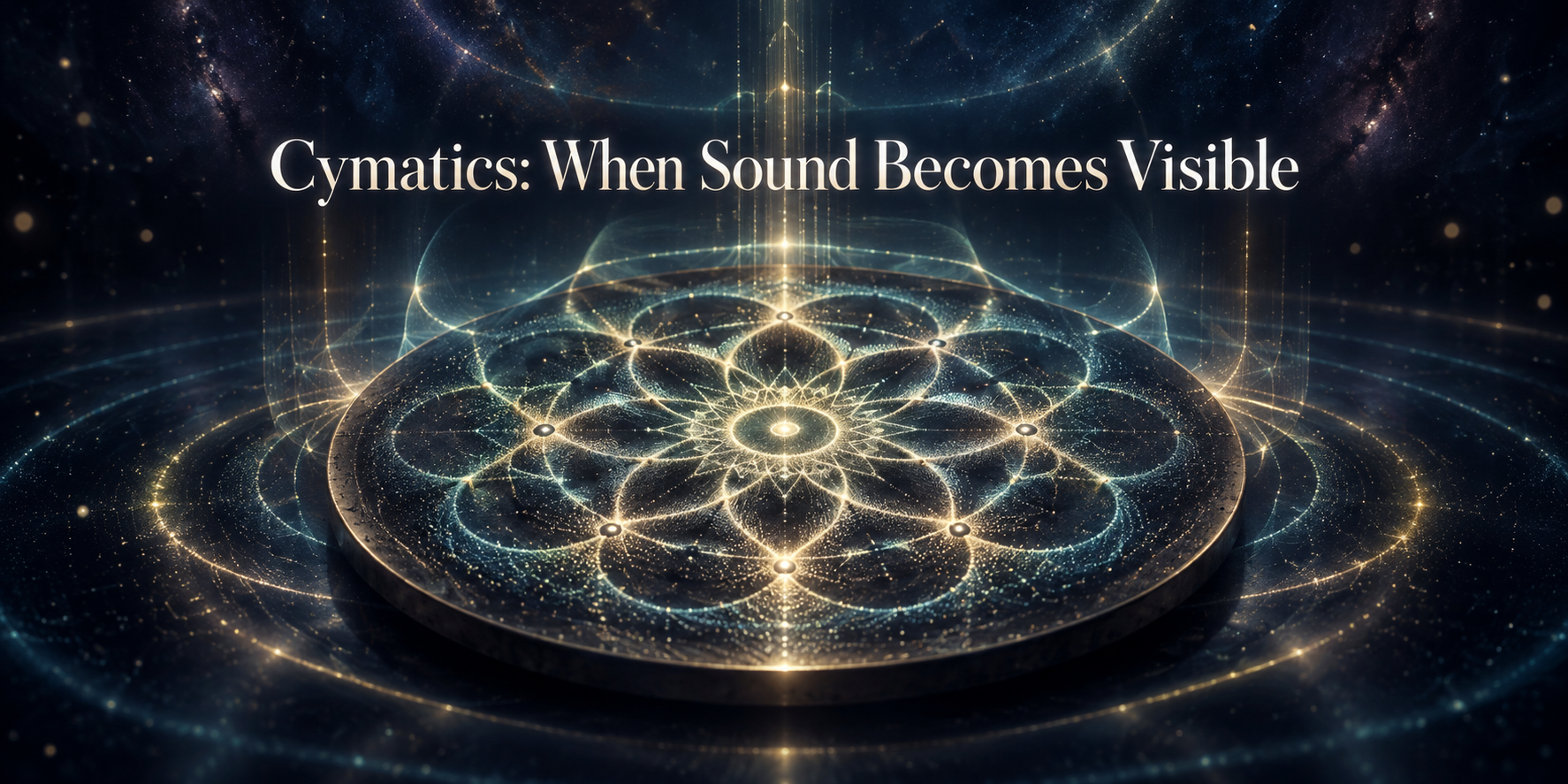
The hidden geometry of vibration and the sacred patterns carried through matter
Sound usually enters our lives invisibly.
We hear a voice, a bell, a bird, a prayer or a piece of music. We recognize its presence, yet we cannot normally see it traveling through the air.
Cymatics changes that.
When vibration passes through a plate, membrane or liquid, it can organize particles and surfaces into visible patterns. Sand gathers into delicate lines. Water rises into repeating forms. Powders separate into curves, circles and intricate geometry.
What was hidden becomes visible.
For the scientific mind, cymatics reveals wave behavior, resonance and the natural modes of matter.
For the sacred imagination, it offers something equally beautiful: a reminder that unseen forces can leave visible traces, that stillness and movement can belong to the same design, and that creation holds possibilities we may not recognize until the right conditions bring them forward.
What is cymatics?
Cymatics is the study and visualization of patterns produced when sound or other mechanical vibrations move through matter.
The word comes from the Greek word kyma, meaning wave.
A cymatics experiment commonly begins with a surface that can vibrate, such as a metal plate, flexible membrane or container of liquid. A tone or mechanical oscillator causes the surface to move. Sand, salt, powder, water or another material reveals how that movement is distributed.
The substance does not arrange itself because it understands the sound. It moves in response to physical forces created by vibration.
Some areas move strongly. Other areas remain comparatively still. Under the right conditions, this difference creates an organized and visible form.
The results can be astonishingly beautiful.
Sound is movement traveling through matter
Sound begins with vibration.
A guitar string moves back and forth. Vocal folds vibrate as air passes through them. A drumhead moves when struck. A speaker repeatedly pushes and pulls the surrounding air.
These movements create changing pressure in a medium—a substance through which the disturbance can travel. Air is the medium for most of the sounds we hear, but sound and mechanical vibration can also travel through water, wood, metal, bone and many other materials.
Sound cannot travel through a perfect vacuum because there are no particles there to carry the mechanical disturbance.
The frequency of a vibration is the number of cycles it completes each second. Frequency is measured in hertz, abbreviated Hz. One hertz means one cycle per second.
Higher frequencies are generally heard as higher pitches. Lower frequencies are generally heard as lower pitches.
Amplitude describes the size or strength of a vibration. Greater amplitude is often experienced as greater loudness, although human hearing involves more than amplitude alone.
Frequency and amplitude help shape a cymatic pattern, but they are only part of the relationship.
Standing waves and the architecture of vibration
Many familiar cymatic forms are produced by standing waves.
A standing wave develops when waves moving through a material interact with reflected waves in a way that creates a stable pattern. The material continues vibrating, but the overall arrangement of movement remains in the same general locations.
Within a standing wave are regions called nodes and antinodes.
Nodes are places where movement is minimal.
Antinodes are places where movement is greater.
On a classic vibrating plate covered with coarse sand, the grains bounce away from strongly moving regions and gather along quieter nodal lines. Those lines create the geometric forms known as Chladni figures.
Very fine particles may sometimes behave differently because currents in the air above a vibrating plate can carry them toward more active regions. This movement of fluid produced by sound is called acoustic streaming.
The substance matters.
Its size, weight and relationship with the surrounding air or liquid help determine how it responds.
Resonance allows the hidden pattern to appear
Every object has natural ways in which it can vibrate. These are called natural frequencies or vibrational modes.
A mode is a particular pattern of movement the object is capable of producing.
When an object is driven near one of its natural frequencies, it can respond with greater vibration. This is resonance.
A familiar example is a playground swing. A push delivered at the right moment builds the swing’s movement. Poorly timed pushes do not strengthen the motion as effectively.
A plate also has preferred ways of vibrating. At particular frequencies, waves travel across it, reflect from its boundaries and combine to create stable arrangements of nodes and antinodes.
When the frequency changes, the vibrational mode may change.
The particles move.
The previous pattern dissolves.
Another pattern emerges.
Cymatics allows us to see that an apparently quiet object may contain many possible forms of movement.
Pattern emerges through relationship
A frequency does not create a cymatic pattern by itself.
The shape, dimensions, thickness and material of a plate affect how it vibrates. So does the place where it is held, clamped or supported. The strength of the vibration matters. The kind and amount of material placed upon the surface matter.
In liquids, depth, temperature, density, viscosity, surface tension and container shape also influence the result.
A tone applied to a circular plate may produce a different form from the same tone applied to a square plate. Changing the mounting point or plate thickness may alter the pattern again.
This means a frequency does not possess one universal geometric image that appears in every material and every experiment.
The frequency matters.
The material matters.
The boundary matters.
The way the system is held matters.
The visible form emerges through relationship.
This is one of the deepest truths cymatics offers.
Vibration does not impose one predetermined image upon everything it touches. It meets the properties and possibilities of the material before it.
Robert Hooke and an early glimpse of vibration
The history of cymatics reaches back centuries.
In 1680, English scientist Robert Hooke experimented with a glass plate covered in flour. By drawing a bow along the plate, he observed particles gathering into patterns produced by vibration.
Hooke had seen an important possibility: loose material could reveal the movement of a solid surface.
His experiment became an early step toward a more systematic exploration of visible sound.
Ernst Chladni and the figures that carry his name
More than a century after Hooke’s observation, German physicist and musician Ernst Chladni greatly expanded the study of vibrating plates.
In the late eighteenth century, Chladni scattered sand across metal plates and made them vibrate, traditionally by drawing a violin bow along an edge.
At resonant frequencies, the sand gathered into symmetrical nodal patterns.
These arrangements became known as Chladni figures.
Chladni experimented with plates of different shapes and carefully documented the forms that appeared. His demonstrations made an invisible physical process visible, repeatable and open to study.
The patterns also offered insight into the vibration of musical instruments. Instrument makers and acousticians could observe how a violin plate, soundboard or other resonant surface moved at particular frequencies.
What appeared to be decorative geometry was actually a map of motion and stillness.
Sophie Germain and the mathematics beneath the beauty
Chladni’s patterns presented scientists with a difficult question.
Why did the lines take those particular forms?
After Chladni demonstrated his plates in Paris, the French Academy of Sciences offered a prize for a mathematical theory that could explain the vibration of elastic surfaces.
French mathematician Sophie Germain devoted years to the problem.
She pursued mathematics during a time when women were largely excluded from formal scientific education. She studied independently, corresponded under a male name and continued refining her work despite obstacles that had little to do with her ability.
Germain’s theory was not the final word on vibrating plates, but it became an important step in the mathematical understanding of elasticity and surface vibration.
In 1816, she received the Academy’s prize, becoming the first woman to receive such an honor from the institution.
Her place in the story of cymatics matters.
The visible beauty of Chladni’s figures inspired a deeper search for the laws beneath them, and Sophie Germain helped open that path.
Michael Faraday and the patterned surface of water
Cymatic forms are not limited to dry particles on metal.
In 1831, English scientist Michael Faraday described patterned waves that appeared when a container of liquid was vibrated vertically.
Today, these forms are known as Faraday waves.
When the vibration becomes strong enough under suitable conditions, a previously flat liquid surface can become unstable and reorganize into a standing-wave pattern.
Depending upon the frequency, acceleration, liquid depth, viscosity, surface tension and container, the surface may display stripes, squares, hexagons or more complex arrangements.
Unlike sand gathering along quieter lines, liquid cymatics involves the surface itself rising and falling.
What looks like a stable shape in a photograph is actually an active relationship repeating through time.
The surprising rhythm of Faraday waves
Faraday waves can display an especially fascinating response.
The liquid surface often oscillates at half the frequency driving the container. This is called a subharmonic response.
In plain language, the container may complete two cycles while the visible surface pattern completes one.
The liquid is responding to the outside vibration, but it is not simply copying it cycle for cycle.
The system has its own dynamics.
This adds another layer to the wonder of cymatics. Matter does not always respond to a force in the simplest or most obvious way. The resulting form emerges from the interaction between the driving vibration and the natural behavior of the responding material.
Hans Jenny and the name cymatics
Swiss physician and natural scientist Hans Jenny introduced the term cymatics in the twentieth century.
Jenny experimented with powders, pastes and liquids placed on vibrating plates and membranes. He used oscillators capable of producing controlled frequencies and documented the resulting forms through photography and film.
His first volume on the subject was published in 1967. A second followed in 1972.
Jenny brought renewed attention to the visual beauty of vibration. He was interested not only in individual patterns but in the dynamic processes through which matter formed, dissolved and reorganized.
His work helped carry the earlier experiments of Hooke, Chladni and Faraday into modern visual culture.
Today, electronic tone generators, high-speed cameras, computer modeling and precision instruments allow researchers and artists to observe vibrational patterns with extraordinary detail.
The tools have changed.
The wonder remains.
Water makes vibration visible in another way
Water responds to vibration differently from dry particles.
Its surface may form ripples, peaks, troughs, rings and repeating geometric arrangements. Under controlled conditions, a vertically driven liquid can display remarkably stable standing-wave patterns.
Water depth matters because it affects how waves travel and interact. Surface tension influences smaller ripples. Gravity becomes more important in larger waves. Viscosity—the resistance of a liquid to flowing—affects how quickly movement is dampened.
The dimensions and shape of the container determine the available boundaries.
A photographed water pattern captures only one instant in an active process.
The water is not frozen into geometry.
It is continually moving through a repeating relationship.
It is form without complete stillness.
It is order carried through change.
Sine tones, musical notes and harmonics
A carefully generated sine tone contains one frequency.
Because it is simple and controlled, a sine tone can make it easier to excite and study a particular vibrational mode.
A note played on a guitar, piano, violin or human voice is more complex. It usually contains a fundamental frequency—the frequency we mainly recognize as the note—along with harmonics.
Harmonics are additional frequencies that occur above the fundamental. Their relative strength helps give an instrument or voice its distinctive sound.
This is why a piano and violin can play the same note yet sound different.
Music adds even more complexity. It contains changing notes, harmonics, rhythm, timing, intensity and often multiple instruments or voices interacting at once.
When music drives a cymatic device, the visible forms may change continuously. The apparatus responds to the physical mixture of frequencies and amplitudes reaching it from moment to moment.
The result is not one permanent image of the song.
It is a moving visual conversation between the music and the material.
Can a spoken word have a cymatic shape?
A spoken word contains changing frequencies, harmonics and intensities.
Different people pronounce the same word with different voices, pitches, accents, timing and volume. Even the same person will not reproduce a word in precisely the same way every time.
A cymatic device can respond to the vibrations within speech, but the image is created by the entire experimental system.
The apparatus is not translating the meaning of the word into a universal symbol.
What it can reveal is still remarkable: the human voice is physical enough to move air, enter matter and create an observable response.
The deeper meaning of a word comes through language, truth, intention, relationship and the spirit in which it is spoken.
Cymatics reveals the physical vibration.
Human experience reveals the meaning it carries.
Beautiful patterns and complex patterns
A visually symmetrical cymatic pattern is not automatically better, healthier or more spiritually powerful than an irregular one.
Some frequencies excite simple modes. Others produce forms with many nodal regions. When several modes interact or conditions shift, the pattern may become increasingly complex.
Complexity is not failure.
It may reflect a richer interaction among frequencies, materials and boundaries.
Cymatics gives us a language of form, but it does not assign moral value to every shape.
The beauty is found in seeing matter respond.
Why cymatic patterns resemble forms in nature
Cymatic patterns may resemble flowers, snowflakes, shells, cells, honeycombs, mandalas and other examples of sacred geometry.
These similarities can be deeply moving.
Nature produces patterns through many processes, including growth, crystallization, fluid flow, gravity, biological development, chemical reaction and wave behavior.
A flower is not simply a cymatic image made solid. A snowflake is shaped through the crystallization of water. A shell grows through biological processes. Honeycomb develops through the activity of living bees and the physical properties of wax.
Yet these different processes may produce related visual qualities—symmetry, repetition, branching, spirals and geometric order.
Creation seems able to arrive at beauty through many pathways.
Cymatics does not need to explain every pattern in nature to deepen our wonder.
It belongs among the many ways order becomes visible.
The science of moving tiny particles with sound
The principles revealed by cymatics now appear in advanced scientific technologies.
Researchers use acoustic fields to move, separate and organize microscopic particles, droplets and cells.
One effect is acoustic radiation force. This is a force produced when sound interacts with an object, guiding it toward particular regions of an acoustic field.
Another effect is acoustic streaming—a steady movement of fluid created by sound. This flowing liquid can transport very small particles.
Scientists can carefully balance or use these effects to control material at tiny scales.
Acoustic tweezers
Acoustic tweezers use sound-generated forces to manipulate small objects without physically gripping them.
Many of these systems use ultrasound—sound at frequencies above the range of human hearing.
Standing surface acoustic waves can create predictable regions where particles or cells gather. By changing the frequency, geometry or arrangement of sound sources, researchers can alter the resulting pattern.
These techniques may be described as label-free because the cells or particles do not always need chemical labels, magnetic beads or other attached markers before they can be moved.
Researchers are exploring acoustic methods for cell sorting, biological analysis, microscopic assembly, droplet control, microrobotics and tissue engineering.
What begins as sand forming lines on a plate leads toward technologies capable of arranging living cells within a tiny chamber.
The invisible becomes practical.
Cymatics as a window into material possibility
A metal plate may appear still while containing many possible modes of vibration.
A bowl of water may appear featureless while holding the ability to form circles, squares or waves.
Sand may appear scattered until resonance reveals a pattern.
The vibration does not place a foreign design onto passive matter.
It encounters the properties already present within the system.
The plate has shape, stiffness and boundaries.
The water has depth, viscosity and surface tension.
The particles have weight, size and texture.
The final pattern arises from the meeting.
Cymatics invites us to look at ordinary matter differently.
What appears still may contain unrealized movement.
What appears scattered may be capable of order.
What appears simple may hold many possible forms.
Movement and stillness belong together
One of the most beautiful truths in a classic Chladni figure is that the visible design traces areas of comparative stillness.
Without movement, the pattern would not form.
Without quieter regions, the pattern would not become visible in the same way.
Both belong to the event.
This can become a sacred lesson.
A meaningful life is not built entirely from action. Stillness is not the absence of life. It can be where experience gathers into understanding.
Prayer, reflection and rest create quiet places within the movement of our days.
The still point does not reject the vibration around it.
It gives the pattern somewhere to appear.
The sacred meaning of resonance
In physics, resonance has a precise meaning. A system responds strongly when it is driven near one of its natural frequencies.
In human life, we also use the word resonance to describe something that reaches us deeply.
A truth resonates.
A song awakens memory.
A prayer feels as though it has found a place already waiting within us.
These experiences are not identical to the vibration of a metal plate, but the shared language is meaningful.
Something outside us meets something within us, and a response emerges.
Discernment matters because not everything that produces a strong reaction is necessarily true or good. Yet genuine resonance can help us recognize beauty, wisdom, calling and connection.
Cymatics offers a physical image for a spiritual experience we already understand.
We are affected by what meets us.
Creation spoken into being
In Genesis, creation unfolds through the speech of God.
God speaks, and light, sky, land and living things come into being.
The biblical meaning reaches far beyond an acoustic wave moving through a plate. Divine speech expresses the authority, will and creative power of God.
The Gospel of John opens with the mystery of the Word—the divine Logos through whom all things were made.
Cymatics is not a scientific demonstration of these passages.
It offers the sacred imagination a visual companion: unseen expression giving rise to visible order.
Science can describe how vibration travels through matter and how physical patterns emerge. Faith asks larger questions about meaning, purpose and the divine source of creation.
These ways of understanding do not have to compete.
Wonder has room for both.
The sacred pattern is not always obvious
Cymatic patterns often become clearest at resonance.
Before that moment, the particles may move without settling into a recognizable form. As the frequency approaches a natural mode, the structure becomes visible.
Human life can feel this way.
There are seasons when events appear scattered. Growth may be happening without a clear design. Pieces may be moving before we understand where they belong.
This does not mean every life event is controlled by a hidden frequency or that every difficulty forms part of a predetermined picture.
It means clarity may sometimes emerge through time, relationship, prayer and patient attention.
The pattern may not be absent.
It may still be becoming visible.
A sacred practice of listening
Choose one sound you can hear clearly.
It might be rainfall, a bird, a bell, a piece of instrumental music or your own voice speaking a short prayer.
Listen without rushing to interpret it.
Notice when the sound begins, how it changes and how it fades. Notice the silence surrounding it. Feel whether the vibration can be sensed in your chest, throat or the surface beneath you.
Then ask:
What am I allowing to shape my inner life?
Which voices help truth, peace and courage emerge within me?
Where do I need more stillness so I can recognize what is forming?
End with a simple prayer:
God, help me listen wisely. Let truth resonate within me. Teach me to use my voice to create comfort, courage and goodness in the lives I touch.
Questions about cymatics
What is cymatics in simple terms?
Cymatics is a way of making the effects of vibration visible. Sound or mechanical vibration moves through a plate, membrane or liquid, causing particles or surfaces to form observable patterns.
Does cymatics actually make sound visible?
Cymatics makes the response of matter to vibration visible. We do not see the sound wave directly. We see sand, water or another substance revealing how vibration moves through a physical system.
What is a Chladni plate?
A Chladni plate is a thin plate covered with particles and made to vibrate. At resonant frequencies, coarse grains commonly gather along relatively still nodal lines, creating geometric patterns called Chladni figures.
Who first observed Chladni-like patterns?
Robert Hooke described an early experiment involving flour on a vibrating glass plate in 1680. Ernst Chladni later studied the phenomenon systematically, documented the patterns and made them widely known.
Who was Sophie Germain?
Sophie Germain was a French mathematician whose work helped advance the mathematical understanding of vibrating elastic surfaces. In 1816, she received a prize from the French Academy of Sciences for her work related to Chladni’s vibrating plates.
What are nodes and antinodes?
Nodes are regions within a standing wave where movement is minimal. Antinodes are regions where movement is greater. In classic Chladni experiments, coarse particles usually gather along nodal lines.
What is a standing wave?
A standing wave is a stable vibration pattern formed when traveling and reflected waves interact. Certain regions repeatedly experience little movement while others experience stronger movement.
What is resonance?
Resonance occurs when a system is driven near one of its natural frequencies and responds with stronger vibration. In cymatics, resonance can allow a distinct vibrational mode to become visible.
Does every frequency have one particular shape?
No single universal shape belongs to a frequency in every setting. The pattern depends upon the entire system, including frequency, amplitude, material, geometry, mounting method and the substance revealing the vibration.
Why do higher frequencies sometimes create more detailed patterns?
Higher-frequency modes may allow more nodal regions to fit across a surface, producing additional lines and divisions. The exact result still depends upon the material, shape and boundaries of the system.
Can cymatics be created with water?
Yes. Vibrating a liquid under controlled conditions can produce ripples and standing-wave patterns. The forms depend upon frequency, acceleration, liquid depth, viscosity, surface tension and container shape.
What are Faraday waves?
Faraday waves are patterned standing waves that can form on a liquid surface when its container is vibrated vertically with sufficient strength. They are named after Michael Faraday, who described them in 1831.
Why can Faraday waves move at half the driving frequency?
Faraday waves often display a subharmonic response. The liquid surface may complete one oscillation for every two cycles of the driving vibration. This behavior emerges from the dynamics of the liquid system.
Who coined the word cymatics?
Swiss physician and natural scientist Hans Jenny introduced the word in the twentieth century. He documented patterns created in powders, pastes and liquids by controlled vibration.
What is the difference between a sine tone and a musical note?
A sine tone contains one frequency. A musical note from a voice or instrument usually contains a fundamental frequency along with harmonics that give the sound its distinctive character.
Can cymatics show the meaning of a spoken word?
A cymatic device can respond to the frequencies and amplitudes within speech, but the meaning of a word is carried through language, context, intention and relationship. There is no single universal cymatic symbol belonging to every spoken word.
Can music create cymatic patterns?
Yes. Because music contains changing frequencies, harmonics, rhythms and intensities, it often creates forms that continually move and transform rather than one permanent image.
Are symmetrical cymatic patterns better than irregular ones?
Not necessarily. Symmetry and complexity reflect the behavior of the physical system. An irregular or rapidly changing pattern is not automatically harmful, and a symmetrical pattern is not automatically healing.
Why do cymatic patterns resemble flowers and sacred geometry?
Wave behavior, boundaries and symmetry can produce repeating geometric forms. Nature also creates similar visual qualities through growth, crystallization, fluid flow and other processes. The resemblance invites wonder without requiring every natural pattern to have the same cause.
What is acoustic streaming?
Acoustic streaming is a steady flow within a fluid caused by sound. It can influence how very small particles move and is important in some modern acoustic technologies.
What are acoustic tweezers?
Acoustic tweezers use carefully controlled sound-generated forces to move particles, droplets or cells without mechanically gripping them. Researchers are studying them for biological analysis, cell sorting, microfluidics and tissue engineering.
Is ultrasound a form of sound?
Yes. Ultrasound is sound with frequencies higher than humans can normally hear. Although it is inaudible, it can still travel through suitable materials and exert physical effects.
What is the spiritual meaning of cymatics?
Cymatics can symbolize unseen influence becoming visible, the relationship between movement and stillness, and the potential that emerges when vibration meets matter. These reflections deepen the meaning of the phenomenon while allowing the physics to remain clear.
Continue exploring
Explore the physical, emotional and sacred influence of language in Words, Vibration and the Human Body.
Discover the relationship between sound and water in Music, Frequency and Water: How Sound Creates Movement, Pattern and Resonance.
Consider the wider mystery of consciousness and the physical world in Can Human Intention Influence Matter?.
When the hidden pattern appears
A tone enters a plate.
The surface begins to move.
Scattered grains travel across it and gather into a form no hand has drawn.
The visible pattern belongs to the whole relationship—the vibration, the plate, its boundaries and the particles responding upon it.
Cymatics does not tell us that every mystery has been solved.
It tells us that the unseen can leave a visible trace.
It reminds us that movement and stillness can belong to one design, that matter holds more possibilities than a quiet surface reveals, and that creation is filled with relationships capable of bringing hidden order into view.
Sometimes wonder begins when something invisible touches the world—and the world responds.