

Holy Basil for Stress, Calm, Sleep, Metabolic Health and Whole-Body Wellness
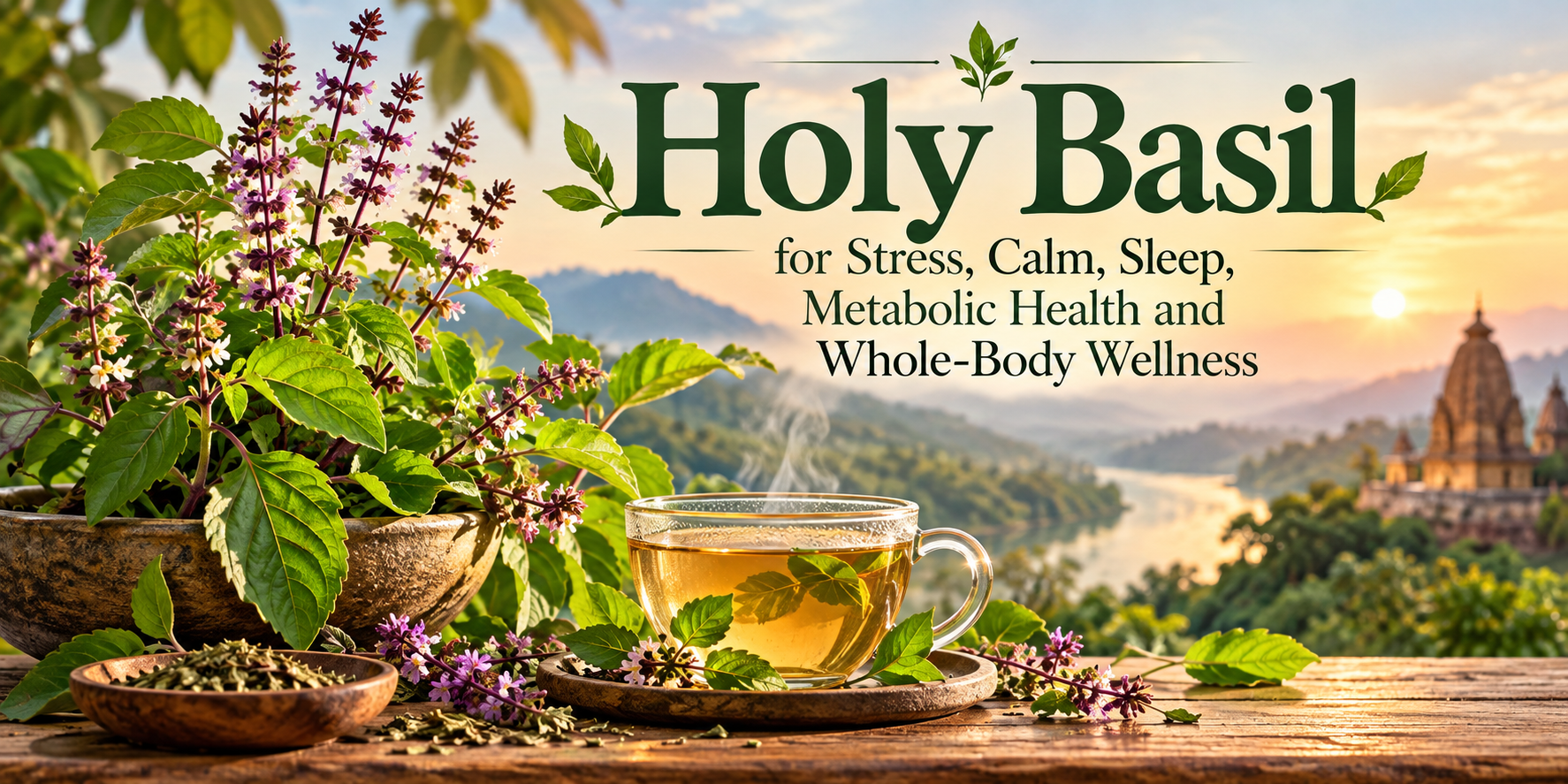
Holy basil has been treasured for generations as far more than an aromatic herb.
Known throughout South Asia as Tulsi or Tulasi, holy basil holds an extraordinary place within Ayurveda and sacred tradition. For centuries, it has been associated with resilience, clarity, balance and well-being.
Today, researchers are approaching this ancient plant from another direction.
Instead of asking only what tradition says about Tulsi, scientists are measuring what happens to stress perception, cortisol, sleep, cognition, blood sugar, immune markers and other aspects of human physiology when people consume specific holy basil preparations.
The results are still emerging, but they are fascinating.
Among its potential uses, stress resilience currently has some of the most compelling modern human evidence.
Holy basil is not simply another herb with a long list of laboratory findings. Randomized, placebo-controlled human trials have begun to provide evidence that particular holy basil extracts may influence both how people feel when they are under stress and some of the measurable biological responses occurring inside the body.
What Is Holy Basil?
Holy basil is an aromatic member of the mint family, Lamiaceae.
Its accepted botanical name is Ocimum tenuiflorum L.
You may also see the older botanical name Ocimum sanctum on research papers and supplement labels. It is now generally treated as a botanical synonym of Ocimum tenuiflorum.
Holy basil is related to the sweet basil commonly used in cooking, but the two are different plants.
Sweet basil is usually Ocimum basilicum.
Holy basil is primarily Ocimum tenuiflorum.
Holy basil is native across a broad region extending through tropical and subtropical Asia into parts of the western Pacific, and it is now cultivated in many other warm regions of the world.
Its leaves contain a complex mixture of naturally occurring plant compounds, which can include:
eugenol
rosmarinic acid
ursolic acid
beta-caryophyllene
carvacrol
other polyphenols and aromatic compounds
The precise chemical profile can vary according to the plant variety, growing environment, harvesting method and extraction process.
That variation becomes very important when we look at supplement research.
Why Is It Called Holy Basil?
The word holy is not simply a modern marketing description.
Tulsi has profound religious and cultural importance, particularly within Hindu traditions, where it has long been regarded as a sacred plant.
Historically, Tulsi has been cultivated around homes, courtyards and temples. Its religious significance became so closely associated with the plant that even its older botanical name, Ocimum sanctum, reflects the idea of sacredness.
Tulsi has therefore lived several lives simultaneously.
It has been a household plant.
A culinary plant.
A traditional medicinal plant.
And a sacred plant.
Its history reminds us that humanity's relationship with plants has never been limited to extracting individual chemical compounds. Plants have also been woven into food, ritual, community, spirituality and everyday life.
Modern science cannot measure all of those meanings.
But it can begin asking what happens biologically when humans consume the plant.
And that is where the modern story of holy basil becomes particularly interesting.
Rama, Krishna and Vana Tulsi
Several forms of Tulsi are commonly encountered.
Rama Tulsi typically has green leaves and is one of the most familiar forms.
Krishna or Shyama Tulsi often has darker green or purple-toned leaves and stems.
Vana Tulsi is a name commonly applied to a wild or forest type, although plants sold under this name may not always represent exactly the same botanical material as Ocimum tenuiflorum.
This matters because "Tulsi" on a package does not necessarily tell us everything about the plant inside.
Botanical identity matters.
So does the plant part, extraction method and concentration.
Why Holy Basil Is Called an Adaptogen
Holy basil is frequently described as an adaptogen.
An adaptogen is generally understood as a plant or substance proposed to help the body adapt to physical or psychological stress and maintain balance during challenging conditions.
The word can sound mysterious, but the underlying idea is fairly simple.
The body is constantly adjusting.
Heart rate changes.
Blood pressure changes.
Hormones rise and fall.
The nervous system shifts between states of greater alertness and greater relaxation.
The immune system activates and quiets.
Blood glucose changes according to meals, activity, sleep and stress.
A healthy body does not remain perfectly still. It continually makes adjustments.
Adaptogenic research asks whether certain plants might help support this ability to respond appropriately and return toward balance.
Holy basil is particularly interesting because human research has begun measuring these responses rather than relying solely on the adaptogen label.
Stress and the HPA Axis
To understand why researchers are interested in holy basil, it helps to understand one of the body's major stress systems.
The HPA axis stands for the:
Hypothalamic-Pituitary-Adrenal axis.
These structures communicate with one another to help coordinate the stress response.
The hypothalamus is located in the brain.
The pituitary gland receives signals from the hypothalamus and sends additional hormonal messages.
The adrenal glands, located above the kidneys, respond to these signals and release hormones including cortisol.
Cortisol is often called the stress hormone, but cortisol is not the enemy.
We need it.
Cortisol helps regulate energy availability, blood pressure, inflammation, metabolism and the sleep-wake cycle.
During a stressful situation, increasing cortisol can help prepare the body to respond.
The problem is not that cortisol exists.
What matters is appropriate regulation.
Healthy stress physiology is less about eliminating the stress response and more about activating it when necessary and allowing it to settle afterward.
This is one reason researchers are interested in whether holy basil may influence stress resilience.
Holy Basil and Stress
Stress is currently one of the strongest areas of modern human research surrounding holy basil.
In a randomized, double-blind, placebo-controlled trial, researchers studied 100 adults between the ages of 18 and 65 who were experiencing stress.
Participants received either a standardized holy basil extract or placebo for eight weeks.
The holy basil group took 125 mg twice daily, for a total of 250 mg per day.
Researchers did not rely on a single question asking whether people felt better.
They examined several different aspects of the stress response.
These included:
perceived stress
mood
sleep questionnaires
hair cortisol
salivary cortisol
salivary amylase
blood pressure
subjective reactions during an experimentally induced stressful situation
Compared with placebo, people receiving the holy basil extract experienced significantly greater improvement in perceived stress scores.
That alone is interesting.
But researchers went further.
Holy Basil and Cortisol
The same clinical trial measured hair cortisol.
Hair can provide researchers with information about longer-term cortisol exposure because cortisol becomes incorporated into growing hair.
After eight weeks, hair cortisol concentrations were lower in the holy basil group than in the placebo group.
Researchers then deliberately exposed participants to a standardized laboratory stress challenge.
This allowed them to watch the stress response unfold.
Compared with placebo, participants receiving holy basil demonstrated a more buffered response, including differences in:
salivary cortisol
salivary amylase
systolic blood pressure
diastolic blood pressure
subjective stress ratings
This is an important distinction.
The study did not merely suggest that people said they were less stressed.
Researchers also detected differences in several physiological measurements associated with the stress response.
One study cannot establish that every Tulsi product will produce these effects.
But it provides an intriguing biological foundation for holy basil's traditional reputation as a plant associated with resilience and balance.
Earlier Human Stress Research
The newer trial is not the only human research investigating Tulsi and stress.
An earlier randomized, double-blind, placebo-controlled trial used a different standardized holy basil preparation at a considerably larger dose.
Participants receiving holy basil experienced greater improvement in several stress-related symptoms than those receiving placebo.
The fact that different studies have used different extracts and dramatically different doses also teaches us something important:
Holy basil supplements are not interchangeable.
A 250 mg standardized extract cannot automatically be compared with 1,200 mg of another preparation.
With herbs, the number of milligrams is only part of the story.
Holy Basil and Calm
Calm does not necessarily mean sedation.
That distinction makes holy basil especially interesting.
A sedative may make someone sleepy.
An adaptogenic approach is different. The goal is better regulation of the body's response to stress.
Some people describe Tulsi as gently calming while remaining mentally clear.
Clinical research cannot yet establish exactly how every person will experience the plant, but improvements in perceived stress provide a plausible foundation for its reputation as a calming botanical.
The emerging picture is less:
"Take this and become sleepy."
And more:
"This plant may influence how the body responds when stress arrives."
Holy Basil and Sleep
Stress and sleep are deeply connected.
When the nervous system remains alert after the day's challenges have ended, falling asleep or staying asleep can become more difficult.
In the eight-week placebo-controlled holy basil trial, participants taking the standardized extract showed greater improvement on the Athens Insomnia Scale, a questionnaire used to evaluate insomnia symptoms.
That is encouraging.
But there is an important scientific detail.
Researchers also used wearable sleep trackers.
Those objective measurements did not demonstrate convincing between-group improvements across the major sleep measurements.
In other words:
People taking holy basil reported better sleep-related outcomes, but the objective sleep data were less conclusive.
That does not make the subjective improvement meaningless.
It simply means the evidence needs to be described accurately.
Future research using more precise sleep measurements could help determine whether holy basil directly changes sleep architecture or whether people primarily sleep better because they feel less stressed.
Holy Basil and the Brain
Chronic stress does not stay neatly confined to emotions.
It can affect:
attention
concentration
working memory
decision-making
mental energy
perceived clarity
This creates an interesting question.
If holy basil influences stress regulation, could some cognitive benefits follow?
Small controlled human studies have investigated this possibility.
Research using holy basil extracts has reported improvements in certain measures involving attention, reaction time, working memory or cognitive flexibility.
These findings are preliminary.
Holy basil should not yet be described as a proven cognitive enhancer.
But the connection between stress and cognition gives researchers a meaningful reason to continue exploring the relationship.
Holy Basil and Blood Sugar
Another interesting area of human research involves glucose metabolism.
Several small clinical studies have reported improvements in fasting or post-meal blood glucose following holy basil supplementation.
One older placebo-controlled crossover study involving people with type 2 diabetes reported reductions in both fasting and post-meal blood glucose during holy basil treatment.
These findings are intriguing but should be placed in context.
Many of the metabolic studies are:
relatively small
older
short in duration
based on different preparations
methodologically weaker than large modern clinical trials
Holy basil should therefore not be considered a replacement for established diabetes care.
But the human evidence is strong enough to make glucose regulation a legitimate area of ongoing Tulsi research.
It also creates an important safety consideration.
If holy basil lowers glucose in some people, combining concentrated extracts with glucose-lowering medication could potentially produce an additive effect.
Holy Basil and Metabolic Health
Metabolism involves far more than body weight.
It includes the processes the body uses to manage:
glucose
insulin
fats
cholesterol
cellular energy
nutrient storage
energy availability
Human Tulsi research has explored several of these areas.
Some small studies have reported favorable changes in measurements involving glucose and blood lipids.
Researchers have also proposed mechanisms involving oxidative stress, carbohydrate metabolism and cellular signaling.
The overall evidence is promising rather than definitive.
More large, modern randomized trials are needed before holy basil can be assigned a clear therapeutic role in metabolic health.
Holy Basil and Cholesterol
Some human studies have examined:
total cholesterol
LDL cholesterol
HDL cholesterol
triglycerides
Certain trials have reported favorable changes.
However, the evidence remains considerably less developed than established approaches involving nutrition, exercise, weight management when appropriate, medications when needed and other proven cardiovascular strategies.
Holy basil is therefore better viewed as an interesting area of metabolic research rather than a treatment for high cholesterol.
Holy Basil and Heart Health
Heart health is connected with many systems being investigated in Tulsi research.
Stress physiology influences blood pressure and heart rate.
Glucose regulation affects vascular health.
Blood lipids influence cardiovascular risk.
Inflammation and oxidative stress interact with blood vessels and metabolic health.
Holy basil research touches several of these pathways.
That does not mean Tulsi has been proven to prevent cardiovascular disease.
Instead, it gives researchers several biologically plausible reasons to continue studying how this plant might fit into the larger picture of cardiovascular and metabolic wellness.
Holy Basil and Immune Function
Holy basil has also been investigated for effects on the immune system.
In a small randomized, double-blind, placebo-controlled crossover study involving healthy adults, supplementation with holy basil extract was associated with changes in several immune measurements, including certain T cells and natural killer cells.
The study was small, so these findings should be interpreted cautiously.
They do, however, suggest that Tulsi may interact with immune regulation.
That is more precise than simply saying holy basil "boosts immunity."
A healthy immune system does not need to remain permanently activated.
Good immune function depends on regulation.
The immune system must respond when necessary and quiet itself when the threat has passed.
Holy Basil and Antioxidant Activity
Normal metabolism continuously produces reactive molecules often called free radicals.
The body has sophisticated antioxidant systems that help control them.
When reactive molecules overwhelm those defenses, oxidative stress can occur.
Holy basil contains numerous compounds that demonstrate antioxidant activity in laboratory research.
These include compounds such as:
eugenol
rosmarinic acid
ursolic acid
other polyphenols
Laboratory antioxidant activity does not automatically mean that consuming an herb produces a specific clinical benefit in humans.
But these compounds may contribute to the larger biological effects researchers are investigating.
Holy Basil and Inflammatory Pathways
Inflammation is another normal part of human biology.
The immune system uses inflammatory signaling to respond to infection, injury and other threats.
Problems can arise when inflammatory processes become chronically dysregulated.
Laboratory and animal research suggests that several compounds found in holy basil interact with pathways involved in inflammatory signaling.
Human clinical evidence demonstrating significant anti-inflammatory effects remains much more limited.
For now, this is best described as a promising biological mechanism under investigation, rather than an established clinical benefit.
What Human Research Has Found Overall
Holy basil has accumulated more human research than its ancient reputation might lead some people to expect.
A systematic review examining human intervention studies identified 24 studies involving more than 1,100 participants.
Researchers grouped the studies broadly into areas involving:
metabolic health
cardiovascular measurements
immune function
stress
mood
neurocognition
Most reported favorable findings.
Serious adverse effects were not prominent in the reviewed research.
But there was an important limitation.
Many studies were small, short, older or methodologically limited.
Only a minority met higher standards of clinical-trial quality.
That gives us a balanced picture.
Tulsi has meaningful human research behind it.
But:
The evidence is not yet strong enough to treat every traditional use as scientifically established.
Newer randomized controlled trials, particularly those examining stress, are beginning to strengthen the evidence considerably.
What We Know and What We Are Still Learning
Science rarely moves from "nothing" to "proven" overnight.
Evidence grows in layers.
For holy basil, the current picture looks something like this:
Human evidence is especially encouraging for
perceived stress
stress resilience
certain physiological stress responses
Preliminary human evidence also exists for
subjective sleep quality
cognition
blood glucose regulation
blood lipids
certain immune measurements
Laboratory and animal research is much broader and includes
antioxidant pathways
inflammatory signaling
cellular protection
numerous additional biological mechanisms
The last category is fascinating.
But laboratory findings should not be promoted as though they were already proven human health outcomes.
That distinction helps us appreciate Tulsi without asking the science to say more than it actually knows.
Whole Herb vs Standardized Extract
This may be one of the most important things to understand about botanical research.
A milligram is not always a milligram.
Clinical trials have used very different Tulsi preparations.
One study used 250 mg per day of a standardized extract.
Other trials have used several hundred milligrams.
Another stress study used approximately 1,200 mg per day of a different preparation.
That does not mean one study used five times the effective dose.
The extracts themselves were different.
Imagine making two cups of coffee.
One is weak.
The other is espresso.
Measuring only the liquid volume would tell you very little about how much caffeine each contains.
Herbal extracts work similarly.
The important questions include:
Which species was used?
Which part of the plant?
Was it whole powdered herb or an extract?
How was it extracted?
How concentrated was it?
Was it standardized?
Which plant compounds were measured?
That is why it is usually inappropriate to take the dose from one clinical trial and apply it indiscriminately to every holy basil supplement.
Holy Basil Tea vs Supplements
Tulsi tea and concentrated extracts should not be treated as equivalent.
Tulsi tea is typically made by steeping dried leaves or other aerial portions of the plant in hot water.
It provides a gentle botanical infusion.
Powdered holy basil contains ground plant material.
Extracts concentrate certain plant constituents into a smaller amount of material.
Standardized extracts are manufactured to provide controlled amounts of specified compounds or chemical markers.
Most of the stronger clinical research has involved specific extracts rather than ordinary cups of tea.
That does not make Tulsi tea unimportant.
It simply means we should not claim that drinking one cup of tea reproduces the results of a clinical study involving a concentrated standardized extract.
The Beauty of Tulsi Tea
Tulsi tea offers something clinical trials do not easily measure.
Ritual.
Warm water.
Aromatic leaves.
A quiet chair.
A few minutes without rushing anywhere.
Tulsi tea is naturally caffeine-free, making it an appealing alternative to caffeinated drinks later in the day.
Its flavor can vary according to the plant and blend, but it is often described as herbal, peppery, slightly sweet, spicy or clove-like.
For some people, the simple act of preparing tea becomes part of a calming evening rhythm.
The chemistry of the plant matters.
But sometimes the ritual surrounding the plant matters too.
Holy Basil and Coffee
Holy basil naturally contains no caffeine.
That makes Tulsi tea particularly interesting for people who want to reduce afternoon or evening caffeine without giving up the comfort of a warm drink.
Holy basil can generally be consumed during the same day as coffee.
But if caffeine tends to amplify nervousness, racing thoughts or sleep difficulties, replacing a later cup of coffee with caffeine-free Tulsi tea may create a gentler transition into the evening.
How Much Holy Basil Has Been Studied?
There is no universally established therapeutic dose of holy basil.
Clinical trials have used dramatically different amounts because the preparations themselves differ.
Depending on the study and extract, human research has used amounts ranging from a few hundred milligrams to more than 1,000 mg daily.
One modern stress study used:
125 mg twice daily
for a total of:
250 mg per day
But that dose applied to the specific standardized extract being studied.
It should not be interpreted as the ideal dose of every holy basil product.
For supplements, the formulation and manufacturer directions matter.
When Is the Best Time to Take Holy Basil?
There is no scientifically established perfect time of day for Tulsi.
Depending on the preparation and intended use, people may consume it:
in the morning
with meals
during the afternoon
in the evening
Because Tulsi contains no caffeine naturally, tea can be particularly pleasant later in the day.
For standardized extracts, following the directions for that specific formulation is more useful than assuming every holy basil product should be taken at the same time.
How Long Does Holy Basil Take to Work?
Most human research has examined regular use over several weeks.
The modern stress trial evaluated participants over eight weeks.
Other studies have used different durations.
This suggests that holy basil is better understood as a botanical being investigated for steady support rather than an instant stress-relief product.
Some people may notice subjective effects sooner, but clinical research does not establish a universal timeline.
Holy Basil vs Ashwagandha
Holy basil and ashwagandha are both commonly called adaptogens.
But they are entirely different plants.
Holy basil is primarily:
Ocimum tenuiflorum
Ashwagandha is:
Withania somnifera
Both have been investigated for stress, but their chemistry and research histories are different.
They should not be considered interchangeable simply because both are placed in the adaptogen category.
Some supplements combine them, but combining several botanicals also makes it harder to know which ingredient is producing an effect.
Choosing a Holy Basil Supplement
A good botanical label should tell you more than the words "Holy Basil."
Look for identification such as:
Ocimum tenuiflorum
or the recognized synonym:
Ocimum sanctum
Ideally, the label should also identify:
plant part used
amount per serving
whether it is powder or extract
extraction ratio when applicable
standardization information when applicable
Independent third-party testing can provide additional reassurance about identity, potency and contaminants.
And remember:
More milligrams does not automatically mean a better product.
A smaller amount of a concentrated standardized extract may contain substantially different amounts of active plant constituents than a larger quantity of ordinary powdered herb.
Is Holy Basil Safe?
Holy basil has generally been well tolerated in short-term human clinical studies.
The modern eight-week stress trial reported no major adverse effects.
Across the broader clinical literature, serious adverse events have not emerged as a prominent signal.
However, that does not mean unlimited or indefinite supplementation has been proven safe.
Long-term safety has not been studied nearly as thoroughly as short-term use.
Possible adverse effects can include digestive symptoms such as nausea or diarrhea.
Food-level exposure, occasional Tulsi tea and concentrated daily extracts should also be considered separately.
Holy Basil and Medications
Botanical does not mean biologically inactive.
Holy basil may influence processes that medications also influence.
Particular caution may be appropriate with:
Blood-glucose-lowering medications
Because human studies suggest holy basil may lower glucose, combining concentrated extracts with diabetes medication could potentially produce additive effects.
Anticoagulant or antiplatelet medications
Holy basil may affect blood clotting, creating a potential concern when combined with medications that reduce clot formation.
Medications around surgery
Because of possible effects on blood sugar and clotting, concentrated holy basil supplements are commonly approached cautiously around surgical procedures.
Thyroid medication
Limited evidence has raised questions about possible thyroid effects. Anyone with thyroid disease or taking thyroid medication should discuss concentrated regular use with a qualified healthcare professional.
A pharmacist can be especially helpful when evaluating herb-medication interactions because they can review the complete medication list rather than considering one supplement in isolation.
Pregnancy, Breastfeeding and Fertility
There is not enough high-quality human evidence to establish the safety of medicinal amounts of holy basil during pregnancy.
Animal research has also raised reproductive concerns.
For that reason, concentrated medicinal use is generally avoided during pregnancy and approached cautiously when trying to conceive.
There is also insufficient evidence establishing the safety of concentrated holy basil supplements during breastfeeding.
Ordinary culinary exposure and concentrated extracts are not necessarily equivalent.
When pregnancy, breastfeeding or fertility is involved, individualized professional guidance is appropriate.
Frequently Asked Questions
Is holy basil the same as Tulsi?
Yes. Tulsi or Tulasi is a traditional name commonly used for holy basil.
What is the scientific name for holy basil?
The currently accepted botanical name is Ocimum tenuiflorum L. Ocimum sanctum is a widely encountered botanical synonym.
Is holy basil the same as regular basil?
No. Holy basil is primarily Ocimum tenuiflorum. Sweet culinary basil is generally Ocimum basilicum. They belong to the same genus but are different plants.
Why is it called holy basil?
Tulsi has longstanding sacred importance, particularly within Hindu traditions, and has historically been cultivated around homes, courtyards and temples. Its older botanical name, Ocimum sanctum, also reflects this association with sacredness.
Is holy basil an adaptogen?
Holy basil is commonly classified as an adaptogen because it is proposed to support the body's ability to respond to stress. Human clinical research has begun to provide evidence for effects on perceived stress and several physiological stress measurements.
Can holy basil help with stress?
Human randomized controlled trials suggest that certain holy basil extracts may reduce perceived stress. A modern eight-week study also found differences in hair cortisol and physiological responses during an experimental stress challenge.
Does holy basil lower cortisol?
One randomized controlled trial found lower hair cortisol after eight weeks in participants receiving a standardized holy basil extract compared with placebo. Researchers also observed a smaller cortisol response during an experimentally induced stress challenge. Additional independent studies are needed.
Can holy basil help with sleep?
Preliminary research suggests it may improve subjective sleep-related symptoms, particularly in people experiencing stress. Objective sleep-tracker findings have been less convincing, so more research is needed.
Does holy basil make you sleepy?
Not necessarily. Holy basil is not primarily considered a sedative. Its potential sleep benefits may be related partly to its effects on stress rather than directly causing drowsiness.
Does holy basil contain caffeine?
No. Tulsi is naturally caffeine-free.
Can you drink Tulsi tea at night?
Because Tulsi itself contains no caffeine, it can be enjoyed in the evening. Check blended teas carefully because other ingredients could contain caffeine.
Can you drink Tulsi tea every day?
Tulsi tea is commonly consumed regularly, but tea and concentrated extracts are not equivalent. People taking medication or managing medical conditions should consider possible interactions, particularly with concentrated supplements.
Can holy basil lower blood sugar?
Small human studies suggest holy basil may influence glucose regulation. This also means people using glucose-lowering medications should be cautious about concentrated supplementation.
Is holy basil good for the brain?
Small controlled studies have reported improvements in certain cognitive measurements, but evidence remains preliminary. Holy basil has not been established as a treatment for cognitive impairment.
Does holy basil support immunity?
Small human studies have reported changes in certain immune-cell measurements. That suggests possible effects on immune regulation, but it does not establish that holy basil prevents infections or broadly "boosts" immunity.
Is holy basil an antioxidant?
Holy basil contains numerous plant compounds with antioxidant activity. Much of the evidence demonstrating direct antioxidant mechanisms comes from laboratory and animal research.
How much holy basil should I take?
There is no universal evidence-based dose that applies to every product. Human studies have used different extracts at widely different doses. Follow the directions for the specific preparation and consider professional guidance when using concentrated extracts.
Is Tulsi tea equivalent to holy basil capsules?
No. Tea, powdered whole herb and concentrated extracts can contain very different amounts and combinations of plant compounds.
Can holy basil interact with medications?
Yes. Particular caution is appropriate with medications affecting blood glucose or blood clotting and potentially with thyroid medication. A pharmacist or healthcare professional can evaluate a specific combination.
Ancient Plant, Modern Questions
There is something remarkable about the journey of Tulsi.
Long before researchers measured cortisol in saliva or analyzed sleep data from wearable devices, people had already formed a deep relationship with this plant.
They cultivated it.
Prepared it.
Shared it.
Honored it.
And carried knowledge about it across generations.
Modern science brings a different set of tools.
Researchers can measure hormones, blood pressure, glucose, immune cells, cognition and perceived stress. They can compare an extract with placebo. They can ask whether an ancient reputation leaves a measurable biological fingerprint.
Sometimes the answer is uncertain.
Sometimes tradition reaches farther than the evidence.
And sometimes science discovers something worth investigating more deeply.
Holy basil appears to belong in that last category.
Its strongest modern story is not that it cures every condition associated with it across centuries of traditional use.
Its story is subtler and perhaps more interesting.
A plant long associated with balance and resilience is now producing measurable signals in human stress research.
There is much more to learn.
But there is already enough evidence to understand why Tulsi continues to fascinate traditional practitioners, gardeners, tea drinkers and modern researchers alike.
An ancient sacred plant has entered the laboratory.
And its story is still unfolding.
Continue Exploring Natural Wellness
If you enjoyed learning about holy basil, continue exploring the Natural Wellness Library with related pages on Rhodiola, L-Theanine, Valerian Root, Magnesium, Glycine, Melatonin and other nutrients and botanicals connected with stress resilience, relaxation, sleep and whole-body wellness.