

Why Singing Together Changes Us
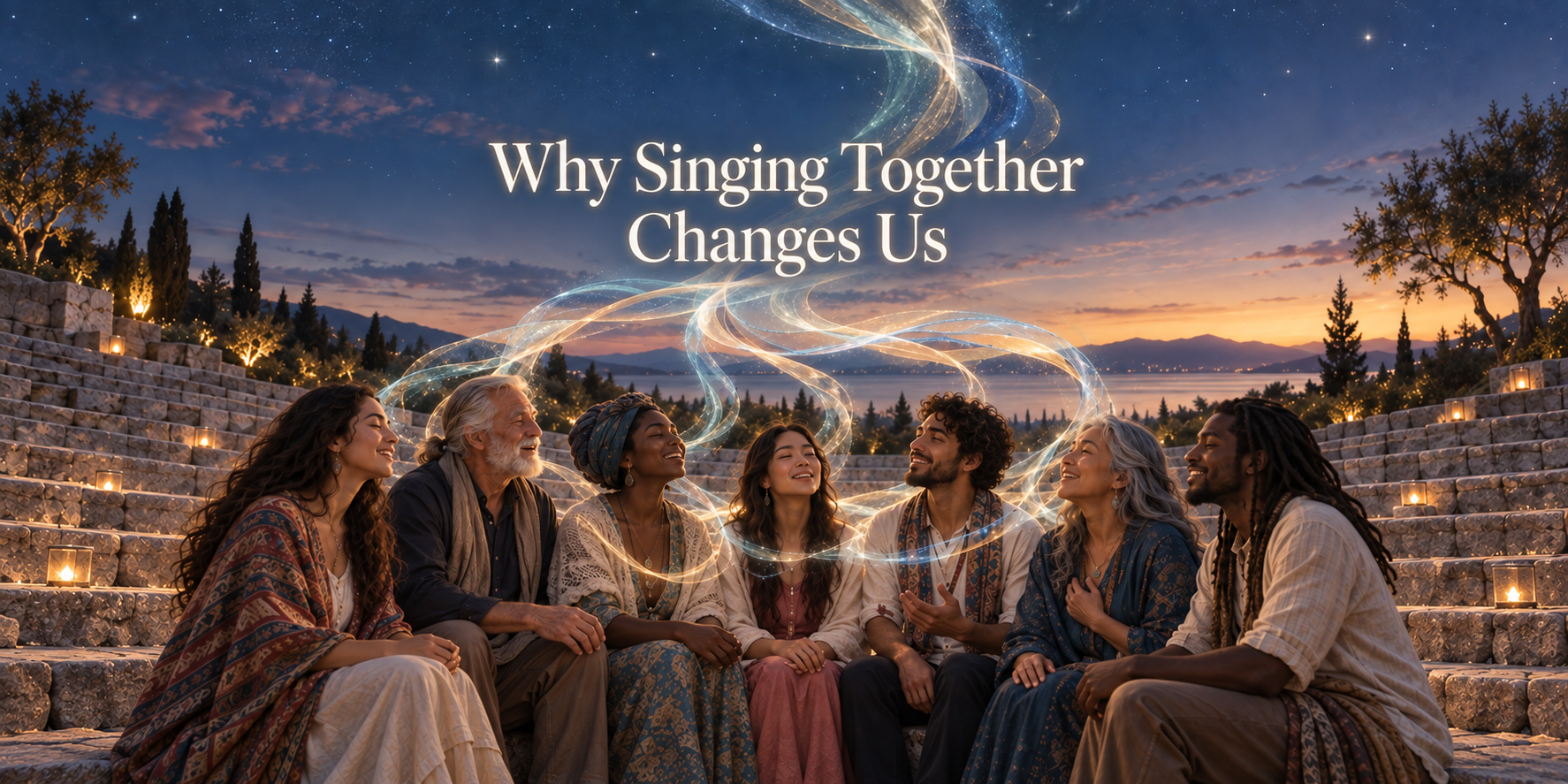
When many voices become one shared expression
There is a moment in communal singing when something changes.
At first, there are individual people—different lives, different stories and different voices. Then the song begins. Breathing starts to follow a common rhythm. Separate words become a shared message. One voice supports another, harmonies gather around the melody and a room filled with individuals begins to sound like one living expression.
We may sing together in a church, choir, stadium, school, family gathering, concert, community circle or beside someone who needs comfort. The setting may be sacred or ordinary. The song may be joyful, grieving, hopeful, peaceful or strong.
Across cultures and generations, people have repeatedly discovered the same thing:
Singing together changes the experience of being together.
Science is beginning to describe some of the physical, emotional and social processes involved. Shared musical phrases influence breathing and heart rhythms. Rhythm organizes attention and movement. Familiar songs awaken memory. Group singing can reduce loneliness and help strangers feel connected. Harmony teaches people to listen while contributing their own distinct voices.
Faith reveals another dimension. A shared song can become prayer, remembrance, praise, testimony and hope carried by many voices at once.
Singing together does not require perfection.
It requires presence.
Singing Is a Whole-Person Experience
Researchers sometimes describe singing as a multimodal activity. This simply means that it engages several parts of human experience at the same time.
Singing involves the body because it requires breathing, posture, vibration and coordinated movement.
It involves the mind because singers follow language, melody, timing and musical patterns.
It involves emotion because music can carry joy, sorrow, gratitude, longing and hope.
It involves memory because familiar words and melodies can remain with us for many years.
It involves relationship because every singer must listen, adjust and respond to the larger sound.
It can involve the spirit because a song may become worship, prayer or a way of reaching toward something greater than ourselves.
Few ordinary activities bring so many dimensions of human life together at once. This may help explain why communal singing can feel both deeply physical and profoundly sacred.
The Body Becomes Part of the Song
Singing is a whole-body act.
Air enters the lungs. The diaphragm—a broad muscle beneath the lungs—helps control the movement of that air. As we breathe out, air passes through the vocal folds in the larynx, commonly called the voice box. The vocal folds vibrate and create sound.
The throat, mouth, tongue and lips help shape the sound into words and tones. The chest, face and other spaces in the body contribute to the sensation of resonance—the way vibration is strengthened and given character.
When people sing together, their bodies enter a shared musical structure. They begin phrases at similar times. They sustain notes. They pause together. They follow the rise and fall of the melody.
Each person remains physically unique, but the song gives many bodies a common pattern to follow.
This is one reason communal singing can feel so different from merely listening to music.
The body is not standing outside the song.
The body is helping create it.
Shared Singing Organizes the Breath
Ordinary breathing changes throughout the day. It may become quick when we are hurried, shallow when we are tense or slow when we feel peaceful.
Singing organizes the breath.
Before a musical phrase begins, singers inhale. While producing the phrase, they release air in a measured way. Longer notes and slower songs can encourage a steadier exhalation than ordinary conversation.
Breathing interacts with the autonomic nervous system—the part of the nervous system that helps regulate automatic functions such as heart rate, digestion and breathing.
This does not mean every song creates the same physical response. A lively celebration and a slow hymn naturally guide the body differently. The important point is that music gives the breath a pattern.
When people follow the same song, they begin breathing within a shared structure.
How Singing Influences Heart Rhythms
Researchers have studied what happens to singers’ heart rhythms when they sing the same musical phrases together.
One important term in this research is heart-rate variability, often shortened to HRV. Heart-rate variability is the natural variation in time between one heartbeat and the next. A healthy heart does not function like a metronome. It continually makes small adjustments in response to breathing, movement, emotion and the needs of the body.
As a person inhales and exhales, the heart naturally speeds up and slows down slightly. Slow, structured singing can make this connection between breathing and heart rhythm especially noticeable.
In a study of group singing, researchers found that different kinds of vocal activity created different heart-rate patterns. Free humming allowed each singer to breathe according to individual preference. A hymn created more shared rhythmic patterns because the singers followed the same musical phrases. A very slow song with breathing points built into each phrase produced the strongest coordination.
The singers’ hearts did not become identical, and every heart did not beat at exactly the same speed. Instead, their heart rates accelerated and slowed in related cycles because their breathing was being guided by the same song.
The music created a shared rhythm that could be observed within the body.
Rhythm Brings Attention Into the Present
Human beings naturally respond to rhythm.
We tap our feet, sway, clap, march and dance when we hear a steady beat. Even when the body appears still, the brain is actively anticipating what comes next.
When people sing together, they listen for the same entrances, hold notes for similar lengths of time and move through the same musical structure. Their attention is no longer directed only inward. Each singer must remain aware of the whole.
Scientists use the word synchrony to describe people moving or acting in coordinated time. Research suggests that synchronized activity can encourage cooperation, closeness and a sense of shared purpose.
Communal singing adds something even richer. The singers are not only keeping time together. They are breathing, listening and giving voice to the same words.
The rhythm gathers scattered attention and brings people into one shared moment.
Singing Helps Strangers Become a Group
One of the most interesting findings in group-singing research has been called the ice-breaker effect.
People who begin singing together can develop feelings of closeness surprisingly quickly—even when they were strangers before the group began. Other shared activities can also create friendships, but singing appears capable of helping that connection form early.
This makes sense when we consider what singing asks people to do.
Everyone enters the same rhythm. Everyone contributes to the same result. Each person must listen to others. No single voice can create the full communal sound alone.
Conversation often begins with the question, “Who are you?”
Singing can begin with a different message:
“We are already making something together.”
The song gives people a shared identity before they have learned every detail of one another’s lives.
Singing Can Ease Loneliness
Loneliness is not simply the absence of people. A person can stand in a crowded room and still feel unseen.
Belonging grows when participation is meaningful—when someone’s presence contributes to what is happening.
A large randomized human trial studied a community choir program involving 390 adults aged 60 and older. After six months, the choir participants experienced greater improvements in loneliness and interest in life than those who had not yet begun the program.
This is important because it moves the conversation beyond a temporary good mood. Regular communal singing can help create continuity, purpose and a place to belong.
A choir gives people a reason to gather. Familiar faces return. Songs develop over time. Individuals learn when to enter, when to listen and how their voices fit into the whole.
The deeper gift may not be simply having somewhere to go.
It is knowing that the song would sound different without you.
Harmony Is a Lesson in Relationship
Harmony offers a beautiful picture of healthy community.
Different notes are sounded at the same time. Each note keeps its own character, yet its meaning changes through relationship with the others. A note that seems unfinished by itself may become luminous when it finds its place within a chord.
A choir does not become one by making every voice identical.
It becomes one when different voices learn to listen, respond and contribute to a shared creation.
Sometimes one section carries the melody while the others support it. Later, another voice may rise. There are moments to be heard clearly and moments to blend. There are times to sing and times to breathe.
Harmony teaches cooperation without requiring the loss of individuality.
It reveals that unity is not sameness.
Unity is difference held together by love, listening and shared purpose.
Music Gives Emotion Somewhere to Go
Some feelings are difficult to explain through ordinary conversation.
Grief can be too deep for a sentence. Joy can overflow the limits of speech. Hope may feel fragile when spoken but stronger when sung.
Music gives emotion structure.
A melody can hold sorrow without rushing it. Rhythm can carry us when we feel tired. Repetition can turn a simple phrase into reassurance. Harmony can surround a lonely feeling with the sound of companionship.
Human studies have found that group singing can increase positive mood and reduce negative mood. In one study involving 193 people affected by cancer—including patients, caregivers and bereaved caregivers—a single choir rehearsal was associated with improved mood and lower cortisol.
Cortisol is a hormone that helps the body respond to stress. Its levels naturally change throughout the day and in response to circumstances. Finding a change after communal singing shows that the experience is not only emotional. The body is participating too.
Researchers have also observed short-term changes in immune-related signaling molecules after singing. These findings are helping scientists understand how emotional expression, social connection and physical participation communicate with the body.
The most grounded message is also the most beautiful:
When people sing together, the mind, body and emotions respond together.
Singing Can Carry What One Person Cannot
The purpose of singing is not always to make a difficult feeling disappear.
Sometimes the gift is that the feeling no longer has to be carried alone.
At a funeral, one grieving person may be unable to sing every word. The voices surrounding them continue. At a hospital bedside, a familiar hymn may express love when conversation has grown tired. During hardship, a community may sing words of hope before anyone feels strong enough to speak them alone.
The group can hold the melody when an individual voice breaks.
That may be one of the most compassionate functions of communal song.
It does not deny sorrow.
It gives sorrow companionship.
Familiar Songs Awaken Memory
Songs are remarkable vessels for memory.
Words joined with melody, rhythm and repetition can become deeply rooted. A few notes may awaken the memory of a person, a season, a childhood room, a place of worship or a moment when life changed.
Music calls upon several processes at once. The brain follows rhythm and pitch, anticipates patterns, retrieves language and connects sound with emotion. These overlapping cues can make a familiar song easier to recognize and remember than an isolated collection of words.
This does not mean that singing universally improves every form of memory or thinking. Its special gift is often more personal.
A song can open a door to something that was still present but difficult to reach.
This is especially meaningful across generations. Children learn songs carried by parents and grandparents. Older adults may remember words they have not spoken in decades. Families and faith communities preserve their stories not only by telling them, but by singing them.
A shared song can become a bridge through time.
Singing Turns Memory Into Living Testimony
Some songs do more than remind us of the past. They allow the past to speak into the present.
Spirituals carried faith through suffering. Hymns preserved theology and hope. Lullabies carried tenderness from one generation to another. Work songs coordinated effort. Songs of freedom gave communities courage. Songs sung beside hospital beds, during worship and at funerals helped people say together what one voice could barely say alone.
When a community continues to sing a song, memory becomes active.
The song does not merely describe what earlier generations believed. It allows new voices to enter that belief, question it, remember it and carry it forward.
A song becomes a vessel traveling through time.
Each generation receives it, adds its own breath and sends it onward.
Communal Song Belongs to Humanity
Music appears across the human story.
Researchers examining ethnographic records and recordings from societies around the world found evidence of music in every society represented. Songs appeared in caregiving, healing, love, dance, ceremony, storytelling and other forms of social life.
The melodies, instruments and musical traditions differed greatly. Yet the impulse to place human meaning inside sound appeared again and again.
Long before recorded music, microphones or concert stages, people gathered and sang. The human voice was an instrument that traveled wherever people traveled. It required no manufactured object. Breath, memory and community were enough.
This helps explain why communal singing can feel ancient even when the song is new.
When we sing together, we participate in something human beings have done across countless generations.
Sacred Song Begins With Remembrance
Scripture repeatedly shows people singing after encountering the faithfulness of God.
In Exodus 15, Moses and the Israelites sing after crossing the sea. Their song remembers deliverance. Miriam then leads the women with tambourines, movement and song.
The people do not merely record what happened.
They give the memory a melody.
A story can be forgotten or altered as years pass. A song returns through repetition. It can be taught to children, carried into worship and remembered during another difficult season.
Sacred singing helps a community remember who God has been so they can trust who God will continue to be.
When Voices Become One
One of the most beautiful pictures of communal singing appears in 2 Chronicles 5.
Musicians and singers gather for the dedication of the temple. Trumpets, cymbals, instruments and voices join in praise. Scripture describes the musicians and singers sounding together as one.
As their united praise rises, the temple is filled with a cloud representing the glory of God.
The passage does not say that only the most talented voice created the sacred moment. The wonder is found in the joining.
Many musicians.
Many singers.
One sound of praise.
Their unity did not make God present, as if human sound could summon Him. Their shared worship opened a moment in which the community recognized and responded to His presence together.
Song Can Hold Joy and Grief at the Same Time
Ezra 3 describes the laying of the foundation for the rebuilt temple.
Some people shout with joy. Others weep because they remember the former temple and all that had been lost. The sounds become so interwoven that those listening from a distance cannot distinguish the joyful shouting from the weeping.
This is one of Scripture’s most honest pictures of communal emotion.
The people are standing in the same sacred moment, but they are not feeling the same thing. One generation sees a beginning. Another remembers what came before. Joy and sorrow rise together.
Communal song does not require everyone to arrive with the same emotional story.
It can hold gratitude and grief, celebration and memory, expectation and loss.
The voices do not have to feel alike in order to belong together.
Singing Encourages the People Beside Us
Ephesians 5:19 describes believers addressing one another through psalms, hymns and spiritual songs. Colossians 3:16 connects singing with wisdom, gratitude and the word of Christ dwelling richly within the community.
These passages reveal that sacred singing moves in more than one direction.
Song rises toward God as worship, but it also moves between people as encouragement.
We sing to God.
We sing truth into our own hearts.
We help the person beside us remember.
Someone may enter worship feeling strong, while someone else arrives carrying fear, weariness or grief. The confident voice can support the uncertain one. On another day, their roles may be reversed.
Sacred singing allows faith to become audible within the community.
Jesus Sang With His Disciples
Matthew 26:30 tells us that Jesus and His disciples sang a hymn together after the Last Supper and before leaving for the Mount of Olives.
The moment matters.
Jesus knew that suffering was approaching. The disciples did not yet understand everything that was about to unfold. Still, before entering the darkness ahead, they sang together.
The song did not mean the night would be easy.
It meant Jesus did not enter it without prayer, sacred memory and the voices of those gathered around Him.
This gives shared singing an extraordinary dignity.
When we sing before an uncertain tomorrow, we are participating in something Jesus Himself chose to do.
A Song Can Rise Before Circumstances Change
Acts 16 tells of Paul and Silas praying and singing hymns while imprisoned. Their bodies were confined, but their praise was not.
The other prisoners listened.
This is an important detail. Their song was personal, but it was not private. Faith became audible within a place of suffering.
Paul and Silas did not wait until the prison doors opened to begin singing. They sang before they could see how the story would end.
Sacred song can become an expression of trust before circumstances change.
It allows hope to have a voice while the answer is still on its way.
God Is Also Described Through Song
Zephaniah 3:17 offers a tender image of God rejoicing over His people with singing.
We often think of worship as humanity singing toward heaven. This passage reverses the direction and gives us the image of divine love singing over human lives.
We sing because joy seeks expression.
We sing because grief seeks companionship.
We sing because faith remembers.
And Scripture suggests that singing is not foreign to the heart of God.
Worship Is Participation
It is possible to stand near singing without fully entering it. A person may admire the musicians, listen to the words or enjoy the atmosphere.
Communal worship carries a deeper invitation.
It asks us to participate.
When a congregation sings, worship is not meant to be a performance given by a few people to an audience. Musicians may guide the melody, but the gathered community becomes the instrument.
One person sings with certainty. Another sings while searching. Someone sings through tears. Someone else can barely whisper the words. Yet all are held within the same song.
The strongest voice does not make the moment sacred.
Shared intention does.
Why Singing Together Can Feel Transcendent
Communal singing can create a sense of transcendence—a feeling of moving beyond the narrow boundaries of the individual self.
Part of this may come from the combination of shared breath, synchronized timing, emotion, memory and belonging. Attention shifts away from private thought and enters a collective experience.
For many people, the experience is also spiritual.
A sacred song can make a room feel filled with more than sound. The individual voice is no longer isolated. It becomes part of praise that began long before the present moment and will continue after it.
We sing with those beside us.
We sing words carried by those who came before us.
We teach those words to voices that may carry them into the future.
The song becomes larger than the singers.
Imperfect Voices Still Belong
Many people stop singing because someone once told them they were not good at it. Others compare themselves with polished voices and decide that silence is safer.
But communal singing was never meant to belong only to professionals.
Technical skill can make music beautiful, and trained singers offer a valuable gift. Yet human singing has always existed beyond the stage.
Parents sing to children. Friends sing in cars. Families sing at birthdays. Communities sing during worship, grief, labor, protest and celebration.
A voice does not have to be flawless to carry love, gratitude or faith.
You may sing softly. You may need time to find the melody. You may hum when words will not come. You may listen during one verse and join during the next.
Belonging does not begin when your voice becomes perfect.
It begins when you allow your honest voice to become part of something shared.
The Quiet After the Final Note
One of the most powerful moments in communal singing can arrive after the sound ends.
The final note fades, but the room does not immediately feel the same as it did before the song began. Breathing settles. Vibration disappears into silence. People become aware of one another again.
That silence is not empty.
It holds the memory of what has just been created—many people breathing, listening, remembering and offering their voices together.
The song may have ended.
The connection it awakened can remain.
A Sacred Practice of Singing Together
You do not need to join a professional choir to experience communal singing.
You might:
Sing during worship instead of only listening.
Learn an older family member’s favorite song.
Sing a hymn with someone who is lonely or ill.
Join a community choir or informal singing group.
Sing simple songs with children.
Gather friends for music without turning it into a performance.
Choose a song of hope during a difficult season.
Sing while working, traveling or preparing a shared meal.
Let familiar sacred music become part of family prayer.
Hum beside someone when spoken comfort feels insufficient.
Begin with one song that means something to you.
Notice your breathing. Listen for the voices around you. Allow your own voice to be present without judging it.
The purpose is not to prove that you can sing.
The purpose is to remember that you do not have to carry every part of life alone.
A Reflection Before You Sing
Take one unhurried breath.
Remember that your voice was never meant to sound like anyone else’s.
Listen for the people around you. Let their voices support yours, and allow your voice to support theirs.
Release the need to be impressive.
Sing with gratitude.
Sing with hope.
Sing with honesty.
Sing as prayer.
Let the song remind you that unity does not erase difference, that shared breath can become shared courage and that even one uncertain voice can find strength inside a faithful chorus.
Questions and Answers About Singing Together
Why does singing together feel so powerful?
Singing together combines breathing, rhythm, language, emotion, memory, listening and social connection. Because so many parts of human experience are participating at once, communal singing can feel more powerful than listening to music or singing alone.
Can singing together help people feel connected?
Yes. Human studies have repeatedly associated group singing with closeness, belonging and social connection. Singing gives people a shared rhythm and meaningful purpose, allowing them to create something together.
What is the ice-breaker effect?
The ice-breaker effect refers to research showing that people in singing groups can begin feeling closer relatively quickly, even when they start as strangers. The shared activity may help a collection of individuals begin experiencing themselves as a group.
Can singing together ease loneliness?
Regular participation in a choir can help. In a randomized study involving 390 older adults, community choir participation was associated with reduced loneliness and greater interest in life after six months.
Do singers’ hearts synchronize?
Singers following the same slow musical phrases can develop related patterns of breathing and heart-rate variability. This does not mean every heart beats at exactly the same speed. It means that the hearts may accelerate and slow in coordinated cycles because the singers are breathing within the same musical structure.
What is heart-rate variability?
Heart-rate variability is the natural variation in time between one heartbeat and the next. These small changes are influenced by breathing, movement, emotion and the autonomic nervous system. Musical phrasing can influence heart-rate variability by shaping the breath.
Can group singing reduce stress?
Group singing has been associated with improved mood and reductions in cortisol during supportive, low-stress singing experiences. Breathing, focused attention, emotional expression and social connection may all contribute.
Does singing affect immune activity?
Researchers have observed short-term changes in immune-related signaling molecules after choir singing. These findings show that the body responds to the experience of singing and provide an interesting direction for continued research.
Does singing improve memory?
Familiar songs can provide powerful cues for personal memories, language and emotion. This is different from claiming that singing improves every kind of memory or thinking ability. Its special gift is often its ability to help people reach memories connected with particular songs.
Is singing in church different from singing in a choir?
Both involve breathing, listening, rhythm and vocal coordination. Sacred singing also carries the intentions of prayer, worship, remembrance and shared faith. The song is not only being performed. It is being offered.
Why is harmony spiritually meaningful?
Harmony allows different notes to retain their individuality while creating something beautiful together. It offers a living picture of unity without sameness—many voices participating in one song.
Can singing help during grief?
Singing can give grief a form of expression when ordinary speech feels insufficient. In a group, other voices can continue carrying the words and melody when a grieving person cannot sing every part.
Do I need a good voice to benefit from group singing?
No. Communal singing can be meaningful without professional vocal ability. Listening, breathing, humming and contributing a quiet voice are all forms of participation.
Why has communal singing appeared across so many cultures?
The human voice is portable, expressive and naturally social. Singing helps communities remember stories, coordinate activity, teach beliefs, celebrate, mourn and create shared identity. It requires no instrument beyond the living body.
What does the Bible say about singing together?
Scripture repeatedly connects communal singing with remembrance, praise, encouragement, gratitude and faith. Israel sang after deliverance, temple musicians praised as one, Jesus sang with His disciples and early believers used hymns and spiritual songs to encourage one another.
A Final Thought
When people sing together, sound becomes relationship.
Breath becomes rhythm.
Memory becomes testimony.
Emotion becomes expression.
Difference becomes harmony.
An individual voice discovers that it can remain completely itself while becoming part of something larger.
Perhaps that is why communal singing has survived every age of human history.
We sing because joy seeks a voice.
We sing because grief needs companionship.
We sing because faith is strengthened when it is remembered together.
And sometimes, when many imperfect voices rise as one, we hear more than music.
We hear what belonging sounds like.
Continue Exploring
The Sacred Meaning of the Human Voice