

Why Nature Repeats the Spiral
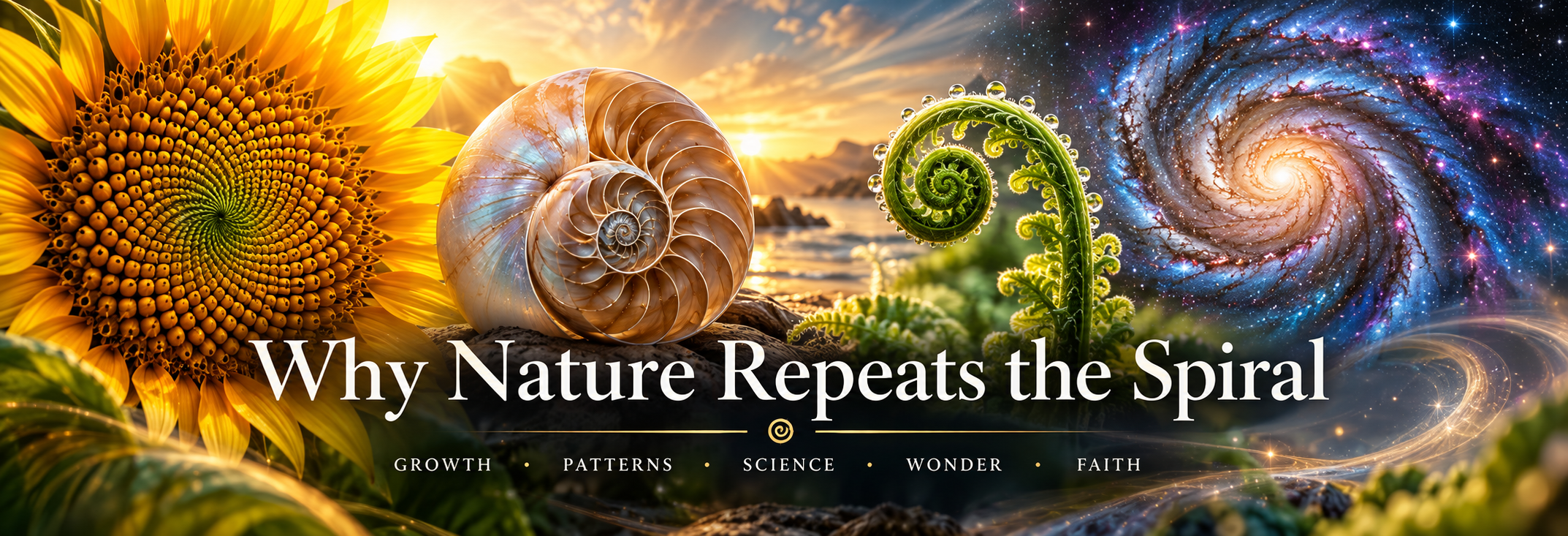
Sunflower, coiled seashell, unfurling fern and spiral galaxy showing recurring spiral forms in nature.
Look closely at the natural world and one shape seems to find us again and again.
A fern slowly unfurls.
A sunflower arranges hundreds of tiny florets around its center.
A climbing vine curls around a branch.
A seashell expands as it grows.
Water turns into a whirlpool.
A hurricane curls around its eye.
A galaxy sweeps luminous arms through the darkness of space.
Even at scales far too small for our eyes to see, nature builds structures that twist and turn.
Again and again, creation turns.
The spiral is so widespread that it can feel almost like a signature written across nature.
Yet the real story is more extraordinary than the popular idea that everything follows one mysterious mathematical formula.
It does not.
A sunflower, shell, hurricane and galaxy do not spiral for the same reason. Different forces are at work. Different materials are involved. Different scales are separated by almost unimaginable distances.
And still, related forms continue to emerge.
The spiral appears again and again because turning is one of the ways matter moves, organisms grow, forces organize and creation unfolds.
A Shape Made for Becoming
A circle closes upon itself.
A spiral does something different.
It turns while moving.
It can expand outward or draw inward while remaining connected to its center.
That combination makes spiral-like forms especially interesting wherever growth, rotation, movement, packing, curvature or changing scale occur together.
This helps explain why nature can create remarkably similar-looking forms through completely different processes.
A shell grows.
A storm flows.
A plant develops.
A galaxy evolves.
DNA twists.
The causes differ.
The geometry sometimes echoes.
Perhaps that is the first lesson hidden inside the spiral.
Things do not have to be identical to share a pattern.
Not Every Spiral Is the Same
There is no single "spiral of nature."
Several different mathematical forms can produce spiral-like shapes.
A logarithmic spiral expands proportionally as it turns. This allows its overall form to remain similar while its size increases.
An Archimedean spiral grows differently, with approximately equal spacing between successive turns.
Then there is the helix.
A spiral generally winds around a center in a plane, while a helix travels through three-dimensional space.
A coiled spring is a helix.
DNA forms a double helix.
Nature uses many variations of turning, twisting, curving and coiling.
That distinction protects us from an attractive but inaccurate idea.
Nature is not repeatedly copying one perfect spiral.
It is repeatedly revealing what curved and rotational forms can do.
Sunflowers and the Mathematics We Can See
Few examples are more mesmerizing than a sunflower.
Look closely at the flower head and you may notice two families of spirals crossing one another, some appearing to turn clockwise and others counterclockwise.
These visible spiral families are known as parastichies.
Their numbers often correspond to neighboring members of the Fibonacci sequence:
1, 1, 2, 3, 5, 8, 13, 21, 34, 55...
Each number is created by adding the previous two.
But the sunflower is not counting.
There is no tiny mathematician hiding inside the flower instructing it to create 34 spirals in one direction and 55 in another.
Something far more interesting is happening.
The mathematics emerges from growth.
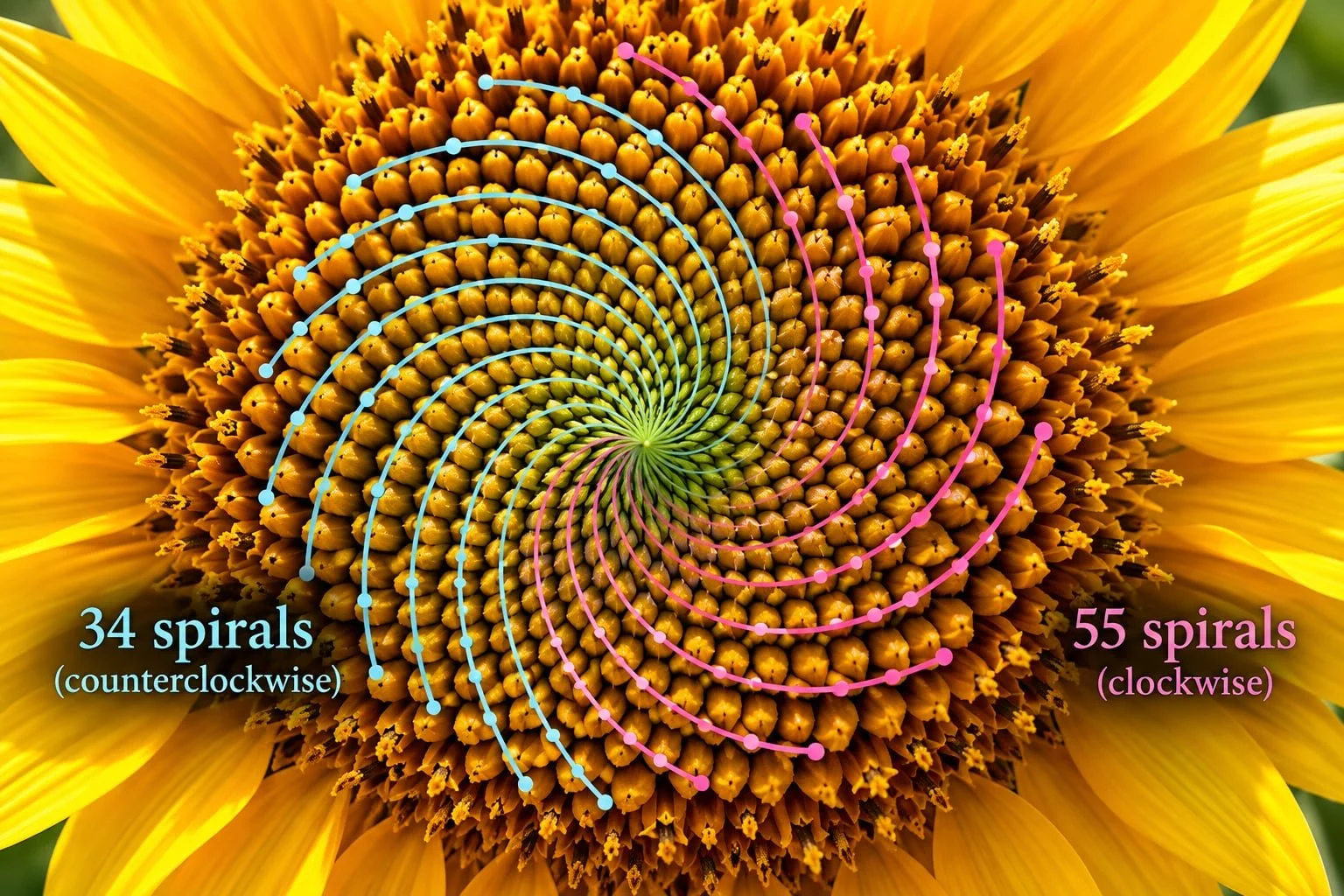
Sunflower center with guide lines showing clockwise and counterclockwise spiral families called parastichies.
How a Plant Builds a Pattern
At the growing regions of plants, new leaves, florets and other structures begin as tiny developing areas called primordia.
Their placement is influenced by structures already forming around them, growth of the surrounding tissue and chemical signaling within the plant.
One especially important participant is auxin, a plant hormone involved in growth and development.
Auxin moves through plant tissues in organized ways. Local concentrations help determine where new plant organs begin to form.
A new structure changes the conditions around it.
That influences where another can emerge.
Then another appears.
And another.
No individual floret contains a blueprint showing the complete sunflower.
Yet gradually an extraordinary larger pattern appears.
This is an example of self-organization.
Large-scale order can emerge through many smaller local interactions.
The sunflower is therefore more interesting than the idea that it merely "follows Fibonacci."
It grows through relationships.
And eventually the mathematics becomes visible.
Golden Angle
In many examples of spiral phyllotaxis, successive plant organs develop at an average angle close to 137.5 degrees from one another.
This is known as the golden angle.
It is mathematically related to the golden ratio, approximately:
1.618
The golden ratio is also connected with the Fibonacci sequence. As Fibonacci numbers become larger, dividing one by the preceding number produces values that increasingly approach the golden ratio.
These mathematical relationships help us understand why Fibonacci numbers, golden-angle arrangements and plant spirals are often discussed together.
But biology adds an important layer of nuance.
Modern research shows that some Fibonacci spiral patterns can emerge through developmental processes involving auxin dynamics and local interactions without requiring an exact golden-angle rule.
The mathematics is real.
So is the biological complexity.
Nature is not following a ruler.
Nature is growing.
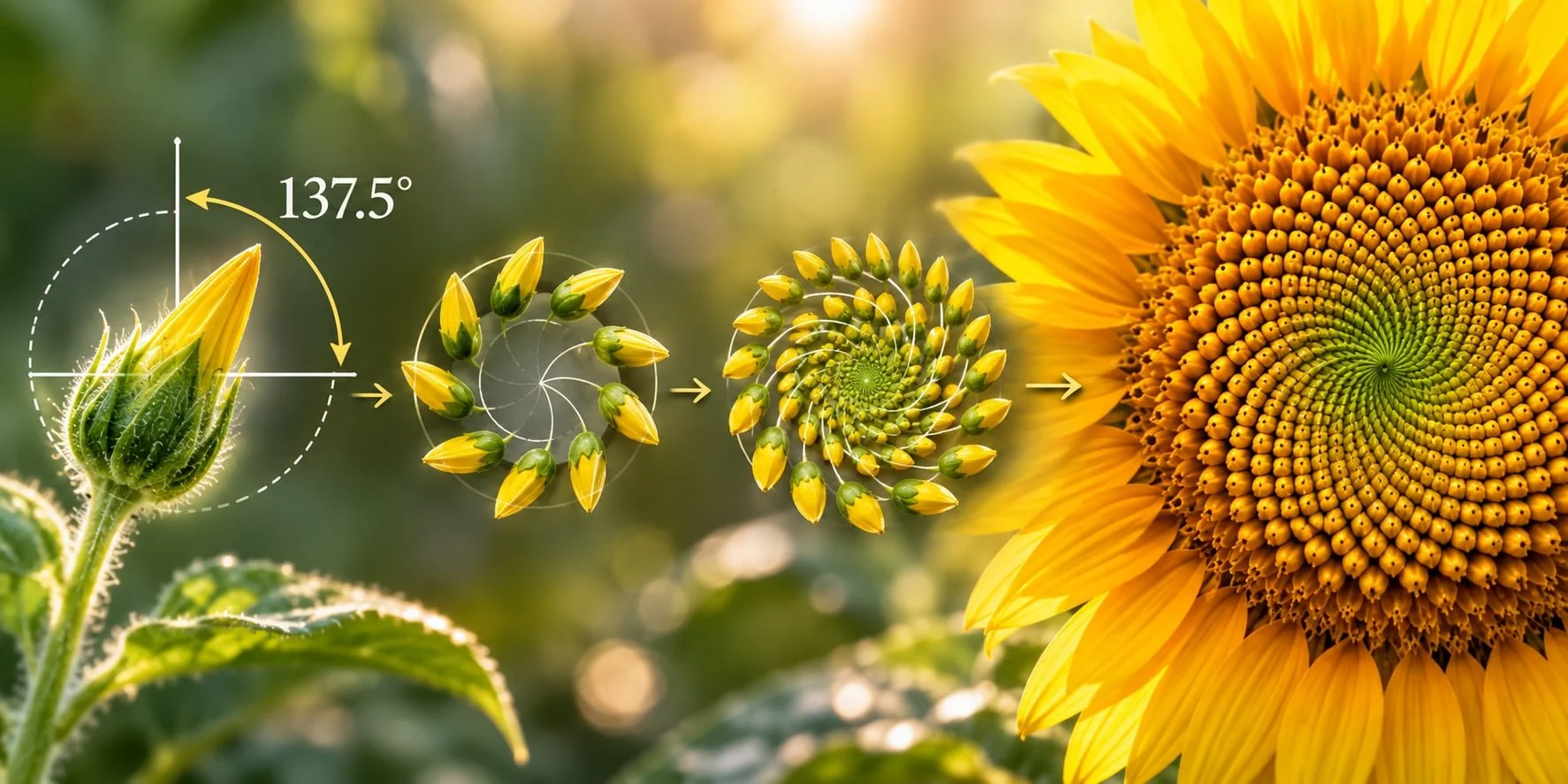
Diagram illustrating the 137.5-degree golden angle and development of a spiral plant pattern.
Nature Is Not Obsessed With the Golden Ratio
The internet has given the golden ratio an almost mythical reputation.
You may encounter claims that every shell, flower, hurricane, galaxy and part of the human body perfectly follows it.
That is not what the evidence shows.
Golden-ratio and Fibonacci relationships genuinely appear in some natural systems, particularly certain plant arrangements.
But they are not a universal blueprint for nature.
Not every flower has a Fibonacci number of petals.
Not every shell is a golden spiral.
Hurricanes are not enormous Fibonacci diagrams.
Spiral galaxies do not universally follow a golden spiral.
None of this makes nature less extraordinary.
It makes nature more interesting.
Creation does not need mathematical exaggeration to be magnificent.
Pinecones, Pineapples and Succulents
Sunflowers are far from alone.
Look carefully at a pinecone and you may see diagonal spirals moving in opposite directions.
A pineapple displays interlocking diagonal patterns across its surface.
Many succulents arrange their leaves in breathtaking rotational forms.
Artichokes, daisies and other plants reveal related arrangements.
Once again, the larger pattern emerges as new structures develop in relation to those already present.
One scale forms.
Then another.
One leaf appears.
Then another.
The completed structure can possess an order that no single part contains on its own.
This is one of nature's recurring wonders:
Simple local interactions can produce astonishing complexity.
Seashells and Growth at the Edge
Seashells tell another version of the spiral story.
A mollusk does not simply stretch its existing shell larger as it grows.
Shell growth occurs largely through the addition of new material along the aperture, the shell's growing opening or edge.
As growth continues, that opening can enlarge and change position while new material is repeatedly added.
This process can create coiled shells whose general proportions remain similar as they become larger.
Many shell forms can be described approximately using logarithmic or related spiral geometry, although real shells vary enormously and often depart from ideal mathematical forms.
There is something beautiful hidden inside this biology.
The shell grows by adding something new to the edge of what already exists.
Yesterday's structure is not discarded.
It becomes part of today's foundation.
Perhaps some human growth happens that way too.
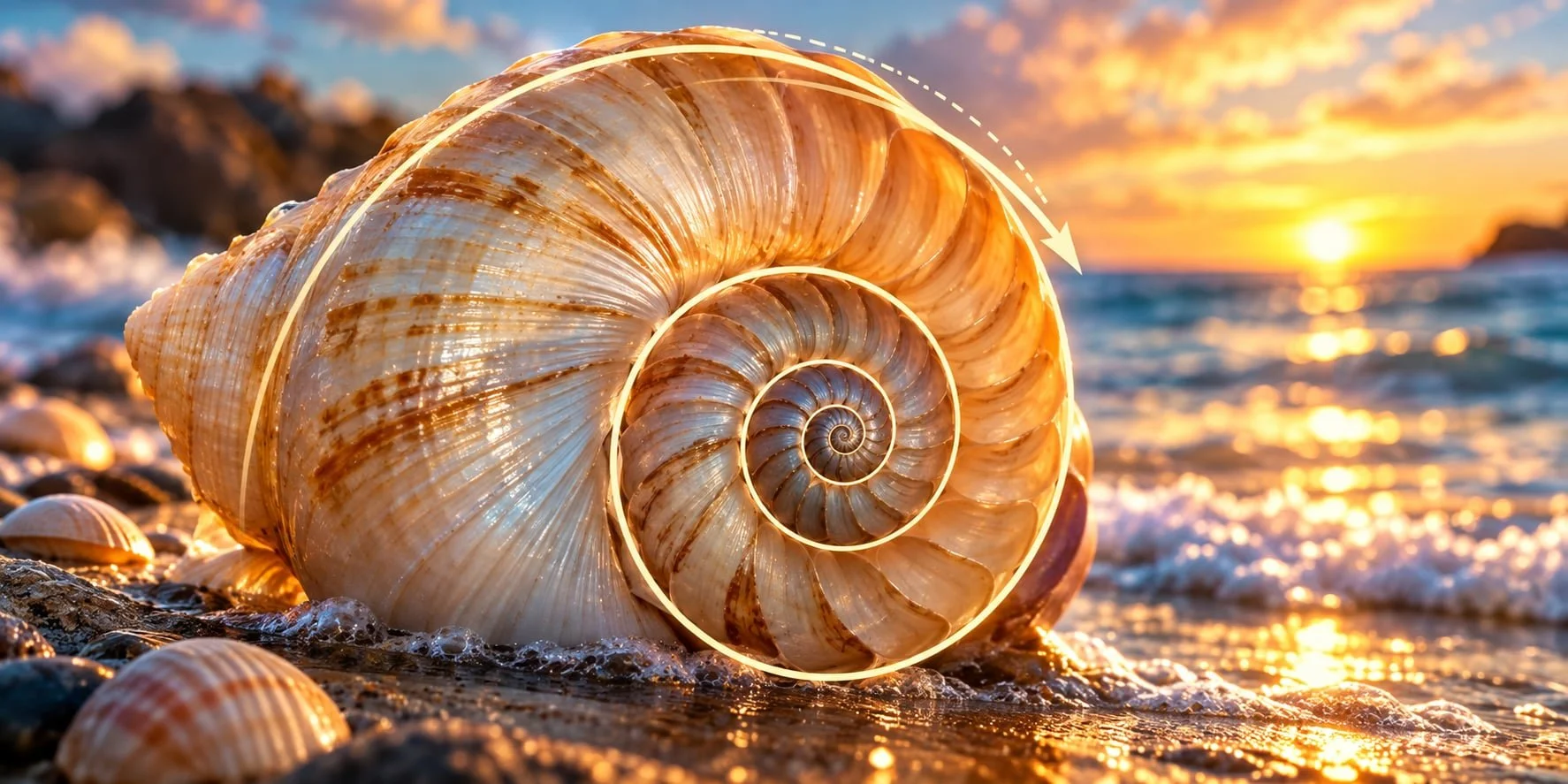
Coiled seashell with a subtle spiral guide illustrating shell growth.
Ferns and the Beauty of Unfolding
Young fern fronds often begin tightly curled.
We commonly call them fiddleheads.
As the frond develops, the curl gradually opens.
What appears tightly contained begins to reveal what was forming within it.
The fern does not unfold all at once.
It opens according to its own development.
That gives us another kind of turning form.
Not simply the spiral of expansion.
The spiral of unfolding.
There are seasons when life looks exactly like that.
Something may already be becoming within us long before anyone else can see its final form.
Vines and the Search for Support
Climbing plants reveal another kind of turning.
Growing stems and tendrils can perform sweeping movements known as circumnutation.
When certain tendrils encounter suitable support, changes in growth can cause them to coil around it.
These structures are usually better described as helical rather than flat spirals.
The geometry serves a purpose.
Instead of constructing an enormous trunk, the plant can use something already standing.
A branch.
A fence.
Another stem.
It finds support and rises.
There is something wonderfully humble in that strategy.
Growth does not always mean doing everything alone.
Sometimes growth means recognizing what can safely support us.
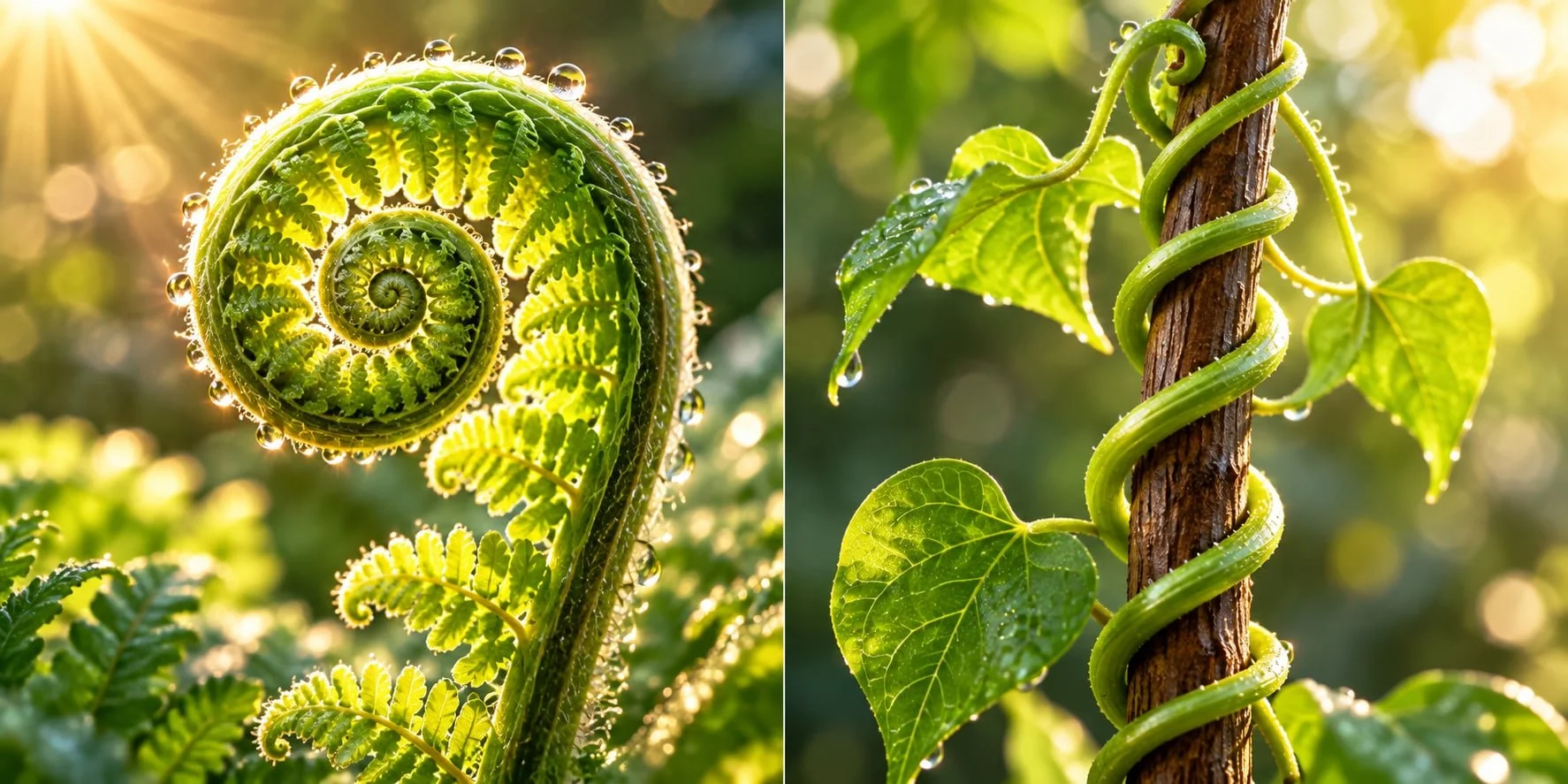
Fiddlehead fern unfurling beside a climbing vine tendril coiled around a support.
Hurricanes and the Spiral of Moving Air
A hurricane can resemble an enormous spiral painted across the ocean.
But its spiral arises from completely different physics than a sunflower or shell.
Tropical cyclones develop around regions of low atmospheric pressure when oceanic and atmospheric conditions are suitable.
Warm, moist air rises.
Air moves toward lower pressure.
Earth's rotation influences moving air through the Coriolis effect.
Heat, moisture, pressure and atmospheric circulation interact within the developing storm.
The result can be a vast rotating system with curved or spiral rainbands surrounding its center.
Here the spiral is not primarily a record of biological growth.
It is a pattern of flow.
Water, Whirlpools and Vortices
Water turns too.
Watch water moving around an obstacle in a river or swirling toward a drain and rotating flows may appear.
These are vortices.
A vortex occurs when fluid rotates around a central region or axis.
Vortices can exist at dramatically different scales, from small eddies behind stones to enormous rotating systems in Earth's atmosphere.
Air and water are both fluids.
When fluids move under the right conditions, rotation and curved flow can emerge naturally.
Here, the spiral becomes movement made visible.
Galaxies and Spirals Written in Starlight
Then the spiral becomes almost unimaginably large.
Spiral galaxies contain stars, gas and dust organized within rotating galactic disks.
Some display spectacular arms sweeping outward from their central regions.
It is tempting to imagine each spiral arm as a permanent structure made from the same collection of stars.
The reality is more interesting.
One useful way astronomers explain some spiral structure is to think of areas of greater density through which material moves.
Imagine a traffic jam.
The individual cars within the traffic jam are constantly changing.
Cars enter.
They slow.
They eventually leave.
Yet the congested region remains recognizable.
In a similar way, stars, gas and dust can move through denser regions associated with spiral arms while the larger pattern persists.
Galaxies are diverse, however, and astronomers continue investigating how different types of spiral arms form and evolve.
The spiral in the heavens is therefore not an enormous sunflower.
It has its own cosmic story.
Gravity.
Motion.
Gas.
Dust.
Stars.
Time.
A spiral written across the darkness in starlight.
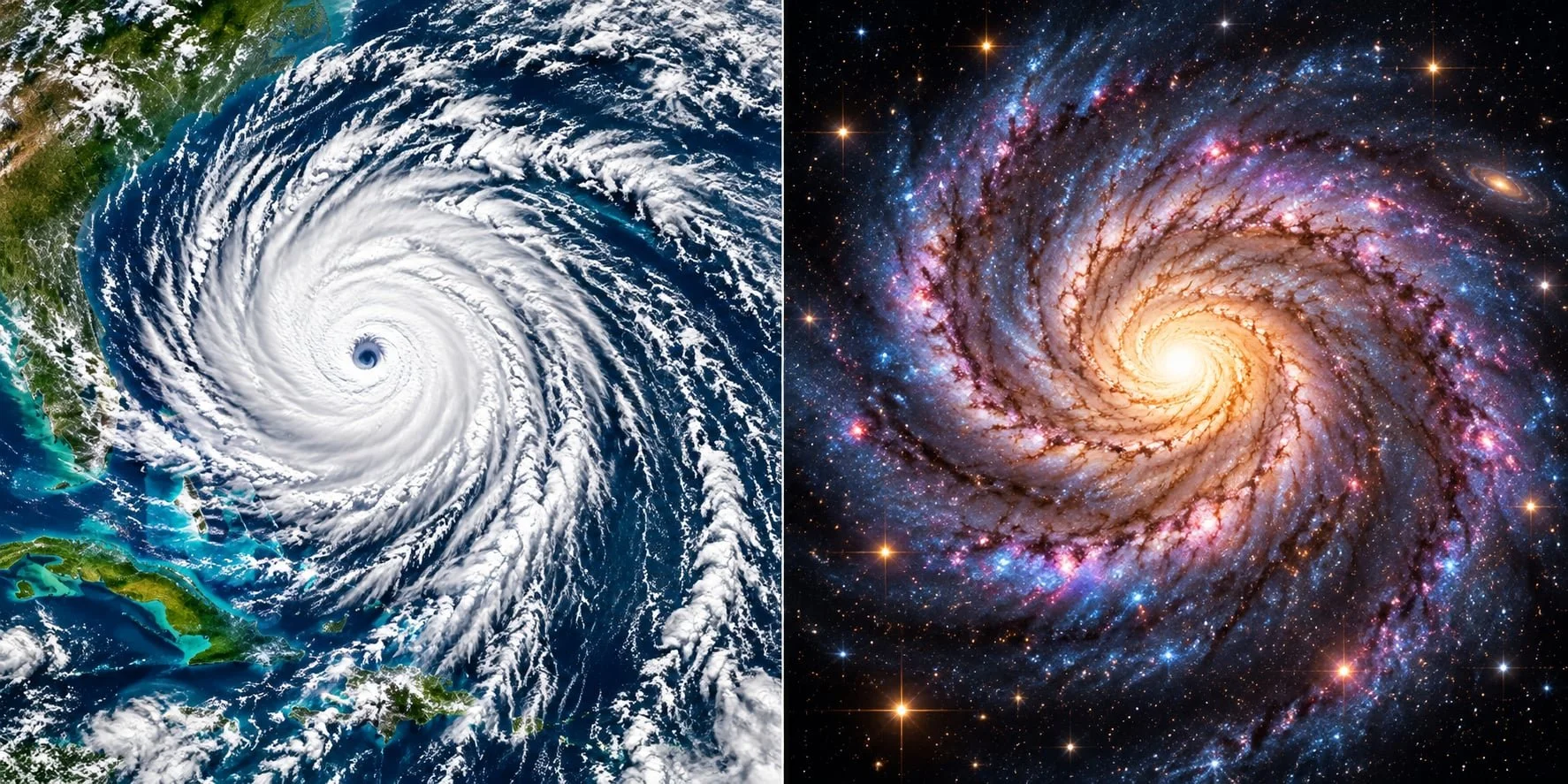
Hurricane and spiral galaxy showing similar spiral forms produced by different physical processes.
DNA and the Double Helix
DNA is frequently included in conversations about spirals in nature.
Technically, DNA introduces another geometry.
The double helix.
DNA consists of two complementary molecular strands winding around one another, creating the familiar twisted-ladder form.
The outside portions contain repeating sugar and phosphate groups, while paired chemical bases connect the two strands.
Its complementary double-stranded structure helps DNA store biological information and provides a mechanism through which that information can be accurately copied when cells divide.
DNA should therefore not be presented as evidence that everything follows a single spiral law.
It teaches us something better.
Twisting geometry can be extraordinarily useful.
At molecular scales, twisting contributes to organized biological structures.
At plant scales, tendrils twist around supports.
Across nature, geometry and function repeatedly meet.
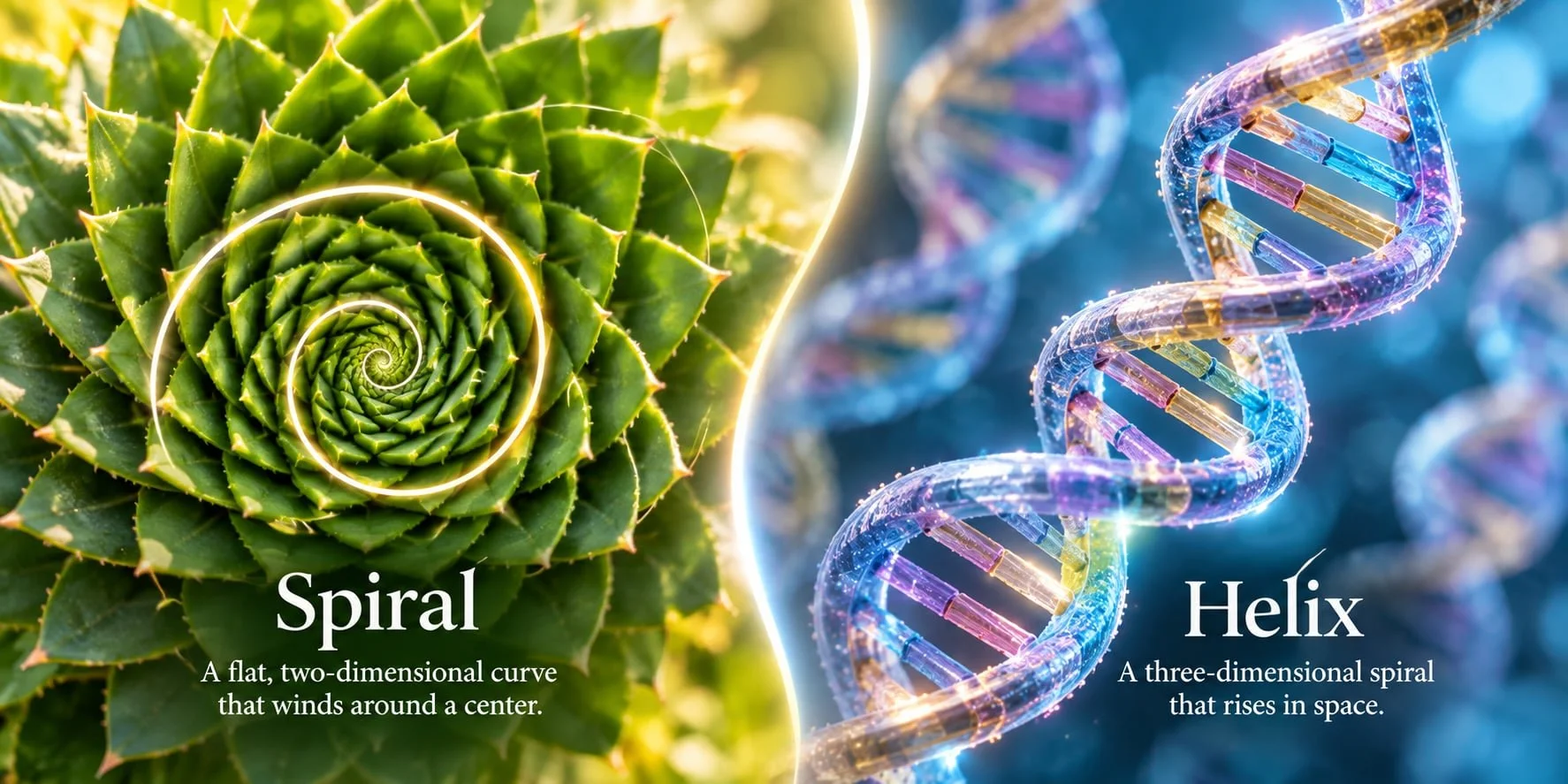
Scientific illustration comparing a two-dimensional spiral with a three-dimensional DNA double helix.
Spirals Within Us
Turning and coiling structures also appear within the human body.
The cochlea of the inner ear is famously coiled.
Proteins can contain helical structures.
Biological fibers can follow complex orientations.
Blood vessels curve and branch.
Connective tissues organize themselves to handle forces arriving from different directions.
Not every curve in the human body is a spiral, and there is no reason to force the comparison.
But living bodies remind us that biology is not built primarily from boxes and straight lines.
Life bends.
Folds.
Twists.
Branches.
Coils.
And grows.
Why Nature Does Not Need Straight Lines
Human beings love straight lines.
We build walls.
Roads.
Shelves.
Buildings.
Boxes.
Nature works under different constraints.
A living structure may need to grow around what already exists.
A fluid must move around obstacles.
A plant must position new organs beside older ones.
A shell must expand while continuing to protect the animal within.
A molecule must organize enormous amounts of biological information within microscopic space.
Curves, spirals, helices and branches offer possibilities that straight lines cannot.
A spiral can expand while remaining connected with its center.
A helix can organize length within a compact space.
A rotating flow can move energy and matter.
A phyllotactic arrangement can organize many structures around a growing region.
Often the geometry is not decoration.
The geometry is part of how the system works.
Emergence
There is a word that deserves a special place in this story:
Emergence.
Emergence describes situations in which larger patterns or behaviors arise through interactions among smaller parts.
No single sunflower floret contains the entire sunflower pattern.
No single star contains the spiral structure of a galaxy.
No single water molecule contains a whirlpool.
Yet when many parts interact under particular conditions, something larger becomes visible.
Nature repeatedly creates wholes whose patterns cannot be appreciated by looking at one isolated piece alone.
That is extraordinary.
Because much of life feels exactly like the isolated piece.
This conversation.
This decision.
This disappointment.
This prayer.
This beginning.
This ordinary Tuesday.
We rarely get to stand far enough away from our own lives to see the complete pattern.
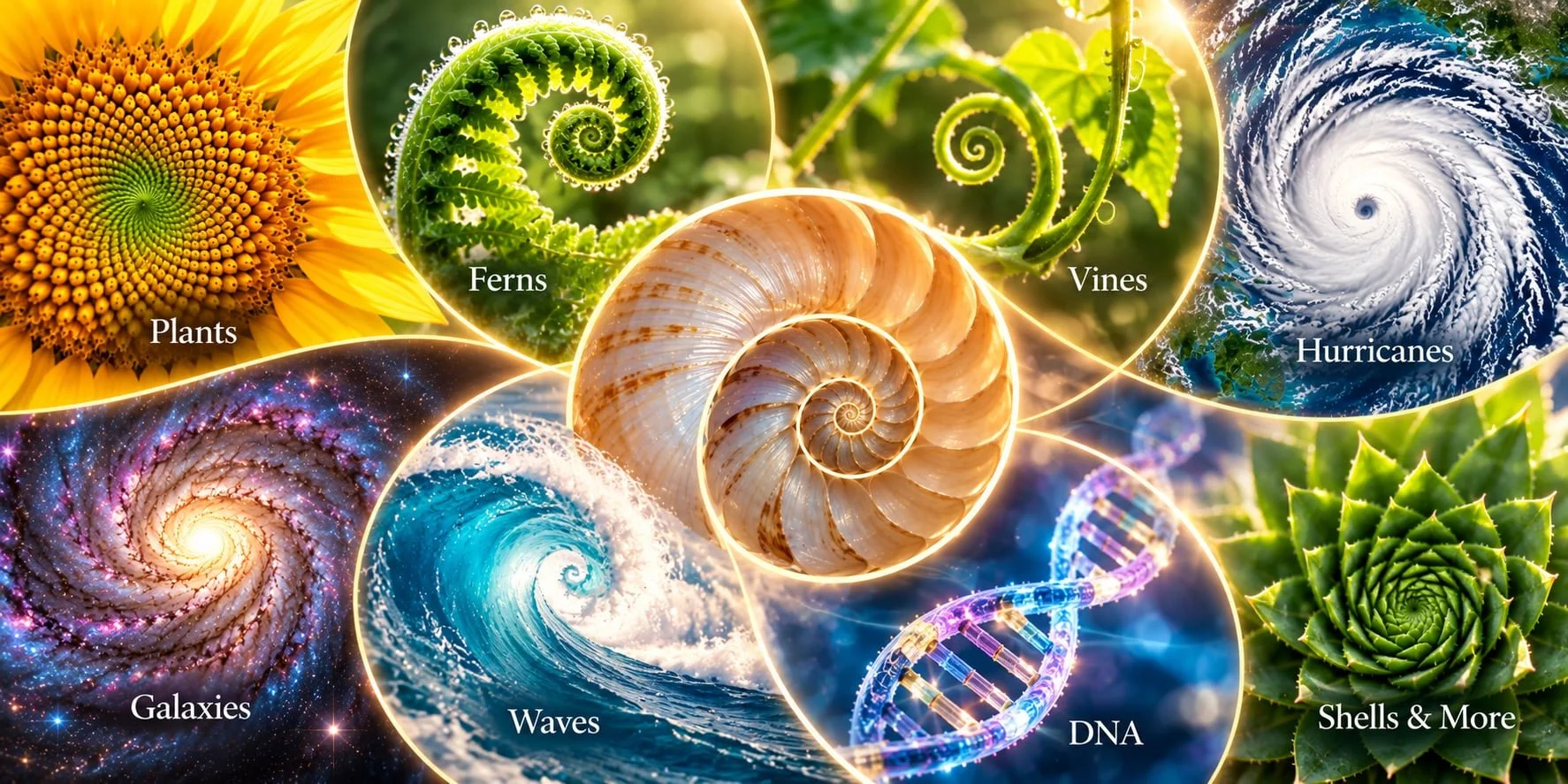
Sunflower, seashell, hurricane and spiral galaxy showing related spiral forms produced by different natural processes.
The Whole Pattern Cannot Be Seen From One Point
A single seed cannot show us the sunflower.
A single star cannot show us the galaxy.
A single drop of water cannot show us the whirlpool.
A single note cannot show us the song.
And a single moment cannot show us a life.
We live inside moments.
We see one small section of the path at a time.
Faith invites another possibility.
We may be standing inside a pattern we cannot yet see.
What appears disconnected from our limited perspective may someday reveal relationships we could not recognize while living through them.
Science does not prove that spiritual interpretation.
Faith does not need science to do so.
But nature gives us a beautiful language for contemplating it.
We see fragments.
God sees more.
Humanity Has Been Drawn to the Spiral for Thousands of Years
Long before anyone spoke about auxin, logarithmic spirals, DNA or galactic dynamics, human beings noticed the turning form.
Spirals appear in ancient pottery, jewelry, carvings, monuments and decorative traditions across different cultures and periods.
We should be careful not to assign one universal spiritual meaning to every ancient spiral.
We cannot know exactly what every spiral meant to the person who created it thousands of years ago.
But their survival tells us something.
Human beings have been fascinated by this form for a very long time.
Perhaps our ancestors saw what we still see.
Movement.
Return.
Expansion.
Mystery.
Life.
Spiritual Meaning of the Spiral
Across different times and traditions, spirals have been interpreted in many ways.
Growth.
Transformation.
Cycles.
Renewal.
Inner journeys.
Outer journeys.
The movement between what was and what is becoming.
Its spiritual power may partly arise from its geometry.
A spiral turns toward familiar directions without returning to exactly the same place.
That feels remarkably close to human experience.
We revisit old questions with new understanding.
We encounter memories from a different perspective.
We meet lessons we thought we had completed.
We return to places within ourselves that feel strangely familiar.
But we are not necessarily back where we began.
Sometimes we are meeting the same place from another turn of the spiral.
Growth Is Not Always Linear
We often imagine progress as a straight line.
Begin here.
Move forward.
Reach the destination.
Nature rarely behaves so neatly.
Seasons return.
Tides rise and fall.
Trees enter dormancy.
Seeds wait beneath soil.
Flowers open and close.
Planets orbit.
Ferns unfurl.
Living systems move through rhythms of activity, rest, expansion and renewal.
The spiral gives us another picture of growth.
Progress can circle.
It can deepen.
It can expand.
It can bring us near something familiar while quietly carrying us somewhere new.
Returning does not always mean going backward.
Faith in the Turns
For a person of faith, nature can become an invitation to notice.
Not because every sunflower contains a hidden theological equation.
Not because a galaxy secretly proves a spiritual theory.
Something quieter is happening.
Creation invites attention.
Scripture repeatedly draws our eyes toward seeds, trees, fields, birds, stars, seasons and flowers.
Nature becomes a place where we can contemplate patience, provision, growth, transformation and the mystery of things happening beyond our immediate sight.
A seed beneath the soil can look like nothing is happening.
A curled fern can look unfinished.
A season of waiting can look empty.
Yet unseen work may already be underway.
Perhaps the spiral offers another reminder.
God can still be leading us forward even when the path does not look straight.
Creation Does Not Hurry Its Becoming
A spiral cannot reach its outer turns without passing through the inner ones.
A sunflower does not apologize for beginning as a seed.
A fern does not force itself open before its tissues are ready.
A shell does not appear at its final size.
A galaxy does not hurry through cosmic time.
Creation makes room for process.
Perhaps we can make room for it too.
We are allowed to grow gradually.
We are allowed to revisit.
We are allowed to rest.
We are allowed to change direction.
We are allowed to learn something twice.
We are allowed to become.
Different Causes, Familiar Beauty
This may be the most important scientific truth on the entire page.
A sunflower's spirals arise through plant development and self-organization.
A shell's coil arises through biological growth.
A whirlpool emerges from fluid motion.
A hurricane's spiral comes from atmospheric circulation and Earth's rotation.
A galaxy's spiral structure emerges through gravitational and galactic dynamics.
DNA forms a molecular double helix.
These things are not obeying one secret equation.
And yet related turning geometries appear.
That does not make the pattern less mysterious.
It makes it more profound.
Across radically different scales, nature repeatedly reveals the possibilities contained within turning, curving, twisting, growing and rotating.
From the Smallest Turn to the Largest
Consider the scale of what we have traveled through.
Molecules.
Cells.
Plants.
Flowers.
Shells.
Bodies.
Water.
Atmospheres.
Galaxies.
The physical processes change dramatically from one level to another.
Yet everywhere we look, nature refuses to remain still.
It grows.
It moves.
It reorganizes.
It responds.
It turns.
The spiral becomes less like a secret mathematical code and more like a recurring visual language of change.
What the Spiral Can Teach Us
Perhaps nature's spirals leave us with a few quiet truths.
Growth does not have to be linear.
Returning is not necessarily regression.
Small actions can participate in patterns larger than themselves.
What begins at the center can expand far beyond it.
Old growth can become the foundation for new growth.
Order can emerge gradually.
Support can help us rise.
Unfolding has its own timing.
And we do not always need to see the complete pattern to trust that something is becoming.
A Sacred Invitation
The next time you encounter a spiral, stop for a moment.
Look into the center of a sunflower.
Hold a shell in your hand.
Notice a fern beginning to unfurl.
Watch water circle around a stone.
Look at the vast turning arms of a spiral galaxy.
Then consider your own journey.
Where are you expanding?
What are you revisiting?
What is still unfolding?
What once felt like going in circles but looks different now because you are different?
Perhaps every return does not carry us backward.
Perhaps some returns carry us deeper.
Perhaps some circles are actually spirals.
And perhaps the path unfolding beneath us is larger than we can see from where we stand.
Final Thought
Nature repeats the spiral not because everything follows one hidden mathematical command, but because growth, rotation, movement, geometry and physical forces repeatedly create turning forms.
That truth does not diminish the wonder.
It deepens it.
We can understand auxin and still marvel at the sunflower.
We can understand shell growth and still hold a seashell with wonder.
We can study atmospheric physics and still be astonished by the enormous turning architecture of a storm.
We can understand gravity and still gaze at a spiral galaxy in awe.
Science can describe mechanisms.
Mathematics can reveal patterns.
Faith can invite gratitude.
Wonder can remain.
Perhaps that is one of the most beautiful lessons hidden within the spiral.
We do not have to choose between understanding creation and being moved by it.
We can do both.
And somewhere between the tiny turning structures of life and the enormous sweep of galaxies, creation leaves us with a gentle reminder:
Keep growing.
Keep unfolding.
Do not be afraid of the turns.
God may be doing beautiful work in places where you cannot yet see the whole pattern.
Questions and Answers
Why are spirals so common in nature?
Spiral-like forms can emerge when growth, rotation, movement, curvature, changing scale or physical forces interact. Different natural systems can therefore produce similar-looking forms through very different mechanisms.
What is phyllotaxis?
Phyllotaxis is the arrangement of leaves, flowers or other plant organs around a stem or growing region. Spiral phyllotaxis is one of its most recognizable forms.
What are the spirals in a sunflower called?
The visible spiral families are called parastichies. They wind in opposite directions across the flower head and often appear in numbers related to the Fibonacci sequence.
Does a sunflower follow the Fibonacci sequence?
Fibonacci-related numbers frequently appear in sunflower spiral counts, but the plant is not literally counting Fibonacci numbers. The pattern emerges through developmental processes involving growth, local interactions and chemical signaling.
What is auxin?
Auxin is a plant hormone involved in growth and development. Its transport and local concentrations play important roles in determining where new leaves, flowers and other plant organs begin forming.
What is the golden angle?
The golden angle is approximately 137.5 degrees. It commonly appears as the average divergence angle between successive organs in spiral phyllotaxis and is mathematically related to the golden ratio.
Do Fibonacci spirals always require the golden angle?
No. Although the golden angle is strongly associated with many examples of spiral phyllotaxis, Fibonacci spiral patterns can also emerge through developmental processes involving local biological interactions without requiring a perfectly exact golden-angle arrangement.
Is everything in nature based on the golden ratio?
No. Golden-ratio and Fibonacci relationships occur in some natural systems, particularly certain plant arrangements, but they do not provide a universal blueprint for shells, storms, galaxies, bodies or all other natural forms.
Are seashells golden spirals?
Not necessarily. Many coiled shells can be described approximately using logarithmic or related spiral geometry, but real shell shapes vary considerably and arise through biological growth processes.
Are hurricanes Fibonacci spirals?
No. Hurricanes are rotating atmospheric systems shaped by heat, moisture, pressure, fluid dynamics and Earth's rotation. Their spiral appearance does not mean they follow Fibonacci mathematics.
Are spiral galaxies golden spirals?
Not as a universal rule. Spiral galaxies vary considerably, and their structures arise through gravitational and galactic dynamics rather than a universal golden-ratio formula.
Is DNA a spiral?
DNA is more precisely described as a double helix. Its two complementary molecular strands wind around one another in three dimensions.
What is emergence in nature?
Emergence occurs when larger patterns or behaviors arise through interactions among smaller parts. A sunflower's overall pattern, for example, develops through many local biological interactions rather than each individual floret possessing a complete map of the finished flower.
What does the spiral mean spiritually?
There is no single universal spiritual meaning. Across different cultures and traditions, spirals have been interpreted as symbols of growth, transformation, cycles, journeys, renewal and becoming. These meanings are spiritual or symbolic interpretations rather than scientific explanations of natural spirals.
What can the spiral teach us about personal growth?
As a metaphor, the spiral reminds us that growth does not always happen in a straight line. We can revisit old experiences from a new perspective, build upon what came before and continue moving forward even when the path appears to circle.
Continue Exploring the Patterns of Creation
Sacred Geometry of Flowers
Discover how symmetry, mathematics, growth and geometry come together in the extraordinary architecture of flowers.
Seeds: The Intelligence Hidden Inside New Beginnings
Explore the remarkable biological potential contained inside a seed and the sacred beauty of beginnings.
How Trees Communicate
Journey into the signals, relationships and living connections operating throughout forests.
Mycelium: The Hidden Networks Beneath the Earth
Explore the fungal networks beneath our feet and their extraordinary relationships throughout ecosystems.
Resonance: Why Some Words, Places and People Stir the Soul
Continue from visible patterns into the fascinating world of resonance, vibration and human experience.
Cymatics
Discover how vibration can organize matter into visible geometric patterns.
The Spiritual Power of Silence Between Sounds
Move from visible patterns into rhythm, stillness and the sacred spaces between sound.