


Whispers of Worth
Explore the deeper meaning of self-worth, grace and belonging. Discover how to remember your value beyond achievement, rejection, comparison and the need to prove yourself.
The quiet truth beneath everything you have tried to prove
There are seasons when worth feels easy to recognize.
You know what you bring into the world. You recognize your gifts. You feel at home within yourself. You move through life without constantly wondering whether you deserve to be there.
And then something changes.
Someone leaves.
Someone criticizes you.
A relationship ends.
An opportunity passes you by.
Your body changes.
Your circumstances change.
You make a mistake you wish you could undo.
Someone else receives what you desperately wanted.
A role you once held disappears.
Life becomes quieter than it used to be.
And somewhere beneath everything else, a question rises.
Am I still enough?
The answer may not arrive dramatically.
There may be no lightning bolt of confidence, no extraordinary revelation, no single moment when every insecurity vanishes.
Sometimes the answer arrives much more gently.
You are still here.
You are still worthy of tenderness.
You are still worthy of dignity.
You are still worthy of honest love.
You are still worthy of becoming.
Worth does not disappear simply because you temporarily lose sight of it.
Sometimes the soul remembers in whispers what the world taught it to doubt.
Worth was never supposed to depend on everything going right
Many of us learn to measure ourselves through performance long before we realize we are doing it.
Achievement.
Appearance.
Productivity.
Money.
Recognition.
Helpfulness.
Being needed.
Being agreeable.
Being strong.
Being the person everyone can count on.
There is nothing wrong with wanting to accomplish something meaningful.
Discipline can shape a life. Excellence can be beautiful. Success can open doors and create possibilities.
The trouble begins when accomplishment stops being something we do and becomes evidence that we deserve to matter.
Then the equation quietly becomes:
If I succeed, I matter.
If I am admired, I matter.
If someone chooses me, I matter.
If I remain useful, I matter.
If everyone is pleased with me, I matter.
That is an exhausting way to live because life never remains perfectly still.
Careers change.
Relationships change.
Bodies change.
Finances change.
Abilities change.
People understand us one day and misunderstand us the next.
If your worth depends upon circumstances always remaining favorable, your worth will always feel vulnerable.
But human dignity reaches deeper than circumstance.
Worth is not the prize at the end of productivity.
It belongs much closer to the beginning.
You were worthy before you were useful
Consider a newborn child.
The child has built nothing.
Earned nothing.
Produced nothing.
Proven nothing.
Achieved nothing.
Yet we instinctively understand that this life matters.
The child deserves protection, nourishment, tenderness, safety and love.
There is something profound hidden inside that recognition.
If dignity exists before achievement begins, perhaps achievement was never its source.
Yet somewhere between childhood and adulthood, many people absorb a different message.
Be impressive.
Be productive.
Be attractive.
Be successful.
Be useful.
Be easy to love.
Be needed.
And then perhaps you will feel secure in your place in the world.
But the deeper truth has not changed.
You were a person before you became a résumé.
You were a soul before you became someone's employee, spouse, parent, caregiver, helper, leader or problem-solver.
What you contribute matters.
But what you contribute is not the entirety of what makes you matter.
The world can teach us to audition for belonging
Human beings naturally long for connection.
We want to belong.
We want to be chosen.
We want to know that there are people with whom we can safely be ourselves.
That longing is not weakness. Belonging is a deeply rooted part of human life.
But because belonging matters so much, we can begin reshaping ourselves to preserve it.
We become what others reward.
We hide what others criticize.
We become quieter.
More agreeable.
More accommodating.
More successful.
More useful.
Less complicated.
Less honest.
Sometimes it works.
People approve of the version of us that knows how to perform.
But eventually the soul becomes tired of being a character in its own life.
Real belonging cannot require permanent self-abandonment.
Love that exists only while you remain convenient is conditional.
Acceptance that disappears whenever your humanity becomes visible is fragile.
Your worth does not require an audition.
Rejection hurts because connection matters
When rejection hurts deeply, we sometimes criticize ourselves for caring.
Why does this bother me so much?
Why can't I just move on?
Why do I care what they think?
But rejection touches something fundamental.
We are relational beings.
Being welcomed, valued, known and connected matters to us.
Research into belonging has long recognized the human drive to form and maintain meaningful relational bonds. That helps explain why rejection can sometimes feel far larger than the event itself.
The pain is real.
But pain is not proof.
Someone declining you does not automatically reveal your value.
Someone leaving does not establish your worth.
Someone misunderstanding you does not define you.
Someone failing to recognize your gifts does not erase them.
Rejection is an experience.
It is not a measurement instrument for the human soul.
Not being chosen does not mean you were unworthy
This distinction deserves to be remembered.
You can be worthy and still not be chosen.
You can be talented and not receive the opportunity.
You can be loving and still experience heartbreak.
You can be qualified and not get the job.
You can be kind and still be misunderstood.
You can offer something beautiful that simply belongs somewhere else.
Life contains timing, compatibility, circumstances, preferences, limitations and paths we cannot always see.
Not every closed door is saying:
There is something wrong with you.
Sometimes it is simply saying:
Not here.
Not this.
Not now.
Not through this door.
You are allowed to grieve what you wanted without transforming the loss into a verdict against yourself.
Comparison turns someone else's life into evidence against your own
Comparison performs a strange kind of emotional mathematics.
Someone else's beauty becomes evidence that you are not beautiful enough.
Their success becomes evidence that you are behind.
Their relationship becomes evidence that you have failed.
Their confidence becomes evidence that something is wrong with you.
Their progress becomes evidence that you should be further along.
But another person's life cannot accurately measure yours.
People carry different histories.
Different responsibilities.
Different opportunities.
Different resources.
Different gifts.
Different wounds.
Different support systems.
Different timing.
Different callings.
And enormous portions of every life remain invisible from the outside.
Comparison removes nearly all of that context and creates a competition that may never have needed to exist.
Another person's light does not require yours to become smaller.
Their path tells you something about their life.
It does not tell you the value of yours.
Worth and confidence are not the same thing
Confidence changes.
Worth does not have to.
Some days you may feel capable and powerful.
Other days you may wonder whether you know what you are doing at all.
Confidence responds to preparation, circumstances, experience, environment, feedback and emotion.
Worth can remain underneath all of it.
You do not have to feel extraordinary every day to have value.
You do not need permanent confidence to deserve respect.
You do not have to love every part of yourself every moment to treat yourself with dignity.
Sometimes self-worth does not sound like:
I am amazing.
Sometimes it sounds like:
I am having a difficult day, and I will not become cruel to myself because of it.
That is worth speaking quietly.
You do not have to hate yourself into becoming better
Some people fear that being compassionate toward themselves will make them complacent.
If I stop criticizing myself, won't I stop improving?
If I forgive myself, won't I repeat the mistake?
If I accept myself, won't I become lazy?
But compassion and accountability do not have to be opposites.
You can say:
I should not have done that.
I need to repair what I can.
I want to understand what happened.
I want to make a different choice next time.
And still refuse to say:
Therefore I am worthless.
Research examining self-compassion after mistakes has found that compassionate responses can actually increase motivation to improve, make amends and address weaknesses.
Perhaps cruelty was never the only engine of transformation.
You do not have to hate yourself into becoming better.
You can care about yourself enough to become more honest.
Mistakes are part of your story, not the entirety of your identity
Mistakes can become powerful teachers.
They reveal blind spots.
Expose patterns.
Show us where maturity is still forming.
Invite responsibility.
Teach humility.
Create opportunities for repair.
Sometimes a mistake redirects an entire life.
But shame tries to transform an event into an identity.
I failed, therefore I am a failure.
I disappointed someone, therefore I am disappointing.
I chose poorly, therefore I cannot trust myself.
I was rejected, therefore I am unworthy.
I lost something, therefore I must not have deserved it.
These conclusions may feel powerful.
That does not automatically make them true.
Growth becomes possible when responsibility and dignity are allowed to occupy the same room.
You can acknowledge what needs changing without declaring yourself worthless.
You can regret something without abandoning yourself.
You can become wiser without despising the person who had to learn.
Sometimes worth returns through tiny moments
Healing does not always arrive through enormous breakthroughs.
Sometimes it happens quietly.
You look in the mirror and decide not to criticize yourself.
You rest without explaining why you deserve it.
You say no without constructing an invisible courtroom defense.
You receive a compliment without immediately dismissing it.
You let someone help you.
You stop chasing someone who repeatedly makes you question your value.
You speak honestly about what you need.
You leave when disrespect becomes the language of the room.
You stop apologizing for a reasonable boundary.
You treat yourself kindly after making a mistake.
You let yourself enjoy something without first earning it through exhaustion.
These moments may appear insignificant.
They are not.
They are tiny acts of remembrance.
Each one quietly says:
My life deserves care.
Boundaries can become whispers of worth
A boundary is not always rejection.
Sometimes it is recognition.
Recognition that your time matters.
Your peace matters.
Your body matters.
Your energy matters.
Your responsibilities matter.
Your emotional wellbeing matters.
Your limitations matter.
Healthy boundaries communicate that love does not require unlimited access.
For someone who has spent years earning worth through helpfulness, accommodation or self-sacrifice, boundaries may initially feel uncomfortable.
But constantly abandoning yourself to preserve someone else's comfort is not the same thing as love.
You can be generous without disappearing.
Compassionate without surrendering discernment.
Helpful without becoming endlessly available.
Forgiving without repeatedly placing yourself back into the same harmful pattern.
Sometimes the whisper of worth sounds like:
I can love you without leaving myself behind.
You are allowed to receive
Some people know how to give beautifully but struggle to receive.
Giving may feel comfortable.
Receiving requires openness.
A compliment.
Support.
Help.
Kindness.
Rest.
Grace.
Attention.
Love.
Receiving can feel vulnerable because it asks us to believe that something good may come toward us without first being earned.
But healthy relationships move in both directions.
You are not valuable only when you are useful to somebody else.
You are allowed to be cared for.
You are allowed to be supported.
You are allowed to hear something kind without immediately explaining why it cannot possibly be true.
You are allowed to receive love without producing an invoice of everything you did to deserve it.
The body may take longer to believe what the mind already understands
Worth is not only an intellectual idea.
Experiences can shape how we respond emotionally and physically to criticism, conflict, uncertainty and rejection.
You may know logically that you are safe while still feeling tense.
You may understand that a boundary is healthy while part of you feels guilty for setting it.
You may recognize that rest is necessary while still feeling uncomfortable when you stop working.
You may know that someone loves you while part of you waits for that love to disappear.
This is why remembering worth often requires patience.
Understanding may arrive first.
Living from that understanding can take longer.
Gentleness matters.
Healthy relationships matter.
Rest matters.
Prayer matters.
Reflection matters.
Repeated experiences of being respected matter.
Time matters.
You do not have to force yourself into transformation.
Sometimes healing grows quietly through repetition.
Worth is not arrogance
Recognizing your own worth does not require believing you are better than anyone else.
Healthy worth is spacious enough to say:
I matter.
And so do you.
My needs deserve consideration.
And so do yours.
My voice has value.
And yours does too.
Arrogance depends upon hierarchy.
Worth does not.
A person who feels secure in their own dignity has less need to steal value from somebody else.
Another person's greatness does not threaten your humanity.
There is room at the table.
There may be younger versions of you still waiting to be welcomed home
Perhaps there are versions of you that still carry old conclusions.
The child who thought love had to be earned.
The teenager who believed being different meant being defective.
The younger adult who confused attention with love.
The person who stayed somewhere long after respect disappeared.
The exhausted version of you who believed rest meant failure.
The grieving version who thought sadness made you weak.
The hopeful version who felt foolish for believing again.
The version of you who made the decision you would never make today.
These parts do not necessarily need punishment.
They may need understanding.
Integration.
Forgiveness.
They may need to hear what nobody knew how to tell them then:
You were learning.
You were becoming.
You did not know everything you know now.
You deserved love while you were figuring life out.
Worth remains when your roles change
We often build enormous parts of our identity around roles.
Parent.
Spouse.
Professional.
Caregiver.
Provider.
Leader.
Helper.
The strong one.
The dependable one.
The person everyone calls.
These roles can be deeply meaningful.
But life sometimes changes them.
Children grow.
Jobs end.
Relationships change.
Bodies age.
Responsibilities shift.
People who once needed us may no longer need us in quite the same way.
Then a frightening question may surface:
Who am I if I am no longer needed the way I once was?
You are still you.
Roles describe parts of a life.
They do not contain the entirety of a soul.
Your responsibilities may change.
Your usefulness may change.
Your season may change.
Your worth does not have to disappear with them.
Worth can survive being unseen
There will be things you do that nobody applauds.
Kindness nobody notices.
Sacrifices nobody understands.
Prayers nobody hears.
Growth nobody witnesses.
Work nobody recognizes.
Battles nobody knows you fought.
Quiet choices that cost you something but looked ordinary from the outside.
A life does not become meaningful only when it becomes visible.
Some of the deepest transformation happens beyond applause.
Being unseen is not the same thing as being insignificant.
God gave dignity a deeper foundation
For faith, worth reaches beyond self-esteem entirely.
Scripture begins with an extraordinary declaration about human identity.
Genesis describes humanity as created in the image of God.
Before résumé.
Before accomplishment.
Before status.
Before anyone could earn applause.
There was divine image.
Psalm 139 offers another intimate picture: a God who searches, knows and remains acquainted with the details of human life.
And throughout the Gospels, Jesus repeatedly moves toward people society had pushed toward its edges.
The sick.
The poor.
Children.
Those carrying shame.
Those others had dismissed.
Those whose lives did not fit comfortably inside respectable categories.
Again and again, He sees people others overlook.
There is something beautiful here.
Dignity is not reserved for the impressive.
The world may recognize your value.
It may overlook it.
It may celebrate you.
It may misunderstand you.
It may reward your gifts.
It may fail to notice them.
But human opinion does not sit above divine authorship.
You are not merely a collection of accomplishments.
You are a life God knows.
Grace dismantles the economy of earning
It is possible to carry performance culture straight into faith.
Pray better.
Believe better.
Serve more.
Make fewer mistakes.
Become spiritually impressive.
Then perhaps God will draw closer.
But grace tells a different story.
Grace unsettles the part of us that wants everything to be earned.
Grace says love can meet you before you have perfected yourself.
God is not only present in your strongest hour.
Divine presence can meet you in uncertainty.
Grief.
Confusion.
Failure.
Exhaustion.
Waiting.
Rebuilding.
The wilderness.
You do not have to become flawless before becoming reachable.
One of the deepest whispers of worth may simply be:
God already knows where you are.
You do not have to become someone else to become more fully yourself
Growth is beautiful.
We are meant to learn.
To mature.
To heal.
To become wiser.
To refine our character.
To deepen our faith.
But transformation does not require rejecting everything that came before it.
Sometimes becoming is not the construction of an entirely new person.
Sometimes it is the removal of everything that convinced you the original person was unacceptable.
Old fear.
Other people's expectations.
Comparison.
Shame.
The need to perform.
The belief that love must constantly be earned.
Layer by layer, something true begins emerging.
Not perfection.
Presence.
Not performance.
Wholeness.
Not a stranger.
You.
Sometimes the whisper becomes a decision
Eventually inner worth begins changing outer life.
You stop explaining yourself to people committed to misunderstanding you.
You stop shrinking to preserve relationships that require your disappearance.
You stop calling neglect love.
You stop confusing exhaustion with virtue.
You stop assuming every closed door means you were not enough.
You become more careful about where you place your energy.
You choose relationships that contain reciprocity.
You speak more clearly.
You forgive yourself more quickly.
You become willing to begin again.
Worth eventually moves from idea into practice.
It becomes something you live.
What worth can sound like
Worth does not always speak loudly.
Sometimes it whispers:
I can try again.
I can change my mind.
I deserve respectful communication.
I do not have to explain every boundary.
I am allowed to rest.
I can be disappointed without attacking myself.
Someone else's opinion is not my identity.
I can learn without becoming ashamed of my existence.
I do not need everyone to understand me.
I am allowed to take up appropriate space in my own life.
I can receive kindness without questioning why it came.
I can apologize without destroying myself.
I can forgive without reopening every door.
I can love without abandoning myself.
I can begin again.
I am still becoming.
When the whisper becomes difficult to hear
There may be seasons when worth feels far away.
After betrayal.
After prolonged criticism.
During grief.
During transition.
When work disappears.
When relationships change.
When a familiar role ends.
When the body no longer looks or functions exactly as it once did.
When plans collapse.
When loneliness becomes heavy.
When something you prayed for does not happen.
During these seasons, you may not be able to summon confidence on command.
Begin smaller.
Borrow the truth until you can feel it again.
Let trustworthy people remind you.
Return to prayer.
Return to scripture.
Return to places where your spirit becomes quieter.
Return to people who do not require you to perform.
Return to kindness.
Worth does not vanish during difficult seasons.
Sometimes it simply becomes harder to hear.
A quiet practice for remembering
Find a few minutes without distraction.
Become still.
Notice your breathing.
You do not have to manufacture a particular emotion.
Simply recognize:
I am here.
Then ask gently:
Where have I been trying to prove what was never meant to be proven?
Notice what rises.
A relationship.
A goal.
A fear.
A memory.
A standard.
A person.
Then ask:
Whose approval am I still trying to earn?
Let the answer come without judging it.
And finally ask:
What would change if I truly believed my worth was already intact?
Perhaps you would rest.
Speak.
Leave.
Stay.
Ask.
Receive.
Forgive.
Create.
Begin.
Wait.
Try again.
Let the answer remain simple.
Deep truths rarely need to shout.
Journal reflections
What have I been using as evidence of my worth?
Where did I learn that approval had to be earned?
Whose voice do I hear when I criticize myself?
Where am I over-performing because I am afraid of disappointing someone?
What relationships allow me to feel most fully myself?
Where am I accepting treatment that conflicts with what I know I deserve?
What forms of kindness are hardest for me to receive?
What would self-respect look like in one practical decision this week?
What part of myself needs understanding rather than judgment?
What role have I confused with my identity?
If nobody applauded my life for a while, what would still matter?
What might God be reminding me about who I am?
If I truly believed my worth was intact, what would I stop chasing?
The whisper beneath all the noise
You can spend years believing worth must be proven loudly.
Through achievement.
Sacrifice.
Beauty.
Strength.
Money.
Recognition.
Productivity.
Approval.
Being needed.
Being chosen.
Eventually another truth begins to emerge.
Worth was never waiting at the finish line.
It was beneath the entire journey.
Present while you were learning.
Present while you were lost.
Present when you made mistakes.
Present when you were celebrated.
Present when nobody noticed.
Present when you were strong.
Present when you were exhausted.
Present when doors opened.
Present when they closed.
Present when you knew exactly who you were.
Present while you were becoming someone new.
Perhaps worth is not something you finally achieve.
Perhaps it is something you slowly remember.
And perhaps, underneath all the noise of the world, all the expectations, comparisons, disappointments and demands, there has always been a quieter voice.
Not shouting.
Not competing.
Not asking you to prove anything.
Simply whispering:
You still matter.
Listen closely.
Some truths do not need to shout.
Questions readers often ask
What does self-worth mean?
Self-worth is the deeper recognition that your life carries value and dignity beyond achievement, appearance, productivity, status or other people's approval. It does not mean believing you are perfect or superior. It means understanding that mistakes, difficult seasons and limitations do not erase your humanity.
Why can rejection make me question my worth?
Human beings naturally seek connection and belonging, so rejection can affect us deeply. The emotional pain of rejection is real, but it does not provide an objective measurement of your value. A person's decision, preference or inability to recognize what you offer is not the final authority on who you are.
What is conditional or contingent self-worth?
It describes a sense of worth that depends heavily on particular outcomes, such as achievement, appearance, approval, relationships or being needed. When those things go well, a person may feel valuable. When they change or disappear, self-worth can suddenly collapse. Building a deeper sense of dignity helps separate who you are from the changing circumstances around you.
Is self-worth the same as confidence?
No. Confidence often relates to how capable or secure you feel in a particular situation. Worth reaches deeper. Confidence can rise and fall depending upon circumstances while a person's fundamental dignity remains unchanged.
Does being compassionate toward myself mean making excuses?
No. Compassion and accountability can exist together. You can recognize a mistake, make amends, change your behavior and grow without attacking your entire identity. Research has even found that compassionate responses to personal failure can encourage motivation to improve.
Can boundaries be an expression of self-worth?
Yes. Healthy boundaries can acknowledge that your time, energy, responsibilities, wellbeing and limitations matter. They do not automatically reject other people. Often, boundaries help create relationships with greater clarity, reciprocity and respect.
Why do I know I have worth but sometimes struggle to feel it?
Understanding something intellectually and experiencing it emotionally are not always the same process. Long-standing patterns formed through relationships, criticism, rejection, expectations or difficult experiences can take time to change. Repeated experiences of respect, healthy relationships, self-compassion, prayer, reflection and kindness can help a new understanding become more deeply lived.
Is knowing my worth selfish or arrogant?
Healthy worth does not place you above other people. It allows you to recognize your dignity while also recognizing theirs. Secure worth leaves room for humility, generosity, respect and compassion because another person's value does not threaten your own.
What does Christianity say about human worth?
Christianity places human dignity deeper than accomplishment. Genesis describes humanity as created in the image of God, and Psalm 139 portrays a God who knows human life intimately. Throughout the Gospels, Jesus repeatedly recognizes and welcomes people whom society often overlooked. Within this framework, worth begins with divine creation and relationship rather than worldly status.
Can I accept myself and still want to change?
Absolutely. Acceptance and growth are not opposites. You can recognize your dignity while becoming wiser, healthier, more responsible, more compassionate and more spiritually mature. Growth does not require self-rejection.
What if I do not feel worthy right now?
You do not have to force yourself into a feeling you do not currently have. Begin with smaller acts of dignity. Speak to yourself more gently. Spend time with trustworthy people. Question harsh conclusions. Allow yourself to receive care. Return to prayer, scripture and whatever helps you remember the larger truth of who you are. Sometimes the feeling of worth follows the practice of treating your life as though it matters.
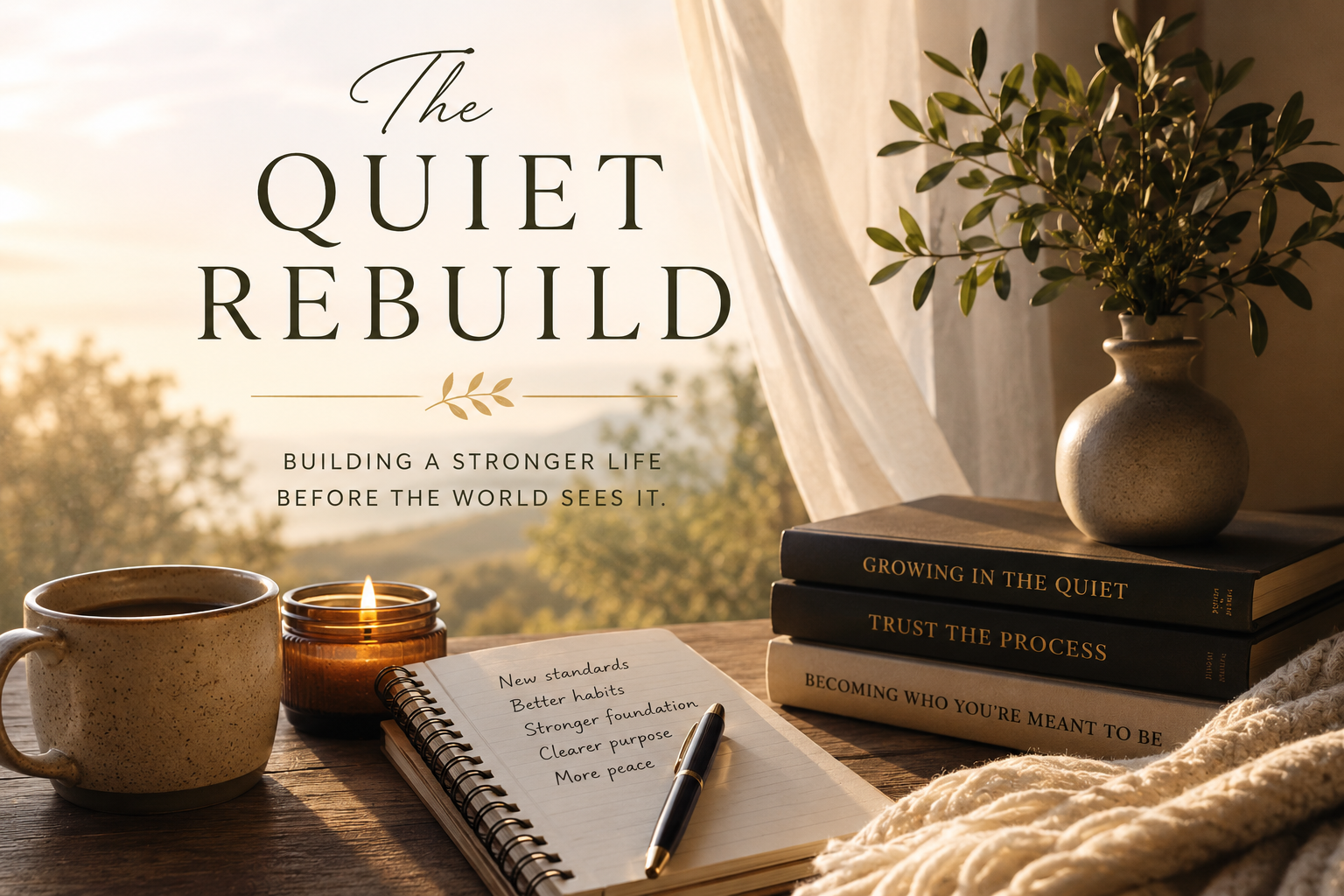
The Quiet Rebuild
Explore how to rebuild your life quietly through stronger foundations, better habits, clearer priorities, practical preparation, faith, and steady choices that create lasting change.
There are seasons when life does not fall apart loudly.
Nothing dramatic announces that change has begun.
You may still wake up in the same home.
Go to the same job.
Handle the same responsibilities.
Talk to many of the same people.
From the outside, very little appears different.
But somewhere beneath the visible life, something has shifted.
You begin questioning what you once tolerated.
You start recognizing what gives you peace and what continually takes it away.
You notice old patterns sooner.
You care less about appearing fine and more about building something that actually feels true.
You begin wanting more honesty.
More steadiness.
More room.
More meaning.
More of a life that agrees with the person you are becoming.
This is the quiet rebuild.
It is the hidden stage of transformation where the foundation begins changing before the new life has fully taken shape.
The outside may look familiar for a while.
But underneath it, you are beginning to build differently.
What Is a Quiet Rebuild?
A quiet rebuild is a period of intentional change that often begins before anyone else can see much difference.
It may come after disappointment.
After exhaustion.
After an ending.
After realizing something no longer fits.
Or it may begin without a crisis at all.
Sometimes nothing has collapsed.
You simply become unable to ignore a deeper truth:
I want to live differently now.
That realization can be enough.
A quiet rebuild may affect how you spend your time.
How you work.
How you handle money.
How you care for your health.
How you use your attention.
What you tolerate.
What you create.
What you protect.
What you prioritize.
What kind of future you prepare for.
You do not need to change everything at once.
The rebuild begins by strengthening what the rest of your life will eventually stand upon.
The Outside May Look the Same for a While
This can be one of the strangest parts.
You know something significant is happening.
But there may be nothing impressive to show for it yet.
No dramatic before-and-after.
No big announcement.
No obvious milestone.
You may still be living inside circumstances you intend to change.
Still working.
Still learning.
Still saving.
Still preparing.
Still sorting through what belongs and what does not.
The visible life can lag behind the internal decision.
That does not make the decision less real.
Sometimes transformation begins privately because the life around it has not caught up yet.
Foundation Comes Before Expansion
If you were rebuilding a house, you would not begin with curtains.
You would look at what carries the weight.
The foundation.
The structure.
The places that need reinforcement.
A life can work the same way.
Before asking:
How do I get more?
it can be useful to ask:
What needs to become stronger?
Perhaps your finances need attention.
Perhaps your routines.
Your health.
Your faith.
Your skills.
Your home.
Your relationships.
Your ability to finish what you begin.
Expansion built on unstable ground creates more pressure.
A quiet rebuild asks:
What needs to become solid before I ask it to carry more?
The Rebuild Often Begins With What You Will No Longer Normalize
Change frequently begins with recognition.
You notice something and cannot unsee it.
A constant rush you once called normal.
A habit that keeps taking more than it gives.
A way of working that leaves no room for living.
A pattern of overcommitting.
A dream continually pushed to “later.”
A life shaped too heavily around other people's expectations.
The first change may simply be:
I do not want to keep living this way.
That may sound small.
It is not.
Naming what no longer belongs creates the first opening for something different.
A New Life Often Begins With New Standards
A rebuild is not only about changing circumstances.
It can also involve changing what you consider acceptable.
What quality of life do you want to create?
What kind of work do you want to produce?
What deserves your time?
How do you want money handled?
What kind of home do you want to live inside?
What kind of relationships do you want to strengthen?
What do you expect from yourself?
What no longer deserves a permanent place in your life?
Standards quietly shape decisions.
Decisions shape patterns.
Patterns eventually shape the life.
You Begin Choosing Before You Arrive
The new life may not exist yet.
But you can begin choosing in its direction.
If you want a calmer life, begin reducing unnecessary chaos.
If you want financial stability, begin changing how money is handled.
If you want meaningful work, begin building the skills or ideas that could support it.
If you want a more creative life, create before anyone gives you permission.
If you want deeper faith, make space for faith now.
If you want greater freedom later, begin preparing for it now.
You do not have to wait for the future to arrive before practicing some of the qualities you want it to contain.
Quiet Choices Have Structural Power
Big changes attract attention.
Small choices build structure.
Going to bed earlier once does very little.
Creating a healthier rhythm can change how you function.
Saving money once is useful.
Building a pattern of saving creates stability.
Writing one page matters.
Writing consistently can eventually create a body of work.
One thoughtful decision may seem minor.
Making thoughtful decisions repeatedly changes direction.
A quiet rebuild is full of choices like these.
None may look revolutionary alone.
Together, they create architecture.
Invisible Progress Is Still Progress
During a rebuild, progress may hide in places you are not accustomed to measuring.
Perhaps you recognize an old pattern before repeating it.
Perhaps you recover faster after a difficult day.
Perhaps you are becoming more consistent.
Perhaps you are learning something you will need later.
Perhaps you no longer chase something that continually drains you.
Perhaps you are finishing things that once remained unfinished.
Perhaps you pause before making decisions you once made automatically.
Perhaps you are taking better care of what you already have.
These changes may not photograph well.
They still matter.
They are evidence that the structure underneath your life is becoming different.
Measure the Rebuild Differently
When visible results are slow, ask better questions.
Instead of:
Why am I not there yet?
Ask:
What am I doing differently than I was six months ago?
What am I handling more wisely?
What am I building that did not exist before?
What have I stopped feeding?
What am I learning?
Where am I becoming more consistent?
What is easier now because I have practiced it?
Progress is not always measured only by distance traveled.
Sometimes it is measured by the strength of what is being built along the way.
Rebuilding Includes Removing as Well as Adding
We often imagine transformation as accumulation.
More goals.
More plans.
More opportunities.
More habits.
More productivity.
But rebuilding also involves subtraction.
Removing commitments that no longer make sense.
Reducing clutter.
Ending unnecessary spending.
Closing projects you no longer intend to complete.
Making fewer promises.
Releasing old assumptions.
Creating more room.
Sometimes the strongest addition to your life is space.
Not Every Old Thing Needs to Be Destroyed
A rebuild is not demolition for the sake of demolition.
Some parts of your life may already be good.
Keep them.
Some relationships are worth strengthening.
Some routines work.
Some beliefs continue to serve you.
Some work remains meaningful.
Some traditions deserve to travel forward.
The purpose of rebuilding is not to prove that everything before was wrong.
It is to decide what is strong enough, useful enough, and true enough to remain.
A wise rebuild preserves what belongs.
Some Things Need Repair, Not Replacement
We live in a culture that often celebrates starting over.
New career.
New home.
New relationship.
New identity.
New everything.
But sometimes the better question is:
Can this be repaired?
Can the schedule change?
Can the business model improve?
Can a neglected gift be revived?
Can a habit be redesigned?
Can communication become clearer?
Can the home be reorganized?
Can something good become healthier instead of being discarded?
Not every difficult thing needs to be abandoned.
Sometimes the quiet rebuild involves making something worth keeping work better.
Other Things Truly Are Complete
And sometimes repair is not the answer.
Something has finished.
A role.
A dream.
A commitment.
A project.
A way of living.
A version of yourself.
You can appreciate what something gave you and still recognize that it no longer belongs in the structure you are building.
Completion is not disrespect.
Sometimes honoring a chapter means allowing it to end.
The In-Between Can Feel Uncomfortable
During a quiet rebuild, you may no longer fully identify with the old life.
But the new life has not completely arrived.
That can create a strange middle space.
You know too much to comfortably return.
But you may not yet have enough evidence to clearly describe what comes next.
This is where patience matters.
Not passive waiting.
Patient construction.
Learning.
Preparing.
Saving.
Testing.
Creating.
Observing.
Adjusting.
The unfinished stage is still part of the build.
You Do Not Need Everyone to Understand
Some changes make perfect sense only from inside the life being changed.
Other people may not see why something matters.
They may prefer the familiar version of you.
They may question why you are changing something that looks perfectly acceptable from the outside.
They may understand later.
They may never understand.
Listen to wise counsel.
But do not turn every outside opinion into authority over your direction.
A life designed entirely around making sense to everyone else can become difficult to recognize as your own.
The Quiet Rebuild Is Not a Performance
You do not need to announce every decision.
You do not need to document every stage.
You do not need to prove that something is changing.
There is power in allowing some work to remain private while it becomes stronger.
Learn quietly.
Save quietly.
Prepare quietly.
Build quietly.
Let consistency speak when it is ready.
A New Rhythm Matters More Than One Perfect Day
Rebuilding can become exhausting if every day has to be exceptional.
It does not.
You need rhythm more than perfection.
A rhythm for work.
Rest.
Money.
Movement.
Learning.
Creating.
Prayer.
Home.
Relationships.
Planning.
The right rhythm does not have to look impressive.
It has to be livable.
The goal is not to perform your ideal life once.
It is to create patterns capable of carrying ordinary life repeatedly.
Peace Is Not the Same as Avoiding Difficulty
A quieter life does not mean a life without challenge.
Peace can contain:
Responsibility.
Ambition.
Deadlines.
Building.
Learning.
Risk.
Difficult conversations.
Big dreams.
The question is whether the difficulty is connected to something meaningful or whether chaos has simply become the default.
You can work hard without living permanently at war with your own life.
Learning Can Be Part of the Rebuild
Sometimes the life you want requires abilities you do not yet have.
That is not a reason to abandon the vision.
It is information.
Learn.
Read.
Practice.
Take the course.
Ask someone who knows.
Make mistakes while the stakes are small.
Build competence before the opportunity requires it.
A quiet season of learning can become the invisible preparation behind a later breakthrough.
Money Can Be Part of the Foundation
A new life often needs financial structure.
Saving.
Reducing unnecessary expenses.
Increasing income.
Paying down obligations.
Planning before spending.
Building reserves.
Preparing for a move.
Preparing for a business.
Preparing for greater choice.
Money does not define purpose.
But financial reality affects options.
Strengthening your financial footing can be one of the most practical forms of rebuilding quietly.
Let Your Environment Support the Change
Willpower is useful.
Environment matters too.
If you want to create more, make creating easier.
If you want to read, keep the book where you see it.
If you want calmer mornings, prepare part of the morning the night before.
If you want a more peaceful home, begin with one room.
If you want to build something important, give it a physical place in your life.
Make the better choice easier to reach.
A rebuild becomes stronger when your surroundings begin supporting the direction you are choosing.
Faith Can Be Part of the Foundation
A quiet rebuild can also become a spiritual season.
A time of asking:
What truly matters?
What am I being called to release?
What deserves more of my attention?
Where do I need courage?
Where do I need patience?
Where do I need wisdom?
Prayer does not always produce a complete blueprint.
Sometimes it gives enough clarity for the next piece.
Enough strength for today.
Enough faith to continue building what you cannot fully see yet.
Ordinary Days Still Count
There will be days when nothing feels dramatic.
Days when the vision feels far away.
Days when progress seems almost invisible.
A meaningful rebuild is not undone by an ordinary Tuesday.
Return to the work.
The budget.
The habit.
The prayer.
The project.
The plan.
The next small thing.
A foundation does not need to be exciting.
It needs to hold.
What the Quiet Rebuild May Look Like
You may be rebuilding if you are becoming more intentional about how you use your time.
If you are questioning old definitions of success.
If you are simplifying parts of your life.
If you are learning before making a major move.
If you are saving or preparing financially.
If you are returning to creativity.
If you are finishing old unfinished business.
If you are becoming less interested in approval.
If you are building routines that support the future you want.
If you are more willing to wait for something that fits.
If you are quietly working on something not everyone knows about yet.
If you are becoming more honest about what you truly want.
Any one of these may seem small.
Together, they may be the beginning of an entirely different life.
A Quiet Rebuild Reflection
Take a blank page and create four sections.
WHAT NEEDS TO STAY?
What is already strong, meaningful, useful, or true in my life?
WHAT NEEDS TO CHANGE?
What continually creates unnecessary pressure, misalignment, or stagnation?
WHAT NEEDS TO BE BUILT?
What skill, habit, resource, relationship, project, or foundation does the life I want require?
WHAT CAN I DO QUIETLY NOW?
What is one action I can begin before anything else changes?
Then choose one answer from the final section.
Not ten.
One.
Make it specific enough that you can begin.
That is how the rebuild becomes real.
Do Not Rush the Reveal
There is a temptation to want the finished life immediately.
The new job.
The new home.
The successful business.
The stronger finances.
The completed project.
The visible transformation.
But there is value in letting a foundation become strong before asking it to support the entire dream.
Prepare carefully.
Build what you can.
Correct what needs correcting.
Keep learning.
Let some things mature before exposing them to pressure.
Not everything needs to bloom the day it is planted.
One Day the Quiet Work Becomes Visible
Eventually, something changes.
The project exists.
The move happens.
The finances are stronger.
The habit has become natural.
The work changes.
The home changes.
You carry yourself differently.
From the outside, it may look as though the transformation happened quickly.
You will know better.
You will know about the decisions nobody applauded.
The things you stopped doing.
The skills you practiced.
The money you saved.
The ideas you tested.
The prayers you prayed.
The times you returned after getting off track.
The visible change was simply the moment the hidden work became impossible to miss.
Build Quietly. Build Well.
You do not need your whole future today.
You need something solid enough to build upon.
A stronger habit.
A clearer priority.
A useful skill.
A wiser decision.
A repaired foundation.
One finished task.
One honest beginning.
Then another.
A quiet rebuild is not about disappearing from your life until you emerge as someone completely different.
It is about participating in your life differently while it is still becoming.
Keep what is good.
Repair what can be repaired.
Release what is complete.
Build what is missing.
Strengthen what must carry more weight.
Give the future somewhere solid to stand.
The outside may not look dramatically different yet.
That is all right.
Some of the most important work happens before anyone can see the finished structure.
Build quietly.
Build carefully.
Build something that can hold the life you are asking for.
Explore Further
Starting Over Without Shame
Explore how to begin again without turning your past, mistakes, or changed direction into evidence against your future.
Grieving Who You Used to Be
Explore how to honor an earlier version of yourself while allowing your identity and life to continue evolving.
The Loneliness of Growth
Explore the middle ground that can appear when you no longer fit old ways of belonging but have not yet found new ones.
How to Trust the Slow Season
Explore patience, preparation, and progress when the work is happening but results are taking longer than you hoped.
Building a New Life One Small Habit
Turn a bigger vision into repeated actions that gradually change the structure of your life.
Becoming Someone You Can Rely On
Explore how personal integrity, follow-through, honest decisions, and consistency can build deeper trust in yourself.
Rise Into the Person God Is Forming in You
A Soul2222 reflection on spiritual formation, becoming who God created you to be, faith, courage, personal growth, and rising into a stronger life.
Becoming Is Sacred Work
There is a person God is forming in you.
Not a stranger. Not an imitation. Not a polished version created to please the crowd. A truer version. A wiser version. A more faithful, peaceful, courageous, and whole version of who you were always meant to become.
This kind of becoming is sacred work.
It does not always happen quickly. It does not always feel graceful. Some seasons feel more like construction than transformation. There may be dust, delays, unfinished corners, and the occasional emotional toolbox left in the hallway. Still, God can be working in the middle of it all.
You are not required to have arrived in order to be loved.
You are not required to understand every step in order to be led.
You are not required to become everything at once.
Growth is often holy because it asks you to trust the One forming you, not just the version of yourself you can already see.
There is more in you than the current chapter has revealed.
Let that truth breathe.
Do Not Bow to the Old Version Forever
The old version of you may have carried you through seasons that required survival, but survival is not always the same as destiny.
There may be patterns, defenses, fears, habits, beliefs, and ways of responding that once made sense, but no longer match where God is leading you. You can honor what helped you survive without letting it rule the life you are now being invited to build.
You do not have to bow forever to the person you became under pressure.
You can grow.
You can soften.
You can become wiser.
You can learn a new response.
You can stop calling old fear your personality.
You can stop calling constant overgiving your identity.
You can stop calling self-doubt humility.
You can stop letting past disappointment write the constitution of your future.
God is not limited to the version of you that life has already seen.
This is good news.
The person being formed in you may have deeper peace than the old version knew how to carry. More courage than the old version thought was safe to use. More clarity than the old version believed was possible. More joy than the old version knew how to receive.
You are allowed to outgrow what once contained you.
Formation Happens in Daily Choices
Rising into the person God is forming in you happens through daily choices.
Not only through big breakthroughs.
Not only through emotional mountaintop moments.
Not only when life finally becomes calm, convenient, and neatly labeled like a pantry designed by angels.
Formation happens in the way you speak to yourself when you are tired. It happens in the boundary you keep after years of abandoning your peace. It happens in the prayer you whisper when fear tries to get loud. It happens in the honest decision to do what is wise, even when the old pattern is easier.
Every choice teaches your life what kind of person you are becoming.
A truthful choice forms you.
A peaceful choice forms you.
A courageous choice forms you.
A forgiving choice forms you.
A disciplined choice forms you.
A hopeful choice forms you.
Even small choices matter when they are made repeatedly. They become spiritual muscle. They become evidence. They become part of the structure of your becoming.
This is why you do not have to despise small beginnings.
God can use small obedient steps to build a life that looks very different over time.
Let God Shape What You Cannot Force
Some parts of becoming cannot be forced.
You can participate. You can obey. You can practice wisdom. You can show up with faith. You can make room for healing, learning, prayer, service, rest, and growth. But you cannot bully your soul into maturity. You cannot rush every season without missing what God is forming inside it.
There is grace in allowing God to shape what you cannot force.
Some wisdom comes with time.
Some strength comes through practice.
Some healing comes layer by layer.
Some clarity comes after surrender.
Some courage comes after you stop waiting to feel fearless.
Some peace comes when you finally stop trying to control what belongs in God’s hands.
Formation is not passive, but it is also not panic-driven.
You are not the manufacturer of your own soul. You are a living person being formed in partnership with God’s grace. That means your effort matters, but so does surrender. Your choices matter, but so does trust. Your growth matters, but so does patience.
Let God work deeper than your schedule.
Let grace do what striving cannot.
Let the hidden places become holy ground.
Rise With Faithful Courage
There comes a time when becoming asks you to rise.
Not because you feel perfectly ready.
Not because every fear has vanished.
Not because everyone understands your path.
You rise because God has been forming something in you that is ready to live more fully.
You rise by telling the truth.
You rise by choosing the next faithful step.
You rise by refusing to shrink back into old names.
You rise by letting your life agree with who you are becoming.
You rise by trusting that the same God who began the work can continue it.
This kind of rising is not performance. It is alignment. It is the inner life becoming visible through peace, courage, wisdom, love, discipline, and hope.
Let yourself become.
Let yourself grow into deeper truth.
Let yourself be strengthened where you used to be shaken.
Let yourself receive joy where you once expected disappointment.
Let yourself walk with the kind of faith that does not need the whole staircase before taking the next step.
The person God is forming in you is not meant to stay hidden under fear, old stories, or the weight of what has already been.
Rise into that person.
One prayer at a time.
One choice at a time.
One brave breath at a time.
The work is sacred.
The process is alive.
And the becoming is already underway.

Let Your Spirit Become Steady and Strong
A Soul2222 reflection on spiritual steadiness, inner strength, faith, peace, resilience, and learning how to stay rooted through life’s challenges.
Strength That Does Not Have to Strain
There is a kind of strength that does not have to strain to prove itself.
It is not loud. It is not frantic. It is not always visible to the room. It does not need to announce every battle it has survived or every mountain it is learning to climb. This strength lives deeper. It is the quiet spiritual steadiness that helps a person remain rooted when life becomes noisy.
A steady spirit is not a spirit that never feels.
It is a spirit that has learned where to return.
It can feel pressure without becoming pressure. It can face uncertainty without surrendering to panic. It can carry responsibility without allowing responsibility to erase peace. It can grieve, wait, hope, pray, rebuild, and still remain connected to the deeper truth that God is present.
This kind of strength is not born from pretending everything is fine.
It is formed by returning to what is true again and again.
A steady spirit says, “I may not know everything yet, but I know where my help comes from.”
That sentence alone can become an anchor.
When the Inner World Feels Scattered
Life has a way of scattering people.
One conversation can pull your attention. One worry can hijack your morning. One unexpected bill, delay, disappointment, or demand can make your thoughts run in five directions at once. The world is full of little spiritual weather systems, and not all of them deserve to move into your house and rearrange the furniture.
When your inner world feels scattered, it is easy to confuse motion with progress.
You may find yourself overthinking, overexplaining, overworking, refreshing, checking, reacting, replaying, planning, fixing, and carrying things God never asked you to hold alone. The body may be moving, but the spirit feels tired.
That is not failure.
That is a signal.
Your spirit may be asking to be gathered again.
Gathered through prayer.
Gathered through quiet.
Gathered through truth.
Gathered through wise boundaries.
Gathered through one honest breath at a time.
Steadiness often begins when you stop letting every concern become the center of your inner life. You can care deeply and still refuse to be consumed. You can be responsible and still remain rooted. You can take action without letting fear drive the whole vehicle like a raccoon with a steering wheel.
Your spirit needs a stronger driver.
Let peace take the wheel.
Steadiness Is Built Through Sacred Return
A steady spirit is not built in one dramatic moment.
It is built through sacred return.
Return to God when the day feels crowded.
Return to truth when your thoughts start spiraling.
Return to prayer before your emotions become your instructions.
Return to gratitude when your mind keeps counting only what is missing.
Return to your breath when your body feels like it is bracing for impact.
Return to the next right step when the whole future feels too large.
Sacred return is powerful because it trains your inner life to come back home.
You do not have to be perfectly steady to practice steadiness. You only have to return one more time than you drift. That is where strength grows. Not in never being shaken, but in learning how to be restored.
This is why small spiritual rhythms matter.
A morning prayer can gather the day before the world scatters it.
A written truth can interrupt an old lie.
A walk can help worry move through the body instead of setting up camp in the mind.
A moment of silence can let your spirit breathe.
A wise pause can keep you from handing your peace to the loudest emotion in the room.
These are not tiny things.
They are training grounds.
Strong Does Not Mean Unmoved
A strong spirit is not an unmoved spirit.
Even the strongest people need rest. Even faithful hearts can feel tired. Even people with deep spiritual roots can have days when everything feels too much. Strength does not mean you are made of stone. It means you are learning how to stay connected to God while being fully human.
There is honor in that.
You are allowed to have tender places.
You are allowed to need quiet.
You are allowed to step back and gather yourself.
You are allowed to say, “This is heavy, and I still believe God is with me.”
That is not weakness. That is honest strength.
A steady spirit does not deny the storm. It refuses to become the storm.
It can look at what is real without making fear the final authority. It can acknowledge difficulty without surrendering its identity to difficulty. It can take wise action without being ruled by panic.
This is mature strength.
It does not need to be constantly dramatic.
It does not need to win every argument.
It does not need to prove its spiritual depth by carrying more than it was designed to carry.
Sometimes strength looks like rest.
Sometimes strength looks like waiting.
Sometimes strength looks like trusting God with what you cannot control.
Sometimes strength looks like choosing peace before the problem is fully solved.
Become Rooted Enough to Rise
A steady and strong spirit changes how you move through life.
You begin to respond with more wisdom. You begin to notice what is worth your energy and what is only trying to steal it. You begin to stop confusing urgency with assignment. You begin to protect your peace without closing your heart. You begin to trust that God can strengthen you from the inside, even while the outside is still being worked out.
This is how you become rooted enough to rise.
Not rooted in perfect circumstances.
Rooted in truth.
Rooted in faith.
Rooted in prayer.
Rooted in wisdom.
Rooted in the quiet knowing that you do not have to be carried by chaos to keep going.
Let your spirit become steady and strong.
Let your inner life become less easily pulled by every passing fear.
Let God gather what has been scattered.
Let your thoughts become cleaner.
Let your heart become braver.
Let your peace become less negotiable.
You are not becoming hard.
You are becoming rooted.
And a rooted spirit can bend without breaking, wait without giving up, move without panic, and rise without losing itself.

Courage Looks Different When It Comes From Peace
A Soul2222 reflection on spiritual formation, becoming who God created you to be, faith, courage, personal growth, and rising into a stronger life.
Not All Courage Is Loud
Courage does not always roar.
Sometimes courage speaks quietly and still changes everything.
It may look like taking one steady breath before a hard conversation. It may look like choosing not to react from fear. It may look like walking away from a pattern that keeps wounding your peace. It may look like telling the truth calmly, setting a boundary without anger, or taking the next step without needing everyone to understand it.
There is a kind of courage that does not come from pressure.
It comes from peace.
This courage is not frantic. It is not desperate to prove itself. It does not need to slam doors, win every argument, or make a dramatic announcement to be real. It carries authority because it is rooted. It knows the difference between being moved by wisdom and being pushed by panic.
Peaceful courage is powerful because it does not abandon the spirit in order to be strong.
It lets you move with steadiness.
It helps you act from alignment instead of reaction.
It reminds you that strength does not have to become harsh to be holy.
Fear Pushes, Peace Leads
Fear often feels urgent.
It rushes. It pressures. It imagines the worst. It tells you that everything must be solved right now, explained right now, defended right now, fixed right now, or controlled right now.
Fear can make every decision feel like an emergency.
Peace leads differently.
Peace does not always remove the difficulty, but it changes the way you carry it. Peace gives you enough space to listen. It helps you ask better questions. It helps you separate wisdom from worry. It helps you recognize when your next step is being guided by faith instead of driven by anxiety.
This matters because courage born from fear can sometimes look strong on the outside while leaving the inside exhausted.
Peaceful courage has a different fruit.
It may still require action. It may still require honesty. It may still require a difficult yes or a difficult no. But it does not need chaos as its fuel.
You can be brave without being frantic.
You can be firm without being cruel.
You can be bold without being loud.
You can be strong without betraying your peace.
That is a deeper kind of courage.
The Courage to Stay Steady
One of the bravest things a person can do is stay steady when life invites them to spiral.
Steadiness is not passivity. It is not pretending nothing matters. It is not letting people walk over you while you whisper peaceful phrases into the wallpaper.
Steadiness is strength under guidance.
It is the ability to pause before reacting. To pray before answering. To listen before deciding. To tell the truth without handing your whole nervous system to the room. To remain anchored when pressure tries to pull you into old patterns.
This kind of courage is formed slowly.
It grows when you practice returning to God before returning to the problem. It grows when you stop letting every mood become your master. It grows when you learn that a delayed response can be a holy response. It grows when you realize you do not have to match the energy of everything that confronts you.
Sometimes courage looks like restraint.
Sometimes it looks like patience.
Sometimes it looks like choosing peace over the satisfaction of proving a point.
Sometimes it looks like letting God defend what your words cannot fix.
That is not weakness.
That is spiritual strength with clean hands.
Peaceful Courage Still Takes Action
Peaceful courage is not passive.
It does not mean you avoid hard choices. It does not mean you stay silent when truth needs a voice. It does not mean you accept what harms your spirit and call it maturity. Peaceful courage is not a decorative pillow with a Bible verse on it. It has backbone.
It may ask you to move.
To speak.
To decide.
To release.
To begin again.
To stop apologizing for a healthy boundary.
To walk through a door that fear told you was too big for you.
The difference is that peaceful courage moves from a rooted place.
It does not need to punish. It does not need to panic. It does not need to prove its worth through volume. It simply recognizes what is true and takes the next faithful step.
You can carry peace into difficult places.
You can carry peace into change.
You can carry peace into growth.
You can carry peace into a conversation that matters.
You can carry peace into a decision that stretches you.
Peace does not make you smaller.
It makes your courage cleaner.
Let Peace Give Your Courage a Home
When courage comes from peace, it has a place to return to.
You are no longer dependent on adrenaline to move forward. You are no longer waiting until you feel fearless. You are no longer measuring your strength by how loudly you can respond or how quickly you can control every unknown.
You begin to understand that courage can be quiet and still be powerful.
You can take the next step with your heart steady.
You can make a wise decision without turning it into a storm.
You can let your yes mean yes and your no mean no.
You can choose truth without losing tenderness.
You can protect your peace without closing your heart.
That is a beautiful kind of strength.
The world may not always recognize peaceful courage because it does not always perform for attention. But heaven knows. Your spirit knows. Your life will know by the fruit it produces.
More clarity.
More steadiness.
More honest boundaries.
More faithful movement.
More strength without unnecessary battle.
Let peace become the home your courage rises from.
You do not have to be loud to be brave.
You do not have to be frantic to be faithful.
You do not have to be harsh to be strong.
Courage looks different when it comes from peace.
And that difference may be exactly what helps you walk forward whole.

Build a Life That Reflects Your Spirit
A Soul2222 reflection on peaceful courage, spiritual strength, steady decisions, healthy boundaries, and moving forward from faith instead of fear.
Your Life Can Become an Honest Reflection
There is a kind of life that begins to feel honest.
Not perfect. Not polished for everyone else’s approval. Not built to impress people who are not even assigned to your path. Honest.
A life that reflects your spirit is a life where the outside begins to agree with what God is forming on the inside. Your choices, rhythms, relationships, words, work, rest, creativity, boundaries, and daily habits begin to carry more of your true values. You stop living only from obligation and start living from alignment.
This does not happen all at once.
It happens through small faithful decisions.
A cleaner yes.
A stronger no.
A gentler pace.
A braver prayer.
A wiser boundary.
A more truthful way of showing up.
Your spirit was not created to stay buried under noise, pressure, comparison, fear, and everyone else’s expectations. There is something in you that wants your life to feel more like home to your soul. Not because life will always be easy, but because it can become more truthful, more rooted, and more aligned with who you are becoming.
Stop Building Around What Shrinks You
Many people build their lives around what keeps them small.
They build around approval. Around survival. Around fear of disappointing others. Around old patterns. Around responsibilities that matter, but have taken up the whole room. Around the belief that peace must wait until everything else is handled.
But what shrinks your spirit cannot become the blueprint for your future.
There comes a time when you have to ask, “Is the life I am building making room for the person God is growing in me?”
That question can wake something up.
It can help you notice where you have been living too cramped. It can help you see where your schedule has no breathing room, where your words do not match your truth, where your energy is being scattered, and where your spirit has been quietly asking for a better rhythm.
This is not about throwing everything away and starting over in dramatic movie-scene fashion. No need to sell the couch, move to a mountain, and start communicating only with birds.
Sometimes rebuilding begins with one drawer, one decision, one boundary, one morning rhythm, one honest conversation, one brave adjustment.
Small changes can carry deep spiritual authority when they agree with truth.
Let Your Values Shape Your Design
A life that reflects your spirit is built from values, not just demands.
If peace matters to you, your life needs places where peace can breathe.
If faith matters to you, your days need room for prayer, reflection, and listening.
If creativity matters to you, your schedule needs space where ideas can stretch their legs.
If health matters to you, your choices need to honor your body as part of your stewardship.
If family matters to you, your presence matters more than constant performance.
If purpose matters to you, your habits must support what you say you are called to build.
Values are not meant to stay as beautiful words floating around in the air. They are meant to become design tools. They help you choose what belongs, what needs to be adjusted, and what no longer fits the life you are praying toward.
Ask yourself:
What do I want my life to carry more of?
What atmosphere do I want to create around me?
What do I want people to feel when they encounter my home, my words, my work, or my presence?
What part of my spirit has been waiting for more room?
These questions are not pressure. They are invitations.
They help your life become more intentional.
Build With Beauty, Order, and Meaning
The life you build does not have to look like anyone else’s.
It may be quiet and simple. It may be creative and colorful. It may be full of family, service, prayer, learning, nature, work, music, hospitality, healing, writing, laughter, solitude, or fresh starts. What matters is not whether it looks impressive from the outside. What matters is whether it carries truth from the inside.
Beauty matters.
Order matters.
Meaning matters.
Not because everything has to be fancy, flawless, or photograph-ready. A sacred life can still include laundry piles, unplanned detours, and at least one mystery container in the refrigerator that everyone is quietly afraid of.
But beauty, order, and meaning help the spirit feel honored.
A clean space can support a clearer mind.
A peaceful morning can shape the whole day.
A kind word can change the atmosphere.
A meaningful habit can become a pillar.
A small creative act can remind you that you are not only here to manage life. You are here to participate in it.
Build with what makes your spirit more awake.
Build with what makes your home feel more peaceful.
Build with what helps your days carry more purpose.
Build with what reminds you that your life is not random. It is being formed.
Let the Inner Life Become Visible
At some point, what God is doing inside you is meant to become visible through how you live.
Not as performance.
As fruit.
More peace in your responses.
More wisdom in your decisions.
More courage in your boundaries.
More kindness in your presence.
More faith in your next steps.
More joy in ordinary places.
More truth in the way you build your days.
You do not have to rush the process. You do not have to have every room of your life renovated by next Tuesday. Growth is sacred work, not a frantic construction project with spiritual hard hats flying everywhere.
Begin where you are.
Choose one area that can better reflect your spirit.
Your morning.
Your home.
Your words.
Your schedule.
Your relationships.
Your health.
Your creative life.
Your prayer life.
Your next step.
Let one part of your life come into better agreement with who you are becoming. Then let that agreement spread.
You are allowed to build a life that feels more honest.
You are allowed to create rhythms that support your spirit.
You are allowed to stop designing your life around what keeps draining it.
God did not place depth, light, wisdom, courage, and love within you so they could stay hidden forever.
Let your life begin to reflect your spirit.
Not perfectly.
Faithfully.
One beautiful, honest choice at a time.

Let Joy Return in Small Sacred Ways
A Soul2222 reflection on building a meaningful life that reflects your spirit, values, faith, peace, purpose, and inner growth.
Joy Does Not Have to Return All at Once
Joy does not always come back loudly.
Sometimes it returns in tiny sacred pieces.
A warm cup in your hands. A song that lifts your spirit. A clean corner of the room. A walk under open sky. A prayer whispered before the day gets busy. A laugh that surprises you. A moment of beauty you almost missed because life had trained you to look only for what needed fixing.
Joy often returns through small doors.
This matters because many people wait for life to become perfect before they let joy back in. They think joy belongs only after the problem is solved, the breakthrough arrives, the schedule calms down, the money stretches farther, the healing is complete, or every question has an answer.
But joy is not only a reward at the end of the road.
Joy can become provision along the way.
It can strengthen the heart while life is still in process. It can help the soul remember beauty even before everything feels easy. It can give the spirit little sparks of life when the day has been heavy.
Joy does not need a stage.
Sometimes it only needs permission.
Small Joys Are Not Small to the Soul
Small joys can carry more strength than they appear to hold.
A flower by the sidewalk. A favorite meal. Fresh sheets. Morning light. A funny little moment that wanders into the day like it forgot it was supposed to knock. A kind word. A quiet evening. A song from years ago. The smell of rain. A candle. A clean kitchen counter. A deep breath after a long stretch of holding too much.
These things may look ordinary, but ordinary does not mean empty.
The soul often receives renewal through simple things.
God can use beauty to soften what has become tense. God can use gratitude to open what has become guarded. God can use laughter to remind you that heaviness is not the only language your life is allowed to speak.
You do not have to apologize for needing joy.
You do not have to earn every beautiful moment through exhaustion.
You do not have to explain why something small helped you breathe again.
Joy is not shallow when it restores what life has been draining.
It is sacred when it helps your heart stay alive.
Joy Grows Where Attention Rests
Joy grows stronger when you learn to notice it.
Not force it.
Notice it.
There is a difference.
Forced joy tries to cover pain. Sacred joy sits beside real life and says, “There is still goodness here too.” It does not deny grief, pressure, responsibility, or hard seasons. It simply refuses to let them become the only things with a voice.
Your attention is powerful.
What you repeatedly notice becomes larger in your inner world. If you only notice what is missing, heavy, delayed, disappointing, or unfinished, your spirit can begin to believe the whole story is lack. But when you practice noticing what is still good, still beautiful, still kind, still possible, and still alive, your heart begins to recover a fuller view.
This is not about pretending life is easy.
It is about telling the whole truth.
Yes, there may be things you are carrying.
And yes, there may still be grace.
Yes, there may be questions.
And yes, there may still be beauty.
Yes, there may be work to do.
And yes, joy can still pull up a chair and behave like it belongs there.
Because it does.
Create Small Sacred Joy Rituals
Joy becomes easier to receive when you make room for it on purpose.
Create small sacred rituals that help your spirit remember life is not only about managing burdens. These rituals do not need to be fancy. No ceremonial trumpet required. Though, honestly, a tiny trumpet for Monday mornings might not hurt.
You can begin with simple practices:
Open the curtains and let morning light greet the room.
Play one song that lifts your spirit before the day gets crowded.
Take a short walk and look for one beautiful thing.
Write down three small gifts from the day.
Make your tea, coffee, or water slowly enough to actually receive the moment.
Light a candle while you pray.
Keep one corner of your home peaceful and uncluttered.
Speak one joyful sentence over your life: “There is still goodness here.” “God is still giving grace.” “My heart is allowed to breathe.” “Joy can return one small moment at a time.”
These practices are not childish.
They are wise.
They train the heart to recognize life again.
Let Joy Help You Keep Going
Joy is not separate from strength.
Joy can help you keep going.
It can give softness to a hard season. It can keep your heart from becoming only practical, only guarded, only tired. It can remind you that your life is not merely a list of responsibilities. You are a living soul, created for beauty, connection, worship, laughter, wonder, and meaningful delight.
Let joy return gently.
Let it return through music.
Let it return through gratitude.
Let it return through prayer.
Let it return through color, kindness, sunlight, movement, creativity, and little moments that make your spirit feel less crowded.
Do not despise the small joys because they are small.
Small joys can become sacred breadcrumbs leading you back to a fuller life.
You may still be building.
You may still be healing.
You may still be waiting.
You may still be learning how to breathe again after a season that asked too much of you.
But joy can meet you right there.
Not after you become perfectly whole.
Not after every question is settled.
Not after life stops being life.
Right there.
In the middle of the ordinary.
In the middle of the unfinished.
In the middle of the day God has given you.
Let joy return in small sacred ways.
It may begin as a flicker.
But flickers know how to become light.
Let Truth Strengthen the Life You Are Building
A Soul2222 reflection on welcoming joy back through gratitude, beauty, prayer, small rituals, and sacred daily moments.
Truth Is Strong Enough to Build On
A life becomes stronger when it is built with truth.
Not harsh truth. Not truth used like a hammer. Not truth that shames, belittles, or makes a person feel small. Real truth carries light. It clears the fog. It steadies the spirit. It helps you stop building on what cannot hold you.
Truth is one of the strongest materials a person can use to build a better life.
It helps you recognize what is real, what is aligned, what is no longer working, what needs care, and what God may be asking you to see with clearer eyes. Truth does not always arrive loudly. Sometimes it comes as a quiet knowing. Sometimes it comes through a repeated lesson. Sometimes it comes through peace. Sometimes it comes through the gentle discomfort of realizing you have outgrown an old pattern.
But when truth arrives, it brings strength with it.
Because truth gives your life something solid.
You cannot build a peaceful life while constantly denying what drains your peace. You cannot build a courageous life while pretending fear is not influencing your choices. You cannot build a meaningful life while ignoring the deeper call inside you. You cannot build from your highest self while agreeing with thoughts that keep you small.
Truth helps you begin again with cleaner ground.
False Things Can Feel Familiar
One reason truth takes courage is that false things can become familiar.
A person can get used to old stories: “This is all I can expect.” “I am too late.” “I always mess things up.” “Nothing will change.” “My voice does not matter.” “I have to shrink to be accepted.” “I have to carry everything alone.”
Those stories may feel familiar, but familiar is not the same as true.
Sometimes the mind repeats what pain taught it. Sometimes the heart protects itself by lowering its expectations. Sometimes the spirit grows quiet because it has been disappointed before. But a difficult season does not have the authority to define your entire life.
Truth can interrupt the old script.
Truth says, “You are still becoming.”
Truth says, “God is not finished with you.”
Truth says, “You can learn a new rhythm.”
Truth says, “You are allowed to live with more wisdom now.”
Truth says, “What happened may have shaped you, but it does not have to own you.”
This is why truth is so powerful. It does not only correct you. It frees you.
It helps you stop making agreements with things that were never meant to become your identity.
Truth Builds Inner Alignment
Truth strengthens your life by bringing your inner world into alignment.
When your words, choices, values, prayers, and daily actions begin to point in the same direction, you become steadier. You stop spending so much energy arguing with yourself. You stop trying to live two different lives inside one body. You begin to feel the strength that comes from being honest with God, honest with yourself, and honest about the life you are trying to build.
Alignment does not require perfection.
It requires willingness.
A willingness to notice where your life feels divided. A willingness to ask better questions. A willingness to choose what is healthy even when the old pattern is easier. A willingness to let truth lead you away from confusion and toward clarity.
You may need to ask:
What am I pretending not to know?
What is this season teaching me?
What keeps pulling me away from peace?
What kind of person am I becoming through this choice?
What would I do differently if I trusted God with the outcome?
These questions are not meant to weigh you down. They are meant to open windows. Truth lets fresh air into rooms you may have kept closed for too long.
And sometimes one honest question can become the beginning of a stronger life.
Build With What Can Hold You
If you are building a life, build with what can hold you.
Build with faith, not panic.
Build with wisdom, not impulse.
Build with peace, not performance.
Build with courage, not approval.
Build with honesty, not avoidance.
Build with prayer, not constant striving.
Build with gratitude, not endless comparison.
The materials matter.
A beautiful life is not only made from dreams. It is made from the choices that support those dreams. It is made from the thoughts you keep feeding, the habits you keep practicing, the boundaries you keep honoring, and the truth you keep returning to when life gets noisy.
This does not mean every day will feel strong.
Some days will feel wobbly. Some days you may have to remind yourself of the truth twelve times before breakfast, especially if the toast burns and the coffee acts emotionally unavailable. Still, truth remains available. You can return to it as often as needed.
Truth is not offended by repetition.
It is patient.
It is steady.
It keeps inviting you back to what is real.
Let Truth Make You Stronger
You do not have to be afraid of the truth that strengthens you.
The right kind of truth will not destroy the life God is helping you build. It will remove what cannot support it. It will help you release what keeps weakening your spirit. It will help you stop carrying false names, false limits, false guilt, and false expectations.
Truth may ask you to grow, but it will not ask you to abandon your soul.
Let truth make your life stronger.
Let it shape your thoughts.
Let it clean up your yes.
Let it strengthen your no.
Let it help you recognize what belongs in the future and what belongs in the lesson.
Let it teach you how to build from a place of deeper wisdom.
You are not building a perfect life.
You are building an honest one.
A faithful one.
A stronger one.
A life with clearer foundations, cleaner rooms, wider windows, and enough light to keep becoming.
When truth strengthens the life you are building, you no longer have to decorate what is unstable. You can begin again from what is real.
And what is real can hold you.

Nourish What Keeps You Bright
A Soul2222 reflection on truth, spiritual strength, inner alignment, honest growth, and building a better life with faith and wisdom.
Your Inner Life Needs Care
Brightness is not only something you feel.
It is something you care for.
The strength of your spirit, the steadiness of your thoughts, the hope in your heart, and the peace you carry through the day all need nourishment. A person cannot constantly pour from an empty place and expect the soul to stay lively, clear, and strong. Even the brightest life needs tending.
This is not about becoming delicate.
It is about becoming wise.
Your inner life is a sacred garden, not a storage closet for everyone else’s noise. What you allow in matters. What you keep repeating matters. What you give your attention to matters. What you believe about yourself matters. What you practice every day begins to shape the atmosphere inside you.
If you want your life to stay bright, you have to nourish what gives life.
Truth.
Prayer.
Rest.
Gratitude.
Beauty.
Purpose.
Courage.
Healthy connection.
Honest joy.
These are not decorations. They are inner provisions. They help your spirit breathe, your mind settle, and your heart remember that life is still full of holy possibility.
You Cannot Feed the Soul Only Scraps
Many people try to live from the leftovers of their own attention.
They give their best energy to pressure, problems, screens, obligations, worry, comparison, and everyone else’s urgency. Then they wonder why their spirit feels dim, their thoughts feel crowded, and their hope feels tired by the end of the day.
The soul was not meant to survive on scraps.
You are allowed to give your inner life something better than whatever is left after the world has had its turn.
This does not mean ignoring responsibility. It means refusing to let responsibility become the only thing that receives your care. You can be faithful to your life without abandoning your spirit. You can handle what needs to be handled and still make room for what keeps you alive inside.
Small nourishment counts.
A quiet morning counts.
A truthful sentence counts.
A worship song in the car counts.
A walk under open sky counts.
A peaceful conversation counts.
A clean boundary counts.
A moment of laughter that sneaks in wearing muddy boots counts too.
Your spirit does not always need something complicated.
Sometimes it just needs to be remembered.
Choose Inputs That Strengthen You
What you consume becomes part of the atmosphere you live in.
Words have weight. Music has weight. Conversations have weight. Social feeds have weight. Repeated thoughts have weight. Environments have weight. The things you take in may not control you completely, but they do influence what feels normal, possible, acceptable, and true.
That is why wise nourishment requires discernment.
Ask yourself what leaves you stronger.
Ask what leaves you scattered.
Ask what pulls you toward faith.
Ask what keeps dragging you into fear.
Ask what helps you become more honest, peaceful, courageous, and awake.
Not everything deserves access to your inner world. Some things may be common, popular, funny, dramatic, familiar, or entertaining, but still leave your spirit heavy. You are allowed to choose cleaner air for your soul.
This is not about living sealed away from reality. It is about not feeding your spirit a steady diet of despair and then wondering why hope feels far away.
Choose what strengthens the life you are building.
Choose what helps you think clearly.
Choose what reminds you of God’s goodness.
Choose what helps you stay kind without becoming drained.
Choose what makes your heart more awake to beauty, truth, courage, and purpose.
A brighter life often begins with better nourishment.
Brightness Grows Through Rhythm
The things that nourish you work best when they become part of your rhythm.
One beautiful moment can encourage you, but repeated nourishment begins to shape you. The prayer you return to. The truth you speak daily. The walk you take often. The gratitude you practice. The quiet you protect. The people you choose wisely. The habits that help your nervous system settle and your spirit remember its strength.
Rhythm builds brightness.
Not because every day feels magical.
Some days will still feel plain. Some days will feel hard. Some days your coffee may taste like ambition and laundry lint had a meeting. But even ordinary days can carry sacred care when you choose rhythms that help you stay connected to what matters.
You do not have to overhaul your entire life.
Begin with one nourishing rhythm.
Read something that strengthens you before the noise begins.
Pray before you start carrying the day.
Write down one thing that is still good.
Move your body in a way that helps energy flow.
Step outside and let the sky remind you that life is larger than your current concern.
End the day with peace instead of scrolling your spirit into exhaustion.
Little rhythms become inner architecture.
Over time, they build a life that can hold more light.
Protect What God Is Growing in You
There is something God is growing in you that deserves protection.
Your peace deserves protection.
Your hope deserves protection.
Your clarity deserves protection.
Your courage deserves protection.
Your joy deserves protection.
Not because you are fragile, but because what is valuable should be cared for with wisdom.
You do not have to explain every boundary. You do not have to consume every opinion. You do not have to carry every atmosphere. You do not have to make yourself constantly available to what empties you and then call it love.
Love can be generous and wise at the same time.
A bright spirit is not built by accident. It is nourished by intention. It is strengthened by truth. It is protected by discernment. It is renewed by returning to God, again and again, in the middle of real life.
So nourish what keeps you bright.
Feed the parts of you that are still reaching for goodness.
Make room for what restores your peace.
Choose what strengthens your becoming.
Let joy have a chair at the table.
Let truth open the windows.
Let prayer light the room.
Your brightness is not something you have to perform.
It is something you are invited to tend.
And with faithful care, it can grow into a steady glow that blesses the life you are building.
Let Inner Clarity Lead the Way Forward
A Soul2222 reflection on nourishing your inner life with truth, prayer, peace, joy, healthy rhythms, and spiritual strength.
The Gift of a Clearer Spirit
There are moments when the next step does not need to be forced.
It needs to be heard.
Inner clarity is one of the quiet gifts of a steady spirit. It is that deeper knowing that begins to rise when fear grows tired, noise settles down, and your heart finally has enough room to tell the truth. It may not hand you the whole road. It may not explain every detail. But it can help you recognize the next faithful step.
That is often where forward movement begins.
Not with total certainty.
Not with a perfect plan.
Not with every question answered.
But with enough light for the part of the path you are standing on today.
Inner clarity matters because life can become crowded with opinions, pressure, urgency, expectation, memory, and fear. The world can be loud about what you should want, who you should be, what you should chase, and how quickly you should get there. But your soul was not created to live permanently pulled by every outside voice.
There is a deeper place in you that knows when something is honest.
There is a steadier place in you that can recognize peace.
There is a God-given wisdom that helps you move forward without betraying yourself to get there.
Noise Can Make Direction Feel Far Away
When life is noisy, direction can feel distant.
Too many voices can scatter your focus. Too much comparison can make your own path look insufficient. Too much urgency can convince you that you must move quickly even when your spirit is asking for wisdom. And too much fear can make every option look dangerous, even the ones that could lead to growth.
This is why clarity often begins with quiet.
Not because silence magically solves everything, but because it gives truth room to be heard.
Sometimes the reason you cannot see the way forward is not because the way does not exist. It is because your inner life has been filled with too much static. Old disappointments are speaking. Other people’s expectations are speaking. Fear of failure is speaking. Fear of being judged is speaking. The tired version of you is trying to make decisions that require the anchored version of you.
Pause matters.
Prayer matters.
A slower breath matters.
Stepping away from the noise long enough to ask, “What is actually true here?” can become a turning point.
Not every voice deserves authority over your next chapter.
Clarity Is Built Through Honesty
Inner clarity does not grow through pretending.
It grows through honesty.
You become clearer when you tell the truth about what strengthens you and what drains you. You become clearer when you admit what you have outgrown. You become clearer when you stop decorating confusion and start listening for peace. You become clearer when you stop asking fear to approve your future.
Honesty can be gentle and still be strong.
You can lovingly admit, “This no longer fits.”
You can calmly say, “I need a better rhythm.”
You can faithfully recognize, “God is leading me toward something different.”
You can bravely accept, “The old way may be familiar, but familiar is not the same as fruitful.”
This kind of honesty does not tear your life apart. It helps you build with cleaner materials. It removes some of the fog from your decisions. It helps you choose from truth instead of reaction.
Clarity does not always feel dramatic.
Sometimes it feels like a quiet yes.
Sometimes it feels like a sacred no.
Sometimes it feels like peace returning to your chest after you finally stop arguing with what you already know.
Let Peace Become a Compass
Peace is not the only guide, but it is a powerful one.
There are times when God leads with conviction. There are times when wisdom comes through counsel, timing, scripture, experience, or a closed door that protects you from a road you were not meant to walk. But one of the ways the spirit recognizes alignment is through peace.
Not comfort.
Peace.
Comfort wants everything easy.
Peace can remain steady even when the step requires courage.
This matters because a clear path is not always the easiest path. Sometimes the right step asks you to grow. Sometimes it asks you to be patient. Sometimes it asks you to stop explaining yourself to people who are committed to misunderstanding your becoming. Sometimes it asks you to move slower, cleaner, wiser, and more prayerfully.
Let peace have a voice in your decisions.
Before you say yes, ask if your spirit is steady.
Before you chase something, ask if it is aligned.
Before you keep carrying something, ask if it still belongs to your assignment.
Before you step forward, ask whether you are moving from faith or from panic.
A life led by clarity becomes less frantic.
It becomes more rooted.
One Faithful Step Is Enough for Today
You do not need to see the entire road to move forward.
You need the next faithful step.
That step may be small. It may be a conversation, a boundary, a prayer, a plan, a decision, a pause, a release, a repair, a new rhythm, or one honest act of courage. Small steps are not small when they are taken in alignment with truth.
Forward is not always fast.
Sometimes forward is cleaner thinking.
Sometimes forward is refusing to spiral.
Sometimes forward is choosing peace over performance.
Sometimes forward is saying, “I will not let confusion become my home.”
Trust the clarity God is growing in you. Let it mature. Let it speak softly without being ignored. Let it guide you away from what keeps scattering your spirit and toward what helps your life become more whole.
You are not required to rush.
You are invited to listen.
You are not required to force every door.
You are invited to walk with wisdom.
When inner clarity leads the way forward, your life begins to move with a different strength. Not loud. Not frantic. Not desperate to prove itself.
Steady.
Honest.
Guided.
And ready for the next faithful step.

When Hope Begins to Glow Again
Hope Can Return Quietly
Hope does not always come back like a trumpet.
Sometimes it returns like a small lamp in a dark room. A little warmth. A little breath. A little opening in the heart where everything had felt closed. It may not answer every question at once, but it begins to remind you that your future is not finished.
That is enough to begin.
Hope is powerful because it gives the soul somewhere to stand while life is still unfolding. It does not deny the hard things. It does not pretend every wound vanished overnight. It simply says, “There is still more here. There is still grace available. There is still a way forward.”
When hope begins to glow again, your whole inner world starts to change.
Not always dramatically.
Sometimes it starts with a gentler thought. A calmer morning. A moment of peace that lasts longer than expected. A desire to try again. A willingness to believe that what has been heavy does not have to be permanent.
Hope is not weakness.
Hope is spiritual oxygen.
It helps the heart breathe again.
The Moment Before Renewal
Before hope fully returns, there is often a tender middle place.
You may not feel defeated anymore, but you may not feel strong yet either. You may sense something shifting, but you may not know what it means. You may feel a quiet pull toward life again, even while part of you still wonders whether it is safe to believe.
This middle place deserves honor.
It is easy to rush renewal. It is easy to want the full bloom before the roots have finished gathering strength. But hope often starts beneath the surface before it becomes visible. It begins in the hidden decision to keep your heart open. It begins when you stop agreeing with despair. It begins when you let a better possibility sit beside the pain.
You do not have to have giant faith to begin again.
You can begin with a mustard seed of trust.
You can begin with one prayer.
You can begin with one hopeful sentence.
You can begin by saying, “Maybe God is not finished here.”
That small opening can become sacred ground.
Hope Changes What You Can See
When hope begins to glow again, it changes your vision.
Not because everything outside you changes immediately, but because something inside you starts looking for life again. You begin to notice possibilities that discouragement made invisible. You begin to hear truth over fear. You begin to recognize that a difficult chapter can be real without becoming your whole identity.
Hope gives your future room to breathe.
It helps you stop living only from what happened. It helps you imagine what could still be restored, built, healed, learned, forgiven, strengthened, or newly chosen. Hope does not erase wisdom. It does not ask you to ignore patterns or walk back into places that harmed your peace. True hope is not blind. It is awake.
It says, “I can move forward with open eyes and a stronger spirit.”
That kind of hope is beautiful.
It is not childish.
It is mature.
It has walked through weather and still believes there can be morning.
Ways to Welcome Hope Back
Hope grows when you make room for it.
Start by being careful with what you repeatedly feed your mind. Constant fear, comparison, bitterness, and noise can smother hope before it has a chance to breathe. Choose inputs that strengthen your spirit. Read what steadies you. Listen to what lifts your thoughts. Spend time with voices that remind you of truth, not just trouble.
Then practice naming evidence of goodness.
Write down one thing that still works. One thing that helped. One thing you learned. One person who cares. One prayer that carried you. One way you have grown. One small sign that life is not only loss, pressure, or struggle.
Hope becomes stronger when you give it honest evidence.
You can also create a simple hope rhythm:
Each morning, speak one promise over your life.
Each evening, name one thing that did not go wrong.
Each week, take one action that agrees with the future you are praying for.
This is not about pretending. It is about partnering with what is still possible.
Hope grows when your choices stop arguing with your prayers.
Let the Glow Become a Flame
There may be a day when you realize hope has returned in a way you can feel.
Not because everything is perfect, but because you are no longer standing in the same place inside yourself. Something has softened. Something has strengthened. Something has opened. Your spirit is not holding its breath the way it used to.
That is grace.
Let it grow.
Let hope become courage. Let courage become movement. Let movement become a new rhythm. Let that rhythm become evidence that God can bring life back to places that felt quiet for a long time.
You are allowed to believe again.
You are allowed to want more from life.
You are allowed to prepare for a future that has not fully arrived yet.
When hope begins to glow again, do not dismiss it because it starts small. Small holy beginnings are still beginnings. A single spark can warm the next step. A single next step can open the road.
Let hope glow.
Let it gather.
Let it teach your heart to look forward again.

The Light That Rises Within You
A Soul2222 reflection on renewed hope, faith, courage, healing, and learning to believe in a better future again.
The Quiet Strength Inside You
There is a light within a person that life does not always explain.
It is not always loud. It does not always arrive with confidence, applause, or perfect timing. Sometimes it rises quietly, underneath the ordinary moments, underneath the tired places, underneath the parts of you that have had to keep going while still healing, learning, rebuilding, and becoming.
This light is not pretend positivity. It is not the kind of brightness that ignores reality. It is deeper than mood and stronger than a passing feeling. It is the God-given part of you that keeps reaching for truth, courage, hope, peace, and purpose even when life has tried to make you forget what you carry.
You may not always feel radiant. You may not always feel strong. But there is still something inside you that knows how to rise.
That matters.
Because the light within you is not only for beautiful days. It was given to you for the difficult ones too.
This reflection begins a Soul2222 series on the light God places within a person: how it rises, how hope returns, how clarity leads, how truth strengthens, how joy restores, and how a life becomes steadier, brighter, and more aligned with who God is forming you to be.
When Life Covers What Is Still Alive
There are seasons when your light can feel covered.
Covered by responsibility. Covered by disappointment. Covered by grief, pressure, exhaustion, confusion, old stories, heavy news, hard conversations, or the endless little demands of daily life. A person can still have light and yet feel dimmed by what they have been carrying.
But covered is not the same as gone.
A cloudy sky does not erase the sun. A tired heart does not erase the soul. A hard season does not erase the design God placed within you. Sometimes what feels like darkness is not the absence of light. Sometimes it is the place where your light is being strengthened in a quieter, deeper way.
You do not have to force yourself to shine for everyone. You do not have to perform brightness. You do not have to pretend life has been easy.
But you can begin to honor the light that remains.
You can notice the small evidence: the prayer you still whispered, the kindness you still offered, the truth you still wanted, the better life you still imagined, the courage you still reached for, even when your hands were tired.
That is light.
Not flashy. Not fragile. Real.
Your Light Is Connected to Your Becoming
The light within you is not only about feeling better. It is connected to who you are becoming.
It helps you choose what is honest. It helps you recognize what gives life and what drains it. It helps you stop shrinking to fit places that do not honor your spirit. It helps you return to peace when the world feels noisy. It helps you build from a place that is deeper than fear.
This is why your inner life matters.
What you feed, you strengthen. What you honor, you grow. What you return to, you begin to live from.
When you give attention to truth, your life becomes clearer. When you give attention to gratitude, your heart becomes more awake. When you give attention to faith, your spirit remembers it is not alone. When you give attention to courage, your next step becomes possible.
The light within you rises through daily alignment.
Not through perfection.
Through returning.
Through choosing.
Through listening.
Through refusing to let the hardest parts of life become the final definition of who you are.
How to Let the Light Rise Again
Letting your light rise does not require a grand performance. It begins with small, honest movements.
Begin by creating a little room for silence. Even one quiet minute can become a doorway back to yourself. Place your hand over your heart. Breathe slowly. Speak one true thing: “God is still with me.” “I am still becoming.” “This is not the end of my story.” “There is still light in me.”
Then choose one life-giving action.
Open the window. Drink water. Write one sentence. Say one prayer. Take one walk. Send one kind message. Clean one small space. Step away from one draining conversation. Speak to yourself with more honor. Do one thing that tells your spirit, “We are not giving up on this life.”
Small choices matter because light often returns through rhythm.
A life does not become brighter only through big breakthroughs. It becomes brighter through repeated acts of faithfulness. One honest thought. One grounded breath. One better choice. One moment of courage. One sacred refusal to abandon yourself.
That is how light rises.
Little by little.
Then all at once, you realize you are standing differently.
A Soul Reminder for the Road Ahead
You are not empty because you are tired.
You are not finished because you are still becoming.
You are not behind because your growth has taken time.
There is a light within you that has survived more than people know. There is wisdom being formed in you. There is strength being gathered in places no one can see. There is purpose still unfolding, even if today only gives you one step and not the whole map.
Honor the light God placed within you.
Protect it from what constantly drains it. Feed it with truth. Let it breathe in peace. Let it be warmed by prayer, beauty, courage, gratitude, and honest love.
You do not have to become someone else to rise.
You are invited to become more fully the person God has been forming in you all along.
The light that rises within you is not small.
It may have been quiet.
But it is holy, steady, and still alive.
Speak a New Life Into Motion
Your words, choices, faith, focus, standards, and daily rhythm can help move your life in a stronger direction. Learn how to speak life with wisdom and begin again with honor.
Not by pretending. Not by performing. Not by throwing pretty words over places that need healing, wisdom, repair, or action. Speak a new life into motion by making a new agreement with truth.
A person can live for years under old agreements.
“I am stuck.”
“I am too late.”
“I always fail.”
“Nothing changes for me.”
“I do not know how to become different.”
Those sentences may have come from pain. They may have been shaped by disappointment, exhaustion, family patterns, difficult seasons, or repeated discouragement. But old agreements do not have to become permanent homes.
You can speak differently.
You can choose differently.
You can pray differently.
You can begin again with more honor than fear.
This is not about using words as a magic wand. It is about using words as a steering wheel, a seed, a lamp, a gate, and a faithful form of participation.
Words alone do not build a life.
But words can help your life start moving in a new direction.
Your life is listening.
Let it hear a new agreement.
Begin With the Agreement You Are Breaking
Before a new life can move freely, an old agreement often has to lose authority.
You may need to break agreement with defeat.
Break agreement with constant self-criticism.
Break agreement with the belief that your past gets to define your whole future.
Break agreement with fear that keeps calling itself wisdom.
Break agreement with delay that keeps calling itself timing.
Break agreement with chaos that keeps calling itself normal.
A broken agreement can begin with one honest sentence:
“I do not have to live under this voice anymore.”
That sentence is not small.
It creates space.
It tells your inner life that the old pattern no longer has unquestioned authority. It tells your future that you are no longer willing to keep repeating the language that buried your hope. It tells your spirit that you are ready to listen for something higher.
You do not need to know every step forward to break agreement with what is harming you.
You can simply say:
“This is not the final word over my life.”
That is a beginning.
A holy one.
Speak Words That Have Roots
Life-giving words should have roots.
They should be connected to truth, faith, wisdom, responsibility, and action. Words without roots can feel thin. They may sound nice for a minute, but they do not hold when the weather changes.
Rooted words are different.
They do not deny hard things.
They speak from a deeper place.
“I am tired, but I can take one faithful step.”
“I am learning, and I am allowed to grow.”
“I have made mistakes, but I am not a mistake.”
“I do not see the whole road, but God can guide the next step.”
“I can build with what is in my hands today.”
“I am no longer using my words to curse my future.”
These words have roots because they tell the truth and make room for strength.
They are honest enough to be trusted.
They are hopeful enough to lead.
They are faithful enough to keep the future open.
The goal is not to sound perfect.
The goal is to speak words your life can stand on.
Let Your Choices Answer Your Words
Words become stronger when choices answer them.
If you say, “I want peace,” let one choice protect peace.
If you say, “I am becoming healthier,” let one choice support your body.
If you say, “I trust God,” let one choice reduce panic and return to prayer.
If you say, “My future matters,” let one choice prepare for it.
If you say, “I am no longer available for this old pattern,” let one choice close the door.
This is where a new life begins to move.
Not in the mouth only.
In the rhythm.
The word becomes a step. The step becomes evidence. The evidence becomes confidence. The confidence becomes a new way of walking.
You do not have to prove everything today.
Simply let one choice agree with one better sentence.
That is how movement begins.
A life does not always change because someone finally makes a huge declaration. Sometimes it changes because a person speaks one truer thing and then takes one small step that proves they meant it.
That is strong.
That is beautiful.
That is how the future starts hearing a new sound.
Speak to the Future With Stewardship
Your future is not something to bully, chase, or panic over.
It is something to steward.
Speak to your future with care.
Do not speak to it like it is closed.
Do not speak to it like it is impossible.
Do not speak to your future as though fear, delay, or disappointment have the final word.
Speak to your future like God is still able to lead you.
Speak to it like wisdom can still grow.
Speak to it like your daily choices still matter.
Speak to it like healing can still happen.
Speak to it like provision can still come.
Speak to it like new strength can still rise inside ordinary days.
Stewardship says, “I will treat what I cannot fully see with reverence.”
That includes your future.
You do not need to know the whole shape of what is coming to speak with faith today. You can speak blessing over the direction. You can speak courage over the next step. You can speak peace over your nervous system. You can speak wisdom over your decisions. You can speak gratitude over what is already here.
The words you choose today can help create the atmosphere your future grows inside.
Make that atmosphere clean.
Make it faithful.
Make it brave.
Make it honest.
Make it alive.
Put the New Life in Motion Today
A new life does not have to begin with a dramatic announcement.
It does not need a stage, a microphone, or a banner flapping in the wind.
It can begin quietly.
With a sentence.
With a prayer.
With a choice.
With a boundary.
With a cleaned corner.
With a walk.
With a page written.
With a task completed.
With an apology.
With a refusal to keep feeding the old story.
With a decision to speak life where you used to rehearse defeat.
This is how motion begins.
Not all at once.
Not perfectly.
But truly.
Say it:
“I am willing to build with God’s help.”
“I am not finished.”
“I can begin again.”
“I choose what strengthens me.”
“I release the old agreement.”
“I speak life over the future I am learning to prepare for.”
Then let your day answer.
Let your choices answer.
Let your rhythm answer.
Let your standards answer.
Let your focus answer.
Let your faith answer.
Your life is listening.
Let it hear a new sound.
Let it hear the sound of someone no longer using their own words as chains.
Let it hear the sound of someone choosing with more honor.
Let it hear the sound of someone preparing for peace, strength, wisdom, provision, healing, and purpose.
Let it hear the sound of motion.
Speak a new life into motion.
Then walk like your words opened a road.
Continue the Journey
Your Life Is Listening
Words That Build the Life You Want
Believe in a Future Worth Preparing For
If this message resonated, you may also enjoy:
Your Soulful Pathways ↑

Believe in a Future Worth Preparing For
A better future begins with belief, preparation, faith, and daily stewardship. Learn how to prepare for the life you are praying, building, and becoming strong enough to carry.
Not a perfect future. Not a fantasy future. Not a life without storms, work, growth, responsibility, or change. A worthy future. A future with more peace, wisdom, strength, faith, stewardship, purpose, health, clarity, love, and room to breathe.
A future like that deserves preparation.
Many people say they want something better, but they live as though nothing better could ever arrive. They pray for open doors while keeping every inner room crowded with fear. They hope for change while giving all their daily energy to the same old patterns. They want a clearer life while continuing to feed confusion first.
This is not a character flaw.
Often, it is because disappointment has trained them to stop preparing.
But faith begins to restore preparation.
Faith says, “I am willing to get ready for what I cannot fully see yet.”
Faith says, “I will not let yesterday convince me there is nothing worth building.”
Faith says, “God can still grow something beautiful from my obedience, stewardship, wisdom, and daily return.”
A future worth preparing for will not ask you to become fake. It will ask you to become aligned.
It will ask your words to rise.
It will ask your choices to agree.
It will ask your daily rhythm to support what your heart keeps praying for.
Your life is listening.
Let it hear preparation.
Hope Becomes Stronger When It Is Honored
Hope is not meant to sit in a corner waiting to be rescued.
Hope needs honor.
You honor hope when you give it a place in your schedule, your habits, your thoughts, your prayers, and your decisions. You honor hope when you stop treating it like a fragile wish and begin treating it like sacred instruction.
If you hope for a healthier life, honor that hope with one better choice.
If you hope for peace, honor that hope by reducing what keeps disturbing your spirit.
If you hope for stronger faith, honor that hope by making room for prayer, scripture, worship, and quiet return.
If you hope for better work, honor that hope by learning, preparing, organizing, practicing, and showing up with excellence.
If you hope for a cleaner future, honor that hope by no longer feeding the old agreement with fear.
Hope becomes stronger when it is practiced.
This does not mean you can control every outcome. You are not the ruler of timing, people, provision, or every open door. But you are the steward of your participation. You can prepare the field. You can water what matters. You can remove what keeps choking the roots.
Hope that is honored begins to gain strength.
It becomes less like a wish and more like a witness inside you.
It says, “I am still alive here.”
Listen to that.
Preparation Is a Form of Faith
Preparation is one of faith’s quiet languages.
It is easy to recognize faith when someone speaks boldly, prays with confidence, or keeps believing through a hard season. But faith also shows up in ordinary preparation.
It looks like cleaning the space.
Paying attention.
Learning the skill.
Writing the plan.
Saving what you can.
Resting before you break down.
Choosing the healthier rhythm.
Finishing the small task.
Making room in your life for what you are asking God to help you carry.
Preparation says, “I believe there is something worth becoming ready for.”
That is holy.
You do not prepare because you are trying to force God’s hand. You prepare because your life has been entrusted to you. You prepare because wisdom matters. You prepare because answered prayers often require a vessel strong enough to steward them.
A future blessing can become heavy if the inner life has not been strengthened to carry it.
This is why preparation matters.
It strengthens the vessel.
It teaches the life to hold more peace, more responsibility, more clarity, more discipline, more love, and more purpose without collapsing into old patterns.
Preparation does not need to be dramatic.
Sometimes faith is a clean desk.
Sometimes faith is a calendar.
Sometimes faith is a quiet prayer before the day begins.
Sometimes faith is learning what you need to learn before the door opens.
Your Present Is the Soil of Your Future
The future is not separate from today.
Today is soil.
What you plant here matters. What you repeat here matters. What you tolerate here matters. What you water here matters. What you keep pulling up by the roots matters too.
A future worth preparing for begins receiving shape from the present.
That can feel sobering, but it can also feel freeing. You do not have to wait for a grand moment to begin participating. You do not have to wait for perfect confidence, perfect timing, or perfect conditions. You can start preparing in the soil of today.
One wiser word.
One cleaner choice.
One protected boundary.
One faithful rhythm.
One small act of order.
One moment of prayer.
One honest look at what needs to change.
These are not little scraps of effort. They are seeds.
A life is built through seeds before it becomes a harvest.
If you want a more peaceful future, plant peace in the present.
If you want a stronger future, plant strength in the present.
If you want a more faithful future, plant devotion in the present.
If you want a clearer future, plant clarity in the present.
Your future is not only waiting for you ahead. In a mysterious and practical way, it is also being formed beneath your feet.
Tend the soil with care.
Prepare Without Panic
Preparation does not need panic to be powerful.
Peace can prepare too, and it usually packs a better bag.
You can prepare with peace.
You can prepare with trust.
You can prepare with wisdom instead of fear.
Fear-based preparation feels frantic. It says, “If I do not control everything, everything will fall apart.”
Faith-based preparation feels steadier. It says, “I will do what is mine to do, and I will trust God with what is not mine to hold.”
That difference matters.
Panic drains the body and clouds the mind. Peaceful preparation strengthens the life without turning every task into an emergency.
You do not have to run through your future with a clipboard and a storm cloud.
You can move with reverence.
Ask:
“What is one thing I can prepare today?”
“What is one area that needs order?”
“What is one skill I can strengthen?”
“What is one habit that would support the life I am praying for?”
“What is one old agreement I need to stop feeding?”
“What is one way I can make room?”
These questions help preparation become manageable.
A future worth preparing for does not need you frantic.
It needs you faithful.
Make Room for What You Are Becoming
A better future needs room.
Room in your thoughts.
Room in your schedule.
Room in your language.
Room in your habits.
Room in your relationships.
Room in your faith.
Room in the way you treat your own becoming.
Sometimes the first act of preparation is removing what no longer belongs. An old identity. A draining rhythm. A repeated sentence. A pattern of delay. A habit of speaking against yourself. A fear that keeps pretending it has wisdom.
You are allowed to make room.
You are allowed to prepare for peace before peace fully arrives.
You are allowed to practice strength before you feel strong.
You are allowed to build order before the whole life feels settled.
You are allowed to believe in a future that asks you to rise without asking you to pretend.
Your life is listening.
Let it hear hope with hands.
Let it hear faith with structure.
Let it hear preparation without panic.
Let it hear a sacred willingness to become ready.
The future you are praying for may not arrive all at once. But you can begin clearing the ground today. You can begin preparing the vessel. You can begin choosing like your life is worth tending.
Believe in a future worth preparing for.
Then prepare with honor.
Continue the Journey
Faith Gives the Future Room to Grow
Daily Rhythm Turns Intention Into Reality
Speak a New Life Into Motion
If this message resonated, you may also enjoy:
Your Soulful Pathways ↑
Daily Rhythm Turns Intention Into Reality
Daily rhythm helps turn faith, focus, hope, and intention into real life. Learn how simple repeated practices can support peace, growth, strength, and spiritual steadiness.
Intention is beautiful. It is the inner yes. It is the moment when your spirit says, “I want to live with more peace. I want to grow. I want to heal. I want to become stronger. I want to walk with God more steadily. I want my life to feel less scattered and more aligned.”
That yes matters.
But intention needs a place to land.
Without rhythm, intention can stay floating above the day like a song nobody ever sings out loud. You can want a stronger life and still fall into the same morning. You can want peace and still begin the day feeding the same fear. You can want clarity and still give your attention to every noisy thing before your spirit has even found its shoes.
Rhythm gives intention a body.
It turns desire into practice.
It turns hope into movement.
It turns faith into a repeated return.
Your daily rhythm does not have to be perfect to be powerful. It does not have to be complicated, expensive, impressive, or rigid. A good rhythm is not a cage. It is a steady road. It helps your life know where to place its feet.
Your life is listening to what you keep returning to.
Give it a rhythm that helps you rise.
Rhythm Gives Intention a Body
A rhythm is what you repeat with purpose.
It can be simple.
Prayer before the noise.
Water before the rush.
A clean start to the morning.
A walk after sitting too long.
A few minutes of scripture.
A short list of what matters today.
A pause before reacting.
A small reset before bed.
These may look ordinary, but they are deeply formative. Repeated actions teach the life what to expect. They train the mind, steady the body, and help the spirit return to center.
A rhythm says, “This is how we come back.”
That matters because real life is full of interruptions. Plans shift. Emotions rise. People need things. Work piles up. The mind wanders. The body gets tired. The day can become a tiny circus with paperwork and snacks.
Rhythm does not remove real life.
It helps you stay anchored inside it.
When you have a rhythm, you do not need to reinvent your entire life every morning. You have a few sacred rails that help carry you forward. You know how to begin. You know how to return. You know what strengthens you enough to practice again.
Intention becomes real when it is given repeated action.
A rhythm is intention with roots.
Small Repeated Practices Build Trust
Trust is built through repetition.
Not only trust in God, though that is foundational. Also trust in your own follow-through.
When you repeatedly keep small promises, something inside you begins to settle. You start to believe that you are not only a person with good ideas. You are a person who can follow through in small, meaningful ways.
That matters.
Many people lose confidence because they keep making huge promises to themselves and then collapsing under the weight of them. They try to change everything at once. They create a routine with twenty steps, three color-coded notebooks, a gallon jug, a prayer closet, a meal plan, a workout plan, a budget plan, and a spiritual warfare soundtrack by sunrise.
Then real life walks in wearing muddy boots.
The whole thing falls apart.
A better rhythm begins smaller.
Small enough to repeat.
Strong enough to matter.
One prayer.
One page.
One walk.
One cleaned surface.
One focused work block.
One kind sentence.
One better bedtime choice.
One moment of gratitude before sleep.
Repeated small practices build trust because they create evidence. You can see that you are participating. You can feel that your life is being led with more care. You begin to become reliable to your own future.
That is beautiful.
That is strength without theatrics.
Morning and Evening Can Become Anchors
Morning and evening are powerful places to build rhythm.
They are like hinges on the day.
The morning helps decide what receives your first attention. The evening helps decide what your heart carries into rest.
A strong morning rhythm does not need to be long. It may be as simple as:
“God, lead me today.”
Three deep breaths.
A glass of water.
A short scripture.
A written list of the top three things that matter.
A decision not to give fear the first seat at the table.
That kind of morning gives your spirit a clean beginning.
An evening rhythm can be just as powerful.
It may sound like:
“What can I release from today?”
“What did I do well?”
“What needs to be placed in God’s hands?”
“What is one small thing I can prepare for tomorrow?”
The evening can become a place of return instead of collapse. It can help you stop dragging the whole day into bed like a sack of bricks with a pillow attached.
You do not need a perfect morning or a perfect evening.
You need a few faithful anchors.
Anchors help the day feel held.
Simple Rhythms Help Life Feel Livable
A daily rhythm should support your life, not suffocate it.
The goal is not to create a routine so strict that one interruption makes you feel like the whole day failed. The goal is to create a rhythm that helps your life feel more livable, peaceful, and aligned.
A good rhythm has grace inside it.
It can bend without breaking.
Some days will be full. Some days will be slow. Some days will ask more of you than you expected. Some days the best rhythm is simply returning to the next wise thing.
That still counts.
Rhythm is not about proving you are disciplined enough to deserve peace. It is about giving peace a place to meet you.
Start with what strengthens your real life.
If mornings are hard, make the first step gentle.
If your mind runs fast, create a pause.
If your body feels heavy, include movement.
If your spirit feels dry, include prayer or scripture.
If your home feels chaotic, choose one small reset point.
If your work feels scattered, create one focused block.
Rhythm works best when it is honest.
It should fit the life you actually have while helping you grow toward the life you are building.
Simple rhythms are not lesser rhythms.
They are often the ones that last.
Let Your Days Practice Your Future
Every day is practicing something.
A scattered day practices scattering.
A fearful day practices fear.
A distracted day practices distraction.
A faithful rhythm practices peace, focus, courage, stewardship, and trust.
This is not meant to make you feel pressured. It is meant to remind you that your daily life is fertile ground. Something is always being planted. Something is always being trained. Something is always becoming more familiar.
Let your days practice your future.
Let them practice steadiness.
Let them practice prayer.
Let them practice wise choices.
Let them practice clean beginnings.
Let them practice returning after interruption.
Let them practice speaking life.
Let them practice protecting peace.
Let them practice becoming the kind of life your spirit can breathe inside.
You do not have to change everything today.
Choose one rhythm.
One faithful return.
One small practice that agrees with the life you are asking God to help you build.
Then repeat it.
Not with pressure.
With devotion.
Your life is listening.
Let it hear consistency.
Let it hear care.
Let it hear a new rhythm forming beneath the noise.
Intention is beautiful, but rhythm is what helps it become real. A stronger life is not built only in big declarations. It is built in the quiet return, the small choice, the repeated practice, the faithful step.
Your future is listening to your daily rhythm.
Give it something steady to grow from.
Continue the Journey
Standards Protect the Life You Are Building
Believe in a Future Worth Preparing For
Speak a New Life Into Motion
If this message resonated, you may also enjoy:
Your Soulful Pathways ↑
Standards Protect the Life You Are Building
Your standards help protect your peace, choices, relationships, focus, and future. Learn how higher standards create a stronger, healthier, more intentional life.
They help decide what gets access to your time, your mind, your peace, your energy, your habits, your relationships, and your future. Without standards, everything can feel urgent. Every feeling can demand obedience. Every distraction can pretend it belongs. Every old pattern can come knocking like it still owns a key.
But a person who is building something meaningful cannot leave every door open.
A standard is a line of honor.
It says, “This matters enough to be protected.”
It says, “My life is not a storage room for every old pattern, loud demand, draining conversation, or careless agreement.”
It says, “I am learning to live with more wisdom.”
Standards do not make you cold. They make you clear. They do not remove love from your life. They help love become healthier. They do not make you harsh. They help you stop handing sacred energy to things that keep emptying you.
Let your life hear honor.
Standards Are Lines of Honor
A standard is not just a rule.
It is a statement about what you value.
When you choose a higher standard for your words, you are saying, “My future deserves language that does not bury it.”
When you choose a higher standard for your time, you are saying, “My days are too valuable to be scattered without care.”
When you choose a higher standard for your relationships, you are saying, “Love should not require the abandonment of peace, truth, or dignity.”
When you choose a higher standard for your habits, you are saying, “My body, mind, and spirit deserve to be supported.”
This is why standards matter.
They protect what is still growing.
New strength can be delicate at first. A new rhythm can be easy to interrupt. A new mindset can feel wobbly before it becomes rooted. A new future can be vulnerable when the old life keeps calling your name.
Standards help protect the beginning.
They give your growth room to breathe. They help you stop treating every request, impulse, mood, and old fear as if it has the right to lead you.
A life with standards is not a locked life.
It is not a life with every window nailed shut. It is a life that knows which doors deserve a wiser lock.
It is a guarded garden.
Not everything belongs near what is trying to bloom.
Clear Standards Make Choices Simpler
When your standards are unclear, every decision becomes harder.
Should I answer this? Should I keep doing this? Should I keep listening to this voice? Should I go back to that pattern? Should I spend my energy there? Should I keep letting this disturb my peace?
Without standards, the mind has to negotiate everything from scratch.
That is exhausting.
Clear standards simplify choices because they give your life a steady center.
A standard may sound like:
“I do not speak defeat over my future.”
“I do not confuse pressure with purpose.”
“I do not keep feeding what drains my spirit.”
“I do not abandon my peace to keep chaos comfortable.”
“I do not build my life around fear.”
“I return to what strengthens me.”
“I choose what helps me become whole.”
These kinds of standards are not small. They become inner agreements. They help you recognize what belongs and what does not.
When a choice appears, you no longer have to ask only, “Do I feel like doing this?”
You can ask, “Does this agree with the life I am building?”
That question carries power.
It brings the future into the present moment. It reminds you that every yes and every no is helping form a direction.
Your life becomes cleaner when your standards become clearer.
Peace Needs Protection
Peace is not always lost through one dramatic event.
Sometimes peace leaks out through a hundred tiny openings.
An unchecked thought.
An unnecessary argument.
A draining conversation.
A chaotic morning.
A habit that keeps taking more than it gives.
A fear you keep rehearsing until it feels larger than God’s help.
A standard helps close the leaks.
It says, “My peace is worth protecting.”
This does not mean avoiding every hard thing. Some hard things are part of growth, obedience, healing, responsibility, and love. But not every hard thing is holy. Not every heavy thing is assigned to you. Not every emotional demand deserves the keys to your inner life.
Peace needs wise stewardship.
A peaceful life does not mean nothing ever goes wrong. It means your inner world is not handed over to every storm without question. It means you learn to pause. You learn to pray. You learn to respond instead of react. You learn to step back from what keeps pulling you into confusion.
You begin to notice the difference between a real responsibility and a familiar pattern.
That difference can save your energy.
That difference can protect your future.
A standard may be as simple as, “I will not make decisions from panic.”
Or, “I will not let one hard moment decide the whole day.”
Or, “I will return to prayer before I return to worry.”
Those standards become shelter.
They help your spirit stay seated when life gets loud.
Higher Standards Create Healthier Agreements
Your life is shaped by agreements.
Some are spoken. Some are quiet. Some were learned long ago and never questioned.
You may have agreed with fear.
Agreed with delay.
Agreed with self-doubt.
Agreed with constant exhaustion.
Agreed with the idea that peace must always come last.
Agreed with relationships where your spirit never feels safe.
Agreed with old labels that were never worthy of your future.
A higher standard breaks unhealthy agreements.
It says, “I am no longer available for this pattern in the same way.”
That sentence can feel powerful because it does not require a perfect plan. It requires a holy decision.
You may not know every step yet, but you can know what no longer gets to lead.
Confusion does not get to lead.
Fear does not get to lead.
Self-sabotage does not get to lead.
Constant distraction does not get to lead.
Old shame does not get to name you.
That is not pride.
That is stewardship.
God does not ask you to despise your life. He invites you to honor it. And honoring your life includes learning what to release, what to protect, what to practice, and what to stop normalizing.
Higher standards do not make you better than other people.
They make you more responsible for the life you have been given.
Protect What You Are Learning to Honor
There comes a moment when a person begins to stop contradicting the life they keep praying for.
Not perfectly.
Not with pressure.
But honestly.
If you are praying for peace, protect peace.
If you are praying for strength, practice strength.
If you are praying for wisdom, stop handing your attention to every voice that feeds confusion.
If you are praying for a better future, stop speaking as though the future is already closed.
If you are praying for healing, stop making room for what keeps reopening the wound without purpose.
Your standards protect your prayers from being contradicted by your patterns.
They help your daily life agree with what your spirit is asking for.
Today, choose one standard that honors your becoming.
One line.
One agreement.
One sacred no.
One faithful yes.
One area where you stop giving careless access to something that keeps weakening you.
Your life is listening.
Let it hear dignity.
Let it hear clarity.
Let it hear a stronger agreement forming inside you.
Let it hear, “I am protecting what God is growing in me.”
Standards are not punishment.
They are protection.
They are not cages.
They are gates.
And the life you are building deserves gates that know what belongs.
Continue the Journey
Your Life Is Listening
Focus Turns Desire Into Direction
Daily Rhythm Turns Intention Into Reality
If this message resonated, you may also enjoy:
Your Soulful Pathways ↑

Focus Turns Desire Into Direction
Desire becomes stronger when it has focus. Learn how attention, intention, discipline, and daily choices can help turn hope into meaningful direction.
Desire is a spark.
Focus is the lamp.
A person can want many beautiful things and still feel scattered. They may want peace, health, faith, clarity, meaningful work, stronger relationships, financial order, creativity, healing, and a deeper life with God. The desire may be real. The longing may be sincere. The heart may truly be reaching for something better.
But desire needs direction.
Without focus, desire can become a room full of open tabs. Everything is glowing, nothing is finished, and the mind feels like it has been chased by a hundred tiny squirrels wearing tap shoes.
Focus gathers the life back into one meaningful movement.
It says, “This matters now.”
It helps you stop spending all your energy circling possibility and begin giving your strength to what can actually be built.
Focus does not make life smaller.
It makes life usable.
It turns longing into practice, hope into movement, and intention into a road.
Attention Is One of Your Greatest Investments
Your attention is not a small thing.
Where attention goes, energy follows. Where energy goes, choices begin to gather. Where choices gather, direction forms.
This is why focus matters so much.
A scattered mind can make a strong person feel weak. A focused mind can make an ordinary day become fruitful. You may not be able to control every circumstance around you, but you can begin to notice what keeps receiving the best of your attention.
Is fear getting your first thought every morning?
Is comparison getting your emotional energy?
Is distraction getting the hours that were meant for building?
Is old disappointment getting more attention than the future you say you want?
These questions are not meant to shame you. They are meant to help you reclaim what is precious.
Attention is a seed bag.
You cannot keep throwing it into every field and wonder why the harvest feels thin.
Choose where your attention belongs.
Give it to what strengthens your life, honors your spirit, supports your body, deepens your faith, and helps your future grow roots.
Desire Needs a Clear Assignment
Desire becomes stronger when it receives an assignment.
“I want a better life” is beautiful, but it is broad.
“What is one better choice I can make today?” gives desire a doorway.
“I want to feel closer to God” is meaningful.
“What is one quiet moment I can protect for prayer, scripture, or worship?” gives desire a rhythm.
“I want more peace” is worthy.
“What is one source of unnecessary noise I can reduce?” gives desire a boundary.
“I want to be healthier” is wise.
“What is one simple action I can repeat this week?” gives desire a body.
Focus helps desire become specific enough to follow.
A clear assignment does not need to be complicated. In fact, simple is often stronger because simple can be repeated. Grand plans may feel exciting for a moment, but repeated small actions build a life.
Choose one area.
Choose one practice.
Choose one next step.
Then give it your attention long enough for it to become real.
Desire without assignment can become frustration.
Desire with focus becomes direction.
Focus Protects You From Every Loud Invitation
Not every invitation deserves your yes.
Not every opportunity belongs to your season.
Not every concern is yours to carry.
Not every thought deserves a meeting.
Not every distraction needs a chair at the table.
Focus protects your life from being pulled apart by every loud thing that wants access to you.
This is especially important when you are building something meaningful. A better life will require attention. A healed rhythm will require attention. A stronger faith will require attention. A clear mind will require attention. A new future will require attention.
If everything gets equal access, the sacred things can get crowded out.
Focus helps you choose what receives your best.
It helps you say:
“This is not mine to carry today.”
“This can wait.”
“This does not support the direction I am building.”
“This is noise pretending to be urgent.”
“This is not the voice I am called to obey.”
That kind of clarity is powerful.
It keeps your life from being led by interruption.
A focused life is not a rigid life. It is a life with a center. It knows what matters enough to protect.
Spiritual Focus Creates Inner Strength
Focus is not only a productivity tool.
It is a spiritual practice.
A focused spirit learns how to return to what is true. It does not let every feeling become a throne. It does not let every fear become a prophecy. It does not let every distraction steal the whole day.
Spiritual focus sounds like:
“God is with me.”
“I can return to peace.”
“I can choose the next right step.”
“I do not have to obey every anxious thought.”
“I am building with wisdom.”
“I will keep my heart available for what is good.”
This kind of focus does not erase real life. It steadies you inside it.
The mind may wander. The emotions may rise. The day may bring unexpected demands. But focus gives you a way back.
Back to prayer.
Back to truth.
Back to the task in front of you.
Back to the standard you chose.
Back to the person you are becoming.
A person with spiritual focus becomes harder to scatter. Not because life is easy, but because they have learned how to return.
Returning is strength.
Returning is discipline.
Returning is how desire becomes devotion.
Give Your Focus to What Deserves Your Future
Your life is listening to what keeps getting your attention.
Let it hear clarity.
Let it hear devotion.
Let it hear a holy yes to what matters and a peaceful no to what does not.
You do not have to focus on everything. You were not designed to carry every possible road in your hands at once. Choose the road that honors your season. Choose the practice that supports your growth. Choose the step that agrees with the future you are preparing for.
Then return to it.
Return when you get distracted.
Return when the old pattern calls.
Return when the progress feels slow.
Return when excitement fades and discipline has to carry the lantern.
Return because what you are building deserves more than occasional attention.
Desire is a beautiful beginning.
Focus is how desire learns to walk.
Give your attention to what carries life. Give your energy to what strengthens you. Give your time to what helps you become faithful, clear, wise, peaceful, and alive.
The future is not built by wanting alone.
It is built when desire receives direction and direction receives daily devotion.
Let your life hear focus.
Continue the Journey
Your Life Is Listening
Brave Action Changes What Feels Possible
Standards Protect the Life You Are Building
If this message resonated, you may also enjoy:
Your Soulful Pathways ↑
Brave Action Changes What Feels Possible
Brave action helps you move beyond fear, hesitation, and old limits. Learn how small courageous steps can change what feels possible in your life.
Before action, fear can look enormous. It can fill the room, block the window, and convince the mind that every step forward is too risky. Fear is skilled at making the unknown look larger than God’s help, larger than wisdom, larger than your growth, and larger than the strength already forming inside you.
But then you move.
You take one honest step.
You make the call. You begin the work. You say the truth. You choose the boundary. You open the document. You ask the question. You go for the walk. You pray again. You try again. You stop waiting for perfect confidence and give your life one brave instruction.
Something changes.
The whole mountain may not move at once, but your relationship to the mountain begins to shift. What felt untouchable becomes approachable. What felt impossible becomes worthy of practice. What felt too far away begins to have a first step attached to it.
Brave action does not always feel heroic.
Sometimes courage wears work clothes and shows up without a spotlight.
Sometimes brave action looks very ordinary from the outside.
But God sees the weight of it.
Courage Often Begins Before You Feel Ready
Many people wait to feel ready before they move.
They wait for confidence to arrive fully dressed, carrying a clipboard, a map, and a guarantee. But readiness does not always come before movement. Sometimes readiness grows because you begin.
You may not feel ready to start again.
You may not feel ready to forgive.
You may not feel ready to build a new rhythm.
You may not feel ready to speak with more honesty.
You may not feel ready to walk away from an old pattern.
You may not feel ready to believe there is more for your life.
But bravery does not require a finished feeling. It requires a faithful step.
There are moments when the soul becomes stronger because it chooses movement before fear has finished its speech. You do not have to wait until your nerves are quiet. You do not have to wait until every doubt has left the room. You do not have to wait until the past gives you permission to grow.
You can begin while trembling.
You can begin while learning.
You can begin while asking God for help with every breath.
That beginning matters.
It tells your life, “Fear is present, but fear is not in charge.”
Small Brave Steps Build New Evidence
Your life needs evidence.
Not evidence that everything will be easy.
Evidence that you can move.
Evidence that you can choose.
Evidence that you can recover.
Evidence that you can respond differently than you used to.
Every brave step gives your life a new memory. It teaches your mind, body, and spirit that forward is possible. The old story may have said, “I always freeze.” “I never finish.” “I cannot handle change.” “I am too far behind.” “I am not the kind of person who follows through.”
But brave action begins writing new evidence.
You started.
You stayed calm for one more minute.
You chose the better word.
You completed one task.
You asked for help.
You kept your peace.
You honored your standard.
You did not quit when the old feeling returned.
That evidence becomes sacred material. It becomes something your future can stand on. You are no longer only hoping you can change. You are collecting proof that change is already beginning.
This is why small brave steps are not small.
They create a trail of living proof.
They help your life trust that the old pattern is no longer the only option.
Action Shrinks What Fear Enlarged
Fear often grows in the places where we keep circling instead of stepping.
The longer we rehearse the worst possibility, the larger it becomes. The longer we avoid the thing that needs our attention, the heavier it feels. The longer we imagine all the ways something could go wrong, the more powerful the fear becomes in our inner world.
Action brings truth into the room.
It does not always make fear vanish, but it reduces fear’s authority.
A task that felt enormous may become manageable once you begin for ten minutes. A conversation that felt unbearable may become clearer once you speak with honesty and humility. A dream that felt impossible may become more grounded once you take the first practical step.
Fear loves fog.
Action brings shape.
When something has shape, you can work with it. You can plan. You can learn. You can adjust. You can ask for wisdom. You can take the next right step.
This is one of the quiet miracles of brave action. It helps you stop wrestling with shadows and begin dealing with what is actually in front of you.
Let action answer fear.
Brave Action Honors the Future You Are Building
Every brave action is a form of honor.
It says, “My future matters enough for me to participate.”
It says, “I will not keep abandoning what God is growing in me.”
It says, “I am willing to become stronger than the habit of hiding.”
This is not about forcing yourself into constant pressure. Brave action does not mean running in every direction or exhausting yourself to prove you are serious. Courage needs wisdom. Courage needs rest. Courage needs prayer. Courage needs timing.
But courage also needs movement.
There is a future version of your life that will thank you for the brave choices you make now. It will thank you for the morning you started. The boundary you kept. The apology you offered. The opportunity you pursued. The habit you rebuilt. The room you cleaned. The prayer you prayed when you did not feel strong.
You may not see all the fruit yet.
But fruit begins with seed.
And brave action is often the seed your future has been waiting for.
Let One Brave Step Open the Road
You do not have to conquer every fear today.
Choose one brave step.
One honest action.
One movement toward peace.
One decision that agrees with strength.
One task that has been waiting for your hands.
One prayer that tells God the truth.
One word that no longer bows to defeat.
A brave step does not need to impress anyone. It only needs to be true.
Let today hear you say, “I am willing to move.”
Let your life hear you say, “I am no longer waiting for fear to approve my future.”
Let your spirit hear you say, “God is with me, and I can take the next step.”
What feels possible can change after movement begins.
The door may not open all at once, but the hinge may loosen.
The road may not appear in full, but the next stone may rise under your foot.
The old story may not disappear in one day, but it can lose authority one brave action at a time.
Move with faith.
Move with wisdom.
Move with honor.
Your life is listening.
Let it hear courage in motion.
Continue the Journey
Faith Gives the Future Room to Grow
Focus Turns Desire Into Direction
Daily Rhythm Turns Intention Into Reality
If this message resonated, you may also enjoy:
Your Soulful Pathways ↑

Faith Gives the Future Room to Grow
Faith creates space for growth, hope, preparation, and spiritual strength. Learn how to live with steady trust while building a better future one choice at a time.
Faith gives the future room to grow.
Without faith, the future can feel crowded by fear before it even arrives. Fear fills the room with worst-case stories. It speaks first, speaks loudest, and tries to convince the heart that nothing good should be expected.
Faith makes space.
Faith opens a window in the soul before fear has finished rearranging the furniture.
It says, “There is more here than what I can currently see.”
Faith does not require you to ignore reality. It does not ask you to pretend the road has no difficulty. Faith is not denial with a spiritual outfit on. Faith is trust that God is still present, still able, still leading, still strengthening, and still working, even when the whole picture has not been handed to you yet.
A life without faith becomes smaller than it was meant to be.
A life with faith begins to prepare for possibilities that fear would have buried.
Faith changes how you wait.
Faith changes how you choose.
Faith changes how you speak.
Faith changes how you recover.
Faith changes what you make room for.
Your future needs room to grow, and faith is one of the ways you give it space.
Faith Makes Room Before the Evidence Arrives
Faith often begins before the evidence feels complete.
That is what makes it faith.
There are seasons when you do not have the full answer, the perfect timing, the clear map, or the visible confirmation you wanted. You may have only a small step, a quiet conviction, a scripture, a prayer, a doorway, a nudge toward wisdom, or a little strength for today.
Faith learns how to honor the small light.
It does not despise the beginning because the ending is not visible yet.
Many people stay stuck because they want certainty before movement. They want the guarantee before the step. They want the fruit before planting anything. But life often asks for faithful participation before the harvest appears.
This does not mean reckless action.
Faith is not wild guessing. Faith is trust moving with wisdom.
It asks, “What can I do today that agrees with the future I am praying for?”
That question can change a life.
You may not know everything, but you can still prepare.
You can clean one area.
Make one call.
Repair one habit.
Save one dollar.
Pray one honest prayer.
Take one walk.
Speak one better sentence.
Choose one act of obedience.
Faith makes room by refusing to let the absence of full evidence become the absence of movement.
Delay Is Not the Same as Denial
Delay can test the heart.
When something takes longer than expected, the mind starts looking for explanations. Fear will often volunteer first. It may say, “It is not happening.” “You missed your chance.” “God forgot.” “There is no point.” “Everyone else is ahead.”
But delay is not always denial.
Sometimes delay is preparation.
Sometimes delay is protection.
Sometimes delay is training.
Sometimes delay is a hidden season where roots are forming before anything beautiful rises above the soil.
Faith helps you wait without turning bitter. It helps you stay open without becoming desperate. It helps you keep tending what matters even when applause, answers, or results are slow.
This is not easy work. Waiting can stretch places in the soul that would rather be comfortable. But waiting with faith is different than waiting with despair.
Despair waits while rehearsing loss.
Faith waits while staying available to life.
Faith says, “I do not know the timing, but I can still choose trust today.”
Faith says, “I do not see the full way, but I can still follow the next right step.”
Faith says, “I am not going to let delay make me hard, careless, or small.”
There is strength in that.
There is holiness in that.
There is a future being protected in that.
Faith Gives Your Choices a Higher Direction
Faith is not meant to stay locked inside a feeling.
Faith needs to become visible in choices.
If you believe God can help you build a stronger life, your choices begin to shift. You become more careful with what you feed your mind. You become more intentional with your time. You become more willing to release what keeps pulling you backward. You become more faithful in small things because you understand that small things are often where the future is trained.
Faith gives your choices a higher direction.
It helps you ask better questions.
“Does this choice agree with fear or trust?”
“Does this habit prepare me for growth or keep me circling?”
“Does this relationship strengthen what God is growing in me?”
“Does this response reflect peace or panic?”
“Does this decision honor the future I keep praying about?”
These questions bring the soul back into alignment.
Faith is not only believing that something better can happen. Faith is also living in a way that makes room for better fruit.
A person who has faith for peace begins practicing peace.
A person who has faith for healing begins creating space for healing.
A person who has faith for wisdom begins seeking wisdom.
A person who has faith for provision begins stewarding what is already in their hands.
A person who has faith for a better life begins making choices that agree with a better life.
Faith becomes powerful when it moves from the mouth into the rhythm.
Prepare for the Future You Are Praying For
One of the most beautiful ways to honor faith is preparation.
Preparation says, “I believe there is something worth getting ready for.”
It may not look dramatic. In fact, it often looks ordinary.
Cleaning.
Learning.
Organizing.
Resting.
Healing.
Budgeting.
Writing.
Practicing.
Apologizing.
Studying.
Building strength.
Showing up again.
These are quiet acts of faith.
When you prepare, you are not demanding that life obey your timeline. You are simply refusing to live as though nothing good can come. You are giving your future a place to land.
This matters because many people pray for open doors while leaving their life too crowded for the answer. Crowded with fear. Crowded with old agreements. Crowded with habits that drain energy. Crowded with unfinished things that keep pulling at the mind.
Preparation clears space.
It says, “I want to be ready for what I am asking God to help me carry.”
That kind of readiness is not about earning a blessing. Grace is not a paycheck. It is about becoming capable of stewarding what you are hoping for.
A stronger future often requires a stronger vessel.
Faith prepares the vessel.
Not through pressure.
Through devotion.
Through daily decisions that honor what is coming, even before it arrives.
Let Hope Have a Place to Stand
Hope needs somewhere to stand.
If your inner life is full of constant self-criticism, fear, delay, distraction, and old labels, hope may feel like a guest with nowhere to sit. Faith begins making room for hope again.
A hopeful life is not an untouched life.
Some of the deepest hope belongs to people who have walked through hard things and still decided not to let the hard thing become the final authority.
Hope says, “I have seen difficulty, but I am still available for goodness.”
Hope says, “I have known disappointment, but I am not closing my heart to renewal.”
Hope says, “I do not know the whole road, but I believe God can meet me on it.”
Faith gives hope a place to stand by protecting the inner room.
It stops fear from taking every chair.
It stops disappointment from owning every window.
It stops the past from naming every doorway.
It creates space for a future that can still grow.
So make room.
Make room in your words.
Make room in your choices.
Make room in your daily rhythm.
Make room in your prayers.
Make room in your standards.
Make room in the way you treat yourself while you are still becoming.
Your future is not asking you to force it open with panic. It is asking you to prepare with faith.
Trust does not have to be loud to be strong.
Sometimes faith is a quiet hand on the plow.
Sometimes faith is a clean corner.
Sometimes faith is one brave sentence.
Sometimes faith is choosing peace when fear wanted the whole room.
Sometimes faith is saying, “God, I do not see it yet, but I am still making room.”
That is not small.
That is how a future grows.
Continue the Journey
Your Life Is Listening
Words That Build the Life You Want
Believe in a Future Worth Preparing For
If this message resonated, you may also enjoy:
Your Soulful Pathways ↑

Words That Build the Life You Want
Your words shape your inner atmosphere, focus, faith, and daily direction. Learn how to speak with wisdom, strength, truth, and life-giving intention.
Your words are living somewhere.
They live in your mind after you say them. They live in your body as tension or peace. They live in your decisions as courage or hesitation. They live in your relationships as blessing or heaviness. They live in your future as either permission or resistance.
This is why words matter.
Not because every sentence must be perfect. Not because you need to police yourself into stiffness. But because the language you repeat becomes part of the atmosphere you breathe.
A person can speak against their own life for years and not realize how much weight those words are carrying. “I can’t.” “Nothing ever works.” “It’s too late.” “I’m always behind.” “This is just how I am.” “Good things happen for other people.”
Those words may feel harmless in the moment, but repeated long enough, they begin building a room around the soul.
There is a better way.
You can tell the truth without sentencing yourself to defeat. You can admit difficulty without giving difficulty the throne. You can name what is hard while still leaving room for God, growth, wisdom, provision, healing, strength, and new direction.
Words that build the life you want are not shallow. They are not fake. They are not little sugar packets sprinkled over real struggle.
They are chosen agreements.
They are the sentences you use to stop feeding fear and start honoring the future you are willing to help build.
Your Words Create an Inner Atmosphere
Every life has an atmosphere.
Some atmospheres feel heavy because every thought has been trained to expect loss, disappointment, rejection, or failure. Some atmospheres feel scattered because the mind keeps repeating too many fears at once. Some atmospheres feel tired because the soul has heard more criticism than encouragement.
Words are one of the ways that atmosphere is formed.
What you say over yourself matters.
What you say about your future matters.
What you say when you are tired matters.
What you say when something does not go your way matters.
Your words do not need to be dramatic to be powerful. A steady sentence can become a shelter. A wise sentence can become a handrail. A faithful sentence can become a lamp in a dim hallway.
“I am learning.”
“God is helping me.”
“I can take the next step.”
“This moment is hard, but it is not the end.”
“I do not have to agree with fear.”
“I am becoming stronger through wise, faithful action.”
These kinds of words do not deny reality. They bring a better authority into the room.
Your inner atmosphere changes when your words stop partnering with defeat.
A life can breathe again when the language inside it becomes cleaner, kinder, braver, and more honest.
Speak From the Life You Are Building
Many people speak only from what they feel in the moment.
If they feel afraid, fear gets the microphone.
If they feel discouraged, discouragement writes the script.
If they feel tired, tiredness names the future.
But feelings are not always qualified to lead the whole life. They can be real without being final. They can be honored without being obeyed as destiny.
One of the most powerful shifts a person can make is learning to speak from the life they are building, not only from the emotion they are currently carrying.
This sounds like:
“I feel overwhelmed, but I am not without help.”
“I feel uncertain, but I can move with wisdom.”
“I feel tired, but I can still choose what strengthens me.”
“I feel afraid, but fear does not get to define my obedience.”
“I feel behind, but I am still allowed to grow.”
That kind of language does not pretend the feeling is absent. It places the feeling inside a larger truth.
You are not only the person experiencing the moment.
You are also the person building a future.
Speak from that place.
Speak from the steadier part of you. Speak from the wiser part of you. Speak from the part of you that still believes God can lead, restore, teach, strengthen, and open a way.
Your future needs language it can grow inside.
Do not keep handing it words that make it smaller.
Truth Does Not Have to Sound Defeated
Some people are afraid that speaking life means being dishonest.
It does not.
Truth and defeat are not the same thing.
You can say, “This has been painful,” without saying, “Nothing good can come again.”
You can say, “I made a mistake,” without saying, “I ruin everything.”
You can say, “I am still healing,” without saying, “I will always be broken.”
You can say, “I do not know the next step yet,” without saying, “There is no way forward.”
This matters because the way you frame truth affects what your spirit can do with it.
Defeated language shuts the windows.
Life-giving truth opens them.
A strong person does not need to lie to feel brave. A strong person learns how to name reality without surrendering authority to it. There is dignity in saying, “This is where I am, but this is not all I am.”
That sentence can carry someone across a hard season.
There is wisdom in saying, “I have been through something, but I am not finished becoming.”
There is faith in saying, “I do not see the full answer yet, but I believe God is still present here.”
Words that build the life you want are not empty positivity. They are truth with a backbone.
They tell the honest story, but they refuse to let pain write the ending.
Daily Language Becomes Daily Direction
Your daily words become part of your daily direction.
The words you say in the morning can open your posture or close it. The words you repeat while working can strengthen your focus or drain it. The words you speak in conflict can create repair or deepen harm. The words you use when talking about yourself can either pull you toward shame or call you back to dignity.
This is not about perfection.
It is about practice.
You can begin by noticing the sentences you repeat most often.
Do they create peace or pressure?
Do they build courage or fear?
Do they help you take responsibility or keep you stuck in blame?
Do they honor what God is growing in you or keep naming you by an old season?
When you notice a sentence that has been weakening you, you can replace it with something truer.
Instead of “I can’t handle this,” try “I can take the next wise step.”
Instead of “I am so behind,” try “I can begin where I am.”
Instead of “Nothing ever changes,” try “Change begins with what I practice today.”
Instead of “I always mess things up,” try “I am learning to choose with more wisdom.”
Instead of “I am alone in this,” try “God is with me, and I can ask for help.”
This is how language becomes a pathway.
Not by forcing yourself to sound cheerful.
By giving your life words that know how to lead.
Let Your Words Agree With Life
Let your life hear something higher.
Let it hear faith without pretending. Let it hear truth without defeat. Let it hear courage without arrogance. Let it hear tenderness without weakness. Let it hear hope that has survived enough storms to know why it matters.
Speak to your life with honor.
Speak to your body like it is not your enemy.
Speak to your mind like it can be renewed.
Speak to your future like it is not closed.
Speak to your mistakes like they are teachers, not tombstones.
Speak to your daily work like it has meaning.
Speak to your spirit like it still belongs to God’s care.
You do not have to speak perfectly to speak powerfully.
Begin with one sentence that helps you stand taller inside your own life.
“I am not finished.”
“I can begin again.”
“I choose what strengthens me.”
“I will not use my words to bury my future.”
“God is helping me build a better life.”
Let your words become clean tools in your hands.
Let them bless what fear tried to curse.
Let them make room for wisdom, courage, healing, provision, peace, strength, and new movement.
The life you want is not built by words alone, but it is hard to build a beautiful life while speaking against it every day.
Speak with care.
Speak with faith.
Speak like your future is listening.
Because it is.
Continue the Journey
Your Life Is Listening
Faith Gives the Future Room to Grow
Speak a New Life Into Motion
If this message resonated, you may also enjoy:
Your Soulful Pathways ↑