

Boron for Bone Health, Mineral Balance, Vitamin D, Joint Health and Whole-Body Wellness
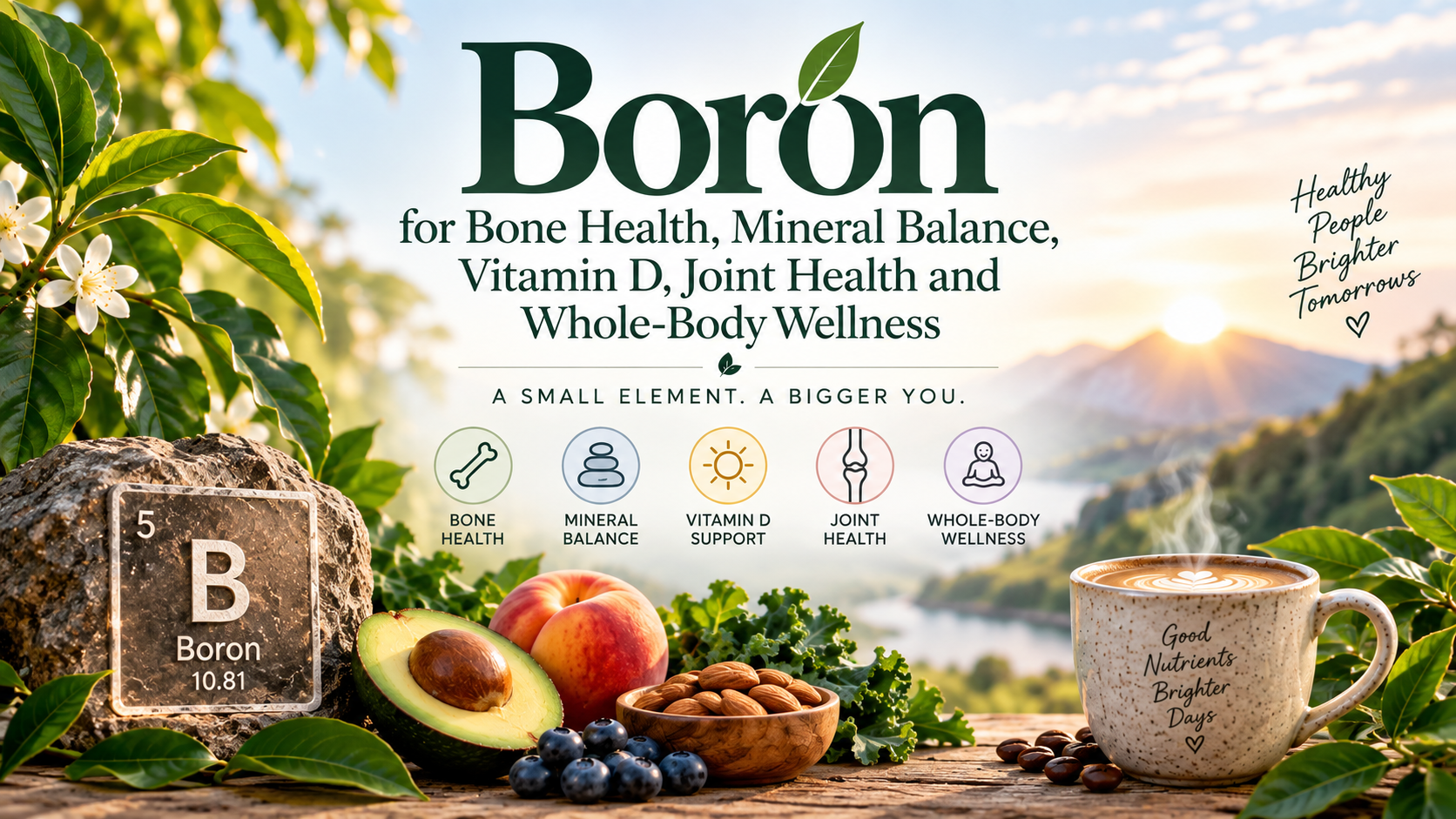
Boron is easy to overlook.
It does not have the fame of calcium, magnesium or vitamin D. There is no established Recommended Dietary Allowance for it, and many people may go their entire lives without thinking about how much boron they consume.
Yet boron is all around us.
It is in soil.
It is essential to plants.
It travels into fruits, vegetables, legumes, nuts and other foods.
It is even present in something millions of people pour into a cup every morning: coffee.
And once boron enters the human body, researchers have found intriguing relationships involving bones, calcium and magnesium metabolism, vitamin D, steroid hormones, joints and even brain function.
Boron may therefore be one of nutrition's great supporting players.
Its story is not necessarily about one enormous biological job.
It may be about relationships.
What Is Boron?
Boron is a naturally occurring element found in soil, water, plants and food.
In nutrition, it is generally described as a trace element.
A trace element is an element present in very small amounts. But small does not mean insignificant.
Plants demonstrate this beautifully.
Boron is essential for plant growth. It contributes to the structure of plant cell walls and plays important roles in growth, pollination and seed formation.
Humans obtain boron primarily through foods and beverages.
Boron is not currently classified as an essential human nutrient because scientists have not yet identified a clearly defined biological function that allows an official human requirement to be established.
But human research shows that changing boron intake can change human physiology.
Researchers have investigated its relationships with calcium metabolism, bone formation, vitamin D and other steroid hormones, brain function, joint health and additional biological systems.
Science may not have finished defining boron's role.
But boron is certainly not biologically boring.
From the Earth to Us
Boron gives us a remarkable example of how intimately human nutrition is connected with the earth.
Plants absorb boron from soil and water.
That boron becomes incorporated into plant tissues.
We eat the plant.
And an element that was once part of the soil environment enters the chemistry of the human body.
The journey can be pictured simply:
Soil → plant → food → human body
The amount of boron in plant foods can vary partly according to the soil and water where those plants grow.
Rainfall matters too. In areas with substantial rainfall, boron can be leached from soil, while some drier regions may have higher soil boron concentrations.
That means the nutritional composition of a plant is connected not only to what kind of plant it is, but also to the earth in which it grew.
A peach is therefore more than simply a peach.
Its mineral story began underground.
What Happens When We Eat Boron?
The human body absorbs boron remarkably well.
Researchers estimate that approximately 85% to 90% of ingested boron is absorbed.
Most of the boron compounds we consume are converted within the gastrointestinal tract into boric acid.
Boric acid is also the primary form of boron found in blood, urine and other body fluids.
Once absorbed, boron enters circulation.
It does not substantially accumulate in most body tissues, although bone, nails and hair contain higher concentrations than many other tissues.
The body ultimately eliminates most boron through urine.
Its journey looks something like this:
Food → digestion → absorption → circulation → biological interaction → urinary excretion
Scientists still do not completely understand how the body regulates boron.
That unfinished piece of the puzzle is one reason boron remains such an interesting subject of nutritional research.
Boron and Bone Health
Bone health is one of the most important areas of boron research.
Bones are living tissues.
Throughout life, old bone is continually broken down and new bone is created through a process called bone remodeling.
Specialized cells participate in this work.
Osteoclasts help remove older bone.
Osteoblasts help form new bone.
Healthy bone remodeling depends upon an intricate network of nutrients and hormones, including calcium, magnesium, vitamin D and sex hormones.
Boron appears to interact with several members of this network.
Human studies have investigated boron in relation to calcium metabolism, magnesium, vitamin D, steroid hormones and other factors associated with maintaining healthy bones.
A review examining human boron research identified 11 eligible studies involving 594 participants. The authors found encouraging evidence surrounding approximately 3 mg of boron per day and its relationships with calcium, vitamin D and sex-steroid metabolism.
The fascinating part is that boron does not appear to behave simply as another piece of bone-building material.
Its role may be more subtle.
It may influence the nutritional and hormonal environment in which bone metabolism takes place.
Boron and Calcium
Calcium is one of the major structural minerals in bone.
But getting calcium into the diet is only part of the story.
The body must absorb it, regulate it, circulate it, store much of it in bone and carefully control calcium concentrations elsewhere.
Controlled human research has shown that changing boron intake can influence calcium metabolism.
In a classic metabolic experiment involving postmenopausal women, researchers first provided a very-low-boron diet and later added 3 mg of boron per day.
During boron supplementation, urinary calcium loss decreased.
That finding helped stimulate decades of interest in boron's relationship with bone and mineral metabolism.
Other studies have not produced identical results, suggesting that boron's effects can depend upon nutritional status, population and experimental conditions.
The relationship is therefore more interesting than simply saying boron "saves calcium."
Boron appears to participate in the body's larger calcium-management system.
Boron and Magnesium
Magnesium adds another layer.
Magnesium participates in hundreds of biochemical reactions and contributes to normal bones, muscles, nerves and energy metabolism.
It also interacts closely with calcium and vitamin D.
Controlled human research suggests boron and magnesium metabolism can influence one another.
In one metabolic study, adding boron reduced urinary magnesium losses, and some effects of boron became particularly noticeable when magnesium intake was low.
This reveals something important about nutrition.
Nutrients do not operate in isolation.
Calcium interacts with magnesium.
Magnesium participates in vitamin D metabolism.
Vitamin D influences calcium.
Hormones influence bone.
And boron appears somewhere inside this conversation.
Boron and Vitamin D
Vitamin D helps the body absorb calcium and contributes to normal bone, muscle and immune function.
Boron research repeatedly intersects with vitamin D.
Studies involving changes in boron intake have reported changes in vitamin D-related measurements under certain experimental conditions.
Researchers have consequently proposed that boron may influence vitamin D metabolism.
Metabolism refers to the processes through which the body makes, transforms, uses and breaks down substances.
Exactly how boron influences vitamin D remains under investigation.
But the interaction is intriguing because it places boron within the same nutritional network that includes calcium, magnesium and bone.
Boron and Hormones
Boron has also been studied in relation to steroid hormones.
Despite the name, steroid hormones are normal substances produced by the human body.
They include estrogen and testosterone.
These hormones influence reproductive biology, but their reach is much broader. They also participate in bone maintenance, muscle physiology and numerous metabolic processes.
Controlled human studies have found changes in estrogen or testosterone measurements under some experimental conditions when boron intake was increased.
Other studies have not found identical effects.
For that reason, boron is better understood as an element being investigated for its relationship with steroid-hormone metabolism, rather than simply being described as a testosterone booster.
The larger biological relationship is much more interesting anyway.
What Happens to the Brain When Boron Intake Is Very Low?
This is one of the most surprising chapters in boron research.
Scientists conducted controlled dietary experiments in healthy older adults comparing diets containing approximately 0.25 mg versus 3.25 mg of boron per 2,000 calories per day.
Researchers measured electrical activity in the brain and performance on cognitive and psychomotor tasks.
Cognition includes mental abilities such as attention, memory, perception and information processing.
Psychomotor performance describes tasks requiring the brain and body to coordinate movement efficiently.
Very-low-boron intake was associated with changes in brain electrical activity and differences in performance on several cognitive and psychomotor tasks.
The findings included areas involving attention, perception, memory, manual dexterity and hand-eye coordination.
This research does not establish boron as a treatment for memory loss.
It tells us something more fundamental and perhaps even more fascinating:
Changing the amount of boron in the diet produced measurable differences in human brain function under controlled experimental conditions.
For an element most people have never thought about, that is remarkable.
Boron and Joint Health
Another intriguing area involves the joints.
Researchers have particularly studied a boron-containing compound called calcium fructoborate.
Calcium fructoborate is related to naturally occurring boron-containing complexes found in plants.
In one randomized, double-blind, placebo-controlled study, 60 adults with knee discomfort received calcium fructoborate or placebo.
Researchers used established questionnaires to evaluate knee discomfort and function.
After 14 days, the calcium fructoborate group showed greater improvements in WOMAC and McGill questionnaire scores compared with placebo.
Other small clinical research has examined calcium fructoborate in people with knee osteoarthritis and reported changes in inflammatory biomarkers.
These studies have generally been small and short, so the research story is still developing.
But the human findings are intriguing enough that joint health has become one of the more interesting areas of boron research.
Boron and Inflammatory Balance
Inflammation is part of the body's natural defense and repair system.
Researchers can study inflammatory activity by measuring substances known as biomarkers.
A biomarker is something measurable in the body that gives scientists information about a biological process.
One familiar inflammatory biomarker is C-reactive protein, commonly abbreviated CRP.
CRP is produced mainly by the liver, and blood concentrations can increase when inflammatory activity rises.
Small controlled trials involving calcium fructoborate have found changes in CRP and other inflammatory biomarkers.
This has led researchers to investigate whether boron-containing compounds interact with pathways involved in inflammatory signaling.
That relationship may also help explain some of the scientific interest surrounding boron and joint health.
Boron and Antioxidant Defense
Boron research has also reached the world of oxidative stress.
Normal metabolism continually produces reactive molecules.
The body has its own antioxidant systems that help keep these molecules balanced.
Oxidative stress occurs when the production of reactive molecules exceeds the body's ability to manage them effectively.
Experimental research suggests boron can influence certain antioxidant enzymes and cellular defense systems.
An enzyme is a protein that helps chemical reactions happen efficiently.
Human evidence in this area is less developed than the evidence surrounding boron and mineral metabolism, making antioxidant activity an emerging part of the boron story.
Perhaps Boron's Greatest Talent Is Cooperation
Look across the research and a pattern appears.
Boron repeatedly crosses paths with:
Calcium
Magnesium
Vitamin D
Bone metabolism
Steroid hormones
Brain function
Joint health
Inflammatory signaling
This raises an intriguing possibility.
Perhaps boron's importance does not come from performing one enormous task.
Perhaps it helps influence the biological environment in which many other processes take place.
Scientists sometimes use the word modulator for something that influences how another biological process operates.
That may be a useful way to think about boron.
Not necessarily the soloist.
Perhaps one of the quieter members of the orchestra helping the larger composition come together.
The Unexpected Boron in Your Morning Coffee
Here is one of the more delightful surprises in the boron story.
Coffee contains boron.
A representative cup contains approximately 0.07 mg.
That means coffee is nowhere near the most concentrated dietary source.
Half a cup of avocado, for example, contains approximately 1.07 mg.
A medium apple contains around 0.66 mg.
So why has coffee appeared prominently in research examining dietary boron intake?
Because people drink it.
Regularly.
Sometimes very regularly.
When nutrition researchers look at where people actually obtain a nutrient, concentration is only half the equation.
Frequency matters too.
A food or beverage containing a modest amount can become an important dietary contributor when it is consumed day after day.
Coffee Can Quietly Add Up
Using approximately 0.07 mg of boron per cup as a representative value:
1 cup of coffee: about 0.07 mg
2 cups: about 0.14 mg
3 cups: about 0.21 mg
4 cups: about 0.28 mg
Those numbers are modest.
But total boron intake itself is measured in small amounts.
So regular coffee consumption can contribute to the larger dietary picture.
This gives us an important nutritional lesson:
The food containing the most of a nutrient is not necessarily the food contributing the most to someone's diet.
What we consume repeatedly matters.
Instant Coffee Has an Especially Interesting Place in the Story
Historical analyses of American diets revealed something surprising.
Among adults, beverages, particularly instant coffee, emerged as major contributors to dietary boron intake.
That does not mean instant coffee contains more boron per serving than avocado, raisins or prune juice.
It reflects consumption patterns.
People may eat raisins occasionally.
They may eat avocado several times a week.
But someone might drink coffee every single morning for years.
A small contribution repeated thousands of times becomes part of the nutritional landscape.
How Does Boron Get Into Coffee?
The journey begins with the coffee plant.
Coffee plants grow in soil.
Their roots absorb water and minerals from that environment, including boron.
Boron is essential to plants, so its presence in coffee is part of the mineral world in which the coffee plant grows.
Some of that boron becomes incorporated into the coffee beans.
When those beans are processed, roasted and eventually brewed, measurable boron remains associated with the coffee and some reaches the beverage.
So the journey becomes:
Soil → coffee plant → coffee bean → roasting → brewing → morning cup → human body
That little cup on the kitchen counter carries a mineral story that began in the earth.
Does Roasting Destroy Boron?
Boron differs from compounds such as certain vitamins that can be degraded by heat.
Boron is an element.
Ordinary coffee roasting cannot destroy the boron element itself.
Processing and brewing can influence its chemical environment, distribution and how much ultimately reaches the finished beverage.
But boron has been measured in roasted coffee.
The atom survives the fiery transformation from green bean to aromatic roast.
Not Every Cup Contains Exactly the Same Amount
The figure of approximately 0.07 mg per cup is a useful representative value.
It is not a promise that every cup on Earth contains exactly that amount.
Coffee is an agricultural product.
Its mineral composition can vary with growing conditions, soil composition, water, processing and preparation.
And that brings us back to where the boron story began.
The earth.
The chemistry of a cup of coffee carries traces of the environment from which the coffee plant grew.
Coffee Is More Than Caffeine
We often reduce coffee to one molecule:
Caffeine.
But coffee is chemically much richer than that.
A cup contains a complex mixture of naturally occurring compounds, including polyphenols, minerals and trace elements.
Boron is one tiny passenger in that chemical caravan.
That does not make coffee a boron supplement.
It makes coffee a fascinating example of how ordinary foods and beverages can quietly contribute micronutrients and trace elements to our diets.
For many people, the morning cup contains much more chemistry than its caffeine reputation suggests.
Boron-Rich Foods
Coffee contributes boron through frequency, but many plant foods contain considerably more per serving.
Useful dietary sources include:
Prune juice
Avocados
Raisins
Peaches
Grape juice
Apples
Pears
Peanuts
Beans
Peanut butter
Grapes
Oranges
Lima beans
Broccoli
Spinach
Bananas
Carrots
Green peas
Coffee
How Much Boron Is in Food?
Approximate amounts include:
Prune juice, 1 cup: 1.43 mg
Avocado, ½ cup: 1.07 mg
Raisins, 1.5 ounces: 0.95 mg
Peach, 1 medium: 0.80 mg
Grape juice, 1 cup: 0.76 mg
Apple, 1 medium: 0.66 mg
Pear, 1 medium: 0.50 mg
Peanuts, 1 ounce: 0.48 mg
Refried beans, ½ cup: 0.48 mg
Peanut butter, 2 tablespoons: 0.46 mg
Grapes, ½ cup: 0.37 mg
Orange, 1 medium: 0.37 mg
Lima beans, ½ cup: 0.35 mg
Broccoli, cooked, ½ cup: 0.20 mg
Spinach, cooked, ½ cup: 0.16 mg
Banana, medium: 0.16 mg
Carrot, medium: 0.14 mg
Green peas, cooked, ½ cup: 0.10 mg
Coffee, 1 cup: 0.07 mg
Looking at this list reveals why a varied plant-rich diet can naturally provide boron without anyone deliberately planning a "boron diet."
How Much Boron Do People Normally Consume?
U.S. dietary surveys have estimated median boron intakes of approximately 0.87 to 1.35 mg per day among adults, while total median intake from foods and supplements is about 1.0 to 1.5 mg per day.
People who eat more plant foods often consume more boron because fruits, vegetables, legumes and nuts are among its richest dietary sources.
There is currently no established Recommended Dietary Allowance, or RDA, for boron.
There is also no established Adequate Intake or Estimated Average Requirement.
That does not mean humans should consume zero boron.
It means scientists do not yet have enough evidence to determine an official human requirement.
What About 3 mg of Boron?
The number 3 mg appears frequently in discussions about boron.
There is a reason.
Approximately this amount has been used in a number of human studies examining bone and mineral metabolism and related biological effects.
A review of human bone research found encouraging evidence surrounding approximately 3 mg per day.
That makes 3 mg a scientifically interesting research amount.
But it should not be mistaken for an official daily requirement.
There is currently no established RDA for boron.
Boron Supplements
Boron is available in dietary supplements in many forms, including:
Boron citrate
Boron glycinate
Boron gluconate
Boron aspartate
Boron amino acid chelate
Boron picolinate
Calcium fructoborate
Sodium borate
Common dietary supplements contain approximately 0.15 to 6 mg of elemental boron.
Elemental boron means the actual quantity of boron provided by the boron-containing compound.
That is the amount declared on the Supplement Facts label.
Scientists have not established that one common supplemental form of boron is universally better absorbed or more effective than all the others.
Food Gives Us More Than Boron
There is another reason the food story matters.
Consider an avocado.
It provides boron, but also potassium, fiber, healthy fats, folate and numerous plant compounds.
An apple provides boron alongside fiber and polyphenols.
Beans bring boron together with protein, fiber, potassium, magnesium and other nutrients.
Coffee contributes a modest amount of boron alongside its extraordinarily complex collection of natural compounds.
Food does not deliver nutrients one at a time.
It delivers communities of chemistry.
And the body receives them together.
Can You Get Too Much Boron?
For adults age 19 and older, the U.S. Tolerable Upper Intake Level, or UL, for boron is 20 mg per day from food, beverages and supplements combined.
The UL is not a recommended target.
It represents the highest average daily intake considered unlikely to pose adverse effects for most healthy adults.
That level is far above typical dietary intake.
There is also an important distinction between nutritional boron and household boron products.
Borax and boric acid products sold for cleaning, industrial or pest-control purposes are not dietary supplements and should not be consumed as nutritional sources of boron.
Food and appropriately manufactured dietary supplements belong in the nutrition conversation.
The cleaning cabinet does not.
Why Isn't Boron Officially an Essential Nutrient?
This question sits at the center of the boron story.
To establish an official nutrient requirement, scientists need enough evidence to identify the biological functions that depend upon the nutrient and determine how much people need.
That picture remains incomplete for boron.
There is no firmly established human boron-deficiency disease.
Yet controlled human experiments have found measurable physiological differences when boron intake is changed.
Those findings have involved mineral metabolism and aspects of brain function, among other areas being investigated.
That leaves boron in an unusual and fascinating scientific position.
Researchers can see that changing boron intake can influence human biology.
They simply have not finished determining exactly what that means.
The Bigger Lesson Boron Teaches Us About Nutrition
Boron challenges the idea that nutrition is simply a checklist.
Calcium.
Check.
Magnesium.
Check.
Vitamin D.
Check.
Human biology does not work that way.
Nutrients meet one another inside enormously complicated systems.
Vitamin D influences calcium.
Magnesium participates in vitamin D metabolism.
Hormones influence bone remodeling.
Minerals influence enzymes.
Enzymes guide cellular reactions.
And a trace element such as boron may quietly modify several of those relationships.
The deeper scientists look into nutrition, the more interconnected the picture becomes.
Frequently Asked Questions
What is boron?
Boron is a naturally occurring trace element found in soil, water and many foods. It is essential for plants and biologically active in humans, although it is not currently classified as an essential human nutrient.
What is boron good for?
The strongest research interest involves bone and mineral metabolism, particularly boron's relationships with calcium, magnesium and vitamin D. Researchers have also investigated steroid hormones, brain function, joints and inflammatory signaling.
Does boron support bone health?
Human research suggests boron can influence processes related to bone health, including calcium and magnesium metabolism, vitamin D and steroid hormones. Human bone research has produced encouraging findings, although scientists are still defining boron's precise role.
Does boron help calcium?
Controlled human research has found changes in calcium metabolism when boron intake is altered, including changes in urinary calcium excretion under certain experimental conditions.
Does boron work with magnesium?
Research suggests that boron and magnesium metabolism interact. Some biological effects observed when boron intake changes have differed according to magnesium status.
Does boron help vitamin D?
Research suggests boron may influence vitamin D metabolism and vitamin D-related measurements under certain experimental conditions. Scientists continue to investigate the nature and significance of this relationship.
Does boron increase testosterone?
Some small human studies have found changes in testosterone or estrogen following changes in boron intake, while others have not. Boron is better understood as a trace element being investigated for its relationship with steroid-hormone metabolism than simply as a testosterone booster.
Does boron affect the brain?
Controlled dietary experiments found differences in brain electrical activity and performance on certain cognitive and psychomotor tasks when very-low-boron diets were compared with higher boron intake.
Can boron support joint health?
Small controlled human trials involving calcium fructoborate have produced encouraging findings involving knee discomfort and inflammatory biomarkers. This remains an active area of research.
Does coffee contain boron?
Yes. A representative cup of coffee contains approximately 0.07 mg of boron. Coffee is not especially concentrated in boron, but frequent consumption means it can contribute meaningfully to someone's overall dietary intake.
Why can coffee be an important dietary source of boron?
Frequency. A beverage does not have to contain a large amount of a nutrient per serving to become a meaningful dietary source when it is consumed regularly.
Where does the boron in coffee come from?
Coffee plants obtain boron from their growing environment. Boron moves from soil and water into the plant and coffee beans, and some ultimately reaches the brewed beverage.
Does roasting destroy boron?
No. Boron is an element. Roasting cannot destroy the boron element itself, although processing and brewing can influence its chemical environment, distribution and how much reaches the finished cup.
Which foods contain the most boron?
Prune juice, avocado, raisins, peaches, grape juice, apples, pears, peanuts, beans and peanut butter are useful dietary sources.
How much boron do adults need?
There is currently no official RDA for boron. U.S. dietary surveys suggest adults commonly consume roughly around a milligram or more each day, depending upon diet and supplement use.
Why is 3 mg of boron frequently discussed?
Approximately 3 mg per day has been used in several human studies and is therefore an amount of scientific interest. It is not an officially established daily requirement.
Is boron the same as borax?
No. Boron is an element naturally present in foods and nutritional supplements. Borax is a boron-containing compound used in various household and industrial applications. Household borax should not be used as a dietary source of boron.
Final Thoughts
Boron begins in the earth.
A plant reaches into the soil and takes it up.
It enters an avocado.
A peach.
An apple.
A peanut.
A coffee bean.
Eventually, some of it reaches us.
The human body absorbs most of the boron we consume, and researchers continue to uncover intriguing relationships involving bones, calcium, magnesium, vitamin D, hormones, joints and the brain.
Even coffee contributes to the story.
Not because one cup contains an enormous amount of boron, but because nutrition is shaped by repetition.
A little today.
A little tomorrow.
A morning cup repeated thousands of times across a lifetime.
Boron reminds us that nutrition is not simply a competition to find the food with the biggest number beside a nutrient.
It is the sum of an entire diet.
It is frequency.
Variety.
Interaction.
And relationship.
The same principle appears inside the body.
Calcium does not work alone.
Magnesium does not work alone.
Vitamin D does not work alone.
Hormones, enzymes, minerals and trace elements continually interact.
Boron appears woven into that conversation.
Science has not yet assigned it an official human requirement or completely defined its biological role.
But controlled human experiments tell us that altering boron intake can alter aspects of human physiology.
And perhaps that is why this quiet trace element is so compelling.
Something measured in mere milligrams can lead us from the soil beneath a coffee tree all the way to mineral metabolism and electrical activity inside the human brain.
Sometimes the smallest elements reveal just how connected the whole living system truly is.