

Faith and Renewal
Explore faith and renewal through Scripture, prayer, the Holy Spirit, renewed strength, hope, repentance, transformation and trusting God through change, waiting and new beginnings.
Faith and renewal belong together.
Faith keeps the heart open when life changes.
Renewal is what can begin in that open space.
There are seasons when life feels steady and familiar, and there are seasons when everything seems to be shifting at once. Plans change. Relationships change. Dreams evolve. Doors close. New responsibilities appear. Something we believed would happen does not unfold the way we expected.
During those seasons, faith becomes more than belief in an idea.
Faith becomes a way of standing.
It allows us to remain rooted in God while the next chapter is still taking shape.
Renewal does not always arrive with dramatic signs. Sometimes it begins quietly.
A little more strength.
A clearer thought.
A returning desire to pray.
The courage to begin again.
A softened heart.
A new idea.
A conversation that changes something.
A sense of peace that was not there yesterday.
A willingness to trust one more time.
Scripture repeatedly presents God as One who restores, renews, revives, rebuilds, transforms and brings life where human beings might have assumed the story was finished.
Faith leaves room for that possibility.
Renewal Is Woven Throughout Scripture
Renewal is one of the great movements running through the Bible.
Creation moves from formlessness toward life and order.
Noah emerges from the flood into a renewed world.
Abraham leaves the familiar and begins a journey of faith.
Joseph moves from betrayal and imprisonment into purpose.
Israel experiences exile, return, rebuilding and restoration.
The Psalms contain prayers for renewed hearts and spirits.
The prophets speak of restoration after devastation.
Jesus speaks of new birth.
The early church speaks of renewed minds, renewed inner life and transformation through the Holy Spirit.
And the resurrection stands at the center of Christianity as the ultimate declaration that what appears final to human eyes is not always final to God.
Again and again, Scripture reveals a pattern:
loss,
faith,
transformation,
renewal.
But biblical renewal does not always mean returning to exactly what existed before.
Sometimes God restores.
Sometimes He redirects.
Sometimes He rebuilds.
Sometimes He creates something entirely new.
Faith Is More Than Optimism
Faith and optimism are not the same thing.
Optimism expects circumstances to improve.
Faith trusts God even when the circumstances remain uncertain.
Optimism may say:
“I think everything will work out the way I hope.”
Faith can say:
“I do not know exactly how this will unfold, but I trust God while I walk through it.”
That distinction matters.
Biblical faith does not require us to pretend that disappointment is pleasant, grief is easy or uncertainty feels comfortable.
Faith can coexist with questions.
It can coexist with waiting.
It can coexist with tears.
It can coexist with moments of fear.
Faith is not certainty about every outcome.
It is confidence that God remains present and faithful even when the road is not yet visible.
Renewal of the Heart
One of the most beautiful prayers for renewal appears in Psalm 51.
David does not merely ask for improved circumstances.
He asks God for a clean heart and a renewed spirit.
This reveals an important dimension of renewal.
Sometimes life needs to change around us.
Sometimes something needs to change within us.
Spiritual renewal can include repentance, honesty and the willingness to recognize where our own thoughts, choices, habits or attitudes have moved us away from what is true and good.
Repentance is not simply sorrow over the past.
At its deepest level, repentance means turning.
Turning toward God.
Turning toward truth.
Turning toward a wiser way of living.
Turning away from something that no longer belongs.
There is great freedom in being able to say:
I see differently now.
I understand more now.
I want to live differently now.
God, renew what needs renewing within me.
Faith gives us permission to change.
A New Heart and a New Spirit
The prophets spoke about renewal in powerful language.
Ezekiel describes God giving His people a new heart and a new spirit.
This is much deeper than surface improvement.
It is transformation from within.
The New Testament continues this theme through the work of the Holy Spirit.
Christian renewal is therefore not simply a self-improvement project.
Self-improvement asks:
“How can I make myself better?”
Spiritual renewal asks:
“What is God transforming within me?”
Human participation matters.
We pray.
We choose.
We learn.
We forgive.
We surrender.
We act.
But Christian faith also recognizes grace.
We are not required to manufacture every transformation through willpower alone.
Sometimes growth happens because we stay close enough to God for something within us to become different.
The Inner Person Can Be Renewed Day by Day
Second Corinthians 4:16 contains one of Scripture's most powerful truths about renewal.
Paul speaks of the inner person being renewed day by day.
This means renewal is not only something that happens after the difficult season ends.
It can happen during it.
The outer circumstances may still be unresolved.
The answer may not have arrived.
The prayer may still be unfolding.
The road may remain uncertain.
And yet something inside can already be changing.
Faith can deepen.
Wisdom can grow.
Courage can return.
Priorities can become clearer.
Peace can strengthen.
Attachment to old fears can loosen.
Discernment can sharpen.
This gives us an extraordinary spiritual truth:
Renewal does not have to wait until the storm passes.
God can begin renewing us inside the storm.
Faith Gives Us Somewhere to Stand During Transition
Transitions contain a strange spiritual tension.
The old may already be gone while the new has not fully arrived.
The mind wants certainty.
We want to know what comes next.
How long it will take.
Whether we made the right decision.
Whether the prayer will be answered the way we hope.
Faith does not always give those answers immediately.
Instead, faith gives us somewhere to stand without them.
Faith reminds us:
Uncertainty does not mean abandonment.
Waiting does not mean rejection.
Redirection does not mean failure.
Silence does not mean God is absent.
A season we cannot yet understand may still contain purpose.
Faith prevents us from turning temporary uncertainty into permanent conclusions.
Waiting on God Is Not Passive
Isaiah 40 contains one of the great biblical promises of renewal.
Those who wait on the Lord will renew their strength.
This kind of waiting is not the same as giving up or doing nothing.
Biblical waiting carries the sense of hopeful expectation.
It means remaining turned toward God even before the answer appears.
Waiting can mean continuing to pray.
Continuing to believe.
Continuing to act faithfully where action is possible.
Continuing to remember what God has already done.
Continuing to stay open to what may unfold.
Isaiah's imagery is especially powerful because the renewed person still has a journey.
They run.
They walk.
Renewal does not necessarily remove the road.
It gives strength for the road.
God's Mercies Are New Every Morning
Lamentations contains one of Scripture's most beloved declarations of hope.
God's mercies are described as new every morning.
These words were not written during an easy season.
They arose in the middle of devastation.
That makes them even more powerful.
Morning becomes a spiritual image of renewal.
Yesterday does not receive automatic authority over today.
Yesterday's disappointment does not have to become today's identity.
Yesterday's fear does not have to become today's decision.
Yesterday's mistake does not have to write tomorrow.
Each morning carries another invitation.
Another prayer.
Another decision.
Another opportunity to walk differently.
Another chance to notice grace.
Renewal sometimes begins simply because the day is new.
Renewal of the Mind
Romans 12:2 connects transformation with the renewing of the mind.
This is much deeper than positive thinking.
A renewed mind does not simply replace unpleasant thoughts with pleasant ones.
It learns to discern.
What is true?
What is good?
What belongs in my life?
What no longer belongs?
What am I being shaped by?
What deserves my attention?
What is God asking of me?
What thoughts are rooted in fear rather than truth?
What assumptions have I carried simply because I repeated them for years?
The renewed mind becomes less controlled by automatic patterns.
Thoughts such as:
“I will never recover.”
“I ruined everything.”
“I missed my chance.”
“Nothing good can happen now.”
“God has forgotten me.”
can begin to lose their authority.
Faith does not replace reality with fantasy.
It refuses to make permanent declarations from temporary circumstances.
The renewed mind learns another language:
God is still present.
I am still learning.
I am still growing.
This chapter is not the entire story.
I can begin again.
Renewal of Identity
Some experiences do more than hurt us.
They try to name us.
Failure says:
“You are a failure.”
Rejection says:
“You are unwanted.”
Delay says:
“You are behind.”
Loss says:
“Your best days are over.”
A mistake says:
“This is who you are now.”
Faith challenges those identities.
An experience can be real without becoming our permanent name.
Christian renewal includes learning to see ourselves through a deeper identity rooted in God rather than allowing painful moments to define the whole person.
We may have failed.
That does not mean failure is our identity.
We may have been rejected.
That does not mean we are without worth.
We may have lost something.
That does not mean our future disappeared with it.
Renewal changes not only what we do.
It can change who we believe we are.
God Can Renew What Life Has Worn Down
Life can slowly exhaust parts of us.
Hope can become tired.
Creativity can become buried beneath responsibility.
Confidence can weaken after repeated disappointment.
Prayer can become mechanical.
Joy can become quieter.
Dreams can be placed on shelves because survival seemed more urgent.
Renewal invites those parts of the soul back into the light.
It may begin with something small.
Interest.
Curiosity.
Energy.
Desire.
Imagination.
A little willingness.
A little hope.
Motivation says:
“I am ready to work harder.”
Renewal may say:
“I am becoming alive again.”
There is a profound difference.
Renewal Does Not Always Mean Going Back
People sometimes pray for life to return to the way it used to be.
Sometimes restoration does bring something back.
Sometimes it should not.
Certain seasons complete their purpose.
Certain relationships change.
Certain identities become too small.
Certain roles are temporary.
Certain dreams evolve.
Certain doors close because another direction is emerging.
The question does not always have to be:
“How do I get my old life back?”
Sometimes the deeper question is:
“What is God creating from here?”
The past can be honored without becoming the destination.
Faith Makes Room for New Possibilities
Fear tends to narrow our vision.
It searches for danger.
It predicts loss.
It rehearses everything that could go wrong.
Faith expands the horizon.
Not because every imagined possibility will happen, but because faith remembers that the future contains realities we cannot presently see.
There may be people we have not met.
Ideas we have not considered.
Strength we have not discovered.
Opportunities that do not yet exist.
Answers that are still forming.
Conversations that will change something.
Doors that have not yet opened.
Faith refuses to assume that the present moment contains the entire story.
There is more road ahead.
Remembering Can Renew Faith
Scripture repeatedly calls people to remember.
Remember what God has done.
Remember where provision came before.
Remember how you were carried through something you once thought you could not survive.
Remember doors that closed and later made sense.
Remember prayers that were answered in ways you did not expect.
Remember strength that appeared after you thought you had none left.
Memory can become fuel for faith.
When facing something uncertain today, we can look backward and ask:
Have I been uncertain before?
Have I been afraid before?
Have I wondered how something would work before?
Have I walked through seasons I once thought would break me?
Often the answer is yes.
And somehow, we are still here.
Remembering does not tell us exactly how the future will unfold.
It reminds us that uncertainty is not unfamiliar territory for God.
Renewal Often Begins Quietly
We sometimes expect transformation to announce itself dramatically.
Usually it knocks much more softly.
You begin waking with a little more peace.
Something that once consumed your thoughts loses its grip.
A new curiosity appears.
You become interested in life again.
You feel drawn toward something meaningful.
You laugh more easily.
You begin imagining a future.
You clean a room.
Make a call.
Open your Bible.
Take a walk.
Start writing.
Create something.
Reconnect with someone.
Try something new.
These ordinary impulses can become early signs of renewal.
Not every sacred transformation arrives with thunder.
Sometimes God rebuilds a life one ordinary decision at a time.
Faith and the Courage to Begin Again
Beginning again requires humility.
We often want progress to move in a straight line.
Human life rarely does.
People begin, stumble, learn, adjust and begin again.
Faith makes room for this.
A mistake does not erase everything learned before it.
A difficult season does not destroy every previous victory.
A detour does not mean the destination disappeared.
Sometimes beginning again is not evidence that we failed.
It is evidence that we learned.
There is strength in saying:
“I will try again.”
There may be even greater wisdom in saying:
“God, show me how to begin again differently.”
God Can Still Work Through an Imperfect Story
Scripture is filled with people whose lives were complicated.
Peter denied Jesus.
Thomas doubted.
David failed.
Moses fled.
Elijah became exhausted.
Jonah resisted.
Paul had once persecuted Christians.
Their stories were not neat.
Yet God continued working.
This matters because people sometimes assume they must become perfect before renewal can begin.
Grace says otherwise.
God does not require an immaculate history before working through a human life.
Our mistakes can teach us.
Our weaknesses can humble us.
Our failures can deepen compassion.
Our detours can sharpen discernment.
An imperfect story is still a story God can use.
Renewal Can Change the Meaning of the Past
Faith cannot change what happened.
But renewal can change the place the past occupies within us.
Experiences that once seemed meaningless can eventually produce wisdom.
Disappointment can clarify what matters.
Loss can deepen compassion.
Waiting can strengthen patience.
Failure can dismantle pride.
Confusion can teach discernment.
Closed doors can redirect an entire life.
None of this means painful experiences must be called good.
It means pain does not receive exclusive authority over what the experience will ultimately mean.
The wound does not have to write the ending.
Renewal and Resurrection
Christianity's greatest image of renewal is resurrection.
The resurrection of Jesus stands at the center of Christian faith because it declares that death does not possess the final word.
This does not mean every lost dream will return exactly as imagined.
Christian faith does not promise that every ending will be reversed.
It reveals something larger.
God can bring life from places human beings thought were finished.
God can create a future where none seemed visible.
God can transform endings into beginnings.
God can do new things after old things have passed away.
The resurrection gives Christian renewal its deepest foundation.
What appears final to human eyes is not necessarily final to God.
Faith After Disappointment
Faith can feel especially difficult after disappointment.
It is one thing to trust before something happens.
It is another to trust after something did not happen the way we prayed.
This is where faith often deepens.
Immature faith may quietly believe:
“If I trust God, everything will happen exactly as I want.”
Maturing faith learns:
“I trust God even when the road differs from the one I imagined.”
This does not make disappointment painless.
It makes disappointment something we can walk through without losing our relationship with God.
There are moments when we may not understand why a prayer unfolded differently, why a door closed or why something took far longer than expected.
Faith does not require manufactured explanations.
Sometimes one of the most faithful prayers available is simply:
“God, I do not understand this yet, but I will keep walking with You.”
That is faith too.
Waiting Can Be a Season of Formation
Waiting often feels unproductive.
Spiritually, it can be deeply formative.
Waiting exposes what we trust.
It reveals where fear lives.
It shows how strongly we desire control.
It teaches patience.
It invites surrender.
It deepens prayer.
It clarifies priorities.
And sometimes it prepares us.
There are things we ask God to give us while God may also be preparing us to carry them.
The waiting room can become a classroom.
Something may be forming there.
Faith and Hope
Faith and hope are close companions.
Faith trusts.
Hope looks forward.
Biblical hope is not simply wishing that something pleasant will happen.
It is confidence that God remains faithful and that darkness does not receive the final word.
Hope gives the soul permission to imagine again.
Perhaps there will be another chapter.
Perhaps there will be another opportunity.
Perhaps love will return in another form.
Perhaps the dream will evolve.
Perhaps what looked like an ending was actually an intersection.
Hope does not know every detail.
It simply keeps the future open.
Renewal May Require Releasing Something
New growth sometimes requires space.
We may need to release an old identity.
An expectation.
A resentment.
A fear.
A timeline.
A role we have outgrown.
A belief about ourselves that formed during a painful season.
Something can once have been necessary and still become something we are called to release.
Faith makes surrender possible because it trusts that empty space is not automatically wasted space.
We can release what has completed its purpose without believing life itself has become empty.
Renewal Can Restore Wonder
One of the quieter signs of spiritual renewal is the return of wonder.
You notice the sky again.
Music moves you.
A conversation stays with you.
You become curious.
You feel gratitude unexpectedly.
You want to create something.
You notice beauty where you used to hurry past it.
Wonder is evidence that the soul is becoming receptive again.
Faith keeps us receptive to mystery.
We do not know every way God may guide, redirect, restore, surprise or awaken us.
A life of faith remains open to sacred possibility.
Renewal Is Not Constant Productivity
Modern culture often treats renewal as becoming productive again.
But sacred renewal is larger than productivity.
Sometimes renewal produces movement.
Sometimes it produces rest.
Sometimes renewal means creating.
Sometimes it means stopping.
Sometimes God restores our ability to work.
Sometimes He restores our ability to be still.
Rest is not the opposite of renewal.
Often it is part of renewal.
We do not have to prove that we are healing, growing or becoming stronger by constantly producing something.
A renewed life is not merely a busier life.
It is a more aligned life.
New Beginnings Rarely Look Finished
Seeds do not resemble forests.
Beginnings rarely resemble outcomes.
This creates one of the great challenges of faith.
We often judge the beginning by standards that belong to the finished thing.
A small opportunity looks insignificant.
A new habit feels unimpressive.
The first page seems tiny compared with the book.
One conversation appears incapable of changing a relationship.
One prayer seems too small for a complicated situation.
One brave decision appears inadequate beside the size of the dream.
Yet almost everything substantial begins in a form that looks small.
Faith honors beginnings.
It gives them room to grow.
God Is Not Limited by the Chapter You Are In
One chapter can dominate our attention so completely that we begin treating it as the entire book.
But lives contain seasons.
A difficult year is a chapter.
A career transition is a chapter.
A financial struggle is a chapter.
A heartbreak is a chapter.
A season of waiting is a chapter.
Even extraordinary success is a chapter.
Faith remembers that God sees more pages than we do.
What feels central now may later become one paragraph in a much larger story.
This does not diminish what we are experiencing.
It restores perspective.
Faith Does Not Need to See the Whole Road
We often ask for the entire map when God may only be giving enough light for the next step.
Sometimes guidance comes one movement at a time.
Call this person.
Take this opportunity.
Rest.
Wait.
Learn.
Release.
Try again.
Say yes.
Say no.
Stay.
Move.
The next faithful step can matter more than knowing the entire route.
Faith does not always illuminate the horizon.
Sometimes it illuminates the next few feet.
And that can be enough.
The Sacred Power of Trying Again
There is holiness in trying again.
After discouragement.
After failure.
After grief.
After embarrassment.
After a plan collapses.
After discovering that the first approach was wrong.
Trying again means hope still has a pulse.
It does not always mean repeating the same action.
Sometimes renewal means trying again with greater wisdom.
Different boundaries.
Better information.
Deeper prayer.
More patience.
Less fear.
Clearer priorities.
Renewal does not send us backward.
It allows us to return wiser.
Faith Makes Transformation Possible
Human beings often cling to what is familiar even when something better may be possible.
Faith loosens that grip.
It allows us to say:
I am willing to grow.
I am willing to learn.
I am willing to change my mind.
I am willing to become more honest.
I am willing to release what no longer belongs.
I am willing to follow where God leads.
That willingness is fertile ground.
Renewal can grow there.
Renewal Through the Holy Spirit
Christian renewal is ultimately more than human effort.
The New Testament connects renewal with the work of the Holy Spirit.
The Spirit illuminates.
Convicts.
Strengthens.
Comforts.
Guides.
Produces spiritual fruit.
Draws people toward truth.
Helps transform character.
Some change requires discipline.
Other change comes through surrender.
Much of spiritual growth includes both.
We participate faithfully while remaining open to what God is doing within us.
Renewal Can Come Through Other People
Faith is deeply personal, but it was never meant to be entirely solitary.
Sometimes God renews us through another person.
Someone prays for us.
Someone reminds us what is true.
Someone sits beside us in uncertainty.
Someone encourages us when our own courage is low.
Someone offers wisdom.
Someone opens a door.
Someone simply shows up.
Christian community has always included shared prayer, fellowship, encouragement, service and the carrying of one another's burdens.
Sometimes another person's faith becomes a bridge until our own strength returns.
Renewal can be communal.
Faith Is Strengthened Through Practice
Faith is both something we possess and something we practice.
Prayer practices faith.
Gratitude practices faith.
Forgiveness practices faith.
Patience practices faith.
Obedience practices faith.
Choosing peace when fear demands control practices faith.
Taking the next right step without knowing the tenth step practices faith.
Faith becomes stronger when it moves from idea into lived experience.
Every season we walk through becomes another spiritual landmark.
We remember:
I have been uncertain before.
I have been afraid before.
I have wondered before.
I have waited before.
And somehow, I kept walking.
When You Cannot Feel Your Faith
There will be moments when faith does not feel powerful.
That does not necessarily mean it is gone.
Faith can be quiet.
Sometimes faith is simply getting out of bed.
Sometimes it is praying one sentence.
Sometimes it is refusing to give up.
Sometimes it is choosing not to make a permanent decision during a temporary storm.
Sometimes it is whispering:
“God, I am still here.”
Faith is not measured only by emotional intensity.
A tiny flame is still fire.
Renewal Is Ongoing
God is not merely the God of beginnings.
He is also the God of continuation.
Philippians speaks of God continuing the good work He has begun.
That matters because spiritual transformation is rarely completed in one dramatic moment.
The breakthrough matters.
The realization matters.
The decision matters.
But so do all the ordinary days afterward.
Renewal happens:
day after day,
choice after choice,
prayer after prayer,
lesson after lesson.
Being unfinished does not mean being abandoned.
Growth is still growth while it is happening.
Faith and Renewal Are a Partnership With Grace
We participate in renewal, but we do not manufacture every part of it.
Grace meets us where effort reaches its limits.
We can work faithfully while trusting God with what lies beyond our control.
Prepare without obsessing.
Act without forcing.
Hope without demanding.
Pray without pretending we know exactly how God must answer.
Faith gives effort its proper place.
We do what belongs to us.
We entrust the rest.
Daily Renewal
Spiritual renewal does not have to wait for a retreat, breakthrough or perfect morning routine.
It can happen in ordinary life.
A few quiet minutes with God.
A sincere prayer.
Reading Scripture slowly.
A walk outside.
Writing down what you are grateful for.
Forgiving someone.
Resting without guilt.
Speaking truth instead of rehearsing fear.
Doing the next thing that belongs to you.
Helping another person.
Creating beauty.
Laughing.
Beginning again after a difficult day.
Small practices accumulate.
A renewed life is often built from ordinary moments offered to God.
Faith, Hope and Human Resilience
Modern research has increasingly explored the relationship between spirituality, meaning, hope and resilience.
Across many studies, people who experience strong sources of meaning, hope, spiritual connection or supportive religious community often report greater psychological well-being and resilience during difficult seasons.
This does not mean faith eliminates hardship.
It suggests something more human and more interesting.
Meaning matters.
Hope matters.
Belonging matters.
Believing that life has purpose matters.
Faith can provide a framework large enough to hold experiences that might otherwise feel meaningless.
For Christians, however, faith is more than a psychological resource.
It is relationship.
Trust.
Surrender.
Prayer.
Hope rooted in God.
A Prayer for Faith and Renewal
God,
Renew what has become tired within me.
Renew my heart where it has grown hard.
Renew my mind where fear has shaped my thinking.
Renew my hope where disappointment has made tomorrow difficult to imagine.
Renew my courage where beginning again feels uncertain.
Help me release what has completed its purpose.
Help me recognize what You are beginning.
Give me wisdom for the next step even when I cannot see the whole road.
Remind me of the times You have carried me before.
Teach me to wait without losing hope.
Teach me to rest without feeling that I have fallen behind.
Teach me to act when it is time to move.
Help me recognize Your presence in ordinary moments, quiet changes and unexpected doors.
When something within me needs to change, give me the honesty to see it and the courage to turn toward You.
When I cannot understand what You are doing, help me remain close enough to keep walking.
And when I feel unfinished, remind me that unfinished does not mean forgotten.
Continue the good work You have begun in me.
Amen.
Questions About Faith and Renewal
What does spiritual renewal mean?
Spiritual renewal is the restoration and transformation of the inner life through a renewed relationship with God. In Christian understanding, renewal is closely connected with the Holy Spirit, prayer, repentance, renewed thinking, spiritual growth, hope and a gradually transformed way of living.
What is the difference between renewal and restoration?
Restoration often involves repairing or returning something that has been damaged or lost. Renewal is broader. It can include restoration, but it may also involve transformation, redirection, new identity or an entirely new season.
Can God renew me while my circumstances are still difficult?
Yes. Second Corinthians describes the inner person being renewed day by day even while outward difficulties remain. Spiritual renewal can begin before circumstances visibly change.
What does it mean to wait on the Lord and renew your strength?
Biblical waiting is not simply passivity. It involves trust, hopeful expectation, continued faithfulness and remaining turned toward God while the outcome is still unfolding. Isaiah connects this kind of waiting with renewed strength for the journey.
Does spiritual renewal require repentance?
Sometimes. Renewal may involve recognizing beliefs, habits, attitudes or choices that need to change and turning back toward God. Biblical repentance is fundamentally a turning toward truth and a new direction.
What does it mean to be renewed by the Holy Spirit?
Christian teaching presents the Holy Spirit as active in inner transformation, helping shape character, conviction, wisdom, spiritual fruit and a deeper relationship with God.
Why does the Bible connect renewal with the mind?
Romans 12 connects a renewed mind with transformation and discernment. Renewal changes not only what we think about but how we evaluate what is true, good and aligned with God's will.
Can faith become strong again after becoming weak?
Yes. Faith can deepen through prayer, Scripture, remembrance, community, experience and renewed trust. A weakened season does not mean faith has permanently disappeared.
Does renewal mean getting my old life back?
Not necessarily. Sometimes God restores what was lost. Other times renewal creates something new. Spiritual renewal often involves transformation rather than simply recreating the past.
Why does renewal sometimes happen slowly?
Character, wisdom, trust, discernment and spiritual maturity often develop gradually. Scripture itself speaks of renewal happening day by day.
How can I renew my faith?
Prayer, Scripture, worship, gratitude, honest reflection, rest, fellowship, service, remembering God's faithfulness and intentional time with God can all create space for renewed faith.
What if I have been praying but nothing seems to be changing?
Visible circumstances are not the only place where change occurs. Sometimes the first renewal happens internally through greater patience, wisdom, peace, surrender, courage or clarity.
Can disappointment make faith stronger?
It can. Disappointment sometimes moves faith beyond dependence on a specific outcome and toward deeper trust in God Himself.
Is starting over a failure?
No. Beginning again can be an expression of wisdom, courage and growth. Sometimes we begin again because we understand something now that we could not understand before.
What is the connection between faith and hope?
Faith places trust in God. Hope allows that trust to look toward the future. Together they help a person remain open to meaning, restoration and possibility during uncertain seasons.
Can another person help renew my faith?
Yes. Prayer, fellowship, encouragement, wisdom and loving presence from others can become powerful sources of spiritual renewal.
Does renewal always mean becoming more active?
No. Sometimes renewal brings energy and movement. Other times it leads toward rest, stillness, reflection or simplifying life. Renewal is about alignment, not constant productivity.
What does resurrection teach Christians about renewal?
The resurrection is Christianity's greatest declaration that death and apparent endings do not possess ultimate authority. It reveals God's power to bring life, transformation and new beginnings from places that seemed finished.
How do I know if I am entering a season of renewal?
Renewal may appear through returning hope, deeper peace, clearer priorities, renewed creativity, stronger boundaries, increased desire for prayer, new opportunities, greater courage or the sense that an old season has completed its purpose.
Can God create something new after years of difficulty?
Yes. Scripture repeatedly tells stories of restoration, transformation and new beginnings after long periods of waiting, hardship, exile, loss and uncertainty. Faith does not place an expiration date on the possibility of renewal.
The Deeper Truth
You do not have to see the new chapter clearly before you believe one can exist.
You do not have to understand every ending before you continue walking.
You do not need enormous faith before renewal can begin.
Sometimes faith is simply enough light for one more step.
And one step becomes another.
The mind clears.
The heart softens.
Strength returns.
Hope begins breathing again.
Something inside you realizes that life is still moving.
Renewal does not require us to deny what happened.
It asks us not to confuse what happened with everything that can still happen.
God can renew the heart.
God can renew the mind.
God can renew strength.
God can renew hope.
God can renew faith.
God can transform identity.
God can create new life from places that appeared finished.
And sometimes that renewal begins long before anything around us looks different.
The God revealed throughout Scripture is a God of creation, restoration, transformation, resurrection and new life.
So when something in your life appears tired, barren, unfinished or uncertain, faith leaves room for one sacred possibility:
God may still be working.
The story may still be unfolding.
Something new may already be beginning.
Explore More in the Sacred Living Library
Grace in Every Transition
Explore how grace meets us in the uncertain spaces between one season and the next.
Divine Timing
Consider the spiritual meaning of waiting, unfolding and trusting what cannot yet be seen.
Sacred Rest: Why the Soul Needs Stillness, Sabbath and Renewal
Explore the relationship between rest, restoration, stillness and spiritual strength.
The Soul's Relationship with God
Go deeper into prayer, connection, trust and the living relationship between the soul and God.
The Purpose of Spiritual Awakening
Explore how seasons of spiritual awakening can transform perception, purpose and the inner life.
Spiritual Maturity
Discover how faith deepens through discernment, responsibility, experience and love.
The Sacred Power of Intention
Explore purposeful living, inner direction and the life we intentionally cultivate.
Living in Truth
Explore what it means to align thought, speech, character and action with what is true.
If this message resonated, you may also enjoy:

When Faith Feels Fragile
When faith feels fragile, discover biblical encouragement for doubt, unanswered prayer, waiting, spiritual weariness and trusting God when He feels quiet or distant.
Finding God in Doubt, Waiting, Weariness and the Quiet Places of Belief
Faith is not always a mountain.
Sometimes it is a thread.
Sometimes it is a tiny flame protected between two hands.
Sometimes it is the quietest thought in the heart:
God, I am still here.
There are seasons when faith feels almost effortless. Prayer comes naturally. Gratitude rises easily. God's presence seems close. The road ahead may not be completely visible, but somehow you know you are being guided.
And then there are other seasons.
A prayer remains unanswered.
Something you were certain would happen does not happen.
A door closes.
Someone you love suffers.
The future changes.
You wait longer than you thought you would.
Or perhaps nothing dramatic happens at all. God simply seems quieter than He once did.
You still believe.
But your faith suddenly feels delicate in your hands.
If you have ever found yourself there, you are not standing outside the life of faith.
You may be standing somewhere very deep within it.
Fragile Faith Is Still Faith
We sometimes imagine faith as unwavering certainty.
But Scripture gives us something much more human.
Its pages contain people who trusted God and questioned God.
People who worshiped and wept.
People who obeyed and became afraid.
People who witnessed extraordinary things and later wondered what God was doing.
David cried out from places of grief and confusion.
Job wrestled with suffering he could not understand.
Elijah became overwhelmed and exhausted.
Habakkuk questioned what he saw happening around him.
Thomas struggled to believe what others told him.
And a desperate father came to Jesus carrying both faith and uncertainty.
His prayer has survived for centuries because it expresses something many hearts understand:
“Lord, I believe; help thou mine unbelief.”
Mark 9:24, KJV
Notice what he did not do.
He did not wait until every doubt disappeared before approaching Jesus.
He came as he was.
Belief and uncertainty arrived together.
And Jesus met him there.
Faith Does Not Require Pretending
Strong faith does not require emotional theater.
You do not have to pretend that something does not hurt.
You do not have to call confusion clarity.
You do not have to manufacture peace.
You do not have to hide disappointment from God.
And you do not have to understand everything before you pray.
God already knows the heart you are bringing to Him.
Sometimes prayer sounds like praise.
Sometimes it sounds like gratitude.
And sometimes prayer sounds like:
I don't understand.
I thought things would be different.
I am tired.
I am afraid.
Where are You?
Please help me.
Those prayers are not spiritually inferior.
Honesty can itself become an act of faith because you are still bringing your heart toward God.
Scripture Gives Us a Word for This
There is a beautiful biblical practice called lament.
Lament means bringing sorrow, disappointment, confusion, grief or suffering honestly before God.
It is not the abandonment of faith.
It is pain brought into relationship with God.
The Psalms contain remarkable examples.
“How long wilt thou forget me, O LORD? for ever?”
Psalm 13:1, KJV
Consider what that tells us.
Scripture does not contain only songs of victory.
It contains questions.
Tears.
Waiting.
Fear.
Longing.
Confusion.
The words “How long?” were not considered too faithless to preserve.
They became part of the Bible.
There is something deeply comforting about that.
God's Word gives human beings permission to bring the whole heart into His presence.
When Faith Has No Happy Ending Yet
Psalm 88 is particularly meaningful when faith feels fragile.
Many biblical laments eventually turn toward praise or renewed confidence.
Psalm 88 is different.
The darkness is not neatly resolved before the Psalm ends.
There is no sudden explanation.
No dramatic breakthrough.
No tidy ending.
And yet something important happens throughout the entire Psalm.
The writer continues speaking to God.
He is distressed.
He questions.
He grieves.
But he keeps turning toward God.
That matters.
Sometimes faith is not the moment when everything becomes clear.
Sometimes faith is continuing the conversation before clarity arrives.
Sometimes prayer itself is the thread.
Doubt and Faith Can Occupy the Same Heart
Doubt is often described as though it automatically cancels faith.
But human beings are more complicated than that.
There is questioning that closes every door.
But there is also questioning that searches.
We ask because something matters.
We wrestle because we care.
We search because we want truth.
Sometimes a heart crying,
God, where are You?
is revealing something important.
It is still crying toward God.
There is relationship inside the question.
Faith does not always mean having no questions.
Sometimes faith means knowing where to take them.
Thomas Deserves Another Look
Thomas is remembered so frequently for doubting that his entire identity has almost been reduced to it.
But his story is richer.
The other disciples told Thomas that Jesus was alive.
Thomas struggled to accept such an extraordinary claim without seeing for himself.
Later, Jesus appeared.
And Jesus did something beautiful.
He invited Thomas closer.
Thomas's questioning did not become the end of his story.
It became part of the road toward his extraordinary confession:
“My Lord and my God.”
John 20:28, KJV
A question can sometimes become a doorway.
When God Feels Quiet
One of the hardest spiritual experiences is not necessarily disbelief.
It is silence.
You pray.
Nothing seems to change.
You ask for direction.
No unmistakable answer appears.
You look for reassurance.
Everything remains quiet.
It is easy to interpret silence as absence.
But they are not necessarily the same thing.
Scripture repeatedly places people inside stories they cannot yet understand.
Joseph could not see his entire future from the prison.
Israel could not see the Promised Land from every mile of wilderness.
The disciples could not comprehend the meaning of the crucifixion while they were grieving it.
We usually understand stories differently when we can see the whole arc.
Life does not give us that luxury.
We live one page at a time.
Faith often means trusting God while the page is still turning.
Waiting Is Sacred Territory
Waiting appears everywhere in Scripture.
Abraham waited.
Joseph waited.
Hannah waited.
David waited.
Israel waited.
The disciples waited.
Waiting is difficult because we want resolution.
When?
How?
Why not yet?
Sometimes an answer eventually becomes clear.
Sometimes the answer arrives differently than expected.
Sometimes circumstances change.
Sometimes we change.
And sometimes questions remain longer than we would choose.
Faith does not require inventing explanations God has not given us.
We can trust God without claiming to understand every mystery.
There is humility in saying:
I don't know why. But I am still walking with You.
Faith Is Not the Same as Certainty
Certainty says:
I know exactly what is happening.
Faith can say:
I don't know exactly what is happening, but I am placing myself in God's hands.
Hebrews describes faith as:
“the substance of things hoped for, the evidence of things not seen.”
Hebrews 11:1, KJV
The unseen is woven into the very idea of faith.
If every outcome were guaranteed, every mystery explained and the entire road illuminated beforehand, very little faith would be necessary.
Sometimes God gives enough light for miles.
Sometimes there appears to be enough light only for the next step.
Take the step.
Faith Is Not the Same as Feeling
Our emotions matter.
They tell us something about what we are experiencing.
But they are not always measurements of spiritual reality.
You can feel afraid and remain faithful.
You can feel uncertain and continue trusting.
You can feel spiritually quiet and still belong completely to God.
You can feel exhausted without having lost your faith.
There may be days when God's presence feels extraordinarily close.
There may be days when prayer feels dry.
The deeper spiritual question may become:
Beneath everything I am feeling today, what do I still believe?
Sometimes the answer will surprise you.
There may be more faith underneath the weariness than you realized.
Sometimes the Soul Is Simply Tired
Not every spiritual struggle begins with theology.
Sometimes a human being is tired.
Life has demanded too much for too long.
The mind is overloaded.
The body is depleted.
The heart has carried more than usual.
Elijah's story in 1 Kings 19 gives us an unexpectedly tender picture.
Elijah had just lived through an extraordinary spiritual confrontation.
Then he became frightened, overwhelmed and exhausted.
He fled into the wilderness.
And what happened next?
Before another assignment came rest.
Food.
Water.
More rest.
God's messenger did not begin with a lecture.
Elijah was given nourishment for the journey.
There is beautiful wisdom here.
Sometimes the soul needs Scripture.
Sometimes the heart needs companionship.
Sometimes the mind needs quiet.
Sometimes the body needs sleep.
And sometimes we need all of them.
Being tired does not make someone spiritually weak.
We are human beings.
God knows this.
The Still Small Voice
Elijah eventually stood before God.
A powerful wind came.
Then an earthquake.
Then fire.
But the biblical account directs our attention somewhere else.
After these dramatic events came what the King James Bible calls:
“a still small voice.”
1 Kings 19:12, KJV
We naturally notice dramatic things.
Miracles.
Breakthroughs.
Open doors.
Visible answers.
Extraordinary experiences.
But God does not need spectacle in order to be present.
There are seasons when faith becomes quieter because perhaps we are learning to listen differently.
Not every sacred moment arrives with thunder.
Some arrive almost as whispers.
Mustard Seed Faith
Jesus used something remarkably small when teaching about faith.
A mustard seed.
That image becomes especially beautiful when faith feels fragile.
Perhaps instead of asking,
Why isn't my faith bigger?
we can sometimes ask,
Is something still alive here?
A seed does not look impressive.
Yet life is contained within it.
Small faith is still faith.
Quiet faith is still faith.
Trembling faith is still faith.
Faith that can manage only the words “help me” is still reaching toward God.
Never confuse small with meaningless.
When Your Understanding of God Grows
Sometimes faith feels fragile because an older understanding of God no longer seems large enough for what life has taught you.
This can feel unsettling.
But spiritual maturity often involves expansion.
Life introduces us to beauty and suffering, love and loss, forgiveness and injustice, beginnings and endings, prayers answered beautifully and prayers we still do not understand.
Faith may gradually become spacious enough to hold more mystery.
Questions may emerge:
Who is God beyond my expectations?
What does trust mean when I cannot control the outcome?
Can mystery and faith coexist?
Can I love God even when I do not understand everything He allows?
These questions deserve reverence.
Sometimes spiritual growth is not receiving smaller answers.
It is discovering a larger God.
You Are Allowed to Rest in Mystery
There are questions human beings have asked for thousands of years.
Why does suffering happen?
Why are some prayers answered differently from others?
Why do certain doors close?
Why do good people sometimes walk through terrible circumstances?
Faith does not require us to produce simplistic answers to enormous mysteries.
Sometimes “I don't know” is a deeply honest spiritual answer.
Mystery does not have to become emptiness.
We can say:
I do not understand everything about God.
while also saying:
I trust His goodness.
Those sentences can live together.
Borrowed Faith Can Carry Us
There may be seasons when your own hope feels very small.
That is one reason community matters.
Sometimes someone else's faith holds a lantern for us.
A friend reminds you of something you temporarily cannot see.
Someone prays when your words disappear.
A familiar Scripture finds you at exactly the right moment.
A song awakens something inside you.
Someone sits beside you without trying to explain everything.
Faith was never meant to become an isolated achievement.
Sometimes we carry others.
Sometimes they carry us.
And sometimes God sends someone simply to sit beside us until we can stand again.
Remember What Has Carried You Before
Scripture repeatedly calls people to remember.
Memory can become a spiritual practice.
Remember the seasons you thought would break you.
Remember unexpected help.
Remember strength that appeared when you thought you had none.
Remember prayers that were answered.
Remember people who arrived at the right moment.
Remember doors that opened.
Remember doors that closed and later revealed something you could not see at the time.
Remember moments of grace hidden inside ordinary days.
You do not have to pretend every difficult experience eventually made perfect sense.
You are simply reminding yourself:
I have stood in unknown territory before.
And you are still here.
Look for God in Smaller Places
When we desperately want a large answer, we can overlook smaller gifts.
Morning light crossing the floor.
Someone calling at the right moment.
A bird outside the window.
A sentence in Scripture that suddenly feels alive.
A child's laughter.
A beautiful song.
An unexpected idea.
A conversation.
A moment of peace.
A kindness you did not expect.
A sudden ability to breathe a little easier.
Not everything needs to be declared a supernatural sign.
Some things can simply be received as gifts.
Sacred attention notices that even in difficult seasons, goodness has not disappeared.
The Holy Ordinary
Faith does not have to perform.
It does not need constant spiritual fireworks.
Much of life with God happens quietly.
Making breakfast.
Going to work.
Caring for family.
Opening the curtains.
Reading a Psalm.
Taking a walk.
Helping someone.
Choosing forgiveness.
Whispering thank you.
Beginning again tomorrow.
The sacred is not confined to extraordinary experiences.
Sometimes God meets us in the middle of an ordinary Tuesday.
And perhaps that is part of the wonder.
You Do Not Have to Solve Tomorrow Tonight
The mind sometimes tries to answer tomorrow's questions using today's information.
That can make faith feel especially fragile.
But some answers have not arrived yet.
You do not need tomorrow's strength tonight.
You do not need next year's map today.
You do not need to know how every chapter ends before continuing this one.
Sometimes the faithful thing is surprisingly small:
Do the next good thing.
Say the next prayer.
Take the next step.
Then allow tomorrow to arrive tomorrow.
When You Cannot Find Words to Pray
Prayer does not need eloquence.
Some seasons produce beautiful prayers.
Others leave only fragments.
Then pray the fragments.
Stay with me.
Help me.
Guide me.
Give me strength for today.
Show me the next step.
Help my unbelief.
Thank You.
And sometimes there may be no words.
Romans 8:26 offers a beautiful image of the Spirit helping us in our weakness when we do not know what we should pray.
Even wordlessness does not place us outside God's reach.
Faith After Disappointment
There is a particular depth to faith that has encountered disappointment and remains open.
It is different from untouched faith.
It knows that life can hurt.
It knows that prayers do not always unfold according to our preferred timetable.
It knows that good people experience painful things.
It knows some mysteries resist easy explanations.
And still it chooses love.
Still it seeks God.
Still it prays.
Still it leaves room for hope.
Still it believes darkness is not the whole story.
Such faith may feel more fragile because it no longer depends upon simple answers.
But perhaps it is becoming something deeper.
Gentler.
Wiser.
More compassionate.
More capable of sitting beside someone else's questions without being frightened by them.
God Can Handle Your Questions
If God is truly God, your questions are not too large for Him.
Your uncertainty does not intimidate Him.
Your tears do not surprise Him.
Your disappointment does not make you unwelcome.
Your confusion does not close heaven's door.
Scripture gives us people who brought anger, sorrow, fear, bewilderment, gratitude, praise and hope before God.
Bring your whole heart.
Not merely the polished pieces.
God already knows what is there.
When Faith Becomes Trust
Perhaps one of faith's deepest transformations occurs when it moves from:
I trust God because I understand what He is doing
to:
I trust God even when I do not understand what He is doing.
That does not mean pretending suffering is good.
It does not mean abandoning wisdom or discernment.
It does not mean never asking questions.
It means the relationship has become deeper than the explanation.
Faith no longer depends entirely upon seeing the map.
It has learned something about the One holding it.
The Sacredness of Continuing
There is something sacred about continuing when you cannot yet see how the story ends.
You keep loving.
You keep praying.
You keep learning.
You keep noticing beauty.
You keep showing up.
You keep doing good.
You keep leaving room for possibility.
You keep believing that the chapter you are standing in is not necessarily the final chapter.
Sometimes faith's quietest courage is not certainty.
It is continuation.
Fragile Things Can Still Hold Light
A stained-glass window is made from separate pieces joined together.
Its beauty does not depend upon pretending those divisions are not there.
Light passes through them.
Perhaps faith can become something similar.
Questions may remain.
Scars may remain.
Mysteries may remain.
But light can still enter.
And sometimes faith that has traveled through questioning becomes gentler, wiser and more compassionate than the faith that existed before.
It no longer needs every mystery solved before trusting God.
It has discovered something deeper.
God can still be present inside the mystery.
When All You Have Is a Thread
Hold the thread.
You do not need the entire rope today.
You do not need tomorrow's strength today.
You do not need every answer before taking another step.
If all you can offer God is one small prayer, offer it.
If all you can find is one reason to hope, hold it.
If all you can manage is one more step, take it.
Faith does not always roar.
Sometimes it whispers.
Sometimes it trembles.
Sometimes it waits.
Sometimes it asks questions.
Sometimes it sits quietly beside mystery.
Sometimes it says only:
I am still here, God.
And perhaps that tiny sentence contains far more faith than we realize.
A Prayer for Fragile Faith
God,
You know the parts of me that believe easily and the parts that still have questions.
You know what I understand and what I cannot make sense of.
You know the prayers I have spoken and the ones I no longer know how to put into words.
Meet me here.
Not where I think I should be.
Here.
Give me enough light for the next step.
Enough peace for today.
Enough courage to remain open.
Enough faith to keep walking.
When I cannot see what You are doing, help me remember who You are.
When my faith feels small, remind me that small does not mean meaningless.
When I am tired, teach me to rest.
When I am afraid, stay near.
When I have questions, help me bring them to You rather than hide them from You.
And when all I have left is a thread of faith, help me discover that Your love was never hanging by that thread.
Amen.
Questions People Often Ask
Is it normal for faith to feel fragile sometimes?
Yes. Scripture contains faithful people experiencing uncertainty, grief, fear, exhaustion, questions and seasons when God's purposes were difficult to understand. A difficult spiritual season does not automatically mean faith has disappeared.
Does doubt mean I have lost my faith?
Not necessarily. Mark 9:24 captures belief and unbelief existing in the same human heart. Questions can become part of a sincere search for deeper understanding.
Is questioning God wrong?
Scripture repeatedly records people bringing difficult questions directly to God. The Psalms, Job, Habakkuk and other biblical writings show that honest questioning can exist within genuine relationship with God.
What is biblical lament?
Lament is the practice of bringing grief, suffering, disappointment or confusion honestly before God. Rather than hiding pain from God, lament brings pain into prayer.
Why is Psalm 88 important?
Psalm 88 is especially meaningful because it does not end with an obvious resolution. The writer remains in distress yet continues addressing God. It beautifully demonstrates that continuing to turn toward God can itself be an act of faith.
Why does God sometimes feel far away?
People can experience spiritual distance during grief, exhaustion, disappointment, prolonged waiting or quieter seasons of spiritual life. Our experience of God's nearness can change, but a feeling of distance is not necessarily evidence of God's absence.
What does “I believe; help thou mine unbelief” mean?
The words come from Mark 9:24. A father seeking Jesus' help expresses faith while honestly acknowledging the part of himself still struggling to believe. It is one of Scripture's clearest pictures of imperfect but genuine faith.
What is mustard-seed faith?
Jesus used the tiny mustard seed when teaching about faith. The image reminds us that spiritual significance should not always be measured by apparent size. Faith can feel small and still be real.
What can I pray when I don't know what to say?
Keep it simple. “Help me,” “Stay with me,” “Guide me,” and “Give me strength for today” can all be prayers. Romans 8:26 also reassures believers that God meets human weakness even when words fail.
Can I be disappointed with God and still love Him?
Yes. Scripture contains people bringing profound disappointment and confusion before God. Honest relationship has room for difficult emotions.
What should I do when my faith feels weak?
Return gently to the foundations. Pray honestly. Read the Psalms. Rest. Spend time with people who strengthen rather than shame you. Remember God's past faithfulness. Notice goodness. Give yourself permission to grow gradually rather than demanding instant certainty.
Does stronger faith mean I will never be afraid?
No. Courage and fear can exist together. Faith does not always eliminate fear. Sometimes faith is what allows someone to keep moving while fear is still present.
Can faith become stronger after a difficult season?
Yes. Difficult seasons can sometimes lead to a faith that is more thoughtful, compassionate and deeply rooted. Growth does not necessarily mean returning to exactly how you believed before. Sometimes faith becomes deeper because it has learned to hold mystery.
A Final Thought
Perhaps fragile faith is not failed faith.
Perhaps sometimes it is faith without armor.
Faith that has stopped pretending.
Faith that has encountered mystery and remained willing to seek.
Faith that has experienced disappointment without permanently closing its heart.
Faith that cannot see the entire road but takes another step anyway.
There will be seasons when faith feels luminous and strong.
There may also be seasons when it feels barely larger than a mustard seed.
Honor both.
Because a small flame is still light.
A whispered prayer is still prayer.
A question spoken toward God is still spoken toward God.
A trembling hand can still reach.
And perhaps when faith feels most fragile, we discover something we could not learn when everything felt certain:
We were never holding God together with our faith.
God was holding us.

Holding Light in the Darkness
Find gentle ways to keep hope, faith, and inner strength alive during difficult seasons through small comforts, prayer, rest, support, and one steady step at a time.
How to Keep Hope, Faith, and Inner Strength Alive During Difficult Seasons
There are seasons when life feels heavier than usual.
The nights feel longer.
The questions feel louder.
Hope may feel far away.
You may be carrying disappointment, grief, uncertainty, exhaustion, change, or a season that simply asks more from you than you expected.
In moments like these, it can seem as though the light has disappeared.
But light is not always gone when you cannot clearly feel it.
Sometimes it is simply harder to see.
Sometimes it is hidden beneath exhaustion.
Sometimes beneath grief.
Sometimes beneath fear.
Sometimes beneath waiting.
Sometimes beneath the simple human experience of not knowing what comes next.
Holding light in the darkness does not mean pretending everything is fine.
It does not mean denying pain.
It does not mean forcing positivity.
It does not mean rushing yourself toward an answer you do not have yet.
It means allowing hope to remain beside what hurts.
It means refusing to let one difficult season define the whole story.
It means remembering that uncertainty and possibility can exist at the same time.
And sometimes it means simply saying:
I cannot see very far right now, but I will keep enough light for the next step.
What Does It Mean to Hold Light in the Darkness?
Holding light means keeping some connection to hope, meaning, love, faith, or possibility even when life feels uncertain.
That light may be strong.
Or barely visible.
Some days it may look like confidence.
Other days it may look like getting out of bed.
Making the phone call.
Eating something nourishing.
Going outside.
Praying one sentence.
Answering one message.
Laughing once.
Resting without deciding you have failed.
Continuing when part of you wants to disappear from the effort.
Light does not always look dramatic.
Sometimes light simply looks like continuing to participate in your own life.
Darkness Is Not Automatically the End of the Story
Difficult seasons can create a strange illusion of permanence.
When something hurts today, the mind can begin believing:
It will always feel this way.
When the future is uncertain:
Nothing is going to change.
When you are tired:
I will never feel like myself again.
But a feeling is not automatically a forecast.
A season is not automatically a lifetime.
A chapter is not automatically the ending.
You do not need to know exactly how things will change before allowing yourself to believe that change remains possible.
Difficult Seasons Can Change Us
Pain itself does not need to be romanticized.
Loss can hurt.
Uncertainty can exhaust you.
Disappointment can shake your confidence.
Waiting can feel endless.
But people can sometimes grow through difficult experiences in ways they did not choose or anticipate.
You may become clearer about what matters.
More compassionate.
More patient.
More discerning.
More aware of your own strength.
More willing to ask for help.
More grounded in faith.
More honest about what you need.
That does not make the pain necessary.
It simply means pain does not have to receive the final word.
Small Lights Matter More Than They Seem
When life feels overwhelming, people often search for one enormous breakthrough.
One answer.
One miracle.
One moment that makes everything okay.
Sometimes that happens.
But often, healing and hope return through smaller things.
A quiet morning.
A warm meal.
A kind word.
A phone call.
A song.
A breeze through an open window.
A few minutes outside.
A prayer.
A joke that catches you off guard.
A good night's sleep.
A dog waiting at the door.
A child laughing.
The first task completed after a difficult week.
A moment when your shoulders finally drop.
These things may seem ordinary.
But ordinary goodness matters.
It reminds you that darkness is not all there is.
Look for Enough Light, Not All the Light
One of the hardest things about uncertainty is wanting the whole map.
What happens next?
When will this change?
How will everything work out?
What am I supposed to do?
Sometimes those answers are not available yet.
Instead of demanding the whole path, ask:
What is the next thing I can see clearly enough to do?
Maybe it is:
Make the appointment.
Send the email.
Rest today.
Ask for help.
Pray.
Wait.
Gather information.
Take the walk.
Have the conversation.
Do nothing tonight.
One step does not solve the whole journey.
But one step is still movement.
Hope Does Not Require Certainty
Hope is often confused with confidence about a particular outcome.
But hope can be quieter than that.
Hope can say:
I do not know exactly what will happen, but I believe goodness is still possible.
That is different from pretending you know the future.
You can have hope while admitting:
I am scared.
I am disappointed.
I am tired.
I do not understand.
I wish things were different.
I need more time.
Hope does not require denying any of those truths.
It simply refuses to make despair the only possibility.
Your Light Has More Than One Source
Sometimes we put too much pressure on ourselves to manufacture hope entirely from within.
You do not have to.
Light can come through:
Faith.
People.
Prayer.
Nature.
Music.
Rest.
A conversation.
A book.
A memory.
A community.
Someone wise who helps you see more clearly.
A familiar routine.
Meaningful work.
Service.
Laughter.
Beauty.
Love.
You are allowed to receive light as well as carry it.
Let Other People Hold Some Light for You
There may be days when your own hope feels small.
That is when other people matter.
A trusted friend may remember your strength when you have forgotten it.
Someone may help you see options you cannot see from inside the problem.
Someone may simply sit beside you without requiring you to be inspiring.
You do not have to carry every difficult season alone.
Sometimes strength looks like allowing someone else to help carry the lantern for a while.
Faith Can Be Quiet
Faith is not always a triumphant feeling.
Sometimes faith is barely more than:
God, I am still here.
Sometimes it is:
Help me.
Sometimes:
I do not understand this, but please stay close.
Sometimes faith looks like continuing to pray while feeling uncertain.
Sometimes it looks like resting instead of forcing yourself to perform strength.
Sometimes it looks like trusting that silence is not abandonment.
Faith can exist without emotional certainty.
God Can Meet You in the Unfinished Place
You do not have to wait until you feel strong again to pray.
You do not have to clean up your emotions.
You do not have to find beautiful language.
You can bring:
Anger.
Fear.
Confusion.
Weariness.
Questions.
Grief.
Hope.
Silence.
Sometimes the most honest prayer is simply:
God, I do not know what to do next. Please stay with me here.
The unfinished place can still be sacred.
Even when you cannot feel God's presence clearly, you are not forgotten. You are not abandoned.
Rest Is Not Losing the Light
There are seasons when you cannot keep moving at your usual pace.
That does not mean your faith is gone.
Your purpose is gone.
Your strength is gone.
Sometimes you are simply tired.
Rest can be one of the ways light is protected.
A candle does not become brighter because you keep placing it in the wind.
Sometimes protecting the flame matters more than forcing it to blaze.
Protect Yourself From Constant Darkness
When life is already heavy, constant exposure to fear, outrage, conflict, and distress can make the inner atmosphere even heavier.
Notice what you consume.
News.
Social media.
Arguments.
Comment sections.
People who repeatedly leave you depleted.
You do not have to become uninformed or disconnected.
But you may need limits.
Ask:
Does this help me respond wisely, or does it simply keep me distressed?
Protecting hope sometimes requires protecting attention.
Create a Light List
When you are having a better day, write down things that help you return.
A person to call.
A prayer.
A song.
A place.
A walk.
A favorite meal.
A Scripture.
A reminder.
A routine.
A comforting movie.
A journal prompt.
Something beautiful you want to remember.
Then when the darker day arrives, you do not have to invent hope from scratch.
You have already left yourself a map.
Keep Tiny Routines When Life Feels Unsteady
Difficult seasons can disrupt normal rhythms.
Simple routines can create small pieces of stability.
Wake up.
Open the curtains.
Drink water.
Take medication if prescribed.
Feed yourself.
Step outside.
Make the bed.
Call someone.
Pray.
Take a shower.
Go to sleep at a reasonable time.
These things may look almost too ordinary to matter.
But when life feels unstable, ordinary rhythms can become anchors.
Do Not Measure Your Strength Only by Productivity
When you are struggling, your normal output may change.
Maybe you accomplish less.
Think more slowly.
Need more rest.
Have difficulty concentrating.
This can be frustrating.
But productivity is not the only evidence of strength.
Strength can look like:
Getting through the day.
Asking for help.
Not giving up.
Allowing yourself to grieve.
Setting a boundary.
Receiving support.
Starting again after a difficult morning.
Doing one thing instead of ten.
Your worth does not shrink because your capacity temporarily changes.
Let Beauty Remain Part of Your Life
Beauty does not solve pain.
But beauty can remind you that pain is not the only thing present.
Flowers.
Sunlight.
Music.
Rain.
Art.
Animals.
Stars.
A beautiful meal.
A clean room.
A favorite scent.
A child's drawing.
A tree outside your window.
Beauty can create tiny openings.
You do not have to justify those openings.
Let them help.
Helping Someone Else Can Sometimes Rekindle Light
There are times when doing something kind for another person brings your own spirit back into motion.
A message.
A meal.
A prayer.
A small favor.
A compliment.
A donation.
A few minutes of listening.
Service does not need to become self-neglect.
But when you have capacity, giving something good can remind you that you still have something good to give.
That matters.
Do Not Force Meaning Too Soon
When something painful happens, people sometimes rush toward meaning.
Everything happens for a reason.
What is the lesson?
What is this trying to teach me?
Sometimes those questions become helpful later.
But you do not need to turn fresh pain into wisdom immediately.
Some experiences need to be lived before they can be understood.
Let understanding arrive at its own pace.
Meaning that is discovered slowly is often more honest than meaning forced too early.
Light and Grief Can Exist Together
You do not have to stop grieving to experience something beautiful.
You can miss someone and laugh.
Feel disappointed and enjoy dinner.
Carry uncertainty and still appreciate the sunset.
Feel sadness and gratitude in the same day.
Human beings can hold more than one truth at once.
The presence of joy does not betray grief.
And grief does not cancel every form of joy.
Sometimes the Light Is Simply That You Stayed
There will be days when you do not feel inspired.
Nothing feels profound.
You simply make it through.
That counts.
You stayed.
You ate.
You rested.
You cried.
You prayed.
You finished the day.
Not every victory announces itself.
Sometimes the light is simply:
I am still here.
When Hope Feels Far Away
There may be moments when hope feels completely unavailable.
Do not make that moment your permanent conclusion.
Borrow structure.
Borrow support.
Borrow routine.
Borrow someone's encouragement.
Borrow tomorrow.
Do the next safe, practical thing.
You do not need to feel hopeful before taking one helpful step.
Sometimes the feeling returns later.
A Simple Practice for Darker Days
When life feels heavy, ask four questions:
What hurts right now?
Name it honestly.
What is still good right now?
Even something tiny.
What do I need right now?
Rest?
Food?
Prayer?
Company?
Quiet?
Help?
What is one thing I can do next?
Keep it small.
That is enough.
Signs Light May Be Returning
Renewal does not always arrive dramatically.
You may notice:
You laugh without forcing it.
You become interested in something again.
You sleep a little better.
You want to make plans.
Food tastes good.
You notice beauty.
You feel curiosity returning.
You have more patience.
Prayer feels less difficult.
You think about the future with more openness.
You begin wanting to create again.
You feel more like yourself.
These small signs matter.
Dawn rarely arrives all at once.
An Affirmation for the Darker Days
Even in darkness, I am still carrying light.
My hope can rest without disappearing.
My faith can be quiet and still be faith.
God is with me here, and morning is still possible.
Frequently Asked Questions
What does “holding light in the darkness” mean?
It means maintaining some connection to hope, faith, meaning, love, or possibility during difficult or uncertain seasons without denying the reality of what hurts.
How can I stay hopeful when life feels overwhelming?
Focus on the next manageable step rather than solving everything at once. Support, routines, rest, prayer, connection, beauty, practical action, and small sources of comfort can all help sustain hope.
Is it wrong to feel hopeless sometimes?
No. Difficult emotions are part of being human. A moment of hopelessness does not necessarily determine what you will feel tomorrow or what your future holds.
Does faith mean I should always feel positive?
No. Faith can coexist with fear, grief, doubt, exhaustion, and unanswered questions. Honest faith does not require pretending.
How can I support someone going through a dark season?
Listen. Stay present. Offer practical help. Avoid forcing optimism or demanding that they find meaning immediately. Sometimes consistent companionship is more valuable than advice.
Can small routines really help during difficult seasons?
Yes. Simple routines can create predictability and structure when other parts of life feel uncertain or overwhelming.
Why do small beautiful moments matter when something big is wrong?
They do not erase the larger problem. They remind you that the problem is not the only reality present in your life.
What if I cannot find meaning in what happened?
You do not need to force meaning. Some experiences take time to understand, and some may never fit neatly into a lesson. You can still move toward healing and peace.
A Prayer for Light in the Darkness
God, meet me in the places that feel heavy.
When I cannot see far ahead, give me enough light for the next step.
When hope feels small, protect the small flame.
Help me recognize goodness that is still present without asking me to deny what hurts.
Give me rest when I am tired, courage when I need to move, people when I need support, and peace when answers are not yet available.
Remind me that silence is not absence and waiting is not abandonment.
Let Your presence remain close in every unfinished place.
Amen.
Holding Light in the Darkness
You do not need to turn darkness into something beautiful.
You do not need to pretend pain is a gift.
You do not need to understand everything.
You do not need to know exactly when the morning will come.
Sometimes the work is simpler.
Keep one light.
One prayer.
One person.
One routine.
One hope.
One reason to keep going.
One next step.
Let that be enough for today.
The road does not need to be fully illuminated for you to continue.
You only need enough light to keep moving.
Even when you cannot feel God's presence clearly, you are not forgotten.
You are not abandoned.
And perhaps one day you will look back and realize that the light was returning long before you knew to call it dawn.
Darkness is part of the landscape.
It does not have to become the whole horizon.
The Frequency of Gratitude
Explore the frequency of gratitude through science, faith and everyday life. Discover how thankfulness can shape attention, well-being, relationships, abundance, prayer and the way we recognize life's ordinary gifts.
How Thankfulness Changes What You Notice, What You Remember and How You Experience Life
Gratitude can seem almost too simple.
Thank you.
I am grateful.
I see what is good here.
Yet within those simple words is an extraordinary shift in attention.
The circumstances around us may not immediately change. The unanswered question may remain unanswered. The future may still contain uncertainty. There may still be something we are building, praying for, healing from or waiting to understand.
But our relationship with the moment can change.
Attention moves.
The heart softens.
What seemed ordinary becomes visible again.
Enoughness begins appearing beside desire.
Beauty becomes easier to recognize.
And sometimes the familiar world begins to feel quietly sacred.
This is the frequency of gratitude.
Not a scientifically established vibration that can be assigned a number in hertz, but something both simpler and deeper:
the frequency with which we return to appreciation.
How often do we notice?
How often do we remember?
How often do we recognize what has been given?
How often do we stop long enough to say:
This matters.
This is beautiful.
I am thankful this is here.
Perhaps the real frequency of gratitude is not something we emit.
Perhaps it is something we practice.
What Is Gratitude?
Gratitude has more than one form.
Sometimes gratitude is an emotion.
Someone does something unexpectedly kind, and warmth rises immediately within us.
Sometimes gratitude is a disposition, meaning a person's general tendency to recognize and appreciate what is good.
And sometimes gratitude is an intentional practice.
We write in a gratitude journal.
We thank someone.
We pray.
We remember a blessing.
We pause before eating.
We notice the sky.
We reflect on something that went right.
We deliberately bring our attention toward what we value.
These forms of gratitude overlap, but they are not identical.
One happens to us.
One becomes part of our character.
And one is something we consciously practice.
Over time, each can influence the others.
Does Gratitude Really Have a Frequency?
The word frequency is often used in spiritual conversations to describe the felt quality of an emotional state.
People may speak about the frequency of love, peace, joy or gratitude.
There is something meaningful within that language, but it helps to understand where metaphor ends and measurable science begins.
There is currently no established scientific evidence showing that gratitude possesses a unique electromagnetic frequency or that human gratitude can be assigned a specific number of hertz.
That does not make the idea meaningless.
Frequency also means how often something occurs.
And viewed this way, the phrase becomes wonderfully practical.
How frequently do we return to gratitude?
Once a year around a Thanksgiving table?
Occasionally when something extraordinary happens?
Or throughout ordinary life?
When morning comes.
When someone helps.
When a prayer is answered.
When food reaches the table.
When our body carries us through another day.
When someone we love walks through the door.
When something beautiful appears unexpectedly.
The frequency of gratitude may be less about the frequency gratitude supposedly emits and more about the frequency with which we allow gratitude into our awareness.
That is something we can actually change.
What Science Has Found About Gratitude
Gratitude has become an important subject within psychological research.
Scientists have studied practices such as gratitude journaling, counting blessings, gratitude letters and reflecting intentionally on things a person appreciates.
One of the largest analyses published to date examined research involving nearly 25,000 people across 28 countries.
The overall finding was encouraging but measured.
Gratitude interventions produced a small average improvement in well-being.
That word small matters.
Gratitude is not magic.
Writing three things in a notebook does not guarantee happiness. Gratitude does not eliminate grief, cure illness, erase financial difficulty or prevent painful things from happening.
But small changes are not necessarily meaningless changes.
A little more appreciation.
A little more positive emotion.
A little more recognition.
A little less taking goodness for granted.
Repeated across months and years, small shifts can become part of the texture of a life.
Perhaps that brings us back to frequency again.
Small moments.
Repeated often.
Gratitude Changes What We Notice
Your mind cannot consciously attend to everything around you at once.
Life contains far more information than awareness can hold.
So attention selects.
Imagine moving through a day while primarily looking for what is wrong.
The delay.
The rude comment.
The bill.
The mistake.
The person who disappointed you.
The opportunity that has not appeared.
The thing you wish you had.
Those things may be completely real.
But they are not everything that is real.
There may also be sunlight crossing the kitchen floor.
Someone who loves you.
Food in the refrigerator.
A tree moving in the wind.
A comfortable chair.
A message from someone you had been thinking about.
A problem that quietly resolved itself.
A prayer answered years ago that has become so familiar you have almost forgotten you once prayed for it.
Gratitude widens the frame.
It does not invent goodness.
It helps us notice goodness that was already there.
Gratitude Is a Form of Remembering
Sometimes gratitude is not about discovering something new.
It is about remembering what has become familiar.
Human beings are remarkably adaptable.
Something extraordinary can slowly become ordinary simply because it remains with us.
The home you once dreamed about becomes the house that needs cleaning.
The job you once prayed for becomes Monday morning.
The relationship you once longed for becomes familiar.
The opportunity you celebrated becomes another responsibility.
The recovery you once considered miraculous becomes everyday life.
The answered prayer becomes part of the furniture.
Gratitude interrupts familiarity for a moment and whispers:
Remember when you hoped for this?
That question can transform an ordinary moment.
Not because the thing changed.
Because we remembered its value.
What You Notice Can Become Easier to Notice
A person beginning a gratitude practice may initially struggle to think of three things.
After a while, something interesting can happen.
The list becomes easier.
Not necessarily because life suddenly contains more goodness.
Because the person has become more practiced at recognizing it.
Warm water.
Clean sheets.
A favorite song.
Someone laughing nearby.
A safe journey home.
A good meal.
A tree full of birds.
A quiet morning.
The ability to read.
Someone remembering your name.
A second chance.
A peaceful hour.
Another sunrise.
Another breath.
Practice changes familiarity.
What we repeatedly look for can become easier to recognize.
Gratitude Is Not Pretending Everything Is Wonderful
This distinction matters deeply.
Gratitude should never become a command to suppress genuine emotion.
“Just be grateful.”
“Other people have it worse.”
“Stop thinking negatively.”
That is not gratitude.
That is dismissal.
True gratitude can coexist with the whole human experience.
You can be grateful and disappointed.
Grateful and grieving.
Grateful and uncertain.
Grateful and exhausted.
Grateful while rebuilding.
Grateful while waiting.
Grateful while asking God for something to change.
Gratitude does not say:
Nothing hurts.
It says:
Pain is not the only thing here.
It does not say:
Everything is wonderful.
It says:
Even here, something good may still exist.
Sometimes the most powerful word in gratitude is simply:
and.
This is difficult and I am loved.
I am grieving and beauty still exists.
I do not know what happens next and I have been carried this far.
I want something more and I am thankful for what is here.
Gratitude expands the emotional landscape instead of shrinking it.
Gratitude Requires Receiving
There is another beautiful dimension to gratitude.
Before gratitude can arise, something must first be recognized as received.
Someone gave their time.
Someone listened.
Someone forgave.
Someone taught.
Someone encouraged.
Someone stayed.
Someone created something we now enjoy.
Something beautiful existed without our having to create it.
Morning arrived.
Rain fell.
A seed became food.
A stranger showed kindness.
We were given another opportunity.
Gratitude begins when we recognize:
Something good reached me.
That realization naturally introduces humility.
Not everything beautiful in our lives exists because we made it happen alone.
Much of life is received.
Gratitude and Grace
For people of faith, that recognition goes even deeper.
Grace itself is gift.
Life is gift.
Love is gift.
Forgiveness is gift.
Creation is gift.
The ability to begin again can feel like gift.
Gratitude becomes our response to receiving what we did not manufacture entirely by ourselves.
This is one reason gratitude has such a natural place within spiritual life.
It turns attention away from constant possession and toward recognition.
Not:
Look what I accumulated.
But:
Look what I have been given.
Gratitude and God
Thanksgiving runs throughout Scripture.
“Give thanks to the Lord, for he is good; his love endures forever.”
Psalm 107:1
Biblical gratitude is not reserved for perfect circumstances.
Thanksgiving appears alongside provision, remembrance, uncertainty, deliverance, worship, waiting and hope.
Again and again, gratitude becomes an act of remembering God.
Remembering what He has already carried us through.
Remembering prayers that were answered.
Remembering doors that opened.
Remembering doors that closed and later made sense.
Remembering provision that arrived when it was needed.
Remembering strength we did not know we had until the moment required it.
Remembering that today's uncertainty is not the whole history of our lives.
Faith looks forward.
Gratitude remembers.
Together, they form a bridge between what has already been and what has not yet arrived.
Gratitude Before the Answer Comes
Some gratitude follows the blessing.
Some gratitude accompanies the waiting.
This does not mean pretending to know exactly how everything will unfold.
It does not mean thanking God for suffering itself.
It can simply mean saying:
Thank You for what I already have.
Thank You for what has carried me this far.
Thank You for the people beside me.
Thank You for what I learned along the way.
Thank You for possibilities I cannot yet see.
Thank You that today's uncertainty is not the end of my story.
There is a quiet strength in gratitude that does not require every answer before allowing peace.
Gratitude and Relationships
Gratitude naturally turns attention toward contribution.
Who helped me?
Who encouraged me?
Who made something easier?
Who believed in me?
Who taught me?
Who showed up?
Who loved me when I needed it?
Research has found a meaningful connection between gratitude and prosocial behavior, meaning actions intended to benefit other people.
That connection appears especially strong when gratitude arises because another person has done something kind.
It creates a beautiful human sequence:
Someone gives.
Someone receives.
Someone recognizes.
Gratitude arises.
Goodness moves outward again.
This does not mean every act of gratitude automatically produces another good deed.
But it reveals something important.
Gratitude does not necessarily stop with the person feeling it.
It can become relational.
Tell People While They Are Here
There is a difference between appreciating someone silently and allowing them to know.
Thank you.
I noticed what you did.
You helped me more than you realized.
I appreciate you.
I am glad you are in my life.
That meant something to me.
These are small sentences with enormous possibilities.
People cannot always see the effect their goodness has had.
Gratitude expressed allows them to know that something they gave reached another human being.
Sometimes people do not need a grand gesture.
They simply need to know their goodness landed somewhere.
Gratitude and Emotional Well-Being
Research examining gratitude practices generally gives us an encouraging but realistic picture.
Gratitude practices can produce modest improvements in well-being and positive emotion.
Results vary among individuals, cultures, studies and the particular gratitude practices being used.
That variability matters.
There is no universal formula guaranteeing that everyone who keeps a gratitude journal will experience the same result.
But there is enough evidence to suggest that intentionally practicing gratitude can be one useful way of supporting emotional well-being.
Not the only practice.
Not a cure-all.
A practice.
And sometimes simple practices become powerful because we can actually carry them into ordinary life.
Gratitude and Stress
Stress naturally directs attention toward problems.
What happened?
What might happen?
How do I fix this?
What if I cannot?
That response has a purpose.
Problems sometimes need our full attention.
But when the mind remains there continuously, life can begin to resemble one enormous collection of threats, responsibilities and unfinished tasks.
Gratitude introduces another piece of information.
Something is still good.
Someone still cares.
Something is still supporting me.
Something still has meaning.
Something beautiful still exists.
This does not make the problem disappear.
It changes what stands beside the problem.
Sometimes that broader perspective helps us meet difficulty from steadier ground.
Gratitude and Sleep
Night has a peculiar talent for making unfinished thoughts louder.
Once the activity of the day becomes quiet, the mind may begin reviewing conversations, responsibilities, problems and tomorrow's uncertainties.
Researchers have studied whether gratitude practices might affect sleep.
The evidence is promising but not conclusive.
A systematic review of randomized gratitude interventions found that subjective sleep quality improved in five of eight studies examining it, while researchers emphasized that stronger evidence is still needed.
So gratitude should not be presented as a sleep treatment.
But there is still something lovely about ending a day by asking:
What was good today?
Who helped me?
What made me smile?
What am I thankful survived this day with me?
What happened today that I do not want to overlook?
Instead of allowing the final inventory of the day to contain only unfinished business, gratitude makes room for what was already enough.
What About Physical Health?
Claims about gratitude and physical health deserve care.
You may encounter statements suggesting gratitude dramatically lowers inflammation, transforms immunity, changes hormones or directly heals the body.
Research has explored physical outcomes, but the evidence remains much less established than the evidence surrounding psychological well-being.
Studies have investigated sleep, cardiovascular measures, inflammatory markers, health behaviors and other outcomes.
Some findings are interesting.
Others are mixed.
Many areas remain understudied.
Gratitude is valuable without requiring us to make it responsible for every system in the human body.
Wonder does not need exaggeration.
Gratitude and Abundance
Gratitude and abundance belong naturally beside one another.
But gratitude is not a transaction with the universe.
It is not:
I will be thankful so I can receive more.
The deeper transformation comes from recognizing how much has already been received.
The inner posture begins moving from:
Nothing is enough.
toward:
There is goodness here, and I remain open to more.
There is nothing wrong with wanting more for your life.
You can desire prosperity.
Healing.
Opportunity.
Purpose.
Love.
Growth.
Expansion.
A beautiful future.
Gratitude does not extinguish desire.
It gives desire somewhere peaceful to stand.
Gratitude and Manifestation
Within manifestation practices, gratitude is often used to cultivate an inner sense of appreciation, possibility and abundance.
There can be something powerful in this when it remains grounded.
Instead of constantly asking:
Where is it?
Why hasn't it happened?
What am I doing wrong?
gratitude turns attention toward:
Look at what has already unfolded.
Look at what is already working.
Look at what I survived.
Look at how far I have come.
Look at what once seemed impossible that is ordinary now.
Look at what may still be possible.
Gratitude can loosen the grip of constant lack.
And when attention is no longer fixed exclusively on what is absent, we may become more capable of recognizing possibilities already around us.
Gratitude Is Not Settling
Being thankful for what exists does not mean abandoning what could exist.
You can be grateful and ambitious.
Grateful and expanding.
Grateful and dreaming.
Grateful and building.
Grateful and asking God for something enormous.
There is room for both:
I love what is here.
and
I believe there may be more.
Those thoughts do not have to compete.
Together they can create a peaceful place from which to grow.
Gratitude Turns Ordinary Life Sacred
Many of life's greatest gifts arrive disguised as ordinary things.
A kitchen table.
Shoes by the door.
Someone calling your name from another room.
A dog sleeping nearby.
Rain against a window.
A familiar meal.
A drive you have made a hundred times.
A parent calling.
A child laughing.
A favorite mug.
A light left on because someone knew you were coming home.
We often recognize the sacredness of ordinary things only after they change.
Gratitude invites us to recognize them while they are still here.
This may be one of gratitude's greatest gifts.
It allows us to experience our lives while we are actually living them.
The Frequency You Carry Into a Room
Gratitude is personal, but it rarely remains entirely private.
A grateful person may begin communicating differently.
Listening differently.
Receiving differently.
Thanking people more readily.
Recognizing effort.
Noticing kindness.
Celebrating another person's good fortune without automatically interpreting it as evidence of personal lack.
In that sense, gratitude can have a social frequency.
Not a measurable vibration floating through the room.
A pattern of presence.
Words influence people.
Expressions influence people.
Attention influences people.
Kindness influences people.
Appreciation influences people.
We help create the emotional atmosphere of the spaces we enter.
Gratitude is one gentle way of warming that atmosphere.
Small Gratitude Is Still Gratitude
You do not need an extraordinary blessing before gratitude becomes appropriate.
Some days gratitude may sound like:
Thank You for this beautiful life.
Other days it may simply be:
Thank You that I made it through today.
Both count.
Gratitude can be enormous.
It can also be microscopic.
The first sip of something warm.
Finding your keys.
A green light when you are late.
A breeze through an open window.
A comfortable pillow.
Ten peaceful minutes.
One unexpected kindness.
One thing that finally worked.
Never underestimate small goodness.
Much of life is built from it.
A Daily Gratitude Rhythm
There is no single correct way to practice gratitude.
In fact, research suggests that gratitude interventions can take many forms, and newer research has found encouraging results when multiple gratitude practices are combined.
Rather than turning gratitude into another obligation, allow it to become a rhythm.
Morning
Before reaching immediately for everything the day requires, name one thing you are grateful to have awakened to.
During the day
Notice one ordinary thing you would normally overlook.
With another person
Express appreciation instead of merely thinking it.
During prayer
Spend a moment thanking before asking.
During difficulty
Ask what remains good without denying what hurts.
At night
Remember three moments from the day that you do not want to disappear unnoticed.
The practice does not have to be complicated.
Frequency matters more than grandeur.
Make Gratitude Specific
Instead of writing:
I am grateful for my home.
Go deeper:
I am grateful for my home because tonight I can close the door, rest and feel safe.
Instead of:
I am grateful for my family.
Try:
I am grateful for the people who know my history and continue walking beside me.
Instead of:
I am grateful for today.
Try:
I am grateful for the sunlight that came through the window this morning because for a moment everything felt peaceful.
Specific gratitude turns an abstract idea into an experience.
You are not merely creating a list.
You are remembering why something matters.
The Gratitude Letter
Think of someone who placed goodness into your life.
Perhaps they encouraged you years ago.
Helped during a difficult season.
Taught you something.
Believed in you.
Protected you.
Forgave you.
Opened a door.
Loved you well.
Write them a letter.
Tell them what they did.
Tell them what it meant.
Tell them what you still remember.
Tell them how their kindness continued beyond the moment in which they offered it.
Send it if that feels right.
Read it aloud.
Or keep it privately.
The purpose is recognition.
Something good reached you.
For a few moments, you deliberately turn toward it.
Gratitude for Yourself
Gratitude does not have to be directed only outward.
You can appreciate yourself too.
Thank yourself for continuing.
For learning.
For trying again.
For changing your mind when you knew something needed to change.
For setting a boundary.
For surviving a season you once wondered whether you could endure.
For becoming wiser without becoming harder.
For choosing hope again.
There are earlier versions of you who carried burdens so that the person reading these words could exist today.
You are allowed to be grateful for them.
Gratitude for What Has Not Happened Yet
There is another form of gratitude that belongs partly to hope.
Thank You for possibilities ahead.
Thank You for opportunities I cannot yet see.
Thank You for people I have not met.
Thank You for places I have not gone.
Thank You for ideas that have not arrived.
Thank You for prayers still unfolding.
This does not require pretending that the future is guaranteed to follow a particular script.
It is openness.
Hope facing forward.
Gratitude walking beside it.
When Gratitude Becomes a Way of Living
A gratitude practice might begin with three sentences in a notebook.
But eventually something deeper can happen.
You stop needing the notebook to remind you.
You notice beauty while walking past it.
You thank people while they are still standing in front of you.
You recognize ordinary blessings before they disappear.
You catch yourself during a difficult day and remember that difficulty is not the whole landscape.
Gratitude becomes less something you do and more something you carry.
Perhaps this is the deepest meaning of the frequency of gratitude.
Not a mystical number.
Not forced positivity.
Not pretending everything is perfect.
It is the frequency with which we return.
Again.
And again.
And again.
A Different Way to Walk Through the World
Imagine beginning tomorrow without demanding that life prove its goodness before you acknowledge it.
Instead, you begin looking.
For one beautiful thing.
One kind person.
One answered prayer.
One unexpected provision.
One reason to smile.
One thing that worked.
One thing you once wanted that you now possess.
One moment worth remembering.
One reminder that goodness still exists.
You may discover something surprising.
Gratitude was never asking you to deny what was missing.
It was teaching you not to miss what was already there.
Final Thought
Gratitude does not need to shout.
It does not require perfect circumstances, extraordinary wealth or a life untouched by difficulty.
Sometimes gratitude is simply a quiet recognition:
This matters.
This is beautiful.
This helped me.
This person is precious.
This moment will not come again.
Thank You.
Perhaps that is why gratitude can feel like a frequency.
Because when we return to it frequently, something in the way we experience life begins to change.
We notice more.
We receive more deeply.
We remember more clearly.
We express love while people are still here to hear it.
We stop walking past pieces of our own lives without recognizing them.
And we remember that some of the things surrounding us today were once things we hoped for.
Gratitude does not promise that every day will be easy.
It offers something quieter.
The willingness to look for the light already present within the day we have been given.
And sometimes, once we begin looking, we discover it was shining in places we had stopped noticing.
Questions and Answers
Does gratitude really have a frequency?
Science has not established a unique measurable frequency in hertz for gratitude. The phrase can instead be understood spiritually and metaphorically, or quite literally as the frequency with which we return our attention to gratitude throughout life.
Is there a scientifically proven vibration of gratitude?
No scientifically established number of hertz has been demonstrated to represent gratitude. Claims assigning emotions such as gratitude, love or joy specific frequencies should not be confused with established scientific measurements.
What happens when you practice gratitude regularly?
Research suggests gratitude interventions can produce small improvements in overall well-being and positive emotion. Results vary among people and studies, so gratitude is best understood as a supportive practice rather than a guaranteed route to happiness.
Can gratitude change what you notice?
Practicing gratitude deliberately directs attention toward things a person values or appreciates. Over time, regularly looking for these experiences can make recognizing them a more familiar part of everyday awareness.
Can gratitude improve relationships?
Gratitude has been associated with prosocial behavior, particularly when it arises in response to another person's kindness. Expressing appreciation can also help another person understand that their actions mattered.
Can gratitude help with sleep?
Research is promising but not conclusive. A systematic review found improvements in subjective sleep quality in several gratitude-intervention studies, but researchers concluded that more evidence is needed.
Does gratitude improve physical health?
The evidence is much less certain than it is for psychological well-being. Physical outcomes including sleep, cardiovascular measures, inflammation and health behaviors have been studied, but results are mixed or limited. Gratitude should not be treated as a medical therapy.
Is gratitude the same as positive thinking?
No. Positive thinking generally emphasizes favorable possibilities or interpretations. Gratitude specifically involves recognizing and appreciating something meaningful, valuable or beneficial.
Is gratitude toxic positivity?
Not when practiced authentically. Healthy gratitude does not require denying grief, anger, fear or disappointment. A person can acknowledge difficulty while also recognizing that difficulty is not the only reality present.
Can I be grateful and still want more?
Absolutely. Gratitude and desire can coexist. Appreciating what exists does not require abandoning goals, dreams, growth or hope for something more.
How does gratitude relate to manifestation?
Gratitude can help shift attention away from constant preoccupation with what is missing and toward what is already meaningful, supportive or possible. It does not guarantee a particular external outcome, but it can influence the inner perspective from which a person approaches goals and possibilities.
What does gratitude mean spiritually?
Spiritually, gratitude can represent recognition of goodness, gift, connection and grace. For Christians, thanksgiving can also be an expression of relationship with God and remembrance of His goodness and provision.
How can I practice gratitude every day?
Keep it natural. Thank God during prayer, name a few specific things you appreciate, tell someone why you value them, write a gratitude letter, notice ordinary beauty or spend a few moments before sleep remembering what was good about the day.
What is the deepest meaning of the frequency of gratitude?
Perhaps it is not about how strongly gratitude vibrates.
Perhaps it is about how frequently we remember.
How often we notice.
How readily we receive.
How willingly we say thank you.
And how often, in the middle of an ordinary life, we recognize that something sacred is already here.

Healing the Heart Space
Explore emotional healing through self-compassion, forgiveness, healthy boundaries, faith, self-trust, and the gradual process of opening your heart to peace and love again.
Healing does not mean erasing the past. It means creating enough room within yourself for love, peace, truth, and life to move through you again.
Within each of us is an inner heart space where love, memory, hope, grief, tenderness, disappointment, longing, forgiveness, and connection can all leave their imprint.
Some experiences open this space beautifully.
Others teach us to protect it.
After heartbreak, betrayal, loss, rejection, disappointment, or seasons of giving more than we received, the heart may become guarded.
We may still love, but cautiously.
Still hope, but with conditions.
Still care, but from behind walls.
Still move forward, while carrying pieces of yesterday into places they were never meant to govern.
Healing the heart space is the gradual process of allowing those protective layers to soften while keeping the wisdom you gained.
You do not have to forget what happened.
You do not have to pretend something did not hurt.
You do not have to return to every person or place you have outgrown.
Healing asks something deeper.
Can the experience become part of your story without remaining the ruler of your heart?
Can you remember without continually reliving?
Can you carry wisdom without carrying the full weight?
Can your heart remain discerning without becoming closed?
Can love have room in you again?
Healing begins there.
What Does It Mean to Heal the Heart Space?
Healing the heart space means tending to the emotional and spiritual places within you that have carried hurt, grief, disappointment, rejection, resentment, loneliness, or loss.
It is not about forcing yourself to feel better.
It is not about rushing toward forgiveness.
It is not about pretending painful experiences were secretly wonderful.
It is about allowing what happened to be acknowledged honestly while gradually making room for something beyond the pain.
Peace.
Compassion.
Acceptance.
Wisdom.
Hope.
Trust.
Love.
And perhaps eventually, gratitude for the person you became while finding your way through.
The heart can hold truth and tenderness at the same time.
You can acknowledge:
That hurt me.
and also say:
It will not define everything that comes after it.
That is heart restoration.
The Gentle Art of Allowing
Healing cannot always be hurried.
There are experiences the mind understands long before the heart has finished processing them.
You may know intellectually that something is over while still feeling sadness.
You may understand why someone made a particular choice while still carrying disappointment.
You may know that your life is moving forward while occasionally grieving what you hoped would happen.
There is nothing unusual about having more than one feeling at once.
The heart often heals through permission.
Permission to acknowledge what hurt.
Permission to grieve what was lost.
Permission to miss something without returning to it.
Permission to love someone and still maintain a boundary.
Permission to forgive without reopening a door.
Permission to be grateful for what was good while remaining honest about what was painful.
Permission to take your time.
You do not have to bully your heart into peace.
Sometimes peace arrives because you finally stop fighting what needs to be felt.
Your Emotions Can Carry Information
Emotions are not always instructions, but they can carry information.
Sadness may reveal what mattered.
Anger may reveal where something felt unjust or where a boundary was crossed.
Grief may reveal the depth of attachment.
Disappointment may reveal an expectation or hope that mattered deeply.
Fear may reveal where greater safety, clarity, or discernment is needed.
Joy may reveal what brings you alive.
Peace may reveal where something within you finally feels settled.
Instead of immediately asking:
How do I make this feeling disappear?
you can sometimes ask:
What is this feeling helping me understand?
That changes the relationship.
You are no longer fighting your emotional world.
You are listening to it without allowing every emotion to become your final authority.
Feel.
Listen.
Discern.
Then choose what deserves to travel forward with you.
Releasing the Armor Around the Heart
Protection has a purpose.
When you have been hurt, becoming more careful can be wise.
You learn.
You notice patterns sooner.
You understand boundaries differently.
You become more discerning about who receives access to your deepest places.
Healing does not require throwing that wisdom away.
The goal is not to become defenseless.
The goal is to recognize when protection has become permanent armor.
Armor can protect the heart from pain.
But when it becomes too heavy, it can also make receiving love, joy, connection, beauty, and trust more difficult.
You may begin assuming every new person will repeat an old person's behavior.
Every uncertainty becomes a warning.
Every vulnerable moment feels dangerous.
Every opening feels like something that must be controlled.
The past begins deciding how much of the present you are allowed to experience.
Healing invites another possibility:
I can keep the wisdom without keeping the wall.
You can become discerning without becoming closed.
You can become wise without becoming hardened.
You can protect what is sacred without treating every person as a threat to it.
Healing Does Not Mean Forgetting
One of the most beautiful parts of emotional healing is realizing that you do not have to erase your history to become free from its weight.
You may always remember.
Certain songs may bring memories back.
Certain places may hold meaning.
Certain dates may remind you of another chapter.
Something may occasionally touch an old tenderness.
Memory itself is not failure.
Healing can mean the memory no longer controls the entire emotional landscape around it.
What once consumed an afternoon may eventually pass through in a few quiet minutes.
What once triggered anger may someday bring understanding.
What once felt like an open wound may become something you can remember with perspective.
The story remains.
But your relationship with the story changes.
And sometimes that is what freedom looks like.
Forgiveness Can Be Part of Healing
Forgiveness is deeply meaningful for many people, particularly within a spiritual life.
But forgiveness deserves to be understood carefully.
Forgiving does not mean saying the harm was acceptable.
It does not require pretending something did not matter.
It does not automatically require reconciliation.
It does not mean removing healthy boundaries.
It does not require returning to a relationship that should remain complete.
Forgiveness can instead become a decision that what happened will no longer receive unlimited emotional ownership of your present.
Sometimes forgiveness comes quickly.
Sometimes it unfolds slowly.
Sometimes the first step is simply becoming willing to stop carrying resentment everywhere you go.
And sometimes healing begins before forgiveness feels possible.
There is room for that too.
The heart does not need another deadline.
It needs truth.
Forgiveness and Reconciliation Are Different
This distinction matters.
You can forgive someone without restoring the relationship.
Reconciliation involves relationship.
Forgiveness can happen within your own heart.
A relationship may require trust, accountability, changed behavior, honesty, responsibility, safety, and mutual willingness before reconciliation makes sense.
Forgiveness does not erase discernment.
You can release resentment while maintaining distance.
You can wish someone well without inviting them back into your life.
You can pray for someone and still keep the boundary.
You can stop carrying hatred without pretending trust has been restored.
Sometimes the most peaceful heart is not the heart that opens every old door.
It is the heart that can walk past the door without needing to fight with it anymore.
Self-Compassion Belongs in Heart Healing
Many people are extraordinarily compassionate toward everyone except themselves.
They understand another person's mistakes.
They give people second chances.
They offer encouragement.
They recognize when someone is tired, overwhelmed, frightened, or simply human.
Then they turn inward and become merciless.
Heart healing asks you to notice that difference.
What would happen if some of the compassion you have offered the world finally came home?
Self-compassion does not mean refusing responsibility.
It does not mean pretending every decision you made was wise.
It means recognizing that growth does not require self-contempt.
You can say:
I wish I had known differently.
I wish I had chosen differently.
I understand more now.
I can repair what is mine to repair.
I can learn from this without hating the person I was.
That is a much stronger foundation for change.
You do not have to become your own enemy in order to become wiser.
Letting Love Lead
Healing deepens when love becomes stronger than condemnation.
That begins with the way you speak to yourself.
Not every inner sentence deserves to become a permanent belief.
You can stop repeating:
I should have known.
I wasted so much time.
I cannot believe I allowed that.
Something must be wrong with me.
And begin speaking from greater wisdom:
I know more now.
I am allowed to grow.
I can honor what I learned.
I can choose differently from here.
My past does not get the final word over my future.
Love does not erase responsibility.
Love creates an environment where transformation can happen without destroying the person who is transforming.
Your Heart Can Become More Open to Trust Again
After disappointment, trusting again can feel vulnerable.
That does not mean you must immediately trust everyone.
Trust can return gradually.
You can begin by trusting yourself.
Trust that you will pay attention.
Trust that you will listen when something feels wrong.
Trust that you will notice patterns.
Trust that you can ask questions.
Trust that you can say no.
Trust that you can leave situations that continually violate your peace.
Trust that you can love without abandoning yourself.
This kind of self-trust changes the heart.
You no longer need certainty that nobody will ever disappoint you.
You begin knowing that even if disappointment comes, you will remain with yourself through it.
That creates a different kind of openness.
Not naive openness.
Grounded openness.
Healing the Heart Does Not Mean Closing the Door on Love
Pain can make the heart believe that the safest future is one where nothing matters too much.
Do not care too deeply.
Do not hope too much.
Do not trust too much.
Do not love too much.
Then nothing can hurt you as much again.
But that bargain costs something.
A heart protected from every possibility of pain may also become protected from wonder.
Healing offers another path.
You can love with wisdom.
Hope with discernment.
Trust gradually.
Stay open while honoring boundaries.
Care deeply without losing yourself.
The goal is not to return to who you were before you were hurt.
You have learned too much for that.
The invitation is to become someone who can carry both wisdom and openness.
That is a stronger heart.
God Can Meet You in the Heart Space
There are places within us that words cannot fully reach.
Sometimes prayer reaches them differently.
You may not know exactly what needs to be released.
You may not know why something still hurts.
You may not know how to forgive.
You may not know what the next chapter is supposed to look like.
You can still bring the heart to God exactly as it is.
Not polished.
Not spiritually impressive.
Not pretending.
Just honest.
God, this still hurts.
God, help me understand what I am carrying.
God, show me what is mine to release.
God, help me keep the wisdom and surrender the weight.
God, teach my heart how to trust what is good again.
Prayer does not require perfect words.
Sometimes the most sacred prayer is simply allowing yourself to become quiet enough to be held.
Make Room for What Is Coming Next
Heart healing is not only about releasing what was.
It is also about becoming available for what is next.
New joy.
New friendships.
New love.
New dreams.
New peace.
New ways of seeing yourself.
New ways of experiencing God.
New chapters you could not imagine while you were standing inside the old one.
Sometimes we become so focused on healing from yesterday that we forget healing is preparing us for tomorrow.
Your heart is not merely clearing pain.
It is making room.
Room for laughter that does not feel forced.
Room for connection that does not require self-abandonment.
Room for peace that does not depend on someone else's behavior.
Room for love that meets the person you have become.
Room for experiences that have nothing to do with the chapter that hurt you.
The future deserves some space in your heart too.
Signs Your Heart May Be Healing
Heart healing does not always arrive as one enormous breakthrough.
Often, you notice it in ordinary moments.
You think about what happened without losing the entire day to it.
You stop checking whether someone has changed.
You no longer need every unanswered question answered.
You become less interested in proving what happened.
You remember the good without using it to excuse the painful.
You remember the painful without allowing it to erase the good.
You begin imagining a future that does not revolve around the past.
You laugh more freely.
You trust your own discernment.
You feel hopeful without immediately correcting yourself.
You begin noticing beauty again.
You realize you have gone several days without thinking about something that once occupied your mind constantly.
You may also notice that you stop needing healing to look dramatic.
Quiet peace begins to feel meaningful enough.
Then one day you recognize:
Something inside me has become lighter.
That matters.
Healing has been happening quietly.
A Gentle Heart Restoration Practice
Find a quiet moment.
Place your hand over your heart if that feels natural.
Take a slow, comfortable breath.
Then ask yourself:
What is my heart carrying that it is ready to put down?
Do not force an answer.
Listen.
Then ask:
What wisdom do I want to keep?
This question matters because healing is not about throwing the entire experience away.
Keep the wisdom.
Keep the discernment.
Keep the courage.
Keep the compassion.
Keep what brought you closer to truth.
Then ask:
What would I like to make room for now?
Peace?
Joy?
Trust?
Love?
Hope?
Creativity?
Faith?
Connection?
Rest?
Let your answer become an invitation.
You are not only releasing.
You are receiving.
Frequently Asked Questions
What Does Healing the Heart Mean?
Healing the heart can describe the emotional and spiritual process of working through grief, heartbreak, disappointment, resentment, rejection, or other painful experiences so they no longer dominate the way you experience yourself, relationships, or the future.
It is less about forgetting and more about developing a different relationship with what happened.
How Do You Begin Healing Emotional Pain?
Begin with honesty.
Acknowledge what happened and what you feel without demanding an immediate solution.
Reflection, prayer, supportive relationships, healthy boundaries, rest, journaling, self-compassion, and meaningful daily practices can all become part of emotional healing.
Does Healing Mean I Have to Forgive?
Forgiveness can be meaningful, but it should not be forced.
Forgiveness is also different from excusing harm or restoring a relationship.
Healing may involve grief, acceptance, boundaries, letting go, forgiveness, or some combination of these over time.
Can You Forgive Someone Without Reconciliation?
Yes.
Forgiveness and reconciliation are different.
You can work toward releasing resentment without restoring access, rebuilding trust, or returning to a relationship.
Can You Heal and Still Remember What Happened?
Yes.
Healing does not require losing the memory.
The goal is not necessarily to forget, but to reach a place where remembering no longer carries the same emotional power over your present life.
Why Does Emotional Healing Take Time?
Meaningful experiences can affect beliefs, expectations, relationships, habits, and the way we understand ourselves.
Those layers may not change at the same speed.
Healing often happens gradually as new experiences, choices, understanding, faith, boundaries, and self-trust begin reshaping the inner world.
How Can Faith Support Emotional Healing?
Faith can offer meaning, hope, prayer, surrender, spiritual connection, and a larger place to bring what cannot yet be understood.
For many people, healing includes trusting that painful chapters do not contain the whole story and that God can still bring wisdom, restoration, purpose, and new life from what has been endured.
Healing the Heart Space
Healing the heart space is not about returning to the person you were before life touched you.
It is about becoming someone deeper because you allowed what happened to teach you without allowing it to own you.
You can remember and still move forward.
You can grieve and still hope.
You can forgive and still have boundaries.
You can love and still have discernment.
You can carry wisdom without carrying bitterness.
You can honor the past without building your home there.
Some painful experiences leave behind resilience, compassion, or wisdom that becomes clearer over time.
Your heart does not need to become untouched.
It can become spacious.
Strong enough for truth.
Soft enough for love.
Wise enough for boundaries.
Open enough for possibility.
Faithful enough to believe that God is still working in places you cannot yet see.
Perhaps that is what heart restoration really is.
Not returning to an untouched heart.
But discovering that after everything it has carried, your heart can still open toward life.
Affirmation for Today
I open my heart to healing, peace, wisdom, and love. I honor what I have lived, release what I no longer need to carry, and trust God with the places still becoming whole.
If This Message Resonated, You May Also Enjoy
Your Soulful Pathways ↑
Discover more series pages for you in Your Soulful Pathways ↑
The Blessing of Small Beginnings
Explore the blessing of small beginnings, mustard-seed faith, hidden growth and beginning again. Discover why small steps, quiet prayers and faithful choices can carry extraordinary possibility.
Why what begins quietly may already contain more than we can see
Some of the most important things in life begin almost invisibly.
A seed disappears beneath the soil.
A prayer is whispered where no one else can hear it.
An idea is written in a notebook.
Someone decides to try again.
A first dollar is saved.
A first page is written.
A first step is taken toward a life that does not exist yet.
We live in a world fascinated by finished things. We notice the flourishing garden, the successful work, the strong relationship, the confident person, the answered prayer and the dream that finally became visible.
But everything that has grown once had a beginning.
And beginnings rarely announce what they will become.
There is something sacred about that.
A small beginning asks us to recognize value before there is much evidence. It reminds us that something does not have to be impressive to be important. It does not have to be visible to be growing. It does not have to be understood by everyone else to be meaningful.
And it does not have to arrive fully formed to contain extraordinary possibility.
Perhaps the little thing in front of you is not insignificant.
Perhaps it is simply early.
God Has Never Been Afraid of Small Beginnings
One of Scripture's most beautiful reflections on beginnings appears in Zechariah:
“Who dares despise the day of small things?”
Zechariah 4:10
These words become even more meaningful when we understand their setting.
The people were rebuilding the temple in Jerusalem after exile. The work before them was incomplete and modest compared with what had existed before. Some could remember an earlier glory, making the new beginning seem painfully small.
Yet God did not look upon the unfinished work with contempt.
The message was not to despise the beginning.
There is something powerful here.
God was not waiting for the temple to be completed before the work mattered.
The foundation mattered.
The building mattered.
The faithfulness happening in the middle mattered.
What human eyes could dismiss as small was still part of something sacred.
That pattern appears throughout Scripture.
David tended sheep before he wore a crown.
Bethlehem was small among the towns of Judah, yet became forever woven into the story of Christ's birth.
Jesus began His ministry without the machinery of worldly power.
A boy's five loaves and two fish appeared terribly small beside the hunger of a multitude.
Jesus spoke about seeds, lamps, yeast and coins, using ordinary things to reveal extraordinary spiritual truths.
Again and again, Scripture refuses to measure significance by appearance alone.
What looks small from the outside may still be carrying purpose.
Small Is Not the Opposite of Sacred
Sometimes we treat smallness as something that must eventually be escaped.
A small audience.
A small home.
A small contribution.
A quiet life.
A simple prayer.
A beginning nobody notices.
But small does not mean meaningless.
There are things whose value has nothing to do with whether they ever become enormous.
A conversation that comforts one person matters.
A meal prepared with love matters.
A prayer nobody hears matters.
A kindness that is never posted or publicly recognized matters.
A garden does not need to become a forest to justify its existence.
A person does not need millions of people to know their name for their life to matter.
This may be one of the deepest blessings hidden inside small beginnings.
They teach us to stop confusing visibility with value.
Not everything sacred becomes famous.
Not everything meaningful becomes large.
Some beautiful things remain quiet their entire lives.
They are no less beautiful for it.
The Seed Knows Something About Beginnings
Nature gives us one of the loveliest pictures of beginnings in the seed.
A seed can appear almost lifeless from the outside while carrying the biological potential for an entirely new plant.
When conditions become favorable, germination begins.
The seed takes in water. Processes that have been quiet become active. Stored resources begin supporting new growth.
Then something remarkable happens.
The embryonic root, called the radicle, is generally the first structure to emerge.
Before the young plant stretches upward, it begins establishing itself downward.
Before leaves reach toward sunlight, roots begin preparing to anchor and nourish what will come later.
There is something deeply beautiful about that order.
The first direction of growth is not always up.
Sometimes it is down.
Sometimes growth looks like roots.
The Hidden Season Is Still a Growing Season
Human beings have hidden seasons too.
You may be learning.
Preparing.
Healing.
Praying.
Changing your thinking.
Building confidence.
Developing discipline.
Gathering resources.
Strengthening your faith.
Releasing something you have outgrown.
Nothing dramatic may be visible from the outside.
Yet the absence of visible results does not necessarily mean the absence of growth.
Roots are growth too.
Much of life develops before it announces itself.
A musician practices before anyone hears the performance.
A writer fills pages before anyone reads the book.
A relationship deepens through countless ordinary conversations.
Character is shaped through decisions nobody applauds.
Faith can deepen during private moments that would look uneventful to everyone else.
There are seasons when life appears quiet because something is being established beneath the surface.
Do not automatically mistake quiet for emptiness.
Something may be taking root.
The Mustard Seed Changes the Way We Think About Faith
Jesus repeatedly used seeds when teaching about spiritual realities.
One of His most memorable images was the mustard seed.
In one teaching, the mustard seed illustrates the Kingdom of God beginning in an inconspicuous form and growing beyond what its beginning might suggest.
In another, Jesus uses the mustard seed while speaking about faith.
The image works because the beginning looks so small.
We sometimes imagine faith as enormous certainty.
But faith can begin much more quietly.
Maybe God is still working here.
Maybe another door exists.
Maybe I can begin again.
Maybe this idea deserves attention.
Maybe today's prayer matters.
Maybe I do not need to understand the entire journey before taking the next step.
Maybe what I have is enough to begin.
Faith does not always roar.
Sometimes faith plants.
An Acorn Does Not Look Like an Oak
Hold an acorn in your hand and you do not appear to be holding a tree.
There is no visible trunk.
No canopy.
No shade.
No branches filled with future acorns.
Yet the beginning carries possibilities that the eye cannot presently see.
Our lives contain moments like this.
When you begin learning something, you cannot see the ability you may eventually develop.
When you begin saving, the first amount may seem tiny beside the goal.
When you begin rebuilding after disappointment, the first peaceful day may not resemble transformation.
When you begin creating something, the first version may bear little resemblance to what eventually emerges.
When you begin praying about something, you may have no idea how the answer will unfold.
Beginnings invite us to respect possibility before it becomes obvious.
Small Steps Have a Quiet Power
There is wisdom in beginning with what we can actually do.
Large goals can feel overwhelming because the mind sees the distance between the present moment and the desired future.
A small action brings the future closer.
Write one paragraph.
Walk around the block.
Save a little.
Read a few pages.
Make the call.
Say the prayer.
Clear one corner.
Learn one thing.
Begin one conversation.
Repeated actions can gradually become patterns. Research into habit formation has found that behaviors repeated within consistent circumstances can become increasingly automatic over time.
There is no magical universal timetable.
Some changes become easier relatively quickly. Others require much longer.
That may actually be freeing.
Growth does not have to follow somebody else's calendar.
Even an imperfect beginning can keep becoming something.
One Missed Day Does Not Destroy a Beginning
There is another encouraging lesson hidden within research on habits.
In one well-known study, missing a single opportunity to perform a new behavior did not materially disrupt the overall process of forming the habit.
Think about how different life feels when we understand that.
You miss a day.
You stumble.
You become distracted.
You get tired.
You do not have to declare the entire beginning ruined.
Return.
Continue.
Begin again.
Growth does not demand that every day be flawless.
Sometimes faithfulness simply means returning to what matters.
Small Choices Can Become Architecture
A single action may appear insignificant.
Repeated actions are different.
One page becomes pages.
One walk becomes miles.
One saved dollar joins another.
One prayer becomes a practice.
One act of courage makes another act of courage easier to imagine.
One boundary begins changing a relationship.
One changed thought interrupts an old pattern.
One evening spent learning becomes knowledge you did not possess before.
We often imagine transformation as one dramatic event.
Sometimes it is.
But much of transformation is quieter.
It is accumulation.
Tiny choices become patterns.
Patterns become ways of living.
Eventually, you may discover that you are standing inside a life constructed from decisions that once seemed almost too small to matter.
Beginnings Require a Different Kind of Vision
The beginning of something rarely looks like its potential.
That can make beginnings emotionally difficult.
We compare our chapter one with someone else's chapter twenty.
We see their harvest while standing beside our freshly planted field.
Then the mind starts calculating.
I should be further along.
This should be happening faster.
Maybe I missed my chance.
Maybe this isn't working.
But a beginning cannot fairly be judged by the standards of maturity.
You would never plant a seed and dig it up three days later because it had failed to become a tree.
Growth has stages.
So do people.
So do dreams.
So does faith.
A beginning deserves permission to be a beginning.
There Is Courage in Being New
Being a beginner requires humility.
You do not know everything yet.
You may make mistakes.
Your first attempt may be awkward.
Someone else may be much better at it.
You may possess a beautiful vision without yet having the skill to express it fully.
That is not failure.
That is learning.
Every accomplished person once encountered something they could not yet do.
Every writer once faced an empty page.
Every musician once struggled with a note.
Every gardener once wondered whether something would grow.
Every confident person has lived through moments of uncertainty.
We sometimes wait for confidence before beginning.
But confidence often arrives because we began.
The First Step Changes Something
Before action, a dream exists largely within imagination.
Then you do something.
You make the appointment.
Buy the notebook.
Send the application.
Plant the seed.
Create the page.
Take the class.
Begin the walk.
Have the conversation.
Ask the question.
Say yes.
Say no.
Pray the prayer.
The action may appear tiny.
But something important has happened.
You have crossed the invisible line between imagining and participating.
The dream has entered the physical world.
You have entered the story.
You Do Not Need the Whole Staircase
Some dreams become intimidating because we try to mentally carry the entire journey at once.
How will I accomplish all of this?
What happens next year?
What if something goes wrong?
How will everything work?
But perhaps today's responsibility is not the entire future.
Perhaps today's responsibility is today's step.
There can be mercy in not knowing everything.
If every challenge, detour, surprise and decision of the next ten years were placed in front of us at once, we might never move.
Instead, life often arrives one piece at a time.
One conversation.
One opportunity.
One lesson.
One decision.
One morning.
One faithful step.
Then another.
Sometimes God gives enough light for the step we are standing on rather than illuminating the entire road.
That light is enough to move.
Faith Lives Between Planting and Seeing
One of the hardest parts of beginning is that effort and outcome rarely arrive together.
You plant before you harvest.
Practice before mastery.
Build before recognition.
Pray before knowing the answer.
Trust before seeing the entire path.
That space between planting and seeing can feel uncertain.
Yet faith gives us another way to inhabit it.
Faith allows us to nurture what is good even while we cannot see everything it may become.
This is not passive waiting.
A gardener does not plant and abandon the garden.
There is tending.
Watering.
Watching.
Responding.
Waiting.
Faith and action belong beautifully together.
Do what is yours to do.
Leave room for God to do what you cannot.
Do Not Demand Applause From a Seed
Beginnings can feel lonely because other people cannot always see what you see.
They may not understand why you care.
They may not recognize the possibility.
They may think your project is too small, your dream too unlikely or your effort too ordinary.
But not every seed needs an audience.
Some things need protection before they need publicity.
There can be wisdom in allowing something to develop without constantly asking the world whether it approves.
You do not need universal applause to nurture something meaningful.
Give the beginning what it actually needs.
Attention.
Care.
Patience.
Discernment.
Faith.
Room.
Let the roots become roots before demanding branches.
What You Have May Be Enough to Begin
Sometimes we postpone beginnings because we focus on what we do not have.
Not enough money.
Not enough knowledge.
Not enough time.
Not enough confidence.
Not enough support.
Not enough certainty.
Yet Scripture contains beautiful stories of people beginning with what was already in their hands.
A shepherd carried a sling.
A boy offered loaves and fish.
A widow offered two small coins.
The significance was not always found in abundance.
Sometimes it was found in willingness.
Perhaps the better question is not:
Do I have everything I will eventually need?
Perhaps it is:
What has already been placed in my hands today?
Start there.
Some Beginnings Change Direction
Not every beginning grows into the future we originally imagined.
Some ideas evolve.
Some plans redirect us.
Some relationships teach us.
Some doors close.
Some dreams become different dreams.
But movement gives us information that standing still cannot.
You discover what matters.
You learn what works.
You recognize what no longer fits.
You discover strengths you did not know you possessed.
You become someone who knows more than the person who first began.
Sometimes a beginning fulfills its purpose by leading you toward another beginning.
Nothing learned in love, faith, wisdom and sincere effort needs to be wasted.
Beginning Again Is Still a Beginning
Small beginnings are not reserved for the young.
Life can begin again many times.
At 20.
At 40.
At 60.
At 80.
After disappointment.
After success.
After grief.
After changing your mind.
After discovering something new about yourself.
After realizing that an old way no longer belongs in the life you are building.
Beginning again does not mean returning to zero.
You carry experience.
Wisdom.
Lessons.
Discernment.
Strength.
Memories.
Faith.
You are not beginning from nothing.
You are beginning from here.
And here may contain far more wisdom than where you began before.
There Is No Shame in Having Only a Little
Perhaps you have only a little right now.
A little energy.
A little money.
A little confidence.
A little time.
A little faith.
A little idea.
A little hope.
Do not automatically dismiss the little.
Ask what can be done with it.
Five loaves and two fish were little.
A mustard seed is little.
David appeared little beside Goliath.
Bethlehem was little among the towns of Judah.
Throughout Scripture, limitation is repeatedly prevented from having the final word.
You do not have to possess everything before offering what you have.
Sometimes the invitation is beautifully simple.
Bring what is in your hands.
The Sacredness of the First Yes
There is a moment before every meaningful beginning when nothing has happened yet.
Then comes a yes.
Yes, I will try.
Yes, I will learn.
Yes, I will pray.
Yes, I will forgive.
Yes, I will heal.
Yes, I will create.
Yes, I will trust.
Yes, I will begin.
That first yes may never appear in photographs.
Nobody may celebrate its anniversary.
No one else may even know it happened.
But entire chapters of life can grow from decisions that initially happened only inside the heart.
Honor those moments.
They are thresholds.
The Beginning May Already Be the Answer to an Earlier Prayer
Sometimes we pray for change and imagine the answer arriving fully formed.
We pray for opportunity and expect an open door.
We pray for abundance and imagine the harvest.
We pray for purpose and expect a complete map.
We pray for healing and imagine waking up transformed.
But sometimes the answer arrives as a beginning.
An idea.
A conversation.
An invitation.
A realization.
A person.
A book.
A new desire.
A small opportunity.
A sudden willingness to try something you once feared.
We can miss the answer because we expected a harvest and God handed us a seed.
Perhaps the question is not only, “Has my prayer been answered?”
Perhaps sometimes it is:
“Has something begun?”
Small Beginnings Teach Us How to See
There is another blessing hidden here.
Small beginnings train our attention.
When everything is enormous, recognition is easy.
When something is small, we have to look more closely.
We begin noticing subtle movement.
A little more peace.
A little more courage.
A new thought.
A healthier response.
A door barely opening.
An unexpected conversation.
A prayer beginning to change.
A desire returning.
Hope appearing where hopelessness used to live.
The person waiting only for miracles may overlook a thousand quiet gifts.
The person who learns to recognize beginnings discovers that life is filled with them.
A Sacred Practice for Small Beginnings
If something meaningful has been stirring within you, do not immediately ask how to complete it.
Ask something gentler.
What is trying to begin?
Then ask:
What is the smallest faithful step I can take toward it today?
Perhaps it is writing one paragraph.
Walking for ten minutes.
Saving five dollars.
Making one phone call.
Reading one page.
Clearing one small space.
Praying for five quiet minutes.
Researching one possibility.
Apologizing.
Applying.
Planting.
Resting.
Starting.
Your first step does not need to prove the entire journey.
It only needs to belong to it.
Bless What Is Beginning
We are very good at celebrating completion.
Graduations.
Weddings.
Launches.
Promotions.
Harvests.
Milestones.
Perhaps we should become equally good at blessing beginnings.
Bless the first attempt.
Bless the awkward stage.
Bless the tiny audience.
Bless the empty notebook.
Bless the first customer.
Bless the newly planted garden.
Bless the first peaceful morning.
Bless the unanswered question.
Bless the prayer that has only just been spoken.
Bless the dream that still looks unreasonable.
Bless the person you are becoming before you can completely see who that person will be.
There is holiness in beginnings because every good beginning contains an act of hope.
It quietly declares that tomorrow can contain something that yesterday did not.
A Prayer for Small Beginnings
God, thank You for the beginnings I can see and for those I may not yet recognize.
Help me never to dismiss what is small simply because it is small.
Give me wisdom to recognize what deserves my attention, courage to take the next step and patience to allow good things to grow in their proper time.
Bless the seeds I am planting through my thoughts, choices, prayers, work and love.
When progress seems invisible, remind me that roots can grow before branches appear.
When I compare my beginning with someone else's harvest, bring my attention back to the path You have placed before me.
When I have only a little, show me what can be done with what is already in my hands.
When I become impatient, remind me that growth has rhythms I cannot always rush.
When I cannot see the whole path, give me enough faith for the step in front of me.
Teach me to recognize quiet growth.
Teach me to honor beginnings.
And help me notice when an answer to prayer has arrived disguised as a seed.
Amen.
The Blessing Was There From the Beginning
One day you may look at something beautiful in your life and remember when it was almost invisible.
A conversation.
An idea.
A prayer.
A few dollars.
A first page.
A trembling yes.
A decision nobody noticed.
And perhaps you will realize something.
It did not suddenly become meaningful when it became successful.
It did not suddenly become worthy when other people noticed.
Its value was not created by its size.
The blessing was there when it was small.
The tree was once a seed.
The song was once a note.
The journey was once a step.
The testimony was once a prayer.
And sometimes the greatest mistake we make with small beginnings is believing we will honor them later, once they become something bigger.
Honor them now.
Hold them gently.
Tend them faithfully.
Give them time.
You may be standing much closer to a miracle than appearances suggest.
Something sacred may already have begun.
Frequently Asked Questions
What does the Bible say about small beginnings?
Zechariah 4:10 asks who has despised “the day of small things.” The passage belongs to the rebuilding of the temple under Zerubbabel after the exile. The work looked modest and unfinished, yet it was not insignificant to God. The larger biblical pattern repeatedly shows important things beginning in unexpected, ordinary or seemingly insufficient ways.
What is the spiritual meaning of a small beginning?
A small beginning can represent faith, hope, possibility, humility and willingness. Spiritually, it reminds us that we do not always need to see the completed outcome before faithfully participating in what is beginning.
What does the mustard seed represent in the Bible?
Jesus uses the mustard seed in more than one teaching. It illustrates the remarkable growth of God's Kingdom from an inconspicuous beginning and is also used when Jesus teaches about faith. The tiny seed becomes a powerful image of smallness carrying possibilities greater than appearances suggest.
Does everything small eventually become something big?
No, and it does not need to. Smallness is not a defect. A quiet act of love, a private prayer or a life that touches only a handful of people can still carry enormous meaning. The blessing of small beginnings is not merely that small things can become large. It is also learning that something can be valuable while it is still small.
Why can progress be happening even when I cannot see it?
Many processes have an unseen stage. During seed germination, for example, early biological activity begins before a flourishing plant appears above the soil, and the young root begins developing before the mature plant exists. Human growth can also include preparation, learning, reflection and inner change before the results become obvious to others.
Why can small steps be powerful?
Small steps turn large intentions into actions we can actually perform. Repeated behaviors can gradually form patterns and become easier or more automatic. Small steps also allow us to build experience instead of waiting until we feel completely ready.
How long does it take to form a habit?
There is no single number that applies to everyone. Habit research has found considerable variation depending on the person and the behavior. What matters more than chasing a particular number is giving a helpful behavior opportunities to be repeated consistently.
What if I miss a day while trying to build a new habit?
One imperfect day does not mean you have lost everything you built. Research on real-world habit formation found that missing one opportunity did not materially disrupt the overall habit-building process. Return to what matters and continue.
Is it ever too late for a new beginning?
A new beginning can happen in many seasons of life. Later beginnings can carry wisdom, experience and discernment that earlier versions of ourselves did not yet possess. Beginning again does not necessarily mean beginning from nothing. It means beginning from where you are now.
What if I do not have enough to pursue what is in my heart?
Instead of beginning with everything you lack, look carefully at what is already available. You may have one idea, one skill, one hour, one connection, one opportunity or enough courage for one step. You do not always need everything required for the entire journey in order to begin today's part of it.
How do I know what my first step should be?
Ask what action is both meaningful and possible now. The first step does not need to solve the whole future. It only needs to move in the direction of what you believe is worth nurturing.
Could a small beginning be an answer to prayer?
Sometimes what we hope will arrive as a complete answer may first appear as an opportunity, idea, conversation, change of heart or new direction. Staying attentive to small beginnings can help us recognize possibilities we might otherwise overlook.
Continue Exploring
The Beauty of Waiting
Divine Timing
Trust the Unseen
Greatness Does Not Always Begin Loudly
The Beauty of Becoming
When Faith Feels Fragile
Listening to Your Spirit
Grace in Every Transition
Manifesting with Joy

Aligned with Abundance
Explore what it means to align with abundance through faith, gratitude, receiving, contentment, stewardship, generosity, purposeful action and trust in God.
When Abundance Becomes a Way of Being
Abundance is often imagined as something waiting somewhere outside of us.
More money. More opportunity. More love. More freedom. More time. More support. More open doors.
But true abundance begins deeper than circumstance.
It begins in the way we see life, the way we receive what is already present, the way we trust what is still unfolding, and the way we participate with God in the life we are being called to live.
Being aligned with abundance does not mean believing that every season will be easy or that every desire will appear exactly when we want it.
It means refusing to let scarcity become the architecture of the soul.
It means learning to live from trust instead of fear, gratitude instead of constant lack, possibility instead of defeat, and faithful participation instead of helpless waiting.
Abundance becomes less about acquiring everything and more about becoming available to the fullness of life.
Abundance Is Larger Than Money
Financial abundance matters.
Money can provide stability, shelter, nourishment, education, choices, experiences, generosity and the freedom to care for ourselves and others.
There is nothing inherently shallow about wanting financial security or greater resources. Money can become a powerful tool when it is held with wisdom.
But abundance is much larger than money.
There is abundance in having people who love you.
There is abundance in waking with peace.
There is abundance in meaningful work, creative ideas, wisdom, health, laughter, purpose, freedom, friendship, time, courage, opportunity and belonging.
There is abundance in being able to help someone.
There is abundance in being helped.
Sometimes abundance looks like increase.
Sometimes it looks like enough.
Sometimes it is an unexpected opportunity.
Sometimes it is the courage to leave something that has become too small for the person you are becoming.
And sometimes abundance is realizing that something you once prayed for has quietly become part of your ordinary life.
Abundance in the Eyes of God
Scripture gives abundance a meaning much deeper than accumulation.
Jesus taught that life does not consist in the abundance of possessions.
Paul wrote about knowing both plenty and need and learning contentment through changing circumstances.
And when Scripture speaks of God providing abundantly, provision is repeatedly connected with purpose, generosity and good works.
This gives sacred abundance a different center.
Abundance is not simply having more.
It is having life.
It is having enough to participate fully in what God is asking of you.
It is wisdom when you need direction.
Strength when you need endurance.
Provision when something must be supplied.
Peace when circumstances are uncertain.
People when you should not walk alone.
Opportunity when it is time to move.
And grace when life unfolds differently than expected.
An abundant life is not necessarily the life with the largest bank account.
It is a life becoming rich in what truly matters.
Contentment and Abundance Belong Together
Contentment is sometimes mistaken for settling.
But contentment does not require abandoning desire.
You can appreciate where you are and still grow.
You can thank God for what you have and still pray for something more.
You can be peaceful today while building toward tomorrow.
You can love your life and still know another chapter is calling.
Contentment says:
I do not have to postpone my peace until everything changes.
Abundance says:
And I remain open to what may still be possible.
Together, they create a powerful way of living.
Grateful for now.
Available for next.
Scarcity Is More Than Having Less
Scarcity can be a real circumstance.
There are seasons when money is tight, opportunities disappear, responsibilities increase or resources genuinely are limited.
The human mind naturally gives enormous attention to urgent problems. Research on scarcity has shown how financial and resource pressure can capture attention and consume mental bandwidth.
So scarcity is not always simply a negative attitude.
Sometimes life is difficult.
But a season of scarcity does not have to become an identity.
Scarcity becomes especially powerful when temporary circumstances begin creating permanent conclusions:
There will never be enough.
Nothing ever works for me.
This was my only chance.
Everyone else is getting ahead.
I cannot change this.
Nothing better is coming.
Alignment with abundance begins when we notice the difference between describing the present and predicting the entire future.
You can say:
This is difficult right now.
Without saying:
This is how my life will always be.
There is enormous freedom in that distinction.
What You Expect Can Change What You Notice
Human attention is selective.
The mind cannot consciously process everything happening around us, so it continually decides what deserves attention.
Our goals, expectations and beliefs can influence what becomes noticeable.
When we believe there is no path forward, we may stop searching.
When we believe another possibility may exist, curiosity remains alive.
We ask another question.
Make another connection.
Search another direction.
Learn another skill.
Notice another opportunity.
Try another door.
This does not mean thoughts control every event.
It means inner orientation can influence attention, behavior, persistence and our willingness to respond when possibility appears.
Sometimes an opportunity is new.
Sometimes it was already nearby, but we finally became able to see it.
Gratitude Changes the Starting Point
Gratitude is one of the simplest abundance practices, and modern research has found meaningful connections between gratitude practices and psychological well-being, positive emotion and prosocial behavior.
Gratitude moves attention from only what is missing toward what is already present.
That does not eliminate ambition.
It gives ambition better ground to grow from.
Gratitude says:
There is goodness here.
Something has already carried me this far.
There is something worth noticing before I ask for more.
There are gifts in my life I no longer want to overlook.
Gratitude and desire are not enemies.
You can deeply appreciate what exists while believing that greater healing, provision, growth and possibility may still be ahead.
There is something beautiful about being able to say both:
Thank You for this.
And:
I am ready for what comes next.
The Sacredness of Enough
We live in a culture that frequently defines abundance as more.
More money.
More possessions.
More achievement.
More followers.
More productivity.
More everything.
But sacred abundance also contains another beautiful word:
Enough.
Enough food.
Enough shelter.
Enough money for what is needed.
Enough strength for today.
Enough courage for the next decision.
Enough support to continue.
Enough peace to sleep.
Enough light to see the next step.
Enough does not mean that growth must stop.
It means we learn to recognize provision while it is happening.
Sometimes enough is ordinary.
Sometimes enough is extraordinary.
Sometimes enough is an answered prayer wearing everyday clothes.
Abundance Requires the Ability to Receive
Some people are extraordinarily comfortable giving and surprisingly uncomfortable receiving.
They give help.
They give encouragement.
They give time.
They give money.
They give energy.
They carry everyone.
Then support comes toward them and something inside resists.
Receiving can feel vulnerable because it requires allowing goodness to reach us without immediately proving that we earned it.
Receiving love.
Receiving assistance.
Receiving rest.
Receiving recognition.
Receiving opportunity.
Receiving financial increase.
Receiving kindness.
Receiving someone's generosity.
Receiving God's provision through people and circumstances we never expected.
There is humility in giving.
There is also humility in receiving.
Sometimes the answer to a prayer arrives with another person's fingerprints on it.
A referral.
A meal.
An introduction.
A recommendation.
A gift.
An encouraging word.
Someone opening a door.
Someone helping carry what became too heavy.
If we insist that everything must be accomplished alone, we may unintentionally refuse some of the very support we have been asking to receive.
Sometimes abundance has already knocked.
Receiving is opening the door.
Hope Is More Than Wishful Thinking
Hope is powerful because it keeps possibility alive.
Healthy hope does more than imagine a desired future.
It begins identifying pathways toward it.
It asks:
Where am I going?
What could help me get there?
What can I do today?
What might I try differently?
Who might know something I need to learn?
What possibility have I not considered?
Faith can say:
I believe something more is possible.
Wisdom can answer:
Then let us prepare for it.
Abundance becomes especially powerful when belief and participation meet.
Faith and Action Belong Together
You can pray and make the call.
Trust and submit the application.
Visualize and build the skill.
Believe and create the plan.
Ask God for direction and research the possibilities.
Surrender the outcome and still take the next faithful step.
Faith does not require passivity.
There are moments when the path opens unexpectedly.
There are also moments when the path is built one decision at a time.
Sometimes the miracle is the opportunity.
Sometimes it is recognizing the opportunity.
Sometimes it is having the courage to say yes.
And sometimes it is becoming the person capable of creating an opportunity where none seemed to exist before.
You Do Not Have to Chase Everything
There is a difference between purposeful action and frantic pursuit.
Purposeful action has direction.
Frantic pursuit often has fear underneath it.
When we believe everything depends upon constant force, life becomes exhausting.
Alignment does not mean doing nothing.
It means learning to recognize which actions actually belong to you.
Some opportunities deserve pursuit.
Some require patience.
Some doors need knocking.
Some doors need leaving alone.
Some things require discipline.
Others require surrender.
Not every opportunity is your opportunity.
Not every open door is your door.
And not every delay means you are behind.
Wisdom grows when we learn the difference.
God Is Not Limited by the Route You Can See
We often imagine the answer before it arrives.
This person must say yes.
This job must work.
This opportunity must happen.
This relationship must continue.
This plan must unfold exactly as expected.
But God is not confined to the route we have already drawn.
Provision may come through someone you have not met.
A skill you have not developed.
An idea you have not considered.
A change you initially resisted.
A conversation you almost did not have.
A door that seemed unrelated.
An ending that eventually reveals itself as redirection.
Faith does not require knowing how everything will happen.
Sometimes faith simply means leaving room for God to know a route you cannot yet see.
When Abundance Arrives Differently Than You Imagined
Sometimes the answer does not resemble the request at first.
You ask for greater financial abundance and receive a new opportunity.
You ask for direction and something closes.
You ask for a healthier relationship and first find yourself healing from an old one.
You ask for growth and life gives you responsibility.
You ask for freedom and discover something must be released.
You ask for a new beginning and the old chapter starts ending.
You ask for purpose and receive an idea that requires courage.
We often recognize abundance only when it arrives in the packaging we expected.
But some of life's greatest gifts begin as redirection.
The first appearance of an answer may not reveal what it will eventually become.
When Doors Close
A closed door can feel like the opposite of abundance.
But not every closed door represents loss.
Some protect.
Some redirect.
Some reveal.
Some prevent us from remaining attached to a future that no longer fits.
Some create the space necessary for another path to become visible.
Discernment matters because abundance does not mean saying yes to everything.
Sometimes the abundant choice is no.
No to depletion.
No to disrespect.
No to commitments that consume your peace.
No to opportunities that require becoming someone you do not want to be.
No to staying somewhere simply because you are afraid nothing else will come.
An abundant life needs room.
Sometimes a closed door helps create it.
Make Room for What You Are Asking For
We often ask for something new while holding tightly to everything old.
But abundance frequently requires space.
Space in the calendar.
Space in the home.
Space in the mind.
Space in relationships.
Space in identity.
Space in expectation.
Space for an opportunity you cannot yet name.
Making room can become an act of trust.
It quietly says:
I believe something new is possible, and I am willing to create somewhere for it to land.
Become Capable of Carrying What You Ask For
Sometimes we ask:
God, give me more.
There is another beautiful prayer:
God, help me carry more wisely.
More money asks for stewardship.
More influence asks for character.
More freedom asks for responsibility.
More opportunity asks for discernment.
More love asks for vulnerability.
More leadership asks for humility.
More creativity asks for courage.
More visibility asks for inner stability.
Growth and abundance often travel together because receiving something and sustaining it are different abilities.
Perhaps preparation is not separate from abundance.
Perhaps preparation is part of it.
We are not merely asking life to give us more.
We are becoming increasingly capable of carrying more well.
Abundance and Stewardship Belong Together
Receiving creates responsibility.
What will you do with your time?
What will you do with your knowledge?
What will you do with your influence?
What will you do with your money?
What will you do with your gifts?
What will you do with the opportunities entrusted to you?
Abundance becomes sacred when what enters our lives increases our ability to live wisely, love deeply, create meaningfully and contribute generously.
The question gradually changes from:
How much can I get?
to:
What can become possible because I was willing to receive and steward what came into my life?
Abundance Is Meant to Circulate
There is another way to understand abundance.
Receive.
Steward.
Create.
Give.
Multiply.
What enters your life does not always have to stop with you.
Someone teaches you something that changes your life.
Years later, you teach someone else.
Someone opens a door for you.
Eventually, you are standing in a position where you can open a door for another person.
Someone believes in you before you believe in yourself.
One day, you become that person for someone else.
Money can circulate.
Knowledge can circulate.
Opportunity can circulate.
Encouragement can circulate.
Hospitality can circulate.
Love can circulate.
One person's abundance can become part of another person's beginning.
That is abundance becoming generative.
Generosity Breaks the Spell of Scarcity
Scarcity instinctively closes the hand.
Generosity opens it.
This does not require reckless giving.
Generosity can be wise and discerning.
And it is much larger than money.
You can give attention.
Encouragement.
Knowledge.
Patience.
Hospitality.
Kindness.
Opportunity.
Forgiveness.
Time.
A sincere compliment.
A useful introduction.
A seat at the table.
Generosity quietly tells the soul:
There is goodness in me that can be shared.
Someone else's gain does not automatically create my loss.
I can participate in making life richer for another person.
Abundance becomes especially beautiful when it moves through us rather than merely accumulating around us.
Another Person's Success Does Not Reduce Your Possibility
Comparison can transform abundance into competition.
Someone else gets the opportunity.
Someone else grows faster.
Someone else earns more.
Someone else seems to arrive sooner.
Scarcity interprets their success as evidence that you have fallen behind.
But another person's timing does not determine yours.
Another person's calling does not replace yours.
Another person's success does not consume some invisible supply of purpose.
Their path belongs to them.
Yours belongs to you.
There is room for many people to flourish.
Someone else's light does not require yours to become dimmer.
Relational Abundance May Be One of Life's Greatest Forms of Wealth
An abundant life has more than resources in it.
It has connection.
Someone you can call.
Someone who tells you the truth.
Someone who celebrates your victories without turning them into competition.
Someone who sits beside you when life hurts.
Someone who makes you laugh.
Someone you can help.
Someone who helps you.
Someone who remembers who you are when you temporarily forget.
Community is one of the most overlooked forms of abundance.
A life can appear extraordinarily successful from the outside and still feel impoverished if there is no one with whom to share it.
Love is wealth.
Friendship is wealth.
Belonging is wealth.
Being known and still being loved is wealth.
Time Is a Form of Abundance
We often think abundance means adding something.
Sometimes it means reclaiming something.
Time.
An unhurried morning.
A meal you actually taste.
An afternoon without obligation.
A conversation without watching the clock.
Time to pray.
Time to create.
Time to rest.
Time to notice your own life.
A schedule can be completely full while a life feels strangely empty.
Abundance is not necessarily having unlimited time.
It is becoming intentional about what receives the time you have.
A truly abundant life needs some breathing room.
Rest Belongs in an Abundant Life
A life filled with resources but emptied of peace is not truly abundant.
Rest reminds us that our value is larger than our productivity.
Stillness creates room to hear what constant striving can drown out.
Sometimes the idea arrives after we stop forcing it.
Sometimes the answer becomes visible after the noise quiets.
Sometimes the next direction appears when we become still enough to notice what has been quietly calling us all along.
There should be places in life where nothing needs to be earned.
Where you can simply be.
Abundance contains breathing room.
Worthiness and Abundance
Sometimes people resist goodness because receiving it feels unfamiliar.
They may feel guilty resting.
Uncomfortable receiving recognition.
Suspicious when something comes easily.
Reluctant to ask for help.
Afraid to desire financial stability.
Unable to believe a peaceful life could belong to them.
But receiving goodness does not require believing you are better than anyone else.
You can desire peace without apology.
You can desire financial stability.
You can desire meaningful work.
You can desire healthy love.
You can desire beauty.
You can desire freedom.
You can desire joy.
You can desire a life that feels good to wake up inside.
Goodness in your life does not require goodness to disappear from someone else's.
More Is Not Always Abundance
Not everything that increases improves life.
More work can become exhaustion.
More possessions can become more maintenance.
More visibility can become less privacy.
More commitments can leave less room for what matters.
More money without wisdom can create different problems.
More opportunities can scatter attention in too many directions.
Sometimes abundance means more.
Sometimes abundance means better.
Better relationships.
Better choices.
Better boundaries.
Better stewardship.
Better alignment.
Better use of time.
Better peace.
The goal is not endless accumulation.
The goal is fullness.
Speak From Possibility
Words influence the inner landscape from which we make decisions.
There is a difference between:
I will never get ahead.
and:
I am building greater stability.
There is a difference between:
Nothing ever works for me.
and:
I have not found the right path yet.
There is a difference between:
This always happens.
and:
This happened, and I can decide what comes next.
There is a difference between:
There are no opportunities.
and:
I have not seen the opportunity yet.
Language does not need to deny reality.
It can describe reality without turning temporary circumstances into permanent identities.
"Yet" is sometimes a very powerful word.
Abundance Is Not Pretending
Alignment with abundance does not require pretending difficulty does not exist.
There may be real financial pressure.
Real disappointment.
Real uncertainty.
Real waiting.
Real grief.
Real obstacles.
Real moments when you have absolutely no idea what happens next.
Sacred abundance does not ask us to paint gold over reality.
It asks us not to confuse the current chapter with the entire story.
You can acknowledge what is difficult while remaining open to change.
You can tell the truth about today without making a prophecy about tomorrow.
This is where I am.
does not have to become:
This is where I will always remain.
Abundance Is Already Moving Through Life
Look closely at life and you will find extraordinary patterns of creation, renewal and multiplication.
Trees produce seeds.
Gardens regenerate.
Ideas multiply when shared.
Knowledge expands when taught.
Love deepens through expression.
Creativity produces something that did not exist before.
People rebuild after endings.
Communities form.
Skills develop.
New relationships begin.
Opportunities emerge.
Life is continually creating.
Abundance is not foreign to life.
It is woven through it.
The invitation is not merely to obtain more.
It is to participate in that creative movement.
A Simple Practice for Aligning With Abundance
Begin by noticing what is already here.
Name three things you are genuinely grateful for.
Not what you think you should appreciate.
What you actually appreciate.
Then ask:
What abundance is already present in my life that I have stopped noticing?
What am I ready to receive?
Where has fear been making decisions for me?
What belief am I ready to release?
What opportunity might deserve another look?
What am I being asked to trust?
What would wise stewardship look like today?
What is one meaningful action I can take?
Then take the step that belongs to you.
Not twenty.
One.
A phone call.
An application.
A conversation.
A prayer.
A boundary.
A budget.
An hour of learning.
An idea written down.
A door knocked upon.
A door finally closed.
Abundance often enters quietly through small faithful actions.
A Prayer for Abundance
God, thank You for the goodness already present in my life, including the blessings I have become so accustomed to that I sometimes forget to see them.
Release me from the belief that fear must determine my future.
Teach me to recognize provision, receive with humility, give with joy, act with courage and wait with trust.
Show me opportunities I have overlooked.
Give me wisdom to recognize the doors that belong to me and peace when others remain closed.
Help me release what no longer belongs in my life so there is room for what comes next.
Increase not only what I receive, but my capacity to steward it wisely.
If the answer comes differently than I imagined, help me recognize Your hand in unfamiliar places.
Let abundance become more than what I possess.
Let it become the way I love, create, serve, receive, give, trust and live.
And when I cannot see the whole road ahead, give me enough light for the next faithful step.
Amen.
The Deeper Truth
Being aligned with abundance is not about convincing yourself that everything will always be easy.
It is about remembering that possibility is larger than the circumstance directly in front of you.
Abundance is not merely something you acquire.
It is something you learn to recognize.
Something you become willing to receive.
Something you develop the capacity to carry.
Something you steward.
Something you participate with.
Something you allow to move through you.
You can live from fear or trust.
Comparison or purpose.
Grasping or receptivity.
Limitation or possibility.
Constant pursuit or faithful participation.
And abundance does not always arrive with fireworks.
Sometimes it begins quietly.
A different thought.
A new idea.
An unexpected introduction.
A courageous decision.
A prayer whispered before anyone else is awake.
A burden shared.
A door finally closing.
A door unexpectedly opening.
Enough for today.
Hope for tomorrow.
The realization that you have survived things you once wondered how you would survive.
The recognition that something you once prayed for is already sitting quietly inside your life.
Perhaps alignment begins there.
Not with having everything.
But with seeing what is here.
Trusting what is unfolding.
Participating in what is possible.
And becoming increasingly available to the abundant life God is inviting you to live.
Frequently Asked Questions
What does being aligned with abundance mean?
Being aligned with abundance means approaching life from gratitude, trust, receptivity, possibility, wise stewardship and purposeful action rather than allowing fear and scarcity to govern every decision. Abundance can include financial resources, but it also includes love, time, peace, opportunity, creativity, purpose, wisdom, community and spiritual richness.
Is abundance only about money?
No. Financial stability is a meaningful form of abundance, but an abundant life can also be rich in relationships, time, health, peace, creativity, wisdom, freedom, purpose, opportunity and connection with God.
What does the Bible say about abundance?
Scripture presents abundance as something deeper than accumulating possessions. Jesus taught that life does not consist in possessions, while other passages connect God's provision with contentment, generosity, good works and fullness of life. Biblical abundance places God, purpose and stewardship at the center.
Can I be content and still want more from life?
Yes. Contentment and growth can coexist. Contentment allows you to experience peace and gratitude now while remaining open to greater opportunity, provision, healing or growth in the future.
Can gratitude help create a more abundant life?
Gratitude can shift attention toward goodness and resources already present. Research has also associated gratitude practices with improvements in positive emotion and aspects of psychological well-being. Gratitude does not require abandoning future desires. It gives those desires a healthier starting point.
How can I move beyond a scarcity mindset?
Begin by distinguishing between a genuinely difficult circumstance and the conclusions being formed around it. Notice absolute thoughts such as "nothing will ever change" or "this is my only chance." Then return attention to what remains possible, what support exists and what meaningful action is available now.
Does thinking abundantly mean ignoring reality?
No. Healthy abundance acknowledges reality while remaining open to possibility. A difficult chapter can be described truthfully without assuming it determines every chapter that follows.
Why is receiving part of abundance?
Receiving allows support, opportunity, love, kindness and provision to enter our lives. Sometimes the answer we need arrives through another person. Learning to receive can be just as important as learning to give.
Does abundance require action?
Abundance and purposeful action often work together. Prayer, belief, gratitude and intention can shape our inner orientation, while learning, planning, asking, creating, connecting and taking thoughtful action allow us to participate in possibility.
What if the opportunity I wanted does not happen?
A particular closed door does not define every future possibility. Sometimes another route emerges, priorities change, new information appears or an unexpected direction proves more meaningful than the original plan.
Can abundance simply mean having enough?
Absolutely. Enough can be one of the deepest forms of abundance. Recognizing sufficient provision, support, peace or strength in the present does not prevent future growth. It allows us to experience the goodness that is already here.
How can faith help me live more abundantly?
Faith can help us trust beyond what is immediately visible, remain open to unexpected paths, move courageously when action is required and recognize that God's provision may arrive differently than we imagined.
Continue Exploring
Divine Timing
Explore the sacred rhythm of waiting, preparation and trusting what unfolds in its proper season.
The Signs You're Being Divinely Guided
Explore intuition, redirection, synchronicity, discernment and the quiet ways direction may become clearer.
Faithfulness Beats Intensity
Discover why small, faithful actions can create extraordinary change over time.
Grace in Every Transition
Explore endings, beginnings and the sacred possibilities hidden within seasons of change.
The Moment I Start Remembering
Return to the deeper truth of who you are beneath fear, pressure and forgotten possibility.
Receiving Help Without Feeling Weak
Explore the strength, humility and sacred receptivity involved in allowing others to support you.
The Strength of a Meaningful Life
Explore how meaning, purpose, connection and contribution create a life rich in what matters most.

Trust the Unseen
Trust the unseen through faith, divine timing and spiritual growth. Explore trusting God, hidden growth, manifestation, uncertainty and believing before you see.
There are seasons when life gives you evidence.
Doors open. Answers arrive. Pieces fall into place. You can see movement, progress and possibility unfolding right in front of you.
And then there are seasons when almost nothing seems to be happening.
You have prayed.
You have hoped.
You have planted the seed.
You have taken the steps you know to take.
And still, the horizon remains quiet.
These are the moments when trust becomes sacred.
Trusting the unseen does not mean pretending that uncertainty is easy. It does not mean ignoring reality or convincing yourself that everything will happen exactly as you imagine.
It means understanding something deeper:
What you can see right now is not the entirety of what is possible.
Roots grow before branches appear.
Seeds awaken beneath the soil before the first green shoot reaches the light.
Dawn begins beyond the horizon before you see the sun.
And sometimes your life is changing long before you recognize the evidence.
Faith Begins Beyond What You Can See
Hebrews 11:1 offers one of Scripture’s most beautiful descriptions of faith:
“Now faith is the substance of things hoped for, the evidence of things not seen.”
Faith reaches beyond visible circumstances.
It does not require every answer before taking another step.
It does not demand that the entire road be illuminated before beginning the journey.
Second Corinthians 5:7 tells us:
“For we walk by faith, not by sight.”
And Romans 8 reminds us that hope itself reaches toward what has not yet become visible.
There is something profound in this.
Sight tells us what appears to be happening now.
Faith leaves room for what God may still be doing.
Trust Is Not Certainty
There is an important difference between trust and certainty.
Certainty says:
I know exactly what will happen.
Trust says:
I do not know exactly what will happen, but I know Who walks with me while it unfolds.
Faith does not require us to predict the future.
It does not guarantee that every particular outcome we imagine will occur exactly as we pictured it.
Faith gives us something deeper.
It gives us a way to live when we cannot yet see the outcome.
That is why trusting God can coexist with questions.
You can believe and still wonder.
You can pray and still wait.
You can feel hopeful and still have moments of uncertainty.
You can trust without knowing every detail.
The Unseen Is Not the Same as the Unreal
Human beings naturally place tremendous importance on what can be observed.
We look for signs.
Results.
Numbers.
Movement.
Confirmation.
But some of life's most important processes begin invisibly.
A thought exists before a decision.
An idea exists before a creation.
Character develops through choices few people ever witness.
Trust grows quietly.
Knowledge accumulates before mastery becomes visible.
A calling may begin as little more than a persistent stirring within your heart.
Something does not have to be visible yet to be meaningful.
Sometimes the unseen is simply unfinished becoming.
God Often Works Before We Understand
Scripture is filled with people who had to walk through the distance between what they believed and what they could see.
Abraham left familiar territory without knowing exactly where the journey would lead.
Joseph carried dreams through years that appeared completely disconnected from them.
Moses stood before the Red Sea before the waters parted.
David was anointed long before he sat on the throne.
The disciples experienced the darkness of the crucifixion before they understood the resurrection.
Again and again, there was a space between promise and fulfillment.
That space required trust.
Our lives contain spaces like this too.
There may be something you believe is possible but cannot yet prove.
Something you feel called toward but cannot fully explain.
Something you have prayed about that has not yet appeared.
The absence of visible evidence does not automatically mean the absence of movement.
Some Things Grow in Hidden Places
Nature gives us one of the most beautiful pictures of unseen growth.
When a seed begins to germinate, much of its earliest transformation occurs hidden from view.
The seed takes in water.
Its internal processes awaken.
The first root begins emerging and reaching into the surrounding soil.
Only later does the young shoot become visible aboveground.
Imagine standing over that patch of earth during those early stages.
From the surface, it might appear that nothing is happening.
Yet underneath, life has already begun moving.
Human growth can feel remarkably similar.
You may be developing patience before circumstances change.
Wisdom before opportunity arrives.
Courage before the door opens.
Discernment before the decision appears.
Strength before the challenge requires it.
Sometimes the hidden season is not postponing your life.
It is becoming part of your life.
The Sacred Space Between Prayer and Answer
Anyone who has prayed deeply eventually encounters the space between asking and knowing.
Sometimes answers seem immediate.
Other times there is silence.
And silence can be difficult because the human mind naturally wants resolution.
Did God hear me?
Is anything changing?
Should I continue?
Psalm 46:10 offers another invitation:
“Be still, and know that I am God.”
Stillness changes the nature of the question.
Instead of constantly searching for evidence, we return to relationship with God.
Prayer becomes more than asking for outcomes.
It becomes communion.
Listening.
Presence.
Surrender.
Trust.
Sometimes the first answer to prayer is not a changed circumstance.
Sometimes it is a changed heart.
Waiting Does Not Mean Nothing Is Happening
Waiting often gets mistaken for inactivity.
But waiting can contain tremendous movement.
You can prepare while you wait.
Learn while you wait.
Pray while you wait.
Build while you wait.
Heal while you wait.
Strengthen relationships while you wait.
Develop skills while you wait.
Become wiser while you wait.
Romans 8:25 speaks beautifully about hoping for what we do not yet see and waiting for it with patience.
Biblical waiting is not necessarily empty space.
Sometimes it is active trust.
Divine Timing Rarely Looks Like Human Timing
We measure life with calendars.
Birthdays.
Deadlines.
Years.
Milestones.
We naturally imagine when things should happen.
But life does not always obey our preferred timetable.
Ecclesiastes 3:11 says:
“He hath made every thing beautiful in his time.”
Some things arrive quickly.
Others unfold through years of preparation, redirection, relationships and growth.
A delay can feel like denial when we can see only the present moment.
Yet timing can prepare us.
Protect us.
Redirect us.
Develop abilities.
Bring people together.
Reveal information.
Or move us toward something we could not have reached through the route we originally imagined.
Trusting divine timing does not mean understanding every delay.
It means remaining open to the possibility that timing itself may be part of the unfolding.
Your Inner Knowing Can Arrive Before Evidence
Sometimes change begins as a quiet knowing.
Not certainty.
Not prediction.
Something gentler.
A persistent idea.
An unexpected peace.
A growing desire.
A sense that one chapter is ending.
A vision that refuses to disappear.
These experiences deserve thoughtful attention.
Prayer matters.
Wisdom matters.
Discernment matters.
Action matters.
Not every feeling is a prediction, and not every desire is necessarily divine direction.
But neither does every meaningful journey begin with complete evidence.
Sometimes direction begins as a whisper.
Discernment Belongs Beside Trust
Trust does not mean accepting every thought as truth.
Spiritual maturity includes discernment.
We can ask:
Does this direction lead toward love?
Does it align with my deepest values?
Does it produce wisdom rather than chaos?
Have I prayed about it?
Am I willing to learn?
Am I willing to change direction if new understanding arrives?
Trust and discernment belong together.
One keeps the heart open.
The other keeps the path grounded.
Trust and Manifestation
Manifestation is often described as bringing something from possibility into lived experience.
At its healthiest, manifestation does not need to become frantic wishing or an attempt to control every outcome.
It can be understood as alignment between vision, belief, intention and action.
You hold a vision.
You nurture it.
You prepare for it.
You take meaningful steps toward it.
You remain receptive to opportunities.
And you leave room for God, life and circumstances to unfold in ways you could not completely predict.
There is wisdom in combining belief with action.
A dream may begin invisibly, but eventually it asks something of us.
A conversation.
A decision.
A phone call.
An application.
A page written.
A skill learned.
A boundary established.
A door knocked upon.
Faith does not have to replace action.
Faith can give action direction.
Stop Digging Up the Seed
One of the hardest parts of trusting the unseen is resisting the urge to constantly check for proof.
Is it working?
Has anything changed?
Am I closer?
Why hasn't it happened yet?
Imagine planting a seed and digging it up every morning to see whether it has begun growing.
Eventually, our need for reassurance would interfere with the very process we were hoping to witness.
Some things need attention.
Some things need action.
And some things need space.
Plant.
Water.
Nurture.
Protect.
Then allow growth to occur.
Trust does not mean abandoning effort.
It means learning when effort has done its part and patience must do the rest.
When Nothing Seems to Be Moving
There may be moments when you genuinely cannot see progress.
Return to what remains within your reach.
You can choose what you give your attention to.
You can choose how you speak.
You can continue learning.
You can pray.
You can prepare.
You can take the next wise step.
You can care for yourself.
You can protect your peace.
You can remain open to unexpected pathways.
You do not have to understand the entire future to participate in creating it.
Sometimes your responsibility is simply the next step.
Faith Does Not Require Perfect Confidence
Trusting God does not mean never wondering.
Never questioning.
Never feeling impatient.
Never becoming discouraged.
One of the most human prayers in Scripture appears in Mark 9:24:
“Lord, I believe; help thou mine unbelief.”
Faith and uncertainty can occupy the same heart.
You do not need perfect confidence to continue.
Sometimes courage is simply taking another step while the questions are still there.
The Door You Cannot See Yet
Life creates possibilities we could never completely plan.
One conversation introduces you to someone important.
One idea becomes a new direction.
One disappointment redirects your path.
One decision creates opportunities that did not exist before it.
One unexpected invitation changes everything.
Looking backward, these moments can appear beautifully connected.
Looking forward, they were invisible.
That is why uncertainty deserves humility.
We simply do not know everything that is coming.
And that is not always bad news.
There may be doors ahead that you do not yet know exist.
What Looks Like Nothing May Be Preparation
Imagine sitting in a theater before the curtain rises.
From the audience, the stage appears hidden.
Behind the curtain, everything may be moving.
Lights are being positioned.
Props are being arranged.
People are finding their places.
Final preparations are underway.
The audience cannot see any of it.
But invisible does not mean inactive.
There are seasons of life that can feel remarkably similar.
You may be staring at a closed curtain while preparation is happening somewhere beyond your view.
Trust Changes the Way You Wait
Waiting with fear feels very different from waiting with trust.
Fear says:
Nothing is happening.
Trust says:
I cannot see everything that is happening.
Fear says:
I am running out of time.
Trust says:
My life is still unfolding.
Fear says:
I need proof immediately.
Trust says:
I can continue before all the evidence arrives.
Fear wants control.
Trust allows participation without demanding control.
That is a powerful difference.
You May Already Be Closer Than You Think
Transformation often has a strange rhythm.
For a long time, very little appears to change.
Then something becomes visible.
Dawn slowly brightens before the sun crosses the horizon.
A flower develops inside a closed bud before it opens.
Knowledge accumulates before something finally clicks.
The visible breakthrough may seem sudden.
The preparation rarely is.
What looks like a beginning may actually be the visible arrival of something that has been developing quietly for a very long time.
Trusting the Unseen Within Yourself
There is another kind of unseen possibility worth trusting.
Your own.
There may be abilities within you that have not yet been tested.
Strength you have not yet needed.
Creativity you have not yet expressed.
Leadership you have not yet stepped into.
Compassion you have not yet had the opportunity to give.
Wisdom that is still developing.
You are not limited to the version of yourself you can currently see.
There is more within you than yesterday has revealed.
Perhaps God Is Preparing You Too
When we pray for something, our attention naturally goes toward the thing we hope will change.
The situation.
The opportunity.
The relationship.
The answer.
The open door.
But perhaps something else is happening at the same time.
Perhaps God is also working within you.
Strengthening patience.
Deepening wisdom.
Softening something that became hardened.
Teaching discernment.
Growing courage.
Clarifying what truly matters.
Preparing you to carry something you once only knew how to ask for.
Sometimes we spend so much time watching the horizon for the answer that we fail to notice the person we are becoming while we wait.
The Sacred Space of Not Knowing
We often treat not knowing as a problem that must immediately be solved.
But uncertainty can also become sacred ground.
It creates room for surrender.
Curiosity.
Growth.
Prayer.
Possibility.
When every detail is already known, faith has little work to do.
When the future remains hidden, trust becomes an active spiritual practice.
Perhaps not knowing is not always emptiness.
Perhaps sometimes it is simply:
possibility without a name yet.
Look Back at What Once Was Unseen
One of the most beautiful ways to strengthen trust is to remember your own history.
Think about what exists in your life today that once did not.
People you had not met.
Places you had never visited.
Opportunities you could not have predicted.
Lessons you had not yet learned.
Strength you did not know you possessed.
Moments you never imagined experiencing.
Once, all of these belonged to an unseen future.
And then one day they became part of your life.
Your present contains things your younger self could never have seen coming.
Your future may too.
You Do Not Have to Force the Future
There is a profound difference between participation and force.
Participation says:
I will show up.
I will prepare.
I will listen.
I will learn.
I will act when the next step becomes clear.
Force says:
Everything must happen according to my schedule and exactly as I imagined.
Trust loosens that grip.
You can have dreams without controlling every road that might lead toward them.
You can pray specifically while remaining open to answers that look different from what you expected.
You can pursue something wholeheartedly while allowing God to redirect you.
Surrender does not mean giving up.
Sometimes surrender means releasing your demand to know exactly how the story must unfold.
Keep Walking
There will be days when faith feels strong.
There will be days when it feels quiet.
Keep walking.
There will be moments when the path makes sense.
There will be moments when you can see only the next few feet.
Keep walking.
There will be prayers answered exactly as you hoped.
There may be others whose answers you understand only much later.
Keep walking.
Not because you know everything that lies ahead.
But because the part of the story you can see is not the whole story.
Trust What Is Still Becoming
You may be standing in the middle of something that has not revealed its shape yet.
Do not automatically mistake incompleteness for failure.
Do not mistake silence for absence.
Do not mistake hidden growth for stagnation.
Do not assume a closed door means there can never be another entrance.
Some things are still being formed.
Some possibilities have not yet entered your awareness.
Some answers may arrive through people, circumstances, timing and choices that have not yet converged.
Your task is not to see the entire future.
Your task is to live this moment well.
Pray.
Prepare.
Listen.
Create.
Love.
Learn.
Act when the next step becomes clear.
And when you reach the edge of what you can see, remember:
Faith has never required the whole road to be visible.
Sometimes you need only enough light for the next step.
And enough trust to take it.
Questions and Answers
What does it mean to trust the unseen?
Trusting the unseen means accepting that you may not have complete evidence about how life will unfold while remaining open to faith, possibility, growth and God's direction. It is not pretending to know the future. It is continuing faithfully when the future is not yet visible.
What does the Bible say about trusting what we cannot see?
Hebrews 11:1 describes faith through hope and things not seen. Second Corinthians 5:7 speaks of walking by faith rather than sight, and Romans 8:24–25 connects hope with patiently waiting for what is not yet seen.
Is trust the same thing as certainty?
No. Certainty says you know what will happen. Trust allows you to move forward even when you do not know. Spiritually, this can mean placing confidence in God rather than requiring certainty about a particular outcome.
Does trusting God mean everything will happen the way I want?
Trusting God does not require believing that every desired outcome will happen exactly as imagined. It means remaining faithful and open to God's direction even when the path develops differently than expected.
Can something really be growing when I cannot see progress?
Absolutely. Nature itself demonstrates this. A germinating seed begins important biological processes before a young plant becomes visible above the soil. Human learning, preparation, character and relationships can also develop long before their results become obvious.
How can I trust divine timing when I feel impatient?
Bring your attention back to what can be done today. Pray, prepare, learn, take constructive action and allow what is outside your control to unfold. Waiting becomes very different when it contains purpose.
How does trust relate to manifestation?
A grounded understanding of manifestation combines vision and intention with meaningful action and openness. Believing in a possibility can inspire direction, but action helps bring intentions into lived experience. Trust allows you to pursue the vision without demanding control over every detail of the outcome.
How can I tell the difference between intuition and wishful thinking?
Give the feeling time. Pray about it. Examine whether it aligns with your values and produces wise action. Seek understanding rather than immediately declaring the feeling a prediction. Genuine discernment does not need to fear thoughtful examination.
What if I begin to doubt?
Doubt does not necessarily mean faith has disappeared. Scripture contains people who believed while wrestling with uncertainty. You can continue praying, seeking wisdom and moving forward even when your confidence is imperfect.
How do I know whether to wait or act?
Ask whether there is a wise step available to you now. If there is, take it. If you have genuinely done what is yours to do, the next part may require patience, attentiveness and trust.
A Final Thought
Some of the most meaningful chapters of your life began before you knew they were beginning.
Perhaps another one is beginning now.
There may be a prayer whose answer you cannot yet recognize.
An idea gathering strength.
A connection waiting to happen.
A door you do not yet know exists.
A path that has not yet become visible.
But perhaps the unseen is not only what may be coming toward you.
Perhaps the unseen is also what God is creating within you while you wait.
The courage.
The wisdom.
The patience.
The discernment.
The faith.
The person capable of stepping into whatever comes next.
You do not have to see everything to believe there is more.
You do not have to know the ending to faithfully live the chapter you are in.
And you do not have to understand every movement of God to trust His presence.
Trust the unseen.
Not because you can guarantee tomorrow.
Not because every hope must unfold exactly as imagined.
But because what you can see from where you are standing has never been the full measure of what is possible.
The horizon is not the end of the world.
It is simply the edge of what you can see.

Manifesting with Joy
Explore manifesting with joy through gratitude, faith, the Law of Attraction, imagination, inspired action, receiving, trust and openness to life's possibilities.
There is a beautiful difference between chasing a dream and dancing toward it.
Manifestation is often presented as serious work.
Set the intention.
Visualize.
Affirm.
Believe.
Watch your thoughts.
Look for signs.
Stay aligned.
But somewhere in all that effort, we can forget one of the most powerful parts of creating a beautiful life.
Joy.
Joy changes the experience of manifestation.
Instead of standing in the present continually measuring the distance between where you are and where you want to be, joy allows you to appreciate what is here while remaining excited about what could be.
You can desire more without declaring today insufficient.
You can dream about tomorrow without abandoning today.
You can believe something wonderful is possible without demanding constant evidence that it is coming.
You can pray boldly while still laughing, creating, loving, resting, and living.
Manifesting with joy is not about pretending everything is perfect.
It is about allowing your desires to grow from a life that is already capable of wonder.
There is a profound difference between saying:
I need this to happen so I can finally be happy.
and saying:
There is goodness here already, and I am excited about what else may be possible.
The desire may be the same.
The journey becomes entirely different.
Joy Is Not Just the Reward
Many of us unknowingly place joy somewhere in the future.
I will be happy when the money comes.
I will relax when the opportunity appears.
I will celebrate when the answer arrives.
I will feel secure when everything works out.
I will enjoy my life when the dream becomes real.
But joy does not belong exclusively at the finish line.
Joy can walk with you.
It can exist while something is still becoming.
It can appear in morning sunlight, a favorite song, a wonderful conversation, the smell of something cooking, laughter from another room, a prayer that leaves you peaceful, an unexpected idea, a beautiful coincidence, or the sudden feeling that life contains possibilities you cannot yet see.
When joy becomes part of manifestation, the journey itself begins to matter.
You are no longer postponing your life while waiting for another life to arrive.
Desire Does Not Have to Begin with Lack
Wanting something does not automatically mean you are ungrateful for what you have.
You can love your home and imagine another one.
You can appreciate today's resources and welcome greater abundance.
You can enjoy your work and desire a new opportunity.
You can love the person you are while continuing to become more.
You can be deeply grateful and still dream enormously.
Desire can arise from dissatisfaction.
But it can also arise from inspiration.
A gardener can adore the flowers already blooming and still plant another garden.
An artist can love one creation and already feel another beginning inside.
A person can look at a good life and wonder:
What other goodness might be possible?
There is nothing inherently empty about that question.
It may simply be life reaching toward more life.
Joy Opens the Inner Landscape
Joy does something interesting to us.
Psychological research into positive emotions has found that emotions such as joy, interest, contentment, and love can broaden the range of thoughts and actions that come to mind.
In everyday language, when we feel safe enough to experience joy and curiosity, the world can seem a little larger.
Joy invites play.
Interest invites exploration.
Contentment invites appreciation.
Love invites connection.
This has a beautiful relationship with manifestation.
When you are consumed by fear, you may see only one road.
When you become curious again, suddenly there may be three.
You notice an idea.
Remember someone you should call.
Try something differently.
Explore an opportunity.
Ask a question.
Create something.
Follow an unexpected thought.
Joy does not have to force the world to change in order to change the possibilities you can see within it.
Sometimes an opportunity begins with something incredibly small:
You noticed it.
Attention Helps Shape the World You Experience
The mind cannot consciously attend to everything surrounding it.
There is simply too much information.
So attention continually selects.
This is why buying or becoming interested in a particular kind of car can make that car suddenly seem to appear everywhere.
The cars did not necessarily multiply overnight.
Your attention changed.
Our repeated focus can influence what rises into awareness.
This does not mean every thought becomes an external event.
But it does mean attention matters.
If you continually ask:
Why does nothing ever work for me?
your mind begins searching within that frame.
If you begin asking:
What possibilities am I not seeing yet?
you have given attention a very different assignment.
That does not guarantee what it will find.
But it opens the search.
Manifestation Is More Than Positive Thinking
There is a beautiful place for imagination.
Close your eyes and picture the home.
The work.
The freedom.
The relationship.
The journey.
The creative life.
The abundance.
The contribution you want to make.
Enjoy imagining it.
But manifestation becomes richer when imagination meets participation.
Research on goal pursuit offers an interesting insight here.
Simply imagining a wonderful future is not always enough to move us toward it. One useful approach is to envision the desired future, recognize the real obstacles between here and there, and create practical responses to those obstacles.
In other words:
Dream beautifully. Then build a bridge.
Imagine the garden.
Then plant something.
Imagine the business.
Then write the first page.
Envision the journey.
Then investigate the road.
Pray for the opportunity.
Then be willing to walk through the door when it opens.
Joyful manifestation does not mean sitting still and waiting for life to deliver a package.
It means becoming an active participant in possibility.
Inspired Action Feels Different
Action taken from fear can feel like running from something.
Action taken from inspiration can feel like moving toward something.
Both may involve effort.
But they do not feel the same inside.
Sometimes manifestation produces a quiet nudge:
Call that person.
Look into that idea.
Apply.
Write it down.
Learn more.
Go there.
Begin.
Ask.
Try.
We cannot always know where a small action will lead.
But many large changes begin with remarkably ordinary decisions.
Faith and action do not have to compete.
Sometimes action is simply faith with its shoes on.
Gratitude and Desire Belong in the Same Room
Gratitude is sometimes misunderstood as settling.
If I am grateful for what I have, should I stop wanting more?
No.
Gratitude says:
I recognize the goodness that is here.
Desire says:
I recognize the possibility of more.
Those ideas can coexist beautifully.
Research on gratitude practices has found modest improvements in aspects of well-being and positive emotion.
But gratitude has value beyond a research finding.
Gratitude turns attention toward what has already arrived.
And sometimes that realization is astonishing.
Look around your life.
There may be something ordinary today that your former self once desperately wanted.
A person.
A place.
A freedom.
A possession.
A relationship.
A skill.
An answered prayer.
Something you once dreamed about may have quietly become Tuesday.
Remembering this can change the way you look at the present.
Perhaps you are already standing inside pieces of yesterday's manifestation.
Savor What Has Already Arrived
Manifestation usually points toward the future.
Savoring points toward now.
Savoring means deliberately noticing and enjoying something good while it is happening.
The warmth of sunlight.
Fresh sheets.
A beautiful meal.
The smell of rain.
Your favorite music.
A quiet house.
A loud house filled with people you love.
The first sip of coffee.
A bird outside the window.
An unexpected message.
The moment you realize something has worked out.
These experiences may appear small beside enormous dreams.
They are not small.
They are life.
A future filled with blessings would eventually be made of ordinary moments too.
Learning to recognize them now may be one of the loveliest forms of abundance.
Desire and Desperation Are Different
Desire says:
I would love this.
Desperation says:
I cannot be okay without this.
Joy gives desire room to breathe.
You can deeply want something without handing it responsibility for your entire happiness.
You can want the house and enjoy today's home.
Want greater abundance and appreciate today's meal.
Want companionship and recognize the love already surrounding you.
Want the breakthrough and still laugh tonight.
Want tomorrow to be magnificent without declaring today a failure.
You do not weaken a dream by refusing to suffer until it arrives.
Expectancy Is Different from Pressure
Expectancy says:
Something wonderful is possible.
Pressure says:
It has to happen exactly this way.
Joyful manifestation leaves some room around the desire.
You may know what you would love while remaining open to possibilities beyond your original picture.
Sometimes an answer comes through the door you expected.
Sometimes life quietly opens a window you never knew existed.
This is where surrender becomes beautiful.
Surrender does not mean abandoning the desire.
It means releasing the belief that you must personally control every detail of its arrival.
Plant the seed.
Water it.
Give it light.
You do not have to dig it up every morning to see whether it has started growing.
Stop Checking the Door Every Five Minutes
One of the quickest ways to drain joy from manifestation is constant monitoring.
Is it here yet?
Was that a sign?
Why hasn't it happened?
Did I think the wrong thing?
Am I aligned enough?
Did I ruin it?
When will it come?
Constant checking can turn a dream into an exhausting job.
There is another way.
Set the intention.
Pray.
Imagine.
Take the actions available to you.
Remain receptive.
Then return to your life.
Cook dinner.
Call someone you love.
Work on something meaningful.
Go outside.
Create.
Rest.
Laugh.
Live.
You do not have to stare at the horizon for the ship to reach shore.
Your Thoughts Do Not Need to Be Perfect
Manifestation should never become a reason to fear your own mind.
You are human.
You will have hopeful days.
You will have uncertain days.
There may be mornings when possibility feels enormous and afternoons when you wonder whether anything is happening at all.
A doubtful thought does not possess magical authority over your future.
A difficult afternoon does not erase months of faith.
Fear does not make you unworthy of good things.
Sadness does not mean you have fallen out of alignment with life.
You do not need perfect thoughts.
You do not need perfect emotions.
Joy itself should never become another assignment you can fail.
Joy is an invitation.
When it disappears, you can welcome it again when it is ready to return.
Play Is an Underrated Part of Manifestation
Children understand something adults often forget.
Imagination can be enjoyable simply because imagining is enjoyable.
Before practicality walks into the room carrying a clipboard, imagination asks:
What would be wonderful?
Where would I go?
What would I create?
How would I live?
What would I love to experience?
What would surprise me?
What if it were possible?
Play lets the mind explore without immediately demanding proof.
Create the vision board because it makes you smile.
Write about the dream.
Sketch the garden.
Name the business.
Plan the imaginary trip.
Walk through the neighborhood.
Make the playlist.
Design the room.
Look at the stars and tell God about the enormous things living inside your heart.
Not everything meaningful has to feel solemn.
Some dreams arrive wearing dancing shoes.
Anticipation Can Be Part of the Gift
Think about looking forward to a holiday, a journey, a reunion, a celebration, or something you have wanted for a long time.
The experience often begins before the experience.
You imagine.
Plan.
Wonder.
Prepare.
Smile.
Anticipation lets a little of tomorrow's happiness visit today.
Manifestation can contain that same delight.
Instead of waking every morning thinking:
Why isn't it here?
sometimes try:
I wonder what beautiful things are still ahead of me.
You do not have to know the answer.
Wonder itself can be joyful.
Leave Room for Surprise
There is another reason not to hold a manifestation too tightly.
You can only imagine the future using information you possess today.
But the future contains things you do not know yet.
People you have never met.
Ideas you have never considered.
Places you have never visited.
Opportunities that do not currently exist.
Conversations you have not had.
Doors you cannot presently see.
Your imagination may create something extraordinary.
Reality may still surprise you.
So dream specifically if specificity brings you joy.
But perhaps leave a little blank space around the edges.
Something beautiful may eventually be written there.
Receiving Is Part of Manifestation
There is tremendous attention given to asking.
Intending.
Visualizing.
Affirming.
Acting.
Far less is said about receiving.
Receiving requires openness.
Sometimes goodness appears and we immediately begin explaining why we cannot accept it.
It is too generous.
Too easy.
Too unexpected.
It came from the wrong direction.
It does not resemble the answer we imagined.
Receiving means becoming willing to recognize goodness even when it arrives wearing unfamiliar clothes.
Sometimes manifestation may require one of the simplest sentences in the world:
Thank you. I receive this.
No apology.
No suspicion.
No immediate search for what might go wrong.
Just gratitude.
What If Something Even Better Is Possible?
Sometimes we become so attached to one outcome that we unintentionally shrink the field of possibility.
The opportunity must come from this company.
The money must arrive this way.
The relationship must unfold according to this timetable.
The solution must look exactly like this.
But what if your imagination has not yet conceived the best possibility?
There is a beautiful openness in saying:
This is what I desire, and I remain open to something even more aligned with the good meant for me.
That does not weaken intention.
It expands possibility.
Manifestation and the Law of Attraction
The Law of Attraction is often described as the idea that what we consistently focus upon, emotionally energize, expect, and align ourselves with can influence what we draw toward our lives.
For many people, this is a spiritual principle experienced through intention, synchronicity, prayer, intuition, meaningful timing, and moments when life seems to arrange itself in ways that feel far more connected than random.
Science can investigate parts of this landscape.
It can study attention.
Emotion.
Expectation.
Motivation.
Visualization.
Decision-making.
Gratitude.
Goal pursuit.
Behavior.
Human connection.
What science has not established is a complete physical mechanism showing that thoughts alone directly command external events into existence.
But that boundary does not make every question beyond it meaningless.
Consciousness itself still holds profound mysteries.
Human beings have wondered for centuries about prayer, intention, providence, meaningful coincidence, divine guidance, and the relationship between inner and outer life.
Some questions belong to laboratories.
Some belong to philosophy.
Some belong to theology.
Some belong to personal experience.
And some remain open.
There is room here for curiosity.
There is room for faith.
There is room for wonder.
Manifesting with God
For someone who believes in God, manifestation can become something gentler and deeper than attempting to command reality.
You can have enormous dreams and still trust God.
You can ask.
Pray.
Imagine.
Prepare.
Work.
Listen.
Watch for doors.
Follow the nudges that lead toward goodness.
And remain open to the possibility that God's path may be larger, quieter, slower, stranger, or more beautiful than the one you designed.
Sometimes the prayer might be:
God, You know what is in my heart. Lead me toward what is good. Open the right doors. Help me recognize them. Give me wisdom when action is needed and peace when waiting is needed. And help me enjoy this beautiful life while everything unfolds.
Faith does not require abandoning desire.
Sometimes faith means holding desire with open hands.
This is what I would love, God. But You can see farther than I can.
There is peace in that.
A Joyful Manifestation Practice
You do not need an elaborate ritual.
Begin with something you genuinely desire.
Close your eyes and imagine it.
Do not force an emotion.
Simply let yourself enjoy the possibility.
Then ask:
What do I believe this would bring into my life?
Freedom?
Peace?
Love?
Security?
Adventure?
Creativity?
Belonging?
Purpose?
Abundance?
Now ask:
Where does a small piece of that already exist in my life?
Notice it.
Appreciate it.
Savor it.
Then ask:
What stands between me and this desire that I can actually influence?
And finally:
What is one practical step I can take?
Take it.
Then loosen your grip.
You have imagined.
You have appreciated.
You have participated.
Now return to living.
Let Your Vision Make You Smile
A vision of the future should not become a courtroom where the present is continually found guilty.
Your dream is allowed to delight you.
Imagine the house and smile.
Imagine the work and feel inspired.
Imagine the journey and enjoy wondering about it.
Imagine helping people.
Imagine having enough.
Imagine waking one morning and realizing something you once prayed about has become ordinary life.
Let the future send a little sunlight backward.
Your Life Is Happening Now
Perhaps this is the heart of manifesting with joy.
Do not sacrifice your entire present to a future you hope to create.
Your life is not waiting to begin when the manifestation arrives.
This morning mattered.
This afternoon matters.
The people around you matter.
Dinner matters.
The sunlight matters.
The conversation matters.
The quiet moments matter.
The ridiculous moments matter.
The detours matter.
Your dream matters too.
But it is entering a life already in progress.
Let the dream enlarge your life rather than eclipse it.
Perhaps Joy Is Already Part of the Manifestation
We often imagine manifestation as the moment when something external finally appears.
The money arrives.
The door opens.
The relationship begins.
The house becomes yours.
The opportunity comes.
But perhaps that definition is too small.
Something may already be changing when you become hopeful again.
When you notice beauty.
When fear stops controlling the entire conversation.
When you become curious.
When you begin creating.
When gratitude returns.
When you take the step you had been avoiding.
When you start expecting life to contain possibility again.
When you stop demanding that one future outcome determine whether today deserves celebration.
Maybe the first manifestation is not always something appearing outside you.
Sometimes it is something awakening within you.
And from there, who knows what becomes possible?
Questions and Answers
What does manifesting with joy mean?
Manifesting with joy means holding a desire with gratitude, hope, imagination, openness, and expectancy while continuing to participate fully in your present life. The dream matters, but happiness is not postponed until the dream arrives.
Does joy help with manifestation?
Joy can influence the way we experience and respond to the world. Research on positive emotions suggests they can broaden thought and encourage exploration, play, creativity, and connection. Spiritually, many manifestation traditions also view joy as a state of openness and alignment.
Do I need to be happy all the time to manifest?
No. You are human. Fear, disappointment, uncertainty, sadness, and doubt do not automatically cancel your desires. Joyful manifestation is not emotional perfection.
Can I be grateful and still want more?
Absolutely. Gratitude recognizes existing goodness. Desire recognizes future possibility. They do not contradict each other.
Is visualization enough?
Visualization can help clarify a desire and make a future possibility feel vivid, but practical action can matter too. Imagining the desired future, recognizing obstacles, and deciding what you can do next creates a bridge between vision and action.
What is inspired action?
Inspired action is a practical step that feels meaningfully connected to your intention. It might be making a call, applying for something, researching an idea, learning a skill, beginning a project, saving money, asking a question, or following a promising opportunity.
Should I constantly look for signs that my manifestation is coming?
You can enjoy meaningful signs or synchronicities without making constant checking the center of the practice. Set your intention, remain attentive, take appropriate action, and continue living.
What if my manifestation arrives differently than I imagined?
That may be part of the adventure. Remaining open allows room for opportunities, people, solutions, and paths you could not have predicted when you first formed the desire.
How does the Law of Attraction relate to manifesting with joy?
The Law of Attraction is commonly understood as a spiritual principle connecting sustained focus, emotion, expectation, and alignment with what a person experiences or draws toward life. Psychology can study some related processes such as attention, expectation, motivation, gratitude, and behavior, while broader spiritual claims remain matters of belief, experience, philosophy, and continuing exploration.
Can manifestation and faith in God exist together?
For many people, yes. Manifestation can be approached as prayerful intention rather than control: bringing desires to God, imagining possibilities, taking wise action, remaining receptive, practicing gratitude, and trusting that God's perspective may reach farther than our own.
Final Thought
You are allowed to want beautiful things.
You are allowed to dream beyond what you can currently see.
You are allowed to pray boldly.
Imagine freely.
Become excited about possibilities that have not yet taken form.
You are also allowed to enjoy Tuesday.
You are allowed to laugh before the breakthrough.
Celebrate before everything is finished.
Feel abundant during a moment that costs nothing.
Love what is here while welcoming what may come.
Hold the vision.
Take the next step.
Leave room for God, mystery, timing, and surprise.
And while everything is still unfolding...
let yourself experience the joy of being alive.

You Are Stronger Than You Know
Discover why you may be stronger than you know. Explore resilience, inner strength, faith, neuroplasticity, relationships, rest, purpose, courage and the quiet power of beginning again.
There are strengths within you that you may never fully see while life is easy.
Some strengths only introduce themselves when life changes.
When the familiar disappears.
When a door closes.
When the plan changes.
When something you counted on is no longer there.
When you have to carry something you never imagined carrying.
When you stand at the edge of a new chapter and realize you have no map for the road ahead.
And then something remarkable happens.
You continue.
Maybe not perfectly.
Maybe not fearlessly.
Maybe with tears.
Maybe with questions.
Maybe one tiny step at a time.
But somehow, you begin finding your way.
There is a kind of strength that cannot always be seen from the outside. It doesn't announce itself. It doesn't require applause. Sometimes you don't even recognize it as strength while you are living it.
Sometimes strength looks surprisingly ordinary.
Getting up.
Trying again.
Changing direction.
Saying no.
Saying yes.
Forgiving.
Learning.
Resting.
Praying.
Asking for help.
Beginning again.
Choosing hope before you know exactly how everything will work out.
There may be far more strength living within you than you have ever had reason to discover.
Strength Is More Than Endurance
We sometimes imagine strength as the ability to withstand everything without bending.
But living things bend.
Trees move with wind.
Rivers find their way around stone.
Roots change direction underground.
Bodies adapt.
Brains learn.
Hearts discover ways to carry what once seemed impossible to hold.
Human strength is not simply the ability to endure pressure.
It includes the ability to adapt.
To learn.
To recover.
To reconsider.
To change direction.
To accept support.
To find meaning.
To keep becoming.
Psychologists often use the word resilience to describe successful adaptation in the face of difficulty, stress, loss, adversity, or major change.
Resilience does not mean nothing hurts.
It does not mean pretending everything is fine.
It does not mean you never become tired.
It does not mean you always know what to do.
You can be grieving and resilient.
Uncertain and resilient.
Tired and resilient.
Afraid and resilient.
Strength and vulnerability can occupy the same heart.
The Ordinary Magic of Human Resilience
One of the most beautiful discoveries in resilience research is that resilience does not appear to belong only to unusually tough or extraordinary people.
Psychologist Ann Masten famously described resilience as a kind of “ordinary magic.”
The idea is simple and profound.
Much of human resilience grows through ordinary systems already woven into life:
relationships,
problem-solving,
learning,
adaptation,
meaning,
healthy routines,
community,
belief,
experience,
and the ability to respond differently when circumstances change.
Strength is often built from surprisingly ordinary things.
Someone who loves you.
Something you believe in.
A lesson you learned years ago.
A mistake you never repeated.
A prayer whispered in the dark.
A boundary you finally learned to establish.
A person who showed up.
A night when you rested instead of pushing harder.
A decision to try once more.
We often search for strength as though it must arrive dramatically.
Sometimes it has been quietly assembling itself inside our lives all along.
Strength Can Be Developed
Resilience is not simply something you are born with.
It can develop.
People can learn new ways of coping.
They can become better problem-solvers.
They can strengthen relationships.
They can learn to regulate emotions.
They can develop perspective.
They can establish healthier boundaries.
They can discover what restores them.
They can learn when to persevere and when to change direction.
They can deepen faith.
They can become more comfortable asking for help.
This means your present capacity is not necessarily the limit of your future capacity.
You are still learning how to be you.
Your Brain Was Made to Learn
The human brain possesses a remarkable capacity called neuroplasticity.
Neuroplasticity means the brain can change through experience, learning, repetition, and practice.
Connections among brain cells can strengthen, weaken, and reorganize as we interact with the world.
That doesn't mean every thought instantly rewires the brain.
It means something more grounded and fascinating:
Experience matters.
Learning matters.
Practice matters.
Repetition matters.
What you repeatedly do can influence what becomes familiar.
What you practice can become easier.
What you learn today can change how you approach tomorrow.
Your past has shaped you.
But your past is not the only thing capable of shaping you.
You are still having experiences.
Still learning.
Still changing.
Still becoming.
Your Past Victories Matter
Think about something you once believed would be incredibly difficult.
Perhaps you thought:
I don't know how I'm going to do this.
And yet somehow, you did.
Maybe beautifully.
Maybe awkwardly.
Maybe with tremendous help.
Maybe while crying the entire way.
But you found a way through.
Experiences like these can become more than memories.
They can become evidence.
Evidence that says:
I have faced uncertainty before.
I have learned things I did not originally know.
I have survived changing circumstances.
I have solved problems.
I have adapted.
I have found help.
I have begun again.
You don't have to pretend the next challenge will be easy.
But you also don't have to approach it as though you have never navigated difficult terrain before.
You have history now.
And some of that history contains proof of your own capacity.
The Strength You Cannot See Yet
Imagine a seed resting beneath the earth.
From above, almost nothing appears to be happening.
But underground, life has begun moving.
The seed absorbs water.
Its stored resources become available.
A root begins emerging.
Growth starts where nobody can see it.
Only later does something green break through the soil.
Human growth can happen this way too.
There are seasons when you may believe nothing is happening because nothing visible has appeared yet.
But beneath the surface, you may be developing:
patience,
discernment,
courage,
compassion,
wisdom,
boundaries,
faith,
self-respect,
clarity,
and the ability to begin again.
Not everything important announces itself immediately.
Invisible does not mean insignificant.
Some of the strongest parts of you may have been growing quietly for years.
Strength Is Not Entirely an Individual Achievement
We love stories about the person who overcame everything alone.
But human beings have never truly lived that way.
We survive through relationship.
Families.
Friends.
Neighbors.
Teachers.
Communities.
Churches.
Mentors.
People who teach us.
People who encourage us.
People who carry something when our hands are already full.
Healthy connection is one of the important resources associated with resilience.
That means accepting support does not subtract from your strength.
Sometimes it becomes part of your strength.
A friend calls at exactly the right time.
Someone sits beside you.
A family member helps.
A church community prays.
A stranger offers kindness.
Someone says:
I'll go with you.
And suddenly the road feels different.
Sometimes God strengthens us from within.
Sometimes strength arrives through someone standing beside us.
Strength Can Say “I Need Help”
There is a persistent idea that strong people should be able to handle everything alone.
But asking for help can require enormous courage.
It requires honesty.
It requires trust.
It requires recognizing the difference between independence and isolation.
There will be things you can carry yourself.
There will be things another person can help you carry.
And there may be things that were never meant to be carried alone.
Strength can say:
I need advice.
I need another pair of hands.
I need someone to listen.
I need prayer.
I don't know what to do next.
Will you walk with me?
Those are not necessarily sentences of defeat.
Sometimes they are sentences of wisdom.
Strength Grows Around What Matters
Human beings can endure remarkable difficulty when they still have something meaningful toward which they are moving.
Love.
Family.
Children.
Faith.
Purpose.
Service.
A calling.
A promise.
A dream.
Something that reminds you:
There is more beyond this moment.
Purpose gives hardship a horizon.
It does not explain every painful thing that happens.
It does not require us to pretend every loss was necessary.
It simply reminds us that difficulty does not have to become the entire landscape.
There can still be something beyond it.
Something worth moving toward.
Something worth building.
Something worth believing in.
You Do Not Have to Be Strong Every Day
This matters.
Resilience is not a permanent state where someone becomes strong and then handles everything beautifully forever.
Human beings change.
Circumstances change.
Resources change.
Energy changes.
What feels manageable one year may feel overwhelming another year.
You may handle one season remarkably well and struggle through another.
That does not erase your strength.
Sometimes you have energy.
Sometimes you need someone else's.
Sometimes you lead.
Sometimes you lean.
Sometimes you run.
Sometimes you walk.
Sometimes you sit beside the road for a while and gather yourself.
Strength has seasons too.
You do not have to perform strength every day in order to possess it.
Rest Belongs to Strength
Even strength needs restoration.
Muscles require recovery after exertion.
The brain needs sleep.
The body depends upon rhythms of activity and rest.
Nature itself contains these rhythms.
Day and night.
Growth and dormancy.
Movement and stillness.
Effort and restoration.
Rest is not the enemy of progress.
Often, rest makes continued progress possible.
There are moments when the strongest decision available is not to push harder.
It is to stop.
Sleep.
Breathe.
Pray.
Sit quietly.
Walk outside.
Watch the sky change.
Take the afternoon.
Return tomorrow.
You are allowed to restore what life has asked you to spend.
Emotional Strength Is Not Emotional Silence
Strong people cry.
Strong people become frightened.
Strong people sometimes feel overwhelmed.
Strong people can have days when they don't know what comes next.
Emotion is not evidence that strength has disappeared.
Courage does not require the absence of fear.
Sometimes courage sounds like:
I'm scared, but I'm taking the next step.
Sometimes strength sounds like:
I'm hurting, but I still believe healing is possible.
And sometimes faith sounds like:
I don't know what happens next, God, but I trust You are already there.
Sometimes Strength Means Staying
There are moments when strength means remaining.
Keeping a promise.
Finishing something difficult.
Standing beside someone.
Continuing to build when results are slow.
Showing up again.
Holding onto faith when answers have not arrived.
Persistence can be powerful.
Many meaningful things are built through small actions repeated long after the excitement of beginning has faded.
But strength is not staying at all costs.
Sometimes wisdom asks something entirely different.
Sometimes Strength Means Leaving
There are doors that require courage to enter.
There are also doors that require courage to close.
Strength can mean walking away from something that continually diminishes you.
Changing your mind after learning something new.
Releasing an old identity.
Recognizing that something has completed its purpose.
Choosing another road.
You can say:
This chapter mattered.
And also:
This chapter is finished.
Changing direction does not erase the miles you already traveled.
Sometimes those miles taught you exactly what you needed in order to recognize the next road.
Difficulty Does Not Automatically Make You Stronger
There is a popular saying that everything difficult makes us stronger.
Life is more complicated than that.
Hardship can hurt.
Loss can remain loss.
Some experiences take a long time to integrate.
Researchers sometimes use the term post-traumatic growth to describe positive changes that some people report following major adversity, such as greater appreciation for life, changed priorities, deeper relationships, spiritual development, or recognition of personal strength.
But growth is not guaranteed simply because something painful happened.
And nobody needs to turn suffering into a beautiful story before they are ready.
There is another way to understand it.
Pain does not deserve all the credit for your growth.
What you chose afterward mattered.
What you learned mattered.
The people who loved you mattered.
The help you accepted mattered.
The meaning you discovered mattered.
The grace that carried you mattered.
Difficulty may become part of your story without becoming the author of your story.
There Is Power in Remembering Who You Are
Difficult seasons can narrow our attention.
One problem becomes so large that it begins occupying the entire landscape.
And sometimes, for a while, you forget everything else about yourself.
You are more than the problem you are solving.
More than the mistake you made.
More than the thing that ended.
More than somebody else's opinion.
More than your worst day.
More than the season you are walking through.
Your circumstances describe something about where you are.
They do not contain the complete definition of who you are.
Faith Changes the Meaning of Strength
There are moments when personal determination does not feel sufficient.
Christian faith offers another possibility:
Perhaps you were never meant to rely exclusively upon your own strength.
Scripture repeatedly returns to this relationship between human weakness and divine strength.
Isaiah 40:31 speaks of those who hope in the Lord renewing their strength.
Psalm 46:1 describes God as our refuge and strength.
Philippians 4:13 speaks of strength received through Christ.
And in 2 Corinthians 12:9, Paul records these words from the Lord:
“My grace is sufficient for you, for my power is made perfect in weakness.”
There is something extraordinary in that message.
Weakness does not have to disappear before God's strength can enter the story.
You do not have to become invincible before God can use you.
You do not have to manufacture endless strength.
Sometimes strength is received.
Sometimes it arrives as peace.
Sometimes as wisdom.
Sometimes as another person.
Sometimes as an unexpected opportunity.
Sometimes as the courage to make one decision.
Sometimes as enough strength for one more day.
And sometimes it is simply the quiet knowledge:
God is here too.
David's Strength Began Long Before Goliath
The biblical story of David and Goliath has endured partly because it overturns our assumptions about strength.
Goliath looked powerful.
David looked insufficient.
But David did not walk onto that field empty-handed.
Long before Goliath appeared, David had spent years tending sheep.
He had practiced with his sling.
He had protected what was entrusted to him.
He had faced danger.
He had developed abilities when nobody was applauding.
The battlefield did not create everything David needed.
It revealed something that had already been developing.
Life sometimes works this way.
A moment arrives that requires something from you.
And suddenly, experiences that once seemed ordinary begin making sense.
The patience you learned.
The skills you practiced.
The wisdom you gained.
The faith you developed.
The boundaries you established.
The mistakes you survived.
What looked like ordinary life may have been preparation.
Small Acts Build Strong Lives
Strength is rarely created through one heroic moment.
It is usually built quietly.
One boundary.
One prayer.
One difficult conversation.
One healthier decision.
One page written.
One application submitted.
One apology.
One hour of practice.
One night of proper rest.
One decision not to give up today.
Small actions can look insignificant when viewed separately.
But lives are built through accumulation.
You do not need to solve your entire future tonight.
You only need to meet the piece of life that is actually in front of you.
Stop Measuring Your Strength Against Someone Else's
Another person's strength may look entirely different from yours.
Someone speaks boldly.
Someone else listens deeply.
One person leads publicly.
Another quietly holds a family together.
One builds something enormous.
Another patiently cares for someone who needs them.
One climbs mountains.
Another gets out of bed during an extraordinarily difficult season and tries again.
Comparison often tries to measure things that were never meant to use the same ruler.
Your strength does not have to resemble somebody else's strength to be real.
You Are Allowed to Become Someone New
There is no rule requiring you to remain the version of yourself that other people remember.
Growth changes us.
Experience changes us.
Knowledge changes us.
Love changes us.
Faith changes us.
Sometimes becoming stronger means releasing an identity you have outgrown.
You can become softer without becoming weaker.
Kinder without becoming easier to mistreat.
More peaceful without becoming passive.
More discerning without becoming cynical.
More confident without becoming hardened.
Strength does not require building walls around the heart.
Some of the deepest strength allows the heart to remain open while wisdom guards the door.
When You Do Not Feel Strong
There will be days when none of this feels true.
On those days, forget the mountain.
Find the next foothold.
Drink the water.
Make the call.
Say the prayer.
Take the walk.
Finish the small task.
Ask for help.
Rest if you need rest.
Try again tomorrow.
Strength does not always arrive as a surge of confidence.
Sometimes it whispers:
Just this next step.
And that is enough.
A Simple Practice for Remembering Your Strength
Find a quiet moment and think of three difficult things you have already navigated.
Beside each one, write what helped you through it.
Maybe you learned patience.
Maybe you discovered independence.
Maybe somebody helped you.
Maybe you learned how to speak for yourself.
Maybe you found courage.
Maybe you learned to establish boundaries.
Maybe you discovered what truly mattered.
Maybe you found God somewhere you never expected Him.
Then ask yourself:
What if something I need for my next chapter has already been growing within me?
You do not need an immediate answer.
Let the question remain open.
You Are Still Becoming
There are parts of you that life has not needed yet.
Courage you have not had to summon.
Wisdom you have not had to use.
Creativity you have not explored.
Leadership you have not been asked to offer.
Compassion that future experiences may deepen.
Faith that may grow in ways you cannot yet imagine.
You are not a finished story.
There are capacities within human beings that sometimes remain hidden until circumstances invite them forward.
One day you may look back at the person you are today with tenderness and realize:
You had no idea what you were capable of.
You Are Stronger Than You Know
Not because nothing can hurt you.
Not because you will never fall.
Not because you must carry everything alone.
You are stronger because strength is bigger than endurance.
You can learn.
You can adapt.
You can rest.
You can reach out.
You can change direction.
You can heal.
You can forgive.
You can build.
You can begin again.
You can grow roots in dark soil and still reach toward the light.
Your strength includes what is inside you.
It includes what life has taught you.
It includes the people who stand beside you.
It includes what still matters to you.
And when your own strength feels insufficient, faith reminds you that your strength is not the only strength available.
There may be days ahead that ask something new of you.
When they come, remember:
You do not need tomorrow's strength today.
You need today's strength for today.
Tomorrow will meet another version of you.
A version carrying everything you learned today.
Questions and Answers
What does “you are stronger than you know” mean?
It means people may possess capacities for courage, learning, adaptation, problem-solving, faith, connection, and resilience that become especially visible when circumstances require them. Some strengths remain largely unnoticed until life gives us a reason to use them.
What is resilience?
Resilience is the process and outcome of adapting to difficult or challenging experiences. It can involve mental, emotional, and behavioral flexibility as people respond to changing circumstances.
Are people born resilient?
Resilience is not simply a fixed trait that some people possess and others do not. Many of the resources and skills associated with resilience can be learned, strengthened, and practiced throughout life.
Does being strong mean never struggling?
No. Struggle and strength can exist simultaneously. Someone can experience fear, sadness, uncertainty, exhaustion, or grief and still demonstrate remarkable resilience.
Can difficult experiences make us stronger?
Sometimes people discover strengths, perspectives, relationships, priorities, or spiritual depth following adversity. But growth is not automatic, and suffering itself does not guarantee positive transformation. People respond to difficult experiences differently.
What is post-traumatic growth?
Post-traumatic growth is a term used to describe positive changes some people report after major adversity. These can include a greater appreciation of life, changed priorities, stronger relationships, recognition of personal strength, or spiritual change. Researchers continue to study how these changes occur and how they should be measured.
Can resilience be strengthened?
Yes. Supportive relationships, useful coping strategies, problem-solving, healthy routines, realistic thinking, meaning, purpose, and learning from experience are among the resources associated with resilience.
Is asking for help a sign of weakness?
No. Relationships and social resources can contribute significantly to resilience. Knowing when to seek appropriate help can itself be an important form of wisdom and strength.
Does rest have anything to do with resilience?
Rest and recovery help support the body's and brain's ability to function under continuing demands. Strength is not endless exertion. Sustainable effort requires restoration too.
What does faith have to do with strength?
For many people, faith provides meaning, hope, community, perspective, prayer, and a sense that they do not face difficulty alone. Within Christianity, strength is also understood as something that can come from God rather than solely from personal determination.
What does the Bible say about strength?
Scripture repeatedly connects strength with God. Isaiah 40:31 speaks about renewed strength for those who hope in the Lord. Psalm 46:1 calls God our refuge and strength. Philippians 4:13 speaks of strength through Christ, and 2 Corinthians 12:9 connects divine power with human weakness.
What if I don't feel strong right now?
You do not have to feel powerful to practice strength. Sometimes strength is getting through today. Sometimes it is resting. Sometimes it is asking for help. Sometimes it is praying. Sometimes it is simply taking the next available step.
How can I remind myself that I am strong?
Remember challenges you have already navigated. Consider what you learned, who helped you, what abilities you developed, how your faith changed, and what you now understand that you did not understand before. Your history may contain evidence of strengths you have stopped noticing.
A Final Thought
Perhaps you have been looking for evidence that you are strong.
Look behind you.
Look at everything you have learned.
Look at every time life changed and you learned how to change with it.
Look at the moments when you didn't know what to do and eventually found a way forward.
Look at the people who appeared when you needed them.
Look at the prayers that carried you.
Look at the doors you had the courage to close.
Look at the ones you had the courage to open.
Look at the person you have become.
And then look ahead.
Not with the expectation that you must be fearless.
Not believing that you must have every answer.
Not demanding that you carry the whole journey today.
Just remember this:
The person who meets tomorrow will carry everything the person standing here today has learned.
And God will already be there.
You are stronger than you know.
Perhaps some of the greatest strength within you has not even been called forward yet.
If this message resonated, you may also enjoy:
The Power of Believing Again
You Are the Miracle
The Beauty of Becoming
Grace in Every Transition
Releasing What No Longer Serves
Trust the Unseen
The Peace of Presence
Receiving Help Without Feeling Weak
Greatness Does Not Always Begin Loudly
Self-Honor Is a Daily Practice
The Magic in Everyday Moments

When You Feel Empty
When you feel empty, the quiet may hold more than you realize. Explore spiritual emptiness, faith, rest, meaning, God's presence, renewal and making room for what comes next.
The Quiet Space Where Something New Can Begin
There are seasons when you do not necessarily feel sad, angry, frightened, or even lost.
You simply feel empty.
The things that normally stir something inside you may feel distant. Your enthusiasm becomes quiet. Inspiration does not arrive when you call for it. Prayer may feel different. Things you normally enjoy may seem strangely muted.
You may continue moving through ordinary life while privately wondering:
Where did my spark go?
Emptiness can be unsettling because we are accustomed to believing life should always contain something we can identify.
Purpose.
Joy.
Direction.
Motivation.
Certainty.
Connection.
But an empty space is not necessarily a meaningless space.
Sometimes emptiness follows exhaustion.
Sometimes it appears after change.
Sometimes it follows disappointment or the ending of something that mattered deeply.
Sometimes it comes after years of giving more than you have been receiving.
Sometimes an old version of life has quietly finished before the next one has revealed itself.
And sometimes something deep within you is changing before your conscious mind has found words for it.
The old has become too small.
The new has not yet taken shape.
There may be nothing to force in that moment.
There may simply be something to listen for.
Emptiness Is Not the Same as Nothingness
When we say we feel empty, we are describing an experience.
We are not describing the whole truth of who we are.
Your heart is still beating.
Your mind is still receiving the world.
Your body is still carrying you.
Your story is still unfolding.
Your ability to love has not disappeared simply because you cannot feel its fullness today.
Your purpose has not necessarily vanished because you cannot currently see it.
Your relationship with God has not ceased to exist because prayer feels quiet.
A field in winter may appear empty, yet beneath the visible surface an entire world remains alive.
Roots remain.
Seeds wait.
Water moves.
Soil changes.
Life continues in forms the eye cannot immediately see.
Human beings have invisible seasons too.
There are times of flowering.
There are times of gathering inward.
Both belong to life.
Ask What Kind of Empty This Is
Not every experience of emptiness comes from the same place.
Sometimes it is exhaustion.
Sometimes it is loneliness.
Sometimes it is disappointment.
Sometimes it is the silence following a major change.
Sometimes we have been moving so quickly that we have lost touch with what actually matters to us.
Sometimes a dream we spent years pursuing no longer fits.
Sometimes life looks full from the outside while something within us longs for greater depth.
Sometimes we are spiritually thirsty.
Sometimes we have been giving without receiving.
And sometimes we simply need rest.
Before rushing to fill the space, become curious about it.
Ask gently:
What kind of empty is this?
You may be surprised by the answer.
Sometimes Emptiness Comes After Giving Too Much
You can pour from yourself for a surprisingly long time.
You can care for people.
Solve problems.
Meet deadlines.
Hold families together.
Carry responsibilities.
Make decisions.
Comfort others.
Keep promises.
Remain dependable.
And continue showing up long after your inner reserves have begun asking for attention.
Eventually something inside may become quiet.
Not because you stopped caring.
Because you have been caring.
Deeply.
Continually.
Perhaps for a very long time.
When this happens, the answer may not be demanding more enthusiasm from yourself.
It may be receiving again.
Rest.
Beauty.
Kindness.
Prayer.
Good food.
Sunlight.
Music.
Laughter.
Silence.
A conversation in which you do not have to solve anything.
The human spirit was never meant only to pour outward.
Life moves inward too.
Elijah and the Sacredness of Rest
There is a remarkable moment in the biblical story of Elijah.
After an intense period of courage, conflict, responsibility, and spiritual exertion, Elijah becomes exhausted.
And what happens next is wonderfully tender.
Before the next part of Elijah's journey unfolds, he sleeps.
He is given food.
He is given water.
He rests again.
Then the journey continues.
There is wisdom in that order.
Sometimes we search for a spiritual explanation when we are exhausted.
Sometimes we wonder what has happened to our motivation when our entire being is asking for rest.
Sometimes we think we need a revelation when we need nourishment.
God does not always begin restoration with an answer.
Sometimes restoration begins with rest.
The Space Between Chapters
Even welcome changes can leave strange spaces behind.
A relationship changes.
A child grows.
A career shifts.
A dream is completed.
A home is left behind.
A long struggle finally ends.
Something you prayed for finally happens.
An identity you carried for years no longer fits.
And suddenly there is an unexpected question:
Who am I now?
We prepare ourselves for beginnings.
We prepare ourselves for endings.
We do not always prepare for the space between them.
That space can feel empty because the familiar structure has disappeared before a new structure has formed.
But perhaps you are simply standing between chapters.
Do not mistake the blank page for the end of the book.
When God Feels Quiet
There is another kind of emptiness people of faith have described for centuries.
Prayer once felt alive and now feels quiet.
Words that once moved you do not reach you in quite the same way.
You still believe, yet you do not strongly feel what you once felt.
Christian spiritual tradition has sometimes described experiences like this as spiritual dryness.
It is a simple phrase for an experience many people quietly know.
Faith and feeling are not identical.
There are seasons when faith feels warm and unmistakable.
There are seasons when faith celebrates.
There are seasons when faith understands.
There are seasons when faith sings.
And there are seasons when faith simply stays.
There can be extraordinary depth in staying.
God's presence does not depend upon our ability to feel it every moment.
Clouds can hide the sun without extinguishing it.
God Can Meet Us in the Quiet
Scripture repeatedly brings people into wilderness.
Abraham waits.
Moses enters the desert.
David spends time in caves.
Job lives inside enormous questions.
Elijah experiences exhaustion and silence.
Jesus withdraws into solitary places to pray.
Again and again, wilderness becomes more than empty geography.
It becomes a place of encounter.
Later in Elijah's story in 1 Kings 19, a powerful wind comes.
Then an earthquake.
Then fire.
But the encounter with God comes afterward in something much quieter, translated in different versions of Scripture as a gentle whisper, a still small voice, or a thin silence.
Not every sacred moment arrives loudly.
Some things can only be heard when everything else becomes quiet.
When prayer feels empty, prayer does not have to become complicated.
Sometimes the entire prayer can be:
God, I am here.
And then you remain.
You Do Not Have to Manufacture Joy
One of the most exhausting things we can do during an empty season is try to manufacture the emotion we think we should have.
You do not have to pretend to be inspired.
You do not have to perform gratitude.
You do not have to manufacture excitement.
You do not have to transform every difficult afternoon into a profound lesson before sunset.
You are allowed to tell the truth.
Today I feel empty.
There can be something deeply sacred about bringing God exactly what is present rather than presenting the version of ourselves we think spirituality requires.
If today feels quiet, let it be quiet.
If you do not know what comes next, allow yourself not to know for a little while.
Truth is fertile ground.
Maybe It Is Not Emptiness
Imagine walking into a completely empty room.
One person might say:
There is nothing here.
Another might say:
Look at all this space.
The room has not changed.
Only the way it is being seen has changed.
Sometimes what initially feels like emptiness eventually reveals itself as spaciousness.
There is room to think.
Room to breathe.
Room to reconsider.
Room to receive.
Room to create.
Room to dream differently.
Room for God.
Room for something that could not enter while every corner of life was occupied.
We spend much of our lives trying to fill space.
Sometimes space itself is the gift.
Begin With What Is Still Here
When life feels empty, enormous questions can become overwhelming.
Instead of asking:
What am I supposed to do with the rest of my life?
Begin smaller.
What is still beautiful?
What still matters to me?
What gives me a little more peace?
Where does my attention naturally soften?
What am I curious about?
Who makes me feel more like myself?
What have I been too busy to notice?
What would kindness toward myself look like today?
What still makes something inside me quietly say yes?
Small questions can open surprisingly large doors.
You do not always need a revelation.
Sometimes you need one small thread.
Follow it.
Meaning Is Often Hidden Inside Ordinary Life
When people think about purpose, they often imagine discovering one enormous calling.
But meaning is frequently quieter.
Meaning can exist in caring for someone.
Creating something.
Learning.
Serving.
Growing.
Teaching.
Building.
Loving.
Praying.
Making a home beautiful.
Keeping a promise.
Raising a child.
Growing a garden.
Feeding someone.
Encouraging a stranger.
Helping someone through a difficult afternoon.
Meaning does not have to announce itself as destiny.
Sometimes meaning is simply knowing your presence made one small corner of the world better today.
Those moments accumulate.
Eventually they become a life.
Let Beauty Find You Again
Beauty can reach places explanations cannot.
A sunrise does not require you to understand your life.
Music does not ask you to have a five-year plan.
A tree does not demand productivity before offering shade.
The moon does not ask whether you accomplished enough today.
Beauty simply arrives.
Researchers studying awe, the feeling of wonder we experience in the presence of something that seems larger than our ordinary frame of reference, have found something interesting about this ancient human experience.
Wonder can change perspective.
Awe can arrive through enormous experiences.
Mountains.
Stars.
Oceans.
Sacred music.
Prayer.
But wonder does not require grandeur.
It can arrive through the shape of afternoon light.
Rain against a window.
A bird landing nearby.
Someone laughing in another room.
A candle burning in darkness.
A piece of music you had forgotten you loved.
A flower growing somewhere nobody planted it.
Beauty reminds us:
Life is still happening.
When you feel empty, you do not have to chase wonder.
Practice noticing it.
Go Outside and Let the World Become Larger Again
Sometimes our inner world becomes so consuming that it begins to feel like the entire world.
Nature gently reminds us otherwise.
Step outside.
Feel sunlight.
Notice wind moving through leaves.
Watch clouds rearranging themselves.
Stand beneath a night sky.
Listen to birds you normally ignore.
Walk somewhere without needing the walk to accomplish anything.
Research continues to explore how time in natural environments can support emotional well-being and the way we respond to difficult thoughts and feelings.
But you do not need to turn a walk beneath the trees into an experiment.
Simply let the world become larger again.
Trees are growing.
Tides are moving.
Clouds are forming.
Seeds are opening.
The earth is turning.
Life is happening everywhere.
And you are still part of it.
Your Body Is Part of Your Spiritual Life
The physical, emotional, and spiritual parts of life are not sealed into separate rooms.
They continually influence one another.
Sometimes an enormous existential question becomes louder because an ordinary human need has gone unanswered.
You may need sleep.
You may need nourishing food.
You may need movement.
You may need sunlight.
You may need water.
You may need less noise.
You may need companionship.
You may simply need a day in which nobody expects anything extraordinary from you.
Caring for your body does not diminish the spiritual meaning of your experience.
Your body belongs to the experience.
Elijah's story reminds us of that beautifully.
Sometimes the soul becomes easier to hear when the body is finally allowed to rest.
Do Not Rush to Fill Every Space
Modern life gives us almost unlimited ways to avoid emptiness.
Scroll.
Shop.
Work.
Watch.
Plan.
Refresh.
Check.
Repeat.
Entertainment, activity, technology, and distraction can all bring genuine enjoyment.
But sometimes we reach for stimulation before discovering what silence was trying to show us.
Before immediately filling the space, spend a little time inside it.
Sit outside.
Take a walk without turning it into exercise.
Write without trying to produce anything useful.
Pray without demanding an immediate answer.
Listen.
Look at the sky.
Allow yourself to exist without performing.
You may discover that what initially felt empty was actually spacious.
Empty Space Can Reveal What You Actually Want
When life is crowded, it can be difficult to distinguish our deepest desires from everything we have simply become accustomed to pursuing.
We inherit expectations.
We absorb definitions of success.
We repeat routines.
We chase goals because they were once important, even when they no longer belong to the person we are becoming.
An empty season interrupts that momentum.
And inside that interruption, a more honest desire may begin emerging.
Not:
What should I want?
But:
What is calling me now?
The answer may arrive slowly.
Let it.
Some truths whisper before they speak.
You Are Allowed to Receive
If you have spent much of your life being strong, useful, dependable, responsible, or needed, receiving can feel surprisingly uncomfortable.
Yet receiving is part of life's rhythm.
Let someone help.
Accept the compliment.
Sit in the sunshine.
Enjoy the meal.
Take the nap.
Receive kindness without immediately searching for a way to repay it.
Let yourself be loved without turning love into a debt.
Grace itself teaches us this.
Not everything beautiful must be earned.
Some gifts are simply gifts.
Create One Small Spark
You do not need to rebuild your entire inner world today.
Create one spark.
Make something.
Plant something.
Cook something unfamiliar.
Write a page.
Call someone.
Walk somewhere new.
Listen to music you once loved.
Open a book.
Watch the sunrise.
Pray.
Sit beneath a tree.
Learn something simply because it interests you.
Do one small thing that reminds you that you are participating in life rather than merely moving through it.
Psychology has a structured approach built around a related principle called behavioral activation.
The idea is surprisingly understandable.
We often assume motivation must come first.
I will do something when I feel like doing something.
But human beings do not always work in that order.
Sometimes meaningful action comes first.
The experience creates a little movement.
Movement creates a little energy.
And energy gives motivation somewhere to return.
You do not need a bonfire.
Begin with a spark.
What Feels Empty May Actually Be Opening
We often recognize transformation only after it has happened.
While we are inside it, transformation can feel like confusion.
Stillness.
Restlessness.
Uncertainty.
Emptiness.
The identity that carried you through one season may be loosening.
Old desires may be fading.
Certain relationships may feel different.
Things that once impressed you may no longer matter.
Your priorities may quietly be rearranging themselves.
This does not necessarily mean something has gone wrong.
It may mean something has changed.
And change often clears space before revealing what belongs there next.
Renewal Can Begin Before You Feel Renewed
One of the beautiful mysteries of renewal is that it can begin before we recognize it.
You may think nothing is changing because you do not yet feel dramatically different.
But perhaps yesterday you rested.
Perhaps you finally said no to something draining you.
Perhaps you laughed.
Perhaps you prayed again.
Perhaps you opened the curtains.
Perhaps you called someone.
Perhaps something made you curious for ten minutes.
Perhaps you noticed the sky.
Perhaps you wanted tomorrow to be different.
Do not dismiss these moments because they seem small.
Renewal rarely needs a trumpet.
Sometimes it enters through a cracked-open window.
The Blank Page Still Contains Possibility
Imagine standing before a blank canvas.
Technically, there is almost nothing there.
Yet it contains a thousand possible paintings.
An empty garden bed may contain next summer's flowers.
An empty room may become a nursery, studio, sanctuary, gathering place, or home.
A blank page may eventually hold words that have never existed before.
Emptiness and possibility often occupy exactly the same space.
The difference is sometimes simply time.
When You Cannot See What Comes Next
You do not have to see the entire road.
Take the next honest step.
Then another.
Faith does not require complete visibility.
Sometimes faith becomes most meaningful precisely where visibility ends.
There may be moments when all you can say is:
I do not know what is happening, but I believe my story is still being written.
That is not a small statement.
That is faith standing in an unfinished room.
A Gentle Practice for Empty Days
When you wake feeling empty, resist the urge to solve your entire life before breakfast.
Place your feet on the floor.
Take a slow breath.
Notice where you are.
Then choose three small things.
Something that cares for your body.
Something that brings beauty into your day.
Something that connects you with life beyond yourself.
It might be breakfast, a walk outside, and calling someone you love.
It might be stretching, playing music, and praying.
It might be drinking water, opening the curtains, and tending a plant.
It might simply be showering, sitting in the sunshine, and reading something beautiful.
Simple actions say:
I am still here.
Life is still here.
Sometimes renewal begins that quietly.
A Prayer for When You Feel Empty
God,
I do not have beautiful words today.
I do not know exactly what I need.
There are places inside me that feel quiet and spaces I do not know how to fill.
So I bring You the emptiness itself.
Meet me here.
Restore what needs restoring.
Release what needs releasing.
Show me what still belongs and gently loosen what does not.
Help me notice the small signs of life around me.
Give me rest where I am tired, courage where I am uncertain, and light for the next step when it is time to move.
When I cannot feel Your presence, help me remember that faith is deeper than feeling.
When I cannot see what You are doing, help me trust that unseen does not mean absent.
If this empty space is preparing room for something new, give me patience while it takes shape.
Teach me to receive.
Teach me to rest.
Teach me to listen.
Teach me to notice what is already beautiful.
And remind me that I am still held, still loved, still becoming, and never beyond Your reach.
Amen.
The Space Is Not the Ending
One day, perhaps without realizing exactly when it happened, something may begin stirring again.
A thought will interest you.
A song will reach you.
You will laugh unexpectedly.
An idea will appear.
You will want to go somewhere.
Create something.
Learn something.
Love something.
Begin something.
Life will start moving through the quiet spaces again.
Do not underestimate that first small movement.
And do not assume you need to become exactly who you were before the emptiness.
Perhaps that was never the invitation.
Perhaps you are being given space to become someone new.
The empty place may not be where your story disappeared.
It may be where the next part quietly began.
Questions to Sit With
Why can I feel empty even when my life looks full?
External fullness and inner fullness are different things. A person can have relationships, responsibilities, possessions, accomplishments, and constant activity while still longing for deeper meaning, rest, connection, creativity, or spiritual renewal. Sometimes a crowded life actually makes the quieter needs of the inner life harder to hear.
Does feeling empty mean I have lost my faith?
No. Faith is not measured entirely by emotion. Christian spiritual tradition has long recognized seasons of spiritual dryness in which someone continues believing even when God's presence does not feel as immediate. Faith can remain even when emotional certainty becomes quiet.
Why does God sometimes feel far away?
There may not always be a simple explanation. Scripture contains people who prayed, waited, questioned, wandered, and continued trusting without immediately understanding what God was doing. A quiet spiritual season does not necessarily mean God has gone anywhere.
Can emptiness be part of spiritual growth?
It can be. Growth sometimes involves releasing identities, expectations, habits, goals, or desires that no longer fit. The space between releasing what was and recognizing what will be can feel remarkably empty. Space is often created before we understand what will eventually grow there.
Could I simply be exhausted?
Sometimes, yes. Physical and emotional exhaustion can change how we experience motivation, connection, joy, creativity, and even spiritual life. Elijah's story offers a beautiful reminder that rest and nourishment can themselves be part of restoration.
Should I immediately try to get rid of the feeling?
Not necessarily. Curiosity may reveal something important. Ask what kind of emptiness you are experiencing. Perhaps you need rest, connection, creativity, prayer, change, beauty, meaning, receiving, or simply quiet.
What should I do when I have no motivation?
Begin very small. Choose one manageable action connected with something meaningful. Go outside. Prepare something nourishing. Call someone. Make something. Read. Pray. Sometimes action does not have to wait for motivation. A small meaningful action can create the momentum for another.
Can nature really help me feel more connected?
Time in natural surroundings can support emotional well-being, and sometimes the benefit is beautifully simple. Nature reminds us that life is continually moving, growing, changing, resting, and beginning again.
Why can beauty affect me when words cannot?
Beauty does not always require explanation. Experiences of awe and wonder can widen our perspective beyond whatever currently occupies our attention. Music, nature, art, prayer, stars, light, architecture, and even small everyday moments can remind us that reality contains more than the problem immediately before us.
What if I no longer know what my purpose is?
You do not have to discover your entire purpose at once. Begin with meaning. What matters today? Who can you love? What can you create? What can you learn? What can you care for? What brings life into you? Purpose sometimes becomes visible only after we begin following these smaller threads.
What if nothing seems to be happening?
Something can be happening before it becomes visible.
Seeds germinate underground.
Dawn begins before sunlight reaches the horizon.
New roots can grow before a plant produces a single new leaf.
Healing, clarity, faith, creativity, and new desires can also begin quietly.
Do not assume invisible means inactive.
Final Reflection
Not every empty place needs to be feared.
Some empty places are resting places.
Some are clearing places.
Some are listening places.
Some are healing places.
Some are places where we finally begin receiving again.
Some are waiting rooms between one version of life and another.
And some become sacred spaces where the noise finally grows quiet enough for us to hear something that had been whispering beneath it all along.
If you feel empty today, you do not have to fill the entire space.
Bring one small light into it.
Then another.
Trust that life can return in ways you cannot yet predict.
There are seeds beneath surfaces you cannot see.
There are possibilities that have not introduced themselves yet.
There are prayers whose answers may still be taking shape.
There are parts of you still becoming.
And there are chapters of your life that have not even been written.
Maybe the page is not empty because the story is over.
Maybe there is simply room now.
Room for grace.
Room for rest.
Room for wonder.
Room for God.
Room for you.
And room for whatever beautiful thing comes next.
The Power of Believing Again
Discover the power of believing again after disappointment. Explore faith, hope, trusting God, neuroplasticity, new possibilities and the courage to begin again.
When Hope Returns to the Places That Learned to Doubt
There are seasons when believing comes easily.
You believe things will work out.
You believe doors will open.
You believe your prayers matter.
You believe there is goodness ahead.
You believe you can begin something new and somehow find your way.
And then life happens.
A prayer seems unanswered.
A relationship changes.
A dream falls apart.
A door you were certain would open remains closed.
Something you worked for disappears.
You experience disappointment, loss, betrayal, exhaustion, or simply too many years of waiting.
And sometimes, almost without realizing it, you stop expecting beautiful things.
You may still believe in God.
You may still pray.
You may still get up every morning and do everything that needs to be done.
But somewhere inside, expectation becomes quieter.
Hope becomes cautious.
Dreams become smaller.
You stop asking certain questions because you are afraid of the answer.
You stop imagining certain possibilities because imagining them once hurt.
And then comes one of the most sacred moments in a human life:
You begin to believe again.
Not because you have forgotten what happened.
Not because every question has been answered.
Not because someone guaranteed the outcome.
You simply decide that what happened before will not be allowed to define everything that can happen next.
That is the power of believing again.
Believing Again Is Different From Believing the First Time
The first time we believe in something, we often have innocence on our side.
We have not yet seen everything that can go wrong.
Believing again is different.
It happens after experience.
After disappointment.
After knowing that life does not always follow the plans we carefully make for it.
This makes renewed belief something remarkable.
It is not naïveté.
It is hope with history.
You know disappointment exists, and you still make room for possibility.
You know some prayers unfold differently than expected, and you still pray.
You know people can disappoint you, and you still allow love into your life.
You know plans can fail, and you still make new ones.
You know the future cannot be completely controlled, and you still walk toward it.
Believing again does not require you to erase yesterday.
It asks you not to make yesterday the author of tomorrow.
Sometimes We Do Not Realize We Stopped Believing
Loss of belief is not always dramatic.
Sometimes it happens quietly.
You stop applying.
You stop asking.
You stop imagining.
You stop creating.
You stop expecting.
You stop talking about the dream.
You begin saying:
“I’m just being realistic.”
“It probably won’t happen.”
“I don’t want to get my hopes up.”
“Things like that happen for other people.”
“I already tried.”
Sometimes these statements contain wisdom. Experience can teach discernment, patience, better judgment, and better timing.
But sometimes “being realistic” becomes a small room we build around ourselves because hope once hurt.
There is an important difference between wisdom and resignation.
Wisdom says:
I have learned. I will move differently now.
Resignation says:
I have learned not to expect anything anymore.
Believing again does not require abandoning wisdom.
It means carrying wisdom forward without allowing disappointment to extinguish possibility.
The Past Can Teach You Without Predicting You
The human mind is always learning from experience.
When something succeeds, we learn.
When something hurts, we learn from that too.
Over time, repeated experiences can influence what we expect will happen next.
If effort repeatedly seems to lead nowhere, trying again may begin to feel pointless.
Psychologists have studied this through ideas involving motivation, expectation, perceived control, and learned helplessness.
Later research added an important insight:
Experiencing that our actions can make a difference matters.
And this gives us a beautiful way to understand how belief can begin returning.
Sometimes hope is rebuilt through experience.
You make the call.
You ask the question.
You change the approach.
You send the application.
You write the first page.
You begin the project.
You say the prayer.
You take one step.
And something moves.
Perhaps only a little.
But something inside receives new information:
What I do still matters.
That can become the beginning of something much larger.
Your Mind Is Still Learning
The adult brain is not frozen in the shape created by everything that has already happened.
It remains responsive to experience and learning.
Scientists use the word neuroplasticity to describe the brain's continuing ability to adapt through experience, learning, practice, and changing demands.
This is one reason new experiences matter.
A trustworthy relationship can challenge expectations created by an untrustworthy one.
A small success can challenge the belief that nothing ever works.
A new skill can challenge an old belief about what you are capable of doing.
A different pathway can challenge the assumption that the closed road was the only road.
The past may influence what you expect.
But new experiences can give the mind new information.
Yesterday can teach you.
It does not have to own tomorrow.
Hope Is More Than Wishing
Hope can sound soft.
But there is something surprisingly active inside it.
One influential psychological framework known as Hope Theory describes hope through two closely connected ideas.
Agency is the sense that you can move toward something meaningful.
Pathways are the routes you can imagine or create to move toward it.
In everyday language:
Hope says there may still be a way, and I am willing to look for it.
That distinction matters.
Because believing again does not necessarily mean believing that your original plan must work exactly as you imagined.
Sometimes renewed belief sounds like:
If this road is closed, perhaps there is another road.
A Closed Road Is Not Always a Closed Dream
Sometimes we confuse the route with the destination.
We decide what we want.
Then we imagine exactly how it should happen.
Through this person.
Through this opportunity.
Through this company.
Through this timeline.
Through this particular door.
When that route disappears, we can conclude that the entire dream disappeared with it.
But perhaps the better question is:
Is the dream gone, or did one pathway close?
Those are very different things.
There may be another road.
Another person.
Another opportunity.
Another idea.
Another approach.
Another season.
Another door you have not even discovered yet.
Hope does not always say:
Try the same thing forever.
Sometimes hope whispers:
Look again. There may be another way.
Faith Does Not Require Knowing the Route
There is a beautiful spiritual truth here.
Sometimes we pray for the destination while quietly assuming that God must use the route we selected.
Then the route closes.
And we wonder whether God has said no.
But:
“That road closed”
and
“There is no road”
are not the same thing.
Faith leaves room for what we cannot yet see.
Hebrews 11:1 says:
“Now faith is the substance of things hoped for, the evidence of things not seen.”
Faith does not require pretending circumstances are different from what they are.
It allows us to acknowledge what is visible without assuming that what is visible is all there is.
Sometimes faith sounds simply like:
God, I cannot see the road from here, but I trust that You can.
Belief Is Not the Same as Certainty
We sometimes think believing means knowing exactly what will happen.
But if we already knew the outcome, hope would hardly be necessary.
Real hope can contain uncertainty.
Real faith can contain questions.
Real courage can exist alongside fear.
You can believe while wondering.
You can trust while waiting.
You can hope without knowing exactly how something will unfold.
One of the most human prayers in Scripture appears in Mark 9 when a father seeking help for his son says:
“Lord, I believe; help thou mine unbelief.”
He does not pretend to possess perfect faith.
He brings belief and doubt.
Hope and uncertainty.
Longing and struggle.
And he brings all of it to God.
Sometimes faith does not begin with:
I know.
Sometimes it begins with:
I want to believe again.
And that can be enough to begin.
Sometimes Believing Again Begins With Maybe
There is an extraordinary little word between hopelessness and certainty.
Maybe.
When someone has experienced deep disappointment, jumping immediately from:
“Nothing will ever change”
to:
“Everything is going to be wonderful”
may feel impossible.
You do not have to make that leap.
Begin with maybe.
Maybe there is another way.
Maybe this is not finished.
Maybe I have not met everyone I am going to meet.
Maybe another opportunity exists.
Maybe I can approach this differently.
Maybe something beautiful can still grow here.
Maybe God is working somewhere I cannot see yet.
Maybe opens a window.
And sometimes a little light is enough to show us where the next step is.
Hope and Action Belong Together
Believing again is not passive waiting.
Living hope asks:
What can I do with what is in my hands today?
Prayer and action do not have to compete.
Faith and preparation do not have to compete.
Trusting God and taking practical steps do not have to compete.
You can pray for the door and still knock.
You can trust God and still prepare.
You can believe something is possible and still learn everything you can about how to pursue it.
You can ask for guidance and then move when the next step becomes clear.
Faith can kneel.
Faith can also stand up and walk.
Small Steps Can Restore Possibility
You do not need enormous confidence to begin.
You do not need to know how everything ends.
You do not need the entire map.
Sometimes you need one faithful next step.
Send the email.
Make the call.
Write the paragraph.
Research the possibility.
Plant the seed.
Take the class.
Have the conversation.
Apply.
Create.
Begin.
Try differently.
One action may seem insignificant.
But small actions create experiences.
Experiences give us information.
And sometimes one little step tells the heart something it desperately needed to hear:
I am moving again.
Belief Can Change What We Notice
Expectations can influence where we place our attention.
When we become convinced that nothing will work, possibilities may be dismissed before we seriously consider them.
When possibility returns, attention can change.
We notice the conversation.
The idea.
The opening.
The person who might help.
The resource.
The opportunity.
The next step.
Belief does not control every circumstance.
But it can influence how we engage with circumstances.
When we believe improvement may be possible, we may become more willing to search, learn, practice, ask, adapt, persevere, and recognize progress.
A quiet inner shift can begin changing the way we meet the world.
Remember What Has Already Carried You
When the future feels uncertain, look backward for a moment.
Not to live there.
To remember.
Scripture repeatedly calls people to remember.
Remember what God has done.
Remember provision.
Remember deliverance.
Remember faithfulness.
Remember the road already traveled.
There is wisdom in this.
Think about your own life.
Remember the things you once thought you could never survive.
Remember problems that eventually found answers.
Remember people who appeared at exactly the right time.
Remember unexpected provision.
Remember strength you discovered because life required you to find it.
Remember the prayer that was answered differently than you imagined.
Remember the door that closed before another one opened.
Remember the moments when you wondered:
How am I ever going to get through this?
And somehow, eventually, you found yourself standing on the other side.
Sometimes believing again begins with remembering.
Not because everything has always gone perfectly.
But because the hardest moment was not always the final moment.
Remember the Good You Did Not See Coming
There is another kind of remembering worth practicing.
Think about the beautiful things in your life that you could not have predicted.
The person you did not know you would meet.
The place you never expected to go.
The opportunity you never knew existed.
The conversation that changed something.
The idea that appeared unexpectedly.
The ordinary day that became a treasured memory.
There was a time when none of these things were visible to you.
And yet they were ahead.
That is worth remembering whenever the future looks empty.
Not seeing something yet does not mean there is nothing there.
Gratitude Helps Us See What Is Still Here
Gratitude does not ask us to pretend nothing is missing.
It helps us notice what remains.
A sunrise.
A meal.
A safe place to sleep.
Someone who loves us.
A prayer.
A laugh.
A conversation.
A new idea.
A quiet morning.
An unexpected kindness.
A second chance.
When disappointment has trained attention toward what went wrong, gratitude gently reminds us that goodness has not disappeared from the world.
Sometimes renewed belief begins there.
Not with something enormous.
With recognition.
There is still goodness here.
Believing Again Does Not Mean Pretending
Faith does not need falsehood to survive.
If something hurt, it hurt.
If something failed, it failed.
If someone disappointed you, that mattered.
If you lost something precious, that loss deserves to be honored.
Believing again does not require rewriting history.
It means history does not get the final word.
You can say:
That happened.
It changed me.
I learned from it.
And I still believe something beautiful can happen next.
Those truths can live together.
Believing Again Is Not Going Backward
Sometimes believing again means returning to an old dream.
Sometimes it does not.
You have changed.
You know things now that you did not know before.
Your priorities may be different.
Your understanding may be deeper.
Something that once looked like failure may eventually reveal itself as redirection.
So ask:
What is alive in me now?
Perhaps the original dream still burns brightly.
Perhaps it has evolved.
Perhaps an entirely new possibility has begun whispering.
Believing again is not forcing yourself back into an earlier version of your life.
It is becoming available to what can grow from where you are now.
Believing in Yourself Again
Sometimes the belief that disappears is not belief in God or life.
It is belief in yourself.
Failure can make someone question abilities that were never actually erased.
Rejection can make someone question worth that was never determined by another person's decision.
A difficult season can make temporary exhaustion feel like permanent limitation.
But consider something important.
You may actually be better equipped now than you were before.
You know more.
You have experienced more.
You may recognize warning signs sooner.
You may possess better judgment.
You may understand your boundaries.
You may have developed patience, courage, compassion, resilience, or skill that you did not have when the story began.
Starting again does not mean starting from zero.
You are beginning with experience.
There is a difference.
Let Your Dreams Breathe Again
Perhaps there is something you stopped talking about.
A place you wanted to go.
Something you wanted to build.
A book you wanted to write.
A business.
A ministry.
A home.
A relationship.
A creative calling.
A life you imagined.
Maybe you buried it because thinking about it became painful.
Perhaps it is time to look again.
Not with pressure.
Not with a demand that everything happen tomorrow.
Simply with curiosity.
Ask:
Do I still want this?
If the answer is yes, give the dream some air.
Write it down.
Pray about it.
Research it.
Imagine it.
Talk to God about it.
Take one step toward it.
Dreams do not always need dramatic declarations.
Sometimes they simply need permission to breathe.
Protect the Tender Beginning
Renewed belief can be delicate.
You do not have to hand every new dream to people who habitually crush possibilities.
Some dreams need quiet while their roots grow.
Jesus often used seeds as images for spiritual truth.
Seeds begin underground.
There is no applause there.
No audience.
No visible proof.
Yet something is happening.
The shell opens.
Roots begin reaching.
Life moves toward the light before anyone standing above the soil can see it.
Your renewed belief may have an underground season too.
That does not mean nothing is happening.
Some of life's most important beginnings happen where nobody can see them yet.
Let God Be Bigger Than the Closed Door
A closed door can become enormous in our minds.
We stare at it.
Analyze it.
Replay it.
Wonder why it did not open.
Eventually, we can mistake one closed door for the whole landscape.
But God is not limited to one doorway.
Sometimes what appears to be the end of the road is simply the place where our map ends.
Proverbs 3:5–6 says:
“Trust in the Lord with all thine heart; and lean not unto thine own understanding.”
Our understanding sees the present frame.
Faith leaves room for what lies beyond it.
Believing again sometimes means releasing the demand to know exactly how everything will happen.
You can trust without possessing the blueprint.
What If Something Goes Right?
Fear has an imagination.
It can create an entire future from something that has not happened.
What if I fail?
What if they say no?
What if nothing changes?
What if I am disappointed again?
But hope is allowed to imagine the future too.
What if something goes right?
What if the next chapter surprises you?
What if the delay taught you something you will need later?
What if the opportunity you thought you missed was not your only opportunity?
What if someone wonderful is still ahead?
What if the idea works?
What if help comes?
What if you are more capable than you currently realize?
What if the answer arrives differently than you expected?
What if God is already working in places you cannot presently see?
We do not have to pretend we know exactly what will happen.
We simply stop assuming that nothing beautiful can.
There Is No Expiration Date on Hope
You are allowed to begin again.
At 20.
At 40.
At 60.
At 80.
Whenever life finds you standing at another beginning.
There is no age at which hope expires.
There is no rule saying you receive only one dream.
There is no law saying one failure becomes your identity.
You are allowed to change direction.
You are allowed to rebuild.
You are allowed to rediscover joy.
You are allowed to learn something new.
You are allowed to want something again.
You are allowed to expect goodness.
You are allowed to believe that your story still contains pages you have not read.
Because it does.
A Sacred Practice for Believing Again
Find a quiet moment.
Sit somewhere peaceful.
Place your hand over your heart if that feels natural.
Think about one place in your life where you stopped believing.
Do not force anything.
Simply notice what comes.
Then gently ask:
What did I once believe was possible here?
What happened that made me stop believing?
What did the experience teach me?
What wisdom should I carry forward?
What fear can I leave behind?
Is the dream gone, or did one pathway close?
Could there be another way?
What would one small act of renewed belief look like today?
And finally:
God, what would You have me see that I cannot see from where I am standing?
Then be still.
You do not need every answer today.
Perhaps you only need the next step.
A Prayer for Believing Again
God, breathe hope into the places where I stopped expecting goodness.
Thank You for carrying me through everything that brought me here.
Give me wisdom for what has passed, courage for what is ahead, and faith for what I cannot yet see.
Help me recognize the difference between a closed road and a closed dream.
Show me the paths I have overlooked and the doors I have not yet noticed.
When fear tells me that yesterday must repeat itself, remind me that You are still writing my story.
When I cannot believe greatly, help me believe a little.
When certainty is impossible, give me enough faith for maybe.
When I cannot see the whole road, show me the next faithful step.
Help me recognize Your goodness, remember Your faithfulness, and remain open to possibilities beyond what I currently understand.
Teach my heart to believe again.
Amen.
Believe Again
Maybe you have been disappointed.
Believe again.
Maybe something you prayed for did not happen the way you expected.
Believe again.
Maybe you tried and failed.
Learn.
Adjust.
Find another pathway.
Believe again.
Maybe someone told you it was impossible.
Believe again.
Maybe you have been waiting longer than you thought you would.
Believe again.
Maybe your dream has changed.
Believe in the new one.
Maybe you cannot yet see the path.
Take the next faithful step anyway.
Believing again is not pretending life has never hurt you.
It is deciding that hurt will not receive the final word.
There are still mornings you have not awakened to.
People you have not met.
Ideas you have not imagined.
Places you have not stood.
Prayers you have not prayed.
Doors you have not discovered.
Laughter you have not heard.
Love you have not experienced.
Grace you have not encountered.
And possibilities you cannot presently see.
Your life is larger than the chapter that disappointed you.
God is larger than the door that closed.
And the future still contains pages you have not read.
Believing again is not asking the past for permission to have a future.
Let the past teach you.
Let wisdom accompany you.
Let God guide you.
Then turn your face toward what is still possible.
Believe again.
Sometimes the smallest return of hope is where an entirely new life begins.
Questions to Carry With You
What does it mean to believe again?
Believing again means becoming willing to hope, trust, dream, or act after disappointment has made those things difficult. It does not require forgetting what happened. It allows experience to become wisdom without automatically turning experience into a prediction of the future.
Is hope the same as positive thinking?
No. Hope can be much more active. Psychological Hope Theory describes hope partly through the motivation to move toward meaningful goals and the ability to develop pathways toward them. Hope can include adapting, problem-solving, trying another route, and continuing forward when obstacles appear.
What are agency and pathways?
In Hope Theory, agency refers to the motivation to pursue a goal. Pathways refers to recognizing or developing routes for reaching it.
Together they offer a simple way of thinking about hope:
I can move, and there may be a way forward.
Can our expectations change?
Yes. Human beings continue learning throughout life. Experiences can reinforce expectations, but new experiences can also provide new information. The adult brain retains neuroplasticity, meaning experience and learning can continue influencing the brain throughout life.
Does believing something guarantee it will happen?
Belief is not a guarantee of a particular outcome. Its power can be found partly in what it changes within us: what we notice, whether we engage, how willing we are to explore alternatives, whether we keep learning, and whether we remain open to possibility.
What if I want to believe but still have doubts?
Belief and doubt can coexist.
The prayer in Mark 9:
“Lord, I believe; help thou mine unbelief”
captures this beautifully.
Faith does not have to begin with complete certainty.
Sometimes willingness is enough.
What if I cannot feel hopeful yet?
Begin smaller.
You do not have to declare that everything will work out.
Try:
Maybe.
Maybe something can change.
Maybe there is another path.
Maybe the story is not finished.
Maybe something good exists beyond what you can presently see.
Sometimes possibility enters through a very small opening.
How can I begin rebuilding hope?
Choose something small enough to act upon.
Pray.
Gather information.
Ask a question.
Make a call.
Learn something.
Create something.
Try another approach.
Take one step.
Small experiences of movement can remind us that circumstances are not necessarily fixed and that our actions still matter.
Does believing again mean returning to an old dream?
Not necessarily. Sometimes an old dream remains meaningful. Sometimes experience transforms it. Sometimes an entirely new dream appears.
Believing again means becoming open to possibility rather than insisting that life return to exactly what it once was.
How can faith help after disappointment?
Faith provides a way to live within uncertainty without requiring every answer immediately. Trusting God can mean believing that one difficult chapter does not represent the entire story and remaining open to guidance, meaning, growth, redirection, and goodness that may not yet be visible.
What if one door keeps refusing to open?
Consider whether the destination and the doorway have become confused.
Sometimes persistence is appropriate.
Sometimes wisdom asks us to look around.
One closed path does not automatically mean the meaningful thing you hoped for is impossible.
There may be another way.
If this message resonated, you may also enjoy:

Sacred Rituals for Everyday Life
Discover sacred rituals for everyday life through prayer, gratitude, meals, candles, nature, family traditions, Sabbath, morning and evening practices, and meaningful ways to honor life's beginnings, endings and ordinary moments.
There are moments in life that seem ordinary only because we have lived them so many times.
We wake.
We open the curtains.
We make coffee or tea.
We wash our faces.
We prepare meals.
We leave home and return again.
We greet the people we love.
We watch daylight disappear.
We turn off the lights.
We sleep.
And then another day begins.
Yet woven through these familiar movements are countless opportunities to remember that life itself is sacred.
A ritual does not have to be elaborate. It does not require a ceremony, a special building or an ancient tradition.
At its heart, ritual is an action given meaning through intention, attention and repetition.
When we pause before eating and give thanks, a meal becomes more than food.
When we light a candle before prayer, the flame becomes a reminder to become still.
When we step outside in the morning and notice the sky, the beginning of the day becomes something we consciously receive rather than something we hurry through.
When we say goodnight to someone we love, we acknowledge that another day together has been given to us.
Ritual invites us to inhabit our lives more fully.
And sometimes the smallest ritual becomes the doorway through which we remember what matters most.
What Makes a Ritual Sacred?
Routine and ritual can look almost identical from the outside.
The difference often lives within us.
A routine is something we regularly do.
A ritual is something we regularly do with meaning.
Making coffee can be routine.
Making coffee slowly while giving thanks for another morning can become ritual.
Walking can simply move us from one place to another.
Walking while praying, reflecting or noticing creation can become sacred practice.
Sitting at a table can simply be dinner.
Gathering there, blessing the food, listening to one another and giving thanks can transform the table into a place of fellowship.
The physical action may remain almost exactly the same.
What changes is our attention.
Sacred ritual quietly says:
This moment matters.
Humans Have Always Created Rituals
Across cultures and throughout history, human beings have created rituals around the experiences that matter most.
Birth.
Coming of age.
Marriage.
Death.
Planting.
Harvest.
Changing seasons.
Homecomings.
Departures.
New beginnings.
Periods of mourning.
Celebrations.
Religious observances.
Ritual gives shape to moments that might otherwise feel too large, too mysterious or too important to simply pass through unnoticed.
But ritual has never belonged only to life's great milestones.
Daily life has always contained rituals too.
Morning prayers.
Blessings before meals.
Lighting lamps.
Preparing bread.
Washing.
Singing.
Gathering around fires.
Welcoming guests.
Resting on sacred days.
Telling stories.
Caring for graves.
Putting children to bed.
The customs differ across cultures and generations, but the impulse is deeply human.
We create actions that help us remember what words alone sometimes cannot hold.
The Psychology of Ritual
Modern researchers have become increasingly interested in something humanity has practiced for millennia: ritual can affect the way people experience themselves, their emotions and one another.
Psychological research has explored ritual in relation to emotional regulation, purposeful behavior and social connection.
Part of ritual's power may come from its structure. Instead of attention scattering in every direction, there is a familiar sequence:
Do this.
Then this.
Now pause.
Now remember.
Now begin.
Meaning adds another dimension.
The action is not merely happening.
It represents something.
That helps explain why an ordinary action can become deeply significant without physically changing at all.
A cup remains a cup.
A candle remains a candle.
Bread remains bread.
A table remains a table.
But human beings live not only among objects.
We live among meanings.
Ritual Brings Us Back to the Present
Much of modern life encourages speed.
There is always another message.
Another task.
Another headline.
Another place to go.
Another thing demanding our attention.
Ritual interrupts that momentum.
It creates a small boundary around a moment and says:
Be here.
The hands know what to do.
The body slows.
Attention gathers.
The mind notices.
The heart catches up.
Ritual does not stop time.
It changes how deeply we experience it.
Ritual Gives Time Meaning
We often think about sacred places.
Churches.
Cathedrals.
Gardens.
Mountains.
Pilgrimage roads.
But ritual can also create an experience of sacred time.
The clock says:
6:30 p.m.
Ritual says:
We are gathering for dinner.
The calendar says:
Sunday.
Faith says:
There is time for worship and rest.
The calendar says:
December 24.
A family says:
Tonight we gather.
The clock measures time.
Ritual gives time meaning.
Perhaps that is one reason repeated traditions become so powerful.
They create landmarks within the river of our lives.
God in the Rhythm of Ordinary Life
Scripture repeatedly brings remembrance of God into ordinary daily life.
Faith is not confined to a sanctuary.
It enters the home.
The road.
Morning.
Night.
Food.
Rest.
Work.
Family.
Hospitality.
Song.
In Deuteronomy, God's people are instructed to keep His words close while sitting at home, walking along the road, lying down and getting up.
The earliest Christian communities gathered for teaching, fellowship, prayer and the breaking of bread. They also ate together in their homes with gratitude and gladness.
There is something important here.
The sacred was never intended to exist only somewhere we visit.
It can enter the rhythm of how we live.
A kitchen table can become a place of thanksgiving.
A bedroom can become a place of prayer.
A garden can become a place of wonder.
A road can become a place of conversation with God.
An ordinary morning can become holy through attention.
Prayer as Daily Ritual
Prayer is one of humanity's oldest sacred practices.
It happens in churches and beside beds.
Around tables and inside cars.
Beneath trees and beside hospital beds.
Aloud and silently.
Prayer creates a deliberate turning toward God.
Sometimes prayer is asking.
Sometimes it is listening.
Sometimes it is gratitude.
Sometimes it is surrender.
Sometimes there are no eloquent words at all.
Sometimes the entire prayer is simply:
Thank You.
A regular time of prayer can become an anchor within the movement of daily life.
Circumstances change continually.
The act of returning remains.
Morning Rituals
The first minutes of morning can quietly shape the way we enter the day.
Before email.
Before news.
Before social media.
Before responsibilities begin calling our names.
There can be a moment of orientation.
Open the curtains.
Notice the light.
Take a slow breath.
Say good morning to God.
Offer a prayer.
Read Scripture or something uplifting.
Drink water.
Step outside.
Listen to the morning.
Give thanks for another day.
A morning ritual does not need to become another checklist.
Its purpose is not productivity.
Its purpose is remembrance.
I am here.
This day has been given to me.
How will I meet it?
Gratitude as Ritual
Gratitude becomes especially meaningful when it moves from something we occasionally feel into something we deliberately practice.
Name three things you are grateful for in the morning.
Thank God before eating.
Share something good from the day around the dinner table.
Notice one beautiful thing while walking.
End the evening by remembering something that made you smile.
Gratitude does not require pretending that life is perfect.
It simply refuses to allow difficulty to become the only thing we notice.
Even within complicated seasons, goodness can still exist.
A warm meal.
A friend's voice.
Rain on the roof.
A dog's excitement when you come home.
Someone's hand in yours.
Sunlight across the kitchen floor.
Another morning.
Another chance.
Another breath.
Ritual helps us notice.
The Sacred Ritual of the Table
One of humanity's oldest everyday rituals happens around food.
We gather.
We prepare.
We serve.
We share.
We give thanks.
Eating together has always been about more than nourishment.
The table can become a place of conversation, hospitality, reconciliation, storytelling and belonging.
A blessing before eating creates a beautiful pause between receiving food and consuming it.
For Christians, giving thanks can acknowledge that nourishment, creation, human labor and life itself ultimately come from God.
Even a meal eaten alone can become sacred through attention.
Sit down.
Put distractions away.
Notice the food.
Give thanks.
Receive the meal rather than racing through it.
The table does not have to be large.
There does not even have to be another person sitting there.
Gratitude can still pull out a chair.
Preparing Food Can Become Ritual
Cooking contains ancient movements.
Washing.
Cutting.
Grinding.
Mixing.
Kneading.
Stirring.
Seasoning.
Waiting.
Serving.
Human hands have repeated these movements for thousands of years.
Preparing food can become an act of love.
A loaf of bread can carry someone's time.
Soup can carry comfort.
A family recipe can carry generations.
A meal prepared for another person can quietly say:
You matter enough for me to nourish you.
Seen this way, the kitchen is not merely where food is produced.
Sometimes it is where love becomes tangible.
Lighting a Candle
Few simple things change the atmosphere of a room as quickly as a small flame.
For thousands of years, lamps and candles have accompanied prayer, worship, remembrance, celebration and gathering.
Lighting a candle can become a visual threshold:
Now I am entering a quieter moment.
Some people light one during prayer.
Some while reading.
Some during dinner.
Some in remembrance of someone they love.
The flame does not need to possess special power.
Its beauty may be much simpler.
It reminds us to pay attention.
The room may not have changed very much.
But we have.
Water and the Ritual of Renewal
Water naturally lends itself to sacred symbolism.
We drink.
We wash.
We bathe.
We water gardens.
We stand beneath rain.
We watch rivers move toward the sea.
Across cultures and religious traditions, water has represented cleansing, renewal and life.
Within Christianity, water carries profound spiritual meaning through baptism.
Even an ordinary encounter with water can invite reflection.
Washing your face in the morning can mark a beginning.
A shower after a difficult day can become a moment of release.
Rain can invite stillness.
Watering a garden can remind us that living things require care.
The water does not have to perform magic.
The ritual lies in what we remember while the water moves.
Walking as Sacred Practice
Walking has accompanied prayer, pilgrimage and contemplation for centuries.
There is something wonderfully honest about walking.
One step.
Then another.
Then another.
A sacred walk does not require an ancient pilgrimage route.
It can happen around your neighborhood.
Through the woods.
Along a beach.
Across a garden.
Down a country road.
Or along the same sidewalk you have walked a hundred times.
Occasionally leave the headphones behind.
Listen.
Notice the wind.
Watch the trees.
Look at the sky.
Feel the ground beneath your feet.
Let thoughts arrive and leave.
Pray.
Give thanks.
Sometimes clarity appears when we stop demanding that the mind produce an answer and simply begin walking.
When the Body Remembers Too
Ritual is not experienced only through thought.
The body participates.
We kneel.
We stand.
We bow our heads.
We hold hands.
We sing.
We walk.
We wash.
We eat.
We light something.
We embrace.
We breathe.
We gather.
Sometimes physical action carries meaning that language struggles to contain.
A grieving person places flowers on a grave.
A grandmother folds her hands before dinner.
Someone holds a parent's old Bible.
A family stands together and prays.
A person prepares a recipe belonging to someone who is no longer here.
We may not always have words for what we are feeling.
Sometimes the body remembers too.
Rituals Help Us Cross Thresholds
Life is filled with thresholds.
Sleeping becomes waking.
Home becomes work.
Work becomes home.
Week becomes Sabbath.
One year becomes another.
A child becomes an adult.
Two lives become a marriage.
A house becomes a home.
A beginning becomes an ending.
Someone we love becomes someone we remember.
Ritual allows us to acknowledge these crossings.
It says:
Something has changed.
Do not hurry past it.
A prayer before starting a new job.
A meal on the first night in a new home.
A photograph on the first day of school.
A blessing before a journey.
A candle after someone dies.
A gathering when someone returns.
A final walk through a home before moving away.
These acts give transitions shape.
Ritual During Uncertain Times
Ritual often becomes especially meaningful when life itself feels uncertain.
This is not surprising.
When circumstances become unpredictable, familiar meaningful actions provide something steady to return to.
Pray in the morning.
Make the tea.
Walk the familiar path.
Call the person you love.
Attend worship.
Prepare Sunday dinner.
Light the candle.
Read the Psalm.
Give thanks before sleeping.
The ritual may not change the circumstances outside us.
But it can change how we meet them.
There is wisdom in having a few meaningful practices that remind us who we are when life feels unfamiliar.
The Ritual of Rest
Rest can also be sacred.
Within biblical tradition, Sabbath is much more than simply taking time off.
It establishes a rhythm in which work does not possess every hour of human life.
There is a time to labor.
And there is a time to stop.
A sacred rhythm of rest reminds us that our worth is not measured only by what we produce.
The world continues turning when we stop working.
The sun rises without our assistance.
Night arrives without our permission.
Seeds grow underground while nobody watches.
Rest can become an act of trust.
Rituals of Hospitality
Opening a home to another person can become sacred ritual.
Open the door.
Welcome them by name.
Offer something to drink.
Prepare food.
Make room at the table.
Listen.
Hospitality does not require a perfect house or an elaborate meal.
Its deeper message is beautifully simple:
There is room for you here.
Throughout Scripture, hospitality appears repeatedly as an expression of generosity, fellowship and care.
Sometimes sacred living looks remarkably ordinary.
Sometimes it looks like pulling out another chair.
Why Doing Things Together Feels Different
Some rituals are solitary.
Others are shared.
People sing together.
Pray together.
Walk together.
Eat together.
Celebrate together.
Mourn together.
Light candles together.
Researchers studying synchronized human activity have explored how moving, singing or acting in coordinated ways can contribute to feelings of affiliation and social connection.
Long before researchers gave this phenomenon a name, human communities were already living it.
Anyone who has stood among people singing the same hymn can understand that something changes when many voices become one song.
Shared ritual tells us:
I am here.
You are here.
We are experiencing this together.
Family Rituals Become Memory
Families often create rituals without intentionally deciding to create them.
Sunday breakfast.
Friday pizza.
Birthday pancakes.
Holiday baking.
Bedtime stories.
A prayer before school.
A song in the car.
A photograph taken in the same place every year.
Researchers have examined family rituals as one of the ways values and social expectations can move between generations.
But there is also something more intimate happening.
Ritual gives memory somewhere to live.
Years later, someone may forget hundreds of ordinary days while remembering exactly how the kitchen smelled on Christmas morning.
The song Dad always played.
The cookies Grandma made.
The prayer Mom always said.
The chair someone always sat in.
The way everyone gathered when someone came home.
Some inheritances are not things.
They are ways of remembering.
Ordinary Objects Can Hold Extraordinary Stories
Human beings attach meaning to objects.
A grandmother's Bible.
A father's coffee cup.
A wedding ring.
A handwritten recipe.
A candleholder.
A family table.
A Christmas ornament.
A shell from a meaningful trip.
A stone picked up during an important season of life.
The object itself may be ordinary.
Its story is not.
Objects sometimes become physical anchors for memory.
Holding them reconnects us with people, places, promises and moments.
This is one reason sacred living does not require expensive things.
Meaning has never depended upon price.
Sometimes the most treasured object in a home would be worth almost nothing to a stranger.
And everything to the person holding it.
Nature Has Its Own Rhythms
Sunrise.
Sunset.
Tides.
Migration.
Blooming.
Harvest.
Falling leaves.
Winter dormancy.
Spring emergence.
The natural world moves through rhythms rather than remaining in one state forever.
Paying attention to these cycles reconnects us with something modern life sometimes obscures:
Everything has a season.
There are times for beginning.
Times for growing.
Times for harvesting.
Times for releasing.
Times for resting.
Noticing seasonal changes can itself become ritual.
Plant flowers in spring.
Watch the first sunrise of summer.
Gather leaves in autumn.
Light a fire on a winter evening.
Notice the first blossoms.
Listen for returning birds.
Stand outside during the first rain after a dry season.
The calendar becomes more than numbers.
It becomes something experienced.
Creating Rituals Around Beginnings
Beginnings deserve attention.
The first day in a new home.
A new job.
The first page of a journal.
A birthday.
A new year.
A project.
A relationship.
A new season of life.
Instead of racing immediately into what comes next, pause.
Pray over the beginning.
Write down your hopes.
Light a candle.
Bless the space.
Share a meal.
Take a photograph.
Plant something.
Say aloud what you hope this new chapter will hold.
Ritual gives beginnings roots.
Honoring Endings
Our culture often celebrates beginnings more readily than endings.
But endings deserve sacred attention too.
A child leaves home.
A career ends.
A house is sold.
A relationship changes.
A chapter closes.
A loved one dies.
A familiar season disappears.
Ritual allows us to acknowledge what happened rather than rushing past it.
Write a letter.
Say a prayer.
Gather photographs.
Tell stories.
Walk through the empty room one final time.
Cook the meal they loved.
Plant something.
Give thanks for what was beautiful.
Release what must be released.
An ending honored becomes part of our story rather than something we simply left behind.
Evening Rituals
Evening is another natural threshold.
The work of the day begins to loosen its grip.
Lights soften.
The world grows quieter.
A simple evening ritual can tell the mind and body that today's demands are ending.
Turn down the lights.
Make tea.
Put away the phone.
Take a warm bath.
Read.
Pray.
Write down something you are grateful for.
Step outside.
Look at the stars.
The final thought of the day does not have to belong to a notification.
It can belong to gratitude.
Personal Rituals Do Not Need an Audience
Some of life's most meaningful rituals may never be witnessed by anyone else.
Watering a plant while remembering someone.
Standing at the window every morning.
Touching a cross before leaving home.
Writing one sentence of gratitude before sleeping.
Reading a Psalm before beginning work.
Making tea in the same beloved cup.
Visiting a certain tree.
Watching sunrise in silence.
Saying someone's name in prayer.
These things do not need to impress anyone.
Their value comes from the meaning they carry.
Ritual Is Not About Controlling Life
There is an important beauty in understanding what sacred ritual is actually for.
Ritual does not need to control the future.
Lighting a candle does not need to control tomorrow for it to help someone enter prayer tonight.
A morning practice does not guarantee that everything will go according to plan.
A family tradition cannot stop life from changing.
Sacred ritual is not valuable because it gives us command over the world.
It helps us consciously meet the world.
That is enough.
When Ritual Becomes Empty
Anything repeated long enough can eventually become automatic.
We can say words without hearing them.
Pray without becoming present.
Follow traditions without remembering why they began.
When that happens, the answer may not be abandoning ritual.
It may simply be returning to intention.
Ask:
Why do I do this?
What does it remind me of?
Who taught me this?
What am I honoring?
What am I grateful for?
What do I want to remember?
Meaning breathes life back into repetition.
Create Rituals That Belong to Your Life
Not every meaningful ritual needs to be inherited.
New rituals can grow naturally from the life you are living now.
Perhaps every morning begins by opening a window and thanking God for the day.
Perhaps Sunday evening means family dinner.
Perhaps the first day of each month begins with writing down prayers and hopes.
Perhaps birthdays include handwritten letters rather than only gifts.
Perhaps every difficult season ends with planting something.
Perhaps returning home from a trip means standing quietly for a moment and giving thanks.
Perhaps you watch one sunrise every week.
Perhaps you call someone you love every Sunday.
Perhaps you bless your home at the beginning of each new year.
The ritual does not need to be impressive.
It needs to mean something.
Simple Sacred Rituals for Everyday Life
Sacred ritual can begin with very little.
Say thank You to God before your feet touch the floor.
Open the curtains and welcome the morning light.
Pray before beginning important work.
Bless your food.
Light a candle during quiet reflection.
Walk sometimes without your phone.
Keep something from nature where you will notice it.
Pause at sunset.
Give someone your full attention when they speak.
Prepare one meal slowly and intentionally.
Create a regular family gathering.
Mark important beginnings.
Honor meaningful endings.
Keep a gratitude journal.
Read something nourishing before sleeping.
Say goodnight to the people you love.
Thank God for the day before closing your eyes.
None of these actions is extraordinary by itself.
That is precisely the point.
The sacred does not always arrive through extraordinary circumstances.
Sometimes we discover it by bringing extraordinary attention to ordinary ones.
Ritual Is a Form of Remembering
Perhaps this is the deepest purpose of sacred ritual.
To remember.
Remember God.
Remember gratitude.
Remember the people we love.
Remember those who came before us.
Remember what matters.
Remember what we promised.
Remember that seasons change.
Remember that rest is allowed.
Remember that we belong to one another.
Remember that our lives are happening now.
Days move quickly.
Years move even faster.
Ritual places small stones along the path and says:
Notice this.
Remember this.
Be here for this.
Sacred Living Happens in Ordinary Places
We sometimes imagine sacredness somewhere far away.
Inside an ancient cathedral.
On a mountaintop.
At the end of a pilgrimage.
Inside a monastery.
Beside a holy river.
And such places may indeed move us deeply.
But sacred life also unfolds beside kitchen sinks.
At breakfast tables.
On porches.
In gardens.
Inside bedrooms.
Along sidewalks.
Around campfires.
Beside hospital beds.
Inside quiet cars.
Under familiar trees.
God does not require extraordinary scenery in order to meet us.
Sometimes the sacred place is simply the place where we finally become present.
Final Reflection
A meaningful life is not built only from its largest moments.
It is shaped quietly through thousands of small ones.
The cup lifted each morning.
The prayer whispered before leaving home.
The hands joined around the table.
The candle lit for someone remembered.
The bread prepared for someone we love.
The walk beneath evening light.
The door opened to a guest.
The story told again.
The blessing spoken over a child.
The gratitude offered before sleep.
These actions may seem small.
But repeated with love and intention, they create rhythm.
Rhythm creates remembrance.
Remembrance carries meaning.
And meaning can transform the way we experience an ordinary life.
Ritual helps us remember what we do not want busyness to make us forget.
God.
Love.
Gratitude.
Family.
Rest.
Wonder.
Presence.
One another.
This moment.
This life.
Perhaps we do not always need to search somewhere else for the sacred.
Sometimes we simply need to notice that it has been quietly waiting within the ordinary all along.
Questions and Answers
What is a sacred ritual?
A sacred ritual is a meaningful action or sequence of actions practiced with intention, attention, faith, gratitude or remembrance. It may come from a religious tradition, a family tradition or something meaningful created within your own life.
What is the difference between a ritual and a routine?
Both may involve repetition, but ritual carries intentional meaning. Making coffee may be a routine. Sitting quietly with that coffee each morning while praying and giving thanks can become ritual.
Are rituals part of Christianity?
Christian life contains many sacred practices, including prayer, baptism, Communion, Sabbath and worship, as well as blessing, hospitality, shared meals, singing, giving thanks and remembering God's presence throughout ordinary life.
Can everyday activities become sacred rituals?
Yes. Cooking, walking, gardening, bathing, drinking tea, watching sunrise, gathering for dinner or preparing for sleep can become meaningful rituals when approached with attention, gratitude, prayer or remembrance.
Why are family rituals important?
Family rituals can create continuity, belonging and shared memories. They can also help carry traditions and values between generations.
Why can rituals feel comforting during change?
Familiar meaningful actions can provide structure during periods of transition or uncertainty. Ritual also gives us a way to acknowledge what is happening rather than simply rushing into whatever comes next.
Can I create my own sacred rituals?
Absolutely. Meaningful rituals do not all have to be inherited. You might create a morning prayer practice, weekly family meal, monthly gratitude tradition, birthday blessing, seasonal gathering or personal way of marking beginnings and endings.
Does a ritual need special objects?
No. Objects such as candles, Bibles, photographs, flowers, stones or family keepsakes can carry meaning, but sacred ritual does not depend upon owning anything special.
Does ritual have to be complicated?
Not at all. Some of the most meaningful rituals are extremely simple: saying thank You upon waking, blessing a meal, lighting a candle before prayer or giving thanks before sleep.
Can ritual make ordinary life feel more meaningful?
It can. Ritual encourages us to slow down, pay attention and consciously recognize the meaning within experiences we might otherwise move through automatically.
If this message resonated, you may also enjoy:
Sacred Table
Sacred Fire
Sacred Hospitality
Sacred Rest
Anointing
Thresholds
Sacred Gardens
Sacred Stones
Spiritual Meaning of Bread
Grace in Every Transition
The Magic in Everyday Moments
The Spiritual Power of Silence Between Sounds
Why Singing Together Changes Us

Dreams as Messages
Explore dreams as messages through science, spirituality and Scripture, including dream meaning, lucid dreams, recurring dreams, grief dreams, dream incubation, symbolism, creativity and spiritual discernment.
When the Sleeping Mind Speaks in Symbols, Stories and Sacred Whispers
Every night, we cross a threshold.
The room remains where it was. The world outside continues turning. Yet somewhere between waking and sleep, consciousness changes.
We enter landscapes no map contains.
People from decades ago may suddenly stand before us. A childhood home may contain rooms that never existed. Someone we love may speak without words. We may fly, fall, search, return, remember or awaken with a feeling so powerful that it follows us into the morning.
Most dreams fade quickly.
Others refuse to leave.
They remain for hours, years or even a lifetime.
And occasionally there is a dream that simply feels different.
Clearer.
Deeper.
Almost luminous.
Human beings have wondered about these experiences for thousands of years.
Are dreams simply the brain processing memories and emotions?
Can they reveal something we have not consciously recognized?
Can dreams inspire creativity?
Can they help us process grief?
And can some dreams carry spiritual meaning?
Modern science can explain increasingly remarkable things about the sleeping brain. Psychology gives us ways of understanding memory, emotion and symbolism. Faith reminds us that humanity has long regarded certain dreams as potentially meaningful.
Perhaps we do not have to choose between wonder and understanding.
We can honor both.
Dreaming Is Part of Being Human
Dreaming is not an unusual experience reserved for especially imaginative people.
It is woven into human sleep.
Dreams are strongly associated with rapid eye movement sleep, commonly called REM sleep, but dreaming is not limited to REM. Dream experiences can also occur during non-REM stages of sleep.
Dreams arising from different stages may have different qualities. Some are fragmented or thought-like. Others unfold as vivid stories filled with people, places, movement and emotion.
During REM sleep, parts of the brain involved in emotion, memory and imagery can be highly active, while some systems involved in the orderly reasoning we rely upon during waking life function differently.
That helps explain one of dreaming's strangest qualities.
Impossible things can happen, and we accept them.
A house floats.
A person becomes someone else.
Decades collapse into seconds.
We arrive somewhere without traveling.
Someone who died years ago sits beside us as though they never left.
The dreaming mind does not have to obey the ordinary architecture of waking reality.
And somehow, while the body rests quietly beneath the blankets, an entire world can appear within.
Dreams Are Not Simply Recordings
Dreams often borrow from waking life, but they rarely reproduce it faithfully.
The brain may draw from recent experiences, distant memories, familiar places, emotions, concerns and seemingly unrelated fragments.
Then it rearranges them.
Someone you saw yesterday might appear inside your childhood home while you experience an emotion connected to something that happened years ago.
A place may be familiar even though you have never actually been there.
Several people may somehow become one person.
A forgotten memory may suddenly become vivid.
Dreaming appears capable of bringing together material that waking consciousness normally keeps separated.
That may be one reason dreams sometimes feel symbolic.
The mind is not necessarily replaying life.
It is reorganizing pieces of it.
Sleep, Memory and Emotion
Sleep itself plays an important role in memory and emotional processing.
While we sleep, the brain continues working with information gathered during waking life. Memories may be strengthened, reorganized and integrated with older experiences.
Researchers have paid particular attention to the relationship between REM sleep, emotional memories and dreaming, although scientists continue investigating exactly how different stages of sleep contribute to these processes.
That gives us an interesting way of thinking about dreams.
A dream may sometimes contain pieces of what the mind has been working with beneath conscious awareness.
A conversation.
A fear.
A beautiful experience.
An unresolved question.
Someone we miss.
Something we hope will happen.
Something we are finally ready to understand.
This does not mean every dream contains a coded message.
But it does mean the sleeping brain is anything but inactive.
Sometimes the Feeling Is the Message
When people try to interpret dreams, they often begin with objects.
What does water mean?
What does a house mean?
What does flying mean?
But sometimes the most revealing part of a dream is not the object.
It is the feeling.
Were you peaceful?
Searching?
Afraid?
Loved?
Lost?
Free?
Frustrated?
Safe?
Awestruck?
A dream's storyline may be completely impossible while its emotional landscape is remarkably familiar.
That makes one question particularly useful:
Where have I felt this feeling before?
Sometimes that question reveals more than any dream dictionary could.
There Is No Universal Dream Dictionary
Human beings naturally search for patterns, and cultures throughout history have developed elaborate systems of dream symbolism.
Water means this.
Snakes mean that.
Flying means something else.
These traditions can be fascinating, but modern science has not established a universal dictionary in which every dream image has one fixed meaning.
Symbols are deeply personal.
Water might represent peace to someone who grew up beside the ocean.
For another person, water may carry memories of uncertainty or fear.
A dog might represent loyalty and companionship to one person and something entirely different to another.
A childhood home might represent safety, family, grief, belonging or simply memory.
Before asking what a symbol is supposed to mean, it may be more revealing to ask:
What does this symbol mean to me?
Our dreams often speak using material gathered from our own lives.
Different Kinds of Messages
The word message does not have to mean only one thing.
A dream may become meaningful in several different ways.
It might be a memory message, bringing something forgotten or overlooked back into awareness.
It might be an emotional message, revealing something we have been carrying.
It might be a relational message, reflecting love, grief, conflict, longing or connection.
It might be a creative message, bringing together ideas that waking thought kept separate.
It might become a spiritual message, contemplated through prayer and faith.
Or it might simply be an unusual dream created through the extraordinary activity of a sleeping brain.
These possibilities do not have to compete with one another.
A dream does not have to be supernatural to be meaningful.
And something meaningful does not have to be scientifically inexplicable to be sacred.
The Mysterious Threshold of Sleep
There is a fascinating borderland between being fully awake and fully asleep.
Scientists call the transition into sleep hypnagogia.
During this period, thoughts can become less orderly. Images may suddenly appear. Sounds, faces, colors, memories and strange associations can emerge.
You may feel awake one moment and find yourself inside something resembling a dream the next.
The earliest stage of sleep is known as N1 sleep. Researchers studying creativity have become particularly interested in this transition because unusual associations can emerge as ordinary waking thought begins to loosen.
The boundary between waking and dreaming may not simply be an empty hallway leading toward sleep.
It may be an interesting creative space of its own.
Dream Incubation
Humans have attempted to influence dreams for centuries.
A person might go to sleep thinking about a question, problem, person or prayer and hope that something meaningful emerges during the night.
Modern researchers have begun studying something surprisingly similar.
It is called targeted dream incubation.
In experimental research, scientists have introduced particular themes during the transition into sleep and then examined whether those themes appeared within subsequent dream reports.
They can.
In a controlled study involving N1 sleep, researchers were able to encourage participants to dream about a particular theme. Participants whose sleep-onset dreams incorporated the targeted material subsequently performed better on creativity tasks related to that theme.
The research does not show that dreams provide magically correct answers.
It reveals something subtler and perhaps more fascinating.
The unusual associative state around sleep onset may allow ideas to connect in ways ordinary waking thought does not always encourage.
The dreaming mind may sometimes wander where the waking mind would never think to go.
Dreams and Creativity
Artists, writers, musicians, scientists and inventors have long described ideas emerging around dreams and sleep.
Modern research gives us reasons to take the relationship between sleep and creativity seriously.
During certain states around sleep, ordinary cognitive boundaries loosen.
Ideas collide.
Memories intermingle.
Unexpected connections become possible.
This does not mean we should expect to wake each morning carrying the next great invention.
But it reminds us of something important.
Not all thinking happens while we are consciously trying to think.
Sometimes creativity appears when conscious effort grows quiet.
Lucid Dreams
There is another extraordinary form of dreaming.
Sometimes a person realizes:
I am dreaming.
And yet the dream continues.
This is called lucid dreaming.
During a lucid dream, awareness of the dream state emerges while the person remains asleep. Some lucid dreamers can intentionally influence portions of the experience, such as deciding where to go or what to do.
Lucid dreaming has become an active field of scientific study because it occupies an unusual territory between ordinary dreaming and reflective awareness.
Researchers have even developed experimental methods that allow some lucid dreamers to respond to simple questions while remaining asleep, providing an extraordinary glimpse into the sleeping mind.
The phenomenon raises a fascinating question.
If part of the mind can recognize a dream while the dream is still occurring, what does that tell us about consciousness?
We do not yet have every answer.
But lucid dreaming reveals that sleeping consciousness may be more layered than it first appears.
Recurring Dreams
Some dreams return.
The characters may change.
The location may shift.
But something remains familiar.
Being chased.
Searching for someone.
Arriving unprepared.
Finding unexpected rooms.
Missing transportation.
Trying to speak but being unable to.
Returning repeatedly to the same mysterious place.
Recurring dreams can be worth noticing because repetition itself may reveal an enduring emotional concern, unresolved experience or continuing theme in a person's life.
Rather than immediately asking:
What does this predict?
Try asking:
What keeps repeating?
What emotion remains the same?
What was happening in my life when this dream returned?
Has the dream changed as I have changed?
Sometimes the evolution of the dream may be as meaningful as its repetition.
When Someone We Love Appears Again
Few dreams are more powerful than dreams of someone who has died.
They can feel extraordinarily vivid.
A loved one may appear healthy again.
They may smile.
Speak.
Offer comfort.
Give an embrace.
Or simply stand nearby.
Sometimes the dreamer awakens with an overwhelming sense of peace.
This experience is common enough that researchers study it specifically.
A 2026 systematic review examined more than a hundred publications concerning dreams of deceased people across different cultures and settings. Researchers found recurring themes involving connection, comfort, guidance and the continuing emotional relationship between the living and the deceased.
Earlier bereavement research has also found that dreams of deceased loved ones can become meaningful parts of the grieving process.
Science can study these dreams.
It can examine their frequency, themes and emotional effects.
What science cannot determine from the dream itself is whether the deceased person actually communicated with the dreamer.
That question reaches beyond what current scientific methods can establish.
For someone of faith, however, such a dream may hold profound personal significance.
Perhaps we do not always need to pull apart an experience that brought peace.
Sometimes gratitude is enough.
Dreams That Seem to Come True
Human history is filled with stories of dreams that appeared to anticipate later events.
These are often called precognitive dreams.
People still report them today.
Scientific research has not established ordinary dreaming as a reliable method of predicting future events.
There are also natural reasons why some dreams may appear prophetic afterward.
We dream frequently.
We forget enormous amounts of dream material.
Human beings are exceptionally good at recognizing similarities and patterns.
And memory itself can change over time.
But that does not mean someone must dismiss a striking personal experience.
There is a simple way to explore unusual dreams with greater clarity.
Write them down immediately.
Record the date.
Record exactly what happened.
Do not rewrite the entry later.
If something eventually occurs that seems connected, return to the original record.
Then you can compare what was actually dreamed with what later happened.
Curiosity becomes much more interesting when memory has a timestamp.
Why Some Dreams Feel Different
Most dreams disappear almost immediately.
But occasionally we awaken knowing:
That one was different.
Perhaps the colors were unusually vivid.
Perhaps everything seemed coherent.
Perhaps there was an overwhelming sense of love or peace.
Perhaps someone spoke a sentence that remains perfectly clear.
Perhaps the dream seemed somehow more real than ordinary dreaming.
Science cannot currently provide a simple test that tells us why one dream feels spiritually significant while another resembles random nighttime theater.
But the experience of significance itself can still matter.
Something does not have to violate the laws of nature to change us.
Music is vibration traveling through air.
That explanation does not make music less beautiful.
When You Wake With Only One Thing
Sometimes an entire dream disappears except for one fragment.
A sentence.
A face.
A name.
A number.
A doorway.
A color.
A place.
A feeling.
Do not dismiss it simply because the rest disappeared.
Write down what remained.
We cannot scientifically say that the surviving fragment was intentionally selected for us.
But psychologically and spiritually, the thing that remained in awareness may still be worth contemplating.
Sometimes one sentence is enough to make us think differently for an entire day.
Dreams in the Bible
Dreams occupy an extraordinary place in Scripture.
Jacob dreams of a stairway reaching between earth and heaven.
Joseph, son of Jacob, experiences dreams that become intertwined with the direction of his life.
Later, Joseph interprets Pharaoh's dreams of seven healthy cows followed by seven thin cows as representing years of abundance followed by famine.
Solomon encounters God in a dream and asks for wisdom.
In the New Testament, Joseph receives guidance through dreams surrounding the birth and early life of Jesus.
And the prophet Joel gives us one of Scripture's most memorable passages concerning dreams and visions.
Joel speaks of a time when sons and daughters will prophesy, old men will dream dreams and young men will see visions.
In the book of Acts, Peter quotes this passage at Pentecost.
Dreams therefore appear within a larger biblical language of revelation, guidance, wisdom and God's interaction with humanity.
Yet Scripture also speaks about false dreams and the importance of discernment.
That balance matters.
The biblical picture is not simply:
I dreamed it, therefore God said it.
Dreams can matter.
Discernment matters too.
Could God Still Speak Through Dreams?
Christians hold different views about how God communicates today.
Some believe God may still use dreams.
Others approach personal dreams more cautiously and place greater emphasis on Scripture, prayer, wisdom and providence.
Perhaps the wisest approach is not to force certainty where certainty has not been given.
If a dream seems spiritually important, bring it into prayer.
Ask:
Does this draw me closer to God?
Does it lead toward love?
Truth?
Wisdom?
Forgiveness?
Courage?
Peace?
Does it agree with the character of God revealed through Scripture?
Does it invite something good within me?
Can I hold it peacefully without becoming consumed by it?
Something truly sacred does not need panic to make itself important.
Not Every Frightening Dream Is a Warning
Nightmares can feel incredibly real.
The heart races.
We awaken suddenly.
Sometimes the emotional residue remains long after the dream has ended.
But emotional intensity alone does not establish that a dream predicts something that will happen.
Dreams can incorporate worries, memories, physical sensations, recent experiences and fears.
A frightening dream can still tell us something useful.
Perhaps not:
This will happen.
But sometimes:
This is what I am afraid of.
That difference can transform fear into understanding.
The Strange Experience of Sleep Paralysis
Some nighttime experiences have fascinated and frightened human beings for centuries.
Sleep paralysis is one of them.
During REM sleep, most skeletal muscles become temporarily inactive, a normal process called REM atonia that helps keep the body relatively still while vivid dreaming occurs.
Occasionally awareness returns before this temporary muscle inactivity has completely disappeared.
A person may feel awake but temporarily unable to move.
Some people also experience vivid sensations or imagery during the episode, which can make the experience feel extraordinary.
Understanding the biology of sleep paralysis gives us another glimpse into just how complex the transition between sleeping and waking can be.
Waking and dreaming are not always separated by a perfectly clean line.
Dreams Throughout Human History
Long before neuroscience laboratories existed, civilizations were recording dreams.
Ancient cultures developed traditions of dream interpretation.
Dreams entered religious practice, literature, healing traditions, philosophy and political life.
Some ancient societies even practiced forms of dream incubation, intentionally preparing themselves for dreams they hoped would bring insight.
For thousands of years, humanity has awakened from mysterious nighttime experiences asking the same question:
What did that mean?
Dream interpretation is not a modern fascination.
It is one of humanity's oldest conversations with the unseen interior world.
Dreams May Reveal What We Have Been Carrying
During waking life, our attention is constantly pulled outward.
Work.
Phones.
Responsibilities.
Schedules.
Conversations.
Decisions.
Noise.
There are emotions we postpone.
Questions we avoid.
Memories we rarely visit.
Longings we hardly admit.
Then night arrives.
External demands grow quiet.
And sometimes something we have pushed to the edge of consciousness walks directly into a dream.
Perhaps one of the simplest messages a dream can carry is:
You have been carrying this.
Sometimes recognition itself begins the healing.
Keep a Dream Journal
Dream memories are fragile.
Waiting even a few minutes can cause remarkable details to disappear.
Keep a notebook beside the bed or record the dream immediately after waking.
Before moving too much, remain still for a moment.
Try to remember backward from the last scene.
Then record whatever remains.
A useful dream entry might include:
Date
What happened
People who appeared
Where the dream occurred
Strongest image
Strongest emotion
Words or sentences remembered
Colors or unusual details
What was happening in your life at the time
What the dream reminds you of
Prayer or reflection
Anything later that seems connected
Do not worry about interpreting everything immediately.
First preserve the dream.
Meaning can wait.
Look for Patterns Over Time
A single dream may seem completely mysterious.
Twenty dreams written across several months may reveal patterns.
Perhaps the same place keeps appearing.
Perhaps water appears during times of change.
Perhaps a certain person appears whenever you are making an important decision.
Perhaps dreams become more vivid during grief, creativity, prayer or transition.
Dream journaling allows you to observe your own symbolic language rather than relying entirely upon someone else's interpretation.
Over time, the journal becomes more than a collection of nighttime stories.
It becomes a record of an interior life.
Pray Before Sleep
Night can become a sacred threshold.
The day's work is finished.
The world grows quieter.
The conscious mind begins releasing its grip.
Prayer before sleep does not need to be complicated.
Thank God for the day.
Offer gratitude for what was good.
Release what you cannot control.
Ask for wisdom where you need it.
Ask for peaceful rest.
Ask that whatever needs to become clear does so in God's time and God's way.
Then let go.
There is no need to manufacture a spiritual experience.
There is something beautiful about simply placing the night in God's hands.
Sometimes the Message Is Rest
In our desire to understand dreams, we can overlook something wonderfully simple.
Sleep itself is remarkable.
While we rest, the brain continues its work.
Memories are processed.
Emotional experiences are reorganized.
The body moves through intricate cycles of restoration.
Consciousness enters states we still do not completely understand.
Perhaps every dream does not need interpretation.
Perhaps every symbol is not a sign.
Sometimes the sacred thing may simply be that while we sleep, life continues its quiet work within us.
The Mystery Remains
We know far more about sleep than our ancestors did.
Scientists can measure brain waves.
Track eye movements.
Observe different stages of sleep.
Study memory consolidation.
Examine emotional processing.
Experimentally influence themes that enter dreams.
Study lucid dreaming.
Explore the strange creative territory around sleep onset.
And still we dream.
Still forgotten faces return.
Still impossible landscapes appear.
Still people awaken from dreams of loved ones with tears in their eyes.
Still an image created somewhere in the night can change the way we understand something in daylight.
Science can illuminate the mechanisms of dreaming.
Psychology can help us explore meaning.
Faith can invite discernment.
None requires us to surrender wonder.
Dreaming may occupy one of the most beautiful borders of human experience, where biology, memory, emotion, imagination, creativity and spirituality meet.
Some dreams may be the mind processing yesterday.
Some may reveal something we have been carrying.
Some may inspire.
Some may comfort.
Some may simply be strange.
And perhaps, sometimes, a dream becomes something more.
We do not have to force the answer.
We can listen.
We can write it down.
We can pray.
We can discern.
We can remain curious.
And when morning comes, we can carry forward whatever wisdom, peace or wonder the night has left behind.
A Sacred Thought
Every night, the noise of the world eventually grows quiet.
The conscious mind loosens its hold.
And we enter a world made of memory, feeling, imagination and mystery.
Most of it will vanish with morning.
But every now and then, something remains.
A face.
A sentence.
A feeling.
A light.
A place we somehow recognize even though we have never been there.
A moment we cannot quite explain.
When that happens, perhaps our first question does not have to be:
Was this supernatural?
Perhaps we can begin somewhere gentler.
What is this asking me to notice?
Listen without fear.
Discern without rushing.
Pray without demanding an answer.
Give thanks for what brings peace.
And allow mystery to remain mystery when it needs to.
Some doors do not open when we push them.
Sometimes they open quietly in their own time.
And sometimes the dream itself is enough.
Questions Readers Often Ask
Do dreams have meaning?
They can. Dreams frequently contain memories, emotions, concerns and experiences connected with waking life. A dream may therefore become meaningful even when its imagery is unusual or impossible.
Does every dream contain a message?
Not every dream needs to contain a hidden message requiring interpretation. Some dreams may reflect memory and emotional processing, while others may simply emerge from the remarkable activity of the sleeping brain.
Can God communicate through dreams?
The Bible contains numerous accounts in which dreams play important roles in guidance and revelation. Christians differ about how dreams should be understood today. Prayer, Scripture, wisdom and discernment provide a thoughtful framework for considering a spiritually significant dream.
Are recurring dreams important?
Recurring dreams can be worth noticing, particularly when the same emotion or theme repeatedly returns. Recording them may reveal connections with experiences, concerns or transitions in waking life.
What is lucid dreaming?
Lucid dreaming occurs when someone becomes aware that they are dreaming while the dream continues. Some lucid dreamers can also intentionally influence portions of the dream.
Can people communicate while lucid dreaming?
Researchers have demonstrated that, under controlled laboratory conditions, some people experiencing verified REM sleep and lucid dreams have been able to receive simple questions and provide measurable responses while remaining asleep. The research offers an intriguing new way to study consciousness during dreaming.
Can you influence what you dream about?
To some extent. Researchers have experimentally influenced dream themes during sleep onset through targeted dream incubation. Research in this area suggests that the transition into sleep may be particularly interesting for creativity and unusual associations.
Can dreams predict the future?
People have reported apparently predictive dreams throughout history, but scientific research has not established ordinary dreaming as a reliable way to predict future events. Recording an unusual dream immediately provides a dated account that can later be compared with what actually occurred.
Why do I dream about someone who died?
Dreams of deceased loved ones are widely reported and have been studied in bereavement research. They may bring comfort, connection and opportunities for emotional processing. Whether such an experience also has spiritual meaning is a matter of faith and personal discernment.
Why do some dreams feel more real than others?
Dream vividness varies considerably. Emotional intensity, sleep stage, awakening directly from a dream and individual differences may all contribute. The personal or spiritual significance of an unusually vivid dream is something the dreamer may choose to explore through reflection and prayer.
Why do I forget dreams so quickly?
Dream memories can be remarkably fragile. Remaining still for a moment after waking and recording whatever you remember immediately can improve the chance of preserving them.
Should I keep a dream journal?
A dream journal can be valuable for remembering dreams, observing recurring themes and preserving unusual dreams before memory changes. Over time, it may reveal patterns that would otherwise be difficult to notice.
What should I do after a powerful dream?
Write it down first. Preserve the details before trying to interpret them. Later, consider its emotions, symbols and relationship to your life. If faith is important to you, bring the experience into prayer. Some dreams become clearer with time.

Affirmations for Your Light
Discover meaningful affirmations for your light, faith, peace, confidence, abundance, love, purpose and becoming, with a deeper look at self-affirmation, values, attention and intentional living.
Words to Remember Who You Are, Strengthen What Is Good Within You and Carry More Light Into the World
There are words we hear once and forget.
And there are words that find a home inside us.
They become part of the quiet conversation beneath our days. They influence what we notice, what we expect, what we believe about ourselves and sometimes what we imagine is possible.
This is one reason affirmations can be meaningful.
An affirmation is more than a pleasant sentence repeated in front of a mirror. At its best, it is an intentional way of returning your attention to something worth remembering: a truth, a value, a strength, a possibility, a promise, a direction or a way of being that you want to carry more fully into your life.
Affirmations do not require pretending that everything is perfect.
They do not ask you to deny disappointment, grief, uncertainty or the complicated parts of being human.
They can simply remind you that whatever is happening around you is not the whole story of who you are.
There is still goodness within you.
There is still possibility ahead of you.
There is still love available to give and receive.
There is still something sacred about being alive.
And there is still light.
What Is an Affirmation?
In everyday life, an affirmation is an intentional statement used to strengthen or return attention to a particular belief, value, perspective or direction.
People have practiced forms of intentional words for centuries, although they have not always called them affirmations.
Prayer.
Blessings.
Declarations of faith.
Sacred recitations.
Vows.
Words of encouragement.
Expressions of gratitude.
Reminders of truth.
Human beings have long understood that the words we carry can matter.
Modern affirmations often begin with simple phrases:
I am.
I choose.
I trust.
I welcome.
I believe.
I am learning.
I am becoming.
These openings make the words personal.
Instead of simply thinking about courage:
I am learning to meet this moment with courage.
Instead of wishing for peace:
I choose to make room for peace within me.
Instead of waiting until everything is certain:
I trust myself to take the next step before I can see the entire path.
The words become something you can carry.
What Self-Affirmation Research Actually Studies
There is an interesting distinction between the everyday meaning of affirmations and the way self-affirmation is often studied in psychology.
In research, self-affirmation frequently involves reflecting on personally important values, relationships, strengths or other meaningful parts of identity.
Someone experiencing difficulty in one part of life might remember:
I am still someone who loves deeply.
I value honesty.
My family matters to me.
Creativity is part of who I am.
I have shown courage before.
This can widen perspective.
One disappointment does not have to become your entire identity.
One rejection does not define your worth.
One mistake does not erase everything good within you.
One difficult chapter does not become the whole book.
Research on self-affirmation suggests that remembering the larger self can sometimes help people respond more openly and adaptively when something threatens their sense of worth.
There is something beautiful in that idea.
You are always larger than one moment.
Your Inner Conversation Matters
Throughout the day, most of us carry on an internal conversation.
Psychologists often call this self-talk, the stream of thoughts and interpretations we direct toward ourselves.
Some of those thoughts encourage us.
Some help us solve problems.
Others may have been repeated for so long that we barely notice them anymore.
I always mess things up.
Nothing works for me.
I am behind.
I am not enough.
I could never do that.
Those sentences can become familiar without ever being consciously chosen.
An intentional affirmation gives us an opportunity to introduce another voice into that conversation.
I can learn.
I can grow.
I am not required to remain who I was yesterday.
My life can still surprise me.
I have survived difficult seasons before.
I am becoming more comfortable trusting myself.
An affirmation does not have to argue with reality.
It can simply remind you that reality contains more possibilities than fear sometimes allows you to see.
Why Truthful Affirmations Can Feel Different
Not every affirmation needs to make an enormous declaration.
In fact, sometimes the gentler sentence is the more meaningful one.
If someone feels deeply uncertain, saying:
I am completely confident in everything I do
may feel too distant from what they genuinely believe.
Research has found that extremely positive self-statements can sometimes be unhelpful when they strongly conflict with a person's existing self-view.
There is another doorway.
Instead of:
I am fearless.
Try:
I am learning that courage can exist even when I feel afraid.
Instead of:
Everything in my life is perfect.
Try:
There is goodness in my life, and more goodness can still grow.
Instead of:
I never doubt myself.
Try:
I am becoming more willing to trust myself.
These are not weaker affirmations.
They are grounded ones.
And sometimes a believable truth gives us somewhere solid to stand.
The Beautiful Power of “I Am Becoming”
Two small words can create an extraordinary amount of room:
I am becoming.
Becoming allows transformation without demanding perfection.
I am becoming more peaceful.
I am becoming more confident in my voice.
I am becoming someone who trusts herself.
I am becoming more open to receiving good things.
I am becoming more aware of God's presence in my life.
I am becoming more intentional about what I allow into my mind.
I am becoming more fully myself.
You do not have to arrive today.
There is holiness in unfolding too.
Affirmations, the Brain and Attention
The human brain is capable of changing throughout life in response to learning and experience. This capacity is called neuroplasticity.
Affirmations themselves are not magic commands that instantly rewire the brain.
What is more interesting is the larger process around them.
What we repeatedly notice, practice, learn and do can influence patterns of thought and behavior.
Brain-imaging research on values-based self-affirmation has found activity in regions associated with thinking about ourselves and assigning value, particularly when people reflected on meaningful values in relation to their future.
That does not mean a sentence controls the brain.
It suggests something subtler and perhaps more meaningful.
What matters deeply to us can engage the mind differently.
Affirmations can become part of an intentional practice of remembering what matters.
Attention Changes What You Notice
Imagine walking through a garden looking only for weeds.
You will find them.
Walk through the same garden looking for blossoms.
They were there too.
The garden did not suddenly change.
Your attention did.
The human brain receives far more information than conscious awareness can hold at once. Attention helps determine what rises into focus.
This is one reason the words we carry may matter.
When you begin your morning with:
I will notice beauty today,
you may notice sunlight crossing the kitchen floor.
A bird on the fence.
Someone holding a door.
The first sip of coffee.
A prayer answered differently than you expected.
A moment when you handled something with more grace than the old version of you would have.
None of those things were necessarily created by the affirmation.
The affirmation helped you remember to look.
And sometimes life has been offering us small wonders all along.
Affirmation Is Not Pretending
Light does not require denying darkness.
Hope does not require pretending something does not hurt.
Faith does not require knowing every answer.
If your heart is hurting, you do not have to say:
I feel wonderful.
You might say:
I am hurting, and I believe healing is still possible.
If you are frightened:
I feel afraid, and courage can walk with me.
If you do not know what comes next:
I cannot see the whole path yet, but I trust that the next step can become clear.
If something has ended:
This chapter has closed, but my story has not.
Truth and possibility can live in the same sentence.
You do not have to deny the storm to remember that somewhere beyond the clouds there is still sky.
Your Circumstances Are Not Your Identity
Life can sometimes reduce itself to one enormous thing.
The job.
The diagnosis.
The rejection.
The relationship.
The mistake.
The financial problem.
The decision.
The waiting.
Suddenly one circumstance seems to occupy the entire horizon.
Affirmation can help restore proportion.
This is something I am experiencing. It is not everything I am.
You are also the person who has loved.
Learned.
Helped.
Created.
Survived.
Laughed.
Changed.
Prayed.
Begun again.
There are entire rooms within you that one difficult circumstance cannot enter.
Remembering the larger self is not escaping reality.
It is seeing reality more completely.
Speaking Life Over Yourself
There is also a deeply spiritual dimension to the words we choose.
Scripture repeatedly returns to words, truth, blessing, encouragement, wisdom and the condition of the heart from which our words arise.
Proverbs speaks powerfully about life and death being in the power of the tongue.
Words can wound.
Words can restore.
They can humiliate.
They can encourage.
They can close something inside a person.
They can awaken courage that had almost gone quiet.
And among the voices you hear most consistently throughout your lifetime is your own.
Speaking kindly to yourself is not vanity.
It can be stewardship.
You are caring for the mind, heart and life you have been given.
Affirmation and Faith
Faith-centered affirmation is not about ordering God to deliver a particular outcome.
It can be something much deeper.
Remembering.
Trusting.
Releasing.
Returning.
God is with me.
I do not need every answer today.
I trust that God can work in ways I cannot yet see.
I will walk through the door that opens and trust God with the ones that remain closed.
Grace is still present here.
These words do not attempt to control the future.
They change the posture with which we meet it.
Sometimes faith says:
I know.
Sometimes faith says:
I believe.
And sometimes faith simply whispers:
I will keep walking.
Your Light Is Not Ego
Your light does not mean believing you are greater than everyone around you.
True light does not require another person to become smaller.
It illuminates.
It warms.
It reveals.
It helps things grow.
Your light may appear as compassion.
Creativity.
Wisdom.
Humor.
Patience.
Courage.
Gentleness.
Faith.
Curiosity.
Generosity.
The willingness to begin again.
The ability to make someone feel seen.
Sometimes your light is dramatic.
Sometimes it is making dinner when you are tired.
Sometimes it is creating something beautiful.
Sometimes it is forgiving.
Sometimes it is setting a boundary.
Sometimes it is making someone laugh on a terrible day.
Sometimes it is refusing to surrender hope.
Sometimes it is simply continuing.
Light has many languages.
Affirmations for Remembering Your Light
There is light within me that a difficult season cannot erase.
I honor the goodness that lives within me.
I do not need to shrink in order to belong.
My presence has meaning.
I carry gifts that are meant to be expressed.
I am worthy of speaking to myself with kindness.
I recognize the beauty of who I am becoming.
I let my light be gentle, strong and true.
I am allowed to shine without making anyone else smaller.
I bring something to this world that only I can bring in my particular way.
Affirmations for Peace
Peace is welcome here.
I return to the present moment.
I release what I do not need to carry right now.
I give myself permission to move slowly when my spirit needs quiet.
I breathe deeply and make room for calm.
I do not have to solve tomorrow today.
I can meet this moment as it comes.
Stillness is available to me.
I choose thoughts that create more room within me.
Peace can begin here.
Affirmations for Difficult Days
Some days do not need enormous declarations.
They need words sturdy enough to stand beside you.
This day is difficult, but it is not the whole story.
I can take this one moment at a time.
I have made it through days I once thought would overwhelm me.
Resting does not mean I have stopped becoming.
I am allowed to begin again as many times as necessary.
I do not need every answer before taking the next step.
There is still goodness I cannot see yet.
My current circumstances do not define my entire future.
Hope can be quiet and still be powerful.
I will keep a little light burning.
Affirmations for Confidence
My voice deserves room in the world.
I trust myself to learn what I do not yet know.
I can enter new spaces without abandoning who I am.
I am becoming more comfortable being seen.
I do not need perfection in order to begin.
I release the need to prove my worth.
I recognize the strength I have already developed.
I am capable of making thoughtful decisions.
I give myself permission to take up the space my life requires.
I walk forward with quiet confidence.
Affirmations for Abundance
Abundance can be larger than possessions.
It can be love.
Friendship.
Health.
Creativity.
Opportunity.
Wisdom.
Time.
Laughter.
Purpose.
Generosity.
Enoughness.
A table with people you love around it.
A morning when your heart feels peaceful.
An idea that arrives at exactly the right time.
A door you did not know existed.
I am open to receiving good things.
I notice the abundance already present in my life.
There are possibilities I have not discovered yet.
I welcome opportunities aligned with what is good for me.
I can receive with gratitude and give with wisdom.
I believe life can expand in beautiful ways.
Another person's success does not diminish what is possible for me.
There is room for many people to flourish.
I am becoming more comfortable receiving support, opportunity and blessing.
I meet abundance with gratitude.
Affirmations for Faith
God is with me in what I understand and what I do not.
I do not need to see the entire road to take the next faithful step.
I am held even in seasons of uncertainty.
I make room for God's guidance.
I trust that redirection can carry meaning I do not yet understand.
I release what I cannot control into God's hands.
I choose faith even when answers arrive slowly.
Grace is present here.
I am never beyond the reach of divine love.
I walk forward with faith, wisdom and an open heart.
Affirmations for Becoming
I am allowed to outgrow old versions of myself.
Change can be evidence that life is moving through me.
I honor who I have been and welcome who I am becoming.
I release identities that no longer belong to me.
I am learning to trust my unfolding.
Every season can teach me something.
I do not need to rush my becoming.
Growth can happen quietly.
I am becoming more aligned with the life I want to live.
There is more within me waiting to emerge.
Affirmations for Love
I am worthy of healthy, honest and nourishing love.
I give love without abandoning myself.
I allow kindness to reach me.
I choose relationships where truth and tenderness can coexist.
I release the belief that love must be earned through exhaustion.
I make room for people who recognize my heart.
I let love move through my words and actions.
I choose compassion without surrendering wisdom.
I am learning to receive love as freely as I give it.
Love expands when it is lived.
Affirmations for Purpose
My life does not have to look like anyone else's to have meaning.
I am listening for what feels deeply worth doing.
My gifts can grow through use.
I do not need to know my entire purpose to live purposefully today.
Small acts can carry enormous meaning.
I am willing to follow what feels true, useful and alive.
What I have learned may someday become light for someone else.
My path is allowed to unfold differently than I expected.
I will keep listening, learning and moving.
There is meaningful work for my hands, heart and life.
Affirmations for New Beginnings
I am allowed to begin again.
A new beginning does not erase my past. It carries its wisdom forward.
I welcome what is ready to grow.
I release what has completed its purpose in my life.
I do not have to know exactly where this beginning will lead.
I trust myself to learn along the way.
New possibilities are allowed to find me.
I step forward without demanding certainty.
I carry wisdom from where I have been and hope for where I am going.
Something beautiful can begin from here.
Affirmations for Morning
Morning is a small threshold between what was and what might be.
Before the world begins asking things from you, you can choose what you want to carry into the day.
This is a new day.
I welcome possibilities I cannot yet see.
I choose peace before pressure.
I bring my whole heart to the life in front of me.
I will notice beauty today.
I welcome helpful people, meaningful moments and unexpected grace.
I trust myself to meet what comes.
I carry light into the places I enter.
I am grateful to be here.
Something good can begin today.
Affirmations for Night
Night does not have to become a courtroom where you put the entire day on trial.
It can become a place of release.
I have done enough for today.
I release the conversations I cannot change tonight.
My unfinished work can wait until tomorrow.
I forgive myself for the moments I would handle differently.
I honor what I learned today.
My body deserves rest.
I allow quiet to surround me.
I release this day with gratitude.
Tomorrow does not need to be carried tonight.
I rest in peace and trust.
Values Affirmations
Some of the most interesting self-affirmation research begins not with "I am" but with a different question:
What matters deeply to me?
Perhaps your answer is:
Faith.
Family.
Kindness.
Integrity.
Creativity.
Learning.
Freedom.
Service.
Courage.
Love.
Then the affirmation becomes a remembrance of what you stand for.
Faith matters to me, and I will let faith shape the way I meet today.
My family matters to me, and I want my presence to communicate love.
Integrity matters to me, even when doing the right thing is inconvenient.
Creativity matters to me, and I will make room for it.
Kindness matters to me, and I can bring it into ordinary encounters.
These affirmations are powerful because they reconnect words with identity and identity with action.
They answer a deeper question:
Who do I want to be while I am living this life?
Create an Affirmation That Belongs to You
Begin by noticing a sentence you repeat that makes your world smaller.
Maybe it is:
Nothing is happening.
Try:
Things may be developing that I cannot see yet.
Maybe:
I am behind.
Try:
My life does not have to follow someone else's timeline.
Maybe:
I cannot do this.
Try:
I can learn the next part.
Maybe:
I always make the wrong decision.
Try:
I can make the best decision I can with what I know today.
A meaningful affirmation often has three qualities.
It feels believable enough that you can engage with it.
It points toward the direction you want to grow.
And it speaks to you with dignity rather than pressure.
When an Affirmation Becomes a Way of Living
Words become especially meaningful when they begin appearing in our choices.
I honor my body
becomes getting the rest you need.
My voice matters
becomes speaking.
I welcome possibility
becomes applying, asking, creating or knocking on the door.
I choose peace
becomes deciding not to feed an argument that has nowhere good to go.
I trust God
becomes finally releasing something you cannot control.
I value kindness
becomes the way you speak to someone having a difficult day.
The affirmation begins as language.
Then it becomes attention.
Then intention.
Then perhaps a choice.
Then perhaps a habit.
Eventually, the words may become visible in the life itself.
You Do Not Have to Force the Words
Affirmations are not a performance.
There is no magical number of repetitions.
You do not need to stand in front of a mirror trying to manufacture an emotion you do not feel.
Read one slowly.
Write it in a journal.
Put it somewhere you naturally encounter it.
Carry it during a walk.
Return to it during prayer.
Remember it when an old thought appears.
Let the words become companions rather than commands.
One meaningful sentence deeply considered may be worth far more than fifty repeated without attention.
A Simple Daily Light Practice
Choose one affirmation in the morning.
Just one.
Read it slowly.
Breathe.
Consider what that sentence would look like if you lived it for one day.
Then carry it with you.
At night, return to it.
Ask:
Where did I live this today?
What did I notice because I was looking for it?
Where did I forget?
What would I like to carry into tomorrow?
There is no score.
There is no failure.
There is simply awareness.
Over time, you may discover that the affirmation no longer feels like something you are practicing.
It has become part of the way you live.
When Your Own Words Become a Place of Light
There will always be voices in the world telling you who you should be.
There may also be old voices inside you repeating things that no longer deserve authority.
You are allowed to choose different words.
Words that strengthen rather than diminish.
Words that remind rather than shame.
Words that make room for faith.
Words that make room for possibility.
Words that honor what is true today while leaving the door open for what can become true tomorrow.
Your light does not have to look like anyone else's.
You do not have to become louder to become brighter.
You do not have to become perfect to become powerful.
You do not have to know exactly where you are going to walk faithfully toward what is calling you forward.
There is light in kindness.
There is light in courage.
There is light in truth.
There is light in beginning again.
There is light in the person who keeps believing that another chapter can still be written.
And sometimes, when you have temporarily forgotten your own light, words can help you find your way back to it.
There is light within me.
There is light around me.
There is light ahead of me.
I am becoming more fully who I was created to be.
I will carry that light forward.
Questions and Answers
What is an affirmation?
An affirmation is an intentional statement that helps direct attention toward a belief, value, strength, possibility or way of living that a person wants to remember or strengthen.
Do affirmations really work?
There are different kinds of affirmations, and they should not all be treated as the same practice. Psychological research has found benefits from self-affirmation exercises, particularly exercises that help people reflect on personally meaningful values and sources of self-worth. A recent meta-analysis also found small but significant positive effects across several areas of well-being.
Is self-affirmation research the same as repeating positive phrases?
Not exactly. Much of the scientific research on self-affirmation involves reflecting or writing about important personal values rather than simply repeating statements such as "I am successful." Everyday positive affirmations can still serve as tools for intention, reflection and self-talk, but the scientific evidence for values-based self-affirmation should not automatically be applied to every type of positive statement.
What if an affirmation does not feel true?
You can soften it until it gives you somewhere believable to stand. Instead of "I am completely confident," try "I am becoming more confident in my ability to handle new situations." Words such as learning, becoming, choosing, opening and growing can create a bridge between your present experience and the direction you want to move.
Can affirmations change the brain?
The brain can change throughout life through neuroplasticity, but it is too simplistic to say that repeating an affirmation automatically rewires the brain. Research using brain imaging has found interesting patterns of activity during values-based self-affirmation in regions involved in self-related processing and valuation. Affirmations are better understood as one possible part of larger patterns involving attention, reflection, learning and behavior.
Can affirmations be part of prayer?
Yes. An affirmation can be incorporated naturally into prayer or spiritual reflection when its words align with your faith. It may become a way of remembering truth, expressing gratitude, strengthening trust or carrying an intention into the day.
Should affirmations always begin with “I am”?
No. They can begin in many ways:
I choose...
I trust...
I welcome...
I release...
I believe...
I am learning...
I am becoming...
Today I will...
Sometimes the most meaningful affirmation is simply:
God, help me remember...
How often should I use affirmations?
There is no required number. Meaningful attention and consistency matter more than counting repetitions. One sentence that stays with you throughout the day may be enough.
Should affirmations be positive all the time?
They can be hopeful without denying reality. "I am hurting, and healing is still possible" may be more meaningful than pretending pain does not exist. An affirmation can hold truth and possibility together.
Can I create my own affirmations?
Yes. Some of the most meaningful affirmations are deeply personal. Think about what matters most to you, what you are learning, what you want to remember and the kind of person you want to become. Then put that intention into simple, truthful words.
What is a values affirmation?
A values affirmation focuses on something deeply important to you, such as faith, family, integrity, creativity, compassion or service. Rather than simply declaring something positive about yourself, you reflect on why that value matters and how you want it to appear in your life.
Do affirmations replace action?
No. They can help give language to an intention, but the life around the words matters too. "I choose kindness" becomes more meaningful when kindness enters your actions. "I trust myself" becomes more meaningful when you begin making thoughtful decisions. Words can point toward a life. Your choices begin walking toward it.
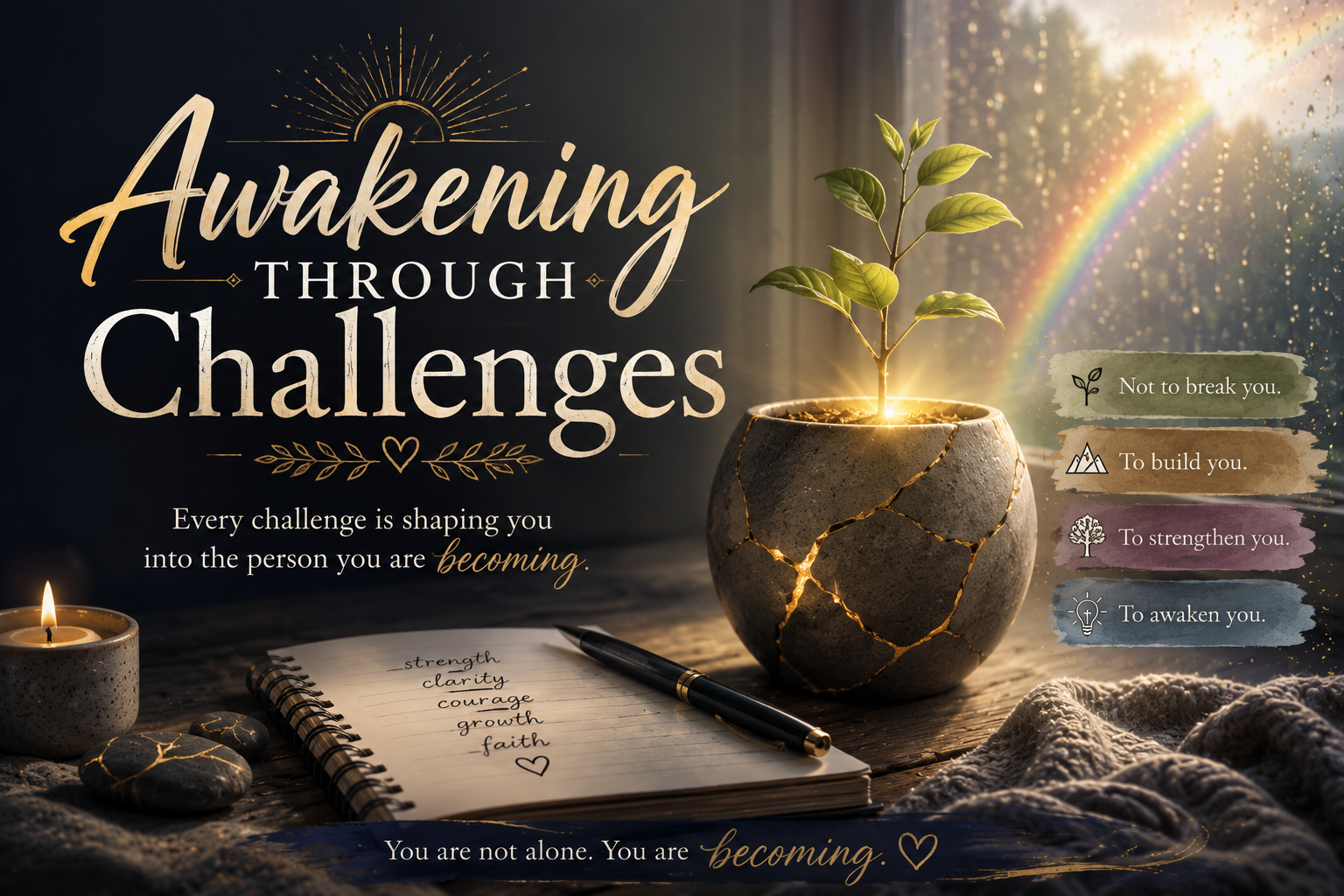
Awakening Through Challenges
Explore how difficult seasons can build resilience, clarify boundaries, deepen faith, strengthen discernment, and reveal what matters without romanticizing hardship.
How Difficult Seasons Can Strengthen Resilience, Clarify What Matters, and Deepen Faith
Challenges can become invitations for growth.
They are not automatically punishment.
They are not always proof that you are off track.
And they do not always arrive with a neat explanation.
Some challenges are simply part of being human.
Loss.
Change.
Uncertainty.
Disappointment.
Responsibility.
Waiting.
Conflict.
Unexpected endings.
Hard decisions.
Seasons where nothing seems to move as quickly as you hoped.
But even when a challenge was not chosen, welcomed, or understood, something meaningful can still emerge from the way you meet it.
A difficult season may strengthen patience.
Clarify boundaries.
Reveal what matters.
Show you where you have been carrying too much.
Teach you where greater self-trust is needed.
Deepen compassion.
Strengthen faith.
Help you discover capacities you did not know you had.
Sometimes a challenge asks:
Will you return to fear, or will you meet this with more truth, wisdom, and courage than before?
That question does not deny the difficulty.
It gives you somewhere to stand inside it.
Challenges Can Reveal What Was Already Beneath the Surface
Hard seasons often make things visible.
A pattern you could ignore during easier times becomes impossible to miss.
A weak boundary becomes obvious.
A relationship dynamic becomes clearer.
A habit that was quietly draining you becomes harder to justify.
A fear you thought you had outgrown may return.
A strength you did not know you possessed may suddenly become necessary.
Challenges can act like mirrors.
Not because every difficulty contains a hidden spiritual message.
But because pressure often reveals what is already present.
You may see:
Where you need more patience.
Where you are trying to control what cannot be controlled.
Where something in your life needs to change.
Where support is missing.
Where you have underestimated your own resilience.
Where an old pattern is ready to be understood differently.
That kind of clarity can become one of the most valuable things a challenge gives you.
The Question Is Not Always Why
When something hurts, the first question is often:
Why is this happening to me?
Sometimes that question has an answer.
Sometimes it does not.
Sometimes life is complicated enough that searching for one clean explanation creates more frustration than clarity.
A more useful question may be:
What is this asking me to understand now?
Or:
What is this revealing?
What do I need here?
What is mine to learn?
What is mine to release?
What is the next faithful step?
These questions do not turn pain into a lesson plan.
They simply help you move from helplessness toward participation.
You may not control what happened.
But you can still decide how you respond.
Meaning Can Be Made Without Pretending the Pain Was Good
There is a difference between finding meaning in a challenge and declaring that the challenge itself was good.
Some losses remain losses.
Some betrayals were wrong.
Some seasons were simply hard.
Some things should never be romanticized.
Growth does not require rewriting pain into something beautiful before you are ready.
You can say:
That hurt me deeply.
and also:
I learned something from surviving it.
You can say:
I wish that had never happened.
and also:
I am proud of who I became afterward.
Both can be true.
Meaning does not have to erase truth.
It can grow beside it.
Challenges Can Strengthen Resilience
Resilience is not becoming unaffected by difficulty.
It is the ability to keep moving, adapting, recovering, and making thoughtful choices even when life becomes demanding.
Sometimes resilience looks strong.
Sometimes it looks quiet.
It may look like:
Getting out of bed.
Showing up for your responsibilities.
Resting before you burn out.
Asking for help.
Changing direction.
Trying again.
Saying no.
Learning something new.
Giving yourself one more day.
Resilience is not the absence of struggle.
It is the capacity to continue relating to life even while struggle is present.
That capacity can grow.
Challenges Can Strengthen Discernment
Hard experiences can sharpen your ability to recognize what fits and what does not.
You may begin noticing:
Who brings peace into your life.
Who repeatedly brings confusion.
Which commitments are meaningful.
Which ones are draining you without purpose.
What kind of work energizes you.
What kind of environment makes you smaller.
Which fears deserve caution.
Which fears are only old patterns asking to remain in charge.
Discernment often becomes clearer when a challenge forces you to stop drifting.
You begin asking better questions.
Not:
What keeps everyone happy?
But:
What is actually true here?
Not:
How do I avoid discomfort?
But:
What choice is most aligned with wisdom and integrity?
Not:
How do I make this disappear?
But:
What does this situation require from me?
That shift can become a turning point.
Challenges Can Reveal Boundaries
Sometimes a challenge teaches you where your limits are.
You may discover that endless giving is not sustainable.
That compassion without boundaries becomes depletion.
That loyalty does not require self-abandonment.
That saying yes to everything can become a quiet way of saying no to yourself.
Challenges often reveal where your peace needs greater protection.
You may learn to say:
I cannot carry this for you.
I need time before I answer.
This does not work for me anymore.
I can care and still step back.
I can love and still have limits.
Boundaries are not walls against life.
Healthy boundaries help protect the conditions where honesty, peace, responsibility, and connection can grow.
Challenges Can Deepen Compassion
Difficulty often changes the way you see other people.
You become less quick to judge.
More aware that many people are carrying stories you cannot see.
You may become more patient with someone who is struggling.
More understanding of how fear affects behavior.
More willing to offer grace.
You may also discover that compassion belongs inward too.
Sometimes the challenge is not only learning to be kinder to others.
It is learning to stop punishing yourself for being human.
You can acknowledge mistakes without turning your entire identity into one.
You can grow without insulting the person you were before you knew better.
You can become wiser without becoming cruel to yourself.
That is part of awakening too.
Faith Can Change the Way You Carry a Challenge
Faith does not mean every difficult circumstance suddenly makes sense.
It does not require pretending everything is fine.
Faith can simply create a larger place to bring what you do not understand.
You can pray:
God, show me what is mine to learn here.
Give me wisdom for what is mine to do.
Help me release what I cannot control.
Strengthen me without hardening me.
Show me what needs to change.
Help me trust You even when I cannot see the whole road.
Sometimes circumstances change.
Sometimes faith changes the way you carry what has not changed yet.
Sometimes it gives you enough strength for one more day.
Sometimes it gives you peace before it gives you answers.
That still matters.
Growth Does Not Always Look Dramatic
Sometimes awakening happens quietly.
You notice you reacted differently.
You spoke up sooner.
You did not chase the same pattern.
You paused before spiraling.
You asked for help instead of pretending you were fine.
You rested before exhaustion made the decision for you.
You let someone misunderstand you without abandoning your own truth.
You chose peace where you once chose panic.
These changes may seem small.
They are not.
Growth often becomes visible first in the moments where your old reaction no longer has the same power.
That is how transformation begins to show itself.
When It Feels Like Too Much
Some seasons are intense.
And in those seasons, growth may feel less like inspiration and more like survival.
If that is where you are, you do not need to turn the challenge into a beautiful lesson today.
You do not have to be perfectly positive to be spiritually strong.
You do not have to understand everything to keep moving.
You do not have to rush healing to prove you are doing it correctly.
You are allowed to stabilize first and understand the lesson later.
Sometimes strength looks like rest.
Sometimes it looks like asking for help.
Sometimes it looks like eating something.
Taking a shower.
Answering one email.
Going outside.
Praying one honest sentence.
Sleeping.
Trying again tomorrow.
Do not underestimate the sacredness of doing what is possible.
One step still counts.
Not Every Challenge Is Yours to Endure Forever
Growth does not always mean staying.
Sometimes the lesson is to leave.
Sometimes the strongest choice is ending a pattern.
Changing jobs.
Seeking support.
Creating distance.
Releasing an obligation.
Admitting that something is no longer healthy.
There can be wisdom in perseverance.
There can also be wisdom in redirection.
The question is not:
How much can I tolerate?
A better question may be:
What choice supports truth, health, responsibility, peace, and integrity now?
Awakening is not measured by how much suffering you can endure.
Sometimes awakening is recognizing that you no longer have to keep volunteering for the same pain.
You Can Keep Your Softness
Challenges can make people stronger.
But strength does not have to become hardness.
You do not have to become cynical because someone disappointed you.
You do not have to stop trusting everyone because one person betrayed you.
You do not have to lose wonder because something did not work.
You do not have to close your heart in order to become wise.
There is another kind of strength.
A strength that keeps discernment without losing compassion.
Keeps boundaries without losing warmth.
Keeps wisdom without losing hope.
Keeps faith without denying reality.
You can emerge from difficulty more grounded and still remain soft.
That may be one of the deepest forms of resilience.
A Grounding Practice for Hard Days
When everything feels too large, bring your attention back to what is actually here.
Place your feet on the floor.
Take one comfortable breath.
Then ask:
What is happening right now?
Not next week.
Not next year.
Right now.
Then ask:
What do I need most in this moment?
Maybe:
Rest.
Water.
Food.
Prayer.
Information.
Support.
Movement.
Quiet.
A boundary.
Then ask:
What is the next loving step?
Not the entire plan.
Not the perfect solution.
One step.
You can say:
I am here.
God is with me.
I do not need the whole answer yet.
I can take the next step.
Hard seasons become more manageable when you stop demanding that today carry the entire future.
A Challenge Reflection Practice
Think about one challenge you are facing.
Ask:
What part of this is outside my control?
Then:
What part is mine to respond to?
Next:
What is this revealing about my needs, values, patterns, or boundaries?
What strength is this asking me to develop?
What do I need to stop carrying?
What kind of support would help?
What is one practical action available now?
Then stop.
You do not have to turn one reflection into a complete life strategy.
Clarity often arrives in pieces.
Honor the piece you have.
The Hidden Gift May Be Who You Become
Not every challenge contains a hidden gift.
But sometimes a gift emerges anyway.
Courage.
Clarity.
Faith.
Humility.
Compassion.
Self-respect.
A stronger boundary.
A different direction.
A new relationship with yourself.
A deeper understanding of what matters.
The challenge itself may not have been a gift.
But what you build from it may become one.
Sometimes the place that once felt like weakness becomes the place where you discover strength.
Sometimes the season that stripped away certainty leaves behind clarity.
Sometimes losing what no longer belonged creates room for something truer.
Life can create meaning even after difficulty.
Frequently Asked Questions
Can Challenges Really Help You Grow?
Yes.
Difficult experiences can create opportunities to develop resilience, problem-solving skills, self-knowledge, boundaries, perspective, compassion, and faith.
Growth is not automatic, but reflection, support, and intentional choices can help turn experience into learning.
Does Every Challenge Happen for a Reason?
Not everyone interprets hardship the same way.
Some people understand challenges spiritually, while others see them as part of ordinary life, circumstance, or chance.
You do not have to force an explanation in order to grow from what happened.
How Do I Find Meaning in a Difficult Season?
Begin with honest questions.
What matters most now?
What is this revealing?
What do I need?
What is within my control?
What have I learned about myself?
Meaning often develops gradually rather than appearing immediately.
What Is Resilience?
Resilience is the capacity to adapt, recover, and continue functioning in the presence of difficulty or change.
It does not mean being unaffected by hardship.
It means being able to keep engaging with life and finding ways forward.
How Do Challenges Strengthen Boundaries?
Difficult experiences can reveal where you are overextended, where a relationship or obligation is unhealthy, or where clearer limits are needed.
That awareness can help you make choices that better protect your time, energy, values, and peace.
How Can Faith Help During Hard Times?
Faith can offer prayer, hope, spiritual connection, meaning, surrender, wisdom, and a sense that you do not have to carry difficulty alone.
Faith does not require having every answer.
How Do I Know Whether to Keep Going or Let Something Go?
Consider whether continued effort still aligns with your values, responsibilities, well-being, and practical reality.
Sometimes perseverance is wise.
Sometimes redirection is wiser.
Reflection, prayer, trusted counsel, and honest evaluation can help clarify the difference.
What If I Am Too Overwhelmed to Look for a Lesson?
Then do not look for one yet.
Focus on what helps you get through the present moment.
Rest.
Eat.
Reach out.
Pray.
Handle the next practical need.
Meaning can wait.
You are allowed to understand something later.
Awakening Through Challenges
Challenges do not need to become punishment.
They do not need to become proof that you failed.
They do not need to become evidence that God has abandoned you.
A difficult chapter can be exactly that:
A difficult chapter.
And still, something can grow from the way you meet it.
You can become more discerning.
More compassionate.
More resilient.
More faithful.
More aware of your limits.
More honest about what matters.
More willing to ask for help.
More courageous about change.
More able to recognize what no longer belongs.
You do not have to love the challenge.
You do not have to pretend it was easy.
You do not have to turn pain into poetry before you have caught your breath.
Just keep listening.
Keep learning.
Keep choosing what is true.
Keep allowing God to meet you in the places you did not plan to visit.
One day you may look back and realize:
The challenge did not become your identity.
It became part of the ground you grew through.
And somehow, you came out knowing yourself more deeply than before.
Challenges can reveal strengths, wisdom, and capacities you had not yet needed to use.
If This Message Resonated, You May Also Enjoy

The Magic in Everyday Moments
Discover the magic in everyday moments through wonder, gratitude, savoring, presence and faith. Explore how ordinary experiences, relationships, simple rituals and thanking God can make everyday life feel deeply meaningful and sacred.
Some moments announce themselves.
A wedding.
A birth.
A long-awaited answer.
A breathtaking journey.
A door finally opening.
And then there are the other moments.
Morning light moving across the floor.
The first sip of coffee.
A bird appearing outside the window.
Someone laughing in another room.
Fresh sheets.
A familiar song arriving at exactly the right time.
Dinner cooking in the kitchen.
A dog waiting at the door.
Rain tapping against the windows.
Someone you love saying your name.
We tend to call these things ordinary.
Perhaps they are anything but.
Much of life is not lived during the extraordinary events we remember forever. It is lived in kitchens and cars, on porches and sidewalks, while folding laundry, making dinner, answering messages, watering plants, watching sunsets, saying good morning and turning out the lights.
If we are always waiting for something remarkable to happen before we feel fully alive, we may overlook the remarkable life already happening around us.
The magic in everyday moments begins when we learn to notice.
Ordinary Life Is Where Life Actually Happens
Milestones matter.
They give our lives shape and become landmarks in our personal stories.
But milestones occupy only a small portion of our actual days.
Most of life happens in between them.
Breakfast.
Work.
Conversation.
Errands.
Meals.
Music.
Rest.
A few minutes outside.
A thought that makes us smile.
A kindness we almost forget.
A beautiful sky we happened to notice.
These moments may appear insignificant individually, yet together they create the texture of a life.
A meaningful life does not have to be a continuous sequence of extraordinary experiences.
It can also be a life in which ordinary experiences are deeply received.
There is freedom in realizing this.
We do not have to wait for life to become spectacular before appreciating it.
We can meet it where it is.
Small Moments Matter More Than We May Realize
Psychologists who study everyday life have found something that feels wonderfully intuitive: small positive experiences matter.
Researchers sometimes call them daily positive events. These can be simple experiences such as enjoying a conversation, spending time with someone we love, accomplishing something, experiencing beauty or having something unexpectedly pleasant happen.
Individually, these moments can seem almost too small to count.
Collectively, they matter.
Research examining decades of studies has found an association between everyday positive events and greater well-being.
Perhaps life was never asking every day to be magnificent.
Perhaps it was asking us to recognize the little pieces of goodness already scattered through it.
Attention Changes What We Experience
Two people can move through the same afternoon and experience very different worlds.
One notices traffic, unfinished tasks and everything that still needs to be done.
Another notices sunlight flickering through trees, a breeze coming through an open window and a favorite song playing on the radio.
The world around them may be nearly identical.
What entered their awareness was different.
Human attention is selective.
There is far more happening around us than we could consciously notice at once, so our minds continually decide what deserves attention.
That means where our attention repeatedly goes can influence what our days seem to contain.
This does not mean ignoring difficulty.
It means remembering that difficulty is rarely the only thing present.
There may also be beauty.
Kindness.
Humor.
Help.
Music.
Possibility.
Love.
Grace.
A single day can contain both struggle and wonder.
Noticing the wonder does not erase the struggle.
It allows us to see more of the whole picture.
Familiar Does Not Mean Ordinary
One reason we stop noticing beautiful things is simple.
We become accustomed to them.
The extraordinary gradually becomes familiar.
Think about how astonishing some everyday experiences actually are.
A tiny seed disappears beneath the soil and eventually becomes a tomato, sunflower or towering tree.
Music moves through the air as vibration and somehow becomes melody, memory and emotion inside us.
A familiar scent can suddenly return us to a kitchen we have not entered in decades.
Someone hundreds of miles away can speak and we can hear their voice almost instantly.
Our bodies continuously regulate temperature, circulate blood, exchange gases, repair tissues and coordinate countless processes without requiring conscious instructions from us.
The moon helps move the oceans.
Plants turn light into stored chemical energy.
Rain falls from water that had been suspended invisibly in the atmosphere.
None of these things becomes less remarkable simply because we have seen them before.
Familiarity does not make something ordinary.
Sometimes familiarity simply makes the extraordinary harder to see.
Wonder Is Not Only for Children
Children are masters of noticing.
A puddle can become an expedition.
A cardboard box becomes architecture.
A beetle crossing the sidewalk deserves immediate investigation.
A strangely shaped cloud may stop everything.
Somewhere along the journey into adulthood, many of us begin naming things so quickly that we stop truly looking at them.
Tree.
Cloud.
Bird.
Rain.
Flower.
Moon.
Once something has been categorized, the mind moves along.
But knowing what something is called is not the same as experiencing its wonder.
Look again.
A tree is alive.
A bird navigates a world entirely different from ours.
A flower constructs intricate colors and patterns from sunlight, water, minerals and genetic instructions.
The night sky contains light that began traveling toward us long before we looked upward.
Wonder was never reserved for childhood.
We may simply have stopped giving it our full attention.
Awe Can Be Found in Small Places
We sometimes imagine awe requires standing at the edge of the Grand Canyon or beneath an enormous night sky.
Those experiences certainly qualify.
But awe can appear closer to home.
A spectacular cloud formation.
A piece of music.
A newborn baby gripping a finger.
Sunlight passing through stained glass.
A thunderstorm approaching.
Standing beneath an old tree.
Watching bees work among flowers.
Looking into a clear night sky.
Hearing an entire congregation sing together.
Scientific research has increasingly explored awe as a meaningful human emotion. Studies have associated everyday experiences of awe with greater well-being and lower perceived stress.
But perhaps we do not need science to tell us why awe feels important.
Awe reminds us that the world is larger than our immediate concerns.
For a moment, something makes us stop.
Look.
Listen.
And remember that we are part of something much larger than ourselves.
God Often Meets Us in the Ordinary
Sacred moments do not always arrive with thunder.
Sometimes they arrive quietly.
Scripture is filled with profound meaning revealed through remarkably ordinary things.
Bread.
Water.
Seeds.
Soil.
Fish.
Lamps.
Birds.
Flowers.
Trees.
Meals.
Vineyards.
Gardens.
Roads.
Jesus repeatedly used things people encountered in everyday life to reveal spiritual truths.
A seed could teach about faith.
Bread could carry sacred meaning.
Birds could become a reminder of God's care.
Lilies could teach something about worry and trust.
A lamp could speak about light.
A meal could become fellowship.
Water could become a symbol of life.
The ordinary world was not separate from spiritual life.
It became a doorway into it.
Perhaps there are more invitations to notice God around us than we realize.
Sometimes the holy moment is not separate from daily life.
Sometimes it is daily life, finally seen.
Gratitude Changes the Way We Receive a Moment
Gratitude has an unusual quality.
It does not necessarily change what is in front of us.
It changes how we receive what is in front of us.
A cup of coffee becomes warmth held between our hands.
A house becomes shelter.
Dinner becomes nourishment.
A phone call becomes connection.
A bed becomes rest.
Another morning becomes another chance.
Psychological research on gratitude practices has found modest but meaningful improvements in well-being across many studies and populations.
That does not mean gratitude is a magic formula.
Its beauty may be much simpler.
Gratitude asks us to notice what we might otherwise pass by.
And for a person of faith, gratitude can travel one step further.
It can become thanksgiving.
Thank You for this morning.
Thank You for this food.
Thank You for this home.
Thank You for this person.
Thank You for carrying me through today.
Thank You for the answer I received.
Thank You for the answer I am still waiting for.
Thank You for this little moment I almost missed.
These prayers do not require ceremony.
Sometimes gratitude spoken quietly in the middle of an ordinary afternoon is prayer enough.
Savoring Is the Art of Staying With Something Good
Psychology has a wonderful word for something human beings have probably practiced for thousands of years.
Savoring.
Savoring means intentionally noticing, appreciating and staying with a positive experience rather than immediately rushing past it.
Research into savoring has found that practices designed to help people more fully engage with positive experiences can support emotional well-being.
The practice itself can be wonderfully simple.
When the coffee tastes especially good, notice it.
When someone you love laughs, listen.
When the evening sky turns magnificent, look.
When the breeze feels wonderful, feel it.
When your home becomes unusually quiet, receive the peace.
When you finish something difficult, allow yourself to experience the relief.
When someone says something kind, do not brush it away.
Let the good moment arrive.
We spend so much of life moving toward the next thing that sometimes we barely experience the thing happening now.
Savoring says:
Stay here for another moment.
This is good.
We Can Savor the Past, Present and Future
Savoring is not limited to what is happening right now.
We can enjoy anticipation.
We can enjoy experience.
And we can enjoy remembrance.
Think about looking forward to Christmas morning, a vacation, a family dinner or seeing someone you love.
The anticipation itself can carry joy.
Then there is the moment itself.
And years later, remembering that experience may bring another kind of warmth.
Human beings possess the remarkable ability to experience joy across time.
We can remember yesterday.
Receive today.
Look forward to tomorrow.
Perhaps that is one reason photographs, traditions, recipes, songs and family stories become so precious.
They allow moments to keep speaking.
You May Be Making a Memory Right Now
This may be one of the most important things to remember.
We rarely know which ordinary moments will become precious memories.
The dinner happening tonight may someday be remembered as those evenings around that table.
The dog sleeping beside you may someday be the dog you would give anything to pet once more.
The child asking endless questions may someday be grown.
The voice calling from another room may someday exist only in memory.
The house that occasionally feels too small may someday be remembered as home.
The person sitting across from you may someday be the person whose stories you repeat.
We often recognize precious moments only after they have become memories.
But sometimes we can recognize them while they are still happening.
Look around occasionally and think:
I may want to remember this.
That simple thought can transform an ordinary moment.
There Is Magic in Being Known
Some of life's greatest treasures are relational.
Someone knows how you take your coffee.
Someone recognizes your footsteps.
Someone knows which story will make you laugh.
Someone remembers what you were worried about yesterday and asks how it turned out.
Someone sends you something because they saw it and thought of you.
Someone can tell from your voice that something is wrong.
Someone knows your history and loves you anyway.
Being known is easy to overlook when it becomes familiar.
But there is profound beauty in having people with whom we do not need to begin our story from the beginning.
Sometimes the magic in an ordinary moment is not the moment itself.
It is who is there with us.
Ordinary Kindness Is Its Own Kind of Magic
Not every meaningful moment arrives through nature, solitude or contemplation.
Some arrive through people we may never see again.
Someone holds a door.
A cashier smiles.
A stranger lets us merge into traffic.
Someone gives directions.
A neighbor brings food.
A person notices that our hands are full and helps.
Someone says, "Take your time."
Someone tells us, "I hope you have a wonderful day," and actually seems to mean it.
These interactions may last seconds.
Their effects can last much longer.
Human beings possess an extraordinary ability to change the emotional temperature of a moment for one another.
You do not need extraordinary resources to improve someone's day.
Sometimes you only need to notice another human being.
The Beauty of Tiny Rituals
Small rituals can turn ordinary activities into meaningful anchors.
Opening the curtains every morning.
Lighting a candle before prayer.
Making tea in a favorite cup.
Blessing food before eating.
Playing music while cooking.
Sitting outside at sunset.
Walking through the garden in the evening.
Calling someone you love every Sunday.
Saying goodnight before going to sleep.
These things may appear insignificant from the outside.
But repetition gives them meaning.
A ritual quietly says:
This moment matters enough for me to be present.
Ritual does not have to be elaborate.
Sometimes sacred rhythm is simply ordinary life performed with intention.
Use the Beautiful Cup
There is a peculiar habit many of us acquire.
We save things.
The beautiful candle.
The expensive soap.
The good dishes.
The special tea.
The new notebook.
The favorite outfit.
We wait for an occasion worthy of them.
Sometimes that makes sense.
But occasionally we forget something important.
Being alive today is an occasion.
Wear the shirt.
Light the candle.
Use the beautiful cup.
Play the music.
Cook the meal.
Open the curtains.
Sit on the porch.
Call the person.
There is wisdom in keeping certain things special.
There is also wisdom in allowing an ordinary Tuesday afternoon to become special because we used them.
Presence Turns Routine Into Experience
Routine itself is not the enemy of wonder.
Absence is.
You can wash dishes while mentally living three days ahead.
Or you can occasionally notice the warm water running across your hands, sunlight coming through the kitchen window and the quiet satisfaction of watching a cluttered sink become empty.
You can walk to the mailbox while thinking about ten other things.
Or you can notice the temperature, the clouds, the birds and the sound of your footsteps.
Presence does not require us to move slowly through every second.
Nobody needs another impossible standard to meet.
We will get distracted.
We will rush.
We will have busy days.
We will sometimes eat lunch while answering messages and realize afterward that we barely tasted it.
That is human.
Presence is simply the invitation to return.
Here.
Now.
This breath.
This room.
This person.
This moment.
This life.
Some of the Best Moments Cannot Be Scheduled
Many beautiful experiences refuse to make appointments.
A rainbow appears.
Someone says something unexpectedly funny.
A child asks an unforgettable question.
A butterfly lands nearby.
A favorite song comes on the radio.
A stranger offers kindness.
The power goes out and everyone ends up talking instead of staring at screens.
A pet does something completely ridiculous.
The sky suddenly turns gold.
These moments cannot always be manufactured.
They can only be received.
And receiving requires enough openness to recognize them when they arrive.
Create a Life With Things Worth Noticing
Noticing beauty is powerful.
Creating beauty is powerful too.
Put flowers somewhere unexpected.
Play music in the kitchen.
Make the bed inviting.
Cook something that smells wonderful.
Write a note.
Plant herbs.
Open the windows.
Feed the birds.
Keep a bowl of fruit where sunlight can reach it.
Make one corner of your home peaceful.
Tell people you appreciate them.
Say please.
Say thank you.
Beauty does not have to be expensive.
Often it is simply intentional.
We can become participants in the everyday magic we hope to experience.
Difficult Seasons Still Contain Moments Worth Receiving
Not every season feels magical.
There are periods of grief, uncertainty, exhaustion, disappointment and change when beautiful language can feel far removed from reality.
Yet even then, small moments can matter enormously.
A warm meal.
A safe place to sleep.
Someone checking in.
A good memory.
A prayer.
Sunlight.
A familiar voice.
A few peaceful minutes.
Finding something good during a difficult season does not require pretending the difficulty is not real.
Sometimes noticing one beautiful thing simply reminds us that hardship has not occupied every inch of the landscape.
There is still something here.
Stop Waiting for Life to Begin
We spend a surprising amount of life waiting.
Waiting for Friday.
Waiting for vacation.
Waiting for the house.
Waiting for the relationship.
Waiting for more money.
Waiting for the weather to improve.
Waiting for something to change.
There is nothing wrong with anticipation.
Dreams give us direction.
Hope pulls us forward.
But tomorrow should not become so bright in our imagination that today disappears beside it.
This day will never happen again.
Not this exact morning.
Not this exact sky.
Not this exact conversation.
Not this exact version of the people you love.
Not this exact version of you.
Life is moving even while we are waiting for life to begin.
A Simple Everyday Wonder Practice
There is no need to turn wonder into another complicated routine.
Try something simple.
At some point today, notice three things.
Something beautiful
Light.
Color.
Music.
Nature.
Someone's smile.
Something good
A kindness.
A comfort.
A task completed.
A pleasant conversation.
Something that went better than expected.
Something to thank God for
It may be enormous.
It may be tiny.
Say thank You anyway.
Then occasionally add one more question:
What happened today that I might someday wish I could experience again?
That question has a way of changing things.
Maybe Magic Is Another Word for Fully Seeing
Magic does not always have to mean something impossible.
Sometimes it describes what happens when an ordinary moment suddenly reveals its depth.
You have seen thousands of sunsets.
Then one evening you stop.
And somehow this one reaches you.
The sunset did not need to change.
Your attention did.
You became available to it.
Perhaps this is one of the quiet secrets of a meaningful life.
We do not necessarily need more extraordinary moments.
We may need deeper attention to the moments already here.
A Sacred Reminder
Your life is not only the milestones.
It is the morning sunlight.
The conversations in the kitchen.
The prayers whispered before sleep.
The meals.
The music.
The rain against the windows.
The people who know your laugh.
The places you return to.
The hands you hold.
The voices you recognize immediately.
The little traditions nobody else would understand.
The quiet moments when nothing remarkable appears to be happening.
Do not underestimate them.
Someday, some of the moments that feel ordinary today may be the ones you would give almost anything to experience once more.
So notice them now.
Say please.
Say thank you.
Thank God.
Laugh when something is funny.
Look at the sky.
Use the beautiful cup.
Listen when someone you love is speaking.
Let yourself enjoy what is good without immediately asking what comes next.
Take the picture sometimes.
And sometimes leave the phone behind and simply be there.
There is more wonder here than we realize.
Sometimes the magic is not waiting somewhere beyond the horizon.
Sometimes it is sitting quietly beside us, hoping we will finally notice.
And sometimes the ordinary moment you are living right now is already becoming one of the beautiful memories of your life.
Questions and Answers
What does it mean to find magic in everyday moments?
It means becoming more aware of the beauty, meaning, connection, gratitude and wonder contained within ordinary experiences. It is not about pretending life is perfect. It is about seeing more completely what is already present.
What is savoring?
Savoring is intentionally noticing, appreciating and engaging with a positive experience. It can involve enjoying something happening now, looking forward to something good or remembering a meaningful experience from the past.
Why do small positive moments matter?
Everyday positive experiences are associated with well-being. A good conversation, beautiful sunset, enjoyable meal, small accomplishment or moment of kindness may appear insignificant alone, but these experiences collectively contribute to the emotional texture of everyday life.
Why do we stop noticing familiar things?
Human attention naturally adapts to repeated experiences. Things that once captured our attention can gradually become part of the background. Curiosity and deliberate attention can help familiar experiences become vivid again.
Can gratitude make everyday life more meaningful?
Gratitude encourages us to notice and appreciate what is good, supportive or meaningful. Research suggests gratitude practices can modestly improve well-being. Spiritually, gratitude can also become thanksgiving as we recognize blessings and thank God for them.
What is awe?
Awe is the feeling that can arise when we encounter something vast, beautiful, powerful or difficult to fully comprehend. Nature, music, spiritual experiences, human connection and even ordinary moments can inspire awe.
Does appreciating small things mean ignoring serious problems?
No. Joy and difficulty can exist simultaneously. Appreciating something beautiful does not erase pain, disappointment or hardship. It allows goodness to remain visible alongside them.
How can ordinary moments become sacred?
Ordinary experiences can become sacred through presence, gratitude, prayer, love and intention. Scripture repeatedly uses everyday things such as bread, water, seeds, birds, flowers, meals and light to reveal deeper spiritual truths.
How can I notice more beauty in everyday life?
Begin small. Notice the sky, temperature, music, someone's voice, the taste of food, light entering a room or one thing that feels good right now. Presence often begins by returning attention to what is directly in front of us.
What is one simple practice I can begin today?
Notice one beautiful thing.
Give it your full attention.
Then say:
Thank You, God. I almost missed that.
Sometimes that is enough to reopen the door to wonder.

Releasing What No Longer Serves
Explore the sacred practice of releasing what no longer serves you through letting go, forgiveness, surrender, faith, emotional release and making room for peaceful new beginnings.
Letting Go, Surrendering to God and Making Room for What Comes Next
There are seasons for holding on.
For building.
For tending.
For protecting.
For persevering.
And there are seasons for releasing.
A belief that once protected us may eventually limit us. A habit that helped us through one season may not belong in the next. A relationship may change. A dream may take another shape. An expectation may quietly expire. An identity we carried for years may become too small for the person we are becoming.
Even beautiful things can have a season.
Releasing what no longer serves us does not mean declaring the past worthless. It means developing the wisdom to recognize what still belongs, what has completed its purpose and what we no longer need to carry.
Sometimes growth asks us to reach for something new.
Sometimes it simply asks us to open our hands.
What Does “No Longer Serves You” Really Mean?
This phrase deserves care.
Something does not cease to serve us simply because it becomes difficult.
Love can be difficult.
Commitment can require sacrifice.
Growth can be uncomfortable.
Responsibility can be demanding.
Faith sometimes asks us to persevere long after the easy road has disappeared.
Releasing what no longer serves us is not an invitation to discard everything inconvenient.
It is an invitation to discern.
The deeper question is not:
Is this difficult?
It is:
Does this still belong?
Does this belief still tell the truth?
Does this pattern still reflect who I am becoming?
Am I carrying this because it is mine to carry, or simply because I have carried it for so long?
Am I being called to persevere?
Or am I being invited to release?
Those are very different questions.
Wisdom helps us recognize the difference.
Release Is Not Rejection
Letting go is often misunderstood.
We may imagine that releasing something means rejecting it, condemning it or pretending it never mattered.
But genuine release can be much gentler.
You can appreciate what something gave you and still recognize that its season has ended.
You can love someone and acknowledge that a relationship has changed.
You can be grateful for an earlier version of yourself without remaining that person forever.
You can honor a dream even when life leads you somewhere different.
You can remember without continually reliving.
Release does not erase meaning.
Sometimes it reveals it.
When we stop demanding that something remain forever, we may finally understand what it came into our lives to teach us.
Why We Hold On
Human beings form attachments not only to people and possessions, but also to routines, expectations, identities, beliefs, memories and imagined futures.
Familiarity can feel safe simply because it is familiar.
Even when something no longer brings peace, we may continue holding it because we know how to live with it.
The unknown asks something different from us.
Trust.
We may also hold on because we have invested so much.
Time.
Love.
Energy.
Money.
Prayer.
Hope.
Effort.
Years.
Something inside us whispers:
After everything I have given, how can I possibly let this go?
But yesterday's investment does not always determine tomorrow's direction.
Sometimes the wiser question is:
What is life asking of me now?
And for a person of faith:
God, what are You asking me to carry into the next season, and what can I finally place into Your hands?
Letting Go Is Not the Same as Avoiding
There is an important difference between releasing an experience and refusing to feel it.
Avoidance says:
I do not want to feel this.
Release says:
I have acknowledged this. I am willing to learn from it. But I do not want it governing my life forever.
Modern psychology sometimes describes a related ability as psychological flexibility.
In simple language, psychological flexibility means being able to experience difficult thoughts and emotions without allowing them to dictate every decision. Instead of spending all our energy trying to eliminate uncomfortable feelings, we can acknowledge them while continuing to move toward what genuinely matters to us.
Release, then, is not pretending.
It is not forcing ourselves to be happy.
It is not denying grief.
It is not burying anger beneath spiritual language.
True release makes room for truth first.
Then, little by little, it makes room for freedom.
Some Things Are Meant to Be Carried Only for a Season
Nature is filled with release.
Trees release leaves.
Flowers release petals.
Fruit releases seeds.
Rivers keep moving.
Day gives way to night, and night eventually releases itself into morning.
Life continually changes form.
Yet human beings sometimes expect themselves to remain unchanged.
We are allowed to grow beyond what once fit us.
There may be habits, expectations, fears, obligations, possessions, relationships, resentments or stories about ourselves that made sense in an earlier chapter but no longer belong in the present one.
Growth sometimes asks us to travel lighter.
Releasing Old Identities
Some of the heaviest things we carry are sentences.
I am the responsible one.
I have to fix everything.
I cannot disappoint anyone.
I have to prove myself.
I always struggle.
Nothing ever works out for me.
I am the person who was hurt.
This is simply who I am.
Some identities begin in childhood.
Others grow from relationships, difficult experiences, expectations or responsibilities we carried for years.
Eventually we may discover that we are living according to a description that no longer reflects who we are.
We are allowed to rewrite the sentence.
That was part of my story. It is not the whole story.
History can explain us without imprisoning us.
Release the Need to Be Who You Used to Be
Other people may become accustomed to a particular version of us.
When we grow, they may not immediately understand.
Growth can change our priorities.
Our boundaries.
Our relationships.
Our routines.
Our dreams.
Our willingness to say yes.
Our willingness to say no.
That does not automatically mean something has gone wrong.
You do not have to dishonor who you were in order to become who you are becoming.
Thank the person you used to be.
That person carried you here.
Then keep walking.
Sometimes We Must Release What Never Happened
Some of the hardest things to release are not memories.
They are futures.
The relationship we believed would last.
The career we imagined.
The opportunity we thought would arrive.
The home we pictured.
The family relationship we hoped would change.
The dream we expected to unfold differently.
The version of ourselves we thought we would become.
We can grieve something that never technically existed because hope itself creates emotional investment.
Sometimes we are not mourning what happened.
We are mourning what we thought was going to happen.
That grief deserves tenderness.
But eventually there may come a moment when continually comparing today's life with yesterday's imagined future prevents us from seeing what is growing here.
You can bless the future you imagined.
You can thank it for the hope it gave you.
And you can become curious about the life that is actually arriving.
Sometimes the unplanned road contains gifts the original map could never have shown us.
Releasing Resentment
Some burdens cannot be seen.
Resentment can keep an old event emotionally present long after the event itself has ended.
Forgiveness offers another path.
Forgiveness does not mean pretending something was acceptable.
It does not mean saying that harm did not matter.
It does not require forgetting.
And forgiveness is not automatically the same thing as reconciliation.
Psychology makes this distinction clearly: forgiveness concerns releasing the domination of resentment, while reconciliation concerns the relationship itself.
That distinction matters.
You can forgive and still have boundaries.
You can forgive and recognize that trust needs rebuilding.
You can forgive without returning to exactly what existed before.
Forgiveness can mean:
What happened mattered. But what happened will not be given permanent authority over who I become.
Keep the Wisdom, Release the Weight
This may be one of the most important lessons in letting go.
We sometimes believe we must choose between remembering and releasing.
We do not.
Keep the lesson.
Release the burden.
Keep the discernment.
Release the bitterness.
Keep the strength.
Release the struggle that is already over.
Keep the wisdom.
Release the weight.
The difficult relationship may have taught you boundaries.
The failed plan may have revealed another direction.
The mistake may have given you discernment.
The disappointment may have clarified what matters.
The long season may have strengthened your faith.
The ending may have made room for a beginning you could not yet see.
Nothing meaningful has to be wasted.
Forgiveness Can Be a Form of Freedom
Scripture repeatedly returns to forgiveness.
Ephesians 4:31–32 speaks of releasing bitterness, anger and malice and choosing kindness, compassion and forgiveness.
Colossians 3:13 similarly encourages forgiveness.
Jesus returned to forgiveness again and again.
There is something profoundly freeing in refusing to allow yesterday's wound to become tomorrow's identity.
Forgiveness does not change what happened.
It changes what we choose to carry forward.
Sometimes forgiveness happens in a moment.
Sometimes it unfolds layer by layer.
Either way, we do not have to wait until every emotion has disappeared before beginning to release the burden.
Releasing the Need for an Apology
One particularly difficult attachment is waiting for another person to give us the ending we believe we need.
An explanation.
An acknowledgment.
An apology.
A confession.
A final conversation.
Sometimes those things come.
Sometimes they do not.
If our peace depends entirely upon another person eventually saying exactly the right words, part of our life remains tied to that person's choices.
Closure is not always something another person gives us.
Sometimes closure begins when we decide:
I understand enough to move forward.
There may always be unanswered questions.
Peace does not require every answer.
Releasing the Need to Control the Outcome
Control can disguise itself as preparation.
We replay conversations.
Predict reactions.
Imagine every possible outcome.
Try to calculate exactly how events should unfold.
Planning can be wise.
But eventually preparation can become an attempt to control what cannot be controlled.
Faith offers another possibility.
Proverbs 3:5–6 encourages us to trust in the Lord rather than relying entirely upon our own understanding.
That does not mean abandoning wisdom, preparation or responsibility.
It means recognizing the limits of our vision.
We see a few steps.
God sees beyond the bend.
There comes a point when peace sounds like:
I have done what I can. The rest I place in God's hands.
Letting Go and Surrender Are Not Quite the Same
Letting go may say:
I am finished carrying this.
Surrender adds something deeper:
God, I give this to You.
There are burdens we genuinely do not know how to resolve.
There are questions without immediate answers.
There are people we cannot change.
There are outcomes we cannot guarantee.
There are doors we cannot force open.
There are timelines we cannot command.
Surrender does not require understanding everything.
It requires trust.
Sometimes the most powerful prayer is remarkably simple:
God, I do not know what to do with this anymore. I give it to You.
That is not defeat.
That is faith.
Release Can Be an Act of Faith
Faith is not always reaching.
Sometimes faith is unclenching.
We can pray for new beginnings while still gripping the ending.
We can ask God to guide us forward while insisting that the next chapter look exactly like the previous one.
Ecclesiastes 3 reminds us that life contains seasons.
There is a time to keep.
And a time to cast away.
A time to seek.
And a time to lose.
A time to mourn.
And a time to dance.
Wisdom includes recognizing which season we are standing in.
Sometimes God may be strengthening us to persevere.
Sometimes He may be inviting us to release.
Discernment is learning to hear the difference.
Sometimes Release Means Loosening Our Grip
Not everything we release must leave our lives.
Sometimes what needs releasing is our grip.
We can love someone without trying to control them.
We can pursue a dream without demanding exactly how it must unfold.
We can pray for an outcome while remaining open to another answer.
We can care deeply without carrying responsibility for everything.
We can hope without insisting upon a timetable.
We can participate fully in life without believing everything depends entirely upon us.
Sometimes release does not mean walking away.
It means holding something differently.
Open hands can still hold.
They simply do not squeeze.
The Body Participates in Release
Stress is not only a thought.
The body participates.
During the body's stress response, breathing and heart rate can increase, muscles can tighten and the body prepares itself to respond to a challenge.
The opposite pattern is sometimes called the relaxation response.
Slow breathing, relaxation practices and focused attention can help the body move toward a calmer state.
This gives us another doorway into release.
Sometimes letting go begins with a thought.
Sometimes it begins with an exhale.
A slow breath.
A walk.
Stretching.
Prayer.
Singing.
Quiet time outside.
Rest.
Tears.
Laughter.
Movement.
These simple acts can become physical reminders:
I do not need to brace against this moment forever.
Tears Are Not the Opposite of Letting Go
We sometimes imagine successful release should immediately feel peaceful.
But release can involve grief.
Even when we know a season has ended, we may mourn what it was.
What we hoped it would become.
Who we were inside it.
What we expected to happen next.
Tears do not necessarily mean we are moving backward.
They may simply mean something mattered.
Grief and gratitude can live in the same heart.
You can miss something and still release it.
You can love something and still let it go.
You can cry and still know you are moving forward.
Writing Can Help Us Put Words Around What We Carry
Sometimes we cannot release something because we have never fully named it.
Writing can help.
Research on expressive writing, meaning writing privately about meaningful thoughts and emotions, has found modest benefits for stress, anxiety and depressive symptoms across groups of studies.
But writing does not need to become a formal exercise.
A blank page can simply provide somewhere to tell the truth.
You might write:
What happened?
What did I hope would happen?
What did this season teach me?
What am I still carrying?
What am I ready to stop carrying?
What do I want to take with me?
What can I place in God's hands?
Sometimes clarity appears when thoughts that have been circling silently finally have somewhere to land.
Making Space Matters
A crowded room has little space for anything new.
Our inner lives can become crowded too.
Old grievances.
Old expectations.
Old obligations.
Old fears.
Old definitions of success.
Old conversations we continue having in our minds.
When we release something, we create space.
At first, that space can feel strange.
We may rush to fill it.
But empty space is not necessarily emptiness.
It can be possibility.
It can be rest.
It can be listening.
It can be the quiet ground where something new begins taking root.
Not every open space needs to be filled immediately.
Sometimes we need to leave room for God to surprise us.
Our Physical Space Can Participate in Release
An inner transition can sometimes be honored through an ordinary physical action.
Clean a drawer.
Donate clothing you no longer use.
Clear old papers.
Remove objects connected to obligations that have ended.
Rearrange a room.
Open the windows.
Wash the bedding.
Sweep the floor.
Bring flowers inside.
Create a peaceful corner for prayer or reflection.
Our surroundings quietly communicate with us.
Creating physical space can become a declaration:
There is room here now.
Releasing Thoughts That No Longer Tell the Truth
Not everything we think deserves permanent residence in our minds.
A thought repeated for years can begin to feel true simply because it is familiar.
I am behind.
I missed my chance.
I am not enough.
Nothing ever changes.
I cannot begin again.
But repetition is not proof.
We can become curious about our thoughts instead of automatically obeying them.
Ask:
Is this true?
Is it still true?
Where did I learn this?
Does this belief reflect who I am today?
Does it help me live according to what matters?
What might become possible if I stopped repeating it?
Sometimes releasing an old belief changes more than changing an external circumstance ever could.
What If It Comes Back?
Release is not always one dramatic moment.
Sometimes we release the same thing many times.
A memory returns.
An old fear appears.
A familiar resentment resurfaces.
The mind revisits a road we thought we had already left.
That does not necessarily mean release failed.
It may simply mean another layer has surfaced.
We can meet it gently:
I remember this.
I know what it taught me.
I have already chosen peace.
I do not need to carry it today.
Over time, something that once occupied an entire room inside us may become a memory we can visit without moving back in.
That is freedom too.
A Sacred Practice of Release
Find somewhere quiet.
Allow yourself a few undisturbed minutes.
Take a slow breath.
Place your hands open in your lap.
Do not force an answer.
Simply ask:
What am I carrying that no longer belongs in this season of my life?
Wait.
Perhaps something immediately comes to mind.
A fear.
An expectation.
A regret.
A relationship.
A possession.
A responsibility.
A belief.
A version of yourself.
A plan that did not unfold as expected.
An answer you never received.
Name it.
Acknowledge what it meant.
Thank God for whatever wisdom came through it.
Keep what is valuable.
Then imagine opening your hands.
And pray:
God, thank You for everything this season has taught me. Give me wisdom to recognize what still belongs and what is complete. Help me keep the love, wisdom and lessons while releasing what I no longer need to carry. I place what I cannot control into Your hands. Lead me toward what comes next, and give me peace while the path is still unfolding. Amen.
Then breathe.
You do not have to solve the next chapter today.
Making room can be enough.
What Release Makes Possible
Releasing is not only about what leaves.
It is also about what becomes possible.
More peace.
More attention.
More energy for the present.
More clarity.
More creativity.
More room for nourishing relationships.
More room for prayer.
More room for gratitude.
More room for joy.
More room for God.
We can spend so long staring at a door that closed that we fail to notice how much light is entering somewhere else.
Release gently turns us around.
Trust the Empty Space
There can be a strange quiet between releasing what was and discovering what comes next.
Do not underestimate that space.
A field can look empty before new growth appears.
A blank page can look like nothing before the words arrive.
Silence can feel empty until we begin hearing what noise had covered.
Not knowing what comes next does not mean nothing is happening.
Some transformations begin underground.
Some answers arrive through redirection.
Some doors close because our lives are moving toward places we could not reach while carrying everything behind us.
Faith leaves room for possibility.
You Are Allowed to Travel Lighter
You do not have to bring every disappointment into tomorrow.
You do not have to carry every opinion someone formed about you.
You do not have to preserve every version of yourself.
You do not have to keep proving that something hurt.
You do not have to remain loyal to beliefs that keep you small.
You do not have to know exactly what comes next before releasing what you know is complete.
There is sacred courage in saying:
Thank you.
I learned.
I loved.
I grew.
And now I release.
Then opening your hands.
Then taking the next step.
Then trusting God with the road you cannot yet see.
Sometimes the miracle is not receiving more.
Sometimes the miracle is discovering how much lighter you become when you finally put something down.
Questions for Reflection
What am I carrying simply because I have carried it for a long time?
What in my life is difficult because it requires perseverance, and what is difficult because its season may actually be complete?
What belief about myself no longer tells the truth?
Is there an imagined future I am still comparing my present life against?
Am I waiting for an apology or explanation before giving myself permission to move forward?
Is there something I cannot control that I could place in God's hands?
What lesson can I keep without continuing to carry the pain that taught it?
What might become possible if I created more room in my life?
What would traveling lighter look like for me?
Frequently Asked Questions
What does releasing what no longer serves you mean?
It means thoughtfully recognizing beliefs, expectations, habits, attachments or patterns that belonged to another season but may no longer support the life you are called to live. It does not mean abandoning everything difficult. Sometimes wisdom tells us to persevere, and sometimes wisdom tells us to release.
Is letting go the same as avoiding difficult feelings?
No. Healthy release can include acknowledging sadness, anger, disappointment or grief. Avoidance attempts to escape an experience entirely. Release allows us to recognize what happened, learn from it and gradually choose not to let it govern the future.
Does letting go mean forgetting?
No. Memories and lessons can remain even after their emotional weight changes. The goal is not necessarily forgetting. It is becoming able to remember without continually living inside the experience.
Can I forgive someone without reconciling with them?
Yes. Forgiveness and reconciliation are not the same thing. Forgiveness can involve releasing resentment, while reconciliation concerns restoring a relationship. You can forgive while still maintaining appropriate boundaries.
Why can letting go hurt even when I know something is complete?
Because endings can involve grief. We may grieve what happened, what once existed or what we hoped would happen. Sadness does not automatically mean release is wrong. Sometimes sadness simply tells us that something mattered.
What if I thought I released something and it comes back?
That can happen. Release is often a process rather than a single event. An old memory or emotion returning does not erase the progress you have made. You can acknowledge it again without allowing it to reclaim its former place in your life.
Can prayer help with letting go?
Prayer can offer a way to surrender what cannot be controlled, ask God for wisdom and entrust an uncertain future to Him. For people of faith, release can become more than putting something down. It can become placing it into God's hands.
What should I do after releasing something?
You do not necessarily need to replace it immediately. Rest. Listen. Pray. Notice. Allow some space to remain open. Sometimes what comes next becomes visible only after we stop filling every empty place.
A Final Thought
There will always be things worth holding tightly.
Love.
Faith.
Truth.
Kindness.
Hope.
Integrity.
The people and purposes entrusted to our care.
But wisdom also teaches us that we were never meant to carry everything forever.
Release is not the art of getting rid of everything difficult.
It is the wisdom to recognize what we are meant to carry, what we are meant to learn from, what we are meant to surrender and what we are finally free to put down.
So keep the wisdom.
Keep the love.
Keep the gratitude.
Keep what strengthened your faith.
Keep what helped you become more compassionate.
And release the weight.
May God give you discernment to recognize what belongs in the next chapter.
May you bless what has completed its season.
May you release what has become too heavy.
May you stop asking yesterday to become tomorrow.
May you trust the spaces that have not yet been filled.
And may you walk forward with open hands, a lighter heart and the quiet confidence that wherever the path leads next, God is already there.

The Beauty of Waiting
Explore the beauty of waiting, divine timing, faith and sacred patience. Discover how waiting can become a season of trust, preparation, spiritual growth, possibility, manifestation and deeper connection with God.
When Something Beautiful May Be Happening Before You Can See It
There are seasons when life moves quickly.
Doors open.
Answers appear.
Plans come together.
A path that was hidden yesterday suddenly becomes visible, and life seems to say, Now.
And then there are seasons of waiting.
You have prayed.
Hoped.
Prepared.
Worked.
Believed.
Perhaps you have done everything you know to do, yet the thing you are waiting for still has not arrived.
Waiting can feel strangely empty because so little may appear to be happening on the surface.
But appearance is not always reality.
An unopened door is not necessarily an empty doorway.
Silence does not necessarily mean absence.
A quiet season is not necessarily an inactive one.
Some of the most important movements in life happen before there is visible evidence of them.
Waiting can become a sacred space between what has been and what is becoming.
And there can be extraordinary beauty there.
Why Waiting Can Feel So Difficult
Human beings naturally love arrival.
We like answers.
Completion.
Certainty.
Movement.
We like knowing where something is going.
Research into human decision-making has repeatedly found that people often place greater value on something available sooner than something they must wait to receive. Researchers call this delay discounting, but the idea is simple: waiting can change how valuable or emotionally compelling a future reward feels to us.
Uncertainty can make waiting even harder.
Sometimes we are not merely wondering when something will happen.
We are wondering whether it will happen.
Will the opportunity come?
Will the prayer be answered the way I hope?
Will the situation change?
Will the door open?
Will everything somehow come together?
That uncertainty can make the space between today and tomorrow feel enormous.
Patience does not always feel peaceful.
Sometimes patience is simply continuing to trust while part of you still wants very much to know what happens next.
Waiting Is Not the Same as Nothing Happening
We tend to measure progress by what we can see.
A new job.
A relationship.
A healed situation.
Financial improvement.
A completed dream.
A clear answer.
A door finally opening.
When those things are not visible, it can seem as though life has stopped moving.
But much of life's development happens invisibly.
Before a seed rises through the earth, something has already begun beneath it.
Before a tree reaches toward the sky, roots have quietly traveled through darkness.
Before an idea becomes something real, it may spend months or years forming inside someone's imagination.
Before an opportunity appears, countless circumstances may need to come together.
Human lives can unfold this way too.
You may be learning something you will need later.
Your priorities may be changing.
Your discernment may be sharpening.
Your character may be strengthening.
Another person's circumstances may be shifting.
An opportunity may be forming somewhere beyond your awareness.
A situation may simply require more time than you expected.
Not everything meaningful announces itself while it is being created.
Sometimes waiting is where the foundation is being built.
There Are Many Kinds of Waiting
Not every waiting season is the same.
Sometimes we are waiting for something we know is coming.
Sometimes we are waiting without knowing the outcome.
Sometimes we are actively preparing while circumstances develop.
Sometimes we are waiting because something does not yet feel clear enough to move toward.
Sometimes the next step belongs to someone else.
Sometimes we are waiting on God.
And sometimes what looks like waiting is actually a quiet transition from one chapter of life into another.
Different seasons ask different things from us.
One may ask for action.
Another may ask for preparation.
Another may ask for courage.
Another may ask us to release something we have been holding too tightly.
And another may simply whisper:
Stay open.
The Sacred Space Between Asking and Receiving
There is a mysterious space between desire and arrival.
Between:
the prayer and the answer,
the dream and its realization,
the preparation and the opportunity,
the question and the clarity,
the planting and the harvest.
We naturally want to close that distance.
We want reassurance.
Evidence.
Dates.
Signs.
Something telling us that our hope is leading somewhere.
But perhaps the space itself matters.
Waiting asks us a beautiful and difficult question:
Can I still live fully while something important remains unresolved?
That question can transform a waiting season.
Instead of treating the present as a hallway we must hurry through before reaching our real life, we begin to understand that this moment is part of our life too.
There may be something here worth receiving.
Something worth noticing.
Something worth becoming.
God Has Always Worked Through Seasons of Waiting
The Bible is filled with people who waited.
Abraham waited for the fulfillment of a promise.
Joseph lived through years he could not possibly have understood while he was experiencing them.
Moses spent years far from the place where his great calling would eventually unfold.
David was anointed long before he became king.
The people of Israel knew generations of longing, promise, wilderness, expectation and deliverance.
Again and again, Scripture connects waiting with faith.
Psalm 27 encourages us to wait for the Lord with strength and courage.
Isaiah 40 speaks beautifully of renewed strength for those who wait upon the Lord.
Romans 8 describes waiting with perseverance for what we hope for but do not yet see.
Biblical waiting is not portrayed merely as meaningless emptiness.
It can be a place where faith learns how to stand without having every answer.
Waiting Can Deepen Trust
Trust is easy when everything makes sense.
It becomes something deeper when the road disappears beyond what we can see.
Faith has always contained an element of the unseen.
We make choices without knowing every outcome.
We love without guarantees.
We plant without controlling the weather.
We pray without always knowing how the answer will come.
We walk forward without possessing a map of the entire journey.
For someone whose faith rests in God, waiting can become an invitation to remember something important:
Our view is not the whole view.
We may see delay.
God may see a much larger picture.
We may hear silence.
Yet silence does not tell us everything about what God may be doing.
We may see a closed door.
God may know where that door would have led.
Faith does not require pretending that waiting is always comfortable.
It allows us to say:
I cannot see the whole story yet, but I do not believe this moment is meaningless.
Divine Timing Is Larger Than Our Timelines
We create timelines almost without realizing it.
By this age.
By next year.
Before this happens.
After that happens.
Surely by now.
We imagine when love should arrive, when finances should improve, when a dream should succeed, when healing should occur, when our work should be recognized, or when clarity should finally come.
Timelines can help us plan.
But sometimes they become invisible rulers we use to measure ourselves.
Life rarely unfolds according to a perfectly organized schedule.
Something that feels late according to our expectations may arrive when we are better able to recognize it, receive it, appreciate it, sustain it, or understand what it means.
There are things we might have mishandled had they arrived earlier.
People we could not have understood before becoming who we are now.
Opportunities requiring abilities we are still developing.
Answers whose meaning becomes clear only after we have lived a little longer.
Timing is not merely about when something arrives.
Sometimes timing is also about who we have become when it does.
Waiting Can Change the Person Who Is Waiting
This may be one of waiting's quietest miracles.
We begin by thinking the purpose of waiting is eventually to receive something.
But while we are looking toward the horizon, something may be happening closer to home.
We are changing.
Our desires become clearer.
Our priorities rearrange themselves.
Our expectations mature.
Our boundaries strengthen.
Our faith deepens.
Our definition of success changes.
We notice things we once overlooked.
We discover strength we did not know we possessed.
We become capable of carrying something an earlier version of ourselves might not have known how to hold.
The person who eventually enters the next chapter may not be exactly the same person who first began waiting for it.
Perhaps becoming is part of the answer.
Waiting Reveals What We Truly Want
Time has a remarkable ability to clarify desire.
Some things we once desperately wanted eventually lose their importance.
Other desires survive years of uncertainty and become even clearer.
Waiting can separate impulse from calling.
It gives us room to ask:
Do I truly want this?
Why does it matter to me?
Would I still want it if nobody else knew I had achieved it?
Does this desire feel true to the life I want to create?
Has my vision changed?
Am I pursuing what I once wanted, or what I genuinely want now?
These questions do not diminish our dreams.
They refine them.
A dream that survives thoughtful reflection often becomes stronger because it is no longer merely something we want.
It becomes something we understand.
Some Beautiful Things Need Time
We live in an age of extraordinary speed.
Messages travel instantly.
Information appears within seconds.
Entertainment begins with a tap.
Something ordered today may arrive tomorrow.
We have shortened countless forms of waiting.
But the deepest parts of human life have not necessarily changed their pace.
Trust takes time.
Wisdom takes time.
Relationships deepen over time.
Forgiveness may take time.
Mastery takes time.
Character develops over time.
A calling may unfold over years.
Some dreams grow slowly because they are becoming larger than we originally imagined.
A meaningful life is rarely assembled overnight.
There are forms of beauty that cannot be hurried.
A great tree cannot be rushed into maturity.
Neither can a human soul.
Waiting May Be Preparation
One of the most powerful questions we can ask during a waiting season is:
What if I am not merely waiting for something? What if I am also being prepared for it?
Perhaps you are waiting for an opportunity while learning the skills that opportunity will require.
Perhaps you are waiting for a relationship while developing a deeper understanding of your own worth.
Perhaps you are waiting for financial expansion while learning how to steward what is already in your hands.
Perhaps you are waiting for a new direction while discovering what no longer belongs in your life.
Perhaps you are waiting for clarity while gathering experiences that will eventually make the answer recognizable.
And while something may be changing within you, circumstances beyond your sight may be changing too.
Preparation does not mean becoming perfect before something wonderful can happen.
There is no invisible examination you must pass before you become worthy of receiving good things.
But growth and timing often travel together.
Sometimes we are preparing for the next chapter.
Sometimes circumstances are still unfolding around us.
And sometimes both are happening at once.
What Looks Like Delay May Be Alignment
There are moments in life that make sense only when viewed backward.
A missed opportunity eventually leads somewhere unexpected.
A plan that refused to come together creates room for another.
A person arrives later than we imagined but at exactly the point when our lives are able to meet.
An idea waits quietly for years and suddenly finds the right moment.
This does not mean every delay carries a hidden explanation that we will eventually discover.
But it reminds us that our interpretation of a moment can change as the story grows larger.
What feels frustrating today may look very different from a future vantage point.
Sometimes life is not refusing to move.
Pieces may simply not have met yet.
Do Not Force What Is Not Ready
Waiting becomes especially difficult when we realize we could force movement.
We could choose a relationship simply because loneliness feels uncomfortable.
Accept an opportunity because uncertainty frightens us.
Push for an answer that has not become clear.
Return to something we have already outgrown.
Settle for something smaller simply because it arrived sooner.
But movement is not always progress.
Sometimes restraint is wisdom.
There are moments when one of the strongest things we can do is refuse to manufacture an answer simply because uncertainty feels uncomfortable.
A rushed yes can change years.
A thoughtful wait can preserve space for something more beautifully aligned.
Discernment often needs quiet.
Patience Is Not Passivity
Waiting does not require sitting still while life happens somewhere else.
Patience can be remarkably active.
You can wait while preparing.
Wait while learning.
Wait while building.
Wait while praying.
Wait while creating.
Wait while strengthening relationships.
Wait while exploring possibilities.
Wait while becoming stronger.
Wait while doing everything that belongs to you today.
There is a profound difference between:
waiting for something
and
waiting to live.
Do not confuse the two.
The present does not become less valuable because something in the future matters deeply to you.
The Future Holds Things You Cannot See From Here
Research into human decision-making has found something fascinating.
When people can imagine the future more vividly and feel more connected to their future selves, future outcomes can become more meaningful in the present.
There is something beautiful in that idea.
An abstract future can feel impossibly far away.
But tomorrow belongs to the same life you are living today.
Think about how much of your current life once belonged to your unknown future.
People you now love were once people you had never met.
Places filled with memories were once places you had never visited.
Things you now know were once things you had never learned.
Some of your favorite days had not happened yet.
That remains true today.
There are still conversations you have not had.
People you have not met.
Places you have not seen.
Ideas you have not thought.
Opportunities you do not know exist.
Prayers whose answers may arrive differently than expected.
Beautiful ordinary days that have not happened yet.
Your present life cannot show you everything your future contains.
Waiting and Manifestation
Manifestation is sometimes portrayed as constant effort toward making something happen.
But intention also has a quieter side.
There is a time to name what you desire.
A time to envision possibility.
A time to take action.
A time to prepare.
And sometimes there comes a point when continued pushing no longer creates meaningful progress.
That is where trust enters.
You can hold a vision without gripping it.
You can believe in possibility without demanding one exact route.
You can remain open to something wonderful without insisting that it arrive according to your personal calendar.
Sometimes manifestation involves movement.
Sometimes it involves receptivity.
Sometimes the next step is action.
Sometimes the next step is allowing.
Wisdom is learning the difference.
Expectation Can Be Beautiful
Waiting does not have to be filled only with uncertainty.
It can also contain expectation.
Expectation says:
I do not know exactly what is ahead, but I believe life still contains goodness I have not experienced yet.
There is freedom in that kind of hope because it does not require us to predict the future.
We can expect possibility without dictating its form.
We can pray boldly while remaining open.
We can dream specifically while allowing life to surprise us.
We can believe that something beautiful remains possible even when we cannot see how it will arrive.
Hope leaves the windows open.
Waiting Teaches Us What Belongs in Our Hands
Waiting eventually confronts us with one of life's great lessons.
We influence many things.
We do not control everything.
We can prepare for an opportunity, but we cannot command someone to offer it.
We can communicate honestly, but we cannot control another person's heart.
We can make wise decisions, but we cannot guarantee every outcome.
We can plant carefully, but we cannot order the rain.
Recognizing this does not make us powerless.
It helps us understand the difference between responsibility and control.
Responsibility asks:
What belongs to me?
Then it does that faithfully.
Trust allows us to release the rest.
There is enormous peace in learning that we do not have to hold everything.
There Is Wisdom in the Pause
A pause creates space.
Music needs silence between notes.
The earth itself moves through rhythms of light and darkness, activity and rest, growth and dormancy.
Our lives contain rhythms too.
The pauses allow us to notice what constant movement can hide.
Who are you when you are not chasing the next achievement?
What have you been too busy to notice?
What do you hear when there is nothing left to force?
What beauty has been sitting quietly beside you while you have been looking toward the horizon?
Sometimes waiting gives us access to ourselves again.
The pause becomes a place of listening.
And sometimes what we hear there changes everything.
The Unseen Is Still Part of Reality
We naturally trust what we can observe.
Yet enormous portions of reality remain outside our immediate awareness.
Roots beneath soil.
Thoughts within another person.
Plans that have not been announced.
Opportunities still being developed.
Decisions being made elsewhere.
Connections between events that we may understand only later.
Our inability to see something does not mean nothing exists there.
This is one reason waiting can become spiritually meaningful.
It teaches us not to confuse:
invisible with impossible,
quiet with empty,
or
not yet with never.
There may be far more happening around your life than you currently know.
When Waiting Becomes Surrender
Sometimes there comes a moment when we realize that thinking about something one more time will not bring it closer.
We have prayed.
Prepared.
Acted where we could.
Considered the possibilities.
Done what belongs to us.
And there is simply nothing more to do today.
That moment can become surrender.
Surrender is not the abandonment of hope.
It is releasing the belief that constant mental effort is required to keep hope alive.
You can place something in God's hands without abandoning your desire for it.
You can say:
This matters deeply to me. I still hope for it. But I trust that I do not have to carry every part of it today.
There is freedom there.
You can put the question down for a while.
You can breathe.
You can go make dinner.
You can laugh.
You can sleep.
You can wake tomorrow without having solved the entire future.
The dream will still be there.
And so will God.
Notice What Has Already Arrived
Waiting can make one absent thing seem larger than everything present.
But look around.
Some of what surrounds you today may once have been something you prayed for.
Something you hoped for.
Something you wondered whether you would ever have.
Perhaps there are people in your life you once had not met.
A home you once did not live in.
Knowledge you once did not possess.
Strength you once did not know you had.
Freedom you once longed for.
A prayer that was answered so gradually you almost forgot you had prayed it.
Waiting for tomorrow should never make us blind to what has already arrived.
Gratitude brings our attention home.
Sometimes we discover that while we have been asking God for the next blessing, we have been standing in the middle of an earlier answered prayer.
Live While You Wait
Do not make waiting the center of every day.
Continue tending the life already in your hands.
Notice what is working.
Care for the people who are here.
Create something.
Learn something.
Spend time outside.
Pray.
Write.
Laugh.
Move your body.
Make your surroundings peaceful.
Do something kind without needing recognition.
Follow the opportunities that are available instead of staring only at the one that has not arrived.
Celebrate something small.
Begin something you have been postponing.
Watch the sunrise.
Plant flowers.
Make dinner with someone you love.
Call someone who makes you laugh.
Create memories in the middle of the unfinished story.
You do not have to postpone joy until everything is resolved.
Gratitude does not require giving up your desires.
You can deeply appreciate your present life while still hoping for more.
These truths can live together beautifully:
I am grateful for what is here.
I am open to what is coming.
Perhaps Nothing Is Late
We often judge our lives against imaginary clocks.
Other people's milestones.
Cultural expectations.
Old plans.
Promises we made to ourselves years ago.
But your life is not required to resemble someone else's timeline.
There may be entire chapters ahead that you cannot currently imagine.
One conversation can change a direction.
One opportunity can open an entirely new road.
Someone you have never met can become important to your future.
An idea can arrive tomorrow that changes the next decade.
A door you never considered can open where you were not even looking.
Life contains far more possibility than the present moment reveals.
Perhaps the question is not always:
Why hasn't it happened yet?
Perhaps sometimes the better question is:
What is still possible from here?
That question opens the room again.
One Day You May Understand the Waiting Differently
There are chapters of life we cannot understand while standing inside them.
Only later do we see how one thing connected to another.
Why a particular season changed us.
Why a certain road mattered.
Why someone entered our life when they did.
Why we needed the strength we developed.
Why an unexpected direction became important.
Looking backward can reveal patterns that were invisible while we were moving through them.
Perhaps one day you will look back at something you are waiting for now and understand the season differently.
Perhaps you will see growth.
Protection.
Preparation.
Redirection.
Unexpected grace.
Or simply the remarkable distance you traveled while believing you were standing still.
And perhaps you will realize:
the waiting was part of the journey too.
A Prayer for the Waiting Season
God, help me trust what I cannot yet see.
Give me wisdom to know when to move and when to wait.
Keep me from forcing doors that are not mine and from overlooking the doors You are opening.
Help me recognize the beauty already surrounding me while I continue hoping for what has not yet arrived.
Use this season to deepen me, strengthen me, prepare me and teach me.
When I become impatient, remind me that my timeline is not the measure of Your faithfulness.
When I become discouraged, remind me how much can change in ways I cannot predict.
Help me recognize what You have already placed in my life.
Give me peace when there is nothing more for me to do today.
Help me place what I cannot control into Your hands.
Keep my heart open to possibilities I have not imagined.
Let me live fully in the life You have given me today while trusting You with tomorrow.
And when the next chapter comes, help me recognize it with gratitude.
Amen.
The Beauty of Waiting
Perhaps waiting is not merely the empty distance between where you are and where you want to be.
Perhaps it is a landscape of its own.
A place where roots deepen.
Desires become clearer.
Faith stretches.
Wisdom grows.
Priorities rearrange themselves.
Character develops.
Possibilities quietly gather.
And something within you becomes ready for a life you could not yet see when the waiting began.
You do not have to know exactly how everything will unfold.
You do not have to solve tomorrow today.
Do what is yours to do.
Release what is not.
Keep your heart open.
Keep living.
Keep praying.
Keep creating.
Keep noticing what is beautiful now.
And keep believing that possibility exists beyond the edge of what you can currently see.
Because sometimes the waiting room is not outside the story.
Sometimes it is where the next chapter is being written.
Questions and Answers
Why does waiting feel so difficult?
Waiting asks us to live with something human beings naturally find challenging: uncertainty. We often prefer outcomes that are available sooner and situations we can understand clearly. When something deeply matters to us but its timing remains unknown, patience can require genuine emotional and spiritual strength.
Is waiting the same as doing nothing?
No. Waiting can include preparation, learning, prayer, discernment, creating, planning and meaningful action. Sometimes there is something useful to do. Other times wisdom means recognizing that we have already done what belongs to us and allowing events to unfold.
What is the spiritual meaning of waiting?
Waiting can become a season of trust, preparation, listening, growth and surrender. It invites us to remain open to what is developing even when we cannot see the entire path ahead.
What does the Bible say about waiting?
Waiting appears throughout Scripture and is repeatedly connected with hope, strength, courage, perseverance and trust in God. Psalm 27:14 encourages courage while waiting for the Lord. Isaiah 40:31 connects waiting upon the Lord with renewed strength. Romans 8:25 speaks of patiently persevering for what we hope for but do not yet see.
Can waiting change us?
Yes. Waiting gives us time to examine what we truly want, develop new abilities, strengthen our faith, reconsider priorities and become more prepared for whatever comes next. Sometimes the person who reaches the next chapter has grown considerably from the person who first began waiting.
What is divine timing?
Divine timing is the spiritual understanding that our preferred timetable may not reveal the entire picture. Trusting God's timing means remaining faithful and receptive even when we cannot yet understand why something has or has not happened.
Can waiting be part of manifestation?
Yes. Intention does not require constant forcing. We can envision a possibility, take meaningful action, remain receptive and allow circumstances to develop. Sometimes holding a vision without gripping it creates room for possibilities we could not have planned ourselves.
What is the difference between patience and passivity?
Passivity means withdrawing from meaningful action. Patience means recognizing that not every outcome can be forced. A patient person can still prepare, learn, pray, create, work and pursue opportunities while allowing what is outside their control to unfold.
How can I stop feeling like my life is on hold?
Return your attention to what is alive today. Continue building relationships, creating, learning, praying, caring for yourself and noticing everyday beauty. Hope for tomorrow does not require postponing joy today.
How do I know whether I should wait or take action?
Consider what genuinely belongs within your control. If there is a meaningful step available, take it. If you have already done what you can and further action would simply be an attempt to force an outcome, patience may be the wiser next step.
What if I cannot see anything happening?
Not all change is immediately visible. Circumstances may be developing outside your awareness, and changes may also be occurring within you. A quiet season does not automatically mean an empty season.
How can I trust God while I wait?
Prayer, gratitude, Scripture, reflection and continuing to live faithfully in the present can nurture trust. Faith does not require knowing what happens next. Sometimes faith means believing that the part of the story we can see is not necessarily the whole story.
How can gratitude help during a waiting season?
Gratitude brings attention back to what is already present. It does not mean abandoning future hopes. It simply allows appreciation for today's blessings to exist alongside hope for tomorrow.
Does “not yet” always mean something will eventually happen?
Not necessarily. Sometimes what we hope for arrives, sometimes circumstances change, and sometimes another path becomes meaningful. The deeper invitation of waiting is to remain open to possibility without requiring life to unfold through only one particular outcome.
Manifestation as a Daily Practice
Explore manifestation as a daily practice through intention, visualization, prayer, gratitude, aligned action, openness, faith and trust in divine timing.
Living Each Day with Intention, Faith, Alignment and Possibility
Manifestation does not have to be something you practice only when you want something.
It can become part of how you live.
It can be present in the thoughts you nurture in the morning, the prayers you whisper while making coffee, the possibilities you remain open to, the choices you make when nobody is watching and the steps you take before you know exactly where they will lead.
At its deepest, manifestation is not simply asking life for something.
It is becoming an active participant in what you are creating.
There is the vision.
There is faith.
There is intention.
There is energy.
There is prayer.
There is action.
There is receiving.
And somewhere among all of these is the mysterious unfolding of a life that cannot always be predicted from where you are standing today.
Manifestation as a daily practice means learning to live in relationship with possibility.
Not once.
Every day.
Manifestation Begins with Intention
Before something can become a meaningful direction in your life, you usually have to recognize that you desire it.
Sometimes the desire is unmistakable.
You want a home.
You want meaningful work.
You want financial abundance.
You want love.
You want healing in an area of your life.
You want greater freedom.
You want to create something.
Other desires arrive more quietly.
You simply know there must be more.
That knowing matters.
Intention gives a desire direction.
Instead of allowing a dream to float indefinitely somewhere in the distance, intention says:
This matters to me.
I am willing to move toward this.
I am open to what may become possible.
That is where daily manifestation begins.
Get to Know the Life Behind the Desire
Sometimes we become so focused on the object of a desire that we forget to ask what the desire represents.
You may want a house, but perhaps what your heart is reaching toward is sanctuary, freedom, security, beauty or belonging.
You may want greater financial abundance because you want choices, generosity, breathing room or the ability to care for the people you love.
You may want a different career because you long for purpose, independence or a life that feels more like your own.
The physical desire still matters.
But understanding what lives beneath it gives the manifestation greater depth.
Ask yourself:
What would this make possible in my life?
How do I imagine feeling when I am living it?
What part of me is asking for this?
Sometimes those questions reveal that the dream is larger than the thing itself.
Attention Changes What You Notice
Your attention is extraordinarily valuable.
At every moment, more information surrounds you than you can consciously process. The brain continually selects what deserves attention, and our goals can help guide that selection.
This gives intention an interesting practical power.
When something becomes important to you, you may begin noticing information connected with it.
An opportunity you once would have ignored catches your attention.
A conversation suddenly seems relevant.
You notice a resource.
You remember someone who could help.
You see a possibility where previously you saw nothing unusual.
The world may not have suddenly filled with these things.
Your relationship with what is around you has changed.
Daily manifestation therefore includes learning to pay attention.
Ask:
What am I noticing now that I have chosen this direction?
The answer can sometimes surprise you.
Begin the Day Before the World Chooses Your Focus
Morning offers a small doorway.
Before messages, responsibilities, news and other people's needs begin competing for your attention, remember what you are creating.
You do not need an elaborate ritual.
Sit quietly for a moment.
Pray.
Breathe.
Remember your intention.
Picture where you are going.
Then choose the energy with which you want to meet the day.
You might say:
I am open to good things today.
I am willing to recognize the opportunities placed before me.
I am moving toward the life I am creating.
God, guide my steps and help me recognize what is meant for me.
I do not need to know the whole path to take today's step.
The words are not magic.
They are direction.
You are reminding yourself what deserves your attention before the noise of the day tries to decide for you.
Visualization Makes Possibility Familiar
Visualization is the practice of mentally experiencing something before it happens.
Close your eyes and imagine the life you are creating.
But go beyond seeing the object.
Enter the experience.
If you desire a home, imagine waking there.
Walk through the rooms in your mind.
Imagine the morning light.
Imagine cooking dinner.
Imagine feeling safe there.
If you desire meaningful work, imagine what a fulfilling workday feels like.
If you desire abundance, imagine having enough to meet your needs, help others, save, give and enjoy your life.
If you desire peace, imagine yourself moving through a situation that once unsettled you with a new steadiness.
Visualization does not have to mean pretending something has already physically happened.
It can be a way of becoming acquainted with possibility.
You are allowing yourself to experience the thought:
This life is imaginable.
And once something becomes imaginable, the next question becomes:
How might I begin moving toward it?
Give the Vision Somewhere to Walk
There is a beautiful place where manifestation and practical action meet.
You can imagine the future you desire and then ask:
What could I do today that agrees with that future?
Research into goal pursuit has found that simply wanting something and taking action toward it are not always the same thing. One useful strategy is forming an “if-then” plan.
If this happens, then I will do this.
You can bring the same wisdom into manifestation.
If an opportunity appears, I will explore it.
If I become discouraged, I will return to my intention before deciding to quit.
If I need information, I will look for it.
If one path closes, I will consider whether another route is opening.
If I receive the opportunity I have been asking for, I will be willing to say yes.
The dream remains expansive.
The next step becomes tangible.
Prayer and Manifestation Can Walk Together
For someone who believes in God, manifestation does not have to mean believing that we control every outcome.
It can mean participating with faith.
Prayer can become part of manifestation:
This is what is on my heart.
This is what I hope for.
This is what I am trying to build.
Please guide me.
Show me what is mine to do.
Open the doors that belong on this path.
Help me recognize the answer, even if it arrives differently than I expected.
There is tremendous freedom in bringing a desire to God without demanding that the entire journey follow your original blueprint.
Faith does not require you to stop dreaming.
It allows you to dream while admitting that you cannot see every road from where you currently stand.
Alignment Is More Than a Feeling
Alignment is sometimes described as feeling wonderful all the time.
But real life is more interesting than that.
Alignment can also mean that your thoughts, choices, values and actions increasingly point in the same direction.
If you say you desire peace, are you making room for peace?
If you desire abundance, are you becoming more thoughtful about what you already have?
If you desire a new opportunity, are you willing to recognize one?
If you desire creativity, are you creating?
If you desire a different life, are there small ways you can begin living differently now?
Alignment does not require perfection.
It asks for relationship between what you desire and how you live.
Gratitude and Desire Belong Together
Gratitude is not the opposite of wanting more.
You can love what exists and still welcome what is coming.
You can be grateful for today's home while dreaming of another.
You can appreciate your current life while knowing that something is changing.
You can thank God for what has already been provided while praying for what has not yet arrived.
Gratitude keeps manifestation from becoming a permanent state of not enough.
Instead of saying:
I will finally be happy when this happens,
gratitude allows you to say:
There is goodness here, and I am still open to more.
That is a very different way to live.
You Do Not Have to Fear Every Negative Thought
A daily manifestation practice should create possibility, not anxiety.
You are human.
You will occasionally doubt.
You may become frustrated.
You may have a terrible Tuesday.
You may wonder whether the thing you want will ever happen.
You may cry.
You may get angry.
You may temporarily lose faith in the plan.
None of this means you destroyed your manifestation.
You do not have to patrol every thought in your head as though one moment of fear can erase everything beautiful you have been building.
Instead, practice returning.
Return to the vision.
Return to prayer.
Return to gratitude.
Return to possibility.
Return to the next step.
One difficult moment does not get to write the entire story.
An Obstacle Is Not Automatically a Sign to Stop
One of the most valuable things to remember is that obstacles are part of almost every meaningful journey.
An obstacle does not necessarily mean you are out of alignment.
It does not necessarily mean the dream is wrong.
It does not necessarily mean you failed to manifest properly.
Sometimes an obstacle contains information.
Maybe something needs to change.
Maybe you need another route.
Maybe there is something to learn.
Maybe preparation is still happening.
Maybe the answer is not yet.
Maybe a completely different door will appear.
There is even research in goal psychology suggesting that imagining a desired future while also recognizing real obstacles and deciding how to respond can support goal pursuit.
That gives us a beautiful principle:
Do not worship the obstacle.
But do not be afraid to look at it either.
Ask:
What is this asking me to do next?
Then listen.
Becoming Matters Too
Manifestation is often discussed entirely in terms of getting.
Getting the relationship.
Getting the money.
Getting the house.
Getting the opportunity.
Getting the answer.
But there is another question:
Who am I becoming while I move toward it?
Perhaps you are becoming more courageous.
More patient.
More discerning.
More willing to receive.
More comfortable trusting yourself.
More aware of God.
More willing to begin again.
Sometimes the person capable of living the next chapter is being formed during the journey toward it.
The destination matters.
So does the becoming.
Make Room for What You Are Asking For
Physical actions can become declarations of readiness.
Clear the desk for the project you intend to create.
Open the savings account for the dream you are funding.
Put the notebook beside your bed.
Research the place you want to visit.
Learn the skill you will need.
Create the folder.
Make the call.
Fill out the application.
Clean the room.
Begin.
You are not pretending the future has already arrived.
You are making room for it.
Sometimes manifestation looks wonderfully mystical.
Sometimes it looks suspiciously like organizing a drawer.
Both can belong.
Receiving Is a Practice Too
We spend enormous amounts of time talking about asking.
But are you willing to receive?
An answer may arrive as an opportunity rather than a finished outcome.
A person may appear.
An idea may arrive unexpectedly.
A conversation may shift something.
A door may open.
A delay may redirect you.
You may suddenly understand what your next step needs to be.
Sometimes the beginning of an answer looks so ordinary that we nearly overlook it.
Receiving requires attention.
It also requires flexibility.
If you insist that your answer must arrive through one exact person, one exact timeline or one exact route, you may miss something better standing a few feet away.
Hold the desire.
Leave some room around the method.
Notice Meaningful Moments
When you begin living intentionally, you may notice moments that feel unusually well timed.
A conversation answers something you were thinking about.
You meet someone connected to an idea you have been exploring.
You encounter the same message repeatedly.
Something appears just when you need it.
Some people call these coincidences.
Others call them synchronicities.
Others see divine guidance.
You do not have to force an explanation for every meaningful moment.
You can simply notice.
Remain curious.
Ask whether it invites action.
And allow life to retain some mystery.
Protect a New Dream When It Needs Quiet
Not every dream needs to be announced.
Some visions become stronger in silence.
Sharing something too early can expose a tender beginning to opinions from people who cannot see what you see.
There is nothing wrong with keeping something between you, God and the blank pages of your notebook for a while.
A seed begins underground.
Its invisibility is not evidence that nothing is happening.
Let some things grow roots before asking them to survive the weather.
Do Not Dig Up the Seed Every Morning
Manifestation can become exhausting when it turns into constant checking.
Is it here?
What about now?
Why hasn't it happened?
Did I do something wrong?
Maybe it isn't coming.
Imagine planting a seed and digging it up every morning to inspect its progress.
Eventually the checking would interfere with the growing.
There comes a point when intention must make room for trust.
Plant.
Water.
Tend.
Participate.
Then allow time to have a role.
Some things happen quickly.
Others unfold through seasons.
You do not need visible proof every morning to continue believing something beautiful can grow.
Release the Timeline Without Releasing the Dream
We often know what we desire long before we understand how or when it can happen.
That space between intention and arrival can be uncomfortable.
But uncertainty is not emptiness.
Things can be moving that you cannot yet see.
Other people may be making decisions.
Resources may be developing.
Circumstances may be changing.
You may be learning something you will need later.
A different route may be forming.
Releasing the timeline does not mean becoming passive.
It means continuing to participate without requiring life to reveal the entire schedule.
There is a difference between:
I give up.
and
I trust that I do not need every answer today.
Take One Aligned Step
Big dreams can make today's actions look insignificant.
They are not.
One phone call.
One application.
One conversation.
One hour of research.
One page written.
One dollar saved.
One boundary established.
One new idea explored.
One prayer.
One brave yes.
One necessary no.
The life you want may be built through hundreds of actions too small to look impressive individually.
Do not underestimate ordinary movement.
A staircase is made of steps that would look almost useless scattered across the floor.
Their power comes from where they lead.
Keep a Record of What Is Moving
Consider keeping a manifestation journal.
Not only for writing what you want, but for noticing what unfolds.
Record intentions.
Prayers.
Ideas.
Unexpected opportunities.
Meaningful conversations.
Synchronicities.
Progress.
Answered prayers.
Doors that opened.
Doors that closed and later made sense.
Things that happened differently but better than you expected.
Over time, you may look back and discover movement where you once believed there was only waiting.
An Evening Manifestation Practice
At the end of the day, return to yourself.
Ask:
What moved today?
What did I notice?
What am I grateful for?
Did an opportunity appear?
Did I take an aligned step?
Is there anything I need to release?
Then let the day end.
You do not have to solve tomorrow tonight.
Sometimes the most aligned thing you can do is sleep.
A Simple Daily Manifestation Rhythm
Morning
Remember what you are creating.
Pray over it.
Visualize it for a few moments.
Choose how you want to meet the day.
Ask what one action would support your intention.
Throughout the Day
Stay awake to opportunity.
Notice what repeatedly catches your attention.
Watch for useful ideas.
Follow meaningful nudges.
Take practical action when it is available.
Stay open to routes you did not originally imagine.
Evening
Notice what moved.
Give thanks for what was good.
Write down anything meaningful.
Release what did not happen.
Rest.
Begin again tomorrow.
This does not need to become another demanding routine.
The purpose is not to spend every waking minute trying to manifest.
The purpose is to live intentionally.
Manifestation Is Not About Controlling Every Detail
Perhaps one of the greatest freedoms in manifestation is discovering that you do not have to control everything.
You can have a clear intention and still remain curious.
You can know what you want while remaining open to something greater.
You can take action without forcing.
You can pray without demanding.
You can believe without knowing how.
You can desire something deeply and still allow God room to surprise you.
Manifestation becomes lighter when it stops being a desperate attempt to command every outcome and becomes a relationship with possibility.
The Ordinary Day Is Where Manifestation Lives
It is easy to imagine that manifestation happens during the vision board, the meditation, the journal entry or the prayer.
Those moments matter.
But manifestation also happens afterward.
When you answer the phone.
When you follow the idea.
When you choose differently.
When you recognize the opportunity.
When you refuse to let yesterday decide tomorrow.
When you keep going despite having no applause and very little evidence.
When you rest instead of forcing.
When you trust.
When you begin again.
Your ordinary life is not the space between manifestations.
It is where manifestation is being practiced.
Questions and Answers
What does manifestation as a daily practice mean?
It means bringing intention, attention, faith, gratitude, openness and practical action into everyday life rather than treating manifestation as something you do only occasionally. It is a way of living in relationship with what you hope to create.
Do I need to manifest every day?
You do not need an elaborate daily ritual. A daily practice can be as simple as remembering your intention, praying, visualizing for a few moments, noticing opportunities and taking one aligned action.
Does manifestation mean thoughts automatically create reality?
Manifestation is understood in many different ways. Science can study areas such as attention, expectations, mental imagery, planning and goal-directed behavior, but it has not established that thoughts alone automatically produce external events. A broader spiritual understanding of manifestation may also include faith, prayer, energy, meaning, divine timing and experiences that people interpret personally.
Can manifestation and belief in God work together?
For many people, yes. Manifestation can be approached as bringing desires to God, praying for guidance, acting on opportunities, remaining open to possibilities and trusting that the path may unfold differently than expected.
Does visualization actually help?
Mental imagery can be useful for rehearsing possibilities and clarifying what you want. It becomes especially practical when paired with action, preparation and consideration of what you will do when obstacles arise.
Do negative thoughts stop manifestation?
There is no reason to believe that one fearful thought, difficult emotion or bad day automatically destroys what you are working toward. Doubt and frustration are normal. Instead of demanding constant positivity from yourself, practice returning to your intention.
What should I do when I encounter an obstacle?
Pause before deciding what the obstacle means. It may call for patience, preparation, another strategy, more information or a different route. Ask what you can learn from it and what action remains available.
What is aligned action?
Aligned action is a practical step that supports the direction you say you want to move toward. It might be making a call, doing research, learning something, saving money, creating, applying, having a conversation or simply beginning.
Why is gratitude part of manifestation?
Gratitude helps keep attention connected to what is already meaningful and good rather than making happiness completely dependent on a future outcome. Research has also found small overall improvements in well-being from gratitude practices.
What if my manifestation happens differently than I imagined?
That may be part of receiving. The deeper desire can sometimes arrive through a route, opportunity or timing you never predicted. Staying open to the essence of what you want can leave room for possibilities beyond the original plan.
How long does manifestation take?
There is no universal timeline. Some changes happen quickly, while others involve circumstances, preparation, other people and factors outside our control. Daily manifestation is less about predicting a date and more about continuing to participate in the direction you have chosen.
Can I manifest something while still being grateful for what I already have?
Yes. Gratitude and desire can coexist beautifully. Appreciating your present life does not require abandoning your hopes for what comes next.
A Final Thought
You do not have to chase your future every waking moment.
Sometimes you can simply walk toward it.
Pray.
Imagine.
Listen.
Notice.
Prepare.
Act.
Receive.
Give thanks.
Rest.
Trust.
Then wake tomorrow and begin again.
There may be things taking shape that you cannot yet see.
There may be doors you do not yet know exist.
There may be conversations waiting to happen, ideas waiting to arrive and possibilities already moving toward the edge of your awareness.
Your job is not to control every piece.
Your invitation is to participate.
Hold the vision without strangling it.
Take the step without demanding the entire staircase.
Make room for possibility.
And remember that manifestation is not only about someday receiving the life you have imagined.
It is also about the person you become, the faith you deepen, the choices you make and the life you begin living while you are on the way.
Perhaps that is why manifestation belongs in the ordinary day.
Because the ordinary day is where tomorrow quietly begins.