

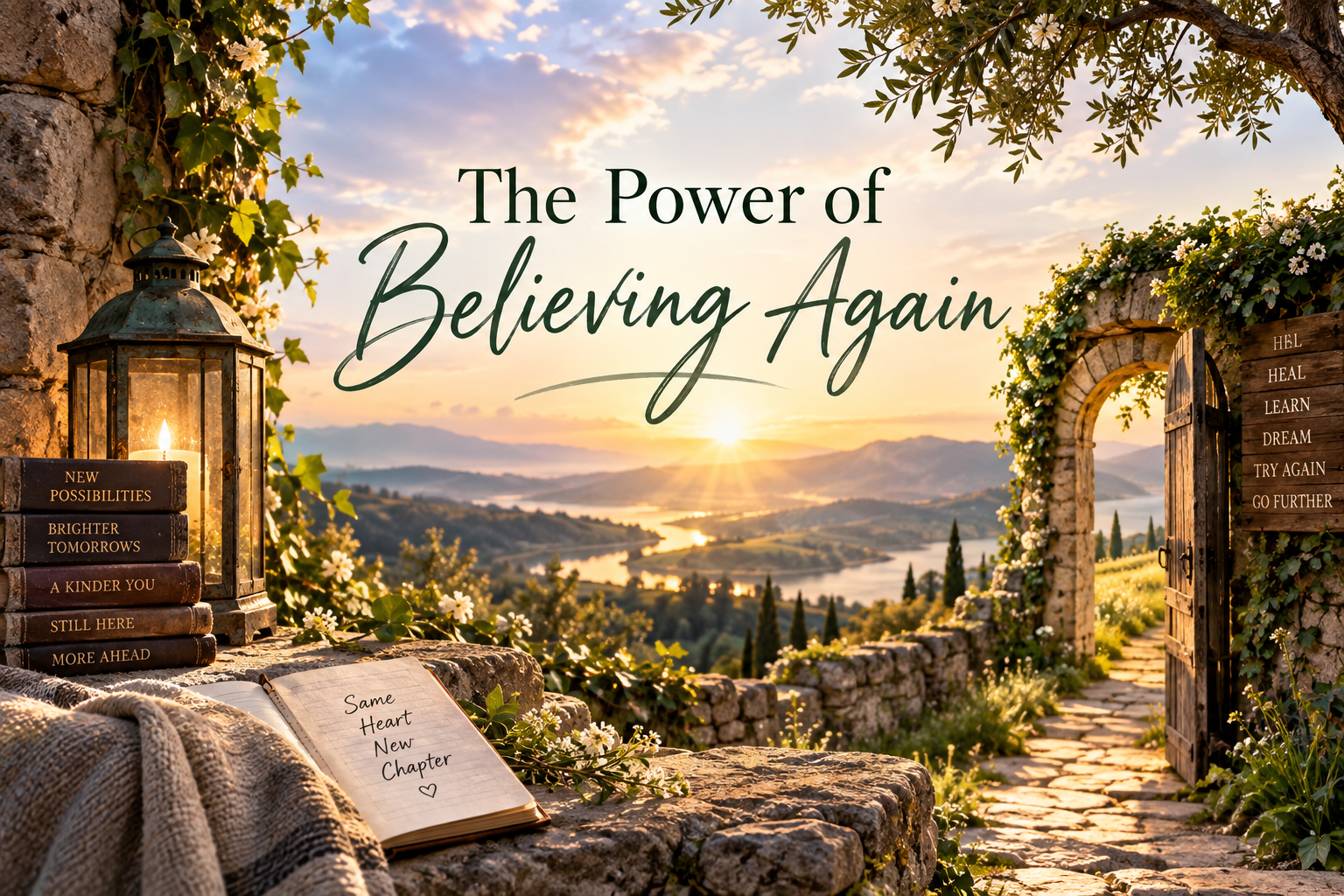
The Power of Believing Again
Discover the power of believing again after disappointment. Explore faith, hope, trusting God, neuroplasticity, new possibilities and the courage to begin again.
When Hope Returns to the Places That Learned to Doubt
There are seasons when believing comes easily.
You believe things will work out.
You believe doors will open.
You believe your prayers matter.
You believe there is goodness ahead.
You believe you can begin something new and somehow find your way.
And then life happens.
A prayer seems unanswered.
A relationship changes.
A dream falls apart.
A door you were certain would open remains closed.
Something you worked for disappears.
You experience disappointment, loss, betrayal, exhaustion, or simply too many years of waiting.
And sometimes, almost without realizing it, you stop expecting beautiful things.
You may still believe in God.
You may still pray.
You may still get up every morning and do everything that needs to be done.
But somewhere inside, expectation becomes quieter.
Hope becomes cautious.
Dreams become smaller.
You stop asking certain questions because you are afraid of the answer.
You stop imagining certain possibilities because imagining them once hurt.
And then comes one of the most sacred moments in a human life:
You begin to believe again.
Not because you have forgotten what happened.
Not because every question has been answered.
Not because someone guaranteed the outcome.
You simply decide that what happened before will not be allowed to define everything that can happen next.
That is the power of believing again.
Believing Again Is Different From Believing the First Time
The first time we believe in something, we often have innocence on our side.
We have not yet seen everything that can go wrong.
Believing again is different.
It happens after experience.
After disappointment.
After knowing that life does not always follow the plans we carefully make for it.
This makes renewed belief something remarkable.
It is not naïveté.
It is hope with history.
You know disappointment exists, and you still make room for possibility.
You know some prayers unfold differently than expected, and you still pray.
You know people can disappoint you, and you still allow love into your life.
You know plans can fail, and you still make new ones.
You know the future cannot be completely controlled, and you still walk toward it.
Believing again does not require you to erase yesterday.
It asks you not to make yesterday the author of tomorrow.
Sometimes We Do Not Realize We Stopped Believing
Loss of belief is not always dramatic.
Sometimes it happens quietly.
You stop applying.
You stop asking.
You stop imagining.
You stop creating.
You stop expecting.
You stop talking about the dream.
You begin saying:
“I’m just being realistic.”
“It probably won’t happen.”
“I don’t want to get my hopes up.”
“Things like that happen for other people.”
“I already tried.”
Sometimes these statements contain wisdom. Experience can teach discernment, patience, better judgment, and better timing.
But sometimes “being realistic” becomes a small room we build around ourselves because hope once hurt.
There is an important difference between wisdom and resignation.
Wisdom says:
I have learned. I will move differently now.
Resignation says:
I have learned not to expect anything anymore.
Believing again does not require abandoning wisdom.
It means carrying wisdom forward without allowing disappointment to extinguish possibility.
The Past Can Teach You Without Predicting You
The human mind is always learning from experience.
When something succeeds, we learn.
When something hurts, we learn from that too.
Over time, repeated experiences can influence what we expect will happen next.
If effort repeatedly seems to lead nowhere, trying again may begin to feel pointless.
Psychologists have studied this through ideas involving motivation, expectation, perceived control, and learned helplessness.
Later research added an important insight:
Experiencing that our actions can make a difference matters.
And this gives us a beautiful way to understand how belief can begin returning.
Sometimes hope is rebuilt through experience.
You make the call.
You ask the question.
You change the approach.
You send the application.
You write the first page.
You begin the project.
You say the prayer.
You take one step.
And something moves.
Perhaps only a little.
But something inside receives new information:
What I do still matters.
That can become the beginning of something much larger.
Your Mind Is Still Learning
The adult brain is not frozen in the shape created by everything that has already happened.
It remains responsive to experience and learning.
Scientists use the word neuroplasticity to describe the brain's continuing ability to adapt through experience, learning, practice, and changing demands.
This is one reason new experiences matter.
A trustworthy relationship can challenge expectations created by an untrustworthy one.
A small success can challenge the belief that nothing ever works.
A new skill can challenge an old belief about what you are capable of doing.
A different pathway can challenge the assumption that the closed road was the only road.
The past may influence what you expect.
But new experiences can give the mind new information.
Yesterday can teach you.
It does not have to own tomorrow.
Hope Is More Than Wishing
Hope can sound soft.
But there is something surprisingly active inside it.
One influential psychological framework known as Hope Theory describes hope through two closely connected ideas.
Agency is the sense that you can move toward something meaningful.
Pathways are the routes you can imagine or create to move toward it.
In everyday language:
Hope says there may still be a way, and I am willing to look for it.
That distinction matters.
Because believing again does not necessarily mean believing that your original plan must work exactly as you imagined.
Sometimes renewed belief sounds like:
If this road is closed, perhaps there is another road.
A Closed Road Is Not Always a Closed Dream
Sometimes we confuse the route with the destination.
We decide what we want.
Then we imagine exactly how it should happen.
Through this person.
Through this opportunity.
Through this company.
Through this timeline.
Through this particular door.
When that route disappears, we can conclude that the entire dream disappeared with it.
But perhaps the better question is:
Is the dream gone, or did one pathway close?
Those are very different things.
There may be another road.
Another person.
Another opportunity.
Another idea.
Another approach.
Another season.
Another door you have not even discovered yet.
Hope does not always say:
Try the same thing forever.
Sometimes hope whispers:
Look again. There may be another way.
Faith Does Not Require Knowing the Route
There is a beautiful spiritual truth here.
Sometimes we pray for the destination while quietly assuming that God must use the route we selected.
Then the route closes.
And we wonder whether God has said no.
But:
“That road closed”
and
“There is no road”
are not the same thing.
Faith leaves room for what we cannot yet see.
Hebrews 11:1 says:
“Now faith is the substance of things hoped for, the evidence of things not seen.”
Faith does not require pretending circumstances are different from what they are.
It allows us to acknowledge what is visible without assuming that what is visible is all there is.
Sometimes faith sounds simply like:
God, I cannot see the road from here, but I trust that You can.
Belief Is Not the Same as Certainty
We sometimes think believing means knowing exactly what will happen.
But if we already knew the outcome, hope would hardly be necessary.
Real hope can contain uncertainty.
Real faith can contain questions.
Real courage can exist alongside fear.
You can believe while wondering.
You can trust while waiting.
You can hope without knowing exactly how something will unfold.
One of the most human prayers in Scripture appears in Mark 9 when a father seeking help for his son says:
“Lord, I believe; help thou mine unbelief.”
He does not pretend to possess perfect faith.
He brings belief and doubt.
Hope and uncertainty.
Longing and struggle.
And he brings all of it to God.
Sometimes faith does not begin with:
I know.
Sometimes it begins with:
I want to believe again.
And that can be enough to begin.
Sometimes Believing Again Begins With Maybe
There is an extraordinary little word between hopelessness and certainty.
Maybe.
When someone has experienced deep disappointment, jumping immediately from:
“Nothing will ever change”
to:
“Everything is going to be wonderful”
may feel impossible.
You do not have to make that leap.
Begin with maybe.
Maybe there is another way.
Maybe this is not finished.
Maybe I have not met everyone I am going to meet.
Maybe another opportunity exists.
Maybe I can approach this differently.
Maybe something beautiful can still grow here.
Maybe God is working somewhere I cannot see yet.
Maybe opens a window.
And sometimes a little light is enough to show us where the next step is.
Hope and Action Belong Together
Believing again is not passive waiting.
Living hope asks:
What can I do with what is in my hands today?
Prayer and action do not have to compete.
Faith and preparation do not have to compete.
Trusting God and taking practical steps do not have to compete.
You can pray for the door and still knock.
You can trust God and still prepare.
You can believe something is possible and still learn everything you can about how to pursue it.
You can ask for guidance and then move when the next step becomes clear.
Faith can kneel.
Faith can also stand up and walk.
Small Steps Can Restore Possibility
You do not need enormous confidence to begin.
You do not need to know how everything ends.
You do not need the entire map.
Sometimes you need one faithful next step.
Send the email.
Make the call.
Write the paragraph.
Research the possibility.
Plant the seed.
Take the class.
Have the conversation.
Apply.
Create.
Begin.
Try differently.
One action may seem insignificant.
But small actions create experiences.
Experiences give us information.
And sometimes one little step tells the heart something it desperately needed to hear:
I am moving again.
Belief Can Change What We Notice
Expectations can influence where we place our attention.
When we become convinced that nothing will work, possibilities may be dismissed before we seriously consider them.
When possibility returns, attention can change.
We notice the conversation.
The idea.
The opening.
The person who might help.
The resource.
The opportunity.
The next step.
Belief does not control every circumstance.
But it can influence how we engage with circumstances.
When we believe improvement may be possible, we may become more willing to search, learn, practice, ask, adapt, persevere, and recognize progress.
A quiet inner shift can begin changing the way we meet the world.
Remember What Has Already Carried You
When the future feels uncertain, look backward for a moment.
Not to live there.
To remember.
Scripture repeatedly calls people to remember.
Remember what God has done.
Remember provision.
Remember deliverance.
Remember faithfulness.
Remember the road already traveled.
There is wisdom in this.
Think about your own life.
Remember the things you once thought you could never survive.
Remember problems that eventually found answers.
Remember people who appeared at exactly the right time.
Remember unexpected provision.
Remember strength you discovered because life required you to find it.
Remember the prayer that was answered differently than you imagined.
Remember the door that closed before another one opened.
Remember the moments when you wondered:
How am I ever going to get through this?
And somehow, eventually, you found yourself standing on the other side.
Sometimes believing again begins with remembering.
Not because everything has always gone perfectly.
But because the hardest moment was not always the final moment.
Remember the Good You Did Not See Coming
There is another kind of remembering worth practicing.
Think about the beautiful things in your life that you could not have predicted.
The person you did not know you would meet.
The place you never expected to go.
The opportunity you never knew existed.
The conversation that changed something.
The idea that appeared unexpectedly.
The ordinary day that became a treasured memory.
There was a time when none of these things were visible to you.
And yet they were ahead.
That is worth remembering whenever the future looks empty.
Not seeing something yet does not mean there is nothing there.
Gratitude Helps Us See What Is Still Here
Gratitude does not ask us to pretend nothing is missing.
It helps us notice what remains.
A sunrise.
A meal.
A safe place to sleep.
Someone who loves us.
A prayer.
A laugh.
A conversation.
A new idea.
A quiet morning.
An unexpected kindness.
A second chance.
When disappointment has trained attention toward what went wrong, gratitude gently reminds us that goodness has not disappeared from the world.
Sometimes renewed belief begins there.
Not with something enormous.
With recognition.
There is still goodness here.
Believing Again Does Not Mean Pretending
Faith does not need falsehood to survive.
If something hurt, it hurt.
If something failed, it failed.
If someone disappointed you, that mattered.
If you lost something precious, that loss deserves to be honored.
Believing again does not require rewriting history.
It means history does not get the final word.
You can say:
That happened.
It changed me.
I learned from it.
And I still believe something beautiful can happen next.
Those truths can live together.
Believing Again Is Not Going Backward
Sometimes believing again means returning to an old dream.
Sometimes it does not.
You have changed.
You know things now that you did not know before.
Your priorities may be different.
Your understanding may be deeper.
Something that once looked like failure may eventually reveal itself as redirection.
So ask:
What is alive in me now?
Perhaps the original dream still burns brightly.
Perhaps it has evolved.
Perhaps an entirely new possibility has begun whispering.
Believing again is not forcing yourself back into an earlier version of your life.
It is becoming available to what can grow from where you are now.
Believing in Yourself Again
Sometimes the belief that disappears is not belief in God or life.
It is belief in yourself.
Failure can make someone question abilities that were never actually erased.
Rejection can make someone question worth that was never determined by another person's decision.
A difficult season can make temporary exhaustion feel like permanent limitation.
But consider something important.
You may actually be better equipped now than you were before.
You know more.
You have experienced more.
You may recognize warning signs sooner.
You may possess better judgment.
You may understand your boundaries.
You may have developed patience, courage, compassion, resilience, or skill that you did not have when the story began.
Starting again does not mean starting from zero.
You are beginning with experience.
There is a difference.
Let Your Dreams Breathe Again
Perhaps there is something you stopped talking about.
A place you wanted to go.
Something you wanted to build.
A book you wanted to write.
A business.
A ministry.
A home.
A relationship.
A creative calling.
A life you imagined.
Maybe you buried it because thinking about it became painful.
Perhaps it is time to look again.
Not with pressure.
Not with a demand that everything happen tomorrow.
Simply with curiosity.
Ask:
Do I still want this?
If the answer is yes, give the dream some air.
Write it down.
Pray about it.
Research it.
Imagine it.
Talk to God about it.
Take one step toward it.
Dreams do not always need dramatic declarations.
Sometimes they simply need permission to breathe.
Protect the Tender Beginning
Renewed belief can be delicate.
You do not have to hand every new dream to people who habitually crush possibilities.
Some dreams need quiet while their roots grow.
Jesus often used seeds as images for spiritual truth.
Seeds begin underground.
There is no applause there.
No audience.
No visible proof.
Yet something is happening.
The shell opens.
Roots begin reaching.
Life moves toward the light before anyone standing above the soil can see it.
Your renewed belief may have an underground season too.
That does not mean nothing is happening.
Some of life's most important beginnings happen where nobody can see them yet.
Let God Be Bigger Than the Closed Door
A closed door can become enormous in our minds.
We stare at it.
Analyze it.
Replay it.
Wonder why it did not open.
Eventually, we can mistake one closed door for the whole landscape.
But God is not limited to one doorway.
Sometimes what appears to be the end of the road is simply the place where our map ends.
Proverbs 3:5–6 says:
“Trust in the Lord with all thine heart; and lean not unto thine own understanding.”
Our understanding sees the present frame.
Faith leaves room for what lies beyond it.
Believing again sometimes means releasing the demand to know exactly how everything will happen.
You can trust without possessing the blueprint.
What If Something Goes Right?
Fear has an imagination.
It can create an entire future from something that has not happened.
What if I fail?
What if they say no?
What if nothing changes?
What if I am disappointed again?
But hope is allowed to imagine the future too.
What if something goes right?
What if the next chapter surprises you?
What if the delay taught you something you will need later?
What if the opportunity you thought you missed was not your only opportunity?
What if someone wonderful is still ahead?
What if the idea works?
What if help comes?
What if you are more capable than you currently realize?
What if the answer arrives differently than you expected?
What if God is already working in places you cannot presently see?
We do not have to pretend we know exactly what will happen.
We simply stop assuming that nothing beautiful can.
There Is No Expiration Date on Hope
You are allowed to begin again.
At 20.
At 40.
At 60.
At 80.
Whenever life finds you standing at another beginning.
There is no age at which hope expires.
There is no rule saying you receive only one dream.
There is no law saying one failure becomes your identity.
You are allowed to change direction.
You are allowed to rebuild.
You are allowed to rediscover joy.
You are allowed to learn something new.
You are allowed to want something again.
You are allowed to expect goodness.
You are allowed to believe that your story still contains pages you have not read.
Because it does.
A Sacred Practice for Believing Again
Find a quiet moment.
Sit somewhere peaceful.
Place your hand over your heart if that feels natural.
Think about one place in your life where you stopped believing.
Do not force anything.
Simply notice what comes.
Then gently ask:
What did I once believe was possible here?
What happened that made me stop believing?
What did the experience teach me?
What wisdom should I carry forward?
What fear can I leave behind?
Is the dream gone, or did one pathway close?
Could there be another way?
What would one small act of renewed belief look like today?
And finally:
God, what would You have me see that I cannot see from where I am standing?
Then be still.
You do not need every answer today.
Perhaps you only need the next step.
A Prayer for Believing Again
God, breathe hope into the places where I stopped expecting goodness.
Thank You for carrying me through everything that brought me here.
Give me wisdom for what has passed, courage for what is ahead, and faith for what I cannot yet see.
Help me recognize the difference between a closed road and a closed dream.
Show me the paths I have overlooked and the doors I have not yet noticed.
When fear tells me that yesterday must repeat itself, remind me that You are still writing my story.
When I cannot believe greatly, help me believe a little.
When certainty is impossible, give me enough faith for maybe.
When I cannot see the whole road, show me the next faithful step.
Help me recognize Your goodness, remember Your faithfulness, and remain open to possibilities beyond what I currently understand.
Teach my heart to believe again.
Amen.
Believe Again
Maybe you have been disappointed.
Believe again.
Maybe something you prayed for did not happen the way you expected.
Believe again.
Maybe you tried and failed.
Learn.
Adjust.
Find another pathway.
Believe again.
Maybe someone told you it was impossible.
Believe again.
Maybe you have been waiting longer than you thought you would.
Believe again.
Maybe your dream has changed.
Believe in the new one.
Maybe you cannot yet see the path.
Take the next faithful step anyway.
Believing again is not pretending life has never hurt you.
It is deciding that hurt will not receive the final word.
There are still mornings you have not awakened to.
People you have not met.
Ideas you have not imagined.
Places you have not stood.
Prayers you have not prayed.
Doors you have not discovered.
Laughter you have not heard.
Love you have not experienced.
Grace you have not encountered.
And possibilities you cannot presently see.
Your life is larger than the chapter that disappointed you.
God is larger than the door that closed.
And the future still contains pages you have not read.
Believing again is not asking the past for permission to have a future.
Let the past teach you.
Let wisdom accompany you.
Let God guide you.
Then turn your face toward what is still possible.
Believe again.
Sometimes the smallest return of hope is where an entirely new life begins.
Questions to Carry With You
What does it mean to believe again?
Believing again means becoming willing to hope, trust, dream, or act after disappointment has made those things difficult. It does not require forgetting what happened. It allows experience to become wisdom without automatically turning experience into a prediction of the future.
Is hope the same as positive thinking?
No. Hope can be much more active. Psychological Hope Theory describes hope partly through the motivation to move toward meaningful goals and the ability to develop pathways toward them. Hope can include adapting, problem-solving, trying another route, and continuing forward when obstacles appear.
What are agency and pathways?
In Hope Theory, agency refers to the motivation to pursue a goal. Pathways refers to recognizing or developing routes for reaching it.
Together they offer a simple way of thinking about hope:
I can move, and there may be a way forward.
Can our expectations change?
Yes. Human beings continue learning throughout life. Experiences can reinforce expectations, but new experiences can also provide new information. The adult brain retains neuroplasticity, meaning experience and learning can continue influencing the brain throughout life.
Does believing something guarantee it will happen?
Belief is not a guarantee of a particular outcome. Its power can be found partly in what it changes within us: what we notice, whether we engage, how willing we are to explore alternatives, whether we keep learning, and whether we remain open to possibility.
What if I want to believe but still have doubts?
Belief and doubt can coexist.
The prayer in Mark 9:
“Lord, I believe; help thou mine unbelief”
captures this beautifully.
Faith does not have to begin with complete certainty.
Sometimes willingness is enough.
What if I cannot feel hopeful yet?
Begin smaller.
You do not have to declare that everything will work out.
Try:
Maybe.
Maybe something can change.
Maybe there is another path.
Maybe the story is not finished.
Maybe something good exists beyond what you can presently see.
Sometimes possibility enters through a very small opening.
How can I begin rebuilding hope?
Choose something small enough to act upon.
Pray.
Gather information.
Ask a question.
Make a call.
Learn something.
Create something.
Try another approach.
Take one step.
Small experiences of movement can remind us that circumstances are not necessarily fixed and that our actions still matter.
Does believing again mean returning to an old dream?
Not necessarily. Sometimes an old dream remains meaningful. Sometimes experience transforms it. Sometimes an entirely new dream appears.
Believing again means becoming open to possibility rather than insisting that life return to exactly what it once was.
How can faith help after disappointment?
Faith provides a way to live within uncertainty without requiring every answer immediately. Trusting God can mean believing that one difficult chapter does not represent the entire story and remaining open to guidance, meaning, growth, redirection, and goodness that may not yet be visible.
What if one door keeps refusing to open?
Consider whether the destination and the doorway have become confused.
Sometimes persistence is appropriate.
Sometimes wisdom asks us to look around.
One closed path does not automatically mean the meaningful thing you hoped for is impossible.
There may be another way.
If this message resonated, you may also enjoy:

The Beauty of Becoming
Explore the beauty of becoming through spiritual growth, self-discovery, transformation, faith, changing identity, letting go, self-compassion and becoming more fully yourself.
You Were Never Meant to Remain the Same
There is something sacred about becoming.
Not because who you are today is inadequate.
Not because you must constantly improve yourself to become worthy.
Not because life is asking you to trade who you are for a more polished, impressive or acceptable version.
Becoming is sacred because life itself is movement.
Seasons turn.
Trees stretch toward light.
Rivers reshape their banks.
The body renews.
The heart learns.
Faith deepens.
Understanding expands.
And so do you.
There are versions of you that were meant to carry you through certain chapters.
There are beliefs that once protected you but may no longer fit.
There are dreams that belonged to an earlier season.
There are strengths inside you that life has not yet asked you to use.
There are truths you may only now be ready to recognize.
Becoming is the unfolding between who you have been and who you are still discovering yourself to be.
It is not always dramatic.
Sometimes becoming looks like changing your mind.
Sometimes it looks like finally saying no.
Sometimes it looks like beginning again.
Sometimes it looks like resting instead of forcing.
Sometimes it looks like realizing that what felt like an ending was creating room for something new.
You are allowed to grow beyond the life you once understood.
Becoming Is Not the Same as Fixing Yourself
One of the most important truths about growth is this:
You do not have to dislike yourself in order to become more fully yourself.
Transformation does not require self-rejection.
A seed does not become a tree because the seed was inadequate.
The seed already carried possibility.
Its transformation was not punishment.
It was fulfillment.
In the same way, becoming does not mean erasing who you are and replacing yourself with someone more acceptable.
Healthy growth often involves uncovering what was already present beneath fear, expectation, disappointment, old roles, survival patterns and the pressure to be who others needed you to be.
You may become more confident because you stop abandoning your own voice.
You may become more peaceful because you stop fighting every season.
You may become more loving because you discover that love does not require losing yourself.
You may become more faithful because life teaches you that certainty and trust are not the same thing.
You may become stronger because you stop confusing strength with never needing help.
The deeper work is often not becoming someone completely different.
It is becoming more honest about who you already are.
Growth and Self-Compassion Can Belong Together
Sometimes people believe that kindness toward themselves will make them complacent.
They imagine that criticism is what keeps them improving.
But lasting growth does not always respond well to constant inner punishment.
There is another way.
You can acknowledge where you need to grow without despising where you currently stand.
You can recognize a mistake without turning it into an identity.
You can want something different for your life without declaring your present life meaningless.
You can hold yourself accountable and still speak to yourself with compassion.
Growth rooted in self-contempt often feels like running from yourself.
Growth rooted in compassion feels more like walking home.
Becoming becomes much gentler when the question changes from:
What is wrong with me?
to:
What is life teaching me now?
There Is Beauty in the In-Between
We often celebrate beginnings and endings.
The new job.
The new home.
The healed heart.
The accomplished dream.
The answered prayer.
The clear direction.
But much of life is lived somewhere in the middle.
You are no longer who you were, yet you cannot fully see who you are becoming.
That space can feel strange because it lacks definition.
The old identity may no longer fit while the new one has not fully formed.
You may feel restless around things that once felt normal.
You may question priorities that once seemed unquestionable.
You may find yourself drawn toward a different way of living without knowing exactly what it will become.
This does not necessarily mean you are lost.
Sometimes you are simply between chapters.
Transformation often creates a period where the old map stops working before the next road becomes clear.
There is beauty here too.
The in-between teaches patience.
It teaches discernment.
It teaches us how to live without demanding that every mystery resolve immediately.
And sometimes it teaches us something even harder:
Clarity is not always given before the next step.
Sometimes clarity arrives because we took it.
You Are Both the Author and the Story
There is an important idea in psychology sometimes called narrative identity.
In simple language, it means that human beings make sense of their lives partly by creating an inner story connecting the past, present and imagined future.
We do not simply remember what happened.
We interpret it.
We decide what experiences meant.
We notice patterns.
We reconsider old conclusions.
We discover that something we once called failure taught us courage.
We realize that something we once considered success was never truly ours to pursue.
We recognize that a chapter we once wished had never happened became part of the wisdom we now carry.
Our understanding of our own story can change because we change.
That does not mean pretending painful experiences were beautiful.
It does not mean rewriting history.
It does not mean forcing every hardship into an inspirational lesson.
It simply means that the meaning of a chapter is not always determined while we are living it.
You may not be able to change what happened.
But what happened does not get exclusive authority over who you become.
You are still holding the pen.
Not Every Painful Chapter Has to Become a Lesson
There is a temptation in spiritual and personal-growth spaces to assign meaning to everything.
Every heartbreak must have happened for a reason.
Every disappointment must have been necessary.
Every loss must contain a hidden gift.
Life is not always that tidy.
Some experiences hurt because they hurt.
Some things should never have happened.
Some endings never become beautiful simply because enough time has passed.
Meaning does not require pretending otherwise.
You are allowed to say:
That was painful.
That changed me.
I wish it had been different.
And I am still becoming.
Sometimes growth comes not from deciding that the wound was necessary, but from discovering that the wound did not end the story.
Some Versions of You Were Meant to Be Temporary
You may look back at an earlier version of yourself and wonder how you believed certain things.
Why did you stay?
Why did you tolerate that?
Why did you silence yourself?
Why did you believe you had to earn love?
Why did you think that dream was the only possible future?
Be gentle with that person.
They were working with what they knew.
Perhaps they were surviving.
Perhaps they were afraid.
Perhaps they were searching.
Perhaps they had not yet learned what seems obvious to you now.
Growth gives us perspective that earlier versions of ourselves did not possess.
There is no wisdom in humiliating the person who carried you here.
Thank them.
Learn from them.
Then keep going.
Some versions of you were bridges.
You were never meant to build a permanent home on them.
Becoming Often Requires Letting Go
Growth is not only about gaining something.
Sometimes becoming asks us to release.
An identity.
An expectation.
A habit.
A relationship.
A role.
A definition of success.
A belief about how life was supposed to unfold.
Even beautiful change can carry grief because transformation often contains some form of departure.
The person beginning a new life may still mourn the old one.
The person setting healthier boundaries may miss the familiarity of always being needed.
The person learning to speak may grieve the years they stayed silent.
The person choosing peace may feel strangely uncomfortable when chaos is no longer familiar.
Letting go does not mean the past was meaningless.
It means its role in your life may be changing.
There are things that nourish one season and restrict another.
Wisdom is learning the difference.
You Are Allowed to Outgrow What Once Fit
There may come a time when what once felt right begins to feel too small.
A dream.
A routine.
A community.
A role.
A belief about yourself.
A definition of success.
Even dreams can have seasons.
This does not require contempt for what came before.
You can honor something and still outgrow it.
You can appreciate a chapter without wanting to reread it forever.
You can love people while recognizing that your paths are changing.
You can respect your past without handing it authority over your future.
Growth sometimes asks us to bless what was and make room for what is becoming.
Becoming and Belonging Can Sometimes Collide
Growth becomes especially difficult when changing threatens our sense of belonging.
Perhaps you have always been the dependable one.
The peacemaker.
The helper.
The strong one.
The quiet one.
The successful one.
The person everyone calls when something goes wrong.
Roles can become identities.
And identities can become expectations.
When you begin changing, the people around you may need time to understand the new boundaries, new priorities or new version of you.
Sometimes growth reveals a painful question:
If I stop performing the role everyone expects from me, will I still belong?
This is one reason becoming takes courage.
We are not only changing habits.
Sometimes we are renegotiating the way we exist inside relationships.
The goal is not to become detached from everyone who knew the old you.
It is to discover relationships where growth does not require disappearing.
Becoming Is Not Becoming More Impressive
There is a version of personal growth that is really performance wearing beautiful clothes.
More productive.
More successful.
More attractive.
More disciplined.
More accomplished.
More spiritual.
More admired.
But becoming is not necessarily about becoming more impressive.
Sometimes becoming makes your life quieter.
You stop needing everyone to understand you.
You become less interested in proving yourself.
You choose relationships that are real rather than impressive.
You learn to say, “I don't know.”
You stop measuring the value of your life only through what can be displayed, counted or praised.
You discover that peace may matter more than prestige.
You stop building a life designed to look beautiful from the outside while leaving you empty inside.
Some growth makes you more visible.
Other growth makes you more true.
And the world may never applaud the difference.
That does not make it less sacred.
Becoming Changes What You Can No Longer Ignore
Growth often sharpens awareness.
Things you once tolerated begin to feel impossible to overlook.
You notice when your peace disappears around certain patterns.
You recognize where your words no longer match your truth.
You become more aware of what drains you, nourishes you, frightens you and awakens you.
You begin noticing where you say yes while your spirit quietly says no.
Awareness can initially feel inconvenient.
Once you truly see something, it becomes difficult to unknow it.
But awareness is one of the gifts of becoming.
You cannot choose differently until you recognize that another choice exists.
Growth Is Rarely a Straight Line
We love the idea of progress moving neatly upward.
Life rarely behaves that way.
You may feel strong one week and uncertain the next.
You may understand a lesson intellectually long before you can live it naturally.
You may revisit an old wound and wonder whether you have gone backward.
You probably have not.
Growth often moves in spirals.
We encounter familiar themes from a different level of awareness.
The circumstance may resemble something old, but you are meeting it with new eyes.
Healing can deepen.
Faith can deepen.
Boundaries can deepen.
Understanding can deepen.
Returning to an old lesson does not automatically mean you failed it the first time.
Sometimes life simply takes you deeper.
Relationships Help Shape Who We Become
We often speak about becoming as though it happens entirely inside us.
But identity is also shaped through relationship.
People reflect things back to us.
Some relationships call forth courage.
Some teach tenderness.
Some show us where our boundaries are weak.
Some reveal qualities we had forgotten.
Some make us feel more like ourselves.
Some make us realize how much of ourselves we have been hiding.
Becoming is deeply personal, but it is rarely completely solitary.
We grow through love.
Through conflict.
Through friendship.
Through family.
Through belonging.
Through disappointment.
Through being seen.
And sometimes through finally recognizing where we have never truly been seen at all.
The people around us do not determine who we are.
But relationships are often one of the places where becoming becomes visible.
Becoming Can Mean Integrating More of Yourself
Growth is not always about adding something new.
Sometimes it is about bringing separated parts of yourself back together.
The strong part and the tender part.
The practical part and the imaginative part.
The person who loves certainty and the person who is learning faith.
The person who wants independence and the person who still needs connection.
Maturity is not always choosing one side.
Sometimes it is learning how seemingly opposite parts of ourselves can belong in the same life.
You can be strong and soft.
Independent and connected.
Confident and curious.
Faithful and questioning.
Grounded and imaginative.
Becoming can mean becoming spacious enough to hold more of who you are.
Many Meaningful Transformations Ask for Trust Before Proof
Human beings naturally prefer what is familiar.
Familiar patterns feel predictable.
Predictability can feel safe.
That is why growth sometimes creates resistance.
Part of you may be ready for change while another part desperately wants everything to remain recognizable.
You may know a chapter has ended and still hesitate to turn the page.
You may know what needs to change and still feel afraid to act.
Courage does not mean the absence of uncertainty.
It means uncertainty no longer gets the final vote.
Many meaningful transformations contain a moment when the future asks for more trust than proof.
You may not know exactly what waits on the other side.
Sometimes all you know is that you cannot remain where you have been.
God Can Work Through Becoming
For people of faith, becoming can be understood as part of spiritual formation.
Scripture repeatedly tells stories of people transformed through time, calling, failure, surrender, experience, grace and relationship with God.
Abram became Abraham.
Jacob became Israel.
Simon became Peter.
Saul became Paul.
Their stories were not simply about new names.
They reflected new identities, responsibilities and ways of walking with God.
Romans 12:2 speaks of transformation through the renewing of the mind.
Second Corinthians 3:18 describes an ongoing transformation into greater likeness to Christ.
Philippians 1:6 speaks of God continuing the good work He has begun.
Together, they present a beautiful picture of spiritual becoming.
Not frantic self-improvement.
Not spiritual perfectionism.
Not a desperate attempt to earn God's love.
Formation.
Growth.
Renewal.
Grace working through a human life over time.
Faith does not require you to finish yourself today.
You are still being formed.
Becoming Can Also Mean Remembering
We often imagine transformation as acquiring something new.
But sometimes becoming is also remembering.
Remembering what mattered before the world became noisy.
Remembering your worth.
Remembering your voice.
Remembering what peace feels like.
Remembering the dreams you stopped mentioning because people did not understand them.
Remembering your dependence upon God.
Remembering that wonder still exists.
Remembering that you are more than the roles you perform.
Sometimes the next version of you does not arrive by becoming someone unfamiliar.
Sometimes it arrives because you finally return to something true.
Some Becoming Happens Quietly
Not every transformation announces itself.
Sometimes you do not realize how much you have changed until life places you inside a situation that once would have undone you.
And suddenly you respond differently.
You do not chase.
You do not argue.
You do not collapse.
You do not abandon yourself.
You choose peace.
You speak clearly.
You walk away when necessary.
You forgive without reopening the same door.
You pause before reacting.
You trust what you know.
You breathe.
And somewhere inside you recognize:
I am not who I was.
Some of the most profound growth happens so quietly that we notice it only afterward.
Becoming Does Not Have an Expiration Date
There is no age at which growth becomes inappropriate.
No decade in which curiosity must disappear.
No birthday after which you are required to stop discovering new dimensions of yourself.
You can begin again at 20.
At 40.
At 60.
At 80.
You can discover a calling later than expected.
Learn something new.
Create something beautiful.
Change your mind.
Deepen your faith.
Return to a forgotten dream.
Build a different kind of life.
Fall in love with being alive again.
Human beings remain capable of learning, meaning, wisdom, creativity and transformation throughout life.
Perhaps there was never meant to be one final, finished version of you.
There may always be another room inside you waiting for the light to come on.
You Do Not Need to Rush Your Becoming
Modern life puts tremendous pressure on transformation.
Heal quickly.
Grow quickly.
Find your purpose quickly.
Build the dream quickly.
Know exactly who you are quickly.
But some things become beautiful because they were allowed to mature slowly.
Roots grow where no one applauds.
Understanding develops through repetition.
Character forms through thousands of ordinary choices.
Trust develops through experience.
Wisdom often arrives quietly.
Not everything meaningful can be accelerated.
Some becoming needs time.
Becoming Is Not a Competition
Someone else's transformation does not make yours late.
Someone else's success does not make yours smaller.
Someone else's clarity does not mean you are failing.
We all move through different lessons, seasons and callings.
Comparison becomes especially painful when we compare the visible result of someone else's journey with the private middle of our own.
You may be seeing their harvest while living through your planting season.
Both matter.
The timing of your life does not need to resemble anyone else's.
Your becoming has its own rhythm.
What Is Falling Away May Be Making Space
There are seasons when life seems to remove more than it gives.
Plans change.
Relationships shift.
Certain doors close.
Motivation disappears for things that once mattered.
Old identities lose their grip.
These seasons can feel empty.
But emptiness is not always absence.
Sometimes it is space.
Space for a different direction.
A clearer relationship.
A truer identity.
A deeper faith.
A dream you could not have carried while your hands were full of yesterday.
Not everything that leaves your life means something has gone wrong.
Sometimes subtraction becomes part of becoming.
Becoming More Yourself
Perhaps there was never meant to be one final, finished version of you.
That possibility is freeing.
You do not need to decide once and forever who you are.
You are allowed to remain curious.
You are allowed to evolve.
You are allowed to discover strengths, complexities and contradictions that do not fit neatly inside an old identity.
The person you are today knows things the person you were five years ago could not know.
And the person you become five years from now may look back at this version of you with even greater understanding.
Perhaps the goal was never to reach a fixed destination called finished.
Perhaps the invitation has always been to become increasingly honest, awake, loving, courageous, faithful and alive.
Signs You May Be in a Season of Becoming
You may be moving through a season of transformation when:
things you once tolerated no longer feel acceptable
your priorities begin changing
old roles feel increasingly restrictive
you feel drawn toward greater honesty or simplicity
you become more protective of your peace
relationships begin revealing themselves differently
your definition of success changes
you feel both excitement and grief about the future
you find yourself asking deeper questions
you feel less interested in proving yourself
something inside you seems to be asking for a more authentic life
you sense that an old chapter is ending even though the next one is not yet clear
These moments do not always announce exactly what is coming.
Sometimes they simply invite attention.
Gentle Questions for a Season of Becoming
You might ask yourself:
Who am I becoming through the choices I make each day?
What no longer feels true for me?
What part of myself have I been afraid to express?
What am I holding onto simply because it is familiar?
What has this season taught me?
Where am I being invited to grow?
What would change if I trusted that I do not need every answer yet?
What feels more honest now than it did a year ago?
Which version of myself am I ready to thank and release?
What am I trying too hard to prove?
Where do I feel most like myself?
What is trying to emerge?
These questions do not need immediate answers.
Some questions are meant to walk beside us for a while.
A Sacred Practice for Becoming
Find a quiet moment and consider three versions of yourself:
Who you were.
Who you are.
Who you are becoming.
Offer gratitude to the version of you who carried what you have already lived through.
Acknowledge the person you are today without judgment.
Then gently consider the qualities you want to carry into the next chapter.
Not achievements.
Qualities.
Perhaps courage.
Peace.
Faith.
Discernment.
Creativity.
Kindness.
Freedom.
Truth.
Patience.
Compassion.
Choose one.
Then ask:
What would it look like to live one small step closer to this today?
You do not need to become your future self all at once.
One choice can begin the conversation.
The Beauty Was Never Only in the Destination
One day you may look back at this season differently.
The uncertainty may make more sense.
The ending may reveal what it opened.
The waiting may show you what it strengthened.
The person you were becoming may finally become recognizable.
But do not overlook the sacredness of this moment while waiting for that one.
You are already living the transformation.
Right here.
In the questions.
In the release.
In the courage.
In the uncertainty.
In the things you are learning to choose differently.
In the way your heart is stretching toward something more true.
There is beauty in who you were.
There is beauty in who you are.
And there is beauty in the person who is still arriving.
Still becoming.
Still unfolding.
Still learning.
Still loved.
Still discovering.
Still wonderfully, sacredly alive.
Questions About Becoming
What does becoming mean spiritually?
Spiritually, becoming can describe the lifelong process of growing in wisdom, faith, character, awareness, compassion and alignment with what is deeply true. It is less about constructing a perfect identity and more about allowing life, experience, reflection and relationship with God to shape us over time.
Why can personal growth feel uncomfortable?
Growth often disrupts familiar roles, identities and expectations. Even healthy change can feel uncertain because the old way of living is known while the new one is still developing.
Is becoming the same as self-improvement?
Not necessarily. Self-improvement often focuses on changing performance or outcomes. Becoming can be much deeper. It may involve greater honesty, integration, self-awareness, spiritual growth and becoming more fully aligned with your values.
Can you outgrow people or relationships without anyone being wrong?
Yes. People sometimes develop in different directions. A relationship can have been meaningful and still no longer fit in the same way. Growth does not always require blame.
Why do old patterns sometimes return after we think we have moved beyond them?
Growth is rarely linear. Similar situations can reappear at different stages of life, allowing us to meet them with greater awareness. Revisiting an old theme does not necessarily mean previous growth was lost.
Is it normal to grieve while becoming a healthier version of yourself?
Yes. Transformation often includes releasing roles, identities, routines, expectations or relationships that once provided familiarity. Growth and grief can exist at the same time.
Do difficult experiences always happen for a reason?
Not every painful experience needs to be explained as necessary or divinely arranged. People can still discover meaning, wisdom or strength after hardship without pretending the hardship itself was good.
Can becoming happen later in life?
Absolutely. Learning, creativity, faith, self-discovery and personal transformation can continue throughout adulthood. There is no universal timetable for becoming.
Do I need to know exactly who I am becoming?
No. Some seasons are meant for discovery rather than definition. You can move toward what feels more truthful without knowing exactly where the process will lead.
What is narrative identity?
Narrative identity is a psychological term describing the evolving inner story through which people connect their past, present and imagined future. As people grow, they may understand earlier experiences differently and integrate them into a larger sense of who they are becoming.
A Final Thought
Perhaps you are not behind.
Perhaps you are not lost.
Perhaps you are not supposed to have everything figured out.
Perhaps this chapter is doing exactly what it came to do.
Changing your questions.
Deepening your faith.
Clarifying your values.
Teaching you what deserves your energy.
Showing you what you are ready to release.
Revealing strengths you had not yet needed.
Returning you to truths you had forgotten.
And slowly introducing you to someone you have never completely met before.
You.
Still becoming.
Still unfolding.
Still learning.
Still loved.
Still held by grace.
And still becoming more fully alive.
You May Also Enjoy
Grace in Every Transition
A gentle exploration of moving through life's changes with faith, patience and self-compassion.
The Moment I Start Remembering
A reflection on reconnecting with the deeper self beneath expectations, noise and forgetting.
Whispers of Worth
A reminder that worth is not something we earn through productivity, approval or perfection.
Aligned with Abundance
An exploration of receptivity, gratitude, possibility and living from a deeper sense of enoughness.
The Peace of Presence
An invitation to return to the moment you are living instead of constantly reaching toward the next one.
Your Body Is Not Betraying You
A compassionate exploration of listening to the body with curiosity rather than conflict.
The Signs You’re Being Divinely Guided
A reflection on discernment, guidance, timing and learning to recognize the quieter movements of life and faith.