


Whispers of Worth
Explore the deeper meaning of self-worth, grace and belonging. Discover how to remember your value beyond achievement, rejection, comparison and the need to prove yourself.
The quiet truth beneath everything you have tried to prove
There are seasons when worth feels easy to recognize.
You know what you bring into the world. You recognize your gifts. You feel at home within yourself. You move through life without constantly wondering whether you deserve to be there.
And then something changes.
Someone leaves.
Someone criticizes you.
A relationship ends.
An opportunity passes you by.
Your body changes.
Your circumstances change.
You make a mistake you wish you could undo.
Someone else receives what you desperately wanted.
A role you once held disappears.
Life becomes quieter than it used to be.
And somewhere beneath everything else, a question rises.
Am I still enough?
The answer may not arrive dramatically.
There may be no lightning bolt of confidence, no extraordinary revelation, no single moment when every insecurity vanishes.
Sometimes the answer arrives much more gently.
You are still here.
You are still worthy of tenderness.
You are still worthy of dignity.
You are still worthy of honest love.
You are still worthy of becoming.
Worth does not disappear simply because you temporarily lose sight of it.
Sometimes the soul remembers in whispers what the world taught it to doubt.
Worth was never supposed to depend on everything going right
Many of us learn to measure ourselves through performance long before we realize we are doing it.
Achievement.
Appearance.
Productivity.
Money.
Recognition.
Helpfulness.
Being needed.
Being agreeable.
Being strong.
Being the person everyone can count on.
There is nothing wrong with wanting to accomplish something meaningful.
Discipline can shape a life. Excellence can be beautiful. Success can open doors and create possibilities.
The trouble begins when accomplishment stops being something we do and becomes evidence that we deserve to matter.
Then the equation quietly becomes:
If I succeed, I matter.
If I am admired, I matter.
If someone chooses me, I matter.
If I remain useful, I matter.
If everyone is pleased with me, I matter.
That is an exhausting way to live because life never remains perfectly still.
Careers change.
Relationships change.
Bodies change.
Finances change.
Abilities change.
People understand us one day and misunderstand us the next.
If your worth depends upon circumstances always remaining favorable, your worth will always feel vulnerable.
But human dignity reaches deeper than circumstance.
Worth is not the prize at the end of productivity.
It belongs much closer to the beginning.
You were worthy before you were useful
Consider a newborn child.
The child has built nothing.
Earned nothing.
Produced nothing.
Proven nothing.
Achieved nothing.
Yet we instinctively understand that this life matters.
The child deserves protection, nourishment, tenderness, safety and love.
There is something profound hidden inside that recognition.
If dignity exists before achievement begins, perhaps achievement was never its source.
Yet somewhere between childhood and adulthood, many people absorb a different message.
Be impressive.
Be productive.
Be attractive.
Be successful.
Be useful.
Be easy to love.
Be needed.
And then perhaps you will feel secure in your place in the world.
But the deeper truth has not changed.
You were a person before you became a résumé.
You were a soul before you became someone's employee, spouse, parent, caregiver, helper, leader or problem-solver.
What you contribute matters.
But what you contribute is not the entirety of what makes you matter.
The world can teach us to audition for belonging
Human beings naturally long for connection.
We want to belong.
We want to be chosen.
We want to know that there are people with whom we can safely be ourselves.
That longing is not weakness. Belonging is a deeply rooted part of human life.
But because belonging matters so much, we can begin reshaping ourselves to preserve it.
We become what others reward.
We hide what others criticize.
We become quieter.
More agreeable.
More accommodating.
More successful.
More useful.
Less complicated.
Less honest.
Sometimes it works.
People approve of the version of us that knows how to perform.
But eventually the soul becomes tired of being a character in its own life.
Real belonging cannot require permanent self-abandonment.
Love that exists only while you remain convenient is conditional.
Acceptance that disappears whenever your humanity becomes visible is fragile.
Your worth does not require an audition.
Rejection hurts because connection matters
When rejection hurts deeply, we sometimes criticize ourselves for caring.
Why does this bother me so much?
Why can't I just move on?
Why do I care what they think?
But rejection touches something fundamental.
We are relational beings.
Being welcomed, valued, known and connected matters to us.
Research into belonging has long recognized the human drive to form and maintain meaningful relational bonds. That helps explain why rejection can sometimes feel far larger than the event itself.
The pain is real.
But pain is not proof.
Someone declining you does not automatically reveal your value.
Someone leaving does not establish your worth.
Someone misunderstanding you does not define you.
Someone failing to recognize your gifts does not erase them.
Rejection is an experience.
It is not a measurement instrument for the human soul.
Not being chosen does not mean you were unworthy
This distinction deserves to be remembered.
You can be worthy and still not be chosen.
You can be talented and not receive the opportunity.
You can be loving and still experience heartbreak.
You can be qualified and not get the job.
You can be kind and still be misunderstood.
You can offer something beautiful that simply belongs somewhere else.
Life contains timing, compatibility, circumstances, preferences, limitations and paths we cannot always see.
Not every closed door is saying:
There is something wrong with you.
Sometimes it is simply saying:
Not here.
Not this.
Not now.
Not through this door.
You are allowed to grieve what you wanted without transforming the loss into a verdict against yourself.
Comparison turns someone else's life into evidence against your own
Comparison performs a strange kind of emotional mathematics.
Someone else's beauty becomes evidence that you are not beautiful enough.
Their success becomes evidence that you are behind.
Their relationship becomes evidence that you have failed.
Their confidence becomes evidence that something is wrong with you.
Their progress becomes evidence that you should be further along.
But another person's life cannot accurately measure yours.
People carry different histories.
Different responsibilities.
Different opportunities.
Different resources.
Different gifts.
Different wounds.
Different support systems.
Different timing.
Different callings.
And enormous portions of every life remain invisible from the outside.
Comparison removes nearly all of that context and creates a competition that may never have needed to exist.
Another person's light does not require yours to become smaller.
Their path tells you something about their life.
It does not tell you the value of yours.
Worth and confidence are not the same thing
Confidence changes.
Worth does not have to.
Some days you may feel capable and powerful.
Other days you may wonder whether you know what you are doing at all.
Confidence responds to preparation, circumstances, experience, environment, feedback and emotion.
Worth can remain underneath all of it.
You do not have to feel extraordinary every day to have value.
You do not need permanent confidence to deserve respect.
You do not have to love every part of yourself every moment to treat yourself with dignity.
Sometimes self-worth does not sound like:
I am amazing.
Sometimes it sounds like:
I am having a difficult day, and I will not become cruel to myself because of it.
That is worth speaking quietly.
You do not have to hate yourself into becoming better
Some people fear that being compassionate toward themselves will make them complacent.
If I stop criticizing myself, won't I stop improving?
If I forgive myself, won't I repeat the mistake?
If I accept myself, won't I become lazy?
But compassion and accountability do not have to be opposites.
You can say:
I should not have done that.
I need to repair what I can.
I want to understand what happened.
I want to make a different choice next time.
And still refuse to say:
Therefore I am worthless.
Research examining self-compassion after mistakes has found that compassionate responses can actually increase motivation to improve, make amends and address weaknesses.
Perhaps cruelty was never the only engine of transformation.
You do not have to hate yourself into becoming better.
You can care about yourself enough to become more honest.
Mistakes are part of your story, not the entirety of your identity
Mistakes can become powerful teachers.
They reveal blind spots.
Expose patterns.
Show us where maturity is still forming.
Invite responsibility.
Teach humility.
Create opportunities for repair.
Sometimes a mistake redirects an entire life.
But shame tries to transform an event into an identity.
I failed, therefore I am a failure.
I disappointed someone, therefore I am disappointing.
I chose poorly, therefore I cannot trust myself.
I was rejected, therefore I am unworthy.
I lost something, therefore I must not have deserved it.
These conclusions may feel powerful.
That does not automatically make them true.
Growth becomes possible when responsibility and dignity are allowed to occupy the same room.
You can acknowledge what needs changing without declaring yourself worthless.
You can regret something without abandoning yourself.
You can become wiser without despising the person who had to learn.
Sometimes worth returns through tiny moments
Healing does not always arrive through enormous breakthroughs.
Sometimes it happens quietly.
You look in the mirror and decide not to criticize yourself.
You rest without explaining why you deserve it.
You say no without constructing an invisible courtroom defense.
You receive a compliment without immediately dismissing it.
You let someone help you.
You stop chasing someone who repeatedly makes you question your value.
You speak honestly about what you need.
You leave when disrespect becomes the language of the room.
You stop apologizing for a reasonable boundary.
You treat yourself kindly after making a mistake.
You let yourself enjoy something without first earning it through exhaustion.
These moments may appear insignificant.
They are not.
They are tiny acts of remembrance.
Each one quietly says:
My life deserves care.
Boundaries can become whispers of worth
A boundary is not always rejection.
Sometimes it is recognition.
Recognition that your time matters.
Your peace matters.
Your body matters.
Your energy matters.
Your responsibilities matter.
Your emotional wellbeing matters.
Your limitations matter.
Healthy boundaries communicate that love does not require unlimited access.
For someone who has spent years earning worth through helpfulness, accommodation or self-sacrifice, boundaries may initially feel uncomfortable.
But constantly abandoning yourself to preserve someone else's comfort is not the same thing as love.
You can be generous without disappearing.
Compassionate without surrendering discernment.
Helpful without becoming endlessly available.
Forgiving without repeatedly placing yourself back into the same harmful pattern.
Sometimes the whisper of worth sounds like:
I can love you without leaving myself behind.
You are allowed to receive
Some people know how to give beautifully but struggle to receive.
Giving may feel comfortable.
Receiving requires openness.
A compliment.
Support.
Help.
Kindness.
Rest.
Grace.
Attention.
Love.
Receiving can feel vulnerable because it asks us to believe that something good may come toward us without first being earned.
But healthy relationships move in both directions.
You are not valuable only when you are useful to somebody else.
You are allowed to be cared for.
You are allowed to be supported.
You are allowed to hear something kind without immediately explaining why it cannot possibly be true.
You are allowed to receive love without producing an invoice of everything you did to deserve it.
The body may take longer to believe what the mind already understands
Worth is not only an intellectual idea.
Experiences can shape how we respond emotionally and physically to criticism, conflict, uncertainty and rejection.
You may know logically that you are safe while still feeling tense.
You may understand that a boundary is healthy while part of you feels guilty for setting it.
You may recognize that rest is necessary while still feeling uncomfortable when you stop working.
You may know that someone loves you while part of you waits for that love to disappear.
This is why remembering worth often requires patience.
Understanding may arrive first.
Living from that understanding can take longer.
Gentleness matters.
Healthy relationships matter.
Rest matters.
Prayer matters.
Reflection matters.
Repeated experiences of being respected matter.
Time matters.
You do not have to force yourself into transformation.
Sometimes healing grows quietly through repetition.
Worth is not arrogance
Recognizing your own worth does not require believing you are better than anyone else.
Healthy worth is spacious enough to say:
I matter.
And so do you.
My needs deserve consideration.
And so do yours.
My voice has value.
And yours does too.
Arrogance depends upon hierarchy.
Worth does not.
A person who feels secure in their own dignity has less need to steal value from somebody else.
Another person's greatness does not threaten your humanity.
There is room at the table.
There may be younger versions of you still waiting to be welcomed home
Perhaps there are versions of you that still carry old conclusions.
The child who thought love had to be earned.
The teenager who believed being different meant being defective.
The younger adult who confused attention with love.
The person who stayed somewhere long after respect disappeared.
The exhausted version of you who believed rest meant failure.
The grieving version who thought sadness made you weak.
The hopeful version who felt foolish for believing again.
The version of you who made the decision you would never make today.
These parts do not necessarily need punishment.
They may need understanding.
Integration.
Forgiveness.
They may need to hear what nobody knew how to tell them then:
You were learning.
You were becoming.
You did not know everything you know now.
You deserved love while you were figuring life out.
Worth remains when your roles change
We often build enormous parts of our identity around roles.
Parent.
Spouse.
Professional.
Caregiver.
Provider.
Leader.
Helper.
The strong one.
The dependable one.
The person everyone calls.
These roles can be deeply meaningful.
But life sometimes changes them.
Children grow.
Jobs end.
Relationships change.
Bodies age.
Responsibilities shift.
People who once needed us may no longer need us in quite the same way.
Then a frightening question may surface:
Who am I if I am no longer needed the way I once was?
You are still you.
Roles describe parts of a life.
They do not contain the entirety of a soul.
Your responsibilities may change.
Your usefulness may change.
Your season may change.
Your worth does not have to disappear with them.
Worth can survive being unseen
There will be things you do that nobody applauds.
Kindness nobody notices.
Sacrifices nobody understands.
Prayers nobody hears.
Growth nobody witnesses.
Work nobody recognizes.
Battles nobody knows you fought.
Quiet choices that cost you something but looked ordinary from the outside.
A life does not become meaningful only when it becomes visible.
Some of the deepest transformation happens beyond applause.
Being unseen is not the same thing as being insignificant.
God gave dignity a deeper foundation
For faith, worth reaches beyond self-esteem entirely.
Scripture begins with an extraordinary declaration about human identity.
Genesis describes humanity as created in the image of God.
Before résumé.
Before accomplishment.
Before status.
Before anyone could earn applause.
There was divine image.
Psalm 139 offers another intimate picture: a God who searches, knows and remains acquainted with the details of human life.
And throughout the Gospels, Jesus repeatedly moves toward people society had pushed toward its edges.
The sick.
The poor.
Children.
Those carrying shame.
Those others had dismissed.
Those whose lives did not fit comfortably inside respectable categories.
Again and again, He sees people others overlook.
There is something beautiful here.
Dignity is not reserved for the impressive.
The world may recognize your value.
It may overlook it.
It may celebrate you.
It may misunderstand you.
It may reward your gifts.
It may fail to notice them.
But human opinion does not sit above divine authorship.
You are not merely a collection of accomplishments.
You are a life God knows.
Grace dismantles the economy of earning
It is possible to carry performance culture straight into faith.
Pray better.
Believe better.
Serve more.
Make fewer mistakes.
Become spiritually impressive.
Then perhaps God will draw closer.
But grace tells a different story.
Grace unsettles the part of us that wants everything to be earned.
Grace says love can meet you before you have perfected yourself.
God is not only present in your strongest hour.
Divine presence can meet you in uncertainty.
Grief.
Confusion.
Failure.
Exhaustion.
Waiting.
Rebuilding.
The wilderness.
You do not have to become flawless before becoming reachable.
One of the deepest whispers of worth may simply be:
God already knows where you are.
You do not have to become someone else to become more fully yourself
Growth is beautiful.
We are meant to learn.
To mature.
To heal.
To become wiser.
To refine our character.
To deepen our faith.
But transformation does not require rejecting everything that came before it.
Sometimes becoming is not the construction of an entirely new person.
Sometimes it is the removal of everything that convinced you the original person was unacceptable.
Old fear.
Other people's expectations.
Comparison.
Shame.
The need to perform.
The belief that love must constantly be earned.
Layer by layer, something true begins emerging.
Not perfection.
Presence.
Not performance.
Wholeness.
Not a stranger.
You.
Sometimes the whisper becomes a decision
Eventually inner worth begins changing outer life.
You stop explaining yourself to people committed to misunderstanding you.
You stop shrinking to preserve relationships that require your disappearance.
You stop calling neglect love.
You stop confusing exhaustion with virtue.
You stop assuming every closed door means you were not enough.
You become more careful about where you place your energy.
You choose relationships that contain reciprocity.
You speak more clearly.
You forgive yourself more quickly.
You become willing to begin again.
Worth eventually moves from idea into practice.
It becomes something you live.
What worth can sound like
Worth does not always speak loudly.
Sometimes it whispers:
I can try again.
I can change my mind.
I deserve respectful communication.
I do not have to explain every boundary.
I am allowed to rest.
I can be disappointed without attacking myself.
Someone else's opinion is not my identity.
I can learn without becoming ashamed of my existence.
I do not need everyone to understand me.
I am allowed to take up appropriate space in my own life.
I can receive kindness without questioning why it came.
I can apologize without destroying myself.
I can forgive without reopening every door.
I can love without abandoning myself.
I can begin again.
I am still becoming.
When the whisper becomes difficult to hear
There may be seasons when worth feels far away.
After betrayal.
After prolonged criticism.
During grief.
During transition.
When work disappears.
When relationships change.
When a familiar role ends.
When the body no longer looks or functions exactly as it once did.
When plans collapse.
When loneliness becomes heavy.
When something you prayed for does not happen.
During these seasons, you may not be able to summon confidence on command.
Begin smaller.
Borrow the truth until you can feel it again.
Let trustworthy people remind you.
Return to prayer.
Return to scripture.
Return to places where your spirit becomes quieter.
Return to people who do not require you to perform.
Return to kindness.
Worth does not vanish during difficult seasons.
Sometimes it simply becomes harder to hear.
A quiet practice for remembering
Find a few minutes without distraction.
Become still.
Notice your breathing.
You do not have to manufacture a particular emotion.
Simply recognize:
I am here.
Then ask gently:
Where have I been trying to prove what was never meant to be proven?
Notice what rises.
A relationship.
A goal.
A fear.
A memory.
A standard.
A person.
Then ask:
Whose approval am I still trying to earn?
Let the answer come without judging it.
And finally ask:
What would change if I truly believed my worth was already intact?
Perhaps you would rest.
Speak.
Leave.
Stay.
Ask.
Receive.
Forgive.
Create.
Begin.
Wait.
Try again.
Let the answer remain simple.
Deep truths rarely need to shout.
Journal reflections
What have I been using as evidence of my worth?
Where did I learn that approval had to be earned?
Whose voice do I hear when I criticize myself?
Where am I over-performing because I am afraid of disappointing someone?
What relationships allow me to feel most fully myself?
Where am I accepting treatment that conflicts with what I know I deserve?
What forms of kindness are hardest for me to receive?
What would self-respect look like in one practical decision this week?
What part of myself needs understanding rather than judgment?
What role have I confused with my identity?
If nobody applauded my life for a while, what would still matter?
What might God be reminding me about who I am?
If I truly believed my worth was intact, what would I stop chasing?
The whisper beneath all the noise
You can spend years believing worth must be proven loudly.
Through achievement.
Sacrifice.
Beauty.
Strength.
Money.
Recognition.
Productivity.
Approval.
Being needed.
Being chosen.
Eventually another truth begins to emerge.
Worth was never waiting at the finish line.
It was beneath the entire journey.
Present while you were learning.
Present while you were lost.
Present when you made mistakes.
Present when you were celebrated.
Present when nobody noticed.
Present when you were strong.
Present when you were exhausted.
Present when doors opened.
Present when they closed.
Present when you knew exactly who you were.
Present while you were becoming someone new.
Perhaps worth is not something you finally achieve.
Perhaps it is something you slowly remember.
And perhaps, underneath all the noise of the world, all the expectations, comparisons, disappointments and demands, there has always been a quieter voice.
Not shouting.
Not competing.
Not asking you to prove anything.
Simply whispering:
You still matter.
Listen closely.
Some truths do not need to shout.
Questions readers often ask
What does self-worth mean?
Self-worth is the deeper recognition that your life carries value and dignity beyond achievement, appearance, productivity, status or other people's approval. It does not mean believing you are perfect or superior. It means understanding that mistakes, difficult seasons and limitations do not erase your humanity.
Why can rejection make me question my worth?
Human beings naturally seek connection and belonging, so rejection can affect us deeply. The emotional pain of rejection is real, but it does not provide an objective measurement of your value. A person's decision, preference or inability to recognize what you offer is not the final authority on who you are.
What is conditional or contingent self-worth?
It describes a sense of worth that depends heavily on particular outcomes, such as achievement, appearance, approval, relationships or being needed. When those things go well, a person may feel valuable. When they change or disappear, self-worth can suddenly collapse. Building a deeper sense of dignity helps separate who you are from the changing circumstances around you.
Is self-worth the same as confidence?
No. Confidence often relates to how capable or secure you feel in a particular situation. Worth reaches deeper. Confidence can rise and fall depending upon circumstances while a person's fundamental dignity remains unchanged.
Does being compassionate toward myself mean making excuses?
No. Compassion and accountability can exist together. You can recognize a mistake, make amends, change your behavior and grow without attacking your entire identity. Research has even found that compassionate responses to personal failure can encourage motivation to improve.
Can boundaries be an expression of self-worth?
Yes. Healthy boundaries can acknowledge that your time, energy, responsibilities, wellbeing and limitations matter. They do not automatically reject other people. Often, boundaries help create relationships with greater clarity, reciprocity and respect.
Why do I know I have worth but sometimes struggle to feel it?
Understanding something intellectually and experiencing it emotionally are not always the same process. Long-standing patterns formed through relationships, criticism, rejection, expectations or difficult experiences can take time to change. Repeated experiences of respect, healthy relationships, self-compassion, prayer, reflection and kindness can help a new understanding become more deeply lived.
Is knowing my worth selfish or arrogant?
Healthy worth does not place you above other people. It allows you to recognize your dignity while also recognizing theirs. Secure worth leaves room for humility, generosity, respect and compassion because another person's value does not threaten your own.
What does Christianity say about human worth?
Christianity places human dignity deeper than accomplishment. Genesis describes humanity as created in the image of God, and Psalm 139 portrays a God who knows human life intimately. Throughout the Gospels, Jesus repeatedly recognizes and welcomes people whom society often overlooked. Within this framework, worth begins with divine creation and relationship rather than worldly status.
Can I accept myself and still want to change?
Absolutely. Acceptance and growth are not opposites. You can recognize your dignity while becoming wiser, healthier, more responsible, more compassionate and more spiritually mature. Growth does not require self-rejection.
What if I do not feel worthy right now?
You do not have to force yourself into a feeling you do not currently have. Begin with smaller acts of dignity. Speak to yourself more gently. Spend time with trustworthy people. Question harsh conclusions. Allow yourself to receive care. Return to prayer, scripture and whatever helps you remember the larger truth of who you are. Sometimes the feeling of worth follows the practice of treating your life as though it matters.
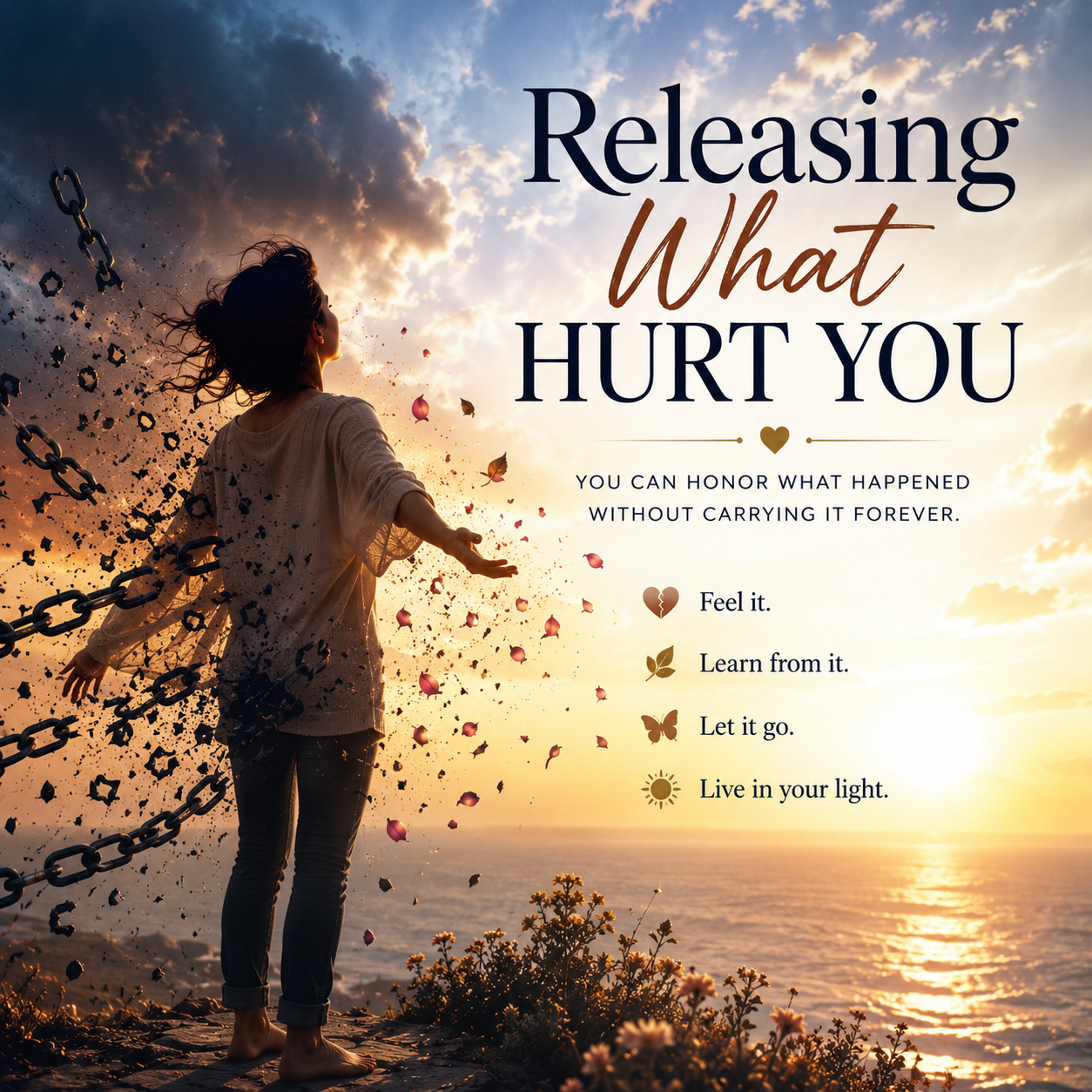
Releasing What Hurt You
A gentle guide to releasing the pain of the past—without minimizing it—so your heart can breathe again and make space for healing.
You Can Honor What Happened Without Carrying It Forever
Some pain changes more than a moment.
It can change the way you see yourself.
The way you trust.
The way you love.
The way you enter relationships.
The way you protect your peace.
The way you interpret what comes next.
Sometimes you move forward on the outside while a part of you is still living inside what happened.
You keep working.
Keep showing up.
Keep taking care of things.
Keep trying to be strong.
But somewhere underneath the daily motion, the hurt is still there.
Releasing what hurt you does not mean pretending it never happened.
It does not mean minimizing the pain.
It does not mean forcing forgiveness before you are ready.
It means loosening the grip the wound has had on your future.
It means allowing your life to become larger than what hurt you.
Letting Go Is Not the Same as Forgetting
People sometimes resist release because they fear it means surrendering the truth.
It does not.
You can remember what happened clearly and still decide you do not want to carry it every day.
You can acknowledge that something was wrong without allowing it to become the center of your identity.
You can learn from the past without continuing to live inside it.
Release is not saying:
“It did not matter.”
Release is saying:
“It mattered, but it will not own everything that comes next.”
That distinction is powerful.
You are not giving the past permission.
You are taking your future back.
Pain Can Become Part of the Identity
One reason releasing hurt can feel difficult is that pain can slowly weave itself into the way you understand yourself.
The betrayal becomes:
“I am someone people leave.”
The rejection becomes:
“I am not enough.”
The failure becomes:
“I ruin everything.”
The loss becomes:
“Nothing good lasts.”
The years of struggle become:
“Life is always hard for me.”
A painful event can become a painful identity when the mind begins turning one experience into a permanent conclusion.
Healing often involves separating the event from the self.
Something happened to you.
That is different from saying the event defines you.
You may have been betrayed.
You are not betrayal.
You may have been rejected.
You are not rejection.
You may have been hurt.
You are not the wound.
Give the Truth Enough Room
Release does not begin by rushing past what happened.
It begins with honesty.
Sometimes the most healing sentence is:
“That hurt me more than I wanted to admit.”
Or:
“I was angry.”
“I felt abandoned.”
“I trusted them.”
“I deserved better.”
“I was pretending I was fine.”
Truth creates movement.
When pain has been denied, minimized, explained away, or buried beneath strength, it often remains emotionally unfinished.
You do not need to dramatize what happened.
You simply need to stop lying to yourself about how deeply it affected you.
Your Feelings Need Somewhere to Go
Pain that has been held tightly for a long time needs room.
Sometimes that room is tears.
Sometimes journaling.
Sometimes prayer.
Sometimes silence.
Sometimes a long walk.
Sometimes speaking honestly with someone you trust.
Sometimes finally saying the words you never allowed yourself to say.
The goal is not to endlessly relive the hurt.
It is to let the emotion move instead of continually forcing it underground.
You do not have to judge the feeling before you feel it.
Anger can be information.
Grief can be love that has nowhere to go.
Sadness can be the heart acknowledging what mattered.
Disappointment can reveal what you hoped for.
Your emotions can teach you something without becoming permanent residents.
Grief Is Sometimes Part of Release
Not everything you release was entirely bad.
Sometimes you are grieving the good parts too.
The relationship you hoped would last.
The future you imagined.
The version of yourself that believed something different.
The place that once felt like home.
The dream you expected to live.
The person someone used to be.
That is why letting go can feel complicated.
You are not always releasing only pain.
Sometimes you are releasing hope attached to something that can no longer become what you wanted it to be.
Grief honors that reality.
And when grief is allowed to move, the heart slowly becomes capable of making room for something new.
You Do Not Need Perfect Closure
People often wait for closure as though healing cannot begin without it.
They want the apology.
The explanation.
The confession.
The answer.
The final conversation.
The moment when everything suddenly makes sense.
Sometimes that comes.
Sometimes it does not.
You may never receive an explanation that feels sufficient.
You may never understand why someone did what they did.
You may never hear the words you deserved.
Your healing cannot remain dependent on another person becoming capable of giving you closure.
Sometimes closure is something you create.
It sounds like:
“I know enough to move forward.”
You do not need every unanswered question solved before your life can continue.
Forgiveness and Release Are Related, but Not Identical
Forgiveness can be part of release, but it does not have to be rushed.
For some people, forgiveness feels spiritual.
For others, it develops gradually as anger loses its hold.
Sometimes forgiveness simply means:
“I am no longer willing to let this occupy so much of my inner life.”
Release can begin even before you know exactly what forgiveness will look like for you.
And forgiveness does not automatically mean renewed closeness.
Peace and access are two different decisions.
Anger Can Protect You, but It Was Never Meant to Become Home
Anger often appears when something important has been violated.
Trust.
Dignity.
Fairness.
Safety.
Love.
Respect.
Anger can help you recognize:
“This mattered.”
“This was wrong.”
“I deserved better.”
That recognition can be important.
But anger becomes heavy when it has to remain permanently active in order to prove that what happened mattered.
You do not have to stay angry forever to validate your pain.
You can move toward peace without rewriting history.
Boundaries Turn Pain Into Wisdom
One of the healthiest forms of release is learning something useful from what hurt you.
Not:
“I will never trust anyone again.”
But:
“I will pay attention to patterns.”
Not:
“I will never love again.”
But:
“I will stop ignoring what does not feel healthy.”
Not:
“People always hurt me.”
But:
“I will choose relationships that respect honesty, consistency, and mutual care.”
Pain can become wisdom when the lesson becomes clearer than the wound.
Boundaries are often part of that transformation.
They allow you to carry the lesson forward without carrying the entire experience.
Releasing Does Not Require Reopening the Door
Healing does not mean everyone deserves renewed access.
You can release resentment and still maintain distance.
You can wish someone well without inviting them back into your life.
You can move toward peace and still keep a boundary.
Sometimes the healthiest evidence of healing is that you no longer need to return to the place that hurt you.
Stop Rehearsing the Same Moment
The mind can keep pain active by repeatedly replaying it.
What they said.
What you should have said.
What you wish had happened.
What you still want them to understand.
What you would say if you saw them again.
Some reflection is useful.
Endless rehearsal is different.
At some point, repeating the moment stops teaching you anything new.
When you notice yourself returning to the same mental scene, gently ask:
“Is there something new to understand here, or am I reopening the wound?”
If there is nothing new to learn, redirect your attention.
The past does not need unlimited rehearsal time.
Release the Conversation You Keep Having in Your Head
Sometimes the relationship has ended, but the argument continues internally.
You explain yourself again.
Defend yourself again.
Tell them what they should have understood.
Imagine the apology.
Imagine finally being vindicated.
Your body may be sitting quietly in a room while your mind is still fighting a conversation that happened months or years ago.
At some point, you can decide:
“This conversation is over, even if it never ended the way I wanted.”
You are allowed to stop attending meetings that only exist inside your mind.
Give Back What Was Never Yours to Carry
Not every painful thing someone said about you was true.
Not every accusation belonged to you.
Not every expectation was reasonable.
Not every failure in a relationship was yours.
Not every person who misunderstood you saw you clearly.
Sometimes release means returning emotional weight to where it belongs.
You may need to say:
“That was their judgment, not my identity.”
“That was their choice, not my worth.”
“That was their inability to love well, not proof that I was unlovable.”
“That was their projection, not my truth.”
You do not have to keep carrying someone else’s interpretation of you.
Let New Experiences Be New
Pain becomes especially costly when old experiences begin shaping new relationships and opportunities before they have had a chance to become something different.
Someone new enters your life, and you expect them to become the person who hurt you.
An opportunity appears, and you assume it will end like the last one.
Love arrives, and you prepare for betrayal.
Success approaches, and you wait for loss.
The nervous system may be trying to protect you.
But protection can become a prison when yesterday is allowed to predict everything about tomorrow.
Healing means allowing new experiences to be new.
Rebuild Trust Slowly
After betrayal or disappointment, trust may not return all at once.
That is okay.
You do not need to become instantly open.
Trust can be rebuilt through evidence.
Consistency.
Honesty.
Respect.
Time.
Follow-through.
Safe behavior repeated often enough that the heart begins to believe what it is seeing.
Healing does not require blind trust.
It allows trust to become wise.
Releasing Self-Blame
Sometimes the person you are struggling to forgive is yourself.
You replay what you should have noticed.
What you should have known.
Why you stayed.
Why you believed them.
Why you did not leave sooner.
Why you made the decision.
But hindsight sees things the past version of you could not always see.
You made choices with the awareness, strength, information, needs, and circumstances you had at the time.
You are allowed to learn without humiliating the person you used to be.
Growth does not require self-punishment.
You Can Outgrow the Version of You That Was Hurt
Pain sometimes freezes part of the identity around the moment it happened.
But you are still becoming.
You know things now that you did not know then.
You have survived days you once feared.
You may have stronger boundaries.
Clearer values.
Better discernment.
Deeper faith.
More self-respect.
More wisdom.
The version of you standing here now does not have to remain organized around the version of you who was wounded.
You are allowed to become larger than that chapter.
Your Body May Need to Learn That the Moment Is Over
Sometimes the mind understands that the past is over before the body fully settles.
A familiar tone of voice.
A place.
A date.
A smell.
A certain kind of conversation.
A similar situation.
Something can suddenly bring the old feeling back.
When that happens, return to the present.
Look around.
Feel your feet.
Slow your breathing.
Notice what is actually happening now.
Then remind yourself:
“That happened then. I am here now.”
The present deserves a chance to become different from the past.
You Are Allowed to Hand Over What Feels Too Heavy
Some pain can be processed through reflection, boundaries, honesty, time, and self-compassion.
Other pain feels too heavy to hold alone.
For those places, you are allowed to surrender.
To God.
To prayer.
To love.
To something greater than the part of you that has been trying to solve everything by yourself.
You might say:
“God, I do not know how to release all of this yet. Help me loosen what is no longer meant to live in my heart.”
Or simply:
“I am willing to let this become lighter.”
Willingness is powerful.
Sometimes release begins before you know how it will finish.
Release Can Happen in Layers
You may feel peaceful about something for months and suddenly feel sadness again.
That does not mean you have gone backward.
Different memories can surface at different times.
New life experiences can reveal another layer.
Healing often moves in circles that gradually widen rather than in one straight line.
You may return to the same memory as a different person.
And because you are different, you can finally release something you were not ready to release before.
Create a Release Ritual
Sometimes the heart benefits from a physical act that marks an internal decision.
Write what you are releasing on paper.
Read it.
Pray over it.
Then tear it up.
Burn it safely.
Bury it.
Throw it away.
Or keep a journal page that ends with:
“This chapter no longer defines what comes next.”
The ritual itself is not magic.
The meaning you give it matters.
It creates a moment when you consciously say:
“I am ready to stop carrying this in the same way.”
What You May Be Ready to Release
You may be ready to release:
the need for an apology you may never receive
the need to be understood by someone committed to misunderstanding you
the story that says the pain defines your worth
guilt that belongs to another person
resentment that has stopped protecting you
the fantasy of a different past
the need to keep proving what happened
the belief that healing requires forgetting
the version of yourself that existed only to survive
fear that every future relationship will repeat the old one
the pressure to heal on someone else’s timeline
Sometimes release happens because you deserve peace.
Replace What Leaves
Release creates space.
Be intentional about what enters that space.
Peace.
New relationships.
Healthy routines.
Beauty.
Purpose.
Prayer.
Movement.
Creativity.
Learning.
Laughter.
Rest.
Nature.
Hope.
Self-respect.
A life cannot be built only around removing what hurt.
Eventually, it needs something beautiful to grow toward.
What Healing Can Look Like
Healing does not always look dramatic.
Sometimes healing is hearing their name without your stomach dropping.
Thinking about the event without losing your entire day.
Not checking whether they regret what happened.
No longer rehearsing the argument.
Trusting someone new a little more.
Saying no sooner.
Sleeping better.
Feeling hopeful about the future.
Laughing without remembering that you once thought happiness might never return.
These small changes matter.
Freedom often arrives quietly.
Your Life Can Grow Beyond the Wound
There may be days when the old weight returns for a moment.
Let that moment be a moment.
It does not have to become the whole story again.
You are allowed to continue growing.
To love again.
To trust wisely.
To try again.
To dream again.
To build something new.
To become joyful without feeling guilty.
To stop organizing your entire life around what once hurt.
Eventually, the wound may no longer be the center of the story.
It may become one chapter.
One lesson.
One place where strength was forged.
One reason you chose better boundaries.
One reason you learned self-respect.
One reason you became gentler with other people.
One place where God carried you farther than you thought you could go.
Your life can become larger than the wound.
A Simple Release Practice
When an old hurt rises, pause.
Place your feet firmly on the ground.
Take one slow breath.
Then ask:
What am I feeling?
What part of this still needs acknowledgment?
Is there anything here I still need to learn?
What am I ready to stop carrying?
Then say:
“I honor what happened. I keep the wisdom. I release the weight.”
Take another breath.
Return your attention to the life in front of you.
Affirmation
I honor what I have been through, but I do not have to carry it forever. I keep the wisdom and release the weight. My past does not define my worth, and my future has room for peace, strength, love, and new light.
Frequently Asked Questions
How do I release something that hurt me deeply?
Begin with honest acknowledgment. Recognize what happened, what changed, and what you still feel. Release may then involve grief, boundaries, prayer, journaling, changing repetitive thought patterns, rebuilding trust slowly, and choosing not to let the wound define your identity.
Is letting go the same as forgiving?
Not always. Letting go can mean reducing the emotional hold an experience has on your present life. Forgiveness may become part of that process over time.
Can I forgive someone and still keep my distance?
Yes. Forgiveness and access are separate decisions. Peace does not require renewed closeness.
Why do I keep thinking about something that happened years ago?
Painful memories can stay active when the mind is still searching for meaning, closure, or safety. It can help to ask whether the memory is teaching you something new or simply replaying an old wound.
How do I stop replaying what happened?
Notice when the replay begins and ask whether there is anything new to understand. If not, gently redirect your attention to the present through grounding, prayer, journaling, movement, or another meaningful activity.
How do I let go without getting an apology?
You may have to create your own closure. Acknowledge what happened, decide what you learned, establish the boundaries you need, and allow your healing to continue without waiting for another person to change.
How do I stop blaming myself?
Separate responsibility from punishment. Learn what is yours to learn without using hindsight to attack the person you were before you knew what you know now.
How do I know if I am healing?
Healing may show up as less mental replay, more peace, stronger boundaries, renewed trust, greater hope, and a growing ability to live without organizing your present around the past.
A Final Thought
You do not have to erase what happened.
You do not have to pretend it did not matter.
You do not have to become the person you were before it happened.
You are allowed to become someone new.
Someone wiser.
Someone clearer.
Someone more discerning.
Someone who knows what they will no longer accept.
Someone who can love without abandoning themselves.
Someone who can remember without reliving.
Someone who can carry the lesson without carrying the weight.
The past may always be part of your story.
But it does not have to remain the author.
There are still pages ahead.
And they belong to you.
If this message resonated, you may also enjoy:
Forgiveness Without Self-Betrayal
Unlearning Self-Rejection
The Soft Return
Your Soulful Pathways ↑
Discover more series pages for you in Your Soulful Pathways ↑

Self-Compassion as Medicine
Learn how self-compassion becomes real emotional medicine—softening self-criticism, honoring your humanity, and helping your heart heal.
There are seasons when the way you speak to yourself becomes part of what is hurting you.
Not because you are trying to be cruel, but because you may have learned that pressure is the only way to keep going. You may have believed that if you were hard enough on yourself, you would stay productive, avoid mistakes, or become stronger. But over time, constant self-criticism can quietly wear down the heart. It can make healing feel farther away, not closer.
Self-compassion is not weakness. It is not laziness, avoidance, or letting yourself off the hook. It is a way of tending to your inner world with honesty and care. It is medicine for the parts of you that are tired from carrying too much without gentleness.
Why self-criticism does not create real healing
Many people were taught to motivate themselves through shame.
They learned inner language like this:
“I should be over this by now.”
“I always mess things up.”
“I need to do better.”
“What is wrong with me?”
At first, this kind of thinking can seem useful because it feels sharp and urgent. It creates the illusion of control. But shame rarely produces lasting peace or meaningful growth. More often, it keeps you trapped in cycles of self-blame, anxiety, and emotional exhaustion.
When you are always bracing against your own thoughts, your nervous system never fully gets to rest. Your body stays tense. Your heart stays guarded. Your spirit begins to believe that love must be earned through perfection.
That is not healing.
Healing begins when truth is paired with kindness. You can acknowledge where you are struggling without turning against yourself in the process.
What self-compassion really means
Self-compassion is the practice of responding to your pain, mistakes, and limitations with understanding instead of harshness.
It does not mean pretending everything is fine.
It does not mean excusing behavior that needs to change.
It does not mean avoiding responsibility.
It means you stay connected to your own humanity while you grow.
Self-compassion says:
“That hurt more than I expected.”
“I am still learning.”
“I can be honest with myself without being cruel.”
“I am allowed to need rest, support, and grace.”
This kind of inner language creates space for repair. It helps you come back to yourself instead of abandoning yourself the moment life feels heavy.
Speaking to yourself like someone you love
Think about how you would respond to someone you deeply care about if they were struggling.
You would probably not shame them for being tired.
You would not tell them they are failing because they need time.
You would not use their pain as proof that they are not enough.
You would soften.
You would listen.
You would remind them that difficult seasons do not erase their worth.
That same tenderness belongs to you too.
For many people, self-compassion feels unfamiliar at first. It may even feel uncomfortable. But that does not mean it is wrong. It simply means you are learning a new way to be with yourself.
Sometimes healing starts with saying words you do not fully believe yet, but need to hear anyway:
“This is hard, and I am allowed to be gentle with myself.”
“My feelings make sense.”
“I deserve the same compassion I so freely offer others.”
Gentle presence is part of the medicine
Self-compassion is not always dramatic. Often it is quiet. It looks like pausing instead of spiraling. It looks like resting without guilt. It looks like noticing your inner critic and choosing not to hand it the microphone.
You do not have to fight every harsh thought. You can simply introduce a different voice. A wiser one. A softer one. One that says, “I see you trying. I see how much this matters to you. Stay here. Do not leave yourself now.”
Place a hand over your heart if you need to.
Take one slow breath.
Let yourself be human.
Over time, this gentle presence becomes its own kind of medicine. Steady. Honest. Healing. Real.
You may not be used to treating yourself with kindness, but that kindness can still begin today. And sometimes the way forward is not through more pressure, but through compassion deep enough to help your whole being exhale.
If this message resonated, you may also enjoy:
Your Soulful Pathways ↑
Discover more series pages for you in Your Soulful Pathways ↑

Awakening the Heart
Explore awakening the heart through love, faith, compassion, gratitude, forgiveness, prayer, discernment and sacred attention, and discover how an open heart can transform ordinary life.
Opening to Love, Wisdom, Compassion and the Presence of God
There are seasons when something within us begins to change.
We notice beauty we once walked past.
Someone else's pain reaches us differently.
Gratitude comes more easily.
Old anger begins losing its grip.
Silence feels less empty.
Prayer becomes more intimate.
We begin wanting peace more than we want to be right.
And somewhere beneath the noise of ordinary life, we sense that there is more to being alive than thinking, accomplishing, protecting, planning and simply getting through the day.
Something within us is opening.
This is one way to understand awakening the heart.
It is not about becoming overly emotional.
It is not abandoning reason.
It is not trusting every feeling that passes through us.
Awakening the heart is a deepening of our inner life.
It is becoming more receptive to love, compassion, wisdom, truth, beauty, conscience, gratitude, forgiveness, wonder and God.
An awakened heart does not make us less grounded.
It can make us more fully alive.
The Heart Is More Than Emotion
When we hear the word heart, we often think of emotion.
Love comes from the heart.
Sadness breaks the heart.
Courage strengthens the heart.
But the ancient spiritual understanding of the heart is much larger.
In the Bible, the heart frequently represents the deep interior of a person. It is associated not only with feelings, but also with thought, intention, desire, understanding, choice and spiritual direction.
The Hebrew words often translated as heart, lev and levav, can point toward this inner center of human life.
This changes the meaning of heart awakening.
It is not simply:
Feel more.
It is something closer to:
Become awake within.
Let love awaken.
Let wisdom awaken.
Let conscience awaken.
Let compassion awaken.
Let courage awaken.
Let discernment awaken.
Let gratitude awaken.
Let your awareness of God awaken.
The spiritual heart is where our inner life begins becoming visible through the way we actually live.
A Listening Heart
One of the most beautiful pictures of the awakened heart is a listening heart.
When Solomon was given the opportunity to ask God for something extraordinary, he asked for wisdom so that he could govern well and distinguish right from wrong.
He wanted an inner life capable of hearing, understanding and discerning.
There is something profound here.
Perhaps awakening the heart does not always begin with speaking.
Perhaps it begins with listening.
Listening to God.
Listening to conscience.
Listening to wisdom.
Listening to another person without preparing our answer.
Listening to what our lives are quietly teaching us.
Listening beneath fear.
Listening beneath pride.
Listening beneath the constant mental chatter that can make subtle things difficult to hear.
A listening heart is not passive.
It is attentive.
And attention can become sacred.
God Can Awaken What We Cannot Force
There is a temptation to turn every spiritual idea into another self-improvement project.
Become more loving.
Become more peaceful.
Become more compassionate.
Become more spiritual.
Try harder.
Do better.
But the Christian understanding of transformation contains something much more beautiful.
Grace.
We are not required to manufacture divine love entirely from our own strength.
Scripture speaks of God's love being poured into our hearts through the Holy Spirit.
That means awakening the heart can also be understood as receiving.
Receiving grace.
Receiving love.
Receiving correction.
Receiving wisdom.
Receiving forgiveness.
Receiving God's presence.
Sometimes the prayer is not:
God, help me try harder.
Sometimes it is simply:
God, open my heart.
When Life Has Taught the Heart to Close
Hearts do not usually become guarded without a reason.
Disappointment can do it.
Betrayal can do it.
Rejection can do it.
Grief can do it.
Being misunderstood can do it.
Repeatedly giving without receiving can do it.
Sometimes we protect ourselves so gradually that we do not realize how much protection we are carrying.
We expect less.
Trust less.
Hope cautiously.
Keep conversations shallow.
Avoid vulnerability.
Tell ourselves we simply do not care anymore.
But beneath some forms of hardness is not an absence of love.
It is love that learned to protect itself.
Awakening does not require condemning those protective places.
Sometimes they need compassion too.
We can gently recognize:
This protected me once. But I may not need to live behind it forever.
Softness Is Not Weakness
A softened heart is sometimes mistaken for a weak heart.
They are not the same.
It takes strength to remain kind without becoming naive.
It takes strength to forgive without pretending nothing happened.
It takes strength to remain compassionate without allowing someone to repeatedly harm us.
It takes strength to hope after disappointment.
It takes strength to love after loss.
It takes strength to remain tender in a world that sometimes rewards hardness.
An awakened heart does not become defenseless.
It becomes discerning.
Love and wisdom belong together.
The Heart and Mind Belong Together
We sometimes talk about the heart and mind as though they are opponents.
The mind says one thing.
The heart says another.
Choose one.
But a mature inner life does not require a war between them.
Our ability to reason is a gift.
So is our capacity to love.
Thought helps us evaluate.
Compassion helps us care.
Experience helps us recognize patterns.
Conscience asks whether our choices align with what we believe is good.
Discernment brings these things together.
The goal is not to become a person who blindly follows every emotion.
The goal is to become someone whose thinking, values, faith, compassion and actions increasingly move in the same direction.
An awakened heart is not a heart without wisdom.
It is a heart illuminated by it.
Sacred Attention
Awakening often begins with something surprisingly simple.
We start noticing.
The morning light moving across the floor.
Rain against a window.
Someone making coffee for us.
A bird calling from a tree.
The smell of bread.
An unexpected conversation.
The way someone smiles when they are genuinely happy.
A prayer answered differently than expected.
A moment of peace arriving in the middle of an ordinary afternoon.
These things were always there.
We simply were not always present enough to receive them.
Attention can transform ordinary life because attention says:
This matters enough for me to notice.
The sacred does not always arrive with thunder.
Sometimes it is already sitting quietly at the kitchen table.
Love Changes What We See
What we love influences what we notice.
A gardener notices a tiny new leaf.
A musician hears something in a song another person misses.
A parent recognizes one familiar voice in a crowded room.
A person who has learned compassion may notice sadness hidden beneath someone's anger.
Love educates attention.
And this may be one of the quiet mysteries of awakening the heart.
The world does not necessarily change overnight.
What we are capable of seeing within it changes.
Compassion Is More Than Feeling Someone's Pain
Compassion and empathy are related, but they are not exactly the same.
Empathy generally refers to understanding or sharing something of another person's emotional experience.
Compassion includes recognizing suffering and feeling concern that moves us toward care.
That movement matters.
Compassion asks:
How can I bring some goodness into this moment?
Sometimes the answer is helping.
Sometimes listening.
Sometimes giving.
Sometimes praying.
Sometimes sitting quietly beside someone.
Sometimes speaking truth with kindness.
Sometimes respecting someone's dignity when they feel invisible.
We cannot solve every person's suffering.
We can refuse to become indifferent to it.
Compassion Includes You
There is an interesting habit many loving people develop.
They offer everyone else patience.
Everyone else gets understanding.
Everyone else is allowed to have a difficult day.
Everyone else is permitted to be imperfect.
Then they turn toward themselves with a completely different voice.
An awakened heart eventually notices this contradiction.
Self-compassion does not mean refusing responsibility.
It does not mean telling ourselves that every choice was right.
It means learning to tell the truth without becoming cruel toward ourselves.
Growth does not require self-contempt.
We can acknowledge what needs to change while remembering that we, too, are worthy of patience, grace and care.
The Courage to Receive Love
Some people are much more comfortable giving love than receiving it.
Giving feels safe.
Receiving requires openness.
Someone compliments us and we immediately minimize it.
Someone offers help and we insist we can manage.
Someone loves us deeply and part of us wonders whether we deserve it.
Yet the heart cannot live forever on one-way traffic.
There are seasons for giving.
There are seasons for receiving.
Receiving love graciously is not selfishness.
Receiving help is not failure.
Receiving kindness does not make us indebted.
And receiving the love of God does not require proving ourselves worthy beforehand.
Sometimes awakening means allowing goodness to reach us.
Gratitude Opens the Window Wider
Gratitude does not deny difficulty.
It notices that difficulty is not the whole story.
A difficult day can still contain a beautiful sunset.
A season of uncertainty can still contain friendship.
Grief can exist beside gratitude.
Questions can exist beside faith.
We can be waiting for something and still appreciate what has already arrived.
Gratitude changes attention.
Instead of continually asking:
What is missing?
We sometimes begin asking:
What has already been given?
Food.
Shelter.
People.
Beauty.
Lessons.
Opportunities.
Another morning.
Another chance.
Another breath.
Gratitude does not shrink our dreams.
It prevents us from overlooking the life already happening while we wait for them.
Forgiveness Creates Space
Few things weigh on the heart quite like unresolved resentment.
Forgiveness is also one of the most misunderstood spiritual practices.
Forgiveness does not necessarily mean reconciliation.
It does not require forgetting.
It does not make harmful behavior acceptable.
It does not mean abandoning boundaries.
It does not require pretending we were never hurt.
Forgiveness can mean choosing not to let an old wound dictate the future of our inner life.
Sometimes forgiveness begins with a decision.
We decide that we no longer want anger, bitterness or resentment to have authority over everything that comes next.
But emotional release may take longer.
This is important.
We may sincerely choose forgiveness before our feelings have completely caught up.
Healing can unfold gradually.
Sometimes forgiveness happens all at once.
Sometimes it happens thread by thread.
And sometimes our first honest prayer is simply:
God, I want to become willing to forgive. Help me get there.
That, too, can be a beginning.
Letting God Soften What Life Has Hardened
Some places within us cannot be opened by force.
Old disappointment.
Fear.
Distrust.
Bitterness.
Grief.
Years of holding everything together.
We may have carried these things for so long that they have begun to feel like personality.
But what has become hardened is not necessarily permanent.
We can ask God to enter those places.
To soften what has become rigid.
To restore what has become weary.
To heal what still aches.
To show us what can be released.
To teach us how to love without abandoning wisdom.
We do not always need to know how the transformation will happen.
Sometimes willingness is the first opening.
The Physical Heart and Our Inner Experience
There is also a fascinating physical dimension to the language of the heart.
The heart does not operate independently from the rest of the body. It is continuously influenced by the brain and nervous system.
The autonomic nervous system is the part of our nervous system that helps regulate automatic functions such as heart rate, breathing and digestion.
One branch helps prepare the body for action during challenge or stress.
Another helps support rest, recovery and regulation.
This helps explain why emotional experiences can feel physical.
Fear may make the heart race.
Relief may bring a deep exhale.
Peace may allow the body to soften.
Slow breathing can sometimes help the body settle.
A loving conversation can change the atmosphere inside us.
This does not mean that every spiritual experience can be reduced to biology.
It means something wonderfully human:
Our inner and physical lives are deeply intertwined.
The body participates in our experience of being alive.
Prayer Creates Room
Prayer can be one of the deepest practices of the awakened heart.
Not because every prayer produces an immediate answer.
Because prayer creates relationship.
Some prayers are eloquent.
Others are barely sentences.
Some are gratitude.
Some are questions.
Some are tears.
Some are silence.
Some are simply:
Help me.
Prayer gives us somewhere to bring the parts of ourselves we cannot neatly organize.
We do not need to perform.
We do not need to impress God.
We can arrive honestly.
And honesty can open places that performance keeps closed.
Silence Is Not Empty
Modern life is remarkably good at filling every available space.
Phones.
Television.
Messages.
Music.
News.
Notifications.
Opinions.
Tasks.
Even waiting has become something we try to eliminate.
But silence has gifts noise cannot give.
Silence allows buried thoughts to rise.
It gives feelings room to breathe.
It gives prayer somewhere to land.
It allows us to notice what constant stimulation can hide.
Silence does not mean nothing is happening.
Sometimes silence is where the deepest listening begins.
Beauty Can Reopen What Words Cannot
There are moments when beauty reaches places explanations cannot.
Music.
A field of wildflowers.
Sunlight through stained glass.
A baby's hand wrapped around a finger.
Ocean waves.
An old photograph.
A candle in a dark room.
A garden after rain.
A familiar voice.
The night sky.
Beauty interrupts utility.
For a moment we are not asking what something can do for us.
We simply behold it.
Wonder returns.
And wonder is one of the great doorways of the heart.
It reminds us that existence is not merely a collection of problems waiting to be solved.
Life is also something to witness.
Something to receive.
Something to cherish.
Joy Belongs to the Awakening Too
Spiritual depth is sometimes portrayed as endlessly serious.
But an awakened heart also remembers how to delight.
Laughter.
Music.
Celebration.
Play.
Friendship.
Good food around a table.
Dancing in the kitchen.
A ridiculous joke at exactly the right moment.
Joy does not disrespect suffering.
It reminds us that suffering does not own everything.
There is holiness in gratitude.
There can also be holiness in delight.
The Awakened Heart Notices People
Spiritual awakening that never changes how we treat people is incomplete.
The heart eventually moves outward.
We begin noticing the person who has been left out.
The tired cashier.
The lonely neighbor.
The family member who needs encouragement.
The stranger carrying something we cannot see.
The person who cannot repay our kindness.
Love becomes practical.
A phone call.
A meal.
A ride.
A prayer.
A listening ear.
A sincere apology.
A door held open.
A moment of patience.
A word spoken at exactly the right time.
The greatest movements of the heart are not always dramatic.
Sometimes love becomes visible through very small things.
Boundaries Can Protect an Open Heart
Opening the heart does not mean giving everyone unlimited access to it.
Love can say no.
Love can leave a harmful situation.
Love can create distance.
Love can refuse manipulation.
Love can stop participating in destructive patterns.
A boundary is a limit that protects our wellbeing, responsibilities, relationships or values.
Healthy boundaries do not necessarily close the heart.
Sometimes they allow it to remain open without continually being wounded.
Compassion does not require self-abandonment.
We can love people and still recognize what we cannot permit.
Discernment Protects the Heart From Confusion
Not every strong feeling is guidance.
Not every fear is a warning.
Not every desire is direction.
Not every opportunity is meant for us.
This is why awakening and discernment belong together.
Discernment means carefully recognizing what is wise, true and aligned with our deepest values and faith.
When something rises strongly within us, we can ask:
Does this lead toward love or fear?
Peace or panic?
Truth or self-deception?
Wisdom or impulse?
Does it respect other people?
Does it reflect the person I believe God is calling me to become?
An awakened heart listens.
A discerning heart also tests what it hears.
The Heart Can Recognize What Cannot Be Counted
Not everything meaningful can be placed on a scale.
There is no ruler for compassion.
No instrument can measure the full value of sitting beside someone who is grieving.
No equation can completely describe what forgiveness means to the person finally able to release resentment.
Science can investigate human emotion, behavior, relationships, physiology and wellbeing.
That knowledge is valuable.
But human beings also encounter meaning through love, faith, conscience, beauty, relationship, memory, prayer and spiritual experience.
Some realities are studied.
Others are lived.
Wisdom allows room for both.
Awakening Does Not Mean Perfection
The awakened heart is still human.
It can become tired.
Irritated.
Afraid.
Disappointed.
Guarded.
We can have a beautiful spiritual realization on Tuesday and become impatient in traffic on Wednesday.
That does not erase what we are becoming.
Growth rarely travels in a perfectly straight line.
The heart opens.
Contracts.
Learns.
Restores.
Opens again.
What matters is our willingness to return.
Signs the Heart May Be Awakening
There is no official checklist for heart awakening.
But we may begin noticing certain changes.
We may become more grateful for ordinary things.
We may feel less attracted to unnecessary conflict.
Compassion may arise more naturally.
We may become increasingly aware of beauty.
Prayer may feel more important.
Forgiveness may begin to feel possible.
We may want greater authenticity in our relationships.
Other people's suffering may matter more to us.
Silence may become less uncomfortable.
We may begin protecting our peace more carefully.
We may feel drawn toward generosity.
We may notice that some things we once chased no longer seem particularly important.
And perhaps most significantly, we begin asking a different question.
Not simply:
What can I get from life?
But:
What kind of presence am I bringing into it?
Simple Ways to Awaken the Heart
Heart awakening does not require a mountaintop revelation.
It can happen in the middle of ordinary life.
Begin the morning with gratitude before reaching for your phone.
Pray honestly.
Listen to someone without interrupting.
Spend a few minutes outside.
Notice one beautiful thing.
Tell someone why you appreciate them.
Forgive one small offense.
Allow someone to help you.
Offer encouragement.
Read something that enlarges your spirit.
Sit in silence.
Create something.
Give something.
Laugh.
Watch the sunset.
Look at the stars.
Ask God to show you something you have been too busy to notice.
Small openings can lead into surprisingly large rooms.
What Would Love Notice Here?
There is a simple question we can carry almost anywhere:
What would love notice here?
Love might notice the person who has gone quiet.
The exhausted parent.
The elderly neighbor.
The beautiful sky everyone is walking beneath.
The child who wants our attention.
The friend whose joke is covering sadness.
The stranger who needs patience.
The blessing hidden inside an ordinary afternoon.
The part of ourselves that needs gentleness.
That question can change a conversation.
A relationship.
A decision.
A day.
Enough changed days can change a life.
Perhaps Awakening Is Also Remembering
We often imagine spiritual awakening as becoming someone extraordinary.
Perhaps sometimes it is the opposite.
Perhaps awakening is remembering what we knew before fear became so loud.
Remembering how to wonder.
Remembering how to trust.
Remembering how to receive.
Remembering that kindness matters.
Remembering that other people carry invisible stories.
Remembering that life is more than productivity.
Remembering that love is not weakness.
Remembering that God has not disappeared simply because we cannot see the whole road.
Perhaps awakening is not always about becoming someone entirely new.
Sometimes it is about allowing God to uncover, restore and transform what has been buried beneath the armor.
Becoming More Fully Alive
When the heart begins to awaken, life does not suddenly become perfect.
There will still be uncertainty.
Disappointment.
Loss.
Questions.
Waiting.
Ordinary frustrations.
But our capacity to encounter life begins expanding.
We discover beauty beside sorrow.
Gratitude beside longing.
Hope beside uncertainty.
Joy beside responsibility.
Faith beside questions.
Grace inside ordinary moments.
And God in places we once thought were empty.
The awakened heart does not escape being human.
It enters the human experience more completely.
A Quiet Practice for the Heart
Place your hand gently over your heart.
Take a slow breath.
Let your shoulders soften.
Become still for a moment.
Then quietly ask:
What am I grateful for?
Where have I become guarded?
Is there something I am ready to release?
Who needs compassion from me?
Where do I need compassion for myself?
What beauty have I been overlooking?
What might God be inviting me to notice?
There is no need to force an answer.
Listen.
Some answers arrive as words.
Some arrive as understanding.
Some arrive later.
And sometimes the gift is simply the silence itself.
A Prayer for an Awakened Heart
God,
Awaken my heart to what is true and good.
Soften the places that have become hardened.
Heal the places that still remember hurt.
Teach me to love without losing wisdom.
Help me forgive without abandoning truth.
Give me compassion without fear.
Give me discernment without hardness.
Help me receive love as freely as I give it.
Open my eyes to beauty I have stopped noticing.
Make me attentive to people who need kindness.
Quiet the noise that keeps me from hearing You.
Pour Your love into the places within me that feel empty.
Give me a listening heart.
A grateful heart.
A courageous heart.
A heart that recognizes Your presence in ordinary life.
And wherever I go, let the love You place within me become something others can feel.
Amen.
Closing Reflection
Awakening the heart is not one dramatic moment.
It is a way of living.
A thousand quiet choices to remain open.
To notice.
To listen.
To forgive.
To receive.
To give.
To wonder.
To discern.
To trust.
To pray.
To love.
There will be days when the heart feels wide open and days when it feels weary.
Return anyway.
Return to gratitude.
Return to compassion.
Return to beauty.
Return to prayer.
Return to wonder.
Return to God.
Again and again.
Because awakening the heart may ultimately be less about becoming someone new and more about allowing love, wisdom and divine presence to reach more of who we already are.
And every time the heart opens a little wider, something extraordinary happens.
The world may be exactly where it was.
But we are capable of seeing more within it.
More beauty.
More humanity.
More possibility.
More grace.
More reasons to love.
And perhaps that is one of the quiet miracles of awakening:
We become more fully present to the life God has already placed before us.
Questions and Answers
What does awakening the heart mean?
Awakening the heart means becoming more inwardly receptive to love, compassion, wisdom, gratitude, forgiveness, truth, beauty, spiritual awareness and God. It is not simply becoming more emotional. It involves the whole inner life, including how we understand, choose, love and live.
What does the heart represent in the Bible?
Biblical references to the heart often involve much more than emotion. The heart can represent a person's inner center, including thought, intention, understanding, desire, will, conscience and spiritual orientation.
Is awakening the heart the same as following your feelings?
No. Feelings contain useful information, but they are not automatically instructions. An awakened heart includes discernment, wisdom and clear thinking alongside emotion and compassion.
Can God awaken the heart?
Christian spirituality understands inner transformation as involving both human willingness and God's grace. Scripture repeatedly connects the heart with spiritual renewal, divine love, wisdom and relationship with God.
Why does the heart sometimes feel closed?
People may become emotionally guarded after grief, betrayal, rejection or repeated disappointment. Guardedness can begin as protection. Awakening does not require condemning ourselves for it. It can involve gradually discovering that openness and wisdom can coexist.
Does an open heart mean having weak boundaries?
No. Healthy boundaries can protect our ability to remain loving. Compassion does not require accepting manipulation, mistreatment or destructive behavior.
What is the difference between empathy and compassion?
Empathy generally involves understanding or sharing something of another person's emotional experience. Compassion includes recognizing suffering and feeling concern that moves us toward care or helpful action.
Is there a physical side to heart awakening?
Our emotional experiences can influence the body through the brain, heart and nervous system. Stress, calm, breathing, connection and emotion can all affect heart rate and other automatic bodily functions. This physical connection does not define spiritual experience, but it reminds us that our inner and bodily lives are closely connected.
Does gratitude really make a difference?
Gratitude can help redirect attention toward what is present, meaningful and good. Spiritually, it can deepen appreciation and help keep what is missing from occupying our entire awareness.
Does forgiveness mean reconciliation?
No. Forgiveness and reconciliation are different. A person can release resentment while maintaining appropriate boundaries or choosing not to restore a relationship.
Why can forgiveness take so long?
Forgiveness can begin as a choice and continue as an emotional process. We may decide that we want to forgive before feelings such as anger or hurt have fully changed. Healing can unfold gradually.
How can I begin awakening my heart?
Begin with ordinary practices: gratitude, honest prayer, silence, compassion, forgiveness, time in nature, attention to beauty, generosity, listening and asking God to help you see what you have been overlooking.
Can the heart close again after awakening?
Yes. Stress, exhaustion, fear and disappointment can make anyone temporarily guarded. Spiritual growth is not perfectly linear. We can continue returning to practices that restore openness, wisdom, faith and connection.
What is a simple question that can help awaken the heart?
Ask:
What would love notice here?
It is a small question capable of revealing things hurry, fear and habit often miss.
You May Also Enjoy:
The Peace of Presence
How to Recognize Your Own Light
Whispers of Worth
Letting Go Gracefully
Trust the Unseen
Grace in Every Transition
The Holy Ordinary

Healing the Heart Space
Explore emotional healing through self-compassion, forgiveness, healthy boundaries, faith, self-trust, and the gradual process of opening your heart to peace and love again.
Healing does not mean erasing the past. It means creating enough room within yourself for love, peace, truth, and life to move through you again.
Within each of us is an inner heart space where love, memory, hope, grief, tenderness, disappointment, longing, forgiveness, and connection can all leave their imprint.
Some experiences open this space beautifully.
Others teach us to protect it.
After heartbreak, betrayal, loss, rejection, disappointment, or seasons of giving more than we received, the heart may become guarded.
We may still love, but cautiously.
Still hope, but with conditions.
Still care, but from behind walls.
Still move forward, while carrying pieces of yesterday into places they were never meant to govern.
Healing the heart space is the gradual process of allowing those protective layers to soften while keeping the wisdom you gained.
You do not have to forget what happened.
You do not have to pretend something did not hurt.
You do not have to return to every person or place you have outgrown.
Healing asks something deeper.
Can the experience become part of your story without remaining the ruler of your heart?
Can you remember without continually reliving?
Can you carry wisdom without carrying the full weight?
Can your heart remain discerning without becoming closed?
Can love have room in you again?
Healing begins there.
What Does It Mean to Heal the Heart Space?
Healing the heart space means tending to the emotional and spiritual places within you that have carried hurt, grief, disappointment, rejection, resentment, loneliness, or loss.
It is not about forcing yourself to feel better.
It is not about rushing toward forgiveness.
It is not about pretending painful experiences were secretly wonderful.
It is about allowing what happened to be acknowledged honestly while gradually making room for something beyond the pain.
Peace.
Compassion.
Acceptance.
Wisdom.
Hope.
Trust.
Love.
And perhaps eventually, gratitude for the person you became while finding your way through.
The heart can hold truth and tenderness at the same time.
You can acknowledge:
That hurt me.
and also say:
It will not define everything that comes after it.
That is heart restoration.
The Gentle Art of Allowing
Healing cannot always be hurried.
There are experiences the mind understands long before the heart has finished processing them.
You may know intellectually that something is over while still feeling sadness.
You may understand why someone made a particular choice while still carrying disappointment.
You may know that your life is moving forward while occasionally grieving what you hoped would happen.
There is nothing unusual about having more than one feeling at once.
The heart often heals through permission.
Permission to acknowledge what hurt.
Permission to grieve what was lost.
Permission to miss something without returning to it.
Permission to love someone and still maintain a boundary.
Permission to forgive without reopening a door.
Permission to be grateful for what was good while remaining honest about what was painful.
Permission to take your time.
You do not have to bully your heart into peace.
Sometimes peace arrives because you finally stop fighting what needs to be felt.
Your Emotions Can Carry Information
Emotions are not always instructions, but they can carry information.
Sadness may reveal what mattered.
Anger may reveal where something felt unjust or where a boundary was crossed.
Grief may reveal the depth of attachment.
Disappointment may reveal an expectation or hope that mattered deeply.
Fear may reveal where greater safety, clarity, or discernment is needed.
Joy may reveal what brings you alive.
Peace may reveal where something within you finally feels settled.
Instead of immediately asking:
How do I make this feeling disappear?
you can sometimes ask:
What is this feeling helping me understand?
That changes the relationship.
You are no longer fighting your emotional world.
You are listening to it without allowing every emotion to become your final authority.
Feel.
Listen.
Discern.
Then choose what deserves to travel forward with you.
Releasing the Armor Around the Heart
Protection has a purpose.
When you have been hurt, becoming more careful can be wise.
You learn.
You notice patterns sooner.
You understand boundaries differently.
You become more discerning about who receives access to your deepest places.
Healing does not require throwing that wisdom away.
The goal is not to become defenseless.
The goal is to recognize when protection has become permanent armor.
Armor can protect the heart from pain.
But when it becomes too heavy, it can also make receiving love, joy, connection, beauty, and trust more difficult.
You may begin assuming every new person will repeat an old person's behavior.
Every uncertainty becomes a warning.
Every vulnerable moment feels dangerous.
Every opening feels like something that must be controlled.
The past begins deciding how much of the present you are allowed to experience.
Healing invites another possibility:
I can keep the wisdom without keeping the wall.
You can become discerning without becoming closed.
You can become wise without becoming hardened.
You can protect what is sacred without treating every person as a threat to it.
Healing Does Not Mean Forgetting
One of the most beautiful parts of emotional healing is realizing that you do not have to erase your history to become free from its weight.
You may always remember.
Certain songs may bring memories back.
Certain places may hold meaning.
Certain dates may remind you of another chapter.
Something may occasionally touch an old tenderness.
Memory itself is not failure.
Healing can mean the memory no longer controls the entire emotional landscape around it.
What once consumed an afternoon may eventually pass through in a few quiet minutes.
What once triggered anger may someday bring understanding.
What once felt like an open wound may become something you can remember with perspective.
The story remains.
But your relationship with the story changes.
And sometimes that is what freedom looks like.
Forgiveness Can Be Part of Healing
Forgiveness is deeply meaningful for many people, particularly within a spiritual life.
But forgiveness deserves to be understood carefully.
Forgiving does not mean saying the harm was acceptable.
It does not require pretending something did not matter.
It does not automatically require reconciliation.
It does not mean removing healthy boundaries.
It does not require returning to a relationship that should remain complete.
Forgiveness can instead become a decision that what happened will no longer receive unlimited emotional ownership of your present.
Sometimes forgiveness comes quickly.
Sometimes it unfolds slowly.
Sometimes the first step is simply becoming willing to stop carrying resentment everywhere you go.
And sometimes healing begins before forgiveness feels possible.
There is room for that too.
The heart does not need another deadline.
It needs truth.
Forgiveness and Reconciliation Are Different
This distinction matters.
You can forgive someone without restoring the relationship.
Reconciliation involves relationship.
Forgiveness can happen within your own heart.
A relationship may require trust, accountability, changed behavior, honesty, responsibility, safety, and mutual willingness before reconciliation makes sense.
Forgiveness does not erase discernment.
You can release resentment while maintaining distance.
You can wish someone well without inviting them back into your life.
You can pray for someone and still keep the boundary.
You can stop carrying hatred without pretending trust has been restored.
Sometimes the most peaceful heart is not the heart that opens every old door.
It is the heart that can walk past the door without needing to fight with it anymore.
Self-Compassion Belongs in Heart Healing
Many people are extraordinarily compassionate toward everyone except themselves.
They understand another person's mistakes.
They give people second chances.
They offer encouragement.
They recognize when someone is tired, overwhelmed, frightened, or simply human.
Then they turn inward and become merciless.
Heart healing asks you to notice that difference.
What would happen if some of the compassion you have offered the world finally came home?
Self-compassion does not mean refusing responsibility.
It does not mean pretending every decision you made was wise.
It means recognizing that growth does not require self-contempt.
You can say:
I wish I had known differently.
I wish I had chosen differently.
I understand more now.
I can repair what is mine to repair.
I can learn from this without hating the person I was.
That is a much stronger foundation for change.
You do not have to become your own enemy in order to become wiser.
Letting Love Lead
Healing deepens when love becomes stronger than condemnation.
That begins with the way you speak to yourself.
Not every inner sentence deserves to become a permanent belief.
You can stop repeating:
I should have known.
I wasted so much time.
I cannot believe I allowed that.
Something must be wrong with me.
And begin speaking from greater wisdom:
I know more now.
I am allowed to grow.
I can honor what I learned.
I can choose differently from here.
My past does not get the final word over my future.
Love does not erase responsibility.
Love creates an environment where transformation can happen without destroying the person who is transforming.
Your Heart Can Become More Open to Trust Again
After disappointment, trusting again can feel vulnerable.
That does not mean you must immediately trust everyone.
Trust can return gradually.
You can begin by trusting yourself.
Trust that you will pay attention.
Trust that you will listen when something feels wrong.
Trust that you will notice patterns.
Trust that you can ask questions.
Trust that you can say no.
Trust that you can leave situations that continually violate your peace.
Trust that you can love without abandoning yourself.
This kind of self-trust changes the heart.
You no longer need certainty that nobody will ever disappoint you.
You begin knowing that even if disappointment comes, you will remain with yourself through it.
That creates a different kind of openness.
Not naive openness.
Grounded openness.
Healing the Heart Does Not Mean Closing the Door on Love
Pain can make the heart believe that the safest future is one where nothing matters too much.
Do not care too deeply.
Do not hope too much.
Do not trust too much.
Do not love too much.
Then nothing can hurt you as much again.
But that bargain costs something.
A heart protected from every possibility of pain may also become protected from wonder.
Healing offers another path.
You can love with wisdom.
Hope with discernment.
Trust gradually.
Stay open while honoring boundaries.
Care deeply without losing yourself.
The goal is not to return to who you were before you were hurt.
You have learned too much for that.
The invitation is to become someone who can carry both wisdom and openness.
That is a stronger heart.
God Can Meet You in the Heart Space
There are places within us that words cannot fully reach.
Sometimes prayer reaches them differently.
You may not know exactly what needs to be released.
You may not know why something still hurts.
You may not know how to forgive.
You may not know what the next chapter is supposed to look like.
You can still bring the heart to God exactly as it is.
Not polished.
Not spiritually impressive.
Not pretending.
Just honest.
God, this still hurts.
God, help me understand what I am carrying.
God, show me what is mine to release.
God, help me keep the wisdom and surrender the weight.
God, teach my heart how to trust what is good again.
Prayer does not require perfect words.
Sometimes the most sacred prayer is simply allowing yourself to become quiet enough to be held.
Make Room for What Is Coming Next
Heart healing is not only about releasing what was.
It is also about becoming available for what is next.
New joy.
New friendships.
New love.
New dreams.
New peace.
New ways of seeing yourself.
New ways of experiencing God.
New chapters you could not imagine while you were standing inside the old one.
Sometimes we become so focused on healing from yesterday that we forget healing is preparing us for tomorrow.
Your heart is not merely clearing pain.
It is making room.
Room for laughter that does not feel forced.
Room for connection that does not require self-abandonment.
Room for peace that does not depend on someone else's behavior.
Room for love that meets the person you have become.
Room for experiences that have nothing to do with the chapter that hurt you.
The future deserves some space in your heart too.
Signs Your Heart May Be Healing
Heart healing does not always arrive as one enormous breakthrough.
Often, you notice it in ordinary moments.
You think about what happened without losing the entire day to it.
You stop checking whether someone has changed.
You no longer need every unanswered question answered.
You become less interested in proving what happened.
You remember the good without using it to excuse the painful.
You remember the painful without allowing it to erase the good.
You begin imagining a future that does not revolve around the past.
You laugh more freely.
You trust your own discernment.
You feel hopeful without immediately correcting yourself.
You begin noticing beauty again.
You realize you have gone several days without thinking about something that once occupied your mind constantly.
You may also notice that you stop needing healing to look dramatic.
Quiet peace begins to feel meaningful enough.
Then one day you recognize:
Something inside me has become lighter.
That matters.
Healing has been happening quietly.
A Gentle Heart Restoration Practice
Find a quiet moment.
Place your hand over your heart if that feels natural.
Take a slow, comfortable breath.
Then ask yourself:
What is my heart carrying that it is ready to put down?
Do not force an answer.
Listen.
Then ask:
What wisdom do I want to keep?
This question matters because healing is not about throwing the entire experience away.
Keep the wisdom.
Keep the discernment.
Keep the courage.
Keep the compassion.
Keep what brought you closer to truth.
Then ask:
What would I like to make room for now?
Peace?
Joy?
Trust?
Love?
Hope?
Creativity?
Faith?
Connection?
Rest?
Let your answer become an invitation.
You are not only releasing.
You are receiving.
Frequently Asked Questions
What Does Healing the Heart Mean?
Healing the heart can describe the emotional and spiritual process of working through grief, heartbreak, disappointment, resentment, rejection, or other painful experiences so they no longer dominate the way you experience yourself, relationships, or the future.
It is less about forgetting and more about developing a different relationship with what happened.
How Do You Begin Healing Emotional Pain?
Begin with honesty.
Acknowledge what happened and what you feel without demanding an immediate solution.
Reflection, prayer, supportive relationships, healthy boundaries, rest, journaling, self-compassion, and meaningful daily practices can all become part of emotional healing.
Does Healing Mean I Have to Forgive?
Forgiveness can be meaningful, but it should not be forced.
Forgiveness is also different from excusing harm or restoring a relationship.
Healing may involve grief, acceptance, boundaries, letting go, forgiveness, or some combination of these over time.
Can You Forgive Someone Without Reconciliation?
Yes.
Forgiveness and reconciliation are different.
You can work toward releasing resentment without restoring access, rebuilding trust, or returning to a relationship.
Can You Heal and Still Remember What Happened?
Yes.
Healing does not require losing the memory.
The goal is not necessarily to forget, but to reach a place where remembering no longer carries the same emotional power over your present life.
Why Does Emotional Healing Take Time?
Meaningful experiences can affect beliefs, expectations, relationships, habits, and the way we understand ourselves.
Those layers may not change at the same speed.
Healing often happens gradually as new experiences, choices, understanding, faith, boundaries, and self-trust begin reshaping the inner world.
How Can Faith Support Emotional Healing?
Faith can offer meaning, hope, prayer, surrender, spiritual connection, and a larger place to bring what cannot yet be understood.
For many people, healing includes trusting that painful chapters do not contain the whole story and that God can still bring wisdom, restoration, purpose, and new life from what has been endured.
Healing the Heart Space
Healing the heart space is not about returning to the person you were before life touched you.
It is about becoming someone deeper because you allowed what happened to teach you without allowing it to own you.
You can remember and still move forward.
You can grieve and still hope.
You can forgive and still have boundaries.
You can love and still have discernment.
You can carry wisdom without carrying bitterness.
You can honor the past without building your home there.
Some painful experiences leave behind resilience, compassion, or wisdom that becomes clearer over time.
Your heart does not need to become untouched.
It can become spacious.
Strong enough for truth.
Soft enough for love.
Wise enough for boundaries.
Open enough for possibility.
Faithful enough to believe that God is still working in places you cannot yet see.
Perhaps that is what heart restoration really is.
Not returning to an untouched heart.
But discovering that after everything it has carried, your heart can still open toward life.
Affirmation for Today
I open my heart to healing, peace, wisdom, and love. I honor what I have lived, release what I no longer need to carry, and trust God with the places still becoming whole.
If This Message Resonated, You May Also Enjoy
Your Soulful Pathways ↑
Discover more series pages for you in Your Soulful Pathways ↑