


Aligned with Abundance
Explore what it means to align with abundance through faith, gratitude, receiving, contentment, stewardship, generosity, purposeful action and trust in God.
When Abundance Becomes a Way of Being
Abundance is often imagined as something waiting somewhere outside of us.
More money. More opportunity. More love. More freedom. More time. More support. More open doors.
But true abundance begins deeper than circumstance.
It begins in the way we see life, the way we receive what is already present, the way we trust what is still unfolding, and the way we participate with God in the life we are being called to live.
Being aligned with abundance does not mean believing that every season will be easy or that every desire will appear exactly when we want it.
It means refusing to let scarcity become the architecture of the soul.
It means learning to live from trust instead of fear, gratitude instead of constant lack, possibility instead of defeat, and faithful participation instead of helpless waiting.
Abundance becomes less about acquiring everything and more about becoming available to the fullness of life.
Abundance Is Larger Than Money
Financial abundance matters.
Money can provide stability, shelter, nourishment, education, choices, experiences, generosity and the freedom to care for ourselves and others.
There is nothing inherently shallow about wanting financial security or greater resources. Money can become a powerful tool when it is held with wisdom.
But abundance is much larger than money.
There is abundance in having people who love you.
There is abundance in waking with peace.
There is abundance in meaningful work, creative ideas, wisdom, health, laughter, purpose, freedom, friendship, time, courage, opportunity and belonging.
There is abundance in being able to help someone.
There is abundance in being helped.
Sometimes abundance looks like increase.
Sometimes it looks like enough.
Sometimes it is an unexpected opportunity.
Sometimes it is the courage to leave something that has become too small for the person you are becoming.
And sometimes abundance is realizing that something you once prayed for has quietly become part of your ordinary life.
Abundance in the Eyes of God
Scripture gives abundance a meaning much deeper than accumulation.
Jesus taught that life does not consist in the abundance of possessions.
Paul wrote about knowing both plenty and need and learning contentment through changing circumstances.
And when Scripture speaks of God providing abundantly, provision is repeatedly connected with purpose, generosity and good works.
This gives sacred abundance a different center.
Abundance is not simply having more.
It is having life.
It is having enough to participate fully in what God is asking of you.
It is wisdom when you need direction.
Strength when you need endurance.
Provision when something must be supplied.
Peace when circumstances are uncertain.
People when you should not walk alone.
Opportunity when it is time to move.
And grace when life unfolds differently than expected.
An abundant life is not necessarily the life with the largest bank account.
It is a life becoming rich in what truly matters.
Contentment and Abundance Belong Together
Contentment is sometimes mistaken for settling.
But contentment does not require abandoning desire.
You can appreciate where you are and still grow.
You can thank God for what you have and still pray for something more.
You can be peaceful today while building toward tomorrow.
You can love your life and still know another chapter is calling.
Contentment says:
I do not have to postpone my peace until everything changes.
Abundance says:
And I remain open to what may still be possible.
Together, they create a powerful way of living.
Grateful for now.
Available for next.
Scarcity Is More Than Having Less
Scarcity can be a real circumstance.
There are seasons when money is tight, opportunities disappear, responsibilities increase or resources genuinely are limited.
The human mind naturally gives enormous attention to urgent problems. Research on scarcity has shown how financial and resource pressure can capture attention and consume mental bandwidth.
So scarcity is not always simply a negative attitude.
Sometimes life is difficult.
But a season of scarcity does not have to become an identity.
Scarcity becomes especially powerful when temporary circumstances begin creating permanent conclusions:
There will never be enough.
Nothing ever works for me.
This was my only chance.
Everyone else is getting ahead.
I cannot change this.
Nothing better is coming.
Alignment with abundance begins when we notice the difference between describing the present and predicting the entire future.
You can say:
This is difficult right now.
Without saying:
This is how my life will always be.
There is enormous freedom in that distinction.
What You Expect Can Change What You Notice
Human attention is selective.
The mind cannot consciously process everything happening around us, so it continually decides what deserves attention.
Our goals, expectations and beliefs can influence what becomes noticeable.
When we believe there is no path forward, we may stop searching.
When we believe another possibility may exist, curiosity remains alive.
We ask another question.
Make another connection.
Search another direction.
Learn another skill.
Notice another opportunity.
Try another door.
This does not mean thoughts control every event.
It means inner orientation can influence attention, behavior, persistence and our willingness to respond when possibility appears.
Sometimes an opportunity is new.
Sometimes it was already nearby, but we finally became able to see it.
Gratitude Changes the Starting Point
Gratitude is one of the simplest abundance practices, and modern research has found meaningful connections between gratitude practices and psychological well-being, positive emotion and prosocial behavior.
Gratitude moves attention from only what is missing toward what is already present.
That does not eliminate ambition.
It gives ambition better ground to grow from.
Gratitude says:
There is goodness here.
Something has already carried me this far.
There is something worth noticing before I ask for more.
There are gifts in my life I no longer want to overlook.
Gratitude and desire are not enemies.
You can deeply appreciate what exists while believing that greater healing, provision, growth and possibility may still be ahead.
There is something beautiful about being able to say both:
Thank You for this.
And:
I am ready for what comes next.
The Sacredness of Enough
We live in a culture that frequently defines abundance as more.
More money.
More possessions.
More achievement.
More followers.
More productivity.
More everything.
But sacred abundance also contains another beautiful word:
Enough.
Enough food.
Enough shelter.
Enough money for what is needed.
Enough strength for today.
Enough courage for the next decision.
Enough support to continue.
Enough peace to sleep.
Enough light to see the next step.
Enough does not mean that growth must stop.
It means we learn to recognize provision while it is happening.
Sometimes enough is ordinary.
Sometimes enough is extraordinary.
Sometimes enough is an answered prayer wearing everyday clothes.
Abundance Requires the Ability to Receive
Some people are extraordinarily comfortable giving and surprisingly uncomfortable receiving.
They give help.
They give encouragement.
They give time.
They give money.
They give energy.
They carry everyone.
Then support comes toward them and something inside resists.
Receiving can feel vulnerable because it requires allowing goodness to reach us without immediately proving that we earned it.
Receiving love.
Receiving assistance.
Receiving rest.
Receiving recognition.
Receiving opportunity.
Receiving financial increase.
Receiving kindness.
Receiving someone's generosity.
Receiving God's provision through people and circumstances we never expected.
There is humility in giving.
There is also humility in receiving.
Sometimes the answer to a prayer arrives with another person's fingerprints on it.
A referral.
A meal.
An introduction.
A recommendation.
A gift.
An encouraging word.
Someone opening a door.
Someone helping carry what became too heavy.
If we insist that everything must be accomplished alone, we may unintentionally refuse some of the very support we have been asking to receive.
Sometimes abundance has already knocked.
Receiving is opening the door.
Hope Is More Than Wishful Thinking
Hope is powerful because it keeps possibility alive.
Healthy hope does more than imagine a desired future.
It begins identifying pathways toward it.
It asks:
Where am I going?
What could help me get there?
What can I do today?
What might I try differently?
Who might know something I need to learn?
What possibility have I not considered?
Faith can say:
I believe something more is possible.
Wisdom can answer:
Then let us prepare for it.
Abundance becomes especially powerful when belief and participation meet.
Faith and Action Belong Together
You can pray and make the call.
Trust and submit the application.
Visualize and build the skill.
Believe and create the plan.
Ask God for direction and research the possibilities.
Surrender the outcome and still take the next faithful step.
Faith does not require passivity.
There are moments when the path opens unexpectedly.
There are also moments when the path is built one decision at a time.
Sometimes the miracle is the opportunity.
Sometimes it is recognizing the opportunity.
Sometimes it is having the courage to say yes.
And sometimes it is becoming the person capable of creating an opportunity where none seemed to exist before.
You Do Not Have to Chase Everything
There is a difference between purposeful action and frantic pursuit.
Purposeful action has direction.
Frantic pursuit often has fear underneath it.
When we believe everything depends upon constant force, life becomes exhausting.
Alignment does not mean doing nothing.
It means learning to recognize which actions actually belong to you.
Some opportunities deserve pursuit.
Some require patience.
Some doors need knocking.
Some doors need leaving alone.
Some things require discipline.
Others require surrender.
Not every opportunity is your opportunity.
Not every open door is your door.
And not every delay means you are behind.
Wisdom grows when we learn the difference.
God Is Not Limited by the Route You Can See
We often imagine the answer before it arrives.
This person must say yes.
This job must work.
This opportunity must happen.
This relationship must continue.
This plan must unfold exactly as expected.
But God is not confined to the route we have already drawn.
Provision may come through someone you have not met.
A skill you have not developed.
An idea you have not considered.
A change you initially resisted.
A conversation you almost did not have.
A door that seemed unrelated.
An ending that eventually reveals itself as redirection.
Faith does not require knowing how everything will happen.
Sometimes faith simply means leaving room for God to know a route you cannot yet see.
When Abundance Arrives Differently Than You Imagined
Sometimes the answer does not resemble the request at first.
You ask for greater financial abundance and receive a new opportunity.
You ask for direction and something closes.
You ask for a healthier relationship and first find yourself healing from an old one.
You ask for growth and life gives you responsibility.
You ask for freedom and discover something must be released.
You ask for a new beginning and the old chapter starts ending.
You ask for purpose and receive an idea that requires courage.
We often recognize abundance only when it arrives in the packaging we expected.
But some of life's greatest gifts begin as redirection.
The first appearance of an answer may not reveal what it will eventually become.
When Doors Close
A closed door can feel like the opposite of abundance.
But not every closed door represents loss.
Some protect.
Some redirect.
Some reveal.
Some prevent us from remaining attached to a future that no longer fits.
Some create the space necessary for another path to become visible.
Discernment matters because abundance does not mean saying yes to everything.
Sometimes the abundant choice is no.
No to depletion.
No to disrespect.
No to commitments that consume your peace.
No to opportunities that require becoming someone you do not want to be.
No to staying somewhere simply because you are afraid nothing else will come.
An abundant life needs room.
Sometimes a closed door helps create it.
Make Room for What You Are Asking For
We often ask for something new while holding tightly to everything old.
But abundance frequently requires space.
Space in the calendar.
Space in the home.
Space in the mind.
Space in relationships.
Space in identity.
Space in expectation.
Space for an opportunity you cannot yet name.
Making room can become an act of trust.
It quietly says:
I believe something new is possible, and I am willing to create somewhere for it to land.
Become Capable of Carrying What You Ask For
Sometimes we ask:
God, give me more.
There is another beautiful prayer:
God, help me carry more wisely.
More money asks for stewardship.
More influence asks for character.
More freedom asks for responsibility.
More opportunity asks for discernment.
More love asks for vulnerability.
More leadership asks for humility.
More creativity asks for courage.
More visibility asks for inner stability.
Growth and abundance often travel together because receiving something and sustaining it are different abilities.
Perhaps preparation is not separate from abundance.
Perhaps preparation is part of it.
We are not merely asking life to give us more.
We are becoming increasingly capable of carrying more well.
Abundance and Stewardship Belong Together
Receiving creates responsibility.
What will you do with your time?
What will you do with your knowledge?
What will you do with your influence?
What will you do with your money?
What will you do with your gifts?
What will you do with the opportunities entrusted to you?
Abundance becomes sacred when what enters our lives increases our ability to live wisely, love deeply, create meaningfully and contribute generously.
The question gradually changes from:
How much can I get?
to:
What can become possible because I was willing to receive and steward what came into my life?
Abundance Is Meant to Circulate
There is another way to understand abundance.
Receive.
Steward.
Create.
Give.
Multiply.
What enters your life does not always have to stop with you.
Someone teaches you something that changes your life.
Years later, you teach someone else.
Someone opens a door for you.
Eventually, you are standing in a position where you can open a door for another person.
Someone believes in you before you believe in yourself.
One day, you become that person for someone else.
Money can circulate.
Knowledge can circulate.
Opportunity can circulate.
Encouragement can circulate.
Hospitality can circulate.
Love can circulate.
One person's abundance can become part of another person's beginning.
That is abundance becoming generative.
Generosity Breaks the Spell of Scarcity
Scarcity instinctively closes the hand.
Generosity opens it.
This does not require reckless giving.
Generosity can be wise and discerning.
And it is much larger than money.
You can give attention.
Encouragement.
Knowledge.
Patience.
Hospitality.
Kindness.
Opportunity.
Forgiveness.
Time.
A sincere compliment.
A useful introduction.
A seat at the table.
Generosity quietly tells the soul:
There is goodness in me that can be shared.
Someone else's gain does not automatically create my loss.
I can participate in making life richer for another person.
Abundance becomes especially beautiful when it moves through us rather than merely accumulating around us.
Another Person's Success Does Not Reduce Your Possibility
Comparison can transform abundance into competition.
Someone else gets the opportunity.
Someone else grows faster.
Someone else earns more.
Someone else seems to arrive sooner.
Scarcity interprets their success as evidence that you have fallen behind.
But another person's timing does not determine yours.
Another person's calling does not replace yours.
Another person's success does not consume some invisible supply of purpose.
Their path belongs to them.
Yours belongs to you.
There is room for many people to flourish.
Someone else's light does not require yours to become dimmer.
Relational Abundance May Be One of Life's Greatest Forms of Wealth
An abundant life has more than resources in it.
It has connection.
Someone you can call.
Someone who tells you the truth.
Someone who celebrates your victories without turning them into competition.
Someone who sits beside you when life hurts.
Someone who makes you laugh.
Someone you can help.
Someone who helps you.
Someone who remembers who you are when you temporarily forget.
Community is one of the most overlooked forms of abundance.
A life can appear extraordinarily successful from the outside and still feel impoverished if there is no one with whom to share it.
Love is wealth.
Friendship is wealth.
Belonging is wealth.
Being known and still being loved is wealth.
Time Is a Form of Abundance
We often think abundance means adding something.
Sometimes it means reclaiming something.
Time.
An unhurried morning.
A meal you actually taste.
An afternoon without obligation.
A conversation without watching the clock.
Time to pray.
Time to create.
Time to rest.
Time to notice your own life.
A schedule can be completely full while a life feels strangely empty.
Abundance is not necessarily having unlimited time.
It is becoming intentional about what receives the time you have.
A truly abundant life needs some breathing room.
Rest Belongs in an Abundant Life
A life filled with resources but emptied of peace is not truly abundant.
Rest reminds us that our value is larger than our productivity.
Stillness creates room to hear what constant striving can drown out.
Sometimes the idea arrives after we stop forcing it.
Sometimes the answer becomes visible after the noise quiets.
Sometimes the next direction appears when we become still enough to notice what has been quietly calling us all along.
There should be places in life where nothing needs to be earned.
Where you can simply be.
Abundance contains breathing room.
Worthiness and Abundance
Sometimes people resist goodness because receiving it feels unfamiliar.
They may feel guilty resting.
Uncomfortable receiving recognition.
Suspicious when something comes easily.
Reluctant to ask for help.
Afraid to desire financial stability.
Unable to believe a peaceful life could belong to them.
But receiving goodness does not require believing you are better than anyone else.
You can desire peace without apology.
You can desire financial stability.
You can desire meaningful work.
You can desire healthy love.
You can desire beauty.
You can desire freedom.
You can desire joy.
You can desire a life that feels good to wake up inside.
Goodness in your life does not require goodness to disappear from someone else's.
More Is Not Always Abundance
Not everything that increases improves life.
More work can become exhaustion.
More possessions can become more maintenance.
More visibility can become less privacy.
More commitments can leave less room for what matters.
More money without wisdom can create different problems.
More opportunities can scatter attention in too many directions.
Sometimes abundance means more.
Sometimes abundance means better.
Better relationships.
Better choices.
Better boundaries.
Better stewardship.
Better alignment.
Better use of time.
Better peace.
The goal is not endless accumulation.
The goal is fullness.
Speak From Possibility
Words influence the inner landscape from which we make decisions.
There is a difference between:
I will never get ahead.
and:
I am building greater stability.
There is a difference between:
Nothing ever works for me.
and:
I have not found the right path yet.
There is a difference between:
This always happens.
and:
This happened, and I can decide what comes next.
There is a difference between:
There are no opportunities.
and:
I have not seen the opportunity yet.
Language does not need to deny reality.
It can describe reality without turning temporary circumstances into permanent identities.
"Yet" is sometimes a very powerful word.
Abundance Is Not Pretending
Alignment with abundance does not require pretending difficulty does not exist.
There may be real financial pressure.
Real disappointment.
Real uncertainty.
Real waiting.
Real grief.
Real obstacles.
Real moments when you have absolutely no idea what happens next.
Sacred abundance does not ask us to paint gold over reality.
It asks us not to confuse the current chapter with the entire story.
You can acknowledge what is difficult while remaining open to change.
You can tell the truth about today without making a prophecy about tomorrow.
This is where I am.
does not have to become:
This is where I will always remain.
Abundance Is Already Moving Through Life
Look closely at life and you will find extraordinary patterns of creation, renewal and multiplication.
Trees produce seeds.
Gardens regenerate.
Ideas multiply when shared.
Knowledge expands when taught.
Love deepens through expression.
Creativity produces something that did not exist before.
People rebuild after endings.
Communities form.
Skills develop.
New relationships begin.
Opportunities emerge.
Life is continually creating.
Abundance is not foreign to life.
It is woven through it.
The invitation is not merely to obtain more.
It is to participate in that creative movement.
A Simple Practice for Aligning With Abundance
Begin by noticing what is already here.
Name three things you are genuinely grateful for.
Not what you think you should appreciate.
What you actually appreciate.
Then ask:
What abundance is already present in my life that I have stopped noticing?
What am I ready to receive?
Where has fear been making decisions for me?
What belief am I ready to release?
What opportunity might deserve another look?
What am I being asked to trust?
What would wise stewardship look like today?
What is one meaningful action I can take?
Then take the step that belongs to you.
Not twenty.
One.
A phone call.
An application.
A conversation.
A prayer.
A boundary.
A budget.
An hour of learning.
An idea written down.
A door knocked upon.
A door finally closed.
Abundance often enters quietly through small faithful actions.
A Prayer for Abundance
God, thank You for the goodness already present in my life, including the blessings I have become so accustomed to that I sometimes forget to see them.
Release me from the belief that fear must determine my future.
Teach me to recognize provision, receive with humility, give with joy, act with courage and wait with trust.
Show me opportunities I have overlooked.
Give me wisdom to recognize the doors that belong to me and peace when others remain closed.
Help me release what no longer belongs in my life so there is room for what comes next.
Increase not only what I receive, but my capacity to steward it wisely.
If the answer comes differently than I imagined, help me recognize Your hand in unfamiliar places.
Let abundance become more than what I possess.
Let it become the way I love, create, serve, receive, give, trust and live.
And when I cannot see the whole road ahead, give me enough light for the next faithful step.
Amen.
The Deeper Truth
Being aligned with abundance is not about convincing yourself that everything will always be easy.
It is about remembering that possibility is larger than the circumstance directly in front of you.
Abundance is not merely something you acquire.
It is something you learn to recognize.
Something you become willing to receive.
Something you develop the capacity to carry.
Something you steward.
Something you participate with.
Something you allow to move through you.
You can live from fear or trust.
Comparison or purpose.
Grasping or receptivity.
Limitation or possibility.
Constant pursuit or faithful participation.
And abundance does not always arrive with fireworks.
Sometimes it begins quietly.
A different thought.
A new idea.
An unexpected introduction.
A courageous decision.
A prayer whispered before anyone else is awake.
A burden shared.
A door finally closing.
A door unexpectedly opening.
Enough for today.
Hope for tomorrow.
The realization that you have survived things you once wondered how you would survive.
The recognition that something you once prayed for is already sitting quietly inside your life.
Perhaps alignment begins there.
Not with having everything.
But with seeing what is here.
Trusting what is unfolding.
Participating in what is possible.
And becoming increasingly available to the abundant life God is inviting you to live.
Frequently Asked Questions
What does being aligned with abundance mean?
Being aligned with abundance means approaching life from gratitude, trust, receptivity, possibility, wise stewardship and purposeful action rather than allowing fear and scarcity to govern every decision. Abundance can include financial resources, but it also includes love, time, peace, opportunity, creativity, purpose, wisdom, community and spiritual richness.
Is abundance only about money?
No. Financial stability is a meaningful form of abundance, but an abundant life can also be rich in relationships, time, health, peace, creativity, wisdom, freedom, purpose, opportunity and connection with God.
What does the Bible say about abundance?
Scripture presents abundance as something deeper than accumulating possessions. Jesus taught that life does not consist in possessions, while other passages connect God's provision with contentment, generosity, good works and fullness of life. Biblical abundance places God, purpose and stewardship at the center.
Can I be content and still want more from life?
Yes. Contentment and growth can coexist. Contentment allows you to experience peace and gratitude now while remaining open to greater opportunity, provision, healing or growth in the future.
Can gratitude help create a more abundant life?
Gratitude can shift attention toward goodness and resources already present. Research has also associated gratitude practices with improvements in positive emotion and aspects of psychological well-being. Gratitude does not require abandoning future desires. It gives those desires a healthier starting point.
How can I move beyond a scarcity mindset?
Begin by distinguishing between a genuinely difficult circumstance and the conclusions being formed around it. Notice absolute thoughts such as "nothing will ever change" or "this is my only chance." Then return attention to what remains possible, what support exists and what meaningful action is available now.
Does thinking abundantly mean ignoring reality?
No. Healthy abundance acknowledges reality while remaining open to possibility. A difficult chapter can be described truthfully without assuming it determines every chapter that follows.
Why is receiving part of abundance?
Receiving allows support, opportunity, love, kindness and provision to enter our lives. Sometimes the answer we need arrives through another person. Learning to receive can be just as important as learning to give.
Does abundance require action?
Abundance and purposeful action often work together. Prayer, belief, gratitude and intention can shape our inner orientation, while learning, planning, asking, creating, connecting and taking thoughtful action allow us to participate in possibility.
What if the opportunity I wanted does not happen?
A particular closed door does not define every future possibility. Sometimes another route emerges, priorities change, new information appears or an unexpected direction proves more meaningful than the original plan.
Can abundance simply mean having enough?
Absolutely. Enough can be one of the deepest forms of abundance. Recognizing sufficient provision, support, peace or strength in the present does not prevent future growth. It allows us to experience the goodness that is already here.
How can faith help me live more abundantly?
Faith can help us trust beyond what is immediately visible, remain open to unexpected paths, move courageously when action is required and recognize that God's provision may arrive differently than we imagined.
Continue Exploring
Divine Timing
Explore the sacred rhythm of waiting, preparation and trusting what unfolds in its proper season.
The Signs You're Being Divinely Guided
Explore intuition, redirection, synchronicity, discernment and the quiet ways direction may become clearer.
Faithfulness Beats Intensity
Discover why small, faithful actions can create extraordinary change over time.
Grace in Every Transition
Explore endings, beginnings and the sacred possibilities hidden within seasons of change.
The Moment I Start Remembering
Return to the deeper truth of who you are beneath fear, pressure and forgotten possibility.
Receiving Help Without Feeling Weak
Explore the strength, humility and sacred receptivity involved in allowing others to support you.
The Strength of a Meaningful Life
Explore how meaning, purpose, connection and contribution create a life rich in what matters most.

Manifesting with Joy
Explore manifesting with joy through gratitude, faith, the Law of Attraction, imagination, inspired action, receiving, trust and openness to life's possibilities.
There is a beautiful difference between chasing a dream and dancing toward it.
Manifestation is often presented as serious work.
Set the intention.
Visualize.
Affirm.
Believe.
Watch your thoughts.
Look for signs.
Stay aligned.
But somewhere in all that effort, we can forget one of the most powerful parts of creating a beautiful life.
Joy.
Joy changes the experience of manifestation.
Instead of standing in the present continually measuring the distance between where you are and where you want to be, joy allows you to appreciate what is here while remaining excited about what could be.
You can desire more without declaring today insufficient.
You can dream about tomorrow without abandoning today.
You can believe something wonderful is possible without demanding constant evidence that it is coming.
You can pray boldly while still laughing, creating, loving, resting, and living.
Manifesting with joy is not about pretending everything is perfect.
It is about allowing your desires to grow from a life that is already capable of wonder.
There is a profound difference between saying:
I need this to happen so I can finally be happy.
and saying:
There is goodness here already, and I am excited about what else may be possible.
The desire may be the same.
The journey becomes entirely different.
Joy Is Not Just the Reward
Many of us unknowingly place joy somewhere in the future.
I will be happy when the money comes.
I will relax when the opportunity appears.
I will celebrate when the answer arrives.
I will feel secure when everything works out.
I will enjoy my life when the dream becomes real.
But joy does not belong exclusively at the finish line.
Joy can walk with you.
It can exist while something is still becoming.
It can appear in morning sunlight, a favorite song, a wonderful conversation, the smell of something cooking, laughter from another room, a prayer that leaves you peaceful, an unexpected idea, a beautiful coincidence, or the sudden feeling that life contains possibilities you cannot yet see.
When joy becomes part of manifestation, the journey itself begins to matter.
You are no longer postponing your life while waiting for another life to arrive.
Desire Does Not Have to Begin with Lack
Wanting something does not automatically mean you are ungrateful for what you have.
You can love your home and imagine another one.
You can appreciate today's resources and welcome greater abundance.
You can enjoy your work and desire a new opportunity.
You can love the person you are while continuing to become more.
You can be deeply grateful and still dream enormously.
Desire can arise from dissatisfaction.
But it can also arise from inspiration.
A gardener can adore the flowers already blooming and still plant another garden.
An artist can love one creation and already feel another beginning inside.
A person can look at a good life and wonder:
What other goodness might be possible?
There is nothing inherently empty about that question.
It may simply be life reaching toward more life.
Joy Opens the Inner Landscape
Joy does something interesting to us.
Psychological research into positive emotions has found that emotions such as joy, interest, contentment, and love can broaden the range of thoughts and actions that come to mind.
In everyday language, when we feel safe enough to experience joy and curiosity, the world can seem a little larger.
Joy invites play.
Interest invites exploration.
Contentment invites appreciation.
Love invites connection.
This has a beautiful relationship with manifestation.
When you are consumed by fear, you may see only one road.
When you become curious again, suddenly there may be three.
You notice an idea.
Remember someone you should call.
Try something differently.
Explore an opportunity.
Ask a question.
Create something.
Follow an unexpected thought.
Joy does not have to force the world to change in order to change the possibilities you can see within it.
Sometimes an opportunity begins with something incredibly small:
You noticed it.
Attention Helps Shape the World You Experience
The mind cannot consciously attend to everything surrounding it.
There is simply too much information.
So attention continually selects.
This is why buying or becoming interested in a particular kind of car can make that car suddenly seem to appear everywhere.
The cars did not necessarily multiply overnight.
Your attention changed.
Our repeated focus can influence what rises into awareness.
This does not mean every thought becomes an external event.
But it does mean attention matters.
If you continually ask:
Why does nothing ever work for me?
your mind begins searching within that frame.
If you begin asking:
What possibilities am I not seeing yet?
you have given attention a very different assignment.
That does not guarantee what it will find.
But it opens the search.
Manifestation Is More Than Positive Thinking
There is a beautiful place for imagination.
Close your eyes and picture the home.
The work.
The freedom.
The relationship.
The journey.
The creative life.
The abundance.
The contribution you want to make.
Enjoy imagining it.
But manifestation becomes richer when imagination meets participation.
Research on goal pursuit offers an interesting insight here.
Simply imagining a wonderful future is not always enough to move us toward it. One useful approach is to envision the desired future, recognize the real obstacles between here and there, and create practical responses to those obstacles.
In other words:
Dream beautifully. Then build a bridge.
Imagine the garden.
Then plant something.
Imagine the business.
Then write the first page.
Envision the journey.
Then investigate the road.
Pray for the opportunity.
Then be willing to walk through the door when it opens.
Joyful manifestation does not mean sitting still and waiting for life to deliver a package.
It means becoming an active participant in possibility.
Inspired Action Feels Different
Action taken from fear can feel like running from something.
Action taken from inspiration can feel like moving toward something.
Both may involve effort.
But they do not feel the same inside.
Sometimes manifestation produces a quiet nudge:
Call that person.
Look into that idea.
Apply.
Write it down.
Learn more.
Go there.
Begin.
Ask.
Try.
We cannot always know where a small action will lead.
But many large changes begin with remarkably ordinary decisions.
Faith and action do not have to compete.
Sometimes action is simply faith with its shoes on.
Gratitude and Desire Belong in the Same Room
Gratitude is sometimes misunderstood as settling.
If I am grateful for what I have, should I stop wanting more?
No.
Gratitude says:
I recognize the goodness that is here.
Desire says:
I recognize the possibility of more.
Those ideas can coexist beautifully.
Research on gratitude practices has found modest improvements in aspects of well-being and positive emotion.
But gratitude has value beyond a research finding.
Gratitude turns attention toward what has already arrived.
And sometimes that realization is astonishing.
Look around your life.
There may be something ordinary today that your former self once desperately wanted.
A person.
A place.
A freedom.
A possession.
A relationship.
A skill.
An answered prayer.
Something you once dreamed about may have quietly become Tuesday.
Remembering this can change the way you look at the present.
Perhaps you are already standing inside pieces of yesterday's manifestation.
Savor What Has Already Arrived
Manifestation usually points toward the future.
Savoring points toward now.
Savoring means deliberately noticing and enjoying something good while it is happening.
The warmth of sunlight.
Fresh sheets.
A beautiful meal.
The smell of rain.
Your favorite music.
A quiet house.
A loud house filled with people you love.
The first sip of coffee.
A bird outside the window.
An unexpected message.
The moment you realize something has worked out.
These experiences may appear small beside enormous dreams.
They are not small.
They are life.
A future filled with blessings would eventually be made of ordinary moments too.
Learning to recognize them now may be one of the loveliest forms of abundance.
Desire and Desperation Are Different
Desire says:
I would love this.
Desperation says:
I cannot be okay without this.
Joy gives desire room to breathe.
You can deeply want something without handing it responsibility for your entire happiness.
You can want the house and enjoy today's home.
Want greater abundance and appreciate today's meal.
Want companionship and recognize the love already surrounding you.
Want the breakthrough and still laugh tonight.
Want tomorrow to be magnificent without declaring today a failure.
You do not weaken a dream by refusing to suffer until it arrives.
Expectancy Is Different from Pressure
Expectancy says:
Something wonderful is possible.
Pressure says:
It has to happen exactly this way.
Joyful manifestation leaves some room around the desire.
You may know what you would love while remaining open to possibilities beyond your original picture.
Sometimes an answer comes through the door you expected.
Sometimes life quietly opens a window you never knew existed.
This is where surrender becomes beautiful.
Surrender does not mean abandoning the desire.
It means releasing the belief that you must personally control every detail of its arrival.
Plant the seed.
Water it.
Give it light.
You do not have to dig it up every morning to see whether it has started growing.
Stop Checking the Door Every Five Minutes
One of the quickest ways to drain joy from manifestation is constant monitoring.
Is it here yet?
Was that a sign?
Why hasn't it happened?
Did I think the wrong thing?
Am I aligned enough?
Did I ruin it?
When will it come?
Constant checking can turn a dream into an exhausting job.
There is another way.
Set the intention.
Pray.
Imagine.
Take the actions available to you.
Remain receptive.
Then return to your life.
Cook dinner.
Call someone you love.
Work on something meaningful.
Go outside.
Create.
Rest.
Laugh.
Live.
You do not have to stare at the horizon for the ship to reach shore.
Your Thoughts Do Not Need to Be Perfect
Manifestation should never become a reason to fear your own mind.
You are human.
You will have hopeful days.
You will have uncertain days.
There may be mornings when possibility feels enormous and afternoons when you wonder whether anything is happening at all.
A doubtful thought does not possess magical authority over your future.
A difficult afternoon does not erase months of faith.
Fear does not make you unworthy of good things.
Sadness does not mean you have fallen out of alignment with life.
You do not need perfect thoughts.
You do not need perfect emotions.
Joy itself should never become another assignment you can fail.
Joy is an invitation.
When it disappears, you can welcome it again when it is ready to return.
Play Is an Underrated Part of Manifestation
Children understand something adults often forget.
Imagination can be enjoyable simply because imagining is enjoyable.
Before practicality walks into the room carrying a clipboard, imagination asks:
What would be wonderful?
Where would I go?
What would I create?
How would I live?
What would I love to experience?
What would surprise me?
What if it were possible?
Play lets the mind explore without immediately demanding proof.
Create the vision board because it makes you smile.
Write about the dream.
Sketch the garden.
Name the business.
Plan the imaginary trip.
Walk through the neighborhood.
Make the playlist.
Design the room.
Look at the stars and tell God about the enormous things living inside your heart.
Not everything meaningful has to feel solemn.
Some dreams arrive wearing dancing shoes.
Anticipation Can Be Part of the Gift
Think about looking forward to a holiday, a journey, a reunion, a celebration, or something you have wanted for a long time.
The experience often begins before the experience.
You imagine.
Plan.
Wonder.
Prepare.
Smile.
Anticipation lets a little of tomorrow's happiness visit today.
Manifestation can contain that same delight.
Instead of waking every morning thinking:
Why isn't it here?
sometimes try:
I wonder what beautiful things are still ahead of me.
You do not have to know the answer.
Wonder itself can be joyful.
Leave Room for Surprise
There is another reason not to hold a manifestation too tightly.
You can only imagine the future using information you possess today.
But the future contains things you do not know yet.
People you have never met.
Ideas you have never considered.
Places you have never visited.
Opportunities that do not currently exist.
Conversations you have not had.
Doors you cannot presently see.
Your imagination may create something extraordinary.
Reality may still surprise you.
So dream specifically if specificity brings you joy.
But perhaps leave a little blank space around the edges.
Something beautiful may eventually be written there.
Receiving Is Part of Manifestation
There is tremendous attention given to asking.
Intending.
Visualizing.
Affirming.
Acting.
Far less is said about receiving.
Receiving requires openness.
Sometimes goodness appears and we immediately begin explaining why we cannot accept it.
It is too generous.
Too easy.
Too unexpected.
It came from the wrong direction.
It does not resemble the answer we imagined.
Receiving means becoming willing to recognize goodness even when it arrives wearing unfamiliar clothes.
Sometimes manifestation may require one of the simplest sentences in the world:
Thank you. I receive this.
No apology.
No suspicion.
No immediate search for what might go wrong.
Just gratitude.
What If Something Even Better Is Possible?
Sometimes we become so attached to one outcome that we unintentionally shrink the field of possibility.
The opportunity must come from this company.
The money must arrive this way.
The relationship must unfold according to this timetable.
The solution must look exactly like this.
But what if your imagination has not yet conceived the best possibility?
There is a beautiful openness in saying:
This is what I desire, and I remain open to something even more aligned with the good meant for me.
That does not weaken intention.
It expands possibility.
Manifestation and the Law of Attraction
The Law of Attraction is often described as the idea that what we consistently focus upon, emotionally energize, expect, and align ourselves with can influence what we draw toward our lives.
For many people, this is a spiritual principle experienced through intention, synchronicity, prayer, intuition, meaningful timing, and moments when life seems to arrange itself in ways that feel far more connected than random.
Science can investigate parts of this landscape.
It can study attention.
Emotion.
Expectation.
Motivation.
Visualization.
Decision-making.
Gratitude.
Goal pursuit.
Behavior.
Human connection.
What science has not established is a complete physical mechanism showing that thoughts alone directly command external events into existence.
But that boundary does not make every question beyond it meaningless.
Consciousness itself still holds profound mysteries.
Human beings have wondered for centuries about prayer, intention, providence, meaningful coincidence, divine guidance, and the relationship between inner and outer life.
Some questions belong to laboratories.
Some belong to philosophy.
Some belong to theology.
Some belong to personal experience.
And some remain open.
There is room here for curiosity.
There is room for faith.
There is room for wonder.
Manifesting with God
For someone who believes in God, manifestation can become something gentler and deeper than attempting to command reality.
You can have enormous dreams and still trust God.
You can ask.
Pray.
Imagine.
Prepare.
Work.
Listen.
Watch for doors.
Follow the nudges that lead toward goodness.
And remain open to the possibility that God's path may be larger, quieter, slower, stranger, or more beautiful than the one you designed.
Sometimes the prayer might be:
God, You know what is in my heart. Lead me toward what is good. Open the right doors. Help me recognize them. Give me wisdom when action is needed and peace when waiting is needed. And help me enjoy this beautiful life while everything unfolds.
Faith does not require abandoning desire.
Sometimes faith means holding desire with open hands.
This is what I would love, God. But You can see farther than I can.
There is peace in that.
A Joyful Manifestation Practice
You do not need an elaborate ritual.
Begin with something you genuinely desire.
Close your eyes and imagine it.
Do not force an emotion.
Simply let yourself enjoy the possibility.
Then ask:
What do I believe this would bring into my life?
Freedom?
Peace?
Love?
Security?
Adventure?
Creativity?
Belonging?
Purpose?
Abundance?
Now ask:
Where does a small piece of that already exist in my life?
Notice it.
Appreciate it.
Savor it.
Then ask:
What stands between me and this desire that I can actually influence?
And finally:
What is one practical step I can take?
Take it.
Then loosen your grip.
You have imagined.
You have appreciated.
You have participated.
Now return to living.
Let Your Vision Make You Smile
A vision of the future should not become a courtroom where the present is continually found guilty.
Your dream is allowed to delight you.
Imagine the house and smile.
Imagine the work and feel inspired.
Imagine the journey and enjoy wondering about it.
Imagine helping people.
Imagine having enough.
Imagine waking one morning and realizing something you once prayed about has become ordinary life.
Let the future send a little sunlight backward.
Your Life Is Happening Now
Perhaps this is the heart of manifesting with joy.
Do not sacrifice your entire present to a future you hope to create.
Your life is not waiting to begin when the manifestation arrives.
This morning mattered.
This afternoon matters.
The people around you matter.
Dinner matters.
The sunlight matters.
The conversation matters.
The quiet moments matter.
The ridiculous moments matter.
The detours matter.
Your dream matters too.
But it is entering a life already in progress.
Let the dream enlarge your life rather than eclipse it.
Perhaps Joy Is Already Part of the Manifestation
We often imagine manifestation as the moment when something external finally appears.
The money arrives.
The door opens.
The relationship begins.
The house becomes yours.
The opportunity comes.
But perhaps that definition is too small.
Something may already be changing when you become hopeful again.
When you notice beauty.
When fear stops controlling the entire conversation.
When you become curious.
When you begin creating.
When gratitude returns.
When you take the step you had been avoiding.
When you start expecting life to contain possibility again.
When you stop demanding that one future outcome determine whether today deserves celebration.
Maybe the first manifestation is not always something appearing outside you.
Sometimes it is something awakening within you.
And from there, who knows what becomes possible?
Questions and Answers
What does manifesting with joy mean?
Manifesting with joy means holding a desire with gratitude, hope, imagination, openness, and expectancy while continuing to participate fully in your present life. The dream matters, but happiness is not postponed until the dream arrives.
Does joy help with manifestation?
Joy can influence the way we experience and respond to the world. Research on positive emotions suggests they can broaden thought and encourage exploration, play, creativity, and connection. Spiritually, many manifestation traditions also view joy as a state of openness and alignment.
Do I need to be happy all the time to manifest?
No. You are human. Fear, disappointment, uncertainty, sadness, and doubt do not automatically cancel your desires. Joyful manifestation is not emotional perfection.
Can I be grateful and still want more?
Absolutely. Gratitude recognizes existing goodness. Desire recognizes future possibility. They do not contradict each other.
Is visualization enough?
Visualization can help clarify a desire and make a future possibility feel vivid, but practical action can matter too. Imagining the desired future, recognizing obstacles, and deciding what you can do next creates a bridge between vision and action.
What is inspired action?
Inspired action is a practical step that feels meaningfully connected to your intention. It might be making a call, applying for something, researching an idea, learning a skill, beginning a project, saving money, asking a question, or following a promising opportunity.
Should I constantly look for signs that my manifestation is coming?
You can enjoy meaningful signs or synchronicities without making constant checking the center of the practice. Set your intention, remain attentive, take appropriate action, and continue living.
What if my manifestation arrives differently than I imagined?
That may be part of the adventure. Remaining open allows room for opportunities, people, solutions, and paths you could not have predicted when you first formed the desire.
How does the Law of Attraction relate to manifesting with joy?
The Law of Attraction is commonly understood as a spiritual principle connecting sustained focus, emotion, expectation, and alignment with what a person experiences or draws toward life. Psychology can study some related processes such as attention, expectation, motivation, gratitude, and behavior, while broader spiritual claims remain matters of belief, experience, philosophy, and continuing exploration.
Can manifestation and faith in God exist together?
For many people, yes. Manifestation can be approached as prayerful intention rather than control: bringing desires to God, imagining possibilities, taking wise action, remaining receptive, practicing gratitude, and trusting that God's perspective may reach farther than our own.
Final Thought
You are allowed to want beautiful things.
You are allowed to dream beyond what you can currently see.
You are allowed to pray boldly.
Imagine freely.
Become excited about possibilities that have not yet taken form.
You are also allowed to enjoy Tuesday.
You are allowed to laugh before the breakthrough.
Celebrate before everything is finished.
Feel abundant during a moment that costs nothing.
Love what is here while welcoming what may come.
Hold the vision.
Take the next step.
Leave room for God, mystery, timing, and surprise.
And while everything is still unfolding...
let yourself experience the joy of being alive.
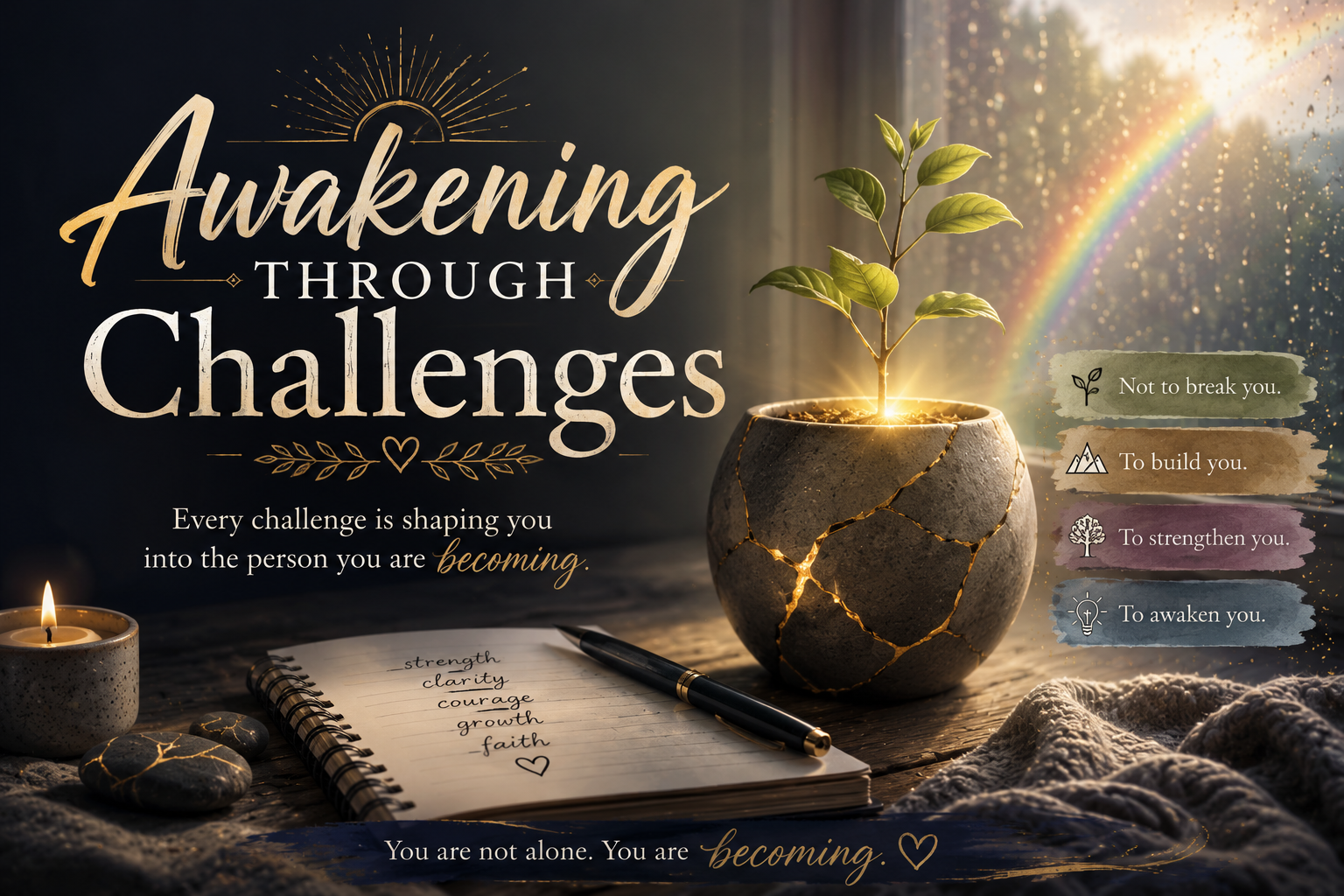
Awakening Through Challenges
Explore how difficult seasons can build resilience, clarify boundaries, deepen faith, strengthen discernment, and reveal what matters without romanticizing hardship.
How Difficult Seasons Can Strengthen Resilience, Clarify What Matters, and Deepen Faith
Challenges can become invitations for growth.
They are not automatically punishment.
They are not always proof that you are off track.
And they do not always arrive with a neat explanation.
Some challenges are simply part of being human.
Loss.
Change.
Uncertainty.
Disappointment.
Responsibility.
Waiting.
Conflict.
Unexpected endings.
Hard decisions.
Seasons where nothing seems to move as quickly as you hoped.
But even when a challenge was not chosen, welcomed, or understood, something meaningful can still emerge from the way you meet it.
A difficult season may strengthen patience.
Clarify boundaries.
Reveal what matters.
Show you where you have been carrying too much.
Teach you where greater self-trust is needed.
Deepen compassion.
Strengthen faith.
Help you discover capacities you did not know you had.
Sometimes a challenge asks:
Will you return to fear, or will you meet this with more truth, wisdom, and courage than before?
That question does not deny the difficulty.
It gives you somewhere to stand inside it.
Challenges Can Reveal What Was Already Beneath the Surface
Hard seasons often make things visible.
A pattern you could ignore during easier times becomes impossible to miss.
A weak boundary becomes obvious.
A relationship dynamic becomes clearer.
A habit that was quietly draining you becomes harder to justify.
A fear you thought you had outgrown may return.
A strength you did not know you possessed may suddenly become necessary.
Challenges can act like mirrors.
Not because every difficulty contains a hidden spiritual message.
But because pressure often reveals what is already present.
You may see:
Where you need more patience.
Where you are trying to control what cannot be controlled.
Where something in your life needs to change.
Where support is missing.
Where you have underestimated your own resilience.
Where an old pattern is ready to be understood differently.
That kind of clarity can become one of the most valuable things a challenge gives you.
The Question Is Not Always Why
When something hurts, the first question is often:
Why is this happening to me?
Sometimes that question has an answer.
Sometimes it does not.
Sometimes life is complicated enough that searching for one clean explanation creates more frustration than clarity.
A more useful question may be:
What is this asking me to understand now?
Or:
What is this revealing?
What do I need here?
What is mine to learn?
What is mine to release?
What is the next faithful step?
These questions do not turn pain into a lesson plan.
They simply help you move from helplessness toward participation.
You may not control what happened.
But you can still decide how you respond.
Meaning Can Be Made Without Pretending the Pain Was Good
There is a difference between finding meaning in a challenge and declaring that the challenge itself was good.
Some losses remain losses.
Some betrayals were wrong.
Some seasons were simply hard.
Some things should never be romanticized.
Growth does not require rewriting pain into something beautiful before you are ready.
You can say:
That hurt me deeply.
and also:
I learned something from surviving it.
You can say:
I wish that had never happened.
and also:
I am proud of who I became afterward.
Both can be true.
Meaning does not have to erase truth.
It can grow beside it.
Challenges Can Strengthen Resilience
Resilience is not becoming unaffected by difficulty.
It is the ability to keep moving, adapting, recovering, and making thoughtful choices even when life becomes demanding.
Sometimes resilience looks strong.
Sometimes it looks quiet.
It may look like:
Getting out of bed.
Showing up for your responsibilities.
Resting before you burn out.
Asking for help.
Changing direction.
Trying again.
Saying no.
Learning something new.
Giving yourself one more day.
Resilience is not the absence of struggle.
It is the capacity to continue relating to life even while struggle is present.
That capacity can grow.
Challenges Can Strengthen Discernment
Hard experiences can sharpen your ability to recognize what fits and what does not.
You may begin noticing:
Who brings peace into your life.
Who repeatedly brings confusion.
Which commitments are meaningful.
Which ones are draining you without purpose.
What kind of work energizes you.
What kind of environment makes you smaller.
Which fears deserve caution.
Which fears are only old patterns asking to remain in charge.
Discernment often becomes clearer when a challenge forces you to stop drifting.
You begin asking better questions.
Not:
What keeps everyone happy?
But:
What is actually true here?
Not:
How do I avoid discomfort?
But:
What choice is most aligned with wisdom and integrity?
Not:
How do I make this disappear?
But:
What does this situation require from me?
That shift can become a turning point.
Challenges Can Reveal Boundaries
Sometimes a challenge teaches you where your limits are.
You may discover that endless giving is not sustainable.
That compassion without boundaries becomes depletion.
That loyalty does not require self-abandonment.
That saying yes to everything can become a quiet way of saying no to yourself.
Challenges often reveal where your peace needs greater protection.
You may learn to say:
I cannot carry this for you.
I need time before I answer.
This does not work for me anymore.
I can care and still step back.
I can love and still have limits.
Boundaries are not walls against life.
Healthy boundaries help protect the conditions where honesty, peace, responsibility, and connection can grow.
Challenges Can Deepen Compassion
Difficulty often changes the way you see other people.
You become less quick to judge.
More aware that many people are carrying stories you cannot see.
You may become more patient with someone who is struggling.
More understanding of how fear affects behavior.
More willing to offer grace.
You may also discover that compassion belongs inward too.
Sometimes the challenge is not only learning to be kinder to others.
It is learning to stop punishing yourself for being human.
You can acknowledge mistakes without turning your entire identity into one.
You can grow without insulting the person you were before you knew better.
You can become wiser without becoming cruel to yourself.
That is part of awakening too.
Faith Can Change the Way You Carry a Challenge
Faith does not mean every difficult circumstance suddenly makes sense.
It does not require pretending everything is fine.
Faith can simply create a larger place to bring what you do not understand.
You can pray:
God, show me what is mine to learn here.
Give me wisdom for what is mine to do.
Help me release what I cannot control.
Strengthen me without hardening me.
Show me what needs to change.
Help me trust You even when I cannot see the whole road.
Sometimes circumstances change.
Sometimes faith changes the way you carry what has not changed yet.
Sometimes it gives you enough strength for one more day.
Sometimes it gives you peace before it gives you answers.
That still matters.
Growth Does Not Always Look Dramatic
Sometimes awakening happens quietly.
You notice you reacted differently.
You spoke up sooner.
You did not chase the same pattern.
You paused before spiraling.
You asked for help instead of pretending you were fine.
You rested before exhaustion made the decision for you.
You let someone misunderstand you without abandoning your own truth.
You chose peace where you once chose panic.
These changes may seem small.
They are not.
Growth often becomes visible first in the moments where your old reaction no longer has the same power.
That is how transformation begins to show itself.
When It Feels Like Too Much
Some seasons are intense.
And in those seasons, growth may feel less like inspiration and more like survival.
If that is where you are, you do not need to turn the challenge into a beautiful lesson today.
You do not have to be perfectly positive to be spiritually strong.
You do not have to understand everything to keep moving.
You do not have to rush healing to prove you are doing it correctly.
You are allowed to stabilize first and understand the lesson later.
Sometimes strength looks like rest.
Sometimes it looks like asking for help.
Sometimes it looks like eating something.
Taking a shower.
Answering one email.
Going outside.
Praying one honest sentence.
Sleeping.
Trying again tomorrow.
Do not underestimate the sacredness of doing what is possible.
One step still counts.
Not Every Challenge Is Yours to Endure Forever
Growth does not always mean staying.
Sometimes the lesson is to leave.
Sometimes the strongest choice is ending a pattern.
Changing jobs.
Seeking support.
Creating distance.
Releasing an obligation.
Admitting that something is no longer healthy.
There can be wisdom in perseverance.
There can also be wisdom in redirection.
The question is not:
How much can I tolerate?
A better question may be:
What choice supports truth, health, responsibility, peace, and integrity now?
Awakening is not measured by how much suffering you can endure.
Sometimes awakening is recognizing that you no longer have to keep volunteering for the same pain.
You Can Keep Your Softness
Challenges can make people stronger.
But strength does not have to become hardness.
You do not have to become cynical because someone disappointed you.
You do not have to stop trusting everyone because one person betrayed you.
You do not have to lose wonder because something did not work.
You do not have to close your heart in order to become wise.
There is another kind of strength.
A strength that keeps discernment without losing compassion.
Keeps boundaries without losing warmth.
Keeps wisdom without losing hope.
Keeps faith without denying reality.
You can emerge from difficulty more grounded and still remain soft.
That may be one of the deepest forms of resilience.
A Grounding Practice for Hard Days
When everything feels too large, bring your attention back to what is actually here.
Place your feet on the floor.
Take one comfortable breath.
Then ask:
What is happening right now?
Not next week.
Not next year.
Right now.
Then ask:
What do I need most in this moment?
Maybe:
Rest.
Water.
Food.
Prayer.
Information.
Support.
Movement.
Quiet.
A boundary.
Then ask:
What is the next loving step?
Not the entire plan.
Not the perfect solution.
One step.
You can say:
I am here.
God is with me.
I do not need the whole answer yet.
I can take the next step.
Hard seasons become more manageable when you stop demanding that today carry the entire future.
A Challenge Reflection Practice
Think about one challenge you are facing.
Ask:
What part of this is outside my control?
Then:
What part is mine to respond to?
Next:
What is this revealing about my needs, values, patterns, or boundaries?
What strength is this asking me to develop?
What do I need to stop carrying?
What kind of support would help?
What is one practical action available now?
Then stop.
You do not have to turn one reflection into a complete life strategy.
Clarity often arrives in pieces.
Honor the piece you have.
The Hidden Gift May Be Who You Become
Not every challenge contains a hidden gift.
But sometimes a gift emerges anyway.
Courage.
Clarity.
Faith.
Humility.
Compassion.
Self-respect.
A stronger boundary.
A different direction.
A new relationship with yourself.
A deeper understanding of what matters.
The challenge itself may not have been a gift.
But what you build from it may become one.
Sometimes the place that once felt like weakness becomes the place where you discover strength.
Sometimes the season that stripped away certainty leaves behind clarity.
Sometimes losing what no longer belonged creates room for something truer.
Life can create meaning even after difficulty.
Frequently Asked Questions
Can Challenges Really Help You Grow?
Yes.
Difficult experiences can create opportunities to develop resilience, problem-solving skills, self-knowledge, boundaries, perspective, compassion, and faith.
Growth is not automatic, but reflection, support, and intentional choices can help turn experience into learning.
Does Every Challenge Happen for a Reason?
Not everyone interprets hardship the same way.
Some people understand challenges spiritually, while others see them as part of ordinary life, circumstance, or chance.
You do not have to force an explanation in order to grow from what happened.
How Do I Find Meaning in a Difficult Season?
Begin with honest questions.
What matters most now?
What is this revealing?
What do I need?
What is within my control?
What have I learned about myself?
Meaning often develops gradually rather than appearing immediately.
What Is Resilience?
Resilience is the capacity to adapt, recover, and continue functioning in the presence of difficulty or change.
It does not mean being unaffected by hardship.
It means being able to keep engaging with life and finding ways forward.
How Do Challenges Strengthen Boundaries?
Difficult experiences can reveal where you are overextended, where a relationship or obligation is unhealthy, or where clearer limits are needed.
That awareness can help you make choices that better protect your time, energy, values, and peace.
How Can Faith Help During Hard Times?
Faith can offer prayer, hope, spiritual connection, meaning, surrender, wisdom, and a sense that you do not have to carry difficulty alone.
Faith does not require having every answer.
How Do I Know Whether to Keep Going or Let Something Go?
Consider whether continued effort still aligns with your values, responsibilities, well-being, and practical reality.
Sometimes perseverance is wise.
Sometimes redirection is wiser.
Reflection, prayer, trusted counsel, and honest evaluation can help clarify the difference.
What If I Am Too Overwhelmed to Look for a Lesson?
Then do not look for one yet.
Focus on what helps you get through the present moment.
Rest.
Eat.
Reach out.
Pray.
Handle the next practical need.
Meaning can wait.
You are allowed to understand something later.
Awakening Through Challenges
Challenges do not need to become punishment.
They do not need to become proof that you failed.
They do not need to become evidence that God has abandoned you.
A difficult chapter can be exactly that:
A difficult chapter.
And still, something can grow from the way you meet it.
You can become more discerning.
More compassionate.
More resilient.
More faithful.
More aware of your limits.
More honest about what matters.
More willing to ask for help.
More courageous about change.
More able to recognize what no longer belongs.
You do not have to love the challenge.
You do not have to pretend it was easy.
You do not have to turn pain into poetry before you have caught your breath.
Just keep listening.
Keep learning.
Keep choosing what is true.
Keep allowing God to meet you in the places you did not plan to visit.
One day you may look back and realize:
The challenge did not become your identity.
It became part of the ground you grew through.
And somehow, you came out knowing yourself more deeply than before.
Challenges can reveal strengths, wisdom, and capacities you had not yet needed to use.
If This Message Resonated, You May Also Enjoy
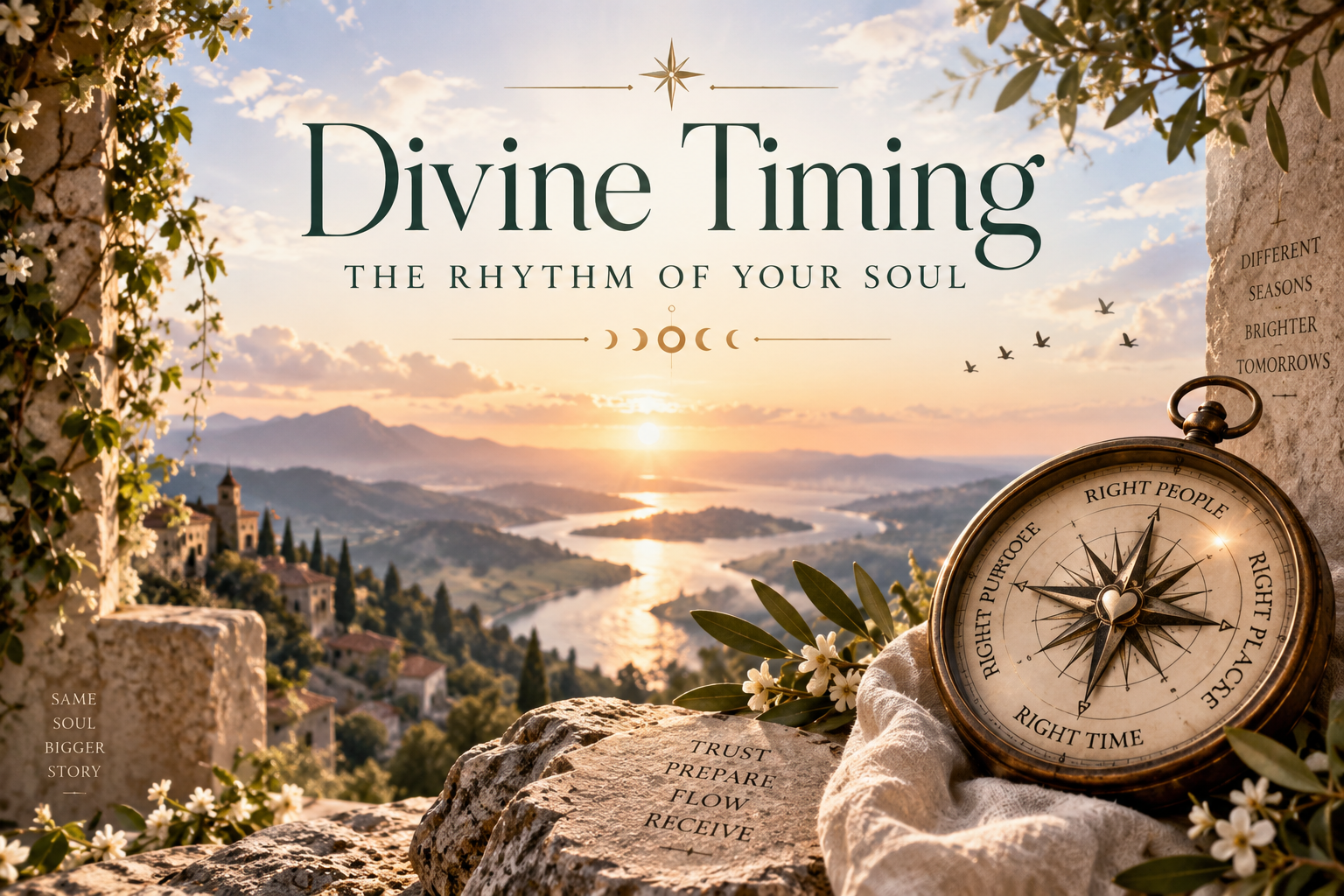
Divine Timing — The Rhythm of Your Soul
Explore divine timing, God's timing, life seasons, synchronicity, waiting, providence, free will, preparation, spiritual discernment and learning to trust the deeper rhythm of your soul.
There are seasons when life feels wide open.
You know what to do.
Energy is moving.
The path feels clear.
Something in you is ready.
And then there are seasons when the soul moves differently.
You feel quieter.
More reflective.
Less interested in pushing.
Things that once fit begin to feel too small.
Old desires lose their grip.
New questions appear before new answers do.
Nothing may look dramatic from the outside, yet something within you is changing.
This is the rhythm of the soul.
Divine timing is the larger mystery.
The rhythm of your soul is how you learn to live within it.
This page is not about waiting for life to happen.
It is about recognizing the season you are actually in.
Because not every season asks for the same response.
Some seasons ask you to move.
Some ask you to prepare.
Some ask you to receive.
Some ask you to rest.
Some ask you to release.
Some ask you to become ready for a life you cannot fully see yet.
Your Soul Does Not Move in a Straight Line
We often imagine growth as a staircase.
One step.
Then another.
Then another.
Always upward.
But real growth is rarely that tidy.
The soul moves in cycles.
Expansion.
Reflection.
Rest.
Integration.
Release.
Reorientation.
Renewal.
What looks like slowing down may actually be integration.
What looks like uncertainty may be transition.
What looks like loss of direction may be the beginning of a deeper direction.
Not every meaningful season feels productive while you are inside it.
There Is a Season for Everything
Ecclesiastes 3 gives us one of Scripture’s most enduring teachings about time.
There is a season for things.
A time to begin.
A time to end.
A time to plant.
A time to gather.
A time to mourn.
A time to dance.
A time to keep.
A time to release.
The wisdom is simple and profound.
Different seasons ask different things from us.
The problem begins when we try to force one season to behave like another.
We demand harvest during a season of planting.
We demand clarity during a season of becoming.
We demand movement during a season of rest.
We demand permanence from something whose purpose was temporary.
Sometimes the spiritual work is not changing the season.
It is recognizing it.
The Question Beneath the Question
When people ask:
“When will this happen?”
there is often another question underneath it.
“What am I supposed to do while I wait?”
That is where this page truly begins.
Instead of asking only when something will change, ask:
What is this season asking of me?
That question shifts the focus from prediction to participation.
You may not know exactly when the next chapter will begin.
But you can still recognize what belongs to this one.
The Six Movements of a Soul Season
There are many kinds of life seasons, but they often carry one of six invitations:
Wait.
Prepare.
Act.
Receive.
Release.
Begin again.
The challenge is knowing which one you are being asked to live.
When the Season Is Asking You to Wait
Waiting is not the same as doing nothing.
There are times when you have done what you can.
You sent the application.
You had the conversation.
You made the decision.
You planted the seed.
You showed up.
Now the next step is not yours.
This kind of waiting is active surrender.
You remain open.
You continue living.
You keep your life moving where movement is available.
But you stop trying to force an answer that cannot be manufactured.
Waiting becomes sacred when it is no longer filled with panic.
When the Season Is Asking You to Prepare
Sometimes the next chapter is not blocked.
It is being prepared for.
Preparation can look ordinary.
Learning.
Practicing.
Saving.
Healing.
Building confidence.
Creating structure.
Strengthening boundaries.
Improving your craft.
Becoming emotionally ready for something you once only desired intellectually.
A future season may need qualities that your current season is developing.
Preparation is one of the quietest forms of progress because the reward often appears later.
When the Season Is Asking You to Act
There are times when waiting becomes avoidance.
You already know the next step.
You are simply afraid to take it.
The application is ready.
The conversation needs to happen.
The boundary needs to be set.
The idea needs to be started.
The door is open.
The answer is clear enough.
This is when faith must move.
Not recklessly.
Not impulsively.
But faithfully.
There is a moment when contemplation becomes procrastination.
There is a moment when the next step is no longer hidden.
When the Season Is Asking You to Receive
Receiving is a spiritual skill.
Many people are far more comfortable working, giving, proving, helping, fixing and pursuing than receiving.
Yet some seasons arrive not to test how hard you can push, but whether you can allow goodness to reach you.
Receive the help.
Receive the opportunity.
Receive the kindness.
Receive the rest.
Receive the compliment.
Receive the answer.
Receive the new chapter.
Sometimes the soul has spent so long surviving that receiving feels unfamiliar.
A receiving season asks you to stop fighting what is trying to bless you.
When the Season Is Asking You to Release
Some seasons end before we are ready.
Other times, we remain long after the ending has become clear.
We hold onto identities, relationships, goals, expectations, environments and versions of ourselves because they once mattered deeply.
But something can be sacred and still be complete.
Release does not erase meaning.
It honors the season for what it was and makes room for what is becoming possible next.
Sometimes the rhythm of the soul changes because it has outgrown the music it once lived by.
When the Season Is Asking You to Begin Again
Beginning again is not failure.
It is one of life’s oldest rhythms.
A new direction.
A new habit.
A new relationship with yourself.
A new understanding of purpose.
A new way of believing.
A new season after loss.
A new identity after something you thought would last forever.
Beginning again can feel humbling because it brings you back to the unfamiliar.
But it can also be deeply freeing.
You do not have to rebuild the old life exactly as it was.
You are allowed to begin differently.
Chronos and Kairos
Ancient Greek gives us helpful language for understanding time.
Chronos refers broadly to measurable time.
Days.
Months.
Years.
Schedules.
Deadlines.
Kairos can refer to a fitting or opportune moment.
A moment whose meaning is not defined only by how long you waited for it.
Chronos asks:
How long has this taken?
Kairos asks:
What kind of moment is this?
Both matter.
The calendar keeps moving.
Responsibilities remain real.
But some things cannot be understood only by counting the days.
A soul season is often recognized by quality rather than duration.
You know something has changed because you have changed.
The Appointed Time
Scripture contains the idea of things unfolding at an appointed time.
Habakkuk speaks of a vision awaiting its proper moment, even when it seems slow.
That language matters because the soul often mistakes delay for absence.
We assume nothing is happening because nothing has happened yet.
But not every process is visible.
Some things must ripen.
Some things must intersect.
Some things require circumstances beyond us.
Some things need our readiness.
Some things simply need time.
When the Pieces Are Moving Beyond Your Sight
Your life is connected to far more than what you can presently see.
The opportunity you eventually receive may depend on decisions happening somewhere else.
The person who becomes important to your life may currently be moving through a season you know nothing about.
A conversation next year may depend upon something someone learns today.
A door may exist long before you know where it is.
This does not mean every event is secretly orchestrated around you.
It means your perspective is naturally limited.
You see your corner of the story.
You do not see the whole landscape.
Faith makes room for that larger field of possibility.
Signs Your Season May Be Changing
A new season does not always announce itself dramatically.
Often the change begins quietly.
What once excited you feels flat.
What once intimidated you feels possible.
You become less willing to tolerate certain patterns.
You crave more simplicity.
You feel drawn toward learning something new.
Old relationships shift.
Your energy changes.
A question keeps returning.
An old dream resurfaces.
A new desire surprises you.
You begin imagining a life you previously could not picture.
Sometimes the outer world stays the same while the inner season has already turned.
When Your Inner Life Changes Before Your Outer Life
This can be one of the most confusing spiritual experiences.
Inside, you know something has shifted.
Outside, nothing has changed yet.
You may feel finished with an old chapter while still physically living inside it.
You may feel ready for expansion while circumstances remain quiet.
You may sense a new direction without having the details.
This gap can feel uncomfortable.
But it is normal.
Inner transformation often moves first.
The external life takes time to catch up.
The Difference Between Forcing and Flowing
Flow is often misunderstood as effortlessness.
But meaningful things can require tremendous work.
The difference is not whether something is hard.
The difference is how the effort feels.
Aligned effort can be difficult and still feel purposeful.
Forcing feels different.
You chase.
Manipulate.
Over-control.
Ignore repeated evidence.
Abandon your values.
Try to make someone choose what they do not choose.
Try to make timing obey your fear.
Flow leaves room.
Forcing closes its fist.
The Difference Between Perseverance and Attachment
Perseverance says:
This matters, and I am willing to continue working toward it.
Attachment says:
This outcome must happen exactly the way I imagined or everything has gone wrong.
One gives you strength.
The other can trap you.
You may remain committed to the essence of a dream while allowing its form to evolve.
Sometimes the destination is still right.
The route simply changes.
When the Season Feels Empty
Some of the hardest seasons are the ones that do not seem to have an identity.
The last chapter ended.
The next has not begun.
You are no longer who you were.
You do not yet know who you are becoming.
This in-between space can feel strangely blank.
But blank does not mean meaningless.
It can be a season of integration.
A season in which your inner world reorganizes itself.
A season where old noise quiets enough for new truth to become audible.
Not every sacred season arrives with fireworks.
Some arrive as silence.
The Psychology of Uncertainty
Waiting can be spiritually demanding because uncertainty is psychologically difficult.
The mind prefers finished stories.
It wants to know:
What is happening?
What happens next?
Should I hope?
Should I prepare?
Should I let go?
Uncertainty keeps the story open.
That can create emotional tension even when nothing outwardly dramatic is occurring.
This does not mean you are failing spiritually.
It means you are human.
Faith does not eliminate uncertainty.
It teaches us how to live without requiring certainty before we can have peace.
Your Body May Recognize a Season Before Your Mind Does
Sometimes the first sign that something has changed is not intellectual.
It is embodied.
You feel tension in an environment you once tolerated easily.
You feel lighter after making a decision.
You notice relief when you imagine letting something go.
You feel energized by a direction you had not seriously considered.
Your body is not an infallible oracle.
But it often carries information worth noticing.
Wisdom listens to the body without surrendering discernment.
Rest Is Also a Season
Rest is not an interruption of your spiritual life.
It is part of it.
There are seasons when expansion is not the assignment.
Recovery is.
Integration is.
Breathing room is.
The world may continue shouting for productivity.
The soul may be asking for quiet.
You do not become less purposeful because you are resting.
Sometimes rest protects the quality of everything that comes after it.
The Sacredness of Becoming Ready
There is something deeply meaningful about becoming the person capable of holding what once felt beyond you.
Perhaps part of the blessing is not only what arrives.
Perhaps it is who you became while preparing for it.
More grounded.
More discerning.
More courageous.
More patient.
More honest.
More able to recognize what is truly right for you.
When the next season comes, you may discover that the waiting period was not separate from your becoming.
It was part of it.
Divine Timing and Free Will
Your season matters.
So do your choices.
You can ignore an invitation.
You can delay a decision.
You can choose differently.
You can leave.
You can stay.
You can learn.
You can begin again.
Free will means your life is not a passive script.
But it also means that timing sometimes involves other people’s choices too.
Not everything is yours to control.
That is why discernment matters so much.
Divine Timing and Synchronicity
Sometimes a season seems to gather symbols around itself.
The same idea appears repeatedly.
A conversation answers a question you have been carrying.
You unexpectedly meet someone connected to a subject you have been thinking about.
A book, song, prayer, phrase or encounter lands with unusual precision.
Carl Jung used the word synchronicity to describe meaningful coincidences that seem linked by significance rather than direct cause.
You do not have to interpret every coincidence as a command.
But neither do you have to strip every meaningful moment of wonder.
A coincidence can become spiritually meaningful because of what it reveals, awakens or clarifies within you.
Discernment Protects the Rhythm
Discernment keeps spiritual awareness from becoming spiritual obsession.
You do not need to decode every event.
You do not need to hunt constantly for confirmation.
You do not need to turn every delay into a sign.
A healthy spiritual life has room for mystery without requiring constant interpretation.
When something feels meaningful, ask:
Does this lead me toward greater truth?
Greater peace?
Greater love?
Greater integrity?
Greater wisdom?
Does it strengthen my life or make me fearful and compulsive?
The soul’s rhythm becomes clearer when we stop drowning it in noise.
When You Feel Behind
Comparison is one of the fastest ways to lose touch with your own season.
Someone else is beginning while you are healing.
Someone else is celebrating while you are rebuilding.
Someone else is harvesting while you are planting.
That does not mean you missed your moment.
It means you are in different seasons.
A life cannot be judged fairly by comparing one person’s harvest to another person’s winter.
Your season is not inferior because it looks different.
You Are Not Late
Your life is not a race against everyone else’s timeline.
There are still people you have not met.
Skills you have not developed.
Places you have not stood.
Questions you have not learned to ask.
Strengths you have not needed yet.
Versions of yourself you have not become.
Some chapters simply do not exist until you reach them.
That is not lateness.
That is unfolding.
The Wisdom of Hindsight
One of the strangest things about timing is that it often makes more sense backward.
At the time, a delay feels pointless.
Later, you see what changed because of it.
At the time, a chapter ending feels devastating.
Later, you understand what became possible afterward.
At the time, a detour feels like wasted effort.
Later, you realize it taught you something essential.
Hindsight does not explain every pain.
Some experiences remain mysterious.
But it often reveals connections that were impossible to see while we were still standing inside the moment.
Prayer for the Season You Are In
Prayer does not always need to ask for faster movement.
Sometimes the deeper prayer is:
God, help me recognize the season I am in.
Show me what belongs to me now.
Give me courage when it is time to act.
Patience when it is time to wait.
Humility when it is time to learn.
Grace when it is time to release.
Openness when it is time to receive.
And faith when I cannot yet see what comes next.
A Simple Practice for Recognizing Your Season
When life feels unclear, ask yourself:
What is ending?
Name what no longer fits.
What is beginning?
Notice what has started pulling your attention.
What needs preparation?
Identify what you can strengthen now.
What needs action?
Notice what you already know you need to do.
What needs release?
Pay attention to what requires constant force to keep alive.
What needs to be received?
Consider whether life is offering you something you keep resisting.
You may not get every answer immediately.
But the questions themselves can reveal the rhythm beneath the noise.
The Rhythm Beneath Your Life
Your life is not one continuous season.
It changes.
Expands.
Contracts.
Surprises you.
Redirects you.
Asks different things of you at different times.
You will not always understand why one chapter moved quickly while another seemed to stand still.
You will not always know why one door opened and another remained closed.
You will not always know when a season is ending until you are already halfway into the next one.
But you can learn to listen.
Not for a perfect map.
For rhythm.
For readiness.
For truth.
For the next honest step.
The Sacred Invitation
The deepest invitation of divine timing is not to wait endlessly for something better.
It is to become present enough to recognize what this season is asking of you now.
Wait when waiting is wise.
Prepare when preparation is needed.
Act when the moment opens.
Receive what comes with grace.
Release what has completed its purpose.
Begin again when a new life asks to be lived.
Your soul is not racing against the clock.
It is learning how to move with truth.
Some seasons will be bright and obvious.
Others will be quiet and hidden.
Some will expand you.
Others will empty your hands.
Some will ask you to build.
Others will ask you to become still.
But every season can teach you something about who you are becoming.
The rhythm will change.
That is not a problem.
That is life.
And sometimes the deepest form of trust is not knowing exactly what comes next, but knowing enough to honor the season you are in.
Questions Readers Often Ask
What does “the rhythm of your soul” mean?
It refers to the way your inner life moves through different seasons of growth, rest, preparation, release, action and renewal. Not every stage of life asks for the same response.
How is this different from divine timing?
Divine timing explores the larger spiritual mystery of when and how life unfolds. The rhythm of your soul focuses more specifically on how you recognize and respond to the season you are personally living through.
How do I know what season I am in?
Pay attention to what is changing internally and externally. Notice what feels complete, what is emerging, what requires preparation, where energy is returning, and what keeps asking for your attention.
Can a season be both painful and meaningful?
Yes. A season can be difficult while still contributing to growth, wisdom or transition. Meaning does not require pretending pain was easy or necessary.
How do I know whether to wait or act?
Ask whether there is a reasonable next step available to you. If there is something clear and responsible you can do, action may be appropriate. If the next step genuinely depends on circumstances beyond your control, waiting may be wiser.
How do I know whether to persevere or let go?
Consider whether continued effort strengthens your integrity and growth or requires you to ignore repeated evidence, abandon your values or control what belongs to someone else.
Why do I feel restless before a life change?
Sometimes inner change begins before outer circumstances shift. Restlessness can reflect growth, boredom, misalignment or a new direction beginning to form. Discernment helps clarify which.
Can rest be part of divine timing?
Yes. Rest can be a meaningful season of integration, recovery and preparation. Not every season is designed for visible expansion.
What does kairos mean?
Kairos is an ancient Greek term that can refer to a fitting, opportune or decisive moment. It offers a useful contrast with measurable chronological time.
Are synchronicities signs of a changing season?
They can feel meaningful and may invite reflection, but they do not need to be treated as automatic instructions. Their value may lie in what they help you notice or understand.
What if I feel behind everyone else?
Different lives unfold through different seasons. Comparing your current chapter with someone else’s visible success can distort your sense of timing.
What if I do not know what comes next?
You do not need the whole answer. Focus on the next faithful step, what this season is developing in you and what is actually yours to do today.
Scripture and Sacred Wisdom
Ecclesiastes 3:1–11
A reflection on seasons, change and the different rhythms woven through human life.
Psalm 31:15
A simple expression of trust in God with the unfolding of our lives.
Proverbs 16:9
A reminder that human planning and divine direction can exist together.
Habakkuk 2:3
A reflection on waiting, vision and the appointed time.
Isaiah 43:18–19
A beautiful invitation to notice when something new is beginning.
You may also enjoy:
Divine Timing
The Signs You’re Being Divinely Guided
Spiritual Discernment
Purpose Is Seasonal
The Beauty of Becoming
Grace in Every Transition
The Quiet Work
Redirects, Not Punishment
Fear vs Intuition
The Soul Blueprint
The Three Callings
The Peace of Presence
The Moment I Start Remembering
The Soul’s Relationship with God
Manifestation is a Quiet Art
Explore manifestation as a quiet art of intention, faith, prayer, attention, gratitude, visualization, alignment, divine timing, action and becoming.
What if manifestation is less about chasing and more about becoming?
Manifestation is often portrayed as something loud.
Declare it.
Visualize it.
Repeat it.
Chase it.
Make it happen.
But some of the most profound manifestations begin almost silently.
A thought becomes clearer.
A desire becomes more honest.
Your attention shifts.
Your beliefs begin changing.
You pray differently.
You recognize possibilities you once overlooked.
Your standards rise.
Your choices change.
You release something you have outgrown.
You become willing to walk through a doorway that an earlier version of you might have been afraid to enter.
Nothing outside you may appear different yet.
And still, something important has already begun.
Manifestation can be a quiet art.
It happens in the unseen places where desire, intention, attention, belief, faith, gratitude, preparation, discernment, and action begin moving together.
Sometimes the first thing manifestation changes is not your circumstances.
It changes you.
Manifestation Begins Before the Evidence Appears
Most meaningful change has an invisible beginning.
Before a new life becomes visible, there is often a new way of seeing.
Before an opportunity is accepted, there may be a new belief about what is possible.
Before someone changes direction, there is often an inner moment when the old direction no longer feels true.
Before something is built, someone imagines that it could exist.
Manifestation frequently begins here.
Not with evidence.
With possibility.
A peaceful home.
Meaningful work.
Financial abundance.
Healing.
Love.
Creative expression.
Greater freedom.
A stronger relationship with God.
A life that feels aligned with who you are becoming.
The outer world may not have changed yet.
But your relationship with possibility has.
And that matters.
Quiet Does Not Mean Passive
There is enormous activity in things we cannot see.
A seed beneath the soil does not appear particularly impressive.
Yet roots are forming.
Structures are developing.
Life is preparing to emerge.
Human transformation can be similar.
There are seasons when the most important movement is internal.
You are learning.
Preparing.
Healing.
Reconsidering.
Praying.
Strengthening your faith.
Building confidence.
Developing skills.
Changing habits.
Releasing an old identity.
Becoming more discerning.
Quiet manifestation recognizes that visible results are only one part of creation.
There is also preparation.
And preparation is movement.
Desire Can Carry Information
Desire deserves curiosity.
Not every desire must become a destination, but recurring desires can reveal something important about us.
Perhaps the desire for a different career is really a longing for freedom, creativity, purpose, or contribution.
Perhaps the dream of a beautiful home represents peace, security, hospitality, stability, or belonging.
Perhaps the desire for abundance is not merely about possessions. It may be about having enough to breathe, give generously, care for family, create, explore, and live without constantly being ruled by scarcity.
Go beneath the surface.
Instead of asking only:
What do I want?
Ask:
Why does this matter to me?
And then:
What might this desire be revealing about the person I am becoming?
Sometimes the deeper desire is far more beautiful than the original request.
Attention Is One of Manifestation's Quiet Forces
Your mind encounters far more information than conscious awareness can hold at once.
Attention helps determine what rises into awareness.
This creates an interesting connection with manifestation.
When something becomes deeply meaningful, related information can suddenly seem to appear everywhere.
You notice the conversation.
The opportunity.
The book.
The person.
The possibility.
The idea.
The opening.
Some of those things may have existed before.
What changed was your readiness to notice them.
Intention can influence what becomes important enough for the mind to recognize.
And recognition matters because what we notice can influence what we investigate, remember, pursue, and act upon.
This is one reason manifestation can sometimes feel mysterious.
The world seems different.
Sometimes it is.
Sometimes you are seeing it differently.
And sometimes both may be true in ways we cannot completely untangle.
Belief Changes What We Are Willing to Attempt
There is an important psychological concept called self-efficacy.
It simply means:
Do I believe I am capable of doing what this requires?
That belief matters.
People who believe they can learn, adapt, improve, or persevere are often more willing to attempt difficult things and continue when those things become challenging.
This gives us a richer understanding of belief.
Manifestation is not only saying:
I believe this will happen.
Sometimes the transformative belief is:
I believe I can become capable of meeting this future.
That changes the conversation.
You may apply.
Learn.
Practice.
Ask.
Create.
Try again.
Walk away from what no longer fits.
Take a chance you previously would have rejected.
Belief does not have to begin as absolute certainty.
Sometimes the beginning is simply:
Maybe this is possible for me.
That tiny opening can change the next decision.
And the next decision can change a life.
Manifestation Is Also About Identity
One of manifestation's deepest questions is not:
How do I get what I want?
It is:
Who am I becoming?
If you desire peace, you may need to become someone who protects peace.
If you desire meaningful relationships, you may need to become more present, honest, loving, forgiving, or discerning.
If you desire financial abundance, you may need to become someone capable of managing abundance wisely.
If you desire meaningful work, you may need to develop the skills required to carry it.
If you want to create something beautiful, you may need to become someone who continues creating before anyone notices.
If you desire greater freedom, you may need the courage to make decisions that freedom requires.
Sometimes manifestation does not first require a different world.
It requires a different relationship between you and the world.
You become the person who recognizes the opportunity.
The person who walks through the doorway.
The person who can sustain the blessing.
The person willing to receive what an earlier version of you might have pushed away.
Visualization Is Most Powerful When It Becomes a Bridge
Visualization can give shape to something that currently exists only as possibility.
Athletes mentally rehearse performance.
Performers imagine stepping onto a stage.
People preparing for difficult situations rehearse how they want to respond.
And someone imagining a different life can begin giving emotional and practical form to that future.
But there is something even more powerful than simply imagining the destination.
Imagine the future.
Then look honestly at what stands between you and it.
Then build a bridge.
Ask:
What obstacle is most likely to stop me?
And:
What will I do when I encounter it?
This is where vision becomes practical.
Perhaps:
If I become discouraged because progress is slow, I will remember why I started before deciding to quit.
Or:
If fear makes me want to reject an opportunity, I will give myself time to consider it rather than automatically saying no.
Or:
If I cannot take the large step yet, I will take the smallest meaningful step available.
A beautiful future becomes more attainable when imagination and preparation meet.
Feel the Future, Then Bring Some of It Here
There is another beautiful way to use visualization.
Ask:
What would the life I desire feel like?
Peaceful?
Free?
Creative?
Secure?
Joyful?
Purposeful?
Loved?
Abundant?
Then ask:
How can I create a small experience of that feeling today?
If the future represents peace, create ten peaceful minutes.
If it represents creativity, make something.
If it represents love, give love.
If it represents freedom, make one freer choice.
If it represents abundance, appreciate something already abundant in your life.
If it represents purpose, do one meaningful thing.
The future does not always arrive all at once.
Sometimes we begin practicing it.
Gratitude Changes the Place From Which We Meet Life
Gratitude belongs naturally beside manifestation.
Not because gratitude is a transaction in which we say thank you and the universe owes us something.
Gratitude changes attention.
It reminds us that desire and appreciation can coexist.
You can desire more while still recognizing what is already beautiful.
Instead of living entirely inside:
Not yet.
You begin noticing:
Already here.
Love already here.
Beauty already here.
Lessons already here.
Possibility already here.
Strength already here.
Provision already here in some form.
Grace already here.
Gratitude does not require pretending everything is perfect.
It simply prevents what is missing from becoming the only thing you can see.
And when you can see more of what is present, you meet the future from a different inner place.
Manifestation Needs Discernment
Not every thought is prophecy.
Not every desire is destiny.
Not every coincidence is necessarily a sign.
And not every closed door carries a hidden message.
The quiet art of manifestation includes discernment.
Some desires arise from comparison.
Some arise from fear.
Some belong to an earlier version of ourselves.
Some are borrowed from other people's expectations.
And then there are desires that keep returning.
Quietly.
Faithfully.
They seem to carry something deeper.
Perhaps they point toward a value, calling, possibility, or direction that deserves our attention.
The work is not believing every thought.
The work is learning which ones are worthy of being followed.
Silence can help.
Prayer can help.
Time can help.
Wisdom can help.
And sometimes the answer becomes clearer when we stop demanding one immediately.
Prayer and Manifestation
For a person of faith, manifestation does not have to mean believing that the human mind commands God or controls every event in the universe.
It can mean participating intentionally in the life God has given you.
You pray.
You imagine.
You listen.
You prepare.
You act.
You remain open.
You trust.
There is something deeply peaceful about being able to say:
This is what I hope for. This is what I am moving toward. And I remain open to God's wisdom beyond what I can currently see.
Prayer is not merely asking.
Prayer can also be listening.
Discernment.
Gratitude.
Relationship.
Surrender.
Worship.
Trust.
And sometimes the answer is:
Yes.
Sometimes:
Not yet.
Sometimes:
There is another way.
Faith leaves room for the possibility that what we can imagine may not be the limit of what God can do.
Prayer Can Change the Person Who Is Praying
Sometimes we pray for circumstances to change.
And while we wait, something within us changes.
We become more courageous.
More patient.
More discerning.
More willing.
More forgiving.
More aware.
More prepared.
You may pray for guidance and become more attentive to where guidance appears.
You may pray for provision and begin recognizing opportunities you once overlooked.
You may pray for healing in a relationship and discover something within yourself that needs healing too.
You may pray for purpose and realize that part of your purpose has already been sitting quietly in front of you.
Prayer can change circumstances.
Prayer can change us.
And sometimes those two things become beautifully intertwined.
Manifestation and the Law of Attraction
The Law of Attraction expresses the idea that what we consistently focus upon, believe, feel, and align ourselves with can influence what we draw toward our lives.
There are different ways people understand this.
Some see it primarily as a spiritual principle.
Others understand parts of it through psychology: attention, expectation, behavior, emotional patterns, relationships, persistence, and opportunity recognition.
These perspectives do not have to erase one another.
Science can study attention.
It can study behavior.
It can study belief.
It can study visualization.
It can study goal pursuit.
But the deeper spiritual questions about consciousness, providence, prayer, meaning, and the nature of reality remain much larger than a laboratory.
There is room for wonder.
When Coincidence Feels Like More Than Coincidence
Sometimes something happens at exactly the right moment.
You have been thinking about a question and someone unexpectedly mentions the answer.
You need a particular connection and meet someone who knows exactly the person you need.
An idea returns after years of silence at precisely the moment you are ready to act upon it.
Several unrelated experiences suddenly seem to point in one direction.
Psychologist Carl Jung used the word synchronicity to describe meaningful coincidences that appear connected through meaning rather than an obvious chain of cause and effect.
Some people understand these moments spiritually.
Some see providence.
Some see synchronicity.
Some see heightened awareness.
Some see probability.
And sometimes we simply do not know.
But there are moments so exquisitely timed that they make us stop.
Perhaps we do not always need to explain them immediately.
Sometimes we can simply pay attention.
The Energy of Forcing
There is a difference between devotion and desperation.
Devotion says:
This matters to me, and I will continue moving toward it.
Desperation says:
This must happen exactly this way and exactly now or everything is wrong.
The second state can make our world very small.
We become so focused on one doorway that we stop seeing the windows.
Quiet manifestation makes room.
You can hold a powerful vision without dictating every detail of its arrival.
You can desire something deeply while remaining open to being surprised.
You can work diligently while still trusting.
You can move forward without trying to wrestle tomorrow into submission.
The Art of Allowing
Allowing does not mean doing nothing.
It means remaining receptive.
Sometimes what we have asked for appears quietly.
A conversation.
An introduction.
A new idea.
A seemingly small opportunity.
A sudden realization.
A changed relationship.
A closed door that redirects us.
A person who believes in us.
A beginning much smaller than the ending we imagined.
Many extraordinary beginnings arrive wearing ordinary clothes.
Manifestation requires enough presence to recognize them.
Letting Go Can Be Part of Receiving
Some manifestations require addition.
Others require subtraction.
You may need to release an old belief.
A habit.
A relationship that continually pulls you backward.
A definition of success inherited from someone else.
A fear that once protected you but now confines you.
The belief that you missed your chance.
The need for everyone to understand your path.
An identity built for a life you no longer live.
There are seasons when receiving more requires carrying less.
Empty space is not always absence.
Sometimes it is room.
Becoming Able to Receive
We speak often about attracting what we desire.
We speak less about being able to receive it.
Imagine receiving the opportunity you have been asking for.
Could you say yes?
Could you sustain it?
Could you allow yourself to be seen?
Could you accept help?
Could you manage greater responsibility?
Could you believe something good belongs in your life without immediately looking for reasons it will disappear?
Sometimes the doorway appears before we feel completely ready.
Manifestation can therefore include learning how to receive.
Not grasp.
Not cling.
Receive.
There is a difference.
The Body Belongs in the Conversation
Change can be exciting and still feel unfamiliar.
A person may consciously desire greater visibility while another part of them fears being judged.
Someone may desire more money while worrying about responsibility.
A person may want love while fearing loss.
Someone may desire freedom while discovering that freedom requires decisions certainty once made for them.
This is why transformation is not purely intellectual.
The body sometimes needs time to become comfortable with a life the mind already says it wants.
Rest.
Prayer.
Stillness.
Supportive relationships.
Reflection.
Breathing room.
Gradual action.
These can help us inhabit change rather than constantly retreat from it.
Sometimes the question is not:
Can I imagine this?
It is:
Can I remain present when it begins arriving?
Small Actions Tell the Future You Are Serious
Manifestation becomes powerful when imagination meets participation.
You do not need the entire map.
You need the next meaningful step.
Send the email.
Make the call.
Open the document.
Save the first dollar.
Take the class.
Clean the room.
Create the page.
Practice the skill.
Ask the question.
Apply.
Walk.
Begin.
The next step may look unimpressive.
Take it anyway.
Entire futures are assembled from ordinary Tuesdays.
Silence Helps Us Hear What We Actually Want
Modern life is noisy.
Advertising tells us what to desire.
Social media shows us what success supposedly looks like.
Other people's expectations can become so familiar that we mistake them for our own.
Comparison speaks loudly.
Fear does too.
Silence creates room for another question:
What do I actually want?
Not what would impress someone.
Not what would prove something.
Not what everyone else seems to be pursuing.
What feels aligned with the life you genuinely feel called to live?
Quiet manifestation begins with honest desire.
Divine Timing
There are things we cannot rush into ripeness.
A delay may provide time to prepare.
A closed door may redirect you.
An uneventful season may be strengthening abilities you will later need.
Something arriving too early can sometimes be harder to carry than something arriving after preparation.
Divine timing does not always announce itself dramatically.
Sometimes you meet someone during exactly the season when your paths need to cross.
An old idea returns when you finally possess the courage to pursue it.
A door opens after years of preparation.
Something you desperately wanted loses its hold, and something more fitting takes its place.
You look backward and recognize a pattern that was invisible while you were living through it.
Some timing cannot be understood from inside the moment.
It reveals itself later.
You Do Not Have to Obsess Over the Outcome
There comes a point when constant focus stops feeling like intention and begins feeling like surveillance.
Is it happening yet?
Was that a sign?
Why isn't it here?
Am I doing this correctly?
Did I think the wrong thought?
That can make the desired future consume the present.
Quiet manifestation releases some of that pressure.
Plant the intention.
Pray over it.
Prepare.
Take meaningful action.
Stay awake to opportunity.
Then live.
Laugh.
Love people.
Work.
Rest.
Create.
Notice the sky.
There is wisdom in allowing a dream to breathe.
Manifestation Does Not Require Pretending
You do not need to pretend disappointment is happiness.
You do not need to call every painful experience a blessing before you are ready.
You do not need to deny uncertainty.
You do not need perfect thoughts every hour of every day.
A grounded spiritual life has room for reality.
Hope and disappointment can coexist.
Faith and questions can share the same room.
Gratitude and grief can occupy the same heart.
You can acknowledge where you are while still believing something new can emerge.
That is not weak manifestation.
That is honest faith.
Become Available to Surprise
You may understand the essence of what you desire without knowing its final form.
You may want meaningful work without knowing where it will come from.
You may desire love without knowing who will enter your life.
You may desire a place that feels like home without knowing its address.
You may sense a calling before understanding what it will become.
Leave a little empty space in the picture.
Life may need somewhere to paint.
God may have colors you have not imagined yet.
When Nothing Seems to Be Happening
There will be seasons when nothing seems to move.
No breakthrough.
No confirmation.
No obvious evidence.
Keep tending what belongs to you.
Your character.
Your preparation.
Your faith.
Your health.
Your relationships.
Your skills.
Your environment.
Your attention.
Your choices.
Your prayer life.
Your willingness to grow.
The absence of visible movement does not necessarily mean the absence of movement.
Some of life's greatest changes begin quietly enough that we recognize them only after they have already transformed us.
A Quiet Manifestation Practice
You do not need an elaborate ritual.
Become still.
Ask yourself what you genuinely desire.
Then ask why it matters.
Picture the life connected to that desire.
Notice how it feels.
Bring it into prayer.
Ask whether it aligns with who you feel called to become.
Notice what stands between you and it.
Identify the obstacle most likely to stop you.
Decide what you will do when that obstacle appears.
Choose one small action that belongs to the future you are creating.
Give thanks for something already present.
Remain awake to unexpected opportunities.
Then release the need to control every detail.
Return to your life.
Keep walking.
Keep listening.
Keep becoming.
Questions for Reflection
What desire keeps returning to your heart?
Why does it matter?
What deeper longing might exist beneath it?
What would you need to believe differently to move toward it?
Who would you need to become to carry it well?
What obstacle is most likely to stop you?
What will you do when that obstacle appears?
What part of your desired future can you begin living today?
Is there something you are trying to force that may need more room?
What are you ready to release?
What opportunity might already be present that you have not fully recognized?
Where might God be asking you to prepare rather than rush?
And what is the next small step that belongs to you?
The Quiet Art
Manifestation does not always look like commanding the universe.
Sometimes it looks like whispering a prayer when nobody else can hear.
Writing a vision down.
Choosing hope again.
Changing one habit.
Learning something new.
Walking away from something that no longer belongs.
Preparing for an opportunity nobody else can see yet.
Saying yes.
Saying no.
Learning to receive.
Learning to trust.
Learning to wait without abandoning the vision.
It is belief becoming courage.
Attention becoming awareness.
Vision becoming preparation.
Gratitude becoming presence.
Prayer becoming discernment.
Intention becoming action.
And action, repeated quietly enough and faithfully enough, becoming a life.
There is power in intention.
There is power in attention.
There is power in belief.
There is power in gratitude.
There is power in action.
There is power in faith.
And there is extraordinary power in becoming.
Some dreams arrive with fireworks.
Others enter almost silently.
One day you look around and realize that the person you once hoped to become has been quietly emerging all along.
The circumstances may have changed.
But so have you.
Perhaps that is the deepest manifestation of all.
And perhaps that is why manifestation is a quiet art.
Questions and Answers
What does manifestation really mean?
Manifestation can be understood as intentionally moving a possibility toward reality through vision, attention, belief, preparation, choices, behavior, opportunity, and action. For many people it also has a spiritual dimension involving prayer, faith, intention, divine guidance, energy, or the Law of Attraction.
Does thinking about something make it happen?
Thought can be powerful without being the only force involved. What we repeatedly think about can influence attention, expectations, emotional responses, decisions, persistence, and behavior. Spiritual traditions and Law of Attraction teachings may understand thought and intention more broadly, while scientific research focuses on the psychological and behavioral processes that can be measured.
Is manifestation the same as the Law of Attraction?
They overlap, but manifestation can be understood more broadly. The Law of Attraction generally emphasizes the relationship between thought, feeling, energetic alignment, and experience. Manifestation may also include prayer, values, attention, visualization, preparation, relationships, opportunity recognition, decision-making, and action.
Can Christians believe in manifestation?
Manifestation can be understood within Christian faith as bringing hopes and desires before God while intentionally participating in the life one has been given. Prayer, faith, stewardship, preparation, action, discernment, surrender, and trust in God's wisdom can all be part of that understanding.
What is self-efficacy and why does it matter?
Self-efficacy is the belief that you can carry out the actions necessary to accomplish something. It matters because believing you are capable of learning, adapting, and persevering can influence what you attempt and whether you continue when things become difficult.
Does visualization work?
Visualization or mental imagery can be useful for rehearsal, preparation, focus, and performance. It becomes especially practical when a desired future is paired with honest recognition of obstacles and a plan for responding to them.
Why is gratitude connected with manifestation?
Gratitude intentionally brings attention toward what is already present and meaningful. Research has associated gratitude practices with improvements in aspects of well-being and positive emotion. Spiritually, gratitude also creates room to appreciate today's blessings while remaining open to tomorrow's possibilities.
What is synchronicity?
Synchronicity is a term associated with psychologist Carl Jung for meaningful coincidences that appear connected through significance rather than an obvious causal chain. People interpret these experiences differently, including psychologically and spiritually.
Why is letting go important?
Letting go does not mean abandoning a desire. It can mean releasing excessive attachment to exactly how or when something must happen. This creates room for different opportunities, timing, directions, and possibilities.
What is the most important part of manifestation?
Perhaps it is alignment.
When what you desire, what you believe, what you value, what you pray about, what you notice, who you are becoming, and what you actually do begin moving in the same direction, something powerful changes.
You are no longer merely wishing for a different life.
You are participating in its creation.
Related Reading
Attention Is One of Your Mind's Greatest Forces
When Vision Becomes Stronger Than Fear
Aligned with Abundance
Divine Timing: The Rhythm of Your Soul
The Signs You're Being Divinely Guided
The Sacred Path of Self-Mastery
Feed Your Mind with What Enlarges You
The Beauty of Becoming
Divine Purpose
The Genius Within Every Soul
The Moment I Start Remembering

The Peace of Presence
Discover the peace of presence and how living fully in the present moment can deepen calm, gratitude, relationships, spiritual awareness, discernment and trust in God.
The Peace of PresenceThere is a kind of peace that does not come from having every answer, solving every problem or knowing exactly what happens next.
It comes from being fully here.
Presence is the quiet return to the moment you are actually living. It is the temporary setting down of yesterday, the release of tomorrow and the willingness to inhabit the life unfolding in front of you.
So much of our inner unrest comes from living in more than one time at once. The body is sitting at the kitchen table while the mind is replaying yesterday. We are driving home while mentally living through tomorrow. We are speaking with someone we love while part of our attention is somewhere entirely different.
Presence gathers the scattered pieces of us and brings them home.
Not into denial.
Not into passivity.
Not into pretending that everything is perfect.
Into reality.
And sometimes reality, right now, is much quieter than the story the mind has been telling.
Presence Is More Than Paying Attention
Presence is often described as awareness of the current moment, but it can reach much deeper than simply noticing what is around us.
To be present is to meet a moment without immediately trying to escape it, judge it, rush through it or turn it into something else.
It is hearing birds outside the window and actually listening.
It is holding a warm cup and noticing the warmth in your hands.
It is sitting beside someone you love and truly being with them.
It is walking outside and realizing that the sky has been beautiful all along.
Presence gives ordinary life its texture back.
Time feels less mechanical. Conversations become deeper. Beauty becomes easier to notice. Gratitude becomes more natural. The ordinary begins revealing details that hurry had hidden.
Presence does not create life.
It reveals the life that was already there.
Your Life Is Always Happening Here
The mind possesses an extraordinary ability to travel through time.
It can remember a childhood afternoon from decades ago.
It can replay something someone said last week.
It can imagine next month, next year or ten years from now.
This ability helps us learn, plan, create and prepare.
But there is an important distinction.
The mind can visit the past and future.
The body cannot.
Your body is always here.
Breathing here.
Feeling here.
Walking here.
Living here.
Presence reunites attention with the place where life is actually happening.
The Mind Can Create Entire Futures
A single unanswered question can sometimes generate dozens of imaginary outcomes.
What if this happens?
What if they say that?
What if the answer is no?
What if I make the wrong decision?
What if everything changes?
The mind can mentally live through events that never actually occur.
This capacity for anticipation can be useful when it helps us prepare. But anticipation becomes heavy when possibility begins masquerading as reality.
Presence asks a wonderfully clarifying question:
What is actually happening right now?
Not what might happen.
Not what happened before.
Not what someone might think.
What is true here?
Often, the present contains fewer problems than the future our imagination has constructed.
Presence Is Where We Can Respond
The past can be remembered, but it cannot be changed from the past.
The future can be imagined, but it cannot be lived ahead of time.
The present is different.
This is where a decision can be made.
Where a prayer can be spoken.
Where forgiveness can begin.
Where a boundary can be established.
Where someone can be loved.
Where a phone call can be made.
Where we can rest, begin, stop, speak, listen, create or choose again.
Presence is powerful because it returns us to the only place where participation is possible.
We cannot act yesterday.
We cannot act tomorrow.
We can act here.
Presence is not passive.
It is where meaningful action begins.
Planning for Tomorrow Is Different From Living There
Presence does not ask us to abandon wisdom.
We still plan.
We still prepare.
We still save money, make appointments, set goals, consider consequences and think ahead.
But there is a difference between preparing for tomorrow and emotionally inhabiting tomorrow before it arrives.
Healthy planning eventually reaches a stopping point.
You make the plan.
You take the action available today.
Then you return.
Tomorrow can be prepared for without being carried every hour.
The future deserves wisdom.
It does not require constant residence.
The Body Can Feel What the Mind Is Carrying
The body can respond not only to what is happening around us, but also to what the mind repeatedly anticipates, remembers and interprets.
A difficult memory can tighten the shoulders.
An imagined conversation can quicken the heartbeat.
A future concern can make the body feel as though something is already happening even while the room around us remains quiet.
This is one reason returning attention to the present can feel so grounding.
Look around.
Feel the chair beneath you.
Notice your feet touching the floor.
Listen to the sounds in the room.
Notice the temperature of the air.
Take one slower breath.
These small acts reconnect awareness with the current environment.
They remind the body:
This is where I am.
This is what is happening now.
Research into mindfulness and present-moment practices has increasingly explored their relationship with perceived stress, emotional regulation, attention and physiological measures associated with stress. The practices studied vary, but the larger idea is meaningful: where attention rests can influence how an experience is processed.
Presence is not merely a spiritual idea.
We experience it through the body too.
You Do Not Have to Chase Every Thought
Thoughts can feel important simply because they appear.
But a thought is not automatically an instruction.
A memory may surface.
A worry may arrive.
A possible problem may announce itself.
A mental argument may begin.
Presence creates a small but powerful space between noticing a thought and following it.
You can recognize:
I am remembering.
I am worrying.
I am predicting.
I am rehearsing.
And then return to what is actually here.
You are not required to walk down every mental road your mind presents.
Some thoughts contain wisdom.
Some need attention.
Others are simply passing traffic.
Presence helps us learn the difference.
Presence Interrupts Rumination
There is a difference between reflecting on something and endlessly circling it.
Reflection can lead to understanding.
Rumination often returns us to the same emotional intersection without moving anywhere.
Why did that happen?
Why did they say that?
What should I have done?
What if I had chosen differently?
There are moments when the past deserves thoughtful examination.
But eventually, healing asks us to come back.
The lesson can travel forward with us.
The moment itself does not have to.
Presence allows the past to become wisdom rather than permanent residence.
The Past Can Be Honored Without Living There
Presence never asks us to erase our history.
Our memories matter.
Grief deserves tenderness.
Lessons deserve respect.
Beautiful memories deserve to be treasured.
What happened to us can shape who we become.
But the past was never meant to become our only address.
We can remember.
We can understand.
We can grieve.
We can forgive.
We can heal.
And then we return to today.
Because today is where the next chapter is written.
The past can explain parts of us without owning the rest of our story.
The Future Can Be Trusted Without Being Controlled
Uncertainty can tempt us into believing that enough thinking will eventually produce certainty.
So we rehearse possibilities.
We calculate outcomes.
We try to anticipate every turn in the road.
But life rarely reveals itself that way.
There will always be things we cannot know until we reach them.
Presence offers another way.
Prepare wisely.
Act responsibly.
Listen carefully.
Pray.
Then release what cannot yet be known.
You do not need the entire road illuminated before taking the next faithful step.
Sometimes enough light appears only when we move forward.
Presence Is Not Always Comfortable
There is an important truth about presence that is sometimes overlooked.
The present moment is not always pleasant.
Sometimes the present contains grief.
Sometimes it contains disappointment.
Sometimes it contains loneliness.
Sometimes it contains an uncomfortable conversation, an unanswered prayer or a truth we would rather avoid.
Presence does not promise that every moment will feel peaceful.
It invites us to meet the moment truthfully.
And there can be a surprising peace in that honesty.
Instead of fighting three battles at once, what happened yesterday, what might happen tomorrow and what is happening today, we meet the one moment actually before us.
This one.
And this is the moment we have been given.
Presence Is Not the Same as Mindfulness
Mindfulness and presence overlap, but presence can be understood more broadly.
Mindfulness practices often involve deliberately observing thoughts, sensations and experiences without immediately judging them.
Presence can include that, but it can also include prayer.
Worship.
Listening.
Creativity.
Gratitude.
Communion.
Wonder.
Service.
A conversation in which you give another person your complete attention.
Sitting quietly with God without needing to say anything at all.
Presence is not confined to a technique.
It can become a way of inhabiting life.
Attention Is Part of Your Life
Attention is easy to underestimate.
But what receives our attention receives a portion of our life.
If we are physically present for a beautiful afternoon but mentally absent from it, the afternoon still happened.
We simply experienced less of it.
This does not mean we must become intensely aware of every second. That would become another form of pressure.
It means recognizing that attention is precious.
Where we repeatedly place it matters.
Presence is the gentle act of reclaiming attention from places where it no longer needs to be and returning it to the life in front of us.
Presence Makes Ordinary Life Larger
One of the quiet gifts of presence is that life stops feeling like something we are constantly rushing through to reach something else.
Meals become moments.
Walks become experiences.
Music becomes something we hear instead of background noise.
A sunset stops being scenery.
A familiar voice becomes something we realize we are fortunate to hear.
The ordinary becomes less ordinary because attention reveals what hurry concealed.
A five-minute moment fully inhabited can sometimes hold more life than an hour spent mentally somewhere else.
Presence Helps Us Love Better
One of the greatest gifts we can give another human being is our attention.
People can often feel when we are truly listening.
They can also feel when we are waiting for our turn to speak, checking a screen or mentally somewhere else.
Presence says:
You matter enough for me to be here.
I am listening.
I am not rushing past you.
Some of the most meaningful moments in relationships are not created through dramatic gestures.
They happen at kitchen tables.
In cars.
On porches.
During ordinary conversations.
In the few minutes when someone realizes another person is truly listening.
Presence can become a form of love.
Presence Creates Room to Receive
Presence is not only about becoming calmer.
It makes us more available.
Available to beauty.
Available to wisdom.
Available to another person's words.
Available to gratitude.
Available to inspiration.
Available to conviction.
Available to love.
Available to God.
A distracted life can contain countless gifts we never fully receive because our attention is somewhere else.
Presence opens the door.
It says:
I am here.
I am listening.
I am willing to notice.
The Sacredness of Here
Scripture repeatedly draws human attention toward daily trust.
Daily bread.
Daily manna.
This day.
This step.
This moment of faithfulness.
Jesus taught in Matthew 6:34 not to worry about tomorrow because tomorrow will have concerns of its own. The teaching appears within a larger message about trust in God, His awareness of human needs and the futility of allowing worry to dominate life.
This is not an invitation to irresponsibility.
It is an invitation to stop carrying tomorrow before tomorrow exists.
Psalm 118:24 celebrates “the day” the Lord has made.
Psalm 46:10 calls us toward stillness and the recognition of God.
The story of manna in Exodus 16 offers another beautiful image. Israel received what was needed for the day. The lesson was not merely about food. It was also about trust.
Enough for today.
Then tomorrow would come.
Again and again, Scripture returns us to faithful presence.
Mary, Martha and the Power of Attention
Luke 10 gives us one of Scripture's most recognizable pictures of divided attention.
Martha is occupied with many responsibilities while Mary sits at the feet of Jesus and listens.
The story is not a condemnation of work. Meals still need preparing. Responsibilities still matter.
But it reveals something about attention.
It is possible to become so occupied with everything surrounding a sacred moment that we miss the sacred moment itself.
There are times to work.
There are times to prepare.
And there are times to recognize:
Something important is happening here.
Be here for it.
God Is Not Waiting for You in the Future
Sometimes we unconsciously imagine that God is waiting somewhere ahead of us.
When the problem is solved.
When the prayer is answered.
When we understand our purpose.
When we become who we think we should be.
When life finally settles down.
But God is not merely waiting at the destination.
God is present on the road.
Here before the answer.
Here during the waiting.
Here while dinner is cooking.
Here on the ordinary Tuesday afternoon.
Here in the car.
Here when the house becomes quiet.
Here when you know exactly what to do.
Here when you have no idea what happens next.
Perhaps one of the deepest truths of presence is realizing:
I do not have to reach another moment to meet God.
He is here.
Prayer Can Bring Us Back
Prayer does not always require many words.
Sometimes a prayer can be as simple as:
Thank You for this moment.
Help me stay here.
Give me what I need for today.
Show me the next right step.
Help me notice what is good.
Let me hear what I need to hear.
Be with me here.
Prayer can release the illusion that we must mentally hold everything together.
It reminds us that presence is not merely sitting alone with ourselves.
It can also be sitting with God.
Gratitude Begins With Noticing
Gratitude becomes easier when attention becomes stronger.
We rarely appreciate what we never notice.
Presence reveals small goodness.
Warm water.
Clean sheets.
A favorite song.
A meal.
A familiar voice.
A breeze through an open window.
Rain against the roof.
The first sip of coffee.
A pet asleep nearby.
Sunlight moving across the floor.
Someone laughing in another room.
These things may seem ordinary until attention makes them visible again.
Gratitude does not require pretending everything is perfect.
It allows what is good to remain visible even when something else is difficult.
Presence gives gratitude somewhere to land.
You Are Allowed to Fully Experience a Good Moment
Sometimes peace itself can make us nervous.
Everything feels good, so the mind begins searching for what might go wrong.
Do not relax yet.
Do not trust this.
Something could happen.
But refusing to enjoy a peaceful moment does not protect it.
If peace has arrived, you are allowed to receive it.
If laughter comes, laugh.
If the afternoon is beautiful, notice it.
If someone you love is sitting beside you, be there.
If nothing needs fixing for the next ten minutes, let those ten minutes belong to you.
Joy does not need a guarantee before it can be experienced.
Presence Can Deepen Discernment
When the mind is racing between fear, memory and prediction, everything can begin to sound equally urgent.
Presence creates space.
And space can make discernment easier.
What actually requires my attention?
What can wait?
What belongs to me?
What does not?
What is fear imagining?
What is wisdom showing me?
What is the next faithful action available?
We do not always need the answer to the entire situation.
Sometimes we need only enough clarity for the next step.
Presence makes room to hear it.
Wonder Lives in Attention
Children often notice things adults walk past.
A tiny insect.
The shape of a cloud.
Light reflecting on water.
A strange stone.
A flower growing through a crack.
The world has not necessarily become less interesting as we grow older.
Our attention has become busier.
Presence restores some of that wonder.
We begin noticing again.
And when we notice, the familiar world becomes astonishingly alive.
Wonder is not childish.
It is what happens when attention meets existence without rushing past it.
Simple Ways to Return to Presence
Presence does not require an elaborate ritual.
It can begin in seconds.
Feel your feet touching the floor.
Notice five things you can see.
Listen for the quietest sound around you.
Take one slower breath.
Feel the air entering and leaving your body.
Look closely at something beautiful.
Step outside for a moment.
Feel water running over your hands.
Eat the next bite without doing anything else.
Pause before responding in conversation.
Put the phone down while someone is speaking.
Say a short prayer.
Notice the sky.
Notice your breathing.
Notice that you are here.
These are not ways of escaping life.
They are ways of entering it.
Turn Ordinary Activities Into Anchors
Presence becomes easier when it is woven into activities already happening every day.
When you make coffee, be there for the first few moments.
When you wash your hands, notice the water.
When you walk through a doorway, take one conscious breath.
When you get into the car, pause before starting it.
When you sit down for a meal, notice what is in front of you.
When someone you love begins speaking, look at them.
When you step outside, look at the sky.
Small rituals of attention can become tiny doorways back into your life.
You Do Not Have to Be Perfectly Present
The goal is not to maintain flawless awareness from morning until night.
The mind wanders.
That is what minds do.
You will remember something.
You will start planning.
You will become distracted.
You will suddenly realize you have been mentally somewhere else for ten minutes.
That is not failure.
The practice is the return.
Return while making breakfast.
Return while driving.
Return while working.
Return while praying.
Return while walking through the grocery store.
Return when worry races ahead.
Return when memory pulls backward.
Again and again.
Every return strengthens the habit of being where your life is.
Peace Does Not Have to Wait Until Everything Is Solved
We often imagine peace waiting on the other side of resolution.
When the bills are paid.
When the answer comes.
When the relationship changes.
When the test results arrive.
When the project is finished.
When the decision is made.
When life finally settles down.
But if peace requires perfect circumstances, it will always remain somewhere ahead of us.
Presence reveals another possibility.
Peace can visit an unfinished life.
It can sit beside uncertainty.
It can appear during waiting.
It can coexist with questions.
It can arrive before the answer.
Peace does not always say:
Everything is solved.
Sometimes peace simply says:
I am here.
God is here.
This moment is enough for this moment.
You Only Have to Live This Day Once
There is something strangely beautiful about realizing that this particular day will never happen again.
The exact light outside the window.
The age you are today.
The people who are part of your life right now.
The conversations waiting to happen.
The ordinary details you barely notice.
This day will eventually become a memory.
But today it is not a memory.
It is alive.
It is happening.
And you are inside it.
The Gift of This Moment
Your life is not happening yesterday.
It is not happening next month.
It is not happening inside the version of the future your mind keeps rehearsing.
Your life is happening here.
This breath.
This room.
This conversation.
This afternoon.
This day.
Presence does not ask you to abandon your dreams or forget where you have been.
It simply asks you not to miss your life while thinking about it.
You do not need to get somewhere else to begin living.
You do not need tomorrow's answer to inhabit today.
You do not need yesterday to become different before this moment can become meaningful.
You do not need every uncertainty removed before peace is allowed to enter.
Life keeps arriving in small pieces called moments.
And God keeps meeting us there.
A Gentle Reminder
You do not have to master presence.
You only have to return.
The mind may wander a hundred times.
Return a hundred and one.
Every return is an arrival.
Every arrival is a small act of peace.
You do not have to carry the entire road today.
Only the ground beneath your feet.
And sometimes, when you finally arrive in the moment you are already standing inside, you discover something extraordinary.
Peace was not waiting somewhere in the distance.
It was waiting here.
Reflection
Where does your mind spend most of its time: in what has happened, what might happen or what is happening now?
What ordinary part of your life have you been moving through without fully noticing?
What becomes quieter when you ask, “What is actually happening right now?”
Is there something about tomorrow you have been carrying before it has arrived?
What goodness exists in your life today that deserves your attention?
Where might God be inviting you to become more present?
What would change if you allowed today to be enough for today?
Frequently Asked Questions
What does it mean to live in the present moment?
Living in the present means returning attention to the life that is actually happening now rather than becoming continually absorbed in memories, worries or imagined future events. It does not mean forgetting the past or refusing to plan. It means remembering that life itself can only be experienced in the present.
Is presence the same thing as mindfulness?
They overlap, but they do not have to mean exactly the same thing. Mindfulness often refers to intentionally observing present experiences with awareness. Presence can encompass mindfulness while also including prayer, gratitude, worship, listening, creativity, relationships, wonder and spiritual awareness.
Can being present help with stress?
Present-moment practices have been studied in relation to perceived stress, emotional regulation and physiological aspects of the stress response. On an everyday level, returning attention to the immediate environment can also help separate what is actually happening now from situations being remembered or anticipated.
Does being present mean I should stop planning for the future?
No. Wise planning is part of responsible living. Presence simply distinguishes planning from continually living mentally inside future possibilities. Make the plan, take the action available now and allow tomorrow to arrive in its own time.
How can I stop worrying about the future and stay present?
Begin by asking, “What is actually happening right now?” Then notice your surroundings, your breathing, your body and the next action available to you. You do not need to solve every future possibility. Often you only need to meet the next step.
What does the Bible say about living one day at a time?
Matthew 6:34 teaches not to worry about tomorrow, while the broader passage emphasizes trust in God's care. Scripture also repeatedly uses themes of daily provision, including daily bread and the manna given to Israel in Exodus 16. Psalm 118:24 celebrates the day God has made, while Psalm 46:10 calls us toward stillness and awareness of God.
Can presence be a Christian spiritual practice?
Yes. Presence can become an expression of prayerful attention to God, other people and the life entrusted to us. It does not require emptying faith from the experience. It can mean becoming more attentive to God's presence within ordinary life.
Why is it so hard to stay present?
The human mind naturally remembers, predicts, imagines and plans. Attention wandering is normal. Presence is not about preventing the mind from ever wandering. It is about recognizing when it has wandered and learning to return.
Can I be present during a difficult season?
Yes. Presence does not require the current moment to be pleasant. Sometimes being present means acknowledging grief, uncertainty or disappointment honestly without adding every possible future fear to what is already happening.
How does presence help relationships?
Presence allows us to listen more fully and respond to another person rather than only preparing what we will say next. Giving someone our undivided attention can communicate care, respect and emotional availability in a powerful way.
How can I practice presence every day?
Use ordinary moments as reminders. Notice your breathing when you wake up. Feel the water when washing your hands. Look at the sky when you step outside. Put your phone down during conversations. Pause before meals. Say a short prayer. Presence grows through small returns rather than one perfect practice.
Can gratitude help me become more present?
Yes. Gratitude directs attention toward what is already here. Presence helps us notice goodness, and gratitude helps us receive what we notice. The two naturally strengthen one another.
Where is God when I am waiting for an answer?
God's presence is not dependent upon having reached the resolution of a situation. Christian faith teaches that God accompanies us through uncertainty, waiting, ordinary life and change. We do not have to reach another moment before we can turn toward Him.
Explore More
Continue exploring peace, sacred awareness, trust and spiritual steadiness through these related Sacred Living pages:
The Holy Ordinary: Finding God in Everyday Life
Discover the sacred presence woven through meals, conversations, work, home and the seemingly ordinary moments of daily life.
Sacred Rest: Why the Soul Needs Stillness, Sabbath and Renewal
Explore the spiritual importance of slowing down, resting and creating room for renewal.
The Signs You’re Being Divinely Guided
Explore discernment, inner knowing, timing and the quiet ways guidance may become visible along the journey.
Divine Timing
Discover what it means to trust unfolding seasons when the answer, opportunity or next chapter has not yet arrived.
Faith and Renewal
Explore the relationship between faith, restoration, hope and beginning again.
Grace in Every Transition
Discover how grace can accompany endings, beginnings and the uncertain space between them.
Living in Truth
Explore the peace that grows when our choices, inner knowing and outward lives become increasingly aligned.
The Soul’s Relationship With God
Explore the deeply personal relationship between the human soul, divine presence, trust, prayer and God.