


Signs You’re on the Right Path
Not sure if you’re where God wants you? These gentle, faith-centered signs help you recognize when you’re actually on the right path with Him.
When life feels hard, uncertain, or slower than expected, it can be easy to wonder if you made a wrong turn. Many people assume that if a path is truly right, it should feel easy, clear, and free of struggle. But the path God leads you on is not always the smoothest one. Often, it is the one that draws you closer to Him, strengthens your character, and brings you back into deeper alignment with your true self.
Being on the right path does not mean everything falls into place overnight. It does not mean there is no stretching, no waiting, and no questions. What it often means is that even in the uncertainty, you can sense God doing something real within you. There is a deeper peace, a growing honesty, and a quiet spiritual clarity that reminds you that you are not wandering alone.
If you have been wondering whether you are truly aligned with where God is leading you, these gentle signs may help you recognize that you are more on track than you think.
You are becoming more honest before God
One of the clearest signs you are on the right path is that you are becoming more honest in your relationship with God. Instead of trying to appear strong, polished, or unaffected, you begin showing up more truthfully. You stop hiding what hurts. You stop performing spirituality. You start bringing your real heart into prayer.
You may notice that:
you are more honest about your fears, doubts, and emotions
you are speaking to God more openly instead of saying what sounds right
you are willing to face truths about your life that you once avoided
you are saying yes and no with more integrity
This kind of honesty is holy. The right path often requires courage because it asks you to live more truthfully. But it also brings freedom. You no longer have to pretend with God. You can come as you are, trusting that He already sees you fully and loves you there.
There is peace underneath the stretching
Another sign you are on the right path is a quiet peace that remains even while life feels stretching, uncomfortable, or new. On the surface, you may be making difficult changes, leaving old patterns behind, or walking through a season that requires faith. But underneath the discomfort, there is a steady sense that God is in it.
It may feel like this:
this is hard, but it feels right
I do not have every answer, but I sense God here
I feel stretched, but not abandoned
That underlying peace matters. It does not always remove fear, but it anchors you beneath it. God’s peace often does not arrive as loud certainty. Sometimes it comes as a quiet steadiness that stays with you even while everything else is still unfolding.
You notice confirmation along the way
God often encourages His people through small confirmations. These moments do not have to be dramatic to be meaningful. They can appear as gentle reminders that He is near and that He is still guiding your steps.
You may notice:
timely Scriptures that speak directly to your situation
songs, sermons, or words of encouragement that feel deeply personal
small moments of provision that arrive right when you need them
people entering your life who reflect what God is teaching you
quiet reminders that strengthen your faith at the right time
These are sometimes called “God winks” because they feel personal, timely, and full of care. They are not always signs that the road will be easy, but they often remind you that you are not walking it alone.
Your character is growing in Christlike ways
Another strong sign you are on the right path is that your character is being shaped in good and godly ways. God’s direction does not only change your circumstances. It transforms your heart.
On the right path, you may notice that:
you are becoming more compassionate with yourself and others
you are learning humility without losing your worth
you are developing healthier boundaries
you recover from setbacks with more faith than before
you are becoming less reactive and more grounded in peace
you care more about obedience than appearances
Perfection is not proof that you are aligned. Growth is. If your life is becoming more rooted in love, truth, humility, discernment, and faith, God is doing a beautiful work in you.
You feel less drawn to what once pulled you away
Sometimes one of the clearest signs you are on the right path is that things which once distracted, depleted, or derailed you no longer feel as appealing. God begins changing your desires. He makes you more sensitive to what steals your peace and more aware of what nourishes your spirit.
You may begin stepping away from:
constant striving
people-pleasing
patterns that keep you disconnected from God
choices that leave you feeling spiritually drained
ways of living that no longer match who you are becoming
This shift may feel subtle at first, but it matters deeply. When God is leading you, He often gives you the grace to outgrow what no longer fits your calling.
Being on the right path still requires faith
Even when you are on the right path, there may still be unanswered questions. There may still be delays, discomfort, and moments when you wish you could see farther ahead. But the presence of uncertainty does not mean the absence of God.
Sometimes the right path is the one that teaches you to trust Him more deeply.
Sometimes it is the one that strengthens your dependence on Him.
Sometimes it is the path that heals you while it leads you.
So if you have been wondering whether you are aligned, do not look only at outward ease. Look at what is happening within you. Look at the honesty, the peace, the growth, and the quiet confirmations. Look at the ways your heart is becoming more open to God.
These are sacred signs too.
Prayer
God, thank You that I do not walk this path alone.
Where I am aligned with You, strengthen me.
Where I am off, gently redirect me.
Help me recognize the signs of Your presence,
trust Your timing,
and follow You with a willing heart.
Step by step, lead me in peace. Amen.
If this message resonated, you may also enjoy:
Your Soulful Pathways ↑
Discover more series pages for you in Your Soulful Pathways ↑

God Is Rearranging Things For You
When everything feels like it’s falling apart, this faith-centered reflection helps you see how God may actually be rearranging things for your good.
What Feels Like Disruption May Be Divine Realignment
Sometimes life starts shifting in ways you did not expect.
Plans change. People move. Doors close. Routines break. What once felt stable begins to feel uncertain, and suddenly you are standing in the middle of a season you did not choose, trying to understand why everything feels so unsettled.
From the outside, it may look like life is falling apart.
But from God’s view, something deeper may be happening.
God may be rearranging things for you. Not against you. Not to punish you. Not to leave you confused and unsupported. He may be moving pieces you could not move on your own, clearing what no longer belongs, and preparing space for what aligns more fully with His purpose for your life.
Divine realignment does not always feel peaceful at first. Sometimes it begins with disruption.
When God’s Realignment Looks Like Disruption
Before something comes into alignment, something else may have to shift.
A door may close. A relationship may change. A plan may fall through. A place you once felt comfortable may begin to feel too small. Something you were holding tightly may no longer carry the peace it once did.
That kind of change can feel unsettling, especially when you do not yet see what God is doing next.
But disruption is not always destruction.
Sometimes it is direction.
God may be closing doors that were quietly draining you. He may be revealing truths you needed to see. He may be loosening your grip on something that looked good but was not truly aligned with where He is leading you.
You may feel like everything is being shaken, but not everything shaken is meant to stay.
Some things are moved so your life can be rebuilt on a stronger, truer foundation.
You Are Being Moved, Not Abandoned
In the middle of the rearranging, it is easy to ask, “Why is everything being taken from me?”
But what if God is not taking things from you to harm you?
What if He is lifting weights off you?
What if He is removing unhealthy attachments, old expectations, false responsibilities, or doors that would have kept you smaller than His plan?
What if the space opening in your life is not emptiness, but preparation?
God’s rearranging can feel uncomfortable because it often touches what you have relied on. It asks you to trust Him when the familiar is changing and the new has not fully arrived. But you are not being left behind in the process.
You are being led.
Even when the pieces look scattered, God still knows where everything belongs.
Ask God What He Is Making Room For
This is a season to pray with honesty and listen with openness.
You do not have to pretend the changes are easy. You can grieve what is shifting and still believe God is good. You can feel uncertain and still trust that He is working. You can miss what was and still be open to what is coming.
Ask Him gently:
God, what are You asking me to release?
What are You removing for my protection?
What are You making room for in my life?
Where do I sense Your peace beneath the uncertainty?
These questions can help you stop clinging to every old piece and begin noticing the new space God is creating.
Sometimes the blessing begins as room.
Room to breathe.
Room to heal.
Room to grow.
Room to walk differently.
Room for what could not enter while your life was too crowded with what no longer belonged.
God Can Be Trusted in the Rearranging
You may not see the full picture yet, but God does.
He sees what needs to move. He sees what needs to close. He sees what needs to be restored, removed, rebuilt, or brought into place. He knows how to align what feels scattered in your hands.
This season may not make sense right away. But one day, you may look back and realize the disruption was not the end of your story. It was the turning point. It was the holy shift. It was God lovingly rearranging what you could not see so your life could match more of what He had planned.
You are not being thrown into chaos.
You are being moved into alignment.
A Prayer for Divine Realignment
Lord, when everything feels uncertain, remind me that You are not.
Help me trust You in the shifting.
Give me peace when old things move, courage when doors close, and faith when I cannot see the full picture.
Take what is not meant for me, protect what is, and bring into place what aligns with Your purpose for my life.
Let my heart stay close to You while You rearrange what I cannot.
Amen.
God is not confused by the changes around you.
He is still present.
He is still guiding.
He is still working for your good.
Let Him rearrange what needs to move.
Affirmation
I trust God in the rearranging. What is shifting around me may be making room for what is aligned, protected, and prepared by Him.
If this message resonated, you may also enjoy:
Trusting the Invisible Path
When Life Pauses You on Purpose
Trust Is a Frequency
Your Soulful Pathways ↑
Discover more series pages for you in Your Soulful Pathways ↑
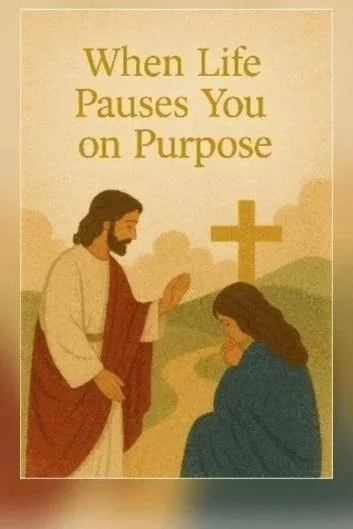
When Life Pauses You on Purpose
If everything has suddenly slowed or stopped, this faith-centered reflection helps you see God’s loving purpose in a pause you didn’t choose.
The Slowdown May Be Part of God’s Protection
Sometimes life slows down when you were trying to keep moving.
Plans stall. Energy drops. Doors close. Progress feels delayed. The momentum you were counting on suddenly disappears, and you find yourself standing still when everything in you wanted to move forward.
At first, that kind of pause can feel frustrating. It can make you wonder if you missed something, failed somehow, or lost your chance. You may look at the silence around you and think God has forgotten what He promised.
But sometimes the pause is not punishment.
Sometimes the pause is protection.
There are seasons when God slows you down because He sees what constant motion has been costing your heart. He knows when your strength has been stretched too thin. He knows when your identity has become too attached to productivity, proving, striving, or trying to hold everything together by yourself.
A holy pause is not always comfortable, but it can be deeply loving.
God Knows When You Need to Slow Down
Your soul may have been whispering, “I am tired,” long before your life finally paused.
You may have felt it in your body, your emotions, your patience, your prayer life, or the quiet heaviness that followed you through the day. But when life is busy, it is easy to keep pushing past the signs. You tell yourself to keep going. You try to stay useful. You try to make things happen.
Then suddenly, something slows.
An opportunity closes. A plan changes. A door stays shut. Your energy does not rise the way it usually does. A season that once felt active becomes still.
It may feel like interruption, but God may be using that slowdown to get your attention with love.
He is not trying to break your spirit.
He may be trying to protect it.
Rest Is Not Wasted Time
When life pauses you on purpose, the first instinct may be to resist it. You may try to fill the quiet, force another door, or prove that you are still productive. Still capable. Still moving. Still worthy.
But rest is not wasted time in God’s hands.
Rest can be where your heart catches up with what your life has been moving through. Rest can be where your spirit becomes steady again. Rest can be where God separates your worth from your performance and reminds you that you are loved even when you are not producing, achieving, or carrying everything.
In the pause, God may invite you to breathe again.
To notice what was draining you.
To release what was never meant to stay.
To bring Him your disappointment honestly.
To let Him restore what constant motion quietly depleted.
The pause may feel empty on the surface, but underneath, God may be repairing things you cannot see yet.
The Pause Can Reveal What Motion Was Hiding
Sometimes we stay busy because stillness tells the truth.
When life slows down, you may begin to notice things you could ignore while you were moving fast. You may realize what no longer fits. You may see where you were overextending yourself. You may recognize that a dream, relationship, role, or routine needs to be surrendered, healed, or realigned.
This is not failure.
This is clarity.
God can use a pause to reveal what speed kept covered. He can show you what needs rest, what needs release, and what needs to be rebuilt on a stronger foundation.
Not every pause is a closed door forever. Sometimes it is a sacred reset before the next step.
God Is Still Working in the Stillness
The pause is not the end of your story.
It may be the place where God prepares you for the next chapter in a deeper way than constant motion ever could. He may be strengthening your trust, softening your heart, refining your direction, or protecting you from walking into something before the timing is right.
You may not see much happening outwardly, but God is not limited by visible movement.
He works in silence.
He works in waiting.
He works in rest.
He works while you are learning to trust Him without rushing ahead.
A Prayer for the Holy Pause
Lord, I do not fully understand this slowdown, but I choose to believe You are with me in it.
Help me stop fighting what You may be using to heal, protect, and prepare me.
Teach me how to rest without guilt.
Show me what needs to be released, restored, or realigned.
Keep my heart close to You, and prepare me for what comes next in Your timing.
Amen.
You are not forgotten because life has slowed down.
You are not failing because God has asked you to pause.
You are being held in the stillness, guided in the quiet, and prepared in ways you may only understand later.
Let the pause do its holy work.
Affirmation
I trust God in the pause. I do not have to force what He is asking me to rest through. I am being protected, restored, and prepared in His timing.
If this message resonated, you may also enjoy:
When You’re Not Sure What’s Next
Trusting the Invisible Path
Grace in the Waiting
Your Soulful Pathways ↑
Discover more series pages for you in Your Soulful Pathways ↑
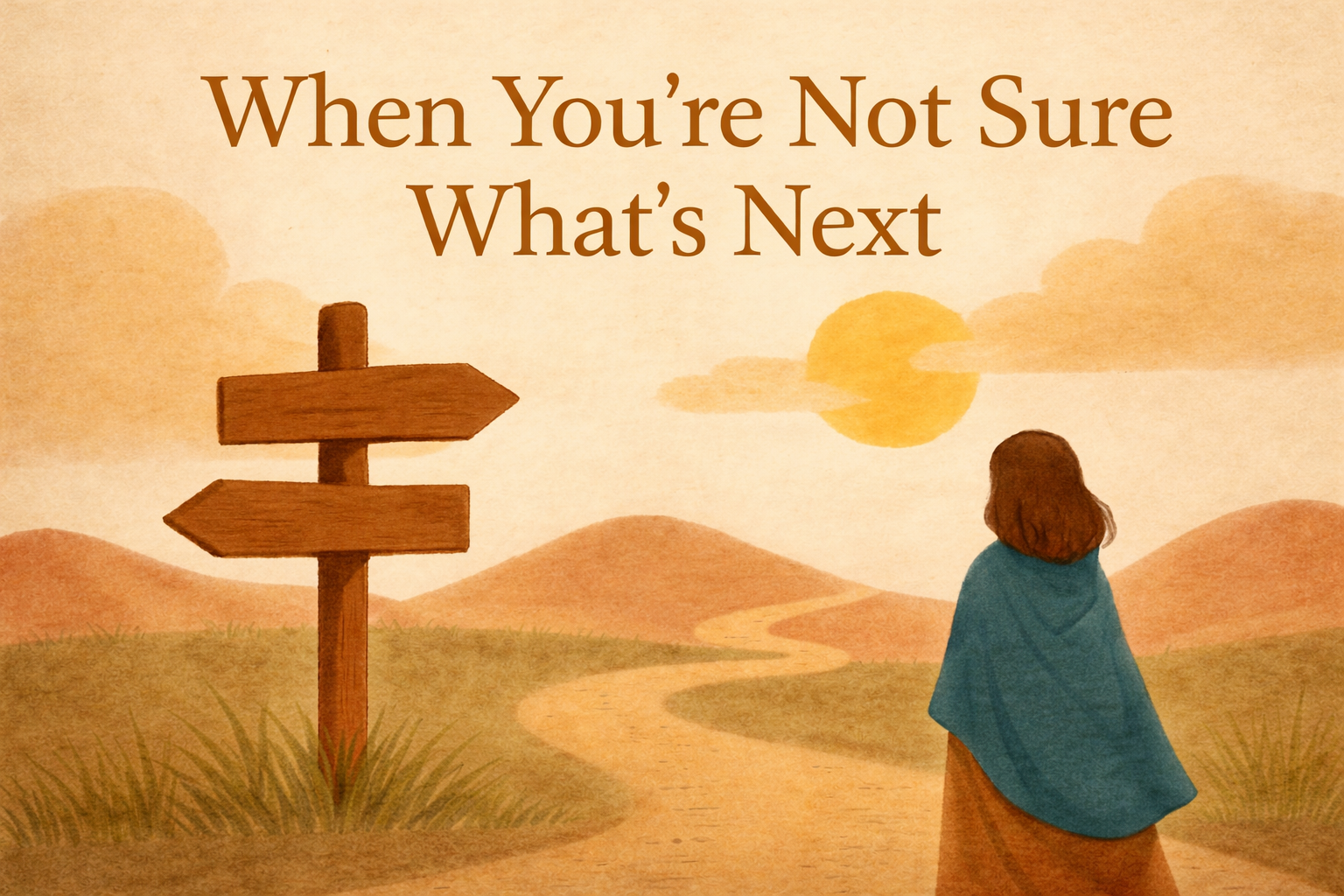
When You’re Not Sure What’s Next
When your future feels foggy, learn how to rest in God, take the next right step, and trust that He still knows exactly where you’re going.
God Can Guide You One Step at a Time
There are seasons when you want the whole road, but God only lights the next step.
Plans may fall through. Doors may close. The future that once felt clear may suddenly feel blurry, quiet, or uncertain. You may find yourself standing between what was and what has not arrived yet, asking, “God, what am I supposed to do now?”
That question can feel heavy when your heart wants direction and your mind wants answers. You may want a sign, a timeline, a clear instruction, or a sudden open door that makes everything make sense.
But sometimes faith does not begin with knowing the whole plan.
Sometimes faith begins with trusting the One who does.
Even when you are not sure what is next, God is not unsure about you. He sees the road ahead. He knows what is closing for your protection, what is opening for your growth, and what is still being prepared beyond what you can see.
The Sacred Space Between Chapters
Life often moves in chapters, but the space between them can feel confusing.
One season may be ending, but the next one has not fully begun. The role you once carried may no longer fit. The dream you were holding may be changing shape. The door you hoped would open may stay shut, while another door has not yet appeared.
This in-between place can feel like being lost, but it is not always loss.
Sometimes it is transition.
Sometimes it is preparation.
Sometimes it is God gently separating you from what no longer belongs before He reveals what is next.
Your spirit may sense change before your circumstances explain it. You may feel restless, tender, or unsure without knowing exactly why. That does not mean you are off track. It may mean God is moving you into a new chapter, and your heart is learning to follow before your eyes can see the full picture.
You Do Not Need the Whole Plan Today
Most of us want God to hand us the full blueprint. We want the dates, the outcome, the reason, the confirmation, and the guarantee that everything will work out the way we hope.
But often, God gives guidance in steps.
A nudge.
A closed door.
A moment of peace.
A truth that keeps returning.
A quiet instruction to release something, wait, apply, call, rest, forgive, begin, or stop forcing what no longer carries His peace.
You do not have to solve your entire future today. You only need to be faithful with the light you have been given now.
Ask God gently:
“What is one step I can take today?”
“What are You asking me to release?”
“Where do I feel Your peace, even if I still feel afraid?”
“What am I trying to control that I need to surrender?”
These questions bring your heart back to the present, where grace is available.
Uncertainty Does Not Mean God Is Absent
Not knowing what comes next can make you feel forgotten, but uncertainty is not proof that God has left you.
Sometimes the quiet season is where your faith becomes deeper than your need for details. It is where you learn to trust God’s character, not just His instructions. It is where you discover that His presence is still steady, even when the path is not fully visible.
God is not limited by what you cannot see.
He can prepare a way while you are resting. He can move hearts while you are praying. He can align timing while you are waiting. He can close what would have drained you and open what will strengthen you.
The fog may feel real, but it is not stronger than His guidance.
A Prayer for the Next Step
God, I do not know what is coming next, but I trust that You do.
Help me release the need to understand everything before I obey.
Close the doors that are not from You.
Open the doors that are aligned with Your will.
Give me courage for the next step, peace for the waiting, and wisdom for the choices ahead.
Even when the road feels unclear, keep my heart close to Yours.
Amen.
You are not behind because you do not know the full plan.
You are not forgotten because the next door has not opened yet.
You are being led, even here.
Take the next step with God. Let tomorrow unfold in His hands.
Affirmation
I do not need to see the whole road to trust God’s guidance. I am held, led, and given enough light for the next faithful step.
If this message resonated, you may also enjoy:
Divine Timing Is Not a Delay
Grace in the Waiting
When the Universe Asks You to Wait
Your Soulful Pathways ↑
Discover more series pages for you in Your Soulful Pathways ↑
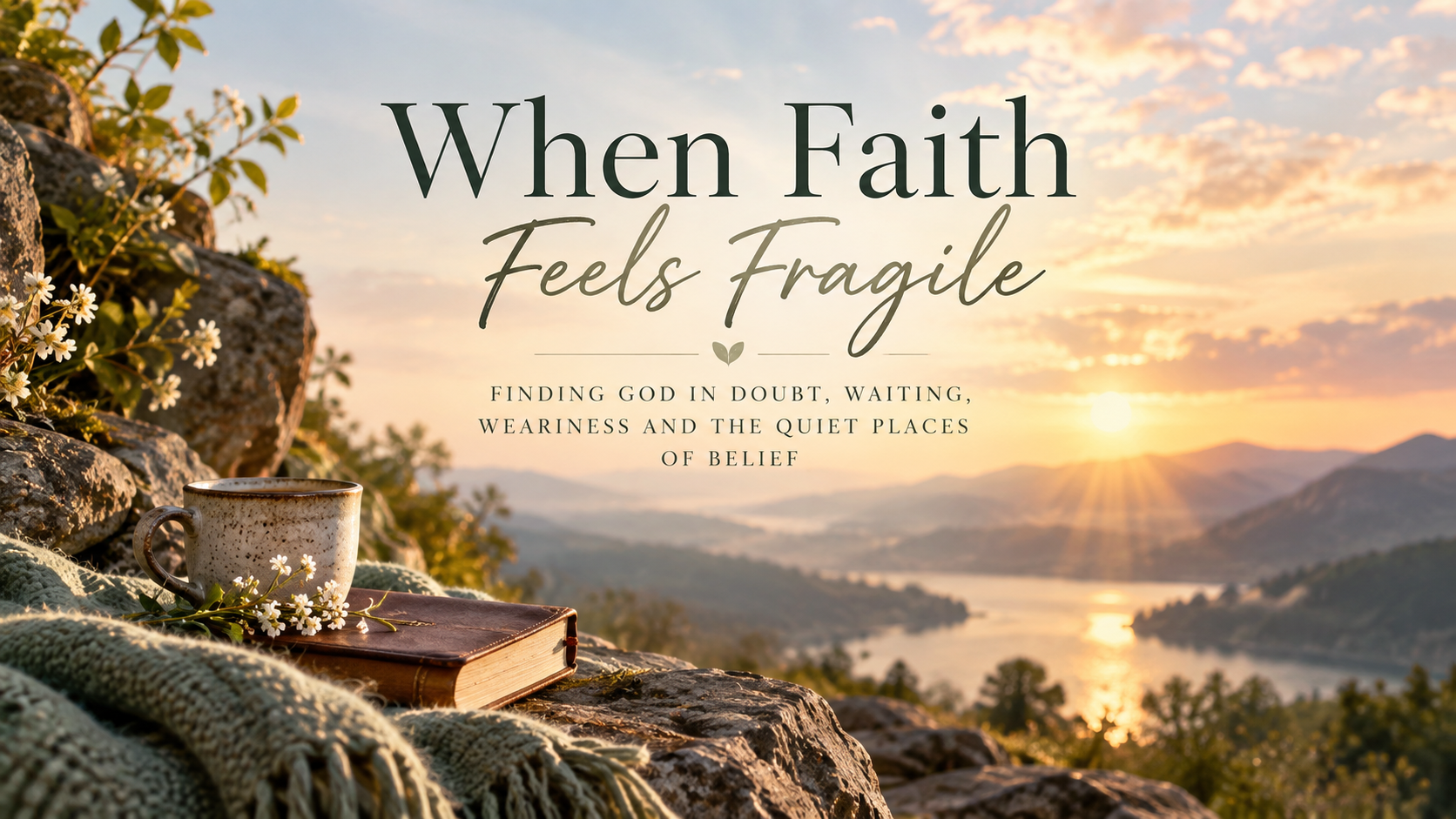
When Faith Feels Fragile
When faith feels fragile, discover biblical encouragement for doubt, unanswered prayer, waiting, spiritual weariness and trusting God when He feels quiet or distant.
Finding God in Doubt, Waiting, Weariness and the Quiet Places of Belief
Faith is not always a mountain.
Sometimes it is a thread.
Sometimes it is a tiny flame protected between two hands.
Sometimes it is the quietest thought in the heart:
God, I am still here.
There are seasons when faith feels almost effortless. Prayer comes naturally. Gratitude rises easily. God's presence seems close. The road ahead may not be completely visible, but somehow you know you are being guided.
And then there are other seasons.
A prayer remains unanswered.
Something you were certain would happen does not happen.
A door closes.
Someone you love suffers.
The future changes.
You wait longer than you thought you would.
Or perhaps nothing dramatic happens at all. God simply seems quieter than He once did.
You still believe.
But your faith suddenly feels delicate in your hands.
If you have ever found yourself there, you are not standing outside the life of faith.
You may be standing somewhere very deep within it.
Fragile Faith Is Still Faith
We sometimes imagine faith as unwavering certainty.
But Scripture gives us something much more human.
Its pages contain people who trusted God and questioned God.
People who worshiped and wept.
People who obeyed and became afraid.
People who witnessed extraordinary things and later wondered what God was doing.
David cried out from places of grief and confusion.
Job wrestled with suffering he could not understand.
Elijah became overwhelmed and exhausted.
Habakkuk questioned what he saw happening around him.
Thomas struggled to believe what others told him.
And a desperate father came to Jesus carrying both faith and uncertainty.
His prayer has survived for centuries because it expresses something many hearts understand:
“Lord, I believe; help thou mine unbelief.”
Mark 9:24, KJV
Notice what he did not do.
He did not wait until every doubt disappeared before approaching Jesus.
He came as he was.
Belief and uncertainty arrived together.
And Jesus met him there.
Faith Does Not Require Pretending
Strong faith does not require emotional theater.
You do not have to pretend that something does not hurt.
You do not have to call confusion clarity.
You do not have to manufacture peace.
You do not have to hide disappointment from God.
And you do not have to understand everything before you pray.
God already knows the heart you are bringing to Him.
Sometimes prayer sounds like praise.
Sometimes it sounds like gratitude.
And sometimes prayer sounds like:
I don't understand.
I thought things would be different.
I am tired.
I am afraid.
Where are You?
Please help me.
Those prayers are not spiritually inferior.
Honesty can itself become an act of faith because you are still bringing your heart toward God.
Scripture Gives Us a Word for This
There is a beautiful biblical practice called lament.
Lament means bringing sorrow, disappointment, confusion, grief or suffering honestly before God.
It is not the abandonment of faith.
It is pain brought into relationship with God.
The Psalms contain remarkable examples.
“How long wilt thou forget me, O LORD? for ever?”
Psalm 13:1, KJV
Consider what that tells us.
Scripture does not contain only songs of victory.
It contains questions.
Tears.
Waiting.
Fear.
Longing.
Confusion.
The words “How long?” were not considered too faithless to preserve.
They became part of the Bible.
There is something deeply comforting about that.
God's Word gives human beings permission to bring the whole heart into His presence.
When Faith Has No Happy Ending Yet
Psalm 88 is particularly meaningful when faith feels fragile.
Many biblical laments eventually turn toward praise or renewed confidence.
Psalm 88 is different.
The darkness is not neatly resolved before the Psalm ends.
There is no sudden explanation.
No dramatic breakthrough.
No tidy ending.
And yet something important happens throughout the entire Psalm.
The writer continues speaking to God.
He is distressed.
He questions.
He grieves.
But he keeps turning toward God.
That matters.
Sometimes faith is not the moment when everything becomes clear.
Sometimes faith is continuing the conversation before clarity arrives.
Sometimes prayer itself is the thread.
Doubt and Faith Can Occupy the Same Heart
Doubt is often described as though it automatically cancels faith.
But human beings are more complicated than that.
There is questioning that closes every door.
But there is also questioning that searches.
We ask because something matters.
We wrestle because we care.
We search because we want truth.
Sometimes a heart crying,
God, where are You?
is revealing something important.
It is still crying toward God.
There is relationship inside the question.
Faith does not always mean having no questions.
Sometimes faith means knowing where to take them.
Thomas Deserves Another Look
Thomas is remembered so frequently for doubting that his entire identity has almost been reduced to it.
But his story is richer.
The other disciples told Thomas that Jesus was alive.
Thomas struggled to accept such an extraordinary claim without seeing for himself.
Later, Jesus appeared.
And Jesus did something beautiful.
He invited Thomas closer.
Thomas's questioning did not become the end of his story.
It became part of the road toward his extraordinary confession:
“My Lord and my God.”
John 20:28, KJV
A question can sometimes become a doorway.
When God Feels Quiet
One of the hardest spiritual experiences is not necessarily disbelief.
It is silence.
You pray.
Nothing seems to change.
You ask for direction.
No unmistakable answer appears.
You look for reassurance.
Everything remains quiet.
It is easy to interpret silence as absence.
But they are not necessarily the same thing.
Scripture repeatedly places people inside stories they cannot yet understand.
Joseph could not see his entire future from the prison.
Israel could not see the Promised Land from every mile of wilderness.
The disciples could not comprehend the meaning of the crucifixion while they were grieving it.
We usually understand stories differently when we can see the whole arc.
Life does not give us that luxury.
We live one page at a time.
Faith often means trusting God while the page is still turning.
Waiting Is Sacred Territory
Waiting appears everywhere in Scripture.
Abraham waited.
Joseph waited.
Hannah waited.
David waited.
Israel waited.
The disciples waited.
Waiting is difficult because we want resolution.
When?
How?
Why not yet?
Sometimes an answer eventually becomes clear.
Sometimes the answer arrives differently than expected.
Sometimes circumstances change.
Sometimes we change.
And sometimes questions remain longer than we would choose.
Faith does not require inventing explanations God has not given us.
We can trust God without claiming to understand every mystery.
There is humility in saying:
I don't know why. But I am still walking with You.
Faith Is Not the Same as Certainty
Certainty says:
I know exactly what is happening.
Faith can say:
I don't know exactly what is happening, but I am placing myself in God's hands.
Hebrews describes faith as:
“the substance of things hoped for, the evidence of things not seen.”
Hebrews 11:1, KJV
The unseen is woven into the very idea of faith.
If every outcome were guaranteed, every mystery explained and the entire road illuminated beforehand, very little faith would be necessary.
Sometimes God gives enough light for miles.
Sometimes there appears to be enough light only for the next step.
Take the step.
Faith Is Not the Same as Feeling
Our emotions matter.
They tell us something about what we are experiencing.
But they are not always measurements of spiritual reality.
You can feel afraid and remain faithful.
You can feel uncertain and continue trusting.
You can feel spiritually quiet and still belong completely to God.
You can feel exhausted without having lost your faith.
There may be days when God's presence feels extraordinarily close.
There may be days when prayer feels dry.
The deeper spiritual question may become:
Beneath everything I am feeling today, what do I still believe?
Sometimes the answer will surprise you.
There may be more faith underneath the weariness than you realized.
Sometimes the Soul Is Simply Tired
Not every spiritual struggle begins with theology.
Sometimes a human being is tired.
Life has demanded too much for too long.
The mind is overloaded.
The body is depleted.
The heart has carried more than usual.
Elijah's story in 1 Kings 19 gives us an unexpectedly tender picture.
Elijah had just lived through an extraordinary spiritual confrontation.
Then he became frightened, overwhelmed and exhausted.
He fled into the wilderness.
And what happened next?
Before another assignment came rest.
Food.
Water.
More rest.
God's messenger did not begin with a lecture.
Elijah was given nourishment for the journey.
There is beautiful wisdom here.
Sometimes the soul needs Scripture.
Sometimes the heart needs companionship.
Sometimes the mind needs quiet.
Sometimes the body needs sleep.
And sometimes we need all of them.
Being tired does not make someone spiritually weak.
We are human beings.
God knows this.
The Still Small Voice
Elijah eventually stood before God.
A powerful wind came.
Then an earthquake.
Then fire.
But the biblical account directs our attention somewhere else.
After these dramatic events came what the King James Bible calls:
“a still small voice.”
1 Kings 19:12, KJV
We naturally notice dramatic things.
Miracles.
Breakthroughs.
Open doors.
Visible answers.
Extraordinary experiences.
But God does not need spectacle in order to be present.
There are seasons when faith becomes quieter because perhaps we are learning to listen differently.
Not every sacred moment arrives with thunder.
Some arrive almost as whispers.
Mustard Seed Faith
Jesus used something remarkably small when teaching about faith.
A mustard seed.
That image becomes especially beautiful when faith feels fragile.
Perhaps instead of asking,
Why isn't my faith bigger?
we can sometimes ask,
Is something still alive here?
A seed does not look impressive.
Yet life is contained within it.
Small faith is still faith.
Quiet faith is still faith.
Trembling faith is still faith.
Faith that can manage only the words “help me” is still reaching toward God.
Never confuse small with meaningless.
When Your Understanding of God Grows
Sometimes faith feels fragile because an older understanding of God no longer seems large enough for what life has taught you.
This can feel unsettling.
But spiritual maturity often involves expansion.
Life introduces us to beauty and suffering, love and loss, forgiveness and injustice, beginnings and endings, prayers answered beautifully and prayers we still do not understand.
Faith may gradually become spacious enough to hold more mystery.
Questions may emerge:
Who is God beyond my expectations?
What does trust mean when I cannot control the outcome?
Can mystery and faith coexist?
Can I love God even when I do not understand everything He allows?
These questions deserve reverence.
Sometimes spiritual growth is not receiving smaller answers.
It is discovering a larger God.
You Are Allowed to Rest in Mystery
There are questions human beings have asked for thousands of years.
Why does suffering happen?
Why are some prayers answered differently from others?
Why do certain doors close?
Why do good people sometimes walk through terrible circumstances?
Faith does not require us to produce simplistic answers to enormous mysteries.
Sometimes “I don't know” is a deeply honest spiritual answer.
Mystery does not have to become emptiness.
We can say:
I do not understand everything about God.
while also saying:
I trust His goodness.
Those sentences can live together.
Borrowed Faith Can Carry Us
There may be seasons when your own hope feels very small.
That is one reason community matters.
Sometimes someone else's faith holds a lantern for us.
A friend reminds you of something you temporarily cannot see.
Someone prays when your words disappear.
A familiar Scripture finds you at exactly the right moment.
A song awakens something inside you.
Someone sits beside you without trying to explain everything.
Faith was never meant to become an isolated achievement.
Sometimes we carry others.
Sometimes they carry us.
And sometimes God sends someone simply to sit beside us until we can stand again.
Remember What Has Carried You Before
Scripture repeatedly calls people to remember.
Memory can become a spiritual practice.
Remember the seasons you thought would break you.
Remember unexpected help.
Remember strength that appeared when you thought you had none.
Remember prayers that were answered.
Remember people who arrived at the right moment.
Remember doors that opened.
Remember doors that closed and later revealed something you could not see at the time.
Remember moments of grace hidden inside ordinary days.
You do not have to pretend every difficult experience eventually made perfect sense.
You are simply reminding yourself:
I have stood in unknown territory before.
And you are still here.
Look for God in Smaller Places
When we desperately want a large answer, we can overlook smaller gifts.
Morning light crossing the floor.
Someone calling at the right moment.
A bird outside the window.
A sentence in Scripture that suddenly feels alive.
A child's laughter.
A beautiful song.
An unexpected idea.
A conversation.
A moment of peace.
A kindness you did not expect.
A sudden ability to breathe a little easier.
Not everything needs to be declared a supernatural sign.
Some things can simply be received as gifts.
Sacred attention notices that even in difficult seasons, goodness has not disappeared.
The Holy Ordinary
Faith does not have to perform.
It does not need constant spiritual fireworks.
Much of life with God happens quietly.
Making breakfast.
Going to work.
Caring for family.
Opening the curtains.
Reading a Psalm.
Taking a walk.
Helping someone.
Choosing forgiveness.
Whispering thank you.
Beginning again tomorrow.
The sacred is not confined to extraordinary experiences.
Sometimes God meets us in the middle of an ordinary Tuesday.
And perhaps that is part of the wonder.
You Do Not Have to Solve Tomorrow Tonight
The mind sometimes tries to answer tomorrow's questions using today's information.
That can make faith feel especially fragile.
But some answers have not arrived yet.
You do not need tomorrow's strength tonight.
You do not need next year's map today.
You do not need to know how every chapter ends before continuing this one.
Sometimes the faithful thing is surprisingly small:
Do the next good thing.
Say the next prayer.
Take the next step.
Then allow tomorrow to arrive tomorrow.
When You Cannot Find Words to Pray
Prayer does not need eloquence.
Some seasons produce beautiful prayers.
Others leave only fragments.
Then pray the fragments.
Stay with me.
Help me.
Guide me.
Give me strength for today.
Show me the next step.
Help my unbelief.
Thank You.
And sometimes there may be no words.
Romans 8:26 offers a beautiful image of the Spirit helping us in our weakness when we do not know what we should pray.
Even wordlessness does not place us outside God's reach.
Faith After Disappointment
There is a particular depth to faith that has encountered disappointment and remains open.
It is different from untouched faith.
It knows that life can hurt.
It knows that prayers do not always unfold according to our preferred timetable.
It knows that good people experience painful things.
It knows some mysteries resist easy explanations.
And still it chooses love.
Still it seeks God.
Still it prays.
Still it leaves room for hope.
Still it believes darkness is not the whole story.
Such faith may feel more fragile because it no longer depends upon simple answers.
But perhaps it is becoming something deeper.
Gentler.
Wiser.
More compassionate.
More capable of sitting beside someone else's questions without being frightened by them.
God Can Handle Your Questions
If God is truly God, your questions are not too large for Him.
Your uncertainty does not intimidate Him.
Your tears do not surprise Him.
Your disappointment does not make you unwelcome.
Your confusion does not close heaven's door.
Scripture gives us people who brought anger, sorrow, fear, bewilderment, gratitude, praise and hope before God.
Bring your whole heart.
Not merely the polished pieces.
God already knows what is there.
When Faith Becomes Trust
Perhaps one of faith's deepest transformations occurs when it moves from:
I trust God because I understand what He is doing
to:
I trust God even when I do not understand what He is doing.
That does not mean pretending suffering is good.
It does not mean abandoning wisdom or discernment.
It does not mean never asking questions.
It means the relationship has become deeper than the explanation.
Faith no longer depends entirely upon seeing the map.
It has learned something about the One holding it.
The Sacredness of Continuing
There is something sacred about continuing when you cannot yet see how the story ends.
You keep loving.
You keep praying.
You keep learning.
You keep noticing beauty.
You keep showing up.
You keep doing good.
You keep leaving room for possibility.
You keep believing that the chapter you are standing in is not necessarily the final chapter.
Sometimes faith's quietest courage is not certainty.
It is continuation.
Fragile Things Can Still Hold Light
A stained-glass window is made from separate pieces joined together.
Its beauty does not depend upon pretending those divisions are not there.
Light passes through them.
Perhaps faith can become something similar.
Questions may remain.
Scars may remain.
Mysteries may remain.
But light can still enter.
And sometimes faith that has traveled through questioning becomes gentler, wiser and more compassionate than the faith that existed before.
It no longer needs every mystery solved before trusting God.
It has discovered something deeper.
God can still be present inside the mystery.
When All You Have Is a Thread
Hold the thread.
You do not need the entire rope today.
You do not need tomorrow's strength today.
You do not need every answer before taking another step.
If all you can offer God is one small prayer, offer it.
If all you can find is one reason to hope, hold it.
If all you can manage is one more step, take it.
Faith does not always roar.
Sometimes it whispers.
Sometimes it trembles.
Sometimes it waits.
Sometimes it asks questions.
Sometimes it sits quietly beside mystery.
Sometimes it says only:
I am still here, God.
And perhaps that tiny sentence contains far more faith than we realize.
A Prayer for Fragile Faith
God,
You know the parts of me that believe easily and the parts that still have questions.
You know what I understand and what I cannot make sense of.
You know the prayers I have spoken and the ones I no longer know how to put into words.
Meet me here.
Not where I think I should be.
Here.
Give me enough light for the next step.
Enough peace for today.
Enough courage to remain open.
Enough faith to keep walking.
When I cannot see what You are doing, help me remember who You are.
When my faith feels small, remind me that small does not mean meaningless.
When I am tired, teach me to rest.
When I am afraid, stay near.
When I have questions, help me bring them to You rather than hide them from You.
And when all I have left is a thread of faith, help me discover that Your love was never hanging by that thread.
Amen.
Questions People Often Ask
Is it normal for faith to feel fragile sometimes?
Yes. Scripture contains faithful people experiencing uncertainty, grief, fear, exhaustion, questions and seasons when God's purposes were difficult to understand. A difficult spiritual season does not automatically mean faith has disappeared.
Does doubt mean I have lost my faith?
Not necessarily. Mark 9:24 captures belief and unbelief existing in the same human heart. Questions can become part of a sincere search for deeper understanding.
Is questioning God wrong?
Scripture repeatedly records people bringing difficult questions directly to God. The Psalms, Job, Habakkuk and other biblical writings show that honest questioning can exist within genuine relationship with God.
What is biblical lament?
Lament is the practice of bringing grief, suffering, disappointment or confusion honestly before God. Rather than hiding pain from God, lament brings pain into prayer.
Why is Psalm 88 important?
Psalm 88 is especially meaningful because it does not end with an obvious resolution. The writer remains in distress yet continues addressing God. It beautifully demonstrates that continuing to turn toward God can itself be an act of faith.
Why does God sometimes feel far away?
People can experience spiritual distance during grief, exhaustion, disappointment, prolonged waiting or quieter seasons of spiritual life. Our experience of God's nearness can change, but a feeling of distance is not necessarily evidence of God's absence.
What does “I believe; help thou mine unbelief” mean?
The words come from Mark 9:24. A father seeking Jesus' help expresses faith while honestly acknowledging the part of himself still struggling to believe. It is one of Scripture's clearest pictures of imperfect but genuine faith.
What is mustard-seed faith?
Jesus used the tiny mustard seed when teaching about faith. The image reminds us that spiritual significance should not always be measured by apparent size. Faith can feel small and still be real.
What can I pray when I don't know what to say?
Keep it simple. “Help me,” “Stay with me,” “Guide me,” and “Give me strength for today” can all be prayers. Romans 8:26 also reassures believers that God meets human weakness even when words fail.
Can I be disappointed with God and still love Him?
Yes. Scripture contains people bringing profound disappointment and confusion before God. Honest relationship has room for difficult emotions.
What should I do when my faith feels weak?
Return gently to the foundations. Pray honestly. Read the Psalms. Rest. Spend time with people who strengthen rather than shame you. Remember God's past faithfulness. Notice goodness. Give yourself permission to grow gradually rather than demanding instant certainty.
Does stronger faith mean I will never be afraid?
No. Courage and fear can exist together. Faith does not always eliminate fear. Sometimes faith is what allows someone to keep moving while fear is still present.
Can faith become stronger after a difficult season?
Yes. Difficult seasons can sometimes lead to a faith that is more thoughtful, compassionate and deeply rooted. Growth does not necessarily mean returning to exactly how you believed before. Sometimes faith becomes deeper because it has learned to hold mystery.
A Final Thought
Perhaps fragile faith is not failed faith.
Perhaps sometimes it is faith without armor.
Faith that has stopped pretending.
Faith that has encountered mystery and remained willing to seek.
Faith that has experienced disappointment without permanently closing its heart.
Faith that cannot see the entire road but takes another step anyway.
There will be seasons when faith feels luminous and strong.
There may also be seasons when it feels barely larger than a mustard seed.
Honor both.
Because a small flame is still light.
A whispered prayer is still prayer.
A question spoken toward God is still spoken toward God.
A trembling hand can still reach.
And perhaps when faith feels most fragile, we discover something we could not learn when everything felt certain:
We were never holding God together with our faith.
God was holding us.
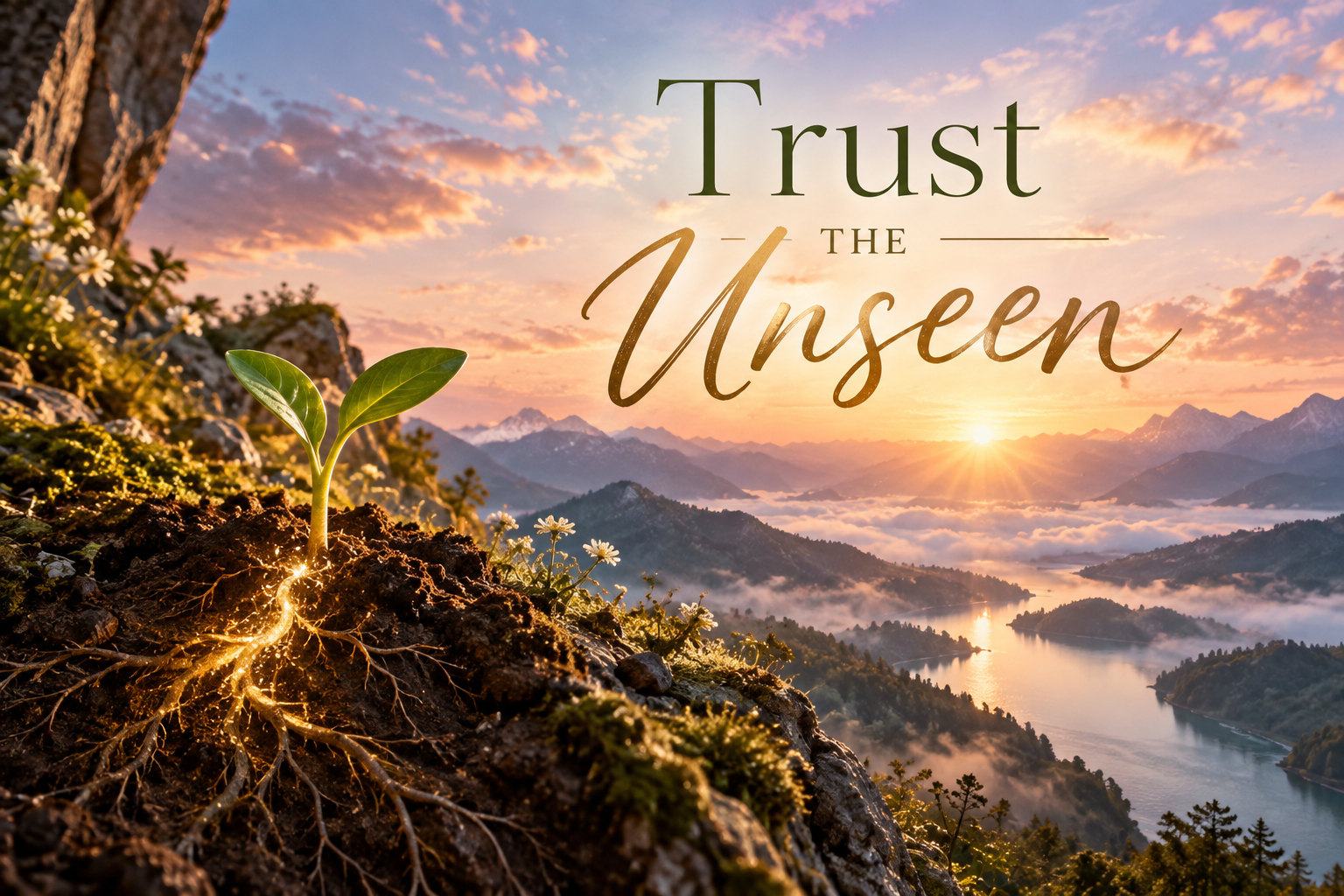
Trust the Unseen
Trust the unseen through faith, divine timing and spiritual growth. Explore trusting God, hidden growth, manifestation, uncertainty and believing before you see.
There are seasons when life gives you evidence.
Doors open. Answers arrive. Pieces fall into place. You can see movement, progress and possibility unfolding right in front of you.
And then there are seasons when almost nothing seems to be happening.
You have prayed.
You have hoped.
You have planted the seed.
You have taken the steps you know to take.
And still, the horizon remains quiet.
These are the moments when trust becomes sacred.
Trusting the unseen does not mean pretending that uncertainty is easy. It does not mean ignoring reality or convincing yourself that everything will happen exactly as you imagine.
It means understanding something deeper:
What you can see right now is not the entirety of what is possible.
Roots grow before branches appear.
Seeds awaken beneath the soil before the first green shoot reaches the light.
Dawn begins beyond the horizon before you see the sun.
And sometimes your life is changing long before you recognize the evidence.
Faith Begins Beyond What You Can See
Hebrews 11:1 offers one of Scripture’s most beautiful descriptions of faith:
“Now faith is the substance of things hoped for, the evidence of things not seen.”
Faith reaches beyond visible circumstances.
It does not require every answer before taking another step.
It does not demand that the entire road be illuminated before beginning the journey.
Second Corinthians 5:7 tells us:
“For we walk by faith, not by sight.”
And Romans 8 reminds us that hope itself reaches toward what has not yet become visible.
There is something profound in this.
Sight tells us what appears to be happening now.
Faith leaves room for what God may still be doing.
Trust Is Not Certainty
There is an important difference between trust and certainty.
Certainty says:
I know exactly what will happen.
Trust says:
I do not know exactly what will happen, but I know Who walks with me while it unfolds.
Faith does not require us to predict the future.
It does not guarantee that every particular outcome we imagine will occur exactly as we pictured it.
Faith gives us something deeper.
It gives us a way to live when we cannot yet see the outcome.
That is why trusting God can coexist with questions.
You can believe and still wonder.
You can pray and still wait.
You can feel hopeful and still have moments of uncertainty.
You can trust without knowing every detail.
The Unseen Is Not the Same as the Unreal
Human beings naturally place tremendous importance on what can be observed.
We look for signs.
Results.
Numbers.
Movement.
Confirmation.
But some of life's most important processes begin invisibly.
A thought exists before a decision.
An idea exists before a creation.
Character develops through choices few people ever witness.
Trust grows quietly.
Knowledge accumulates before mastery becomes visible.
A calling may begin as little more than a persistent stirring within your heart.
Something does not have to be visible yet to be meaningful.
Sometimes the unseen is simply unfinished becoming.
God Often Works Before We Understand
Scripture is filled with people who had to walk through the distance between what they believed and what they could see.
Abraham left familiar territory without knowing exactly where the journey would lead.
Joseph carried dreams through years that appeared completely disconnected from them.
Moses stood before the Red Sea before the waters parted.
David was anointed long before he sat on the throne.
The disciples experienced the darkness of the crucifixion before they understood the resurrection.
Again and again, there was a space between promise and fulfillment.
That space required trust.
Our lives contain spaces like this too.
There may be something you believe is possible but cannot yet prove.
Something you feel called toward but cannot fully explain.
Something you have prayed about that has not yet appeared.
The absence of visible evidence does not automatically mean the absence of movement.
Some Things Grow in Hidden Places
Nature gives us one of the most beautiful pictures of unseen growth.
When a seed begins to germinate, much of its earliest transformation occurs hidden from view.
The seed takes in water.
Its internal processes awaken.
The first root begins emerging and reaching into the surrounding soil.
Only later does the young shoot become visible aboveground.
Imagine standing over that patch of earth during those early stages.
From the surface, it might appear that nothing is happening.
Yet underneath, life has already begun moving.
Human growth can feel remarkably similar.
You may be developing patience before circumstances change.
Wisdom before opportunity arrives.
Courage before the door opens.
Discernment before the decision appears.
Strength before the challenge requires it.
Sometimes the hidden season is not postponing your life.
It is becoming part of your life.
The Sacred Space Between Prayer and Answer
Anyone who has prayed deeply eventually encounters the space between asking and knowing.
Sometimes answers seem immediate.
Other times there is silence.
And silence can be difficult because the human mind naturally wants resolution.
Did God hear me?
Is anything changing?
Should I continue?
Psalm 46:10 offers another invitation:
“Be still, and know that I am God.”
Stillness changes the nature of the question.
Instead of constantly searching for evidence, we return to relationship with God.
Prayer becomes more than asking for outcomes.
It becomes communion.
Listening.
Presence.
Surrender.
Trust.
Sometimes the first answer to prayer is not a changed circumstance.
Sometimes it is a changed heart.
Waiting Does Not Mean Nothing Is Happening
Waiting often gets mistaken for inactivity.
But waiting can contain tremendous movement.
You can prepare while you wait.
Learn while you wait.
Pray while you wait.
Build while you wait.
Heal while you wait.
Strengthen relationships while you wait.
Develop skills while you wait.
Become wiser while you wait.
Romans 8:25 speaks beautifully about hoping for what we do not yet see and waiting for it with patience.
Biblical waiting is not necessarily empty space.
Sometimes it is active trust.
Divine Timing Rarely Looks Like Human Timing
We measure life with calendars.
Birthdays.
Deadlines.
Years.
Milestones.
We naturally imagine when things should happen.
But life does not always obey our preferred timetable.
Ecclesiastes 3:11 says:
“He hath made every thing beautiful in his time.”
Some things arrive quickly.
Others unfold through years of preparation, redirection, relationships and growth.
A delay can feel like denial when we can see only the present moment.
Yet timing can prepare us.
Protect us.
Redirect us.
Develop abilities.
Bring people together.
Reveal information.
Or move us toward something we could not have reached through the route we originally imagined.
Trusting divine timing does not mean understanding every delay.
It means remaining open to the possibility that timing itself may be part of the unfolding.
Your Inner Knowing Can Arrive Before Evidence
Sometimes change begins as a quiet knowing.
Not certainty.
Not prediction.
Something gentler.
A persistent idea.
An unexpected peace.
A growing desire.
A sense that one chapter is ending.
A vision that refuses to disappear.
These experiences deserve thoughtful attention.
Prayer matters.
Wisdom matters.
Discernment matters.
Action matters.
Not every feeling is a prediction, and not every desire is necessarily divine direction.
But neither does every meaningful journey begin with complete evidence.
Sometimes direction begins as a whisper.
Discernment Belongs Beside Trust
Trust does not mean accepting every thought as truth.
Spiritual maturity includes discernment.
We can ask:
Does this direction lead toward love?
Does it align with my deepest values?
Does it produce wisdom rather than chaos?
Have I prayed about it?
Am I willing to learn?
Am I willing to change direction if new understanding arrives?
Trust and discernment belong together.
One keeps the heart open.
The other keeps the path grounded.
Trust and Manifestation
Manifestation is often described as bringing something from possibility into lived experience.
At its healthiest, manifestation does not need to become frantic wishing or an attempt to control every outcome.
It can be understood as alignment between vision, belief, intention and action.
You hold a vision.
You nurture it.
You prepare for it.
You take meaningful steps toward it.
You remain receptive to opportunities.
And you leave room for God, life and circumstances to unfold in ways you could not completely predict.
There is wisdom in combining belief with action.
A dream may begin invisibly, but eventually it asks something of us.
A conversation.
A decision.
A phone call.
An application.
A page written.
A skill learned.
A boundary established.
A door knocked upon.
Faith does not have to replace action.
Faith can give action direction.
Stop Digging Up the Seed
One of the hardest parts of trusting the unseen is resisting the urge to constantly check for proof.
Is it working?
Has anything changed?
Am I closer?
Why hasn't it happened yet?
Imagine planting a seed and digging it up every morning to see whether it has begun growing.
Eventually, our need for reassurance would interfere with the very process we were hoping to witness.
Some things need attention.
Some things need action.
And some things need space.
Plant.
Water.
Nurture.
Protect.
Then allow growth to occur.
Trust does not mean abandoning effort.
It means learning when effort has done its part and patience must do the rest.
When Nothing Seems to Be Moving
There may be moments when you genuinely cannot see progress.
Return to what remains within your reach.
You can choose what you give your attention to.
You can choose how you speak.
You can continue learning.
You can pray.
You can prepare.
You can take the next wise step.
You can care for yourself.
You can protect your peace.
You can remain open to unexpected pathways.
You do not have to understand the entire future to participate in creating it.
Sometimes your responsibility is simply the next step.
Faith Does Not Require Perfect Confidence
Trusting God does not mean never wondering.
Never questioning.
Never feeling impatient.
Never becoming discouraged.
One of the most human prayers in Scripture appears in Mark 9:24:
“Lord, I believe; help thou mine unbelief.”
Faith and uncertainty can occupy the same heart.
You do not need perfect confidence to continue.
Sometimes courage is simply taking another step while the questions are still there.
The Door You Cannot See Yet
Life creates possibilities we could never completely plan.
One conversation introduces you to someone important.
One idea becomes a new direction.
One disappointment redirects your path.
One decision creates opportunities that did not exist before it.
One unexpected invitation changes everything.
Looking backward, these moments can appear beautifully connected.
Looking forward, they were invisible.
That is why uncertainty deserves humility.
We simply do not know everything that is coming.
And that is not always bad news.
There may be doors ahead that you do not yet know exist.
What Looks Like Nothing May Be Preparation
Imagine sitting in a theater before the curtain rises.
From the audience, the stage appears hidden.
Behind the curtain, everything may be moving.
Lights are being positioned.
Props are being arranged.
People are finding their places.
Final preparations are underway.
The audience cannot see any of it.
But invisible does not mean inactive.
There are seasons of life that can feel remarkably similar.
You may be staring at a closed curtain while preparation is happening somewhere beyond your view.
Trust Changes the Way You Wait
Waiting with fear feels very different from waiting with trust.
Fear says:
Nothing is happening.
Trust says:
I cannot see everything that is happening.
Fear says:
I am running out of time.
Trust says:
My life is still unfolding.
Fear says:
I need proof immediately.
Trust says:
I can continue before all the evidence arrives.
Fear wants control.
Trust allows participation without demanding control.
That is a powerful difference.
You May Already Be Closer Than You Think
Transformation often has a strange rhythm.
For a long time, very little appears to change.
Then something becomes visible.
Dawn slowly brightens before the sun crosses the horizon.
A flower develops inside a closed bud before it opens.
Knowledge accumulates before something finally clicks.
The visible breakthrough may seem sudden.
The preparation rarely is.
What looks like a beginning may actually be the visible arrival of something that has been developing quietly for a very long time.
Trusting the Unseen Within Yourself
There is another kind of unseen possibility worth trusting.
Your own.
There may be abilities within you that have not yet been tested.
Strength you have not yet needed.
Creativity you have not yet expressed.
Leadership you have not yet stepped into.
Compassion you have not yet had the opportunity to give.
Wisdom that is still developing.
You are not limited to the version of yourself you can currently see.
There is more within you than yesterday has revealed.
Perhaps God Is Preparing You Too
When we pray for something, our attention naturally goes toward the thing we hope will change.
The situation.
The opportunity.
The relationship.
The answer.
The open door.
But perhaps something else is happening at the same time.
Perhaps God is also working within you.
Strengthening patience.
Deepening wisdom.
Softening something that became hardened.
Teaching discernment.
Growing courage.
Clarifying what truly matters.
Preparing you to carry something you once only knew how to ask for.
Sometimes we spend so much time watching the horizon for the answer that we fail to notice the person we are becoming while we wait.
The Sacred Space of Not Knowing
We often treat not knowing as a problem that must immediately be solved.
But uncertainty can also become sacred ground.
It creates room for surrender.
Curiosity.
Growth.
Prayer.
Possibility.
When every detail is already known, faith has little work to do.
When the future remains hidden, trust becomes an active spiritual practice.
Perhaps not knowing is not always emptiness.
Perhaps sometimes it is simply:
possibility without a name yet.
Look Back at What Once Was Unseen
One of the most beautiful ways to strengthen trust is to remember your own history.
Think about what exists in your life today that once did not.
People you had not met.
Places you had never visited.
Opportunities you could not have predicted.
Lessons you had not yet learned.
Strength you did not know you possessed.
Moments you never imagined experiencing.
Once, all of these belonged to an unseen future.
And then one day they became part of your life.
Your present contains things your younger self could never have seen coming.
Your future may too.
You Do Not Have to Force the Future
There is a profound difference between participation and force.
Participation says:
I will show up.
I will prepare.
I will listen.
I will learn.
I will act when the next step becomes clear.
Force says:
Everything must happen according to my schedule and exactly as I imagined.
Trust loosens that grip.
You can have dreams without controlling every road that might lead toward them.
You can pray specifically while remaining open to answers that look different from what you expected.
You can pursue something wholeheartedly while allowing God to redirect you.
Surrender does not mean giving up.
Sometimes surrender means releasing your demand to know exactly how the story must unfold.
Keep Walking
There will be days when faith feels strong.
There will be days when it feels quiet.
Keep walking.
There will be moments when the path makes sense.
There will be moments when you can see only the next few feet.
Keep walking.
There will be prayers answered exactly as you hoped.
There may be others whose answers you understand only much later.
Keep walking.
Not because you know everything that lies ahead.
But because the part of the story you can see is not the whole story.
Trust What Is Still Becoming
You may be standing in the middle of something that has not revealed its shape yet.
Do not automatically mistake incompleteness for failure.
Do not mistake silence for absence.
Do not mistake hidden growth for stagnation.
Do not assume a closed door means there can never be another entrance.
Some things are still being formed.
Some possibilities have not yet entered your awareness.
Some answers may arrive through people, circumstances, timing and choices that have not yet converged.
Your task is not to see the entire future.
Your task is to live this moment well.
Pray.
Prepare.
Listen.
Create.
Love.
Learn.
Act when the next step becomes clear.
And when you reach the edge of what you can see, remember:
Faith has never required the whole road to be visible.
Sometimes you need only enough light for the next step.
And enough trust to take it.
Questions and Answers
What does it mean to trust the unseen?
Trusting the unseen means accepting that you may not have complete evidence about how life will unfold while remaining open to faith, possibility, growth and God's direction. It is not pretending to know the future. It is continuing faithfully when the future is not yet visible.
What does the Bible say about trusting what we cannot see?
Hebrews 11:1 describes faith through hope and things not seen. Second Corinthians 5:7 speaks of walking by faith rather than sight, and Romans 8:24–25 connects hope with patiently waiting for what is not yet seen.
Is trust the same thing as certainty?
No. Certainty says you know what will happen. Trust allows you to move forward even when you do not know. Spiritually, this can mean placing confidence in God rather than requiring certainty about a particular outcome.
Does trusting God mean everything will happen the way I want?
Trusting God does not require believing that every desired outcome will happen exactly as imagined. It means remaining faithful and open to God's direction even when the path develops differently than expected.
Can something really be growing when I cannot see progress?
Absolutely. Nature itself demonstrates this. A germinating seed begins important biological processes before a young plant becomes visible above the soil. Human learning, preparation, character and relationships can also develop long before their results become obvious.
How can I trust divine timing when I feel impatient?
Bring your attention back to what can be done today. Pray, prepare, learn, take constructive action and allow what is outside your control to unfold. Waiting becomes very different when it contains purpose.
How does trust relate to manifestation?
A grounded understanding of manifestation combines vision and intention with meaningful action and openness. Believing in a possibility can inspire direction, but action helps bring intentions into lived experience. Trust allows you to pursue the vision without demanding control over every detail of the outcome.
How can I tell the difference between intuition and wishful thinking?
Give the feeling time. Pray about it. Examine whether it aligns with your values and produces wise action. Seek understanding rather than immediately declaring the feeling a prediction. Genuine discernment does not need to fear thoughtful examination.
What if I begin to doubt?
Doubt does not necessarily mean faith has disappeared. Scripture contains people who believed while wrestling with uncertainty. You can continue praying, seeking wisdom and moving forward even when your confidence is imperfect.
How do I know whether to wait or act?
Ask whether there is a wise step available to you now. If there is, take it. If you have genuinely done what is yours to do, the next part may require patience, attentiveness and trust.
A Final Thought
Some of the most meaningful chapters of your life began before you knew they were beginning.
Perhaps another one is beginning now.
There may be a prayer whose answer you cannot yet recognize.
An idea gathering strength.
A connection waiting to happen.
A door you do not yet know exists.
A path that has not yet become visible.
But perhaps the unseen is not only what may be coming toward you.
Perhaps the unseen is also what God is creating within you while you wait.
The courage.
The wisdom.
The patience.
The discernment.
The faith.
The person capable of stepping into whatever comes next.
You do not have to see everything to believe there is more.
You do not have to know the ending to faithfully live the chapter you are in.
And you do not have to understand every movement of God to trust His presence.
Trust the unseen.
Not because you can guarantee tomorrow.
Not because every hope must unfold exactly as imagined.
But because what you can see from where you are standing has never been the full measure of what is possible.
The horizon is not the end of the world.
It is simply the edge of what you can see.