

When You Don’t Know the Next Step
When you don’t know the next step, explore faith, prayer, patience, discernment and practical wisdom for finding peace and direction when the future feels uncertain.
There are seasons when the path ahead seems to disappear.
You have prayed.
You have thought about it from every angle.
You have considered the possibilities, watched for direction and tried to imagine where each road might lead.
And still, you do not know what comes next.
There is something deeply human about wanting an answer. We like to know where we are going. We want to understand what is happening, what we should do and how everything will turn out.
But life does not always give us that kind of visibility.
Sometimes you are shown the destination.
Sometimes you are shown the next step.
And sometimes you are simply given enough light to remain where you are until something becomes clearer.
Not knowing does not necessarily mean you are lost.
It may simply mean the next part of your life has not revealed itself yet.
You Do Not Need to See the Whole Road
Psalm 119:105 gives us a beautiful image for uncertain seasons:
“Your word is a lamp to my feet and a light to my path.”
A lamp does not illuminate miles of road.
It gives light to the place where you are standing.
Perhaps there is wisdom in that.
We often ask God to show us the entire plan when what we truly need is enough light for the next faithful step.
The next conversation.
The next application.
The next prayer.
The next morning.
The next decision that actually needs to be made.
You may not need a map of the next five years.
You may only need enough light for today.
Not Knowing Is Not the Same as Something Being Wrong
One of the most important things to remember during an uncertain season is beautifully simple:
Unknown does not mean bad.
When we cannot see what is coming, the mind often begins filling the empty space.
What if I make the wrong decision?
What if this does not work?
What if the opportunity never comes?
What if everything changes?
Those questions can begin to feel like predictions.
But they are not predictions.
They are possibilities.
And they are not the only possibilities.
Something wonderful could happen too.
A door could open that you do not yet know exists.
Someone could enter your life.
An opportunity could appear.
An idea could arrive.
A problem could resolve in a way you never considered.
A closed door could redirect you toward something better suited to who you are becoming.
The future is unknown.
But fear does not own the unknown.
Possibility lives there too.
Why Uncertainty Can Feel So Uncomfortable
There is also a very human reason that not knowing can feel difficult.
Our minds appreciate predictability.
When we know what is likely to happen, we can prepare. When we do not know, our minds may continue searching for answers.
Psychologists sometimes use the term intolerance of uncertainty to describe difficulty tolerating the discomfort that comes from not knowing what will happen.
This can show up in different ways.
Some people keep searching for more information.
Some repeatedly ask others for reassurance.
Some postpone decisions because they are afraid of choosing incorrectly.
Others make decisions too quickly because having some answer feels better than having no answer.
This reveals an important question:
Do I need an answer right now, or do I simply want the discomfort of not knowing to end?
Those are not always the same thing.
Sometimes wisdom means deciding.
Sometimes wisdom means allowing the answer a little more time to form.
You Do Not Need Certainty to Have Peace
We often imagine peace waiting for us on the other side of the answer.
Once I know what is happening, I will relax.
Once the decision is made, I will feel better.
Once the door opens, I will trust.
Once I know how this ends, I will have peace.
But there is another kind of peace.
Peace before the answer.
Peace while the prayer is still a prayer.
Peace while several possibilities remain.
Peace when tomorrow has not explained itself yet.
This peace does not come from knowing everything.
It comes from realizing that you do not have to know everything to be okay today.
You can have unanswered questions and still have faith.
You can have uncertainty and still have hope.
You can be waiting and still be moving forward internally.
You can be unsure of the road and still trust the One walking beside you.
Uncertainty Is Not Emptiness
When you cannot see anything changing, it is easy to believe that nothing is happening.
But unseen does not mean inactive.
A seed beneath the soil appears quiet while extraordinary transformation is taking place.
Roots form before leaves.
Foundations are laid before walls rise.
Morning begins before the horizon becomes bright.
Your own life may contain seasons like this.
Something can be developing before you have language for it.
An opportunity may not yet have arrived.
An answer may depend upon circumstances that are still changing.
Your own understanding may still be growing.
Someone else's decision may still be unfolding.
A possibility may exist that you cannot yet see from where you are standing.
There can be movement beneath the surface long before there is visible evidence above it.
Do Not Confuse Urgency With Guidance
Uncertainty can create pressure.
Choose.
Move.
Fix it.
Decide.
Do something.
But urgency and guidance are not necessarily the same thing.
Fear can create urgency.
Impatience can create urgency.
Comparison can create urgency.
Other people's expectations can create urgency.
Exhaustion can create urgency.
Sometimes we become so uncomfortable with not knowing that almost any decision begins to feel better than waiting.
That is when it can help to ask:
Is there actually a deadline here?
If the answer is yes, then a decision may need to be made with the best information available.
But if the answer is no, there may be wisdom in allowing yourself more room.
You are allowed to gather more information.
You are allowed to sleep on it.
You are allowed to pray again.
You are allowed to ask another question.
You are allowed to say:
I don't know yet.
There is strength in refusing to manufacture certainty simply because uncertainty feels uncomfortable.
Ask God for Wisdom
James 1:5 tells us that when we lack wisdom, we can ask God for it.
That is especially meaningful when we do not know which direction to take.
But wisdom does not always arrive dramatically.
Sometimes wisdom comes through prayer.
Sometimes through Scripture.
Sometimes through experience.
Sometimes through another person's insight.
Sometimes through information you did not have yesterday.
Sometimes through a door opening.
Sometimes through a door closing.
Sometimes through realizing that something you once desperately wanted no longer feels right.
And sometimes wisdom arrives as the ability to wait peacefully until more becomes clear.
You can ask God for an answer.
You can also ask Him for discernment while the answer is still unfolding.
Faith and Practical Planning Belong Together
Trusting God does not require abandoning practical thought.
Proverbs 16:9 beautifully holds both ideas together: we can make plans while allowing God to direct our steps.
So plan.
Research.
Prepare.
Ask questions.
Consider the consequences.
Make the phone call.
Build the savings.
Learn the skill.
Send the application.
Explore the possibility.
Prepare for the opportunity you are praying for.
And remain open to redirection.
Faith does not mean refusing to plan.
Planning does not mean you lack faith.
You can trust God while looking at the details.
You can pray for an open door while preparing yourself to walk through it.
Ask a Smaller Question
Sometimes the problem is not that there is no answer.
The question is simply too large.
What am I supposed to do with my life?
That question can feel enormous.
Try:
What deserves my attention today?
Instead of:
How will everything work out?
Ask:
What can I responsibly do right now?
Instead of:
Which choice guarantees the best future?
Ask:
Which choice seems faithful, wise and honest with what I know today?
Instead of:
How do I get all the way there?
Ask:
What is the next step?
And if even that feels too large:
What is the smallest useful step?
Small questions can reveal doors that enormous questions keep hidden.
Separate What You Know From What You Fear
Uncertainty has a way of mixing facts and fears together until they become difficult to distinguish.
Untangle them gently.
Ask yourself:
What do I actually know?
What am I assuming?
What am I afraid might happen?
What evidence do I have for that fear?
What information am I still missing?
What is within my control?
What is outside my control?
Is there anything useful I can do today?
Then add one more question:
What if something good happens that I cannot see yet?
That question is not pretending that every outcome will be easy.
It simply restores possibility to a future that fear may have claimed too quickly.
Focus on What Is Yours to Carry
Some parts of an uncertain situation belong to you.
Others do not.
You can prepare for an interview.
You cannot control who else applies.
You can communicate honestly.
You cannot control another person's response.
You can make a thoughtful plan.
You cannot guarantee that circumstances will remain unchanged.
You can plant.
You can water.
You cannot command the seed to emerge tomorrow morning.
There is freedom in learning the difference.
Do what belongs in your hands.
Place the rest in God's.
Take the Smallest Faithful Step
When a decision feels enormous, look for the smallest meaningful action.
You may not need to accept the job.
You may only need to apply.
You may not need to move.
You may need to visit.
You may not need to start the business.
You may need to research the first requirement.
You may not need to solve the relationship.
You may need to have one honest conversation.
You may not need to understand the entire dream.
You may need to write the first idea down.
Small steps create information.
Information creates clarity.
Clarity can reveal another step.
This is how paths often appear.
Not all at once.
One piece at a time.
When the Next Step Is to Wait
Waiting is still a step.
That can be difficult to believe in a world that celebrates visible movement.
But waiting can contain preparation.
Waiting can contain healing.
Waiting can contain learning.
Waiting can allow circumstances to rearrange themselves.
Waiting can prevent a decision made only to escape discomfort.
There are times when action is wisdom.
There are also times when restraint is wisdom.
A seed pulled from the earth every morning to see whether it has grown will never be given the quiet it needs to become what it was created to be.
Some things need time underground.
Waiting and Avoiding Are Not the Same
There is an important difference between waiting and avoiding.
Waiting says:
I do not have enough information yet, so I am remaining attentive and preparing.
Avoidance says:
There is something I know I need to face, but I keep turning away from it.
Waiting can be active.
You can research.
Prepare financially.
Strengthen your skills.
Have necessary conversations.
Pray.
Rest.
Observe.
Ask for wise counsel.
Organize what you can.
Then, when the moment arrives, you are ready.
The question is not simply:
Am I moving?
A better question may be:
Am I faithfully responding to what is mine to do right now?
Some Doors Become Visible Only When You Reach Them
From far away, a path can look completely blocked.
Then you walk closer.
A turn appears.
A gate becomes visible.
A bridge you could not see from where you started crosses the distance.
Life often unfolds this way.
We sometimes want information that can only be discovered from a place we have not reached yet.
That means you may not be missing the answer.
You may simply be too early for it.
There are things your future self will know because your future self will be standing somewhere you cannot stand today.
Let tomorrow reveal what belongs to tomorrow.
Notice What Keeps Returning
Some thoughts disappear once the emotion surrounding them passes.
Others return.
Quietly.
Repeatedly.
An idea keeps visiting.
A dream refuses to disappear.
A possibility continues to draw your attention.
A subject keeps fascinating you.
A direction begins appearing through different conversations or circumstances.
This does not automatically make something a sign.
But recurring possibilities can be worth exploring.
Instead of immediately declaring:
This must be the answer.
Become curious.
Why does this keep returning?
What does it awaken in me?
Does it align with my values?
Does it draw me toward truth, love, responsibility and growth?
Is there a practical way to explore it without forcing an outcome?
Sometimes the next step is not commitment.
Sometimes the next step is curiosity.
Closed Doors Can Give Us Information
Not every door will open.
And not every closed door means you failed.
Sometimes we become so attached to one version of the future that we begin trying to force life into that shape.
But there may be another route.
Another opportunity.
Another timing.
Another place.
Another possibility you could not see while staring at the door that would not move.
A closed door does not automatically mean something better is guaranteed to appear.
But it does give you new information.
It may invite you to reconsider.
Redirect.
Wait.
Explore.
Or release something you have been trying too hard to control.
Release does not always mean giving up.
Sometimes release creates enough space to notice what else is possible.
Redirection Is Not Failure
You may take a step and discover it was not the road you expected.
That does not automatically make the step wasted.
It gave you information.
It taught you something.
It revealed something.
It changed what you know.
And now you can choose again.
We sometimes imagine a meaningful life as one perfectly straight line.
But real lives contain turns.
Plans change.
Priorities change.
Circumstances change.
We change.
A direction that once made perfect sense may no longer fit.
You are allowed to learn while walking.
You Are Allowed to Change Your Mind
A decision does not always need to become an identity.
You are allowed to discover that something is different from what you expected.
You are allowed to choose again when circumstances change.
You are allowed to grow beyond an old plan.
Wisdom is not proving that every decision you have ever made was correct.
Wisdom is remaining awake enough to recognize when new understanding asks for a new direction.
When Nothing Feels Clear
If every option feels cloudy, return to what is already true.
You know what matters to you.
You know what kind of person you want to be.
You know what values you do not want to sacrifice.
You know what love looks like.
You know what honesty requires.
You know what kindness asks of you.
You know that fear does not deserve complete authority over your life.
And you can trust that God sees farther than you can.
When direction is unclear, values can become a compass.
You may not know where the road leads.
You can still decide how you will walk it.
Pray for the Step, Not Only the Destination
There are prayers for great things.
And then there are small prayers that quietly carry us through ordinary days.
God, show me what needs my attention today.
Help me recognize what is mine to do.
Give me wisdom where I cannot yet see.
Close what needs to close.
Open what needs to open.
Keep fear from making my decisions for me.
Help me recognize Your guidance.
Give me courage when the time comes to move.
Give me peace when the time comes to wait.
Perhaps guidance is sometimes less about receiving a blueprint and more about walking with Someone who already knows the road.
You do not need the entire map when you trust the One walking with you.
A Simple Practice for Uncertain Seasons
When the future begins to feel overwhelming, return to these questions:
What do I actually know today?
What am I imagining or fearing?
What is within my control?
What information would genuinely help?
Is there one small action I can take?
Is this a moment for movement or patience?
What can I place in God's hands instead of carrying it through the night?
Then do what you can.
And release what you cannot.
Tomorrow will bring information that today does not possess.
There Is Wisdom in the Pause
A pause can look empty from the outside.
Inside it, much can happen.
Your priorities become clearer.
Old desires loosen their grip.
New possibilities emerge.
Your emotions settle.
Your perspective changes.
You hear things that were drowned out by noise.
You discover what you actually want rather than what you thought you were supposed to want.
You become ready for something that would have overwhelmed you six months earlier.
The pause is not necessarily an interruption of your journey.
Sometimes the pause is part of the journey.
Remember How Many Times You Could Not See Ahead
There were other moments when you did not know how things would unfold.
And somehow, life continued.
A conversation happened.
An opportunity appeared.
A decision became clearer.
Something ended.
Something began.
You learned.
You adjusted.
You found another way.
There were things you worried about that never happened.
There were things you could never have predicted that did.
There were answers that only made sense afterward.
Remembering previous seasons of uncertainty can remind you that today's unanswered question does not need to contain tomorrow's answer.
You only need to meet tomorrow when it arrives.
Faith Does Not Require Perfect Visibility
Faith would hardly be faith if everything were already visible.
There are seasons when belief means moving.
There are seasons when belief means waiting.
There are seasons when belief means preparing.
And there are seasons when belief simply means refusing to declare an unfinished story hopeless.
You may be standing between chapters.
The old one has ended.
The new one has not yet revealed its title.
That blank space can feel unsettling.
But blank space is also where possibility lives.
The Unknown Holds More Than Fear
There is a horizon you cannot see beyond.
That does not mean there is nothing beyond it.
There are conversations you have not had.
People you have not met.
Ideas you have not discovered.
Places you have not stood.
Answers you have not received.
Doors you do not yet know exist.
There may be blessings ahead that you cannot predict.
Prayers answered in ways you never considered.
Unexpected opportunities.
Beautiful changes of direction.
Ideas arriving at exactly the right moment.
A strength in yourself that you have not needed yet.
A version of your life you could not have planned from where you are standing today.
You do not have to assume the darkness beyond the edge of your vision contains something frightening.
There may simply be light there that has not reached you yet.
The Next Step May Be Smaller Than You Think
Maybe you do not need to change your whole life today.
Maybe you need to send one email.
Make one call.
Read one page.
Take one walk.
Have one honest conversation.
Rest.
Pray.
Research.
Apply.
Prepare.
Say yes.
Say no.
Or simply give yourself another day before deciding.
A life is built from these small movements.
Rarely do we leap from one chapter into another fully formed.
More often, we arrive there one ordinary step at a time.
Trust What Has Not Yet Been Revealed
You do not have to manufacture the future.
You can participate in its unfolding.
Prepare where you can.
Move when it is time.
Wait when it is wise.
Stay curious.
Stay open.
Keep praying.
And when you cannot see the whole path, remember the lamp.
Light for your feet.
Light for the path.
Not necessarily the whole road at once.
Just enough to keep walking.
A Closing Reflection
If you do not know the next step today, you do not have to pretend that you do.
Let the unanswered question remain unanswered for a little while.
Place your hands around the life that is actually here.
Notice what is good.
Do what is yours to do.
Release what belongs to tomorrow.
Ask God for wisdom.
Listen.
Prepare.
Stay open.
And trust that clarity can arrive one piece at a time.
You do not need certainty before you are allowed to have peace.
You do not need the entire map before you are allowed to begin.
You do not need to know the ending before you can trust that there is more to the story.
The road does not need to reveal itself all at once for you to be guided.
Sometimes the next step appears only when you are close enough to take it.
And sometimes, for today, the sacred next step is simply this:
Trust.
Breathe.
Stay open.
Do what you can.
Let God hold what you cannot.
Questions and Answers
Why does not knowing what comes next feel so uncomfortable?
Human beings generally find predictability easier to navigate because it helps us prepare. When an outcome is unknown, the mind may continue searching for information or imagining possible outcomes. Researchers use the term intolerance of uncertainty to describe a tendency to react negatively to uncertainty, and research has linked greater intolerance of uncertainty with worry and difficulties making decisions.
Is uncertainty the same thing as danger?
No. Uncertainty simply means something is not known with precision or confidence. An uncertain outcome can be negative, neutral or positive. Not knowing what happens next does not, by itself, tell us what will happen.
What should I do when I genuinely do not know what to do next?
Start with what you already know. Separate facts from fears, identify what is within your control and determine whether there is one small, useful action available today. If additional information is likely to change your decision and there is no urgent deadline, waiting and gathering that information may be reasonable.
How do I know whether I should act or wait?
Consider whether there is a genuine deadline, whether you have enough information to make a responsible decision and whether you are moving because the action seems wise or simply because uncertainty has become uncomfortable. Sometimes the next step is action. Sometimes it is gathering information, preparing or waiting.
How can I tell the difference between waiting and avoiding?
Waiting can be intentional and active. You may be researching, preparing, praying, observing or allowing circumstances to develop. Avoidance more often involves repeatedly turning away from information, conversations or responsibilities you already recognize need attention.
Does not knowing the next step mean I am on the wrong path?
No. Uncertainty is part of many ordinary life decisions and transitions. Sometimes information becomes available only after time passes or after we take a small exploratory step.
Should I trust my intuition?
Intuition can be one source of information, but important decisions can also benefit from facts, values, practical consequences, prayer and thoughtful reflection. You do not have to choose between spiritual discernment and practical wisdom.
What does the Bible say about not knowing what comes next?
Scripture repeatedly emphasizes trust, wisdom and daily faithfulness rather than complete knowledge of the future. Psalm 119:105 describes God's word as a lamp for our feet and light for our path. Proverbs 3:5–6 teaches trust in God rather than relying entirely on our own understanding. James 1:5 encourages us to ask God for wisdom, while Proverbs 16:9 beautifully brings human planning and God's direction together.
Can waiting actually be progress?
Yes. Waiting can contain preparation, learning, reflection and changing circumstances. Visible action is not the only meaningful thing that can happen during an uncertain season.
What if I make the wrong decision?
Few lives unfold through a perfect sequence of flawless decisions. New information can allow you to adjust, learn and change direction. A decision can teach you something even when it does not lead where you expected.
What if God seems silent?
Silence does not necessarily mean absence. Continue praying, remain attentive, seek wisdom, consider what Scripture and your deepest values already make clear and take responsible action where you can. Some answers become understandable only with time.
Can I trust God and still make practical plans?
Yes. Faith and preparation can work together. You can pray while researching, trust while preparing and remain open to God's direction while making responsible plans with the information you currently have.
How can I find peace when I still do not have an answer?
Bring your attention back to the present. Identify what you can influence today, release what you cannot control, take the next useful step if there is one and allow some questions to remain unanswered. Peace does not require complete knowledge of the future.
You May Also Enjoy:
The Beauty of Waiting
For discovering meaning, preparation and possibility within seasons that ask for patience.
Faith and Practical Planning
For exploring how trusting God and thoughtfully preparing for the future can walk together.
Let Peace Lead the Way
For making room for peace instead of allowing fear to make every decision.
Alignment Before Action
For considering what becomes possible when your values and direction come before movement.
Listening to Your Spirit
For exploring intuition, discernment and the quieter ways we recognize what matters.
Grace in Every Transition
For finding grace in the space between what was and what is becoming.
Grace for What Has Been
For honoring the chapter behind you while making room for the one ahead.
The Power of Believing Again
For welcoming hope and possibility back after disappointment or uncertainty.
Becoming the Light You Seek
For discovering how the qualities we search for can also be cultivated within us.
The Blessing of Change
Explore the blessing of change and discover how faith, letting go, resilience, meaning and trusting God can help us move into new seasons with hope.
Change is one of the great rhythms of life.
Morning becomes evening. Seasons turn. Seeds open beneath the soil. Trees release what they can no longer carry. Rivers reshape their paths. Children grow. Hearts heal. Wisdom deepens.
Nothing living remains exactly as it was.
And neither do we.
Some changes arrive because we choose them. We move, begin, create, forgive, leave, return, learn or finally say yes to something that has been calling us forward.
Other changes arrive without asking permission.
A door closes. A relationship changes. A familiar season ends. A plan falls apart. Something we thought would remain suddenly looks different.
These changes can leave us wondering what happens next.
Yet change does not have to be the enemy of peace.
Sometimes change is the doorway through which a new season enters.
Sometimes it clears what has become too small.
Sometimes it reveals strength we did not know we possessed.
Sometimes it redirects us toward something we could not yet see.
And sometimes the blessing is not the change itself.
The blessing is what can become possible because life did not end where we thought it would.
Change Is Written Into Creation
Look closely at the natural world and transformation is everywhere.
A seed must open before the life hidden inside it can emerge.
A tree releases its leaves and grows them again.
The landscape changes with rain, wind, sunlight and seasons.
Even the human body continually adjusts to changing conditions.
Life is not built around permanent stillness.
It is built around movement, renewal and adaptation.
There is even a fascinating idea in physiology called allostasis, sometimes described as achieving stability through change. Living systems continually make adjustments in response to changing demands.
There is something beautiful in that idea.
Sometimes stability does not mean keeping everything exactly as it was.
Sometimes we remain whole by learning how to change.
Why Change Can Feel So Uncomfortable
Human beings naturally find comfort in predictability.
We learn the rhythms of our lives.
We know where things belong.
We understand the people around us.
We develop expectations about tomorrow.
Then something changes.
Suddenly, the map we were using no longer matches the landscape.
That can feel unsettling even when the change is ultimately welcome.
A new home can be exciting and unfamiliar.
A new opportunity can bring gratitude and nervousness.
Healing can require leaving behind habits that once helped us cope.
Growth can ask us to become someone we have never been before.
This is important:
Feeling uncomfortable with change does not automatically mean the change is wrong.
Sometimes discomfort is simply what uncertainty feels like.
At the same time, fear should not always be dismissed. It may occasionally be telling us something important.
Listen to fear.
Examine the facts.
Pray.
Seek wisdom.
Consider your responsibilities.
Give yourself room to think.
But do not automatically hand fear the steering wheel.
When Change Makes You Ask Who You Are
Some changes alter more than our circumstances.
They touch our identity.
A career ends and someone wonders who they are without the work that defined so many years.
Children grow and a parent discovers that daily life suddenly looks different.
A relationship changes and the future once imagined must be rewritten.
A dream changes.
A role changes.
A home changes.
A belief changes.
And beneath all the practical questions may be another:
Who am I now?
Research on major life events has found that significant changes can disrupt goals, expectations and a person's sense of identity. People may gradually reconstruct the story they tell themselves about their lives as they adapt to new circumstances.
Spiritually, there is something powerful here.
Change does not have to erase who you were.
You carry wisdom forward.
You carry memories.
You carry lessons.
You carry love.
You carry everything that became part of you along the way.
The question may not be:
Who am I without my old life?
Perhaps it becomes:
Who am I becoming because I have lived it?
The Sacred Space Between Chapters
There is a peculiar place in every transition.
What was has ended.
What will be has not fully arrived.
You are standing somewhere between yesterday and tomorrow.
This in-between place can feel empty.
But empty does not always mean barren.
Sometimes it means open.
The space between chapters can become a place where assumptions loosen.
Where prayer deepens.
Where priorities become clearer.
Where possibilities appear.
Where old expectations are reconsidered.
Where we discover that some things we thought we needed were simply familiar.
We often want to rush through this part.
We want the answer.
The plan.
The new direction.
The certainty.
But perhaps the space between chapters deserves more respect.
You are not nowhere.
You are in transition.
And transition is a place of its own.
Not Every Change Is the Blessing
This distinction matters deeply.
Not everything that happens should be called good simply because something good eventually grows afterward.
Some changes hurt.
Some changes are unfair.
Some involve genuine loss.
Some deserve grief rather than a cheerful explanation.
Faith does not require pretending otherwise.
Calling this page The Blessing of Change does not mean declaring every painful event a blessing.
It means recognizing something more hopeful:
Pain does not get exclusive rights to the future.
You may never call what happened good.
You may never fully understand why it happened.
You may wish with all your heart that it had been different.
And still...
Love can remain.
Meaning can return.
Joy can grow again.
New relationships can form.
Wisdom can deepen.
A different dream can appear.
A changed life can still become a beautiful life.
Sometimes the blessing is not what happened.
The blessing is what God can still grow afterward.
God Is Present in Changing Seasons
Scripture does not describe life as one endless season.
Ecclesiastes tells us:
“To every thing there is a season, and a time to every purpose under the heaven.”
There are beginnings.
Endings.
Times of planting.
Times of gathering.
Times of holding.
Times of releasing.
The season changes.
God does not.
That distinction can become an anchor when everything else feels uncertain.
Faith does not mean knowing exactly what tomorrow contains.
Sometimes faith simply says:
I do not know where this road leads, but I know I will not walk it alone.
We can ask God for direction without demanding the entire map.
We can trust Him while still having questions.
We can feel uncertain without becoming faithless.
And sometimes, looking backward, we discover that God was present in places we did not recognize while we were walking through them.
Sometimes the Answer to Prayer Looks Like Change
This is one of the strange and beautiful truths about prayer.
Sometimes we pray for something and then become uncomfortable when life begins rearranging itself around the answer.
We pray for growth.
Growth asks us to stretch.
We pray for peace.
Peace may require boundaries.
We pray for healing.
Healing may require release.
We pray for opportunity.
Opportunity may require courage.
We pray for a new beginning.
And eventually something old must end.
An answered prayer does not always arrive as instant comfort.
Sometimes it arrives as movement.
Sometimes the door we prayed would open leads somewhere unfamiliar.
And sometimes we realize:
We were asking God for change before we realized change would change us too.
What Should Come With You?
Change does not require abandoning everything that came before.
Some things deserve to travel with you.
Your faith.
Your values.
The people who truly love you.
The lessons you learned.
The wisdom someone gave you years ago.
The courage discovered during another difficult season.
The traditions that still bring meaning.
The memories that still make you smile.
The parts of yourself that remain true.
Instead of seeing transition simply as:
Old Life → New Life
perhaps it looks more like:
What Was → What I Keep → What I Release → What I Learn → What I Become
That is a much gentler understanding of transformation.
We do not have to destroy the past to create a future.
We can bless what was good.
Learn from what was difficult.
Release what has finished its work.
And carry forward what still belongs.
What Remains When Everything Else Changes
When life feels uncertain, it helps to notice what remains steady.
Your faith.
Prayer.
Someone who loves you.
Your values.
Morning light through the window.
A familiar meal.
A walk outside.
Music.
Scripture.
The sound of a trusted voice.
A pet waiting for you.
The night sky.
A cup of coffee before the world becomes noisy.
Small familiar things can become anchors during unfamiliar seasons.
Research on difficult life transitions also reminds us that adaptation does not happen through willpower alone. Relationships, practical security and supportive resources can matter.
We were never meant to prove our strength by carrying everything alone.
Sometimes resilience looks like standing tall.
Sometimes resilience looks like saying:
I need help with this.
Both are strength.
The Wisdom of Flexibility
There is another important lesson hidden inside change.
The strategy that helped yesterday may not be the strategy needed today.
Research into coping flexibility has explored our ability to adjust the way we respond depending on the situation. Studies have found an association between greater coping flexibility and better psychological adjustment.
That idea translates beautifully into everyday life.
Sometimes strength means persevering.
Sometimes strength means resting.
Sometimes wisdom says stay.
Sometimes wisdom says go.
Sometimes faith says act.
Sometimes faith says wait.
Sometimes courage means speaking.
Sometimes courage means becoming quiet enough to listen.
There is no single response that fits every season.
Wisdom is not always holding your ground. Sometimes wisdom is knowing when it is time to move.
Change Can Reveal What Matters
When familiar structures move, priorities sometimes become surprisingly clear.
We discover which relationships matter.
Which worries were consuming energy unnecessarily.
Which dreams are still alive.
Which habits no longer belong.
Which parts of life we were taking for granted.
Change can strip away background noise and reveal what deserves our attention.
It can ask:
What truly matters now?
That question can change a life.
Finding Meaning Without Forcing Meaning
Human beings naturally try to make sense of important experiences.
We ask:
Why did this happen?
What does this mean?
What am I supposed to learn?
Where do I go from here?
Psychologists sometimes call this process meaning-making, the effort to integrate difficult or significant experiences into our understanding of ourselves and our lives.
But meaning should never become another burden.
You do not have to discover a perfect reason for everything that has happened to you.
You do not have to turn every wound into a lesson immediately.
You do not have to explain God's entire plan.
Sometimes meaning arrives slowly.
Sometimes it changes over time.
Sometimes the meaning is simply:
I survived this. I learned something. I loved deeply. I am still here. And I am ready to keep living.
That is enough.
Outgrowing Does Not Mean Something Was Wrong
One of the hardest parts of growth is realizing that something that once fit beautifully may no longer fit.
A goal.
A routine.
A relationship dynamic.
A way of thinking.
A dream.
A version of yourself.
We sometimes interpret this as failure.
But something does not have to be bad for its season to be complete.
A chapter can be wonderful and still end.
A place can be meaningful and still become somewhere you once lived.
A dream can be beautiful and still make room for another dream.
Gratitude and release can exist together.
You can say:
Thank you for what this gave me.
And also say:
I am ready for what comes next.
Letting Go Creates Room
We often think of letting go only as losing.
But release creates space.
An open hand can receive.
A field can be planted again.
A room can be rearranged.
A calendar can hold something new.
A heart can breathe differently when it is no longer carrying what has completed its purpose.
Letting go does not mean forgetting.
It does not mean something did not matter.
Sometimes letting go is simply acknowledging:
This belonged to an earlier chapter, and I am grateful it was there.
You Are Not Starting From Nothing
Beginning again can feel intimidating.
We look at a new road and remember how long it took to build the old one.
But you are not beginning from zero.
You bring experience.
Discernment.
Skills.
Memories.
Faith.
Lessons.
Mistakes that taught you.
Victories that strengthened you.
Love you received.
Love you learned to give.
You bring every mile already traveled.
A new beginning is not an empty page.
It is a new page written by someone who knows more than they did when the previous chapter began.
You are not starting over.
You are starting forward.
Small Changes Can Quietly Transform a Life
Not every transformation begins with a dramatic moment.
Some begin almost invisibly.
Getting up a little earlier.
Taking a walk.
Praying before reacting.
Calling someone you love.
Saying no.
Saying yes.
Resting.
Forgiving.
Drinking the water.
Turning off the noise.
Opening the Bible.
Trying again.
Choosing one healthier thought.
Repeating one better habit.
Life is built from thousands of small decisions.
We sometimes wait for the giant moment that changes everything while overlooking the tiny choices that quietly are changing everything.
You Do Not Have to Rush Becoming
Change does not require immediate clarity.
You can move slowly.
You can pray.
You can listen.
You can gather information.
You can rest.
You can change your mind.
You can take one step and see what becomes visible from there.
Growth does not need to be frantic to be real.
Sometimes the wisest response to change is not immediate action.
It is attention.
Ask yourself:
What is this season showing me?
What deserves to come with me?
What am I ready to release?
What am I learning about myself?
Where do I feel peace?
What possibility can I see now that I could not see before?
God, what are You asking me to notice?
The answers may not arrive together.
Let them come in their own time.
A Sacred Practice for Times of Change
Find a quiet place.
Take a slow breath.
Place your hand over your heart if that feels comfortable.
Think about the season that is changing.
Do not judge it.
Simply acknowledge it.
Then consider four things:
What I am thankful for
Remember what this season gave you.
What I am carrying forward
Name the wisdom, love, faith, memories and lessons you want to keep.
What I am releasing
Notice what feels complete.
What I am opening my heart to
You do not need to know exactly what comes next.
Simply make room for possibility.
Then pray:
God, thank You for what has been.
Thank You for every blessing I can see and every lesson I may understand only later.
Guide me through what is changing.
Give me wisdom to know what should come with me and grace to release what has completed its purpose.
When I am afraid, steady me.
When I cannot see the road ahead, help me trust the next step.
Protect what matters.
Open the doors that belong in my life and give me peace about the doors that close.
Help me recognize Your presence in this new season.
And remind me that wherever tomorrow leads, You are already there.
Amen.
Then be still.
You do not need to manufacture an answer.
Sometimes peace arrives before clarity.
Signs You May Be Entering a New Season
A new season does not always announce itself loudly.
Sometimes it whispers.
Something that once felt important no longer carries the same weight.
You begin craving greater peace.
Your priorities rearrange themselves.
You feel drawn toward something new.
Old patterns become easier to recognize.
A dream you had buried begins returning.
You feel called to simplify, create, forgive, move, rest, learn or begin again.
None of these feelings automatically tells you what decision to make.
They are invitations to pay attention.
Change often whispers before it knocks.
The Blessing of Becoming
Perhaps one of life's greatest gifts is that we are not required to remain exactly who we once were.
We can learn.
We can heal.
We can apologize.
We can forgive.
We can rebuild.
We can discover.
We can change direction.
We can believe again.
We can become wiser without becoming harder.
Stronger without losing tenderness.
More discerning without closing our hearts.
We can carry the lesson without carrying every wound.
We can honor yesterday without living there.
Change means the story is still moving.
And if the story is still moving, possibility remains.
When You Finally Notice You Have Changed
There may come a day when you suddenly realize something.
The thing that once frightened you no longer holds the same power.
You responded differently.
You chose differently.
You stopped chasing something.
You began protecting your peace.
You forgave.
You spoke.
You walked away.
You stayed.
You trusted.
You tried again.
The transformation may have happened so gradually that you did not notice it while it was happening.
Then one day you look backward and realize:
I am not standing where I used to stand.
Honor that moment.
Not because you became someone entirely different.
But because you became more fully the person this journey was teaching you to be.
The Blessing Was Not Always Where You Expected It
Sometimes we believe the blessing will be getting exactly what we asked for.
Sometimes it is.
But sometimes the blessing appears differently.
It is the courage you discovered.
The person you met.
The boundary you finally created.
The faith that deepened.
The direction you changed.
The peace you stopped negotiating away.
The dream you discovered only because the first one changed.
The life you never would have imagined because you were too busy imagining another one.
We cannot know what every change will bring.
But we can remain open.
There are possibilities beyond the edge of what we can currently see.
A Final Thought
There are chapters we would gladly live forever.
There are chapters we cannot wait to leave.
And there are chapters whose meaning we understand only after they have ended.
Life moves through all of them.
So when change comes, meet it gently.
Grieve what deserves grieving.
Celebrate what deserves celebrating.
Carry forward what is beautiful.
Release what has finished its work.
Ask God for wisdom.
Stay close to what anchors you.
Remain open to possibility.
You do not need to understand the entire journey before taking the next faithful step.
The road ahead does not have to resemble the road behind you to be good.
And perhaps this is the deepest blessing hidden within change:
The blessing of change is not that everything that changes is good.
The blessing is that change does not have the final word about what your life can become.
God is still present.
Love is still possible.
Growth is still possible.
Healing is still possible.
New dreams are still possible.
Joy is still possible.
And there are pages of your story that have not been written yet.
Sometimes change is not the end of something beautiful.
Sometimes it is how the next beautiful thing begins.
Questions and Answers
Why does change feel difficult even when it is positive?
Human beings generally find comfort in predictability. When routines, expectations or circumstances change, uncertainty can create stress even when the change is welcome. Feeling unsettled does not necessarily mean you are moving in the wrong direction.
Can change really be a blessing?
Yes, but that does not mean every event that causes change is good. Sometimes the blessing appears in what grows afterward: greater wisdom, stronger faith, new opportunities, healthier boundaries, deeper relationships or a new direction.
What does faith have to do with change?
Faith can provide an anchor when circumstances are uncertain. Trusting God does not require knowing exactly what will happen next. Prayer, Scripture, reflection and trusted relationships can help us move through transition one step at a time.
How can I know whether fear is warning me or simply resisting change?
Fear deserves attention, but it does not always deserve control. Consider the facts, practical risks, your responsibilities and values. Pray, seek wise counsel when appropriate and give yourself enough time to distinguish genuine warning signs from the natural discomfort of uncertainty.
What is meaning-making?
Meaning-making is a term used in psychology for the ways people try to understand significant or stressful experiences and integrate them into their broader understanding of themselves and their lives. It does not mean every painful experience needs a positive explanation.
What is coping flexibility?
Coping flexibility is the ability to adjust how you respond depending on the circumstances. Sometimes a situation calls for action, while another calls for acceptance, patience, support or rest. Research has associated greater coping flexibility with better psychological adjustment.
How do I know when something has completed its season?
There is no universal test. Prayer, reflection, practical facts, trusted counsel and examining whether something still aligns with your values and responsibilities can help bring clarity. Sometimes the answer becomes clearer gradually rather than arriving all at once.
Is it okay to grieve a change even when I know it is necessary?
Absolutely. Knowing something needs to change does not erase its meaning. Gratitude, sadness, relief, hope and uncertainty can exist at the same time.
Does beginning again mean I failed?
No. New beginnings are part of life. Sometimes circumstances change, sometimes we grow, and sometimes greater wisdom leads us toward a different path. You are not beginning empty-handed. You bring everything you learned with you.
What should I do when I cannot see what comes next?
Focus on the next wise step rather than demanding the entire map. Pray, gather the information you need, remain connected to supportive people, care for your practical needs and give clarity time to emerge.
Continue Exploring
Grace in Every Transition
Explore how grace can meet us in the uncertain spaces between one season and another.
Letting Go Gracefully
Discover the peace that can come from honoring what was while gently releasing what has completed its purpose.
Releasing What No Longer Serves
Explore how intentional release can create room for greater peace, alignment and possibility.
The Beauty of Waiting
Discover the quiet purpose that may exist when the next chapter has not yet fully appeared.
Faith and Practical Planning
Explore how trusting God and making thoughtful, practical plans can beautifully work together.
The Power of Believing Again
Rediscover hope when disappointment or uncertainty has made believing difficult.
You Are Stronger Than You Know
Explore the strength that often becomes visible only after life asks us to use it.
The Magic in Everyday Moments
Discover how presence helps us recognize beauty even while life around us is changing.
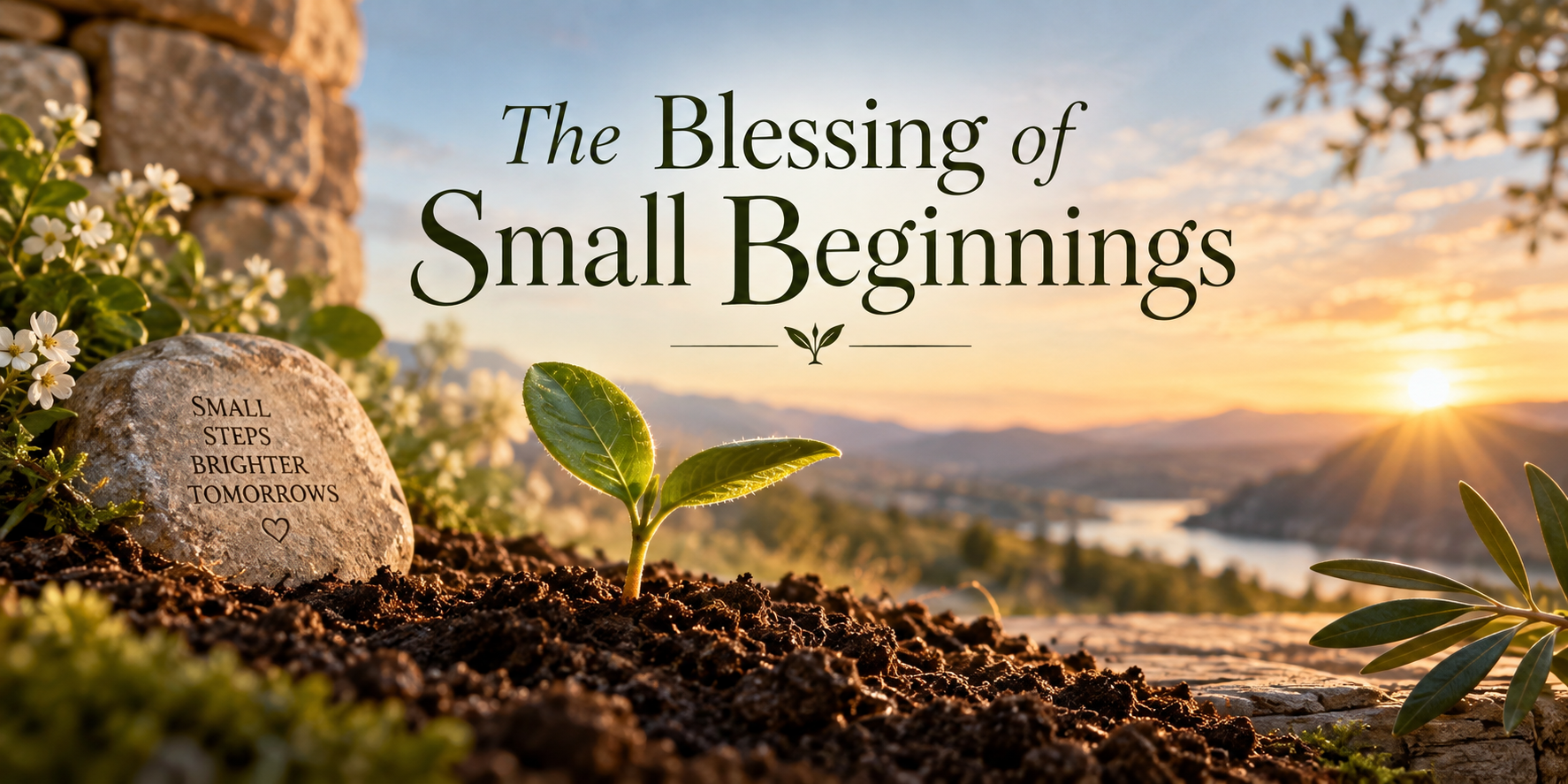
The Blessing of Small Beginnings
Explore the blessing of small beginnings, mustard-seed faith, hidden growth and beginning again. Discover why small steps, quiet prayers and faithful choices can carry extraordinary possibility.
Why what begins quietly may already contain more than we can see
Some of the most important things in life begin almost invisibly.
A seed disappears beneath the soil.
A prayer is whispered where no one else can hear it.
An idea is written in a notebook.
Someone decides to try again.
A first dollar is saved.
A first page is written.
A first step is taken toward a life that does not exist yet.
We live in a world fascinated by finished things. We notice the flourishing garden, the successful work, the strong relationship, the confident person, the answered prayer and the dream that finally became visible.
But everything that has grown once had a beginning.
And beginnings rarely announce what they will become.
There is something sacred about that.
A small beginning asks us to recognize value before there is much evidence. It reminds us that something does not have to be impressive to be important. It does not have to be visible to be growing. It does not have to be understood by everyone else to be meaningful.
And it does not have to arrive fully formed to contain extraordinary possibility.
Perhaps the little thing in front of you is not insignificant.
Perhaps it is simply early.
God Has Never Been Afraid of Small Beginnings
One of Scripture's most beautiful reflections on beginnings appears in Zechariah:
“Who dares despise the day of small things?”
Zechariah 4:10
These words become even more meaningful when we understand their setting.
The people were rebuilding the temple in Jerusalem after exile. The work before them was incomplete and modest compared with what had existed before. Some could remember an earlier glory, making the new beginning seem painfully small.
Yet God did not look upon the unfinished work with contempt.
The message was not to despise the beginning.
There is something powerful here.
God was not waiting for the temple to be completed before the work mattered.
The foundation mattered.
The building mattered.
The faithfulness happening in the middle mattered.
What human eyes could dismiss as small was still part of something sacred.
That pattern appears throughout Scripture.
David tended sheep before he wore a crown.
Bethlehem was small among the towns of Judah, yet became forever woven into the story of Christ's birth.
Jesus began His ministry without the machinery of worldly power.
A boy's five loaves and two fish appeared terribly small beside the hunger of a multitude.
Jesus spoke about seeds, lamps, yeast and coins, using ordinary things to reveal extraordinary spiritual truths.
Again and again, Scripture refuses to measure significance by appearance alone.
What looks small from the outside may still be carrying purpose.
Small Is Not the Opposite of Sacred
Sometimes we treat smallness as something that must eventually be escaped.
A small audience.
A small home.
A small contribution.
A quiet life.
A simple prayer.
A beginning nobody notices.
But small does not mean meaningless.
There are things whose value has nothing to do with whether they ever become enormous.
A conversation that comforts one person matters.
A meal prepared with love matters.
A prayer nobody hears matters.
A kindness that is never posted or publicly recognized matters.
A garden does not need to become a forest to justify its existence.
A person does not need millions of people to know their name for their life to matter.
This may be one of the deepest blessings hidden inside small beginnings.
They teach us to stop confusing visibility with value.
Not everything sacred becomes famous.
Not everything meaningful becomes large.
Some beautiful things remain quiet their entire lives.
They are no less beautiful for it.
The Seed Knows Something About Beginnings
Nature gives us one of the loveliest pictures of beginnings in the seed.
A seed can appear almost lifeless from the outside while carrying the biological potential for an entirely new plant.
When conditions become favorable, germination begins.
The seed takes in water. Processes that have been quiet become active. Stored resources begin supporting new growth.
Then something remarkable happens.
The embryonic root, called the radicle, is generally the first structure to emerge.
Before the young plant stretches upward, it begins establishing itself downward.
Before leaves reach toward sunlight, roots begin preparing to anchor and nourish what will come later.
There is something deeply beautiful about that order.
The first direction of growth is not always up.
Sometimes it is down.
Sometimes growth looks like roots.
The Hidden Season Is Still a Growing Season
Human beings have hidden seasons too.
You may be learning.
Preparing.
Healing.
Praying.
Changing your thinking.
Building confidence.
Developing discipline.
Gathering resources.
Strengthening your faith.
Releasing something you have outgrown.
Nothing dramatic may be visible from the outside.
Yet the absence of visible results does not necessarily mean the absence of growth.
Roots are growth too.
Much of life develops before it announces itself.
A musician practices before anyone hears the performance.
A writer fills pages before anyone reads the book.
A relationship deepens through countless ordinary conversations.
Character is shaped through decisions nobody applauds.
Faith can deepen during private moments that would look uneventful to everyone else.
There are seasons when life appears quiet because something is being established beneath the surface.
Do not automatically mistake quiet for emptiness.
Something may be taking root.
The Mustard Seed Changes the Way We Think About Faith
Jesus repeatedly used seeds when teaching about spiritual realities.
One of His most memorable images was the mustard seed.
In one teaching, the mustard seed illustrates the Kingdom of God beginning in an inconspicuous form and growing beyond what its beginning might suggest.
In another, Jesus uses the mustard seed while speaking about faith.
The image works because the beginning looks so small.
We sometimes imagine faith as enormous certainty.
But faith can begin much more quietly.
Maybe God is still working here.
Maybe another door exists.
Maybe I can begin again.
Maybe this idea deserves attention.
Maybe today's prayer matters.
Maybe I do not need to understand the entire journey before taking the next step.
Maybe what I have is enough to begin.
Faith does not always roar.
Sometimes faith plants.
An Acorn Does Not Look Like an Oak
Hold an acorn in your hand and you do not appear to be holding a tree.
There is no visible trunk.
No canopy.
No shade.
No branches filled with future acorns.
Yet the beginning carries possibilities that the eye cannot presently see.
Our lives contain moments like this.
When you begin learning something, you cannot see the ability you may eventually develop.
When you begin saving, the first amount may seem tiny beside the goal.
When you begin rebuilding after disappointment, the first peaceful day may not resemble transformation.
When you begin creating something, the first version may bear little resemblance to what eventually emerges.
When you begin praying about something, you may have no idea how the answer will unfold.
Beginnings invite us to respect possibility before it becomes obvious.
Small Steps Have a Quiet Power
There is wisdom in beginning with what we can actually do.
Large goals can feel overwhelming because the mind sees the distance between the present moment and the desired future.
A small action brings the future closer.
Write one paragraph.
Walk around the block.
Save a little.
Read a few pages.
Make the call.
Say the prayer.
Clear one corner.
Learn one thing.
Begin one conversation.
Repeated actions can gradually become patterns. Research into habit formation has found that behaviors repeated within consistent circumstances can become increasingly automatic over time.
There is no magical universal timetable.
Some changes become easier relatively quickly. Others require much longer.
That may actually be freeing.
Growth does not have to follow somebody else's calendar.
Even an imperfect beginning can keep becoming something.
One Missed Day Does Not Destroy a Beginning
There is another encouraging lesson hidden within research on habits.
In one well-known study, missing a single opportunity to perform a new behavior did not materially disrupt the overall process of forming the habit.
Think about how different life feels when we understand that.
You miss a day.
You stumble.
You become distracted.
You get tired.
You do not have to declare the entire beginning ruined.
Return.
Continue.
Begin again.
Growth does not demand that every day be flawless.
Sometimes faithfulness simply means returning to what matters.
Small Choices Can Become Architecture
A single action may appear insignificant.
Repeated actions are different.
One page becomes pages.
One walk becomes miles.
One saved dollar joins another.
One prayer becomes a practice.
One act of courage makes another act of courage easier to imagine.
One boundary begins changing a relationship.
One changed thought interrupts an old pattern.
One evening spent learning becomes knowledge you did not possess before.
We often imagine transformation as one dramatic event.
Sometimes it is.
But much of transformation is quieter.
It is accumulation.
Tiny choices become patterns.
Patterns become ways of living.
Eventually, you may discover that you are standing inside a life constructed from decisions that once seemed almost too small to matter.
Beginnings Require a Different Kind of Vision
The beginning of something rarely looks like its potential.
That can make beginnings emotionally difficult.
We compare our chapter one with someone else's chapter twenty.
We see their harvest while standing beside our freshly planted field.
Then the mind starts calculating.
I should be further along.
This should be happening faster.
Maybe I missed my chance.
Maybe this isn't working.
But a beginning cannot fairly be judged by the standards of maturity.
You would never plant a seed and dig it up three days later because it had failed to become a tree.
Growth has stages.
So do people.
So do dreams.
So does faith.
A beginning deserves permission to be a beginning.
There Is Courage in Being New
Being a beginner requires humility.
You do not know everything yet.
You may make mistakes.
Your first attempt may be awkward.
Someone else may be much better at it.
You may possess a beautiful vision without yet having the skill to express it fully.
That is not failure.
That is learning.
Every accomplished person once encountered something they could not yet do.
Every writer once faced an empty page.
Every musician once struggled with a note.
Every gardener once wondered whether something would grow.
Every confident person has lived through moments of uncertainty.
We sometimes wait for confidence before beginning.
But confidence often arrives because we began.
The First Step Changes Something
Before action, a dream exists largely within imagination.
Then you do something.
You make the appointment.
Buy the notebook.
Send the application.
Plant the seed.
Create the page.
Take the class.
Begin the walk.
Have the conversation.
Ask the question.
Say yes.
Say no.
Pray the prayer.
The action may appear tiny.
But something important has happened.
You have crossed the invisible line between imagining and participating.
The dream has entered the physical world.
You have entered the story.
You Do Not Need the Whole Staircase
Some dreams become intimidating because we try to mentally carry the entire journey at once.
How will I accomplish all of this?
What happens next year?
What if something goes wrong?
How will everything work?
But perhaps today's responsibility is not the entire future.
Perhaps today's responsibility is today's step.
There can be mercy in not knowing everything.
If every challenge, detour, surprise and decision of the next ten years were placed in front of us at once, we might never move.
Instead, life often arrives one piece at a time.
One conversation.
One opportunity.
One lesson.
One decision.
One morning.
One faithful step.
Then another.
Sometimes God gives enough light for the step we are standing on rather than illuminating the entire road.
That light is enough to move.
Faith Lives Between Planting and Seeing
One of the hardest parts of beginning is that effort and outcome rarely arrive together.
You plant before you harvest.
Practice before mastery.
Build before recognition.
Pray before knowing the answer.
Trust before seeing the entire path.
That space between planting and seeing can feel uncertain.
Yet faith gives us another way to inhabit it.
Faith allows us to nurture what is good even while we cannot see everything it may become.
This is not passive waiting.
A gardener does not plant and abandon the garden.
There is tending.
Watering.
Watching.
Responding.
Waiting.
Faith and action belong beautifully together.
Do what is yours to do.
Leave room for God to do what you cannot.
Do Not Demand Applause From a Seed
Beginnings can feel lonely because other people cannot always see what you see.
They may not understand why you care.
They may not recognize the possibility.
They may think your project is too small, your dream too unlikely or your effort too ordinary.
But not every seed needs an audience.
Some things need protection before they need publicity.
There can be wisdom in allowing something to develop without constantly asking the world whether it approves.
You do not need universal applause to nurture something meaningful.
Give the beginning what it actually needs.
Attention.
Care.
Patience.
Discernment.
Faith.
Room.
Let the roots become roots before demanding branches.
What You Have May Be Enough to Begin
Sometimes we postpone beginnings because we focus on what we do not have.
Not enough money.
Not enough knowledge.
Not enough time.
Not enough confidence.
Not enough support.
Not enough certainty.
Yet Scripture contains beautiful stories of people beginning with what was already in their hands.
A shepherd carried a sling.
A boy offered loaves and fish.
A widow offered two small coins.
The significance was not always found in abundance.
Sometimes it was found in willingness.
Perhaps the better question is not:
Do I have everything I will eventually need?
Perhaps it is:
What has already been placed in my hands today?
Start there.
Some Beginnings Change Direction
Not every beginning grows into the future we originally imagined.
Some ideas evolve.
Some plans redirect us.
Some relationships teach us.
Some doors close.
Some dreams become different dreams.
But movement gives us information that standing still cannot.
You discover what matters.
You learn what works.
You recognize what no longer fits.
You discover strengths you did not know you possessed.
You become someone who knows more than the person who first began.
Sometimes a beginning fulfills its purpose by leading you toward another beginning.
Nothing learned in love, faith, wisdom and sincere effort needs to be wasted.
Beginning Again Is Still a Beginning
Small beginnings are not reserved for the young.
Life can begin again many times.
At 20.
At 40.
At 60.
At 80.
After disappointment.
After success.
After grief.
After changing your mind.
After discovering something new about yourself.
After realizing that an old way no longer belongs in the life you are building.
Beginning again does not mean returning to zero.
You carry experience.
Wisdom.
Lessons.
Discernment.
Strength.
Memories.
Faith.
You are not beginning from nothing.
You are beginning from here.
And here may contain far more wisdom than where you began before.
There Is No Shame in Having Only a Little
Perhaps you have only a little right now.
A little energy.
A little money.
A little confidence.
A little time.
A little faith.
A little idea.
A little hope.
Do not automatically dismiss the little.
Ask what can be done with it.
Five loaves and two fish were little.
A mustard seed is little.
David appeared little beside Goliath.
Bethlehem was little among the towns of Judah.
Throughout Scripture, limitation is repeatedly prevented from having the final word.
You do not have to possess everything before offering what you have.
Sometimes the invitation is beautifully simple.
Bring what is in your hands.
The Sacredness of the First Yes
There is a moment before every meaningful beginning when nothing has happened yet.
Then comes a yes.
Yes, I will try.
Yes, I will learn.
Yes, I will pray.
Yes, I will forgive.
Yes, I will heal.
Yes, I will create.
Yes, I will trust.
Yes, I will begin.
That first yes may never appear in photographs.
Nobody may celebrate its anniversary.
No one else may even know it happened.
But entire chapters of life can grow from decisions that initially happened only inside the heart.
Honor those moments.
They are thresholds.
The Beginning May Already Be the Answer to an Earlier Prayer
Sometimes we pray for change and imagine the answer arriving fully formed.
We pray for opportunity and expect an open door.
We pray for abundance and imagine the harvest.
We pray for purpose and expect a complete map.
We pray for healing and imagine waking up transformed.
But sometimes the answer arrives as a beginning.
An idea.
A conversation.
An invitation.
A realization.
A person.
A book.
A new desire.
A small opportunity.
A sudden willingness to try something you once feared.
We can miss the answer because we expected a harvest and God handed us a seed.
Perhaps the question is not only, “Has my prayer been answered?”
Perhaps sometimes it is:
“Has something begun?”
Small Beginnings Teach Us How to See
There is another blessing hidden here.
Small beginnings train our attention.
When everything is enormous, recognition is easy.
When something is small, we have to look more closely.
We begin noticing subtle movement.
A little more peace.
A little more courage.
A new thought.
A healthier response.
A door barely opening.
An unexpected conversation.
A prayer beginning to change.
A desire returning.
Hope appearing where hopelessness used to live.
The person waiting only for miracles may overlook a thousand quiet gifts.
The person who learns to recognize beginnings discovers that life is filled with them.
A Sacred Practice for Small Beginnings
If something meaningful has been stirring within you, do not immediately ask how to complete it.
Ask something gentler.
What is trying to begin?
Then ask:
What is the smallest faithful step I can take toward it today?
Perhaps it is writing one paragraph.
Walking for ten minutes.
Saving five dollars.
Making one phone call.
Reading one page.
Clearing one small space.
Praying for five quiet minutes.
Researching one possibility.
Apologizing.
Applying.
Planting.
Resting.
Starting.
Your first step does not need to prove the entire journey.
It only needs to belong to it.
Bless What Is Beginning
We are very good at celebrating completion.
Graduations.
Weddings.
Launches.
Promotions.
Harvests.
Milestones.
Perhaps we should become equally good at blessing beginnings.
Bless the first attempt.
Bless the awkward stage.
Bless the tiny audience.
Bless the empty notebook.
Bless the first customer.
Bless the newly planted garden.
Bless the first peaceful morning.
Bless the unanswered question.
Bless the prayer that has only just been spoken.
Bless the dream that still looks unreasonable.
Bless the person you are becoming before you can completely see who that person will be.
There is holiness in beginnings because every good beginning contains an act of hope.
It quietly declares that tomorrow can contain something that yesterday did not.
A Prayer for Small Beginnings
God, thank You for the beginnings I can see and for those I may not yet recognize.
Help me never to dismiss what is small simply because it is small.
Give me wisdom to recognize what deserves my attention, courage to take the next step and patience to allow good things to grow in their proper time.
Bless the seeds I am planting through my thoughts, choices, prayers, work and love.
When progress seems invisible, remind me that roots can grow before branches appear.
When I compare my beginning with someone else's harvest, bring my attention back to the path You have placed before me.
When I have only a little, show me what can be done with what is already in my hands.
When I become impatient, remind me that growth has rhythms I cannot always rush.
When I cannot see the whole path, give me enough faith for the step in front of me.
Teach me to recognize quiet growth.
Teach me to honor beginnings.
And help me notice when an answer to prayer has arrived disguised as a seed.
Amen.
The Blessing Was There From the Beginning
One day you may look at something beautiful in your life and remember when it was almost invisible.
A conversation.
An idea.
A prayer.
A few dollars.
A first page.
A trembling yes.
A decision nobody noticed.
And perhaps you will realize something.
It did not suddenly become meaningful when it became successful.
It did not suddenly become worthy when other people noticed.
Its value was not created by its size.
The blessing was there when it was small.
The tree was once a seed.
The song was once a note.
The journey was once a step.
The testimony was once a prayer.
And sometimes the greatest mistake we make with small beginnings is believing we will honor them later, once they become something bigger.
Honor them now.
Hold them gently.
Tend them faithfully.
Give them time.
You may be standing much closer to a miracle than appearances suggest.
Something sacred may already have begun.
Frequently Asked Questions
What does the Bible say about small beginnings?
Zechariah 4:10 asks who has despised “the day of small things.” The passage belongs to the rebuilding of the temple under Zerubbabel after the exile. The work looked modest and unfinished, yet it was not insignificant to God. The larger biblical pattern repeatedly shows important things beginning in unexpected, ordinary or seemingly insufficient ways.
What is the spiritual meaning of a small beginning?
A small beginning can represent faith, hope, possibility, humility and willingness. Spiritually, it reminds us that we do not always need to see the completed outcome before faithfully participating in what is beginning.
What does the mustard seed represent in the Bible?
Jesus uses the mustard seed in more than one teaching. It illustrates the remarkable growth of God's Kingdom from an inconspicuous beginning and is also used when Jesus teaches about faith. The tiny seed becomes a powerful image of smallness carrying possibilities greater than appearances suggest.
Does everything small eventually become something big?
No, and it does not need to. Smallness is not a defect. A quiet act of love, a private prayer or a life that touches only a handful of people can still carry enormous meaning. The blessing of small beginnings is not merely that small things can become large. It is also learning that something can be valuable while it is still small.
Why can progress be happening even when I cannot see it?
Many processes have an unseen stage. During seed germination, for example, early biological activity begins before a flourishing plant appears above the soil, and the young root begins developing before the mature plant exists. Human growth can also include preparation, learning, reflection and inner change before the results become obvious to others.
Why can small steps be powerful?
Small steps turn large intentions into actions we can actually perform. Repeated behaviors can gradually form patterns and become easier or more automatic. Small steps also allow us to build experience instead of waiting until we feel completely ready.
How long does it take to form a habit?
There is no single number that applies to everyone. Habit research has found considerable variation depending on the person and the behavior. What matters more than chasing a particular number is giving a helpful behavior opportunities to be repeated consistently.
What if I miss a day while trying to build a new habit?
One imperfect day does not mean you have lost everything you built. Research on real-world habit formation found that missing one opportunity did not materially disrupt the overall habit-building process. Return to what matters and continue.
Is it ever too late for a new beginning?
A new beginning can happen in many seasons of life. Later beginnings can carry wisdom, experience and discernment that earlier versions of ourselves did not yet possess. Beginning again does not necessarily mean beginning from nothing. It means beginning from where you are now.
What if I do not have enough to pursue what is in my heart?
Instead of beginning with everything you lack, look carefully at what is already available. You may have one idea, one skill, one hour, one connection, one opportunity or enough courage for one step. You do not always need everything required for the entire journey in order to begin today's part of it.
How do I know what my first step should be?
Ask what action is both meaningful and possible now. The first step does not need to solve the whole future. It only needs to move in the direction of what you believe is worth nurturing.
Could a small beginning be an answer to prayer?
Sometimes what we hope will arrive as a complete answer may first appear as an opportunity, idea, conversation, change of heart or new direction. Staying attentive to small beginnings can help us recognize possibilities we might otherwise overlook.
Continue Exploring
The Beauty of Waiting
Divine Timing
Trust the Unseen
Greatness Does Not Always Begin Loudly
The Beauty of Becoming
When Faith Feels Fragile
Listening to Your Spirit
Grace in Every Transition
Manifesting with Joy