


How to Recognize Your Own Light
Learn how to recognize your own light through your gifts, resilience, compassion, curiosity, faith and purpose. Discover the strengths you may have overlooked and how to use them with humility, courage and meaning.
You May Be Shining Long Before You Realize It
There are seasons when it is easy to recognize the light in other people.
We notice their kindness.
Their courage.
Their patience.
Their creativity.
Their faith.
Their ability to make someone feel safe, hopeful, understood or less alone.
Yet strangely, we can stand in the middle of our own lives carrying many of those same qualities and fail to recognize them in ourselves.
We may call our strength ordinary because we have lived with it for so long.
We may dismiss our kindness because it feels natural.
We may overlook our resilience because we remember how frightened we were while surviving.
We may minimize our gifts because someone else appears more talented.
We may believe that light must look dramatic before it deserves to be called light.
But much of the most meaningful light in this world is quiet.
It appears in the person who keeps choosing kindness.
The person who begins again after disappointment.
The person who listens carefully.
The person who creates something beautiful.
The person who remains honest when dishonesty would have been easier.
The person who comforts someone who is hurting.
The person who walks into a difficult room and somehow leaves peace behind.
You may have spent years searching for evidence that you are enough while standing inside evidence that was there all along.
Learning to recognize your own light is not learning to believe you are better than anyone else.
It is learning to stop pretending that what God placed within you does not exist.
What Does Your Light Mean?
When people speak about someone's "light," they are usually describing qualities that seem to bring life, goodness, truth, warmth, hope or clarity into the world.
Your light may include your compassion.
Your integrity.
Your creativity.
Your humor.
Your faith.
Your intelligence.
Your courage.
Your patience.
Your sensitivity.
Your wisdom.
Your ability to encourage.
Your willingness to help.
Your capacity to notice beauty.
Your ability to see possibilities where other people see only limitations.
Psychologists sometimes speak of character strengths, meaning positive qualities expressed through the way we think, feel and act.
These can include qualities such as kindness, curiosity, hope, gratitude, courage, wisdom, perseverance and love.
In everyday language, these are some of the ways our inner character becomes visible.
From a spiritual perspective, light has carried even deeper meaning throughout Scripture.
Light represents truth.
Goodness.
God's presence.
Guidance.
Hope.
Life.
Jesus told His followers:
"You are the light of the world."
Matthew 5:14
The image becomes even more powerful in the verses that follow.
A lamp is not meant to be hidden.
It is placed where it can give light.
That changes the meaning of recognizing your own light.
The goal is not:
Admire how bright I am.
The deeper question is:
What has God placed within me that was meant to serve, bless, encourage, create, heal, guide or strengthen something beyond myself?
Your gifts are not trophies.
They are something to steward.
Your Light Is Not Your Ego
Recognizing your own goodness is sometimes confused with arrogance.
They are not the same thing.
Ego says:
"I must be greater than you."
Healthy self-recognition says:
"I do not need to make myself smaller."
Ego depends upon comparison.
Light does not.
You can admire another person's intelligence without questioning your own.
You can celebrate someone else's beauty without diminishing yours.
You can honor another person's success without believing abundance has somehow run out.
You can recognize your gifts without assuming they make you superior.
Humility does not require denial.
If someone has a genuine gift for teaching, there is nothing humble about pretending they do not.
If someone is deeply compassionate, they do not become more virtuous by refusing to recognize it.
If someone has survived difficult things with remarkable courage, acknowledging that courage does not make them arrogant.
Truthful self-recognition simply says:
This is something good within me. Let me use it well.
Seeing Your Light Does Not Require Ignoring Your Shadows
One of the most important things to understand is that recognizing your light does not mean pretending your weaknesses do not exist.
You can appreciate your strengths while still acknowledging where you need to grow.
You can say:
"I handled that poorly."
without saying:
"I am a terrible person."
You can say:
"I need to learn."
without saying:
"I have nothing to offer."
You can recognize a mistake without turning that mistake into an identity.
Psychologists sometimes use the term self-compassion to describe responding to ourselves with kindness and honesty during difficulty rather than immediately attacking ourselves.
Self-compassion does not mean excusing everything we do.
It means telling the truth without becoming cruel.
There is a great difference between accountability and self-condemnation.
You can acknowledge:
There are beautiful qualities within me.
There are unfinished places within me.
There are things I understand.
There are things I am still learning.
There are wounds that have healed.
There are places still tender.
There are gifts already visible.
There are gifts still developing.
All of these things can be true at once.
You do not need to become perfect before recognizing what is good.
One Sign of Your Light Is What Comes Naturally to You
Some of your strongest qualities may be the ones you underestimate most.
Why?
Because they feel normal to you.
Perhaps people frequently come to you when they need advice.
You may think:
"I am only listening."
But perhaps listening is one of your gifts.
Maybe you naturally arrange things, solve problems or notice what needs to happen next.
You may think:
"Anyone could do this."
Perhaps they could.
But they did not.
You did.
Maybe children trust you.
Animals relax around you.
Strangers tell you personal stories.
Friends call when life becomes difficult.
You know how to make a home feel welcoming.
You instinctively see what could be improved.
You notice beauty other people walk past.
You explain complicated things simply.
You make people laugh during difficult seasons.
You can create order from chaos.
Do not immediately dismiss what comes easily.
Ease does not make a gift insignificant.
Sometimes ease means a quality has become deeply woven into who you are.
But there is another truth here.
Not Every Gift Feels Easy
Some gifts require work.
A gifted musician still practices.
A compassionate person may need to learn healthy boundaries.
A natural leader may spend years learning patience.
A talented writer still rewrites.
A thoughtful person may need courage before speaking.
A creative person may have to develop discipline.
So do not look only for what feels effortless.
Also notice what repeatedly calls you back.
What are you willing to practice?
What do you keep returning to even when improvement takes time?
What feels difficult but meaningful?
What skill keeps asking to be developed?
A gift can begin as a spark.
Practice teaches it how to burn steadily.
Notice What People Consistently Thank You For
Other people sometimes see qualities in us that we struggle to see ourselves.
Psychological research on self-knowledge suggests that introspection alone does not always reveal everything about who we are.
People who know us well may notice patterns that have become invisible to us.
That does not mean every opinion about you is accurate.
But repeated feedback deserves attention.
Look for patterns.
Perhaps one person tells you that you are patient.
Then a coworker says it.
Then a family member says the same thing.
Perhaps several people describe you as dependable.
Creative.
Calming.
Wise.
Funny.
Resourceful.
Generous.
Encouraging.
Observant.
Resilient.
When similar descriptions appear across different relationships and different seasons, pay attention.
Other people may be seeing the glow around a gift you have spent years calling ordinary.
Notice Who You Are When Nobody Is Applauding
Some of your brightest qualities will never receive public recognition.
Perhaps you care for someone when no one sees.
Perhaps you pray for people who will never know.
Perhaps you keep promises that would have been easy to break.
Perhaps you encourage the person everyone else overlooked.
Perhaps you return something that does not belong to you.
Perhaps you choose honesty when dishonesty would have benefited you.
Perhaps you quietly keep your family together through a difficult season.
Perhaps you clean up a mess you did not create simply because it needs doing.
Character often reveals itself where applause cannot reach.
The world tends to notice spectacular accomplishments.
God often works through quieter faithfulness.
Your private goodness matters too.
Your Light Often Leaves Evidence
People sometimes wait for a dramatic revelation about who they are.
But your life has already been leaving clues.
Look backward.
Who have you helped?
What have you built?
What have you repaired?
What have you survived?
What have people trusted you with?
What have you learned unusually quickly?
What keeps returning to your imagination?
Where have you brought peace?
What have you made beautiful?
What have you taught without realizing you were teaching?
What problems have you solved?
Where have people become stronger because you were present?
Where have you stepped forward when someone needed you?
Where have you created order?
Where have you brought hope?
Your light leaves fingerprints.
Sometimes recognizing it simply means turning around and noticing them.
Your Survival May Contain More Light Than You Realize
People often look back on difficult seasons and remember only their fear, exhaustion or uncertainty.
They forget the part where they continued.
You may remember crying.
But you also woke up the next morning.
You may remember being afraid.
But you moved forward while afraid.
You may remember not knowing what to do.
But somehow you made the next decision.
You may remember feeling weak.
But you carried things that once seemed impossible to carry.
Psychologists use the word resilience to describe the ability to adapt and continue through difficulty.
Resilience does not always feel heroic while it is happening.
Sometimes resilience looks like washing the dishes.
Going to work.
Answering one more email.
Making dinner.
Praying again.
Trying again.
Getting out of bed.
Choosing hope for another day.
Do not measure your strength only by how strong you felt.
Sometimes strength is simply the evidence that you continued.
Hardship Does Not Have to Become a Gift
There is a beautiful but important distinction here.
Pain does not need to be romanticized.
Not every difficult experience happens for an obvious reason.
Not every hardship produces wisdom.
Not everyone emerges from suffering feeling stronger.
Psychologists sometimes use the phrase post-traumatic growth to describe positive changes that some people experience after struggling with profound adversity.
But growth is not automatic.
You do not need to call the painful experience itself good in order to recognize what developed while you were walking through it.
Perhaps courage emerged.
Perhaps compassion deepened.
Perhaps your priorities changed.
Perhaps faith matured.
Perhaps you discovered who truly loved you.
Perhaps you learned boundaries.
Perhaps you found strength you did not know you possessed.
And sometimes simply surviving is enough.
You do not owe every painful chapter a beautiful ending.
But you are allowed to recognize whatever light you carried through it.
Your Sensitivity May Be Part of Your Light
Sensitive people often notice things quickly.
A change in someone's voice.
The atmosphere of a room.
The person sitting quietly at the edge of the group.
Beauty.
Music.
Nature.
Suffering.
Kindness.
Injustice.
Sensitivity can contribute to compassion, creativity, attentiveness and emotional awareness.
But sensitivity also benefits from discernment.
Discernment means thoughtfully evaluating what you perceive instead of assuming every feeling or impression is automatically correct.
Feeling something strongly does not always mean your interpretation is accurate.
You can remain deeply sensitive and still ask:
What do I actually know?
What might I be assuming?
What deserves more reflection?
What feels peaceful and grounded?
What requires wisdom?
Sensitivity with discernment becomes a powerful combination.
You do not necessarily need to become less sensitive.
You may need to learn how to understand and steward what your sensitivity notices.
Your Light Often Appears Where You Feel Most Alive
Pay attention to moments when something inside you seems to awaken.
When do you lose track of time?
When do ideas begin arriving quickly?
When do you feel deeply peaceful?
When do you feel useful?
What kind of work leaves you tired but satisfied rather than simply drained?
What conversations energize you?
What subjects could you explore for hours?
What kind of beauty moves you?
What problems do you instinctively want to solve?
What injustice makes you want to help?
What possibility keeps returning to your imagination?
These moments contain clues.
The things that make you feel alive are not automatically your life purpose.
But they frequently reveal something meaningful about your values, interests and gifts.
Your Curiosity Can Reveal How Your Mind Works
Curiosity is one of life's quiet compasses.
You do not need to turn every interest into a career.
But repeated fascination deserves attention.
Maybe you keep returning to gardening.
Healing.
Architecture.
History.
Writing.
Music.
Animals.
Teaching.
Technology.
Food.
Faith.
Design.
Human behavior.
Nature.
The stars.
The oceans.
Certain subjects seem to knock repeatedly on the same door inside us.
But curiosity can reveal more than what interests you.
It may reveal something about how your mind naturally works.
Someone constantly asking:
How does this work?
may have a strong analytical mind.
Someone asking:
Why do people behave this way?
may carry unusual curiosity about human nature.
Someone constantly imagining:
What could this become?
may be visionary.
Someone who notices tiny differences in plants, music, color, architecture or language may possess strong powers of observation.
Someone who constantly asks:
How could this be better?
may be a natural problem-solver.
Pay attention to your questions.
They may be telling you something about you.
Notice What You Want to Give
Another way to recognize your light is to ask:
What do I naturally want other people to experience?
Do you want people to feel safe?
Beautiful?
Capable?
Healthy?
Loved?
Hopeful?
Seen?
Free?
Inspired?
Closer to God?
Curious?
Empowered?
Peaceful?
Sometimes what you most want to give reveals something about what you carry.
The encourager wants people to believe again.
The teacher wants people to understand.
The healer wants suffering to lessen.
The artist wants people to experience beauty.
The builder wants possibility to become tangible.
The protector wants people to be safe.
The peacemaker wants conflict to soften.
The visionary wants people to see beyond what currently exists.
The caregiver wants someone to know they are not alone.
Your desire to contribute may contain fingerprints of your gifts.
Purpose Does Not Have to Be One Grand Mission
People sometimes imagine that purpose means discovering one enormous assignment that explains their entire life.
That idea can create unnecessary pressure.
Researchers studying meaning in life often describe several dimensions.
One is purpose, having meaningful direction.
Another is coherence, feeling that your life has some understandable shape.
Another is mattering, sensing that your existence and actions have significance.
Purpose can therefore be much larger and much smaller than a career.
Your purpose today might involve raising a child.
Building a business.
Supporting a parent.
Creating beauty.
Learning something difficult.
Writing something meaningful.
Helping a neighbor.
Healing.
Teaching.
Serving.
Beginning again.
There may be one great thread running through your life.
Or there may be many meaningful seasons.
You do not need a dramatic title for your life to matter.
Ask Where Your Gifts Meet Something Worthwhile
A powerful question is:
Where does something I carry meet something that needs care?
Perhaps your patience meets someone else's confusion.
Your knowledge meets someone else's question.
Your creativity meets an empty space.
Your courage meets an injustice.
Your humor meets someone's heavy day.
Your organizational ability meets chaos.
Your compassion meets loneliness.
Your faith meets fear.
Your experience meets someone just beginning a road you have already traveled.
Purpose often appears at intersections.
Who you are.
What you care about.
What you can offer.
What the moment requires.
Look there.
Your Light Can Exist Beside Your Imperfections
One of the biggest obstacles to recognizing our own light is the belief that goodness requires perfection.
It does not.
You can be kind and impatient sometimes.
Strong and frightened.
Wise and still learning.
Faithful and occasionally uncertain.
Generous and in need of rest.
Confident in one area and insecure in another.
Human beings contain complexity.
A cloudy day does not mean the sun disappeared.
Your difficult moments do not erase every beautiful quality within you.
Growth often requires holding two truths at once:
There are things within me worth celebrating.
There are things within me still becoming.
Both can be true.
Stop Using Your Worst Moment as Your Biography
Sometimes people carry an old version of themselves far beyond its season.
A mistake becomes an identity.
A failed relationship becomes proof they cannot love well.
A business failure becomes proof they are incapable.
A poor decision becomes evidence that they cannot trust themselves.
A difficult season becomes the definition of their personality.
But a chapter is not the whole book.
You are allowed to become someone your past did not predict.
Grace makes room for transformation.
Wisdom can grow from mistakes.
Strength can grow from hardship.
Compassion can deepen through pain.
Faith can mature after questioning.
You do not have to keep introducing yourself through wounds that are already healing.
The Light You Admire May Tell You Something
There is something fascinating about admiration.
We are often strongly drawn toward certain qualities.
Courage.
Creativity.
Peace.
Wisdom.
Generosity.
Faith.
Leadership.
Freedom.
Instead of allowing admiration to become comparison, turn it into curiosity.
Ask:
What exactly do I admire here?
Then ask:
Why does this move me so strongly?
And perhaps:
Where might this quality already be growing in me?
Admiration does not always mean you lack something.
Sometimes it reveals something you value deeply.
And what you value can reveal the direction in which you are growing.
Let Comparison Become Information, Not a Verdict
Human beings compare themselves with other people.
Sometimes comparison motivates growth.
Sometimes it makes us feel inadequate.
Sometimes it inspires.
Sometimes it distorts.
Instead of expecting yourself never to compare, learn to notice what comparison is doing.
If someone's courage inspires you, ask what kind of courage you want to develop.
If someone's creativity awakens something in you, explore it.
If someone's success makes you feel small, notice the story you immediately begin telling yourself.
Did your mind say:
"I will never have that."
"I am too late."
"I am not talented enough."
"Everyone is ahead of me."
Question those conclusions.
Comparison can become information.
It does not have to become a verdict.
Stop Shrinking So Other People Can Stay Comfortable
Many people learn to dim themselves early.
Do not talk too much.
Do not dream too big.
Do not appear too confident.
Do not be too spiritual.
Do not be too creative.
Do not be too successful.
Do not be too different.
Do not make anyone uncomfortable.
Eventually shrinking becomes automatic.
You may begin apologizing for your enthusiasm.
Laughing off compliments.
Hiding ideas.
Downplaying success.
Pretending not to care about things that matter deeply to you.
There is humility in remembering that none of us is greater than everyone else.
But disappearing is not humility.
You were not given gifts so you could spend your life pretending they do not exist.
Light Does Not Require an Audience
Modern culture often connects visibility with significance.
Followers.
Views.
Applause.
Recognition.
Awards.
Numbers.
But significance existed long before social media.
A grandmother who changes the emotional atmosphere of an entire family may never become famous.
A teacher may quietly alter hundreds of futures.
A neighbor who checks on someone living alone may change one important life.
A parent may build security into a child through thousands of small moments no camera records.
A stranger may offer one sentence of encouragement that someone remembers for years.
Impact and visibility are not the same thing.
Some lights illuminate stadiums.
Others illuminate kitchens.
Both can matter enormously.
Your Light Is Not a Fixed Identity
Recognizing your strengths does not mean trapping yourself inside labels.
You are still becoming.
Perhaps you are already kind and becoming more courageous.
Already creative and becoming more disciplined.
Already strong and learning tenderness.
Already generous and learning boundaries.
Already faithful and growing wiser.
Already thoughtful and learning to speak.
Human qualities can develop.
Strengths can mature.
New gifts can emerge.
Old gifts can take new forms.
Recognizing your light is not saying:
"This is all I am."
It is saying:
"This is something alive within me now, and I am willing to see where God takes it."
Your Light May Change Shape Throughout Your Life
You are not required to express yourself the same way forever.
A gift can mature.
A purpose can expand.
A season can end.
Your creativity may once have appeared through painting and later through gardening.
Your leadership may once have appeared in a workplace and later within your family.
Your nurturing ability may first serve your children and later your community.
Your curiosity may eventually become teaching.
Your hardship may become wisdom you share with someone else.
Nothing meaningful is necessarily wasted.
Life keeps rearranging familiar threads into new patterns.
Allow yourself to evolve.
Recognize the Difference Between Light and Performance
Performance says:
"Notice me."
Light says:
"Let me contribute."
Performance asks:
"How do I appear?"
Light asks:
"What can I bring?"
Performance requires constant validation.
Light can continue even without applause.
There is nothing wrong with being seen.
There is nothing wrong with success.
There is nothing wrong with recognition.
But when your sense of worth depends entirely upon outside reaction, your gifts begin working for an audience rather than flowing from identity.
The deeper freedom comes when you know something about who you are before anyone claps.
Gratitude Can Help You See Yourself More Clearly
We often think gratitude means appreciating things outside ourselves.
But gratitude can also include appreciation for the person God is shaping us into.
You might say:
Thank You for my ability to care.
Thank You for my curiosity.
Thank You that I kept going.
Thank You for my creativity.
Thank You for the people I have helped.
Thank You for the lessons I have learned.
Thank You for the courage growing in me.
Thank You for another chance to become more fully who I was created to be.
Gratitude does not have to inflate the ego.
When we recognize the Source, gratitude can soften the ego.
The gift becomes something to steward rather than something to worship.
Ask God to Show You What You Cannot See
Sometimes we are simply too close to ourselves to see clearly.
Prayer creates room for another perspective.
You might ask:
"God, show me what You placed within me that I have overlooked."
"Show me where I am making myself smaller than You intended."
"Show me the gifts I am meant to develop."
"Show me where my light is needed."
"Help me recognize the good without becoming prideful."
"Help me see myself through grace rather than comparison."
Then pay attention.
An opportunity may appear.
Someone may say something unexpected.
An old interest may return.
A door may open.
A persistent idea may become difficult to ignore.
A pattern may finally become visible.
Guidance is not always dramatic.
Sometimes it arrives through repetition.
Protect What Keeps Your Light Alive
Once you begin recognizing your light, learn what strengthens it.
Maybe your spirit becomes clearer after time in nature.
Maybe prayer restores you.
Maybe writing helps you understand yourself.
Maybe music reawakens your creativity.
Maybe certain friendships leave you feeling more like yourself.
Maybe rest returns your patience.
Maybe learning keeps your mind bright.
Maybe solitude helps you hear your own thoughts.
Maybe service reminds you why your life matters.
Pay attention to what leaves you expanded rather than diminished.
You are allowed to protect the environments that help your best qualities grow.
Do Not Confuse Exhaustion With Losing Your Light
There will be days when you feel dull.
Uninspired.
Disconnected.
Quiet.
Tired.
That does not necessarily mean something is wrong.
Human beings have rhythms.
Rest is not darkness.
Stillness is not failure.
A field does not produce crops every day of the year.
People also need seasons where nothing spectacular appears to be happening.
Your light does not disappear because you are resting.
Sometimes rest protects it.
Sometimes quiet restores it.
Sometimes what looks like inactivity is preparation.
Light Naturally Multiplies
One of the beautiful things about light is that it can spread without becoming smaller.
Encouragement creates encouragement.
Generosity inspires generosity.
Courage can give someone else permission to become courageous.
Faith strengthens faith.
Creativity awakens creativity.
Hope travels.
One person's willingness to live fully can quietly change what other people believe is possible.
You may never know every place your light reaches.
That does not mean it stopped traveling.
A Simple Practice for Recognizing Your Own Light
At the end of the day, ask yourself a few questions.
What did I do well today?
Where did I bring kindness, courage or value?
What came naturally to me?
What required courage?
When did I feel most like myself?
What made me curious?
Where did I help?
What quality within me deserves gratitude tonight?
Do not search only for extraordinary answers.
Perhaps you stayed calm during a frustrating conversation.
Perhaps you finished something difficult.
Perhaps you encouraged someone.
Perhaps you made your home beautiful.
Perhaps you asked for help.
Perhaps you learned something.
Perhaps you rested when you needed rest.
Perhaps you laughed.
Perhaps you tried again.
Recognition grows through attention.
The more carefully you observe your own life, the harder it becomes to believe that nothing beautiful is happening within it.
Your Light Does Not Need Permission
There may never be a perfect moment when everyone agrees that you should step forward.
Someone may misunderstand you.
Someone may prefer the quieter version of you.
Someone may not understand your dream.
Someone may think you have changed.
Perhaps you have.
Growth changes people.
You do not need universal permission to become more fully yourself.
You need discernment.
Humility.
Courage.
Faith.
And the willingness to walk through doors that feel aligned with what you are becoming.
You Were Never Asked to Be Someone Else's Light
Comparison convinces people there is one correct way to shine.
There is not.
Perhaps someone else's light is loud.
Yours may be gentle.
Theirs may involve leadership.
Yours may involve care.
Theirs may reach millions.
Yours may transform one family.
Theirs may create movements.
Yours may create sanctuary.
Different does not mean lesser.
You do not need their personality.
Their audience.
Their path.
Their story.
Their pace.
Your responsibility is not to imitate another person's radiance.
It is to become faithful to your own.
How to Recognize Your Own Light
You may recognize it in the kindness you offer without thinking.
In what people repeatedly trust you with.
In the difficult things you survived.
In the ideas that keep visiting you.
In the beauty you create.
In the courage you forget to count.
In the way you love.
In the problems you naturally solve.
In the questions you keep asking.
In the dreams that refuse to leave.
In the hope you somehow keep finding.
In the peace you bring into certain spaces.
In the qualities people repeatedly see in you.
In the ways you serve when no one is watching.
In the person you are becoming.
Perhaps your light has not been hidden.
Perhaps you have simply been standing too close to recognize its shape.
Do Not Merely Recognize Your Light. Steward It.
There is one final step.
Once you recognize something good within yourself, ask what it is for.
If you are compassionate, where can compassion serve?
If you are wise, where can wisdom guide?
If you are creative, what might you create?
If you are encouraging, who needs encouragement?
If you are courageous, where might courage be required?
If you understand something deeply, who might benefit from what you know?
If you bring peace, where is peace needed?
The biblical image of light is not a lamp staring at itself.
It is a lamp giving light.
That may be the deepest reason to recognize your own light.
Not so you can spend your life admiring it.
So you can stop hiding what was meant to be given.
You Do Not Have to Become Brighter Than Anyone Else
There is no competition here.
Your light does not require someone else's darkness.
You do not need to become the most talented person in the room.
The wisest.
The strongest.
The most spiritual.
The most successful.
You only need to stop denying the goodness that is already asking to move through your life.
Recognize it.
Develop it.
Protect it.
Practice it.
Share it.
Thank God for it.
And allow it to grow.
Because one of the quiet tragedies of life would be spending years asking whether you have light while the people around you have already been warmed by it.
Questions and Answers
What does it mean to recognize your own light?
Recognizing your own light means becoming aware of the strengths, gifts, values and forms of goodness you naturally bring into the world. It does not mean believing you are better than other people. It means seeing yourself clearly enough to stop dismissing what is good within you.
Is recognizing your own light prideful?
Not necessarily. Pride depends upon superiority. Healthy self-recognition is grounded in truth. You can acknowledge your gifts while remaining grateful, humble and aware that other people carry gifts of their own.
How do I discover strengths I may not recognize?
Notice patterns. Pay attention to what people consistently thank you for, what comes naturally, what you repeatedly return to, what you are willing to practice, what problems people ask you to help solve and what activities make you feel deeply alive.
Why is it easier to see good qualities in other people than in myself?
Familiarity can make our own gifts seem ordinary. We experience ourselves every day, including our doubts and mistakes, while seeing other people's strengths more from the outside. Trusted people can sometimes help us recognize qualities that have become invisible to us.
What are character strengths?
Character strengths are positive qualities expressed through thoughts, feelings and behavior. Examples include kindness, curiosity, hope, perseverance, gratitude, courage, wisdom and love.
Is self-compassion the same as excusing mistakes?
No. Self-compassion means responding to yourself with honesty and kindness during struggle. You can acknowledge mistakes, repair harm and grow without turning every failure into evidence that you are worthless.
Can hardship reveal someone's light?
Yes, although hardship does not automatically make someone stronger. Difficulty can reveal courage, endurance, compassion, faith or wisdom, but growth after suffering looks different for everyone. Sometimes surviving itself is an extraordinary act.
What is resilience?
Resilience is the ability to adapt and continue through difficulty. It does not always look dramatic. Sometimes resilience appears in ordinary actions such as continuing responsibilities, asking for help, resting, praying or trying again.
What is post-traumatic growth?
Post-traumatic growth describes positive changes that some people experience through their struggle with major adversity. It may include deeper relationships, changed priorities, greater appreciation for life, spiritual growth or a stronger sense of personal strength. It does not happen to everyone, and suffering does not need to be called good for growth to occur.
Can sensitivity be a strength?
Yes. Sensitivity may contribute to empathy, creativity, emotional awareness and attentiveness. It becomes especially helpful when paired with discernment, meaning the ability to thoughtfully evaluate what you perceive rather than assuming every impression is automatically accurate.
How can curiosity reveal my gifts?
The subjects and questions that repeatedly capture your attention can reveal how your mind naturally works. Curiosity may point toward analytical ability, creativity, observation, problem-solving, teaching, compassion or another developing strength.
What if my gifts do not come easily?
Many important abilities require development. Natural ability is only one clue. Pay attention to what repeatedly calls you back, what feels meaningful enough to practice and what grows stronger when you give it time and attention.
What does purpose mean?
Purpose is a sense of meaningful direction. It does not have to be one enormous life mission. Purpose can appear through relationships, service, work, creativity, faith, family, learning or the responsibilities of a particular season.
Do I need recognition from other people to know my light matters?
No. Recognition can be encouraging, but visibility and significance are not the same thing. Many of life's greatest influences happen quietly within families, friendships, workplaces and communities.
How can prayer help me recognize my own light?
Prayer can create space for reflection, gratitude and guidance. Asking God to reveal overlooked gifts, strengths or opportunities can help shift attention away from comparison and toward stewardship of what has already been placed within you.
How can I begin recognizing my light today?
Notice one quality you appreciate about yourself, one difficult thing you have survived, one way you helped someone recently, one subject that continually sparks your curiosity and one place where you feel especially alive. Small observations often reveal larger patterns.
Continue Exploring
Whispers of Worth
The Beauty of Becoming
Feed Your Mind with What Enlarges You
Attention Is One of Your Mind's Greatest Forces
Greatness Does Not Always Begin Loudly
Trust the Unseen
Letting Go Gracefully
Manifestation Is a Quiet Art
Grace in Every Transition

The Soft Return
Explore how to come back to yourself through gentleness, self-trust, boundaries, faith, honest reflection, and small choices that reconnect you with your own voice.
Coming Back to Yourself With Gentleness, Self-Trust, and Truth
Not every return is dramatic.
Sometimes coming back to yourself does not look like a breakthrough, a public declaration, or a complete reinvention of your life.
Sometimes it begins almost invisibly.
A quieter breath.
A pause before saying yes when you mean no.
A moment when you notice what you need instead of immediately dismissing it.
A decision to stop explaining yourself.
A day when your inner world begins to feel a little easier to inhabit.
This is the soft return.
It is the sacred movement back toward yourself without force, punishment, shame, or performance.
Instead of demanding instant transformation, you begin rebuilding a kinder relationship with your own soul.
You stop treating yourself like a problem that needs to be solved.
You begin treating yourself like someone worth knowing, honoring, protecting, and returning to.
The soft return is not weak.
It is steady.
It is honest.
It is reverent.
It is the quiet strength of choosing truth without turning against yourself.
What Does It Mean to Come Back to Yourself?
Coming back to yourself means returning to greater honesty about who you are, what you value, what you need, what brings you peace, and what no longer belongs in your life.
It can happen after a difficult relationship.
After years of people-pleasing.
After living according to expectations that never truly fit.
After becoming disconnected from your own voice.
After a season when survival took so much energy that simply getting through the day became more important than asking what felt meaningful.
Sometimes you do not realize how far you have moved away from yourself until something inside you begins asking for your attention.
You may feel restless.
You may crave quiet.
Old patterns may suddenly feel unbearable.
You may become less willing to tolerate relationships, environments, habits, or expectations that require you to disappear.
You may find yourself asking:
What do I actually want?
What feels true for me now?
What am I tired of pretending does not hurt?
What gives me peace?
What have I been doing simply because I thought I had to?
These questions are not evidence that something is wrong with you.
Sometimes they are evidence that something true is waking up.
Returning Does Not Have to Be Harsh
Many people have been taught to change through pressure.
Push harder.
Be more disciplined.
Stop feeling so much.
Move faster.
Fix yourself.
Become better.
Get over it.
But change driven mainly by shame can deepen the very separation a person is trying to heal.
The journey back to yourself should not become another place where you are judged, measured, and found lacking.
A gentler inner relationship can make honesty, reflection, courage, and change easier to sustain.
This is why the way you return matters.
Not only that you return.
How you come back matters too.
A harsh return says:
You must change before you are worthy.
A soft return says:
I can begin caring for myself differently now.
A harsh return attacks the person who survived.
A soft return learns from them.
A harsh return demands immediate transformation.
A soft return understands that lasting change may be built through many small choices.
The way you return teaches your inner life what kind of relationship you intend to have with yourself from now on.
You Do Not Have to Hate Who You Were to Become Who You Are
Growth does not require contempt for your past self.
That earlier version of you may have made choices you would not make today.
They may have stayed too long.
Trusted the wrong person.
Ignored their own needs.
Made themselves smaller.
Accepted less than they deserved.
Been afraid to speak.
Lost themselves trying to keep everything together.
But you are looking backward with knowledge that version of you may not have possessed yet.
Honor the difference.
You can recognize what needs to change without despising the person who had not learned it yet.
You can say:
I understand more now.
I choose differently now.
I know myself better now.
I am allowed to grow beyond what I once accepted.
That is a softer foundation for becoming.
Small Signs You Are Coming Back to Yourself
The soft return often becomes visible through ordinary changes.
You stop explaining your boundaries so much.
You notice what drains you and take that information seriously.
You let rest matter without needing to earn every minute of it.
You become less interested in performing wellness and more interested in actually living truthfully.
You start honoring your own pace.
You become more selective about where your energy goes.
You pause before giving an automatic yes.
You recover more quickly after moments of self-doubt.
You begin hearing your own voice sooner.
You stop making every decision according to how everyone else might react.
You begin trusting the small inner signals that tell you:
This feels right.
This does not feel right anymore.
I need more time.
I want something different.
I am ready to let this go.
These changes may look small from the outside.
Inside, they can represent an entirely different relationship with yourself.
They are signs of return.
Little lanterns appearing along the path home.
Your Own Voice Becomes Easier to Hear
One of the most beautiful parts of coming back to yourself is recognizing your own voice again.
For a long time, it may have been buried beneath other voices.
What will people think?
What should I be doing?
What is expected of me?
What will keep everyone happy?
What will make me look successful?
What will prevent conflict?
What will make me acceptable?
When those voices dominate long enough, your own knowing can become difficult to distinguish.
The soft return creates room for another question:
What is true for me?
Not what is easiest.
Not what avoids every uncomfortable conversation.
Not what earns the most approval.
What is true?
Your voice may initially return as a whisper.
Listen anyway.
Self-trust is often rebuilt when you repeatedly show yourself that your own inner knowing will no longer be automatically dismissed.
Your Whole Being May Need Gentleness
When you have lived under pressure for a long time, even positive change can feel unfamiliar.
Slowing down may feel strange.
Speaking honestly may bring fear.
Rest may feel undeserved.
Receiving love may feel vulnerable.
Setting boundaries may feel uncomfortable.
Choosing yourself may feel unfamiliar even when something deeper knows it is right.
That does not automatically mean you are moving backward.
Sometimes it means you are learning a new way of living.
You do not have to tear every old pattern out overnight.
You can notice it.
Understand it.
Question it.
Loosen your agreement with it.
Choose one different response.
And then choose differently again.
The return becomes real through repetition.
Small truth.
Small honesty.
Small repair.
Small courage.
Small mercy.
These acts begin creating a different inner climate.
They teach you that truth does not always have to arrive like thunder.
Sometimes it arrives like morning light across the floor, touching everything without demanding that anything hurry.
Self-Trust Is Rebuilt Through Small Choices
You do not rebuild self-trust by promising yourself an entirely different life tomorrow.
You rebuild it by becoming increasingly trustworthy to yourself today.
You say you need rest, and you allow some rest.
You recognize a boundary, and you honor it.
You make yourself a promise small enough to keep, and you keep it.
You notice something is hurting you, and instead of immediately explaining it away, you listen.
You say you will give yourself time before answering, and you take the time.
You admit what you actually want.
You stop abandoning your own knowing merely because someone else disagrees with it.
Each choice says:
I hear you.
I believe you matter.
I will not automatically leave you when things become uncomfortable.
That is how self-trust begins growing roots.
Coming Home Feels Less Like Performance
Coming home to yourself does not always feel dramatic.
Often, it feels simpler.
You stop fighting yourself quite as much.
You become less interested in proving.
You begin making choices that feel cleaner.
You allow yourself more room around decisions.
You laugh more freely.
You rediscover things you once loved.
You become curious again.
You start imagining a future based on what feels meaningful instead of merely what seems expected.
Homecoming can feel like less inner argument.
Less pretending.
Less translating yourself into something everyone else can understand.
Less abandoning what you know for approval.
And more presence.
More honesty.
More steadiness.
More room.
The soft return turns remembrance into a way of living.
The real you begins to feel less like a distant idea and more like someone you can walk with every day.
You Can Return in Pieces
You do not have to come back to yourself all at once.
You can return in pieces.
A little more honesty here.
A little more tenderness there.
A little more courage where you used to disappear.
A little more trust in the voice you once dismissed.
A little less apologizing for taking up space.
A little more attention to what brings you alive.
A little less loyalty to what continually diminishes you.
Every quiet return counts.
Every moment of staying with yourself matters.
Every gentle choice becomes a bridge.
And eventually, those bridges begin reconnecting parts of you that once felt far apart.
Faith Can Be Part of the Return
Sometimes returning to yourself also means returning more deeply to God.
Not to performance.
Not to fear.
Not to the belief that you must become perfect before you can be loved.
But to relationship.
Prayer can become a place where you stop performing and become honest.
God, help me hear what is true.
Show me what I have been afraid to see.
Help me release what I have outgrown.
Give me wisdom for what comes next.
Help me become who You created me to be.
There are seasons when you may not know exactly who you are becoming.
That is okay.
You do not have to see the finished picture to recognize that something is being restored.
Sometimes the soft return begins simply by becoming quiet enough to hear God again beneath all the noise.
A Soft Return Practice
When you feel disconnected from yourself, you do not need to solve your entire life.
Begin with five questions.
What am I feeling right now?
Name it without judging it.
What have I been ignoring?
A need, boundary, desire, truth, exhaustion, idea, dream, or decision may have been asking for attention.
What feels heavy because it no longer fits?
Sometimes heaviness can be information.
What feels quietly life-giving?
Notice what brings peace, energy, curiosity, beauty, clarity, or genuine joy.
What is one small way I can honor myself today?
Not next month.
Not after everything is fixed.
Today.
Then do that one thing.
The return does not need to be enormous to be real.
You Are Allowed to Meet Yourself Again
There may be parts of you that you have not heard from in years.
Creativity.
Playfulness.
Curiosity.
Confidence.
Faith.
Wonder.
Ambition.
Tenderness.
Courage.
Dreams you stopped mentioning.
Interests you set aside.
Parts of your personality that became inconvenient in certain relationships or environments.
Coming back to yourself can include rediscovery.
But you may not simply be returning to who you were.
You may also be meeting who you have become.
That matters.
Because the real you is not frozen somewhere in the past waiting to be recovered exactly as you once were.
You have lived.
Learned.
Changed.
Survived.
Expanded.
Questioned.
Understood things you did not understand before.
The return is not always backward.
Sometimes coming home means meeting yourself here.
Frequently Asked Questions
What Does It Mean to Come Back to Yourself?
Coming back to yourself means reconnecting with your values, needs, voice, boundaries, desires, faith, identity, and sense of what feels truthful and meaningful in your life.
How Do I Know If I Have Lost Myself?
You may feel disconnected from your preferences, constantly seek outside approval, struggle to know what you want, automatically put everyone else's needs before your own, or feel as though you are performing a life rather than inhabiting one.
These experiences do not mean you are permanently lost.
They can become invitations to reconnect.
How Do I Start Finding Myself Again?
Begin small.
Create quiet.
Notice what you feel.
Pay attention to what gives or drains energy.
Revisit things you genuinely enjoy.
Examine the expectations shaping your decisions.
Practice small boundaries.
Give yourself time before automatically agreeing to things.
Self-connection often returns through repeated acts of attention.
Why Does Setting Boundaries Feel Uncomfortable?
A new boundary can feel unfamiliar, especially if you are accustomed to prioritizing harmony, approval, or other people's expectations.
Discomfort does not automatically mean the boundary is wrong.
Sometimes it means you are practicing a different way of relating.
Can You Change Without Rejecting Your Past Self?
Yes.
Growth does not require hating who you used to be.
You can recognize that earlier choices no longer serve you while still honoring the person who was doing the best they understood how to do at the time.
Does Coming Back to Yourself Mean Becoming Selfish?
No.
Knowing your needs, values, limits, and truth can help you relate to other people more honestly.
Healthy self-respect does not require indifference to others.
It simply means other people's needs no longer automatically erase your own.
How Can Faith Help Me Come Back to Myself?
Faith can provide prayer, meaning, guidance, reflection, and a deeper sense of identity.
For a person who believes their life has sacred purpose, returning to oneself can also involve asking who God created them to be beneath fear, performance, pressure, and other people's expectations.
You Are Safe to Come Back to Yourself
There is no prize for returning to yourself harshly.
You are allowed to come back gently.
You are allowed to grow without turning your heart into a courtroom.
You are allowed to change without insulting the version of you that survived.
You are allowed to question what you once accepted.
You are allowed to rediscover what brings you alive.
You are allowed to hear your own voice again.
You are allowed to rebuild self-connection.
You are allowed to become familiar to your own soul.
The soft return does not demand that you fix everything before beginning.
It asks for something much simpler.
One honest breath.
One truthful admission.
One kinder thought.
One better boundary.
One moment of listening.
One small refusal to betray your own spirit.
One prayer.
One choice that says:
I am here now.
I am listening now.
I am coming back.
That is enough to begin.
You do not have to return perfectly.
You do not have to return quickly.
You do not have to become who you were before life changed you.
You can meet the person you are becoming now.
Softly.
Steadily.
Faithfully.
You are allowed to come home.
If this message resonated, you may also enjoy:
How to Recognize Your Own Light
Your Spirit Has a Voice Pattern
Your Soulful Pathways ↑
Discover more Soul2222 series pages in Your Soulful Pathways ↑

The Lie You Mistook for Truth
Explore how false beliefs form, why painful stories can feel true, and how to question old beliefs, rebuild self-worth, and return to a truer sense of who you are.
How False Beliefs Shape Identity, Self-Worth, and the Stories We Carry
There are beliefs people carry for years that were never actually true.
They only felt true because they were repeated often, reinforced emotionally, or learned during a tender season when the heart was trying to understand what happened.
A child hears something enough, and it can start to feel like law.
A wounded heart experiences enough disappointment, and it may begin forming conclusions that feel permanent.
A person moves through enough rejection, criticism, pressure, exclusion, or confusion, and eventually a story can settle beneath the surface.
I am too much.
I am not enough.
I am difficult to love.
My needs create problems.
My voice does not matter.
If I want too much, I will lose people.
If I am fully myself, I will be rejected.
These beliefs can feel enormously real.
But feeling true and being true are not always the same thing.
Sometimes what feels like truth is actually an old interpretation of pain.
It may have sounded convincing because it arrived with emotion. It may have felt powerful because it was connected to real experiences.
But pain is not always a prophet.
Fear is not always a wise narrator.
A hard season does not have the authority to name your whole life.
The real you was never meant to be built around a lie.
What Is a False Belief?
A false belief is an idea about yourself, other people, relationships, or life that has been accepted as truth even though it may be incomplete, distorted, outdated, or rooted in circumstances that no longer define you.
Some false beliefs are obvious.
Others hide inside ordinary thoughts:
I always mess things up.
People always leave.
I have to keep everyone happy.
If someone is upset with me, I must have done something wrong.
I have to earn love.
I cannot trust myself.
Nothing good lasts.
Repeated long enough, these thoughts can stop sounding like beliefs.
They begin sounding like facts.
That is part of what makes them powerful.
You stop asking whether the belief is true because you have lived beside it for so long that you assume it must be.
But familiarity is not evidence.
A belief can be old without being true.
False Beliefs Often Arrive Early
Many deep distortions do not begin as carefully reasoned conclusions.
They begin as emotional impressions.
A child, teenager, or adult experiencing something painful naturally tries to understand why it happened.
And sometimes the explanation becomes personal.
Someone leaves.
Maybe I wasn't worth staying for.
Someone criticizes you repeatedly.
Maybe something is wrong with me.
Someone ignores your needs.
Maybe my needs don't matter.
Someone becomes uncomfortable when you speak honestly.
Maybe I should stay quiet.
You experience rejection.
Maybe being myself is dangerous.
The experience may have been real.
The conclusion drawn from it may not have been.
That distinction matters enormously.
Sometimes the Belief Came From Someone Else
Not every belief you carry began with you.
A parent may have been inconsistent.
A partner may have been withholding.
A friend may have made your tenderness feel excessive.
An authority figure may have confused control with wisdom.
A culture may have rewarded performance more than presence.
Someone else's fear, limitation, insecurity, expectation, or inability to understand you may have influenced the way you learned to see yourself.
And somewhere in the middle of all that, you may have drawn a conclusion that was never yours to carry.
That is one of the quiet sorrows of false beliefs.
They often begin in moments when you needed understanding most.
Instead of receiving clarity, you received confusion.
Instead of learning truth, you learned adaptation.
Instead of being mirrored clearly, you were handed distortion and eventually began wearing it like skin.
But what was handed to you does not have to belong to you forever.
A lie can feel familiar.
A lie can feel old.
A lie can even sound like your own voice after years of repetition.
But age does not make it holy.
Familiarity does not make it true.
Repetition Can Make a Belief Feel More Convincing
The mind learns through repetition.
A thought repeated again and again can become easier to retrieve and increasingly familiar.
Eventually you may stop hearing:
I am thinking that I am not good enough.
You simply hear:
I am not good enough.
The thought and the identity begin blending together.
That is why repeated inner language matters.
But there is something important to remember:
Repetition can strengthen familiarity without proving truth.
You can repeat something for twenty years and still be wrong about yourself.
That realization can be deeply freeing.
Because if something was learned, reinforced, practiced, or repeatedly interpreted in one direction, it can also be questioned.
When a Lie Becomes a Life Pattern
Once a false belief settles deeply enough, it can begin influencing choices.
If you believe you are difficult to love, you may tolerate relationships that require you to continually prove your worth.
If you believe your needs are burdensome, you may struggle to ask for anything.
If you believe your voice causes trouble, you may remain silent when something matters.
If you believe you always fail, you may avoid opportunities that could prove otherwise.
If you believe everyone eventually leaves, you may protect yourself so fiercely that closeness becomes difficult.
If you believe your value comes from usefulness, you may keep giving long after you are empty.
This is how a belief can become a pattern.
Thought influences expectation.
Expectation can influence interpretation.
Interpretation can influence behavior.
Behavior can sometimes create experiences that appear to confirm the original belief.
The circle closes.
And the belief says:
See? I told you.
But perhaps what you are seeing is not destiny.
Perhaps you are seeing a pattern.
And patterns can be interrupted.
A Lie Believed Long Enough Can Feel Like Personality
This is where false beliefs become especially sneaky.
You may begin saying:
That's just who I am.
I'm a people-pleaser.
I'm terrible with conflict.
I'm insecure.
I don't speak up.
I don't trust people.
I always overthink.
Some tendencies may genuinely be part of temperament.
But others may be practiced responses built around older beliefs.
There is a powerful difference between:
This is who I am
and
This is something I learned to do.
One sounds permanent.
The other leaves a door open.
You are allowed to examine the parts of yourself you once assumed were fixed.
Some may be authentic characteristics.
Others may be old strategies that helped you navigate an earlier chapter.
You get to discover the difference.
Your Mind Naturally Looks for Confirmation
Once you strongly believe something, experiences that seem to confirm it can become especially noticeable.
If you believe nobody listens to you, interruptions may stand out more sharply.
If you believe you always fail, one mistake may overshadow the progress you made before it.
If you believe you are difficult to love, rejection may feel enormously significant while genuine affection becomes harder to trust.
This does not mean the experiences are imaginary.
It means existing beliefs can influence what receives attention and how experiences are interpreted.
That creates an important question:
Am I seeing the whole picture, or am I mainly noticing evidence for a story I already believe?
Sometimes truth enters through evidence you have been overlooking.
Truth Has a Different Voice
Truth has a different texture than shame.
Even when truth is challenging, it brings clarity.
It may call you higher, but it does not require self-contempt.
Truth can say:
You handled that badly. Make it right.
without saying:
You are a terrible person.
Truth can say:
You need to grow here.
without saying:
You will never be enough.
Truth can say:
That choice was not aligned with who you want to be.
without turning one choice into your entire identity.
Truth corrects without crushing.
Truth strengthens without shaming.
Truth reveals without making you hopeless.
That difference matters.
Some Beliefs May Have Functioned as Protection
Not every false belief began only as a mistake.
Some may have helped you cope.
Imagine learning:
If I keep everyone happy, I will be safe.
People-pleasing may then become protection.
Or:
If I expect disappointment, I won't be surprised by it.
Pessimism becomes armor.
Or:
If I never need anyone, nobody can let me down.
Extreme independence becomes protection.
Or:
If I stay quiet, nobody can criticize what I really think.
Silence becomes shelter.
Understanding that a belief may have once served a protective purpose can help you approach it with wisdom instead of shame.
You do not have to hate the version of you who learned the pattern.
You can simply recognize:
I understand why I learned this. I do not need it to lead me anymore.
Ask Where the Belief Came From
When you discover a belief that has been shaping your life, get curious.
Ask:
When did I first begin believing this?
Whose voice does it sound like?
What experiences seemed to confirm it?
Was I seeing the whole situation then?
What did I need that I was not receiving?
What evidence exists against this belief?
Would I say this about someone I deeply love?
Does this belief reflect truth, or an old interpretation of pain?
You may not remember exactly where every belief began.
You do not need to.
The purpose is not to conduct an archaeological excavation of every painful moment in your life.
The purpose is to recognize that a belief has a history.
And having a history does not make it your destiny.
Releasing the Old Sentence
Changing a deeply held belief is not always about forcing a shiny affirmation over an old wound.
Sometimes that creates an inner argument rather than genuine change.
If the belief is:
I am worthless,
and you immediately replace it with:
I am the greatest person alive,
your inner world may not believe you.
Instead, move toward something truthful.
Maybe the lie was:
I am too sensitive.
A deeper truth may be:
I feel deeply, and I can learn how to honor that wisely.
Maybe the lie was:
I am hard to love.
A deeper truth may be:
Some people were unable to love me in the ways I needed. That does not define my capacity to give or receive love.
Maybe the lie was:
My voice does not matter.
A deeper truth may be:
My perspective has value even when someone disagrees with it.
Maybe the lie was:
My needs are too much.
A deeper truth may be:
Having needs is part of being human. I can express them honestly and respectfully.
Maybe the lie was:
I have to earn my place by being useful.
A deeper truth may be:
My value is larger than what I produce, carry, fix, or give.
You are not trying to invent a prettier story.
You are looking for a truer one.
Give the New Truth Evidence
New beliefs become stronger when they are lived.
If you are learning:
My voice matters,
use it.
Say one honest thing.
If you are learning:
My needs matter,
honor one.
If you are learning:
I can trust myself,
make one thoughtful decision without asking six people to approve it.
If you are learning:
I do not have to earn love through usefulness,
allow someone to care for you without immediately trying to repay them.
If you are learning:
I can survive disagreement,
let someone disagree without abandoning your position simply to restore comfort.
This is how new truth begins moving from words into experience.
You give yourself evidence.
You Can Question the Story Without Denying What Happened
Releasing a false belief does not require pretending painful experiences were harmless.
Something may genuinely have hurt you.
Someone may genuinely have failed you.
You may genuinely have experienced rejection, criticism, abandonment, betrayal, exclusion, or loss.
You do not have to rewrite history to reclaim yourself.
You are changing the meaning you gave the experience.
There is a difference between:
Someone rejected me
and
I am fundamentally rejectable.
Between:
Someone did not value what I offered
and
I have no value.
Between:
I failed at something
and
I am a failure.
Between:
Someone could not love me well
and
I am impossible to love.
The event may belong to your history.
The false identity does not have to.
What Does God Say About the Lie?
For a person of faith, there is another question worth asking:
Does this belief agree with what I believe God says about human worth, identity, grace, purpose, and love?
A voice that continually tells you that you are worthless, hopeless, permanently damaged, or without purpose deserves examination.
Faith offers an identity larger than rejection.
Larger than failure.
Larger than an old wound.
Larger than one painful chapter.
You can bring the old sentence into prayer:
God, show me what is true here.
Show me what I have believed that was never mine to carry.
Help me recognize where pain became identity.
Help me release what does not belong to me.
Teach me to see myself with greater truth.
Sometimes the lie weakens simply because it is finally brought into the light.
A Simple Practice for Challenging an Old Belief
Take a piece of paper and write:
The old belief
What have I been believing?
Where I may have learned it
What experiences, relationships, or repeated messages strengthened it?
How it has shaped my life
What choices, relationships, fears, boundaries, or behaviors has it influenced?
Evidence that challenges it
What experiences do not fit the old story?
The deeper truth
What statement is more accurate, compassionate, grounded, and honest?
One action that agrees with the new truth
What can I do today that gives the deeper truth somewhere to live?
This is where remembering becomes practical.
Frequently Asked Questions
Why Do False Beliefs Feel So True?
Beliefs can feel convincing because they may be connected to strong emotion, repeated experiences, influential relationships, or years of mental rehearsal.
Familiarity can strengthen a belief's sense of truth even when the belief itself is incomplete or inaccurate.
Can Childhood Experiences Shape Beliefs About Yourself?
Yes.
Early experiences can influence how people understand relationships, safety, worth, belonging, and themselves.
Those early interpretations do not necessarily have to remain permanent.
How Do I Know If a Belief About Myself Is False?
Examine the evidence.
Ask where the belief originated, whether it uses absolute language such as always or never, whether contrary evidence exists, and whether the belief confuses an experience with an identity.
Can Repeated Thoughts Become Beliefs?
Repeated thoughts can become increasingly familiar and accessible, which may contribute to stronger beliefs and expectations over time.
Repetition alone, however, does not make a thought objectively true.
How Do I Replace a Negative Belief?
Begin by identifying the belief clearly.
Examine its origin and evidence.
Then develop a more accurate alternative and begin practicing thoughts and behaviors that support the new understanding.
The goal is not forced positivity.
It is greater truth.
Why Do Old Beliefs Keep Coming Back?
Familiar mental patterns can return, particularly in situations that resemble the circumstances in which they developed.
Their return does not mean you have failed.
It may simply mean an old pathway has been activated and you now have another opportunity to respond differently.
Can Prayer Help With False Beliefs?
Prayer can provide space for reflection, surrender, discernment, hope, and a faith-centered examination of identity.
It can become a place to question old messages and return attention to what you believe is true about God, yourself, and your life.
The Real You Lives Beneath the Lie
The lie may have shaped parts of your story.
But it did not create your soul.
It may have influenced your choices, relationships, confidence, voice, expectations, and willingness to be seen.
But influence is not ownership.
The real you still lives beneath it.
Beneath the sentence you repeated.
Beneath the identity you accepted.
Beneath the fear that sounded convincing.
Beneath the old conclusion that tried to make a permanent name out of a painful season.
There is still a deeper truth in you.
A truth that is not built on rejection.
A truth that is not built on fear.
A truth that is not built on someone else's inability to love, see, honor, or understand you well.
You are allowed to return to that truth.
You are allowed to loosen your agreement with the lie.
You are allowed to stop calling old pain your identity.
You are allowed to discover that something you believed about yourself for twenty years was never yours at all.
You are allowed to let your spirit breathe in a larger room.
The lie may have been loud.
It may have been repeated.
It may have been reinforced.
It may have followed you for years.
But repetition did not turn it into truth.
What you learned about yourself can be questioned.
What pain named you can be renamed.
What fear predicted does not have to become your future.
What someone else could not recognize in you did not cease to exist.
Truth is steadier.
And every time you question the old sentence, choose differently, speak more honestly, receive love more freely, honor your needs more wisely, or refuse to shrink around an outdated belief, you give truth another place to live.
The real you does not have to be invented.
Sometimes the real you simply has to be uncovered.
Not someone new.
Someone remembered.
If this message resonated, you may also enjoy:
How to Recognize Your Own Light
Your Soulful Pathways ↑
Discover more Soul2222 series pages in Your Soulful Pathways ↑
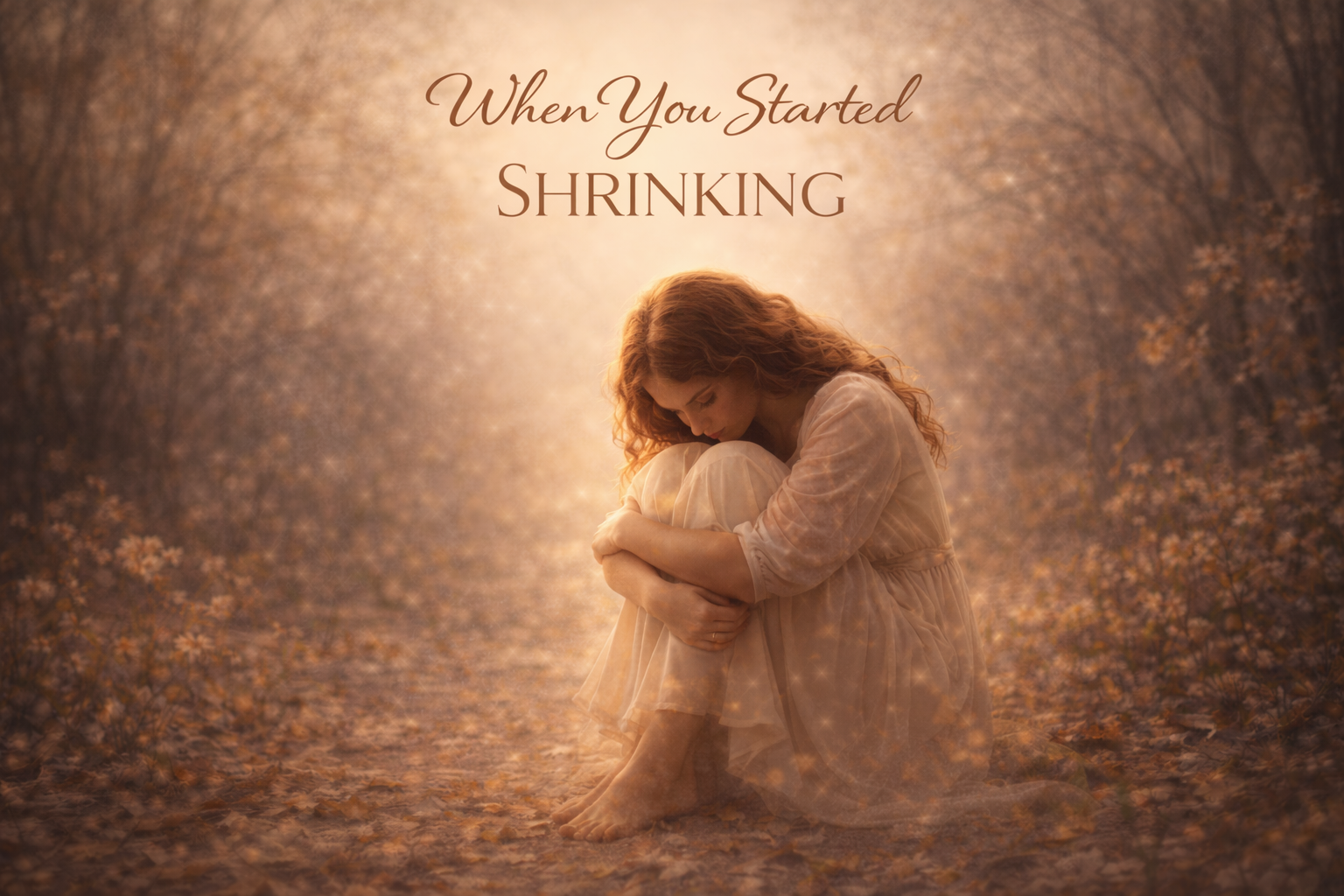
When You Started Shrinking
A Soul2222 page about how emotional shrinking begins, why it happens, and how to slowly return to your natural shape.
Most people do not shrink all at once.
It happens gradually. Quietly. Through a collection of moments that seem small when taken one by one, but heavy when they settle into the body over time.
A dismissal here.
A criticism there.
A room where your truth felt too large.
A relationship where your needs felt inconvenient.
A family pattern where being easy was rewarded more than being real.
A world that taught you how to become acceptable before it ever taught you how to become whole.
And so you adjusted.
You spoke a little less boldly. You hid a little more carefully. You second-guessed what once felt natural. You learned to read the emotional weather before showing your full self. You became skilled at fitting the room, even when the room could not hold your depth.
This is how shrinking begins.
Not because your soul was small.
Because some part of you learned that being fully visible might cost too much.
Shrinking Was a Way You Learned to Stay Safe
It is important to see this with compassion.
Shrinking does not mean you were weak. It means some part of you became alert to rejection, conflict, embarrassment, disappointment, or disconnection and decided it might be safer to become smaller than to remain fully seen.
Sometimes shrinking looks like silence.
Sometimes it looks like chronic self-doubt.
Sometimes it looks like apologizing for your feelings before you even express them.
Sometimes it looks like downplaying your gifts, hiding your needs, making yourself endlessly agreeable, or abandoning what lights you up because it feels easier not to want too much.
You may have learned to make yourself quieter in places where your truth was not welcomed.
You may have learned to become useful instead of honest.
You may have learned to keep the peace by leaving your own spirit unattended.
That kind of pattern deserves tenderness.
It was not foolish. It was protective. It was the part of you trying to help you survive the room, the season, the relationship, the pressure, the disappointment, or the environment you were in.
But what once protected you may now be limiting you.
And the real you is allowed to return.
The Cost of Becoming Smaller
At first, shrinking can feel useful.
It lowers tension. It helps you avoid judgment. It keeps certain relationships smooth. It earns approval in environments that do not know how to honor truth.
But over time, the cost becomes clearer.
You lose access to your natural signal.
You stop trusting your own preferences.
You speak from adaptation instead of alignment.
You say yes when your spirit means no.
You forget what fullness feels like.
And perhaps the most painful part is this: after enough time, shrinking can start to feel normal.
You may not even realize how often you leave yourself in order to keep the peace. You may think you are being mature when you are actually disappearing. You may think you are being kind when you are betraying your own reality. You may think you are staying humble when you are dimming a light that was never meant to be hidden.
True humility does not require you to erase yourself.
True peace does not require you to abandon your own voice.
True love does not require you to live as a smaller version of who God made you to be.
Shrinking may have helped you get through something.
But it was never meant to become your permanent shape.
Where You Begin to Notice the Pattern
Restoration begins when you gently notice the places where you contract.
Where do you silence yourself?
Where do you become overly agreeable?
Where do you edit your truth before it reaches your mouth?
Where do you make yourself emotionally smaller so that others do not have to stretch?
Where do you pretend something is fine when your spirit has already whispered that it is not?
These questions are not here to condemn you.
They are here to help you see where your soul learned that hiding was safer than being seen.
There is power in simply recognizing the pattern. Once you notice where you disappear, you begin to interrupt the old rhythm. Awareness becomes a doorway. Not a harsh spotlight, but a lantern.
You may begin to notice that your body tightens around certain people.
You may notice that your voice changes in certain rooms.
You may notice that your joy gets quieter when you are near people who only know how to handle the edited version of you.
You may notice that you have been calling it peace when it was really self-abandonment wearing soft shoes.
That noticing is holy.
It means something true in you is waking up.
Expansion Can Return Slowly
You do not need to burst back into your life in one dramatic act of confidence.
Real restoration is often quieter than that.
It may begin with one honest sentence. One boundary. One preference spoken aloud without apology. One moment of staying present with yourself instead of folding inward. One decision to stop laughing off what actually mattered to you.
This is how you begin to reverse the habit of shrinking.
Not by becoming hard.
Not by becoming loud for the sake of appearance.
Not by turning your pain into armor.
But by becoming available to your own truth again.
You can begin gently.
You can say, “I need a little time to think about that.”
You can say, “That does not feel right for me.”
You can say, “I see it differently.”
You can say, “I am not available for that.”
You can say, “This matters to me.”
Each honest sentence becomes a small act of return.
Each boundary becomes a little more room for your spirit to breathe.
Each moment of choosing truth over automatic shrinking reminds your inner life that it is safe to come forward again.
Expansion does not have to be dramatic to be powerful.
Sometimes the strongest thing you can do is simply remain with yourself.
You Are Allowed to Take Your Natural Shape
The part of you that learned to shrink deserves compassion.
It was trying to protect you. It carried you through seasons where being fully seen may not have felt safe, welcomed, or wise.
Honor that part.
But do not hand it the keys to your whole future.
You are allowed to outgrow the pattern.
You are allowed to take up the space your soul actually needs.
You are allowed to return to your natural shape.
Not inflated.
Not defended.
Not demanding the whole room revolve around you.
Just real.
Steady.
Honest.
Present.
Alive.
Unedited by fear.
There is a version of you that does not have to keep folding inward to survive every room. There is a version of you that can be kind without disappearing, humble without shrinking, strong without becoming cold, and gentle without handing away your own authority.
That version is not unreachable.
It is already within you.
It begins to rise every time you stop abandoning yourself for the comfort of people who were never meant to define your size.
You do not have to live as the smallest version of your truth.
Your life has room for the real you.
Your voice has room.
Your joy has room.
Your purpose has room.
Your light has room.
And slowly, one brave return at a time, you can come back into the shape you were always meant to carry.
If this message resonated, you may also enjoy:
Before You Forgot Your Own Light
Your Soulful Pathways ↑
Discover more Soul2222 series pages in Your Soulful Pathways ↑

Before You Forgot Your Own Light
Explore how fear, pressure, people-pleasing, and self-protection can disconnect you from your authentic self, and how to reconnect with your voice, joy, faith, and inner light.
Reconnecting With Your Authentic Self, Voice, Joy, Faith, and Inner Light
There was a time when your light moved more freely.
Before you learned to edit yourself.
Before you began scanning the room for approval.
Before your tenderness started feeling risky.
Before life taught you how to brace, perform, hide, overthink, or shrink to fit places that could not hold your full truth.
There was something in you that shone more naturally then.
Not because life was perfect.
Not because pain had never touched your story.
Not because you lived untouched by hardship, disappointment, confusion, rejection, or change.
Your light moved more freely because your essence had not yet become so covered by protection.
That light still matters.
Not as a faraway version of yourself you can never return to, but as a living truth that may still exist beneath the layers.
Somewhere underneath the self-monitoring, people-pleasing, emotional caution, old expectations, and ways you learned to protect yourself, there may still be an original radiance.
A way your soul knew how to move before fear became familiar.
A way your spirit responded before it learned to expect disappointment, rejection, pressure, criticism, or the need to become smaller than it really was.
Your defenses may have helped you survive.
Your light is what helps you feel fully alive.
And remembering that light is not about going backward.
It is about bringing something true forward.
Your Light Existed Before Your Defenses
Many people spend years trying to improve themselves without first asking what they may have forgotten.
They assume personal growth means constructing a better identity from the ground up.
Become more polished.
More acceptable.
More successful.
More controlled.
More impressive.
More untouchable.
But sometimes the deeper work is not about building an entirely new self.
Sometimes it is about remembering.
It is about uncovering qualities that existed before self-protection became a way of life.
Pressure may have shaped how you learned to behave, but it does not define the deepest parts of who you are.
You may have learned to impress.
Prove.
Disappear.
Perform.
Explain.
Keep the peace.
Stay small.
Those patterns may have influenced your behavior.
They may have become familiar enough to feel like personality.
But they are not necessarily the deepest definition of who you are.
There is a difference between who you are and what you learned to do to protect yourself.
That difference matters.
Survival can teach you how to function while leaving important parts of your inner life hidden.
You may know how to get through the day and still wonder where your joy went.
You may know how to handle enormous responsibility and still feel distant from your own voice.
You may know how to appear strong while missing the softness that once made you feel alive.
You may know how to read everyone else in the room while barely noticing what is happening inside you.
You may become excellent at adapting and slowly forget what it feels like simply to be.
That distance can feel enormous.
But distance is not disappearance.
The light you lost touch with may not be gone.
It may simply be waiting beneath everything that taught you to dim it.
What Can Cover a Person's Inner Light
People do not usually forget themselves all at once.
It happens slowly.
Through criticism.
Comparison.
Rejection.
Disappointment.
Pressure.
Heartbreak.
Repeated self-doubt.
Environments where approval felt conditional.
Relationships where honesty carried a cost.
Rooms where performance was rewarded more than truth.
You may have learned that being fully yourself created friction.
Maybe your sensitivity was called too much.
Your needs were treated as inconvenient.
Your joy was dismissed as childish.
Your ideas were overlooked.
Your honesty made someone uncomfortable.
Your creativity was criticized.
Your confidence threatened someone.
Your boundaries disappointed people who benefited from you having none.
So you adapted.
You became more careful.
More edited.
More guarded.
More observant of everyone else's reactions.
Less willing to reveal what mattered.
Less willing to risk being misunderstood.
This is how forgetting can begin.
Not because your light was weak.
Because adapting sometimes felt safer than shining.
And when that happens for long enough, a person can begin mistaking the protected version for the authentic version.
The guarded self starts feeling normal.
The cautious voice starts sounding wise.
The smaller life starts feeling familiar.
But familiar does not always mean true.
The version of you shaped by difficult seasons deserves compassion.
It helped you navigate what you knew how to navigate at the time.
But it does not have to become the final definition of who you are.
There may be more light in you than the guarded season allowed you to live.
You May Have Mistaken Protection for Personality
This can be one of the strangest discoveries in personal growth.
You begin asking:
Is this actually me, or is this something I learned?
Maybe you describe yourself as quiet, but somewhere along the way you learned that speaking openly brought criticism.
Maybe you believe you are indecisive, but you spent years being taught not to trust your own judgment.
Maybe you think you do not need much, but expressing needs once created conflict.
Maybe you believe you are naturally guarded, but openness once cost you something.
Maybe you think you are not creative anymore, but your creativity was repeatedly dismissed.
Maybe you call yourself a people-pleaser as though it is simply who you are, when perhaps keeping everyone happy once felt like the safest way to keep peace.
Not every trait has a hidden explanation.
Sometimes quiet really is quiet.
Sometimes independence really is independence.
Sometimes caution really is wisdom.
But it can be illuminating to ask.
Is this my nature, or is this an adaptation?
Does this still serve me?
Who might I be if I no longer needed this particular protection?
Those questions are not invitations to reject yourself.
They are invitations to know yourself more deeply.
Remembering Is Not Becoming Someone New
Remembering your light is not about inventing a brighter self out of nowhere.
You are not trying to become healed enough, spiritual enough, confident enough, successful enough, or impressive enough to finally become real.
You are returning to qualities that may already belong to you.
That is what makes this kind of growth sacred.
It is not performance.
It is not self-rejection dressed up as transformation.
It is not forcing yourself into a shape that earns approval.
It is a gradual return to what has remained true underneath everything else.
Maybe your light once looked like wonder.
Maybe it looked like gentleness.
Maybe it looked like curiosity.
Creativity.
Honesty.
Warmth.
Depth.
Openness.
Trust.
Courage.
Humor.
Imagination.
Prayer.
Playfulness.
Compassion.
The ability to see beauty without apologizing for being moved by it.
Whatever it looked like, those qualities may still belong to you.
Your light may return quietly at first.
It may not come bursting through the door with trumpets and banners.
It may arrive as a small desire to speak more honestly.
A pull toward something creative.
A cleaner boundary.
A deeper prayer.
A spontaneous laugh you did not suppress.
A moment of wonder.
A softer breath.
A decision that feels unmistakably yours.
A moment when you realize:
I do not want to live as a stranger to myself anymore.
That counts.
A flicker is still fire.
Remembering Yourself Does Not Mean Returning to the Past
There is an important distinction here.
You are not trying to become exactly who you were before difficult experiences changed you.
That person did not yet know everything you know now.
You have lived.
Learned.
Changed.
Loved.
Lost.
Discovered.
Questioned.
Grown.
Your experiences have become part of you.
Remembering the real you does not mean erasing everything that happened afterward.
It means bringing your original qualities forward with the wisdom you have gained.
Perhaps you were once open but had few boundaries.
Now you can become open and discerning.
Perhaps you were once trusting without knowing when trust had been misplaced.
Now you can become trusting and wise.
Perhaps you were once endlessly giving.
Now you can become generous without abandoning yourself.
Perhaps you were once spontaneous but ungrounded.
Now you can become free and rooted.
This is not regression.
It is integration.
You are not walking backward toward an earlier self.
You are allowing what was beautiful in that earlier self to meet the wisdom of who you have become.
Your Joy May Know Something About the Real You
One way to begin remembering yourself is to notice what makes you feel quietly alive.
Not what impresses people.
Not what earns praise.
Not what looks productive.
What brings you back into the room?
What makes time disappear?
What makes you curious?
What beauty catches your attention?
What subjects could you explore for hours?
What kind of music changes the atmosphere inside you?
What makes you laugh without thinking about how you sound?
What did you once love doing before you began deciding whether it was useful?
Joy can reveal something.
So can curiosity.
So can wonder.
They are not perfect maps, but they can point toward places within you that have not disappeared.
Sometimes remembering yourself begins with something wonderfully ordinary.
Planting something.
Painting.
Writing.
Cooking.
Walking outside.
Listening to music.
Learning.
Building.
Dancing in the kitchen.
Sitting somewhere beautiful.
Praying in silence.
Watching the sky change.
Calling someone who lets you be fully yourself.
These things may appear small.
But sometimes small things reopen doors that pressure closed years ago.
Your Own Voice May Need Room to Return
Another part of remembering is learning to hear yourself again.
When you have spent years adapting to expectations, other people's opinions can become louder than your own knowing.
What will they think?
Will they understand?
Will they approve?
Will they be disappointed?
Will this make someone uncomfortable?
Will I have to explain myself?
Eventually, your own voice can become difficult to distinguish beneath the noise.
Give it room.
Before asking everyone else what they think, ask yourself.
What do I think?
What feels true to me?
What do I actually want?
What gives me peace?
What feels forced?
What have I known for a long time but been afraid to acknowledge?
You do not have to obey every impulse simply because it came from within.
Discernment still matters.
Wisdom still matters.
Prayer still matters.
But your voice deserves a seat at the table of your own life.
You were never meant to disappear from your own decisions.
A Gentle Way to Begin Remembering
Ask yourself:
What did I stop expressing when I learned to be careful?
Do not force the answer.
Let it rise slowly.
It may come as a memory.
A feeling.
A longing.
A quiet ache.
A forgotten interest.
A desire.
A softness in your body when you remember what once felt natural before so much self-protection settled in.
Maybe you stopped trusting your own knowing.
Maybe you stopped speaking freely.
Maybe you stopped letting joy move through you.
Maybe you stopped honoring the parts of yourself that felt most alive.
Maybe you stopped creating because someone made your wonder feel foolish.
Maybe you stopped resting because your worth became tangled with usefulness.
Maybe you stopped asking for what mattered because needing anything felt unsafe.
Maybe you stopped dreaming because disappointment taught you to expect less.
The goal is not to judge how much has been hidden.
The goal is to notice what still glows beneath the surface.
You do not have to recover everything in one day.
You do not have to understand every layer before you begin.
You do not have to become fearless to become more honest.
Start small.
Tell the truth in one place.
Let joy have one doorway.
Let your voice return in one sentence.
Pick up something you once loved.
Wear something because you love it.
Say no where you mean no.
Say yes where your spirit genuinely comes alive.
Sit quietly long enough to hear yourself.
Let your spirit breathe without asking permission.
Sometimes remembering begins as only a flicker.
That flicker matters.
Protect it.
Give Your Light Somewhere to Live
Remembering is important.
But eventually, remembrance needs expression.
If you remember that you are creative, create something.
If you remember that you love nature, go outside.
If you remember that your faith matters deeply, make room for prayer.
If you remember that you love learning, study something that awakens your curiosity.
If you remember that you are playful, let some play return.
If you remember that honesty matters, practice one honest conversation.
If you remember that peace matters, stop giving every source of chaos unlimited access to you.
You do not have to rebuild your entire life around these discoveries tomorrow.
Just give your light somewhere to live.
A habit.
A boundary.
A room.
A morning ritual.
A conversation.
A creative project.
A relationship.
A prayer.
A small piece of your ordinary day.
The more room you create for what is true, the less foreign your own life begins to feel.
Some People May Know Only the Dimmed Version of You
Some people may have met you during a season when you were quieter.
More accommodating.
Less confident.
Less expressive.
More willing to accept what you would not accept today.
They may be familiar with the version of you who rarely said no, asked for very little, or made everyone else's comfort more important than your own truth.
As you change, some relationships may adjust beautifully.
Others may resist.
Change alters patterns.
And when one person changes their role within a pattern, everyone involved has to respond to something new.
You cannot control how everyone responds to your growth.
But you can choose to live with greater honesty.
You can become kinder without becoming smaller.
More loving without becoming invisible.
More open without surrendering discernment.
More authentic without needing everyone to approve.
The goal is not to become difficult to recognize.
It is to become increasingly recognizable to yourself.
Your Light Is Not Something You Have to Earn
You do not have to accomplish enough to deserve your own light.
You do not have to become perfect.
You do not have to prove that you have healed.
You do not have to receive permission from everyone who once misunderstood you.
You do not have to wait until every insecurity disappears.
Your worth was never supposed to be a prize awarded after sufficient self-improvement.
And your light is not a performance review.
It is expressed through the qualities that make your life more truthful and alive.
Love.
Integrity.
Creativity.
Faith.
Compassion.
Courage.
Wisdom.
Joy.
Presence.
The willingness to become more fully who God created you to be.
These qualities do not need applause before they become valuable.
God Did Not Create You to Disappear
There is a spiritual dimension to remembering yourself.
If you believe your life carries purpose, then becoming more truthful about who you are is not merely personal development.
It can become stewardship.
Your gifts matter.
Your compassion matters.
Your voice matters.
Your creativity matters.
Your discernment matters.
Your ability to love matters.
The qualities God placed within you were never meant to be buried beneath a lifetime of fear about whether everyone would understand them.
This does not mean every desire is divine direction or every impulse should be followed.
It means you do not have to assume that becoming smaller is the same thing as becoming humble.
Humility does not require disappearance.
You can honor God without denying what He has placed within you.
You can remain teachable while becoming confident.
You can remain gentle while becoming strong.
You can remain loving while developing boundaries.
You can become more fully yourself while becoming more deeply rooted in God.
Sometimes remembering your light means remembering where the light came from.
Your Light Is Still Yours
The part of you that forgot your own light deserves tenderness.
It adapted.
It learned how to navigate difficult seasons.
It carried you through experiences you may not have had the language, support, wisdom, or strength to fully understand at the time.
Honor that.
But do not mistake survival for your whole identity.
You are allowed to live from something deeper now.
You are allowed to soften where you became unnecessarily guarded.
You are allowed to open where you became hidden.
You are allowed to speak where you learned silence.
You are allowed to create where you learned embarrassment.
You are allowed to rest where you learned constant performance.
You are allowed to stop treating your light like a risk when it may be one of the most sacred truths within you.
Your light does not need to be loud to be real.
It does not need to impress everyone to be worthy.
It does not need to be understood by every room to be honored.
It only needs room to breathe again.
Frequently Asked Questions
What Does It Mean to Forget Your Own Light?
Forgetting your own light can describe becoming disconnected from qualities that once felt natural and authentic, such as joy, creativity, confidence, curiosity, honesty, faith, openness, or self-trust.
This can happen gradually as a person adapts to criticism, rejection, pressure, difficult relationships, disappointment, or environments where being fully themselves did not feel welcome.
How Do I Know If I Have Lost Touch With Myself?
You may notice that you constantly look to others before making decisions, rarely know what you actually want, suppress your needs, avoid things you once loved, or feel that you are performing a version of yourself rather than living naturally.
Feeling disconnected does not mean your authentic self has disappeared.
It may mean some parts of you need more room to be heard and expressed again.
Can People-Pleasing Make You Lose Your Sense of Self?
People-pleasing can sometimes make it difficult to distinguish your genuine preferences from what you believe will keep other people happy.
If you continually prioritize approval over your own values, needs, boundaries, or honest opinions, your own voice can become harder to hear.
Reconnecting with yourself may involve practicing small acts of honest preference and healthy boundaries.
How Can I Start Reconnecting With My Authentic Self?
Begin with curiosity rather than pressure.
Notice what brings you peace, joy, energy, interest, meaning, or a sense of being fully present.
Ask what you genuinely believe, want, value, and enjoy.
Then give one of those qualities a small place in your everyday life.
Is Remembering Who I Am the Same as Going Back to Who I Used to Be?
No.
You do not have to become an earlier version of yourself.
Healthy growth allows you to bring forward qualities that were always meaningful while combining them with the wisdom, discernment, experience, and maturity you have gained.
The goal is not regression.
It is integration.
Can I Be Authentic and Still Change?
Absolutely.
Authenticity does not mean remaining exactly the same forever.
You can learn, mature, change your mind, develop new interests, strengthen boundaries, deepen your faith, and discover entirely new parts of yourself while still living truthfully.
Becoming is part of being human.
How Can Faith Help Me Remember Who I Am?
Faith can help shift identity away from constant external approval and toward a deeper relationship with God, purpose, character, truth, and the qualities you believe were placed within you for a reason.
Prayer and reflection can also create quiet space to discern what is authentic, what has been learned through fear, and what may be ready to grow.
Before You Forgot Your Own Light
Before you forgot your own light, there was a part of you that knew how to move with more trust.
More wonder.
More honesty.
More presence.
More curiosity.
More life.
You do not have to recreate the past to find those qualities again.
You can bring them forward.
With wisdom now.
With discernment now.
With stronger boundaries now.
With deeper faith now.
With everything life has taught you.
You are not trying to become who you were.
You are discovering who you are when fear is no longer allowed to write every sentence.
Perhaps your light returns through creativity.
Perhaps through prayer.
Perhaps through laughter.
Perhaps through truth.
Perhaps through boundaries.
Perhaps through the courage to want something again.
Perhaps through one ordinary morning when you suddenly realize:
I feel like myself.
Do not underestimate that moment.
The real you is not behind you forever.
Your light is still here.
Still glowing beneath the layers.
Still waiting for room.
Still responding to truth.
Still capable of wonder.
Still ready to rise.
Your light is not gone.
It is still yours.
Continue the Journey
This reflection is part of the Remembering the Real You series.
If this message resonated, you may also enjoy:
Who Are You Without the Story?
Your Soulful Pathways ↑
Discover more Soul2222 series pages in Your Soulful Pathways ↑

Remembering the Real You
Remembering the Real You is a Soul2222 series about returning to your true essence beneath fear, performance, self-doubt, and conditioning.
Remembering the Real You is not about becoming someone else.
It is not about performing a better version of yourself, fixing your personality, or chasing a shinier identity until you finally feel worthy. It is about returning to the part of you that existed before fear became a pattern, before survival became a lifestyle, and before the world taught you to measure yourself by how useful, agreeable, productive, or easy you were to hold.
The real you is not a costume you have to earn.
It is not buried so deeply that it cannot be reached. It is not lost because life became loud. It is not gone because you adapted, endured, adjusted, softened your voice, or learned how to survive rooms that did not know how to recognize you.
The real you is still here.
Still breathing beneath the layers.
Still carrying a quiet light.
Still waiting for your return.
A Return to What Was Always True
Somewhere along the way, many people learn to leave themselves.
Not all at once. Usually slowly. Quietly. Through rejection, pressure, comparison, disappointment, heartbreak, responsibility, and the long training of trying to be acceptable. You learn what gets approval. You learn what keeps conflict low. You learn how to be chosen, how to stay safe, how to read the room, how to shrink before anyone asks you to.
But survival is not the same as identity.
The way you learned to cope is not the whole of who you are. The habits that helped you make it through a hard season do not get to define the full kingdom of your life. There is a deeper self beneath the performance, beneath the overthinking, beneath the pleasing, beneath the doubt, beneath the old stories that tried to name you before you had the strength to answer back.
Remembering the Real You is a sacred return to that deeper place.
Not a forced reinvention.
Not a harsh self-improvement project.
Not a frantic attempt to become enough.
A return.
A gathering back.
A quiet turning toward the truth that never stopped belonging to you.
You Are Not Here to Perform Worthiness
There is a kind of exhaustion that comes from trying to prove a worth that was never supposed to be on trial.
Many people spend years trying to become impressive enough, helpful enough, quiet enough, strong enough, attractive enough, spiritual enough, successful enough, or healed enough to finally feel safe inside their own life.
But the real you does not begin at the finish line of achievement.
The real you is not waiting for a perfect mood, a perfect body, a perfect bank account, a perfect relationship, a perfect past, or a perfect record. The real you is not reserved for some future version of yourself who finally has everything figured out.
Your worth is not a reward for performance.
It is part of your design.
This series is for the person who is ready to stop asking, “Who do I need to become to be enough?” and begin asking, “What have I forgotten that was always true?”
That question changes the atmosphere.
It moves you out of endless striving and brings you back into remembrance. It reminds your heart that it is not a machine to optimize. It is something sacred to listen to. It reminds your spirit that healing is not always a staircase. Sometimes it is a homecoming.
Sometimes the miracle is realizing you have spent years trying to improve what was never meant to be rejected.
The Real You Still Carries a Clear Signal
The real you has a signal.
You can feel it in the places where your spirit becomes steady. You can feel it in the conversations that make you breathe differently. You can feel it in the work that wakes something honest in you. You can feel it in the people who do not require you to disappear in order to belong.
Your real self speaks through resonance.
Through longing.
Through peace.
Through holy discomfort.
Through creativity.
Through tenderness.
Through the quiet ache for a life that feels more honest.
This does not mean every feeling is a command. It means your inner life is not random noise. It has wisdom. It has pattern. It has a voice.
There are parts of you that still know what is life-giving, what is draining, what is false, what is clean, what is no longer yours to carry.
Remembering the Real You helps you listen again.
It helps you notice where you abandoned your own voice. It helps you recognize where you became hard just to cope. It helps you tell the truth about what was never really you, even if you wore it for years.
And slowly, gently, powerfully, the signal gets clearer.
Remembering Gives You Direction
Remembering is not passive.
It is not sitting still forever, waiting for life to hand you a perfect sense of identity. Remembering gives direction. It helps you choose differently. It strengthens the inner yes and the holy no. It teaches you what belongs in your life and what only stayed because you forgot you were allowed to grow.
When you remember who you are, you begin to stop negotiating with everything that diminishes you.
You stop calling self-betrayal peace.
You stop calling exhaustion strength.
You stop calling shrinking wisdom.
You stop calling constant adaptation love.
You begin to build a life that can actually hold the truth of you.
That may happen in small ways first. A boundary. A prayer. A breath. A cleaner choice. A quieter morning. A braver conversation. A refusal to insult yourself. A decision to rest without guilt. A willingness to believe that your life is not finished speaking.
Small returns matter.
Every honest choice becomes a thread back to yourself.
This Is a Sacred Homecoming
Remembering the Real You is for the soul that is ready to rise without abandoning tenderness.
It is for the person who knows there is more life inside them than old fear allowed them to live. It is for the one who is tired of carrying identities made from survival, disappointment, expectation, and the small definitions other people handed them.
You are not here to become a polished version of someone else’s approval.
You are here to come home to what is real.
The true version of you may not arrive with thunder. It may return softly. Through one honest sentence. One brave decision. One moment of stillness. One place where you finally stop arguing with your own light.
Not the polished version.
Not the pressured version.
Not the version created to survive everyone else’s expectations.
The true version.
The one that feels steady, open, alive, honest, and real.
You are not starting from nothing.
You are not trying to invent a soul. You are not building worth from scraps. You are not manufacturing light that never existed. You are reconnecting with something that has remained quietly alive beneath the surface, even through seasons when you could not feel it clearly.
The real you is not behind you forever.
It is still here.
Still breathing beneath the layers.
Still carrying the sound of home.
Still waiting for your return.
Continue the Journey
This is the beginning of the Remembering the Real You series.
If this reflection stirred something honest in you, continue with the next message in this pathway:
The You Before the World Touched You
If this message resonated, you may also enjoy:
Before You Forgot Your Own Light
How to Recognize Your Own Light
A Remembering Ritual for Hard Days
Your Soulful Pathways ↑
Discover more Soul2222 series pages in Your Soulful Pathways ↑

Daily Inner Kingdom Check-In
Use this daily inner kingdom check-in to reconnect with peace, self-trust, and emotional clarity through a gentle practice of inner leadership.
Peace Is Strengthened Through Daily Attention
Peace is strengthened through daily attention.
A healthy inner life is not built only through breakthroughs. It is built through rhythm. It is built through small returns, honest pauses, quiet choices, and sacred moments where you come back to yourself before chaos has a chance to take over the room again.
This is why a daily check-in matters.
Many people move through the day without ever truly checking in with themselves. They respond, perform, fix, help, think, solve, carry, and keep going. They notice the needs around them before they notice what is happening within them.
But inner leadership requires awareness.
You cannot lead what you refuse to notice.
A Daily Inner Kingdom Check-In is not meant to become one more heavy task. It is not a performance. It is not a spiritual checklist. It is a small act of return.
A pause.
A breath.
A reconnection.
A way of asking, “What is happening in me today, and who is leading right now?”
That question can bring your inner world back into order.
It helps you notice whether peace is still near the center or whether fear, pressure, exhaustion, resentment, or urgency has quietly taken the seat.
Honesty Before Performance
Start with honesty, not performance.
This check-in does not require polished answers. It does not require you to sound wise, feel peaceful, or have everything figured out before you begin. It simply asks for truth.
Truth is a clean beginning.
You might ask yourself:
What am I feeling right now?
What is my body carrying today?
What thoughts have been setting the tone lately?
What feels aligned?
What feels off?
Have I been abandoning myself anywhere?
What has been louder than peace?
What would peace need from me today?
These questions are not meant to judge you. They are meant to help you see yourself clearly.
Awareness itself can be healing because it interrupts autopilot. It gives you a moment to stop moving from habit and begin moving from wisdom. It lets you notice the inner atmosphere before it becomes the outer reaction.
Sometimes the most powerful thing you can say is simple:
This is what is happening in me.
No shame.
No pretending.
No spiritual performance.
Just truth, held with kindness.
Listening to the Inner Council
A daily check-in helps you listen to your inner council.
Your mind may be carrying thoughts that need to be named.
Your body may be carrying tension that needs care.
Your emotions may be asking to be heard without being allowed to rule.
Your spirit may be longing for prayer, stillness, truth, beauty, or a slower pace.
When you check in daily, you stop treating yourself like one disconnected machine. You begin relating to yourself like a whole being.
You may discover that your mind needs less noise.
You may discover that your body needs rest.
You may discover that your emotions need compassion.
You may discover that your spirit needs time with God.
You may discover that your peace has been pushed to the edge of your life when it was meant to have a place near the center.
This is not overthinking. It is stewardship.
You are tending the inner kingdom.
You are noticing what has been neglected.
You are learning what needs order, care, truth, release, or protection.
A check-in does not have to be long to be powerful. Even a few honest minutes can interrupt a pattern, soften a reaction, and help you return to the deeper part of you that knows how to lead.
Awareness Becomes Leadership
The goal is not only to notice what is there.
The goal is to lead wisely from what you see.
If your body is carrying too much tension, perhaps peace needs rest.
If your mind is spinning, perhaps peace needs less stimulation and more truth.
If your emotions are loud, perhaps peace needs compassion and discernment.
If your spirit feels neglected, perhaps peace needs prayer, stillness, reflection, Scripture, worship, or quiet time away from noise.
This is how a check-in becomes more than a mood report.
It becomes inner leadership.
Not harsh.
Not rigid.
Attentive.
Wise.
Steady.
The more consistently you do this, the more your inner world begins to trust you. It learns that you will notice. It learns that you will not keep charging ahead while everything inside you is asking for care. It learns that peace has a place in your daily life, not just in your imagination.
Small daily returns create a steadier life.
A five-minute pause may not solve everything in one day, but it can change the direction of your inner life over time. It keeps you connected. It helps you respond sooner. It strengthens self-trust. It reminds you that leadership begins inside and must be renewed again and again.
Your inner kingdom does not need constant intensity.
It needs faithful attention.
Gentle Reflection
A daily check-in is one way of saying:
I am here.
I am listening.
I am not abandoning myself today.
I want peace near the center again.
That kind of return is powerful.
It is how calm becomes more natural. It is how self-trust becomes stronger. It is how peace becomes less accidental. It is how your inner kingdom stays tended.
You do not need to overhaul your whole life in one moment.
You can begin with today.
One pause.
One honest answer.
One breath before reaction.
One moment of listening.
One choice that brings peace closer to the center.
This is how inner leadership becomes a rhythm instead of an idea. This is how the kingdom within you becomes steadier, clearer, and more whole.
Ask yourself today:
What does my inner kingdom need from me right now?
What has been leading me lately?
What part of me needs care, truth, rest, or courage?
Where can I create more room for peace today?
What is one small choice that would help me lead myself well?
If this message resonated, you may also enjoy:
When You Stop Negotiating With Chaos
Alignment Isn’t Loud. It’s Consistent
Your Soulful Pathways ↑
Discover more series pages for you in Your Soulful Pathways ↑

When You Stop Negotiating With Chaos
Learn what changes when you stop negotiating with chaos and begin protecting peace, boundaries, and inner order with quiet strength.
Chaos Does Not Get the Final Vote
Chaos should not always get a vote.
There comes a point in inner leadership when you realize that not everything deserves endless negotiation. Not every chaotic pattern deserves one more chance to prove itself harmless. Not every draining habit deserves more access. Not every inner storm deserves the final say.
For a long time, people often negotiate with chaos because it feels familiar.
They explain it.
They excuse it.
They revisit it.
They accommodate it.
They keep making room for it long after it has already shown what it brings.
This can happen outwardly in relationships, environments, routines, and responsibilities. But it can also happen inwardly in thought patterns, emotional cycles, old reactions, fear loops, and self-defeating habits.
At some point, peace requires a decision:
Chaos no longer gets this kind of access.
That decision is not harsh. It is holy clarity. It is the deeper part of you rising up and saying, “This cannot keep ruling my inner world.”
Peace begins to grow when you stop giving disorder the same authority as truth.
Peace Requires Clarity
Peace grows where clarity is allowed.
Negotiating with chaos can sound reasonable at first. “Maybe it will change.” “Maybe I am overreacting.” “Maybe this time will be different.” “Maybe I can keep managing it.” “Maybe it is not as draining as it feels.”
But constant negotiation is not always wisdom.
Sometimes it is avoidance of the grief that comes with clarity.
Clarity can be uncomfortable because it asks something of you. It may ask for a boundary, a release, a refusal, a new rhythm, a better pattern, or a deeper level of honesty. It may ask you to stop pretending something is peaceful just because it is familiar.
But clarity also protects peace.
It stops pretending that everything belongs in your life equally.
It helps you recognize the difference between what stretches you and what drains you, what challenges you and what continually destabilizes you, what deserves patience and what has already shown its pattern.
When you stop negotiating with chaos, you begin honoring what peace requires.
You begin to understand that peace is not built by giving everything unlimited access. Peace is built when truth is allowed to name what no longer belongs near the center of your life.
Boundaries Create Inner Order
Boundaries are part of inner government.
A healthy inner kingdom cannot stay healthy if chaos is always welcomed as though it deserves the same seat as truth, wisdom, peace, and spiritual alignment. Boundaries help establish order. They tell your life what will no longer be allowed to keep ruling through confusion, pressure, repeated disruption, and emotional exhaustion.
This does not mean you become hard-hearted.
It means you become clear.
It means you stop treating chaos like an equal partner in your decision-making. It means you stop letting every crisis, every old fear, every familiar pattern, and every self-undermining impulse pull you away from your center.
Sometimes the holiest word is no.
Sometimes the cleanest answer is enough.
Sometimes peace grows not because something lovely was added, but because something chaotic finally lost access.
That is not cruelty.
That is stewardship.
You are the keeper of your inner atmosphere. You are allowed to notice what keeps disturbing your peace. You are allowed to protect what God is restoring in you. You are allowed to stop opening the door to what repeatedly walks in and scatters what you have been trying to build.
Boundaries do not make your life smaller.
They make room for what is sacred to breathe.
You Do Not Owe Chaos Your Loyalty
You do not owe chaos your loyalty.
There is no virtue in staying endlessly available to what keeps stealing your peace. Chaos may be loud, but loudness is not authority. Familiarity is not alignment. Repetition is not proof that something belongs.
Some patterns feel powerful only because they have had access for so long.
Some fears feel truthful only because they have spoken so often.
Some habits feel like part of you only because they have gone unchallenged.
But you are allowed to outgrow what once ruled you.
You are allowed to stop negotiating with the thoughts that make you smaller.
You are allowed to stop returning to the emotional cycles that exhaust your spirit.
You are allowed to stop giving old confusion a seat at the table of your future.
The moment you stop negotiating with chaos, something in you stands taller. Self-trust grows. Clarity deepens. Peace feels less fragile because you are no longer making it share the room with everything that opposes it.
This is not punishment.
It is protection.
It is inner leadership saying, “We do not live like that anymore.”
And sometimes that one sentence changes the whole atmosphere of a life.
Gentle Reflection
When you stop negotiating with chaos, you are not declaring that life will never be difficult. You are declaring that difficulty does not get to become your ruler. You are deciding that pressure does not get automatic authority. You are choosing to stop making endless room for what keeps pulling you away from peace.
This is part of rightful order.
Truth gets a voice.
Peace gets a place.
Wisdom gets authority.
Chaos does not get to sit on the throne.
You can be compassionate and still be clear. You can be patient and still have limits. You can be loving and still say no. You can be gentle and still refuse to keep giving access to what repeatedly fractures your inner world.
Ask yourself today:
What chaos in my life have I been over-negotiating with?
What pattern has already shown me what it brings?
What would peace ask me to make clear?
Where do I need a cleaner boundary?
What would change if I stopped giving chaos a vote in my inner kingdom?
If this message resonated, you may also enjoy:
Your Soulful Pathways ↑
Discover more series pages for you in Your Soulful Pathways ↑
Power in Calm Decisions
Discover the power of calm decisions and how inner authority helps you choose with clarity, peace, and self-trust instead of pressure.
Clarity, Discernment, Inner Peace, and Better Choices
Calm is not weakness.
In a world that rewards urgency, speed, reaction, and immediate answers, calm can look unimpressive at first.
It does not rush to prove itself.
It does not perform panic to seem responsible.
It does not create drama in order to feel powerful.
It does not assume that the loudest feeling must contain the clearest answer.
Calm carries a quieter strength.
And that strength is real.
Calm can see.
Calm can listen.
Calm can wait long enough for the emotional dust to settle.
Calm can recognize the difference between something that feels urgent and something that is actually important.
Many poor decisions are not made because people lack wisdom.
They are made because people are flooded.
When fear spikes, pressure rises, anger takes over, or uncertainty becomes uncomfortable, it becomes harder to hear the quieter voice of discernment.
You may choose for relief instead of truth.
You may say yes because saying no feels uncomfortable.
You may say no because fear makes possibility feel dangerous.
You may respond before you understand what you are responding to.
You may choose what makes the feeling disappear now instead of what will create greater peace later.
That is why calm matters.
Calm gives wisdom room to speak.
It gives your spirit space to recognize what is true.
It gives you enough distance from the immediate emotional weather to ask a better question:
What choice will I still respect when this feeling passes?
There is power in calm decisions because calm helps you choose from your deeper center instead of your loudest fear.
Pressure Pushes, Calm Considers
Pressure pushes.
Calm considers.
Pressure says:
Decide now.
Calm says:
Pause long enough to see clearly.
Pressure says:
Do whatever makes this feeling stop.
Calm asks:
What will remain true after this feeling passes?
Pressure wants immediate relief.
Calm wants wise alignment.
This distinction matters because not every urgent feeling carries accurate direction.
Sometimes urgency is fear asking for the steering wheel.
Sometimes pressure is discomfort demanding an escape.
Sometimes guilt disguises itself as responsibility.
Sometimes excitement makes something look clearer than it actually is.
Sometimes anger makes immediate action feel powerful when waiting would be wiser.
Emotions can carry useful information, but they do not always need to become immediate instructions.
You can honor what you feel without allowing every feeling to make your decisions.
That is inner leadership.
Calm Does Not Mean Doing Nothing
Calm is sometimes misunderstood as passivity.
But a calm decision can be incredibly decisive.
A calm no.
A calm yes.
A calm ending.
A calm beginning.
A calm boundary.
A calm correction.
A calm decision to walk away.
A calm willingness to stay.
A calm refusal to return to what has repeatedly brought chaos.
A calm decision to stop explaining yourself to what has already shown you its pattern.
There is nothing passive about clarity.
Sometimes calm tells you to wait.
Sometimes calm tells you to act because the answer is already clear.
The difference is that the action is not being controlled by emotional chaos.
You are acting from clarity rather than trying to escape discomfort.
That distinction can change the direction of a life.
Emotional Urgency Is Not Always Real-World Urgency
One of the most useful distinctions you can learn is the difference between emotional urgency and actual urgency.
Actual urgency may require immediate action.
A genuine emergency.
An immediate responsibility.
A time-sensitive opportunity.
A situation involving safety.
A deadline that truly exists.
Those moments call for appropriate action.
But emotional urgency can make an ordinary decision feel as though the walls are closing in.
I have to decide right now.
I have to answer them immediately.
I cannot sit with this uncertainty.
Something terrible will happen if I wait.
Sometimes the deadline exists only inside the feeling.
Before making an important decision, ask:
Is this actually urgent, or does it simply feel urgent?
That question can create precious space between reaction and choice.
And sometimes a few minutes, a night of sleep, a prayer, a walk, or one additional piece of information changes everything.
Calm Creates Space Between Feeling and Choice
There is enormous power in the space between what happens and what you do next.
Someone says something upsetting.
You do not have to answer immediately.
An opportunity appears.
You do not have to accept before understanding it.
Someone asks something of you.
You do not have to give an automatic yes.
Fear rises.
You do not have to reorganize your life around it.
Anger appears.
You do not have to turn it into action before you understand what it is protecting.
Calm creates a small clearing.
And inside that clearing, you regain choice.
You can ask:
What actually happened?
What am I feeling?
What do I know?
What am I assuming?
What information am I missing?
What response agrees with who I want to be?
That pause is not weakness.
Sometimes the pause is where your power returns.
Calm Decisions Protect Future Peace
Every decision plants something.
It creates a consequence, direction, pattern, boundary, relationship, commitment, opening, or ending.
That is why inner authority matters.
It helps you stop sabotaging tomorrow's peace simply to relieve today's discomfort.
Calm decision-making asks different questions:
Does this align with my deeper truth?
Will this create greater peace or greater chaos later?
Am I choosing from fear, pressure, guilt, anger, or clarity?
What are the likely consequences of this choice?
Do I actually have enough information yet?
Does my spirit feel settled here?
Would I make the same decision tomorrow morning?
These questions shift the center of your life.
Instead of allowing every feeling to write the next chapter, you let wisdom hold the pen.
Calm decisions protect your future from the cost of panic.
They protect your peace from impulsive agreements.
They protect your time from automatic yeses.
They protect your relationships from unnecessary reactions.
They protect your self-trust from repeatedly choosing against what you already know.
They protect your inner kingdom from being ruled by whatever happens to feel loudest today.
Calm Makes Room for Discernment
Discernment needs room.
When everything inside you is shouting, subtle differences become harder to recognize.
Fear and intuition can sometimes be difficult to distinguish in the moment.
So can:
Excitement and alignment.
Guilt and responsibility.
Avoidance and peace.
Pressure and genuine urgency.
Calm gives you space to look more carefully.
You can ask whether a choice agrees with your values.
Whether the facts support it.
Whether you are responding to what is actually happening now.
Whether you need more information.
Whether you are choosing something because it is right or because you desperately want uncertainty to end.
This is also where prayer can become powerful.
Instead of praying only:
God, tell me what to do.
You might also pray:
God, quiet what is distorting my sight. Help me recognize what is true. Give me wisdom to know what is mine to do and courage to do it.
Sometimes the answer becomes clearer when the noise becomes quieter.
You Can Be Calm and Still Change Your Mind
Inner authority does not mean stubbornness.
A strong decision-maker can receive new information.
You can make the best decision available with what you know today and later discover something you did not know.
Then you can adjust.
That is not weakness.
That is wisdom responding to reality.
Calm does not need to defend yesterday's decision simply because yesterday made it.
Calm can say:
I know more now.
I see this differently now.
This no longer aligns.
I need to reconsider.
I was wrong.
I am choosing differently.
There is freedom in knowing that one decision does not imprison you forever.
Some choices have lasting consequences, but many parts of life allow reconsideration, repair, adjustment, and new direction.
You do not need perfect foresight.
You need honesty, wisdom, and enough humility to keep listening.
The 24-Hour Question
When a decision feels emotionally charged and does not require an immediate answer, try a simple practice:
Would anything important be harmed if I waited until tomorrow?
If the answer is no, give the decision some room.
Sleep.
Pray.
Walk.
Write down the facts.
Let excitement settle.
Let fear settle.
Let anger settle.
Then revisit the decision.
Sometimes the answer remains exactly the same.
That itself can be useful.
You discover that the decision was not merely an emotional reaction.
Other times, the answer changes once the intensity passes.
Either way, you have learned something.
Not every decision needs 24 hours.
But decisions carrying strong emotion often benefit from enough space to discover what remains after the emotional volume comes down.
A Simple Calm Decision Practice
When you have an important decision to make, move through these questions:
1. What are the facts?
Separate what you actually know from what you fear, hope, suspect, or assume.
2. What am I feeling?
Name the emotion without judging it.
Fear.
Excitement.
Anger.
Guilt.
Pressure.
Hope.
Confusion.
Relief.
3. Is there a genuine deadline?
Determine whether the urgency exists in reality or mainly inside the emotional experience.
4. What information am I missing?
Sometimes clarity requires another question rather than another hour of thinking.
5. What choice agrees with my values?
Bring the decision back to who you want to be and what you believe matters.
6. What are the likely consequences?
Look beyond immediate relief.
Consider tomorrow.
Next month.
Next year, when appropriate.
7. What becomes clearer when I become quieter?
Then pause.
Pray.
Listen.
And when clarity arrives, have the courage to honor it.
Stronger Decisions Build Deeper Self-Trust
A life filled with frantic decisions can easily become a frantic life.
But a life built through clearer choices begins to carry a different atmosphere.
You start trusting yourself more.
You become less available for unnecessary confusion.
You learn that you do not have to answer every demand immediately.
You become more comfortable saying:
I need to think about that.
Let me get back to you.
I need more information before deciding.
That does not work for me.
Yes, this feels right.
No, I am not choosing that.
There is tremendous power in a person who does not need panic to make progress.
Calm decisions teach your inner world:
We do not have to run every time fear knocks.
We can pause.
We can listen.
We can discern.
We can choose.
That is how self-trust grows.
Not from making every decision perfectly.
From knowing that you can listen, choose, learn, and adjust.
Calm Can Become Part of Your Inner Kingdom
The Inner Kingdom is strengthened whenever you decide what gets authority within you.
Fear may speak.
It does not automatically become king.
Anger may speak.
It does not automatically write the law.
Pressure may arrive.
It does not automatically set the deadline.
Other people's opinions may matter.
They do not automatically become your truth.
Your emotions deserve to be heard.
But your deepest decisions deserve more than whichever feeling happens to be loudest.
Wisdom needs a seat.
Truth needs a seat.
Faith needs a seat.
Discernment needs a seat.
Peace needs a seat.
And when those voices have room, your choices begin to change.
You become less reactive without becoming passive.
More thoughtful without becoming indecisive.
More peaceful without becoming powerless.
More open without becoming easily moved.
Calm becomes part of your strength.
Frequently Asked Questions
Why Is It Better to Make Decisions When Calm?
Calm can make it easier to consider information, consequences, values, and alternatives rather than responding primarily to immediate emotional pressure.
The goal is not to eliminate emotion.
It is to give yourself enough space to use emotion as information without allowing it to become the only information.
Does Being Calm Mean Ignoring My Feelings?
No.
Calm decision-making begins by recognizing what you feel.
Fear, anger, excitement, disappointment, hope, and concern may all contain useful information.
The difference is that you listen to the emotion before deciding whether it should direct your action.
How Can I Calm Down Before Making an Important Decision?
When circumstances allow, create some space.
Step away from the conversation.
Take a walk.
Pray.
Breathe slowly.
Sleep before answering.
Write down what you know.
Gather missing information.
Talk with someone whose wisdom you trust.
Even a short pause can sometimes change the quality of a decision.
How Do I Know Whether Something Is Actually Urgent?
Look for an external reason the decision must happen immediately.
Is there a genuine deadline?
Is someone's safety involved?
Will waiting create a real consequence?
Or is the strongest pressure coming from discomfort with uncertainty?
Not everything that feels urgent actually is.
Can a Calm Decision Still Be Difficult?
Absolutely.
Some of the clearest decisions are difficult precisely because they require courage.
Calm does not guarantee comfort.
It gives you a steadier place from which to choose.
What If I Make the Wrong Decision?
You will not make every decision perfectly.
When new information appears, you can learn, adjust, repair what can be repaired, and choose again where choice remains available.
Self-trust does not come from never making mistakes.
It grows from knowing you can respond wisely when you do.
Choose From the Quiet Place
There is real power in calm decisions because calm helps truth rise to the surface.
Calm does not remove responsibility.
It helps you carry responsibility with wisdom.
Calm does not make decisions disappear.
It helps you make them from a clearer place.
Calm does not promise that every choice will be easy.
It gives you a steadier center from which to choose.
You do not have to rush every decision simply because pressure is present.
You do not have to obey fear because fear speaks loudly.
You do not have to choose temporary relief at the expense of lasting peace.
You can pause.
You can breathe.
You can gather information.
You can pray.
You can ask for wisdom.
You can wait when waiting is wise.
You can act when action is clear.
And you can make the calm decision even when the calm decision requires courage.
Ask yourself:
What decision in my life needs less pressure and more peace around it?
Where have I been mistaking urgency for wisdom?
What am I assuming that I could actually verify?
What choice would support my future peace?
What would remain true if I gave this decision a little more room?
What would calm say if I allowed it to speak?
Sometimes power does not arrive as force.
Sometimes it arrives as a quiet moment in which fear stops holding the pen.
And you choose from truth instead.
If this message resonated, you may also enjoy:
When You Stop Negotiating With Chaos
Your Soulful Pathways ↑
Discover more series pages for you in Your Soulful Pathways ↑

Creating a Seat for Peace
Learn how to create a lasting place for peace within your life through self-trust, calm choices, and inner emotional stability.
Peace Needs a Place to Sit
Peace needs a place to sit.
Many people want peace, but they treat it like a visitor instead of giving it a place to stay. They hope it will appear when circumstances calm down, when people behave better, when the schedule gets lighter, or when life becomes less demanding.
But peace cannot become a steady atmosphere in your life when it is always treated like something temporary.
Creating a seat for peace means making room for it within your inner world. It means building a life where peace is no longer constantly pushed out by urgency, fear, overreaction, noise, and emotional chaos. It means deciding that calm gets to belong here too.
This is not denial.
It is intention.
It is the sacred decision to stop making peace wait outside the door of your own life.
Peace needs more than an occasional invitation. It needs a place of honor. It needs room in your thoughts, your pace, your choices, your boundaries, your body, your prayers, and your daily rhythm.
When you create a seat for peace, you are telling your inner kingdom:
Calm is welcome here.
Wisdom is welcome here.
Stillness is welcome here.
God’s peace is not a stranger here.
Peace Can Live in Real Life
Peace is not the absence of everything hard.
Many people imagine peace as a life where nothing difficult happens, no one disappoints them, no pressure rises, no uncertainty appears, and no emotion shakes the room. But peace does not require perfect conditions. It requires a stable center.
You can still have grief and peace.
You can still have uncertainty and peace.
You can still have responsibility and peace.
You can still have pressure around you without giving pressure full authority within you.
Peace becomes stronger when it is built into your way of living instead of left at the mercy of your circumstances.
This might mean making slower decisions instead of impulsive ones.
It might mean stepping away from unnecessary noise.
It might mean protecting your energy from constant overstimulation.
It might mean refusing to rehearse fear all day in your own mind.
It might mean choosing what nourishes your spirit instead of what only drains your attention.
It might mean allowing silence, prayer, breath, rest, and truth to become part of your daily atmosphere again.
Peace is not fragile when it is rooted.
It can sit with you in the middle of a hard season and still remind you that chaos does not get the final word. It can steady your thoughts, soften your reactions, and help you respond from wisdom instead of pressure.
This is how peace becomes more than a feeling.
It becomes a way of being led.
A Peaceful Life Is Built Through Repeated Choices
A peaceful life is built on repeated choices.
Peace is rarely created in one grand gesture. More often, it is created through small daily decisions that teach your inner world what atmosphere you are willing to live in.
When you keep a healthy boundary, peace gets stronger.
When you stop feeding panic with constant mental spiraling, peace gets stronger.
When you stop abandoning yourself, peace gets stronger.
When you choose gentleness without becoming passive, peace gets stronger.
When you tell the truth before resentment grows, peace gets stronger.
When you give your body rest instead of treating exhaustion like a badge of honor, peace gets stronger.
When you return to God before you return to worry, peace gets stronger.
A seat for peace is built through repetition. It is built by choosing what supports steadiness over and over again until calm no longer feels foreign.
At first, peace may feel unfamiliar if you have lived for a long time in urgency. Calm can feel strange when your inner world has been trained to expect pressure. Stillness can feel uncomfortable when noise has become normal. Rest can feel undeserved when over-functioning has been your pattern.
But peace can be learned.
Your inner world can become accustomed to gentleness.
Your nervous system can begin to recognize safety.
Your spirit can begin to breathe again.
Every peaceful choice becomes another stone in the foundation.
Peace Belongs Near the Center
Peace belongs near the center.
If peace is always the first thing sacrificed, something in you will remain tired. You may achieve things, help people, keep moving, and appear strong on the outside, but inwardly you may feel like there is never anywhere soft to land.
Peace changes that.
It gives your soul somewhere to sit down.
This is one of the sacred responsibilities of inner leadership. You are not only leading your life forward. You are also deciding what gets to live at the center of it.
If urgency sits at the center, everything becomes rushed.
If fear sits at the center, everything becomes tense.
If approval sits at the center, everything becomes negotiable.
If exhaustion sits at the center, everything becomes heavy.
But when peace is allowed near the center, your inner world begins to change.
Your thoughts breathe more easily.
Your body softens more often.
Your decisions become less frantic.
Your spirit feels less exiled from your daily life.
Peace deserves more than occasional access. It deserves a real place.
Not because life will always be easy, but because your soul was not created to live constantly crowded by pressure. You were made for steadiness. You were made for communion with what is sacred. You were made for an inner life where peace is not always being evicted by the loudest demand.
Peace is not a luxury.
It is part of rightful order.
Gentle Reflection
Creating a seat for peace is one of the most powerful acts of inner leadership.
It is the decision to stop treating calm like an accident and start treating it like something worthy of protection. It is the decision to notice what keeps pushing peace out and to begin making different choices. It is the decision to let wisdom, stillness, prayer, and truth become part of the atmosphere within you.
Peace does not need everything around you to be perfect before it can sit with you.
It only needs room.
A little room in your morning.
A little room in your thoughts.
A little room before you respond.
A little room before you say yes.
A little room before fear takes over.
A little room where your spirit can remember that God is near, truth is steady, and you do not have to be ruled by every storm.
Ask yourself today:
What in my life keeps pushing peace out?
Where have I been treating peace like a visitor instead of giving it a place?
What choice would create more room for calm within me?
What boundary would protect the peace I am trying to build?
What would it look like to let peace sit closer to the center today?
If this message resonated, you may also enjoy:
Self-Trust Is the Currency of the Kingdom
When You Stop Negotiating With Chaos
Your Soulful Pathways ↑
Discover more series pages for you in Your Soulful Pathways ↑

Self-Trust Is the Currency of the Kingdom
Self-trust is the currency of the inner kingdom. Discover how peace, consistency, and self-loyalty rebuild inner confidence from within.
Self-Trust Is Built by What You Show Yourself
Self-trust is not built through words alone.
You can tell yourself to be confident. You can repeat encouraging thoughts. You can try to think more positively. Those things can help, but self-trust is not built only through what you say to yourself. It is built through what you repeatedly show yourself.
Self-trust grows when your inner world begins to believe that you mean what you say.
It grows when you keep promises to yourself.
It grows when you honor your own truth.
It grows when you stop abandoning yourself when discomfort rises.
It grows when you become someone your own spirit can rely on.
In that sense, self-trust becomes the currency of your inner kingdom. It is what allows peace, clarity, courage, boundaries, and wisdom to move through your life in a healthy way.
When self-trust is strong, you do not need to argue with yourself as much. You do not need constant outside confirmation before every choice. You do not have to keep proving to yourself that your deeper knowing matters.
Your inner world begins to understand:
I am safe with myself now.
The Currency of the Inner Kingdom
Every kingdom runs on something.
Some inner kingdoms run on fear. Some run on urgency. Some run on approval. Some run on old patterns that were never meant to govern a whole life.
But a peaceful inner kingdom runs on trust.
Self-trust is the inner currency that makes steadiness possible. It is the quiet agreement between your mind, body, and spirit that says, “We can move forward because we are no longer working against ourselves.”
When self-trust is weak, life can feel unstable. Decisions become harder because you are never fully sure you will stay with yourself. Boundaries feel shaky because some part of you expects you to override them later. Peace feels fragile because your inner foundation does not feel fully dependable yet.
But when self-trust begins to grow, your inner world starts to settle.
Your mind does not have to keep spinning for proof.
Your body does not have to keep bracing for betrayal.
Your spirit does not have to keep wondering if it will be heard.
Self-trust tells every part of you that your leadership is becoming safer, clearer, and more consistent.
That is why it matters so much.
Trust Grows Through Consistency
Many people think self-trust returns in one breakthrough moment.
Sometimes healing does include a powerful moment of realization. A light turns on. A truth becomes clear. Something inside finally says, “I cannot keep living against myself.”
But self-trust is usually rebuilt through consistency.
Small, honest, repeated acts of self-loyalty matter more than dramatic promises.
Every time you rest when you truly need rest, trust grows.
Every time you tell yourself the truth, trust grows.
Every time you keep a boundary instead of collapsing it for approval, trust grows.
Every time you choose alignment over self-betrayal, trust grows.
Every time you follow through on one small promise, trust grows.
These moments may seem ordinary, but they are not small to your inner world. They send a message deeper than words:
You are safe with me now.
I will not keep leaving you behind.
I will not promise peace and then keep choosing chaos.
I will not hear the truth and then bury it for comfort.
I will learn how to stay.
This is how the inner kingdom becomes stable. Not through pressure. Not through perfection. Through faithful, repeated alignment.
A Trustworthy Foundation Changes Everything
A kingdom without trust cannot stay peaceful.
Imagine trying to lead an inner life where every part of you feels uncertain about your leadership. Your mind doubts your follow-through. Your body expects you to ignore warning signs. Your spirit assumes you will dismiss what it knows. Your emotions do not know whether they will be heard or silenced.
That is not a peaceful kingdom.
That is an unstable one.
But when trust begins to grow, your whole inner world responds. You become less reactive because you are less divided. Your decisions become cleaner because you know you will stand with what is true. Your boundaries become calmer because they are no longer built only from exhaustion. Peace becomes more sustainable because it has a trustworthy foundation.
Self-trust is quiet strength.
It does not always look dramatic from the outside. It may look like simple steadiness. It may look like not chasing panic. It may look like making one clean choice and standing by it. It may look like telling the truth without turning it into a battle. It may look like no longer needing to debate your own worth before you honor your own peace.
This kind of trust is deeply healing.
It restores dignity.
It restores stability.
It helps you stop living as though everything depends on external confirmation.
When self-trust returns, peace no longer feels accidental. It begins to feel rooted, steady, and real.
Gentle Reflection
Self-trust is built one honest choice at a time.
It grows when your words and actions begin to match. It grows when your inner life sees that you are no longer making promises you do not intend to keep. It grows when you stop treating your own needs, truth, and peace as things that can always be postponed.
You do not have to rebuild self-trust all at once.
You can begin with one small promise.
One honest boundary.
One clean yes.
One peaceful no.
One moment where you choose not to abandon yourself.
One moment where your deeper wisdom becomes the voice you follow.
That is how inner currency is restored.
That is how the kingdom becomes steady again.
Ask yourself today:
What is one small promise I can keep to myself today?
Where have I been asking myself to trust words without action?
What would help my inner world feel safer with me?
What choice today would strengthen self-trust instead of weaken it?
How can I lead myself in a way my own spirit can believe?
If this message resonated, you may also enjoy:
Your Soulful Pathways ↑
Discover more series pages for you in Your Soulful Pathways ↑

I Don’t Abandon Myself
Discover the power of making a new inner law: I don’t abandon myself. Learn how self-trust grows through loyalty, peace, and inner commitment.
How Self-Loyalty Builds Self-Trust, Stronger Boundaries, and Inner Peace
There is power in choosing a new inner law:
I don’t abandon myself.
Not:
I always get everything right.
Not:
I never change my mind.
Not:
I put myself above everyone else.
Not:
I refuse compromise.
Something much steadier.
I will not keep disappearing from my own life.
I will listen when something matters to me.
I will notice when I am tired.
I will pause before automatically saying yes.
I will stop pretending something is fine when I know it needs attention.
I will allow myself to have needs, preferences, limits, questions, and a voice.
I will care about other people without making myself the price of keeping the peace.
That is self-loyalty.
And for someone who has spent years adapting, pleasing, overgiving, explaining, carrying, fixing, or keeping everything together, self-loyalty can feel almost revolutionary.
What Is Self-Abandonment?
Self-abandonment happens when you repeatedly move away from your own needs, values, feelings, boundaries, or inner knowing in order to gain approval, avoid discomfort, preserve connection, or keep other people happy.
It does not always look dramatic.
It may look like:
Saying yes when you want to say no.
Ignoring exhaustion because other people need something.
Staying quiet when something matters deeply to you.
Allowing someone else's disappointment to override your decision.
Dismissing your feelings before you have understood them.
Accepting behavior you know is hurting you.
Overexplaining every boundary.
Pretending not to care.
Making everyone else's comfort more important than your own peace.
You can abandon yourself while looking incredibly responsible from the outside.
That is part of what makes the pattern difficult to see.
Self-Abandonment Can Look Like Being “Easy”
Many people learn early that being easy creates less conflict.
Do not need too much.
Do not complain.
Do not make things complicated.
Do not disappoint anyone.
Do not become emotional.
Do not change your mind.
Do not ask for special consideration.
So you become adaptable.
Helpful.
Agreeable.
Low-maintenance.
Dependable.
Those qualities can be beautiful.
But they become costly when they require you to continually suppress the person underneath them.
Being considerate is not the same as disappearing.
Being flexible is not the same as never having preferences.
Being kind is not the same as letting everyone else decide.
Why Do People Abandon Themselves?
Usually, self-abandonment is not random.
It developed for a reason.
Perhaps disagreement once created tension.
Maybe saying no led to guilt.
Maybe approval felt uncertain.
Perhaps being helpful earned affection.
Maybe being strong kept everything moving.
Maybe you learned that other people's emotions were somehow your responsibility.
Maybe staying quiet felt safer than speaking honestly.
Those strategies may have helped you navigate an earlier season.
But survival strategies can become habits long after the original situation has changed.
One of the most important questions you can ask is:
Does this pattern still serve the life I am living now?
Self-Abandonment Is Often Very Quiet
It may happen in a few seconds.
Someone asks:
Can you do this?
You already feel tired.
You know your schedule is full.
Something inside you hesitates.
But before you have fully checked with yourself, you hear your own voice say:
Sure.
That tiny moment matters.
Not because every unwanted task is self-abandonment.
Life requires compromise, responsibility, sacrifice, and sometimes doing things we would rather not do.
The deeper issue is whether you are consciously choosing or automatically overriding yourself.
There is a difference between:
I don't really feel like doing this, but I choose to because it matters
and
I cannot allow myself to say no because someone might be disappointed.
Choice changes the experience.
The Cost of Repeatedly Leaving Yourself
One false yes probably will not reshape your entire life.
But patterns accumulate.
You may begin to feel:
Resentful.
Exhausted.
Invisible.
Disconnected.
Chronically overcommitted.
Unsure what you actually want.
Frustrated that people expect so much from you.
Confused because you agreed to many of those expectations yourself.
You may start believing other people are constantly taking your time when part of the problem is that you have never taught your life where the limits are.
That realization is not an invitation to blame yourself.
It is an invitation to reclaim choice.
Self-Loyalty Does Not Mean Selfishness
This distinction matters.
Self-loyalty does not mean:
Nobody else's needs matter.
I always get my way.
I never compromise.
I refuse inconvenience.
I only do what feels good.
Healthy relationships require flexibility.
Families require sacrifice.
Commitments require follow-through.
Sometimes love, responsibility, and commitment ask something from you.
Self-loyalty simply means you remain part of the equation.
Your needs do not automatically outrank everyone else's.
But they also do not automatically come last.
Stay With Yourself Before You Answer
One of the simplest ways to stop abandoning yourself is to slow the answer down.
Before responding to a request, ask:
Do I have capacity?
Do I want to do this?
Is this genuinely my responsibility?
Am I agreeing because I choose to or because I feel afraid to say no?
What will this yes require from me?
Then answer.
When you need time, say:
Let me think about it and get back to you.
That sentence creates room for you to exist inside the decision.
What Self-Loyalty Sounds Like
It does not always sound dramatic.
Sometimes it sounds like:
I need a little time.
That doesn't work for me.
I can help with part of that.
I need to rest tonight.
I see it differently.
I don't want to discuss that right now.
I changed my mind.
I need help.
I am not comfortable with that.
I can do this, but I cannot do that.
Small truthful sentences can change the architecture of a life.
Stop Making Your Needs a Problem
Some people can acknowledge everyone else's needs easily.
But when their own appear, the inner conversation changes.
I shouldn't need this.
I should be able to handle more.
Why am I so tired?
Other people have it worse.
I do not want to be difficult.
You do not need to turn every need into a moral question.
Sometimes you need food.
Rest.
Quiet.
Space.
Help.
Time.
Information.
Comfort.
Movement.
A boundary.
Needs are information.
They do not automatically dictate what you must do, but they deserve to be heard.
Your Body Can Offer Information
Self-abandonment can sometimes show up physically.
You agree and notice tension.
You enter a situation and feel yourself bracing.
You keep pushing and realize you are exhausted.
You say something is fine while remaining unsettled afterward.
Your body does not provide infallible answers.
A physical reaction can reflect fear, anxiety, excitement, fatigue, stress, or many other things.
So use the same principle:
Notice first. Interpret second.
Ask what the sensation may be telling you.
Then bring in context, values, facts, prayer, and judgment.
Boundaries Are One Form of Self-Loyalty
A boundary turns inner awareness into action.
You recognize:
I need rest.
Then protect an evening.
You recognize:
This conversation keeps becoming disrespectful.
Then end it when that line is crossed.
You recognize:
I cannot take another commitment.
Then decline.
You recognize:
This person has not handled my private life carefully.
Then share less.
Boundaries say:
What I know about myself is allowed to influence how I live.
That builds self-trust.
You Can Change Your Answer
Sometimes you abandon yourself before you realize it.
You say yes.
Then think about it.
Then recognize:
I really cannot do this.
You are allowed to correct yourself.
Try:
“I answered too quickly. I need to change my answer.”
Or:
“I thought I could make that work, but I can't.”
Or:
“After thinking about it, I need to pass.”
Changing an answer thoughtfully is sometimes more honest than keeping a commitment you made without clarity.
Of course, some commitments carry responsibilities and consequences.
But your first answer is not automatically sacred simply because it came out of your mouth quickly.
Stop Waiting for Other People to Notice Your Limits
Sometimes resentment grows because you hope someone will see that you are exhausted and stop asking.
They may not.
You hope they will realize you have too much on your plate.
They may not.
You hope they will sense that your yes was reluctant.
They may not.
People cannot reliably honor limits they do not know exist.
Part of self-loyalty is communicating.
Not angrily.
Clearly.
You Can Love Someone Without Agreeing With Them
Self-abandonment often appears in disagreement.
You may think:
If I disagree, they will feel rejected.
If I say no, they will think I do not care.
If I choose differently, they will be upset.
But love does not require identical thoughts, preferences, beliefs, or decisions.
You can say:
I love you, and I see this differently.
I care about you, and my answer is still no.
I understand why you feel that way, but I need to make another choice.
Connection becomes more genuine when it can survive difference.
Stop Overexplaining Your Boundaries
Overexplaining often sounds like kindness.
Sometimes it is fear wearing a very long paragraph.
You keep explaining because you hope the other person will finally agree that your boundary is legitimate.
But your boundary does not require unanimous approval.
You can provide context.
You can be warm.
You can care about the other person's feelings.
And still stop explaining.
“That doesn't work for me.”
Sometimes that is enough.
Staying With Yourself Does Not Mean Obeying Every Feeling
Self-loyalty is not emotional impulsivity.
You can feel anger without sending the message.
Feel fear without running.
Feel guilt without changing a healthy boundary.
Feel desire without acting immediately.
Feel hurt without deciding the relationship is over.
Your feelings deserve attention.
They do not always deserve control.
Staying with yourself means listening without handing every emotion the steering wheel.
Learn to Stay Through Discomfort
One reason people abandon themselves is because honesty can create discomfort.
Someone may be disappointed.
There may be silence.
A conversation may feel awkward.
You may feel guilty.
Your heart may race.
You may want to take your boundary back simply to make the discomfort stop.
This is where self-loyalty becomes practice.
Ask:
Can I remain here without immediately undoing what I know?
Discomfort passes.
Self-betrayal can linger much longer.
Self-Loyalty Rebuilds Self-Trust
Self-trust is not simply believing you always make the right decision.
Nobody does.
Self-trust is knowing:
I will listen.
I will pay attention.
I will tell myself the truth.
I will correct course when I need to.
I will not repeatedly sacrifice myself just to avoid uncomfortable moments.
That kind of trust is built through repetition.
One pause.
One honest answer.
One boundary.
One promise kept.
One decision not to override yourself.
The inner relationship begins changing.
Keep Small Promises to Yourself
If you want to strengthen self-loyalty, start small.
Promise yourself ten minutes of quiet.
Take them.
Decide you will pause before answering a request.
Pause.
Say you will go to bed earlier.
Try.
Promise yourself you will make the call.
Make it.
Choose one thing you will not revisit tonight.
Leave it alone.
Grand declarations can feel inspiring.
Small promises create evidence.
Do Not Abandon Yourself After a Mistake
Self-abandonment can happen after failure too.
You make a mistake and immediately turn against yourself.
How could I be so stupid?
I ruin everything.
I should have known better.
Self-loyalty does not mean avoiding responsibility.
It means remaining on your own side while taking it.
Try:
I made a mistake.
What needs repair?
What can I learn?
What do I do next?
You do not become wiser by making yourself your enemy.
Stay With Yourself in Success Too
People sometimes abandon themselves when things are going well.
An opportunity appears and you immediately worry about whether you deserve it.
Someone compliments you and you dismiss it.
You accomplish something and rush to minimize it.
You experience joy and immediately prepare for something to go wrong.
Self-loyalty includes receiving good things without automatically arguing against them.
Let yourself say:
This is good.
I am grateful.
I worked for this.
I can receive this moment.
Become Someone You Can Come Home To
There is a beautiful shift that happens when your inner world begins feeling less hostile.
You stop treating yourself like a problem to manage.
You become curious instead of immediately critical.
You allow uncertainty.
You listen.
You rest.
You correct yourself without humiliation.
You celebrate growth.
You take responsibility.
You forgive.
You begin becoming a place within yourself where your own life can safely land.
That is a profound form of inner peace.
Faith Can Deepen Self-Loyalty
For a person of faith, staying with yourself does not mean making yourself your highest authority.
It can mean honoring the life God entrusted to you.
Your body.
Your time.
Your abilities.
Your relationships.
Your conscience.
Your responsibilities.
Your gifts.
Your need for rest.
Your ability to choose.
You can pray:
God, help me recognize when fear is pulling me away from what is true.
Help me love others without disappearing.
Help me know when sacrifice is loving and when it has become self-abandonment.
Give me wisdom about what belongs to me and what does not.
Teach me to stay rooted in You without leaving myself behind.
A Self-Loyalty Check-In
When something feels confusing, ask:
What am I feeling?
What do I need?
What do I know?
What am I afraid will happen if I honor that?
What is actually my responsibility?
What choice best reflects my values?
What can I communicate honestly?
What would staying with myself look like here?
You do not need immediate certainty.
Sometimes asking the right questions is the beginning of returning.
Signs You Are Abandoning Yourself Less
You may notice:
You pause before automatically saying yes.
You recognize exhaustion sooner.
You say what you prefer more easily.
You need less permission for ordinary choices.
You change your answer when necessary.
You stop explaining every boundary.
You ask for help sooner.
You recognize when guilt is trying to override you.
You are more willing to disappoint someone temporarily than betray yourself repeatedly.
You listen to emotions without obeying every one of them.
You recover from mistakes without attacking yourself.
You feel more comfortable receiving good things.
You trust yourself to speak when something matters.
You feel less invisible inside your own life.
Self-loyalty often grows quietly.
But eventually, you can feel the difference.
Frequently Asked Questions
What does it mean to abandon yourself?
Self-abandonment can mean repeatedly ignoring your needs, values, boundaries, emotions, preferences, or inner judgment in order to avoid conflict, gain approval, preserve connection, or prioritize others at your own continual expense.
What are common signs of self-abandonment?
Common patterns can include people-pleasing, saying yes when you mean no, overexplaining boundaries, suppressing needs, ignoring exhaustion, constantly seeking approval, minimizing your feelings, and feeling responsible for everyone else's emotions.
Is putting other people first always self-abandonment?
No. Love, responsibility, parenting, partnership, friendship, and community sometimes require sacrifice. The issue is whether sacrifice is consciously chosen and sustainable or whether you repeatedly erase yourself from consideration.
How do I stop abandoning myself?
Begin by slowing down decisions, noticing your needs and limits, communicating more honestly, setting appropriate boundaries, keeping small promises to yourself, and observing the situations where you most often override yourself.
Is self-loyalty selfish?
Healthy self-loyalty is not the belief that only your needs matter. It means your needs, values, responsibilities, and wellbeing remain part of your decisions rather than being automatically excluded.
Why do I feel guilty when I start setting boundaries?
If you learned that agreement, helping, caretaking, or keeping peace were necessary for belonging, boundaries may initially feel unfamiliar. Guilt does not automatically mean the boundary is wrong.
Can I change my mind after saying yes?
Sometimes, yes. Circumstances, information, or your understanding of your capacity may change. When responsibilities to others are involved, communicate as early and respectfully as possible.
Does staying with myself mean trusting every feeling?
No. Feelings are valuable information, but they are not always instructions. Self-loyalty includes noticing emotions, considering context and consequences, and making decisions through discernment.
How does self-loyalty build self-trust?
Every time you listen to yourself, communicate honestly, keep a reasonable promise, or correct course instead of ignoring what you know, you create evidence that you can rely on yourself.
A Prayer for Self-Loyalty
God, help me stay close to what is true.
Teach me to love others without disappearing from my own life.
Show me where fear, guilt, pressure, or old habits are teaching me to leave myself behind.
Help me hear my needs without making them my only concern, honor my boundaries without becoming hard, and serve others without losing the life You entrusted to me.
Give me courage to pause, wisdom to choose, and grace when I need to correct my path.
Help me become someone I can trust to listen, learn, repair, rest, and begin again.
Let my loyalty to truth deepen my relationship with You and strengthen the way I walk through my own life.
Amen.
I Don’t Abandon Myself
There will still be moments when keeping everyone happy seems easier.
Times when saying yes feels simpler.
Times when silence appears safer.
Times when you want to ignore what you know because the truth may require change.
You will not handle every one of those moments perfectly.
That is not the promise.
The promise is:
I will keep coming back.
I will notice when I have left myself behind.
I will listen again.
I will tell the truth again.
I will correct my answer when needed.
I will rest.
I will ask for help.
I will take responsibility.
I will stop treating my own life as the easiest thing to sacrifice.
You can love people deeply without disappearing.
You can compromise without betraying yourself.
You can serve without becoming invisible.
You can forgive without surrendering discernment.
You can change without losing yourself.
You can feel deeply without letting every feeling rule.
You can belong to others and still belong inside your own life.
There is power in choosing a new inner law:
I don’t abandon myself.
Not because I am the only person who matters.
Because I matter too.

Letting Feelings Speak Without Letting Them Rule
Discover how to honor your emotions without letting them control your life. Learn emotional wisdom, self-leadership, and peaceful inner balance.
Feelings Deserve Respect
Your feelings deserve respect, not the throne.
Many people are taught two extremes when it comes to emotion. Either push feelings down and pretend they are not there, or let feelings decide everything. Either suppress the heart or surrender the whole life to whatever emotion is loudest in the moment.
But neither extreme leads to peace.
Your emotions are not the enemy. They carry information. They reveal tenderness, fear, grief, desire, disappointment, love, hope, longing, and unmet need. They can help you understand what is happening inside of you. They can show you where something matters, where something hurts, where something needs attention, and where something is asking to be held with care.
But feelings were never meant to become the ruler of your life.
They are part of your inner world.
They deserve a voice.
They do not need the throne.
Inner leadership allows you to honor what you feel without letting every emotion govern your direction. It gives your heart room to speak while still allowing wisdom, truth, peace, and spiritual alignment to lead.
That is emotional steadiness.
Not numbness.
Not denial.
Not surrender.
Steadiness.
Emotion Is Information
Emotion is information, not final instruction.
A feeling can tell you that something matters. It can tell you that something hurt. It can tell you that a boundary may have been crossed, that a fear has been stirred, or that your heart is asking for kindness. A feeling may reveal something real, but it does not always reveal the whole truth.
It shows you part of the landscape.
It does not always give you the full map.
Fear may say, “Do not risk this.”
Insecurity may say, “You are not ready.”
Loneliness may say, “Go back to what drains you so you do not have to feel alone.”
Disappointment may say, “Nothing good is coming.”
Anxiety may say, “Decide now.”
These feelings are real, but real does not always mean reliable as the final guide.
Emotional wisdom begins when you stop asking your feelings to be your ruler and start allowing them to be your messenger. You can receive the message without making the feeling your master. You can ask what the emotion is trying to show you without letting it take command of your identity, your decisions, or your future.
A feeling may be honest about the moment.
Wisdom helps you understand what the moment truly means.
Listening Without Surrendering
Listening is different from surrendering.
There is wisdom in saying, “I feel anxious right now,” instead of pretending everything is fine. There is wisdom in saying, “This hurt,” instead of minimizing what mattered. There is wisdom in saying, “My body feels unsettled,” instead of overriding every signal. There is wisdom in naming what is true inside you with gentleness and honesty.
But there is also wisdom in not building your next decision around the loudest feeling of the hour.
You can listen without surrendering.
You can honor emotion without obeying every impulse.
You can make room for your heart without handing it the crown.
This is where inner authority becomes so important. Inner authority helps you hold your feelings with compassion while still leading with discernment. It lets you say, “I hear what this emotion is trying to tell me, but I will not let it run the government of my life.”
That is not harsh.
That is healthy.
That is the deeper part of you learning how to lead.
You do not have to shame yourself for feeling deeply. You do not have to punish yourself for having a strong reaction. You do not have to pretend your heart is quieter than it is. You can bring your feelings into the light and still choose from truth.
This is how peace begins to have more authority within you.
Holding Emotions With Wisdom
Peace grows when emotions are held well.
A feeling that is ignored often gets louder. A feeling that is blindly obeyed often gains too much power. But a feeling that is truly heard and wisely held begins to settle into its rightful place.
When you stop fighting your emotions and stop submitting to them, you begin to develop a calmer relationship with yourself. Your inner world becomes less chaotic because you are no longer at war with what you feel, and you are no longer ruled by every wave that rises.
This is emotional wisdom.
You are allowed to feel deeply.
You are allowed to grieve.
You are allowed to ache.
You are allowed to hope.
You are allowed to tremble.
You are allowed to care.
And you are also allowed to lead yourself gently through those feelings instead of turning every wave into your identity, your prophecy, or your next command.
A feeling can move through you without becoming you.
A feeling can visit without becoming the king.
A feeling can speak without writing the law of your life.
When your emotions are held by wisdom, they become part of your wholeness instead of proof that you are falling apart. They become signals to understand, not storms to worship.
Your heart is safest when it is honored and led well.
Gentle Reflection
You do not need to become emotionless to be steady.
You do not need to silence your heart to be wise.
You do not need to choose between feeling deeply and living with inner authority.
You can be tender and strong.
You can be honest and grounded.
You can be emotional and wise.
You can let your feelings speak without letting them rule.
This is one of the sacred practices of inner leadership. It teaches your inner world that every part of you can be welcomed, but not every part gets to lead. It teaches your emotions that they do not have to scream for attention. It teaches your spirit that peace can remain present even when feelings rise.
Ask yourself today:
What feeling in me needs to be heard?
What feeling have I been letting rule too much?
What would wisdom say to this feeling?
What would change if I honored my emotions without handing them my authority?
If this message resonated, you may also enjoy:
Difference Between Control and Authority
Self-Trust Is the Currency of the Kingdom
Your Soulful Pathways ↑
Discover more series pages for you in Your Soulful Pathways ↑
Difference Between Control and Authority
Learn the difference between control and authority, and discover how peaceful inner leadership creates trust, steadiness, and emotional balance.
Control Is Not Authority
Control and authority are not the same.
Many people confuse inner authority with control. They think self-leadership means tightening everything, managing every variable, forcing constant discipline, and staying on guard against anything unexpected.
But control and authority do not carry the same spirit.
Control is usually rooted in fear. It grips because it is afraid of what may happen without force. It needs certainty, immediate compliance, and visible order at all times. It tries to hold life so tightly that there is no room left to breathe.
Authority is different.
Authority does not panic.
Authority does not need to prove itself every minute.
Authority is grounded. It knows what matters. It leads with steadiness, clarity, and truth.
Inner authority is not the harsh voice that bullies you into obedience. It is the wiser voice that helps you return to alignment. It does not try to dominate your inner world. It brings your inner world into order.
That is the difference.
Control grips.
Authority leads.
Control Presses, Authority Directs
Control often feels urgent.
It says things like, “Fix this now.” “Do more.” “Hold it together.” “Do not let anything slip.” “Keep everything under control.”
Even when control sounds productive, its energy is usually pressure. It pushes you to move from fear instead of wisdom. It may create motion, but it rarely creates peace.
Authority moves differently.
Authority does not always shout. In fact, it often speaks quietly.
It says, “Pause.”
“Tell the truth.”
“This matters.”
“That does not belong here.”
“You do not need to betray yourself to keep the peace.”
Authority directs instead of dominates.
Control wants total predictability.
Authority wants alignment.
Control asks, “How can I make everything behave?”
Authority asks, “What is the wise thing to do from here?”
That question changes the atmosphere within you. It moves you out of panic and back into presence. It reminds you that you do not have to squeeze life into submission in order to lead yourself well.
Trust Cannot Be Forced
Control does not create deep trust.
When you try to control yourself harshly, your inner world does not become peaceful. It becomes tense. Your mind may obey for a little while, but your body begins to carry strain. Your spirit may feel confined. You may become productive, but not deeply well.
That is why pressure is not the same as peace.
Authority creates something control never can.
Trust.
When you lead yourself with true authority, your inner world begins to learn that you are safe to follow. You are not ruling through shame, force, panic, or self-rejection. You are making decisions from clarity. You are holding limits without cruelty. You are protecting peace without becoming rigid.
This matters because your inner life responds to the quality of your leadership.
If you lead yourself with constant pressure, you may stay in motion but lose connection.
If you lead yourself with grounded authority, you build peace and trust at the same time.
You begin to believe yourself again.
You begin to feel safer inside your own life.
You begin to understand that self-leadership does not have to feel like war within you. It can feel like order returning.
The Strength of True Authority
True authority is strong enough to stay calm.
One of the clearest signs of real authority is that it does not need constant drama. It can be still without becoming passive. It can be firm without becoming harsh. It can say no without guilt and yes without fear.
It is not flimsy.
It is not frantic.
It is rooted.
This kind of authority is deeply needed in a loud world. When everything around you is pulling for your attention, inner authority helps you stop reacting to every demand, every emotion, and every fear as if it deserves full control over your life.
You begin to realize that peace is not weakness.
Calm is not passivity.
Softness is not surrender.
Sometimes the most powerful thing you can do is stay rooted enough not to be ruled by pressure.
Inner authority allows you to move through life with a clearer center. You can listen without absorbing everything. You can care without carrying what was never yours. You can be flexible without losing yourself. You can be kind without becoming available to every form of disorder.
That is not control.
That is leadership.
Gentle Reflection
The difference between control and authority can change the way you relate to yourself.
Control says, “I must force myself into peace.”
Authority says, “I can lead myself back into alignment.”
Control tightens.
Authority steadies.
Control fears what might happen.
Authority trusts wisdom enough to move one honest step at a time.
You do not need to control every part of yourself into silence. You need to lead yourself with truth, calm, courage, and care. You need the kind of inner authority that can listen well, decide clearly, and return to peace without demanding perfection.
Ask yourself today:
Am I trying to control myself into peace?
Where have I been using pressure instead of wisdom?
What would change if I led myself with calm authority?
What decision would feel different if I made it from alignment instead of fear?
If this message resonated, you may also enjoy:
Letting Feelings Speak Without Letting Them Rule
Your Inner Council Mind, Body, Spirit
Your Soulful Pathways ↑
Discover more series pages for you in Your Soulful Pathways ↑

Your Inner Council Mind Body Spirit
Explore the relationship between mind, body, and spirit, and learn how inner harmony creates stronger self-trust, peace, and alignment.
Whole Within Yourself
You are more than one moving part.
Your inner world is not made of one voice alone. You are not just a mind thinking thoughts. You are not just a body carrying stress. You are not just a spirit reaching for meaning. You are all of these at once, and each part affects the others.
That is why inner leadership matters so much.
When one part of you is carrying too much while the others are ignored, life can start to feel off balance. Your mind may be racing while your body is asking for rest. Your spirit may be longing for peace while your thoughts keep circling pressure. You may be trying to move forward while one part of you is quietly asking to be heard first.
This is why it helps to understand your inner world as a council.
Your mind, body, and spirit each have something to say.
Each one carries wisdom.
Each one deserves attention.
But they were never meant to live in conflict. They were meant to come into alignment under wise inner leadership.
The Mind Gathers Meaning
Your mind helps you interpret life.
It notices patterns, asks questions, remembers experiences, solves problems, and tries to make sense of what is happening. It can be a beautiful gift of insight, clarity, discernment, creativity, and direction.
A healthy mind helps you see what matters.
It helps you learn from the past without living there.
It helps you imagine the future without being ruled by it.
It helps you choose with wisdom instead of simply reacting to the loudest feeling in the room.
But when the mind is left without inner grounding, it can become overwhelmed. It can circle the same concern again and again. It can build stories from fear. It can try to manage everything at once until peace feels far away.
The mind should be listened to, but not worshiped.
It is wise when aligned.
It becomes heavy when it tries to carry the whole kingdom alone.
Inner leadership allows the mind to bring information, but not become the only voice in charge.
The Body Carries Truth
Your body is often speaking before your words ever do.
It carries tension, fatigue, relief, instinct, warning, energy, and quiet signals that deserve attention. Sometimes your body knows you are overloaded before your mind admits it. Sometimes your body feels the weight of a room before you can explain why. Sometimes your body is simply asking for sleep, stillness, nourishment, movement, sunlight, breath, or care.
Many people try to lead themselves while ignoring the body completely.
They push through exhaustion.
They override warning signs.
They treat rest as an interruption instead of wisdom.
But the body is not an inconvenience. It is part of your inner council. It was never meant to be dragged behind your life as if it has nothing important to say.
Your body helps tell the truth about your pace, your limits, your energy, and your needs.
When you begin listening to the body with kindness, you stop treating yourself like a machine. You begin relating to yourself like a whole being.
That is part of inner leadership too.
The Spirit Remembers What Matters
Your spirit reaches beyond survival.
It longs for truth, peace, meaning, alignment, beauty, purpose, and communion with what is sacred. It is the part of you that knows when something is technically working but still does not feel right for your soul. It is the part that pulls you toward what is deeper, cleaner, wiser, and more real.
Your spirit remembers what matters when life becomes busy.
It remembers your values when pressure gets loud.
It remembers peace when your thoughts are scattered.
It remembers God, truth, and meaning when the world tries to reduce everything to tasks, outcomes, and appearances.
When the spirit is neglected, life can become hollow even if you stay productive. You may be functioning outwardly while inwardly feeling disconnected from your center.
That disconnection is not failure.
It is an invitation to return.
Your spirit does not need noise to be powerful. Often, it speaks through stillness, conviction, longing, gratitude, beauty, and the quiet knowing that something inside you is asking to be honored again.
A Council Led by Wisdom
Inner harmony changes everything.
Self-leadership is not about letting one part dominate the others. It is about listening well and leading wisely.
Your mind may bring insight.
Your body may bring truth.
Your spirit may bring direction.
Together, they give you a fuller picture of what is real.
This does not mean every part gets equal control. It means every part receives honest attention. Leadership still matters. The goal is not inner confusion with three voices competing for the throne. The goal is wise inner order.
When your mind is respected, your body is cared for, and your spirit is heard, your life begins to feel less divided. Decisions become clearer. Reactions soften. Peace comes closer. You stop forcing yourself forward without listening to what your whole being is trying to say.
Your inner council does not need constant conflict.
It needs a leader who knows how to listen.
It needs the deeper, steadier part of you to gather the voices, honor what is true, and choose from wisdom.
Ask yourself today:
Which part of me has been ignored lately?
What has my mind been trying to tell me?
What has my body been asking for?
What has my spirit been quietly remembering?
What might change if I listened with kindness and led with wisdom?
If this message resonated, you may also enjoy:
Difference Between Control and Authority
Letting Feelings Speak Without Letting Them Rule
Your Soulful Pathways ↑
Discover more series pages for you in Your Soulful Pathways ↑

Part of You Meant to Lead
Discover the steady part of you meant to lead your life with peace, self-trust, and inner authority instead of fear or emotional chaos.
Inner Leadership, Self-Trust, and Choosing Wisdom Over Fear
There is a deeper self in you.
A steady center beneath the noise.
A part of you capable of listening to fear without obeying it, feeling emotion without being ruled by it, and making decisions from wisdom instead of urgency.
A part of you that can pause when everything feels loud.
A part of you that remembers what matters when emotions pull in ten directions.
A part of you that can listen for truth, recognize what God may be showing you, and choose the next step without handing your life over to panic.
This is inner leadership.
And this is the part of you meant to lead.
Many people live from whichever inner voice is loudest in the moment.
Fear rises, and fear takes over.
Insecurity speaks, and everything bends around it.
Anger appears, and anger decides what happens next.
The need for approval enters the room, and suddenly your own truth becomes negotiable.
When this happens often, life can begin to feel reactive. You may still be functioning, making decisions, and handling responsibilities, but inwardly it can feel as though the wrong voice keeps running the room.
Inner leadership asks a different question:
Who in me is leading right now?
That question can change everything.
It helps you notice whether your life is being led by wisdom or worry, truth or pressure, peace or panic, faith or fear, your deeper knowing or a passing emotional storm.
The part of you meant to lead is not necessarily the loudest.
It is often the steadiest.
What Is Inner Leadership?
Inner leadership is the ability to remain connected to your values, wisdom, faith, discernment, and deeper knowing even when emotions or circumstances become loud.
It does not require you to control every thought.
It does not ask you to become emotionless.
It does not mean you will never feel afraid, uncertain, hurt, angry, disappointed, or overwhelmed.
Inner leadership means those experiences can enter the room without automatically being placed in charge of it.
You can feel fear and still choose courage.
You can feel angry and still choose your words wisely.
You can feel hurt and still refuse to make a permanent decision from a temporary wound.
You can feel pressure and still pause.
You can feel uncertain and still listen for truth.
You can want someone's approval and still refuse to abandon yourself to receive it.
This is one of the great differences between control and inner authority.
Control says: I need everything around me to behave a certain way before I can be at peace.
Inner leadership says: I can remain rooted even when I cannot control everything around me.
Control tries to govern the world.
Inner authority learns to govern what has actually been entrusted to you.
Your responses.
Your choices.
Your attention.
Your words.
Your boundaries.
Your direction.
Your willingness to listen.
Your willingness to wait.
Your willingness to choose what is true.
That is where your authority lives.
Feelings Can Speak Without Taking the Throne
Your emotions matter.
They carry information.
They can reveal hurt, longing, needs, patterns, tenderness, desire, disappointment, joy, hope, and places inside you that deserve attention.
They can point toward what needs care, clarity, healing, honesty, or change.
But feelings do not have to sit on the throne of your life.
They are messengers, not monarchs.
Fear may have something to tell you.
Anger may have something to tell you.
Sadness may have something to tell you.
Excitement may have something to tell you.
Even jealousy, disappointment, frustration, and uncertainty can reveal something worth examining.
Inner leadership does not silence these voices.
It listens.
Then it discerns.
Because listening to a feeling is different from obeying it.
A moment of rejection does not have to define your identity.
One wave of fear does not have to decide your future.
One hard memory does not have to determine what you expect from every new relationship.
One uncomfortable conversation does not have to become proof that everything is falling apart.
One emotional day does not have to become a verdict on your entire life.
The deeper part of you can listen while still asking:
What is this feeling showing me?
What is actually true?
What belongs to this moment, and what belongs to the past?
What would be wise?
Where is peace leading me?
What would I choose if fear were not making the decision?
That is inner authority.
Fear Can Advise You Without Governing You
Fear can be persuasive because it often speaks with urgency.
Do it now.
Fix this immediately.
Say yes.
Get away.
Do not risk it.
Do not change.
What if something goes wrong?
What if they leave?
What if you fail?
Fear loves a deadline.
Wisdom is often willing to breathe.
That does not make fear useless.
Sometimes fear alerts you to something important. Sometimes it notices risk. Sometimes it reminds you to slow down and look more carefully.
But fear does not automatically become truth simply because it speaks loudly.
You can hear its concern without giving it final authority.
You can pause.
Look at the whole picture.
Ask what is true.
Seek wisdom.
Pray.
Then decide.
Fear can have a voice without having the throne.
The Voice Qualified to Lead
The part of you meant to lead does not usually shout.
It does not scramble.
It does not demand relief at any cost.
It does not rush you into decisions simply to escape discomfort.
It does not need to prove itself through control, force, perfection, or endless explanation.
It is grounded.
Honest.
Steady.
Aware.
Patient enough to listen.
Strong enough to tell the truth.
Humble enough to change direction when new truth appears.
This deeper self can look at your emotions and say:
I hear you, but I will not let you drive us somewhere untrue.
It remembers your values when your mind is spinning.
It remembers what matters when emotions pull in ten directions.
It remembers who you are when old fear tries to rename you.
True inner leadership can be compassionate and strong at the same time.
It knows when you need rest.
It knows when you need honesty.
It knows when you need courage.
It knows when you need a boundary.
It knows when you need to wait.
It knows when you need to stop negotiating with something that continually pulls you away from peace.
This is the voice qualified to lead.
Not because it is loud.
Because it is aligned.
How to Recognize the Steadier Voice
The wiser voice within you often feels different from fear and pressure.
It may not always give you the answer you hoped for, but it usually does not have to frighten you into listening.
The steadier voice often:
Allows you to pause.
Does not demand an immediate answer when one is unnecessary.
Can acknowledge uncertainty without collapsing into panic.
Remembers your values.
Leaves room for prayer and discernment.
Can hold compassion and boundaries at the same time.
Does not require you to betray yourself to keep someone else comfortable.
Does not need endless justification.
Can admit when you were wrong.
Can change direction without turning the change into failure.
Looks beyond immediate relief toward what will still feel true tomorrow.
Leaves you clearer rather than more tangled.
Sometimes this voice is surprisingly simple.
Wait.
Rest.
Tell the truth.
Do not answer yet.
This is not yours to carry.
Apologize.
Try again.
Walk away.
Stay.
Ask for help.
Give it time.
Trust God here.
The deepest guidance is not always complicated.
Sometimes the wisdom you need has been underneath the noise the entire time.
Inner Leadership in Everyday Life
Inner leadership becomes easier to understand when you see what it looks like in ordinary moments.
Someone disappoints you.
Fear says:
Fix this immediately or you may lose them.
Inner leadership says:
I can pause before deciding what this means.
Someone asks something of you.
People-pleasing says:
Say yes so nobody is disappointed.
Inner leadership says:
Let me decide whether this is actually mine to carry.
Something goes wrong.
Panic says:
Everything is falling apart.
Inner leadership asks:
What actually needs my attention right now?
You make a mistake.
Shame says:
This proves something terrible about you.
Inner leadership says:
I can take responsibility without turning a mistake into an identity.
Someone misunderstands you.
Insecurity says:
Explain until they approve of you.
Inner leadership says:
I can communicate clearly without surrendering my peace to someone's interpretation of me.
An opportunity appears.
Fear says:
Stay where it is familiar.
Impulse says:
Jump immediately before you lose it.
Inner leadership says:
Let me listen, pray, gather what I need to know, and decide from clarity.
These differences may seem small.
But small differences repeated over time can shape an entire life.
The Inner Leadership Check-In
Before an important reaction, conversation, or decision, pause.
Ask:
Who in me is leading right now?
Fear?
Urgency?
Anger?
Shame?
Exhaustion?
The need for approval?
The need to prove something?
An old wound?
A past disappointment?
Or:
Peace?
Wisdom?
Faith?
Love?
Truth?
Discernment?
Self-respect?
Then ask:
If the wisest, steadiest part of me were leading this moment, what would I do next?
Notice the wording.
Not:
What would solve my whole life?
Not:
What guarantees the outcome I want?
Not:
What will make everyone happy?
Just:
What would I do next?
Sometimes the next wise action is small.
Wait an hour.
Sleep on it.
Make the call.
Do not send the message yet.
Tell the truth.
Ask another question.
Say no.
Say yes.
Pray.
Get more information.
Rest.
Take one step.
Inner leadership often becomes clearer when you stop demanding the entire road and ask only for enough wisdom for the next step.
Inner Authority Is Different From Control
There is an important difference between authority and control.
Control often grows from the desire to manage every outcome, every response, every possibility, and every detail.
But life cannot be lived that way.
There will always be things outside your control.
Other people's choices.
Timing.
Unexpected changes.
Closed doors.
Open doors.
Delays.
Outcomes you could not predict.
Inner authority does not require mastery over all of that.
It says:
I may not control everything happening around me, but I can choose how I meet what happens.
That is strength.
You do not have to control another person's reaction in order to speak honestly.
You do not have to know the entire future in order to make today's wise decision.
You do not have to eliminate uncertainty before moving forward.
You do not have to make everyone understand you before honoring what you know.
Inner authority gives you a place to stand even while the world around you is still moving.
Inner Leadership and Faith
True inner leadership carries humility.
Sometimes leading yourself well means becoming quiet enough to recognize that you do not know everything.
It means listening.
Praying.
Discerning.
Being willing to receive wisdom.
Being willing to change.
Being willing to recognize what God may be showing you instead of allowing fear, pressure, or ego to govern you.
You can ask:
God, what is true here?
What am I not seeing clearly?
What belongs to me to do?
What do I need to release?
Where am I being led by fear instead of faith?
What would wisdom look like here?
Inner leadership is not about having every answer.
It is about becoming a wiser steward of the life you have been given.
Sometimes leadership means acting.
Sometimes leadership means waiting.
Sometimes leadership means admitting you were wrong.
Sometimes leadership means standing firm when you know something is right.
Sometimes leadership means surrendering what was never yours to control.
Wisdom knows the difference.
Strengthening Your Inner Authority
Inner authority grows through practice.
Every pause before a reaction matters.
Every honest breath matters.
Every time you choose truth over impulse, you teach your inner world who is allowed to lead.
Every time you refuse to betray your deeper knowing simply to escape discomfort, something becomes stronger.
Every time you keep a boundary you know is right, self-trust grows.
Every time you admit a mistake without turning against yourself, self-trust grows.
Every time you pause rather than reacting immediately, self-trust grows.
Every time you pray before making a decision that pressure wants made immediately, discernment grows.
Every time you honor a quiet no, a peaceful yes, or a necessary wait, your inner life becomes more trustworthy.
A new order begins to form.
Fear may still speak, but it no longer receives full command.
Old patterns may still knock, but they no longer automatically receive the keys.
Emotion may still move through you, but emotion does not automatically become direction.
These moments may seem small.
They are not.
They are how self-trust is rebuilt.
They are how peace becomes more than an occasional feeling.
They are how the inner kingdom begins to come into rightful order.
Signs Your Inner Leader Is Getting Stronger
Inner leadership does not always arrive with a dramatic breakthrough.
Often, you notice it in the way ordinary moments begin to change.
You pause before reacting.
You need less outside validation before trusting what you know.
You become more comfortable saying:
I don't know yet.
You can change your mind without believing you have failed.
You recover your peace more quickly after difficult moments.
Your yes becomes more intentional.
Your no becomes clearer.
You can hear another person's opinion without automatically turning it into your truth.
You make fewer decisions simply to escape discomfort.
You recognize when something deserves thought instead of an immediate reaction.
You become more willing to ask questions.
You become more willing to wait for clarity.
You can admit a mistake without surrendering your worth.
You begin recognizing peace as strength rather than passivity.
You stop confusing urgency with importance.
And perhaps most importantly, you begin trusting yourself to meet life as it comes.
You do not need every future answer today.
You trust that when tomorrow arrives, you can meet tomorrow with the wisdom available then.
That is a different kind of confidence.
Quiet.
Rooted.
Lived.
Self-Trust Is Built by What You Repeatedly Do
Self-trust is not believing that every instinct you have is correct.
It is knowing that you will listen to yourself honestly.
That you will examine what you feel.
That you will seek truth.
That you will correct yourself when needed.
That you will not continually abandon what you know simply because another voice becomes louder.
You build self-trust when your actions repeatedly show your inner world:
I am listening.
I will tell myself the truth.
I will seek wisdom.
I will give myself time when time is available.
I will follow through on what I know matters.
Eventually, something changes.
You stop needing every answer immediately.
You become less afraid of uncertainty.
You trust yourself to meet the next moment when it arrives.
That is a powerful kind of peace.
Your Inner Council Has Many Voices
You do not have to silence every voice inside you.
Imagine an inner council.
Your mind has something to say.
Your body has something to say.
Your emotions have something to say.
Memory has something to say.
Desire has something to say.
Experience has something to say.
Your spirit has something to say.
Faith has something to say.
Wisdom listens to the whole council.
But not every voice receives the throne simply because it spoke.
Fear can warn without ruling.
Emotion can inform without commanding.
Memory can teach without imprisoning.
Desire can inspire without controlling.
Logic can clarify without silencing the soul.
Your body can signal without writing the entire story.
Faith can remind you that what you see today may not be the whole story.
Inner leadership listens.
Then it discerns.
Then it chooses.
This is not the silencing of yourself.
It is the integration of yourself.
Different parts can be heard while the wisest part remains responsible for direction.
Gentle Reflection
The goal is not perfection.
The goal is rightful order.
When the deeper, steadier, wiser part of you begins to lead, your inner life starts to feel different.
You become less easily pulled away from yourself.
Your decisions become calmer.
Your boundaries become clearer.
Your reactions become more intentional.
Your spirit becomes steadier.
You begin trusting yourself to face difficult moments without automatically surrendering to whichever feeling arrives first.
Peace begins to feel less like somewhere you occasionally visit and more like something being built within you.
Ask yourself today:
What voice in me has been leading lately?
Is that voice truly qualified to lead my life?
Where has fear been making decisions that belong to wisdom?
What do I already know beneath the noise?
What would change if my deeper wisdom had more authority today?
What is one decision I can make from peace instead of pressure?
You do not need to answer everything today.
One honest answer may be enough to change the direction of the next step.
Frequently Asked Questions
What Is Inner Leadership?
Inner leadership is the ability to guide your choices, reactions, boundaries, attention, and direction from wisdom, values, discernment, faith, and deeper self-awareness rather than automatically reacting to fear, pressure, emotion, or outside approval.
How Do I Become a Better Leader of Myself?
Begin by creating a pause between what you feel and what you do. Notice what voice is influencing you, identify what is actually true, consider your values, pray or reflect when needed, and choose the next action that aligns with wisdom rather than immediate emotional relief.
How Can I Tell Whether Fear Is Making My Decisions?
Fear-driven decisions often carry urgency, catastrophic thinking, pressure to escape discomfort, or the feeling that something must be solved immediately. Wisdom can still recognize real risks, but it generally leaves room for information, reflection, prayer, discernment, and deliberate choice.
How Can I Make Decisions From Wisdom Instead of Emotion?
Begin by listening to the emotion rather than immediately acting on it. Ask what the feeling is showing you, what facts are actually present, what your values say, what you may need to learn, and what choice will still feel true when the emotional intensity has passed.
Can I Honor My Emotions Without Letting Them Control Me?
Yes. Emotions can be heard without automatically being obeyed. You can explore what an emotion may be revealing and then decide what response aligns with your deeper wisdom, values, faith, and circumstances.
What Is the Difference Between Inner Authority and Control?
Control attempts to manage people, circumstances, and outcomes. Inner authority focuses on what is actually yours to govern: your choices, responses, words, boundaries, attention, and direction.
How Does Self-Trust Strengthen Inner Leadership?
Self-trust grows when you repeatedly listen honestly, keep meaningful promises to yourself, honor appropriate boundaries, seek wisdom, correct course when necessary, and stop abandoning your deeper knowing simply to avoid discomfort or gain approval.
What Role Can Faith Play in Inner Leadership?
Faith can create space between fear and action. Prayer, discernment, trust in God, and willingness to listen can help you move beyond immediate reactions and consider what is true, wise, loving, and aligned.
The Part of You Meant to Lead
You are not meant to be ruled by chaos.
You are not meant to be governed by every passing mood, memory, fear, pressure, opinion, or expectation.
There is a steady self in you that knows how to lead.
There is wisdom in you deeper than fear.
There is truth in you more reliable than urgency.
There is faith available when you cannot see the whole road.
That part of you may need strengthening.
Strengthen it.
Give it room.
Listen for it.
Practice choosing from it.
Your inner kingdom does not become peaceful because every difficult voice disappears.
It becomes peaceful because those voices are finally given their rightful place.
Fear may speak.
Emotion may speak.
Memory may speak.
Desire may speak.
Uncertainty may speak.
But they do not automatically rule.
Wisdom listens.
Truth discerns.
Faith steadies.
Peace creates room.
And the part of you meant to lead makes the final decision.
That is inner leadership.
That is self-trust becoming lived.
That is your inner kingdom coming into rightful order.
If this message resonated, you may also enjoy:
Your Inner Council Mind, Body, Spirit
Difference Between Control and Authority
Alignment Isn’t Loud. It’s Consistent
Your Soulful Pathways ↑
Discover more series pages for you in Your Soulful Pathways ↑

Inner Kingdom
Inner Kingdom is a Soul2222 series about self-trust, emotional steadiness, and peaceful inner authority. Discover how leadership begins within.
Leadership Begins Inside
Leadership begins inside.
Many people spend years trying to organize the outside world while their inner world feels noisy, divided, or unsettled. They try to solve everything through pressure, speed, overthinking, or control, only to discover that peace is not found by managing appearances.
Real leadership begins within.
Inner Kingdom is a higher motivation series about self-governance, inner authority, and the sacred work of becoming trustworthy with your own life. It is about learning how to let the wisest part of you lead. It is about creating an inner life where peace has influence, truth has a voice, and your life is no longer carried away by every passing storm.
Many of us were taught how to react, survive, please, perform, and keep moving. But inner leadership is different. Inner leadership knows how to pause. It listens without surrendering to panic. It honors emotion without handing emotion the crown. It allows your deeper values, your spiritual center, and your higher wisdom to become the governing voice within you.
This is the heart of Inner Kingdom.
Rightful Order Within
Your inner world was never meant to be ruled by fear, exhaustion, old wounds, pressure, or confusion.
When the wrong voice takes the lead, life begins to feel unstable. Fear starts making decisions. Urgency sets the pace. Exhaustion shapes your reactions. Old pain writes new rules. You may still look capable on the outside, but inside, your peace feels interrupted by too many voices trying to take command.
Inner Kingdom invites you into a different way.
What if peace could take its rightful place in you?
What if self-trust could be restored?
What if you stopped handing authority to chaos and started leading from calm?
What if the deepest, truest, most God-rooted part of you became the part that carried influence?
Rightful order does not mean you become cold, rigid, or emotionally shut down. It means your inner life becomes aligned. It means every feeling can be heard, but not every feeling gets to lead. It means fear can speak, but wisdom gets the final word. It means pressure can knock, but peace decides what enters.
Peace With Authority
Peace is not weakness.
There is a kind of peace that is gentle, and there is a kind of peace that is strong. Strong peace knows when to pause, when to speak, when to let go, when to stay steady, and when to stop giving your energy away to what keeps pulling you out of alignment.
This kind of peace does not come from pretending everything is fine. It comes from inner authority.
Inner authority is not force. It is not control. It is not pushing yourself into perfection. It is the quiet strength of knowing who should be leading within you.
When your inner world has rightful order, your thoughts become clearer. Your emotions become easier to hold. Your boundaries become less confusing. Your decisions become calmer. You stop abandoning yourself to please noise, urgency, fear, or pressure.
You begin to feel the difference between a reaction and a response.
You begin to know the difference between control and true authority.
You begin to understand that calm is not passive. Calm can be powerful. Calm can be protective. Calm can be deeply wise.
The Work of Becoming Trustworthy With Your Life
Inner Kingdom is an invitation back to yourself.
Each part of this series walks through a different piece of inner restoration. You will explore what it means to let the right part of you lead, how to understand your inner world with more clarity, how to build self-trust, and how to create daily rhythms that keep peace near the center.
This is the work of becoming trustworthy with your own life.
It means learning to listen inwardly without being ruled by every inner voice. It means honoring your mind, body, and spirit as part of your inner council. It means allowing your emotions to speak without allowing them to govern your entire direction. It means choosing self-respect over self-abandonment. It means creating a steady place within you where truth can sit down and speak clearly.
Inner leadership grows through practice.
A pause before a reaction.
A truthful word instead of a pleasing one.
A calm decision instead of a pressured one.
A boundary that protects peace.
A daily check-in that asks, “What is leading me right now?”
These small moments become sacred structure. They teach your inner world that wisdom is allowed to lead here.
The Inner Kingdom Path
Inner Kingdom is not a kingdom of control.
It is a kingdom of alignment.
It is a kingdom of inner steadiness.
It is a kingdom where peace has a place, truth has a voice, and your life is no longer led by chaos.
Leadership begins inside.
And when it does, everything begins to change.
Continue through the Inner Kingdom series:
Part of You Meant to Lead
Your Inner Council Mind Body Spirit
Difference Between Control and Authority
Letting Feelings Speak Without Letting Them Rule
I Don’t Abandon Myself
Self-Trust Is the Currency of the Kingdom
Creating a Seat for Peace
Power in Calm Decisions
When You Stop Negotiating With Chaos
Daily Inner Kingdom Check-In
If this message resonated, you may also enjoy:
Your Soulful Pathways ↑
Discover more series pages for you in Your Soulful Pathways ↑
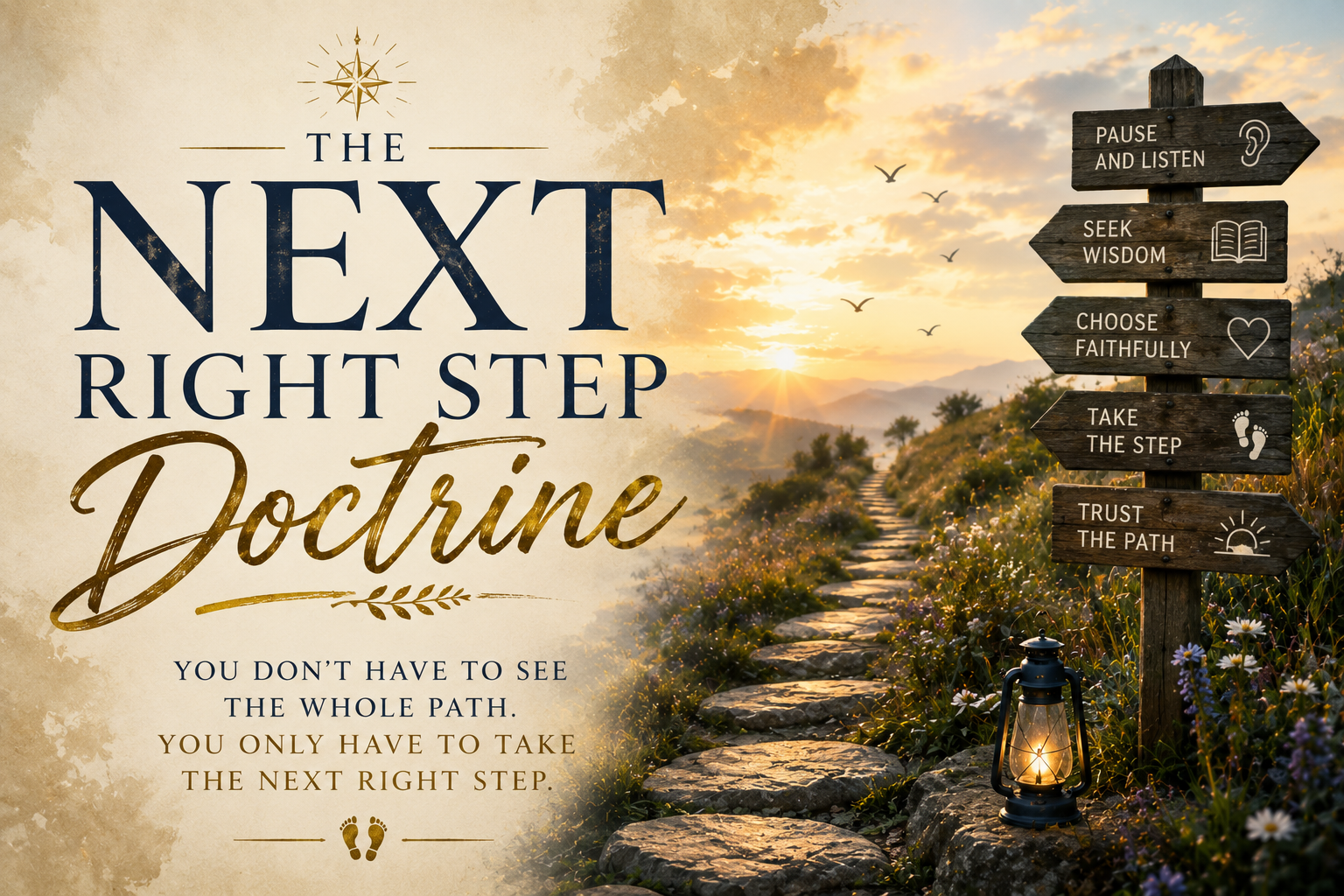
The Next Right Step Doctrine
When the future feels overwhelming, return to the next right step. Explore faith, clarity, discernment, purpose, and finding direction one faithful choice at a time.
Faith, Clarity, Discernment, and Finding Direction One Faithful Choice at a Time
You do not have to carry the whole path.
You do not have to know how every chapter will unfold before you begin the one you are standing in.
You do not need complete certainty, guaranteed outcomes, or a ten-step map before taking step one.
Sometimes the pressure we feel is not coming from the step actually in front of us.
It is coming from trying to mentally carry every step that might come afterward.
We want to know how everything will work.
What every decision will produce.
Whether we will succeed.
Whether the timing is right.
Whether the road will remain safe.
Whether the door will stay open.
Whether the thing we hope for will become what we imagine.
But life is rarely handed to us in full blueprint form.
More often, it unfolds through the next right step.
There is deep relief in realizing that you do not have to figure out your whole life tonight.
You can return to what is honest, clear, faithful, and possible now.
This way of living is simple:
When the future feels too large, return to what is clear enough for today.
What conversation needs to happen?
What task needs to be completed?
What truth needs to be honored?
What habit needs to begin?
What decision already feels clear?
What burden needs to be put down?
What small act of courage is asking for your yes?
You do not have to carry the whole path at once.
You only have to become faithful to the light you have.
The Next Right Step Is a Way of Living
The next right step is more than a productivity strategy.
It is a way of relating to uncertainty.
Instead of demanding complete knowledge before moving, you learn to work faithfully with what you know now.
Instead of asking:
How am I going to figure out my entire future?
You ask:
What is mine to do next?
That question changes the size of the problem.
It brings your attention out of an imagined future and back into the part of life where you can actually participate.
Today.
This conversation.
This decision.
This responsibility.
This opportunity.
This prayer.
This moment.
You may eventually need to make ten decisions.
But perhaps only one of them can actually be made today.
Then make that one well.
Tomorrow may reveal information you do not possess yet.
A conversation may change something.
A door may open.
A circumstance may shift.
You may understand yourself differently.
God may lead you somewhere you could not have predicted from where you are standing now.
Why demand today's mind solve tomorrow's information?
Do faithfully what belongs to today.
Let tomorrow reveal what belongs to tomorrow.
Small Clarity Is Still Clarity
People often dismiss small knowing because it does not answer everything.
They want the sky to open before they trust the candle in their hand.
But a little clarity can still be enough to move.
You may not know where the path leads six months from now, but you may know what integrity requires today.
You may not know your final purpose, but you may know what kindness, responsibility, honesty, faith, or courage looks like in this moment.
You may not know whether an opportunity will become something permanent, but you may know it deserves exploration.
You may not know exactly how something will work, but you may know enough to begin learning.
That matters.
Small clarity is not inferior clarity.
It is usable clarity.
There is wisdom in honoring what has already been made plain.
Sometimes the next right step does not solve every question.
It simply gives you enough truth to stop standing still.
You Do Not Need Certainty to Have Direction
Certainty and direction are not the same thing.
You can have direction without knowing the outcome.
You can know the next responsible thing without knowing where it eventually leads.
You can feel called to begin without knowing exactly what the finished work will become.
You can take a faithful step while still carrying questions.
This matters because waiting for absolute certainty can become its own form of paralysis.
Sometimes people think:
When I am completely sure, I will move.
But complete certainty may never arrive.
Instead, there may be enough clarity to begin.
Enough information to investigate.
Enough peace to continue.
Enough wisdom to pause.
Enough evidence to change direction.
Enough faith to take another step.
Discernment does not always give you the entire road.
Sometimes it gives you enough for the next mile.
Sometimes enough for the next hundred feet.
Sometimes enough for one step.
And one step can still be direction.
One Step Softens Overwhelm
When you bring your attention back to one step, something inside you can soften.
The mind stops trying to swallow the whole horizon.
The heart stops carrying tomorrow, next month, next year, and every possible outcome all at once.
You return to relationship with the present.
This is not laziness.
It is wisdom.
Large callings are often lived one simple decision at a time.
Sometimes the next right step is practical.
Send the email.
Make the call.
Complete the application.
Keep the appointment.
Research the question.
Finish the thing in front of you.
Sometimes the next right step is inward.
Tell the truth.
Forgive yourself.
Stop performing.
Ask for help.
Choose peace.
Admit what you already know.
Let an old pattern end.
Sometimes the next right step is rest.
Sometimes it is action.
Sometimes it is waiting.
Sometimes it is speaking.
Sometimes it is becoming quiet enough to hear what all the noise has been drowning out.
The question is not:
What looks most impressive?
It is:
What is right for me to do next?
The Next Right Step Is Not Always the Easiest Step
“Right” does not necessarily mean comfortable.
Sometimes the next right step asks courage from you.
It may be the phone call you have been avoiding.
The boundary you need to establish.
The truth you need to admit.
The beginning that makes you nervous.
The apology you owe.
The opportunity you are afraid to pursue.
The habit you know needs to change.
The responsibility you have postponed.
The conversation that would be easier to keep avoiding.
A right step can carry peace and still require courage.
Peace does not always mean the absence of nervousness.
Sometimes there is a deeper steadiness beneath the nerves.
Something in you knows:
This may be difficult, but it is honest.
That kind of knowing deserves attention.
The Next Right Step Is Not Always Forward
There is another important part of this practice.
Not every right step looks like advancement.
Sometimes the next right step is to stop.
Pause.
Rest.
Reconsider.
Ask another question.
Gather more information.
Wait for clarity.
Repair something behind you.
Return to something unfinished.
Say no to an opportunity that looks impressive but feels wrong.
Release something you have been trying too hard to force.
Movement is not automatically progress.
And waiting is not automatically stagnation.
There are times when wisdom says:
Go.
There are times when wisdom says:
Stay.
There are times when wisdom says:
Not yet.
The goal is not constant motion.
The goal is faithful movement.
How Do You Recognize the Next Right Step?
Sometimes it is obvious.
Other times, several possibilities compete for attention.
When you are unsure, ask:
What do I already know to be true?
What choice agrees with my values?
What responsibility is genuinely mine?
What am I avoiding because I am afraid?
What am I forcing because I am impatient?
What choice leaves me with greater integrity?
What information am I missing?
What would wisdom ask me to do before making a larger decision?
What can I do now without pretending I know more than I do?
Then pray.
Listen.
Gather information where information is needed.
Seek wise counsel when counsel is useful.
Pay attention to what brings clarity rather than merely urgency.
You are not trying to manufacture a mystical answer.
You are trying to become honest enough to recognize what is yours to do.
Purpose Is Often Discovered Through Movement
People sometimes imagine purpose as one enormous revelation.
One moment when everything becomes obvious.
For some people, there may be defining moments.
But much of purpose is discovered through participation.
You try something.
You learn.
You meet someone.
You develop a skill.
You discover what matters to you.
You realize something does not fit.
You change direction.
You become better at something.
You encounter a need.
You recognize a gift.
You take another step.
Looking backward, what once seemed like disconnected choices may begin to resemble a path.
This is one reason the next right step matters.
Purpose often becomes clearer while it is being lived.
One beginning can reveal information that thinking alone could never provide.
One clear yes can teach you something.
One necessary no can protect something.
One attempt can show you whether the path has life in it.
You do not need every answer before beginning to participate.
Purpose Is Built in Sequences
A meaningful life is rarely one huge leap.
It is a series of choices.
One decision shapes another.
One act of obedience creates room for the next.
One healed pattern opens a new possibility.
One faithful decision strengthens you for a larger yes.
One ordinary day prepares you for another.
If you keep demanding the entire staircase before stepping onto the first stair, you may remain frozen beside your own becoming.
The next right step doctrine reminds you that life can be lived faithfully in pieces.
You do not have to force revelation.
You do not have to manufacture certainty.
You do not have to know every chapter before honoring the sentence in front of you.
Purpose is built in conversations, habits, prayers, choices, boundaries, repairs, attempts, responsibilities, beginnings, endings, and returns.
One step may seem small by itself.
But aligned steps gather direction.
Faithfulness in Ordinary Days Matters
Some of the most important next steps will never look extraordinary.
They may be almost invisible.
Showing up.
Keeping your word.
Caring for someone.
Learning.
Working.
Praying.
Finishing what you started.
Making the responsible decision when nobody applauds.
Choosing patience.
Telling the truth.
Doing something well simply because it is yours to do.
Sacred purpose is not confined to dramatic callings.
There is purpose in ordinary faithfulness.
The way you handle today's responsibilities can become part of tomorrow's readiness.
Ordinary days are not empty space between important moments.
They are where much of a meaningful life is actually built.
When You Feel Behind, Return to What Is Yours
Feeling behind can make the mind frantic.
You look at other people's lives.
Their progress.
Their milestones.
Their careers.
Their relationships.
Their accomplishments.
Their timing.
And suddenly your next step becomes buried beneath someone else's entire staircase.
Come back.
Their path is not yours to carry.
Ask:
What is mine today?
Maybe yours is smaller than theirs.
Maybe yours is quieter.
Maybe yours is still forming.
That does not make it meaningless.
You do not need to catch someone else's life.
You need to participate faithfully in your own.
God May Give You Enough Light for the Step, Not the Whole Road
Faith would be unnecessary if every outcome were visible beforehand.
Sometimes guidance comes as enough light to move rather than enough light to see everything.
You may pray for the entire map and receive clarity about one conversation.
You may ask what your life is supposed to become and feel led toward one responsibility.
You may ask for a sign about the future and instead find courage for today.
That does not mean nothing happened.
Perhaps the answer is smaller because smaller is what you can use now.
Scripture often uses the language of paths, steps, wisdom, trust, and light to describe guidance.
Faith does not require refusing to plan.
Planning can be wise.
Preparation can be wise.
Research can be wise.
But planning is different from demanding complete control over an unknowable future.
You can prepare thoughtfully and still leave room for God to redirect you.
You can make plans and remain teachable.
You can move faithfully without pretending you know everything.
A Next Right Step Practice
When life feels too large, take a piece of paper and write:
What feels overwhelming right now?
Name it.
Then ask:
What part of this actually needs my attention today?
Separate today's responsibility from tomorrow's possibilities.
Then ask:
What do I already know?
Write only what is clear.
Then:
What do I still need to know?
If information is missing, perhaps gathering it is the next step.
Finally ask:
What is one honest, responsible, faithful action I can take now?
Make it specific.
Not:
Fix my life.
But:
Send the email.
Make the appointment.
Research the requirement.
Pray about the decision.
Have the conversation.
Finish the application.
Rest tonight and revisit this tomorrow.
Then do that step.
Afterward, ask again:
What is next?
This is how enormous things become livable.
Frequently Asked Questions
What Is the Next Right Step?
The next right step is the most honest, responsible, wise, or aligned action available to you with the information and clarity you currently have.
It does not have to solve the entire situation.
It simply needs to move you faithfully from where you are.
What If I Do Not Know What the Next Step Is?
Sometimes the next step is gathering information rather than making a decision.
You may need to research, pray, ask questions, seek wise counsel, rest, or give yourself enough quiet to distinguish urgency from clarity.
Finding the next step can itself be the next step.
How Do I Know Whether a Step Is Right?
Consider whether it agrees with your values, responsibilities, faith, available information, and deeper sense of integrity.
Also consider whether you are choosing from wisdom or reacting primarily from fear, pressure, impatience, or the desire for approval.
Does Following the Next Right Step Mean I Should Not Make Long-Term Plans?
No.
Long-term planning and next-step thinking can work beautifully together.
A larger direction can help you know where you are going, while the next right step keeps you grounded in what can actually be done now.
You can hold a vision for tomorrow while remaining faithful to today.
What If I Take the Wrong Step?
Not every decision will produce the outcome you hoped for.
That does not mean every imperfect decision ruins the path.
You can learn.
Adjust.
Repair.
Change direction.
Ask better questions.
Begin again.
A meaningful life does not require flawless navigation.
It requires enough honesty and humility to keep responding to what you learn.
Can the Next Right Step Be Rest?
Absolutely.
Rest can be a wise next step when exhaustion is clouding judgment, when your body needs recovery, or when pushing harder would produce more confusion than progress.
The next right step is not synonymous with doing more.
How Does Faith Fit Into the Next Right Step?
Faith allows you to move without demanding complete control over the outcome.
You can pray, listen, use wisdom, gather information, make thoughtful plans, and then act on what is clear while trusting that more can be revealed as the path unfolds.
Enough for Today Can Become a Life
When you feel behind, overwhelmed, uncertain, or unable to see the entire road, return to the simplest question:
What is the next right step?
Not the biggest step.
Not the most impressive step.
Not the step that proves everything all at once.
The right step.
The honest step.
The faithful step.
The doable step.
The step that carries responsibility, truth, love, wisdom, peace, or courage.
That is enough for today.
And often, enough for today becomes a life.
A life is built by the way you keep returning to what is yours to do.
The next right word.
The next right choice.
The next right repair.
The next right prayer.
The next right boundary.
The next right act of courage.
You do not have to see the full harvest to plant the seed.
You do not have to know the whole song to sing the next note.
You do not have to understand every future doorway to walk through the one already opening.
Purpose does not always arrive as a grand announcement.
Sometimes it arrives as a quiet instruction:
Do this next.
And when you honor what is clear with sincerity, something begins moving.
Step by step.
Choice by choice.
Prayer by prayer.
Light by light.
You do not have to carry the whole path.
You only need enough light for the next faithful step.
If this message resonated, you may also enjoy:
A Purpose Practice for People Who Feel Behind
The Spiritual Discipline of Showing Up
Your Soulful Pathways ↑
Discover more series pages for you in Your Soulful Pathways ↑
Faithfulness Beats Intensity
Discover why faithfulness matters more than intensity and how consistency, perseverance, grace, abiding in God, small daily choices and patient spiritual growth can shape a meaningful life.
There are moments when life catches fire.
We feel inspired. We pray with unusual passion. We begin something new with enormous energy. We make promises to ourselves, to others, and sometimes to God. We decide that everything is going to change.
These moments can be beautiful.
But intensity is not the same thing as faithfulness.
Intensity can begin a journey.
Faithfulness carries it.
A powerful moment may awaken the heart, but the quiet decisions that follow are what shape a life.
Faithfulness is choosing what matters again tomorrow.
It is showing up when the emotion has faded.
It is praying when prayer feels powerful and when it feels ordinary.
It is loving when love feels effortless and when love requires patience.
It is tending what God has placed in your hands long after the excitement of beginning has disappeared.
A faithful life is rarely built through one spectacular act.
It is built through thousands of ordinary yeses.
Intensity Can Start Something Beautiful
Intensity has a place.
There are moments when conviction arrives suddenly, inspiration floods in, or a truth becomes so clear that immediate action feels almost unavoidable.
A powerful spiritual experience can redirect a life.
A courageous decision can break an old pattern.
A burst of energy can launch a meaningful project.
An emotional moment can open the heart.
Intensity is not the enemy.
The problem comes when we expect intensity to do the work that only faithfulness can accomplish.
Intensity says, “This matters deeply to me.”
Faithfulness says, “It will still matter when this moment passes.”
One can ignite the flame.
The other tends it.
Faithfulness Is More Than Consistency
Faithfulness and consistency are related, but faithfulness reaches deeper.
Consistency describes repeated action.
Faithfulness describes character.
A faithful person becomes trustworthy.
Their words and actions increasingly belong together.
They keep commitments.
They remain present.
They care for what has been entrusted to them.
They continue loving when love requires patience.
They return to truth when they wander from it.
Biblically, faithfulness is not merely about completing tasks.
God Himself is described as faithful.
Lamentations 3:22–23 celebrates His mercy as new every morning and declares, “Great is thy faithfulness.”
God's faithfulness reveals steadfastness, trustworthiness, mercy and constancy.
When we grow in faithfulness, we are not simply becoming better at routines.
We are becoming people whose lives increasingly reflect what we say we value.
Scripture Honors Faithfulness
Faithfulness runs like a quiet river throughout Scripture.
Jesus teaches in Luke 16:10 that the person who is faithful in little can also be faithful in much.
Small responsibilities matter.
Small decisions matter.
How we tend what is already in our hands matters.
In Matthew 25, the servants who responsibly cared for what had been entrusted to them are greeted with the words:
“Well done, good and faithful servant.”
Faithful.
That word matters.
Galatians 6:9 encourages believers not to become weary in doing good because there is a harvest in due season for those who do not give up.
James 1:2–4 connects the testing of faith with perseverance and maturity. Difficulty does not merely test whether faith exists. Remaining steadfast through difficulty can deepen and mature it.
Hebrews 10:36 speaks of the need for patient endurance after doing the will of God.
And 1 Corinthians 15:58 encourages believers to remain steadfast and committed to the work of the Lord.
Again and again, Scripture honors something quieter than spiritual fireworks.
Steadfastness.
Patience.
Endurance.
Trustworthiness.
Remaining.
Faithfulness.
Jesus Gave Us the Image of Abiding
One of the most beautiful pictures of faithfulness appears in John 15.
Jesus describes Himself as the vine and His followers as the branches.
The central instruction is not frantic striving.
It is abiding.
Remain in Me.
A branch does not produce fruit by occasionally straining with extraordinary force.
It bears fruit because it remains connected to the source of its life.
That changes how we understand spiritual growth.
Faithfulness is not endlessly trying to manufacture a spiritual experience.
It is staying connected.
Returning to prayer.
Remaining receptive.
Walking with God through ordinary days.
Listening.
Learning.
Trusting.
Receiving.
Obeying.
Resting.
Growing.
The fruit comes from the relationship.
Most of Life Happens on Ordinary Tuesdays
Most lives are not made of extraordinary days.
They are made of ordinary Tuesdays.
Meals.
Conversations.
Work.
Laundry.
Phone calls.
Bills.
Prayer.
Driving.
Helping someone.
Keeping a promise.
Finishing something that needs to be finished.
Listening when someone needs to speak.
Choosing patience instead of irritation.
Starting again after yesterday did not go as planned.
These moments rarely look dramatic.
Yet this is where much of character is formed.
If we are always waiting for a monumental moment to become who we want to be, we may overlook the thousands of small opportunities already surrounding us.
The sacred life is lived in ordinary hours.
Faithfulness turns those hours into something meaningful.
Small Things Become Large Things
One page becomes a book.
One saved dollar becomes savings.
One conversation becomes a friendship.
One walk becomes a practice.
One lesson becomes knowledge.
One prayer becomes a life of prayer.
One act of forgiveness can begin repairing a relationship.
One small decision repeated over years can alter the direction of a life.
We often underestimate gradual change because dramatic events are easier to notice.
But time magnifies repeated behavior.
What we do once matters.
What we repeatedly return to can become part of who we are.
The Science of Showing Up
Modern behavioral research offers an interesting companion to this ancient wisdom.
Wanting to do something does not always mean we will actually do it.
Psychologists sometimes describe this as the gap between intention and action.
We may genuinely intend to pray more, move more, write more, save more, read more, connect more deeply with family, or pursue something meaningful.
The intention can be sincere.
But intention alone may not create a pattern.
One well-studied approach involves connecting an intended behavior to a specific situation.
Instead of:
“I want to pray more.”
The practice becomes:
“After I make my morning coffee, I will spend a few quiet minutes in prayer.”
Instead of:
“I want to become more grateful.”
It might become:
“Before I go to sleep, I will remember three things from this day for which I am thankful.”
The principle is simple.
Intensity says:
“I really want to do this.”
Faithfulness eventually learns:
“This is where this belongs in my life.”
Repetition Can Change What Feels Natural
Research into habit formation has also found that behaviors repeated within familiar contexts can gradually become more automatic.
At first, a new practice may require considerable conscious effort.
Over time, the same practice may begin to feel increasingly natural.
This helps explain why small faithful actions can have such enormous long-term influence.
What requires discipline today may eventually become part of how we naturally live.
Prayer can become where the heart instinctively turns.
Gratitude can become how we notice life.
Kindness can become our first response.
Honesty can become deeply rooted.
Generosity can become part of how we move through the world.
Patience can become easier to reach.
Faithfulness does not merely accomplish things.
Faithfulness forms people.
Faithfulness Is Not Perfection
There is an enormous difference between faithfulness and perfection.
Faithfulness does not require a flawless streak.
You may miss the routine.
Lose patience.
Forget the commitment.
Become distracted.
Take the wrong turn.
Need more rest than expected.
Spend time moving in a direction that later proves wrong.
None of these automatically erase the good that came before them.
Research on habit formation has even found that missing an occasional opportunity does not necessarily destroy the process of developing a habit.
That is wonderfully human.
Growth can survive an imperfect day.
Faithfulness is not:
“I never miss.”
It is:
“I keep returning.”
This is where grace enters the story.
Grace Makes Returning Possible
Christian faith is filled with stories of return.
Peter failed spectacularly.
He returned.
Thomas doubted.
He remained.
The disciples misunderstood, stumbled, became frightened and sometimes failed to grasp what Jesus was teaching them.
Yet their stories continued.
The prodigal son wandered far from home.
Then he turned toward home.
Grace does not tell us that failure is the end of the story.
Grace opens the door to return.
You can return to prayer.
Return to truth.
Return to kindness.
Return to integrity.
Return to the work.
Return to your calling.
Return to the relationship.
Return to God.
Sometimes the most faithful thing a person can do is come back.
Consistency Does What Motivation Cannot
Motivation is wonderful.
It can help us begin.
But motivation changes.
Some mornings we wake up ready to conquer the world.
Other mornings, successfully locating the coffee feels sufficiently ambitious.
That is human.
A meaningful life cannot depend entirely upon emotional momentum.
Faithfulness gives us something steadier.
We pray because prayer matters.
We care for our bodies because health matters.
We nurture relationships because people matter.
We continue learning because wisdom matters.
We keep our word because integrity matters.
We return to our calling because it matters.
When our actions become rooted in values rather than temporary emotion, we become less dependent upon constantly feeling inspired.
We learn how to continue.
Faithfulness Is Not Relentless Productivity
Faithfulness should never become another word for exhaustion.
It does not mean working constantly.
It does not mean proving your worth through productivity.
It does not mean forcing yourself forward regardless of what your body, circumstances, wisdom or God may be showing you.
Jesus withdrew from crowds.
He rested.
He prayed in solitude.
He did not respond to every demand simply because the demand existed.
Rest can be part of faithfulness.
Silence can be part of faithfulness.
Waiting can be part of faithfulness.
A Sabbath can be part of faithfulness.
Faithfulness is not about squeezing the maximum amount of productivity out of every hour.
It is about living in alignment with what matters.
Faithfulness Is Not Stubbornness
There is another distinction worth making.
Persistence is not automatically faithfulness.
Sometimes people continue something simply because they have already invested so much into it.
But faithfulness requires discernment.
Sometimes faithfulness means staying.
Sometimes it means changing.
Sometimes it means waiting.
Sometimes it means resting.
Sometimes it means releasing something whose season has ended.
Sometimes it means admitting that the original plan was wrong while the deeper calling remains right.
And sometimes it means continuing when every visible result seems to suggest nothing is happening.
The question is not simply:
“Can I keep doing this?”
A wiser question may be:
“Is this still mine to faithfully carry?”
Faithfulness remains loyal to truth, not merely attached to familiarity.
Quiet Seasons Are Not Empty Seasons
One of the hardest forms of faithfulness is continuing when there is little visible evidence that anything is changing.
We like evidence.
We like progress we can measure.
We like doors opening.
Answers arriving.
Numbers rising.
Problems resolving.
But some of the deepest formation happens quietly.
A seed may spend a long time underground before anything green appears above the soil.
Roots are forming where no one can see them.
There are seasons of life like that.
You may be developing strength you cannot yet measure.
Learning wisdom you have not yet needed.
Building relationships whose importance will become clear later.
Developing abilities whose purpose has not fully appeared.
Praying prayers whose answers you cannot yet see.
God may be forming something within you before revealing what will come through you.
Slow does not mean meaningless.
Invisible does not mean absent.
Faithfulness in Prayer
Prayer does not always arrive wrapped in emotion.
There may be moments when God's presence feels overwhelming.
There may also be mornings when prayer feels quiet and ordinary.
Both can be sacred.
Faithfulness in prayer means continuing the relationship.
Talking with God.
Listening.
Giving thanks.
Bringing questions.
Bringing fears.
Bringing hopes.
Sitting quietly.
Returning again.
A relationship with God does not require constant spiritual fireworks.
Some of the deepest spiritual roots may grow during seasons when nothing dramatic appears to be happening.
Faithfulness in Relationships
Relationships also reveal the difference between intensity and faithfulness.
Grand gestures can be beautiful.
But relationships live between the grand gestures.
They live in whether we listen.
Whether we remember.
Whether we speak kindly.
Whether we apologize.
Whether we keep confidence.
Whether we make time.
Whether we tell the truth.
Whether we remain present during difficult seasons.
Love becomes trustworthy through repetition.
“I love you” is powerful.
Living in ways that repeatedly demonstrate that love gives the words weight.
Faithfulness makes love believable.
Faithfulness in Purpose
Purpose is often romanticized.
We imagine discovering our calling and suddenly possessing endless motivation.
Real purpose rarely behaves that way.
Purpose includes repetition.
Learning.
Practice.
Mistakes.
Correction.
Unseen work.
Long stretches when progress appears smaller than expected.
People who create meaningful things often spend far more time practicing their calling than celebrating it.
Writers write.
Teachers prepare.
Musicians practice.
Builders build.
Parents parent.
Caregivers care.
Leaders make thousands of decisions nobody will ever remember.
Purpose becomes real through participation.
You do not have to feel extraordinary every day to live an extraordinary life.
You simply have to keep returning to what is yours to do.
Faithfulness When Results Are Slow
Galatians 6 gives us the beautiful image of harvest.
That image matters because harvest assumes a period when the seed has been planted but the fruit has not yet appeared.
There is planting.
Then tending.
Then waiting.
Then growth.
Then harvest.
Much of life happens between planting and harvest.
We may want to skip the middle.
But the middle is often where faithfulness lives.
You continue loving.
Continue learning.
Continue praying.
Continue building.
Continue tending.
Continue trusting.
Not because you can already see everything that will come from it, but because you know the seed is worthy of care.
Faithfulness Creates Trust
People trust what proves reliable.
A friend becomes trusted because honesty and care have been demonstrated over time.
A person becomes dependable because their words and actions repeatedly begin to match.
The same principle operates within ourselves.
Every time we honor an important commitment, we strengthen self-trust.
Faithfulness teaches the heart:
When I say something matters, I will care for it.
Not perfectly.
Not obsessively.
But sincerely.
That creates stability.
Faithfulness Protects Us From All-or-Nothing Thinking
Intensity can easily create extreme expectations.
If we cannot do everything, we do nothing.
If we miss one day, the plan is ruined.
If we cannot give an hour, ten minutes feels pointless.
If progress is slow, we assume progress is absent.
Faithfulness thinks differently.
Ten minutes still counts.
One prayer still counts.
One healthy choice still counts.
One page still counts.
One honest conversation still counts.
One act of kindness still counts.
One return still counts.
A small step taken repeatedly can travel remarkably far.
Imperfect consistency can still create beautiful change.
You Do Not Have to Rush What God Is Growing
We live in a culture fascinated by speed.
Fast success.
Fast transformation.
Fast answers.
Fast growth.
But some things should not be rushed.
Wisdom needs experience.
Trust needs time.
Character needs testing.
Relationships need history.
Calling needs formation.
Spiritual maturity needs seasons.
There are things God may be developing within us that cannot be manufactured through greater intensity.
They require time.
Patience with the process can itself become an act of faith.
When God Gives You Something Small
Never assume small means unimportant.
Many meaningful things begin quietly.
A conversation.
An idea.
A relationship.
A responsibility.
A small opportunity.
A desire you cannot yet explain.
A door that opens only slightly.
We sometimes ask God for greater opportunities while overlooking what He has already placed in our hands.
Faithfulness asks:
What has been entrusted to me today?
Then it tends that.
The small thing may be preparation for something larger.
Or perhaps the small thing itself is sacred enough.
Not everything meaningful needs to become enormous.
Faithfulness Compounds
We understand compounding easily when we think about money.
A small amount repeatedly added can eventually become something substantial.
Human lives have their own forms of compounding.
Knowledge compounds.
Trust compounds.
Skill compounds.
Wisdom compounds.
Relationships compound.
Character compounds.
Prayer compounds into a deeper life with God.
Years of seemingly ordinary choices can produce something that looks extraordinary when viewed all at once.
But the extraordinary result was often built quietly.
Day by day.
Choice by choice.
Prayer by prayer.
Return by return.
Faithfulness Is Love With Roots
Intensity can say:
“I care deeply.”
Faithfulness says:
“I will still care tomorrow.”
That is why faithfulness is one of the quiet languages of love.
God's faithfulness toward humanity is repeatedly celebrated throughout Scripture.
His faithfulness does not depend upon applause.
It does not disappear because circumstances become difficult.
It is rooted in who He is.
Steady.
Present.
True.
When our own love develops faithfulness, it grows roots.
A Faithful Life Can Look Surprisingly Ordinary
The people who profoundly influence others may never appear extraordinary from the outside.
A mother who loves her children every day.
A father who keeps showing up.
A teacher who patiently pours wisdom into students year after year.
A neighbor who quietly helps people.
A caregiver who tends someone through illness or age.
A person who faithfully prays for their family.
Someone who refuses to become bitter despite hardship.
Someone who keeps choosing honesty when dishonesty would be easier.
Someone who serves without needing recognition.
Someone who keeps a promise no one else remembers was made.
These lives may never become headlines.
Heaven may measure them differently.
What Matters Is What You Keep Returning To
You do not need to live every day at maximum intensity.
You do not need to wake up endlessly inspired.
You do not need every prayer to feel powerful.
You do not need every step to be enormous.
You do not need a perfect streak.
You do not need to become everything at once.
You do not need to see the harvest yet.
Stay close to God.
Tend what has been entrusted to you.
Do the next faithful thing.
Rest when it is time to rest.
Return when you wander.
Change direction when wisdom requires it.
Keep going when the path is still yours.
Return to love.
Return to truth.
Return to prayer.
Return to your calling.
Return to the people entrusted to you.
Return after disappointment.
Return after distraction.
Return after failure.
Return after rest.
Return again.
A faithful life is built through returning.
Faithfulness Beats Intensity
Intensity may change a moment.
Faithfulness can shape a lifetime.
The world naturally notices dramatic moments because they are easy to see.
God sees the quiet ones too.
The prayer nobody heard.
The kindness nobody noticed.
The promise you kept.
The work you completed.
The temptation you resisted.
The person you forgave.
The responsibility you carried.
The day you wanted to quit but chose one more step.
The moment wisdom told you to rest and you listened.
The season that ended and you had the courage to release it.
The morning you began again.
Those moments accumulate.
Over time, they become character.
Over time, they become trust.
Over time, they become wisdom.
Over time, they become a life.
You do not have to burn with extraordinary intensity every day.
There is another kind of strength.
A steadier one.
A life rooted deeply enough that it does not require constant excitement to continue growing.
A branch that remains connected to the vine.
A seed tended before the harvest can be seen.
A light that keeps shining.
Faithfulness.
Again today.
And tomorrow.
And whenever necessary, beginning again.
Questions for Reflection
Where in my life have I been relying on motivation instead of faithfulness?
What small responsibility has God already placed in my hands?
What meaningful practice could change my life if I faithfully returned to it over time?
Where have I mistaken slow progress for no progress?
Is there something important I need to return to rather than abandon?
Is there something I am continuing from stubbornness rather than faithfulness?
Where might rest actually help me remain faithful?
What has God been growing quietly beneath the surface of my life?
What promise, relationship, calling or spiritual practice deserves my steady attention right now?
What would the next faithful thing look like today?
Frequently Asked Questions
What does “faithfulness beats intensity” mean?
It means that steady, repeated commitment often creates deeper and more lasting change than occasional bursts of extraordinary effort. Intensity can awaken us and help us begin. Faithfulness allows what matters to take root, mature and become part of our lives.
Is intensity bad?
No. Powerful moments of conviction, inspiration, prayer, courage and determination can be enormously meaningful. Intensity becomes insufficient only when we expect a powerful beginning to replace the patient work of continuing.
Is faithfulness the same as consistency?
Not entirely. Consistency is part of faithfulness, but biblical faithfulness reaches deeper. It includes trustworthiness, steadfastness, integrity and remaining true to what has been entrusted to us.
What does the Bible say about faithfulness?
Faithfulness is honored throughout Scripture. Jesus speaks about being faithful with little in Luke 16:10. Matthew 25 honors the “good and faithful servant.” Galatians 6:9 encourages perseverance in doing good. James 1 connects steadfastness with spiritual maturity, and John 15 presents abiding in Christ as central to fruitful spiritual life.
Does faithfulness mean I can never change direction?
No. Faithfulness requires discernment. Sometimes remaining faithful means continuing. At other times it may mean changing an approach, resting, waiting or releasing something whose season has ended. Faithfulness is loyalty to what is true, not stubborn attachment to a particular method.
What if I have not been consistent?
Return. One interruption does not have to become abandonment. Growth is often less about maintaining a flawless streak and more about continuing to come back to what matters.
Can rest be part of faithfulness?
Yes. Jesus Himself withdrew for solitude and prayer. Rest can preserve our ability to continue serving, loving, creating and living wisely. Faithfulness is not relentless productivity.
Why do small actions matter so much?
Repeated actions accumulate. They build skill, trust, knowledge, relationships and character. Small actions may seem insignificant individually, yet their influence can become enormous over time.
What is abiding?
In John 15, Jesus uses the image of a vine and its branches to describe remaining connected to Him. Abiding suggests an ongoing relationship rather than occasional spiritual intensity. The branch bears fruit because it remains connected to the source of its life.
Can faithfulness matter even when I cannot see results?
Yes. Many forms of growth remain invisible for a season. Scripture repeatedly uses agricultural imagery because planting, tending and harvest do not happen simultaneously. A quiet season is not necessarily an empty season.
How can I become more faithful in everyday life?
Begin with what has already been entrusted to you. Choose small practices that reflect what you genuinely value. Give them a natural place in your day. Allow room for rest and changing circumstances. When you wander from what matters, return.
Related Sacred Living Topics
Sacred Rest
The Holy Ordinary: Finding God in Everyday Life
The Spiritual Discipline of Showing Up
Explore the spiritual discipline of showing up through faithfulness, consistency, devotion, rest, small daily actions, and learning to return when motivation fades.
There is profound spiritual power in showing up.
Not once.
Not only when you feel inspired.
Not only when everything is flowing beautifully.
But again and again, through ordinary days, changing emotions, uncertain seasons, slow progress, and the quiet work nobody else may ever see.
Showing up is rarely glamorous.
It does not always feel significant while you are doing it. Most days, it looks simple. It looks like returning to what matters when the feeling has faded, the energy is lower than you hoped, the path is not completely clear, or nobody is applauding.
It looks like opening the document again.
Saying the prayer again.
Taking the walk again.
Keeping the promise again.
Telling the truth again.
Beginning again after a difficult day.
There is something sacred about becoming a person who knows how to return.
Return to the work.
Return to prayer.
Return to truth.
Return to healing.
Return to responsibility.
Return to the life in front of you after discouragement, distraction, confusion, fatigue, disappointment, or delay.
This is not small strength.
It is a holy kind of steadiness.
There is something sacred about a person who keeps arriving with an honest heart. Not perfectly. Not dramatically. Not because every day feels inspired. But because something deeper has decided:
This still matters.
Showing up is one of the quiet ways the soul says yes.
Showing Up Is Different From Feeling Motivated
Motivation is wonderful when it arrives.
It can create energy, excitement, movement, and a fresh beginning.
But motivation is not designed to carry every meaningful thing in your life.
Feelings change. Energy changes. Circumstances change.
Some mornings you will feel deeply connected to what you are doing. Other mornings you may simply know it needs to be done.
That is where discipline becomes meaningful.
Discipline says:
I do not need to feel exactly the same every day in order to remain faithful to what matters.
You can act without forcing emotion.
You can pray without feeling spiritually electric.
You can write without feeling brilliant.
You can exercise without feeling enthusiastic.
You can care for a relationship without every conversation being profound.
You can continue building something before you see the full result.
Motivation may begin the movement.
Faithfulness helps carry it forward.
Small Returns Shape the Soul
It is easy to admire dramatic breakthroughs.
It is harder to recognize the quieter miracle of consistency.
But transformation is often built there. Not in one enormous emotional moment, but in hundreds of small returns.
Every time you come back to what matters, you are teaching yourself something:
This deserves my attention.
This deserves another attempt.
This is still part of who I want to become.
That message gathers strength over time.
A person does not become disciplined because of one extraordinary day. Discipline is formed through ordinary days handled with intention.
Faith can deepen through extraordinary spiritual experiences, but it is also formed through ordinary acts of prayer, trust, obedience, and return.
Character is not built through one heroic decision. It grows through repeated choices that slowly become a way of living.
Small returns matter because they become part of identity.
You begin becoming someone who knows:
I can come back.
Perfectionism Can Keep You From Showing Up
Perfectionism likes ideal conditions.
Enough time.
Enough energy.
The perfect plan.
Complete confidence.
A clear outcome.
A beautiful beginning.
It whispers:
If you cannot do it properly, perhaps you should wait.
Discipline answers differently:
Do what is possible today.
Write the paragraph.
Walk for fifteen minutes.
Pray one honest prayer.
Clean one corner.
Make one call.
Read one page.
Take the first step.
Send the email.
Begin with what you have.
Perfectionism asks whether the effort is impressive enough.
Faithfulness asks whether it is sincere.
Those are very different standards.
A small honest effort can carry more life than a perfect plan that never begins.
Faithfulness Often Looks Ordinary
Many people miss the sacred because they are searching for constant intensity.
But intensity comes and goes.
Faithfulness stays.
Faithfulness answers the message.
Writes the paragraph.
Takes the walk.
Says the prayer.
Keeps the appointment.
Cleans the room.
Pays the bill.
Keeps the promise.
Tells the truth.
Prepares the meal.
Learns the skill.
Rests when rest is needed.
Returns after distraction.
None of this looks extraordinary in isolation.
Yet lives are made from these things.
Purpose is not only found in the large, shining moments. Purpose also lives inside the small actions that protect what is good, the repeated decisions that keep love alive, the responsibilities handled with care, and the quiet work that prepares a future nobody can see yet.
Ordinary faithfulness may not make much noise.
But it builds roots.
Showing Up Builds Self-Trust
Every time you follow through on something meaningful, you create evidence.
Evidence that you can rely on yourself.
You said you would do something and you did it.
You lost momentum and returned.
You made a mistake and corrected it.
You became discouraged but did not abandon everything.
You listened when you needed rest.
You started again when you were ready.
Self-trust is not believing you will always perform perfectly.
It is knowing you will keep relating honestly to your own life.
You begin to trust:
I will listen.
I will adjust.
I will return.
I will not turn one mistake into a reason to abandon myself.
That kind of trust creates steadiness.
Showing Up Does Not Mean Showing Up for Everything
Not every request deserves your yes.
Not every opportunity deserves your energy.
Not every emergency belongs to you.
Not every open door is yours to walk through.
Spiritual discipline is not frantic availability.
Showing up faithfully requires discernment.
What is actually yours to tend?
Your relationship with God.
Your responsibilities.
Your health.
Your family.
Your commitments.
Your work.
Your healing.
Your calling.
Your rest.
Your next faithful step.
If you show up for everything, eventually you may have very little left for what matters most.
Discipline is not only about doing.
Sometimes discipline is choosing what not to do.
Rest Can Be Part of Showing Up
There is a version of discipline that glorifies exhaustion.
Push harder.
Do more.
Keep going.
Ignore what your body is telling you.
But sustainable faithfulness requires rhythm.
Work and rest.
Effort and recovery.
Giving and receiving.
Movement and stillness.
Rest does not always mean abandoning the work. Sometimes rest protects your ability to return to it well.
You may need sleep.
An afternoon away.
A slower day.
A quiet prayer instead of another task.
A walk without a goal.
A night where the laptop stays closed.
Showing up for your life includes showing up for the part of you that needs restoration.
Rest is not automatically the opposite of discipline.
Sometimes it is disciplined stewardship.
Rest can be one of the ways you remain faithful to the life you have been given, because restoration helps you return with greater presence rather than simply greater exhaustion.
Return Without Condemning Yourself
There will be days when you lose rhythm.
That is part of being human.
You may become overwhelmed, distracted, discouraged, emotionally tired, or pulled into another responsibility.
You may lose a day.
A week.
Sometimes an entire season.
Then you look up and realize you have drifted from something that once helped you feel grounded.
The spiritual discipline is not never wobbling.
The discipline is coming back.
Again.
Without turning one interruption into a permanent identity.
This is where many people lose momentum. They miss a few days and decide:
I failed.
Then shame turns an interruption into abandonment.
But you do not need perfect momentum.
You need the ability to return.
Say:
Today I return.
Not:
I should never have left.
Return to prayer.
Return to movement.
Return to honesty.
Return to the project.
Return to rest.
Return to the habit.
Return to God.
Return to what still matters.
Yesterday does not need to approve today's beginning.
Beginning Again Is a Spiritual Skill
Starting is a skill.
So is restarting.
Life will interrupt you.
Plans change.
People need you.
Energy fluctuates.
Grief comes.
Celebrations come.
Illness comes.
Opportunities appear.
Responsibilities expand.
Seasons change.
If your definition of consistency requires your life never to interrupt you, almost everyone will eventually feel like a failure.
A stronger definition is:
Consistency includes returning.
You are not starting from nothing every time you come back.
You are returning with experience.
You know more.
You understand what disrupted you.
You may know how to build differently now.
Starting again is not proof that the first attempt was wasted.
Sometimes returning is exactly how the practice becomes yours.
Some Days Faithfulness Is Very Small
Not every day has the same capacity.
On one day, showing up may mean three productive hours.
On another, it may mean ten focused minutes.
One day you may pray deeply.
Another day the whole prayer may be:
God, help me.
One day you may handle everything beautifully.
Another day your victory may simply be refusing to give up entirely.
Do not measure every day against your strongest day.
Ask:
What does faithfulness look like with the capacity I actually have today?
That question leaves room for discipline without turning it into punishment.
A smaller act of faithfulness is still faithfulness.
Show Up Before You Feel Completely Ready
Readiness is sometimes created through action.
You may never feel completely prepared for the conversation.
The application.
The first page.
The new responsibility.
The decision.
The beginning.
Some clarity arrives only after you move.
This does not mean acting recklessly. Preparation matters. Wisdom matters. Timing matters.
But endless preparation can become another form of hiding.
Sometimes the next step is simply:
Begin.
Send it.
Ask.
Try.
Practice.
Learn while moving.
Courage often meets you after you have already taken the first few steps.
Showing Up Is How Skill Is Built
Natural ability matters.
But ability grows through practice.
Writers write.
Musicians practice.
Builders build.
Teachers teach.
People become better at difficult conversations by having them.
Confidence often grows from experience rather than arriving beforehand.
The same principle applies spiritually.
Prayer becomes more familiar because you pray.
Discernment develops because you practice listening and choosing.
Patience grows through moments requiring patience.
Faith is exercised in places where outcomes are not completely visible.
Much of who you become is shaped through participation, practice, and repeated choices.
The life you want cannot always be thought into existence.
Some parts must be practiced.
Hidden Work Still Matters
There are seasons when you are doing the work and almost nobody can see the result.
You are learning.
Preparing.
Healing.
Building.
Saving.
Writing.
Practicing.
Praying.
Studying.
Developing something that has not yet emerged publicly.
Hidden work can be difficult because there is little external reinforcement.
No applause.
No visible breakthrough.
No dramatic evidence that it is working.
But invisible does not mean meaningless.
Roots grow where nobody sees them.
Foundations disappear beneath the buildings they eventually support.
Preparation often happens before the opportunity that requires it.
Do not assume the hidden season is empty.
You may be developing patience, wisdom, skill, endurance, discernment, character, knowledge, or spiritual depth that will become visible only later.
Some of your most important showing up may happen before anyone else understands what you are building.
God Is Present in Ordinary Faithfulness
There can be a temptation to search for God only in extraordinary moments.
The answered prayer.
The breakthrough.
The unmistakable sign.
The beautiful worship experience.
Those moments can be sacred.
But God is not limited to spectacle.
There can be holiness in ordinary faithfulness.
In washing dishes.
Caring for family.
Doing honest work.
Keeping your word.
Helping someone.
Learning patience.
Practicing forgiveness.
Managing responsibilities.
Resting.
Praying quietly.
Beginning again.
The spiritual life is not separate from ordinary life.
The ordinary places are often where faith becomes lived rather than merely believed.
You do not have to wait for an extraordinary life to live faithfully.
The ordinary day is already here.
And God can meet you inside it.
Showing Up Can Become Devotion
Discipline changes when it becomes connected to love.
You are not merely checking boxes.
You are caring for something.
The work because it matters.
Your body because your life matters.
The relationship because love matters.
Prayer because your relationship with God matters.
The boundary because peace matters.
The practice because the future matters.
Devotion gives discipline a heart.
It changes:
I have to do this
into:
This matters enough for me to tend it.
That does not make every task enjoyable.
It gives the task meaning.
And meaning can carry a person farther than temporary excitement.
Do Not Confuse Struggle With Failure
Something can be difficult and still be working.
A habit can feel awkward before it becomes familiar.
A new boundary can feel uncomfortable before it becomes natural.
Prayer can feel quiet and still matter.
A project can move slowly and still be progressing.
A difficult conversation can be messy and still be necessary.
We sometimes assume:
If this were right, it would feel easier.
But many meaningful things contain friction.
Learning contains friction.
Growth contains friction.
Change contains friction.
Discipline contains friction.
Faith sometimes asks us to continue before we can see where the path leads.
The question is not always:
Is this hard?
Sometimes the better question is:
Is this difficulty serving something worthwhile?
That is a very different question.
The Spiritual Discipline of the Next Small Thing
When life feels enormous, showing up can become simple.
Ask:
What is mine to do next?
Not everything.
Next.
Send the message.
Drink the water.
Say the prayer.
Finish the paragraph.
Make the appointment.
Rest.
Wash the dishes.
Ask the question.
Take the walk.
Apologize.
Begin again.
There is humility in tending the next small thing.
You stop demanding that the entire path reveal itself before you move.
You become faithful to the step beneath your feet.
And sometimes one small faithful step is exactly how God leads you toward the next one.
A Showing-Up Practice
Choose one area of your life that matters to you.
Not ten.
One.
Ask:
What does showing up here actually mean?
Make the answer concrete.
Instead of:
I want to deepen my faith.
Try:
I will spend ten quiet minutes in prayer each morning.
Instead of:
I want to write.
Try:
I will write for twenty minutes three times this week.
Instead of:
I want better relationships.
Try:
I will make one intentional call this week.
Then ask:
What is the smallest version of this practice I can return to on a difficult day?
Maybe the ten-minute prayer becomes one minute.
The twenty-minute writing session becomes one paragraph.
The workout becomes a short walk.
The long conversation becomes one thoughtful message.
Now you have a way to remain connected even when capacity changes.
The goal is not perfect execution.
The goal is faithful return.
What Showing Up Teaches You Over Time
Keep showing up long enough and something interesting happens.
The practice begins shaping the person.
You become more patient because you have practiced patience.
More disciplined because you have returned after distraction.
More courageous because you have acted before certainty arrived.
More faithful because you have continued walking with God through both extraordinary and ordinary seasons.
More trustworthy to yourself because you have learned that losing rhythm does not mean losing the path.
The external result may have been what originally motivated you.
But eventually you realize something deeper has been happening.
While you were building the work, the work was also building you.
While you were practicing faithfulness, faithfulness was becoming part of your character.
While you were showing up for your life, you were becoming someone increasingly capable of carrying it.
That may be one of the quiet gifts of discipline.
The thing you faithfully tend can also shape the person you become.
Frequently Asked Questions
What Does Showing Up Mean Spiritually?
Spiritually, showing up means bringing attention, faithfulness, honesty, and presence to what has been entrusted to you.
It may include prayer, relationships, responsibilities, personal growth, service, work, rest, healing, or simply taking the next faithful step.
Showing up is less about dramatic spiritual intensity and more about continuing to live what you believe in ordinary life.
Why Is Consistency So Important?
Consistency allows small actions to accumulate.
Skills, habits, relationships, trust, character, and spiritual practices often deepen through repeated participation rather than one extraordinary effort.
What seems small today can become substantial when faithfully repeated over time.
What Is the Difference Between Discipline and Motivation?
Motivation is a feeling or drive that can rise and fall.
Discipline involves acting according to values, commitments, responsibilities, or goals even when motivation is lower.
Both can be useful, but discipline helps meaningful practices continue when enthusiasm changes.
How Do I Start Showing Up Again After Losing Momentum?
Begin smaller than your disappointment tells you to.
Do one meaningful thing.
Return to the practice without demanding that you immediately make up for lost time.
You do not need to recreate yesterday.
You simply need somewhere honest to begin today.
Is Rest Part of Discipline?
Yes.
Rest can support sustainable effort, recovery, clarity, health, spiritual renewal, and continued participation in meaningful responsibilities.
Discipline does not require treating exhaustion as success.
Sometimes rest is part of how you faithfully care for the life you have been given.
How Can I Stay Consistent When Life Keeps Interrupting Me?
Build practices that can flex.
Have a fuller version for ordinary days and a smaller version for difficult ones.
When interruptions happen, focus on returning rather than judging yourself for the interruption.
Consistency does not require uninterrupted perfection.
Consistency includes returning.
Does Faithfulness Mean I Should Never Give Up?
No.
Faithfulness is not stubbornly continuing every commitment forever.
Wisdom may sometimes require changing direction, releasing something that no longer belongs, recognizing that a season has ended, or making room for something God is leading you toward next.
Faithfulness includes discernment.
Why Does Ordinary Work Matter Spiritually?
Ordinary work makes up much of human life.
Responsibility, care, honesty, service, relationships, prayer, rest, work, and daily choices can all become places where values and faith are lived rather than merely discussed.
An ordinary day can become sacred when it is lived with presence, love, integrity, and faithfulness.
The Spiritual Discipline of Showing Up
Showing up is rarely dramatic.
That may be exactly why it matters.
It happens before the applause.
Before certainty.
Before mastery.
Before the visible result.
You return.
To God.
To the work.
To yourself.
To the people you love.
To the responsibility that is yours.
To the rest you need.
To the truth you know.
To the next small thing.
Again.
And again.
And again.
Not because every day feels inspired.
Because some things are worth tending even when they feel ordinary.
You will lose rhythm sometimes.
Return.
You will become tired.
Rest, then return.
You will question yourself.
Listen, discern, and return if the path is still yours.
You will make mistakes.
Learn, repair, and return.
That is not imperfect discipline.
That is discipline.
A meaningful life is rarely built through one magnificent act.
It is built through thousands of moments where someone quietly decided:
I will show up for what matters today.
The prayer whispered.
The promise kept.
The work continued.
The truth spoken.
The boundary honored.
The person loved.
The responsibility tended.
The beginning made again after almost giving up.
This is how lives gain substance.
Not only through breakthrough.
Through return.
Not only through inspiration.
Through devotion.
Not only through vision.
Through presence.
Sometimes the most spiritual thing you can do is simply arrive again with an honest heart.
And trust that God can do something beautiful with your faithfulness.
If This Message Resonated, You May Also Enjoy
Faithfulness Beats Intensity
When You’re in the Hidden Season
The Next Right Step Doctrine