

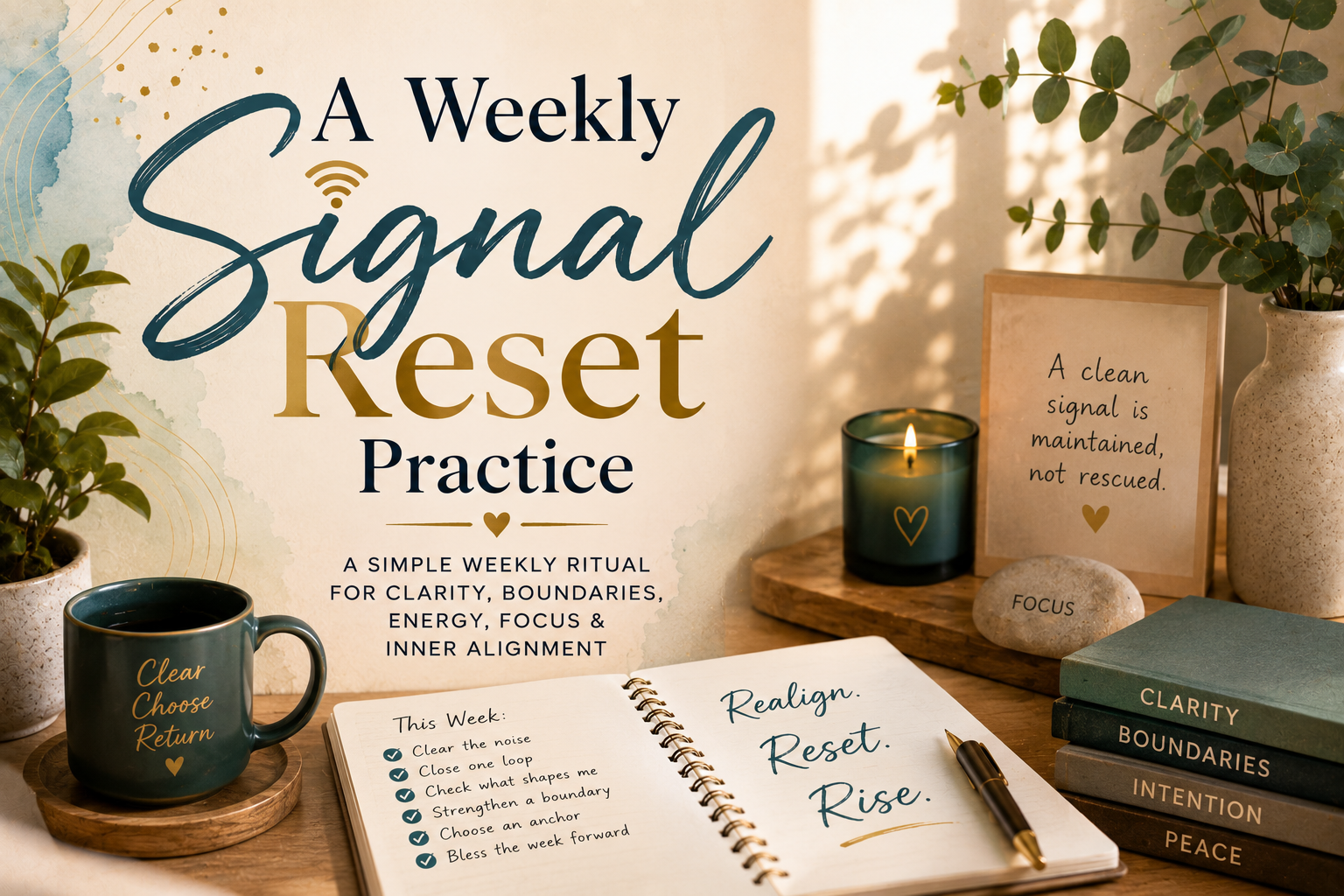
A Weekly Signal Reset Practice
Try a simple weekly reset practice to clear mental noise, close open loops, strengthen boundaries, review what is draining or nourishing you, and enter the new week with greater clarity.
A Simple Weekly Ritual for Clarity, Boundaries, Energy, Focus, and Inner Alignment
You do not have to wait until you are exhausted to realign.
A clean signal is maintained, not rescued.
That is what a weekly signal reset is for.
It is a gentle practice for clearing mental noise, closing open loops, strengthening boundaries, reviewing what has been shaping you, and returning to the part of yourself that feels clear, grounded, and true.
Not as punishment.
As care.
Not because you failed.
Because your life deserves maintenance too.
A weekly reset is not about fixing everything at once.
It is about creating one intentional pause before noise becomes overload.
One place in the week where you stop.
Listen.
Clear.
Choose.
Return.
Even twenty to thirty minutes can create a noticeable shift.
Your life does not need another complicated system.
It needs somewhere to come back into order.
What Is a Weekly Signal Reset?
A weekly signal reset is a simple reflection practice designed to help you notice what has been affecting your thoughts, energy, focus, emotions, habits, and choices before those influences quietly accumulate.
Think of it as a weekly check-in with your inner world.
You are asking:
What has been loud?
What actually matters?
What is unfinished?
What has been feeding me?
What has been draining me?
Where do I need a clearer boundary?
What practice will help steady me this week?
The purpose is not perfection.
The purpose is awareness.
A clear signal begins when you stop moving automatically and become conscious of what has been shaping you.
Why a Weekly Reset Can Help
Life creates buildup.
Messages.
Appointments.
Loose ends.
Decisions.
Conversations.
Screens.
Responsibilities.
Other people's needs.
Unfinished tasks.
Thoughts you meant to process later.
Eventually the mind can begin feeling like a room where everyone walked in and nobody closed the door behind them.
A weekly reset gives you a place to clear some of that buildup.
You do not have to eliminate every demand.
You simply stop carrying everything unconsciously.
Some things need action.
Some need boundaries.
Some need rest.
Some need prayer.
Some need to be written down.
Some need to be released.
And some need nothing more than acknowledgment.
The reset helps you tell the difference.
Step One: Clear the Channel
Begin somewhere quiet.
Sit comfortably.
Take a few slow breaths.
Let yourself arrive before you start evaluating anything.
You are not rushing.
You are not performing.
You are not trying to solve your entire life in one sitting.
You are listening.
Then ask:
What has been loud in me lately?
Write a few words.
No perfect sentences required.
Maybe it is:
Worry.
Frustration.
A decision.
A conversation you keep replaying.
Something you are waiting for.
An obligation you resent.
A fear you have not named.
A dream that keeps returning.
A feeling you pushed aside because the week required too much from you.
Naming something can create space around it.
What felt like a fog becomes more visible.
And once something becomes visible, you can decide what it actually needs.
This first step is not about fixing.
It is about seeing.
Step Two: Separate Noise From What Actually Matters
Not everything taking up mental space deserves equal attention.
Some things are important.
Some are simply loud.
That distinction can change the entire reset.
Ask:
What truly needs my attention?
Then:
What has been getting attention simply because it is noisy?
A loud concern may be someone else's urgency.
An argument you are still mentally rehearsing.
Something online that stirred frustration but requires no action.
An imagined future problem.
A comparison.
A decision that does not need to be made yet.
A real priority often feels different.
It may still be uncomfortable.
But it has substance.
There is something to do.
Something to decide.
Something to communicate.
Something to tend.
Something to release.
Signal clarity is partly the ability to stop treating every loud thing as equally important.
Step Three: Close One Open Loop
Open loops are quiet energy drains.
They are the unfinished tasks, delayed replies, half-made decisions, loose responsibilities, and mental tabs your mind keeps reopening in the background.
Even when you are trying to rest, part of you may still be carrying them.
You do not have to close everything.
Choose one.
Send the email.
Schedule the appointment.
Reply to the message.
Pay the bill.
File the paper.
Return the call.
Make the list.
Put one thing back where it belongs.
Handle the five-minute task that has been taking up five days of mental space.
One loop is enough.
This is about momentum, not perfection.
Closing one loop says:
I do not have to carry everything at once.
I can bring one thing into order.
I can reduce one source of friction.
Sometimes clarity returns through thought.
Sometimes it returns through action.
Step Four: Review What Has Been Shaping Your Signal
Your inputs matter.
What you repeatedly watch, read, hear, discuss, scroll through, absorb, and revisit leaves something behind.
So once a week, ask:
What affected my peace, mood, focus, or energy this week?
Create two columns.
Nourishing
and
Draining
Nourishing inputs might include:
Prayer.
Quiet.
Music.
Meaningful conversations.
Walking.
Nature.
Encouragement.
Creative work.
Learning.
Time with people who bring out something good in you.
Draining inputs might include:
Too much scrolling.
Constant notifications.
Comparison.
Arguments.
Stress content.
Overcommitting.
Unnecessary conflict.
Endless checking.
Conversations that leave you scattered.
The point is not to label everything good or bad.
It is to notice patterns.
Then choose one adjustment for the coming week.
Reduce one draining input.
Add one nourishing one.
Create a small pocket of quiet.
Unfollow something that continually unsettles you.
Stop beginning the morning with stress content.
Choose silence before screens.
Choose prayer before pressure.
Small input changes can create surprisingly large shifts in the atmosphere of a week.
Step Five: Check Your Boundaries
A weekly reset is a good time to notice where your yes and no stopped matching what you actually meant.
Ask:
Where did I say yes when I wanted to say no?
Where did I stay too long?
Where did I overexplain?
Where did I allow someone else's urgency to become mine?
Where did I give more access than felt right?
This is not an invitation to shame yourself.
It is information.
Maybe you agreed too quickly.
Answered messages when you needed rest.
Stayed in a conversation after it became disrespectful.
Accepted responsibility that was not yours.
Allowed your time to become too available.
Notice the pattern.
Then choose one boundary for the coming week.
For example:
I take time before agreeing to requests.
I do not answer non-urgent messages after a certain time.
I am not discussing that topic.
I leave conversations that become disrespectful.
I keep one hour protected for myself.
I do not explain a no more than necessary.
A boundary becomes easier to keep when you already know the sentence you will use.
Try:
That does not work for me.
I need time before I answer.
I am not available for that.
I cannot commit to that right now.
I am choosing something different.
Short.
Calm.
Repeatable.
Step Six: Choose One Signal Anchor
A signal anchor is a small daily practice that helps bring you back to yourself.
It does not need to be elaborate.
The best anchor is one you can actually repeat.
It might be:
Three slow breaths before checking your phone.
A short walk.
Water before coffee.
A five-minute prayer.
One honest sentence in a journal.
Ten minutes of tidying.
A few minutes outside.
A moment of gratitude before bed.
A short stretch.
Five minutes of silence.
Then decide when it happens.
Anchors work better when they have a home.
After waking.
Before work.
After lunch.
When you arrive home.
Before bed.
The purpose is not to build another obligation.
It is to give your day a reliable place to return.
Step Seven: Notice One Thing You Did Well
Many people review a week only by looking for what went wrong.
What did I forget?
What did I waste?
What did I fail to finish?
What should I have done differently?
But growth deserves attention too.
Ask:
What is one thing I am proud of from this week?
Maybe you paused before reacting.
Maybe you told the truth.
Maybe you rested.
Maybe you said no.
Maybe you finished something difficult.
Maybe you kept going.
Maybe you asked for help.
Maybe you recognized an old pattern sooner.
This matters.
If you only train your attention toward what needs improvement, you may miss evidence that you are already changing.
A weekly reset should not become another courtroom.
It is also a place to recognize progress.
Step Eight: Bless the Week Forward
End by turning toward the week ahead.
Not with pressure.
With intention.
You might say:
May my life be clean, clear, and true.
Or:
May I protect my peace with wisdom.
Or:
May I move through this week with clarity, courage, and grace.
Or:
God, help me live from truth instead of pressure.
Or simply:
Show me what matters most this week.
Let the words be simple.
You are not trying to control the entire week before it begins.
You are choosing the spirit in which you want to meet it.
Your Weekly Signal Reset
Use this simple checklist whenever you want a quick return to clarity:
□ What has been loud?
□ What actually matters?
□ What one open loop can I close?
□ What nourished me this week?
□ What drained me this week?
□ What boundary do I need?
□ What will be my daily signal anchor?
□ What did I do well?
□ What intention or prayer will I carry forward?
You can return to the same questions every week.
The answers will change.
The practice remains simple.
A Five-Part Signal Reset When You Have Less Time
Some weeks you may have thirty minutes.
Some weeks you may have ten.
You can still reset.
Use this shorter version:
Clear
What has been loud?
Close
What is one open loop I can handle?
Check
What has been nourishing or draining me?
Choose
What boundary and anchor do I need?
Bless
How do I want to enter the next week?
That is enough.
A practice only helps if you can return to it.
What a Signal Reset Is Not
A reset is not punishment for having a messy week.
It is not a productivity audit.
It is not a demand to become perfectly organized.
It is not a spiritual performance.
It is maintenance.
A place to notice.
Adjust.
Finish.
Release.
Protect.
Reconnect.
You return because returning is part of staying clear.
The Weekly Reset Can Become a Form of Self-Trust
Every time you pause and listen, you send yourself a message.
My inner life matters.
Every time you close one loop:
I can take care of what is mine.
Every time you strengthen a boundary:
My energy deserves stewardship.
Every time you choose a nourishing input:
I can influence the atmosphere I live in.
Every time you recognize progress:
I am paying attention to who I am becoming.
And every time you return after a difficult week:
I know how to come back to myself.
That is self-trust being built through repetition.
Frequently Asked Questions
What Is a Weekly Reset Practice?
A weekly reset is a short reflection and planning practice used to clear mental clutter, close unfinished tasks, review habits and inputs, strengthen boundaries, and prepare intentionally for the week ahead.
How Long Should a Weekly Reset Take?
There is no required length.
A useful reset may take ten minutes or thirty minutes depending on the week.
Consistency matters more than making it elaborate.
What Day Should I Do a Weekly Reset?
Choose whatever day naturally creates transition for you.
Some people prefer Sunday before the week begins.
Others prefer Friday evening, Saturday morning, or another quiet point in their schedule.
The best time is the time you are most likely to repeat.
How Do I Mentally Reset for a New Week?
Begin by naming what has been occupying your mind.
Then identify what truly needs attention, close one manageable open loop, review what has been nourishing or draining you, set one boundary, and choose one grounding practice for the week ahead.
What Is an Open Loop?
An open loop is an unfinished task, decision, conversation, obligation, or reminder that continues occupying mental attention because it has not been completed, scheduled, delegated, or intentionally released.
What Is a Signal Anchor?
A signal anchor is a small repeated practice that helps you return to a clearer, steadier state during the day.
Examples include prayer, breathing, walking, journaling, silence, stretching, or another simple routine that helps you reconnect.
How Can a Weekly Reset Help With Boundaries?
A weekly review gives you an opportunity to notice where you overcommitted, ignored your own capacity, overexplained, or allowed another person's urgency to shape your choices.
You can then choose one clearer boundary for the next week and prepare simple language for keeping it.
Give Yourself a Steady Way Back
You do not need a perfect week to live with a clear signal.
There will still be noisy weeks.
Hard conversations.
Unexpected responsibilities.
Unfinished tasks.
Schedules that change.
Moments when a boundary bends or an anchor disappears.
That does not mean the practice failed.
The point is not to prevent life from becoming complicated.
The point is to know how to return when it does.
Clear the channel.
Notice what actually matters.
Close one loop.
Review what has been shaping you.
Strengthen one boundary.
Choose one anchor.
Recognize one thing you did well.
Bless the week forward.
Then step into what comes next with a little more room inside you.
A little less noise.
A little more intention.
A little more peace.
Your signal does not need to be perfect.
It simply needs to know the way home.
If this message resonated, you may also enjoy:
Small Truths Create Big Reality
Alignment Isn’t Loud. It’s Consistent
Self-Trust Is the Currency of the Kingdom
Your Soulful Pathways ↑
Discover more series pages for you in Your Soulful Pathways ↑

Small Truths Create Big Reality
Explore how small truths, attention, beliefs, habits, faith, and everyday choices can influence the direction of your life and gradually create meaningful change.
Big realities are rarely created in one enormous moment.
They are assembled quietly.
One thought entertained.
One truth accepted.
One promise kept.
One boundary honored.
One prayer whispered.
One choice made differently than yesterday.
One small act repeated until it becomes part of the way we live.
We tend to notice the dramatic turning points because they are easy to recognize. The opportunity. The breakthrough. The answer. The decision. The door finally opening.
But behind many visible transformations are hundreds of invisible moments.
A person begins believing they are worthy of peace.
Someone decides their past does not get to make every future decision.
A family chooses kindness during an ordinary conversation.
A person begins taking a few quiet minutes each morning to pray.
Someone stops saying, Nothing ever works for me.
Another begins saying, I do not know what happens next, but something good is still possible.
These may look like small things.
They are not.
Small truths can become seeds.
And seeds have a remarkable way of becoming something much larger than what first fit inside the palm of your hand.
Reality Is Built More Quietly Than We Realize
Every life contains thousands of ordinary moments.
What we think about.
What we notice.
What we expect.
What we practice.
What we tolerate.
What we repeatedly choose.
What we say about ourselves.
What we believe might still be possible.
One thought does not determine a life.
One difficult morning does not determine a future.
One fearful moment does not erase years of growth.
But patterns matter.
Repeated thoughts can influence how we interpret situations.
Those interpretations can influence choices.
Repeated choices can become habits.
Habits can shape relationships, health, confidence, work, faith, and the direction in which a life moves.
This is how something small begins becoming something large.
What Is a Small Truth?
A small truth is not merely a pleasant phrase.
It is something real enough to stand upon.
I can make one good decision today.
My past is part of my story, but it does not have to control my future.
I can learn something I do not yet know.
I can treat myself and others with greater kindness.
Rest has value.
My attention matters.
There is still possibility here.
God has not forgotten me.
A small truth does not need to explain everything.
It only needs to illuminate enough ground for the next step.
Truth Does Not Need to Pretend
There is a difference between truth and forced positivity.
If something hurts, pretending that it does not hurt is not truth.
If something has gone wrong, saying everything is perfect does not make it so.
If a problem requires action, hopeful words are most powerful when they lead us toward wisdom, courage, and movement.
A life-giving truth can acknowledge reality without surrendering possibility.
Instead of:
Nothing is wrong.
perhaps:
This is difficult, but I can still take the next step.
Instead of:
I am never afraid.
perhaps:
I can feel fear without allowing fear to make every decision.
Instead of:
Everything will happen exactly as I want.
perhaps:
I trust that goodness, meaning, and possibility can still exist even when I cannot see the entire road.
Truth does not require denial.
Truth can look directly at what is happening and still leave the door open for hope.
Attention Helps Shape What We Experience
At any moment, more is happening around us than we can consciously notice.
The mind selects.
It filters.
It focuses.
It decides what seems important.
This makes attention powerful.
Imagine walking into a crowded room while looking for someone wearing a red jacket.
Suddenly red seems to appear everywhere.
The red objects were already there.
Your attention changed what became noticeable.
Life can work this way too.
When we continually look for rejection, disappointment, danger, or proof that something will go wrong, those signals can become especially noticeable.
When we intentionally notice kindness, opportunity, progress, beauty, and possibility, those things can become easier to see too.
This does not mean our attention magically creates everything around us.
It means attention influences what rises to the foreground of our awareness.
And what we notice often influences what we do next.
The Mind Learns Through Repetition
The human brain is capable of learning and adapting throughout life.
This ability is sometimes called neuroplasticity.
Neuroplasticity simply means that the brain can change through learning, experience, and repeated practice.
It does not mean that repeating one sentence instantly transforms the brain or guarantees a particular outcome.
The deeper truth is simpler.
Practice matters.
Repetition creates familiarity.
Skills strengthen when they are used.
Behaviors that are repeated in familiar situations can gradually become easier to perform.
This is part of how habits form.
At first, a new action may require effort.
Eventually, it may begin feeling more natural.
And this is important:
Growth does not require perfection.
One missed day does not erase everything you have practiced.
One difficult week does not mean you have failed.
You can return.
You can continue.
You can begin again.
Your Inner Voice Is Part of Your Environment
We usually think of our environment as something outside us.
Our home.
Workplace.
Neighborhood.
Relationships.
Media.
But we also live inside a stream of internal language.
I always ruin everything.
I will never figure this out.
People like me do not succeed.
There is no point trying.
When these thoughts repeat often enough, they can begin feeling like facts.
But familiar does not mean true.
A healthier inner voice does not need to become exaggerated praise.
It can simply become more accurate.
I made a mistake, but mistakes can be corrected.
I do not understand this yet.
I have handled difficult things before.
I can ask for help.
I can try another approach.
This moment is not my whole life.
These are small truths.
And small truths can give the mind somewhere new to stand.
Small Truths Can Replace Old Stories
Many beliefs about ourselves began before we consciously chose them.
Someone called you difficult.
Too sensitive.
Too quiet.
Too ambitious.
Not talented enough.
Not smart enough.
Not capable.
Maybe one failure became an identity.
Maybe rejection became a prophecy.
Maybe someone else's limitation became something you carried as your own.
But something repeated to you is not automatically something true about you.
Growth can begin when we separate the event from the identity.
I failed at something is different from I am a failure.
Someone rejected me is different from I am unworthy of love.
I felt afraid is different from I am weak.
I made a poor decision is different from I cannot make good decisions.
The difference may look small on paper.
Inside a life, it can be enormous.
Values Give Truth Roots
There is a difference between saying something flattering about yourself and remembering what genuinely matters to you.
Your values are the principles and qualities you want your life to reflect.
Faith.
Kindness.
Family.
Integrity.
Peace.
Compassion.
Courage.
Creativity.
Service.
When we remember what we truly value, difficult moments can be placed into a larger story.
You are more than one mistake.
More than one rejection.
More than one opinion.
More than one bad day.
A small truth becomes stronger when it connects to something meaningful.
Kindness matters to me, so I will answer with kindness.
Faith matters to me, so I will pray before I panic.
Health matters to me, so I will care for my body today.
Peace matters to me, so I do not need to participate in every argument.
This is where truth begins becoming action.
Belief Becomes More Powerful When It Meets Behavior
Belief matters.
But belief becomes especially meaningful when it begins influencing what we do.
Suppose someone decides:
My health matters.
That truth may lead to a walk.
The walk may lead to another.
Eventually, walking becomes part of everyday life.
Or:
My peace matters.
That truth may lead to a boundary.
The boundary changes a conversation.
The changed conversation creates more room for peace.
Or:
I can learn this.
That belief encourages someone to try.
Trying creates experience.
Experience develops skill.
Skill creates confidence.
Confidence makes another attempt easier.
The truth did not magically rearrange the world.
It changed participation in the world.
And participation can change outcomes.
Turn a Truth Into a Small Plan
There is a simple way to help a good intention become something practical.
Decide beforehand what you will do when a certain moment arrives.
For example:
If I begin criticizing myself after making a mistake, I will remind myself that a mistake is something I made, not who I am.
If I feel overwhelmed in the morning, I will pause and pray before deciding what to do next.
If I want to abandon a new habit, I will do the smallest version of it instead.
If a conversation becomes disrespectful, I will step away rather than escalate it.
Sometimes the bridge between a truth and a changed life is simply having a plan for the moment when the old pattern returns.
A small truth becomes a small plan.
A small plan becomes a small action.
Repeated actions can gradually become a different way of living.
Identity Can Begin Changing Before Circumstances Do
Sometimes the first evidence of transformation appears inside.
Before the promotion.
Before the relationship changes.
Before the goal is reached.
Before anyone else notices.
A person begins thinking:
I am someone who keeps promises to myself.
I am learning to create peace.
I am capable of building something meaningful.
I am becoming wiser about where I place my energy.
Then comes evidence.
One promise kept.
One courageous conversation.
One healthier decision.
One boundary maintained.
One morning when an old reaction appears and a different response is chosen.
The outside world may look almost identical.
But the person standing inside it is changing.
That matters.
Words Participate in the World We Build
Words do things.
They comfort.
They encourage.
They wound.
They invite.
They exclude.
They reconcile.
They clarify.
They bless.
Words can change the emotional atmosphere of a home.
They can determine whether a conversation becomes a bridge or a wall.
They can influence how we interpret our own experiences.
Consider the difference between:
I cannot do this.
and
I have not figured this out yet.
The situation has not changed.
But the second sentence leaves a door open.
Sometimes one open door is enough to keep someone moving.
The Small Decisions Nobody Sees
Some of the most meaningful decisions in life receive no applause.
Going to bed instead of continuing an argument.
Turning off something that disturbs your peace.
Taking the walk.
Drinking the water.
Opening the book.
Making the phone call.
Saving a little money.
Praying before reacting.
Choosing not to repeat gossip.
Cleaning one corner of a room when the whole room feels overwhelming.
Saying no.
Saying yes.
Trying again.
Stopping something.
Beginning something.
Forgiving.
Walking away.
Returning.
These decisions rarely look historic while we are making them.
But lives are largely constructed from ordinary days.
What is repeated becomes structure.
Small Choices Have a Way of Accumulating
A small action can seem almost meaningless when viewed alone.
One page read.
One dollar saved.
One healthy meal.
One prayer.
One kind sentence.
One evening spent learning.
One walk.
One apology.
One early bedtime.
But repetition changes scale.
One page becomes chapters.
Small savings accumulate.
Practice becomes ability.
Kindness can alter a relationship.
Prayer can become a spiritual rhythm.
One courageous decision can make courage feel more familiar the next time it is needed.
Small does not mean insignificant.
Small things have a remarkable ability to accumulate.
Small Truths and Faith
Scripture repeatedly draws our attention toward small things.
Seeds.
Bread.
Lamps.
Sparrows.
Water.
Fields.
A widow's offering.
A mustard seed.
Jesus used ordinary things to reveal extraordinary spiritual realities.
There is something beautiful about that.
God does not seem intimidated by small beginnings.
Faith itself does not always arrive as complete certainty.
Sometimes it begins as willingness.
God, I do not understand this, but I trust You.
Show me the next step.
Help me see what I cannot see yet.
Give me wisdom for today.
A prayer may take only a few seconds.
Its influence may travel much farther.
Perhaps the prayer changes the way you enter a conversation.
The conversation changes a decision.
The decision changes a relationship.
The relationship changes something years from now.
We rarely know the full reach of one faithful moment.
Faithfulness in Little Things
There is a powerful principle in Luke 16:10:
Whoever is faithful with very little can also be faithful with much.
The spiritual life does not exist only in dramatic moments.
It lives in ordinary faithfulness.
How we speak when nobody is impressed.
How we treat someone who cannot benefit us.
What we do when no one is watching.
Whether we keep our word.
Whether we choose compassion.
Whether we remain grateful.
Whether we continue praying when nothing appears to be changing.
The small place may be where something larger is being prepared.
The Mustard Seed Principle
Jesus famously compared faith to a mustard seed.
The image endures because it captures something profound.
Small beginnings can contain enormous potential.
A seed does not resemble the plant it will become.
It can be held between fingertips.
Once buried, it may appear to have disappeared entirely.
Yet beneath the surface, life is moving.
Roots form before branches appear.
That is worth remembering.
Not every meaningful change is immediately visible.
Sometimes roots are growing.
Small Truths and Manifestation
There is a grounded and beautiful way to understand the connection between small truths and manifestation.
Manifestation does not need to mean that thoughts control every event.
It can mean bringing your inner life and your outward choices into greater alignment with what you hope to create.
You hold a vision.
You give it attention.
You become more aware of possibilities connected to it.
You make decisions that support it.
You prepare for what you hope to receive.
You act when opportunities appear.
You remain open to doors you could not have planned.
Faith, intention, and action can walk together.
We do not control every circumstance.
But neither are we powerless observers of our own lives.
There is a beautiful place between believing we control everything and believing nothing we do matters.
That place is participation.
Expectations Can Influence What Happens Next
What we expect can sometimes influence the way we behave.
Imagine someone entering a gathering believing:
No one will like me.
They may avoid eye contact.
Speak very little.
Stay distant.
Then they leave without connecting with anyone and think:
See? I knew it.
The original belief helped shape the behavior that followed.
But another small truth can interrupt the pattern.
I do not know these people yet.
That thought may encourage eye contact.
Eye contact may lead to conversation.
Conversation may create connection.
Connection creates new evidence.
The external world did not change because of a magic sentence.
A belief changed behavior.
Behavior changed interaction.
Interaction changed experience.
That is one way small truths can help create a different reality.
Your Environment Can Support the Person You Are Becoming
Willpower does not have to carry everything.
Your surroundings can make a good choice easier.
If you want to read more, place the book where you will see it.
If you want to drink more water, keep water within easy reach.
If you want to pray in the morning, create a quiet place that invites stillness.
If you want less digital noise, make distractions less convenient.
If you want to remember a truth, place it somewhere your eyes naturally land.
Sometimes wisdom is not trying harder.
Sometimes it is making the good choice easier to reach.
You Do Not Need to Transform Everything Today
The idea of changing an entire life can become overwhelming.
Fortunately, life rarely asks us to live tomorrow today.
Sometimes transformation asks only for the next thing.
The next honest thought.
The next healthy choice.
The next prayer.
The next boundary.
The next apology.
The next attempt.
The next act of courage.
The next truth.
You do not need to solve your entire future before sunset.
You can participate faithfully in the moment you have.
Progress Does Not Require Perfection
This may be one of the most important small truths of all.
Missing one day does not destroy a habit.
Having one difficult morning does not erase growth.
Feeling afraid does not cancel courage.
Questioning does not mean faith has disappeared.
Making a mistake does not return you to the beginning.
Growth is rarely perfectly straight.
There are pauses.
Detours.
Days when the old way feels easier.
Days when nothing seems to be happening.
Continue.
Return.
Begin again.
One New Truth Can Change the Direction of a Life
Sometimes a future changes because someone finally accepts one truth they could not accept before.
I can leave.
I can forgive.
I can begin again.
I can ask for help.
I am loved.
I have something meaningful to contribute.
I do not have to become who someone else expected me to be.
God is still working in my life.
The sentence may be short.
The consequences may be enormous.
There are moments when truth becomes a hinge.
The door swings differently afterward.
Big Reality Is Often the Sum of Tiny Alignments
A meaningful life is not built only through accomplishments.
It is also built through alignment.
Your words begin matching your values.
Your choices begin matching your hopes.
Your habits begin supporting the person you are becoming.
Your environment begins protecting what matters.
Your relationships begin making room for honesty.
Your attention begins moving toward what enlarges rather than diminishes you.
Your inner voice becomes more truthful.
Your faith begins appearing in ordinary decisions.
Each adjustment may seem small.
Together, they can become a very different reality.
Do Not Despise Small Beginnings
Honor the beginning.
The first attempt.
The first prayer.
The first boundary.
The first dollar saved.
The first page written.
The first morning you wake up believing something different about yourself.
The first time you refuse to return to something that repeatedly wounds you.
The first moment you think:
Maybe my life can be different.
Beginnings often look unimpressive.
Seeds usually do.
A Seven-Day Small Truth Practice
Choose one truthful sentence that represents something you genuinely want to live more fully.
Keep it simple.
Peace belongs in my life.
My attention is valuable.
I can make one good choice today.
There is still goodness ahead.
God is guiding me.
For seven days, return to that truth.
Then give it an action.
If your truth is My peace matters, perhaps your action is five quiet minutes each morning.
If your truth is My body deserves care, perhaps your action is taking a walk.
If your truth is God is guiding me, perhaps your action is beginning the day in prayer before reaching for your phone.
If your truth is I can learn, perhaps your action is reading two pages of something that teaches you.
The sentence matters.
The action gives the sentence somewhere to live.
Small Truths Create Big Reality
A life is not shaped only by monumental moments.
It is shaped by thousands of quiet ones.
What you notice.
What you practice.
What you repeat.
The word you stop saying about yourself.
The kindness you offer.
The boundary you keep.
The habit you begin.
The prayer you whisper.
The possibility you refuse to abandon.
The truth you finally allow yourself to believe.
Small truths may enter softly.
But truth has never needed to be loud to be powerful.
A seed does not announce itself before it grows.
A root does not need an audience.
A prayer does not need a microphone.
A better choice does not need applause.
Some of the greatest transformations in a human life begin almost invisibly.
One thought.
One truth.
One decision.
One faithful step.
And then another.
Until one day you look around and realize the landscape has changed.
Questions to Reflect On
What is a small truth?
A small truth is a simple, grounded realization that can guide the way you think or act. It does not need to solve everything. Sometimes it simply provides enough clarity for your next step.
Can thoughts really change reality?
Thoughts do not control every external event. They can influence what we notice, how we interpret experiences, the decisions we make, and the actions we take. Over time, those influences can meaningfully affect the direction of our lives.
Is this the same as positive thinking?
Not necessarily. A small truth should be grounded rather than used to deny difficulty. Everything is perfect may not be true. Something good may still be possible can acknowledge difficulty while preserving hope.
What is neuroplasticity?
Neuroplasticity is the brain's ability to adapt through learning and experience. It is one reason repeated practice can help strengthen skills and behavioral patterns over time.
What does it mean to live according to your values?
Your values are the qualities and principles that matter deeply to you, such as faith, kindness, honesty, family, courage, or peace. Living according to your values means allowing those principles to influence your everyday choices.
Can one small choice really matter?
Yes. One choice may appear insignificant by itself, but repeated choices can create habits, change relationships, build confidence, and gradually alter the direction of a life.
Can faith begin with something very small?
Yes. Scripture repeatedly uses small things to reveal larger spiritual truths, especially the image of the mustard seed. A prayer, an act of trust, or one faithful decision may become the beginning of something much larger.
Does manifestation mean our thoughts control everything?
It does not have to. Manifestation can be understood as intentionally aligning attention, beliefs, choices, and actions with what you hope to create while remaining open to circumstances, opportunities, God's guidance, and outcomes you cannot completely control.
What if I keep falling back into an old pattern?
Returning to an old pattern does not mean your growth has disappeared. Notice what happened, reconnect with the truth you want to live, and make the next choice from that place. Growth often includes returning and beginning again.
What small truth should I begin with?
Choose something simple, honest, and actionable:
My next choice matters.
Then make one choice that agrees with it.
That is enough for today.
You may also enjoy:
Attention Is One of Your Mind's Greatest Forces
Feed Your Mind With What Enlarges You
Manifestation Is a Quiet Art
Greatness Does Not Always Begin Loudly
Trust the Unseen
The Beauty of Becoming
Divine Timing
The Peace of Presence
Whispers of Worth
How to Recognize Your Own Light
Alignment Isn’t Loud. It’s Consistent.
Learn how consistency, small habits, boundaries, daily choices, and self-trust can help you build a life that aligns with your values and what matters most.
How Small Choices, Daily Habits, and Self-Trust Create a Life That Matches What You Value
Alignment is often imagined as a dramatic moment.
A breakthrough.
A revelation.
A sign.
A sudden decision that seems to rearrange everything.
Sometimes life does change that way.
But much of real alignment is quieter.
It happens when what you say matters begins appearing in the way you live.
Not once.
Repeatedly.
Alignment is not simply:
I know what I want.
It is:
I am beginning to live in a way that supports it.
It is the steady agreement between your values, choices, habits, boundaries, attention, and actions.
You do not have to announce it.
You do not have to feel inspired every day.
You do not need a perfect morning routine or a dramatic transformation.
You simply keep returning.
To truth.
To what matters.
To the promises you want your life to believe.
Again and again, your choices begin saying:
This is the direction now.
What Does It Mean to Live in Alignment?
Living in alignment means your daily life increasingly reflects what you genuinely value.
If you value peace, you begin making choices that create more peace.
If you value health, your routines begin making room for your body.
If you value family, your attention reflects that.
If you value faith, prayer and spiritual reflection have somewhere to live.
If you value creativity, you stop waiting for unlimited free time before creating.
If you value honesty, your words gradually become more truthful.
If you value rest, you stop treating exhaustion as the only proof that you worked hard enough.
Alignment does not mean every choice is perfect.
It means the overall direction begins making sense.
Alignment Is a Pattern, Not a Performance
One aligned decision can feel powerful.
But one decision does not create a life.
Patterns do.
You may decide:
I am going to protect my peace.
Then three days later, you find yourself pulled into the same unnecessary conflict.
That does not mean your intention was false.
It means the new pattern still needs practice.
Alignment becomes real through repetition.
You return.
You correct.
You choose again.
You notice faster next time.
Eventually, what once required enormous effort can begin feeling more natural.
Alignment is not something you perform for a day.
It is something your life gradually learns through repeated choices.
Your Life Believes What You Repeat
Declarations can be powerful.
But repetition teaches.
If you continually tell yourself:
My health matters
while never making room for rest, nourishment, movement, or care, your lived experience receives a different message.
If you say:
I want peace
while allowing every notification, argument, request, and crisis immediate access to you, the pattern says something else.
If you say:
I am building something important
but give it only the time left over after everything else, your schedule may be contradicting your intention.
This is not an invitation to shame yourself.
It is an invitation to look honestly.
Ask:
What is my life learning from what I repeatedly do?
That question can reveal where alignment wants to grow.
Consistency Does Not Mean Perfection
Consistency is sometimes misunderstood.
People imagine it means:
Never missing.
Never drifting.
Never changing plans.
Never losing motivation.
Never having a bad day.
That is not consistency.
Consistency is returning often enough that the direction remains alive.
You miss the walk.
Go tomorrow.
You react instead of pausing.
Repair and try again.
You lose your routine during a difficult week.
Begin again when you can.
You overcommit.
Notice it and protect the next opening.
A missed day does not erase the pattern you are building.
Consistency becomes stronger when you stop treating every interruption like failure.
Build a Foundation Instead of Chasing a Feeling
Inspiration is wonderful.
But inspiration is weather.
It changes, which is why your foundation has to work on ordinary days too.
Some mornings you wake up ready to rebuild your entire life.
Other mornings you would prefer coffee and silence before anyone speaks to you. ☕
A foundation has to work on both kinds of days.
That is why aligned practices should not depend entirely on motivation.
A feeling says:
I feel committed today.
A foundation says:
This still matters when the feeling is quieter.
That difference can change everything.
Small Habits Can Carry Big Values
A habit does not have to look impressive to express something important.
Drinking water can express care for your body.
Turning your phone off for thirty minutes can express protection of your attention.
Going to bed earlier can express respect for tomorrow.
Writing one paragraph can express commitment to creativity.
Saving a small amount can express financial stewardship.
Taking a walk can express care for your energy.
Praying before reacting can express faith and discernment.
Saying:
Let me think before I answer
can express self-respect.
Small behavior can carry large meaning.
Choose Habits That Prove Something to You
A good habit does more than complete a task.
It can create evidence.
Every time you keep a reasonable promise, you prove:
I can rely on myself.
That may be more valuable than the habit itself.
You said you would take ten quiet minutes.
You did.
You said you would make the call.
You did.
You said you would stop working at a certain time.
You did.
You said you would pause before saying yes.
You remembered.
Self-trust grows from these little pieces of evidence.
Start Smaller Than Your Ambition
One reason consistency fails is that people design habits for their most motivated self.
An hour every morning.
Seven days a week.
Everything changes Monday.
Then ordinary life arrives.
The routine collapses.
Try making the practice smaller.
Five minutes.
One page.
Ten dollars.
One walk.
One drawer.
One prayer.
One honest sentence.
A small practice you actually repeat can shape your life more than an impressive practice you abandon.
Small does not mean insignificant.
Small means repeatable.
And repeatable is powerful.
Make Your Aligned Choice Easier to Repeat
Environment matters.
If you want to read, leave the book where you can see it.
If you want less phone use, move the phone farther away.
If you want to walk in the morning, set out your shoes.
If you want to journal, leave the journal open.
If you want to save automatically, create the system once.
If you want quiet before the day begins, protect those first few minutes.
Do not make every aligned choice depend on willpower.
Build some support around it.
Your Calendar Reveals Alignment
One of the clearest alignment checks is your calendar.
Look at where your time actually goes.
Not where you intended it to go.
Where did it go?
Work.
Family.
Scrolling.
Errands.
Rest.
Creating.
Learning.
Driving.
Helping.
Worrying.
Exercise.
Entertainment.
Prayer.
There is no perfect distribution.
Different seasons require different things.
But ask:
Does my time roughly reflect what I say matters right now?
If not, do not overhaul everything.
Change one piece.
Your Attention Reveals Alignment Too
Time is not the only thing you spend.
Attention is another currency.
You can physically be with someone while mentally living inside your phone.
You can have free time while giving your entire mind to worry.
You can say a project matters while continually breaking your own concentration.
Ask:
What receives the best of my attention?
That answer may tell you as much as your calendar does.
Let Your No Protect Your Yes
Alignment requires limits.
Every yes uses something.
Time.
Energy.
Attention.
Money.
Capacity.
You cannot say yes to everything without eventually making some of your most important yeses weaker.
A boundary can protect:
Your family.
Your work.
Your health.
Your faith.
Your recovery.
Your creativity.
Your peace.
A thoughtful no is not automatically rejection.
Sometimes it is stewardship.
Let Your Rest Support Your Direction
Rest is not outside alignment.
It can be part of it.
A life built entirely around output eventually becomes difficult to sustain.
Rest supports:
Attention.
Patience.
Creativity.
Energy.
Decision-making.
Emotional steadiness.
Physical recovery.
You do not have to earn every pause through exhaustion.
Sometimes rest is simply one of the practices that helps you keep living well.
Alignment Can Feel Uncomfortable
An aligned choice is not always the comfortable choice.
You may need to:
Say no.
Have a conversation.
End a habit.
Start something unfamiliar.
Spend differently.
Rest when you are used to pushing.
Begin before you feel ready.
Stop explaining yourself.
Stay consistent when nobody is praising you.
Alignment is not measured by whether every choice feels easy.
Sometimes the right direction still asks for courage.
Learn the Difference Between Discipline and Punishment
Consistency works better when it is not built on self-attack.
Discipline says:
This matters, so I am going to support it.
Punishment says:
I failed, so now I have to be harsh with myself.
One builds capacity.
The other drains it.
You can be disciplined without becoming cruel.
You can hold yourself accountable without turning every missed day into evidence against your character.
Your Identity Begins Following Repetition
Repeated behavior can influence the way you see yourself.
You take walks consistently and begin thinking:
I am someone who takes care of my body.
You write regularly and eventually:
I am a writer.
You keep boundaries and begin feeling:
I can trust myself to protect what matters.
You pray regularly and discover:
Faith has a place in my ordinary life.
Identity does not always arrive before action.
Sometimes action gives identity evidence.
Stop Waiting to Feel Like the Person You Want to Become
You may not feel confident yet.
Begin anyway.
You may not feel disciplined.
Keep one promise.
You may not feel peaceful.
Protect ten quiet minutes.
You may not feel creative.
Make something small.
You may not feel financially secure.
Take one wise step.
You may not feel spiritually strong.
Pray one honest prayer.
You do not always become ready and then act.
Sometimes you act, and readiness begins growing afterward.
Alignment Includes Your Words
What you say repeatedly matters too.
You may value peace while constantly speaking against yourself.
I always mess everything up.
I never follow through.
I'm terrible at this.
Nothing ever changes.
Those sentences can become habits of their own.
Try language that is accurate without becoming defeating.
I am learning consistency.
I missed today. I can return tomorrow.
This is taking longer than I hoped.
I am building something new.
I am practicing a different way of living.
Your words do not need to be artificially positive.
They can simply stop turning temporary difficulty into permanent identity.
Alignment Includes Your Actions
Words matter.
Actions make them believable.
You can say:
Peace matters.
Then choose fewer unnecessary battles.
You can say:
My health matters.
Then give your body some support.
You can say:
My dream matters.
Then give it actual time.
You can say:
My faith matters.
Then create room for prayer.
You can say:
My family matters.
Then put the phone down sometimes.
Ask:
Does the way I am living support what I keep saying matters?
That is one of the simplest alignment questions there is.
Use One Signal Anchor
Choose one practice that reminds you of the direction you are building.
It might be:
Three slow breaths before touching your phone.
A morning prayer.
A ten-minute walk.
Writing one paragraph.
Cleaning one small area.
Checking your spending once a week.
Turning screens off before bed.
One honest journal sentence.
A five-minute pause before responding to requests.
The anchor does not need to transform your entire life.
Its job is to remind you:
This is the direction.
Try a Weekly Alignment Check
Once a week, ask:
What did I say mattered this week?
What actually received my time?
What strengthened me?
What repeatedly scattered me?
What promise did I keep?
Where did I drift?
What is one adjustment for next week?
Five minutes is enough.
This is not an audit of your worth.
It is navigation.
When You Drift, Return Without Drama
Drift happens.
A demanding week arrives.
A routine gets disrupted.
You become distracted.
You fall back into an old pattern.
The most useful response is often much simpler than the mind wants to make it.
Return.
Open the journal.
Take the walk.
Reset the boundary.
Make the next wiser spending choice.
Put the phone away.
Pray again.
You do not need a ceremony for getting back on track.
A missed step does not erase the road.
Self-Trust Is Built Through Return
Keeping promises builds one kind of self-trust.
Returning after you drift builds another.
You learn:
I do not have to be perfect to remain committed.
I can notice when something is not working and adjust.
I can begin again without turning the interruption into defeat.
Self-trust does not require believing:
I will never fail myself again.
A stronger promise is:
When I notice I have drifted, I will return.
That is believable.
Human.
Steady.
You can become reliable not because you never lose your way, but because you become increasingly willing to correct course.
Faith Can Give Alignment a Deeper Center
Alignment is more than optimizing your schedule.
For a person of faith, another question enters:
What am I trying to become before God?
Not only:
What do I want?
But:
What am I called to steward?
My time.
My gifts.
My relationships.
My health.
My resources.
My character.
My opportunities.
My rest.
Faith can keep consistency from becoming obsession with productivity.
You are not valuable because you maintained a perfect routine.
Your practices are there to support the life you have been given.
Consistency Can Be Gentle
Consistency does not need to feel militarized.
It can be quiet.
A cup of water.
A prayer.
Five minutes outside.
One page.
A clean kitchen before bed.
A phone put away.
A boundary kept.
A promise remembered.
A moment of gratitude.
Gentle does not mean ineffective.
A river reshapes stone without shouting about it.
Signs You Are Becoming More Aligned
You may notice:
Your decisions require less internal argument.
You keep more small promises to yourself.
Your calendar reflects your priorities more clearly.
You recover faster after drifting.
You need less motivation to begin familiar practices.
You say no more thoughtfully.
Your yes feels more genuine.
You feel less divided between what you value and what you do.
Your habits begin supporting your future instead of only relieving the present moment.
You become more comfortable with slow progress.
You trust yourself more.
Your ordinary days begin feeling more intentional.
Alignment often becomes visible quietly.
Frequently Asked Questions
What does it mean to live in alignment?
Living in alignment means your choices, habits, priorities, words, and actions increasingly reflect the values and direction that genuinely matter to you.
Does alignment mean following every feeling?
No. Feelings provide information, but alignment also involves values, responsibilities, wisdom, consequences, and discernment.
Why is consistency important for personal growth?
Consistency allows small actions to accumulate. Repeated choices can strengthen skills, routines, confidence, self-trust, and the likelihood that important values are actually reflected in daily life.
How do I become more consistent?
Start with one small, realistic behavior. Reduce unnecessary friction, attach it to an existing routine if helpful, and focus on returning after missed days rather than demanding perfection.
How do I know whether my life is aligned with my values?
Look at your calendar, attention, habits, spending, relationships, boundaries, and repeated choices. Ask whether they roughly support what you say matters most.
Can I be aligned and still have bad days?
Absolutely.
Alignment is a direction, not a permanent emotional state.
What should I do when I lose consistency?
Return.
Identify what disrupted the pattern, adjust if necessary, and begin again without turning the interruption into an identity.
How does consistency build self-trust?
Every reasonable promise you keep creates evidence that you can rely on yourself. Returning after setbacks builds another kind of trust: the belief that drifting does not mean giving up.
Is rest part of alignment?
Yes. Rest can support health, energy, emotional steadiness, attention, creativity, and the ability to continue doing what matters.
A Prayer for Consistent Alignment
God, help me build a life that reflects what matters.
Give me wisdom to know what deserves my attention and courage to choose it consistently.
Help me stop confusing intensity with transformation.
Teach me to honor small beginnings, quiet routines, honest boundaries, meaningful work, and needed rest.
When I drift, help me return without shame.
When motivation fades, remind me why the direction still matters.
Let my habits support the person You are helping me become.
And keep my pursuit of consistency rooted in faith, love, wisdom, and gratitude rather than fear or perfection.
Amen.
Alignment Isn’t Loud. It’s Consistent.
You do not need one enormous moment to prove your life is changing.
Sometimes change looks much quieter.
You drink the water.
You take the walk.
You say the honest thing.
You protect the hour.
You save the money.
You write the page.
You pray.
You rest.
You return.
Again.
And again.
Eventually, the pattern becomes visible.
Your choices begin agreeing with your values.
Your habits begin supporting your future.
Your schedule begins reflecting what matters.
Your words and actions begin telling a more consistent story.
You stop needing every day to feel extraordinary.
Because ordinary days are where lives are built.
Alignment is not loud.
It does not need an audience.
It does not need constant inspiration.
It needs direction.
Practice.
Return.
And enough consistency for your life to begin believing:
This is who we are becoming now.

How to Stop Draining Your Life Force
Discover what quietly drains your life force, from mental overload and open loops to worry, digital noise and emotional carrying, and learn practical ways to reclaim your energy.
Where Your Energy Goes and How to Reclaim More of Yourself
Life force does not always disappear in dramatic ways.
Sometimes it leaves through tiny openings.
The unfinished decision you think about twenty times a day.
The conversation you keep replaying.
The phone that never really leaves your attention.
The problem you are trying to solve for someone else.
The room full of clutter that quietly asks something of you every time you walk through it.
The commitment you no longer want but keep maintaining.
The worry that has been running in the background for weeks.
The constant switching between tasks.
The pressure to respond immediately.
The habit of giving everything your attention except the life directly in front of you.
Individually, these things may seem small.
Together, they can become expensive.
You can wake up after a full night of sleep and still feel depleted because exhaustion is not always about how many hours you slept.
Sometimes it is about how many places your attention, emotion, responsibility, and energy are trying to live at once.
Your life force is the vitality you bring to being alive.
It is your capacity to think, create, care, work, move, love, imagine, focus, respond, pray, build, recover, and participate in your own life.
Protecting it does not mean becoming unavailable to the world.
It means becoming more intentional about what receives you.
What Do We Mean by Life Force?
Across cultures and spiritual traditions, human vitality has been described in many ways.
Some traditions speak of qi or chi.
Others speak of prana.
Spiritual language may describe vital energy, spirit, breath, presence, or life force.
In everyday language, we might simply call it energy.
You know the experience even if you never give it a spiritual name.
Some days you feel alive.
Clear.
Creative.
Present.
Capable.
Interested in life.
Other days you feel scattered, flat, overstimulated, mentally crowded, or strangely exhausted.
Not every change in energy has the same cause. Sleep, nutrition, physical health, stress, workload, environment, emotional strain, and many other factors can affect how energetic a person feels.
But there is another question worth asking:
What am I repeatedly giving my energy to?
Because energy is not only something you have.
It is something you spend.
Attention Is One of Your Greatest Energy Resources
Your attention may be one of the most overlooked forms of life force.
Every notification asks for some.
Every open tab asks for some.
Every distraction asks for some.
Every time you interrupt one task to check another, your attention has to move, reorient, and return.
Modern life can scatter attention into hundreds of fragments.
You can spend an entire day doing things while feeling as though you were never fully present for any of them.
That fragmentation can be draining.
Protecting your life force sometimes begins with something surprisingly simple:
Decide what deserves your attention right now.
Not everything that can reach you deserves immediate access to you.
Open Loops Can Quietly Consume Energy
An open loop is something unfinished that continues asking for mental attention.
The email you need to answer.
The appointment you need to make.
The bill you need to handle.
The object you need to return.
The conversation you know you need to have.
The project sitting half-finished.
One open loop may not matter much.
Twenty can create mental static.
Your mind keeps revisiting them because nothing has told it:
This is handled.
You do not need to finish everything today.
Instead, capture what is open.
Write it down.
Then decide:
Do it.
Schedule it.
Delegate it.
Decide it.
Delete it.
Sometimes the greatest relief comes not from completing something, but from finally deciding what will happen with it.
Indecision Has an Energy Cost
A decision made once uses energy once.
A decision avoided may use energy every day.
Should I?
Shouldn't I?
Maybe.
Not yet.
What if?
I'll think about it tomorrow.
Then tomorrow arrives and the internal meeting begins again.
Some decisions genuinely need time.
Others remain open because closing the door feels uncomfortable.
There comes a point when indecision itself becomes more expensive than choosing.
You will not always know the perfect answer.
Sometimes you gather what you know, listen carefully, pray, use your best judgment, choose, and move.
Clarity can restore enormous energy.
Worry Can Become Invisible Background Activity
Worry rarely announces:
I am consuming your energy now.
It runs quietly.
While you work.
While you cook.
While you drive.
While you are supposed to be resting.
Your body may be sitting on the couch while your mind is trying to solve next Thursday, next month, someone else's decision, three hypothetical disasters, and a conversation that has not happened.
That is work.
Invisible work, but work nonetheless.
There is a difference between planning and rehearsing uncertainty.
Planning asks:
What can I do?
Worry often asks:
How many times can I mentally revisit what I cannot control?
When you notice the loop, ask:
Is there an action available to me?
If yes, identify it.
If no, the practice becomes releasing what cannot be solved in this moment.
Sometimes energy returns when the mind stops working on problems it cannot solve in the present moment.
Constant Availability Keeps Part of You on Duty
There was once a clearer separation between being reachable and being unavailable.
Technology blurred it.
A message can arrive anywhere.
An email can arrive anytime.
Someone else's urgency can enter your quiet afternoon in seconds.
The result is that part of the mind can remain perpetually on call.
Did someone message?
Did I get a reply?
Should I check?
Do they need something?
Did something happen?
You do not need to answer every signal the moment it arrives.
You can create periods when your attention belongs fully to what you are doing.
A meal.
Work.
Prayer.
Family.
A walk.
A book.
Sleep.
Nothing catastrophic happens because a message waits.
Your availability is a resource.
Use it deliberately.
Too Many Decisions Can Drain the Day
Not every energy drain is emotional.
Sometimes there are simply too many decisions.
What should I eat?
What should I wear?
What should I work on first?
When should I exercise?
What do I need from the store?
Which email should I answer?
What am I forgetting?
Repeated small decisions can create surprising mental fatigue.
Simple routines can protect energy.
A regular grocery list.
A place where important things belong.
A short morning routine.
A written priority list.
Meals you know how to make.
A system for recurring responsibilities.
Structure does not have to make life rigid.
Good structure can free energy for things that deserve creativity.
Clutter Can Become Visual Noise
Your environment communicates with your attention.
A pile can say:
Deal with me.
An overflowing counter can say:
Something is unfinished.
A crowded desktop can say:
Look at all of this.
You do not need a perfect house to have peace.
But reducing visual noise in one small area can create an unexpected sense of relief.
Clear the chair.
Clear one counter.
Close unnecessary computer tabs.
Put away the pile you see every morning.
Create one place where your eyes can rest.
Sometimes protecting life force is wonderfully ordinary.
Emotional Carrying Can Become Exhausting
Caring about someone is different from carrying their entire emotional world.
You can listen without becoming responsible for solving everything.
You can love someone who is struggling without spending the rest of the day mentally living inside their struggle.
You can support people without making their emotional state your assignment.
Compassion says:
I care about what you are experiencing.
Over-carrying says:
I must somehow make this okay.
One allows love.
The other can consume enormous energy.
You are allowed to return other people's responsibilities to them with love.
Replaying Conversations Keeps Them Alive
The conversation ended two hours ago.
But internally, it is still happening.
You replay what they said.
Rewrite what you should have said.
Imagine what they meant.
Construct the better response.
Predict the next conversation.
Now the interaction has lasted far longer inside you than it did in reality.
Reflection can be useful.
Endless replay usually is not.
Ask:
Is there something I need to learn, communicate, or do?
If there is, decide what that is.
If there isn't, allow the conversation to end.
You do not need to keep paying energy toward an interaction that is already over.
Overexplaining Spends Energy Trying to Control Understanding
Sometimes we explain because explanation is useful.
Other times we explain because we desperately want another person to agree that our decision is reasonable.
So we add another sentence.
And another.
And another.
Trying to prevent disappointment.
Trying to eliminate misunderstanding.
Trying to make a boundary impossible to challenge.
But you cannot control another person's interpretation perfectly.
Sometimes:
“I can't do that.”
is enough.
Sometimes:
“That doesn't work for me.”
is enough.
Sometimes:
“I've decided to go another direction.”
is enough.
You can communicate respectfully without spending enormous energy trying to manage how every person feels about your answer.
Unnecessary Conflict Is Expensive
Not every invitation to argue deserves acceptance.
Not every incorrect statement requires correction.
Not every online disagreement deserves your afternoon.
Not every misunderstanding needs a five-paragraph response.
Not every person is trying to understand.
Discernment includes knowing when engagement can create something useful and when it will simply consume energy.
You can care about truth without attending every argument you are invited to.
Peace sometimes requires knowing what deserves your voice and what deserves your silence.
Comparison Can Drain Energy From Your Own Path
Comparison sends attention away from your life and into someone else's.
Their progress.
Their house.
Their body.
Their relationship.
Their business.
Their audience.
Their opportunities.
Their timeline.
Sometimes comparison can provide information or inspiration.
But repeated comparison can quietly make your own life feel inadequate.
The energy that could be used to build something becomes energy spent measuring.
Return to your lane.
What are you building?
What matters in your season?
What is the next step available to you?
Your life needs your attention more than someone else's life does.
Unfinished Emotional Business Can Keep Pulling From the Present
Some drains are older.
A resentment.
An unresolved disappointment.
Something you wish had happened differently.
A person you are still trying to understand.
An apology you never received.
A version of the past you keep mentally rewriting.
Healing does not require pretending these things did not matter.
But there may come a point when continuing to carry them costs more than they can ever repay.
Release does not change history.
It changes how much of today's energy history is allowed to consume.
Stop Giving Full Access to Everything
Not everything deserves the same amount of you.
Some things deserve deep attention.
Some deserve five minutes.
Some deserve a boundary.
Some deserve delegation.
Some deserve forgiveness.
Some deserve completion.
Some deserve deletion.
Some deserve absolutely nothing further.
Wisdom is learning the difference.
Your life force becomes stronger when your energy begins matching importance.
Your Body Is Part of Your Energy
Spiritual language should never make us forget the body.
Your physical body is part of how you experience every moment of life.
Sleep matters.
Food matters.
Hydration matters.
Movement matters.
Sunlight matters.
Rest matters.
Physical health matters.
If you feel persistently exhausted or notice a major unexplained change in energy, it is worth considering physical causes alongside emotional and spiritual ones.
Caring for your life force includes caring for the body carrying your life.
Rest Is Repair, but Not All Rest Is the Same
You can spend two hours scrolling and still feel exhausted.
You can watch television while simultaneously answering messages, checking email, and thinking about work.
Technically, you stopped working.
Your attention never stopped.
Restorative rest gives something a genuine break.
Physical rest lets the body slow.
Mental rest reduces decisions and problem-solving.
Social rest gives you time without interaction or expectation.
Sensory rest reduces noise, screens, and stimulation.
Creative rest lets you receive beauty instead of continually producing.
Spiritual rest creates room for prayer, silence, gratitude, nature, worship, or simple presence with God.
Sometimes the question is not:
Do I need rest?
It is:
What kind of rest am I actually missing?
Protect Your Creative Energy
Creative energy is easy to spend before you realize you needed it.
Too much consumption can crowd out creation.
Too many opinions can drown out original thought.
Too much noise can make it difficult to hear the idea forming underneath.
If you write, build, design, solve problems, make music, create a business, care for a home, or bring new ideas into the world, protect some empty space.
Creativity often needs room before it needs instruction.
You do not have to fill every quiet moment.
Sometimes the blank space is where something new arrives.
Your Energy Should Know Where Home Is
After a demanding day, your energy needs somewhere to return.
Maybe that is prayer.
A walk.
Music.
A shower.
Your garden.
A quiet room.
Writing.
Sitting outside.
Cooking.
Stretching.
Reading.
Watching the sky change.
Talking with someone you love.
There should be places in your life where you are not performing, explaining, producing, solving, or managing.
Places where you simply return.
Home is not only an address.
Sometimes it is a state within yourself.
A Life-Force Audit
If you have been feeling scattered or depleted, ask yourself:
What am I thinking about repeatedly that I could decide?
What unfinished task keeps taking up mental space?
Who or what currently has too much access to my attention?
What am I carrying that actually belongs to someone else?
What conversation am I still replaying?
What am I doing from obligation that needs to be reconsidered?
What digital noise could I reduce?
What physical space is quietly stressing me?
What am I consuming that leaves me depleted?
What restores me that I have stopped making room for?
You do not need to repair all of it today.
Find the drain with the greatest return.
Start there.
The One-Drain Practice
Choose one thing that has been repeatedly consuming energy.
Then decide what it needs.
Closure
Finish it.
A decision
Choose.
A boundary
Limit access.
A system
Stop solving the same problem from scratch.
Delegation
Let someone else carry what belongs to them.
Release
Stop feeding what cannot be changed.
Rest
Allow recovery.
Attention
Give something important your undivided presence.
One drain addressed can create more relief than ten new productivity techniques.
Because sometimes you do not need more energy.
You need fewer leaks.
Where Your Life Force Belongs
Your energy is meant to move.
It is meant to be used.
You are not supposed to preserve yourself in a glass case and avoid everything demanding.
Life requires effort.
Love requires energy.
Purpose requires energy.
Building something meaningful requires energy.
Raising a family requires energy.
Creating requires energy.
Growth requires energy.
The goal is not to never become tired.
There is a beautiful kind of tiredness that comes from spending yourself on something that matters.
The question is whether your energy is going toward the life you actually want to build.
You can spend energy on love rather than approval.
Creation rather than comparison.
Action rather than endless worry.
Purpose rather than distraction.
Presence rather than constant availability.
Responsibility rather than carrying what belongs to everyone else.
Life Force and Spiritual Alignment
From a spiritual perspective, protecting your energy is not about becoming afraid of the world.
It is about stewardship.
Your time matters.
Your attention matters.
Your gifts matter.
Your body matters.
Your peace matters.
Your capacity to love and create matters.
If God has placed something within you to develop, build, share, nurture, or become, continually scattering yourself can make it harder to give that calling your full presence.
You do not need to guard your energy because life is dangerous.
You can care for it because your life has somewhere meaningful to go.
Frequently Asked Questions
What does “life force” mean?
Life force is a spiritual and everyday way of describing vitality, aliveness, and the energy available for living, thinking, creating, working, relating, and engaging with life. Different traditions use different concepts and terminology for vital energy.
Why do I feel drained even when I haven't done much physically?
Mental load, emotional stress, worry, decision-making, constant digital stimulation, poor-quality rest, unresolved tasks, and other factors can leave a person feeling depleted even without strenuous physical activity. Physical causes can also contribute to persistent fatigue.
Can unfinished tasks really make me feel drained?
Unfinished tasks and unresolved decisions can continue occupying attention because the mind keeps returning to them. Writing them down, scheduling them, completing them, or consciously deciding not to pursue them can reduce some of that mental load.
How can I protect my energy without becoming selfish?
Protecting energy does not require refusing responsibility or withdrawing from people. It means becoming more intentional about what receives your time, attention, emotional labor, and availability so you have sufficient capacity for the people and purposes that genuinely matter.
What drains energy the most?
There is no single answer for everyone. Common drains can include inadequate sleep, chronic stress, interruptions, worry, unresolved responsibilities, overcommitment, conflict, digital overstimulation, emotional carrying, and insufficient recovery.
Is scrolling actually rest?
It can be enjoyable downtime, but it does not necessarily provide the kind of mental or sensory rest you need. If you finish scrolling feeling more stimulated, distracted, or depleted, another form of rest may restore you more effectively.
How do I know what is draining me?
Pay attention to patterns. Notice what repeatedly leaves you scattered, tense, resentful, mentally crowded, or unusually depleted, and compare it with activities and environments that leave you feeling clearer or restored.
Should I interpret low energy spiritually?
Spiritual reflection can be meaningful, but persistent or unexplained fatigue should not automatically be interpreted as an energetic or spiritual problem. Sleep, stress, nutrition, medications, physical health, and other factors can influence energy as well.
A Simple Life-Force Reset
Take one slow breath.
Then ask:
Where has my energy been going?
Do not judge the answer.
Notice it.
Now ask:
What deserves less of me?
And finally:
What deserves more of me?
Let one answer become an action.
Close something.
Turn something off.
Make the decision.
Take the walk.
Drink the water.
Say the no.
Finish the task.
Put down the phone.
Go to sleep.
Pray.
Create.
Return.
Affirmation
My life force is precious, purposeful, and alive. I release unnecessary drains, give my energy wisely, care for my body and spirit, and return my attention to the life I am here to live.
Direct Your Life Force Toward What Matters
Your life force is not meant to remain untouched.
It is meant to become something.
Love.
Work.
Art.
Prayer.
Movement.
Connection.
Ideas.
Service.
Prosperity.
Creation.
Purpose.
A life.
The goal is not to hold onto every ounce of energy.
The goal is to stop spending so much of it unconsciously.
Close what needs closing.
Release what needs releasing.
Rest what needs resting.
Protect what needs protecting.
Then give your best energy to what deserves to grow.
Because the deepest question may not be:
“How do I get more energy?”
It may be:
“What would become possible if more of the energy I already have finally belonged to my own life?”
The Frequency of Boundaries
Discover how healthy boundaries protect your peace, energy, time, relationships, and self-respect, with practical examples for setting clear boundaries without guilt.
How Healthy Boundaries Protect Your Peace, Energy, Self-Respect, and Spiritual Alignment
Boundaries have a frequency.
When your boundaries are clear, your life feels clearer.
When your boundaries are inconsistent, your life becomes noisy.
A boundary is not a wall built from anger. It is not punishment. It is not an attempt to control another person. It is a clear understanding of what you will participate in, what you will carry, what you will allow, and what deserves access to your time, energy, attention, and inner world.
A healthy boundary is a form of self-respect.
It helps your life return to the right signal.
It says:
This is what I will participate in.
This is what I will not carry.
This is where my responsibility ends.
This is where my peace needs protection.
This is how I honor the life God has placed in my hands.
Without boundaries, your signal can become crowded by every need, mood, demand, expectation, interruption, and pattern seeking access to you.
With boundaries, your life becomes easier to hear.
You stop living as an open door to everything.
You begin living as a steward of something sacred.
Your time matters.
Your peace matters.
Your energy matters.
Your relationships matter.
Your calling matters.
Your life force matters.
Boundaries help your choices reflect that truth.
What Is a Healthy Boundary?
A healthy boundary helps you understand what belongs to you and what does not.
Your choices belong to you.
Your words belong to you.
Your behavior belongs to you.
Your time belongs to you.
Your availability belongs to you.
Your response belongs to you.
Other people have their own choices, emotions, expectations, preferences, and responses.
Recognizing that difference can be incredibly freeing.
You can care deeply about someone without taking responsibility for everything they feel.
You can listen without fixing.
You can love without rescuing.
You can disagree without attacking.
You can help without becoming responsible for another person's entire life.
You can say no without making the other person wrong.
A boundary does not always say:
You must change.
Often, it simply says:
This is what I will do.
That distinction changes everything.
You cannot always control what another person chooses.
You can decide what you will continue participating in.
That is where boundaries become powerful.
Boundaries Are Decisions of Self-Respect
A boundary is not merely something you announce.
It is something you honor.
A clean boundary may sound simple:
I will not continue a conversation where I am being spoken to disrespectfully.
I am not available after 8 p.m.
I do not discuss that topic.
I need more notice before I can commit.
If this continues, I am going to leave the conversation.
I cannot take that on right now.
That does not work for me.
I need some time before I answer.
Boundaries do not have to be loud to be strong.
A boundary can be calm and still be firm.
Kind and still be clear.
Loving and still have limits.
The strength of a boundary is not measured by how forcefully you say it.
It is measured by whether your actions continue to honor it.
That is where self-respect becomes visible.
Not in a speech.
Not in a declaration.
Not in proving a point.
In the steady choice to stop participating in what repeatedly costs you your peace.
Why Boundaries Can Feel So Difficult
Setting a boundary sounds simple until the boundary changes an established pattern.
Someone who has always had immediate access to you may notice when that access changes.
Someone accustomed to your yes may react to your no.
Someone accustomed to receiving a long explanation may notice when your answer becomes simple and clear.
Someone accustomed to you carrying their emotions may notice when you begin allowing them to carry their own.
Change creates adjustment.
And sometimes the hardest boundary is not the sentence you say to another person.
It is the decision you make inside yourself:
I am no longer going to betray what I know simply because someone dislikes my answer.
That is an entirely different kind of strength.
Inconsistent Boundaries Create Noise
When boundaries are inconsistent, your life becomes harder to trust.
You say you are unavailable, then answer anyway.
You say the conversation is over, then keep explaining.
You say you cannot take on more, then make room for another responsibility you do not have the capacity to carry.
You say something does not work for you, then keep adjusting yourself until it does.
Eventually, you may begin doubting your own words.
That can create a cycle.
Overgiving.
Exhaustion.
Frustration.
Guilt.
Another promise to set boundaries.
Then overgiving again.
Consistency interrupts the cycle.
Every time you honor a clean boundary, you tell yourself:
I can trust myself.
My words mean something.
I do not have to abandon myself to keep everyone comfortable.
I can care about other people without disappearing from my own life.
A boundary kept gently is still a boundary kept.
You do not need to keep making the boundary louder.
You need to make it dependable.
That steady follow-through is where the signal changes.
Boundaries Protect Your Life Force
Your energy is valuable.
Overextending, overexplaining, overgiving, people-pleasing, rescuing, absorbing other people's emotions, and repeatedly abandoning your own needs can become quiet leaks in your life.
At first, some of these behaviors may even look like love.
But love without wisdom can become exhaustion.
A boundary says:
My energy matters.
Not more than everyone else's.
But not less either.
Your energy is connected to what you are here to build.
When your attention is continually pulled toward responsibilities, conflicts, demands, and emotional burdens that do not belong to you, there may be less available for your deeper work.
Creativity becomes crowded.
Rest gets postponed.
Prayer becomes rushed.
Your own relationships receive whatever is left.
Your calling competes with constant interruption.
Boundaries protect room for what matters.
They can protect your mornings.
Your attention.
Your relationships.
Your health.
Your home.
Your creativity.
Your faith.
Your rest.
Your ability to hear your own thoughts.
Your ability to hear God in a noisy world.
This is stewardship.
A protected life is not a closed life.
It is a life with enough order to carry what matters.
Different Types of Healthy Boundaries
Boundaries can appear in nearly every area of life.
Understanding their different forms can help you recognize where your own signal may need strengthening.
Time Boundaries
Time boundaries protect your calendar and rhythm.
They may include:
Not answering work messages after a certain hour.
Declining commitments when your schedule is already full.
Protecting time for family, prayer, rest, or creative work.
Requesting advance notice instead of automatically accepting last-minute demands.
Leaving enough unscheduled time to breathe.
Time is part of your life.
Protecting some of it is intentional stewardship.
Emotional Boundaries
Emotional boundaries help you distinguish compassion from responsibility.
You can care when someone is upset without believing it is automatically your job to make the feeling disappear.
You can listen without absorbing.
Support without rescuing.
Love without carrying everything.
Someone else's difficult emotion does not automatically mean you have done something wrong.
Emotional boundaries create room for compassion without requiring you to lose yourself inside another person's experience.
Communication Boundaries
Communication boundaries establish how you are willing to interact.
They may sound like:
I am willing to discuss this when we can speak respectfully.
I am going to end this conversation if the yelling continues.
I need time to think before we continue.
I am not discussing this through text.
You are allowed to protect the quality of communication you participate in.
You cannot control another person's words.
You can choose whether you remain in the conversation.
Physical Boundaries
Physical boundaries concern your body, personal space, home, belongings, privacy, and physical comfort.
They can include deciding who may enter your space, what kinds of physical contact you welcome, whether someone may borrow your belongings, and when you need privacy.
Your physical space belongs within your boundary system too.
Digital Boundaries
Modern life has created another doorway into your energy.
The phone.
Messages.
Email.
Social media.
Notifications.
Group chats.
Being reachable does not mean you must always be available.
A digital boundary might mean:
Turning notifications off.
Not answering immediately.
Keeping the phone out of the bedroom.
Leaving a group chat that continually drains you.
Limiting access to your social media.
Not engaging with every comment or argument.
Creating phone-free time.
Technology can provide access.
You still decide how much.
Financial Boundaries
Money can need boundaries too.
You may decide:
How much you are able to give.
Whether you lend money.
What financial information you share.
What expenses you are willing to take responsibility for.
When helping someone is appropriate.
Where your financial responsibility ends.
Generosity and boundaries can coexist.
A generous heart can still move with wisdom.
Access Boundaries
Not everyone needs equal access to you.
That may be one of the most important boundary lessons of all.
Different people can have different levels of access to:
Your time.
Your home.
Your plans.
Your vulnerabilities.
Your private life.
Your energy.
Your dreams.
Your becoming.
Some relationships may belong close.
Others may function beautifully with more space.
You can care about someone without giving them unlimited access.
You can love someone from a healthier distance.
You can remain kind while changing how much of your inner world you share.
Access can deepen through trust, respect, consistency, honesty, and care.
Boundaries Are Not About Controlling Other People
This distinction deserves to be clear.
A boundary focuses primarily on your participation.
Control attempts to dictate another person's choices.
For example:
You are not allowed to yell.
tries to govern what another person does.
A boundary says:
If yelling begins, I will end the conversation and we can try again later.
The difference is important.
You may not be able to stop someone from yelling.
But you can decide that you will not remain in a conversation where yelling continues.
You cannot make another person respect your time.
You can decide how available you will be.
You cannot force someone to understand your no.
You can still honor it.
You cannot make everyone approve of your choices.
You can choose not to build your life around their approval.
Boundaries restore your attention to the part you actually have authority over:
your participation.
You Do Not Have to Overexplain a Boundary
Many people turn a simple no into a ten-minute presentation.
They explain.
Then explain the explanation.
Then soften it.
Then apologize.
Then provide evidence.
Then offer three alternative solutions.
Sometimes clarity needs fewer words.
I can't do that.
I'm not available.
That doesn't work for me.
I need time to think about it.
No, but thank you for asking.
A longer explanation may sometimes be appropriate, especially in close relationships.
But every boundary does not require an extensive defense.
Clear communication can be compassionate without becoming endless.
Your no does not become more legitimate because it has six paragraphs attached to it.
Guilt Is Not Always Truth
If you are used to being available to everyone, boundaries may trigger guilt.
That guilt does not automatically mean you have done something wrong.
Sometimes discomfort appears because you are behaving differently than you used to.
If you have spent years saying yes quickly, apologizing for your needs, explaining your limits, or carrying responsibilities that were never fully yours, self-respect may initially feel unfamiliar.
New boundaries can feel unfamiliar before they feel natural.
You can experience discomfort and still make a wise choice.
You can feel nervous and still be clear.
You can care about someone's disappointment and still honor your answer.
A useful question is:
Did I do something unkind, or am I simply uncomfortable because I did something different?
Those are not the same thing.
Give yourself time to learn the difference.
What Happens When Someone Does Not Like Your Boundary?
Not everyone will celebrate your boundaries.
Some people will understand immediately.
Some will need time to adjust.
Some may ask questions.
Some may push.
Some may test whether you really mean what you said.
This is where consistency matters.
You do not necessarily need a stronger speech.
You may simply need to keep honoring the original decision.
If you said you are unavailable after a certain hour, become unavailable.
If you said you will leave a disrespectful conversation, leave when it becomes disrespectful.
If you said you need advance notice, stop automatically rearranging everything for last-minute requests.
Your actions teach people how seriously to take your boundaries.
They also teach you how seriously to take them.
Boundaries Can Change as You Change
Healthy boundaries do not have to become permanent rules carved into stone.
Life changes.
Relationships change.
Trust can grow.
Circumstances shift.
You change.
A boundary that was necessary during one season may become unnecessary later.
Another may need strengthening.
You are allowed to reassess.
The goal is not rigidity.
The goal is alignment.
Ask:
Does this boundary still support peace, wisdom, respect, and what matters in my life?
If yes, honor it.
If something has genuinely changed, you can change too.
How to Set a Boundary Without Creating a Battle
A simple boundary can often follow three steps.
1. Name what needs protection.
Your time?
Privacy?
Energy?
Physical space?
Emotional peace?
Money?
Attention?
Rest?
2. Communicate clearly.
Use simple language.
I won't be able to do that.
I need more notice.
I'm going to step away if this conversation becomes disrespectful.
I need time before I answer.
That doesn't work for me.
3. Follow through.
This is the part that turns a preference into a boundary.
You do not need anger.
You need consistency.
A Simple Boundary Check
When something repeatedly leaves you drained, resentful, pressured, or scattered, ask:
What is happening here?
What am I currently allowing?
What part actually belongs to me?
What am I carrying that belongs to someone else?
What would a healthier boundary look like?
What is the simplest truthful sentence I could say?
What action would support that sentence?
Sometimes the answer is significant.
Often it is surprisingly small.
A shorter conversation.
A later response.
A closed door.
A declined invitation.
A private plan.
A quiet no.
A phone placed on silent.
A decision to stop explaining.
Small boundaries can reclaim enormous amounts of energy.
Boundaries Can Make Relationships More Honest
Boundaries are sometimes treated as relationship destroyers.
But healthy boundaries can also make relationships cleaner.
They reduce hidden resentment.
They make expectations clearer.
They help people know where they stand.
They create space for honest yeses because no is also allowed.
Without boundaries, a person may say yes while quietly resenting it.
Give while becoming depleted.
Stay silent while anger accumulates.
Agree while inwardly wanting to leave.
That is not necessarily harmony.
Sometimes it is delayed conflict.
A relationship that can hold respectful boundaries has room for greater honesty.
You know the yes is real because no was also possible.
Boundaries With Yourself
Some of the most important boundaries you will ever create are not with another person.
They are with yourself.
Self-boundaries are agreements about how you want to care for your own life.
They may sound like:
I am not going to answer important questions when I am exhausted.
I will stop scrolling when I know my body needs sleep.
I am not going to keep reopening a decision I already made from clarity.
I will not spend money I have already committed to another purpose.
I will give myself time before reacting when I am emotional.
I will not continually sacrifice tomorrow's peace for today's impulse.
I will keep some promises to myself even when nobody else knows I made them.
These boundaries create self-leadership.
They remind you that protecting your life is not only about managing outside access.
It is also about how you use your own freedom.
Sometimes you are the person who needs to hear:
Enough for today.
Put the phone down.
Go rest.
Do not send the message yet.
You already know your answer.
Keep the promise.
A boundary with yourself can become an act of devotion to the person you are becoming.
Boundaries and Faith
There is nothing inherently unloving about having limits.
You are a human being with finite time, energy, attention, and physical capacity.
Wisdom includes discerning what you are called to carry and what you are not.
You can be generous without saying yes to everything.
Compassionate without absorbing everything.
Forgiving without restoring every level of access.
Faithful without exhausting yourself trying to meet every demand.
Boundaries can become part of spiritual discernment.
Ask:
Is this mine to carry?
Is this where my energy belongs?
Does this support peace, wisdom, truth, and love?
Am I saying yes because I genuinely feel called to say yes, or because I am afraid to say no?
Am I protecting something God has asked me to build?
Sometimes the sacred answer is yes.
Sometimes it is no.
Discernment helps you know the difference.
A boundary does not have to close your heart.
It can help you keep your heart open without giving everything unlimited access to it.
Signs Your Boundaries Are Becoming Stronger
You may notice:
You pause before automatically saying yes.
You explain yourself less.
You feel less responsible for everyone's emotions.
You recognize exhaustion earlier.
Your yes becomes more genuine.
Your no becomes calmer.
You recover your time more easily.
You stop confusing access with love.
You feel less resentment.
You trust yourself more.
You become more selective about what receives your energy.
You can hear your own thoughts more clearly.
Your life begins feeling quieter.
That quiet is meaningful.
Your signal is becoming clearer.
Frequently Asked Questions
What Is a Healthy Boundary?
A healthy boundary identifies what you are comfortable participating in and what you will do when a limit is crossed. Boundaries can protect time, energy, physical space, emotional wellbeing, privacy, finances, relationships, and personal values.
Are Boundaries Selfish?
Healthy boundaries are not inherently selfish. They help you care for your own responsibilities, energy, and wellbeing while creating clearer and often more sustainable relationships with others.
Why Do I Feel Guilty After Setting a Boundary?
Guilt can appear when you begin changing an established pattern, particularly if you are accustomed to overgiving, immediately accommodating others, or avoiding disappointment. New boundaries can feel unfamiliar before they feel natural.
Do I Have to Explain My Boundaries?
Sometimes an explanation helps, especially in close relationships. But every boundary does not require an extensive defense. Clear and respectful communication may be enough.
What If Someone Keeps Ignoring My Boundary?
Return your attention to what you control. Instead of endlessly repeating the same explanation, consider what action you can consistently take when the boundary is crossed.
Can I Love Someone and Still Limit Their Access to Me?
Yes. Love and access are not identical. Relationships can have different levels of closeness depending on trust, circumstances, respect, consistency, and what supports a healthy relationship.
Can Boundaries Change?
Yes. Boundaries can evolve as circumstances, relationships, responsibilities, trust, and your own needs change.
Can You Set Boundaries With Yourself?
Yes. Personal boundaries can guide your own choices around time, spending, rest, technology, communication, emotional reactions, commitments, and other areas of life. They can become an important form of self-leadership.
The Frequency of Boundaries
Boundaries are the frequency of self-respect.
They teach your life what deserves access.
They teach your energy what deserves protection.
They teach your relationships where honesty lives.
They teach your future that you are serious about what you are building.
You do not need to become hard to become clear.
You do not need anger to have limits.
You do not need to explain forever to honor what you know.
You do not need everyone's permission to protect what God has trusted you to carry.
Let your boundaries become calm.
Let your words become clear.
Let your actions become consistent.
Let your yes mean yes.
Let your no mean no.
Let love remain love.
Protect what deserves protection.
Release what was never yours to carry.
And let your life become quiet enough that you can hear your own signal again.
If This Message Resonated, You May Also Enjoy
How to Stop Leaking Your Life Force
The Cost of Mixed Signals (Saying Yes When You Mean No)
Alignment Isn’t Loud. It’s Consistent
The People Around You Shape Your Signal
When Your Energy Doesn’t Match Your Words
Your Soulful Pathways ↑
Discover more series pages for you in Your Soulful Pathways ↑

The Cost of Mixed Signals: Saying Yes When You Mean No
Discover why saying yes when you mean no can create resentment, weaken self-trust, and drain your time and energy, and learn how to communicate with greater clarity.
When Your Words and Your Truth Are Saying Different Things
Mixed signals can look perfectly polite from the outside.
You agree.
You smile.
You say, “Sure.”
You add another commitment to the calendar.
You tell someone, “No problem.”
And somewhere underneath the words, something inside you says:
I really don't want to do this.
That disconnect matters.
A mixed signal happens when what you communicate outwardly does not match what you know inwardly. You say yes when you mean no. You act available when you need space. You agree because disappointing someone feels harder than disappointing yourself.
Once in a while, this is simply part of being human. We all make compromises, help when we would rather rest, or choose generosity over convenience.
The deeper problem begins when the false yes becomes a pattern.
When your mouth continually agrees while your inner voice objects, the cost eventually appears somewhere.
In your time.
Your energy.
Your relationships.
Your resentment.
Your peace.
And perhaps most importantly, in your ability to trust yourself.
The answer is not becoming rigid, harsh, or unwilling to compromise.
It is learning how to become clear.
Clear enough that your yes means yes.
Clear enough that your no can mean no.
Clear enough that your life begins reflecting what you actually value.
What Are Mixed Signals?
We often think of mixed signals as something another person gives us, especially in relationships.
Someone acts interested and then distant.
They say one thing and do another.
They leave you wondering what they really mean.
But we can also send mixed signals from within our own lives.
You may say:
“I'd love to.”
when you actually mean:
“I don't have the time.”
You may say:
“It doesn't bother me.”
when it does.
You may say:
“Whatever you want is fine.”
when you have a clear preference.
You may repeatedly tell someone:
“It's okay.”
while resentment quietly grows.
The outer message and the inner message are different.
That is the split.
And the longer the two remain separated, the harder it can become to know which voice you are actually living by.
Why We Say Yes When We Mean No
Most false yeses are not born from dishonesty.
They are often born from something much more understandable.
You want to be helpful.
You do not want to disappoint someone.
You want to avoid an argument.
You do not want to appear selfish.
You want people to like you.
You are afraid an opportunity will disappear.
You feel guilty saying no.
You are used to being the dependable one.
You answered before you had time to think.
Sometimes saying yes simply feels easier.
The discomfort of saying no happens now.
The cost of saying yes often arrives later.
So we choose immediate comfort and send the bill to our future selves.
The Hidden Cost of the Automatic Yes
A yes takes something.
Sometimes it takes an hour.
Sometimes an evening.
Sometimes money.
Sometimes emotional energy.
Sometimes attention that could have gone somewhere else.
Every commitment occupies a piece of your life.
That does not make commitment bad. Some of life's greatest joys require enormous commitments.
The question is whether you chose the commitment or simply fell into it because no felt uncomfortable.
An automatic yes can turn into a resentful obligation surprisingly quickly.
You may find yourself thinking:
Why am I always the one doing this?
Sometimes the uncomfortable answer is:
Because I keep agreeing to it.
That realization is not about blame.
It is about recovering choice.
Mixed Signals Can Weaken Self-Trust
Self-trust is built through small moments of inner honesty.
You notice what you need.
You recognize your limits.
You make a choice.
Your actions begin matching what you know.
But when you repeatedly recognize your own limits and then override them, you begin learning that your own no does not carry much weight.
You know you are exhausted, but agree anyway.
You know your schedule is full, but squeeze something else into it.
You know something does not feel right, but say yes because explaining yourself feels uncomfortable.
Eventually, you may start second-guessing yourself before anyone else even has the chance.
Am I being unreasonable?
Should I just do it?
Maybe I'm making too much of this.
Maybe my needs aren't that important.
Self-trust grows when you learn to take your own limits, preferences, and inner clarity seriously.
Resentment Is Often Information
Resentment is uncomfortable, but sometimes it carries useful information.
You may resent the favor you agreed to.
The event you did not want to attend.
The responsibility that somehow became yours.
The person who keeps asking.
Before deciding that the other person is entirely responsible, ask:
“Did I communicate my limit clearly?”
Sometimes the answer will be yes, and someone ignored it.
That matters.
But sometimes the answer is:
“I never actually told them.”
They heard yes.
You meant no.
They responded to the signal you gave them.
That realization can be freeing because it reveals something you can change.
Clarity Is Kind
Clear communication gives other people useful information.
They know what you can do.
What you cannot do.
What you want.
What you need.
What you are willing to accept.
What you are not willing to continue.
People may not always like the information.
But they can understand it.
Mixed signals create guesswork.
Clarity reduces it.
A clear answer can prevent resentment from growing around something that was never honestly communicated.
Kindness and clarity are not enemies.
You can have both.
A No Does Not Mean You Are Rejecting the Person
One reason saying no can feel so uncomfortable is that we sometimes confuse declining a request with rejecting a person.
They are not necessarily the same thing.
“I can't come tonight” does not mean “I don't value you.”
“I can't take this on” does not mean “Your needs don't matter.”
“That doesn't work for me” does not mean “You were wrong to ask.”
A request is a request.
An invitation is an invitation.
Neither automatically creates an obligation.
You can care about someone and still decline what they are asking from you.
Before You Say Yes, Pause
One of the simplest ways to stop sending mixed signals is to stop answering so quickly.
You do not have to know immediately.
Try:
“Let me check my schedule.”
“Let me think about that.”
“Can I get back to you?”
“I need to make sure I have room for it before I commit.”
The pause creates space between the request and your habitual response.
In that space, ask yourself:
Do I actually want to do this?
Do I realistically have time?
What will this yes require from me?
What will I have to say no to in order to say yes to this?
Am I agreeing because I want to, or because I am afraid of the reaction if I don't?
You may still decide yes.
But now it is a chosen yes.
Every Yes Contains a No
Time is finite.
If you say yes to one thing, you are often saying no to something else.
Yes to another commitment may mean no to rest.
Yes to extra work may mean no to an evening with your family.
Yes to an obligation may mean no to something you wanted to create.
Yes to staying longer may mean no to getting enough sleep.
This does not mean you should never sacrifice.
Love sometimes sacrifices.
Family requires compromise.
Friendship requires generosity.
Dreams require discipline.
But conscious sacrifice feels different from habitual self-abandonment.
Ask:
“What am I saying no to by saying yes to this?”
That question reveals the real price of the decision.
Learn the Difference Between Generosity and Overextension
Sometimes you genuinely want to help even when it is inconvenient.
That can be beautiful.
You drive someone to an appointment.
Help a friend move.
Stay late because someone needs you.
Give your time when you could have spent it elsewhere.
A meaningful yes does not have to be effortless.
The difference is that generosity contains choice.
Overextension often feels compulsory.
Generosity says:
“I choose to give this.”
Overextension says:
“I don't feel like I'm allowed to say no.”
That distinction matters.
A True Yes Can Still Be Hard
Do not mistake alignment for ease.
A genuine yes can require enormous effort.
You may say yes to starting a business.
Raising a child.
Caring for someone you love.
Going back to school.
Building something important.
Keeping a promise.
Following a calling.
None of those things are necessarily easy.
A true yes does not mean:
“This requires nothing from me.”
It means:
“I understand what this asks of me, and I am choosing it.”
That is a very different signal.
Practice Clean Ways to Say No
A no does not require a courtroom defense.
You do not need ten reasons.
You do not need an emotional essay.
You do not need to make your answer so complicated that the other person cannot tell whether you declined.
Try:
“I can't commit to that.”
“That doesn't work for me.”
“I'm not available.”
“I need to pass this time.”
“I don't have room for another commitment right now.”
“I can't help with that, but I hope it goes well.”
“Thank you for thinking of me, but I'm going to say no.”
Warm.
Respectful.
Clear.
Stop Turning Every No Into an Apology
There are times when an apology is appropriate.
But declining an invitation or request does not automatically require one.
Compare:
“I'm so sorry, I feel terrible, I really wish I could, I'm sorry, please don't be upset…”
with:
“Thank you for inviting me. I won't be able to make it, but I hope you have a wonderful time.”
Both can be kind.
Only one treats your decision as though you have done something wrong.
You can be gracious without apologizing for having limits.
Overexplaining Can Turn a Boundary Into a Negotiation
The more reasons you give, the more opportunities someone has to solve them.
“I can't because I have work.”
Maybe they suggest another time.
“I'm tired.”
Maybe they say you can rest later.
“I have too much going on.”
Maybe they explain why their request will only take a minute.
Sometimes details are appropriate.
But when the answer is simply no, an explanation can accidentally turn your decision into a problem the other person is invited to solve.
A complete sentence can be enough:
“I can't take that on.”
What If Someone Is Disappointed?
They might be.
This is one of the harder truths about becoming clearer:
You cannot always be honest and keep everyone completely comfortable at the same time.
Someone may wish you had said yes.
They may be disappointed that you cannot attend.
They may have to make another plan.
They may even be annoyed.
You can care about their feelings without making those feelings responsible for your decision.
Disappointment is not always damage.
Sometimes it simply means two people's needs did not line up.
When Someone Pushes Past Your No
A clear no does not guarantee immediate acceptance.
Someone may ask again.
Negotiate.
Guilt you.
Try another angle.
If your answer has not changed, you do not need a new explanation.
You can repeat yourself.
“I understand, but I still can't do it.”
“I know that's disappointing. My answer is still no.”
“That still doesn't work for me.”
Calm repetition can be more powerful than increasingly elaborate justification.
Your boundary does not become more valid because you found better words for it.
What If You Already Said Yes?
You are allowed to reconsider.
Sometimes new information appears.
Circumstances change.
You realize you misunderstood what was being asked.
Or you recognize that you agreed too quickly.
Changing your answer may inconvenience someone, so handle it responsibly.
Tell them as soon as possible.
Acknowledge any legitimate impact.
But do not assume that one premature yes has sentenced you forever.
You can say:
“I agreed too quickly, and after looking at what I have going on, I need to change my answer.”
That may feel uncomfortable.
But correcting a mixed signal is often healthier than quietly resenting the commitment.
Stop Saying “It's Fine” When It Isn't
Mixed signals are not limited to yes and no.
They appear whenever words conceal what needs to be communicated.
“It's fine.”
“Whatever.”
“I don't care.”
“Do what you want.”
Sometimes those statements are true.
Sometimes they are shields.
If something genuinely matters, try saying what is underneath.
“That bothered me.”
“I have a preference.”
“I need some time to think.”
“I don't agree.”
“I would like something different.”
Clarity does not guarantee agreement.
It simply gives the relationship something real to work with.
Your Calendar Reveals Your Yeses
Look at your calendar.
It tells a story.
Where does your time go?
How much of it reflects what matters to you?
How much is filled by automatic commitments?
How much space remains for rest, creativity, family, faith, health, friendship, joy, or simply being?
A calendar can become crowded one innocent yes at a time.
Sometimes the answer is not better time management.
Sometimes the answer is fewer yeses.
Your Energy Has a Budget Too
Money is not the only resource that needs a budget.
Attention has limits.
Patience has limits.
Social energy has limits.
Creative focus has limits.
Time has limits.
You can spend those resources wisely or scatter them everywhere.
When you treat your energy as valuable, you begin choosing more carefully where it goes.
That does not make you selfish.
It makes your giving more intentional.
Clarity Can Strengthen Relationships
It may seem that always saying yes keeps relationships peaceful.
Sometimes the opposite is true.
When people can trust your yes, your generosity becomes more meaningful.
When they can trust your no, they do not have to decode hidden resentment.
When you can express preferences, disagreements, needs, and limits respectfully, relationships have more reality in them.
Real connection requires something real to connect to.
If you continually hide yourself to maintain harmony, the relationship may be peaceful on the surface while becoming increasingly distant underneath.
When Compromise Is the Right Answer
Clarity does not mean always getting your way.
Healthy relationships require compromise.
Sometimes you do something you would not choose because it matters deeply to someone you love.
Sometimes another person does the same for you.
The important difference is conscious choice.
You can say:
“This would not be my first choice, but it matters to you, so I'm willing.”
That is not a mixed signal.
That is an honest yes to compromise.
You know what you are choosing and why.
Let Your No Protect Your Greater Yes
Sometimes no is not about rejection.
It is about protection.
No to another obligation may protect your yes to family.
No to constant interruption may protect your yes to creative work.
No to unnecessary spending may protect your yes to a larger dream.
No to an unhealthy pattern may protect your yes to peace.
No to endless availability may protect your yes to rest.
A meaningful life cannot say yes to everything.
Your no helps define what your greater yes is.
Your Inner No Deserves Curiosity
Not every internal no should automatically be obeyed.
Sometimes fear says no.
Insecurity says no.
Habit says no.
Avoidance says no.
A meaningful opportunity may frighten you precisely because it asks you to grow.
So when you feel resistance, become curious.
Ask:
Is this a true limit or fear of stretching?
Am I protecting my peace or avoiding growth?
Does this violate something important to me, or is it simply unfamiliar?
Clarity requires discernment, not reflex.
The goal is not to obey every feeling.
It is to stop ignoring yourself automatically.
Your Yes Deserves the Same Discernment
A yes can come from excitement.
Love.
Generosity.
Purpose.
Curiosity.
Faith.
But it can also come from guilt.
Fear.
Approval-seeking.
Pressure.
Habit.
Before a significant yes, ask:
What is underneath this answer?
The word may be identical.
The reason behind it can be completely different.
Clean Signals Create a Clearer Life
Imagine knowing that when you say yes, you mean it.
When you say no, you can stand by it.
When you do not know, you allow yourself time.
When something bothers you, you can communicate it.
When your preference matters, you can name it.
When compromise is worthwhile, you can choose it consciously.
When you change your mind, you can say so responsibly.
That is what a cleaner signal looks like.
Not perfection.
Congruence.
Your words, choices, values, time, and energy begin moving in the same direction.
A Simple Practice Before Your Next Yes
The next time someone asks something of you, pause before answering.
Ask:
Do I want to say yes?
Do I realistically have room for this?
What will this commitment require?
What am I saying no to if I say yes?
Am I choosing generosity or avoiding discomfort?
Will I resent this later?
Does this align with what matters most to me right now?
Then answer.
Yes.
No.
Maybe.
I need time.
All four can be honest answers.
Frequently Asked Questions
Why do I keep saying yes when I want to say no?
You may be trying to avoid disappointing someone, conflict, guilt, rejection, or the discomfort of expressing a preference. Sometimes the automatic yes simply becomes a habit. Pausing before answering can help separate what you genuinely want from what you feel pressured to say.
How do I say no without feeling guilty?
Guilt may still appear at first, especially if you are accustomed to being highly available. Feeling guilty does not automatically mean you have done something wrong. Practice giving respectful, simple answers without turning every boundary into a lengthy defense.
Is saying no selfish?
Not inherently. Saying no can protect time, energy, responsibilities, relationships, health, finances, or priorities. The broader circumstances matter more than the existence of the word no.
How can I stop overexplaining my boundaries?
Decide what information is actually necessary before you respond. Try giving one clear answer and stopping there. You can be warm without supplying enough detail to turn the decision into a negotiation.
What if someone gets angry when I say no?
Listen if there is something legitimate to consider, but another person's reaction does not automatically determine whether your boundary was wrong. You can remain respectful while keeping an answer that still feels appropriate.
Is compromise the same as saying yes when you mean no?
No. Healthy compromise can be a genuine choice to do something because the relationship or larger goal matters to you. The difference is whether you consciously choose the sacrifice or feel unable to express what you really want.
Can I change my mind after saying yes?
Sometimes, yes. Circumstances change and people occasionally commit too quickly. If changing your answer affects someone else, communicate as early and responsibly as possible.
How do I know whether my inner no is wisdom or fear?
Give yourself time and examine what is underneath the resistance. Ask whether the situation conflicts with your values or limits, or whether it simply feels unfamiliar, challenging, or vulnerable. Not every uncomfortable feeling means stop.
Affirmation
My words and choices can reflect what I truly mean. I give myself permission to pause, to choose carefully, to say yes with my whole heart, and to say no with clarity and peace.
A Final Thought
Your life is shaped by your yeses.
And by your noes.
By what you accept.
What you decline.
What you make room for.
What you protect.
What you give your time to.
What you stop giving your time to.
You do not have to become harder to become clearer.
You do not have to stop being generous.
You do not have to stop helping people.
You do not have to refuse every inconvenience or protect yourself from every sacrifice.
You simply need to become more honest about what you are choosing.
Let generosity be generosity.
Let compromise be compromise.
Let fear be recognized as fear.
Let a boundary be a boundary.
Let yes mean yes.
Let no mean no.
And when you do not know yet, let yourself pause.
Because the clearest signal you can send into your own life is this:
I listen to myself before I answer for myself.
If this message resonated, you may also enjoy:
When Your Energy Doesn’t Match Your Words
How to Stop Leaking Your Life Force
Your Soulful Pathways ↑
Discover more series pages for you in Your Soulful Pathways ↑

When Your Energy Doesn’t Match Your Words
Discover why your words, feelings, body language, and actions sometimes send mixed signals, and learn how honesty, boundaries, and inner alignment can strengthen self-trust.
How Mixed Signals, Body Language, Emotional Honesty, and Boundaries Affect Inner Alignment
People do not only hear your words.
They also notice your tone.
Your timing.
Your facial expression.
Your posture.
Your hesitation.
Your consistency.
Your actions.
And sometimes those things communicate something different from the sentence you just said.
You say:
“Sure.”
But your voice goes flat.
You say:
“It’s fine.”
But your body remains tense.
You say:
“I don’t mind.”
But resentment begins building almost immediately.
You say:
“I can do that.”
And five minutes later, you wish you had said no.
That mismatch can feel subtle.
But over time, repeatedly speaking against what you actually feel, need, believe, or have capacity for can create confusion inside you.
You may begin wondering why you feel irritated after agreeing.
Why you replay conversations.
Why certain commitments feel heavier than they should.
Why you explain yourself so much.
Why your words say one thing while another part of you seems to be quietly resisting.
This is not about becoming perfectly transparent.
It is not about saying every thought aloud.
And it is not about treating every body sensation as unquestionable truth.
It is about inner alignment.
Alignment means your feelings, values, words, choices, and actions are no longer constantly working against one another.
You can still be afraid.
Still uncertain.
Still emotional.
Still private.
But you begin communicating in ways that feel more honest and less divided.
That is when your signal becomes clearer.
What Does It Mean When Your Energy Doesn’t Match Your Words?
“Energy” can describe the overall impression you carry into an interaction.
People may notice:
The tension behind a smile.
The hesitation before a yes.
A change in tone.
A pause that feels meaningful.
Body language that pulls away while the words agree.
Behavior that repeatedly contradicts what has been said.
Sometimes you notice the mismatch more strongly than anyone else.
You leave the interaction thinking:
Why did I say that?
That wasn’t really what I meant.
I knew I didn’t want to agree.
Why didn’t I just say I needed time?
That internal split is worth noticing.
It does not automatically tell you what the correct answer should have been.
But it may tell you that your first response was not the whole truth.
Why Words and Feelings Sometimes Do Not Match
Most people do not send mixed signals because they are deliberately trying to deceive anyone.
Often, the mismatch comes from protection.
You may fear:
Conflict.
Disappointing someone.
Being judged.
Being misunderstood.
Appearing difficult.
Losing connection.
Hurting someone's feelings.
Being rejected.
Being called selfish.
So instead of saying what is true, you say what seems safest.
You agree.
Smile.
Minimize.
Soften.
Explain.
Stay quiet.
Or pretend something does not matter.
These responses may have once helped you navigate difficult relationships or environments.
But what helped you keep the peace in one season may eventually create conflict inside yourself.
Your Body May Notice the Conflict Before Your Mind Has Words
Sometimes your body reacts before you consciously understand why.
You say yes, and your stomach drops.
You agree to a plan, and your shoulders tighten.
You finish a conversation, and your jaw is clenched.
You tell someone you are fine, yet you feel unsettled afterward.
Those sensations can be useful information.
But they are not automatic instructions.
A racing heart can mean anxiety.
Excitement.
Stress.
Fear.
Anticipation.
Fatigue.
Or something unrelated to the decision entirely.
The wiser approach is:
Notice first. Interpret second.
Ask:
What am I feeling?
What was happening when this changed?
Is there something I am avoiding admitting?
Do I need more time before deciding?
Body awareness can support discernment without replacing it.
Signs Your Words and Inner Experience May Not Match
You may notice patterns such as:
Saying yes and immediately feeling resentful.
Feeling relief when plans you agreed to are cancelled.
Replaying conversations because you did not say what you really meant.
Overexplaining simple boundaries.
Saying “it doesn’t matter” when it clearly does.
Agreeing because someone seems disappointed.
Feeling exhausted after trying to appear fine.
Apologizing for preferences that require no apology.
Giving an answer before checking whether you actually have capacity.
Avoiding someone after agreeing to something you did not want.
Feeling confused because your behavior keeps contradicting your words.
One moment does not define a pattern.
But repeated friction deserves attention.
Integrity Creates a Clearer Signal
Integrity is not about being perfect.
It is not about always being certain.
It is not about saying whatever comes into your mind.
Integrity is about reducing unnecessary contradiction between what you know, what you say, and how you live.
You might feel nervous and still say:
“I need to be honest. That doesn’t work for me.”
You might feel guilty and still hold the boundary.
You might love someone deeply and still say no.
You might feel uncertain and say:
“I don’t know yet.”
You might be upset and decide to wait until you can speak respectfully.
Alignment does not mean all parts of you feel identical. It means they are no longer constantly fighting one another.
Privacy Is Not Dishonesty
This distinction matters.
Being authentic does not mean everyone deserves access to everything you feel.
You are allowed to be private.
You are allowed to say:
“I don’t want to talk about that right now.”
“I’m still processing it.”
“I’m not ready to answer.”
“I’d rather keep that private.”
That may actually be more aligned than saying:
“I’m fine.”
when you know you are not.
Privacy protects information.
Dishonesty replaces the truth with something false.
Those are not the same thing.
Small Truths Can Prevent Big Resentment
You do not need a dramatic confrontation every time something feels off.
Often, a small truthful sentence is enough.
Let me think about that.
I need to check before I commit.
I’m not available for that.
That doesn’t work for me.
I need more time.
I see it differently.
I’m not ready to talk about that.
I can help with part of this, but not all of it.
I need a quieter day today.
I thought I could do this, but I need to change my answer.
Small truths reduce the pressure created by false agreement.
Why Saying Yes When You Mean No Creates Stress
A false yes creates two jobs.
The external job is whatever you just agreed to.
The internal job is managing the fact that you did not really want to agree.
Now you may have to manage:
Resentment.
Guilt.
Frustration.
Exhaustion.
Avoidance.
Self-criticism.
Or the urge to escape the commitment later.
A clean no may create temporary discomfort.
A false yes can create much longer discomfort.
That is why the pause before answering matters so much.
Practice the Pause Before You Answer
You do not need to make decisions at the speed of someone else's question.
When possible, pause.
Ask yourself:
Do I actually want to do this?
Do I have capacity?
Am I agreeing because I want to or because I am afraid of disappointing someone?
What will this yes cost?
Do I need more information?
Do I need time?
Then answer.
If you are unsure, use:
“Let me think about that and get back to you.”
That one sentence can protect enormous amounts of energy.
Mismatch Often Shows Up Through Overexplaining
When your answer does not feel fully secure inside you, you may try to strengthen it with explanation.
Lots of explanation.
Why you cannot come.
Why you need rest.
Why you changed your mind.
Why you cannot help.
Why you need time.
Why you chose something different.
Sometimes context is appropriate.
But sometimes overexplaining is a sign that you are still hoping the other person will give you permission to honor your own decision.
Try shortening the sentence.
Instead of:
“I’m so sorry, I know I said maybe, and I feel terrible, and I’ve just had such a long week…”
try:
“I’m not able to make it tonight, but thank you for inviting me.”
Your boundary does not become more legitimate because it has more paragraphs.
People May Sense When Something Feels Off
Communication is larger than words.
People notice patterns.
A warm sentence delivered with obvious irritation may feel confusing.
Repeated promises that are not followed by action eventually lose credibility.
A yes paired with withdrawal can feel uncertain.
An apology without changed behavior can feel incomplete.
This does not mean everyone accurately interprets every facial expression or tone.
People misunderstand each other all the time.
But when verbal and nonverbal communication repeatedly contradict one another, relationships can become harder to navigate.
Clarity helps.
Mixed Signals Can Affect Relationships
Repeated mismatch can create confusion for other people too.
If you repeatedly say:
“I don’t mind.”
while becoming resentful, the other person may genuinely believe you do not mind.
If you say:
“Everything is okay.”
while pulling farther away, they may not understand what changed.
If you keep saying yes and later become angry about being asked, the relationship may become increasingly confusing.
This does not mean every feeling must immediately become a conversation.
It means other people cannot reliably respond to truths you never communicate.
Healthy relationships need some degree of clear information.
Alignment Does Not Require Immediate Honesty
Sometimes you need time before you know what is true.
That is okay.
You can say:
I need time.
Instead of forcing a premature answer.
There is wisdom in waiting when your emotions are high.
You may need to:
Sleep.
Pray.
Walk.
Think.
Write.
Talk to someone trustworthy.
Gather information.
Let the emotional intensity settle.
Then answer.
A delayed honest answer is often cleaner than an immediate false one.
Fear Can Make Honesty Feel Dangerous
If honesty was punished in the past, even simple truth can feel frightening.
Perhaps speaking up led to anger.
Maybe saying no created guilt.
Maybe disagreement threatened connection.
Maybe expressing needs made you feel burdensome.
Maybe silence once kept you safer.
Your discomfort around honesty may have history.
That deserves compassion.
But history does not have to dictate every future interaction.
You can practice truth gradually.
Start where the risk is small.
State a preference.
Ask for time.
Decline something minor.
Correct a misunderstanding.
Say:
“Actually, I would rather do this.”
Each experience can build evidence that honesty does not always lead to disaster.
Learn the Difference Between Discomfort and Misalignment
Something feeling uncomfortable does not automatically mean it is wrong for you.
Healthy growth can be uncomfortable.
Setting a needed boundary can feel uncomfortable.
Starting something new can feel uncomfortable.
Speaking publicly can feel uncomfortable.
Having an honest conversation can feel uncomfortable.
The question is not merely:
Does this feel uncomfortable?
Ask:
Why does this feel uncomfortable?
Is it fear because you are doing something new?
Or is it resistance because you are acting against your values?
Is it anxiety about growth?
Or resentment from overcommitting?
Discernment requires more than following the first sensation.
Alignment Includes Your Actions Too
Alignment is not only about saying honest things.
Behavior matters.
You can say:
“My health matters.”
but repeatedly ignore rest.
You can say:
“Family matters.”
while giving everyone else your best attention.
You can say:
“I want peace.”
while continually entering unnecessary conflict.
You can say:
“I respect this boundary.”
and repeatedly cross it.
Words become more trustworthy when actions begin supporting them.
Ask:
Does the way I am living support what I keep saying matters?
That question can reveal important gaps without requiring shame.
Let Your No Become Cleaner
A clean no does not need anger.
It does not need a dramatic explanation.
It can be calm.
No, I can't do that.
I'm not available.
That isn't something I'm willing to take on.
I need to pass.
That doesn't work for me.
A clean no protects the meaning of your yes.
Because when you stop giving false yeses, people can trust that your yes actually means something.
Let Your Yes Become More Alive
Alignment is not only about saying no.
It also strengthens your yes.
A true yes can feel interested.
Willing.
Committed.
Maybe nervous.
Maybe stretched.
But underneath, there is agreement.
Yes, I want this.
Yes, this matters.
Yes, I am willing to give my time to this.
Yes, I choose this.
Your yes becomes stronger when it is no longer being handed out automatically.
Stop Saying “I’m Fine” When You Need a Different Sentence
Sometimes “I'm fine” is perfectly accurate.
Other times, it is simply the fastest way to close the conversation.
You do not have to reveal everything.
Try a more honest middle ground:
“It’s been a long day, but I’ll be okay.”
“I’m dealing with something, but I don’t want to talk about it yet.”
“I’m tired today.”
“I’m still processing.”
“I’m not at my best today, but thank you for asking.”
Honesty has many levels.
You get to choose the appropriate one.
Three Clues Worth Noticing
You do not need to analyze every interaction.
But three recurring patterns can be useful.
Resentment
Ask:
What am I repeatedly agreeing to that I do not actually want to keep doing?
Sometimes resentment points toward an unspoken limit.
Rehearsal
If you spend hours mentally rewriting a conversation, ask:
What truth am I having difficulty saying simply?
Sometimes one clear sentence can quiet ten imaginary conversations.
Relief
If a commitment is cancelled and you feel enormous relief, become curious.
Maybe you are tired.
Maybe the timing was wrong.
Maybe you answered too quickly.
Relief is not a verdict.
It is information.
Use the Three-Question Alignment Check
Before an important response, ask:
What do I actually feel?
What do I actually want or need?
What can I honestly communicate right now?
Notice that the third question is not:
How do I tell everyone everything?
It is:
What can I honestly communicate?
Sometimes the answer is a boundary.
Sometimes a yes.
Sometimes a no.
Sometimes:
I need time.
Sometimes:
I don't want to discuss that.
Sometimes silence is appropriate.
Alignment includes discernment.
Repair When Your Words Did Not Match
You are allowed to correct yourself.
Maybe you said yes too quickly.
You can say:
“I answered before thinking it through, and I need to change my answer.”
Maybe you pretended something did not bother you.
You can say:
“I said I was fine earlier, but I realized I actually do need to talk about it.”
Maybe your tone communicated something you did not intend.
You can say:
“I think I sounded more frustrated than I meant to. Let me try that again.”
Repair builds trust.
You are not required to communicate perfectly the first time.
Self-Trust Grows When You Stop Speaking Against Yourself
Every time you notice what is true and respond with reasonable honesty, you give yourself evidence.
I hear myself.
My needs matter.
My values matter.
I can pause.
I can change my answer.
I can communicate without abandoning myself.
Self-trust grows through these ordinary moments.
Not grand declarations.
Repeated inner agreement.
Faith and Honest Communication
Faith does not require pretending everything is fine.
Prayer gives you somewhere to bring what is actually true.
Fear.
Anger.
Confusion.
Disappointment.
Uncertainty.
Gratitude.
Hope.
Need.
You can ask:
God, help me speak truth without cruelty.
Help me know when to speak and when to wait.
Help me recognize when fear is shaping my answer.
Give me courage to be honest without making honesty a weapon.
Teach me to love people without abandoning what is true.
There is room for honesty and grace in the same conversation.
A Simple Practice for Clearer Communication
Choose one situation where you feel divided.
Write three sentences.
What I said:
__________.
What I actually felt or wanted:
__________.
What a more aligned response could have been:
__________.
Then ask:
Is there anything I need to repair or communicate now?
Maybe yes.
Maybe no.
Sometimes the lesson is simply for next time.
The goal is not regret.
It is clarity.
Signs Your Signal Is Becoming Clearer
You may notice:
You pause before agreeing.
Your yes feels more genuine.
Your no requires less explanation.
You change your answer when necessary.
You recognize resentment earlier.
You feel less need to perform being okay.
You are becoming more comfortable saying “I don't know yet.”
You communicate preferences more clearly.
You notice body signals without immediately obeying them.
Your actions increasingly reflect what you say matters.
You repair instead of pretending nothing happened.
You feel less divided after difficult conversations.
You trust yourself more.
Clarity grows through practice.
Frequently Asked Questions
Why do my words sometimes not match how I feel?
People may say things that do not fully reflect their feelings because of fear, habit, conflict avoidance, people-pleasing, uncertainty, social expectations, or a desire to protect privacy.
Can people tell when your words and body language do not match?
People can sometimes notice inconsistencies between words, tone, facial expression, posture, timing, behavior, or context. However, nonverbal cues can be misunderstood, so they should not be treated as perfect evidence of what someone is thinking.
Why do I say yes when I really want to say no?
You may fear disappointing someone, creating conflict, appearing selfish, or losing connection. Practicing a pause before answering can help you choose more deliberately.
What are signs that I may be ignoring my own feelings?
Resentment after agreeing, repeated overexplaining, constantly replaying conversations, feeling relief when commitments disappear, or repeatedly saying something does not matter when it does may be useful patterns to examine.
Does being authentic mean saying everything I feel?
No. Authenticity does not require complete disclosure. Privacy, discretion, timing, and discernment remain important.
How can I stop answering too quickly?
Use a prepared phrase such as:
“Let me think about that and get back to you.”
This creates time to check your capacity and preferences before committing.
Why do I feel guilty when I start being more honest?
If you learned to keep peace through agreement, caretaking, or people-pleasing, clearer communication may initially feel unfamiliar or uncomfortable. Feeling guilt does not automatically mean your boundary is wrong.
How do boundaries help rebuild self-trust?
Boundaries translate inner awareness into action. When you recognize a limit and communicate it honestly, you create evidence that you are willing to listen to and protect what matters to you.
Does discomfort mean I am making the wrong choice?
No. Discomfort can accompany both misalignment and healthy growth. Consider the context, your values, the consequences, your patterns, and whether the discomfort is coming from fear of change or from repeatedly acting against yourself.
A Prayer for Clear and Honest Words
God, help my words become more honest, wise, and clear.
Show me where fear has been speaking for me.
Help me pause before agreeing to what I cannot carry.
Give me courage to say no without cruelty, yes without resentment, and “I need time” when I am not ready to decide.
Teach me to recognize what my body and emotions are communicating without letting fear become my only guide.
Help my actions reflect what I say matters.
Give me discernment about what to share, what to protect, when to speak, and when silence is wiser.
Let truth and love live together in the way I communicate.
Amen.
Let Your Words Become a Place Where Truth Can Stand
Your words will not always perfectly match your feelings.
You are human.
Sometimes you will answer too quickly.
Sometimes fear will speak first.
Sometimes you will need time to understand what you actually feel.
Sometimes your body will be anxious even when your decision is right.
Sometimes you will say something badly and need to repair it.
Alignment is not perfection.
It is willingness.
Willingness to notice.
To pause.
To tell yourself the truth.
To communicate more clearly.
To change an answer.
To stop using false agreement as a substitute for peace.
To let your no become honest.
To let your yes become meaningful.
To keep private things private without pretending.
To allow your actions and values to become more consistent.
You do not need every part of yourself to feel calm before you speak truth.
Sometimes courage trembles.
Sometimes a clean boundary makes your heart race.
Sometimes alignment feels uncomfortable before it feels freeing.
But each time your inner truth and outer life become a little less divided, something strengthens.
Your clarity.
Your integrity.
Your relationships.
Your self-trust.
Your peace.
Let your words become a place where your truth can stand.
And let your life increasingly carry one clear message:
I do not have to speak against myself in order to belong.

The People Around You Shape Your Signal
Discover how relationships and social environments can influence your confidence, stress, boundaries, habits, and growth, and learn how to build connections that strengthen your life.
How Relationships, Environments, and Emotional Atmospheres Influence the Person You Become
You are not living in a sealed room.
You are living among people.
Voices.
Moods.
Expectations.
Conversations.
Relationships.
Workplaces.
Families.
Communities.
Homes.
Digital spaces.
Every day, your inner life meets an outer environment.
The people around you do not control who you are.
But they can influence what becomes easier to feel, believe, tolerate, expect, express, and repeat.
That matters.
Because human beings respond to one another.
We notice tone.
We register criticism.
We recognize warmth.
We feel pressure.
We respond to consistency.
We react to unpredictability.
We open around some people.
We brace around others.
Some relationships help you become more honest, grounded, peaceful, courageous, and alive.
Others may repeatedly pull you toward self-doubt, overexplaining, people-pleasing, defensiveness, fear, exhaustion, or old versions of yourself you are trying to outgrow.
The goal is not to divide the world into good people and bad people.
It is to become more aware of a deeper question:
What happens to me in this environment?
The People Around You Can Influence Your Inner World
Every relationship creates some kind of atmosphere.
Around certain people, you may feel relaxed.
You laugh easily.
You speak without rehearsing every sentence.
You can disagree without fearing the relationship will collapse.
You do not have to prove yourself.
You do not have to monitor every mood.
You leave feeling more like yourself.
Around other people, the experience may be very different.
You may carefully choose your words.
Prepare for criticism.
Overexplain simple decisions.
Feel responsible for the other person's emotions.
Become quieter than usual.
Feel unusually tired afterward.
Question yourself.
Replay the conversation.
None of these experiences automatically tells you everything about the relationship.
But repeated patterns deserve attention.
Ask What Version of You Appears Around Different People
Different relationships can bring different parts of you forward.
Who are you around this person?
Confident?
Guarded?
Playful?
Quiet?
Anxious?
Honest?
Performative?
Curious?
Defensive?
Small?
Calm?
Always helping?
Always apologizing?
Always explaining?
You contain many parts.
That is normal.
But if you repeatedly become a version of yourself that feels frightened, invisible, resentful, exhausted, or disconnected from your values, it may be worth asking why.
The question is not:
Why am I acting wrong?
It is:
What is this relationship bringing out in me?
Your Signal Adapts to What You Normalize
Repeated environments can shape what begins to feel normal, familiar, and acceptable.
That means you can become accustomed to things that are not actually healthy for you.
Constant criticism.
Unpredictability.
Disrespect disguised as humor.
Walking on eggshells.
Emotional volatility.
One-sided relationships.
Being expected to solve everything.
Having your boundaries questioned.
Or constantly proving that your feelings are legitimate.
Familiar does not always mean healthy.
It only means familiar.
And when you begin changing what you normalize, your sense of what is acceptable can change with it.
Healthy Relationships Can Become Familiar Too
You can also become accustomed to peace.
Consistency.
Mutual respect.
Honest communication.
Encouragement.
Reliability.
Listening.
Room to disagree.
Room to grow.
Room to rest.
Relationships where your no is not treated as betrayal.
Where your success is not treated as competition.
Where vulnerability is handled with care.
Where you do not need to shrink in order to remain connected.
Healthy connection can teach your inner world something too:
This can be normal.
Use the After-Effect Test
You do not have to analyze every relationship endlessly.
Notice the after-effect.
After spending time with this person, do I generally feel:
More peaceful or more tense?
Clearer or more confused?
Energized or depleted?
More like myself or less like myself?
Encouraged or diminished?
Grounded or scattered?
Free to be honest or afraid to say the wrong thing?
One interaction does not tell the whole story.
Everyone has difficult days.
But repeated after-effects can reveal patterns.
Your peace is information.
Your tension is information.
Your confusion is information.
Your sense of aliveness is information.
You can listen without immediately turning every feeling into a final judgment.
Notice What Happens to Your Boundaries
Relationships reveal boundaries very quickly.
Around some people, you can say:
I can't today.
And the conversation continues.
Around others, your no becomes the beginning of a negotiation.
You may be pressured.
Guilted.
Questioned.
Mocked.
Ignored.
Or made to feel selfish.
Pay attention to that.
Healthy relationships do not require identical preferences.
But respect matters.
A relationship becomes much harder to inhabit when your boundaries are treated as obstacles rather than information.
Notice Whether You Are Allowed to Change
Some people love you as you are becoming.
Others may be deeply attached to who you used to be.
The agreeable version.
The available version.
The quiet version.
The endlessly helpful version.
The one who needed less.
The one who never challenged anything.
Growth can disturb old relationship patterns.
You may begin setting boundaries.
Changing priorities.
Resting more.
Speaking more honestly.
Trying something new.
Becoming more confident.
And suddenly someone seems uncomfortable.
That does not automatically make them wrong or cruel.
People sometimes need time to adjust.
But you also do not have to return to an old version of yourself simply because someone else preferred it.
Supportive People Do Not Require You to Stay Small
Support does not mean endless praise.
A truly supportive person may disagree with you.
Challenge you.
Tell you something difficult.
Point out where you are getting in your own way.
But there is a difference between challenge that helps you grow and criticism that repeatedly makes you smaller.
Healthy challenge says:
I believe you can handle the truth.
Diminishing criticism says:
You should doubt yourself.
Learn the difference.
Be Careful With Relationships That Keep You in Constant Explanation
Some relationships make every choice feel like a legal defense.
Why did you do that?
Why don't you want this?
Why are you changing?
Why can't you just?
Why do you need that boundary?
Why are you taking so long?
Eventually, you may start explaining decisions that never required permission in the first place.
Rooted relationships can tolerate:
This is what I decided.
Not every decision requires a committee.
You Do Not Have to Absorb Every Mood
Compassion is beautiful.
But compassion does not require emotional absorption.
Someone can be upset without you becoming responsible for fixing the entire atmosphere.
Someone can be disappointed without you immediately abandoning your boundary.
Someone can be anxious without you carrying their anxiety for the rest of the day.
Someone can disagree without you having to convince them.
Try asking:
What belongs to them?
What belongs to me?
That question can protect enormous amounts of energy.
Protect Your Signal Without Becoming Hard
Protection does not always mean ending a relationship.
Sometimes it means changing access.
Shorter conversations.
Different topics.
Less personal information.
Fewer immediate responses.
More recovery time afterward.
Clearer boundaries.
A different level of closeness.
Not every person needs the same access to your time, thoughts, emotions, plans, or inner life.
You can care about someone and still decide:
This relationship needs a different shape.
Relationships Can Have Different Distances
Not everyone belongs in the innermost circle.
Some people are:
Close family.
Trusted friends.
Mentors.
Colleagues.
Neighbors.
Acquaintances.
Old friends you now see occasionally.
People you love but cannot safely share everything with.
Distance does not always mean rejection.
Sometimes distance is simply accuracy.
It reflects what the relationship can genuinely hold.
Stop Giving Everyone Front-Row Access
One of the quiet mistakes people make is sharing important dreams, plans, or vulnerable thoughts with people who consistently respond with dismissal, fear, mockery, or discouragement.
Discernment matters.
Before sharing something tender, ask:
Has this person shown they can handle this part of me well?
Not everyone gets backstage access simply because they ask.
Some things deserve protection while they are still growing.
Choose People Who Can Celebrate Your Growth
One of the clearest signs of a healthy relationship is whether the other person can tolerate your expansion.
Can they celebrate when something good happens?
Can they support a new direction?
Can they allow you to succeed without turning everything into comparison?
Can they make room for a version of you they have never met before?
The people closest to you do not have to understand every dream.
But it is beautiful when they do not require your light to dim so theirs can feel brighter.
Normalize Relationships Where You Can Breathe
Normalize calm.
Normalize honesty.
Normalize consistency.
Normalize respect.
Normalize people who mean what they say.
Normalize apologies followed by changed behavior.
Normalize being allowed to think before answering.
Normalize being loved without being controlled.
Normalize friendships where both people matter.
Normalize relationships where disagreement does not become punishment.
Normalize connection where your spirit does not feel as though it has to hold its breath.
Peace should not always feel suspicious simply because chaos was once familiar.
Add Before You Subtract
If your social environment feels draining, you do not necessarily need to begin by removing everyone.
Sometimes the first step is adding.
One healthier friendship.
One community.
One wise mentor.
One person who encourages your growth.
One environment where you feel peaceful.
One conversation where you can be honest.
One place where your gifts are welcomed.
A healthier life does not only come from eliminating what drains you.
It also comes from increasing what nourishes you.
Online Environments Shape You Too
The people around you are not only the people physically near you.
Your digital environment matters.
Accounts you follow.
Videos you watch.
Comment sections you read.
Creators you listen to every day.
Group chats.
Online communities.
Algorithms can place voices in your mind repeatedly without those people ever entering your home.
Ask:
What does this content repeatedly bring out in me?
Curiosity?
Hope?
Wisdom?
Fear?
Outrage?
Comparison?
Distrust?
Compulsive attention?
Your feed is part of your environment.
Curate it accordingly.
Protect Your Home Atmosphere
Your home can become an important counterweight to the noise of the world.
Consider what kind of atmosphere you want there.
Peace?
Warmth?
Honesty?
Laughter?
Prayer?
Rest?
Safety?
Creativity?
Your home does not need to be perfect.
But intentional environments can support intentional lives.
The people within a home shape one another too.
Tone matters.
How conflict is handled matters.
How mistakes are treated matters.
Whether people feel safe speaking honestly matters.
Atmosphere is built through repetition.
Become the Kind of Person You Want Around You
This page is not only about evaluating everyone else.
Turn the question inward.
What happens to people around you?
Do they feel heard?
Can they disagree?
Can they say no?
Do you celebrate their growth?
Do you respect their boundaries?
Do you make room for them to change?
Do you bring calm or chaos?
Encouragement or constant criticism?
Presence or distraction?
The people around you shape you.
And you shape them too.
That is sacred responsibility.
Choose Your Inner Circle Carefully
The people closest to you will often hear your dreams before the world does.
They will see your uncertainty.
Your mistakes.
Your beginnings.
Your exhaustion.
Your unfinished work.
Choose people who can hold those things with wisdom.
You do not need a huge circle.
A few relationships built on trust, truth, respect, consistency, laughter, and mutual care can change the emotional quality of an entire life.
Do Not Demand Perfection From People
Healthy relationships are still human.
People miss things.
Say the wrong thing.
Become stressed.
Misunderstand.
Need space.
Have difficult seasons.
You will too.
The goal is not to create a circle of flawless people.
Look instead for patterns.
Can problems be discussed?
Can repair happen?
Can someone take responsibility?
Is respect restored?
Is growth possible?
Healthy relationships are not conflict-free. They are capable of repair.
That distinction matters.
When a Relationship Repeatedly Causes Harm
Sometimes reduced access is not enough.
Some relationships repeatedly involve manipulation, intimidation, coercion, humiliation, threats, or other serious harm.
In those cases, the question becomes larger than protecting your “signal.”
Safety matters.
Outside support may matter.
Distance may matter.
Every relationship does not have to be preserved at the cost of your wellbeing.
Wisdom includes recognizing when something has crossed far beyond ordinary relational discomfort.
Faith Can Help You Discern Relationships
Faith does not mean being endlessly available to everyone.
Love and discernment can coexist.
Forgiveness and boundaries can coexist.
Compassion and distance can coexist.
You can pray:
God, show me which relationships help me grow in truth.
Show me where I am carrying what is not mine.
Help me love without disappearing.
Help me forgive without abandoning wisdom.
Bring people into my life who strengthen what is good, honest, faithful, and alive in me.
And equally:
Help me become that kind of person for others.
A Relationship Reflection Practice
Choose one important relationship.
Ask:
Who do I become around this person?
Can I speak honestly?
Are my boundaries respected?
Do we recover after conflict?
Can this person celebrate my growth?
Do I feel responsible for managing their moods?
Can I be imperfect here?
What does this relationship consistently bring out in me?
Then ask:
What would make this relationship healthier?
A conversation?
A boundary?
More appreciation?
More honesty?
More distance?
More time?
Less access?
Repair?
Do not rush to a dramatic conclusion.
Let clarity come first.
Signs a Relationship May Be Strengthening Your Signal
You may notice:
You can be yourself without performing.
Your no is respected.
Your yes is not taken for granted.
You can disagree without being punished.
Your growth is welcomed.
You leave conversations feeling clearer rather than chronically confused.
You are encouraged without being controlled.
Both people's needs matter.
Honesty does not require cruelty.
Mistakes can be repaired.
You feel free to think for yourself.
The relationship supports peace without demanding sameness.
Those are beautiful qualities to recognize and cultivate.
Frequently Asked Questions
Do the people around me really influence who I become?
Relationships and social environments can influence habits, expectations, emotions, behavior, beliefs, stress, and what begins to feel normal. Influence does not mean control, but repeated environments can matter deeply.
How do I know if someone is draining me?
Look for recurring patterns rather than one difficult interaction. You may notice ongoing tension, exhaustion, self-doubt, pressure, overexplaining, confusion, or feeling less like yourself after repeated contact.
Do I need to cut off people who affect me negatively?
Not necessarily. Depending on the relationship, smaller changes such as boundaries, reduced access, shorter interactions, different topics, or clearer expectations may be enough.
What does a healthy friendship feel like?
Healthy friendships generally include mutual respect, honesty, room for difference, reasonable boundaries, trust, reciprocity, support, and the ability to repair after misunderstandings.
Why do I become a different person around certain people?
Different relationships can activate different habits, expectations, memories, roles, and emotional responses. Noticing the pattern can help you decide which responses still fit the person you are becoming.
Is protecting my peace selfish?
Protecting your wellbeing does not require disregarding everyone else. Healthy boundaries can help you participate in relationships more honestly and sustainably.
Can I love someone and still limit their access to me?
Yes. Caring about someone does not require giving them unlimited access to your time, energy, personal information, or inner life.
How can faith guide relationship choices?
Prayer and spiritual discernment can help you evaluate whether relationships support truth, love, wisdom, integrity, growth, peace, and healthy responsibility rather than fear or self-abandonment.
A Prayer for Wise Relationships
God, help me recognize what the relationships around me are bringing into my life.
Give me wisdom to know where to open my heart, where to create boundaries, where to repair, where to forgive, and where greater distance may be needed.
Bring people into my life who strengthen truth, faith, courage, joy, wisdom, and peace.
Help me become that kind of presence for others too.
Teach me to love without disappearing, give without resentment, listen without absorbing everything, and remain rooted in who You are forming me to become.
Amen.
The People Around You Shape Your Signal
You are responsible for your life.
But you are not untouched by your environment.
People matter.
Their words matter.
Their consistency matters.
Their expectations matter.
Their ability to repair matters.
The atmosphere around you matters.
And your presence matters too.
So pay attention.
Who helps you breathe?
Who helps you grow?
Who respects your no?
Who tells you the truth without trying to make you small?
Who can celebrate your light?
Who allows you to change?
Who reminds you of what is good in you?
Who leaves you feeling more capable of living the life you actually want to build?
Stand closer to what strengthens you.
Create wise distance from what continually scatters you.
Repair what can be repaired.
Protect what deserves protection.
And become increasingly conscious of the atmosphere you create for everyone who stands near you.
You are not living in a sealed room.
The people around you shape your signal.
And little by little, you get to choose which signals you allow to help shape your life.
Clean Inputs, Clean Outputs
Your inputs shape your mood, decisions, and energy. Clean up what you consume so your life feels clearer and calmer.
Your life is always processing what you allow inside it.
Words. Screens. Conversations. Food. Music. Environments. News. Social media. The people around you. The tone of your own self-talk.
Nothing enters you without leaving some kind of impression.
That does not mean you have to fear the world. It means you get to become more awake about what you are feeding your system.
Inputs become outputs.
What you repeatedly take in begins to shape what you carry, what you expect, how you respond, how you speak, how you think, and how you move through your day.
Clean inputs create cleaner outputs.
Not because you are trying to live perfectly, but because you are learning to live honestly.
The question is simple:
What am I feeding my life, and what is it producing in me?
That question can change the entire signal you carry.
Your Life Responds to What You Let In
Your inner world is not separate from your outer inputs.
What you hear, watch, read, eat, absorb, and repeat becomes part of the atmosphere inside you. Over time, that atmosphere shapes your mood, your focus, your patience, your energy, and your choices.
You cannot pour chaos into your day and expect peace to rise easily from it.
If your morning begins with stress, noise, comparison, pressure, or constant urgency, your whole system may carry that signal forward. Then later, you wonder why you feel tense, scattered, tired, reactive, or unable to focus.
Your life is not failing you.
It may simply be responding to what it has been given.
This is why clean inputs matter.
They give your spirit something steadier to work with. They give your mind fewer fires to manage. They give your body a calmer rhythm to follow. They give your choices more room to become intentional instead of reactive.
A cleaner input is not always dramatic.
Sometimes it is silence.
Sometimes it is water before scrolling.
Sometimes it is one peaceful song.
Sometimes it is stepping outside before opening another app.
Sometimes it is choosing a conversation that strengthens you instead of one that drains you.
Small inputs become strong signals when they are repeated.
Inputs Are More Than Information
Not every input is obvious.
Sometimes the input is not only what you watched, read, or heard. Sometimes it is the tone it left behind.
Some things make your thoughts race.
Some things tighten your chest.
Some things make you compare your life to someone else’s polished moment.
Some things stir up irritation, fear, jealousy, pressure, or exhaustion before you even realize what happened.
Other things settle you.
They help you breathe deeper. They remind you who you are. They bring your thoughts back to truth. They give you courage, steadiness, hope, wisdom, clarity, or gratitude.
That is the difference.
A clean input is anything that leaves you more grounded, more honest, more awake, or more aligned than before.
It does not have to look spiritual.
It has to be life-giving.
A quiet room can be a clean input.
A sincere conversation can be a clean input.
A walk can be a clean input.
A meaningful paragraph can be a clean input.
A simple meal, a clean space, a soft morning, a prayer, a song, a boundary, or one minute of stillness can all become clean inputs when they help your life return to itself.
Your signal is shaped by the atmosphere you keep entering.
Choose atmospheres that help you rise.
Clean Inputs Create Calmer Choices
Messy inputs often create messy outputs.
When your system is overloaded, your choices become more reactive. You may answer too quickly. Say yes before you have checked in with yourself. Overexplain. Procrastinate. Snap at someone you love. Reach for comfort that does not really comfort you. Keep scrolling even though you feel worse.
That is not weakness.
That is overflow.
Your system can only process so much noise before it starts sending noise back out.
Clean inputs create a different kind of output.
You pause before responding.
You choose before agreeing.
You breathe before reacting.
You notice what you need.
You move through the day with more steadiness.
You become harder to pull into every passing storm.
This is one of the quiet strengths of clean signal living.
Your life stops being led by whatever enters it first.
You become the keeper of your inner environment.
That does not mean you control everything around you. It means you become more intentional about what gets full access to you.
Your peace deserves protection.
Your focus deserves protection.
Your calling deserves protection.
Your energy deserves protection.
You are allowed to guard the life God is helping you build.
The Three-Category Check
You do not have to overhaul your whole life at once.
Start by noticing your regular inputs and placing them into three simple categories:
Nourishing.
Neutral.
Draining.
Nourishing inputs leave you steadier, clearer, stronger, kinder, more hopeful, or more connected to truth.
Neutral inputs do not deeply harm or deeply strengthen you. They may simply be part of ordinary life.
Draining inputs leave you tense, scattered, heavy, irritated, insecure, distracted, or pulled away from your better self.
This check is not about judging everything.
It is about seeing clearly.
Once you see the pattern, choose one draining input and reduce it by a small amount this week.
Just one.
Reduce it by ten percent.
A little less scrolling.
A little less noise in the morning.
A little less time in conversations that always pull you down.
A little less content that makes your mind feel crowded.
A little less access to what keeps stealing your calm.
Then add one nourishing input in its place.
A glass of water.
A short walk.
A quiet prayer.
A clean song.
A few deep breaths.
A page of something that strengthens you.
A few minutes outside.
A kinder sentence spoken over your own life.
Small changes count.
Your signal responds to repetition, not pressure.
Protect What Shapes You
Your life broadcasts what you repeatedly allow inside it.
That is why you do not have to consume what everyone else consumes. You do not have to keep every conversation open. You do not have to let every opinion, every mood, every message, every screen, or every voice have a seat inside your spirit.
You can curate your inputs the way you would care for a home.
Clear what clutters.
Keep what strengthens.
Open the windows.
Let light in.
Make room for peace to breathe.
Clean inputs are not about perfection.
They are about freedom.
Freedom from being shaped by every loud thing.
Freedom from carrying energy that was never yours to hold.
Freedom from starting your day in someone else’s noise before you have even heard your own soul.
Choose one clean pocket today.
Water before content.
Silence before conversation.
Prayer before pressure.
A breath before the screen.
An open window before an open app.
A hand on your heart before the day starts asking for pieces of you.
Let that small practice become a signal:
I am safe enough to choose my day.
I am awake enough to protect my peace.
I am steady enough to decide what enters my life.
I am building something too sacred to feed it with noise.
Clean inputs create clean outputs.
And the more carefully you choose what enters you, the more clearly your life can broadcast what is true.
If this message resonated, you may also enjoy:
The People Around You Shape Your Signal
Your Attention Is Your Power Supply
When Your Energy Doesn’t Match Your Words
Your Soulful Pathways ↑
Discover more series pages for you in Your Soulful Pathways ↑
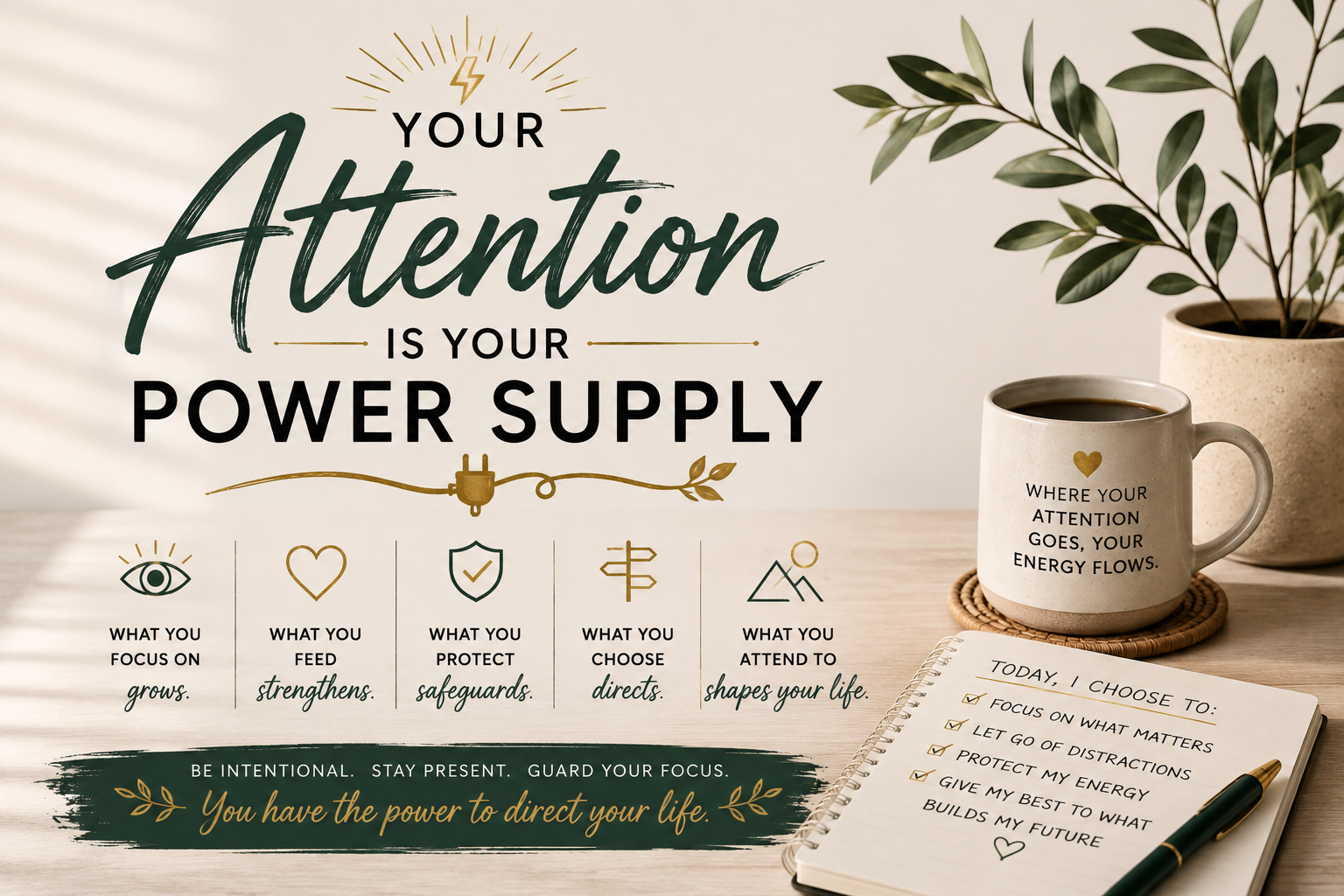
Your Attention Is Your Power Supply
Explore how attention shapes focus, habits, energy, and daily life, with practical ways to reduce distraction, protect your focus, and give more attention to what matters.
How Focus Shapes Your Energy, Inner World, and the Life You Are Building
Your attention is one of the most valuable things you carry.
It is not just something you give.
It is something you spend.
Something you invest.
Something you strengthen through use.
And something that quietly feeds the life you are building, whether you realize it or not.
Where your attention repeatedly lands, your energy begins to gather.
Your thoughts gather there.
Your emotions gather there.
Your habits gather there.
Your choices gather there.
Your perception begins organizing around it.
And over time, parts of your life begin taking shape around what has consistently held your focus.
In practical terms, attention helps determine what receives your mental time, emotional engagement, learning, and action.
That is why attention matters so much.
Your attention is your power supply.
It feeds your focus, your peace, your creativity, your faith, your discipline, your relationships, and your daily direction.
When your attention is scattered across too many things, your energy can begin to feel scattered too.
You can be busy all day and still wonder why nothing meaningful seemed to move forward.
Your power was active.
It was simply divided.
So begin with one revealing question:
Where does my attention go when I am not choosing on purpose?
Notice the answer without judgment.
That awareness alone can begin changing the way you live.
Your Attention Helps Build Your Life
Your life is not built only by what you want.
It is also shaped by what receives your attention over and over again.
What you repeatedly watch, think about, check, replay, practice, study, create, worry over, appreciate, or return to becomes increasingly familiar to your mind.
Attention tells your inner world:
This matters. Keep noticing this.
That can work against you.
But it can also work beautifully for you.
When your attention repeatedly feeds fear, possibilities can become harder to see.
When your attention repeatedly feeds frustration, peace has to compete for space.
When your attention repeatedly feeds comparison, your own path can begin looking smaller than it really is.
But when your attention feeds courage, you become more practiced at recognizing courage.
When your attention feeds gratitude, you become more likely to notice what is good.
When your attention feeds purpose, meaningful opportunities become easier to recognize.
When your attention feeds faith, possibility, beauty, wisdom, and constructive action, those things receive more room in your daily experience.
You are not powerless over your focus.
You can choose what gets fed.
Your Brain Learns What You Repeatedly Notice
The human brain is selective.
At any moment, far more information exists around you than conscious awareness could possibly process.
Attention helps determine what receives priority.
Repeated attention can make certain information, patterns, and cues more familiar and easier to notice.
This is one reason habits of attention matter.
If your mind becomes accustomed to searching for threats, problems, criticism, or reasons something will fail, those patterns can become increasingly familiar.
But attention can also be practiced in another direction.
You can deliberately notice:
Solutions.
Progress.
Beauty.
Opportunity.
Kindness.
Useful information.
What is working.
What you can influence.
What deserves your effort.
What God may already be doing in a situation that once looked completely closed.
This does not mean pretending difficult things do not exist.
It means refusing to make difficulty the only thing your mind is trained to see.
Reality is larger than whatever has captured your attention.
Sometimes changing your focus allows you to notice parts of reality that were there all along.
What You Focus On Becomes More Familiar
Attention does not magically make every thought become reality.
But repeated attention can strengthen familiarity.
A conversation you replay all afternoon becomes easier to return to.
A notification you check constantly becomes part of a practiced loop.
A problem you mentally revisit without taking action can begin occupying more space than it deserves.
The same principle can work in life-giving directions.
Prayer can become easier to return to.
Focused work can become more natural.
Gratitude can become more familiar.
Creative practice can develop rhythm.
A healthier routine can begin requiring less inner negotiation.
This is why intentional focus matters.
It is not about controlling every passing thought.
It is about becoming wiser about what you repeatedly return to.
Attention wanders. Power returns when you notice and choose again.
Attention Is Not Agreement
There is an important distinction here.
Something receiving your attention does not automatically mean you agree with it, created it, wanted it, or invited it into your life.
Sometimes something genuinely needs attention.
A problem may need solving.
A difficult conversation may need processing.
A responsibility may need handling.
Pain may need acknowledgment.
News may need understanding.
A complicated situation may require careful thought.
The goal is not to become afraid of focusing on anything difficult.
The deeper question is:
Am I giving this the attention necessary to respond wisely, or am I continuing to feed it after my attention is no longer useful?
That distinction matters.
There is a difference between addressing a problem and mentally living inside it.
There is a difference between learning from something and endlessly replaying it.
There is a difference between being informed and being consumed.
There is a difference between responsible attention and surrendered attention.
Your power is not protected by ignoring reality.
It is protected by deciding how much access something deserves after you understand what needs to be done.
Attention Is One of the Great Currencies of Modern Life
Your attention has value beyond your inner world.
Entire industries compete for it.
Notifications want it.
Headlines want it.
Advertisements want it.
Apps want it.
Algorithms want it.
Entertainment wants it.
Other people's urgency sometimes wants it.
And none of those things necessarily know what matters most to your life.
That means protecting attention has become more than a productivity skill.
It is an act of discernment.
Every time something asks for your attention, it is asking for a piece of your finite day.
You do not need to treat every notification as an invitation.
You do not need to investigate every controversy.
You do not need to know what everyone is doing.
You do not need to enter every conversation.
You do not need to give every headline emotional residence inside you.
Ask:
Does this deserve access to my attention?
That question can save enormous amounts of energy.
Protect Your Power Supply
Your attention can become fragmented long before you realize it.
One tab.
Another notification.
A message.
A half-finished task.
A quick check.
A thought you meant to revisit.
Another interruption.
Then another.
Individually, each pull seems small.
Together, they can create a day where your attention never stays anywhere long enough to deepen.
You may feel tired without understanding why.
Foggy without having done anything physically demanding.
Busy without feeling productive.
Present everywhere and fully present nowhere.
Protecting your attention does not mean becoming rigid.
It means deciding that your mind does not have to remain permanently available to everything.
You can close the tab.
Silence the notification.
Finish one thing before starting another.
Write down the thought instead of carrying it.
Let someone wait for a reasonable reply.
Choose a quieter environment when something important needs your best thinking.
Protecting your power supply means reducing unnecessary fragmentation so your attention has somewhere to gather.
Your Attention Shapes Your Experience of Time
Have you ever reached the end of an hour and wondered where it went?
Attention and time are deeply intertwined.
Where attention goes, pieces of your life go with it.
Ten minutes here.
Twenty minutes there.
Another check.
Another scroll.
Another distraction.
Another mental replay.
Individually, these moments can seem tiny.
Together, they become hours.
Days.
Eventually, years.
This is not a reason to become obsessive about productivity.
Rest deserves attention too.
Play deserves attention.
People you love deserve attention.
Beauty deserves attention.
Prayer deserves attention.
Doing absolutely nothing for a little while can have a rightful place in a human life.
The question is not whether every minute produced something.
The question is whether your attention reflects what you actually value.
A meaningful life is not a life in which every moment produces something.
It is a life in which your attention increasingly belongs to what matters.
Your Attention Also Needs Rest
Protecting attention does not mean concentrating every waking minute.
Attention needs restoration too.
There are moments when the mind benefits from not solving, producing, checking, responding, or performing.
Looking out a window.
Walking without a destination.
Listening to music.
Sitting outside.
Praying quietly.
Letting your mind wander.
Doing something gentle with your hands.
Being with someone you love without turning the moment into a task.
Restorative attention is different from numbing distraction.
One leaves you more available to your life.
The other can leave you feeling further away from it.
You are not wasting your power supply when you allow it to recharge.
Sometimes the wisest thing you can do with your attention is stop asking it to perform.
The One-Tab Practice
Start simply.
Choose one part of your day where you practice living one-tab.
One task.
One focus.
One moment.
One direction.
It does not have to be long.
Even twenty minutes can help you practice staying with one thing.
During that time, do one thing without splitting yourself across multiple inputs.
Fold the laundry without a second screen.
Write without checking your phone.
Pray without rushing toward the next thing.
Eat without scrolling.
Listen to someone without preparing your reply.
Work on one task without opening every possible distraction.
Read without checking notifications.
Walk and actually notice where you are.
When your mind darts away, bring it back without drama.
No shame.
No pressure.
No harshness.
Just return.
That return is the practice.
The goal is not never becoming distracted.
The practice is becoming better at returning.
Every return says:
I am here.
I am present.
I am choosing where my energy goes.
That is more than discipline.
It is devotion to the life you are actually living.
Try an Attention Audit
Sometimes you cannot redirect your attention until you can see where it has been going.
At the end of one ordinary day, ask:
What received most of my attention today?
Then divide what you notice into three simple categories.
What strengthened me?
What left you clearer, wiser, more peaceful, more connected, more productive, more loving, or more alive?
What genuinely needed me?
Responsibilities, work, family, decisions, problems, planning, necessary information.
What simply consumed me?
Things that received substantial attention without giving anything meaningful back.
Do not turn this into another reason to criticize yourself.
Be curious.
You are gathering information.
You may discover that something you thought took ten minutes actually took an hour.
You may notice that one conversation kept replaying long after it ended.
You may realize your best hours are being spent on your least important inputs.
Or you may discover that you are already protecting your attention better than you realized.
Awareness gives you something to work with.
Reclaim the First Minutes of Your Day
The beginning of the day can be especially valuable because it happens before much of the outside world begins competing for your attention.
Experiment with keeping the first few minutes for yourself.
Pray.
Drink water.
Open the curtains.
Step outside.
Read something meaningful.
Sit quietly.
Write down what matters today.
Ask God for wisdom.
Choose the one thing that deserves your clearest attention.
This does not need to become an elaborate morning ritual.
Five quiet minutes can be enough.
Let your own spirit speak before the whole world starts speaking at you.
What Deserves Your Best Attention?
Not everything deserves equal access to you.
Some things deserve your best attention.
People you love.
Work that matters.
Your health.
Your faith.
Your home.
Your purpose.
Your responsibilities.
Your creativity.
Your dreams.
The quiet ideas that keep returning.
The opportunities that need tending.
The relationships that grow stronger when you are truly present.
Sometimes we give our best attention to what screams and whatever remains to what matters.
Turn that around.
Give something meaningful your clearest hour.
Give someone you love your undivided presence.
Give your calling more than leftover energy.
Give prayer a few minutes before giving the internet forty.
Give the life you want to build some of the attention you have been giving to things you will barely remember next week.
That is how priorities become visible.
Choose What Feeds Your Signal
What you repeatedly feed becomes part of the signal you carry into life.
If you feed your attention to constant outrage, you may begin carrying the weight of it.
If you feed your attention to comparison, your joy has to fight through a crowd.
If you feed your attention to distraction all day, your deeper purpose may struggle to find a quiet place to speak.
But if you feed your attention to truth, your signal becomes clearer.
If you feed your attention to courage, your steps become stronger.
If you feed your attention to gratitude, goodness becomes easier to recognize.
If you feed your attention to faith, possibility has more room to breathe.
If you feed your attention to wisdom, beauty, purpose, creativity, meaningful relationships, and steady action, your life begins carrying something different.
You do not have to give your power to everything that asks for it.
Your attention is sacred ground.
Choose where it goes with care.
A Daily Attention Reset
When you notice yourself becoming scattered, use this simple reset.
Stop for a moment.
Take one slow breath.
Then ask:
Where is my attention right now?
Next:
Is this where I want my energy to be?
If yes, stay.
If no, ask:
What deserves my attention instead?
Then return.
That is it.
No elaborate ritual.
No punishment for becoming distracted.
No demand for perfect concentration.
Notice.
Choose.
Return.
You may do this ten times in one day.
Good.
That means you returned ten times.
Frequently Asked Questions
Why Is Attention So Important?
Attention helps determine what information, thoughts, tasks, experiences, and relationships receive your mental resources.
What repeatedly receives attention can influence learning, habits, priorities, emotions, and behavior over time.
Does Focusing on Something Make It Happen?
Not by itself.
Attention can influence what you notice, practice, prioritize, and act upon.
Those changes can affect outcomes, but attention is not a guarantee that every thought becomes reality.
Why Does My Attention Feel So Scattered?
Modern life contains enormous competition for attention, including notifications, multiple screens, unfinished tasks, constant information, work demands, and frequent interruptions.
Scattered attention does not mean you have failed.
It may simply mean your focus needs more protection and fewer competing inputs.
How Can I Improve My Focus?
Start smaller than you think.
Choose one task.
Reduce unnecessary inputs.
Move your phone away when possible.
Set a short period for uninterrupted focus.
When your mind wanders, return.
Repeated returning is part of strengthening attention.
Is It Wrong to Pay Attention to Negative Things?
No.
Problems, responsibilities, difficult emotions, and important events sometimes require attention.
The goal is not avoiding reality.
It is learning the difference between giving something the attention required to respond wisely and allowing it to consume attention indefinitely.
How Do I Stop Giving My Attention to Things That Drain Me?
Begin by identifying the pattern.
Then make the unwanted behavior slightly harder and the preferred behavior slightly easier.
Turn off unnecessary notifications.
Move distracting apps.
Create screen-free periods.
Finish small open loops.
Choose specific times for checking messages.
Replace one draining input with something that actually nourishes you.
Your Attention Is Already Creating Something
You do not need perfect focus.
You need intentional return.
One breath before you scroll.
One pause before you react.
One clear task before you scatter.
One moment of presence with someone you love.
One prayer before the noise.
One period of rest without demanding productivity from yourself.
One decision to stop feeding something that has already received enough of you.
One honest question before giving your energy away:
Is this feeding the life I am here to build?
Your attention is valuable because your life is valuable.
Where you place it matters.
What you repeatedly notice matters.
What you practice noticing matters.
What you refuse to keep feeding matters.
What you allow to rest matters.
And what you choose to return to matters.
Your power supply is already in your hands.
Direct it toward what strengthens you.
Toward what teaches you.
Toward what deserves you.
Toward what brings you closer to God.
Toward what creates beauty.
Toward what builds peace.
Toward the people you love.
Toward the work you are here to do.
Toward the life quietly waiting for your full presence.
Protect your attention.
Rest your attention.
Choose your signal.
Feed what you want to strengthen.
And when your attention wanders, as human attention does, simply bring it home again.
If this message resonated, you may also enjoy:
The People Around You Shape Your Signal
Self-Trust Is the Currency of the Kingdom
Your Soulful Pathways ↑
Discover more series pages for you in Your Soulful Pathways ↑

Living as a Signal
Your life broadcasts. Learn how to clean your signal through attention, boundaries, integrity, and small consistent choices that create real change.
Your life speaks before you explain yourself.
It speaks through what you repeat. Through what you protect. Through what you allow near your mind, your heart, your time, and your energy. It speaks through the way you answer when you are tired, the promises you keep when no one is watching, and the quiet choices that slowly teach your life what you truly value.
Living as a signal means becoming clear about what your life is broadcasting.
Not for performance. Not for approval. Not to appear spiritual, strong, or aligned from the outside.
This is about becoming clean inside yourself.
Clear. Steady. Honest. Whole.
Your signal is the message your life sends through your choices. It is the rhythm people feel around you. It is the standard your habits reveal. It is the energy you carry into rooms, relationships, work, rest, faith, and purpose.
When your inner truth and outer life begin to match, something powerful happens.
You stop leaking energy into pretending.
You stop splitting yourself to keep everyone comfortable.
You stop saying yes with your mouth while your spirit quietly pulls back.
You begin to live with a signal that can be trusted.
What Living as a Signal Means
Living as a signal means your life becomes an expression of what is true in you.
It is the practical side of alignment.
Alignment is not only a beautiful thought. It is what you choose on an ordinary day. It is how you spend your attention. It is what you keep feeding with your focus. It is the conversation you decide not to enter. It is the boundary you hold with peace. It is the habit you repeat because your future matters.
Your signal is not built by one big declaration.
It is built by the way you live after the declaration.
Anyone can say they want peace. The signal changes when peace becomes protected.
Anyone can say they want a higher life. The signal changes when the lower pattern no longer gets full access.
Anyone can say they are becoming new. The signal changes when their daily rhythm begins to agree.
This is where motivation becomes embodiment.
You are not here to simply think higher thoughts. You are here to live in a way that lets those higher thoughts take root.
Your Signal Is Built From What You Repeat
Your life is shaped by repetition.
What you repeat becomes familiar.
What becomes familiar becomes normal.
What becomes normal becomes part of your identity.
This is why small choices matter so much.
The things you watch, the people you keep close, the conversations you entertain, the habits you return to, the promises you break or keep, the way you speak to yourself, the way you handle your energy, and the way you spend your attention all become part of your broadcast.
A clean signal is not about perfection.
It is about coherence.
Coherence is when your life begins to agree with your truth. Your yes becomes real. Your no becomes calm. Your habits support the life you say you want. Your boundaries stop feeling like emergencies and start becoming part of your self-respect.
The more your choices agree with your values, the stronger your signal becomes.
You feel less scattered.
You trust yourself more.
Your energy becomes clearer.
Your direction becomes easier to follow.
A steady signal gives your life a stronger foundation.
Clean Signal Living Creates Inner Strength
A mixed signal creates inner friction.
You feel it when you keep agreeing to things that drain you. You feel it when your attention is pulled in too many directions. You feel it when your words say one thing and your energy knows another. You feel it when your life keeps serving an old pattern while your spirit is reaching for something higher.
Clean signal living brings you back into agreement with yourself.
It helps you choose with more honesty. It helps you notice what strengthens you and what weakens your focus. It helps you stop giving your best energy to what keeps pulling you away from your purpose.
This is not harsh living.
This is honorable living.
It is the quiet discipline of becoming someone your own soul can trust.
A clean signal does not need to shout. It does not need to prove. It does not need to explain itself to every person who does not understand the shift.
It simply becomes consistent.
Consistency is powerful because it teaches your life a new truth:
This is who I am becoming now.
This is what I protect now.
This is what I no longer trade away.
This is the standard my life is rising into.
The Path This Series Will Walk
This series is a bridge between spiritual awareness and real-life choices.
It will help you bring your higher vision into your habits, words, relationships, boundaries, attention, energy, and daily rhythm.
You will learn how to reclaim your attention as a power source and stop letting every distraction pull from your life force.
You will learn how to clean up your inputs so your outputs become calmer, clearer, and more intentional.
You will learn how relationships influence your baseline and why the people closest to you can either steady your signal or scatter it.
You will learn how to align your words with your energy without becoming cold, harsh, or distant.
You will learn how to stop saying yes when your inner truth is asking for a peaceful no.
You will learn how to set boundaries that are consistent, grounded, and steady.
You will learn how to notice the small leaks that drain your strength before they become bigger patterns.
You will learn how daily habits build alignment through repetition.
You will learn how small truths can reshape your reality when you actually live them.
You will learn how to use a weekly signal reset to return to clarity before your energy gets too cluttered.
This is a series for the person who is ready to live with more truth in motion.
Not just insight.
Not just inspiration.
Not just the dream of a higher life.
The practice of one.
Begin With One Clear Choice
You do not have to rebuild your whole life in one day.
Begin with one clear choice.
One cleaner input.
One honest no.
One promise kept.
One distraction released.
One boundary honored.
One conversation handled with maturity.
One quiet return to the person you are becoming.
That is how your signal changes.
Not through force. Through repetition. Through honesty. Through the steady decision to let your life agree with the truth rising inside you.
Your life already broadcasts.
Let it broadcast clarity.
Let it broadcast courage.
Let it broadcast self-respect.
Let it broadcast faith, strength, steadiness, and a higher way forward.
Live so your choices can carry the message your soul came here to send.
If this message resonated, you may also enjoy:
Your Attention Is Your Power Supply
The Cost of Mixed Signals (Saying Yes When You Mean No)
A Weekly “Signal Reset” Practice
Your Soulful Pathways ↑
Discover more series pages for you in Your Soulful Pathways ↑