

Does Water Have Memory? The Mystery of Structure, Information and the History Carried by Water
Explore whether water has memory through hydrogen bonds, interfaces, Benveniste, Rey, Montagnier, nanoparticles, Emoto, intention and consciousness.
Water remembers the shape of a riverbed.
It carries minerals from stone.
It carries traces of soil, atmosphere, temperature, pressure, dissolved gases, surfaces, freezing, melting and the environments through which it has traveled.
A glacier can preserve ancient air.
A river can reveal the geology of an entire watershed.
Water surrounding DNA behaves differently from water in the middle of a glass.
Water confined inside microscopic spaces behaves differently again.
So when we ask:
Does water have memory?
we are not asking one question.
We are asking many.
Can water retain information about substances that were once dissolved within it?
Can an aqueous system's previous history influence what it becomes later?
Can surfaces, particles, gases and electromagnetic conditions create persistent organization?
Can extremely diluted preparations retain measurable characteristics associated with their preparation history?
Can vibration influence water after the vibration ends?
Can water respond to meaning, intention or consciousness?
The phrase water memory has gathered many meanings.
Some involve ordinary physical history.
Some arise from unusual experimental observations.
Some involve proposed mechanisms involving particles, interfaces, electromagnetic relationships or collective organization.
Others reach toward profound questions about information itself.
Perhaps the best place to begin is with a better definition:
Water memory may be less about water remembering an object and more about an aqueous system retaining consequences of its history.
Water Has a History
Every glass of water has been somewhere before.
Perhaps it fell as rain.
Passed through soil.
Moved through limestone.
Entered an underground aquifer.
Flowed through a river.
Was filtered.
Heated.
Frozen.
Stored.
Shaken.
Exposed to air.
Touched glass, metal, stone or plastic.
Mixed with minerals.
Encountered living organisms.
Real water exists in relationship with its surroundings.
Those relationships can leave measurable consequences.
At the broadest level, water carries history.
The deeper mystery is how many forms that history can take.
What Does Water Memory Mean?
Water memory can describe very different phenomena.
It may involve:
chemical history
isotopic history
temporary molecular organization
surface and interface effects
nanoparticles
nanobubbles
silica or other container-derived material
freezing and crystallization history
pressure, heating or mechanical agitation
high-dilution preparations
electromagnetic information
collective molecular behavior
sound and vibration
or relationships involving intention and consciousness
These are not interchangeable ideas.
A molecule remaining permanently locked into one structure is one possibility.
A complex aqueous system retaining consequences from its preparation history is something entirely different.
Water beside DNA is another.
Water near a hydrophilic surface is another.
A highly diluted, vigorously shaken preparation is another.
Water exposed to music, prayer or intention raises still another question.
The deeper we look, the less useful a simple yes-or-no answer becomes.
Perhaps Water Memory Is Really System Memory
Imagine a river.
The molecules flowing through it today will not be the same molecules flowing through it tomorrow.
Yet the river remains.
Its banks guide it.
Gravity moves it.
Tributaries feed it.
Stone redirects it.
Weather changes it.
Sediment shapes it.
Its identity exists through a relationship among:
matter
energy
boundaries
movement
and pattern.
Perhaps some forms of water memory should be considered in the same way.
Not as a tiny message carved permanently into an individual H₂O molecule.
But as information carried by an interacting system:
water
ions
particles
gases
interfaces
container surfaces
temperature
pressure
movement
electromagnetic conditions
and history.
Perhaps the system remembers even while its molecules dance.
Memory does not always require a permanent object.
Sometimes it exists as an organized relationship.
A river remembers through its channel.
A crystal remembers through the path of its formation.
An ecosystem remembers through relationships among life and environment.
A melody persists while each individual note disappears.
A flame remains recognizable while its molecules constantly change.
A whirlpool persists while water flows through it.
The meaningful pattern can endure even while its components move.
That gives us a richer way to think about water memory.
Water Is Astonishingly Dynamic
At the molecular level, liquid water is in constant motion.
Water molecules continually interact through hydrogen bonds.
Those bonds form.
Bend.
Break.
Reform.
The network is alive with movement.
Ultrafast spectroscopy has revealed structural rearrangements occurring on femtosecond and picosecond timescales.
One femtosecond is:
one quadrillionth of a second.
A landmark Nature study examining ultrafast water dynamics found that some structural correlations within liquid water disappear within roughly 50 femtoseconds.
That discovery deepens the mystery rather than shrinking it.
If longer-lived forms of aqueous history occur, the explanation may lie beyond a permanently fixed cluster of unchanged molecules.
The memory may belong to:
relationships,
interfaces,
particles,
fields,
boundaries,
or the larger system.
The Whirlpool Gives Us Another Way to Think
A whirlpool does not need the same molecules every second.
Its identity exists in the pattern.
A flame does not preserve the same particles.
Its identity exists in ongoing organization.
A human body exchanges matter continuously.
Yet personal identity remains.
A melody survives beyond each disappearing note because the notes form a relationship through time.
So the deeper water-memory question becomes:
Can information persist through a dynamic pattern while individual molecular relationships continually reorganize?
That question is very different from asking whether one H₂O molecule carries a permanent recording.
And it may be much closer to what researchers are actually trying to understand.
Water Near Surfaces Enters a Different World
Water does not behave exactly the same everywhere.
Water next to a surface can behave differently from water farther away.
Water confined within nanoscale spaces can show altered:
movement
orientation
hydrogen-bond behavior
freezing
and interactions with nearby material.
Inside living organisms, biological water exists beside:
proteins
membranes
DNA
ions
minerals
and microscopic cellular structures.
Water in life is rarely simply a pool of bulk liquid.
It exists in relationships.
Exclusion-Zone Water
One fascinating example comes from research into exclusion zones, often called EZs.
Gerald Pollack and colleagues reported that when certain hydrophilic surfaces contact water, microscopic particles can be excluded from a region extending away from the surface.
The exclusion-zone phenomenon near strongly hydrophilic surfaces has been observed by multiple research groups.
Researchers have explored explanations involving:
surface chemistry
charge gradients
ion exchange
solute gradients
diffusiophoresis
nanobubbles
and molecular organization.
The central lesson is powerful:
Water beside a surface can behave very differently from water in the middle of a container.
That matters deeply when we ask whether water can carry history.
The surroundings may be part of the memory.
Water Around Life Is Organized by Life
Water surrounding biological molecules is not passive filler.
Proteins depend upon water for folding and function.
DNA is surrounded by hydration layers.
Cell membranes organize nearby water.
Ions create local electrical environments.
Enzymes rely upon precisely arranged interactions involving water molecules.
Biological water is constantly being shaped by:
charge
geometry
molecular surfaces
electrical fields
and cellular structures.
That gives us another way to think about information.
Perhaps information does not need to be stored within isolated water molecules.
Perhaps it emerges through:
relationships between water and everything surrounding it.
Real Water Is Never Just H₂O
Water researcher Martin Chaplin offered an especially useful way to think about the subject.
He described water memory broadly as the possibility that the properties of an aqueous preparation may depend upon its previous history.
That may be the most useful scientific question on this entire page:
Can the previous history of an aqueous system influence its future behavior?
Real water contains more than idealized H₂O.
Even highly purified laboratory water interacts with:
ions
dissolved gases
trace particles
container surfaces
air
temperature
and surrounding materials.
The true experimental system is therefore far richer than:
water remembers
versus:
water forgets.
Perhaps history belongs to the complete aqueous system.
Water Memory and Homeopathy Are Different Questions
The modern phrase water memory became strongly associated with homeopathy.
But the broader physical question reaches much farther.
The effectiveness of a particular treatment is one question.
Whether an aqueous system's preparation history can influence later physical properties is another.
The larger water-memory question can be explored through:
physics
chemistry
interfaces
nanoparticles
nanobubbles
spectroscopy
thermoluminescence
electromagnetic effects
crystallization
and other experimental approaches.
Water memory is therefore larger than any one medical tradition.
Jacques Benveniste and the Modern Water Memory Story
The modern water-memory controversy exploded in 1988.
French immunologist Jacques Benveniste and collaborators published experiments involving extremely dilute antibody preparations.
The researchers worked with human basophils, immune cells involved in allergic responses.
They reported biological responses from preparations diluted to levels where calculations suggested that original antibody molecules would be extraordinarily unlikely to remain.
The implications were enormous.
If the original molecules were effectively absent, what was interacting with the cells?
The researchers proposed that something about the preparation retained information associated with what had once been present.
The media gave the phenomenon an unforgettable name:
The Memory of Water
And a worldwide scientific conversation began.
Benveniste Was Already an Established Immunologist
Jacques Benveniste was not new to biomedical research.
Before the water-memory controversy, he had contributed to research involving platelet-activating factor, an important mediator involved in inflammatory biology.
His background made the 1988 findings especially striking.
An unconventional observation had emerged from within established immunological research.
The question attracted attention precisely because its implications were so large.
The Question Changed Direction
Subsequent blinded investigations produced a more complicated experimental history.
Benveniste did not abandon the mystery.
Instead, the difficulty pushed his research toward another possibility.
Perhaps the information was not being stored through the mechanism everyone had initially imagined.
Perhaps biological information could be carried another way.
That next possibility was:
electromagnetic information.
From Water Memory to Digital Biology
Benveniste eventually explored whether information associated with biologically active molecules could somehow be:
recorded
digitized
stored
transmitted
and replayed.
This became known as digital biology.
The question changed dramatically.
Instead of asking:
Does water preserve the physical shape of an absent molecule?
it became:
Can biological information exist in an electromagnetic form separate from the molecule that originally carried it?
That shifted the water-memory conversation from structure alone toward information itself.
Information Is Not the Same Thing as Matter
Consider a song.
It can exist:
on vinyl
on magnetic tape
as electrical signals
as digital code
through a speaker
or within memory.
The physical carrier changes.
Yet the information remains recognizable.
A book works similarly.
Paper is matter.
Ink is matter.
But the meaning created by the arrangement of those marks is information.
So when researchers ask whether water can carry information, the deeper question becomes:
What is carrying it?
Molecular organization?
Particles?
Interfaces?
Electromagnetic fields?
Collective behavior?
Gas structures?
Container-derived material?
Something else?
That question sits at the center of the mystery.
Luc Montagnier Continued the Electromagnetic Question
Years after Benveniste's work, French virologist Luc Montagnier, who shared the 2008 Nobel Prize in Physiology or Medicine for discoveries related to HIV, entered similar territory.
Montagnier and colleagues reported low-frequency electromagnetic signals associated with some highly diluted aqueous preparations derived from bacterial DNA sequences.
They proposed that aqueous nanostructures and resonance with ambient very-low-frequency electromagnetic fields might participate in the phenomenon.
Montagnier later continued publishing work exploring electromagnetic transmission of DNA-associated information through aqueous systems.
That carried the older question into another form:
Can water participate in carrying biological information electromagnetically?
And once again, water stood at the intersection of:
biology
information
electromagnetism
and mystery.
Louis Rey and Frozen Ultra-Dilute Water
Another major chapter came from physicist Louis Rey.
Instead of studying immune cells or crystal beauty, Rey examined:
thermoluminescence.
Thermoluminescence is light released from a material when it is warmed after first being irradiated at very low temperature.
In 2003, Rey published experiments involving ultra-high dilutions of:
lithium chloride
and
sodium chloride
prepared in heavy water.
The preparations reached theoretical concentrations around:
10⁻³⁰ g/cm³
a level of dilution at which calculations based upon Avogadro's number indicate that molecules of the original salts would be extraordinarily unlikely to remain.
The samples were cooled to:
77 K
irradiated with X-rays and gamma rays,
and gradually warmed while emitted light was measured.
Rey reported different thermoluminescence patterns associated with the salts originally dissolved in the preparations.
When Frozen Water Released a Different Signature
Rey's experiment approached water memory through a completely different window.
Benveniste examined biological response.
Emoto examined crystal formation.
Rey examined:
energy released during warming from frozen ultra-dilute preparations.
Different starting salts were associated with different thermoluminescence patterns after extreme dilution.
That raised an extraordinary question:
What physical feature of the preparation carried the difference forward?
Rey explored the idea that preparation history could alter the hydrogen-bonded system.
Later, he also considered whether dispersed gases and nanobubbles created during vigorous agitation might contribute to the observed behavior.
That fits beautifully with the larger system-memory idea.
Perhaps the history does not reside in one molecular structure.
Perhaps preparation changes the relationships among:
water
gas
interfaces
particles
and energy.
Rey's experiments remain an especially interesting candidate for modern independent repetition using today's instruments.
Preparation May Become Part of the Information
This is one of the most important insights in the entire water-memory discussion.
Dilution is not always simply subtraction.
Vigorous shaking adds mechanical energy.
Air enters the system.
Gas-liquid interfaces form.
Container surfaces interact with the liquid.
Trace materials may enter from glass or plastic.
Nanoparticles may appear.
Nanobubbles may form.
Surface area changes.
Storage allows the system to evolve.
Temperature changes it again.
So repeated preparation can create a physical history even while the original dissolved substance becomes progressively more dilute.
The process itself may become part of the sample.
That possibility transforms the conversation.
The Container May Be Part of the Memory
Water experiments often focus entirely on what was dissolved in the liquid.
But perhaps the container deserves equal attention.
Water interacts with glass.
Mechanical agitation increases contact between liquid, air and container surfaces.
Small amounts of silica and silicate material can enter aqueous preparations from glass.
Researchers David Anick and John Ives explored what became known as the silica hypothesis, asking whether silicate structures derived from glass containers could contribute to physical properties observed in highly diluted preparations.
That leads to a wonderfully simple realization:
Perhaps the container is part of the memory.
Water, Glass, Air and Motion Form a System
Imagine repeatedly diluting and vigorously shaking water in a glass bottle.
The experimental system includes:
water
air
dissolved gases
glass
silica
mechanical force
interfaces
temperature
storage time
and whatever solute was present earlier in the sequence.
Now the question becomes much richer.
Preparation history can alter the physical system through interactions among all of these components.
What appears at first to be a mysterious property of water alone may involve an entire microscopic ecology.
Nanoparticles Changed the Conversation
Nanotechnology has opened another door.
Researchers studying highly diluted preparations have reported nanoscale particles in some samples.
Those particles may originate from:
the starting substance
container surfaces
silica
or the preparation process itself.
Nanoparticles behave differently from ordinary bulk material because their extremely high surface-area-to-volume ratio can produce unusual:
chemical
electrical
optical
and biological behavior.
A recent nanoparticle-tracking study published in 2024 detected particles in approximately the 20 to 300–400 nanometer range in many serially prepared samples and controls and also reported differences associated with container material.
That reinforces an important idea:
Extremely diluted preparations may not be physically empty systems.
There may be considerable activity at scales earlier experiments were never designed to see.
Nanobubbles May Carry History Too
Water contains dissolved gases.
Mechanical agitation can change gas distribution and create extremely small gas-filled structures known as nanobubbles.
Nanobubbles create gas-liquid interfaces.
Those interfaces can influence:
ions
particles
surface charge
and molecular organization.
Rey himself later considered dispersed gas and nanobubbles as possible contributors to the physical signatures he observed.
Other high-dilution models have also incorporated nanobubbles.
The broader lesson remains:
Water is not alone.
Its history may be carried through everything participating in the system.
Extremely Diluted Water Can Still Be Physically Complex
Researchers examining highly diluted aqueous preparations have reported changes in measurements such as:
conductivity
pH
calorimetry
electrode potentials
particle distributions
and other physicochemical properties.
Some studies have reported that these properties evolve with:
time
preparation history
storage conditions
container type
and mechanical processing.
The larger realization is powerful:
Dilute does not necessarily mean physically simple.
A preparation may contain fewer molecules of the original solute while becoming more complicated in other ways.
Could Water Organize Collectively?
Some models propose that water molecules, electromagnetic fields, ions, surfaces and other components may participate in collective organization.
These approaches include:
coherent-domain models
cluster models
particle-based models
interface models
clathrate-like structures
and nanobubble-based explanations.
Their details differ greatly.
But many share one central idea:
The meaningful unit may be the aqueous system rather than the individual molecule.
That shifts the conversation away from:
Can one H₂O molecule remember?
toward:
Can an organized water system retain consequences of its history?
That is a much more interesting question.
Water Clearly Carries Chemical Memory
Some forms of water memory are beautifully straightforward.
Water can preserve traces of its past through:
dissolved minerals
ions
organic molecules
microorganisms
isotopes
gases
particles
contaminants
and chemical reaction products.
Scientists can analyze water and learn where it has traveled.
Geochemists reconstruct geological processes.
Hydrologists identify water sources.
Environmental scientists track pollutants.
Climate researchers read ancient environmental information.
Water's history is written into its chemistry.
Ice Cores Are Earth's Memory Written in Water
Perhaps nowhere is this more dramatic than inside glaciers.
Ice can preserve:
ancient air bubbles
dust
volcanic material
isotopic ratios
chemical signatures
and atmospheric gases.
Scientists drill deep into Greenland and Antarctic ice sheets and read Earth's past layer by layer.
Frozen water can reveal:
ancient temperatures
atmospheric composition
volcanic eruptions
and long-term climate shifts.
Here, the phrase:
water memory
becomes almost literal.
Water becomes an archive.
Rivers Remember Their Landscapes
A river carries the story of everything it touches.
Minerals reveal geology.
Sediment reveals erosion.
Nutrients reveal ecosystems.
Pollutants reveal human activity.
Microorganisms reveal living communities.
Isotopes can reveal where precipitation originated.
A river is moving water carrying information about an entire watershed.
Perhaps one of the simplest truths within this whole subject is:
Water is always reading the world around it.
The deeper question is how much of that history can persist when obvious chemical traces fade.
Freezing Creates Another Kind of History
Liquid water reorganizes rapidly.
Ice is different.
During freezing, molecules become arranged into ordered crystalline networks.
How those crystals grow depends upon:
temperature
cooling rate
impurities
surfaces
nucleation
pressure
and environmental conditions.
Once a crystal begins growing, earlier events influence later structure.
The final crystal therefore contains a physical history of formation.
That is one reason Masaru Emoto's water-crystal work belongs naturally within the larger water-memory conversation.
His photographs captured:
water after a history of exposure and crystallization.
Masaru Emoto Asked a Different Kind of Memory Question
Masaru Emoto entered this mystery through another doorway.
Instead of beginning with extreme dilution, he explored:
words
music
photographs
prayer
gratitude
natural environments
and human intention.
His laboratory later froze the water and photographed the resulting ice-crystal formations.
Emoto interpreted patterns among those photographs as evidence that water responded to information.
His question was different from Benveniste's.
Benveniste asked:
Can biological information survive extreme dilution?
Emoto asked:
Can water respond to information presented through meaning, vibration and intention?
Louis Rey asked:
Can ultra-dilute preparations retain distinct physical signatures after freezing and irradiation?
Montagnier asked:
Can highly diluted aqueous systems participate in electromagnetic biological signaling?
Different experiments.
Different mechanisms.
One enormous shared mystery:
Can water carry information in ways we have only begun to understand?
Blinded Intention Studies Added Another Layer
Later experiments involving Emoto's crystal method explored distant intention under blinded conditions.
A 2006 double-blind pilot involved approximately 2,000 people directing positive intention toward water located thousands of miles away.
The resulting crystal photographs were evaluated blindly, and the researchers reported higher aesthetic ratings for images from the intention-treated condition.
A later triple-blind experiment involving approximately 1,900 intention participants and more than 2,500 independent judges again reported a difference in the predicted treated-versus-proximal-control comparison.
Those experiments were exploring another kind of history:
Could an intentional event become part of what happens to water later?
Does Water Remember Sound?
Sound unquestionably interacts physically with water.
Sound waves create pressure changes.
Under appropriate conditions they can produce:
ripples
standing waves
mixing
cavitation
and elaborate patterns.
Cymatics gives us striking visual examples of vibration organizing matter.
But another question follows:
Does anything remain after the sound stops?
That is the difference between response and memory.
Masaru Emoto's music experiments explored whether water exposed to different compositions later produced different ice-crystal formations.
The question becomes:
Could vibration leave a persistent physical history within an aqueous system?
Does Water Remember Words?
Written words take the mystery farther.
A written word does not need to create sound.
The word:
LOVE
is simply a visual arrangement until meaning enters the picture.
Emoto reported different crystal formations following exposure to different written words.
His observations therefore point toward a question that reaches beyond ordinary sound waves:
Could meaning itself participate in the interaction?
Meaning?
Intention?
Electromagnetic conditions?
Observer relationships?
Information itself?
That is why the word experiments remain so provocative.
They carry the water-memory question directly into the mystery of meaning.
Does Water Remember Prayer?
Prayer takes the question deeper still.
A person can pray silently.
No sound must travel.
No physical contact is required.
Yet prayer can contain:
attention
meaning
emotion
love
faith
gratitude
and intention.
Emoto's prayer experiments and later distant-intention studies explored whether such conditions might correspond with later differences in water-crystal formation.
The question becomes:
How could such an interaction occur?
What could carry the information?
What role might intention play?
The question reaches far beyond chemistry.
It reaches toward consciousness itself.
Could Water Remember Consciousness?
This may be the deepest version of the water-memory question.
Not:
Can water preserve salt?
Not:
Can it retain silica?
Not:
Can freezing preserve environmental history?
But:
Can water retain something associated with consciousness?
The distant-intention studies raise an extraordinary possibility:
if consciousness and water can interact across distance, the implications would extend far beyond water itself.
What is intention?
What carries it?
Does consciousness produce information that extends beyond the nervous system?
Can physical systems receive that information?
Does distance matter?
Could water be especially sensitive to such interactions?
These questions touch one of humanity's deepest mysteries:
consciousness itself.
Information May Be the Deeper Mystery
Perhaps water memory is ultimately a doorway into something even larger:
How does nature store information?
DNA carries information.
Neural networks carry information.
Cells transmit information.
Light carries information.
Sound carries information.
Electrical signals carry information.
Magnetic patterns can encode information.
Crystals preserve information about formation.
Ice cores preserve information about ancient atmospheres.
Rivers carry information about landscapes.
Information is everywhere in nature.
Perhaps the deepest question is therefore not:
Can water remember?
It is:
What forms can information take within water?
And:
How long can those forms persist?
Perhaps the Word Memory Is Too Small
Memory makes us imagine a fixed recording.
A photograph stored in a drawer.
A document saved on a computer.
A thought tucked somewhere inside the brain.
Water may require a different vocabulary.
Perhaps more useful words are:
history
organization
response
persistence
pattern
relationship
resonance
information
Instead of asking only:
Does water remember?
we might ask:
Can the previous history of an aqueous system influence what it becomes next?
In many physical situations, the answer is already yes.
The deeper possibilities invite us to keep asking how far that history can reach.
What Modern Technology Could Do
Today, water-memory experiments could become far more sophisticated.
Imagine thousands of coded samples analyzed with:
ultrapure preparation systems
multiple container materials
robotic dilution
automated shaking
precise control of dissolved gases
nanoparticle tracking
nanobubble analysis
mass spectrometry
Raman spectroscopy
infrared spectroscopy
NMR
ultrafast spectroscopy
thermoluminescence
electrical conductivity
automated freezing
continuous thermal monitoring
environmental sensors
computer vision
artificial intelligence
and complete blinding.
Every variable could be isolated.
One experiment could alter only:
container material.
Another:
mechanical agitation.
Another:
electromagnetic exposure.
Another:
the original solute.
Another:
storage time.
Another:
intention.
Then independent laboratories could repeat the same protocols.
The mystery could become increasingly precise.
Artificial Intelligence Could Search Without Knowing the Story
Modern AI offers researchers something earlier generations never possessed.
A system could receive enormous datasets without knowing which sample belonged to which condition.
Thousands of spectra.
Thousands of crystal images.
Thousands of electrical measurements.
Thousands of particle distributions.
The AI would not know:
which sample received intention
which sample contained a particular original solute
which sample was shaken
which sample was stored in glass
which sample was exposed to electromagnetic conditions
It would simply search for patterns.
Only afterward would researchers reveal the experimental code.
If repeatable differences mapped onto preparation history across independently operated laboratories, entirely new questions would open.
Water memory could move increasingly from argument toward measurement.
Water Never Exists Alone
Perhaps this is the deepest lesson of the entire subject.
Water is always in relationship.
With air.
With stone.
With minerals.
With temperature.
With surfaces.
With living cells.
With proteins.
With DNA.
With ions.
With sound.
With light.
With electromagnetic fields.
With human activity.
And perhaps with influences we have not yet learned how to recognize.
Real water exists in the world.
And the world leaves traces.
The Sacred History of Water
Long before laboratories measured hydrogen bonds, human beings treated water as something capable of carrying:
meaning
blessing
purification
renewal
and sacred presence.
Holy water.
Blessed water.
Baptismal water.
Sacred springs.
Ritual purification.
Water prayed over before drinking.
Rivers associated with rebirth.
Wells associated with healing.
Across cultures and centuries, water has repeatedly occupied the boundary between physical life and sacred meaning.
Water receives.
Water carries.
Water cleanses.
Water transforms.
Water returns.
Perhaps humanity's ancient relationship with water deserves to stand beside the modern scientific question rather than beneath it.
Water in the Bible
Water carries profound symbolism throughout Scripture.
Genesis opens with the Spirit of God moving over the waters.
The flood marks transition and renewal.
The Israelites pass through the sea.
Water comes from the rock.
Naaman washes in the Jordan.
John baptizes with water.
Jesus enters the Jordan.
Christ speaks of:
living water.
Throughout the biblical story, water repeatedly appears with:
life
cleansing
renewal
provision
rebirth
and spiritual transformation.
The substance humanity has used for thousands of years as a symbol of spiritual renewal turns out to possess extraordinary physical complexity as well.
Perhaps Water's Greatest Memory Is Relationship
Maybe water does not remember the way a brain remembers.
Perhaps it does not need to.
Its history is written through relationship.
Stone changes it.
Heat changes it.
Pressure changes it.
Surfaces change it.
Living organisms change it.
Movement changes it.
Freezing changes it.
Containers participate in it.
Particles move through it.
Electromagnetic conditions interact with it.
Sound moves through it.
Life depends upon it.
And perhaps meaning, intention and consciousness belong somewhere within a story we are still learning how to read.
Water does not exist alone.
It exists in relationship.
And relationship creates history.
Does Water Have Memory?
The answer depends upon what we mean.
Can water carry chemical history?
Yes.
Minerals, isotopes, gases, particles and dissolved substances can preserve information about where water has been.
Can frozen water preserve environmental history?
Yes.
Ice cores contain ancient atmospheric and climate information.
Can water behave differently around surfaces, proteins, DNA and confined spaces?
Yes.
Interfacial and confined water can behave differently from bulk liquid.
Can preparation history alter measurable properties of an aqueous system?
Yes, under many physical conditions.
Mechanical agitation, container material, dissolved gases, particles, temperature and storage can all influence the resulting system.
Can ultra-dilute preparations show distinct physical signatures?
Louis Rey's thermoluminescence experiments and other physicochemical investigations have reported preparation-specific differences that deserve modern repetition with contemporary instrumentation.
Could silica, nanoparticles, nanobubbles and interfaces carry part of that history?
These are among the physical mechanisms researchers have explored.
Could electromagnetic information become part of the story?
Benveniste's later work and Montagnier's investigations pushed directly into that possibility.
Could words, music, prayer or intention influence water?
Masaru Emoto and later blinded intention studies explored precisely those questions.
Could consciousness itself become part of water's history?
That may be the deepest question of all.
Perhaps water memory is not one phenomenon.
Perhaps it is a family of questions involving:
matter
energy
structure
interfaces
particles
fields
history
information
and consciousness.
Some of those relationships are already measurable.
Others remain mysteries.
Together they make the question far more interesting than a simple yes or no.
A Final Reflection
Water never stops becoming.
It falls.
Flows.
Freezes.
Melts.
Evaporates.
Condenses.
Enters cells.
Leaves bodies.
Moves through rivers.
Returns to oceans.
Rises again into clouds.
Its molecular relationships reorganize at astonishing speed, yet the systems water participates in can carry history across moments, years, centuries and hundreds of thousands of years.
Water can preserve the atmosphere of another age inside ice.
It can carry the geology of mountains into rivers.
It organizes differently around biological molecules.
It behaves differently beside surfaces.
Highly diluted aqueous preparations have produced experimental observations that continue to inspire questions about structure, preparation history and information.
Electromagnetic experiments have opened another branch of inquiry.
Masaru Emoto asked whether words, music, prayer and intention might become part of water's story.
Jacques Benveniste asked whether biological information could persist through extreme dilution.
Louis Rey asked whether frozen ultra-dilute preparations retained distinct energetic signatures.
Luc Montagnier asked whether aqueous DNA-derived systems could participate in electromagnetic signaling.
Gerald Pollack asked us to look more closely at water beside surfaces.
Martin Chaplin asked whether perhaps the most useful definition of water memory is simply:
Can the previous history of an aqueous system influence its future behavior?
That question is larger than any single theory.
Perhaps the mystery endures because water itself refuses to fit neatly into our simplest categories.
It is dynamic and structured.
Ordinary and extraordinary.
Ancient and constantly renewed.
Transparent, yet filled with invisible activity.
Everywhere around us, yet still capable of surprise.
So:
Does water have memory?
Perhaps water has something even more interesting.
Water has history.
Water has relationships.
Water carries information in many forms we already understand.
And there may still be forms of its story that humanity has only begun to learn how to read.
The water is still here.
The questions are still here.
And we can keep looking.
Questions and Answers
What does water memory mean?
Water memory broadly refers to the idea that an aqueous system's previous history can influence its later properties or behavior. Depending upon the context, this may involve chemistry, surfaces, particles, molecular organization, high dilution, electromagnetic effects, crystallization, vibration or intention.
Is water memory only about homeopathy?
No. Water memory became strongly associated with homeopathy, but the broader question concerns whether previous events can influence the later behavior of aqueous systems.
Who was Jacques Benveniste?
Jacques Benveniste was a French immunologist whose 1988 high-dilution experiments helped popularize the modern phrase water memory.
What did Benveniste's experiments suggest?
His group reported biological responses from extremely diluted antibody preparations, raising the possibility that information associated with the original substance persisted after extreme dilution.
What happened after Benveniste's first experiments?
Subsequent blinded investigations produced a complicated experimental history. Benveniste continued investigating and eventually explored whether biological information might be carried electromagnetically.
What was digital biology?
Digital biology was Benveniste's later idea that information associated with biologically active substances might be recorded, transmitted and replayed through electromagnetic signals.
Who was Louis Rey?
Louis Rey was a physicist who investigated thermoluminescence in ultra-high dilutions of lithium chloride and sodium chloride.
What did Louis Rey report?
Rey reported different thermoluminescence patterns in ultra-dilute preparations associated with the salts originally dissolved in them after freezing, irradiation and reheating.
Did Rey later propose another explanation?
Yes. He later explored whether dispersed gas and nanobubbles produced during vigorous preparation could contribute to the physical signatures observed.
What is thermoluminescence?
Thermoluminescence is light released when a previously irradiated material is warmed.
How does Luc Montagnier relate to water memory?
Montagnier and colleagues reported low-frequency electromagnetic signals associated with some highly diluted aqueous preparations derived from bacterial DNA sequences and continued exploring electromagnetic transmission of DNA-associated information.
What is the silica hypothesis?
The silica hypothesis proposes that material released from glass containers during repeated dilution and shaking may contribute to the physical properties of highly diluted preparations.
Why might glass matter?
Water interacts with glass surfaces, and mechanical agitation can increase the release and distribution of trace silicate material. The container can become part of the experimental system.
What are nanoparticles?
Nanoparticles are extremely small pieces of matter whose physical properties can differ greatly from larger amounts of the same material.
Have nanoparticles been found in highly diluted preparations?
Recent nanoparticle-tracking studies have reported nanoscale particles in various serially prepared samples and controls, with container material influencing the particle environment.
What are nanobubbles?
Nanobubbles are extremely small gas-containing structures in liquids. Agitation, dissolved gases and interfaces can influence their formation.
What is exclusion-zone water?
Exclusion zones are regions near certain hydrophilic surfaces where microscopic particles are displaced away from the interface. Multiple groups have observed the phenomenon while researchers continue examining the physical processes that create it.
Why is exclusion-zone water important?
It demonstrates that water next to certain surfaces can behave differently from bulk liquid, reinforcing the importance of interfaces and environment.
Do water molecules rearrange quickly?
Yes. Hydrogen-bond relationships in liquid water reorganize on very short femtosecond and picosecond timescales.
Can a dynamic system still preserve information?
Yes. A whirlpool, flame, river, melody and living organism all demonstrate how organized patterns can persist while individual components continually change.
Can water carry chemical memory?
Yes. Minerals, gases, isotopes, particles and dissolved substances can preserve information about water's previous environments.
How do ice cores demonstrate water's history?
Ancient ice preserves air bubbles, isotopes, dust, volcanic material and chemical signatures that researchers use to reconstruct past atmospheric and climate conditions.
How does Masaru Emoto relate to water memory?
Masaru Emoto explored whether words, music, photographs, prayer, gratitude and human intention influenced water before it was frozen and photographed as ice crystals.
Were blinded intention experiments performed?
Yes. Published double-blind and triple-blind studies associated with Emoto's crystal method explored whether distant positive intention corresponded with differences in later water-crystal photographs.
Does water respond to sound?
Yes. Sound physically interacts with water through pressure waves and vibration. Whether a meaningful pattern persists after exposure is a deeper question.
Could water respond to written words?
Emoto reported different crystal formations after water was exposed to different written words, bringing meaning and information directly into the water-memory discussion.
Could water respond to prayer or intention?
Emoto's prayer work and later distant-intention studies explored whether focused intention corresponded with later differences in water-crystal formation.
Could electromagnetic fields carry information through water?
Electromagnetic models and experiments have been explored by researchers including Benveniste and Montagnier, alongside broader theories involving collective aqueous organization.
What may be the most useful definition of water memory?
A particularly useful definition is:
The possibility that the previous history of an aqueous system influences its future behavior.
Could modern technology investigate water memory more deeply?
Yes. Automated preparation, nanoparticle tracking, nanobubble analysis, spectroscopy, NMR, thermoluminescence, continuous environmental monitoring, computer vision and AI could make future investigations far more detailed and highly blinded.
Related Sacred Living Exploration
Dr. Masaru Emoto: Water, Consciousness, Love, Gratitude and the Power of Intention
Explore Masaru Emoto's life, philosophy, water research and message of love and gratitude.
Masaru Emoto's Water Crystal Experiments
Enter the world of words, music, prayer, natural waters, HADO and frozen water-crystal photography.
The Double-Blind and Triple-Blind Water Intention Studies
Explore published experiments involving distant intention, blinded water-crystal photography and thousands of independent evaluations.
Can Human Intention Influence Matter?
Travel beyond water into the larger question of whether consciousness and intention can interact with physical systems.
The Science of Water: Why H₂O Is So Extraordinary
Explore hydrogen bonding, polarity, crystallization, interfaces and the extraordinary physical properties of water.
Prayer, Blessing and the Sacred Meaning of Water
Explore humanity's ancient relationship with water through prayer, baptism, sacred springs, purification and blessing.
Words, Vibration and the Human Body
Discover the relationship among language, sound, emotion, expectation and human physiology.
Music, Sound and Water
Explore resonance, acoustics, cymatics, vibration and Emoto's experiments involving music and water.
Love, Gratitude and the Biology of Positive Emotion
Explore how love, gratitude and appreciation interact with human experience and well-being.
What Science Still Does Not Understand About Consciousness
Enter one of humanity's deepest mysteries and explore questions surrounding the nature and reach of consciousness.
The Mystery of Water, Consciousness and Human Intention
Bring the entire journey together through water, information, intention, consciousness and possibility.
References and Further Exploration
The Memory of Water: An Overview
Martin F. Chaplin
Homeopathy, 2007
A broad review framing water memory as the possibility that an aqueous preparation's properties depend upon its previous history.
Ultrafast Memory Loss and Energy Redistribution in the Hydrogen Bond Network of Liquid H₂O
Nature, 2005
Research showing how rapidly structural correlations within liquid water's hydrogen-bond network can reorganize.
Thermoluminescence of Ultra-High Dilutions of Lithium Chloride and Sodium Chloride
Louis Rey
Physica A: Statistical Mechanics and its Applications, 2003
An experimental study reporting different thermoluminescence patterns from highly diluted lithium chloride and sodium chloride preparations.
Thermoluminescence of Ultra-High Dilutions and the Role of Gas Structures
Louis Rey
Follow-up discussion exploring whether dispersed gases and nanobubbles formed during vigorous preparation could contribute to observed physical signatures.
The Silica Hypothesis for Homeopathy: Physical Chemistry
David J. Anick and John A. Ives
Homeopathy, 2007
An exploration of whether silicate material originating from glass containers may contribute to the physical behavior of high-dilution preparations.
Electromagnetic Signals Are Produced by Aqueous Nanostructures Derived From Bacterial DNA Sequences
Luc Montagnier and colleagues
Research exploring low-frequency electromagnetic signals associated with highly diluted aqueous preparations derived from bacterial DNA.
Exclusion Zone Phenomena in Water
A modern review of experimental exclusion-zone observations and proposed mechanisms near hydrophilic surfaces.
Nanoparticle Tracking in Serially Prepared Aqueous Samples
Recent research examining nanoscale particles in serially prepared aqueous systems and the influence of container material.

The Science of Water: Why H₂O Is So Extraordinary
Explore the extraordinary science of water, from hydrogen bonds, ice and osmosis to human biology, Earth’s climate and the enduring mystery of H₂O.
A simple molecule with astonishing properties
Water is everywhere within us and around us.
It flows through rivers, oceans, clouds, soil, plants, animals and the human body. It carries nutrients, moderates temperature, shapes landscapes and participates in nearly every process that sustains life.
Its chemical formula appears beautifully simple: H₂O.
Two hydrogen atoms. One oxygen atom.
Yet from this small arrangement emerges one of the most unusual and consequential substances known to science.
Water can soften stone, suspend enormous ships, rise through a tree, preserve life beneath winter ice and help fold the proteins inside a living cell. It carries the history of climates, moves continuously between Earth and sky and guides the search for life beyond our planet.
The deeper science looks into water, the more extraordinary it becomes.
Shape of a water molecule
A water molecule has a bent shape. Its two hydrogen atoms form an angle around the larger oxygen atom.
Oxygen attracts the molecule’s shared electrons more strongly than hydrogen does. This gives the oxygen side a slight negative charge and the hydrogen sides slight positive charges.
Water is therefore a polar molecule.
That polarity allows water molecules to orient themselves toward one another. The slightly positive hydrogen region of one molecule is attracted to the slightly negative oxygen region of another.
This attraction is called a hydrogen bond.
A single hydrogen bond is relatively weak. Together, vast numbers of hydrogen bonds create a remarkably influential network.
This network helps explain water’s:
unusually high boiling point
strong surface tension
high heat capacity
powerful solvent behavior
density changes during freezing
ability to form ordered crystals
central role in biological structure
Much of water’s wonder begins here—in the relationship between its shape, its charge and its ability to connect.
A living network of movement
Liquid water is highly dynamic.
Its molecules are constantly moving, rotating and reorganizing. Hydrogen bonds form, bend and release on extraordinarily short timescales. Water is structured, but its structure is fluid rather than fixed.
At any moment, local arrangements appear and change throughout the liquid.
Water molecules can participate in different local hydrogen-bond configurations. The relationship among these arrangements helps give water many of its unusual properties across changes in temperature and pressure.
This continual molecular dance gives water both stability and adaptability. It can absorb energy, surround dissolved substances, enter tiny spaces and reorganize around biological molecules.
Water actively participates in the chemical relationships that make life possible.
Water’s bonds work together
Water’s hydrogen bonds are cooperative.
The orientation and bonding of one molecule can influence the molecules surrounding it. Those molecules influence their neighbors, creating an extended network in which local changes can be shared across a wider molecular environment.
The network remains fluid and continually reorganizing, yet its relationships have collective effects.
This cooperative behavior helps give water its unusual combination of strength, flexibility and responsiveness. A single water molecule is simple. The relationships formed among many water molecules create something far more extraordinary.
Modern experiments continue to reveal the charge movement, energy transfer and molecular cooperation occurring within this dynamic network.
Explore research on water’s cooperative hydrogen-bond network
Why water remains liquid on Earth
Small molecules similar in size to water are often gases under ordinary Earth conditions.
Water behaves differently because its molecules attract one another through hydrogen bonding. Additional energy is required to separate them, giving water a much higher boiling point than its molecular size alone would suggest.
This allows water to remain liquid across a broad range of temperatures found on Earth.
That range is foundational to life as we know it. Oceans can persist. Rivers can flow. Rain can fall. Cells can maintain an internal liquid environment where countless biochemical reactions unfold.
Liquid water creates a meeting place where molecules can move, interact and transform.
Water carries extraordinary amounts of heat
Water has a very high specific heat capacity. It can absorb a great deal of energy while changing temperature relatively slowly.
Approximately 4,184 joules of energy are needed to raise the temperature of one kilogram of water by one degree Celsius.
Because oceans, lakes and living organisms contain so much water, this property provides powerful thermal stability.
It helps:
moderate coastal climates
reduce rapid temperature changes in aquatic habitats
distribute heat through ocean currents
stabilize internal body temperature
protect cells from abrupt thermal fluctuations
The oceans act as a planetary reservoir of heat, receiving, storing and gradually redistributing solar energy.
Earth’s climate is deeply connected to the movement and condition of its water.
Explore water’s specific heat capacity with the U.S. Geological Survey
Phase changes move energy around the planet
Water absorbs or releases large quantities of energy when it changes phase.
Evaporation requires energy. When water evaporates from skin, leaves, soil or the ocean, it carries heat with it. This is why perspiration can cool the body and why evaporation influences weather.
Condensation releases stored energy into the atmosphere, helping power clouds, storms and larger weather systems.
Freezing releases energy, while melting absorbs it.
The energy required to convert water into vapor is especially large—about 2,260 kilojoules per kilogram under standard boiling conditions.
The continuous movement of water between liquid, vapor and ice transports tremendous amounts of energy through Earth’s climate system.
Water does more than circulate around the planet. It circulates heat.
Learn about latent heat and the water cycle from the U.S. Geological Survey
Ice floats and protects life
Most substances become denser as they cool and solidify.
Water follows a more unusual path.
Liquid freshwater reaches its greatest density at approximately 4°C. As it cools further toward freezing, its hydrogen-bonded structure becomes more open. When water forms ordinary ice, its molecules settle into a spacious crystalline lattice.
The solid is approximately 9 percent less dense than the liquid beneath it.
Ice floats.
This familiar event has planetary importance. When a lake freezes, the ice forms at the surface and creates an insulating layer. Liquid water can remain below, providing a winter refuge for aquatic life.
A glass of floating ice reveals one of water’s most life-supporting properties.
Explore why ice floats with the U.S. Geological Survey
Water has a remarkable phase map
Water can exist as solid, liquid and gas, but pressure and temperature reveal an even richer story.
At water’s triple point, ice, liquid water and water vapor can coexist in equilibrium. The triple point occurs at 0.01°C under a precisely defined pressure.
At sufficiently high temperature and pressure, water reaches its critical point. Beyond this boundary, the distinction between liquid and vapor disappears. Water becomes a supercritical fluid with properties associated with both.
Supercritical water can move through materials readily while dissolving substances in unusual ways. It is studied and used in specialized chemical, geological and industrial settings.
Water can also remain liquid below its usual freezing point. This state is called supercooled water. It appears in clouds, laboratories and natural environments before crystallization begins.
The International Association for the Properties of Water and Steam maintains internationally accepted scientific formulations for water’s behavior across ordinary, supercooled and extreme conditions.
Ice has many forms
The ice in a freezer is only one form of solid water.
Under different combinations of temperature and pressure, water molecules can arrange themselves into numerous crystalline structures. Each has its own molecular organization and physical properties.
Some forms arise only under immense pressure. Others may exist inside icy moons and planetary bodies.
Water can also form noncrystalline solids called amorphous ice. In amorphous ice, molecules occupy a less regular arrangement than they do in an orderly crystal lattice. These forms are important to understanding water in extremely cold environments and throughout space.
In 2023, researchers reported a form called medium-density amorphous ice. Its density falls between previously recognized low-density and high-density amorphous forms.
The discovery added another expression to water’s remarkable solid-state family and may help researchers better understand frozen water in planetary and extremely cold environments.
Snowflakes, glaciers, planetary ice and microscopic high-pressure phases are all expressions of the same molecule responding to different conditions.
Read about medium-density amorphous ice
How water creates crystals
When liquid water freezes, molecules begin organizing into ordered structures.
Ordinary ice has an underlying sixfold symmetry. This molecular geometry helps produce the hexagonal patterns seen in snow crystals.
Every snow crystal develops while moving through changing conditions of temperature, humidity and air movement. Tiny differences in that journey influence its branches, plates, columns and delicate details.
This is why snowflakes can share the same basic symmetry while displaying immense variation.
Water crystal formation is influenced by:
molecular structure
temperature
humidity
impurities
nucleation surfaces
pressure
airflow
growth time
A crystal is both a molecular structure and a record of the conditions in which it formed.
Water is an exceptional solvent
Water is often called the universal solvent because it can dissolve an exceptionally wide variety of substances.
Its polarity allows water molecules to gather around ions and other polar molecules. The oxygen side tends to orient toward positively charged particles, while the hydrogen sides orient toward negatively charged particles.
These surrounding layers are called hydration shells.
Hydration shells help keep dissolved particles separated and mobile. Salts can dissociate into ions. Sugars can disperse. Nutrients can travel. Chemical reactions can occur between molecules that would otherwise remain isolated.
Water also interacts selectively with different kinds of substances. Oils and many nonpolar substances separate from water. This difference helps biological membranes form and allows cells to maintain boundaries.
Water’s solvent behavior creates both movement and organization.
Natural water carries a world within it
Water in rivers, oceans, springs, lakes and aquifers contains dissolved minerals, salts, gases and organic compounds gathered along its journey.
Calcium, magnesium, sodium, potassium, chloride and other substances influence the taste, hardness and chemical character of water.
Dissolved oxygen sustains fish and many other aquatic organisms. Salinity helps shape ocean circulation and determines which forms of life thrive in particular environments.
Pure water has a pH near 7 at 25°C. Its precise neutral pH changes with temperature. Natural waters vary according to minerals, atmospheric gases, biological activity and surrounding geology.
Every natural body of water carries a chemical signature shaped by its source, surroundings and history.
Explore the properties of natural water with the U.S. Geological Survey
Water helps build the architecture of life
Cells are filled with carefully organized relationships among water, proteins, membranes, ions, sugars, fats and genetic material.
Proteins fold into working shapes partly because different regions interact with water in different ways. Some portions are attracted to water, while others tend to gather together away from it.
This hydrophobic effect contributes to:
protein folding
cell membrane formation
molecular recognition
enzyme activity
assembly of complex biological structures
DNA and RNA are also surrounded by water and ions. Their hydration environments influence stability, flexibility, folding and interaction with proteins.
Water molecules can occupy organized positions around biological surfaces, forming temporary bridges and helping molecules recognize one another.
Scientific research describes water as an active partner in the stability, structure, movement and function of proteins and other biomolecules.
At the scale of life, water becomes part of the architecture.
Explore water’s role in proteins and biomolecular structure
Hydration shells support biological communication
A hydration shell is the region of water surrounding an ion, protein, strand of DNA or another dissolved molecule.
Water molecules within these layers respond to the surface, shape and electrical charge of the substance they surround.
Hydration shells influence:
protein stability
DNA structure
enzyme reactions
molecular recognition
movement of ions
binding between molecules
cellular communication
Water helps biological molecules encounter, recognize and respond to one another.
Its role is subtle, dynamic and essential.
Osmosis keeps living systems in balance
Cell membranes regulate the movement of water and dissolved substances.
When two solutions have different concentrations, water tends to move across a selectively permeable membrane toward the region with the greater concentration of dissolved particles. This process is called osmosis.
Cells continually manage osmotic pressure. Water movement helps maintain cell volume, internal chemistry and the balance between cells and their surroundings.
Many cells use specialized membrane proteins called aquaporins. These channels allow water to pass rapidly and selectively through cell membranes in response to osmotic gradients.
Aquaporins contribute to water movement in the:
kidneys
brain
eyes
lungs
glands
blood vessels
digestive system
tissues of plants
The discovery of aquaporins transformed scientific understanding of water movement in living cells. Peter Agre shared the 2003 Nobel Prize in Chemistry for discovering these specialized water channels, which are now known to occur throughout nature.
Living cells contain precisely formed channels that guide water across membranes with extraordinary speed and selectivity.
Explore the Nobel Prize recognition of aquaporins
Read about aquaporin water channels through the National Institutes of Health
Water participates in metabolism
Water is the setting for biochemical reactions and a participant within them.
During hydrolysis, a water molecule helps break a chemical bond. During condensation reactions, water may be produced as smaller molecules join together.
Water also participates in acid-base chemistry by accepting or donating protons.
These processes support:
digestion
energy production
synthesis of proteins and nucleic acids
breakdown of stored nutrients
regulation of cellular chemistry
At nearly every level of metabolism, water is present as a solvent, participant, transporter or stabilizer.
Water creates pathways for protons
Water’s hydrogen-bond network can transport protons through a remarkable relay process.
Rather than one proton moving the entire distance like a particle floating through a pipe, hydrogen bonds reorganize and transfer protonic charge from one water molecule to another.
This is known as the Grotthuss mechanism.
Proton movement through chains of water molecules contributes to:
acid-base chemistry
enzyme activity
cellular energy production
photosynthesis
biological proton channels
energy technologies
Within mitochondria and photosynthetic systems, carefully directed proton movement helps living organisms convert energy into usable forms.
Water’s molecular network creates pathways through which energy-bearing charge can move.
Explore proton movement through water networks
Light moves through water
Pure water transmits much of the visible light spectrum. This transparency allows sunlight to enter lakes and oceans, supporting photosynthesis in aquatic plants, algae and microscopic phytoplankton.
These organisms form the foundation of many aquatic food webs and contribute significantly to Earth’s oxygen and carbon cycles.
Water absorbs different wavelengths of light at different rates. Red light is absorbed relatively quickly, while blue light can travel farther through clear water. This selective absorption contributes to the blue appearance of deep water.
Light and water together create habitable zones beneath the surface—places where energy from the Sun becomes living matter.
Cohesion, adhesion and the upward journey of water
Water molecules attract one another through cohesion.
They also adhere to many other surfaces.
Together, cohesion and adhesion contribute to capillary action—the movement of water through narrow spaces, sometimes against the pull of gravity.
In plants, water travels through microscopic vessels called xylem. Evaporation from leaves creates tension that helps draw a continuous column of water upward from the roots.
This movement carries dissolved minerals and supports photosynthesis, growth and temperature regulation.
The water rising through a tree connects soil, root, trunk, leaf, atmosphere and sunlight in one continuous flow.
Surface tension creates a delicate boundary
At the surface of liquid water, molecules experience an inward pull from neighboring molecules. This produces surface tension.
Water’s surface can behave almost like a flexible skin.
Surface tension allows droplets to form, helps water move through tiny structures and enables certain insects to stand or glide across a pond.
At small scales, surface effects can become more influential than gravity. This is one reason water behaves differently in droplets, pores, membranes and microscopic channels than it does in a large open container.
The surface of water is an active molecular boundary.
Water near surfaces reveals another world
Water molecules next to minerals, proteins, membranes and other interfaces encounter forces that influence their orientation and movement.
This interfacial water can display properties different from bulk liquid water. Its mobility may be reduced, its hydrogen-bonding patterns may change and its arrangement may become more ordered.
Water confined within extremely small pores or channels can behave differently again.
These effects matter in:
cell biology
geology
soil science
nanotechnology
filtration
energy storage
atmospheric chemistry
materials science
Water’s behavior around surfaces and within nanoscale spaces is one of the most fascinating frontiers in modern water science. Each discovery reveals new dimensions of how responsive, adaptable and structurally intricate water can be.
Explore research on confined and interfacial water
Water and the electrical activity of life
Pure water conducts electricity poorly. Water in the body, oceans and natural environments contains dissolved ions that carry electrical charge.
Sodium, potassium, calcium, chloride, magnesium and other electrolytes help regulate:
nerve impulses
muscle contraction
heart rhythm
fluid balance
acid-base balance
transport across cell membranes
Human biology depends on both water and the substances moving within it.
The body maintains water and electrolyte concentrations within carefully regulated ranges. Water moves continuously among blood, cells and surrounding tissues, supporting circulation, temperature control, waste removal and communication throughout the body.
Water within the human body
Water generally makes up approximately half to two-thirds of an adult human body, with the proportion varying according to age, body composition and other individual factors.
About two-thirds of the body’s water is located inside cells. The remainder surrounds cells or circulates through blood and other fluids.
Water supports:
circulation
digestion
nutrient transport
temperature regulation
joint lubrication
cushioning of organs
elimination of metabolic waste
maintenance of cell volume
biochemical reactions
communication among tissues
Every breath, heartbeat and movement depends upon an internal world shaped by water.
Water shapes the face of Earth
Water is one of Earth’s greatest sculptors.
Rain loosens rock and soil. Rivers carve valleys. Waves reshape coastlines. Glaciers move stone across continents. Groundwater dissolves minerals and creates caves.
Over immense periods, water transports sediment, redistributes nutrients and continually reshapes the planet.
This work can appear gentle or powerful. A droplet may seem insignificant, yet repeated over time, water can transform mountains.
Water teaches the strength of persistence through movement.
Groundwater connects hidden worlds
A significant portion of Earth’s usable liquid freshwater lies underground.
Rain and melting snow enter the soil, move through pores and fractures and collect within aquifers. Groundwater can remain below the surface for days, centuries or far longer.
It supplies wells, feeds springs and streams and supports wetlands during dry periods.
Groundwater creates an unseen connection among rainfall, soil, rock, rivers, plants and human communities.
Protecting water includes caring for the land above it. What enters soil can eventually travel into aquifers, springs, rivers and oceans.
Water exists in different isotopic forms
Hydrogen and oxygen occur naturally in several isotopic forms. Isotopes are atoms of the same element that contain different numbers of neutrons and therefore have different masses.
Most water contains ordinary hydrogen. A small portion contains deuterium, a heavier isotope of hydrogen.
A molecule containing one ordinary hydrogen atom and one deuterium atom is called HDO or semi-heavy water. Heavy water more specifically refers to D₂O, in which both hydrogen atoms are deuterium.
These variations preserve water’s basic chemical identity, but their proportions can be measured with extraordinary precision.
Scientists use water isotopes to investigate:
the origin of Earth’s oceans
ancient temperatures and rainfall
groundwater movement
glacier history
evaporation and precipitation
the age and renewal of aquifers
water sources used by plants and animals
similarities between Earth’s water and water found in asteroids or comets
Water can carry a scientifically readable history.
Isotope hydrology reveals the journey of water
Water from different places can have distinctive isotope ratios.
Evaporation, condensation, precipitation, freezing and melting can influence these ratios. By measuring them, scientists can trace water as it moves through the environment.
Isotope hydrology helps researchers determine:
where groundwater originated
how quickly an aquifer is replenished
how surface water and groundwater interact
whether water came from recent rain or ancient reserves
how climate patterns have changed
where contamination may be moving
The International Atomic Energy Agency describes isotope hydrology as a way of revealing the life story of water.
Explore isotope hydrology through the International Atomic Energy Agency
The planetary water cycle
Water moves continuously among ocean, atmosphere, land and living beings.
It evaporates from seas and soils. Plants release it through transpiration. Vapor condenses into clouds. Rain and snow return it to the surface. Water infiltrates the ground, freezes into ice, flows through rivers and eventually reaches the ocean again.
The water cycle is powered primarily by solar energy and gravity.
It is also influenced by forests, soils, wetlands, mountains, ocean currents and living organisms.
Water continually changes location and form while remaining part of one interconnected planetary system.
Freshwater is precious
Most of Earth’s water is salty ocean water.
Only a small portion is freshwater, and much of that freshwater is held in glaciers, ice caps or underground. The readily accessible water in rivers, lakes and shallow groundwater represents only a small part of Earth’s total water supply.
This makes clean freshwater one of humanity’s most precious shared gifts.
Healthy forests help hold and filter it. Wetlands store it. Soils guide it. Rivers move it. Aquifers preserve it.
Reverence for water naturally becomes responsibility for watersheds, oceans and future generations.
Water holds the history of Earth
Water can preserve information about past environments in scientifically measurable ways.
The ratios of stable oxygen and hydrogen isotopes vary with processes such as evaporation, condensation, temperature and precipitation.
Scientists study these isotope patterns in:
glacier ice
cave deposits
sediments
groundwater
corals
tree rings
ancient shells
Air bubbles trapped in ice can preserve samples of ancient atmospheres. Layers of snow compressed over time create records of changing climate conditions.
Water and water-formed materials carry physical records of where they have traveled and the conditions they encountered.
Where Earth’s water came from
Earth’s water has an ancient story.
Current evidence points toward a combined history in which water associated with Earth’s early materials, geological outgassing and later impacts from water-rich asteroids—and possibly comets—all contributed to the oceans we know today.
Scientists compare hydrogen isotopes in oceans, meteorites, asteroids and comets to investigate these origins.
The water within Earth’s oceans belongs to a story billions of years old.
Every glass of water contains atoms connected to cosmic and planetary history.
Explore NASA’s updated discussion of Earth’s oceans
Water guides the search for life
When scientists search for potentially habitable environments beyond Earth, water is among the first things they seek.
Mars contains abundant water ice and evidence of ancient rivers and lakes. Jupiter’s moon Europa appears to contain a global saltwater ocean beneath its icy crust. Saturn’s moon Enceladus releases plumes containing water vapor, ice and other materials from an underground ocean.
Scientists also search the atmospheres of planets beyond our solar system for water vapor and other signs of potentially habitable conditions.
Water is one of the essential conditions for life as we know it. Its presence reveals places where chemistry may have the opportunity to grow more complex, organized and life-supporting.
Explore ocean worlds with NASA
Water remains a scientific frontier
Water is familiar, yet its scientific story continues to expand.
Researchers continue to study:
hydrogen-bond dynamics
supercooled water
the origins of water’s unusual properties
interfacial and confined water
ice formation in clouds
water surrounding proteins and DNA
proton movement through water
high-pressure ice phases
water inside planets and moons
water under extreme conditions
New instruments and experimental methods are allowing scientists to observe water across increasingly small scales, shorter timescales and more extreme environments.
Each advance adds new detail to a substance whose molecular relationships influence life, climate, biology and planetary systems.
Water is one of the world’s most studied substances—and still one of its most fascinating.
Water science and Masaru Emoto’s work
Masaru Emoto invited people around the world to look at water with renewed attention.
His photographs of frozen water crystals associated with words, music, prayer and intention inspired wonder, gratitude and important questions about the relationship between consciousness and matter.
Water crystals reveal how exquisitely responsive water can be to the conditions surrounding it. Masaru Emoto expanded this exploration by asking whether words, music, prayer and human intention may also become part of the story expressed through frozen water crystals.
His questions inspired controlled research.
A double-blind pilot study examined water toward which approximately 2,000 people in Tokyo directed positive intention. The resulting crystal photographs were blindly identified and independently evaluated. The treated crystals received higher aesthetic ratings than the control crystals in the study’s primary comparison.
Read the double-blind water intention study
A later triple-blind replication involved approximately 1,900 participants in Austria and Germany directing prayers of gratitude toward water stored in an electromagnetically shielded room in California.
Six bottles of water were randomly assigned as treated samples, nearby controls or distant controls. Fifty frozen drops were prepared from each bottle, creating 300 photographs for evaluation.
Freezer positions were randomized. The photographer remained blind to the treatment assignments. A total of 2,579 independent judges completed 128,950 image assessments, giving every photograph hundreds of individual ratings.
In the planned comparison between the treated samples and the nearby control samples, crystal photographs from the intentionally treated water received higher beauty ratings.
The researchers also used computerized image-contrast analysis as an additional way of examining the photographs.
Read the triple-blind water intention study
The double-blind pilot and triple-blind replication both reported findings aligned with the intention hypothesis in their primary comparisons.
The later study strengthened the experimental approach through randomized freezer placement, proximal and distant controls, triple blinding, assessment of all 300 photographs and more than 128,000 independent image ratings.
Together, these studies showed that Emoto’s questions could be carried into carefully structured research and opened a meaningful path for continued exploration of intention, consciousness and water crystal formation.
Emoto’s enduring gift
Masaru Emoto’s contribution reaches beyond any single experiment.
He encouraged millions of people to regard water as precious, explore the qualities of love and gratitude and reflect on how human beings participate in the world around them.
He gave people a visual language through which to contemplate the relationship among water, beauty, thought, prayer, music and consciousness.
His work invited humanity to ask:
What changes when we approach water with gratitude?
What becomes possible when intention is studied with openness and care?
How might our words and inner states participate in the world around us?
What responsibility comes with recognizing water as the foundation of life?
That invitation continues to awaken wonder, gratitude and a deeper sense of responsibility toward the water that sustains all life.
View Masaru Emoto’s water crystals
The Emoto Peace Project maintains a water crystal gallery featuring images associated with:
words
photographs
music
prayer
natural water sources
Viewing the crystals through the project’s gallery allows readers to experience Emoto’s work within its original context.
View the Water Crystal Gallery from the Emoto Peace Project
You can also learn more through the official Masaru Emoto website.
A meeting place for science and wonder
Water science gives us precise language for polarity, hydrogen bonding, phase transitions, heat capacity, osmosis, proton movement, hydration and crystal formation.
Wonder gives us a reason to care.
The two can meet beautifully.
Scientific knowledge can deepen reverence. It reveals that every drop participates in relationships extending from molecular bonds to cells, ecosystems, weather systems, oceans and worlds beyond Earth.
Water links the smallest scales of chemistry with the largest systems of planetary life.
Water as a sacred gift
Across cultures and spiritual traditions, water has represented purification, renewal, healing, blessing and rebirth.
It appears in sacred rivers, baptism, ritual washing, offerings, prayers for rain and ceremonies of remembrance.
This spiritual significance is deeply connected to water’s physical role. Water cleanses, nourishes, carries, restores and sustains.
To call water sacred can be an expression of gratitude for what it is and what it makes possible.
A sacred relationship with water may begin with a simple recognition:
This substance moves through clouds, rivers, roots, animals, ancestors and us.
We are participants in its continuing journey.
A practice of gratitude
Before drinking water, pause.
Notice its clarity, weight and temperature.
Consider the distance it may have traveled—the clouds, rain, soil, river, aquifer, reservoir or well that brought it to you.
Offer a simple blessing:
Thank you for sustaining life.
May this water bring nourishment and renewal.
May clean water be protected and shared with all beings.
Prayer, mindfulness and gratitude change the quality of our attention.
And attention can change how we live.
Honoring water through action
Reverence becomes especially meaningful when expressed through care.
We can honor water by:
reducing unnecessary waste
keeping chemicals and litter away from drains and waterways
choosing products that place less pressure on aquatic ecosystems
protecting wetlands, forests and watersheds
supporting access to safe drinking water
learning where our household water originates
caring for groundwater and soil
using gratitude as the beginning of responsible action
Water connects private choices with collective life.
To protect water is to protect the future moving through every living system.
A final reflection
Water is simple enough to write as H₂O and complex enough to occupy generations of scientific inquiry.
It forms bonds and releases them.
It rises into clouds and returns as rain.
It becomes ocean, blood, sap, snowflake, mist and tear.
It stabilizes climates, shapes continents, folds proteins, carries nutrients and shelters life beneath ice.
It participates in metabolism, moves protonic charge, guides the architecture of cells and records the history of environments.
Its properties are measurable. Its beauty is immediate. Its importance is beyond calculation.
The science of water reveals how deeply its wonder runs.
Questions and answers
Why is water considered unusual?
Water has many properties that differ from what might be expected for such a small molecule. These include its high boiling point, high heat capacity, strong surface tension, solvent behavior and expansion during freezing.
Why is water polar?
Oxygen attracts shared electrons more strongly than hydrogen. Because the molecule is bent, its charges are unevenly distributed, creating a slightly negative oxygen region and slightly positive hydrogen regions.
What is a hydrogen bond?
A hydrogen bond is an attraction between the slightly positive hydrogen region of one water molecule and the slightly negative oxygen region of another. Large networks of these attractions influence many of water’s properties.
Does liquid water have structure?
Yes. Water molecules form dynamic local arrangements through hydrogen bonding. These patterns change extremely rapidly, so liquid water’s structure is flexible and continually reorganizing.
What does it mean that hydrogen bonds are cooperative?
The bonding arrangement of one water molecule can influence neighboring molecules. This creates collective behavior across water’s extended hydrogen-bond network.
Why does water have such a high boiling point?
Hydrogen bonding creates attraction among water molecules. Considerable energy is required to separate them and turn liquid water into vapor.
Why does ice float?
When ordinary ice forms, its molecules arrange themselves in an open crystalline lattice. This makes ice approximately 9 percent less dense than liquid water.
At what temperature is water most dense?
Fresh liquid water reaches its greatest density at approximately 4°C under ordinary atmospheric pressure.
Can water remain liquid below freezing?
Yes. Water can become supercooled and remain liquid below 0°C until an event, particle or surface initiates crystallization.
Are there different types of ice?
Yes. Water can form numerous crystalline ice phases under different pressures and temperatures. It can also form several types of amorphous ice without a regular crystalline lattice.
What is medium-density amorphous ice?
Medium-density amorphous ice is a form reported by researchers in 2023. Its density falls between previously recognized low-density and high-density amorphous forms.
What is the triple point of water?
The triple point is the precise combination of temperature and pressure at which solid ice, liquid water and water vapor can coexist in equilibrium.
What is supercritical water?
Above water’s critical temperature and pressure, the distinction between liquid and vapor disappears. The resulting supercritical fluid has unusual solvent and transport properties.
Why is water called the universal solvent?
Water can dissolve an exceptionally wide variety of ionic and polar substances. Its molecules surround dissolved particles and help keep them separated in solution.
What is a hydration shell?
A hydration shell is a region of water molecules organized around an ion or another dissolved molecule. These layers influence solubility, molecular structure, chemical reactions and biological activity.
How does water help proteins fold?
Water interacts differently with various parts of a protein. Water-attracted regions tend to remain exposed, while water-avoiding regions often gather inward. This helps guide proteins into functional shapes.
What is osmosis?
Osmosis is the net movement of water across a selectively permeable membrane in response to differences in dissolved-particle concentration.
What are aquaporins?
Aquaporins are specialized proteins that form water channels through cell membranes. They allow water to move rapidly and selectively in response to osmotic conditions.
Peter Agre shared the 2003 Nobel Prize in Chemistry for the discovery of aquaporin water channels.
What is the Grotthuss mechanism?
The Grotthuss mechanism is a relay process through which protonic charge moves along a hydrogen-bonded chain of water molecules. It contributes to acid-base chemistry, enzyme activity and cellular energy processes.
Is pure water a good conductor of electricity?
Pure water conducts electricity poorly. Natural water and bodily fluids conduct more effectively because they contain dissolved ions.
How much of the human body is water?
Water generally makes up approximately 50 to 65 percent of an adult body, although the proportion varies with age, body composition and other individual factors.
How does water regulate temperature?
Water absorbs substantial heat before its temperature rises greatly. Evaporation also carries away heat, helping cool organisms and surfaces.
Why is water important to climate?
Oceans absorb, store and transport heat. Evaporation and condensation move energy through the atmosphere, while water vapor, clouds, snow and ice influence Earth’s energy balance.
Why does deep water often appear blue?
Water absorbs longer visible wavelengths, including red light, more strongly than blue wavelengths. Blue light can penetrate farther and is more likely to be scattered back toward an observer.
What is heavy water?
Heavy water is D₂O, a form of water in which both hydrogen atoms are the heavier hydrogen isotope called deuterium. Small amounts of deuterium-containing water occur naturally.
Can water preserve information about its journey?
Yes. Water can carry measurable chemical and physical information through dissolved minerals, gases, isotope ratios, temperature and other properties. Scientists use these signatures to trace water sources, movement, age and environmental history.
Can water preserve information about past climates?
Water-related materials preserve measurable physical records. Isotope ratios, ice layers, trapped gases, sediments and groundwater chemistry help scientists reconstruct earlier environmental conditions.
Where did Earth’s water originate?
Current evidence points toward several contributors, including water associated with Earth’s early materials, geological outgassing and impacts from water-rich asteroids and possibly comets.
Why do scientists search for water in space?
Water is one of the essential conditions for life as we know it. Finding liquid water, ice or water vapor helps scientists identify places where life-supporting chemistry may occur.
How does Masaru Emoto’s work connect with water science?
Masaru Emoto explored whether words, music, prayer and human intention might be reflected in the appearance of frozen water crystals.
Water science reveals how responsive crystal formation is to surrounding conditions. Emoto expanded the question by exploring whether consciousness and intention may also participate in the story expressed through water crystals.
Have blinded water intention studies been conducted?
Yes. A double-blind pilot study and a later triple-blind replication examined whether distant positive intention was associated with differences in independently evaluated water crystal photographs.
Both reported findings aligned with the intention hypothesis in their primary comparisons.
What did the triple-blind study add?
The triple-blind study used treated samples, nearby controls and distant controls. It incorporated randomized freezer placement, assessment of all 300 crystal photographs, computerized image analysis and more than 128,000 independent beauty and interest ratings.
The people photographing, judging and analyzing the images remained blind to the underlying treatment assignments.
Why is Masaru Emoto’s work meaningful?
Emoto encouraged people throughout the world to contemplate water through love, gratitude, music, prayer and intention.
His work inspired water crystal photography, public awareness, spiritual reflection and controlled studies exploring the relationship between intention and water crystal formation.
Can science and sacred appreciation coexist?
Yes. Science describes water’s observable properties and processes. Sacred appreciation expresses gratitude, meaning and responsibility. Scientific understanding can deepen the reasons we value and protect water.
Continue exploring
Masaru Emoto’s Water Crystal Experiments — Words, Music, Prayer and the Mystery Within Water
Can Human Intention Influence Matter?
Double-Blind and Triple-Blind Water Intention Studies
Water science and Emoto resources
Water Properties from the U.S. Geological Survey
Facts About Water from the U.S. Geological Survey
International Association for the Properties of Water and Steam
Water and Protein Structure through the National Institutes of Health
Aquaporin Water Channels through the National Institutes of Health
2003 Nobel Prize Recognition of Aquaporins
Double-Blind Water Intention Study
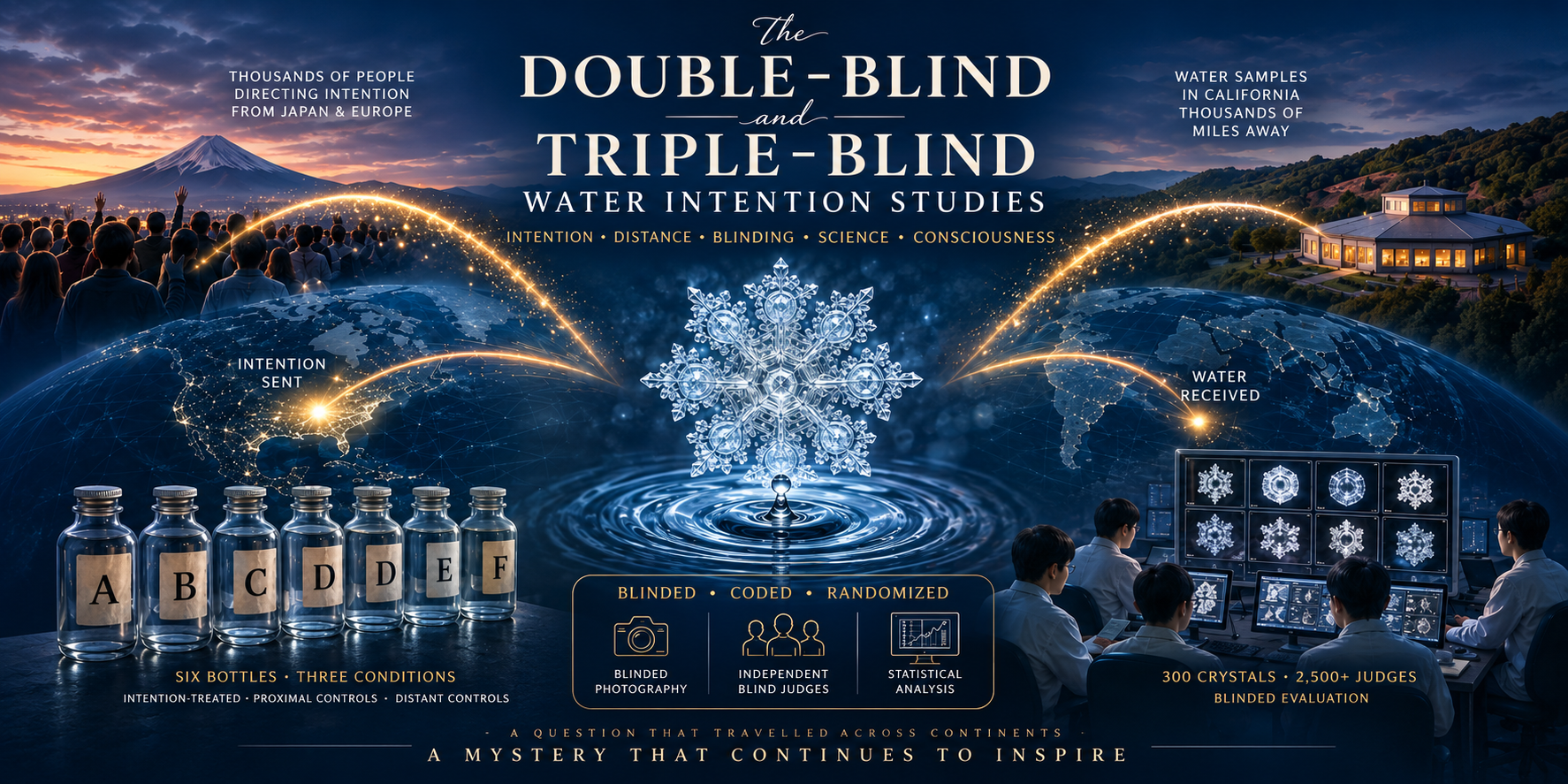
The Double-Blind and Triple-Blind Water Intention Studies
Explore Masaru Emoto's double-blind and triple-blind water intention studies, distant intention, frozen crystals, blinded judging and reported results.
Thousands of people gathered in Japan and Europe.
Thousands of miles away, bottles of water waited quietly in California.
The participants could not touch them.
They did not stand beside them.
They did not speak directly over them.
Instead, they directed something across the distance:
Intention.
The water was later frozen.
Ice-crystal formations were photographed.
Independent people evaluated the photographs without knowing which water had received the distant intention.
And in two published experiments associated with Dr. Masaru Emoto, researchers reported differences in the direction they had predicted.
Behind the photographs and statistics was a question much larger than water:
Can focused human intention reach across distance and somehow become reflected in matter?
Masaru Emoto had already spent years exploring relationships among water, words, music, prayer, gratitude and consciousness.
These studies carried part of that exploration into another realm:
randomization
controls
blinding
independent judging
image analysis
statistics
The beautiful water crystal had entered the laboratory in a new way.
From Water Crystals to a Testable Question
Emoto's earlier work explored water exposed to words, music, photographs, prayer and other influences. His official organization describes these categories as central parts of his water-crystal work and continues to preserve examples from the original collection. (Masaru Emoto)
But distant intention presented a particularly fascinating question.
What if the people directing intention were nowhere near the water?
What if the person photographing the crystals did not know which sample had received the intention?
What if the people judging those photographs did not know either?
Could the story behind each bottle remain hidden while observations were made?
Could intention become an experimental variable while expectation was deliberately separated from observation?
That became the heart of the blinded water-intention studies.
The 2006 Double-Blind Pilot Study
In 2006, Dean Radin, Gail Hayssen, Masaru Emoto and Takashige Kizu published:
Double-Blind Test of the Effects of Distant Intention on Water Crystal Formation
in the journal Explore.
The experiment was described as a pilot test conducted under double-blind conditions.
Approximately:
2,000 people in Tokyo
focused positive intentions toward water samples.
But the target water was not in Tokyo.
It was in:
California.
The target samples were located inside an electromagnetically shielded room.
Similar water samples were maintained elsewhere as controls, and the people directing the intentions did not know about those control samples. (ScienceDirect)
Tokyo to California
Think about the experimental question.
Approximately 2,000 human beings were in one part of the world.
The water was thousands of miles away.
The participants could see where their intention was being directed, but they could not physically interact with the water.
Afterward, ice crystals were produced from both the intention-treated and control samples.
The crystals were identified and photographed under blinded conditions.
Then another layer was added.
100 independent judges
assessed the resulting photographs for aesthetic appeal without knowing whether the images came from intention-treated or control water. (ScienceDirect)
The experiment created a remarkable chain:
Human intention
↓
Distance
↓
Water
↓
Freezing
↓
Crystal formation
↓
Photography
↓
Blind evaluation
↓
Statistical comparison
An invisible question was being approached through something visible.
What Did the Double-Blind Study Report?
The crystal photographs formed from the intention-treated water received higher aesthetic ratings than photographs formed from the control water.
The researchers reported:
p = .001, one-tailed
and concluded that the result lent support to their experimental hypothesis. (ScienceDirect)
Approximately 2,000 people had directed positive intention toward distant water.
The resulting crystals had been blindly photographed.
Independent judges had evaluated the images.
A difference appeared in the predicted direction.
And then something important happened.
They asked the question again.
From Pilot Study to a Stronger Experiment
A meaningful experiment does more than produce a result.
It can reveal how the next experiment should be designed.
The researchers developed a follow-up investigation with additional controls and stronger blinding.
They expanded the judging dramatically.
They added computerized image analysis.
They randomized additional portions of the procedure.
And all 300 photographs produced for the experiment entered the dataset.
The question remained.
The method evolved.
The resulting study was published as:
Effects of Distant Intention on Water Crystal Formation: A Triple-Blind Replication
by:
Dean Radin
Nancy Lund
Masaru Emoto
Takashige Kizu
in the Journal of Scientific Exploration. (Journal of Scientific Exploration)
The Triple-Blind Water Intention Experiment
This time approximately:
1,900 people
in Austria and Germany focused their intentions toward water located inside an electromagnetically shielded room in California.
And the design contained an especially interesting addition.
There were not merely treated bottles and untreated bottles.
There were:
Intention-treated water
Proximal-control water
Distant-control water
Three conditions.
Six bottles.
And until the experimental identities were eventually revealed, letters concealed the stories behind those bottles. (Water Crystal)
Six Bottles of Water
The replication began with six bottles of commercially bottled Fiji water.
They were identified by letters:
A
B
C
D
E
F
Randomization was used to assign bottles to experimental roles.
Two became intention targets.
Two became proximal controls.
Two became distant controls.
The experimental identities were preserved separately so that people involved in the blinded stages would not simply know:
This is the intention water.
This is the control water.
At first, there were only letters.
The story remained hidden.
The Hidden Water Beneath the Table
One of the most fascinating features of the replication was the proximal-control condition.
Two intention-target bottles were placed on a small table inside the shielded chamber.
Two additional bottles were placed beneath that same table.
Those were the proximal controls.
They occupied essentially the same immediate physical environment as the target water.
But the people directing the distant intentions did not know those nearby controls existed. The published paper specifically describes water located near the target water, but unknown to the people providing the intentions, as the proximal-control condition. (Journal of Scientific Exploration)
That created a particularly interesting comparison:
Two bottles were intentionally targeted.
Two nearby bottles shared their environment but were not identified as targets.
Physically close.
Experimentally different.
The Distant Controls
Two additional samples were maintained outside the shielded room as distant controls.
The researchers therefore created three relationships:
targeted and nearby
untargeted and nearby
untargeted and farther away
This allowed them to explore something the original pilot could not examine in the same way.
If a difference appeared between the target water and water sitting close beside it, the shared local environment alone would be less able to explain that particular comparison.
The proximal controls became one of the most important additions to the second experiment.
Inside the Shielded Chamber
Imagine the room.
Four bottles.
Two above.
Two below.
The target bottles were visible in the experimental presentation.
The nearby controls were hidden from the intention participants.
Thousands of miles away, people would focus upon the intended target.
But they would not be consciously directing that intention toward the water waiting immediately beneath it.
This was no longer simply an experiment about beautiful crystals.
It had become an experiment about experimental identity.
Could two samples occupy almost the same physical environment while producing different outcomes according to whether one had been the intended target?
That was the question hidden beneath the table.
Across Continents
Over three days, approximately 1,900 people in Austria and Germany participated in the distant-intention experiment while the target water remained in California. (Journal of Scientific Exploration)
Bodies remained separated by thousands of miles.
The experimental variable was intention.
That makes distance itself one of the most compelling parts of the story.
A physical object must travel across space to reach another physical object.
But human attention behaves differently in our experience.
Think of someone you love on another continent.
Your awareness of that person is immediate.
The deeper experimental question is whether intention merely occurs within the person intending, or whether anything associated with it can correspond with measurable change elsewhere.
The water provided a physical destination for that question.
Gratitude Was at the Heart of the Exploration
There is something important here that can disappear beneath all the methodology.
Emoto's larger body of work continually returned to:
Love and Gratitude.
His official organization still presents water-crystal photographs associated with prayer, words, music and other intentional conditions, including prayer-related collections involving Fujiwara Dam, Hiroshima Peace Memorial Park, Lake Biwa and other waters. (Masaru Emoto)
For Emoto, water was never simply an anonymous laboratory material.
It represented life.
Connection.
Nature.
Responsibility.
Gratitude.
And peace.
That larger philosophy traveled with him into the intention experiments.
The Water Eventually Became 300 Samples
After the intention sessions, the coded water was eventually taken through the crystal-formation process.
From each of the six bottles, 50 samples were prepared.
Six bottles.
Fifty samples each.
That produced:
300 frozen samples.
The samples were randomized within the freezer.
They were frozen at approximately:
−25°C to −30°C
for at least three hours.
The random placement helped distribute variations within the freezing environment among the different experimental conditions. (Water Crystal)
The six bottles had become 300 individual observations.
Inside the Cold Room
The frozen samples were examined under cold conditions.
Takashige Kizu photographed the formations using microscopy.
Some drops produced pronounced crystalline structures.
Others formed differently.
But the second experiment made an especially important methodological move:
All 300 photographs entered the experimental record.
The experiment was no longer dependent upon showing readers only a small collection of representative crystals.
Every photographed sample became part of the dataset.
That development is especially meaningful when placed beside Emoto's broader crystal work.
Office Masaru Emoto explains that its normal educational presentations typically involved observing 50 to 100 crystals from one water sample and choosing a representative photograph. (Masaru Emoto)
The triple-blind experiment moved toward a different approach.
Every experimental image counted.
Six Bottles Became 300 Images
Think about that transformation.
Six ordinary bottles.
Then 300 frozen samples.
Then 300 photographs.
Somewhere behind the anonymous coding were:
two intention targets,
two hidden proximal controls,
and two distant controls.
But the people evaluating the photographs did not need those stories.
They needed only the images.
More Than 2,500 Independent Judges
The photographs were assessed for aesthetic beauty by more than 2,500 independent judges.
The resulting data were analyzed while the relevant participants in those stages remained blind to the underlying treatment conditions. (Journal of Scientific Exploration)
Instead of one person declaring:
This crystal is beautiful.
The experiment gathered a vast collection of independent human impressions.
One photograph.
Many judgments.
Another photograph.
Many more.
Subjective perception gradually became numerical data.
Beauty Became Data
There is something extraordinary about this part of the experiment.
It attempted to turn:
beauty
into something that could be statistically examined.
Beauty feels personal.
Intuitive.
Immediate.
Yet human beings often share perceptions of:
symmetry
balance
complexity
clarity
organization
harmony
Rather than allowing the story behind the water to influence those perceptions, the judges saw the images without knowing their experimental identities.
Water.
Crystal geometry.
Human perception.
Statistics.
All meeting inside one experiment.
What Did the Triple-Blind Study Report?
The researchers reported that crystal images from the intention-treated condition were rated as aesthetically more beautiful than proximal-control crystals.
The result reported in the study's abstract was:
p = .03, one-tailed
The authors described the result as replicating the outcome of the earlier pilot test. (Journal of Scientific Exploration)
That is the central reported finding of the replication.
The 2006 pilot had produced a difference in aesthetic ratings in the predicted direction.
The larger experiment approached the question again with proximal controls and stronger blinding.
And once again, the researchers reported a difference in the predicted direction for the key treated-versus-proximal comparison.
The Researchers Also Looked Inside the Images
The second experiment did not rely entirely upon human perceptions of beauty.
Computerized image analysis was also introduced.
One characteristic examined was image contrast.
A pronounced crystal can create brighter structures against darker surrounding areas, while other frozen formations may produce more uniform images.
This provided another way of looking at the photographs:
not simply:
What do people find beautiful?
but:
What characteristics can be measured within the image itself?
That was an important evolution.
The experiment was beginning to move from human visual interpretation toward quantifiable properties of the crystal photographs.
The Experiment Had Evolved
Several features distinguished the triple-blind replication from the earlier work.
Proximal controls allowed intentionally targeted water to be compared with nearby water sharing essentially the same local environment.
Distant controls created another comparison outside the immediate target environment.
Randomized sample placement distributed freezer-position effects among experimental conditions.
Blinding separated experimental identity from important stages of crystal photography, judging and analysis.
Computerized image analysis added quantitative image characteristics.
And:
all 300 experimental photographs were included.
The question had evolved substantially from simply placing selected crystals beside one another.
What Triple-Blind Really Means
Six bottles entered the experiment carrying nothing more revealing than letters.
A.
B.
C.
D.
E.
F.
Somewhere else existed the answer.
Two had been selected as distant-intention targets.
Two rested nearby as hidden proximal controls.
Two waited elsewhere as distant controls.
But during the blinded stages, the people producing and evaluating the evidence did not have the complete story behind those letters.
The crystals had to appear before their identities did.
That is what makes blinding powerful.
Observation arrives before expectation.
The images existed first.
Their experimental stories could be reconnected afterward.
The Photographer Saw Crystals, Not Stories
Takashige Kizu had spent years photographing water crystals associated with Emoto's work.
In this experiment, coding separated the crystal from the experimental narrative.
The microscope could reveal:
ice
geometry
branching
light
structure
formation
But the coded bottle did not announce its story.
The camera recorded what appeared.
The experimental identity remained concealed.
The Judges Saw Images, Not Intention
The independent judges experienced another layer of that separation.
They did not need to know:
People directed intention toward this water.
They did not need to know:
This was a proximal control.
They simply evaluated what appeared before them.
The narrative remained hidden while the data accumulated.
Only later could the experimental condition and the judgments be brought back together.
The Distant Controls Added Another Mystery
The distant controls did not create a perfectly simple staircase in which every outcome lined up neatly according to distance and treatment.
That makes the experiment more interesting.
The authors' central reported result concerned the difference between the intention-treated samples and the proximal controls. (Journal of Scientific Exploration)
But the broader pattern raises another fascinating question:
What constitutes the ideal control when the phenomenon being explored is distant intention?
If the hypothesis itself concerns consciousness acting across distance, then defining the boundary of an experiment becomes unusually interesting.
How far away should a control be?
What counts as completely outside an intentional environment?
Can awareness of an experiment itself matter?
How should future researchers isolate intention?
Rather than closing the investigation, these questions point toward increasingly sophisticated experiments.
From Representative Crystals to Every Image
This may be one of the most important developments in Emoto's research story.
His famous books introduced people around the world to selected crystal photographs.
Office Masaru Emoto itself explains that researchers commonly observe dozens of crystals from a water sample and choose representative examples for educational purposes. (Masaru Emoto)
Those images opened the door.
The triple-blind experiment walked farther through it.
300 samples.
300 photographs.
More than 2,500 judges.
An observation had become a larger experimental question.
And the methodology was changing along with it.
What Were the Researchers Actually Asking?
It would be easy to reduce these experiments to:
Prayer changed water.
But the research question was more precise and far more interesting.
The studies explored whether water exposed to distant positive intention would later produce frozen crystal photographs receiving different aesthetic evaluations from control water.
The observable chain looked something like this:
Human intention
↓
Target water
↓
Frozen samples
↓
Crystal formation
↓
Photographs
↓
Blind evaluation
↓
Statistical comparison
The invisible was being approached through an observable outcome.
What Is Distant Intention?
Distant intention is the idea that focused consciousness can be directed toward a person, organism, object or physical system without ordinary physical contact.
Human beings have practiced forms of this idea for thousands of years.
Prayer for someone far away.
Blessings offered across distance.
A congregation praying for someone in another city.
A parent praying for a child across the country.
A person directing love toward someone on the other side of the world.
The spiritual idea is ancient.
The experimental question is different:
Can anything associated with that distant intention be detected at the destination?
The water studies attempted to give that enormous question a physical target.
Why Water?
Water offered something unusual.
It could sit quietly.
It could be coded.
It could be separated into groups.
It could be transported.
It could be frozen.
It could be photographed.
And crystallization could transform transparent liquid into elaborate visible geometry.
For Emoto, water became more than an experimental medium.
It became a place where an invisible relationship might possibly leave a visible trace.
Distance Became Part of the Mystery
California.
Tokyo.
Austria.
Germany.
Different countries.
Different continents.
Different people.
Different rooms.
One question connected them.
Physical distance is enormous to the human body.
But consciousness gives us a curious everyday experience.
Think of someone you love thousands of miles away.
Your awareness of that person can arise immediately.
The water-intention studies pushed that familiar experience toward a much larger question:
Does intention remain entirely within the person intending, or can something about it participate beyond that person?
That mystery lies at the heart of these experiments.
Prayer Entered the Laboratory
There is something extraordinary about an experiment involving:
bottles
randomization
shielding
freezers
Petri dishes
microscopes
image analysis
statistics
and:
human intention and gratitude.
Prayer and blessing belong to human history far older than laboratories.
Here, ancient human questions met experimental methodology over water.
The laboratory did not create the meaning of gratitude.
It attempted to ask whether something associated with intentional meaning could correspond with a measurable physical outcome.
Love and Gratitude Appeared Again
Throughout Masaru Emoto's work, two ideas returned repeatedly:
Love
and
Gratitude.
His official water-crystal archive continues to preserve the visual record of that exploration, including natural waters, words, music and prayer-related crystals. (Masaru Emoto)
For Emoto, water was something worthy of appreciation.
Something humanity should protect.
Something intimately connected with life.
Something deserving thanks.
So even amid randomization, controls and statistical analysis, the larger spirit of his work remained recognizable:
Thank you, water.
What Could We Do With This Experiment Today?
Technology has changed enormously since these studies were conducted.
Imagine the same fundamental question explored with:
thousands of coded samples
robotic water dispensing
computerized randomization
automated freezer placement
continuous thermal mapping
humidity monitoring
vibration monitoring
automated microscopy
continuous crystallization imaging
computer vision
artificial intelligence
pre-registered analysis
independent statistical teams
multiple laboratories
and experimental identities inaccessible until every analysis had been completed.
Every crystal could be measured.
Every environmental change could be logged.
Every image could become data.
Artificial Intelligence Could Look Deeper
An AI analysis system would not need to know:
which water received intention,
which bottle was a proximal control,
which bottle was distant,
which photograph Emoto preferred,
or which image a human being considered beautiful.
It could receive only coded images.
Then it could measure:
six-fold symmetry
branching complexity
crystal area
edge structure
angular relationships
fractal characteristics
formation time
brightness
contrast
radial organization
structural completeness
and perhaps hundreds of other characteristics.
Only after the analysis was locked would the treatment code be revealed.
Imagine a repeated pattern appearing across independently operated laboratories.
The questions would become extraordinary.
What carried the influence?
What information crossed the distance?
What property of water responded?
What role did consciousness play?
What does intention actually do?
Emoto began with human eyes.
Today we possess instruments capable of looking far deeper.
Perhaps These Experiments Were an Opening Chapter
Masaru Emoto did something deceptively simple.
He looked at water differently.
Then people began asking how those observations might be examined differently.
A pilot experiment led to a more elaborate experiment.
A more elaborate experiment created additional questions.
That is how exploration grows.
One generation asks.
Another develops better instruments.
Another sees patterns the previous generation could not measure.
Another asks questions nobody had yet imagined.
The water-intention studies can therefore be viewed not as the final chapter:
but as:
an opening chapter.
Consciousness Remains a Profound Mystery
We experience consciousness every waking moment.
We know what it feels like to:
think
intend
remember
pray
love
imagine
choose
focus
feel gratitude
Yet fundamental questions about consciousness remain.
Where does consciousness fit within nature?
How does intention relate to physical reality?
Does consciousness only observe the world?
Can consciousness participate in it?
Does distance matter to consciousness in the same way it matters to physical bodies?
These questions reach far beyond Masaru Emoto.
But water gave him and his collaborators a remarkable place to ask them.
Six Bottles and One Extraordinary Question
Return to those bottles.
A.
B.
C.
D.
E.
F.
They began as ordinary bottled water.
Randomization gave them different experimental roles.
Two became targets.
Two became hidden neighbors.
Two became distant controls.
People thousands of miles away focused intention.
The water eventually became hundreds of frozen samples.
The samples became photographs.
The photographs were judged.
The judgments became statistics.
And only through the experimental code could those numbers finally be reconnected with the stories of the water.
The journey was never merely about creating a beautiful crystal.
It was an attempt to build a bridge:
from intention to observation.
The Most Beautiful Part May Still Be the Question
What happened within those samples?
We can document the experiment.
We can count the participants.
We can identify the locations.
We can record the temperatures.
We can count the photographs.
We can examine the judgments.
We can report what the researchers found.
But underneath all those numbers lives a question humanity has asked in different forms for a very long time:
Does consciousness reach farther than we understand?
Perhaps intention participates in reality through relationships we have not yet learned how to measure.
Perhaps water still has something to teach us about information, consciousness and connection.
Perhaps future experiments will reveal patterns we cannot yet imagine.
These studies did not exhaust the question.
They gave humanity another way to ask it.
Explore Masaru Emoto's Original Water Crystal Collection
Masaru Emoto's original water-crystal photographs deserve to be experienced through the people preserving his work.
Today, Office Masaru Emoto continues the mission associated with his water-crystal photography and maintains an official collection featuring natural waters, music, words, photographs, prayer and other explorations. The organization says it has continued producing water-crystal photographs and sharing Emoto's message since his death in 2014. (Masaru Emoto)
Readers can explore the authentic photographs directly through the official Masaru Emoto Water Crystal Gallery.
The official archive also contains a dedicated collection showing water crystals associated with prayer, including examples connected with Fujiwara Dam, Hiroshima Peace Memorial Park, Lake Biwa and other waters.
For those who would like to know more about the man behind the photographs, Office Masaru Emoto maintains an official biography and legacy page for Masaru Emoto.
We have intentionally chosen to direct readers to these official collections rather than reproduce Emoto's original crystal photographs here. Office Masaru Emoto states that original water-crystal photographs should not be used without contacting the organization beforehand and that licensing applies to their use. (Masaru Emoto)
In this way, the images remain connected to the people entrusted with preserving Emoto's work, while readers who discover his research here can continue their journey directly with his official legacy organization.
A Final Reflection
Thousands of people.
Six bottles.
Three experimental conditions.
A shielded room in California.
Gatherings thousands of miles away.
Hundreds of frozen samples.
Hundreds of photographs.
Thousands of independent judges.
And somewhere beneath all of it:
intention.
Masaru Emoto spent much of his life asking humanity to look at water differently.
These experiments asked us to look at consciousness differently too.
A thought cannot be placed beneath a microscope.
A prayer cannot be held in the hand.
Gratitude cannot be poured into a measuring cylinder.
So the researchers gave intention a destination.
Water.
They coded it.
They separated it.
They directed intention toward it.
They froze it.
They photographed what emerged.
They hid the identities.
They gathered the judgments.
They analyzed the results.
And eventually, the experimental identities could be revealed.
The mystery did not become smaller.
It became larger.
Because somewhere between human intention and frozen water lies one of the most profound questions we can ask:
How deeply are consciousness, matter and the world around us connected?
Masaru Emoto believed water might help humanity look.
Perhaps one of the most honoring things we can do is continue looking.
With better instruments.
Better experiments.
Open minds.
Deep curiosity.
And gratitude for the water that made the question visible.
Questions and Answers
What was Masaru Emoto's double-blind water intention study?
The 2006 pilot study involved approximately 2,000 people in Tokyo focusing positive intentions toward water inside an electromagnetically shielded room in California. Ice crystals formed from treated and control samples were blindly photographed and assessed by 100 independent judges. The intention-treated crystal photographs received higher aesthetic ratings, with the researchers reporting p = .001, one-tailed. (ScienceDirect)
Who conducted the 2006 study?
The published study was authored by Dean Radin, Gail Hayssen, Masaru Emoto and Takashige Kizu. (PubMed)
Was the 2006 experiment published in a journal?
Yes. Double-Blind Test of the Effects of Distant Intention on Water Crystal Formation was published in Explore, Volume 2, Issue 5, in 2006. (ScienceDirect)
Readers interested in the research paper itself can view the 2006 study record at PubMed.
What was the triple-blind water intention study?
It was a follow-up experiment in which approximately 1,900 people in Austria and Germany focused intentions toward water in California. The design included intention-treated samples, proximal controls and distant controls. Crystal photographs were assessed by more than 2,500 independent judges, while relevant stages of photography, judging and analysis were conducted blind to treatment condition. (Journal of Scientific Exploration)
Who conducted the triple-blind study?
The paper was authored by Dean Radin, Nancy Lund, Masaru Emoto and Takashige Kizu. (Journal of Scientific Exploration)
Readers who would like to examine the research directly can visit the Journal of Scientific Exploration study page.
What were proximal controls?
They were water samples located near the target water but unknown to the people providing the distant intentions. This allowed researchers to compare intentionally targeted water with nearby water sharing essentially the same immediate environment. (Water Crystal)
How many people participated?
Approximately 2,000 people participated in the Tokyo pilot. Approximately 1,900 people participated in the later experiment involving Austria and Germany. (PubMed)
How many people judged the triple-blind crystal photographs?
More than 2,500 independent judges assessed the crystal photographs for aesthetic beauty. (Journal of Scientific Exploration)
What did the 2006 study report?
The intention-treated crystal photographs received higher aesthetic ratings than the control photographs, with a reported result of p = .001, one-tailed. (ScienceDirect)
What did the triple-blind experiment report?
The researchers reported that crystal images from the intention-treated condition were rated as aesthetically more beautiful than proximal-control crystals, with p = .03, one-tailed reported in the abstract. The authors described the outcome as replicating the earlier pilot result. (Journal of Scientific Exploration)
Did the researchers analyze all the experimental photographs?
Yes. The triple-blind experiment incorporated the full set of 300 photographs, an important development from the representative-image approach associated with Emoto's broader educational crystal work. (Water Crystal)
Did the study use measurements other than human judgments of beauty?
Yes. Computerized image analysis was incorporated to examine characteristics of the photographs, including image contrast. (Water Crystal)
Can I see Masaru Emoto's original water-crystal photographs?
Yes. The official Office Masaru Emoto crystal gallery preserves examples involving natural waters, words, music, photographs and other conditions. A separate official gallery contains prayer-related water crystal photographs.
Can Masaru Emoto's crystal photographs simply be copied onto another website?
Office Masaru Emoto states that people planning to use its original water-crystal photographs should contact the organization beforehand and that licensing fees apply. Its current photography agreement states that copyright in photographs taken by Office Masaru Emoto belongs to Office Masaru Emoto, LLC. (Masaru Emoto)
Does Office Masaru Emoto still exist?
Yes. Office Masaru Emoto says its staff continued the mission after Masaru Emoto died in 2014 and continue producing water-crystal photographs and conducting educational activities related to the work. (Masaru Emoto)
Could these experiments be explored again with modern technology?
Yes. Automated microscopy, robotic sample preparation, continuous environmental monitoring, computer vision, artificial intelligence and multi-laboratory protocols could examine water-crystal formation on a scale and with a degree of automation unavailable when the original experiments were conducted.
What is the larger question behind these studies?
At their deepest level, the studies explored whether focused human intention corresponded with measurable differences in a distant physical system, and what such a relationship might mean for questions involving water, consciousness, information and matter.
Explore More Sacred Reflections
Dr. Masaru Emoto: Water, Consciousness, Love, Gratitude and the Power of Intention
Explore the life, philosophy, peace mission and remarkable message of the man behind the water-crystal photographs.
Masaru Emoto's Water Crystal Experiments
Enter the larger world of Emoto's crystal work through natural waters, words, Love and Gratitude, music, photographs, prayer and HADO.
Can Human Intention Influence Matter?
Travel beyond Emoto's water experiments into the larger question of consciousness, intention and physical systems.
The Science of Water: Why H₂O Is So Extraordinary
Explore hydrogen bonding, crystallization and the remarkable physical properties of the substance at the heart of Emoto's work.
Does Water Have Memory?
Explore the fascinating questions surrounding water, molecular organization, information and the many meanings associated with water memory.
Prayer, Blessing and the Sacred Meaning of Water
Explore humanity's ancient relationship with water through prayer, baptism, blessing, purification and sacred traditions.
Words, Vibration and the Human Body
Discover how language, meaning, sound and emotion travel through human experience.
Music, Sound and Water
Explore acoustics, vibration, resonance, cymatics and the extraordinary relationship between sound and water.
Love, Gratitude and the Biology of Positive Emotion
Explore gratitude, love, appreciation and their relationship with human experience and well-being.
What Science Still Does Not Understand About Consciousness
Enter one of humanity's deepest mysteries and explore questions surrounding the nature, origin and reach of consciousness.
The Mystery of Water, Consciousness and Human Intention
Bring the larger journey together through water, intention, consciousness, gratitude, meaning and possibility.
Can Human Intention Influence Matter?
Explore how human intention may influence matter through consciousness, water, prayer, words, mind-body pathways and mind-matter research.
Consciousness, Water, Prayer, Energy and the Creative Power of the Human Mind
Every visible creation begins somewhere beyond visibility.
A building begins as an idea. A garden begins as a vision. A healing conversation begins with the intention to understand. A prayer begins within the heart before a single word is spoken.
Human beings continuously bring unseen possibilities into physical form. Thoughts become choices. Choices become actions. Actions reorganize matter, relationships, communities and lives.
Yet Dr. Masaru Emoto invited humanity to consider an even deeper possibility:
Can human intention influence matter directly?
Could loving attention, gratitude, prayer or focused consciousness affect water or another physical system before intention becomes an ordinary physical action?
Emoto’s water crystal photographs brought this question into public awareness in a way few scientific papers ever could. His images appeared to show that water exposed to loving words, gratitude, prayer and harmonious music formed more balanced frozen crystals than water exposed to harsh expressions or disorder.
To some, the photographs suggested a responsive universe. To others, they opened a question worthy of more careful investigation. To millions of people, they carried a message that felt immediately recognizable:
What we bring to life matters.
The relationship between consciousness and matter remains one of humanity’s great mysteries. It stands at the meeting place of science, spirituality, philosophy, psychology, prayer and lived experience.
What Is Intention?
Intention is more than having a thought.
Thoughts move through the mind continually. Intention gathers consciousness around a direction. It gives thought purpose and begins organizing the person around what they are choosing to create, express, receive or become.
An intention may contain:
Focused attention
Emotional meaning
Purpose
Expectation
Choice
Prayer
Commitment
Imagination
Willingness
Spiritual alignment
When these elements come together, intention becomes an organizing force.
It influences what we notice, what we nourish, how we interpret circumstances and what we are prepared to do. It can guide the nervous system, shape behavior, change relationships and give physical form to something that previously existed only as a possibility.
Intention is one of the primary bridges between consciousness and creation.
Consciousness Already Influences Matter
At the most observable level, consciousness influences matter every day.
A person imagines a table and then shapes wood into that form. An architect visualizes a structure before materials are assembled. A musician hears a melody inwardly before sound moves through the air. A community holds a shared vision and builds something that did not previously exist.
The pathway is familiar:
A possibility enters awareness.
Attention gives the possibility greater presence.
Intention establishes a direction.
Decisions organize around that direction.
The body takes action.
Matter is rearranged.
A new physical reality appears.
Consciousness is already participating in material change.
Emoto’s question reaches beyond this familiar pathway. He asked whether consciousness may also interact with matter through subtler forms of information, attention, resonance, prayer or focused intention.
Dr. Masaru Emoto’s Invitation
Dr. Masaru Emoto explored the relationship between water and human consciousness by freezing water samples and photographing the crystals that formed.
Water was exposed to different influences, including:
Loving and appreciative words
Prayer
Spoken expressions
Written messages
Music
Photographs
Individual intention
Group intention
Different natural and environmental conditions
Emoto reported that water associated with love, gratitude and harmony often produced balanced, intricate crystals. Water associated with hostility, neglect or disorder frequently produced less symmetrical formations.
The photographs became known throughout the world.
Their significance reached beyond the appearance of individual crystals. Emoto encouraged people to consider water as more than a passive substance. He approached it as a sacred foundation of life and a participant in the relationship between humanity and the natural world.
His work carried a simple but profound message:
If water can receive something from consciousness, then every word, prayer and intention may carry greater meaning than we realize.
Explore Emoto’s Original Water Crystal Work
Dr. Masaru Emoto’s work continues through the organizations preserving his water crystal photographs, teachings and vision for peace.
Readers who would like to view the original water crystal images and learn directly from those carrying forward his legacy may explore:
Office Masaru Emoto — the official organization managing Dr. Emoto’s legacy, educational work and continuing water crystal photography.
Masaru Emoto’s Hado World — information about Hado, water crystal photography, Emoto’s books and the continuing work of I.H.M.
Emoto Peace Project — Emoto’s peace mission, water crystal gallery, children’s picture books and educational materials.
These official resources allow Emoto’s photographs and message to be experienced within the context established by the people preserving his work.
Water Between Spirit and Matter
Water occupies a unique place in both life and spiritual tradition.
It forms rivers, oceans, rain, clouds, blood, tears and the fluid environments within living organisms. It moves through the atmosphere, soil, plants, animals and human beings in a continuous cycle.
Water also carries sacred meaning across cultures and faiths.
It is connected with:
Cleansing
Baptism
Renewal
Blessing
Healing
Rebirth
Purification
Spiritual life
Divine grace
In Scripture, water repeatedly appears at moments of creation, transformation and renewal.
The creation account begins with the Spirit of God moving over the waters. Baptism uses water as a visible expression of inward transformation. Christ speaks of living water as a gift that reaches beyond physical thirst.
Emoto placed water at the center of a modern consciousness question, but humanity’s sense that water is sacred is ancient.
His work gave new visual form to something people have felt for thousands of years: water is not merely useful. It is worthy of gratitude, protection and reverence.
Words Carry Intention Into the World
Words are one of the clearest ways intention becomes physical.
A spoken word creates vibration in the air. It enters the ear, activates the nervous system and carries meaning into another person’s mind and body.
Written words alter a page or screen. Remembered words can continue shaping identity and behavior for years.
The same sentence can carry different effects depending on the consciousness behind it. Tone, attention, emotion, relationship and purpose all become part of the message.
Words can:
Strengthen a person
Restore hope
Awaken courage
Deepen trust
Create peace
Encourage healing
Reinforce fear
Damage confidence
Change the emotional atmosphere of a home
Become part of another person’s inner voice
A loving word does not remain inside the speaker. It enters the shared world.
Emoto’s message about language remains powerful. Words participate in creation because they influence the people, choices and environments through which the future takes form.
Emotion Gives Intention Its Quality
Intention is not formed by words alone.
Two people may say the same phrase while carrying entirely different inner states. One may speak from sincerity, while the other speaks mechanically. One may offer a genuine blessing, while the other merely repeats the correct language.
Intention therefore has both direction and quality.
Its direction is what we are focusing toward.
Its quality is what we are placing into that focus.
Love, gratitude, reverence, fear, resentment, compassion and peace organize human experience differently. They influence facial expression, voice, posture, breathing, attention, decisions and behavior.
Emoto believed love and gratitude carried an especially harmonious quality.
Love reaches outward in care.
Gratitude recognizes and receives the gift already present.
Together, they create a way of relating to life that is both generous and receptive.
Intention and the Living Body
The human body provides one of the clearest examples of consciousness becoming physical.
A thought can alter breathing. A memory can change heart rate. An expectation can influence pain. Fear can tighten muscles before an external threat has appeared. Peaceful attention can help the nervous system move toward a calmer state.
Mental and emotional experiences are expressed through:
Electrical activity in the brain
Neurotransmitters
Hormone signaling
Muscle tension
Breathing patterns
Heart rate
Blood pressure
Immune communication
Digestion
Sleep
Pain perception
Behavior
The mind and body are not two completely separate realities. They are continuously communicating aspects of one living person.
Expectation and meaning can also affect how people experience discomfort, treatment and recovery. The body responds not only to physical substances but also to context, trust, fear, hope, relationship and interpretation.
What is held within consciousness can become part of the body’s physical experience.
Intention Changes What the Brain Notices
The brain receives more information than conscious awareness can hold at once. Attention helps determine what rises into the foreground.
When a person establishes a meaningful intention, the brain becomes more likely to recognize information connected with it. Opportunities that were previously overlooked become visible. Relevant conversations stand out. Possibilities that once seemed distant begin entering awareness.
Someone intending to create peace notices where peace is needed.
Someone intending to heal a relationship becomes more aware of words, habits and moments of choice.
Someone intending to build a new life begins recognizing openings that did not previously command attention.
Intention changes the relationship between a person and the field of possibilities already present.
What receives attention receives energy. What receives sustained energy is more likely to influence what happens next.
Intention Creates Coherence
A person becomes more powerful when thought, emotion, speech and action move in the same direction.
This state can be understood as coherence.
Incoherence appears when a person says one thing, believes another, feels something entirely different and acts against all three.
Coherence appears when:
The mind holds a clear purpose
The heart is emotionally connected with that purpose
Words support it
Choices reflect it
Actions give it form
Coherent intention brings the person into greater unity.
Instead of energy being scattered across competing impulses, thought, emotion and action begin working together. This alignment changes how time, attention and effort are directed.
Intention becomes stronger when it is embodied by the whole person.
Prayer as Sacred Intention
Prayer may contain intention, but it reaches beyond personal will.
Sacred prayer is not simply an attempt to command matter or force reality into a preferred form. It can include:
Communion with God
Gratitude
Trust
Intercession
Listening
Surrender
Praise
Guidance
Blessing
Alignment with divine wisdom
Intention says, “This is the direction I am choosing.”
Prayer may also say, “God, guide this intention so it serves what is true, loving and right.”
Prayer can influence the person praying by changing attention, courage, patience, compassion and action. It can change the way a person enters a room, treats another human being or responds to hardship.
Many people experience prayer as more than an internal psychological process. They understand it as participation in a spiritual reality connecting human consciousness with God and with others.
Scientific instruments can examine measurable outcomes surrounding prayer. They cannot contain the full meaning of a relationship with the Divine.
Blessing as the Direction of Consciousness
A blessing is intention expressed in sacred form.
To bless water, food, a home or another person is to direct love, gratitude and goodwill toward life. The blessing acknowledges that what stands before us has meaning and deserves conscious regard.
Blessing changes the moment.
Instead of consuming without thought, we receive.
Instead of moving automatically, we pause.
Instead of treating the physical world as lifeless property, we recognize relationship.
A person may bless water by saying:
May this water nourish life and carry gratitude through every part of me.
A person may bless a home by saying:
May this home be filled with peace, protection, truth and love.
A person may bless another by saying:
May you be strengthened, guided and surrounded by grace.
The meaning of a blessing does not depend upon perfect wording. It arises from sincere presence and loving intention.
Research Into Mind–Matter Interaction
For decades, researchers have attempted to study whether intention can affect physical systems without conventional contact.
Research has explored:
Dice
Mechanical systems
Electronic random-number generators
Quantum random-event generators
Double-slit optical systems
Water crystal formation
Plants and seeds
Cells and laboratory samples
Human physiology
Distant healing
Group intention
Collective emotional events
The reported effects are usually subtle rather than dramatic. Detecting them requires controlled conditions, large datasets and careful analysis.
The persistence of the question has produced a substantial body of experimental work and several important research programs.
Random-Number Generator Research
Random-number generators produce sequences that should vary according to chance.
In intention experiments, participants are asked to mentally influence a device so it produces more of one outcome than another. Long-term results are then examined to see whether they depart from the range expected by chance.
A 2006 meta-analysis combined 380 studies examining human intention and random-number generators. Across the combined research, the authors found a statistically significant but very small overall effect.
The studies varied considerably, and smaller studies tended to report larger effects. Researchers have continued debating whether the accumulated findings reflect a subtle consciousness interaction, publication patterns, differences in experimental design or a combination of influences.
The body of research remains significant because it attempts to move the mind–matter question from personal experience into controlled measurement.
These experiments do not describe dramatic control over machines. They examine whether human intention may correspond with extremely small changes in probability.
Princeton Engineering Anomalies Research
One of the best-known investigations of mind–matter interaction was the Princeton Engineering Anomalies Research laboratory, commonly known as PEAR.
Founded in 1979 at Princeton University by engineering professor Robert G. Jahn, PEAR examined whether human intention correlated with small changes in random physical systems.
Participants were generally asked to produce a higher result, a lower result or to allow the device to operate without directed intention.
Across many years and millions of trials, PEAR researchers reported small deviations from chance corresponding with participant intentions. The effects were tiny in individual sessions but appeared more visible when large amounts of data were combined.
PEAR also studied whether factors such as emotional connection, personal meaning and the relationship between participants influenced experimental outcomes.
Its work raised larger questions:
Does consciousness extend beyond the boundaries of the brain?
Can meaning influence probability?
Does emotional connection affect physical systems?
Could consciousness and matter emerge from a deeper shared reality?
Is reality more participatory than it appears?
PEAR did not describe people commanding machines through thought. It proposed something subtler: consciousness and physical randomness might share a weak but measurable relationship under certain conditions.
Global Consciousness Project
The Global Consciousness Project grew from earlier random-event generator research.
A worldwide network of devices was used to explore whether moments of intense shared attention or emotion corresponded with departures from expected randomness.
Researchers examined periods surrounding events that drew the attention of large populations, including celebrations, tragedies, ceremonies and other globally meaningful moments.
Some project analyses reported unusual correlations during major events. The researchers proposed that collective attention may be associated with a form of coherence detectable within networks of random systems.
Other researchers have questioned how events were selected, how statistical choices were made and how the resulting correlations should be interpreted.
The project therefore represents an exploratory body of work rather than a settled explanation of collective consciousness.
Its importance lies in the question it places before us:
Can shared human meaning leave a measurable signature in the physical world?
Double-Slit Experiments and Human Attention
The double-slit experiment is one of the most famous demonstrations in quantum physics.
When particles or photons pass through two slits under certain conditions, they produce an interference pattern associated with wave-like behavior. When physical information about the path becomes available through measurement, the pattern changes.
Some researchers have explored whether focused human attention might also correspond with changes in the interference pattern.
Several experiments reported small changes in the expected direction. Later analyses demonstrated how sensitive these findings can be to physical noise, data processing and statistical choices.
This research has also helped clarify an important distinction. In physics, an “observer” generally refers to a physical measurement interaction capable of recording information. It does not automatically mean a conscious person looking at the experiment.
Quantum physics nevertheless reveals a physical world that is relational, probabilistic and far more mysterious than classical matter once appeared.
Different interpretations of quantum mechanics offer different explanations for what occurs during measurement. A few philosophical interpretations have assigned consciousness a special role, while many others do not require consciousness to explain the observed results.
Questions about measurement, information and consciousness continue to inspire scientific and philosophical exploration.
Intention and Living Systems
Researchers have also studied whether intention, prayer or healing attention can affect living systems.
Studies have involved:
Seed germination
Plant growth
Enzyme activity
Cell cultures
Wound healing
Human physiology
Pain
Heart rate
Blood pressure
Emotional well-being
Recovery experiences
Results have varied across different methods and subjects. Some studies have reported meaningful differences between intention and comparison groups, while others have produced little separation.
A systematic review examined 23 randomized distant-healing trials involving 2,774 participants. Thirteen of the trials reported statistically significant effects. Because the studies differed greatly in their methods, the reviewers concluded that the findings merited further investigation.
Living systems may be especially meaningful subjects for consciousness research because they already contain communication, adaptation, relationship and self-regulation.
They are also deeply complex. A living organism is continually responding to its environment, history and internal condition, making subtle effects more difficult to isolate.
Individual and Collective Intention
An individual intention begins within one person. Collective intention forms when many people direct attention, prayer, emotion or action toward a shared purpose.
Collective intention can influence matter through visible pathways:
Communities build physical spaces.
Groups protect water and land.
Shared prayer changes how people support one another.
Social movements alter institutions.
Cooperative action redirects resources.
Families create different emotional environments.
Communities responding together change future outcomes.
These are powerful material effects.
Frontier research asks whether collective consciousness may also produce subtler forms of coherence beyond coordinated behavior.
Even as that question continues to be explored, the visible power of collective intention is undeniable. When enough people hold the same vision and act in alignment with it, the physical world changes.
Intention Is Participation
Sacred intention does not require believing that one person controls every circumstance.
Human beings live within a vast reality containing natural laws, other people’s choices, collective conditions, freedom, timing, mystery and the will of God.
We influence reality without being its only influence.
Intention makes us participants.
This understanding preserves both responsibility and grace. We are not powerless, yet we do not have to carry the burden of believing that every difficult experience was created by an incorrect thought.
Sacred intention asks:
What am I contributing now?
What am I willing to create from here?
What can love bring into this moment?
These questions return power to the present without placing blame upon the past.
Intention Requires Relationship
Matter is not merely something human beings act upon. We live in relationship with the physical world.
We depend upon water, soil, air, sunlight, plants, animals and entire ecosystems. Our choices influence these living systems, and their condition influences us.
Emoto’s message invited humanity to replace domination with reverence.
When water is treated as sacred, pollution becomes more than a technical problem. It becomes a wound within a relationship.
When food is received with gratitude, consumption becomes participation.
When Earth is approached as a living creation rather than an unlimited resource, responsibility deepens.
Human intention influences matter not only through thought but through the way intention teaches us to relate to everything physical.
Love and Gratitude as Creative Forces
Emoto repeatedly emphasized the combined power of love and gratitude.
These qualities influence physical reality through countless pathways.
Love changes how we touch, speak, build, protect and respond.
Gratitude changes what we value and how carefully we receive it.
Together, they can change:
The emotional atmosphere of a home
The way water and food are received
How the body is spoken to
How children understand themselves
How conflict is approached
How the natural world is treated
How resources are used
Which possibilities receive attention
What kind of future people work to create
Love and gratitude are not passive emotions. When embodied, they become creative forces moving through human words, hands and choices.
Giving Intention Physical Form
An intention becomes most powerful when it is welcomed by the whole person.
Name the Intention
Choose a direction that is clear, life-giving and meaningful.
Feel Its Deeper Purpose
Ask why this intention matters and what quality of life it is meant to serve.
Bring It Before God
Invite wisdom, guidance and alignment rather than relying upon force alone.
Speak It With Care
Words help give shape to what consciousness is holding.
Imagine It Embodied
See how the intention would appear through choices, relationships and daily life.
Take the Next Physical Step
Give the intention a place to enter the material world.
Remain Receptive
The path may unfold differently from the first image you held.
Practice Gratitude
Honor what has already moved, opened, healed or become visible.
Intention becomes creation when it moves through presence, alignment and action.
A Sacred Water Intention Practice
Water can become a daily reminder that life is sacred.
Hold a glass of water with both hands. Become still for a moment.
Consider the journey of the water before you. It has moved through clouds, rain, land, rivers and countless natural cycles. The water within that glass belongs to a story far older than any one human life.
Offer gratitude in your own words.
You might say:
Thank you for this water and for the life it carries. May it nourish my body. May my thoughts, words and actions carry love, gratitude and peace into the world.
Drink slowly and consciously.
This practice is about relationship. It transforms an automatic act into a moment of reverence.
What the Research Invites Us to Consider
Mind–matter research has produced intriguing findings, subtle statistical patterns, important questions and continuing efforts to understand what consciousness may be.
The evidence is clearest in the ways intention influences:
Attention
Perception
Physiology
Behavior
Relationships
Decision-making
Persistence
Collective action
Physical consequences created through human choices
Research into intention acting upon distant matter remains a frontier. Some experiments have reported small effects that invite further investigation. Other work has shown how sensitive those effects can be to experimental conditions and methods.
A meaningful approach leaves room for both discernment and wonder.
We can honor unusual findings without demanding that they answer every question. We can value careful scientific methods without treating current limits as the final boundary of what consciousness may be.
The question remains worthy.
Deeper Meaning of Emoto’s Work
Dr. Masaru Emoto may be remembered for photographs of ice crystals, but the heart of his message was much larger.
He asked humanity to become conscious of its relationship with water.
He asked us to recognize the power carried by words.
He asked us to understand gratitude as a way of living.
He asked us to imagine peace as something human beings could place into the world.
His work invited people to consider that consciousness might be participatory rather than isolated—that the inner and outer worlds may be more deeply connected than they appear.
Perhaps future research will reveal mechanisms that are not yet understood.
Perhaps some of Emoto’s images will continue serving as sacred symbols calling humanity toward love, peace and gratitude.
Either way, the invitation remains:
Speak as though words matter.
Pray as though love travels.
Give thanks as though life can receive it.
Act as though intention is the beginning of creation.
Frequently Asked Questions
Can Human Intention Influence Matter?
Yes. Intention influences matter whenever it guides the brain, body, behavior and physical action. Research has also explored whether intention can affect physical systems directly, with subtle findings that continue to be investigated.
What Is the Difference Between Thought and Intention?
A thought may appear briefly and pass. Intention gives thought direction, emotional meaning, purpose and commitment. It organizes attention and prepares a person to participate in an outcome.
Did Dr. Masaru Emoto Believe Water Responded to Consciousness?
Yes. Emoto believed water could receive information from words, music, prayer, emotion and focused intention. His frozen-water photographs were presented as visible expressions of that responsiveness.
Where Can I View Emoto’s Original Water Crystal Photographs?
Original water crystal photographs and information about Emoto’s continuing legacy can be found through Office Masaru Emoto, Masaru Emoto’s Hado World and the Emoto Peace Project.
Can Words Change Matter?
Words are physical vibrations when spoken and physical symbols when written. They influence the brains, bodies, emotions, decisions and actions of people who receive them. Emoto’s work also explored the possibility that words and the intentions behind them may affect water more directly.
What Did Random-Number Generator Experiments Find?
Many experiments reported extremely small statistical shifts corresponding with participant intentions. A meta-analysis of 380 studies found a small overall effect, leading to continued discussion about consciousness, probability and experimental design.
What Was the PEAR Laboratory?
The Princeton Engineering Anomalies Research laboratory was a long-running Princeton University program investigating possible interactions between human intention and random physical systems. Its researchers reported small cumulative deviations associated with participant intentions.
What Is Collective Intention?
Collective intention occurs when many people direct attention, emotion, prayer or action toward a shared purpose. It can transform physical reality through cooperation, and some researchers have explored whether it also corresponds with subtler changes in random systems.
Does Quantum Physics Show That Consciousness Affects Matter?
Quantum physics demonstrates that measurement, information and physical interaction are central to how quantum systems are observed. Some interpretations give consciousness a special role, while others explain measurement without it. The relationship between consciousness and quantum reality remains a profound philosophical question.
Is Prayer a Form of Intention?
Prayer can include focused intention, but it also includes relationship with God, gratitude, trust, listening, surrender, guidance and blessing. Sacred prayer seeks alignment rather than control.
Can I Bless Water?
Yes. Blessing water can be a meaningful act of gratitude, faith and conscious relationship. It allows an everyday necessity to be received with reverence.
Do I Need Special Words to Set an Intention?
No. Sincerity matters more than a perfect phrase. A meaningful intention can be spoken, written, prayed, visualized or quietly held before being expressed through action.
Does Intention Mean People Create Everything That Happens to Them?
Intention gives people meaningful creative participation in life. Every person also lives within a larger reality shaped by natural conditions, other people’s choices, collective systems, timing, mystery and divine will.
Why Did Emoto Emphasize Love and Gratitude?
Emoto regarded love and gratitude as deeply harmonious expressions capable of changing how people relate to themselves, one another, water and Earth. Love gives, while gratitude receives and honors what has been given.
A Final Reflection
Perhaps intention is the place where the invisible begins moving toward form.
It gathers the mind.
It awakens the heart.
It changes the body.
It shapes words.
It guides the hands.
It influences relationships.
It organizes action.
It enters the physical world.
There may also be pathways by which consciousness touches matter more directly—through resonance, information, prayer or forms of connection humanity has not yet learned to measure completely.
The existence of unanswered questions does not make consciousness less sacred. It reminds us how much remains to be understood.
Dr. Masaru Emoto asked us to look at a water crystal and see more than frozen matter. He asked us to consider relationship, responsiveness, beauty and responsibility.
His question is still before us:
What if the consciousness we bring to life becomes part of what life receives from us?
We do not have to wait for every mystery to be resolved before choosing what we will contribute.
We can choose words that strengthen.
We can offer prayer.
We can bless what sustains us.
We can act with purpose.
We can approach water, Earth and one another with reverence.
We can place love and gratitude into the world—and allow our lives to give those intentions physical form.
If This Message Resonated, You May Also Enjoy
Research Referenced
Bösch H, Steinkamp F, Boller E. Examining Psychokinesis: The Interaction of Human Intention With Random Number Generators—A Meta-Analysis. Psychological Bulletin. 2006;132(4):497–523. National Library of Medicine
Astin JA, Harkness E, Ernst E. The Efficacy of Distant Healing: A Systematic Review of Randomized Trials. Annals of Internal Medicine. 2000;132(11):903–910. National Library of Medicine
Tremblay N. Independent Re-analysis of Alleged Mind–Matter Interaction in Double-Slit Experimental Data. PLOS ONE. 2019;14(2):e0211511. PLOS ONE
Radin D, Lund N, Emoto M, Kizu T. Effects of Distant Intention on Water Crystal Formation: A Triple-Blind Replication. Journal of Scientific Exploration. 2008;22(4):481–493. Journal of Scientific Exploration
Dr. Masaru Emoto’s original water crystal photographs remain the work of their respective copyright holders. Links are provided so readers may explore the photographs and teachings through the official organizations preserving his legacy.

Masaru Emoto's Water Crystal Experiments: Words, Music, Prayer and the Mystery Within Water
Explore Masaru Emoto's water crystal experiments with words, love, gratitude, music, photographs, prayer and intention, plus the mysteries they continue to inspire.
A drop of water freezes.
For a brief moment, under intensely cold conditions, something extraordinary can emerge.
A crystal begins to grow.
Six-sided geometry appears.
Branches extend outward.
Light catches its edges.
A structure that was invisible moments before suddenly reveals itself.
Then it changes.
It melts.
It disappears.
Dr. Masaru Emoto became fascinated with these fleeting moments and devoted years to photographing them.
What began as an exploration of frozen water eventually became a remarkable international body of work involving natural springs, rivers, lakes, municipal water, written words, different languages, music, photographs, prayer and human intention.
Some of the crystals appeared extraordinarily symmetrical.
Some resembled jeweled snowflakes.
Some developed intricate branching patterns.
Others formed in entirely different ways.
Emoto believed these differences carried meaning.
Behind the photographs was a question much larger than ice:
What can water reveal about what it has encountered?
That question became one of the great themes of his life.
Where the Water Crystal Experiments Began
In 1994, Masaru Emoto began pursuing an unusual idea.
Freeze water.
Observe it under magnification.
Photograph the crystal structures that emerge.
The idea was simple.
Capturing the crystals was much more difficult.
Frozen water begins changing as soon as its environment changes.
The emerging crystals are temporary.
Temperature matters.
Timing matters.
Observation matters.
The photographer has only a limited opportunity to capture a formation before it changes again.
According to Emoto's account, it took approximately two months of experimentation before the team succeeded in obtaining the kinds of crystal photographs they were seeking.
Then the first beautiful hexagonal formations appeared.
And an entire world opened.
A Laboratory Filled With Tiny Frozen Worlds
The water crystal method developed into a process involving many small samples from the same source.
Rather than freezing an entire bottle and expecting one crystal to represent it, the laboratory prepared multiple small portions of water.
Emoto's organization explains that approximately 50 to 100 water crystals were commonly observed from a single water sample.
That detail reveals the scale of the process.
One bottle could become dozens of frozen observations.
One experiment could produce an entire family of crystalline formations.
Every crystal was different.
The laboratory then photographed examples that expressed the characteristics the researchers found especially striking.
Over time, this process created an enormous visual archive of water.
Water Does Not Produce the Same Crystal Twice
One of the observations emphasized by Emoto's organization is remarkably beautiful in itself:
They did not observe identical crystals.
Even when water came from the same experimental sample, each formation could develop differently.
This gave the work an almost snowflake-like individuality.
The basic geometry of ice may follow natural molecular principles, yet each developing formation reflects a particular moment of crystallization.
Temperature.
Movement.
Nucleation.
The microscopic environment.
The history of the sample.
And perhaps, Emoto wondered, influences that had not yet been considered.
Each crystal became a moment rather than a permanent object.
Why the Hexagon Became So Important
Many of Emoto's most celebrated photographs display six-sided crystalline forms.
There is remarkable natural chemistry behind this geometry.
When water freezes into ordinary ice, hydrogen bonding helps organize water molecules into structures associated with hexagonal symmetry.
This underlying organization is also responsible for the familiar six-fold geometry seen in snow crystals.
The hexagonal form gave Emoto a beautiful starting point for asking why different samples developed such different crystalline expressions.
Why did one water sample develop an elaborate, balanced crystal while another appeared entirely different?
Why did certain samples seem repeatedly associated with the forms he considered harmonious?
Why did water from different places appear to show such different crystalline expressions?
Those questions drove the work forward.
The First Great Exploration Was Water From Earth
Before Emoto's work became famous for words such as Love and Gratitude, he explored water collected from the world itself.
His archive grew to include water from springs, rivers, lakes, glaciers, fountains and other natural sources.
Among the waters preserved in the official crystal collection are samples associated with:
Lake Baikal
Lake Titicaca
the Amazon
Mount Cook Glacier
Antarctic ice
Lake Motosuko
the Shimanto River
Huilo-Huilo Falls
the Fountain of Lourdes
Japanese spring waters
and many other locations around the world.
Each sample entered the same basic journey.
Collect.
Freeze.
Observe.
Photograph.
Compare.
The planet itself became part of the experiment.
Natural Water Captured Emoto's Attention
Emoto became particularly fascinated by water that had moved through relatively natural environments.
Mountain springs.
Rivers.
Snow.
Glacial water.
Lakes.
Waterfalls.
He reported seeing many striking crystalline formations among these samples.
For him, they seemed to carry something of the places from which they came.
Water travels with a history.
Rain meets the atmosphere.
Water enters soil.
It passes through stone.
It encounters minerals.
It feeds roots.
It enters aquifers.
It emerges from springs.
It joins streams.
It flows through communities.
It returns toward oceans.
A glass of water may look transparent and simple, yet it is the temporary endpoint of an extraordinary journey.
Emoto began asking whether some part of that journey could somehow be seen in the crystal.
From Environment to Information
Studying natural water led to a much larger question.
If water from different environments produced different crystal photographs, what exactly was water responding to?
Chemistry?
Minerals?
Temperature?
Its environmental history?
Emoto began wondering about another possibility:
Information.
Could water somehow respond to information presented to it?
That question led to the experiments that would ultimately make his work famous around the world.
Words and Water
Imagine two containers filled with water.
They begin with the same kind of water.
One receives words associated with appreciation.
Another receives words carrying a very different meaning.
The physical setup remains largely the same while the informational condition changes.
What happens when both samples are frozen?
Emoto decided to look.
Written Words Presented to Water
Emoto and his team placed written words and phrases on or near containers of water.
The words were presented to the water before the samples were frozen and photographed.
Among the expressions associated with his best-known work were:
Love
Gratitude
Thank You
Peace
Love and Gratitude
Other experiments presented words carrying anger, rejection, contempt or hostility.
Emoto reported striking differences among the crystal photographs that followed.
Water presented with words associated with appreciation, love and harmony frequently produced elaborate crystalline formations that his team regarded as especially beautiful.
Words carrying very different meanings were associated with very different forms.
For Emoto, this raised a profound possibility.
Perhaps words contain more than letters.
Perhaps meaning itself matters.
Thank You in Different Languages
One of the more fascinating aspects of Emoto's word experiments was his exploration of different languages.
The same basic meaning could be written in Japanese, English or another language.
The symbols changed.
The spelling changed.
The visual appearance changed.
Yet Emoto reported similar kinds of beautiful crystal formation when appreciative meaning such as Thank You was presented in different languages.
His official biography specifically describes the experiment being performed with written expressions of thanks in multiple languages.
This led Emoto to wonder whether meaning itself carried something the water could somehow encounter.
That question became deeply important to his philosophy.
What Is a Word?
A word can be viewed in many ways.
Ink arranged on paper.
Pixels arranged on a screen.
A pattern of sound.
A symbol.
A thought given form.
A carrier of meaning.
A carrier of emotion.
A carrier of intention.
To a human being, the word love is not merely four letters.
It can contain memories.
Relationships.
Longing.
Compassion.
Devotion.
Connection.
Sacrifice.
Joy.
Emoto's experiments raised a beautiful philosophical question:
Where does the information in a word actually live?
In the letters?
In the person reading them?
In the person writing them?
In the intention behind them?
Or perhaps in relationships among all of these?
Water gave Emoto a way to ask the question visually.
Love and Gratitude
Two words eventually became the heart of Emoto's work:
Love and Gratitude
He regarded their combination as especially significant.
Love gives.
Gratitude receives and recognizes.
Love reaches outward.
Gratitude looks at what has already arrived and says:
Thank you.
For Emoto, these qualities represented harmony.
The crystal photographs associated with Love and Gratitude became some of the most recognizable images connected with his work.
But eventually the message escaped the laboratory.
People began asking different questions.
What happens when love becomes part of a home?
What happens when gratitude becomes part of a life?
What happens when appreciation replaces constant criticism?
What happens when children regularly hear words of encouragement?
What happens when we become conscious of the words we speak to ourselves?
The experiment started with water.
The message returned to humanity.
Music and Water
Then Emoto allowed water to listen.
His laboratory exposed water samples to different musical compositions before freezing and photographing them.
The official crystal archive includes water associated with works such as:
Mozart's Symphony No. 40 in G Minor
Bach's Air on the G String
Beethoven's Destiny
Pachelbel's Canon
Tchaikovsky's Swan Lake
Johann Strauss II's The Beautiful Blue Danube
Sarasate's Zigeunerweisen
John Lennon's Imagine
and other compositions.
The resulting crystals became another major part of Emoto's collection.
Music Is Invisible Motion
Music gives this exploration another dimension because sound physically travels as vibration.
We cannot hold a musical note in our hands.
Yet it moves matter.
Sound creates pressure waves.
Those waves move through air.
They move through liquids.
They move through physical objects.
Place water near sufficient vibration and its surface can visibly respond.
But Emoto was interested in something beyond movement alone.
A symphony is not merely vibration.
It has:
rhythm
structure
harmony
timing
relationship
emotion
meaning
Two musical compositions can contain sound waves while creating completely different human experiences.
Emoto wondered whether water might somehow respond to that larger informational character.
Can Harmony Be Carried?
This became another branch of his central question.
When music enters water, what arrives?
Only mechanical vibration?
Frequency?
Amplitude?
Rhythm?
Or does organized sound carry information in ways we still have more to understand?
Emoto interpreted his crystal photographs as expressions of this relationship between vibration and information.
Music became another language through which water might reveal itself.
Photographs Presented to Water
Words and music were not the boundary of Emoto's curiosity.
His team also presented photographs and images to water.
The official collection contains a category devoted specifically to water exposed to photographs, including an example associated with an image called A Group of Dolphins.
This is a particularly intriguing part of the work.
A photograph contains visible information.
A person can look at an image and immediately experience meaning.
Joy.
Beauty.
Fear.
Tenderness.
Recognition.
Memory.
What, then, is the nature of information itself?
Could water somehow interact with the image?
The information represented within it?
The intention with which it was presented?
Or something else entirely?
The photograph experiments made Emoto's underlying question even larger.
Prayer and Water
Prayer became one of the most moving areas of Emoto's exploration.
Water was photographed before and after prayer or focused loving intention had been directed toward it.
His archive contains examples associated with prayer involving waters from multiple locations.
Among them are:
Fujiwara Dam in Gunma Prefecture, Japan
the Watarase drainage basin
Hiroshima Peace Memorial Park
Lake Biwa
Buan Dam in Korea
Lake Carapicuiba in Brazil
and other waters.
These were presented as before-and-after prayer crystal photographs.
The Fujiwara Dam Prayer Experiment
One of the better-known examples involved water from Fujiwara Dam in Japan.
The official Emoto archive presents crystal photographs from the water before and after a Buddhist monk offered prayer.
For Emoto, the difference in the photographs carried enormous meaning.
Here the influence being explored was prayer.
Focused human intention.
Reverence.
Attention.
Meaning.
Love.
This moved the work into a much deeper question:
Can consciousness participate in the physical world?
Prayer at Hiroshima
Another particularly meaningful example in Emoto's archive involves tap water from Hiroshima Peace Memorial Park, photographed before and after prayer.
The location gives the experiment an emotional depth beyond crystallography.
Hiroshima carries an enormous human history.
Suffering.
Memory.
Loss.
Peace.
Reconciliation.
Hope.
To bring prayer and water together at such a place aligned closely with the direction Emoto's work eventually took.
His interest increasingly connected water with the possibility of peace.
Lake Biwa and Other Waters
The archive also contains before-and-after prayer imagery associated with Lake Biwa in Japan, along with waters from other countries.
This reveals something important about Emoto's work.
He did not treat prayer as a single demonstration.
It became one of several recurring categories through which he explored water.
Words.
Music.
Images.
Natural environments.
Prayer.
Intention.
Different doorways.
One central mystery.
From Nearby Prayer to Distant Intention
Eventually the question moved beyond people standing near the water.
What happens if human intention is directed toward water from far away?
Can distance separate consciousness from its intended object?
This question led to some of the most intriguing controlled experiments associated with Emoto's work.
The 2006 Double-Blind Experiment
In 2006, Dean Radin and Gail Hayssen of the Institute of Noetic Sciences worked with Masaru Emoto and Takashige Kizu on a pilot experiment involving distant intention.
Approximately 2,000 people in Tokyo directed positive intentions toward water samples located inside an electromagnetically shielded room in California.
Ice crystals were produced from the samples and photographed under blinded conditions.
The photographs were then assessed for aesthetic appeal by 100 independent judges who were also blind to the treatment conditions.
The intention-treated crystal photographs received significantly higher aesthetic ratings than the control photographs.
The reported statistical result was:
p = .001, one-tailed
The experiment transformed Emoto's question from an observational photographic practice into a question that could also be approached through blinding, controls and independent evaluation.
A Larger Triple-Blind Exploration
The question was pursued again in a subsequent experiment.
Approximately 1,900 people in Austria and Germany directed intentions toward water stored inside an electromagnetically shielded room in California.
This time the experiment included:
intention-treated water
proximal control water
distant control water
More than 2,500 independent judges assessed the resulting crystal photographs.
The experiment was structured so that the photographing, judging and analysis stages remained blind to the treatment conditions.
The intention-treated crystal photographs received higher aesthetic ratings than the proximal control photographs.
The reported comparison was:
p = .03, one-tailed
The researchers reported that the pattern replicated the earlier pilot result.
Why the Blinded Experiments Matter to Emoto's Story
Emoto began by looking.
As the questions deepened, the work evolved toward blinded designs and independent evaluation.
Observation inspired methodology.
Methodology inspired additional testing.
Questions produced better questions.
This is one of the most interesting chapters in the entire story because it shows that Emoto's work was not frozen in time along with his crystals.
Others attempted to take the question farther.
And today, it could be taken farther still.
The Crystal Photographer
The visual record surrounding Emoto also depended upon the people who spent years behind the microscope.
Office Masaru Emoto identifies Takashige Kizu among the important figures associated with water crystal photography and research.
The organization reports that he began working as a water crystal photographer in 1999 and spent many years observing crystals under the microscope.
It credits his work with photographs from more than 1,000 different water samples, spanning categories such as words, music, natural water, tap water and photographs.
Kizu also appears as a coauthor with Emoto in the published distant-intention studies.
The crystal archive was therefore not only an idea.
It required thousands upon thousands of patient observations.
Tiny frozen droplets.
Cold rooms.
Microscopes.
Cameras.
And someone waiting for a crystal to emerge.
More Than 1,000 Different Water Samples
The sheer scale of the project is easy to overlook.
This was not a collection built from ten famous photographs.
Office Masaru Emoto reports crystal photography involving more than 1,000 different water samples.
Those samples reached across multiple categories:
natural water
tap water
words
music
photographs
prayer
other experimental conditions
That scale changes the way the work feels.
The famous Love and Gratitude crystal was one image within a much larger visual journey.
For years, water kept arriving beneath the microscope.
And curiosity kept arriving with it.
Representative Crystals
Because many crystals could be observed from each water sample, Emoto's team selected representative photographs for books and educational presentations.
Beauty was part of that selection.
Emoto and his organization discussed this openly.
That naturally inspired the next stage of the question:
Could the observations be evaluated in ways that relied less on knowing what each sample represented?
That question helped lead toward blinded photography and independent judging in later studies.
Today, technology allows the idea to move even farther.
Every crystal could potentially be photographed.
Every image could be measured.
Every sample could contribute to the dataset.
The story naturally points forward.
Beauty Became Part of the Experiment
Modern research often prefers measurements that can be expressed numerically.
Height.
Mass.
Temperature.
Concentration.
Frequency.
But Emoto was fascinated by something humans have contemplated for thousands of years:
Beauty.
Symmetry.
Balance.
Complexity.
Harmony.
Order.
A crystal could evoke an immediate response before the observer knew anything about its history.
This made the photographs unusual and culturally powerful.
People did not need specialized equipment to look at the images.
They could simply see them.
And then they could wonder.
The Crystal Photographs as Art
Emoto eventually acknowledged something important about his work.
The photographs could also be received as art.
That idea suits them remarkably well.
Each image captures something temporary.
A form born from water.
Geometry appearing from apparent emptiness.
A structure lasting only long enough to be photographed.
Then gone.
A scientist might ask about crystallization.
A photographer might ask about light.
A philosopher might ask about order.
A spiritual seeker might ask about meaning.
Emoto's photographs allowed all of those people to stand in front of the same crystal.
That may explain some of their enduring power.
Water, Information and Meaning
Underneath nearly every Emoto experiment is one recurring question:
Can water interact with information?
Consider the progression.
Natural environments contain information about geology and chemistry.
Music contains organized vibration.
Written language contains symbolic information.
Photographs contain visual information.
Prayer contains intention.
Human consciousness contains thought and meaning.
Emoto's work traveled gradually from the clearly physical toward the increasingly subtle.
Water became the meeting place.
HADO
Emoto used the concept of HADO to describe much of this relationship.
For him, HADO involved vibration, resonance and information.
Everything participated.
Water.
Sound.
Words.
Emotion.
Thought.
Human beings.
Nature.
He believed harmonious influences could resonate with water and that the crystal photographs provided a visual expression of those relationships.
HADO became the language through which Emoto connected the physical appearance of a crystal with a larger philosophy about life.
Resonance Is Also a Human Experience
Whatever discoveries await within water itself, human beings understand resonance intuitively.
Walk into a room where two people have just argued and something feels different.
Hear a song associated with someone you love and memory arrives instantly.
Receive unexpected kindness and the entire day can change.
Hear words of encouragement at the precise moment you were ready to give up and a new possibility appears.
Meaning moves through us.
Emoto wondered whether we should think more broadly about where that movement ends.
Water Between Liquid and Crystal
The famous images capture ice crystals emerging from frozen water samples.
That transformation is part of what makes them so beautiful.
Liquid water is fluid.
Mobile.
Continuously changing.
When freezing occurs, molecular organization changes dramatically and crystalline order emerges.
The photograph therefore captures water during one of nature's great transformations:
liquid becoming crystal
Invisible molecular relationships becoming visible geometry.
Perhaps the transitional nature of the moment is part of why the photographs carry such symbolic power.
The Science Within Every Snowflake
Emoto's work can inspire wonder even before consciousness enters the conversation.
Every ordinary snowflake is evidence that water possesses extraordinary capacity for self-organization under the right physical conditions.
Six arms can emerge around a central point.
Branch upon branch can develop.
Geometry unfolds without a sculptor touching the crystal.
No two snowflakes need to look exactly alike.
Water already carries an astonishing relationship with temperature, molecular bonding and environmental conditions.
Emoto's question was whether the list of influences might eventually prove larger than we currently imagine.
Water Is a Participant
One idea runs quietly through Emoto's entire body of work:
Water is not merely scenery.
It participates.
In nature, water transports minerals.
Carries nutrients.
Moves heat.
Erodes mountains.
Builds coastlines.
Feeds forests.
Shapes weather.
Circulates through bodies.
Supports cells.
Connects atmosphere, land, oceans and life.
Water continually responds to its environment.
Emoto's great leap was asking:
How much can water respond to?
The Human Body Made the Question Personal
Human beings themselves are deeply dependent upon water.
It fills cells and tissues.
It circulates through blood.
It supports digestion.
It helps regulate temperature.
It carries nutrients and metabolic products.
It participates in virtually every major biological system.
This is why Emoto's ideas resonated so strongly with people.
If water could somehow respond to information and intention, what might that mean for living beings?
That question opened an enormous horizon.
And we already see something profound within ourselves.
Human beings respond to meaning.
Kindness changes us.
Fear changes us.
Music changes us.
Prayer changes the experience of countless people.
Words change relationships.
Gratitude changes attention.
Love changes lives.
Emoto used water to invite us to look more carefully at all of it.
What Could We Do With Emoto's Experiment Today?
Technology has advanced dramatically since the first water crystals were photographed in the 1990s.
Today, imagine an experiment involving:
thousands of identically prepared samples
automated handling
precise temperature control
randomized treatment assignments
complete coding of samples
automated microscopes
continuous imaging
computer vision
artificial intelligence
independent replication across multiple laboratories
Instead of selecting one representative crystal, every formation could be included.
Software could measure:
six-fold symmetry
branching
crystal area
geometric complexity
formation time
structural completeness
fractal characteristics
angular relationships
and hundreds of other visual features.
Humans would not even need to decide which crystal was most beautiful.
The crystals could become data.
And then the question could become sharper.
Artificial Intelligence Could Look Where Humans Cannot
Emoto's era depended heavily upon human eyes.
Today's technology offers something he never had.
Artificial intelligence can examine enormous image collections and identify patterns that humans may overlook.
Imagine feeding hundreds of thousands of blindly coded crystal photographs into an analysis system.
The computer would not know which sample had received prayer.
It would not know which bottle carried Love and Gratitude.
It would not know which water heard Mozart.
It would simply look for patterns.
Either outcome would deepen understanding, and a repeated unexpected pattern would open an extraordinary new question.
Perhaps one of the most honoring continuations of Emoto's work would be to keep improving the experiment.
His Experiment May Have Been a Beginning
Masaru Emoto began with a simple act.
He looked.
That matters.
Many discoveries begin before anyone knows what the final explanation will be.
Something catches someone's attention.
A pattern.
An anomaly.
A recurring observation.
A strange possibility.
Then comes investigation.
Emoto's experiments can be seen as an opening chapter in a question future researchers may continue with new tools.
The technology can evolve.
The measurements can evolve.
The question can evolve.
The curiosity can remain.
What If Water Has More to Teach Us?
Water has already surprised humanity.
Its solid form floats.
Its polarity makes it an extraordinary solvent.
Its hydrogen bonds contribute to remarkable physical properties.
It moderates temperature.
It moves endlessly through Earth's hydrological cycle.
Life depends upon it.
Civilizations rise around it.
Human beings search for it on other worlds because where liquid water exists, the possibility of life becomes especially interesting.
Yet here on Earth we turn on a faucet and barely notice it.
Emoto noticed.
And then he kept looking.
From Microscope to Meaning
Perhaps that is why these experiments became so much larger than their laboratory setting.
The images immediately asked people to think about their own lives.
If words matter, what are we saying?
If gratitude matters, are we practicing it?
If intention matters, what are we intending?
If water is precious, are we protecting it?
If prayer carries meaning, how consciously are we praying?
If love creates harmony among human beings, why would we ration it?
The crystal became a doorway.
Through it, people found themselves.
The Experiment Came Back to Love
After all the microscopes, freezing, photography, natural waters, written words, music, prayer and distant-intention experiments, Emoto repeatedly returned to something remarkably simple:
Love and Gratitude
Maybe that is the most unexpected part of his water research.
The laboratory was cold.
The crystals were frozen.
The camera recorded ice.
But the message Emoto carried away was warm.
Love more.
Give thanks.
Value water.
Protect Earth.
Choose words carefully.
Seek peace.
Remain curious.
Look at Water Again
The next time you pour a glass of water, allow yourself one moment before drinking it.
Look at it.
This transparent substance has traveled through a world far older than you.
Water has fallen as rain.
Moved through rivers.
Passed through stone.
Fed plants.
Entered animals.
Frozen into snow.
Risen into clouds.
Returned again.
Now some of it is in your hand.
You do not need to settle every question surrounding Emoto's experiments to experience what he wanted humanity to rediscover:
Water is worthy of our attention.
Perhaps Gratitude Is the Simplest Experiment
Hold the glass.
Consider what it makes possible.
Then say:
Thank you.
Perhaps the water changes.
Perhaps you change.
Perhaps both possibilities deserve curiosity.
Something once overlooked has become visible again.
You noticed.
You appreciated.
You remembered that life depends upon gifts so familiar we often cease to recognize them.
That is no small thing.
The Crystal as a Question
Look at one of Emoto's crystal photographs and resist the urge to end the conversation too quickly.
Instead, ask:
Why did this structure form?
What influenced it?
What else could influence it?
Could we measure those influences differently?
Could another laboratory reproduce them?
What is information?
What is intention?
What is consciousness?
Does meaning participate in nature?
How much do we still have to discover about water?
Questions keep knowledge alive.
A Legacy Frozen for Only a Moment
The crystals Emoto photographed existed briefly.
His questions have lasted much longer.
That seems fitting.
Water moves.
Ideas move.
Knowledge moves.
Human understanding changes.
Perhaps the best way to honor his water-crystal experiments is to keep looking.
To improve the tools.
To deepen the questions.
To preserve wonder.
And to remember what Emoto ultimately saw reflected in those tiny frozen worlds:
Love.
Gratitude.
Harmony.
Peace.
Possibility.
Questions and Answers
What were Masaru Emoto's water crystal experiments?
Masaru Emoto and his research team explored frozen water from different environments and water exposed to written words, music, photographs, prayer and human intention. Small water samples were frozen and the resulting temporary ice-crystal formations were observed and photographed under magnification.
When did Masaru Emoto begin his water crystal work?
Emoto traced the beginning of his crystal exploration to 1994, when he began experimenting with methods for freezing water and photographing the crystalline forms that emerged.
How many crystals were observed from a water sample?
Office Masaru Emoto explains that researchers commonly observed approximately 50 to 100 water crystals from a single water sample.
Were all the crystals identical?
No. Emoto's organization says it did not observe identical crystals. Individual frozen samples could create many different formations.
What words did Masaru Emoto present to water?
His work included words and phrases associated with love, gratitude, thanks and peace, along with contrasting expressions carrying very different emotional meanings.
Did Emoto experiment with different languages?
Yes. His official biography describes presenting expressions such as Thank You in various languages and reports beautiful crystalline formations across those different linguistic presentations.
Why were Love and Gratitude so important to Emoto?
Emoto came to regard love and gratitude as deeply harmonious qualities. Their combination became one of the defining themes of both his crystal work and his larger philosophy.
Did Masaru Emoto play music to water?
Yes. His archive contains water exposed to musical works associated with Mozart, Bach, Beethoven, Pachelbel, Tchaikovsky, Johann Strauss II, John Lennon and other musicians.
Did Masaru Emoto show photographs to water?
Yes. His archive includes water exposed to photographs and images, expanding his exploration beyond spoken sound and written language into visual information.
Did Emoto experiment with prayer?
Yes. His official crystal archive contains before-and-after prayer collections involving water from Fujiwara Dam, Hiroshima Peace Memorial Park, Lake Biwa and several other locations.
What was the Fujiwara Dam experiment?
Water from Fujiwara Dam in Gunma Prefecture, Japan, was photographed in crystal form before and after a Buddhist monk offered prayer. The comparison became one of the better-known prayer examples within Emoto's collection.
Was prayer explored in other places?
Yes. Emoto's archive includes before-and-after prayer imagery associated with locations including Hiroshima Peace Memorial Park, Lake Biwa, the Watarase drainage basin, Buan Dam in Korea and Lake Carapicuiba in Brazil.
Were distant-intention experiments later conducted?
Yes. A 2006 double-blind pilot experiment involved approximately 2,000 participants in Tokyo directing intention toward water in California. A later blinded replication involved approximately 1,900 participants in Austria and Germany and more than 2,500 independent evaluations of resulting crystal photographs.
What did the 2006 study report?
The independently judged crystal photographs from the intention-treated water received higher aesthetic ratings than control photographs, with a reported one-tailed p-value of .001.
What did the later experiment report?
The later study reported higher aesthetic ratings for intention-treated crystal photographs than proximal-control photographs, with a reported one-tailed p-value of approximately .03.
Who was Takashige Kizu?
Takashige Kizu was an important water-crystal photographer associated with Emoto's organization and a coauthor of the published distant-intention studies. Office Masaru Emoto credits his years of microscopic crystal observation with photographs spanning more than 1,000 different water samples.
Why are Emoto's photographs sometimes described as artistic?
Emoto embraced beauty as an important aspect of the photographs. Each crystal was temporary, visually unique and captured at a fleeting moment during crystallization, allowing the collection to function both as observation and striking photographic art.
What exactly do Emoto's photographs show?
The photographs capture visible ice-crystal structures formed from frozen water, preserving a fleeting moment of crystallization under magnification.
What is HADO?
HADO was Emoto's concept for discussing vibration, resonance and information. It became the philosophical framework through which he connected water with words, music, prayer, intention and consciousness.
Could Emoto's experiments be explored with today's technology?
Yes. Automated microscopy, artificial intelligence, computer vision, highly controlled temperature systems and large-scale blinded experiments could examine far more crystals and quantify their geometric characteristics in ways that were difficult when Emoto began his work.
Why do Masaru Emoto's water-crystal experiments still matter?
They opened a conversation reaching far beyond frozen water. His images invite questions about information, consciousness, prayer, words, music, gratitude, the environment and how much humanity may still have to discover about water.
Continue Your Sacred Journey:
Dr. Masaru Emoto: Water, Consciousness, Love, Gratitude and the Power of Intention
Discover the life, philosophy, peace mission and enduring legacy of the man behind the water-crystal photographs.
The Double-Blind and Triple-Blind Water Intention Studies
Explore the controlled distant-intention experiments, their methods, results and the remarkable questions they opened.
Can Human Intention Influence Matter?
Travel beyond water into broader investigations of consciousness, intention and physical systems.
The Science of Water: Why H₂O Is So Extraordinary
Explore the remarkable chemistry, hydrogen bonding, freezing behavior and physical properties that make water essential to life.
Does Water Have Memory?
Enter the fascinating conversation surrounding water, information, molecular organization and the many meanings behind the idea of water memory.
Prayer, Blessing and the Sacred Meaning of Water
Explore humanity's ancient relationship with sacred water through faith, prayer, purification, baptism, blessing and spiritual tradition.
Words, Vibration and the Human Body
Discover how language, sound, emotion, expectation and human connection travel through lived human experience.
Music, Sound and Water
Explore acoustics, resonance, cymatics, vibration and the physical and mysterious relationships between sound and water.
Love, Gratitude and the Biology of Positive Emotion
Explore what gratitude, love, appreciation and human connection can create within a life.
What Science Still Does Not Understand About Consciousness
Travel into one of humanity's greatest mysteries and the continuing search to understand consciousness itself.
The Mystery of Water, Consciousness and Human Intention
Bring the larger exploration together through water, consciousness, intention, meaning and the unknown.
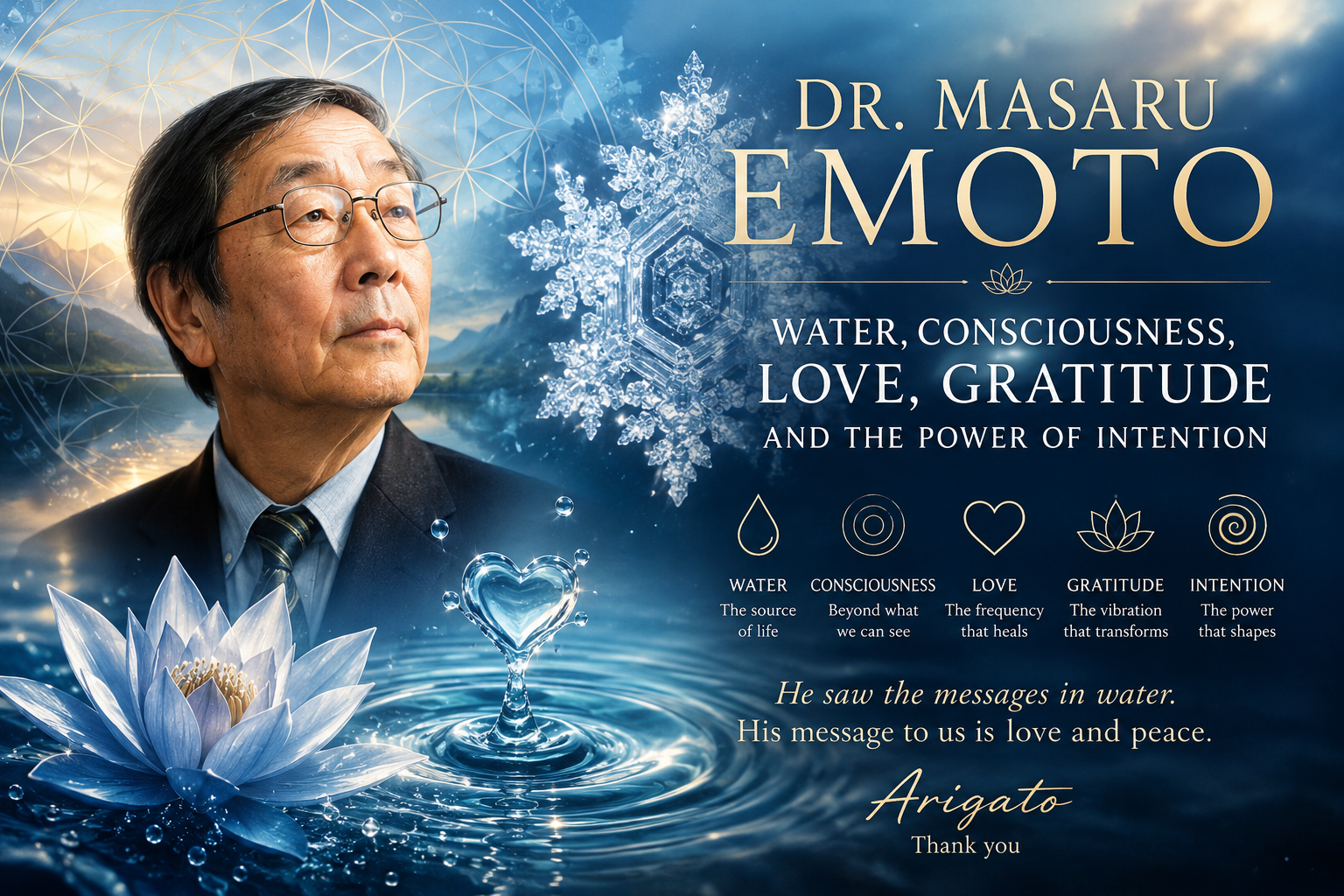
Dr. Masaru Emoto: Water, Consciousness, Love, Gratitude and the Power of Intention
Explore Dr. Masaru Emoto's remarkable work with water crystals, words, music, prayer, love, gratitude and human intention, including blinded intention studies.
Water is everywhere.
It falls from clouds, flows through rivers, gathers in oceans, rises through trees, nourishes food, circulates through the human body and sustains every known form of life.
We drink it without always thinking about it.
We wash with it.
We cook with it.
We live because of it.
Dr. Masaru Emoto spent decades inviting humanity to look at water differently.
What if water is more responsive than we realize?
What if words, music, prayer, gratitude and human intention interact with the world around us in ways we are only beginning to explore?
What if something as familiar as a glass of water still holds mysteries?
These questions became the heart of Masaru Emoto’s life’s work.
His photographs of frozen water crystals traveled around the world, showing striking differences among crystals formed from water exposed to different words, music, environments, photographs, prayer and intention.
Some appeared intricate and symmetrical, resembling tiny jeweled snowflakes.
Others appeared irregular, fragmented or incomplete.
Emoto believed water was responding to the information it encountered.
His work opened an extraordinary conversation about water, consciousness, vibration, gratitude and the relationship between human intention and the physical world.
That conversation continues.
Who Was Dr. Masaru Emoto?
Masaru Emoto was born in Yokohama, Japan, on July 22, 1943.
He studied international relations at Yokohama Municipal University and later became deeply interested in water, healing, vibration and human consciousness.
In 1986, he established IHM Corporation in Tokyo.
He later received a Doctor of Alternative Medicine credential from the Open International University.
His path was different from that of a conventional laboratory chemist or academic water scientist.
He became something else.
An explorer.
A photographer.
An author.
A philosopher of water.
A man fascinated by questions that crossed the boundaries between the physical and the unseen.
The organization preserving his legacy describes him as an original thinker who investigated the mysteries of water.
That may be one of the best ways to understand him.
He was willing to ask questions that many people had never considered asking.
One of those questions changed his life.
Readers can learn more about his life through the official Masaru Emoto profile.
The Beginning of the Water Crystal Journey
In 1994, Emoto began exploring an idea that would eventually become known around the world.
He wanted to freeze water and photograph the crystals that formed.
The process required experimentation.
Water samples were frozen, tiny frozen droplets were observed under magnification and the fleeting crystal formations were photographed before they disappeared.
Eventually, beautiful hexagonal crystals began appearing through the microscope.
They resembled snowflakes.
Each was temporary.
Each was different.
Emoto became fascinated.
He began comparing water from different sources:
Natural spring water
River water
Lake water
Tap water
Water from urban environments
Water from relatively pristine natural environments
He reported seeing striking differences.
Some natural waters formed elaborate crystalline structures.
Other samples produced very different formations.
The question naturally grew larger.
If water responded visibly to its physical environment, what else might influence it?
Emoto’s own account of the beginning of this work can be read through Message from Water, maintained by Office Masaru Emoto.
What Happens When Water Meets Words?
One of Emoto’s most famous experiments involved exposing water to written words.
Different bottles of water were associated with different expressions.
Some carried words of appreciation.
Some carried love.
Some carried gratitude.
Others carried anger, rejection or hostility.
The water was then frozen and photographed.
Emoto reported a recurring pattern.
Water associated with words such as:
Love
Gratitude
Thank You
Peace
often produced crystals his laboratory regarded as especially complete, harmonious and beautiful.
Water associated with hostile or degrading words frequently produced very different crystalline forms.
For Emoto, this raised an extraordinary possibility.
Perhaps words carry more than definitions.
Perhaps intention matters.
Perhaps communication has qualities extending beyond what we consciously hear.
His photographs gave millions of people a visual way to contemplate something humanity has understood intuitively for a very long time:
Words have power.
Readers can view examples through the official Water Crystal Gallery without removing the photographs from the context established by the organization preserving his work.
Love and Gratitude
Of all the words Emoto explored, two became central to his life’s message:
Love and Gratitude
He came to regard their combination as particularly important.
Love reaches outward.
Gratitude receives.
Love gives.
Gratitude recognizes what has been given.
Together, they became for Emoto a language of harmony.
His water crystal photographs associated with love and gratitude became some of the best-known images connected with his work.
But his message eventually grew beyond the microscope.
He encouraged people to practice gratitude in daily life.
To appreciate water.
To appreciate Earth.
To appreciate one another.
To speak more consciously.
To understand that our inner life affects how we enter the world.
Whether spoken quietly to another person, written in a letter, offered in prayer or carried privately within the heart, gratitude changes the atmosphere of human experience.
Emoto wanted us to consider whether its reach might extend even farther.
Music and Water
Words were only the beginning.
Emoto also explored what happened when water was exposed to music.
His laboratory played different compositions to water and later photographed the frozen crystals.
His crystal collection included water exposed to works associated with composers such as:
Mozart
Bach
Beethoven
Debussy
Johann Strauss II
Pachelbel
Tchaikovsky
Emoto reported that different music appeared to correspond with different crystalline formations.
This opened another fascinating question.
Music is vibration made audible.
Sound travels physically through matter as waves.
We already know that vibration can move water. Anyone who has watched ripples spread across a surface has seen matter respond to movement.
Emoto wondered whether water might respond not only to the physical vibration of sound but also to the information, harmony or emotional quality carried within music.
That possibility became another branch of his exploration.
Original crystal photographs associated with music, natural water and other conditions can be viewed in the Office Masaru Emoto Water Crystal Gallery.
The Language of Vibration
One of the concepts most closely associated with Emoto was HADO.
The Japanese word is formed from characters associated with wave and movement.
Emoto used HADO to express ideas involving vibration, resonance and the informational qualities carried through existence. He described it as an intrinsic vibrational pattern within matter whose foundation is connected with the energy of consciousness.
He believed everything possessed its own vibration and that resonance occurred when compatible vibrations met.
In his worldview, harmony could create harmony.
His water crystal work became a visual expression of that philosophy:
Beautiful words.
Beautiful music.
Prayer.
Gratitude.
Love.
To Emoto, these represented qualities capable of creating resonance.
His interpretation of HADO reached beyond the ordinary scientific meanings of frequency, vibration and resonance.
It became part physical idea, part philosophical language and part spiritual understanding.
Through it, Emoto asked something remarkably simple:
What are we sending into the world?
His explanation can be explored further through Emoto’s official introduction to HADO.
Prayer and Water
Prayer became another important part of Emoto’s work.
He explored water before and after groups directed prayer, appreciation or positive intention toward it.
He reported differences in the frozen crystals that followed.
For Emoto, prayer represented something more than spoken language.
It carried intention.
Attention.
Emotion.
Hope.
Love.
Connection.
The idea that water might somehow respond to prayer naturally attracted enormous interest because water has held sacred meaning for humanity for thousands of years.
Later researchers attempted to explore the question of intention and water using blinded experimental designs.
That added another intriguing chapter to Emoto’s story.
The Double-Blind Intention Experiment
In 2006, Dean Radin and Gail Hayssen worked with Masaru Emoto and Takashige Kizu on an unusual experiment.
Their question was straightforward:
Would water receiving distant positive intention produce ice-crystal photographs that were rated differently from control water?
Approximately 2,000 people in Tokyo directed positive intention toward water samples located thousands of miles away inside an electromagnetically shielded room in California.
Other water samples from the same source served as controls.
The resulting ice crystals were photographed.
Independent judges who did not know which photographs came from which water samples then evaluated the images for aesthetic beauty.
The photographs from the intention-treated water received significantly higher aesthetic ratings than the control photographs.
The reported statistical result was:
p = .001, one-tailed.
This was an important development in Emoto’s story.
His earlier work was largely observational and photographic.
Now part of the question had been explored using a blinded experimental design.
The result invited researchers to look again.
The published record can be viewed through the National Library of Medicine:
Double-Blind Test of the Effects of Distant Intention on Water Crystal Formation
Then Came the Triple-Blind Experiment
A later experiment went even further.
Over three days, approximately 1,900 people in Austria and Germany focused intention toward water samples stored inside an electromagnetically shielded room in California.
The experiment included:
Intention-treated water
Proximal control water located near the target samples
Distant control water located farther away
Ice formations produced from the samples were photographed.
More than 2,500 independent judges then assessed the resulting images for aesthetic beauty.
The process was designed so that relevant technicians, judges and analysts were blind to the treatment conditions.
The intention-treated crystal images received higher aesthetic ratings than the proximal control images.
The reported result was:
p = .03, one-tailed.
The researchers reported that the result replicated the pattern observed in their earlier pilot experiment.
The original photographs inspired the question.
The blinded studies attempted to investigate it more carefully.
Positive statistical differences were reported.
Rather than closing the subject, the experiments created room for deeper inquiry.
The full published paper can be explored here:
Effects of Distant Intention on Water Crystal Formation: A Triple-Blind Replication
What Exactly Was Being Observed?
Understanding the experiments clearly makes them more interesting.
The researchers examined ice crystals formed from water after different experimental treatments.
They then evaluated photographs of those crystals.
This places the research at an unusual intersection of:
Water
Freezing
Crystal formation
Human perception
Intention
Distance
Consciousness
The studies measured aesthetic differences among photographs produced under different experimental conditions.
They did not attempt to explain exactly how those differences might arise.
Perhaps that is where the real mystery begins.
An observation can come before an explanation.
Human beings have often noticed phenomena before understanding their mechanisms.
Curiosity begins by asking:
What happened?
Then comes:
Why?
The Beauty Question
There was another fascinating element in Emoto’s method.
His laboratory examined many crystals.
No two were exactly alike.
Beauty became part of how the photographs were interpreted and selected.
Emoto openly discussed this.
Rather than hiding the artistic dimension of his work, he eventually embraced it.
He suggested that the crystal photographs could be experienced as something existing between categories:
Observation
Art
Message
Mystery
He even described the photographs as something that could be enjoyed as a new kind of art.
That is worth remembering.
A frozen water crystal is fleeting.
It appears.
Changes.
Melts.
Disappears.
Photography captures one moment in an otherwise invisible transformation.
Emoto gave that moment a stage.
More Than 1,000 Kinds of Water
The work did not end with a handful of famous bottles labeled Love or Thank You.
His crystal photography eventually included more than 1,000 different water samples.
The collection included:
Water exposed to words
Water exposed to music
Natural waters
Tap waters
Water exposed to photographs
Water involved in other experimental conditions
That scale helps explain why Emoto became so absorbed in the work.
Each sample could become another question.
Each crystal was different.
Each photograph revealed something temporary that ordinarily would never have been seen.
The project became a visual archive of water under many different circumstances.
Nature’s Water
Emoto was particularly interested in natural water.
Spring water.
Mountain water.
Rivers.
Lakes.
Water moving freely through Earth.
He reported that many natural waters produced beautiful and distinctive crystalline forms.
For him, this reinforced the idea that water carried a relationship with its environment.
There is something beautiful about that idea even at the most practical level.
Water continuously interacts with its surroundings.
It moves through rock.
Carries minerals.
Responds to temperature.
Absorbs substances.
Evaporates.
Condenses.
Freezes.
Melts.
Falls.
Flows.
Enters living organisms.
Returns to Earth.
Water is never truly isolated from the world.
It participates in it.
The official gallery includes crystals photographed from natural waters around the world, including springs, rivers, lakes, glaciers and Antarctic ice. Readers can view them through the Natural Water section of Emoto’s Water Crystal Gallery.
Water Is Already Extraordinary
The more we learn about ordinary water, the less ordinary it becomes.
Every molecule contains only three atoms:
H₂O
Two hydrogen atoms.
One oxygen atom.
From that tiny arrangement emerges one of the most remarkable substances on Earth.
Water is polar.
Water molecules interact through hydrogen bonding.
Water can dissolve an enormous variety of substances.
It absorbs and transports heat remarkably well.
It participates in countless biochemical reactions.
It helps regulate body temperature.
It carries nutrients and metabolic products.
It shapes landscapes.
It influences climate.
Unlike most substances, frozen water is less dense than its liquid form.
That is why ice floats.
Because ice floats rather than sinking, lakes and ponds can freeze from the surface downward while liquid water remains beneath.
This creates conditions that help aquatic life survive cold seasons.
All of that emerges from H₂O.
Water requires no mystery theory to become astonishing.
It already was.
Emoto simply asked whether the story might contain chapters we had not yet read.
Water and the Human Body
The human body depends profoundly upon water.
Water is present in:
Blood
Cells
Muscles
Organs
Connective tissues
The brain
Digestive secretions
Lymphatic fluid
Virtually every biological system
Water helps transport nutrients, support circulation, regulate temperature, lubricate tissues and provide the environment in which countless biochemical reactions occur.
That physical reality made Emoto’s ideas deeply personal.
If water is responsive to its environment, he wondered, what might that mean for living beings composed so substantially of water?
It is an enormous question.
There is also another part of the story we experience every day.
Human beings respond to words.
We respond to love.
We respond to rejection.
We respond to gratitude.
We respond to fear.
We respond to encouragement.
We respond to prayer.
A compassionate voice can calm someone.
A cruel sentence can remain with someone for years.
Kindness can change a day.
Love can change a life.
Emoto’s work brings us back to something easy to recognize in humanity:
What we give to one another matters.
Words Are More Than Sound
Consider the difference between hearing:
I believe in you.
and:
You will never succeed.
The physical sound disappears within moments.
Yet the message can live within a person for decades.
Words influence:
Memory
Emotion
Expectation
Confidence
Stress
Relationships
Choices
Behavior
Identity
Emoto’s water photographs invited people to visualize that invisible power.
Perhaps this is one reason his work traveled so far beyond the laboratory.
People already knew words mattered.
He gave them an image through which to contemplate why.
Gratitude Changes the Person Who Practices It
Emoto’s emphasis on gratitude reaches far beyond his crystal experiments.
Gratitude shifts attention.
Instead of seeing only what is missing, we notice what is present.
Instead of allowing ordinary gifts to disappear into familiarity, we see them again:
A glass of clean water.
Food.
Shelter.
A sunrise.
A loved one.
A prayer answered.
A lesson learned.
Another day.
Another opportunity.
Another breath.
Emoto encouraged people to direct that gratitude toward water itself.
Not because water needs praise from us.
Because perhaps we need to remember what water gives us.
The Sacred History of Water
Long before Emoto photographed a single crystal, humanity understood water symbolically and spiritually.
Water has represented:
Life
Purification
Renewal
Rebirth
Healing
Cleansing
Transformation
Divine provision
Sacred springs appear throughout human history.
Ritual washing appears across cultures.
Rivers became places of pilgrimage.
Water became part of ceremonies marking transitions between one state of life and another.
For Christians, water carries particularly profound meaning.
The opening chapter of Genesis speaks of the Spirit of God moving over the waters.
Water flows throughout biblical history.
The Israelites cross the sea.
Water comes from the rock.
Naaman washes in the Jordan.
John baptizes with water.
Jesus is baptized.
Christ speaks of living water.
Water becomes connected with cleansing, renewal and spiritual life.
Emoto entered an ancient human conversation.
He simply entered it carrying a microscope and camera.
Prayer, Intention and the Invisible World
Prayer involves something deeper than audible sound.
A person can pray silently.
No spoken vibration is required.
Yet intention is present.
Attention is present.
Meaning is present.
Love may be present.
Hope may be present.
Faith may be present.
This is why Emoto’s interest in prayer reaches beyond ordinary acoustics.
He was asking whether intention itself participates in reality.
The distant-intention experiments pushed directly into that question because the participants were thousands of miles away from the water.
They were not standing beside the samples.
They were directing intention toward them across great distance.
The reported differences therefore invite a much larger discussion about consciousness.
Can Consciousness Reach Beyond the Body?
This may ultimately be the largest question hidden within Emoto’s water crystals.
What is consciousness?
Where does it begin?
Where does it end?
Is consciousness entirely confined to processes inside the brain?
Can intention interact with physical systems beyond the body?
Can attention influence events or matter in ways we do not yet understand?
These are enormous questions.
They belong not only to spirituality but also to philosophy, neuroscience, psychology, physics and consciousness research.
Emoto did not solve the mystery of consciousness.
What he did was give the mystery a glass of water.
Suddenly, millions of people were looking.
Love as an Organizing Principle
Perhaps one of the most beautiful aspects of Emoto’s worldview was his belief that love and gratitude create harmony.
He did not simply want beautiful crystals.
He wanted a more beautiful world.
His work increasingly became connected with peace, environmental responsibility and the way people treated one another.
He believed humanity’s relationship with water reflected something about humanity’s relationship with life itself.
Pollute water, and we harm ourselves.
Honor water, and we remember our dependence upon Earth.
Speak cruelly, and something changes between people.
Speak lovingly, and something else becomes possible.
Emoto’s crystal photographs became symbols of those larger choices.
Water and Peace
Emoto carried his message internationally.
He spoke about:
Water
Peace
Gratitude
Children
Human consciousness
Humanity’s responsibility toward the planet
He wanted people to protect water and understand its value.
He believed changing the consciousness of individuals could contribute to changing the world.
His message became increasingly simple:
Value water.
Practice gratitude.
Choose love.
Seek peace.
Protect what sustains life.
A Message for the Next Generation
As Emoto’s work spread, he increasingly turned his attention toward children.
He believed that changing humanity’s relationship with water needed to begin early.
If children learned to value water, respect Earth, practice gratitude and understand the importance of their words, perhaps they would carry those values into the world they inherited.
His children’s books became part of that mission.
Emoto dreamed of placing his message about water into the hands of young people throughout the world.
His children’s materials were translated into numerous languages, allowing his message of water, gratitude, love and peace to cross borders he could never personally reach.
Perhaps that was one of the deepest intentions behind his work.
He was not simply asking what water might reveal.
He was asking:
What kind of world are we leaving to the children who come after us?
The Emoto Peace Project continues this mission by sharing educational materials about water, love, gratitude and peace with children around the world.
The Hidden Messages in Water
Emoto’s work reached enormous international audiences through his books.
One of the best known was:
The Hidden Messages in Water
The book introduced readers around the world to his crystal photographs and philosophy.
Other works expanded upon the themes of water, vibration, healing, love and gratitude.
His images also gained broader attention through documentaries, lectures and international presentations.
For many people, encountering Emoto’s work created a moment they never forgot.
A photograph associated with Love and Gratitude placed beside one formed under a very different condition made them stop.
Look.
Think.
Wonder.
That pause was part of Emoto’s gift.
Readers can explore his published works through the official Masaru Emoto book collection.
Wonder Does Not Require Certainty
There is tremendous value in being able to say:
I do not know yet.
Those words do not close a door.
They open one.
Wonder asks questions without demanding the answer in advance.
Discernment examines what we observe carefully.
Together, they allow us to explore extraordinary possibilities without forcing them into conclusions before their time.
Emoto’s work lives beautifully in that space.
We can study his photographs.
Read his observations.
Examine the blinded experiments.
Ask how crystallization works.
Explore consciousness.
Study vibration.
Consider prayer.
Think about gratitude.
Remain open to discovery.
Human knowledge is still growing.
A Question Worth Continuing
One meaningful way to honor Masaru Emoto is to continue looking.
Could future experiments use automated imaging?
Could artificial intelligence analyze every crystal rather than selected images?
Could temperature and freezing conditions be controlled with even greater precision?
Could researchers measure crystal geometry objectively alongside aesthetic evaluation?
Could spectroscopy reveal physical changes that photography cannot?
Could experiments involving intention be independently repeated across many laboratories?
Could water teach us something unexpected about consciousness?
Technology available today offers ways to investigate questions that were much harder to explore when Emoto began photographing water in the 1990s.
His work does not have to be the final chapter.
It may be an opening chapter.
Imagine the Experiment We Could Perform Today
Emoto’s original work depended heavily upon human photography and visual judgment.
Modern research could go considerably farther.
Imagine hundreds or thousands of identically prepared water samples.
Automated freezing.
Precisely controlled temperatures.
Randomized sample codes.
Researchers unaware of treatment conditions.
Automated microscopes capturing every eligible crystal instead of selected examples.
Computer vision measuring:
Symmetry
Branching
Hexagonal structure
Complexity
Surface geometry
Formation time
Crystalline completeness
Independent laboratories could then repeat the protocol.
Whatever the results revealed, the question would advance.
That is what curiosity is for.
Perhaps Emoto Was Asking More Than One Question
At first glance, the question appears to be:
Can words change water?
But beneath it are many others.
Can intention influence matter?
Does consciousness extend beyond what we currently recognize?
Does gratitude have qualities beyond its psychological effects?
Does prayer interact with the physical world?
Can information influence biological or material systems?
Are there dimensions of communication humans do not consciously perceive?
How much remains undiscovered about water?
And perhaps most importantly:
How should we live if our thoughts, words and intentions matter more than we realize?
That last question does not require a microscope.
It requires a life.
The Message We Can Live Today
No matter how future generations ultimately explain Emoto’s crystal photographs, something beautiful remains.
Love matters.
Gratitude matters.
Water matters.
Words matter.
Prayer matters.
Peace matters.
Protecting Earth matters.
How we treat one another matters.
Curiosity matters.
If future research discovers that consciousness interacts with physical systems in ways we do not presently understand, Emoto’s willingness to ask an unconventional question may become even more meaningful.
Either way, we are richer for having explored it.
His Final Word
Masaru Emoto died in Tokyo on October 17, 2014.
His wife, Kazuko, was beside him.
According to the announcement preserving his family’s words, the final word he spoke was:
Arigato
Thank you.
For a man who spent years teaching about gratitude, there could hardly have been a more fitting final word.
His life ended with the message he had carried around the world.
Gratitude.
The official announcement honoring Masaru Emoto preserves the account of his passing and the meaning his family attached to his final word.
The Legacy of Masaru Emoto
Masaru Emoto left behind more than photographs.
He left questions.
He left books.
He left thousands of crystal images.
He left people looking differently at their water.
He encouraged humanity to consider the effect of its words.
He elevated gratitude.
He connected water with peace.
He asked people to care for the planet.
He invited children to appreciate water.
He reminded the modern world that something does not become ordinary simply because we encounter it every day.
Water remains extraordinary.
Consciousness remains mysterious.
Prayer remains profound.
Love remains transformative.
Gratitude remains powerful.
Human knowledge remains unfinished.
Office Masaru Emoto and Masaru Emoto’s Hado World continue preserving and expanding access to his teachings, photographs and water-centered work.
What If We Treated Water as Sacred Again?
Think about the water that passes through a single day.
The glass beside the bed.
The shower in the morning.
The water used to make coffee or tea.
The water used to prepare food.
Rain touching a garden.
A river feeding a community.
Water moving invisibly through pipes beneath a city.
Water circulating through the body every moment.
Most of us encounter it repeatedly without thinking:
This substance is keeping me alive.
Emoto wanted humanity to remember.
Perhaps we should.
We can conserve it.
Protect it.
Keep pollutants out of it.
Give thanks for it.
Teach children its value.
Recognize communities that struggle to obtain clean water.
Refuse to treat life’s essentials as disposable simply because they are familiar.
That may be one of the most practical expressions of his legacy.
Love and Gratitude as a Daily Practice
Emoto’s work can also become something personal.
Begin the day with gratitude before reaching for the phone.
Give thanks before drinking a glass of water.
Speak appreciation to someone you love.
Replace one unnecessary criticism with encouragement.
Pray over your food.
Notice the words used in your home.
Notice the words you use toward yourself.
Notice how your body responds to kindness.
Notice how another person’s face changes when they feel genuinely appreciated.
You do not need laboratory equipment to observe those results.
You simply need attention.
The Water Beside You
There may be a glass of water somewhere near you right now.
Look at it.
Really look.
Inside that seemingly simple glass is a substance ancient beyond imagination.
Water has circulated through oceans, clouds, rivers, soil, plants and living beings throughout Earth’s history.
It has shaped mountains.
Fed forests.
Carried civilizations.
Sustained countless generations.
Now, for a brief moment, some of it may be sitting beside you.
Masaru Emoto asked us to consider whether water might carry messages.
Perhaps water already carries one message we can understand without any experiment:
Life is a gift worth appreciating.
The Question Dr. Emoto Left With Us
Emoto did not ask humanity to stop wondering.
He asked us to wonder more.
What is water capable of?
What is consciousness capable of?
What is intention?
What is prayer?
What is vibration?
What is gratitude?
What happens when love becomes something we deliberately practice instead of merely something we feel?
How much of reality might still be waiting for us to notice it?
These questions do not make knowledge smaller.
They make the horizon larger.
A Final Reflection
Perhaps Dr. Masaru Emoto’s greatest legacy is not contained within any single crystal photograph.
It is contained within the moment after we see one.
The pause.
The curiosity.
The possibility.
The sudden awareness that water, words and life itself may deserve far more attention than we normally give them.
He looked through a microscope and found a reason to speak about love.
He studied water and found a reason to speak about gratitude.
He photographed ice and found a reason to talk about peace.
He explored vibration and found a reason to ask what human beings are contributing to the world around them.
That is a remarkable journey.
Whether future generations ultimately explain his observations through physics, consciousness, crystallization, information, something completely unexpected or a combination we have yet to imagine, Masaru Emoto gave humanity a question worth carrying forward.
Perhaps the most appropriate way to remember him is with the same word with which he reportedly left this world:
Arigato
Thank you.
Questions and Answers
Who Was Dr. Masaru Emoto?
Masaru Emoto was a Japanese author, water researcher, photographer and original thinker best known for exploring frozen water crystals and asking whether words, music, prayer, photographs, gratitude and human intention could influence their formation. His biography and life’s work are preserved in his official profile.
What Did Dr. Masaru Emoto Study?
Emoto explored water from natural and urban environments as well as water exposed to written words, music, photographs, prayer and other forms of intention. His laboratory froze the water and photographed the ice crystals that formed.
What Was Masaru Emoto’s Water Experiment?
Water samples were exposed to different conditions, frozen and photographed under magnification. Emoto reported that samples associated with loving words, gratitude, harmonious music and prayer often produced aesthetically beautiful crystalline structures, while other conditions produced dramatically different forms.
Where Can I See Emoto’s Original Water Crystal Photographs?
Original photographs involving natural waters, music, words and other conditions can be viewed through the official Water Crystal Gallery.
What Words Did Masaru Emoto Use With Water?
Some of his most famous work involved expressions such as Love, Gratitude and Thank You, along with contrasting words and messages carrying very different emotional meanings.
What Did Emoto Believe About Love and Gratitude?
Love and gratitude became central to Emoto’s philosophy. He regarded them as qualities of harmony and encouraged people to practice gratitude toward water, Earth, other people and life itself.
Did Masaru Emoto Experiment With Music?
Yes. His crystal photography included water exposed to numerous musical compositions, including works associated with Mozart, Bach, Beethoven, Debussy, Pachelbel, Tchaikovsky and other composers and musicians.
Did Researchers Perform a Double-Blind Water Intention Experiment?
Yes. A published 2006 pilot experiment involved approximately 2,000 people in Tokyo directing positive intention toward water samples in California. When resulting ice-crystal photographs were independently evaluated under blinded conditions, the intention-treated photographs received higher aesthetic ratings, with a reported one-tailed p-value of .001.
Was There Also a Triple-Blind Study?
Yes. A later study involved approximately 1,900 participants in Austria and Germany and more than 2,500 independent image evaluations. Researchers reported higher aesthetic ratings for the intention-treated condition compared with proximal controls, with a one-tailed p-value of approximately .03.
What Is HADO?
HADO was Emoto’s way of discussing vibration, resonance and information. It became a central concept through which he interpreted the relationship among water, words, music, intention and consciousness. His explanation is available through the official HADO page.
Why Was Water So Important to Emoto?
Emoto saw water as both essential to physical life and a profound symbol of humanity’s relationship with one another and the planet. His later work increasingly emphasized gratitude, peace, environmental stewardship and educating children about the importance of water.
What Is The Hidden Messages in Water?
The Hidden Messages in Water is one of Masaru Emoto’s best-known books. It helped bring his water crystal photographs and ideas about words, consciousness, love and gratitude to an international audience. His books can be explored through the official collection.
How Many Water Samples Were Photographed?
The crystal photography project eventually included more than 1,000 different water samples, including waters exposed to words, music, photographs and samples from natural and municipal sources.
What Was Masaru Emoto’s Final Word?
According to the organization preserving his work and his family’s announcement, his final spoken word before his death in 2014 was Arigato, meaning Thank you.
What Is the Emoto Peace Project?
The Emoto Peace Project carries forward Emoto’s goal of teaching children about water, gratitude, conscious words and peace. Educational materials and information about the project are available through the official Emoto Peace Project website.
What Can We Take From Masaru Emoto’s Work Today?
His work invites us to look more deeply at water, consciousness, words, gratitude and intention. It also offers a simple daily invitation: appreciate water, speak with greater care, practice gratitude, protect the natural world and remain curious about what humanity has yet to discover.
Continue Your Sacred Journey:
Research and Official Resources
Office Masaru Emoto — the organization preserving Emoto’s legacy and continuing water crystal photography.
Official Masaru Emoto Profile — his life, education, publications, water work and peace mission.
Message from Water — Emoto’s account of beginning water crystal photography and exploring words, music, pictures and prayer.
Official Water Crystal Gallery — original photographs involving natural waters, words, music and other conditions.
Masaru Emoto’s Hado World — his HADO philosophy, books, crystal work and continuing legacy.
Emoto Peace Project — educational materials, water crystal resources and Emoto’s vision for children and peace.
Radin D, Hayssen G, Emoto M, Kizu T. Double-Blind Test of the Effects of Distant Intention on Water Crystal Formation. EXPLORE. 2006;2(5):408–411. View the published record.
Radin D, Lund N, Emoto M, Kizu T. Effects of Distant Intention on Water Crystal Formation: A Triple-Blind Replication. Journal of Scientific Exploration. 2008;22(4):481–493. View the published study.
Dr. Masaru Emoto’s original water crystal photographs are presented through the official organizations preserving his work. The links above allow readers to experience the images in their original context.
Life Codes: The Sacred Patterns That Shape Who We Become
Explore Life Codes, the sacred patterns found in gifts, synchronicities, relationships, soul memory, purpose, spiritual awakening, and connection with God.
There are patterns woven through a human life that seem to speak before we fully understand their language.
A gift that keeps returning.
A dream that refuses to disappear.
A lesson appearing through different circumstances.
A person who changes the direction of our life.
A truth we somehow recognize before we can explain why.
A calling that becomes louder with time.
A moment of synchronicity arriving with almost impossible precision.
These experiences invite an extraordinary possibility:
Perhaps life carries codes.
Not necessarily codes written in numbers or hidden symbols.
Codes of meaning.
Codes of character.
Codes of possibility.
Codes of remembrance.
Codes carried through our gifts, choices, relationships, experiences, spiritual awareness, and relationship with God.
A Life Code can be understood as a deep pattern that helps reveal something about who we are, what we are learning, what we carry, and what we may be here to become.
Some Life Codes seem present from the beginning.
Others awaken through experience.
Some whisper.
Some repeat.
Some arrive through love.
Others are revealed through challenge.
And some remain invisible until we are finally ready to recognize them.
What Are Life Codes?
Life Codes can be understood as the deeper patterns of meaning, potential, character, consciousness, and purpose that unfold through a human life.
They may reveal themselves through:
Natural gifts.
Recurring interests.
Core values.
Intuition.
Relationships.
Synchronicities.
Repeated lessons.
Creative impulses.
Spiritual experiences.
Moments of recognition.
Purpose.
Service.
Prayer.
Choices.
Life transitions.
The idea of Life Codes gives language to something many people experience:
Certain things in our lives seem to carry unusual weight.
They return.
They connect.
They develop.
They lead somewhere.
One experience may appear random.
Ten connected experiences begin to look like a pattern.
Life Codes invite us to notice the pattern.
Life Is More Than a Sequence of Events
It is easy to experience life as a collection of separate moments.
School.
Work.
Relationships.
Loss.
Opportunity.
Mistakes.
Success.
Change.
Beginning again.
But when we look backward, something remarkable often happens.
Connections appear.
The job that seemed unrelated taught the skill needed years later.
The difficult season strengthened something that eventually became essential.
A childhood interest becomes an adult calling.
A person encountered briefly changes an entire direction.
A door that closed redirects us toward another life.
The pieces begin talking to one another.
What once looked scattered begins forming a pattern.
This is one way to understand Life Codes.
They are the threads that become visible when we stop looking only at individual moments and begin seeing the larger tapestry.
Some Codes May Be Present From the Beginning
Certain qualities appear remarkably early.
The child who constantly creates.
The one who protects others.
The one fascinated by how everything works.
The child who loves animals.
The natural storyteller.
The builder.
The questioner.
The caregiver.
The peacemaker.
The leader.
The seeker.
Before careers, titles, expectations, and responsibilities arrive, something is often already there.
A tendency.
A fascination.
A gift.
A way of seeing.
These early patterns can become important Life Codes because they may reveal aspects of ourselves that existed before the world told us who we were supposed to become.
Sometimes purpose leaves fingerprints very early.
Life Codes and the Soul Blueprint
A Life Code and a Soul Blueprint are closely connected, but they are not exactly the same.
The Soul Blueprint can be understood as the larger pattern of essence, values, gifts, lessons, purpose, and potential carried through a life.
Life Codes are the signals within that blueprint.
The blueprint is the larger design.
The codes are pieces of information that help us recognize it.
A repeated calling may be a code.
A natural gift may be a code.
A value you refuse to betray may be a code.
A recurring lesson may be a code.
A deep spiritual recognition may be a code.
The more codes we recognize, the clearer the larger pattern may become.
Life Codes and Soul Memory
Some Life Codes feel strangely familiar.
You encounter an idea and immediately recognize it.
You meet someone and feel an unusual sense of knowing.
You visit a place and experience a connection you cannot easily explain.
You discover a spiritual teaching and think:
I know this.
Not:
I learned this.
But:
I recognize this.
This experience is often described spiritually as soul memory.
Soul memory does not always arrive as a detailed picture of another time or place.
Sometimes it appears simply as recognition.
A resonance.
A knowing.
A pull toward something meaningful.
Life Codes may sometimes reveal themselves through these moments of deep familiarity.
Life Codes and the Divine Spark
If every person carries a Divine Spark, then certain Life Codes may represent the ways that sacred potential seeks expression.
One person carries extraordinary compassion.
Another carries courage.
Another carries creativity.
Another carries wisdom.
Another carries a gift for bringing people together.
Another sees possibilities others overlook.
Another feels called to teach.
Heal.
Build.
Protect.
Create.
Serve.
Lead.
Comfort.
Discover.
The Divine Spark may be one light.
But it shines through countless human expressions.
Your Life Codes may help reveal how that light wants to move through you.
Life Codes and God-Given Gifts
Gifts are among the clearest Life Codes.
Some abilities come naturally.
Others reveal themselves only after practice.
Still others remain dormant until life creates the circumstances that call them forward.
A gift may appear ordinary to the person who possesses it because it feels natural.
That is precisely why gifts are sometimes overlooked.
You may assume everyone sees what you see.
Feels what you feel.
Understands what you understand.
Can do what you do.
They cannot.
What comes naturally to you may be one of the clues.
A Life Code asks:
What has been placed in my hands?
And then:
What might it be for?
Life Codes and Repeating Patterns
Repetition deserves attention.
A theme appears once.
Then again.
Then somewhere completely different.
Perhaps you repeatedly become the person others seek when they need clarity.
Perhaps you continually find yourself creating order from chaos.
Perhaps certain subjects have fascinated you for decades.
Perhaps life repeatedly places you in situations requiring courage.
Perhaps relationships keep teaching the same lesson about boundaries.
Perhaps opportunities repeatedly appear around one particular gift.
Patterns can reveal where life is trying to develop us.
Some patterns reveal gifts.
Others reveal lessons.
Some reveal wounds that need attention.
Others reveal doors.
The key is not merely noticing repetition.
It is asking:
What is this repetition trying to show me?
Life Codes and Synchronicity
Sometimes patterns arrive with extraordinary timing.
You think about someone and they call.
A book appears just as you need its message.
A conversation answers a question you had not spoken aloud.
Several unrelated events point toward the same decision.
A door opens immediately after another closes.
These experiences are often called synchronicities.
Psychologist Carl Jung used the term synchronicity for meaningful coincidences that appear connected by significance rather than ordinary cause and effect.
Spiritually, synchronicity can feel like life briefly revealing its hidden architecture.
Not every coincidence must carry a cosmic message.
But some moments carry enough meaning to deserve attention.
A Life Code may arrive through timing.
Life Codes and Numbers
Numbers have long carried symbolic importance across cultures and spiritual traditions.
Some people repeatedly encounter particular numbers during meaningful seasons.
Others explore numerology, angel numbers, biblical numbers, birth numbers, or repeating sequences.
Numbers can become Life Codes when they function as symbols that prompt reflection, remembrance, prayer, or awareness.
The number itself may matter.
But perhaps even more important is the question it awakens.
What was I thinking about when I noticed it?
What is happening in my life right now?
What keeps returning to my attention?
A symbol becomes useful when it deepens awareness.
Life Codes and Words
Sometimes a Life Code is a word.
A word follows you through a season.
Freedom.
Build.
Trust.
Create.
Return.
Serve.
Begin.
Peace.
Truth.
Courage.
A word appears in conversations.
Books.
Prayer.
Thoughts.
Songs.
Unexpected places.
Eventually it begins carrying unusual significance.
Certain words can become anchors for entire seasons of transformation.
A Life Code does not always arrive as a complicated spiritual message.
Sometimes it is one word that refuses to leave.
Life Codes and Names
Names can carry enormous meaning.
They connect us with family.
History.
Identity.
Culture.
Memory.
Scripture.
People sometimes become curious about the origin or meaning of their own name during periods of spiritual awakening.
A name does not determine destiny.
But exploring its history or symbolism can become another doorway into reflection.
Sometimes the meaning surprises us.
Sometimes it resonates.
Sometimes it simply reminds us that identity itself has layers.
Life Codes and Dreams
Dreams can become another place where important patterns emerge.
A single dream may disappear by morning.
But repeated dreams deserve attention.
Recurring places.
People.
Symbols.
Animals.
Doors.
Water.
Journeys.
Homes.
Light.
Flight.
Falling.
Searching.
Returning.
Dreams have been interpreted spiritually for thousands of years.
The Bible itself contains powerful accounts of meaningful dreams, including those associated with Jacob, Joseph, Daniel, and others.
A dream does not automatically predict the future.
But dreams can reveal emotion, symbolism, concern, hope, spiritual reflection, or patterns occupying the deeper mind.
A recurring dream may become a Life Code worth exploring.
Life Codes and Relationships
Some of our most powerful Life Codes arrive through people.
A soulmate.
A kindred spirit.
A mentor.
A child.
A friend.
A stranger.
A difficult relationship.
A person may enter our lives and activate something that had been sleeping.
Love.
Courage.
Creativity.
Healing.
Purpose.
Self-respect.
Faith.
A relationship may reveal who we are.
Or who we are becoming.
Some people walk beside us for decades.
Others appear briefly and still alter the road.
Length does not always determine significance.
Life Codes and Sacred Connections
There are relationships that feel unusually meaningful.
Conversation flows differently.
Recognition appears quickly.
Growth accelerates.
Something important awakens.
Sacred connections do not have to mean that every intense relationship is destined to remain forever.
Some connections accompany us.
Some teach us.
Some redirect us.
Some awaken us.
Some become home.
The Life Code may not always be the person themselves.
Sometimes it is what became possible because you met them.
Life Codes and Challenges
Not every Life Code arrives wrapped in beauty.
Some arrive through challenge.
A setback exposes strength.
A betrayal teaches discernment.
A loss reveals what truly matters.
A closed door forces a new direction.
A difficult season develops endurance.
This does not mean every painful event was deliberately sent as a lesson.
It means human beings possess the extraordinary capacity to discover meaning even in difficult terrain.
Pain can become wisdom.
Experience can become discernment.
Survival can become service.
What happened to us does not have to become the final meaning of what happened.
We can participate in what it becomes.
Life Codes and Redirects
Some of the most important moments in life initially feel like interruption.
Plans fail.
Timelines change.
Something ends unexpectedly.
A path disappears.
Then another opens.
Years later we realize:
I would never have arrived here if that had worked.
Redirects can become powerful Life Codes.
They remind us that a closed door does not always mean the journey has ended.
Sometimes the road simply turned.
Life Codes and Choice
Life Codes do not eliminate free will.
A calling can be ignored.
A gift can remain undeveloped.
A pattern can be recognized and repeated anyway.
A relationship can offer growth that we refuse.
An opportunity can arrive and be declined.
Potential is not the same as destiny.
Choice matters.
Perhaps Life Codes reveal possibilities.
Free will determines how we respond.
That makes the human journey more sacred, not less.
We are not merely reading a script.
We are participating.
Life Codes and Inner Authority
The more spiritual information we encounter, the more important inner authority becomes.
Not every sign is instruction.
Not every coincidence is prophecy.
Not every strong feeling is intuition.
Not every spiritual teacher understands our path.
Life Codes should deepen discernment rather than replace it.
Ask.
Pray.
Observe.
Wait.
Notice what repeats.
Look at character.
Look at consequences.
Look at whether something produces clarity, love, courage, wisdom, and peace.
Inner authority allows spiritual curiosity to remain grounded in wisdom.
Life Codes and Intuition
Intuition may help us recognize Life Codes before the logical mind understands them.
Something feels important.
A direction feels alive.
A truth lands differently.
An opportunity carries unusual resonance.
Intuition often whispers rather than shouts.
But intuition grows stronger when paired with discernment.
We can listen deeply without surrendering judgment.
We can remain open without becoming gullible.
The goal is not to interpret everything.
It is to become more attentive.
Life Codes and Purpose
Purpose is rarely revealed through one clue.
It often emerges from a constellation.
Your gifts.
Values.
Experiences.
Interests.
Relationships.
Challenges.
Curiosities.
Repeated opportunities.
The needs you notice.
The problems you cannot stop thinking about.
The work that makes you come alive.
One clue may mean little.
Together, they can form a map.
Life Codes help us gather those clues.
Life Codes and the Three Callings
Purpose may express itself through different kinds of calling.
A being calling asks who you are becoming.
A doing calling asks what you are here to create, build, teach, protect, heal, or contribute.
A seasonal calling asks what this particular chapter requires from you now.
Not every calling lasts forever.
Some exist for one season.
The Life Code may therefore change expression while the deeper essence remains.
A person called to nurture may nurture children in one season, employees in another, and a community later.
The form changes.
The code remains recognizable.
Life Codes and Conscious Creation
Life Codes reveal possibilities.
Conscious creation helps us participate in them.
If a pattern repeatedly points toward creativity, creation requires action.
If purpose points toward service, service requires participation.
If life continually calls you toward courage, courage eventually requires a choice.
Awareness without action can remain only potential.
A code becomes lived when we respond.
Life Codes and Intention
Intention tells possibility:
I am willing.
I am willing to learn.
To create.
To change.
To listen.
To begin.
To become.
Intention gathers scattered energy and gives it direction.
Life Codes may reveal the door.
Intention reaches for the handle.
Life Codes and the Twelve DNA Strands
Life Codes connect beautifully with the spiritual teaching of the Twelve DNA Strands.
Twelve-strand teachings explore dormant human potential, spiritual activation, expanded consciousness, soul remembrance, ascension, and divine connection.
Life Codes ask how those deeper possibilities reveal themselves through an individual life.
A gift may be a code.
An awakening may be a code.
A recurring spiritual recognition may be a code.
A purpose may be a code.
A capacity that suddenly comes alive may be a code.
If the Twelve DNA Strands symbolize what may be waiting within humanity, Life Codes can symbolize the clues through which that potential begins revealing itself personally.
Life Codes and Light Codes
Life Codes and light codes can overlap, but they do not have to mean exactly the same thing.
Within metaphysical teachings, light codes are often described as spiritual information, energetic patterns, frequencies, symbols, or transmissions associated with awakening and expanded consciousness.
Life Codes are broader.
They can include spiritual illumination, but also:
Character.
Gifts.
Choices.
Relationships.
Purpose.
Patterns.
Synchronicities.
Lessons.
Values.
Service.
A light code may be experienced as illumination.
A Life Code may be discovered across an entire lifetime.
Life Codes and Spiritual Awakening
Spiritual awakening often changes the way we read our own life.
Events that once seemed unrelated begin connecting.
Patterns become visible.
Relationships take on deeper meaning.
Old interests return.
Intuition strengthens.
Questions become larger.
Purpose begins stirring.
We start noticing the language beneath the events.
This is one of the great gifts of awakening.
We do not merely ask:
What happened?
We begin asking:
What does this reveal?
Life Codes and Spiritual Maturity
Recognizing a Life Code is only the beginning.
Spiritual maturity asks what we do with it.
A person may recognize a gift.
Will they develop it?
Recognize a pattern.
Will they change it?
Recognize a calling.
Will they answer?
Recognize a truth.
Will they live it?
The deepest codes are not decorations for a spiritual identity.
They become invitations to character.
Responsibility.
Growth.
Service.
Love.
Life Codes and Faith
Faith changes the way Life Codes can be understood.
Instead of seeing ourselves as isolated beings attempting to decode a meaningless universe, we can approach life with a different possibility:
There may be purpose woven through the journey.
God may work through gifts.
People.
Timing.
Prayer.
Opportunity.
Closed doors.
Open doors.
Conviction.
Wisdom.
Grace.
The entire path may not be visible.
Often it is not.
But faith does not require seeing the entire road.
Sometimes enough light appears for the next step.
Prayer and Life Codes
Prayer is one of the most beautiful ways to explore Life Codes.
Rather than demanding a sign, we can ask for wisdom.
God, help me recognize what matters.
Show me the gifts I am meant to develop.
Help me understand the patterns in my life.
Give me discernment about what deserves my attention.
Reveal where I am being called to grow.
Help me recognize the doors You are opening.
Give me courage when the next step becomes clear.
Help me use what I have been given well.
Prayer turns decoding into relationship.
How to Recognize Your Life Codes
Look backward before looking forward.
What has repeated throughout your life?
What did you love before anyone told you what was practical?
What gifts have other people consistently recognized in you?
What experiences changed your direction?
What lessons keep returning?
What subjects continually fascinate you?
What kind of people do you naturally help?
What injustices or problems deeply move you?
When have you felt most alive?
What prayers have shaped your path?
Which apparent endings later became beginnings?
What keeps calling you?
Patterns often become visible when we gather the pieces in one place.
Create a Life Code Map
A simple Life Code Map can reveal connections that are difficult to see when memories remain scattered.
Write down:
Five early interests
What fascinated you as a child?
Five natural gifts
What comes naturally?
Five major turning points
Which events changed your direction?
Five repeating lessons
What has life taught more than once?
Five meaningful relationships
Who changed you?
Five recurring themes
What keeps returning?
Five moments of unusual timing
Which synchronicities still stand out?
Five deepest values
What will you not willingly betray?
Five dreams or desires that remain alive
What refuses to disappear?
Five ways you naturally serve
How do you make life better for others?
Then look across the page.
Do not force a conclusion.
Notice.
The codes may already be talking to one another.
Life Codes Change as We Grow
A Life Code may remain constant while its expression changes.
Creativity may begin as drawing.
Become design.
Then writing.
Then entrepreneurship.
Then teaching.
Service may begin in family.
Move into work.
Expand into community.
Wisdom may begin through personal experience and eventually become something shared with others.
The outer form evolves.
The deeper current remains.
This is why purpose does not always fit neatly into one job title.
The code may be larger than the role.
You Are More Than One Code
No human life can be reduced to one word, number, gift, personality type, calling, or spiritual label.
We are layered.
A creator can also be a protector.
A leader can also be deeply contemplative.
A caregiver can also be an inventor.
A teacher can remain a student.
Life Codes should expand our understanding of ourselves, not shrink it.
The map should reveal possibility.
Not build another box.
Life Codes Are Meant to Be Lived
The most important Life Code is not necessarily the most mysterious one.
It may be the one you already know.
Create.
Forgive.
Begin.
Speak.
Build.
Serve.
Rest.
Trust.
Learn.
Love.
Return.
Sometimes we spend years searching for hidden answers while standing beside the answer that has been quietly repeating all along.
Recognition matters.
But eventually recognition asks for movement.
Questions and Answers About Life Codes
What are Life Codes?
Life Codes are a spiritual framework for exploring recurring patterns, gifts, values, relationships, synchronicities, lessons, purpose, and other meaningful clues that may reveal deeper dimensions of a person's life and potential.
Are Life Codes the same as DNA?
No. Life Codes are spiritual and symbolic language. They describe patterns of meaning and potential rather than biological genetic code.
Are Life Codes the same as light codes?
Not necessarily. Light codes are commonly described in metaphysical teachings as spiritual information, frequencies, symbols, or illumination associated with awakening. Life Codes are broader and can include gifts, relationships, choices, patterns, purpose, values, synchronicities, and spiritual experiences.
Are Life Codes connected to the Twelve DNA Strands?
They can be explored together. Twelve DNA Strands teachings focus on dormant human potential, activation, expanded consciousness, remembrance, and divine connection. Life Codes can represent the personal clues through which deeper potential becomes recognizable.
Can a gift be a Life Code?
Yes. Repeated natural abilities can provide important clues about how a person is uniquely equipped to create, contribute, or serve.
Can relationships be Life Codes?
Relationships can reveal important Life Codes because they often awaken love, boundaries, courage, healing, purpose, self-knowledge, or spiritual growth.
Can synchronicities be Life Codes?
Meaningful coincidences can become part of a Life Code pattern, particularly when similar themes repeatedly appear around important moments or decisions.
Can repeating numbers be Life Codes?
Numbers may become meaningful spiritual symbols for some people. Their greatest value may be the awareness, prayer, reflection, or recognition they inspire.
Can dreams reveal Life Codes?
Recurring dreams, symbols, people, places, or themes can provide material for spiritual reflection and may reveal patterns worth exploring.
Are Life Codes predetermined destiny?
Life Codes do not need to be understood as an unchangeable script. Free will, choice, growth, circumstances, relationships, and action all participate in how a life unfolds.
Can a Life Code change?
The deeper pattern may remain while its expression changes. A lifelong code of creativity, for example, may appear through many different forms across different seasons.
How do I discover my Life Codes?
Begin by examining recurring interests, gifts, values, turning points, relationships, challenges, synchronicities, dreams, callings, and moments when you felt unusually alive or deeply aligned.
How do I know whether something is a Life Code or coincidence?
Avoid forcing meaning onto every event. Look for repetition, significance, timing, consistency, and the larger pattern. Prayer, reflection, time, and discernment can help.
Can prayer reveal Life Codes?
Prayer can help create clarity around gifts, purpose, patterns, decisions, and spiritual direction. Rather than demanding signs, prayer can ask God for wisdom and discernment.
What is the purpose of understanding Life Codes?
The purpose is not simply to collect spiritual signs. It is to understand yourself more deeply, recognize meaningful patterns, develop your gifts, make wiser choices, live more intentionally, and become more conscious of your relationship with God.
A Final Thought
Perhaps your life has been speaking to you longer than you realized.
Through the things you loved before you knew whether they were useful.
Through the gifts that came naturally.
Through the people who changed you.
Through the doors that opened.
Through the doors that closed.
Through the lessons that returned.
Through the dreams that survived.
Through the questions you could never stop asking.
Through the strange moments of perfect timing.
Through the prayers that changed direction.
Through the quiet knowing that there must be more.
Maybe the Life Codes were never meant to turn life into a puzzle.
Maybe they were meant to help us recognize the pattern already unfolding.
You are not one event.
One mistake.
One success.
One relationship.
One season.
One title.
You are an unfolding life.
And scattered across that life may be clues to something larger.
Your gifts.
Your values.
Your choices.
Your relationships.
Your lessons.
Your purpose.
Your faith.
Your Divine Spark.
Some codes are discovered.
Some are remembered.
Some are chosen.
Some are awakened.
And some only reveal their meaning after we have lived long enough to look backward and finally see:
That was connected.
That mattered.
That was preparing me.
That changed me.
That was pointing somewhere.
Perhaps the question is not whether your life contains meaning.
Perhaps the question is:
Are you paying attention to what keeps returning?
Continue the Sacred Living Journey
Soul Blueprint
Explore the deeper pattern of essence, values, gifts, lessons, purpose, and possibility carried through your life.
Soul Memory
Discover the mysterious experience of spiritual recognition and knowing that seems deeper than ordinary memory.
The Twelve DNA Strands
Explore spiritual activation, human potential, twelve chakras, ascension, remembrance, and deeper divine connection.
The Three Callings
Explore the different ways purpose may appear through who you are, what you contribute, and what a particular season asks of you.
Divine Purpose
Divine Purpose explores God-given calling, gifts, sacred direction, identity, service, creativity, healing, spiritual discernment, courage, surrender, and living with meaning.
Divine purpose is the sacred direction of a life.
It is the deeper reason a soul feels drawn toward meaning, growth, love, service, healing, creation, truth, and becoming.
It is not only one task.
It is not only one title.
It is not only a career, relationship, gift, ministry, platform, or dream.
Divine purpose is the God-given thread that runs through a life and helps the soul understand what it is here to become, carry, offer, heal, build, restore, and love.
A person may sense purpose long before they can explain it.
They may feel a quiet pull.
A holy restlessness.
A recurring desire to help, create, speak, teach, heal, build, protect, encourage, restore, or bring beauty into the world.
They may notice certain themes keep returning.
Certain gifts keep rising.
Certain burdens keep touching the heart.
Certain doors keep calling.
Certain lessons keep forming wisdom.
Certain dreams refuse to disappear.
Purpose often speaks through the places where the soul feels most alive, most burdened in a sacred way, most willing to grow, and most aware that life is meant to carry more than survival.
Divine purpose is not pressure from the world.
It is invitation from God.
It is the soul being called into deeper agreement with what was placed within it before fear, delay, comparison, disappointment, or ordinary life tried to cover it.
Purpose is the sacred question beneath many other questions:
Why am I here?
What did God place within me?
What am I meant to carry with love?
What am I meant to learn?
What am I meant to offer?
What kind of person am I being shaped to become?
Divine purpose helps the soul remember that life is not random.
There is design.
There is meaning.
There is calling.
There is stewardship.
There is grace.
There is a holy reason the soul keeps being invited forward.
Purpose Begins With God
Divine purpose begins with God because the soul begins with God.
The world may assign roles.
Families may have expectations.
Culture may measure success.
Systems may reward certain paths.
People may praise what is visible.
But God knows the deeper design.
He knows the gifts that are obvious and the gifts still hidden.
He knows the strength being formed quietly.
He knows the pain that will become compassion.
He knows the wisdom being gathered through experience.
He knows the doors that are not open yet.
He knows the calling that may begin small before it becomes clear.
Purpose becomes safer when it is rooted in God instead of approval.
When purpose is rooted only in approval, a person may chase what looks impressive.
When purpose is rooted in fear, a person may try to prove they matter.
When purpose is rooted in comparison, a person may abandon their own design.
When purpose is rooted in God, the soul can move with more peace.
It can ask:
God, what did You place within me?
What is mine to carry?
What is mine to release?
What is the next faithful step?
What is being formed in me right now?
Divine purpose is not discovered by becoming someone else.
It is discovered by walking with God into the truth of who the soul was created to be.
Purpose Is More Than One Assignment
Many people think purpose must be one grand assignment.
One perfect path.
One lifelong role.
One clear answer.
One visible mission.
But divine purpose is often wider, deeper, and more alive than that.
A person may carry purpose in many ways across a lifetime.
Purpose may live in how they love.
How they speak.
How they create.
How they raise a child.
How they heal a pattern.
How they serve a neighbor.
How they build a home.
How they write a page.
How they bring peace into a room.
How they choose truth after years of hiding.
How they use their gifts with humility.
How they help others remember their worth.
How they turn experience into wisdom.
There may be specific callings within divine purpose, but purpose itself is not limited to one visible assignment.
It is the sacred direction of a life being shaped by God.
Some seasons are for building.
Some are for healing.
Some are for learning.
Some are for serving.
Some are for resting.
Some are for preparing.
Some are for releasing.
Some are for stepping forward.
Purpose can move through all of these seasons without disappearing.
A quiet season can still be purposeful.
A healing season can still be purposeful.
A waiting season can still be purposeful.
A small beginning can still be purposeful.
Divine purpose is not lost because it is unfolding.
Purpose Begins With Identity
Purpose is connected to identity.
A person cannot fully understand what they are meant to carry while believing false things about who they are.
If the soul agrees with shame, purpose may feel undeserved.
If the soul agrees with fear, purpose may feel unsafe.
If the soul agrees with comparison, purpose may feel too small.
If the soul agrees with rejection, purpose may feel impossible.
If the soul agrees with old labels, purpose may feel hidden.
God often begins purpose by healing identity.
Before a person can offer fully, they may need to remember they are loved.
Before they can lead, they may need to become rooted.
Before they can create, they may need to believe their voice matters.
Before they can serve, they may need to stop proving their worth through exhaustion.
Before they can step forward, they may need to receive the truth that God did not make a mistake in creating them.
Purpose grows from a truer identity.
A soul that knows it belongs to God can stop trying to become impressive and begin becoming faithful.
A soul that knows it is loved can stop performing for value and begin offering from love.
A soul that knows it carries divine design can stop shrinking beneath old names and begin walking in sacred responsibility.
Identity is the soil.
Purpose is one of the fruits.
Purpose Is Connected to Gifts
Divine purpose often speaks through gifts.
A gift may be creative.
Practical.
Spiritual.
Emotional.
Intellectual.
Relational.
Healing.
Organizing.
Teaching.
Building.
Writing.
Encouraging.
Protecting.
Listening.
Solving.
Praying.
Leading.
Restoring.
Some gifts are easy to recognize.
Others begin quietly.
A person may not call something a gift because it feels natural to them.
They may dismiss what comes easily.
They may overlook what others receive from them.
They may assume their ability to notice, comfort, organize, create, discern, or build is ordinary.
But the things that feel natural may still be sacred.
A gift does not have to be dramatic to be purposeful.
A quiet gift can carry enormous blessing.
A practical gift can hold families and communities together.
A creative gift can give language, beauty, and hope.
A spiritual gift can help others feel seen, prayed for, and guided toward truth.
A gift becomes part of divine purpose when it is stewarded with love, humility, wisdom, and God-centered intention.
Purpose asks:
What has God placed within me?
How can I strengthen it?
How can I use it with love?
How can I offer it without making it an idol?
How can this gift become service?
The gift is not the whole purpose, but it is often one of the ways purpose becomes visible.
Purpose Is Connected to Love
Divine purpose is never separated from love.
A calling that has no love becomes empty.
A gift without love can become performance.
Knowledge without love can become pride.
Influence without love can become control.
Service without love can become resentment.
Purpose becomes sacred when love remains at the center.
Love gives purpose its purity.
It keeps the motive clean.
It reminds the soul that purpose is not only about being seen, known, praised, or successful.
Purpose is about participating with God in ways that bring life, truth, healing, beauty, wisdom, hope, and sacred contribution.
Love may call a person to serve.
To create.
To tell the truth.
To repair harm.
To protect peace.
To raise children with tenderness.
To encourage the weary.
To build something useful.
To pray faithfully.
To speak life.
To help others rise.
To use their experience as a lantern for someone still walking through the dark.
Divine purpose does not have to be loud to be loving.
Sometimes purpose is found in the way a person shows up with care.
The way they keep choosing truth.
The way they help one soul feel less alone.
The way they honor what God placed in their hands.
Love turns purpose from ambition into offering.
Purpose Is Formed Through Seasons
Purpose unfolds through seasons.
Spring does not ask the tree to bear autumn fruit.
A seed does not become a harvest in one day.
A life has rhythms.
Beginnings.
Growth.
Waiting.
Pruning.
Preparation.
Rest.
Harvest.
Release.
Renewal.
God may use different seasons to form different parts of purpose.
A learning season may form wisdom.
A waiting season may form patience.
A healing season may form compassion.
A hidden season may form humility.
A building season may form discipline.
A loss may clarify what matters.
A closed door may protect the path.
A slow season may strengthen roots.
A new opportunity may reveal readiness.
This is why purpose should not be judged only by visible progress.
Much of divine purpose is formed in hidden places.
In prayer.
In character.
In private choices.
In small faithfulness.
In quiet obedience.
In healing work no one applauds.
In learning to stay steady when the outer world has not changed yet.
A person may feel delayed when they are actually being prepared.
They may feel hidden when roots are growing.
They may feel unfinished because God is still forming what the next season will require.
Divine purpose honors timing, but it is not the same as timing.
Timing asks when the door opens.
Purpose asks what the soul is being formed to carry when it does.
Purpose and Preparation
Preparation is part of purpose.
A person may want the open door, but God may be strengthening the person who will walk through it.
Preparation may look like learning.
Healing.
Practice.
Discipline.
Rest.
Study.
Prayer.
Character development.
Skill building.
Emotional maturity.
Spiritual discernment.
Better boundaries.
Greater humility.
More trust.
Preparation is not wasted time.
It is sacred formation.
The unseen work matters because purpose must be carried by a person, not merely reached as a destination.
A gift may need practice.
A calling may need structure.
A message may need maturity.
A relationship may need healing.
A dream may need stewardship.
A future may need a steadier soul.
Purpose that arrives before preparation can feel heavier than expected.
Purpose that is prepared for can be carried with more grace.
This does not mean a person must be perfect before beginning.
It means growth and purpose walk together.
A person can begin with what they have while staying willing to mature.
The next faithful step is often part of the preparation.
Purpose Can Begin Small
Divine purpose often begins smaller than people expect.
One conversation.
One prayer.
One idea.
One act of service.
One page.
One choice.
One healing step.
One boundary.
One new habit.
One gift practiced quietly.
One person helped.
One truth lived.
Small does not mean insignificant.
Small is often how God begins sacred things.
A seed is small.
A spark is small.
A word can be small.
A yes can be small.
A beginning can be small.
But small things can carry holy direction when they are faithful.
A person may miss purpose because they are waiting for something grand while ignoring what is already in their hands.
Purpose may already be speaking through the simple question:
What is the next faithful thing?
Who can I love well today?
What gift can I practice?
What truth can I live?
What has God placed in front of me?
What needs my care?
What small step agrees with the life I feel called toward?
The sacred life does not despise small beginnings.
It honors them.
Purpose and Healing
Healing is often part of divine purpose.
A person may need healing so they can carry purpose without being ruled by old wounds.
A wounded place may try to choose from fear.
A rejected place may try to prove worth.
A disappointed place may resist hope.
A shamed place may hide gifts.
A grieving place may struggle to believe new life can come.
God does not wait for a person to be fully healed before loving them, guiding them, or using their life.
But healing helps purpose become cleaner.
It helps the soul stop carrying purpose through pressure, fear, proving, control, or survival.
Healing allows the gift to breathe.
It allows the voice to strengthen.
It allows the heart to serve without abandoning itself.
It allows the soul to discern what is truly God’s invitation and what is only an old wound asking for attention.
Sometimes the very place being healed becomes part of the wisdom a person carries.
Pain is not the purpose, but God can bring purpose through what has been healed.
A person who has walked through grief may carry comfort.
A person who has rebuilt after loss may carry courage.
A person who has learned boundaries may carry wisdom.
A person who has found God in hidden seasons may carry hope.
Healing does not erase the story.
It lets God redeem what the story tried to steal.
Purpose and Sacred Responsibility
Purpose requires sacred responsibility.
What God places within a life deserves care.
A gift deserves stewardship.
A calling deserves humility.
A dream deserves faithfulness.
A word deserves wisdom.
A relationship deserves truth.
A season deserves attention.
A door deserves discernment.
Sacred responsibility keeps purpose grounded.
It asks:
How am I caring for what God gave me?
Am I strengthening the gift?
Am I protecting the calling from ego?
Am I walking with humility?
Am I becoming trustworthy with what I carry?
Am I willing to grow?
Am I using purpose to serve love, or using purpose to prove worth?
Purpose becomes more beautiful when responsibility enters.
The soul begins to understand that calling is not only something to receive.
It is something to steward.
Purpose is not meant to be carried carelessly.
It is meant to be honored.
With prayer.
With wisdom.
With patience.
With discipline.
With love.
With surrender.
Purpose and Spiritual Discernment
Discernment is essential for divine purpose.
Not every opportunity is assignment.
Not every desire is direction.
Not every open door is God’s door.
Not every delay is denial.
Not every closed door is failure.
Not every intense feeling is confirmation.
Purpose needs discernment because life will offer many voices.
The voice of fear.
The voice of pressure.
The voice of comparison.
The voice of urgency.
The voice of approval.
The voice of old identity.
The voice of ego.
The voice of God.
A discerning soul learns to pause and ask:
Does this align with God’s peace?
Does this produce good fruit?
Does this honor truth and love?
Does this require me to abandon wisdom?
Does this grow my character?
Does this agree with what God has been forming in me?
Is this calling me forward, or pulling me away from peace?
Discernment helps purpose stay clear.
It protects the soul from chasing every bright thing.
It helps a person recognize the difference between a sacred assignment and a distracting invitation.
Purpose becomes steadier when discernment holds the lamp.
Purpose and Free Will
Divine purpose honors free will.
God may call, guide, correct, invite, and open doors, but the soul still participates.
A person can say yes.
They can delay.
They can resist.
They can return.
They can grow.
They can learn.
They can begin again.
Free will makes purpose relational.
God does not treat the soul like an object being moved without response.
He invites the soul into sacred participation.
A person participates in purpose through daily choices.
The choice to pray.
The choice to heal.
The choice to practice.
The choice to tell the truth.
The choice to release comparison.
The choice to steward a gift.
The choice to walk through the door when peace comes.
The choice to wait when the door is not open.
The choice to obey the next faithful step.
Purpose is not only discovered.
It is lived.
And it is lived through choices that bring the soul into agreement with God’s invitation.
Purpose and Service
Purpose becomes more sacred when it becomes service.
This does not mean every purpose must look public, religious, dramatic, or large.
Service can be quiet.
A kind word.
A steady presence.
A helpful skill.
A healing conversation.
A prayer.
A meal.
A page written in truth.
A child loved well.
A home made peaceful.
A business built with integrity.
A problem solved.
A gift offered.
A life lived with compassion.
Service is the place where purpose moves beyond self-focus and becomes blessing.
A person may begin by asking, what is my purpose?
But over time, the question deepens:
How can what God placed within me serve love?
How can my gifts bring light?
How can my healing become wisdom?
How can my work bless life?
How can my presence make something better?
How can my life participate with God’s goodness?
Divine purpose is not only about finding fulfillment.
It is about becoming a vessel of meaning, love, and sacred contribution.
Purpose and Creativity
Creativity is often connected to divine purpose.
God is Creator, and human beings carry creative capacity.
A person may create through art, words, music, design, food, home, business, systems, teaching, problem-solving, ministry, healing, or the way they build a life.
Creativity gives form to what was once invisible.
An idea becomes a page.
A prayer becomes a song.
A vision becomes a home.
A wound becomes wisdom.
A dream becomes a plan.
A problem becomes a solution.
A feeling becomes language.
A calling becomes an offering.
Purpose often asks creativity to become brave.
Not perfect.
Brave.
A person may need to begin before everything is polished.
They may need to practice.
They may need to let the first version be part of the path.
They may need to stop hiding what keeps asking for form.
Creative purpose grows when the soul stops waiting for permission from everyone and begins listening for God’s invitation.
The creative gift becomes sacred when it is offered with humility, love, and faithful stewardship.
Purpose and Work
Purpose can move through work, but work is not the whole of purpose.
A job may express purpose.
A business may express purpose.
A calling may become work.
A skill may become service.
A project may become part of a sacred assignment.
But a person is more than a role.
A person can carry purpose in a workplace and still carry purpose beyond it.
They can be purposeful while working, resting, healing, caregiving, creating, learning, or rebuilding.
This matters because some seasons do not look like the dream yet.
A person may be doing ordinary work while God forms extraordinary wisdom.
They may be learning discipline.
Patience.
Humility.
Skill.
Endurance.
Integrity.
Faithfulness.
They may be gathering experience that will matter later.
No season has to be wasted when the soul lives awake.
Purpose can be expressed through work, but it is rooted deeper than employment.
It is rooted in God’s design, love, character, service, and the life being formed.
Purpose and Relationships
Relationships can be part of divine purpose.
Some relationships help the soul heal.
Some help the soul grow.
Some reveal patterns.
Some strengthen love.
Some teach boundaries.
Some awaken gifts.
Some call forth courage.
Some show what needs to be released.
Some become sacred partnerships for building, serving, loving, creating, or walking with God.
Purpose in relationships is not about using people as stepping-stones.
It is about recognizing that love, truth, repair, devotion, and spiritual growth often happen through connection.
A person may learn patience through family.
Courage through honesty.
Compassion through grief.
Discernment through disappointment.
Devotion through love.
Self-respect through boundaries.
Faith through waiting.
Healing through being known.
Relationships can shape purpose because they shape the soul.
The question is:
What is this relationship forming in me?
Is love growing here?
Is truth allowed here?
Is God being honored here?
Is this connection helping me become more whole, wise, loving, and aligned?
Sacred relationships can become part of the way purpose unfolds.
Purpose and Ordinary Life
Divine purpose is not limited to extraordinary moments.
It can live in ordinary life.
In how a person wakes.
How they speak.
How they prepare a meal.
How they answer a child.
How they handle disappointment.
How they care for a body.
How they steward money.
How they keep a promise.
How they bring order to a home.
How they create peace in small places.
How they pray before a decision.
How they choose truth when silence would be easier.
How they treat people when no one is watching.
Ordinary life is where purpose becomes embodied.
A person can dream of a meaningful future while neglecting the meaningful present.
But purpose is often practiced before it is expanded.
The way a person carries today helps shape what they can carry tomorrow.
God can use ordinary places to form extraordinary depth.
A sacred life learns to ask:
How can I live this day with purpose?
What is holy about what is already in front of me?
Where can love become action today?
Where can truth be lived today?
Where can I steward this moment well?
Purpose is not always waiting somewhere far away.
Sometimes it is asking to be recognized in the life already being lived.
Purpose and Courage
Purpose often requires courage.
The courage to begin.
The courage to keep going.
The courage to be seen.
The courage to be misunderstood.
The courage to stop shrinking.
The courage to use a gift.
The courage to leave an old pattern.
The courage to speak truth.
The courage to learn something new.
The courage to step through an open door.
The courage to wait when timing requires patience.
The courage to believe the life still has meaning after disappointment.
Purpose does not always feel easy.
Even sacred things can require trembling steps.
A person may feel both called and afraid.
Hopeful and uncertain.
Ready and still becoming.
This does not mean purpose is absent.
It means courage is being invited.
God often gives enough light for the next faithful step before the whole road is visible.
Purpose grows as a person keeps choosing the next right thing with God.
Courage does not need to be loud.
Sometimes courage is quiet obedience.
A small yes.
A new beginning.
A prayer whispered through uncertainty.
A step taken while still learning to trust.
Purpose and Surrender
Purpose needs surrender.
Without surrender, purpose can become control.
A person may try to force timing.
Force outcomes.
Force recognition.
Force doors.
Force clarity before the season is ready.
But surrender keeps purpose in sacred order.
It says:
God, I will participate.
I will prepare.
I will steward what You placed within me.
I will take the next faithful step.
I will honor the gift.
I will listen.
I will grow.
And I will trust You with what I cannot control.
Surrender does not erase desire.
It purifies desire.
It helps a person want the purpose without turning the purpose into an idol.
It helps the soul hold dreams with open hands.
It keeps God at the center.
The purpose is not greater than God.
The dream is not greater than God.
The calling is not greater than God.
The gift is not greater than God.
Surrender lets purpose become holy again.
When Purpose Feels Unclear
There may be seasons when purpose feels unclear.
This can happen during transition.
Healing.
Grief.
Rest.
Burnout.
Waiting.
Change.
Disappointment.
Or when an old season has ended and the next one has not fully opened.
Unclear does not mean purposeless.
Sometimes the soul is being gently redirected.
Sometimes the body needs rest before the next assignment.
Sometimes a gift needs care.
Sometimes identity needs healing.
Sometimes God is closing what no longer belongs.
Sometimes the next step is small, simple, and close.
When purpose feels unclear, a person can return to the basics:
Pray.
Tell the truth.
Care for what is in your hands.
Strengthen the gift.
Love well.
Heal what needs attention.
Release comparison.
Practice faithfulness.
Listen for peace.
Take the next honest step.
Purpose often becomes clearer through movement, healing, prayer, and faithful stewardship.
The whole map may not appear at once.
The next light may be enough.
Questions for Divine Purpose
What has God placed within me that keeps asking for care?
What gift, burden, desire, or vision keeps returning?
Where do I feel most alive in a sacred way?
Where has my life experience become wisdom?
What small beginning have I been overlooking?
What season am I in right now: healing, learning, preparing, building, waiting, serving, or releasing?
What purpose may already be present in my ordinary life?
What needs to be healed so I can carry purpose more freely?
What step would honor the gift God placed within me?
Where do I need more discernment?
Where do I need courage?
Where do I need surrender?
How can my purpose become service, love, and sacred contribution?
These questions are not meant to create pressure.
They are meant to open recognition.
Purpose does not need to be forced.
It needs to be listened for, prayed through, stewarded, strengthened, and lived one faithful step at a time.
Living the Purpose God Placed Within You
Divine purpose is the sacred direction of a life being shaped by God.
It is found in gifts.
In love.
In healing.
In service.
In creativity.
In wisdom.
In ordinary faithfulness.
In sacred responsibility.
In the small beginnings that carry more meaning than they first appear.
A person does not have to know the whole road to begin living with purpose.
They can start with what is already true.
What God has placed within them.
What keeps calling with peace.
What needs their care.
What gift is ready for practice.
What love is ready to become action.
What truth is ready to be lived.
What small step is already available.
Purpose is not only something waiting in the future.
It is something that can be honored today.
The soul can live purposefully before everything is clear.
It can love purposefully.
Speak purposefully.
Create purposefully.
Heal purposefully.
Serve purposefully.
Choose purposefully.
Prepare purposefully.
Rest purposefully.
Trust purposefully.
Divine purpose is not a burden placed on the soul to make it prove its worth.
It is a holy invitation to become more fully aligned with what God placed within it.
A life of purpose does not have to look like anyone else’s.
It does not have to be loud.
It does not have to be understood by everyone.
It does not have to arrive all at once.
It simply needs to be honored with prayer, truth, love, courage, patience, stewardship, and surrender.
God knows the design.
God knows the timing.
God knows the hidden preparation.
God knows what has been placed within the soul.
And as a person walks with Him, one faithful step at a time, divine purpose begins to rise from idea into life.
Not as pressure.
As calling.
Not as performance.
As offering.
Not as comparison.
As design.
Not as control.
As trust.
Not as striving to become worthy.
As living from the sacred truth that the soul already came from God with meaning placed within it.
Continue Exploring Sacred Living
Sacred Genius and Divine Gifts
The Soul’s Relationship With God
The Purpose of Spiritual Awakening

The Twelve DNA Strands
Explore the Twelve DNA Strands, Barbara Marciniak, twelve chakras, DNA activation, ascension, light codes, soul memory, human potential, and divine connection.
Human beings have always sensed that there may be more within us than what is visible on the surface.
More wisdom.
More creativity.
More intuition.
More capacity for love.
More spiritual awareness.
More possibility.
More connection with God.
More of ourselves waiting to become fully lived.
Across modern metaphysical teachings, one powerful expression of this possibility is the idea of the Twelve DNA Strands.
The teaching reaches far beyond the familiar image of biological DNA.
It speaks of consciousness.
Human potential.
Spiritual awakening.
Soul remembrance.
Ascension.
Transformation.
Integration.
Divine connection.
An original blueprint.
A fuller expression of the human being.
Within this spiritual understanding, the Twelve DNA Strands can be explored as a sacred map of capacities that may awaken, strengthen, reconnect, and become consciously lived.
The deeper question becomes:
How much of what God placed within us has humanity begun to remember?
And perhaps even more personally:
What within me is waiting to awaken?
What Are the Twelve DNA Strands?
Within metaphysical teachings, the Twelve DNA Strands have been described in different ways.
Strands.
Layers.
Codes.
Energies.
Dimensions.
Chakra connections.
Aspects of consciousness.
Channels of remembrance.
Components of an original human blueprint.
Different teachers and traditions do not define the twelve in exactly the same way.
Yet beneath those differences is a remarkable shared theme:
Human beings may carry far more spiritual, creative, intuitive, compassionate, and conscious potential than is ordinarily expressed.
Some traditions connect the twelve strands with an expanded chakra system.
Others connect them with multidimensional consciousness.
Some speak of light-body activation.
Others emphasize soul memory, ascension, divine identity, human evolution, or reconnection with God.
Rather than reducing the teaching to one rigid map, the Twelve DNA Strands can be explored as an invitation into a much larger vision of human potential.
Where the Modern Twelve-Strand Teaching Comes From
The Twelve DNA Strands became especially visible through modern metaphysical teachings in the late twentieth century.
Several spiritual teachers developed twelve-part DNA frameworks, although their interpretations differ.
Among the most influential is Barbara Marciniak, whose work helped bring the idea of twelve DNA strands and twelve chakra centers to a much larger spiritual audience.
The Kryon teachings later developed another extensive model based on twelve interdimensional layers or energies of DNA.
These teachings helped transform the phrase DNA activation into spiritual language for awakening, remembrance, multidimensional awareness, and expanded human consciousness.
Barbara Marciniak and the Twelve DNA Strands
Barbara Marciniak is one of the most important modern voices associated with the Twelve DNA Strands teaching.
She became widely known through her work as an author and trance channel, particularly through her 1992 book Bringers of the Dawn: Teachings from the Pleiadians.
Marciniak describes the teachings in the book as communications from the Pleiadians, beings associated within her spiritual work with the Pleiades star system.
Her work explores an expansive vision of humanity.
Human potential.
Consciousness.
Personal power.
Spiritual remembrance.
Multidimensional existence.
Belief.
Creation.
Transformation.
Awakening.
Within Bringers of the Dawn, the twelve-strand teaching is connected with an original human configuration involving twelve DNA strands and twelve chakra centers.
That connection became highly influential within modern metaphysical spirituality.
The teaching presents the awakening of humanity as something greater than acquiring spiritual information.
It is a remembering.
A reassembling.
A restoration of capacities believed to be part of a fuller human potential.
Within this vision, awakening involves becoming more conscious of who we are, what we carry, how thought and belief affect experience, and how human consciousness may participate in something far larger than ordinary physical awareness.
Marciniak's importance to the Twelve DNA Strands discussion lies not merely in using the phrase.
Her teachings gave the concept a larger spiritual architecture.
Twelve DNA strands.
Twelve chakra centers.
Expanded consciousness.
Human potential.
Remembrance.
Transformation.
Multidimensional awareness.
A fuller expression of humanity.
Her work helped establish Twelve DNA Strands as one of the recognizable symbols of modern spiritual awakening.
Kryon and the Twelve Layers of DNA
Another influential twelve-part DNA teaching appears within the Kryon material associated with Lee Carroll.
Rather than describing twelve ordinary physical strands, Kryon presents a system of twelve interdimensional layers or energies of DNA.
The twelve are described as functioning together as a larger spiritual system rather than simply as a numbered list.
Some layers are associated with themes such as life lessons, divine identity, healing, spiritual communication, and the God within.
Layer Twelve, for example, is described within Kryon teaching as an especially divine layer associated with the God Within.
This offers another fascinating interpretation of the number twelve.
Here, DNA becomes a spiritual language for the relationship between physical humanity and divine consciousness.
Different system.
Same extraordinary question:
How much of the human being remains unseen?
Why Twelve?
The number twelve carries profound symbolic weight across human history.
Twelve months form the year.
Biblical tradition gives us the twelve tribes of Israel.
Jesus chose twelve apostles.
Twelve has repeatedly appeared as a number associated with order, completion, sacred structure, cycles, and wholeness.
Within the Twelve DNA Strands teaching, twelve becomes an especially beautiful symbol.
One human being.
Many dimensions.
One soul.
Many capacities.
One divine source.
Many expressions.
Twelve does not have to mean twelve identical steps.
It can represent wholeness becoming conscious through many interconnected parts.
The Extraordinary Mystery of Physical DNA
Physical DNA is extraordinary in its own right.
Modern genomics describes DNA as two linked strands that wind around one another to create the familiar double helix.
Within those strands is genetic information involved in development, function, inheritance, and life itself.
And even the double helix is only part of DNA's remarkable structural story.
DNA can form other temporary secondary structures under particular conditions.
One of the most fascinating is the G-quadruplex, a four-stranded structure formed by guanine-rich DNA sequences.
G-quadruplex structures have been detected in human cells and are being studied for their roles in transcription, genome stability, replication, regulation, and cellular differentiation.
Physical DNA is already astonishing.
It is dynamic.
Responsive.
Intricate.
Beautifully ordered.
The discoveries of modern genetics can deepen wonder without limiting spiritual exploration.
Physical DNA and Spiritual DNA
Physical DNA and spiritual DNA speak different languages.
Physical DNA belongs to molecular biology.
Spiritual DNA belongs to metaphysical exploration.
Physical DNA carries biological information.
Spiritual DNA can symbolize the deepest patterns and possibilities within the human being.
Identity.
Potential.
Soul memory.
Consciousness.
Purpose.
Divine inheritance.
Spiritual capacity.
The phrase spiritual DNA gives language to the feeling that something essential may be written deeply within us.
Not merely learned.
Remembered.
Not merely acquired.
Awakened.
A blueprint of potential.
A sacred inheritance.
A pattern of becoming.
DNA as a Sacred Symbol
The DNA spiral itself is a remarkable sacred image.
Two currents winding together.
Pattern within pattern.
Life carrying life forward.
The spiral appears throughout creation.
Galaxies spiral.
Storms spiral.
Shells spiral.
Plants unfurl through curved geometries.
The spiral also resembles the way spiritual growth often feels.
We return to familiar lessons.
But we are different when we return.
A truth encountered at twenty may mean something entirely different at fifty.
An old wound may be revisited with greater wisdom.
A spiritual idea may suddenly become real after years of being only intellectual.
We circle.
Deepen.
Return.
Expand.
The spiral does not merely travel forward.
It travels deeper.
That makes DNA an especially powerful symbol for spiritual evolution.
The Original Human Blueprint
Many Twelve DNA Strands teachings speak of an original human blueprint.
This is one of the most beautiful aspects of the teaching.
The original blueprint suggests that human beings may have been created for more than fear, survival, limitation, repetition, and unconscious living.
There may be capacities waiting within humanity for fuller expression.
Love.
Wisdom.
Creativity.
Courage.
Discernment.
Intuition.
Compassion.
Purpose.
Integrity.
Service.
Unity.
Relationship with God.
Within this spiritual understanding, activation may be less about becoming something foreign and more about remembering what was always possible.
The blueprint asks:
What was humanity created to become?
And personally:
Who might I become if I lived more fully from what God placed within me?
Activation as Remembrance
The word activation is central to Twelve DNA Strands teachings.
Spiritually, activation can be understood as something dormant becoming available.
Something forgotten becoming remembered.
Something potential becoming lived.
A person may carry tremendous creativity for decades before finally creating.
The gift was present.
Expression was dormant.
Then something awakens it.
A person may possess courage they never knew they had until life demands it.
Courage activates.
A person may carry spiritual hunger for years before suddenly longing for deeper relationship with God.
Faith awakens.
A person may have always been highly intuitive but only later learn how to recognize and develop that sensitivity.
Intuition strengthens.
Activation becomes a powerful description of potential moving into expression.
Dormant Human Potential
Human beings frequently contain capacities that have barely been explored.
Someone may carry musical ability without ever touching an instrument.
Leadership without ever stepping forward.
Healing compassion without discovering where it can serve.
Creative genius buried beneath fear.
Spiritual sensitivity hidden beneath busyness.
A calling postponed for decades.
Dormant does not mean absent.
A seed can remain quiet while still carrying an entire future within it.
Perhaps this is one reason the Twelve DNA Strands teaching resonates so deeply.
It suggests:
There may be more within you than you have lived yet.
A Twelve-Dimensional Map of Awakening
Because twelve-strand teachings vary, the strands can be contemplated through many spiritual lenses.
One meaningful way to explore them is through twelve dimensions of human awakening:
Embodied life.
Emotional wisdom.
Conscious thought.
The heart.
Truth.
Intuition and discernment.
Creativity.
Purpose.
Sacred relationship.
Service.
Unity.
Divine connection.
These dimensions are not a hierarchy.
They form a circle of integration.
The First Strand: Embodied Life
The first strand can symbolize physical presence and embodied life.
We experience this human journey through a body.
We breathe through it.
Move through it.
Work through it.
Touch through it.
Create through it.
Love through it.
Spiritual awakening does not have to mean escaping physical existence.
It can mean inhabiting life more consciously.
Rest.
Movement.
Nourishment.
Sunlight.
Breath.
Strength.
Rhythm.
Stewardship.
The question becomes:
Am I fully present in the life I have been given?
The Second Strand: Emotional Wisdom
The second strand can represent the awakening of emotional intelligence.
Emotions are powerful messengers.
Joy reveals what brings us alive.
Grief reveals what mattered.
Anger may reveal where something sacred feels violated.
Fear can signal danger or reveal where courage is being invited.
Emotional awakening means learning to feel deeply without becoming ruled by every feeling.
The soul begins asking:
What is this emotion showing me?
The Third Strand: Conscious Thought
The third strand can represent an awakened relationship with thought and belief.
Thought influences perception.
Beliefs become lenses.
We carry stories about:
Who we are.
What is possible.
What God is like.
What we deserve.
What love looks like.
What the future can hold.
Awakening asks us to examine these stories.
Which belong to us?
Which were inherited?
Which were shaped by fear?
Which still serve truth?
The mind becomes more powerful when it becomes conscious of what it continually agrees with.
The Fourth Strand: The Heart
The fourth strand can symbolize love and heart consciousness.
The awakened heart becomes both softer and stronger.
It recognizes dignity.
It grows compassion.
It learns forgiveness.
It also learns boundaries.
Love can comfort.
Love can protect.
Love can tell the truth.
Love can stay.
Love can release.
Love can serve.
The heart becomes spiritually mature when love and wisdom begin working together.
The Fifth Strand: Truth and Inner Authority
The fifth strand can represent truth and inner authority.
Spiritual awakening eventually asks us to examine what we actually believe.
Not merely what we inherited.
Not merely what others expect.
Not merely what feels comfortable.
Inner authority grows through:
Prayer.
Reflection.
Experience.
Discernment.
Courage.
Humility.
It does not say:
I know everything.
It says:
I am responsible for seeking truth and living what I recognize.
The Sixth Strand: Intuition and Discernment
The sixth strand can represent intuition joined with spiritual discernment.
Some knowing arrives quietly.
An inner recognition.
A sudden clarity.
A feeling that something matters.
A pattern that suddenly becomes visible.
Intuition can become an extraordinary human capacity when developed alongside wisdom.
Listen.
Observe.
Pray.
Allow time.
Notice patterns.
Watch outcomes.
Discernment gives intuition roots.
The Seventh Strand: Creativity
The seventh strand can symbolize creative consciousness.
Every creation begins before it exists physically.
An idea.
A vision.
A melody.
A design.
A story.
A solution.
A dream.
Then something invisible enters the world.
Human creativity is extraordinary because we can imagine what does not yet exist and participate in giving it form.
Creativity can become sacred partnership.
God gives gifts.
We cultivate them.
Then possibility becomes creation.
The Eighth Strand: Purpose
The eighth strand can represent purpose and calling.
Purpose often leaves clues throughout a lifetime.
What continually draws your attention?
What problem do you want to solve?
What gift refuses to disappear?
What work makes you feel alive?
What do people naturally seek from you?
What would you continue caring about even without applause?
Purpose may already be whispering through patterns.
Awakening helps us hear it.
The Ninth Strand: Sacred Relationship
The ninth strand can represent relationship and soul connection.
Human beings reveal one another.
Relationships awaken:
Love.
Trust.
Fear.
Vulnerability.
Boundaries.
Devotion.
Healing.
Growth.
Recognition.
Another person may become a companion, mirror, teacher, catalyst, or sacred connection.
Relationships teach the awakened soul how to love without possession and remain connected without losing itself.
The Tenth Strand: Service
The tenth strand can represent service and contribution.
Eventually, awakening asks:
What will you do with what you have awakened?
Knowledge can serve.
Creativity can serve.
Compassion can serve.
Business can serve.
Parenthood can serve.
Leadership can serve.
One conversation can serve.
Spiritual awakening begins within.
Service allows it to move outward.
The Eleventh Strand: Unity
The eleventh strand can represent unity consciousness.
Unity does not erase individuality.
It expands recognition.
Different people remain different.
Different gifts.
Cultures.
Experiences.
Beliefs.
Stories.
Yet beneath difference, life still matters.
Dignity still matters.
Love still matters.
The circle of concern becomes larger.
Unity consciousness asks whether we can recognize connection without demanding sameness.
The Twelfth Strand: Divine Connection
The twelfth strand can represent conscious relationship with God.
The journey returns to Source.
Prayer becomes relationship.
Gratitude becomes awareness.
Purpose becomes stewardship.
Surrender becomes trust.
Creation becomes offering.
Love becomes practice.
God is no longer confined to rare spiritual experiences.
The Divine becomes part of ordinary life.
Morning.
Work.
Family.
Decisions.
Silence.
Beauty.
Service.
The twelfth strand becomes the remembrance that awakened human potential ultimately belongs within something greater than the individual self.
The Twelve Strands as One Living Whole
The strands do not need to be understood as twelve spiritual levels that must be conquered one after another.
Human beings develop in many directions at once.
Someone may possess great intuition while learning emotional steadiness.
Someone may be spiritually devoted while still discovering purpose.
Someone may be highly creative while learning confidence.
Someone may understand unity while struggling with boundaries.
Growth is layered.
The twelve become a living wheel:
Body.
Emotion.
Mind.
Heart.
Truth.
Discernment.
Creativity.
Purpose.
Relationship.
Service.
Unity.
God.
The deeper invitation is integration.
The Twelve DNA Strands and the Twelve Chakras
The connection between twelve DNA strands and twelve chakra centers is especially important within some modern teachings.
Barbara Marciniak's work directly links the two.
The familiar chakra system commonly discussed today focuses on seven major centers associated with different dimensions of physical, emotional, relational, expressive, intuitive, and spiritual experience.
Expanded twelve-chakra teachings extend consciousness beyond those seven centers into additional transpersonal or spiritual dimensions.
Different traditions place or name the additional centers differently.
The larger symbolism is powerful:
As consciousness expands, more dimensions of the human being become integrated.
The Twelve DNA Strands and Twelve Chakra teachings therefore meet around a shared theme:
awakening more of the whole human being.
The Twelve Strands and Ascension
Twelve-strand teachings are frequently connected with ascension.
Ascension can be understood as an expansion of consciousness.
A movement toward greater spiritual awareness.
Greater compassion.
Greater discernment.
Greater responsibility.
Greater understanding of unity.
Deeper alignment with divine truth.
A stronger relationship with God.
Seen this way, ascension does not require abandoning human life.
It means bringing more consciousness into human life.
Becoming more awake.
More loving.
More intentional.
More spiritually mature.
More capable of recognizing the sacred.
Ascension becomes less about escaping Earth and more about learning how to live here with greater light.
Light Codes
Another concept often associated with spiritual DNA teachings is light codes.
Light has long symbolized:
Truth.
Knowledge.
Divine presence.
Illumination.
Awakening.
Revelation.
A light code can be understood spiritually as information, remembrance, insight, or awareness becoming available to consciousness.
Something suddenly makes sense.
A truth feels remembered.
A calling becomes clear.
An old pattern is finally understood.
A spiritual connection deepens.
The language of light codes gives symbolic form to these moments of illumination.
The Light Body
The light body is another metaphysical concept often connected with ascension and DNA activation.
It can represent the spiritual or energetic dimension of the human being becoming increasingly conscious and integrated.
Rather than seeing spiritual life and physical life as completely separate, the light-body teaching invites integration.
Spirit expressed through the human life.
Awareness embodied through action.
Love embodied through behavior.
Truth embodied through choices.
Faith embodied through trust.
The brightest spiritual illumination should eventually become visible through the way a person lives.
DNA Activation and Epigenetics
Epigenetics adds another fascinating dimension to our understanding of biological life.
Epigenetic mechanisms influence how genes are regulated and expressed without rewriting the underlying DNA sequence.
This shows something remarkable:
Biology itself is dynamic.
Genes operate within complex regulatory environments.
Spiritual DNA activation and epigenetics are different ideas, but both can inspire wonder about the complexity of human life.
One belongs to metaphysical exploration of consciousness and potential.
The other belongs to biological science.
Both remind us that the human being is far more intricate than a simple mechanical model suggests.
The Twelve Strands and Soul Memory
Some spiritual experiences feel less like learning and more like remembering.
A truth feels strangely familiar.
A place awakens something.
A person creates immediate recognition.
A calling returns after decades.
A teaching gives words to something that seemed already present.
This is often described as soul memory.
Within twelve-strand teachings, activation and remembrance frequently travel together.
Something within the person recognizes.
Perhaps that is why certain spiritual ideas can feel powerful long before we know what to do with them.
The soul sometimes recognizes before the mind explains.
The Twelve Strands and Spiritual Awakening
The Twelve DNA Strands naturally connect with spiritual awakening.
Awakening expands awareness.
A person begins noticing what once remained invisible.
Patterns.
Purpose.
Synchronicity.
Intuition.
Relationships.
God.
The inner life.
Human potential.
One season may awaken creativity.
Another may awaken courage.
Another may deepen compassion.
Another may restore faith.
Another may reveal purpose.
Awakening unfolds.
The strands become a beautiful symbol for how many dimensions of consciousness may gradually come alive.
The Twelve Strands and Spiritual Maturity
Awakening opens awareness.
Spiritual maturity learns how to carry it.
The deepest expression of activation is not spiritual status.
It is transformation.
Greater awareness can become greater compassion.
Greater intuition can become greater discernment.
Greater spiritual knowledge can become greater humility.
Greater consciousness can become greater responsibility.
Greater connection with God can become greater love.
This is where the Twelve DNA Strands teaching becomes especially meaningful.
The question moves from:
What have I activated?
to:
What has awakening allowed me to become?
The Twelve Strands and Higher Consciousness
Higher consciousness can mean becoming more consciously human.
More aware of consequence.
More responsible with power.
More compassionate.
More discerning.
More creative.
More truthful.
More aware of connection.
More sensitive to purpose.
More conscious of God.
Higher consciousness does not need to remove us from ordinary life.
It can transform how ordinary life is lived.
A spiritually awakened person still cooks dinner.
Raises children.
Works.
Pays bills.
Builds.
Creates.
Loves.
Grieves.
Laughs.
The difference is awareness.
Ordinary life begins carrying extraordinary meaning.
The Twelve Strands and the Divine Spark
If every human being carries a Divine Spark, awakening does not create sacred worth.
Sacred worth was already there.
The strands can instead symbolize the ways that inner light becomes more fully expressed.
Through love.
Creativity.
Wisdom.
Service.
Courage.
Truth.
Compassion.
Purpose.
Faith.
The Divine Spark is the beginning.
Awakening allows its qualities to become increasingly visible.
The Twelve Strands and Conscious Creation
Conscious creation begins with recognizing participation.
We may not control every event.
But we participate in the life we build.
Attention matters.
Belief matters.
Choice matters.
Intention matters.
Action matters.
Character matters.
The Twelve DNA Strands can symbolize increasingly conscious participation in creation.
What are you strengthening?
What are you repeatedly choosing?
What are you building?
What are you giving attention to?
What possibilities are receiving your energy?
What are you creating through the person you are becoming?
The Twelve Strands and Free Will
Awareness reveals possibility.
Free will decides what happens next.
A gift can awaken and remain undeveloped.
A truth can be recognized and ignored.
A calling can be felt and postponed.
A pattern can be seen and repeated.
Spiritual awakening does not remove choice.
It makes choice more meaningful.
The strands represent possibility.
Free will gives possibility direction.
The Twelve Strands and Intention
Intention turns awareness toward purpose.
If creativity awakens, what will you create?
If compassion awakens, whom will you help?
If intuition strengthens, how will you develop discernment?
If purpose becomes clearer, what step will you take?
If your relationship with God deepens, what changes in your life?
Intention says:
I am willing to participate in what is awakening within me.
The Twelve Strands and Energy
Spiritual teachings often use the word energy to describe vitality, consciousness, presence, emotional atmosphere, spiritual sensitivity, and the felt quality of experience.
Love carries a different quality from resentment.
Peace feels different from conflict.
Creative inspiration feels different from depletion.
Prayer may shift the inner state from which we meet a difficult situation.
The language of energy gives people a way to speak about these subtle dimensions of experience.
Within Twelve DNA Strands teachings, energy becomes another way of describing capacities moving toward greater awareness and integration.
Prayer and the Twelve DNA Strands
Prayer can give the twelve-strand teaching a deeply God-centered foundation.
The prayer does not need to be:
Give me extraordinary spiritual powers.
It can become:
God, awaken what You placed within me.
Awaken wisdom.
Awaken courage.
Awaken compassion.
Awaken discernment.
Awaken creativity.
Awaken purpose.
Awaken service.
Awaken love.
Help me remember what matters.
Help me recognize the gifts I have neglected.
Help me become trustworthy with what I am given.
Draw me closer to You.
Activation becomes relationship.
Meditation and the Twelve Strands
Meditation can create space for stillness, awareness, observation, contemplation, and spiritual listening.
Each strand can become an area of meditation.
The body.
Emotion.
Thought.
Heart.
Truth.
Discernment.
Creativity.
Purpose.
Relationship.
Service.
Unity.
God.
One may simply ask:
What within this part of my life is ready to awaken?
And listen.
Living the Twelve Strands
Ultimately, the Twelve DNA Strands become most powerful when they enter ordinary life.
Care for the body.
Understand emotion.
Examine thought.
Love deeply.
Seek truth.
Develop discernment.
Create.
Live purposefully.
Honor relationships.
Serve.
Recognize unity.
Walk with God.
The strands cease to be only an idea.
They become a way of living.
A Twelve-Strand Sacred Reflection
Embodied Life
How am I caring for the life carried by my body?
Emotional Wisdom
What are my emotions revealing?
Conscious Thought
Which beliefs are shaping the life I am creating?
The Heart
Where am I being invited to love more deeply and wisely?
Truth and Inner Authority
What truth is asking for my courage?
Intuition and Discernment
What deserves deeper listening, prayer, and observation?
Creativity
What wants to be brought into form through me?
Purpose
What am I here to contribute?
Sacred Relationship
How can I love without possession and connect without losing myself?
Service
Where can my gifts make another life better?
Unity
Where can I recognize connection beyond difference?
Divine Connection
How can my relationship with God become more alive?
Perhaps all twelve are not asking for attention today.
Perhaps one is glowing brighter.
Begin there.
Questions and Answers About the Twelve DNA Strands
What are the Twelve DNA Strands?
The Twelve DNA Strands are a modern metaphysical framework associated with expanded consciousness, spiritual awakening, human potential, soul remembrance, twelve chakra teachings, ascension, and divine connection.
Where did the Twelve DNA Strands teaching come from?
The idea became prominent within modern metaphysical spirituality, particularly through teachers such as Barbara Marciniak and through other twelve-layer teachings such as the Kryon material.
Who is Barbara Marciniak?
Barbara Marciniak is a metaphysical author and trance channel best known for Bringers of the Dawn: Teachings from the Pleiadians. Her work helped popularize ideas connecting twelve DNA strands, twelve chakra centers, expanded consciousness, remembrance, and human potential.
What did Barbara Marciniak teach about twelve-strand DNA?
Her work describes an original human configuration associated with twelve DNA strands and twelve chakra centers and places the idea within a broader teaching about consciousness, human possibility, spiritual remembrance, and transformation.
What does Kryon teach about twelve-layer DNA?
Kryon teachings describe a twelve-layer or twelve-energy interdimensional DNA system. The layers are presented as interconnected spiritual aspects rather than twelve ordinary molecular DNA strands.
What is the original human blueprint?
Within some metaphysical teachings, the original blueprint represents a fuller expression of human potential. Spiritually, it can be contemplated as the love, wisdom, creativity, discernment, purpose, divine connection, and other capacities humanity may be capable of expressing more completely.
Why is the number twelve significant?
Twelve appears throughout religious, spiritual, and cultural symbolism and is frequently associated with completion, sacred structure, order, cycles, and wholeness.
How are the Twelve DNA Strands connected to twelve chakras?
Some teachings directly pair twelve DNA strands with twelve chakra centers, creating an expanded map of human and transpersonal consciousness.
What is DNA activation spiritually?
DNA activation can describe dormant human or spiritual potential becoming awakened and consciously expressed through qualities such as intuition, creativity, purpose, compassion, wisdom, discernment, and divine connection.
What are light codes?
Light codes are part of metaphysical language surrounding awakening and activation. They may symbolize spiritual information, illumination, remembrance, insight, or expanded awareness.
What is the light body?
The light body is a spiritual concept describing the subtle or spiritual dimension of the human being. Within awakening teachings, light-body activation often represents increasing integration between spiritual awareness and embodied life.
Is Twelve DNA Strands teaching connected to ascension?
Yes. Many modern metaphysical teachings connect twelve-strand activation with ascension, expanded consciousness, greater awareness, unity, spiritual development, and the fuller expression of human potential.
How are the Twelve DNA Strands connected to soul memory?
Activation is often described alongside remembrance. Soul memory refers to the mysterious experience of recognizing truths, purposes, relationships, or spiritual ideas that seem deeply familiar.
How does spiritual maturity relate to DNA activation?
Spiritual maturity gives awakening depth. Greater awareness becomes meaningful when it produces greater compassion, discernment, humility, responsibility, wisdom, love, and relationship with God.
What does physical science say about DNA?
Modern genomics describes DNA primarily as two linked strands forming a double helix. Researchers also study alternative secondary structures, including four-stranded G-quadruplexes, demonstrating that DNA's molecular behavior is more structurally dynamic than a single static textbook image suggests.
Are G-quadruplexes the same as twelve-strand DNA?
No. G-quadruplexes are scientifically studied four-stranded secondary DNA structures. The Twelve DNA Strands belong to metaphysical teachings about consciousness, activation, and human potential.
Is DNA activation the same as epigenetics?
They describe different things. Epigenetics studies biological mechanisms affecting gene regulation and expression, while spiritual DNA activation belongs to metaphysical teachings about consciousness and potential.
Can meditation be used with the Twelve DNA Strands?
Yes. Meditation can be used to contemplate the qualities represented by the strands and bring greater awareness to areas such as purpose, creativity, intuition, love, service, and divine connection.
Can prayer be part of Twelve DNA Strands activation?
Yes. Prayer can center awakening in relationship with God and direct spiritual growth toward wisdom, compassion, discernment, humility, purpose, love, service, and deeper divine connection.
How can I begin exploring the Twelve DNA Strands?
Begin with one dimension that feels alive for you now. Explore your body, emotions, thoughts, heart, truth, intuition, creativity, purpose, relationships, service, sense of unity, or relationship with God. Ask what is ready for greater awareness and expression.
A Final Thought
The Twelve DNA Strands invite us into one of humanity's oldest and most beautiful questions:
What are we capable of becoming?
Perhaps there is more within the human being than we have learned to express.
More courage.
More intuition.
More creativity.
More wisdom.
More compassion.
More consciousness.
More ability to create.
More capacity to serve.
More remembrance.
More relationship with God.
The idea of activation gives language to possibility.
The original blueprint gives language to remembrance.
Ascension gives language to expanded consciousness.
The light body gives language to spiritual integration.
The twelve chakras give language to dimensions of awareness.
And the Twelve DNA Strands bring these ideas together in one powerful image:
humanity awakening more fully to what it carries.
Not twelve measures of worth.
Twelve invitations.
Twelve dimensions.
Twelve doorways.
Body.
Emotion.
Mind.
Heart.
Truth.
Discernment.
Creativity.
Purpose.
Relationship.
Service.
Unity.
God.
Perhaps the deepest question is not whether awakening will make us something entirely new.
Perhaps it is whether awakening will help us remember what God placed within us from the beginning.
And whether we will have the courage to live it.
Continue the Sacred Living Journey
The Divine Spark Within
Explore the sacred light, God-given worth, and extraordinary possibility carried within every person.
Soul Memory
Discover the mysterious experience of spiritual remembrance, recognition, and knowing that seems to arise from somewhere deeper than ordinary memory.
The Purpose of Spiritual Awakening
Explore why awareness deepens and how awakening can become transformation, responsibility, purpose, and lived faith.
Spiritual Maturity
Discover how spiritual awareness grows into wisdom, discernment, humility, character, and deeper relationship with God.
Conscious Creation
Explore how awareness, intention, belief, free will, and action participate in bringing possibilities into form.
The Genius Within Every Soul
The Genius Within Every Soul explores God-given intelligence, soul wisdom, creativity, sensitivity, practical wisdom, spiritual perception, purpose, and sacred design.
Every soul carries genius.
Some genius shines through the mind.
Some genius shines through the hands.
Some genius shines through creativity.
Some genius shines through intuition.
Some genius shines through tenderness.
Some genius shines through practical wisdom.
Some genius shines through spiritual perception.
Some genius shines through the ability to love, build, restore, listen, discern, create, solve, guide, comfort, or bring beauty into places that need light.
The genius within every soul is not limited to academic intelligence, titles, awards, or worldly measurement. It is the God-given intelligence, perception, creativity, sensitivity, wisdom, originality, and sacred design placed within a person from the beginning.
This kind of genius may look quiet.
It may look steady.
It may look practical.
It may look deeply creative.
It may look like patience.
It may look like discernment.
It may look like a creative idea no one else saw.
It may look like a parent understanding what a child cannot yet say.
It may look like a builder knowing how pieces should fit.
It may look like a healer sensing where tenderness is needed.
It may look like a writer giving language to what people feel but cannot express.
It may look like someone who sees truth beneath appearance.
It may look like someone who keeps finding a way through what once seemed impossible.
Genius is not only found in the mind.
It can live in the spirit.
In the hands.
In the heart.
In the voice.
In the way a person notices.
In the way a person loves.
In the way a person creates order.
In the way a person brings light where there was confusion.
God sees the deeper design within every soul.
He knows the hidden brilliance.
The uncommon perception.
The sacred sensitivity.
The quiet wisdom.
The original design.
The purpose waiting to be honored, strengthened, and brought into the light.
The genius within every soul is not a decoration.
It is part of divine design.
It is one way the soul reveals what God placed within it for life, love, service, creation, healing, and sacred contribution.
Genius Is More Than Intelligence
The word genius is often connected to mental ability.
Fast thinking.
High scores.
Academic achievement.
Exceptional memory.
Complex problem-solving.
These can be beautiful forms of intelligence, but they are not the whole story.
Human beings are more than one kind of intelligence.
They are body, heart, spirit, soul, imagination, intuition, memory, emotion, creativity, conscience, and lived experience.
A person may carry genius in ways that cannot be captured by a test.
They may understand people.
They may feel atmosphere.
They may organize chaos.
They may recognize beauty.
They may bring calm to a room.
They may notice what others keep missing.
They may understand timing.
They may sense what is honest.
They may find solutions through instinct, pattern, experience, or prayer.
They may carry wisdom that came through life and became compassion.
This does not make intellectual genius less valuable.
It makes the picture wider.
Genius is not one narrow doorway.
It is a field of God-given brilliance expressed through many forms.
Some souls think in words.
Some think in images.
Some think in music.
Some think in movement.
Some think through their hands.
Some think through relationships.
Some think through systems.
Some think through patterns.
Some think through silence.
Some think through prayer.
When a person begins to recognize their own form of intelligence, something sacred opens.
The soul stops trying to become someone else’s design and begins honoring what God actually placed within it.
The Soul Has Its Own Intelligence
The soul has a way of knowing that is deeper than surface thought.
It may recognize what feels aligned before the mind can explain why.
It may sense when something is false beneath polished words.
It may feel drawn toward a path before the outer world confirms it.
It may remember what matters when life becomes noisy.
It may become restless when a gift needs attention.
It may feel peace when the right door opens.
It may feel resistance when something is not meant to be carried forward.
This soul intelligence should be held with humility and discernment.
Not every feeling is divine guidance.
Not every instinct is truth.
Not every pull is purpose.
But there is a sacred wisdom within the soul that deserves attention.
The soul often carries clues.
Clues about calling.
Clues about healing.
Clues about gifts that need care.
Clues about relationships that require truth.
Clues about decisions that need prayer.
Clues about the life God is asking a person to grow into.
The genius within every soul includes this inner intelligence, the deeper knowing that helps a person recognize what is life-giving, what is draining, what is honest, what is hollow, what is sacred, and what is calling them toward God-centered alignment.
Genius Can Be Quiet Before It Is Recognized
Some genius takes time to be recognized.
It may grow slowly.
It may need encouragement.
It may need practice.
It may need the right season.
It may need healing, confidence, or space before it can fully rise.
This does not make it less real.
A seed is still alive before the flower appears.
A gift is still sacred before it is public.
A calling is still meaningful before the full path is visible.
A person may carry brilliance quietly for years before they understand what God placed within them.
Some people discover their genius through creativity.
Some through service.
Some through motherhood or fatherhood.
Some through problem-solving.
Some through healing.
Some through spiritual growth.
Some through work that teaches discipline.
Some through seasons that reveal hidden strength.
Some through helping others.
Some through listening to what has always stirred within them.
Genius is not always born in one dramatic moment.
Sometimes it is revealed through faithful living.
A person notices what keeps returning.
What they naturally understand.
What they love to build.
What burdens their heart in a holy way.
What they can help others see.
What they do with unusual care.
What makes them feel alive, useful, prayerful, and aligned.
The genius within the soul may begin quietly, but quiet does not mean small.
It may simply be sacred enough to require the right atmosphere before it blooms.
Genius and the Divine Spark
The genius within every soul is connected to the Divine Spark.
There is something God-given inside a person that cannot be manufactured by approval and cannot be erased by misunderstanding.
It may be undeveloped.
It may still be maturing.
It may be waiting beneath fear.
It may be learning how to trust its own light.
But it is not absent.
The Divine Spark is the sacred evidence that a person is more than what happened to them, more than what others called them, more than what they achieved, and more than what they have not yet become.
It is the holy imprint of God’s creative nature within the soul.
Because God is Creator, human beings carry creative capacity.
Because God is wisdom, the soul can grow in wisdom.
Because God is love, the soul can learn to love with depth.
Because God brings order, the soul can learn to bring order.
Because God speaks life, the soul can learn to speak what builds.
Because God sees what is hidden, the soul can learn to discern beneath the surface.
The genius within every soul is not separate from God.
It is one of the ways God’s design becomes visible through a life.
Not so the person can become proud.
So the person can become faithful.
Genius May Look Like Sensitivity
Sensitivity can be a sacred form of intelligence.
Some people feel deeply.
They notice subtle shifts.
They sense the tone beneath the words.
They carry compassion strongly.
They feel beauty intensely.
They may be moved by music, nature, prayer, atmosphere, grief, or kindness.
This sensitivity can become discernment.
It can become compassion.
It can become creativity.
It can become prayer.
It can become healing presence.
It can become the ability to notice what another soul needs.
Sensitivity needs stewardship.
With wisdom, it becomes clearer.
With boundaries, it becomes stronger.
With God, it becomes grounded.
When sensitivity is healed, guided, and matured, it can become one of the soul’s most beautiful forms of intelligence.
A sensitive soul may be able to perceive what others overlook.
It may carry tenderness into places that have become hard.
It may help restore humanity where people have been treated like problems instead of souls.
Sensitivity is not weakness.
Sometimes it is untrained genius asking to be honored with maturity.
Genius May Look Like Creativity
Creativity is one of the clearest signs of soul intelligence.
A creative soul sees possibility where others see only what already exists.
It imagines.
Arranges.
Builds.
Writes.
Designs.
Restores.
Solves.
Beautifies.
Combines things in unusual ways.
Brings form to what was once only a feeling.
Creativity does not belong only to artists.
A person can be creative in business, parenting, cooking, teaching, problem-solving, homemaking, healing, organizing, leadership, gardening, speaking, music, building, writing, or creating peace in difficult situations.
Creativity is the soul participating with possibility.
It says:
Something more can be made here.
Something beautiful can come from this.
Something useful can be built.
Something broken can be restored.
Something unseen can be expressed.
Something ordinary can become meaningful.
Creativity is sacred because it allows the inner world to become an offering.
A prayer can become a song.
A wound can become wisdom.
A vision can become a page.
A problem can become a solution.
A quiet idea can become something that helps another life.
The genius within the creative soul is not only imagination.
It is the ability to bring hidden light into visible form.
Genius May Look Like Practical Wisdom
Some genius is beautifully practical.
It knows how to fix what is broken.
It knows how to organize what is scattered.
It knows how to stretch resources.
It knows how to read a situation quickly.
It knows how to keep life moving when others feel overwhelmed.
It knows how to make a plan.
It knows how to care for a home.
It knows how to protect what matters.
It knows how to find the missing piece.
Practical wisdom is sacred because it turns love into action.
It gives form to care.
It helps families, communities, businesses, ministries, homes, and relationships function.
Some people carry the genius of knowing what needs to be done next.
Some carry the genius of making things work.
Some carry the genius of calming disorder.
Some carry the genius of building a bridge between idea and reality.
This is not lesser than spiritual insight.
It is spiritual insight made useful.
A sacred life needs both vision and practical stewardship.
The person who can bring order, solve problems, and care for details may be carrying a genius that quietly holds much more together than they realize.
Genius May Look Like Emotional Wisdom
Emotional wisdom is a powerful form of soul intelligence.
Some people can understand what others feel.
They can sense what is beneath a reaction.
They can recognize grief beneath anger.
Fear beneath control.
Shame beneath distance.
Love beneath awkwardness.
Hope beneath hesitation.
This kind of genius helps people feel seen.
It brings gentleness into difficult conversations.
It makes room for repair.
It helps love become more patient.
It helps truth become more compassionate.
Emotional wisdom is not the same as absorbing everyone else’s pain.
It is not the same as fixing everyone.
It is not the same as becoming responsible for every feeling in the room.
Emotional wisdom needs boundaries, discernment, and God-centered strength.
When it is healthy, it becomes sacred.
It can help a person love without controlling.
Listen without collapsing.
Correct without cruelty.
Encourage without flattery.
Hold space without losing themselves.
The soul that carries emotional wisdom may have learned through life, but pain is not the final name of the gift.
God can turn deep feeling into deep wisdom.
Genius May Look Like Spiritual Perception
Some people carry spiritual perception.
They notice patterns.
They sense timing.
They recognize repeated lessons.
They feel drawn toward prayer.
They can see meaning beneath ordinary events.
They sense when something is out of alignment.
They may feel the difference between peace and pressure.
They may have dreams, impressions, intuition, or deep inner knowing that invites discernment.
Spiritual perception can be a form of genius, and it becomes strongest when it remains humble.
A person who sees deeply must also love deeply.
A person who discerns must also remain teachable.
A person who senses must also test what they sense.
A person who receives insight must also ask God for wisdom in how to carry it.
When spiritual perception is rooted in God, love, humility, and truth, it can help bring light to what is hidden.
It can help a person recognize where healing is needed.
Where prayer is needed.
Where patience is needed.
Where a boundary is needed.
Where a door is opening.
Where a pattern is repeating.
Where the soul is being invited to grow.
This kind of genius is not for showing off.
It is for sacred service.
Genius May Look Like Resilience
Some genius is revealed through resilience.
A person who has walked through difficulty may carry deep intelligence about endurance.
They know how to begin again.
They know how to find strength in small places.
They know how to keep moving when the road is unclear.
They know how to rebuild.
They know how to recognize what matters after life has stripped away what did not last.
They know how to see life differently because experience has given them depth.
Resilience can become genius when it matures into wisdom, compassion, and faith.
It is not simply the ability to survive hard things.
It is the ability to let hardship become a teacher without letting it become identity.
A resilient soul may know how to encourage others because it has known discouragement.
It may know how to recognize courage because it has walked with fear.
It may know how to honor peace because it has lived through chaos.
It may know how to protect joy because it has tasted grief.
This kind of genius should be honored gently.
God can work through what life has touched and bring forth wisdom that helps others find their way.
Genius Needs Healing and Care
The genius within the soul may need healing and care before it can be fully expressed.
A person may need encouragement around what makes them unique.
They may need to rebuild confidence.
They may need to practice slowly.
They may need to separate their gift from fear.
They may need to release old comparison.
They may need to let God restore trust in what He placed within them.
Healing allows genius to breathe again.
It helps the soul separate gift from pressure.
Calling from performance.
Originality from fear.
Sensitivity from overwhelm.
Creativity from perfectionism.
Intelligence from approval.
Purpose from proving.
A gift can become tangled when it has not been honored well.
Healing helps untangle it.
The soul may need to pray through old words spoken over it.
It may need to grieve what was not recognized.
It may need to forgive.
It may need to begin again slowly.
It may need to practice without needing applause.
It may need to let God restore confidence in what was once hidden.
The genius within every soul does not need to be forced.
It needs to be honored, healed, strengthened, and given room to grow.
Genius Needs Stewardship
Genius needs stewardship.
A gift becomes stronger when it is cared for.
A perception becomes clearer when it is joined with discernment.
A creative spark becomes more useful when it is practiced.
A sensitive heart becomes steadier when it has boundaries.
A strong mind becomes wiser when it remains humble.
A spiritual gift becomes safer when it is rooted in God.
Stewardship means caring for what has been given.
It means practice.
Prayer.
Patience.
Learning.
Correction.
Humility.
Boundaries.
Consistency.
Courage.
A person does not steward genius by worshiping it.
They steward it by honoring God through it.
The question is not only, what gift do I carry?
The question is also:
How am I caring for what I carry?
Is this gift becoming more loving?
More truthful?
More useful?
More humble?
More disciplined?
More rooted in God?
A genius that is stewarded well becomes blessing.
It becomes service.
It becomes contribution.
It becomes light with structure.
It becomes something the soul can carry with wisdom.
Genius Does Not Need Comparison
Comparison can hide genius.
A person may dismiss their own brilliance because it does not look like someone else’s.
But comparison is often blind to divine design.
A rose does not need to become a river.
A river does not need to become a star.
A star does not need to become a garden.
Each carries its own assignment of beauty.
The soul must learn to honor its own design without shrinking beneath someone else’s.
Another person’s genius is not proof that yours is absent.
It is proof that God creates with variety.
A sacred life does not need to copy in order to matter.
It needs to become faithful to what has been placed within it.
Comparison asks, am I better or worse?
Wisdom asks, what has God given me to carry?
That question brings the soul back home.
Genius Does Not Always Look Loud
Some genius is quiet.
It does not demand attention.
It does not announce itself.
It does not need a stage.
It may live in the person who notices details.
The person who remembers what matters.
The person who listens deeply.
The person who prays faithfully.
The person who brings peace into a room.
The person who keeps showing up with integrity.
The person who holds a family together with unseen care.
The person who builds slowly.
The person who loves consistently.
The person who sees what others miss with humility and grace.
Quiet genius is still genius.
A hidden gift is still sacred.
A private wisdom still matters.
Not everything God places within a life is meant to be loud.
Some things are meant to be steady.
Some are meant to be intimate.
Some are meant to serve quietly.
Some are meant to grow slowly until the right season.
A soul does not need noise to prove value.
God sees what is faithful in hidden places.
Genius and Purpose
Genius is often connected to purpose.
What a person notices may point toward what they are called to help heal, build, teach, create, protect, or restore.
The thing that keeps stirring the heart may be connected to purpose.
The pattern a person keeps recognizing may be connected to purpose.
The problem a person longs to solve may be connected to purpose.
The beauty a person keeps wanting to create may be connected to purpose.
The wisdom a person has gathered through experience may be connected to purpose.
Purpose is not always one grand assignment revealed all at once.
Often, it unfolds through the faithful use of what is already present.
The next honest step.
The next act of service.
The next practice.
The next conversation.
The next creation.
The next moment of courage.
The next yes to what God has been forming.
The genius within the soul may become clearer as a person lives with attention, prayer, responsibility, and trust.
Purpose often reveals itself as the soul begins to steward what it already carries.
When Genius Is Ready to Rise
There may be seasons when a person feels their genius returning.
A quiet stirring.
A new idea.
A stronger desire to create.
A deeper pull toward purpose.
A renewed confidence.
A more peaceful sense of identity.
A feeling that something within them is ready to be honored again.
These moments should be treated gently.
The soul does not need to rush.
It can begin with one small yes.
One page.
One prayer.
One conversation.
One practice.
One idea.
One step toward what has been waiting.
Genius often rises through care, not pressure.
It comes alive when the soul feels safe enough, steady enough, and willing enough to begin.
God knows how to awaken what has been quiet.
He knows how to breathe life into what is ready.
He knows how to guide the next step.
Questions for the Genius Within Every Soul
What kind of intelligence has God placed within me?
Where have I measured myself too narrowly?
What part of my design needs more honor?
What sensitivity may actually be part of my genius?
Where does my creativity want to breathe again?
What practical wisdom do I carry that I have dismissed as ordinary?
Where has life experience become wisdom in me?
What gift needs healing before it can be expressed freely?
How can I steward my genius with humility, discipline, and love?
Where has comparison hidden what God placed within me?
What quiet genius have I failed to honor?
What might my genius be pointing toward in my purpose?
These questions are not meant to create pressure.
They are meant to open recognition.
The genius within every soul does not need to be forced into performance.
It needs to be honored, healed, strengthened, stewarded, and offered in the right spirit.
Honoring the Brilliance God Placed Within You
The genius within every soul is sacred because it comes from divine design.
It may not look the way the world expected.
It may not follow the timeline a person imagined.
It may not be loud.
It may not be fully developed yet.
But it matters.
The world needs many forms of genius.
The genius that builds.
The genius that heals.
The genius that teaches.
The genius that protects.
The genius that creates.
The genius that listens.
The genius that notices.
The genius that organizes.
The genius that prays.
The genius that restores.
The genius that loves wisely.
The genius that sees light where others only saw difficulty.
A soul honors God by receiving what He placed within it with humility.
Healing what has been wounded.
Strengthening what has been given.
Releasing comparison.
Practicing faithfully.
Listening deeply.
Serving lovingly.
Creating courageously.
And allowing the brilliance within to become a blessing, not an idol.
The genius within you does not have to look like anyone else’s to be real.
It does not have to be applauded to be sacred.
It does not have to be perfect to begin.
It does not have to be understood by everyone to matter.
God knows what He placed inside your soul.
And as you live with prayer, healing, stewardship, humility, and courage, that hidden brilliance can begin to rise.
Not for ego.
Not for performance.
Not for proving.
For purpose.
For love.
For service.
For sacred contribution.
For the life God designed you to carry.
Continue Exploring Sacred Living
Sacred Genius and Divine Gifts
The Divine Spark Within
Everyone Is Born With a Gift
The Sacred Path of Self-Mastery
The Sacred Path of Self-Mastery explores spiritual growth, emotional wisdom, thoughts, words, desire, energy, surrender, self-discipline, God-centered peace, and inner freedom.
Self-mastery is not about becoming hard.
It is not about controlling every emotion.
It is not about silencing the heart.
It is not about becoming perfect, untouchable, or spiritually superior.
The sacred path of self-mastery is the journey of becoming steady enough within yourself that fear no longer rules every reaction, emotion no longer drives every choice, desire no longer becomes command, and outside noise no longer decides who you become in the moment.
It is the soul learning to live under God, truth, love, wisdom, and peace.
It is the inner life becoming ordered.
It is the mind learning where to rest.
It is the heart learning how to feel without being ruled.
It is the body learning how to breathe before reacting.
It is the spirit learning how to return to God before surrendering to fear.
Self-mastery is sacred because the life a person builds is deeply connected to the inner world they keep practicing.
A scattered inner life can create scattered choices.
A fearful inner life can create fearful reactions.
An undisciplined inner life can give every feeling the power of command.
A wounded inner life can mistake protection for wisdom.
A surrendered inner life begins to move differently.
A truthful inner life begins to speak differently.
A God-centered inner life begins to choose differently.
Self-mastery is not domination over the self.
It is stewardship of the self.
It is learning to carry your thoughts, words, emotions, energy, desires, gifts, wounds, choices, and calling with reverence.
It is the soul becoming trustworthy with its own life.
Self-Mastery Begins With Awareness
A person cannot master what they refuse to notice.
Self-mastery begins with awareness.
What am I thinking?
What am I feeling?
What am I repeating?
What am I feeding?
What am I avoiding?
What am I protecting?
What am I reacting from?
What keeps taking authority over my peace?
Awareness is not judgment.
It is light.
It allows a person to see what has been happening inside without pretending, defending, or collapsing into shame.
Many patterns continue simply because they are hidden.
A person may not realize how often fear is leading.
How often anger is protecting grief.
How often busyness is hiding avoidance.
How often comparison is stealing gratitude.
How often desire is being mistaken for divine direction.
How often the same old wound is choosing the response.
Awareness brings the pattern into the room.
And once something is seen, it can be brought before God.
That is where self-mastery begins.
Not with punishment.
With light.
Self-Mastery Is Not Self-Control Without God
Self-mastery can become heavy when a person tries to build it through human will alone.
Trying harder may work for a little while.
Pushing everything down may create the appearance of strength.
Controlling the outer life may make things look peaceful for a season.
But sacred self-mastery is deeper than behavior management.
It is not only trying not to react.
It is becoming healed enough, surrendered enough, and spiritually awake enough that the reaction no longer owns the inner room.
God must remain at the center of this path.
Without God, self-mastery can become pride.
It can become performance.
It can become control.
It can become the illusion that a person can perfect themselves through effort alone.
With God, self-mastery becomes transformation.
It becomes grace working through practice.
Truth working through awareness.
Love working through discipline.
Wisdom working through choice.
Peace working through surrender.
The sacred path of self-mastery is not the soul proving its strength apart from God.
It is the soul learning how to live with God in the places where it once lived from fear, impulse, pain, or confusion.
Mastering the Mind
The mind is powerful.
It can build stories.
Replay wounds.
Imagine failure.
Create arguments that never happened.
Rehearse fear.
Magnify rejection.
Feed comparison.
Strengthen faith.
Return to truth.
Practice gratitude.
Imagine possibility.
Hold vision.
Receive wisdom.
The mind can become either a sacred garden or a crowded room of unguarded voices.
Self-mastery asks a person to become more responsible for the thoughts they allow to keep speaking.
This does not mean every thought must be perfect.
It means every thought does not deserve agreement.
A fearful thought can arise without becoming truth.
A jealous thought can arise without becoming identity.
A bitter thought can arise without becoming direction.
A hopeless thought can arise without becoming prophecy.
The sacred path of self-mastery asks:
What thought am I feeding?
What thought needs correction?
What thought needs prayer?
What thought is rooted in fear instead of truth?
What thought keeps pulling me away from God’s peace?
The mind becomes steadier when it is taught to return.
Return to truth.
Return to prayer.
Return to gratitude.
Return to what God has made clear.
Return to the thought that carries light.
Mastering Emotion Without Rejecting Emotion
Emotions are not enemies.
They are signals.
They reveal what is tender, wounded, joyful, afraid, hopeful, grieving, angry, loved, threatened, or in need of attention.
Self-mastery does not mean refusing to feel.
It means learning how to feel with wisdom.
An emotion can be real without being final authority.
Anger may reveal that something matters, but it does not need to choose the words.
Fear may reveal vulnerability, but it does not need to choose the path.
Sadness may reveal grief, but it does not need to erase hope.
Desire may reveal longing, but it does not need to become command.
Emotional mastery begins when a person learns to pause long enough to ask:
What is this emotion trying to show me?
Is this emotion connected to the present moment, or an old wound?
What does this feeling need from God?
What response would honor truth and love?
What would wisdom say before I react?
This kind of mastery does not make a person cold.
It helps the heart respond with more clarity, wisdom, and care.
The heart remains alive, but it no longer has to throw every feeling into the world unmanaged.
Mastering Reaction
Reaction is often faster than wisdom.
Someone speaks sharply, and the old defense rises.
A delay happens, and fear begins writing the story.
A person feels ignored, and rejection takes the throne.
A door closes, and disappointment calls it the end.
A memory gets touched, and the body prepares for battle.
Self-mastery creates space between what happens and what is chosen next.
That space is sacred.
It is the pause where God can be invited in.
It is the breath before the word.
The silence before the answer.
The prayer before the decision.
The moment when a person asks:
Who do I want to be here?
What spirit do I want to respond from?
Is this reaction protecting truth, or protecting a wound?
What choice would keep me in alignment with God?
A mastered reaction does not mean a person never feels upset.
It means upset does not get to drive without wisdom.
The sacred path of self-mastery teaches the soul to respond from alignment instead of reflex.
Mastering Words
Words are one of the first places self-mastery becomes visible.
The unguarded word can create harm quickly.
A sentence spoken from pain can linger long after the emotion passes.
A careless phrase can damage trust.
A repeated complaint can deepen discouragement.
A harsh truth can wound instead of heal.
A wise word can open peace.
A gentle word can restore dignity.
A courageous word can bring truth into the room.
A prayerful word can shift the atmosphere.
Self-mastery asks a person to steward speech.
Not by becoming silent in the face of truth.
Not by swallowing what needs to be spoken.
Not by performing politeness while resentment grows.
But by letting words pass through wisdom before they leave the mouth.
Is this true?
Is this clean?
Is this needed?
Is this the right time?
Is this spoken from love or from injury?
Is this word building what God would have me build?
A person walking the sacred path of self-mastery learns that not every thought deserves a voice, not every feeling deserves a speech, and not every battle deserves a response.
Words become more sacred when they become more intentional.
Mastering Desire
Desire is powerful.
It can point toward calling, love, creativity, purpose, growth, and holy longing.
It can also become tangled with fear, lack, comparison, ego, impatience, control, or escape.
Self-mastery does not require a person to reject desire.
It asks desire to be purified.
What do I want?
Why do I want it?
What do I believe it will give me?
Is this desire rooted in love, purpose, healing, and truth?
Or is it rooted in fear, proving, attention, control, or emptiness?
Desire needs discernment because not every longing is an assignment.
Not every open door is God’s direction.
Not every intense feeling is destiny.
Not every attraction is alignment.
Not every opportunity is sacred.
A mature soul does not shame desire.
It brings desire into conversation with God.
God, purify what I want.
Show me what is holy.
Show me what is fear.
Show me what is timing.
Show me what is not mine.
Show me what is truly aligned.
Desire becomes safer when it is surrendered.
Mastering the Body’s Signals
The body often participates in the sacred path of self-mastery.
A tightened chest.
A clenched jaw.
A shallow breath.
A restless body.
A nervous stomach.
A heavy exhaustion.
A sudden rush of anger.
A deep softening when truth is spoken.
The body can reveal what the mind has been trying to outrun.
Self-mastery honors the body as part of the whole person.
It does not ignore the body in the name of spirituality.
It listens.
It breathes.
It rests.
It notices.
It asks what the body may be carrying.
This does not mean every physical sensation is spiritual. The body deserves practical care, rest, nourishment, and proper attention when something feels concerning or persistent.
But the body can still become a place of sacred awareness.
A person may learn that their body reacts strongly before an old wound speaks.
They may notice that certain conversations drain them.
They may recognize where fear lives physically.
They may realize that peace has a bodily language too.
The sacred path of self-mastery includes learning how to return the body to calm before the soul responds from chaos.
A breath can become a doorway.
A pause can become prayer.
A rested body can help the spirit hear more clearly.
Mastering Attention
Attention shapes direction.
What a person keeps watching, rehearsing, reading, feeding, following, and imagining begins to influence the inner atmosphere.
Self-mastery asks:
Where is my attention going?
What is it building in me?
Is this feeding peace or confusion?
Is this feeding faith or fear?
Is this feeding gratitude or comparison?
Is this feeding love or resentment?
Is this helping me become who God is calling me to become?
Attention is sacred because it carries energy.
A person can give attention to everything and lose the ability to hear what matters.
Every conflict.
Every opinion.
Every fear.
Every distraction.
Every old story.
Every urgent demand.
Every emotional pull.
Self-mastery helps a person reclaim attention from what does not deserve the throne.
This is not denial.
It is spiritual order.
Not everything that asks for attention deserves devotion.
Mastering Energy
Energy needs boundaries.
A person can leak energy into worry, over-explaining, people-pleasing, resentment, comparison, unhealed arguments, emotional clutter, and battles that were never theirs to carry.
Self-mastery teaches the soul to ask:
What keeps draining me?
What am I giving power to?
Where am I over-carrying?
Where am I trying to manage someone else’s growth?
Where am I spending energy on what God has not assigned to me?
Where do I need to return to my own lane?
Energy becomes sacred when it is aligned with purpose, truth, love, healing, prayer, and calling.
A person does not have endless energy for every demand.
Some energy belongs to healing.
Some belongs to family.
Some belongs to purpose.
Some belongs to prayer.
Some belongs to rest.
Some belongs to the work God placed in front of them.
Self-mastery helps a person stop giving sacred fuel to what keeps producing disorder.
Mastering the Need to Be Understood
One of the harder parts of self-mastery is releasing the need to be understood by everyone.
The human heart naturally wants to be seen accurately.
It wants people to understand its motives.
Its story.
Its effort.
Its pain.
Its choices.
Its growth.
But not everyone will understand.
Some people will misunderstand because they do not have the full picture.
Some will misunderstand because they are committed to an old version of the story.
Some will misunderstand because your growth disrupts their comfort.
Some will misunderstand because they see through their own wound.
Self-mastery does not mean giving up the desire for healthy understanding.
It means not letting misunderstanding become a master.
A person can explain with honesty when explanation is useful.
They can clarify with love when clarity is needed.
But they do not have to spend their whole life trying to convince every person to see correctly.
God knows.
The soul can rest there.
A soul walking in self-mastery does not need to win every courtroom in another person’s mind.
It needs to walk in truth.
Mastering the Ego
The ego wants to be central.
Seen.
Praised.
Defended.
Proven right.
Protected from correction.
Safe from humility.
It wants spiritual gifts without surrender.
Knowledge without teachability.
Influence without responsibility.
Power without love.
The sacred path of self-mastery requires ego to bow before God.
This does not mean a person loses confidence.
It means confidence is purified.
The soul can stand with dignity without needing superiority.
It can use gifts without needing worship.
It can speak truth without needing to dominate.
It can receive correction without collapsing.
It can lead without controlling.
It can be seen without becoming addicted to attention.
It can remain hidden without becoming bitter.
Ego says, make me the center.
The soul says, God belongs at the center.
Self-mastery brings the inner life back into proper order.
Mastering Spiritual Gifts
Spiritual gifts require self-mastery.
Intuition.
Discernment.
Dreams.
Sensitivity.
Healing presence.
Teaching.
Encouragement.
Creative vision.
Prayer.
Symbolic understanding.
Spiritual insight.
These gifts are beautiful, but they need maturity.
A person does not need to speak every impression.
They do not need to interpret everything quickly.
They do not need to carry every burden they sense.
They do not need to turn spiritual awareness into performance.
They do not need to make their gift their identity.
A gift without self-mastery can become unstable.
A gift with self-mastery becomes service.
It becomes cleaner.
Quieter when needed.
Stronger when called.
More humble.
More useful.
More rooted in love.
The sacred path of self-mastery helps a person carry gifts without being ruled by ego, fear, urgency, or attention.
God remains the Source.
The gift remains entrusted.
The soul remains responsible.
Mastering the Old Pattern
Old patterns often ask to be repeated.
The familiar reaction.
The familiar fear.
The familiar attachment.
The familiar avoidance.
The familiar self-protection.
The familiar surrender to discouragement.
The familiar return to what no longer carries life.
Self-mastery is not proven by never being tempted by an old pattern.
It is revealed when the soul begins choosing differently while the old pattern is still trying to speak.
This is sacred work.
A person may feel the old pull and still pause.
Feel the old fear and still pray.
Feel the old anger and still choose wisdom.
Feel the old shame and still receive grace.
Feel the old desire to run and still stay present.
Feel the old story and still speak truth.
The moment between the old pattern and the new choice is holy ground.
That is where the soul becomes stronger.
That is where freedom begins to form.
Mastering Through Small Faithful Choices
Self-mastery is built through small faithful choices.
A breath before reacting.
A prayer before deciding.
A boundary kept.
A thought corrected.
A word softened.
A temptation resisted.
A truth admitted.
A body rested.
A gift practiced.
A distraction released.
A forgiveness begun.
A pattern interrupted.
A next step taken.
These choices may not look dramatic from the outside.
But they are forming the inner life.
A person does not become steady in one moment.
They become steady through repeated returns.
Return to God.
Return to truth.
Return to peace.
Return to wisdom.
Return to love.
Return to the person they are becoming.
The sacred path of self-mastery is walked one faithful choice at a time.
Self-Mastery and Surrender
Self-mastery and surrender belong together.
This may seem surprising.
But the person who refuses surrender is often still being ruled by control.
True self-mastery knows what belongs to the person and what belongs to God.
My response belongs to me.
My obedience belongs to me.
My words belong to me.
My healing belongs to me.
My boundaries belong to me.
My preparation belongs to me.
My willingness belongs to me.
The outcome belongs to God.
The timing belongs to God.
The hidden work belongs to God.
The hearts of other people belong to God.
The doors I cannot force belong to God.
Surrender keeps self-mastery from becoming pride.
It reminds the soul that discipline is sacred, but control is not the same as faithfulness.
A mastered soul participates fully and still opens its hands.
When Self-Mastery Feels Hard
Self-mastery can feel hard because it asks a person to grow in the places where they are used to reacting.
It may ask the angry place to pause.
The fearful place to trust.
The wounded place to stop choosing from pain.
The anxious place to breathe.
The controlling place to surrender.
The impulsive place to wait.
The discouraged place to believe again.
The proud place to receive correction.
The tired place to rest.
The hidden place to tell the truth.
This is not easy work.
But it is holy work.
A person should not use self-mastery as another reason to shame themselves.
Growth takes time.
Healing takes time.
Learning a new inner pattern takes time.
God is patient with the soul that keeps returning.
The goal is not to become flawless.
The goal is to become more faithful, more awake, more truthful, more loving, more surrendered, and more steady over time.
Signs of Growing Self-Mastery
Self-mastery may begin to show in quiet ways.
You pause more often before reacting.
You notice patterns sooner.
You apologize more cleanly.
You speak with more intention.
You stop feeding every fear.
You protect your peace with more wisdom.
You feel emotions without letting them rule every choice.
You become less controlled by the need to prove yourself.
You listen for God before moving.
You release what drains your spirit.
You become more honest about what you need.
You stop mistaking urgency for divine direction.
You become more trustworthy with your gifts.
You can be misunderstood without abandoning truth.
You return to peace faster than before.
These signs may be subtle, but they matter.
Self-mastery is often less dramatic than people expect.
It looks like steadiness.
Clarity.
Humility.
Emotional wisdom.
Spiritual discipline.
A cleaner response.
A calmer spirit.
A stronger yes.
A wiser no.
A heart that keeps returning to God.
Questions for the Sacred Path of Self-Mastery
What reaction keeps trying to rule me?
What thought do I need to stop feeding?
What emotion needs compassion without becoming authority?
Where do my words need more wisdom?
What desire needs to be brought before God?
Where is my attention leaking into fear, comparison, or distraction?
What energy needs a boundary?
Where am I still trying to be understood by everyone?
What old pattern is asking to be repeated?
What small faithful choice is available today?
What belongs to me, and what belongs to God?
Where is self-mastery inviting me into deeper surrender?
These questions are not meant to make the path heavy.
They are meant to bring the inner life into light.
The soul does not master itself through shame.
It grows through awareness, grace, practice, surrender, truth, and God-centered love.
The Steady Soul
The sacred path of self-mastery leads toward steadiness.
Not numbness.
Not perfection.
Not control.
Steadiness.
A steady soul can feel without being ruled.
Desire without being driven.
Speak without wounding.
Pause without avoiding.
Act without forcing.
Wait without collapsing.
Love without controlling.
Discern without judging.
Hold power without pride.
Carry gifts without performance.
Receive correction without shame.
Walk forward without needing every person to understand.
This is sacred strength.
It is the strength of a soul being ordered by God.
A person walking this path is not above struggle.
They are learning how to return.
Return to truth.
Return to prayer.
Return to wisdom.
Return to love.
Return to the next faithful step.
Self-mastery is not the soul becoming its own god.
It is the soul becoming more able to live under God.
More able to choose what is holy.
More able to carry what matters.
More able to protect peace.
More able to steward gifts.
More able to speak truth with love.
More able to walk through life awake, disciplined, surrendered, and free.
The sacred path of self-mastery is not a cage.
It is a doorway.
A doorway into inner freedom.
A doorway into spiritual maturity.
A doorway into sacred responsibility.
A doorway into the life the soul can carry when it is no longer ruled by every fear, impulse, wound, or passing storm.
This is where the soul becomes steady enough to live what it knows.
And humble enough to keep walking with God.
Continue Exploring Sacred Living
Spiritual Maturity
Sacred Responsibility
The Spiritual Laws of Life

Sacred Union
Explore the spiritual meaning of sacred union through love, God, wholeness, reciprocity, devotion, free will, intimacy, divine partnership, and shared purpose.
Sacred union is more than finding someone to love.
It is the meeting of two lives that are willing to honor something greater than possession, attraction, convenience, or need.
Two people do not disappear into one another.
They meet.
They recognize.
They choose.
They create.
Each remains a whole soul with free will, purpose, responsibility, gifts, boundaries, and a relationship with God.
And yet something new becomes possible between them.
A shared life.
A shared devotion.
A place where truth can be spoken.
A place where love can mature.
A place where two people can strengthen rather than diminish one another.
Sacred union is not about finding someone who completes an unfinished person.
It is about bringing greater wholeness into relationship and allowing love to become a place where both souls can continue growing.
What Is Sacred Union?
Sacred union is a deeply intentional relationship rooted in love, truth, mutual respect, freedom, devotion, spiritual growth, reciprocity, and shared responsibility.
It may describe a committed romantic partnership or marriage, but its deeper meaning reaches beyond relationship status.
Sacred union asks:
How do two people love without possessing?
How do they become deeply connected without losing themselves?
How do they honor individual purpose while building something together?
How does love become more than emotion and begin shaping character?
How can two people support one another’s relationship with God rather than replacing it?
The sacredness of union is not created by a label.
It is created by what two people consistently bring into the relationship.
Sacred Union Begins With Two Whole Souls
One of the most beautiful truths about sacred union is that love does not require self-erasure.
You do not need to become less yourself in order to become deeply connected to another person.
A healthy union makes room for two identities.
Two histories.
Two sets of gifts.
Two voices.
Two paths of growth.
Two relationships with God.
The relationship creates a third reality, the life being built together, but it does not need to consume the individuals creating it.
Sacred union says:
I can belong with you without ceasing to belong to myself.
Sacred Union and God
At its deepest level, sacred union recognizes that love is not merely something two people possess.
Love can become something they steward.
A God-centered union asks more than:
Are we happy together?
It also asks:
Are we becoming more truthful?
Are we strengthening one another?
Are we honoring what is sacred?
Are we creating peace?
Are we living with integrity?
Are we supporting the gifts God placed within each of us?
Are we becoming wiser through loving one another?
God does not need to be used as decoration around a relationship.
Divine presence becomes meaningful when faith influences how two people actually love.
How they forgive.
How they speak.
How they make decisions.
How they handle conflict.
How they keep promises.
How they protect one another’s dignity.
Sacred Union and Divine Purpose
Sacred union may carry a purpose larger than companionship alone.
Two people may be brought together not only to love one another, but to help awaken courage, truth, healing, service, creativity, or purpose in each other.
One may recognize a gift the other has overlooked.
One may create stability that allows the other to grow.
One may bring vision.
Another may bring structure.
Together, they may build something that could not have taken the same form alone.
A home.
A family.
A business.
A ministry.
A creative body of work.
A place of healing.
A life that quietly blesses other people.
Divine purpose does not mean every relationship must become public, dramatic, or extraordinary.
Sometimes the purpose is simply to help two people become more loving, truthful, faithful, and aligned with God.
Sacred union becomes especially powerful when love helps each person move closer to the life they were created to live.
Sacred Union Is Not Possession
Love does not create ownership.
Another person is never a possession.
Their thoughts belong to them.
Their body belongs to them.
Their choices belong to them.
Their spiritual path cannot be forced.
Their individuality remains sacred.
Deep commitment and personal freedom can exist together.
Sacred union does not say:
You belong to me.
It says:
We belong beside one another because we continue choosing this love.
That distinction changes everything.
Sacred Union and Free Will
Free will gives love meaning.
If love were forced, it would no longer be love.
Sacred union therefore honors choice.
Two people continue choosing honesty.
Choosing presence.
Choosing fidelity.
Choosing repair.
Choosing growth.
Choosing the relationship.
This does not make commitment fragile.
It makes commitment alive.
A vow has meaning precisely because another path was possible and love was chosen anyway.
Sacred Union and Reciprocity
Sacred union is sustained through reciprocity.
Love moves in both directions.
Care moves in both directions.
Truth moves in both directions.
Repair moves in both directions.
Support moves in both directions.
This does not mean every day is perfectly equal.
Life has seasons.
One partner may temporarily carry more during illness, grief, work pressure, pregnancy, caregiving, or transition.
But over time, the relationship must remain mutual.
One person cannot permanently become the only one listening, apologizing, adapting, supporting, initiating, forgiving, or carrying the emotional weight.
Sacred union is not measured by exact symmetry.
It is measured by mutual willingness.
Both people are invested.
Both people matter.
Both people participate.
Reciprocity turns love from one person’s sacrifice into a shared life.
Sacred Union and True Love
True love may be the deep affection, recognition, care, and devotion between two people.
Sacred union asks what that love becomes when it is consciously lived.
Love may begin as feeling.
Union requires participation.
Two people must learn one another.
Build trust.
Create agreements.
Navigate difference.
Protect the relationship.
Allow growth.
Make decisions.
Repair what becomes damaged.
True love is part of sacred union.
Sacred union is love becoming a shared way of life.
Sacred Union and Soulmates
A soulmate connection may carry a powerful sense of recognition.
Someone may feel deeply familiar.
The connection may seem unusually meaningful.
But recognition alone does not create sacred union.
Two people can feel a profound connection and still need compatibility, timing, maturity, honesty, communication, reciprocity, and mutual willingness.
Sacred union is not defined only by how strongly two souls recognize one another.
It is shaped by what they are capable of building together.
Sacred Union and Kindred Spirits
Kindred spirits often recognize shared values, interests, sensitivities, or ways of seeing the world.
Sacred union can contain that kind of resonance, but it asks for something more.
Shared recognition becomes shared responsibility.
Affinity becomes commitment.
Understanding becomes action.
The relationship develops roots.
Sacred union is not simply:
You understand me.
It becomes:
We understand what we are building together.
Sacred Union and Spiritual Partnership
A spiritual partnership is a relationship in which growth itself becomes part of the shared journey.
Each person becomes both companion and mirror.
Strengths are reflected.
Blind spots appear.
Old wounds may surface.
Gifts may become clearer.
Purpose may deepen.
This does not mean partners are responsible for spiritually fixing one another.
Each person remains responsible for their own growth.
The relationship simply becomes one of the places where growth is revealed.
Sacred Union and Recognition
Some relationships begin with an unusual sense of recognition.
A feeling of familiarity.
Ease.
Depth.
A sense that the meeting matters.
Sacred recognition can be beautiful.
But recognition is a beginning.
Time reveals what the connection can hold.
Does trust grow?
Does truth deepen?
Do actions match words?
Can both people remain themselves?
Can difficulty be handled with dignity?
Can love survive reality rather than only imagination?
Recognition may open the door.
Character determines what can be built beyond it.
Sacred Union and Intensity
Intensity can feel powerful.
It can feel magnetic.
It can create the impression that something extraordinary must be happening.
Yet intensity by itself does not define sacred union.
A relationship may feel consuming because it activates fear, longing, uncertainty, old wounds, or emotional instability.
Sacred union becomes clearer through different qualities:
Truth.
Trust.
Reciprocity.
Freedom.
Steadiness.
Respect.
Mutual growth.
Dignity.
Peace that does not require pretending.
Passion may be present.
Deep emotion may be present.
But love does not need chaos in order to feel sacred.
A strong connection becomes more trustworthy as reality becomes clearer, not less.
Sacred Union and Wholeness
Sacred union does not ask one person to become the missing half of another.
Human beings naturally need connection, affection, belonging, companionship, and love.
But a partner cannot carry the entire burden of another person’s identity, worth, healing, happiness, and purpose.
That weight eventually becomes too heavy.
Wholeness means bringing responsibility for your own inner life into the relationship.
You can still need each other.
Lean on each other.
Comfort each other.
Build together.
Depend on one another in healthy ways.
Wholeness does not eliminate interdependence.
It makes interdependence stronger because love is not being asked to rescue someone from themselves.
Sacred Union Within Yourself
Before sacred union becomes relational, there is another kind of union worth understanding.
The union within the self.
Mind and heart.
Faith and action.
Strength and tenderness.
Reason and intuition.
Purpose and daily life.
The person you appear to be and the person you know yourself to be.
Inner division can make relationships confusing.
We may ask another person to resolve conflicts we have not yet faced within ourselves.
Inner union begins when the different parts of the self are brought into greater truth and alignment.
You become less divided.
More integrated.
More capable of loving without abandoning yourself.
Sacred Union With God
There is also a deeper spiritual union that exists beyond romantic relationship.
The soul’s relationship with God.
For some, this becomes the foundation beneath every other form of love.
When identity is rooted in God, another human being no longer has to become everything.
They do not have to become your source of worth.
Your entire purpose.
Your only refuge.
Your ultimate authority.
Human love can then remain beautifully human.
Deep.
Sacred.
Devoted.
Imperfect.
Growing.
Love between two people becomes stronger when neither person is being asked to take the place of God.
Sacred Union and Divine Masculine and Feminine
Some spiritual traditions describe sacred union through the symbolic language of divine masculine and divine feminine.
These ideas can represent complementary qualities within human experience.
Action and receptivity.
Strength and tenderness.
Direction and intuition.
Structure and creativity.
Protection and nurturing.
These qualities are best understood as symbolic spiritual energies or archetypal qualities rather than rigid roles assigned to men and women.
Every person can carry different expressions of both.
A man may be deeply intuitive and nurturing.
A woman may be highly structured and protective.
A person may express different qualities in different seasons.
The deeper spiritual meaning is integration.
Sacred union allows complementary strengths to meet without declaring one superior to the other.
Difference can create balance without becoming hierarchy.
Sacred Union and Equality
Sacred does not mean unequal.
A relationship becomes stronger when both people possess dignity, voice, agency, and value.
They may contribute differently.
Their strengths may differ.
Their responsibilities may change across seasons.
Perfect sameness is unnecessary.
Mutual worth is essential.
One person’s calling does not need to disappear beneath the other’s.
One person’s voice should not become the only voice that matters.
Sacred union creates room for both lives to matter.
Sacred Union and Polarity
Difference can create attraction and complementarity.
One person may be naturally more expressive.
The other more reflective.
One may initiate quickly.
The other may consider carefully.
One may bring structure.
The other imagination.
Sacred union does not require eliminating difference.
It learns how to use difference wisely.
Healthy polarity creates movement without creating domination.
The goal is not sameness.
It is harmony without loss of dignity.
Sacred Union and Communication
Love needs language.
Even deep connections cannot depend entirely on intuition.
People need to speak.
Ask.
Listen.
Clarify.
Explain.
A partner should not have to guess every need.
Sacred communication makes room for honesty without cruelty.
It allows:
This hurt me.
I need something different.
I misunderstood you.
I was wrong.
I need time.
I love you.
I am afraid.
Can we try again?
Truth spoken with care strengthens union.
Sacred Union and Listening
Listening is one of love’s quietest forms of devotion.
To listen is to temporarily stop making the conversation entirely about yourself.
You become curious about another person’s reality.
What are they actually saying?
What are they struggling to express?
What matters beneath the words?
Listening does not require agreement.
It requires presence.
A relationship becomes safer when both people know their inner world can be spoken without immediately being dismissed.
Sacred Union and Vulnerability
Deep love requires vulnerability.
To be known, something real must be revealed.
Fear.
Hope.
Need.
History.
Dreams.
Insecurity.
Desire.
Truth.
Vulnerability creates intimacy when it is met with care.
It should never become a weapon.
What someone shares in trust should not later be used to humiliate them.
Sacred union protects what vulnerability reveals.
Sacred Union and Trust
Trust is built slowly.
Promises matter.
Consistency matters.
Truth matters.
Reliability matters.
Privacy matters.
Actions matter.
Trust grows when words and behavior repeatedly agree.
When trust is damaged, repair requires more than reassurance.
It may require changed behavior.
Transparency.
Time.
Patience.
Accountability.
Trust is sacred because it gives another person access to places within us that are not given to everyone.
Sacred Union and Boundaries
Deep connection still needs boundaries.
Boundaries protect individuality and dignity.
They clarify what is acceptable.
They protect time.
They protect privacy.
They protect physical and emotional well-being.
A boundary is not automatically rejection.
Sometimes it is what allows love to remain healthy.
Sacred union understands:
We can be deeply connected without having unlimited access to every part of one another.
Sacred Union and Conflict
Sacred union does not mean a relationship without conflict.
Two human beings will eventually disagree.
What matters is how disagreement is handled.
Can anger exist without cruelty?
Can frustration exist without contempt?
Can someone ask for space without using silence as punishment?
Can both people return to the conversation?
Can either person admit fault?
Can repair become more important than victory?
Conflict can reveal whether love has developed roots deeper than comfort.
Sacred Union and Repair
One of the greatest signs of a strong relationship is not perfection.
It is repair.
Something goes wrong.
A misunderstanding happens.
Words land badly.
A promise is missed.
A wound is touched.
Repair says:
Let us understand what happened.
Let us take responsibility.
Let us restore what can be restored.
A sincere apology is sacred.
Changed behavior makes the apology believable.
Sacred Union and Forgiveness
Forgiveness allows relationships to breathe beyond human imperfection.
Two people will eventually disappoint one another.
They will misunderstand.
They may speak poorly.
They may fail to show up in the right way.
Forgiveness creates room for growth.
But forgiveness and accountability belong together.
Forgiveness does not require pretending a harmful pattern is harmless.
Love can forgive and still require change.
Sacred Union and Loyalty
Loyalty is the protection of what has been entrusted.
It means honoring the relationship even when the other person is not present.
Protecting confidences.
Refusing unnecessary betrayal.
Being trustworthy with vulnerability.
Loyalty is not blind obedience.
It remains connected to truth.
Sacred loyalty does not protect dishonesty or harm.
It protects what is genuinely worthy of trust.
Sacred Union and Devotion
Devotion gives sacred union heart across time.
It is the willingness to keep tending what matters.
To remain present.
To notice.
To cherish.
To return to love after ordinary life becomes busy.
Devotion is deeper than staying out of obligation.
It is conscious care.
Sacred devotion remains mutual, truthful, and alive.
It does not ask one person to disappear in order to preserve the appearance of union.
Sacred Union and Commitment
Commitment gives love structure.
It says:
I am willing to build here.
Commitment creates enough stability for trust, plans, shared responsibilities, and long-term dreams to deepen.
It is not simply endurance.
Sacred commitment continues asking whether both people are participating with honesty, dignity, and care.
Freedom is not removed.
It is consciously directed toward something both people value.
Sacred Union and Intimacy
Intimacy is the experience of being deeply known.
Physical intimacy may be one expression of it.
But intimacy is larger.
Emotional intimacy.
Spiritual intimacy.
Intellectual intimacy.
Shared humor.
Private language.
Quiet companionship.
Prayer.
Dreams spoken aloud.
The ability to sit together without performance.
Sacred intimacy develops when two people repeatedly experience:
I can be real here.
Sacred Union and Physical Love
Physical affection can become a meaningful expression of sacred union when it is rooted in mutual desire, respect, trust, tenderness, and consent.
The body is not separate from dignity.
Touch communicates.
Affection communicates.
Sexual intimacy can carry vulnerability, trust, connection, pleasure, and emotional meaning.
Sacred physical love honors the person, not merely the body.
It never treats intimacy as entitlement.
Sacred Union and Friendship
Some of the strongest unions contain deep friendship.
The partners genuinely like one another.
They laugh.
Talk.
Share.
Support.
Enjoy ordinary life together.
Romance matters, but friendship gives love another kind of strength.
There is something sacred about having someone beside you who is both beloved and friend.
Sacred Union and Shared Values
Chemistry can create attraction.
Shared values help create a life.
How do you understand loyalty?
Family?
Money?
Faith?
Work?
Children?
Responsibility?
Honesty?
Purpose?
Freedom?
Service?
Two people do not need identical opinions.
But the foundations beneath major life decisions matter.
Sacred union grows stronger when both people understand what they are building upon.
Sacred Union and Shared Purpose
Some unions carry a purpose larger than the relationship itself.
Two people may build a family.
A business.
A ministry.
A home.
A creative life.
A community.
A place of service.
Or simply a life whose goodness quietly affects everyone around it.
Shared purpose gives love somewhere to flow.
The relationship becomes not only something the partners receive from.
It becomes something through which they give.
Sacred Union and Individual Purpose
Shared purpose should not erase individual calling.
One person may be a healer.
Another a builder.
One may write.
Another lead.
One may nurture family.
Another create systems.
Their gifts may intersect or remain distinct.
Sacred union asks:
How can I help you become more fully who God created you to be?
That question transforms partnership.
Love becomes a place where gifts receive oxygen.
Sacred Union and Growth
A sacred union should have room for both people to change.
The person you love today will not remain exactly the same forever.
Neither will you.
Beliefs deepen.
Priorities shift.
Bodies change.
Careers evolve.
New wisdom arrives.
Sacred union does not demand permanent sameness.
It learns how to meet one another again and again.
Long love requires curiosity.
Sacred Union and Seasons
Every relationship moves through seasons.
Beginning.
Building.
Expansion.
Challenge.
Rest.
Renewal.
Grief.
Celebration.
Transition.
Some seasons feel romantic.
Others feel practical.
There may be periods when love is expressed less through grand gestures and more through showing up.
Making dinner.
Handling responsibilities.
Sitting beside someone in a hospital room.
Working toward a shared dream.
Keeping the home together during a difficult season.
Sacred union recognizes holiness in ordinary devotion.
Sacred Union and Independence
Healthy independence strengthens connection.
Each person should retain the ability to think, learn, grow, create, maintain meaningful relationships, and spend appropriate time alone.
Closeness and independence are not enemies.
A relationship can breathe.
Sacred union is not two people gripping one another so tightly that neither can move.
It is two people whose roots are strong enough for their branches to intertwine.
Sacred Union and Interdependence
Independence is not the entire goal.
Human beings are relational.
Sacred union also embraces healthy interdependence.
We allow another person to matter.
We receive support.
We give support.
We build systems together.
We share burdens.
We celebrate victories.
We create a life neither person would have created alone.
Interdependence says:
I can stand.
You can stand.
And there are things we can carry better together.
Sacred Union and Healing
Love can create conditions where healing becomes possible.
Being treated with respect may challenge old beliefs about worth.
Consistency may soften fear.
Safe vulnerability may restore trust.
Healthy affection may teach the body something new about closeness.
But a partner is not responsible for healing every wound.
Sacred union supports healing without turning one person into the other’s permanent rescuer.
Love can accompany healing.
Each soul must still participate in its own restoration.
Sacred Union and Shadow
Deep relationships reveal parts of ourselves that solitude may never expose.
Jealousy.
Fear of abandonment.
Control.
Avoidance.
Defensiveness.
Need for approval.
Old wounds.
These discoveries can be uncomfortable.
But they can also become opportunities.
The relationship becomes a mirror.
Sacred union does not ask us to shame what appears in the mirror.
It asks us to become responsible for what we see.
Sacred Union and Gratitude
Familiarity can make extraordinary things feel ordinary.
A person who once felt like an answered prayer may slowly become someone whose presence is taken for granted.
Gratitude protects love from this sleep.
Notice.
The coffee they make.
The way they listen.
The responsibilities they carry.
The humor they bring.
The years they have stayed.
The ways they have grown.
The ordinary kindnesses that hold a shared life together.
Gratitude keeps recognition alive.
Sacred Union and Spiritual Awakening
Love can awaken the soul.
A relationship may reveal capacities we did not know we possessed.
Devotion.
Patience.
Courage.
Vulnerability.
Forgiveness.
Responsibility.
Sacred union can become part of spiritual awakening because another person often reveals both our light and the places where greater growth is needed.
The deeper question remains:
What is this love helping us become?
Sacred Union and Spiritual Maturity
Spiritual maturity changes the quality of love.
We become less interested in games.
Less dependent on constant reassurance.
More willing to communicate clearly.
More capable of responsibility.
More respectful of boundaries.
More comfortable with truth.
More able to distinguish love from possession.
Mature love becomes steadier.
It does not need unnecessary chaos to feel alive.
Sacred Union and Surrender
No relationship can be controlled completely.
We can love deeply and still face uncertainty.
People change.
Life changes.
Circumstances change.
Sacred union therefore requires surrender.
Not surrender of effort.
Not surrender of standards.
Surrender of the illusion that love can be guaranteed through control.
We choose faithfully.
We communicate.
We build.
We pray.
We protect what matters.
And we entrust what we cannot control to God.
Sacred Union and Divine Timing
A meaningful connection may arrive unexpectedly.
Sometimes two people meet when both are ready.
Sometimes growth must happen first.
Sometimes a relationship needs time before its purpose becomes clear.
Divine timing is not an excuse to wait forever for someone unwilling to participate.
It is an invitation to respect that meaningful things often have seasons.
Love cannot always be rushed into readiness.
Sacred Union and Marriage
Marriage can be one of the clearest expressions of sacred union when vows are lived rather than merely spoken.
A ceremony may mark the beginning.
The union is built afterward.
Through ordinary days.
Through decisions.
Through sacrifice.
Through laughter.
Through conflict.
Through forgiveness.
Through fidelity.
Through shared responsibility.
A sacred marriage is not made sacred by appearing perfect.
It becomes sacred through the quality of love repeatedly practiced within it.
Sacred Union and Home
A sacred union often creates more than a relationship.
It creates an atmosphere.
A home can become a place of peace.
Truth.
Laughter.
Prayer.
Safety.
Hospitality.
Rest.
Growth.
The spiritual quality of a home is shaped less by decoration than by what repeatedly happens within its walls.
How do people speak?
How are mistakes handled?
Is affection expressed?
Is dignity protected?
Does peace have somewhere to live?
Sacred union can create sacred space.
Sacred Union and Family
When sacred union becomes the foundation of a family, the relationship between partners influences far more than the two people involved.
Children learn by watching.
They learn how love speaks.
How disagreement is handled.
How affection is expressed.
How responsibility is shared.
How apologies happen.
How people treat one another when nobody is performing for the outside world.
A loving union can become an inheritance.
Sacred Union and Legacy
Some relationships leave something behind.
Children.
Work.
Art.
Service.
Traditions.
Memories.
A home filled with love.
People helped.
Wisdom passed forward.
Sacred union asks:
What will exist because we loved one another well?
That may be one of the most beautiful questions two people can ask.
When Sacred Union Is Tested
Every meaningful relationship will eventually be tested.
Stress.
Loss.
Financial pressure.
Illness.
Change.
Distance.
Family difficulty.
Different needs.
Uncertainty.
A test does not automatically mean the union is failing.
Sometimes pressure reveals the strength already present.
Sometimes it reveals what needs repair.
Sometimes it reveals that a relationship can no longer continue in its current form.
The sacred response is truth.
Not appearances.
Not denial.
Truth.
When Love Requires Release
Not every meaningful relationship is meant to remain forever.
Some unions change.
Some complete their season.
Some become impossible to continue with integrity.
Love and release can exist together.
A relationship can have been real and still end.
A person can be meaningful and still not be able to walk the rest of the path beside you.
Sacred union honors love.
Sacred wisdom also honors truth.
What Sacred Union Feels Like
Sacred union may contain passion, excitement, recognition, and deep emotion.
But over time, it often develops something quieter.
Safety.
Trust.
Freedom.
Warmth.
Respect.
Belonging.
Peace.
A sense that both people can breathe.
It does not mean every day feels peaceful.
It means the relationship itself is not dependent upon constant instability to feel meaningful.
Deep love can have fire.
It can also have roots.
Signs of a Sacred Union
Sacred union may be reflected through:
Mutual respect.
Honest communication.
Reciprocity.
Emotional safety.
Shared values.
Healthy boundaries.
Freedom to remain individual.
Mutual devotion.
Trust.
Accountability.
Affection.
Spiritual growth.
Shared responsibility.
Support for one another’s purpose.
The ability to repair after conflict.
A willingness to grow.
A relationship with God that strengthens rather than disappears inside the partnership.
No relationship embodies every quality perfectly at every moment.
What matters is the direction both people continually choose.
What Sacred Union Is Not
Sacred union is not obsession.
It is not possession.
It is not control disguised as devotion.
It is not one-sided emotional labor.
It is not losing yourself to keep another person.
It is not spiritual superiority.
It is not endless chaos mistaken for passion.
It is not one person doing all the growing.
It is not ignoring reality because a connection feels destined.
Sacred union honors love enough to keep truth beside it.
Creating Sacred Union
Sacred union is not only something people find.
It is something they build.
Tell the truth.
Listen.
Keep promises.
Protect trust.
Honor boundaries.
Practice reciprocity.
Stay curious.
Apologize.
Repair.
Laugh.
Pray.
Touch with tenderness.
Support one another’s gifts.
Create shared dreams.
Protect individual purpose.
Express gratitude.
Choose each other consciously.
Let love mature.
A sacred relationship is created through thousands of seemingly ordinary choices.
Over time, those choices become a life.
A Sacred Reflection
If you are in a relationship, ask:
Can we both be fully ourselves here?
Does our love create freedom as well as closeness?
Can we tell one another the truth?
Do our actions support our words?
Is the effort mutual?
Are we growing?
Are we protecting one another’s dignity?
Do we support each other’s purpose?
What are we building together?
What needs greater care?
What deserves gratitude?
Where might God be asking us to grow?
If you are not currently in a relationship, ask:
What kind of love am I preparing myself to give?
What have previous relationships taught me?
What patterns am I ready to leave behind?
What values matter most?
What boundaries protect my future?
What does reciprocity look like to me?
Am I building a life that love can enter without requiring me to abandon myself?
Sacred union begins long before two hands meet.
It begins with the kind of person we are becoming.
Questions and Answers About Sacred Union
What is sacred union?
Sacred union is a deeply intentional relationship rooted in love, truth, mutual respect, freedom, reciprocity, devotion, spiritual growth, shared responsibility, and the willingness of two people to build something meaningful together.
Is sacred union the same as a soulmate relationship?
Not exactly. Soulmate language often describes a profound sense of recognition or connection. Sacred union focuses on what two people consciously build through love, character, compatibility, reciprocity, devotion, and mutual participation.
Is sacred union only romantic?
The term is most often associated with romantic partnership or marriage, but it can also describe inner spiritual integration and the soul’s deeper relationship with God.
Does sacred union mean two people become one person?
Sacred union creates deep connection while preserving individuality. Both people retain their identity, free will, gifts, purpose, voice, and personal responsibility.
What role does God have in sacred union?
In a God-centered union, faith influences how love is lived through truth, forgiveness, prayer, devotion, responsibility, dignity, service, and shared purpose.
Why is reciprocity important in sacred union?
Reciprocity keeps the relationship mutual. Love, care, repair, support, responsibility, and growth may vary by season, but both people remain willing participants in the life they are building.
Can sacred union include conflict?
Yes. Meaningful relationships experience disagreement. The important distinction is whether conflict is handled with respect, honesty, accountability, and willingness to repair.
What is the difference between sacred union and true love?
True love describes the depth and quality of love itself. Sacred union explores how that love becomes a consciously built relationship and shared life.
Can intense chemistry be mistaken for sacred union?
Yes. Intensity can feel meaningful, but sacred union becomes clearer through trust, reciprocity, dignity, freedom, steadiness, and mutual growth over time.
Can a sacred union end?
Yes. A relationship can have deep meaning and still reach a point where continuing it is no longer truthful, mutual, or healthy. Sacredness does not require denying reality.
What is inner sacred union?
Inner sacred union is the integration of different aspects of the self, such as mind and heart, strength and tenderness, intuition and reason, spiritual belief and lived action.
What are divine masculine and divine feminine in sacred union?
They are symbolic spiritual qualities often used to describe complementary expressions such as action and receptivity, strength and tenderness, structure and creativity. These qualities can exist within every person and are not fixed gender roles.
What does sacred union feel like?
It may contain passion and profound connection, but mature sacred union often also carries trust, freedom, emotional safety, reciprocity, respect, warmth, belonging, and peace.
How do you create a sacred union?
Sacred union grows through truth, communication, reciprocity, trust, healthy boundaries, devotion, shared values, spiritual growth, forgiveness, accountability, affection, mutual support, and consistent action.
Does sacred union require marriage?
No. Marriage can become a powerful expression of sacred union, but sacredness comes from how love is lived rather than from a relationship label alone.
Can sacred union help spiritual growth?
Yes. Deep relationships can reveal gifts, fears, patterns, wounds, strengths, and opportunities for greater love, responsibility, discernment, and spiritual maturity.
What is the deeper purpose of sacred union?
Its deeper purpose is not merely companionship. Sacred union can become a place where love helps two people grow, create, serve, deepen their relationship with God, support one another’s purpose, and build something meaningful together.
A Final Thought
Sacred union is not two incomplete people disappearing into one another.
It is two souls meeting with enough love to draw close and enough wisdom to remain whole.
It is recognition without possession.
Devotion without control.
Intimacy without self-erasure.
Freedom without indifference.
Reciprocity without scorekeeping.
Truth without cruelty.
Strength with tenderness.
Individual purpose beside shared purpose.
Two lives saying:
I see you.
I honor you.
I will not ask you to become smaller so that I can feel larger.
I will bring my part to what we are building.
I will protect what is sacred between us.
I will continue becoming, and I will make room for you to become too.
And when God is placed at the center, sacred union becomes something even deeper.
Not simply two people looking endlessly at one another.
But two people standing beside one another, looking toward something greater.
Loving.
Learning.
Building.
Serving.
Growing.
Choosing.
Again and again.
That is the sacredness of union.
Not merely that two souls found one another.
But that through love, truth, reciprocity, and purpose, they became capable of building something neither could have created alone.
Continue the Sacred Living Journey
True Love
Explore the deeper spiritual nature of love, recognition, freedom, devotion, and what it means to love another person well.
Soulmates
Discover the spiritual meaning of profound soul connections and why some people seem to enter our lives with extraordinary familiarity and significance.
Kindred Spirits
Explore the beautiful recognition that can arise when two people naturally resonate in values, understanding, spirit, or purpose.
Dedication and Devotion
Discover how love becomes enduring through commitment, presence, faithfulness, and conscious choice.
The Spiritual Meaning of Free Will
Explore why freedom and choice are essential to genuine love and spiritual growth.
Spiritual Maturity
Discover how discernment, responsibility, humility, boundaries, and God-centered wisdom deepen the way we love.
Reiki: The Sacred Practice of Energy, Presence and Healing
Explore the sacred meaning of Reiki, Mikao Usui's teachings, the Five Reiki Principles, Japanese Reiki practices, life energy, self-Reiki, attunement, Reiki symbols, distance Reiki and Reiki as a path of conscious living.
Some sacred practices begin by asking us to do something.
Reiki begins by asking us to become present.
Rooted in Japan and developed into a spiritual healing system by Mikao Usui in the early twentieth century, Reiki brings together life energy, meditation, intention, hands-on practice, personal discipline, gratitude, kindness, and conscious living.
Today, Reiki is often introduced as a form of energy healing in which a practitioner places their hands lightly on or above another person's body.
But Reiki is larger than the treatment table.
Its deeper teachings ask us to consider the energy we carry into our lives, the condition of our inner world, the quality of our intentions, and the way we treat ourselves and others.
At its heart, Reiki is a practice of becoming more conscious of how we live.
What Is Reiki?
Reiki is a Japanese spiritual and energy practice most closely associated with Mikao Usui, who developed the system known as Usui Reiki Ryōhō in Japan during the early 1920s.
The word Reiki is commonly explained through two Japanese concepts.
Rei can carry meanings connected with the spiritual, sacred, universal, or something beyond the individual self.
Ki refers to vital energy or life energy.
Together, Reiki is often translated as universal life energy or spiritual life-force energy.
The concepts of rei and ki existed within Japanese language and thought before Usui developed his system. Usui's contribution was the development and teaching of his own method of spiritual cultivation, energetic practice, and healing.
Within Reiki tradition, practitioners seek to become a clear and intentional channel through which Reiki may flow.
The practice is rooted in allowing rather than forcing.
It creates space for harmony, awareness, balance, and healing to unfold in their own way.
Mikao Usui and the Birth of Usui Reiki Ryōhō
Mikao Usui was born in Japan in 1865.
His life eventually became connected with spiritual study, meditation, self-development, and healing practice.
Reiki tradition strongly associates an important turning point in Usui's spiritual journey with Mount Kurama, a sacred mountain north of Kyoto.
Accounts surrounding the exact details vary, but Reiki tradition holds that during a period of intensive spiritual practice in 1922, Usui experienced a profound realization that contributed to the development of the system he would later teach.
He called his method Usui Reiki Ryōhō.
The system reached far beyond hand placement.
Usui's teachings incorporated spiritual principles, meditation, self-practice, personal cultivation, energetic awareness, and methods for working with others.
The goal extended into the way a person lived, thought, worked, related to others, and carried themselves through the world.
Reiki Begins Within
One of the most important truths about Reiki is that the practice begins with the person practicing it.
Self-practice and personal development were fundamental to Usui's approach.
Reiki therefore turns the question inward.
What am I cultivating within myself?
What energy do I bring into my relationships?
Am I living from gratitude or constant dissatisfaction?
Am I allowing worry to consume the present?
Am I carrying anger long after the moment has passed?
Am I treating people with kindness?
Am I living with integrity?
The practitioner becomes part of the practice.
That is one reason Reiki belongs so naturally within sacred living.
The Five Reiki Principles
At the heart of Usui's teaching are principles commonly called the Five Reiki Precepts, Five Reiki Principles, or Gokai.
Translations from Japanese vary slightly, but their essence is commonly expressed as:
Just for today, do not anger.
Just for today, do not worry.
Just for today, be grateful.
Just for today, work honestly and diligently.
Just for today, be kind to others.
These teachings have also been associated with the beautiful idea of Reiki as a path toward greater happiness and well-being.
But perhaps the most powerful words are the simplest:
Just for today.
Usui's teaching does not demand that we conquer every weakness for the rest of our lives before we can begin.
It brings spiritual practice into the day we are actually living.
Just for Today, Release Anger
Anger contains energy.
Sometimes it tells us that a boundary has been crossed, something is unjust, or something needs to change.
The deeper invitation is to notice what happens when anger begins controlling us.
Can we feel it without becoming it?
Can we respond consciously rather than allowing one moment to occupy the rest of the day?
The sacred work is learning when emotion is informing us and when it has begun carrying us.
Just for Today, Release Worry
Worry pulls consciousness toward a future that has not yet arrived.
It asks us to live tomorrow's possible pain today.
Reiki brings attention back to the present.
What can be done now?
What is actually happening now?
What is still good now?
There is wisdom in preparing for tomorrow.
There is also wisdom in allowing today's peace to remain here today.
Just for Today, Be Grateful
Gratitude changes what receives our attention.
Life may contain unfinished problems while also containing extraordinary gifts.
Both can exist at once.
The morning arrived.
Someone loves you.
The body is breathing.
A lesson was learned.
A prayer was answered.
A door opened.
Something beautiful survived.
Gratitude teaches consciousness to notice what is still here.
Just for Today, Work Honestly and Diligently
Spirituality is woven into ordinary responsibility.
How we work matters.
How we treat people when no one is watching matters.
The integrity behind what we create matters.
Usui's principles bring sacredness into everyday labor.
Spiritual growth appears in whether our actions reflect our values.
Just for Today, Be Kind
Kindness may be one of the simplest spiritual practices and one of the most demanding.
It asks us to remember that other people carry invisible stories.
A gentle word may enter a life at exactly the moment it is needed.
A patient response can change the direction of an interaction.
Compassion can interrupt a cycle of hurt.
Reiki reminds us that what we bring into another person's world matters.
Why the Reiki Principles Were Practiced Daily
Traditionally, Reiki practitioners were encouraged to contemplate or recite the principles regularly, including morning and evening practice with the hands held together.
This transforms the principles from inspirational words into spiritual discipline.
A teaching changes us when we return to it.
Day after day.
Especially on the days when it is difficult.
Reiki therefore contains something deeper than energy work.
It contains a practice for shaping character.
The Sacred Idea of Life Energy
Reiki belongs to a much older human understanding that life possesses an energetic dimension.
Japanese traditions speak of ki.
Chinese traditions speak of qi.
Indian spiritual traditions speak of prana.
These systems developed independently and deserve to be honored as distinct traditions.
Yet each reflects humanity's long fascination with vitality, breath, spirit, and the unseen dimensions of being alive.
Reiki works within this energetic worldview.
Within the tradition, greater energetic harmony is associated with greater balance within the whole person.
For practitioners, this understanding is explored through experience, intention, awareness, meditation, and practice.
Original Japanese Reiki Practices
Usui Reiki developed with practices that reach beyond the familiar Western image of Reiki hand positions.
Different Reiki schools preserve and interpret these methods somewhat differently, but several Japanese practices help reveal the broader character of Reiki.
Gassho
Gassho means bringing the hands together, usually in front of the heart or chest.
The position may accompany meditation, contemplation, or the Reiki principles.
Gassho creates a physical gesture of centeredness.
The hands that normally reach outward become still.
Attention gathers.
The practitioner becomes present before giving energy or attention to anyone else.
Reiji-Ho
Reiji-Ho is associated with intuitive guidance during Reiki practice.
The practitioner becomes quiet and attentive, allowing awareness or intuition to guide the placement of the hands.
The principle behind it is simple and profound.
Listen before acting.
That lesson reaches far beyond Reiki.
Byosen
Byosen, or Byosen scanning, refers to sensing areas where the practitioner perceives energetic disturbance, imbalance, or a particular need for Reiki.
Practitioners may describe sensations such as warmth, tingling, heaviness, pulsing, or other subtle impressions.
Byosen is an intuitive Reiki practice centered on energetic awareness.
Its deeper lesson is sensitivity.
Pay attention.
Notice.
Listen.
Kenyoku
Kenyoku, sometimes translated as dry bathing, is an energetic-clearing practice.
It typically involves sweeping movements across the body and may be used before or after Reiki practice.
Symbolically, Kenyoku carries a beautiful idea:
we do not have to carry everything we encounter.
Sometimes conscious living requires release.
Gyoshi-Ho and Koki-Ho
Traditional Reiki teachings also describe practices involving the gaze and breath.
Gyoshi-Ho is associated with Reiki through the eyes or gaze.
Koki-Ho involves the breath.
These methods remind us that Reiki historically extended beyond the hands alone.
Attention, breath, awareness, intention, and presence all became part of the practice.
How Reiki Traveled Beyond Japan
Reiki did not remain confined to Usui's original community.
Two people became particularly important in its journey around the world:
Chujiro Hayashi and Hawayo Takata.
Hayashi was one of Usui's students and played an important role in the development and organization of Reiki practice after Usui's death in 1926.
Reiki eventually reached Hawayo Takata, a Japanese-American woman born in Hawaii who encountered Reiki while receiving care in Japan during the 1930s.
Takata learned Reiki through Hayashi and later brought the practice back to Hawaii.
Through decades of teaching and eventually training Reiki Masters, Takata became one of the central figures responsible for Reiki's spread throughout the Western world.
A simplified lineage often associated with much Western Reiki runs:
Mikao Usui → Chujiro Hayashi → Hawayo Takata → Western Reiki lineages
As Reiki crossed languages and cultures, aspects of its teaching evolved.
That is why the Reiki practiced today may differ depending upon lineage, teacher, country, and tradition.
Japanese Reiki and Western Reiki
There is no single modern Reiki experience.
Some lineages emphasize traditional Japanese meditation and energetic practices.
Others emphasize standardized hand positions and structured treatments.
Some incorporate chakras.
Some incorporate crystals.
Some combine Reiki with prayer or meditation.
Others attempt to remain close to particular Japanese traditions.
Understanding this diversity gives Reiki more depth.
The practice has history, lineage, adaptation, and evolution.
What Happens During a Reiki Session?
A modern Reiki session is usually quiet and gentle.
The recipient generally remains fully clothed and may lie comfortably on a treatment table or sit in a chair.
The practitioner places their hands lightly on appropriate areas of the body or holds them just above it.
Some practitioners follow established hand positions.
Others work more intuitively.
Some sessions include music.
Others unfold primarily in silence.
The recipient does not need to manufacture a particular experience.
Reiki asks for receptivity rather than performance.
What Reiki May Feel Like
People describe Reiki differently.
Some report warmth.
Others notice coolness, tingling, pulsing, heaviness, lightness, or waves of sensation.
Some see colors or imagery with their eyes closed.
Some become emotional.
Some feel extraordinarily peaceful.
Some fall asleep.
Others notice little during the session but recognize afterward that they feel different.
There is no correct Reiki sensation.
A sacred experience can be profound even when it is quiet.
The Sacredness of the Hands
Hands carry extraordinary symbolism.
We use them to build.
Create.
Plant.
Prepare food.
Hold children.
Comfort someone who is grieving.
Join together in prayer.
Reach toward someone who has fallen.
Place a hand over our heart when words disappear.
Reiki brings intentional awareness to the hands as instruments of compassionate presence.
Hands can grasp.
Or they can open.
They can push.
Or they can become still.
The deeper question is what intention they carry.
Reiki and Intention
Intention is woven throughout Reiki practice.
A practitioner may hold an intention for peace, harmony, healing, compassion, clarity, or the highest good of the person receiving Reiki.
Intention is different from control.
Control says:
This outcome must happen.
Intention says:
This is what I open myself toward.
That distinction appears throughout sacred living.
We can choose our direction while allowing life to unfold with wisdom beyond our immediate understanding.
Self-Reiki
One of the most important aspects of Reiki is self-practice.
Self-Reiki brings the practice home.
A practitioner may place their hands gently over different areas of the body while becoming quiet and attentive.
Some practice in the morning.
Others use Reiki before sleep.
It may accompany meditation, gratitude, reflection, or prayer.
Self-Reiki carries an empowering spiritual message:
peace can also be cultivated from within.
We can learn practices that help us return to ourselves.
Reiki Training and Reiju
Reiki is traditionally passed from teacher to student.
Within Japanese Reiki tradition, an important practice associated with this transmission is known as Reiju, sometimes translated as a spiritual blessing, empowerment, or initiation.
As Reiki developed, particularly in Western lineages, formal attunement ceremonies became a prominent part of training.
Different lineages conduct and understand these ceremonies differently.
Within Reiki belief, attunement or Reiju supports the student's connection with and ability to practice Reiki.
The ceremony marks something larger than learning hand positions.
It represents entrance into a practice and lineage.
Levels of Reiki
Many Western Reiki systems organize training into levels.
Reiki I generally emphasizes self-Reiki, foundational teachings, and hands-on practice.
Reiki II often introduces additional techniques, Reiki symbols, and distance practice.
Reiki Master or Master Teacher training involves advanced practice and may include learning how to teach and provide attunements.
Training structures vary considerably.
The depth of spiritual practice is ultimately revealed through character, integrity, humility, compassion, and the way a person treats others.
Reiki Symbols
Symbols became an important part of many Reiki lineages, particularly in advanced training.
Within the practice, symbols may be associated with particular intentions, teachings, or forms of Reiki work.
Traditionally, they were often treated with respect and taught within the teacher-student relationship.
Today, many are publicly available.
But a sacred symbol is more than lines drawn correctly on paper.
Its meaning comes from the intention, teaching, practice, and tradition associated with it.
Human beings have always used symbols to carry realities larger than the symbols themselves.
Distance Reiki
Some Reiki traditions teach distance Reiki, in which the practitioner and recipient are not physically together.
Within Reiki tradition, distance is not considered a barrier to energetic connection, and distance Reiki is practiced as an intentional way of offering Reiki beyond physical proximity.
The idea touches something deeply familiar.
People pray for someone thousands of miles away.
We hold absent loved ones in our thoughts.
We send compassion toward people we may never meet.
Distance Reiki transforms that directed intention into a formal energetic practice.
How someone understands that experience may depend upon their own spiritual worldview.
Reiki and Prayer
Reiki can be practiced within many different spiritual frameworks.
Some people integrate Reiki with prayer and their existing relationship with God.
For them, Reiki may become a period of surrender, gratitude, listening, or prayerful stillness.
Others understand Reiki through universal consciousness, nature, spirit, or life energy.
For people of faith, Reiki can be approached with discernment and woven into a spiritual life in a way that remains aligned with their deepest beliefs.
Sometimes stillness allows prayer to become less about speaking and more about listening.
Reiki and Chakras
Reiki and the chakra system are frequently combined in modern energy-healing practices.
Historically, they developed from different traditions.
Reiki developed in Japan.
Chakra traditions developed primarily within Indian spiritual traditions.
Many contemporary Reiki practitioners now incorporate chakra awareness into sessions, creating a blending of traditions.
That distinction allows both systems to be honored without rewriting their histories.
Reiki and Emotional Release
Quiet can reveal what constant activity keeps hidden.
During Reiki, some people become emotional.
Tears may appear.
Memories may surface.
A long-held feeling may finally receive attention.
Others simply experience relief.
When external demands become quiet, we sometimes finally notice what has been happening inside us.
The sacred act may simply be allowing ourselves to feel it.
Reiki and Spiritual Awakening
People sometimes discover Reiki during periods of significant inner change.
Old beliefs may be shifting.
Life may no longer feel aligned with who they are becoming.
Questions about purpose, intuition, consciousness, God, energy, or meaning may become stronger.
Reiki can provide a contemplative space for that exploration.
A healthy spiritual practice deepens discernment.
It helps a person become more aware, more thoughtful, and more connected to their own inner wisdom.
Reiki can offer a doorway.
The individual still decides whether, when, and how to walk through it.
Healing and Curing Are Different Experiences
Modern language often uses healing and curing interchangeably.
Sacred traditions frequently understand healing more broadly.
A relationship can heal.
Grief can heal.
Trust can heal.
A frightened heart can find peace.
A person can heal their relationship with themselves.
Someone can experience profound inner healing even while facing circumstances they would never have chosen.
This broader understanding helps explain why Reiki can hold meaning beyond physical outcomes.
Healing is not always returning life to exactly what it was.
Sometimes healing changes the person walking through it.
What Modern Research Is Exploring
Modern research has explored Reiki in connection with relaxation, stress, anxiety, pain, fatigue, sleep, emotional well-being, and quality of life.
Some studies and research reviews have reported encouraging findings, and interest in Reiki continues to grow within complementary and integrative care.
Reiki's traditional understanding of universal life energy remains rooted in its spiritual framework, while modern research focuses primarily on measurable human experiences and outcomes.
Both perspectives continue to invite thoughtful exploration.
Reiki Beyond the Treatment Table
The spirit of Reiki does not have to end when a session ends.
Its teachings can enter ordinary life.
Pause before answering in anger.
Notice when worry carries you into a future that has not happened.
Practice gratitude while life is still imperfect.
Work with integrity.
Choose kindness when harshness would be easier.
Become conscious of the atmosphere you create when you enter a room.
Pay attention to the intention behind your words.
Reiki asks us to become more aware of what we carry and what we give.
That is where Reiki becomes more than a technique.
It becomes a way of living.
A Simple Reiki-Inspired Sacred Practice
Find somewhere quiet.
Set the phone aside.
Sit or lie comfortably.
Bring your hands together in Gassho for a moment.
Allow your breathing to settle.
Then gently place one hand over your heart and the other over your abdomen.
You may begin with prayer, gratitude, or a simple intention:
May I become peaceful.
May I receive what I need.
May I release what I no longer need to carry.
May I be guided toward what is good.
Or simply:
Thank you.
Then become quiet.
Allow the experience to unfold naturally.
Be present.
Sacred practices deepen when we stop trying to perform them perfectly and begin allowing ourselves to inhabit them.
Reiki and Inner Authority
A healthy sacred practice should return people to themselves.
The practitioner creates space.
The recipient remains sovereign.
The teacher offers guidance.
The student develops discernment.
The practice becomes an invitation to reconnect with peace, awareness, intuition, faith, and inner wisdom.
Sacred practice should strengthen inner authority.
Choosing a Reiki Practitioner or Teacher
Reiki is practiced through many lineages and teaching styles.
Look beyond certificates.
Pay attention to character.
A trustworthy practitioner or teacher should respect boundaries, explain their practice clearly, ask permission before touching, honor your spiritual beliefs, welcome questions, and respect your ability to make your own choices.
The quality of someone's presence often reveals more than the titles after their name.
Reiki and the Mystery of Experience
Reiki contains spiritual ideas that continue to be explored through tradition, personal experience, and modern research.
That leaves room for discernment.
And it leaves room for curiosity.
A person does not have to decide in advance exactly what every Reiki experience means.
They can notice.
Reflect.
Question.
Learn.
And decide for themselves what place the practice holds in their spiritual life.
Mystery and discernment can exist together.
Reiki As Sacred Living
Perhaps the deepest expression of Reiki has little to do with whether someone ever lies on a Reiki table.
Its principles reach directly into ordinary life.
Do not give today's peace away to yesterday's anger.
Do not live tomorrow's possible troubles before tomorrow arrives.
Practice gratitude.
Work with integrity.
Choose kindness.
Become present.
Notice what you carry into a room.
Use your hands to create, comfort, build, and bless.
Learn how to give.
Learn how to receive.
Learn when to release.
And remember:
stillness is not emptiness.
Sometimes it is where we finally hear what noise has been covering.
Questions About Reiki
What does Reiki mean?
Reiki is a Japanese term commonly associated with spiritual or universal life energy. Modern Usui Reiki developed in Japan through Mikao Usui during the early twentieth century.
Who was Mikao Usui?
Mikao Usui was the Japanese spiritual teacher associated with the development of Usui Reiki Ryōhō in the early 1920s.
Did Reiki begin on Mount Kurama?
Mount Kurama holds an important place in Reiki tradition. Accounts associate Usui's spiritual development of Reiki with an intensive period of practice there in 1922, although historical details vary among sources and lineages.
What are the Five Reiki Principles?
The principles encourage living one day at a time while releasing anger and worry, cultivating gratitude, working honestly and diligently, and practicing kindness.
What is Gassho?
Gassho involves bringing the hands together and is commonly used with meditation, centered awareness, or contemplation of the Reiki principles.
What is Byosen scanning?
Byosen is a Reiki practice in which practitioners pay attention to sensations they interpret as energetic areas that may benefit from Reiki.
What is Reiji-Ho?
Reiji-Ho is associated with allowing intuitive guidance to help direct Reiki practice rather than relying entirely on predetermined hand positions.
What is Kenyoku?
Kenyoku, sometimes called dry bathing, is a traditional Reiki clearing practice involving sweeping movements across the body.
Who were Chujiro Hayashi and Hawayo Takata?
Hayashi was an important student of Usui who helped develop Reiki practice after Usui's death. Takata learned Reiki through Hayashi and became instrumental in spreading Reiki through Hawaii and the Western world.
Are Japanese and Western Reiki identical?
Reiki evolved as it traveled between teachers, lineages, and cultures. Some contemporary systems emphasize traditional Japanese practices, while others use approaches developed through Western Reiki lineages.
What happens during Reiki?
The recipient usually remains fully clothed while a practitioner places their hands lightly on or above different areas of the body. Sessions are generally quiet and may involve meditation, intention, or silence.
What does Reiki feel like?
Experiences vary. People may notice warmth, tingling, coolness, heaviness, lightness, emotion, imagery, peacefulness, relaxation, or very little physical sensation.
What is self-Reiki?
Self-Reiki involves practicing Reiki on oneself through hand placements, awareness, intention, meditation, or other techniques taught within a Reiki lineage.
What is Reiki attunement?
Attunement is commonly used in Western Reiki training as a ceremonial initiation or empowerment through which a teacher prepares a student for Reiki practice. Japanese traditions may use the term Reiju for related forms of spiritual empowerment.
What are Reiki symbols?
Symbols are used within many Reiki lineages as sacred tools associated with particular teachings, intentions, or forms of practice.
What is distance Reiki?
Distance Reiki is based on the traditional belief that Reiki can be offered when practitioner and recipient are not physically together.
Can Reiki and prayer be practiced together?
Some people incorporate Reiki into their existing spiritual or prayer practice. How Reiki fits with a person's faith is a matter of individual belief and discernment.
Are Reiki and chakras the same thing?
Reiki and chakra traditions developed from different cultural and spiritual systems. Many modern practitioners combine them, but their origins are distinct.
Can anyone learn Reiki?
Reiki traditions generally teach that people can learn the practice through instruction and initiation or attunement from a Reiki teacher. Training structures vary among lineages.
What is the deeper purpose of Reiki?
Beyond energy practice, Reiki encourages gratitude, kindness, integrity, presence, self-awareness, inner peace, and conscious living. Its deeper teachings concern how a person chooses to live.
Final Reflection
Perhaps Reiki's greatest gift is what we begin to notice when we become present.
The breath we were barely aware of.
The gratitude buried beneath distraction.
The worry stealing moments that were still good.
The anger asking to be released.
The kindness we could have chosen.
The quiet wisdom we had stopped hearing.
Mikao Usui's teachings ultimately return us to something remarkably simple:
Just for today.
Not forever.
Not once everything is perfect.
Today.
Today, choose gratitude.
Today, loosen worry's grip.
Today, release what anger no longer needs to carry.
Today, work with integrity.
Today, be kind.
Today, become conscious of what you bring into the world.
That may be where Reiki's deepest meaning lives.
In the hands.
In the intention.
In the person those hands belong to.
In the life they create.
In the peace they cultivate.
And in the recognition that sacred living is built one ordinary day at a time.
Just for today.
Continue Exploring
Energy Clearing in Everyday Life
This is an excellent companion because it explores energetic awareness, clearing, grounding, boundaries, prayer, intention, and returning to your center.
Energy Clearing in Everyday Life
The Human Aura: Energy, Presence and the Light People Perceive
A very natural next step from Reiki's discussion of life energy and the subtle energetic dimension of the human experience.
The Human Aura: Energy, Presence and the Light People Perceive
Healing in the Light
This fits the Reiki page beautifully because it carries the reader from energy healing into the larger spiritual ideas of healing, light, renewal, and wholeness.
Healing in the Light
The Spiritual Power of Silence Between Sounds
Reiki contains such a strong element of quiet presence and listening before acting that this makes a lovely deeper connection.
The Spiritual Power of Silence Between Sounds
The Frequency of Gratitude
This one is especially appropriate because gratitude is part of the Reiki principles themselves, not merely a loosely related topic. The Reiki page specifically discusses gratitude as part of Usui's teachings.
The Frequency of Gratitude
The Soul’s Relationship With God
The Soul’s Relationship With God explores prayer, divine guidance, surrender, trust, sacred identity, conscience, correction, spiritual gifts, and returning to God.
The soul’s relationship with God is the sacred center of spiritual life.
Before gifts.
Before signs.
Before purpose.
Before awakening.
Before spiritual knowledge.
Before the search for meaning.
There is the soul and God.
The soul is not only looking for answers. It is looking for its Source.
It is looking for the One who knows what language cannot explain.
The One who sees the hidden places.
The One who understands the wound beneath the reaction.
The One who remembers the purpose beneath the confusion.
The One who calls the soul back when life becomes loud, scattered, distracted, or far from truth.
The soul’s relationship with God is not only about belief.
It is about being known.
Guided.
Corrected.
Loved.
Strengthened.
Awakened.
Comforted.
Refined.
Restored.
Called.
It is about learning to live as though God is not distant from the inner life, but present within the deepest conversation of the soul.
A person can know many spiritual ideas and still hunger for God.
They can understand energy, timing, intuition, symbols, past lives, gifts, soulmates, intention, and spiritual laws, yet still feel incomplete without the living presence of God at the center.
Because spiritual knowledge was never meant to replace relationship.
The soul was not created only to gather understanding.
It was created for communion.
To walk with God.
To listen.
To trust.
To return.
To become.
To love.
To live in sacred agreement with the One who gave it life.
God Is the Source of the Soul
The soul does not begin with the world.
It does not begin with achievement.
It does not begin with approval.
It does not begin with personality, talent, appearance, success, or pain.
The soul begins in God.
God is the Source from which life receives meaning, breath, identity, and sacred worth.
This matters because a person can spend years trying to discover who they are through outer mirrors.
What people think.
What they accomplish.
What they own.
What they lose.
What they survive.
What they are praised for.
What they are rejected for.
But the deepest truth of the soul cannot be decided by the world.
The world may describe behavior.
It may recognize a gift.
It may misunderstand a season.
It may label a wound.
It may celebrate a role.
It may criticize a path.
But only God knows the full design.
Only God sees the beginning, the becoming, the hidden battle, the sacred purpose, the unfinished healing, and the light placed within the soul.
A person begins to understand themselves more clearly when they stop asking only, who does the world say I am?
And begin asking:
God, who did You create me to be?
Being Known by God
One of the deepest needs of the soul is to be known.
Not partly known.
Not performed into acceptance.
Not understood only when useful.
Not loved only when polished.
Known fully.
Known beneath the mask.
Known beneath the fear.
Known beneath the survival patterns.
Known beneath the mistakes.
Known beneath the roles a person has had to play.
God knows the soul in a way no human being can.
He knows the hidden grief.
The quiet longing.
The private courage.
The silent obedience.
The questions that never became words.
The prayers whispered through tears.
The goodness that no one noticed.
The weariness carried behind a smile.
The dream that still lives under disappointment.
To be known by God is to stop believing that the hidden parts of the self are abandoned.
Nothing real is hidden from God.
That can feel vulnerable, but it can also become deeply comforting.
Because what God sees, God can heal.
What God reveals, God can restore.
What God names, God can redeem.
The soul does not have to perform its way into God’s attention.
It already lives before Him.
Prayer as Relationship
Prayer is not only asking.
Prayer is relationship.
It is the soul turning toward God.
Sometimes prayer has words.
Sometimes it is silence.
Sometimes it is gratitude.
Sometimes it is surrender.
Sometimes it is crying.
Sometimes it is repentance.
Sometimes it is listening.
Sometimes it is one honest sentence:
God, help me.
God, show me.
God, I do not know what to do.
God, I need You here.
Prayer does not need to be polished to be sacred.
It needs to be real.
A rehearsed prayer can be beautiful, but an honest prayer can open a doorway.
The soul does not have to speak perfectly for God to understand.
God hears what language cannot hold.
Prayer becomes deeper when it moves beyond emergency and becomes daily communion.
A person begins to bring God into the ordinary places.
The morning.
The decision.
The conversation.
The worry.
The gratitude.
The body.
The work.
The relationship.
The waiting.
The grief.
The hope.
Prayer teaches the soul that God is not only present in sacred buildings, spiritual experiences, or dramatic moments.
God is present in the life being lived now.
Listening for God
Many people speak to God, but struggle to listen.
Listening for God is not always dramatic.
It may come as peace.
Conviction.
A quiet knowing.
A scripture or sacred truth that keeps returning.
A closed door.
A softened heart.
A repeated invitation toward courage.
A loss of peace around something false.
A deep pull toward what is right.
A correction that feels firm but not cruel.
A sense that the next step is clear, even if the whole path is not.
God’s guidance does not always arrive as a loud voice.
Often, it comes as a steady light.
The soul learns to recognize the difference between God’s guidance and fear.
Fear rushes.
God can be urgent, but He is not chaotic.
Fear shames.
God corrects without destroying dignity.
Fear confuses.
God brings clarity, even when the answer requires courage.
Fear controls.
God invites truth, wisdom, and trust.
Listening for God requires stillness, humility, discernment, and patience.
The soul must learn not to confuse every feeling with divine direction.
Not every desire is guidance.
Not every fear is warning.
Not every delay is rejection.
Not every open door is assignment.
This is why discernment matters.
The soul’s relationship with God grows stronger as listening becomes more honest, less rushed, and more surrendered.
God’s Love and the Soul’s Healing
God’s love reaches places human love cannot always reach.
It reaches the wound before it had language.
The fear before it became a pattern.
The grief no one noticed.
The shame that stayed hidden.
The part of the soul that learned to survive by becoming guarded, silent, busy, hardened, agreeable, or distant.
Healing often begins when the soul realizes God’s love is not dependent on the mask.
A person does not have to be healed before coming to God.
They come to God because healing is needed.
God’s love does not mean every pain disappears instantly.
It means pain is no longer carried alone.
It means the soul has a place to bring what has been too heavy.
It means the hidden room can receive light.
It means the false names placed on the soul can begin to lose authority.
Rejected.
Unworthy.
Too broken.
Too late.
Too much.
Not enough.
Forgotten.
God’s love speaks deeper than these names.
It calls the soul back to truth.
Loved.
Known.
Held.
Guided.
Redeemable.
Called.
Still becoming.
The soul heals as it learns to believe God more than the wound.
Correction Is Not Rejection
God’s correction is part of relationship.
This can be difficult for people who have experienced harshness, criticism, punishment, control, or rejection from others.
They may hear correction as condemnation.
They may assume that being shown the truth means they are unloved.
But sacred correction is not rejection.
Correction can be love in action.
God may reveal where a person has been living outside of truth.
Where pride has entered.
Where fear has taken authority.
Where a relationship needs honesty.
Where a habit is harming peace.
Where a gift is being neglected.
Where a wound has become a pattern.
Where obedience has been delayed.
Where the soul has been trying to control what belongs to God.
This kind of correction is not meant to crush the soul.
It is meant to free it.
God does not correct because the soul is worthless.
He corrects because the soul is worth guiding.
A person who trusts God’s love can receive correction without collapsing into shame.
They can say:
Show me what is true.
Help me change what needs to change.
Give me courage to grow.
Let Your correction become healing in me.
The Soul and Surrender
Surrender is one of the deepest movements in the soul’s relationship with God.
Surrender does not mean giving up.
It means releasing the false belief that everything must be controlled by human strength.
It means opening the hands.
The plan.
The outcome.
The timing.
The fear.
The person.
The dream.
The unanswered question.
The burden that was never meant to become a throne.
Surrender says:
God, I will participate, but I will not pretend to be You.
I will take the next faithful step, but I will not force the whole path.
I will pray, prepare, choose, and obey, but I will trust You with what I cannot hold.
This is not passivity.
Surrender can require great courage.
It may ask a person to release resentment.
To stop forcing a door.
To leave a false agreement.
To forgive.
To wait.
To move.
To admit the truth.
To accept that God’s timing is wiser than personal urgency.
The soul becomes lighter when it stops carrying what only God can carry.
Trusting God in Hidden Seasons
There are seasons when God feels close.
Clear.
Tender.
Present.
Easy to recognize.
And there are seasons when the soul feels like it is walking through fog.
Prayers may feel quiet.
Answers may feel delayed.
The next step may feel hidden.
The old season may be ending while the new one has not fully appeared.
These hidden seasons can test the soul’s trust.
But hidden does not mean absent.
A seed is hidden before it breaks through the soil.
A root grows where no one applauds.
A child forms in the unseen before birth.
A soul may be strengthened in places where nothing seems to be happening.
God often does deep work in hidden seasons.
He may be forming patience.
Healing motives.
Refining desire.
Strengthening faith.
Preparing the heart.
Teaching surrender.
Separating the soul from false dependence.
Rebuilding identity.
Closing what cannot come forward.
Opening what is not ready to be seen yet.
Trust does not mean pretending the waiting is easy.
It means believing God is still present when the outer evidence feels incomplete.
The Soul’s Identity Before God
The soul’s relationship with God shapes identity.
Without God, identity can become unstable because it is built on changing things.
Approval changes.
Roles change.
Seasons change.
Bodies change.
Relationships change.
Success changes.
Energy changes.
Feelings change.
But the soul needs something deeper than changing mirrors.
God speaks identity from the Source.
A person may have made mistakes, but they are not the mistake.
They may carry wounds, but they are not the wound.
They may have been misunderstood, but misunderstanding does not define them.
They may have wandered, but wandering is not the end of the story.
They may have hidden their gifts, but the gift is not gone.
They may have lived from fear, but fear is not their truest name.
The soul begins to stand differently when it receives identity from God.
Not inflated.
Not ashamed.
Not pretending.
Rooted.
Humbled.
Loved.
Called.
A God-centered identity does not need constant performance.
It has a place to rest.
Conscience as a Sacred Meeting Place
Conscience can be one of the places where the soul becomes aware of God’s nearness.
It is the inner place where truth presses gently or firmly.
Where peace lifts or withdraws.
Where something inside knows, this is not right.
Or, this is the way.
Conscience should be treated with reverence.
It should not be hardened by repeated compromise.
It should not be ignored because the truth is inconvenient.
It should not be confused with shame, fear, or anxiety.
A healthy conscience is not a cruel voice.
It is a sacred witness.
It helps a person recognize when choices, words, motives, or relationships are moving out of alignment.
It also helps a person feel the quiet peace of obedience.
The clean relief of truth.
The steadiness of love.
The inner strength of doing what is right, even when it is not easy.
God can work through conscience to guide the soul toward maturity.
A person who listens well becomes more sensitive to truth.
Obedience and Love
Obedience can sound heavy until it is understood through love.
Sacred obedience is not cold rule-following.
It is the soul responding to God with trust.
It is love moving into action.
It is truth becoming lived.
It is faith becoming choice.
It is surrender becoming movement.
A person may obey God by speaking truth.
By apologizing.
By resting.
By leaving what has become harmful.
By staying faithful where growth is slow.
By using a gift.
By setting a boundary.
By forgiving.
By waiting.
By beginning.
By letting go.
By becoming honest.
Obedience is not always dramatic.
Sometimes it is quiet faithfulness.
A decision no one sees.
A prayer returned to.
A temptation resisted.
A word withheld.
A kindness offered.
A next step taken with trembling courage.
The soul’s relationship with God becomes stronger when love is allowed to become obedience, and obedience is kept rooted in love.
God and Free Will
God’s relationship with the soul honors free will.
Love cannot be forced and still be love.
Trust cannot be coerced and still be trust.
Surrender cannot be demanded from the outside and still be surrender.
God invites.
Guides.
Corrects.
Calls.
Warns.
Comforts.
Strengthens.
But the soul still participates.
A person can resist truth.
Delay obedience.
Ignore peace.
Feed fear.
Choose control.
Close the inner room.
Or they can turn.
Listen.
Receive.
Ask.
Repent.
Trust.
Choose.
Begin again.
Free will makes the relationship meaningful because the soul is not merely being moved like an object.
The soul is invited into living response.
God’s grace makes return possible.
Human will makes participation real.
The sacred relationship grows as the soul learns to say yes more honestly.
Yes to truth.
Yes to love.
Yes to healing.
Yes to surrender.
Yes to the next faithful step.
Yes to God.
When God Feels Far Away
There may be times when God feels far away.
This can happen in grief.
Exhaustion.
Confusion.
Disappointment.
Spiritual dryness.
Unanswered prayer.
Long waiting.
Personal failure.
Heartbreak.
Or seasons where the soul simply cannot feel what it once felt clearly.
Feeling distant from God does not always mean God has withdrawn.
Sometimes the heart is tired.
Sometimes pain has made listening difficult.
Sometimes fear has crowded the inner room.
Sometimes the nervous system is overwhelmed.
Sometimes the soul is being invited into deeper trust beyond feeling.
During these seasons, the invitation is not to perform closeness.
It is to remain honest.
God, I feel far from You.
God, I want to hear You, but I feel quiet inside.
God, help me return.
God, sit with me in this silence.
God, teach me to trust You beyond what I can feel.
Honest distance can become part of prayer.
God is not offended by truth.
The soul can bring even its numbness, doubt, weariness, and confusion into relationship.
The Soul’s Longing for God
There is a longing in the soul that cannot be satisfied by achievement, approval, romance, possessions, knowledge, or constant activity.
These things may bring beauty, comfort, joy, and meaning in their proper place.
But they cannot become God.
When the soul tries to make something created carry the weight of the Creator, disappointment eventually follows.
A relationship cannot be the whole source.
A calling cannot be the whole source.
A gift cannot be the whole source.
A spiritual experience cannot be the whole source.
A dream cannot be the whole source.
The soul longs for God because it was made to return to the Source of life.
This longing may show up as restlessness.
A hunger for meaning.
A desire for truth.
A pull toward prayer.
A deep ache for home.
A sense that life must be more than survival, performance, or routine.
The soul’s longing is not a flaw.
It is a compass.
It points beyond the surface and says:
Return to God.
Spiritual Gifts Must Stay Rooted in God
Spiritual gifts are beautiful when they remain rooted in God.
Intuition.
Discernment.
Dreams.
Symbolic understanding.
Healing presence.
Teaching.
Encouragement.
Creativity.
Prayer.
Leadership.
Wisdom.
Sensitivity.
These gifts are not meant to become idols.
They are not meant to replace humility.
They are not meant to make a person feel superior.
They are not meant to become performance.
They are entrusted.
A gift separated from God can become tangled with ego, fear, attention, control, or confusion.
A gift surrendered to God can become service.
It can bless.
Guide.
Comfort.
Awaken.
Strengthen.
Create beauty.
Reveal truth.
Help others remember what matters.
The soul’s relationship with God keeps the gift clean.
It reminds the person:
The gift is not the source.
God is the Source.
The gift is not the identity.
God gives identity.
The gift is not the center.
God remains the center.
Returning to God
The soul’s relationship with God includes return.
Returning after distraction.
Returning after fear.
Returning after pride.
Returning after disappointment.
Returning after a season of silence.
Returning after mistakes.
Returning after trying to carry everything alone.
Returning after forgetting what is sacred.
Return is one of the most beautiful movements of the soul.
It says:
I do not want to keep living far from truth.
I do not want to keep carrying this without God.
I do not want to keep performing while my spirit is weary.
I do not want to keep choosing fear when grace is calling.
I do not want to keep feeding what pulls me away from peace.
Return does not always happen in one grand moment.
Sometimes it is daily.
A prayer in the morning.
A correction received.
A choice made differently.
A quiet apology.
A boundary honored.
A moment of gratitude.
A breath before reacting.
A decision to listen again.
A willingness to be led.
God is not shocked by the need to return.
The path back is part of the relationship.
Questions for the Soul’s Relationship With God
Where do I feel closest to God?
Where have I been trying to understand myself apart from God?
What part of my life needs to be brought honestly into prayer?
Where might God be correcting me with love?
What am I trying to control that belongs in God’s hands?
Where do I need to listen more deeply?
What false name have I been living under?
What truth about my identity is God inviting me to receive?
Where is my conscience asking for attention?
What would surrender look like in this season?
What gift needs to be rooted more deeply in God?
Where is my soul being invited to return?
These questions are not meant to make the relationship heavy.
They are meant to open the inner door.
God is not looking for performance.
He is inviting presence.
Honesty.
Trust.
Love.
Return.
The Soul’s Deepest Home
The soul’s relationship with God is the deepest home.
Not because life becomes perfect.
Not because every question is answered immediately.
Not because every road becomes easy.
But because the soul no longer has to live disconnected from its Source.
It can be known.
Held.
Guided.
Corrected.
Loved.
Strengthened.
Restored.
Called.
It can bring the unfinished places to God.
The hidden grief.
The uncertain future.
The trembling yes.
The weary heart.
The sacred dream.
The old wound.
The gift waiting to mature.
The question still burning quietly.
The soul can come as it is, and still be called higher.
That is the beauty of relationship with God.
It is tender and holy.
Comforting and correcting.
Personal and eternal.
Quiet and powerful.
Nearer than performance.
Deeper than knowledge.
Stronger than fear.
The soul’s relationship with God brings every other spiritual truth into sacred order.
Purpose finds its Source.
Gifts find their proper place.
Discernment finds its light.
Love finds its foundation.
Truth finds its voice.
Responsibility finds its grace.
Awakening finds its reason.
And the soul remembers that it was never meant to walk through life alone.
It was made to live with God.
To return to God.
To be shaped by God.
To be loved by God.
To become, in daily life, a living response to divine truth.
Continue Exploring Sacred Living
The Purpose of Spiritual Awakening
Explore the purpose of spiritual awakening, why it happens, what changes afterward, and how awareness can deepen faith, purpose, discernment, remembrance, responsibility, and spiritual maturity.
There are moments when life begins to look different even though the world around us may appear unchanged.
Questions become deeper.
Old priorities lose some of their power.
Things once accepted without examination begin asking to be understood.
A person may become more aware of their inner life, their relationship with God, the meaning beneath their choices, the patterns they have been repeating, or the purpose behind the life they are building.
Something within has begun to wake.
Spiritual awakening is often described as a moment of realization, but awakening can be much larger than a single moment.
It can be an unfolding.
A remembering.
A recognition.
A gradual opening of awareness that changes how a person understands themselves, God, other people, and life itself.
But awakening is not the destination.
The deeper question is:
What are we awakening for?
The purpose of spiritual awakening is not simply to see more.
It is to live differently because of what we have begun to see.
What Is Spiritual Awakening?
Spiritual awakening is a meaningful expansion or deepening of spiritual awareness.
It may involve becoming more conscious of God.
More aware of the soul.
More sensitive to truth.
More interested in purpose.
More conscious of patterns, choices, relationships, values, and the deeper meaning of life.
For some people, awakening arrives suddenly.
A loss changes everything.
A prayer is answered in an unexpected way.
A profound experience opens a new understanding.
A moment of unmistakable clarity occurs.
For others, awakening happens quietly.
Questions accumulate.
Priorities shift.
A deeper hunger for truth appears.
Old ways of living gradually stop fitting.
There is no single awakening experience everyone must have.
What matters is what awakening begins to reveal, restore, and transform.
Awakening Is an Invitation
Spiritual awakening can feel like discovery, but it is also an invitation.
An invitation to become more conscious.
To examine what you believe.
To understand what you value.
To recognize what has been guiding your choices.
To strengthen your relationship with God.
To discover where your life has become disconnected from your deeper truth.
Awakening says:
Look again.
Look at your life.
Look at your relationships.
Look at what you are creating.
Look at what you fear.
Look at what you love.
Look at what you have accepted without questioning.
Look at what God may be asking you to understand.
Awareness opens the door.
What we do after the door opens determines how deeply awakening transforms us.
Awakening Can Feel Like Remembering
Not every awakening feels like learning something completely new.
Sometimes it feels like remembering something the soul already knew.
A truth suddenly feels familiar.
A calling returns after years of being ignored.
A forgotten part of yourself begins to come alive again.
A spiritual insight feels less like information and more like recognition.
You may think:
I have known this somewhere inside me all along.
This sense of remembrance can be deeply moving because it reconnects us with parts of ourselves that became buried beneath habit, fear, expectation, busyness, or survival.
Awakening can be discovery.
It can also be return.
A return to God.
A return to truth.
A return to purpose.
A return to the deeper self that was waiting beneath the noise.
The Purpose Is Not Escape
Spiritual awakening is sometimes imagined as an escape from ordinary human life.
But genuine awakening often brings us more deeply into life.
We still have responsibilities.
Relationships.
Work.
Bodies.
Choices.
Challenges.
Bills.
Promises.
People who need us.
Awakening does not necessarily remove these things.
It can change how we meet them.
The sacred life is not somewhere beyond ordinary existence.
It is discovered within it.
A conversation can become sacred.
Work can become service.
A boundary can become an act of truth.
Rest can become stewardship.
Creativity can become purpose.
Love can become devotion.
Awakening helps us recognize that spiritual life and everyday life were never meant to be strangers.
Awakening to God
For many people, the deepest purpose of spiritual awakening is a renewed awareness of God.
God may have always been present.
What changes is our ability or willingness to recognize that presence.
Prayer may become deeper.
Silence may feel different.
Gratitude may become more natural.
Questions may become more honest.
The desire for spiritual understanding may intensify.
A person may begin seeking God not only when something is wrong, but because relationship itself has become important.
Awakening can transform faith from inherited belief into lived relationship.
The question shifts from:
What have I been told about God?
toward:
How am I actually living in relationship with God?
Awakening to the Soul
Spiritual awakening can also involve becoming aware that identity reaches deeper than roles.
You may be a parent.
A spouse.
A worker.
A business owner.
A caregiver.
A friend.
A creator.
A leader.
These roles matter.
But they are not the whole of you.
Awakening invites a deeper question:
Who am I beneath everything I have been asked to perform?
This does not require abandoning roles.
It means discovering the consciousness, values, gifts, character, faith, and inner life beneath them.
The soul begins to emerge from beneath the noise.
Awakening to Truth
Truth is one of awakening’s greatest invitations.
We begin seeing what we previously avoided.
A relationship may no longer feel healthy.
A habit may reveal its true cost.
A belief may need deeper examination.
A dream may return after years of being ignored.
A gift may become impossible to dismiss.
A pattern may finally become visible.
Truth can be liberating.
It can also be uncomfortable.
Awakening is not only seeing beautiful possibilities.
Sometimes it is finally seeing what needs to change.
Awakening to Patterns
Awareness makes patterns easier to recognize.
How do you respond when you feel rejected?
What happens when you are afraid?
Where do you abandon your own wisdom?
Where do you overgive?
Where do you avoid responsibility?
Where do you become smaller to keep the peace?
What situations bring out your strongest character?
What situations reveal where growth is still needed?
Patterns are powerful while they remain unconscious.
Once seen, they become available for examination.
Awakening turns repetition into awareness.
Awareness creates the possibility of choice.
Awakening to Free Will
Greater awareness gives free will greater clarity.
Once you recognize a pattern, you can begin choosing differently.
Once you recognize that a boundary is needed, you can decide whether to create it.
Once you recognize a gift, you can decide whether to develop it.
Once you recognize that something matters deeply, you can decide whether to honor it.
Spiritual awakening does not remove free will.
It makes free will more conscious.
Awareness illuminates the crossroads.
Choice determines which path receives your footsteps.
Awakening to Purpose
One of the most common questions during spiritual awakening is:
Why am I here?
Purpose may begin to feel more important than achievement alone.
But purpose does not always arrive as one dramatic mission.
It may emerge through patterns.
What consistently moves you?
What do people naturally seek from you?
What are you able to create?
What problem do you feel drawn to solve?
What truth do you feel called to share?
What gift keeps returning?
Purpose often leaves fingerprints throughout a life long before we have language for it.
Awakening helps us notice them.
Awakening to Your Gifts
Some people move through years of life without fully recognizing what they carry.
Awakening can bring forgotten or underestimated gifts into awareness.
Creativity.
Discernment.
Leadership.
Compassion.
Teaching.
Writing.
Building.
Listening.
Problem-solving.
Encouragement.
Vision.
Spiritual sensitivity.
A gift does not need to be extraordinary to be sacred.
The important question becomes:
What will I do with what has been placed within me?
Awakening reveals.
Purpose asks us to develop.
Awakening to Inner Authority
Spiritual awakening often changes our relationship with outside approval.
A person may realize how much of life has been shaped by expectations.
Family expectations.
Cultural expectations.
Social expectations.
Fear of judgment.
The desire to belong.
Awakening can begin restoring inner authority.
This does not mean rejecting guidance or believing every personal impulse is correct.
Healthy inner authority remains teachable.
It listens.
It prays.
It examines.
It discerns.
But it no longer gives everyone else the power to define the soul.
Awakening and Discernment
Awakening opens perception.
Discernment helps us understand what we perceive.
This distinction is essential.
Strong emotions may contain insight, but they can also contain fear or desire.
A coincidence may feel meaningful without automatically becoming instruction.
Attraction can be powerful without determining destiny.
A spiritual teacher may offer wisdom while still deserving thoughtful evaluation.
Discernment asks:
Is this true?
Is it wise?
What does it produce?
Does it strengthen love, integrity, humility, responsibility, and clarity?
Does it draw me closer to God?
Awareness opens the eyes.
Discernment teaches them how to see.
Awakening and Intuition
Many people report becoming more attentive to intuition during periods of spiritual growth.
This may involve noticing subtle internal signals, patterns, impressions, or a stronger sense that something deserves attention.
Intuition can be valuable.
Spiritual maturity keeps intuition connected to discernment.
Fear can feel urgent.
Desire can feel certain.
Past experiences can influence present perception.
The awakened life develops a wiser relationship with the inner voice.
Listen.
Examine.
Pray.
Observe.
Allow truth and time to help clarify what the feeling means.
Awakening and Synchronicity
Meaningful coincidences may become especially noticeable during spiritual awakening.
A conversation arrives at the right moment.
A book answers a question you have been carrying.
A repeated symbol catches your attention.
A sequence of events feels unusually connected.
These experiences can invite reflection.
The important question is less about proving what the coincidence means and more about noticing what it awakens within you.
Did it encourage reflection?
Did it reveal something worth exploring?
Did it bring your attention toward God, truth, purpose, gratitude, or growth?
Synchronicity can become an invitation to notice.
Discernment helps determine what meaning belongs there.
Awakening and Signs
People sometimes become more attentive to signs during spiritual awakening.
Repeated numbers.
Animals.
Songs.
Dreams.
Unexpected encounters.
Patterns appearing at meaningful times.
These experiences may become personal symbols of reflection or remembrance.
Their deepest value lies in what they invite you to examine.
A meaningful pattern may ask:
What am I being reminded of?
What deserves my attention?
What truth have I been avoiding?
What possibility am I being invited to consider?
Signs can open awareness.
Wisdom helps us decide what to do with what we notice.
Awakening and the Ego
Spiritual awakening can reveal how strongly identity has been shaped by ego.
The need to be admired.
The need to win.
The need to control.
The need to appear successful.
The need to prove spiritual superiority.
The need to be right.
Awakening does not require destroying the self.
It invites the self into healthier proportion.
Confidence can remain.
Ambition can remain.
Individuality can remain.
What begins changing is the need to build identity entirely around approval, comparison, superiority, or control.
The soul becomes less interested in proving its importance and more interested in living its truth.
Awakening and Relationships
Relationships often change during spiritual awakening because we begin seeing them differently.
Some relationships deepen.
Some become more honest.
Some require boundaries.
Some reveal patterns that can no longer be ignored.
Some naturally fade.
Awakening does not automatically mean leaving people behind.
Growth does not make us spiritually superior to those whose lives look different.
Sometimes the awakened choice is to stay and love better.
Sometimes it is to speak.
Sometimes it is to forgive.
Sometimes it is to establish a boundary.
Sometimes it is to leave.
Discernment determines the difference.
Awakening and Solitude
Periods of awakening can create a desire for solitude.
Noise may feel excessive.
Old conversations may feel less satisfying.
The inner life may need room.
Solitude can provide that room.
It allows reflection.
Prayer.
Writing.
Rest.
Listening.
Reassessment.
But solitude becomes most valuable when it helps us return to life with greater clarity rather than permanently withdrawing from it.
The purpose of going inward is often to return outward with greater wisdom.
Awakening and Sensitivity
Some people notice greater sensitivity during periods of spiritual awakening.
They may become more aware of environments, conversations, emotional dynamics, beauty, nature, noise, or the emotional tone of relationships.
Greater awareness can feel intense at first.
Maturity teaches us how to carry sensitivity without becoming overwhelmed by it.
Boundaries help.
Rest helps.
Discernment helps.
Time in nature may help.
Prayer helps.
Grounded daily routines help.
Sensitivity becomes a gift when it develops alongside strength.
Awakening and the Dark Night
Not every awakening begins in light.
Sometimes awakening begins when something falls apart.
A relationship ends.
A career changes.
A belief system is questioned.
A loss removes familiar certainty.
An identity no longer fits.
What once provided meaning stops working.
Some spiritual traditions describe profound periods of spiritual emptiness or transformation as a dark night of the soul.
The experience can feel like losing direction.
Yet sometimes what is disappearing is an old structure that can no longer contain who the soul is becoming.
The dark night should not be romanticized.
Pain deserves care.
But difficult seasons can become places where deeper truth emerges.
Awakening Through Loss
Loss has a way of stripping life down to what matters.
It can awaken questions ordinary routines kept quiet.
What do I truly value?
What remains when something I depended upon disappears?
What did this person or experience teach me?
What do I want to do with the life still in front of me?
Loss is not required for spiritual awakening.
But when met consciously, it can open depths of compassion, gratitude, humility, and understanding that were previously unknown.
Awakening Through Beauty
Awakening does not always come through pain.
Sometimes beauty opens the door.
A sunrise.
Music.
A child laughing.
An extraordinary landscape.
A moment of love.
The night sky.
A prayer answered quietly.
A realization that life itself is astonishing.
Beauty can interrupt unconscious living.
For a moment, we stop rushing.
We become present.
Wonder awakens.
Gratitude awakens.
God feels close.
Beauty reminds the soul that awakening can arrive through awe as readily as through hardship.
Awakening Through Love
Love can awaken parts of the soul that intellect cannot reach.
Being deeply loved may reveal how much fear we carried.
Loving another person may expose our capacity for devotion.
Parenthood may awaken responsibility.
Friendship may awaken belonging.
Compassion may awaken service.
True love can become a spiritual teacher because it continually asks us to move beyond self-centeredness.
Love asks:
Can you see another person clearly?
Can you care without controlling?
Can you remain truthful?
Can you honor freedom?
Can you become more because love entered your life?
Awakening Through Questions
Questions are sacred instruments of awakening.
Who am I?
Why am I here?
What do I believe?
What is God asking of me?
What does love require?
What is true?
What am I afraid to see?
What would I do if I stopped living entirely for approval?
Questions create openings.
We do not always need immediate answers.
Sometimes a question changes us simply because we finally became brave enough to ask it.
Awakening and Old Beliefs
Spiritual awakening often involves examining inherited beliefs.
Some become stronger after examination.
Some become deeper.
Some need new understanding.
Some may no longer fit.
Questioning does not automatically mean rejecting faith.
It can mean taking faith seriously enough to seek genuine understanding.
A belief consciously chosen has a different foundation from one never examined.
Awakening can transform inherited spirituality into personal conviction.
Awakening and Identity
One of awakening’s deepest changes may occur in identity.
You begin recognizing that you are more than what happened to you.
More than your mistakes.
More than your occupation.
More than your possessions.
More than another person’s opinion.
More than one chapter of your life.
Identity begins moving inward.
Character matters more.
Purpose matters more.
Relationship with God matters more.
The question changes from:
How do I appear?
to:
Who am I becoming?
Awakening and the Body
Spiritual awakening does not require abandoning the physical body.
The body is where human life is experienced.
It needs rest.
Food.
Movement.
Sunlight.
Care.
Rhythm.
Touch.
Breath.
A spiritual life disconnected from the body can become ungrounded.
Maturity remembers that caring for the body can be part of sacred stewardship.
Awakening should help us inhabit life more fully.
Awakening and Embodiment
Insight becomes most powerful when it enters the way we live.
Spiritual awakening becomes embodied when what we understand begins changing how we speak, work, love, choose, rest, create, serve, and treat other people.
Insight may arrive in a moment.
Embodiment happens through practice.
A realization about boundaries becomes meaningful when the boundary is lived.
A realization about forgiveness becomes embodied when bitterness begins to loosen.
A realization about purpose becomes real when the work begins.
A realization about God becomes deeper when prayer becomes relationship.
The purpose of awakening is not to collect spiritual experiences.
It is to allow awareness to become character, action, and life.
Awakening and Nature
Nature can become a powerful companion during spiritual awakening.
Trees grow without hurry.
Seasons demonstrate change.
Rivers move around obstacles.
Seeds disappear beneath soil before emerging.
The night sky restores perspective.
Nature continually demonstrates transformation without explanation.
It reminds us that growth can be quiet.
Rest can be productive.
Endings can prepare beginnings.
Life moves in rhythms larger than our immediate plans.
Awakening and Gratitude
Awareness naturally creates opportunities for gratitude.
Ordinary things become less ordinary.
Water.
Food.
Morning light.
A safe place to sleep.
A conversation.
A second chance.
A body carrying us through another day.
Gratitude is not denial of difficulty.
It is the refusal to allow difficulty to become the only thing visible.
Awakening expands the field of vision.
Awakening and Conscious Creation
Spiritual awakening can change how we understand creation.
We begin recognizing that choices matter.
Attention matters.
Beliefs matter.
Words matter.
Habits matter.
Relationships matter.
Actions matter.
The future is influenced by what we repeatedly participate in today.
Conscious creation is not the belief that we control every event.
It is the recognition that we are participants rather than spectators.
Awakening reveals participation.
Intention gives it direction.
Free will gives it choice.
Action gives it form.
Awakening and Intention
Once we become more conscious, intention becomes increasingly important.
What are you trying to create?
What are you bringing into this conversation?
What does this decision serve?
What kind of person are you becoming?
Awakening makes intention visible.
A life previously guided mostly by habit can become increasingly guided by purpose.
This is one of awakening’s greatest gifts.
We stop merely repeating.
We begin choosing.
Awakening and Responsibility
Greater awareness brings greater responsibility.
Once we see something clearly, our relationship with it changes.
If we recognize a harmful pattern, responsibility asks us to address it.
If we discover a gift, responsibility asks us to develop it.
If we understand how our actions affect others, responsibility asks us to act with greater care.
Awakening is not spiritual privilege.
It is spiritual responsibility.
The more clearly we see, the more consciously we are called to live.
Awakening and Service
Eventually, genuine awakening begins looking outward.
How can what I have learned help someone else?
How can my gifts serve?
How can my experience become wisdom?
How can my work create value?
How can my presence bring peace rather than chaos?
Awakening that remains entirely focused on the self becomes incomplete.
The soul awakens inwardly and then begins contributing outwardly.
Wisdom becomes service.
Awakening and Spiritual Maturity
Awakening opens the door.
Spiritual maturity teaches us how to walk through it.
This distinction matters.
A person can have a profound spiritual experience and still have much growing to do.
Awakening may happen in a moment.
Maturity develops through choices repeated over time.
Integrity.
Patience.
Discernment.
Responsibility.
Humility.
Boundaries.
Service.
Truth.
Love.
Awakening gives us new sight.
Maturity teaches us how to live with what we see.
Awakening Is Not Spiritual Superiority
One of the greatest traps of spiritual awakening is believing that being “awake” makes someone better than other people.
True awakening should make arrogance harder, not easier.
The more deeply we understand human life, the more we recognize how much remains mysterious.
Everyone is learning through different circumstances.
Different timing.
Different experiences.
Different questions.
A mature awakening produces humility.
You do not need everyone else to awaken exactly as you did.
You simply need to live what you have learned.
Awakening Is Not a Finish Line
There may be many awakenings within one lifetime.
We awaken to God.
Then perhaps to purpose.
To a relationship pattern.
To a gift.
To responsibility.
To gratitude.
To a truth we were not ready to see before.
Life keeps revealing new rooms within the soul.
Spiritual awakening is therefore less like crossing a finish line and more like opening windows.
More light enters.
And with each opening, we are invited to see more clearly.
What Comes After Spiritual Awakening?
Eventually, the question changes.
Not:
Am I awakening?
But:
How will I live now?
This is where awakening becomes sacred.
Live the truth you discovered.
Develop the gift you recognized.
Create the boundary you know is needed.
Make the apology.
Begin the work.
Strengthen the relationship.
Release what no longer belongs.
Pray differently.
Serve.
Create.
Love more wisely.
Become trustworthy with what you have been shown.
The purpose of awakening is not endless awakening.
It is transformation.
Signs That Awakening Is Becoming Mature
The deepest signs may be surprisingly ordinary.
You react less quickly.
You listen more carefully.
You need less approval.
You become more honest.
Your boundaries become clearer.
You judge less impulsively.
You take responsibility sooner.
You become more comfortable saying, I don’t know.
You recognize beauty more easily.
You value peace without avoiding truth.
You become less interested in appearing spiritual.
You become more interested in living with integrity.
You trust God more deeply even when every answer has not arrived.
These changes may not look dramatic.
But they reveal that awakening has begun growing roots.
How to Honor a Spiritual Awakening
You do not need to rush.
Allow understanding to deepen.
Pray.
Write.
Read.
Reflect.
Spend time in silence.
Spend time in nature.
Ask questions.
Notice patterns.
Protect your peace.
Examine your beliefs.
Stay connected to ordinary responsibilities.
Develop discernment.
Care for your body.
Allow relationships to reveal what still needs growth.
Most importantly, begin living what you already know.
The next revelation is not always what the soul needs.
Sometimes the soul needs to practice the revelation it has already received.
A Sacred Reflection
Ask yourself:
What has awakened within me?
What do I see now that I did not see before?
What truth keeps returning?
What part of my life no longer fits who I am becoming?
What gift is asking to be developed?
What relationship needs greater honesty?
What fear has been controlling a choice?
What have I been shown that I have not yet acted upon?
Where is God asking me to trust more deeply?
What am I remembering about myself that I had forgotten?
What could my awakening become if I stopped treating it only as an experience and began living it as a responsibility?
You do not need every answer today.
Awakening itself begins with willingness.
Willingness to see.
Willingness to question.
Willingness to listen.
Willingness to change.
Willingness to remember.
Willingness to become.
Questions and Answers About Spiritual Awakening
What is spiritual awakening?
Spiritual awakening is a deepening or expansion of spiritual awareness that can change how a person understands God, identity, purpose, relationships, truth, and life.
What is the purpose of spiritual awakening?
Its deeper purpose is transformation. Awakening helps us become more conscious so that we can live with greater truth, wisdom, responsibility, love, purpose, and alignment with God.
Can spiritual awakening feel like remembering something?
Yes. Some people experience awakening as recognition or remembrance rather than discovering something entirely new. A truth, calling, or part of the self may suddenly feel deeply familiar.
What causes a spiritual awakening?
Awakening may emerge through prayer, spiritual experience, loss, love, beauty, questioning, major life change, self-reflection, or gradual inner growth. There is no single path.
Can spiritual awakening happen gradually?
Yes. Some awakenings are sudden, while others develop quietly over months or years as questions deepen, priorities shift, and awareness expands.
Does spiritual awakening mean becoming religious?
Spiritual awakening is understood differently across traditions. For a God-centered spiritual life, awakening can deepen prayer, faith, relationship with God, and the desire to live according to sacred values.
Are synchronicities part of spiritual awakening?
Some people notice meaningful coincidences more frequently during periods of heightened awareness. Their value may lie in the reflection, questions, or recognition they awaken.
Can repeated numbers or signs be meaningful during spiritual awakening?
Repeated numbers and other meaningful patterns may become personally significant during periods of heightened awareness. The deeper evidence of awakening appears in growing wisdom, discernment, responsibility, compassion, truthfulness, and spiritual maturity.
Why do relationships change during spiritual awakening?
Greater self-awareness may reveal patterns, unmet needs, deeper compatibility, or the need for clearer boundaries. Some relationships strengthen while others change form.
Can spiritual awakening feel uncomfortable?
Yes. Becoming more conscious can reveal beliefs, patterns, relationships, or identities that need reconsideration. Growth may contain both wonder and discomfort.
What is the difference between spiritual awakening and spiritual maturity?
Awakening is the opening of awareness. Spiritual maturity is the development of wisdom, character, discernment, humility, and responsibility that follows.
What does embodiment mean after spiritual awakening?
Embodiment means allowing spiritual insight to change how you actually live. Awareness becomes visible through behavior, relationships, choices, boundaries, service, and daily practice.
Can you have more than one spiritual awakening?
Yes. A person may experience multiple periods of awakening throughout life as new layers of purpose, faith, identity, relationship, and understanding emerge.
How do I know whether my spiritual awakening is helping me grow?
Look at what it produces. Healthy awakening should gradually support greater honesty, humility, compassion, responsibility, discernment, peace, meaningful action, and deeper alignment with your values and faith.
What should I do after a spiritual awakening?
Give the experience time, reflect on what you have learned, remain grounded, develop discernment, continue your responsibilities, deepen prayer, and begin putting meaningful insights into practice.
How does God fit into spiritual awakening?
For those whose spirituality is centered in God, awakening can deepen awareness of divine presence, strengthen prayer, refine purpose, encourage surrender, and invite a more conscious relationship with God.
A Final Thought
Spiritual awakening is not the moment you become better than who you were.
It is the moment you begin seeing more clearly what has always been asking to grow.
God.
Truth.
Purpose.
Love.
Responsibility.
Possibility.
The soul.
The life waiting beneath unconscious habit.
Awakening opens the eyes.
But open eyes are only the beginning.
The purpose is to see differently so that eventually we can choose differently.
Love differently.
Create differently.
Serve differently.
Pray differently.
Live differently.
Sometimes awakening reveals something new.
Sometimes it returns us to something we somehow already knew.
And perhaps that is the deepest purpose of spiritual awakening:
Not to leave ordinary life behind.
But to return to it awake.
To recognize the sacred where we once saw only the ordinary.
To become more conscious of what we carry.
More responsible for what we create.
More discerning about what we follow.
More grateful for what we have been given.
More courageous about what we are called to become.
And more deeply aware that God may have been present through the entire journey, quietly waiting for us to notice.
Continue the Sacred Living Journey
Spiritual Maturity
Explore what happens after awareness begins deepening and spiritual insight becomes wisdom, character, discernment, and lived faith.
The Spiritual Meaning of Free Will
Discover how awareness and choice work together in shaping the direction of a life.
The Sacred Power of Intention
Explore how inner purpose gives direction to attention, prayer, choice, and meaningful action.
Soul Memory
Explore the mysterious sense of inner recognition, remembrance, and knowing that can sometimes accompany spiritual experience.
The Spiritual Laws of Life
The Spiritual Laws of Life explores sacred patterns of sowing and reaping, agreement, attention, words, the Law of Attraction, truth, love, free will, responsibility, divine timing, faith, and alignment.
Life carries patterns.
Some are easy to see.
Seeds become harvests.
Words shape atmosphere.
Choices create direction.
Truth brings freedom.
Love strengthens what is sacred.
Fear can shrink what faith is trying to grow.
What is fed becomes stronger.
What is repeated begins to form a path.
What is honored begins to carry more weight.
What is neglected begins to fade.
These are not random movements. They are reminders that life is woven with spiritual order.
The spiritual laws of life are the sacred patterns that reveal how thoughts, words, choices, energy, love, truth, faith, responsibility, attraction, and alignment shape the life a person is living.
They are not formulas for controlling God.
They are not a way to force outcomes.
They are not spiritual tricks for getting everything the human mind wants.
They are deeper than that.
They are invitations to live with wisdom.
They remind the soul that life responds to participation.
What a person agrees with matters.
What a person speaks matters.
What a person practices matters.
What a person loves matters.
What a person expects matters.
What a person releases matters.
What a person keeps feeding matters.
The spiritual laws of life teach that nothing within the soul is meaningless. The inner life and outer life are always in conversation.
A thought can become a pattern.
A word can become an atmosphere.
A choice can become a direction.
A belief can become a boundary or a prison.
An expectation can become an inner signal.
A repeated action can become a harvest.
A healed place can become wisdom.
A surrendered place can become peace.
A faithful place can become a doorway.
Sacred living begins when a person realizes life is not only happening around them.
Life is also being shaped through them.
Spiritual Laws Are Sacred Patterns
A spiritual law is not always like a human rule written on paper.
It is more like a pattern woven into creation.
A seed produces according to its nature.
A life grows in the direction of what it repeatedly nourishes.
A heart becomes shaped by what it keeps agreeing with.
A soul becomes burdened when it lives outside of truth.
Peace becomes stronger when it is protected.
Love becomes deeper when it is joined with honesty.
Wisdom becomes clearer when humility is allowed to lead.
These patterns can be seen in nature, relationships, character, faith, healing, and the inner life.
The spiritual laws of life help a person recognize that actions are not isolated. Words are not weightless. Thoughts are not powerless. Choices are not empty. Expectations are not meaningless.
Everything participates in formation.
The question becomes:
What is this forming in me?
What is this forming around me?
What is this forming through me?
Sacred awareness begins when a person stops treating life casually and begins seeing the deeper pattern beneath the surface.
The Law of Sowing and Reaping
One of the clearest spiritual laws is the law of sowing and reaping.
What is planted eventually produces something.
A person who continually plants bitterness will not harvest peace.
A person who continually plants fear will struggle to live in faith.
A person who continually plants honesty will begin to harvest clarity.
A person who continually plants love will strengthen the atmosphere where love can grow.
This law is not punishment.
It is pattern.
Seeds have nature.
Words have nature.
Choices have nature.
Habits have nature.
Agreements have nature.
A life does not usually change because one new thought appeared for a moment. It changes when a person begins planting differently and keeps tending what is new.
A seed needs soil.
A life needs repetition.
A new direction needs care.
A prayer needs participation.
A calling needs faithfulness.
A relationship needs truth.
A gift needs practice.
A healed life needs new patterns.
The law of sowing and reaping invites a person to ask:
What am I planting with my words?
What am I planting with my attention?
What am I planting with my daily choices?
What am I planting in my home, my relationships, my body, my spirit, and my future?
The harvest begins with the seed.
The Law of Agreement
Agreement is powerful.
What a person agrees with inwardly begins to influence what they allow outwardly.
If a person agrees with the belief that they are unworthy, they may tolerate what dishonors them.
If they agree with fear, they may call avoidance wisdom.
If they agree with shame, they may hide gifts God meant to mature.
If they agree with truth, they begin to stand differently.
If they agree with love, they begin to choose differently.
If they agree with faith, they begin to move differently.
Agreement does not always happen through loud declarations.
Sometimes agreement sounds like repetition.
This always happens to me.
I am not capable.
Nothing ever changes.
I cannot trust myself.
This is just how life is.
I am too late.
I am not allowed to want more.
These inner agreements can become invisible walls.
The soul may not even realize it is living inside them.
Sacred living asks a person to examine what they have been agreeing with.
Is this agreement rooted in God’s truth?
Is this agreement rooted in fear?
Is this agreement inherited?
Is this agreement protecting an old wound?
Is this agreement keeping me small?
Is this agreement helping me become who God is calling me to become?
The law of agreement teaches that the soul must be careful about what it calls true.
Agreement gives inner permission.
When agreement changes, life begins to open in new ways.
The Law of Attention
Attention is one of the great currencies of the soul.
What receives attention receives energy.
What receives energy often grows.
A person can feed fear with attention until fear feels larger than God’s peace.
They can feed resentment until the past becomes louder than the present.
They can feed comparison until their own gifts seem invisible.
They can feed gratitude until beauty becomes easier to notice.
They can feed faith until courage becomes stronger.
They can feed truth until confusion loses some of its authority.
Attention does not mean ignoring reality.
It means choosing what gets to lead the inner life.
A person can acknowledge a challenge without worshiping it.
They can face a problem without making it their identity.
They can grieve honestly without building a permanent home inside sorrow.
They can notice fear without giving fear the throne.
The law of attention asks:
What am I feeding with my focus?
What do I keep rehearsing?
What keeps receiving my imagination?
What do I keep expecting?
What is taking more of my life than it deserves?
Where does my attention need to return to God, truth, love, healing, and purpose?
Attention is sacred because it helps steer the soul.
The Law of Words
Words carry creative force.
They shape atmosphere.
They reveal belief.
They influence emotion.
They bless or burden.
They can strengthen faith or strengthen fear.
They can build dignity or diminish it.
They can open healing or deepen wounds.
This is why words deserve reverence.
A person does not need to become afraid of speaking imperfectly. Human language is human. Everyone has moments of frustration, grief, uncertainty, and weariness.
But sacred living asks for more awareness.
What am I speaking over my life?
What am I speaking over my body?
What am I speaking over my future?
What am I speaking over the people I love?
What am I speaking when I am tired, disappointed, afraid, or angry?
Words can become repeated agreements.
A person may say something so often that the soul begins to accept it as instruction.
That will never happen for me.
I always fail.
My life is too hard.
I cannot change.
I am stuck.
Nothing good lasts.
The law of words asks for cleaner speech.
Not fake positivity.
Not denial.
Not pretending pain is not present.
Clean speech means the words begin making room for truth, faith, responsibility, and possibility.
I am healing.
I am learning.
God is guiding me.
This season can change.
I can choose differently.
I can become stronger.
Peace is still possible.
My life is not finished.
Words can become lamps.
They can help the soul find the next faithful step.
The Law of Attraction
The Law of Attraction teaches that the inner life carries a drawing power.
What a person repeatedly thinks, feels, expects, speaks, believes, and agrees with can influence the direction of their life.
This does not mean every event is personally created by thought.
It does not mean hardship is always attracted through failure, weakness, or negativity.
Life is more complex than that, and God is greater than any formula.
But the Law of Attraction does remind the soul that inner atmosphere matters.
A fearful inner life often expects fear.
A grateful inner life begins to notice blessing.
A wounded or bitter inner life may keep noticing what confirms the pain.
A faithful inner life begins making room for possibility.
A person who continually imagines defeat may struggle to recognize open doors.
A person who continually rehearses worthiness, healing, courage, and divine help may begin participating differently with life.
Attraction is not only about wishing.
It is about agreement.
It is about attention.
It is about emotional expectation.
It is about the words spoken repeatedly over life.
It is about the energy a person keeps feeding.
It is about whether the inner world is preparing for fear or preparing for faith.
The Law of Attraction becomes sacred when it is joined with God, wisdom, humility, truth, love, and responsibility.
Without discernment, it can become shallow.
With God-centered wisdom, it becomes a reminder that the soul should not rehearse what it does not want to become.
It asks:
What am I expecting?
What am I rehearsing?
What am I emotionally agreeing with?
What kind of future am I making room for inside?
Am I attracting from fear, lack, comparison, and desperation?
Or am I aligning with faith, truth, gratitude, love, purpose, and divine possibility?
The Law of Attraction is not about controlling God.
It is about becoming conscious of the inner signal being released through thought, emotion, word, belief, and expectation.
A sacred life learns to attract from alignment, not fear.
From faith, not panic.
From truth, not illusion.
From gratitude, not lack.
From God-centered possibility, not the old story.
The Law of Truth
Truth is a spiritual law because what is false cannot hold real peace forever.
A person may delay truth.
Hide from truth.
Decorate what is false.
Explain away what is harmful.
Call fear wisdom.
Call silence peace.
Call attachment love.
Call avoidance patience.
But truth keeps calling.
Truth brings things into the light so the soul can become free.
This does not always feel easy. Truth may ask for humility, confession, change, repair, release, or courage.
But truth also restores dignity.
It helps a person stop dividing themselves.
It brings the inner life and outer life into agreement.
It allows healing to begin in the places where denial kept the door closed.
The law of truth says that freedom cannot fully grow in a life built on what is false.
Truth may disrupt false peace, but it makes sacred peace possible.
It may close a door that was built on illusion, but it can open a path rooted in reality.
It may reveal what hurts, but it also reveals what can heal.
God’s truth does not come to humiliate the soul.
It comes to bring the soul back into alignment.
The Law of Love
Love is one of the highest spiritual laws.
Not shallow love.
Not possessive love.
Not love that controls.
Not love that flatters what needs correction.
Not love that requires a person to abandon truth.
Sacred love.
Love with character.
Love with wisdom.
Love with patience.
Love with honesty.
Love with devotion.
Love that honors God, the soul, and the dignity of another person.
The law of love teaches that anything separated from love eventually loses sacred order.
Truth without love can become harsh.
Power without love can become dangerous.
Knowledge without love can become pride.
Spiritual gifts without love can become performance.
Correction without love can become injury.
Boundaries without wisdom and compassion can become coldness.
Love gives holiness to what a person carries.
It cleans the motive.
It steadies the gift.
It softens the truth without weakening it.
It makes responsibility beautiful instead of burdensome.
The law of love asks:
Is love present here?
Is love guiding my words?
Is love protecting truth?
Is love honoring dignity?
Is love joined with wisdom?
Is love free, or is it tangled with control?
When love is rightly ordered, it becomes a sacred force that brings life closer to God’s nature.
The Law of Alignment
Alignment means the inner life and outer life begin moving in the same direction.
Thoughts, words, choices, values, energy, faith, and action begin to agree.
A person may desire peace while practicing constant conflict.
They may desire change while repeating the old agreement.
They may desire love while tolerating what dishonors love.
They may desire purpose while avoiding the next faithful step.
They may desire truth while protecting a comfortable illusion.
The law of alignment teaches that desire alone is not the same as direction.
Direction is revealed by participation.
What is being practiced?
What is being protected?
What is being repeated?
What is being chosen?
What is being fed?
Alignment does not require perfection.
It requires honest movement.
A life becomes more aligned when the small things begin agreeing with the sacred things.
The words agree with the prayer.
The choices agree with the calling.
The boundaries agree with the peace.
The habits agree with the healing.
The relationships agree with truth.
The inner life agrees with what God has already made clear.
Alignment creates clarity because the soul is no longer pulling in opposite directions.
The Law of Free Will
Free will is sacred because love cannot be forced.
God does not create the soul as a machine. A person is invited to choose, respond, participate, learn, surrender, grow, and return.
Free will means the soul has responsibility.
A person can choose truth or avoidance.
Love or control.
Faith or fear.
Wisdom or impulse.
Humility or pride.
Healing or repetition.
Alignment or resistance.
This does not mean every life circumstance is chosen. Many things happen through other people’s choices, broken systems, pain, loss, timing, and conditions beyond human control.
But even within difficulty, the soul often has a sacred place of response.
How will I carry this?
What will I agree with now?
What will I allow this to form in me?
Where is God inviting me to choose differently?
What step of healing is mine?
The law of free will teaches that choice participates in formation.
A person becomes through what they repeatedly choose to join, feed, release, repair, and obey.
Free will is not only freedom from restraint.
It is freedom for sacred participation.
The Law of Responsibility
Responsibility is one of the ways spiritual life becomes grounded.
A person becomes responsible for what has been revealed.
The truth they know.
The words they speak.
The gifts they carry.
The relationships they enter.
The energy they bring.
The boundaries they need.
The healing they are invited into.
The calling placed within them.
Responsibility is not shame.
It is stewardship.
It is the soul learning to honor what matters.
Without responsibility, spiritual insight can become decoration. A person may collect ideas, signs, dreams, teachings, and symbols, but never allow wisdom to shape the life.
The law of responsibility asks:
What am I doing with what I have been given?
How am I caring for what God placed within me?
What truth now requires a response?
What gift needs stewardship?
What relationship needs honesty?
What pattern needs to end?
What calling needs faithfulness?
Responsibility does not remove grace.
It gives grace somewhere to work.
The Law of Release
Some things cannot enter until something else is released.
A person may need to release an old identity before they can receive a truer one.
Release a false agreement before they can walk in freedom.
Release resentment before peace has room to breathe.
Release control before trust can deepen.
Release a completed season before the next door can open.
Release a story that no longer carries truth.
Release the need to be understood by everyone.
Release what keeps asking for self-betrayal.
The law of release teaches that the soul cannot carry everything and still walk freely.
Release is not always rejection.
Sometimes it is obedience.
Sometimes it is healing.
Sometimes it is wisdom.
Sometimes it is making room for what God is forming next.
Releasing does not mean something never mattered.
It means its role may be complete.
The soul must be allowed to grow beyond what once held it.
Sacred release asks:
What am I carrying that no longer belongs to this season?
What am I afraid will happen if I let go?
What is God asking me to trust Him with?
What becomes possible if my hands are no longer full of the old thing?
Release creates room.
The Law of Divine Timing
Timing has spiritual weight.
There are doors that open only when preparation, alignment, maturity, readiness, protection, and grace meet in the right way.
A person may feel called before they feel ready.
They may sense a promise before the path appears.
They may see the seed before the harvest.
They may feel the shift before the evidence arrives.
Divine timing teaches patience without passivity.
Waiting does not always mean nothing is happening.
Sometimes the root is growing before the flower appears.
Sometimes God is preparing the person for the door.
Sometimes delay is protection.
Sometimes a closed door is mercy.
Sometimes the timing is forming the character required to carry the blessing.
The law of divine timing asks:
What is this season preparing in me?
What can I steward while I wait?
Where do I need patience?
Where do I need movement?
Where am I trying to force what God has not opened?
Where am I avoiding what God has already made clear?
Timing and participation belong together.
A person can trust the timing and still prepare faithfully.
The Law of Faith
Faith is more than positive thinking.
Faith is trust placed in God, even when the full picture is not visible.
Faith strengthens the soul to move with hope.
It helps a person stand when circumstances look unfinished.
It gives courage to obey the next step before the whole road appears.
It keeps the heart open to possibility.
It teaches the spirit that reality is not limited to what the eyes can currently see.
The law of faith does not deny difficulty.
It refuses to let difficulty become final authority.
Faith says:
God is still present.
This can change.
Wisdom is available.
Grace is working.
The next step can be revealed.
The seed can still grow.
The door can still open.
The soul can still heal.
Faith changes the atmosphere inside a person.
It does not demand that every feeling become cheerful.
It does invite the soul to stop bowing to despair as though despair knows the whole story.
Faith gives the future room to breathe.
The Law of Humility
Humility keeps spiritual life clean.
Without humility, knowledge can become pride.
Gifts can become performance.
Discernment can become judgment.
Leadership can become control.
Confidence can become arrogance.
Spiritual experiences can become identity instead of invitation.
The law of humility teaches that the soul must remain teachable.
A humble person can receive correction.
They can admit when they are wrong.
They can apologize.
They can learn.
They can grow beyond what they once understood.
They can carry gifts without needing to be worshiped for them.
They can speak truth without needing to feel superior.
Humility does not mean thinking poorly of oneself.
It means standing honestly before God.
Not inflated.
Not crushed.
Clear.
Open.
Teachable.
Humility makes a person safer with truth, safer with gifts, safer with power, and safer in relationships.
The Law of Reciprocity
Life carries an exchange.
What is given, withheld, honored, neglected, poured out, or received shapes the movement of relationship and community.
A person who only takes weakens connection.
A person who only gives without wisdom may become depleted.
A healthy life learns sacred reciprocity.
Giving and receiving.
Speaking and listening.
Serving and resting.
Pouring out and being restored.
Supporting and being supported.
Loving and allowing love in.
Reciprocity does not mean keeping score.
It means honoring the sacred flow of life.
Relationships become strained when one person is always carrying and another is always consuming.
Calling becomes strained when service never allows restoration.
Love becomes strained when giving is not joined with truth.
The law of reciprocity asks:
Where am I giving from love?
Where am I giving from guilt?
Where do I need to receive?
Where do I need to stop over-carrying?
Where is the flow healthy?
Where has the exchange become unbalanced?
Sacred reciprocity helps love stay alive, honest, and whole.
The Law of Inner Formation
A person is always becoming.
Every repeated thought, choice, word, habit, prayer, agreement, and relationship forms something within the soul.
This is why daily life matters.
The ordinary becomes spiritual because it shapes the person from the inside.
How a person responds when no one applauds.
How they speak when they are frustrated.
How they treat what is small.
How they handle correction.
How they practice gratitude.
How they return to prayer.
How they choose truth when avoidance would be easier.
How they repair after harm.
How they guard peace.
How they continue when progress feels slow.
These things form the inner life.
The law of inner formation teaches that a person is not only moving through life.
Life is also moving through them and shaping them.
The sacred question becomes:
Who am I becoming through what I keep practicing?
The Law of Fruit
Fruit reveals root.
Over time, what is truly being fed begins to show.
A relationship will show its fruit.
A belief will show its fruit.
A habit will show its fruit.
A spiritual teaching will show its fruit.
A pattern will show its fruit.
A choice will show its fruit.
This does not mean every hard season is bad fruit. Some sacred things take time. Healing can be messy. Growth can feel uncomfortable. Obedience can require sacrifice.
But over time, fruit matters.
Does this produce peace or constant confusion?
Does this produce humility or pride?
Does this produce love or control?
Does this produce truth or performance?
Does this produce courage or shrinking?
Does this produce wisdom or chaos?
Does this produce freedom or bondage?
The law of fruit helps a person discern what is healthy, holy, aligned, and worth continuing.
Fruit tells the truth when appearances are polished.
The Law of Sacred Order
Sacred order is the alignment of life under God, truth, love, wisdom, and peace.
When life moves out of sacred order, confusion often grows.
The wrong thing becomes central.
Fear takes the throne.
Approval becomes the master.
Control replaces trust.
Ego replaces love.
Desire replaces discernment.
Spiritual gifts replace God.
Busyness replaces calling.
Performance replaces truth.
Sacred order restores the proper place of things.
God at the center.
Truth as foundation.
Love as law.
Wisdom as guide.
Peace as fruit.
Responsibility as stewardship.
Free will as participation.
Discernment as lamp.
Grace as covering.
The law of sacred order teaches that life becomes clearer when what is holy is allowed to lead.
A disordered life can still look successful.
It can still be busy.
It can still receive applause.
But the soul knows when the inner room is out of order.
Sacred living invites the soul back into divine arrangement.
When Spiritual Laws Are Misunderstood
Spiritual laws should be handled with humility.
They are not tools for blaming people for every hardship.
They are not proof that every painful event was personally created by wrong thinking.
They are not permission to judge another person’s suffering.
They are not a way to reduce God to a formula.
Life is complex.
People experience grief, loss, injustice, illness, betrayal, hardship, and circumstances they did not choose.
A wise understanding of spiritual law never becomes cruel.
It does not say, this happened because you failed.
It asks, how can truth, love, wisdom, faith, responsibility, and grace meet this moment?
Spiritual laws are meant to awaken wisdom, not produce shame.
They help a person participate more consciously with life.
They teach that the soul has influence, but they do not pretend the human being controls everything.
God remains God.
Mystery remains mystery.
Grace remains necessary.
Love remains the highest law.
Questions for the Spiritual Laws of Life
What am I sowing through my daily words, choices, and habits?
What inner agreements have been shaping my life?
Where is my attention feeding fear instead of faith?
What words do I need to stop speaking over myself?
What am I expecting, rehearsing, and emotionally agreeing with?
Where is the Law of Attraction asking me to align with faith instead of lack?
What truth has God been inviting me to face?
Where does love need to become wiser, cleaner, or more honest?
Where are my desires and daily choices out of alignment?
What responsibility belongs to me in this season?
What do I need to release so I can move more freely?
What fruit is being produced by the path I am walking?
Where do I need to trust divine timing?
What is being formed in me through what I keep practicing?
These questions are not meant to make the spiritual life heavy.
They are meant to bring light.
The spiritual laws of life are invitations into greater awareness, not chains around the soul.
They help a person live more awake.
More honest.
More loving.
More faithful.
More aligned.
More responsible.
More open to God.
Living in Sacred Agreement With Life
The spiritual laws of life remind us that life is not spiritually empty.
There is meaning beneath the surface.
There is order beneath the visible.
There is formation happening in the hidden places.
There is power in agreement.
Power in attention.
Power in expectation.
Power in truth.
Power in words.
Power in love.
Power in attraction.
Power in release.
Power in responsibility.
Power in faith.
Power in what is repeated, chosen, nourished, and surrendered.
A sacred life is not built by accident.
It is built through participation with God, truth, love, wisdom, and grace.
One thought corrected.
One word spoken with care.
One choice made in alignment.
One seed planted faithfully.
One old agreement released.
One expectation lifted into faith.
One act of love practiced.
One boundary honored.
One prayer returned to.
One truth lived.
One step taken in divine timing.
These are not small things.
They are the hidden architecture of a life.
The spiritual laws of life do not remove mystery.
They help the soul walk through mystery with greater wisdom.
They remind the heart that what is sacred should be honored, what is false should be released, what is good should be nurtured, and what God has placed within a life should be stewarded with love.
Life carries patterns.
The soul carries influence.
God carries the whole.
And somewhere in that sacred meeting place, a person learns to live awake, responsible, faithful, aligned, and free.
Continue Exploring Sacred Living
Conscious Creation
The Spiritual Meaning of Free Will
Sacred Responsibility
The Sacred Power of Intention
Explore the sacred power of intention through purpose, prayer, manifestation, attention, free will, surrender, integrity, divine timing, and aligned action.
Every meaningful creation begins before it can be seen.
Before the words are spoken, there is a reason for speaking.
Before the path is chosen, something within us leans in a direction.
Before the prayer rises, the heart reaches toward God.
Before the hand moves, the soul has already begun to decide what the action will serve.
This unseen beginning is intention.
Intention is the inner purpose, direction, or meaning beneath a thought, choice, word, prayer, or action. It is the quiet force that helps determine where our attention goes, what our energy supports, and how we participate in the life unfolding around us.
Two people may perform the same action while carrying entirely different intentions.
One person may give in order to control.
Another may give from genuine love.
One may speak the truth to humiliate.
Another may speak the same truth to bring clarity and healing.
One may pray from fear alone.
Another may pray with trust, humility, and willingness.
The outward action matters.
The inner reason matters too.
Intention is sacred because it reveals what the heart is choosing to serve.
What Is Intention?
Intention is the conscious purpose or inner direction behind what we think, say, choose, and do.
It answers the question:
What am I truly trying to create, express, protect, understand, or become through this?
An intention may be simple.
To listen without interrupting.
To bring peace into a difficult conversation.
To care for the body with greater consistency.
To create something beautiful.
To approach a new day with gratitude.
To forgive.
To learn.
To serve.
To grow closer to God.
Intention gives direction to attention.
Attention influences choice.
Choice becomes action.
Action, repeated over time, helps shape a life.
Intention Is the Beginning, Not the Whole Journey
A beautiful intention is powerful, but intention alone is incomplete.
A person may intend to apologize and never speak.
They may intend to begin a meaningful project and continually postpone the work.
They may intend to care for a relationship while remaining absent.
They may intend to change while repeating the same pattern.
Sacred intention asks for participation.
It needs choice.
It needs action.
It needs honesty.
It needs follow-through.
Intention opens the door.
Dedication carries us through it.
Intention and God
A sacred intention becomes strongest when it is aligned with God.
This does not mean every desire will unfold exactly as imagined.
It means the heart is willing to ask:
Does this honor truth?
Does it protect dignity?
Does it create greater love?
Does it reflect wisdom?
Does it draw me closer to God?
Does it serve life rather than merely satisfy pride?
A God-centered intention is not an attempt to control divine will.
It is a willingness to bring our motives, desires, plans, and hopes into prayerful alignment.
It says:
Let what I seek be worthy.
Let what I create serve something good.
Let my actions reflect the truth I claim to believe.
The Heart Beneath the Action
Actions are visible.
Intentions often remain hidden.
Yet the hidden heart beneath an action changes its moral and spiritual quality.
Service offered with resentment feels different from service offered with willing care.
Praise offered to manipulate feels different from sincere appreciation.
Silence used to punish feels different from silence chosen to prevent harm.
A gift given for recognition feels different from a gift offered privately out of compassion.
This does not mean intention removes responsibility for consequences.
A person may mean well and still cause harm.
Good intention should be joined with wisdom, awareness, and accountability.
The heart matters.
So does the effect of what the heart chooses to do.
Intention and Attention
Attention is one of life’s most valuable resources.
What we repeatedly notice begins to shape what we believe matters.
What we continually feed with thought gains influence.
An intention helps direct attention consciously.
Without intention, attention may be scattered across fear, distraction, comparison, outrage, worry, and endless demands.
With intention, we begin choosing where the mind will return.
A person may set an intention to notice beauty.
To listen for wisdom.
To recognize opportunities to serve.
To see what is working instead of focusing only on what is missing.
To look for evidence of growth.
Attention does not create every reality, but it strongly influences the reality we perceive, strengthen, and respond to.
Intention and Conscious Creation
Intention is one of the foundations of conscious creation.
Conscious creation means participating deliberately in the life we are building through thought, belief, choice, action, relationship, and spiritual alignment.
Intention gives that participation direction.
It clarifies what we are cultivating.
Peace.
Purpose.
Integrity.
Health.
Love.
Knowledge.
Service.
Creativity.
Abundance.
Stronger faith.
Yet intention is not a command issued to the universe.
It is a sacred orientation.
It helps align the inner life with the choices required to bring a possibility closer to form.
Intention and Manifestation
Manifestation is often described as bringing a desired possibility into form.
Within sacred living, manifestation is most meaningful when it is understood as aligned participation rather than wishful thinking or guaranteed control over outcomes.
Intention may clarify what we hope to create.
Belief may strengthen our willingness to move.
Attention may help us recognize opportunity.
Action may open doors.
Faith may sustain us when results are still invisible.
Yet other people have free will.
Timing matters.
Circumstances change.
Life may redirect us toward something wiser than the outcome we first imagined.
Sacred manifestation is not about forcing reality to obey desire.
It is about becoming an active participant in what we are called to create while remaining open to truth, timing, growth, and God.
Intention and Free Will
Free will gives us the ability to choose.
Intention helps clarify what our choice is meant to serve.
A person may have many available options.
Their intention becomes a compass.
If the intention is peace, they may choose words that reduce unnecessary conflict.
If the intention is truth, they may stop avoiding a difficult conversation.
If the intention is healing, they may seek help, create boundaries, or begin a new practice.
If the intention is purpose, they may choose the next faithful action rather than waiting for perfect confidence.
Free will provides movement.
Intention provides direction.
Intention and Desire
Desire and intention are related, but they are not identical.
Desire says:
I want this.
Intention says:
I am willing to orient my choices toward this.
A person may desire peace while continuing to feed conflict.
They may desire health while resisting every supportive habit.
They may desire love while avoiding vulnerability.
They may desire purpose while refusing to begin.
Desire reveals longing.
Intention begins commitment.
Sacred intention asks whether we are prepared to participate in what we say we want.
Intention and Expectation
Intention and expectation can feel similar, but they carry different energy.
Intention says:
This is what I choose to cultivate.
Expectation says:
This must happen in the way I imagined.
Intention creates direction.
Expectation can become attachment to one specific result.
A person may intend to create a loving relationship while accepting that another person still has free will.
They may intend to build meaningful work while remaining open to the form it eventually takes.
They may intend to heal while allowing the process to unfold at its own pace.
Expectation becomes difficult when peace depends entirely on one outcome.
Sacred intention remains committed while staying open.
It honors purpose without demanding control.
Intention and Motivation
Motivation changes.
Some days we feel energized.
Other days the same goal feels distant.
Intention can remain when motivation fades.
A clear intention reminds us why a choice still matters, even when enthusiasm is quiet.
A person may no longer feel excited about a discipline, yet the intention behind it can keep the practice alive.
Motivation is emotional fuel.
Intention is direction.
Dedication becomes the structure that keeps us moving when the fuel rises and falls.
Intention and Prayer
Prayer is one of the most powerful places to examine intention.
Why are we praying?
Are we seeking control?
Relief?
Clarity?
Healing?
Peace?
Wisdom?
A changed outcome?
A changed heart?
Prayer can contain all of these.
God welcomes honesty.
Sacred intention does not require pretending our desires are purer than they are.
It invites us to bring the whole heart into God’s presence and allow it to be refined.
A prayer may begin:
Please make this happen.
Over time, it may deepen into:
Show me what is true.
Help me become ready.
Guide my choices.
Let this unfold in the way that serves the highest good.
Prayer shapes intention by placing desire beside trust.
Intention and Surrender
Intention gives direction.
Surrender releases control over the final form.
This balance is essential.
We can intend to love well without controlling how another person responds.
We can intend to create meaningful work without controlling when recognition arrives.
We can intend to heal without demanding that growth follow one exact schedule.
We can intend to follow God while accepting that the path may look different from what we imagined.
Sacred intention says:
This is what I am choosing to cultivate.
Surrender says:
I release the need to control every outcome.
Together, they create committed openness.
Intention and Outcome
A sincere intention does not guarantee a particular result.
Life contains many influences.
Other people have free will.
Timing matters.
Circumstances change.
Our understanding may be incomplete.
An action may produce consequences we did not expect.
This does not make intention meaningless.
It means intention must work beside wisdom, adaptability, humility, and responsibility.
We are accountable for what we meant to do.
We are also accountable for learning from what actually happened.
Spiritual maturity holds motive and outcome together.
Pure Intention and Mixed Motives
Human motives are often mixed.
A person may want to help and also want appreciation.
They may want success and also want to serve.
They may desire love while fearing loneliness.
They may speak truth from both courage and frustration.
Mixed motives do not make every action false.
They invite greater honesty.
Ask:
What part of me is leading?
What am I hoping to receive?
Would I still do this without applause?
Am I trying to create understanding or prove superiority?
Am I serving, controlling, hiding, or seeking approval?
The purpose of examining intention is not self-condemnation.
It is purification.
Awareness gives the soul room to choose from a clearer place.
Intention and Integrity
Integrity means that intention, words, and actions begin to agree.
A person may say their intention is peace, but their behavior repeatedly creates chaos.
They may say they value honesty while withholding truth whenever it becomes inconvenient.
They may claim love while using guilt, control, or silence as weapons.
Integrity asks intention to become visible.
It asks:
Does the life I am living reflect the purpose I say I hold?
When inner intention and outward behavior align, trust grows.
Intention and the Spoken Word
Words carry intention.
A sentence can be used to comfort or control.
A question can express curiosity or accusation.
A compliment can be sincere or strategic.
A truth can be spoken to heal or to wound.
Before speaking, pause.
What do I want these words to create?
Understanding?
Clarity?
Repair?
Encouragement?
A boundary?
A release?
This pause does not require perfect language.
It allows intention to guide tone, timing, and delivery.
Words become more sacred when the heart knows what it is trying to serve.
Intention in Relationships
Every relationship is shaped by repeated intentions.
The intention to understand.
The intention to remain honest.
The intention to protect trust.
The intention to respect freedom.
The intention to listen.
The intention to repair.
The intention to love without erasing oneself.
A relationship may begin through attraction, recognition, family, friendship, or circumstance.
It deepens through what both people continually choose to bring into it.
Sacred intention does not guarantee that every relationship will continue.
It helps us show up with clarity, dignity, and care while the relationship is present.
Intention and True Love
Love is more than feeling.
Intention gives love direction.
A person may feel affection yet act carelessly.
Another may choose patience, honesty, and devotion even during a difficult season.
The intention to love well asks:
What does care require here?
What truth needs to be spoken?
What boundary protects dignity?
What action would help this person flourish?
What must I change within myself?
Love becomes sacred when intention and action learn to walk together.
Intention in Conflict
Conflict often activates old patterns.
The desire to win.
The urge to punish.
The need to defend.
The fear of being misunderstood.
A clear intention can change the direction of a difficult conversation.
Before entering conflict, decide:
My intention is to understand.
My intention is to speak honestly without humiliation.
My intention is to protect dignity.
My intention is to find a workable path forward.
My intention is to remain aligned with my values.
This does not guarantee agreement.
It helps prevent the conversation from becoming something the soul later regrets.
Intention and Boundaries
A boundary can carry different intentions.
It may be used to control another person.
It may also be used to protect peace, dignity, health, time, safety, or purpose.
A sacred boundary is clear about what we will do, permit, or continue carrying.
Its intention is not punishment.
Its intention is alignment.
A boundary may say:
I care about this relationship, and this pattern cannot continue.
I am protecting the life God entrusted to me.
I am choosing truth over ongoing confusion.
Intention gives boundaries their moral center.
Intention and Forgiveness
Forgiveness may begin as an intention before the emotions are ready to follow.
A person may intend to release bitterness.
To stop rehearsing the injury.
To pray for freedom.
To refuse revenge.
This intention does not erase pain.
It does not restore trust automatically.
It does not require renewed closeness.
It begins turning the soul away from being governed by what happened.
The intention to forgive is often the first quiet opening through which healing enters.
Intention and Service
Service becomes sacred when it honors the dignity of the person receiving it.
The intention is not to appear generous.
It is not to create dependence.
It is not to prove moral superiority.
Sacred service intends to help, strengthen, uplift, protect, or accompany.
It listens.
It respects.
It gives without making another person smaller.
A clear intention helps service remain connected to love rather than ego.
Intention and Creativity
Every creative act carries intention.
To express beauty.
To tell the truth.
To awaken wonder.
To preserve memory.
To solve a problem.
To bring comfort.
To challenge an assumption.
To offer hope.
Creativity becomes especially powerful when the creator understands what the work is meant to carry.
An image can carry peace.
A story can carry courage.
A song can carry remembrance.
A website can carry knowledge and possibility.
Intention becomes the unseen architecture inside the creation.
Intention and Work
Work is shaped by more than the tasks being completed.
It is also shaped by the intention brought to them.
To serve well.
To solve honestly.
To create value.
To protect people.
To build something lasting.
To learn.
To provide.
To lead with integrity.
A sacred intention can bring meaning into ordinary work.
It does not make every task enjoyable.
It reconnects the task to the purpose beneath it.
Intention and Money
Money magnifies intention.
It can be used to create stability, opportunity, generosity, beauty, healing, education, and service.
It can also be used to control, exploit, impress, or accumulate without purpose.
A sacred relationship with money asks:
What am I trying to create through what I earn, spend, save, give, and build?
Money itself does not determine character.
Intention and action reveal what money has been asked to serve.
Intention and the Body
The body responds to repeated patterns of care, pressure, rest, movement, nourishment, and attention.
A sacred intention toward the body begins with stewardship rather than punishment.
It says:
I want to support this life.
I want to become stronger.
I want to listen more carefully.
I want my choices to come from respect rather than shame.
The intention behind a wellness practice matters.
Care creates a different inner relationship than self-rejection.
Intention and Healing
Healing often begins with the intention to move toward wholeness.
This may include physical, emotional, relational, or spiritual healing.
The intention may be quiet.
A person decides to ask for help.
To stop hiding.
To rest.
To forgive themselves.
To learn something new.
To leave what repeatedly harms them.
Healing rarely follows a perfect line.
Intention helps the soul return to the direction of restoration after difficult days.
Intention and Habit
A habit is easier to build when the intention behind it is clear.
The goal is not merely:
I will wake earlier.
The intention may be:
I want quiet time with God before the day becomes crowded.
The goal is not merely:
I will write every day.
The intention may be:
I am developing the gift placed within me.
The goal is not merely:
I will move my body.
The intention may be:
I am caring for my strength and future.
A meaningful intention gives a habit an identity.
Intention and Morning Practice
The beginning of the day offers a natural place to set intention.
Before messages, demands, and distractions begin, ask:
What quality do I want to carry today?
Peace?
Courage?
Patience?
Clarity?
Gratitude?
Faith?
Presence?
The intention does not need to be complicated.
One clear sentence can become a spiritual compass:
Today, I intend to respond with wisdom rather than hurry.
Today, I intend to notice what is good.
Today, I intend to act from truth.
Today, I intend to bring peace into the spaces I enter.
Intention at the End of the Day
Evening reflection allows intention to become wisdom.
Ask:
What did I intend today?
Where did I live it?
Where did I lose alignment?
What did I learn?
What needs repair?
What intention should I carry into tomorrow?
This is not a nightly trial.
It is a practice of awareness.
Reflection helps intention mature from a beautiful idea into a lived discipline.
Intention and Gratitude
Gratitude can be practiced intentionally.
A person may decide to look for what is still present, beautiful, helpful, or growing.
This does not deny difficulty.
It keeps difficulty from becoming the only thing the mind can see.
An intention of gratitude expands awareness.
It helps the soul recognize gifts hidden inside ordinary life.
Warm light through a window.
A sincere conversation.
A meal.
A lesson.
A second chance.
Gratitude becomes a way of seeing.
Intention and Attention to Possibility
Intention can help the mind recognize possibility.
When we decide that growth is possible, we become more attentive to openings.
When we intend to learn, mistakes begin to carry information.
When we intend to serve, opportunities to help become easier to notice.
When we intend to create, ideas receive more attention.
Intention does not manufacture every opportunity.
It prepares awareness to recognize what might otherwise pass unseen.
Intention and Energy
People often say that intention carries energy.
In spiritual language, this can describe the felt quality a motive brings into a room, relationship, prayer, or creation.
An intention of compassion affects how a person listens.
An intention of control affects how they speak.
An intention of gratitude affects what they notice.
An intention of peace affects how they respond.
Here, energy refers to the felt quality of attention, emotion, presence, behavior, and relational impact rather than a claim that thoughts themselves function as a measurable physical force.
The inner state still matters greatly.
It influences presence, behavior, attention, and choice.
Others often feel the difference.
When Intention Becomes Control
Intention loses its sacred quality when it becomes an attempt to control everything.
A person may believe that thinking correctly should force a particular person, relationship, opportunity, or outcome to appear.
This turns intention into pressure.
Sacred intention works differently.
It focuses on participation.
What can I cultivate?
What can I choose?
What can I offer?
What can I become?
It remains open to timing, free will, wisdom, redirection, and God.
Intention is strongest when it guides us without trying to imprison life inside one outcome.
When Good Intentions Cause Harm
Good intentions can still produce painful consequences.
A person may try to protect someone and become controlling.
They may try to help and fail to listen.
They may try to be honest and speak without care.
They may intend to inspire but create pressure.
When this happens, sacred character requires more than saying:
I meant well.
It asks us to examine the impact.
To listen.
To apologize.
To repair.
To learn a better way.
Good intention deserves humility.
Intention and Discernment
Not every intention is equally wise.
A person may sincerely intend to remain loyal to a situation that is destroying dignity.
They may intend to keep peace by avoiding necessary truth.
They may intend to sacrifice while ignoring the harm caused by depletion.
Discernment asks:
Is this intention aligned with truth?
Does it honor God?
Does it protect dignity?
Does it create life?
Is fear hiding inside it?
Is ego directing it?
Is this mine to carry?
Intention becomes sacred through discernment.
Intention and Moral Character
Morality examines what choices protect truth, dignity, justice, and life.
Intention reveals the inner motive behind those choices.
Both matter.
A morally good action performed only for reputation may still help someone, but it does not shape the heart in the same way as sincere compassion.
Sacred character grows when the inner and outer life become more honest with each other.
We choose what is right.
We also allow God to refine why we are choosing it.
Intention and Faith
Faith gives intention a deeper foundation.
It allows us to act before every outcome is visible.
A person may intend to build something meaningful without knowing exactly how it will unfold.
They may intend to forgive before peace has fully arrived.
They may intend to follow a calling before they feel ready.
Faith does not remove uncertainty.
It gives the soul courage to move with it.
A faith-filled intention says:
I will take the next honest step and trust God with what I cannot yet see.
Intention and Divine Timing
An intention may be right while the timing is still developing.
A seed carries the possibility of growth, yet it does not become a tree overnight.
Some intentions need preparation.
Skill.
Healing.
Resources.
Relationships.
Courage.
Patience.
Divine timing does not ask us to become passive.
It asks us to prepare faithfully while refusing to force what still needs time.
Intention and Patience
Patience protects intention from becoming frustration.
A meaningful goal may take longer than expected.
A relationship may require slow repair.
A calling may unfold in stages.
Healing may involve pauses and setbacks.
Patience keeps the heart connected to the direction without demanding immediate proof.
It says:
I am still participating.
I am still learning.
I am still listening.
I am willing to let this grow.
Intention and Detachment
Detachment is the ability to care deeply without making one outcome the condition of peace.
This does not mean becoming indifferent.
It means releasing the need to control how intention must be fulfilled.
A person may intend to create love and discover that the most loving action is a boundary.
They may intend to pursue one career and discover a deeper purpose through another path.
They may pray for restoration and receive the strength to release.
Detachment allows intention to remain faithful to essence while becoming flexible in form.
Intention and Identity
Repeated intentions begin shaping identity.
A person who continually intends to live truthfully starts seeing themselves as someone who honors truth.
A person who intends to create becomes more willing to call themselves a creator.
A person who intends to serve begins organizing life around contribution.
Identity grows through what we repeatedly choose to embody.
Be careful with intentions formed from shame:
I intend to prove I am worthy.
I intend to make everyone approve of me.
I intend to become someone else so I can belong.
Sacred intention begins with worth already given by God.
It grows from identity rather than begging for one.
Intention and the Future Self
A helpful intention can be created by imagining the person you are becoming.
Ask:
What would my future self thank me for beginning today?
What truth would they be grateful I faced?
What habit would strengthen their life?
What boundary would protect their peace?
What gift would they wish I had developed?
This is not about rejecting the present self.
It is about loving the future enough to act wisely now.
Intention and Community
Intention shapes groups as well as individuals.
A family may set an intention to speak more honestly.
A team may intend to serve customers with integrity.
A community may intend to protect vulnerable people.
A church may intend to become a place of prayer, wisdom, and belonging.
Shared intention creates culture when it is supported by shared action.
Words posted on a wall are not enough.
The group must repeatedly choose what the intention requires.
Setting a Sacred Intention
A sacred intention should be clear enough to guide action and open enough to allow wisdom.
Begin by asking:
What matters most here?
What quality do I want to embody?
What am I trying to create?
What is within my responsibility?
What would honor God?
Then express the intention simply.
I intend to approach this conversation with honesty and compassion.
I intend to care for my body with patience.
I intend to develop the gift God placed within me.
I intend to create work that brings knowledge and hope.
I intend to choose peace without abandoning truth.
A clear intention becomes easier to remember and live.
Turning Intention Into Action
An intention becomes powerful when it is connected to a next step.
If your intention is gratitude, write down three things you appreciate.
If your intention is healing, schedule the appointment or begin the conversation.
If your intention is creativity, create for twenty minutes.
If your intention is stronger faith, protect time for prayer.
If your intention is peace, decide how you will respond when tension rises.
Ask:
What action would make this intention visible today?
The action may be small.
Small does not mean insignificant.
Protecting an Intention
New intentions are vulnerable.
Old habits may resist them.
Other people may not understand.
Distraction may scatter attention.
Protect the intention with structure.
Write it down.
Place it somewhere visible.
Create time for it.
Remove one obstacle.
Tell someone trustworthy.
Return to it in prayer.
Review it at the end of the day.
Protection gives intention room to grow roots.
When You Lose Alignment
Everyone loses alignment.
We react instead of respond.
We become distracted.
We forget.
We fall into old patterns.
The sacred response is return.
Return without drama.
Return without self-condemnation.
Return with honesty.
Ask:
What happened?
What did I need?
What would help next time?
What intention still matters?
An intention becomes strong through repeated return, not flawless performance.
A Sacred Intention for Daily Life
You may choose an intention such as:
I intend to live this day awake.
To notice what is beautiful.
To speak with care.
To recognize where help is needed.
To listen for God.
To honor the body.
To protect truth.
To create rather than merely consume.
To let gratitude interrupt complaint.
To leave each place with more dignity than you found there.
One intention can quietly transform an ordinary day.
A Sacred Reflection
Consider the intentions guiding your life now.
What are you truly trying to create?
What receives most of your attention?
Where are your actions aligned with your intentions?
Where are they divided?
Which intention comes from love?
Which one comes from fear?
What are you trying to control?
What expectation are you ready to release?
What are you ready to surrender?
What intention would bring greater truth, peace, purpose, or dignity into your life?
What is one action that would make it visible today?
The soul does not need a hundred intentions at once.
It needs one clear direction lived faithfully.
Questions and Answers About the Sacred Power of Intention
What is intention?
Intention is the conscious purpose, motive, or inner direction behind a thought, word, choice, prayer, or action.
Why is intention spiritually important?
Intention reveals what the heart is choosing to serve. It helps direct attention, influence choices, shape behavior, and bring the inner and outer life into greater alignment.
Is intention the same as desire?
No. Desire expresses what we want. Intention includes a willingness to orient our choices and actions toward what we want to cultivate.
What is the difference between intention and expectation?
Intention gives direction while remaining open to wisdom and timing. Expectation often becomes attached to a particular result or form.
Is intention enough to create change?
Intention is the beginning of change, but it must be joined with action, dedication, wisdom, patience, and responsibility.
What is the difference between intention and manifestation?
Intention clarifies what we hope to cultivate. Manifestation describes the broader process of bringing a possibility into form through belief, attention, choice, action, opportunity, and participation.
Can good intentions still cause harm?
Yes. A person may mean well and still create an unwanted effect. Sacred responsibility includes listening to the impact, making repairs, and learning a wiser approach.
How can I set a sacred intention?
Clarify what matters, examine your motive, consider what honors God and dignity, express the intention simply, and connect it to a practical action.
How does intention affect relationships?
Intention influences how people listen, speak, handle conflict, set boundaries, repair trust, and express love. Clear intentions can help relationships become more honest and compassionate.
Can intention become controlling?
Yes. Intention becomes controlling when it tries to force a person, timing, or outcome. Sacred intention guides personal participation while respecting free will, wisdom, and God’s unfolding direction.
How does prayer refine intention?
Prayer creates space to examine desire, motive, fear, and attachment. It allows the heart to seek clarity, surrender control, and align intention more closely with God.
What should I do when I lose alignment with my intention?
Return without self-condemnation. Examine what happened, learn from the moment, make any needed repair, and choose the next aligned action.
Can intention shape identity?
Repeated intentions supported by action can shape habits, character, and self-understanding. Over time, what we continually choose to embody becomes part of who we are.
How does gratitude relate to intention?
An intention of gratitude directs attention toward what is present, meaningful, beautiful, and worthy of appreciation, even while difficulties remain.
What is the sacred purpose of intention?
Its sacred purpose is to align the heart, attention, free will, and action with truth, love, dignity, purpose, and God.
A Final Thought
Intention is the quiet beginning.
It is the unseen direction beneath a life.
Before the prayer becomes words, intention reaches.
Before the choice becomes action, intention leans.
Before the creation takes form, intention imagines.
Before love becomes devotion, intention says:
I am willing to care.
Sacred intention does not control the world.
It aligns the soul.
It helps attention become purposeful.
It helps choice become conscious.
It helps action become meaningful.
It helps prayer become surrender.
It helps love become visible.
When intention is rooted in truth, refined through prayer, protected by integrity, and carried into action, it becomes more than a private wish.
It becomes sacred participation.
A heart aligned.
A direction chosen.
A life beginning to move toward what it was created to serve.
More to Nourish the Spirit
Spiritual Maturity
Explore spiritual maturity through wisdom, humility, discernment, responsibility, boundaries, emotional steadiness, faith, surrender, truth, and deeper alignment with God.
Spiritual maturity is not measured by how many spiritual ideas a person knows.
It is revealed by how deeply truth has entered the life.
A spiritually mature person may still have questions.
They may still face fear.
They may still make mistakes.
They may still experience grief, disappointment, anger, doubt, and uncertainty.
What changes is the way they meet these things.
They become less ruled by impulse.
Less easily shaken by approval or rejection.
More willing to tell the truth.
More able to hold compassion and boundaries together.
More capable of waiting.
More willing to change.
More rooted in God than in appearances.
Spiritual maturity is the slow transformation of belief into character.
It is what happens when faith moves from something we admire into something we live.
What Is Spiritual Maturity?
Spiritual maturity is the development of wisdom, discernment, humility, responsibility, steadiness, love, and deeper alignment with God.
It is not spiritual perfection.
It is spiritual depth.
A mature soul begins to respond to life with greater awareness.
It recognizes that strong feelings are real but not always final truth.
It understands that love may require both tenderness and boundaries.
It accepts that growth can include discomfort.
It becomes more interested in what is true than in protecting an image.
Spiritual maturity asks:
What is this moment teaching me?
What is mine to take responsibility for?
Where is fear speaking?
Where is wisdom speaking?
What response reflects the person I am becoming?
Spiritual Maturity Begins With Humility
Humility is one of the clearest signs of spiritual maturity.
Humility does not mean thinking poorly of yourself.
It means seeing yourself honestly.
You can recognize your gifts without believing they make you superior.
You can acknowledge your limitations without believing they make you unworthy.
You can admit when you do not know.
You can listen.
You can change your mind when truth asks you to.
You can receive correction without turning every disagreement into an attack.
Pride needs to appear certain.
Humility is strong enough to remain teachable.
Knowing More Is Not the Same as Growing More
Spiritual knowledge can be valuable.
Books can open doors.
Teachers can offer wisdom.
Scripture can deepen understanding.
Study can reveal patterns and possibilities.
Yet knowledge alone does not create maturity.
A person may know many spiritual terms and still avoid responsibility.
They may understand forgiveness intellectually while holding tightly to bitterness.
They may speak beautifully about love while treating people harshly.
They may discuss divine purpose while neglecting the work placed directly in front of them.
Spiritual maturity appears when knowledge becomes practice.
Wisdom becomes visible through the life.
Spiritual Maturity and God
A mature spiritual life grows increasingly rooted in relationship with God rather than performance.
Faith becomes less about appearing spiritual and more about becoming truthful.
Prayer becomes more honest.
The need to impress decreases.
Trust deepens.
A person may begin by asking God mainly for outcomes.
Over time, prayer may become:
Help me understand.
Help me remain faithful.
Show me where I need to change.
Give me wisdom.
Strengthen what is good within me.
Help me release what I cannot control.
Spiritual maturity does not eliminate desire.
It brings desire into deeper relationship with trust.
Spiritual Maturity and Discernment
Discernment is the ability to recognize what deserves agreement, attention, trust, or action.
A spiritually mature person does not treat every emotion, thought, coincidence, attraction, or opportunity as divine instruction.
They pause.
They examine.
They pray.
They look at character.
They consider consequences.
They allow time to reveal what intensity may hide.
Discernment protects the sacred life from confusion.
It allows wonder without abandoning wisdom.
Spiritual Maturity and Emotional Steadiness
Spiritual maturity does not mean becoming emotionless.
It means emotion no longer controls every decision.
A mature person can feel anger without becoming cruel.
They can feel fear without automatically retreating.
They can experience disappointment without abandoning everything they believe.
They can feel excitement without rushing into commitments that deserve time.
Emotion provides information.
Wisdom determines response.
The ability to pause between feeling and action is one of maturity’s greatest strengths.
Spiritual Maturity and Responsibility
Maturity increases our willingness to ask:
What part of this belongs to me?
This question can transform relationships.
Instead of focusing only on what another person did, the mature soul also examines its own choices, reactions, boundaries, expectations, and patterns.
Responsibility does not mean accepting blame for everything.
It means becoming honest about what is ours.
What did I say?
What did I avoid?
What boundary did I fail to protect?
What repair can I make?
Where do I need to change?
Responsibility returns power to the soul.
Spiritual Maturity and Truth
A mature spiritual life becomes increasingly devoted to truth.
Truth about relationships.
Truth about motives.
Truth about patterns.
Truth about what is working.
Truth about what must change.
Spiritual immaturity often seeks a comforting story.
Maturity seeks what is real.
Truth may be uncomfortable, but it creates freedom.
The soul becomes steadier when it no longer needs illusion to protect it.
Spiritual Maturity and Inner Authority
Inner authority becomes stronger through spiritual maturity.
A mature person listens to wisdom within without becoming closed to counsel.
They do not surrender every decision to other people.
They also do not assume that every inner impulse is correct.
They compare intuition with truth, experience, prayer, character, and consequence.
Inner authority matures when confidence and humility learn to coexist.
You can trust yourself and still remain teachable.
Spiritual Maturity and Free Will
Free will gives us choices.
Spiritual maturity teaches us how to use them.
Immaturity may ask:
What do I feel like doing?
Maturity asks:
What will this choice create?
Who will it affect?
Does it align with truth?
Does it honor God?
Does it move me toward or away from the person I want to become?
Freedom becomes sacred when it is joined with wisdom.
Spiritual Maturity and Boundaries
Boundaries are part of mature love.
A spiritually mature person understands that compassion does not require unlimited access.
They can care deeply and still say no.
They can forgive and still require change.
They can love someone and recognize that distance is necessary.
They can serve without becoming depleted beyond reason.
Boundaries protect dignity.
They protect peace.
They protect what is sacred.
Maturity learns that love without boundaries can become confusion.
Spiritual Maturity and Forgiveness
Forgiveness becomes deeper with maturity.
It is no longer confused with pretending nothing happened.
A mature person can forgive while remembering what the experience taught them.
They can release bitterness while rebuilding trust slowly.
They can wish another person well while choosing distance.
They can forgive themselves while still taking responsibility.
Forgiveness is not amnesia.
It is freedom from allowing the past to rule every future choice.
Spiritual Maturity and Conflict
Conflict reveals spiritual maturity quickly.
Immaturity often seeks victory.
Maturity seeks truth, clarity, dignity, and resolution.
A spiritually mature person can disagree without needing to destroy the other person.
They can listen.
They can admit where the other person may be right.
They can speak clearly without humiliation.
They can step away when discussion becomes destructive.
They understand that peace is not always agreement.
Sometimes peace is the ability to remain grounded inside disagreement.
Spiritual Maturity and Patience
Patience is one of spiritual maturity’s quiet strengths.
Mature faith understands that not everything unfolds immediately.
Answers may take time.
Healing may take time.
Trust may take time.
Purpose may take time.
Relationships may reveal themselves slowly.
Patience does not mean passivity.
It means allowing process to exist.
A mature soul can continue preparing without forcing the result.
Spiritual Maturity and Divine Timing
Divine timing requires patience and discernment.
A person may sense that something is right and still understand that the moment is not ready.
Spiritual maturity recognizes that timing can be part of wisdom.
Some doors require preparation.
Some relationships need growth.
Some purposes need deeper roots.
Some decisions need clarity.
Maturity asks not only:
Is this right?
It also asks:
Is this ready?
Spiritual Maturity and Surrender
Surrender grows deeper as spiritual maturity develops.
At first, surrender may feel like loss of control.
Later, it can become a form of trust.
A mature soul understands that control is limited.
We can choose.
We can prepare.
We can pray.
We can act.
Yet we cannot command every outcome.
Surrender says:
I will do what is mine to do.
I will release what is not mine to control.
This is not weakness.
It is spiritual strength.
Spiritual Maturity and Faith
Immature faith may depend heavily on circumstances.
When life feels good, faith feels strong.
When life becomes difficult, faith feels threatened.
Mature faith develops roots.
It may still ask questions.
It may still grieve.
It may still wrestle.
Yet it continues reaching toward God.
Faith matures when trust becomes deeper than temporary conditions.
Spiritual Maturity and Doubt
Doubt does not automatically mean spiritual failure.
Some doubts become doorways to deeper understanding.
A mature spiritual life can examine difficult questions without panic.
It does not require pretending certainty where certainty does not exist.
It allows faith and inquiry to meet.
The goal is not endless skepticism.
The goal is honest seeking.
A faith that has faced questions can become stronger than one built only on avoidance.
Spiritual Maturity and Spiritual Experiences
Powerful spiritual experiences can be meaningful.
A dream.
A moment of deep peace.
A profound coincidence.
A sense of divine presence.
An intuitive recognition.
Yet spiritual maturity does not build an entire life on one intense experience.
It allows experience to be tested by time, truth, character, and outcome.
The question becomes:
What did this experience produce?
Greater humility?
Greater love?
Greater wisdom?
Greater responsibility?
A spiritual experience becomes most valuable when it improves the life that follows it.
Spiritual Maturity and Intuition
Intuition can be valuable, but maturity keeps it connected to discernment.
A strong inner feeling may contain wisdom.
It may also contain fear, memory, desire, or projection.
Spiritual maturity asks the inner feeling to stand beside reality.
Does the evidence support it?
Does character support it?
Does time support it?
Does prayer bring clarity?
Intuition becomes more reliable when the inner life becomes more honest.
Spiritual Maturity and Ego
Ego is often treated as something that must be destroyed.
A healthier spiritual view recognizes that the problem is not simply having a sense of self.
The problem is allowing pride, fear, image, control, or superiority to rule the life.
Spiritual maturity softens the need to prove.
It becomes less interested in appearing important.
It does not need every conversation to end in victory.
It can celebrate another person without feeling diminished.
The mature soul becomes quieter about its own importance and stronger in its actual presence.
Spiritual Maturity and the Need to Be Right
The need to be right can become a powerful obstacle to growth.
A mature person values truth more than winning.
They can say:
I was wrong.
I misunderstood.
I did not know that.
You helped me see this differently.
Changing your mind in response to better understanding is not weakness.
It is evidence of growth.
Spiritual Maturity and Comparison
Comparison pulls attention away from personal purpose.
Another person’s gifts, timing, opportunities, relationships, or progress can become distractions.
Spiritual maturity recognizes that lives unfold differently.
Someone else’s success does not reduce your possibilities.
Someone else’s timing does not define yours.
The mature soul asks:
What has God placed in my hands?
What am I responsible for today?
Purpose becomes clearer when comparison loses authority.
Spiritual Maturity and Approval
The need for approval can control choices.
People may remain silent, shrink their gifts, abandon boundaries, or alter their values to remain accepted.
Spiritual maturity gradually loosens this dependence.
The mature soul still values relationships and wise counsel.
It simply stops treating universal approval as a requirement for peace.
You can be kind without being universally liked.
You can be truthful without being understood by everyone.
You can follow a calling that others do not yet recognize.
Spiritual Maturity and Criticism
Criticism becomes easier to handle as maturity grows.
Not every criticism is true.
Not every criticism is false.
A spiritually mature person learns to examine it rather than react automatically.
Ask:
Is there something useful here?
Does this person understand the situation?
Is this feedback offered in good faith?
What can I learn?
What can I release?
Maturity can receive a lesson without surrendering identity.
Spiritual Maturity and Silence
Silence can become a spiritual practice.
It creates space for reflection.
It reduces reactive speech.
It allows prayer to deepen.
It helps the soul hear what noise may conceal.
Yet maturity also recognizes when silence becomes avoidance.
There are times to remain quiet.
There are times to speak.
Wisdom learns the difference.
Spiritual Maturity and Speech
Words reveal the condition of the inner life.
Mature speech becomes more intentional.
It avoids needless cruelty.
It protects confidence.
It resists gossip.
It becomes slower to condemn.
It tells the truth.
It encourages where encouragement is deserved.
It corrects where correction is needed.
Spiritual maturity understands that words can remain in another person long after the conversation ends.
Spiritual Maturity and Listening
Listening is one of maturity’s most underrated practices.
Immaturity listens for an opening to respond.
Maturity listens to understand.
It pays attention to what is being said and what may be difficult to say.
Listening requires humility because it allows another person’s reality to exist beside our own.
Deep listening can become an act of love.
Spiritual Maturity and Compassion
Compassion deepens with maturity because judgment becomes more nuanced.
The mature soul recognizes that people carry histories we cannot fully see.
This does not mean excusing harmful behavior.
It means understanding that accountability and humanity can exist together.
Compassion says:
I can recognize your pain without allowing it to become permission to harm me.
This is mature love.
Spiritual Maturity and Justice
A mature spiritual life cares about justice.
It understands that love includes protecting dignity.
Justice asks us to notice where power is being misused, where people are being treated unfairly, and where silence may preserve harm.
Yet mature justice seeks truth rather than revenge.
It aims toward protection, accountability, restoration, and wiser structures.
Spiritual Maturity and Mercy
Mercy remembers that human beings can change.
It does not erase consequence.
It creates room for transformation.
A mature soul can hold someone accountable while still recognizing their humanity.
Justice names what happened.
Mercy leaves the door open for genuine change.
Spiritual Maturity and Character
Spiritual maturity becomes visible through character.
Integrity.
Courage.
Humility.
Patience.
Responsibility.
Faithfulness.
Self-control.
Compassion.
Truthfulness.
Spiritual language may reveal what a person believes.
Character reveals what those beliefs have become.
Spiritual Maturity and Self-Control
Self-control is freedom from being governed by every impulse.
It allows the soul to choose its response.
A person may feel anger and wait before speaking.
They may feel temptation and choose a different path.
They may want immediate gratification and protect something more valuable instead.
Self-control is not repression.
It is disciplined freedom.
Spiritual Maturity and Gratitude
Gratitude becomes deeper as maturity grows.
It moves beyond gratitude only for pleasant outcomes.
A mature person may become grateful for wisdom gained through difficulty.
For clarity after confusion.
For strength discovered through challenge.
For doors that closed before harm occurred.
This does not require calling suffering good.
It means recognizing that growth can emerge even from difficult soil.
Spiritual Maturity and Purpose
Purpose matures as the need for recognition decreases.
At first, people may imagine purpose as something dramatic.
A title.
A platform.
A large audience.
An extraordinary assignment.
Maturity discovers that purpose is often expressed through faithful work.
Raising a child.
Serving well.
Creating something useful.
Keeping a promise.
Encouraging someone.
Building a business with integrity.
Purpose becomes less about looking important and more about becoming useful to what matters.
Spiritual Maturity and Success
Success can test maturity as much as hardship.
Praise can awaken pride.
Money can increase temptation.
Influence can distort judgment.
Opportunity can create entitlement.
A spiritually mature person asks:
Can I hold more without becoming less truthful?
Can success enlarge generosity rather than ego?
Can influence become service?
Success does not automatically reveal maturity.
How success is carried does.
Spiritual Maturity and Failure
Failure can become a powerful spiritual teacher.
It exposes assumptions.
It reveals weak foundations.
It may strip away pride.
It can redirect a path.
Spiritual maturity does not romanticize failure.
It learns from it.
The question becomes:
What is this teaching me?
What needs repair?
What can I carry forward?
Failure becomes wisdom when the lesson is received.
Spiritual Maturity and Waiting
Waiting can be spiritually difficult because it removes the illusion of control.
A mature soul learns to use waiting well.
Prepare.
Pray.
Learn.
Rest.
Develop skills.
Strengthen character.
Clarify intention.
Waiting does not have to become empty space.
It can become preparation.
Spiritual Maturity and Change
Maturity becomes increasingly comfortable with necessary change.
A belief may deepen.
A relationship may change form.
A career may end.
A calling may expand.
A familiar identity may become too small.
Change can feel like loss even when it is leading somewhere good.
The mature soul learns to release forms while protecting what remains true beneath them.
Spiritual Maturity and Letting Go
Letting go is one of maturity’s sacred arts.
We may need to release:
An old identity.
A relationship.
A grudge.
A dream that no longer fits.
A need for control.
A version of life that existed only in expectation.
Letting go does not mean the past was meaningless.
It means the soul is willing to continue growing.
Spiritual Maturity and Detachment
Healthy detachment allows us to care without becoming controlled by outcome.
We can love someone without owning them.
We can pursue a goal without making our worth depend on success.
We can pray deeply while still surrendering timing.
Detachment keeps devotion from becoming possession.
It creates space for trust.
Spiritual Maturity in Relationships
Relationships become powerful classrooms for spiritual growth.
They reveal how we communicate.
How we handle disappointment.
How we respond to boundaries.
How we repair.
How we receive love.
How we give it.
Spiritual maturity in relationships looks like honesty, accountability, freedom, compassion, discernment, and mutual respect.
It allows closeness without self-erasure.
Spiritual Maturity and Being Alone
Solitude can reveal the depth of the inner life.
A person who cannot tolerate being alone may become vulnerable to relationships chosen only to avoid loneliness.
Spiritual maturity develops companionship with the self and with God.
Being alone and being lonely are different experiences.
Healthy solitude can become a place of clarity, creativity, rest, prayer, and renewal.
Spiritual Maturity and Community
Spiritual maturity is personal, but it is not purely private.
Communities help us grow.
They challenge blind spots.
They offer encouragement.
They provide accountability.
They create opportunities to serve.
A mature spiritual community makes room for questions, truth, responsibility, dignity, and growth.
It does not require everyone to pretend.
It allows people to become.
Spiritual Maturity and Service
Service matures when it becomes less about being seen as helpful and more about genuinely helping.
A mature servant respects dignity.
They listen before assuming.
They give without making others smaller.
They recognize when support empowers and when it creates dependence.
Service becomes sacred when love and wisdom work together.
Spiritual Maturity and Leadership
Leadership exposes spiritual maturity because influence magnifies character.
A mature leader does not confuse authority with superiority.
They remain accountable.
They listen.
They admit mistakes.
They protect people with less power.
They use influence as stewardship.
The strongest spiritual leadership often appears through humility rather than spectacle.
Spiritual Maturity and Money
Money can reveal the condition of the inner life.
It can become a tool for security, generosity, creativity, service, and opportunity.
It can also magnify fear, status-seeking, greed, or control.
Spiritual maturity asks:
What does money serve in my life?
Does it support my values?
Am I using it wisely?
Does more make me more generous or more afraid?
Money becomes spiritually meaningful through the intention and character behind its use.
Spiritual Maturity and the Body
The body is part of the sacred life.
Maturity moves away from punishment and toward stewardship.
Rest matters.
Movement matters.
Nourishment matters.
Listening matters.
The body carries our work, relationships, service, creativity, and daily experience.
Caring for it can become an act of gratitude.
Spiritual Maturity and Healing
Healing can become more mature when it is no longer understood as becoming untouched by pain.
A healed person may still remember.
They may still have tender places.
What changes is the degree to which old pain controls present choices.
Spiritual maturity allows healing to include wisdom.
The scar may remain.
The wound no longer leads the life.
Spiritual Maturity and Spiritual Bypassing
Spiritual language can sometimes be used to avoid reality.
A person may say everything happens for a reason instead of allowing grief.
They may call a harmful situation a lesson while refusing to create a boundary.
They may tell someone to forgive before accountability exists.
They may use positivity to avoid truth.
Spiritual maturity does not use faith to escape reality.
It brings faith into reality.
It allows grief, truth, responsibility, hope, prayer, and practical action to exist together.
Spiritual Maturity and Positivity
Positive thinking can be powerful when it expands possibility and hope.
Maturity keeps positivity connected to truth.
It does not require pretending that painful things are pleasant.
A mature positive outlook says:
This is difficult, and possibility still exists.
I do not know the whole path, and I can still take the next step.
Something has ended, and life can still create new beginnings.
Hope becomes stronger when it does not need denial.
Spiritual Maturity and Mystery
Not every question receives a complete answer.
Some experiences remain mysterious.
Why did this happen?
Why did this relationship arrive?
Why did this door close?
Why did the timing unfold this way?
Spiritual maturity learns to live beside mystery without inventing certainty.
It can say:
I do not fully understand this.
And still:
I trust that meaning may continue unfolding.
Mystery becomes less frightening when faith no longer requires complete control.
Signs of Spiritual Maturity
Spiritual maturity may become visible when a person:
Tells the truth more readily.
Takes responsibility more quickly.
Listens more deeply.
Needs less external approval.
Responds rather than reacts.
Keeps healthy boundaries.
Remains teachable.
Can apologize sincerely.
Allows people their freedom.
Holds compassion and accountability together.
Chooses integrity when no one is watching.
Accepts that timing matters.
Trusts God without demanding control.
Finds meaning in service.
Learns from failure.
Becomes increasingly peaceful without becoming passive.
These qualities develop gradually.
Spiritual maturity is a direction, not a finish line.
What Spiritual Maturity Is Not
Spiritual maturity is not constant serenity.
It is not having every answer.
It is not never feeling anger.
It is not becoming detached from human life.
It is not speaking in spiritual language all day.
It is not tolerating mistreatment.
It is not pretending pain does not exist.
It is not believing yourself more enlightened than others.
Spiritual maturity is increasingly honest participation in life.
It is depth without superiority.
Faith without performance.
Compassion with wisdom.
Truth with grace.
How Spiritual Maturity Develops
Spiritual maturity grows through practice.
Pray honestly.
Tell the truth.
Keep promises.
Accept correction.
Study.
Reflect.
Listen.
Serve.
Set wise boundaries.
Take responsibility.
Practice patience.
Forgive.
Repair.
Spend time in silence.
Develop discernment.
Allow difficult experiences to teach without allowing them to define you.
Stay close to God.
Growth often happens quietly.
One wiser response at a time.
When Growth Feels Slow
Spiritual growth is difficult to measure from the inside.
We often notice what still needs work more easily than what has already changed.
You may still feel anger, but recover more quickly.
You may still fear rejection, but protect your boundary anyway.
You may still experience doubt, but no longer abandon faith because of it.
You may still make mistakes, but take responsibility sooner.
These are signs of growth.
Maturity often appears as shorter distances between losing alignment and finding your way back.
A Sacred Reflection
Consider the person you are becoming.
Where have you grown more steady?
Where are you more honest than you once were?
What triggers still pull you away from wisdom?
Where are you seeking approval rather than truth?
What responsibility have you been avoiding?
What boundary would reflect greater maturity?
Where is God asking you to become more patient?
What do you need to release?
What would spiritual maturity look like in one situation you are facing now?
Growth does not require becoming someone entirely different overnight.
It asks for the next wiser response.
One honest conversation.
One humble apology.
One boundary.
One act of courage.
One surrendered outcome.
One faithful return to God.
Questions and Answers About Spiritual Maturity
What is spiritual maturity?
Spiritual maturity is the gradual development of wisdom, discernment, humility, responsibility, steadiness, love, and deeper alignment with God.
How do you know if you are spiritually mature?
Signs include greater self-awareness, honesty, responsibility, patience, discernment, healthy boundaries, humility, compassion, and the ability to respond thoughtfully rather than react impulsively.
Does spiritual maturity mean having no doubts?
No. Mature faith can include honest questions and uncertainty. Spiritual maturity allows a person to explore doubt without abandoning truth, humility, or relationship with God.
What is the difference between spiritual knowledge and spiritual maturity?
Spiritual knowledge is what a person understands. Spiritual maturity is how deeply that understanding has shaped character, behavior, relationships, choices, and faith.
Can spiritually mature people make mistakes?
Yes. Maturity is revealed partly by how a person responds to mistakes through honesty, responsibility, apology, repair, and changed behavior.
Why are boundaries part of spiritual maturity?
Boundaries protect dignity, peace, health, and truth. They allow compassion to exist without requiring self-abandonment or unlimited access.
How does spiritual maturity affect relationships?
It strengthens communication, accountability, respect, discernment, freedom, healthy boundaries, forgiveness, and the ability to repair conflict.
What role does humility play in spiritual maturity?
Humility keeps the soul teachable. It allows people to recognize both strengths and limitations, receive correction, admit uncertainty, and continue growing.
Is emotional control part of spiritual maturity?
Emotional maturity does not mean suppressing feelings. It means learning to understand emotions without allowing every feeling to dictate behavior.
What is spiritual bypassing?
Spiritual bypassing occurs when spiritual ideas are used to avoid grief, responsibility, boundaries, conflict, or difficult realities that need honest attention.
How can I become more spiritually mature?
Practice prayer, truthfulness, reflection, responsibility, discernment, humility, patience, service, healthy boundaries, forgiveness, and consistent alignment between values and actions.
Does spiritual maturity ever end?
Spiritual maturity is an ongoing process. Life continually offers new experiences, responsibilities, relationships, and opportunities for deeper wisdom.
What is the role of God in spiritual maturity?
A God-centered spiritual life grows through prayer, trust, truth, grace, surrender, wisdom, and the willingness to allow faith to reshape character and action.
A Final Thought
Spiritual maturity is not becoming less human.
It is becoming more deeply awake within your humanity.
It is learning to feel without being ruled by every feeling.
To love without abandoning wisdom.
To forgive without surrendering truth.
To believe without pretending every mystery has been solved.
To speak with courage.
To listen with humility.
To hold boundaries without hatred.
To accept responsibility without losing grace.
To trust God without demanding control.
Spiritual maturity does not make the soul louder.
It makes it steadier.
Less interested in appearances.
Less easily pulled by fear.
More willing to learn.
More capable of love.
More devoted to truth.
And more able to carry light into ordinary life with wisdom, courage, humility, and grace.
Continue the Sacred Living Journey
Morality and Sacred Character
Explore how integrity, truth, courage, conscience, and responsibility shape a life others can trust.
The Spiritual Meaning of Free Will
Explore how choice, responsibility, surrender, and divine guidance shape the direction of a life.
Dedication and Devotion
Discover how spiritual commitment becomes visible through faithful action, love, and purpose.
Sacred Responsibility
Sacred Responsibility explores spiritual maturity, stewardship, gifts, words, choices, relationships, boundaries, calling, grace, and honoring what God places within a life.
Sacred responsibility begins when the soul realizes that what it carries matters.
The words spoken.
The choices made.
The gifts received.
The truth revealed.
The love given.
The energy brought into a room.
The promises kept.
The wounds being healed.
The patterns being broken.
The wisdom being lived.
Responsibility is often misunderstood as pressure, burden, obligation, or the heavy feeling of having to carry everything alone. But sacred responsibility is different.
It is not the weight of trying to control the whole world.
It is the honor of caring for what God has placed within your life.
It is stewardship.
It is maturity.
It is the soul becoming trustworthy with truth.
It is the willingness to stop living carelessly with what has been given.
A person can awaken spiritually and still need to mature.
They can recognize gifts and still need to steward them.
They can know truth and still need to live it.
They can feel called and still need character.
They can sense energy, patterns, timing, and spiritual meaning, yet still need humility, discipline, love, and wisdom.
Sacred responsibility is where awakening becomes grounded.
It is where the soul stops asking only, what am I receiving?
And begins asking:
What am I doing with what I have been given?
Sacred Responsibility Is Not Shame
Sacred responsibility is not shame.
It is not the voice that says you should have known sooner, done better sooner, healed faster, carried more, or become perfect before you were ready.
Shame crushes the soul.
Sacred responsibility awakens it.
Shame says, you are failing.
Sacred responsibility says, what you carry has value, and it is worth caring for with wisdom.
This distinction matters because a person can only grow honestly when truth and grace are allowed to stand together.
God does not invite responsibility to bury the soul beneath pressure.
He invites it to help the soul become more faithful, more awake, more loving, more truthful, and more able to steward what has been placed within its care.
Responsibility Is Sacred Stewardship
Stewardship means caring for something with reverence because it has value.
A life is something to steward.
A body.
A gift.
A calling.
A relationship.
A home.
A word.
A promise.
A season.
A truth.
A moment of influence.
A spiritual insight.
A person does not own these things in a careless way. They are entrusted with them.
That changes everything.
When something is entrusted to you, it asks to be honored.
Not controlled.
Not hidden forever.
Not used for pride.
Not neglected.
Not treated as ordinary when God has placed meaning inside it.
Sacred responsibility asks:
How am I caring for what has been placed in my hands?
How am I carrying what has been placed in my heart?
How am I living with what has been revealed to my spirit?
Stewardship brings holiness into ordinary choices.
It says the small things matter because they are part of the life being built.
What God Places Within You Deserves Care
Every person carries something.
A gift.
A voice.
A tenderness.
A strength.
A lesson.
A wisdom.
A creative spark.
A prayer life.
A way of seeing.
A way of helping.
A way of loving.
A way of building.
A way of bringing light into the world.
Sacred responsibility begins when a person stops dismissing what God placed within them as small, strange, inconvenient, or unimportant.
Some gifts are quiet.
Some gifts are still immature.
Some gifts need practice.
Some gifts need healing around them because they were criticized, ignored, misunderstood, or hidden for a long time.
But a gift does not become less sacred because it began quietly.
A person is invited to recognize what is within them, strengthen it, protect it from misuse, and offer it in the right spirit.
A gift without responsibility can become unstable.
A gift with responsibility becomes service.
It becomes something that blesses rather than impresses.
It becomes something guided by love instead of ego.
It becomes something God can mature over time.
Responsibility for Your Words
Words carry power.
They can build.
They can wound.
They can clarify.
They can confuse.
They can bless.
They can diminish.
They can open a door.
They can close a heart.
Sacred responsibility asks a person to become more aware of what their words are releasing into the world.
This does not mean every sentence must be perfect. It means words should be handled with more reverence.
A responsible person learns to ask:
Is this true?
Is this kind?
Is this needed?
Is this mine to say?
Is this the right time?
Am I speaking from wisdom or from a wound?
Am I using truth to bring light, or using truth to release pain?
Words spoken from fear, pride, anger, envy, or carelessness can create damage that lasts longer than the moment.
Words spoken from truth, love, courage, humility, and prayer can become medicine.
Sacred living does not require silence in the face of truth.
It asks for words clean enough to carry truth well.
Responsibility for Your Presence
Every person brings something into a room.
Peace.
Tension.
Warmth.
Confusion.
Encouragement.
Restlessness.
Faith.
Bitterness.
Hope.
Judgment.
Love.
Pressure.
Calm.
The presence a person carries is not only about mood. It is shaped by what they are practicing inside.
The thoughts they keep feeding.
The resentment they keep protecting.
The prayers they keep returning to.
The peace they are learning to guard.
The truth they are willing to face.
The love they are allowing to mature.
Sacred responsibility does not mean a person must always feel joyful or polished. Human beings have tender days, heavy days, tired days, and uncertain days.
But it does ask a person to notice what they are repeatedly carrying into the lives of others.
Am I bringing peace or constant disorder?
Am I bringing honesty or performance?
Am I bringing encouragement or quiet criticism?
Am I bringing humility or spiritual pride?
Am I bringing love or control?
Presence matters because people feel what is carried, even when words are carefully chosen.
A sacred life becomes more aware of the atmosphere it carries.
Responsibility for Your Energy
Energy needs stewardship too.
Where attention goes.
What the heart keeps feeding.
What the mind rehearses.
What the body carries.
What conversations are allowed to drain life.
What fears are given authority.
What patterns are protected because they feel familiar.
A person can give their energy to everything and then wonder why the soul feels scattered.
Sacred responsibility asks for cleaner participation.
It asks:
What am I giving my life force to?
What keeps taking my peace?
What keeps receiving my attention without deserving my agreement?
What am I feeding that I say I want to release?
Where does my energy need a boundary?
Energy is not meant to be thrown into every demand, every fear, every opinion, every conflict, or every open door.
Some things deserve devotion.
Some things deserve attention.
Some things deserve prayer.
Some things deserve release.
Sacred responsibility helps a person stop leaking energy into what is not aligned with truth, love, or purpose.
Responsibility in Relationships
Relationships ask for sacred responsibility.
The way we love.
The way we speak.
The way we listen.
The way we repair harm.
The way we set boundaries.
The way we handle disappointment.
The way we leave room for another person’s humanity.
The way we stop asking love to survive without truth.
A responsible heart does not use love as an excuse for control.
It does not use history as an excuse to avoid repair.
It does not use loyalty as an excuse to tolerate continual harm.
It does not use spiritual language to bypass honesty.
Sacred responsibility in relationships asks:
Am I loving with truth?
Am I communicating with humility?
Am I expecting someone else to carry what belongs to me?
Am I taking responsibility for my reactions, choices, and words?
Am I allowing this connection to mature, or am I repeating an old pattern inside it?
Love becomes more sacred when responsibility enters.
Not responsibility for controlling another person.
Responsibility for how one carries oneself in the relationship.
Truthfully.
Kindly.
Clearly.
With dignity.
With God.
Responsibility for What You Know
Once truth is revealed, a person becomes responsible for how they respond to it.
This can be uncomfortable, because knowing changes things.
When a person knows a pattern is harmful, they can no longer pretend it is harmless.
When they know a relationship needs truth, silence begins to cost more.
When they know a gift is calling, neglect begins to feel heavier.
When they know God has shown them a next step, delay begins to feel different.
When they know a way of living no longer aligns, the old life becomes harder to inhabit.
Sacred responsibility does not demand perfection the moment truth appears.
It does invite response.
A person may need time.
Prayer.
Support.
Healing.
Courage.
Preparation.
But truth asks to be honored.
What has been revealed should not be buried under convenience.
The soul becomes stronger when it begins living in agreement with what God has made clear.
Responsibility for Spiritual Gifts and Awareness
Spiritual awareness should be carried with humility.
A person may sense things.
Dream deeply.
Recognize patterns.
Feel energy.
Understand symbols.
Receive impressions.
Discern spiritual atmosphere.
Feel called toward prayer, healing, teaching, encouragement, creativity, or sacred service.
These things should not make a person careless or superior.
They should make a person more reverent.
Spiritual gifts require maturity because they touch tender places.
People’s hearts.
People’s questions.
People’s pain.
People’s faith.
People’s hope.
People’s vulnerability.
Sacred responsibility asks that spiritual insight be joined with love, character, patience, and discernment.
A person does not need to speak every impression.
They do not need to interpret every symbol for someone else.
They do not need to turn sensitivity into performance.
They do not need to make their gift the center.
God remains the center.
The gift is entrusted.
The responsibility is to carry it cleanly.
Responsibility Is Not Control
Sacred responsibility should not be confused with control.
Control tries to manage outcomes that belong to God.
Control tries to force timing.
Control tries to carry other people’s choices.
Control tries to prevent every discomfort.
Control tries to make life obey fear.
Responsibility is different.
Responsibility asks, what belongs to me?
My words.
My choices.
My honesty.
My boundaries.
My healing.
My obedience.
My preparation.
My stewardship.
My response to what God has shown me.
There is peace in knowing the difference.
A person is not responsible for making everyone understand them.
They are responsible for walking in truth.
They are not responsible for forcing every door open.
They are responsible for preparing faithfully and moving when God gives peace.
They are not responsible for another person’s maturity.
They are responsible for not abandoning their own.
Responsibility becomes sacred when it honors both participation and surrender.
Responsibility and Boundaries
Boundaries are part of sacred responsibility.
A boundary protects what must remain healthy, honest, and whole.
It protects peace.
It protects dignity.
It protects time.
It protects the body.
It protects calling.
It protects relationships from becoming places of resentment.
It protects love from turning into exhaustion.
Some people feel guilty for having boundaries because they confuse endless availability with goodness.
But a life without boundaries becomes scattered.
A gift without boundaries can burn out.
Love without boundaries can become tangled.
Service without boundaries can become resentment.
A sacred boundary says:
This is what I can carry.
This is what I cannot carry.
This is where love remains honest.
This is where peace must be protected.
This is where responsibility returns to its proper place.
Boundaries are not the opposite of love.
They are one way love stays truthful.
Responsibility and Repair
Sacred responsibility includes repair.
Everyone makes mistakes.
Everyone speaks from pain at times.
Everyone misunderstands.
Everyone has moments where they choose poorly, react quickly, avoid truth, or fail to carry love well.
The responsible soul does not pretend harm did not happen.
It does not hide behind pride.
It does not use spiritual language to escape accountability.
It asks:
Where do I need to apologize?
Where do I need to make something right?
Where do I need to listen?
Where did my words or actions create pain?
What pattern needs to change so the apology becomes more than a sentence?
Repair is sacred because it honors truth and love together.
It says the relationship matters.
The truth matters.
The other person’s dignity matters.
My character matters.
God can work through a humble willingness to repair.
Responsibility and Calling
Calling needs responsibility.
A calling is not only a feeling.
It is something that must be stewarded.
A person may feel called to write, teach, build, heal, create, lead, serve, pray, speak, guide, restore, protect, or bring beauty into the world.
But calling asks for more than inspiration.
It asks for faithfulness.
Practice.
Patience.
Preparation.
Humility.
Discipline.
Consistency.
Character.
A calling may begin as a spark, but responsibility helps it become a flame that can give light without burning everything around it.
A person is responsible for taking the next step that belongs to them.
Not the whole road.
Not every outcome.
Not every person’s response.
The next faithful step.
Sacred responsibility asks:
What has God placed in my hands right now?
What gift needs strengthening?
What assignment needs attention?
What small act of faithfulness is already available?
Calling becomes more grounded when it is carried with responsibility.
Responsibility and Spiritual Maturity
Spiritual maturity is not measured only by what a person knows.
It is measured by what they embody.
A person can speak beautifully about love and still avoid practicing it.
They can understand energy and still spread chaos.
They can know spiritual language and still refuse accountability.
They can recognize signs and still ignore character.
They can talk about awakening and still live carelessly with truth.
Sacred responsibility is one of the signs of spiritual maturity.
It shows that the soul is no longer only collecting insight.
It is becoming shaped by wisdom.
Maturity asks:
Can I be trusted with what I know?
Can I be trusted with influence?
Can I be trusted with another person’s vulnerability?
Can I be trusted with my gift?
Can I be trusted with the truth God has shown me?
Can I be trusted to repair when I fall short?
A mature soul does not need to be perfect.
It needs to be honest, teachable, and willing to grow.
Responsibility and Grace
Responsibility without grace becomes heavy.
Grace without responsibility becomes avoidance.
Together, they create a sacred path.
Grace says the soul can grow.
Responsibility says the soul must participate.
Grace says mistakes can be healed.
Responsibility says patterns must be faced.
Grace says God meets you with mercy.
Responsibility says do not use mercy as permission to remain careless.
Grace says you are not abandoned in your growth.
Responsibility says keep walking with what has been revealed.
This balance matters.
A person should not drown in shame over what they did not know before.
But once the light comes, the invitation changes.
Now there is something to steward.
Something to heal.
Something to choose.
Something to live differently.
God’s grace does not erase responsibility.
It makes sacred responsibility possible.
Responsibility for the Life You Are Building
Every person is building something.
A way of living.
A way of loving.
A way of speaking.
A way of choosing.
A way of carrying energy.
A way of responding to God.
A way of treating the people around them.
A way of stewarding gifts.
A way of becoming.
The life being built may not be finished.
It may still be tender.
It may still be under construction.
It may still have places that need healing, correction, patience, and grace.
But it is still being built.
Sacred responsibility asks a person to stop living as though their daily choices have no spiritual weight.
The repeated word.
The repeated thought.
The repeated yes.
The repeated no.
The repeated avoidance.
The repeated act of courage.
The repeated return to prayer.
The repeated decision to tell the truth.
These become the structure of a life.
A sacred life is built through responsible participation with God, truth, love, wisdom, and grace.
Questions for Sacred Responsibility
What has God placed in my hands to steward?
What gift within me needs more care, practice, or courage?
Where have I been living carelessly with my words?
What energy am I bringing into the rooms I enter?
Where do I need a clearer boundary?
What truth have I been shown that now asks for response?
Where do I need to repair harm?
What responsibility belongs to me, and what am I trying to carry that belongs to God?
How can I participate more faithfully with the calling in front of me?
What would it look like to become more trustworthy with what I have been given?
These questions are not meant to create pressure.
They are meant to invite reverence.
Sacred responsibility is not a punishment.
It is an awakening to value.
What you carry matters.
How you carry it matters.
What you do with it matters.
The Honor of Carrying What Matters
Sacred responsibility is the honor of carrying what matters with wisdom.
The gift.
The word.
The relationship.
The truth.
The body.
The calling.
The energy.
The season.
The influence.
The spiritual awareness.
The life God placed in your hands.
It is the moment the soul realizes it was not given life merely to drift, react, perform, consume, or survive.
It was given life to participate.
To love.
To grow.
To steward.
To choose.
To repair.
To become.
To offer what has been placed within it in a way that carries light.
Sacred responsibility does not make life smaller.
It makes life more meaningful.
It teaches the soul to live with reverence.
To stop treating gifts as accidents.
To stop treating words as weightless.
To stop treating peace as disposable.
To stop treating truth as optional.
To stop treating spiritual growth as decoration.
What God places within a life is meant to be honored.
Not perfectly.
Faithfully.
With humility.
With courage.
With love.
With wisdom.
With grace.
A soul that accepts sacred responsibility becomes steadier.
Cleaner.
More truthful.
More trustworthy.
More able to carry blessing without being ruled by ego.
More able to carry truth without becoming harsh.
More able to carry gifts without neglecting character.
More able to carry love without abandoning wisdom.
This is part of sacred living.
Not only awakening to what is possible.
But becoming responsible for what has been given.
Continue Exploring Sacred Living
Sacred Living
The Sacred Nature of Choice
Morality and Sacred Character
Living in Truth
Living in Truth explores sacred honesty, inner truth, integrity, relationships, self-deception, courage, God-centered alignment, and the freedom of an undivided life.
Truth has a way of calling the soul back into alignment.
It may begin quietly.
A small knowing.
A tightness around something false.
A sentence inside that keeps returning.
A peace that will not settle until honesty is allowed into the room.
A moment when the spirit realizes it can no longer live comfortably inside what it has outgrown.
Living in truth is more than telling the truth.
It is allowing truth to shape the inner life, the outer life, the words spoken, the choices made, the relationships kept, the boundaries honored, and the direction followed.
Truth is not only something a person believes.
Truth is something a person must eventually live.
A life can look peaceful from the outside while carrying hidden disagreement within.
A person may smile while resentment grows.
They may say yes while the soul is saying no.
They may keep the peace while abandoning honesty.
They may perform strength while hiding exhaustion.
They may pretend something is aligned because facing the truth would require change.
But truth keeps speaking.
Not always loudly.
Often steadily.
Truth asks for agreement.
It asks the life to stop arguing with what the soul already knows.
It asks the heart to stop making excuses for what keeps causing harm.
It asks the spirit to stop calling fear wisdom.
It asks the mind to stop protecting a story that no longer carries light.
Living in truth is the sacred practice of letting God’s light reach the places where confusion, performance, denial, fear, and self-protection have been ruling quietly.
It is where the soul begins to breathe again.
Truth Is a Place of Freedom
Truth can feel uncomfortable at first because it reveals what has been hidden.
But truth is also where freedom begins.
A person cannot heal what they refuse to name.
They cannot release what they keep explaining away.
They cannot change what they keep pretending is fine.
They cannot walk in alignment while living in agreement with something false.
Truth brings light to the inner room.
It helps a person see what is present.
What is missing.
What is no longer working.
What has become too heavy.
What needs repair.
What needs release.
What needs courage.
What needs God.
Living in truth does not mean a person has every answer.
It means they are willing to stop lying to themselves about what has become clear.
That willingness is sacred.
It opens the door to healing, dignity, wisdom, peace, and a life that no longer has to divide itself to survive.
The Difference Between Truth and Opinion
Truth and opinion are not the same thing.
Opinion often changes with mood, preference, fear, culture, pressure, or personal interpretation.
Truth carries deeper weight.
Truth is not simply what a person wants to be true.
It is not always what feels easiest.
It is not always what other people agree with.
It is not always what protects comfort.
Truth has a steadier presence.
It can be gentle, but it is not flimsy.
It can be loving, but it does not flatter what needs correction.
It can be merciful, but it does not require a person to keep participating in what destroys peace, dignity, or integrity.
Spiritual maturity learns to ask:
Is this true, or is it familiar?
Is this true, or is it convenient?
Is this true, or is it fear trying to sound responsible?
Is this true, or is it the story I have repeated long enough to believe?
Is this true before God?
That last question matters.
Truth is not only measured by personal comfort.
It is measured by alignment with God, love, wisdom, humility, character, and the fruit it produces.
Truth Begins Within
Living in truth begins inside.
Before truth becomes a conversation, it often becomes an inner admission.
I am tired.
I am grieving.
I am angry.
I am afraid.
I need help.
I need rest.
I am no longer aligned with this.
I keep saying yes when I mean no.
I am staying out of guilt.
I am avoiding what God already showed me.
I am carrying something that was never mine to carry.
I want a different life, but I keep feeding the old one.
These admissions are not failures.
They are openings.
The soul does not become free by pretending.
It becomes free when truth is allowed to enter without being attacked.
A person can meet their own truth with compassion and still be honest.
They can say, this is what is present, and God can meet me here.
That is the beginning of sacred change.
Truth and the Body
The body often knows when something is out of agreement.
The stomach tightens.
The chest feels heavy.
The throat closes.
The breath becomes shallow.
The shoulders hold what the mouth will not say.
The body may carry stress around what the mind keeps avoiding.
This does not mean every sensation is a spiritual message, but the body deserves attention.
Human beings are not only thoughts.
They are body, mind, heart, and spirit moving together.
When a person lives outside of truth for too long, the body may begin to carry the cost.
There may be fatigue from pretending.
Tension from silence.
Restlessness from misalignment.
Heaviness from unspoken grief.
Pressure from living in a role that no longer fits.
The body can become a quiet witness.
It may ask:
What am I carrying?
What am I refusing to say?
Where have I been performing peace instead of living it?
Where does my body soften when I tell the truth?
Where is God inviting me into a more honest way of being?
Living in truth honors the body as part of the soul’s listening.
Truth in Relationships
Truth is sacred in relationships because love needs honesty to remain clean.
A relationship may have affection, history, chemistry, loyalty, or deep familiarity, but without truth, love begins to carry confusion.
Truth asks:
Can I be honest here?
Can I be known here?
Can we speak without punishment?
Can we repair when harm happens?
Can love hold reality, or does it only survive when someone stays silent?
Healthy connection requires truth.
Not harsh truth.
Not cruel truth.
Not truth used as a weapon.
Truth with love.
Truth with dignity.
Truth with courage.
Truth with humility.
A relationship becomes more sacred when people can bring honest things into the light and still choose respect.
Some truths strengthen a bond.
Some truths reveal what needs healing.
Some truths expose where boundaries are needed.
Some truths show that a relationship has completed its season.
Truth does not destroy what is holy.
It reveals what is real.
Truth Without Cruelty
Some people mistake truth for bluntness.
They use honesty as permission to be harsh.
But sacred truth carries responsibility.
Truth does not need cruelty in order to be strong.
A person can speak clearly without tearing another person down.
They can name what is real without humiliating.
They can set a boundary without hatred.
They can disagree without contempt.
They can correct without superiority.
They can tell the truth while still honoring the soul in front of them.
Truth becomes sacred when love governs its expression.
This does not mean truth must become soft enough to be ignored.
It means truth should be clean enough to carry God’s character.
A truth spoken from bitterness may create more harm.
A truth spoken from courage, humility, and love can become a doorway to healing.
The question is:
Am I speaking truth to bring light, or to release pain onto another person?
The difference matters.
Truth and Self-Deception
Self-deception is one of the quietest ways a life moves out of alignment.
A person may know something deep down and still build explanations around it.
They may say they are fine because admitting pain feels too costly.
They may call something patience when it is fear.
They may call something loyalty when it is self-abandonment.
They may call something peace when it is silence.
They may call something faith when it is avoidance.
They may call something love when it is attachment, guilt, or control.
Self-deception often begins as protection.
The truth may feel too painful, too disruptive, too inconvenient, or too risky.
But what protects for a season can become a prison when it keeps the soul from growing.
Living in truth requires tenderness toward the places that once needed denial to survive.
The goal is not to shame the self for what it could not face before.
The goal is to become honest now.
God can meet a person at the exact place where truth begins.
Truth and Spiritual Discernment
Discernment and truth belong together.
Discernment helps a person recognize what is real beneath appearance.
It helps separate truth from fear, intuition from anxiety, wisdom from impulse, and God’s peace from emotional relief.
A person can want something so deeply that desire begins shaping the story.
They can fear something so strongly that anxiety begins sounding like warning.
They can feel intensity and mistake it for destiny.
They can feel familiarity and mistake it for safety.
They can feel discomfort and assume something is wrong, when truth may simply be asking for courage.
Discernment slows the inner room.
It asks:
What is actually true here?
What fruit is being produced?
Where is peace?
Where is pressure?
What am I avoiding?
What am I trying to force?
What has God already made clear?
Truth becomes easier to hear when discernment holds the lamp.
Truth and Peace
Peace and truth are deeply connected.
A false peace can be created by avoiding conflict.
A sacred peace is created by living in agreement with truth.
False peace says, do not disturb anything.
Sacred peace says, let what is real come into the light so healing can begin.
False peace depends on silence.
Sacred peace can survive honesty.
False peace asks one person to disappear so everything looks calm.
Sacred peace honors dignity, truth, and love together.
This matters because many people have been taught to choose quiet over truth.
They may keep the room calm while the soul becomes loud inside.
But peace that requires self-betrayal is not sacred peace.
Truth may create temporary discomfort, but it can lead to deeper peace.
The soul often feels steadier after the truth is finally named.
Not because everything is solved.
Because the inner life is no longer pretending.
Truth and Courage
Truth often asks for courage.
The courage to admit what is present.
The courage to speak what needs to be spoken.
The courage to stop defending an old pattern.
The courage to leave what keeps diminishing the spirit.
The courage to begin what keeps calling.
The courage to apologize.
The courage to ask for repair.
The courage to let someone misunderstand the choice.
The courage to be seen without the mask.
Courage is not always dramatic.
Sometimes courage is one honest sentence.
Sometimes courage is not laughing at what hurts.
Sometimes courage is saying, I need time.
Sometimes courage is admitting, I was wrong.
Sometimes courage is saying, this no longer fits the person God is forming in me.
Living in truth does not require a person to become fearless.
It asks them to stop letting fear be the final author.
Truth and the Masks We Wear
Many people learn to wear masks before they learn to trust their own soul.
The strong one.
The agreeable one.
The successful one.
The easy one.
The funny one.
The spiritual one.
The helper.
The fixer.
The one who needs nothing.
The one who never gets angry.
The one who keeps everyone comfortable.
Some masks begin as survival.
They may have helped a person belong, avoid criticism, receive approval, or stay safe.
But a mask can become heavy when it keeps the true self hidden.
Living in truth asks what parts of the self have been performing instead of breathing.
Where am I acting instead of living?
Where am I being praised for a version of me that is exhausted?
Where am I hiding what God is asking me to honor?
Where have I confused approval with alignment?
The soul does not need applause for the mask.
It needs freedom for the truth.
Truth and Your God-Given Identity
Truth is connected to identity.
A person cannot live fully while believing false things about who they are.
I am too much.
I am not enough.
I am only valuable when useful.
I must earn love.
I cannot trust myself.
My gifts do not matter.
My voice is a burden.
My needs are wrong.
My past defines me.
These sentences can become inner cages.
Living in truth means allowing God’s view to confront the false names life may have placed on the soul.
You are not the wound.
You are not the old label.
You are not the mistake.
You are not the rejection.
You are not the fear.
You are not the version of yourself that survival required.
Truth calls the soul back to what God placed there before fear, shame, disappointment, or other people’s opinions tried to rename it.
A life becomes more aligned when identity begins agreeing with divine truth.
Truth and the Words We Speak
Words carry direction.
A person’s words can strengthen truth or strengthen the old story.
They can bless or diminish.
They can clarify or confuse.
They can heal or wound.
They can open a doorway or close the heart.
Living in truth asks for honesty in speech.
Not constant explanation.
Not oversharing.
Not speaking every thought that rises.
Honest speech means the words begin to agree with what is real, loving, wise, and true.
It may sound like:
I need to think about that.
That does not feel aligned for me.
I was hurt by what happened.
I need help.
I was wrong.
I am not available for that.
I care about you, and I also need this to be honest.
I am choosing differently now.
Truthful words help the life stop splitting into pieces.
The inner yes and the outer yes begin to match.
The inner no and the outer no begin to match.
That is sacred alignment.
Truth and the Choices We Make
Truth becomes embodied through choice.
A person may see truth clearly, but choice determines whether that truth becomes lived.
A truth can be known and still be avoided.
A truth can be heard and still be postponed.
A truth can be written in a journal and still be ignored in daily life.
Living in truth asks the soul to participate.
What choice agrees with what I now know?
What step would honor this truth?
What boundary needs to be kept?
What habit needs to change?
What conversation needs courage?
What relationship needs honesty?
What gift needs attention?
What old agreement needs release?
Truth becomes stronger when it receives action.
Even a small action matters.
One clean choice can begin bringing the life into agreement with what the spirit has already recognized.
Truth and Grace
Truth without grace can become crushing.
Grace without truth can become avoidance.
Together, they create a holy path.
Truth says, this is what is real.
Grace says, God can meet you here.
Truth says, this choice has consequences.
Grace says, growth is still possible.
Truth says, something needs to change.
Grace says, you are not abandoned in the changing.
Truth says, the old way no longer fits.
Grace says, there is mercy for the journey out.
Living in truth should not bury the soul in shame.
It should bring the soul into the light where healing can happen.
God’s truth does not come to destroy what can be restored.
It comes to free what has been bound.
It comes to reveal what has been hidden.
It comes to call the soul into a more honest, whole, faithful way of living.
When Truth Changes a Season
Sometimes truth changes the shape of a life.
A relationship may need new boundaries.
A job may need to be reconsidered.
A dream may need to be taken seriously.
A habit may need to be released.
A conversation may need to happen.
A role may need to end.
A season may need to close.
This can feel frightening because truth often asks for movement.
But staying in what is false carries its own cost.
The soul can become tired from maintaining what no longer carries life.
Truth may ask a person to grieve.
It may ask them to step into uncertainty.
It may ask them to trust God beyond the familiar.
It may ask them to release a version of life that once made sense but no longer aligns.
This is not punishment.
It is sacred correction.
It is the life being brought back toward what is real.
Living in Truth Before God
The deepest truth is not performed before people.
It is lived before God.
God sees the hidden motive.
The unspoken pain.
The private choice.
The silent compromise.
The fear beneath the reaction.
The love that no one applauded.
The obedience that no one noticed.
The truth a person is finally brave enough to admit.
Living in truth before God brings the soul into a cleaner posture.
There is less pretending.
Less performance.
Less need to be seen as perfect.
Less dependence on the approval of others.
A person can pray honestly:
God, show me what is true.
Show me where I am avoiding truth.
Show me where I am believing something false.
Show me where my words and life need to agree.
Give me courage to live what You reveal.
This kind of prayer is powerful because it invites God into the places where the self can be blind.
Truth becomes safer when it is held by God’s love.
Signs You Are Returning to Truth
Returning to truth may show up in subtle ways.
You feel less divided inside.
You stop explaining away what keeps hurting.
You become more honest about what you need.
You feel stronger in your no.
You feel cleaner in your yes.
You stop performing agreement.
You begin choosing peace with more integrity.
You notice where fear has been leading.
You speak more clearly.
You release what requires self-betrayal.
You feel grief and relief at the same time.
You become more willing to let God lead what you cannot control.
Truth often brings both tenderness and strength.
It may soften the heart while strengthening the backbone.
It may make old patterns uncomfortable.
It may make peace feel more possible.
It may make the next step clearer.
Returning to truth is not always loud.
Sometimes it is the quiet moment when the soul finally says:
I cannot keep pretending this is not true.
Questions for Living in Truth
Where am I living in agreement with truth?
Where am I pretending something is fine when my soul knows it is not?
What truth have I been avoiding because it may require change?
Where has fear been calling itself wisdom?
Where do my words and inner knowing need to match?
What boundary would honor truth?
What conversation needs honesty and love?
What old story needs to be corrected by God’s truth?
What choice would help my life come back into alignment?
What would peace look like if truth were allowed into the room?
These questions are not meant to shame the heart.
They are meant to invite light.
Truth does not need to rush.
It needs welcome.
And when truth is welcomed, the soul begins to return to itself.
The Freedom of an Undivided Life
Living in truth leads toward an undivided life.
A life where the inner world and outer choices begin to agree.
A life where words carry more honesty.
A life where peace is no longer built on pretending.
A life where love is joined with clarity.
A life where boundaries protect what is sacred.
A life where prayer becomes more honest.
A life where identity is shaped by God’s truth instead of old wounds.
A life where choices become cleaner because the soul is no longer arguing with what it knows.
This does not happen all at once.
Truth often restores a life one honest place at a time.
One admission.
One prayer.
One conversation.
One boundary.
One release.
One act of courage.
One decision to stop protecting the false thing.
One step toward what God has made clear.
Living in truth is sacred because truth brings the soul home to God, to itself, and to the life it was never meant to fake its way through.
There is freedom in truth.
There is dignity in truth.
There is healing in truth.
There is peace in truth.
There is alignment in truth.
And when a life begins to agree with truth, the soul no longer has to divide itself to survive.
It can stand in the light.
Whole.
Honest.
Humbled.
Strengthened.
And ready to walk forward with God.
More for Heart and Spirit
Sacred Living
Morality and Sacred Character
The Sacred Nature of Choice