


Meaning Gives Life a Different Kind of Power
Meaning gives life quiet power. Discover how purpose, substance, and inner alignment create a stronger and more grounded way to live.
Meaning Changes the Energy of a Life
Not all power looks the same.
Some power is loud, restless, and hungry to prove itself. It depends on recognition, control, attention, or outside validation. It can look impressive for a while, but it often leaves a person tired on the inside.
Then there is another kind of power.
A deeper kind.
A steadier kind.
The kind that comes from meaning.
When life has meaning, your energy changes. Your effort changes. Even your presence changes. You are no longer moving through your days only trying to survive, impress, or keep up. You begin moving with a deeper reason, and that reason gives strength to your steps.
Meaning gives life power because it connects you to something more enduring than mood, convenience, pressure, or approval. It gives you a center. It gives you a why. It gives your choices a deeper foundation than whatever happens to feel easy, urgent, or shiny in the moment.
Without meaning, people can get pulled in ten directions at once. They chase what is urgent, react to what is loud, and drift wherever the pressure goes. This can create motion, but motion is not always strength. A life can be full of activity and still feel strangely powerless when it is disconnected from what truly matters.
Meaning gathers the scattered pieces back together.
It gives your life a place to stand.
Meaning Creates Steadiness
Meaning does not remove difficulty, but it changes how difficulty is carried.
When you know why something matters, you can hold more with less inner collapse. You can stay with what is worth building. You can endure seasons that would otherwise feel pointless. Meaning adds depth to effort, and depth gives effort strength.
This is why purpose gives ordinary days so much power.
It turns repetition into devotion.
It turns small acts into building blocks.
It turns consistency into something sacred.
Washing the dishes, tending your home, doing your work with care, showing kindness, creating something true, honoring your values, keeping your word, beginning again after a hard day, these things may not always look dramatic from the outside. But when they are connected to meaning, they become powerful.
They become part of the life you are building.
The world may overlook small faithful acts because the world is often distracted by spectacle. But the soul knows when something is real. The soul knows when effort has love inside it. The soul knows when a simple action is connected to something deeper than routine.
Meaning creates steadiness because it reminds you that your life is not made only of big visible moments. It is also made of the quiet choices that no one claps for, but heaven still sees.
There is power in living that way.
Meaning Protects Your Life Force
Meaning also helps you stop wasting yourself on what does not deserve you.
When you know what matters, your discernment gets stronger. You become less available for empty pursuits, shallow noise, and the kind of striving that leaves the soul untouched. You begin to notice the difference between what is calling you higher and what is simply calling you away from yourself.
That matters.
Your attention is not cheap.
Your energy is not random.
Your time is not meaningless.
Your life force is sacred material, and it should not be handed over to every distraction wearing a sparkly hat and shouting for a parade.
Meaning helps you protect what is precious. It teaches you to ask better questions before giving your energy away.
Does this strengthen what is true in me?
Does this help me become more grounded, loving, wise, and awake?
Does this honor the life I am trying to build?
Does this carry substance, or does it only create noise?
These questions are not meant to make life heavy. They are meant to make life honest. They help you stop scattering yourself across things that do not nourish your spirit, deepen your character, or support your becoming.
That is power too.
Sometimes power looks like saying no before your soul has to beg for rescue.
Sometimes power looks like choosing peace over performance.
Sometimes power looks like pulling your energy back from what has been draining the light out of you.
Meaning gives you the strength to live less scattered and more rooted.
Quiet Strength Is Still Strength
A meaningful life does not have to be loud to be strong.
Many people underestimate quiet strength because the world often rewards visibility over depth. But the strongest lives are often not the loudest. They are the most rooted. The most aligned. The most honest. The most connected to what is worth living for.
Meaning gives life this kind of quiet force.
It makes a person harder to knock off center because they are not being held together only by appearances. They are being held together by substance.
That does not mean they never feel tired, uncertain, tender, or stretched. It means there is something deeper inside them than the current mood of the moment. There is a reason beneath the effort. There is conviction beneath the choice. There is an inner yes that keeps them from being owned by every passing pressure.
This kind of power does not need to announce itself every five minutes.
It does not need applause to know it is real.
It does not need to dominate the room to carry authority.
It endures.
It steadies.
It strengthens.
It changes the way a life feels from the inside.
When a person lives from meaning, their presence begins to carry weight. Not heaviness. Not harshness. Weight. Substance. Ground. A sense that their life is connected to something deeper than surface noise.
That is a beautiful strength to build.
Live From the Center, Not the Surface
You do not have to become someone else to live this way. You do not need to manufacture intensity or pretend every day feels grand and glowing. A meaningful life is not built by forcing drama into ordinary moments. It is built by listening for what is deeply true and letting that truth guide your choices.
What matters to your spirit?
What brings dignity to your decisions?
What makes your life feel more real, more awake, and more aligned?
What helps you live from the center instead of the surface?
These are powerful questions because they lead you back to substance.
A life with meaning has a different kind of power because it is not being lived only from reaction, image, speed, or expectation. It is being lived from the center. It is being shaped by what matters. It is being strengthened by truth, care, devotion, courage, and intention.
That kind of power may not always shout.
But it remains.
And once you begin living from meaning, even small days stop being small. They begin to carry weight. Direction. Presence. Purpose. Power.
You begin to understand that a meaningful life does not need to impress everyone to be strong.
It only needs to be real.
Your Soulful Pathways ↑
Discover more series pages for you in Your Soulful Pathways ↑.
Related Links
The Strength of a Meaningful Life
Purpose Changes the Weight of Ordinary Days
Live in a Way That Lets Your Life Mean Something

The Strength of a Meaningful Life
Discover what makes life meaningful through purpose, faith, relationships, mattering, resilience, contribution, gratitude, values and the sacred strength found in ordinary life.
A meaningful life does not have to be an extraordinary life.
It does not require fame, wealth, constant happiness, a perfect family, an impressive title, or a story that unfolds exactly as planned.
Meaning is often quieter than that.
It lives in the people we love, the responsibilities we faithfully carry, the work we do with care, the truths we choose to live by, the things we create, the people we help, the beauty we notice, the wisdom we gain, the prayers we whisper, and the countless ordinary moments in which we decide what kind of person we are going to be.
Meaning gives life roots.
When we understand what matters to us and why our lives matter, difficulty does not necessarily become easy. But it can become more bearable. Sacrifice can have purpose. Waiting can contain growth. Work can become contribution. Love can become devotion. An ordinary day can become sacred.
A meaningful life develops a particular kind of strength.
It gives us something to live toward, something to stand upon, and something worth carrying forward.
What Makes a Life Meaningful
Psychological research increasingly describes meaning in life through three interconnected dimensions: coherence, purpose, and mattering.
Coherence is the sense that life has some understandable shape. We can make sense of who we are, what we have experienced, what we believe, and how the pieces of our lives fit together.
Purpose gives life direction. There are people, responsibilities, goals, convictions, or callings toward which we are moving.
Mattering, sometimes called significance, is the sense that our existence has value. Our lives count. Our presence makes some difference in the world.
Together, these create a powerful picture of meaningful living.
A meaningful life has a story.
It has a direction.
And it matters.
Meaning researchers have increasingly emphasized that mattering deserves particular attention. A person can have goals and still feel empty if those goals seem ultimately insignificant. But when someone knows that their presence, love, work, faith, or contribution matters, even seemingly ordinary life can carry tremendous meaning.
Meaning Is Different From Happiness
Happiness and meaning often travel together, but they are not identical.
Happiness frequently describes how enjoyable, comfortable, or satisfying life feels.
Meaning answers a different question:
Why does this matter?
Some of life's most meaningful experiences are not particularly comfortable.
Raising children can be exhausting and meaningful.
Caring for someone can be difficult and meaningful.
Building something worthwhile can require years of uncertainty and meaning.
Keeping a promise can demand sacrifice and meaning.
Grieving someone can be painful precisely because the relationship carried enormous meaning.
A meaningful life therefore does not require constant positive emotion.
Joy belongs within meaningful living, but meaning can remain present even during seasons when happiness feels distant.
Sometimes the deepest meaning in life appears precisely where love has asked something difficult of us.
Human Beings Seek Meaning
Across cultures, religions, philosophies, and generations, human beings have repeatedly asked some version of the same questions.
Why am I here?
What matters?
Who am I becoming?
What is worth giving my life to?
How should I live?
What will remain because I was here?
These are not merely philosophical curiosities.
They reach into something fundamental about being human.
Psychiatrist Viktor Frankl, who survived Nazi concentration camps and later developed logotherapy, placed the human search for meaning at the center of his understanding of psychological life.
His work emphasized something humanity has repeatedly discovered:
Human beings need more than comfort.
We need reasons.
We need relationships.
We need responsibility.
We need hope.
We need something worthy of our devotion.
Your Life Needs to Feel Like It Counts
Purpose asks:
Where am I going?
Mattering asks:
Does my being here make any difference?
That distinction is important.
A person may have an impressive career, ambitious goals, and a crowded calendar while quietly wondering whether any of it actually matters.
Another person may live a life the world considers ordinary while knowing with complete certainty:
My family needs me.
My love matters.
My work helps someone.
My presence changes something.
My prayers matter.
My choices affect other lives.
My life counts.
Research suggests that this sense of existential mattering is a distinct and important part of experiencing life as meaningful.
And mattering does not require an audience.
The world does not have to know your name for your life to matter enormously.
Meaning Is Often Relational
Much of life's meaning exists between people.
Family.
Friendship.
Marriage.
Parenthood.
Community.
Mentorship.
Caregiving.
Belonging.
Shared history.
Research on meaning consistently identifies relationships and social connection among important sources of meaningfulness.
This makes intuitive sense.
People remember people.
They remember who loved them.
Who stayed.
Who listened.
Who taught them.
Who believed in them.
Who made them laugh when everything felt too heavy.
Who sat beside them without needing to fix anything.
Who showed up.
A meal becomes meaningful because of who sat around the table.
A house becomes meaningful because of what happened inside it.
A song becomes meaningful because of whom it reminds us of.
A particular day becomes meaningful because someone we love was there.
Meaning is rarely an entirely solitary achievement.
Much of it lives in the invisible threads connecting one human life to another.
Meaning Comes From Giving Something of Yourself
A life centered entirely on personal comfort can eventually become surprisingly small.
Meaning expands through contribution.
Contribution does not require fame, wealth, or enormous influence.
It can mean teaching someone what you know.
Creating something beautiful.
Doing honest work.
Raising children.
Caring for animals.
Supporting a family.
Serving a community.
Building a business that genuinely helps people.
Mentoring someone younger.
Making someone's difficult day easier.
Standing beside someone during a painful season.
Repairing something that was broken.
Leaving a place slightly better than you found it.
Research has found that prosocial behavior, including helping others, can strengthen people's sense that their lives are meaningful.
There is something deeply human about discovering that what we possess can become meaningful when it becomes useful to someone beyond ourselves.
Knowledge can be shared.
Strength can protect.
Money can provide.
Experience can teach.
Creativity can inspire.
Compassion can comfort.
Time can become presence.
When we give something genuine of ourselves, our lives begin extending beyond ourselves.
Responsibility Can Give Life Strength
Responsibility is sometimes portrayed as the enemy of freedom.
Yet meaningful responsibility can give life extraordinary strength.
Responsibility says:
Someone needs me.
Something has been entrusted to me.
There is work worth doing.
There is something worth protecting.
There is a reason for me to show up.
A child.
A family.
A promise.
A calling.
A community.
A business.
A garden.
A creative work.
A person who depends upon our care.
Not every burden belongs to us.
But some responsibilities become sacred precisely because love has placed them in our hands.
We often discover strengths we did not know we possessed because something mattered enough to require them.
Meaning Can Strengthen Resilience
Meaning and resilience appear to have an important relationship.
When people possess reasons to continue, difficult circumstances can be placed within a larger story.
A painful day is not necessarily the whole life.
A failure is not necessarily the final verdict.
A loss does not erase everything that remains.
A difficult season is not automatically the last chapter.
Meaning can help us say:
This is difficult, but something still matters.
Someone still matters.
Tomorrow still matters.
I still have something to give.
And the relationship may work in both directions.
Meaning can strengthen resilience, while surviving difficulty can also deepen our understanding of what matters.
Sometimes we know our values intellectually.
Then life tests them.
Afterward, we know them differently.
Meaning Gives Suffering a Larger Context
Meaning does not require calling suffering good.
Pain is pain.
Loss is loss.
Injustice is injustice.
But human beings possess an extraordinary ability to determine what suffering will be allowed to become.
A person who has experienced grief may become unusually compassionate toward grieving people.
Someone who struggled may later become a mentor.
Someone who made serious mistakes may use what they learned to protect others from repeating them.
Someone who experienced loneliness may become the person who notices those standing alone.
Someone who endured injustice may spend years creating something fairer.
The wound does not become good simply because something meaningful eventually grows around it.
But suffering does not have to receive the final word.
We can ask:
What will I carry forward from this?
What will I refuse to carry forward?
What has this taught me about love?
What has this revealed about what truly matters?
What kind of person will I become from here?
Meaning can emerge from what remains.
When the Story Breaks
One part of meaning is coherence, the sense that life makes some kind of sense.
That coherence can be disrupted.
A death.
A divorce.
A betrayal.
A lost career.
A dream that does not happen.
A major transition.
An unexpected ending.
Suddenly the story we thought we were living is no longer the story in front of us.
Who am I now?
What happens next?
Where does this fit?
What do I believe after this?
Meaning-making is partly the process of building a larger understanding capable of holding what happened.
Healing does not always mean returning to the meaning we had before.
Sometimes it means developing a deeper meaning capable of including a chapter we never would have chosen.
Purpose Does Not Have to Be Grand
Purpose is often portrayed as one enormous calling hidden somewhere in the universe, waiting for us to discover it.
Sometimes people do experience a powerful lifelong vocation.
But purpose also appears in much smaller forms.
Your purpose today may be raising a child well.
Listening to someone who needs to speak.
Doing honest work.
Creating something useful.
Teaching.
Healing.
Repairing.
Protecting.
Encouraging.
Providing.
Learning.
Forgiving.
Growing.
Serving.
Praying.
Sometimes the greatest purposes of a human life are expressed through thousands of apparently ordinary decisions.
The world tends to celebrate visible achievement.
Meaning frequently grows underground.
You May Not Need to Find Meaning as Much as Notice It
Meaning research contains a surprisingly hopeful insight.
Meaningful life appears to be a relatively commonplace human experience.
That challenges the cultural idea that everyone must embark on an enormous quest to “find their purpose.”
Perhaps some people are searching for something that is already quietly surrounding them.
The person waiting for them at home.
The work sitting in front of them.
The neighbor who needs help.
The gift they have neglected.
The garden outside.
The family story they are preserving.
The friendship that has survived decades.
The meal being prepared.
The prayer being spoken.
The person they are becoming.
Meaning is sometimes discovered through searching.
But sometimes meaning is discovered through seeing.
Searching for Meaning Is Part of the Journey
There are seasons when meaning feels obvious.
There are seasons when it does not.
Sometimes we know exactly what matters.
Sometimes we question everything.
Sometimes an old purpose ends before a new one becomes visible.
Searching does not mean a life has failed.
Questions can be part of growth.
What mattered ten years ago may not carry the same importance today.
What once defined us may eventually release us.
New responsibilities arrive.
Old identities fall away.
Faith deepens.
Priorities change.
Wisdom rearranges the furniture.
Meaning is not always discovered once and permanently settled.
Sometimes it unfolds as we do.
Meaning May Reach Into Physical Health
The relationship between purpose and well-being appears to extend beyond emotional life.
A large 2026 meta-analysis combined evidence from 25 samples involving 488,765 participants, 48,928 deaths, and follow-up periods extending as long as 32 years.
Higher purpose in life was associated with an approximately 30 percent lower risk of earlier mortality in the primary analysis. The association became smaller after accounting for behavioral, clinical, and psychological factors but remained present.
This does not establish that purpose itself directly causes longer life.
What it does show is that purpose repeatedly travels alongside important patterns of health and longevity.
Other research has linked stronger purpose with healthier behaviors and other favorable health outcomes.
Perhaps this should not be entirely surprising.
When tomorrow matters, how we care for today can change.
When Tomorrow Matters, We Care Differently for Today
Purpose gives the future emotional weight.
There is something to wake up for.
Something to finish.
Someone to see.
Something still to learn.
Someone still to love.
Something still to create.
A reason to participate in tomorrow can influence what we do today.
We take the walk.
We make the plan.
We keep learning.
We stay connected.
We care for the body expected to carry us into that future.
We continue building.
We continue participating.
We keep showing up.
Meaning does not simply decorate life with inspiring ideas.
It can influence the ordinary choices from which a life is built.
Meaning Requires Values
Meaning becomes clearer when we understand what we value.
Without values, life easily becomes reactive.
We chase whatever appears urgent, popular, profitable, entertaining, impressive, or socially rewarded.
Values provide a compass.
Faith.
Family.
Truth.
Integrity.
Compassion.
Freedom.
Courage.
Creativity.
Service.
Wisdom.
Justice.
Peace.
Stewardship.
Learning.
Loyalty.
Growth.
When values become clearer, decisions become clearer.
The question gradually changes from:
What will impress people?
to:
What reflects the person I believe I am called to become?
A meaningful life increasingly brings actions into alignment with values.
Integrity Creates Inner Strength
There is tremendous strength in living in agreement with yourself.
When beliefs, values, words, and actions begin moving in the same direction, life becomes more internally coherent.
Integrity does not mean perfection.
It means sincerity.
It means admitting when we were wrong.
Correcting what can be corrected.
Keeping promises that matter.
Choosing truth when appearance would be easier.
Refusing to sell something essential within ourselves merely to gain approval.
A meaningful life becomes stronger each time character matters more than image.
Awe Reminds Us That Life Is Larger Than Us
Not all meaning comes through accomplishing something.
Some meaning comes through encountering something.
The night sky.
The ocean.
Ancient trees.
Mountains.
Music that seems to reach somewhere words cannot.
The birth of a child.
Standing inside a sacred place.
Witnessing extraordinary kindness.
Prayer.
Beauty.
Wonder.
Awe temporarily loosens the grip of the small self.
For a moment, our worries are no longer the entire universe.
We encounter something larger.
Research has increasingly explored relationships between awe, perspective, well-being, and meaning.
There are moments when we do not need to accomplish anything at all.
We simply behold.
And something within us remembers:
Life is bigger than me.
And somehow, I belong within it.
Gratitude Reveals Meaning Already Present
Gratitude helps us notice what familiarity causes us to overlook.
The people we assume will always be there.
The body quietly carrying us through another day.
Food.
Music.
Conversation.
Work.
Sunlight.
Rain.
The strange comedy of family life.
The familiar sound of someone's voice.
A dog waiting at the door.
A second chance.
A prayer answered differently than expected.
Gratitude does not require pretending everything is perfect.
It simply refuses to let what is difficult erase what is still good.
Sometimes meaning is not missing.
It has merely become familiar.
Meaning Is Not the Same as Productivity
A human being does not become more valuable by completing more tasks.
Productivity can serve a meaningful life.
But productivity itself is not meaning.
Rest can be meaningful.
Conversation can be meaningful.
Prayer can be meaningful.
Play can be meaningful.
Watching a sunset can be meaningful.
Holding someone's hand can be meaningful.
Sitting beside someone who is hurting can be meaningful even though nothing measurable has been produced.
Some of life's most important moments would look terribly inefficient on a spreadsheet.
Human value cannot be reduced to output.
Meaning Requires Attention
A meaningful life depends partly upon what we choose to notice.
Attention is one of our most precious resources.
Whatever repeatedly receives our attention begins shaping our internal world.
If our attention is constantly captured by comparison, outrage, noise, urgency, entertainment, and endless distraction, meaning can become difficult to perceive.
But when we deliberately notice people, beauty, truth, gratitude, creativity, prayer, nature, meaningful work, and the life unfolding directly in front of us, something changes.
Attention tells life:
This matters.
And what we repeatedly treat as meaningful begins shaping who we become.
A Meaningful Life Needs More Than One Root
There is wisdom in allowing meaning to grow through several parts of life.
Faith.
Family.
Friendship.
Service.
Work.
Creativity.
Learning.
Community.
Nature.
Character.
Contribution.
Relationship with God.
If the entire meaning of life is planted in one place, losing that one thing can shake the foundations of identity.
If all meaning comes from career, retirement or job loss can feel like disappearance.
If all meaning comes from parenthood, children leaving home can create a painful void.
If all meaning comes from one relationship, losing that relationship can seem to erase the future.
But meaning can develop many roots.
A deeply rooted life can bend tremendously without becoming uprooted.
Meaning Changes Across Seasons
The sources of meaning at 25 may not look exactly like those at 45, 65, or 85.
A young adult may find meaning in discovering and building.
A parent may find enormous meaning in nurturing and providing.
Midlife may bring deeper questions about contribution, stewardship, and legacy.
Later life can contain profound meaning through wisdom, relationship, mentoring, memory, gratitude, spiritual reflection, and passing knowledge to another generation.
Meaning evolves.
A changing purpose does not mean the earlier purpose was wrong.
Some assignments belong to seasons.
What mattered then helped build who you are now.
Purpose Does Not Retire
Employment can end.
Purpose does not have to.
Human beings remain capable of loving, teaching, encouraging, creating, praying, mentoring, learning, contributing, noticing beauty, preserving stories, and offering wisdom throughout life.
An older person may carry something extraordinarily valuable that cannot be taught in a textbook:
Perspective.
They have watched seasons arrive and leave.
They know that some disasters pass.
They know that some victories matter less than expected.
They know which relationships endured.
They know what they wish they had worried about less.
They know what they are grateful they protected.
A meaningful culture does not discard this wisdom.
It passes it forward.
Faith Gives Meaning a Larger Horizon
For people of faith, meaning reaches beyond personal preference and human achievement.
Life becomes something received.
Purpose becomes something discovered in relationship with God.
Love becomes more than emotion.
Service becomes more than usefulness.
Character becomes more than reputation.
Ordinary life can become sacred because God can be encountered within ordinary life.
Christian faith speaks beautifully to the three dimensions of meaning.
Coherence says:
My life belongs within a larger story.
Purpose says:
There is good I am called to participate in.
Mattering says:
My value is not determined by fame, wealth, beauty, productivity, popularity, or applause.
Scripture repeatedly presents human life as purposeful.
Ephesians 2:10 describes us as God's workmanship, created for good works.
Micah 6:8 speaks of doing justice, loving mercy, and walking humbly with God.
Jesus places love of God and love of neighbor at the center of faithful living.
Even the smallest acts of compassion are given significance.
From this perspective, meaning is not merely something we invent.
It is also something we discover.
The question becomes:
What has God placed before me to love, cultivate, protect, create, learn, forgive, serve, or faithfully carry?
Faithfulness Often Matters More Than Visibility
Some of the strongest lives will never become famous.
They will not trend.
They will not receive awards.
History books may never record their names.
Yet countless lives are changed by people who quietly remain faithful.
The teacher who believes in a struggling student.
The grandmother whose prayers shape a family.
The father who consistently shows up.
The neighbor who notices when someone is alone.
The friend who answers the phone.
The worker who chooses honesty when dishonesty would be easier.
The person who keeps planting good seeds without knowing where they will eventually grow.
Meaning often hides inside faithfulness.
A life does not have to be witnessed by millions to matter enormously.
The Sacredness of Ordinary Life
Meaning does not live only inside dramatic moments.
It is happening while someone packs a child's lunch.
Makes coffee for another person.
Repairs a house.
Earns a living.
Feeds a family.
Calls a parent.
Walks the dog.
Keeps a promise.
Plants flowers.
Teaches someone something useful.
Prays quietly before everyone wakes.
Laughs around a kitchen table.
Turns off the lights after everyone else is asleep.
These moments rarely receive applause.
Yet they form the architecture of a life.
A meaningful life is not necessarily constructed from a few spectacular moments.
It may be built from ten thousand ordinary moments in which love kept appearing.
Legacy Begins Before We Leave
Legacy is often discussed as though it begins after death.
It begins much earlier.
Legacy exists in how people feel after spending time with us.
It exists in what children learn by watching us.
It exists in courage we awaken in another person.
It exists in knowledge we share.
It exists in wounds we decide not to pass forward.
It exists in traditions we preserve.
It exists in kindness someone remembers years later.
It exists in the way our love changes another person's understanding of love.
Legacy is not merely what remains after your life.
It is what moves through your life into other lives.
The Quiet Strength of Knowing What Matters
There is tremendous freedom in knowing what matters.
It becomes easier to say no to things that do not deserve your life.
Comparison loses some of its authority.
Other people's timelines become less important.
Status becomes less hypnotic.
Noise becomes easier to recognize as noise.
You begin understanding that life is not a competition for the most impressive biography.
It is a stewardship.
You have been given a particular collection of days, gifts, relationships, opportunities, responsibilities, wounds, questions, and possibilities.
Meaning grows through what you choose to do with them.
How to Build a More Meaningful Life
Meaning is rarely created through one dramatic revelation.
It is usually constructed through repeated alignment.
Spend time with people you genuinely love.
Invest in relationships that allow honesty and growth.
Know what you value.
Give your attention to what deserves it.
Do work that contributes something worthwhile.
Create.
Learn.
Serve.
Practice gratitude.
Protect your attention.
Keep promises that matter.
Forgive where forgiveness is possible.
Tell people what they mean to you while they are still here to hear it.
Become useful without believing usefulness determines your worth.
Allow yourself to experience wonder.
Spend time with God.
Let ordinary moments count.
Choose courage when fear wants to make decisions for you.
Allow difficult experiences to deepen rather than define you.
Build more than one source of meaning.
Keep becoming someone whose life reflects what they believe.
Meaning accumulates.
One faithful choice joins another.
Eventually those choices become a life.
Questions That Can Reveal What Matters
Sometimes meaning becomes clearer when we ask better questions.
What do I deeply care about?
Who do I want to be there for?
What makes my life feel significant?
What kind of person do I want to become?
Where do I experience genuine belonging?
What gives me a sense of contribution?
What brings me alive in a way that feels deeper than entertainment?
What have difficult seasons taught me?
What do I want the people closest to me to remember about how I lived?
Where do my abilities meet another person's need?
What deserves more of my attention?
What deserves less?
What part of my life already contains meaning that I have stopped noticing?
What might God be asking me to cultivate in this season?
The answers do not have to arrive all at once.
Meaning is often discovered while walking.
Frequently Asked Questions
What makes a life meaningful?
Meaning commonly grows from a combination of coherence, purpose, and mattering. Relationships, faith, contribution, values, responsibility, personal growth, service, creativity, belonging, and understanding one's life within a larger story can all strengthen a sense of meaning.
What are coherence, purpose, and mattering?
Coherence is the sense that your life and experiences make some understandable sense. Purpose is having direction, goals, or something worth moving toward. Mattering is the sense that your existence has significance and that your life counts. Together, these are widely discussed as central dimensions of meaning in life.
Is purpose the same as meaning?
No. Purpose is an important part of meaning, but meaning is broader. A person may have goals yet still wonder whether those goals matter. Meaning can also arise from relationships, faith, identity, belonging, memories, values, beauty, contribution, and the sense that one's existence has significance.
Can an ordinary life be deeply meaningful?
Yes. Meaning does not require public recognition. Raising children, loving a spouse, caring for family, serving a community, creating useful work, being a dependable friend, practicing faith, keeping promises, and living with integrity can form an extraordinarily meaningful life.
Does meaning help people handle difficult times?
Meaning is associated with resilience and psychological well-being. Having people, values, faith, responsibilities, or purposes worth continuing for can help place difficult experiences within a larger story. Difficulty can also clarify what matters and sometimes deepen a person's understanding of meaning.
Is purpose connected with physical health?
Research has repeatedly found associations between stronger purpose and favorable health outcomes. A large 2026 analysis involving nearly 489,000 participants found higher purpose associated with lower risk of earlier mortality over long-term follow-up. These findings show an association rather than proving that purpose itself directly causes longer life.
Can meaning change throughout life?
Yes. Different seasons naturally emphasize different sources of meaning. Building, parenting, providing, creating, mentoring, caring, teaching, serving, and passing wisdom forward may become more or less prominent during different chapters. A changing purpose can be a sign of growth rather than loss.
What if I do not know my purpose?
You do not need a complete life mission before living meaningfully. Begin with what is already in front of you: people to love, work to do well, gifts to develop, responsibilities to honor, beauty to notice, truths to live by, opportunities to serve, and a relationship with God to deepen. Purpose frequently becomes visible through faithful participation in life.
Can someone lose their sense of meaning?
Yes. Loss, transition, disappointment, isolation, or the ending of an important role can disrupt the story a person once used to understand life. Meaning can be rebuilt. New relationships, responsibilities, values, faith, contribution, understanding, and purpose can gradually become new roots.
Can faith make life more meaningful?
For many people, faith provides one of the deepest foundations for meaning because it places individual life within a larger spiritual story. Relationship with God can shape identity, purpose, values, hope, service, responsibility, and the understanding that ordinary acts of love and faithfulness possess significance beyond recognition or achievement.
The Life Beneath the Life
Eventually, many people discover that the things the world teaches us to chase are not always the things that nourish the deepest parts of us.
Recognition fades.
Possessions become familiar.
Achievements become yesterday's news.
The world quickly moves to the next thing.
But love remains meaningful.
Truth remains meaningful.
Character remains meaningful.
Faith remains meaningful.
The people we helped remain meaningful.
The people who loved us remain meaningful.
The courage we found when life became difficult remains meaningful.
The prayers spoken when nobody else heard remain meaningful.
The ordinary days in which we quietly became who we were meant to become remain meaningful.
A meaningful life does not have to shout.
It does not have to prove itself to the world.
It knows what matters.
It knows whom it loves.
It knows what it serves.
It knows that its presence counts.
It knows where its roots are planted.
And from those roots comes strength.
Strength for changing seasons.
Strength for unfinished stories.
Strength for unexpected detours.
Strength for great joy and deep loss.
Strength to begin again.
Strength to keep loving.
Strength to keep believing.
Strength to keep showing up.
Because in the end, a meaningful life may not be measured primarily by how much attention it received.
It may be measured by how deeply it loved, how faithfully it lived, how generously it gave, how courageously it grew, what it carried forward, and what became better because it was here.
That is the strength of a meaningful life.
Related Links Intro
If this message resonated, you may also enjoy:
Meaning Gives Life a Different Kind of Power
A Life Built on What Matters Feels Different
Depth Comes from Living with Intention

Possibility Changes What a Person Reaches For
Possibility changes what a person reaches for by expanding belief, vision, and willingness. Explore how openness to more can reshape action and the future you pursue.
What a person reaches for is rarely random. It is shaped by belief, expectation, imagination, and the size of possibility they allow themselves to live inside. People tend to reach toward the lives they can picture, the opportunities they believe are worth pursuing, and the futures they have not already ruled out in advance.
That is why possibility matters so much.
Possibility expands reach. It changes what a person is willing to consider, attempt, ask for, move toward, and remain open to. A smaller mindset often creates a smaller reach. A more expansive mindset does not just change the way life feels. It changes the direction of a person’s movement within it.
Reach reflects inner expectation
A person who expects very little often reaches very carefully. They may hold back from opportunities, conversations, ideas, dreams, or decisions because inwardly they have already concluded that not much is likely to open. Sometimes that conclusion is so quiet it goes unnoticed. It simply becomes the emotional atmosphere they live inside.
And atmosphere shapes reach.
If the mind is filled with small expectations, the life often becomes shaped around what feels safe, familiar, or already approved by discouragement. The person may not even realize how much their reach has been reduced. They may call it realism, maturity, or wisdom, when in truth it is often old disappointment still trying to define the limits of the future.
Possibility interrupts that pattern. It changes inner expectation, and once expectation changes, reach often changes too.
Openness creates a different kind of movement
When a person becomes more open to possibility, they begin moving differently. They ask questions they would not have asked before. They revisit ideas they once dismissed too quickly. They take steps they used to talk themselves out of. They allow themselves to approach life with more willingness because inwardly, they are no longer assuming the answer is already no.
This is where growth becomes visible.
Possibility does not force an outcome, but it changes approach. It creates movement where resignation once created stillness. It creates curiosity where fear once created withdrawal. It creates courage where discouragement once kept everything tightly contained.
A person who believes more may be available usually starts living with a different kind of reach. They become more emotionally willing to engage with life instead of simply managing what feels limited.
The future often responds to what you are willing to approach
There are many things in life that can only be discovered through reaching. A path is found because you explored. A connection is made because you spoke. A gift grows because you used it. A door opens because you knocked. A new chapter begins because you let yourself move toward something that once felt too uncertain to touch.
This is why reach matters.
It is not about striving for the sake of striving. It is about participation. It is about understanding that the future often meets people through movement. When possibility changes what a person reaches for, it changes what they become available to encounter.
A small reach can keep a life very contained. A larger reach can place a person in living contact with opportunities, timing, and openings they would never have met from a posture of inner retreat.
Possibility helps a person stop partnering with smallness
Many people have learned to partner with smallness without realizing it. They soften every desire. They lower every hope. They limit every vision before it has a chance to breathe. They do this to stay safe from disappointment, but over time it can train the heart to expect less than life may actually hold.
Possibility brings a different invitation.
It says you do not have to keep translating every dream into something smaller. You do not have to keep shrinking your reach to match old fears. You do not have to keep living as though the future can only contain what the past has already permitted.
That invitation is powerful. Because once a person stops partnering with smallness, they begin stretching toward more. More growth. More truth. More direction. More opening. More life than their old conclusions had prepared them to seek.
Reaching for more begins inwardly
Before a person reaches differently outwardly, they often reach differently inwardly. Their thoughts open. Their imagination widens. Their belief becomes more spacious. They begin relating to life through a larger frame. From there, action follows more naturally because the inner world is no longer resisting expansion at every turn.
This is one of the beautiful things about possibility.
It does not only change circumstances. It changes readiness. It changes what kind of life the soul becomes willing to engage. It changes whether a person keeps circling the same emotional territory or starts stepping into a wider field with new expectancy.
Possibility changes what a person reaches for because it changes what a person believes might actually be there.
You are allowed to reach for a wider life
You are allowed to reach beyond what fear first taught you to expect. You are allowed to approach life with more openness, more courage, and more vision than old disappointment once permitted. You are allowed to believe that there may be more waiting to meet you than a smaller mindset would ever let you discover.
That belief matters.
Because what you reach for helps shape the life you touch. What you move toward influences what can move toward you. What you remain open to helps determine what kind of future you are willing to walk into.
Possibility changes what a person reaches for. It changes whether the heart stays close to what feels limited or begins stretching toward what feels alive. It changes whether a person keeps agreeing with the smallest version of their life or starts participating in something larger.
And sometimes the turning point is simply this: you finally let yourself reach for more than less.
Your Soulful Pathways ↑
Discover more series pages for you in Your Soulful Pathways ↑.
If this message resonated, you may also enjoy:

The Inner Permission to Imagine More
The inner permission to imagine more can open new hope, vision, and direction. Explore how giving yourself permission to think beyond old limits can widen your life.
Many people are not lacking intelligence, talent, or depth. What they are often lacking is permission. Not always from the outside, but from within. Somewhere along the way, they learned to become careful with hope. Careful with vision. Careful with wanting more. They learned to narrow what they imagine so they would not be disappointed, judged, or stretched beyond what felt familiar.
But a smaller imagination creates a smaller emotional horizon.
When a person no longer gives themselves permission to imagine more, they often stop reaching for more too. They begin living inside what feels acceptable, predictable, and already approved by old fears. Over time, that can make life feel smaller than it truly is. Not because more is unavailable, but because the inner world has stopped making room for it.
Imagination is part of expansion
Imagination is often misunderstood. Some people hear that word and think it means fantasy, detachment, or wishful thinking. But imagination can be something much more grounded than that. It is part of how a person sees beyond the present moment. It is part of how they hold a larger possibility in mind before it fully arrives in form.
Without imagination, life can become overly fixed.
A person starts believing only in what has already happened, only in what can already be measured, only in what fits neatly inside old expectations. But imagination opens the field. It helps the mind consider that life may contain more than current visibility suggests. It allows a person to relate to the future with openness instead of confinement.
In that sense, imagination is not an escape from life. It is one of the ways people become available to more of it.
Inner permission changes what the heart allows
Many futures remain unopened because the inner permission was never granted. A person may secretly want more, sense more, even feel called toward more, but some part of them has not yet said yes to the idea that they are allowed to envision it.
That inner yes is powerful.
It says, “I am allowed to think beyond what fear approved.”
It says, “I am allowed to imagine a life with more room, more meaning, and more opening.”
It says, “I do not have to keep limiting my vision to match old disappointments.”
This kind of permission can feel small at first, but it changes the emotional posture of a life. It softens the mind’s grip on limitation. It allows the heart to breathe again. It makes space for vision, expectancy, creativity, and direction to return.
Sometimes the first expansion is not external success. Sometimes it is simply the moment you stop forbidding yourself from imagining that more could exist.
A larger vision often begins quietly
Not every important shift arrives with noise. Some begin in silence. A person sits with their life and realizes they are tired of treating smallness like wisdom. They are tired of making every dream smaller to keep it safe. They are tired of translating every desire into something more manageable, more modest, more acceptable to old fears.
And so something opens.
Not necessarily a final plan. Not a perfect picture. But a willingness. A soft but honest inner movement that says, “Maybe I am allowed to hold a bigger vision than this.” That thought can become the beginning of a very real change. Because once the mind allows more room, the future begins to feel less closed.
A larger vision often begins there, in the quiet moment when a person stops apologizing inwardly for wanting a wider life.
Permission creates readiness
When you give yourself permission to imagine more, you become more ready for life. More ready to notice opportunities. More ready to follow new direction. More ready to believe that your life may still have room for beauty, expansion, and surprising openings.
This is one of the hidden powers of inner permission.
It changes what you are emotionally available to receive. It changes what you are willing to consider. It changes whether you keep living inside inherited limits or begin stepping toward a more expansive future. A person who has granted themselves inner permission often starts moving differently, because inwardly they are no longer shutting every larger possibility down before it can breathe.
You are allowed to imagine more
You are allowed to imagine more than the narrowest version of your life. You are allowed to envision more peace, more purpose, more clarity, more joy, more strength, more direction, and more opening than fear once told you to expect.
That does not make you unrealistic. It makes you available.
It means you are no longer forcing your future to fit inside an outdated emotional container. It means you are letting your inner world become spacious enough to hold what may still be trying to emerge. It means you are no longer treating limitation as the only mature way to think.
The inner permission to imagine more is not a small thing. It can become the beginning of renewal. The beginning of courage. The beginning of action. The beginning of a life that feels larger because inwardly, you finally stopped making yourself live so small.
And sometimes the first real sign of expansion is simply this: your imagination is no longer afraid to open the window.
Your Soulful Pathways ↑
Discover more series pages for you in Your Soulful Pathways ↑.
If this message resonated, you may also enjoy:

When You Realize More May Be Available
When you realize more may be available, your thinking, hope, and reach can begin to expand. Explore how openness to more can widen the life you are willing to live.
There are moments in life when something shifts quietly but powerfully. You begin to sense that the version of life you have been assuming may not be the only one. The limits you accepted start feeling less permanent. The closed feeling that once surrounded your future begins to loosen. You do not have every answer yet, but you can feel a new thought entering the room.
Maybe more is available.
That realization can change far more than people expect. It changes emotional posture. It changes the way a person looks at opportunities, timing, relationships, direction, and their own next step. A life can begin widening the moment someone no longer assumes that less is the only thing within reach.
Small expectations can become invisible walls
Many people do not know how much they have adjusted themselves to less. It can happen gradually. A few disappointments, a few delayed outcomes, a few doors that did not open, and before long the mind begins lowering the ceiling. What once felt temporary starts becoming normal. What once felt disappointing starts being treated as reality itself.
This is how invisible walls are built.
A person may still function, still move through life, still do what needs to be done, but inwardly they have stopped expecting much room. They no longer look for more because they have made peace with a smaller frame. Not a joyful peace, but a resigned one.
Then one day something begins to shift. A new thought enters. A new level of openness appears. A person starts wondering if they may have underestimated what life can still hold.
That question alone can be a turning point.
Realizing more may be available changes the atmosphere
The moment you realize there may be more available, the emotional weather changes. Life stops feeling so sealed. The future stops feeling so reduced. Even before anything outward has fully changed, something inward becomes more breathable.
That matters deeply.
Because people live differently when they sense that more may exist. They think differently. They notice more. They ask better questions. They become less trapped inside automatic conclusions. They begin engaging life with a little more expectancy, a little more receptivity, and a little more willingness to meet what could open next.
This does not mean forcing optimism. It means allowing your perspective to become more spacious. It means letting hope have a chair at the table again. It means refusing to act as though your current visibility is the full measure of your future.
More becomes visible when you stop assuming less
One of the quiet powers of openness is that it helps you recognize what a resigned mindset can miss. When you are always expecting less, you may overlook opportunities because they do not fit your old script. You may miss invitations because your mind already decided they were not for you. You may fail to notice how much life is still trying to hand you because you have been reading everything through a narrow lens.
But once you realize more may be available, you start looking again.
You notice paths.
You notice timing.
You notice possibilities that once seemed too distant to deserve your attention.
You notice that life may be richer, more responsive, and more open than the old mindset allowed you to believe.
Sometimes nothing around you has changed yet except your willingness to see more. But that shift alone can begin changing everything.
Openness makes a person more ready for life
When you stop assuming less, you become more available to life itself. More available to try, to ask, to begin, to trust, to revisit something you gave up on too early. More available to follow the quiet pull toward a larger future. More available to receive what a closed expectation would have filtered out.
This is why realizing more may be available is so important.
It is not just an emotional comfort. It is a form of readiness. It brings the mind out of reduction and back into relationship with possibility. It reminds the heart that there may still be more space ahead than the present moment can fully show.
A person does not need full proof in order to become more open. Sometimes they simply need to stop assuming that what they currently see is all there is.
You are allowed to expect a wider life
You are allowed to believe that more may be available than you first thought. More direction. More growth. More opportunity. More clarity. More beauty. More provision. More future. More life than old discouragement once permitted you to imagine.
That realization is not weakness. It is awakening.
It is the moment you stop partnering with smallness as though it were wisdom. It is the moment you let life become larger in your thinking. It is the moment the heart starts lifting its gaze beyond the nearest wall and realizing there may be a horizon behind it.
When you realize more may be available, something in you starts responding to that wider truth. You begin to move differently because you no longer feel as confined. You begin to hope differently because the future no longer seems so closed. You begin to live differently because inwardly, more room has opened.
And sometimes that is how the next chapter begins. Not with certainty, but with the quiet and powerful realization that there may be more for your life than you were taught to expect.
Your Soulful Pathways ↑
Discover more series pages for you in Your Soulful Pathways ↑.
If this message resonated, you may also enjoy:

A Different Future Often Begins with a Different View
A different future often starts with a different view. Explore how perspective, openness, and a wider inner vision can change what you recognize, choose, and step toward.
Sometimes people wait for the future to change before they allow themselves to think differently. They wait for visible proof, for clear signs, for external movement that gives them permission to hope. But often the beginning happens in the opposite direction. First the view changes. First perception widens. First the mind becomes willing to see life through a lens that is larger than the one fear, disappointment, or habit has been handing it.
That is where many different futures begin.
Not in a dramatic moment. Not in instant certainty. But in the quiet shift where a person starts seeing more than they used to see. More room. More path. More possibility. More life than the old view allowed them to imagine.
The way you see affects the way you move
Perspective is never just decorative. It shapes direction. It shapes what feels reachable, what feels worth trying, and what kind of future a person can even believe in enough to move toward.
If your view is narrow, your choices often become narrow too.
A person who sees life mainly through the lens of limitation may interpret everything as smaller than it is. They may assume that good things are for other people, that timing has already passed, or that the future can only be a repeat of what has already happened. That kind of view does not only affect emotion. It affects participation.
But when perspective changes, movement often changes with it. The same life can begin to feel more open because the person is finally seeing with a wider lens. That wider lens does not create fantasy. It creates access. It helps the heart recognize that there may be more ahead than the old view ever let it notice.
A new view makes room for a new future
Many futures never fully unfold because they were never fully seen. The possibility was not rejected on purpose. It was simply invisible to the person still looking through a smaller frame. This is one of the most important reasons to protect your perspective. The way you see today may be influencing what you can recognize tomorrow.
A new view creates inner room.
It lets a person imagine beyond old endings. It helps them stop reading every difficult season as permanent. It gives them the ability to hold both honesty and hope at the same time. Life may still have challenges, but it no longer appears sealed. It starts looking like a place where change, guidance, and opening could still happen.
That shift matters deeply. Because what the heart believes it can walk toward, it is far more likely to begin moving toward.
Different does not always arrive loudly
Sometimes a different future begins very quietly. Not with fireworks, but with a reorientation. A person lifts their gaze. They stop calling every delay a dead end. They stop treating current visibility as the final measure of what is possible. They become more willing to believe that the future may still be carrying something they have not yet seen.
That small change in view can become a major turning point.
A person who once expected very little begins to expect that life may still hold meaningful openings. A person who once only saw walls begins noticing windows. A person who once felt trapped inside one interpretation begins realizing that another reading of their life may be possible, and that other reading may contain more hope, more movement, and more invitation than the first one did.
Different often enters through perspective before it enters through circumstance.
Perspective can release you from repetition
One of the hidden powers of a changed view is that it can keep you from unconsciously recreating the same emotional world again and again. If you keep looking through the same narrow lens, you often keep relating to life in the same way. The future may offer new opportunities, but an unchanged perspective can make them difficult to notice or receive.
A changed view interrupts that cycle.
It helps you relate to life with more openness. It allows fresh interpretation. It weakens the automatic agreement you may have had with discouragement, resignation, or smallness. It makes you more available to what is new, because inwardly you are no longer demanding that everything remain familiar.
That is one reason perspective is so important. It does not just color the future. It can help create a different experience of it.
You are allowed to see your future through a wider lens
You are allowed to believe that your life may still contain more opening than the present moment can fully prove. You are allowed to stop staring at your future through yesterday’s disappointments. You are allowed to develop a wider view, one that makes room for growth, grace, timing, and a path that may be larger than what you can currently measure.
A different future often begins there.
It begins in the inner shift where the mind stops insisting that life can only be one thing. It begins when your perspective becomes more spacious than your fear. It begins when your view becomes generous enough to let possibility breathe.
You do not need to see every detail to carry a different vision. Sometimes all that changes at first is the lens. But that is enough to matter. Because once the view changes, the future often begins changing with it.
And what once felt too far away may start becoming visible from the moment you begin seeing from a higher place.
Your Soulful Pathways ↑
Discover more series pages for you in Your Soulful Pathways ↑.
If this message resonated, you may also enjoy:
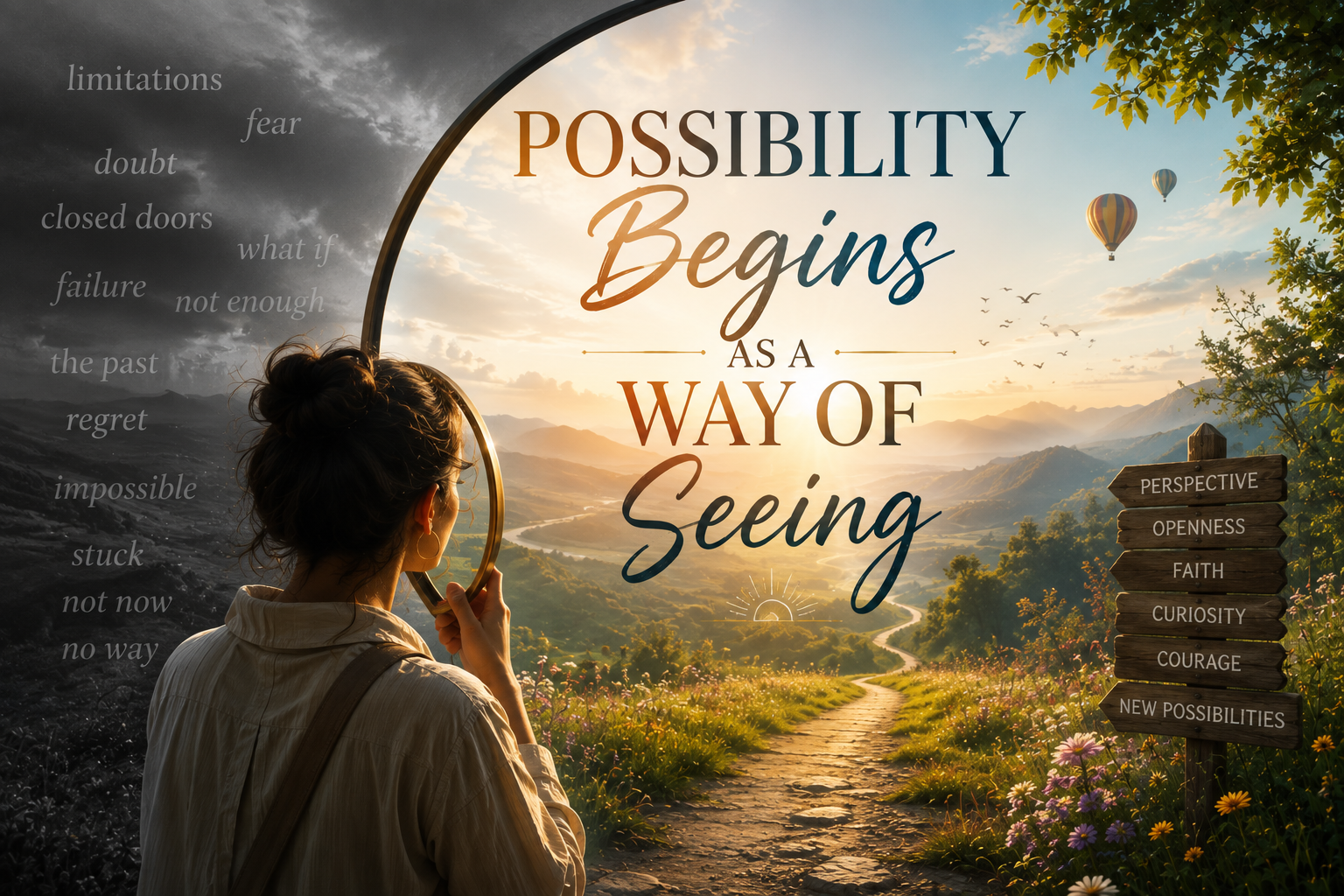
Possibility Begins as a Way of Seeing
Explore how perception, attention, expectations, faith, and perspective can help you question limiting conclusions, recognize new possibilities, and see more ways forward.
How Mindset, Perspective, Faith, and Attention Can Help You Recognize More of What Life May Hold
Before a life changes on the outside, something often changes in the way a person sees.
A possibility that once felt invisible begins becoming noticeable.
A path that once seemed unrealistic starts feeling worth considering.
A door that looked completely closed begins looking less final.
A circumstance that once seemed to have only one interpretation suddenly reveals another.
These moments matter more than people realize because possibility often begins long before results appear.
It begins in perception.
The way you see life influences the way you meet it.
If you look through a lens shaped entirely by defeat, you may overlook openings that are already near.
If you expect every attempt to fail, you may stop investigating possibilities before they have a chance to become real.
If the past has convinced you that nothing changes, even movement can become difficult to recognize.
But when you begin looking through a wider lens, something shifts.
You notice movement.
Options.
Questions worth asking.
People worth talking to.
Ideas worth exploring.
Steps that were there before but did not seem relevant.
This is not about pretending everything is easy.
It is not about denying obstacles.
It is about recognizing that what is visible at first glance is not always the whole picture.
Possibility begins when you become willing to look again.
Seeing Is Not Passive
We often imagine perception as though we simply observe reality exactly as it is.
But human perception is influenced by many things.
Past experience.
Expectation.
Memory.
Fear.
Hope.
Belief.
Attention.
Culture.
What we have learned.
What we assume something means.
Two people can encounter a similar circumstance and notice completely different things.
One may immediately see limitation.
Another may see questions.
Options.
Timing.
Resources.
A possible next step.
Neither person controls reality simply by thinking differently.
But the way they interpret what they see can influence what they do next.
That matters.
Because what you notice influences what you investigate.
What you investigate influences what you learn.
What you believe is possible influences what you are willing to attempt.
What you attempt can influence what becomes available afterward.
A way of seeing is not completely passive.
Perception can become part of participation.
Expectation Can Shape What You Notice
Expectation can influence attention by shaping what the mind is more likely to notice, interpret, or dismiss.
You cannot consciously process everything happening around you.
Your attention has to select.
And what you already expect can influence what stands out.
If you expect rejection, uncertainty may look like rejection.
If you expect failure, one difficulty may feel like confirmation.
If you believe nothing ever changes, early movement may seem too small to matter.
If you believe an opportunity is impossible, you may never investigate whether it actually exists.
But widening expectation can widen attention.
You begin asking:
What am I not seeing yet?
Is there another interpretation?
What information am I missing?
What would I notice if I did not already assume the answer was no?
Those questions can open a surprising amount of life.
Possibility does not require blind optimism.
Sometimes it simply requires enough openness to investigate before concluding.
Fear Can Narrow the Frame
Fear has an important job.
It helps us recognize threats and protect what matters.
But fear can also narrow attention.
When you feel threatened, uncertain, rejected, or overwhelmed, the mind may become intensely focused on what could go wrong.
The danger.
The loss.
The obstacle.
The worst-case outcome.
That focus can be useful when genuine danger is present.
But fear does not always know when its shift is over.
Sometimes it continues interpreting ordinary uncertainty as evidence that everything is closing.
This is where possibility asks for a wider view.
Not:
Nothing can go wrong.
But:
What else is true?
There may be risk.
What else is true?
There may also be preparation.
There may be uncertainty.
What else is true?
There may also be time to learn.
One door may have closed.
What else is true?
There may be another route.
Something may not have worked before.
What else is true?
You may know more now.
Possibility widens the frame without erasing what is difficult.
A Changed View Can Create a Changed Response
Sometimes the first meaningful shift is not external at all.
It is the moment you begin interpreting something differently.
Instead of:
This delay means nothing is happening.
You consider:
I do not know what this delay means yet.
Instead of:
I failed, so I am not capable.
You consider:
That approach failed. What did it teach me?
Instead of:
There is no way forward.
You ask:
What would a way forward require?
Instead of:
I missed my chance.
You ask:
What chances still exist?
The circumstance may not immediately change.
But your response can.
You may research.
Ask.
Learn.
Prepare.
Wait more wisely.
Try another method.
Speak to someone.
Apply.
Begin.
Continue.
Or recognize that what you thought you wanted is no longer the direction you need.
A changed perspective does not guarantee a particular outcome.
It can create a different response.
And different responses sometimes lead to different possibilities.
Possibility Widens the Frame
A narrow frame says:
This is all there is.
This is all I can do.
This is all I can become.
This is what always happens.
This is how the story ends.
Possibility asks you to pull the frame wider.
Maybe there is more context.
More information.
More timing.
More help.
More learning.
More ways forward.
More potential.
More future than the present moment is currently revealing.
This wider frame does not erase difficulty.
It simply refuses to crown difficulty as the whole truth.
When possibility enters your way of seeing, life becomes less sealed.
You begin recognizing that one interpretation may not be the only interpretation.
One route may not be the only route.
One outcome may not define the entire story.
Sometimes that is how everything starts.
Not with proof.
With enough openness to look again.
Possibility Is Different From Fantasy
A mindset of possibility is not a promise that anything you imagine will happen.
It is not pretending obstacles do not exist.
It is not believing you can control every outcome with thought.
And it is not ignoring facts because they are inconvenient.
Possibility is grounded.
It can say:
This is difficult.
And:
There may still be something I can do.
It can say:
I do not know what happens next.
And:
I am willing to remain open to what I have not seen yet.
It can recognize:
This particular door is closed.
without deciding:
Every door is closed.
It can accept:
I need more preparation.
without translating that into:
I am incapable.
Possibility respects reality enough to see it clearly.
And it respects the future enough not to pretend the present contains everything that could ever happen.
Your Questions Change What You Can Explore
One of the simplest ways to widen perception is to ask better questions.
A defeated mind may ask:
Why does nothing ever work?
A possibility-oriented mind might ask:
What specifically is not working, and what could change?
Instead of:
Why am I stuck?
Try:
What is one thing keeping me here?
Instead of:
Why don't I have any options?
Try:
What options have I already ruled out without investigating?
Instead of:
What if this goes wrong?
Also ask:
What if something useful comes from trying?
Instead of:
Why can't I do this?
Try:
What would I need to learn to become more capable?
A better question does not magically produce an answer.
But it gives the mind somewhere better to look.
Sometimes possibility begins not with knowing more.
It begins with asking differently.
A Possibility-Oriented Mind Notices Invitations
Life does not only arrive as giant doors with flashing signs.
Possibility often enters quietly.
A conversation.
An idea.
A new interest.
A person you meet.
Something someone mentions in passing.
A class.
A book.
A job listing.
A creative urge.
A new question.
An unexpected invitation.
A sudden realization that an old direction no longer fits.
A problem that forces you to learn something.
A small opportunity that does not look impressive yet.
A sense that you should explore something further.
Not every opening becomes important.
But you cannot discover which ones matter if you dismiss all of them before looking.
A possibility-oriented mind does not treat everything as destiny.
It simply remains awake enough to recognize an invitation when one appears.
Possibility Needs Participation
Seeing possibility matters.
But eventually, perception needs participation.
You notice the opportunity.
Then what?
You ask the question.
You make the call.
You learn the skill.
You begin the project.
You introduce yourself.
You research the possibility.
You pray.
You prepare.
You submit the application.
You try again differently.
You take the next right step.
Seeing a door is not the same as walking through it.
But seeing it is often where movement begins.
Possibility becomes powerful when it changes participation.
A wider view can create a wider range of choices.
And choices give possibility somewhere to become lived experience.
Sometimes the Possibility Is You
Not every possibility is an external opportunity.
Sometimes what becomes visible is a possibility within yourself.
You realize:
Maybe I can learn this.
Maybe I am capable of saying no.
Maybe I can respond differently.
Maybe I can become more disciplined.
Maybe I can start again.
Maybe I do have something meaningful to contribute.
Maybe the person I have been is not the limit of the person I can become.
That kind of perception matters deeply.
People sometimes wait for circumstances to prove they are capable before believing growth is possible.
But capability often develops through participation.
You do not need to know everything before learning.
You do not need confidence before taking every first step.
You do not need mastery before allowing yourself to begin.
Sometimes the possibility you are finally seeing is your own ability to become more capable.
Faith Makes Room Beyond What Is Visible
Faith also changes the way possibility is seen.
Faith does not require pretending you know exactly what God will do.
It does not mean every desired outcome is promised.
Faith leaves room.
Room for guidance.
Room for timing.
Room for redirection.
Room for an answer you did not anticipate.
Room for growth you cannot yet see.
Room for God to work beyond your current understanding.
Sometimes what looks closed really is closed.
And sometimes the closing becomes part of the direction.
Sometimes what looks delayed needs more time.
Sometimes what you thought you were waiting for is not the thing that ultimately opens.
Faith does not demand that you know.
It allows you to remain open while you walk.
You can pray:
God, help me see clearly.
Show me what I am overlooking.
Help me recognize what is mine to pursue and what is mine to release.
Give me wisdom to know the difference between fear and discernment.
Help me remain open without forcing what is not meant for me.
A mindset of possibility and faith work beautifully together when possibility remains open and faith remains surrendered.
A Wider View Can Change How You See the Past
Possibility can even change the way you understand what has already happened.
A disappointment may still be disappointing.
A loss may still matter.
A mistake may still carry consequences.
But over time, you may discover that the meaning you originally gave something was incomplete.
What looked like failure may have taught you something essential.
What looked like rejection may have redirected you.
What looked like wasted time may have developed wisdom.
What looked like an ending may have created room for a beginning you could not see yet.
This does not mean every painful experience secretly happened for some beautiful reason.
Sometimes difficult things are simply difficult.
But human beings can continue making meaning, learning, adapting, and growing after them.
Possibility says:
What happened matters.
And:
What happens next still matters too.
A Possibility Practice
Choose one area of life that currently feels closed.
Then ask:
What do I believe is true about this situation?
Write the answer honestly.
Next ask:
What part of that is fact, and what part is interpretation?
Then:
What might I be overlooking?
What information would help me see this more clearly?
Is there another reasonable interpretation?
What would I notice if I believed some movement were still possible?
What is one small action available to me?
Maybe the answer is:
Research.
Ask.
Wait.
Learn.
Apply.
Rest.
Pray.
Create.
Prepare.
Let go.
Begin again.
Then take the step that is actually yours.
Possibility does not need to show you the whole road.
Sometimes it only needs to help you recognize that the road may not be finished.
Frequently Asked Questions
What Is a Mindset of Possibility?
A mindset of possibility is a way of approaching life that remains open to growth, alternatives, new information, learning, and opportunities without denying reality or assuming every desired outcome will happen.
It replaces automatic limitation with thoughtful openness.
Can the Way You See a Situation Change What Happens?
Perception does not control every outcome.
But the way you interpret a situation can influence what you notice, how you feel, what questions you ask, which options you consider, and what actions you take.
Those differences can affect what happens next.
Why Does Fear Make Possibilities Harder to See?
Fear can narrow attention toward threat, risk, and potential loss.
That can be helpful when danger is real, but it can also make other information harder to notice.
Creating enough calm to look again can sometimes reveal options that were difficult to see while fear was dominating attention.
Is a Possibility Mindset the Same as Positive Thinking?
Not exactly.
Positive thinking often focuses on expecting favorable outcomes.
A possibility mindset can be more flexible.
It says:
I do not know exactly what will happen, but I am willing to remain open to useful possibilities, information, growth, and different ways forward.
How Can I Develop a More Open Mindset?
Begin by questioning automatic conclusions.
Ask what else could be true.
Look for missing information.
Expose yourself to different ideas and perspectives.
Allow yourself to learn.
Replace absolute statements such as:
There is no way
with questions such as:
What would a way require?
Does Seeing Possibility Mean Ignoring Risk?
No.
Real possibility includes discernment.
You can evaluate risk, facts, timing, resources, consequences, and limitations while remaining open to options.
A wider lens should help you see reality more completely, not less clearly.
How Does Faith Relate to Possibility?
Faith can help a person remain open beyond what is immediately visible while still practicing wisdom and surrender.
You can trust that God may guide, redirect, teach, or open something without deciding in advance exactly what the answer must look like.
You Are Allowed to See With a Wider Lens
You are allowed to stop interpreting your life through the smallest frame available.
You are allowed to look again.
You are allowed to question conclusions written by an older version of you.
You are allowed to discover information that changes your understanding.
You are allowed to believe that what is visible right now may not be the full story.
You are allowed to remain open without becoming naive.
Hopeful without becoming unrealistic.
Faithful without demanding certainty.
Curious without having every answer.
Possibility often begins there.
Not in proof.
Not in guarantees.
Not in pretending obstacles are imaginary.
But in the quiet shift where you stop assuming that what you currently see is everything there is to see.
The future becomes less sealed.
The mind becomes more spacious.
The heart becomes more available.
Different questions emerge.
Different choices become visible.
Different actions become possible.
And from there, something new has room to begin.
Possibility begins as a way of seeing.
And sometimes one changed view becomes the first doorway into an entirely different life.
Your Soulful Pathways ↑
Discover more series pages for you in Your Soulful Pathways ↑.
If this message resonated, you may also enjoy:

A Closed Mind Lives in a Smaller World
A closed mind can make life feel smaller than it is. Explore how openness, flexibility, and a wider way of seeing can expand your world and the future you recognize.
A mind does not have to be hostile to be closed. Sometimes it is simply tired. Sometimes it has seen disappointment more than once and decided not to expect much anymore. Sometimes it has grown so used to familiar limits that it no longer questions them. What once felt like self-protection slowly becomes a way of living, and over time, that way of living can make the world feel smaller than it really is.
A closed mind narrows experience before experience has a chance to speak.
It decides too early what is possible, what people are like, what life can hold, what change can happen, and what kind of future is realistic. It can make a person feel like they are being practical, when in truth they may just be standing inside an old frame that no longer deserves that much authority.
A narrow lens creates a narrow world
The world a person lives in is shaped partly by what they are willing to see. If your thoughts are always filtering for limitation, disappointment, or what will probably not work, life begins to appear smaller, flatter, and more fixed. Not because nothing exists beyond that, but because your inner lens is no longer looking for much else.
This is how a mind can reduce a life.
It can make beauty harder to notice.
It can make people easier to dismiss.
It can make opportunity feel distant before it is even explored.
It can make change seem unlikely before it is even given room.
A narrow lens does not only affect mood. It affects perception. And perception matters because what you do not recognize, you cannot respond to with openness.
Openness creates room where there once was only conclusion
An open mind does not mean believing everything. It means staying willing to see more. It means allowing life to remain larger than your current conclusions. It means understanding that one disappointment is not a prophecy, one season is not the whole story, and one way of seeing is not the only truth available.
Openness gives life breathing room.
It lets new understanding enter. It lets nuance return. It lets possibility stand where certainty once shut the door too quickly. A person with an open mind begins to move differently through the world because they are no longer demanding that reality stay trapped inside their old assumptions.
That kind of openness is powerful. It makes room for discovery, growth, and surprise. It creates a larger conversation between who you are and what life may still have to show you.
A closed mind often protects old limits
Sometimes a closed mind feels strong because it sounds certain. It can seem grounded because it quickly decides. But certainty is not always wisdom. Sometimes it is just fear that has learned how to speak with confidence.
A closed mind often protects old limits more than it protects truth.
It can defend what is familiar even when what is familiar is too small. It can reject new possibilities because they would require a different internal posture. It can keep a person emotionally contained, not because their life has no room to expand, but because their thinking has not yet given them permission to step beyond what they have known.
This is why openness can feel so important. It is not weakness. It is not instability. It is the willingness to let your life remain teachable, movable, and more alive than old assumptions allowed.
A larger world appears when the mind relaxes its grip
When you stop gripping life so tightly through old conclusions, more starts becoming visible. New meanings. New people. New paths. New interpretations of what once seemed final. A softer, more open mind gives the future more room to arrive in ways you may not have predicted.
That matters deeply.
Because life is often fuller than the first story you told yourself about it. There may be more available than you realized. More support than you noticed. More creativity than you expected. More healing than you accounted for. More timing, more grace, more openings, more direction.
A closed mind may call that unrealistic. But an open mind understands something better: life has often exceeded the limits people placed on it.
You are allowed to live in a wider world
You do not have to keep shrinking reality to match old fears. You do not have to keep assuming that what you have seen is all there is to see. You are allowed to live with curiosity. You are allowed to stay teachable. You are allowed to believe that the world may be wider, richer, kinder, and more open than a discouraged perspective once made it seem.
That shift can change a lot.
Because when the mind opens, the world often opens with it. Not all at once, not magically, but perceptibly. You begin noticing what you used to miss. You begin hearing what you were too guarded to receive. You begin reaching for what once felt beyond your range.
A closed mind lives in a smaller world. But your life does not have to stay that small.
There is more to see than fear first told you. And sometimes the widening begins the moment you let your mind become a place where more is allowed to exist.
Your Soulful Pathways ↑
Discover more series pages for you in Your Soulful Pathways ↑.
If this message resonated, you may also enjoy:

What You Believe Shapes What You Pursue
What you believe shapes what you attempt. Explore how a more open, possibility-filled mindset can expand action, courage, and the future you are willing to reach for.
What you believe quietly influences the way you live.
Belief shapes how you see yourself, how you interpret opportunities, and how willing you are to move toward something meaningful. It affects whether you begin, whether you keep going, and whether you stay open long enough to discover what may be possible for you. Long before visible results appear, belief often helps shape the direction of your effort.
That is why mindset matters.
A more open mindset does not instantly transform every part of life, but it can change the way you approach life. It can help you become more willing to try, more willing to grow, and more willing to participate in what is calling you forward. When belief expands, effort often expands with it. When effort expands, new possibilities become easier to recognize.
Belief influences the way you move through life
What you believe does not stay hidden in your thoughts. It shows up in your actions, your energy, your decisions, and your willingness to keep reaching. Belief influences whether you speak up, try again, ask for more, apply for the opportunity, or stay committed long enough to build something meaningful.
This is part of what makes belief so powerful.
A person who believes growth is possible often begins to live differently. They may notice openings they once overlooked. They may ask stronger questions, take more meaningful steps, and stop holding themselves back before life has had a chance to respond. Their actions begin to reflect a different expectation.
Belief creates inner permission.
It helps a person say yes to growth.
It helps them stay open to possibility.
It helps them move toward what matters with more courage and less hesitation.
Sometimes the first real shift in life is not external. Sometimes it is the moment your inner world begins making room for more.
Possibility grows when you are willing to pursue it
Many opportunities are not fully visible at the beginning. Some things only become clear through action. A conversation begins because you reached out. A skill grows because you practiced. A connection forms because you showed up. A new chapter opens because you decided to take one honest step forward.
Pursuit brings possibility into motion.
When you act on what matters to you, you create contact with growth, discovery, and new experience. You stop standing at a distance from your own life and begin participating in it more fully. That participation matters. It creates movement. It builds momentum. It allows new paths to become visible.
Sometimes what changes first is not the whole road. Sometimes what changes first is that you finally step onto it.
That step can change more than you realize.
A positive mindset supports growth and resilience
Believing in more does not mean ignoring reality. It means staying open to potential. It means refusing to let old experiences define every future possibility. A healthy mindset supports resilience, courage, learning, and the willingness to continue building even when everything is not yet clear.
This kind of belief is grounded, not unrealistic.
It helps you move with purpose.
It helps you continue with steadiness.
It helps you stay available to progress while progress is still taking shape.
You do not need guaranteed outcomes to benefit from a stronger mindset. You only need enough openness to keep moving, keep learning, and keep making room for what can grow. Over time, that inner shift can influence your confidence, your consistency, and the quality of the life you are willing to build.
Growth begins when you engage with life
There are moments in life that only unfold when you participate. Not because you control every outcome, but because action creates room for new experiences, new direction, and new understanding. When you engage life with openness, life often gives you more to work with.
Belief plays an important role in that process.
It influences whether you send the message, take the class, share the idea, apply for the role, start the project, make the call, or trust the nudge that keeps returning to you. It shapes whether you stay seated in old assumptions or rise into a more open relationship with your future.
Many meaningful things begin there.
Sometimes change does not begin with a dramatic breakthrough. Sometimes it begins with a quieter decision to try, to trust, to move, and to remain open to what can happen next.
That kind of beginning is powerful.
You are allowed to pursue a bigger future
You do not need perfect certainty to begin. You do not need every answer before taking one meaningful step. Sometimes the first breakthrough is simply this: you begin believing your effort matters.
Because it does.
When belief grows, pursuit often follows. And when pursuit follows, life has more room to respond. New strengths develop. New confidence forms. New paths become easier to recognize. What once felt far away can begin feeling more reachable because you are finally moving toward it with greater openness and intention.
You are allowed to believe in growth.
You are allowed to pursue what calls to you.
You are allowed to move toward a larger future with courage, hope, and a willingness to begin.
Sometimes what changes a life is not instant success.
Sometimes it is the moment a person finally believes enough to move forward.
Your Soulful Pathways ↑
Discover more series pages for you in Your Soulful Pathways ↑.
If this message resonated, you may also enjoy:

Mindset of Possibility
Mindset of Possibility explores how belief, openness, and perception can expand what you reach for, what you attempt, and how large life begins to feel.
Some people live inside what has already happened. They build their expectations around disappointment, limitation, and what did not work before. After a while, that way of thinking can feel realistic. It can even feel safe. But it also makes life smaller. It narrows what a person notices, what they hope for, what they attempt, and what they believe is worth reaching toward.
A mindset of possibility begins when a person stops treating the past like the final word.
It begins when you realize that not everything ahead of you has to resemble what has already been behind you. It begins when you become willing to see life as more open than fear first told you. That shift matters. It changes the emotional room you live in. It changes the energy you bring into decisions. It changes what kind of future you can even recognize when it appears.
Possibility changes what the mind looks for
The human mind is always searching for evidence. It tends to notice what matches its expectations. If you expect closed doors, you will see obstacles first. If you expect there may be more available, you begin to notice opportunities, connections, openings, and ideas that were always easier to miss from a smaller mental frame.
This does not mean pretending everything is easy. It means refusing to believe that difficulty is the whole story.
A mindset of possibility widens perception. It helps you look at life with a little more openness, a little more courage, and a little more readiness to meet what could still become real. When possibility enters your thinking, your mind starts participating differently in your future.
Belief expands what a person attempts
What a person believes affects what a person does. Many lives stay smaller not because there is no path forward, but because the mind has already decided not to look for one. When someone begins to believe that more may be available, effort changes. Curiosity changes. Initiative changes. The questions become different.
Instead of asking, “Why bother?”
the heart starts asking, “What might happen if I try?”
That shift is powerful. It does not always create instant results, but it creates movement. And movement matters. New doors are often found by people who are willing to take one step farther than resignation would have allowed.
A larger view creates a larger life
A closed mind can live in a world that feels finished. An open mind lives in a world that still has room. Room for growth. Room for healing. Room for redirection. Room for divine timing. Room for new relationships, fresh ideas, stronger opportunities, and unseen favor.
When your inner world opens, your outer life often begins to change with it.
You carry yourself differently when you believe that life is not over in the places where it once felt limited. You speak differently. You decide differently. You reach differently. A larger view does not guarantee every outcome, but it does create space for better ones. It helps you stop partnering with smallness when your life may be asking for expansion.
Possibility is a way of seeing before it becomes a way of living
Most meaningful changes begin before there is visible proof. They begin in perception. They begin in the quiet willingness to believe that something more could exist, even before you know exactly what form it will take.
That is why possibility matters so much.
It is not just optimism. It is not vague wishing. It is a change in the way you relate to life itself. It is the decision to stay open. To imagine more. To let your thoughts make room for what your current circumstances have not yet fully revealed.
Sometimes a different future begins with a different view. Sometimes a door opens first in thought, long before it opens in form. Sometimes the first real change is simply that you no longer assume less is all there is.
You are allowed to see farther
There is no weakness in hope. There is no foolishness in openness. There is no shame in believing that more is possible for your life than what fear predicted.
You are allowed to think beyond old limits. You are allowed to imagine a wider future. You are allowed to become someone who expects life to hold more light, more depth, more meaning, and more opening than you once believed.
A mindset of possibility does not remove every challenge. But it changes the way you meet them. It reminds you that life is not only made of walls. It is also made of windows, paths, invitations, and doors you may not have noticed yet.
And sometimes everything begins to change the moment you start looking for more than less.
Your Soulful Pathways ↑
Discover more series pages for you in Your Soulful Pathways ↑.
If this message resonated, you may also enjoy:

There Is Quiet Strength in Simply Being Here
There is quiet strength in simply being here. Discover the steady power of presence, endurance, and sacred dignity in ordinary human life.
Strength is often imagined as something dramatic.
People picture force, confidence, speed, certainty, and visible power. They think of bold movement, clear victories, impressive resilience, and the kind of courage that enters a room wearing polished boots and making the floorboards pay attention.
But life teaches another kind of strength too.
It is quieter.
Steadier.
Less performative.
Often easier to miss.
It does not always announce itself, yet it is deeply real.
There is quiet strength in simply being here.
This kind of strength may not be loud enough for the world to celebrate, but the soul recognizes it immediately. It is the strength of remaining present when it would be easier to disconnect. It is the strength of keeping your tenderness intact in a world that often rewards numbness.
It is the strength of continuing to inhabit your life honestly, even when the season is fragile, unclear, unfinished, or still asking more of you than people can see.
Staying Present Can Be an Act of Courage
Sometimes strength is not in conquering.
Sometimes it is in remaining.
In breathing through another day without abandoning yourself.
In choosing not to become hardened by disappointment.
In letting your heart stay open enough to keep receiving life after pain.
This does not always look impressive from the outside. Yet it often requires extraordinary courage.
It takes strength to stay human in difficult seasons.
It takes strength to keep returning to your own dignity when fear would rather make you shrink.
It takes strength to resist the temptation to treat your own life as lesser simply because it is still unfolding.
Quiet resilience is still resilience.
In many seasons, it is the holiest kind.
There are days when being here with honesty is not passive at all. It is a brave refusal to disappear from your own life. It is a quiet declaration that pain does not get to take everything. It is the soul saying, I am still here, and that still matters.
Quiet Strength Is Rooted in Self-Respect
When a person stops measuring strength only by outward intensity, they begin noticing a deeper power.
The power of rootedness.
The power of self-respect.
The power of not needing to perform worth in order to possess it.
This is where quiet strength grows.
It grows when you remain faithful to your own life without turning everything into a spectacle.
It grows when you learn to stand inside your value, even in slower or softer seasons.
It grows when you let your presence be enough without constantly trying to force yourself into a louder shape.
Quiet strength does not need to dominate a room.
It does not need endless recognition.
It does not need to keep proving that it is real.
It is content to be true.
This kind of strength carries soul in it because it is grounded in dignity rather than performance. It does not have to impress everyone to matter. It does not have to look fierce to be powerful. It does not have to become hard in order to be strong.
Some strength is gentle because it knows who it is.
Not All Power Needs to Be Loud
The world often celebrates loud strength because loud strength is easier to notice.
But not all power arrives with volume.
Some power looks like patience.
Some power looks like restraint.
Some power looks like forgiveness.
Some power looks like not returning cruelty for cruelty.
Some power looks like choosing peace when chaos keeps asking for your signature.
Some power looks like staying tender without becoming fragile.
There is strength in the person who keeps loving after disappointment.
There is strength in the person who keeps healing after pain.
There is strength in the person who keeps showing up without needing every effort to be seen.
There is strength in the person who refuses to let bitterness become their final language.
That kind of strength may not receive applause, but it leaves a mark. It changes the atmosphere. It carries light into places where harshness would have been easier.
The strongest people are not always the loudest people.
Sometimes they are the ones who have learned to remain steady without becoming cold.
Sometimes they are the ones who carry peace like a quiet lantern.
Sometimes they are the ones still here, still open, still choosing truth, still becoming whole.
Honor the Strength That Has Kept You Here
If you have been underestimating yourself because your strength has not looked dramatic, consider another possibility.
Maybe your endurance has been deeper than you realized.
Maybe your willingness to keep showing up has been its own sacred power.
Maybe your decision to keep healing, keep staying tender, keep returning to truth, and keep honoring your own life has required more courage than anyone knows.
Some courage looks like a leap.
Some courage looks like staying.
Some courage looks like breathing.
Some courage looks like choosing not to despise your life while it is still becoming what it will be.
Some courage looks like refusing to disappear from yourself.
Honor that.
Honor the resilience that did not need a spotlight.
Honor the quiet strength that helped you continue.
Honor the tenderness that survived.
Honor the faith that kept breathing beneath the surface.
Honor the part of you that is still here, still learning, still capable of love, still willing to become more whole.
You do not have to wait for your strength to look impressive before you respect it.
Some of the most meaningful strength is quiet enough to be missed by everyone except God and the soul that had to carry it.
Simply Being Here Can Carry Sacred Power
There is quiet strength in simply being here because your presence is not passive.
It is carrying life.
It is carrying meaning.
It is carrying breath, history, hope, endurance, tenderness, and a grounded kind of power the world does not always know how to praise.
You are not weak because your strength has been quiet.
You are not lesser because your courage has been gentle.
You are not insignificant because your resilience has been hidden.
There is dignity in the way you are still here.
Still open.
Still becoming.
Still capable of tenderness and truth.
Still willing to inhabit your life with care.
That is not a lesser form of power.
That is strength with dignity in it.
So honor your quiet strength.
Honor the way you have remained present.
Honor the way you have kept breathing through unfinished seasons.
Honor the way you have continued to carry light, even when life did not feel easy.
Simply being here with sincerity can be holy.
Simply staying open can be brave.
Simply refusing to abandon your own life can be one of the deepest strengths a person ever learns.
There is quiet strength in simply being here.
And that strength is worthy of reverence.
Your Soulful Pathways ↑
Discover more series pages for you in Your Soulful Pathways ↑
If this message resonated, you may also enjoy:
Your Life Already Holds Meaning

Let Your Inner Voice Remember Your Worth
Let your inner voice remember your worth with this gentle Soul2222 reflection on self-talk, dignity, and returning to a kinder relationship with yourself.
The way you speak to yourself shapes more than a mood.
It shapes your inner atmosphere. It influences how safe you feel inside your own being, how you recover from mistakes, how you carry disappointment, and whether your spirit feels supported or quietly bruised as it moves through life.
An inner voice becomes a kind of climate.
Over time, that climate affects everything.
This is why it matters to let your inner voice remember your worth.
Not just your thoughts in theory. Not just your beliefs when life is going well. Your inner voice. The private tone that rises when you are tired, uncertain, embarrassed, grieving, overwhelmed, or trying again after something painful.
That is where so much healing either deepens or gets delayed.
The voice within you should not become another place where your dignity is stripped away.
It can become a place where truth and tenderness learn to speak together.
Harshness Is Often Learned, Not Born
Very few people begin life speaking to themselves with contempt.
Much of that harshness is learned over time. It can come from criticism, neglect, perfectionism, comparison, spiritual pressure, emotional insecurity, disappointment, or environments where love felt conditional.
Eventually those messages move inward.
A person begins repeating them automatically, as if they are simple truth.
I should be farther along.
I always mess things up.
I am too much.
I am not enough.
I should have known better.
I do not deserve peace until I fix everything.
These sentences can become familiar enough to feel honest, but familiarity is not the same as truth.
Sometimes the inner voice becomes harsh because it learned to survive that way. It learned to stay alert. It learned to brace for rejection. It learned to criticize first so no one else could wound it more deeply.
But survival language is not always sacred language.
And a voice that helped you endure one season may not be the voice that helps you heal in the next.
An Old Voice Is Not Always a True Voice
An old voice is not always a true voice.
Sometimes the language inside you is not wisdom at all. Sometimes it is pain repeating itself. Sometimes it is fear trying to control your growth through shame. Sometimes it is an outdated survival voice that learned to be severe because tenderness did not feel safe.
Recognizing this can be liberating.
It means you do not have to treat every harsh inner sentence as accurate.
You do not have to bow to every old accusation.
You do not have to keep letting yesterday’s wounds narrate tomorrow’s becoming.
You are allowed to question the tone you inherited.
You are allowed to ask:
Is this voice telling the truth, or is it repeating fear?
Is this correction helping me grow, or only making me smaller?
Is this inner language honoring my dignity, or stripping it away?
Is this wisdom, or is this old pain holding a microphone?
The inner voice can sound official when it has been loud for a long time. It may arrive with a little clipboard, a stern face, and a stack of imaginary evidence.
But volume is not authority.
A harsh voice may be familiar, but that does not mean it is faithful to the truth of who you are.
A Worthy Soul Needs a Gentler Language
To remember your worth does not mean you become unrealistic or avoid accountability.
It means you stop using cruelty as your main form of guidance.
It means you learn to tell the truth without humiliation.
It means your inner voice begins to sound more like wisdom and less like punishment.
A gentler inner voice can still be honest.
It can say:
This matters.
This hurt.
This needs healing.
This choice needs wisdom.
This pattern needs attention.
This is where I need to grow.
But it does not strip you of dignity in the process. It does not speak as though your value disappears every time you fall short. It does not confuse shame with transformation.
Cruelty is not the same as clarity.
Condemnation is not the same as conviction.
Self-attack is not the same as accountability.
A worthy soul needs language that can hold both truth and care.
When a person begins speaking to themselves with more reverence, something inside relaxes. The soul becomes less defensive. Growth becomes more possible because it no longer has to fight its way through constant accusation.
Healing often deepens when the inner world becomes safer.
Not easier.
Safer.
A safe inner world can still be honest, but it does not destroy the person it is trying to help.
Speak Inwardly as if Your Life Is Sacred
There is something deeply restorative about deciding that your own soul should not be spoken to like an enemy.
You do not need to become your own punisher in order to become whole.
Harshness may feel powerful for a moment, but it rarely creates true peace. It may force a person forward, but it does not teach them how to live with dignity.
What if your inner voice remembered that you are still worthy while learning?
Still worthy while grieving?
Still worthy while repairing?
Still worthy while becoming?
Still worthy when life feels tender, unfinished, or uncertain?
What if your own mind began to sound less like accusation and more like truth spoken with care?
A sacred inner voice might say:
I can learn from this without hating myself.
I can be honest without being cruel.
I am allowed to grow slowly.
God is not finished working in me.
My worth does not collapse because I had a hard day.
I can return to peace.
I can begin again with dignity.
This return usually happens gradually.
In a softer sentence.
In a pause before self-judgment.
In a kinder interpretation of your own humanity.
In choosing, one moment at a time, not to make yourself smaller every time life feels hard.
Speak inwardly as if your life is sacred.
Because it is.
Let Your Inner Voice Become a Place of Shelter
Let your inner voice remember your worth.
Let it stop speaking as though your value is always one mistake away from collapse.
Let it become a place where your spirit can breathe, grow, and remain whole.
The way you speak to yourself is shaping the life you live from the inside. That language influences your courage, your healing, your peace, your choices, and your ability to stand inside your own life without constant inner injury.
So let your inner language begin to reflect what is true.
You are still worthy.
Still meaningful.
Still deserving of gentleness.
Still allowed to grow.
Still allowed to heal.
Still allowed to be spoken to with dignity.
Your inner voice does not have to become loud to become strong. It does not have to become harsh to become wise. It does not have to become polished overnight.
It only needs to begin returning to truth.
Again and again.
With steadiness.
With care.
With enough reverence to remember that your life is not something to condemn into wholeness.
It is something to tend.
Something to honor.
Something to speak life over.
Let your inner voice become a place of shelter.
A place of correction without cruelty.
A place of honesty without humiliation.
A place where your worth is remembered, not renegotiated.
Because your spirit was never meant to live under constant accusation.
It was meant to breathe in truth.
It was meant to grow in dignity.
It was meant to hear a voice within that knows how to say:
You are still worthy.
Come back to yourself with care.
Your Soulful Pathways ↑
Discover more series pages for you in Your Soulful Pathways ↑
If this message resonated, you may also enjoy:
There Is Quiet Strength in Simply Being Here

You Do Not Need to Earn the Right to Matter
You do not need to earn the right to matter. This gentle reflection explores worth, dignity, and why your life has value before approval or achievement.
Many people move through life carrying a quiet belief they rarely say out loud:
I will let myself feel worthy once I have done enough.
Once I have improved enough.
Once I have proven enough.
Once I am more healed, more successful, more useful, more wanted, more certain, more impressive, or easier to understand.
Until then, they relate to themselves as though their right to matter is still under review.
This creates so much hidden suffering.
You do not need to earn the right to matter.
Your life is not waiting for approval before it becomes meaningful. Your existence is not suspended until you become more impressive. The right to matter is not a reward handed out to those who finally meet every condition.
It is part of your humanity already.
It is part of the dignity you carry simply by being here.
You are not here on trial.
You are here as a human life with breath, soul, presence, becoming, and sacred worth.
Worth Is Not Something You Negotiate For
When people believe they must earn the right to matter, they often begin building their lives around conditions.
They decide they can rest later.
They can be kinder to themselves later.
They can take up space later.
They can believe they belong later.
They can speak with more honor later.
They can stop apologizing for being human later.
Everything meaningful gets postponed until they have somehow become enough.
But enoughness is a moving target when it is built on fear. No matter how much a person achieves, the conditions tend to keep multiplying.
There is always another standard.
Another pressure.
Another comparison.
Another reason to withhold peace.
Another tiny courtroom in the mind where the soul is asked to present more evidence that it deserves compassion.
This is why the soul becomes so tired under conditional living.
You were not meant to spend your life negotiating for your own significance. You were not meant to approach your existence like an application waiting to be approved.
There is something deeply healing in stepping outside that system altogether and remembering that worth is not granted by perfection.
It is deeper than performance.
It is steadier than approval.
It is older than the pressure to prove.
You Matter in the Unfinished Places Too
It is easy to believe in dignity when life feels polished and strong.
The deeper challenge is learning to believe in it when life feels tender, incomplete, uncertain, or still in process.
Can you still matter while healing?
While rebuilding?
While grieving?
While learning?
While carrying unanswered questions?
While trying again after disappointment?
While moving slower than you hoped?
Yes.
You do not become less meaningful because your life is still unfolding. You do not become less sacred because you are in process.
A human being does not lose the right to matter in seasons that are slower, messier, quieter, or less outwardly successful.
If anything, these are often the seasons when the truth needs to be remembered most.
There is no requirement that you become extraordinary before treating your life with reverence. There is no spiritual wisdom in withholding dignity from yourself until you have reached some imaginary finish line.
A life in progress is still a life deserving of tenderness.
A person who is healing is still worthy.
A person who is learning is still worthy.
A person who is rebuilding is still worthy.
A person who is tired is still worthy.
A person who is not yet where they want to be is still worthy.
Your unfinished places are not evidence against your value.
They are part of the human story you are still bravely living.
Stop Postponing Your Own Sacred Regard
One of the turning points in healing comes when a person decides to stop delaying kindness toward themselves.
They stop making compassion conditional.
They stop acting as though their value will only become official in the future.
They begin honoring the life they have now.
Not only the life they hope to have later.
Not only the polished version.
Not only the healed version.
Not only the version that finally has everything figured out and arrives with organized drawers, glowing skin, perfect timing, and a calm little trumpet section.
They begin honoring this life.
This breath.
This chapter.
This becoming.
This human being who is still here.
That kind of shift changes more than self-esteem. It changes posture. It changes inner atmosphere. It changes the way a person moves through difficulty because they are no longer treating themselves like a problem that must be fixed before it can be loved.
You are allowed to offer yourself sacred regard before everything is settled.
You are allowed to speak to yourself with dignity before life feels easy.
You are allowed to carry tenderness into the places that still need time.
This is not weakness.
It is reverence.
You Are Not Here to Prove Your Legitimacy
The pressure to prove can make a person live as though their existence must constantly be justified.
They overexplain.
Overwork.
Overgive.
Overapologize.
Overperform.
They try to become undeniable because somewhere along the way they were made to feel optional.
But your life is not waiting to become legitimate.
You do not need more proof before you are allowed to matter.
You do not need to be useful every moment before you deserve care.
You do not need to be understood by everyone before your life has meaning.
You do not need to become flawless before your presence can be honored.
You are not here to prove that you deserve a place in the world.
You are here to live from the dignity that was already given.
That dignity does not cancel growth. It gives growth a healthier foundation. It allows you to become more without treating yourself as nothing until you arrive.
You can pursue healing without despising the wounded places.
You can pursue excellence without making achievement your identity.
You can pursue purpose without believing your current life is worthless.
You can grow from dignity, not toward dignity.
That is a freer way to live.
Your Life Already Belongs Among the Things That Matter
If you have been carrying the heavy task of trying to earn your place in the world, let this truth loosen that burden:
You do not need to earn the right to matter.
You only need to remember what has always been true beneath the pressure, beneath the striving, beneath the old conditions, and beneath every voice that made you feel as though your worth had to be proven first.
Your life already belongs among the things that matter.
Not because you are always strong.
Not because you are always productive.
Not because you are always certain.
Not because you have finished becoming.
But because you are a human life carrying sacred dignity.
You matter in the visible places.
You matter in the hidden places.
You matter in the strong places.
You matter in the tender places.
You matter in the unfinished places.
You matter before the breakthrough.
You matter before the applause.
You matter before the proof.
Let that truth become steadier inside you.
Let it quiet the old courtroom.
Let it loosen the pressure to keep earning what was never meant to be withheld.
Let it teach you to stand inside your life with more reverence.
You are not here on trial.
You are here with dignity.
You are here with meaning.
You are here with a life that already belongs among the sacred things.
Your Soulful Pathways ↑
Discover more series pages for you in Your Soulful Pathways ↑
If this message resonated, you may also enjoy:
Let Your Inner Voice Remember Your Worth

Worth Exists Before Achievement
Worth exists before achievement. Discover a grounding reminder that your value begins long before success, productivity, or approval ever enter the picture.
Many people do not realize how deeply they have linked worth with achievement until life slows down.
As long as they are accomplishing, producing, helping, reaching, fixing, building, or proving, they feel steady enough. But the moment progress pauses, energy dips, success feels delayed, or life changes shape, something inside starts to shake.
They begin to question themselves, not just their circumstances.
This is one of the oldest false equations many people carry:
If I am achieving, I am valuable.
If I am not, I must be falling behind in worth.
But worth exists before achievement.
It exists before the promotion, before the recognition, before the applause, before the healed season, before the breakthrough, before the visible result.
It exists before the world has any chance to measure you at all.
Your value did not begin when you became useful to a system. It did not arrive when you became impressive. It was already present in your life before performance ever entered the room.
You are not valuable because you are always producing.
You are valuable because you are a human life carrying breath, spirit, presence, possibility, and sacred dignity.
Achievement Can Express Value, but It Cannot Create It
Achievement is not bad.
It can reflect devotion, discipline, talent, courage, creativity, faithfulness, and care. It can be part of the way a person expresses their gifts in the world. It can become a beautiful offering when it flows from truth instead of fear.
But achievement was never designed to carry the full weight of identity.
It is too unstable for that.
If you build your sense of value on accomplishment alone, then every delay starts to feel personal. Every unfinished season feels like a verdict. Rest becomes uncomfortable. Slowness begins to look like failure. Even joy can become conditional because you are always asking whether you have done enough to deserve it.
That is a heavy bargain.
The soul cannot breathe freely when worth is always waiting for the next completed task, the next visible result, or the next approving voice.
A human life is too sacred to be reduced to output.
You are more than what you complete.
More than what you earn.
More than what you fix.
More than the version of yourself that appears most polished, productive, and effective.
Some of the most meaningful parts of you do not even show up on a list of accomplishments.
They live deeper than that.
The Deepest Things Are Often Not Measurable
Not everything valuable can be counted.
Tenderness is not usually rewarded the same way success is. Neither are honesty, quiet faith, resilience, compassion, patience, humility, forgiveness, or the courage to begin again.
Yet these are often the qualities that make a life deeply beautiful.
These are the things that shape a soul from the inside.
These are the things that often matter most.
The world may measure speed, status, income, visibility, and performance, but the soul measures differently. It recognizes the worth of faithfulness that no one saw. It honors the courage it took to keep going. It knows that a person can be carrying deep value even in a season that looks quiet from the outside.
When people forget this, they begin living under a pressure that never really ends.
Every day becomes another chance to prove they deserve peace.
Every mistake becomes evidence against them.
Every slower chapter becomes a threat to their identity.
Every unfinished place starts tapping its little clipboard, asking for proof that you still matter.
But that is not truth.
That is exhaustion wearing the mask of wisdom.
The deepest things in you are not always the most visible things about you.
Do not let the world’s measuring stick become the ruler of your soul.
Slower Seasons Do Not Mean Lesser Worth
A slower season can feel uncomfortable when achievement has been carrying too much of your identity.
When life asks you to pause, heal, wait, rebuild, rest, or move differently, the old fear may rise quickly. It may whisper that you are falling behind. It may tell you that you are losing value because you are not producing at the same pace.
But a slower season is not a loss of worth.
It may be a season of restoration.
It may be a season of hidden formation.
It may be a season where God is strengthening what success could not heal.
It may be a season where your life is being returned to something truer than performance.
You have not become smaller because life is asking you to move differently.
You have not become less meaningful because the results are not immediate.
You have not become less worthy because you need rest, clarity, healing, or time.
A seed is not worthless because it is underground.
A foundation is not meaningless because it is hidden.
A quiet chapter is not empty because it has not yet become visible fruit.
There are seasons when life is still working deeply, even when it is not producing loudly.
Your worth remains there too.
Let Worth Become Something Steadier Within You
There is relief in remembering that your value does not vanish on days when you are less productive.
It does not rise only when others praise you.
It does not weaken because life has shifted shape.
It does not disappear because you are tired.
It does not depend on being constantly useful, needed, chosen, applauded, or ahead.
Worth is deeper and more stable than the metrics people cling to when they are afraid.
Maybe this is the healing invitation inside this truth:
Stop treating achievement as the source of your value.
Begin treating achievement as one possible expression of a value that already exists.
That is a very different way to live.
It makes room for rest.
It makes room for humanity.
It makes room for healing.
It makes room for unfinished chapters without turning them into evidence of inadequacy.
It allows you to grow from dignity instead of scrambling toward dignity.
It allows you to build from worth instead of begging life to prove you have some.
Your value is not a prize waiting at the end of exhaustion.
It is a truth to stand on while you grow.
Your Worth Was Woven Into You From the Beginning
Worth exists before achievement, beneath achievement, and beyond achievement.
It remains when life is fruitful and when life is tender.
It remains when the path is clear and when the next step is still hidden.
It remains when you are productive and when you are recovering.
It remains when others see your effort and when they do not.
It remains in the quiet.
It remains in the waiting.
It remains in the rebuilding.
It remains in the becoming.
So if you are in a slower season, or a season where your efforts feel less visible, do not confuse that with a loss of worth.
You are still a life of sacred dignity.
You are still carrying meaning.
You are still allowed to be here without proving your right to breathe.
You are still worthy of care, respect, patience, peace, and tenderness.
Achievement may come. Results may grow. Doors may open. Fruit may become visible. But none of that will be the first moment your life became valuable.
Your worth was already there.
Before the achievement.
Before the applause.
Before the proof.
Before the world knew what to call you.
Your worth was never manufactured by performance.
It was woven into you from the beginning.
Your Soulful Pathways ↑
Discover more series pages for you in Your Soulful Pathways ↑
If this message resonated, you may also enjoy:
There Is Meaning in Simply Being Fully Present

The Dignity of Being Here
Explore the dignity of being here, the God-given worth of every person, human dignity, self-respect, presence, aging, receiving help and the sacred meaning of being alive.
Before the World Measured You, Your Life Already Had Worth
There is dignity in being here.
Before you accomplished anything.
Before anyone applauded you.
Before you earned money, built a career, raised a family, developed a talent, helped another person or discovered what you wanted to do with your life.
Before the world could measure you, compare you, praise you, overlook you or misunderstand you, your life already carried dignity.
You were never waiting for the world to decide that you mattered.
From a sacred perspective, human worth begins much deeper than achievement.
The opening pages of the Bible give humanity an extraordinary identity:
“God created mankind in his own image.”
Genesis 1:27
This is the foundation of what Christians call the image of God, sometimes described by the Latin phrase imago Dei. It means that human beings possess a sacred significance that cannot be reduced to appearance, intelligence, productivity, wealth, health, age or social position.
Your dignity is not a prize.
It is not a promotion.
It is not something handed to you when you finally become impressive enough.
It belongs to the mystery of being human.
Dignity Means Worth That Cannot Be Priced
The word dignity can sound formal, but its meaning is deeply personal.
At its heart, dignity means that a human being possesses a kind of worth that should be recognized and respected.
Throughout history, dignity was sometimes associated with rank, prestige or social position. But a much deeper understanding emerged: human worth cannot belong only to kings, leaders, scholars, celebrities or powerful people.
Every person matters.
Philosophers eventually expressed this through the idea that a person should never be treated merely as a tool for someone else's purposes.
Christian faith reaches even deeper.
A person has value not because someone else finds them useful, but because human life itself carries sacred worth.
That means dignity belongs to the person whose name everyone knows and the person almost nobody notices.
The person building a company and the person washing its floors.
The person caring for others and the person who currently needs care.
The person standing confidently and the person learning how to stand again.
Human beings have value beyond price because human beings are more than commodities.
You Are More Than What You Produce
Modern life can quietly turn existence into a performance review.
How much did you accomplish?
How much do you earn?
How successful are you?
How attractive are you?
How many people notice you?
How productive were you today?
How much do you have to show for your years?
Those measurements may describe parts of life.
They cannot measure a life.
A newborn child has accomplished nothing, yet we recognize the child as precious.
An elderly person may no longer be able to work as they once did, yet their humanity has not diminished.
Someone recovering from exhaustion remains worthy while resting.
Someone searching for direction remains worthy while searching.
Someone receiving help remains worthy while receiving.
Someone whose life looks ordinary may carry extraordinary love into the lives around them.
Work can express dignity. Work does not create dignity.
Your worth is not a paycheck issued by the world.
God Did Not Create a Ranking of Human Worth
Human society has always been tempted to create hierarchies of importance.
Wealth.
Beauty.
Influence.
Education.
Power.
Youth.
Achievement.
Status.
But Scripture repeatedly unsettles those rankings.
Jesus noticed people others passed by.
He welcomed children when others considered them an interruption.
He spoke with people who lived outside accepted social boundaries.
He touched people others avoided.
He ate with people whose reputations made them unwelcome elsewhere.
He noticed the sick.
He listened to the grieving.
He saw people before he saw labels.
Again and again, Jesus demonstrated something profound:
No human being becomes insignificant because someone else fails to recognize their significance.
Known by God
Jesus once told his followers:
“Even the very hairs of your head are all numbered.”
Luke 12:7
The image is one of extraordinary attention.
God does not see humanity only as a crowd.
He sees the person.
Your story.
Your hopes.
Your questions.
Your gifts.
The things you have survived.
The things you are still becoming.
The prayer spoken aloud.
The prayer that never found words.
Psalm 139 carries this intimacy even further, describing a God who knows our movements, thoughts and days.
There is something deeply healing in the possibility that the Creator knows us more completely than anyone else ever could.
You can be misunderstood by people and still be known by God.
You can be overlooked by a room and still be seen by God.
You can feel uncertain about yourself and still be known by God.
Crowned With Glory and Honor
Psalm 8 asks one of humanity's oldest questions:
What are human beings that God is mindful of us?
The answer is remarkable.
Humanity is described as being crowned with glory and honor.
There is humility in that passage because human beings are small within an enormous creation.
Yet there is also astonishing dignity.
We are small beneath the stars, but we are not meaningless beneath them.
The night sky does not diminish human significance.
It can deepen the wonder of it.
Among galaxies, oceans, forests, mountains and countless living things, here you are:
conscious,
loving,
remembering,
creating,
choosing,
hoping,
praying,
wondering what all of this means.
Being human is an extraordinary way of being alive.
Being Here Is Already Extraordinary
Existence becomes familiar so quickly that we can forget how remarkable it is.
Morning arrives.
Light enters a room.
Your heart continues beating.
Your lungs continue exchanging air.
Your body performs countless quiet tasks while your attention is somewhere else.
You hear a familiar voice.
You taste food.
You remember someone you love.
You feel rain.
You notice sunlight moving across a wall.
You laugh unexpectedly.
You hear a song that opens a forgotten memory.
Ordinary life can become so familiar that its wonder disappears beneath routine.
But existence itself is extraordinary.
You are participating in something astonishing.
You are here.
Sometimes that realization is enough to make an ordinary Tuesday feel sacred.
Dignity Remains When Life Feels Undignified
There are circumstances in life that can make a person feel stripped of dignity.
Losing a job.
Needing financial help.
Depending on someone else.
Living through illness.
Losing mobility.
Experiencing rejection.
Growing older.
Making a serious mistake.
Being misunderstood.
Starting over.
Needing assistance with things you once did independently.
But circumstances can change what life feels like without changing what a person fundamentally is.
There is an important distinction here:
A person's circumstances can become difficult without the person becoming less valuable.
The season may change.
Ability may change.
Money may change.
Appearance may change.
Independence may change.
Social position may change.
Human worth remains.
There Is Dignity in Receiving
Many people are comfortable giving help but uncomfortable receiving it.
Giving can make us feel strong.
Receiving can make us feel vulnerable.
Yet human beings begin life entirely dependent upon others.
Someone feeds us.
Carries us.
Protects us.
Teaches us.
Comforts us.
We grow into independence, but none of us becomes truly self-sufficient.
We continue needing doctors, farmers, builders, teachers, mechanics, friends, family members, neighbors, strangers and communities.
At different times, we carry one another.
Receiving help does not erase dignity.
Sometimes allowing another person to help is itself an act of trust.
Human dignity was never dependent upon needing nobody.
Your Body Carries Dignity Too
The body is often treated as something to judge.
Too old.
Too young.
Too large.
Too small.
Too scarred.
Too tired.
Not strong enough.
Not beautiful enough.
Yet the body is not merely an object to evaluate.
It is where your earthly life is happening.
Through your body you embrace people.
You laugh.
You cry.
You walk.
You work.
You hear music.
You taste food.
You create.
You pray.
You sleep.
You feel the warmth of another person's hand.
You experience the world through this remarkable living home.
Christian tradition has long understood the human person as more than an invisible soul temporarily occupying a disposable body.
Scripture describes the body as a temple of the Holy Spirit.
“Your bodies are temples of the Holy Spirit.”
1 Corinthians 6:19
Age does not erase bodily dignity.
Scars do not erase it.
Changes in appearance do not erase it.
Physical limitations do not erase it.
Your body has carried the story of your life.
It deserves care rather than contempt.
Aging Does Not Make a Person Less
A culture fascinated by youth can quietly teach people to fear becoming older.
But aging is not a loss of humanity.
There is dignity in the face that has lived long enough to change.
There is dignity in silver hair.
There is dignity in slower steps.
There is dignity in memories accumulated across decades.
There is dignity in needing more rest.
There is dignity in receiving care.
A person's value does not peak at a particular age.
Every season of human life carries something the others cannot.
Youth carries beginnings.
Maturity carries experience.
Age can carry perspective, memory, wisdom and a long view of what truly matters.
Life does not become less sacred because it has been lived longer.
Your Difficult Seasons Are Not Your Identity
People sometimes turn circumstances into identities.
A lost job becomes:
“I am a failure.”
A broken relationship becomes:
“I am unwanted.”
A financial struggle becomes:
“I am behind.”
A mistake becomes:
“I am ruined.”
A season of uncertainty becomes:
“I have no purpose.”
But circumstances describe something happening in your life.
They do not contain the whole truth about who you are.
You are a human being of sacred worth moving through a chapter.
Chapters change.
Dignity remains.
Dignity Is Given, Character Is Cultivated
Recognizing human dignity does not mean pretending every human choice is good.
Our choices matter precisely because our lives matter.
There is a beautiful distinction:
Dignity is given. Character is cultivated.
You do not earn your fundamental worth through good behavior.
But recognizing your worth can call you toward a life that reflects it.
Toward truth.
Toward love.
Toward courage.
Toward responsibility.
Toward compassion.
Toward forgiveness.
Toward integrity.
Toward respect for the dignity carried by another person.
Sacred worth is not permission to become careless with life.
It is an invitation to honor life.
You Matter. They Matter. Therefore, How We Live Matters.
Understanding dignity changes more than the way we see ourselves.
It changes the way we see everyone else.
If sacred worth belongs to you, it also belongs to the person beside you.
The cashier.
The child.
The elderly neighbor.
The exhausted parent.
The person cleaning the building after everyone leaves.
The stranger sitting alone.
The person who cannot offer you anything.
The person whose life looks nothing like yours.
The person with whom you disagree.
Human dignity becomes most meaningful when it moves beyond an idea and begins shaping how people are treated.
We listen differently.
We speak differently.
We become slower to humiliate.
Slower to dismiss.
Slower to reduce someone to a label.
More willing to see the person.
Every Person Is Carrying a Hidden Story
Everyone you meet is living a life you can see only partially.
The impatient person may be grieving.
The distracted person may be worried about someone they love.
The successful person may feel lost.
The confident person may be frightened.
The quiet person may be carrying enormous strength.
The person who seems ordinary may have survived things you know nothing about.
This does not mean we understand or approve of everything another person does.
It means we remember there is a human being behind what we see.
Dignity asks us to look deeper.
The Dignity of Ordinary Work
There is dignity in work that never becomes famous.
Preparing breakfast.
Cleaning a room.
Repairing a roof.
Driving a truck.
Answering a telephone.
Caring for an aging parent.
Teaching a child.
Growing food.
Balancing accounts.
Building a home.
Listening to someone who needs to speak.
Folding laundry.
Making something with your hands.
Work can become an expression of creativity, service, responsibility and love.
But its deepest dignity comes from the person doing it.
No honest task is beneath human dignity simply because the world gives another occupation more prestige.
And when the workday ends, the person's dignity remains.
There Is Dignity in Rest
This may be one of the hardest truths for a productivity-driven world to remember:
You remain valuable when you are doing nothing productive.
Rest is woven into the biblical rhythm of life.
Sabbath reminds us that existence cannot be reduced to output.
You are not a machine whose value depends upon continuous operation.
Sleep.
Stillness.
Prayer.
Quiet.
Laughter.
Time with people you love.
Sitting beneath a tree.
Watching evening settle across the sky.
These are not necessarily empty spaces between important things.
Sometimes they are the important things.
Presence Restores What Pressure Steals
Pressure can pull a person away from their own life.
The mind rushes toward tomorrow.
It replays yesterday.
It imagines what should have happened.
It rehearses what might happen.
Meanwhile, the present moment waits quietly.
Presence brings us home.
Notice the room.
Notice the person beside you.
Notice your breathing.
Notice the meal.
Notice the sound outside.
Notice the sky.
Notice that you are alive within this particular moment.
Sacred living often begins there.
Not somewhere distant.
Here.
The Holy Ordinary
A meaningful life does not require an endless sequence of extraordinary experiences.
There is holiness in washing dishes.
There is dignity in caring for a home.
There is love in preparing food.
There is sacredness in listening.
There is meaning in keeping a promise.
There is grace in tending a garden.
There is goodness in holding a child's hand.
There is beauty in laughing around a table.
There is spiritual depth in resting when you are tired.
The ordinary is not the opposite of the sacred.
Very often, it is where the sacred has been hiding in plain sight.
Your Presence Changes Places
People often underestimate the effect of simply being present.
But presence carries influence.
A peaceful person can change the atmosphere of a room.
A compassionate person can soften a difficult conversation.
A hopeful person can help a family remember possibility.
A faithful person can remain steady when everyone else feels uncertain.
A loving person can make someone feel seen.
You may never know every effect your presence has had.
A sentence you barely remember may have encouraged someone for years.
A kindness that seemed small to you may have arrived during one of the hardest days of another person's life.
A conversation may have reminded someone they were not alone.
A child may remember something you taught them decades later.
We rarely see the entire ripple created by our existence.
You Do Not Have to Rush Through Your Life
Modern culture often treats the present as a waiting room.
Finish this.
Reach that.
Earn more.
Buy something.
Become something.
Get to the next stage.
But life is not merely a hallway leading somewhere else.
The day you are living now is your life too.
This morning matters.
This conversation matters.
This meal matters.
This season matters.
Even the waiting places matter.
There is dignity in allowing life to unfold without treating every present moment as preparation for a more important future.
Some Seasons Are About Being
There are seasons for building.
Seasons for healing.
Seasons for working.
Seasons for creating.
Seasons for learning.
Seasons for serving.
Seasons for beginning again.
And there are seasons when the deepest work may be happening quietly.
Roots grow where nobody applauds them.
Healing often happens quietly.
Faith deepens quietly.
Clarity sometimes arrives quietly.
A life can be changing profoundly before anything visible has changed at all.
You Are Allowed to Take Up Space
Some people learn to shrink themselves.
They apologize for needing help.
They minimize their opinions.
They silence their gifts.
They hide their creativity.
They make themselves smaller so other people remain comfortable.
But humility does not require disappearance.
You can be kind without erasing yourself.
You can be generous without abandoning yourself.
You can serve others while still honoring the life God gave you.
You are allowed to speak.
You are allowed to create.
You are allowed to learn.
You are allowed to dream.
You are allowed to begin again.
You are allowed to occupy your place in the world.
Your Life Does Not Need to Look Like Anyone Else's
Comparison can make a meaningful life appear inadequate.
Someone else reached the destination sooner.
Someone else owns more.
Someone else has a larger audience.
Someone else appears more successful.
Someone else's life seems easier.
But another person's timeline cannot measure your life.
Your story has its own rhythm.
Your gifts have their own expression.
Your path contains relationships, lessons, possibilities and moments that belong uniquely to you.
There is dignity in allowing your life to be your life.
Self-Respect Is One Way We Honor the Gift
Dignity becomes practical when it shapes how we treat ourselves.
It can influence the boundaries we keep.
The relationships we choose.
The way we speak to ourselves.
The environments we remain in.
The rest we allow ourselves.
The gifts we develop.
The dreams we permit ourselves to pursue.
Self-respect is not arrogance.
It is recognizing that your life is worth caring for.
Being Seen by God Changes the Question
People can spend years asking:
Do they approve of me?
Am I successful enough?
Am I attractive enough?
Am I doing enough?
Am I important enough?
Faith offers another place from which to live:
How does God see me?
Scripture repeatedly describes human beings as known, loved, called and remembered by God.
That changes the foundation of identity.
You do not have to construct your entire sense of worth from the opinions of people who may see only fragments of your story.
You can live from a deeper center.
The Sacred Responsibility of Being Alive
Dignity is both a gift and an invitation.
If life has sacred value, then how we live matters.
How we treat people matters.
How we use our gifts matters.
How we care for those who need us matters.
How we speak matters.
How we forgive matters.
How we love matters.
How we respond to the opportunities placed before us matters.
Recognizing dignity does not create a demand for perfection.
It creates awareness.
You matter.
They matter.
Therefore, how we live matters.
When You Remember Your Dignity
Something changes when you remember your worth.
You become less dependent upon every room validating you.
You become more thoughtful about what you tolerate.
You begin treating your body with greater tenderness.
You recognize when your soul needs rest.
You become less interested in measuring your life against someone else's.
You become more capable of recognizing dignity in other people.
You begin noticing how much sacredness has been hiding inside ordinary existence.
The world may still be noisy.
Life may still be uncertain.
But something inside becomes steadier.
You remember:
I am here.
My life matters.
God knows me.
My circumstances are not the measure of my worth.
This moment belongs to my story.
There is dignity in being here.
A Sacred Practice for Today
Take a few quiet minutes today without trying to accomplish anything.
Notice your breathing.
Notice where you are.
Listen to the sounds around you.
Look at your hands.
Think about everything those hands have touched.
What they have carried.
What they have created.
Whom they have comforted.
What they have repaired.
What they have survived.
What they have held onto.
What they have finally released.
Then quietly pray:
Thank You, God, for the gift of being here. Help me honor the life You have given me. Help me recognize the dignity within myself, protect it in others and live in a way that reflects the love from which that dignity comes.
For a moment, nothing else needs to be accomplished.
Simply be here.
A Final Thought
Perhaps one of the most sacred truths we can remember is also one of the simplest:
You do not have to become extraordinary before your life becomes meaningful.
Before the world could measure you, compare you, praise you, overlook you or misunderstand you, your life already carried dignity.
You were never waiting for the world to decide that you mattered.
Meaning is already present.
In your breath.
In your relationships.
In your presence.
In your capacity to love.
In your ability to notice beauty.
In your willingness to begin again.
In the gifts still unfolding within you.
In the people whose lives are different because you were part of them.
In the quiet moments nobody else sees.
And in the sacred truth that you are known by God.
There is dignity in your body.
There is dignity in your story.
There is dignity in giving.
There is dignity in receiving.
There is dignity in working.
There is dignity in resting.
There is dignity in beginning.
There is dignity in growing older.
There is dignity even in the chapters you would never have chosen.
And beneath all of it is something the world did not give you and therefore cannot measure:
the dignity of being here.
Questions Readers Often Ask
What is human dignity?
Human dignity is the inherent worth of a human person. It means a person's fundamental value is deeper than achievement, appearance, wealth, usefulness, health, age or social status.
What does human dignity mean in Christianity?
Christian understanding of human dignity begins with the belief that human beings are created in the image of God. This gives every human life sacred significance and provides a foundation for treating ourselves and others with love, compassion and respect.
What does it mean to be created in the image of God?
The biblical phrase comes from Genesis 1. It expresses the unique relationship between humanity and God and the sacred significance of human beings within creation. It also carries responsibility: we are called to reflect qualities such as love, goodness, truth, stewardship and care for one another.
Do I have to earn my dignity?
No. Fundamental human dignity is not an achievement. Accomplishments may be celebrated and character can be cultivated, but human worth exists before either.
Can someone lose their dignity because of mistakes?
A person's choices matter and actions have consequences, but fundamental human worth remains. Christianity holds together both truths: every person possesses dignity, and every person is called toward growth, truth, love and responsibility.
Does needing help reduce a person's dignity?
No. Dependence is part of human life. Every person begins life dependent upon others, and most of us will move through seasons of giving and receiving care. Receiving help does not make a person less valuable.
Does aging affect human dignity?
Aging changes the body and sometimes changes independence, but it does not reduce a person's fundamental worth. Every stage of life carries dignity.
Is self-respect compatible with humility?
Yes. Humility does not require thinking poorly of yourself. Healthy humility recognizes your own worth without placing yourself above others. It allows you to honor both your dignity and theirs.
What is the difference between dignity and self-esteem?
Self-esteem describes how positively someone feels about themselves and can rise or fall with circumstances. Dignity describes something deeper: the underlying worth of the person does not depend upon feeling confident, successful or admired.
Why is presence connected to dignity?
Presence allows us to stop treating life only as preparation for something else. When we become attentive to the moment we are actually living, ordinary experiences, relationships, rest and even our own existence can regain their significance.
How can I honor my dignity in everyday life?
Care for your body. Speak to yourself with respect. Allow yourself to rest. Develop your gifts. Keep healthy boundaries. Receive help when you need it. Treat other people as persons rather than tools, labels or obstacles. And remember that your worth is deeper than today's productivity.
You may also enjoy:
The Holy Ordinary: Finding God in Everyday Life
The Peace of Presence
Whispers of Worth
Receiving Help Without Feeling Weak
The Beauty of Becoming
Grace in Every Transition
The Strength of a Meaningful Life
Sacred Rest: Why the Soul Needs Stillness, Sabbath and Renewal
The Soul's Relationship With God
Divine Spark Within
Sacred Living
Light Begins in the Inner World
The outer life is often shaped by the inner one. Explore why light begins in the inner world and changes life from the inside out.
Much of what people try to change in life is external.
They want better circumstances, clearer direction, stronger relationships, more peace, and a future that feels more aligned. These desires are not wrong. They are deeply human. But many outward shifts begin somewhere less visible first.
They begin in the inner world.
The inner world is where thoughts gather, meanings form, emotional tone develops, and identity is reinforced. It is where fear can quietly organize a life, or where light can begin doing the same.
This is why inner life matters so deeply.
It is not separate from reality. It is one of the places reality is first interpreted, received, and built.
A mind that builds light understands this sacred truth:
Before light changes the outer path, it often begins by changing the place you live from within.
The Inner World Quietly Shapes Everything
People sometimes treat inner life as secondary, but it influences almost everything.
The state of the inner world affects how you perceive situations, how you carry yourself, what you expect, what you tolerate, what you avoid, what you create, and what you believe is possible.
A person can look functional outwardly while living in a deeply darkened inner atmosphere.
A person can also begin rebuilding life by first restoring what is happening within.
This is where light becomes more than a comforting idea. It becomes a force of inner formation.
When light begins shaping the mind, something foundational shifts. You are no longer living only from reaction, pressure, fear, or survival. You begin living from a steadier center.
You become more available to truth.
More available to beauty.
More available to courage.
More available to peace.
More available to the quiet wisdom God is strengthening inside you.
The inner world may be hidden from others, but it is not powerless.
It is the workshop where much of your life is first formed.
And a workshop full of light builds differently than one crowded with fear.
Light Begins With What You Allow to Live Within You
Inner light is built through what you entertain, repeat, nourish, and protect.
It grows through truthful thought, wise language, deep peace, meaningful focus, spiritual grounding, and a willingness to stop feeding what continually diminishes you.
It grows through prayer.
It grows through reflection.
It grows through stillness.
It grows through beauty.
It grows through choosing truth again after fear has tried to decorate the walls with worst-case scenarios and nervous little sticky notes.
This kind of inner light does not make you detached from life. It makes you more present to it.
It helps you respond rather than only react.
It strengthens your center.
It gives clarity, beauty, wisdom, and courage more influence than panic.
Light in the inner world is not accidental. It is cultivated. It is welcomed. It is protected from the patterns that keep trying to crowd it out.
You cannot always choose what happens around you.
But you can begin choosing what you continue allowing to take root within you.
That choice matters.
Because what lives within you eventually begins shaping how you live outwardly.
Outer Change Often Follows Inner Change
When the inner world begins filling with more light, outward life often starts shifting too.
Choices change.
Tone changes.
Relationships change.
Boundaries improve.
Vision becomes clearer.
Creative energy returns.
Courage becomes easier to access.
The future becomes easier to imagine because the mind is no longer dominated by inner darkness.
This is one reason real transformation can feel quiet at first. It may not look dramatic from the outside, but something foundational is happening within.
A new atmosphere is being formed.
A new way of thinking is taking root.
A stronger relationship with truth is emerging.
A deeper steadiness is rising.
What begins as inner work eventually becomes outward movement. The change may be subtle at first, but it rarely stays hidden forever.
Sooner or later, inner light begins showing up in the way a person speaks, chooses, rests, creates, loves, builds, and recovers.
The life begins to reflect the light that has been growing beneath the surface.
Building Inner Light Is Deeply Worthwhile
Inner work is not lesser work.
It is some of the most meaningful work a person can do because it changes the place from which everything else flows.
To build light in the inner world is to become more able to live from clarity, strength, spiritual depth, peace, and courage.
It is to stop letting every fear become a blueprint.
It is to stop letting every old wound become a narrator.
It is to stop letting every hard season rename your future.
It is to begin tending the place where thought, language, attention, focus, meaning, and belief all gather.
This is sacred ground.
Your inner world deserves care.
It deserves protection.
It deserves nourishment.
It deserves truth.
It deserves light.
Not because life is always easy, but because you are worth living from a place that is not ruled by chaos.
Building inner light is not about becoming untouched by difficulty. It is about becoming rooted enough that difficulty no longer gets to own the whole story.
Once Light Begins Within You, It Begins to Move Through You
Light begins in the inner world because that is where life first becomes organized in thought, language, attention, and meaning.
Tend that place with care.
Protect it from what darkens it unnecessarily.
Feed it with what enlarges it.
Return it again and again to truth.
Let your mind become a place where peace can remain.
Let your thoughts become a place where wisdom can speak.
Let your focus become a place where vision can grow.
Let your inner language become a place where life is strengthened instead of diminished.
The outer life may take time to catch up, but the inner world is where light often begins its first real work.
And once it begins there, it rarely stays there alone.
It starts moving through your choices.
Through your presence.
Through your courage.
Through your creativity.
Through your relationships.
Through the way you build, bless, restore, and rise.
A mind that builds light becomes a life that carries light.
And a life that carries light becomes part of what helps the world remember that darkness does not get the final word.
Your Soulful Pathways ↑
Discover more series pages for you in Your Soulful Pathways ↑
If this message resonated, you may also enjoy:

A Clearer Mind Makes a Different Future
A clearer mind leads to wiser choices, stronger direction, and a different future. Explore why mental clarity matters so much.
The future is shaped by visible decisions, but those decisions are often influenced by something less visible first.
The state of the mind.
A clearer mind does not only feel better in the moment. It changes what you notice, what you trust, what you choose, and what you sustain. Over time, that creates a different future.
Mental clarity is not a luxury.
It is a form of inner strength.
When the mind becomes clearer, life becomes easier to read. Direction becomes easier to recognize. Peace becomes easier to protect. Wisdom becomes easier to hear beneath the noise.
A mind that builds light must learn how to clear space for truth.
Because a clearer mind does not just change your mood.
It changes the ground from which your life is being built.
A Clouded Mind Makes Life Harder to Read
When the mind is crowded by noise, fear, overthinking, emotional residue, constant input, or unfinished inner conversations, it becomes harder to discern what is true.
People can misread situations.
They can doubt their deeper knowing.
They can delay needed movement because the inner world feels too congested to hear clearly.
A clouded mind often creates a clouded path. Not because the future is impossible, but because the mind has trouble perceiving it accurately.
When the inner world is crowded, even simple decisions can begin to feel heavy.
Small uncertainties multiply.
Discernment weakens.
Peace feels distant.
The future starts feeling foggy, not only because life is unclear, but because the mind is overloaded.
A cluttered mind can turn one decision into a whole committee meeting with no chairperson, three alarms, and someone in the back shouting, What if everything goes wrong?
This is why clarity matters.
Not so you can control every outcome.
But so you can hear what is wise, true, steady, and life-giving.
Clarity Changes Direction
A clearer mind changes direction because it changes discernment.
It helps you identify what matters most. It helps you separate urgency from importance. It helps you stop reacting to every inner weather pattern as if it were final truth.
Not every anxious thought is a warning.
Not every pressured feeling is instruction.
Not every loud demand deserves your obedience.
Clarity helps you recognize the difference.
This kind of clarity influences relationships, work, spiritual choices, emotional patterns, and the way you respond to opportunity. It creates stronger follow-through because the mind is no longer constantly splintered by contradiction.
Energy that was once scattered becomes available for creation.
You begin noticing what is aligned and what is draining.
You become less pulled by noise and more guided by truth.
You become less controlled by panic and more available for wisdom.
A clear mind does not mean you know everything.
It means you can hear what matters.
It means you can move without being ruled by every fear that tries to grab the steering wheel.
It means your future is no longer being built from confusion alone.
A Different Future Begins With a Different Inner Environment
Many people want new outcomes while living from the same inner clutter.
They want peace, but keep feeding mental chaos.
They want direction, but keep giving attention to everything that fragments them.
They want courage, but keep rehearsing fear until fear feels like the only honest voice.
But when the mental environment changes, new outcomes become more possible.
Peace increases.
Focus strengthens.
Self-sabotaging loops become easier to notice.
Wisdom becomes easier to hear.
Hope becomes easier to hold.
A different future is not always born from doing more. Sometimes it begins by clearing what has been crowding the mind for too long.
This may include constant noise, unexamined fear, internal harshness, unresolved resentment, old labels, comparison, or an overload of input with very little reflection.
When that clutter begins lifting, even gradually, the future can start feeling more open.
Not because everything is solved.
Not because the road has become easy.
Not because all uncertainty has disappeared.
But because you are no longer trying to build from chaos.
A clearer inner environment gives your life better soil.
And better soil changes what can grow.
Clarity Is Cultivated Through Space and Truth
A clearer mind is usually built through practices that create room.
Silence.
Rest.
Reflection.
Prayer.
Journaling.
Truthful self-observation.
Better boundaries.
Wiser consumption.
These things may seem simple, but they restore coherence to the inner world.
They help the mind stop spinning long enough to become honest. They help the heart settle long enough to listen. They help the spirit breathe beneath all the noise trying to claim authority.
Clarity also grows when you stop agreeing with every anxious or distorted thought that passes through.
You begin testing what is true.
You begin returning to what steadies you.
You begin noticing what repeatedly clouds your peace.
You begin valuing a clear mind enough to protect it.
This is sacred stewardship.
A peaceful mind is not something to apologize for. It is something to honor, guard, and rebuild when life has crowded it.
A clear mind can still face hard things.
It simply does not let confusion become the foundation.
A Clearer Mind Builds From a Stronger Place
A clearer mind makes a different future because it changes the ground from which your life is being built.
It does not guarantee an easy road, but it changes how you walk it.
It creates better thought.
Better response.
Better direction.
Better alignment.
Better courage.
Better follow-through.
When the mind clears, you begin to see what fear had blurred. You begin to hear what noise had covered. You begin to trust what chaos had made difficult to recognize.
The future begins to open from the inside first.
One cleared thought.
One truthful pause.
One wiser boundary.
One quieter morning.
One prayerful return.
One decision made from peace instead of panic.
This is how a different life begins to form.
Not always dramatically.
Not always instantly.
But faithfully.
A mind that is clearer becomes more available to light. It becomes more able to build what matters. It becomes more willing to move from wisdom instead of reaction.
You do not need a perfect mind.
You need a mind that is being cleared, strengthened, nourished, and returned to truth.
From that place, life begins to feel less fogged by fear and more open to direction.
From that place, courage rises with steadier feet.
From that place, God can breathe fresh wisdom into what confusion tried to cover.
A clearer mind makes a different future.
Because a clearer mind can finally see the light it is being called to build with.
Your Soulful Pathways ↑
Discover more series pages for you in Your Soulful Pathways ↑
If this message resonated, you may also enjoy:
Light Begins in the Inner World
When Vision Becomes Stronger Than Fear
Discover what happens when vision becomes stronger than fear and how faith, purpose, courage, future thinking and meaningful action can help you move toward what God is calling you to become.
The moment possibility becomes more powerful than hesitation
There comes a moment when something shifts inside you.
The circumstances may not have changed yet.
The road ahead may still be unfamiliar.
You may not have every answer, every resource, every connection, or every detail worked out.
And yet the future you can see begins to matter more than the fear that once kept you standing still.
That is the moment vision becomes stronger than fear.
Vision gives the soul somewhere to go.
It allows us to look beyond the uncertainty of the present and recognize that something meaningful may be waiting ahead.
A calling.
A new beginning.
A healthier life.
A restored relationship.
A creative dream.
A deeper relationship with God.
A life that feels more aligned with who you are becoming.
Fear asks:
What if it goes wrong?
Vision asks:
What if something beautiful becomes possible?
Faith asks:
What is the next step I can take even before I see the whole road?
And sometimes those questions change everything.
Fear Sees the Immediate. Vision Sees Beyond It.
Fear tends to focus on what is closest.
The uncertainty.
The possible loss.
The unfamiliarity.
The opinions of other people.
The possibility of failure.
The things we do not yet know.
Vision has a longer horizon.
It sees beyond the first uncomfortable conversation.
Beyond the first imperfect attempt.
Beyond the season of learning.
Beyond the awkward beginning.
Beyond the stretch of road where certainty has not yet arrived.
Vision does not always erase fear.
It gives the heart something greater to follow.
There is now another voice within you saying:
Keep going. There may be more ahead than what you can see from here.
Fear Can Inform You Without Leading You
Fear has a purpose.
It can alert us to uncertainty, change, danger, loss, and things that deserve attention.
But fear does not have to become the architect of an entire life.
It can offer information without being given authority.
You can listen to what fear is trying to tell you.
You can examine it.
You can pray about it.
You can use wisdom and discernment.
And then you can decide whether fear deserves the final word.
Sometimes it does not.
Sometimes what matters more is purpose.
Truth.
Love.
Calling.
Faith.
Freedom.
Growth.
Or the quiet recognition that you are being asked to move.
Vision Gives Courage a Direction
Courage without direction can become simple endurance.
Vision gives courage somewhere meaningful to travel.
When you can picture what you are building, becoming, or moving toward, individual steps begin to make sense.
The phone call matters.
The application matters.
The first page matters.
The small amount saved matters.
The hour spent learning matters.
The conversation matters.
The boundary matters.
The prayer matters.
The first attempt matters.
The decision to begin again matters.
Vision connects today’s actions with tomorrow’s possibility.
Something small can become deeply meaningful when you understand where it may be leading.
Vision Is More Than a Dream
A dream can remain beautiful in the imagination.
Vision begins asking what it will take to bring something meaningful into the world.
A dream says:
Wouldn’t that be wonderful?
Vision asks:
What can I do with what has been placed in my hands today?
That is where vision becomes active.
You begin learning.
Planning.
Preparing.
Praying.
Building.
Saving.
Practicing.
Connecting.
Trying.
Vision becomes more powerful when it moves from something admired in the distance into something participated in now.
The Future Can Begin Shaping the Present
Human beings are remarkable in the way we relate to the future.
We imagine.
Anticipate.
Plan.
Hope.
Prepare.
Pray.
Mentally rehearse.
Picture possibilities.
We can think about experiences that have not happened yet and allow those imagined futures to influence what we do today.
A person who sees themselves graduating studies tonight.
A person who sees a home ahead begins saving.
A person who believes a relationship can heal chooses a different conversation.
A person who sees a healthier life makes a different decision this morning.
A person who senses a calling begins learning before the opportunity arrives.
A person who sees a meaningful future begins becoming the person capable of living it.
The future may not exist yet in physical form.
But through vision, it can already begin shaping the present.
Your Mind Responds to What You Repeatedly Picture
The human mind constantly imagines possible futures.
We rehearse conversations before having them.
Athletes picture movements before performing them.
We imagine routes before traveling them.
We mentally explore possibilities before making decisions.
Research on mental imagery and future thinking suggests that imagining meaningful future outcomes can influence emotion, motivation, preparation, and behavior.
One of the most valuable insights is this:
It helps to imagine not only the destination, but also the process of getting there.
Not simply:
I can see myself succeeding.
But:
I can see myself taking the steps required to move toward it.
That is where vision becomes grounded.
The image becomes a pathway.
Fear and Vision Both Speak About Futures That Have Not Happened Yet
Fear often has a very convincing voice.
What if I fail?
What if they say no?
What if I lose something?
What if people judge me?
What if I choose incorrectly?
What if I am not ready?
Those thoughts can feel like facts because they arrive carrying emotion.
But often they are predictions.
Vision also speaks in possibilities.
What if I learn?
What if the door opens?
What if I become stronger through the process?
What if I meet the person who helps me take the next step?
What if this opportunity teaches me something I could not learn while standing still?
What if God is preparing something I cannot yet see?
Neither fear nor vision can guarantee what tomorrow will bring.
But we can choose which one will shape the way we live today.
Scripture Is Filled With People Who Had to See Beyond the Present
The Bible repeatedly tells stories of people called forward before they could see the entire outcome.
God told Abraham:
“Go from your country, your people and your father’s household to the land I will show you.” — Genesis 12:1
Abraham received direction before receiving every detail.
Joseph carried glimpses of a future that took years to unfold.
Moses was called while feeling inadequate for the assignment.
Joshua was repeatedly told to be strong and courageous as he moved into unfamiliar territory.
David was anointed long before he sat on a throne.
Nehemiah saw broken walls and envisioned restoration before the rebuilding began.
Peter stepped out of the boat before knowing how the next few moments would unfold.
Paul wrote:
“For we live by faith, not by sight.” — 2 Corinthians 5:7
And Hebrews describes faith this way:
“Now faith is confidence in what we hope for and assurance about what we do not see.” — Hebrews 11:1
Again and again, we see the same spiritual pattern.
The full destination is not always visible.
The whole plan is not always revealed.
But there is enough light to begin moving.
Faith and Vision Are Powerful Companions
Vision says:
I can see a possibility.
Faith says:
I am willing to walk toward what matters even before I understand every detail.
Together, they create movement.
Faith does not require having all the answers.
Sometimes it is simply the willingness to take the next faithful step.
The question may not be:
Do I have enough courage for the entire journey?
The better question may be:
Do I have enough faith for what is directly in front of me?
God Often Gives the Next Step Before the Whole Map
We often want clarity about everything.
Where will this lead?
How long will it take?
Will it work?
Who will help?
What will happen after that?
But Scripture often reflects a different rhythm.
Psalm 119:105 says:
“Your word is a lamp for my feet, a light on my path.”
A lamp for the feet is wonderfully specific.
It illuminates where you are stepping.
Not necessarily the next ten years.
Not every turn.
Not every answer.
Enough light for movement.
Perhaps this is one of the quiet mysteries of faith.
We are not always given the entire map.
Sometimes we are given the next piece of ground.
And after we step onto it, the next piece becomes visible.
Vision Becomes Stronger When It Is Connected to Meaning
Not every goal is powerful enough to carry us through difficulty.
Goals built primarily on comparison, approval, image, or pressure can lose their energy when the journey becomes uncomfortable.
Meaningful vision has deeper roots.
It asks:
Why does this matter?
Who could be helped by this?
What kind of person am I becoming through this?
What would change if this became real?
Does this move me toward truth, love, purpose, wisdom, service, or greater faith?
A vision becomes stronger when there is meaning underneath it.
You are no longer simply chasing an outcome.
You are answering something.
Vision Is Also About Who You Are Becoming
Vision is not only about what you hope to have.
It can be about who you are becoming.
More courageous.
More patient.
More disciplined.
More compassionate.
More faithful.
More creative.
More generous.
More grounded.
More willing to use the gifts God placed within you.
This changes the entire journey.
You stop asking only:
What am I trying to accomplish?
And begin asking:
Who am I becoming while I pursue it?
Sometimes the greatest result of a vision is not the destination itself.
It is the person who emerges along the way.
There May Be a Future Version of You Waiting on Today’s Decision
Imagine yourself several years from now.
Not as a stranger.
As you.
The version of you who continued.
The version who learned what needed to be learned.
The version who survived the awkward beginnings.
The version who stopped asking everyone else for permission.
The version who discovered strength that could not be known while standing still.
The version who trusted God through what could not be controlled.
The version who looked back and realized that some of the things once feared were actually doorways into a larger life.
We sometimes think we are making a decision only for the person we are today.
We are also making decisions for the person we are becoming.
Vision Can Become Stronger Through Small Steps
A powerful vision does not require a giant leap.
It needs movement.
One call.
One page.
One application.
One prayer.
One conversation.
One hour of learning.
One decision.
One boundary.
One beginning.
Small steps do something important.
They teach you that movement is possible.
Each completed action becomes evidence.
I can begin.
I can learn.
I can adjust.
I can continue.
This is one reason small beginnings have so much power.
They turn possibility into experience.
The dream stops existing only in your imagination.
A piece of it now exists in the world.
Vision Works Best When It Sees the Road as Well as the Destination
A meaningful future becomes even more useful when we recognize what currently stands between here and there.
That strengthens vision because it gives it direction.
You can ask:
What do I want to create?
Why does it matter?
What obstacle is currently in the way?
What can I do about that obstacle?
What is the next meaningful action available to me?
This turns hope into direction.
You are no longer merely admiring the destination.
You are beginning to build the road.
Difficulty Can Become Part of the Becoming
With vision, difficulty can take on a different meaning.
Learning can be difficult because you are expanding.
Starting again can be difficult because you are leaving something familiar.
Building can be difficult because something new is taking shape.
Waiting can be difficult because timing is still unfolding.
Growth often asks us to spend time in the space between who we have been and who we are becoming.
Vision helps us remember why that space may be worth crossing.
The Strongest Vision Makes Room for Discernment
Vision is powerful, and wisdom gives it depth.
Prayer helps us listen more carefully.
Scripture helps anchor us.
Reflection helps us recognize patterns.
Wise counsel can help us see what we may be missing.
Discernment asks meaningful questions.
Does this move me toward greater love?
Greater honesty?
Greater integrity?
Greater wisdom?
Greater service?
Greater spiritual clarity?
Greater faith?
Does this vision invite me to become more fully aligned with what I believe God is asking of me?
A vision becomes especially powerful when it is not merely exciting.
It is aligned.
Vision, Meaning, Obstacle, Step, Faith
When something meaningful keeps returning to your heart, take a quiet moment and work through these five questions.
Vision
What can I see ahead that matters deeply to me?
Meaning
Why does this matter?
Obstacle
What currently stands between where I am and where I believe I am going?
Step
What is one meaningful thing I can do now?
Faith
What is beyond my control that I need to place in God’s hands?
This creates a beautiful balance.
See what could be.
Understand what is in front of you.
Do what you can.
Trust God with what you cannot.
When Vision Becomes Stronger Than Fear
There may never be a trumpet announcing the moment.
It may happen quietly.
One morning you notice that you are thinking more about where you are going than about what could stop you.
You begin researching.
Planning.
Praying.
Learning.
Saving.
Creating.
Calling.
Writing.
Building.
Trying.
The fear that once dominated your attention begins to lose its grip.
Something greater has taken its place.
Purpose.
Hope.
Meaning.
Possibility.
Faith.
Vision.
And once you can see beyond where you are standing, the first step begins to look different.
Maybe courage is not always the absence of fear.
Maybe courage is what happens when something more meaningful becomes worthy of following.
When the life ahead matters more than the hesitation behind you.
When purpose speaks louder.
When faith becomes larger.
When possibility begins pulling you forward.
When you finally understand:
Fear may have something to say, but it does not have to decide.
And sometimes that is the beginning of everything.
Q&A
What does it mean when vision becomes stronger than fear?
It means that the meaning, purpose, possibility, or calling ahead begins to influence your decisions more strongly than fear of uncertainty, failure, change, or judgment.
Can fear and faith exist at the same time?
Yes. Faith does not require the absence of uncomfortable emotions. Biblical courage often involves moving forward while uncertainty is still present.
Why can vision feel so motivating?
A meaningful vision gives the mind a future to organize around. Imagining where you want to go can strengthen emotion, focus, motivation, planning, and commitment, especially when the vision is connected to real steps.
Should I visualize only the final outcome?
It can be helpful to picture the outcome, but also imagine the process. Think about the actions, habits, learning, conversations, and decisions that could help move you toward it.
What if I cannot see the whole path?
You may not need to. Many meaningful journeys become clear gradually. Focus on the part you can see and the next wise step available to you.
How do I know whether a vision is from God?
Bring it into prayer and examine its direction and fruit. Consider whether it leads toward love, integrity, truth, wisdom, service, spiritual growth, and greater faith. Scripture, prayer, discernment, and wise counsel can help provide clarity.
Why are small steps so important?
Small steps turn an imagined future into lived experience. They create movement, teach you what works, reveal new information, and build confidence that continuing is possible.
Can vision change who I become?
Yes. Vision is not only about achievement. The process of moving toward something meaningful can develop courage, patience, discipline, faith, wisdom, and other qualities that shape who you are becoming.
The Quality of Your Thoughts Shapes the Quality of Your Life
The way you think affects the way you live. Explore how the quality of your thoughts influences peace, resilience, and daily life.
Life is shaped by many things, but the quality of your thoughts is one of the most overlooked.
The way you think affects how you interpret what happens, how you respond under pressure, what you expect from the future, and the kind of emotional climate you carry each day. It influences your relationships, energy, courage, peace, and direction in ways that are both subtle and powerful.
This does not mean you can think your way out of every hardship.
It means the quality of thought changes the experience of living through that hardship.
Thoughts do not control everything, but they do help shape the inner world you live from. They influence whether life feels endlessly closed or quietly possible. They affect whether your mind becomes a place of panic, pressure, and defeat, or a place where wisdom, clarity, and light can grow.
The quality of your thoughts matters because your inner world is not separate from your life.
It is part of the life you are building.
Thought Quality Changes the Way Life Is Perceived
Two people can face similar circumstances and experience them very differently because of the lens through which they are thinking.
Low-quality thought tends to magnify threat, shrink possibility, and narrow perspective. It can make every challenge feel final, every delay feel personal, and every uncertain place feel dangerous.
It can create a life that feels constantly heavier than it needs to be.
Higher-quality thought does not pretend everything is easy. It sees more clearly.
It is less distorted by panic, self-condemnation, resentment, comparison, or mental noise. It makes better distinctions. It helps separate what is true from what is simply loud.
That kind of thought can say:
This is hard, but it is not hopeless.
This is uncertain, but it is not the end.
This is uncomfortable, but it may still be forming strength.
This is delayed, but it is not automatically denied.
This is heavy, but I do not have to carry it with fear leading the way.
Clearer thought changes perception, and perception changes how life is lived.
When your thoughts become wiser, the whole room inside you gets more breathable. The mental furniture stops flying around every time life sneezes. A little order returns. A little light gets in.
Your Thoughts Help Shape Your Emotional Climate
Thought quality and emotional life are deeply connected.
Repetitive, cynical, chaotic, fearful, or self-rejecting thought patterns create stress in the inner world. They make it harder to access steadiness. They keep the mind tense and the heart crowded.
A mind filled with harsh thoughts often carries a harsh atmosphere.
A mind filled with fearful thoughts often carries a threatened atmosphere.
A mind filled with defeated thoughts often carries a discouraged atmosphere.
Over time, the emotional climate begins to reflect the thoughts that have been rehearsed most often.
But thought patterns grounded in truth, wisdom, perspective, prayer, meaning, and hope create a different atmosphere. They do not remove every challenge, but they often reduce unnecessary suffering.
They allow more room for peace.
More room for patience.
More room for resilience.
More room for courage.
More room to remember that one difficult season is not the full definition of your life.
This is why the quality of your inner life cannot be separated from the quality of your lived experience. A pressured mind often produces a pressured life. A mind learning peace often creates more room, even in imperfect seasons.
When the mind becomes clearer, the heart often becomes less crowded.
And when the heart is less crowded, life can be carried with more grace.
Better Thought Quality Supports Better Choices
When the mind is clearer, choices become clearer too.
You are less likely to react from panic, collapse under fear, or reinforce what harms you simply because it feels familiar. Good thought quality supports discernment. It helps you notice what is manipulation, what is projection, what is fear, what is old pain speaking, and what is actually yours to carry.
That kind of clarity changes the direction of life over time.
Small daily choices matter, and your thought life influences many of them.
It changes what you tolerate.
It changes what you pursue.
It changes how you speak.
It changes how you recover from setbacks.
It changes how quickly you return to truth after fear tries to take over.
It changes whether you keep choosing from old wounds or begin choosing from renewed wisdom.
This is why caring for the quality of your thoughts is not abstract. It is deeply practical.
A clearer mind can pause before agreeing with fear.
A wiser mind can recognize when urgency is trying to impersonate direction.
A steadier mind can notice when a familiar pattern is asking for another turn at the wheel.
A light-filled mind can choose what leads to life instead of what only repeats the old ache.
Better thought quality does not make you perfect.
It makes you more awake.
And an awake mind can begin choosing differently.
Higher-Quality Thought Is Cultivated
A clearer inner world does not appear by accident.
It is built through nourishment, reflection, honesty, focus, and spiritual grounding. It grows when you become less willing to agree with distortion and more willing to return to truth.
It grows when you protect your mind from excess noise.
It grows when you pay attention to what repeatedly drains your peace.
It grows when you choose what deepens you rather than what depletes you.
It grows when you stop feeding thoughts that shrink your life and start returning to thoughts that strengthen your spirit.
Higher-quality thought may sound like:
I can face this with wisdom.
I do not have to believe every fearful story.
God can strengthen what feels weak in me.
I can learn from this without condemning myself.
My future is not limited to what I can see today.
I can respond with clarity instead of panic.
I can become steadier from the inside out.
This kind of thinking is not shallow positivity. It is disciplined truth.
It does not ignore reality. It refuses to let distortion rule reality.
It does not deny difficulty. It denies difficulty the right to become your identity.
As thought quality changes, life often begins changing with it. Not because the outer world instantly becomes perfect, but because you are no longer living from the same internal ground.
You perceive differently.
You respond differently.
You carry yourself differently.
You recover differently.
You build differently.
Over time, that changes more than most people expect.
A Mind Filled With Better Thoughts Builds a Better Life
The quality of your thoughts shapes the quality of your life because the inner world helps determine how life is received, interpreted, and built.
A mind filled with fear will often build from protection.
A mind filled with shame will often build from hiding.
A mind filled with comparison will often build from pressure.
A mind filled with truth begins building from clarity.
A mind filled with wisdom begins building from discernment.
A mind filled with peace begins building from steadiness.
A mind filled with light begins building from hope.
You do not need a perfect thought life.
You need a cared-for thought life.
You need a mind that is being renewed, strengthened, corrected, nourished, and guided back to what is true.
You need thoughts that help you stand up inside your own life instead of shrinking from it.
You need thoughts that make room for courage, prayer, wisdom, and possibility.
Care for the quality of your thoughts, and you begin caring for the quality of your whole experience.
Not because thought is everything.
But because thought is one of the places where life begins taking shape.
A mind that learns to think with truth becomes a mind that can build with light.
And a life built from that inner light becomes steadier, wiser, stronger, and more open to what God is still growing within you.
Your Soulful Pathways ↑
Discover more series pages for you in Your Soulful Pathways ↑
If this message resonated, you may also enjoy:

Attention Is One of Your Mind’s Greatest Forces
Discover the power of attention and how focus, awareness, faith, gratitude and intention can influence thoughts, choices, relationships and everyday life.
Your attention may be one of the most powerful forces within your everyday life.
At every moment, the world is offering you more information than you could possibly hold in conscious awareness all at once.
Sounds.
Faces.
Memories.
Thoughts.
Sensations.
Responsibilities.
Possibilities.
Concerns.
Beauty.
Ideas.
Opportunities.
Your mind must continually decide what comes forward and what remains in the background.
That selection matters more than we often realize.
What receives your attention becomes more prominent in your experience.
What repeatedly receives your attention can influence what you notice next.
What you notice can affect how you think.
What you think can influence how you feel.
What you feel can influence your decisions.
And decisions, repeated over time, can help determine the direction of your life.
Attention does not control everything that happens.
But it can profoundly influence how you meet what happens.
That makes attention precious.
Attention Is More Than Concentration
We often think of attention as the ability to sit still and concentrate.
But attention is much more than that.
It helps your mind decide what deserves priority.
It allows you to notice one voice in a crowded room.
It helps you return to a book after your thoughts wander.
It brings a memory into awareness.
It allows you to listen closely to someone you love.
It shifts toward a sudden sound that might matter.
It moves inward when you reflect, imagine or pray.
Your attention is constantly moving between the world around you and the world within you.
Sometimes you direct it.
Sometimes something else captures it.
And sometimes an old pattern quietly pulls it somewhere familiar.
Learning to recognize those movements gives you greater freedom over where your mind spends its time.
Your Mind Cannot Give Everything Equal Attention
Imagine walking into a busy room.
People are talking.
Music is playing.
Glasses are clinking.
Someone walks past you.
Your clothing touches your skin.
Lights shine overhead.
Your body receives countless sensations.
Yet you may be deeply focused on the person speaking directly in front of you.
Then someone across the room says your name.
Almost instantly, your attention shifts.
The room did not suddenly change.
What changed was what became important.
Attention helps the brain prioritize information in an environment filled with competing signals.
You are not experiencing every part of reality with equal intensity.
Your mind is continually filtering.
Selecting.
Prioritizing.
Returning.
What exists around you and what becomes central in your conscious experience are not always the same thing.
Your Attention Is Influenced by More Than One Force
Attention is shaped by several interacting influences.
One is intention.
You decide what you want to focus on.
Another is what strongly stands out around you.
A bright flash.
A loud noise.
A frightened expression.
Your phone lighting up.
And another influence comes from experience.
Things that have mattered before can become more likely to attract your attention again.
Your goals matter.
Your environment matters.
Your history matters.
This explains something important.
Attention is partly a choice, but it is not always an immediate choice.
Sometimes the first movement happens automatically.
The greater freedom often comes in what happens next.
You May Not Choose the First Thought
A thought appears.
A memory rises.
A worry enters.
A notification flashes.
Someone says something that bothers you.
Your attention moves toward it.
That does not mean you deliberately chose it.
But you can increasingly choose whether you remain there.
You may not always control the first thought.
You can have much more influence over which thought receives the next ten minutes.
That distinction is powerful.
A thought can visit without becoming your home.
A fear can appear without becoming your prophecy.
A difficult memory can surface without receiving the remainder of your day.
You can notice what entered your awareness and then decide whether it deserves to stay at the center.
Your Attention Has a History
One of the most fascinating things about attention is that previous experiences can influence what attracts us later.
Your mind learns.
Things you repeatedly search for can become easier to notice.
Things associated with reward can gain importance.
Things connected with unpleasant experiences may become difficult to ignore.
Repeated patterns can create attentional familiarity.
Researchers sometimes describe part of this influence as selection history, meaning that previous experiences can affect what receives priority later.
This means yesterday's attention can sometimes influence today's attention.
But old patterns do not have to become permanent ones.
That is where awareness becomes powerful.
Perhaps your mind automatically notices everything that could go wrong.
You can begin practicing recognition of what is also going right.
Perhaps you constantly notice what everyone else has accomplished.
You can deliberately return attention to your own path.
Perhaps an old hurt keeps pulling the mind backward.
You can acknowledge it while also choosing to notice the life still unfolding in front of you.
Attention can develop habits.
And habits can change.
What Becomes Important Becomes Easier to See
Think about learning a new word.
Once you know it, you suddenly seem to encounter it everywhere.
Or perhaps you begin thinking about buying a certain vehicle.
Within days, you notice that vehicle on road after road.
Those cars did not necessarily appear overnight.
Your mind simply began treating them as relevant.
The world contains an astonishing amount of information.
Attention helps determine which parts become noticeable.
This has beautiful implications.
Begin learning about birds and the trees may suddenly seem more alive.
Begin studying plants and weeds become identifiable species.
Begin practicing gratitude and ordinary moments that once disappeared into the background can begin standing out.
Begin searching for solutions and possibilities may become easier to recognize.
The world may not have changed at all.
But your relationship with what was already there has changed.
You Can Look Without Truly Seeing
There is a fascinating phenomenon known as inattentional blindness.
When people concentrate intensely on one thing, they can sometimes fail to consciously notice something unexpected directly in front of them.
The eyes may receive the information.
Yet conscious awareness does not fully register it.
This teaches us something extraordinary about everyday life.
Looking and noticing are not always the same thing.
How much beauty passes nearby while the mind is somewhere else?
How many kind gestures go unnoticed?
How many possibilities are dismissed before they are examined?
How many answers are quieter than the problem demanding our attention?
How many ordinary blessings have become almost invisible through familiarity?
Attention does not create everything that exists.
Sometimes it simply allows us to finally notice what was there all along.
Your Inner World Also Receives Attention
Attention does not operate only through your eyes and ears.
It moves inward too.
You can sit in a peaceful room while your attention is completely absorbed in an argument from three days ago.
Nothing threatening may be happening around you.
But internally, the argument is still receiving center stage.
You can also be moving through a difficult season while intentionally returning your inner attention toward faith, possibility, prayer and the people who support you.
The mind travels between outer experience and inner experience constantly.
Memories receive attention.
Imagined futures receive attention.
Questions receive attention.
Dreams receive attention.
Prayer receives attention.
Possibilities receive attention.
This is why the direction of your inner attention matters so much.
Your body can be in one place while your mind is living somewhere entirely different.
Fear Can Be Loud Without Being Prophetic
Fear knows how to capture attention.
That makes sense.
Human beings benefit from noticing possible danger quickly.
A threatening sound, expression or situation can become mentally important almost immediately.
But there is an important truth hidden here.
Something capturing your attention does not make it a prediction.
Fear may say:
Look at this.
That does not automatically mean:
This is what will happen.
A frightening thought can feel important simply because your mind is treating possible danger as worthy of investigation.
Once we understand that, fear becomes easier to hold differently.
We can listen for useful information without surrendering the entire mind to it.
Ask:
Is there something I need to do?
If yes, act where you can.
Then allow your attention to widen again.
The presence of uncertainty does not require the absence of peace.
Attention Can Make One Part of Life Feel Like the Whole
Suppose ten things are happening in your life.
Nine are relatively good.
One is deeply frustrating.
Which one does the mind want to discuss at 2 a.m.?
Usually not the nine.
Attention can magnify one part of an experience until it begins feeling like the entire experience.
The problem may be real.
But it may not be the whole story.
Gratitude helps widen the frame.
You can say:
This is difficult.
And also:
Something good still remains.
Someone still loves me.
I still have choices.
I still have abilities.
There are possibilities I have not seen yet.
God is still here.
Gratitude does not deny hardship.
It refuses to let hardship become the only thing visible.
What You Ask Your Mind to Find Matters
Questions direct attention.
Ask:
What is wrong with everything?
Your mind can begin collecting evidence.
Ask:
What is still working?
It can search there too.
Ask:
Why will this never happen?
The mind may begin producing obstacles.
Ask:
What can I do next?
Now attention moves toward action.
Ask:
What am I missing?
Awareness may widen.
Ask:
Where is God working in this?
The entire inner posture changes.
The question does not guarantee the answer you want.
But questions influence where your mind begins searching.
That makes the questions we repeatedly ask ourselves enormously important.
Attention and Intention Work Together
Intention says:
This matters to me.
Attention says:
Then I will continue returning here.
You may intend to become healthier.
Attention begins noticing habits, movement, sleep and choices related to health.
You may intend to build something meaningful.
Attention begins looking for ideas, opportunities and next steps.
You may intend to strengthen your relationship with God.
Attention begins making room for prayer, Scripture, worship, gratitude and stillness.
You may intend to live more peacefully.
Attention begins noticing what disrupts peace and what restores it.
Intention provides direction.
Attention helps keep that direction visible.
A dream may begin with desire.
But eventually attention must remain long enough for desire to become action.
Repetition Teaches the Mind
Human beings learn through repetition.
A musician practices the same movement again and again.
A child repeats a word until it becomes natural.
A new road becomes familiar after enough trips.
Patterns of thought can become familiar too.
This is one reason repeatedly returning attention matters.
You sit down to read.
Your mind wanders.
You notice.
You return.
You begin praying.
A grocery list appears in your mind.
You notice.
You return.
Someone you love is speaking.
Your thoughts move toward tomorrow.
You notice.
You return.
You are working on something important.
Your phone calls for attention.
You notice.
You return.
The wandering is not the failure.
The return is the training.
Again.
And again.
And again.
There is something almost sacred about the return.
Each one says:
This still matters.
Attention Can Be Strengthened
Attention is not one single skill, and different people have different strengths.
But research suggests that some attention-related abilities can improve through practice and training.
Studies of mindfulness-based practices, for example, have found improvements in several aspects of attention, although results vary depending on the type of practice and the ability being measured.
The most useful lesson for everyday life is simple.
Attention benefits from practice.
You practice when you notice distraction and return.
You practice when you listen instead of preparing your response.
You practice when you finish a paragraph before checking your phone.
You practice when you pray and gently return when thoughts wander.
You practice when you choose one meaningful thing and remain with it.
There is no requirement for perfect focus.
The ability to return matters enormously.
A Wandering Mind Is Not a Broken Mind
Not every wandering thought needs to be stopped.
The mind naturally moves.
It remembers.
Imagines.
Plans.
Dreams.
Rehearses.
Makes unexpected connections.
Sometimes wandering attention interferes with what you are trying to accomplish.
You can read an entire page and suddenly realize you remember none of it.
But mental wandering can also accompany imagination, future planning and creative thought.
A solution may arrive while taking a walk.
An idea may appear in the shower.
A connection may form while looking out the window.
Not every beautiful thought arrives while the mind is standing at attention.
The goal is not to imprison the mind.
The goal is to know when focus is needed and when spaciousness is valuable.
There is a time to concentrate.
There is a time to reflect.
There is a time to imagine.
There is a time to dream.
There is a time simply to be.
The World Is Competing for Your Attention
Human attention has become extraordinarily valuable.
Phones vibrate.
Screens light up.
Messages arrive.
Videos begin playing automatically.
Headlines are written to create curiosity.
Platforms continually offer something else to see.
Technology can educate, connect, inspire and create tremendous good.
But it helps to remember what is happening.
Every notification is making a request.
Look at me.
Every headline is making a request.
Think about me.
Every application is making a request.
Stay here a little longer.
And every demand on your attention is also, in a small way, asking for part of your life.
Because attention takes time.
And time is life.
Not Everything Asking for Your Attention Deserves It
This may be one of the most liberating truths on the page.
Something can be loud without being important.
Something can be urgent to someone else without being urgent to you.
Something can be interesting without being nourishing.
Something can provoke emotion without deserving an hour of thought.
You are allowed to decide:
This deserves me.
This does not.
This deserves five minutes.
This deserves tomorrow.
This deserves action.
This deserves prayer.
This deserves release.
Attention becomes powerful when discernment enters the room.
Make Focus Easier
Sometimes improving attention does not require greater willpower.
It requires fewer unnecessary battles.
Silence notifications you do not need.
Move your phone farther away while doing meaningful work.
Close browser tabs that have nothing to do with the task in front of you.
Create moments without television or background noise.
Allow one conversation to be the only conversation.
Give important work enough quiet to breathe.
You do not have to place your attention in the middle of twenty competing demands and then criticize yourself because concentration feels difficult.
You are allowed to create an environment that supports what matters.
Attention Helps Us Truly Experience Our Lives
Have you ever driven somewhere familiar and barely remembered the drive?
Have you finished eating and realized you hardly tasted the meal?
Have you spent time with someone while mentally thinking about everything else you needed to do?
The body can participate in something while attention is somewhere else.
Attention helps transform moments from things that merely happen around us into experiences we actually register.
This matters deeply in relationships.
Your child telling a story.
Your mother laughing.
Your friend needing to be heard.
Your spouse sitting across from you.
A family meal.
A quiet morning.
A prayer.
A sunset.
Ordinary moments often reveal their value only after they are gone.
Attention allows us to receive more of them while they are still here.
Attention Is One of the Purest Forms of Love
There are moments when the greatest gift you can give someone requires no money.
No solution.
No speech.
No brilliant advice.
Just attention.
Listening fully communicates:
For this moment, you matter enough for me to be here.
People know when we are waiting for our turn to talk.
They know when we are glancing at the phone.
They also know when someone is truly present.
Attention says:
I see you.
I hear you.
You are not disappearing into the background.
In an increasingly distracted world, undivided attention has become an extraordinary expression of love.
Presence Is Attention Brought Home
Much of human life takes place somewhere other than where the mind is currently living.
The body is sitting at breakfast.
The mind is already at work.
The body is lying in bed.
The mind is in next Tuesday.
Someone is speaking.
The mind is composing its response.
The sky is beautiful.
The eyes are looking at a screen.
Presence begins when attention returns.
Here.
This breath.
This person.
This moment.
This life.
Presence does not mean you never plan for tomorrow.
It means tomorrow does not steal every piece of today.
Gratitude Trains the Eye to Recognize Goodness
Gratitude is a practice of attention.
It says:
Notice this too.
The meal.
The person who checked on you.
The roof overhead.
The unexpected laugh.
The body carrying you.
The tree blooming outside.
The prayer that was answered years ago.
The lesson hidden inside something difficult.
The chance to begin again.
Familiarity has a strange way of making blessings disappear from conscious awareness.
We stop noticing what has been beside us every day.
Gratitude brings ordinary goodness back into focus.
And suddenly the ordinary does not look quite so ordinary anymore.
Prayer Is an Act of Attention
Prayer contains words, but prayer is also a turning of attention.
For a moment, the world is no longer at the center.
God is.
You stop.
Listen.
Speak.
Remember.
Surrender.
Ask.
Give thanks.
Become still.
Faith does not need neuroscience to validate prayer.
But it is beautiful to see modern research exploring how prayer engages attention, reflection, memory, relationship and inner awareness.
Prayer gathers the scattered mind.
The problem may still exist when the prayer ends.
But the problem is no longer the only presence in the room.
Faith Gives Attention Somewhere Larger to Stand
Scripture repeatedly speaks about where human beings set their minds, what they seek, what they remember and where they place their hearts.
Philippians 4:8 gives a remarkable invitation to consider what is true, honorable, just, pure, lovely and worthy of praise.
This does not require denying pain.
The Bible never pretends suffering does not exist.
Instead, Scripture continually expands attention beyond suffering.
Toward God.
Toward hope.
Toward love.
Toward truth.
Toward what remains possible.
Jesus spoke about worry and then pointed toward birds.
Flowers.
Provision.
Today.
Again and again, He widened attention beyond fear.
Fear may be present.
But fear does not have to become the center of everything.
Attention and the Law of Attraction
Attention also helps illuminate part of what many people recognize through the Law of Attraction.
When something becomes important to you, you may begin noticing related possibilities, conversations, people, resources and opportunities that previously blended into the background.
A clear intention can change what receives mental priority.
That does not mean every passing thought instantly creates an external event.
Life contains free will, circumstances, timing, mystery and realities beyond our individual control.
But dominant patterns of attention can influence what you recognize, how you interpret circumstances, which opportunities you pursue, how you behave and whether you continue moving toward what you desire.
There is power in expectancy.
There is power in vision.
There is power in believing something more is possible.
When faith, attention, intention and action begin moving in the same direction, possibilities that once seemed invisible can become easier to recognize and pursue.
Attention and Creation
Almost everything meaningful humans create requires attention.
A book.
A song.
A garden.
A home.
A business.
A ministry.
A friendship.
A healed relationship.
A new skill.
A different life.
Dreams need imagination.
But eventually they also need attention.
Attention returns tomorrow.
And the next day.
And the next.
It learns.
Adjusts.
Builds.
Improves.
Tries again.
The extraordinary is often created through ordinary attention given faithfully over time.
What You Water Has a Greater Chance to Grow
A garden offers a beautiful picture of attention.
A gardener cannot command the seed.
Life unfolds through mysteries the gardener does not control.
But the gardener still participates.
Where will the water go?
What will receive nourishment?
What needs pruning?
What needs protection?
What deserves more sunlight?
Attention works in a similar way.
You cannot control every circumstance.
You cannot force every dream into existence.
You cannot prevent every disappointment.
But you can participate in what you continue nourishing.
Fear or faith.
Resentment or healing.
Comparison or purpose.
Noise or peace.
Helplessness or possibility.
Yesterday or today.
You may have to choose many times.
That is perfectly all right.
You can return.
Protect What Is Sacred Enough to Deserve Your Attention
Your attention is finite.
That makes it precious.
You cannot give everything your full attention.
And you were never meant to.
Give attention to the people you love.
Give attention to your health.
Give attention to the work placed on your heart.
Give attention to ideas that make something better.
Give attention to beauty.
Give attention to laughter.
Give attention to learning.
Give attention to silence.
Give attention to possibilities.
Give attention to God.
And become more selective about what receives the rest.
A meaningful life is not shaped only by a handful of enormous decisions.
It is shaped by thousands of tiny moments in which attention moves somewhere.
Each one seems small.
Together, they create direction.
A Simple Daily Practice for Attention
In the morning, ask:
What truly deserves my attention today?
During the day, occasionally ask:
Where is my attention right now?
If you discover that it has become trapped somewhere unhelpful, ask:
Is there something I need to do about this?
If action is needed, take the next reasonable step.
Then ask:
Where do I want to return?
At the end of the day, consider:
What received most of my attention today?
Was it worthy of that much of my life?
What would I like to notice more tomorrow?
These questions require only moments.
But they can reveal a great deal.
Your Attention Is Part of How You Meet the World
You do not control everything.
Life contains surprises.
Other people have choices.
Circumstances change.
Doors open and close.
Some prayers unfold differently than expected.
But within that enormous mystery, you still possess something remarkable.
The ability to notice.
The ability to return.
The ability to choose again.
You can redirect your eyes toward beauty.
Your thoughts toward possibility.
Your heart toward gratitude.
Your actions toward purpose.
Your spirit toward God.
Attention does not promise that everything will go exactly as planned.
It offers something deeply meaningful.
Participation.
You are not merely being carried through your days by whatever happens to shout the loudest.
You can become increasingly conscious of where your mind goes.
And you can call it home.
The Quiet Power of Choosing Again
Perhaps your attention has spent too much time on something painful.
Choose again.
Perhaps fear has been occupying more mental space than faith.
Choose again.
Perhaps comparison has been louder than purpose.
Choose again.
Perhaps your phone has been receiving attention that belonged to the people beside you.
Choose again.
Perhaps yesterday has been receiving more of you than today.
Choose again.
You do not need to wait for Monday.
A new month.
A new year.
A perfect mood.
The next moment offers another doorway.
Attention can return now.
Your Life Is Happening Where Your Attention Lands
There will always be more things competing for your attention than you have attention to give.
That is exactly why it matters.
What repeatedly receives your attention gains access to something irreplaceable.
Your time.
Your thought.
Your emotion.
Your energy.
Your presence.
Pieces of your life.
Give those pieces wisely.
Notice what is beautiful.
Notice what is possible.
Notice what is growing.
Notice what needs healing.
Notice the people who love you.
Notice when fear is telling a story rather than reporting a fact.
Notice opportunities hiding beneath familiarity.
Notice when God may be calling your attention somewhere new.
And when the world scatters you, as it inevitably will, remember that you can always return.
Attention becomes direction.
Direction influences action.
Action creates experience.
Experience becomes part of the story you are living.
So perhaps one of the most powerful questions you can carry into each new day is also one of the simplest:
What deserves my attention now?
Questions and Answers
Why is attention so powerful?
Attention helps determine which information receives priority in your conscious experience. What you notice can influence thoughts, emotions, decisions and behavior, which means patterns of attention can meaningfully affect how you experience and respond to life.
Is attention the same as concentration?
No. Concentration is one form of attention. Attention also involves noticing, selecting, shifting, prioritizing and redirecting awareness between the outer world and your inner thoughts and memories.
Why do I suddenly notice something everywhere after becoming interested in it?
Once something becomes important to you, your mind becomes more likely to prioritize related information. The thing may have been present before, but it did not receive the same level of attention.
Can past experiences affect what captures my attention?
Yes. Previous learning and experience can influence what receives priority. Things that have repeatedly mattered, carried emotional importance or become familiar can become easier for the mind to notice again.
Can fear capture attention automatically?
Yes. Possible threats can strongly attract human attention. That can be useful for protection, but a thought feeling urgent does not necessarily make it a prediction of what will happen.
What is inattentional blindness?
Inattentional blindness occurs when people fail to consciously notice something unexpected because their attention is heavily engaged elsewhere. It reminds us that looking at something and consciously noticing it are not always the same thing.
Can attention be strengthened?
Some aspects of attention appear responsive to practice. Activities that involve noticing distraction and returning to a chosen task, conversation, prayer or experience can help strengthen attentional awareness.
Is mind-wandering bad?
Not always. Mind-wandering can interfere with activities requiring sustained concentration, but it can also accompany planning, imagination and creative thought. A healthy mind needs both focus and room to wander.
How does attention affect relationships?
Attention communicates presence. Listening carefully, putting distractions aside and genuinely noticing another person can strengthen connection and help people feel seen and valued.
Can gratitude change attention?
Gratitude intentionally directs awareness toward what is valuable, meaningful or good. It does not erase hardship. It broadens the picture so hardship does not become the only thing receiving attention.
How are attention and intention connected?
Intention establishes what matters to you. Attention keeps returning mental energy toward it. Together, they can influence what you notice, the choices you make and the actions you take.
Does focusing on something make it happen?
Attention alone does not guarantee a particular external outcome. But it can influence what you recognize, what information you seek, which opportunities you pursue, how you behave and whether you continue moving toward a goal.
Can prayer redirect attention?
Yes. Prayer naturally turns attention toward God, reflection, gratitude, surrender, meaning and spiritual relationship. For many people, this creates a larger frame around whatever concern had been dominating the mind.
What is the simplest way to become more intentional with attention?
Ask yourself periodically:
Where is my attention right now, and is this where I want to keep it?
That small moment of awareness gives you the opportunity to choose again.
Continue Exploring
When Vision Becomes Stronger Than Fear
Explore what happens when possibility begins receiving more of your attention than fear.
The Peace of Presence
Discover the beauty and strength of returning fully to the life happening now.
Sacred Path of Self-Mastery
Explore the inner strength that grows through awareness, intention, discipline and conscious choice.
The Genius Within Every Soul
Discover what may emerge when your gifts receive attention, encouragement and room to develop.
Aligned with Abundance
Explore how awareness can move beyond constant scarcity toward gratitude, possibility and openness.
The Dignity of Being Here
Explore the sacred worth of your presence and the meaning found in simply being alive.