
Integrity: The Highest Frequency You Can Hold
Integrity isn’t perfection. It’s alignment. Learn how choosing truth, even quietly, becomes your strongest spiritual power.
When Your Inner Life and Outer Life Match
Integrity has a sound.
Not a loud sound. Not a perfect sound. Not the sound of having everything figured out.
It is the quiet sound of alignment.
When your inner life and outer life begin to match, something settles. Your energy stops leaking into pretending. Your nervous system stops negotiating with what you already know is not right for you. Your spirit stops trying to carry the weight of divided living.
Integrity becomes a kind of peace you can feel in your bones.
It is not about looking flawless.
It is about becoming whole enough that you no longer have to live against yourself to keep the room comfortable.
There is power in that.
Because when a person begins to live in integrity, their life starts carrying a different kind of strength. Not the strength of image. Not the strength of performance. Not the strength of being approved by everyone.
The strength of being aligned.
Integrity Is Not Perfection
Perfection is fear trying to look impressive.
Integrity is truth learning how to stand.
Perfection asks, “How do I appear?”
Integrity asks, “Am I being honest?”
Perfection wants the image protected.
Integrity wants the soul protected.
Perfection is exhausting because it has to keep proving itself. Integrity is steady because it does not need to perform to be real.
Integrity says:
“This is who I am.”
“This is what I value.”
“This is what I will not betray.”
“This is where I must tell the truth.”
“This is where I must stop pretending.”
That does not mean you never make mistakes. It does not mean you never have to apologize, grow, repair, learn, or choose better.
Integrity is not the absence of error.
It is the willingness to return to truth.
It is less about appearance and more about coherence. It is the sacred agreement between what you know, what you choose, what you allow, and how you live.
A person in integrity may still be learning.
But they are no longer using self-betrayal as a strategy for belonging.
How Misalignment Speaks Through the Body
When you are out of integrity, your body often knows before your mind is ready to admit it.
You may feel tension after saying yes when you meant no.
You may feel heaviness after pretending something did not bother you.
You may feel fog after ignoring your instincts.
You may feel fatigue after giving your energy to relationships that leave you drained.
You may feel restlessness after staying in a situation your spirit has already outgrown.
You may feel resentment after agreeing to something your soul never consented to.
That is not random.
It is your inner life saying, “We are not aligned.”
Many people try to override that message. They explain it away. They call it being dramatic. They call it being difficult. They call it selfishness. They call it overthinking.
But sometimes discomfort is not confusion.
Sometimes discomfort is truth asking to be honored.
Integrity often begins in the body before it becomes a decision. You feel the cost of abandoning yourself. You feel the price of pretending. You feel the strain of being pleasant while your spirit is trying to be honest.
That feeling is not there to punish you.
It is there to bring you back.
The Quiet Ways We Leave Ourselves
Integrity is not usually lost all at once.
It is often lost in tiny moments.
Laughing at something that hurt you.
Staying silent when truth mattered to you.
Overgiving to earn closeness.
Agreeing just to avoid discomfort.
Saying “It is fine” when something in you knows it is not.
Keeping peace in a room while losing peace inside yourself.
Making yourself easier to love by becoming harder for yourself to live with.
There is no shame in recognizing this.
Most people learned some form of self-abandonment as survival. They learned when to stay quiet, when to be agreeable, when to make things smaller, when to keep smiling, when to carry more than they should, and when to ignore the inner signal that said, “This does not feel right.”
But what was learned for survival can be unlearned through devotion.
Devotion to truth.
Devotion to peace.
Devotion to the life God placed inside you.
Devotion to becoming someone your own soul can trust.
Integrity does not always look “nice” to people who benefited from your old compliance.
Sometimes integrity looks like saying no without a long explanation.
Sometimes it looks like leaving a situation that keeps dishonoring you.
Sometimes it looks like admitting, “I changed my mind.”
Sometimes it looks like keeping your word to yourself even when nobody claps.
Sometimes it looks like disappointing someone else instead of betraying what you know is true.
Integrity is a private agreement with your soul.
And private agreements shape public lives.
Becoming a Self You Can Trust
A simple integrity check can change everything.
Ask:
“What would I do if I trusted myself fully?”
Then ask:
“What am I doing now that I will have to emotionally pay for later?”
That second question carries weight.
It reveals the hidden debt of self-betrayal.
Because every time you abandon your truth to keep something comfortable, some part of you has to pay for it later. You may pay with resentment. You may pay with exhaustion. You may pay with confusion. You may pay with a life that looks fine from the outside but does not feel honest on the inside.
Integrity stops that debt from growing.
It brings you back to the clean ground of truth.
When you live in integrity, you stop needing a mask. You stop needing to convince everyone. You stop needing to prove your goodness through overgiving, overexplaining, or overperforming.
Your life becomes the evidence.
You become someone whose yes has weight because your no is honest. You become someone whose kindness is real because it is not built on self-erasure. You become someone whose peace is not borrowed from approval.
That is a high frequency.
Not because it is mystical in a shallow way.
Because integrity lifts the whole life into alignment.
It clears the noise. It strengthens the spirit. It teaches the nervous system that truth is safe. It teaches the soul that it no longer has to split itself to survive.
The highest frequency is not being admired by everyone.
It is becoming a self you can trust.
If this message resonated, you may also enjoy:
The New You Will Require New Habits
The Courage to Be Misunderstood
The Spiritual Power of Saying “That’s Not Me Anymore”
Your Soulful Pathways ↑
Discover more series pages for you in Your Soulful Pathways ↑.
The Courage to Be Misunderstood
Growth can confuse people who only knew your old self. Learn how to stay grounded when others don’t get your transformation yet.
One of the hardest parts of transformation is that it changes how you are received.
People who benefited from your old self may not celebrate your new boundaries. People who loved your performance may feel unsettled by your honesty. People who only knew your survival identity may not recognize the real you when you stop playing the role they expected.
That can feel lonely.
It can also feel holy.
Because there comes a point in becoming where you have to choose truth over being easily understood.
You stop overexplaining.
You stop rescuing.
You stop smiling through discomfort.
You stop making yourself smaller so other people can stay comfortable.
You stop returning to old patterns just because they make relationships feel familiar.
And not everyone will know what to do with that.
Some people will call it distance because they were used to access. Some will call it attitude because they were used to your agreement. Some will call it selfish because they were used to your sacrifice. Some will call it change because they do not yet understand that what they are seeing is truth finally getting room to breathe.
This is where courage becomes spiritual.
Not because you become hard.
Because you become steady.
Misunderstanding Does Not Mean You Are Wrong
Misunderstanding is not always evidence that you made a mistake.
Sometimes it is simply evidence that you changed.
You may be speaking more honestly now. You may be honoring your limits now. You may be choosing peace over approval now. You may be allowing your no to stand without wrapping it in a long explanation.
That can surprise people who only knew the edited version of you.
They may not understand why you no longer respond the same way. They may not understand why you stopped carrying what was never yours. They may not understand why your voice is quieter but stronger. They may not understand why your kindness now has boundaries.
But their confusion is not automatically your assignment.
You can listen.
You can care.
You can be respectful.
You can stay open to correction when correction is honest and wise.
But you do not have to shrink back into an old identity just to make your growth easier for someone else to digest.
There is a difference between being misunderstood and being wrong.
Learning that difference is part of freedom.
Why It Feels So Uncomfortable
Being misunderstood can feel threatening because the nervous system often connects understanding with safety.
Some part of you may think:
“If they do not understand me, I will lose connection.”
“If they are disappointed, I did something wrong.”
“If they see me differently, I need to fix it.”
“If I do not explain enough, they may leave.”
That fear makes sense, especially if love once felt conditional.
But transformation often requires you to tolerate a temporary gap.
The gap between who you were and who you are becoming.
That gap can feel tender. People may still respond to the old version while you are learning to live from the real one. They may expect your old availability, your old silence, your old overgiving, your old quick forgiveness, your old habit of making everything easier for everyone else.
And you may feel the pull to go back.
Not because the old role was right.
Because the old role was known.
But familiar is not the same as free.
Sometimes the discomfort you feel is not a warning to retreat. Sometimes it is the stretching place between the old self and the true self.
The Temptation to Become Easier Again
When you feel misunderstood, you may be tempted to make yourself easier to manage.
You may want to soften the boundary until it barely exists.
You may want to prove you are still good.
You may want to explain yourself until you are exhausted.
You may want to return to the old role just to calm the room.
You may want to apologize for growth that did not harm anyone, but did disrupt their expectations.
That is where discernment is needed.
Peace built on self-abandonment is not peace.
It is only a pause before the next resentment.
True peace does not require you to disappear. True kindness does not require you to become endlessly available. True love does not require you to betray your own becoming so someone else never feels discomfort.
You can be kind without being consumable.
You can be compassionate without being controlled.
You can be humble without handing other people authority over your identity.
You can say:
“I hear you.”
“I understand this feels different.”
“I am still choosing this.”
“I am not explaining further.”
“I care about you, but I am not returning to that pattern.”
That is courage.
Not loud.
Not dramatic.
Not harsh.
Just firm and calm.
Staying True When You Are Not Fully Understood
Being misunderstood does not require you to harden.
It requires you to stay rooted.
There are anchors that can help you remain steady when the old fear rises.
“I do not have to be understood to be true.”
“The right people will adjust.”
“My growth does not require permission.”
“I can be kind without surrendering myself.”
“I am allowed to become someone my old patterns would not recognize.”
These are not walls.
They are roots.
They help you remain grounded when someone else’s reaction tries to become the weather inside you.
And there is a deeper gift hidden inside the courage to be misunderstood.
Misunderstanding filters your relationships.
It reveals who loved your role and who is willing to know your person. It reveals who needed your performance and who can honor your truth. It reveals who prefers your silence and who can sit with your voice.
That can be tender.
It can also be freeing.
Because the real you needs room to live.
Not room to perform.
Not room to manage everyone’s comfort.
Not room to keep proving that your growth is allowed.
Room to breathe.
Room to choose.
Room to speak.
Room to become.
You will not be understood by everyone.
But you can become honest enough that being misunderstood no longer pulls you out of yourself.
And that is a quiet kind of power.
If this message resonated, you may also enjoy:
Integrity: The Highest Frequency You Can Hold
Your Nervous System Picks Your Personality (Until You Heal)
The New You Will Require New Habits
Your Soulful Pathways ↑
Discover more series pages for you in Your Soulful Pathways ↑.
Your Nervous System Picks Your Personality (Until You Heal)
When you’re dysregulated, your nervous system can run your reactions, roles, and relationships. Healing creates room for the real you.
When Protection Starts Looking Like Personality
Some traits are not the full truth of who you are.
Some traits are your nervous system doing its best to protect you.
That matters.
Because a person can live for years believing, “This is just how I am,” when what they are really describing is how they learned to stay safe.
The easygoing one may have learned not to ask for much.
The strong one may have learned not to need anyone.
The funny one may have learned to hide pain behind laughter.
The responsible one may have learned that love felt safer when they were useful.
The independent one may have learned that depending on people hurt too much.
None of this means those parts of you are fake.
It means they may not be the whole story.
A dysregulated system will choose whatever strategy creates the most safety. It may choose pleasing, controlling, withdrawing, performing, overthinking, staying quiet, staying busy, or staying guarded.
And over time, those strategies can start to feel like identity.
But protection is not always personality.
Sometimes it is the body’s old language for survival.
How Safety Changes Who Comes Forward
When your system feels safe, you have options.
You can pause.
You can breathe.
You can choose.
You can respond instead of react.
You can tell the truth without feeling like truth will cost you everything.
But when your system feels unsafe, it defaults.
You may snap.
You may shut down.
You may people-please.
You may overthink every word.
You may try to control the room.
You may withdraw before anyone can reject you.
You may perform so no one sees what you really feel.
This is not because you are broken.
It is because your body is trying to protect you from something it has learned to recognize as danger.
Sometimes the danger is real. Sometimes it is remembered. Sometimes it is old pain dressed in present circumstances.
Your nervous system does not always ask, “Is this the same situation?”
Sometimes it only asks, “Have we felt this before?”
That is why healing matters.
Healing gives the body new information.
It teaches your system that not every hard conversation is abandonment. Not every boundary creates rejection. Not every emotion is unsafe. Not every pause means danger. Not every disagreement means love is leaving.
When safety grows inside you, more of the real you can come forward.
Traits That May Be Old Protection
There are parts of you that may be both real and protective.
That is important to understand.
A trait can be part of your personality and still be shaped by survival. The goal is not to reject yourself. The goal is to see yourself more truthfully.
You may be “easygoing,” but secretly you rarely say what you need.
You may be “independent,” but underneath that independence is a fear of relying on anyone.
You may be “funny,” but humor has become the door you hide behind when vulnerability gets too close.
You may be “busy,” but productivity helps you outrun feelings you do not want to sit with.
You may be “spiritual,” but detachment has sometimes become a way to avoid the honest work of feeling.
You may be “strong,” but strength has become the only version of you that feels acceptable.
These patterns deserve honesty, not shame.
They often began as wisdom for a former season. They helped you move through life when you did not yet feel safe enough to be fully seen, fully honest, fully soft, fully human.
But what protected you in one season may limit you in another.
The same pattern that once kept you safe can later keep you small.
Healing Gives You Choice Again
One of the most freeing sentences you can speak over an old pattern is:
“This is a nervous system strategy.”
That sentence removes shame from the room.
It shifts the question from “What is wrong with me?” to “What is happening in me?”
That shift is powerful.
Because shame makes you attack yourself. Awareness helps you understand yourself. And when you understand the pattern, you can begin to choose differently.
As healing begins to settle into the body, identity often starts changing naturally.
You set boundaries without panic.
You speak honestly without rehearsing every word.
You rest without guilt.
You stop chasing approval.
You tolerate being misunderstood.
You allow silence without rushing to fill it.
You stop treating other people’s emotions as your assignment.
You let yourself want what you want without immediately judging it.
That is not you becoming someone else.
That is you returning to yourself.
The real you may be calmer than the version that had to stay alert.
The real you may be softer than the version that had to survive.
The real you may be more direct than the version that had to keep peace.
The real you may be more joyful than the version that had to stay guarded.
Healing does not erase your strength.
It removes the bracing.
Returning to the Self Beneath the Bracing
The real you is not a performance.
The real you is what remains when your body no longer believes it has to fight, flee, freeze, please, prove, or disappear to be safe.
A simple regulation practice can help you return to that place.
Place one hand on your chest.
Breathe slower than your thoughts.
Name five things you can see.
Let your shoulders drop on the exhale.
Then ask:
“What do I actually want right now?”
That question may feel simple, but it is sacred work.
Because many people have spent years asking, “What will keep me safe?”
“What will keep them happy?”
“What will avoid conflict?”
“What will make me seem okay?”
“What will make me acceptable?”
Asking what you actually want invites the real self back into the room.
You do not have to force a dramatic answer. You may only need water, rest, honesty, space, prayer, movement, quiet, or one truthful sentence.
Small truth teaches the system safety.
And safety gives the soul room.
You are not trapped inside every pattern that once protected you.
You are not required to keep calling fear your personality.
You are allowed to become more regulated, more honest, more present, more free.
Healing does not create your identity.
Healing reveals it.
If this message resonated, you may also enjoy:
The Courage to Be Misunderstood
Who Are You Without the Story?
Integrity: The Highest Frequency You Can Hold
Your Soulful Pathways ↑
Discover more series pages for you in Your Soulful Pathways ↑.

Who Are You Without the Story?
Your story shaped you, but it doesn’t have to define you forever. Explore what remains when you loosen the labels and listen inward.
Your story matters.
It explains. It validates. It gives shape to what happened. It helps you understand the roads you walked, the wounds you carried, the choices you made, and the strength it took to keep going.
A story can bring order to pain.
But sometimes the story that once helped you make sense of your life begins to make your life smaller.
It becomes a cage made of familiar sentences.
“I am the one who always has to be strong.”
“I have always been this way.”
“People always leave.”
“I do not need anyone.”
“That is just how I am.”
“This is what happens to people like me.”
At first, those sentences may feel protective. They may feel like wisdom. They may feel like proof that you are finally seeing clearly.
But at a certain point, the story stops being a reflection and starts becoming a rule.
And you were not created to live forever inside the smallest interpretation of what happened to you.
When History Turns Into Identity
A story is meant to describe where you have been.
It is not meant to dictate where you are allowed to go.
But identity often forms around survival narratives. The mind looks at what hurt, what repeated, what disappointed, what demanded too much, and tries to create a map that will keep you from being hurt the same way again.
So the story begins:
“I had to grow up fast.”
“I am the responsible one.”
“I am the one who holds everything together.”
“People leave, so I do not need anyone.”
“I am the strong one. I do not fall apart.”
“I cannot trust good things to last.”
Some of those stories may be rooted in truth.
You may have had to grow up fast. You may have carried too much. You may have learned strength in places where softness was not protected. You may have been disappointed by people who should have shown up better.
But even a true story can become too small for the person you are becoming.
What happened may explain part of you.
It does not get to contain all of you.
Your past can be honored without being crowned as your identity.
The Difference Between Your History and Your Essence
Your history is what happened.
Your essence is what remains when you stop organizing your whole self around what happened.
Your history may include pain, pressure, loss, responsibility, rejection, survival, disappointment, and seasons where you had to become more guarded than you wanted to be.
Your essence is deeper.
It is not the role you played to get through.
It is not the wound you learned to protect.
It is not the label people placed on you.
It is not the sentence you repeated until it sounded like truth.
Your essence shows up in quieter places.
What calms you.
What feels honest.
What you value when no one is watching.
What you return to when you are not trying to prove anything.
What makes your spirit feel clean, steady, and alive.
What keeps calling to you even after you try to ignore it.
You do not have to erase the past to meet your essence.
You simply stop letting the past be your only mirror.
There is a self underneath the story.
Not untouched by life, but not owned by it either.
Questions That Loosen the Old Labels
The stories we carry often stay powerful because we rarely question them.
We repeat them. We defend them. We build around them. We call them personality, preference, wisdom, or realism.
But sometimes a story needs to be held up to the light and asked a better question.
Ask yourself:
“Who am I when I am not protecting myself?”
“What do I choose when I am not trying to impress anyone?”
“What feels true even when it is inconvenient?”
“What makes me feel clean inside?”
“What do I keep longing for, even when I ignore it?”
“What part of me have I mistaken for weakness because it needed gentleness?”
“What would become possible if I stopped calling my protection my personality?”
Longing is often truth knocking.
Not every longing is meant to become your whole life, but it often points toward something real. It may point toward rest. Honesty. Creativity. Belonging. Peace. Courage. A softer way of living. A braver way of loving. A life that feels less like defense and more like devotion.
The old story may say, “Do not hope.”
But the deeper self may still whisper, “There is more.”
Pay attention to that whisper.
It may be the part of you that never fully believed the cage was home.
Letting the Story Grow Wider
This is not about denying pain.
It is not about pretending the past did not matter. It is not about forcing yourself into a cheerful version of healing. It is not about rushing forgiveness, skipping grief, or acting like survival did not shape you.
It is about allowing your identity to become wider than what you survived.
You can say:
“Yes, that happened.”
“And also, I am not only that.”
You can honor what shaped you without making it the ruler of every future choice.
You can respect the strength that carried you without forcing yourself to remain in the role forever.
You can remember the old chapter without letting it write every new sentence.
A gentle exercise is to write one sentence that describes you without using your roles or your wounds.
Not:
“I am the one who holds everything together.”
Try:
“I am learning how to live with both softness and strength.”
Not:
“I am the one who always gets left.”
Try:
“I am building relationships that feel safe, honest, and mutual.”
Not:
“I am just the responsible one.”
Try:
“I am becoming someone who can carry what is mine without carrying everything.”
Not:
“I have always had to be strong.”
Try:
“I am learning that strength can include rest, truth, tenderness, and receiving.”
Your story can stay.
It can be respected. It can be understood. It can be part of the sacred record of how you became who you are.
But it does not get to own you.
You are allowed to outgrow the sentences that once protected you.
You are allowed to become more than the role, more than the wound, more than the old conclusion.
You are allowed to meet the self that was waiting beneath the story.
If this message resonated, you may also enjoy:
Your Nervous System Picks Your Personality (Until You Heal)
The Moment You Stop Performing
The Courage to Be Misunderstood
Your Soulful Pathways ↑
Discover more series pages for you in Your Soulful Pathways ↑.
The Moment You Stop Performing
Performance can be a learned way to stay safe and liked. This page helps you notice the pattern and choose presence instead.
There is a moment when performance stops feeling like a skill and starts feeling like a sentence.
You can still do it. You can still read the room. You can still say the acceptable thing, smile at the right time, soften your truth, hide the exhaustion, and become the version of yourself that keeps everything smooth.
But it costs more than it used to.
You feel it in your body. In your shoulders. In your jaw. In the way your breath stays shallow. In the way your nervous system does not fully unclench even after the conversation ends.
That discomfort is not failure.
It is awakening.
Something in you is starting to recognize that being approved of is not the same as being free. Something deeper is beginning to ask why peace should require so much editing. Something honest is rising beneath the trained response.
And once the real self begins to breathe, performance becomes harder to tolerate.
What Performing Really Is
Performing is not the same as showing up.
Showing up is honest presence. It is being thoughtful, grounded, kind, aware, and responsible without abandoning yourself.
Performing is different.
Performing is when you manage your presence for a result.
Be liked.
Be safe.
Be admired.
Be needed.
Be chosen.
Be impressive.
Be easy to approve of.
It often starts early. You learn what gets warmth and what brings distance. You learn what earns praise and what creates tension. You learn which parts of you are welcomed and which parts make people uncomfortable.
Then you become what works.
You may become quieter. Funnier. Stronger. Sweeter. More capable. Less needy. More polished. More agreeable. More useful.
Not because the real you disappeared.
Because some part of you learned that acceptance had conditions.
Performance is often survival wearing good manners.
It can look beautiful from the outside and still feel exhausting inside.
Signs You Are Tired of the Role
You may notice that you rehearse what to say before you say it.
You edit your feelings while they are leaving your mouth.
You smile when you do not feel safe.
You keep things light even when something inside you feels heavy.
You say yes before you have asked your own spirit the question.
You leave certain conversations feeling drained instead of nourished.
You may also notice that people think they know you, but only because they know the version you have learned to present.
That realization can ache.
But it is not shame.
It is insight.
It is the soul beginning to tell the truth. It is the part of you that was buried beneath approval starting to rise with quiet authority.
You are not becoming difficult.
You are becoming aware of where you have been divided.
There is the version of you that performs for peace.
And there is the version of you that is ready to live in peace without performing.
The Sacred Discomfort of Stopping
When you stop performing, two things often happen at once.
The old identity panics.
The real self breathes.
The old identity may say:
“They will think I am different.”
“They will be disappointed.”
“What if I lose them?”
“What if they liked the old version better?”
“What if honesty changes everything?”
That panic does not mean you are doing something wrong. It means an old pattern is losing its position of power.
But beneath the panic, there is another voice.
A quieter one.
It may say:
“I can be here without acting.”
“I can be honest without being harsh.”
“I can be kind without disappearing.”
“I can be loved without earning every ounce of it.”
“I can be myself without apologizing for existing.”
That breath is important.
That breath is the beginning of freedom.
Stopping performance does not mean becoming careless, cruel, or cold. It does not mean throwing your truth like a weapon. It means no longer treating your real self like something that must be hidden to keep connection.
It means choosing presence over performance.
It means allowing your words, choices, silence, and boundaries to come from truth instead of fear.
Choosing Real Over Polished
You do not have to dismantle the whole performance at once.
Start small.
Presence is built in moments, not speeches.
Instead of overexplaining, try one honest sentence.
Instead of laughing something off, try a quiet pause.
Instead of saying yes automatically, try, “Let me think about it.”
Instead of pretending you are fine, try, “I need a little time.”
Instead of becoming what the room prefers, let yourself stay rooted in what is true.
Every time you do this, you are teaching your system that honesty can be safe.
You are training your life to make room for the real you.
Before you respond to someone, ask:
“What would I say if I was not trying to be anything?”
That question can cut through years of automatic performance.
You can still be kind.
You can still be thoughtful.
You can still be wise.
You can still care about others.
The goal is not harshness.
The goal is honesty without costumes.
The moment you stop performing, you do not become less lovable.
You become more real.
And real is where peace begins to live.
If this message resonated, you may also enjoy:
Who Are You Without the Story?
How Shame Builds a Fake Identity
Your Nervous System Picks Your Personality (Until You Heal)
Your Soulful Pathways ↑
Discover more series pages for you in Your Soulful Pathways ↑.
How Shame Builds a Fake Identity
Shame can push you into hiding and shaping a self that feels safer. Learn how to recognize shame-based patterns and return to truth.
Shame does not just hurt.
It edits.
It takes a real moment, a real mistake, a real wound, a real human need, and turns it into a conclusion about who you are.
A mistake becomes “I am a failure.”
A need becomes “I am too much.”
A rejection becomes “I am not worth choosing.”
A hard season becomes “This is all I will ever be.”
That is how shame works. It does not simply point to pain. It tries to give pain authority.
And once shame writes the conclusion, identity begins to follow.
You may start living as though the worst thing you felt, did, heard, or survived has the right to define you. You may start shrinking around a sentence that was never the whole truth.
But shame is not wisdom.
Shame is not discernment.
Shame is pain trying to become a name.
What Shame Sounds Like in the Mind
Shame rarely speaks with fairness.
It rarely says, “That was hard.”
It rarely says, “You were learning.”
It rarely says, “You needed help.”
It rarely says, “You were human.”
Shame says, “That is you.”
It whispers:
“You are too much.”
“You are not enough.”
“You ruin things.”
“You always mess it up.”
“Do not get your hopes up.”
“Do not let anyone see that part of you.”
“Be better, or be hidden.”
Over time, those messages can shape the way you move through life.
You may become quieter, not because you have nothing to say, but because you fear being judged. You may become impressive, not because ambition is wrong, but because you are trying to outrun the feeling of not being enough. You may become overly helpful, not because your heart is false, but because being needed feels safer than being known.
That does not mean you are weak.
It means some part of you learned to protect itself from pain.
But protection is not the same as truth.
How Shame Builds the False Self
A shame-based identity is often built like armor.
If I am perfect, I cannot be criticized.
If I am helpful, I will not be abandoned.
If I am invisible, I cannot be rejected.
If I am always okay, no one will leave.
If I never need too much, no one can call me a burden.
If I stay impressive, no one will see how unsure I feel.
This false self can look successful from the outside.
It can look polished. Capable. Strong. Easy. Responsible. Well put together.
But inside, it often feels tight.
It feels like living in clothes that do not breathe. It feels like always being watched by an inner judge. It feels like working hard to be acceptable while quietly wondering if the real you would still be loved.
That is the hidden ache of shame.
It does not only make you feel bad.
It makes you perform for safety.
It convinces you that being fully human is too risky, so you start presenting a smaller, safer, edited version of yourself.
But the edited version is not the whole you.
It is only the version shame allowed to come forward.
Choosing Truth Over Shame’s Story
One sign that shame is leading is that your choices begin to come from prevention.
Not “What is true?”
Not “What do I need?”
Not “What is God growing in me?”
Not “What would be honest and wise?”
But “What will keep me from being judged?”
“What will keep me from being rejected?”
“What will keep me from looking foolish?”
“What will keep anyone from seeing the part of me I am afraid is unlovable?”
That is shame trying to manage your life with impossible standards.
And the way out is not pretending to feel confident before you are ready.
The way out is truth.
Truth does not have to yell to be powerful. Truth often arrives quietly, but it carries weight shame cannot carry.
You can begin by naming the shame message:
“I am feeling like I am not enough.”
“I am feeling like I ruined everything.”
“I am feeling like I have to be perfect to be safe.”
Then name the human truth:
“I am learning.”
“I am growing.”
“I am allowed to be imperfect.”
“One moment does not get to define my whole identity.”
“I can take responsibility without becoming shame’s prisoner.”
Then name the next honest action:
“I will take one step, not ten.”
“I will tell the truth without attacking myself.”
“I will choose repair where repair is needed.”
“I will not use shame as a home.”
Truth may feel quieter than shame at first.
But truth lasts longer.
Releasing the Identity Pain Created
A gentle identity reset begins with one brave question:
“What did I decide about myself because of pain?”
That question can uncover old conclusions you may have been carrying for years.
Maybe you decided you were too emotional because someone could not handle your feelings. Maybe you decided you were hard to love because someone loved you poorly. Maybe you decided you had to earn your place because acceptance once felt conditional. Maybe you decided your needs were a problem because no one knew how to honor them.
Then ask:
“If I release that decision, what becomes possible?”
This is where the false identity begins to loosen.
Not all at once. Not through force. Not by pretending the past did not matter.
It loosens when you stop signing shame’s contract.
You were never your worst moment.
You were never the label placed on you.
You were never the pain that tried to rename you.
You were never shame’s conclusion.
You are allowed to take responsibility without hating yourself.
You are allowed to grow without dragging old labels into every new season.
You are allowed to become someone shame never gave you permission to be.
The truth of you is deeper than the wound.
The truth of you is wider than the mistake.
The truth of you is still alive beneath every false name pain tried to give you.
If this message resonated, you may also enjoy:
The Moment You Stop Performing
Who Are You Without the Story?
Your Soulful Pathways ↑
Discover more series pages for you in Your Soulful Pathways ↑.

The Mask That Got Applause
Sometimes the version people praised isn’t the real you. Explore how approval shapes identity, and how to step out of the role with grace.
Some masks do not feel like masks.
They feel like excellence. They feel like maturity. They feel like being easy to love, easy to trust, easy to invite back. They feel like the version of you that gets chosen, praised, complimented, admired, and depended on.
That is what makes them difficult to recognize.
A painful mask is easier to question. A mask that receives applause is more complicated. It does not always feel like hiding. Sometimes it feels like winning.
You become the one people approve of.
The calm one.
The capable one.
The funny one.
The strong one.
The helpful one.
The one who never makes things difficult.
The one who always knows how to carry the room.
And because people respond well to that version, you may start believing that this is who you are supposed to be all the time.
But applause is not always freedom.
Sometimes applause becomes a velvet rope around your real self.
How Approval Teaches You Who to Be
Approval can train a person quietly.
You say the right thing, and people laugh.
You stay calm, and people call you mature.
You take on more than you should, and people call you dependable.
You hide your hurt, and people call you strong.
You make your pain easy to be around, and people call you inspiring.
At first, it may feel good. It may even feel healing. After seasons of being overlooked, rejected, misunderstood, or criticized, approval can feel like oxygen.
But over time, something subtle can happen.
You stop asking, “Is this true for me?”
You start asking, “Will this be received well?”
That is how a person can begin shaping themselves around response instead of truth.
You may not even notice it at first. You just become more careful. More polished. More agreeable. More impressive. More available. More acceptable.
The mask does not always arrive as a lie.
Sometimes it arrives as a rewarded version of survival.
The Hidden Cost of Being the Praised Version
The cost of an applauded mask often shows up quietly.
You feel strangely empty after being around people.
You cannot tell if you are happy or just functioning well.
You feel anxious before being seen, even by people who seem safe.
You fear disappointing others more than you fear abandoning yourself.
You feel loved for what you provide, but unsure if you are known for who you are.
That kind of emptiness has a message.
It may be telling you that the version receiving praise is not the whole truth of you.
There is a difference between being appreciated and being trapped inside what others appreciate.
The applause may sound kind. It may even come from people who mean well. But if it pressures you to repeat a role that is costing your spirit, it becomes a cage with soft walls.
You can be admired and still unseen.
You can be praised and still lonely.
You can be called strong while silently needing permission to be honest.
Growth Expands You, Performance Compresses You
There is a clear difference between growth and performance.
Growth expands you.
Performance compresses you.
Growth allows you to become more honest, more grounded, more whole, more alive. It may be uncomfortable, but it does not require you to betray yourself.
Performance is different. Performance asks you to keep the room comfortable, keep the image polished, keep the approval flowing, and keep your true feelings tucked away where they cannot inconvenience anyone.
Growth can be messy and still be holy.
Performance can be polished and still be painful.
A helpful question to ask yourself is:
“When I am being praised, do I feel more free or more trapped?”
Your spirit usually knows the answer before your mind tries to explain it away.
If praise makes you feel more alive, more honest, and more aligned, receive it with gratitude.
But if praise makes you feel pressured to keep shrinking, smiling, overgiving, overperforming, or pretending, pay attention.
That praise may be attached to a role you have outgrown.
Returning to the Self Beneath the Applause
Stepping out of an old role does not mean burning everything down.
You do not have to announce a new version of yourself with fireworks. You do not have to explain your entire inner transformation to people who only knew the mask. You can begin quietly, truthfully, one choice at a time.
You let silence exist without filling it.
You admit you are tired without making it funny.
You say, “That does not work for me,” and let the sentence stand.
You stop offering long explanations to soften a simple no.
You allow yourself to be less impressive and more real.
Some people will adjust.
Some will not.
Their response becomes information, not a verdict.
Because the goal is not to become difficult. The goal is to become honest. The goal is not to reject love, appreciation, or connection. The goal is to stop trading your real self for approval that only recognizes the performed version of you.
Your mask was not a mistake.
It was a bridge.
It helped you cross seasons where being fully yourself did not feel safe. It helped you move through rooms where acceptance felt conditional. It helped you survive places where your honesty may not have been welcomed.
But bridges are meant for crossing.
They are not meant to become home.
The real you does not need applause to be valid.
The real you needs room to breathe.
The real you needs permission to exist without editing every sentence, softening every need, and performing every strength.
You are allowed to be loved beyond the mask.
You are allowed to be known beyond the applause.
You are allowed to become so true that approval no longer gets to decide who you are.
If this message resonated, you may also enjoy:
How Shame Builds a Fake Identity
The Moment You Stop Performing
Your Soulful Pathways ↑
Discover more series pages for you in Your Soulful Pathways ↑.
The Self You Built to Survive
Survival can shape a version of you that worked then but feels tight now. Learn how to honor it, and gently release what you no longer need.
There is a version of you that deserves respect.
Not because it was perfect. Not because it always made the healthiest choices. Not because it showed the whole truth of who you are.
Because it helped you survive.
That self knew what to say. It knew when to stay quiet. It learned how to read a room like a weather report and adjust before the first thunderclap. It learned which emotions were safe to show and which ones needed to be hidden. It learned how to become acceptable in places where being fully honest felt too costly.
That version of you may have carried more than it should have carried. It may have stayed calm when it wanted to cry. It may have smiled when it felt unseen. It may have become useful, agreeable, strong, quiet, funny, responsible, invisible, or impressive because that was the safest way to move through the season you were in.
That does not make you fake.
It means you adapted.
But the self you built to survive was never meant to become the whole architecture of your life.
How Survival Becomes an Identity
When life feels unpredictable, painful, or unsafe, a person begins to shape themselves around protection.
You become what reduces conflict.
You become what keeps people from leaving.
You become what avoids punishment.
You become what keeps the peace.
You become what earns approval.
You become what makes chaos feel a little less dangerous.
Sometimes that survival self looks admirable from the outside.
The responsible one.
The helper.
The peacemaker.
The high achiever.
The fixer.
The one who never complains.
The one who can handle anything.
The one who is always fine.
People may praise the very role that is quietly exhausting you.
They may call you strong when you are actually overextended. They may call you easygoing when you have simply learned to silence your needs. They may call you mature when you were required to grow up too fast. They may call you dependable when you are afraid of disappointing anyone.
Survival can look polished.
But polished does not always mean free.
Signs the Old Role Is Still Leading
A survival identity often keeps working long after the danger has passed.
You may notice it in small moments. You overexplain when you do not owe anyone a report. You apologize before you even know what you did wrong. You feel guilty resting, as though rest has to be earned through exhaustion. You struggle to relax around people you love because part of you is still scanning for a shift in tone, mood, or approval.
You may keep choosing what is safe even when it feels too small.
You may say yes while your spirit is whispering no.
You may stay quiet because being honest feels like it could cost you connection.
You may shrink your needs to keep peace with people who have grown comfortable with your silence.
These are not character flaws.
They are old instructions.
They are leftover strategies from a version of life where you had to protect yourself the best way you knew how.
But old instructions do not have to become lifelong commandments.
Honoring the Self Without Staying Bound to It
There is a powerful shift that happens when you stop hating the survival self and stop obeying it at the same time.
You do not have to destroy that version of you.
You can honor it.
You can say, “I see what you did for me.”
You can say, “I understand why you chose that.”
You can say, “You helped me survive a season I did not know how to survive.”
You can say, “Thank you for getting me here.”
Then you can add the sentence that begins the turning:
“But we are not there anymore.”
That sentence matters.
Because healing does not always begin with a dramatic breakthrough. Sometimes it begins with realizing the old role is still trying to protect you from a storm that has already passed.
You are allowed to outgrow a version of yourself that once kept you safe.
You are allowed to stop performing strength and begin living with truth.
You are allowed to be more than the role that helped you endure.
Reclaiming the Self That Was Waiting Underneath
Releasing a survival identity is usually not one grand moment. It is a series of small permissions.
Permission to disappoint someone who benefits from you being easy.
Permission to say no without building a courtroom defense.
Permission to rest without proving you deserve it.
Permission to be quiet without explaining your mood.
Permission to be seen without performing.
Permission to have needs without apologizing for being human.
This is how a truer self begins to return.
Not with noise. Not with force. Not with the need to announce itself to everyone.
It returns through honest choices.
It returns when you pause before becoming the old version automatically. It returns when you notice the urge to shrink and choose to stay present. It returns when you stop treating peacekeeping as your full-time assignment. It returns when you let your spirit tell the truth before fear edits the sentence.
This week, when you feel yourself slipping into an old survival role, pause and ask:
“What am I trying to prevent right now?”
Then ask:
“What would be true if I did not have to prevent anything?”
That question can open a door.
Because the real you is not gone. The real you has been waiting underneath the strategy, underneath the pleasing, underneath the proving, underneath the carefulness.
You do not have to despise the self that helped you survive.
You simply stop letting it rule the life you are here to become.
If this message resonated, you may also enjoy:
How Shame Builds a Fake Identity
Before You Forgot Your Own Light
Your Soulful Pathways ↑
Discover more series pages for you in Your Soulful Pathways ↑.

Identity Alchemy
A transformative series for releasing masks, survival identities, and performance patterns, so you can return to what’s true and live from it.
There comes a moment when a person realizes they are not meant to keep living as the version of themselves that pain, pressure, fear, approval, or survival created.
That moment may not arrive loudly.
It may come quietly.
A truth rises.
A heaviness becomes obvious.
A role begins to feel too small.
A pattern that once felt normal starts feeling like a cage.
Identity alchemy begins when you stop asking, “Who do I need to be so I can be accepted?” and start asking, “Who was I before I learned to disappear?”
This is not about becoming someone more impressive.
It is about becoming more true.
It is not a personality upgrade.
It is a shedding.
It is the sacred work of releasing what was never truly you, so the deeper, stronger, God-given self can finally breathe.
What Identity Alchemy Really Means
Alchemy is transformation at the root.
It is not surface change. It is not polishing the outside while the inside remains divided. It is not learning how to look peaceful, confident, strong, spiritual, or unbothered while something within you is still living under old agreements.
Identity alchemy is what happens when truth reaches the places where performance has been living.
It is when you stop negotiating with false versions of yourself.
You stop asking, “How do I look?”
You start asking, “What is true?”
You begin to recognize the difference between the self you became to get through life and the self you were created to become in truth.
This kind of transformation may look quiet from the outside.
But inside, it is powerful.
It is the moment you stop laughing at what hurts you.
It is the moment you stop shrinking to keep others comfortable.
It is the moment you stop calling fear wisdom.
It is the moment you stop confusing peace with silence.
It is the moment you can finally say, “That is not me anymore.”
Why We Become Versions of Ourselves That Do Not Fit
People do not usually build false selves because they are weak.
Many false selves are built because a person had to survive something.
They may have had to become easygoing because honesty was punished.
They may have had to become strong because no one came to help.
They may have had to become funny because pain needed somewhere to hide.
They may have had to become productive because rest felt unsafe.
They may have had to become agreeable because rejection felt too costly.
They may have had to become quiet because their voice was not honored.
For a season, that version may have helped.
It may have carried you.
It may have protected you.
It may have helped you move through rooms, relationships, responsibilities, and seasons you did not yet have the freedom or strength to face any other way.
But there comes a time when survival can no longer be allowed to name you.
There comes a time when the old role has done all it can do.
There comes a time when the self that helped you endure must bow to the self that is ready to live.
The Difference Between Survival and Truth
Survival asks:
How do I stay accepted?
How do I avoid conflict?
How do I keep everyone calm?
How do I make myself easier to love?
How do I become what this room expects?
Truth asks:
What is honest?
What is aligned?
What honors the life God gave me?
What brings peace without self-betrayal?
What would I choose if fear was no longer leading?
The survival self often moves quickly. It reacts, performs, overthinks, explains, hides, pleases, and adjusts.
The true self moves from a deeper place.
It may still tremble.
It may still be learning.
It may still feel new.
But it carries a clean kind of strength.
It does not feel like pretending.
The Mask That Got Applause
One of the hardest parts of identity alchemy is releasing the version of you that other people liked.
Not because it was always false.
Not because it had no beauty.
But because even a praised mask is still a mask.
Sometimes people applaud the version of you that never says no.
Sometimes they admire the version of you that carries too much.
Sometimes they celebrate the version of you that never needs anything.
Sometimes they prefer the version of you that keeps peace by abandoning yourself.
But approval is not the same as alignment.
Being useful is not the same as being whole.
Being admired is not the same as being free.
The real you may not please everyone.
The real you may disrupt old expectations.
The real you may confuse people who benefited from your former silence.
That does not mean you are doing something wrong.
It may mean you are no longer willing to live divided.
What This Series Is Here to Awaken
This series is for the person who knows there is more inside them than the role they have been playing.
It is for the one who has outgrown the old identity, but has not fully stepped into the new one yet.
It is for the strong soul who is tired of performing strength.
It is for the kind heart that is learning boundaries.
It is for the peaceful spirit that is no longer willing to confuse peace with self-erasure.
It is for the person who is ready to stop being shaped by fear, shame, old labels, and other people’s expectations.
You will explore:
The self you built to survive
The mask that received applause
How shame can shape a false identity
The moment you stop performing
Who you are without the old story
How old patterns can feel like personality until truth wakes up
The courage to be misunderstood
Integrity as a spiritual frequency
New habits for the new you
The spiritual power of saying, “That is not me anymore”
This is not about becoming someone else.
It is about becoming honest enough to stop living as someone smaller than who you were created to be.
The Courage to Be Misunderstood
A powerful identity cannot be built on constant approval.
At some point, becoming true will require the courage to be misunderstood.
Not everyone will understand the new boundaries.
Not everyone will celebrate the new clarity.
Not everyone will know what to do when the version of you they could predict, use, control, or overlook no longer shows up the same way.
That is part of the path.
You are not here to keep every old expectation alive.
You are not here to stay readable to people who only understood your survival.
You are not here to keep proving your growth to those committed to remembering your former shape.
Some people will meet the real you.
Some will only miss the mask.
Keep becoming anyway.
New Habits for the New You
A new identity is not only discovered.
It is practiced.
You begin choosing differently.
You speak with more honesty.
You stop explaining what your spirit already knows.
You rest without guilt.
You say no without turning it into a courtroom.
You stop chasing rooms where your soul has to shrink.
You choose peace that includes truth.
You choose love that does not require self-betrayal.
You choose strength that is not built on exhaustion.
Little by little, the new you becomes familiar.
Not because you invented a new person.
Because you finally stopped abandoning the one who was there all along.
That Is Not Me Anymore
There is spiritual power in the sentence, “That is not me anymore.”
It does not have to be angry.
It does not have to be dramatic.
It does not have to be explained to every person who once knew you differently.
It can be quiet.
It can be holy.
It can be final.
That is not me anymore.
I do not live from that fear anymore.
I do not shrink like that anymore.
I do not confuse silence with peace anymore.
I do not betray myself to be chosen anymore.
I do not wear that old identity anymore.
This is the work of identity alchemy.
The false burns away.
The true remains.
And the life that rises from truth carries a different light.
If this message resonated, you may also enjoy:
Who Are You Without the Story?
The Spiritual Power of Saying “That’s Not Me Anymore”
Your Soulful Pathways ↑
Discover more soul-building series in Your Soulful Pathways ↑.
The “Essence Yes” Test for Big Decisions
Struggling with a big decision? Use the Essence Yes Test to separate fear, pressure, and people-pleasing from what truly aligns with your values and design.
Some decisions do not feel like simple choices.
They feel like crossroads.
Stay or go.
Begin or wait.
Speak up or stay quiet.
Say yes or protect your peace.
Keep trying or finally release what no longer fits.
And when a decision carries weight, the mind often does what the mind does.
It spins.
It lists pros and cons.
It imagines every possible outcome.
It tries to control uncertainty by thinking harder, longer, louder.
But your deeper self has a different kind of intelligence.
It does not always speak in full explanations.
It does not always arrive with perfect certainty.
It does not always remove every nervous feeling.
Sometimes it speaks as a clean inner yes.
Sometimes it speaks as a quiet no.
Sometimes it speaks as a steady knowing that keeps returning after the fear has settled.
This is where the Essence Yes Test can help.
It gives you a way to listen beneath pressure, people-pleasing, panic, and performance so you can hear what is actually true.
What An Essence Yes Is
An Essence Yes is not the same as excitement.
It is not a rush.
It is not adrenaline.
It is not the feeling of being chosen, praised, wanted, or validated.
It is not simply the absence of fear.
An Essence Yes is the deeper yes that rises when a decision aligns with your values, your peace, your truth, and the person you are becoming.
You can feel nervous and still have an Essence Yes.
You can feel excited and still be misaligned.
You can feel sadness and still know something is right.
You can feel unsure about the details and still sense that the direction is honest.
An Essence Yes is not always loud.
It is often steady.
It feels less like a sparkler and more like a lamp.
It does not always dazzle you.
It helps you see.
What An Essence Yes Is Not
Before you can hear your essence clearly, it helps to recognize the voices that often pretend to be guidance.
Not because these voices are evil.
They are usually protective.
But protection is not always wisdom.
Sometimes a voice inside you is trying to keep you safe by keeping you small.
The Pressure Voice
The pressure voice says:
You should do this.
Everyone else is ahead of you.
You cannot disappoint people.
You need to prove you are capable.
You need to make this look successful.
This voice is fueled by comparison, shame, obligation, and performance.
It may push you toward a yes that looks impressive on the outside but feels heavy inside your spirit.
Pressure can create movement.
But it rarely creates peace.
The People-Pleasing Voice
The people-pleasing voice says:
Say yes so they do not get upset.
Do not make things uncomfortable.
Keep the peace, even if it costs your own.
Be easy.
Be agreeable.
Be available.
Be who they need you to be.
This voice is fueled by fear of rejection, fear of conflict, and the old habit of self-abandonment.
It may feel loving at first.
But if your yes requires you to disappear, it is not an Essence Yes.
Love does not require the erasure of your own truth.
The Panic Voice
The panic voice says:
Do something now.
Fix this immediately.
Choose quickly so the anxiety will stop.
If you do not act right now, everything will fall apart.
This voice is fueled by urgency and worst-case thinking.
It wants fast relief more than deep alignment.
The panic voice often does not care if the choice is wise.
It only wants the discomfort to end.
But a decision made only to escape anxiety may create a life that keeps producing more of it.
The Essence Yes Test
Write the decision at the top of a page.
Then answer these questions slowly and honestly.
Do not rush them.
Let each one sit in your body before you move to the next.
1. Does This Honor My Core Values?
Ask yourself:
Does this choice honor what matters most to me?
Does it protect my peace?
Does it keep me honest?
Does it align with my faith, integrity, growth, family, purpose, or freedom?
If you do not know your top values yet, begin with peace and truth.
Peace asks, “Can I live with this without losing myself?”
Truth asks, “Am I being honest about what I know?”
A decision does not have to be easy to honor your values.
But it should not require you to betray them.
2. Does This Require Me To Shrink?
Ask yourself:
Will I have to make myself smaller to keep this?
Will I have to silence what is true?
Will I have to over-explain, over-function, or over-adjust?
Will I have to betray my needs to maintain the connection, opportunity, role, or path?
Some decisions come dressed as blessings, but they quietly require self-abandonment.
An Essence Yes may stretch you.
It may challenge you.
It may ask you to grow.
But it will not ask you to disappear.
3. Does This Create A Cleaner Life Or A Louder Life?
Clean does not always mean easy.
A clean decision can still involve grief, courage, change, and uncomfortable conversations.
But it creates less inner chaos.
A cleaner life feels more honest.
A cleaner life has fewer hidden resentments.
A cleaner life requires less pretending.
A cleaner life lets your spirit breathe.
A louder life may look exciting, impressive, or urgent, but inside it often feels cluttered.
More explaining.
More forcing.
More anxiety.
More proving.
More distance from yourself.
Ask:
Will this choice bring my life into clearer alignment?
Or will it create more noise I already know I cannot carry?
4. If Nobody Applauded Me, Would I Still Want This?
This question is powerful because it separates essence from performance.
Ask yourself:
Would I still choose this if no one praised me?
Would I still want it if it did not impress anyone?
Would I still feel called to it if it stayed quiet for a while?
Would I still honor this direction if the world did not immediately understand?
Sometimes the truest yes is not the most visible one.
Sometimes the path that fits your soul will not be the path that gets the quickest applause.
That does not make it less meaningful.
It may make it more honest.
5. What Does My Body Do When I Imagine Living With This Decision?
Imagine yourself living with this choice for six months.
Not just choosing it.
Living with it.
Notice your breath.
Notice your shoulders.
Notice your chest.
Notice your stomach.
Notice whether your body feels more open or more trapped.
Do you feel relief?
Do you feel heaviness?
Do you feel clean nervousness?
Do you feel dread?
Do you feel like your spirit has more room?
Your body is not always perfect at interpretation, especially if you are used to stress, instability, or survival.
But your body often tells the truth faster than your mind can explain it.
Do not make fear your master.
But do not ignore the wisdom your body keeps trying to offer.
How An Essence Yes Feels In Real Life
An Essence Yes often feels like:
relief mixed with nerves
calm determination
a quiet “I can do this”
peace beneath uncertainty
sadness for what you are releasing
clarity about what is true
a sense of self-respect returning
more room to breathe
less division inside yourself
It is rarely dramatic.
It is usually steady.
It does not always remove the discomfort of change.
But it gives you a deeper sense that you are no longer fighting yourself.
How An Essence No Feels
An Essence No may not always be angry or loud.
Sometimes it feels like heaviness.
Sometimes it feels like your energy pulling back.
Sometimes it feels like a quiet closing inside.
Sometimes it feels like your body saying, “Not this.”
Sometimes it feels like peace returning when you stop trying to force the yes.
An Essence No is still guidance.
It may be protecting your peace.
It may be honoring your timing.
It may be asking you to wait.
It may be showing you that something looks right on paper but does not fit your spirit.
A no is not always rejection.
Sometimes a no is protection with clean edges.
If It Is Not A Yes, It Does Not Have To Be A Forever No
Sometimes the answer is not yes.
Sometimes it is not yet.
That is still wisdom.
You are allowed to wait.
You are allowed to gather more information.
You are allowed to build capacity.
You are allowed to pray.
You are allowed to let the timing become clearer.
You are allowed to move slowly when the decision matters.
Not every open door is meant to be entered immediately.
Not every opportunity is aligned just because it arrived.
Not every delay means fear is winning.
Sometimes the wisest thing you can say is:
I need more clarity before I give my yes.
That, too, can be self-respect.
A Simple Essence Yes Practice
Place your hand over your heart or sit quietly with both feet on the ground.
Take three slow breaths.
Then say the decision out loud.
I am considering ______.
Now ask:
Does this feel honest?
Does this feel peaceful beneath the nerves?
Does this honor who I am becoming?
Does this require self-betrayal?
Is this a true yes, a true no, or a not yet?
Do not force the answer.
Let it rise.
Sometimes the first answer is fear.
Let that speak, then listen deeper.
Your essence often speaks after the noise has had its turn.
Closing Breath
The point of discernment is not to eliminate uncertainty.
It is to eliminate self-betrayal.
You may still feel nervous.
You may still need courage.
You may still have questions.
You may still be asked to walk by faith before every detail is visible.
But when you choose from essence, you will not feel divided in the same way.
Something inside you will become cleaner.
Something will settle.
Something will say, “This is honest.”
That is how you begin to know.
An Essence Yes does not always shout.
Sometimes it simply stands there, steady and true, waiting for you to trust what your soul already knows.
If this message resonated, you may also enjoy:
Your Purpose Is Seasonal (And That’s Okay)
A Simple “Purpose Map” You Can Do in One Hour
Your Soulful Pathways ↑
Discover more series pages for you in Your Soulful Pathways ↑
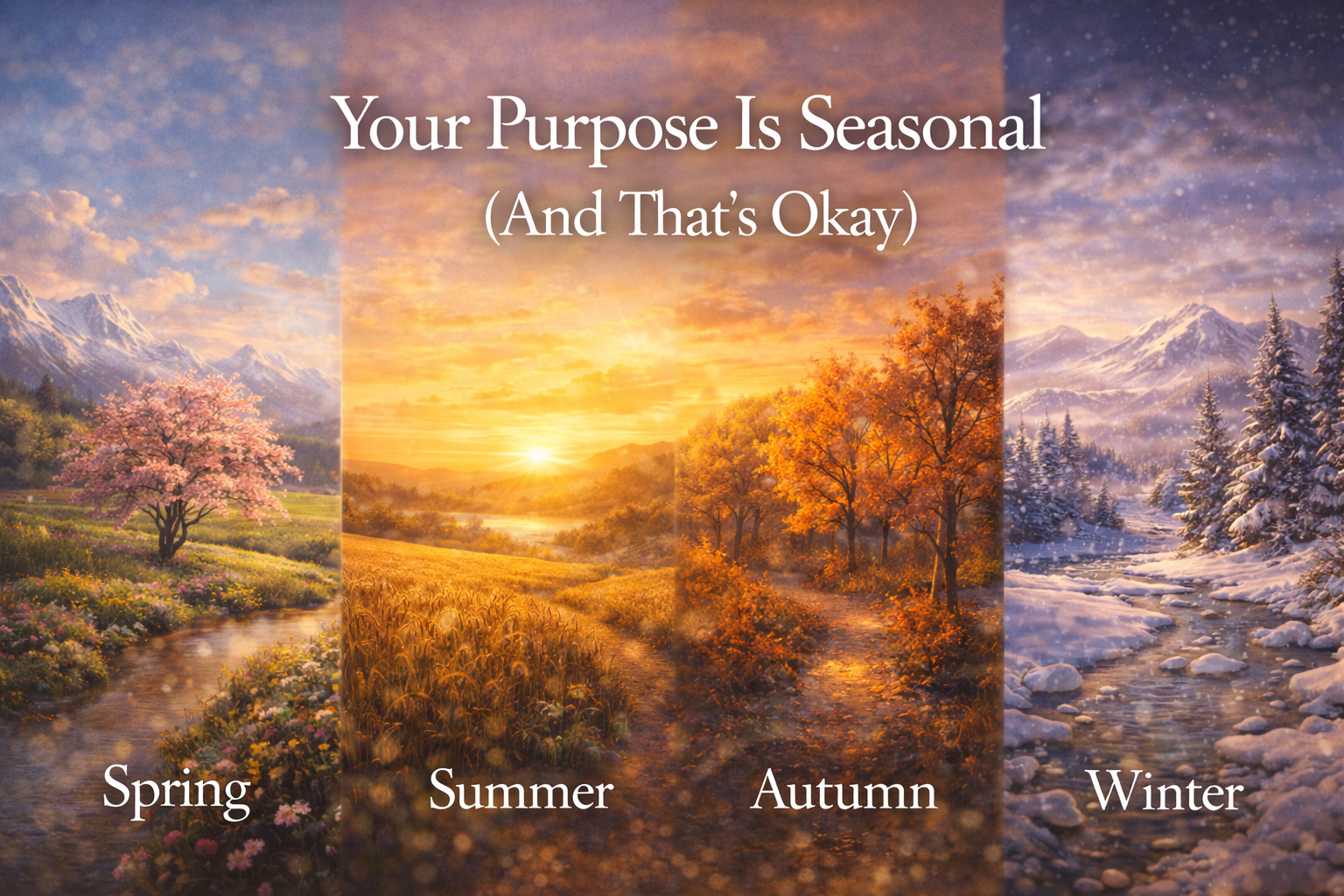
Your Purpose Is Seasonal (And That’s Okay)
Your purpose doesn’t have to stay the same forever. Learn how purpose shifts with seasons, capacity, and growth, without losing your core design.
There’s a quiet pressure many people carry: the belief that purpose must be one permanent, unchanging thing.
A single path. A single label. A single “final answer.”
And if your interests shift, or your priorities change, or your energy isn’t the same as it used to be, you might wonder if you’re unstable, scattered, or failing to “figure it out.”
But purpose often works like seasons.
It doesn’t mean you’re inconsistent. It means you’re alive.
Why purpose feels confusing when you expect it to be permanent
When you expect purpose to be one fixed destination, any change feels like losing your way.
But purpose isn’t only a destination. It’s also a relationship, something you live with. And relationships shift as you grow. What you’re meant to bring to the world can be expressed differently depending on what life is asking of you.
There are seasons for building. Seasons for healing. Seasons for caregiving. Seasons for creating. Seasons for simplifying. Seasons for starting over.
Your blueprint doesn’t change, but the expression of it can.
Your essence stays, your expression evolves
Think of your essence as the core thread: the qualities that remain true.
Maybe your essence is nurturing.
In one season, that shows up in parenting.
In another, it shows up in mentoring.
In another, it shows up in writing.
Same essence. Different expression.
Maybe your essence is clarity.
One season, you clarify systems at work.
Another season, you clarify emotions in your family.
Another season, you clarify ideas through teaching or content.
Your purpose isn’t a title you cling to. It’s a truth you live.
The four purpose seasons
Here are four common seasons your purpose may move through:
The foundation season
You’re learning skills, stabilizing, building routines, creating capacity. This season is quieter, often unglamorous, but essential.The healing season
Your purpose is restoration: nervous system repair, boundary building, rebuilding trust with yourself. You’re not “off track.” You’re becoming strong enough to carry what you’re called to.The expansion season
You feel energy return. You create, lead, serve, build, share. This is often when clarity feels louder.The refinement season
You simplify. You choose quality over quantity. You stop doing what drains you. You focus on what’s true, not what’s impressive.
None of these seasons are wrong. They’re rhythmic. Like breathing.
How to know what season you’re in
Ask yourself:
Do I need stability or expansion right now?
Is my body asking for rest, healing, or momentum?
Am I learning foundations, or building something outward?
What feels most urgent: growth, recovery, or clarity?
The answer isn’t a judgment. It’s guidance.
A practical way to stay aligned in any season
Instead of asking, “What’s my one purpose forever?” ask:
“What is my purpose in this season?”
Then answer with one sentence:
“My purpose right now is to stabilize.”
“My purpose right now is to heal.”
“My purpose right now is to create.”
“My purpose right now is to refine.”
“My purpose right now is to serve in a way that doesn’t drain me.”
This removes panic. It gives you a clean next step.
Closing breath
You are not inconsistent because your life is evolving.
Your purpose is allowed to move with your seasons, while your essence stays true underneath it all.
You’re not behind.
You’re in season.
Your Soulful Pathways ↑
Desktop: Hover over ‘Your Soulful Pathways’ in the top menu to explore another series.
Mobile: Tap the menu (☰), then choose ‘Your Soulful Pathways.’
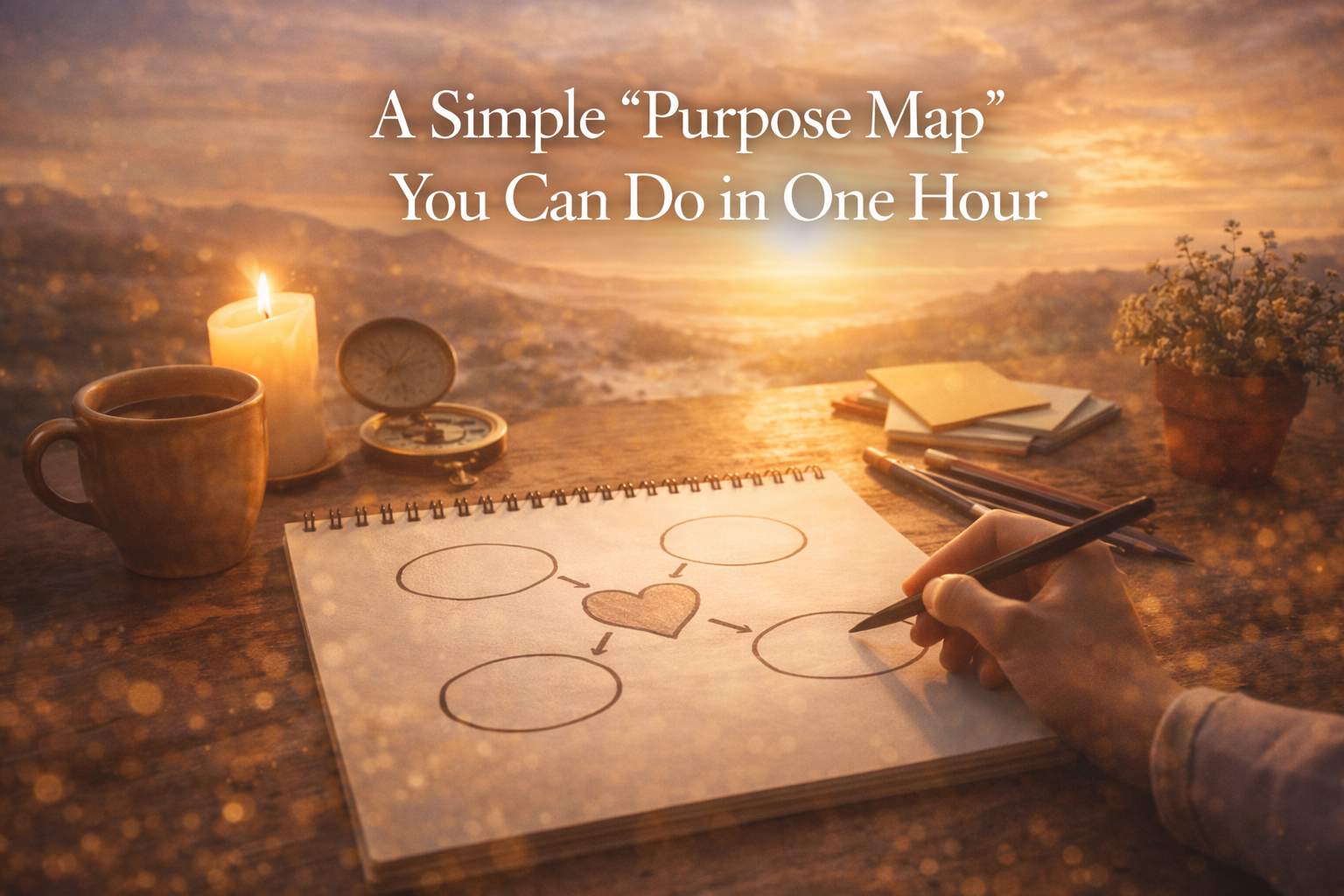
A Simple “Purpose Map” You Can Do in One Hour
Use this one-hour purpose map to identify your values, gifts, patterns, and next steps. Grounded direction you can act on immediately.
You do not need a perfect five-year plan to begin moving with purpose.
You do not need every answer.
You do not need a dramatic sign.
You do not need to solve your whole life in one sitting.
Sometimes you only need enough clarity for the next honest step.
Purpose often becomes clearer when you stop trying to force one giant answer and start gathering the clues already living inside your life.
Your values.
Your gifts.
Your patterns.
Your callings.
Your quiet pull toward what feels meaningful.
This one-hour purpose map is not about pressure.
It is about listening.
It is a simple way to notice what your life has been trying to show you and turn those clues into a direction you can actually walk.
Set The Space
Give yourself one hour.
Grab a notebook or open a blank document.
Choose a quiet place if you can.
Set a timer.
Take a breath.
Make this gentle.
Tea counts as a sacred tool.
A candle counts.
Soft music counts.
Silence counts.
Sitting in your car for one peaceful hour counts too.
This is not a test.
You are not trying to impress yourself.
You are not trying to create the perfect life plan.
You are simply making room for your spirit to speak without being rushed.
Before you begin, write this at the top of your page:
I am not forcing an answer. I am gathering clues.
Let that be the tone.
Step 1: Name Your Core Values
Spend ten minutes writing your top five values.
If you are not sure where to begin, choose from this list:
peace
truth
freedom
stability
growth
faith
family
creativity
service
excellence
compassion
simplicity
justice
learning
beauty
wisdom
courage
integrity
healing
joy
Then define each one in your own words.
For me, peace means ______.
For me, truth means ______.
For me, freedom means ______.
For me, faith means ______.
For me, creativity means ______.
Do not use dictionary definitions.
Use your real life.
Peace might mean no longer living in constant emotional noise.
Freedom might mean having room to choose your own rhythm.
Faith might mean trusting that God is still guiding you, even when the next step is not fully visible.
Stability might mean building a life that does not keep pulling you out of yourself.
When you are done, circle your top two values.
These are your compass points.
When your life moves against them for too long, you will feel it.
When your choices honor them, something inside you will begin to breathe again.
Step 2: Notice Your Gift Fingerprints
Spend ten minutes answering these quickly.
People come to me for ______.
I naturally notice ______.
I make things better by ______.
When I am at my best, I bring ______ to others.
I have always cared about ______.
I can often see ______ before other people do.
I feel useful when I am helping with ______.
Do not overthink your answers.
Your gifts are often so natural to you that you overlook them.
You may think, “That does not count. That is just how I am.”
But sometimes “just how you are” is part of your blueprint.
Maybe people come to you for calm.
Maybe they come to you for honesty.
Maybe you organize chaos.
Maybe you see solutions.
Maybe you make people feel less alone.
Maybe you create beauty.
Maybe you explain things clearly.
Maybe you protect what others overlook.
Maybe you bring warmth into hard places.
Underline repeated words or themes.
Those are your fingerprints.
They show how your soul tends to leave goodness behind.
Step 3: Understand A Repeating Pattern
Spend ten minutes naming one pattern you are ready to understand.
Write:
This keeps happening: ______.
When it happens, I usually feel: ______.
I usually respond by: ______.
What I may be learning is: ______.
The truth I may need to admit is: ______.
The boundary I may need is: ______.
The next wise step could be: ______.
This part matters because purpose is not only found in what you chase.
Sometimes purpose becomes clearer through what you finally stop repeating.
A draining relationship pattern.
A habit of over-giving.
A fear of being seen.
A tendency to shrink.
A pattern of starting and stopping.
A habit of saying yes when your spirit already knows no.
Sometimes the next step is not “do more.”
Sometimes the next step is to stop tolerating what keeps pulling you away from your design.
Patterns are not here to shame you.
They are here to reveal where your life is asking for more truth.
Step 4: Discover Your Calling Mix
Spend ten minutes rating these three callings from 1 to 10 in your current season.
Service
Creation
Presence
Then finish these sentences:
Service looks like ______ for me.
Creation looks like ______ for me.
Presence looks like ______ for me.
Service is how you help, support, guide, protect, restore, organize, advocate, or strengthen.
Creation is what you write, build, design, imagine, shape, make, solve, or bring into form.
Presence is how you bring steadiness, peace, attention, honesty, warmth, and grounded energy into the spaces you enter.
Circle the highest number.
That may be your lead calling right now.
Then notice the lowest number.
That may be the calling that needs more care, space, or balance.
Your calling mix may change by season.
There may be seasons when you are called to help.
Seasons when you are called to build.
Seasons when you are called to become still enough to hear what is next.
None of these seasons are wasted.
They each reveal something about how purpose moves through you.
Step 5: Write Your Purpose Texture Statement
Spend ten minutes completing this sentence:
When I feel most like myself, I am bringing ______ into the world through ______, and it leaves people feeling ______.
Here are a few examples:
When I feel most like myself, I am bringing peace into the world through honest words, and it leaves people feeling understood.
When I feel most like myself, I am bringing order into the world through practical support, and it leaves people feeling steadier.
When I feel most like myself, I am bringing beauty into the world through creativity, and it leaves people feeling hopeful.
When I feel most like myself, I am bringing truth into the world through guidance, and it leaves people feeling stronger.
Your statement does not have to sound impressive.
It only has to feel true.
Read it twice.
Notice your body.
Does something soften?
Does your breath deepen?
Does your spirit feel recognized?
Does the sentence feel clean, simple, and honest?
Relief is information.
Sometimes your purpose does not arrive with fireworks.
Sometimes it arrives as a quiet inner yes.
Step 6: Choose One Tiny Next Step
Spend the last eight minutes choosing one small action you can take in the next seven days.
Keep it simple.
Not a life overhaul.
Not a dramatic leap.
Not a giant promise you will resent by Tuesday.
Choose one aligned step.
Examples:
write one honest post
have one meaningful conversation
take one lesson in a course
organize one part of your space
create one small thing
pray for clarity each morning
apply to one opportunity that matches your values
set one boundary that protects your peace
share one piece of your work
make one phone call
research one path that keeps calling you
rest without guilt for one hour
Your blueprint does not require a leap.
It requires alignment.
One honest step is better than ten frantic ones.
One aligned action can begin to restore trust between you and your own life.
What Your Map May Reveal
When you finish, look over your notes.
You may notice that certain words keep appearing.
Peace.
Truth.
Healing.
Order.
Beauty.
Freedom.
Teaching.
Protection.
Creativity.
Steadiness.
Faith.
Service.
Pay attention to repetition.
Your life often whispers before it announces.
A repeated word may be a clue.
A repeated longing may be a clue.
A repeated frustration may be a clue.
A repeated gift may be a clue.
Purpose is not always hidden.
Sometimes it is scattered across your life, waiting for you to gather the pieces.
Closing Breath
You do not need to force your purpose into existence.
Your life is already leaving clues.
Values.
Gifts.
Patterns.
Callings.
Longings.
Lessons.
Quiet yeses.
Clean noes.
Gather them with honesty, and direction starts to appear.
One hour may not answer everything.
But it can help you begin.
And sometimes beginning is the moment your soul has been waiting for.
If this message resonated, you may also enjoy:
Your Purpose Is Seasonal (And That’s Okay)
The Three Callings: Service, Creation, Presence
The “Essence Yes” Test for Big Decisions
Your Soulful Pathways ↑
Discover more series pages for you in Your Soulful Pathways ↑
The Three Callings: Service, Creation, Presence
Discover three ways purpose shows up: service, creation, and presence. Identify your strongest calling and build a life that fits your design.
Purpose can feel overwhelming when you think it has to arrive as one giant assignment.
One perfect path.
One obvious mission.
One unmistakable sign.
One clear calling that explains your whole life.
But purpose is often quieter than that.
It does not always arrive as a thunderclap.
Sometimes it reveals itself through the natural ways your soul keeps showing up.
The way you help.
The way you create.
The way you steady a room.
The way you notice what others miss.
The way you keep returning to what feels meaningful, even when no one is asking you to.
Many people carry purpose through three simple, human callings:
service, creation, and presence.
Most people have all three within them, but one may lead in a certain season.
One may be louder when life is asking you to build.
One may rise when people need your steadiness.
One may become clear when your heart cannot ignore what needs care.
Your purpose does not have to look impressive to be real.
It only has to be true.
Calling One: Service
Service is the calling of helping, supporting, protecting, restoring, guiding, or strengthening what has been weakened.
It is the part of you that sees a need and feels moved to respond.
Service does not always mean caregiving as a job.
It does not always mean ministry, leadership, or a public role.
It does not always look formal.
Sometimes service looks like mentoring someone through a hard season.
Organizing what feels chaotic.
Advocating for someone who feels unheard.
Solving a problem others keep avoiding.
Bringing steadiness where people feel scattered.
Helping someone feel less alone.
Offering wisdom that makes another person breathe easier.
Service is the “I cannot ignore this” part of your blueprint.
It is the part of you that feels called to make life safer, clearer, kinder, stronger, or more whole.
But service needs wisdom.
Without boundaries, service can turn into self-erasure.
Without discernment, helping can become rescuing.
Without rest, generosity can become exhaustion.
True service does not require you to disappear.
It asks you to offer what is real from a place that is still rooted in your own spirit.
The healthiest service does not drain the life out of you.
It lets love move through you without asking you to abandon yourself.
Calling Two: Creation
Creation is the calling of bringing something into form.
It is what you make, shape, build, design, write, organize, imagine, restore, or bring to life.
Creation is not only art.
It can be writing words that help people feel seen.
Building systems that make life easier.
Designing solutions where others see only problems.
Creating beauty from ordinary life.
Turning ideas into something useful.
Making spaces feel peaceful.
Creating content that helps people breathe again.
Building something meaningful from what once felt scattered.
Creation is your inner blueprint leaving a fingerprint on the world.
It is the part of you that says, “This does not exist yet, but I can help bring it forward.”
Some people create with color.
Some create with language.
Some create with structure.
Some create with strategy.
Some create with music, food, gardens, homes, businesses, healing spaces, or better ways of doing things.
Creation is sacred because it takes what is unseen and gives it a place to live.
An idea becomes a page.
A vision becomes a plan.
A feeling becomes a song.
A burden becomes a solution.
A spark becomes something another person can hold.
Creation reminds you that purpose is not only about finding your path.
Sometimes purpose is about making one.
Calling Three: Presence
Presence is one of the most underestimated callings.
Because presence does not always look productive.
It does not always announce itself.
It does not always have visible output.
It does not always come with a title.
But presence can change the atmosphere of a life.
Presence is the calling of being grounded, attentive, emotionally safe, honest, steady, and awake where you are.
It is the gift of being with people without needing to perform.
Listening without rushing to control.
Speaking truth without harshness.
Bringing calm without becoming passive.
Staying anchored when the room is loud.
Offering your full attention instead of your distracted fragments.
Some people shift rooms simply by being in them.
Not because they are the loudest.
Not because they dominate.
Not because they need to be seen.
But because their spirit is anchored.
Presence makes people feel more human.
It can bring peace to a conversation.
Safety to a relationship.
Clarity to confusion.
Warmth to a cold room.
Honesty to a place that has been hiding from the truth.
Presence is not doing nothing.
Presence is bringing the fullness of who you are into the moment you are in.
And sometimes that is the very medicine a room needs.
Your Purpose Is Often A Mix
You may carry all three callings in different ways.
You may serve through what you create.
You may create from a place of presence.
You may offer presence while serving others.
You may move between all three depending on the season you are in.
Purpose is rarely one flat line.
It is more like a living pattern.
Ask yourself:
Do I feel most alive when I am helping, making, or being fully present?
What do people consistently thank me for?
What do I naturally return to when life gets quiet?
What kind of need do I notice first?
What kind of work gives me energy instead of only taking it?
What do I keep doing even when no one is rewarding me for it?
Your lead calling often becomes clearer when you stop choosing what looks impressive and start noticing what feels true.
Sometimes the calling is not the thing that gets the most applause.
It is the thing your spirit keeps recognizing as yours.
Why Balance Matters
Each calling is beautiful.
But each one needs balance.
If you live only in service, you may forget your own needs.
You may become responsible for everyone else’s peace while neglecting your own.
If you live only in creation, you may isolate.
You may keep building without letting yourself be held, known, or restored.
If you live only in presence, you may avoid action.
You may become peaceful in theory but hesitant to move, build, speak, or choose.
Balance does not mean all three callings are equal every day.
It means they are allowed to work together.
Service needs boundaries.
Creation needs consistency.
Presence needs embodiment.
Service asks, “Who or what am I here to help?”
Creation asks, “What am I here to bring forward?”
Presence asks, “Who am I becoming while I do this?”
When these three begin to work together, purpose becomes less heavy.
It becomes less about proving your life matters and more about living in alignment with what has always been woven through you.
A Calling Mix Check-In
Take a moment and rate each calling from 1 to 10 in your current season.
Service
Creation
Presence
Then ask:
Which one feels strongest right now?
Which one feels neglected?
Which one feels overused?
Which one is asking for more attention?
Which one needs better boundaries?
Which one would bring more peace if I practiced it weekly?
Sometimes exhaustion is not a mystery.
Sometimes it is a calling out of balance.
You may be serving without resting.
Creating without sharing.
Being present for others while absent from yourself.
Holding ideas but not giving them form.
Helping everyone else while your own spirit waits for your attention.
A small shift can bring your life back into better rhythm.
One act of service with a boundary.
One creative practice with consistency.
One moment of presence where you stop rushing and fully return to yourself.
Purpose grows clearer when your life has room to breathe.
When Your Calling Changes By Season
Your lead calling may change as you grow.
There may be seasons where service leads because someone needs your help, wisdom, protection, or support.
There may be seasons where creation leads because something inside you is ready to be written, built, spoken, designed, or shared.
There may be seasons where presence leads because life is asking you to slow down, heal, listen, and become more rooted before you move again.
A quieter season does not mean you have lost your purpose.
It may mean your purpose is changing shape.
You are not always meant to produce.
You are not always meant to pour out.
You are not always meant to carry the same assignment in the same way.
Sometimes your purpose matures with you.
Sometimes your calling becomes cleaner after you stop forcing it to look the way it used to.
Closing Breath
Your purpose does not have to be a heavy assignment.
It can be a simple alignment.
Helping where you are designed to help.
Creating what you are designed to create.
Bringing presence that makes life feel more honest, steady, and human.
That is not small.
That is sacred.
Because the world does not only need louder lives.
It needs truer ones.
And when service, creation, and presence begin to move through you with wisdom, your life becomes more than busy.
It becomes meaningful.
If this message resonated, you may also enjoy:
A Simple “Purpose Map” You Can Do in One Hour
How to Tell the Difference Between Fear and Intuition
Your Purpose Is Seasonal (And That’s Okay)
Your Soulful Pathways ↑
Discover more series pages for you in Your Soulful Pathways ↑
How to Tell the Difference Between Fear and Intuition
Fear is loud and urgent. Intuition is calm and clear. Learn practical ways to discern your inner voice and make aligned decisions.
Fear and intuition can sound similar at first because both are trying to protect you.
Both can make you pause.
Both can make you pay attention.
Both can make you question a path, a person, a decision, or a timing.
But their energy is different.
Fear creates pressure.
Intuition creates clarity.
Fear tries to control.
Intuition tries to guide.
Fear often arrives with panic, shame, and imagined disaster.
Intuition usually arrives with a cleaner knowing, even when the message is serious.
Learning the difference is part of the soul’s maturity.
It helps you stop obeying every anxious thought as if it were wisdom.
It helps you stop dismissing the quiet truth that has been trying to reach you.
How Fear Speaks
Fear often speaks in urgency.
It says:
Do it now or you will lose everything.
You are running out of time.
This will ruin your life.
You always get it wrong.
You cannot handle what happens next.
Everyone will leave.
You have to prove yourself.
Fear does not simply warn you.
It presses on you.
It fills your body with pressure, your mind with worst-case stories, and your spirit with the feeling that you must act immediately just to feel safe again.
Fear often makes everything feel bigger, faster, and heavier than it truly is.
It pulls you out of wisdom and into reaction.
It wants certainty before you move.
It wants control before you trust.
It wants proof before you breathe.
And because fear is loud, it can feel convincing.
But loud does not always mean true.
How Intuition Feels
Intuition is usually quieter than fear, but it is often clearer.
It may feel like:
a calm knowing
a simple yes
a clean no
a steady nudge that keeps returning
a quiet discomfort you cannot ignore
a sense that something does or does not fit
a peaceful pull toward one direction
a firm inner stop
Intuition does not always feel soft.
Sometimes it feels serious.
Sometimes it feels direct.
Sometimes it tells you something you did not want to admit.
But even when intuition is strong, it usually carries a different quality than fear.
It does not attack your worth.
It does not shame you into action.
It does not make you frantic.
It does not need chaos to be heard.
Intuition may be quiet, but it is persistent.
It keeps returning with the same clean message, long after the emotional storm has passed.
The Body Test
Your body often knows before your mind finishes explaining.
Take a moment and imagine choosing one path.
Notice your breath.
Notice your shoulders.
Notice your jaw.
Notice your stomach.
Notice whether your body feels pressured, frozen, heavy, or steady.
Then imagine choosing the other path.
Notice again.
Fear often feels tight, rushed, frantic, or trapped.
Intuition often feels grounded, clean, steady, or quietly firm.
This does not mean every nervous feeling is wrong.
Sometimes you feel nervous because something is new.
Sometimes you feel nervous because growth stretches you.
Sometimes you feel nervous because the next step matters.
The question is not, “Do I feel anything?”
The question is, “What is the quality of what I feel?”
Is it chaos or clarity?
Is it pressure or truth?
Is it panic or a steady knowing?
Your body can become a place of discernment when you stop rushing past what it is telling you.
The Time Test
Fear often spikes.
It rises quickly, changes with mood, and feeds on urgency.
One hour, everything feels disastrous.
The next hour, the story shifts.
By morning, the intensity may look different.
Intuition tends to remain.
It may become quieter, but it does not disappear.
It may soften, but the message stays steady.
It may wait, but it does not collapse just because your mood changes.
When possible, give the decision time.
Sleep on it.
Pray on it.
Step away from the pressure.
Let the first wave of emotion settle.
Then ask:
What still feels true?
What still feels clear?
What remains after the panic quiets down?
Time can reveal the difference between a fear reaction and a soul knowing.
The Fruit Test
One of the clearest ways to test a voice is to look at what it produces.
Fear often produces frantic action.
It makes you chase.
Force.
Over-explain.
Prove.
Shrink.
Settle.
Self-abandon.
Control what was never yours to control.
Intuition produces aligned action.
It may still require courage, but it leads you toward peace, integrity, honesty, maturity, and truth.
Ask yourself:
If I follow this voice, what kind of fruit will it produce?
Will it lead me into peace or panic?
Will it help me honor myself or abandon myself?
Will it make me more truthful or more afraid?
Will it bring me closer to wisdom or deeper into confusion?
Will it strengthen my spirit or drain it?
Fear may offer temporary relief, but it usually asks for your peace in return.
Intuition may require courage, but it does not require you to betray yourself.
When Past Pain Makes Discernment Harder
If you have lived through instability, disappointment, rejection, betrayal, or survival seasons, discernment can feel complicated.
Your system may confuse intensity with truth.
A person who feels familiar may not be healthy.
A situation that creates anxiety may feel important.
A calm path may seem boring because your body is used to chaos.
Stability may feel suspicious because peace is unfamiliar.
This does not mean you cannot trust yourself.
It means you are learning a new language within your own spirit.
Discernment becomes a practice.
One honest step instead of ten frantic ones.
One peaceful pause before reacting.
One written reflection before deciding.
One prayer before moving.
One conversation with someone steady and safe.
One value-based choice, even when your emotions feel loud.
You do not have to shame yourself for finding this hard.
You are learning to tell the difference between the voice that protects your fear and the voice that protects your future.
A Simple Discernment Practice
When you are unsure, write down the decision in front of you.
Then answer these questions:
What is fear telling me?
What is wisdom telling me?
What would I choose if I did not have to prove anything?
What would I choose if I trusted that peace is allowed?
What choice helps me remain honest with myself?
What choice requires the least self-abandonment?
What still feels true after I breathe?
You may not receive the whole answer at once.
Sometimes guidance comes as a lamp, not a lightning bolt.
It gives you enough light for the next step.
And sometimes that is all you need.
A Simple Discernment Prayer
Let what is true become clear.
Let what is fear loosen its grip.
Quiet the noise around me and within me.
Lead me toward peace, wisdom, honesty, and love.
Help me recognize the difference between panic and guidance.
Help me trust the still, steady truth You place within me.
Amen.
Closing Breath
You do not need perfect discernment to be guided.
You only need to keep choosing clarity over chaos, one decision at a time.
Fear may be loud, but loud is not the same as wise.
Intuition may be quiet, but quiet is not the same as weak.
The deeper you listen, the more you begin to recognize the difference.
Fear tries to rush you away from yourself.
Intuition gently leads you back.
If this message resonated, you may also enjoy:
The Three Callings: Service, Creation, Presence
When Life Redirects You, It’s Not Punishment
A Simple “Purpose Map” You Can Do in One Hour
Your Soulful Pathways ↑
Discover more series pages for you in Your Soulful Pathways ↑

When Life Redirects You - It’s Not Punishment
When plans fall apart, it can feel personal. Learn how to reframe redirection as guidance, protection, and deeper alignment.
When life redirects you, it can feel personal.
The door closes.
The plan changes.
The timing shifts.
The thing you were reaching for moves out of reach.
And if you are someone who tries hard, cares deeply, and wants to do things right, redirection can feel like punishment.
It can make you wonder if you missed something.
If you failed.
If you chose wrong.
If life is withholding something from you.
But not every redirection is punishment.
Sometimes it is protection.
Sometimes it is refinement.
Sometimes it is divine mercy in a form you do not understand yet.
Sometimes life is not taking you away from your purpose.
Sometimes it is taking you closer to it.
Why Redirection Can Hurt So Much
Redirection often touches the most tender places in us.
It touches the part that wanted stability.
The part that wanted certainty.
The part that hoped this time would finally work.
The part that is tired of starting over.
The part that wonders, “Am I falling behind?”
That is why a closed door can feel heavier than the door itself.
It is not only the loss of the plan.
It is the grief of what you thought the plan meant.
You may have attached safety to it.
Identity to it.
Hope to it.
Proof to it.
A future to it.
So when life redirects you, it can feel like more than a change.
It can feel like your whole inner map has been rearranged.
But sometimes the map has to change because the destination was never meant to be reached through the road you were trying to force.
Not Every Closed Door Is Rejection
Some doors close because they were never truly aligned.
Some doors close because the cost would have been your peace.
Some doors close because the role would have required self-abandonment.
Some doors close because the relationship would have kept you small.
Some doors close because the timing would have drained you.
Some doors close because the path would have pulled you farther from yourself.
A closed door can still hurt and still be mercy.
Both can be true.
You can grieve what did not happen while still trusting that life may have protected you from something you could not fully see.
Sometimes rejection is not the final word.
Sometimes it is redirection wearing a sharp edge.
Sometimes what did not choose you was never meant to carry you.
Redirection Can Refine You
Some redirection does not immediately show you a new path.
Instead, it shows you yourself.
It reveals what you were tolerating.
What you were forcing.
What you were afraid to admit.
What you were trying to make fit because you did not want to begin again.
This kind of redirection can feel uncomfortable because it removes distractions.
It asks you to become more honest.
More grounded.
More discerning.
More willing to trust what your spirit has been trying to tell you.
Redirection can refine your values.
It can strengthen your boundaries.
It can make your yes more sacred and your no more peaceful.
It can help you stop building a life around things that require you to disappear.
Sometimes life redirects you because the version of you who was willing to settle is no longer the version of you who is meant to lead.
Redirection Can Realign You
Some redirection does more than refine you.
It realigns you.
It turns you toward something you would not have chosen on your own.
It moves you into a season you did not plan.
It brings you into a rhythm, a relationship, a lesson, a place, or a calling that makes more sense later than it does in the beginning.
At first, it may look like loss.
Later, it may look like guidance.
At first, it may feel like delay.
Later, it may feel like timing.
At first, it may feel like everything fell apart.
Later, you may realize something false had to fall away so something true could finally be built.
Realignment is not always gentle when it begins.
But it can become holy when you look back and realize you were not being abandoned.
You were being moved.
What To Do In The Middle
The middle is often the hardest place.
Not where you were.
Not where you are going.
Not holding the old plan.
Not yet living the new one.
This is the space where fear gets loud.
But the middle can also become a place of deep listening.
Ask yourself:
What is this season asking me to release?
What truth is becoming impossible to ignore?
What am I no longer willing to force?
What is being simplified?
What is still steady, even now?
Where is life asking me to become braver?
What would peace choose next?
Redirection often removes what is not essential so you can rebuild from what is.
It may clear the noise.
It may strip away false urgency.
It may loosen your grip on what was never truly yours.
And in that clearing, you may begin to hear the quieter guidance that was there all along.
The Redirection Reframe
When life redirects you, your fear may rush to explain it in the harshest way possible.
Fear says, “I failed.”
Truth may say, “I am being refined.”
Fear says, “This is punishment.”
Truth may say, “This may be protection I do not understand yet.”
Fear says, “I am behind.”
Truth may say, “My life is unfolding at the pace my spirit can actually hold.”
Fear says, “Nothing is working.”
Truth may say, “Something is being rearranged.”
Fear says, “I lost my chance.”
Truth may say, “What is meant for me will not require me to lose myself to receive it.”
You do not have to believe the first story your fear tells.
You can pause.
You can breathe.
You can ask for a truer interpretation.
Sometimes peace begins when you stop calling every redirection failure.
The Detour Can Become A Door
Some detours are not empty delays.
They become the season you heal.
The pause where you stop performing.
The reset where you finally hear yourself.
The bridge to the right people.
The space where a better rhythm finds you.
The interruption that saves you from building the wrong life beautifully.
A detour can look inconvenient and still be sacred.
It can look like an ending and still be an entrance.
You may not see the door yet because you are still standing in the hallway of what changed.
But that does not mean the door is not forming.
Sometimes life has to reroute you before it can reveal what was prepared beyond the old plan.
Closing Breath
If your life has been redirected, do not rush to call it failure.
Do not shame yourself for a door that closed.
Do not assume every delay means you are forgotten.
Do not confuse discomfort with punishment.
Sometimes what you thought was the destination was only the bridge.
Sometimes what left was making room.
Sometimes what changed was protecting your peace.
Sometimes what did not work was guiding you toward what fits.
You are not being punished for needing a new path.
You are being guided into a deeper one.
And one day, the road that felt like a detour may become the very path that brings you home to yourself.
If this message resonated, you may also enjoy:
How to Tell the Difference Between Fear and Intuition
The Work You’re Here to Do Is Often Quiet
The Three Callings: Service, Creation, Presence
Your Soulful Pathways ↑
Discover more series pages for you in Your Soulful Pathways ↑
The Work You’re Here To Do Is Often Quiet
Not all meaningful work is visible. Learn to honor quiet purpose, unseen growth, and the steady inner work that changes everything.
Some of the most important work you will ever do will not be seen by everyone.
It may not be praised.
It may not be posted.
It may not come with proof the world knows how to measure.
But it will still matter.
Some work changes the outside of your life.
Some work changes the structure inside you.
And often, the work you are truly here to do begins quietly.
It begins in the choices no one claps for.
The patterns no one knows you are breaking.
The peace you protect before anyone understands why.
The strength you build before the next door opens.
Quiet work is not lesser work.
Sometimes it is the work that makes everything else possible.
Quiet Work Is Still Sacred Work
Quiet work can look simple from the outside.
It can look like pausing before you react.
Choosing peace when you could have chosen pride.
Telling the truth after years of making yourself smaller.
Letting old versions of you fall away without needing an audience.
Resting without guilt.
Staying consistent when no one is watching.
Becoming steady after years of surviving.
This kind of work does not always look dramatic.
It looks like maturity.
It looks like self-respect.
It looks like emotional strength.
It looks like finally becoming someone your own spirit can trust.
Quiet work is foundation work.
It is the unseen construction beneath a life that can finally hold more peace, more truth, more love, more purpose, and more direction.
Why Quiet Growth Can Feel So Easy To Dismiss
The world often teaches people to value what can be displayed.
Visible success.
Public achievement.
Fast results.
Loud evidence.
A life that looks impressive from the outside.
But your soul is not performing for the world.
Your growth does not need to become content to be real.
Your healing does not need applause to count.
Your becoming does not need witnesses to be sacred.
Some of the strongest changes happen in places where no one else can see.
A calmer response.
A cleaner boundary.
A wiser decision.
A softer inner voice.
A stronger refusal to betray yourself.
These may not look big to everyone else.
But to your spirit, they are landmarks.
They are proof that something real is being rebuilt within you.
Signs You Are Doing The Work You Came Here To Do
Purpose does not always feel exciting at first.
Sometimes purpose feels like alignment.
Sometimes it feels like peace returning.
Sometimes it feels like finally no longer arguing with what your spirit already knows.
You may be doing the work you are here to do when:
your choices become clearer
your peace becomes more valuable than being understood
your boundaries become cleaner
your relationships become more honest
your inner voice becomes kinder
your life becomes less shaped by fear
your spirit feels less scattered
your yes becomes more sincere
your no becomes more peaceful
your energy stops chasing what drains it
These are not small changes.
They are the architecture of a new life.
Before purpose becomes visible, it often becomes internal.
Before your life expands, your spirit often becomes steadier.
Before the next chapter arrives, something within you learns how to stand.
The Ripple Effect You May Not See Yet
You may think your quiet work is only changing you.
It is not.
When you heal a pattern, you change what you pass forward.
When you choose peace, you change what you normalize.
When you tell the truth, you make room for truth around you.
When you stop abandoning yourself, you teach your life to meet you differently.
When you become safer within yourself, you often become safer for others too.
Quiet work has a ripple.
It reaches into conversations.
It reaches into families.
It reaches into friendships.
It reaches into the choices you make when no one is guiding you.
You may never fully know how much your becoming protects, inspires, steadies, or awakens something around you.
But that does not mean the ripple is not real.
Sometimes your purpose is not only found in what you build.
Sometimes it is revealed in who you become while building it.
A Practice: Name Your Quiet Wins
Take a few minutes and write down ten quiet wins from the last month.
Not the loud wins.
Not the impressive wins.
Not the wins someone else had to validate.
The quiet ones.
Examples:
I paused before reacting.
I told the truth.
I did not chase what was pulling away.
I rested without punishing myself for needing rest.
I said no with peace.
I protected my energy.
I stayed consistent.
I chose the wiser response.
I trusted what I knew.
I gave myself credit for growth no one else could see.
Your spirit needs evidence too.
Not because you are behind.
Not because you have to prove your worth.
But because sometimes the soul relaxes when it remembers, “I am moving. I am growing. I am becoming.”
Quiet wins remind you that progress is not always loud.
Sometimes progress is the moment you no longer abandon yourself in the same old way.
What If You Feel Behind
If your life looks quieter than you expected right now, breathe.
Quiet does not always mean nothing is happening.
Sometimes a quiet season is a strengthening season.
Sometimes it is a clearing season.
Sometimes it is a root season.
Roots do not grow in applause.
They grow in depth.
And depth often takes time.
You may not be behind.
You may be becoming strong enough to carry what is next without losing yourself in it.
There are seasons when life does not ask you to prove yourself louder.
It asks you to become truer.
Closing Breath
Quiet seasons are not empty seasons.
Some roots grow in silence so the tree can stand later.
Your work counts.
Even when no one sees it.
Even when it is slow.
Even when it is quiet.
The work you are here to do may not always announce itself loudly.
But when it is real, it changes the ground beneath your life.
And one day, what grew quietly in you may become the very strength that carries everything forward.
If this message resonated, you may also enjoy:
When Life Redirects You, It’s Not Punishment
Your Purpose Has a Texture (Not a Title)
How to Tell the Difference Between Fear and Intuition
Your Soulful Pathways ↑
Discover more series pages for you in Your Soulful Pathways ↑

Your Purpose Has A Texture (Not A Title)
Purpose isn’t always a job label. Learn how to sense the texture of your purpose through what restores you, moves you, and feels true.
Many people think purpose is a title they must discover.
Teacher.
Coach.
Healer.
Entrepreneur.
Artist.
Leader.
But purpose is often a texture before it becomes a title.
It is the felt sense of what you are here to bring into the world, even before you know the exact form it will take. It is the energy beneath the role, the meaning beneath the work, the thread that keeps showing up no matter how your life changes.
A title can shift.
A season can change.
A role can end.
But the deeper texture of your purpose often remains.
You may express it through different jobs, relationships, projects, conversations, ministries, creative work, or everyday acts of care. The outer form may evolve, but the essence keeps revealing itself.
Purpose is not always asking, “What should I call myself?”
Sometimes it is asking, “What am I here to bring?”
Why Titles Can Confuse You
A title is external.
Purpose is internal.
A title tells people what box to place you in. Purpose tells you what kind of life feels aligned with your design.
You can have the “right” title and still feel empty.
You can have a humble role and feel deeply alive.
You can be impressive on paper and disconnected in your spirit.
You can be doing something simple and feel the quiet confirmation that says, “This is part of me.”
That is why titles can become confusing.
They make purpose look like something you have to announce, prove, achieve, or explain. They can make you chase a label before you understand the deeper truth beneath it.
But purpose is not about what sounds impressive to other people.
It is about what fits your soul.
It is about where your gifts, values, compassion, wisdom, and life experience begin to move in the same direction.
A title may help describe your work.
It cannot fully define your purpose.
Purpose Has a Felt Signature
Purpose feels like something.
It may feel like steady peace.
It may feel like devotion.
It may feel like quiet joy.
It may feel like courage rising in your chest.
It may feel like creative electricity.
It may feel like grounded responsibility.
It may feel like tenderness that wants to protect something precious.
It may feel like clarity, compassion, service, beauty, truth, strength, or restoration.
Your purpose has an emotional signature because your spirit recognizes alignment before your mind can explain it.
Pay attention to what happens inside you when you are doing something meaningful.
Do you feel more present?
Do you feel more awake?
Do you feel deeply useful without feeling erased?
Do you feel stretched, but in a way that feels honest?
Do you feel like something in you is saying yes?
That matters.
Your body, your spirit, and your peace often hold clues your overthinking has not learned how to trust yet.
Purpose does not always feel easy.
But it often feels true.
Your Purpose Texture Leaves Clues
If you want direction without forcing a perfect answer, begin with three questions.
What restores me?
Not entertainment.
Not distraction.
Not numbing.
Restoration is the thing that fills something back up in you. It returns you to yourself. It makes your inner world feel steadier, clearer, or more alive.
What moves me?
What kind of needs, stories, people, wounds, possibilities, or moments pull your heart forward?
What makes you care deeply?
What keeps catching your attention?
What do you notice that others may walk past?
What matters even when I am tired?
Fatigue often strips away performance.
It reveals what is real.
When you are too tired to impress anyone, what still matters?
What still feels meaningful?
What still feels worth protecting, building, healing, creating, clarifying, or offering?
Where restoration, movement, and meaning overlap, the texture of purpose begins to form.
You may not have the full title yet.
But you may begin to feel the thread.
Purpose Works Better as a Verb
Instead of asking, “What am I?” ask a truer question.
What am I here to build?
What am I here to protect?
What am I here to heal?
What am I here to clarify?
What am I here to create?
What am I here to guide?
What am I here to restore?
What am I here to strengthen?
Verbs keep you free.
They let your purpose evolve without losing its core.
Maybe your purpose is to comfort. That can show up in parenting, writing, mentoring, friendship, nursing, leadership, ministry, or the way you hold space for people.
Maybe your purpose is to clarify. That can show up in teaching, organizing, coaching, planning, project work, problem-solving, content creation, or helping people see what they could not see before.
Maybe your purpose is to build. That can show up in business, home, community, systems, art, faith work, or creating something that gives other people a place to stand.
One essence can have many expressions.
One purpose can wear many forms.
You are not behind because you do not have one perfect label yet.
You may simply be learning the verb your life keeps returning to.
Alignment Can Start Before the Full Plan
Purpose does not demand that you know the entire road before you begin.
It asks for alignment.
The next step may be small.
One conversation.
One boundary.
One honest decision.
One class.
One small project.
One brave yes.
One peaceful no.
One page written.
One gift practiced.
One truth finally admitted.
Clarity grows in motion.
You do not need a perfect label before you begin living with more intention. You do not need to turn your purpose into a title before you honor it. You do not need to explain the whole picture before you take the next faithful step.
Try this practice:
Finish this sentence without editing yourself:
When I feel most like myself, I am bringing __________ into the world through __________, and it leaves people feeling __________.
Read it twice.
Notice your body.
If something in you exhales, pay attention.
Relief is information.
Peace is information.
A quiet yes is information.
You do not have to force a calling into existence.
Let your purpose be something you live, not something you prove.
The title can come later.
Alignment can start now.
If this message resonated, you may also enjoy:
The Work You’re Here to Do Is Often Quiet
When Life Redirects You, It’s Not Punishment
Your Soulful Pathways ↑
Discover more series pages for you in Your Soulful Pathways ↑

Your Gifts Leave Fingerprints
Your gifts are already visible in how you notice, help, and create. Learn how to recognize your “gift fingerprints” and trust what comes naturally.
Your gifts are not always loud.
They do not always arrive with applause, attention, or a spotlight. Sometimes they show up as the thing you do so naturally that you assume it does not count.
But your gifts leave fingerprints.
They leave evidence in the people you strengthen, the rooms you steady, the problems you notice, the beauty you create, and the way something improves when you are present.
A gift is not always the thing that makes the most noise.
Sometimes it is the quiet grace you carry without realizing how deeply it matters.
Your life has been giving you clues. You may not have named them yet, but they have been there.
In what people come to you for.
In what you notice before others do.
In what you make easier, clearer, calmer, safer, or more beautiful.
Your gifts are not hidden because they are absent.
They may be hidden because they feel familiar.
What Counts as a Gift
A gift is not only talent.
It is impact.
It is what people consistently receive from you, even when you are not trying to impress anyone.
Some gifts look like making people feel safe.
Some gifts look like seeing what others miss.
Some gifts look like explaining things clearly.
Some gifts look like bringing calm into chaos.
Some gifts look like organizing what feels overwhelming.
Some gifts look like listening in a way that helps people feel seen.
Some gifts look like noticing the overlooked and honoring it.
Some gifts look like creating beauty from ordinary moments.
Not every gift is flashy.
Not every gift is public.
Not every gift is something you can place on a résumé.
Some gifts are quiet and still change the temperature of a room.
Some gifts never ask for attention, but they leave people better than they were before.
That matters.
Real Gifts Leave Evidence
A real gift usually leaves evidence in three ways.
It is repeatable.
It shows up across different seasons and settings. You may notice it at work, at home, in friendships, in conversations, or even with strangers. You may not always use it the same way, but the pattern keeps appearing.
It is energizing, even when it requires effort.
A gift can still take work. It can still stretch you. It can still require practice, patience, and wisdom. But somewhere inside it, something comes alive. Your spirit recognizes itself there.
It produces fruit.
People feel clearer, steadier, more hopeful, more understood, more organized, more encouraged, or more strengthened because of what you bring.
Fruit matters.
Fruit is evidence.
You do not have to call something a gift just because you enjoy it.
And you do not have to dismiss something just because it feels natural.
Look at what keeps showing up.
Look at what helps.
Look at what brings life.
Those fingerprints are part of your soul blueprint.
Why We Dismiss Our Own Gifts
Many people dismiss their gifts because the gift feels too easy.
They think, “If this comes naturally to me, it must not be important.”
But ease does not mean emptiness.
Ease may mean alignment.
You may also dismiss your gifts because no one praised them early. You may have learned to hide what made you shine. You may have believed humility meant shrinking. You may have been taught to value only what looks impressive, measurable, profitable, or difficult.
If you grew up in survival mode, you may not have had room to notice your gifts.
You were busy getting through.
You were busy staying steady.
You were busy reading the room, carrying too much, or trying not to need anything.
But gifts do not expire.
They wait.
They keep leaving little traces until you are ready to recognize them.
The gift you have been shrugging off may be one of the clearest clues to your design.
Your Story Can Point to Your Gift
Sometimes your gift is connected to what you had to learn the hard way.
If you have known anxiety, you may carry a gift of calm.
If you have known instability, you may carry a gift of steadiness.
If you have known what it feels like to be unseen, you may carry a gift of presence.
If you have known heartbreak, you may carry a gift of compassion.
If you have known confusion, you may carry a gift of clarity.
If you have known loneliness, you may carry a gift of welcome.
This does not glorify pain.
It honors transformation.
Not every gift comes from hardship, but sometimes the places that once hurt become places where wisdom grows. Sometimes what you survived gives you eyes for what others are carrying. Sometimes the very thing you needed becomes the thing you know how to offer with tenderness and strength.
Your story is not just a record of what happened.
It can also be a map of what has been formed in you.
Use Your Gifts Without Losing Yourself
A gift still needs wisdom.
A gift still needs boundaries.
A gift without a boundary can become overgiving.
A gift without rest can become exhaustion.
A gift without discernment can turn into carrying what was never yours to carry.
You are not required to pour yourself out just because you can help.
You are allowed to use your gifts in a way that honors your peace, your energy, your season, and your capacity.
Ask yourself:
What is one small way I can use my gift this week without abandoning myself?
Maybe it is one honest conversation.
Maybe it is creating something small.
Maybe it is helping someone in a way that does not drain you.
Maybe it is practicing the gift privately before sharing it publicly.
Maybe it is finally admitting, “This matters to me.”
Small use is still use.
Gifts grow when they are practiced, not when they are doubted.
You do not have to force a calling into existence.
Your life has receipts.
Follow the fingerprints, and you will stop chasing who you think you should be.
You will start recognizing who you already are.
If this message resonated, you may also enjoy:
Your Purpose Has a Texture (Not a Title)
The Patterns You Keep Repeating Are Clues
The Work You’re Here to Do Is Often Quiet
Your Soulful Pathways ↑
Discover more series pages for you in Your Soulful Pathways ↑

The Patterns You Keep Repeating Are Clues
The patterns you keep repeating aren’t proof you’re broken. Learn how to decode cycles as clues and turn them into clarity, healing, and direction.
If you keep repeating the same kind of situation, it does not mean you are doomed.
It does not mean you are broken.
It does not mean you are bad at life.
It means something in your life is asking to be understood.
Patterns are often the soul’s way of highlighting an unmet need, an unfinished lesson, a truth you are ready to face, or a boundary you are learning how to hold. They are not here to condemn you. They are here to show you something.
A pattern is a clue.
And clues are hopeful because they can be read.
Once you begin reading the pattern instead of shaming yourself for it, the whole thing starts to loosen. You stop asking, “Why do I always do this?” with frustration, and you begin asking, “What is this trying to teach me?”
That question changes everything.
Patterns Are Not Proof of Failure
A repeating cycle can feel deeply personal, like life is pointing at you and saying, “Here you go again.”
But patterns often repeat for a simpler reason.
They are familiar.
Familiar does not always mean healthy. It does not always mean aligned. It does not always mean good for you.
It simply means known.
Your inner life remembers what you adapted to. It remembers what you tolerated. It remembers what you were praised for, what you were punished for, what you had to carry, and what you were taught to accept as normal.
Sometimes you are not repeating because you want to.
You are repeating because part of you reaches for what it recognizes.
That is not a curse.
That is conditioning.
And conditioning can change.
The moment you can see the pattern clearly, you are no longer fully asleep inside it. Awareness becomes the little lantern at the cave door. It does not solve everything in one flash, but it shows you where the opening is.
Familiar Is Not the Same as True
Some patterns feel powerful because they have been with you for a long time.
You may have learned to over-give because being needed made you feel safe.
You may have learned to stay quiet because speaking up once cost you too much.
You may have learned to over-explain because being misunderstood felt unbearable.
You may have learned to carry everything because no one else seemed steady enough.
You may have learned to stay too long because leaving felt like failure.
Those patterns may have made sense at one time.
They may have helped you get through seasons where you were doing the best you could with what you knew.
But what helped you survive one season may not be what helps you become whole in the next.
A pattern can be familiar and still be false.
It can feel automatic and still not be your truth.
It can feel like “just the way I am” and still be something you learned.
This matters because your soul blueprint is not only found in what feels natural. It is also found in what keeps repeating until you finally see the lesson.
The Feeling Is the Thread
If you want to understand a pattern, begin with the feeling.
Ask yourself:
What do I always feel in this kind of situation?
Unseen?
Responsible?
Guilty for needing anything?
Afraid to disappoint?
Afraid to be rejected?
Afraid to be alone?
Afraid to be too much?
Afraid to ask for what I truly need?
The feeling is the thread.
Follow the thread, and you will often find the belief underneath it.
Maybe the belief says, “I have to earn love.”
Maybe it says, “My needs are a burden.”
Maybe it says, “Peace will disappear if I tell the truth.”
Maybe it says, “If I do not handle everything, everything will fall apart.”
Once the belief is named, the pattern begins to lose some of its power.
You are no longer standing in a fog.
You are seeing the shape of what has been driving the cycle.
Insight is not self-blame.
Insight is a doorway.
Some Patterns Are Callings in Disguise
Not every repeating pattern is about pain.
Some patterns repeat because something beautiful in you keeps trying to come alive.
You may keep feeling pulled to write, create, teach, guide, build, organize, mentor, lead, encourage, heal, design, or speak truth in some way.
You may keep dismissing it because it feels too big, too late, too uncertain, too impractical, or too different from the life you already know.
But the pull keeps returning.
That is a clue too.
Some patterns are not warnings.
Some are invitations.
A repeated desire can be part of your blueprint.
A repeated longing can point toward a gift.
A repeated burden for certain people, places, problems, or possibilities can reveal where your spirit is paying attention.
Sometimes the pattern is not saying, “Look what is wrong.”
Sometimes it is saying, “Look what is waking up.”
Change Begins With One Different Choice
Patterns usually break through small, honest choices.
Not dramatic reinventions.
Not sudden perfection.
Not one giant declaration that you will never repeat anything again.
Real change often begins quietly.
Pausing before you explain yourself.
Leaving at the first red flag instead of the fifth.
Saying “no” without writing a whole speech around it.
Asking for help without apologizing for needing it.
Resting before burnout forces you to stop.
Telling the truth sooner.
Choosing peace before pressure talks you out of it.
Listening to the inner nudge instead of burying it under fear.
Tiny changes can create massive relief because they interrupt the old agreement.
They tell your spirit, “We are not doing it the same way this time.”
Pick one repeating pattern and write this down:
What keeps happening?
What do I feel during and after it?
Who do I become in the pattern?
What do I avoid by repeating it?
What does it cost me?
What would change if I believed I deserve better?
Do not rush the answers.
Let them tell the truth slowly.
Your patterns are not condemnation.
They are instruction.
You are not stuck.
You are learning the language of your life.
And when you read the clue correctly, the pattern begins to loosen.
If this message resonated, you may also enjoy:
The Difference Between Personality and Essence
Your Core Values Are Your Compass
Your Soulful Pathways ↑
Discover more series pages for you in Your Soulful Pathways ↑

Your Core Values Are Your Compass
When life feels uncertain, your values provide direction. Learn how to identify your core values and make decisions that feel steady and true.
If you have been asking, “What should I do with my life?” there is a quieter question that often carries the answer:
“What do I value most, even when no one is watching?”
Your values are not random preferences.
They are not simply likes, opinions, or personality traits.
They are the deeper compass points your spirit keeps trying to live by. They show you what feels honest, what feels false, what gives you peace, and what slowly drains the life out of you.
When you ignore your values, life begins to feel like a daily compromise. You may still be functioning. You may still be doing what looks responsible, acceptable, or impressive from the outside. But inside, something feels unsettled.
That unsettled feeling is not always confusion.
Sometimes it is your compass asking to be honored.
Values Show You What Fits
Two people can live the same lifestyle and feel completely different inside it.
One person may thrive with structure, rhythm, and predictability. Another may feel trapped by the same routine.
One person may feel alive in constant movement, conversation, and activity. Another may feel scattered and drained by it.
One person may love risk, change, and adventure. Another may need steadiness, peace, and a strong sense of home.
The difference is not weakness.
It is not willpower.
It is values.
Values tell you what “right” feels like for you.
They help explain why something can look good on paper and still feel wrong in your spirit. They help you understand why certain rooms open you, while others make you shrink. They help you stop forcing yourself to want a life that was never aligned with your design.
Your values are not here to limit your options.
They are here to help you recognize what fits.
Second-Guessing Can Be a Signal
Second-guessing is not always insecurity.
Sometimes it is misalignment.
If you keep choosing things that clash with your values, your body, mind, and spirit may keep resisting, even when the choice seems logical.
If you value peace but keep choosing urgency, you may feel constantly unsettled.
If you value truth but keep performing, you may feel restless.
If you value freedom but keep building your life around control, you may feel trapped.
If you value depth but keep living on the surface, you may feel hungry for something more honest.
Your values are not trying to ruin your plans.
They are trying to protect your soul from building a life that looks successful but feels empty.
Sometimes the hesitation you feel is not because you are incapable.
Sometimes it is because your deeper self knows the path in front of you comes at too high a cost.
Your Strong Reactions Hold Clues
One of the simplest ways to discover your values is to look at your emotional history.
Think of a time you felt deeply respected, safe, proud, peaceful, or alive.
What value was being honored?
Maybe it was honesty.
Maybe it was freedom.
Maybe it was creativity, devotion, excellence, simplicity, beauty, faith, family, service, courage, peace, or meaningful work.
Now think of a time you felt angry, hurt, drained, overlooked, or deeply uncomfortable.
What value was violated?
Often, your strongest values show up through your strongest reactions.
You may feel anger when fairness is ignored because justice matters to you.
You may feel grief when tenderness is mocked because compassion matters to you.
You may feel exhausted by constant pressure because peace matters to you.
You may feel restless in shallow spaces because truth matters to you.
Your reactions are not always problems to silence.
Sometimes they are messages to understand.
Name Your Compass Clearly
Once you begin noticing your values, write them down in your own words.
Do not use dictionary definitions.
Use personal definitions.
Peace may mean: I move at a pace that keeps my spirit steady.
Truth may mean: I do not abandon myself to be accepted.
Service may mean: I help in ways that empower without erasing myself.
Creativity may mean: I make room for what wants to be born through me.
Freedom may mean: I choose paths with breath, space, and flexibility.
Faith may mean: I walk with God before I walk with fear.
Beauty may mean: I protect what brings light, meaning, and tenderness into the world.
Choose five values that feel deeply true to you.
Then ask:
Does my current life support these values or fight them?
This question is not meant to shame you.
It is meant to show you where small course corrections can create great relief.
Sometimes one honest adjustment can bring more peace than a dozen forced plans.
Let Your Values Guide the Next Step
Values do not remove every hard choice.
They remove a great deal of confusion.
When you are unsure, ask:
Which option honors my top values?
Which option costs me my peace?
Which option makes me smaller?
Which option feels honest, even if it feels uncomfortable?
Which option helps me become more aligned with the person I am here to be?
You do not need perfect certainty to move forward.
You need a compass you trust.
Your values are part of your soul blueprint. They are evidence of your design. They show you what deserves protection, what deserves space, and what kind of life your spirit can actually breathe inside.
When you live from your values, you stop drifting.
You stop building your life around pressure, comparison, and outside approval.
You begin aligning.
And alignment has a quiet strength.
It does not always announce itself loudly.
Sometimes it simply feels like peace returning to the room.
If this message resonated, you may also enjoy:
The Difference Between Personality and Essence
The Patterns You Keep Repeating Are Clues
Your Soulful Pathways ↑
Discover more series pages for you in Your Soulful Pathways ↑