
The Essence Yes Test for Big Decisions
Use the Essence Yes Test for big decisions by examining your values, tradeoffs, timing, future direction, intuition, and whether a choice truly fits the life you want to live.
Some decisions are easy.
You know what you want.
You know what makes sense.
You choose.
But the decisions that shape a life are rarely that simple.
Take the job or stay.
Move or remain where you are.
Say yes to the opportunity or walk away.
Start the business.
End the project.
Make the investment.
Commit.
Wait.
Begin again.
Sometimes both choices have advantages.
Sometimes both involve risk.
Sometimes everyone around you has an opinion.
And sometimes the choice that looks strongest on paper creates a strange resistance inside you.
That is where a different kind of question can help:
Does this choice allow me to remain aligned with who I am at my core?
That is the heart of the Essence Yes Test.
What Is an Essence Yes?
An Essence Yes is more than excitement.
Excitement can be temporary.
It is more than comfort.
The right decision is not always comfortable.
It is more than approval.
Other people can love a choice that does not fit you.
And it is more than fearlessness.
You can be afraid and still know you want to move forward.
An Essence Yes is the deeper recognition that a choice fits the larger pattern of your life.
Your values.
Your priorities.
Your character.
Your gifts.
Your desired way of living.
Your responsibilities.
Your future direction.
The person you are becoming.
It is the sense that:
This belongs in my life.
An Essence Yes Is Not the Same as Intuition
Intuition may be part of an Essence Yes.
But they are not identical.
Intuition can be one signal.
A quiet knowing.
A warning.
A pull.
A sense that something deserves attention.
The Essence Yes Test looks at the whole decision.
Intuition.
Values.
Evidence.
Timing.
Tradeoffs.
Practical realities.
Desired way of living.
Future consequences.
Alignment with who you are.
An intuitive feeling may begin the conversation.
An Essence Yes asks whether the larger picture agrees.
That distinction matters.
Why Good Opportunities Can Still Be Wrong for You
One of the hardest decisions is not choosing between something good and something bad.
It is choosing between something good and something right for you.
A job can offer more money and still move you farther from the life you want.
An opportunity can bring recognition while demanding a way of living you dislike.
A beautiful home can require financial pressure that changes everything else.
A business opportunity can be profitable but take you away from work that matters more.
Something can be impressive.
Desirable.
Successful by conventional standards.
And still be wrong for your life.
The question is not only:
Is this a good opportunity?
Ask:
Is this a good opportunity for me?
That one word changes the decision.
Start With Your Core Values
Before evaluating the choice itself, return to what matters most.
Faith.
Family.
Freedom.
Integrity.
Security.
Creativity.
Service.
Peace.
Growth.
Independence.
Connection.
Contribution.
Ask:
Does this choice support the values I say matter most?
Then go deeper:
What will this decision require me to compromise?
Every meaningful choice has tradeoffs.
The goal is not to find an option that costs nothing.
The goal is to understand what you are being asked to exchange.
Test One: Does This Choice Respect Who I Am?
Some decisions require growth.
That is healthy.
But growth is different from continually pretending to be someone you are not.
Ask:
Will this choice allow me to use my natural strengths?
Can I be myself here?
Will I respect the person I need to become in order to sustain this choice?
Does this direction strengthen qualities I value in myself?
A decision can stretch you without separating you from yourself.
Test Two: Does It Fit the Life I Actually Want?
People often evaluate decisions by looking only at the reward.
Salary.
House.
Title.
Opportunity.
Achievement.
Destination.
But every reward comes attached to a life.
A higher-paying job may come with longer hours.
A beautiful property may require more maintenance.
A promotion may mean less time doing the work you actually enjoy.
A business may create freedom eventually but require intense commitment now.
Do not evaluate only the prize.
Evaluate the life surrounding the prize.
Ask:
If this works exactly as planned, do I want the daily life it creates?
That question can reveal more than the reward itself.
Test Three: What Is the Real Price?
Price is larger than money.
Every major decision has a cost.
Time.
Energy.
Attention.
Freedom.
Opportunity.
Relationships.
Stress.
Responsibility.
Focus.
Ask:
What will this choice require from me?
Then:
Am I willing to pay that price?
Something can be worth the cost.
But you should know what the cost is.
A conscious tradeoff can become commitment.
An unconscious one can quietly become resentment.
Test Four: What Am I Saying No To By Saying Yes?
Every yes contains a no.
Say yes to one use of your time and you say no to another.
Say yes to one major project and another may need to wait.
Say yes to one location and you cannot simultaneously build a life somewhere else.
This is not negative.
It is simply how choices work.
Ask:
If I say yes to this, what am I saying no to?
Then:
Am I comfortable with that no?
Sometimes this reveals more than the opportunity itself.
Test Five: Would I Still Want This Without the Applause?
Remove the audience.
Remove social media.
Remove the title.
Remove the prestige.
Remove the ability to tell anyone about it.
Now look at the choice again.
Would I still want it?
This question can separate genuine desire from borrowed desire.
We absorb ideas about what a successful life is supposed to look like.
But an impressive life and a meaningful life are not automatically the same thing.
Your decision has to be lived by you.
Test Six: Is This Expanding Me or Simply Inflating Me?
Some opportunities expand us.
They increase capacity.
Knowledge.
Courage.
Skill.
Service.
Creativity.
Wisdom.
Other opportunities mainly increase image.
Status.
Attention.
Recognition.
There is nothing inherently wrong with achievement.
But ask:
What will actually grow if I choose this?
My ability?
My contribution?
My character?
My understanding?
My freedom?
Or primarily the way I appear to other people?
Expansion changes what you are capable of becoming.
Inflation changes how large something looks from the outside.
Test Seven: Does My Future Self Benefit From This Choice?
Imagine yourself several years from now.
Not an idealized version.
You.
Living with the consequences.
What did this choice build?
What did it make possible?
What did it cost?
What did you learn?
Who did you become?
Now ask:
Will I be grateful that I made this choice?
You cannot predict the future perfectly.
That is not the point.
The question helps move you beyond immediate emotion and into longer-range thinking.
Test Eight: What Would I Know If the Pressure Disappeared?
Urgency changes decisions.
Some deadlines are real.
But pressure can also make everything feel more urgent than it is.
Imagine for a moment that nobody needs an answer today.
Nobody is waiting.
Nobody is disappointed.
There is nothing to prove.
Now ask:
What becomes clearer?
Sometimes the answer remains the same.
Sometimes the noise falls away and you realize you already knew.
Test Nine: Is This Fear Asking Me to Grow or Wisdom Asking Me to Stop?
A meaningful decision can create fear.
That alone does not make it wrong.
Starting something new can be frightening.
Moving can be frightening.
Creating can be frightening.
Being seen can be frightening.
Leaving the familiar can be frightening.
Instead of asking only:
Am I scared?
Ask:
What is the fear about?
Is it fear of being inexperienced?
Fear of change?
Fear of failure?
Fear of visibility?
Those fears may accompany growth.
Or is the resistance connected to a genuine conflict with your values, responsibilities, evidence, timing, or deeper sense of direction?
Fear deserves examination.
It does not automatically deserve the final vote.
Test Ten: What Happens When I Imagine I Have Already Chosen?
For a few minutes, pretend the decision has already been made.
I am doing it.
Do not debate.
Imagine tomorrow.
Next month.
Next year.
Notice what becomes clearer.
Then try the opposite.
I am not doing it.
Again, do not debate.
Imagine that path.
You may notice:
Relief.
Grief.
Energy.
Resistance.
Curiosity.
Peace.
Regret.
Excitement.
No single feeling is the answer.
Look at the pattern.
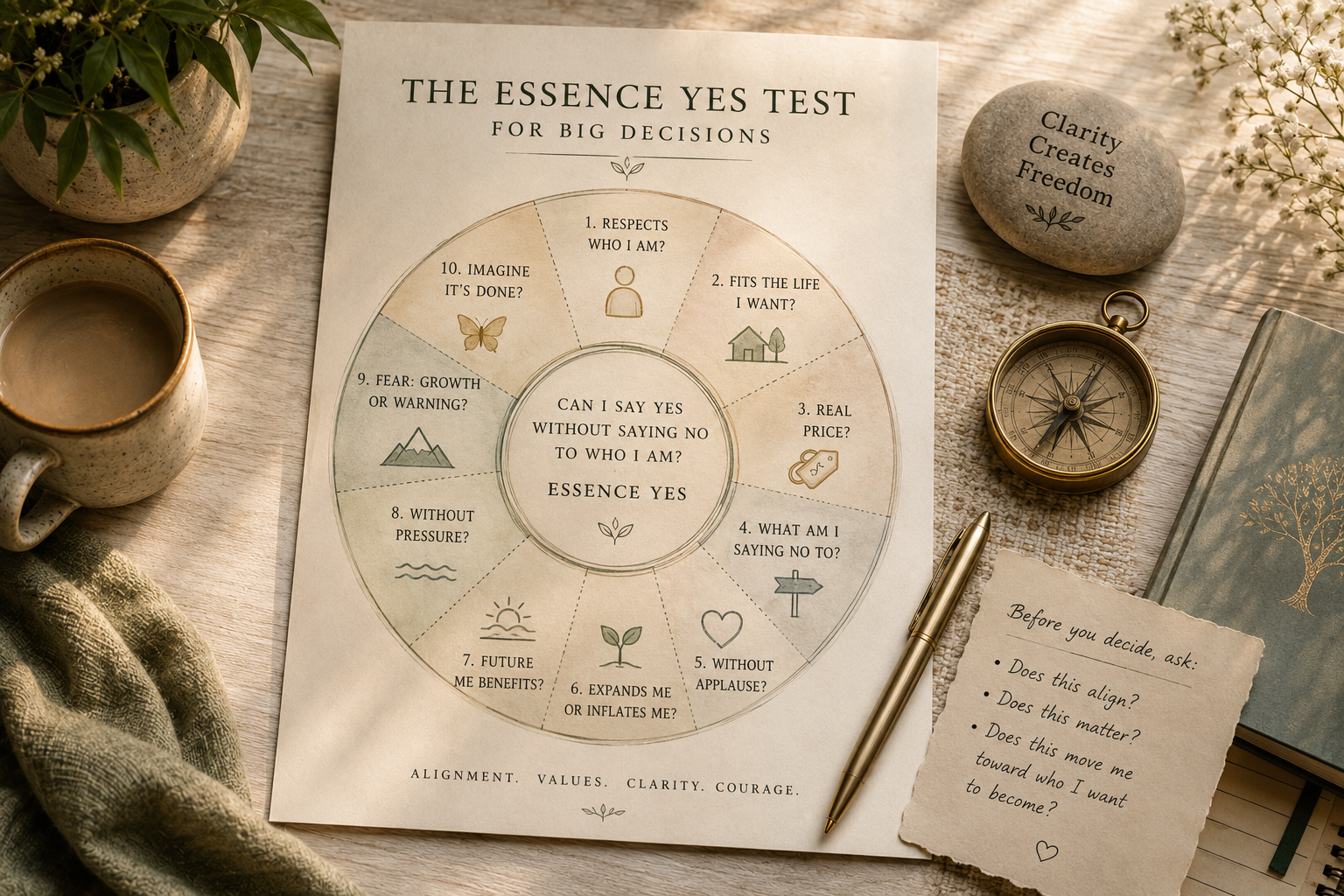
The Essence Yes Test
When facing an important decision, write these questions down:
1. Does this choice respect who I am?
2. Does it fit the life I actually want?
3. What is the real price?
4. What am I saying no to by saying yes?
5. Would I still want this without anyone else’s approval?
6. Is this expanding me or mainly improving my image?
7. Will my future self benefit from this choice?
8. What would I know if the pressure disappeared?
9. Is my fear pointing toward growth or toward something genuinely misaligned?
10. What do I notice when I imagine the decision is already made?
Then ask one final question:
When I consider everything together, is there an Essence Yes here?
This Is Not a Scorecard
Do not count the yeses.
Eight yeses and two noes do not automatically equal yes.
One issue may matter more than several others combined.
A choice may look excellent in nine categories but violate one core value you are unwilling to surrender.
Or a decision may include several difficult tradeoffs while still feeling deeply aligned overall.
The Essence Yes Test is not about arithmetic.
It is about weight.
Which answers matter most?
What is negotiable?
What is not?
Where is there tension?
Where is there coherence?
You are looking for the shape of the whole decision.
An Essence Yes Does Not Mean Everything Is Perfect
A genuine yes can still contain inconvenience.
Sacrifice.
Uncertainty.
Work.
Learning.
Risk.
Fear.
You may still wish parts of the situation were different.
Alignment does not mean perfection.
It means that when you look at the whole choice, the tradeoffs still make sense in relation to what matters.
You are willing to carry the difficult parts because you believe in what the decision makes possible.
Sometimes the Answer Is Not Yet
There is another answer between yes and no.
Not yet.
The direction may be right while the timing is wrong.
You may need more information.
More savings.
More preparation.
Another conversation.
A skill.
A plan.
A commitment completed first.
Sometimes clarity comes from separating:
Do I want this?
from
Is now the right time?
Those are different questions.
A Conditional Yes Can Be an Honest Yes
Sometimes the answer is:
Yes, if...
Yes, if the schedule can change.
Yes, if the numbers work.
Yes, if my family can be supported through the transition.
Yes, if the agreement protects something important.
Yes, if I can maintain the part of my life I am unwilling to sacrifice.
Conditions are not automatically hesitation.
Sometimes they reveal exactly what the decision needs in order to become aligned.
Be Careful With Decisions That Require Constant Self-Betrayal
Compromise is part of life.
Self-betrayal is different.
If a choice repeatedly requires you to violate your deepest values, ignore what you know, become someone you do not respect, or abandon what matters most to you, pay attention.
No reward automatically makes that bargain worthwhile.
A decision should not require you to continually leave yourself behind in order to maintain it.
A Right Decision Can Still Have Difficult Days
Once people make a major choice, they sometimes interpret every difficult moment as evidence that the decision was wrong.
But every path contains friction.
A new business can fit beautifully and still have terrible weeks.
A move can be right and still include loneliness.
A meaningful commitment can be right and still demand sacrifice.
Do not judge an entire decision by one difficult day.
Look at the larger pattern.
You Do Not Need Absolute Certainty
Most meaningful decisions arrive without guarantees.
You can research.
Think.
Pray.
Ask questions.
Run numbers.
Seek counsel.
Listen inwardly.
Consider consequences.
And still not know exactly what will happen.
At some point, decision-making becomes participation.
You choose.
Then you bring your wisdom, character, effort, faith, creativity, and presence into what happens next.
Clarity matters.
So does courage.
Can I Say Yes Without Saying No to Who I Am?
The Essence Yes Test is not about finding a life where nothing goes wrong.
It is about making choices that increasingly resemble the life you actually mean to live.
A life aligned with your values.
A life that uses your gifts.
A life that respects what matters.
A life whose costs you consciously choose.
A life that feels like yours.
Sometimes that means saying yes to something enormous.
Sometimes it means walking away from something impressive.
Sometimes it means waiting.
Sometimes it means changing the terms.
Sometimes it means choosing the quieter road because it leads somewhere you recognize.
Beneath all ten questions is one deeper question:
Can I say yes to this choice without saying no to who I am?
When the larger picture answers yes, pay attention.
That may be your Essence Yes.
Explore Further
The Difference Between Personality and Essence
Explore the deeper qualities that remain beneath roles, habits, expectations, and changing identities.
Your Core Values Are Your Compass
Explore the values that can guide important decisions when several paths appear possible.
How to Tell the Difference Between Fear and Intuition
Go deeper into discerning fear, impulse, practical caution, and intuitive knowing.
A Simple Purpose Map You Can Do in One Hour
Map your values, strengths, experiences, interests, contribution, and desired way of living.
Your Purpose Is Seasonal and That’s Okay
Explore why a choice or calling that once fit beautifully may change as your life enters another season.
Soul Blueprint
Explore the deeper pattern formed by your essence, values, gifts, recurring themes, intuition, and purpose.
Your Purpose Is Seasonal and That’s Okay
Explore how life purpose can evolve through different seasons while deeper values, gifts, and meaningful threads remain, and learn how to recognize what your current season may be asking of you.
There are things you may once have been certain you were meant to do.
A career.
A business.
A relationship.
A role.
A project.
A way of serving.
A dream you carried for years.
Maybe you poured yourself into it.
Maybe it mattered deeply.
Maybe it shaped you.
And then something changed.
What once felt alive began to feel complete.
What once pulled you forward stopped calling so loudly.
A different interest appeared.
Your values shifted.
Your responsibilities changed.
An old dream no longer fit the person you had become.
And that can be confusing.
Because if something was truly part of your purpose, shouldn’t it remain your purpose forever?
Not necessarily.
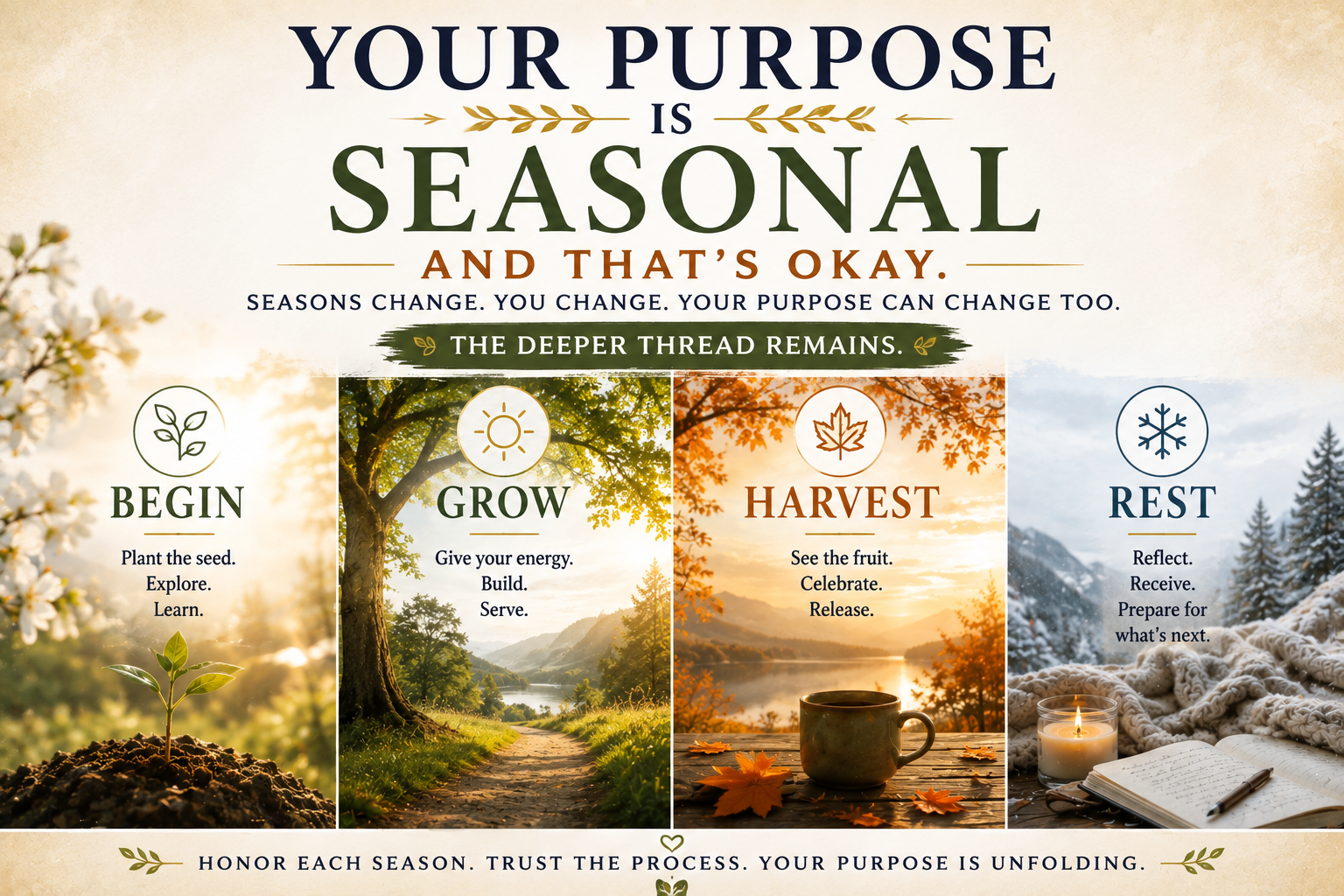
The expression of purpose may be seasonal. The deeper thread may be enduring.
Some things accompany us for decades.
Others belong to one chapter.
Both can matter.
Purpose Is Not a Lifetime Job Description
We often talk about purpose as though every person has been assigned one permanent role.
Find it.
Name it.
Do it.
Never deviate.
But human lives rarely unfold that neatly.
You learn.
You change.
You develop abilities you did not have twenty years ago.
Your understanding deepens.
Your priorities shift.
People enter your life.
People leave.
Your responsibilities change.
The person asking, What am I here to do? at twenty-five may be standing in a very different place at fifty-five.
Purpose does not have to ignore all of that.
It can move through it.
The Form Can Change While the Thread Remains
Imagine someone whose deeper thread is teaching.
At one point, they teach children in a classroom.
Later, they train employees.
Years later, they mentor younger people in their profession.
Eventually, they write.
The form changed.
The thread did not.
Or perhaps someone’s deeper thread involves creating beauty.
It appears first through art.
Later through designing a home.
Then gardening.
Then photography.
Then helping restore something neglected.
Different expressions.
A recognizable current underneath them.
This is why looking only at titles can make purpose difficult to see.
The deeper question may be:
What keeps expressing itself through the different things I do?
Some Purpose Belongs to a Particular Season
There may be things you were genuinely meant to do then.
Raise children.
Care for someone.
Build a business.
Learn a craft.
Support a family.
Lead a team.
Create something.
Restore something.
Study.
Teach.
Travel.
Rebuild.
Begin again.
That season may have required parts of you that another season does not.
When it ends, its importance does not disappear.
Completion does not erase meaning.
A chapter can be finished and still have belonged in the book.
Completion Is Different From Failure
This distinction can change the way you understand your past.
Sometimes we call something a failure because it ended.
But endings do not automatically mean failure.
A business can close after teaching you how to lead.
A career can end after developing abilities you will use elsewhere.
A friendship can belong deeply to one period of life without lasting forever.
A project can accomplish what it came to accomplish.
A season can finish.
Ask:
Did this fail, or did this complete something?
The answer may not always be obvious.
But the question opens a different door.
Outgrowing Something Does Not Mean It Was Wrong
You can outgrow something that was once right for you.
This happens with clothes.
Homes.
Ideas.
Roles.
Dreams.
Work.
Ways of seeing yourself.
Growth changes fit.
What suited you at one stage may become restrictive later.
That does not require you to criticize your former self.
You chose with the knowledge, needs, opportunities, and understanding you had then.
Perhaps that choice helped create the person capable of choosing differently now.
You are allowed to want something new without turning what came before into a mistake.
A Changing Season Can Feel Unclear at First
Sometimes you recognize the shift yourself.
Other times, you simply notice that the old energy is gone.
You no longer feel pulled toward the same things.
A role that once defined you begins feeling too small.
You know something is changing, but you cannot yet name what is replacing it.
That in-between space can feel uncomfortable.
The old identity no longer fits.
The new one has not fully formed.
But uncertainty does not mean there is nothing next.
It may simply mean you are between recognizable forms.
The In-Between Season Matters
We tend to respect seasons of action.
Building.
Launching.
Achieving.
Creating.
Serving.
Producing.
The in-between receives less admiration.
Waiting.
Listening.
Learning.
Resting.
Reconsidering.
Preparing.
Letting go.
But the space between chapters can be enormously important.
It gives experience time to become wisdom.
It allows old identities to loosen.
It creates room for questions that constant activity can drown out.
Not every season needs visible output.
Some seasons prepare the soil.
Do Not Rush to Replace What Ended
When something important feels complete, there can be pressure to immediately find the next thing.
What is my new purpose?
What am I supposed to do now?
What is the plan?
But replacing one identity too quickly can prevent you from understanding what the previous season actually gave you.
Before rushing forward, ask:
What did that chapter teach me?
What strengths did I develop?
What no longer fits?
What do I want to carry forward?
What am I ready to leave behind?
What has begun quietly capturing my attention?
The next direction may already be appearing at the edges.
A New Season May Begin as Curiosity
Purpose does not always announce itself with certainty.
Sometimes it begins with:
That’s interesting.
You start reading about something.
Learning something.
Making something.
Helping with something.
Thinking about an idea more often.
You do not know where it leads.
You simply feel drawn toward it.
Do not underestimate curiosity.
Curiosity can be the first opening into a new chapter.
You do not need to turn every interest into destiny.
But recurring curiosity deserves attention.
Some Dreams Belong to Later Seasons
There may be things you have wanted to do for years but could not reasonably pursue.
The timing was wrong.
Money was needed elsewhere.
Children needed you.
Work demanded your attention.
You lacked knowledge.
You lacked resources.
Other responsibilities mattered more.
The dream did not necessarily disappear.
It waited.
Later, circumstances change.
You have more experience.
More freedom.
More skill.
More courage.
More clarity.
Something that once seemed impossible becomes possible.
This is one of the beautiful things about seasonal purpose.
A dream that could not grow in one chapter may finally have room in another.
Not every delayed dream is a denied dream.
Some dreams are seeds waiting for the right season.
Purpose Can Expand Instead of Being Replaced
A new season does not always erase an old calling.
Sometimes it enlarges it.
The teacher becomes a writer but still teaches.
The builder becomes a mentor but still builds.
The caregiver begins creating but carries compassion into the work.
The business owner begins serving a different community but keeps the wisdom earned through years of experience.
Life accumulates.
The next chapter can contain pieces of the earlier ones.
You are not necessarily starting from zero.
You may be starting from experience.
What You Learned Comes With You
Skills travel.
Wisdom travels.
Character travels.
Experience travels.
The ability to communicate.
Organize.
Build.
Listen.
Lead.
Research.
Create.
Solve problems.
Teach.
Adapt.
Begin again.
These things do not disappear because a role ends.
This is one reason life can become richer with time.
You begin carrying more tools into each new season.
Your Values Can Help You Recognize the Next Season
When the form of purpose changes, values can provide continuity.
Ask:
What matters to me now?
Perhaps freedom has become more important.
Or family.
Faith.
Creativity.
Service.
Peace.
Independence.
Connection.
Truth.
Adventure.
Stability.
Contribution.
Your priorities may shift because your life has shifted.
The next season may need to honor values the previous one could not fully hold.
That does not mean the earlier season was wrong.
It means you are standing somewhere new.
Notice What Is Becoming More Alive
Instead of looking only at what is fading, notice what is gaining energy.
What are you thinking about more often?
What are you learning?
What possibilities excite you?
What are you creating?
What do you find yourself talking about?
What are you newly willing to try?
What feels increasingly important?
A changing season often reveals itself through what is becoming more alive.
Pay attention there.
Not Every Quiet Period Means You Have Lost Your Purpose
There may be seasons when nothing feels particularly clear.
You are doing ordinary things.
Working.
Caring for people.
Handling responsibilities.
Living.
There is no enormous mission blazing across the horizon.
That does not make your life empty.
Perhaps this season is about:
Faithfulness.
Learning.
Family.
Rest.
Preparation.
Presence.
Building stability.
Doing the work directly in front of you.
Meaning can exist quietly.
Purpose Can Be Larger Than Productivity
This matters particularly in transitional seasons.
You are not valuable only when you are producing.
A season does not become meaningful because you generated enough visible results.
Some of the most important things happening in a life cannot be measured by output.
Learning who you are.
Deepening faith.
Becoming wiser.
Building relationships.
Changing a pattern.
Learning patience.
Developing courage.
Receiving what life is teaching you.
Being present.
Preparing for something you cannot yet see.
There are forms of growth that produce no impressive statistic.
They still change a life.
How to Recognize That a Season May Be Changing
There is no perfect formula, but certain patterns may be worth noticing.
Something that once energized you repeatedly feels complete.
Your values have shifted.
A new interest keeps returning.
You feel drawn toward learning something different.
The old role still works externally but no longer feels like the whole story.
You find yourself imagining a different way of contributing.
A dream you put aside begins resurfacing.
You are increasingly aware that the life you built belongs partly to an earlier version of you.
One sign alone does not require dramatic action.
Look for patterns.
Give them time.
Do Not Burn Down a Life Because You Feel a Shift
Recognizing a changing season does not mean making an impulsive decision.
You can explore before you leap.
Research.
Learn.
Save money.
Test an idea.
Take a class.
Create something small.
Volunteer.
Have conversations.
Build a skill.
Try the new direction alongside the old one.
Some transitions happen quickly.
Others can be crossed one stepping stone at a time.
Wisdom does not make purpose less meaningful.
It gives purpose somewhere stable to land.
Ask What This Season Is Asking From You
Instead of demanding a complete map of the future, ask a smaller question:
What is this season asking from me?
Perhaps:
Patience.
Courage.
Learning.
Discipline.
Service.
Creation.
Presence.
Rest.
Receiving.
Preparation.
Letting go.
Building.
Trust.
A difficult conversation.
A first step.
Sometimes we do not need the entire future.
We need the next honest response.
A Seasonal Purpose Reflection
Take a piece of paper and create four sections.
WHAT IS COMPLETING?
What feels finished, smaller, or ready to be released?
WHAT REMAINS TRUE?
Which values, gifts, interests, and deeper threads continue across seasons?
WHAT IS EMERGING?
What new curiosity, dream, responsibility, possibility, or direction keeps appearing?
WHAT DOES THIS SEASON NEED FROM ME?
What is one thing you can learn, build, release, explore, receive, practice, or begin?
Do not force a dramatic answer.
Look for movement.
Sometimes the shift is enormous.
Sometimes it is only a few degrees.
A few degrees can eventually lead somewhere entirely new.
Honor the Season That Brought You Here
You do not have to reject your past in order to enter your future.
Honor what worked.
Honor what you built.
Honor what you learned.
Honor the people who mattered.
Honor the version of you who did the best they could with what they knew.
Then allow yourself to continue.
You were never required to remain exactly the same person simply to prove that your earlier choices were real.
They were real.
And so is who you are becoming.
Your Life Can Have More Than One Beautiful Chapter
Purpose does not have to be a single road stretching unchanged from beginning to end.
It can have chapters.
Expressions.
Seasons.
A deeper thread may travel through all of them, sometimes clearly and sometimes almost invisibly.
One season may teach you to serve.
Another to create.
Another to lead.
Another to receive.
Another to be present.
Another to begin again.
You do not have to force tomorrow to look like yesterday in order for yesterday to have mattered.
Something can be complete without being meaningless.
Something can change without having been wrong.
And something new can begin without betraying what came before.
Perhaps the question is not always:
What is my purpose for the rest of my life?
Perhaps sometimes the better question is:
What is this season of my life asking me to grow, give, create, learn, receive, or become?
Listen there.
The answer does not have to last forever to matter now.
Explore Further
Soul Blueprint
Explore the deeper patterns, gifts, values, and qualities that may remain recognizable even as their expression changes.
Your Purpose Has a Texture, Not a Title
Explore why purpose may be better understood through qualities and contribution than through one permanent role.
The Three Callings: Service, Creation, Presence
Explore three ways calling can express itself differently across the seasons of a life.
A Simple Purpose Map You Can Do in One Hour
Create a practical map of your values, strengths, experiences, interests, contribution, and desired way of living.
When Life Redirects You, It’s Not Punishment
Explore unexpected redirection when life changes the road before you were planning to leave it.
Your Core Values Are Your Compass
Explore the values that can provide continuity when circumstances and directions change.
A Simple Purpose Map You Can Do in One Hour
Create a simple purpose map using your values, strengths, experiences, recurring interests, contribution, and desired way of life to uncover meaningful directions and practical next steps.
Purpose can become unnecessarily complicated.
We imagine there is one perfect answer hidden somewhere inside us.
One calling.
One career.
One mission.
One sentence that will finally explain why we are here.
So we search for the answer:
What is my purpose?
But that question is enormous.
And enormous questions often create enormous pressure.
There may be another way.
Instead of trying to define your entire life, you can begin by looking at what is already there.
Your values.
Your gifts.
Your experiences.
The things you care about.
The problems you naturally notice.
The ideas that keep returning.
The ways you like to contribute.
The kind of life you want to build.
Put those pieces together and something begins to appear.
Not necessarily a perfect answer.
A map.
And a map can be more useful than an answer because it gives you somewhere to begin.
Purpose Is Easier to See in Patterns
Purpose rarely appears through one isolated clue.
It tends to show itself through repetition.
You keep returning to certain ideas.
Certain kinds of work energize you.
Certain problems bother you enough that you want to help solve them.
People repeatedly come to you for similar things.
Some experiences feel deeply meaningful even when they are difficult.
Certain dreams refuse to disappear.
Individually, these things may seem ordinary.
Together, they can reveal a pattern.
That is what this exercise is designed to uncover.
You Are Mapping, Not Defining
Before you begin, remove one expectation.
You are not going to define the purpose of your entire existence in sixty minutes.
You do not need to.
The purpose map is not a contract with your future.
It is a picture of what seems meaningful from where you are standing now.
You are allowed to discover more later.
You are allowed to change.
You are allowed to realize that something you wrote does not fit anymore.
The map belongs to you.
It can grow as you do.
What You Need
Keep this simple.
You need:
Paper or a notebook.
A pen.
About an hour, if you have it.
And somewhere you can think without too many interruptions.
You can also do the exercise over several shorter sessions.
The hour is not sacred.
The attention is.
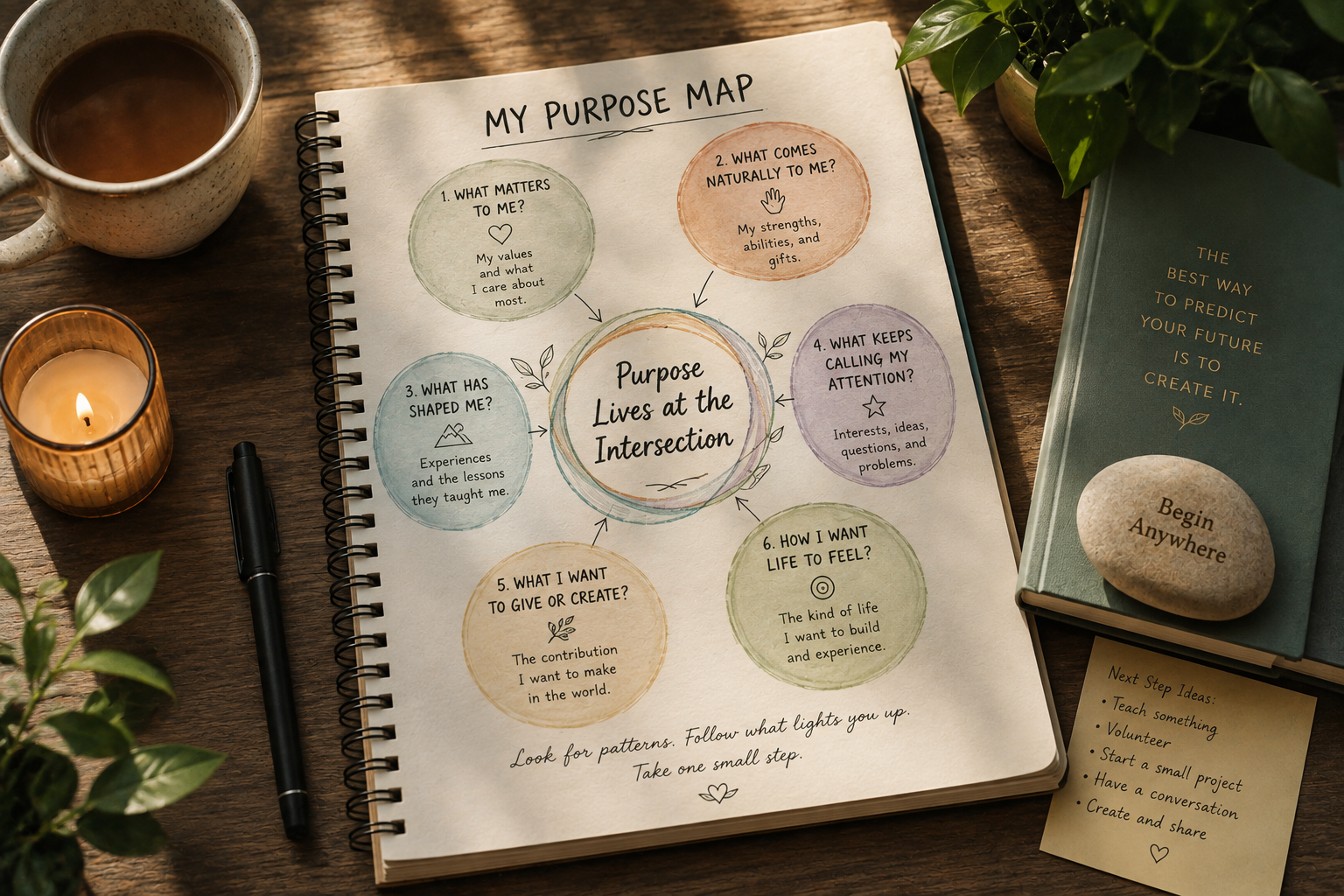
At the top of the page, write:
MY PURPOSE MAP
Then create six areas:
What Matters to Me
What Comes Naturally to Me
What Has Shaped Me
What Keeps Calling My Attention
What I Want to Give or Create
How I Want Life to Feel
Do not worry about making it beautiful.
You are looking for truth, not designing a poster.
Part One: What Matters to Me?
Start with your values.
Not the values you think you should have.
What actually matters to you?
Freedom.
Faith.
Family.
Integrity.
Creativity.
Compassion.
Peace.
Growth.
Truth.
Service.
Beauty.
Learning.
Independence.
Ask yourself:
What am I unwilling to build a life without?
Then ask:
What qualities make a life feel worthwhile to me?
Write freely for several minutes.
When you finish, circle the five values that feel most important.
Do not overthink the ranking.
You are looking for the ones that make you think:
Yes. My life needs this.
Part Two: What Comes Naturally to Me?
Now move toward ability.
Ask:
What do I seem to do naturally?
Do not limit yourself to formal skills.
Maybe you:
Organize chaos.
Explain complicated things simply.
Listen well.
Build.
Repair.
Write.
Teach.
Research.
Plan.
Design.
Encourage.
Solve problems.
See possibilities.
Create beauty.
Lead.
Care for people.
Understand systems.
Bring people together.
Think about what others repeatedly ask you for help with.
Sometimes other people notice our natural strengths before we do.
Write what comes to mind.
Do not dismiss something because it feels easy.
It may feel easy because it is one of your gifts.
Part Three: What Has Shaped Me?
Purpose does not develop in a vacuum.
Your life has taught you things.
Some lessons came through joy.
Others through difficulty.
Some came through work.
Relationships.
Family.
Success.
Failure.
Loss.
Opportunity.
Responsibility.
Unexpected turns.
Ask:
What experiences changed the way I see life?
What have I learned that I could not have learned from a book?
What have I become unusually knowledgeable about because I lived through it?
You are not required to turn every painful experience into a mission.
But sometimes what you have lived gives you insight that later becomes useful.
Write down the experiences that shaped you.
Then beside each one, write:
What did this teach me?
That second question is where much of the value appears.
Part Four: What Keeps Calling My Attention?
Now look at what repeatedly captures you.
What do you read about without being assigned?
What conversations make you come alive?
What problems do you immediately notice?
What ideas keep returning?
What makes you think:
Someone should do something about this.
Or:
I would love to create something around this.
Or:
I wish more people understood this.
Attention is valuable information.
We cannot pursue every interest.
But recurring attention can reveal where energy naturally wants to go.
Write down anything that has been calling your attention repeatedly.
Pay Attention to What You Cannot Leave Alone
Some interests disappear quickly.
Others stay.
You encounter them again six months later.
Then two years later.
You take another direction.
Somehow you circle back.
These recurring interests deserve special attention.
They do not automatically define your purpose.
But they may be clues.
Put a star beside anything that has followed you through multiple seasons of your life.
Part Five: What Do I Want to Give or Create?
Now move from observation into contribution.
Ask:
What would I like to add to the world around me?
Maybe you want to:
Teach.
Build.
Protect.
Write.
Raise.
Design.
Grow.
Repair.
Encourage.
Organize.
Invent.
Beautify.
Lead.
Provide.
Preserve.
Serve.
Create.
You do not need to know exactly how yet.
Stay with the deeper action.
Maybe you do not know what business you want to build, but you know you want to create.
Maybe you do not know what role fits, but you know you want to teach.
Maybe you do not know the form, but you know you want to help people see possibility.
Purpose often becomes clearer when we identify the contribution before forcing it into a title.
Service, Creation, and Presence Can Help Here
If this section feels difficult, return to the three callings.
Ask:
SERVICE
What do I want to give?
CREATION
What do I want to bring into being?
PRESENCE
Where do I want to be more fully present?
You may find that one question opens the door.
You may find that all three do.
Part Six: How Do I Want My Life to Feel?
This piece is often forgotten.
People build a vision around what they want to accomplish but never ask what kind of life those accomplishments will create.
Imagine that your plans work.
Then ask:
Do I actually want the life that comes with them?
Perhaps you value:
Freedom.
Peace.
Adventure.
Stability.
Creativity.
Connection.
Spaciousness.
Challenge.
Community.
Independence.
Simplicity.
Contribution.
There is no correct answer.
Someone may want movement, travel, challenge, and new people.
Someone else may want roots, quiet mornings, deep relationships, meaningful work, and a garden.
Neither is more purposeful.
Purpose should not require constructing a life you secretly do not want to live.
Write down five words describing how you want your life to feel.
Now Look for Intersections
You now have six collections of information.
Values.
Natural strengths.
Life experience.
Recurring interests.
Contribution.
Desired way of living.
This is where the exercise becomes a map.
Look across the entire page.
What repeats?
What words appear in more than one section?
What ideas seem connected?
What values support certain strengths?
What interests connect with certain forms of contribution?
What experiences gave you knowledge that now overlaps with what you care about?
Circle repeated words.
Draw lines between related ideas.
Star anything that creates energy when you read it.
Cross out anything you wrote because you thought you were supposed to.
Then ask:
Where are three or more parts of the map pointing in the same direction?
Those intersections matter.
They are often more useful than any single answer.
Look for Combinations
Purpose often becomes more distinctive through combinations.
Maybe your map contains:
Writing + faith + encouragement.
Building + craftsmanship + service.
Research + truth + communication.
Gardening + teaching + community.
Business + organization + independence.
Design + homes + beauty.
The individual pieces may be common.
The combination may be uniquely yours.
Ask:
Which combinations feel most alive?
Write down three.
Look for Tension Too
Not everything on your map will fit neatly together.
That is useful.
Perhaps you value freedom but also security.
You love helping people but need substantial solitude.
You want to create but dislike public attention.
You value adventure and also want deep roots.
You want meaningful work but do not want work to consume your life.
Do not erase those tensions.
They can help you build something more honest.
Ask:
How could both needs have a place?
A good purpose map does not flatten you into one dimension.
It makes room for complexity.
Write Three Possible Purpose Directions
Now begin turning the map into possibilities.
Not declarations.
Directions.
Complete this sentence three different ways:
I feel most alive when I use my ability to ______ to help, create, or contribute ______ in a way that allows me to live with ______.
For example:
I feel most alive when I use my ability to explain complicated ideas to help people understand things that improve their lives, while living with freedom and creativity.
Or:
I feel most alive when I use my ability to build and solve problems to create useful things, while living with independence and challenge.
These are not permanent purpose statements.
They are working possibilities.
You are giving yourself something to explore.
Turn the Map Into One Small Experiment
This may be the most important step.
A purpose map should lead to movement.
Look at your three directions and ask:
What is one small experiment I could try?
If teaching appears repeatedly:
Teach something.
If writing appears:
Write and share something.
If building appears:
Build something small.
If service appears:
Volunteer somewhere that uses your actual strengths.
If entrepreneurship appears:
Test a small idea before building an entire business.
If mentoring appears:
Help one person.
If creativity appears:
Make something.
The experiment does not have to become your future.
Its job is to give you information.
Let Reality Answer Some of the Questions
Thinking can reveal a great deal.
Experience reveals things thinking cannot.
You may believe you would love teaching until you teach.
Then you discover whether you love:
Teaching itself.
Explaining ideas.
Preparing lessons.
Working with people.
Or simply learning.
You may think you want to start a business and discover that what you really love is creating products.
You may think you want to write a book and discover that shorter writing fits you better.
Purpose becomes more precise when imagination meets reality.
Notice What Gives Energy Back
Not every meaningful activity will feel easy.
Some will require discipline.
Some will leave you tired.
But there is a difference between being tired because you did something meaningful and feeling continually emptied by something that does not fit.
After trying something, ask:
Would I want to become better at this?
That question can be more revealing than:
Was I good at it immediately?
Purpose often grows through skill.
Interest gives you a reason to begin.
Practice gives you somewhere to go.
Do Not Confuse Purpose With Monetization
When people discover something meaningful, one of the first questions often becomes:
How can I make money from this?
Sometimes you can.
Sometimes you should.
But monetization is a separate question.
Something can be deeply purposeful without becoming a business.
Parenting.
Volunteering.
Creating privately.
Supporting a community.
Growing food.
Caring for animals.
Mentoring.
Learning.
Preserving family history.
Purpose does not become more legitimate because someone pays you for it.
Money and purpose can intersect.
They do not have to be identical.
Do Not Throw Away What Already Works
Purpose exploration can create the urge to reinvent everything.
Quit the job.
Move.
Start over.
Change careers.
Build something enormous.
But your map may reveal that much of your purpose is already present.
Perhaps it simply needs more room.
Maybe your work uses your strengths but your schedule conflicts with your values.
Maybe you love your life but have neglected an interest that needs attention.
Maybe the change is smaller than you expected.
Purpose does not always demand demolition.
Sometimes it asks for rearrangement.
Your Map Should Become More Accurate With Use
Come back to your map.
In three months.
Six months.
A year.
Add what you learned.
Remove what no longer fits.
Circle new patterns.
Notice which experiments created energy.
Notice which ideas sounded better in imagination than they felt in reality.
Your purpose map should become increasingly honest.
Not increasingly impressive.
A Purpose Map Is a Living Document
You are alive.
Therefore the map should be alive too.
You will learn things.
Meet people.
Gain skills.
Change priorities.
Discover gifts.
Enter different seasons.
Something that matters deeply now may become less central later.
Something you barely notice today may become important years from now.
That does not make the earlier map wrong.
It makes it a map of where you were standing.
Your One-Hour Purpose Map
When you finish, you should have:
1. What Matters to Me
Your deepest values.
2. What Comes Naturally to Me
Your strengths and natural ways of contributing.
3. What Has Shaped Me
Experiences and what they taught you.
4. What Keeps Calling My Attention
Recurring interests, questions, ideas, and problems.
5. What I Want to Give or Create
The contribution you want to make.
6. How I Want Life to Feel
The qualities you want your way of living to contain.
Then identify:
Three strong intersections.
Three meaningful combinations.
Three possible purpose directions.
And finally:
One small experiment.
That last line matters.
Because a map becomes valuable when you begin walking.
You Do Not Need to Solve Your Life Today
You may finish this exercise with surprising clarity.
Or you may finish with three better questions.
Both are useful.
You are not trying to force your life into a sentence.
You are learning to recognize its patterns.
What matters to you.
What comes naturally.
What life has taught you.
What continually draws your attention.
What you want to contribute.
How you want to live while contributing it.
Put those pieces together.
Look for intersections.
Test what you find.
Then pay attention to what happens.
Your purpose does not have to arrive as a lightning bolt.
Sometimes it becomes visible one connection at a time.
And sometimes the map you were searching for begins with something surprisingly simple:
A blank piece of paper and an honest look at the life that is already yours.
Explore Further
Soul Blueprint
Explore the deeper pattern formed by your essence, values, gifts, recurring themes, intuition, and purpose.
Your Core Values Are Your Compass
Go deeper into the values that give your decisions and direction an internal compass.
The Patterns You Keep Repeating Are Clues
Explore recurring patterns and what they may reveal about your life.
Your Purpose Has a Texture, Not a Title
Explore purpose beyond one career, role, or predetermined identity.
The Three Callings: Service, Creation, Presence
Explore three ways purpose can move into the way you actually live.
How to Tell the Difference Between Fear and Intuition
Explore discernment when the next direction on your map is not immediately clear.
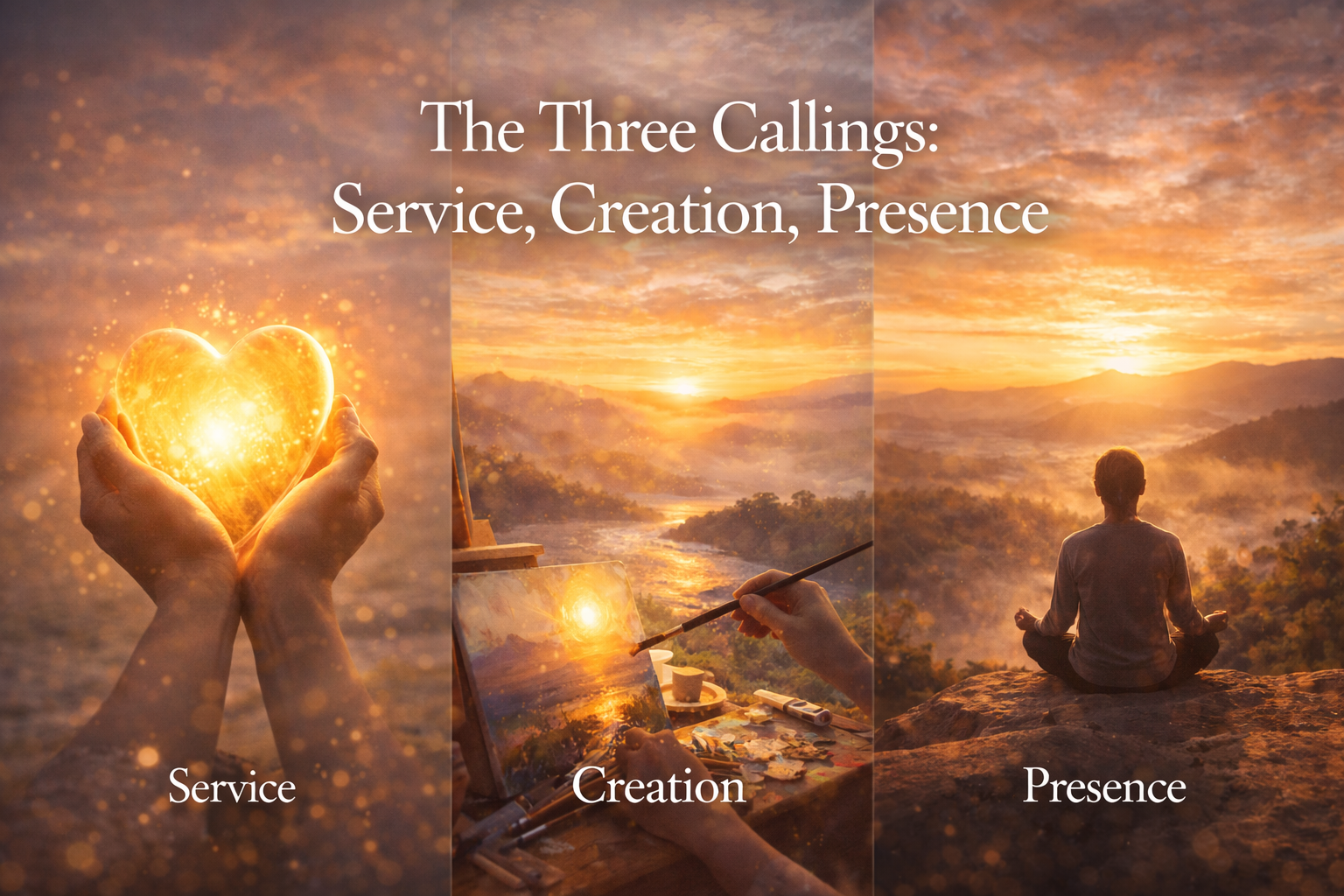
The Three Callings: Service, Creation, Presence
Discover three ways purpose shows up: service, creation, and presence. Identify your strongest calling and build a life that fits your design.
We often imagine a calling as one specific thing.
A profession.
A mission.
A ministry.
A great work we are somehow supposed to discover.
But calling may be broader than that.
Across very different lives, meaningful contribution often moves through three powerful expressions:
Service.
Creation.
Presence.
Service asks:
What can I give?
Creation asks:
What can I bring into being?
Presence asks:
How can I fully inhabit the life and relationships already in front of me?
You may recognize yourself strongly in one.
You may recognize yourself in all three.
These are not boxes.
They are not personality types.
They are ways purpose can move.
Calling Is One Expression of Purpose
Purpose can be the deeper thread.
Calling can be one of the ways that thread asks to be lived.
If part of your purpose involves helping others understand, calling may appear through teaching, writing, parenting, mentoring, training, or conversation.
If your deeper purpose involves creating beauty, calling may appear through art, design, gardening, building, music, cooking, restoration, or something entirely your own.
The expression can change.
The deeper thread can remain.
That is why a person may experience more than one calling across a lifetime.
The Calling of Service
Service begins with contribution.
What can I do that helps?
Sometimes service is obvious.
Teaching.
Caregiving.
Medicine.
Ministry.
Volunteering.
Mentoring.
Advocacy.
Helping someone through difficulty.
But service is much larger than occupations traditionally labeled as helping professions.
A contractor who makes a home safe serves.
A business owner who treats customers honestly serves.
A mechanic who makes sure a family can travel safely serves.
A farmer serves.
A parent serves.
A person who shares useful knowledge serves.
A neighbor who notices what needs doing and quietly does it serves.
Service is not defined by title.
It is defined by contribution.
Service Is Not Self-Erasure
This distinction matters.
Serving others does not require abandoning yourself.
It does not mean agreeing to everything.
It does not mean having no boundaries.
It does not mean carrying responsibilities that belong to someone else.
It does not require becoming endlessly available.
Healthy service comes from something you genuinely have to give.
Knowledge.
Time.
Skill.
Encouragement.
Resources.
Care.
Experience.
Strength.
Attention.
Service becomes sustainable when giving and wisdom remain connected.
Otherwise, service can quietly become depletion.
Service Can Be an Exchange
We sometimes imagine service as entirely one-directional.
One person gives.
Another receives.
But meaningful service often creates exchange.
A teacher gives knowledge and learns from students.
A parent gives care and discovers capacities they did not know they possessed.
A mentor gives experience and gains perspective.
A volunteer gives time and develops connection.
A business solves a problem and receives compensation that allows the business to continue.
Receiving does not automatically diminish service.
An exchange can still be deeply meaningful.
Service is not measured by how much you sacrifice.
It is measured by the quality and integrity of what you contribute.
The Calling of Creation
Creation asks a different question:
What wants to exist because I was here?
A book.
A garden.
A home.
A business.
A song.
A recipe.
A website.
A system.
A solution.
A painting.
A piece of furniture.
A tradition.
A new way of doing something.
Creation is one of the ways human beings participate in possibility.
We take something that exists only as imagination and begin giving it form.
Creation Is Larger Than Art
People often hear creative calling and think:
Painter.
Writer.
Musician.
Designer.
Those are creative callings.
But so are many things we rarely describe as creative.
Solving a complicated business problem.
Designing a better process.
Building a house.
Developing software.
Creating a family tradition.
Inventing a tool.
Starting an organization.
Restoring land.
Planning a beautiful gathering.
Finding a solution nobody else considered.
Creation is not limited to art.
It is the movement from:
This does not exist yet
to
Now it does.
Creation Requires a Relationship With the Unknown
When you create, you rarely know exactly what the finished thing will become.
You begin with an idea.
Then reality enters.
Something does not work.
Something unexpected works beautifully.
The original idea changes.
You learn.
You adjust.
You begin again.
This is why creation requires more than inspiration.
It requires willingness to meet the unfinished.
Creation Often Begins Before Confidence
One of the great myths about creation is that people begin because they feel ready.
Often they begin because the idea matters more than their uncertainty.
The first version may be awkward.
The first page may be imperfect.
The first attempt may fail.
The first business plan may change.
The first garden may teach more than it produces.
The first design may be abandoned.
But creation has its own form of education.
You learn by making.
You discover what the idea needs because you begin giving it form.
The Calling of Presence
Presence may be the least celebrated of the three callings.
It produces fewer visible trophies.
But it can be one of the most profound.
Presence asks:
Can I actually be here for the life I am living?
Not constantly preparing for another life.
Not endlessly replaying yesterday.
Not living only for the next accomplishment.
Not treating the people around you as scenery while you chase something farther away.
Presence is the ability to inhabit the moment you have been given.
Presence Is Not Doing Nothing
Presence can be misunderstood as passivity.
But presence is active attention.
Listening when someone speaks.
Seeing what is actually happening.
Noticing beauty.
Paying attention to your own life.
Giving someone your full attention.
Recognizing when something has changed.
Allowing yourself to experience joy without immediately moving to the next goal.
Presence is not the absence of action.
It is the quality of attention you bring to action.
Some People Need Your Presence More Than Your Solution
There are moments when we rush to fix what does not need to be fixed by us.
Someone is grieving.
Someone is uncertain.
Someone needs to speak.
Someone is celebrating.
Someone is trying to understand their own experience.
The instinct may be to solve.
Advise.
Explain.
Correct.
Rescue.
But sometimes the deeper gift is presence.
Listening.
Witnessing.
Sitting beside.
Being there.
There are experiences no clever sentence can repair.
Presence says:
You do not have to experience this moment entirely alone.
Presence Lets You Receive Life Too
Service asks us to give.
Creation asks us to make.
Presence reminds us that life is also something we are allowed to receive.
Sunlight through a window.
A conversation.
Music.
A meal.
A quiet morning.
Laughter.
Prayer.
A child’s story.
A breeze.
A beautiful sky.
The person sitting across from you.
A life devoted entirely to productivity can become strangely absent from itself.
Presence reminds us that existence is not only a project.
Some moments are not asking to be improved.
They are asking to be noticed.
The Three Callings Strengthen One Another
This is where Service, Creation, and Presence become more than three separate ideas.
They can correct and strengthen one another.
Service without presence can become mechanical.
You do the task.
Solve the problem.
Meet the obligation.
But stop seeing the person.
Presence helps service notice what is actually needed.
Creation without presence can become endless production.
Make more.
Publish more.
Build more.
Achieve more.
Presence allows creation to breathe.
It lets you actually experience what you have made.
Presence without expression can become stillness without movement.
There are moments to notice.
And there are moments to act.
A need appears.
An idea arrives.
A responsibility becomes clear.
Presence helps us see.
Service and creation give what we see somewhere to go.
One Life Can Contain All Three
Imagine a parent.
They serve through care, protection, teaching, and provision.
They create a home culture, traditions, opportunities, and perhaps a new starting point for the next generation.
They practice presence by actually being with the child whose life is unfolding in front of them.
One role.
Three callings.
Or imagine a business owner.
They serve customers by solving a real problem.
They create something that did not previously exist.
They practice presence by paying attention to people, changing conditions, and the work actually in front of them.
Again:
Service.
Creation.
Presence.
These callings do not need separate lives.
They can inhabit the same one.
Different Seasons May Emphasize Different Callings
There may be seasons dominated by creation.
You are building.
Writing.
Designing.
Launching.
Learning.
Experimenting.
Other seasons may call heavily for service.
Someone needs you.
A community needs something.
Your knowledge becomes useful.
Your responsibilities expand.
And there may be seasons when presence becomes the deeper work.
A child is growing quickly.
Someone you love is aging.
You are rebuilding after a demanding season.
Life is asking you to stop rushing past something that matters.
There can also be seasons of receiving.
Learning.
Resting.
Listening.
Gathering strength.
Those seasons may look unproductive from the outside, but they can prepare the ground for what comes next.
The balance changes.
The calling is still alive.
Your Calling Does Not Have to Become Your Career
Sometimes it will.
Sometimes it will not.
You may create through your work and serve through your family.
You may serve professionally and create privately.
You may earn your living doing something practical while your deepest creative work happens elsewhere.
You may express all three through the same occupation.
There is no requirement that your paycheck perfectly summarize your soul.
Work matters.
But a human life is larger than employment.
Calling Is Not a Competition
There is no hierarchy here.
Creation is not more important because it leaves something visible.
Service is not more noble because it helps someone.
Presence is not more spiritual because it sounds contemplative.
Each can become meaningful.
Each can also become distorted.
Service can become self-erasure.
Creation can become ego or endless production.
Presence can become avoidance if it is used as an excuse never to act.
The goal is not to identify the “best” calling.
It is to understand how these forms of meaning and contribution operate within your life.
Ask Which Calling Is Asking for More Room
Instead of asking:
Which one am I?
Try asking:
Which one needs more room in my life right now?
Perhaps you have spent years serving and something inside you wants to create.
Perhaps you have spent years creating and realize you have been absent from the people and experiences around you.
Perhaps you have spent a long season inward and now feel ready to contribute outwardly.
Perhaps all three are already alive and simply need better balance.
This question keeps calling dynamic.
It allows life to participate in the answer.
A Three Callings Reflection
Take a page and divide it into three sections.
Write:
SERVICE
Ask:
What do I naturally give?
Who or what benefits from what I know?
Where am I useful?
What problems do I care about helping solve?
What kind of contribution feels meaningful?
Then write:
CREATION
Ask:
What do I want to bring into existence?
What ideas keep returning?
What do I love building, making, improving, designing, or imagining?
What would I create even if the first version were imperfect?
Then write:
PRESENCE
Ask:
Where is my attention needed?
What part of my life am I moving through too quickly?
Who deserves more of my actual presence?
What beauty, relationship, or experience am I overlooking?
What would change if I were more fully here?
Then look across all three.
Do not force yourself into one box.
Look instead for the shape of your life.
Where are you already serving?
What are you creating?
Where is greater presence needed?
What combination feels most alive right now?
You may begin seeing something larger than a job title.
You may begin seeing how meaning actually moves through your life.
Calling Can Be Ordinary and Still Be Sacred
A calling does not need dramatic language.
Sometimes service is making dinner.
Creation is planting something.
Presence is sitting outside long enough to notice the evening sky.
Sometimes service is doing your job well.
Creation is finding a better way.
Presence is listening when someone needs to speak.
The sacred does not always separate itself from ordinary life.
Sometimes it moves directly through it.
You Do Not Have to Choose Only One
Perhaps that is the most freeing part.
You do not have to decide:
I am here to serve.
or
I am here to create.
or
I am here to be present.
You may be here to do all three in combinations that belong uniquely to your life.
To serve what matters.
To create what wants to exist.
To be present enough to recognize the life happening while you are doing both.
Some seasons will emphasize one.
Some days may contain all three.
A meaningful life does not need to fit inside one word.
But these three words can help illuminate how meaning moves.
Service.
What can I give?
Creation.
What can I bring into being?
Presence.
How can I fully inhabit what is already here?
Perhaps calling is not only something you find.
Perhaps it is something you practice.
And through service, creation, and presence, purpose begins moving out of the realm of ideas and into the way a life is actually lived.
Explore Further
Your Purpose Has a Texture, Not a Title
Explore purpose through the qualities, gifts, values, and forms of contribution that make life feel meaningful.
The Work You’re Here to Do Is Often Quiet
Explore stewardship, character, consistency, and meaningful contribution beyond recognition.
Your Core Values Are Your Compass
Discover how your deepest values can give direction to the way you live, create, and contribute.
Soul Blueprint
Explore the deeper pattern woven through your essence, values, gifts, recurring themes, intuition, and purpose.
Your Purpose Is Seasonal and That’s Okay
Explore how the expression of purpose and calling can change through different seasons of life.
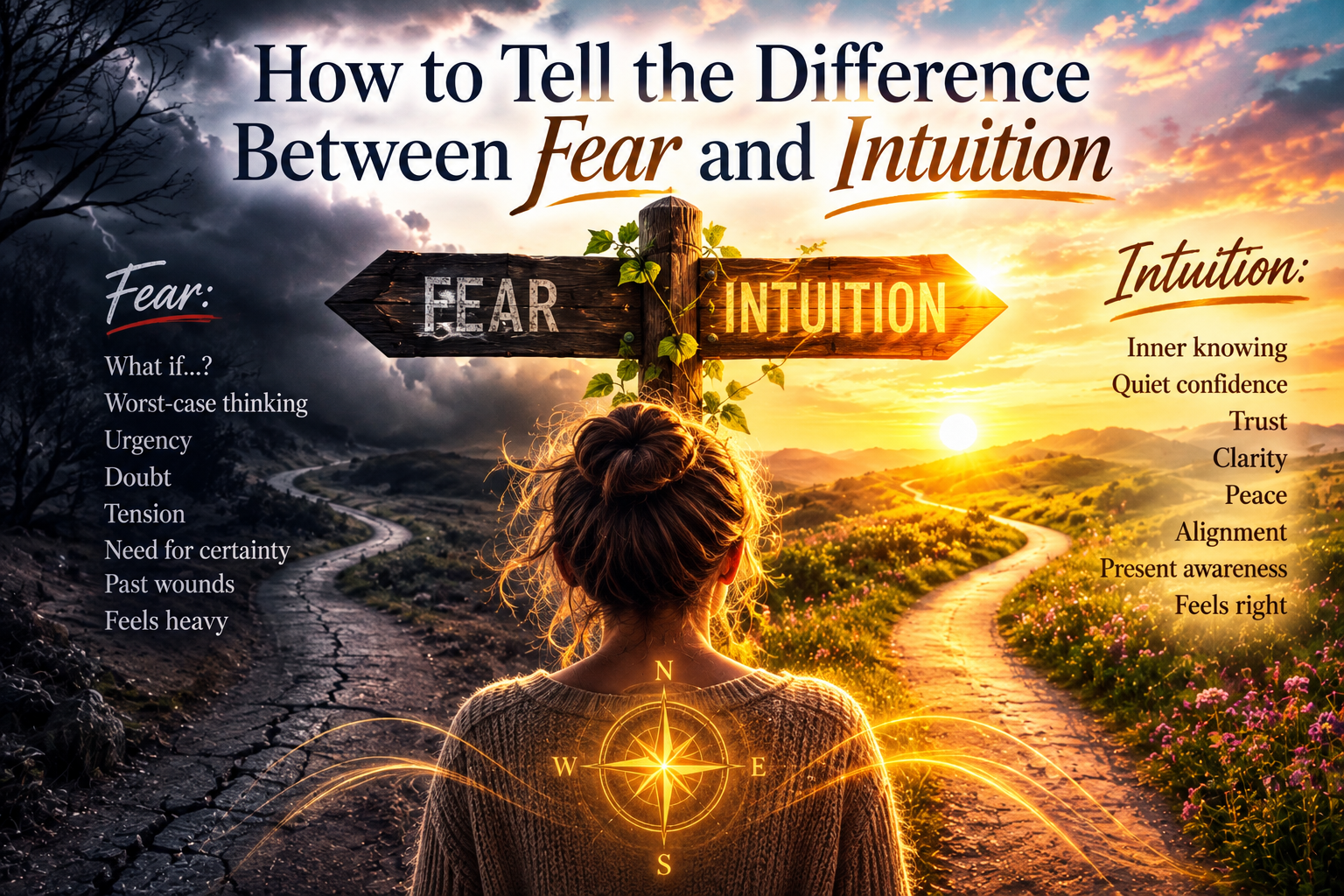
How to Tell the Difference Between Fear and Intuition
Learn how to tell fear from intuition by examining conditioning, impulse, desire, body signals, evidence, practical caution, faith, and your own patterns of inner knowing.
Sometimes you know.
You cannot completely explain why.
Nothing dramatic happens.
There may be no sign, no evidence you can point toward, and no perfectly constructed argument.
But something inside you becomes clear.
Yes.
No.
Go.
Wait.
Something about this deserves another look.
Then there are other moments when something inside you speaks just as strongly.
What if this goes wrong?
What if I lose everything?
What if I embarrass myself?
What if I make the wrong choice?
What if I regret this?
Both experiences can feel powerful.
Both can influence a decision.
Both can appear before the rational mind has fully understood what is happening.
And that creates one of the most important questions in discernment:
Is this intuition, or is this fear?
The answer is not always obvious.
Fear can disguise itself as wisdom.
Wishful thinking can disguise itself as intuition.
Past experience can create reactions that feel immediate and certain.
Practical caution can look like fear even when it is responding to something real.
And intuition itself may sometimes warn you about something uncomfortable.
The goal is not to eliminate fear and obey every feeling that seems intuitive.
The goal is to become better at listening.
Fear and Intuition Are Both Messengers
Fear is not automatically the enemy.
It can alert you to danger.
It can make you slow down.
It can reveal where you feel vulnerable.
It can tell you that you need more information, preparation, boundaries, or support.
Intuition can also function as a messenger.
It may draw your attention toward something before you have consciously assembled all the reasons.
It may create a quiet sense of recognition.
It may make you notice an inconsistency.
It may pull you toward an opportunity.
It may tell you to wait.
It may suggest that something deserves closer attention.
The question is not:
Which voice should I silence?
A better question is:
What is each voice trying to tell me?
Intuition Is Not Perfect Certainty
Intuition is sometimes described as though it provides flawless answers.
It does not.
Human beings can misinterpret feelings.
We can confuse desire with knowing.
We can project our hopes onto situations.
We can mistake familiarity for truth.
We can interpret fear as prophecy.
We can be wrong.
Intuition may draw upon subtle information, pattern recognition, lived experience, inner awareness, and spiritual discernment before the conscious mind has fully articulated what it has noticed.
Sometimes you sense something before you can explain it.
That does not make the feeling infallible.
It makes it worth examining.
Fear Often Wants a Guarantee
Fear frequently asks questions that cannot be fully answered.
What if this fails?
What if they reject me?
What if I regret leaving?
What if I regret staying?
What if I choose incorrectly?
The mind begins building futures.
One possibility becomes five.
Five become twenty.
Soon you are trying to solve events that have not happened.
Fear often wants certainty before movement.
But life rarely gives guarantees.
Sometimes the question beneath fear is not:
Is this wrong?
It is:
Can you promise me nothing painful will happen?
Those are not the same question.
Intuition Can Be Quiet, but Not Always
Intuition often has a certain simplicity.
Wait.
Ask another question.
Something is off.
This matters.
Go back.
This feels right.
Fear, by contrast, often creates more story around the feeling.
It argues.
Predicts.
Rehearses.
Explains.
Builds scenarios.
But this is not a perfect rule.
Real danger can feel urgent.
A major life decision can carry both intuitive clarity and understandable fear.
The point is not to force every feeling into a formula.
It is to notice the patterns in your own inner responses.
Fear Can Be Loud Because Something Matters
Fear often becomes louder around meaningful decisions.
Starting a business.
Falling in love.
Leaving a familiar situation.
Sharing your work.
Changing careers.
Setting a boundary.
Moving somewhere new.
Trying something you might fail at.
Sometimes fear means:
Stop.
Sometimes fear means:
This is unfamiliar.
Discernment helps you determine which one you are hearing.
Fear should be listened to.
It should not automatically be given the final vote.
Intuition May Tell You What You Do Not Want to Hear
One clue that a feeling deserves attention is that it does not always flatter your preferences.
Sometimes you desperately want something to work.
But something inside you keeps saying:
Look closer.
Sometimes you want to leave.
But something says:
Do not decide yet.
Sometimes you want to say yes.
Something says:
Wait.
Sometimes you want to avoid something.
But underneath the fear there is another quieter sense:
You need to do this.
Intuition does not always point toward comfort.
And it does not always confirm what you hoped would be true.
Wishful Thinking Can Sound Like Intuition
Desire is powerful.
When we want something badly enough, it can become easy to interpret anything supporting that desire as confirmation.
I just know this person is the one.
I know this opportunity is meant for me.
I know this will work.
Perhaps.
But desire deserves its own seat at the table.
Ask:
Would I interpret this feeling the same way if I did not desperately want this outcome?
That question can reveal a great deal.
Intuition can coexist with desire.
But desire should not automatically be renamed intuition.
Conditioning Can Sound Like Wisdom
Some fears were learned long before the present decision appeared.
Do not take risks.
Do not draw attention to yourself.
Stay where it is safe.
People like us do not do that.
Money is always scarce.
Success changes people.
You should never disappoint anyone.
You need permission.
Do not trust yourself.
Those messages can become so familiar that they sound like wisdom.
Then an opportunity appears and something inside you immediately says:
No. That is too risky.
But whose voice is that?
Yours?
A parent's?
A culture's?
A former version of you?
An old experience?
Not every internal voice began inside you.
Past Experience Can Create Fast Reactions
The mind is excellent at recognizing patterns.
A tone of voice.
A type of situation.
A business arrangement.
A relationship dynamic.
A familiar inconsistency.
Something about the present resembles something from the past, and your system responds.
That response may contain useful information.
Experience can create wisdom.
But similarity is not identity.
The present may resemble the past without being the past.
Ask:
What exactly am I recognizing?
That question can help separate useful experience from old assumptions.
Practical Caution Is Not the Same as Fear
Sometimes something feels wrong because the facts actually are wrong.
The numbers do not work.
The agreement is vague.
The person keeps changing their story.
The deadline is unrealistic.
The risks are substantial.
The plan is incomplete.
The evidence contradicts the promise.
You do not need to spiritualize good judgment.
If something can be checked, check it.
Read the contract.
Run the numbers.
Ask questions.
Verify the claim.
Look at the history.
Get another opinion.
Intuition and evidence do not have to compete.
Sometimes intuition tells you where to look.
Reason helps you understand what you are seeing.
Your Body Can Offer Information
People often experience decisions physically.
Tension.
Expansion.
Restlessness.
A sense of ease.
A sudden tightening.
Energy.
Fatigue.
Stillness.
The body can offer useful information.
But bodily sensation is not automatic truth.
Stress affects the body.
Excitement affects it.
Exhaustion affects it.
Fear affects it.
Past experience affects it.
Notice the sensation.
Then ask what may be creating it.
Your body can be part of discernment without becoming the entire decision.
Give the Feeling Time
Fear often changes when given time and information.
An initial reaction may soften after you understand the situation better.
Intuition can sometimes remain remarkably consistent.
You think about the situation today.
The same quiet sense remains tomorrow.
And next week.
The emotional intensity may change, but something underneath it remains.
When possible, do not force clarity faster than clarity wants to arrive.
Sleep on it.
Walk.
Pray.
Write.
Research.
Step away.
Return.
See what remains after the emotional weather changes.
Remove the Audience
Sometimes we cannot hear ourselves because too many imaginary people are in the room.
What will they think?
Will they approve?
Will they understand?
Will they be disappointed?
Will they think I failed?
Imagine for a moment that nobody will ever know what you choose.
There is no applause.
No criticism.
No explanation required.
What becomes clearer?
Removing the audience can reveal how much of the conflict belongs to the decision and how much belongs to the fear of being judged for it.
Separate the Decision From the Fear of Its Consequences
Sometimes you already know what you want to do.
What frightens you is what may happen afterward.
Those are different questions.
What choice feels right?
and
What consequence am I afraid of?
are not identical.
You may know you need to have a difficult conversation and still fear the response.
You may know a job no longer fits and still fear financial uncertainty.
You may know you want to pursue something meaningful and still fear failure.
Fear of consequences does not automatically mean the decision is wrong.
But consequences still matter.
Discernment holds both truths at once.
Ask What Fear Is Protecting
Instead of fighting fear, question it.
What are you trying to protect me from?
Failure?
Embarrassment?
Loss?
Rejection?
Financial instability?
Conflict?
Being wrong?
Being alone?
Disappointing someone?
Once fear becomes specific, it becomes easier to evaluate.
Some concerns need action.
You may need savings.
More information.
A backup plan.
A boundary.
Training.
Time.
A safer environment.
Other fears may simply need courage.
You cannot determine which until you know what fear is actually protecting.
Ask Intuition to Become More Specific Too
Do not let intuition remain vague simply because it feels profound.
If something inside you says:
Something is wrong.
Ask:
What specifically should I examine?
If it says:
Wait.
Ask:
What information am I waiting for?
If it says:
Go.
Ask:
What is the next reasonable step?
If it says:
This matters.
Ask:
Why?
You may not receive a perfect verbal answer.
But the questions prevent intuition from becoming an excuse to stop thinking.
True discernment can withstand examination.
Intuition and Reason Work Best Together
You do not have to choose between inner knowing and rational thought.
They can be partners.
Intuition may notice something first.
Reason investigates.
Intuition raises the question.
Evidence tests it.
Reason identifies consequences.
Intuition helps you understand what those consequences mean to you.
Reason can catch what intuition overlooked.
Intuition can draw attention to what reason has not yet considered.
A strong decision often emerges when both are allowed into the room.
Faith Adds Another Dimension
For a person of faith, discernment may also include prayer.
Not as a demand for a dramatic sign.
Not as a way to escape responsibility for choosing.
But as a way of becoming quieter inside.
Prayer can shift the question from:
How do I guarantee the outcome I want?
to:
Help me see clearly.
Help me recognize what is true.
Help me know what belongs to fear and what deserves attention.
Give me wisdom for the next step.
Faith does not always remove uncertainty.
Sometimes it gives us courage to move without complete certainty.
You Do Not Need a Sign for Every Decision
Some decisions are simply decisions.
Not every choice carries a hidden spiritual test.
Constantly searching for signs can make ordinary decision-making unnecessarily heavy.
Wisdom includes knowing when something deserves deep discernment and when you are simply allowed to choose.
You are permitted to have preferences.
You are permitted to experiment.
You are permitted to make ordinary decisions without receiving cosmic confirmation.
Test Small When You Can
Not every decision needs to be all or nothing.
Sometimes you can test a new direction.
Take the class.
Volunteer once.
Create the prototype.
Have the conversation.
Visit the place.
Research the opportunity.
Try the new routine.
Work on the idea for a month.
Small experiments create information.
You do not always need perfect certainty before taking a reversible step.
Sometimes Clarity Comes Through Movement
Discernment does not always happen before action.
Sometimes it happens because of action.
You take one step.
Something becomes clearer.
You ask one question.
New information appears.
You try something small.
Your response surprises you.
Movement can reveal what endless thinking cannot.
This does not mean acting recklessly.
It means recognizing that clarity is sometimes discovered through participation.
A Simple Fear or Intuition Check
When you are uncertain, write down the decision.
Then ask:
What am I actually feeling?
Name it without interpreting it.
What am I afraid will happen?
Be specific.
Is there evidence supporting that fear?
Look at the facts.
Does this situation resemble something from my past?
Notice possible conditioning or pattern recognition.
What do I want to happen?
Separate desire from discernment.
If nobody else knew about my decision, what would I choose?
Remove the audience.
What does my quieter inner sense keep returning to?
Notice consistency.
What practical information can I verify?
Use reason.
What would one small, reversible next step look like?
Create movement without unnecessary risk.
What remains after I have rested, prayed, researched, and allowed the emotional intensity to settle?
Then listen again.
Fear and Intuition Can Speak at the Same Time
This may be the most important truth on the page.
You do not always have to choose between:
I am afraid
and
I know this is right.
Both can be true.
You can feel afraid and still sense that something is worth doing.
You can love someone and intuitively recognize that something is wrong.
You can feel excited about an opportunity and still notice a warning.
You can know a change is necessary and still grieve what it may cost.
Human experience can hold more than one signal at once.
Discernment is not always about finding the single feeling that wins.
Sometimes it is about understanding what each feeling is telling you.
Intuition Becomes Easier to Recognize When You Know Yourself
The more familiar you become with your own patterns, the easier discernment can become.
You begin to know:
This is what my fear sounds like.
This is how I behave when I want approval.
This is what happens when I am avoiding conflict.
This is how excitement feels in my body.
This is what an old pattern feels like when it returns.
And this is what that quieter sense of knowing tends to feel like for me.
There is no universal formula because human beings are not identical.
Discernment becomes more precise through self-knowledge.
You Are Learning Your Own Inner Language
Perhaps intuition is not something you either possess or do not possess.
Perhaps it is something you learn to recognize.
You learn the difference between urgency and clarity.
Between desire and knowing.
Between conditioning and wisdom.
Between fear of danger and fear of growth.
Between imagination and evidence.
Between an old voice and your own.
You learn when to investigate.
When to wait.
When to pray.
When to move.
When to walk away.
And sometimes, even after all of that, you still will not know with complete certainty.
That is part of being human.
The goal is not perfect prediction.
It is deeper discernment.
Listen to fear.
Listen to intuition.
Look at the evidence.
Know your patterns.
Give yourself room to think.
Ask for wisdom.
Then make the best choice you can with what you know.
You do not need absolute certainty to take an honest next step.
Sometimes clarity arrives before movement.
Sometimes it meets you on the road.
Explore Further
The Patterns You Keep Repeating Are Clues
Explore how recurring patterns can reveal conditioning, beliefs, reactions, strengths, and places where a different choice may be possible.
Your Core Values Are Your Compass
Discover how knowing what truly matters to you can bring greater clarity to difficult decisions.
When Life Redirects You, It’s Not Punishment
Explore what happens when plans change, doors close, and the path ahead looks different from the one you expected.
The Essence Yes Test for Big Decisions
Use a practical reflection for decisions that require deeper alignment and discernment.
Soul Blueprint
Explore how intuition, values, gifts, recurring patterns, and deeper qualities may form part of the larger pattern of your life.

When Life Redirects You, It’s Not Punishment
When plans change, doors close, or life takes an unexpected turn, redirection does not always mean failure. Explore responsibility, faith, meaning, possibility, and a new path forward.
Sometimes life changes direction without asking permission.
The opportunity disappears.
The relationship ends.
The plan falls apart.
The door you expected to open stays closed.
The path you spent months or years preparing for suddenly no longer exists.
Something you were certain would happen does not happen.
And when you are standing in the middle of that change, it can feel deeply personal.
Why did this happen?
What did I do wrong?
Why would God allow this?
Was I mistaken about where I was going?
Am I being punished?
Not every closed door is punishment.
Not every delay means you failed.
Not every ending means you chose incorrectly.
Not every unexpected turn means you have somehow fallen out of alignment with your life.
Sometimes a road simply changes.
And sometimes what looks like an interruption becomes part of the path itself.
Redirection Rarely Feels Like Redirection at First
We usually call something redirection after we know where it led.
While it is happening, it often has another name.
Disappointment.
Confusion.
Loss.
Delay.
Rejection.
Uncertainty.
Frustration.
An ending.
You may not stand inside a major change and immediately think:
Wonderful. I am being redirected.
You may simply think:
This was not supposed to happen.
That response is human.
Redirection does not require pretending disappointment feels good.
Something can hurt and still open a new road.
Something can be unwanted and still become meaningful.
Something can close without the entire story being over.
We Become Attached to the Route
Often we know what we want.
And then we build a route toward it.
I will do this.
Then this will happen.
Then I will reach that.
The route begins to feel inseparable from the destination.
But they are not always the same thing.
Perhaps you want meaningful work.
You assume one particular career is the route.
Perhaps you want love.
You assume one particular relationship must become the future.
Perhaps you want security.
You assume one particular opportunity must work.
Perhaps you want to contribute.
You assume it must happen through one particular role, business, project, or platform.
When the route disappears, it can feel as though the destination disappeared too.
But sometimes only the route changed.
That distinction can open enormous possibility.
A Closed Door Is Information, Not a Verdict
Closed doors hurt most when we interpret them as judgments about our worth.
I wasn’t chosen.
Therefore, I wasn’t good enough.
It ended.
Therefore, I failed.
The opportunity disappeared.
Therefore, I missed my chance.
The plan changed.
Therefore, I must have made a mistake.
But a closed door tells you only one thing with certainty:
That particular path is not continuing in the way you expected.
Everything beyond that requires interpretation.
Sometimes circumstances changed.
Sometimes another person made a decision.
Sometimes timing changed.
Sometimes you learned something new.
Sometimes you changed.
Sometimes the opportunity was not sustainable.
Sometimes there is no satisfying explanation.
A closed door can be information without becoming a sentence about your future.
Redirection, Consequences, and Responsibility Are Different
This distinction matters.
Not every change in direction is mysterious.
Sometimes our own choices create consequences.
We ignore warning signs.
We delay too long.
We make a poor decision.
We avoid responsibility.
We choose something that does not work.
That does not mean we are being punished by life.
It means choices have outcomes.
Responsibility can actually make redirection more powerful because it lets us ask:
What can I learn from what happened?
What was within my control?
What would I do differently now?
What needs to change before I move forward?
Redirection does not erase accountability.
It gives accountability somewhere constructive to go.
A mistake does not have to become an identity.
A consequence does not have to become a permanent destination.
You can learn and still begin again.
Not Everything That Ends Was a Mistake
We often assume that if something ended, it must never have been right.
But something can be right for a season and still end.
A friendship may have been meaningful even if it did not last forever.
A job may have taught you something important even if you eventually outgrew it.
A business idea may have given you skills that become useful somewhere completely different.
A dream may have carried you far enough to discover another dream.
An experience does not have to become permanent to have been valuable.
Some paths are bridges.
Their purpose is not to become your final destination.
Their purpose is to take you somewhere you could not have reached from where you began.
Sometimes the Detour Gives You Something the Direct Route Could Not
Imagine traveling toward a destination and being forced onto another road.
The new route may be slower.
Less familiar.
More complicated.
You would not have chosen it.
But along that road, you encounter something you could never have encountered on the original one.
A person.
An idea.
A skill.
A realization.
A place.
A possibility.
A different version of yourself.
Life sometimes works this way.
The detour changes what you know.
And what you know changes what becomes possible.
You may arrive somewhere different because the person who reaches the next crossroads is no longer the person who began the journey.
Redirection Can Reveal What You Were Really Seeking
Sometimes losing the route helps reveal the deeper desire underneath it.
Perhaps you thought you wanted a particular job.
But what you actually wanted was independence.
Or meaningful work.
Or financial security.
Or creativity.
Or flexibility.
Perhaps you thought you needed one particular relationship.
But underneath that desire was companionship.
Partnership.
Belonging.
Love.
Perhaps you were attached to one dream because it represented freedom.
When the original form disappears, ask:
What was I really hoping this would give me?
That question matters.
Because the deeper desire may still be possible even if its first form is gone.
There Is a Difference Between Persistence and Attachment
Persistence is powerful.
Many worthwhile things require patience, effort, courage, and repeated attempts.
A closed door does not always mean stop.
Sometimes the right response is:
Try again.
Learn more.
Improve.
Wait.
Ask another question.
Take another approach.
Keep going.
But persistence and attachment are not identical.
Persistence says:
This matters enough to keep working toward.
Attachment says:
It must happen exactly this way.
One leaves room for wisdom.
The other can make every change of route feel like catastrophe.
Sometimes strength means continuing.
Sometimes strength means recognizing that the path itself needs to change.
Wisdom is learning the difference.
Redirection Is Not the Same as Giving Up
Changing direction can feel uncomfortable because we often celebrate persistence more than discernment.
Never quit.
Keep pushing.
Do not stop.
Those messages can be useful.
But sometimes continuing simply because you have already invested time, money, energy, or identity into something keeps you tied to a path that no longer makes sense.
Redirection is not necessarily surrender.
Sometimes it is adaptation.
You are not abandoning movement.
You are changing how you move.
You Are Allowed to Change Your Mind
Not every redirection comes from outside you.
Sometimes you are the one who changes.
You learn.
You mature.
You discover something.
Your values become clearer.
Something that once excited you no longer does.
A dream that once fit begins feeling too small.
A goal you inherited from someone else stops feeling like your own.
You realize you have been walking toward something simply because you started walking toward it years ago.
You are allowed to reconsider.
Changing your mind after gaining new understanding is not automatically inconsistency.
Sometimes it is evidence that you are paying attention.
Sometimes Life Removes What You Would Not Have Released
There are situations we remain inside because they are familiar.
A job.
A relationship.
A role.
A plan.
An identity.
A way of living.
We know something is changing, but we keep holding on because uncertainty feels more frightening than familiarity.
Then circumstances make the decision for us.
The company restructures.
The relationship ends.
The opportunity disappears.
The arrangement becomes impossible.
This can feel brutal when it happens.
But occasionally, much later, you recognize something:
I probably would not have left on my own.
That does not mean every loss was divinely engineered or that pain should be romanticized.
It simply means endings can sometimes move us beyond places we had become unable to leave ourselves.
You Cannot See the Future You Did Not Live
When a path closes, it is easy to imagine the future you believe you lost.
If only I had gotten that job.
If only that relationship had worked.
If only I had moved there.
If only that opportunity had happened.
But imagined futures are incomplete.
We usually picture the best version.
We cannot see all the consequences.
The job might have changed.
The relationship might have become something very different.
The opportunity might have carried costs you could not yet recognize.
This does not mean every disappointment was hidden protection.
It means we should be careful about assuming the future we lost would certainly have been better than the future still available.
We do not know.
And sometimes not knowing leaves room for possibility.
God Is Not Limited by the Road That Closed
Faith does not require believing that every painful event was personally sent as a lesson.
Life includes human choices, natural consequences, loss, uncertainty, change, and circumstances we may never fully understand.
But faith can hold something powerful:
God is not limited by the road that closed.
A plan can fail without God failing you.
A person can leave without your life losing meaning.
An opportunity can disappear without your future disappearing.
You can make a mistake without becoming permanently lost.
You can wander and still find your way.
You can begin again.
A changed road does not place you beyond God’s reach.
Perhaps faith is sometimes less about understanding why the road changed and more about trusting that there can still be somewhere worth going.
You Do Not Need to Call Everything a Sign
When something unexpected happens, it can be tempting to interpret every detail.
Was this a sign?
Was I warned?
Was this meant to happen?
What is this trying to tell me?
Sometimes meaning may be present.
Sometimes intuition matters.
Sometimes patterns deserve attention.
But not every inconvenience requires spiritual decoding.
A canceled appointment can simply be a canceled appointment.
A rejection can simply be one person’s decision.
A delay can simply be a delay.
Discernment leaves room for meaning without forcing meaning onto everything.
You can pay attention without becoming afraid of every turn in the road.
Sometimes the Meaning Comes Later
There are experiences that make no sense while we are living them.
Then years pass.
We look backward.
And suddenly connections appear.
If that had not ended, I would never have gone there.
If I had gotten that opportunity, I would never have met this person.
If that plan had worked, I would never have learned this.
If I had stayed, I would never have built what came next.
Hindsight does not make the difficult part disappear.
But it can reveal connections that were invisible from inside the change.
You may eventually understand why something shifted.
You may not.
Your ability to move forward cannot depend entirely upon receiving an explanation.
There Can Be Grief in Redirection
A new possibility does not erase what was lost.
You can believe something better may still exist and grieve what did not happen.
You can trust God and still be disappointed.
You can accept a new direction and still miss the old one.
You can know that an ending was necessary and still feel sadness about it.
These things can coexist.
Hope does not require pretending you never cared about what was lost.
Sometimes honoring the old dream is part of becoming ready for the next one.
The Empty Space Matters Too
There is often a strange space between what ended and what begins next.
You no longer belong to the old chapter.
But the new one has not fully appeared.
This can feel uncomfortable.
There is nothing obvious to chase.
Nothing certain to announce.
Nothing finished enough to understand.
But empty space is not always wasted space.
It can become room for reflection.
Rest.
Learning.
Reassessment.
Prayer.
New ideas.
A different question.
You do not have to fill every empty space immediately.
Some transitions need room.
Look at What the Redirection Is Revealing
When a path changes, ask more than:
How do I get back to where I was?
Ask:
What do I know now that I did not know before?
What did this experience reveal about what matters to me?
What was working?
What was not?
What was within my control?
What do I want to carry forward?
What am I relieved to leave behind?
What possibility exists now that did not exist before?
What would I choose if I were not trying to recreate the old plan?
Those questions turn redirection into information.
Not because every ending contains a hidden message.
But because every experience gives you something from which to make the next decision.
You Can Take What Was Good With You
When something ends, you do not necessarily leave empty-handed.
You may carry:
Knowledge.
Skills.
Friendships.
Confidence.
Experience.
Discernment.
Memories.
Faith.
Strength.
Clarity.
A better understanding of yourself.
A clearer understanding of what you want.
A clearer understanding of what you do not want.
The container may disappear.
What you gained inside it can remain.
Sometimes the next chapter is built partly from materials gathered in the previous one.
Begin With the Next Honest Step
You do not need to understand the entire new road.
Often you cannot.
You only need enough clarity for the next honest step.
Make the call.
Do the research.
Rest.
Apply somewhere else.
Learn the skill.
Have the conversation.
Change the plan.
Ask for help.
Pray.
Wait.
Try again.
Walk away.
Begin something small.
The next step does not have to reveal the entire destination.
Movement creates new information.
You Have Not Missed Your Entire Life
This may be the most important thing to remember when a major plan collapses.
One closed road is not your entire life.
One mistake is not your entire life.
One rejection is not your entire life.
One relationship is not your entire life.
One lost opportunity is not your entire life.
One season is not your entire life.
There are moments when disappointment makes the future look much smaller than it really is.
Do not confuse the edge of the plan with the edge of possibility.
They are not the same.
The Road Can Change Without You Being Lost
Perhaps this is what redirection ultimately asks us to remember.
You can be uncertain without being lost.
You can be disappointed without being defeated.
You can change your mind without betraying yourself.
You can take responsibility without condemning yourself.
You can leave something behind without declaring it meaningless.
You can encounter a closed door without deciding that you are being punished.
You can trust God without understanding every turn.
You can begin again without knowing exactly where the new road leads.
Some roads will make sense immediately.
Others may only make sense when you look backward.
And some may never give you the explanation you wanted.
Still, the road continues.
There are things ahead that you cannot see from where you are standing now.
People you have not met.
Ideas you have not had.
Places you have not been.
Strengths you have not needed yet.
Possibilities you have not imagined.
The plan may have changed.
That does not mean possibility has ended.
Sometimes the road you did not choose becomes the road from which an entirely different life begins.
Explore Further
The Patterns You Keep Repeating Are Clues
Explore recurring experiences and what they may reveal about beliefs, choices, strengths, values, and possibilities for change.
Your Purpose Has a Texture, Not a Title
Explore purpose beyond one career, role, or predetermined route.
The Work You’re Here to Do Is Often Quiet
Discover how meaningful contribution can continue even when recognition, circumstances, or the form of the work changes.
How to Tell the Difference Between Fear and Intuition
Explore how fear, conditioning, practical wisdom, and deeper inner knowing can influence the choices you make.
The Essence Yes Test for Big Decisions
Use a practical reflection when life presents a new road and you need to decide whether it feels aligned.
Your Purpose Is Seasonal and That’s Okay
Explore how purpose can take different forms as circumstances, responsibilities, and seasons of life change.
The Work You’re Here To Do Is Often Quiet
Explore the meaning of quiet work, unseen contribution, stewardship, character, and everyday acts that can shape lives, families, and generations without recognition.
Some of the most important work you will ever do may never receive applause.
There may be no announcement.
No audience.
No award.
No moment when the world turns toward you and says:
This mattered.
And yet it mattered.
A child remembers what you taught them.
Someone carries words you spoke years ago.
A family changes because one person decided an old pattern would end with them.
Something beautiful exists because you took the time to make it.
Someone found courage because you believed in them before they believed in themselves.
A home became safer.
A business became more honest.
An idea became possible.
A person felt less alone.
A piece of knowledge was preserved.
A problem was quietly solved.
A seed was planted whose shade you may never sit beneath.
We often imagine meaningful work as something large enough to be seen.
But much of what holds human life together happens quietly.
Visibility and Value Are Not the Same
We live in a time when almost anything can be measured publicly.
Views.
Followers.
Likes.
Shares.
Sales.
Rankings.
Titles.
Awards.
Reach.
Numbers can tell us useful things.
But they cannot measure everything that matters.
There is no reliable metric for the conversation that changed someone’s direction.
No follower count for the parent who patiently taught a child how to become a good human being.
No analytics dashboard for integrity.
No applause meter for keeping your word.
No viral statistic for showing up when someone needed you.
Visibility measures how many people saw something.
It does not necessarily measure how deeply something mattered.
Those are different things.
Quiet Work Is Not Automatically Meaningful Work
Something does not become purposeful simply because nobody sees it.
Unnoticed effort can still be careless.
Unseen work can still be empty.
Quiet work becomes meaningful when it carries something deeper:
Care.
Responsibility.
Integrity.
Craftsmanship.
Service.
Stewardship.
Love.
Truth.
Contribution.
The value is not in being invisible.
The value is in what the work protects, creates, repairs, teaches, strengthens, or passes forward.
That distinction matters.
Quiet Work Can Still Be Foundational
Consider how much of life depends upon people doing things most of the world will never notice.
Someone checks the details.
Someone cleans the room.
Someone prepares the meal.
Someone repairs what is broken.
Someone keeps records.
Someone tends the garden.
Someone teaches the lesson.
Someone listens carefully.
Someone catches the mistake.
Someone remembers the promise.
Someone wakes up early and does what needs to be done.
These actions may look ordinary.
But when they are done with care and responsibility, they can become part of what holds a family, workplace, community, or life together.
Quiet does not mean insignificant.
Sometimes quiet means foundational.
The Work Beneath the Work
There is often another layer underneath what we appear to be doing.
A teacher teaches mathematics.
But perhaps the deeper work is helping a child discover that they are capable of learning.
A carpenter builds a staircase.
But the deeper work may include craftsmanship, safety, pride, and creating something another family will use for decades.
A parent prepares dinner.
But underneath the meal may be consistency, provision, belonging, and love.
A business owner sends an invoice.
But beneath that ordinary task may be the larger work of building something honest enough to support employees, customers, and a family.
A writer publishes a page.
But the deeper work may happen months later when one person finds exactly the words they needed.
The visible task and the deeper work can exist together.
Sometimes we recognize only the task.
Meaning often lives underneath it.
You May Never Know the Full Reach of What You Do
This can be difficult to accept.
We like feedback.
We want to know whether something worked.
Whether someone noticed.
Whether the effort mattered.
But influence rarely travels in a straight line.
You help one person.
They treat someone differently because of what they learned.
That person carries something forward.
Years pass.
The original act disappears from view.
But its consequence continues.
A teacher may never know what became of every student.
A writer may never meet most readers.
A kind stranger may never know what happened after the conversation ended.
A parent may not see the full result of something taught until decades later.
You are not always given access to the ending of every story you touch.
That does not mean there was no ending.
Some Seeds Grow Where You Cannot See Them
There is ancient wisdom in planting something whose harvest belongs to the future.
People plant trees they will never sit beneath.
They preserve knowledge for people they will never meet.
They build institutions intended to outlive them.
They raise children who carry values into another generation.
They repair land.
Restore buildings.
Write books.
Record stories.
Teach skills.
Protect traditions.
Improve systems.
Leave something better than they found it.
This kind of work requires a different relationship with reward.
You may participate in something meaningful without personally receiving its full benefit.
That is not wasted effort.
It is stewardship.
Stewardship Changes the Question
Purpose is often framed around:
What am I meant to get from my life?
Stewardship asks something different:
What has been placed in my hands, and what can I do with it?
Your abilities.
Your time.
Your knowledge.
Your resources.
Your opportunities.
Your relationships.
Your creativity.
Your experience.
Your voice.
Your faith.
Your particular place in the world.
Stewardship does not require perfection.
It asks for attention.
What do you have the ability to tend?
What can you improve?
What can you protect?
What can you create?
What can you pass forward?
Sometimes meaningful work begins not by searching the horizon for a grand calling, but by looking carefully at what is already within reach.
Consistency Can Be More Powerful Than Intensity
We tend to remember dramatic moments.
But lives are usually shaped through repetition.
One extraordinary conversation can matter.
So can a thousand ordinary ones.
One generous act can matter.
So can years of reliability.
One inspired day of work can produce something beautiful.
But craftsmanship is usually built by returning again and again.
Quiet work often has this quality.
It is cumulative.
You keep showing up.
Keep learning.
Keep tending.
Keep improving.
Keep creating.
Keep caring.
Keep doing what you said you would do.
Eventually, those ordinary repetitions become something substantial.
A reputation.
A relationship.
A body of work.
A family culture.
A skill.
A business.
A garden.
A life.
The extraordinary is sometimes built from ordinary things repeated with care.
Character Is Part of the Work
Not all meaningful work produces something visible.
Some of it produces you.
Learning patience.
Becoming dependable.
Choosing honesty when dishonesty would be easier.
Learning how to apologize.
Keeping your word.
Becoming more generous.
Developing courage.
Learning when to speak.
Learning when to listen.
Doing good work even when nobody is watching.
These things may not appear on a résumé.
But they shape every room you enter.
Character changes the quality of whatever else you do.
That makes the person you are becoming part of the work itself.
There Is Sacredness in Ordinary Responsibility
Not every day feels extraordinary.
Most do not.
There are dishes.
Bills.
Appointments.
Emails.
Repairs.
Meals.
Errands.
Deadlines.
Laundry.
Phone calls.
Children who need something.
People who depend on us.
Tasks that must simply be completed.
It is easy to imagine that purpose exists somewhere beyond ordinary life.
But ordinary life is one of the primary places where purpose can be practiced.
Responsibility can become care.
Work can become service.
Craftsmanship can become devotion.
Hospitality can become love.
Patience can become generosity.
A routine act can carry extraordinary meaning because of the spirit in which it is done.
The sacred does not always arrive dressed as the extraordinary.
Sometimes it is already sitting at the kitchen table.
Quiet Work Can Change a Family
Some work becomes visible only across generations.
A person decides to communicate differently.
To handle money differently.
To raise children differently.
To treat people differently.
To build stability where there was instability.
To preserve faith where it might otherwise have been lost.
To create opportunity that did not previously exist.
To teach something they themselves had to learn the hard way.
The change may begin with one person.
But it does not necessarily end there.
Children learn from what they repeatedly see.
Families develop cultures.
Values become habits.
Habits become traditions.
One person’s quiet decision can become another generation’s starting point.
Breaking a Pattern Is Work Too
Sometimes the work you are here to do involves what you refuse to continue.
A harmful family pattern.
A destructive belief.
A way of treating people.
A cycle of fear.
A habit of silence.
An assumption about what is possible.
Breaking something inherited may never produce a trophy.
It may not even be understood by the people around you.
But choosing differently can alter what moves forward.
You may never know everyone who benefits from the pattern you stopped.
That does not make the work invisible to its consequences.
Creation Is Often Quiet Before It Becomes Visible
Almost everything meaningful has an unseen stage.
The book exists privately before anyone reads it.
The business begins as notes, calculations, uncertainty, and long hours.
The garden begins underground.
The skill begins awkwardly.
The painting begins with an empty surface.
The idea exists before anyone understands it.
The life change begins before anyone else can see it.
This is important because people sometimes abandon good work during its invisible stage.
Nothing seems to be happening.
Nobody notices.
There is little evidence yet.
But roots are still work.
Preparation is work.
Practice is work.
Learning is work.
The invisible stage is not necessarily the empty stage.
Recognition Is Good, but It Cannot Be the Foundation
There is nothing wrong with appreciation.
People deserve to be thanked.
Good work deserves recognition.
Encouragement matters.
Being seen can be deeply meaningful.
The problem begins when recognition becomes the only proof that something has value.
Then the absence of applause starts feeling like the absence of purpose.
But meaningful work existed before anyone noticed it.
If recognition comes, receive it.
If appreciation comes, enjoy it.
But do not hand strangers the authority to decide whether your contribution mattered.
They may never see enough of the story to know.
Quiet Does Not Mean Passive
Quiet work is not necessarily gentle or easy.
Sometimes it requires enormous courage.
Standing by a principle when nobody supports you can be quiet.
Starting over can be quiet.
Learning something difficult can be quiet.
Saving money month after month can be quiet.
Caring for someone can be quiet.
Building a business can be quiet.
Recovering from failure can be quiet.
Keeping faith during uncertainty can be quiet.
Doing the right thing when nobody would know otherwise can be quiet.
Quiet is not the absence of strength.
Sometimes it is strength without performance.
You Do Not Need to Turn Everything Into a Legacy
There is another trap hiding inside the idea of meaningful work.
The pressure to leave something enormous behind.
A legacy.
A movement.
A name remembered for generations.
Perhaps you will.
But you do not need to turn your life into a monument.
Some contributions are complete because they mattered while they were happening.
The meal mattered because someone was hungry.
The friendship mattered because someone was loved.
The garden mattered because it brought beauty.
The work mattered because it was done well.
The kindness mattered because someone received it.
Meaning does not require permanence.
A sunset disappears.
That does not make it worthless.
The Person in Front of You May Be Part of the Work
We can become so focused on finding our great contribution that we overlook what is directly in front of us.
Sometimes the work is listening.
Encouraging.
Teaching.
Helping.
Making an introduction.
Sharing what you know.
Opening a door.
Offering someone a chance.
You cannot help everyone.
You are not responsible for carrying everyone.
But sometimes purpose is closer than we imagine.
It can have a horizon.
It can also have a face.
The Work May Look Different Than You Expected
You may once have imagined that meaningful work would arrive in a particular form.
A career.
A ministry.
A business.
A creative project.
A family.
A public role.
And perhaps life changed.
The original form disappeared.
That does not necessarily mean the deeper work disappeared with it.
Maybe the role changed while the contribution remained.
You may still teach without a classroom.
Lead without a title.
Create without a platform.
Serve without an organization.
Build without owning a company.
Encourage without becoming a speaker.
Purpose can survive changes in form because meaningful contribution is larger than any single container.
How to Recognize Your Quiet Work
You may already be doing more of it than you realize.
Ask yourself:
What do people consistently trust me with?
What becomes better because I tend to it?
What am I willing to do well even when nobody notices?
What knowledge do I naturally pass forward?
What responsibility have I accepted because it matters?
Where have my choices changed something for another person?
What am I building slowly?
What am I protecting?
What am I preserving?
What am I refusing to pass forward?
What might be growing because I keep showing up?
Do not search only for impressive answers.
Look for true ones.
Some Work Is Measured in Ripples
We naturally want to see the whole result.
But perhaps that is rarely possible.
You may only see the first ripple.
The person you helped.
The thing you created.
The child you taught.
The problem you solved.
The standard you upheld.
The idea you shared.
The pattern you interrupted.
The seed you planted.
What happens afterward may travel beyond your view.
And perhaps that is part of the humility of meaningful work.
You do your part.
You tend what has been placed in your hands.
You build carefully.
You love well.
You create what you can.
You leave something better where possible.
Then life carries some of it farther than you ever could.
Do Not Mistake Quiet for Meaningless
There will be seasons when your work feels invisible.
When progress seems slow.
When nobody understands what you are building.
When the contribution looks ordinary.
When you wonder whether any of it matters.
Remember that visibility and value were never the same measurement.
Roots grow quietly.
Character forms quietly.
Trust accumulates quietly.
Skills deepen quietly.
Families change quietly.
Ideas develop quietly.
Faith strengthens quietly.
Good work is often built quietly.
And some of the most important things you will ever contribute may never arrive with an announcement.
They may simply become part of another person’s life.
Another person’s courage.
Another family’s future.
Another possibility.
Another piece of the world made slightly better because you were here.
You may never know the full reach of your work.
Do it with care anyway.
That may be part of the work itself.
Explore Further
Your Purpose Has a Texture, Not a Title
Explore purpose beyond careers and labels through the qualities, gifts, values, and forms of contribution that make life feel meaningful.
Soul Blueprint
Explore the deeper pattern woven through your essence, values, gifts, recurring themes, intuition, and purpose.
The Patterns You Keep Repeating Are Clues
Explore the patterns that may be asking to be understood, changed, strengthened, or carried forward.
The Three Callings: Service, Creation, Presence
Explore three broad ways meaningful contribution can move through a human life.
Your Purpose Is Seasonal and That’s Okay
Discover why purpose can remain meaningful even as its expression changes through different seasons of life.

Your Purpose Has a Texture, Not a Title
Discover a different way to find your purpose through the values, gifts, contributions, experiences, and qualities that make your life feel meaningful and alive.
For years, people are asked some version of the same question:
What are you going to be?
It begins when we are young.
What do you want to be when you grow up?
What career will you choose?
What will you study?
What will you accomplish?
What will you become known for?
Eventually, many people begin asking a heavier version of that question:
What is my purpose?
And somewhere along the way, purpose can start sounding like a position we are supposed to discover.
Teacher.
Writer.
Healer.
Parent.
Entrepreneur.
Artist.
Leader.
Minister.
Creator.
But perhaps purpose was never meant to fit neatly inside a title.
Perhaps your purpose has a texture.
A way life feels when you are living closer to what matters.
A quality that keeps appearing in the things that bring you alive.
A particular way you contribute.
A deeper pattern in how you create, serve, build, teach, protect, encourage, explore, or bring meaning into the world.
Your purpose may have many expressions.
But underneath those expressions, there may be something remarkably consistent.
Purpose Is Bigger Than a Job
Work can be deeply meaningful.
For some people, vocation and purpose overlap beautifully.
But a job is still only one place where purpose can be expressed.
If purpose existed only inside employment, then retirement would erase it.
Losing a job would remove it.
Changing careers would destroy it.
Parenthood, friendship, caregiving, community, faith, creativity, and countless forms of contribution would somehow matter less simply because nobody issued a paycheck.
Human life is larger than that.
A person may express purpose through work.
But they may also express it through how they raise a child.
How they care for someone.
What they create.
What they teach.
How they lead.
How they encourage.
How they solve problems.
How they preserve something worth keeping.
How they make people feel welcome.
How they bring beauty into ordinary places.
How they use what they have been given.
Purpose can move through a career.
It does not have to live there permanently.
What Does It Mean for Purpose to Have a Texture?
Imagine describing a meaningful life without using job titles.
Instead of saying what you do, describe what it feels like when you are at your best.
Perhaps your purpose feels:
Creative.
Expansive.
Steady.
Useful.
Free.
Compassionate.
Curious.
Peaceful.
Courageous.
Faithful.
Restorative.
Connected.
Maybe you feel most alive when you are:
Building.
Teaching.
Discovering.
Creating.
Protecting.
Organizing.
Encouraging.
Leading.
Solving.
Learning.
Nurturing.
Restoring.
Opening possibilities.
These qualities create texture.
They tell you something a title cannot.
A title describes a position.
Texture describes the quality of experience and contribution that makes that position meaningful to you.
That is why two people can hold the same title and experience purpose very differently.
The title may match.
The texture may not.
Purpose and Calling Are Related, but They Are Not the Same
Purpose is the deeper meaning or direction running through a life.
A calling is one way that purpose may ask to be expressed.
Your purpose may involve creating, teaching, restoring, serving, protecting, illuminating, or building.
A calling may be the particular form that takes during one season.
You may feel called to raise a family.
Build a business.
Teach.
Write.
Serve a community.
Care for someone.
Create something.
Study something.
Lead.
Begin again.
The calling can change.
The deeper purpose may continue.
That distinction matters because it removes the pressure to find one permanent assignment and label it your entire reason for being here.
A calling can be seasonal.
Purpose can be broader.
The Same Purpose Can Wear Different Clothes
Suppose part of your purpose involves helping people understand complicated things.
That could become teaching.
Writing.
Parenting.
Training.
Mentoring.
Creating educational resources.
Helping a friend make sense of a difficult decision.
The expression changes.
The deeper quality remains.
Perhaps your texture is restoration.
You might restore houses.
Gardens.
Businesses.
Relationships.
Old objects.
Confidence.
Hope.
Perhaps your texture is creation.
It might appear through painting, cooking, entrepreneurship, writing, building, gardening, design, music, invention, or problem-solving.
Perhaps your texture is protection.
That could move through parenting, law, advocacy, caregiving, leadership, animal welfare, craftsmanship, or simply being someone others know will stand beside them.
When you understand the deeper texture, you stop requiring one title to carry the entire weight of your purpose.
Purpose Often Hides in What Comes Naturally
People frequently overlook meaningful abilities because those abilities feel ordinary to them.
You may naturally explain difficult things clearly.
Bring calm into complicated situations.
Create beauty.
Organize chaos.
Notice what other people miss.
Encourage.
Build.
Repair.
Teach.
Connect.
Solve.
Because these qualities come naturally, you may assume they do not count.
But natural does not mean insignificant.
What comes easily to you may be one of the places where purpose finds expression.
The important question is not simply:
What am I good at?
It is:
What do I naturally bring that also feels meaningful to give?
That combination can reveal texture.
Pay Attention to What Makes You Feel More Alive
Not everything enjoyable is purpose.
But aliveness is worth noticing.
There are activities that entertain us.
And then there are experiences that seem to activate something deeper.
You may finish tired, but satisfied.
Your attention becomes sharper.
Time behaves differently.
You feel engaged.
Present.
Useful.
More fully yourself.
Ask:
When do I feel most alive?
Not merely comfortable.
Not merely praised.
Not merely successful.
Alive.
Perhaps it happens when you are learning.
Creating.
Helping.
Teaching.
Solving.
Exploring.
Leading.
Building.
Praying.
Writing.
Working with your hands.
Spending time in nature.
Bringing people together.
The answer does not automatically reveal a career.
It reveals a clue about texture.
Meaning and Pleasure Are Not Always the Same
A meaningful life is not necessarily a permanently pleasurable one.
Some deeply purposeful experiences require effort.
Raising children can be exhausting.
Building something worthwhile can be frustrating.
Serving others can require sacrifice.
Learning a difficult skill can test patience.
Standing for something important can be uncomfortable.
Purpose is not simply:
What makes me happy every moment?
A better question may be:
What feels worth giving myself to?
That question has more depth.
Some things bring pleasure.
Some bring meaning.
The richest parts of life often contain both, but they are not identical.
What You Cannot Stop Caring About Matters
There may be subjects, problems, possibilities, or forms of contribution that keep returning to your attention.
You notice them.
You read about them.
You talk about them.
You imagine better versions of them.
You find yourself wondering:
Why isn't someone doing something about this?
Why couldn't this be different?
Why does this matter so much to me?
Persistent care can be a clue.
You do not need to turn every concern into a profession.
But what repeatedly captures your care deserves attention.
Purpose often grows near the places where gift and care meet.
Purpose Can Be Found in the Way You Do Things
Sometimes purpose is less about what you do and more about how you do it.
Two people can perform the same work and bring completely different qualities to it.
One brings precision.
Another brings compassion.
One brings creativity.
Another brings steadiness.
One brings humor.
Another brings wisdom.
One brings beauty.
Another brings courage.
This means purpose can enter ordinary work.
You do not always need a different life to express something deeper.
Sometimes you need to bring more of yourself into the life already in front of you.
That is part of purpose's texture too.
Purpose Does Not Require an Audience
Modern culture can make purpose look public.
Build a platform.
Become known.
Create something enormous.
Reach thousands.
Leave a legacy everyone recognizes.
Those things can be meaningful.
But visibility and purpose are not the same.
Some meaningful contributions may be witnessed by very few people.
A parent changing the direction of a family.
A teacher believing in one student.
A person quietly caring for someone they love.
Someone building a business with integrity.
A neighbor looking after another neighbor.
A conversation that changes the direction of another person's life.
Purpose does not become larger because more people see it.
Its value is not measured by audience size.
Purpose Does Not Need to Be Impressive
This is where people sometimes miss it.
They are waiting for purpose to announce itself dramatically.
Instead, it keeps appearing in ordinary clothes.
You keep helping.
Keep creating.
Keep teaching.
Keep fixing.
Keep encouraging.
Keep learning.
Keep building.
And because it looks familiar, you assume it cannot possibly be important enough.
But meaning is not measured by spectacle.
A life can be profound without being famous.
A contribution can matter deeply without becoming visible to the world.
Purpose does not require applause to become real.
Values Give Purpose Direction
Purpose and values are closely connected, but they are not identical.
Values tell you what matters.
Purpose helps those values find expression.
If you value freedom, perhaps your purpose needs room for independence or possibility.
If you value compassion, perhaps your contribution involves caring, teaching, protecting, or serving.
If you value creativity, purpose may need room for making something that did not exist before.
If you value faith, your purpose may be shaped by devotion, service, character, prayer, or the way you walk through uncertainty.
Values help explain why certain forms of contribution feel meaningful.
They provide direction.
Purpose gives that direction somewhere to move.
Your Gifts Give Purpose a Way to Move
Values can give purpose direction.
Gifts can give it expression.
Perhaps you care deeply about helping people, but your particular gift is writing.
Someone else may share the same value but express it through nursing, teaching, cooking, construction, leadership, prayer, or extraordinary listening.
Purpose becomes more personal when we ask not only:
What matters to me?
But also:
What do I naturally bring?
The combination of what you value, what you care about, and what you are able to give can create a texture that is distinctly yours.
Purpose Can Exist Before You Know Its Name
You may already be living pieces of your purpose without recognizing them.
Perhaps you have spent years helping others see possibilities.
Perhaps you continually create order.
Perhaps you preserve stories.
Perhaps you teach without calling yourself a teacher.
Perhaps you lead without having a leadership title.
Perhaps you bring peace into complicated situations.
Perhaps you restore things others have given up on.
Sometimes the realization comes afterward.
You look back and think:
I have been doing some version of this my entire life.
The name came later.
The texture was already there.
You Do Not Need One Perfect Purpose Statement
There is tremendous pressure in trying to summarize an entire life in one sentence.
My purpose is to...
Sometimes that exercise helps.
Sometimes it creates unnecessary pressure.
You are allowed to have a purpose that cannot be reduced to a slogan.
You are allowed to carry several meaningful threads.
You are allowed to discover new expressions of them.
You are allowed to understand yourself differently as you grow.
The purpose of discovering purpose is not to create another label.
It is to live with greater awareness of what makes your contribution feel meaningful and true.
A Purpose Title Can Become a Cage
Suppose someone decides:
My purpose is to be a writer.
What happens if writing changes?
What if another form of expression begins calling?
What if circumstances temporarily make writing impossible?
Has purpose disappeared?
Maybe the deeper texture was never simply writer.
Maybe it was:
to illuminate ideas.
to create meaning through words.
to help people see differently.
Those qualities can move through writing.
But they might also move through teaching, conversation, speaking, mentoring, or another form not yet imagined.
A title can be useful.
But if we hold it too tightly, it can become a cage around something much larger.
You Can Have More Than One Meaningful Thread
A human being is capable of carrying more than one form of purpose.
You may be a creator and a caregiver.
A builder and a teacher.
A leader and a student.
A parent and an entrepreneur.
A person of faith and a person of curiosity.
A protector and an artist.
These threads do not have to compete.
Sometimes they weave together.
Sometimes one becomes dominant for a season.
Sometimes another waits quietly until life creates room for it.
Purpose can be multidimensional because people are multidimensional.
Purpose Can Change Form Without Disappearing
A meaningful life has seasons.
What purpose looks like at 25 may be very different from what it looks like at 55.
A season of raising children may express purpose differently from a season of building a business.
A season of learning differs from a season of teaching.
A season of rebuilding may differ from a season of expansion.
The form changes.
The deeper texture may remain.
This is why a changed life does not automatically mean a lost purpose.
Sometimes purpose is simply looking for a new expression.
A Simple Purpose Texture Exercise
Instead of asking yourself:
What is my purpose?
Try something different.
Complete these sentences:
I feel most alive when...
I feel most useful when...
I naturally bring...
People often come to me for...
I care deeply about...
I lose track of time when...
I would still care about this even if nobody applauded...
The kind of difference I enjoy making is...
I want more of my life to feel...
Now look at your answers.
Do not immediately turn them into a job title.
Look for qualities.
Perhaps the words that emerge are:
Freedom.
Creation.
Connection.
Discovery.
Service.
Beauty.
Teaching.
Restoration.
Leadership.
Faith.
Building.
Encouragement.
Possibility.
Those words begin describing the texture.
Build More of the Texture Into Your Life
You do not have to wait until you completely understand your purpose.
If creativity makes you feel alive, create something.
If teaching matters, teach.
If service matters, help.
If beauty matters, make one space more beautiful.
If learning matters, learn.
If faith matters, make room for it.
If connection matters, reach toward someone.
If freedom matters, begin examining where greater freedom could be built.
Purpose does not always arrive as a revelation.
Sometimes it becomes clearer because you begin living small pieces of it.
Action creates information.
You May Recognize Purpose by Its Texture
Perhaps purpose is not one hidden answer waiting somewhere outside you.
Perhaps it has been leaving clues all along.
In what gives you energy.
In what you care about.
In what you naturally bring.
In what you keep creating.
In the contribution that feels worth making.
In the moments when something inside you recognizes:
This feels like me.
You may never find one title large enough to contain your purpose.
That may be because purpose was never meant to become a title.
It was meant to become a life.
A life with meaning.
A life with contribution.
A life that gives your deepest values and gifts somewhere to live.
So perhaps the question is not only:
What am I supposed to be?
Perhaps it is:
What kind of life feels true to build, and what do I want to bring into it?
That question leaves room for something much larger than a title.
It leaves room for your purpose to have a texture all its own.
Explore Further
Soul Blueprint
Explore the deeper pattern woven through your essence, values, natural gifts, recurring themes, intuition, purpose, and life experiences.
Your Core Values Are Your Compass
Discover the values that give direction to the way you want to live and contribute.
The Difference Between Personality and Essence
Explore the difference between the personality you develop and the deeper qualities that remain recognizable within you.
The Work You're Here to Do Is Often Quiet
Explore meaningful contribution beyond recognition, visibility, status, or applause.
The Three Callings: Service, Creation, Presence
Explore three broad ways calling can express a deeper sense of purpose.
Your Purpose Is Seasonal and That's Okay
Discover why the expression of purpose can change as your life enters different seasons.
The Patterns You Keep Repeating Are Clues
The patterns you keep repeating aren’t proof you’re broken. Learn how to decode cycles as clues and turn them into clarity, healing, and direction.
Sometimes life seems to repeat itself.
The same kind of relationship.
The same frustration at work.
The same hesitation when an opportunity appears.
The same conflict.
The same promise to yourself that somehow gets postponed again.
The same situation wearing a different face.
When something repeats, it is easy to become frustrated with yourself.
Why does this keep happening?
Why do I keep ending up here?
Why can I see the pattern and still somehow return to it?
But repetition does not always mean failure.
Sometimes repetition is information.
A pattern can be a clue.
It may point toward a belief you have been carrying.
A value that has been ignored.
A boundary that has not been honored.
A fear that keeps influencing decisions.
A role you keep stepping into.
A need you have not acknowledged.
A strength you repeatedly underestimate.
Or even a gift that keeps asking for expression.
Patterns become powerful when we stop seeing them only as problems and begin asking what they may be showing us.
What Is a Repeating Pattern?
A repeating pattern is a theme, behavior, reaction, choice, or type of experience that appears often enough to become recognizable.
Sometimes the pattern is obvious.
You repeatedly choose work that drains you.
You continually say yes when you want to say no.
You keep delaying something that matters deeply.
You find yourself in the same kind of conflict with different people.
Other patterns are quieter.
You pull back just as something begins becoming real.
You repeatedly underestimate yourself.
You keep taking responsibility for things that do not belong entirely to you.
You abandon your own priorities whenever someone else needs something.
Or perhaps you continually find yourself drawn toward the same kind of meaningful work, creativity, spiritual question, or form of service.
That matters too.
Patterns are not always things that need to be broken.
Some are showing you what belongs.
Not Every Repetition Is a Message
It is important not to turn every coincidence into a profound sign.
Life contains randomness.
People encounter similar situations for ordinary reasons.
Sometimes two events simply happen to resemble each other.
A meaningful pattern usually becomes clearer through consistency.
The same type of choice.
The same reaction.
The same environment.
The same expectation.
The same role.
The same result.
Or the same strength appearing across very different parts of your life.
The question is not:
Has this happened more than once?
A better question is:
Is there a recognizable theme here that continues appearing through my own choices, responses, circumstances, or interests?
That is when repetition becomes worth studying.
Repetition Creates a Trail
One event may tell you very little.
A recurring theme creates a trail.
Imagine noticing that every job you eventually dislike has the same underlying feature.
Perhaps there is no autonomy.
Perhaps the work conflicts with your values.
Perhaps you need more creativity.
Perhaps you continually choose security while ignoring something else that matters deeply.
The job titles may all be different.
The pattern underneath them may be remarkably similar.
That is useful information.
You do not have to condemn yourself for it.
You can study it.
Patterns Often Live Beneath the Surface
We tend to notice the visible event.
The argument.
The breakup.
The stalled project.
The exhaustion.
The missed opportunity.
But sometimes the real pattern lives underneath it.
Perhaps the visible pattern is:
I keep taking on too much.
The deeper pattern may be:
I believe being useful is how I earn my place.
Or:
I do not trust other people to handle things.
Or:
I feel uncomfortable disappointing anyone.
Or:
I have confused responsibility with carrying everything.
The same behavior can come from very different places.
That is why awareness matters.
The goal is not merely to stop what is happening.
It is to understand what may be feeding it.
Beliefs Can Help Create Patterns
Beliefs influence what we expect, what we notice, what we attempt, what we tolerate, and what we believe is possible.
A belief does not need to be spoken aloud to affect a life.
Someone may quietly carry ideas such as:
I have to do everything myself.
People always leave.
Money never stays.
Success requires exhaustion.
I am not ready yet.
I need permission.
It is safer not to try.
I should keep everyone happy.
Good things never last.
Those beliefs can influence choices.
Choices shape experiences.
Experiences can then appear to confirm the original belief.
A loop begins.
The belief shapes the choice.
The choice shapes the experience.
The experience appears to prove the belief.
Recognizing that cycle can help you see that what feels inevitable may actually contain points where a different response is possible.
Values Can Reveal Patterns Too
Patterns are not always about what is wrong.
Sometimes they reveal what matters.
Perhaps you repeatedly leave environments where integrity is missing.
Perhaps you continually gravitate toward work that allows independence.
Perhaps you keep finding ways to teach, create, protect, build, organize, or help people.
Maybe every major turning point in your life brings you back toward faith.
Perhaps certain kinds of beauty, service, learning, or contribution continue showing up.
Those repetitions may reveal values.
They may also reveal parts of your deeper nature.
A pattern is not automatically something that needs to be broken.
Some patterns deserve to be understood and strengthened.
Positive Patterns Deserve Attention
People often study their difficult patterns while ignoring the good ones.
But positive repetition can reveal just as much.
Perhaps people continually trust you with important responsibilities.
Perhaps you repeatedly create calm in complicated situations.
Maybe you consistently notice solutions others miss.
You may keep returning to writing, building, caring, teaching, restoring, organizing, creating, or learning.
Perhaps you thrive whenever you have freedom.
Perhaps you become more alive whenever your work involves helping people.
Maybe you repeatedly recover from difficult seasons with greater wisdom.
Those are patterns too.
They can reveal strengths, gifts, values, environments where you flourish, and qualities worth developing further.
Do not become so focused on what needs to stop that you miss what deserves to grow.
Relationship Patterns Can Be Revealing
Relationships often make patterns easier to see because they bring our expectations, boundaries, habits, and responses into contact with another person.
Perhaps you repeatedly become the caretaker.
The fixer.
The one who apologizes first.
The one who says nothing.
The one who carries most of the emotional weight.
The one who keeps hoping another person will become who they have repeatedly shown they are not.
The purpose of noticing these patterns is not to blame yourself for every relationship difficulty.
Other people bring their own choices, history, and behavior.
But your recurring role is still worth examining.
Ask:
What part do I repeatedly find myself playing?
That question can sometimes reveal more than focusing only on what the other person did.
Work Patterns Can Reveal What You Need
Careers and jobs create patterns too.
You may repeatedly enter work that looks good on paper but eventually leaves you depleted.
You may thrive whenever you have autonomy.
You may repeatedly become the person who explains, organizes, solves, teaches, or leads regardless of your title.
You may continually choose security but find yourself longing for creativity or meaning.
Do not immediately translate every pattern into a dramatic career change.
First ask what it reveals.
Perhaps you need more independence.
More challenge.
More stability.
More creativity.
More human connection.
More quiet.
More purpose.
The pattern may be showing you the conditions under which you function best.
Money Patterns Can Carry Their Own Meaning
Money can reveal patterns around security, freedom, fear, generosity, control, scarcity, responsibility, and self-trust.
Perhaps money arrives and immediately disappears.
Perhaps you struggle to spend even when you can afford to.
Perhaps you undercharge for your work.
Perhaps you avoid looking at finances altogether.
Perhaps money has become so closely tied to safety that every financial decision feels heavier than the numbers alone would suggest.
Instead of beginning with judgment, ask:
What does money represent to me?
Security?
Freedom?
Choice?
Provision?
Status?
Responsibility?
Fear?
Understanding the meaning beneath the behavior can help make the pattern more visible.
Sometimes the Pattern Is Avoidance
Not every pattern involves doing something.
Sometimes the repetition is what you continually do not do.
The call you never make.
The idea you keep postponing.
The application you never submit.
The boundary you never establish.
The conversation you keep avoiding.
The opportunity you repeatedly talk yourself out of.
Avoidance can develop its own rhythm.
You feel the pull.
Fear appears.
You delay.
The discomfort temporarily decreases.
Later the desire returns.
The cycle begins again.
If something has returned for years, it may deserve more than another postponement.
A useful question is:
What am I protecting myself from by not moving?
Familiar Does Not Always Mean Right
People often return to what feels familiar.
Familiar reactions.
Familiar roles.
Familiar relationships.
Familiar expectations.
Familiar limits.
Familiarity can feel safe simply because we know how to navigate it.
That does not necessarily mean it is aligned.
A familiar pattern may still be painful.
But because it is known, it can feel easier than entering something unfamiliar.
Growth sometimes asks us to choose a new response before the new response feels natural.
Unfamiliar does not automatically mean wrong.
Your Reactions Can Become Patterns
Sometimes the repeating event is not the situation itself.
It is the way you respond.
You become defensive whenever someone questions you.
You withdraw whenever conflict appears.
You overexplain when you feel misunderstood.
You assume the worst when plans change.
You say yes before checking whether you actually want to.
You abandon an idea when early results disappoint you.
Reactions can become automatic.
The space between the event and your response becomes very small.
Awareness creates room inside that space.
You begin to notice:
I know this reaction.
That recognition matters.
It means choice has begun entering the room.
A Pattern Is Not Your Identity
This is one of the most important truths on the page.
A repeated behavior is something you have done.
It is not the whole of who you are.
A repeated choice is something that has happened.
It is not a prophecy.
If you have repeated something ten times, you are not required to repeat it an eleventh.
You may have spent years avoiding conflict.
That does not mean you are forever incapable of speaking honestly.
You may have abandoned projects before.
That does not mean you cannot finish something meaningful.
You may have repeatedly underestimated yourself.
That does not mean you must keep building your future around an outdated opinion of your own ability.
History offers evidence.
It does not remove choice.
Choice Is Where the Pattern Begins to Change
Patterns can feel powerful because they often become automatic.
But even an established pattern contains moments where something can change.
A different question.
A different pause.
A different boundary.
A different response.
A different decision.
Sometimes the new choice feels almost insignificant.
Pause before saying yes.
Wait before reacting.
Tell the truth sooner.
Ask for clarification instead of assuming.
Let another person carry their own responsibility.
Finish one small part of the project instead of abandoning the whole thing.
Choose the unfamiliar response once.
One different choice may not erase years of repetition.
But patterns are built through repeated choices.
New patterns can be built the same way.
Awareness Is Not the Same as Change
There can be a frustrating stage where you clearly recognize a pattern and still repeat it.
That does not mean awareness is useless.
Often awareness develops in stages.
First you notice the pattern afterward.
Then you begin recognizing it while it is happening.
Eventually you may notice it before you act.
The moment of recognition moves earlier.
And when recognition arrives earlier, choice has more room to enter.
That progression matters.
Seeing clearly is part of changing.
The Patterns You Inherited
Not every pattern began with you.
Families carry patterns.
Communication styles.
Money attitudes.
Ideas about work.
Expectations around family roles.
Ways of expressing affection.
Ways of avoiding conflict.
Beliefs about success.
Beliefs about faith.
Beliefs about what is possible.
Some inherited patterns are beautiful.
Generosity.
Perseverance.
Faith.
Craftsmanship.
Hospitality.
Responsibility.
Loyalty.
Others may deserve examination.
You can honor where you came from without automatically carrying every pattern forward.
Inheritance is not obligation.
You are allowed to choose consciously what continues through you.
When a Pattern Needs More Than Reflection
Not every repeated pattern can be changed through insight alone.
Some involve deeply established habits, harmful relationships, addiction, trauma, financial problems, or circumstances that may require specialized support.
Awareness can still be valuable because it helps you recognize that the situation needs a different level of help.
There is wisdom in knowing when reflection is enough and when additional support is needed.
Repeating Patterns and Soul Codes
Some recurring patterns may connect with what Soul2222 calls Soul Codes, meaning the beliefs, messages, assumptions, and inherited programming that can influence how a person interprets and responds to life.
The distinction is simple:
This page is about seeing the repetition.
Soul Codes explores what may be operating beneath some of that repetition.
Recognition comes first.
Sometimes noticing,
I have been here before
is enough to begin opening a new possibility.
A Simple Pattern-Mapping Exercise
Choose one recurring situation.
Write:
What keeps happening?
Be specific.
Then ask:
What usually happens immediately before it?
How do I normally respond?
What do I tend to believe in that moment?
What am I afraid might happen?
What am I trying to protect?
What value or need may be underneath this?
What part of the situation is actually within my control?
Then ask:
What would one different response look like next time?
Do not redesign your entire life.
Find one point in the pattern where another choice could enter.
That is enough to begin.
Look for the Pattern Beneath the Pattern
Sometimes the first explanation is only the surface.
You may say:
I keep choosing the wrong jobs.
Look deeper.
Perhaps:
I keep choosing what looks secure before asking what actually fits me.
You may say:
People keep taking advantage of me.
Look deeper.
Perhaps:
I wait too long to communicate limits.
You may say:
I never finish anything.
Look deeper.
Perhaps:
I abandon projects when the excitement wears off.
Or:
I expect myself to do everything perfectly and stop when I cannot.
The deeper pattern often gives you more useful information than the visible event alone.
Some Patterns Are Invitations to Become More
Not every repetition points backward.
Some point forward.
Perhaps you keep receiving opportunities to lead.
Perhaps people continually ask you to teach.
Perhaps every season eventually brings you back to creativity.
Perhaps your life keeps placing you in situations where courage must grow.
Maybe you repeatedly find yourself protecting people, building things, restoring what is damaged, solving problems, or offering perspective.
Those patterns may be asking:
Will you recognize what is trying to develop here?
Sometimes the clue is not about what needs to end.
It is about what is ready to become stronger.
Your Life Is Not Repeating to Punish You
It can feel discouraging when a familiar situation appears again.
But repetition does not have to be interpreted as punishment.
Sometimes patterns arise from choices, beliefs, habits, circumstances, and relationships interacting in familiar ways.
Sometimes repetition reveals something you had not noticed before.
Sometimes you understand something intellectually long before you learn how to live it differently.
And sometimes the situation looks familiar while you are no longer the same person meeting it.
That matters.
Progress does not always mean you never encounter an old pattern again.
Sometimes progress means you respond differently when it returns.
The Clue Is an Invitation
A repeating pattern is not a verdict.
It is an invitation to become curious.
What keeps appearing?
What keeps hurting?
What keeps calling?
What keeps getting postponed?
What keeps pulling you back toward yourself?
What keeps asking to be handled differently?
And what keeps showing you something good that deserves more room?
Your patterns hold information.
Some are asking to be released.
Some are asking to be rewritten.
Some are asking to be understood.
Some are asking to be strengthened.
The goal is not to create a life with no patterns.
Life itself is built through repetition.
The goal is to become more conscious about which patterns you continue feeding.
Because what you repeatedly practice begins shaping what you live.
And when you can see the pattern clearly, you are no longer standing in exactly the same relationship to it.
You have found the clue.
Now you have a choice.
Explore Further
Soul Blueprint
Explore how values, gifts, recurring themes, intuition, and life experiences can reveal the deeper pattern of your life.
Your Core Values Are Your Compass
Discover how core values can reveal alignment and help guide meaningful choices.
Soul Codes
Explore the beliefs, inherited messages, assumptions, and internal patterns that may influence recurring experiences.
How to Tell the Difference Between Fear and Intuition
Explore how fear, conditioning, and deeper inner knowing can influence the choices you repeatedly make.
The Essence Yes Test for Big Decisions
Use a practical reflection when you want to interrupt an old pattern and choose from a more aligned place.

Your Core Values Are Your Compass
When life feels uncertain, your values provide direction. Learn how to identify your core values and make decisions that feel steady and true.
There are moments in life when the path ahead is clear.
And there are moments when every direction seems possible.
You can make the practical list.
Weigh the advantages.
Ask other people what they think.
Consider what looks safest, smartest, most impressive, or most expected.
And still feel uncertain.
Sometimes the missing question is not:
Which option looks best?
It is:
Which choice is most aligned with what truly matters to me?
That is where your core values become powerful.
Core values are more than preferences or admirable words.
They are the principles, qualities, and ways of living that carry deep importance within you.
Truth. Faith. Freedom. Family. Integrity. Compassion. Creativity. Courage. Peace. Growth. Service. Wisdom.
When you understand your deepest values, they can become an inner compass.
They may not tell you exactly which road to take.
But they can help you recognize which directions move you closer to the life you want to stand inside.
What Are Core Values?
Core values are the principles and qualities that hold enduring importance in the way you want to live.
They influence what feels meaningful.
What feels right.
What you respect.
What you protect.
What you admire in others.
What disappoints you.
What you are willing to work for.
And what can leave you feeling deeply unsettled when it is repeatedly violated.
A preference might be:
I enjoy working from home.
A value underneath that preference might be:
freedom, independence, family, peace, or flexibility.
A preference might be:
I love creating things.
The deeper value could be:
creativity, beauty, expression, or contribution.
A preference tells you something you like.
A core value tells you something about why it matters.
That difference is important.
Values, Beliefs, and Goals Are Different
These ideas often overlap, but they are not the same thing.
A belief is something you hold to be true.
A value is something you consider deeply important and worthy of guiding the way you live.
A goal is something you want to achieve, create, complete, or experience.
For example:
You may believe that meaningful work contributes to a better life.
You may value creativity and service.
And you may set a goal of starting a business, writing a book, changing careers, or building something that helps people.
The goal can be reached.
The value continues.
That distinction matters because goals change throughout life, but the deeper values beneath them may remain remarkably consistent.
A person may achieve one career goal and move toward another while still being guided by the same values of freedom, contribution, growth, or family.
Values are less about a finish line.
They are about how you want to live while you are moving through life.
Values Give Meaning to Our Choices
Two people can make exactly the same decision for completely different reasons.
One person may start a business because they value independence.
Another because they value creativity.
Another because they value financial security.
Another because they want to serve people in a particular way.
Another because they value family and want greater control over their time.
The action looks the same.
The meaning underneath it is different.
Values live beneath many of our choices.
Understanding them helps us understand ourselves.
Some Values Have Been With You for a Long Time
Look backward through your life.
What has consistently mattered to you?
Perhaps you have always needed freedom.
Perhaps fairness has mattered deeply since childhood.
Perhaps you have always valued loyalty.
Maybe creativity has followed you everywhere.
Perhaps faith has been the foundation beneath everything else.
Maybe you have always protected family.
Perhaps truth matters so deeply that dishonesty unsettles you even when it would be easier to ignore it.
Your life leaves evidence.
The values that repeatedly appear across different seasons deserve attention.
Not Every Value We Carry Is Truly Ours
Human beings inherit values.
Families teach them.
Communities teach them.
Religion can teach them.
Culture teaches them.
Schools teach them.
Workplaces teach them.
Society teaches them.
Some inherited values become deeply and genuinely our own.
Others never quite fit.
You may have been taught that achievement matters above everything.
That financial success proves worth.
That keeping everyone happy is more important than speaking honestly.
That stability should always be chosen over possibility.
That being busy means being valuable.
That family expectations must determine your path.
Or perhaps you inherited beautiful values:
Faith.
Generosity.
Responsibility.
Courage.
Service.
Community.
Integrity.
Tradition.
The point is not to reject what you inherited.
It is to examine it.
Ask:
Do I truly believe this?
Does this value help me become the person I want to be?
Would I still choose it if nobody expected me to?
Some values are passed down because they are worth carrying forward.
Others are waiting to be reconsidered.
What You Admire Can Reveal What You Value
Think about the people you deeply respect.
Not simply people who are successful.
People you genuinely admire.
Why do you admire them?
Perhaps they are courageous.
Kind.
Faithful.
Independent.
Creative.
Honest.
Disciplined.
Generous.
Wise.
Perhaps they stood for something when standing was difficult.
Perhaps they built something meaningful.
Perhaps they treated people with dignity.
Perhaps they remained humble while accomplishing extraordinary things.
Often, what we admire in another person reveals something we value ourselves.
Admiration can be a mirror.
What Makes You Angry Can Reveal Values Too
Values do not only reveal themselves through inspiration.
Sometimes they appear through frustration.
Dishonesty may bother you intensely because you value truth.
Being controlled may disturb you because you value freedom.
Cruelty may affect you because you value compassion.
Waste may bother you because you value stewardship.
Being dismissed may hurt because you value respect.
Broken promises may matter deeply because you value reliability or loyalty.
Strong recurring reactions can be worth examining.
Instead of asking only:
Why does this bother me so much?
You can also ask:
What does this reaction tell me about what matters to me?
Sometimes irritation is pointing toward a value.
Misalignment Has a Feeling
There are times when life looks fine from the outside but something inside feels wrong.
The job pays well.
The relationship looks acceptable.
The opportunity sounds impressive.
The decision makes sense on paper.
Everyone tells you it is a good idea.
Yet something feels unsettled.
Sometimes that discomfort comes from fear.
Sometimes it comes from uncertainty.
Sometimes it comes from stepping into necessary growth.
But sometimes it comes from value misalignment.
You may be living in a way that repeatedly asks you to compromise something deeply important.
A person who values family may struggle in work that leaves no room for the people they love.
Someone who values integrity may feel depleted in an environment that rewards dishonesty.
A person who values creativity may slowly wither in a life with no room to create.
Someone who values freedom may feel trapped by a path built entirely around other people's expectations.
The discomfort is information.
It deserves to be understood.
Alignment Does Not Mean Life Is Always Comfortable
A value-aligned choice is not necessarily the easiest choice.
If you value courage, alignment may ask you to do something frightening.
If you value honesty, alignment may require a difficult conversation.
If you value growth, alignment may lead you beyond what is familiar.
If you value family, alignment may sometimes require sacrifice.
If you value integrity, alignment may cost you an opportunity.
If you value service, alignment may require effort when convenience would be easier.
Values are not designed to make every decision comfortable.
They help make decisions meaningful.
Values Can Conflict With One Another
Sometimes there is no obvious answer because two things you deeply value are pulling in different directions.
You value security.
But you also value freedom.
You value family.
But you also value independence.
You value compassion.
But you also value truth.
You value service.
But you also value rest.
You value loyalty.
But you also value integrity.
This does not mean your values are broken.
It means life is complex.
The question becomes:
What does honoring both values as wisely as possible look like here?
Sometimes one value needs greater priority in a particular season.
Sometimes compromise is possible.
Sometimes the conflict reveals that a decision needs more thought.
Your compass does not eliminate complexity.
It helps you navigate it.
Values Need Expression
It is easy to say:
Family matters to me.
But how does family appear in your calendar?
It is easy to say:
Health matters.
But how does that value appear in your daily choices?
If creativity matters, where are you creating?
If faith matters, where does faith have room in your life?
If learning matters, what are you learning?
If generosity matters, how are you giving?
If peace matters, what are you continually allowing to disturb it?
If integrity matters, what happens when honesty costs something?
A value becomes more than an idea when it enters behavior.
That does not mean perfect consistency.
Human beings are imperfect.
But the closer our actions move toward what we claim matters, the more coherent life can begin to feel.
Stated Values and Practiced Values
There is an important difference between what we say matters and what our repeated choices reveal.
Stated values are the principles we say we care about.
Practiced values are the principles visible in the way we actually live.
The two do not always match.
Someone may say family is their highest value while giving almost every available hour to work.
Someone may say peace matters while continually inviting chaos into their life.
Someone may value growth but avoid every situation that requires learning something new.
This is not an invitation to judge yourself.
It is an invitation to notice.
Sometimes there is a gap because circumstances are difficult.
Sometimes survival temporarily rearranges priorities.
Sometimes responsibilities leave little choice.
And sometimes the gap simply reveals that something needs attention.
Awareness gives us the opportunity to realign.
Core Values Can Change in Expression
Your deepest values may remain surprisingly stable, but the way you live them can evolve.
Freedom at 20 may mean exploration.
Freedom at 40 may mean building a life with greater control over your time.
Freedom at 70 may mean simplicity.
Service may once express itself through a career and later through family, mentoring, community, or quiet generosity.
Creativity may move from art to entrepreneurship to gardening to storytelling.
Faith may deepen and change expression through different seasons of life.
The value remains.
Its form evolves.
That is one reason values can provide continuity even when life itself changes dramatically.
Values Can Help With Big Decisions
When you face an important choice, values give you another way to look at the decision.
Instead of asking only:
Which option pays more?
Which one looks better?
Which one will people approve of?
Which one is easier?
Ask:
Which choice honors what matters most to me?
Which option requires me to abandon something essential?
Which path allows more of my deepest values to be lived?
What value am I protecting by saying yes?
What value am I protecting by saying no?
If nobody knew which choice I made, what would I choose?
Which decision will I respect myself for making?
Those questions do not guarantee an easy answer.
But they can change the quality of the decision.
Values Can Help With Small Decisions Too
Core values are not only for life-changing crossroads.
They belong in ordinary Tuesday afternoons.
How you speak to someone.
What you do when nobody is watching.
How you spend money.
How you spend time.
What you tolerate.
What you create.
What you refuse to participate in.
How you respond when you make a mistake.
How you treat someone who cannot do anything for you.
How you behave when keeping your values is inconvenient.
Character is built in these smaller places.
A meaningful life is rarely created by one enormous decision.
It is shaped through thousands of ordinary choices that gradually begin pointing in the same direction.
You Do Not Need Twenty Core Values
Almost everyone can appreciate a long list of admirable qualities.
That does not make all of them core values.
The exercise becomes more useful when you narrow the field.
Start by choosing perhaps ten values that feel important.
Then ask yourself:
If I could keep only five, which ones would remain?
Consider whether some words are expressions of something deeper.
Maybe honesty, authenticity, and truth belong under one larger value.
Maybe independence and autonomy belong beneath freedom.
Maybe kindness, generosity, and service connect through compassion.
There is no perfect number.
The purpose is not to win a values exercise.
The purpose is to discover which principles sit closest to the center of your life.
A Simple Core Values Exercise
Take a blank page.
Write:
What matters enough that I want my life to reflect it?
Then begin listing words.
Do not worry about order.
Once you have a list, circle the values that feel essential.
Then take each one and ask:
Why does this matter to me?
That question is important.
If you write success, ask what success gives you.
Freedom?
Security?
Contribution?
Recognition?
Growth?
If you write money, ask what money represents.
Safety?
Choice?
Generosity?
Independence?
Provision?
If you write family, ask what part matters most.
Love?
Belonging?
Loyalty?
Connection?
Responsibility?
Keep asking until you reach the value underneath the value.
Then look at your life.
Where are you already living these values?
Where have you drifted away from them?
Where is one small adjustment possible?
That is how a list becomes a compass.
Your Compass Is Not Someone Else's Map
One of the most freeing realizations is that two good people can value different things.
One person may deeply value stability.
Another values adventure.
One values community.
Another needs solitude.
One values tradition.
Another values innovation.
One values public service.
Another values quiet family life.
Neither person automatically has the better value system.
The important question is what those values produce in the way a person lives and treats others.
Your values should not become a weapon for judging everyone who chooses differently.
A compass tells you how to navigate.
It does not require everyone else to travel your road.
Values Are One Part of a Deeper Picture
Core values do not define your entire identity.
But they can reveal something important.
They help explain why certain environments strengthen you and others drain you.
Why some opportunities look impressive but feel wrong.
Why certain forms of contribution matter so much.
Why some decisions bring peace even when they are difficult.
And when your values begin agreeing more closely with the way you live, life can feel less fragmented.
You begin to recognize what belongs.
What needs attention.
And what may no longer fit.
Let Your Values Become Visible
Knowing your values is only the beginning.
The deeper invitation is to let them become visible.
Let integrity appear in what you do when telling the truth is inconvenient.
Let compassion appear in how you treat people.
Let creativity appear in something you make.
Let faith appear in how you walk through uncertainty.
Let courage appear in the choice you have been avoiding.
Let family appear in the time you protect.
Let growth appear in what you are willing to learn.
Let freedom appear in the life you intentionally build.
Your values do not need to remain beautiful words on a page.
They can become architecture.
Choice by choice.
Day by day.
They help shape the life you are building.
And when the road becomes unclear, you may discover that the answer is not always another sign telling you where to go.
Sometimes you already carry a compass.
The work is learning how to read it.
Explore Further
Soul Blueprint
Explore how values, gifts, recurring themes, intuition, purpose, and life experiences can reveal the deeper pattern of who you are.
The Difference Between Personality and Essence
Explore what may belong to your personality and what seems to arise from something deeper within you.
The Patterns You Keep Repeating Are Clues
Discover what recurring experiences may reveal about beliefs, values, choices, boundaries, and growth.
The Essence Yes Test for Big Decisions
Use a practical Soul2222 reflection when your values, intuition, and choices need to come together around an important decision.
The Difference Between Personality and Essence
Learn the difference between personality and essence so you can stop over-identifying with survival traits and reconnect with who you really are.
There is the person you have learned to be.
And there is something deeper within you.
Throughout life, we develop ways of interacting with the world. We discover what makes people laugh. What earns approval. What keeps the peace. What helps us succeed. What makes us feel accepted. What protects us when life becomes difficult.
We develop preferences, habits, roles, reactions, strengths, and ways of expressing ourselves.
All of these become part of our personality.
But sometimes, beneath everything we have learned, there is another question waiting:
Who am I underneath all of this?
Not who am I supposed to be.
Not who have I needed to be.
Not who does everyone expect me to be.
But who am I when I am most deeply myself?
That question leads us toward the difference between personality and essence.
What Is Personality?
Personality is the recognizable way a person tends to think, feel, respond, communicate, and interact with life.
Some people are naturally outgoing.
Others are reflective.
Some love structure.
Others thrive with flexibility.
Some speak quickly.
Others think before they speak.
Some naturally lead from the front.
Others influence quietly.
Personality can include temperament, preferences, habits, communication style, emotional patterns, learned behaviors, and ways of relating to other people.
And personality is real.
It is not something we need to reject in order to discover a deeper self.
But personality is also shaped by life.
Family influences it.
Culture influences it.
Relationships influence it.
Success and failure influence it.
Expectations influence it.
The roles we occupy influence it.
Over time, some parts of our personality may become beautiful expressions of who we genuinely are, while other parts may have developed because they helped us navigate the world around us.
That is where the distinction becomes important.
Temperament, Personality, Identity, and Essence
These words are related, but they are not identical.
Temperament is often the natural style we seem to bring into life: energetic or quiet, cautious or adventurous, highly sensitive or more even-tempered.
Personality develops through temperament combined with experience, habits, relationships, culture, learning, and adaptation.
Identity includes the story we hold about who we are, including roles, labels, beliefs, history, affiliations, and the way we describe ourselves.
Essence, in Soul2222 language, points toward something deeper: the enduring qualities, values, gifts, and ways of being that continue to feel recognizably true beneath changing roles and circumstances.
They can influence one another.
They can overlap.
But understanding the difference can help us notice what is temporary, what is learned, and what seems to come from a deeper place within us.
What Is Essence?
Essence is harder to describe because it lives beneath labels.
It is less about how you appear and more about what seems fundamentally alive within you.
Your essence might express itself through:
Creativity.
Compassion.
Curiosity.
Courage.
Wisdom.
Gentleness.
Truthfulness.
Devotion.
Playfulness.
Leadership.
Wonder.
Service.
Independence.
A desire to understand.
A need to create.
A natural instinct to protect.
A gift for bringing people together.
A deep relationship with faith.
A love of beauty.
A hunger for freedom.
Essence does not need to be dramatic.
It may be quiet.
Sometimes it is so familiar that you barely recognize it.
But when you begin paying attention to what has remained true beneath changing circumstances, the deeper qualities of who you are can become easier to see.
Personality and Essence Are Not Enemies
It can be tempting to divide the two into:
Personality = false
Essence = real
But human beings are more complex than that.
Your personality can beautifully express your essence.
A naturally humorous personality may express an essence filled with joy and connection.
A quiet personality may express observation, wisdom, or compassion.
A highly organized personality may give structure to an essence that loves service, creation, or leadership.
An adventurous personality may give expression to curiosity and freedom.
And traits that were originally learned or developed in response to life are not automatically fake.
Sometimes an adaptation matures into something genuinely valuable.
A person who learned responsibility early may later transform that responsibility into wise leadership.
Someone who became observant because they needed to read a room may eventually use that sensitivity with discernment and compassion.
Someone who learned independence through difficulty may later turn it into strength without shutting people out.
Growth does not always mean removing what was learned.
Sometimes it means transforming it.
The better question is:
How much of my personality expresses who I truly am, and how much of it is still being driven by old expectations, fear, or the need for approval?
That question can reveal a great deal.
Some Parts of Us Are Learned
Imagine a child who discovers that being agreeable keeps everyone happy.
They may become extremely accommodating.
Another child discovers that achievement earns praise.
They may become intensely driven.
Someone else learns that humor makes difficult situations easier.
They become the funny one.
Another learns that being quiet prevents conflict.
They become the one who rarely speaks up.
Another discovers that being useful earns love.
They become the person who takes care of everyone.
None of these qualities automatically means something is wrong.
Being agreeable can be beautiful.
Achievement can be meaningful.
Humor can be a gift.
Quietness can carry wisdom.
Helping others can be sacred.
But the reason underneath the behavior matters.
There is a difference between:
I help because generosity is part of who I am
and
I help because I believe people will leave if I stop being useful.
The behavior may look almost identical from the outside.
The inner experience is very different.
Roles Can Become Part of Our Identity
Life gives us roles.
Parent.
Partner.
Employee.
Business owner.
Caregiver.
Friend.
Leader.
Peacemaker.
Provider.
Responsible one.
Strong one.
Successful one.
Funny one.
Spiritual one.
Roles can become so familiar that we stop noticing where the role ends and the person begins.
Sometimes a role genuinely expresses us.
Sometimes it reflects what a particular season required.
And sometimes we become so skilled at playing a role that everyone around us believes it is the whole of who we are.
Including us.
This is one reason major transitions can feel disorienting.
When a career ends, children leave home, a relationship changes, responsibilities shift, or a long-held identity falls away, a person may suddenly wonder:
Who am I now?
But perhaps another question is available:
What remains true about me even though this role has changed?
That question leads us closer to essence.
Essence Can Move Through Different Roles
A deeper quality can express itself through many different forms.
A person who carries a natural gift for teaching may express that through work, parenting, mentoring, writing, or simply helping others understand something clearly.
Someone drawn toward restoration may express that through rebuilding, healing, caring, creating, or bringing order where something has fallen apart.
Someone with a creative essence may express it through art, design, food, writing, building, gardening, business, or problem-solving.
The role changes.
The deeper quality can remain.
This is one reason essence can help us see beyond titles.
A role is one expression.
Essence is the deeper current moving through it.
What Remains When the Audience Leaves?
One way to begin recognizing essence is to notice who you are when nobody is watching.
What interests you when there is nothing to prove?
What do you create when nobody is paying?
What do you learn about simply because you want to know?
What beauty do you notice?
What conversations make you come alive?
What do you care about even when caring brings you no recognition?
What would still matter if nobody applauded?
These questions can reveal parts of you that existed before performance entered the room.
Sometimes the clearest glimpse of essence happens in ordinary moments when there is no audience at all.
Look for Continuity, Not Perfection
If you look back across your life, you may notice certain qualities appearing again and again.
Perhaps you were always curious.
Perhaps you were always building things.
Organizing.
Helping.
Questioning.
Creating.
Exploring.
Protecting.
Listening.
Imagining.
Not every childhood interest predicts a lifelong calling.
And people change.
But when the same quality appears in different forms across many seasons, it may be worth noticing.
The surface may change.
The deeper pattern can remain surprisingly familiar.
Sometimes We Outgrow a Version of Ourselves
Growth can create an unusual feeling.
Something that once fit suddenly does not.
You may notice that you no longer enjoy being the person everyone expects you to be.
You may become less interested in approval.
A role that once felt important may begin feeling restrictive.
An old goal may lose its power.
You may want more quiet.
More truth.
More freedom.
More meaning.
More creativity.
More faith.
More depth.
This does not necessarily mean the person you used to be was fake.
That version of you may have been completely real for that season.
But growth changes expression.
You can honor who you were without requiring yourself to remain there forever.
Essence Does Not Require Reinvention
There is a popular idea that changing your life requires becoming a completely new person.
Sometimes transformation feels more like the opposite.
You stop trying so hard to become someone.
You begin recognizing what has been there all along.
You remember what matters.
You return to neglected qualities.
You question identities that no longer fit.
You become less willing to trade truth for approval.
You stop forcing yourself into places that continually require you to shrink.
Growth can involve adding new skills, perspectives, and abilities.
But it can also involve removing what has been covering something true.
Not creating yourself from nothing.
Reintroducing yourself to yourself.
The Difference Between Growth and Performance
Growth and performance can look similar from the outside.
Both may involve change.
But they feel different within.
Performance asks:
Who do I need to become so I will be accepted?
Growth asks:
What is asking to develop within me?
Performance often watches the room.
Growth watches the direction.
Performance can become preoccupied with how change appears.
Growth is interested in whether change is true.
This does not mean we should ignore other people or refuse wise feedback.
Other people sometimes see things about us that we cannot see ourselves.
But a life built entirely around external approval can slowly move us away from our own center.
Your Essence Can Grow
Essence does not mean you are finished.
A deeper self is not a frozen self.
Courage can deepen.
Compassion can mature.
Wisdom can grow.
Faith can strengthen.
Creativity can expand.
Leadership can become more responsible.
Freedom can learn discipline.
Gentleness can learn boundaries.
Strength can learn tenderness.
Some qualities may have been present within you for years without being fully developed.
That is part of the wonder of becoming.
You can be deeply yourself and still have enormous room to grow.
How to Recognize What Feels True
You do not need to solve your identity in one sitting.
Start with observation.
Ask yourself:
What qualities have remained recognizable throughout my life?
When do I feel most naturally myself?
What do I care about even when nobody else does?
What do I repeatedly create, protect, teach, build, explore, or contribute?
Which parts of my personality feel natural and alive?
Which parts feel driven by fear, approval, or habit?
What do people consistently recognize in me?
What values do I struggle to betray?
What qualities have followed me through completely different chapters of my life?
When have I felt most internally aligned?
And perhaps the simplest question:
When do I feel like I have come home to myself?
Do not rush the answers.
Watch your life.
Clarity often comes through patterns rather than declarations.
You Are Allowed to Become More Honest
There can be enormous freedom in realizing that you do not have to maintain every version of yourself you have ever created.
You are allowed to change your mind.
You are allowed to outgrow a role.
You are allowed to discover that something you once wanted no longer matters.
You are allowed to develop qualities you neglected.
You are allowed to become quieter.
Bolder.
Kinder.
Stronger.
More creative.
More discerning.
More faithful.
More yourself.
You do not have to reject your personality to do this.
You simply become more conscious about what is leading it.
Personality Is the Expression. Essence Is the Deeper Current.
Perhaps personality is one of the ways your essence learns to move through the world.
It gives you style.
Voice.
Temperament.
Preference.
Expression.
But underneath those changing forms, something deeper may continue quietly revealing itself.
Through what you love.
Through what you value.
Through how you naturally contribute.
Through what you protect.
Through what you cannot stop wondering about.
Through the qualities that keep appearing.
Through the truths you keep returning to.
Through the moments when you feel most fully alive.
You do not need to destroy the person you have become in order to discover who you are.
You simply begin looking beneath the surface.
And sometimes, what you find there feels strangely familiar.
Not because you have become someone new.
Because you have finally recognized someone who has been there all along.
Explore Further
Soul Blueprint
Explore the deeper pattern woven through your essence, values, natural gifts, recurring themes, intuition, purpose, and life experiences.
Your Core Values Are Your Compass
Discover how the values that matter most to you can reveal alignment and help guide meaningful choices.
The Patterns You Keep Repeating Are Clues
Explore what recurring experiences may reveal about beliefs, values, needs, boundaries, and growth.
Your Purpose Has a Texture, Not a Title
Explore purpose beyond careers and labels by noticing the qualities and forms of contribution that consistently bring you alive.
The Essence Yes Test for Big Decisions
Use a practical Soul2222 reflection tool when an important choice needs deeper clarity.
The Soul Blueprint
You’re not behind or broken. Learn how to decode your patterns, gifts, and values to understand your design and move forward with clarity.
There are parts of you that have been speaking long before you had words for them.
The things that have always mattered to you.
The gifts that seem to rise naturally.
The kinds of experiences that stay with you.
The work that makes you feel more alive.
The values you cannot betray without feeling something inside you shift.
The patterns that keep returning.
The quiet pull toward certain people, ideas, places, forms of service, creativity, learning, or contribution.
These pieces may look unrelated when viewed one at a time.
But together, they can begin to reveal something deeper.
Your soul blueprint.
A soul blueprint is the deeper spiritual pattern expressed through your essence, values, natural gifts, recurring themes, intuition, purpose, and the particular ways your life seems to come alive when you are living in greater agreement with who you truly are.
It is not a rigid destiny.
It is not a cage.
It is not a script telling you exactly what job to choose, where to live, whom to love, or how every chapter must unfold.
It is more like the underlying architecture beneath the many different lives you could build.
The form can change.
The deeper pattern can remain.
Your Life Has Been Giving You Clues
People often search for purpose as though the answer must exist somewhere outside them.
A career.
A title.
A perfect plan.
A dramatic revelation.
But the deeper direction of a life often reveals itself quietly.
It leaves clues.
What consistently matters to you is a clue.
What you naturally notice is a clue.
What people repeatedly come to you for may be a clue.
The problems you instinctively want to solve can be clues.
The beauty you protect can be a clue.
The work that leaves you tired but deeply satisfied can be a clue.
The subjects you return to year after year can be clues.
So can the things that repeatedly disturb your peace.
Even frustration can reveal something about what you value.
Your life has been collecting evidence about you for years.
The challenge is rarely that there are no clues.
The challenge is that we have learned to overlook them.
Your Soul Blueprint Is Deeper Than a Role
Every human life accumulates roles.
Child.
Parent.
Partner.
Worker.
Caregiver.
Leader.
Friend.
Student.
Creator.
Provider.
Those roles matter.
But none of them tells the whole story.
A role is something you do or a place you occupy in a particular season.
Your deeper nature may be visible through many different roles.
Perhaps you have always been curious.
Perhaps you naturally create order from chaos.
Perhaps people feel safe telling you the truth.
Perhaps you notice possibilities other people miss.
Perhaps beauty matters deeply to you.
Perhaps injustice has always stirred something powerful inside you.
Perhaps you cannot stop creating, teaching, building, helping, questioning, protecting, learning, or imagining.
Those qualities may appear in different forms throughout your life.
That continuity matters.
It can help you recognize the difference between one temporary expression of your life and something much deeper that continues moving through it.
Your Essence Is Part of the Blueprint
Your essence is not simply your personality.
Personality can include temperament, habits, preferences, coping patterns, social roles, learned behaviors, and ways of adapting to the world around you.
Essence points toward something deeper.
It is the part of you that feels most true when you are not performing.
It may show itself through qualities such as compassion, courage, creativity, wisdom, devotion, curiosity, steadiness, gentleness, discernment, humor, leadership, or a natural instinct to serve.
Your essence does not have to be dramatic.
It may be quiet.
Sometimes it is so familiar that you barely recognize it.
But when you begin paying attention to what has remained true beneath changing roles, circumstances, and identities, the deeper pattern of your life becomes easier to see.
Your Core Values Reveal What Matters Most
Values are another powerful part of the blueprint.
Your core values are the principles that make life feel internally right or wrong to you.
Truth.
Freedom.
Faith.
Family.
Integrity.
Beauty.
Compassion.
Creativity.
Justice.
Wisdom.
Service.
Independence.
Peace.
Growth.
When your life repeatedly violates something you deeply value, you often feel the tension long before you can explain it.
A job may look successful from the outside and still feel wrong.
A relationship may appear acceptable and still leave something inside you unsettled.
A lifestyle may impress other people while slowly draining you.
That discomfort does not always mean you should immediately walk away.
But it does deserve attention.
Sometimes what feels like confusion is actually a collision between the life you are living and the values asking to be honored.
Your Natural Gifts Are Clues Too
Some of the strongest clues in a soul blueprint are the abilities that come naturally to you.
Not necessarily the flashy ones.
Not necessarily the ones rewarded with money or recognition.
Often the most revealing gifts are the ones you have carried for so long that you assume everyone has them.
Perhaps you can make complicated things easier to understand.
Perhaps you can sense when someone needs encouragement.
Perhaps you know how to organize chaos.
Perhaps you create beauty effortlessly.
Perhaps you have a gift for listening.
Teaching.
Building.
Repairing.
Writing.
Leading.
Nurturing.
Problem-solving.
Seeing patterns.
Creating peace.
Helping people feel included.
Imagining something before it exists.
Making people laugh.
Finding solutions.
Bringing people together.
One of the strangest things about natural gifts is that the person carrying them may be the last person to recognize their value.
Pay attention to repetition.
What do people thank you for?
What do they ask you to help with?
What comes more naturally to you than it seems to come to others?
What kind of work makes time disappear?
What have you continued doing even when nobody was rewarding you for it?
Your gifts may not tell you exactly what career to choose.
But they can reveal important pieces of your deeper design.
What Feels Deeply Familiar Can Matter
There are also things that seem to resonate with us in a way that is difficult to explain.
Certain subjects.
Places.
Forms of work.
Traditions.
Ideas.
Kinds of beauty.
Ways of helping.
Ways of creating.
Ways of serving.
Sometimes a person encounters something for the first time and experiences an unexpected sense of recognition.
This does not automatically mean every strong attraction is destiny.
But deep and persistent resonance deserves curiosity.
Ask:
Why does this matter so much to me?
Why do I keep returning to it?
What part of me comes alive here?
What value, gift, longing, or purpose might this be touching?
Sometimes what feels familiar is simply showing you where something within you has room to breathe.
Repeating Patterns Can Offer Information
Not every clue is comfortable.
Sometimes your blueprint becomes clearer through what keeps repeating.
The same type of frustration.
The same dream postponed again.
The same kind of work that eventually leaves you empty.
The same moment where you abandon your own instincts.
The same invitation to grow.
Repeated patterns do not automatically mean fate is forcing you into an endless loop.
They can simply be information.
They may show you where a belief keeps shaping choices.
Where a value has been ignored.
Where a boundary needs strengthening.
Where a gift wants expression.
Where fear repeatedly wins the same argument.
Or where life continues bringing you back to something that genuinely matters.
The goal here is not to solve every pattern on this page.
It is to recognize that repetition can be one of the ways your life shows you where attention is needed.
Desire Can Point Toward Something Deeper
Desire is complicated.
Not every desire is guidance.
Not every impulse needs to be followed.
But persistent desires deserve curiosity.
There are things a person wants for a week.
And there are things that quietly return for years.
A desire to create.
To teach.
To build something.
To help people.
To live differently.
To write.
To grow something.
To study a certain subject.
To start again.
To simplify.
To contribute in a way that feels meaningful.
When a desire keeps returning, the question does not have to be:
“Does this mean I am supposed to do it?”
A better question may be:
“What is this desire revealing about me?”
Sometimes the desire itself is not the final destination.
It may be pointing toward a value, gift, experience, or form of expression that needs more room in your life.
Your Blueprint Can Have Many Expressions
This is where people often place unnecessary pressure on themselves.
They believe there must be one perfect calling.
One perfect career.
One perfect decision.
One correct life.
But a deeper blueprint can have many expressions.
Creativity can become painting, cooking, building, writing, gardening, design, entrepreneurship, music, or problem-solving.
Service can become caregiving, leadership, teaching, volunteering, parenting, advocacy, spiritual support, or simply becoming someone who consistently helps others feel seen.
Wisdom can become mentoring, storytelling, listening, teaching, writing, or quiet guidance inside a family.
A gift does not need one costume.
Purpose can change clothing without changing its deeper nature.
Your Soul Blueprint Is Not a Predetermined Destiny
This is one of the most important parts of the idea.
A soul blueprint does not mean your life has been completely decided in advance.
You still choose.
You still grow.
You still change direction.
You still learn.
You still create.
Free will matters.
Circumstances matter.
Relationships matter.
Opportunity matters.
What the blueprint offers is not a script.
It offers an underlying pattern.
A person whose deeper nature includes teaching may become a teacher, parent, author, mentor, business owner, coach, or simply the person friends turn to when they need clarity.
The expression changes.
The deeper gift remains recognizable.
A person drawn toward restoration may express that through healing, gardening, rebuilding homes, caring for animals, supporting someone through change, preserving history, repairing relationships, or creating beautiful spaces.
The form is flexible.
The deeper current can remain.
Your soul blueprint does not tell you that you can become only one thing.
It helps you recognize what tends to feel true when you become more fully yourself.
Your Blueprint Can Change Expression Across Seasons
You are not required to express your deepest qualities the same way at 25, 45, 65, and 85.
Life has seasons.
Some seasons are for learning.
Some are for building.
Some are for caring for others.
Some are for creating.
Some are for rebuilding.
Some are for resting.
Some are for leading.
Some are for becoming.
A calling that once expressed itself through work may later move through family, community, creativity, faith, mentoring, or service.
The outer expression changes.
The inner thread can remain.
This is why losing one role does not mean losing yourself.
The blueprint is deeper than the role.
Redirection Does Not Erase the Blueprint
Life rarely unfolds in one clean line.
Plans change.
Relationships end.
Opportunities disappear.
Businesses close.
Health changes.
Families need us.
Something we believed would last does not.
Sometimes we choose the redirection.
Sometimes it chooses us.
A changed path does not automatically mean the deeper direction of your life has been lost.
Redirection can sometimes reveal parts of the blueprint that were difficult to see before.
A gift that had no room to breathe may suddenly become important.
A value you ignored may become impossible to ignore.
A different kind of contribution may begin calling.
An old identity may loosen enough for something truer to emerge.
You may not always understand why a road ended.
You do not need to pretend every closed door was secretly wonderful.
But you can remain open to the possibility that a changed path can still lead somewhere meaningful.
Confusion Can Be the Beginning of Clarity
Confusion is uncomfortable because we want answers.
But sometimes confusion begins when an old answer stops being true.
You may have built a life around expectations that once made sense.
You may have followed what family, culture, fear, necessity, or circumstance asked of you.
Then one day the old structure begins to feel too small.
Nothing obvious has replaced it yet.
That middle space can feel like being lost.
But it may actually be a threshold.
You are discovering that the map you were following no longer matches the territory inside you.
That does not require panic.
It requires attention.
Clarity often begins by noticing what is no longer true.
Intuition Can Help, but Discernment Matters
Intuition may be part of how a person recognizes alignment, but inner signals are not always simple.
Some voices come from wisdom.
Some come from fear.
Some come from conditioning.
Some come from desire.
Some come from old habits.
Some may come from genuine intuition.
That is why discernment matters.
You do not need to follow every feeling.
You can give an inner direction time.
You can pray.
Reflect.
Write.
Look at the facts.
Seek wisdom.
Notice whether the same knowing remains after emotion settles.
Spiritual discernment does not require you to abandon practical wisdom.
The two can work together.
The deeper work of distinguishing fear from intuition deserves its own exploration.
Here, it is enough to recognize that your inner life can be one of the places where the blueprint begins speaking.
Free Will Is Part of the Sacred Design
Your soul blueprint becomes more meaningful, not less, when we leave room for choice.
You are not simply uncovering something already completed.
You are participating in your own becoming.
You choose which gifts to develop.
You choose which patterns to interrupt.
You choose which values to honor.
You choose what to practice.
You choose what kind of person you want your experiences to shape you into.
Perhaps the blueprint gives you raw material.
You still build.
That means your future is neither completely predetermined nor completely disconnected from who you already are.
You are creating from something.
And that something deserves to be understood.
How to Begin Reading Your Own Soul Blueprint
You do not need to solve your entire life in one sitting.
Start by gathering evidence.
Take a notebook and answer honestly without trying to make your responses impressive.
Ask yourself:
What have I cared deeply about for most of my life?
What qualities have remained part of me through different seasons?
What do people consistently come to me for?
What kinds of problems do I naturally want to solve?
What activities make me feel engaged, useful, creative, peaceful, or alive?
What abilities have always come naturally to me?
What values become painful when I violate them?
What themes keep repeating in my life?
What subjects, ideas, places, or forms of work have fascinated me for years?
Where do I feel most like myself?
Where do I feel as though I am performing a version of myself?
What kind of contribution would still matter to me if nobody applauded?
What parts of myself have I repeatedly pushed aside because they did not fit someone else's expectations?
What keeps calling me back?
Do not force these answers into a career.
Do not immediately turn them into a five-year plan.
Look for patterns first.
Let the evidence gather.
Your blueprint often becomes visible through convergence.
Several seemingly unrelated answers begin pointing toward the same deeper themes.
You Are More Than One Answer
There may never be one sentence that completely explains you.
That is not failure.
A human life is too alive for that.
Your soul blueprint is not a label that ends the search.
It is a deeper understanding that helps you move through life with greater recognition.
You begin noticing what fits.
You begin recognizing what repeatedly pulls you away from yourself.
You understand your gifts more clearly.
You become more intentional about your values.
You stop expecting one role to contain the entirety of your purpose.
And perhaps you stop asking only:
“What am I supposed to do?”
You begin asking:
“What kind of person am I here to become?”
“What am I here to give?”
“What has my life been teaching me?”
“What wants to be expressed through me?”
Those questions open a much larger door.
Your Life Has Been Speaking
You may discover that your soul blueprint was never completely hidden.
Its language has been woven through ordinary life.
The things that moved you.
The things that broke your heart.
The gifts you kept using.
The ideas you kept returning to.
The values you defended.
The roads that did not fit.
The people who changed you.
The work that mattered.
The moments when something inside you quietly said yes.
And the moments when your whole being knew:
This is not my road.
You are not required to understand every piece today.
You are learning how to read the pattern.
You are gathering the clues.
You are becoming more honest about what has been there all along.
And as the picture becomes clearer, the goal is not to trap yourself inside a blueprint.
It is to build a life that gives the deepest parts of you somewhere to live.
Explore Further
The Difference Between Personality and Essence
Explore the difference between the deeper qualities of who you are and the personality, roles, habits, and adaptations that develop through life.
Your Core Values Are Your Compass
Look more closely at the principles that help reveal alignment and guide meaningful decisions.
The Patterns You Keep Repeating Are Clues
Explore what recurring patterns may reveal about beliefs, needs, values, boundaries, and growth.
How to Tell the Difference Between Fear and Intuition
Go deeper into discernment when your inner signals feel difficult to interpret.
The Essence Yes Test for Big Decisions
Use a practical Soul2222 reflection tool when an important choice needs deeper clarity.