
How to Stop Draining Your Life Force
Feeling depleted? Learn how to identify energy drains, close open loops, set calmer boundaries, and reclaim your life force in small, steady ways.
Life force doesn’t always disappear dramatically. Often, it drains away through small openings you’ve gotten used to.
Unfinished tasks. Open loops. Over-explaining. Emotional labor you didn’t volunteer for. Saying yes to avoid tension. Constant background worry. These are energy drains. And you can be a strong person with a beautiful heart and still feel worn down by them.
This page is about reclaiming your power without becoming hard.
Drains are usually invisible until you name them
An energy drain is anything that repeatedly takes from you without restoring you.
You might notice it as:
feeling tired after “simple” interactions
putting off one task that haunts you daily
carrying responsibility that isn’t yours
staying in conversations that leave you tense
checking your phone compulsively “just in case”
When you name the drain, you reduce its power. Clarity is a form of protection.
The drain list practice
Write down ten things that have been draining you lately. Not your whole life story, just the current drains.
Then circle the one you can address this week. One drain at a time is how you rebuild strength.
Examples of small fixes:
close one open loop (a call, a form, a reply)
unfollow one account that dysregulates you
stop responding instantly
end one recurring conversation sooner
choose one hour of no-requests time
Small fixes create big relief because they tell your nervous system: we’re listening now.
Overgiving is a common drain
Overgiving can look like love, but it often contains fear. Fear of rejection. Fear of being seen as selfish. Fear of losing connection.
Clean signal love is generous and honest. Draining love is anxious and performative.
A helpful question is: am I giving from overflow or from obligation?
If it’s obligation, it’s likely a drain.
Stop over-explaining to earn permission
Over-explaining is the attempt to make your boundary acceptable. But boundaries don’t require a courtroom speech.
Try replacing explanations with calm repetition:
“That doesn’t work for me.”
“I’m not able to.”
“I’m choosing something different.”
Your signal strengthens every time you stop bargaining for your own needs.
Close loops like you’re cleaning a room
Open loops are like clutter. Your system keeps scanning for them, even when you’re trying to rest. Pick one tiny loop per day to close. Not as punishment, as relief.
Even five minutes of closure can change the feel of your entire day.
Rest is not a drain, it’s a repair
Rest is how the body repairs signal. It’s how your mind stops buzzing. It’s how you return to yourself.
Reclaiming life force isn’t about doing more. It’s about draining less. It’s about protecting your attention, your time, your emotional bandwidth, and your right to be a person, not a machine.
Your energy is sacred. Protect it with small, steady choices. Your life force returns the moment you stop giving it away to what doesn’t deserve it.
Your Soulful Pathways ↑
Discover more series pages for you in Your Soulful Pathways ↑
The Frequency of Boundaries
Boundaries aren’t walls. They’re tuning. Learn how boundaries protect your energy, strengthen your signal, and create calmer relationships.
Boundaries have a frequency. When your boundaries are clear, your life feels clear. When your boundaries are inconsistent, your life feels noisy.
Boundaries aren’t walls built from anger. They’re tuning tools built from self-respect.
What boundaries really are
A boundary is a decision about what you will and will not participate in. It’s not a demand that others behave perfectly. It’s your commitment to yourself.
A clean boundary sounds like: I won’t be spoken to like that. I’m not available after 8 pm. I don’t discuss that topic. If that continues, I’m going to leave.
Why inconsistent boundaries create noise
If you set a boundary but don’t keep it, your system learns to distrust you. Then boundaries feel pointless. You swing between over-tolerance and sudden explosion.
Consistency creates safety. Safety creates peace.
Boundaries protect life force
Overextending, overexplaining, abandoning your needs, these are leaks. Boundaries are a message: my energy matters.
Three boundary types
Time boundaries. Emotional boundaries. Access boundaries. Emotional and access boundaries are often the most healing.
Guilt is not a sign you’re wrong
If you’re used to being available, boundaries can trigger guilt. That guilt is often conditioning, not truth.
You can feel guilty and still be aligned.
One phrase that changes everything
I’m not available for that. No debate. No details. Clean signal.
Boundaries are the frequency of self-respect. And self-respect makes your signal unmistakably clear.
Your Soulful Pathways ↑
Discover more series pages for you in Your Soulful Pathways ↑
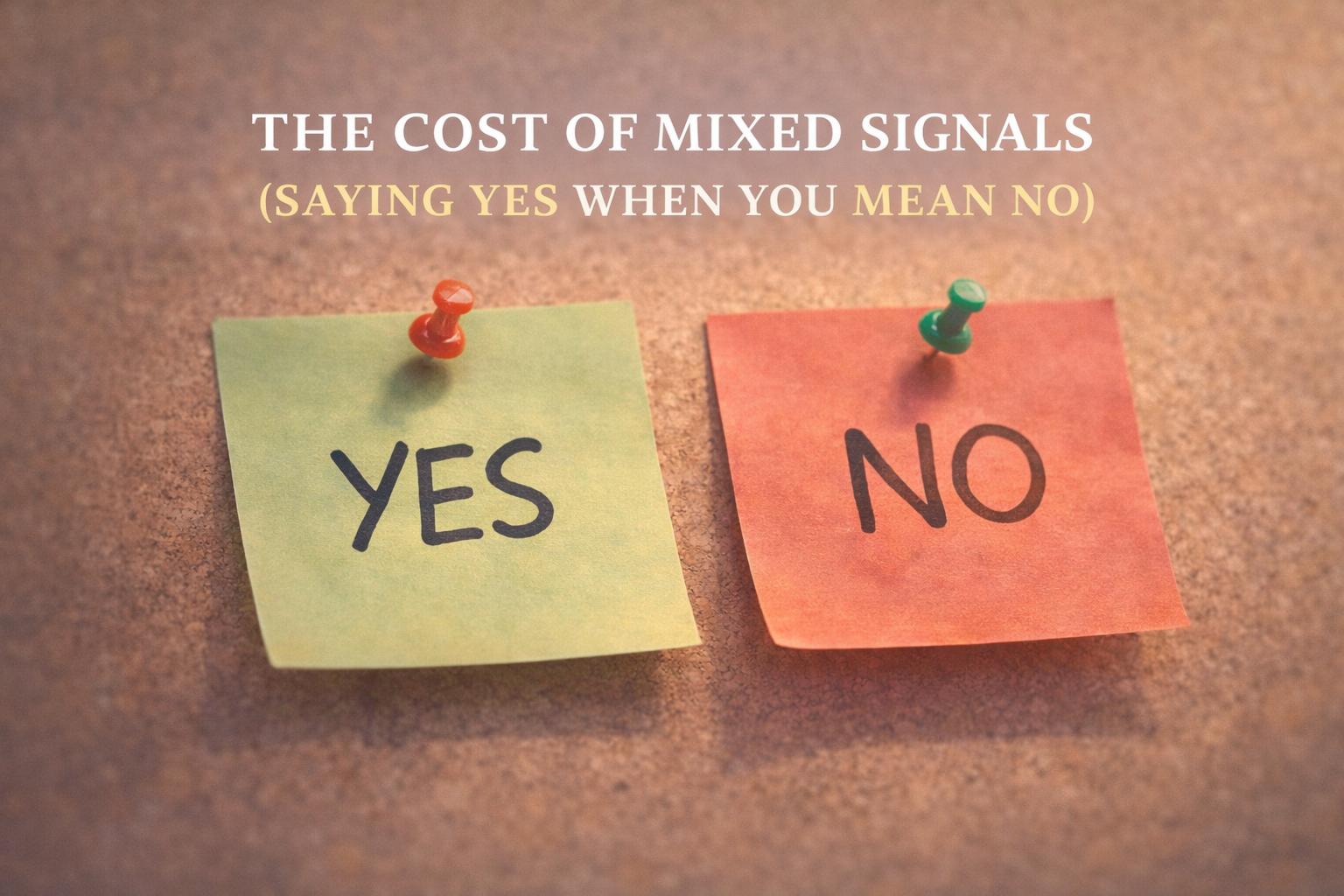
The Cost of Mixed Signals (Saying Yes When You Mean No)
Mixed signals drain your time, energy, and self-trust. Learn how to stop saying yes when you mean no with calm, clear boundaries.
Mixed signals look polite, but they cost a lot.
A mixed signal is when your mouth says yes and your body says no. When your calendar agrees and your soul withdraws. When you offer something with a smile but feel resentment later.
Clean signal living asks for something different: clarity that doesn’t punish you.
Mixed signals drain self-trust first
Each time you say yes when you mean no, you teach your system: my needs are negotiable. Over time, you second-guess yourself and feel exhausted without knowing why.
Your signal has been split.
Mixed signals confuse other people too
People respond to what you repeatedly allow. If your yes is unreliable, others don’t know where you stand. Some push harder. Some assume you’re fine.
Clarity is kindness.
Why no feels scary
For many people, no feels like danger. Fear of anger. Fear of abandonment. Fear of being labeled difficult. Your body can react to a simple boundary like it’s a threat.
So we start with safer steps.
The delayed yes practice
Instead of answering immediately: let me check and get back to you, I want to be sure before I commit, can I confirm by tomorrow?
A delayed yes protects your signal.
Clean ways to say no
I can’t commit to that. That doesn’t work for me. I’m not available. I’m focusing on fewer things right now. I can’t help with that, but I hope it goes well.
Short. Respectful. Final.
When you mean yes, say it fully
A true yes feels open, not tight. Present, not resentful. Your life becomes simpler when yes and no are clean.
Mixed signals are expensive. Clean signals are freeing.
Your Soulful Pathways ↑
Discover more series pages for you in Your Soulful Pathways ↑
When Your Energy Doesn’t Match Your Words
Learn why mismatch creates stress and confusion, and how to return to integrity through small, steady truth.
People don’t just hear your words. They feel your signal.
When your energy doesn’t match your words, confusion enters the room. Not always outwardly, but inwardly. Your body knows. Your nervous system registers the split. Over time, that split becomes stress.
This isn’t about being perfect or always positive. It’s about coherence. Being true in a way your whole system can relax into.
Mismatch creates friction inside you
You say it’s fine, but your chest is tight. You say sure, but your stomach drops. You say you’re not bothered, but your mind loops for hours.
That looping is your system asking for integrity, in the small moments where you override yourself.
Integrity isn’t a moral badge. It’s an energetic state where your inner truth and outer expression meet.
Why your body cares so much
Your body tracks safety. When you repeatedly deny what you feel, your system learns you are not listening. That can create anxiety, hypervigilance, or numbness.
When your energy matches your words, your body receives a powerful message: I can trust me.
The smallest truth is strong medicine
Clean signal isn’t oversharing. It’s honest enough to stay aligned.
Try small truths like: let me think about that, I’m not available for that, give me a minute to answer honestly, that doesn’t work for me, I’m feeling tender today and I need quiet.
Small truths create big relief because they stop internal friction.
Where mismatch often comes from
Mismatch usually comes from fear: fear of conflict, fear of disappointing someone, fear of being seen as difficult, fear of losing connection.
But connection that requires self-betrayal is costly. It teaches your system to trade truth for safety. That trade may have protected you once. Now it drains your signal.
A coherence check you can use anytime
Before responding, ask: what do I actually feel, what do I actually want, what can I honestly communicate right now?
Then choose the cleanest version you can. Clean doesn’t mean harsh. It means clear.
Your life broadcasts your integrity
When your energy matches your words, your life becomes simpler. Less explaining. Less rescuing. Less performing. More peace.
Integrity is the signal of calm.
Your Soulful Pathways ↑
Discover more series pages for you in Your Soulful Pathways ↑
The People Around You Shape Your Signal
Relationships influence your nervous system and choices. Learn to protect your energy and strengthen your signal through healthier connection.
You are not broadcasting from a sealed room. You’re broadcasting from a field. And the people closest to you help shape the signal you live inside of.
This is comforting, not condemning. It means you’re not too sensitive. Your nervous system is doing what it was designed to do: respond to cues of safety, tension, warmth, pressure, and unpredictability.
Co-regulation is real
Your body learns safety in relationship. It also learns stress in relationship. Around grounded people, your breathing often settles. Around chaotic people, your system braces even if you’re smiling.
This isn’t judgment. It’s information.
The question is not “Are they good or bad?” The question is: what does my system become around them?
Your signal adapts to survive
Many people learned to match other people’s energy to stay safe. You became the agreeable one. The smooth one. The one who keeps the peace.
That’s not your fault. But it can become a leak.
When you consistently shrink, perform, or overextend, your signal becomes distorted. You might feel tired after conversations that look “fine.” You might second-guess yourself for days.
The after-effect test
Instead of analyzing the relationship endlessly, notice the after effect.
After time with them, do I feel more calm or more tense? More clear or more confused? More energized or more drained? More like myself or less like myself?
You don’t need to demonize anyone. You just need to honor the data.
Protecting your signal without burning bridges
Protection can be quiet: shorten the call, share less with unsafe listeners, stop trying to be understood by someone committed to misunderstanding you, choose neutral topics, rest afterward instead of pushing through.
This isn’t coldness. It’s stewardship.
Upgrading your environment gently
You don’t have to replace your whole circle overnight. Add one supportive input: one steady friend, one kind community, one weekly check-in, one boundary that stops the biggest leak.
Your signal strengthens around people who respect your no, celebrate your truth, and don’t punish you for being human.
Your life will broadcast what you normalize
Normalize disrespect and your system tolerates it. Normalize calm and your system begins to seek it. Normalize honesty and your nervous system relaxes.
You’re allowed to choose the field you live in.
Your Soulful Pathways ↑
Discover more series pages for you in Your Soulful Pathways ↑
Clean Inputs, Clean Outputs
Your inputs shape your mood, decisions, and energy. Clean up what you consume so your life feels clearer and calmer.
Your life is always processing what you let in. Words, screens, conversations, food, music, environments, even the tone of your own self-talk. Inputs become outputs. Not because you’re weak, but because you’re human.
Clean inputs create clean outputs. This isn’t about being strict. It’s about being honest: what am I feeding my system, and what is it producing in me?
Your nervous system is not a machine
You can’t pour chaos into your day and expect peace to come out. If your morning begins with stress, your body often carries that signal like a radio stuck between stations. Then you wonder why you’re tired, why you’re snapping, why you can’t focus.
Your nervous system is a translator. It turns inputs into feelings, feelings into actions, actions into patterns. When your inputs are cleaner, your patterns become kinder.
Inputs aren’t just content, they’re atmosphere
Sometimes the input isn’t what you watched. It’s the tone it left behind. Some things tighten your chest. Some things speed up your thoughts. Some things make you quietly compare your life to someone else’s highlight reel.
A clean input is anything that leaves you more grounded than before. It doesn’t have to be “high vibe.” It just has to be nourishing and true.
The three categories check
Sort your regular inputs into three categories: nourishing, neutral, draining. Don’t overhaul your life. Reduce one draining input by 10% this week. That’s enough to change your signal.
Clean outputs look like calm decisions
When inputs are messy, outputs are reactive. You answer too fast. You say yes too quickly. You overexplain. You procrastinate. You reach for comfort that doesn’t actually comfort.
When inputs are clean, outputs become calmer. You pause. You choose. You respond instead of react.
A simple clean-input ritual
Pick one daily clean pocket: water before content, silence before conversation, open a window before opening apps, three slow breaths with your hand on your chest.
This isn’t productivity. It’s a safety signal: I am safe enough to choose my day.
Your signal deserves protection
You don’t have to consume what everyone else consumes. You can curate your inputs like you curate your home, because your life broadcasts what you repeatedly allow inside it.
Clean inputs aren’t about perfection. They’re about freedom.
Your Soulful Pathways ↑
Discover more series pages for you in Your Soulful Pathways ↑
Your Attention Is Your Power Supply
Your attention fuels your life. Learn how to reclaim focus, reduce noise, and direct your energy toward what truly matters.
Your attention is not just something you “give.” It’s something you spend. And your life gets built where your attention keeps landing.
Attention is your power supply. It feeds your thoughts, your habits, your nervous system, your relationships, your decisions. If your attention is constantly scattered, your energy feels scattered too. You can be doing a hundred things and still feel like nothing is moving, because your power supply is leaking into noise.
This is the first signal reset: noticing where your attention goes when you are not trying.
What you focus on grows roots
Your attention is a form of agreement. When you repeatedly focus on something, you train your brain and body to treat it as important. That’s why doom-scrolling can make life feel unsafe, even if your day is objectively fine. That’s why overthinking a conversation can drain you like you ran a mile. Attention builds reality internally first, then externally.
The goal is not perfect focus. The goal is honest focus. Clean focus. Focus that matches the life you want to live.
The hidden cost of constant switching
Every time you switch tasks, tabs, or thoughts, your system pays a small tax. Over time, that tax becomes fatigue, irritability, and that foggy feeling like your day never really started. Your signal gets choppy. Your mood becomes reactive. Your creativity gets delayed because your mind is always reloading.
When your attention is stable, your life feels steadier too. Not louder. Just clearer.
An attention audit that actually works
For one day, every time you pick up your phone, pause for one breath and ask: “What am I looking for right now?” Relief? Distraction? Reassurance? Stimulation? Escape? Connection?
Naming the reason turns your attention from something that gets stolen into something you choose.
Then add one gentle rule: if you’re looking for relief, do one calming thing before you scroll. One sip of water. One shoulder drop. One slow breath. One minute looking out a window. That pause returns power to you.
The one-tab life practice
Pick one daily window, even 20 minutes, where you live one-tab. One task. One focus. When your mind darts away, bring it back without drama. This is not discipline. It’s devotion.
Your signal gets cleaner when your attention learns it can stay.
What you feed becomes your frequency
If you feed your attention to what drains you, your life broadcasts that drain. If you feed your attention to what strengthens you, your life broadcasts steadiness.
Your power supply is already in your hands. One choice at a time, you can direct it.
Your Soulful Pathways ↑
Discover more series pages for you in Your Soulful Pathways ↑

Living as a Signal
Your life broadcasts. Learn how to clean your signal through attention, boundaries, integrity, and small consistent choices that create real change.
Your life broadcasts, even when you don’t realize you’re transmitting.
Not just in what you say, but in what you repeat. In what you tolerate. In what you give your attention to. In the way you answer when you’re tired. In the “yes” you offer while your body quietly says no.
Living as a signal means becoming honest about your broadcast. Not to impress anyone. Not to “look aligned.” But to feel clean inside yourself. Clear. True. Steady.
This series is a practical bridge between spirituality and real-life choices. Because alignment is not just an idea. It’s how you show up on a Tuesday. It’s how you protect your energy. It’s how you speak. It’s how you keep your promises. It’s how your nervous system learns it can trust you.
Your signal is built from what you repeat
Most people try to change their lives by changing their thoughts, but your signal is often shaped by smaller, quieter things: what you consume, who you keep close, how quickly you respond, how often you abandon your own needs to keep peace.
A clean signal is not perfection. It’s coherence. It’s when your inner truth and outer choices begin to match. It’s when your “yes” is real. Your “no” is calm. Your habits support the life you say you want.
Mixed signals create mixed results
When you send mixed signals, you don’t just confuse other people. You confuse your own system. You may feel anxious, drained, scattered, or stuck, not because you’re doing life wrong, but because your energy is constantly split.
This series helps you reduce that split in a gentle way, using practical steps your nervous system can actually handle.
What you’ll learn here
You’ll learn how to reclaim your attention as a power source, clean up your inputs so your outputs become calmer, notice how relationships influence your baseline, align your words with your energy without becoming harsh, stop saying yes when you mean no, set boundaries that are consistent and peaceful, plug the leaks that drain your life force, build alignment through steady habits, use small truths to reshape your reality, and maintain clarity with a weekly signal reset.
How to use this series
Read in order if you want the full journey. Or start with the page that matches your current struggle. Each page includes a simple practice, because clean signal living is built through repetition, not inspiration alone.
Your life already broadcasts. The question is whether it’s broadcasting noise or truth.
Your Soulful Pathways ↑
Discover more series pages for you in Your Soulful Pathways ↑
The New You Will Require New Habits
Identity becomes real through repetition. Explore small habit shifts that match your new self, without pressure or shame.
A new identity needs somewhere to live.
Not just in your thoughts. In your calendar. In your boundaries. In your mornings. In the small decisions no one applauds. In the quiet moments when no one is watching and you still choose differently.
Transformation becomes stable when it becomes habitual.
Insight can open the door, but habits are what help you walk through it again and again until the path becomes natural.
Why habits matter for identity
Your habits are a daily vote for who you are.
They tell your body what to expect. They tell your mind what is normal. They tell your nervous system whether you are still living from survival or beginning to live from truth.
If your new self is grounded, but your habits are chaotic, you will feel pulled back into old patterns. Not because you are weak, but because repetition teaches the body what is familiar.
Habits are how the body learns:
This is who we are now.
This is what safety feels like now.
This is what alignment looks like in real life.
A new identity cannot stay strong if your daily rhythms are still serving an old version of you.
The trap of trying to change everything at once
Many people struggle with change not because they lack desire, but because they try to become a whole new person overnight.
They make long lists. Big promises. Dramatic plans. Then when they cannot sustain all of it at once, they feel discouraged and start questioning whether they have really changed.
But identity alchemy is slower than that.
It is one small aligned habit at a time. One repeated choice. One new response where the old version of you would have reacted differently.
The goal is not intensity.
The goal is consistency.
Lasting change usually looks less like a lightning strike and more like a lantern you keep lighting every day.
Habits that support a truer self
Choose habits that reduce self-betrayal and strengthen inner steadiness.
Examples:
A two-minute morning check-in:
What do I need today?
A boundary habit:
pause before saying yes
A nervous system habit:
breathe before responding
A truth habit:
speak one honest sentence each day
A rest habit:
schedule recovery like it matters, because it does
A reflection habit:
notice when something no longer feels aligned
These habits may look small, but small habits become anchors.
Anchors become identity.
Identity begins to reshape your life from the inside out.
Let your new self become familiar
At first, new habits can feel awkward.
You may feel like you are forcing it. You may wonder whether it is really you. You may miss the strange comfort of old patterns, even when those patterns were hurting you.
That does not mean you are doing it wrong.
Awkward is not failure.
Awkward is often the feeling of truth becoming embodied.
Give yourself time to become familiar to yourself again.
The new you may feel unfamiliar at first, not because it is false, but because you have spent so long rehearsing survival.
A gentle habit plan
Pick one habit and make it easy.
Tie it to something you already do, like after coffee or after brushing your teeth.
Keep it short. Two minutes counts.
Track it lightly. A checkmark is enough.
Do not ask the habit to prove everything all at once. Let it be small. Let it be steady. Let it become part of the atmosphere of your life.
Then repeat it until it feels like home.
The truth about the new you
The new you is not a stranger.
The new you is the real you with fewer masks. The real you with stronger boundaries. The real you with less chaos, less self-abandonment, and more willingness to live in alignment with what is true.
New habits do not create your worth.
They protect your alignment.
They give your healing somewhere to land.
They give your becoming a structure.
They help your future self stop living like your past self is still in charge.
And that is what makes transformation last.
Your Soulful Pathways ↑
Discover more series pages for you in Your Soulful Pathways ↑

The Spiritual Power of Saying “That’s Not Me Anymore”
Some words close old doors gently. Learn how to release past identities with compassion and step into the truth you’re ready to live.
There is a sentence that can change your life without raising your voice:
“That’s not me anymore.”
Not said with anger.
Not said with superiority.
Said with clarity.
This sentence carries spiritual power because it draws a line between who you had to be and who you are choosing to become. It marks the space between survival and alignment. Between old patterns and present truth.
Sometimes healing does not begin with a dramatic breakthrough. Sometimes it begins with one honest sentence spoken from a steadier place within:
That’s not me anymore.
Why this sentence is spiritually powerful
Old identities do not always leave when you outgrow them.
Sometimes they linger through habit. Through fear. Through relationships that still expect the old version of you. Through roles you learned to play to stay loved, safe, accepted, or needed.
That is why saying, “That’s not me anymore,” matters so much.
It is a spiritual boundary.
It is an energetic decision.
It is a declaration that your past patterns are no longer the authority over your future.
This is not denial. It is discernment.
You are not pretending the old version of you never existed. You are recognizing that it no longer gets to lead.
What you may be leaving behind
This sentence can apply to more than one kind of pattern. It may be the line you draw against:
People-pleasing
Overexplaining
Self-abandonment
Shame-driven choices
Emotional shrinking
Settling for less than mutual love
Calling chaos “chemistry”
These patterns often began as protection. They helped you survive a season, a relationship, an environment, or a wound.
But survival strategies are not always meant to become lifelong identities.
There comes a moment when healing asks you to stop introducing yourself through your pain.
You are not betraying the old you
Many people hesitate to change because they do not want to seem inconsistent. They worry that choosing differently will confuse others or disappoint people who benefited from the older version of them.
But consistency is not holiness.
Integrity is.
If you are healing, your choices should change.
If you are growing, your responses should change.
If you are becoming more honest, peaceful, and whole, your life should begin to reflect that.
Saying, “That’s not me anymore,” is not a rejection of your past. It is an update of your truth.
You are not judging the old you.
You are simply no longer asking that version of you to carry the future.
Why this matters for your nervous system too
This is not just spiritual language. It is also nervous system retraining.
Every time you stop returning to an old pattern, you teach your body that a new way is possible. Every time you choose clarity over performance, peace over panic, honesty over self-betrayal, you create a new internal agreement.
The phrase “That’s not me anymore” becomes more than a statement. It becomes reinforcement.
It tells your mind, your body, and your spirit:
I do not have to repeat what I have healed.
I do not have to keep abandoning myself to stay connected.
I do not have to live inside an identity that no longer fits.
That is where the spiritual power lives. Not just in what you say, but in what you stop feeding.
How to say it without hostility
You do not need to weaponize this sentence for it to be strong.
You can say it gently:
“That’s not me anymore.”
“I don’t live that way now.”
“I’m choosing something different.”
“I’m not available for that.”
No long explanation required.
No performance required.
No courtroom required.
Truth does not need a defense team.
A simple release practice
Write down one identity you are ready to release.
Then write:
Thank you for what you did for me.
I release you with love.
That’s not me anymore.
This is not magical thinking.
It is spiritual alignment.
It is emotional honesty.
It is nervous system retraining.
It is a new agreement with your future.
The moment becoming becomes real
Transformation is not only what you realize.
It is what you stop returning to.
There comes a point when insight is no longer the work. Embodiment is.
When you say, “That’s not me anymore,” you close an old door. Not to punish yourself, but to protect your future. Not to become cold, but to become clear. Not to erase your story, but to stop living inside the chapter that has already ended.
And that is spiritual power.
Your Soulful Pathways ↑
Discover more series pages for you in Your Soulful Pathways ↑
Integrity: The Highest Frequency You Can Hold
Integrity isn’t perfection. It’s alignment. Learn how choosing truth, even quietly, becomes your strongest spiritual power.
Integrity has a sound.
It’s not the sound of being flawless. It’s the sound of being aligned. When your inner life and outer life match, something settles. Your energy stops leaking. Your nervous system stops negotiating.
Integrity becomes a kind of peace you can feel in your bones.
Integrity is not perfection
Perfection is fear wearing a fancy outfit.
Integrity is truth wearing comfortable shoes.
Integrity says:
“This is who I am.”
“This is what I value.”
“This is what I will not betray.”
It’s less about appearance and more about coherence.
Why integrity feels like a frequency
When you’re out of integrity, your body knows.
You might feel:
Tension after saying yes when you meant no
Fog after pretending something didn’t bother you
Fatigue after entertaining relationships that drain you
Restlessness after ignoring your own instincts
That’s your system telling you, “We’re not aligned.”
The quiet ways we abandon ourselves
Integrity is often lost in tiny moments:
Laughing at something that hurt you
Staying silent when truth mattered to you
Overgiving to earn closeness
Agreeing just to avoid discomfort
No shame. Most people learned this as survival.
But you can unlearn it as devotion.
Choosing integrity in real life
Integrity doesn’t always look “nice.”
Sometimes it looks like:
Saying no without explaining
Leaving a situation that keeps dishonoring you
Admitting, “I changed my mind”
Being consistent with your own values, even when nobody claps
Integrity is a private agreement with your soul.
A simple integrity check
Ask:
“What would I do if I trusted myself fully?”
Then ask:
“What am I doing now that I’ll have to emotionally pay for later?”
That second question is powerful.
It reveals the hidden debt of self-betrayal.
Integrity creates identity
When you live in integrity, you stop needing a mask.
You stop needing to convince people.
You stop needing to prove.
Your life becomes the evidence.
That’s the highest frequency:
A self you can trust.
Your Soulful Pathways ↑
Discover more series pages for you in Your Soulful Pathways ↑.
The Courage to Be Misunderstood
Growth can confuse people who only knew your old self. Learn how to stay grounded when others don’t get your transformation yet.
One of the hardest parts of transformation is that it changes how you are received.
People who benefited from your old self may not celebrate your new boundaries. People who loved your performance may feel unsettled by your honesty. People who only knew your survival identity might not recognize the real you.
This is where courage becomes spiritual.
Misunderstanding is not a sign you’re wrong
Sometimes misunderstanding is simply evidence that you changed.
You stopped overexplaining.
You stopped rescuing.
You stopped smiling through discomfort.
You started telling the truth in a quieter voice.
Not everyone will know what to do with that.
Why it feels so uncomfortable
The nervous system often equates misunderstanding with danger:
“If they don’t get me, I’ll lose connection.”
But transformation requires you to tolerate a temporary gap:
The gap between who you were and who you are becoming.
That gap can feel lonely, even when it’s healthy.
The temptation to shrink back
When you feel misunderstood, you might feel pulled to:
Make yourself easier to digest.
Prove you’re still “good.”
Explain yourself until you’re exhausted.
Return to the old role for peace.
But peace built on self-abandonment is not peace.
It’s a pause before the next resentment.
Staying grounded in your truth
Try these anchors:
“I don’t have to be understood to be true.”
“The right people will adjust.”
“I can be kind without being consumable.”
“My growth does not require permission.”
A compassionate boundary
Being misunderstood doesn’t require you to harden.
It requires you to stay steady.
You can say:
“I hear you.”
“I’m still choosing this.”
“I’m not explaining further.”
That is courage.
Not loud.
Not dramatic.
Just firm and calm.
The deeper gift of being misunderstood
Misunderstanding filters your relationships.
It reveals who loves you as a role, and who loves you as a person.
And while that can be tender, it can also be freeing.
Because the real you needs space to live.
Not space to perform.
Your Soulful Pathways ↑
Discover more series pages for you in Your Soulful Pathways ↑.
Your Nervous System Picks Your Personality (Until You Heal)
When you’re dysregulated, your nervous system can run your reactions, roles, and relationships. Healing creates room for the real you.
Some traits aren’t “you.”
They’re your nervous system doing its job.
A dysregulated system will choose strategies that keep you safe, even if they cost you authenticity. That means what you call your personality might actually be a pattern of protection.
And that is good news, because patterns can change.
How regulation shapes identity
When your system feels safe, you have options.
You can pause. You can choose. You can respond.
When your system feels unsafe, it defaults.
You snap, shut down, people-please, overthink, control, withdraw, perform.
Not because you’re broken. Because your body is trying to protect you.
“Personality” traits that can be protective
You might relate to:
Being “easygoing” but secretly never saying what you need.
Being “independent” but actually afraid to rely on anyone.
Being “funny” but using humor to avoid vulnerability.
Being “busy” but using productivity to outrun discomfort.
Being “spiritual” but using detachment to avoid feelings.
These traits can still be real parts of you. But they may also be survival-driven.
The quiet relief of naming it
One of the most healing sentences is:
“This is a nervous system strategy.”
Because it removes shame.
It turns the spotlight from “What’s wrong with me?” to “What’s happening in me?”
Healing makes room for choice
As you heal, you may notice your identity shifting naturally:
You set boundaries without panic.
You speak honestly without rehearsing.
You rest without guilt.
You stop chasing approval.
You tolerate being misunderstood.
That’s not you becoming someone else.
That’s you returning to yourself.
A regulation practice that supports identity
Try this simple reset:
Place one hand on your chest and breathe slower than your thoughts.
Name five things you can see.
Let your shoulders drop on the exhale.
Ask: “What do I actually want right now?”
This is how you teach your system that truth is safe.
The real you isn’t a performance
The real you is what remains when your body is no longer bracing.
Healing doesn’t create your identity.
Healing reveals it.
Your Soulful Pathways ↑
Discover more series pages for you in Your Soulful Pathways ↑.
Who Are You Without the Story?
Your story shaped you, but it doesn’t have to define you forever. Explore what remains when you loosen the labels and listen inward.
Your story matters. It explains. It validates. It organizes your past into something you can carry.
But sometimes your story becomes a cage made of familiar sentences.
“I’m the one who…”
“I’ve always been…”
“That’s just how I am…”
At a certain point, the story stops being a reflection and starts being a rule.
When the story becomes the identity
A story is meant to describe where you’ve been, not dictate where you’re allowed to go.
But identity often forms around survival narratives:
“I had to grow up fast.”
“I’m the responsible one.”
“People leave, so I don’t need anyone.”
“I’m the strong one. I don’t fall apart.”
These stories may be true. But they might not be your full truth anymore.
The difference between your history and your essence
Your history is what happened.
Your essence is what remains when you stop performing around what happened.
Essence shows up as:
What calms you.
What feels honest.
What you value when nobody is watching.
What you return to when you’re not trying to prove anything.
You don’t need to erase the past to meet your essence. You just stop letting the past be your only mirror.
Questions that loosen the labels
Try asking:
“Who am I when I’m not protecting myself?”
“What do I do when I’m not trying to impress anyone?”
“What makes me feel clean inside?”
“What do I keep longing for, even when I ignore it?”
Longing is often truth knocking.
Letting the story evolve
This isn’t about denying pain. It’s about letting identity become wider than pain.
You can say:
“Yes, that happened.”
“And also, I’m not only that.”
Your life is allowed to expand beyond what you survived.
A gentle exercise
Write one sentence that describes you, but remove your roles and your wounds.
Not:
“I’m the one who holds everything together.”
Try:
“I’m learning how to live with softness and strength.”
Not:
“I’m the one who always gets left.”
Try:
“I’m building relationships that feel safe and mutual.”
Your story can stay.
But it doesn’t get to own you.
Your Soulful Pathways ↑
Discover more series pages for you in Your Soulful Pathways ↑.
The Moment You Stop Performing
Performance can be a learned way to stay safe and liked. This page helps you notice the pattern and choose presence instead.
There is a moment when performance stops feeling like a skill and starts feeling like a sentence.
You can still do it, but it costs you more than it used to. You feel it in your body. Your shoulders. Your jaw. The way your nervous system won’t unclench even after the conversation ends.
That discomfort is not failure. It’s awakening.
What performing really is
Performing is not the same as showing up.
Performing is when you manage your presence for a result:
Be liked.
Be safe.
Be admired.
Be needed.
Be chosen.
It often starts early. You learn what gets you love and what gets you consequences. Then you become what works.
Signs you’re performing
You might notice:
You rehearse what to say before you say it.
You edit your feelings mid-sentence.
You smile when you don’t feel safe.
You “keep it light” even when you’re heavy inside.
You leave interactions feeling drained, not nourished.
Again, this is not shame. This is insight.
The sacred discomfort of stopping
When you stop performing, two things happen:
The old identity panics.
The real self breathes.
The panic might sound like:
“They’ll think I’m different.”
“They’ll be disappointed.”
“What if I lose them?”
But the breath sounds like:
“I can be here without acting.”
“I can be loved without earning it.”
“I can be myself without apologizing.”
Choosing presence over performance
Start small. Presence is built in moments, not speeches.
Instead of overexplaining, try one honest sentence.
Instead of laughing something off, try a pause.
Instead of saying yes automatically, try: “Let me think about it.”
When you do this, you are training your system to tolerate truth.
A simple practice
Before you respond to someone, ask:
“What would I say if I wasn’t trying to be anything?”
You can still be kind. You can still be thoughtful. The goal is not harshness. The goal is honesty without costumes.
The moment you stop performing, you don’t become less lovable.
You become more real.
And real is where peace lives.
Your Soulful Pathways ↑
Discover more series pages for you in Your Soulful Pathways ↑.

How Shame Builds a Fake Identity
Shame can push you into hiding and shaping a self that feels safer. Learn how to recognize shame-based patterns and return to truth.
Shame doesn’t just hurt. It edits.
It takes a real moment, a real mistake, a real human need and turns it into a conclusion about who you are.
And once shame writes the conclusion, identity follows.
What shame sounds like in the mind
Shame rarely says, “That was hard.”
Shame says, “That’s you.”
It whispers:
“You’re too much.”
“You’re not enough.”
“You ruin things.”
“You always mess it up.”
“Don’t get your hopes up.”
Over time, you learn to become a safer version. A quieter version. A less-needy version. A more impressive version.
Not because you’re shallow. Because you’re trying to escape pain.
How shame creates a false self
A shame-based identity is built like armor:
If I’m perfect, I can’t be criticized.
If I’m helpful, I won’t be abandoned.
If I’m invisible, I can’t be rejected.
If I’m always okay, no one will leave.
This false self can look “successful.” But inside, it feels tight. Like living in clothes that don’t breathe.
The hidden sign you’re shame-led
You might notice you make choices from a place of prevention.
Not “What do I want?”
But “What will keep me safe from being judged?”
That’s shame running your life like a manager with impossible standards.
Returning to truth without forcing confidence
You don’t heal shame by yelling affirmations at it. You heal shame by offering it warmth and reality.
Try this:
Name the shame message. “I’m feeling like I’m not enough.”
Name the human truth. “I’m learning. I’m growing. I’m allowed to be imperfect.”
Name the next honest action. “I’ll take one step, not ten.”
Truth is often quieter than shame, but it lasts longer.
A gentle identity reset
Ask:
“What did I decide about myself because of pain?”
Then ask:
“If I release that decision, what becomes possible?”
You don’t have to rewrite your whole life. You just stop signing shame’s contract.
You were never your worst moment.
You were never the label placed on you.
You are not shame’s conclusion.
Your Soulful Pathways ↑
Discover more series pages for you in Your Soulful Pathways ↑.

The Mask That Got Applause
Sometimes the version people praised isn’t the real you. Explore how approval shapes identity, and how to step out of the role with grace.
Some masks don’t feel like masks.
They feel like “my best self.” They feel like the version of you that gets invited back, gets chosen, gets complimented, gets trusted.
And that’s the tricky part.
When a mask gets applause, it becomes tempting to live inside it.
How applause teaches you who to be
Approval can train the nervous system like a reward button.
You say the right thing, people laugh.
You stay calm, people call you mature.
You take on extra, people call you dependable.
You look unbothered, people call you strong.
Over time, you stop asking, “Do I want this?” and start asking, “Will this be received well?”
That is how applause becomes a cage with soft walls.
The invisible cost of being the “good version”
The cost often shows up quietly:
You feel oddly empty after socializing.
You can’t tell if you’re happy or just functioning.
You feel anxious before being seen, even by safe people.
You fear letting others down more than you fear losing yourself.
The applause doesn’t just praise you. It pressures you to repeat yourself.
The difference between growth and performance
Growth expands you. Performance compresses you.
Growth feels honest even when it’s messy.
Performance feels polished even when it’s painful.
Ask yourself:
“When I’m being praised, do I feel more free… or more trapped?”
Your body will answer.
Stepping out of the role without burning everything down
You don’t have to announce a new you with fireworks. You can simply start being more truthful in small ways.
You let a silence exist without filling it.
You admit you’re tired without making it funny.
You say, “That doesn’t work for me,” and let the sentence end.
Some people will adjust. Some won’t. Their response becomes information, not a verdict.
A grounded reframe
Your mask was not a mistake. It was a bridge.
It helped you cross seasons where being fully you didn’t feel safe. But bridges are meant for crossing, not living on.
The real you doesn’t need applause to be valid.
The real you needs permission to exist.
Your Soulful Pathways ↑
Discover more series pages for you in Your Soulful Pathways ↑.
The Self You Built to Survive
Survival can shape a version of you that worked then but feels tight now. Learn how to honor it, and gently release what you no longer need.
There’s a version of you that deserves respect.
Not because it was perfect. Because it was strategic. It knew what to say. It knew when to stay quiet. It learned how to read a room like a weather report and adjust your personality before the first thunderclap.
That version of you got you through.
But survival selves have an expiration date. They’re not meant to be permanent housing.
How survival shapes identity
When life feels unpredictable, the nervous system starts prioritizing safety over authenticity. You become what gets you less conflict. Less abandonment. Less punishment. Less chaos.
Sometimes you became the responsible one. The helper. The peacemaker. The high-achiever. The invisible one. The funny one. The “I’m fine” one.
And none of that makes you fake. It makes you adaptive.
Signs your survival self is still in charge
You might notice:
You overexplain even when you don’t owe anyone a report.
You feel guilty resting, like rest has to be earned.
You can’t fully relax around people you love.
You keep choosing what’s “safe” even when it feels small.
You’re praised for being strong, but inside you feel tired.
These are not character flaws. They’re leftover strategies.
Honor without staying trapped
A powerful shift is learning how to thank the survival self without letting it run the whole show.
You can say:
“I see what you did for me.”
“I understand why you chose that.”
“You helped me survive a season I didn’t know how to survive.”
Then you add:
“But we’re not there anymore.”
Releasing the role gently
Releasing a survival identity isn’t a single moment. It’s a series of tiny permissions.
Permission to disappoint someone who benefits from you being easy.
Permission to say no without giving a speech.
Permission to be quiet without being “off.”
Permission to be seen without performing.
You might start noticing how often you shrink your needs to keep peace. Or how quickly you apologize for having emotions. Those moments are clues. They point to the places where the old self is still gripping the steering wheel.
A small practice for this week
When you feel yourself slipping into a survival role, pause and ask:
“What am I trying to prevent right now?”
Then ask:
“What would be true if I didn’t have to prevent anything?”
Even one honest sentence can begin a new identity.
You don’t have to destroy the old self. You just stop worshipping its rules.
Your Soulful Pathways ↑
Discover more series pages for you in Your Soulful Pathways ↑.

Identity Alchemy
A transformative series for releasing masks, survival identities, and performance patterns, so you can return to what’s true and live from it.
Identity alchemy is not a personality upgrade. It’s a shedding.
It’s the moment you realize you’ve been living in a version of yourself that was built for survival, approval, or protection and you’re ready to come home to what’s real. Not in a dramatic, make-a-scene way. In a quiet, powerful, irreversible way.
This series is for anyone who has ever felt like they’re doing life “correctly” but still feels strangely absent inside it. For anyone who has been praised for being strong, easygoing, dependable, funny, spiritual, productive, or unbothered… while privately carrying the weight of a self that doesn’t quite fit anymore.
Here, we’re not chasing a better mask. We’re releasing the need to wear one.
What identity alchemy really means
Alchemy is transformation at the root level. In this series, that means you stop negotiating with false selves. You don’t just “try to be confident.” You find the places where you learned to perform confidence to avoid rejection, then you dissolve the contract.
Identity alchemy is when you stop asking, “How do I look?” and start asking, “What’s true?”
Why we build false selves
False selves aren’t evil. They’re often brilliant. They helped you belong. They helped you stay safe. They helped you get through seasons that demanded a certain shape of you.
But sometimes the self that saved you becomes the self that traps you.
This series will help you recognize the difference between a true identity and a protective identity, so you can honor what got you here without forcing it to keep driving your life.
What you’ll explore in this series
Each page is designed like a gentle turning of a key. Not to shame the old you, but to free the real you.
The self you built to survive
The mask that got applause
How shame builds a fake identity
The moment you stop performing
Who you are without the story
How your nervous system can “choose” your personality until you heal
The courage to be misunderstood
Integrity as a spiritual frequency
New habits for the new you
The spiritual power of saying, “That’s not me anymore”
How to use these pages
Read slowly. Notice what tightens. Notice what softens. Your body is often the first place truth speaks.
If a page stirs something, it’s not a sign you’re broken. It’s a sign you’re waking up to what doesn’t match anymore.
You don’t need to reinvent yourself. You need to release what was never you.
Your Soulful Pathways ↑
Discover more series pages for you in Your Soulful Pathways ↑.
The “Essence Yes” Test for Big Decisions
Struggling with a big decision? Use the Essence Yes Test to separate fear, pressure, and people-pleasing from what truly aligns with your values and design.
Some decisions don’t just feel like choices.
They feel like crossroads.
Stay or go. Start or wait. Speak up or stay quiet. Say yes or protect your peace.
And when a decision carries weight, the mind tends to do what the mind does: it spins. It lists pros and cons. It predicts future disasters. It tries to control uncertainty by overthinking.
But your essence has a different kind of intelligence.
It doesn’t always speak in full paragraphs.
Sometimes it speaks as a simple inner “yes” or “no.”
This is where the Essence Yes Test helps.
What an “essence yes” is (and what it isn’t)
An Essence Yes is not the same as excitement.
It’s not a dopamine rush.
It’s not “I’m not scared.”
An Essence Yes is when a decision aligns with your deeper values and your true self, even if it’s uncomfortable.
You can feel nervous and still have an Essence Yes.
You can feel excited and still be misaligned.
Essence Yes is about truth, not adrenaline.
The three voices that often masquerade as “guidance”
Before you listen for essence, it helps to notice what isn’t essence.
The pressure voice
This voice says: “Do it because you should.”
It’s fueled by comparison, shame, and performance.The people-pleasing voice
This voice says: “Do it so they don’t get upset.”
It’s fueled by fear of rejection and the habit of self-abandonment.The panic voice
This voice says: “Do something now so you don’t feel anxious.”
It’s fueled by urgency and catastrophizing.
These voices aren’t evil. They’re protective. But they’re not always wise.
The essence yes test (5 questions)
Write your decision at the top of a page. Then answer:
Does this honor my top two values?
If you don’t know them yet, use peace and truth as a starting point.
Does this choice protect your peace? Does it keep you honest?Does this require me to shrink?
Will you have to dim yourself, explain yourself excessively, or betray your needs?Does this create a cleaner life or a louder life?
Cleaner doesn’t mean easier. It means less internal chaos.If nobody applauded me, would I still want this?
This separates essence from performance. It’s powerful.What does my body do when I imagine living with this decision for six months?
Do you feel relief? Tightness? Expansion? Dread?
Your body is not always perfect, but it is honest.
How an essence yes feels in real life
An Essence Yes often feels like:
relief mixed with nerves
calm determination
a quiet “I can do this”
sadness for what you’re releasing, but clarity about what’s true
a sense of self-respect returning
It’s rarely dramatic. It’s often steady.
If it’s not a yes, it doesn’t have to be a forever no
Sometimes your answer is: “Not right now.”
That’s still wisdom.
You’re allowed to wait. You’re allowed to gather more information. You’re allowed to build capacity before you leap.
Closing breath
The point of discernment isn’t to eliminate uncertainty.
It’s to eliminate self-betrayal.
When you choose from essence, you may still feel nervous. But you won’t feel divided inside.
That’s how you’ll know.
That’s an Essence Yes.
Your Soulful Pathways ↑
Desktop: Hover over ‘Your Soulful Pathways’ in the top menu to explore another series.
Mobile: Tap the menu (☰), then choose ‘Your Soulful Pathways.’