

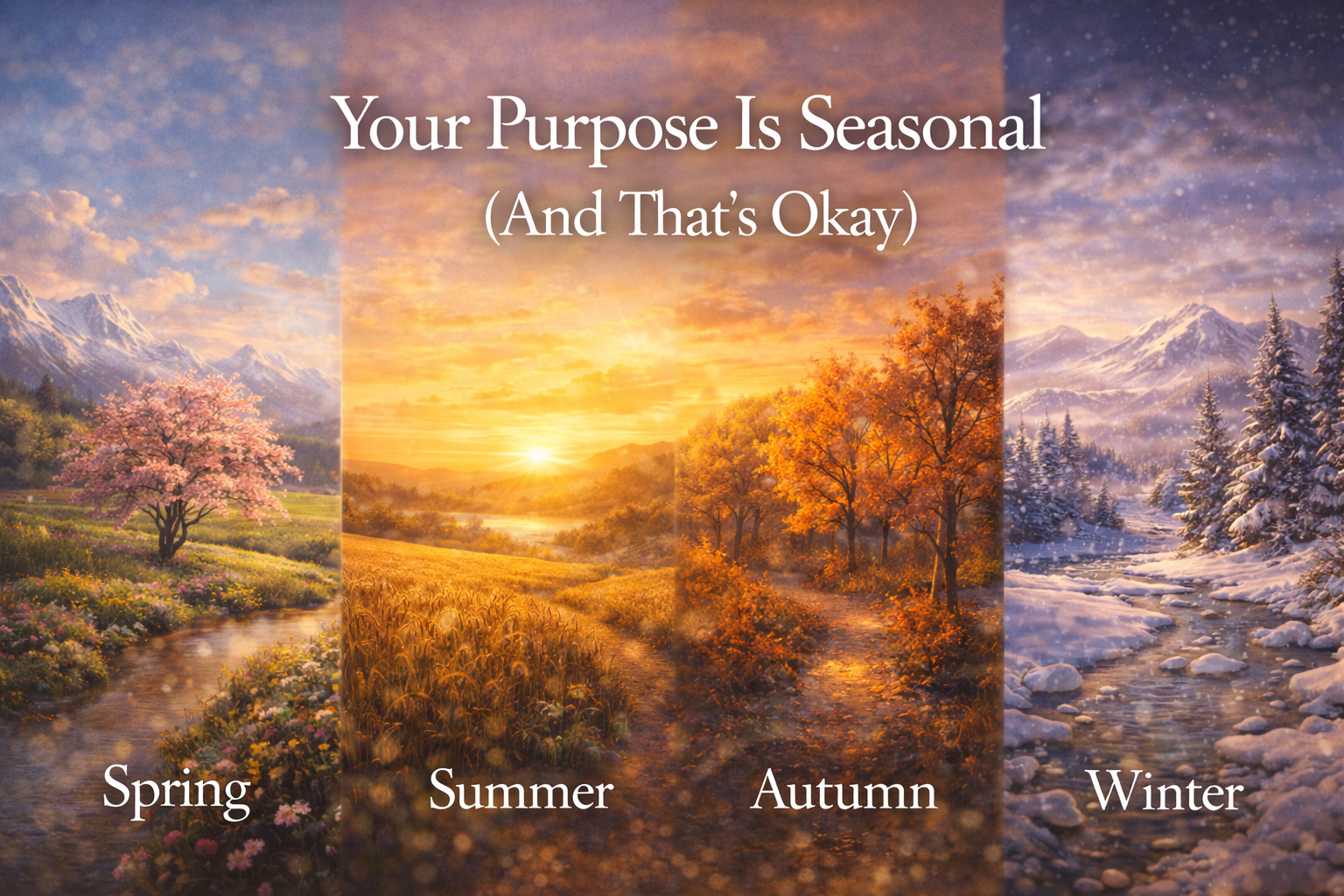
Your Purpose Is Seasonal (And That’s Okay)
Your purpose doesn’t have to stay the same forever. Learn how purpose shifts with seasons, capacity, and growth, without losing your core design.
There’s a quiet pressure many people carry: the belief that purpose must be one permanent, unchanging thing.
A single path. A single label. A single “final answer.”
And if your interests shift, or your priorities change, or your energy isn’t the same as it used to be, you might wonder if you’re unstable, scattered, or failing to “figure it out.”
But purpose often works like seasons.
It doesn’t mean you’re inconsistent. It means you’re alive.
Why purpose feels confusing when you expect it to be permanent
When you expect purpose to be one fixed destination, any change feels like losing your way.
But purpose isn’t only a destination. It’s also a relationship, something you live with. And relationships shift as you grow. What you’re meant to bring to the world can be expressed differently depending on what life is asking of you.
There are seasons for building. Seasons for healing. Seasons for caregiving. Seasons for creating. Seasons for simplifying. Seasons for starting over.
Your blueprint doesn’t change, but the expression of it can.
Your essence stays, your expression evolves
Think of your essence as the core thread: the qualities that remain true.
Maybe your essence is nurturing.
In one season, that shows up in parenting.
In another, it shows up in mentoring.
In another, it shows up in writing.
Same essence. Different expression.
Maybe your essence is clarity.
One season, you clarify systems at work.
Another season, you clarify emotions in your family.
Another season, you clarify ideas through teaching or content.
Your purpose isn’t a title you cling to. It’s a truth you live.
The four purpose seasons
Here are four common seasons your purpose may move through:
The foundation season
You’re learning skills, stabilizing, building routines, creating capacity. This season is quieter, often unglamorous, but essential.The healing season
Your purpose is restoration: nervous system repair, boundary building, rebuilding trust with yourself. You’re not “off track.” You’re becoming strong enough to carry what you’re called to.The expansion season
You feel energy return. You create, lead, serve, build, share. This is often when clarity feels louder.The refinement season
You simplify. You choose quality over quantity. You stop doing what drains you. You focus on what’s true, not what’s impressive.
None of these seasons are wrong. They’re rhythmic. Like breathing.
How to know what season you’re in
Ask yourself:
Do I need stability or expansion right now?
Is my body asking for rest, healing, or momentum?
Am I learning foundations, or building something outward?
What feels most urgent: growth, recovery, or clarity?
The answer isn’t a judgment. It’s guidance.
A practical way to stay aligned in any season
Instead of asking, “What’s my one purpose forever?” ask:
“What is my purpose in this season?”
Then answer with one sentence:
“My purpose right now is to stabilize.”
“My purpose right now is to heal.”
“My purpose right now is to create.”
“My purpose right now is to refine.”
“My purpose right now is to serve in a way that doesn’t drain me.”
This removes panic. It gives you a clean next step.
Closing breath
You are not inconsistent because your life is evolving.
Your purpose is allowed to move with your seasons, while your essence stays true underneath it all.
You’re not behind.
You’re in season.
Your Soulful Pathways ↑
Desktop: Hover over ‘Your Soulful Pathways’ in the top menu to explore another series.
Mobile: Tap the menu (☰), then choose ‘Your Soulful Pathways.’
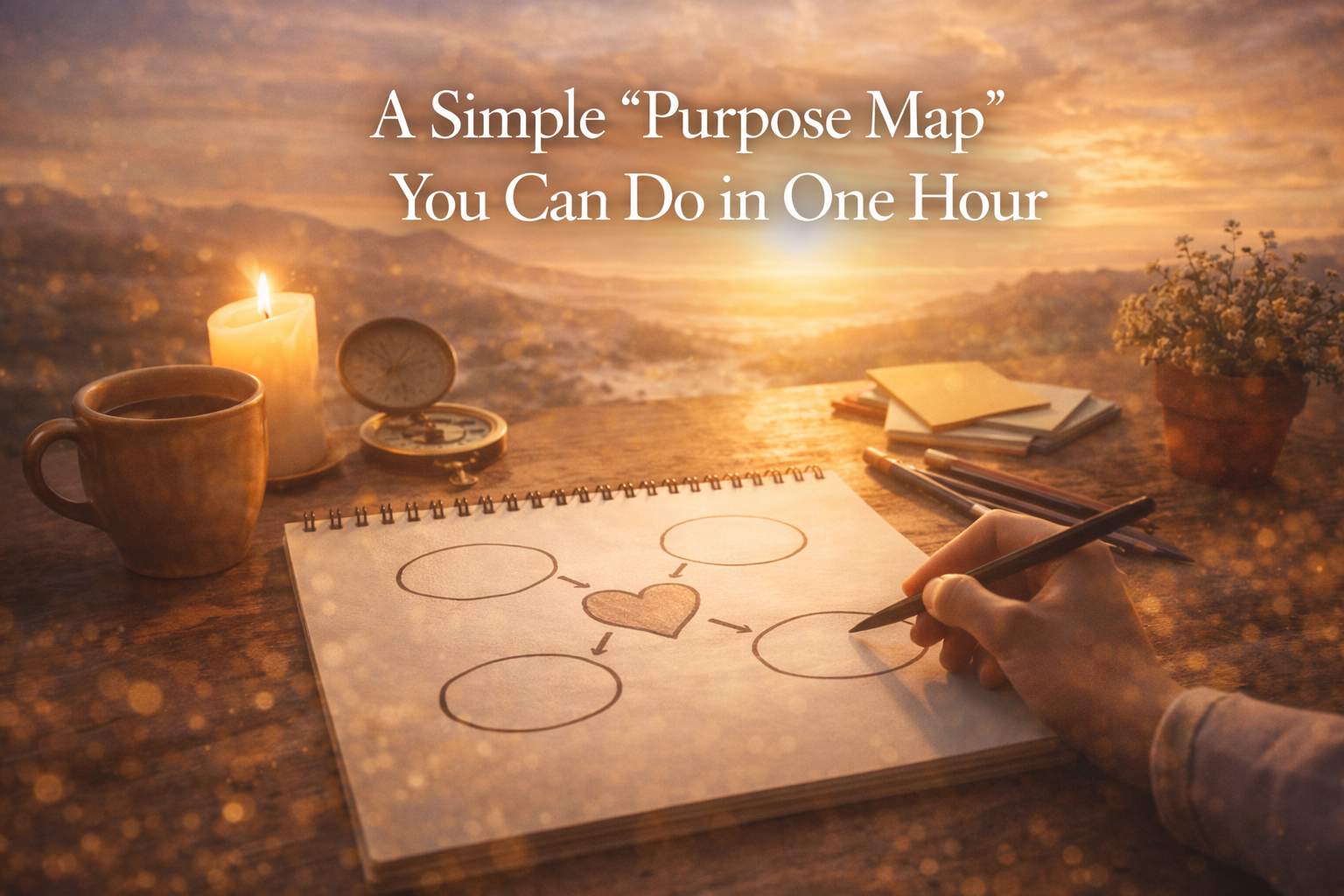
A Simple “Purpose Map” You Can Do in One Hour
Use this one-hour purpose map to identify your values, gifts, patterns, and next steps. Grounded direction you can act on immediately.
You don’t need a five-year plan to find direction.
You need a clear next step that matches your design.
This one-hour purpose map isn’t about solving your entire life. It’s about gathering your clues and turning them into a path you can actually walk.
Set the space (2 minutes)
Grab a notebook. Set a timer for one hour. Make it gentle. Tea counts as a sacred tool.
Your goal is clarity, not pressure.
Step 1: your core values (10 minutes)
Write your top five values. If you’re unsure, choose from: peace, truth, freedom, stability, growth, faith, family, creativity, service, excellence, compassion, simplicity, justice, learning, beauty.
Now define each in one sentence: “For me, peace means ______.”
Circle your top two. These are your compass points.
Step 2: your gift fingerprints (10 minutes)
Answer quickly:
People come to me for ______.
I naturally notice ______.
I make things better by ______.
When I’m at my best, I bring ______ to others.
Underline repeated words. Those are your fingerprints.
Step 3: your repeating pattern (10 minutes)
Write one repeating pattern you’re ready to understand:
This keeps happening: ______.
I always feel: ______.
I usually respond by: ______.
The lesson might be: ______.
The boundary I may need is: ______.
Sometimes the next step isn’t “do more.” Sometimes it’s “stop tolerating what drains you.”
Step 4: your calling mix (10 minutes)
Rate 1–10:
Service
Creation
Presence
Then write:
Service looks like ______ for me.
Creation looks like ______ for me.
Presence looks like ______ for me.
Circle the highest. That’s your lead calling right now.
Step 5: your purpose texture statement (10 minutes)
Finish this:
“When I feel most like me, I am bringing ______ into the world through ______, and it leaves people feeling ______.”
Read it twice. Notice your body. Relief is information.
Step 6: your tiny next step (8 minutes)
Choose one small action you can do in the next seven days.
Examples:
write one honest post
have one meaningful conversation
take one course step
volunteer once
create one small thing
set one boundary that protects your peace
apply to one opportunity that matches your values
Your blueprint doesn’t require a leap. It requires alignment.
Closing breath
You don’t need to force your purpose into existence.
Your life is already leaving clues.
Values. Gifts. Patterns. Callings.
Gather them, and direction starts to appear.
One hour is enough to begin.
Your Soulful Pathways ↑
Desktop: Hover over ‘Your Soulful Pathways’ in the top menu to explore another series.
Mobile: Tap the menu (☰), then choose ‘Your Soulful Pathways.’
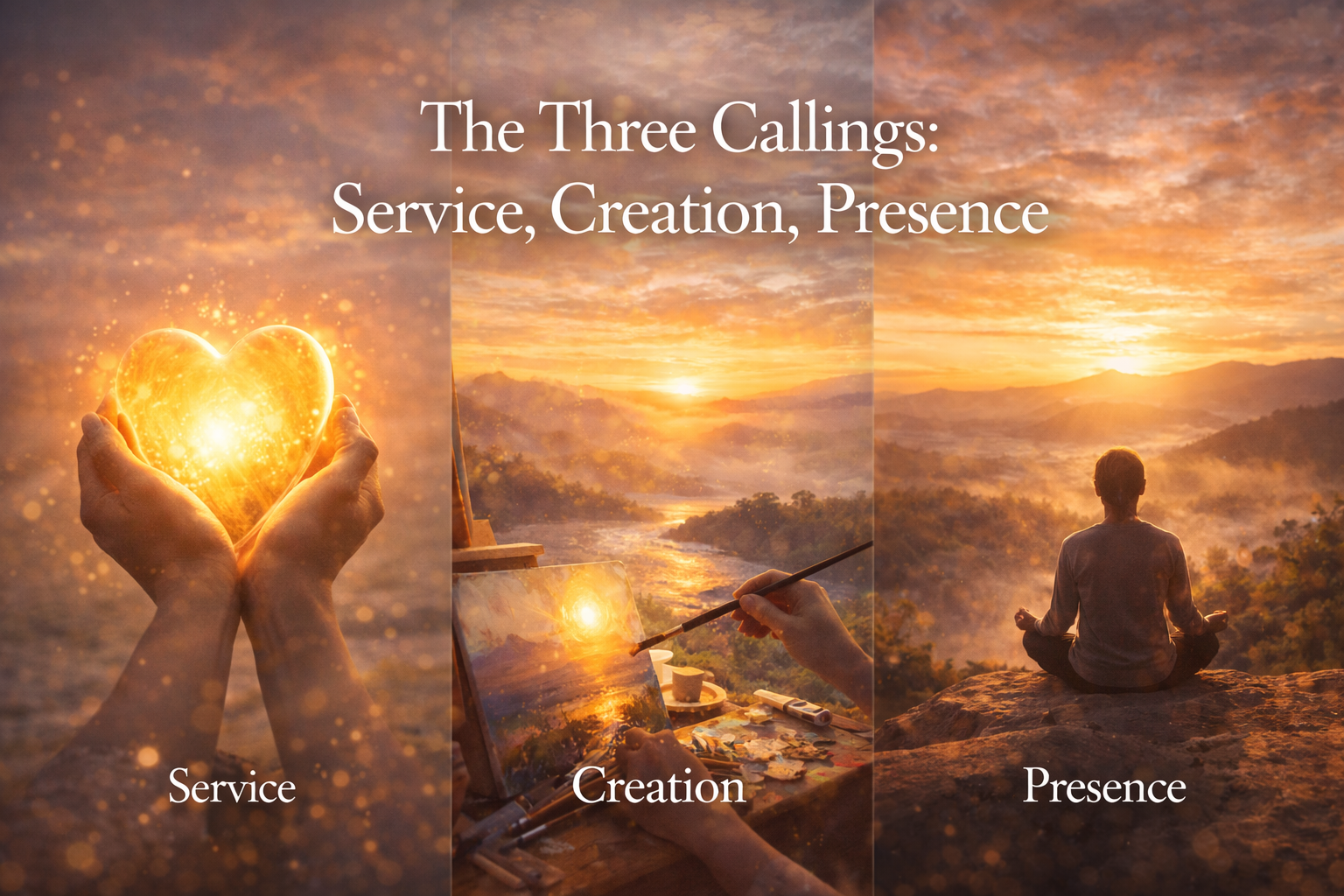
The Three Callings: Service, Creation, Presence
Discover three ways purpose shows up: service, creation, and presence. Identify your strongest calling and build a life that fits your design.
Purpose can feel overwhelming when you think it has to be one giant thing.
But purpose often expresses itself through three callings that are simple, human, and real: service, creation, and presence. Most people have all three, but one usually leads in a given season.
Calling one: service
Service is how you help, support, protect, or restore.
Service doesn’t always mean caregiving as a job. Service can be:
mentoring
organizing
advocating
coaching
problem-solving
bringing steadiness to chaos
helping people feel less alone
Service is your “I can’t not help” energy, but it needs boundaries so it doesn’t become self-erasure.
Calling two: creation
Creation is what you make.
Not only art. Creation includes:
writing
building systems
designing solutions
making beauty from ordinary life
turning ideas into something useful
creating content that helps people breathe again
Creation is your blueprint leaving a fingerprint on the world.
Calling three: presence
Presence is deeply underestimated.
Presence is the calling of being:
emotionally safe
grounded and steady
attentive without performance
honest without harshness
calming without controlling
Some people shift rooms simply by being in them. Not because they’re loud, but because they’re anchored.
Your purpose is often a mix
Ask:
Do I feel most alive helping, making, or being?
What do people consistently thank me for?
What do I return to naturally when life gets quiet?
Your lead calling becomes obvious when you stop trying to choose what looks impressive and start noticing what feels true.
Why balance matters
If you live only in service, you can burn out.
If you live only in creation, you can isolate.
If you live only in presence, you can avoid action.
Balance looks like:
serving with boundaries
creating with consistency
practicing presence so you don’t lose yourself in doing
A quick “calling mix” check-in
Rate 1–10:
Service
Creation
Presence
Then ask:
Which one is highest right now?
Which one is neglected?
What is one small weekly practice that would bring balance back?
Sometimes your exhaustion isn’t a mystery. It’s an imbalance.
Closing breath
Your purpose doesn’t have to be a heavy assignment.
It can be a simple alignment:
helping where you’re designed to help,
creating what you’re designed to create,
and bringing presence that makes life feel more human.
That’s not small.
That’s sacred.
Your Soulful Pathways ↑
Desktop: Hover over ‘Your Soulful Pathways’ in the top menu to explore another series.
Mobile: Tap the menu (☰), then choose ‘Your Soulful Pathways.’
How to Tell the Difference Between Fear and Intuition
Fear is loud and urgent. Intuition is calm and clear. Learn practical ways to discern your inner voice and make aligned decisions.
Fear and intuition can sound similar at first because both try to protect you.
But their energy is different.
Fear is loud. Intuition is clear.
Fear rushes. Intuition steadies.
Fear shames. Intuition guides.
How fear sounds
Fear often carries:
urgency (“Do it now or you’ll miss out.”)
catastrophizing (“This will ruin everything.”)
self-attack (“You always mess things up.”)
obsession (“I can’t stop thinking about it.”)
Fear pulls you into tightness. It makes you smaller. It tries to control life so you never feel vulnerable.
How intuition feels
Intuition tends to be quieter and cleaner:
a calm knowing
a simple yes or no
a gentle nudge that repeats
a steady discomfort that won’t leave
clarity without drama
Intuition doesn’t usually scream. It persists softly until you listen.
The body test
Ask your body what it knows.
Imagine choosing Option A. Notice your breath. Your shoulders. Your jaw.
Now imagine choosing Option B. Notice again.
Tightness, racing thoughts, and pressure often point to fear.
Grounded breath, steadiness, and clean clarity often point to intuition.
This isn’t about being emotionless. It’s about noticing the quality of the emotion.
The time test
Fear spikes and changes with mood. Intuition stays consistent.
If you can, sleep on it. See what remains true in the morning. Time often reveals what’s real.
The fruit test
Fear produces frantic action to relieve anxiety.
Intuition produces aligned action to honor truth.
Ask: “If I follow this voice, what fruit will it produce?”
If the fruit is exhaustion, self-betrayal, panic, or shrinking, pause.
If the fruit is peace, integrity, steadiness, and honest growth, listen.
What if trauma makes this hard
If you’ve lived through instability, your system may confuse intensity with guidance. Calm can feel unfamiliar. Healthy love can feel “boring.” Stability can feel suspicious.
Discernment becomes a practice:
one honest step instead of ten frantic ones
reflection with someone safe
writing decisions down and rereading them later
following values even when you feel nervous
Being nervous doesn’t always mean it’s wrong. Sometimes it means it’s new.
A simple discernment prayer (optional)
“Let what is true become clear.
Let what is fear loosen its grip.
Lead me toward peace, wisdom, and love.”
Closing breath
You don’t need perfect discernment to be guided.
You just need to keep choosing clarity over chaos, one decision at a time.
Fear is loud, but it isn’t wise.
Intuition is quieter, but it’s faithful.
Your Soulful Pathways ↑
Desktop: Hover over ‘Your Soulful Pathways’ in the top menu to explore another series.
Mobile: Tap the menu (☰), then choose ‘Your Soulful Pathways.’

When Life Redirects You - It’s Not Punishment
When plans fall apart, it can feel personal. Learn how to reframe redirection as guidance, protection, and deeper alignment.
When life redirects you, it can feel humiliating.
The door closes. The plan collapses. The timeline shifts. And if you’re someone who tries hard, you might interpret redirection as punishment.
But many redirections are not punishment.
They’re protection. They’re refinement. They’re guidance toward what fits.
Why redirection hurts so much
Because it touches tender places:
your need for stability
your fear that you’re falling behind
your fear that you “misread your life”
Redirection can make you replay decisions searching for where you went wrong. But sometimes you didn’t go wrong. Sometimes you’re being moved.
Not every closed door is rejection
Some doors close because:
the cost would have been your peace
the role would have required self-abandonment
the relationship would have kept you small
the timing would have depleted you
the path would have delayed your real alignment
A closed door can be mercy.
Even when it stings.
Two types of redirection
Redirection that refines you
This kind strengthens boundaries, clarifies values, and makes you more honest.Redirection that realigns you
This kind turns you toward something you wouldn’t have chosen, but later you realize it was built for you.
Both can be sacred. Both can be stabilizing in the long run, even if they feel disruptive in the moment.
What to do in the middle of it
The middle is the hardest part: the “not yet” space.
Try these grounding questions:
What is this season asking me to release?
What truth is becoming impossible to ignore?
What is being simplified?
Where is life asking me to become braver?
What still feels steady, even now?
Redirection often removes what isn’t essential so you can rebuild from what is.
The redirection reframe
Write the story your fear is telling, then rewrite it with compassion.
Old story: “I failed.”
New story: “I’m being refined and guided toward what fits.”
Old story: “This is punishment.”
New story: “This may be protection I don’t understand yet.”
Old story: “I’m behind.”
New story: “My life is unfolding at the pace my soul can hold.”
The detour can become a door
Sometimes the detour becomes:
the season you heal
the pause where you stop performing
the reset where you finally hear yourself
the bridge to the right people and the right rhythm
Detours can be divine, not dramatic.
Closing breath
If your life has rerouted, don’t rush to label it as failure.
Sometimes what you thought was the destination was only the bridge.
You are not cursed.
You are being guided.
Your Soulful Pathways ↑
Desktop: Hover over ‘Your Soulful Pathways’ in the top menu to explore another series.
Mobile: Tap the menu (☰), then choose ‘Your Soulful Pathways.’
The Work You’re Here To Do Is Often Quiet
Not all meaningful work is visible. Learn to honor quiet purpose, unseen growth, and the steady inner work that changes everything.
Some of the most important work you will ever do won’t be recognized publicly.
It won’t go viral. It won’t come with a certificate. It might not even look like progress from the outside. But it will change your life. And it will change the lives around you.
Quiet work is still real work
Quiet work looks like:
learning to regulate your emotions
unlearning self-abandonment
choosing peace over proving
breaking family cycles
becoming consistent after years of survival
telling the truth after years of swallowing it
learning to rest without guilt
Quiet work is foundation work. It’s the kind of work that makes future success sustainable.
Why we undervalue what’s quiet
Because the world rewards display.
If it’s not posted, it feels like it didn’t happen.
If it’s not measured, it feels like it doesn’t count.
But your soul is not a performance. Your healing is not content. Your growth is not a competition.
Quiet work doesn’t get applause, but it creates stability. It creates safety. It builds the kind of inner home you can actually live in.
Signs you’re doing your true work
Sometimes purpose doesn’t feel like excitement. Sometimes it feels like alignment.
You may be doing the work you’re here to do if:
your boundaries are cleaner
your nervous system is calmer
your choices are simpler
your relationships are truer
your inner voice is kinder
you feel less desperate to be understood
These are not small changes. These are life architecture.
The ripple effect you can’t see yet
When you heal, you change what you normalize.
When you choose peace, you change what you tolerate.
When you choose honesty, you change what you accept.
When you become safer for yourself, you become safer for others.
Sometimes your purpose is not what you do.
Sometimes your purpose is who you become.
A practice: the quiet wins list
Write ten quiet wins from the last month. Examples:
I paused before reacting.
I didn’t chase what was pulling away.
I rested without earning it.
I said no without explaining.
I asked for help.
I protected my peace.
I stayed consistent.
Proof helps your spirit relax. Proof helps your nervous system trust the process.
What if you feel “behind”
If your life looks smaller than you expected right now, breathe.
Some seasons are quiet because you’re becoming strong enough to hold what’s next. Roots don’t grow in applause. They grow in the slow, steady places.
Closing breath
Quiet seasons are not empty seasons.
Some roots grow in silence so the tree can stand later.
Your work counts. Even when it’s quiet.
Your Soulful Pathways ↑
Desktop: Hover over ‘Your Soulful Pathways’ in the top menu to explore another series.
Mobile: Tap the menu (☰), then choose ‘Your Soulful Pathways.’

Your Purpose Has A Texture (Not A Title)
Purpose isn’t always a job label. Learn how to sense the texture of your purpose through what restores you, moves you, and feels true.
Many people think purpose is a title they must discover.
Teacher. Coach. Healer. Entrepreneur. Artist. Leader.
But purpose is often a texture before it becomes a label. It’s the felt sense of what you’re here to bring, even if the “how” changes throughout your life.
Why titles can confuse you
A title is external. Purpose is internal.
You can have the “right” title and still feel empty.
You can have a humble role and feel deeply aligned.
Because purpose isn’t about what impresses people. It’s about what fits your design.
Purpose feels like something
Purpose has an emotional signature. It might feel like:
steady peace
devotion
quiet joy
courage
creative electricity
grounded responsibility
tenderness that wants to protect
Pay attention to what you feel when you’re doing something meaningful. Your body is giving you data. Purpose leaves a trail in your nervous system.
Three questions that reveal your purpose texture
If you want direction without pressure, ask:
What restores me
Not entertainment, but restoration. The thing that fills you back up.What moves me
What kind of needs, stories, or moments pull your heart forward? What makes you care deeply?What matters even when I’m tired
Fatigue strips away the performance and reveals what’s real.
Where these overlap, purpose begins to form.
Purpose works better as a verb
Instead of asking, “What am I?” ask:
What am I here to build?
What am I here to protect?
What am I here to heal?
What am I here to clarify?
What am I here to create?
What am I here to guide?
Verbs keep you free. They let your purpose evolve without losing its core.
Maybe your purpose is to comfort. That can happen in parenting, writing, mentoring, nursing, friendship, leadership.
Maybe your purpose is to clarify. That can happen in teaching, organizing, coaching, project work, content creation.
One essence. Many expressions.
A “purpose texture” paragraph
Write this and finish it without editing:
“When I feel most like me, I am bringing ______ into the world through ______, and it leaves people feeling ______.”
Read it twice. Notice your body. If something in you exhales, pay attention. Relief is information.
Why you don’t have to know the full plan
Purpose doesn’t demand a leap. It asks for alignment.
The next step might be:
one conversation
one boundary
one small project
one class
one honest decision
one brave yes
Clarity grows in motion.
Closing breath
You don’t need a perfect label before you begin.
Let your purpose be something you live, not something you prove.
The title can come later. Alignment can start now.
Your Soulful Pathways ↑
Desktop: Hover over ‘Your Soulful Pathways’ in the top menu to explore another series.
Mobile: Tap the menu (☰), then choose ‘Your Soulful Pathways.’

Your Gifts Leave Fingerprints
Your gifts are already visible in how you notice, help, and create. Learn how to recognize your “gift fingerprints” and trust what comes naturally.
Your gifts aren’t always loud.
They don’t always arrive with applause. Sometimes they show up as the thing you do so naturally you assume it doesn’t count. But your gifts leave fingerprints. And your life is full of evidence.
What counts as a gift
A gift is not only talent. A gift is impact. It’s what people consistently receive from you, even when you’re not trying.
Some gifts look like:
making people feel safe
seeing what others miss
explaining things clearly
bringing calm into chaos
organizing what feels overwhelming
listening in a way that heals
noticing the overlooked and honoring it
creating beauty from ordinary moments
Not everything powerful is flashy. Not everything meaningful is monetized. Some gifts are quiet and still change people.
The three “fingerprint signs” of a real gift
A gift usually has three qualities:
It’s repeatable
It shows up across seasons and settings. You do it at work, at home, in friendships, even with strangers.It’s energizing (even if it’s hard)
It may take effort, but it doesn’t only drain you. It lights something up in you, like your spirit recognizes itself.It produces fruit
People feel strengthened, steadier, clearer, more hopeful. Something improves when you’re present.
Fruit matters. Fruit is proof.
Why we dismiss our own gifts
We dismiss our gifts because:
they feel “too easy”
we weren’t praised for them early
we learned humility meant hiding
we were punished for shining
we only value what looks impressive
If you grew up in survival mode, you may not have had space to notice your gifts. You were busy getting through. But gifts don’t expire. They wait.
Gift fingerprint prompts
Answer quickly, without polishing:
People come to me for ______.
I naturally notice ______.
I make things better by ______.
I lose track of time when I’m ______.
The pain I feel compelled to ease is ______.
The compliment I keep receiving but shrug off is ______.
Underline repeated words. That overlap is a fingerprint.
Your story often points to your gift
Sometimes your gift is connected to what you had to learn the hard way.
If you’ve known anxiety, you may carry a gift of calm.
If you’ve known instability, you may carry a gift of steadiness.
If you’ve known being unseen, you may carry a gift of presence.
If you’ve known heartbreak, you may carry a gift of compassion.
This isn’t romanticizing pain. It’s honoring transformation.
How to use your gifts without burning out
A gift needs a boundary. Otherwise it becomes overgiving.
Ask: “What is one small way I can use my gift this week without abandoning myself?”
Small use is still use. Gifts grow when they’re practiced, not when they’re doubted.
Closing breath
You don’t have to force a calling into existence.
Your life has receipts. Follow the fingerprints, and you’ll stop chasing who you “should” be.
You’ll start recognizing who you already are.
Your Soulful Pathways ↑
Desktop: Hover over ‘Your Soulful Pathways’ in the top menu to explore another series.
Mobile: Tap the menu (☰), then choose ‘Your Soulful Pathways.’

The Patterns You Keep Repeating Are Clues
The patterns you keep repeating aren’t proof you’re broken. Learn how to decode cycles as clues and turn them into clarity, healing, and direction.
If you keep repeating the same kind of situation, it doesn’t mean you’re doomed.
It means something in you is still trying to be understood.
Patterns are not proof you’re “bad at life.” Patterns are often the soul’s way of highlighting an unmet need, an unfinished lesson, or a boundary you’re learning to hold. They are clues. And clues are hopeful because they can be read.
Why patterns feel like failure
A repeating cycle can feel personal, like life is pointing at you and saying, “Here you go again.”
But patterns repeat for a simpler reason: they’re familiar. Familiar doesn’t mean healthy, it just means known. Your nervous system is a historian. It remembers what you adapted to, what you tolerated, what you survived, and what you were taught was normal.
So sometimes you’re not repeating because you want to. You’re repeating because your system reaches for what it recognizes.
That’s not a curse. That’s conditioning. And conditioning can change.
The three most common types of patterns
Most repeating cycles fall into one of these categories:
Healing patterns
These repeat until you learn how to care for yourself differently.
Examples: over-giving, ignoring your needs, minimizing your pain, staying too long, tolerating emotional inconsistency.Boundary patterns
These repeat until you learn how to say no without guilt.
Examples: being taken for granted, being the reliable one with no support, being the peacemaker at your own expense.Calling patterns
These repeat because something in you keeps trying to come online.
Examples: feeling pulled to create, teach, guide, build, mentor, lead, organize, heal, but talking yourself out of it every time.
Same emotion, different setting? That’s a clue.
The clue is usually in the emotion
Ask: “What do I always feel in this pattern?”
Unseen. Responsible. Guilty for needing anything. Afraid to disappoint. Afraid to be rejected. Afraid to be alone.
That emotion is the thread. Follow the thread, and you’ll find the belief underneath it.
The pattern decoder exercise
Pick one repeating pattern and write:
The scene: What keeps happening?
The emotion: What do I feel during and after?
The role: Who do I become? Fixer? Pleaser? Over-functioner? Silent sufferer?
The payoff: What do I avoid by repeating it? Conflict? Rejection? Loneliness?
The cost: What does it cost me? Peace? Time? Confidence?
The lesson: What would change if I believed I deserve better?
Insight is not self-blame. Insight is a doorway.
Sometimes the pattern is your nervous system
If you grew up in chaos, calm can feel suspicious. If you learned love equals effort, ease can feel unsafe. If your system is used to intensity, stability can feel “wrong.”
That doesn’t mean your intuition is broken. It means your body is learning a new normal.
How patterns break in real life
Pattern-breaking usually looks small:
pausing before you explain yourself
leaving at the first red flag instead of the fifth
saying “no” without a paragraph
asking for help without apologizing
resting before burnout forces it
telling the truth sooner
Tiny changes. Massive relief.
Closing breath
Your patterns are not condemnation. They are instruction.
You’re not stuck. You’re learning the language of your life. And when you read the clue correctly, the pattern starts to loosen.
Your Soulful Pathways ↑
Desktop: Hover over ‘Your Soulful Pathways’ in the top menu to explore another series.
Mobile: Tap the menu (☰), then choose ‘Your Soulful Pathways.’

Your Core Values Are Your Compass
When life feels uncertain, your values provide direction. Learn how to identify your core values and make decisions that feel steady and true.
If you’ve been asking, “What should I do with my life?” there’s a quieter question that often answers it:
“What do I value most, even when no one is watching?”
Values are not preferences. They’re the inner laws your spirit keeps trying to live by. And when you ignore them, life starts feeling like a daily compromise.
Why values create instant clarity
Two people can live the same lifestyle and feel completely different inside it.
One person thrives in structure. Another feels trapped.
One person feels fulfilled in constant social activity. Another feels drained.
One person loves risk and adventure. Another needs stability and predictability.
The difference isn’t willpower. It’s values.
Values tell you what “right” feels like for you.
The hidden reason you keep second-guessing
Second-guessing isn’t always insecurity. Sometimes it’s misalignment.
If you keep forcing choices that clash with your values, your body and spirit will resist, even if the choice looks “good on paper.”
If you value peace but keep choosing urgency, your nervous system will protest.
If you value truth but keep performing, you’ll feel restless.
If you value freedom but keep choosing control to feel safe, you’ll feel trapped.
Your values aren’t trying to ruin your plans. They’re trying to protect your soul.
How to identify your top values (without overthinking)
Use your emotional history as data.
Think of a time you felt deeply respected, safe, or proud. What value was being honored?
Now think of a time you felt angry, hurt, or depleted. What value was violated?
Often your strongest values show up in your strongest reactions.
The “compass list” practice
Choose five values and define them in your own words. Not dictionary definitions. Personal definitions.
Examples:
Peace: I move at a pace that keeps my body steady.
Truth: I don’t abandon myself to be accepted.
Service: I help in ways that empower, not drain.
Creativity: I make space for what wants to be born through me.
Freedom: I choose paths with breath and flexibility.
Then ask: “Does my current life support these values or fight them?”
This isn’t meant to shame you. It’s meant to show you where small course corrections will create massive relief.
Using values to make decisions
When you’re unsure, ask:
Which option honors my top values?
Which option costs me my peace?
Which option makes me smaller?
Which option feels honest, even if it’s uncomfortable?
Values don’t remove hard choices. They remove confusion.
Closing breath
You don’t need perfect certainty to move forward. You need a compass you trust.
Your values are not random. They’re evidence of your design. And when you live from them, you stop drifting. You start aligning.
Your Soulful Pathways ↑
Desktop: Hover over ‘Your Soulful Pathways’ in the top menu to explore another series.
Mobile: Tap the menu (☰), then choose ‘Your Soulful Pathways.’
The Difference Between Personality and Essence
Learn the difference between personality and essence so you can stop over-identifying with survival traits and reconnect with who you really are.
Most people try to “find themselves” by polishing their personality.
But personality is not the same thing as essence.
Personality can be real and sincere, but it often contains strategies you developed to function, belong, stay safe, or avoid pain. Essence is who you are underneath what you needed to become. And when you learn the difference, you stop building your life around coping traits and start building it around truth.
Personality is a strategy
Personality often includes survival skills that served you well:
People-pleasing that learned to be “easy to love”
Overachieving that learned safety through performance
Humor that learned to soften tension before it got sharp
Independence that learned not to rely on anyone
Hyper-responsibility that learned “if I don’t handle it, no one will”
These traits do not make you fake. They make you adaptive. They make you human.
The problem happens when you confuse your coping with your identity. Then life starts to feel like a role you can’t stop performing, even when you’re exhausted.
Essence is a frequency
Essence is steadier. Simpler. Less frantic.
Essence is what remains true across every season, even when your personality changes.
Your essence might be nurturing, even when you’re tired.
It might be honest, even when honesty costs you.
It might be protective, creative, devoted, curious, peace-making.
Essence is who you are when you’re not bracing for impact.
How to tell which one you’re living from
Here’s a gentle test: after an interaction, do you feel expanded or contracted?
When you’re living from personality-strategy, you may feel depleted, rehearsing, overthinking, or “performing” in your mind afterward.
When you’re living from essence, you feel clearer, steadier, and more at home in yourself.
Personality asks, “Did they like me?”
Essence asks, “Was I aligned?”
Why this matters for purpose
If you build your life on personality alone, you’ll often pick goals that impress people but starve you.
You’ll chase roles that reward coping traits: the responsible one, the fixer, the achiever, the strong one who never needs anything.
Essence builds a different kind of life. One where you don’t have to abandon yourself to succeed. One where your purpose doesn’t require you to disappear.
A practice: the two-column truth
In a journal, make two columns:
Column A: What I became to cope
Perfectionism, hyper-independence, constant explaining, staying small, staying busy, emotional shutdown, over-functioning.
Column B: What I am when I’m safe
Playful, tender, direct, creative, calm, grounded, curious, steady, generous without self-erasure.
Now circle one word in Column B that feels like home. That word is a compass point for your blueprint.
Closing breath
You don’t need to shame your personality. It helped you survive. But you are allowed to evolve beyond survival.
Essence is not something you earn. It’s something you remember. And every time you choose alignment over performance, you come back to yourself.
Your Soulful Pathways ↑
Desktop: Hover over ‘Your Soulful Pathways’ in the top menu to explore another series.
Mobile: Tap the menu (☰), then choose ‘Your Soulful Pathways.’
The Soul Blueprint
You’re not behind or broken. Learn how to decode your patterns, gifts, and values to understand your design and move forward with clarity.
You’re not lost. You’re not “too late.” You’re not a walking mistake that needs fixing.
You’re decoding yourself.
A lot of people think clarity arrives like a lightning strike: one perfect moment where your purpose drops from the ceiling and everything finally makes sense. But real clarity is usually quieter than that. It arrives like a map you learn to read. A pattern you start noticing. A language you slowly become fluent in.
This series, The Soul Blueprint, is not about forcing an identity makeover. It’s not about copying someone else’s path because yours feels uncertain. It’s about learning how you’re designed, so you can stop interpreting every season like a failure and start recognizing it as information.
What a “blueprint” really means
A blueprint isn’t a cage. It’s not a rigid plan that says you can only be one thing forever. It’s the underlying structure of who you are: the values you can’t betray without feeling uneasy, the gifts that keep showing up, the patterns that repeat until you learn their lesson.
Your blueprint shows up in what consistently matters to you.
In what drains you and what restores you.
In what you keep repeating and what you keep avoiding.
In what you feel pulled toward even when you try to ignore it.
Most people are not lost. They’re just trying to navigate their lives using other people’s maps.
Why you feel confused (even when you’re smart)
Confusion happens when you’ve been trained to live from the outside in.
You scan what others are doing and assume that’s the standard.
You measure your worth by productivity.
You try to “figure it out” by forcing yourself into roles that look respectable but don’t fit your spirit.
But your soul doesn’t speak in job titles first. It speaks in resonance. In truth. In values. In that inner yes or inner no that shows up when you’re quiet enough to hear it.
Sometimes your confusion is not a lack of purpose. Sometimes it’s the collapse of an identity that was never fully yours.
The two things we’re doing in this series
We’re doing two grounded things, over and over:
Separating who you are from who you learned to be.
Gathering your clues and turning them into clarity.
We’ll explore personality versus essence, core values, repeating patterns, gift “fingerprints,” quiet callings, redirections, and discernment between fear and intuition. Then we’ll end with a simple “purpose map” you can do in one hour, so this becomes practical, not theoretical.
This isn’t about becoming someone new. It’s about becoming more you.
A small practice to start today
Take five minutes with a notebook and answer:
What do I keep coming back to, even when I try to move on?
What do people consistently receive from me?
What kind of pain do I notice quickly in others?
What kind of beauty do I protect?
Don’t judge your answers. Just collect them. You’re gathering evidence.
Closing breath
If you’ve been feeling scattered, consider this your permission to slow down. You don’t need a dramatic breakthrough to move forward. You need a gentle return to your design.
You’re not lost.
You’re decoding yourself.
Your Soulful Pathways ↑
Desktop: Hover over ‘Your Soulful Pathways’ in the top menu to explore another series.
Mobile: Tap the menu (☰), then choose ‘Your Soulful Pathways.’
Faith and Practical Planning
Explore how spiritual trust and practical financial planning can work together to create peace, clarity, and steady provision.
Some people think planning means you don’t trust. Others think trusting means you shouldn’t plan. Peaceful money lives in the middle, where faith and practicality hold hands instead of fighting. Faith says, “I’m not alone.” Planning says, “I will steward what’s in my hands.” Together, they create calm.
Why both are needed
If you only plan without faith, you can become rigid, pressured, and terrified of mistakes. If you only have faith without planning, you can become avoidant, scattered, and overwhelmed by consequences that could have been softened.
Peace grows when trust guides your steps and planning gives those steps shape.
A gentle framework for faith and planning
1) Start with peace, not panic
Before you look at numbers, take a breath. Place a hand on your chest. Let your body know this moment is safe. Set an intention: “Guide me into wise steps. Help me see clearly.”
2) Get honest about your current reality
Clarity is not the enemy of faith. Avoidance is exhausting. Write down: income (or average), essentials, minimum payments, and due dates. Truth is grounding.
3) Choose priorities, not fantasies
Decide what matters most right now: housing stability, food, catching up on one bill, building a small cushion. Priorities keep you from being pulled in every direction.
4) Build a “next right step” plan
Keep it simple:
one income step (apply, follow up, offer a service)
one expense step (cut, renegotiate, pause a subscription)
one savings step (even $5)
one support step (ask, receive, research a resource)
5) Invite provision through action
Faith is not passive. Action becomes the road that provision travels on. Make the call. Send the email. Apply. Follow up. Ask.
What to do with “what if” thoughts
Fear loves the future. Rather than wrestling every scenario, create a simple safety-net plan:
Who can I call?
What can I cut quickly?
What can I sell if needed?
What short-term work can I pick up?
Having a plan reduces panic because your brain knows you’re not helpless.
Faith without shame
Some people feel guilty for being anxious, like worry is a spiritual failure. But being human isn’t a failure. Anxiety is often your nervous system asking for reassurance and structure. Planning can be one way you reassure yourself: “I’m paying attention. I’m taking steps. I’m caring for my future.”
A closing prayer for calm provision
May I be guided, provided for, and strengthened.
May I plan with clarity and live with peace.
May I release shame and choose steady steps.
May my needs be met in ways that surprise me with goodness.
When faith and planning work together, money becomes a tool again, not a threat. And when money is a tool, peace has room to live.
Your Soulful Pathways ↑
Desktop: Hover over ‘Your Soulful Pathways’ in the top menu to explore another series.
Mobile: Tap the menu (☰), then choose ‘Your Soulful Pathways.’.
Building Margin One Small Step
Learn how to create breathing room in your finances and life through small, consistent changes that reduce stress over time.
Margin is breathing room. It’s the space between a problem and a panic. It’s the quiet exhale that says, “I can handle this.” When margin is missing, life can feel fragile. One surprise expense can shake the whole system. But when margin exists, even in small amounts, your nervous system begins to relax.
What margin looks like in real life
Margin might be:
$20 saved that wasn’t there before
one bill paid early
fewer late fees
a grocery plan that actually works
a small emergency cushion
one less subscription
one boundary that prevents overspending
Margin is not just money. It’s steadiness.
Why margin matters emotionally
Without margin, your mind stays on high alert. You feel like you’re always one step from disaster. With margin, you gain options. Options create peace. Peace creates clearer choices.
Margin doesn’t have to begin big. It can begin tiny and still be real.
How to build margin one small step at a time
1) Patch one leak
Choose the easiest win: cancel a subscription, reduce one category, renegotiate one bill, stop one late fee pattern. Even $15 saved is a margin seed.
2) Start a minimum savings seed
Pick an amount so small your brain can’t argue with it: $5 a week, $10 a paycheck. Consistency matters more than impressiveness.
3) Use the 24-hour pause
Pause before non-essential spending. Waiting lowers emotional spending and builds patience. Patience is a financial superpower.
4) Build time margin too
Overwork and exhaustion can lead to overspending, missed due dates, and impulsive decisions. Rest is not only health. Rest is protection.
5) Automate one good thing
Auto-pay one bill. Auto-transfer a tiny amount. Let systems support you when your energy is low.
When it feels too small
Compounding is quiet. It doesn’t announce itself. It simply accumulates. One month becomes two. Two becomes six. Then one day you realize: life feels less fragile.
A new way to measure progress
Instead of “Am I rich yet?” ask:
Is my panic decreasing?
Is my clarity increasing?
Am I building steadiness?
That is progress.
A steady reminder
Margin is often the result of small choices repeated with patience. Even a tiny buffer is proof that you are building.
Your Soulful Pathways ↑
Desktop: Hover over ‘Your Soulful Pathways’ in the top menu to explore another series.
Mobile: Tap the menu (☰), then choose ‘Your Soulful Pathways.’.
Worth Is Not a Number
Release the belief that income, debt, or productivity determines your value, and return to steady self-worth and peace.
Money is a tool, but shame tries to turn it into a mirror. A mirror that claims to define you. If you have more, you’re “doing life right.” If you have less, you’re “behind.” If you carry debt, you’re “messy.” If you’re struggling, you must be irresponsible, broken, or failing.
Those stories are loud in the world. They get louder when you’re tired.
But they are not truth.
Your worth is not a number
Not your income.
Not your savings.
Not your debt.
Not your credit score.
Not your productivity.
Not your ability to keep up with someone else’s timeline.
Your finances may reflect a season, responsibilities, a starting point, a learning curve, or a hardship you survived. They do not reflect your soul’s value.
How money shame hooks in
1) It attaches morality to money
As if wealth equals virtue and struggle equals failure. But financial realities are shaped by health, caregiving, opportunity, location, education, trauma, timing, and more. Money is not a purity test.
2) It rewrites your story
You stop seeing your resilience and only see your deficits. You forget the calls you made, the bills you managed, the ways you stretched what you had.
3) It makes you hide
Avoiding budgets and avoiding numbers because shame hates light. But hiding increases anxiety. Clarity reduces it.
Reclaiming worth while you improve your finances
You can grow financially without hating yourself into change.
Use neutral language
Replace “I’m terrible with money” with:
“I’m learning new skills.”
“I’m building structure.”
“I’m in a rebuilding season.”
Separate mistakes from identity
A late fee is not a label. A debt is not a personality trait. A hard season is not your final story.
Celebrate invisible wins
Opening the bill. Making the call. Tracking spending once. Asking for help. Setting one boundary. Quiet victories still count.
Choose a “worth anchor”
Write this where you’ll see it:
“I am valuable even while I’m improving.”
Why worth matters practically
Stable worth creates stable decisions. You stop spending to soothe pain. You stop avoiding because you feel undeserving of peace. When worth is steady, choices get clearer.
A spiritual closing
Your worth was assigned before your bank account ever existed. Numbers change. Seasons change. But your value is not up for negotiation.
Your Soulful Pathways ↑
Desktop: Hover over ‘Your Soulful Pathways’ in the top menu to explore another series.
Mobile: Tap the menu (☰), then choose ‘Your Soulful Pathways.’.
Receiving Help Without Feeling Weak
Learn how to accept support without shame and why receiving can be part of provision, strength, and healing.
Some of the strongest people struggle the most to receive. Not because they’re arrogant, but because they learned to survive by being low-need. Maybe you were praised for being “independent.” Maybe you were the one who held everything together. Maybe help used to come with strings, guilt, or a silent debt that never felt paid off. So you learned a hard skill: carry it alone.
But receiving help does not make you weak. It makes you human. And sometimes it makes you wise.
Why receiving can feel so tender
Receiving can trigger old beliefs like:
“I should be able to handle this.”
“If I accept support, I’m failing.”
“If I need help, I’m a burden.”
If money is involved, it can feel even more exposed because finances touch survival, dignity, and identity. You might fear judgment. You might fear being misunderstood. You might fear that receiving means losing your power.
A new lens: receiving is provision in motion
Provision isn’t always a dramatic miracle. Often, it arrives through people, timing, community, and practical resources. A friend who offers groceries. A referral. A program built for this season. A payment plan that gives you breathing room. Receiving doesn’t cancel your strength. It supports it.
Sometimes the help isn’t the whole solution. Sometimes it’s the bridge. And bridges are not weakness. Bridges are how you cross.
How to receive with strength, not shame
1) Separate help from identity
Needing help is a circumstance, not a definition. You are not “a burden.” You are a person in a season.
2) Ask clearly and specifically
Specific requests protect dignity:
“Can you help with groceries this week?”
“Do you know anyone hiring for remote work?”
“Can you cover this bill for one month while I catch up?”
Clarity turns help into a practical exchange instead of an emotional swirl.
3) Set boundaries around the help
Receiving doesn’t require oversharing. You can say:
“Thank you. This helps a lot. I’m keeping details private right now.”
4) Make a short-term receiving plan
If your nervous system fears dependency, create a simple outline:
what you need (and for how long)
what steps you’re taking
when you’ll reassess
This makes receiving feel safe and structured.
5) Practice gratitude without self-erasure
You do not have to over-apologize. A simple “Thank you, I appreciate this” is enough.
A quiet truth to hold
You are allowed to be supported without embarrassment for being human. You are allowed to receive without turning it into a verdict about your worth. You can be strong and still let someone help.
Your Soulful Pathways ↑
Desktop: Hover over ‘Your Soulful Pathways’ in the top menu to explore another series.
Mobile: Tap the menu (☰), then choose ‘Your Soulful Pathways.’.
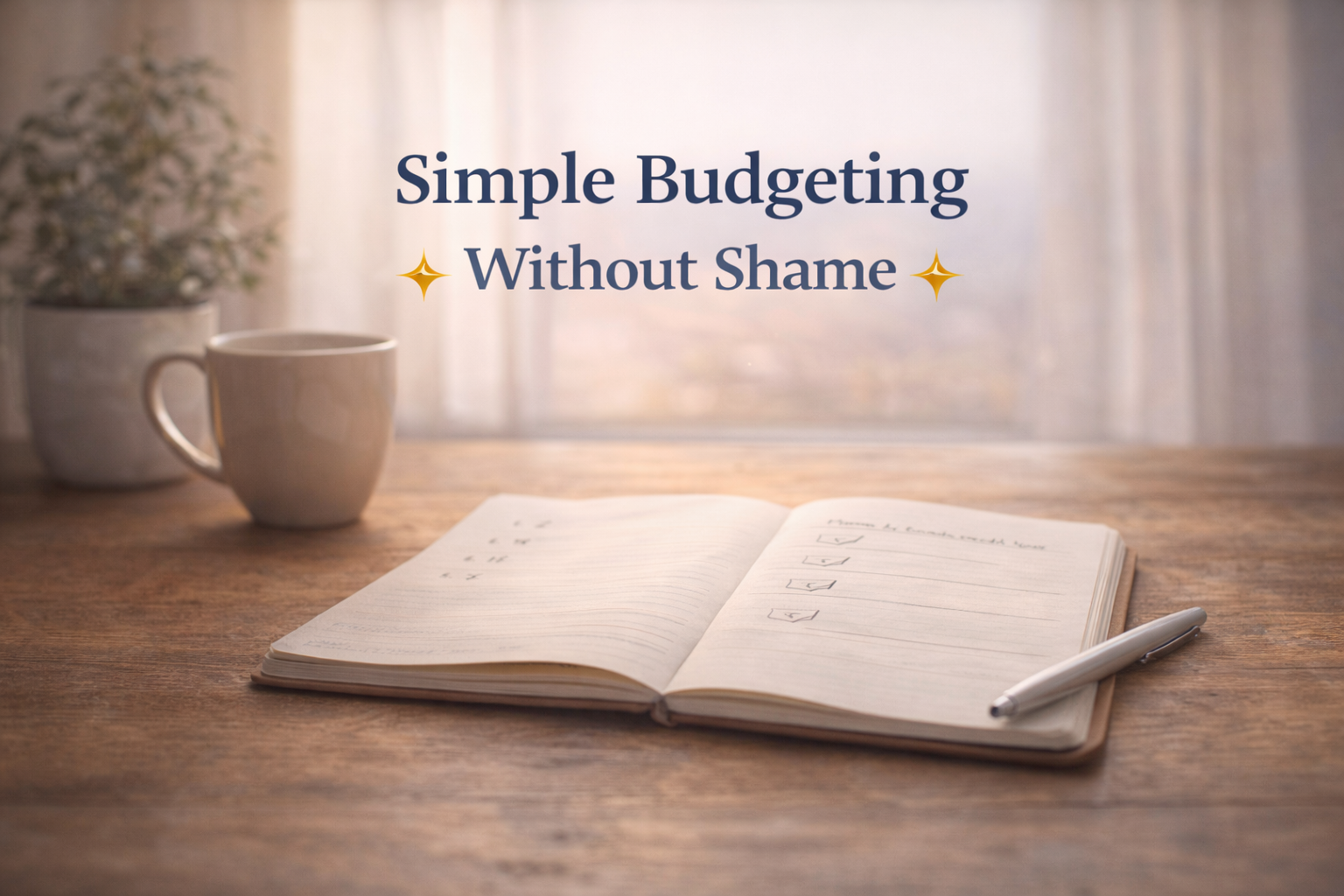
Simple Budgeting Without Shame
A gentle budgeting approach that builds clarity and calm without guilt, harsh rules, or perfection pressure.
Budgeting gets a bad reputation because many people learned it as punishment. Like a financial scolding. Like proof you should have done better. But budgeting, at its best, is not a cage. It is a kindness. It says: “I want to feel safe. I want to know what I’m working with. I want to make choices on purpose.”
Release perfection first
A budget is a living plan, not a moral grade. If your numbers shift, life happened. The goal is clarity, not flawless execution. A shame-free budget is flexible enough for real life and steady enough to reduce anxiety.
The simple, calm method
Step 1: Start with three numbers
Monthly income (or a realistic average)
Fixed essentials (rent, utilities, insurance, minimum payments)
Flexible essentials (food, gas, household needs)
This creates a foundation fast without overwhelm.
Step 2: Choose one “peace category”
Pick one focus that reduces stress:
a small savings seed
extra toward one debt
a grocery limit
catching up on one bill
When you choose one, your brain stops freezing.
Step 3: Add a “real life” line item
Real life includes birthdays, pharmacy runs, little surprises, and small joys. If your budget doesn’t include real life, it will break and shame will move in like it owns the place.
Use weekly check-ins, not daily surveillance
Once a week, review spending with curiosity, not judgment:
What worked?
What surprised me?
What do I want to adjust?
Your budget should feel like a map, not a courtroom.
When you overshoot, respond with kindness
Don’t punish yourself. Investigate gently:
Was I tired? Lonely? Overwhelmed? Did I plan enough for real life? Then pick one small adjustment. One. Not a full life overhaul.
A tiny template you can repeat
Income: ________
Fixed essentials: ________
Flexible essentials target: ________
Peace category (choose one): ________
Real life cushion: ________
The real goal
Budgeting isn’t about being “good.” It’s about building trust with yourself. Every time you look at your numbers gently, you’re telling your nervous system: “I’m here. I’m paying attention. I’m taking care of us.”
Your Soulful Pathways ↑
Desktop: Hover over ‘Your Soulful Pathways’ in the top menu to explore another series.
Mobile: Tap the menu (☰), then choose ‘Your Soulful Pathways.’.

How to Stop Comparing Your Timeline
Release the pressure of comparing your finances and life progress, and return to your own pace with peace and clarity.
Comparison is sneaky because it wears the mask of motivation. It whispers, “Look at them, now hurry.” But what it often produces isn’t inspiration. It produces shame. And when it comes to money, comparison can sting like a fresh bruise.
Why timeline comparison hurts so much
Lives are not identical equations. Different starting points. Different responsibilities. Different support systems. Different hidden battles. You might be building stability while also healing, caregiving, or rebuilding after loss. That isn’t “behind.” That is real life.
Sometimes your timeline looks slower because you are doing more than people can see.
What comparison steals
Comparison doesn’t just steal joy. It steals:
Gratitude: your “enough” starts feeling like “not enough.”
Clarity: you chase what looks successful instead of what is aligned.
Peace: your nervous system treats life like a race.
And once life feels like a race, your decisions start coming from pressure instead of wisdom.
Five ways to stop comparing your timeline
1) Name the trigger
What did you see that made you feel behind? A post, a conversation, a family expectation, a milestone announcement. Naming it pulls you out of the fog and back into reality.
2) Translate envy into information
Envy often points to a desire, not a verdict. Instead of “I’m failing,” try:
“I want stability.”
“I want ease.”
“I want freedom.”
Now you can plan toward what you want without shaming yourself.
3) Compare only to your past self
List what has improved: your skills, your discipline, your calm, your boundaries, your resilience. Progress isn’t always a bigger paycheck. Sometimes it’s fewer panic spirals and more steady choices.
4) Reduce inputs that inflame you
If certain accounts, conversations, or media leave you raw, reduce exposure. This isn’t weakness. It’s self-protection.
5) Create your own milestones
Comparison grows when your path feels undefined. Define your path gently:
save a small amount each month
pay down one debt
track spending weekly
increase income by one small step
Quiet wins count.
A short practice for timeline peace
Hand on chest, one breath. Say: “Their path is theirs. My path is mine.”
Then ask: “What is one step that supports my life this week?”
Do that step. Let that be enough.
Your timeline is not late
Slow can be rooted. Slow can be wise. Slow can be sacred. You are not here to keep up. You are here to build a life that fits your soul and supports your future.
Your Soulful Pathways ↑
Desktop: Hover over ‘Your Soulful Pathways’ in the top menu to explore another series.
Mobile: Tap the menu (☰), then choose ‘Your Soulful Pathways.’.
Provision Without Panic
Explore a calm approach to money where you plan wisely, breathe deeply, and trust provision without living in constant urgency.
Panic has a very convincing voice. It says everything is urgent, everything is fragile, and you must solve it all right now. But panic is not the same thing as responsibility. Panic narrows your vision, drains creativity, and makes you miss open doors. Provision rarely arrives through frantic energy. Provision is often quieter than we expect.
The difference between urgency and wisdom
Urgency says: “If I don’t fix this immediately, everything collapses.”
Wisdom says: “This matters, and I can take it one step at a time.”
Urgency steals your breath. Wisdom gives it back. The goal isn’t to stop caring. The goal is to care without burning your peace as fuel.
Provision is often ordinary
Provision can look like a steady client, an unexpected discount, a friend offering a referral, a small opportunity that grows, or a resource you forgot you had. Peace helps you notice it. Panic makes you overlook it.
If you’ve been waiting for provision to arrive like thunder, consider that it may be arriving like a lamp: quietly, consistently, lighting one next step at a time.
A peaceful approach to provision
Try this steady sequence:
Start with reality, not dread. Write down the actual numbers and due dates. Dread is infinite. Reality is workable.
Choose today’s next step. One call. One application. One payment plan. One small action that reduces pressure.
Build a “provision list.” Skills you can offer, people you can contact, resources available, side income ideas, items you can sell, services you can provide.
Pray grounded. “Guide me to what supports me. Show me the next open door.”
Create a calm plan B. Three options if things tighten: a short-term income step, a bill negotiation, a temporary reduction in spending.
This is not panic-planning. This is wise stewardship with a calm nervous system.
When panic shows up anyway
Panic loves the future. So bring yourself back to the present with two questions:
“What am I afraid will happen?”
“What is the smallest action that reduces risk today?”
Then do the smallest action. Small actions are how panic loses its throne.
Trust and planning can coexist
You can trust and still track. You can pray and still negotiate. You can believe you will be supported and still take wise steps. Peaceful money holds both.
A steady reminder
Provision does not require you to destroy your peace as proof you care. Peace is not procrastination. Peace is power. It is the calm that allows you to make decisions that actually help.
Your Soulful Pathways ↑
Desktop: Hover over ‘Your Soulful Pathways’ in the top menu to explore another series.
Mobile: Tap the menu (☰), then choose ‘Your Soulful Pathways.’.
Money Anxiety and the Body
Learn how financial stress shows up in your body and how to calm your nervous system so you can make steady decisions again.
Money anxiety doesn’t just live in your thoughts. It lives in your body. That’s why you can “know” you are okay and still feel your chest tighten when you open a banking app. It’s why you can be sitting in a quiet room and still feel a stomach drop when you remember a bill. Your nervous system is not doing this to punish you. It is trying to protect you.
How financial stress shows up physically
Money stress often wears a physical costume, and it can look like:
Tight jaw, clenched shoulders, headaches, shallow breathing
Sleep disruption, especially waking in the middle of the night running numbers
Digestive tension, appetite changes, or a hollow feeling in the belly
Scattered focus: starting tasks and drifting into worry
Freeze and avoidance: unopened mail, ignored statements, delayed calls
When your body is in fight-or-flight, the brain prioritizes survival, not strategy. That’s why planning feels impossible when you’re panicking. You can’t make calm decisions from a body that believes it’s in danger.
A gentle reframe that changes everything
Instead of asking, “What is wrong with me?” try asking:
“What is my body trying to keep me safe from?”
Maybe you grew up around instability. Maybe you watched adults panic. Maybe you lived through a season where resources were truly scarce. Your nervous system remembers what your mind would rather forget. Sometimes the body isn’t reacting to today’s bill. Sometimes it’s reacting to the memory of the last time you didn’t know what would happen next.
Before you look at numbers: a calm ritual
Use this before you check balances, pay bills, or plan.
Breathe with a longer exhale. Inhale for 4, exhale for 6, three times.
Name it. “My body is anxious. I am safe enough to look.”
Choose a small look. Set a timer for 10 minutes.
Look for facts, not judgments. Due dates, amounts, minimums, options.
Close the loop. Shut the app, stand up, roll your shoulders, and tell your body: “We are done for now.”
This teaches your nervous system something powerful: money tasks are finite. They do not last forever. You can touch them and return to safety.
After a money task: soothe the body
Do one or two of these tiny resets:
Shake out your hands for ten seconds
Sip water slowly
Step into daylight for one minute
Soften your jaw and drop your shoulders
Take one long exhale like you’re fogging a mirror
Small signals create big shifts over time. You’re training your system to associate money with capacity, not catastrophe.
A steady truth to keep
You do not need to feel fearless to be wise. You only need enough calm to take the next right step. Peaceful money begins when your body stops treating money as danger and starts treating it as information you can handle.
Your Soulful Pathways ↑
Desktop: Hover over ‘Your Soulful Pathways’ in the top menu to explore another series.
Mobile: Tap the menu (☰), then choose ‘Your Soulful Pathways.’.