

Somatic Healing for Spiritual People
A gentle bridge between body wisdom and spiritual peace. Learn how to feel sensations safely, calm your system, and return to trust with steady, sacred steps.
Your body is not a problem to solve.
It is a place to return to.
If you’re a spiritual person, you might feel confused when anxiety rises anyway, when grief sits in the throat, when numbness moves in like fog. You pray. You believe. You try to stay grounded. And still, your body feels loud.
This is not a spiritual failure
A sensitive nervous system is not proof that your faith is weak. It’s proof that you are human, and that your body has been carrying real life. Many people were taught to override their bodies in the name of being strong, staying positive, or pushing through. But the body doesn’t disappear when you ignore it. It gets louder, not to punish you, but to protect you.
Somatic healing does not replace faith. It helps your faith land somewhere real. Somewhere breathable. Somewhere your nervous system can receive it.
What “somatic” really means
Somatic simply means “of the body.” Somatic healing is the practice of noticing what your body is saying without panic, without shame, and without forcing it to stop. It’s learning the language of sensation so it no longer feels like an emergency.
Sometimes your body speaks in tightness. Sometimes in restlessness. Sometimes in heaviness. Sometimes in numbness. None of it is a character flaw. None of it is spiritual failure. It’s information.
Why this work matters for spiritual people
Many faith-forward hearts have been trained to leap over the body: to pray harder, think better thoughts, and press forward. And prayer is powerful. But if the nervous system is braced, even the most beautiful truth can feel out of reach.
This work is not about obsessing over symptoms. It’s about rebuilding safety from the inside out, so peace becomes something you can actually feel, not just something you’re trying to convince yourself of.
When your body learns safety, your spirit can rest. When your breath softens, your thoughts soften. When your muscles unclench, your faith feels less like effort and more like home.
How to listen without spiraling
When a sensation rises, try this gentle sequence:
Name it: “Tightness.” “Flutter.” “Pressure.”
Locate it: “Chest.” “Throat.” “Stomach.”
Soften the story: Not “Something is wrong,” but “Something is here.”
Offer safety: Unclench your jaw. Drop your shoulders. Place a hand where you feel it.
Your nervous system learns safety through repeated experiences of presence, not through force.
Breath as a bridge back to peace
Breath is one of the simplest bridges between body and spirit. You don’t have to do it perfectly. You just have to return.
Try this for 1–3 minutes:
Inhale through the nose for 4
Exhale through the nose for 6
If counting stresses you, simply lengthen the exhale a little.
Longer exhales tell the body, “We are not being chased.”
A prayer that calms the body too
God of Peace,
Meet me in my breath.
Meet me in this tightness, this trembling, this ache.
Help my body learn what my soul already knows:
That I am held. That I am safe enough to soften.
Teach me to listen without fear,
and to return to You one steady inhale at a time.
Amen.
Your Soulful Pathways ↑
Desktop: Hover over ‘Your Soulful Pathways’ in the top menu to explore another series.
Mobile: Tap the menu (☰), then choose ‘Your Soulful Pathways.’.

Night Regulation for Overthinking Minds
Gentle nighttime regulation practices that calm overthinking, reduce mental spirals, and help your body settle into rest.
Night can be the loudest time.
Not because life is happening, but because your mind finally has space to replay it. Overthinking often isn’t “just thoughts.” It’s a nervous system trying to create safety. Your brain scans for mistakes, rehearses future pain, and tries to control outcomes so you won’t be surprised.
The goal at night isn’t to win an argument with your mind. It’s to help your body feel safe enough to rest.
Why the mind loops at night
When the day slows down, your system finally notices everything it carried. If you’ve been pushing through stress, your brain may treat bedtime like a meeting where it dumps every open tab on the table. It’s not trying to torment you. It’s trying to protect you by solving things in advance.
A gentle night regulation routine
You don’t need all of this every night. Choose what helps, and keep it kind.
Step 1: Brain dump (2 minutes)
Write the looping thoughts down. Not beautifully. Not perfectly. Just honestly.
This tells your mind: you don’t have to hold it all night.
If writing feels like too much, try a simple list:
“What I’m thinking about”
“What I can’t solve tonight”
“What I can do tomorrow”
Step 2: The future container
Write one sentence: “I will return to this tomorrow at ____.”
Even if you don’t, your nervous system relaxes when there’s a plan. It’s a container. A promise to your mind that it won’t be ignored.
Step 3: Slow-exhale settle (60 seconds)
Inhale normally through your nose.
Exhale slowly through your mouth.
Repeat until your shoulders drop even a little.
The long exhale is a body signal: the emergency is not happening right now.
Step 4: A body cue for safety
Place a hand on your chest or belly.
Whisper: “Nothing is required of me right now.”
Then soften your jaw and let your tongue rest.
You’re teaching your system that rest is allowed.
If your mind keeps looping, ask better questions
Instead of arguing with your thoughts, try:
“Is this a problem I can solve tonight?”
“What would be kind to myself right now?”
“What is the next soft step, not the whole staircase?”
“What do I need to feel safe enough to rest?”
Overthinking often fades when you offer your system gentleness instead of pressure.
If you wake up anxious in the night
Try this simple reorientation:
Name five things you can see (even in dim light).
Press your feet into the bed and feel the support underneath you.
Exhale slowly three times.
Say: “This is a moment. It will pass.”
And if sleep still won’t come, let rest be enough. Closing your eyes, staying warm, and breathing slowly is still regulation. It still teaches your body: we can soften.
A tiny permission to end the day
You do not have to earn sleep.
You do not have to fix your whole life at 2:00 a.m.
You are allowed to pause.
Affirm gently
“My mind can be loud, and I can still choose softness.”
Rest is not a reward. It is a regulation tool. It is a healing space.
Your Soulful Pathways ↑
Desktop: Hover over ‘Your Soulful Pathways’ in the top menu to explore another series.
Mobile: Tap the menu (☰), then choose ‘Your Soulful Pathways.’.

Morning Regulation Before the World Enters You
A gentle morning approach to regulate your nervous system before screens, stress, and the world rush in.
The world is loud. So your morning matters.
Not as a rigid routine, but as a boundary: I meet myself before I meet everything else.
Many people wake up and immediately enter output mode. Phone. Notifications. News. To-do lists. But your nervous system is most impressionable in the first minutes of the day. When you start in urgency, your body learns urgency as a baseline. When you start in softness, your body remembers it has another option.
If you tend to “wake and brace,” this is for you. You’re not trying to control the day. You’re simply choosing a calmer doorway into it.
What morning regulation really means
It’s not about being perfect. It’s about giving your body a small signal of safety before the day asks things of you. Even two minutes can change how you respond to stress later.
A gentle 5-minute morning regulation practice
If you don’t have five minutes, do one minute. If you don’t have one minute, do one breath. The point is the return.
Minute 1: Choose presence before the phone
Before you touch a screen, place a hand on your chest.
Take one slow exhale.
Say: “I am here.”
This interrupts autopilot and tells your system you’re leading the day, not chasing it.
Minute 2: Orient to safety
Look around the room slowly.
Let your eyes land on something neutral or comforting: a window, a wall, a plant, a familiar object.
Your nervous system relaxes when it can see the environment and confirm: nothing is chasing us.
Minute 3: Water first
Even a few sips signals care.
If mornings make you anxious, hydration helps your body wake up without panic.
You’re telling your system: I’m going to provide for you.
Minute 4: One stretch that feels good
Not punishment. Not a workout. Just a return.
Roll your shoulders. Stretch your arms. Move your neck gently.
Micro-movement helps your body transition into the day with less bracing.
Minute 5: Set one nervous-system-friendly intention
Choose one sentence and keep it simple:
“I will move slower than my anxiety.”
“I will pause before I react.”
“I will protect my energy like it matters.”
“I will choose one moment of peace on purpose.”
If mornings are hard, create a soft landing
Keep one comforting cue near your bed: a warm robe, a journal, a phrase you love, a small object that signals calm. Familiar safety cues matter. Your nervous system likes predictability.
If you wake up anxious, try this quick reset
Breathe in normally.
Exhale slowly and fully.
Repeat three times.
Then say: “Nothing is required of me in this exact moment.”
Replace “What do I have to do?” with:
“What do I need to feel steady today?”
That question shifts your day from chasing to choosing.
Affirm gently
“I meet myself first. I start from steadiness.”
Your Soulful Pathways ↑
Desktop: Hover over ‘Your Soulful Pathways’ in the top menu to explore another series.
Mobile: Tap the menu (☰), then choose ‘Your Soulful Pathways.’.

Micro Practices That Bring You Back to Yourself
Simple micro practices that help you come back to yourself quickly, gently, and consistently throughout the day.
You don’t need a perfect routine to heal. You need tiny returns, repeated.
Micro practices are small enough to do in real life. They don’t require silence, candles, or a new personality. They work in the middle of dishes, deadlines, errands, and messy feelings. And they matter because your nervous system learns safety through repetition.
Think of them like little “re-centering taps.” Not dramatic. Not magical. Just consistent.
Why micro practices work
When you practice regulation only when you’re already calm, your body doesn’t learn what to do under pressure. Micro practices help you return to yourself while life is still happening. Over time, your system starts to trust that you can come back, which makes emotions feel less scary.
You’re not trying to never feel stressed again. You’re building the skill of return.
Micro practices you can use anytime
Pick one. Do it gently. Repeat as needed.
The feet check-in (10 seconds)
Press your feet into the floor. Feel the ground holding you.
Whisper: “I am supported.”
If you’re standing, shift weight slowly from heel to toe and notice the steadiness beneath you.
The look-around cue (20 seconds)
Turn your head slowly and let your eyes land on three neutral things.
Name them quietly: “chair, wall, plant.”
This helps your body update time: you are here, not back there.
Jaw release (15 seconds)
Unclench your jaw. Let your tongue rest on the floor of your mouth.
Then exhale once, slowly.
So much stress lives in the mouth. Softening the jaw can soften the whole system.
Shoulders down + exhale (10 seconds)
Lift shoulders up toward your ears.
Drop them down.
Exhale slowly.
It’s a reset button your body understands.
Cold water reset (30 seconds)
Splash cool water on your face or hold something cool.
If you can, place cool water on the wrists for a few seconds.
Many people feel a quick shift, like the body “wakes up” from panic.
One hand on the body (20 seconds)
Place a hand on your chest, belly, arm, or neck.
Let the touch be warm, not forceful.
Touch communicates safety faster than thoughts do.
Permission is part of regulation
Sometimes what calms the system is not a technique, but a truth.
Try one of these:
“I don’t have to solve everything right now.”
“I can pause before I react.”
“I can take one small step.”
“I can feel this and still be safe.”
A one-minute return-to-self sequence
Feet on the floor.
Exhale slowly twice.
Look around and name three things you see.
Hand on chest.
Whisper: “I am here.”
That’s it. No perfection. Just a return.
Over time, these small returns become your baseline. Your nervous system starts learning: life is intense, but I can come back to myself.
Affirm gently
“Even in the middle of life, I can return to my center.”
Your Soulful Pathways ↑
Desktop: Hover over ‘Your Soulful Pathways’ in the top menu to explore another series.
Mobile: Tap the menu (☰), then choose ‘Your Soulful Pathways.’.

The Freeze Response and How to Gently Thaw
Understand the freeze response and learn gentle ways to thaw and return to yourself without pressure or shame.
Freeze is not laziness. Freeze is protection.
When your nervous system believes fight or flight isn’t possible, it may choose shutdown. It’s the body’s way of conserving energy and reducing threat when things feel too much, too fast, or too unsafe. Freeze can look like stillness, avoidance, numbness, procrastination, or that heavy “I can’t” feeling that doesn’t respond to willpower.
Because our world rewards productivity, people often shame themselves for freeze. But shame makes freeze stronger. Your nervous system doesn’t thaw from criticism. It thaws from safety.
How freeze can show up in real life
Freeze is not always dramatic. Sometimes it’s quiet and daily:
You scroll but don’t absorb anything.
You stare at a task and feel glued in place.
You avoid messages or calls because it feels like too much.
You feel foggy, distant, or blank.
You feel heavy and exhausted, even with small responsibilities.
You know what you “should” do, but your body won’t cooperate.
If this is you, start here: your body is not failing. It is protecting.
What freeze is trying to do for you
Freeze can reduce conflict, reduce exposure, and reduce risk. It’s a nervous system strategy that says, “If I stay still, maybe I’ll be safe.” It’s not a choice you make with logic. It’s a state your body drops into when it senses overload.
The most important rule
Don’t try to bully yourself out of freeze. If pushing worked, you’d already be out. Thaw happens when your system gets enough signals of safety to come back online.
How to thaw gently
Choose one or two steps, not all of them. Gentle and doable is the goal.
1) Name it without judgment
Say: “This is freeze.”
Not: “I’m lazy.”
Not: “I’m broken.”
Naming creates space between you and the state. It helps your brain stop turning this into a character story.
2) Add warmth and comfort
Warmth tells your system: we are not under attack.
Try:
a blanket
a warm mug
a warm shower
cozy socks
sitting in sunlight for one minute
3) Use micro-movement
Your nervous system responds better to tiny motion than big demands:
wiggle toes
roll shoulders
open and close hands
stretch fingers
stand up and sit down once
Small movement signals safety without overwhelm.
4) Choose one tiny completion
Pick an action under two minutes:
open the curtains
drink water
wash your face
put one dish away
set a timer for a 90-second task
Completion creates a spark of “I can,” without pressure.
5) Offer your body reassurance
Put a hand on your chest and try:
“I’m not leaving you.”
“We can do this slowly.”
“One tiny step is enough.”
Freeze often softens when your system feels accompanied instead of judged.
A simple thaw sequence (under one minute)
Exhale slowly three times.
Press your feet into the floor.
Name one tiny action you can do in under two minutes.
Do it gently.
Rest for 30 seconds afterward.
Thaw is not a sprint. It’s a return.
Affirm gently
“I don’t have to force my way out. I can return gently.”
Your Soulful Pathways ↑
Desktop: Hover over ‘Your Soulful Pathways’ in the top menu to explore another series.
Mobile: Tap the menu (☰), then choose ‘Your Soulful Pathways.’.

Signs Your Body Does Not Feel Safe Yet
Discover gentle signs your body is still in survival mode and learn supportive ways to build real inner safety.
You can be in a safe place and still feel unsafe inside. That’s not weakness. That’s a nervous system remembering.
Safety isn’t just a fact. It’s a felt experience your body has to learn again.
When your system has lived through stress, loss, unpredictability, conflict, chronic pressure, or past trauma, it may keep scanning for danger even when life looks calm on the surface. Your mind can say, “I’m fine,” while your body whispers, “Stay ready.”
What it can look like when your body doesn’t feel safe yet
These signs are not character flaws. They are protective strategies your nervous system learned to keep you functioning.
You can’t fully relax, even during rest
Your shoulders stay lifted. Your jaw stays tight. Your belly stays clenched. Even when you sit down, your body feels like it’s waiting for the next interruption. Rest becomes “pause with one eye open,” not true release.
You startle easily
A loud sound, a sudden text, a door closing, a tone change. Your body reacts first, then your brain catches up. This is your system trying to protect you quickly, before it decides whether you’re actually in danger.
You read between lines constantly
You analyze facial expressions, pauses, and energy shifts. You try to predict what people will do so you won’t be caught off guard. This is hypervigilance, and it often comes from a history where surprises felt unsafe.
You feel guilty when you rest
Your nervous system learned that slowing down could be risky: you might fall behind, disappoint someone, or miss a threat. So even good rest can feel “wrong,” and your mind tries to bargain you back into productivity.
You go numb or disconnect
You may feel foggy, blank, distant, or emotionally muted. Not because you don’t care, but because your system is conserving energy. Numbness can be a protection when feeling too much once felt dangerous.
You feel the need to control everything
Control becomes a substitute for safety. If you can manage it, anticipate it, or fix it, your system believes it can relax. The hard part is that control never truly finishes the job. It just keeps the body “on duty.”
If this resonates, let this land softly
Your body isn’t being dramatic. It’s being protective. And protective parts don’t need scolding. They need reassurance, consistency, and new experiences that prove safety is real.
What your body is asking for
Not a harsh push. Not more pressure. Not a “get over it.”
It’s asking for predictability, gentleness, slower transitions, supportive routines, and the kind of boundaries that reduce daily stress.
Try a simple safety inventory
Take two minutes and answer these gently:
What helps me feel safer in my body?
What makes me feel less safe?
What am I tolerating that keeps my system on edge?
That last question can be powerful. Sometimes “safety” begins with one honest adjustment, not a whole life overhaul.
Choose one small safety-building action today
Pick one and keep it simple:
Drink water before caffeine.
Spend two minutes outside.
Lower the volume (music, TV, notifications).
Tidy one small area to reduce visual stress.
Exhale slower than you inhale for 60 seconds.
Say no to one thing that drains you.
Small, repeated moments teach the nervous system: “We’re allowed to soften.”
Affirm gently
“I can create safety in small ways. I can live inside myself again.”
Your Soulful Pathways ↑
Desktop: Hover over ‘Your Soulful Pathways’ in the top menu to explore another series.
Mobile: Tap the menu (☰), then choose ‘Your Soulful Pathways.’.

Vagus Nerve Calm in 60 Seconds
Try a gentle 60-second practice to support vagus nerve tone and help your body shift out of stress mode.
When your nervous system is revved up, your body doesn’t need a lecture. It needs a signal.
Not “Calm down.”
Not “Stop overreacting.”
Not “Get it together.”
What your body needs is a cue of safety
It needs: “You’re safe enough right now.”
The vagus nerve is part of your body’s calming network. It helps carry the message that you can shift from fight-or-flight into rest-and-digest. You can’t force your body into peace, but you can invite it with small cues that feel safe, simple, and doable.
Why “60 seconds” actually matters
Your nervous system learns through repetition, not intensity. A short practice done often is like a friendly knock on your system’s door: “Hey. We’re okay. You can come back.” One minute won’t erase a hard day, but it can interrupt the spiral, soften the edge, and help you respond instead of react.
Pick one option below. Do it gently. Let it be enough.
Option 1: The long-exhale reset
Inhale through your nose in a comfortable, natural way.
Exhale through your mouth a little slower and a little longer.
Repeat for 6 slow rounds.
If counting makes you tense, skip the numbers. The goal is simply: inhale normal, exhale slower.
Longer exhales can signal to your body that the “emergency” has passed. Many people notice their shoulders drop or their chest loosens even slightly, and that slight shift is meaningful.
Option 2: The humming reset
Inhale softly through your nose.
Hum on the exhale for 5 to 10 seconds.
Repeat 3 to 5 times.
Keep it gentle. This is not a performance. It’s a vibration cue that can help your throat, chest, and breath feel less tight. If you’re in public, you can do a quiet closed-mouth hum or even a soft “mmm” that only you can hear.
Option 3: The hand-to-heart safety cue
Place your palm on your chest.
Let your touch be warm, not forceful.
Look around the room slowly and whisper: “I’m here. I’ve got you.”
Touch is a powerful language to the nervous system. It says: I’m with you. You’re not alone in this moment. If you want, add a second hand to your belly and feel the rise and fall of your breath.
Add one orienting step (optional, but powerful)
After any option:
Turn your head gently left and right.
Let your eyes land on three neutral things.
Name them quietly: “chair, window, lamp.”
Then return to your breath.
This helps your body update time. It tells your system: this is now, not then.
If your mind is still racing
Try a “small truth” phrase instead of a big demand:
“Right now, I’m safe enough.”
“This moment is manageable.”
“I can take the next step slowly.”
Your nervous system doesn’t need perfect calm. It needs enough safety to soften.
Make it yours
If one option doesn’t work today, that doesn’t mean you’re doing it wrong. It just means your body wants a different doorway. Some days breath works. Some days touch works. Some days your best reset is stepping outside for ten seconds and feeling the air.
When you practice for one minute, you’re not chasing serenity. You’re building a bridge back to yourself.
Affirm gently
“My breath is a doorway. I can come back to calm.”
Your Soulful Pathways ↑
Desktop: Hover over ‘Your Soulful Pathways’ in the top menu to explore another series.
Mobile: Tap the menu (☰), then choose ‘Your Soulful Pathways.’.
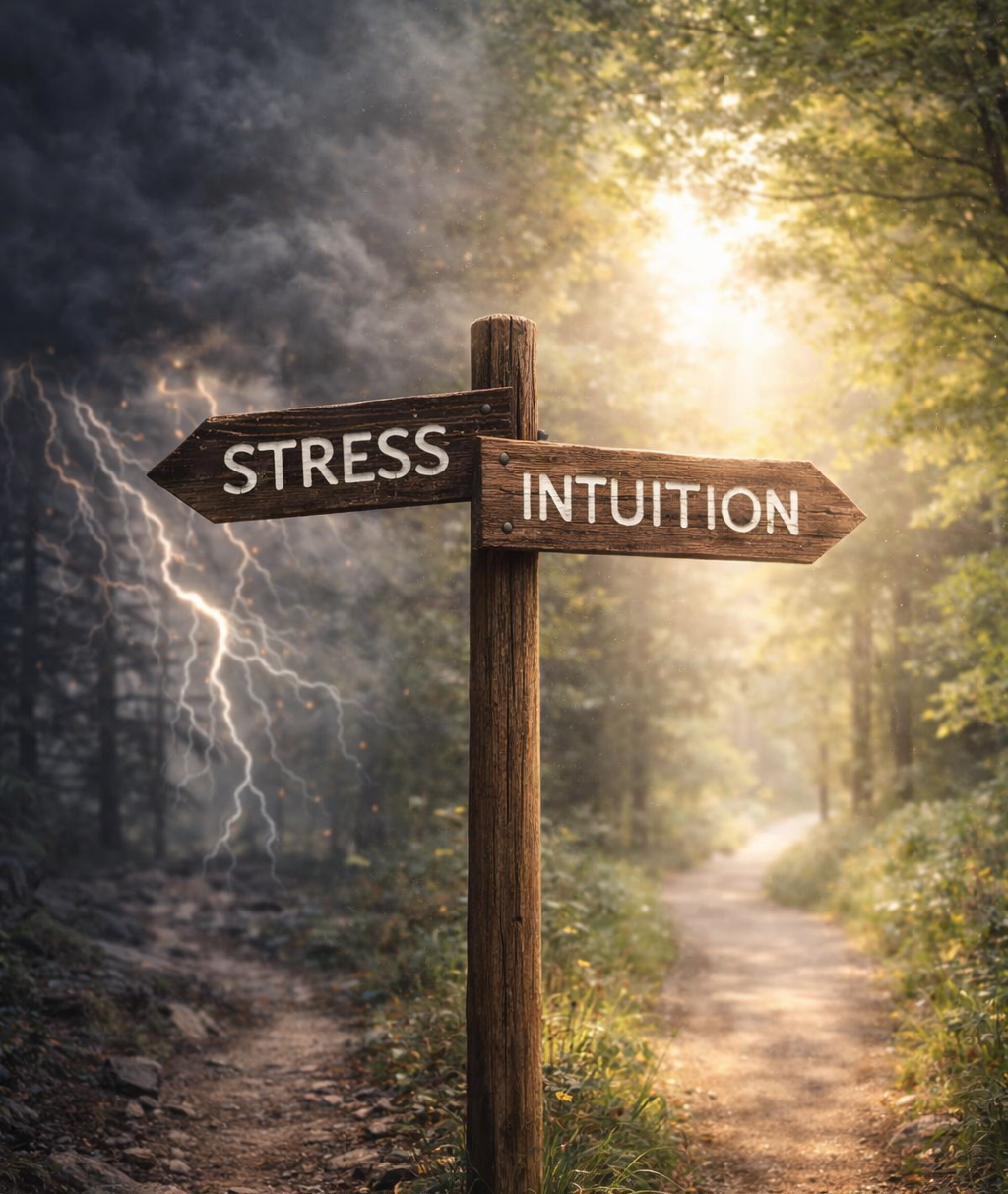
How to Tell Stress from Intuition
Learn the key differences between stress responses and true intuition, and how to hear your inner guidance more clearly.
Stress and intuition can wear the same outfit.
Both can feel urgent. Both can feel like: “I have to do something.”
The difference is where it comes from, and what it does to your body
But they come from different places inside you, and they leave different footprints in your body.
What stress feels like in the body
Stress is often your nervous system trying to protect you. It carries pressure, fear, or a racing edge. Stress wants certainty. Stress wants control. Stress wants “right now.”
Common stress signals include tight chest, shallow breathing, racing thoughts, urgency, jaw tension, stomach knots, restless energy.
Stress often sounds like:
“What if this goes wrong?”
“I’m running out of time.”
“I can’t mess this up.”
“I need certainty right now.”
What intuition feels like in the body
Intuition can be quiet, but it’s steady. Even when it tells you something difficult, it often comes with clarity instead of panic. It feels clean. It feels true.
Intuition often shows up as a clear inner yes or no, grounded steadiness, a consistent message, or a calm knowing even if you’re nervous.
Intuition often sounds like:
“This isn’t for me.”
“Not yet.”
“Yes, this matters.”
“Something feels off, even if I can’t explain it.”
The simple body test
Ask yourself: “If I remove fear, what remains?”
If the answer collapses, it was likely stress.
If it remains steady, it may be intuition.
Then ask: “Does this expand me or contract me?”
Expansion doesn’t always mean comfort. It means alignment.
Contraction feels like bracing, shrinking, or abandoning yourself to be safe.
How to hear intuition more clearly
Intuition gets clearer when your nervous system is regulated. When your body feels safe, your inner guidance doesn’t have to shout.
Try this quick clarity practice:
Feet on the floor.
Name three things you can see.
Exhale slowly three times.
Hand on chest.
Ask: “What is true for me right now?”
If the answer doesn’t come, don’t force it. Sometimes the most intuitive response is: “I need to settle first.”
Affirm gently
“I do not have to make choices from panic. I can choose from clarity.”
Your Soulful Pathways ↑
Desktop: Hover over ‘Your Soulful Pathways’ in the top menu to explore another series.
Mobile: Tap the menu (☰), then choose ‘Your Soulful Pathways.’.

What Nervous System Dysregulation Feels Like
Learn the subtle signs your nervous system is overwhelmed and how to respond with gentleness, safety, and grounded support.
Sometimes your nervous system doesn’t feel “anxious.”
Sometimes it feels like too much… or nothing at all.
When your body has been in survival mode for too long
Nervous system dysregulation is what happens when your body has been in survival mode for too long, even if your mind is doing everything it can to keep going. It can show up after stress, grief, burnout, conflict, trauma, or simply months and years of pushing yourself past your limits because life demanded it.
It’s important to name this gently: dysregulation doesn’t mean you’re broken. It means your system learned to protect you. And now it’s still protecting you, even when the danger is no longer present.
Common ways dysregulation can feel
Overstimulated and reactive
Small things feel big. Sounds are sharp. People feel like pressure. Your patience is thin. You might snap, shut down, or feel the strong need to escape. You may even feel guilty afterward, like you’re not yourself.
Restless but exhausted
You’re tired, but you can’t settle. Your body wants rest, yet your system keeps scanning for what could go wrong. You might sleep but wake up tense, as if your body stayed on duty all night.
Numb or disconnected
You’re present, but not fully here. It’s hard to feel joy. It’s hard to feel much of anything. You go through the motions, but the world looks muted, like your spirit stepped back to conserve energy.
Overthinking and looping
Your mind won’t stop narrating. You replay conversations, rehearse outcomes, brace for impact. Thoughts can feel like they’re trying to prevent pain by solving everything in advance.
Body tension you can’t explain
Clenched jaw. Tight chest. Shallow breathing. Stomach knots. Headaches. A constant “held” feeling, like your body is bracing for a hit that never arrives.
A sense of unsafety for no clear reason
Nothing is actively wrong, but your body doesn’t believe that yet. That’s the key phrase: your body doesn’t believe it yet.
What this actually means
You don’t force calm. You build safety.
Regulation isn’t a personality trait. It’s a relationship with your body. It’s showing your system, again and again, that this moment can be lived without bracing.
Try a gentle reset right now
Place one hand on your chest, one on your belly.
Breathe in normally.
Exhale slower than you inhale, even by one or two seconds.
Whisper: “In this moment, I am safe enough.”
That phrase matters. “Safe enough” tells your nervous system the truth without demanding perfection. It opens the door without insisting you sprint through it.
Add an orienting cue (optional, but powerful)
Look around the room slowly.
Name three neutral things you see.
Then return to your breath.
Your nervous system learns through repetition. A few seconds of safety, repeated often, can change your baseline over time.
Affirm gently
“My body is not the enemy. It is learning to feel safe again.”
Your Soulful Pathways ↑
Desktop: Hover over ‘Your Soulful Pathways’ in the top menu to explore another series.
Mobile: Tap the menu (☰), then choose ‘Your Soulful Pathways.’.
Rest as Resistance to the Job Loop
Rest is not laziness. It’s sacred resistance to constant output. Reclaim Sabbath energy, restore your nervous system, and remember your worth.
Rest is spiritual rebellion in a world that demands constant output.
Rest Reminds You Who You Are
The job loop can make you feel like you exist to produce. Work. Pay bills. Recover. Repeat. In that rhythm, rest can start to feel like a luxury you have to earn. But that is not how you were created.
Rest is not weakness. Rest is remembrance. It says: I am human. I have limits. I am more than my output.
Sabbath Energy Is a Boundary
Sabbath is not only a religious concept. It is a spiritual boundary that says: I stop. I trust. I receive. It pushes back against the voice that says you must always be useful to be worthy.
A system that praises constant production will try to convince you that rest is laziness. But God built rest into creation. Rest is not optional. It is part of wholeness.
What Rest Can Look Like
Rest is not always sleep. Rest can be anything that restores your nervous system and brings you back to yourself.
Rest can look like:
quiet without screens
nature and fresh air
prayer that is receiving, not striving
laughter and play
creative time without pressure
time with people who feel safe
a nap without apology
Rest that heals is rest that feels safe.
The Guilt That Tries to Stop You
If guilt rises when you rest, that guilt is usually conditioning. Many people were trained to believe they must earn rest. But your worth is not something you earn. It is something God already declared.
Try this phrase:
I do not have to earn what God already calls good.
A Simple Rest Practice
Choose one small rest ritual this week:
30 minutes of quiet time
one screen-free evening
a slow walk
a Sabbath hour where you do not produce
a nap with no apology
Then notice what changes in your body. Rest is not a reward. It is medicine.
Gentle Reflection Questions
Where have I been trying to earn rest instead of receiving it
What kind of rest actually restores me
What one rest ritual can I protect this week
A Short Prayer
God, teach me to rest without guilt. Restore my body and spirit, and remind me that my worth is not measured by output. Amen.
Your Soulful Pathways ↑
Desktop: Hover over ‘Your Soulful Pathways’ in the top menu to explore another series.
Mobile: Tap the menu (☰), then choose ‘Your Soulful Pathways.’
When It Is Time to Leave And When It Is Not Yet
Learn to tell fear from true suffocation. Explore red flags, green flags, and how to plan a wise exit without panic or self-betrayal.
Wisdom helps you tell fear from suffocation.
Two Feelings That Can Look Similar
Sometimes discomfort is growth. Sometimes discomfort is harm. Both can feel intense, and both can make you want out. But they are not the same.
A stretching season can feel challenging while still being purposeful.
A suffocating season feels like your soul is shrinking.
Discernment is learning the difference.
Red Flags That It May Be Time to Leave
Consider leaving if you notice patterns like these:
Your health is declining and you cannot recover
The environment is unsafe or abusive
Your values are constantly compromised
You are becoming numb, bitter, or smaller over time
Nothing improves after honest effort and communication
You dread your life more than you live it
You do not have to justify your pain to anyone. If your soul is suffocating, that matters.
Green Flags That It Might Be a Bridge Season
Staying may be wise if:
You can rest and recover outside of work
The job is hard but not harming your health
You are building skills, savings, or experience for the next step
You sense peace about preparing rather than rushing
You are learning boundaries and confidence
A stretching season can still be holy, especially if it has a time limit and a purpose.
Planning a Wise Exit
If leaving is the direction, you do not have to leap in panic. A wise exit often looks like:
saving what you can
reducing expenses to create margin
updating your resume and exploring options
building one skill or side stream
setting a realistic timeline
Planning is not lack of faith. Planning is stewardship. Wisdom protects your nervous system and keeps you grounded.
A Final Truth Check
Ask yourself:
If I knew provision was secure, would I still want to leave
This question often reveals whether fear is the main driver or whether your soul is truly done.
Gentle Reflection Questions
What is fear and what is true suffocation in me
What red flags or green flags have I been ignoring
What wise preparation step could I take this month
A Short Prayer
God, give me courage and wisdom. If it is time to go, guide my steps and provide a path. If it is time to prepare, give me patience and strength. Amen.
Your Soulful Pathways ↑
Desktop: Hover over ‘Your Soulful Pathways’ in the top menu to explore another series.
Mobile: Tap the menu (☰), then choose ‘Your Soulful Pathways.’
Hearing God in Your Work Decisions
Unsure whether to stay, shift, or leave. Learn discernment through peace versus panic, wise next steps, and trusting timing in work decisions.
Discernment is learning the difference between peace and panic.
The Noise That Surrounds Big Choices
Work decisions can stir a lot of fear. Stay or go. Take the risk or keep stability. Start something new or stay where you are until you feel more ready. When you are in the job loop, decisions can feel urgent because your soul is tired. But urgency is not always guidance. Sometimes urgency is anxiety.
Anxiety rushes. It demands certainty. It creates pressure.
God’s guidance often feels different. It may be quiet, steady, and repeated. It may come as peace that grows over time.
Peace Is Not the Same as Comfort
Peace does not always mean easy. Peace can exist with stretching. Peace can exist with fear. Peace often shows up as a steady inner knowing, even when the next step is unfamiliar.
Try asking:
Does this path bring deeper peace over time
Not instant relief. Deeper alignment.
Sometimes the “right” choice still feels scary. But it also feels honest. It feels clean. It feels like you are moving toward truth, not away from it.
Questions That Help You Hear Clearly
When you are discerning, clarity often returns after rest. So if you are overwhelmed, start by calming your nervous system. Then ask these questions slowly in prayer or journaling:
What am I most afraid will happen if I stay
What am I most afraid will happen if I leave
What feels honest in my body even if it is hard
What door keeps opening with calm clarity
What door keeps closing no matter how hard I push
If fear was not leading me, what would I choose
You are not trying to force a sign. You are allowing truth to rise.
Peace vs Pressure
Peace often looks like:
clarity that returns after rest
conviction without panic
steady desire that does not vanish
practical steps that feel wise
Pressure often looks like:
rushing and forcing
spiraling thoughts
dread that does not lift
needing everything decided immediately
If your mind is frantic, that is usually not the voice of God. God may call you to courageous steps, but God does not crush you with chaos.
One Next Step Instead of a Full Blueprint
You do not need a ten year plan. Ask for one next step. One phone call. One resume update. One skill learned. One conversation. One hour a week toward a new direction. God often leads step by step so you can stay grounded.
Gentle Reflection Questions
What decision is weighing on me most right now
What would peace look like over time not just relief today
What is one next step I can take without forcing the future
A Short Prayer
God, lead me with clarity and calm. Help me recognize Your peace, release panic, and take the next right step with trust. Amen.
Your Soulful Pathways ↑
Desktop: Hover over ‘Your Soulful Pathways’ in the top menu to explore another series.
Mobile: Tap the menu (☰), then choose ‘Your Soulful Pathways.’
Living on Less Without Feeling Small
Simplifying can be freedom, not shame. Learn how living on less can create breathing room, peace, and a life that actually fits you.
Simplifying can be freedom. It does not have to be shame.
There Is a Difference Between Simplicity and Lack
For many people, the idea of living on less can feel heavy. It can bring up memories of not having enough, or fear that simplifying means you are failing. But intentional simplicity is different than lack. Simplicity is chosen. It is values-based. It is a decision to create space. Lack is something that happens to you. Simplicity is something you build.
Shame says, “I have less because I am less.”
Simplicity says, “I am choosing room for what matters.”
If you are simplifying to create more freedom, more peace, or more time to breathe, that is not small. That is wise.
Why Less Can Create More Life
The job loop can trap you in a cycle of earning and spending just to keep up. Simplifying interrupts that cycle because it reduces pressure. Less can mean:
fewer payments and recurring bills
fewer impulse purchases
less clutter to manage
less stress about appearances
more margin in your month
more time in your life
more energy for healing and purpose
Sometimes the deepest freedom begins when you stop trying to “keep up” and start building a life that actually fits you.
Simplifying Without Punishing Yourself
Simplicity is not a punishment. It is not about deprivation. It is not about living with the bare minimum while feeling miserable. It is about clearing out what is draining you so you can have more life, not less.
Ask gently:
What expenses actually support my values
What am I buying to soothe stress or emptiness
What am I trying to prove
What would make my month feel lighter
What would feel like freedom for me, personally
When you ask these questions without shame, you start making decisions from clarity instead of fear.
Small Simplifications That Make a Big Difference
You do not have to change everything at once. Choose one small simplification and repeat it until it becomes your new normal.
Here are a few gentle options:
Cancel one subscription you rarely use
Plan simple meals for one week to reduce spending and stress
Reduce one convenience habit that adds up
Pause online shopping for a month and track what you feel
Sell items you no longer use and put the money toward margin
Choose a “buy less” rule like waiting 48 hours before purchases
Small changes create breathing room. Breathing room creates choices. Choices create freedom.
Living on Less Without Losing Your Dignity
Your worth is not measured by what you own. You do not have to prove your value through purchases. You are not small because you are simplifying. You are strong because you are choosing a path that supports your peace.
Sometimes simplifying is how you reclaim your life from the loop. Sometimes it is how you make space for your gifts. Sometimes it is how you create the quiet foundation your next chapter needs.
Gentle Reflection Questions
What do I want more of in my life that money cannot buy
What spending habit is tied to stress or comparison
What is one simplification that would bring me breathing room
A Short Prayer
God, help me choose simplicity with dignity. Teach me contentment without shame, and guide me into freedom through wise and gentle choices. Amen.
Your Soulful Pathways ↑
Desktop: Hover over ‘Your Soulful Pathways’ in the top menu to explore another series.
Mobile: Tap the menu (☰), then choose ‘Your Soulful Pathways.’
Building Side Streams from Your Gifts Without Burning Out
Start a gentle side income stream rooted in your gifts without turning it into another grind. Build steadily with rest, boundaries, and wisdom.
Side income should feel like support, not a second cage.
A Side Stream Can Be a Bridge
Side streams can be practical and deeply empowering. They can help you build options, freedom, and breathing room without forcing you to leap too soon. A side stream can also be sacred because it often comes from what you naturally carry: encouragement, creativity, organization, teaching, making, writing, designing, caring, fixing, or helping.
But the goal is not to build another exhausting grind. The goal is to build support that honors your nervous system.
Start With One Gift and One Simple Offer
The fastest way to burn out is trying to do everything. Start with one small offer you can sustain.
Ask:
What gift do I have that feels natural and life-giving?
Then ask:
What is the simplest version of offering that gift?
Examples:
A single service you can deliver weekly
A small product you can create once and sell repeatedly
A skill you can offer locally
A resource you can share online
Keep it clear. Keep it small. Keep it doable.
Build Slowly So It Does Not Become Another Cage
A soulful side stream respects your energy:
Choose one time block per week
Set a small goal for one month
Keep your offer repeatable
Rest on purpose
Do not punish yourself for being new
Consistency beats intensity. Steady beats scattered.
Money Without Pressure
Pricing can feel emotional. Many people undervalue themselves out of fear or overwork themselves out of panic. Try this:
Price with respect, not apology.
You are not charging for perfection. You are charging for time, skill, and care.
If you do not know what to charge, start with what feels fair and sustainable, then adjust as you gain feedback and confidence.
A Gentle Starter Plan
Week 1: Choose your offer
Week 2: Create the simplest version
Week 3: Tell 5 to 10 people
Week 4: Improve based on what you learn
This is enough. You do not need a full brand, a perfect website, or a giant audience to begin. You need one honest step at a time.
Gentle Reflection Questions
What gift do I have that feels natural and life-giving
What is one simple offer I could start without overwhelming myself
What boundary will protect my rest as I build
A Short Prayer
God, show me how to build with wisdom and gentleness. Bless the work of my hands without letting it become another cage. Lead me into provision with peace. Amen.
Your Soulful Pathways ↑
Desktop: Hover over ‘Your Soulful Pathways’ in the top menu to explore another series.
Mobile: Tap the menu (☰), then choose ‘Your Soulful Pathways.’
Redefining Success from the Inside Out
Success that costs your peace is too expensive. Redefine success through wholeness, alignment, relationships, and how you feel inside your life.
Success that costs your peace is not success. It is performance.
The Old Definition Can Leave You Empty
The world often defines success as titles, income, productivity, and what your life looks like from the outside. But you can “achieve” and still feel anxious. You can make more money and still feel exhausted. You can look put-together and still feel like you are disappearing inside your own life.
That is why your soul keeps asking for a new definition.
Signs You Are Outgrowing the Old Story
You may be outgrowing the old version of success if:
You no longer want to hustle at the cost of your health
You crave simplicity more than status
You want peace more than applause
You want alignment more than approval
You want your life to feel honest, not impressive
This is not weakness. This is maturity. This is your spirit choosing wholeness.
What Success Can Mean Now
Success can be:
Waking up without dread
Having peace in your body
Feeling proud of your integrity
Having relationships that feel safe
Making decisions that match your values
Having time to breathe and be human
Feeling at home in your own skin
This kind of success does not always impress people. But it heals you.
A Simple Redefinition Exercise
Write two lists:
List One: Outside Success
What do you feel pressured to want?
List Two: Inside Success
What actually makes you feel alive, grounded, and free?
Then ask:
“Which list has been running my choices?”
This question can change your whole direction.
Success Through a Spiritual Lens
God’s idea of success often looks like fruit: love, patience, self-control, kindness, wisdom. It looks like a life that is rooted. It looks like a heart that is not enslaved to pressure. It looks like peace that remains even when circumstances are imperfect.
When you define success from the inside out, you stop chasing goals that cost you your soul. You start choosing what fits your actual life.
A Gentle Next Step
Choose one area where you want success to feel different: work, money, relationships, health, rest. Then choose one small action that reflects your new definition.
Success becomes real when your choices match your values.
Gentle Reflection Questions
What definition of success have I been living under
What kind of success would actually heal me
What is one choice I can make that honors my inner peace
A Short Prayer
God, free me from performance and pressure. Teach me to define success through wholeness, peace, and love, and guide me into a life that feels true. Amen.
Your Soulful Pathways ↑
Desktop: Hover over ‘Your Soulful Pathways’ in the top menu to explore another series.
Mobile: Tap the menu (☰), then choose ‘Your Soulful Pathways.’
Protecting Your Soul in a Draining Job
If you can’t leave yet, you can still protect your spirit. Ground, reset, and release what isn’t yours while you stay steady and safe.
If you cannot leave yet, you can still protect your peace.
Draining Jobs Drain More Than Energy
Some jobs do not just tire your body. They drain your emotions, your nervous system, your patience, and your spirit. And when you are in that environment long enough, you can start to forget what calm feels like. You can start to live in survival mode without realizing it, and you may carry work stress into your home like a heavy coat you cannot take off.
Protecting your soul is not dramatic. It is daily stewardship. It is learning how to stay soft without being harmed.
Before Work Protection
You do not need an hour long routine. You need a moment of intention. Even 30 seconds can change the tone of your day.
Try this:
Breathe in slowly and breathe out longer than you breathe in
Whisper: “God, keep me steady.”
Imagine a gentle boundary around you like light
Choose one sentence to carry: “Peace stays with me.”
Your mind might resist at first, especially if you are used to bracing for impact. But your nervous system learns through repetition.
Micro Breaks During the Day
Micro breaks interrupt the stress loop. They teach your body safety.
Try these simple resets:
Unclench your jaw
Drop your shoulders
Take one slow breath before each difficult interaction
Step outside for 60 seconds
Touch your wrist and whisper: “I am here.”
These micro resets are not laziness. They are maintenance for your spirit.
Energetic Boundaries Without Becoming Cold
You can be compassionate without absorbing. You can care without carrying. If you feel drained because you are always taking on other people’s emotions, try this inner boundary:
“I can be present without taking this home.”
When the day feels heavy, remind yourself: some burdens are not yours to hold. You are allowed to release them.
After Work Release Ritual
Create a clear transition from work to home. Your nervous system needs an “ending.”
Choose one:
Wash your hands and imagine the day leaving
Change clothes as a boundary
Sit in your car for one minute and exhale
Take a shower and let it be symbolic release
Say aloud: “I release what is not mine.”
The more consistent your release ritual becomes, the more your home begins to feel like yours again.
Protecting Your Life Outside of Work
If you are in a draining job, your time off matters deeply. Protect it. Do not fill it with more depletion. Choose at least one thing each week that restores you: quiet, nature, music, laughter, prayer, safe people, or creativity.
Your peace is not optional. It is sacred.
Gentle Reflection Questions
What drains me most at work and what boundary could help
What simple ritual could help me release work energy after the day ends
Where do I need to stop carrying what is not mine
A Short Prayer
God, protect my heart and strengthen my boundaries. Help me release what I was never meant to carry and return home to peace. Amen.
Your Soulful Pathways ↑
Desktop: Hover over ‘Your Soulful Pathways’ in the top menu to explore another series.
Mobile: Tap the menu (☰), then choose ‘Your Soulful Pathways.’
Tiny Acts of Purpose in an Ordinary Workday
You don’t have to wait for a new job to live with purpose. Practice small choices that protect your peace and bring meaning into today.
Purpose is not only found after you escape. It can live inside today.
Purpose Is a Way of Being
When your job is not your dream, it is easy to feel like real life starts later. Later when you have more time. Later when you have more money. Later when you finally find the “right” work. But purpose is not only something you arrive at in the future. Purpose is also a way of being that you can practice right now.
Purpose is not always a career path. Sometimes purpose is what you carry. It is the values you live from. It is the way you treat people. It is how you keep your heart intact while you handle responsibilities.
You do not have to pretend you love your job. This is not about forcing gratitude. It is about reclaiming your power in small ways and remembering: your soul is still yours wherever you go.
Tiny Acts That Bring You Back to Yourself
Tiny acts of purpose are small choices that make you feel more human and less like a machine. They are moments where you refuse to disappear inside pressure.
Purpose can show up as:
Being kind without people-pleasing
Holding a boundary without guilt
Choosing integrity when cutting corners would be easier
Encouraging someone who looks worn down
Staying honest instead of performing
Doing your work with care, even if the job is not your dream
These are not small spiritually. These are the quiet actions that build character and inner steadiness.
How to Feel Less Trapped Without Quitting
Feeling trapped often comes from feeling powerless. So even if you cannot change the job today, you can change what you allow to take over your spirit.
Try these small shifts:
Choose one part of your day to protect. A lunch break that is yours. A short walk. A moment of quiet in your car.
Create one steady boundary. One thing you will no longer tolerate, even if you say it kindly.
Bring a calming ritual. A grounding stone. A calming playlist. A breath practice before meetings.
Stop carrying what is not yours. You can be compassionate without absorbing everyone’s emotions.
Tiny shifts teach your nervous system: I still belong to me.
Purpose Through Presence
A huge part of purpose is presence. When you are present, you do not lose yourself. Even one deep breath before you respond can keep your nervous system from spiraling. Even one intentional pause can keep you from becoming hardened.
Try this phrase during stressful moments:
“I return to myself.”
Then breathe. Let your shoulders soften. Let your jaw unclench. Let your heart stay open without becoming a sponge.
The After Work Purpose Window
Purpose also lives after work. In what you create. In what you learn. In how you rest. In who you connect with. If your evenings feel like collapse, ask gently:
“What would make my evenings feel more like my life?”
It might be:
ten minutes of journaling
a walk outside
one creative habit
one weekly class
one hour without noise
one simple side dream researched slowly
Your purpose grows when you give it consistent space, not when you demand instant transformation.
Gentle Reflection Questions
What value do I want to embody at work today
Where do I need a boundary to protect my peace
What is one small purposeful act I can choose before the day ends
A Short Prayer
God, let me carry purpose into today. Help me stay kind without shrinking, strong without hardening, and present without losing myself. Amen.
Your Soulful Pathways ↑
Desktop: Hover over ‘Your Soulful Pathways’ in the top menu to explore another series.
Mobile: Tap the menu (☰), then choose ‘Your Soulful Pathways.’
The Bridge Season When You Are Not Where You Were But Not Where You Are Going
In-between seasons are not failure. Learn how to stay steady, build wisely, and trust the slow transition when your next chapter is forming.
The in-between is not failure. It is transition with purpose.
The Strange Middle Space
A bridge season feels like standing between two worlds. Your outside life may look the same, but inside you have shifted. This season can feel slow and lonely, especially when others do not see what is changing in you.
Why Bridge Seasons Matter
Bridge seasons stabilize you while your future forms. They often teach patience, boundaries, and trust. Sometimes staying for a season is wisdom, not fear. Sometimes it is how you protect your nervous system while you prepare.
You Are Building Even If You Are Still There
Progress in a bridge season often looks like learning a skill, saving a little, paying down debt, healing from stress, exploring ideas, and practicing consistency. Quiet progress is still progress.
Anchors for the In Between
Name what you are building
Choose one consistent step each week
Protect rest as part of transition
Ask for daily guidance rather than a full blueprint
Gentle Reflection Questions
What am I building in this season even if it is quiet
Where do I need to be more patient and less self-critical
What consistent step can I take without burning out
A Short Prayer
God, help me trust the in-between. Give me peace while I build, wisdom in my timing, and courage to take steady steps into the future You are forming. Amen.
Your Soulful Pathways ↑
Desktop: Hover over ‘Your Soulful Pathways’ in the top menu to explore another series.
Mobile: Tap the menu (☰), then choose ‘Your Soulful Pathways.’
The Job Loop - When You Feel Like You Are Just Surviving
Wake, work, pay, repeat can drain the soul. Name burnout with compassion and take one small step toward clarity, relief, and renewed life.
Wake work pay repeat can make your soul feel quiet. You are not alone.
Naming the Hamster Wheel
There is exhaustion that is more than being tired. It is the heaviness of repetition without meaning. Days blur. Weeks disappear. You keep up with responsibilities, but inside you feel like you are living on autopilot.
If you are here, your feelings make sense. This is a real experience, and it can quietly wear down hope.
Burnout Does Not Always Look Dramatic
Sometimes burnout looks like numbness, dread, scrolling to escape, losing motivation, and needing more recovery than before. Burnout is not laziness. It is your nervous system asking for relief.
The First Step Is Seeing the Loop
You do not have to quit your job today. The first step is powerful and simple:
See the loop without becoming the loop.
When you name what is happening, you create space. And space is where freedom begins.
Tiny Steps That Break the Spell
Try this question each day:
“Where did I feel most alive today, even for 30 seconds?”
A song, a sunset, a laugh, a boundary, a quiet prayer. Those are breadcrumbs back to yourself.
Then ask:
“What is one small step I can take this week toward a life that feels more like mine?”
Ten minutes outside. One skill video. One page of journaling. One screen-free evening. One conversation with someone safe.
One inch of ownership begins to loosen the loop.
Gentle Reflection Questions
Where do I feel the job loop most strongly in my body or emotions
What moment of aliveness did I experience today even if it was small
What is one tiny step I can take this week to reclaim my life
A Short Prayer
God, meet me in this tired place. Help me breathe again, see the loop clearly, and take one gentle step toward freedom. Strengthen me without crushing me. Amen.
Your Soulful Pathways ↑
Desktop: Hover over ‘Your Soulful Pathways’ in the top menu to explore another series.
Mobile: Tap the menu (☰), then choose ‘Your Soulful Pathways.’

Money as a Tool Not a Master
Shift from chasing money in fear to using money with wisdom. Release shame and comparison while honoring real needs and building steady peace.
Money is real. Fear does not have to be your ruler.
You Are Not Wrong for Wanting Stability
Money touches real needs: housing, food, safety, family, emergencies. So if you have ever felt ashamed for caring about money, let this soften that shame: wanting stability is not greed. Wanting to breathe is not “unspiritual.” Wanting provision is not a flaw. Your needs matter, and God cares about the practical parts of your life too.
The issue is not money itself. The issue is when money becomes the master of your nervous system.
When Money Starts Leading Your Life
Money becomes a master when it controls your peace, your identity, and your worth. When your life turns into constant pressure: “I have to make more or I will never be okay.” That pressure can create comparison, shame, panic, and overworking that disconnects you from your own soul.
If you have been living in that pressure, you are not failing. You are responding to a culture that teaches people to chase and chase, even when the heart is exhausted.
Money Is a Tool for Support
A tool is meant to serve you. Money can support your home, your health, your goals, your giving, your peace. Try this reframe:
“Money supports what my soul is here to do.”
That one sentence changes the energy. It invites stewardship instead of obsession, wisdom instead of panic.
The Hidden Meaning We Attach to Money
Sometimes money represents safety, freedom, approval, or finally being “enough.” When money becomes proof of worth, you will never feel settled, because worth cannot be purchased. Worth can only be remembered.
Peaceful Practical Steps
A peaceful relationship with money does not mean ignoring bills. It means meeting reality with steadiness:
A simple budget that is honest, not punishing
One savings goal, even if small
One spending habit examined with compassion
Releasing comparison when it rises
You are allowed to want more without letting fear run the show.
Gentle Reflection Questions
What does money represent to me emotionally right now
Where have fear and comparison been driving my decisions
What is one peaceful step I can take with my finances this week
A Short Prayer
God, give me wisdom with money and peace in my heart. Help me treat money as a tool, not a master, and guide me into steady provision without fear. Amen.
Your Soulful Pathways ↑
Desktop: Hover over ‘Your Soulful Pathways’ in the top menu to explore another series.
Mobile: Tap the menu (☰), then choose ‘Your Soulful Pathways.’