

Prayer that Calms the Body Too
Explore gentle prayer practices using breath, grounding, posture, silence, Scripture, and faith to create more room for calm, surrender, presence, and peace.
How Gentle Prayer, Breath, Posture, Presence, and Faith Can Create More Room for Peace
Let prayer become a place your body can rest.
Sometimes a person can pray with sincere faith while the body still feels braced.
The words are there.
The belief is there.
The desire for peace is there.
But the shoulders stay tight.
The jaw stays clenched.
The breath stays shallow.
The stomach holds tension.
The mind keeps moving.
The body has not yet followed the heart into stillness.
That does not mean prayer is failing.
It does not mean your faith is weak.
It does not mean God is far away.
Sometimes your whole being simply needs a gentler doorway into the moment.
Prayer is often spoken through words, but spiritual presence can involve much more than words.
Breath.
Posture.
Stillness.
Hands resting quietly.
Feet on the floor.
A softened face.
A slower pace.
A moment when you stop trying to accomplish something and simply allow yourself to be with God.
You do not have to pray harder to be heard.
Sometimes the invitation is to pray more gently.
Prayer Is More Than Words
Prayer can be spoken.
But prayer can also become quiet.
It can be a whispered:
Help.
It can be:
Jesus.
It can be:
Stay near.
It can be sitting in silence when there are no sentences left.
It can be letting tears come without needing to explain them.
It can be placing one hand over your heart and remembering that you are here.
It can be breathing slowly enough to notice that you have been rushing.
Some seasons require many words.
Others require almost none.
If your body feels tense, restless, tired, numb, overwhelmed, or unable to settle, you are not failing spiritually.
You are human.
Your spiritual life does not have to exclude that humanity.
You can bring your whole self into prayer.
The part that believes.
The part that hopes.
The part that is tired.
The part that does not know what to say.
The part that is still carrying yesterday.
God can meet you in the prayer you speak.
And He can meet you in the silence after the words are gone.
The Body Is Part of the Life You Bring to God
Sometimes spirituality is treated as though the body is merely carrying the soul around.
But your body is part of your lived experience.
It carries the day with you.
It responds to pressure.
It notices exhaustion.
It holds posture.
It breathes.
It moves.
It rests.
It experiences the physical side of emotion.
When you are stressed, you may notice:
Tighter muscles.
A quicker or shallower breath.
Restlessness.
A clenched jaw.
A racing heart.
Difficulty sitting still.
A feeling of being keyed up even when you want to relax.
Prayer does not have to ignore any of this.
You can notice what your body is doing while you pray.
Not because every sensation needs to be analyzed.
Simply because awareness creates another place where gentleness can enter.
Maybe your jaw can soften.
Maybe your hands can unclench.
Maybe your shoulders can come down a little.
Maybe your breathing can become less hurried.
Prayer can become a moment when you stop fighting yourself long enough to notice:
I am carrying more tension than I realized.
And then, without judgment:
God, meet me here too.
Make Prayer a Place of Presence, Not Performance
When people feel stressed, uncertain, afraid, or spiritually dry, there can be a temptation to pray “better.”
More words.
More intensity.
More effort.
More pressure to sound faithful.
More pressure to feel peaceful.
More pressure to get the prayer exactly right.
But prayer is not an audition.
God does not need eloquence before He can hear honesty.
A prayer does not have to be long to be real.
It does not have to sound beautiful.
It does not have to impress anyone.
Sometimes the truest prayer is:
God, I am here.
God, hold me.
God, help me slow down.
God, steady me.
God, meet me in this moment.
God, help me receive Your peace.
Simple prayer can become a repeated cue to pause.
Not because particular words are magical.
Because repetition, stillness, gentle breathing, and prayer can all become part of a quieter moment.
You are not performing peace.
You are making room for it.
Begin by Noticing Before You Try to Change Anything
Before trying to relax, simply notice.
Where are your shoulders?
What is your jaw doing?
Are your hands gripping something?
Are you holding your breath?
Is your forehead tense?
Are you rushing through the prayer itself?
Notice without criticizing.
You do not have to say:
I should be calmer than this.
Try:
This is how I am arriving today.
That sentence creates room.
Maybe you arrive peaceful.
Maybe exhausted.
Maybe angry.
Maybe distracted.
Maybe hopeful.
Maybe frightened.
Maybe deeply grateful.
Maybe unsure.
You do not have to manufacture another state before you are allowed to pray.
You can begin with the state you actually have.
Presence starts with truth.
Hand-to-Heart Prayer
This is a simple way to bring prayer, touch, and presence together.
Place one hand over your chest if that feels comfortable.
Or rest your hand over your upper arm, belly, or lap.
Let your shoulders soften slightly.
Take one comfortable breath.
Then choose one short prayer.
God, be near.
Peace, come close.
I am held.
Help me soften.
I am not alone.
Lead me into peace.
Repeat it slowly for a few breaths.
You do not have to force yourself to feel anything.
The purpose is not to create an instant emotional transformation.
It is simply to become present.
Feel the warmth of your hand.
Notice the movement of your breath.
Hear the words.
Let prayer occupy more of the moment than the rush does.
Sometimes that is enough.
Let the Exhale Become Prayer
Breathing is already happening.
You do not have to turn it into a complicated exercise.
Simply notice your next breath.
Inhale comfortably.
Then allow the exhale to become slightly slower if that feels natural.
As you breathe out, whisper one word.
Peace.
Mercy.
Rest.
Held.
Grace.
Jesus.
Then breathe normally again.
Repeat gently.
Slow, comfortable breathing can help the body shift toward a calmer state for some people.
There is no need to force an unusually deep breath or chase a particular sensation.
The prayer is not a trick.
The breath is not a test.
You are simply allowing breathing and prayer to share the same moment.
One word can be enough.
One breath can be enough.
God does not need a paragraph when your heart only has one word.
Breath Prayer Can Carry Scripture Too
A breath prayer can also be built around a short truth from Scripture.
You might pray slowly:
Be still.
The Lord is my shepherd.
You are with me.
Your peace be with me.
I will trust in You.
Or create two simple phrases.
On the inhale:
God, You are here.
On the exhale:
I release what I cannot carry.
Or:
You are my refuge.
I rest in You.
The purpose is not to squeeze an entire theology into one breath.
It is to give your attention one simple truth to return to.
Grounding Prayer
Sometimes your thoughts are racing so quickly that words alone feel difficult to hold.
Bring attention to something physical.
Place your feet on the floor.
Notice the contact.
Feel the support beneath you.
Look around the room.
Notice where you are.
Then pray:
I am here.
You are here.
I am not alone.
Repeat it slowly.
You can also name what you see.
A window.
A chair.
A lamp.
The light on the wall.
The tree outside.
This is not about making ordinary objects spiritually significant.
It is about returning your attention to the present moment.
Sometimes stress pulls the mind ten steps ahead or ten years behind.
Grounding prayer says:
God, meet me here.
Not in every imagined future.
Not in every replayed past.
Here.
Prayer While Walking
Prayer does not require sitting perfectly still.
For some people, movement makes presence easier.
Walk slowly.
Outside if possible.
Let your arms move naturally.
Notice your footsteps.
Notice the air.
Notice the sky.
Then pray as you walk.
Guide my steps.
Give me wisdom.
Help me walk in peace.
Show me what is mine to do today.
You can also pray without words.
Walk.
Listen.
Notice.
Let movement release some of the physical restlessness you have been carrying.
Stillness is sacred.
Movement can be sacred too.
Prayer With Open Hands
Hands can quietly mirror what we are carrying.
Sometimes they are clenched without us noticing.
Try resting your hands open on your lap.
Palms relaxed.
Then name what you are carrying.
God, I give You this fear.
I give You this decision.
I give You what I cannot control.
I give You this person.
I give You this waiting.
I give You tomorrow.
Then remain quiet for a moment.
Open hands can become a physical reminder:
I do not have to grip everything in order to care about it.
Surrender does not mean indifference.
Sometimes surrender is simply admitting:
This matters deeply, and I still cannot control all of it.
Prayer Does Not Require You to Pretend You Feel Safe
There is an important difference between saying something as a spiritual truth and demanding that your body immediately feel it.
You may believe that God is with you while still feeling anxious.
You may believe that you are loved while still feeling unsettled.
You may trust God and still have questions.
You may pray for peace while your body remains tense.
Faith and immediate emotional calm are not the same thing.
You do not have to force yourself to say:
I feel perfectly safe.
when you do not.
You can pray more honestly:
God, help me feel steadier here.
God, stay with me while this passes.
Help me remember what is true even while I feel afraid.
That is not weaker faith.
That is prayer without pretending.
When Prayer Feels Hard
There may be days when prayer does not immediately feel comforting.
You may feel numb.
Tired.
Distracted.
Angry.
Blank.
Restless.
Disappointed.
Too overwhelmed to form clear words.
There may even be seasons when prayer feels unusually quiet.
That does not automatically mean something has gone wrong between you and God.
Relationships contain quiet seasons too.
You can pray:
God, I do not know what I feel.
God, I am overwhelmed.
God, I am tired.
God, I feel far from myself.
God, carry what I cannot carry.
God, stay near while I find my footing again.
Honesty belongs in prayer.
You do not have to bring God a polished version of yourself.
Bring the real moment.
The real breath.
The real ache.
The real uncertainty.
The real silence.
You do not have to clean up your humanity before bringing it into God's presence.
Silence Can Be Prayer Too
Sometimes the deepest prayer is quiet.
You sit.
You breathe normally.
You stop explaining.
You stop asking yourself whether you are doing it correctly.
You simply become still before God.
Silence may feel strange at first.
We are used to filling space.
But silence can teach a different kind of presence.
Nothing to prove.
Nothing to produce.
Nothing to perform.
No spiritual report card.
Just:
Here I am.
Sometimes silence does not immediately feel peaceful.
That is okay.
Let the silence be honest too.
You are not trying to manufacture a mystical experience.
You are simply making room.
Scripture Can Give the Mind Somewhere Gentle to Return
When thoughts are scattered, a short passage or phrase from Scripture can become an anchor.
Read it slowly.
Not to finish a chapter.
Not to achieve a goal.
Read one line.
Then pause.
Read it again.
Notice which word stays with you.
Perhaps:
Peace.
Still.
Refuge.
Grace.
Rest.
Love.
Strength.
Let one word remain with you as you sit quietly.
Sometimes spiritual nourishment comes not from reading more, but from allowing one truth enough time to land.
A Prayer Before a Difficult Conversation
Prayer can also prepare the body and mind before something demanding.
Before entering the room, making the call, answering the message, or beginning the conversation, pause.
Feel your feet.
Release your jaw.
Let your shoulders lower.
Take one comfortable breath.
Then pray:
God, help me remain truthful and kind.
Give me wisdom before I respond.
Help me listen clearly.
Keep me from reacting out of fear.
Let peace have a place in this conversation.
Then go.
Prayer does not guarantee that the conversation will be easy.
But it can help you enter it more intentionally.
A Prayer for the End of the Day
The body sometimes carries pieces of the day into the evening.
The conversation.
The deadline.
The unanswered question.
The thing you wish you had said differently.
The thing tomorrow still requires.
Before sleep, try a short closing prayer.
God, this day is complete.
Thank You for carrying me through it.
Show me what I can release tonight.
I give You what remains unfinished.
Let my mind and body receive rest.
You do not have to solve tomorrow before sleeping tonight.
Some things can remain unfinished and still be placed in God's hands.
A Short Daily Liturgy for Calm
Use this when you want a simple prayer your body can follow.
God of Peace,
I release my jaw.
I soften my shoulders.
I let my breathing become easy.
I return to this moment.
I return to my body with kindness.
I release what I cannot control.
I receive the grace available here.
I return to You.
Amen.
Say it once.
Say it twice.
Or simply keep the one line you need.
Prayer does not become more valuable because it is longer.
Repetition Can Create Familiarity
A familiar prayer can become comforting because you no longer have to invent words every time you need them.
The same phrase.
The same chair.
The same quiet moment before bed.
The same hand over your heart.
The same short prayer before beginning work.
The same words while taking a morning walk.
Over time, the practice becomes familiar.
You know what comes next.
Your attention has somewhere to return.
That does not make prayer mechanical.
Repetition can create rhythm.
And rhythm can create room for presence.
This is one reason liturgies, repeated prayers, hymns, and familiar scriptures have remained meaningful across generations.
Sometimes the soul does not need novelty.
It needs somewhere familiar to come home.
Prayer Can Help You Stop Carrying Everything at Once
Stress often tells us:
Think about everything.
Solve everything.
Prepare for everything.
Control everything.
Prayer offers another posture.
What is mine to do?
What is not mine to control?
What needs action?
What needs patience?
What needs surrender?
What can wait until tomorrow?
These questions can bring order to an overloaded moment.
Prayer does not remove responsibility.
It can help separate responsibility from the impossible task of controlling every outcome.
You can act faithfully without carrying the entire future.
Faith Does Not Require Constant Calm
There is a temptation to assume that spiritually mature people should always feel peaceful.
But faith is not measured by the absence of emotion.
A faithful life can contain:
Tears.
Questions.
Frustration.
Uncertainty.
Weariness.
Joy.
Hope.
Fear.
Trust.
Relief.
You can feel unsettled and still pray.
You can feel afraid and still trust.
You can feel exhausted and still be loved by God.
You can need support and still have faith.
Peace does not have to become another spiritual performance.
Sometimes faith sounds like:
God, I trust You, and I am still having a hard day.
There is room for both truths.
Prayer Can Become a Place of Rest
Your body is allowed to be included in your spiritual life.
You do not have to separate faith from breath.
Prayer from posture.
Stillness from sensation.
God made you as a whole person.
The spiritual life is lived through an actual human life.
So let prayer become softer when softness is what you need.
Let it become breathable.
Let it become quiet.
Let it become a place where your shoulders can lower.
Where your jaw can release.
Where your hands can open.
Where the day's urgency does not get the final word.
You do not have to pray perfectly.
You do not have to perform peace.
You can come as you are.
Braced.
Tired.
Tender.
Scattered.
Hopeful.
Numb.
Overwhelmed.
Joyful.
Quiet.
God can meet you in all of it.
Sometimes the deepest shift is not that every feeling disappears, but that you no longer feel alone inside it.
Frequently Asked Questions
Can Prayer Help You Feel Calmer?
Prayer can offer comfort, meaning, spiritual connection, reflection, and a quiet place to pause.
Practices that pair prayer with quiet attention and slow, comfortable breathing may also include elements that help some people move toward a calmer state.
Prayer itself should not be treated as a guaranteed medical treatment, but it can be a meaningful part of a person's spiritual and emotional life.
Why Can I Pray and Still Feel Anxious?
Prayer and immediate emotional calm are not the same thing.
A person can have genuine faith while the body and mind remain activated by stress, uncertainty, exhaustion, grief, or other circumstances.
Feeling anxious during prayer does not automatically indicate weak faith.
What Is a Breath Prayer?
A breath prayer is a short prayer or sacred phrase repeated gently with breathing.
It may involve one phrase on the inhale and another on the exhale, or simply one word repeated slowly while breathing comfortably.
Does Slow Breathing Affect the Nervous System?
Breathing and autonomic nervous system activity are closely connected.
Slow, comfortable breathing can help the body shift toward a calmer state for some people.
It should feel easy rather than forced.
Can I Pray Without Words?
Yes.
Prayer traditions have long included silence, contemplation, listening, and wordless presence.
A person may sit quietly with God, pray through tears, rest in silence, or use a single repeated word when longer prayer feels difficult.
What Can I Pray When I Feel Overwhelmed?
Keep it simple.
God, help me.
God, stay near.
Give me wisdom for the next step.
Help me release what I cannot control.
Bring me back to peace.
The prayer does not have to explain everything you are carrying.
Is It Okay to Move While I Pray?
Yes.
Prayer can happen while sitting, standing, kneeling, walking, resting, working, or moving through ordinary life.
For some people, gentle walking makes it easier to focus than sitting still.
What If Prayer Does Not Make Me Feel Better Right Away?
You do not have to judge the prayer by whether your emotional state changes immediately.
Prayer can still be meaningful as relationship, honesty, surrender, reflection, worship, or spiritual connection.
Some moments bring relief.
Others simply give you somewhere truthful to bring what you are carrying.
A Gentle Prayer for Body and Spirit
God of peace,
Meet me here.
In this breath.
In this body.
In this moment.
Soften what I have been gripping too tightly.
Give me wisdom for what is mine to carry.
Help me release what is not mine to control.
Let my mind become quieter.
Let my body receive rest.
Let my spirit remember that I am not walking alone.
I do not need every answer tonight.
I do not need to perform peace.
I only need to be here with You.
Lead me gently.
Hold what I cannot hold.
And let Your peace have room in me.
Amen.
Prayer that Calms the Body Too
Maybe prayer was never meant to remain only in your thoughts.
Maybe sometimes it belongs in your breath.
Your posture.
Your hands.
Your footsteps.
Your tears.
Your silence.
Your willingness to stop rushing for a moment.
You do not need to force peace into your body.
You can create room for peace.
One gentle breath.
One loosened shoulder.
One open hand.
One honest sentence.
One quiet moment with God.
Again and again.
Eventually prayer can become more than something you hurry through when life feels overwhelming.
It can become a place you recognize.
A place of honesty.
A place of surrender.
A place of connection.
A place where you do not have to perform.
A place where the whole of you is welcome.
And perhaps that is one of prayer's quiet gifts.
You come carrying everything.
And for a little while, you remember that you do not have to carry it alone. ✨
If This Message Resonated, You May Also Enjoy
Breath as a Bridge Back to Peace
Your Soulful Pathways ↑
Discover more series pages for you in Your Soulful Pathways ↑

When You Feel Numb and Cannot Cry
Numbness is often protection, not failure. Learn how to soften safely, reconnect with your body, and thaw emotion without forcing it.
When the Tears Will Not Come
Sometimes you know something hurts.
You know it matters.
You know there is grief, disappointment, fear, exhaustion, or sadness somewhere inside you.
And yet the tears will not come.
You may sit quietly waiting for emotion and feel almost nothing.
You may want to cry and cannot.
You may know you care deeply while feeling strangely distant from what happened.
You may wonder whether something is wrong with you because your heart seems silent when you expected it to break open.
But emotional numbness does not necessarily mean you do not care.
Sometimes it means you have been carrying too much for too long.
Sometimes the mind, body, and spirit become quiet because the full weight of what happened feels too difficult to experience all at once.
Numbness can feel like absence.
But often, something is still there beneath the quiet.
What Emotional Numbness Can Feel Like
Numbness does not feel the same for everyone.
It may feel like fog, distance, flatness, heaviness, or disconnection.
You may laugh at something funny and still feel strangely detached from yourself afterward.
You may hear difficult news and feel almost no reaction.
You may know you should feel sad and instead feel tired.
You may want to pray but cannot find the words.
You may stare at something beautiful and notice that it does not reach you the way it normally would.
Sometimes numbness feels less like feeling nothing and more like feeling separated from what you know is there.
That distinction matters.
The emotions may not be gone.
They may simply be difficult to reach right now.
Not Crying Does Not Mean You Are Not Hurting
Crying is one way emotion moves through us.
It is not the only way.
Some people cry easily. Others rarely do. Some people cry immediately after something painful, while others cry days, weeks, or much later.
Some feel grief as tears.
Others feel it as exhaustion, silence, restlessness, heaviness, difficulty concentrating, or a need to be alone.
There is no correct timetable.
You do not have to produce tears to prove that something mattered.
Your grief is real even when it is quiet.
Your pain is real even when your face remains dry.
Your heart does not need to perform its hurt.
Numbness Can Be a Form of Protection
When life becomes overwhelming, sometimes feeling less is what allows you to keep functioning.
Responsibilities remain.
People still need things.
Work still has to be done.
Meals still need to be made.
Life may keep moving even when something inside you has been shaken.
Numbness can create temporary distance from an emotion that feels too large to carry all at once.
Instead of treating that distance as failure, become curious about it.
You might gently say:
“Maybe some part of me needs time.”
That is very different from demanding:
“Why am I not feeling this correctly?”
Stop Trying to Force the Tears
When you desperately want to cry, it can be tempting to push.
You replay the memory.
Listen to sad music.
Think about everything that happened.
Try to make the emotion arrive.
Sometimes that opens something.
Sometimes it makes you feel even farther away.
Emotion does not always respond well to pressure.
Instead of trying to make yourself cry, try creating conditions where feeling is welcome.
Quiet.
Warmth.
Privacy.
Rest.
Prayer.
Nature.
Music.
A trusted presence.
Time.
Then let your emotional world decide what comes.
Tears may arrive.
They may not.
Either way, you are still allowing yourself to be present.
Begin With Sensation Instead of Emotion
If emotions feel unreachable, start with something simpler.
Notice physical sensation.
The warmth of a mug.
The coolness of water.
The weight of a blanket.
The floor beneath your feet.
The air against your skin.
The warmth of sunlight.
The pressure of your hand resting over your heart.
You do not need to ask:
“What deep emotion am I feeling?”
Start with:
“What can I feel physically right now?”
Warm.
Cool.
Soft.
Firm.
Heavy.
Light.
Still.
Moving.
Feeling sensation is still feeling.
Sometimes reconnection begins there.
Let Warmth Help You Return
Warmth can be deeply comforting when you feel emotionally distant.
Wrap yourself in a blanket.
Hold a warm drink.
Take a shower.
Sit in sunlight.
Use a warm towel.
Take a bath.
You are not trying to thaw yourself dramatically.
You are simply creating an environment where guarded places can soften at their own pace.
A little warmth.
A little time.
A little less pressure.
Ground Yourself in the Present
When numbness makes you feel far away from yourself, return to what is immediately around you.
Look around slowly.
Notice the room.
A window.
A chair.
A lamp.
A plant.
A doorway.
The color of the wall.
The light coming through the curtains.
Feel your feet against the floor.
Take one slow breath.
Say quietly:
“I am here.”
You are not trying to solve anything.
You are simply returning to the moment you are actually living.
Use Gentle Movement
Emotion does not always move through words.
Sometimes movement helps you feel more present.
Walk.
Stretch.
Sway.
Shake out your hands.
Roll your shoulders.
Dance slowly to one song.
Walk outside without trying to accomplish anything.
Movement does not need to be strenuous.
A few minutes can be enough.
The purpose is not to force a breakthrough.
It is simply to remind yourself:
I am still here. I can still move.
Humming, Singing and Sound
Sometimes sound reaches places that words cannot.
Hum gently.
Sing quietly.
Listen to music that feels comforting rather than overwhelming.
Pray aloud.
Read something meaningful out loud.
The vibration of your own voice may help you feel a little more present.
Perhaps you notice a sigh.
A deeper breath.
A lump in your throat.
A little warmth.
Or nothing dramatic at all.
That is okay.
Not every meaningful moment announces itself.
Let Music Be a Door, Not a Demand
Music can awaken emotion powerfully.
But if you are already overwhelmed, intentionally choosing the saddest music you can find may not always be what you need.
Ask instead:
“What music helps me feel safe enough to be present?”
Maybe it is something gentle.
Familiar.
Beautiful.
Spiritual.
Hopeful.
Instrumental.
Sometimes feeling returns through comfort before it returns through sadness.
Write Without Trying to Sound Wise
Journaling can help when emotion feels trapped behind silence.
Do not worry about making the writing beautiful.
Start with:
“What I wish I could say is…”
Or:
“What I am tired of carrying is…”
Or:
“If I could cry about one thing, it might be…”
Or simply:
“I do not know what I feel.”
That last sentence is enough.
Keep going from there.
Sometimes language finds the doorway before tears do.
The Emotion May Not Be Sadness
If you cannot cry, you may assume sadness is the missing emotion.
But sometimes something else is sitting underneath.
Anger.
Disappointment.
Relief.
Exhaustion.
Fear.
Confusion.
Betrayal.
Resentment.
Shock.
Even gratitude.
Human emotion is rarely neat.
You may be grieving something and simultaneously feel relieved that it ended.
You may love someone and still be angry with them.
You may know something was right and still feel loss.
Give yourself permission to hold more than one truth.
Sometimes You Are Simply Tired
Not every numb season needs a deep explanation.
Sometimes you are exhausted.
Too little sleep.
Too much responsibility.
Too much information.
Too many decisions.
Too many conversations.
Too much emotional input.
When everything feels muted, rest may be more useful than analysis.
Eat.
Drink water.
Sleep.
Turn the phone off.
Take a quiet afternoon.
Let yourself do less.
A tired human being does not always need another breakthrough.
Sometimes they need a pillow.
Numbness After Grief
Grief can arrive in surprising ways.
One day you may cry easily.
Another day you may feel completely ordinary.
Then later, a song, smell, date, photograph, place, or sentence suddenly opens something again.
Grief does not travel in a straight line.
You may experience sadness, numbness, laughter, anger, peace, longing, and ordinary life all in the same week.
None of those states cancel the others.
You can miss someone deeply and still laugh.
You can feel numb and still love.
You can have a peaceful day and still be grieving.
Grief does not need consistency to be real.
When Numbness Follows Disappointment, Loss or Betrayal
Sometimes numbness arrives after something you did not expect.
A relationship ends.
Someone betrays your trust.
A dream falls apart.
An opportunity disappears.
You lose something that mattered deeply.
A person reveals something that changes how you see them.
You might think:
“I should be devastated.”
Yet feel very little.
Sometimes a period of emotional distance comes before grief becomes easier to feel.
You do not need to rush yourself from one emotional state into another.
Let reality settle at its own pace.
When You Have Been Strong for Too Long
Strength can become a habit.
You handle things.
You figure things out.
You keep moving.
You do what needs to be done.
People may even admire how well you are coping.
But being capable does not mean you never need space.
Create somewhere you do not have to perform strength.
A quiet room.
A trusted person.
A journal.
Prayer.
A long shower.
A walk.
A place where nobody needs anything from you for a little while.
Sometimes feeling needs room before it needs words.
You Do Not Have to Earn the Right to Feel
Some people minimize their own emotions because someone else had it worse.
They tell themselves:
“I should be grateful.”
“Other people have bigger problems.”
“This should not bother me so much.”
Gratitude and pain can exist together.
Perspective is valuable.
But comparison does not erase emotion.
Someone else’s suffering does not make your sadness imaginary.
You are allowed to acknowledge what something meant to you.
Release the Shame Around Numbness
Numbness can carry shame.
You may wonder:
Why am I not crying?
Why do I feel nothing?
Why am I not reacting the way everyone else is?
Why can everyone else talk about this and I cannot?
But emotional expression is deeply individual.
You do not need to look devastated to be deeply affected.
You do not need tears to prove love.
You do not need visible emotion to prove humanity.
And you do not need to punish yourself because your emotions are moving at their own pace.
Spiritual Numbness Can Happen Too
Sometimes numbness reaches into spiritual life.
Prayer feels flat.
Music that normally moves you feels distant.
Scripture or spiritual reading does not seem to reach you.
You may wonder:
“Where did God go?”
But your ability to feel spiritual emotion is not the measure of God’s presence.
Faith is not only what you feel.
There are seasons when faith feels radiant.
There are seasons when faith is simply:
“I am still here.”
You can pray without feeling inspired.
You can sit quietly without experiencing anything dramatic.
You can trust that God is present even when your emotional world is quiet.
God Is Not Waiting for You to Perform Emotion
You do not have to cry during prayer for the prayer to matter.
You do not have to feel peace immediately.
You do not have to feel grateful enough.
Faithful enough.
Spiritual enough.
There is no emotional entrance exam for God’s presence.
You can come exactly as you are.
Even numb.
Even tired.
Even unsure.
Even with no words.
Silence can be a prayer too.
Let God Meet You in the Quiet
You may not be able to reach the deepest places inside yourself today.
You do not have to.
You can simply say:
“God, meet me here.”
Not where you think you should be.
Not where you wish you were.
Here.
In the fog.
In the silence.
In the distance.
In the part of you that cannot cry.
Sometimes surrender begins by stopping the demand that you feel differently.
A Prayer for the Numb Places
God, meet me where I cannot reach myself. Bring warmth to what has gone quiet and peace to what feels distant. Help me stop judging the places in me that became still when life felt like too much. Let feeling return gently, honestly, and in its own time. Hold me when I have no words. Remind me that Your presence does not depend on my ability to feel it. Bring me back to myself one small moment at a time. Amen.
Do Not Turn Healing Into Another Performance
There can be pressure to heal beautifully.
Journal every day.
Meditate perfectly.
Say the right affirmations.
Understand every pattern.
Cry at the right moment.
Forgive quickly.
Move on gracefully.
But healing is not a performance.
Some days you may feel deeply.
Some days you may feel almost nothing.
Some days you may simply make lunch and answer emails.
That is still life.
You do not need to spend every moment analyzing your healing.
Sometimes healing happens while you are busy living.
Feeling Can Return Through Ordinary Things
Emotion often returns indirectly.
A joke makes you laugh harder than expected.
A dog rests its head on your lap.
The sky looks particularly beautiful.
Someone says exactly what you needed to hear.
You smell something that reminds you of home.
You suddenly realize you are hungry.
A song reaches you.
You feel irritated.
You feel excited about something.
These are all signs of emotional life moving.
Do not dismiss them because they are not tears.
Feeling is larger than crying.
When Tears Finally Come
If tears eventually arrive, let them.
You do not have to understand every one.
You may cry for what happened.
For what almost happened.
For what you lost.
For who you were.
For what you survived.
For how tired you became.
For relief.
For love.
Sometimes tears carry several stories at once.
Let them move without demanding an explanation.
Then rest.
Crying does not necessarily mean you are falling apart.
Sometimes it simply means something finally had enough room to move.
If the Tears Never Come
Some people simply do not cry often.
That does not make their emotions less real.
You may process through words.
Prayer.
Movement.
Music.
Solitude.
Conversation.
Creativity.
Reflection.
Your emotional life does not need to resemble anyone else’s.
The goal is not crying. The goal is connection.
Can you recognize what matters?
Can you allow yourself to feel in the ways available to you?
Can you live honestly with your emotions without forcing them into a particular shape?
That matters more than tears.
A Five-Minute Return-to-Feeling Practice
If you feel numb, try this gently.
Minute 1: Notice the room
Look slowly around you and notice where you are.
Minute 2: Notice the body
Feel your feet, hands, breathing, and the temperature around you.
Minute 3: Notice one emotion
If no emotion appears, simply say:
“I feel numb.”
That counts.
Minute 4: Ask what you need
Rest?
Quiet?
Food?
Movement?
Prayer?
Company?
Space?
Minute 5: Offer kindness
Place a hand over your heart and say:
“I do not need to force anything. I can return in my own time.”
Then continue with your day.
Gentle Ways to Reconnect When You Feel Numb
You might try:
sitting in sunlight
holding something warm
taking a shower or bath
walking outside
listening to gentle music
humming
stretching
journaling
cooking something nourishing
spending time with an animal
sitting near someone you trust
turning off your phone for a while
praying
resting
watching something that makes you laugh
noticing one beautiful thing
You do not need to do them all.
Choose one.
Small is enough.
What Returning Can Look Like
Feeling may return as tears.
Or it may first return as a sigh, hunger, irritation, curiosity, laughter, fatigue, desire, relief, gratitude, interest, a wish to call someone, an appreciation for music, or the ability to notice beauty again.
Do not insist that emotion return through the door you expected.
Let it come through whatever door opens.
When Numbness Deserves More Attention
Emotional numbness can sometimes be associated with depression, trauma-related conditions, or medication effects. If the numbness is persistent, severe, worsening, or interfering with everyday life, relationships, sleep, work, or your ability to enjoy things, it may be worth talking with a qualified health professional.
Seeking another perspective does not take away from spiritual practices, prayer, rest, or the gentle ways you are already caring for yourself.
It simply gives you another form of support.
You Are Still in There
Numbness can make you wonder whether you have changed permanently.
Whether the old you is gone.
Whether you will ever feel deeply again.
But emotional quiet does not necessarily mean your heart has disappeared.
Your love is still there.
Your capacity for joy is still there.
Your faith is still there.
Your tenderness is still there.
Give yourself time.
You are still in there.
Affirmation
I do not have to force myself to feel. I honor the quiet places within me and allow emotion to return gently, honestly, and in its own time. My heart is still here. I am still here.
Frequently Asked Questions
Why do I feel numb but know I am sad?
Emotional numbness can happen when feelings are difficult to access or when life has felt overwhelming. You may intellectually recognize sadness while feeling emotionally distant from it.
Why can’t I cry even when I want to?
People express emotion differently and on different timelines. Stress, exhaustion, grief, shock, medication effects, and individual differences may all influence how easily tears come.
Does not crying mean I do not care?
No. Tears are only one form of emotional expression. Someone can care deeply without crying.
How can I reconnect with my emotions without forcing them?
Start gently with physical sensations, quiet, movement, journaling, music, nature, prayer, rest, and safe connection. Focus on creating space rather than demanding a particular emotional response.
Can grief make you feel numb?
Yes. Emotional numbness can occur after overwhelming or traumatic experiences, and people can experience grief in many different ways.
Is emotional numbness the same as spiritual numbness?
Not necessarily. Emotional exhaustion can sometimes make spiritual practices feel distant or flat, but a lack of spiritual feeling does not automatically mean a lack of faith or connection with God.
What should I do if prayer feels empty?
Keep it simple. You might say:
“God, I am here. Meet me here.”
Prayer does not have to feel emotionally powerful to be meaningful.
Will my emotions come back?
Emotional states can change over time. Give yourself room for rest, connection, honest experience, and support rather than trying to force a particular feeling.
A Final Thought
You do not need to make yourself cry.
You do not need to prove that you are hurting.
You do not need to force your heart open.
Let quiet be quiet for a while.
Hold something warm.
Step outside.
Take a breath.
Listen to a song.
Say a prayer.
Rest.
Notice one beautiful thing.
Let your emotional world return through whatever door opens first.
Maybe tears will come.
Maybe laughter will.
Maybe anger.
Maybe hunger.
Maybe a deep sigh.
Maybe simply the realization:
“I feel a little more here today.”
That is enough.
Your heart is not gone.
You are not empty.
Some parts of you may simply need more time, more quiet, and more gentleness before they are ready to speak again.
And when they do, you can listen.
If this message resonated, you may also enjoy:
Prayer that Calms the Body Too
Your Soulful Pathways ↑
Discover more series pages for you in Your Soulful Pathways ↑.

Gentle Movement for Emotional Release
You don’t need intense exercise to heal. Learn simple, gentle movements that help emotions move through the body and return you to calm.
Gentle movement is not about fitness. It is about freedom.
Some emotions do not need to be analyzed first.
Sometimes they need room to move.
They may sit in the chest, gather in the throat, tighten the stomach, weigh down the shoulders, or make the body feel frozen, restless, heavy, or stuck. You may not even have the right words for what you are feeling yet. You may only know that something inside you wants space, breath, warmth, and motion.
That is where gentle movement can become healing.
Not intense movement.
Not pressure.
Not exercise as performance.
Not forcing the body to “get over it.”
Gentle movement simply tells your nervous system, we are not frozen anymore. We are here. We are supported. We can move slowly and safely.
The body does not always need a big moment to begin releasing.
Sometimes it needs one shoulder roll, one stretch, one sway, one long exhale, one small signal that softness is allowed again.
Why Movement Helps Feelings Move
Emotion is not only a thought.
It is also physical.
Stress, grief, anxiety, sadness, anger, overwhelm, and even numbness can show up in the body. Muscles tighten. Breath changes. Hands clench. Shoulders rise. The belly braces. The jaw locks. The body prepares to protect, even when the moment has already passed.
Gentle movement helps the body complete what stress may have interrupted.
It brings circulation back into places that have been holding. It helps the nervous system feel present. It reminds your body that you are not trapped in the old feeling forever.
Movement can say what words cannot always say.
I am here.
I can soften.
I can return.
I can let this move through me.
I do not have to hold everything so tightly.
That is why even small movement can feel powerful.
Your body does not measure healing by intensity.
It measures healing by safety.
Movement That Feels Safe Counts the Most
If your nervous system is sensitive, big movement may not always feel supportive.
Fast workouts, intense stretching, or pushing too hard can sometimes feel like too much when the body is already activated, tired, or emotionally full. That does not mean you are weak. It means your body is asking for a gentler doorway.
Start where safety lives.
Try slow shoulder circles.
Open and close your hands.
Turn your head gently from side to side.
Sway slowly while standing.
Walk around the room.
Stretch your arms overhead and exhale.
Press your feet into the floor.
Let your chest open softly, without forcing it.
There is no need to perform.
Let your body choose the pace.
Healing respects your tempo.
A Three-Minute Emotional Release Flow
This simple practice can help your body feel grounded, present, and gently open.
You can do it standing or seated. Let it be easy.
1. Feet: Ground
Press your feet into the floor for ten seconds.
Feel the support underneath you. Notice that the ground is holding you without asking anything from you.
Say quietly:
I am supported here.
2. Hands: Wake Up Presence
Open and close your fists slowly ten times.
Then spread your fingers wide and release them.
Let the hands remind your body that you do not have to stay clenched. You can hold, and you can let go.
3. Shoulders: Undo Bracing
Roll your shoulders back slowly ten times.
Let the chest open gently, like a window.
Not armor.
Not force.
Just a little more space to breathe.
4. Sway: Signal Safety
Sway side to side for thirty seconds.
Keep your eyes soft. Let the motion feel steady and soothing. Imagine your body remembering that it can move without needing to rush.
5. Exhale: Complete the Moment
Take one long exhale with a sigh.
A real sigh.
The kind your body may have been holding back.
Then stop.
Let that be enough.
You do not have to chase a big emotional release. A small shift is still a release.
When Tears Are Close, But Not Here
Sometimes movement brings tears.
Sometimes it brings relief without tears.
Sometimes it brings warmth.
Sometimes it brings a yawn.
Sometimes it brings a little more breath.
Sometimes it simply helps you feel less frozen than before.
All of that counts.
The goal is not to force emotion out of the body. The goal is to create enough safety for emotion to exist without being trapped, judged, or pushed away.
Tears are not the only sign that something moved.
A softer jaw matters.
A deeper breath matters.
A relaxed hand matters.
A less heavy chest matters.
A small feeling of presence matters.
Your body knows how to release in its own timing.
You are simply creating space.
Turning Movement Into Body Prayer
For spiritual people, gentle movement can become a form of prayer.
Not a performance. Not something dramatic. Just an honest way of bringing your whole self into the presence of God.
You can move with a simple phrase:
With each step, I return.
With each breath, I soften.
With each stretch, I release.
With each sway, I remember I am held.
With each exhale, I give You what I cannot carry alone.
Faith does not have to live only in thoughts.
It can live in the breath.
It can live in the hands.
It can live in the shoulders as they soften.
It can live in the feet as they remember the ground.
It can live in the body as peace slowly becomes something felt.
God can meet you in stillness.
And He can meet you in movement.
A Gentle Practice for Heavy Emotions
When your heart feels heavy, try this small practice.
Place one hand on your heart and one hand on your belly.
Take a slow breath.
Then gently rock or sway, just a little.
Whisper:
I do not have to hold this alone.
My body is allowed to soften.
God is with me here.
Let the movement be small.
Let the prayer be honest.
Let your body know it does not have to be forced into peace. It can be invited there.
Your Body Is Allowed to Move Toward Peace
Gentle movement is not about becoming more flexible, more fit, or more impressive.
It is about helping the body remember that it has options.
It can soften.
It can shift.
It can release.
It can breathe.
It can move slowly toward peace.
It can come back from frozen places with patience and care.
Some days, movement may look like a walk.
Some days, it may look like stretching your hands.
Some days, it may look like standing by a window, taking one long breath, and letting your shoulders fall.
That still counts.
Your body is not asking for perfection.
It is asking for presence.
A Closing Blessing
May your body feel safe enough to move.
May your heart feel safe enough to feel.
May your breath become softer.
May your spirit remember it is held.
May every gentle motion remind you that release does not have to be forced.
It can happen slowly, kindly, and safely.
One breath.
One stretch.
One sway.
One step.
One soft return at a time.
If this message resonated, you may also enjoy:
Releasing Stress Stored in the Body
Somatic Healing for Spiritual People
Your Soulful Pathways ↑
Discover more series pages for you in Your Soulful Pathways ↑.
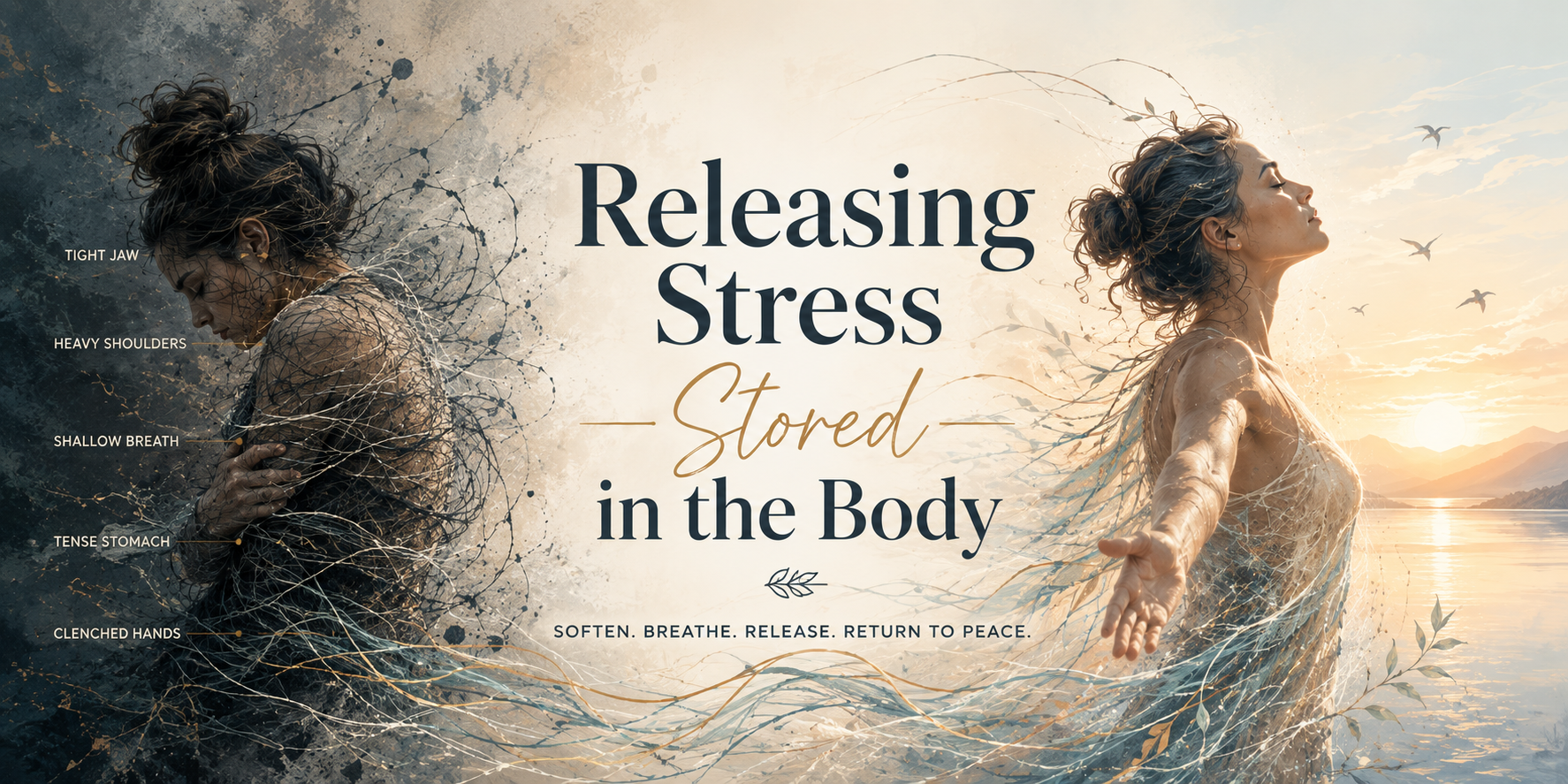
Releasing Stress Stored in the Body
Learn what “stress stored in the body” can mean and explore gentle ways to ease muscle tension, shallow breathing, physical bracing, overwhelm, and stress through movement, rest, grounding, warmth, prayer, and everyday care.
Helping the Body Soften After Stress, Pressure, and Long Periods of Holding On
Sometimes stress ends before the body realizes the moment has changed.
The difficult conversation is over.
The deadline passed.
The crisis settled.
You finally sat down.
And yet your jaw is still tight.
Your shoulders are still lifted.
Your hands are clenched.
Your stomach feels tense.
Your breathing remains shallow.
Your body seems to be waiting for something else to happen.
This is what many people mean when they talk about stress being stored in the body.
Stress is not literally tucked away inside a muscle like an object in a drawer. But prolonged or repeated stress can influence breathing, muscle tension, posture, sleep, attention, movement, and the way the body responds to everyday situations.
You may become so accustomed to bracing that you stop noticing you are doing it.
The shoulders stay slightly raised.
The jaw remains clenched.
The belly rarely fully softens.
The breath stays near the top of the chest.
The body keeps working long after the immediate demand has passed.
Releasing stress from the body is therefore less about forcing something dramatic to leave and more about helping yourself rediscover another state:
softness.
Movement.
Breath.
Rest.
Grounding.
Safety.
Presence.
And the ability to recognize:
I do not have to hold myself this tightly right now.
What Does “Stored Stress” Really Mean?
The phrase is useful because it describes something many people recognize intuitively.
After periods of pressure, the body can continue carrying physical patterns associated with stress.
Muscles may remain tense.
Breathing may stay faster or shallower than usual.
Sleep may become disrupted.
You may feel restless even when you are tired.
You may become more sensitive to noise, interruption, or conflict.
Your body can begin behaving as though there is always one more thing to handle.
This does not mean the body is broken.
It means your whole system has been adapting to what life has been asking from you.
Sometimes the next step is not more effort.
It is helping the body remember how to come out of effort.
The Body Can Learn Patterns
Human beings are wonderfully adaptable.
If you repeatedly need to hurry, you get good at hurrying.
If you repeatedly need to stay alert, alertness becomes familiar.
If you continually hold tension in your shoulders while working, that posture can begin to feel normal.
If every quiet moment is immediately filled with a phone, task, conversation, worry, or responsibility, stillness itself may begin to feel unfamiliar.
Patterns become easier through repetition.
The good news is that this works in both directions.
You can practice releasing the jaw.
Dropping the shoulders.
Breathing more slowly.
Walking without rushing.
Resting without multitasking.
Feeling the ground beneath you.
Creating moments where nothing urgent is required.
You are not trying to become relaxed every second of your life.
You are simply giving the body more than one familiar way to be.
Where Stress Often Shows Up
People experience stress differently.
You may notice it in:
the jaw
neck and shoulders
forehead
chest
stomach
hands
lower back
hips
breathing
sleep
restless movement
general physical tension
Sometimes you notice it immediately.
Other times, someone says:
“Relax your shoulders.”
And only then do you realize they were practically visiting your ears.
Awareness is useful because you cannot intentionally soften tension you have stopped noticing.
Start by Noticing, Not Fixing
Before trying to release anything, pause.
Ask:
Where am I holding myself right now?
Do not force an answer.
Scan gently.
Jaw.
Face.
Shoulders.
Hands.
Chest.
Belly.
Legs.
Feet.
You may notice tension.
You may notice nothing.
Both are fine.
Then ask:
Can this area soften by five percent?
Not completely.
Five percent.
That small invitation often works better than commanding:
RELAX.
The body rarely responds beautifully to being yelled at about relaxation.
The Jaw Is a Good Place to Begin
The jaw can hold surprising amounts of tension.
Notice whether your teeth are touching.
Unless you are chewing or swallowing, they do not need to remain pressed together.
Let the tongue rest comfortably.
Allow a small space between the upper and lower teeth.
Relax the muscles around the mouth.
Then exhale.
Sometimes loosening one small area helps the rest of the body follow.
Let the Shoulders Come Down
Shoulders can creep upward throughout a stressful day.
Try exaggerating the pattern first.
Lift both shoulders toward your ears.
Hold them briefly.
Then let them drop.
Notice the contrast.
Roll them slowly backward.
Then forward.
Let the arms hang heavily for a moment.
You are giving the muscles another option besides bracing.
Slow the Exhale
You do not need complicated breathwork to create a quieter moment.
Breathe in comfortably.
Then let the exhale become slightly slower.
Do not force a huge breath.
Do not struggle to fill the lungs completely.
Just allow the exhale to lengthen naturally.
Try:
Inhale gently.
Exhale slowly.
Repeat several times.
The purpose is not perfect breathing.
It is giving the body a rhythm that feels less hurried.
Let Yourself Sigh
Sometimes you do not need a technique.
You need a sigh.
Let one happen.
An ordinary human:
Haaaaa.
Drop the shoulders with it.
Loosen the hands.
Let the face soften.
Sometimes one simple exhale reveals how tightly you have been holding yourself together.
Shake Out Tension Gently
Movement can help when stress has left you restless or physically wound up.
Stand comfortably.
Shake the hands loosely.
Then the arms.
Shift your weight between your feet.
Let the knees remain soft.
You can gently shake the legs one at a time.
Keep the movement easy.
You are not trying to force stress out of the body.
You are simply giving tension somewhere to move.
Thirty seconds may be enough.
Then stop.
Stand still.
Notice what changed.
Walk Without Trying to Get Anywhere
Walking is one of the simplest ways to shift physical and mental state.
But make this walk different.
No destination if possible.
No phone call.
No productivity podcast.
No race against the clock.
Walk simply to walk.
Feel the legs moving.
Notice your arms.
Look at the sky.
Notice trees, buildings, birds, light, wind, or whatever surrounds you.
Let movement become movement instead of transportation.
Sometimes the body softens when nothing is being demanded from the walk.
Stretch Where You Naturally Want to Stretch
You do not necessarily need a formal routine.
Notice what your body wants to do.
Reach the arms overhead.
Stretch the sides.
Roll the neck gently.
Open the chest.
Lean forward comfortably.
Stretch the calves.
Move the hips.
The important word is gently.
Stretching should create space, not become another contest.
You are not proving flexibility.
You are exploring where the body would appreciate more room.
Press Into Something Solid
Sometimes stress leaves a person feeling physically restless or as though they need somewhere to place their strength.
A wall press can be simple.
Stand facing a wall.
Place both palms against it.
Keep your feet grounded.
Press steadily into the wall for several seconds.
Feel the strength through your arms and feet.
Then release.
Pause.
Repeat if it feels comfortable.
The practice gives the body something clear and physical to do with muscular effort.
Push.
Release.
Feel the difference.
Use Your Hands to Create Gentle Contact
Touch can help bring attention back to the body.
Place one hand over your chest.
Or your belly.
Or hold one forearm with the opposite hand.
You do not need a special technique.
Simply notice:
Warmth.
Pressure.
Contact.
Presence.
You might say:
“I am here.”
Sometimes grounding begins with something that simple.
Warmth Can Help the Body Soften
Warmth often feels deeply comforting.
A warm shower.
Bath.
Heating pad.
Warm towel.
Cup of tea held between both hands.
Sunlight.
A blanket.
You do not need to attach a complicated meaning to it.
Warmth can simply create a moment where the body no longer has to push through the sharper edges of the day.
Water Can Mark the End of the Day
A shower can become a useful transition.
Work happened.
Stress happened.
People needed things.
Decisions were made.
Now the day is changing.
Let the water create a boundary between what happened and what comes next.
You might quietly think:
The workday is over.
That conversation is over.
I do not have to keep carrying this moment.
Sometimes rituals help because repetition creates a recognizable transition.
Water.
Change clothes.
Dim the lights.
Put the phone down.
The message becomes:
We are leaving one state and entering another.
Stress Sometimes Needs Less Input
Trying to relax while continuing to absorb enormous amounts of stimulation can be difficult.
Television playing.
Phone in hand.
Notifications arriving.
Several conversations happening.
News running.
Laptop open.
Music playing.
Rest can become another form of input.
Try reducing something.
Lower the lights.
Mute the phone.
Turn off background television.
Close the laptop.
Sit in one room.
Let there be less.
Sometimes the body does not need another relaxation technique.
It needs fewer things demanding a response.
The Body Needs Transitions
Modern life can jump instantly between roles.
Work ends.
Two seconds later, social media.
Then dinner.
Then email.
Then a family conversation.
Then news.
Then bed.
There is no doorway between one part of life and another.
Try creating one.
After work, walk for ten minutes.
After a difficult conversation, wash your face.
Before dinner, sit quietly for three minutes.
Before bed, dim the room and stretch.
After arriving home, change clothes.
Transitions tell the body:
That part is finished.
Complete Small Physical Actions
Sometimes stress comes with a feeling of unfinished momentum.
You were rushing.
Carrying.
Working.
Typing.
Driving.
Helping.
Then suddenly you stop.
A small physical completion can help mark the shift.
Put the work materials away.
Close the computer.
Wash the cup.
Straighten the desk.
Take off your shoes.
Hang up the bag.
Then stop.
Completion does not need to be dramatic.
It simply gives the moment an ending.
Rest Does Not Mean You Failed to Cope
Stress can create a strange belief that stopping means weakness.
Keep going.
Push through.
Handle it.
Do one more thing.
But the body cannot remain in constant output indefinitely without needing recovery.
Rest is not evidence that stress defeated you.
Rest is part of how human beings continue.
You work.
You recover.
You give.
You replenish.
You act.
You pause.
Rhythm is not weakness.
Rhythm is life.
Sleep Is One of the Body’s Great Reset Periods
When possible, protect sleep.
Not perfectly.
Real life is real life.
But consistently cutting sleep short while looking for another way to feel restored is a difficult bargain.
Create a softer landing into nighttime.
Dim the lights.
Reduce stimulating content.
Handle what truly must be handled.
Write down tomorrow's tasks instead of carrying them mentally into bed.
Let the day end.
You do not need to solve tomorrow while lying under tonight's blankets.
Stress Can Affect the Stomach Too
Many people notice that periods of stress seem connected with changes in appetite, digestive comfort, or abdominal tension.
If you notice yourself continually holding the belly tight, experiment with letting it soften when you are sitting safely at rest.
Breathe without deliberately pulling the stomach inward.
Give the abdomen room to move naturally.
Sometimes even that simple release reveals how much effort has been happening unconsciously.
The Hands Tell Stories Too
Look at your hands.
Are they clenched?
Gripping the phone?
Holding the steering wheel tighter than necessary?
Curling into fists while you work?
Open them.
Stretch the fingers.
Shake them gently.
Turn the palms upward.
Rest them somewhere comfortable.
The hands do a tremendous amount of work.
Let them know when the work has stopped.
Notice When Effort Has Become Bracing
Effort is useful.
You need muscular tension to lift something.
Focus to work.
Energy to exercise.
Attention to solve problems.
Bracing is different.
It is effort continuing when effort is no longer needed.
Instead of trying to eliminate activation, practice noticing when the demand has passed.
Now I need effort.
And later:
Now I can soften.
That ability to move between effort and release matters more than trying to remain calm all the time.
Stress Release Can Be Small
Release does not have to look cinematic.
There may be no dramatic tears.
No trembling breakthrough.
No profound revelation.
Sometimes release is:
Your shoulders dropping.
A deeper breath.
A yawn.
Stretching after sitting too long.
Getting outside.
Turning off the phone.
Finally going to bed.
Laughing.
Taking a shower.
Walking around the block.
Sitting quietly for five minutes.
Ordinary things can be powerful precisely because you can actually repeat them.
You Do Not Need to Chase a “Somatic Release”
Body-based healing can sometimes be presented as though dramatic shaking, trembling, crying, or catharsis are required signs that something important has been released.
You do not need to chase a reaction.
Your body does not need to perform healing for you.
A practice can be useful even if all you notice afterward is:
“My shoulders feel a little better.”
That counts.
The goal is not spectacle.
It is greater ease, awareness, movement, recovery, and the ability to settle when the moment allows it.
Gentle Is Often Enough
More intensity is not automatically more helpful.
If a movement hurts, reduce it.
If a breathing practice makes you uncomfortable, return to normal breathing.
If an exercise makes you feel overwhelmed, stop.
Your body does not need to be conquered.
Stress reduction works best when the practice itself is not another source of stress.
Emotional Stress and Physical Tension Can Influence Each Other
A difficult emotion can change posture and breathing.
Physical tension can also influence how comfortable or settled you feel.
This is why mind-body care can move in both directions.
Sometimes talking helps the body soften.
Sometimes moving helps the mind settle.
Sometimes prayer shifts the emotional atmosphere.
Sometimes sleep changes everything.
Sometimes you need several forms of care working together.
Human beings are wonderfully interconnected that way.
Release What Can Actually Be Changed
Physical relaxation is helpful.
But if the source of stress remains unchanged, the tension may keep returning.
Sometimes the deeper release is practical.
The schedule needs to change.
The boundary needs to be spoken.
The task needs to be finished.
The workload needs to be reduced.
The conversation needs to happen.
The phone needs to be turned off.
The commitment needs to end.
The help needs to be requested.
You cannot stretch your way out of every problem.
Sometimes the body is tense because life genuinely needs an adjustment.
Listen to that information too.
Nature Can Help You Come Out of Hurry
Go outside when you can.
Look farther than the nearest screen.
Let your eyes rest on distance.
Walk beneath trees.
Sit near water.
Notice sunlight.
Feel wind.
Listen.
Nature moves at a different rhythm than notifications.
It can remind you that not everything happens immediately.
A cloud does not hurry because your inbox is full.
There is wisdom in occasionally joining the slower world.
Joy Releases a Different Kind of Tension
Stress reduction is not only about quiet.
Sometimes it is about joy.
Laugh.
Dance.
Play with an animal.
Sing badly.
Cook something you love.
Watch something genuinely funny.
Spend time with someone who makes you forget to monitor yourself.
Joy changes the atmosphere of the body too.
Sometimes what you need is not another healing practice.
Sometimes you need to remember you are alive.
Prayer Can Become a Place of Release
For people of faith, prayer offers another place to put what has been carried.
You do not have to arrive calm.
You do not need perfect words.
You can come tense.
Tired.
Frustrated.
Overwhelmed.
And say:
“God, I cannot carry all of this tonight.”
Prayer does not require denying responsibility.
It creates a place for surrender alongside responsibility.
Do what is yours.
Release what is not.
Trust what cannot yet be known.
Let the Body Participate in Prayer
Prayer does not have to happen only in the mind.
Unclench your hands.
Drop your shoulders.
Breathe.
Walk while you pray.
Sit outside.
Place your hands open in your lap.
Let your physical posture reflect the prayer:
I am releasing what I cannot control.
The body can participate in surrender too.
A Prayer for Releasing Stress
God, help me release what I no longer need to hold so tightly. Bring softness where I have been bracing, rest where I have been pushing, clarity where I have been overwhelmed, and peace where I have been carrying too much. Show me what is mine to handle and what I can place into Your hands. Help my mind, body, and spirit return to a steadier rhythm. Amen.
A Five-Minute Body Reset
You do not need special equipment.
Minute 1
Notice where you are holding tension.
Jaw.
Shoulders.
Hands.
Belly.
Breath.
Minute 2
Move.
Roll the shoulders.
Stretch.
Shake the hands.
Stand.
Minute 3
Breathe naturally and let the exhale slow slightly.
Minute 4
Feel something real.
Feet on the floor.
Air on the skin.
Hands resting.
Your surroundings.
Minute 5
Ask:
“What does my body need next?”
Water?
Food?
Movement?
Quiet?
Sleep?
A boundary?
Fresh air?
A conversation?
Then honor one reasonable answer.
A Longer Stress-Release Routine
When you have more time:
Take a short walk.
Stretch gently.
Drink water.
Take a warm shower.
Put the phone away.
Reduce the lighting.
Write down unfinished tasks.
Decide what can wait until tomorrow.
Pray.
Then let the day end.
You do not have to use every technique.
The routine matters less than the message:
The demanding part of the day is over.
When Stress Keeps Returning to the Same Place
Pay attention to patterns.
Maybe your jaw always tightens during work.
Your shoulders rise when answering emails.
Your stomach tenses before a particular meeting.
Your hands clench while driving.
This can give you a useful cue.
Instead of waiting until the end of the day, interrupt the pattern earlier.
Before opening email:
Drop the shoulders.
Before the meeting:
Take a slower breath.
At the red light:
Loosen the hands.
Tiny interruptions can prevent tension from becoming the default position for hours.
The Goal Is Flexibility, Not Permanent Calm
Life is supposed to activate you sometimes.
Excitement activates you.
Exercise activates you.
A challenge activates you.
A difficult conversation can activate you.
Stress responses are part of being human.
The goal is not permanent calm.
The goal is greater flexibility.
The ability to rise when life requires energy.
To notice when the demand has passed.
And to settle again when the moment allows it.
When Physical Symptoms Need More Than Stress Relief
Stress can influence how the body feels, but physical symptoms should not automatically be blamed on stress.
Persistent, severe, new, or worsening symptoms deserve medical evaluation rather than being automatically attributed to stress.
Chest discomfort, significant breathing difficulty, persistent pain, severe fatigue, ongoing digestive problems, or other concerning symptoms deserve appropriate attention.
You can care for stress while also taking physical symptoms seriously.
The two approaches do not compete.
Frequently Asked Questions
What does it mean when people say stress is stored in the body?
It is a common way of describing persistent physical patterns associated with stress, such as muscle tension, guarded posture, altered breathing, restlessness, or difficulty settling. It does not mean stress is literally stored inside a particular muscle as a physical substance.
Where do people commonly feel stress in the body?
People may notice stress-related tension in areas such as the jaw, neck, shoulders, chest, abdomen, hands, lower back, or hips. The pattern varies from person to person.
How can I release physical tension from stress?
Gentle movement, stretching, walking, slower breathing, warmth, reducing stimulation, adequate rest, sleep, relaxation, and addressing the actual source of stress may all help.
Can shaking help release stress?
Gentle voluntary shaking can provide movement when you feel physically restless or tense. It does not need to be intense or dramatic. Stop if it feels uncomfortable.
Why am I tense even when nothing is wrong?
Physical tension can become habitual, especially during periods of repeated stress, prolonged sitting, concentrated work, or worry. Becoming aware of the pattern gives you opportunities to interrupt it.
Does stress release have to involve crying?
No. Crying is one possible emotional response, but stress reduction may simply feel like easier breathing, looser muscles, better sleep, less restlessness, or feeling more settled.
Can prayer help with stress?
For people of faith, prayer may provide a meaningful way to pause, reflect, surrender worries, reconnect with God, and create space away from constant mental activity.
When should I stop assuming a symptom is caused by stress?
If a symptom is new, persistent, severe, worsening, or concerning, seek appropriate medical evaluation rather than assuming stress is the cause.
Signs Your Body May Be Softening
Changes can be wonderfully ordinary.
Your jaw is not clenched.
Your shoulders stay lower.
You notice your breathing.
You sleep more easily.
You feel less restless.
You can sit without immediately reaching for something to do.
You move more freely.
You feel tired and recognize that rest is the answer.
You begin noticing tension sooner instead of carrying it for hours.
These are meaningful changes.
Affirmation
I do not have to hold everything so tightly. I give my body permission to soften, move, breathe, rest, and return to a steadier rhythm. I release what I can, address what I need to, and trust that peace can be practiced one moment at a time.
Your Body Can Learn Another Rhythm
Your body is not your enemy.
It has worked.
Carried.
Adapted.
Responded.
Protected.
Kept moving.
It deserves more than criticism for being tense.
It deserves care.
Move it.
Rest it.
Feed it.
Hydrate it.
Stretch it.
Let it sleep.
Let it laugh.
Let it walk outside.
Let it sit quietly.
Let it experience moments where nothing is chasing it.
And when life becomes demanding again, as life sometimes will, remember that tension does not have to become a permanent address.
You can notice.
You can soften.
You can move.
You can breathe.
You can make changes.
You can pray.
You can rest.
You can return.
Again and again.
Not because your body was holding something wrong.
Because effort and release can both belong in a human life.

Breath as a Bridge Back to Peace
Discover slow breathing practices for stress, anxiety, overwhelm, prayer, and nervous system balance. Learn gentle breathing exercises that support calm without force or perfection.
How Slow, Gentle Breathing Can Support Calm, Presence, Prayer, and Nervous System Balance
Your breath is always with you.
In traffic.
During a difficult conversation.
Before an important decision.
When your mind is racing at night.
When you are praying.
When you feel overwhelmed.
When you do not know what to do next.
Most of the time, breathing happens without conscious attention.
But stress can change the way you breathe. Breathing may become quicker, shallower, less regular, or held without you realizing it.
That creates an extraordinary opportunity.
Because breathing happens automatically, but it can also be influenced intentionally.
You cannot simply command every part of your nervous system to become peaceful.
But you can change the rhythm of your breath.
And sometimes that gives the rest of you somewhere gentler to follow.
Why Breath Can Help Us Feel Calmer
Breathing and the autonomic nervous system are closely connected.
Slow breathing can influence heart-rate variability, respiratory-cardiovascular coordination, and autonomic regulation. These changes may help explain why many people experience slow breathing as calming or grounding.
That does not mean every slow breath instantly produces peace.
It means breathing is one practical way of influencing a system that normally feels outside conscious control.
You do not need to understand every nerve pathway to experience the basic practice.
Slow down.
Breathe comfortably.
Notice the exhale.
Give your body a few moments without rushing it.
Sometimes peace begins there.
Breath Is Not About Forcing Calm
This distinction matters.
Breathing practices should not become another command:
Calm down.
Stop feeling this.
Make the anxiety disappear.
That can create more pressure.
Instead, breathing can become an invitation.
I can stay here for this moment.
I can give myself a little more room.
I do not need to solve everything on this breath.
The purpose is not always to eliminate emotion.
Sometimes it is simply to become steady enough to remain present with it.
The Simplest Breath Practice
If you want one uncomplicated practice, begin here.
Sit or stand comfortably.
Let your shoulders soften.
Breathe in gently.
Breathe out gently.
Allow the breath to become somewhat slower than usual without taking enormous breaths.
Continue for a minute or two.
That is enough.
Slow-paced breathing is often studied around approximately five to six breaths per minute, although the most comfortable and useful pace varies from person to person.
You do not need to chase an exact number.
Comfort matters.
What About a Longer Exhale?
A slightly longer exhale can feel soothing for many people.
You might try:
Inhale gently for four.
Exhale comfortably for six.
Or:
Inhale naturally.
Let the exhale last a little longer.
But treat this as an option, not a rule.
Research comparing longer-exhale breathing with equal inhale-and-exhale breathing suggests both can support reductions in stress. A longer exhale has not been established as universally superior.
So the better principle is:
Slow. Comfortable. Unforced.
If four and six feels good, use it.
If counting makes you tense, stop counting.
Your breath does not need to pass an exam.
Bigger Breaths Are Not Necessarily Better Breaths
When people hear “deep breathing,” they sometimes begin taking enormous breaths.
More air is not always the goal.
The breath can be slow without being exaggerated.
You should not have to strain your chest, gulp air, or force your lungs to maximum capacity.
Breathing too deeply or too quickly can sometimes contribute to symptoms such as:
Lightheadedness.
Tingling.
A sense of breathlessness.
Chest discomfort.
Feeling strangely detached or unsettled.
Let the breath feel easy enough that you could continue without fighting it.
If deliberate breathing makes you lightheaded, uncomfortable, or more anxious, return to normal breathing and try something gentler later.
Breath should be a doorway toward steadiness, not another place to struggle.
Try a Soft Exhale
Sometimes you do not need an entire breathing technique.
Try one exhale.
Notice whatever breath is already happening.
Then let the next breath out slowly.
No counting.
No performance.
No demand that something dramatic happen.
Just:
One softer exhale.
Then another if it feels good.
That can be enough to interrupt a moment of rushing.
Breath Can Give the Mind Something Simple to Do
Stress often creates mental multiplication.
What if?
What next?
What about tomorrow?
Why did that happen?
What am I going to do?
The mind keeps generating more questions.
Breath gives attention one simple place to land.
In.
Out.
Here.
Now.
You are not solving the entire situation.
You are narrowing the moment.
That can create enough space for clearer thinking to return.
Breath and Prayer Can Belong Together
For a person of faith, breathing can become more than a relaxation practice.
It can become a rhythm for prayer.
Not because the breath itself is God.
But because the simplicity of breathing can help quiet enough inner noise to become more present in prayer.
Try:
Inhale: God, be with me.
Exhale: Bring me peace.
Or:
Inhale: I receive Your peace.
Exhale: I release this fear.
Or:
Inhale: Guide me.
Exhale: I surrender what I cannot control.
Or simply:
Inhale: God.
Exhale: I am here.
Prayer does not need elaborate language to be sincere.
Sometimes one sentence carried on several breaths is enough.
A Breath Prayer for a Difficult Moment
When something feels overwhelming, place your feet firmly on the floor.
Look at what is actually around you.
Then breathe naturally.
On your next inhale, pray:
God, steady me.
On the exhale:
Help me take the next right step.
Again.
God, steady me.
Help me take the next right step.
This moves prayer away from solving the entire future.
It brings it into the moment you are actually living.
Breathing During an Anxiety Spike
When anxiety rises rapidly, forcing enormous slow breaths may feel uncomfortable.
Start smaller.
Let your breathing remain natural for a moment.
Feel your feet.
Look around.
Notice where you are.
Then allow the pace of your breathing to gradually slow if that feels comfortable.
You might use a simple phrase:
I am here.
One moment at a time.
This feeling can move through.
God is with me here.
You do not need to demand immediate calm.
Steadier is enough.
When Emotion Rises With the Breath
Sometimes slowing down creates room for emotion you had not noticed.
A sigh.
Tears.
Tiredness.
A feeling in your throat.
A heaviness in your chest.
That does not automatically mean something extraordinary is happening.
Sometimes you simply became quiet enough to notice what was already present.
Let yourself experience the moment without needing to interpret everything.
You can breathe.
Cry.
Pray.
Sit quietly.
Put your hand over your heart.
Let emotion have some room without turning it into a problem that must immediately be solved.
When You Feel Numb or Shut Down
Not every stressful state feels like panic.
Sometimes it feels like:
Fog.
Heaviness.
Distance.
Low energy.
Difficulty feeling much at all.
In those moments, breath may work better when combined with gentle orientation and movement.
Try:
Look around the room.
Move your hands.
Stretch your arms.
Press your feet into the floor.
Walk slowly.
Then notice your natural breathing.
You do not need to force deep relaxation if what you need first is a little more contact with the present moment.
Humming Can Add Vibration to the Exhale
If silent breathing feels difficult, try humming gently while breathing out.
Inhale comfortably.
Then hum through the exhale.
Feel the vibration in your chest, throat, lips, or face.
The goal is not to produce a particular pitch.
It simply gives the exhale a rhythm and something physical to notice.
For some people, sound makes the breath easier to follow than counting.
Try Breathing While Walking
Breathing practices do not have to happen sitting perfectly still.
Walk at an easy pace.
Notice your steps.
Let your breathing settle into its own rhythm.
You might breathe in across a few steps and out across a few more.
Do not force the count.
Let walking, breathing, and attention begin working together.
This can be especially useful if sitting still makes you feel restless.
Use Breath Before a Difficult Conversation
Breath can create a pause between emotion and response.
Before answering an upsetting message.
Before entering a meeting.
Before discussing something difficult.
Before setting a boundary.
Take one or two slower breaths.
Then ask:
What do I actually want to say?
You are not breathing to make yourself passive.
You are creating enough room to choose your response rather than handing it completely to the first surge of emotion.
Use Breath Before a Decision
Not every decision should be made while the body is highly activated.
If possible, pause.
Breathe.
Walk.
Pray.
Let the immediate intensity settle somewhat.
Then look at the facts again.
A calmer body does not automatically give you the correct answer.
But it may create better conditions for thinking clearly.
Breath is not a decision-maker. It can help create space for discernment.
Breath Can Be Part of a Morning Rhythm
Before reaching for your phone, try three comfortable breaths.
Then ask:
How do I want to meet this day?
That may be all you need.
No elaborate routine.
No checklist.
Just enough space to enter the day intentionally instead of being immediately swept into everyone else's noise.
Breath Can Mark the End of the Day
At night, breath can also become a closing ritual.
Lie down.
Let your breathing remain easy.
With each exhale, imagine releasing the need to continue today's work mentally.
You might pray:
God, what I could do today is done.
Help me release what belongs to tomorrow.
You do not need to finish every thought before sleeping.
Some things can remain unfinished without remaining in your hands all night.
Breath Is Especially Useful Because It Is Portable
Many calming practices require time, space, equipment, or privacy.
Breathing requires none of those.
You can notice one breath:
At your desk.
In the car before walking inside.
Standing in line.
Before answering the phone.
After receiving difficult news.
While praying.
Before sleep.
The practice travels with you because the breath already does.
Breath Is One Tool, Not the Only Tool
Breathing is helpful.
But it is not the answer to every kind of distress.
Sometimes you need:
Sleep.
Food.
Movement.
A boundary.
A conversation.
Medical care.
Professional support.
A financial plan.
A change in environment.
Time.
Prayer.
Community.
An actual solution to the problem creating the stress.
Breathing should not become a way to tolerate indefinitely what genuinely needs to change.
Sometimes the breath helps you become calm enough to recognize:
Something here needs action.
When Breathwork Makes You Feel Worse
Some people find deliberate breathing uncomfortable.
You may become overly focused on bodily sensations.
Counting may make you anxious.
Deep breathing may feel unnatural.
You may feel lightheaded.
If that happens, stop forcing the practice.
Breathe normally.
Look around the room.
Feel your feet.
Walk.
Listen to music.
Pray without coordinating it with breath.
There is no requirement that breathwork must be your calming practice.
A useful practice should support you, not become another source of pressure.
Breathing Does Not Replace Medical Care
Difficulty breathing can occur with stress and anxiety, but breathing changes can also have physical causes.
New, severe, persistent, or worsening shortness of breath, chest symptoms, fainting, or other concerning physical symptoms should not automatically be attributed to stress.
Breath practices are supportive tools.
They are not a way to diagnose the cause of a symptom.
A Two-Minute Breath Reset
Try this whenever the day begins moving faster than you want.
First 30 seconds
Feel your feet and look around.
Next 30 seconds
Notice your natural breath without changing it.
Next 30 seconds
Allow your breathing to become slightly slower and softer.
Final 30 seconds
Ask:
What do I need next?
Maybe the answer is:
Continue working.
Drink water.
Take a break.
Pray.
Make the call.
Set the boundary.
Go outside.
Rest.
Breath creates the pause.
Then life continues.
A Five-Breath Prayer
If you want something even simpler:
Breath 1: God, I am here.
Breath 2: Help me become still.
Breath 3: Give me wisdom.
Breath 4: Help me release what is not mine to control.
Breath 5: Lead me forward in peace.
Five breaths.
One prayer.
Then continue with your day.
Frequently Asked Questions
Can breathing exercises really reduce stress?
Research suggests slow and controlled breathing practices can support relaxation and may reduce stress and anxiety for some people. Results vary depending on the person, breathing method, practice duration, and circumstances.
What breathing pattern is best for relaxation?
There is no single breathing ratio that is ideal for everyone.
Slow, comfortable, unforced breathing is the more important principle.
Some people enjoy a slightly longer exhale.
Others prefer equal inhale and exhale periods.
Is 4-6 breathing good for anxiety?
A four-count inhale and six-count exhale is one reasonable slow-breathing pattern if it feels comfortable.
It should be treated as an option rather than a required or universally superior technique.
Why can slow breathing support a calmer state?
Slow breathing can influence heart-rate variability, respiratory-cardiovascular coordination, and autonomic regulation.
These physiological changes may be part of why many people experience slow breathing as calming or grounding.
What if breathing exercises make me dizzy?
Return to normal breathing.
Avoid taking unnecessarily large or forceful breaths.
If dizziness, significant breathing difficulty, or other concerning symptoms persist or occur independently of breath practice, seek appropriate medical evaluation.
Can I combine prayer and breathing exercises?
Yes.
You can use the rhythm of breathing as a simple structure for prayer, repeating short phrases on the inhale and exhale.
How long do I need to practice?
Breathing exercises do not need to be lengthy to be useful.
Brief practices can create a pause, while longer or repeated practices may become part of a regular calming routine.
The useful duration varies from person to person.
Does breathing solve the cause of stress?
Not necessarily.
Breathing may help you regulate your response to a stressful situation, but practical problems may still require boundaries, decisions, support, treatment, or other action.
A Prayer for Steady Breath
God, meet me in this breath.
Quiet what has become too loud within me.
Help my body soften where it has been bracing and my mind become clear where fear has been racing ahead.
Give me wisdom for what needs action, patience for what needs time, and peace for what I cannot control.
Let each breath remind me that I am here, that this moment can be met, and that I do not walk through it alone.
Bring me back to Your presence, one breath at a time. Amen.
Breath as a Bridge Back to Peace
Your breath cannot solve every problem.
It cannot change every circumstance.
It cannot make grief disappear.
It cannot decide for you.
It cannot remove everything difficult from your life.
But it can give you a pause.
A rhythm.
A little more space.
A way to come back into the present.
A place to pray.
A moment before reacting.
A softer doorway into what comes next.
You do not need to master your breath.
You do not need to breathe perfectly.
You do not need an elaborate technique.
Sometimes all you need is to notice:
I am breathing.
Then let the next breath become slightly gentler.
And the next one.
And perhaps, somewhere between the inhale and the exhale, the world stops feeling quite so loud.
Not because everything has been solved.
Because you have found your way back into the moment.
One breath can become a bridge.
And sometimes peace is waiting on the other side.
Interoception and Trusting Yourself Again
Learn what interoception means, how anxiety can affect body awareness, and how to notice hunger, fatigue, tension, emotions, and other internal signals without fear while rebuilding self-trust.
Learning to Notice Your Body Without Fear or Losing Your Discernment
Your body is constantly sending information.
Hunger.
Thirst.
Warmth.
Cold.
Fatigue.
Fullness.
Breath.
Heartbeat.
Muscle tension.
The need to use the bathroom.
A fluttering stomach.
A dry mouth.
A sense that you need movement.
A sense that you need rest.
Most of this communication happens so naturally that you may rarely think about it.
The process of sensing and interpreting internal signals from the body is called interoception.
Interoception is not mystical by itself.
It is part of being embodied.
But learning to notice your body more clearly can become deeply meaningful.
It can help you recognize needs earlier.
Notice patterns.
Become more aware of how stress feels in your body.
Recognize when you are tired before you reach complete exhaustion.
Notice hunger before you become shaky and irritable.
Realize that your shoulders have been tight for three hours.
And perhaps most importantly, begin developing a calmer relationship with the signals coming from within you.
Learning to notice and respond thoughtfully to these signals can become one part of rebuilding self-trust.
What Is Interoception?
Interoception refers broadly to the processes through which the nervous system senses, integrates, and interprets signals originating from within the body.
These signals can include awareness of:
heartbeat
breathing
hunger
fullness
thirst
internal temperature
fatigue
nausea
bladder fullness
tension
physical arousal
other internal bodily sensations
Interoception is more complicated than simply noticing sensations.
There is the signal itself.
Your awareness of it.
Your interpretation of it.
And what you decide to do next.
That distinction matters.
A racing heart is a bodily signal.
The thought:
“Something terrible is happening.”
is an interpretation.
Another interpretation might be:
“I just climbed three flights of stairs.”
Or:
“I am excited.”
Or:
“I am nervous about this conversation.”
The sensation is information.
The meaning still requires context.
Your Body Has Information, Not Always Instructions
One of the most useful ways to think about interoception is:
Your body can provide information without automatically providing the entire answer.
A tight stomach may tell you something is happening internally.
It does not necessarily tell you why.
A racing heartbeat may tell you that your body is activated.
It does not automatically tell you that you are in danger.
Fatigue tells you something about your current state.
It may point toward rest, poor sleep, illness, stress, medication effects, workload, nutrition, or many other possibilities.
Body awareness becomes stronger when curiosity replaces certainty.
Instead of:
“My body feels this, therefore it must mean X.”
Try:
“I notice this. What else do I know?”
That is discernment.
Why Self-Trust Can Become Shaky
Self-trust rarely disappears in one dramatic moment.
Sometimes it erodes through repeated overriding.
You are tired.
You keep going.
You are hungry.
You ignore it.
Something bothers you.
You tell yourself it shouldn't.
You need time before answering.
You answer immediately anyway.
You feel overwhelmed.
You tell yourself to work harder.
Do this often enough and it can become harder to know what you need until the signal becomes loud.
That does not mean your body stopped communicating.
Sometimes you simply became practiced at moving past the message.
Rebuilding trust begins by listening earlier.
Start With More Straightforward Body Signals
You do not need to begin with complicated emotional questions.
Start with signals that are often easier to identify.
Am I thirsty?
Hungry?
Too warm?
Too cold?
Tired?
Holding my breath?
Sitting in one position too long?
Needing the bathroom?
Needing movement?
These signals are wonderfully ordinary.
They also offer a useful foundation.
You notice.
You respond.
You learn:
When I pay attention to myself, something useful can happen.
Self-trust often grows through very unremarkable moments.
Hunger Is Information
Hunger is one of the more recognizable interoceptive signals.
But even hunger can become difficult to notice if you are distracted, stressed, rushing, or accustomed to ignoring it.
You may not notice until you are suddenly irritable, weak, unfocused, or ravenous.
Try checking in occasionally before the signal becomes urgent.
When did I last eat?
Do I feel hunger physically?
Would food support me right now?
This is not about obsessively monitoring the body.
It is about becoming less surprised by needs that were quietly building.
Thirst Can Be Easy to Miss
The same applies to thirst.
Some people notice it clearly.
Others realize they have barely had water all day only when they develop a dry mouth or suddenly feel very thirsty.
A simple check can help:
Have I had water recently?
Not every internal sensation needs philosophical interpretation.
Sometimes enlightenment is a glass of water.
Fatigue Deserves Attention Too
Fatigue can carry useful information.
But it is not always a simple command.
Sometimes you need sleep.
Sometimes you need food.
Sometimes you have been concentrating too long.
Sometimes you need movement.
Sometimes you are becoming ill.
Sometimes stress has been relentless.
Sometimes the issue deserves medical attention.
The important step is noticing rather than immediately overriding.
I am tired.
Then:
What might be contributing to this?
That second question keeps interoception connected with reasoning.
Learn the Difference Between Sensation and Story
This may be one of the most important practices on the page.
Notice the sensation first.
Then notice the story your mind adds.
For example:
Sensation: My chest feels tight.
Story: Something bad is about to happen.
Or:
Sensation: My stomach is fluttering.
Story: This decision is definitely wrong.
Or:
Sensation: My heart is beating quickly.
Story: I am losing control.
Separate them.
You do not need to reject the story immediately.
Just recognize that sensation and interpretation are not identical.
That small space can create enormous clarity.
Anxiety Can Make Body Signals Feel Louder
Anxiety can increase attention to internal sensations, and ordinary bodily changes may sometimes be interpreted in threatening ways.
A heartbeat becomes alarming.
A stomach flutter becomes evidence that something is wrong.
Warmth becomes panic.
A moment of breathlessness becomes frightening.
This is one reason body awareness should be practiced with steadiness rather than constant scanning.
The goal is not:
Notice everything intensely.
The goal is:
Notice enough to respond wisely.
Not Every Sensation Means Danger
Your heart beats faster when you exercise.
Your stomach may flutter when you are excited.
Your hands may feel different when you are nervous.
Your breathing changes when you laugh, run, cry, sing, or climb stairs.
Bodies move through different states all day.
A sensation can be uncomfortable without automatically being dangerous.
At the same time, persistent, severe, new, or concerning symptoms should not be dismissed as anxiety or intuition.
Body awareness works best when it includes both calm interpretation and appropriate medical care when needed.
Do Not Turn Interoception Into Constant Body Monitoring
Once people discover body awareness, they can sometimes begin checking constantly.
How is my heartbeat?
What does that sensation mean?
Why does my stomach feel different?
Is my breathing okay?
What does this tell me?
That can become exhausting.
Interoception is supposed to help you participate in life, not keep you trapped inside continuous self-monitoring.
Notice.
Respond if something needs attention.
Then return to living.
You do not need to supervise your body every minute.
A One-Minute Interoception Check
Pause for one minute.
Ask:
What do I notice inside my body right now?
Maybe:
Warmth.
Coolness.
Hunger.
Fullness.
Tension.
Ease.
Heartbeat.
Breathing.
Fatigue.
Energy.
No obvious sensation at all.
Then ask:
Does anything need a response?
Maybe yes.
Maybe no.
That is enough.
Start With Neutral Sensations
If body awareness tends to make you anxious, begin with sensations that feel emotionally neutral.
Warm hands.
Cool feet.
The feeling of swallowing.
The rise and fall of breathing.
Whether you are hungry.
Whether you are full.
The sensation of sitting.
The feeling of needing to stretch.
This can help interoception become familiar without immediately turning it into an emotional detective mission.
Notice Without Demanding Meaning
Try:
“My stomach feels tight.”
Stop there.
You do not immediately need:
Why?
Who caused this?
Is this intuition?
Is something wrong?
What is my body trying to tell me?
Sometimes the first practice is simply:
“This is what I notice.”
Meaning can come later.
Body Awareness Can Help You Notice Stress Earlier
You may discover certain patterns.
Your jaw tightens while reading emails.
Your breathing becomes shallow during difficult conversations.
Your shoulders rise when deadlines approach.
Your stomach becomes unsettled before presentations.
Your hands clench when you are frustrated.
Those patterns can become useful cues.
Not necessarily because they reveal hidden truth, but because they tell you:
I am activated right now.
That awareness gives you options.
Pause.
Breathe.
Move.
Take a break.
Prepare.
Ask for time.
Ground yourself.
Address the actual problem.
Interoception Can Support Emotion Awareness
Internal body signals and emotional experience are deeply connected.
You may notice:
Sadness as heaviness.
Anger as heat.
Nervousness as fluttering.
Excitement as energy.
Relief as softening.
But emotions do not have one universal body map that works identically for everyone.
Your experience is your experience.
You are learning your own patterns rather than memorizing a chart.
Ask “What Am I Feeling?” and “What Do I Know?”
When emotions run high, use both questions.
What am I feeling in my body?
And:
What do I know about the situation?
This keeps body awareness connected with context.
Maybe your stomach tightens before speaking publicly.
What do you know?
You are prepared.
You have done this before.
You are nervous.
Nervousness does not mean stop.
Or maybe your body becomes tense every time someone repeatedly crosses a boundary.
What do you know?
The behavior has happened several times.
You have already communicated about it.
There is a pattern.
Now the bodily reaction is one piece of broader evidence.
That is very different from treating one sensation as an unquestionable command.
What About Intuition?
This is where nuance matters.
People often describe intuition as a gut feeling, inner knowing, or bodily sense.
That experience can feel very real.
But there is no simple bodily code where:
calm = intuition
and
anxiety = false
Human experience is more complicated than that.
A wise decision can make you nervous.
A familiar but unhealthy choice can temporarily feel comfortable.
An exciting opportunity can make your heart race.
Fear can sometimes protect you.
Fear can also sometimes misread the situation.
So rather than asking:
“Is this intuition or anxiety?”
as though one sensation can settle the question, try asking:
What am I sensing?
What facts do I have?
What patterns have I observed?
What do my values say?
What would wisdom suggest?
Do I need more time or information?
That is a much stronger form of discernment.
Spiritual Discernment Can Include the Body Without Being Ruled by It
Your spiritual life does not need to exclude your physical experience.
Prayer can happen while you notice the tension in your shoulders.
Discernment can include noticing that something repeatedly unsettles you.
A decision can include observing whether you feel chronically pressured or consistently peaceful.
But body sensation should be one voice in the conversation, not the entire council.
Faith.
Reason.
Experience.
Values.
Facts.
Patterns.
Wise counsel.
Prayer.
Body awareness.
All can contribute.
That is richer than trying to turn every physical sensation into a spiritual message.
Peace Can Inform a Decision, but It Does Not Prove One
Sometimes a decision brings a deep sense of peace.
That can matter.
But immediate comfort is not always evidence that something is right.
Avoiding a difficult conversation may feel peaceful for an hour.
Doing something brave may feel uncomfortable for days.
Discernment sometimes requires moving through temporary discomfort toward something you believe is right.
So notice peace.
Honor it.
But place it alongside truth, wisdom, responsibility, evidence, and reality.
Rebuilding Trust Through Small Responses
Self-trust grows when you show yourself repeatedly:
I notice.
I consider.
I respond.
You notice thirst.
You drink.
You notice exhaustion.
You reconsider the schedule.
You notice tension.
You move.
You notice overwhelm.
You reduce input.
You notice uncertainty.
You give yourself time before deciding.
Not every signal receives exactly what it asks for.
Sometimes you are hungry but dinner is twenty minutes away.
Sometimes you are tired but something important needs finishing.
Self-trust does not mean immediate gratification.
It means your needs are included in the decision rather than automatically dismissed.
Sometimes the Answer Is “Not Yet”
You notice fatigue.
You still need to drive home.
The answer may be:
“I hear that I am tired. I will rest when I arrive.”
You notice hunger during a meeting.
“I will eat when this ends.”
You feel overwhelmed during an important responsibility.
“I cannot stop now, but I can reduce what I do afterward.”
Listening does not require obeying every signal instantly.
It means acknowledging reality and responding as responsibly as circumstances allow.
Sometimes the Answer Is a Boundary
Body signals may alert you that a situation is demanding a great deal from you.
But rather than treating the sensation itself as proof of what you should do, investigate.
Is this workload unreasonable?
Is someone repeatedly crossing a limit?
Have I agreed to too much?
Am I skipping meals?
Am I staying available constantly?
Is the environment genuinely chaotic?
Sometimes the practical answer becomes clear.
Less access.
More time.
A conversation.
A no.
A change in schedule.
A boundary supported not only by sensation, but by observable reality.
Sometimes the Answer Is Medical Care
Interoception includes noticing internal signals.
Some of those signals deserve medical evaluation.
Persistent chest discomfort.
Significant breathing problems.
New or worsening pain.
Fainting.
Severe fatigue.
Major digestive changes.
Unexplained physical symptoms.
Listening to your body does not mean interpreting every symptom spiritually.
Sometimes trusting yourself means saying:
“This deserves to be checked.”
Interoceptive Awareness Can Be Practiced
Interoception is multidimensional, which means there is not one single skill called “interoception” that simply becomes stronger in every way at once.
But aspects of interoceptive awareness can be practiced.
Simple approaches may include:
mindful body awareness
noticing breathing
recognizing hunger and fullness
gentle movement
observing tension
pausing to identify physical needs
noticing internal sensations without immediately judging them
comparing sensations with context and repeated patterns
The point is not perfect accuracy.
It is greater awareness and wiser response.
A Five-Minute Body Listening Practice
Minute 1: Arrive
Feel the chair, bed, or floor supporting you.
Notice the room.
Minute 2: Notice
What internal sensations are most obvious?
No need to search aggressively.
Minute 3: Name
Warm.
Tired.
Hungry.
Tense.
Comfortable.
Restless.
Nothing obvious.
Minute 4: Interpret Gently
Ask:
What might this mean?
Notice the word might.
Stay curious.
Minute 5: Respond
Is there one reasonable action?
Water.
Food.
Movement.
Rest.
A slower breath.
More information.
No action at all.
Then move on with your day.
Keep a Simple Pattern Journal
If you are trying to understand your body's signals, occasional notes may help.
You might write:
Situation: Preparing for meeting.
Body: Tight shoulders, fluttery stomach.
Emotion: Nervous.
What happened: Meeting went well.
Over time, patterns may appear.
You may discover:
This sensation often means I am nervous, not unsafe.
Or:
I repeatedly get headaches on days when I forget lunch.
Or:
This environment genuinely leaves me overstimulated every time.
Patterns can teach more than isolated sensations.
Trust Is Built Through Evidence
Self-trust is not only:
“I believe every feeling I have.”
It can also be:
“I pay attention to myself, observe patterns, learn from experience, correct myself when necessary, and make increasingly wise decisions.”
That is sturdy trust.
It can survive being wrong occasionally.
Because trusting yourself does not mean believing you will never misinterpret anything.
It means believing you can notice, reconsider, learn, and adjust.
You Can Change Your Interpretation
Maybe you once believed every racing heartbeat meant danger.
Now you recognize that sometimes it means caffeine, exercise, excitement, or nervousness.
Maybe you once ignored every sign of fatigue.
Now you take sleep more seriously.
Maybe you interpreted every uncomfortable feeling as a reason to escape.
Now you can sometimes remain present and discover that discomfort passes.
This is growth.
Interoception is not only noticing signals.
It is learning what they mean for you, in context, over time.
Your Body Is Not a Lie Detector
This line is worth remembering.
Your body is not a lie detector.
It cannot infallibly tell you whether another person is trustworthy.
Whether a business opportunity will succeed.
Whether someone is your soulmate.
Whether a spiritual interpretation is correct.
Whether every uneasy feeling predicts danger.
Your body gives you information about your current internal state.
That information matters.
Then you bring in everything else you know.
That protects both your intuition and your reason.
You Do Not Have to Choose Between Body and Spirit
Your spiritual life can include embodiment.
You can pray and notice your breathing.
Seek God's guidance and examine the facts.
Honor an inner nudge and still ask questions.
Listen to your body and still seek medical care.
Trust your experience and still remain open to correction.
Faith does not require abandoning discernment.
And discernment does not require ignoring the body.
A Prayer for Listening Wisely
God, help me become more present within the life You have given me. Teach me to notice what my body is communicating without fear, obsession, or confusion. Give me wisdom to distinguish sensation from interpretation, courage to respond when something truly needs care, and humility to seek help when I do not know. Let my body, mind, faith, experience, and wisdom work together rather than against one another. Help me trust myself enough to listen and trust You enough to remain teachable. Amen.
Signs Self-Trust May Be Growing
You may notice:
you recognize hunger before becoming ravenous
you notice fatigue before total exhaustion
you pause before overriding a need automatically
body sensations feel less mysterious
you can notice anxiety without immediately assuming danger
you give yourself more time before important decisions
you recognize recurring patterns
you seek more information when you need it
you can change your mind without feeling that you betrayed yourself
you take physical symptoms seriously without catastrophizing every sensation
you become more comfortable saying, “I don't know yet”
you respond to yourself with more steadiness
Self-trust often looks less dramatic than people imagine.
It can simply look like becoming easier to live inside.
Frequently Asked Questions
What is interoception?
Interoception refers to how the nervous system senses, integrates, and interprets signals originating from inside the body, such as heartbeat, breathing, hunger, fullness, thirst, and other internal states.
Is interoception the same as intuition?
No. Interoception refers specifically to internal bodily sensing and interpretation. Intuition is a broader concept that may involve experience, pattern recognition, emotion, memory, bodily sensations, and other forms of processing.
Can anxiety affect interoception?
Yes. Anxiety can be associated with heightened attention to bodily sensations and with interpreting some internal signals as threatening.
Can interoceptive awareness be practiced?
Yes. Some aspects of interoceptive awareness can be practiced through mindful body awareness, noticing breathing, recognizing hunger and fullness, gentle movement, and observing internal sensations without immediately judging them. Interoception is multidimensional, so there is no single universal measure of “better interoception.”
How do I practice interoception without becoming anxious?
Begin with neutral signals such as hunger, thirst, warmth, fullness, or muscle tension. Keep check-ins brief, avoid constant monitoring, and practice separating the sensation itself from the meaning you assign to it.
Can body sensations tell me whether a decision is right?
They can provide useful information about your internal response, but they should be interpreted alongside facts, values, experience, patterns, practical realities, and other forms of discernment.
How can interoception help with self-trust?
It can help you recognize needs and internal states earlier. Self-trust grows further when you learn from patterns, respond appropriately, reconsider interpretations when needed, and make decisions using both inner awareness and external information.
When should a body sensation be medically evaluated?
New, severe, persistent, worsening, or concerning symptoms deserve appropriate medical evaluation rather than being assumed to have an emotional or spiritual cause.
Affirmation
I can listen to my body without fearing every sensation or treating every feeling as a command. I notice, consider, learn, and respond with wisdom. My body offers information, my experience offers perspective, my faith offers guidance, and I am allowed to take time to understand what is true.
Trusting Yourself Again
Trust does not mean believing that every thought is correct.
Every sensation prophetic.
Every fear justified.
Every instinct perfect.
Trust can be quieter than that.
It can mean:
I will listen.
I will pay attention.
I will gather information.
I will notice patterns.
I will care for myself.
I will seek help when I need it.
I will change my mind when new truth requires it.
I will not abandon myself simply because I do not immediately understand what I feel.
Your body has information.
Your mind has the ability to interpret.
Your experience carries lessons.
Your spirit can seek wisdom.
And none of these need to fight for control.
They can work together.
Perhaps that is what trusting yourself again really looks like.
Not perfect certainty.
A better relationship with uncertainty.
A willingness to listen without immediately obeying.
A willingness to question without immediately dismissing.
And the growing confidence that when something within you speaks, you are capable of meeting it with attention, wisdom, faith, and care.

How to Listen to Sensations Without Fear
Discover how to understand body sensations without fear. Explore interoception, brain-body communication, emotional awareness, and greater inner peace.

Discovering the language of your body, the science of inner awareness, and the freedom of experiencing life with greater confidence, understanding, and peace.
Your body is an extraordinary living system, communicating with you every moment of every day.
A gentle warmth in your chest. A flutter in your stomach. A wave of energy moving through your arms. The quiet rhythm of your heartbeat. A feeling of lightness after a joyful experience. The comfortable heaviness that arrives when your body is ready for rest.
These sensations are part of the remarkable conversation taking place between your brain, nervous system, emotions, and physical body.
Some sensations are so subtle that they pass unnoticed. Others capture your attention immediately.
What makes these experiences particularly fascinating is that the sensation itself and the meaning we give it are not always the same thing.
A racing heart can accompany excitement, exercise, anticipation, or fear. Warmth may reflect circulation, environmental temperature, or an emotional response. Butterflies in the stomach can appear before an exciting adventure or an uncertain conversation.
The body produces sensations for countless reasons, and the brain continually works to interpret them.
Learning to listen without fear begins with understanding this relationship.
It is the ability to notice what you feel without immediately imagining the worst, to recognize the body's natural rhythms without constantly questioning them, and to develop greater confidence in your ability to respond thoughtfully to your experiences.
This journey is not about silencing the body.
It is about discovering how to listen.
Your Body Is Always Communicating
Even during moments of complete stillness, your body is remarkably active.
Your heart adjusts its rhythm to meet changing demands. Your lungs exchange oxygen and carbon dioxide. Your digestive system processes nourishment. Your muscles make subtle adjustments to support posture and movement.
Throughout these processes, sensory information travels between the body and brain.
Some signals help regulate essential functions automatically. Others become part of conscious awareness.
You might notice hunger before preparing a meal, thirst after spending time outdoors, or muscle fatigue following physical activity.
You may also notice physical changes accompanying your emotional experiences.
Excitement might bring a fluttering sensation in your stomach. Gratitude may be accompanied by warmth or relaxation. Anticipation can create a burst of energy.
These experiences reveal that the body is not separate from the life you are living.
It participates in that life.
Every day, physical sensations contribute to your understanding of your surroundings, your needs, and your emotional state.
Interoception and the Science of Feeling Your Body From Within
Scientists use the term interoception to describe the processes through which the nervous system detects, interprets, and regulates signals arising from within the body.
Interoception helps us recognize internal experiences such as:
Heartbeat and changes in cardiovascular activity
Breathing and respiratory sensations
Hunger, fullness, and thirst
Digestive movement and abdominal sensations
Body temperature and internal comfort
Fatigue and physical exertion
Internal changes associated with emotions
This internal sensing system contributes to the body's ability to maintain physiological balance.
For example, when the body needs water, internal changes help generate the experience of thirst. When energy reserves and digestive signals change, hunger and fullness sensations help guide eating behavior.
Interoception also contributes to emotional awareness.
The brain integrates information about internal bodily conditions with memories, expectations, environmental information, and other sensory experiences.
This helps explain why emotions often have recognizable physical qualities.
A moment of excitement may be felt in the chest. Nervousness may appear in the stomach. Relief can bring a noticeable softening throughout the body.
Interoception is therefore more than simply noticing a heartbeat or recognizing hunger.
It is part of how we experience ourselves as living, feeling human beings.
The Fascinating Connection Between the Brain and Body
The brain and body maintain continuous communication through an intricate network of neural, hormonal, and chemical pathways.
Among the structures involved are the brainstem, insular cortex, anterior cingulate cortex, and regions associated with attention, emotion, and sensory processing.
The insular cortex, often called the insula, plays an important role in integrating information about internal bodily conditions.
It helps connect physical sensations with conscious awareness and emotional experience.
The brainstem contributes to essential regulatory functions, including breathing, cardiovascular activity, and other processes necessary for life.
The anterior cingulate participates in processes involving attention, motivation, and responses to bodily and emotional information.
Together, these systems help the brain understand what is happening inside the body and coordinate appropriate responses.
But the brain does something even more remarkable.
It does not simply wait for information to arrive.
It continually makes predictions.
Your Brain Predicts What Sensations Might Mean
Modern neuroscience increasingly recognizes that perception involves both incoming sensory information and the brain's expectations.
The brain uses previous experiences, current circumstances, and learned associations to anticipate what may happen next.
This process helps us navigate everyday life efficiently.
For example, when you begin climbing stairs, your brain expects your breathing and heartbeat to increase.
When you enter a warm room, you anticipate feeling warmer.
When you prepare for an exciting event, you may recognize increased energy as a natural part of anticipation.
But what happens when a sensation appears unexpectedly?
Imagine sitting quietly and suddenly becoming aware of your heartbeat.
The sensation may be ordinary, but your brain still attempts to interpret it.
If you associate a noticeable heartbeat with excitement or physical activity, the experience may seem unremarkable.
If you associate the same sensation with danger, your attention may immediately intensify.
The physical sensation and the interpretation become closely connected.
The brain does not always respond only to what is happening. It also responds to what it expects might be happening.
This is one reason learning about bodily sensations can be so valuable.
Understanding creates opportunities for the brain to develop more flexible interpretations.
Why Some Sensations Feel More Intense Than Others
Have you ever noticed a sensation that seemed to become stronger the longer you focused on it?
Perhaps you became aware of your breathing and suddenly noticed every inhale and exhale.
Maybe you felt a slight tension in your shoulders and found yourself checking it repeatedly.
Or perhaps you noticed a fluttering sensation in your stomach that seemed more prominent once your attention settled there.
Attention influences conscious perception.
The brain receives enormous amounts of sensory information, but only a portion becomes the focus of awareness.
When attention shifts toward a particular sensation, that sensation can become more noticeable.
This does not necessarily mean the underlying physical activity has increased.
Sometimes, the brain is simply giving the sensation greater priority.
Researchers distinguish several important aspects of interoception.
Interoceptive accuracy refers to how accurately someone can detect particular internal bodily signals under specific testing conditions.
Interoceptive attention describes how much attention a person directs toward internal sensations.
Interoceptive interpretation involves the meaning assigned to those sensations.
Interoceptive confidence concerns how certain someone feels about their perception of internal signals.
These abilities are related, but they are not identical.
A person may notice bodily sensations frequently without interpreting them accurately.
Another person may rarely think about internal sensations while still responding appropriately to hunger, fatigue, or other physical needs.
Greater sensitivity is not automatically the same as greater understanding.
The most helpful relationship with the body often involves balanced attention, thoughtful interpretation, and the ability to shift focus naturally.
How Fear Changes the Experience of a Sensation
Fear is not merely a thought.
It involves coordinated activity throughout the brain and body.
When the brain perceives a threat, the sympathetic nervous system and other stress-response pathways may become more active.
Heart rate can increase. Breathing may become faster. Muscles may tighten. Sweating can increase. Digestion may temporarily change.
These physiological adjustments prepare the body to respond to demanding circumstances.
They are part of a natural protective system.
However, when a harmless sensation is interpreted as threatening, the resulting stress response can create additional physical sensations.
A cycle may develop.
First, a sensation appears.
The mind interprets it as concerning.
Fear increases physiological arousal.
The body produces additional sensations.
Attention becomes more focused on those sensations.
The experience may then feel increasingly intense.
This relationship is particularly important in research involving panic and anxiety sensitivity.
Anxiety sensitivity describes a tendency to fear sensations associated with anxiety because of beliefs about their possible consequences.
For example, someone may interpret an increased heartbeat as evidence of danger rather than recognizing that heart rate naturally changes throughout the day.
Understanding this cycle creates an opportunity to respond differently.
The first sensation does not always have to determine everything that happens next.
The Difference Between a Sensation and the Story We Tell About It
One of the most empowering skills in body awareness is learning to distinguish physical experience from interpretation.
Consider these examples.
What the body feels
What the mind might assume
My heart is beating faster.
Something must be wrong.
My stomach feels unsettled.
Something bad is about to happen.
My shoulders are tense.
I cannot handle this situation.
My hands feel warm.
This feeling must mean something unusual.
I feel a wave of energy.
I need to figure out what this means immediately.
The first column describes an experience.
The second describes a possible interpretation.
Sometimes interpretations provide useful information. At other times, they reflect uncertainty, previous experiences, or expectations rather than the actual cause of a sensation.
Learning to recognize this difference can create a little more space between noticing and reacting.
Instead of immediately asking, "What is wrong?" we can begin with a more open question.
"What am I noticing?"
This does not require dismissing physical symptoms or overlooking meaningful changes.
It means beginning with observation rather than automatically assuming a frightening explanation.
Your Body Can Learn a Different Response
One of the most encouraging discoveries in modern psychology is that learned responses to bodily sensations can change.
The brain continually adapts through experience.
This capacity is associated with neuroplasticity, the ability of neural systems to change their functioning and connections in response to learning and experience.
If a particular sensation has repeatedly been associated with fear, the brain may begin anticipating danger whenever that sensation appears.
But new experiences can help establish different associations.
Researchers study this process through approaches such as interoceptive exposure, a component of cognitive behavioral therapy used particularly in treating panic disorder.
In appropriately structured clinical settings, people learn to experience certain previously feared bodily sensations while discovering that their anticipated consequences do not necessarily occur.
This process supports what researchers call inhibitory learning.
Rather than simply erasing an old association, the brain develops new learning that can compete with it.
For example, someone who previously associated a faster heartbeat exclusively with danger may gradually learn to recognize that an elevated heartbeat can occur during ordinary, safe activities.
The sensation becomes less automatically connected with fear.
This research offers an important insight.
The way we respond to a familiar sensation is not necessarily fixed forever.
Understanding, supportive experiences, and gradual learning can help create a different relationship with the body.
The Healing Value of Curiosity
Curiosity changes the questions we ask.
Fear often seeks immediate certainty.
It wants to know why a sensation appeared, what it means, and how quickly it can disappear.
Curiosity allows a different experience.
It makes room for observation without demanding an immediate conclusion.
Instead of asking, "Why is my body doing this?" with alarm, we might wonder:
"Does this sensation change as I move?"
"Was I feeling excited, tired, or emotionally stirred before I noticed it?"
"Is this something I have experienced during ordinary activities?"
"What would a thoughtful response look like?"
Curiosity does not guarantee that a sensation will disappear.
Its value lies in encouraging a more flexible relationship with the experience.
Mindfulness-based research suggests that observing sensations with greater acceptance and less automatic judgment can help some people reduce emotional reactivity.
The body remains free to communicate.
The mind becomes less compelled to interpret every unfamiliar experience as a threat.
When Movement Helps Us Understand Sensations
Listening to the body does not always require sitting still.
Movement can provide valuable information about how sensations naturally change.
During walking, the heart adjusts its activity to support working muscles.
Breathing responds to increased oxygen demands.
Muscles generate warmth.
Circulation changes to support physical activity and temperature regulation.
These are examples of the body's remarkable adaptability.
Gentle movement can also help some people shift attention away from repetitive internal monitoring.
A comfortable walk, stretching, gardening, or moving to music may create opportunities to experience the body as capable and responsive.
Rather than concentrating exclusively on whether a sensation is present, attention can include the activity itself.
The feeling of feet meeting the ground.
The movement of arms.
The changing rhythm of breathing.
The experience of participating in the world.
For some people, this creates a more comfortable introduction to body awareness than prolonged stillness.
Movement becomes another way of listening.
Why Stillness Can Make the Body Feel Louder
Quiet environments can make internal sensations more noticeable.
During a busy day, attention is directed toward conversations, responsibilities, sounds, movement, and other activities.
When the environment becomes still, some of that external stimulation disappears.
The heartbeat that went unnoticed during the afternoon may become apparent while resting.
Digestive sounds may seem surprisingly prominent in a quiet room.
Muscle tension may become easier to recognize when movement stops.
This does not necessarily mean the body has suddenly become more active.
The balance of attention has changed.
Understanding this can make quiet moments feel less mysterious.
Stillness can offer opportunities for reflection and awareness, but it does not need to become an exercise in searching for sensations.
There is value in simply enjoying the quiet.
Emotions Have a Physical Expression
Emotions are not confined to thoughts.
They involve patterns of activity throughout the body.
Joy, sadness, excitement, embarrassment, affection, and anticipation can all be accompanied by physical changes.
Researchers studying bodily maps of emotion have found that people often associate different emotional experiences with recognizable patterns of bodily sensation.
For example, excitement and happiness may be associated with increased feelings of activation.
Sadness may be accompanied by heaviness or reduced energy.
Embarrassment can produce warmth in the face.
These patterns are not identical for everyone, and they do not establish that emotions occupy fixed physical locations.
Instead, they reveal the intimate connection between emotional experience and bodily perception.
Learning to notice these connections can deepen emotional understanding.
Someone may recognize that shoulder tension frequently accompanies demanding conversations.
Another person may discover that stomach sensations appear during anticipation.
A third may notice that feelings of gratitude coincide with a comfortable sense of relaxation.
Over time, these observations can help people recognize their emotional patterns.
The body becomes a source of information rather than something to constantly question.
Can the Body Remember Emotional Experiences?
Past experiences can influence how the body responds in the present.
A familiar sound, environment, conversation, or situation may activate learned emotional and physiological responses.
These associations develop through interactions among memory, perception, emotion, and nervous-system activity.
For example, someone who experienced a frightening event in a particular environment may later notice increased tension when encountering similar surroundings.
The body may respond before the person consciously identifies the association.
This does not mean emotions are literally stored inside muscles or organs as separate physical objects.
Rather, the brain and body participate in learned response patterns that can be activated by reminders and expectations.
These patterns can also change.
Supportive experiences, emotional understanding, appropriate therapeutic approaches, and new learning may help reduce the intensity of certain responses.
For some people, developing a more compassionate relationship with bodily sensations becomes part of a broader process of emotional healing.
The emphasis is not on forcing hidden emotions to emerge.
It is on creating room for understanding, patience, and a different experience of the present.
Learning to Befriend Your Body
There is a meaningful difference between treating the body as something to constantly monitor and treating it as something to understand.
When we approach every unfamiliar sensation with suspicion, the body can begin to feel unpredictable.
We may find ourselves repeatedly checking whether a feeling has changed, disappeared, or returned.
But when we approach the body with thoughtful attention, our relationship can become more balanced.
We begin recognizing that sensations are part of ordinary living.
The body becomes warm and cool.
It becomes energized and tired.
Muscles tighten and relax.
Breathing changes with activity, emotion, and rest.
Hunger comes and goes.
The heartbeat responds to changing demands.
These variations are part of a dynamic living system.
Befriending the body means appreciating this adaptability while remaining responsive to genuine needs.
It means recognizing discomfort without immediately turning against ourselves.
It means allowing the body to be alive, responsive, and sometimes imperfect.
And it means remembering that confidence does not require knowing the explanation for every sensation.
A Gentle Practice for Listening Without Fear
Body awareness can be explored through brief, comfortable moments throughout the day.
There is no need to search for unusual sensations or attempt to feel every internal process.
The purpose is to develop a natural relationship with what is already present.
Begin with your surroundings
Notice the space around you.
Observe the light entering the room, the colors nearby, or the sounds in the distance.
Feel the surface supporting your body.
Allow yourself to become aware of the present environment.
Notice something comfortable or neutral
Perhaps your hands feel warm.
Maybe your feet are resting comfortably on the floor.
You might notice the gentle movement of your clothing or the support of a chair beneath you.
Begin with an experience that feels easy and familiar.
Describe rather than interpret
If a sensation draws your attention, notice its basic qualities.
Is it warm or cool?
Steady or changing?
Light or noticeable?
There is no need to immediately decide what it means.
Allow your attention to remain flexible
After noticing the sensation, return your awareness to something around you.
Look out a window.
Listen to a sound.
Notice the colors in the room.
This helps practice moving between internal and external awareness rather than becoming absorbed in continuous body monitoring.
Finish with appreciation
Take a moment to recognize the extraordinary work your body performs.
Your heart, lungs, brain, muscles, and countless other systems continue supporting life through complex processes that rarely require conscious attention.
You can appreciate these processes without needing to control them.
This practice can be brief, gentle, and adapted to personal comfort.
Why Flexible Attention Matters More Than Constant Monitoring
A healthy relationship with body awareness includes the freedom to direct attention elsewhere.
There is no requirement to notice every heartbeat, digestive movement, or subtle change in muscle tension.
In fact, excessive attention to internal sensations can sometimes increase worry.
Researchers distinguish between helpful awareness and patterns of heightened monitoring associated with anxiety.
Helpful awareness allows someone to notice a sensation, consider its significance, respond appropriately, and continue with daily life.
Hypervigilance involves repeatedly searching for possible signs of danger.
The distinction matters because the purpose of listening is understanding, not surveillance.
The body does not need to become a project that requires constant observation.
It can simply be part of the experience of living.
The Relationship Between Sensations and Intuition
Many people describe intuition through physical experiences.
A flutter in the stomach.
A sudden sense of calm.
A feeling of unease.
An unexpected sense of confidence.
Scientists have explored how bodily signals may contribute to decision-making through theories involving somatic markers and emotional processing.
The brain continuously processes information beyond conscious awareness, including patterns from previous experiences.
Some of this processing can influence feelings before we can clearly explain their origin.
This may contribute to what people describe as a gut feeling.
However, a sensation does not always provide an accurate interpretation of a situation.
A feeling of unease might reflect a meaningful observation, but it could also arise from fatigue, uncertainty, stress, or a previous association.
Intuition becomes most useful when it is considered alongside thoughtful observation, experience, and available information.
We can honor our inner experiences without assuming that every sensation carries a hidden message.
The Body's Natural Rhythms Are Constantly Changing
One of the most remarkable qualities of the human body is its adaptability.
Heart rate varies with activity, sleep, temperature, emotion, and other influences.
Breathing patterns change throughout the day.
Digestion responds to meals, movement, hormones, and nervous-system activity.
Energy levels shift with sleep, nutrition, physical exertion, and circadian rhythms.
Even the way we perceive sensations can vary depending on attention, expectations, and emotional state.
This constant adjustment supports homeostasis, the regulation of internal conditions within ranges compatible with healthy functioning.
The body is not designed to remain in one unchanging state.
It is designed to respond.
Recognizing this natural variability can help us develop a more realistic understanding of physical sensations.
A change does not automatically mean something is wrong.
It may reflect the body's response to an ordinary circumstance.
At the same time, new, severe, persistent, or worsening symptoms deserve appropriate attention. Sudden chest pain, major breathing difficulty, fainting, or new stroke-like symptoms require emergency evaluation.
Listening wisely includes both confidence in the body's normal adaptability and respect for signals that call for care.
The Emerging Science of Interoception
Interoception has become an increasingly important area of neuroscience and behavioral medicine.
Researchers are investigating how the brain detects internal bodily information, how those signals contribute to conscious experience, and how interoceptive processes influence physical and emotional health.
The National Institutes of Health has supported research initiatives focused on interoception and the complex communication between the brain and body.
Current areas of investigation include:
How internal bodily signals contribute to emotional experiences
The relationship between interoception and anxiety
How pain perception involves sensory information, attention, and interpretation
Connections between gastrointestinal activity and the brain
How internal signals influence decision-making
The effects of mindfulness and behavioral interventions on body awareness
How the brain updates expectations about bodily sensations
One particularly interesting research direction involves the relationship between prediction and perception.
Scientists are exploring how the brain combines expectations with incoming sensory information to create conscious experiences of the body.
Another area examines how people learn to respond differently to sensations they previously feared.
These investigations may contribute to improved understanding of emotional regulation, chronic symptoms, and brain-body communication.
The field continues to evolve, offering new perspectives on experiences humans have recognized throughout history.
What Recent Research Reveals
Scientific findings offer several important insights into listening to bodily sensations.
Body awareness involves multiple abilities. Research distinguishes between detecting sensations, directing attention toward them, interpreting their meaning, and evaluating one's confidence in those interpretations.
Anxiety can influence how sensations are perceived. Research has found associations between anxiety and more negative interpretations of bodily signals, particularly when sensations are perceived as threatening.
Learned responses can change. Clinical research involving cognitive behavioral therapy and interoceptive exposure demonstrates that fear associated with certain bodily sensations can decrease through new learning.
Mindfulness can support emotional flexibility. Studies suggest that nonjudgmental awareness may help some individuals reduce anxiety and emotional reactivity, although benefits vary.
Movement provides another avenue for body awareness. Physical activity creates natural physiological changes and may help people develop a more comfortable relationship with bodily responses.
The brain and body operate as an integrated system. Internal sensory information contributes to physiological regulation, emotion, attention, and conscious experience.
These findings point toward a meaningful conclusion.
The quality of our relationship with sensations matters.
Awareness becomes especially valuable when combined with understanding, flexibility, and appropriate responsiveness.
Finding Peace Without Needing Every Sensation to Disappear
Sometimes we imagine peace as a state in which the body feels completely comfortable, the mind is perfectly quiet, and nothing unexpected occurs.
But life is constantly changing.
The body responds to activity, emotion, environment, nourishment, rest, and countless other influences.
Trying to eliminate every uncomfortable sensation can become exhausting.
A different kind of peace becomes possible when we recognize that not every experience requires an immediate reaction.
A sensation can be present without taking over the entire moment.
A feeling of uncertainty can exist while we remain connected to the world around us.
A physical change can be noticed, understood in context, and addressed when necessary without becoming the center of our attention.
This is not indifference toward the body.
It is a more balanced form of care.
Peace can include awareness.
Peace can include uncertainty.
Peace can include the wisdom to respond when something matters and the freedom to continue living when it does not.
A Spiritual Perspective on Listening to the Body
There is something extraordinary about the life unfolding within us.
The heart beats without requiring our constant attention.
Breathing continues through countless moments of the day.
Cells communicate, tissues respond, and the nervous system coordinates an intricate network of processes that sustain our existence.
We participate in this remarkable living experience every moment.
From a spiritual perspective, body awareness can become an expression of gratitude.
Rather than focusing exclusively on what feels unfamiliar or uncomfortable, we can appreciate the many ways our bodies support us.
We can honor the gift of movement.
The comfort of rest.
The warmth of connection.
The peacefulness of a quiet moment.
The extraordinary ability to feel joy, affection, wonder, and love.
For those who find strength in faith, this awareness can also become an invitation to recognize God's presence in ordinary life.
There is no need to interpret every physical sensation as a spiritual message.
Sometimes the most meaningful response is simply gratitude for being alive.
May I listen with wisdom, respond with kindness, and appreciate the life unfolding within me.
Everyday Ways to Develop Greater Confidence in Your Body
A peaceful relationship with sensations can grow through ordinary daily experiences.
Notice the pleasant sensations too. Warm sunlight on the skin, comfortable movement, relaxation after rest, and the feeling of being supported are all part of body awareness.
Recognize natural changes. The body responds differently to activity, temperature, emotions, meals, and sleep.
Give sensations context. Consider what you were doing or experiencing before a sensation appeared.
Allow attention to move naturally. You can notice a feeling and then return to a conversation, activity, or enjoyable moment.
Appreciate movement. Walking, stretching, and comfortable physical activity can help you experience the body as active and adaptable.
Respond thoughtfully to your needs. Hunger, fatigue, discomfort, and other sensations can offer useful information.
Let understanding replace unnecessary assumptions. A sensation does not always require an immediate explanation.
Practice patience. Becoming more comfortable with bodily experiences is a gradual process, and every person develops awareness differently.
These everyday practices can help create a relationship with the body grounded in curiosity rather than constant concern.
Frequently Asked Questions
What does it mean to listen to sensations without fear?
It means noticing physical sensations with curiosity and thoughtful awareness rather than automatically interpreting every unfamiliar feeling as dangerous. It also involves recognizing when a sensation deserves appropriate care.
What is interoception?
Interoception is the process through which the nervous system detects, interprets, and regulates information about the body's internal condition. It contributes to experiences such as hunger, thirst, heartbeat awareness, and emotional sensations.
Why do physical sensations sometimes feel frightening?
The brain interprets sensations using expectations, memories, and previous experiences. When a sensation is associated with danger, the body's stress response may intensify the experience.
Can the brain learn to stop fearing certain sensations?
Yes. Research involving learning, cognitive behavioral therapy, and interoceptive exposure demonstrates that fearful responses to some bodily sensations can change through appropriate experiences and new associations.
Why do sensations become stronger when I focus on them?
Attention can increase how noticeable a sensation feels. The brain gives greater priority to information that becomes the focus of awareness, even when the underlying physical activity has not substantially changed.
Is being highly sensitive to body sensations a good thing?
Sensitivity can provide useful information, but greater sensitivity does not automatically mean greater accuracy. Balanced awareness includes understanding sensations in context and being able to redirect attention.
Can emotions create physical sensations?
Yes. Emotions involve physiological processes that can influence breathing, heartbeat, muscle tension, digestion, circulation, and other bodily functions.
Can gentle movement help with body awareness?
Yes. Comfortable movement provides opportunities to recognize natural changes in breathing, heartbeat, warmth, and muscle activity while maintaining engagement with the surrounding environment.
What is the difference between intuition and a physical sensation?
A physical sensation is an experience arising from bodily processes. Intuition involves judgments or impressions that may draw on previous learning and information processed outside conscious awareness. Bodily sensations can contribute to intuition, but they do not automatically establish whether an impression is accurate.
Can mindfulness help reduce fear of sensations?
Mindfulness-based approaches may help some people develop less judgmental and more flexible responses to bodily experiences. Practices can be adapted to personal comfort, including focusing on external surroundings rather than internal sensations.
Does every sensation have a deeper meaning?
No. Many sensations reflect ordinary physiological activity. Others may provide useful information about physical needs, emotional experiences, or health concerns. Their meaning depends on context.
How can I begin developing greater trust in my body?
Begin by recognizing ordinary bodily rhythms, noticing comfortable sensations, responding to genuine needs, and allowing attention to move naturally between your body and the world around you. Understanding and experience can gradually build confidence.
Learning to Listen Is Learning to Live More Freely
Your body is not meant to be experienced only through questions, worry, or constant observation.
It is the living foundation through which you experience the world.
Through your body, you feel the warmth of sunlight, the comfort of an embrace, the energy of movement, and the peacefulness of rest.
You experience laughter, anticipation, gratitude, connection, and love.
Sensations are woven throughout these experiences.
Some are comfortable.
Some are unfamiliar.
Some ask for attention.
Others simply pass through the natural rhythms of everyday life.
The beautiful discovery is that you can learn to meet these experiences with greater understanding.
You can recognize that a sensation and its interpretation are not always the same.
You can appreciate the body's extraordinary adaptability.
You can develop new responses to experiences that once created unnecessary fear.
And you can remember that peace does not depend on controlling every feeling.
Sometimes, peace begins with allowing the body to be what it is: a remarkable, responsive, ever-changing part of being alive.
You can listen without immediately fearing. You can notice without constantly analyzing. You can respond with wisdom while remaining open to the beauty of the present moment.
Your body has a language.
And learning to understand it can become a journey toward greater confidence, compassion, and inner peace.
You May Also Enjoy:
How to Center Your Spirit
Discover gentle ways to reconnect with inner steadiness, presence, and spiritual balance.
How to Clear Heavy Energy Gently
Explore practices for releasing emotional heaviness and creating a renewed sense of lightness.
The Observer Within
Discover how awareness allows us to notice thoughts, emotions, and experiences without becoming completely absorbed in them.
The Vagus Nerve
Explore the remarkable communication pathways connecting the brain, nervous system, and body.
Creating Quiet
Discover how moments of stillness can support clarity, reflection, and a more peaceful daily experience.
Your Body Is Not Betraying You
Your body is not betraying you. Explore body signals, interoception, stress, pain, fatigue, inflammation, nervous system regulation, healing, sleep and the gut-brain connection.
There are times when living inside your own body can feel confusing.
You may be exhausted when you want to have energy. Your heart may race when you want to feel calm. Your muscles may tighten when you are trying to relax. Digestion may change. Sleep may become unpredictable. Hormones may shift. Pain may appear. Hunger may increase. Your mind may feel foggy. Your body may seem to react before you even understand what happened.
In those moments, it can feel as though your body has turned against you.
But the human body is not designed to betray you.
It is designed to protect you, regulate you, adapt to changing conditions, conserve resources when necessary, repair what it can and communicate when something needs attention.
Not every symptom has a simple explanation, and not every uncomfortable response is beneficial. Illness, injury and dysfunction are real. But many of the sensations we experience are connected to biological systems attempting to respond to what is happening within us and around us.
Your body has a language.
Learning to hear it can completely change the relationship you have with yourself.
Your Body Is Always Communicating
Long before you consciously notice that you are hungry, thirsty, tired, overheated, stressed or becoming ill, biological processes are already unfolding.
The brain, nervous system, endocrine system, immune system, cardiovascular system, digestive system and other organs continuously exchange information.
Hormones travel through the bloodstream.
Nerves carry electrical signals.
Immune cells release chemical messengers.
The brain receives sensory information.
Organs communicate their changing needs.
Cells respond to their environment.
Much of this communication occurs without conscious awareness.
A symptom can sometimes be the point at which something that has been happening quietly finally becomes noticeable.
That does not mean every sensation contains a mysterious message that must be decoded. It means the body's sensations contain information worth respecting.
Interoception Is Your Sense of What Is Happening Inside You
We usually think about the five familiar senses: sight, hearing, smell, taste and touch.
But the body also possesses an extraordinary ability to sense itself from within.
Scientists call this interoception.
Interoception refers to the nervous system's sensing and interpretation of signals arising from inside the body.
It contributes to your awareness of hunger, fullness, thirst, heartbeat, breathing, temperature, pain, nausea, bladder fullness and many other internal sensations.
Your brain is continuously receiving information from your organs and tissues and integrating those signals with information about your environment.
Some internal signals become conscious.
Most do not.
You do not have to consciously instruct your heart to change its rate when you climb stairs. You do not have to calculate how much you need to sweat when you become hot. You do not have to manually regulate blood pressure every time you stand.
Your body senses, calculates and responds.
Interoception gives scientific language to something deeply human: the experience of feeling what is happening inside ourselves.
Homeostasis Is a Living Kind of Balance
The body is constantly working toward internal stability through a process called homeostasis.
Homeostasis does not mean everything remains perfectly still.
Life is never perfectly still.
Body temperature changes.
Blood sugar rises after eating and falls between meals.
Blood pressure changes when you stand, exercise, sleep or become stressed.
Hormones rise and fall.
Fluid levels change.
Oxygen needs change.
Energy demands change.
The body continuously senses these shifts and adjusts.
When you become hot, sweating helps release heat.
When fluid levels fall, thirst encourages drinking.
When blood glucose changes, hormones help regulate how energy is stored and used.
When oxygen demand increases during movement, breathing and circulation respond.
Balance is therefore not the absence of change.
Balance is the ability to respond to change.
Your Body Is Built Around Feedback Loops
Many biological systems operate through feedback.
Something changes.
The body detects the change.
Signals are released.
Organs and tissues respond.
New information is detected.
The response is adjusted again.
This happens continuously.
The endocrine system uses feedback loops to regulate hormones. The cardiovascular system continually adjusts circulation. The brainstem monitors carbon dioxide and helps regulate breathing. The kidneys participate in regulating fluids, electrolytes and blood pressure.
The body is less like a machine running one fixed program and more like a living conversation.
Information moves back and forth every second of your life.
Your Nervous System Is Trying to Keep You Alive
The autonomic nervous system regulates many processes that happen automatically, including heart rate, blood vessel activity, digestion, sweating and aspects of breathing.
When the brain perceives challenge or danger, the sympathetic nervous system can help prepare the body for action.
Heart rate may increase.
Breathing may change.
Muscles may tighten.
Attention may sharpen.
Digestion may temporarily receive less priority.
Stress hormones such as adrenaline and cortisol may rise.
These reactions can feel uncomfortable, but their original purpose is protective.
A body preparing to run from danger does not prioritize deep relaxation and leisurely digestion.
It prepares for survival.
Modern Stress Can Activate Ancient Biology
The human stress response developed in a world very different from the one most people inhabit today.
Modern threats are often psychological, social or persistent rather than immediate physical dangers.
Deadlines.
Financial uncertainty.
Conflict.
Noise.
Constant notifications.
Caregiving.
Overwork.
Poor sleep.
Relationship stress.
Information overload.
The nervous system can still respond with ancient biology.
The heart may beat faster even though you are sitting at a desk.
Muscles may tighten even though there is nowhere to run.
Digestion may change before a difficult conversation.
Sleep may become lighter during an uncertain period.
Your body may be responding to what your nervous system perceives as important.
Your Body Also Knows How to Recover
The stress response receives enormous attention, but it is only half the story.
The body also contains systems devoted to restoration.
Parasympathetic nervous-system activity supports processes associated with rest, digestion and recovery.
Heart rate can slow.
Muscle tension can decrease.
Breathing can become calmer.
Digestion can receive greater biological attention.
The body can move from mobilization toward restoration.
Sleep, relaxation, supportive relationships, enjoyable movement, time in nature, quiet, breathing practices and environments that feel safe can all help create conditions associated with recovery.
Your body does not only know how to activate.
It also knows how to come home from activation.
Sometimes What Feels Like Dysfunction Began as Adaptation
One of the most important things to understand about the body is that many uncomfortable responses have protective origins.
Muscle tension can prepare the body for action.
Pain can discourage movement of injured tissue.
Inflammation can initiate defense and repair.
Fever can be part of the immune response to infection.
Hunger encourages energy intake.
Thirst protects fluid balance.
Fatigue during illness can encourage energy conservation.
Heightened alertness can help detect danger.
A faster heartbeat can increase circulation during exertion or stress.
These mechanisms can become problematic when they are excessive, persistent, poorly regulated or activated when they are no longer useful.
But understanding their original purpose changes the question.
Instead of immediately asking, “Why is my body doing this to me?”
we can begin asking,
“What is my body responding to?”
The Body Can Learn Patterns
The nervous system learns from experience.
When an experience occurs repeatedly, the brain becomes better at predicting it.
This is useful.
It allows us to move through the world efficiently without relearning everything every day.
But protective patterns can also become deeply established.
If a particular environment repeatedly produces stress, the body may begin preparing before anything actually happens.
Your shoulders may tighten when you open your work email.
Your stomach may change before an uncomfortable meeting.
Your heart may race when you hear a sound associated with a previous stressful experience.
Sometimes the reaction seems to arrive before the thought.
That is because the nervous system is capable of responding extraordinarily quickly.
The body remembers patterns.
And because the nervous system is capable of change, new patterns can also be learned.
Your Brain Predicts as Well as Reacts
The brain is not simply waiting for the world to happen.
It constantly anticipates what the body may need next.
Before movement, muscles prepare.
When food is anticipated, digestive responses can begin.
Before strenuous activity, cardiovascular and respiratory systems can begin adjusting.
When a familiar stressful situation approaches, the nervous system may prepare based partly on previous experience.
Prediction is one reason the human body is so efficient.
It does not always wait until a need becomes urgent.
It prepares.
Sometimes those predictions remain useful.
Sometimes circumstances change before the prediction does.
A response that once protected you may continue even when the original situation is gone.
That does not make the body foolish.
It means the nervous system learned well.
Now it may need opportunities to learn something new.
The Body Compensates More Than We Realize
The human body possesses remarkable ways of adapting when conditions change.
If one area becomes weaker, another may take on additional work.
If temperature changes, circulation adjusts.
If physical activity increases, muscles and cardiovascular systems adapt.
If energy intake changes, metabolism responds.
If sleep is temporarily lost, alertness systems can help keep you functioning.
Compensation can happen so effectively that we may not realize how much adaptation is occurring.
Eventually, however, maintaining compensation may require more energy or become less effective.
Sometimes a symptom appears after the body has already been adapting quietly for some time.
The symptom may feel sudden.
The process behind it may not be.
Pain Is More Than a Damage Meter
Pain is one of the body's most powerful protective experiences.
It can warn us that tissue has been injured or may be threatened.
Without pain, we could continue using an injured area and cause additional damage.
But modern pain science has revealed something important.
Pain intensity does not always perfectly correspond with the amount of tissue damage.
Pain emerges from complex interactions among sensory signals, the brain, nervous system, inflammation, previous experiences, attention, sleep, stress and context.
The nervous system can also become sensitized.
Sensitization means pain-processing pathways become increasingly responsive, sometimes producing stronger reactions to sensory input than they previously did.
This can help explain why chronic pain may sometimes continue even after the original injury has healed.
The pain is real.
The nervous system itself can become part of the continuing pain process.
Symptoms and Damage Are Not Always the Same Thing
A powerful symptom does not automatically mean severe tissue damage.
And the absence of dramatic symptoms does not always mean nothing important is happening.
Biology is more complicated than that.
Pain can become amplified by nervous-system sensitization.
Stress can intensify physical sensations.
Migraine can produce severe symptoms without the kind of tissue injury people might imagine from the intensity of the experience.
At the same time, some health conditions can initially develop with surprisingly few noticeable symptoms.
Listening to the body therefore means respecting symptoms without assuming that symptom intensity alone tells the entire story.
The signal matters.
Understanding what is creating it matters too.
Inflammation Is Part of the Body's Defense and Repair System
Inflammation is often portrayed as an enemy.
But without inflammation, normal healing and immune defense would be impossible.
When tissue is injured or a potential threat is detected, chemical signals help recruit immune cells and coordinate a response.
Blood flow can increase.
Immune cells arrive.
Damaged material can be cleared.
Repair processes begin.
Temporary inflammation is part of the body's biological intelligence.
Difficulty can arise when inflammatory activity becomes excessive, persists longer than necessary or becomes directed toward healthy tissues.
The goal is not a body incapable of inflammation.
The goal is appropriately regulated inflammation.
A protective system becomes troublesome when regulation is lost.
Fatigue Is Information
Fatigue is not a moral failure.
It is not automatically laziness.
Energy is a biological resource.
The body constantly allocates that resource among movement, immune function, digestion, temperature regulation, brain activity, tissue repair and countless other demands.
During illness, immune activity consumes energy.
During periods of inadequate sleep, recovery becomes incomplete.
During prolonged stress, physiological demands can accumulate.
Fatigue can also occur with anemia, nutrient deficiencies, thyroid disorders, infections, sleep disorders, medication effects, hormonal changes and many other conditions.
Sometimes fatigue means you have done too much.
Sometimes it means you have recovered too little.
Sometimes it deserves deeper investigation.
Whatever the cause, exhaustion is not evidence that the body has failed you.
It is information about energy.
Hunger Is Biology, Not a Character Flaw
Hunger is regulated by an intricate network involving the brain, gastrointestinal system, hormones, nutrient availability and energy stores.
Signals including ghrelin, leptin, insulin and many others participate in appetite regulation.
Hunger can change after exercise.
It can change after inadequate sleep.
It can change when food intake has been restricted.
It can change with hormones, stress and illness.
The human body evolved under conditions in which access to food was not guaranteed.
It therefore possesses powerful systems designed to defend energy availability.
Understanding hunger as biology rather than weakness can create a healthier relationship with food and the body.
Hormones Are Messengers
Hormones are chemical messengers carrying instructions between tissues.
They influence metabolism, reproduction, growth, appetite, stress responses, sleep, temperature, energy, mood and many other processes.
Hormonal patterns naturally change throughout life.
Puberty.
Menstrual cycles.
Pregnancy.
Postpartum transitions.
Perimenopause.
Menopause.
Aging.
These transitions can influence sleep, energy, cognition, appetite, temperature regulation, mood and body composition.
Hormonal change is not the body forgetting how to function.
It is biology moving through another season.
Your Gut and Brain Are in Constant Conversation
The brain and gastrointestinal system communicate continuously through what researchers call the gut-brain axis.
This communication involves the nervous system, hormones, immune signaling and compounds associated with the intestinal microbiome.
The vagus nerve is one important pathway connecting the brain with internal organs.
This relationship helps explain why emotional experiences can become physical sensations.
Nervousness can create butterflies.
Stress can change appetite.
Anxiety can influence bowel patterns.
Digestive discomfort can influence mood and attention.
The mind does not float separately above the body.
Mental and physical experience emerge from deeply interconnected biological systems.
Your Immune System Is Always Listening
The immune system is continuously monitoring the body.
Immune cells identify potential pathogens, damaged cells and abnormal activity.
When a threat is detected, immune cells communicate using chemical messengers, including cytokines.
Those signals can influence temperature, appetite, sleep, energy and behavior.
During infection, fatigue and the desire to rest can increase.
Appetite may change.
The desire for social activity may decrease.
These changes can be part of a coordinated biological response that redirects resources toward defense and recovery.
The immune system does far more than fight germs.
It participates in an enormous communication network throughout the body.
Your Body Is Constantly Repairing
Healing is woven into human biology.
Skin renews itself.
Bone continually remodels.
Muscle repairs after physical stress.
The intestinal lining renews rapidly.
Blood cells are continually produced.
DNA repair mechanisms operate within cells.
Immune cells monitor damaged tissue.
The liver possesses substantial regenerative capacity.
None of this means the body can repair every injury or cure every disease on its own.
It means repair is not an occasional event.
Repair is happening every day.
Your body is rebuilding itself while you are living inside it.
Healing Requires Resources
The body's ability to repair is extraordinary, but repair requires resources.
Energy is needed.
Protein provides amino acids used throughout the body.
Vitamins and minerals participate in countless cellular processes.
Water supports circulation and biochemical reactions.
Essential fats contribute to cellular structures and signaling.
Sleep provides conditions for important restorative processes.
Movement stimulates adaptations in muscle, bone, circulation and metabolism.
Food provides both energy and raw materials.
This creates a more useful question than simply asking why the body has not recovered faster.
What conditions does the body need to do its work well?
Sometimes supporting the body begins by supplying what biology has been asking for.
Sleep Is Active Restoration
Sleep may look quiet from the outside, but internally the body remains extraordinarily active.
The brain processes information and consolidates memories.
Hormonal patterns change.
Immune processes are regulated.
Tissues recover.
Metabolic processes shift.
The nervous system moves through distinct sleep stages.
Sleep also appears to influence cerebrospinal-fluid circulation and processes associated with the brain's emerging glymphatic clearance system, although researchers are still determining exactly how these mechanisms operate in humans.
Sleep is not time lost.
It is biological maintenance.
When the body asks for sleep, it is asking for one of its fundamental resources.
Movement Is Information Too
Exercise is not simply about burning calories.
Movement sends biological signals.
Resistance tells muscles and bones that strength is required.
Aerobic activity challenges the cardiovascular system to become more efficient.
Walking moves joints and muscles and supports circulation.
Stretching exposes tissues to different ranges of motion.
Balance activities challenge coordination.
Regular physical activity can influence insulin sensitivity, cardiovascular health, muscle strength, bone health, mood and brain function.
The body adapts to what it repeatedly encounters.
Movement is one of the languages through which we communicate with it.
Recovery Is Not Always a Straight Line
Human beings often expect recovery to behave like a staircase.
Every day should be better than the day before.
Biology rarely works that neatly.
Energy fluctuates.
Hormones fluctuate.
Sleep quality changes.
Pain sensitivity changes.
Stress changes.
Immune activity changes.
Exercise recovery changes.
Life changes.
A difficult day does not automatically erase previous progress.
Sometimes recovery looks more like a tide than a staircase.
It moves forward, retreats, settles and moves again.
Looking at the larger pattern often reveals progress that cannot be seen by judging a single day.
Sometimes the Body Needs Less Pressure, Not More
When the body struggles, our instinct is often to push harder.
More productivity.
More exercise.
Less food.
More caffeine.
Less sleep.
Ignore the discomfort.
Keep going.
There are times when discipline is valuable.
There are also times when the body is already carrying an enormous physiological load.
Adding more pressure to an overwhelmed system does not always create strength.
Sometimes strength is built through recovery.
Sometimes progress begins with nourishment.
Sometimes the body needs movement.
Sometimes it needs stillness.
Wisdom is learning the difference.
Stop Fighting the Messenger
Many modern habits make it easy to override the body's signals.
Caffeine can temporarily mask sleepiness.
Constant stimulation can distract from exhaustion.
Rigid schedules can override hunger.
Work can continue through pain.
Screens can postpone sleep.
None of these choices automatically causes harm, and sometimes pushing through temporarily is simply part of life.
But continually silencing signals without asking why they are occurring can make it harder to understand what the body needs.
Symptoms are not always instructions.
But they are information.
Instead of immediately trying to silence the messenger, sometimes it is worth hearing the message.
Listening Also Means Investigating
Respecting the body means neither dismissing every symptom nor becoming frightened by every sensation.
Sometimes listening means sleeping.
Sometimes it means eating.
Sometimes it means drinking water.
Sometimes it means moving.
Sometimes it means resting.
Sometimes it means changing an environment that continually overwhelms you.
And sometimes listening means asking a qualified healthcare professional to help determine why something has changed.
Persistent, unexplained or significant changes deserve investigation precisely because the body's signals matter.
Seeking answers is another form of listening.
Build a Partnership With Your Body
Many people spend years fighting their bodies.
They criticize their appearance.
Ignore hunger.
Push through exhaustion.
Resent pain.
Fear aging.
Become angry at hormonal changes.
Treat rest as something that must be earned.
But the body has been carrying them through every one of those moments.
A different relationship is possible.
Notice patterns.
Respect sleep.
Eat nourishing food.
Move regularly.
Spend time outdoors.
Allow recovery.
Pay attention to digestion.
Notice how different environments affect you.
Recognize what restores your energy and what repeatedly drains it.
Seek answers when something changes.
You do not have to control every biological process.
You can learn to work with the body instead of constantly fighting it.
Your Body Has Been Carrying You All Along
Consider what has already happened inside your body today.
Your heart has beaten tens of thousands of times.
Your lungs have continuously exchanged oxygen and carbon dioxide.
Your kidneys have filtered your blood.
Your liver has processed nutrients and countless compounds.
Your digestive system has broken food into materials your cells can use.
Your immune system has monitored tissues.
Your nervous system has coordinated sensation and movement.
Hormones have carried messages.
Cells have repaired damage.
Your brain has processed an unimaginable amount of information.
Most of it happened without you asking.
Your body does not require you to understand every biochemical pathway in order to continue doing its work.
It has been regulating, adapting, protecting and repairing from the beginning.
A Different Question Changes the Relationship
Sometimes the most powerful shift begins with the question we ask.
Instead of:
“Why is my body doing this to me?”
Try:
“What changed?”
“What is my body responding to?”
“What pattern am I noticing?”
“What resources might my body need?”
“What deserves further investigation?”
“What helps me return toward balance?”
The goal is not to assign profound meaning to every ache, sensation or difficult day.
The goal is to stop automatically treating the body as an adversary.
Your body can become ill.
It can become injured.
Its regulatory systems can become disrupted.
It can become exhausted.
It can need treatment, nourishment, rehabilitation, rest or support.
But none of those realities make your body your enemy.
Sometimes the symptom you resent began as protection.
Sometimes exhaustion is asking for recovery.
Sometimes pain is sounding an alarm.
Sometimes hunger is protecting energy.
Sometimes tension reflects a nervous system preparing for what it learned to expect.
Sometimes a symptom is the moment when a quiet adaptation finally becomes visible.
Your body is not betraying you.
It is communicating.
It is responding.
It is adapting.
It is protecting.
It is repairing.
It is learning.
And whenever biology allows, it is continually working toward balance.
Questions and Answers
What does “your body is not betraying you” mean?
It means many bodily sensations and responses can be understood as part of systems designed to communicate, protect, adapt or maintain internal balance. This does not mean every symptom is beneficial or should be ignored. It means symptoms can be approached with curiosity and investigation rather than automatically viewing the body as an enemy.
What is interoception?
Interoception is the nervous system's ability to sense and interpret signals arising from inside the body. It contributes to sensations such as hunger, fullness, heartbeat, breathing, thirst, temperature, nausea and pain.
Can stress really create physical symptoms?
Yes. Stress influences the autonomic nervous system and hormonal signaling and can affect heart rate, breathing, muscle tension, digestion, sleep and other physiological processes. Emotional experiences can therefore produce very real physical sensations.
Why can my body react before I understand what is happening?
The nervous system processes enormous amounts of information outside conscious awareness. Previous experiences also help the brain predict what may happen next. A physical response can therefore begin before you consciously identify the trigger.
Can the nervous system learn new patterns?
Yes. The nervous system is plastic, meaning it can change through experience. Repeated experiences, behaviors and environments can influence neural patterns throughout life.
Does pain always mean tissue is being damaged?
No. Pain can provide important information about injury or threat, but pain intensity does not perfectly measure tissue damage. Nervous-system sensitization, inflammation, stress, sleep, previous experiences and other factors can influence how pain is experienced.
Is inflammation always harmful?
No. Acute inflammation is an essential part of immune defense and tissue repair. Problems can occur when inflammatory activity becomes excessive, persistent or improperly regulated.
Why am I tired when I have been under stress?
Stress creates physiological demands and can also disrupt sleep and recovery. Fatigue can have many causes, but prolonged stress can contribute to feeling physically and mentally depleted.
Why does my stomach react when I am nervous?
The gastrointestinal system and brain communicate through the gut-brain axis. Nervous-system activity, hormones and other biological signals can influence digestion during emotional stress.
Can the body compensate for problems before symptoms appear?
Yes. The body possesses many adaptive mechanisms that can temporarily compensate for changing demands. Sometimes noticeable symptoms emerge only after a system has been adapting for some time.
Why does recovery sometimes have good days and bad days?
Biological systems fluctuate. Sleep, stress, hormones, activity, immune function and energy availability can all change from day to day. Recovery therefore does not always follow a perfectly straight path.
How can I begin listening to my body?
Start by noticing patterns rather than judging individual sensations. Observe sleep, energy, appetite, digestion, movement, stress, pain and the environments in which changes occur. Over time, patterns can provide useful information about what supports your well-being.
Does listening to my body mean avoiding medical care?
No. Listening includes investigating persistent, unexplained or significant changes. Medical evaluation can help identify what a symptom represents and what support may be appropriate.
What does the body need in order to repair itself?
Different tissues and conditions have different requirements, but fundamental biological resources include adequate energy, protein, vitamins and minerals, essential fats, hydration, sleep, circulation and appropriate movement. Medical treatment may also be an important part of repair when illness or injury requires it.
You may also Enjoy:
Nervous System Strength and Balance
Cortisol: Stress Response, Energy, Sleep, Metabolism and Hormonal Balance
How to Support the Lymphatic System Naturally: Rebounding, Movement, Massage and Healthy Flow
Fiber for Digestion, Blood Sugar, Heart Health and the Microbiome
Probiotics
Magnesium
Potassium

Somatic Healing for Spiritual People
A gentle bridge between body wisdom and spiritual peace. Learn how to feel sensations safely, calm your system, and return to trust with steady, sacred steps.
Your body is not a problem to solve. It is a place to return to.
Sometimes the body speaks before the mind has words.
A tight chest. A heavy throat. Restless energy. Shallow breathing. A stomach that knots before you understand why. A foggy numbness that makes it hard to feel present, even when you want to be connected, peaceful, and spiritually steady.
For a spiritual person, this can feel confusing.
You pray. You believe. You try to think higher thoughts. You remind yourself of truth. You want to stay calm, faithful, hopeful, and centered. But still, your body may feel loud.
That does not mean you are failing spiritually.
It means you are human.
Your body has been carrying real life with you. It has carried stress, responsibilities, grief, pressure, disappointment, uncertainty, and seasons where you had to keep going even when you did not fully have time to process what you were feeling.
Somatic healing is not about treating the body like an enemy.
It is about learning to listen with gentleness.
This Is Not a Spiritual Failure
A sensitive nervous system is not proof that your faith is weak.
It is proof that your body is alive, responsive, and trying to protect you. Many people were taught to override the body in the name of being strong, staying positive, being productive, or pushing through. But the body does not disappear when it is ignored.
It keeps speaking.
Not to punish you.
Not to embarrass you.
Not to pull you away from God.
But to bring your attention back to something within you that needs care.
Faith and body awareness do not have to compete.
Prayer can calm the spirit. Breath can steady the body. Stillness can help the nervous system soften. Gentle awareness can make room for peace to become something you do not only believe, but begin to feel.
Somatic healing does not replace faith.
It helps faith land somewhere real.
Somewhere breathable.
Somewhere embodied.
Somewhere your whole self can receive it.
What Somatic Healing Really Means
Somatic simply means connected to the body.
Somatic healing is the practice of noticing what your body is communicating without panic, shame, or force. It is learning to listen to sensation instead of instantly fearing it, fighting it, or turning it into a story about what is wrong with you.
Sometimes the body speaks through tightness.
Sometimes through restlessness.
Sometimes through heaviness.
Sometimes through trembling.
Sometimes through numbness.
Sometimes through a feeling of being on alert, even when nothing obvious is happening.
These sensations are not character flaws.
They are information.
Your body may be saying, I need rest.
It may be saying, I need space.
It may be saying, I need to slow down.
It may be saying, I have been holding too much.
It may be saying, I do not feel safe enough to soften yet.
Somatic healing helps you respond with compassion instead of criticism.
Why This Matters for Spiritual People
Many spiritual people are deeply sincere, but they have also learned to live from the neck up.
They pray, think, study, reflect, analyze, encourage others, and reach for higher truth. All of that can be beautiful. But if the body is braced, truth can feel hard to receive.
You may know you are loved, but your chest still feels guarded.
You may believe God is with you, but your stomach still tightens.
You may want peace, but your body still feels ready for something to go wrong.
That is not hypocrisy.
That is the nervous system asking for repeated experiences of safety.
The body often learns through experience. A calm breath. A softened jaw. A slow walk. A hand over the heart. A moment of quiet where nothing has to be fixed immediately.
These small practices help your body learn, I am here now. I am not in the old moment. I can soften a little.
When the body begins to feel safer, the spirit often feels more open too.
Peace becomes less like something you are chasing and more like something you can slowly receive.
How to Listen Without Spiraling
When a sensation rises, you do not have to panic.
You can begin gently.
Name it.
Tightness.
Pressure.
Fluttering.
Heaviness.
Restlessness.
Numbness.
Then locate it.
Chest.
Throat.
Stomach.
Shoulders.
Jaw.
Hands.
Belly.
Then soften the story.
Instead of, Something is wrong with me, try:
Something is here.
My body is asking for attention.
I can notice this without fearing it.
I can slow down and listen.
I do not have to fix everything in this moment.
Then offer safety.
Unclench your jaw.
Drop your shoulders.
Put both feet on the floor.
Place a hand over your heart or stomach.
Take one slow breath.
Look around the room and notice where you are.
This is not about forcing the sensation to disappear.
It is about teaching your body that you can stay present with yourself.
Breath as a Bridge Back to Peace
Breath is one of the simplest bridges between body and spirit.
You do not have to do it perfectly. You do not have to make it complicated. You only have to return.
Try this for one to three minutes:
Inhale gently through the nose for four counts.
Exhale slowly through the nose or mouth for six counts.
Let the exhale be a little longer than the inhale.
Let your shoulders drop as you breathe out.
If counting makes you tense, release the numbers.
Simply breathe in gently and exhale a little longer than usual.
The longer exhale gives the body a quiet signal:
I am not being chased.
I am here.
I can soften now.
Even one slow breath can become a doorway back to peace.
A Simple Somatic Prayer
God of Peace,
Meet me in my breath.
Meet me in this tightness, this heaviness, this ache, this tenderness.
Help me listen to my body without fear.
Help me stop treating my sensitivity like failure.
Teach my nervous system how to receive safety, gentleness, and rest.
Remind my whole self that I am held.
Let peace become something I can feel, not only something I try to believe.
Bring me back to You, one steady breath at a time.
Amen.
Your Body Is a Sacred Place to Return To
Your body is not working against your spiritual life.
It is part of your spiritual life.
It is where you breathe.
Where you feel.
Where you carry love.
Where you notice peace.
Where you sense tension.
Where you soften into safety.
Where you learn to return to the present moment.
You do not have to shame your body for needing care.
You do not have to push past every signal to prove you are strong. You do not have to treat anxiety, grief, numbness, or tension as evidence that you are spiritually behind.
You can meet your body with kindness.
You can let breath become prayer.
You can let stillness become healing.
You can let awareness become a doorway.
You can let your body become a place where peace is allowed to land.
Your body is not a problem to solve.
It is a place to return to.
And every gentle return is holy in its own quiet way.
If this message resonated, you may also enjoy:
Your Body Is Not Betraying You
Breath as a Bridge Back to Peace
Interoception and Trusting Yourself Again
Your Soulful Pathways ↑
Discover more series pages for you in Your Soulful Pathways ↑.