


When It Is Time to Leave And When It Is Not Yet
Learn to tell fear from true suffocation. Explore red flags, green flags, and how to plan a wise exit without panic or self-betrayal.
Wisdom helps you tell fear from suffocation.
Two Feelings That Can Look Similar
Sometimes discomfort is growth. Sometimes discomfort is harm. Both can feel intense, and both can make you want out. But they are not the same.
A stretching season can feel challenging while still being purposeful.
A suffocating season feels like your soul is shrinking.
Discernment is learning the difference.
Red Flags That It May Be Time to Leave
Consider leaving if you notice patterns like these:
Your health is declining and you cannot recover
The environment is unsafe or abusive
Your values are constantly compromised
You are becoming numb, bitter, or smaller over time
Nothing improves after honest effort and communication
You dread your life more than you live it
You do not have to justify your pain to anyone. If your soul is suffocating, that matters.
Green Flags That It Might Be a Bridge Season
Staying may be wise if:
You can rest and recover outside of work
The job is hard but not harming your health
You are building skills, savings, or experience for the next step
You sense peace about preparing rather than rushing
You are learning boundaries and confidence
A stretching season can still be holy, especially if it has a time limit and a purpose.
Planning a Wise Exit
If leaving is the direction, you do not have to leap in panic. A wise exit often looks like:
saving what you can
reducing expenses to create margin
updating your resume and exploring options
building one skill or side stream
setting a realistic timeline
Planning is not lack of faith. Planning is stewardship. Wisdom protects your nervous system and keeps you grounded.
A Final Truth Check
Ask yourself:
If I knew provision was secure, would I still want to leave
This question often reveals whether fear is the main driver or whether your soul is truly done.
Gentle Reflection Questions
What is fear and what is true suffocation in me
What red flags or green flags have I been ignoring
What wise preparation step could I take this month
A Short Prayer
God, give me courage and wisdom. If it is time to go, guide my steps and provide a path. If it is time to prepare, give me patience and strength. Amen.
Your Soulful Pathways ↑
Desktop: Hover over ‘Your Soulful Pathways’ in the top menu to explore another series.
Mobile: Tap the menu (☰), then choose ‘Your Soulful Pathways.’

Hearing God in Your Work Decisions
Discover how to hear God in your work decisions through prayer, biblical wisdom and spiritual discernment. Explore career guidance, purpose and faith in action.
Finding Divine Guidance, Peace, Wisdom and Purpose in Your Professional Life
Every new day carries possibilities. A conversation may lead to an unexpected opportunity. A quiet desire for change may begin growing within your heart. A skill you developed years ago may suddenly become valuable in a new way. Sometimes, the next chapter of your professional life begins long before you recognize where it is leading.
Work is one of the many places where faith, purpose and personal growth come together. Through our work, we share our abilities, provide for ourselves and our families, develop relationships, solve problems and contribute something meaningful to the world.
And God can be part of every decision along the way.
Hearing God in your work decisions is about developing a relationship with Him that brings wisdom, peace, courage and spiritual awareness into your professional life.
It is about recognizing that your career is not separate from your faith. Your hopes matter. Your abilities have value. Your desire to grow, prosper, contribute and find fulfillment can become part of your conversations with God.
Sometimes guidance feels like a growing conviction. Sometimes it emerges through Scripture, prayer, wise counsel or an opportunity that deserves exploration. At other times, clarity develops gradually as you take thoughtful steps forward.
The beautiful invitation is to welcome God into the journey, trusting that faith and practical wisdom can work together as you discover what comes next.
God Cares About the Work You Do
Throughout Scripture, work is presented as a meaningful part of human life.
In Genesis 2:15, Adam is placed in the Garden of Eden to work and care for it. This takes place before the account of humanity's fall, presenting purposeful activity as part of the original creation story.
Work, in this understanding, is not merely something people must endure. It can be an expression of creativity, stewardship, service and participation in the world God has made.
Colossians 3:23 encourages believers to work wholeheartedly, as working for the Lord.
Proverbs 16:3 teaches the importance of committing our work to God.
These passages offer a beautiful perspective: ordinary professional responsibilities can carry spiritual meaning.
A person does not need to work in a church or religious organization to honor God through their profession.
The teacher encouraging a student, the business owner serving customers, the contractor helping restore a home, the nurse caring for a patient and the administrator keeping an organization running smoothly all have opportunities to express integrity, compassion and excellence.
Even responsibilities that appear small can become expressions of faith.
A thoughtful conversation, an honest decision, a promise fulfilled or a problem solved with patience can make a meaningful difference in another person's life.
Your work can become one of the places where the gifts God has given you are expressed through service, creativity and love.
What Does It Mean to Hear God's Voice in a Work Decision?
The expression hearing God's voice holds deep significance in Christian spirituality.
For some believers, it describes a strong inner conviction. For others, it means recognizing guidance through biblical teachings, prayer, circumstances, spiritual reflection or counsel from trusted people.
The Bible contains accounts of God communicating through dreams, visions, prophets, angels and direct encounters.
Yet Scripture also places great importance on wisdom, discernment, prayer and the development of godly character.
Not every thought that enters the mind is a divine message. Not every unexpected opportunity is necessarily an instruction from God.
Spiritual discernment involves examining what we believe we are hearing and considering how it aligns with Scripture, integrity, wisdom and responsibility.
In a professional setting, this may mean reflecting on whether an opportunity supports your values, allows you to use your abilities, respects your responsibilities and offers meaningful possibilities for growth.
Sometimes the guidance we seek is not a specific instruction about which job to accept.
It may be the wisdom to recognize what matters most and the courage to make a thoughtful decision.
The Holy Spirit and the Wisdom to Discern
Within Christian faith, the Holy Spirit is understood as God's presence working within believers.
Jesus speaks of the Holy Spirit in John 14:26 as a teacher who reminds His followers of His teachings.
Romans 8:14 describes those led by the Spirit of God as children of God.
These passages have inspired generations of Christians to seek spiritual guidance in everyday life.
One meaningful way to approach this guidance is through the character of a decision.
Galatians 5:22–23 describes the fruit of the Spirit, including love, joy, peace, patience, kindness, goodness, faithfulness, gentleness and self-control.
These qualities can provide a foundation for reflection.
Consider a professional opportunity that promises greater financial rewards but requires dishonesty or mistreatment of others. The potential income does not erase the importance of integrity.
Now consider an opportunity that allows someone to grow professionally, provide for their family and contribute positively to others.
The values expressed through that opportunity may provide meaningful reasons to explore it.
The fruit of the Spirit is not a formula for predicting career outcomes. Rather, it helps Christians consider whether their choices reflect the character they are called to develop.
Spiritual guidance is not only about where we are going. It is also about who we are becoming along the way.
How God Guided People Through Work and Responsibility in the Bible
The Bible contains remarkable stories of people whose faith influenced their responsibilities, leadership and life decisions.
Their experiences are different, yet each offers meaningful insight into the relationship between trusting God and taking action.
Joseph and the Preparation for an Unexpected Opportunity
Joseph's story, found in Genesis 37–50, is one of perseverance, preparation and extraordinary changes in responsibility.
After experiencing betrayal, enslavement and imprisonment, Joseph eventually stands before Pharaoh to interpret troubling dreams.
In Genesis 41, Joseph explains that Egypt will experience seven years of abundance followed by seven years of famine.
He also recommends a practical plan to store food during the abundant years.
Pharaoh recognizes Joseph's wisdom and appoints him to oversee the preparation.
Joseph's story beautifully connects spiritual faith with practical ability.
His responsibilities require organization, planning, leadership and the careful management of resources.
The opportunity is extraordinary, but so is the preparation required to fulfill it.
His life reminds us that abilities developed during one season may become valuable in another.
A skill that seems ordinary today may eventually open possibilities that were not previously visible.
Nehemiah and the Partnership Between Prayer and Planning
Nehemiah's story offers one of Scripture's clearest examples of combining prayer with purposeful action.
When Nehemiah learns that Jerusalem's walls remain broken, he is deeply moved.
He begins by praying.
Later, in Nehemiah 2, he approaches the king, explains his concerns and requests permission to travel to Jerusalem.
He also asks for letters that will help him travel safely and obtain the timber needed for rebuilding.
Nehemiah does not treat faith and preparation as competing responsibilities.
He prays, develops a plan, requests resources and organizes the work.
His example speaks directly to professional decisions today.
Someone considering a new business can pray while researching the market. Someone seeking a career change can ask God for wisdom while developing skills and exploring opportunities.
Prayer can give purpose to preparation, while preparation helps turn meaningful intentions into action.
Paul and the Willingness to Change Direction
In Acts 16:6–10, Paul and his companions experience changes in their missionary travel plans.
The account describes them being prevented from entering certain regions before Paul receives a vision involving a man from Macedonia.
They then conclude that God has called them to preach there.
One striking part of this story is that Paul and his companions are already traveling when their direction changes.
Their journey illustrates a spiritual principle that can be meaningful in professional life.
Not every step must be understood before the journey begins.
Sometimes new information, opportunities or circumstances lead us to reconsider our plans.
Changing direction thoughtfully does not necessarily mean that earlier efforts were wasted.
The experience and understanding gained along the way may become valuable in the next chapter.
Priscilla, Aquila and Faith in Everyday Business
Acts 18 introduces Priscilla and Aquila, a married couple who share the trade of tentmaking with Paul.
Their lives bring together skilled work, hospitality, relationships and Christian service.
They demonstrate that spiritual purpose does not have to be separated from earning a living.
A profession can provide opportunities to build relationships, practice generosity, develop abilities and contribute to a community.
Their example offers encouragement to anyone whose work may seem ordinary compared with more visibly religious activities.
God can be honored through the quality of our work and the way we treat the people we encounter.
Four Ways Christians May Recognize God's Guidance
Christian traditions differ in how they understand personal guidance from God, but several practices are widely valued in spiritual discernment.
Through Scripture
The Bible provides principles that can guide professional decisions.
Honesty, fairness, generosity, diligence, humility and responsible stewardship are recurring themes throughout Scripture.
James 1:5 encourages believers to ask God for wisdom.
Proverbs 11:1 emphasizes honesty in business dealings.
Proverbs 21:5 recognizes the value of diligent planning.
When considering a professional opportunity, these teachings can help clarify what kind of decision reflects your faith.
Scripture may not identify a particular employer or business opportunity, but it offers a foundation for choosing with integrity.
Through Prayer and Inner Conviction
Prayer creates space to bring our hopes, questions and uncertainties before God.
Sometimes an opportunity continues to feel meaningful after repeated reflection. A desire may become clearer, or a concern may become easier to understand.
These experiences can be worth exploring.
However, a strong feeling alone does not establish divine instruction.
Inner conviction becomes more useful when considered alongside Scripture, practical information and wise counsel.
Through Wise Counsel
Proverbs 15:22 teaches that plans benefit from the guidance of others.
Trusted people can sometimes recognize strengths, challenges or opportunities that we have overlooked.
A mentor may identify a professional ability worth developing. An experienced business owner may help someone understand the responsibilities of entrepreneurship.
A spiritually mature friend may offer perspective when emotions make a decision difficult.
Wise counsel does not mean surrendering responsibility for your choices.
It means allowing the experience and understanding of others to contribute to your discernment.
Through Opportunities and Circumstances
Sometimes an opportunity appears through an unexpected introduction, invitation, conversation or change in circumstances.
These moments can become meaningful subjects for prayer.
A professional connection may lead to a new position. A skill developed years earlier may become relevant to an emerging field.
Yet an opportunity being available does not automatically mean it should be accepted.
An open door is a possibility worth examining.
Prayer, wisdom and practical evaluation help determine whether walking through it would be beneficial.
The Still, Small Voice and the Importance of Quiet
One of the most memorable passages about listening for God appears in 1 Kings 19.
The prophet Elijah experiences a powerful wind, an earthquake and a fire.
Yet the biblical account places God's communication afterward, in what many translations describe as a gentle whisper or still, small voice.
The passage invites reflection on the importance of attentive listening.
Modern professional life is filled with competing demands.
Messages arrive throughout the day. Financial responsibilities require attention. Employers, clients, family members and colleagues all have expectations.
There may be little room left to consider what we genuinely want, what we value or which opportunities deserve our attention.
Quiet reflection can help restore that space.
A few moments of prayer before beginning the workday may help establish a sense of purpose.
An evening walk may provide an opportunity to reflect on a difficult decision.
Writing down thoughts after prayer may help reveal recurring questions, hopes or concerns.
Silence does not guarantee a particular answer, but it can make thoughtful reflection easier.
Sometimes clarity begins when the noise surrounding a decision becomes less important than the values guiding it.
Your Calling May Be Greater Than Your Career
One of the most beautiful ideas in Christian teaching is that a person's calling can extend far beyond a particular occupation.
A job describes a role.
A career describes a professional journey.
A calling can encompass the deeper commitments, relationships, responsibilities and forms of service that give a life meaning.
Christian theology often distinguishes between the broad calling to follow Christ and the many particular ways people may serve through their abilities and circumstances.
This distinction matters because professional life changes.
A position may end. A company may close. An industry may evolve. Personal interests may develop in new directions.
Yet the abilities, values and qualities that someone brings into the world can continue growing.
A person gifted in communication may express that ability through teaching, writing, consulting or helping others navigate complicated situations.
Someone with a natural talent for organization may serve through business administration, project management, event coordination or community leadership.
A compassionate person may contribute through healthcare, education, family caregiving or volunteer service.
The expression of a gift can change without the gift itself disappearing.
Your purpose is not confined to one employer, one title or one season of life.
This understanding creates room for new beginnings.
You can appreciate the work you have done while remaining open to what you may do next.
Can God Guide You Through Your Desires?
Sometimes a new professional direction begins with a desire that grows over time.
Perhaps you feel drawn toward creative work.
Perhaps you want to build something of your own, help people in a different way or develop a talent that has remained in the background.
Within Christian reflection, our interests and abilities can become meaningful parts of discerning how we might contribute.
Psalm 37:4 speaks of delighting in the Lord and the desires of the heart.
This passage is not a promise that every personal wish will be fulfilled. It invites reflection on the relationship between devotion to God and the shaping of our desires.
A lasting interest may reveal something important about our abilities and values.
Consider what kinds of work naturally engage your attention.
What activities make you feel productive and fulfilled?
What problems do you enjoy solving?
What abilities do other people consistently recognize in you?
What kind of contribution would you find meaningful even when the work requires effort?
These questions may reveal patterns worth exploring.
A desire does not need to become an immediate decision.
It can become the beginning of learning, preparation and prayerful discovery.
Finding Peace in a Professional Decision
Peace holds a meaningful place in Christian faith.
Philippians 4:6–7 connects prayer and thanksgiving with the peace of God.
Colossians 3:15 encourages believers to let the peace of Christ rule in their hearts.
When facing a work decision, peace can provide an important source of spiritual encouragement.
But peace is more than a comfortable feeling.
A new opportunity may bring excitement and nervousness at the same time.
A promotion may be meaningful while requiring unfamiliar responsibilities.
Starting a business may inspire hope while also involving financial uncertainty.
Feeling nervous does not automatically mean a decision is wrong.
Likewise, remaining in a familiar situation may feel comfortable even when change would be beneficial.
A deeper understanding of peace involves being able to consider a decision thoughtfully without allowing fear or excitement to control the entire process.
Ask whether the opportunity continues to make sense after careful consideration.
Does it align with your values?
Can you approach it with integrity?
Have you considered the responsibilities involved?
Peace can accompany discernment, but it works best alongside wisdom, prayer and practical understanding.
When God Opens a Door
An unexpected opportunity can bring a wonderful sense of possibility.
Perhaps someone recommends you for a position you had not considered.
A former colleague reaches out about a new project.
A business idea begins attracting interest.
An organization recognizes an ability you have spent years developing.
These experiences can inspire gratitude and renewed confidence.
In 1 Corinthians 16:9, Paul describes an open door for effective work, while also acknowledging opposition.
This is a meaningful detail.
An open door does not necessarily mean the path will be effortless.
A promising opportunity may still require preparation, courage, patience and perseverance.
Nor does every available opportunity represent a divine command.
A door can be open without being the best door for your present circumstances.
Consider the full picture.
What would the opportunity make possible?
What responsibilities would it require?
Does it support your values, financial needs and long-term goals?
Would accepting it allow you to contribute meaningfully?
Faith can inspire you to explore possibilities while wisdom helps you decide which ones deserve your commitment.
Closed Doors and the Possibility of Redirection
Professional life includes disappointments.
An application may receive no response. A promotion may go to someone else. A business agreement may not develop as expected.
These experiences can be especially difficult when we have prayed about the outcome.
Yet a closed opportunity does not determine the value of a person or the possibilities of their future.
Hiring decisions, organizational priorities, economic conditions and countless practical circumstances influence professional outcomes.
Not every setback can be confidently explained as God's intervention.
Still, faith can offer hope in the midst of disappointment.
Romans 8:28 has long encouraged Christians to trust that God can work toward good through life's circumstances.
This does not mean every difficulty is good or that every disappointment has an immediately recognizable purpose.
It means that difficult experiences need not have the final word.
Sometimes a setback encourages new preparation.
Sometimes it leads someone to explore a different possibility.
Sometimes the original goal remains worthwhile, but another approach becomes necessary.
A closed door does not mean your gifts have lost their value or that your future has run out of possibilities.
When God Seems to Be Leading You Toward a Career Change
A desire to change careers can emerge gradually.
You may begin noticing that your interests have evolved.
Perhaps you want to use different abilities, pursue more meaningful responsibilities, improve your financial situation or create a healthier balance between work and personal life.
These desires deserve thoughtful attention.
A career change can be approached as a process of discovery rather than a single dramatic decision.
Begin by identifying what you want to carry forward from your current experience.
Skills such as communication, leadership, research, organization, negotiation and problem-solving often transfer across industries.
Then consider what you want your next professional chapter to include.
Would you enjoy greater creativity?
More independence?
A different schedule?
More opportunities to learn?
A stronger connection between your work and personal values?
Prayer can accompany each part of this exploration.
Rather than expecting the entire path to become clear immediately, consider which practical step would help you learn more.
That step might involve researching an industry, speaking with someone in a particular profession, taking a course or applying for a promising position.
Sometimes a new direction becomes clearer through responsible exploration.
How to Discern Between Two Good Opportunities
One of the more challenging professional decisions occurs when two possibilities both appear worthwhile.
Imagine receiving two job offers.
One provides greater compensation and familiar responsibilities.
The other offers creative freedom, flexibility and opportunities to develop new abilities.
Neither option is necessarily wrong.
Both may provide meaningful ways to work, grow and contribute.
Christian discernment does not always require identifying one perfect choice hidden among several good possibilities.
Sometimes wisdom involves understanding your priorities and making a responsible decision.
Consider five questions.
Does this opportunity align with my faith and values?
Think about the expectations, relationships and responsibilities involved.
Will it allow me to use or develop my abilities?
Consider both your existing strengths and the opportunities for future growth.
Does it support my practical responsibilities?
Evaluate compensation, stability, working conditions and the needs of your household.
Have I sought wisdom beyond my immediate feelings?
Prayer, research and trusted counsel can provide valuable perspective.
Can I move forward with integrity even without knowing the entire outcome?
Every meaningful decision involves some uncertainty.
These questions do not produce a guaranteed answer from God. They provide a thoughtful framework for choosing with faith and responsibility.
Sometimes more than one path can lead to meaningful work.
God's Guidance and Financial Provision
Financial considerations are a legitimate part of work decisions.
Employment and business activity provide resources for daily living, family responsibilities, future planning, generosity and financial stability.
Wanting fair compensation or improved financial opportunities does not diminish the spiritual meaning of work.
Proverbs 21:5 connects diligent planning with beneficial results.
Luke 14:28 uses the example of calculating the cost before beginning a project.
These passages recognize the importance of thoughtful preparation.
A new position may offer higher income but require substantial additional expenses.
A business opportunity may have promising potential but also involve uncertainty and financial commitments.
A career change may require training or a period of transition.
Understanding these details helps a person make informed decisions.
Faith and financial responsibility can support each other.
You can pray for provision while evaluating compensation.
You can pursue greater opportunity while developing a realistic plan.
You can trust God while using the judgment and abilities available to you.
Prosperity can mean more than money alone. It may include stability, generosity, meaningful relationships, personal growth and the freedom to use your time and talents well.
Recognizing the Difference Between Intuition and Spiritual Discernment
Sometimes a person feels an immediate sense of confidence or hesitation about a professional opportunity.
Psychological research describes intuition as a process in which the brain rapidly draws upon previous experiences, learned patterns and information that may not be fully conscious.
An experienced professional may recognize warning signs in a proposal before being able to explain precisely what feels wrong.
Another person may recognize a promising opportunity because its characteristics resemble situations in which they have previously succeeded.
These impressions can be useful.
Yet intuition can also be influenced by fear, excitement, assumptions and personal bias.
Spiritual discernment involves examining impressions within a broader framework of faith, Scripture, prayer, values and wise counsel.
A feeling may be meaningful without being infallible.
When a strong impression arises, consider exploring it through questions.
What might be contributing to this feeling?
Does it reflect past experience?
Is there practical information that supports it?
Does it align with my values?
Has the impression remained consistent after reflection?
This approach allows intuition to contribute to a decision without requiring it to carry the entire responsibility.
When Obedience Requires Courage
Sometimes the most meaningful professional choices are also the ones that require courage.
Applying for a position beyond your current comfort zone may feel intimidating.
Beginning a business may require learning unfamiliar skills.
Declining an opportunity that conflicts with your values may involve sacrifice.
Having an honest conversation about compensation or working conditions may require confidence.
Joshua 1:9 contains God's encouragement to Joshua to be strong and courageous as he takes on leadership responsibilities.
Although the passage concerns a specific biblical situation, it continues to inspire Christian reflection on courage and trust.
Courage does not guarantee that every effort will succeed.
It allows us to approach meaningful responsibilities without requiring complete certainty about the outcome.
Sometimes courage means moving forward.
Sometimes it means declining an opportunity.
Sometimes it means recognizing that a different direction would better support your values and responsibilities.
Faith can strengthen courage by reminding us that our worth is not determined by a single professional outcome.
Faith and Action Work Together
One of the most empowering lessons from Scripture is that prayer and purposeful effort can exist together.
Nehemiah prayed and planned.
Joseph interpreted Pharaoh's dreams and organized resources.
Paul pursued his mission while adapting to changing circumstances.
Priscilla and Aquila practiced a skilled trade while contributing to their community.
These stories remind us that faith is not necessarily passive.
A person hoping for a new opportunity can pray while developing skills, preparing applications and building professional relationships.
A business owner can seek God's wisdom while studying the market, improving services and making responsible financial decisions.
Someone facing a difficult workplace situation can pray for patience and then approach the conversation with honesty and respect.
You can trust God and still take the next practical step.
Action may also reveal information that was not available before.
An interview can help someone understand whether a position is suitable.
A conversation can reveal new possibilities.
A small experiment with a business idea can provide insight before a larger commitment.
Thoughtful action can become part of the discernment process.
When You Pray but Do Not Hear an Answer
There are seasons when prayer does not produce a clear sense of direction.
You may ask God about a career decision and still feel uncertain.
You may consider several possibilities without knowing which one to pursue.
You may hope for an opportunity that takes longer than expected.
These experiences do not necessarily indicate a lack of faith.
The Psalms contain many expressions of waiting, questioning and seeking God during uncertain circumstances.
Psalm 27:14 encourages waiting for the Lord with strength and courage.
Waiting, however, does not always mean remaining inactive.
A season of uncertainty can also be a season of preparation.
You can continue developing your abilities.
You can research opportunities.
You can strengthen professional relationships.
You can become clearer about your priorities.
You can remain faithful to the responsibilities already entrusted to you.
Sometimes the next step becomes apparent before the entire destination is known.
And sometimes a thoughtful decision must be made without receiving the certainty we hoped for.
Faith can remain present in both experiences.
God's Timing and the Seasons of Your Professional Life
Ecclesiastes 3 reminds us that life unfolds through different seasons.
Professional life also changes over time.
There are seasons of learning, building, leading, serving, creating and beginning again.
An occupation that once felt fulfilling may eventually give way to new interests.
Responsibilities that were important during one period of life may change as personal circumstances evolve.
A skill developed many years earlier may become surprisingly valuable in a new setting.
These transitions can create opportunities for reflection.
What has this season taught me?
Which abilities have grown stronger?
What would I like to experience or contribute next?
How can I use what I have learned in a meaningful way?
God's timing is often discussed in relation to these transitions, although we cannot always know why a particular opportunity arrives or does not arrive.
What faith can offer is the confidence that our lives retain meaning during periods of change.
The present season can be valuable even while the future remains uncertain.
Doing Ordinary Work With Extraordinary Purpose
Not every workday brings an important career decision.
Most professional lives are built through ordinary activities.
Answering questions.
Completing assignments.
Helping customers.
Organizing information.
Solving problems.
Keeping commitments.
These activities may appear routine, but they provide opportunities to practice character and develop excellence.
Brother Lawrence, a seventeenth-century Christian lay brother, became known for his reflections on practicing awareness of God's presence during ordinary daily responsibilities.
His spiritual example emphasized that everyday tasks could become opportunities for devotion.
This understanding offers a beautiful way to approach work.
You do not need to wait for a promotion, new career or extraordinary opportunity to experience spiritual meaning in what you do.
You can bring gratitude into today's responsibilities.
You can approach a difficult task with patience.
You can offer kindness during a stressful conversation.
You can take satisfaction in work completed with care.
The way you work can reflect the values you carry within you.
When Your Current Work No Longer Feels Like Your Purpose
There may come a time when your work no longer feels connected to your deeper interests and aspirations.
Perhaps you have mastered the responsibilities but want to continue growing.
Perhaps your priorities have changed.
Perhaps you have discovered abilities that you would like to develop in a different direction.
These experiences can become invitations to reflection.
Before making a major change, consider what is creating the feeling of disconnection.
Is it the nature of the work?
The environment?
The schedule?
The compensation?
The relationships?
The lack of opportunities for development?
Understanding the source of dissatisfaction can help identify meaningful solutions.
Sometimes a new position is the answer.
Sometimes additional training or a different responsibility can restore enthusiasm.
Sometimes improved boundaries or working conditions make an important difference.
And sometimes a new chapter truly is worth exploring.
Faith can provide a foundation for approaching these questions with hope rather than fear.
Your professional life is allowed to grow and evolve.
A Daily Practice for Hearing God in Your Work
Bringing faith into professional life can begin with a few intentional moments each day.
Begin the morning with gratitude.
Thank God for the abilities, opportunities and resources already present in your life.
Invite wisdom into your responsibilities.
Ask for clarity in decisions, patience in conversations and integrity in your actions.
Notice meaningful opportunities.
Pay attention to new ideas, professional connections and possibilities that deserve exploration.
Use your gifts intentionally.
Look for ways to contribute your abilities through service, creativity and thoughtful work.
Make time for reflection.
Consider what went well, what you learned and what may need attention.
Release the need to control every outcome.
Prepare carefully and act responsibly while recognizing that not every circumstance is within your control.
Remain open to growth.
Allow your understanding of purpose, success and meaningful work to continue developing.
These practices can help make faith a living part of the professional day rather than something reserved only for major decisions.
A Prayer for Hearing God in Your Work Decisions
Heavenly Father,
Thank You for the life You have given me and for the gifts, abilities and opportunities You have placed within my heart.
I welcome Your presence into my work, my plans, my dreams and every decision before me.
Give me wisdom to recognize meaningful opportunities and discernment to understand which paths deserve my attention.
Help me hear Your guidance through prayer, Scripture, wise counsel and the quiet moments when I seek You.
Open my heart to possibilities I may not yet recognize.
Strengthen my confidence in the abilities You have given me, and help me continue growing into the person You created me to become.
When a decision requires courage, give me strength.
When I need patience, help me remain hopeful.
When new opportunities appear, give me the wisdom to consider them thoughtfully.
Bless the work of my hands. May it bring provision, fulfillment, growth and opportunities to serve others.
Guide me toward work that honors my values, develops my gifts and allows me to contribute something meaningful.
Remind me that my worth is not measured by a job title, a paycheck or another person's approval.
I trust You with the possibilities before me, the decisions I make today and the future that continues to unfold.
May my work reflect Your goodness, and may my life remain open to Your wisdom and love.
In Jesus' name, Amen.
Questions and Answers
How can I tell if God is guiding me toward a particular job?
Christians commonly seek guidance through prayer, Scripture, wise counsel, personal reflection and careful consideration of circumstances. An opportunity that aligns with your values, abilities and responsibilities may be worth pursuing. No single feeling or event can conclusively establish that a particular job is God's will.
Does God care which career I choose?
Christian teaching recognizes work as a meaningful part of life. Scripture emphasizes the importance of character, service, diligence, honesty and stewardship. Many careers can provide opportunities to express these qualities.
Can the Holy Spirit guide my professional decisions?
Christians understand the Holy Spirit as a source of spiritual guidance and growth. Prayer, biblical teaching and reflection on the fruit of the Spirit can help believers consider whether their choices reflect Christian values.
How do I know whether a career opportunity is an open door from God?
An opportunity may be meaningful, but its availability does not automatically establish divine direction. Consider the responsibilities, working conditions, financial implications, personal values and opportunities for growth before deciding.
Can God guide me through dreams about work?
The Bible contains accounts of dreams with spiritual significance. Christian traditions differ in how they interpret such experiences today. A dream may inspire reflection, but important professional decisions benefit from additional discernment and practical evaluation.
What if I feel called to change careers but do not know what to do next?
Begin by exploring your interests, abilities and priorities. Research possible careers, speak with experienced professionals and consider small steps that would help you learn more. Prayer and practical preparation can accompany one another.
Is it wrong to want a better-paying job?
No. Financial provision, stability and responsible stewardship are legitimate considerations. A higher-paying position can be evaluated alongside integrity, working conditions, personal responsibilities and long-term goals.
Does feeling nervous mean God is telling me not to take a job?
Not necessarily. Nervousness can accompany meaningful opportunities and unfamiliar responsibilities. Consider the source of the feeling and evaluate the opportunity carefully rather than relying on emotion alone.
What if I pray for a job and do not receive an offer?
An unsuccessful application does not determine your worth or prove that God has rejected your plans. Professional outcomes depend on many factors. You can continue seeking opportunities while reflecting on what the experience may teach you.
Can God guide me toward starting a business?
Entrepreneurship can be a meaningful way to use creativity, leadership and service. Prayer can accompany research, financial planning, skill development and the evaluation of business opportunities.
How can I hear God when I feel overwhelmed by a decision?
Creating quiet time for prayer, writing down your concerns, gathering information and speaking with trusted people may help organize your thoughts. Breaking a large decision into smaller questions can make the process more manageable.
What if two career opportunities both seem right?
Sometimes more than one option can be good. Compare how each aligns with your values, responsibilities, abilities and goals. Prayer and thoughtful evaluation can help you make a responsible choice without requiring absolute certainty.
Can God's guidance change as my life changes?
Christian faith recognizes that people grow through different seasons and responsibilities. Your professional interests and opportunities may evolve while your deeper commitments to faith, integrity and service remain consistent.
Do I need a special sign from God before making a work decision?
The Bible does not establish a universal requirement for receiving a special sign before ordinary professional decisions. Scripture, prayer, wisdom, counsel and responsible judgment can provide a meaningful foundation.
How can I honor God in a job that does not feel spiritually meaningful?
Integrity, kindness, diligence, fairness and service can bring spiritual meaning into ordinary responsibilities. The way you treat people and approach your work can express faith regardless of your job title.
Your Work, Your Faith and the Possibilities Ahead
There is something beautiful about recognizing that your professional life is still unfolding.
You have abilities that can continue growing.
You have experiences that can become foundations for new opportunities.
You have gifts that may be expressed in ways you have not yet imagined.
And you have the freedom to approach your future with faith, wisdom, preparation and hope.
Hearing God in your work decisions is not about achieving perfect certainty or discovering a hidden answer behind every circumstance.
It is about developing a relationship with Him that shapes the way you think, choose, work and grow.
It is about allowing prayer to strengthen your perspective, Scripture to inform your values and wisdom to guide your actions.
It is about recognizing that meaningful work can take many forms and that your purpose is greater than any single professional role.
You can dream about new opportunities.
You can pursue greater provision.
You can develop new abilities, explore different directions and welcome the possibility of a beautiful new chapter.
You can trust God while taking thoughtful steps toward the future.
You do not need to see the entire road to take your next step in faith. The gifts within you still have room to grow, the possibilities ahead are not yet exhausted, and every new day offers another opportunity to work, live and move forward with purpose.
You May Also Enjoy:
Discover how prayer, preparation and purposeful action can work together as you pursue meaningful goals.
Explore the importance of connecting your decisions with your values, intentions and deeper sense of purpose.
Intuition: The Quiet Knowing Within
Learn how experience, inner awareness and thoughtful reflection influence the decisions we make.
The Observer Within: Awareness, Attention and the Inner Witness
Explore how becoming more aware of your thoughts and reactions can support clarity and intentional living.
Synchronicity
Discover the meaning people find in unexpected connections, meaningful coincidences and life's surprising moments.
Explore how self-understanding, personal growth and reflection can create a foundation for meaningful change.

Living on Less Without Feeling Small
Discover how to live on less money without feeling small. Explore financial confidence, simple living, abundance, self-worth, gratitude, and lasting joy.
Your financial circumstances may change, but your worth remains whole. A beautiful, meaningful, abundant life is not measured by how much money you spend.
There is a beautiful kind of freedom that begins when you realize you do not have to spend more to become more.
You do not need the largest house, the newest car, the most expensive clothing, or a lifestyle that impresses other people to experience a life filled with purpose, beauty, love, and possibility.
Sometimes life invites us to simplify. Sometimes circumstances make simplicity necessary. And sometimes, after years of pursuing what we thought success was supposed to look like, we discover that many of the things we truly value were never particularly expensive.
A peaceful home. A meaningful conversation. Time with people we love. The freedom to enjoy a quiet morning. The ability to rest without constantly feeling that we must prove ourselves.
These experiences have a richness of their own.
But living on less is not always easy.
Financial changes can challenge our confidence, disrupt familiar routines, and bring unexpected emotions. We may find ourselves comparing our present circumstances with the life we once had, the life we expected to have, or the life we see others enjoying.
We may even begin to confuse having less with being less.
Yet your financial circumstances are not a measurement of your value.
You can live modestly and think expansively. You can make careful financial decisions while maintaining beautiful dreams. You can appreciate what you have without abandoning your desire for greater prosperity.
Living on less does not mean accepting a smaller identity.
It means learning how to protect your dignity, recognize the abundance already present, and build a life that feels meaningful while continuing to create opportunities for the future.
Your Worth Has Never Been a Financial Number
From an early age, many people absorb messages about what success should look like.
A certain income represents achievement. A beautiful house suggests stability. A prestigious career signals accomplishment. Expensive possessions become visible evidence that someone has made it.
Over time, these cultural expectations can quietly become personal expectations.
We begin measuring our progress against milestones that may not reflect what genuinely matters to us.
And when our financial circumstances change, the experience can feel deeply personal.
A person who once earned a comfortable income may begin questioning their abilities after losing a job. Someone who has always supported others may feel uncomfortable accepting assistance. A business owner navigating a slower season may wonder whether years of hard work have somehow lost their meaning.
But none of these circumstances erase the qualities that make a person valuable.
Your knowledge does not disappear when your income changes.
Your kindness does not become less meaningful because you cannot afford an expensive gift.
Your creativity, intelligence, experience, humor, compassion, and capacity to love are not dependent on your financial statement.
Money can measure purchasing power.
It cannot measure the depth of a human life.
You are not worth more when you earn more, and you are not worth less when you have less.
When Money Becomes Part of Your Identity
Money is more than a practical resource.
For many people, it represents independence, security, achievement, freedom, generosity, and the ability to make choices.
That is why changes in income can affect more than a household budget.
They can affect how someone sees themselves.
Consider a person who has always been able to pay for family celebrations, help relatives, travel whenever they wished, or purchase what they needed without hesitation.
When circumstances change, the loss may not be limited to spending power.
They may miss the feeling of being capable, dependable, generous, or free.
Psychologists distinguish between objective financial circumstances and subjective financial well-being, which includes how secure and capable people feel in managing their financial lives.
Two people with similar incomes may experience very different levels of confidence and satisfaction depending on their expenses, responsibilities, resources, and expectations.
This reveals something important.
The emotional meaning of money is often connected to the experiences we believe money makes possible.
Understanding those connections can help us identify what we genuinely need, what we deeply value, and which expectations no longer deserve so much influence.
The Quiet Grief of a Lifestyle You Can No Longer Afford
Sometimes living on less involves saying goodbye to a version of life you once knew.
Perhaps you moved from a larger home into a smaller one.
Perhaps vacations became less frequent, familiar traditions changed, or purchases that once required little thought now involve careful planning.
Perhaps you worked for years to create a particular lifestyle and never imagined needing to make such significant adjustments.
These changes can bring a sense of loss.
And that loss deserves acknowledgment.
You can appreciate your present life while missing something from your past.
You can recognize the practical wisdom of a decision while wishing the decision had not been necessary.
You can feel hopeful about the future while still adjusting emotionally to the present.
Sometimes what we miss most is not the expensive restaurant, the larger home, or the freedom to shop without checking prices.
It is the feeling those experiences represented.
Comfort. Independence. Stability. Generosity. Possibility.
Once we recognize the deeper meaning behind what has changed, we may begin discovering new ways to experience some of those qualities.
A smaller home can still feel welcoming.
A simpler celebration can still be memorable.
Generosity can still be expressed through attention, encouragement, time, and thoughtful gestures.
And financial independence can remain a goal, even when rebuilding takes longer than expected.
A former lifestyle may have been meaningful, but it was never the entirety of who you were.
You can honor the life you once had without believing your best days are behind you.
When Money Is Tight, Your Mind Deserves More Compassion
Financial pressure does not remain neatly contained within financial decisions.
It can follow someone into their workday, interrupt their sleep, affect their relationships, and occupy their thoughts during moments that would otherwise feel peaceful.
When bills are approaching, income is uncertain, or an unexpected expense appears, the mind may repeatedly return to the same questions.
How will everything get paid?
What happens if something else goes wrong?
What can wait?
What needs attention immediately?
Researchers have explored how financial scarcity and persistent financial concerns can influence attention and cognitive performance.
In a widely discussed 2013 study published in Science, researchers Sendhil Mullainathan, Eldar Shafir, Anandi Mani, and Jiaying Zhao examined how poverty-related concerns can affect cognitive functioning.
Their findings suggested that financial concerns can consume mental resources, making it more difficult to concentrate on other tasks.
Subsequent research has explored these relationships further, with findings varying depending on study design, circumstances, and the cognitive abilities being measured.
The underlying experience is familiar to many people: when an urgent problem demands attention, there is less mental room for everything else.
This can make ordinary decisions feel more complicated.
It can become difficult to plan ahead when immediate needs continually demand attention.
Recognizing this connection creates an opportunity for compassion.
A person navigating financial stress may benefit from making certain parts of life more predictable.
Keeping important payment dates in one place, simplifying recurring decisions, organizing financial information, and addressing one manageable task at a time can reduce unnecessary mental demands.
When possible, building even a modest financial cushion may create greater flexibility.
And when the problem is a genuine shortage of resources, practical assistance and increased income may be far more valuable than another attempt to become more disciplined.
The goal is not to become perfectly calm about every financial concern.
It is to recognize that your mind deserves support while you navigate difficult circumstances.
Money Matters, but It Is Not the Whole Story of Happiness
There is a familiar saying that money cannot buy happiness.
The relationship is more interesting than that.
Money can make a meaningful difference in people's lives.
It can provide safe housing, reliable transportation, nutritious food, healthcare, education, opportunities, and freedom from some forms of financial uncertainty.
It can also make it easier to help loved ones, pursue interests, and create memorable experiences.
Research examining income and emotional well-being has found that higher income is generally associated with greater well-being, although the relationship varies across individuals.
In 2023, researchers Matthew Killingsworth, Daniel Kahneman, and Barbara Mellers published a collaborative analysis in Proceedings of the National Academy of Sciences examining the relationship between income and emotional well-being.
Their findings helped reconcile earlier conflicting research.
The analysis suggested that emotional well-being can continue increasing with income for many people, while the pattern differs among individuals experiencing lower levels of happiness.
This matters because it challenges two overly simple ideas.
The first is that money does not matter.
The second is that money alone creates a fulfilling life.
Both overlook important parts of the human experience.
Financial resources can support happiness by reducing stress and expanding choices.
But happiness also involves relationships, health, purpose, personal freedom, emotional connection, and the meaning we find in our experiences.
A person can benefit from greater financial security while also learning to appreciate the richness already present.
These possibilities do not compete with one another.
They can grow together.
Abundance Is Larger Than Income
Abundance is often associated with financial prosperity, but the experience of abundance can reach into many areas of life.
There is relational abundance in being surrounded by people who genuinely care.
There is intellectual abundance in learning, curiosity, and discovering new possibilities.
There is emotional abundance in laughter, affection, meaningful conversation, and moments of peace.
There is creative abundance in having ideas, expressing yourself, and finding new ways to make something beautiful.
There is spiritual abundance in faith, gratitude, purpose, and feeling connected to something greater than yourself.
And there is financial abundance in having the resources to meet your needs, make choices, pursue opportunities, and support the people and causes you value.
These forms of abundance can complement one another.
They do not all require the same resources, and they do not always arrive at the same time.
A person may be financially comfortable but longing for meaningful relationships.
Another may have deep relationships and a strong sense of purpose while working toward greater financial stability.
Recognizing different forms of abundance does not make financial needs disappear.
It simply allows us to see more of what makes life valuable.
Your bank account tells one part of your story. It does not tell the whole story.
The Real Luxury Is Having Room to Choose
When people imagine financial success, they often picture expensive possessions.
But one of the most meaningful benefits of financial well-being is the freedom to make choices.
The Consumer Financial Protection Bureau's research on financial well-being identifies four important dimensions:
Having control over everyday and month-to-month finances.
Being able to absorb an unexpected financial expense.
Making progress toward financial goals.
Having the financial freedom to make choices that allow enjoyment of life.
These dimensions are not centered on appearing wealthy.
They are centered on security and freedom.
The freedom to handle an unexpected repair without panic.
The freedom to make a career decision based on more than immediate financial pressure.
The freedom to spend time with family.
The freedom to rest, travel, give, learn, or pursue an opportunity.
This creates a different way of thinking about prosperity.
Perhaps the goal is not to own more expensive things.
Perhaps the goal is to have more room to choose.
For one person, that might mean paying off debt.
For another, it might mean reducing housing expenses.
For someone else, it may mean developing an additional source of income or building savings.
And for another person, it may mean intentionally maintaining a modest lifestyle even after their income increases.
The most meaningful financial goal is not always the most impressive-looking one.
Sometimes it is the one that gives you the greatest peace and flexibility.
Simplicity Is Not the Same as Deprivation
There is an important difference between choosing to live simply and being unable to afford essential needs.
Simplicity can be intentional.
It may involve reducing unnecessary purchases, choosing a manageable home, spending less on entertainment, or deciding that certain possessions no longer add meaningful value.
Deprivation involves going without something necessary or deeply important, sometimes because there is no practical alternative.
The difference matters.
A person who chooses to live in a smaller home to reduce expenses may experience freedom.
Someone living in inadequate housing because they cannot afford anything safer may experience genuine hardship.
A person who enjoys preparing inexpensive meals may find creativity and satisfaction in cooking.
Someone struggling to purchase enough food faces a very different reality.
Living on less can be beautiful when it creates alignment, freedom, and room for what matters.
But financial hardship should never be romanticized.
The deeper message is that dignity belongs to people in both circumstances.
A person choosing simplicity deserves respect.
A person experiencing financial hardship deserves respect, practical support, and meaningful opportunities.
Neither person's worth is determined by what they can afford.
The Difference Between Being Frugal and Feeling Deprived
Frugality is often misunderstood as refusing to spend money.
But thoughtful frugality is better understood as deciding which expenses deserve your resources.
It is possible to spend less while preserving enjoyment, comfort, and personal expression.
Imagine two people making the same financial decision.
Both decide not to purchase an expensive item.
One thinks, I can never have anything I want.
The other thinks, I would rather use that money toward something that matters more to me.
The financial outcome may be identical, but the emotional experience is different.
The second person has connected the decision to a meaningful choice.
That sense of agency can make restraint feel purposeful rather than punishing.
Of course, not every financial decision comes with freedom of choice.
When money is genuinely insufficient, even thoughtful decisions can feel difficult.
But wherever some flexibility exists, aligning spending with personal values can help create a healthier relationship with money.
It may also be useful to preserve a small amount of room for enjoyment when circumstances allow.
A favorite coffee, a hobby, a meaningful celebration, or a simple outing may support well-being.
Financial responsibility does not require removing every pleasure from life.
It means making room for enjoyment in ways that fit your circumstances.
When Someone Else's Lifestyle Becomes Your Measuring Stick
Comparison can quietly transform a satisfying life into one that suddenly feels inadequate.
You may be perfectly content with your home until you see someone else's renovation.
You may appreciate your vehicle until a friend purchases a newer model.
You may feel proud of your progress until social media introduces you to someone who appears to be moving faster.
Psychologists call this social comparison, the tendency to evaluate ourselves in relation to other people.
Social psychologist Leon Festinger introduced social comparison theory in 1954, proposing that people often evaluate their opinions and abilities by comparing themselves with others.
Later research expanded this understanding to include comparisons involving appearance, success, wealth, and lifestyle.
Comparison can sometimes inspire growth.
But when it becomes constant, it may create dissatisfaction and the feeling that we are always falling behind.
Social media can intensify this experience because we often encounter carefully selected moments from other people's lives.
We see the vacations, celebrations, purchases, and accomplishments.
We rarely see every sacrifice, responsibility, financial obligation, or personal difficulty behind them.
The comparison becomes especially misleading when we measure our complete circumstances against someone else's most polished moments.
There is another question worth asking.
Do you actually want what that person has?
Or do you want the feeling you imagine it provides?
Perhaps the expensive home represents security.
Perhaps the luxury vacation represents freedom.
Perhaps the successful business represents independence.
Perhaps the beautiful wardrobe represents confidence.
When you understand the feeling beneath the desire, you may discover several ways to pursue it.
Some may require money.
Others may begin with a different decision, a new opportunity, or a shift in priorities.
You do not have to reject beautiful things.
You simply do not have to let someone else's possessions determine whether your life is beautiful.
Stop Apologizing for Living Within Your Means
There can be tremendous freedom in making a financial decision without feeling the need to explain it.
You do not have to apologize for choosing a less expensive restaurant.
You do not have to justify purchasing something secondhand.
You do not have to feel embarrassed about declining an event that does not fit your budget.
And you do not have to make purchases simply to maintain an image.
Sometimes the most confident financial statement is a peaceful decision.
That is not where I want to spend my money right now.
There is dignity in knowing your priorities.
There is maturity in understanding your resources.
There is strength in making choices that support your future rather than responding to social pressure.
Living within your means does not make your world smaller.
It can help protect the resources needed to make your world larger in ways that genuinely matter.
Rebuilding Trust in Your Financial Decisions
Financial hardship can sometimes leave a person questioning their judgment.
Perhaps an investment did not work out.
Perhaps a career change brought unexpected challenges.
Perhaps a major expense, business slowdown, or change in family circumstances disrupted plans that once seemed secure.
Afterward, even ordinary financial decisions may feel more difficult.
You may second-guess purchases, worry about making mistakes, or hesitate to pursue opportunities.
Rebuilding financial confidence often begins with recognizing the difference between a decision and its outcome.
A thoughtful decision can still lead to an unexpected result.
Circumstances change. Information is incomplete. Events occur that no one could reasonably anticipate.
Rather than judging every past choice by what happened afterward, consider what information was available at the time and what you have learned since.
Confidence can grow through small, manageable experiences.
You might begin by reviewing your finances without criticism.
You might create a realistic plan for an upcoming expense.
You might research an opportunity before committing resources.
You might establish a simple financial routine that makes your obligations easier to understand.
And when a decision works well, allow yourself to recognize that progress.
Financial confidence does not mean knowing exactly what the future will bring.
It means developing greater trust in your ability to evaluate information, make thoughtful choices, adapt when necessary, and learn from experience.
You do not have to make perfect decisions to become financially confident. You can become confident by learning to make decisions with clarity, patience, and self-respect.
Make Everyday Life Feel Beautiful
Beauty is not reserved for expensive homes, luxury vacations, or carefully designed spaces.
It can be created through attention, creativity, and care.
A small room can feel peaceful when sunlight enters through an open window.
A simple table can become inviting with fresh flowers, a favorite cloth, or a candle.
An ordinary meal can become a meaningful experience when it is prepared thoughtfully and shared with someone you love.
A familiar evening can feel entirely different with music, laughter, or an unhurried conversation.
The beauty of everyday life often depends on how fully we experience it.
This does not mean inexpensive experiences are always better than expensive ones.
It means that meaningful experiences are available across a wide range of circumstances.
You can appreciate a beautiful hotel while enjoying the comfort of your own home.
You can dream of traveling internationally while discovering interesting places close to where you live.
You can admire an elegant restaurant while creating a wonderful dinner in your own kitchen.
One experience does not diminish the other.
The ability to recognize beauty in ordinary life is something you can carry into every financial season.
The Hidden Wealth of Resourcefulness
Resourcefulness is the ability to recognize possibilities within available resources.
It is creativity put into practical action.
It may involve repairing something rather than replacing it, finding a new purpose for an existing object, learning a useful skill, or discovering a more efficient way to accomplish something.
Resourcefulness can also involve recognizing opportunities.
Someone might learn to prepare meals they previously purchased.
Another person might develop a skill that eventually creates additional income.
Someone else may discover that a smaller home requires less maintenance, leaving more time for meaningful activities.
These experiences can build confidence because they demonstrate personal capability.
The satisfaction comes not merely from spending less, but from recognizing what you can create, solve, or improve.
There is something empowering about discovering that you have more options than you initially realized.
And those skills do not lose their value when your financial circumstances improve.
Resourcefulness can remain a source of freedom throughout life.
Give Your Money a Purpose Instead of Giving It Your Identity
A financial plan does not have to begin with restriction.
It can begin with intention.
Instead of asking only what you need to eliminate, consider what you want your resources to support.
Perhaps your priorities include stability, family, health, generosity, education, travel, retirement, or building a business.
Perhaps your immediate goal is simply to create more breathing room each month.
Once your priorities become clearer, spending decisions can become more meaningful.
A practical approach is to think about money in four areas.
Essentials
The expenses that support daily life, including housing, food, transportation, utilities, and healthcare.
Security
The resources that help you prepare for unexpected expenses, reduce burdensome debt, and create greater stability.
Meaningful Enjoyment
Experiences, interests, relationships, and purchases that genuinely contribute to your quality of life.
Future Possibilities
Savings, education, career development, business ideas, and other goals that may expand your choices.
These areas will not receive equal attention during every financial season.
Sometimes essentials require nearly everything available.
At other times, there may be room to strengthen security, enjoy more experiences, or invest in future opportunities.
The purpose is not to achieve a perfect financial formula.
It is to give your money a direction that reflects the life you want to build.
The Beauty of Having Enough for This Moment
The word enough can be misunderstood.
It does not have to mean settling.
It does not have to mean giving up on financial growth.
And it certainly does not mean pretending that unmet needs are unimportant.
Enough can simply describe the recognition that a particular moment is complete without requiring something more.
A quiet morning may be enough for that morning.
A meaningful conversation may be enough for that afternoon.
A simple celebration may be enough to honor a beautiful occasion.
This form of contentment does not eliminate ambition.
It creates a healthier relationship with it.
You can enjoy the present without requiring the future to arrive immediately.
You can recognize what is working while improving what is not.
You can be grateful for today's resources while creating a plan for tomorrow's opportunities.
Enough is not necessarily a destination.
Sometimes it is a peaceful place to stand while deciding where to go next.
You Are Allowed to Want More
There is nothing inherently unspiritual about wanting financial prosperity.
Money can support meaningful purposes.
It can provide a comfortable home, help children and grandchildren, fund education, support charitable causes, create businesses, and make experiences possible.
It can offer the freedom to make decisions with less financial pressure.
Wanting these things does not make someone ungrateful.
The desire for greater prosperity can arise from love, generosity, responsibility, creativity, and hope.
The important distinction is between wanting more resources and believing those resources will finally make you worthy.
You do not need to wait for a larger income to respect yourself.
You do not need to reach a particular financial milestone before believing your life has meaning.
And you do not need to diminish your dreams to prove that you are content.
Gratitude and ambition can live in the same heart.
You can appreciate what you have while remaining open to everything you may still become.
Building Wealth Without Waiting to Feel Worthy
Financial progress often happens gradually.
It may begin with a new skill, a career opportunity, a change in spending, a manageable savings goal, or a decision to approach money differently.
Some steps produce immediate results.
Others take months or years.
But self-worth does not need to wait for the results.
A person building an emergency fund is worthy before the fund is complete.
Someone searching for better employment is worthy before receiving an offer.
A person rebuilding after financial loss is worthy throughout the rebuilding process.
There is a meaningful difference between believing I am becoming financially stronger and believing I will finally matter when I become financially stronger.
The first encourages growth.
The second makes dignity conditional.
You can pursue wealth from a foundation of self-respect rather than from a need to prove your value.
And that foundation may help you make decisions that are more aligned with your long-term well-being.
Receiving Help Without Losing Your Dignity
One of the more difficult experiences during financial uncertainty can be accepting assistance.
People who are accustomed to independence may feel uncomfortable receiving help from family, friends, community organizations, or support programs.
They may worry about becoming a burden.
They may feel embarrassed that their circumstances have changed.
But human life has always involved cooperation and mutual support.
We learn from others, rely on shared resources, exchange skills, and help one another through different seasons.
Receiving assistance does not erase independence, competence, or personal responsibility.
Sometimes it provides the stability needed to regain greater independence.
Support may take many forms.
A family member might help with transportation.
A friend might share a professional opportunity.
A community organization might provide temporary assistance.
A trusted person might offer encouragement or practical knowledge.
There is also dignity in recognizing when a situation requires resources beyond what one person can reasonably provide.
Generosity is not meaningful only when you are the giver.
Learning to receive with gratitude can be part of recognizing the value of human connection.
Living on Less Without Living in Fear
Financial responsibility and financial fear are not the same thing.
Responsibility involves understanding obligations, making thoughtful choices, and preparing where possible.
Fear can make every expense feel threatening, even when it is necessary or manageable.
A person who has experienced financial hardship may continue feeling uneasy about spending after their circumstances improve.
They may worry about making the wrong decision, losing progress, or returning to a difficult situation.
These reactions can reflect the emotional impact of previous uncertainty.
A more peaceful relationship with money may develop through clarity, preparation, and repeated experiences of making manageable decisions.
Knowing what is available, what is required, and what can be postponed can reduce some uncertainty.
Establishing a small amount of financial flexibility, when possible, may also help.
And recognizing that some spending supports health, safety, relationships, and long-term stability can make financial choices feel more balanced.
The goal is not to stop caring about money.
It is to allow money to become something you manage rather than something that constantly defines how safe or successful you feel.
The Spiritual Freedom of Not Having to Prove Yourself
There is a deep peace in realizing that your life does not need to look impressive to be meaningful.
You do not have to demonstrate success through possessions.
You do not have to compare your blessings with someone else's.
And you do not have to believe that God measures your worth by your income.
In Matthew 6, Jesus invites people to consider the birds of the air and the lilies of the field.
The imagery encourages reflection on provision, worry, and the value of life beyond material accumulation.
It offers a reminder that human worth is not determined by outward possessions.
This spiritual perspective can coexist with practical responsibility.
Faith does not require abandoning financial planning.
Trust does not mean ignoring obligations.
And gratitude does not mean refusing opportunities for growth.
You can work diligently, seek better opportunities, manage resources wisely, and pursue prosperity while remaining grounded in spiritual values.
Perhaps one of the greatest freedoms is recognizing that you do not need to become financially successful before you are worthy of God's love.
Your life already carries meaning.
Your gifts already have value.
And your circumstances do not place limits on the depth of your spiritual life.
Your Season Is Not Your Identity
Life moves through seasons.
There are seasons of building, seasons of enjoying what has been built, seasons of uncertainty, and seasons of beginning again.
Some bring financial expansion.
Others require adjustment.
A slower season may create time to reconsider priorities.
A transition may reveal strengths you had forgotten.
A difficult experience may encourage new skills, relationships, or directions.
Not every challenge produces a hidden benefit, and no one needs to celebrate hardship to grow through it.
But a challenging season does not have to become a permanent definition of who you are.
You may be living with less than you once had.
You may have less than you hoped to have at this point in life.
You may be working toward something that has not yet arrived.
But you are not less.
Your circumstances are part of your story, not the measure of your soul.
The future remains open to new decisions, opportunities, relationships, and possibilities.
And the person you are becoming may be developing qualities that will serve you long after this season has passed.
Creating a Life That Feels Expansive
An expansive life is not necessarily one filled with expensive possessions.
It is a life with room for curiosity, creativity, connection, growth, and meaningful experiences.
You can create that sense of expansion in many ways.
Learning something new can open intellectual possibilities.
Developing a skill can strengthen confidence and potentially create professional opportunities.
Spending time in nature can provide beauty and perspective.
Meaningful relationships can create belonging.
Creative activities can offer expression, satisfaction, and enjoyment.
Spiritual practices can nurture gratitude, reflection, and a sense of purpose.
None of these experiences requires abandoning financial goals.
They simply ensure that life continues while those goals are being pursued.
Your dreams deserve attention.
But so does the day you are living right now.
Small Ways to Experience More While Spending Less
There are practical ways to create richness in everyday life without making expensive purchases.
Make Ordinary Moments Special
Create enjoyable routines around meals, music, reading, prayer, or time outdoors.
Reconnect With People You Love
Meaningful conversations and shared experiences often provide lasting satisfaction.
Use What You Already Own Creatively
Rearrange a room, rediscover a hobby, or give something familiar a new purpose.
Explore Free or Inexpensive Experiences
Libraries, parks, community events, walking trails, and local activities can provide opportunities for enjoyment.
Learn Something That Interests You
Knowledge and new skills can expand both personal and professional possibilities.
Celebrate Progress
Recognize thoughtful decisions, completed goals, and moments of resourcefulness.
Protect Room for Joy
When finances allow, include small pleasures that genuinely improve your daily life.
Keep Planning for the Future
Living modestly today does not prevent you from preparing for greater opportunities tomorrow.
The goal is not to turn every moment into a lesson about saving money.
It is to remember that life can remain interesting, meaningful, and beautiful at many different spending levels.
Receiving More Without Losing the Beauty of Less
One of the most valuable discoveries of intentional living is that its lessons can remain useful when financial circumstances improve.
You may eventually earn more money, pay off debts, build savings, move into a different home, or enjoy opportunities that once seemed distant.
And when those changes arrive, you do not have to abandon everything you learned while living with less.
You can continue appreciating ordinary moments.
You can maintain thoughtful spending habits.
You can preserve meaningful relationships.
You can choose purchases based on genuine value rather than social pressure.
You can enjoy beautiful things without making them the foundation of your identity.
Financial growth and intentional living are not opposites.
In fact, the ability to distinguish between what genuinely enriches life and what merely creates the appearance of success may become even more valuable as your resources expand.
Prosperity can provide more choices.
Wisdom helps you decide which choices matter.
A Gentle Reflection on Money, Abundance, and Self-Worth
Consider taking a quiet moment to reflect on your relationship with money.
What does financial security mean to me personally?
Which parts of my life already feel rich and meaningful?
Have I been comparing my circumstances with someone else's expectations?
What experiences bring me genuine happiness without requiring substantial spending?
Am I holding on to an image of success that no longer reflects my values?
What would I like greater financial prosperity to make possible?
How can I respect my present circumstances while continuing to build toward my future?
And perhaps the most important question:
What would change if I stopped measuring my worth by what I could afford?
These questions are not meant to produce perfect answers.
They are invitations to discover what matters most.
Sometimes a different relationship with money begins with a different understanding of yourself.
Living With Less While Believing in More
You can live modestly without thinking modestly about your future.
You can be careful with money without becoming fearful of life.
You can appreciate simple pleasures without believing that greater prosperity is beyond your reach.
And you can make financial changes without surrendering the parts of your identity that matter most.
There is no contradiction between gratitude and growth.
You can be thankful for today's provision while working toward tomorrow's possibilities.
You can enjoy a simple home while dreaming of another.
You can make thoughtful spending decisions while believing that new opportunities may expand your resources.
You can find peace in the present without declaring that the present is all there will ever be.
The richness of your life is not confined to what you currently own.
It is also found in what you love, what you create, what you learn, what you contribute, and what you continue to believe is possible.
Your Life Is Not on Hold Until You Have More
There is a temptation to postpone happiness until a particular financial milestone arrives.
When I earn more, I will relax.
When I have a better home, I will feel successful.
When I pay everything off, I will finally enjoy life.
When I have enough savings, I will begin doing the things that matter to me.
Financial goals can be valuable, and achieving them may genuinely improve life.
But your present life deserves attention, too.
There are conversations worth having today.
There are relationships worth nurturing.
There are beautiful moments worth noticing.
There are ideas worth exploring and opportunities worth pursuing.
Your life is not a waiting room for financial success.
It is already unfolding.
You can take meaningful steps toward greater prosperity while recognizing the value of the experiences available now.
You can make plans without withholding joy.
You can work toward security without withholding self-respect.
And you can believe that the future may hold wonderful things without overlooking what is beautiful in the present.
You do not have to become wealthier to become worthy. You already are.
A Life That Cannot Be Measured in Dollars
Imagine looking back on your life many years from now.
You may remember the homes you lived in, the places you traveled, the work you accomplished, and the financial milestones you reached.
But you may also remember the conversations that changed your perspective.
The people who stood beside you.
The laughter that filled an ordinary room.
The courage it took to begin again.
The unexpected opportunities.
The quiet prayers.
The moments when you realized that life was still beautiful, even when it looked different from what you had imagined.
These experiences form a kind of richness that cannot be fully captured by numbers.
Money can support a wonderful life, and greater financial security is a worthy goal.
But your life contains dimensions that money alone cannot define.
You are allowed to live beautifully now.
You are allowed to dream expansively.
You are allowed to build wealth, pursue opportunity, and welcome prosperity.
And through every season, you are allowed to remain confident in the value of who you are.
Living on less does not make you small. Your worth remains whole, your possibilities remain open, and your life is still worthy of being lived beautifully.
Questions & Answers
Can you live on less money without feeling deprived?
Yes. When basic needs are met, living on less can feel more satisfying when financial choices reflect personal priorities rather than social pressure. Intentional spending, meaningful experiences, creativity, and preserving room for enjoyment can help reduce feelings of deprivation.
How do I stop feeling embarrassed about having less money?
Begin by separating financial circumstances from personal worth. Income and possessions do not determine intelligence, character, kindness, or dignity. Recognizing your strengths, reducing comparison, and making decisions aligned with your values can help rebuild confidence.
Does money actually make people happier?
Research generally finds a positive relationship between income and well-being, although the strength and pattern vary. Money can reduce financial stress and expand choices, while relationships, purpose, health, and meaningful experiences also contribute to happiness.
What is the difference between simple living and poverty?
Simple living often involves intentionally reducing consumption or complexity. Poverty involves insufficient financial resources to meet an acceptable standard of living and may limit access to essential needs. The experiences can overlap, but they should not be treated as identical.
How can I feel abundant when money is tight?
Recognizing meaningful relationships, personal strengths, creativity, faith, and everyday experiences can help broaden your sense of abundance. Practical steps toward greater financial security remain important, particularly when essential needs are difficult to meet.
Why does financial stress make it difficult to think clearly?
Financial uncertainty can occupy attention and create persistent worry. Research suggests that scarcity-related concerns may interfere with cognitive performance in some circumstances. Simplifying decisions, organizing obligations, and seeking practical support can help reduce some of that pressure.
Is wanting more money incompatible with gratitude?
No. Gratitude involves appreciating what is meaningful in the present. Ambition involves pursuing future possibilities. A person can experience both simultaneously.
How do I stop comparing my lifestyle with other people's?
Consider reducing exposure to comparison-triggering content, identifying your personal definition of success, and questioning whether the things you admire genuinely align with your values. Remember that visible lifestyles rarely reveal someone's complete financial circumstances.
Can living on less actually create more freedom?
It can, particularly when reducing unnecessary expenses creates greater flexibility, lowers financial obligations, or supports savings. However, when resources are insufficient for essential needs, living on less may restrict freedom rather than expand it.
How can I rebuild financial confidence after experiencing hardship?
Begin with manageable financial decisions, clearer information about your circumstances, and realistic goals. Recognize progress, learn from past experiences without defining yourself by them, and gradually build trust in your ability to make thoughtful decisions.
How can I enjoy life while working toward financial goals?
Create room for meaningful, affordable experiences, maintain supportive relationships, and recognize progress toward your goals. Financial planning and present-day enjoyment can coexist.
What does the Bible say about money and self-worth?
Biblical teachings often distinguish spiritual value from material possessions. Matthew 6 encourages reflection on worry, provision, and priorities. From a faith-centered perspective, human dignity is not determined by financial wealth.
Does an abundance mindset mean ignoring financial limitations?
No. A healthy abundance mindset can involve recognizing opportunities, possibilities, and existing sources of value while remaining realistic about financial responsibilities. Optimism and practical planning can support one another.
Can I become financially successful and still live simply?
Absolutely. Simple living is not limited to people with modest incomes. Someone with substantial resources may intentionally choose fewer possessions, manageable expenses, and experiences aligned with personal values.
You May Also Enjoy:
Discover more reflections on gratitude, spiritual abundance, intentional living, and creating a meaningful future.
Explore how appreciation can transform the way you experience everyday life.
Discover how spiritual trust and thoughtful action can work together as you build toward your goals.
A reminder that your value is not determined by achievements, possessions, or circumstances.
Explore the relationship between intention, gratitude, hopeful expectation, and meaningful action.
Discover how clarity about your values can help guide the decisions you make.
Reflect on the possibilities that can emerge when life takes an unexpected direction.

Building Side Streams from Your Gifts Without Burning Out
Learn how to turn your skills, knowledge and experience into sustainable side income without burning out. Explore multiple income streams, pricing, first customers, systems, boundaries and meaningful growth.
There is a difference between earning more money and building more possibility.
Creating side income or multiple income streams does not always require another degree, an entirely new career or filling every unused hour with work. Sometimes the most promising place to begin is with something you already carry.
Something you already know.
Something you already create.
Something people regularly ask you to help with.
Something you learned through years of work or life experience.
Something that comes naturally enough that you may no longer recognize how valuable it is.
Your skills, knowledge, creativity and experience can sometimes become additional streams of income.
But there is an important distinction.
A good side stream should add something to your life rather than quietly consuming it.
The goal is not to monetize every hobby, turn every free hour into work or transform every talent into a business. Some gifts deserve to remain simply gifts.
Instead, ask:
Is there something I already know, create or do well that could provide meaningful value to someone else without requiring me to sacrifice the life I am trying to build?
That question opens a much bigger door.
Your Gifts May Be More Practical Than You Think
The word gift can sound grand.
But many valuable gifts are wonderfully ordinary.
You may be good at:
organizing complicated information
explaining difficult things simply
writing
editing
researching
repairing things
bookkeeping
teaching
gardening
cooking
photography
crafting
sewing
planning
decorating
negotiating
working with spreadsheets
solving technical problems
caring for animals
managing projects
creating systems
communicating with customers
spotting mistakes
understanding a specialized industry
turning chaos into order
Years of experience can create expertise so gradually that you stop noticing how much you know.
Something that feels easy to you may be difficult for someone else precisely because you have spent years becoming good at it.
A person who has solved the same kind of problem hundreds of times may accomplish in thirty minutes what would take a beginner several days to understand.
That difference has value.
Start With Problems, Not Products
One of the easiest ways to discover a potential income stream is to stop asking:
What could I sell?
And begin asking:
What problem do I already know how to solve?
Perhaps you know how to:
organize an overwhelmed person's bookkeeping,
create a professional résumé,
photograph products,
build useful spreadsheets,
plan a garden,
proofread documents,
teach beginners how to use software,
restore furniture,
research complicated information,
create graphics,
prepare specialized industry paperwork,
organize a home,
or turn someone's scattered knowledge into a clear system.
Now the gift has a purpose.
Instead of:
“I'm good at spreadsheets.”
it becomes:
“I create simple tracking systems for small businesses that are tired of managing everything manually.”
Instead of:
“I know a lot about gardening.”
it becomes:
“I help beginning gardeners create simple planting plans for their yards.”
The gift did not change.
The value became visible.
Look for the Intersection of Gift, Need and Sustainability
Not every ability needs to become an income stream.
A promising side stream often sits where three things meet:
Something you can do well
Something another person genuinely needs or wants
Something you can deliver sustainably
That third piece matters.
An idea may make money and still be poorly designed for your life.
If it requires constant availability, endless custom work or more hours than you comfortably have, the income may come with a hidden price.
Sustainability belongs in the business model from the beginning.
Think of it as:
Gift + usefulness + sustainable delivery = a stronger side stream.
Your Work History Is a Library
People sometimes search for side-income ideas while overlooking the enormous collection of knowledge created by their existing careers.
Every profession develops specialized knowledge.
After years in an industry, you may understand:
terminology,
documentation,
software,
workflow,
pricing,
quality control,
regulations,
customer expectations,
common mistakes,
problem-solving,
communication,
or processes outsiders would have to spend considerable time learning.
That experience may eventually support:
consulting,
freelance work,
specialized services,
training,
templates,
guides,
workshops,
digital resources,
or educational content.
Experience itself can become an asset.
You may not be starting from zero.
You may simply be reorganizing something you have already spent years building.
A Side Stream Can Give Energy Too
It is easy to assume that additional work automatically means additional exhaustion.
Life is more interesting than that.
Research into side work, multiple-job holding and meaningful work suggests that additional work can create both demands and benefits. When people experience greater ownership, meaning, autonomy or accomplishment through work they have chosen, that work can sometimes feel very different from work they simply have to complete.
That gives us a different question.
Instead of asking only:
How much additional work can I handle?
Ask:
What kind of additional work might actually give something back to me?
Someone may spend eight hours performing work that pays the bills and then spend two hours building something of their own.
The clock measures both as work.
The person may experience them very differently.
One may drain energy.
The other may awaken creativity, possibility, confidence or purpose.
The goal is not simply to do less.
It is to design better.
Build Around Autonomy
One of the greatest advantages of creating something yourself is the possibility of deciding how it operates.
Do not accidentally recreate everything you dislike about traditional work inside a business you control.
If rigid schedules exhaust you, consider whether your offer truly requires one.
If constant phone calls drain you, do not build a service dependent on constant phone calls.
If you enjoy deep independent work, design around it.
If you love teaching, perhaps teaching belongs near the center.
If creating energizes you but constant custom work does not, explore repeatable products.
If flexibility matters, protect flexibility while the business is still small.
The freedom is not simply in owning the business.
It is in having some ability to design the work itself.
One Gift Can Produce Several Streams
One ability can sometimes create several forms of income.
Imagine someone who understands gardening.
That knowledge might become:
local garden consultations,
custom planting plans,
seasonal workshops,
a downloadable planting calendar,
beginner gardening guides,
photography,
seed-starting classes,
or educational resources.
Someone skilled in bookkeeping might offer:
monthly bookkeeping,
one-time cleanup services,
business setup sessions,
spreadsheet templates,
beginner workshops,
or educational guides.
Someone skilled in photography might eventually earn through:
client sessions,
prints,
stock photography,
presets,
licensing,
classes,
or digital resources.
Different streams.
Same underlying gift.
You do not necessarily need several unrelated businesses.
You may simply need several branches growing from the same tree.
Diversify Without Fragmenting Yourself
Multiple income streams can create flexibility.
But multiple unrelated jobs can create fragmentation.
Imagine trying to manage freelancing, pet sitting, photography, online selling, tutoring, delivery work and consulting at the same time.
Every stream may require different customers, tools, schedules, knowledge and systems.
Now imagine instead:
one body of expertise → several related streams
A photographer might create:
client sessions,
prints,
stock photography,
presets,
workshops,
and image licensing.
The streams are different.
But they can share:
the same expertise,
the same equipment,
the same audience,
the same reputation,
the same portfolio,
and many of the same systems.
That is diversification without fragmentation.
It allows multiple streams to reinforce one another instead of continually pulling you in different directions.
Understand Active and Repeatable Income
Most side streams sit somewhere along a spectrum.
At one end is active income.
You perform work and receive payment.
Examples include:
consulting,
freelancing,
tutoring,
photography,
repair work,
writing,
bookkeeping,
design,
coaching,
or specialized professional services.
Active services can be relatively simple to test because they may require little infrastructure.
But eventually you encounter a natural limitation.
There are only so many hours.
At the other end are more repeatable forms of income.
These might include:
templates,
printables,
digital guides,
recorded workshops,
books,
patterns,
licensed designs,
stock photography,
courses,
or other products capable of being sold repeatedly.
These are sometimes called passive income.
In reality, most still require work.
Something has to be created.
Customers have to discover it.
Products may need updates.
Questions may need answers.
The advantage is not that work disappears.
The advantage is that the same hour of creation may eventually serve more than one customer.
That changes the mathematics.
The Side-Stream Ladder
A useful way to imagine growth is:
Gift → Service → System → Product → Asset
Suppose your gift is organizing complicated information.
Gift
You naturally turn confusion into clarity.
↓
Service
You organize information for individual clients.
↓
System
You develop a repeatable process, checklist and templates.
↓
Product
You sell the templates or teach the process.
↓
Asset
You build resources capable of creating value repeatedly.
You do not have to climb the entire ladder.
A profitable service business may be exactly what you want.
But the ladder reveals something important:
A skill does not have to remain permanently tied to selling individual hours.
Over time, knowledge can become systems.
Systems can become products.
Products can become assets.
Start With One Stream, Not Seven
Possibility can become intoxicating.
Suddenly there is:
a website to build,
three social accounts,
a newsletter,
an online store,
a course,
a podcast,
a logo,
a membership,
a digital guide,
and perhaps a mug for reasons nobody completely understands.
And somehow the person who wanted an extra $500 a month has created another full-time job before earning the first dollar.
Start smaller.
Choose:
one problem
one customer
one offer
one way to deliver it
Then test it.
You do not need an empire to discover whether an idea works.
Build the Minimum Useful Offer
Create the smallest version that genuinely solves the problem.
If you eventually imagine a course, perhaps begin with a live workshop.
If you imagine a library of templates, create one excellent template.
If you imagine consulting, offer one clearly defined consultation.
If you imagine a handmade product line, test one or two products.
If you imagine freelance work, begin with one specific service.
If you imagine writing a large guide, perhaps first create a smaller resource answering one recurring question.
The purpose is not to create something mediocre.
It is to avoid building something enormous before discovering whether anyone wants it.
Prove the little version before building the enormous version.
Find the First Customer Before Building the Crowd
The first customer can teach you more than a hundred hypothetical customers.
And you do not necessarily need a large audience to find that person.
Depending on the type of work, early customers may come from:
people who already know your abilities,
former professional contacts,
referrals,
local community groups,
professional communities,
industry networks,
online marketplaces,
social media,
or people already searching for the exact problem you solve.
Begin with a simple, clear offer.
I help this kind of person solve this kind of problem in this particular way.
Then listen.
Which words make people understand immediately?
Which questions keep appearing?
What makes someone interested?
What prevents someone from saying yes?
Your earliest goal does not need to be reaching thousands of people.
It may simply be finding a few people with the problem you know how to solve.
One real customer can turn an idea into information.
Let the First Customers Teach You
Early customers provide something almost as valuable as revenue:
feedback.
Notice:
What do people ask for?
What do they value most?
What confuses them?
What part seems easiest to sell?
What takes far longer than expected?
What do customers repeatedly request?
What would they happily purchase again?
What problem appears adjacent to the one you are already solving?
Real customers may reveal opportunities brainstorming never could.
Sometimes the business you eventually build looks slightly different from the business you originally imagined.
That is not failure.
That is learning.
Build a Bridge Before You Build an Exit
Sometimes a side stream eventually opens the door to a larger life change.
But it does not have to begin with:
Quit everything and follow your dream.
It can begin with:
Test the dream while the bridge underneath you is still intact.
A small side stream can help answer important questions.
Do people actually want this?
Will they pay for it?
Do I enjoy doing it for customers rather than only for myself?
Can I deliver it profitably?
Is demand predictable?
Do I enjoy operating the business as much as creating the product or service?
Could it eventually support a larger portion of my income?
What would have to be true before I reduced other work?
A side stream can become a laboratory for possibility.
You get to learn before making enormous decisions.
And sometimes the experiment simply remains a wonderful additional stream.
That is valuable too.
Know Your Capacity Before Success Arrives
Most people launching something wonder:
How do I get customers?
Ask another question too:
How many customers could I comfortably handle if they arrived tomorrow?
Imagine receiving thirty orders tonight.
Would that be exciting?
Or would it create immediate panic?
Imagine ten new clients wanting appointments.
Could you serve them well?
Capacity can be established before demand arrives.
For example:
Maximum four consulting clients each month.
Maximum ten custom orders each week.
Appointments only Tuesday and Thursday.
Orders processed Monday and Friday.
Twenty seats available for the workshop.
These are not limitations on success.
They are containers for success.
A business without capacity boundaries can punish its owner for becoming popular.
Measure Money, Energy, Freedom and Growth
Revenue alone does not tell the entire story.
Imagine two streams.
Stream A
Earns $800 each month.
Requires 30 hours.
Creates frequent interruptions.
Leaves you exhausted.
Stream B
Earns $600 each month.
Requires 8 hours.
Can be scheduled.
Uses work you enjoy.
Has room to become more efficient.
If you measure only revenue, Stream A appears stronger.
Look at the entire equation.
Money Return
How much are you actually earning for the total time involved?
Energy Return
Do you generally feel energized, neutral or depleted afterward?
Freedom Return
Does this create greater flexibility or simply another obligation?
Growth Return
Can systems eventually increase income without requiring an equal increase in hours?
These questions reveal something a bank statement cannot.
The largest stream is not automatically the most useful stream.
Calculate the Real Hour
A one-hour service rarely consumes exactly one hour.
There may be:
15 minutes of preparation,
one hour with the client,
30 minutes of follow-up,
20 minutes answering messages,
billing,
scheduling,
marketing,
and recordkeeping.
The customer sees one hour.
Your life may experience two.
That matters when setting prices.
Instead of calculating only the visible service time, calculate the real hour.
How much time does the entire transaction require?
Then ask whether the price still makes sense.
Revenue Is Not Profit
If your side stream brings in $1,000, that does not necessarily mean you made $1,000.
Depending on the business, there may be:
materials,
supplies,
software,
advertising,
payment-processing fees,
platform fees,
shipping,
packaging,
equipment,
professional services,
insurance,
returns,
travel,
and taxes.
Revenue is money coming into the business.
Profit is what remains after business expenses.
Even a simple side stream benefits from understanding the difference.
For product-based businesses, break-even analysis can also be useful.
A basic formula is:
Fixed Costs ÷ (Selling Price − Variable Cost per Item) = Break-Even Units
Suppose fixed expenses are $300.
You sell something for $30.
Each item costs $10 to produce.
$300 ÷ ($30 − $10) = 15
You would need to sell 15 units to cover those fixed costs.
Numbers do not take the soul out of an idea.
They help reveal whether the idea can support itself.
Price for Sustainability
Underpricing is one of the quietest ways to build burnout into a business.
When prices are too low, the natural response is often:
Do more.
More customers.
More projects.
More orders.
More hours.
The business becomes dependent on volume simply to produce meaningful income.
Pricing can take into account:
your actual time,
your expertise,
the complexity of the work,
business expenses,
administrative time,
market conditions,
and the value being provided.
This does not mean every price should be high.
It means the numbers should make sense.
A side stream becomes much easier to sustain when the work and the reward remain in a healthy relationship.
Create an Energy Budget
Most people understand a financial budget.
An energy budget deserves similar respect.
Suppose you realistically have five comfortable hours each week available for additional work.
Do not build a side stream requiring fifteen and hope enthusiasm will somehow manufacture the missing ten.
Design around the five.
Perhaps those hours become:
two hours of paid work,
one hour communicating with customers,
one hour improving systems,
and one hour creating something reusable.
Your arrangement may look completely different.
The principle remains:
Build around the capacity you actually have rather than the capacity you wish you had.
A smaller system you can sustain can eventually outperform a larger system you repeatedly abandon because it overwhelms you.
Protect the End of the Workday
Additional income does not have to consume the hours previously used for sleep, relationships, rest and ordinary life.
Recovery matters.
Research on work recovery has found value in psychological detachment: being able to mentally disengage from work during nonwork time.
That gives us a wonderfully practical principle:
Do not merely schedule when work begins. Schedule when work ends.
Perhaps client calls happen only on certain days.
Perhaps orders are processed twice a week.
Perhaps messages wait until business hours.
Perhaps one evening is reserved for the side stream and the others remain yours.
Clear containers allow work to have a place without allowing it to occupy every place.
Batch What Repeats
Repetition becomes expensive when every task is handled separately.
If similar tasks recur, group them.
Write several pieces of content together.
Package several orders together.
Schedule consultations together.
Create invoices together.
Prepare a reusable onboarding message.
Develop a checklist.
Create templates.
Save frequently used responses.
Automate scheduling or payment processes where appropriate.
Every unnecessary decision consumes a little attention.
Systems return some of that attention to you.
The goal is not to become robotic.
It is to stop spending creative energy on things that no longer require creativity.
Productize What You Repeat
Repetition may also reveal your next opportunity.
If every customer needs the same checklist, perhaps the checklist can eventually become a product.
If you repeatedly explain the same process, perhaps it could become a guide.
If consultations repeatedly solve the same problem, perhaps that problem could become a defined service package.
If people continually request the same design, perhaps it could become a standard offering.
If you repeatedly teach the same lesson individually, perhaps it could become a workshop.
This is how work can gradually become more efficient.
You stop beginning at zero every time.
You build foundations.
Create a Stop-Doing List
Growth conversations usually focus on what to add.
Sustainable growth also requires deciding what not to add.
Perhaps you do not need:
another social platform,
daily content,
custom orders,
weekend appointments,
same-day responses,
a complicated website,
a giant product catalog,
or every customer who asks to work with you.
Not every opportunity deserves a yes.
A business can grow through subtraction.
Removing the least profitable, least enjoyable or most time-consuming parts may strengthen everything that remains.
Know the Difference Between Stretching and Draining
Growth sometimes requires effort.
Learning unfamiliar software may be frustrating.
A launch may temporarily require extra energy.
A busy week may happen.
A new skill may initially take longer.
That does not automatically mean something is wrong.
Ask whether the strain is temporary and purposeful or constant and structural.
Temporary stretching says:
This is difficult because I am learning.
Chronic draining says:
The way this is built requires me to remain overloaded.
Those are different problems.
Learning usually becomes easier.
A difficult structure can be redesigned.
Adjust Before You Become Overloaded
A side stream should be allowed to evolve around the person operating it.
If the workload begins taking more than you want to give, there are many levers available.
Raise the price when appropriate.
Reduce capacity.
Eliminate an offer.
Create a waiting list.
Automate a repetitive process.
Strengthen business hours.
Take fewer clients.
Pause expansion.
Simplify.
Rest.
You do not have to wait until something becomes unbearable before changing it.
Sometimes the smartest form of growth is redesign.
Do Not Scale Chaos
More customers do not automatically fix a difficult business.
Sometimes they multiply the difficulty.
Before expanding, ask:
Can I deliver this consistently?
Do I understand the true cost?
Is the process repeatable?
Do customers understand exactly what they receive?
What happens if demand doubles?
What breaks first?
What can be simplified before growth?
Growth magnifies systems.
If the system is calm and efficient, growth can magnify that.
If the system is chaotic, growth can magnify that too.
Build the container before pouring in more water.
Keep the Financial Side Simple and Real
Side income is still income.
In the United States, income from freelance, gig, independent-contractor and other side work generally needs to be reported for federal tax purposes, including in situations where a person does not receive a tax form reporting that income.
Depending on the amount and type of income and the person's circumstances, self-employment tax, estimated tax payments or other tax requirements may apply.
Simple recordkeeping from the beginning can make life much easier.
Track things such as:
income,
business expenses,
receipts,
software,
supplies,
equipment,
platform fees,
payment-processing fees,
business mileage when applicable,
and other legitimate business costs.
Depending on the activity and location, licenses, permits, insurance, sales-tax obligations or other requirements may also apply.
The administrative side does not need to dominate the dream.
It simply needs a home.
Give the Money a Purpose
A side stream becomes more meaningful when the money has somewhere to go.
Perhaps it is building:
an emergency fund,
debt freedom,
a vacation fund,
retirement savings,
a home,
education,
a future business,
greater independence,
charitable giving,
or simply more breathing room each month.
A clear purpose changes the emotional texture of additional work.
Instead of vaguely working more, you are building toward something.
You can even give the stream a destination.
“I want this to generate $500 a month.”
“I want it to cover one particular bill.”
“I want it to build a $10,000 reserve.”
“I want it to fund one vacation each year.”
“I want enough recurring income to reduce my hours somewhere else.”
Now the stream has a job.
Enough Is a Business Strategy
Business culture often treats growth as the natural destination of every successful idea.
More customers.
More revenue.
More products.
More employees.
More.
But what if the goal is simply:
$300 extra each month?
$1,000?
Enough to pay the mortgage?
Enough to travel?
Enough to work four days instead of five?
Enough to fund something you care about?
Then enough is enough.
You do not owe an income stream infinite growth.
A beautifully designed small business that fits comfortably inside your life can be more valuable than a larger business that consumes it.
Small does not necessarily mean unsuccessful.
Small can be intentional.
Let Streams Have Seasons
Not every side stream needs to operate at maximum capacity all year.
Some work naturally has seasons.
Photography may become busier around weddings or holidays.
Gardening work may bloom in spring.
Educational resources may change with the school year.
Handmade products may surge around holidays.
Tax-related services have obvious peaks.
Instead of fighting seasonality, design around it.
A quieter season can become time for:
rest,
planning,
learning,
building reusable products,
updating systems,
or developing another complementary stream.
Life has seasons.
Sustainable businesses can too.
Build an Ecosystem, Not a Pile of Jobs
Eventually several streams can support one another.
Imagine someone whose gift is helping people organize their homes.
The ecosystem might become:
Stream 1: private organizing sessions
Stream 2: virtual consultations
Stream 3: printable organizing guides
Stream 4: a recorded beginner workshop
Stream 5: carefully selected partnerships related to organizing
The streams differ.
But the knowledge underneath them is the same.
Five unrelated jobs create five learning curves.
Five related streams can share:
the same audience,
the same expertise,
the same reputation,
the same content,
and many of the same systems.
That is leverage.
Some Gifts Should Remain Gifts
Not everything you love needs a price tag.
This deserves to be said clearly.
If painting restores you, you are allowed to paint without opening a store.
If gardening gives you peace, you do not need to start selling vegetables.
If baking is one way you love your family, it does not have to become a catering company.
If music carries you somewhere beautiful, it does not have to become a revenue stream.
Before monetizing something precious, ask:
Would being paid for this deepen my enjoyment or change my relationship with it?
There is no universal answer.
The freedom lies in choosing.
Money can come from your gifts without requiring every gift to become money.
Your Side Stream Does Not Have to Become Your Main Thing
There is enormous pressure to turn every promising idea into something bigger.
But bigger is only one direction.
A stream that earns a few hundred dollars a month, fits comfortably into your schedule and continues for years can be remarkably valuable.
It does not need employees.
It does not need investors.
It does not need thousands of followers.
It does not need to become your identity.
It does not even need to become your primary income.
It simply needs to accomplish what you want it to accomplish.
A Simple Side-Stream Test
Before committing deeply to an idea, ask:
1. What gift, knowledge or experience am I using?
2. What specific problem does it solve?
3. Who would value that solution?
4. What is the smallest useful version I could offer?
5. Where could I find the first few people who need it?
6. How much total time would each sale actually require?
7. What would it cost to deliver?
8. What would remain as actual profit?
9. Could any part eventually become reusable or repeatable?
10. What boundaries would prevent it from taking over my life?
11. How many customers could I comfortably handle?
12. What amount of monthly income would make the effort worthwhile?
13. What would “enough” look like?
And then ask one more question:
Do I still like the idea after answering the first thirteen?
That question matters more than it appears.
The Gift-to-Stream Map
Turn a possibility into something more tangible with this progression:
Gift
What am I naturally good at or deeply experienced in?
↓
Problem
What does this help another person accomplish?
↓
Person
Who needs that solution?
↓
Offer
What could I provide that solves the problem?
↓
Small Test
What is the simplest useful version I can try?
↓
First Customer
Where can I find someone who already needs this?
↓
Price
What must I charge for the numbers to make sense?
↓
System
What can I template, batch or automate?
↓
Boundary
How much time and energy am I willing to give it?
↓
Stream
Can this reliably create income without taking more from my life than I want to give?
↓
Expansion
Could this eventually become another related stream?
This is how a vague possibility begins becoming something real.
Questions Worth Sitting With
What do people already come to you for?
What have you learned through experience that could save someone else time?
What work feels unusually natural to you?
What have you created for yourself that other people might find useful?
What problem can you solve faster today than you could five years ago?
What knowledge have you accumulated without realizing its value?
Which of your skills could be delivered without constant availability?
Could something you currently do one-to-one eventually become one-to-many?
What opportunities give you energy?
What kind of work gives you a sense of ownership?
What amount of additional income would genuinely change something in your life?
What kind of work would give you more freedom rather than merely more work?
And perhaps most importantly:
What would enough look like?
Build Work That Gives Something Back
A second income stream can begin quietly.
One client.
One product.
One consultation.
One Saturday workshop.
One template.
One listing.
One small experiment.
Then perhaps another.
A stream does not begin as a river.
It gathers.
And when it is built thoughtfully, its purpose is not merely to add more work to your life.
It can create more choice within it.
More financial breathing room.
More ways to use what you know.
More creative expression.
More ownership of your time.
More confidence.
More resilience.
More possibilities for whatever comes next.
Money can be one return.
Meaning can be another.
Autonomy can be another.
Confidence can be another.
Creative expression can be another.
New skills can be another.
Future options can be another.
And sometimes joy itself becomes part of the return.
Your gifts have value.
Your knowledge has value.
Your experience has value.
And your energy has value too.
Protect all four.
The strongest side stream is not necessarily the one that becomes the largest.
It may be the one that keeps flowing without requiring you to empty yourself into it.
Questions and Answers
What is a side stream of income?
A side stream is an additional source of income alongside a person's primary income. It might come from freelance work, consulting, products, teaching, creative work, digital resources, specialized knowledge or another skill-based activity.
How do I find a side stream based on my gifts?
Start by identifying what people already ask you for help with, problems you solve easily, knowledge you have accumulated and skills developed through work or life experience. Then look for a genuine need that intersects with those abilities.
How can I turn my skills into extra income?
Connect a skill to a specific problem someone needs solved. Begin with a small offer, test it with real customers and pay attention to what people value. Over time, repeated work may be turned into systems, packages, templates, products or other additional income streams.
Should I start several income streams at once?
Starting with one clearly defined offer can make it easier to understand demand, pricing, workload and customer needs. Once the first stream works well, related streams can be added without necessarily starting from scratch.
How do I find my first customer?
Start where trust or need already exists. Depending on the service, that could include personal or professional networks, referrals, local communities, industry groups, online marketplaces or social platforms. A clear description of the problem you solve is often more useful than trying to market yourself to everyone.
What is the difference between active and repeatable income?
Active income generally requires performing work for each payment, such as consulting or freelance services. Repeatable income comes from something that may be sold or licensed multiple times, such as a template, book, digital resource or recorded workshop. Repeatable income still usually requires creation, maintenance and marketing.
Is passive income really passive?
Rarely in the literal sense. Many so-called passive-income streams require significant work initially and continued maintenance afterward. Their advantage is that income can sometimes become less directly tied to each individual hour worked.
Can a side stream actually make work more enjoyable?
It can. Work that provides meaning, autonomy, creativity, accomplishment or ownership may feel very different from work performed purely from obligation. The experience depends on the person, the work and how the stream is designed.
How can I prevent a side business from taking over my life?
Set capacity limits before demand grows. Establish working hours, communication expectations, maximum workloads and protected nonwork time. Systems, batching, templates and automation can also reduce repetitive work.
How should I price a side service?
Consider the entire amount of time required, not merely the customer-facing portion. Preparation, communication, administration, expenses, expertise and follow-up can all affect whether a price is sustainable.
What is the difference between revenue and profit?
Revenue is the money a business receives. Profit is what remains after relevant business expenses are deducted. A business can have substantial revenue while producing relatively little profit if its costs are high.
What if my side stream becomes too busy?
Capacity can be adjusted. Options may include limiting orders, creating a waiting list, increasing efficiency, simplifying offerings, changing prices or temporarily closing new-client availability.
Do I need to turn my favorite hobby into a business?
No. Some activities may be more valuable as sources of restoration, creativity or joy. Monetization is an option, not an obligation.
Does side income have to be reported for taxes?
In the United States, income from freelance, gig, independent-contractor and other side work generally needs to be reported for federal tax purposes. Specific tax requirements depend on the type and amount of income and individual circumstances.
Can a small side stream still be successful?
Yes. Success depends on its purpose. A modest stream that reliably funds a goal, creates flexibility or provides meaningful additional income while requiring relatively little time may be doing exactly what it was created to do.
Does a side stream have to become a full-time business?
No. A side stream can remain intentionally small. It can also provide a lower-risk way to explore an idea before deciding whether a larger career or business change makes sense.
How many income streams should I have?
There is no ideal number. More streams are not automatically better. A useful collection of income streams should remain understandable, manageable and aligned with the amount of time and energy you want to devote to them.
You May Also Enjoy:
Building a New Life One Small Habit
Building Margin One Small Step at a Time
When Your Job Is Not Your Calling
Faith and Practical Planning
Alignment Before Action
Becoming Who You Were Always Meant to Be
Belief Changes the Size of a Life
Self-Honor Is a Daily Practice
Quiet Moments Build Strong Souls
A Soft Reset for Your Brain

Redefining Success from the Inside Out
Success that costs your peace is too expensive. Redefine success through wholeness, alignment, relationships, and how you feel inside your life.
Success that costs your peace is not success. It is performance.
The Old Definition Can Leave You Empty
The world often defines success as titles, income, productivity, and what your life looks like from the outside. But you can “achieve” and still feel anxious. You can make more money and still feel exhausted. You can look put-together and still feel like you are disappearing inside your own life.
That is why your soul keeps asking for a new definition.
Signs You Are Outgrowing the Old Story
You may be outgrowing the old version of success if:
You no longer want to hustle at the cost of your health
You crave simplicity more than status
You want peace more than applause
You want alignment more than approval
You want your life to feel honest, not impressive
This is not weakness. This is maturity. This is your spirit choosing wholeness.
What Success Can Mean Now
Success can be:
Waking up without dread
Having peace in your body
Feeling proud of your integrity
Having relationships that feel safe
Making decisions that match your values
Having time to breathe and be human
Feeling at home in your own skin
This kind of success does not always impress people. But it heals you.
A Simple Redefinition Exercise
Write two lists:
List One: Outside Success
What do you feel pressured to want?
List Two: Inside Success
What actually makes you feel alive, grounded, and free?
Then ask:
“Which list has been running my choices?”
This question can change your whole direction.
Success Through a Spiritual Lens
God’s idea of success often looks like fruit: love, patience, self-control, kindness, wisdom. It looks like a life that is rooted. It looks like a heart that is not enslaved to pressure. It looks like peace that remains even when circumstances are imperfect.
When you define success from the inside out, you stop chasing goals that cost you your soul. You start choosing what fits your actual life.
A Gentle Next Step
Choose one area where you want success to feel different: work, money, relationships, health, rest. Then choose one small action that reflects your new definition.
Success becomes real when your choices match your values.
Gentle Reflection Questions
What definition of success have I been living under
What kind of success would actually heal me
What is one choice I can make that honors my inner peace
A Short Prayer
God, free me from performance and pressure. Teach me to define success through wholeness, peace, and love, and guide me into a life that feels true. Amen.
Your Soulful Pathways ↑
Desktop: Hover over ‘Your Soulful Pathways’ in the top menu to explore another series.
Mobile: Tap the menu (☰), then choose ‘Your Soulful Pathways.’

Protecting Your Soul in a Draining Job
If you can’t leave yet, you can still protect your spirit. Ground, reset, and release what isn’t yours while you stay steady and safe.
Some jobs ask for your labor.
Others seem to follow you home.
The workday ends, but the conversations continue in your mind. You replay an email while making dinner. Someone else's frustration sits beside you on the couch. Sunday afternoon begins carrying the shadow of Monday morning. You are technically away from work, yet some part of you is still standing inside it.
A draining job does not always look dramatic from the outside.
You may have a respectable position, decent income, good coworkers, meaningful responsibilities, or work you once genuinely enjoyed. Yet something about the workload, atmosphere, leadership, expectations, conflict, emotional demands, constant urgency, lack of control, or endless availability gradually begins consuming more of you than the job should require.
Sometimes you are simply tired.
Sometimes you are depleted.
And sometimes something deeper within you is saying:
I cannot keep giving this place unlimited access to me.
Protecting your soul in a draining job does not mean becoming cold, uncaring, lazy, or detached from your responsibilities.
It means learning how to work faithfully without surrendering your identity.
It means caring without carrying everything.
It means giving your best without giving away your whole self.
It means remembering that your employer may have purchased certain hours of your labor, but your inner life still belongs to you.
Your Job Is Something You Do, Not Everything You Are
Work easily becomes tangled with identity.
A title can become a definition.
Productivity can become proof of worth.
Praise can make us feel valuable.
Criticism can make us question ourselves.
A promotion can feel like confirmation that we are succeeding at life, while a difficult performance review can feel strangely personal.
But you existed before your current job.
And there is far more within you than anything listed on a résumé.
You are a person with relationships, convictions, gifts, curiosity, faith, memories, creativity, humor, hopes, responsibilities, dreams, and a private interior life that no employer created.
One of the strongest boundaries you can establish is remembering:
I work here. I do not belong to here.
Your work may receive your skill.
Your attention.
Your integrity.
Your creativity.
Your professionalism.
Your effort.
It does not automatically receive unlimited access to your peace.
Why Some Jobs Drain Us So Deeply
A job does not have to involve physical labor to create profound exhaustion.
Human beings constantly read their environment.
We notice facial expressions, tone of voice, conflict, unpredictability, interruptions, deadlines, expectations, social tension, unfairness, urgency, criticism, and whether we feel respected or powerless.
When a workplace repeatedly requires you to anticipate problems, manage difficult personalities, respond to emergencies, absorb complaints, meet shifting expectations, or remain prepared for the next disruption, part of you may stay continually braced.
You wait for the next email.
The next complaint.
The next emergency.
The next unreasonable request.
The next person who needs something immediately.
Even when nothing is happening, you may be anticipating what could happen.
That kind of vigilance consumes energy.
This is one reason someone can spend eight hours sitting at a desk and arrive home feeling as though they have carried stones all day.
Hard Work and a Draining Environment Are Not the Same Thing
Hard work is not inherently harmful.
A demanding day can be deeply satisfying.
We can work intensely, solve difficult problems, accomplish something meaningful, and finish tired but fulfilled.
The deeper problem often emerges when high demands are combined with too little support, control, clarity, respect, recovery, flexibility, recognition, or meaning.
There is a difference between being challenged and being continually depleted.
A healthy challenge can expand you.
A corrosive environment continually consumes you.
One asks:
What are you capable of?
The other seems to ask:
How much of yourself are you willing to sacrifice?
Learning to recognize that difference is part of wisdom.
Burnout Is More Than Being Tired
Burnout is often discussed casually, but occupational burnout describes something deeper than needing a weekend off.
It can involve profound exhaustion, growing emotional or mental distance from work, cynicism about something you once cared about, and a declining sense that your efforts accomplish anything meaningful.
Sometimes the earliest sign is not exhaustion.
It is indifference.
You stop caring about things you once cared about.
You become irritated more easily.
You dread ordinary interactions.
You begin feeling emotionally flat.
You find yourself thinking:
I just don't care anymore.
That change deserves attention.
A person may not have suddenly become negative or lazy.
They may have been drawing from the same well for too long without enough water returning to it.
Emotional Labor Is Real Labor
Some jobs require far more than completing tasks.
They require managing your emotions while simultaneously responding to everyone else's.
A customer speaks harshly, and you remain polite.
A client is frightened, and you remain reassuring.
A coworker becomes upset, and you remain calm.
A manager is stressed, and you absorb the pressure without reacting.
A family is grieving, and you hold yourself together while helping them.
A classroom becomes chaotic, and the teacher must regulate the room while regulating themselves.
A patient is frightened.
A homeowner is overwhelmed.
A customer is angry.
A team is frustrated.
The employee standing in front of them is still expected to remain composed.
This emotional regulation takes energy.
Sometimes you are tired because you have been doing two jobs simultaneously:
Completing the work.
And managing the emotional atmosphere surrounding the work.
Recognizing that can change the way you understand your exhaustion.
Caring Is Different From Carrying
Compassion is beautiful.
Carrying everyone is something different.
There is a point where empathy can quietly become emotional absorption.
Someone else's frustration becomes your frustration.
Their panic becomes your urgency.
Their disappointment becomes something you feel responsible for repairing.
Their anger follows you home even though the conversation ended hours ago.
Healthy compassion allows you to care without merging.
You can listen without taking ownership.
You can help without becoming responsible for another person's entire emotional state.
You can understand someone's anger without storing that anger inside yourself.
You can care deeply and still say internally:
This belongs to them. I do not need to carry it.
That distinction can remove enormous emotional weight from a workday.
Do Not Confuse Being Needed With Being Valued
This distinction matters.
A workplace may depend heavily upon you without truly valuing you.
You may be the person everyone calls.
The person who fixes problems.
The person who remembers everything.
The person who stays late.
The person who handles difficult customers.
The person who trains everyone else.
The person who catches mistakes.
The person who holds the operation together when something goes wrong.
Being needed can feel flattering.
But dependence is not necessarily appreciation.
A workplace that values people does more than continually rely upon their competence.
Value can also look like respect, reasonable expectations, communication, recognition, support, listening, fairness, appropriate compensation, flexibility, trust, and concern for the person doing the work.
Sometimes highly capable people become trapped by their own reliability.
Because they can handle more, they are continually given more.
Eventually extraordinary effort becomes the expected baseline.
Remember:
Being the person who can carry everything does not mean you should be asked to.
Excellence and Overextension Are Different
There is beauty in doing good work.
Taking pride in your work, keeping your word, being dependable, solving problems, helping others, and doing things properly are forms of character.
But conscientiousness can quietly become overfunctioning.
First you do what belongs to you.
Then you begin doing what belongs to someone else.
Then you solve problems nobody asked you to solve.
Then people begin expecting it.
Eventually, your exceptional effort is treated as ordinary availability.
Excellence means doing your work with care.
Overextension means repeatedly spending yourself beyond what the role reasonably requires.
Faithfulness does not require self-erasure.
Your Calling Is Larger Than Your Employer
This is especially important for people who feel deeply connected to their work.
Teachers.
Nurses.
Caregivers.
Ministers.
Counselors.
Artists.
Helpers.
Builders.
Leaders.
Healers.
Creators.
People whose work feels connected to something they believe they were meant to do.
Meaningful work can be deeply fulfilling.
But meaningful work can also make boundaries harder.
When people believe their work is a calling, they may tolerate conditions they would otherwise recognize as unsustainable because leaving feels like abandoning their purpose.
But your calling is larger than one employer.
A teacher's gift is larger than one school.
A nurse's compassion is larger than one hospital.
A creator's imagination is larger than one company.
A leader's ability is larger than one organization.
A helper's heart is larger than one position.
God does not need one particular employer in order to continue using what He placed within you.
A workplace can be one expression of your purpose without becoming the owner of it.
When Your Soul Is Tired Because Your Values Are Being Violated
Not all workplace exhaustion comes from workload.
Sometimes the deepest exhaustion comes from repeatedly operating against your conscience.
You may be asked to treat people in ways that trouble you.
You may watch decisions being made that conflict with your values.
You may feel pressured to remain silent about something you believe matters.
You may be required to enforce decisions you did not make and cannot support.
You may continually find yourself thinking:
This is not how I believe people should be treated.
There is a particular kind of exhaustion that comes from repeatedly separating what you believe from what you are required to do.
It can create an inner friction that ordinary rest does not fully resolve because the weariness is not coming only from effort. It is coming from conflict within yourself.
Pay attention when work continually requires you to become someone you do not want to become.
Your conscience is not an inconvenience.
It is part of your inner compass.
Mattering at Work Changes Everything
People do not merely want to be employed.
They want to matter.
They want to know their work contributes something.
They want to be treated with dignity.
They want their effort to be seen.
They want to know their voice can be heard.
They want to feel that they are human beings rather than interchangeable units of productivity.
A healthy workplace does not have to praise everyone constantly.
But people generally flourish where contribution and dignity coexist.
When a workplace repeatedly communicates that numbers matter more than people, something begins to erode.
That erosion is difficult to measure on a spreadsheet.
But the human being experiencing it knows it is there.
Autonomy Can Change How Work Feels
Two people can perform similarly demanding jobs and experience them very differently.
One reason is control.
Having some reasonable ability to decide how work is organized, how problems are solved, when tasks are completed, or how expertise is applied can dramatically change the experience of work.
Constant micromanagement creates a different psychological environment.
So does unpredictability.
So does being held responsible for outcomes while having little authority over the decisions affecting those outcomes.
People generally function better when responsibility and agency have some relationship to one another.
Sometimes exhaustion is not coming from having too much responsibility.
It is coming from having responsibility without enough control.
Boundaries Protect What Is Valuable
Boundaries are sometimes imagined as walls.
Healthy boundaries are closer to doors.
They allow connection while preserving choice.
At work, boundaries may involve how available you remain after hours, how quickly you respond to nonurgent messages, how much emotional energy you invest in conflict, whether you participate in gossip, whether you continually volunteer for additional responsibilities, and whether you allow another person's anxiety to determine your internal pace.
Some boundaries are spoken.
Others are behavioral.
And some are entirely internal.
One of the strongest may simply be:
This situation requires my attention. It does not require possession of my peace.
Protecting Your Peace Is Not Passivity
Peace is not avoidance.
It is not pretending problems do not exist.
It is not refusing responsibility.
And it is not letting important things slide.
You can address a problem without letting the problem consume you.
You can speak clearly without becoming combative.
You can document what matters without replaying it all night.
You can be accountable without allowing responsibility to swallow your identity.
Protecting your peace means remaining grounded enough to respond with wisdom instead of letting every situation dictate your internal state.
Not Everything Urgent Is an Emergency
Some workplaces develop cultures of permanent urgency.
Everything is immediate.
Every email is critical.
Every request is urgent.
Every delay is catastrophic.
Every problem seems to require instant attention.
Eventually, the nervous system stops distinguishing ordinary responsibility from genuine emergency.
When everything becomes urgent, urgency loses meaning.
Ask:
Does this actually require immediate action?
What happens if this waits?
Is the situation urgent, or is another person anxious?
Am I solving a genuine problem, or absorbing someone else's panic?
Calm does not prevent excellent work.
Very often, calm makes excellent work possible.
Not Every Battle Deserves Your Energy
A difficult workplace can tempt you to respond to everything.
Every inaccurate statement.
Every irritating email.
Every unfair comment.
Every personality conflict.
Every unnecessary opinion.
Every piece of gossip.
Every strange tone.
But attention is a resource.
Before entering conflict, ask whether the situation genuinely requires your participation.
Some things should be addressed.
Some should be documented.
Some require clarification.
Some require courage.
And some are simply invitations into chaos.
Wisdom includes knowing the difference.
You do not have to attend every argument to which you are invited.
Stay Out of Workplace Gossip
Gossip can create a peculiar form of exhaustion.
It may temporarily create connection, but it keeps attention focused on judgment, suspicion, conflict, and other people's behavior.
A workplace where everyone talks about everyone eventually becomes a workplace where nobody feels completely safe.
You do not need to dramatically announce your refusal to participate.
You can simply become unavailable for it.
Respond neutrally.
Change the subject.
Return to the task.
Offer something positive.
Let the conversation move past you.
Peace is sometimes protected through very ordinary choices.
Difficult People Do Not Get to Become Your Inner Voice
One of the more subtle dangers of a draining workplace is that voices around you can eventually become voices inside you.
A critical supervisor can leave you second-guessing yourself.
A sarcastic coworker can make you guarded.
A chaotic environment can convince you that everything is always urgent.
A culture of dissatisfaction can gradually make you feel that nothing you do is enough.
Pay attention to the messages you absorb.
Someone else's inability to recognize your value does not determine whether that value exists.
Someone else's bad mood is not a verdict on your character.
Someone else's communication style does not need to become the way you speak to yourself.
Guard your internal language carefully.
Your mind is your home.
Not everyone deserves a key.
Stop Replaying Conversations That Have Already Ended
A difficult interaction can last five minutes and occupy the mind for five hours.
The conversation ends.
But internally, the meeting continues.
You remember what they said.
You imagine what you should have said.
You compose a better response.
You predict tomorrow's conversation.
You rehearse an argument that may never happen.
Now the workplace is receiving hours for which it never paid you.
Learning to mentally disengage from work during nonwork time is an important part of recovery.
Detachment does not mean you no longer care about your responsibilities.
It means recognizing when you are no longer in a position to do anything useful about them.
When the mind begins replaying something that cannot currently be changed, return to the present:
That moment is over. I am here now.
Tomorrow does not need to be solved tonight.
Create a Ritual That Ends the Workday
Human beings respond to transitions.
For generations, work and home were often separated by natural rituals.
People walked home.
Washed.
Changed clothes.
Prepared food.
Prayed.
Sat outdoors.
Tended animals.
Talked with family.
Modern work can erase those transitions, particularly when work happens through a screen or follows us through a phone.
Creating a deliberate transition tells the mind and body:
That part of the day has ended.
Your ritual might be simple.
Change clothes.
Take a shower.
Walk outside.
Play music.
Pray.
Stretch.
Sit quietly for a few minutes.
Make tea.
Water the garden.
Walk the dog.
The activity matters less than the message.
Work is finished. I am returning to my life.
Protect the First Minutes After Work
The beginning of the evening can become a bridge between two worlds.
Instead of immediately replacing work stimulation with another form of stimulation, allow yourself a little breathing room.
Drink water.
Step outside.
Look at the sky.
Sit on the porch.
Pet the dog.
Walk around the block.
Listen to music.
Talk with someone you love.
Stand barefoot in the grass.
Give yourself a few minutes in which nobody needs anything from you.
Small moments of peace are not insignificant.
They are often where you begin returning to yourself.
Working From Home Still Requires Leaving Work
Remote work removed the commute for millions of people.
It also removed one of the clearest boundaries between professional and personal life.
The office may now be ten steps from the kitchen.
Messages arrive after dinner.
The laptop remains visible.
Work is always physically nearby.
Without intentional separation, the workday can quietly expand into the entire day.
Create an ending.
Close the laptop.
Turn off work notifications when the day is finished.
Leave the workspace.
Change the lighting.
Take a walk.
Move into another room.
Play music.
Do something that marks the transition.
When the commute disappears, sometimes you have to build your own doorway between work and home.
Use Breaks as Actual Breaks
A break spent discussing work, reading work messages, thinking about unfinished tasks, and staring at the same screen is barely a break.
Whenever possible, create real separation.
Stand outside.
Move.
Stretch.
Eat somewhere different.
Look into the distance instead of another screen.
Listen to music.
Sit quietly.
Talk about something completely unrelated to work.
Let the mind briefly inhabit another world.
Recovery does not always require hours.
Sometimes it begins with ten genuine minutes.
Keep Something in Your Life That Work Cannot Touch
Every life needs territories that do not belong to productivity.
Gardening.
Painting.
Reading.
Music.
Prayer.
Cooking.
Woodworking.
Walking.
Family dinners.
Photography.
Exercise.
Volunteering.
Fishing.
Writing.
Church.
Animals.
Nature.
Friendship.
Laughter.
Whatever reminds you that you are alive rather than merely efficient.
These parts of life restore proportion.
A difficult Tuesday at work feels different when Tuesday is not the entirety of your existence.
Protect Your Morning Too
If your first conscious thought every morning is about work, the job has already entered your day before you have.
Let some part of the morning belong to you.
Five minutes can matter.
Drink coffee quietly.
Read Scripture.
Pray.
Stretch.
Write.
Step outside.
Listen to music.
Sit with your family.
Watch the sunrise.
Begin the day by remembering who you are before the world begins making requests.
Find Small Pockets of Beauty
You may not be able to redesign your workplace.
You can still notice what is good within the day.
Sunlight through a window.
A kind coworker.
A favorite drink.
A photograph on your desk.
A song during lunch.
Fresh air.
A conversation that makes you laugh.
A task completed well.
Someone genuinely appreciating your help.
Beauty interrupts emotional monotony.
It reminds us that even difficult environments rarely contain only difficulty.
Sometimes a tiny moment of goodness is enough to keep an ordinary Wednesday from owning the entire story.
Prayer Can Become a Boundary
For people of faith, prayer can become both connection and release.
You can bring your workplace to God without carrying the workplace as though everything depends upon you.
You can pray:
God, help me do today's work with wisdom and integrity.
Help me remain peaceful around people who are not peaceful.
Show me what belongs to me and what does not.
Give me courage when something matters.
Give me wisdom when silence is better.
Protect my heart from bitterness.
Protect my mind from fear.
Help me serve without losing myself.
Let me leave this place today with my spirit still intact.
And at the end of the day, you can release what remains unfinished.
There is freedom in remembering that you were never meant to carry the entire world.
Guard Your Heart Without Hardening It
Protecting yourself does not mean becoming numb.
It does not mean becoming cynical.
It does not mean losing compassion.
There is a difference between guarding the heart and closing it.
You can remain kind without becoming absorbent.
You can remain generous without becoming depleted.
You can remain compassionate without becoming consumed.
You can remain open without allowing everything to enter.
You can remain soft without becoming defenseless.
That balance is a deeper kind of strength.
You Can Bring Light Without Becoming Fuel
People who care deeply often become the encouragers.
The fixers.
The reliable ones.
The calm ones.
The people everyone calls.
The people who stay late.
The people who absorb difficult situations.
The people who quietly hold everything together.
Those gifts are beautiful.
But being a source of light does not mean allowing everyone around you to burn through your reserves.
You can help without rescuing everyone.
You can care without becoming responsible for everything.
You can serve without disappearing.
Even generosity needs stewardship.
Sabbath Offers a Different Definition of Worth
The spiritual idea of Sabbath carries a radical message into a productivity-obsessed world.
Stop producing.
Stop proving.
Stop achieving.
Stop fixing.
Stop answering.
Stop measuring your worth by what you completed today.
And discover that the world continues turning.
Sabbath reminds us that human worth is not measured entirely by output.
You are still valuable while sitting under a tree.
Still valuable while eating with people you love.
Still valuable while praying.
Still valuable while laughing.
Still valuable while watching the clouds.
Still valuable while asleep.
For someone who spends the week surrounded by performance metrics, deadlines, quotas, expectations, or constant evaluation, this truth can be revolutionary.
Rest Is Part of Strength
Human beings live through rhythms.
Wake and sleep.
Effort and recovery.
Focus and wandering.
Giving and receiving.
Work and rest.
We were never designed for endless output.
Rest is not the opposite of strength.
It is one of the places strength is rebuilt.
A person who continually refuses recovery eventually begins spending tomorrow's energy today.
Recovery Is More Than Collapsing
There is a difference between stopping and recovering.
You can stop working and spend the entire evening mentally at work.
You can sit on the couch while your thoughts continue running.
You can scroll for three hours and still feel exhausted.
Intentional recovery restores something.
Sleep.
Movement.
Sunlight.
Nature.
Good food.
Friendship.
Prayer.
Laughter.
Creative activity.
Music.
Quiet.
Time with people who make you feel more like yourself.
These are not decorative additions to life.
They are part of how we return to ourselves after spending energy in the world.
Protect Your Capacity for Joy
One of the clearest signs that work has expanded too far is when it begins stealing your ability to enjoy everything else.
You are home but mentally at work.
You are with family but distracted.
You finally have a free evening but are too depleted to enjoy it.
You reach Saturday and spend most of the weekend recovering enough to face Monday.
Pay attention to that pattern.
Joy deserves protection.
A job is meant to support a life.
Life was never meant to become the recovery period between shifts.
Your Peace Has Value Too
Jobs are often evaluated almost entirely by salary.
Income matters.
But so do benefits, stability, flexibility, commute time, schedule, autonomy, meaningful work, leadership, relationships, advancement, dignity, and peace.
A higher-paying job that consumes every evening may cost more than the paycheck reveals.
A job with flexibility, dignity, supportive leadership, reasonable expectations, and emotional breathing room may create tremendous value elsewhere in life.
The true cost of employment includes what you must spend internally to remain there.
Peace belongs somewhere in the calculation.
You Do Not Have to Become Better at Surviving Everything
Personal growth is valuable.
Resilience is valuable.
Boundaries are valuable.
Prayer is valuable.
Emotional regulation is valuable.
But there is an important distinction:
Sometimes the answer is learning how to navigate a difficult season.
Sometimes the environment itself needs to change.
You were never meant to become so skilled at surviving an unhealthy environment that you stop asking whether the environment should have this much access to your life.
Not every problem should be converted into a personal-development assignment.
Sometimes exhaustion is information.
Watch What the Job Is Teaching You
Even difficult seasons can reveal important truths.
A draining job may teach you what kind of environment you never want again.
It may reveal abilities you underestimated.
It may strengthen communication.
Discernment.
Leadership.
Patience.
Problem-solving.
Courage.
It may show you what kind of manager you someday want to become.
It may expose values you did not realize mattered so deeply.
It may introduce people who become important to your life.
It may fund something you are quietly building.
It may prepare you for a door you cannot yet see.
Not every difficult season is meaningless.
Sometimes discomfort becomes information.
Do Not Make a Permanent Decision From One Terrible Day
Every job contains difficult moments.
People misunderstand each other.
Deadlines converge.
Customers become unreasonable.
Managers make mistakes.
Projects fail.
Technology breaks at precisely the moment it develops a sense of theatrical timing.
One terrible Tuesday does not necessarily mean your entire career needs to be dismantled by Wednesday morning.
Look at patterns.
How do you feel most weeks?
Is the environment improving or deteriorating?
Can problems be addressed?
Do good days still exist?
Are you respected?
Are you learning?
Does the work still contain meaning?
Do boundaries help?
Are difficult circumstances temporary or simply the normal culture?
Patterns usually speak more clearly than isolated moments.
Know When Protection May Include Preparation
Protecting your soul does not always mean learning how to remain in the same environment indefinitely.
Sometimes protection includes preparation.
Updating your résumé.
Learning a new skill.
Saving money.
Exploring another field.
Talking with trusted people.
Building professional connections.
Applying elsewhere.
Starting something of your own.
Asking whether the life you are living still fits the person you are becoming.
Leaving a job does not necessarily mean the job defeated you.
Sometimes a place served its purpose.
Sometimes you outgrow it.
Sometimes the lesson is complete.
Sometimes staying requires courage.
Sometimes leaving requires courage.
Discernment is learning which kind of courage the season is asking from you.
Your Worth Does Not Change When Your Employment Does
Jobs end.
Companies restructure.
Departments disappear.
Leaders change.
Industries evolve.
People retire.
Businesses close.
Careers change direction.
A person who builds their entire identity around employment can feel as though they disappear when the position disappears.
But your deepest identity was never contained in a job title.
Your gifts remain.
Your character remains.
Your experience remains.
Your relationships remain.
Your capacity to learn remains.
Your faith remains.
Your story continues.
Employment can change without diminishing the person who was employed.
Leave Work Where Work Belongs
At the end of the day, imagine setting the workplace down.
The unfinished tasks.
The difficult personalities.
The email waiting for tomorrow.
The comment someone made.
The problem you cannot currently solve.
The project that remains incomplete.
The conversation you wish had gone differently.
Set it down.
You can pick up what truly requires your attention when you return.
Your evening belongs somewhere else.
Your home does not have to become an extension of the office.
The people you love should not continually receive only what remains of you after work has taken everything good.
Your soul needs places where it can expand again.
Remember Who You Are Before You Walk Through the Door
Before entering work, remember what remains true regardless of what happens there.
You are more than today's performance.
More than a supervisor's opinion.
More than a customer complaint.
More than a deadline.
More than an inbox.
More than a paycheck.
More than a mistake.
More than a title.
More than what you accomplished yesterday.
More than what remains unfinished today.
You can walk into demanding places without allowing them to define you.
A Draining Job Does Not Get the Final Word
A job can shape a season.
It does not have to define a life.
Perhaps this season is teaching you boundaries.
Perhaps it is strengthening your discernment.
Perhaps it is revealing your gifts.
Perhaps it is showing you what you value.
Perhaps it is funding something you are quietly building.
Perhaps it is preparing you for leadership.
Perhaps it is showing you what you never want to become.
Perhaps it is revealing that another chapter is approaching.
Whatever this season contains, do not hand over the deepest parts of yourself.
Do your work.
Do it with integrity.
Learn what there is to learn.
Care about people.
Keep your boundaries.
Rest.
Laugh.
Pray.
Come home.
Return to the people and places that remind you who you are.
Protecting your peace does not mean avoiding responsibility.
It means refusing to let responsibility consume your identity.
And underneath the deadlines, expectations, conversations, meetings, messages, and noise, there is still a life that belongs to you.
Protect it.
Nourish it.
Honor it.
And live it.
Questions People Often Ask
Why does my job drain me when the work is not physically difficult?
Mental vigilance, emotional labor, interpersonal tension, constant interruptions, uncertainty, lack of control, conflicting expectations, difficult communication, and continual urgency can require enormous energy. A person can therefore become deeply exhausted from work that appears physically easy from the outside.
What is the difference between ordinary job stress and burnout?
Ordinary stress may rise during difficult periods and ease when the pressure passes. Burnout can become more persistent and may include deep exhaustion, growing cynicism or emotional distance from work, and a declining sense of professional effectiveness or accomplishment.
Why do I keep thinking about work after I leave?
The mind naturally continues processing unresolved situations, particularly those involving conflict, uncertainty, embarrassment, anger, or unfinished responsibilities. Developing psychological separation from work can help. Transition rituals, movement, absorbing activities, relationships, prayer, hobbies, and consciously redirecting repetitive work thoughts can all support that separation.
How can I stop carrying other people's emotions home?
Begin distinguishing compassion from emotional ownership. You can understand someone's frustration, sadness, fear, or anger without making it your responsibility to continue feeling it after the interaction ends. An internal reminder such as “I can care about this without carrying it” can help reinforce that boundary.
How do I protect myself around negative coworkers?
Limit unnecessary participation in gossip, chronic complaining, interpersonal conflicts, and conversations that repeatedly leave you depleted. Remain courteous without assuming that every conversation requires your emotional participation.
What if everyone depends on me at work?
Being dependable is a strength, but being capable of carrying more does not mean carrying more should become your permanent role. Consider whether responsibilities are appropriately distributed and whether being needed is accompanied by respect, recognition, support, and reasonable expectations.
Can meaningful work still become unhealthy?
Yes. Deeply meaningful work can inspire extraordinary commitment, but meaning can also make people more willing to overextend themselves. A calling does not require abandoning healthy boundaries. Purpose and stewardship can coexist.
What if my job conflicts with my personal values?
Repeated conflict between work requirements and deeply held values can create a particularly difficult form of emotional strain. Pay attention to recurring situations that leave you feeling that you must act against your conscience or become someone you do not want to become. Those experiences may provide important information about whether the environment still fits your values.
Is it wrong to care less about my job than I used to?
Not necessarily. There is a difference between becoming indifferent to your responsibilities and placing work into healthier proportion. You can remain conscientious, ethical, and professional without allowing your occupation to become your entire identity.
How do I know whether I need stronger boundaries or a different job?
Look at patterns rather than isolated bad days. Consider whether reasonable boundaries improve your experience, whether problems can be addressed, whether you are treated with dignity, whether good days still exist, whether the work retains meaning, and whether the environment allows you to remain recognizably yourself.
Can prayer help me separate from workplace stress?
Prayer can provide a powerful practice of perspective, guidance, surrender, and release. It can help you distinguish what belongs to your responsibility from what lies outside your control and remind you that your identity and purpose extend beyond your workplace.
What if I cannot leave my job right now?
You can still begin reclaiming parts of your life. Strengthen boundaries where possible, create meaningful transitions after work, cultivate relationships and interests outside the workplace, protect your rest, disengage from unnecessary conflict, reconnect with your identity beyond your occupation, and quietly prepare for future possibilities if change is something you desire.
Can a difficult job still have purpose?
Yes. Difficult seasons can develop abilities, clarify values, strengthen discernment, reveal what kind of environment suits you, introduce important relationships, provide financial resources for another goal, or prepare you for future opportunities. Finding meaning in a season does not require pretending the season is easy.
Continue Exploring
Readers exploring this subject may also enjoy pages:
Sacred Rest
Faith and Renewal
Spiritual Discernment
Inner Authority
Living in Truth
Divine Purpose
The Strength of a Meaningful Life
Faithfulness Beats Intensity
The Holy Ordinary
Grace in Every Transition

Tiny Acts of Purpose in an Ordinary Workday
Learn how to protect your soul in a draining job through healthy boundaries, emotional separation, meaningful rest, prayer, workplace discernment, identity, purpose and peace beyond work.
Purpose is not only found after you escape. It can live inside today.
Purpose Is a Way of Being
When your job is not your dream, it is easy to feel like real life starts later. Later when you have more time. Later when you have more money. Later when you finally find the “right” work. But purpose is not only something you arrive at in the future. Purpose is also a way of being that you can practice right now.
Purpose is not always a career path. Sometimes purpose is what you carry. It is the values you live from. It is the way you treat people. It is how you keep your heart intact while you handle responsibilities.
You do not have to pretend you love your job. This is not about forcing gratitude. It is about reclaiming your power in small ways and remembering: your soul is still yours wherever you go.
Tiny Acts That Bring You Back to Yourself
Tiny acts of purpose are small choices that make you feel more human and less like a machine. They are moments where you refuse to disappear inside pressure.
Purpose can show up as:
Being kind without people-pleasing
Holding a boundary without guilt
Choosing integrity when cutting corners would be easier
Encouraging someone who looks worn down
Staying honest instead of performing
Doing your work with care, even if the job is not your dream
These are not small spiritually. These are the quiet actions that build character and inner steadiness.
How to Feel Less Trapped Without Quitting
Feeling trapped often comes from feeling powerless. So even if you cannot change the job today, you can change what you allow to take over your spirit.
Try these small shifts:
Choose one part of your day to protect. A lunch break that is yours. A short walk. A moment of quiet in your car.
Create one steady boundary. One thing you will no longer tolerate, even if you say it kindly.
Bring a calming ritual. A grounding stone. A calming playlist. A breath practice before meetings.
Stop carrying what is not yours. You can be compassionate without absorbing everyone’s emotions.
Tiny shifts teach your nervous system: I still belong to me.
Purpose Through Presence
A huge part of purpose is presence. When you are present, you do not lose yourself. Even one deep breath before you respond can keep your nervous system from spiraling. Even one intentional pause can keep you from becoming hardened.
Try this phrase during stressful moments:
“I return to myself.”
Then breathe. Let your shoulders soften. Let your jaw unclench. Let your heart stay open without becoming a sponge.
The After Work Purpose Window
Purpose also lives after work. In what you create. In what you learn. In how you rest. In who you connect with. If your evenings feel like collapse, ask gently:
“What would make my evenings feel more like my life?”
It might be:
ten minutes of journaling
a walk outside
one creative habit
one weekly class
one hour without noise
one simple side dream researched slowly
Your purpose grows when you give it consistent space, not when you demand instant transformation.
Gentle Reflection Questions
What value do I want to embody at work today
Where do I need a boundary to protect my peace
What is one small purposeful act I can choose before the day ends
A Short Prayer
God, let me carry purpose into today. Help me stay kind without shrinking, strong without hardening, and present without losing myself. Amen.
Your Soulful Pathways ↑
Desktop: Hover over ‘Your Soulful Pathways’ in the top menu to explore another series.
Mobile: Tap the menu (☰), then choose ‘Your Soulful Pathways.’
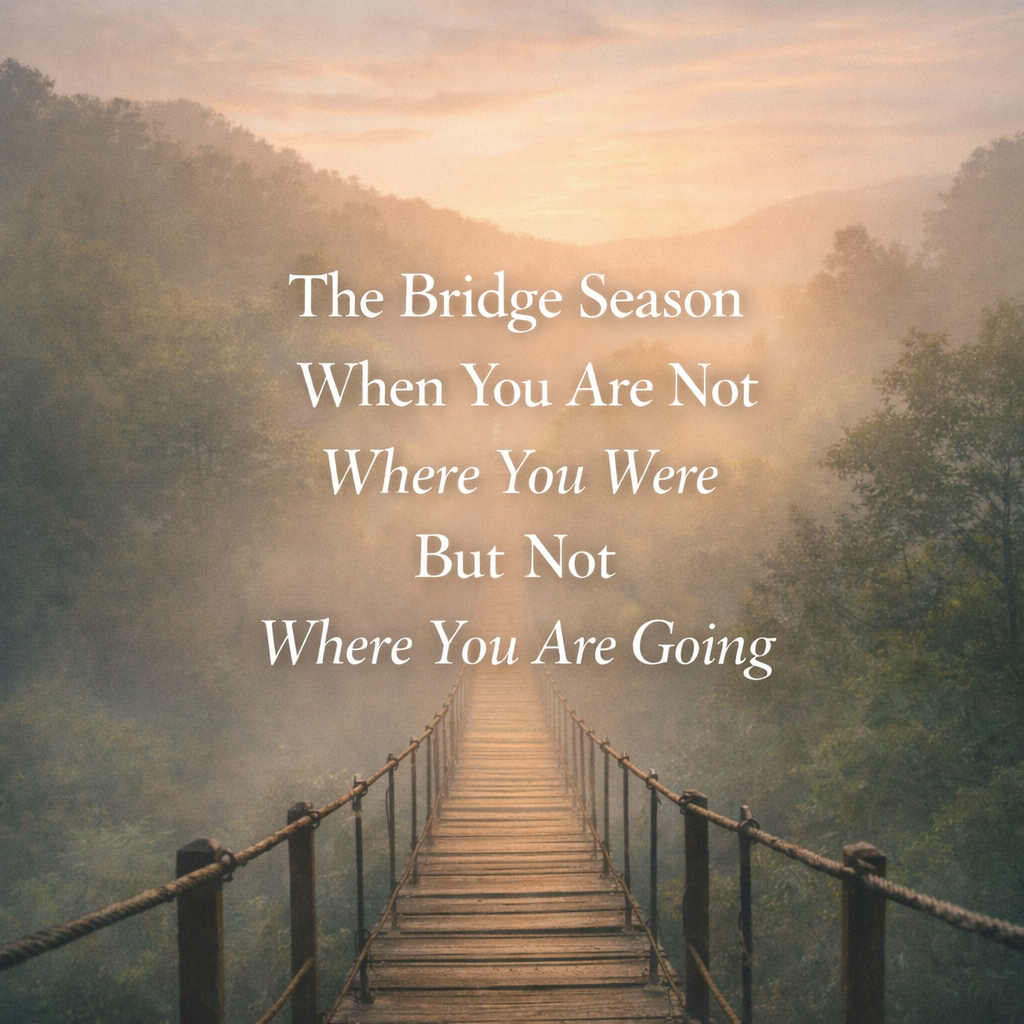
The Bridge Season When You Are Not Where You Were But Not Where You Are Going
In-between seasons are not failure. Learn how to stay steady, build wisely, and trust the slow transition when your next chapter is forming.
The in-between is not failure. It is transition with purpose.
The Strange Middle Space
A bridge season feels like standing between two worlds. Your outside life may look the same, but inside you have shifted. This season can feel slow and lonely, especially when others do not see what is changing in you.
Why Bridge Seasons Matter
Bridge seasons stabilize you while your future forms. They often teach patience, boundaries, and trust. Sometimes staying for a season is wisdom, not fear. Sometimes it is how you protect your nervous system while you prepare.
You Are Building Even If You Are Still There
Progress in a bridge season often looks like learning a skill, saving a little, paying down debt, healing from stress, exploring ideas, and practicing consistency. Quiet progress is still progress.
Anchors for the In Between
Name what you are building
Choose one consistent step each week
Protect rest as part of transition
Ask for daily guidance rather than a full blueprint
Gentle Reflection Questions
What am I building in this season even if it is quiet
Where do I need to be more patient and less self-critical
What consistent step can I take without burning out
A Short Prayer
God, help me trust the in-between. Give me peace while I build, wisdom in my timing, and courage to take steady steps into the future You are forming. Amen.
Your Soulful Pathways ↑
Desktop: Hover over ‘Your Soulful Pathways’ in the top menu to explore another series.
Mobile: Tap the menu (☰), then choose ‘Your Soulful Pathways.’

The Job Loop - When You Feel Like You Are Just Surviving
Wake, work, pay, repeat can drain the soul. Name burnout with compassion and take one small step toward clarity, relief, and renewed life.
Wake work pay repeat can make your soul feel quiet. You are not alone.
Naming the Hamster Wheel
There is exhaustion that is more than being tired. It is the heaviness of repetition without meaning. Days blur. Weeks disappear. You keep up with responsibilities, but inside you feel like you are living on autopilot.
If you are here, your feelings make sense. This is a real experience, and it can quietly wear down hope.
Burnout Does Not Always Look Dramatic
Sometimes burnout looks like numbness, dread, scrolling to escape, losing motivation, and needing more recovery than before. Burnout is not laziness. It is your nervous system asking for relief.
The First Step Is Seeing the Loop
You do not have to quit your job today. The first step is powerful and simple:
See the loop without becoming the loop.
When you name what is happening, you create space. And space is where freedom begins.
Tiny Steps That Break the Spell
Try this question each day:
“Where did I feel most alive today, even for 30 seconds?”
A song, a sunset, a laugh, a boundary, a quiet prayer. Those are breadcrumbs back to yourself.
Then ask:
“What is one small step I can take this week toward a life that feels more like mine?”
Ten minutes outside. One skill video. One page of journaling. One screen-free evening. One conversation with someone safe.
One inch of ownership begins to loosen the loop.
Gentle Reflection Questions
Where do I feel the job loop most strongly in my body or emotions
What moment of aliveness did I experience today even if it was small
What is one tiny step I can take this week to reclaim my life
A Short Prayer
God, meet me in this tired place. Help me breathe again, see the loop clearly, and take one gentle step toward freedom. Strengthen me without crushing me. Amen.
Your Soulful Pathways ↑
Desktop: Hover over ‘Your Soulful Pathways’ in the top menu to explore another series.
Mobile: Tap the menu (☰), then choose ‘Your Soulful Pathways.’

Money as a Tool Not a Master
Discover how money can support freedom, happiness, abundance, and purpose. Explore the psychology of wealth, financial peace, and intentional living.
Creating Financial Freedom, Welcoming Abundance, and Living With Purpose
Money has an extraordinary ability to create possibilities.
It can turn an idea into a business, transform a house into a home, provide education, support a family, and make dreams that once seemed distant feel within reach. It can offer stability during uncertain seasons, create opportunities for adventure, and give us the freedom to make choices that reflect the lives we want to live.
Money can also become a powerful expression of love. It can help us care for aging parents, provide opportunities for our children, support meaningful causes, and extend kindness into places we may never personally visit.
There is nothing inherently wrong with wanting financial prosperity. There is beauty in building something, achieving financial independence, and creating a legacy that reaches beyond our own lifetime.
But money was never meant to become the measure of our humanity.
It is a resource to direct, not an identity to protect. It is something we can earn, manage, grow, enjoy, and share without allowing it to determine our worth or control our peace.
The purpose of money is not simply to have more. It is to make more possible.
When we begin to understand this distinction, our relationship with money can change. Financial success becomes more than a number, abundance becomes more than accumulation, and prosperity becomes an opportunity to create a life that is both meaningful and free.
Money Is One of Life's Most Powerful Tools
Consider everything money makes possible in an ordinary day.
It provides the electricity that illuminates our homes, the transportation that connects us to opportunities, the food that nourishes our families, and the technology that allows people across the world to communicate.
Money helps ideas become inventions, businesses become employers, and dreams become tangible realities.
It also allows us to prepare for the future.
Savings can provide protection during unexpected circumstances. Investments can help build long-term financial resources. Insurance can transfer certain financial risks. Education can expand our skills and earning opportunities.
These are meaningful advantages.
Money is not merely paper, coins, or numbers on a screen. It represents purchasing power, choices, and access to resources.
Yet its usefulness depends partly on how we direct it.
A tool does not determine the purpose of the person holding it.
A hammer can build a home, but it cannot decide what kind of home should be built.
In much the same way, money can help us create a life, but it cannot tell us what makes that life worth living.
That decision belongs to us.
Wealth and Worth Are Two Different Things
One of the most important financial truths is also one of the easiest to forget.
Our financial circumstances do not determine our personal value.
A person earning a substantial income is not automatically more intelligent, compassionate, or spiritually fulfilled than someone earning less.
A person experiencing financial difficulty has not become less worthy of respect, opportunity, or happiness.
Income can reflect many things, including education, experience, occupation, economic conditions, geographic location, opportunities, and circumstances beyond individual control.
It cannot fully describe a human being.
Yet modern culture frequently encourages us to associate success with visible financial achievement.
We notice expensive homes, beautiful vehicles, designer clothing, and luxurious vacations. These things may genuinely bring enjoyment to the people who own them.
But possessions reveal only a small part of someone's life.
They do not tell us whether a person feels loved, enjoys meaningful relationships, experiences peace, or finds purpose in the way they spend their days.
The same principle applies to our own lives.
We can celebrate financial achievements without turning them into measures of our identity.
We can pursue greater prosperity while remembering that wisdom, integrity, creativity, compassion, and faith are forms of richness that no bank statement can adequately express.
When Money Becomes the Master
Money begins to become a master when it moves from supporting our priorities to determining them.
Sometimes this happens through the pursuit of status.
We begin wanting things primarily because other people have them. Our definition of success becomes dependent on comparison.
Sometimes it happens through fear.
We worry constantly about losing money, making the wrong decision, or not having enough for the future.
Sometimes it happens through endless accumulation.
A financial goal is reached, but satisfaction quickly fades. Another target appears, followed by another.
There is always a higher income to pursue, a larger home to consider, or another milestone to achieve.
And sometimes money becomes a master through sacrifice.
We repeatedly postpone relationships, rest, health, and meaningful experiences because financial achievement always seems to require one more year of effort.
Financial ambition can be healthy and productive. Hard work can create extraordinary opportunities.
But a life devoted entirely to preparing for some distant moment of enjoyment can quietly pass by without being fully experienced.
The question is not whether we should pursue wealth.
It is whether the pursuit of wealth continues to serve the life we actually want.
Financial Well-Being Is More Than a Bank Balance
Financial well-being is often described in terms of income, savings, debt, and investments.
These measurements matter, but they do not tell the whole story.
The Consumer Financial Protection Bureau has identified four dimensions of financial well-being that help explain why money is ultimately connected to the quality of our choices.
Together, they offer a broader picture of financial freedom.
The Freedom to Manage Everyday Life
The first dimension involves having enough control over our finances to meet ordinary responsibilities.
Housing, utilities, groceries, transportation, and other essential expenses form the financial foundation of daily living.
When these responsibilities are manageable, we often have more mental space for relationships, creativity, work, and personal growth.
Financial stability can reduce the constant need to make difficult tradeoffs between necessities.
It creates room to participate in life rather than spending every day responding to financial pressure.
The Freedom to Handle Unexpected Events
Life is full of circumstances we cannot predict.
Vehicles need repairs. Appliances stop working. Employment situations change. Homes require maintenance. Families encounter unexpected expenses.
Financial resilience means having resources, arrangements, or support systems that make these events easier to navigate.
Emergency savings are one example.
Insurance coverage, manageable financial commitments, and access to reliable information can also contribute to preparedness.
The goal is not to eliminate every uncertainty.
It is to build a foundation that allows us to respond to life's changes with greater flexibility.
The Freedom to Move Toward Our Goals
Money can support the future we envision.
For one person, that may mean purchasing a home.
For another, it may mean starting a business, paying for education, reducing debt, traveling, or preparing for retirement.
Financial progress becomes especially meaningful when our goals reflect our actual priorities.
We are no longer accumulating resources simply because more is considered better.
We are building toward something.
Every intentional financial decision can become part of a larger story.
The Freedom to Enjoy Life
This fourth dimension is especially meaningful.
Money is not only about meeting obligations or preparing for emergencies.
It can also give us the freedom to make choices that bring enjoyment, fulfillment, and meaning.
That might involve spending time with loved ones, taking a vacation, supporting a creative passion, exploring a new interest, or having greater flexibility in how we work.
Financial freedom is not necessarily the absence of responsibility.
It is the growing ability to make choices that reflect what matters to us.
True financial well-being includes both the security to face tomorrow and the freedom to enjoy today.
Can Money Buy Happiness? What Science Reveals
For years, one of the most frequently repeated ideas about money and happiness was that emotional well-being stopped increasing after annual income reached approximately $75,000.
That conclusion came from influential research published in 2010 by Daniel Kahneman and Angus Deaton, which distinguished between emotional well-being and overall life evaluation.
However, subsequent studies revealed a more complex relationship.
In 2023, researchers Matthew Killingsworth, Daniel Kahneman, and Barbara Mellers collaborated to examine apparently conflicting findings about income and happiness.
Their analysis suggested that emotional well-being generally continued to increase with income across the income ranges studied, although the pattern differed among individuals.
For the least happy group, improvements in emotional well-being appeared to level off at higher income levels. Among happier participants, well-being continued increasing with income within the observed range.
The findings challenged the idea that one universal income threshold determines when money stops contributing to happiness.
They did not establish that happiness rises indefinitely as income increases.
They revealed something more interesting.
People experience the benefits of money differently.
For someone struggling to afford basic necessities, additional income may substantially improve daily life.
For someone who already has financial stability, additional resources may create opportunities for convenience, meaningful experiences, autonomy, or personal fulfillment.
But income is not the only influence on happiness.
Relationships, physical and emotional health, meaningful work, personal freedom, and individual circumstances all contribute to well-being.
Money can help create favorable conditions for happiness.
It cannot guarantee every experience that makes life meaningful.
The deeper lesson is not that money fails to matter.
It is that financial prosperity can enrich life most meaningfully when it supports the other things that make life worth living.
The Psychology of Scarcity and Financial Pressure
Our relationship with money is shaped by more than income.
It is also influenced by experience, memory, emotion, and the environments in which we learned about financial security.
Someone who grew up experiencing financial instability may develop a strong desire to save and prepare.
Someone who experienced unemployment or unexpected financial loss may become especially attentive to financial risks.
Someone who watched family members struggle with debt may approach borrowing with caution.
These experiences can influence financial behavior long after circumstances have changed.
Research on scarcity has explored how pressing financial concerns can occupy attention and mental resources.
When people must continually manage urgent financial demands, fewer cognitive resources may be available for other decisions.
This does not mean people experiencing financial hardship lack intelligence, discipline, or good judgment.
It means that persistent financial pressure can make everyday decision-making more demanding.
Understanding this helps us recognize the value of creating financial clarity.
A realistic budget can reveal where resources are going.
An emergency fund can provide a buffer against unexpected expenses.
A manageable debt repayment plan can create visible progress.
Learning about financial options can replace uncertainty with greater understanding.
These practical steps do more than organize money.
They can help reduce the number of financial questions competing for our attention.
And as our circumstances improve, we can also examine whether old financial fears still reflect our present reality.
There is value in learning to distinguish between a genuine financial responsibility and an expectation of danger carried forward from an earlier season.
Money as Stored Opportunity
One of the most empowering ways to understand money is to view it as stored opportunity.
Savings represent choices we have preserved for the future.
An emergency fund may provide the opportunity to respond to an unexpected event without immediately taking on expensive debt.
Retirement savings may create the opportunity to reduce working hours later in life.
A business reserve may provide the opportunity to continue operating during a slower season.
Money set aside for education may open the door to new skills or career possibilities.
And funds reserved for meaningful experiences may allow us to explore places, relationships, and interests that enrich our lives.
This does not mean that money sitting in an account automatically creates freedom.
Inflation can reduce purchasing power, investments carry risks, and resources must be considered in relation to our responsibilities.
But thoughtful financial planning can preserve choices that might otherwise be unavailable.
Money becomes more meaningful when we understand what it is being saved for.
Instead of asking only, "How much do I have?" we can begin asking, "What possibilities am I creating?"
The Difference Between Financial Freedom and Emotional Freedom
Financial freedom and emotional freedom are connected, but they are not identical.
Financial freedom involves having sufficient resources and flexibility to make choices without excessive financial constraint.
Emotional freedom involves developing a sense of identity, confidence, and purpose that is not entirely dependent on financial circumstances.
A person can possess substantial wealth and still feel anxious about money.
Another person may be working toward financial stability while maintaining a strong sense of purpose and personal worth.
These experiences remind us that financial security and our emotional relationship with money deserve attention.
Building wealth can improve our practical circumstances.
Developing self-awareness can help us understand why certain financial situations create fear, pressure, or dissatisfaction.
Both forms of growth matter.
We can learn how to manage money more effectively while also learning that our humanity is not something we must continually prove through financial achievement.
Financial freedom gives us more choices. Emotional freedom helps us choose without allowing money to define who we are.
The Hidden Cost of Always Wanting More
Human beings have a remarkable ability to adapt.
Something that once felt extraordinary can gradually become familiar.
A new home becomes the place where we live every day.
A salary increase becomes part of our regular income.
A purchase that once brought excitement becomes an ordinary possession.
Psychologists sometimes describe this process through hedonic adaptation, the tendency for emotional responses to positive or negative changes to diminish over time.
Adaptation is not inherently negative.
It allows us to adjust to changing circumstances.
But it can also help explain why financial satisfaction sometimes feels temporary.
We reach a goal, adjust to the improvement, and begin looking toward the next one.
This process can contribute to lifestyle inflation, where spending increases alongside income.
A higher income may bring greater comfort and convenience, but if every increase is immediately absorbed by additional commitments, financial flexibility may not improve as much as expected.
There is nothing wrong with enjoying the rewards of hard work.
The opportunity lies in making those choices intentionally.
When income increases, we can decide how much to direct toward present enjoyment, future security, debt reduction, generosity, and personal goals.
We can celebrate progress without automatically expanding every expense.
And we can pursue the next dream without forgetting to appreciate the one that has already become reality.
Enough Is a Powerful Financial Idea
Enough is not the opposite of abundance.
It is the ability to recognize satisfaction without requiring every desire to be fulfilled first.
Enough does not mean that we stop growing.
It does not mean accepting financial hardship as our permanent condition.
It does not mean abandoning dreams of a beautiful home, successful business, comfortable retirement, or greater financial independence.
It means allowing our present lives to contain meaning while we continue creating the future.
Our definition of enough may change throughout life.
A young adult beginning a career may focus on establishing independence.
A family raising children may prioritize stability, housing, and education.
A business owner may value reserves and predictable cash flow.
Someone approaching retirement may place greater importance on financial resilience and freedom over time.
Enough is personal.
It emerges from the relationship between our needs, responsibilities, values, and aspirations.
And it gives us something that endless comparison cannot provide.
A way to recognize progress.
We can want more without believing that what we have is worthless.
We can build wealth without postponing every experience of contentment.
We can appreciate today while preparing for tomorrow.
Spending Money in Alignment With Our Values
Every financial decision directs resources toward something.
Some spending supports necessities.
Some creates comfort and convenience.
Some allows us to express creativity, explore interests, or share meaningful experiences.
The question is not whether every purchase is essential.
Enjoyment has a legitimate place in life.
The question is whether our spending reflects what genuinely matters to us.
Consider a person who values travel and discovery.
They may find greater satisfaction in exploring new places than in purchasing additional household possessions.
Someone who values hospitality may choose to spend money creating a welcoming home where friends and family can gather.
Someone who values learning may invest in books, courses, and educational opportunities.
Another person may value simplicity and find satisfaction in reducing unnecessary expenses.
Each choice can be meaningful when it reflects the life the individual wants to create.
This is sometimes described as values-based spending.
Rather than allowing advertising, comparison, or impulse to determine our priorities, we consciously direct money toward the things we value.
Research on happiness and spending has also suggested that certain experiences can provide meaningful satisfaction, particularly when they strengthen relationships or become part of our personal stories.
But experiences and possessions are not universally interchangeable. A useful possession may bring lasting value, and an expensive experience is not automatically fulfilling.
What matters is the relationship between the purchase, the person, and the purpose it serves.
Money becomes a tool for intentional living when our spending supports the things we genuinely care about.
Time Is a Form of Wealth
Money and time are deeply connected.
We often exchange time for income.
We may then use income to purchase convenience, reduce demands on our schedules, or create opportunities to spend time differently.
Research has explored the relationship between spending money to save time and subjective well-being.
A 2017 study published in the Proceedings of the National Academy of Sciences found that people who spent money on time-saving services reported greater life satisfaction in observational data, while an experimental component found greater happiness after a time-saving purchase than after a material purchase.
This does not mean every convenience is worth its cost.
It does suggest that how money affects our time can be an important part of financial well-being.
Consider the value of having more time to prepare a meal with family, spend an afternoon outdoors, pursue a creative project, or simply rest.
These experiences may not increase our bank balance.
But they can enrich the life that our financial efforts are meant to support.
There is wisdom in considering not only the price of something, but also the time and energy associated with it.
A higher-paying opportunity may be valuable, especially when it improves financial security.
But the hours, responsibilities, flexibility, and personal costs involved also deserve consideration.
The goal is not to avoid hard work.
It is to remember what our work is helping us build.
Money can be earned again. Time already lived cannot be returned to us.
Building Wealth With Purpose
Building wealth can be a meaningful expression of responsibility and vision.
It can create financial security, expand choices, and provide opportunities that extend across generations.
Long-term wealth building often involves a combination of earning, saving, investing, managing debt, and protecting against financial risks.
Consistency can be especially valuable.
Regular contributions to savings or investments may create progress over time, although investment returns are never guaranteed and market values can fluctuate.
Managing expenses can preserve resources for future goals.
Developing skills can expand earning opportunities.
Building a business can create both personal and community value.
Financial education can improve our ability to evaluate opportunities and understand tradeoffs.
But purposeful wealth building begins with understanding why we want financial growth.
Perhaps we want to support our family.
Perhaps we want to create a business that reflects our gifts.
Perhaps we want the freedom to work differently later in life.
Perhaps we want to fund educational opportunities, support causes we believe in, or leave resources for future generations.
These motivations give financial goals a human purpose.
They turn wealth building into something larger than accumulation.
And they allow us to celebrate success without allowing money to become the center of our identity.
Generosity Expands the Meaning of Prosperity
One of money's most remarkable qualities is its ability to benefit people beyond the person who possesses it.
Money can provide a meal, support education, help a family through a difficult season, or contribute to a community project.
It can create opportunities that continue producing value long after the original gift has been made.
Research on prosocial spending, which involves using money to benefit others, has found associations with greater happiness in a variety of settings.
The benefits are influenced by circumstances, including whether giving is voluntary, meaningful, and connected to a positive impact.
This reveals something important about the relationship between wealth and well-being.
Money can bring satisfaction through what it allows us to receive.
It can also bring meaning through what it allows us to contribute.
Generosity does not require enormous wealth.
It may involve helping someone purchase groceries, supporting a local organization, contributing to a cause, or sharing resources with a person who needs assistance.
It can also involve giving time, knowledge, encouragement, and practical support.
Healthy generosity includes wisdom.
Supporting others does not require neglecting our own essential needs or responsibilities.
The most sustainable forms of generosity allow compassion and financial stewardship to work together.
When resources are guided by love and intention, their value can extend far beyond the amount exchanged.
Gratitude and the Experience of Abundance
Gratitude allows us to recognize the value of what is already present in our lives.
It may begin with ordinary things.
A comfortable place to sleep.
Food prepared in a familiar kitchen.
A reliable vehicle.
A conversation with someone we love.
The opportunity to work, learn, create, or enjoy a quiet afternoon.
These experiences may seem ordinary because they are familiar.
Yet many represent resources, relationships, and opportunities that contribute meaningfully to our well-being.
Research has associated gratitude practices with improvements in some measures of psychological well-being, although the effects vary among individuals and studies.
Gratitude can help us direct attention toward what is meaningful rather than concentrating exclusively on what is missing.
But gratitude and ambition are not opposites.
We can appreciate our current home while planning for another.
We can be thankful for our income while pursuing better opportunities.
We can celebrate financial progress while continuing to build toward greater freedom.
Gratitude does not require us to stop wanting more.
It allows us to experience the value of what we have while we continue growing.
Abundance becomes more meaningful when appreciation accompanies aspiration.
Faith, Money, and the Wisdom of Stewardship
Throughout Scripture, money is discussed not merely as something to possess, but as something that reveals priorities and creates responsibilities.
One of the most frequently misunderstood biblical teachings appears in 1 Timothy 6:10.
The passage speaks about the love of money as a root of many kinds of evil.
It does not declare that possessing money is inherently wrong.
The distinction matters.
Money can support a household, fund meaningful work, create opportunities, and allow generosity.
But when the pursuit of money becomes more important than integrity, compassion, faith, or relationships, our priorities can become distorted.
In Matthew 6:24, Jesus teaches about the impossibility of serving both God and money as competing masters.
This teaching invites us to consider what ultimately directs our lives.
Are we allowing financial fear to determine every choice?
Are we measuring success only through material achievement?
Are we using our resources in ways that reflect our deeper beliefs?
Christian stewardship offers a meaningful alternative.
It encourages the thoughtful management of resources through responsibility, gratitude, wisdom, and generosity.
This can include earning an honest living, caring for family, preparing for the future, honoring commitments, and helping others.
Proverbs 21:5 also emphasizes the value of diligent planning.
Faith and practical preparation do not need to compete.
They can complement one another.
We can trust God while making thoughtful decisions.
We can pray for guidance while developing financial skills.
We can welcome prosperity while remembering that our ultimate identity rests in something greater than possessions.
Money becomes one of the resources through which we can live out our values and serve a purpose beyond ourselves.
Prosperity Does Not Have to Come at the Expense of Peace
Sometimes people imagine they must choose between financial ambition and a peaceful life.
They picture prosperity as endless work, pressure, competition, and sacrifice.
But financial success can take many forms.
A person may build a thriving business while establishing boundaries that protect family time.
Someone may pursue a higher-paying career because it creates greater stability and opportunity.
Another person may choose a simpler lifestyle that requires less income and provides greater flexibility.
Someone else may find fulfillment in building substantial wealth and using it to support people, businesses, or causes they believe in.
These paths are different.
None is automatically superior.
What matters is whether the chosen path reflects the person's responsibilities, values, and goals.
Peace does not require the absence of ambition.
It can come from knowing why we are pursuing something and making decisions that remain consistent with that purpose.
We can work toward financial abundance without allowing every moment of life to become a transaction.
We can be successful without turning success into a competition.
And we can enjoy what we have created without feeling obligated to continually prove that we deserve it.
When Financial Circumstances Change
Financial life moves through seasons.
Some bring growth and opportunity.
Others require adjustment, patience, and rebuilding.
Income may fluctuate. Businesses may experience slower periods. Careers may change. Unexpected expenses may arise.
These circumstances can affect our choices, but they do not erase our abilities or diminish our value.
A period of financial transition may invite us to reassess priorities.
We may discover expenses that no longer serve us.
We may identify skills that create new earning opportunities.
We may develop a different understanding of what stability means.
We may learn to distinguish between possessions we enjoy and obligations that limit our flexibility.
Not every financial challenge contains a hidden blessing, and hardship can involve real losses.
Yet changing circumstances do not eliminate the possibility of future growth.
Financial resilience often develops through a combination of practical planning, adaptability, access to support, and the willingness to learn.
A difficult season is part of a financial story.
It does not have to become the final chapter.
Teaching Children That Money Has a Purpose
The way adults relate to money can influence how children understand it.
Children notice conversations about spending, saving, generosity, work, and financial responsibility.
They also notice whether money is discussed primarily through fear, comparison, gratitude, or thoughtful decision-making.
Financial education can begin with simple lessons.
Money is earned through work, enterprise, and other legitimate sources of income.
Spending involves choices.
Saving allows resources to be used later.
Borrowing creates obligations.
Giving can help others.
And financial decisions often involve balancing present enjoyment with future priorities.
But perhaps the most meaningful lesson is that money is not a measure of personal worth.
Children can learn to celebrate achievement without defining themselves through possessions.
They can understand the value of hard work while respecting people whose circumstances differ from their own.
They can discover that generosity and responsibility belong together.
And they can grow into adults who view money as something they are capable of understanding and directing.
These lessons can become part of a legacy that extends far beyond a financial inheritance.
Creating a Personal Philosophy of Money
A healthy relationship with money becomes easier to develop when we understand what we want it to accomplish.
A personal philosophy of money does not need to be complicated.
It begins with a few meaningful principles.
Earn with purpose. Seek opportunities that support financial responsibilities while respecting your abilities, values, and long-term goals.
Spend with intention. Allow your purchases to reflect your priorities rather than relying exclusively on habit, pressure, or comparison.
Save for possibilities. Build financial resources that can support future needs, unexpected events, and meaningful goals.
Grow with wisdom. Continue learning about financial decisions, recognizing both opportunities and risks.
Give with compassion. Use resources to support others in ways that are meaningful and sustainable.
Enjoy with gratitude. Allow the rewards of your efforts to contribute to a fulfilling life today.
Remember what matters most. Let money support your relationships, purpose, well-being, and spiritual values rather than replacing them.
These principles create a foundation for financial choices that can evolve throughout life.
They do not require perfection.
They invite awareness.
And over time, greater awareness can help money become an increasingly useful partner in creating the life we envision.
A Rich Life Has More Than One Kind of Wealth
Imagine measuring prosperity through more than financial accounts.
There is the wealth of having people who care about us.
The wealth of being able to learn and explore.
The wealth of meaningful work.
The wealth of having time to enjoy a beautiful morning.
The wealth of creativity, wisdom, faith, and purpose.
There is the wealth of knowing we have helped someone.
The wealth of having built something meaningful.
The wealth of being able to look toward the future with hope.
Financial resources can support many of these experiences.
They can provide opportunities, stability, convenience, and access.
But they are not the only sources of richness.
A beautiful life is not defined exclusively by the amount of money that flows through it.
It is also shaped by how we spend our time, how we treat people, what we create, what we appreciate, and what we choose to make important.
This broader understanding does not diminish the value of financial prosperity.
It gives prosperity a greater purpose.
Questions for Reflection
What do I truly want money to make possible in my life?
Which financial achievements would create the greatest sense of freedom?
Am I pursuing certain goals because they reflect my values or because I feel pressure to keep up with others?
What does enough mean for my current season of life?
How can I enjoy more of what I already have while continuing to grow?
Which financial choices could create greater stability and opportunity for my future?
How might greater prosperity allow me to express generosity and support the people I love?
If money were fully serving my purpose, what would my daily life look like?
These questions can help us move beyond the simple pursuit of more and toward a thoughtful understanding of what prosperity means to us.
Frequently Asked Questions
Is money good or bad?
Money is a financial resource that can be used for many purposes. It can support basic needs, provide security, create opportunities, and enable generosity. Its effects depend on the circumstances in which it is earned, managed, and used.
What does it mean to make money a tool instead of a master?
It means allowing personal values, responsibilities, and meaningful goals to guide financial decisions rather than allowing money, status, fear, or endless accumulation to determine the direction of life.
Can money buy happiness?
Research indicates that higher income is generally associated with greater life satisfaction and emotional well-being across the income ranges studied, although the relationship varies among individuals. Money can reduce financial hardship and expand choices, but relationships, health, purpose, and other life circumstances also contribute to happiness.
Is wanting to become wealthy spiritually wrong?
Wanting financial prosperity is not inherently incompatible with Christian faith or spiritual values. The deeper consideration is whether wealth is pursued and used with wisdom, integrity, gratitude, and compassion rather than becoming the ultimate source of identity or meaning.
How can I develop a healthier relationship with money?
A useful starting point is understanding your financial circumstances, identifying your priorities, establishing realistic goals, and examining the beliefs that influence your financial choices. Practical planning and greater self-awareness can work together.
What is the difference between financial security and financial freedom?
Financial security generally involves having the resources and arrangements needed to manage responsibilities and withstand financial setbacks. Financial freedom places greater emphasis on having choices about work, time, lifestyle, and future opportunities. The two concepts overlap, but they are not identical.
Does living simply mean giving up financial ambition?
No. Simple living can involve intentionally directing resources toward what matters most. A person can build substantial wealth while choosing to limit unnecessary expenses, reduce obligations, and prioritize flexibility.
Why do people sometimes feel dissatisfied even after earning more money?
Several factors may contribute, including rising expectations, lifestyle inflation, social comparison, and adaptation to improved circumstances. Higher income can provide meaningful benefits, but satisfaction also depends on how financial progress connects to personal goals and well-being.
Can generosity improve happiness?
Research on prosocial spending suggests that using money to benefit others can contribute to happiness, especially when giving is voluntary and meaningful. The benefits vary, and generosity is most sustainable when it is balanced with personal financial responsibilities.
What does the Bible teach about money and stewardship?
Biblical teachings encourage diligence, generosity, wisdom, and responsible management of resources. They also caution against allowing the love of money to become a controlling priority. Stewardship emphasizes using what we have in ways that reflect faith, responsibility, and care for others.
How much money is enough?
There is no universal amount. Enough depends on living expenses, family responsibilities, location, goals, health needs, and desired lifestyle. Understanding personal priorities can help establish meaningful financial targets rather than relying solely on comparison.
How can I enjoy money without becoming attached to it?
Enjoying money can involve appreciating the comfort, experiences, and opportunities it provides while remembering that possessions and financial achievements are not the foundation of personal worth. Intentional spending, gratitude, generosity, and clear priorities can support this balance.
Final Reflection
Money can be a beautiful part of life.
It can provide security, create opportunities, nourish dreams, and give us the freedom to make meaningful choices.
It can help us build homes, establish businesses, educate children, care for loved ones, and contribute to causes that matter.
We do not need to reject prosperity to live with purpose.
We can welcome abundance.
We can work toward financial independence.
We can celebrate success, enjoy comfort, build wealth, and create a lasting legacy.
But we can do all of these things while remembering that money is meant to serve something greater than itself.
A full bank account may create opportunities, but it cannot replace love.
A successful career may bring achievement, but it cannot define the whole of a person.
A beautiful home may provide comfort, but the relationships and experiences within it give that home its deepest meaning.
The greatest freedom may come when we no longer feel compelled to prove our worth through what we earn or own.
We can appreciate money without worshiping it.
We can manage it wisely without living in constant fear of losing it.
We can pursue more while recognizing the abundance already present in our lives.
And we can use our resources to create something that extends beyond ourselves.
Let money be a tool that builds your dreams, supports your purpose, and expands your freedom. Let wisdom guide how you earn it, gratitude shape how you enjoy it, and love influence how you share it.
Money can help create a beautiful life. But the life itself will always be worth more than the money.
You May Also Enjoy:
Living on Less Without Feeling Small
Discover how intentional simplicity can create greater freedom, satisfaction, and appreciation without diminishing your dreams or sense of worth.
Faith and Practical Planning
Explore how spiritual trust and thoughtful preparation can work together to support meaningful decisions and a purposeful future.
The Frequency of Gratitude
Discover how gratitude can transform the way we experience everyday life, helping us recognize abundance while remaining open to growth.
The Sacred Power of Anticipation: How Hope Shapes the Way We Experience Tomorrow
Explore how hope and positive anticipation can influence our relationship with the future and the possibilities we are preparing to create.

When Your Job Is Not Your Calling
Your job does not have to be your calling. Explore purpose beyond career, meaningful work, faith, provision and how to honor a deeper calling while appreciating the work supporting your life.
Your Work Can Support Your Life Without Defining Your Life
There is a beautiful idea repeated throughout modern culture:
Find what you love. Make it your career. Discover your purpose.
Sometimes life unfolds exactly that way.
And sometimes it does not.
Sometimes the work that pays your bills is not the work that makes your spirit come alive.
Sometimes you are good at your profession. You may even be grateful for it. It may provide stability, support people you love and make much of your life possible.
And still, somewhere beneath the schedules, responsibilities and practical necessities of life, something else keeps calling you.
Something you want to create.
Something you want to learn.
Someone you want to help.
A place you want to build.
A contribution you want to make.
A way of living that feels deeply connected to who you are.
That does not mean you chose the wrong life.
Your job can have value without being your calling.
Your calling can be real without appearing on your résumé.
And the years you spend doing practical work are not necessarily years spent away from your purpose.
Sometimes they are part of the road that leads you toward it.
A Job and a Calling Are Not Always the Same Thing
A job is generally an exchange.
You give your time, knowledge, skill, labor or attention, and in return you receive compensation.
A career is the larger working path that may develop through experience, changing roles and years of growth.
Purpose reaches further.
Purpose concerns what gives your life meaning and direction.
And calling can feel deeper still.
A calling is that persistent sense that something matters enough for you to give part of yourself to it.
For some people, all of these things meet in the same place.
Their job becomes their career, their career expresses their purpose, and their purpose feels like a calling.
Wonderful.
But that is not the only way to live a meaningful life.
Your calling may involve creating.
Teaching.
Building.
Encouraging.
Raising children.
Serving others.
Growing food.
Making beauty.
Caring for animals.
Solving problems.
Sharing knowledge.
Strengthening a community.
Helping people feel less alone.
Deepening faith.
Bringing something into the world that was not here before.
Your calling may eventually become your career.
But it does not have to.
One of the most freeing realizations in life is that purpose does not require payroll.
Something does not become meaningful only when someone agrees to pay you for it.
You Are More Than Your Occupation
One of the first questions adults often ask one another is:
“What do you do?”
And usually we answer with an occupation.
Teacher.
Contractor.
Accountant.
Nurse.
Manager.
Driver.
Designer.
Technician.
But imagine answering the question differently.
I raise people.
I create beauty.
I solve problems.
I make people feel welcome.
I protect what matters.
I encourage people when they have forgotten their strength.
I build things that last.
I bring order to confusion.
I help people see possibilities.
Suddenly a human being becomes much larger than a job title.
Your occupation describes something you do.
It does not contain everything you are.
Work Does Not Have to Give You Everything
We sometimes place an enormous burden on employment.
We expect a job to provide income, security, friendship, identity, creativity, fulfillment, excitement, growth, meaning and purpose.
That is quite a workload for one part of a human life.
A meaningful life can draw nourishment from many places.
Work.
Family.
Faith.
Friendship.
Creativity.
Learning.
Service.
Nature.
Community.
Home.
Rest.
Curiosity.
Love.
You do not have to extract your entire identity from the hours for which you are paid.
A job can simply be one part of a much larger life.
And sometimes that realization creates tremendous freedom.
Sacred Provision
There is dignity in work that provides.
A job may pay the mortgage.
Put groceries on the table.
Keep the electricity running.
Support children.
Help aging parents.
Pay for education.
Build savings.
Fund a dream.
Provide stability during an uncertain season.
Give someone else in the family room to pursue something important.
That is not meaningless work.
Provision itself can be an act of love.
The world celebrates dramatic leaps toward destiny.
It speaks less often about the quiet courage required to wake up, go to work and faithfully care for the responsibilities already in your hands.
But quiet faithfulness matters too.
Sometimes providing is part of the calling.
God Can Use Work That Is Not Your Final Destination
Sacred purpose does not begin after you discover the perfect career.
God can work through ordinary seasons.
A workplace can teach patience.
A difficult project can develop perseverance.
Responsibility can build discipline.
A manager can teach you what leadership should be, or what it should never become.
A demanding season can teach stewardship.
An unexpected job can introduce you to people you were meant to know.
You may learn skills that seem completely unrelated to your future until years later, when suddenly the pieces connect.
Life has a remarkable way of connecting dots backward.
What once looked like a detour can become preparation.
Scripture repeatedly places significant moments of calling inside ordinary life.
Moses was tending sheep.
David cared for his father's flock.
Peter was fishing.
Matthew was working when Jesus called him.
The ordinary did not prevent the sacred from entering.
Purpose has never required perfect scenery.
Your Calling May Be Larger Than Your Career
Perhaps one of the greatest mistakes we make is shrinking calling until it fits inside employment.
A human life is far larger than a profession.
Your calling may include the kind of parent you become.
The home you create.
The people you encourage.
The knowledge you share.
The generosity you practice.
The things you build.
The beauty you bring into ordinary places.
The ideas you introduce.
The faith you carry.
The people you mentor.
The prayers you quietly pray.
The courage you awaken in someone else.
The kindness you give when nobody is keeping score.
Your calling may travel through your life wearing many different clothes.
It does not necessarily need one permanent job title.
You May Have More Than One Calling
The idea that every person has exactly one hidden purpose can make calling feel like a cosmic guessing game.
Choose correctly and everything falls into place.
Choose incorrectly and somehow you have missed your life.
But human lives are rarely that narrow.
There may be a season of raising children.
A season of building financial stability.
A season of caregiving.
A season of learning.
A season of creating.
A season of leadership.
A season of rebuilding.
A season of service.
A season of starting something entirely new.
Several may overlap.
One chapter does not invalidate another.
Perhaps calling is not always one destination.
Perhaps sometimes it is a thread running through many destinations.
Calling Often Leaves Clues
Calling does not always arrive with thunder.
Sometimes it whispers.
Pay attention to what repeatedly draws your attention.
What subjects could you explore for hours?
What problems make you think, “Someone should do something about this”?
What kind of need immediately awakens compassion in you?
What do people naturally ask you for help with?
What are you unusually good at explaining, creating, organizing, fixing, noticing or understanding?
What have you repeatedly returned to throughout your life?
What would you continue caring about even if nobody applauded?
What kind of contribution leaves you tired but deeply satisfied?
These patterns can become clues.
Calling often reveals itself through recurrence.
Something keeps returning.
And so does your desire to answer it.
Pay Attention to What Makes You Feel More Alive
There are activities that consume energy.
There are others that somehow return something while you are doing them.
You begin creating and suddenly realize hours have passed.
You help someone and experience unusual clarity.
You study a subject and every answer creates another fascinating question.
You build something and feel a quiet satisfaction that is difficult to explain.
You enter a particular environment and some part of you seems to recognize it.
These moments do not automatically tell you which career to pursue.
But they can reveal something about the architecture of your inner life.
Pay attention.
Your life is speaking.
An Unanswered Calling Is Still a Calling
Sometimes people know exactly what they would love to pursue but cannot make it their occupation.
Finances may not allow it.
Family responsibilities may come first.
The opportunity may not exist yet.
The timing may not be right.
Or perhaps the calling was never meant to become a profession.
Researchers studying work and meaning have even explored what they call an unanswered calling: something a person feels strongly drawn toward but is not currently pursuing as their occupation.
People sometimes find other ways to express these callings.
Through hobbies.
Through volunteering.
Through relationships.
Through creative projects.
Through learning.
Through service.
Through the hours that belong entirely to them.
That matters.
You may not be able to give your calling forty hours each week.
Perhaps right now you can give it two.
Those two hours still belong to your life.
Your Calling Does Not Have to Become Your Hustle
There is a peculiar habit in modern culture.
The moment someone discovers something they love, the next question often becomes:
“How can you make money from it?”
But not everything meaningful needs to become a business.
You are allowed to paint without selling paintings.
Write without publishing.
Garden without selling produce.
Bake without opening a bakery.
Study without earning another degree.
Play music without building an audience.
Create without becoming a brand.
Help people without turning compassion into a company.
Some things are precious precisely because they remain outside economic pressure.
A calling does not become more legitimate when money enters the room.
You are allowed to love something simply because loving it enlarges your life.
Your Current Job May Be Funding Your Calling
This possibility is often overlooked.
The job and the calling may not be competitors.
The job may be helping the calling exist.
Your paycheck might fund the camera.
The workshop.
The education.
The website.
The garden.
The studio.
The books.
The land.
The tools.
The business you are slowly building.
The charitable work you quietly support.
The dream you have not announced yet.
The hours spent earning money may be purchasing the freedom to spend other hours doing something that matters deeply to you.
Seen differently, your job may not be standing between you and your calling.
It may be carrying part of its weight.
Sometimes You Can Bring More of Yourself Into the Job
There is another possibility.
You may not need a completely different occupation to experience more meaning.
Researchers use the term job crafting to describe ways people intentionally reshape parts of their work.
That might mean spending more time using a strength.
Helping a coworker.
Mentoring someone.
Improving a broken process.
Taking on a project that matters to you.
Building better relationships.
Bringing creativity into something routine.
Or simply seeing the purpose of your work differently.
You may not be able to redesign every part of a job.
But sometimes a small shift allows more of who you are to enter the work you already do.
The job title remains unchanged.
The experience becomes different.
There May Be No Perfect Career
This may be one of the most freeing truths of all.
There may not be one perfect job waiting somewhere that will satisfy every interest, gift, value, dream, financial need and part of your personality.
And that is okay.
People change.
Families change.
Industries change.
Circumstances change.
Dreams change.
The person you were at twenty may not want what you want at forty.
The life you imagine at forty may change again at sixty.
Purpose does not have to mean discovering one flawless occupational answer and staying there forever.
Sometimes wisdom means making the best choice available in one season while remaining open to what another season may reveal.
Do Not Despise the Bridge
There is often a bridge between where you are and where you hope to be.
People sometimes become frustrated because they want to teleport across it.
But bridges serve a purpose.
A transition can give you time to learn.
Save money.
Practice.
Experiment.
Build skills.
Develop relationships.
Test an idea.
Understand an industry.
Create something quietly.
Strengthen your confidence.
Wait for the right door.
A bridge is not a permanent address.
But that does not make it wasted ground.
Sometimes wisdom means walking across slowly enough that you do not have to swim back.
You Do Not Have to Quit Everything to Honor Your Calling
Purpose does not always arrive carrying a resignation letter.
Sometimes the next faithful step is tiny.
Spend thirty minutes writing.
Take the class.
Plant the garden.
Volunteer.
Create the first page.
Make the first product.
Teach one person.
Research the idea.
Practice the skill.
Start saving.
Buy the domain.
Make the phone call.
Have the conversation.
Begin before your circumstances are perfect.
Small beginnings are not lesser beginnings.
An hour consistently given to something meaningful can eventually become hundreds of hours.
A calling that receives a little faithful attention has already begun entering the physical world.
Stop Waiting for Permission
People often wait for an invisible authority to declare them qualified.
You are officially a writer.
You are officially an artist.
You are officially allowed to start the business.
You are officially ready to teach.
You are officially permitted to create.
But meaningful things often begin long before anyone grants permission.
Writers write before publishers notice.
Artists create before galleries care.
Entrepreneurs experiment before companies exist.
Teachers teach before classrooms appear.
Builders imagine before foundations are poured.
You do not need external recognition before beginning to develop what has been placed within you.
Calling Is Not Always Loud
Sometimes we expect purpose to feel enormous.
A lightning bolt.
A revelation.
A dramatic change of direction.
But calling can be quiet.
It may appear as curiosity that refuses to disappear.
An idea that keeps returning.
A subject you cannot stop learning about.
A desire to help a particular kind of person.
A vision you keep seeing.
A place where your gifts and another person's need naturally meet.
Sometimes purpose does not shout.
Sometimes it simply refuses to leave.
Purpose Does Not Have to Be Productive Every Minute
Even meaningful pursuits need room to breathe.
You do not have to turn every gift into output.
Every interest into achievement.
Every spare hour into progress.
Every calling into another obligation.
There is room for rest.
There is room for play.
There is room for exploration that leads nowhere except wonder.
There is room to change your mind.
There is room to enjoy being alive without producing something from every experience.
Calling should deepen life, not consume it.
Do Not Measure Purpose by Scale
A calling does not have to reach millions of people.
You may change one household.
One classroom.
One neighborhood.
One customer.
One child.
One friend.
One stranger.
A life does not need an enormous audience to possess enormous meaning.
Some of the most important things human beings do will never become measurable.
A conversation can redirect a life.
Kindness can interrupt despair.
Encouragement can resurrect an abandoned dream.
Knowledge can travel through generations.
One person's influence can continue moving through people they will never meet.
Purpose has never depended upon analytics.
Your Job Can Still Be a Place of Purpose
Even when your occupation is not your calling, your calling may occasionally walk through the door.
Perhaps someone needs encouragement.
Perhaps a coworker needs patience.
Perhaps your integrity changes the atmosphere of a difficult workplace.
Perhaps your creativity improves something everyone else accepted as unchangeable.
Perhaps you teach someone what you know.
Perhaps you make someone's difficult day a little easier.
Perhaps you simply treat people with dignity in a place where dignity has become scarce.
You do not have to love every part of your job for goodness to move through you while you are there.
Calling is portable.
You carry it with you.
Gratitude and Desire Can Live Together
You can appreciate your job and still want something different.
You can be thankful for stability while dreaming of freedom.
You can recognize everything your current work provides while sensing another chapter beginning.
These truths do not cancel one another.
Gratitude does not require abandoning desire.
And desire does not require disrespecting what has carried you this far.
You can bless the ground beneath your feet while still walking toward the horizon.
When You Cannot Name Your Calling Yet
Sometimes you know your current work is not the whole story, but you cannot explain what the next chapter is.
Do not manufacture an answer simply because uncertainty feels uncomfortable.
Become curious.
Read.
Learn.
Experiment.
Create.
Pray.
Listen.
Volunteer.
Try something.
Follow a question.
Explore an interest.
Notice what keeps returning.
Notice what expands you.
Notice what remains meaningful after the initial excitement disappears.
Clarity often emerges through movement.
You do not always discover the path and then begin walking.
Sometimes you begin walking and discover the path.
Ask a Larger Question
Instead of asking only:
“What career am I supposed to have?”
Try asking:
“What am I here to contribute?”
That question opens a much larger landscape.
Maybe your contribution is wisdom.
Beauty.
Compassion.
Protection.
Knowledge.
Joy.
Leadership.
Healing.
Innovation.
Hospitality.
Courage.
Faith.
Creation.
Connection.
Once you recognize the deeper contribution, you may discover many different ways to express it.
Your calling may wear more than one uniform during your lifetime.
You Have Not Missed Your Life
There is no universal age by which purpose must be discovered.
Some people recognize their direction early.
Others discover new purpose after raising children.
After retirement.
After loss.
After disappointment.
After changing careers.
After rebuilding.
After decades spent doing something entirely different.
Life continues opening doors long after culture suggests everyone should have everything figured out.
You are not behind because your deeper work has not fully appeared yet.
Perhaps some of what you have already lived was necessary preparation for what you will eventually give.
Experience creates wisdom.
Time develops discernment.
Difficulty can deepen compassion.
Responsibility can build strength.
The road behind you may contain materials you will use to build what comes next.
Faithfulness Before Visibility
There is something beautiful about developing a calling before anyone else sees it.
No applause.
No audience.
No guarantee.
Just a quiet conviction that something matters.
You study because you care.
You create because something inside you wants expression.
You help because someone needs help.
You build because you can imagine what does not exist yet.
You continue because the work itself carries meaning.
Visibility may come later.
It may not.
Purpose existed before recognition arrived.
Work Is Something You Do
Your life is something you are living.
Your job may occupy many hours of your week.
But it does not own your imagination.
It does not own your faith.
It does not own your creativity.
It does not own your relationships.
It does not own your dreams.
And it does not own your future.
You can faithfully perform today's responsibilities while quietly building tomorrow.
You can earn a living without surrendering the deeper life within you.
You can appreciate practical work without demanding that it explain your existence.
And you can allow a calling to grow without insisting that it immediately pay the bills.
A Sacred Reminder
Maybe your job is your calling.
Maybe it expresses part of your calling.
Maybe it funds your calling.
Maybe it is preparing you for your calling.
Maybe your calling lives mostly outside your employment.
Maybe your job is simply honest work that supports a beautiful life.
All of these can hold dignity.
You do not have to force your livelihood and your life's deepest purpose into the same container.
God can work through the office.
The workshop.
The classroom.
The construction site.
The garden.
The kitchen table.
The computer screen.
The family.
The quiet dream.
The unseen beginning.
Your calling is not validated by a paycheck.
It is not validated by a title.
It is not validated by an audience.
It is revealed through what you faithfully bring into the world.
And if something inside you continues whispering that there is more for you to create, give, learn, explore or become, you do not have to silence that voice simply because you already have a job.
You can appreciate the work that supports your life.
You can honor the responsibilities currently in your hands.
You can trust the season you are in.
And you can still leave a door open for what is calling you forward.
Sometimes purpose arrives through that door quietly.
And one day, looking backward, you may discover that what seemed like unrelated pieces were becoming a life all along.
Questions to Carry With You
Does everyone have one specific calling?
Not necessarily. Calling may be expressed through several roles, interests and contributions across different seasons of life. You do not have to discover one perfect occupation that explains your entire existence.
Does my calling have to become my career?
No. Meaningful callings can be expressed through parenting, caregiving, creativity, volunteering, mentoring, faith, community, hobbies, relationships and personal projects. Something can matter profoundly without becoming employment.
What is an unanswered calling?
Researchers have used this idea to describe a calling someone feels but is not currently pursuing through their occupation. People may still find ways to express parts of it through their existing work, hobbies, creative pursuits and life outside work.
What if I cannot afford to leave my job?
You do not have to leave it simply because it is not your calling. Your job may provide the stability and resources that allow another part of your life to grow gradually.
Can my job actually help support my calling?
Absolutely. Income from one kind of work can support education, creative projects, tools, property, travel, volunteering, entrepreneurship or whatever helps another meaningful part of life develop.
What is job crafting?
Job crafting is a term researchers use for intentional changes people make in how they approach their existing work. That might involve emphasizing certain tasks, developing relationships, contributing in new ways or changing how they understand the meaning of what they do.
Should I turn something I love into a business?
Only if that genuinely fits what you want. A passion does not need to produce income to justify its place in your life. Some meaningful pursuits are wonderful precisely because they remain free from financial pressure.
What if there is no perfect career for me?
There may not be one. A meaningful life can be built across work, relationships, faith, creativity, service, home and many other areas. One occupation does not have to satisfy every part of you.
How can I explore my calling while working full time?
Give it a small but protected place in your life. A few consistent hours can be enough to learn, experiment, create and discover what wants to grow.
Can God use a job that does not feel like my calling?
Yes. Work can become a place of provision, learning, service, relationship, preparation and unexpected opportunity even when the occupation itself does not feel like the fullest expression of your purpose.
Am I wasting time by staying in practical work?
Not necessarily. Practical work can develop knowledge, discipline, resources, relationships and skills that may become unexpectedly important later.
Is it too late to discover a calling?
No. Meaningful chapters can begin throughout life. Everything you have already experienced may become part of what equips you for something you have not yet imagined.