


Night Regulation for Overthinking Minds
Discover gentle ways to regulate an overthinking mind at night, release racing thoughts, quiet mental arousal, create a peaceful nighttime rhythm, and make room for deeper rest.
When the World Becomes Quiet but Your Mind Does Not
Night has a strange way of making thoughts louder.
The house settles. The demands of the day begin to fade. There are fewer conversations, fewer decisions, fewer places your attention has to go.
And suddenly the mind remembers everything.
Something you should have said.
Something you need to do tomorrow.
A decision you have not made.
A conversation you thought you were finished thinking about.
An idea.
A possibility.
A question without an answer.
For an active mind, bedtime can become the moment when everything that waited quietly behind the noise of the day finally steps forward.
But nighttime regulation is not about forcing your mind into silence.
It is about helping your whole system recognize something beautifully simple:
Nothing needs to be solved right now.
You can have unanswered questions and still rest.
You can have an unfinished life and still sleep.
Tomorrow does not need to be completed tonight.
Why the Mind Can Feel Busier at Night
During the day, attention is constantly being pulled outward.
Work needs completing. People need answers. Meals need preparing. Messages arrive. Decisions are made. Life keeps moving.
At night, much of that external stimulation disappears.
Attention naturally has more room to turn inward.
Thoughts that barely registered during the day may suddenly seem enormous.
Sleep researchers use the term pre-sleep cognitive arousal to describe mental activity that remains high when a person is trying to transition toward sleep.
In ordinary language, the body may be in bed while the mind is still at work.
You might find yourself:
planning tomorrow,
replaying conversations,
solving problems,
imagining future possibilities,
reviewing mistakes,
thinking through relationships,
creating ideas,
or worrying about whether you are going to sleep.
That last one can create an especially frustrating loop.
Why am I still awake?
How many hours do I have left?
What if I'm exhausted tomorrow?
Why can't I just fall asleep?
Now the mind has been given another problem to solve:
sleep itself.
And sleep was never meant to be a performance.
The Overthinking Mind May Be Trying to Protect Something
An active nighttime mind is not necessarily producing meaningless noise.
Sometimes it is trying to keep something available.
Don't forget this.
Figure this out.
Prepare for that.
Remember what happened.
Decide what you're going to do.
Make sure nothing goes wrong.
The mind may keep returning to something because it believes the matter is unfinished and therefore still requires attention.
This gives us an important distinction.
Something does not have to be resolved before it can be released for the night.
Resolved means:
I have the answer.
Released means:
I do not have the answer yet, and I am finished working on it tonight.
That is a very different kind of closure.
Give the Mind Permission to Close the File
Imagine that every unresolved concern is an open file on a desk.
Some need attention tomorrow.
Some need information you do not yet have.
Some require another person's response.
Some require time.
And some may eventually resolve themselves in ways you cannot see tonight.
You do not need to throw the files away.
You simply need to close them.
You can tell yourself:
I know this matters.
I am not ignoring it.
I will return to it when I can actually do something about it.
For tonight, the file is closed.
The mind does not always need an answer.
Sometimes it needs permission to stop searching for one.
Give Tomorrow Somewhere to Live
A surprisingly powerful nighttime practice is also one of the simplest.
Write tomorrow down.
If your mind keeps repeating:
Call them.
Remember the appointment.
Send that email.
Look into that.
Don't forget that idea.
put it somewhere outside your head.
Keep a notebook nearby and write down the few things that genuinely need your attention tomorrow.
This is not about creating an enormous productivity list before bed.
It is about giving unfinished responsibilities another place to live.
Once something has been captured, you no longer need to keep mentally rehearsing it so you will remember.
Your brain does not have to be tomorrow's storage container.
Paper can hold tomorrow.
You can hold tonight.
Create a Closing Ritual, Not Just a Bedtime Routine
There is a subtle difference between preparing for bed and closing the day.
A bedtime routine prepares the body for sleep.
A closing ritual tells the mind:
Today's work is finished.
The ritual can be remarkably simple.
You might prepare something for morning, write down tomorrow's important tasks, lower the lights, wash your face, take a warm shower, read something peaceful, pray, stretch gently, sit quietly, or write down something from the day that made you grateful.
You do not need a complicated routine involving twelve steps and a perfectly organized bedroom.
What matters is recognition.
Repeated evening patterns can become familiar signals that the active portion of the day is ending.
Night begins before your head reaches the pillow.
Help Your Body Recognize Night
The human body keeps an internal daily rhythm that helps organize periods of wakefulness and sleep.
Light is one of the strongest signals influencing that rhythm.
Daylight tells the body about daytime.
Darkness helps announce night.
That is one reason the transition into evening can matter.
As night approaches, you can gently change the atmosphere around you.
Let the lights become softer.
Allow the house to become quieter.
Move away from stimulating activities when you can.
Let tomorrow's work remain tomorrow's work.
A cool, comfortable, darkened bedroom can become another familiar signal.
You are not trying to create a scientifically perfect sleeping chamber.
You are simply allowing your surroundings to speak the language of night.
Daylight Helps Nighttime Too
A peaceful night does not begin entirely at bedtime.
Your body notices the contrast between day and night.
Exposure to natural light during the day, particularly earlier in the day, helps provide timing information to the body's internal clock.
Movement during the day can also support healthy sleep.
This gives nighttime regulation a wider perspective.
Day should feel somewhat like day.
Night should feel somewhat like night.
The modern world can blur those boundaries with bright rooms, screens, irregular schedules, indoor living, and activity that continues around the clock.
We do not need to reject modern life.
We can simply give the body clearer signals.
Here is morning.
Here is daytime.
Here is evening.
Here is rest.
Protect the Final Part of the Day
Attention is precious.
What we give it before sleep can influence the emotional atmosphere we carry into bed.
The final hour of the day does not have to become a dumping ground for everything we did not have time to consume earlier.
Consider the difference between ending the day with:
conflict,
work emails,
endless scrolling,
breaking news,
arguments,
or emotionally charged information,
and ending it with:
music,
prayer,
reading,
gentle conversation,
gratitude,
quiet,
stretching,
soft light,
or simply doing less.
This is not about creating rigid rules around screens or evening activities.
It is about noticing what keeps your mind running and what helps it soften.
Your evening can become intentional without becoming restrictive.
Notice What Keeps the Engine Running
Sometimes an active mind has a little help from the body.
Caffeine can remain active for hours, and people differ considerably in how sensitive they are to it.
Someone who feels completely normal after afternoon coffee may still discover that moving caffeine earlier makes nighttime settling easier.
Alcohol can create another interesting pattern. It may initially make someone feel sleepy, yet sleep later in the night can become lighter or more interrupted.
You do not need to become obsessed with everything you eat or drink.
Simply become curious.
Your body leaves clues.
Night regulation becomes easier when you learn how your own system responds.
Separate Thinking Time from Sleeping Time
Some thoughts deserve attention.
Bedtime simply may not be the best place to give it to them.
If the same concern keeps arriving at night, try giving it deliberate attention earlier.
Sit somewhere other than your bed.
Write about it.
Pray about it.
Think through the possibilities.
Ask yourself:
Is there something I can actually do about this?
If yes, identify the next step.
If not tonight, acknowledge that too.
There is nothing more I can do about this tonight.
That sentence can be surprisingly freeing.
There is a time for thinking.
There is a time for acting.
And there is a time for resting.
All three have value.
Do Not Attend Every Meeting Your Mind Schedules
A thought appears:
What if...?
Another part of the mind immediately begins answering.
Then comes another question.
Then another possibility.
Then another answer.
Before long, there is an entire committee meeting happening beneath the blankets.
You are allowed to adjourn the meeting.
A thought does not automatically require a response.
Instead of following every thought to its conclusion, simply notice what is happening.
There is planning.
There is replaying.
There is tomorrow.
There is uncertainty.
There is that conversation again.
You do not have to defeat the thought.
You do not have to argue with it.
You do not have to prove anything.
You can notice it without following it.
Move from Thought into Sensation
Overthinking often pulls attention somewhere other than the present moment.
Yesterday.
Tomorrow.
What might happen.
What should have happened.
What could happen.
The body, however, is always here.
That makes gentle sensory awareness a useful doorway back into the present.
Notice the weight of the blanket.
The softness beneath your head.
The temperature of the room.
The movement of your breathing.
The position of your hands.
The heaviness of your legs.
The darkness behind your closed eyes.
You are not trying to force yourself to sleep.
You are simply returning from the imagined world to the physical one.
From tomorrow to tonight.
From everywhere else to here.
Let the Exhale Become an Invitation
Breathing can give an active mind somewhere gentle to place its attention.
There is no need to turn it into another performance.
You do not need perfect timing.
You do not need a complicated counting system.
Simply notice your breathing.
Let the inhale arrive comfortably.
Let the exhale leave without effort.
If it feels natural, allow the exhale to become a little slower.
Then another.
And another.
Nothing needs to happen.
You are not breathing to make yourself sleep.
You are simply allowing yourself to do less.
Let the Body Put Down the Day Too
Sometimes the mind is not the only part of us still working.
The jaw remains tight.
The shoulders remain raised.
The forehead is tense.
The hands are curled.
The stomach is braced.
The body may still be holding the posture of the day.
Progressive muscle relaxation and other body-based relaxation practices are often used to help reduce physical arousal around bedtime.
You can make this very simple.
Notice your forehead.
Soften it.
Notice your jaw.
Release it.
Let your shoulders drop.
Uncurl your hands.
Let your stomach soften.
Let your legs become heavy.
Let your feet rest.
You are not commanding the body to sleep.
You are showing it that it no longer needs to work.
Sometimes the body understands the message before the mind does:
We are finished for today.
Stop Checking Whether Sleep Is Working
There is a strange paradox hidden inside sleep.
The harder we chase it, the more elusive it can become.
An overthinking mind may approach sleep as another goal.
I need to fall asleep.
I need eight hours.
Why isn't this working?
I have to try harder.
But trying harder creates effort.
Effort can create alertness.
And alertness moves us away from the effortless state in which sleep naturally arrives.
So instead of:
I have to sleep,
try:
I am allowed to rest.
That small change removes the test.
You do not have to manufacture sleep.
You can create conditions that welcome it and then allow sleep to arrive in its own time.
Put the Clock Back Where It Belongs
The clock can become surprisingly loud at night even when it makes no sound.
12:43.
1:16.
Now I only have five hours.
Now tomorrow is going to be terrible.
Checking the time can transform wakefulness into arithmetic.
And arithmetic can quickly become worry.
If you do not need to see the clock, consider turning it away.
Morning will arrive whether you calculate the remaining minutes or not.
You do not need to supervise the night.
Let the Bed Become a Place of Sleep Again
The brain learns associations.
If the bed repeatedly becomes the place where you worry, work, scroll, plan, calculate sleep, or become frustrated about being awake, it can gradually become associated with alertness.
Behavioral sleep therapy uses a principle called stimulus control to help strengthen the connection between the bed and sleep.
The idea itself is gentle.
Let the bed mean sleep.
If you have been lying awake and feel yourself becoming increasingly alert or frustrated, you can leave the bed for a while.
Keep the environment quiet and the lighting soft.
Read something peaceful.
Sit quietly.
Pray.
Listen to something calming.
Return when sleepiness begins to appear again.
There is no need to watch the clock and measure how long you have been awake.
You are simply stepping away from the struggle.
The bed does not have to become a battleground.
It can become a place of rest again.
Night Is Not the Best Time to Predict Your Future
An exhausted mind can become a dramatic storyteller.
One difficult day becomes:
Everything is going wrong.
One uncertain situation becomes:
Nothing is going to work.
One mistake becomes:
I always get things wrong.
One unanswered question becomes:
Something bad must be happening.
Thoughts can feel intensely convincing at night.
But intensity is not the same thing as truth.
You do not have to make major conclusions about your life from beneath a blanket in the middle of the night.
Morning brings information that night does not possess.
Sometimes daylight changes nothing about the circumstances.
But it changes the perspective from which we see them.
A Simple Night Regulation Practice
When the mind begins racing, try moving through four gentle steps.
Notice
My mind is active right now.
There is nothing wrong with noticing.
Name
I am planning.
I am replaying.
I am worrying.
I am trying to solve tomorrow.
Naming the process can help create a little space between you and the thought.
Release
This does not need to be solved tonight.
Return
Come back to your breathing.
Your body.
The darkness.
Prayer.
The pillow beneath your head.
Or another quiet anchor.
Another thought will probably arrive.
That does not mean the practice failed.
Return again.
There may be five thoughts.
There may be fifty.
Every return is part of the practice.
Your Mind Does Not Need to Be Empty
A peaceful mind is not necessarily a silent mind.
Thoughts may still wander through.
Memories may surface.
Ideas may appear.
A forgotten task may suddenly announce itself.
The goal is not to create a perfectly blank internal landscape.
The goal is to stop treating every thought as an assignment.
Thoughts can come and go without being completed.
Some will be useful.
Some will be repetitive.
Some will be strange.
Some may even be beautiful.
Notice them.
Then let them keep moving.
You do not have to invite every thought to stay for the night.
Sleep Is an Act of Trust
There is something profound about sleep that we rarely consider.
Every night, we voluntarily stop managing the world.
We stop planning.
We stop producing.
We stop checking.
We stop solving.
We stop watching.
For hours, life continues without our supervision.
The earth keeps turning.
Morning approaches.
Problems move through time.
Other people live their lives.
And we surrender consciousness to sleep.
Seen this way, sleep contains an extraordinary act of trust.
Faith gives that surrender even deeper meaning.
Scripture says:
“In peace I will lie down and sleep, for you alone, Lord, make me dwell in safety.” — Psalm 4:8
There comes a point when planning becomes carrying.
And there comes a point when carrying can become surrender.
You can whisper:
God, I have done what I can with this day.
What remains unfinished, I place in Your hands.
Watch over what I cannot control.
Guide what I cannot yet see.
Give me wisdom when morning comes.
For tonight, let me rest.
The situation may not have changed.
The answer may not have arrived.
Tomorrow may still contain uncertainty.
But you are no longer asking yourself to hold all of it through the night.
Tomorrow Does Not Need to Be Lived Tonight
Jesus offered a remarkably simple teaching about the future:
“Therefore do not worry about tomorrow, for tomorrow will worry about itself.” — Matthew 6:34
This does not mean tomorrow is unimportant.
It means tomorrow has its own place.
Planning can be wise.
Preparation can be wise.
Thinking can be wise.
But there comes a point when preparation has done everything it can do.
Then rest becomes part of wisdom too.
You can care deeply about tomorrow without living it before it arrives.
Some Nights Will Still Be Restless
Night regulation is not about achieving perfect sleep every night.
Human sleep moves with life.
Schedules change.
Stress changes.
Bodies change.
Responsibilities change.
Some nights will simply be more restless than others.
One difficult night does not erase every peaceful one that came before it.
And it does not predict tomorrow night.
There is freedom in refusing to turn one restless night into a story about your future.
Tonight is simply tonight.
When Overthinking and Sleeplessness Become a Pattern
Occasional restless thinking is part of being human.
But when difficulty falling asleep, staying asleep, or getting restorative sleep becomes persistent, there are well-established approaches that go much deeper than ordinary bedtime tips.
One of the best-supported treatments is Cognitive Behavioral Therapy for Insomnia, commonly called CBT-I.
CBT-I looks at the thoughts, behaviors, patterns, and learned associations that can unintentionally keep insomnia going.
It can include techniques that help reconnect the bed with sleep, reduce physical and mental arousal, reshape unhelpful beliefs about sleep, and rebuild healthier sleep patterns.
That distinction matters.
A peaceful nighttime routine can support sleep.
Persistent insomnia may deserve something more structured.
There is no contradiction between gentle nighttime practices and getting additional support.
Both can honor the same goal:
rest.
Tonight Is Enough
You do not have to finish your life before you fall asleep.
You do not have to solve the relationship.
Make the decision.
Predict the outcome.
Understand every emotion.
Prepare for every possibility.
Replay every conversation.
Or guarantee that tomorrow will unfold exactly as you hope.
You only need to reach the end of this day.
Then you can set it down.
The unanswered questions can remain unanswered for a few hours.
The plans can wait on paper.
The problems can remain closed files.
Tomorrow can remain tomorrow.
And somewhere between the last thought you chase and the first thought you allow to pass without following it, something begins to change.
The jaw softens.
The shoulders release.
The breathing becomes quieter.
The mind loosens its grip.
Night becomes night again.
You are no longer trying to solve anything.
You are simply here.
Resting.
Trusting.
Letting go.
And allowing sleep to find you.
Questions People Often Ask
Why does my mind become so active when I go to bed?
Daytime distractions can keep many thoughts in the background. When the environment becomes quiet at night, attention has more opportunity to turn inward. Stress, planning, worry, unfinished tasks, and concern about sleep itself can also contribute to mental arousal around bedtime.
Why do I suddenly remember everything I need to do tomorrow?
The mind may be trying to protect unfinished information from being forgotten. Writing important tasks down can give those thoughts somewhere outside your head to live until morning.
Can writing a to-do list before bed help?
It may. Writing down specific things that need attention tomorrow can help create a sense that they have been captured rather than needing to be mentally rehearsed throughout the night.
Should I try to stop thinking completely?
You do not need an empty mind in order to rest. Trying aggressively to suppress thoughts can create another struggle. Instead, notice the thought, recognize what your mind is doing, and gently return your attention to something restful.
What does “closing the mental file” mean?
It means recognizing that something can remain unresolved without requiring more attention tonight. You are not ignoring the issue. You are postponing further work on it until there is an appropriate time to return to it.
Can breathing help an overthinking mind?
Breathing exercises can provide a gentle focus for attention and are among the relaxation approaches used to reduce physical arousal. They do not need to be complicated. Comfortable, unforced breathing is enough.
Why do problems sometimes feel much worse at night?
Fatigue, quiet surroundings, fewer distractions, and repetitive thinking can change the way a concern feels. Something that seems overwhelming at night may look quite different after rest and daylight.
What should I do if lying in bed is making me more frustrated?
One approach used in behavioral sleep treatment is to step away from the bed when wakefulness has become a struggle. Spend some quiet time elsewhere in low light and return when sleepiness begins returning. This can help preserve the association between bed and sleep.
What is CBT-I?
Cognitive Behavioral Therapy for Insomnia is a structured, evidence-based treatment for chronic insomnia. It addresses sleep-related thoughts, behaviors, routines, and learned associations that may be contributing to ongoing sleep difficulty.
Can prayer be part of nighttime regulation?
Yes. For people of faith, prayer can become a meaningful transition from carrying the responsibilities of the day to placing what remains unfinished into God's hands.
Do I need a perfect bedtime routine?
No. Consistency can be helpful, but perfection is not the goal. A few familiar practices that help your mind and body recognize the transition into night may be more valuable than an elaborate routine you feel pressured to perform.

Morning Regulation Before the World Enters You
A gentle morning approach to regulate your nervous system before screens, stress, and the world rush in.
The world is loud. So your morning matters.
Not as a rigid routine, but as a boundary: I meet myself before I meet everything else.
Many people wake up and immediately enter output mode. Phone. Notifications. News. To-do lists. But your nervous system is most impressionable in the first minutes of the day. When you start in urgency, your body learns urgency as a baseline. When you start in softness, your body remembers it has another option.
If you tend to “wake and brace,” this is for you. You’re not trying to control the day. You’re simply choosing a calmer doorway into it.
What morning regulation really means
It’s not about being perfect. It’s about giving your body a small signal of safety before the day asks things of you. Even two minutes can change how you respond to stress later.
A gentle 5-minute morning regulation practice
If you don’t have five minutes, do one minute. If you don’t have one minute, do one breath. The point is the return.
Minute 1: Choose presence before the phone
Before you touch a screen, place a hand on your chest.
Take one slow exhale.
Say: “I am here.”
This interrupts autopilot and tells your system you’re leading the day, not chasing it.
Minute 2: Orient to safety
Look around the room slowly.
Let your eyes land on something neutral or comforting: a window, a wall, a plant, a familiar object.
Your nervous system relaxes when it can see the environment and confirm: nothing is chasing us.
Minute 3: Water first
Even a few sips signals care.
If mornings make you anxious, hydration helps your body wake up without panic.
You’re telling your system: I’m going to provide for you.
Minute 4: One stretch that feels good
Not punishment. Not a workout. Just a return.
Roll your shoulders. Stretch your arms. Move your neck gently.
Micro-movement helps your body transition into the day with less bracing.
Minute 5: Set one nervous-system-friendly intention
Choose one sentence and keep it simple:
“I will move slower than my anxiety.”
“I will pause before I react.”
“I will protect my energy like it matters.”
“I will choose one moment of peace on purpose.”
If mornings are hard, create a soft landing
Keep one comforting cue near your bed: a warm robe, a journal, a phrase you love, a small object that signals calm. Familiar safety cues matter. Your nervous system likes predictability.
If you wake up anxious, try this quick reset
Breathe in normally.
Exhale slowly and fully.
Repeat three times.
Then say: “Nothing is required of me in this exact moment.”
Replace “What do I have to do?” with:
“What do I need to feel steady today?”
That question shifts your day from chasing to choosing.
Affirm gently
“I meet myself first. I start from steadiness.”
Your Soulful Pathways ↑
Desktop: Hover over ‘Your Soulful Pathways’ in the top menu to explore another series.
Mobile: Tap the menu (☰), then choose ‘Your Soulful Pathways.’.
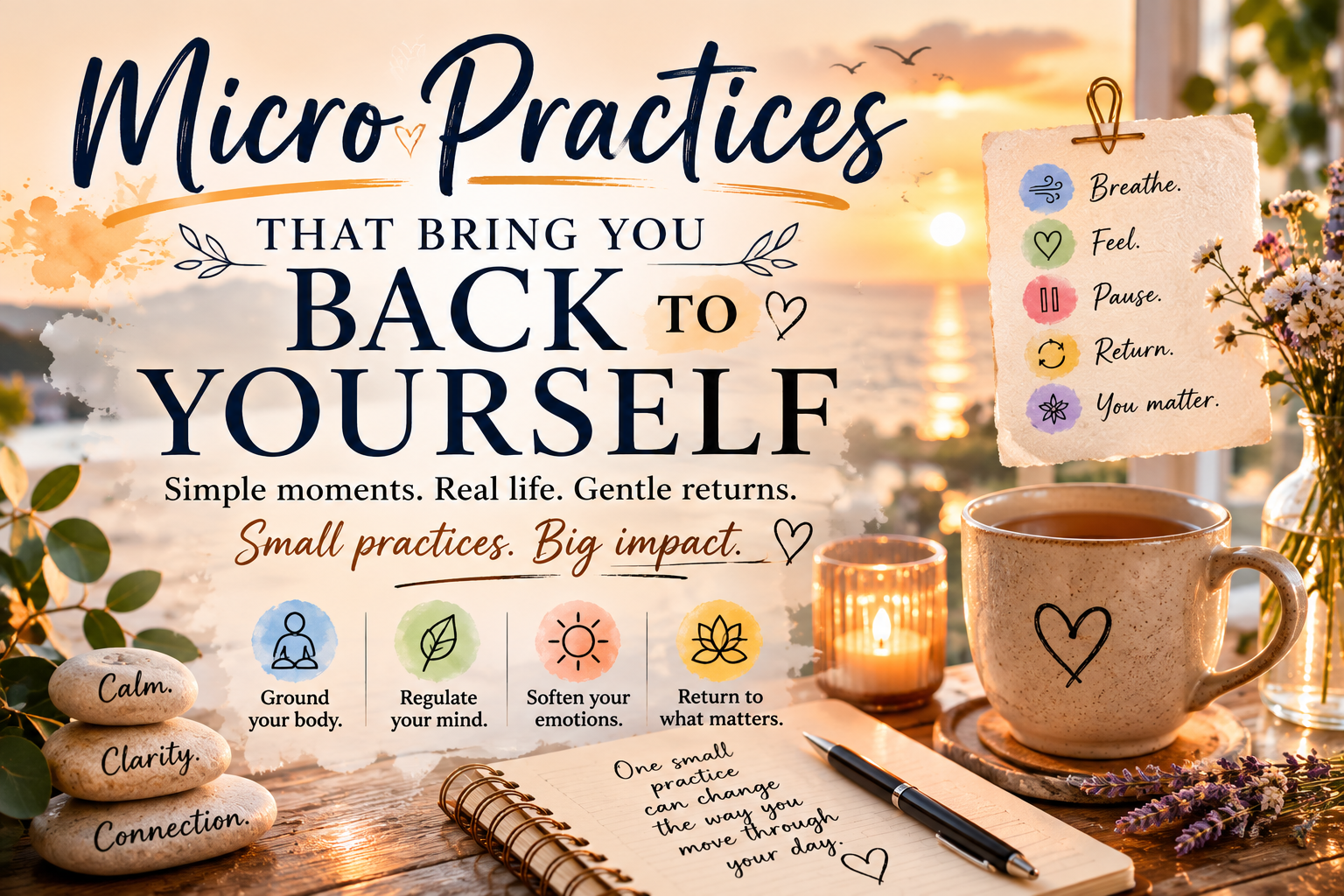
Micro Practices That Bring You Back to Yourself
Discover simple nervous system regulation practices for stress and overwhelm, including grounding, slow breathing, movement, sensory awareness, muscle release, prayer, and one-minute resets.
Simple Nervous System Regulation Practices for Stress, Grounding, Calm, and Returning to the Present
You do not need a perfect routine to come back to yourself.
Sometimes you need ten seconds.
One breath.
Feet on the floor.
A softer jaw.
A slower exhale.
A moment of looking around the room and remembering:
I am here.
Micro practices are small nervous system regulation practices that can be woven into ordinary life.
They do not require an hour of meditation.
They do not require silence, candles, perfect concentration, or a completely different personality.
They can happen while dishes are in the sink.
While the phone is ringing.
Between meetings.
Before answering a difficult message.
In the grocery store.
At your desk.
In the car before walking inside.
In the middle of a day that has become louder than you expected.
These practices matter because regulation is not only something you do once everything is peaceful.
It can also be something you practice while life is happening.
A small pause can interrupt momentum.
A longer exhale can slow the pace of a moment.
Feeling your feet can bring attention out of racing thoughts and back toward the body.
Looking around can reconnect you with your present surroundings.
A simple phrase can remind you that you do not have to solve everything at once.
Think of these practices as little returns.
Not dramatic.
Not magical.
Not something you have to perform perfectly.
Just small ways of reminding your mind and body:
Come back here.
What Is Nervous System Regulation?
Your nervous system is constantly helping your body respond to what is happening around and within you.
It helps regulate things such as heart rate, breathing, movement, alertness, digestion, sleep, and the body's response to stress.
When something feels demanding, uncertain, threatening, frustrating, or overwhelming, the body can become more activated.
You may notice:
A faster heartbeat.
Shallow breathing.
Tight shoulders.
A clenched jaw.
Restlessness.
Racing thoughts.
Difficulty concentrating.
Feeling keyed up or unable to settle.
At other times, overwhelm may feel more like shutting down.
You may feel disconnected.
Foggy.
Heavy.
Quiet in a way that does not feel peaceful.
Numb.
Far away from yourself.
Regulation does not mean remaining calm every minute of the day.
That is not the goal.
The nervous system is designed to shift.
Sometimes we need energy.
Sometimes we need rest.
Sometimes we need quick action.
Sometimes we need stillness.
The useful skill is learning how to notice your state and help yourself return toward greater steadiness when you need it.
Why Micro Practices Can Help
When stress is high, complicated instructions are not always useful.
You may not want a twenty-step routine.
You may not have thirty quiet minutes.
You may simply need something small enough to use.
That is where micro practices shine.
They give attention a clear place to land.
The body.
The breath.
The room.
The ground.
One sensation.
One movement.
One truthful sentence.
Repeated practice can make these responses more familiar.
Instead of waiting until stress feels enormous before trying to settle, you begin practicing small returns throughout the day.
You may start recognizing tension sooner.
Pausing sooner.
Breathing sooner.
Responding instead of reacting automatically.
The goal is not:
I will never feel stressed again.
A more useful goal is:
I know ways to come back when stress rises.
That is a very different kind of strength.
Match the Practice to What You Need
Not every stressful state needs the same response.
If you feel restless, tense, or keyed up, you may prefer:
A slower exhale.
Dropping your shoulders.
Releasing your jaw.
Gentle walking.
Quiet prayer.
If you feel foggy, disconnected, or far away from the present, you may prefer:
Looking around the room.
Feeling your feet.
Gentle movement.
A cool sensory cue.
Naming what you see, hear, or feel.
If you feel mentally overloaded, you may need:
One next step.
A written list.
Permission to stop solving everything at once.
A few minutes away from the screen.
A quieter environment.
You do not need to diagnose your nervous system.
Simply ask:
Do I need more settling, more grounding, more movement, or more space?
Then choose the smallest practice that matches the moment.
The Feet Check-In
Try this when your thoughts are racing or you feel scattered.
Place both feet on the floor.
Notice where they make contact.
Press down gently.
Feel the support beneath you.
If you are standing, slowly shift your weight slightly toward your heels and then toward the front of your feet.
You do not need to make it dramatic.
Simply notice:
Pressure.
Balance.
Temperature.
Texture.
The physical reality of standing or sitting where you are.
You can quietly say:
My feet are here.
Or:
I am supported by the ground beneath me.
This practice redirects attention toward immediate sensory information.
Instead of living entirely inside the storm of thought, you give awareness somewhere physical to land.
Sometimes ten seconds is enough to change the texture of a moment.
Look Around and Orient to the Present
Stress can pull attention inward.
You become absorbed in the thought.
The problem.
The conversation.
What might happen.
What already happened.
One simple way to interrupt that tunnel is to gently look around.
Turn your head slowly.
Let your eyes move through the space.
Find three neutral or pleasant things.
A chair.
A window.
A plant.
A lamp.
A picture.
Sunlight.
The color of a wall.
Then name them quietly.
Window.
Plant.
Blue chair.
You can add:
I am here, in this room, right now.
This kind of orienting practice brings attention back to present surroundings.
You are allowing your eyes and mind to take in more of the environment instead of remaining locked onto one internal point of tension.
Release the Jaw
Stress often shows up in muscles before we consciously notice how tense we have become.
The jaw is a common place to hold that tension.
Notice your teeth.
Are they pressed together?
Let them separate slightly.
Soften the muscles around the mouth.
Allow your tongue to rest comfortably rather than pressing or bracing.
Then breathe out slowly.
You may also gently move the jaw from side to side.
The goal is not to force relaxation.
Simply give muscles that have been working unnecessarily permission to do a little less.
Sometimes the body does not need an instruction to “calm down.”
It needs one place to stop gripping.
Drop the Shoulders
Here is another tiny physical reset.
Lift your shoulders gently toward your ears.
Pause.
Then release them downward.
Let your arms feel a little heavier.
Exhale.
Notice whether you were carrying tension there without realizing it.
You can repeat this once or twice.
Then ask:
What else am I holding that I do not need to hold this tightly?
Sometimes the body answers before the mind does.
Lengthen the Exhale
You do not need complicated breathwork to use breathing intentionally.
Try breathing in naturally.
Then let the exhale become a little slower and longer.
Do not force an enormous breath.
Just soften the pace.
Inhale comfortably.
Exhale slowly.
Again.
A longer, comfortable exhale may help some people feel more settled because breathing and autonomic nervous system activity are closely connected.
The point is not to breathe perfectly.
The point is to stop adding urgency to a moment that already has enough of it.
Sometimes two slower breaths are enough.
Try a Cool Sensory Cue
A cool sensation can provide a noticeable sensory cue that some people find refreshing or grounding.
You might:
Splash cool water on your face.
Hold a cool washcloth.
Run cool water over your hands.
Hold a cool drink.
Notice the temperature against your skin.
Instead of thinking of cool water as a magical nervous system switch, use it as a sensory anchor.
Temperature gives attention something immediate and physical to notice.
Ask:
What does this actually feel like?
Cool.
Wet.
Fresh.
Sharp.
Awakening.
Present.
You are bringing awareness back into the body and the current moment.
Use temperatures that feel comfortable rather than extreme.
One Hand on the Body
Touch can be a simple grounding cue.
Place one hand wherever feels natural.
Your chest.
Upper arm.
Shoulder.
Belly.
Hands together in your lap.
Let the contact be gentle.
Notice warmth.
Pressure.
Movement as you breathe.
You might quietly say:
I am here.
I can stay with myself through this.
One moment at a time.
For some people, gentle self-touch feels soothing because it creates a simple, familiar sensory anchor.
For others, another grounding method feels better.
Choose the practice that actually helps you feel more present.
Name What You Are Feeling
Sometimes the fastest way back to yourself is not changing the feeling.
It is naming it.
Try:
I am frustrated.
I am overwhelmed.
I am disappointed.
I am nervous.
I feel pressure.
I am tired.
Notice the difference between:
Everything is terrible.
and:
I am feeling overwhelmed right now.
One becomes the whole reality.
The other names an experience you are having within reality.
You are allowed to feel something without becoming the feeling.
Naming it can create a little space around it.
Ask What Your Body Needs
Before reaching for another technique, ask:
What do I need right now?
Maybe the answer is movement.
Water.
Food.
Fresh air.
Quiet.
Rest.
A bathroom break.
Less screen time.
A conversation.
Five minutes alone.
Something practical you have been postponing.
Not every uncomfortable nervous system state requires an elaborate explanation.
Sometimes you have been staring at a screen for four hours and need to stand up.
The body can be refreshingly unromantic that way.
Try a Slow Sip
Drink something slowly.
Water.
Tea.
Another drink you enjoy.
Instead of drinking while scrolling, typing, driving, or thinking about six other things, notice the act itself.
Feel the cup.
Notice the temperature.
Take one sip.
Pause.
Take another.
This is less about the beverage and more about doing one ordinary thing with full attention.
A nervous system reset does not always have to look like a nervous system reset.
Sometimes it looks like actually being present for the glass of water already in your hand.
Use a Visual Anchor
Choose one object nearby.
Look at it carefully.
Notice:
Its shape.
Color.
Texture.
Edges.
Shadow.
Details.
Then describe it silently.
The mug is white.
The handle is curved.
There is light reflecting near the top.
This gives the thinking mind a neutral task.
Instead of trying to force yourself to stop thinking, you redirect thought toward something simple and present.
Move for Thirty Seconds
Sometimes stillness is not what you need.
Stress can bring a lot of physical activation with it.
Try standing.
Stretch your arms overhead.
Roll the shoulders.
Shake out your hands.
Walk across the room.
March gently in place.
Stretch your back.
Movement gives the body somewhere to put some of that energy.
You do not always have to calm yourself by becoming motionless.
Sometimes regulation looks like movement first and stillness later.
Step Outside
If possible, step outdoors for a moment.
Feel the temperature.
Notice the sky.
Listen for a bird, wind, traffic, or distant voices.
Look toward something farther away than the screen in front of you.
Take one normal breath.
You do not have to turn it into a twenty-minute nature meditation.
Just step outside.
Sometimes changing the environment helps interrupt a loop that was becoming louder indoors.
Permission Can Be Part of Regulation
Sometimes what helps most is not another technique.
It is permission.
Pressure often multiplies when you believe everything must be solved immediately.
Try one of these:
I do not have to solve everything right now.
I can pause before I react.
I can take one small step.
I do not need the entire answer yet.
This feeling can be here without making every decision for me.
I can give myself a minute.
I am allowed to respond after I have gathered myself.
Permission changes the assignment.
You are no longer demanding that you instantly become calm.
You are giving yourself room to return.
Prayer Can Become a Micro Practice Too
A prayer does not have to be long to bring your attention back toward God.
Sometimes one sentence is enough.
God, help me become still enough to hear what is true.
God, steady me here.
God, give me wisdom for the next step.
God, help me release what I cannot control.
God, bring me back to peace.
Prayer does not require pretending the stress is gone.
It gives you somewhere to bring it.
Sometimes the return to yourself is also a return to remembering that you do not have to carry everything alone.
A One-Minute Return-to-Self Sequence
When you need something simple, try this:
1. Put your feet on the floor.
Feel the contact beneath you.
2. Exhale slowly twice.
No huge breaths. Just soften the pace.
3. Look around and name three things you see.
Bring attention into the present environment.
4. Relax your jaw and shoulders.
Let one place in the body do less work.
5. Place one hand somewhere comfortable.
Notice the contact.
6. Ask: What do I need next?
Not for the whole day.
Just next.
7. Say: I am here.
That is enough.
No perfection.
No performance.
Just a return.
Build Micro Practices Into Things You Already Do
One of the easiest ways to remember these practices is to attach them to ordinary moments.
When you wash your hands:
Feel the water.
When you sit in the car:
Take one slower exhale.
When your phone rings:
Drop your shoulders before answering.
When you open your laptop:
Feel your feet.
When you walk through a doorway:
Notice the room you are entering.
When you make coffee or tea:
Take ten seconds without checking anything.
When you get into bed:
Release your jaw.
When you wake:
Notice three things you can see.
You are turning existing moments into reminders.
No giant routine required.
Small Returns Can Build Self-Trust
Each time you notice yourself and respond with care, you strengthen your relationship with yourself.
You begin communicating:
I notice when I am overwhelmed.
I do not have to abandon myself inside stress.
I can pause.
I can choose what happens next.
That is self-trust.
Not the belief that you will never struggle.
The knowledge that when life becomes difficult, you have ways to stay connected to yourself through it.
Your Nervous System Does Not Need Perfection
Some days these practices may create a noticeable shift.
Other days they may help only a little.
That still counts.
You are not trying to achieve some permanently regulated state where nothing bothers you.
Being human includes activation.
Excitement.
Stress.
Sadness.
Frustration.
Intensity.
Rest.
Joy.
Uncertainty.
The nervous system is meant to move through states.
The goal is flexibility.
The ability to rise when action is needed.
Settle when the moment allows.
Recover after stress.
And recognize when your body and mind need support.
Micro practices simply create more opportunities for that return.
Frequently Asked Questions
What Is a Nervous System Reset?
A nervous system reset is an informal term for practices that may help you shift from feeling highly activated, overwhelmed, scattered, or disconnected toward greater grounding and steadiness.
There is no literal reset button in the nervous system.
The phrase describes helping your body and attention move toward a more manageable state.
What Are Micro Regulation Practices?
Micro regulation practices are brief actions that use breathing, sensory awareness, movement, attention, touch, grounding, or simple reflection to help you reconnect with the present moment.
They may take only a few seconds or a minute.
How Can I Calm My Nervous System Quickly?
Different practices work for different people.
Simple options include slowing your exhale, feeling your feet on the ground, looking around your environment, relaxing tense muscles, moving gently, stepping outside, or focusing on a neutral sensory detail.
Why Does Grounding Help When I Feel Stressed?
Grounding redirects attention toward immediate sensory information such as sight, touch, movement, sound, and physical surroundings.
This can help interrupt loops of racing thoughts and bring more attention into what is happening right now.
Does Cold Water Reset the Nervous System?
Cool sensations can feel grounding or refreshing, but “reset” is an oversimplification.
Cool water can provide a strong sensory cue that redirects attention and may feel settling or alerting depending on the person and the situation.
Extreme cold is not necessary for this kind of grounding practice.
Do I Need Breathwork to Regulate My Nervous System?
No.
Breathing practices are only one option.
Movement, sensory grounding, muscle relaxation, orienting to the room, stepping outdoors, prayer, quiet, touch, and addressing basic physical needs can all be useful ways of returning toward steadiness.
What If a Grounding Practice Does Not Work for Me?
Try another one.
There is no single technique that feels right for everyone or in every moment.
Sometimes you need stillness.
Sometimes movement.
Sometimes sensory input.
Sometimes food, water, rest, space, prayer, or a practical solution to the thing creating stress.
The most useful practice is one that actually helps you become more present and able to choose your next step.
Affirm Gently
You do not have to command yourself into calm.
Try something softer:
Even in the middle of life, I can return to my center.
Or:
I am allowed to pause.
Or:
One small return is enough for this moment.
Or:
God, help me come back to what is true and steady.
Come Back One Small Moment at a Time
You do not need a flawless nervous system routine.
You do not need to regulate perfectly.
You do not need to transform every stressful moment into peace.
You need ways to return.
Feet on the floor.
One slower breath.
A look around the room.
A softer jaw.
A dropped shoulder.
A sip of water.
Thirty seconds of movement.
A hand resting gently on your body.
A prayer.
A truthful sentence.
A moment outside.
A reminder that everything does not have to be solved right now.
These practices are small because life is real.
You need things you can actually use while the dishwasher is running, the deadline is approaching, your phone is buzzing, and somebody has just asked you a question you were not prepared to answer.
That is where the practice lives.
Not outside ordinary life.
Inside it.
You are not trying to become someone who never gets overwhelmed.
You are becoming someone who recognizes:
I know how to come back.
One breath.
One sensation.
One choice.
One tiny return at a time.
Your Soulful Pathways ↑
Desktop: Hover over ‘Your Soulful Pathways’ in the top menu to explore another series.
Mobile: Tap the menu (☰), then choose ‘Your Soulful Pathways.’.

The Freeze Response and How to Gently Thaw
Understand the freeze response and learn gentle ways to thaw and return to yourself without pressure or shame.
Freeze is not laziness. Freeze is protection.
When your nervous system believes fight or flight isn’t possible, it may choose shutdown. It’s the body’s way of conserving energy and reducing threat when things feel too much, too fast, or too unsafe. Freeze can look like stillness, avoidance, numbness, procrastination, or that heavy “I can’t” feeling that doesn’t respond to willpower.
Because our world rewards productivity, people often shame themselves for freeze. But shame makes freeze stronger. Your nervous system doesn’t thaw from criticism. It thaws from safety.
How freeze can show up in real life
Freeze is not always dramatic. Sometimes it’s quiet and daily:
You scroll but don’t absorb anything.
You stare at a task and feel glued in place.
You avoid messages or calls because it feels like too much.
You feel foggy, distant, or blank.
You feel heavy and exhausted, even with small responsibilities.
You know what you “should” do, but your body won’t cooperate.
If this is you, start here: your body is not failing. It is protecting.
What freeze is trying to do for you
Freeze can reduce conflict, reduce exposure, and reduce risk. It’s a nervous system strategy that says, “If I stay still, maybe I’ll be safe.” It’s not a choice you make with logic. It’s a state your body drops into when it senses overload.
The most important rule
Don’t try to bully yourself out of freeze. If pushing worked, you’d already be out. Thaw happens when your system gets enough signals of safety to come back online.
How to thaw gently
Choose one or two steps, not all of them. Gentle and doable is the goal.
1) Name it without judgment
Say: “This is freeze.”
Not: “I’m lazy.”
Not: “I’m broken.”
Naming creates space between you and the state. It helps your brain stop turning this into a character story.
2) Add warmth and comfort
Warmth tells your system: we are not under attack.
Try:
a blanket
a warm mug
a warm shower
cozy socks
sitting in sunlight for one minute
3) Use micro-movement
Your nervous system responds better to tiny motion than big demands:
wiggle toes
roll shoulders
open and close hands
stretch fingers
stand up and sit down once
Small movement signals safety without overwhelm.
4) Choose one tiny completion
Pick an action under two minutes:
open the curtains
drink water
wash your face
put one dish away
set a timer for a 90-second task
Completion creates a spark of “I can,” without pressure.
5) Offer your body reassurance
Put a hand on your chest and try:
“I’m not leaving you.”
“We can do this slowly.”
“One tiny step is enough.”
Freeze often softens when your system feels accompanied instead of judged.
A simple thaw sequence (under one minute)
Exhale slowly three times.
Press your feet into the floor.
Name one tiny action you can do in under two minutes.
Do it gently.
Rest for 30 seconds afterward.
Thaw is not a sprint. It’s a return.
Affirm gently
“I don’t have to force my way out. I can return gently.”
Your Soulful Pathways ↑
Desktop: Hover over ‘Your Soulful Pathways’ in the top menu to explore another series.
Mobile: Tap the menu (☰), then choose ‘Your Soulful Pathways.’.

Signs Your Body Does Not Feel Safe Yet
Discover gentle signs your body is still in survival mode and learn supportive ways to build real inner safety.
You can be in a safe place and still feel unsafe inside. That’s not weakness. That’s a nervous system remembering.
Safety isn’t just a fact. It’s a felt experience your body has to learn again.
When your system has lived through stress, loss, unpredictability, conflict, chronic pressure, or past trauma, it may keep scanning for danger even when life looks calm on the surface. Your mind can say, “I’m fine,” while your body whispers, “Stay ready.”
What it can look like when your body doesn’t feel safe yet
These signs are not character flaws. They are protective strategies your nervous system learned to keep you functioning.
You can’t fully relax, even during rest
Your shoulders stay lifted. Your jaw stays tight. Your belly stays clenched. Even when you sit down, your body feels like it’s waiting for the next interruption. Rest becomes “pause with one eye open,” not true release.
You startle easily
A loud sound, a sudden text, a door closing, a tone change. Your body reacts first, then your brain catches up. This is your system trying to protect you quickly, before it decides whether you’re actually in danger.
You read between lines constantly
You analyze facial expressions, pauses, and energy shifts. You try to predict what people will do so you won’t be caught off guard. This is hypervigilance, and it often comes from a history where surprises felt unsafe.
You feel guilty when you rest
Your nervous system learned that slowing down could be risky: you might fall behind, disappoint someone, or miss a threat. So even good rest can feel “wrong,” and your mind tries to bargain you back into productivity.
You go numb or disconnect
You may feel foggy, blank, distant, or emotionally muted. Not because you don’t care, but because your system is conserving energy. Numbness can be a protection when feeling too much once felt dangerous.
You feel the need to control everything
Control becomes a substitute for safety. If you can manage it, anticipate it, or fix it, your system believes it can relax. The hard part is that control never truly finishes the job. It just keeps the body “on duty.”
If this resonates, let this land softly
Your body isn’t being dramatic. It’s being protective. And protective parts don’t need scolding. They need reassurance, consistency, and new experiences that prove safety is real.
What your body is asking for
Not a harsh push. Not more pressure. Not a “get over it.”
It’s asking for predictability, gentleness, slower transitions, supportive routines, and the kind of boundaries that reduce daily stress.
Try a simple safety inventory
Take two minutes and answer these gently:
What helps me feel safer in my body?
What makes me feel less safe?
What am I tolerating that keeps my system on edge?
That last question can be powerful. Sometimes “safety” begins with one honest adjustment, not a whole life overhaul.
Choose one small safety-building action today
Pick one and keep it simple:
Drink water before caffeine.
Spend two minutes outside.
Lower the volume (music, TV, notifications).
Tidy one small area to reduce visual stress.
Exhale slower than you inhale for 60 seconds.
Say no to one thing that drains you.
Small, repeated moments teach the nervous system: “We’re allowed to soften.”
Affirm gently
“I can create safety in small ways. I can live inside myself again.”
Your Soulful Pathways ↑
Desktop: Hover over ‘Your Soulful Pathways’ in the top menu to explore another series.
Mobile: Tap the menu (☰), then choose ‘Your Soulful Pathways.’.
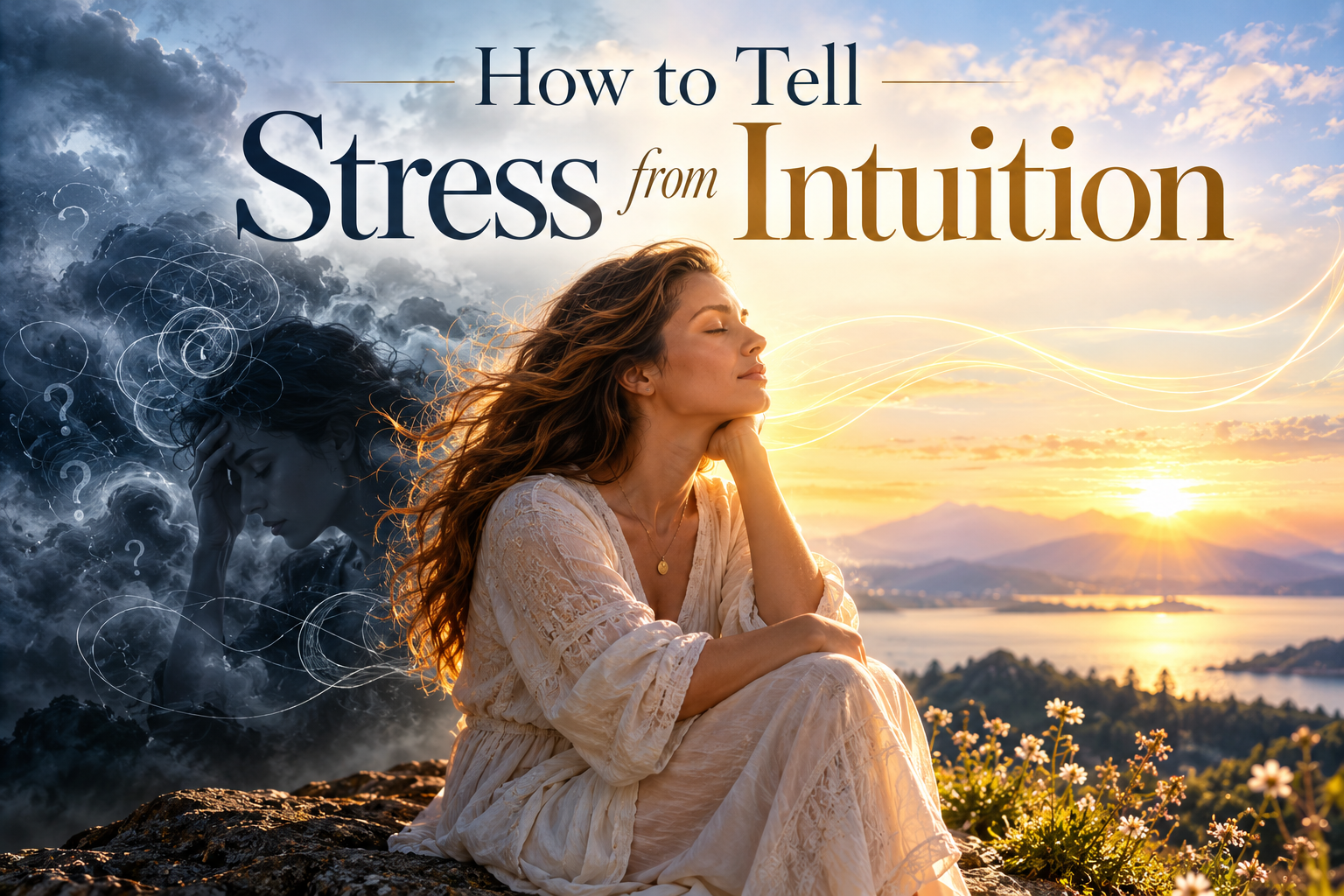
How to Tell Stress from Intuition
Learn how to tell stress from intuition, recognize fear-driven thoughts, understand gut feelings, and strengthen inner wisdom and spiritual discernment.
Understanding Fear, Inner Wisdom, and the Quiet Guidance Within
There are moments when something within you seems to know before your mind can explain.
You meet someone and sense an immediate connection. You consider an opportunity and feel an unexpected sense of possibility. You enter a situation and notice a subtle feeling that something deserves your attention.
Sometimes the feeling arrives as clarity. Sometimes it appears as a physical sensation, a sudden realization, or a quiet thought that seems to rise from somewhere deeper than ordinary reasoning.
This is often what we call intuition.
But there is another experience that can feel remarkably similar.
Stress can also create powerful inner signals. It can make the heart beat faster, tighten the stomach, sharpen attention, and produce a strong feeling that something needs to happen immediately.
Both experiences can influence our decisions before we have consciously examined all the information. Both can feel deeply personal, and both can be convincing.
The beautiful possibility is that we can become more aware of these inner experiences without fearing them, suppressing them, or automatically believing every thought they produce.
Learning to distinguish stress from intuition is not about choosing between the mind and the spirit. It is about developing the awareness to recognize what is happening within us and the wisdom to respond thoughtfully.
What Is Intuition and Where Does It Come From?
Intuition is the ability to form an impression, recognize a pattern, or arrive at an understanding without consciously working through every step of reasoning.
Although intuition can feel mysterious, the human brain has remarkable abilities that help explain how it develops.
Throughout life, the brain continuously collects information from experiences, relationships, conversations, surroundings, and emotional responses.
Much of this information is processed outside conscious awareness.
Over time, the brain learns patterns.
It recognizes familiar expressions, changes in behavior, environmental details, and connections between events.
Sometimes these patterns become apparent before we can explain exactly what we have noticed.
A teacher may recognize that a student is struggling before the student says anything.
An experienced nurse may notice a subtle change in someone's condition.
A person may sense that an opportunity aligns with their interests before they have fully considered every practical detail.
These impressions can emerge from accumulated experience and unconscious learning.
Researchers sometimes describe this as implicit learning or rapid pattern recognition.
Intuition is not necessarily a random feeling. It can represent information the brain has recognized without bringing every part of the process into conscious awareness.
Yet intuition is not automatically correct. The same unconscious processes can be influenced by incomplete information, expectations, and past experiences.
Its value grows when we learn to combine inner awareness with observation, reflection, and discernment.
How Life Experience Teaches Intuition to Recognize Patterns
One of the most fascinating discoveries in psychology is that intuition can become more reliable through experience.
Psychologists Daniel Kahneman and Gary Klein examined this subject in their 2009 research paper, Conditions for Intuitive Expertise: A Failure to Disagree, published in American Psychologist.
They explored why intuitive judgments can sometimes be remarkably accurate while other impressions become misleading.
Their work identified two important conditions for developing reliable intuitive expertise.
The first is an environment containing patterns that can actually be learned.
The second is sufficient opportunity to learn those patterns through experience and meaningful feedback.
Consider an experienced musician.
After years of practice, the musician may immediately recognize that something sounds slightly wrong, even before identifying the particular note.
An experienced gardener may recognize subtle changes in a plant that a beginner overlooks.
Someone who has spent years working with people may become especially sensitive to changes in tone, behavior, or communication.
In these situations, intuition can represent knowledge that has become so familiar that it no longer requires deliberate analysis.
However, experience alone does not guarantee accuracy.
If an environment is highly unpredictable or feedback is misleading, confidence can grow without judgment becoming more reliable.
This gives us an important understanding of inner wisdom.
Intuition becomes more valuable when it is informed by experience, strengthened by reflection, and open to learning.
What Happens in the Body When We Experience Stress?
Stress is a natural biological response that helps us respond to challenges, demands, and perceived threats.
When the brain recognizes a situation as demanding or potentially dangerous, several interconnected systems begin responding.
The sympathetic nervous system can increase alertness and prepare the body for action.
Adrenaline helps support rapid responses by influencing heart rate, circulation, and energy availability.
The hypothalamic-pituitary-adrenal axis participates in a broader hormonal response, including the release of cortisol.
These changes are not inherently harmful.
They are part of the body's extraordinary ability to adapt.
A short-term stress response can help us focus, prepare, and act when something requires immediate attention.
However, when stress becomes intense or continues for long periods, it can influence how we interpret information.
Attention may become more focused on possible threats.
Uncertainty may feel increasingly uncomfortable.
Ordinary problems may seem more urgent.
It may become harder to consider several possibilities at once.
Research examining acute stress has found that stress can interfere with working memory and cognitive flexibility, although its effects vary depending on the task, intensity, and circumstances.
This means stress can change not only how we feel, but also how we evaluate what is happening around us.
A situation that deserves thoughtful consideration may begin to feel like an emergency.
Understanding this response allows us to approach our feelings with greater awareness rather than automatically treating every uncomfortable sensation as a warning.
Why Stress and Intuition Can Feel So Similar
Stress and intuition can both appear before conscious reasoning catches up.
Both may involve changes in attention, emotion, and physical sensations.
You might notice a tightening stomach before an important conversation.
You may experience a sudden feeling of uneasiness around a decision.
You may sense excitement about an opportunity without immediately knowing why.
The experience itself is real.
But the meaning of that experience may require further exploration.
The brain continuously combines information from the body with memories, expectations, surroundings, and previous experiences.
Sometimes this process produces a useful recognition.
Other times, stress influences how the information is interpreted.
The important distinction is that feeling something strongly does not automatically reveal what caused it or what it means.
A powerful feeling may deserve attention without requiring immediate obedience.
The Difference Between Stress, Anxiety, and Intuition
Stress, anxiety, and intuition are related to different aspects of human experience, although they can overlap.
Stress generally involves a response to demands, pressures, or perceived challenges.
Anxiety involves apprehension, worry, or anticipation of possible threats. It may continue even when no immediate danger is present.
Intuition involves an impression or recognition that emerges without fully conscious reasoning.
There is also another experience worth understanding.
Rumination occurs when the mind repeatedly returns to distressing thoughts, concerns, or interpretations without necessarily reaching a useful conclusion.
For example, you might notice that a conversation felt different than usual.
An intuitive impression may draw your attention to a subtle change in someone's behavior.
Anxiety may begin imagining what that change could mean.
Rumination may keep replaying the conversation and searching for an explanation.
These experiences can occur together.
The goal is not to force every feeling into one category. It is to understand which processes may be influencing your interpretation.
How to Recognize Stress and Intuition in Everyday Life
There is no single physical sensation or emotional quality that reliably distinguishes intuition from stress.
However, certain patterns can help us explore what we are experiencing.
When Stress Is Influencing a Reaction
Thoughts repeatedly focus on possible negative outcomes.
There is a strong desire to eliminate uncertainty immediately.
The mind continually searches for reassurance.
A situation feels threatening primarily because of imagined possibilities.
Decision-making becomes focused on escaping discomfort.
When Intuition May Be Contributing
An impression emerges from a recognized pattern or meaningful detail.
A sense of direction appears before a complete explanation.
An impression remains meaningful without constant mental repetition.
The feeling connects to observable information or previous experience.
Attention turns toward something important, meaningful, or worth exploring.
These patterns are not absolute.
Intuition can feel urgent when genuine danger is present.
Stress can alert us to real problems.
An intuitive impression can be mistaken, and an anxious concern can turn out to be justified.
The distinction becomes clearer when we consider the feeling alongside the situation, our history, and the information available.
When Your Inner Knowing Arrives Before Your Explanation
Have you ever suddenly understood something without knowing exactly how you reached the conclusion?
Perhaps you recognized that a particular opportunity was worth exploring.
Maybe you noticed a change in a relationship that had been developing gradually.
Or perhaps a solution appeared after you had stopped actively thinking about a problem.
These experiences can reflect the brain's ability to integrate information outside conscious awareness.
The mind does not need to explain every step of a process for that process to influence awareness.
Sometimes understanding appears as a completed impression rather than a sequence of thoughts.
This is one reason intuition can feel immediate.
But an impression is the beginning of understanding, not necessarily the end.
We can honor the experience by becoming curious about it.
What might I have recognized?
What details support this feeling?
Does it connect to something I have learned before?
What else might explain it?
These questions allow intuition and conscious reasoning to work together.
Stress Often Creates Urgency While Intuition May Create Recognition
One of the most useful distinctions involves our relationship with uncertainty.
Stress often increases the desire to resolve uncertainty quickly.
The mind may begin asking:
What if I make the wrong decision?
What if something terrible happens?
What if I miss my opportunity?
What if I cannot handle the outcome?
These questions can create pressure to act immediately.
Sometimes the urgency comes from the situation itself.
Other times, it comes from the desire to escape an uncomfortable feeling.
This is an important difference.
Making a decision can temporarily relieve anxiety, even when the decision has not been carefully considered.
Intuition, by contrast, may begin as a simple recognition.
Something deserves attention.
A possibility feels meaningful.
A familiar pattern has appeared.
An important detail does not seem consistent.
Intuition does not always feel calm, and stress does not always feel chaotic. Still, noticing whether you are seeking understanding or simply trying to escape uncertainty can be revealing.
The desire for immediate relief is not always the same as the presence of inner clarity.
When a Genuine Warning Feels Like Anxiety
Not every uncomfortable feeling comes from imagined danger.
Sometimes the body responds to something important before we consciously identify it.
A person may notice that someone's behavior has changed.
A situation may contain inconsistencies that deserve attention.
An environment may present genuine signs of danger.
These observations can produce anxiety because recognizing a potential threat naturally activates protective responses.
In these moments, the presence of fear does not invalidate the concern.
A useful question is whether the feeling connects to something observable.
What happened?
What did I notice?
Is there a specific behavior, inconsistency, or circumstance that deserves attention?
When there is immediate danger, appropriate protective action matters more than trying to determine whether the feeling qualifies as intuition.
In everyday situations, however, examining the available evidence can help us distinguish a meaningful warning from a prediction created primarily by fear.
How to Tell a Genuine Warning from an Old Emotional Wound
Our experiences shape the way we interpret the present.
The brain learns associations between situations, emotions, and outcomes.
When a new experience resembles something difficult from the past, familiar emotional responses may arise.
Someone who previously experienced dishonesty may become especially sensitive to uncertainty in relationships.
Someone who has experienced financial hardship may feel apprehensive when considering a new investment.
Someone who has been criticized repeatedly may interpret ordinary feedback as rejection.
These responses may reflect learned protective patterns.
Sometimes those patterns help us recognize genuine concerns.
At other times, they cause a new situation to feel more threatening than the available information supports.
The important question is not whether the feeling is real.
It is whether the interpretation belongs to the present situation.
Consider asking:
Does this remind me of something I have experienced before?
Am I responding to what is happening now or what I fear might happen again?
What is different about this situation?
What information would help me understand it more accurately?
Recognizing an old emotional pattern does not mean dismissing yourself.
It means giving yourself the opportunity to respond to the present rather than automatically reliving the past.
What Your Gut Feelings Are Really Telling You
The expression gut feeling has an intriguing biological foundation.
The digestive system contains an extensive network of neurons known as the enteric nervous system.
This network participates in regulating digestion and communicates with the central nervous system through several pathways.
The vagus nerve is one important connection between the brain and internal organs.
Hormonal, immune, and microbial pathways also contribute to gut-brain communication.
This complex relationship helps explain why emotions can influence digestive sensations.
Excitement may produce butterflies.
Anxiety may contribute to nausea or abdominal discomfort.
Stress may change digestive activity.
The body and brain are constantly exchanging information.
Researchers study the perception of internal bodily signals through a process called interoception.
Interoception contributes to our awareness of heartbeat, breathing, hunger, fullness, tension, and other internal sensations.
But bodily awareness and bodily interpretation are not the same thing.
You can accurately recognize that your stomach feels tight while remaining uncertain about why.
A gut feeling may draw attention to something important, but the sensation itself cannot determine whether a person is trustworthy or whether a future event will occur.
Your body can tell you that something is happening within you. Understanding what it means requires awareness, context, and discernment.
Why Anxiety Can Change the Meaning We Give to Body Sensations
Research on anxiety and interoception has revealed an important distinction.
A 2024 systematic review and meta-analysis examining findings from 71 studies involving self-reported interoception and anxiety found associations between anxiety and greater negative attention to bodily signals, increased sensitivity to uncomfortable sensations, and difficulties describing internal experiences.
These findings do not mean that people experiencing anxiety are simply less capable of detecting bodily sensations accurately.
Instead, they highlight how anxiety can influence the attention and meaning we give to what we feel.
Imagine feeling your heart beat faster before meeting someone new.
One interpretation is that something is wrong.
Another is that you are excited.
A third is that you are nervous because the meeting matters to you.
The physical sensation may be similar across these experiences.
Context helps reveal the difference.
This understanding can be liberating.
You do not have to dismiss a sensation or turn it into a prediction.
You can simply recognize it as information and remain curious about its meaning.
When Intuition Invites You Toward Something New
Intuition is often discussed as a warning system.
But inner knowing can also be associated with possibility, creativity, connection, and growth.
Sometimes intuition seems to draw us toward something rather than away from it.
You may encounter an idea that feels unusually meaningful.
You may recognize a talent you want to develop.
You may meet someone whose values resonate with your own.
You may discover a path that connects experiences and interests you had previously considered unrelated.
These moments can be deeply inspiring.
They may reflect the brain recognizing meaningful patterns, connections, and opportunities.
They may also carry spiritual significance for someone who experiences life through faith and a sense of calling.
Not every exciting opportunity is necessarily right for us.
But a feeling of possibility can be worth exploring.
Instead of demanding immediate certainty, we can ask what the experience is inviting us to discover.
Perhaps the next step is learning more, having a conversation, developing a skill, or taking one small action.
Sometimes intuition does not provide the entire destination.
It simply draws our attention toward a door worth opening.
Can Intuition Feel Like Fear?
Yes.
A meaningful intuitive impression can be accompanied by fear, especially when it involves uncertainty or significant change.
Imagine being offered a new position that aligns with your abilities and long-term goals.
You may feel excited by the opportunity while also experiencing anxiety about unfamiliar responsibilities.
The fear does not necessarily mean the opportunity is wrong.
It may reflect the importance of the decision.
Likewise, recognizing a genuine concern can produce discomfort.
The presence of anxiety does not automatically discredit what you have noticed.
The more useful question is whether the feeling contains information worth examining.
Can you identify a specific concern?
Does the impression connect to experience or evidence?
Are you imagining a negative outcome without supporting information?
Can you distinguish excitement about possibility from fear of uncertainty?
These questions allow us to understand our emotional responses without giving any single feeling complete authority over our decisions.
Why Feeling Peaceful Does Not Always Mean a Decision Is Right
Peace can be a beautiful and meaningful experience.
A settled mind may make it easier to reflect, recognize priorities, and consider different possibilities.
For many people, spiritual peace is also associated with prayer, trust, and a sense of connection with God.
Yet emotional calm is not a guarantee of accuracy.
A person can feel peaceful about an assumption that later proves incorrect.
Someone can feel uncomfortable about a decision that ultimately becomes deeply rewarding.
Our emotional states are influenced by expectations, beliefs, previous experiences, and current circumstances.
This means peace is valuable without needing to function as proof.
A decision can be approached through several forms of wisdom.
We can consider our values.
We can examine the available evidence.
We can seek counsel.
We can pray.
We can reflect on possible consequences.
And we can remain open to learning something new.
Peace may accompany this process, but discernment involves more than the presence or absence of a particular emotion.
How the Nervous System Can Help Restore Clarity
When stress increases, the body may become more activated.
Breathing can change.
Muscles may tighten.
The heart may beat faster.
Attention may become focused on possible problems.
These changes can make reflective thinking more difficult.
Fortunately, the nervous system is adaptable.
The sympathetic and parasympathetic branches of the autonomic nervous system work together to support the body's changing needs.
Simple practices can help some people reduce unnecessary physiological activation and return to a more comfortable state.
A few slow, gentle breaths may help.
Walking outdoors can provide movement and a change of environment.
Relaxing the shoulders and jaw may reduce unnecessary muscular tension.
A quiet moment away from digital distractions can allow attention to settle.
These practices do not guarantee that a decision will become obvious.
Their value lies in creating better conditions for reflection.
We are not trying to eliminate every uncomfortable feeling.
We are allowing ourselves to approach the experience with greater steadiness.
A Two-Minute Practice for Recognizing Your Inner Signals
When you feel uncertain about whether an experience reflects stress or intuition, a brief moment of awareness can help.
First 30 Seconds: Return to the Present
Sit or stand comfortably.
Notice your feet against the ground.
Relax your shoulders.
Allow your breathing to become gentle and natural.
There is nothing you need to force.
Next 30 Seconds: Notice What You Are Feeling
Pay attention to your emotional and physical experience.
Are you feeling excitement, apprehension, urgency, tension, or curiosity?
You do not need to identify everything perfectly.
Simply observe.
Next 30 Seconds: Separate What You Know from What You Fear
Ask yourself what has actually happened.
What information do you have?
What are you predicting?
Are you noticing a genuine pattern, or are you imagining an outcome that has not occurred?
Final 30 Seconds: Consider the Next Wise Step
Ask what would help you understand the situation more clearly.
Perhaps you need additional information.
Perhaps you need time.
Perhaps a conversation would help.
Perhaps the next step is simply acknowledging that something deserves attention.
The purpose of this practice is not to manufacture certainty.
It is to create a moment in which awareness can become more deliberate.
Why Stillness Can Make Inner Guidance Easier to Recognize
Modern life is filled with competing demands on attention.
Messages, notifications, responsibilities, conversations, and constant streams of information can make it difficult to notice our internal experiences.
Stillness offers a different kind of space.
A quiet walk, a moment of prayer, sitting outdoors, or spending time without digital distractions can create an opportunity for reflection.
During periods of reduced external demands, the mind may continue processing memories, experiences, and unresolved questions.
Sometimes an idea emerges after we stop consciously struggling to find an answer.
Other times, we recognize that an uncomfortable feeling was connected to exhaustion, frustration, or emotional overload.
Stillness does not guarantee revelation.
It allows us to become more attentive.
And sometimes what we discover is not a dramatic answer, but a clearer understanding of ourselves.
How Intuition and Logical Thinking Can Strengthen Each Other
Intuition and reasoning are often treated as competing forces.
Yet they can complement one another.
Intuition may help us recognize something that deserves attention.
Reasoning can help us determine whether the impression is supported by information.
Consider someone evaluating a career opportunity.
They may initially feel uncertain about the position.
Rather than immediately declining, they begin asking questions.
They discover that the responsibilities are unclear or that the schedule does not align with their priorities.
Their initial impression directed their attention toward an issue worth investigating.
Now imagine the opposite situation.
Someone feels nervous about a promising opportunity.
After examining the responsibilities, compensation, schedule, and potential for growth, they realize that the position aligns well with their goals.
The anxiety was real, but it was not necessarily a warning.
In both situations, inner awareness helped begin the process.
Thoughtful evaluation helped bring it into focus.
The strongest decisions often emerge when intuition invites us to notice and wisdom helps us understand.
The Spiritual Meaning of Discernment
For many people, intuition is connected to something greater than conscious thought.
It may be experienced through prayer, faith, spiritual reflection, or a sense of being guided toward a meaningful purpose.
Within Christian traditions, discernment involves seeking God's wisdom while examining our intentions, circumstances, and choices.
Scripture repeatedly emphasizes the value of wisdom.
James 1:5 encourages those who lack wisdom to ask God.
Proverbs 3:5–6 speaks of trusting in the Lord and acknowledging Him along life's path.
These passages invite reflection on the relationship between faith, understanding, and guidance.
Spiritual discernment does not require us to abandon reason.
We can pray while gathering information.
We can trust God while seeking wise counsel.
We can remain open to guidance while recognizing that our personal interpretations may be incomplete.
Sometimes prayer brings a sense of peace.
Sometimes it encourages patience.
Sometimes it helps us recognize a responsibility we have been avoiding.
And sometimes the answer becomes clearer through circumstances, learning, and time.
Faith can create room for both trust and thoughtful action.
Learning to Recognize Guidance Without Forcing an Answer
There is a difference between seeking guidance and demanding certainty.
When we feel anxious, we may want an unmistakable sign that tells us exactly what to do.
We may repeatedly examine a feeling, hoping it will eventually become impossible to misunderstand.
But constant searching can sometimes increase confusion.
A more peaceful approach is to remain open without trying to force an interpretation.
You can acknowledge an impression.
You can pray about it.
You can consider what it may be drawing your attention toward.
You can gather information and allow understanding to develop.
Not every meaningful feeling needs to become an immediate decision.
Not every unanswered question represents a missed opportunity.
Sometimes discernment involves recognizing that the next step is small, practical, and available right now.
When a Feeling Keeps Returning
Some impressions return repeatedly.
An idea may continue appearing in your thoughts.
A concern may remain present after several days.
A possibility may continue capturing your interest.
Recurring thoughts can feel especially significant, but repetition alone does not establish that something is intuitive.
Anxiety and rumination can also create recurring mental experiences.
The important distinction is whether the repetition brings new understanding or simply returns to the same uncertainty.
You might ask:
What is this thought directing my attention toward?
Is there something practical I need to address?
Does it connect to an important value?
Am I discovering new information, or repeating the same fear?
Is there a constructive action available?
A recurring impression can become an invitation to explore something more deeply.
It does not have to become a command.
How to Strengthen Your Intuition Through Everyday Experience
Developing intuition is not necessarily about trying to feel more.
It is often about learning to recognize patterns more accurately.
One helpful practice is to keep a decision journal.
When you experience a strong impression, write down what happened.
Describe the feeling.
Record what you believed it meant.
Include the information you had at the time.
Later, return to the entry and consider what actually occurred.
You may discover that some impressions were connected to recognizable patterns.
Others may have reflected assumptions or emotional responses.
Over time, this practice can help you understand when your judgments tend to be more dependable.
It can also reveal the circumstances that make interpretation more difficult, such as fatigue, emotional pressure, or limited information.
Other valuable practices include spending time in reflection, learning from experience, seeking constructive feedback, and becoming more familiar with your emotional responses.
For those who practice faith, prayer and spiritual reflection may also become meaningful parts of this process.
The goal is not to become someone who never questions an impression.
It is to become someone who can listen inwardly while remaining open to truth.
Why Self-Trust Does Not Require Perfect Certainty
One of the most empowering discoveries is that trusting yourself does not mean believing you will always be right.
Human judgment is imperfect.
Even experienced people sometimes misunderstand situations.
Emotions can be confusing.
Circumstances can change.
Information can be incomplete.
Self-trust grows when we recognize that we can respond thoughtfully to these realities.
We can notice a feeling without becoming controlled by it.
We can reconsider an assumption without losing confidence in ourselves.
We can make a decision and remain willing to learn from the outcome.
This kind of self-trust is grounded in awareness rather than certainty.
It allows us to remain curious, flexible, and courageous.
What If You Still Cannot Tell Whether It Is Stress or Intuition?
Sometimes both experiences are present.
You may recognize a genuine concern while also feeling anxious.
You may sense an opportunity while fearing the changes it could bring.
You may feel uncertain because the situation is genuinely complicated.
There is no requirement to identify every internal experience immediately.
When the distinction remains unclear, focus on what you can reasonably understand and influence.
Consider the information available.
Notice whether your thoughts are becoming repetitive.
Allow time for reflection when the situation permits.
Seek additional perspective from someone you trust.
If anxiety becomes persistent, overwhelming, or interferes with daily life, a qualified mental health professional can help you understand and work with those patterns.
The purpose of developing intuition is not to make uncertainty disappear.
It is to become more capable of meeting uncertainty with awareness, wisdom, and confidence.
Questions and Answers
How can I tell whether a feeling is stress or intuition?
Consider whether the feeling is connected to observable information, learned experience, or a recognizable pattern. Stress may create urgency, repetitive worry, and difficulty tolerating uncertainty. Intuition may appear as a rapid impression or recognition. Neither can be identified reliably by sensation alone.
Does intuition always feel peaceful?
No. Intuition can be accompanied by excitement, discomfort, concern, or fear. Emotional calm is not a guarantee that an impression is accurate.
Can anxiety feel exactly like intuition?
Yes. Anxiety can create strong physical sensations and a powerful sense that something important is happening. Examining the circumstances and separating facts from predictions can help clarify the experience.
Can intuition be wrong?
Yes. Intuitive judgments can be influenced by experience and pattern recognition, but also by expectations, biases, and incomplete information.
Why do I get a gut feeling around certain people?
Your brain may be responding to subtle behaviors, previous experiences, expectations, or emotional associations. The gut-brain connection can contribute to physical sensations, but the feeling alone cannot establish another person's intentions.
Can intuition warn us about danger?
Sometimes rapid recognition of environmental details or learned patterns can help identify genuine risks. When immediate danger is present, appropriate protective action is important. In less urgent situations, examining the evidence can help determine what the feeling may mean.
Why do I feel anxious when something good is happening?
Positive changes can involve uncertainty, responsibility, and unfamiliar experiences. Anxiety may reflect the significance of an opportunity rather than indicate that something is wrong.
Can past experiences make intuition harder to understand?
Yes. Previous experiences can shape expectations and emotional responses. A familiar situation may activate learned associations that are not entirely relevant to the present.
How can I strengthen my intuition?
Develop experience, pay attention to patterns, reflect on decisions, seek feedback, and compare impressions with actual outcomes. These practices can help improve self-awareness and judgment.
Can prayer help me recognize inner guidance?
For people of faith, prayer can provide space for reflection, spiritual connection, and discernment. It can be combined with careful consideration of circumstances, information, and wise counsel.
Should I always trust my first feeling?
A first impression can contain useful information, but it may also reflect assumptions or emotional activation. Important decisions benefit from reflection and evidence.
What if I feel both fear and excitement about a decision?
Both emotions can naturally accompany meaningful opportunities. Consider what you value, what you know, and which concerns can be explored through practical information.
Learning to Hear the Wisdom Beneath the Noise
There is a remarkable intelligence woven into the human experience.
The brain learns from patterns we may never consciously notice.
The body communicates through sensations that invite our attention.
Our emotions reveal what matters to us.
Our experiences shape the way we understand the world.
And for those who approach life through faith, prayer and spiritual discernment can bring an additional sense of meaning and connection.
These different dimensions of awareness do not have to compete.
They can become part of a deeper relationship with ourselves.
Stress may be asking for reassurance, rest, preparation, or a greater sense of safety.
Intuition may be drawing attention toward a meaningful pattern, an important concern, or an unexpected possibility.
Sometimes both are present.
We can learn to recognize the difference without becoming suspicious of every feeling.
We can honor our inner experiences without turning them into unquestionable predictions.
We can listen to our bodies, examine our thoughts, seek wisdom, and remain open to the possibilities unfolding before us.
Perhaps the greatest expression of inner trust is not knowing every answer in advance.
Perhaps it is recognizing that we have the capacity to meet life's uncertainty with awareness, courage, faith, and discernment.
You do not have to follow every fearful thought, and you do not have to dismiss every quiet impression. There is wisdom in learning to listen, and there is freedom in knowing you can choose how to respond.
You May Also Enjoy:
How to Center Your Spirit
Discover ways to cultivate steadiness, reflection, and a deeper connection with your inner life.
The Observer Within
Explore how observing thoughts and emotions without immediately reacting can strengthen self-awareness.
The Vagus Nerve
Learn about the connection between the nervous system, internal bodily signals, and emotional regulation.
Creating Quiet
Discover how moments of stillness can support clarity, reflection, and a renewed sense of connection.
How to Listen to Sensations Without Fear
Explore the relationship between bodily awareness, emotional interpretation, and a compassionate understanding of physical sensations.
How to Shift Your Energy in 2 Minutes
Discover simple ways to change your focus, settle your thoughts, and approach the present moment with renewed awareness.

What Nervous System Dysregulation Feels Like
Learn the subtle signs your nervous system is overwhelmed and how to respond with gentleness, safety, and grounded support.
Sometimes your nervous system doesn’t feel “anxious.”
Sometimes it feels like too much… or nothing at all.
When your body has been in survival mode for too long
Nervous system dysregulation is what happens when your body has been in survival mode for too long, even if your mind is doing everything it can to keep going. It can show up after stress, grief, burnout, conflict, trauma, or simply months and years of pushing yourself past your limits because life demanded it.
It’s important to name this gently: dysregulation doesn’t mean you’re broken. It means your system learned to protect you. And now it’s still protecting you, even when the danger is no longer present.
Common ways dysregulation can feel
Overstimulated and reactive
Small things feel big. Sounds are sharp. People feel like pressure. Your patience is thin. You might snap, shut down, or feel the strong need to escape. You may even feel guilty afterward, like you’re not yourself.
Restless but exhausted
You’re tired, but you can’t settle. Your body wants rest, yet your system keeps scanning for what could go wrong. You might sleep but wake up tense, as if your body stayed on duty all night.
Numb or disconnected
You’re present, but not fully here. It’s hard to feel joy. It’s hard to feel much of anything. You go through the motions, but the world looks muted, like your spirit stepped back to conserve energy.
Overthinking and looping
Your mind won’t stop narrating. You replay conversations, rehearse outcomes, brace for impact. Thoughts can feel like they’re trying to prevent pain by solving everything in advance.
Body tension you can’t explain
Clenched jaw. Tight chest. Shallow breathing. Stomach knots. Headaches. A constant “held” feeling, like your body is bracing for a hit that never arrives.
A sense of unsafety for no clear reason
Nothing is actively wrong, but your body doesn’t believe that yet. That’s the key phrase: your body doesn’t believe it yet.
What this actually means
You don’t force calm. You build safety.
Regulation isn’t a personality trait. It’s a relationship with your body. It’s showing your system, again and again, that this moment can be lived without bracing.
Try a gentle reset right now
Place one hand on your chest, one on your belly.
Breathe in normally.
Exhale slower than you inhale, even by one or two seconds.
Whisper: “In this moment, I am safe enough.”
That phrase matters. “Safe enough” tells your nervous system the truth without demanding perfection. It opens the door without insisting you sprint through it.
Add an orienting cue (optional, but powerful)
Look around the room slowly.
Name three neutral things you see.
Then return to your breath.
Your nervous system learns through repetition. A few seconds of safety, repeated often, can change your baseline over time.
Affirm gently
“My body is not the enemy. It is learning to feel safe again.”
Your Soulful Pathways ↑
Desktop: Hover over ‘Your Soulful Pathways’ in the top menu to explore another series.
Mobile: Tap the menu (☰), then choose ‘Your Soulful Pathways.’.