


A Sabbath from Noise
Create a weekly sabbath from noise: a gentle break from screens and nonstop input that restores your spirit and attention.
A sabbath from noise is a love letter to your nervous system.
It is not about being rigid, overly disciplined, or trying to look spiritual on the outside. It is about giving your mind, body, and spirit a place to breathe again. In a world that is always asking for your attention, your opinion, your reaction, and your presence, a sabbath from noise becomes a quiet act of self-respect.
It is a rhythm of stepping back.
It is a way of saying that not everything deserves immediate access to you.
And perhaps most importantly, it is a way of remembering that peace does not usually shout. It waits for space.
Noise is more than sound
When people think of noise, they often think of loud music, traffic, or crowded rooms. But the deeper kind of noise is often invisible. It is the constant mental pull to check, compare, respond, scroll, consume, and stay alert. It is the emotional static created by too much information and not enough stillness.
Noise can look like endless notifications.
It can look like doomscrolling when your spirit is already tired.
It can look like feeling responsible to answer everything, know everything, and stay emotionally available at all times.
A sabbath from noise gently interrupts that cycle. It says, not today. Not everything needs my energy today. Not everything gets a seat at my table today.
What a noise sabbath can look like
A sabbath from noise does not have to be dramatic to be healing. It can be one hour, one evening, or one full day. It can be built in a way that fits your life and honors the season you are in. The goal is not perfection. The goal is relief.
You might choose boundaries like no news, no social media, no doomscrolling, no constant texting, or putting your phone on airplane mode for a while. For someone else, it may look like turning off the television, stepping away from stressful conversations, or resisting the urge to fill every quiet moment with stimulation.
You are not disappearing.
You are recovering.
You are letting your attention come home.
Plan it gently so it can actually happen
The most nourishing rhythms are often the ones that are simple enough to keep. Pick a window that feels realistic. Maybe it is Saturday morning before the day begins, or Sunday evening as a way of resetting your spirit before a new week.
You can tell one person if that helps reduce guilt or expectation. You can also prepare a small replacement menu, because the mind often resists empty space unless it is held with intention.
You might fill that time with walking, cooking, reading, journaling, prayer, meditation, quiet music, stretching, sunlight, puzzles, art, or simply sitting with tea and doing absolutely nothing.
Rest does not always need a task attached to it to be valid.
Sometimes stillness itself is the medicine.
What you may notice at first
At first, you may feel restless. You may notice urges to check your phone, refresh something, or reach for noise out of habit. That does not mean you are doing it wrong. It means your attention has been trained to keep chasing.
Notice it without judgment.
Let it rise, and let it pass.
When the discomfort shows up, remind yourself: I am safe to not know everything right now.
That one sentence can soften a lot.
Because the truth is, your soul was never designed to live in a constant state of reaction.
What happens when you stay with it
When you stay with the quiet long enough, something begins to change. Your shoulders loosen. Your breathing deepens. Your thoughts stop racing quite so fast. Your body begins to remember its natural pace.
You start hearing your own inner voice again.
Not the internet’s voice.
Not the crowd’s voice.
Not fear’s voice.
Yours.
And that matters more than many people realize. Your attention is one of your most precious resources. A sabbath from noise is one way you protect it. It is one way you stop pouring yourself into what drains you and start returning to what restores you.
A gentle closing
Let your mind rest.
Let your body unclench.
Let your spirit refill.
You do not have to be available to everything in order to be faithful to your life. Sometimes the holiest thing you can do is step away from the noise long enough to hear peace again.
Your Soulful Pathways ↑
Discover more series pages for you in Your Soulful Pathways ↑
A Soft Reset for Your Brain
Feeling overstimulated or foggy? Try a soft reset that calms your brain and restores clarity without harsh rules.
Sometimes you do not need a total life overhaul.
You do not need to throw everything away, disappear for a week, or force yourself into some extreme version of healing. Sometimes what you really need is much quieter than that. You need a reset. A soft one. A kind one. A simple return to yourself.
A soft reset for your brain is not about perfection. It is not a dramatic detox or a rigid plan. It is a gentle way of helping your mind, body, and nervous system come back to baseline when everything feels a little too full. It is for the days when your thoughts feel scattered, your patience feels thin, and even small things seem harder than they should.
Sometimes the brain is not broken. It is just overloaded.
When your mind feels full
There are days when your focus is foggy, your body feels restless, and your emotions feel crowded. You may be tired but unable to truly rest. You may want quiet, but still find yourself reaching for more input. It can feel like your brain is asking for relief while your habits keep feeding it more stimulation.
That tension is exhausting.
A soft reset is for those moments.
It is for when you reach for your phone without thinking.
It is for when you cannot focus, but still feel wired.
It is for when you walk into a room and forget why you went there.
It is for when you feel emotionally full and mentally tired.
It is for when rest does not even feel restful anymore.
This is often not laziness or failure. It is saturation. And saturation needs decompression, not shame.
Why a soft reset helps
Your brain and nervous system are always responding to what you are carrying. Too much noise, too much scrolling, too many decisions, too much emotional weight, and too little stillness can leave you feeling frayed on the inside. When that happens, pushing harder usually does not solve it. More pressure is rarely what an overloaded system needs.
A reset helps because it interrupts the cycle.
It gives your attention fewer things to hold.
It gives your body a chance to settle.
It reminds your mind that it does not have to stay in sprint mode all day long.
Sometimes healing begins with reducing input, not adding more.
A simple 60-minute soft reset
Pick a time you can protect, even if it is not perfect. This is not about creating ideal conditions. It is about creating enough space to breathe.
Start by removing input for ten minutes. Put your phone on silent, face down, or in another room. Even that small act can begin to quiet the mental pull of constant checking.
Then move your body for ten minutes. You can walk, stretch, tidy a small area, or do light cleaning. Gentle motion helps release stress and helps your system complete what it has been holding.
Next, spend ten minutes on hydration and nourishment. Drink water, tea, or something soothing. Have a simple snack if you need one. Your brain is not just emotional. It is physical too. Sometimes support begins with the basics.
Then give yourself twenty minutes of quiet focus. Choose one simple task. Fold laundry. Read a few pages. Organize a drawer. Write a short list. Wipe down one space. The point is not productivity. The point is giving your mind one calm place to land.
Close with ten minutes of calm. Long exhales, prayer, a shower, soft music, sitting outside, or simply looking at the sky. Let this final moment send a message to your whole system: we are safe enough to downshift now.
Make it something you can return to
A soft reset becomes more powerful when it is repeatable. Give it a name if you want. Put it on your calendar once a week or keep it as a go-to rhythm for hard days. Familiar rituals teach the brain that it does not have to live in constant urgency.
And when your mind tries to pull you back toward the screen or the noise, you do not have to fight it harshly. Just tell yourself: I can check later. Right now I’m resetting.
Short. Gentle. Steady.
A gentle closing
Your mind clears when it is given fewer things to carry.
You do not always need to push harder.
Sometimes you just need to come home to your attention, like returning to a quiet room inside yourself.
Let it be simple.
Let it be soft.
Let it help.
Your Soulful Pathways ↑
Discover more series pages for you in Your Soulful Pathways ↑
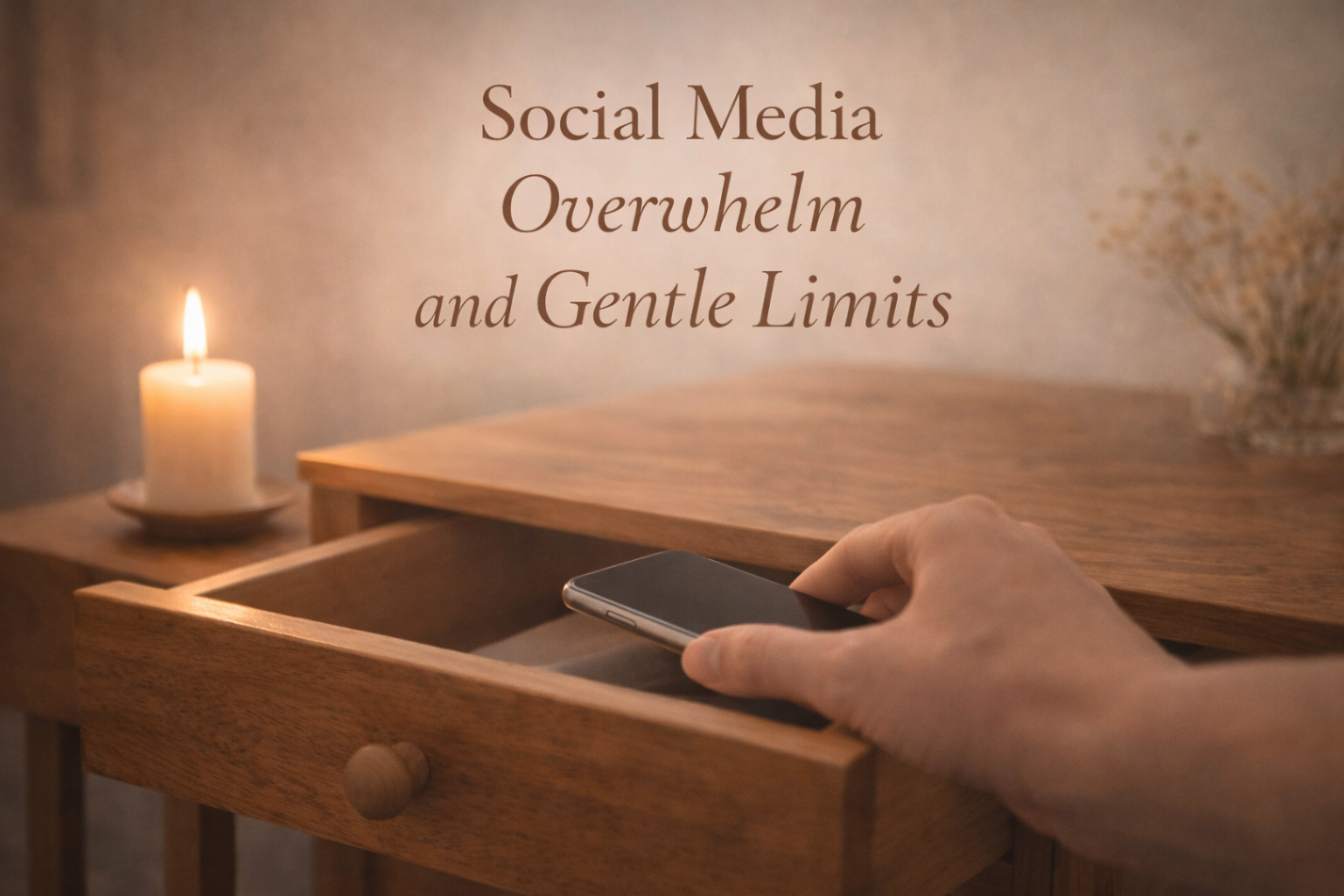
Social Media Overwhelm and Gentle Limits
Social media can overwhelm your nervous system. Try gentle boundaries that protect your peace without going extreme.
If social media leaves you tired, it’s not “in your head.” It’s in your body.
Scrolling can be a thousand micro-interactions: comparison, outrage, desire, grief, inspiration, judgment, laughter, envy. Even when you think you’re just “killing time,” your nervous system is processing emotional frequencies.
Overwhelm happens when your attention is asked to hold too much at once.
Why it feels so intense
Social media is fast. It rarely gives your system time to settle. You can move from tragedy to comedy to a sales pitch to a perfect-life montage in sixty seconds.
That kind of emotional whiplash makes the body braced, even if you don’t notice it.
Gentle limits are not punishments
They’re protection. Not rigid rules, but compassionate containers that say: My peace matters.
Try soft boundaries that still feel like freedom:
time windows (social media only after breakfast)
scroll caps (10–15 minutes, then stop)
no-bed scrolling (phone charges outside the bedroom)
app placement (move apps off your home screen)
one platform rule (choose one platform for a season)
You’re not removing joy. You’re removing overload.
Curate like your nervous system lives here (because it does)
Unfollow accounts that spike comparison. Mute what triggers. Reduce voices that keep you in outrage.
Your feed is not a public service. It’s an environment. And you are allowed to design your environment.
A grounding practice after scrolling
After you log off, do one “real-life contact” act:
look out a window for 30 seconds
touch something textured
drink water slowly
stretch your shoulders and jaw
step outside and breathe
Teach your body: We are back here now.
Replace scrolling with something that actually restores
Try a small “restore list”:
one chapter of a book
music that steadies you
a shower
journaling three sentences
a short walk
sitting in silence with one long exhale
Restoration doesn’t need to be complicated. It needs to be consistent.
You can enjoy social media without letting it siphon your spirit. Your attention is sacred. And gentle limits are one of the most loving things you can offer yourself. 🤍
Your Soulful Pathways ↑
Desktop: Hover over ‘Your Soulful Pathways’ in the top menu to explore another series.
Mobile: Tap the menu (☰), then choose ‘Your Soulful Pathways.’
Creating Quiet Without Escaping Your Life
Quiet doesn’t mean disappearing. Learn gentle ways to reduce overstimulation while staying engaged with your real life.
Quiet is not avoidance. Quiet is restoration.
You don’t need to abandon your responsibilities or move to a cabin in the woods to feel peace. You need pockets of quiet that fit inside your actual life, like soft landings for your nervous system.
Quiet isn’t always the absence of sound. It’s the absence of constant demand. It’s a moment where nothing is asking you to react.
The hidden noise you may not notice
background TV “for company”
constant podcasts to avoid silence
notifications that spike attention every few minutes
group chats that never stop
social media that keeps you in comparison
If your nervous system never gets a break, it starts treating normal life as too much.
Quiet that heals vs quiet that hides
Healing quiet says: I’m coming back to myself.
Hiding quiet says: I’m disappearing because I can’t cope.
This page is for healing quiet. The kind that makes you more able to live, not less.
Try these quiet anchors
Pick one or two. Keep it realistic.
Morning quiet (3 minutes).
No phone. No news. Just breath, water, light.
A quiet corner.
A chair or small space where your phone does not come with you.
The one-sound rule.
If music is on, no scrolling. If you’re scrolling, no music. One stream at a time.
Quiet transitions.
Before you enter your home, your car, your bed, pause for 10 seconds and exhale slowly.
These aren’t dramatic. They’re dependable. And dependence is what heals.
Quiet doesn’t have to be perfect
Quiet can be:
folding laundry without a screen
eating without scrolling
walking for five minutes
turning off notifications for one hour
sitting in your car before going inside
When you choose quiet, you’re not wasting time. You’re restoring capacity.
If quiet makes you anxious
That’s okay. Sometimes silence surfaces feelings.
If quiet feels intense, try “gentle quiet” instead:
soft instrumental music
nature sounds
a candle and one deep breath
a slow task with your hands
Quiet is a volume knob, not an on/off switch.
You don’t need to escape your life to find peace. You need to stop letting noise rent space inside your mind. Quiet is where your attention returns, and your spirit remembers its own rhythm. 🌿
Your Soulful Pathways ↑
Desktop: Hover over ‘Your Soulful Pathways’ in the top menu to explore another series.
Mobile: Tap the menu (☰), then choose ‘Your Soulful Pathways.’
The Sacred Power of Single Tasking
Multitasking fragments your attention. Single tasking restores calm, focus, and inner clarity. Learn how to practice it gently.
Single tasking is not laziness. It’s devotion.
It’s placing your attention like a blessing on one thing at a time.
In a world that rewards speed, single tasking can feel rebellious. Quietly. Kindly. Powerfully.
Multitasking looks productive, but it often feels like being pulled apart. You’re present everywhere and fully nowhere. Your mind becomes a room with eight conversations happening at once.
What multitasking does to your nervous system
Your brain pays a “transition tax” every time you switch tasks. It has to reorient, refocus, re-enter. That costs energy.
Over time, you may notice:
mental fatigue
irritation
scattered thoughts
difficulty finishing what you start
a constant feeling of being behind
Single tasking helps you stop leaking life through tiny cracks.
Single tasking as a sacred practice
This doesn’t require incense or perfection. Single tasking can be:
washing dishes and only washing dishes
writing one message, then stopping
listening to someone without checking your phone
eating without scrolling
folding laundry without a podcast in your ear
Attention is sacred because whatever you give your attention to, you feed.
The 10-minute sanctuary
Start small. Small wins build trust.
Choose one task.
Set a timer for 10 minutes.
Put your phone out of reach.
When your mind wanders, return gently.
After the timer, you can stop or continue. Either way, you’ve trained your nervous system to stay with one thing.
Common resistance and what it means
If single tasking feels uncomfortable, that’s normal. Sometimes distraction is how we avoid feelings. When you remove the distractions, your inner weather shows up: restlessness, sadness, fear, boredom.
Instead of judging it, try this phrase:
I can stay with this for one breath.
One breath is the door. The next breath is the room.
Make single tasking easier in real life
use music as a container (one playlist per task)
keep your phone in another room during focus blocks
close tabs when you finish
write a short list of “today’s one thing”
practice “finish before start” when you can
Single tasking restores your mind, not by force, but by reunion. It brings your life back into full color instead of scattered pixels. And slowly, your attention becomes a home you can return to. 🕯️
Your Soulful Pathways ↑
Desktop: Hover over ‘Your Soulful Pathways’ in the top menu to explore another series.
Mobile: Tap the menu (☰), then choose ‘Your Soulful Pathways.’
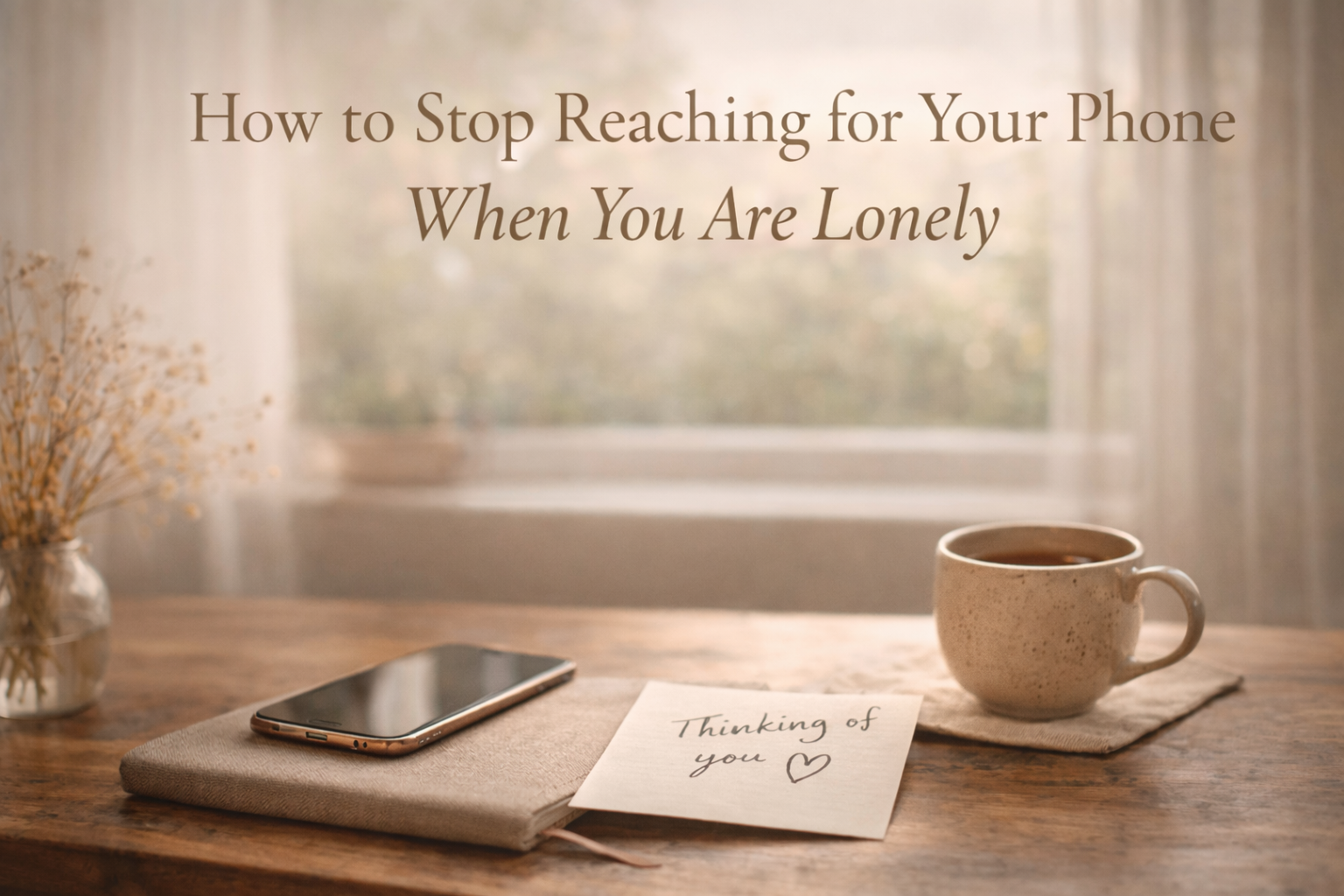
How to Stop Reaching for Your Phone When You Are Lonely
Loneliness makes the phone feel like comfort. Learn gentle ways to meet your need for connection without getting trapped in scrolling.
Loneliness doesn’t always knock. Sometimes it seeps.
And when it does, your phone becomes a doorway. Not always to real connection, but to company-like noise that keeps the quiet from feeling too quiet.
If you reach for your phone when you’re lonely, it doesn’t mean you’re addicted. It means your nervous system is seeking warmth, responsiveness, belonging. Screens mimic those signals, but often leave you emptier afterward.
Why the phone feels like comfort
Your phone offers:
movement and novelty
faces and voices
instant stimulation
the illusion of being “around people”
But loneliness isn’t solved by stimulation.
It’s soothed by presence. The kind that lands in the body.
The most important question
Before you grab your phone, ask:
What am I actually needing right now?
To be seen? To be reassured? To feel included? To avoid a heavy feeling? To be held?
Your answer becomes your next step.
A gentle replacement: The 90-second bridge
Instead of “don’t touch your phone,” try this:
Put one hand on your chest.
Exhale slowly.
Say: I feel lonely. I’m still here with me.
Then choose one connecting act:
text one person “thinking of you”
send a voice note
step outside for fresh air
play one song that feels like a friend
write three honest sentences in a journal
make tea and sit with it, no scrolling
This teaches your body: I can soothe myself without disappearing into the feed.
Create connection snacks
Big social plans aren’t always possible. So build small, steady threads:
one message to someone safe each day
one weekly call with a friend or family member
one gentle group space (book club, hobby group, spiritual group)
one “real-world anchor” activity (walk, class, volunteering)
Connection becomes easier when it’s a rhythm, not an emergency.
If the loneliness is deeper
Sometimes the phone is covering grief, transition, or burnout. If that’s true, go even softer. You don’t have to force yourself into crowds. You just need one true thread: one person, one practice, one place where your heart can exhale.
Your phone is not your enemy. It’s just the fastest comfort you’ve had available. Now you’re learning a braver comfort: connection that nourishes, and presence that holds you. 🤍
Your Soulful Pathways ↑
Desktop: Hover over ‘Your Soulful Pathways’ in the top menu to explore another series.
Mobile: Tap the menu (☰), then choose ‘Your Soulful Pathways.’
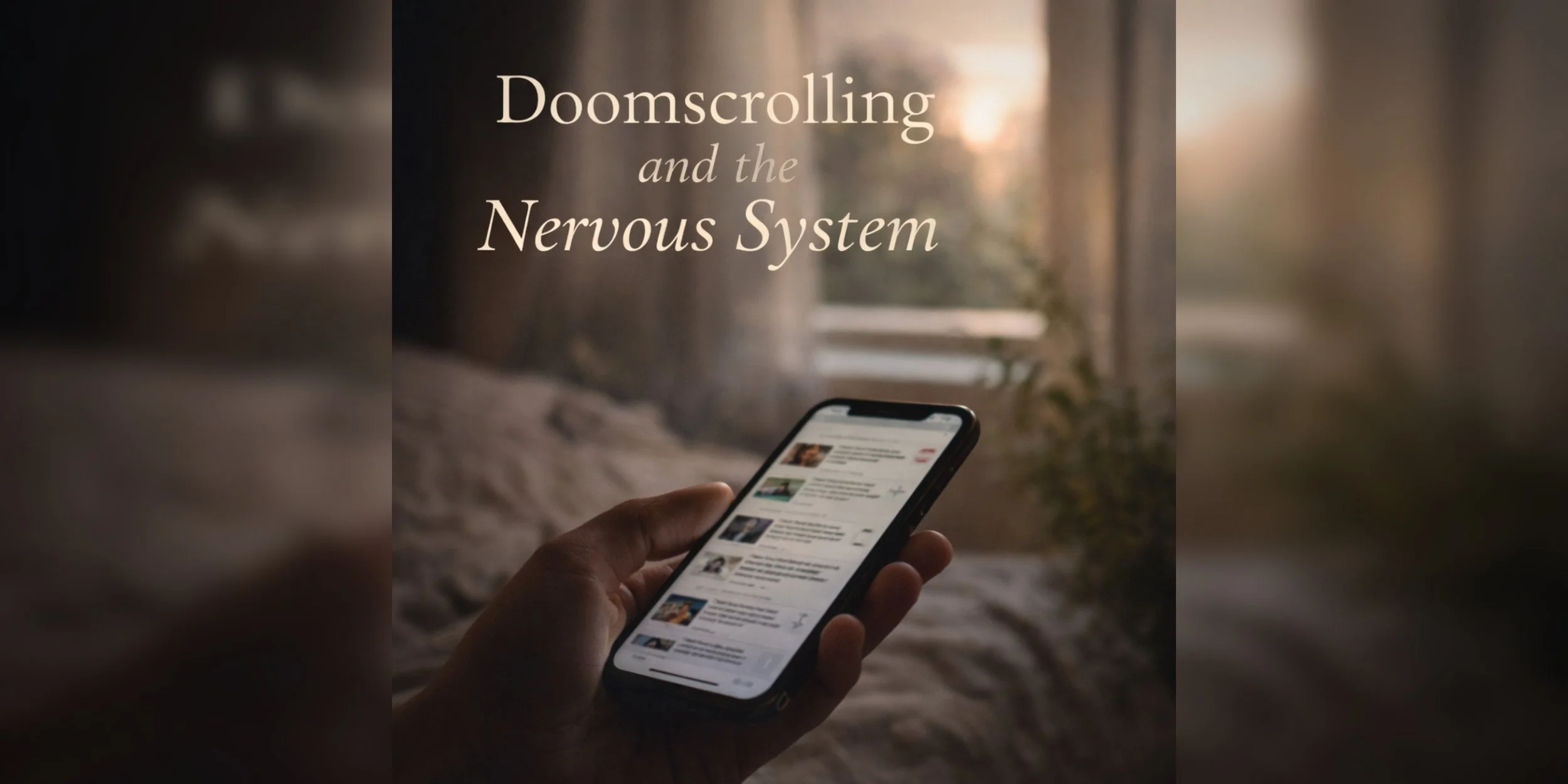
Doomscrolling and the Nervous System
Doomscrolling isn’t a lack of willpower. It’s nervous system activation. Learn why it happens and how to gently interrupt the loop.
Doomscrolling isn’t a character flaw. It’s a nervous system pattern.
When your body feels uncertain, your brain looks for information. It wants certainty, closure, control. The scroll offers a promise: “Maybe the next post will explain it. Maybe the next headline will help me feel ready.”
But the nervous system does not interpret headlines as “content.” It interprets them as signals. Threat. Instability. Danger. Your body reacts as if it’s happening right now, even when you’re sitting safely on your couch.
Why doomscrolling is so sticky
Doomscrolling often blends three powerful forces:
Hypervigilance: “If I stay informed, I’ll stay safe.”
Novelty loops: refresh, new, new, new.
Unfinished stress: your body never completes the stress cycle and returns to calm.
So you keep scrolling, trying to finish a feeling that doesn’t finish.
Signs your nervous system is driving the scroll
tight chest or shallow breathing while scrolling
feeling compelled to check “just one more thing”
irritability after you stop
trouble sleeping or looping thoughts
dread that doesn’t match your actual moment
If this is you, you’re not weak. You’re activated.
The gentlest interrupt: Name the state
Before you scroll, pause and ask:
What state am I in right now?
Anxious? Lonely? Restless? Avoiding something? Overwhelmed?
Then say:
I’m not craving content. I’m craving regulation.
That sentence is a flashlight. It helps you see the real need.
A 2-step nervous system reset
When you catch yourself doomscrolling:
Step 1: Change your posture.
Sit up. Feet on the floor. Your body reads posture as information.
Step 2: Offer a safer signal.
Take three slow exhales.
Sip water.
Look at something real and neutral.
Place a hand on your ribs and feel your breath move.
You’re not trying to “win” against your phone.
You’re helping your body feel safe enough to choose.
Soft boundaries that still let you be informed
news once a day at a set time
no news after 6 PM
put news apps in a folder named “Later”
replace late-night scrolling with music, a shower, or journaling
Try this question:
Will more information help me act, or will it just activate me?
You were never meant to metabolize the entire world’s fear through a glowing screen. Be informed, yes. But also be steady. Be held. Be human. 🕯️
Your Soulful Pathways ↑
Desktop: Hover over ‘Your Soulful Pathways’ in the top menu to explore another series.
Mobile: Tap the menu (☰), then choose ‘Your Soulful Pathways.’
When Your Mind Feels Loud
Your mind isn’t broken, it’s overloaded. Learn gentle ways to quiet mental noise and reclaim your attention without forcing calm.
When your mind feels loud, it’s rarely because you’re “too much.”
It’s usually because your inner world has been asked to hold too much.
Pings. News. Opinions. Pressure. Comparison. Tiny jolts of emotion that never fully land, never fully release. The mind starts buzzing like a room full of conversations you didn’t choose.
Noise isn’t only sound. Sometimes it’s input. The steady drip of information, the constant scanning, the invisible urgency. Your brain tries to cope by thinking faster, solving harder, staying on guard. That’s not weakness. That’s protection.
What loudness is really telling you
A loud mind often means your system is over-collecting. You’ve taken in more than you’ve processed. Your body is still “on,” even if your day has technically slowed down.
This can show up as:
trouble sleeping
irritability
difficulty focusing
mental fog
a constant feeling of being behind
reaching for distractions without even thinking
Instead of asking, “What’s wrong with me?” try asking:
What has my nervous system been carrying?
Quiet vs shutdown
Quiet is spacious. Shutdown is numb.
Quiet lets you feel present. Shutdown makes you disappear. If you’ve been running on overload for a long time, real quiet can feel unfamiliar at first. Your brain may treat it like danger because it’s not used to stillness.
So we go gently. We don’t force silence like a punishment. We invite quiet like a friend.
A gentle practice: the 3-minute sound dimmer
Use this when your mind is loud and you feel pulled toward your phone.
Put your phone face down or in a drawer.
Hand on chest, hand on belly.
Inhale slowly. Exhale longer than you inhale.
Name three things you can see.
Name two sensations you can feel (tight, warm, heavy, calm).
Name one thing you truly need right now.
This is a nervous system signal: I’m here. I’m not abandoning myself.
The input fast that doesn’t feel like punishment
Pick one small boundary today:
no phone in the bathroom
no scrolling during meals
notifications off for one hour
one room becomes a “quiet space”
five minutes in the morning with no screen
Small changes build trust. Your attention starts believing you again.
When you need something deeper than “calm down”
If your mind feels loud because you’re carrying grief, uncertainty, or chronic stress, aim for soothing, not perfection. A warm shower. A slow walk. Gentle music. A prayer whispered under your breath.
The goal isn’t to erase thoughts.
It’s to lower the volume enough to hear yourself.
Your mind isn’t loud because you’re failing. It’s loud because it’s been trying to protect you in a world that never stops talking. You don’t need a new personality. You need a little less incoming, and a little more sacred attention.
Your Soulful Pathways ↑
Desktop: Hover over ‘Your Soulful Pathways’ in the top menu to explore another series.
Mobile: Tap the menu (☰), then choose ‘Your Soulful Pathways.’

Digital Detox and Sacred Attention
A soft, soulful digital detox series to calm overstimulation, reduce scrolling, and reclaim sacred attention without harsh rules or all-or-nothing resets.
This is not a strict detox. This is a return.
A return to your breath. Your body. Your real life. Your attention.
Attention is not just productivity. It’s presence. It’s how you experience love, peace, clarity, creativity, and even your own thoughts. When attention gets scattered, life can start to feel scattered too, like you’re living in small fragments instead of a whole day.
We live in a world designed to pull you. Notifications sparkle like tiny hooks. Feeds refresh like slot machines. Headlines lean in close and whisper, “React. Stay alert. Don’t miss anything.” Over time, you can start living in a state of constant reaching, even when nothing is truly urgent.
If you’ve been feeling overstimulated, foggy, emotionally tired, or unable to focus, you are not alone.
You’re not broken. You’re not weak. You’re not failing at discipline. You’re saturated.
This series is for the nights you scroll even though you’re tired. For the mornings you reach for your phone before you check in with your own heart. For the moments your mind feels loud and your body feels tight, and you can’t tell if you need rest, reassurance, or simply less input.
What sacred attention means
Sacred attention is the practice of placing your awareness with intention. It’s the choice to stop feeding what drains you, and start nourishing what steadies you. Sacred attention is not anti-technology. It’s pro-you.
Sacred attention can look like:
completing one thought before adding five more
eating a meal without scrolling
walking without documenting
listening to your body before listening to the internet
choosing quiet without disappearing
Why a digital detox can feel emotional
Screens often become coping tools. They buffer loneliness. They distract from worry. They soften boredom. They give the illusion of connection with very little risk. When you reduce screen time, your real needs can rise to the surface. Restlessness. Sadness. A weird tenderness you didn’t know you were carrying.
That isn’t failure. That’s information. That’s your inner world finally getting a chance to speak.
This series is built for real life
You don’t need to delete everything, buy a flip phone, or become a monk with a perfect morning routine. This series is not about extremes. It’s about small, consistent shifts that teach your nervous system it can exhale again.
Inside these pages, you’ll learn how to:
calm the mind when it feels loud
understand doomscrolling through a nervous system lens
stop reaching for your phone when you feel lonely
create gentle limits that protect your peace
reset your brain without harsh rules
create quiet without escaping your life
practice single tasking as a sacred return
build a sabbath from noise that restores you weekly
A simple place to start today: The 30-Second Return
Put your phone face down.
Exhale slowly, longer than you inhale.
Ask: What do I actually need right now?
Give yourself one honest answer.
Your attention is one of your most precious resources. You deserve to live a life where your mind isn’t constantly being pulled away from you. This is your gentle beginning. 🕯️
Your Soulful Pathways ↑
Desktop: Hover over ‘Your Soulful Pathways’ in the top menu to explore another series.
Mobile: Tap the menu (☰), then choose ‘Your Soulful Pathways.’
Restoring Your Yes
When your yes comes from pressure, it becomes resentment. Restore your yes by reconnecting with truth, clarity, and calm self trust.
When your yes is not yours, it becomes heavy.
It becomes obligation. It becomes performance. It becomes the quiet resentment you feel after you do the thing you promised, while your body wonders why you agreed in the first place.
A true yes is different. A true yes is clean. It feels like alignment. It feels like choice.
Restoring your yes is how you restore your life.
How yes gets stolen
Your yes can get shaped by many things:
fear of disappointing someone
fear of conflict
fear of being judged
fear of being rejected
the belief that love must be earned
the belief that your needs are “too much”
So you say yes to avoid discomfort. And in doing so, you abandon your own truth, one small moment at a time.
What a true yes feels like
A true yes often feels like:
calm excitement
willingness without dread
“I want to,” not “I should”
a body that relaxes, not braces
energy that remains after you commit
Sometimes a true yes is quiet. Not fireworks. Just clarity.
How to find your yes again
Start by giving yourself permission to pause.
Before you agree, practice:
“Let me think about it.”
“I will get back to you.”
“I need to check what I have the capacity for.”
Pausing is powerful because it returns the decision to you.
The yes and no filter
Ask yourself three questions:
Do I have the capacity for this?
Do I want to do this, not just feel obligated?
Will I feel resentful if I say yes?
If resentment is already whispering, listen. Resentment is often the soul’s way of saying: “This is not true for you.”
Restore your yes through small choices
You do not have to change your whole life overnight. Start with one small yes that is truly yours:
Yes to rest.
Yes to quiet time.
Yes to your body.
Yes to your creative spark.
Yes to a boundary.
Yes to saying no.
A restored yes is not louder. It is truer.
And when your yes becomes honest again, your relationships become honest too. The people who love you in a healthy way will adjust. The people who only loved your compliance may resist.
Let that be information, not a reason to abandon yourself again.
Affirm softly
“My yes is sacred. My no is sacred. I choose what is true for me with calm confidence and gentle strength.”
Your Soulful Pathways ↑
Desktop: Hover over ‘Your Soulful Pathways’ in the top menu to explore another series.
Mobile: Tap the menu (☰), then choose ‘Your Soulful Pathways.’.
What Healthy Love Requires
Healthy love does not demand self loss. Explore the signs of respectful love, emotional safety, and relationships where care flows both ways.
Healthy love feels like breathing.
Not perfect. Not always easy. But spacious enough to be real.
For people pleasers, love can become something you perform. Something you earn. Something you keep by being agreeable, available, endlessly understanding.
But healthy love does not require self loss. Healthy love requires respect, safety, and mutual care.
Healthy love requires respect
Respect is not grand gestures. It is everyday consideration.
Respect sounds like:
“I hear you.”
“That matters.”
“I will not punish you for having needs.”
“I will take responsibility for my impact.”
Respect means your boundaries are not treated like inconveniences. Your no is not taken personally. Your feelings are not dismissed.
If you have to argue for basic respect, that is not a partnership. That is you trying to be seen by someone who benefits from not seeing you.
Healthy love requires emotional safety
Safety is the environment where your nervous system can soften.
In healthy love, you do not have to guess where you stand. You do not have to walk on eggshells. You do not have to shrink to keep the peace.
Safety looks like:
repair after conflict
honesty without cruelty
room to be human
consistency that calms your body, not confuses it
If someone only loves you when you are easy, that is not safety. That is conditional acceptance.
Healthy love requires mutual care
Mutual care means the relationship is not built on one person’s constant giving.
It means:
both people initiate
both people apologize
both people consider each other’s limits
both people make space for each other’s hard days
both people protect the relationship, not just one
If you are always the one adjusting, always the one explaining, always the one smoothing everything over, you are not in partnership. You are doing emotional labor.
Signs you are choosing healthy love
You can say no without fear. You can rest without punishment. You can disagree without being threatened. You can be imperfect and still be loved.
You feel supported, not managed. Seen, not used. Strengthened, not drained.
Healthy love does not erase your nervous system. It settles it.
A gentle relationship check in
Ask yourself:
Do I feel more like myself in this connection, or less?
Am I free to be honest, or do I filter everything?
Is my giving appreciated, or expected?
When I have needs, do they matter?
These questions are not meant to shame you. They are meant to bring you back to truth.
Because love should not cost you your voice.
Affirm softly
“I choose love that honors me. I am worthy of respect, safety, and mutual care. I do not shrink to be loved.”
Your Soulful Pathways ↑
Desktop: Hover over ‘Your Soulful Pathways’ in the top menu to explore another series.
Mobile: Tap the menu (☰), then choose ‘Your Soulful Pathways.’.

Healing the Need to Be Approved
Learn why approval feels so necessary and how to heal it gently. Build self trust, steady worth, and inner permission to be yourself.
The need for approval can feel like a quiet hunger. Not loud, but constant.
It shows up as checking your phone. Replaying what you said. Adjusting your tone. Wondering if you were too much or not enough. Doing extra, giving extra, smiling extra, just to keep everyone comfortable.
Approval can become a substitute for inner safety.
But you can heal it. Gently. Without shame.
Where the need comes from
Approval seeking usually starts as a strategy.
Maybe you learned that being agreeable kept you safe. Maybe love felt conditional. Maybe praise was the main form of attention you received. Maybe conflict felt dangerous. Maybe you were taught to be “good” instead of being real.
If approval was how you stayed connected, of course your nervous system still reaches for it.
This is not a character flaw. It is a learned pattern.
The cost of living for applause
When you live for approval, you slowly lose your inner compass.
You start choosing what will be accepted instead of what is true. You silence your needs. You perform wellness when you are struggling. You stay in spaces that drain you because leaving might disappoint someone.
And even when you receive approval, it rarely satisfies. It fades, and you need it again.
Because approval cannot replace self belonging.
How to rebuild self approval
This healing is not one moment. It is a practice.
Notice the trigger
When you feel that approval hunger, pause. Name it: “I want to be liked right now.”
Naming breaks the trance.
Give yourself what you are seeking
Ask: “What do I need to hear from myself?”
Try one:
“It makes sense that you feel this.”
“You are allowed to be human.”
“You do not have to earn love.”
“You can handle someone being disappointed.”
Choose one tiny act of truth
Not a dramatic overhaul. A small honest choice:
say what you mean kindly
rest without explaining
wear what you like
let someone misunderstand you without chasing them
These are powerful. They train your nervous system to trust you.
A gentle daily practice: self permission
Every morning, choose one permission:
Today I am allowed to go slower.
Today I am allowed to change my mind.
Today I am allowed to say no.
Today I am allowed to take up space.
Write it down. Repeat it. Live one small moment as if it is true.
Because it is.
Affirm softly
“I approve of myself. I belong to myself. I do not perform for love. I live in truth with gentle confidence.”
Your Soulful Pathways ↑
Desktop: Hover over ‘Your Soulful Pathways’ in the top menu to explore another series.
Mobile: Tap the menu (☰), then choose ‘Your Soulful Pathways.’.

The Script for Saying No Kindly
Use gentle scripts for saying no with confidence. Set boundaries clearly, reduce anxiety, and stop overexplaining your needs.
Saying no is not rude. It is a skill.
For people pleasers, no can feel like a threat. Your mind imagines worst-case reactions. Your body tightens. You start constructing a long explanation that somehow keeps everyone happy.
But a kind no is simple. A kind no is clear. A kind no does not require you to audition for permission.
Why no feels so hard
People pleasing often grew out of fear, not personality.
Fear of conflict. Fear of rejection. Fear of being misunderstood. Fear of being “too much.”
So when you say no, you are not only declining a request. You are facing an old survival alarm.
That is why scripts help. Scripts calm the alarm.
The three sentence structure
Here is the easiest framework:
Appreciation
Clear no
Optional gentle close
Examples:
“Thanks for thinking of me. I can’t commit to that. I hope it goes well.”
“I appreciate the invite. I’m not available. Maybe another time.”
“Thank you for asking. That doesn’t work for me. I’m cheering you on.”
Short. Clean. Kind.
When you feel tempted to overexplain
Overexplaining is often a form of self protection. It tries to control how the other person feels.
But you do not need to manage their emotions to be a good person.
Try a replacement line:
“I’m keeping it simple.”
“I’m not able to, but thank you.”
“I don’t have the capacity.”
Capacity is a complete sentence.
Scripts for common situations
Work requests
“I can’t take that on right now. My current workload is full.”
“I can help next week, but not today.”
“I’m not the right person for this.”
Family and friends
“I love you, and I’m not available for that.”
“I’m resting tonight.”
“I’m saying no so I don’t end up resentful.”
Last-minute asks
“I can’t do last minute plans. I need more notice.”
“I’m not able to shift my schedule today.”
Pushback
“I understand. My answer is still no.”
“I’m not discussing it further.”
“I hear you. I’m holding this boundary.”
How to deliver no with calm energy
Your tone matters more than your words.
Speak slower than usual. Keep your shoulders relaxed. Do not apologize repeatedly. Do not add extra reasons.
A calm no teaches people how to treat you. It also teaches you that you can remain safe while being honest.
Affirm softly
“I can be kind and still be clear. I do not have to earn my no. My boundaries protect my peace.”
Your Soulful Pathways ↑
Desktop: Hover over ‘Your Soulful Pathways’ in the top menu to explore another series.
Mobile: Tap the menu (☰), then choose ‘Your Soulful Pathways.’.
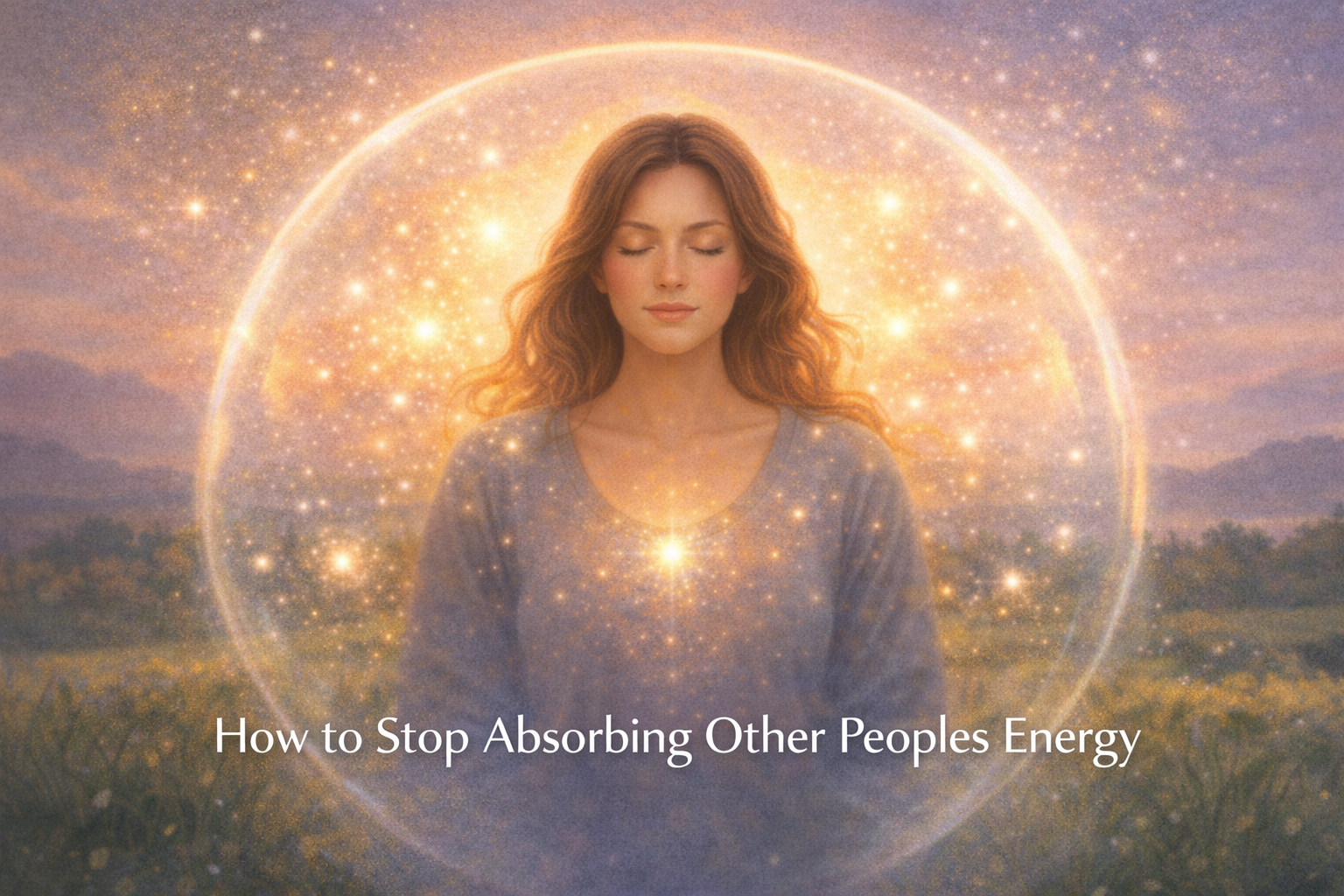
How to Stop Absorbing Other Peoples Energy
If you feel drained after conversations, you may be absorbing what is not yours. Learn simple energetic boundaries to stay grounded and clear.
If you walk away from people feeling heavy, foggy, or exhausted, you might be carrying feelings that were never yours.
This does not mean you are weak. It often means you are sensitive. Attuned. Empathic. You notice shifts. You read rooms. You feel what is under the words.
But sensitivity without boundaries becomes emotional absorption. And absorption, over time, becomes burnout.
Signs you are absorbing energy
You might notice:
you feel drained after being around someone, even if nothing “bad” happened
you take on stress that disappears when you are alone
you feel responsible to fix or soothe
you replay conversations for hours
you feel guilty for needing space
you struggle to tell where you end and others begin
If this is you, the goal is not to shut down your sensitivity. The goal is to protect it.
The truth: empathy is not ownership
You can care deeply without carrying deeply.
You can witness someone’s pain without making it your assignment. You can listen without absorbing. You can love without merging.
This is emotional maturity. It is not selfish. It is sacred.
A simple boundary practice: name what is yours
After an interaction, try this:
Sit quietly for one minute.
Ask: “What am I feeling?”
Then ask: “Is this mine?”
If the emotion feels sudden, intense, and unfamiliar, it may not be yours. If it fades quickly when you step away, that is another clue.
Now say gently: “If this is not mine, I release it.”
The grounding technique: feet and breath
When you are with someone intense, bring your attention to your feet.
Feel the ground. Press your toes slightly. Slow your breath. Soften your shoulders.
This signals safety to your nervous system. It helps you stay in your body instead of floating into theirs.
A visualization that actually helps
You do not need to “fight energy.” You need a calm container.
Imagine a soft light around you like a clear sphere. Not hard. Not sharp. Gentle. Quiet. Firm.
Then set an intention:
“I can hear you without holding you.”
“I can be present without absorbing.”
“I return to myself.”
Your attention follows your intention. And your nervous system follows your attention.
What to say when someone unloads
Sometimes absorption happens because you don’t know how to interrupt emotional dumping.
Try one of these kind sentences:
“I care about you, and I can listen for a few minutes.”
“I want to support you, and I also need to stay grounded. Can we slow down?”
“That sounds heavy. What do you need right now, listening or solutions?”
“I’m at capacity today. Can we talk another time?”
You are allowed to have limits, even with people you love.
Affirm softly
“My sensitivity is a gift, and I protect it. I feel with compassion and release with ease.”
Your Soulful Pathways ↑
Desktop: Hover over ‘Your Soulful Pathways’ in the top menu to explore another series.
Mobile: Tap the menu (☰), then choose ‘Your Soulful Pathways.’.
When Kindness Turns into Self Abandonment
Explore how kindness can quietly become self abandonment. Learn to notice the shift and choose self honoring care without hardening your heart.
Kindness is one of the most beautiful energies a person can carry. It can heal rooms. It can soften hard moments. It can remind people they are human again.
But when kindness becomes your survival strategy, it starts to cost you.
It becomes a way of managing other people’s emotions. A way of staying liked. A way of avoiding conflict. A way of keeping connection at any price.
That is when kindness begins turning into self abandonment.
The difference between kindness and pleasing
Kindness is freely given.
Pleasing is given under pressure.
Kindness has joy in it.
Pleasing has tension in it.
Kindness can say no.
Pleasing feels like it cannot.
A helpful question is: “Am I doing this from love or from fear?”
Love feels steady. Fear feels urgent.
How self abandonment shows up
Self abandonment is not always obvious. It can look like:
laughing at a joke that hurts you
agreeing with something you do not believe
saying “It’s fine” when it is not
staying quiet to keep the peace
overextending because you fear being seen as selfish
changing your tone, your opinions, your needs to match the room
Over time, the cost becomes heavy: anxiety, resentment, exhaustion, and a confusing sense that you are present in life but not fully living it.
Because you keep leaving yourself behind.
Why it feels hard to stop
If you learned early that love required performance, then self honoring may feel risky. You might fear:
“If I set limits, I will be rejected.”
“If I speak up, I will be punished.”
“If I disappoint them, I will lose them.”
These fears are understandable. They are also often outdated. Your current life may be safer than your nervous system believes.
How to return to yourself without hardening
This is not about becoming cold. It is about becoming honest.
Try these small returns:
pause before you respond so your body can catch up to your mouth
name one true need per day, even quietly to yourself
replace “I’m fine” with one honest sentence: “I’m a little overwhelmed today.”
practice kind truth: “I care about you, and I need to do this differently.”
Boundaries do not cancel your kindness. They protect it.
Because when you stop abandoning yourself, your kindness becomes real again, not compulsory.
A gentle reset: the one sentence vow
When you feel yourself slipping into pleasing, repeat:
“I will not betray myself to belong.”
You can belong without self erasure. The right connections will not require you to disappear.
Affirm softly
“My kindness includes me. I can be loving and still be true. I return to myself with grace.”
Your Soulful Pathways ↑
Desktop: Hover over ‘Your Soulful Pathways’ in the top menu to explore another series.
Mobile: Tap the menu (☰), then choose ‘Your Soulful Pathways.’.

Boundaries Without Guilt
Create boundaries that feel calm, kind, and clear. Release guilt, build inner safety, and learn to honor your limits without overexplaining.
For many people pleasers, guilt is not just a feeling. It is a reflex.
The moment you consider a boundary, guilt rushes in like a siren. You imagine disappointing someone. You imagine being misunderstood. You imagine being “too much,” “too cold,” “not nice.”
But boundaries are not cruelty. Boundaries are clarity. And clarity is kindness, especially when it is honest.
Why guilt shows up
Guilt often appears when you begin changing a role you have played for a long time. If you have been the dependable one, the flexible one, the one who always accommodates, your new boundary can feel like a shock to the system.
Not because it is wrong. Because it is unfamiliar.
Also, guilt is not always a moral signal. Sometimes it is a nervous system signal. It is your body saying: “This is new. Are we safe to do this?”
You can feel guilt and still be right to protect your peace.
Boundaries are not walls
A healthy boundary is not shutting people out. It is showing people how to stay in your life with respect.
A boundary says:
this is what works for me
this is what does not
this is how I can show up sustainably
this is what I need to remain well
The goal is not to control others. The goal is to care for your energy.
The boundary formula that reduces guilt
If guilt spikes when you explain yourself, simplify. Overexplaining often invites negotiation, and negotiation often triggers panic.
Try this calm structure:
A clear statement
A short reason (optional)
A steady close
Examples:
“I can’t make it tonight. I’m resting.”
“I’m not available for calls during work hours.”
“I’m not able to take that on right now.”
“That doesn’t work for me.”
“I’m keeping my weekends quiet this month.”
Notice: these are not speeches. They are truths.
What if someone reacts badly
This is where many people pleasers break their own boundary. Not because they want to, but because they fear the reaction.
When someone reacts strongly, remind yourself:
their feelings are real, but they are not your responsibility to fix
your boundary is not a debate
discomfort does not equal danger
Sometimes people resist your boundary because they benefited from your lack of one. That does not mean you are doing something wrong. It means the old dynamic is changing.
A gentle practice: guilt to self respect
When guilt rises, try this:
Name it: “This is guilt.”
Normalize it: “Guilt is common when I choose myself.”
Re-center: “My needs matter too.”
Hold steady: repeat your boundary in one sentence.
Then stop. Let the silence do its work. You do not need to keep talking to be a good person.
A closing truth
Boundaries are not you becoming less loving. They are you becoming more real. And real love can survive truth.
Affirm softly
“I release guilt as a guide. I choose clarity. I protect my peace with gentle strength.”
Your Soulful Pathways ↑
Desktop: Hover over ‘Your Soulful Pathways’ in the top menu to explore another series.
Mobile: Tap the menu (☰), then choose ‘Your Soulful Pathways.’.
Signs You Are Overgiving
Learn the quiet signs of overgiving, emotional depletion, and invisible self abandonment. Recognize the patterns and return to balanced, sustainable care.
Giving can be beautiful. It can be sacred. It can be your love language, your way of making the world softer.
But overgiving feels different.
Overgiving is giving when you are empty. It is giving when you are unsure you are allowed to stop. It is giving to earn peace, to avoid conflict, to keep connection, to stay safe. And most of the time, it does not look dramatic. It looks like being “helpful.” It looks like being “easy.” It looks like being “strong.”
Until one day you realize: the giving never ends, but your energy does.
The quiet signs of overgiving
Overgiving often shows up as subtle patterns you have normalized:
you feel responsible for other people’s comfort
you offer help before anyone asks
you feel anxious when you rest
you apologize for having needs
you say yes while your body says no
you feel a low hum of resentment you do not want to admit is there
you struggle to receive without trying to earn it back
you feel drained after interactions that “weren’t even bad”
If you relate to these, it does not mean you are broken. It means you learned to survive through giving. You became skilled at scanning for what others might need, because maybe your own needs were not always safe to have.
When giving becomes self loss
There is a difference between generosity and self abandonment.
Generosity says: “I want to.”
Self abandonment says: “I have to.”
Generosity leaves you feeling open.
Self abandonment leaves you feeling depleted.
Generosity includes you.
Self abandonment forgets you.
If you are always the one holding everything together, you may not realize how much weight you are carrying until you finally put it down.
A simple self check: the body knows
Before you say yes to something, try this:
Place one hand on your chest, one on your belly.
Take one slow breath.
Ask: “If I say yes, do I feel expansion or contraction?”
Expansion often feels like calm, clarity, grounded willingness.
Contraction often feels like tightness, dread, pressure, obligation.
Your body is not being dramatic. It is giving you data.
Why overgiving feels “safer” than honest limits
People pleasing patterns often come with an unspoken belief: if I give enough, I can prevent discomfort. If I take care of everyone, nobody will be upset. If I stay useful, I stay connected.
But the cost is high. Overgiving doesn’t just drain your energy. It trains your nervous system to believe you are only safe when you are performing.
You were not made to earn belonging through exhaustion.
What to practice instead: sustainable care
Start small. Overgiving does not heal through one big boundary. It heals through repeated moments of choosing yourself.
Try one of these this week:
Pause before responding: “Let me check my schedule and get back to you.”
Offer what is true, not what is expected: “I can help for 15 minutes, not an hour.”
Practice receiving without explaining: “Thank you, that means a lot.”
Name your capacity out loud: “I’m at capacity today.”
Choose one small self-care first: water, food, a short walk, quiet time before you give.
Every time you do this, you teach your nervous system a new truth: love does not require self erasure.
Affirm softly
“I am allowed to give without losing myself. My care is sacred, and so is my energy.”
Your Soulful Pathways ↑
Desktop: Hover over ‘Your Soulful Pathways’ in the top menu to explore another series.
Mobile: Tap the menu (☰), then choose ‘Your Soulful Pathways.’.
Sacred Boundaries and People Pleasing Recovery
A gentle series for releasing overgiving, rebuilding self respect, and creating boundaries without guilt. Learn to protect your energy with calm clarity and soft strength.
There is a kind of tired that sleep does not fix.
It comes from always being “the strong one.” The helpful one. The flexible one. The one who can handle it. The one who says yes, even when your body is quietly begging for no.
People pleasing often begins as protection. A way to stay safe. A way to keep love. A way to avoid conflict. A way to feel needed, included, and valued. But over time, it can become a pattern of self abandonment, not because you lack strength, but because you have used your strength everywhere except for yourself.
This series is an invitation back to you
Not through harshness. Not through shutting people out. But through soft strength. Through truth spoken gently. Through boundaries that feel like peace instead of punishment.
Because boundaries are not walls. They are sacred agreements with your own nervous system. They are the way you teach your life: this is what keeps me well.
What this series is here to heal
This is for you if you:
feel responsible for other people’s emotions
overexplain your needs and still feel guilty
say yes quickly and regret it later
absorb stress after conversations and feel drained
avoid conflict even when it costs you
carry resentment you do not want to admit is there
struggle to receive support without trying to earn it back
If you see yourself here, let this be a gentle truth: you are not “too sensitive.” You are not “too caring.” You are simply ready for a new way. A way where your kindness includes you.
What sacred boundaries actually mean
Sacred boundaries are not cold. They are clear.
They are the difference between generosity and self loss. Between love and performance. Between support and overgiving. Between compassion and absorption.
A sacred boundary says:
“I can love you and still have limits.”
“I can care and still protect my peace.”
“I can be kind and still be honest.”
“I can be present without abandoning myself.”
When you practice boundaries, you may feel discomfort at first. That is normal. Your system is learning. Guilt may rise. Anxiety may chatter. Old roles may protest. But over time, boundaries create a new foundation: safety. And safety becomes the soil where your real self can grow.
What you will find inside these pages
This series is designed to help you:
recognize overgiving before you burn out
set boundaries without guilt or long explanations
stop absorbing emotions that are not yours
say no kindly and confidently
heal the need for approval
understand what healthy love requires
restore your yes so it becomes true again
Each page is meant to be practical and soul soothing. Something you can come back to whenever life pulls you toward old patterns.
Start here
If you are unsure where to begin, start with what feels most familiar:
If you feel exhausted, begin with Signs You Are Overgiving.
If you struggle to say no, begin with The Script for Saying No Kindly.
If you feel drained around people, begin with How to Stop Absorbing Other Peoples Energy.
If guilt is your biggest block, begin with Boundaries Without Guilt.
There is no wrong entry point. Your nervous system will guide you to the page you need.
And as you move through this series, let it be simple:
You do not have to become a different person.
You only have to stop leaving yourself behind.
Affirm softly
“My boundaries are sacred. My needs matter. I can be loving and still be true.”
Your Soulful Pathways ↑
Desktop: Hover over ‘Your Soulful Pathways’ in the top menu to explore another series.
Mobile: Tap the menu (☰), then choose ‘Your Soulful Pathways.’.

Prayer that Calms the Body Too
Prayer can be embodied, not performative. Learn simple prayers and body-based practices that help your nervous system receive peace and steadiness.
Some people pray with their mind while their body stays braced. Words rise, but the shoulders stay tight. Scripture is spoken, but the breath remains shallow.
Prayer can be holy and still not land in the nervous system.
This is an invitation: let prayer become a place your body can rest.
Prayer is not only words
Prayer can be breath.
Prayer can be softness.
Prayer can be a hand on the heart and a whispered, “Help.”
If your body feels anxious, it doesn’t mean prayer isn’t working. It may mean your system needs a gentler doorway.
Make prayer a container, not a performance
When people feel stressed, they often try to pray “better.” More words. More intensity. More striving.
But peace tends to arrive through safety.
Try prayer that is simple enough to be true:
“God, I’m here.”
“God, hold me.”
“God, help my body soften.”
Three embodied prayer practices
Hand-to-heart prayer
Place a hand on your chest.
Breathe slowly.
Repeat one sentence prayer for 60 seconds:
“God, be near.”
or
“Peace, come close.”
Exhale prayer
Inhale quietly.
Exhale and whisper one word: “Peace.”
Repeat for 1–2 minutes.
Let the exhale do the preaching.
Grounding prayer
Press your feet into the floor and say:
“I am here. I am held. I am not alone.”
This teaches the body what the spirit already believes.
When prayer feels hard
Sometimes people feel guilty when prayer doesn’t feel comforting. But prayer is not a transaction. It is relationship.
If you feel numb, tired, angry, or blank, you can still pray honestly:
“God, I don’t know what I feel.”
“God, I’m overwhelmed.”
“God, carry what I can’t.”
Honesty is not disrespect. It’s intimacy.
A short daily liturgy for calm
God of Peace,
I release my jaw.
I soften my shoulders.
I slow my breath.
I return to this moment.
I return to You.
Amen.
Say it once. Say it twice. Let the body learn it.
Your Soulful Pathways ↑
Desktop: Hover over ‘Your Soulful Pathways’ in the top menu to explore another series.
Mobile: Tap the menu (☰), then choose ‘Your Soulful Pathways.’.

When You Feel Numb and Cannot Cry
Numbness is often protection, not failure. Learn how to soften safely, reconnect with your body, and thaw emotion without forcing it.
Numbness can be frightening because it looks like nothing, but it can feel like everything.
You may want to cry and can’t. You may know you care and still feel blank. You may feel disconnected from yourself and wonder where you went.
Numbness is not a lack of love.
It’s often the body protecting you from too much at once.
Numb is a protector
If your system has been overwhelmed, it may choose shutdown as mercy. It’s not trying to punish you. It’s trying to keep you functional.
Instead of fighting numbness, try respecting it:
“Thank you for protecting me.”
“I’m ready for small softness now.”
When you honor the protector, it stops needing to shout.
How to thaw without forcing
Forced feeling can backfire. Gentle reconnection works better.
Try micro-connection:
hold a warm mug
take a slow shower
sit in sunlight for 3 minutes
place a hand on your heart and breathe
listen to one song that feels safe, not intense
The nervous system thaws like winter soil. Slowly. Patiently. In layers.
Somatic practices that support numbness
Temperature grounding
Hold something warm or cool and notice the sensation. Let “feeling temperature” be enough for today.
Gentle tapping
Tap lightly on the collarbone, chest, or arms while breathing slowly. This can bring presence back without overwhelm.
Humming
Hum on the exhale. Vibration can help the body feel more “here” again.
Orienting
Look around the room and name what you see. This tells the body: “We are here, now.”
Spiritual shame has to go
If you’ve been taught that numbness means you’re “not trusting God enough,” release that idea. Some seasons require survival tools. Some days require softness later.
God does not abandon you because your feelings are paused.
Sometimes healing looks like simply staying.
A prayer for the numb places
God, meet me where I cannot reach myself.
Bring warmth to what has gone quiet.
Help me feel safely, slowly, honestly.
Hold me until I can hold me again.
Amen.
Your Soulful Pathways ↑
Desktop: Hover over ‘Your Soulful Pathways’ in the top menu to explore another series.
Mobile: Tap the menu (☰), then choose ‘Your Soulful Pathways.’.