


Restoring Your Yes
When your yes comes from pressure, it becomes resentment. Restore your yes by reconnecting with truth, clarity, and calm self trust.
When your yes is not yours, it becomes heavy.
It becomes obligation. It becomes performance. It becomes the quiet resentment you feel after you do the thing you promised, while your body wonders why you agreed in the first place.
A true yes is different. A true yes is clean. It feels like alignment. It feels like choice.
Restoring your yes is how you restore your life.
How yes gets stolen
Your yes can get shaped by many things:
fear of disappointing someone
fear of conflict
fear of being judged
fear of being rejected
the belief that love must be earned
the belief that your needs are “too much”
So you say yes to avoid discomfort. And in doing so, you abandon your own truth, one small moment at a time.
What a true yes feels like
A true yes often feels like:
calm excitement
willingness without dread
“I want to,” not “I should”
a body that relaxes, not braces
energy that remains after you commit
Sometimes a true yes is quiet. Not fireworks. Just clarity.
How to find your yes again
Start by giving yourself permission to pause.
Before you agree, practice:
“Let me think about it.”
“I will get back to you.”
“I need to check what I have the capacity for.”
Pausing is powerful because it returns the decision to you.
The yes and no filter
Ask yourself three questions:
Do I have the capacity for this?
Do I want to do this, not just feel obligated?
Will I feel resentful if I say yes?
If resentment is already whispering, listen. Resentment is often the soul’s way of saying: “This is not true for you.”
Restore your yes through small choices
You do not have to change your whole life overnight. Start with one small yes that is truly yours:
Yes to rest.
Yes to quiet time.
Yes to your body.
Yes to your creative spark.
Yes to a boundary.
Yes to saying no.
A restored yes is not louder. It is truer.
And when your yes becomes honest again, your relationships become honest too. The people who love you in a healthy way will adjust. The people who only loved your compliance may resist.
Let that be information, not a reason to abandon yourself again.
Affirm softly
“My yes is sacred. My no is sacred. I choose what is true for me with calm confidence and gentle strength.”
Your Soulful Pathways ↑
Desktop: Hover over ‘Your Soulful Pathways’ in the top menu to explore another series.
Mobile: Tap the menu (☰), then choose ‘Your Soulful Pathways.’.

What Healthy Love Requires
Healthy love does not demand self loss. Explore the signs of respectful love, emotional safety, and relationships where care flows both ways.
Healthy love feels like breathing.
Not perfect. Not always easy. But spacious enough to be real.
For people pleasers, love can become something you perform. Something you earn. Something you keep by being agreeable, available, endlessly understanding.
But healthy love does not require self loss. Healthy love requires respect, safety, and mutual care.
Healthy love requires respect
Respect is not grand gestures. It is everyday consideration.
Respect sounds like:
“I hear you.”
“That matters.”
“I will not punish you for having needs.”
“I will take responsibility for my impact.”
Respect means your boundaries are not treated like inconveniences. Your no is not taken personally. Your feelings are not dismissed.
If you have to argue for basic respect, that is not a partnership. That is you trying to be seen by someone who benefits from not seeing you.
Healthy love requires emotional safety
Safety is the environment where your nervous system can soften.
In healthy love, you do not have to guess where you stand. You do not have to walk on eggshells. You do not have to shrink to keep the peace.
Safety looks like:
repair after conflict
honesty without cruelty
room to be human
consistency that calms your body, not confuses it
If someone only loves you when you are easy, that is not safety. That is conditional acceptance.
Healthy love requires mutual care
Mutual care means the relationship is not built on one person’s constant giving.
It means:
both people initiate
both people apologize
both people consider each other’s limits
both people make space for each other’s hard days
both people protect the relationship, not just one
If you are always the one adjusting, always the one explaining, always the one smoothing everything over, you are not in partnership. You are doing emotional labor.
Signs you are choosing healthy love
You can say no without fear. You can rest without punishment. You can disagree without being threatened. You can be imperfect and still be loved.
You feel supported, not managed. Seen, not used. Strengthened, not drained.
Healthy love does not erase your nervous system. It settles it.
A gentle relationship check in
Ask yourself:
Do I feel more like myself in this connection, or less?
Am I free to be honest, or do I filter everything?
Is my giving appreciated, or expected?
When I have needs, do they matter?
These questions are not meant to shame you. They are meant to bring you back to truth.
Because love should not cost you your voice.
Affirm softly
“I choose love that honors me. I am worthy of respect, safety, and mutual care. I do not shrink to be loved.”
Your Soulful Pathways ↑
Desktop: Hover over ‘Your Soulful Pathways’ in the top menu to explore another series.
Mobile: Tap the menu (☰), then choose ‘Your Soulful Pathways.’.

Healing the Need to Be Approved
Learn why approval feels so necessary and how to heal it gently. Build self trust, steady worth, and inner permission to be yourself.
The need for approval can feel like a quiet hunger. Not loud, but constant.
It shows up as checking your phone. Replaying what you said. Adjusting your tone. Wondering if you were too much or not enough. Doing extra, giving extra, smiling extra, just to keep everyone comfortable.
Approval can become a substitute for inner safety.
But you can heal it. Gently. Without shame.
Where the need comes from
Approval seeking usually starts as a strategy.
Maybe you learned that being agreeable kept you safe. Maybe love felt conditional. Maybe praise was the main form of attention you received. Maybe conflict felt dangerous. Maybe you were taught to be “good” instead of being real.
If approval was how you stayed connected, of course your nervous system still reaches for it.
This is not a character flaw. It is a learned pattern.
The cost of living for applause
When you live for approval, you slowly lose your inner compass.
You start choosing what will be accepted instead of what is true. You silence your needs. You perform wellness when you are struggling. You stay in spaces that drain you because leaving might disappoint someone.
And even when you receive approval, it rarely satisfies. It fades, and you need it again.
Because approval cannot replace self belonging.
How to rebuild self approval
This healing is not one moment. It is a practice.
Notice the trigger
When you feel that approval hunger, pause. Name it: “I want to be liked right now.”
Naming breaks the trance.
Give yourself what you are seeking
Ask: “What do I need to hear from myself?”
Try one:
“It makes sense that you feel this.”
“You are allowed to be human.”
“You do not have to earn love.”
“You can handle someone being disappointed.”
Choose one tiny act of truth
Not a dramatic overhaul. A small honest choice:
say what you mean kindly
rest without explaining
wear what you like
let someone misunderstand you without chasing them
These are powerful. They train your nervous system to trust you.
A gentle daily practice: self permission
Every morning, choose one permission:
Today I am allowed to go slower.
Today I am allowed to change my mind.
Today I am allowed to say no.
Today I am allowed to take up space.
Write it down. Repeat it. Live one small moment as if it is true.
Because it is.
Affirm softly
“I approve of myself. I belong to myself. I do not perform for love. I live in truth with gentle confidence.”
Your Soulful Pathways ↑
Desktop: Hover over ‘Your Soulful Pathways’ in the top menu to explore another series.
Mobile: Tap the menu (☰), then choose ‘Your Soulful Pathways.’.

The Script for Saying No Kindly
Use gentle scripts for saying no with confidence. Set boundaries clearly, reduce anxiety, and stop overexplaining your needs.
Saying no is not rude. It is a skill.
For people pleasers, no can feel like a threat. Your mind imagines worst-case reactions. Your body tightens. You start constructing a long explanation that somehow keeps everyone happy.
But a kind no is simple. A kind no is clear. A kind no does not require you to audition for permission.
Why no feels so hard
People pleasing often grew out of fear, not personality.
Fear of conflict. Fear of rejection. Fear of being misunderstood. Fear of being “too much.”
So when you say no, you are not only declining a request. You are facing an old survival alarm.
That is why scripts help. Scripts calm the alarm.
The three sentence structure
Here is the easiest framework:
Appreciation
Clear no
Optional gentle close
Examples:
“Thanks for thinking of me. I can’t commit to that. I hope it goes well.”
“I appreciate the invite. I’m not available. Maybe another time.”
“Thank you for asking. That doesn’t work for me. I’m cheering you on.”
Short. Clean. Kind.
When you feel tempted to overexplain
Overexplaining is often a form of self protection. It tries to control how the other person feels.
But you do not need to manage their emotions to be a good person.
Try a replacement line:
“I’m keeping it simple.”
“I’m not able to, but thank you.”
“I don’t have the capacity.”
Capacity is a complete sentence.
Scripts for common situations
Work requests
“I can’t take that on right now. My current workload is full.”
“I can help next week, but not today.”
“I’m not the right person for this.”
Family and friends
“I love you, and I’m not available for that.”
“I’m resting tonight.”
“I’m saying no so I don’t end up resentful.”
Last-minute asks
“I can’t do last minute plans. I need more notice.”
“I’m not able to shift my schedule today.”
Pushback
“I understand. My answer is still no.”
“I’m not discussing it further.”
“I hear you. I’m holding this boundary.”
How to deliver no with calm energy
Your tone matters more than your words.
Speak slower than usual. Keep your shoulders relaxed. Do not apologize repeatedly. Do not add extra reasons.
A calm no teaches people how to treat you. It also teaches you that you can remain safe while being honest.
Affirm softly
“I can be kind and still be clear. I do not have to earn my no. My boundaries protect my peace.”
Your Soulful Pathways ↑
Desktop: Hover over ‘Your Soulful Pathways’ in the top menu to explore another series.
Mobile: Tap the menu (☰), then choose ‘Your Soulful Pathways.’.

How to Stop Absorbing Other Peoples Energy
If you feel drained after conversations, you may be absorbing what is not yours. Learn simple energetic boundaries to stay grounded and clear.
Some people can walk into a room and immediately sense that something has changed. They notice tension before anyone speaks. They feel when someone is upset behind a smile. A conversation can leave them energized, peaceful, unsettled, or strangely exhausted.
This kind of sensitivity can be a beautiful form of awareness. But when you continually take other people’s emotions, stress, expectations, or intensity into yourself, sensitivity can begin to feel less like a gift and more like a weight.
Learning how to stop absorbing other people’s energy is not about becoming cold, detached, or less compassionate. It is about learning to remain fully yourself while being present with someone else.
You can care without carrying.
You can listen without becoming overwhelmed.
You can love without losing your center.
That is the heart of energetic and emotional boundaries.
What It Means to Absorb Someone Else’s Energy
When people talk about “absorbing energy,” they may be describing several experiences at once.
Human beings constantly respond to one another. We notice facial expressions, tone of voice, posture, tension, mood, pace, silence, and countless subtle signals. Highly sensitive or deeply perceptive people may notice these shifts especially quickly.
There can also be a spiritual dimension to the way people understand this experience. Many spiritual traditions describe human presence as something that can be felt, not merely observed. A peaceful person can change the feeling of a room. So can anger, grief, fear, excitement, or joy.
Whatever language you use for the experience, the important distinction is this:
Sensing something does not mean you have to carry it.
Awareness and absorption are not the same thing.
Signs You May Be Taking On Too Much
You may be absorbing the emotional atmosphere around you when your internal state changes dramatically after certain interactions.
You might walk into a conversation feeling peaceful and leave feeling anxious. You may become exhausted around particular people without understanding why. Someone else’s problem may stay in your thoughts long after the conversation ends.
Other signs can include feeling responsible for keeping everyone comfortable, replaying conversations repeatedly, needing a long recovery period after social situations, feeling guilty for needing space, or having difficulty distinguishing your own emotions from what someone else is experiencing.
One of the most revealing questions is simple:
“Did I feel this way before I entered this situation?”
A sudden shift in how you feel can be a useful signal to pause and notice what changed. You may be responding to the emotional atmosphere around you, something happening within you, or a combination of both.
The goal is not to perfectly diagnose where every feeling came from. The goal is to become more aware of what belongs in your inner world and what may have entered your attention through the people or environment around you.
Empathy Is Not Ownership
Compassion can quietly turn into carrying.
Someone tells you what they are going through, and because you care, part of you begins carrying the problem with them. You think about it afterward. You search for solutions. You worry about what will happen. Their distress begins occupying part of your internal world.
But empathy does not require emotional ownership.
You can recognize another person’s pain without taking responsibility for removing it.
You can sit beside someone in a difficult season without entering that season yourself.
You can remind yourself:
“I see what you are carrying, but I do not have to carry it for you.”
That distinction protects both people. It allows compassion to remain compassion instead of becoming exhaustion.
Know Your Own Emotional Baseline
One of the most powerful practices for sensitive people is developing a clearer awareness of their own baseline.
Before entering a gathering, meeting, conversation, store, workplace, or crowded environment, notice how you feel.
Are you calm?
Happy?
Tired?
Focused?
Restless?
Peaceful?
You are establishing a reference point.
Then check in again later.
If your mood has changed, become curious rather than immediately identifying with it.
Instead of thinking:
“I am anxious.”
Try:
“I am noticing anxiety.”
That small shift creates space between you and the feeling.
You can then ask:
“Is there something happening in my own life that explains this, or did this feeling appear after entering this environment?”
You do not have to answer perfectly. The practice itself strengthens self-awareness.
Return Your Attention to Your Body
Absorption often becomes stronger when all of your attention moves outward.
You are reading the other person’s expression. Listening for changes in their voice. Anticipating what they need. Watching the room. Monitoring reactions.
Your awareness has left home.
Bring some of it back.
Feel your feet against the floor. Notice the chair supporting you. Relax your jaw. Drop your shoulders. Let your breathing become slower and more natural.
Then quietly remind yourself:
“I am here.”
Grounding does not require an elaborate ritual. Sometimes the most powerful grounding practice is simply returning your attention to your physical presence.
Your body becomes an anchor.
Stop Scanning Everyone Around You
Sensitive people can develop a habit of continuously checking the emotional weather.
Is everyone okay?
Is someone upset?
Did that person’s tone change?
Did I say something wrong?
Does someone need me?
That constant outward scanning can become exhausting because your attention never gets to rest.
You do not need to interpret every facial expression.
You do not need to solve every silence.
You do not need to determine what everyone in the room is feeling.
Allow other people to have their own internal experiences without making those experiences your assignment.
Sometimes peace begins when you stop monitoring the entire room.
Create an Energetic Boundary Before You Need One
Boundaries are easier to maintain when they are established before an intense interaction.
Before entering an environment that tends to overwhelm you, take a moment to become centered.
Imagine yourself surrounded by calm, clear light. It does not need to resemble armor or a wall. Think of it as a peaceful boundary around your own presence.
Inside that space are your thoughts, emotions, choices, peace, and inner life.
Other people are allowed to exist outside it without being rejected.
You can silently set an intention:
“I remain centered in my own energy.”
“I can be present without absorbing.”
“What belongs to others may remain with them.”
“I return to myself.”
Your attention often follows your intention, and bringing your awareness back to your body can help you feel more centered and grounded.
The purpose is not fear or protection from people. It is remembering where you are within yourself.
Protect Your Attention
Energy follows attention in a very practical sense: whatever continually occupies your awareness begins occupying your inner world.
If you spend an hour listening to someone repeat fear, anger, conflict, or hopelessness, your mind may continue replaying that emotional atmosphere afterward.
Sometimes what feels like lingering energy is also lingering attention.
Give yourself permission to redirect it.
Look outside.
Walk.
Listen to music.
Pray.
Spend time in nature.
Take a shower.
Stretch.
Open a window.
Work with your hands.
Do something that reminds your mind and body that the interaction has ended.
The goal is not to run from difficult emotions. It is to stop giving yesterday’s conversation today’s attention.
Emotional Dumping Is Different From Healthy Sharing
Healthy relationships make room for difficult conversations. People need places where they can speak honestly about pain, fear, frustration, disappointment, and uncertainty.
But healthy sharing contains mutual awareness.
Emotional dumping often feels different. The same crisis may be repeated without movement. One person dominates the emotional space. Your capacity is rarely considered. You become the container for everything they do not know how to hold themselves.
You are allowed to recognize that difference.
Compassion does not require unlimited access to you.
What to Say When Someone Is Overwhelming You
Boundaries do not have to sound harsh.
You can say:
“I care about you, but I don’t have the capacity for a heavy conversation right now.”
“I can listen for a little while, but then I need to get back to what I’m doing.”
“That sounds like a lot. What do you think your next step is?”
“I want to give this conversation proper attention. Can we talk another time?”
“I need some quiet tonight.”
These statements allow you to remain caring without volunteering your entire emotional reservoir.
Release the Need to Fix Everyone
Sometimes what feels like absorbing another person’s energy begins with an internal belief:
If someone I love is hurting, I should make it better.
That belief can turn every difficult conversation into a responsibility.
But people have their own journeys, lessons, decisions, consequences, strengths, and inner wisdom.
Supporting someone is different from becoming responsible for their emotional state.
You can offer wisdom.
You can offer love.
You can offer practical help.
And then you can allow them to decide what happens next.
Their life remains theirs.
Clear Your Energy After Difficult Interactions
A simple transition ritual can help signal that an interaction is complete.
You might wash your hands slowly while imagining the heaviness leaving with the water. Take a shower. Step outside and breathe fresh air. Change clothes after returning home. Sit quietly in sunlight. Walk barefoot on the ground. Pray. Journal. Stretch your body.
You can also close your eyes and imagine anything that does not belong to you gently leaving your space.
Then say:
“I release what is not mine. I call my attention and energy back to myself.”
The power of the ritual comes from intention and transition. You are telling yourself that the experience has ended and you are returning home to your own inner world.
Let Your Home Help You Reset
Your environment can make it easier to return to yourself.
Create at least one place in your home that feels peaceful and uncluttered. It might be a chair beside a window, a corner with plants, a porch, a prayer space, or simply your bed with your phone somewhere else.
Let that place become associated with returning to center.
Over time, entering it can become its own signal:
Here, I come back to myself.
Be Mindful of Digital Energy Too
You do not have to physically stand beside someone to absorb the emotional atmosphere around them.
Social media can expose you to hundreds of emotional states within minutes: anger, grief, outrage, comparison, fear, excitement, conflict, urgency, and tragedy.
That much emotional input can change the way you feel even when none of it belongs to your immediate life.
Notice how you feel after scrolling.
If you regularly leave social media feeling heavier than when you arrived, your boundaries may need to include your screen.
Protecting your energy sometimes means protecting what receives your attention.
Sensitivity Can Become Discernment
The goal is not to stop feeling.
Sensitivity becomes powerful when it is joined by discernment.
You can notice tension without becoming tense.
You can recognize sadness without becoming consumed by sadness.
You can sense that someone is struggling without assuming responsibility for their struggle.
You can recognize an unhealthy atmosphere and choose not to remain inside it.
This is sensitivity with roots.
Instead of being pulled in every direction by what you perceive, you learn to observe, understand, choose, and remain centered.
When Someone Else’s Energy Feels Especially Strong
Sometimes one relationship consistently leaves you depleted.
Pay attention to patterns.
How do you feel before seeing this person?
How do you feel while you are together?
How do you feel afterward?
Do you feel free to disagree?
Can you say no?
Can you end the conversation?
Are your needs respected?
Does the relationship contain mutual support, or are you almost always the emotional container?
Patterns tell you more than isolated moments.
You do not have to label someone negatively to recognize that you need stronger boundaries around the relationship.
A One-Minute Return-to-Self Practice
When you feel emotionally overloaded, try this:
Place both feet on the ground.
Take one slow breath.
Notice three things you can physically feel.
Ask:
“What am I feeling right now?”
Then:
“What actually belongs to me?”
Release anything you do not need to carry.
Finally, say:
“I am here. I am grounded. I return to myself.”
Then continue with your day.
The practice is intentionally simple because boundaries become strongest when they can be used in ordinary life.
You Do Not Have to Become Less Sensitive
Your sensitivity may allow you to notice beauty other people miss.
It may help you recognize when someone needs kindness. It may deepen your intuition, compassion, creativity, spirituality, and connection with others.
The answer is not to become harder.
It is to become more rooted.
A tree does not stop feeling the wind because its roots become deeper. It simply stops being carried away by every gust.
You can remain openhearted and still have boundaries.
You can be compassionate and still protect your peace.
You can feel deeply and still know what belongs to you.
Affirmation
My sensitivity is a gift guided by wisdom. I remain rooted in myself. I can care deeply without carrying what belongs to others. My energy, attention, and peace are mine to honor.
Frequently Asked Questions
Why do I absorb other people’s emotions so easily?
Some people are especially attentive to facial expressions, tone, mood, tension, and other social cues. Habit can also play a role, particularly when someone has become accustomed to monitoring the people around them. Spiritually sensitive people may describe the same experience as sensing another person’s energy.
How do I know whether an emotion is mine?
Notice your emotional state before and after an interaction. Sudden changes can be useful clues. Ask what was happening internally before the feeling appeared and whether something in your own life explains it. You may also be responding to the emotional atmosphere around you. The goal is greater awareness rather than perfect certainty.
Can I be empathic without absorbing other people’s energy?
Yes. Empathy means recognizing and caring about another person’s experience. It does not require taking responsibility for their emotions or carrying them afterward. Strong boundaries can actually make compassion more sustainable.
How can I protect my energy around negative people?
Stay aware of your body, limit how much emotional space you give the interaction, redirect conversations when necessary, maintain clear boundaries, and give yourself time to reset afterward. Prayer, visualization, grounding, nature, quiet, or other centering practices may also help you return to yourself.
Does protecting my energy mean avoiding people?
No. Healthy energetic boundaries are about remaining yourself in relationships rather than isolating yourself from them. Sometimes distance is appropriate, but many situations simply require clearer limits and stronger self-awareness.
What is the fastest way to reset after a draining interaction?
Return your attention to your body. Feel your feet, slow your breathing, step outside if possible, move your body, drink water, wash your hands or face, and consciously redirect your attention away from the interaction. Even a few intentional minutes can help mark the transition.
A Final Thought
You were never meant to carry every emotion you encounter.
Other people’s fear does not have to become your fear. Their urgency does not have to become your urgency. Their disappointment does not have to become your burden.
You can walk through the world with an open heart without leaving the doors of your inner life unattended.
The deeper practice is not learning how to feel less.
It is learning how to remain yourself while feeling deeply.
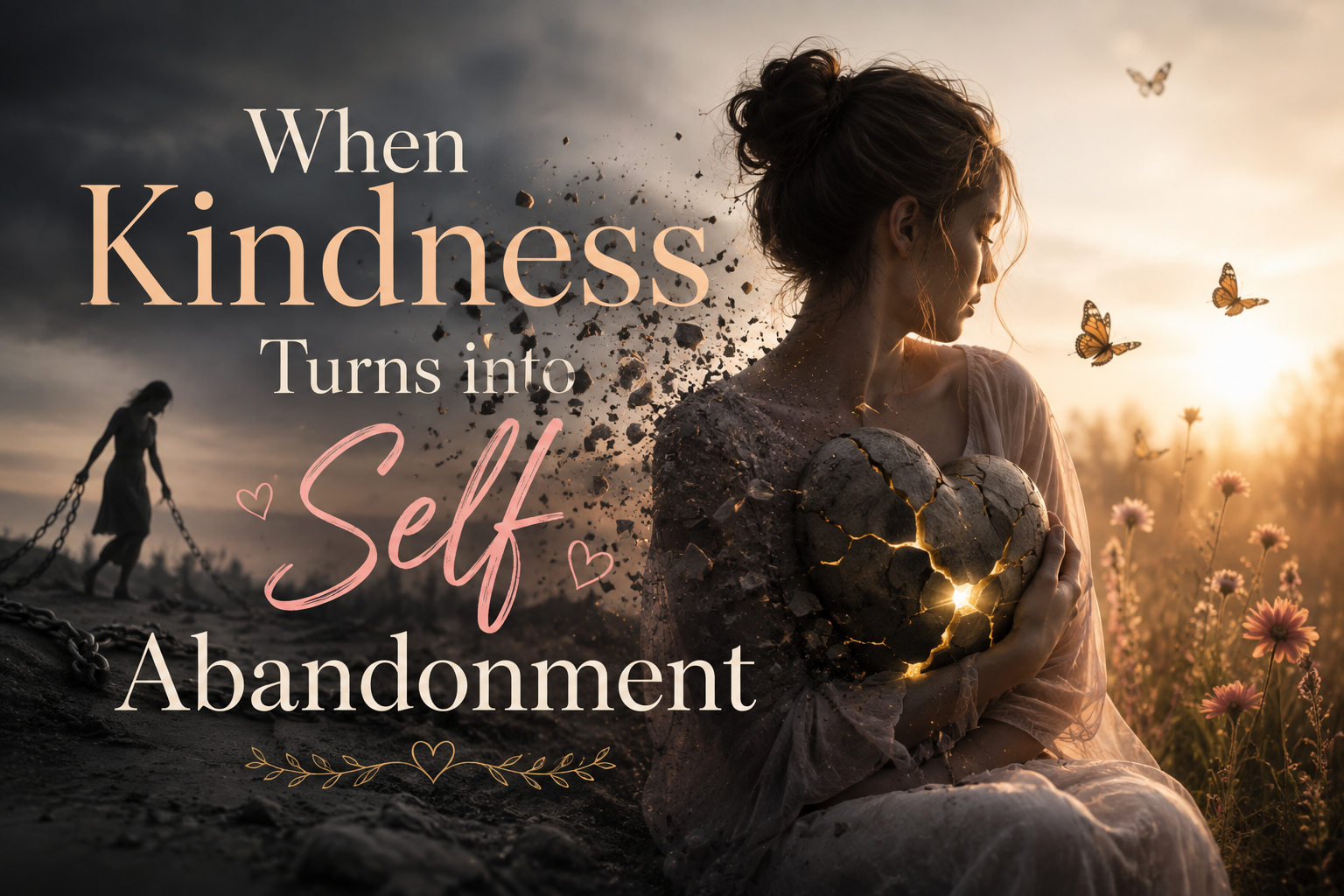
When Kindness Turns into Self Abandonment
Explore how kindness can become self-abandonment through people pleasing, overgiving, guilt, and fear of disappointing others, and how boundaries and self-trust help you stay loving without losing yourself.
How to Stay Loving Without Losing Yourself
Kindness is one of the most beautiful qualities a person can carry.
It can soften difficult moments.
Restore dignity.
Create connection.
Make someone feel seen.
Bring warmth into places that desperately need it.
Kindness matters.
But there is an important difference between being kind and repeatedly abandoning yourself in order to keep everyone else comfortable.
Sometimes what looks like kindness from the outside is actually fear underneath.
Fear of disappointing someone.
Fear of conflict.
Fear of being misunderstood.
Fear of being called selfish.
Fear of losing connection.
Fear that someone will withdraw their love if you stop giving them what they want.
When kindness becomes a strategy for managing other people's emotions, preserving approval, or preventing rejection at any cost, something begins to change.
You are still caring for everyone.
But you may no longer be caring for yourself.
That is where kindness can quietly turn into self-abandonment.
Kindness and People Pleasing Are Not the Same Thing
Kindness is freely given.
People pleasing often feels required.
Kindness can come from love.
People pleasing often comes from fear.
Kindness can say yes wholeheartedly.
Kindness can also say no honestly.
People pleasing struggles with no because another person's disappointment can feel dangerous.
That difference matters.
A kind person may think:
I want to help.
A people pleaser may think:
I have to help or something bad will happen between us.
A kind person can consider another person's feelings without becoming responsible for controlling them.
A people pleaser may feel responsible for making sure everyone remains happy, comfortable, approving, and emotionally settled.
One is generosity.
The other can become emotional over-responsibility.
A useful question is:
Am I choosing this freely, or am I afraid of what will happen if I do not?
Sometimes that one question reveals everything.
Self-Abandonment Can Be Surprisingly Quiet
Self-abandonment does not always look dramatic.
Sometimes it looks polite.
Helpful.
Flexible.
Easygoing.
Agreeable.
It can look like laughing at something that hurt you.
Saying “It's fine” when it is not.
Agreeing with something you do not believe.
Staying silent because someone else might become uncomfortable.
Saying yes before you have checked what you actually want.
Apologizing for having ordinary needs.
Explaining your boundaries until they barely resemble boundaries anymore.
Overextending yourself because you fear being considered selfish.
Changing your opinions depending on who is in the room.
Accepting behavior you would tell someone you love not to accept.
Making yourself smaller so another person never has to adjust.
You can become so practiced at accommodating everyone else that you stop noticing how often you override yourself.
That is what makes self-abandonment difficult to recognize.
It can become automatic.
The Body Often Knows Before the Mouth Says No
Sometimes your body recognizes a boundary before your mind does.
Someone asks something of you and your stomach tightens.
Your shoulders rise.
Your jaw clenches.
Your breathing changes.
You feel an immediate heaviness.
And then your mouth says:
“Sure.”
That gap matters.
Your body may be signaling discomfort before your mind has fully understood why.
This does not mean every uncomfortable feeling means you should say no.
Sometimes worthwhile things are uncomfortable.
But repeated tension around the same person, expectation, request, or situation deserves attention.
Instead of answering immediately, try:
“Let me think about that.”
“I need to check my schedule.”
“Can I get back to you?”
That small pause creates room between the request and the automatic yes.
Sometimes returning to yourself begins with five seconds of space.
Why People Pleasing Can Feel Like Kindness
People pleasing often develops around something good.
You care.
You notice people.
You do not want to cause unnecessary pain.
You value harmony.
You may naturally be generous, empathetic, thoughtful, or sensitive to the emotional atmosphere around you.
Those qualities are beautiful.
The difficulty begins when care becomes responsibility for everyone else's emotional state.
You begin thinking:
If they are upset, I must fix it.
If they are disappointed, I did something wrong.
If they misunderstand me, I must explain myself until they approve.
If they need something, I should provide it even when it costs me too much.
If I say no, I am unkind.
That is where compassion can become tangled with fear.
You are allowed to care deeply without becoming responsible for every reaction around you.
Why It Can Feel So Hard to Stop
For some people, pleasing was learned early.
Maybe being agreeable kept things peaceful.
Maybe being helpful brought praise.
Maybe having needs created tension.
Maybe expressing disagreement brought criticism.
Maybe you learned to read moods before you learned to read yourself.
Maybe being easy, useful, cheerful, responsible, quiet, or accommodating helped you maintain connection.
Those patterns can become deeply familiar.
Later, even when circumstances have changed, saying no may still feel strangely difficult.
You may understand intellectually that you are allowed to have boundaries while something inside you whispers:
But what if they leave?
What if they get angry?
What if they think I am selfish?
What if I disappoint them?
What if they do not love this version of me?
This is why changing people-pleasing patterns can take practice.
You are not simply learning different words.
You are learning that connection does not have to require disappearance.
Guilt Does Not Always Mean You Did Something Wrong
This is an important distinction.
Sometimes guilt tells you that you acted against your values.
That kind of guilt can help you repair something.
But sometimes guilt appears simply because you did something unfamiliar.
You said no.
You asked for space.
You declined an invitation.
You stopped overexplaining.
You let someone solve their own problem.
You did not immediately respond.
You chose rest instead of rescuing.
And suddenly you feel guilty.
That feeling does not automatically mean the boundary was wrong.
Sometimes guilt is simply the emotional echo of an old pattern.
You can feel guilty and still have made a healthy choice.
The feeling may need time to catch up with the new boundary.
Resentment Can Reveal Where Kindness Has Lost Its Freedom
Resentment is not always something to condemn.
Sometimes it carries information.
If you repeatedly feel resentful after helping someone, ask why.
Did you actually want to say yes?
Did you feel allowed to say no?
Did you agree because you wanted appreciation?
Did you hope the other person would eventually notice how much you were sacrificing?
Did you give more than you could freely give?
Resentment can sometimes reveal the place where generosity stopped being voluntary.
That does not make you a bad person.
It may simply mean something needs to become more honest.
Healthy generosity has room for choice.
Boundaries Do Not Cancel Kindness
A boundary does not automatically mean:
I do not care about you.
It may mean:
I care about this relationship enough to be honest.
You can be loving and unavailable.
Generous and discerning.
Compassionate and clear.
Helpful and limited.
Warm and honest.
A boundary can sound like:
“I care about you, but I cannot do that today.”
“I am available for this, but not for that.”
“I need some time before I answer.”
“That does not work for me.”
“I understand that you are disappointed.”
“I need to do this differently.”
None of these statements require cruelty.
Boundaries do not remove love.
They give love structure.
Someone Else's Disappointment Is Not Automatically Your Emergency
This can be one of the hardest lessons for a people pleaser.
Someone may be disappointed by your boundary.
They may wish you had said yes.
They may prefer the version of you who was always available.
They may need time to adjust.
Their disappointment can be real without becoming proof that you were wrong.
Two truths can exist together:
They are disappointed.
And:
My boundary is still appropriate.
You do not have to immediately erase another person's uncomfortable emotion.
Sometimes respect means allowing people to have their own feelings without rushing in to manage them.
You Can Disappoint Someone Without Disrespecting Them
Disappointment and disrespect are different things.
You may decline something kindly and someone still feels disappointed.
You may choose differently than someone hoped.
You may change your availability.
You may stop participating in an old pattern.
You may decide that something no longer works for you.
Their disappointment does not necessarily mean you behaved badly.
Mature relationships have room for difference.
They have room for no.
They have room for negotiation.
They have room for changing needs.
They have room for two people to remain whole.
Stop Overexplaining Your No
People pleasing often turns a boundary into a courtroom argument.
You say no.
Then explain.
Then explain the explanation.
Then soften it.
Then provide evidence.
Then offer three alternatives.
Then apologize.
Then wonder whether you should reverse the decision entirely.
Sometimes a respectful no can simply be:
“I won't be able to do that.”
Or:
“That doesn't work for me.”
You do not always need a closing argument.
An explanation can be generous when you genuinely want to offer one.
But explanation should not become the price you pay for permission to have a boundary.
Kindness Should Include You
Imagine practicing kindness in a way that does not leave one person permanently excluded.
You.
What would change?
Maybe you would rest before exhaustion.
Speak before resentment.
Pause before agreeing.
Ask for what you need.
Protect time that matters.
Stop apologizing for reasonable limits.
Let other adults carry responsibilities that belong to them.
Give from willingness instead of fear.
Receive without immediately trying to repay.
You are allowed to receive care without immediately earning it back.
Your needs do not become more important than everyone else's.
They simply stop being less important.
That is a profound shift.
Self-Respect and Kindness Can Live Together
There is no rule requiring you to choose between a soft heart and a strong spine.
You can have both.
Self-respect does not make kindness smaller.
It can make kindness cleaner.
You give because you mean yes.
You help because you genuinely want to.
You listen without absorbing responsibility for everything you hear.
You love without making yourself disappear.
You forgive without pretending something did not matter.
You remain compassionate without continually crossing your own limits.
This kind of kindness has roots.
How to Return to Yourself Without Hardening
Recovering from people pleasing is not about becoming cold.
It is not about refusing everyone.
It is not about treating independence as the highest virtue.
It is about bringing choice back into kindness.
Start small.
Before answering a request, pause.
Ask:
What do I actually want to say?
Notice your body.
Notice whether your yes feels open or pressured.
Name one honest need each day, even if you initially name it only to yourself.
Replace automatic reassurance with truth.
Instead of:
“I'm fine.”
Try:
“I'm a little overwhelmed today.”
Instead of an immediate yes:
“Let me think about it.”
Instead of disappearing into silence:
“Something about that did not sit well with me.”
Instead of resentment:
“I can help with part of this, but I cannot take on all of it.”
These are small returns.
But small returns rebuild self-trust.
Practice the Sacred Pause
One of the simplest ways to interrupt people pleasing is to stop answering immediately.
Create a pause.
A request comes.
Breathe.
Check inward.
Ask:
Do I want to do this?
Do I realistically have the capacity?
Am I saying yes because I mean it or because I fear the consequences of saying no?
Will I resent this later?
What would an honest answer sound like?
Then respond.
The pause may feel tiny.
But it gives your own voice time to enter the conversation.
Faith Does Not Require Self-Erasure
Kindness, generosity, service, compassion, and love are deeply meaningful spiritual qualities.
But love does not require a person to become invisible.
Even a life devoted to serving others still needs truth, wisdom, rest, discernment, and appropriate limits.
You can pray:
God, help me know what is mine to give.
Help me recognize what is not mine to carry.
Teach me to love without abandoning truth.
Give me wisdom when kindness and fear become tangled.
Help me serve from love rather than compulsion.
Teach me to include myself in the compassion I offer others.
Faith can help kindness become more intentional.
Not less generous.
More honest.
A Gentle Reset for People-Pleasing Moments
When you feel yourself slipping automatically into pleasing, pause.
Place a hand over your heart if that feels natural.
Take one slow breath.
Then say:
I do not have to answer immediately.
I am allowed to consider what I need.
Another person's reaction does not determine whether my choice is valid.
I can be kind without leaving myself behind.
Then ask:
What is the most loving truthful response available to me?
Sometimes the answer will still be yes.
Beautiful.
Now it is a freer yes.
Sometimes the answer will be no.
That can be loving too.
The One-Sentence Vow
When you need something simple to remember, return to this:
I will not betray myself to belong.
You can belong without self-erasure.
You can love without disappearing.
You can help without becoming responsible for everyone.
You can care without carrying everything.
You can remain tender without becoming endlessly available.
The relationships capable of honoring the real you need room for the real you to exist.
Frequently Asked Questions
What Is Self-Abandonment?
Self-abandonment can happen when you repeatedly ignore your own needs, values, feelings, limits, or inner knowing in order to maintain approval, avoid conflict, or preserve connection.
It often develops gradually and may become so familiar that it initially feels like ordinary kindness or flexibility.
What Is the Difference Between Kindness and People Pleasing?
Kindness contains choice.
People pleasing often contains fear or pressure.
A kind yes is something you genuinely choose.
A people-pleasing yes may be driven primarily by fear of rejection, anger, conflict, disappointment, or disapproval.
Why Do I Feel Guilty When I Set Boundaries?
If you are accustomed to accommodating other people, boundaries can initially feel unfamiliar.
That discomfort may appear as guilt even when you have not done anything wrong.
With practice, your emotional response may begin adjusting to the new pattern.
Is Saying No Selfish?
Saying no is not inherently selfish.
A thoughtful no can protect time, energy, responsibilities, health, relationships, and commitments that matter.
Healthy relationships need room for both yes and no.
Why Do People Pleasers Become Resentful?
Resentment can develop when a person repeatedly gives more than they freely want or realistically have capacity to give.
It may signal that clearer communication, limits, expectations, or choices are needed.
Can You Be Kind and Still Have Strong Boundaries?
Yes.
Kindness and boundaries can strengthen one another.
Boundaries can help generosity remain voluntary, sustainable, and honest rather than driven by fear or obligation.
How Do I Stop People Pleasing?
Begin by creating more space between requests and responses.
Notice automatic yeses, identify what you actually want, practice small boundaries, tolerate reasonable disappointment, reduce unnecessary overexplaining, and gradually build trust in your own decisions.
What If Someone Gets Angry When I Set a Boundary?
Their reaction may provide useful information, but it does not automatically determine whether your boundary was appropriate.
Consider whether your boundary was communicated respectfully and reasonably.
Healthy relationships can usually make room for limits, differences, and honest conversation.
When Kindness Turns into Self-Abandonment
Kindness does not require you to disappear.
Love does not require you to silence every need.
Generosity does not require exhaustion.
Peace does not require pretending.
Belonging does not require self-erasure.
You can remain warm.
Tender.
Generous.
Thoughtful.
Compassionate.
Loving.
And still have boundaries.
Still tell the truth.
Still protect your peace.
Still listen to yourself.
Still say no.
Still change your mind.
Still ask for what you need.
Still occupy your own life.
The goal is not to become less kind.
It is to become kind without abandoning yourself.
Because when kindness includes you, something beautiful happens.
Your yes becomes more genuine.
Your no becomes more honest.
Your relationships become more truthful.
Your generosity becomes freer.
And slowly, you stop confusing love with disappearance.
Your kindness includes you too.
Affirm Softly
My kindness includes me. I can be loving and still be true. I honor my needs, respect my limits, and return to myself with grace.

Boundaries Without Guilt
Create boundaries that feel calm, kind, and clear. Release guilt, build inner safety, and learn to honor your limits without overexplaining.
For many people pleasers, guilt is not just a feeling. It is a reflex.
The moment you consider a boundary, guilt rushes in like a siren. You imagine disappointing someone. You imagine being misunderstood. You imagine being “too much,” “too cold,” “not nice.”
But boundaries are not cruelty. Boundaries are clarity. And clarity is kindness, especially when it is honest.
Why guilt shows up
Guilt often appears when you begin changing a role you have played for a long time. If you have been the dependable one, the flexible one, the one who always accommodates, your new boundary can feel like a shock to the system.
Not because it is wrong. Because it is unfamiliar.
Also, guilt is not always a moral signal. Sometimes it is a nervous system signal. It is your body saying: “This is new. Are we safe to do this?”
You can feel guilt and still be right to protect your peace.
Boundaries are not walls
A healthy boundary is not shutting people out. It is showing people how to stay in your life with respect.
A boundary says:
this is what works for me
this is what does not
this is how I can show up sustainably
this is what I need to remain well
The goal is not to control others. The goal is to care for your energy.
The boundary formula that reduces guilt
If guilt spikes when you explain yourself, simplify. Overexplaining often invites negotiation, and negotiation often triggers panic.
Try this calm structure:
A clear statement
A short reason (optional)
A steady close
Examples:
“I can’t make it tonight. I’m resting.”
“I’m not available for calls during work hours.”
“I’m not able to take that on right now.”
“That doesn’t work for me.”
“I’m keeping my weekends quiet this month.”
Notice: these are not speeches. They are truths.
What if someone reacts badly
This is where many people pleasers break their own boundary. Not because they want to, but because they fear the reaction.
When someone reacts strongly, remind yourself:
their feelings are real, but they are not your responsibility to fix
your boundary is not a debate
discomfort does not equal danger
Sometimes people resist your boundary because they benefited from your lack of one. That does not mean you are doing something wrong. It means the old dynamic is changing.
A gentle practice: guilt to self respect
When guilt rises, try this:
Name it: “This is guilt.”
Normalize it: “Guilt is common when I choose myself.”
Re-center: “My needs matter too.”
Hold steady: repeat your boundary in one sentence.
Then stop. Let the silence do its work. You do not need to keep talking to be a good person.
A closing truth
Boundaries are not you becoming less loving. They are you becoming more real. And real love can survive truth.
Affirm softly
“I release guilt as a guide. I choose clarity. I protect my peace with gentle strength.”
Your Soulful Pathways ↑
Desktop: Hover over ‘Your Soulful Pathways’ in the top menu to explore another series.
Mobile: Tap the menu (☰), then choose ‘Your Soulful Pathways.’.
Signs You Are Overgiving
Learn the quiet signs of overgiving, emotional depletion, and invisible self abandonment. Recognize the patterns and return to balanced, sustainable care.
Giving can be beautiful. It can be sacred. It can be your love language, your way of making the world softer.
But overgiving feels different.
Overgiving is giving when you are empty. It is giving when you are unsure you are allowed to stop. It is giving to earn peace, to avoid conflict, to keep connection, to stay safe. And most of the time, it does not look dramatic. It looks like being “helpful.” It looks like being “easy.” It looks like being “strong.”
Until one day you realize: the giving never ends, but your energy does.
The quiet signs of overgiving
Overgiving often shows up as subtle patterns you have normalized:
you feel responsible for other people’s comfort
you offer help before anyone asks
you feel anxious when you rest
you apologize for having needs
you say yes while your body says no
you feel a low hum of resentment you do not want to admit is there
you struggle to receive without trying to earn it back
you feel drained after interactions that “weren’t even bad”
If you relate to these, it does not mean you are broken. It means you learned to survive through giving. You became skilled at scanning for what others might need, because maybe your own needs were not always safe to have.
When giving becomes self loss
There is a difference between generosity and self abandonment.
Generosity says: “I want to.”
Self abandonment says: “I have to.”
Generosity leaves you feeling open.
Self abandonment leaves you feeling depleted.
Generosity includes you.
Self abandonment forgets you.
If you are always the one holding everything together, you may not realize how much weight you are carrying until you finally put it down.
A simple self check: the body knows
Before you say yes to something, try this:
Place one hand on your chest, one on your belly.
Take one slow breath.
Ask: “If I say yes, do I feel expansion or contraction?”
Expansion often feels like calm, clarity, grounded willingness.
Contraction often feels like tightness, dread, pressure, obligation.
Your body is not being dramatic. It is giving you data.
Why overgiving feels “safer” than honest limits
People pleasing patterns often come with an unspoken belief: if I give enough, I can prevent discomfort. If I take care of everyone, nobody will be upset. If I stay useful, I stay connected.
But the cost is high. Overgiving doesn’t just drain your energy. It trains your nervous system to believe you are only safe when you are performing.
You were not made to earn belonging through exhaustion.
What to practice instead: sustainable care
Start small. Overgiving does not heal through one big boundary. It heals through repeated moments of choosing yourself.
Try one of these this week:
Pause before responding: “Let me check my schedule and get back to you.”
Offer what is true, not what is expected: “I can help for 15 minutes, not an hour.”
Practice receiving without explaining: “Thank you, that means a lot.”
Name your capacity out loud: “I’m at capacity today.”
Choose one small self-care first: water, food, a short walk, quiet time before you give.
Every time you do this, you teach your nervous system a new truth: love does not require self erasure.
Affirm softly
“I am allowed to give without losing myself. My care is sacred, and so is my energy.”
Your Soulful Pathways ↑
Desktop: Hover over ‘Your Soulful Pathways’ in the top menu to explore another series.
Mobile: Tap the menu (☰), then choose ‘Your Soulful Pathways.’.

Sacred Boundaries and People Pleasing Recovery
A gentle series for releasing overgiving, rebuilding self respect, and creating boundaries without guilt. Learn to protect your energy with calm clarity and soft strength.
There is a kind of tired that sleep does not fix.
It comes from always being “the strong one.” The helpful one. The flexible one. The one who can handle it. The one who says yes, even when your body is quietly begging for no.
People pleasing often begins as protection. A way to stay safe. A way to keep love. A way to avoid conflict. A way to feel needed, included, and valued. But over time, it can become a pattern of self abandonment, not because you lack strength, but because you have used your strength everywhere except for yourself.
This series is an invitation back to you
Not through harshness. Not through shutting people out. But through soft strength. Through truth spoken gently. Through boundaries that feel like peace instead of punishment.
Because boundaries are not walls. They are sacred agreements with your own nervous system. They are the way you teach your life: this is what keeps me well.
What this series is here to heal
This is for you if you:
feel responsible for other people’s emotions
overexplain your needs and still feel guilty
say yes quickly and regret it later
absorb stress after conversations and feel drained
avoid conflict even when it costs you
carry resentment you do not want to admit is there
struggle to receive support without trying to earn it back
If you see yourself here, let this be a gentle truth: you are not “too sensitive.” You are not “too caring.” You are simply ready for a new way. A way where your kindness includes you.
What sacred boundaries actually mean
Sacred boundaries are not cold. They are clear.
They are the difference between generosity and self loss. Between love and performance. Between support and overgiving. Between compassion and absorption.
A sacred boundary says:
“I can love you and still have limits.”
“I can care and still protect my peace.”
“I can be kind and still be honest.”
“I can be present without abandoning myself.”
When you practice boundaries, you may feel discomfort at first. That is normal. Your system is learning. Guilt may rise. Anxiety may chatter. Old roles may protest. But over time, boundaries create a new foundation: safety. And safety becomes the soil where your real self can grow.
What you will find inside these pages
This series is designed to help you:
recognize overgiving before you burn out
set boundaries without guilt or long explanations
stop absorbing emotions that are not yours
say no kindly and confidently
heal the need for approval
understand what healthy love requires
restore your yes so it becomes true again
Each page is meant to be practical and soul soothing. Something you can come back to whenever life pulls you toward old patterns.
Start here
If you are unsure where to begin, start with what feels most familiar:
If you feel exhausted, begin with Signs You Are Overgiving.
If you struggle to say no, begin with The Script for Saying No Kindly.
If you feel drained around people, begin with How to Stop Absorbing Other Peoples Energy.
If guilt is your biggest block, begin with Boundaries Without Guilt.
There is no wrong entry point. Your nervous system will guide you to the page you need.
And as you move through this series, let it be simple:
You do not have to become a different person.
You only have to stop leaving yourself behind.
Affirm softly
“My boundaries are sacred. My needs matter. I can be loving and still be true.”
Your Soulful Pathways ↑
Desktop: Hover over ‘Your Soulful Pathways’ in the top menu to explore another series.
Mobile: Tap the menu (☰), then choose ‘Your Soulful Pathways.’.