

Daily Rituals for Staying Out of the Loop
Discover simple daily rituals for stepping out of repetitive thoughts and habits, protecting your attention, creating new patterns, deepening faith and returning to intentional living.
Some days move forward.
Other days seem to circle.
You wake up thinking the same thoughts. Reach for the same distractions. Revisit the same conversation. Check the same thing again. Think about something that still cannot be answered. Promise yourself that tomorrow will feel different.
Then tomorrow arrives, and somehow yesterday has followed you into it.
This is the loop.
Not every loop is something we need to change. Repetition is part of being human. It helps us learn, remember, build skills and move through familiar parts of life without having to consciously decide every tiny action.
But sometimes repetition stops serving us.
A thought becomes a place we keep visiting.
A reaction becomes predictable.
Checking becomes automatic.
Waiting becomes worrying.
Rest becomes scrolling.
Reflection becomes replaying.
And without realizing it, we can spend enormous amounts of energy traveling roads we already know.
The beautiful truth is that a loop can be interrupted.
Not necessarily through force.
Not by criticizing yourself.
Not by demanding that you become an entirely different person tomorrow morning.
Sometimes the beginning of change is much smaller.
A pause.
A prayer.
A walk.
A breath.
A different response.
A decision not to follow the thought one more time.
A tiny ritual can become a doorway out of yesterday and back into the life happening right now.
Not Every Loop Is the Same Loop
Before changing a pattern, it helps to recognize what kind of pattern it is.
Some loops are habit loops.
A familiar cue leads almost automatically to a familiar behavior.
You sit on the couch and reach for your phone.
You walk into the kitchen and open the refrigerator.
A notification appears and you immediately check it.
Other loops happen primarily in our thoughts.
Something uncertain happens.
You think about it.
Then you think about your thinking.
You imagine what could happen.
You replay what already happened.
You search for certainty.
You find another possibility.
And around you go.
Other loops can grow through avoidance.
Something feels uncomfortable, so you postpone it.
Postponing feels easier in the moment.
But the unfinished thing remains.
Tomorrow it feels a little heavier.
So you avoid it again.
These patterns can overlap, but recognizing the pattern gives you something important:
A place to interrupt it.
The Brain Learns What We Repeat
The human brain is beautifully adaptive.
When behaviors are repeatedly performed in familiar circumstances, associations can develop between the situation and the response. Over time, familiar cues can make certain behaviors easier to begin without lengthy conscious deliberation.
That is wonderful when the behavior serves us.
Brush your teeth.
Put on your seat belt.
Make your morning coffee.
Lock the door.
But repetition does not stop to ask whether a pattern is helping you.
It simply helps make familiar patterns more familiar.
That means changing a pattern can be more useful than merely fighting one.
Instead of:
I have to stop doing this.
We can begin asking:
When this familiar moment arrives, what would I like to practice instead?
The old doorway can become the entrance to a new ritual.
Reflection Moves. Rumination Circles.
Thinking deeply is not the enemy.
Reflection is valuable.
Reflection asks:
What happened?
What can I learn?
Is there something I need to do?
Is there something I need to change?
What belongs to me?
What can I release?
Useful reflection eventually produces something.
Understanding.
Acceptance.
A decision.
An action.
A boundary.
A conversation.
A lesson.
Or sometimes the realization that nothing more needs to be done.
Rumination is different.
It circles.
The same question receives another hearing.
The same conversation gets replayed.
The same possibilities are examined from another angle.
Nothing genuinely new enters the discussion, yet the mind keeps calling another meeting.
A simple question can help:
Is this thought taking me somewhere, or is it taking me around again?
If it is taking you somewhere, continue.
If it is only taking you around again, perhaps you have already received everything this particular thought has to give.
You Don't Have to Finish Every Thought
This may be one of the most freeing things to remember.
You do not have to finish every thought that enters your mind.
Some thoughts arrive without needing an answer.
Some questions cannot be solved today.
Some possibilities do not need rehearsal.
Some memories do not need another hearing.
Some conversations do not need to continue in your imagination.
Some uncertainties cannot be eliminated before you move forward.
And some fears do not deserve an afternoon of investigation.
A thought can knock without being invited to move in.
You can notice it.
Acknowledge it.
And return to what is actually happening.
Name the Loop Without Becoming the Loop
Words matter.
Instead of:
I am such an overthinker.
Try:
I notice that I am replaying this again.
Instead of:
I can't stop worrying.
Try:
My mind keeps returning to a question I cannot answer right now.
Instead of:
I always do this.
Try:
This is a familiar pattern.
That small shift creates space.
You are not the pattern.
You are the person noticing the pattern.
And once you can notice it, you have already created something that did not exist while you were completely absorbed in it:
Choice.
Ritual Creates a Place to Return
A routine asks:
What do I normally do?
A ritual can ask:
How do I want to enter this moment?
That distinction changes everything.
A ritual does not have to be elaborate.
Open the curtains and thank God for another morning.
Take a slow breath before opening your inbox.
Pause before responding to something upsetting.
Walk outside when your thoughts begin circling.
Write one sentence of gratitude before bed.
Pray before making the decision.
Make tea and sit quietly for five minutes.
The action itself may be tiny.
Its meaning can be enormous.
It says:
I do not have to continue automatically from here.
Begin Before the World Begins for You
Morning is one of the easiest places for yesterday's loops to restart.
Before your feet have fully touched the floor, the mind can already be reviewing responsibilities, problems, messages and unfinished business.
Try claiming a small piece of morning before everything else arrives.
It does not have to become an elaborate morning routine.
Five minutes can matter.
Ten minutes can matter.
Open the curtains.
Drink water.
Stretch.
Breathe.
Pray.
Step outside.
Notice the sky.
Then ask:
What do I want to carry into today?
Peace?
Courage?
Joy?
Patience?
Faith?
Curiosity?
Purpose?
Gratitude?
Choose something before the noise chooses for you.
Do Something Intentional Before Something Digital
Our phones contain extraordinary tools.
They also contain an almost endless supply of things asking for attention.
Messages.
Headlines.
Statistics.
Notifications.
Comments.
Emails.
Videos.
Updates.
Before opening that doorway in the morning, consider doing one intentional thing first.
Pray.
Drink water.
Make the bed.
Open the curtains.
Feed the dog.
Step outside.
Write.
Stretch.
Make coffee and actually taste it.
The point is not to declare technology bad.
The point is to remember:
Technology is a tool. Your attention still belongs to you.
Replace Checking With Choosing
Checking can become one of the quietest loops of modern life.
Check email.
Check messages.
Check statistics.
Check social media.
Check the news.
Nothing changed?
Check again.
Each moment seems insignificant, but together they can divide a day into dozens of tiny fragments.
Try moving from checking to choosing.
Choose when you will look.
Choose when you will answer.
Choose what deserves immediate attention.
Choose what can wait.
Not every notification deserves access to the exact moment it arrives.
The goal is not rigidity.
It is ownership.
Create an Interrupt Ritual
Choose one tiny action that means:
I noticed the loop. I am returning now.
Take one slow breath.
Stand up.
Place both feet on the floor.
Look through a window.
Say a short prayer.
Drink water.
Step outside.
Change rooms.
Write the thought down.
Wash your hands.
Touch something natural.
Turn on music.
Stretch.
The particular action matters less than the meaning you repeatedly give it.
And there is an important difference here:
Noticing the loop is not failure.
Noticing is the beginning of the return.
Make an If-Then Promise to Yourself
Vague intentions can disappear inside busy days.
Specific plans give us something recognizable to do.
Instead of:
I need to stop worrying so much.
Try:
If I notice myself repeatedly asking a question I cannot answer today, then I will write it down, pray about it and return to something I can influence.
Instead of:
I should use my phone less.
Try:
If I pick up my phone without knowing why, then I will put it down and ask what I actually intended to do.
Instead of:
I need to stop reacting so quickly.
Try:
If a message upsets me, then I will pause before responding.
Now you do not have to invent a wise response while standing in the middle of the emotional weather.
You chose your response while the sky was clear.
Use the Body to Change the Moment
Sometimes thinking harder about a thought simply gives that thought a bigger chair.
Move.
Walk.
Stretch.
Sweep the porch.
Water the plants.
Fold laundry.
Dance in the kitchen.
Take the dog outside.
Garden.
Cook.
Build something.
Work with your hands.
Sometimes forward movement in the body can help create forward movement in attention.
This does not mean running away from what matters.
It means remembering something important:
You are more than a mind sitting in a room thinking about itself.
You are a living person inside a living world.
Go meet some of it.
Give Worry Somewhere to Go
When something genuinely requires your attention, write it down.
Then ask:
Can I Do Something About This Now?
If yes, choose the smallest useful action.
Send the email.
Make the call.
Research the question.
Schedule the appointment.
Ask for help.
Write the first paragraph.
Have the conversation.
Make the plan.
Action can transform vague worry into something concrete.
If there is nothing useful to do right now, acknowledge that too.
Continuous thinking is not always continuous progress.
Sometimes the next faithful step is action.
Sometimes it is waiting.
Wisdom is learning the difference.
Give Your Mind Something New to Live
A loop feeds easily on sameness.
Same chair.
Same screen.
Same question.
Same information.
Same conversation.
Same reaction.
Sometimes the interruption is not thinking differently.
It is living differently for the next twenty minutes.
Bake something.
Call someone.
Plant something.
Learn something.
Take another road home.
Sit somewhere new.
Begin the project.
Visit somewhere beautiful.
Make something with your hands.
Listen to unfamiliar music.
Read something that expands you.
Do something your yesterday did not contain.
You are not merely trying to stop a thought.
You are giving life another place to happen.
Do One Thing That Creates Forward Motion
Loops feel circular because nothing new enters them.
So every day, place one stone somewhere ahead of you.
Read five pages.
Walk ten minutes.
Apply for something.
Write one paragraph.
Organize one drawer.
Learn one thing.
Work on the dream for twenty minutes.
Make the appointment.
Start the garden.
Finish the small task.
You do not need to reinvent your life today.
Just create one piece of forward motion.
Tomorrow, create another.
Eventually those stones become a road.
Create a Midday Beginning
A difficult morning does not own the afternoon.
One frustrating conversation does not own the day.
One mistake does not own the week.
Create a small midday ritual that says:
The day can begin again here.
Step outside.
Wash your face.
Make tea.
Take a short walk.
Pray.
Sit quietly for three minutes.
Then ask:
What matters now?
Not this morning.
Not yesterday.
Not next month.
Now.
There is tremendous freedom hidden inside that little word.
Practice the Sacred Pause
Between what happens and what you do next, look for the pause.
Not every text needs an immediate answer.
Not every opinion requires participation.
Not every misunderstanding requires a defense.
Not every thought requires investigation.
Not every invitation deserves a yes.
Not every emotion needs to become an action.
The pause gives wisdom time to enter the room.
For a person of faith, it can become something more:
God, show me how to meet this moment.
Perhaps nothing outside you changes during those few seconds.
But something within you might.
Protect Small Pockets of Silence
Silence does not require a retreat in the mountains.
Turn off the television while making dinner.
Drive without audio occasionally.
Sit outside without bringing your phone.
Drink your morning coffee without scrolling.
Walk without filling every second with something to hear.
Let there be small places in your life where nothing is asking you to respond.
At first, silence can feel unusually empty.
Stay there a little longer.
You may discover what was underneath all the noise.
Ideas.
Questions.
Gratitude.
Creativity.
Prayer.
Wonder.
Peace.
Sometimes your own spirit has been whispering beneath everything else.
Put Beauty Into the Day on Purpose
Not every ritual needs to solve a problem.
Some rituals should exist because being alive is worth noticing.
Light the candle.
Play beautiful music.
Arrange the flowers.
Use the good cup.
Watch the sunset.
Cook something slowly.
Sit beneath a tree.
Look at the moon.
Open the window when it rains.
Beauty interrupts mechanical living.
It reminds us that life is not simply a collection of problems waiting to be solved.
There is something here to experience.
Sometimes the Loop Needs Sleep
There are thoughts that feel enormous at midnight and very different after rest.
When we are tired, ordinary concerns can sometimes feel closer, louder and more urgent.
So create an evening closing ritual.
Write down what needs to be remembered tomorrow.
Dim the lights.
Put the phone away.
Pray.
Release unfinished business.
Then allow today to be complete.
Not every late-night thought deserves a midnight solution.
Some questions look different in morning light.
Let Tomorrow Hold Tomorrow
One of the most exhausting loops is trying to live days that have not arrived.
What if this happens?
What if that changes?
What if they say this?
What if it does not work?
Planning can be wise.
Preparation can be wise.
But endless rehearsal cannot guarantee the future.
Jesus spoke beautifully to the human tendency to carry tomorrow before it arrives. In Matthew 6:34, He teaches us not to worry about tomorrow because today already has enough to hold.
Faith does not require you to solve tomorrow before tomorrow arrives.
Do what belongs to today.
Let tomorrow meet you when it becomes today.
There Is a Difference Between Returning to a Thought and Returning to God
A looping mind often keeps asking:
What if?
Faith can eventually answer:
I have done what I can.
I have prayed.
I have acted where action was possible.
I have asked for wisdom.
I have taken the next step.
I do not have to mentally carry this every minute in order for God to be working in it.
That is surrender.
Not giving up.
Sometimes surrender comes after faithfully doing the thing that was yours to do.
Then the rest can be placed somewhere larger than your own hands.
Renewing the Mind Is More Than Fighting Thoughts
Romans 12:2 speaks of transformation through the renewing of the mind.
That renewal can be lived in wonderfully practical ways.
What are you repeatedly looking at?
What are you repeatedly listening to?
What are you repeatedly rehearsing?
What are you repeatedly expecting?
What are you repeatedly practicing?
And what are you repeatedly returning to?
Philippians 4:8 points attention toward what is true, honorable, just, pure, lovely and worthy of praise.
That does not require pretending difficult things do not exist.
It reminds us that difficulty does not deserve the entire landscape of our attention.
There is still goodness.
There is still beauty.
There is still possibility.
There is still God.
New Mercy Means Today Does Not Have to Be Yesterday
Lamentations 3:22–23 gives us one of Scripture's most beautiful images of renewal: God's compassion does not run out, and His mercies are new every morning.
Think about that.
New every morning.
Morning does not arrive demanding that you perfectly repeat yesterday.
It arrives new.
And you can meet it new.
Perhaps not completely changed.
Perhaps still learning.
Perhaps still practicing.
But awake.
Aware.
Willing.
Beginning again.
Don't Count Days. Build Repetitions.
There is no magical number of days after which every new behavior becomes automatic.
People are different.
Behaviors are different.
Lives are different.
So instead of staring at the calendar wondering whether you have finally become a new version of yourself:
Practice.
Repeat.
Return.
If you miss Tuesday, return Wednesday.
If an old pattern catches you for an afternoon, notice it when you notice it.
Then return.
Every time you recognize the cue and practice another response, you give that response another repetition.
Progress does not require a flawless streak.
Make the New Path Easy to Find
Willpower does not have to carry everything.
Let your environment help you.
Want to journal?
Leave the journal where you will see it.
Want to walk?
Put your shoes near the door.
Want to pray before checking notifications?
Keep the phone away from the bed.
Want to read more?
Put the book where the phone usually sits.
Want more quiet?
Turn off notifications that do not need immediate access to you.
Want to drink more water?
Put it within reach.
Build little invitations toward the life you want.
Make the desired path easy to see.
Do Not Build Another Prison Out of Your Rituals
There is an important irony here.
A page about escaping loops should not give you another rigid loop you are afraid to break.
Ritual should support your life.
Not dominate it.
Some mornings will be different.
Travel happens.
Work gets busy.
Someone needs you.
Plans change.
Life moves.
The purpose of ritual is not perfect performance.
It is remembrance.
When life pulls you outward, ritual gives you somewhere to return.
A Simple Daily Rhythm for Staying Out of the Loop
You do not need twenty new rituals.
Choose a few.
Morning
Before the phone, breathe, pray, drink water, open the curtains and decide what you want to carry into the day.
When You Notice the Loop
Name it gently.
I am replaying.
I am checking.
I am predicting.
I am avoiding.
I am circling.
Then use your interrupt ritual.
Midday
Ask:
What matters now?
Let the day begin again.
Afternoon
Do one thing that creates forward motion.
Evening
Write down what tomorrow needs.
Notice something good from today.
Pray.
Release the rest.
Sleep.
Then begin again.
The Loop Breaks Here
The past can explain a pattern.
The future can inspire change.
But the only place you can actually choose differently is here.
This breath.
This response.
This click.
This conversation.
This prayer.
This morning.
This next ten minutes.
That is wonderful news.
You do not need control over your entire future.
You need enough awareness to recognize one doorway and enough willingness to choose what happens next.
And if you miss that doorway?
Another one will come.
Life gives us thousands of opportunities to return.
A Beautiful Life Is Built Through Returns
Perhaps staying out of the loop does not mean never finding yourself in an old pattern again.
Perhaps it means recognizing it sooner.
Returning more gently.
Choosing more consciously.
And trusting yourself to begin again.
Return to your breath.
Return to prayer.
Return to your body.
Return to nature.
Return to gratitude.
Return to purpose.
Return to what matters.
Return to God.
Return to life.
Every return gives another path a little more use.
And one day something quietly remarkable may happen.
The familiar trigger appears.
The old doorway opens.
But you don't walk through it.
You pause.
You choose.
You respond differently.
Maybe there is no thunder.
No grand announcement.
No dramatic moment when the old you disappears and the new you arrives.
Just a different choice where the old choice used to live.
And perhaps that is how many lives truly change.
One sacred interruption.
One faithful action.
One conscious choice.
One return.
Then another.
Until eventually you look behind you and realize:
You are no longer walking in circles.
You are going somewhere.
Questions to Sit With
What Does It Mean to Be Stuck in a Loop?
A loop is a recurring pattern of thought, attention, reaction or behavior. Some loops are useful routines. Others keep bringing us back to thoughts or behaviors that no longer help us move forward.
How Can I Tell the Difference Between Reflection and Rumination?
Reflection tends to produce understanding, acceptance, a decision or useful action. Rumination tends to revisit the same material without creating meaningful new information. Ask yourself: Is this thought taking me somewhere, or is it taking me around again?
What Is an Interrupt Ritual?
An interrupt ritual is a simple action you choose to use when you notice a familiar pattern beginning. It might be prayer, breathing, walking outside, writing something down, changing rooms or pausing before responding.
Why Are If-Then Rituals Useful?
They turn a broad intention into a recognizable response. Instead of trying to decide what to do in the middle of a difficult moment, you decide beforehand: If this happens, I will do this.
Can Movement Help When My Thoughts Are Circling?
Movement can give attention somewhere constructive to go. Walking, gardening, stretching, cleaning, cooking and other physical activities can reconnect us with the body, our surroundings and the present moment.
Do I Have to Eliminate My Phone or Social Media?
No. The goal is intentional use rather than automatic use. Technology can remain a useful part of life while you decide when and how it receives your attention.
How Long Does It Take to Create a New Habit?
There is no universal number of days. Habit formation varies between people, behaviors and circumstances. Rather than chasing a magical deadline, focus on making the desired behavior easy to repeat in the circumstances where you want it to live.
What If I Fall Back Into an Old Pattern?
Return when you notice. One difficult morning or forgotten ritual does not erase the choices that came before it. Beginning again is part of the practice.
How Can Faith Help Me Step Out of a Loop?
Prayer can create a meaningful pause between what happens and how we respond. Faith can also help us distinguish between what is ours to act upon and what can eventually be entrusted to God. We can act faithfully without mentally carrying every uncertainty every minute.
Closing Thought
You do not have to wake tomorrow and become an entirely different person.
Wake tomorrow and notice.
Notice the first light through the window.
Notice your first thought.
Notice when your hand reaches automatically.
Notice when a useful thought becomes a circle.
Notice when you have done everything you can do.
Notice when it is time to act.
Notice when it is time to release.
Then make one conscious choice.
Pray.
Move.
Create.
Rest.
Begin.
Return.
There comes a point when repetition stops merely describing where you have been and begins creating where you are going.
Let your rituals become little doors into that future.
And every morning, with new mercy waiting for you, choose another door.
You May Also Enjoy:
Creating Quiet Without Escaping Your Life
Why Ritual Changes the Way We Experience Life
Building a New Life One Small Habit
Calm as a Spiritual Practice
A Remembering Ritual for Hard Days
Building Margin One Small Step at a Time
Belief Changes the Size of a Life
Becoming Who You Were Always Meant to Be
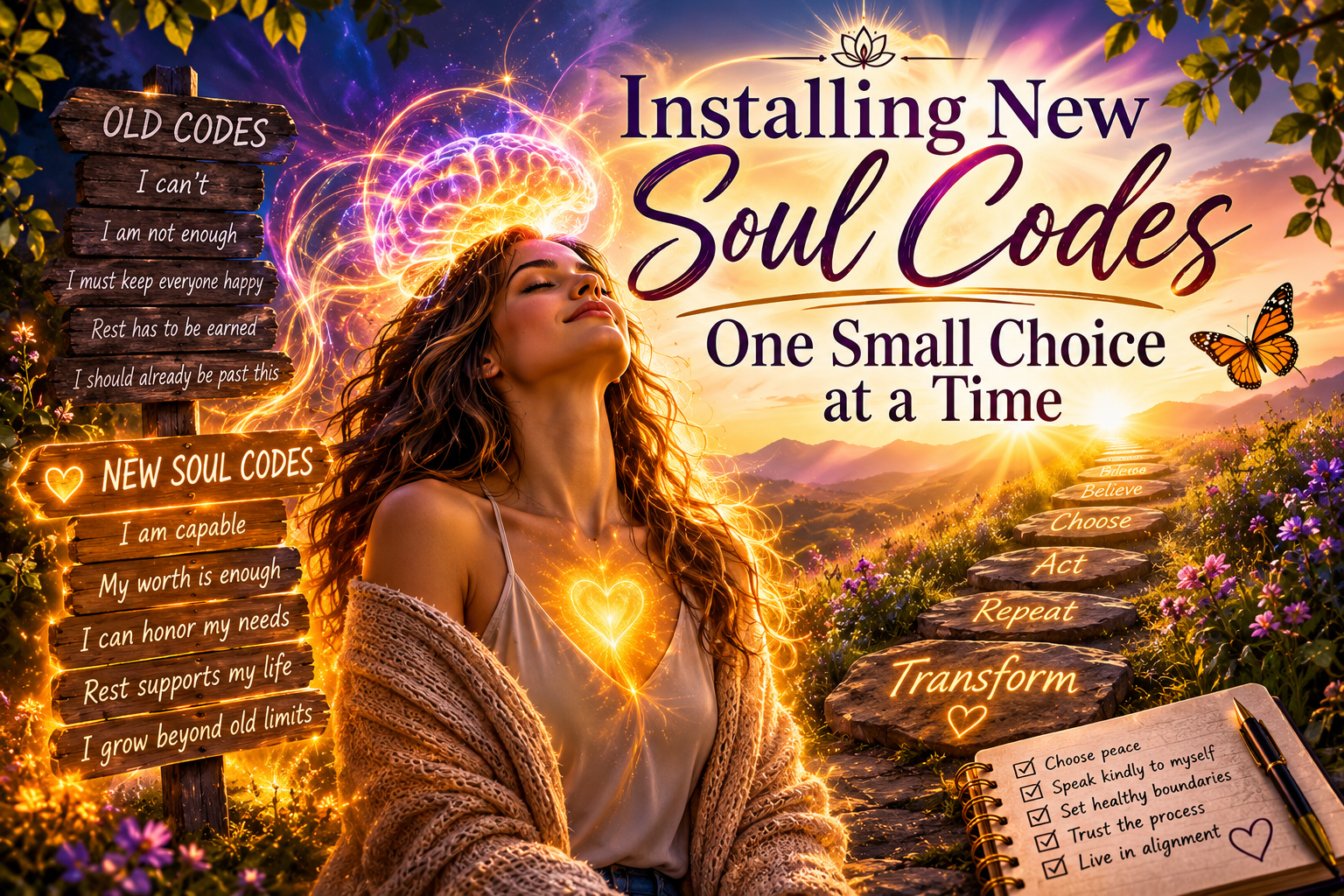
Installing New Soul Codes One Small Choice at a Time
Learn how small repeated choices can help change old beliefs and patterns. Explore soul codes, self-trust, neuroplasticity, and practical ways to create meaningful change.
How Repeated Choices Can Help Rewrite Old Patterns and Build a New Inner Way of Living
New soul codes are not just prettier thoughts.
They are not sentences you repeat while secretly continuing to live against yourself. They are not forced positivity, spiritual pressure, or an attempt to pretend you believe something your inner world has not yet learned to trust.
New soul codes are built through lived choices.
They begin forming when you relate to yourself differently in small, honest, repeatable ways.
You choose differently.
Respond differently.
Speak to yourself differently.
Protect what matters differently.
And slowly, the old script stops being the only script available.
Your mind begins learning something new.
Your habits begin changing.
Your expectations begin widening.
Your relationship with yourself begins becoming more trustworthy.
Your spirit begins recognizing a different way of living.
That is how meaningful change often happens.
Not all at once.
One small choice at a time.
What Are Soul Codes?
Think of a soul code as an inner instruction you have come to live by.
“Soul code” is a spiritual and reflective way of describing the beliefs, assumptions, inner rules, expectations, and repeated patterns that can quietly shape how we live.
Some codes are conscious:
I am capable of figuring things out.
My voice matters.
I can trust myself to make thoughtful decisions.
Others operate more quietly beneath the surface:
Do not ask for too much.
Keep everyone happy.
Stay small so you stay safe.
Do not risk being disappointed.
Rest has to be earned.
If someone is unhappy with me, I must have done something wrong.
These inner rules can influence how you interpret situations, what you expect, what you tolerate, how you respond to opportunity, and what you believe is available to you.
They can become so familiar that you stop recognizing them as learned patterns.
They simply begin sounding like truth.
But a familiar instruction is not necessarily a permanent one.
Old Codes Were Built Through Repetition
Old inner codes rarely appeared from nowhere.
They may have developed through repeated experiences, family dynamics, cultural expectations, criticism, disappointment, relationships, fear, pressure, or periods when you were trying to understand what was safe and what was not.
A code such as:
I can't do that
may have grown after repeated discouragement.
That kind of life isn't for me
may have developed from watching possibilities seem available to everyone except you.
I have to keep everyone happy
may have formed in an environment where conflict felt threatening.
I have to earn rest
may have grown from years of connecting worth with productivity.
I should already be past this
may have developed where struggle was judged instead of understood.
When something is experienced or repeated enough, it can become familiar.
And familiar patterns can begin influencing behavior automatically.
Habit research supports the importance of repeated behavior, particularly when the same response occurs in recurring contexts. Over time, these learned associations can make a response increasingly automatic.
This reveals something hopeful:
What has been learned does not always have to remain unchanged.
A Code Can Become an Identity Without You Realizing It
One of the most powerful things about an old inner code is that eventually you may stop hearing it as a belief.
You begin hearing it as you.
Instead of:
I learned to avoid conflict,
it becomes:
I am someone who cannot handle confrontation.
Instead of:
I learned to doubt myself,
it becomes:
I am indecisive.
Instead of:
I became accustomed to putting everyone first,
it becomes:
That's just who I am.
This is where old programming can become especially limiting.
A learned pattern has quietly become an identity statement.
And once something feels like identity, you may stop imagining that another way is possible.
One part of rewriting your inner codes is learning to separate:
What happened to me
from
Who I am.
And:
What I learned
from
What I choose to continue believing.
That distinction creates room.
New Soul Codes Need Lived Evidence
You cannot always think your way into a new life.
Sometimes your inner world needs evidence.
It needs to see you choose differently.
It needs to watch you keep promises to yourself.
It needs to experience what happens when you rest instead of continually pushing.
When you speak instead of shrinking.
When you pause instead of reacting.
When you say no instead of automatically pleasing.
When you honor something true inside yourself rather than abandoning it to keep everything comfortable.
A new soul code becomes stronger when your actions repeatedly support it.
You rest when you need rest instead of proving your worth through exhaustion.
You speak kindly to yourself after making a mistake instead of turning one mistake into an attack on your identity.
You pause before agreeing to something.
You allow yourself to want something without creating a courtroom-level defense of why you deserve it.
You set one honest boundary instead of swallowing resentment.
You try something you previously assumed you could not do.
You tell yourself the truth when an old fear begins writing the story.
These moments may look small from the outside.
Inside, something important is happening.
You are creating new evidence.
The Brain Learns Through Experience and Repetition Too
There is also a biological reason practice and repetition matter.
The human brain retains a capacity to learn and adapt throughout life. This capacity is broadly described as neuroplasticity.
Research on adult learning has documented experience-dependent changes in the adult brain, while learning research shows that practice contributes to the acquisition of new skills.
This does not mean that a single affirmation instantly “rewires” the brain.
Nor does neuroplasticity scientifically prove the spiritual concept of Soul Codes.
They are two different ways of looking at the conversation.
Soul Codes are a spiritual and reflective framework.
Neuroplasticity describes the biological capacity of the nervous system to change in response to experience and learning.
Where they meet is in something wonderfully practical:
Experience matters.
Practice matters.
Attention matters.
Repetition matters.
If an old response has been practiced hundreds or thousands of times, it makes sense that a different response may initially feel unfamiliar.
Unfamiliar does not mean wrong.
It may simply mean new.
The first boundary can feel awkward.
The first honest no can feel strange.
The first attempt at something new can feel unnatural.
The first time you refuse to participate in an old pattern may make part of you want to return immediately to what is familiar.
Keep practicing.
You are giving yourself another option.
Embodiment Makes the New Code Real
A belief becomes more meaningful when your life begins reflecting it.
If your new soul code is:
My needs matter,
then embodiment might mean actually checking what you need before automatically agreeing to something.
If the code is:
My voice matters,
embodiment may mean speaking when you would normally stay silent.
If the code is:
I am capable of learning,
embodiment may mean attempting the thing you once avoided because you feared being bad at it.
If the code is:
Rest supports my life,
embodiment means allowing yourself to rest without turning the entire experience into guilt.
If the code is:
I can trust myself,
embodiment may mean making a thoughtful decision without polling everyone around you first.
The words establish direction.
The choice gives the words roots.
Choose Codes That Are Actually Yours
Not every new belief needs to come from a book, teacher, social media post, family member, spiritual community, or someone else's idea of the person you should become.
Sometimes transformation means discovering what you genuinely believe when the noise settles.
A new soul code might arise from truth you have learned through experience:
I do not have to abandon myself to keep peace.
I can love someone without carrying what belongs to them.
I am allowed to change my mind when I learn something new.
God can lead me somewhere I did not expect.
My past can teach me without controlling my future.
I can be kind without saying yes to everything.
I can listen to wisdom without surrendering my own discernment.
I am allowed to build a life that feels true to me.
The strongest new codes are not merely attractive sentences.
They are truths you are increasingly willing to live.
Ask yourself:
Do I actually believe this?
Does this bring me closer to truth?
Does this help me become more honest, loving, courageous, peaceful, and whole?
What would living this belief actually look like?
Your new code should not replace somebody else's programming with somebody else's newer programming.
It should help you return to what is genuinely true.
Small Choices Matter More Than Dramatic Promises
People often make change too large.
Tomorrow I will become completely different.
I will never do this again.
Everything changes Monday.
That intensity can feel powerful.
But sustainable change often grows more quietly.
Instead of asking yourself to become an entirely different person tomorrow, choose one behavior that agrees with the person you are becoming.
Ten minutes of movement.
One honest conversation.
One application submitted.
One drawer organized.
One boundary held.
One glass of water.
One morning without immediately reaching for your phone.
One moment where you notice self-criticism and choose a more truthful response.
One promise made small enough that you can actually keep it.
Small does not mean meaningless.
Small means repeatable.
And repeatable choices can become patterns.
Research on habit formation reinforces this principle: repetition in a sufficiently consistent context can gradually increase automaticity, although the time involved varies considerably by person and behavior.
Your Choices Teach You What You Believe About Yourself
Imagine repeatedly telling yourself:
I matter.
But every time you need rest, you ignore yourself.
Every time someone crosses a boundary, you silence yourself.
Every time you want something, you immediately dismiss it.
Every time you make a mistake, you attack yourself.
The words and the lived experience are giving different instructions.
Now imagine something changes.
You say:
I matter.
And then you act accordingly.
You rest.
You speak.
You pause.
You choose.
You protect your time.
You honor your commitments to yourself.
You correct yourself without destroying yourself.
The belief begins receiving evidence.
Your choices become part of the conversation you are having with yourself about who you are.
A Better Question to Ask
Instead of only asking:
What should I believe?
Ask:
What choice would support the version of me I am becoming?
That question brings transformation out of the clouds and into the moment you are actually living.
Maybe the next aligned choice is drinking water instead of ignoring your body.
Maybe it is closing the app.
Taking the walk.
Making the appointment.
Starting the project.
Going to bed.
Telling the truth gently.
Applying for something.
Taking ten minutes to pray.
Saying no.
Saying yes.
Choosing silence instead of continuing to explain yourself to someone committed to misunderstanding you.
The choice does not have to be dramatic to matter.
It needs to be honest enough to create new evidence.
Do Not Try to Rewrite Everything at Once
If you identify twenty old codes and attempt to replace all of them tomorrow, you have created another form of pressure.
Choose one.
Maybe your old code is:
I always have to be available.
Work with that.
Maybe it is:
I cannot trust my decisions.
Start there.
Maybe:
I have to be perfect before I begin.
That one may be quietly stopping an entire section of your life.
Choose the code currently creating the most friction.
Then practice one new response.
Let your life learn it.
There will be time for the others.
When the Old Code Returns
An old pattern returning does not automatically mean the new one failed.
Familiar responses often appear quickly, especially when you encounter familiar situations.
You may have been getting better at boundaries and suddenly hear yourself say yes automatically.
You may have been practicing confidence and suddenly doubt yourself.
You may have been treating yourself more kindly and have one terrible day where the old inner critic returns carrying a megaphone.
Notice it.
That is different from surrendering to it.
You can catch yourself and say:
There is the old code.
Then choose again.
The goal is not to become a person who never encounters an old pattern.
The goal is to become someone who increasingly recognizes when an old pattern is trying to make the decision.
That recognition is powerful.
Some New Codes Need Better Language
A new soul code should feel expansive without requiring you to pretend.
If:
I am completely fearless
feels absurd to you, do not force it.
Try:
I can move forward even when I feel uncertain.
Instead of:
Everything always works perfectly for me,
try:
I trust myself to meet what comes.
Instead of:
I never doubt myself,
try:
I can listen to doubt without automatically obeying it.
Instead of:
I love everything about myself,
perhaps begin with:
I am learning to treat myself with greater respect.
Truth has room to grow.
Your new code does not need to be extravagant.
It needs to point toward the life you genuinely want to practice.
Soul Practice
Choose one area where you want to update your inner programming.
Complete these three lines:
Old code:
New soul code:
One small action that supports it today:
For example:
Old code:
“I have to earn rest.”
New soul code:
“Rest supports my energy, clarity, and ability to live well.”
One small action that supports it today:
“I will take ten quiet minutes without explaining or apologizing.”
Or:
Old code:
“My voice creates problems.”
New soul code:
“I can speak honestly and kindly.”
One small action that supports it today:
“I will say what I actually mean in one conversation.”
Or:
Old code:
“I am not capable of doing something like that.”
New soul code:
“I can learn things I do not know yet.”
One small action that supports it today:
“I will spend fifteen minutes learning the first step.”
Repeat the action for a week if it makes sense.
Notice what changes.
Notice what resists.
Notice what becomes easier.
Then keep building.
Seven Soul Codes You Can Begin Practicing
You may want to experiment with one of these:
I can pause before I answer.
My worth is larger than my productivity.
I am allowed to learn through imperfect beginnings.
I can trust myself to notice when something does not feel right.
My needs deserve a place in my decisions.
I can change an old pattern without rejecting who I used to be.
I do not have to repeat something simply because it is familiar.
Do not simply repeat the sentence.
Ask:
What would this look like in my life today?
Then give the belief one small action.
Frequently Asked Questions
What Are Soul Codes?
Soul codes are a spiritual and reflective way of describing deeply held beliefs, assumptions, internal rules, expectations, and repeated patterns that can influence how you understand yourself and move through life.
The term provides a framework for recognizing old patterns and intentionally practicing different ones.
Can Old Patterns Really Change?
Yes.
Habits, responses, beliefs, skills, and behavioral patterns can change throughout life.
Some changes happen relatively quickly, while deeply practiced patterns may require longer periods of repetition, experience, awareness, and intentional action.
Why Do New Beliefs Sometimes Feel Uncomfortable?
Familiarity can influence what feels normal.
A healthier response may initially feel strange simply because it has not been practiced as often.
This can happen with boundaries, self-talk, receiving help, resting, speaking honestly, or trying unfamiliar things.
Uncomfortable and wrong are not always the same thing.
Sometimes unfamiliarity is simply part of learning another way.
Do Affirmations Work?
Affirmations can be useful when they help direct attention, interrupt habitual self-talk, reinforce intentions, or remind you of a belief you are actively practicing.
They become especially meaningful when the words are believable enough to engage with and are supported by choices and experiences that give them substance.
Instead of using an affirmation to deny what you feel, it can become a reminder of the direction you are choosing.
How Long Does It Take to Build a New Pattern?
There is no single timeline that applies to every person or behavior.
A recent systematic review of health-related habit research found substantial variation in how long behaviors took to become more automatic, with the type of behavior, timing, context, and individual differences all contributing.
Consistency is more useful than demanding a specific deadline.
What If I Fall Back Into an Old Pattern?
Notice it and return.
One old reaction does not erase every different choice you have already made.
The moment you recognize the pattern, you have another opportunity to practice the new response.
Do I Need to Believe My New Soul Code Completely Before I Begin?
No.
Sometimes belief strengthens through experience.
You may begin with a statement that feels honest enough to practice rather than something you already believe with absolute certainty.
Then let your choices create evidence.
You Are Teaching Your Life a New Way
New soul codes settle through repetition.
Through choices.
Through honesty.
Through better patterns.
Through the promises you keep with yourself.
Through the moment you recognize an old script and decide it does not automatically get to write what happens next.
You are not trying to manufacture an artificial version of yourself.
You are creating room for a truer one to live.
One small choice can create new evidence.
New evidence can strengthen a new belief.
A new belief can support a different pattern.
A different pattern can become a new rhythm.
And over time, those rhythms can change the way you experience your own life.
You do not have to rewrite everything today.
Choose one code.
Choose one action.
Choose again tomorrow.
That is enough to begin.
And sometimes the smallest choice is where an entirely different story quietly starts.
If this message resonated, you may also enjoy:
When Old Programming Fights Back
Living from the Remembered Self, Not the Wounded Self
Daily Rituals for Staying Out of the Loop
Your Soulful Pathways ↑
Discover more series pages for you in Your Soulful Pathways ↑

Waking Up Inside Your Own Program
Learn how to move from being inside old patterns to witnessing them — and how awareness restores choice in everyday moments.
There is a quiet moment when something inside you pauses and says, “I have been here before.”
Not in memory. In pattern.
The same feeling rises. The same reaction appears. The same fear speaks. The same habit reaches for control. You may find yourself overexplaining again, shrinking again, saying yes again, shutting down again, preparing for disappointment again, or trying to earn peace in a room that already feels familiar to your nervous system.
That moment may feel uncomfortable, but it is also powerful.
Because the moment you can see the pattern, you are no longer completely asleep inside it.
You are waking up.
What It Means to Wake Up Inside Your Own Program
Waking up inside your own program does not mean the old pattern disappears overnight. It means you are no longer fully merged with it.
You begin to notice the difference between who you are and what you have been repeating.
That is a sacred shift.
When you are inside the program, everything can feel automatic. Emotions move quickly. Thoughts feel urgent. Fear sounds convincing. The body reacts before the spirit has a chance to speak. You may feel like you have no choice, only reflex.
But when awareness enters, even for one breath, something changes.
You become the witness instead of the reflex.
You begin to realize, “This is an old pathway. This is not my whole self.”
And that awareness creates space for something new.
Signs You Are Stepping Out of Autopilot
Awakening often begins in small, ordinary moments.
You notice the urge before the action.
You feel the emotion before believing the story.
You sense the old pull before you follow it.
You pause before replying.
You catch the familiar need to explain, please, hide, fix, prove, or disappear.
These moments may not look dramatic from the outside, but inside, they are huge.
This is not about becoming perfectly calm or spiritually polished. It is about becoming present enough to notice yourself while life is happening.
A person waking up inside their own program may still feel the old feelings. They may still hear the old thoughts. They may still feel the old fear. But now there is another voice present too.
A quieter one.
The voice that says, “I can choose differently this time.”
The Question That Changes the Pattern
One of the most powerful shifts is moving from judgment into curiosity.
Instead of asking, “What is wrong with me?”
Try asking, “What is happening in me right now?”
That one question changes the room inside you.
It stops turning your pattern into a character flaw. It helps you see what is actually happening beneath the reaction. Maybe you are afraid of being rejected. Maybe you are trying to stay safe. Maybe an old part of you thinks peace depends on pleasing everyone else. Maybe your body remembers a time when speaking up came with a cost.
Curiosity does not excuse every reaction, but it helps you understand the root.
And when you understand the root, you can begin to respond with wisdom instead of shame.
When Old Patterns Get Louder
At first, awareness can feel strange.
Old programs do not always soften the moment they are seen. Sometimes they get louder. The fear may push harder. The habit may feel stronger. The old story may try to convince you that nothing is changing.
But that does not mean you are going backward.
It often means the light is reaching a place that used to run silently in the background.
Keep noticing. Keep breathing. Keep returning to yourself without turning awareness into another reason to criticize your progress.
Every time you pause, you teach your inner world that there is another way.
Soul Practice
The next time an old program activates, try this simple three-part pause.
Name it gently: “This is a familiar pattern.”
Take one slow breath, with a longer exhale than inhale.
Choose one small shift.
That shift may be relaxing your shoulders, softening your jaw, delaying your reply, taking a sip of water, stepping away for a moment, or speaking one honest sentence instead of repeating the old script.
You do not have to become a new person in one moment.
You only have to return choice to the moment you are in.
A Gentle Closing
Each time you notice without immediately reacting, you create space.
Inside that space lives choice.
Choice to respond differently.
Choice to rest instead of push.
Choice to speak truth instead of habit.
Choice to listen to your spirit before obeying an old fear.
You are not late to your life.
You are arriving.
And every moment of awareness is part of the return.
If this message resonated, you may also enjoy:
My Spirit’s Knowing Matters More Than Outside Noise
When Old Programming Fights Back
Daily Rituals for Staying Out of the Loop
Your Soulful Pathways ↑
Discover more series pages for you in Your Soulful Pathways ↑.
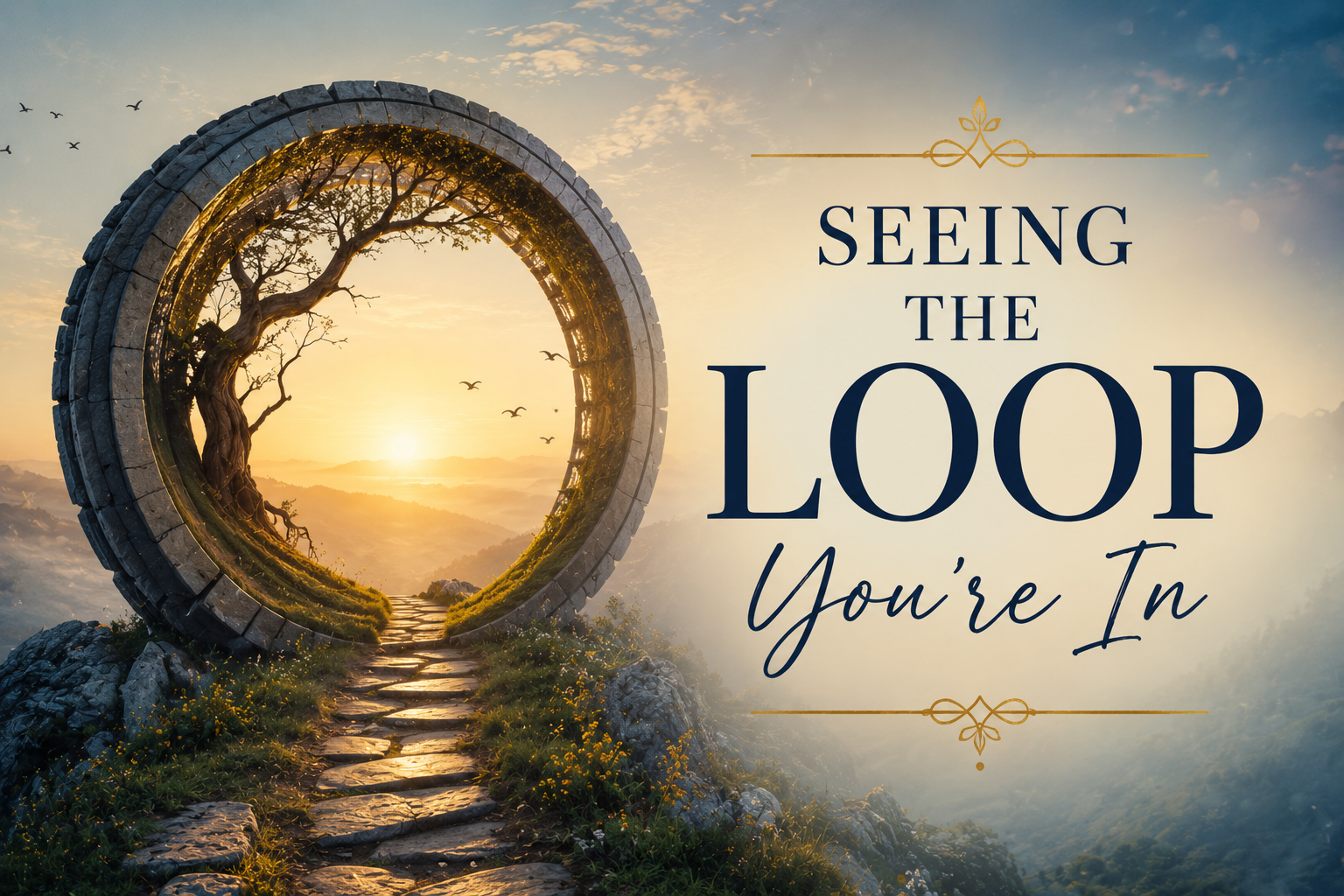
Seeing the Loop You’re In
Learn how to recognize repeating emotional and behavioral patterns, understand the beliefs beneath them, and begin rewriting old inner loops one conscious choice at a time.
Recognizing Repeating Patterns, Reclaiming Choice, and Rewriting Old Inner Codes
There comes a moment when repetition starts to feel heavy.
You may not notice the loop at first.
You may simply feel tired of the same reaction.
The same worry.
The same shutdown.
The same relationship pattern.
The same self-doubt.
The same disappointment.
The same version of yourself showing up when you hoped something different would rise.
And then one day, something in you notices:
I have been here before.
That moment matters.
It is not failure.
It is awareness beginning to wake up.
A loop is not who you are.
It is a pattern.
A repeated inner pathway.
A response that became familiar through experience, protection, survival, habit, fear, conditioning, or emotional memory.
At one time, that pattern may have helped you.
It may have taught you how to avoid conflict.
How to keep peace.
How to stay accepted.
How to protect your heart.
How to prepare for disappointment.
How to move through a season you did not yet know how to navigate differently.
But what once protected you can eventually become too small for the life you are ready to live.
Seeing the loop is where rewriting begins.
What Is an Inner Loop?
An inner loop is a repeated pattern of thought, emotion, expectation, or behavior that tends to activate in similar situations.
Something happens.
The old interpretation appears.
The familiar emotion follows.
The usual response takes over.
Then the outcome may reinforce the original belief.
And the cycle begins again.
For example:
Someone becomes distant.
You assume rejection.
You become anxious.
You overexplain, chase, withdraw, or shut down.
The interaction becomes strained.
Then something in you says:
See? I knew this would happen.
That is how a loop can strengthen itself.
The same process can happen around money.
Relationships.
Work.
Boundaries.
Self-worth.
Conflict.
Success.
Rest.
Visibility.
Trust.
Love.
A loop is powerful because it has been practiced.
But practiced does not mean permanent.
What Repeating Patterns Can Look Like
Loops are not always dramatic.
Sometimes they hide inside ordinary habits.
You may notice yourself:
Saying yes while something in you quietly says no.
Shrinking when you want to speak.
Overexplaining because a simple answer feels unsafe.
Expecting disappointment before anything has actually gone wrong.
Avoiding a conversation because conflict feels dangerous.
Returning to relationships that recreate familiar emotional dynamics.
Procrastinating on something that matters because beginning feels vulnerable.
Scrolling or distracting yourself whenever an uncomfortable feeling appears.
Assuming criticism before anyone has criticized you.
Trying to control every detail because uncertainty feels unbearable.
Overgiving in order to feel secure.
Pulling away the moment connection becomes vulnerable.
Repeating the same harsh self-talk after every mistake.
Choosing what feels familiar even when familiar does not feel peaceful.
The loop often says:
This is just what I do.
Awareness begins asking:
But is this what I still want to do?
That question returns choice.
Where Loops Come From
Many repeating patterns begin long before we have language for them.
They can form through childhood experiences.
Family patterns.
Repeated disappointment.
Fear of rejection.
Emotional pressure.
Unpredictable environments.
Relationships.
Loss.
Expectations about who you were supposed to be.
Messages about what was safe to feel, say, need, or become.
A person may learn:
Do not upset anyone.
Do not ask for too much.
Be useful.
Stay quiet.
Be strong.
Keep everyone happy.
Expect disappointment.
Do not trust easily.
Do not show weakness.
Those messages may never have been spoken directly.
Sometimes they were learned by watching what happened.
Over time, the pattern becomes familiar.
And familiar can begin to feel safer than new.
Even when familiar hurts.
That is why change can sometimes feel uncomfortable even when you know the old way no longer fits.
Your spirit may be ready for something new while an old inner code still reaches automatically for the doorway it recognizes.
That does not mean you are stuck.
It means the old map has been used many times.
Now you are learning another route.
Familiar Does Not Always Mean True
One reason loops can be difficult to recognize is that familiarity can masquerade as truth.
You may think:
This always happens to me.
People always leave.
I always mess things up.
I can never relax.
I am just bad at relationships.
I have always been this way.
Nothing ever changes.
But repetition can create a powerful illusion.
Something happening repeatedly does not automatically mean it reflects your identity or your future.
Sometimes the same belief, expectation, environment, choice, or response has been repeating.
The loop may be familiar.
That does not make it destiny.
How a Loop Can Reinforce Itself
Repeating patterns sometimes survive because they appear to create evidence for themselves.
You expect to be misunderstood.
So you enter a conversation guarded.
Your tone becomes defensive.
The other person becomes guarded too.
The conversation goes poorly.
Then the loop says:
See? Nobody understands me.
Or perhaps you believe your needs are inconvenient.
So you do not communicate them.
People assume everything is fine.
Your needs remain unmet.
Then the loop says:
See? Nobody cares what I need.
Or perhaps you fear failure.
So you delay beginning.
You run out of time.
The result is weaker than it could have been.
Then the loop says:
See? I knew I couldn't do it.
This does not mean every difficult outcome is something you created.
Life contains real disappointment, difficult people, uncertainty, and circumstances outside your control.
But sometimes a pattern helps produce the very evidence it later uses to justify itself.
Seeing that can be powerful.
Because once the pattern becomes visible, another response becomes possible.
Awareness Opens the Door
Seeing the loop does not mean you have to fix your entire life today.
Awareness is not a command to punish yourself into change.
It is an invitation to notice what has been happening beneath the surface.
Notice when your mind rushes toward the familiar conclusion.
Notice when you start preparing for rejection before anyone has rejected you.
Notice when you abandon your own truth to keep the room calm.
Notice when one mistake immediately becomes a story about your worth.
Notice when you feel compelled to react before you have enough information.
Notice when an old fear begins narrating a new situation.
This noticing matters.
It is the moment you stop living completely on autopilot.
You begin to realize:
This is a pattern.
This is not my whole identity.
I have seen this before.
I may be able to choose differently here.
Seeing the loop is already part of leaving it.
The Loop Is Not the Same as You
This distinction matters.
A pattern you have repeated for years can begin to feel like personality.
You may say:
I'm just an overthinker.
I'm just a people pleaser.
I'm terrible with boundaries.
I always sabotage things.
I'm just emotionally unavailable.
But a repeated behavior is not necessarily the deepest truth of who you are.
Some characteristics genuinely belong to your personality.
Others may be strategies that became so familiar they started answering to your name.
Instead of saying:
This is who I am,
try:
This is something I learned to do.
That small change in language creates possibility.
What has been learned can be examined.
What has been practiced can be practiced differently.
What became automatic can become conscious again.
Ask What the Loop Is Trying to Protect
Many loops make more sense when you stop asking:
What is wrong with me?
and begin asking:
What is this trying to protect?
Maybe the loop is trying to protect you from rejection.
Conflict.
Embarrassment.
Abandonment.
Failure.
Disappointment.
Vulnerability.
Uncertainty.
Feeling powerless.
Being seen.
Needing someone.
Losing control.
Understanding the purpose of an old pattern does not mean you have to keep living from it.
It simply allows you to see it with greater clarity.
You can say:
I understand why this began.
I understand what it was trying to do.
And I can decide whether I still need it now.
That creates a very different relationship with change.
Why Kindness Can Change More Than Force
Many people try to break old loops with pressure.
They criticize themselves.
Push harder.
Demand instant transformation.
Call themselves weak.
Tell themselves they should be past this by now.
But shame can strengthen the very pattern you want to release.
If a loop formed through fear, shame adds more fear.
If it formed through rejection, shame becomes another rejection.
If it formed because mistakes once felt unsafe, shame reinforces the old lesson.
Kindness creates room.
Curiosity creates information.
Instead of:
Why do I keep doing this?
Try:
What happens right before I do this?
Instead of:
I should know better.
Try:
I noticed it sooner this time.
Instead of:
I failed again.
Try:
The old pattern showed up. What can I learn here?
Change becomes easier when awareness is not immediately followed by attack.
Triggers Can Reveal the Entrance to the Loop
A trigger can reveal where an old pattern begins.
Something happens.
A tone of voice.
A delayed response.
A request.
A criticism.
An unexpected bill.
A change of plans.
A feeling of being overlooked.
A moment of uncertainty.
And suddenly the old pathway lights up.
This can be useful information.
The trigger is not necessarily the whole problem.
It may simply be the doorway.
Ask:
What did this moment seem to mean to me?
Maybe the delayed message became:
They are leaving.
Maybe the criticism became:
I am failing.
Maybe the request became:
I have to say yes.
Maybe the uncertainty became:
Something bad is coming.
The meaning attached to the trigger can reveal the inner code underneath the loop.
Find the Belief Underneath the Pattern
The belief beneath the loop is often more important than the behavior you can see.
The behavior might be overexplaining.
The deeper belief might be:
If I am not perfectly understood, I will be rejected.
The behavior might be people-pleasing.
The deeper belief might be:
If someone is disappointed in me, I am unsafe.
The behavior might be procrastination.
The deeper belief might be:
If I try and fail, it will prove I am not capable.
The behavior might be controlling.
The deeper belief might be:
If I do not manage everything, something terrible will happen.
The behavior might be withdrawing.
The deeper belief might be:
If I leave first, I cannot be abandoned.
When you find the belief, the loop becomes easier to understand.
Then you can ask:
Is this belief still true?
Was it ever completely true?
What would a truer belief sound like now?
This is where rewriting your inner codes becomes real.
The Pause Is Where the Rewrite Begins
You do not break every loop by never feeling the old response again.
You begin by creating space between what happens and what you automatically do next.
That space may be only a few seconds at first.
But it matters.
Someone says something that activates you.
The old loop says:
React now.
The pause says:
Wait.
A request arrives.
The old loop says:
Say yes immediately.
The pause says:
Check with yourself first.
Something goes wrong.
The old loop says:
Everything is falling apart.
The pause asks:
What actually happened?
A relationship feels uncertain.
The old loop begins writing the ending.
The pause says:
I do not know enough yet.
The pause is not empty.
It is where choice returns.
One Small Different Choice Changes the Pattern
You do not always need a dramatic response.
Sometimes the rewrite is almost invisible.
You answer tomorrow instead of immediately.
You say:
Let me think about it.
You ask a question instead of making an assumption.
You tell the truth instead of giving the expected answer.
You rest instead of pushing through.
You stay in the conversation instead of shutting down.
You walk away instead of escalating.
You stop explaining after you have already been clear.
You receive kindness without searching for what must be wrong with it.
You let something good happen without immediately preparing for its ending.
That one different choice gives your inner world new information:
There is another way.
Repeated often enough, another way becomes another pathway.
Rewriting the Inner Code
Once you see the old belief, you can begin choosing a new one.
Old code:
I have to keep everyone happy to be safe.
New code:
I can be kind without abandoning myself.
Old code:
If someone misunderstands me, I have failed.
New code:
I can communicate clearly without controlling how I am interpreted.
Old code:
A mistake means I am not capable.
New code:
A mistake can give me information I can use.
Old code:
Uncertainty means danger.
New code:
I can remain grounded while I wait for more information.
Old code:
I have to earn love by being useful.
New code:
My worth does not depend on how much I carry for everyone else.
Old code:
This always happens.
New code:
The past has repeated, but the next response can be different.
New inner codes become believable through experience.
You do not only repeat the new thought.
You begin living it.
Rewriting Does Not Mean Erasing Your Past
Rewriting your inner codes does not mean erasing your past.
It does not mean pretending certain things never happened.
It does not require rejecting the person you once were.
It means deciding which old instructions still belong in the life you are building now.
Some patterns may have helped you survive.
Honor what they did.
Then ask whether they are still needed.
You can appreciate the protection without continuing the pattern.
You can understand the old version of yourself without remaining inside it.
You can carry the wisdom forward without carrying every old instruction with you.
Your past can inform you without continuing to program you.
What Happens When You Choose Differently
Choosing differently can feel strange at first.
You may feel guilty after setting a boundary.
Uncomfortable after saying no.
Exposed after telling the truth.
Restless when you stop chasing.
Uncertain when you leave something unresolved.
That discomfort does not automatically mean the old way was better.
Sometimes the new choice feels unfamiliar simply because the old one has been practiced longer.
Give the new response time.
You are building evidence.
Every time you respond differently and move through the discomfort, your inner world learns something new.
I can say no and still be okay.
I can wait without everything collapsing.
I can tell the truth and remain whole.
I can disappoint someone and still be a good person.
I can feel uncertainty without surrendering to panic.
I can choose something new.
That is how a new inner code starts becoming lived truth.
Do Not Turn Growth Into Another Loop
Even personal growth can become a loop if you begin believing you must constantly monitor, fix, and improve yourself.
You are not a machine under permanent repair.
You do not have to analyze every reaction.
You do not have to turn every uncomfortable feeling into a project.
Sometimes you are tired.
Sometimes you have a bad day.
Sometimes something genuinely hurts.
Sometimes you need rest instead of interpretation.
Sometimes there is nothing to decode.
The goal is not perfect self-awareness.
The goal is greater freedom.
You are learning to recognize patterns that repeatedly limit your life while allowing yourself to remain human.
That balance matters.
Signs You Are Beginning to Leave the Loop
Change may be quieter than you expect.
You catch the pattern earlier.
You pause before reacting.
You ask questions instead of immediately assuming.
You recover faster when the old response appears.
You say no with less explanation.
You recognize when fear is predicting instead of observing.
You stop treating every uncomfortable feeling as an emergency.
You notice familiar relationship dynamics sooner.
You become more willing to choose what feels true instead of what merely feels familiar.
You trust yourself to move through discomfort.
You stop believing one setback means you are back at the beginning.
Perhaps the loop still appears.
But it no longer feels invisible.
And what is visible has less power to operate automatically.
A Soul Practice for Seeing the Loop
The next time you feel the familiar pull of an old pattern, pause.
Take one slow breath.
Then ask:
What just happened?
Name the event without adding the story yet.
What did I immediately make it mean?
Notice the interpretation.
What am I feeling?
Name the emotion.
What do I feel pulled to do automatically?
Identify the familiar response.
What might this response be trying to protect me from?
Become curious.
What is actually true right now?
Separate present reality from old expectation.
What is one small different choice available to me?
Then choose the smallest honest shift.
Maybe you soften your shoulders.
Wait ten minutes.
Drink water.
Ask a question.
Tell the truth kindly.
Step outside.
Write before speaking.
Say:
I need time to think about that.
You do not have to rewrite your entire life in one moment.
You only need to return one small piece of choice to yourself.
Seeing the Loop Is the First Rewrite
The moment you recognize a pattern as a pattern, something has already changed.
Before, the loop simply happened.
Now you can see it happening.
That awareness creates a little distance.
A little light.
A little choice.
You may still enter the loop sometimes.
But now there is a door.
You know where it is.
And every time you find that door a little sooner, the old pattern loses some of its authority.
You begin to recognize:
I have felt this before.
I have thought this before.
I have reacted this way before.
And I do not have to finish the story the same way.
That is the beginning of freedom.
Frequently Asked Questions
What Is a Repeating Emotional Loop?
A repeating emotional loop is a familiar cycle of trigger, interpretation, emotion, and response that tends to appear in similar situations. Through repetition, the sequence can become increasingly automatic, making it feel as though you are reacting before consciously choosing.
Why Do I Keep Repeating the Same Patterns?
Patterns can develop through habit, past experiences, learned beliefs, protective responses, family dynamics, expectations, or fear. Familiar responses can continue even after the circumstances that originally shaped them have changed.
Recognizing the pattern gives you an opportunity to examine whether it still belongs in your life.
How Do I Recognize the Loop I Am In?
Look for situations where you repeatedly experience similar thoughts, emotions, relationship dynamics, expectations, or behaviors.
Ask what tends to happen immediately before the pattern begins and what meaning you automatically attach to that event.
The belief underneath the reaction may reveal the loop more clearly than the behavior itself.
Can an Old Pattern Feel Like My Personality?
Yes.
Behaviors repeated for years can become so familiar that they feel like fixed personality traits. Some characteristics genuinely reflect personality, while others may have developed as learned strategies or protective responses.
Awareness can help you begin exploring the difference.
How Do I Break a Repeating Pattern?
Begin with awareness rather than force.
Notice what activates the pattern, identify the interpretation or belief that follows, create a pause before the automatic response, and choose one small different action.
You are creating another possible pathway rather than demanding instant transformation.
Why Does Changing an Old Pattern Feel Uncomfortable?
Familiar responses can feel predictable even when they are limiting.
A different response may initially feel strange simply because it has not been practiced as often.
New does not automatically mean wrong.
Sometimes unfamiliarity is simply evidence that you are no longer repeating the old response.
What Does Rewriting Your Inner Codes Mean?
Rewriting your inner codes means examining the beliefs, assumptions, and expectations underneath recurring patterns and deciding whether they still belong in the life you are creating.
It is not about erasing your past.
It is about carrying forward the wisdom while becoming more intentional about the instructions you continue to live by.
A Gentle Closing
Seeing the loop is the first rewrite.
Not because everything changes instantly.
Because your power begins to come back online.
You are no longer only living from old programming.
You are becoming present enough to choose.
The loop may still speak.
The old doorway may still look familiar.
The first response may still rise.
But now you can notice.
Pause.
Question.
Choose.
Practice.
Return.
You are not required to finish every old pattern simply because it started.
You can change the ending.
One response.
One boundary.
One honest thought.
One different choice at a time.
You are waking up inside your own life.
And that waking up matters.
If this message resonated, you may also enjoy:
Waking Up Inside Your Own Program
Installing New Soul Codes One Small Choice at a Time
Daily Rituals for Staying Out of the Loop
Your Soulful Pathways ↑
Discover more series pages for you in Your Soulful Pathways ↑