
Integrity: The Highest Frequency You Can Hold
Integrity isn’t perfection. It’s alignment. Learn how choosing truth, even quietly, becomes your strongest spiritual power.
Integrity has a sound.
It’s not the sound of being flawless. It’s the sound of being aligned. When your inner life and outer life match, something settles. Your energy stops leaking. Your nervous system stops negotiating.
Integrity becomes a kind of peace you can feel in your bones.
Integrity is not perfection
Perfection is fear wearing a fancy outfit.
Integrity is truth wearing comfortable shoes.
Integrity says:
“This is who I am.”
“This is what I value.”
“This is what I will not betray.”
It’s less about appearance and more about coherence.
Why integrity feels like a frequency
When you’re out of integrity, your body knows.
You might feel:
Tension after saying yes when you meant no
Fog after pretending something didn’t bother you
Fatigue after entertaining relationships that drain you
Restlessness after ignoring your own instincts
That’s your system telling you, “We’re not aligned.”
The quiet ways we abandon ourselves
Integrity is often lost in tiny moments:
Laughing at something that hurt you
Staying silent when truth mattered to you
Overgiving to earn closeness
Agreeing just to avoid discomfort
No shame. Most people learned this as survival.
But you can unlearn it as devotion.
Choosing integrity in real life
Integrity doesn’t always look “nice.”
Sometimes it looks like:
Saying no without explaining
Leaving a situation that keeps dishonoring you
Admitting, “I changed my mind”
Being consistent with your own values, even when nobody claps
Integrity is a private agreement with your soul.
A simple integrity check
Ask:
“What would I do if I trusted myself fully?”
Then ask:
“What am I doing now that I’ll have to emotionally pay for later?”
That second question is powerful.
It reveals the hidden debt of self-betrayal.
Integrity creates identity
When you live in integrity, you stop needing a mask.
You stop needing to convince people.
You stop needing to prove.
Your life becomes the evidence.
That’s the highest frequency:
A self you can trust.
Your Soulful Pathways ↑
Discover more series pages for you in Your Soulful Pathways ↑.
The Courage to Be Misunderstood
Growth can confuse people who only knew your old self. Learn how to stay grounded when others don’t get your transformation yet.
One of the hardest parts of transformation is that it changes how you are received.
People who benefited from your old self may not celebrate your new boundaries. People who loved your performance may feel unsettled by your honesty. People who only knew your survival identity might not recognize the real you.
This is where courage becomes spiritual.
Misunderstanding is not a sign you’re wrong
Sometimes misunderstanding is simply evidence that you changed.
You stopped overexplaining.
You stopped rescuing.
You stopped smiling through discomfort.
You started telling the truth in a quieter voice.
Not everyone will know what to do with that.
Why it feels so uncomfortable
The nervous system often equates misunderstanding with danger:
“If they don’t get me, I’ll lose connection.”
But transformation requires you to tolerate a temporary gap:
The gap between who you were and who you are becoming.
That gap can feel lonely, even when it’s healthy.
The temptation to shrink back
When you feel misunderstood, you might feel pulled to:
Make yourself easier to digest.
Prove you’re still “good.”
Explain yourself until you’re exhausted.
Return to the old role for peace.
But peace built on self-abandonment is not peace.
It’s a pause before the next resentment.
Staying grounded in your truth
Try these anchors:
“I don’t have to be understood to be true.”
“The right people will adjust.”
“I can be kind without being consumable.”
“My growth does not require permission.”
A compassionate boundary
Being misunderstood doesn’t require you to harden.
It requires you to stay steady.
You can say:
“I hear you.”
“I’m still choosing this.”
“I’m not explaining further.”
That is courage.
Not loud.
Not dramatic.
Just firm and calm.
The deeper gift of being misunderstood
Misunderstanding filters your relationships.
It reveals who loves you as a role, and who loves you as a person.
And while that can be tender, it can also be freeing.
Because the real you needs space to live.
Not space to perform.
Your Soulful Pathways ↑
Discover more series pages for you in Your Soulful Pathways ↑.
Your Nervous System Picks Your Personality (Until You Heal)
When you’re dysregulated, your nervous system can run your reactions, roles, and relationships. Healing creates room for the real you.
Some traits aren’t “you.”
They’re your nervous system doing its job.
A dysregulated system will choose strategies that keep you safe, even if they cost you authenticity. That means what you call your personality might actually be a pattern of protection.
And that is good news, because patterns can change.
How regulation shapes identity
When your system feels safe, you have options.
You can pause. You can choose. You can respond.
When your system feels unsafe, it defaults.
You snap, shut down, people-please, overthink, control, withdraw, perform.
Not because you’re broken. Because your body is trying to protect you.
“Personality” traits that can be protective
You might relate to:
Being “easygoing” but secretly never saying what you need.
Being “independent” but actually afraid to rely on anyone.
Being “funny” but using humor to avoid vulnerability.
Being “busy” but using productivity to outrun discomfort.
Being “spiritual” but using detachment to avoid feelings.
These traits can still be real parts of you. But they may also be survival-driven.
The quiet relief of naming it
One of the most healing sentences is:
“This is a nervous system strategy.”
Because it removes shame.
It turns the spotlight from “What’s wrong with me?” to “What’s happening in me?”
Healing makes room for choice
As you heal, you may notice your identity shifting naturally:
You set boundaries without panic.
You speak honestly without rehearsing.
You rest without guilt.
You stop chasing approval.
You tolerate being misunderstood.
That’s not you becoming someone else.
That’s you returning to yourself.
A regulation practice that supports identity
Try this simple reset:
Place one hand on your chest and breathe slower than your thoughts.
Name five things you can see.
Let your shoulders drop on the exhale.
Ask: “What do I actually want right now?”
This is how you teach your system that truth is safe.
The real you isn’t a performance
The real you is what remains when your body is no longer bracing.
Healing doesn’t create your identity.
Healing reveals it.
Your Soulful Pathways ↑
Discover more series pages for you in Your Soulful Pathways ↑.
Who Are You Without the Story?
Your story shaped you, but it doesn’t have to define you forever. Explore what remains when you loosen the labels and listen inward.
Your story matters. It explains. It validates. It organizes your past into something you can carry.
But sometimes your story becomes a cage made of familiar sentences.
“I’m the one who…”
“I’ve always been…”
“That’s just how I am…”
At a certain point, the story stops being a reflection and starts being a rule.
When the story becomes the identity
A story is meant to describe where you’ve been, not dictate where you’re allowed to go.
But identity often forms around survival narratives:
“I had to grow up fast.”
“I’m the responsible one.”
“People leave, so I don’t need anyone.”
“I’m the strong one. I don’t fall apart.”
These stories may be true. But they might not be your full truth anymore.
The difference between your history and your essence
Your history is what happened.
Your essence is what remains when you stop performing around what happened.
Essence shows up as:
What calms you.
What feels honest.
What you value when nobody is watching.
What you return to when you’re not trying to prove anything.
You don’t need to erase the past to meet your essence. You just stop letting the past be your only mirror.
Questions that loosen the labels
Try asking:
“Who am I when I’m not protecting myself?”
“What do I do when I’m not trying to impress anyone?”
“What makes me feel clean inside?”
“What do I keep longing for, even when I ignore it?”
Longing is often truth knocking.
Letting the story evolve
This isn’t about denying pain. It’s about letting identity become wider than pain.
You can say:
“Yes, that happened.”
“And also, I’m not only that.”
Your life is allowed to expand beyond what you survived.
A gentle exercise
Write one sentence that describes you, but remove your roles and your wounds.
Not:
“I’m the one who holds everything together.”
Try:
“I’m learning how to live with softness and strength.”
Not:
“I’m the one who always gets left.”
Try:
“I’m building relationships that feel safe and mutual.”
Your story can stay.
But it doesn’t get to own you.
Your Soulful Pathways ↑
Discover more series pages for you in Your Soulful Pathways ↑.
The Moment You Stop Performing
Performance can be a learned way to stay safe and liked. This page helps you notice the pattern and choose presence instead.
There is a moment when performance stops feeling like a skill and starts feeling like a sentence.
You can still do it, but it costs you more than it used to. You feel it in your body. Your shoulders. Your jaw. The way your nervous system won’t unclench even after the conversation ends.
That discomfort is not failure. It’s awakening.
What performing really is
Performing is not the same as showing up.
Performing is when you manage your presence for a result:
Be liked.
Be safe.
Be admired.
Be needed.
Be chosen.
It often starts early. You learn what gets you love and what gets you consequences. Then you become what works.
Signs you’re performing
You might notice:
You rehearse what to say before you say it.
You edit your feelings mid-sentence.
You smile when you don’t feel safe.
You “keep it light” even when you’re heavy inside.
You leave interactions feeling drained, not nourished.
Again, this is not shame. This is insight.
The sacred discomfort of stopping
When you stop performing, two things happen:
The old identity panics.
The real self breathes.
The panic might sound like:
“They’ll think I’m different.”
“They’ll be disappointed.”
“What if I lose them?”
But the breath sounds like:
“I can be here without acting.”
“I can be loved without earning it.”
“I can be myself without apologizing.”
Choosing presence over performance
Start small. Presence is built in moments, not speeches.
Instead of overexplaining, try one honest sentence.
Instead of laughing something off, try a pause.
Instead of saying yes automatically, try: “Let me think about it.”
When you do this, you are training your system to tolerate truth.
A simple practice
Before you respond to someone, ask:
“What would I say if I wasn’t trying to be anything?”
You can still be kind. You can still be thoughtful. The goal is not harshness. The goal is honesty without costumes.
The moment you stop performing, you don’t become less lovable.
You become more real.
And real is where peace lives.
Your Soulful Pathways ↑
Discover more series pages for you in Your Soulful Pathways ↑.
How Shame Builds a Fake Identity
Shame can push you into hiding and shaping a self that feels safer. Learn how to recognize shame-based patterns and return to truth.
Shame doesn’t just hurt. It edits.
It takes a real moment, a real mistake, a real human need and turns it into a conclusion about who you are.
And once shame writes the conclusion, identity follows.
What shame sounds like in the mind
Shame rarely says, “That was hard.”
Shame says, “That’s you.”
It whispers:
“You’re too much.”
“You’re not enough.”
“You ruin things.”
“You always mess it up.”
“Don’t get your hopes up.”
Over time, you learn to become a safer version. A quieter version. A less-needy version. A more impressive version.
Not because you’re shallow. Because you’re trying to escape pain.
How shame creates a false self
A shame-based identity is built like armor:
If I’m perfect, I can’t be criticized.
If I’m helpful, I won’t be abandoned.
If I’m invisible, I can’t be rejected.
If I’m always okay, no one will leave.
This false self can look “successful.” But inside, it feels tight. Like living in clothes that don’t breathe.
The hidden sign you’re shame-led
You might notice you make choices from a place of prevention.
Not “What do I want?”
But “What will keep me safe from being judged?”
That’s shame running your life like a manager with impossible standards.
Returning to truth without forcing confidence
You don’t heal shame by yelling affirmations at it. You heal shame by offering it warmth and reality.
Try this:
Name the shame message. “I’m feeling like I’m not enough.”
Name the human truth. “I’m learning. I’m growing. I’m allowed to be imperfect.”
Name the next honest action. “I’ll take one step, not ten.”
Truth is often quieter than shame, but it lasts longer.
A gentle identity reset
Ask:
“What did I decide about myself because of pain?”
Then ask:
“If I release that decision, what becomes possible?”
You don’t have to rewrite your whole life. You just stop signing shame’s contract.
You were never your worst moment.
You were never the label placed on you.
You are not shame’s conclusion.
Your Soulful Pathways ↑
Discover more series pages for you in Your Soulful Pathways ↑.

The Mask That Got Applause
Sometimes the version people praised isn’t the real you. Explore how approval shapes identity, and how to step out of the role with grace.
Some masks don’t feel like masks.
They feel like “my best self.” They feel like the version of you that gets invited back, gets chosen, gets complimented, gets trusted.
And that’s the tricky part.
When a mask gets applause, it becomes tempting to live inside it.
How applause teaches you who to be
Approval can train the nervous system like a reward button.
You say the right thing, people laugh.
You stay calm, people call you mature.
You take on extra, people call you dependable.
You look unbothered, people call you strong.
Over time, you stop asking, “Do I want this?” and start asking, “Will this be received well?”
That is how applause becomes a cage with soft walls.
The invisible cost of being the “good version”
The cost often shows up quietly:
You feel oddly empty after socializing.
You can’t tell if you’re happy or just functioning.
You feel anxious before being seen, even by safe people.
You fear letting others down more than you fear losing yourself.
The applause doesn’t just praise you. It pressures you to repeat yourself.
The difference between growth and performance
Growth expands you. Performance compresses you.
Growth feels honest even when it’s messy.
Performance feels polished even when it’s painful.
Ask yourself:
“When I’m being praised, do I feel more free… or more trapped?”
Your body will answer.
Stepping out of the role without burning everything down
You don’t have to announce a new you with fireworks. You can simply start being more truthful in small ways.
You let a silence exist without filling it.
You admit you’re tired without making it funny.
You say, “That doesn’t work for me,” and let the sentence end.
Some people will adjust. Some won’t. Their response becomes information, not a verdict.
A grounded reframe
Your mask was not a mistake. It was a bridge.
It helped you cross seasons where being fully you didn’t feel safe. But bridges are meant for crossing, not living on.
The real you doesn’t need applause to be valid.
The real you needs permission to exist.
Your Soulful Pathways ↑
Discover more series pages for you in Your Soulful Pathways ↑.
The Self You Built to Survive
Survival can shape a version of you that worked then but feels tight now. Learn how to honor it, and gently release what you no longer need.
There’s a version of you that deserves respect.
Not because it was perfect. Because it was strategic. It knew what to say. It knew when to stay quiet. It learned how to read a room like a weather report and adjust your personality before the first thunderclap.
That version of you got you through.
But survival selves have an expiration date. They’re not meant to be permanent housing.
How survival shapes identity
When life feels unpredictable, the nervous system starts prioritizing safety over authenticity. You become what gets you less conflict. Less abandonment. Less punishment. Less chaos.
Sometimes you became the responsible one. The helper. The peacemaker. The high-achiever. The invisible one. The funny one. The “I’m fine” one.
And none of that makes you fake. It makes you adaptive.
Signs your survival self is still in charge
You might notice:
You overexplain even when you don’t owe anyone a report.
You feel guilty resting, like rest has to be earned.
You can’t fully relax around people you love.
You keep choosing what’s “safe” even when it feels small.
You’re praised for being strong, but inside you feel tired.
These are not character flaws. They’re leftover strategies.
Honor without staying trapped
A powerful shift is learning how to thank the survival self without letting it run the whole show.
You can say:
“I see what you did for me.”
“I understand why you chose that.”
“You helped me survive a season I didn’t know how to survive.”
Then you add:
“But we’re not there anymore.”
Releasing the role gently
Releasing a survival identity isn’t a single moment. It’s a series of tiny permissions.
Permission to disappoint someone who benefits from you being easy.
Permission to say no without giving a speech.
Permission to be quiet without being “off.”
Permission to be seen without performing.
You might start noticing how often you shrink your needs to keep peace. Or how quickly you apologize for having emotions. Those moments are clues. They point to the places where the old self is still gripping the steering wheel.
A small practice for this week
When you feel yourself slipping into a survival role, pause and ask:
“What am I trying to prevent right now?”
Then ask:
“What would be true if I didn’t have to prevent anything?”
Even one honest sentence can begin a new identity.
You don’t have to destroy the old self. You just stop worshipping its rules.
Your Soulful Pathways ↑
Discover more series pages for you in Your Soulful Pathways ↑.
Identity Alchemy
A transformative series for releasing masks, survival identities, and performance patterns, so you can return to what’s true and live from it.
Identity alchemy is not a personality upgrade. It’s a shedding.
It’s the moment you realize you’ve been living in a version of yourself that was built for survival, approval, or protection and you’re ready to come home to what’s real. Not in a dramatic, make-a-scene way. In a quiet, powerful, irreversible way.
This series is for anyone who has ever felt like they’re doing life “correctly” but still feels strangely absent inside it. For anyone who has been praised for being strong, easygoing, dependable, funny, spiritual, productive, or unbothered… while privately carrying the weight of a self that doesn’t quite fit anymore.
Here, we’re not chasing a better mask. We’re releasing the need to wear one.
What identity alchemy really means
Alchemy is transformation at the root level. In this series, that means you stop negotiating with false selves. You don’t just “try to be confident.” You find the places where you learned to perform confidence to avoid rejection, then you dissolve the contract.
Identity alchemy is when you stop asking, “How do I look?” and start asking, “What’s true?”
Why we build false selves
False selves aren’t evil. They’re often brilliant. They helped you belong. They helped you stay safe. They helped you get through seasons that demanded a certain shape of you.
But sometimes the self that saved you becomes the self that traps you.
This series will help you recognize the difference between a true identity and a protective identity, so you can honor what got you here without forcing it to keep driving your life.
What you’ll explore in this series
Each page is designed like a gentle turning of a key. Not to shame the old you, but to free the real you.
The self you built to survive
The mask that got applause
How shame builds a fake identity
The moment you stop performing
Who you are without the story
How your nervous system can “choose” your personality until you heal
The courage to be misunderstood
Integrity as a spiritual frequency
New habits for the new you
The spiritual power of saying, “That’s not me anymore”
How to use these pages
Read slowly. Notice what tightens. Notice what softens. Your body is often the first place truth speaks.
If a page stirs something, it’s not a sign you’re broken. It’s a sign you’re waking up to what doesn’t match anymore.
You don’t need to reinvent yourself. You need to release what was never you.
Your Soulful Pathways ↑
Discover more series pages for you in Your Soulful Pathways ↑.
The “Essence Yes” Test for Big Decisions
Struggling with a big decision? Use the Essence Yes Test to separate fear, pressure, and people-pleasing from what truly aligns with your values and design.
Some decisions don’t just feel like choices.
They feel like crossroads.
Stay or go. Start or wait. Speak up or stay quiet. Say yes or protect your peace.
And when a decision carries weight, the mind tends to do what the mind does: it spins. It lists pros and cons. It predicts future disasters. It tries to control uncertainty by overthinking.
But your essence has a different kind of intelligence.
It doesn’t always speak in full paragraphs.
Sometimes it speaks as a simple inner “yes” or “no.”
This is where the Essence Yes Test helps.
What an “essence yes” is (and what it isn’t)
An Essence Yes is not the same as excitement.
It’s not a dopamine rush.
It’s not “I’m not scared.”
An Essence Yes is when a decision aligns with your deeper values and your true self, even if it’s uncomfortable.
You can feel nervous and still have an Essence Yes.
You can feel excited and still be misaligned.
Essence Yes is about truth, not adrenaline.
The three voices that often masquerade as “guidance”
Before you listen for essence, it helps to notice what isn’t essence.
The pressure voice
This voice says: “Do it because you should.”
It’s fueled by comparison, shame, and performance.The people-pleasing voice
This voice says: “Do it so they don’t get upset.”
It’s fueled by fear of rejection and the habit of self-abandonment.The panic voice
This voice says: “Do something now so you don’t feel anxious.”
It’s fueled by urgency and catastrophizing.
These voices aren’t evil. They’re protective. But they’re not always wise.
The essence yes test (5 questions)
Write your decision at the top of a page. Then answer:
Does this honor my top two values?
If you don’t know them yet, use peace and truth as a starting point.
Does this choice protect your peace? Does it keep you honest?Does this require me to shrink?
Will you have to dim yourself, explain yourself excessively, or betray your needs?Does this create a cleaner life or a louder life?
Cleaner doesn’t mean easier. It means less internal chaos.If nobody applauded me, would I still want this?
This separates essence from performance. It’s powerful.What does my body do when I imagine living with this decision for six months?
Do you feel relief? Tightness? Expansion? Dread?
Your body is not always perfect, but it is honest.
How an essence yes feels in real life
An Essence Yes often feels like:
relief mixed with nerves
calm determination
a quiet “I can do this”
sadness for what you’re releasing, but clarity about what’s true
a sense of self-respect returning
It’s rarely dramatic. It’s often steady.
If it’s not a yes, it doesn’t have to be a forever no
Sometimes your answer is: “Not right now.”
That’s still wisdom.
You’re allowed to wait. You’re allowed to gather more information. You’re allowed to build capacity before you leap.
Closing breath
The point of discernment isn’t to eliminate uncertainty.
It’s to eliminate self-betrayal.
When you choose from essence, you may still feel nervous. But you won’t feel divided inside.
That’s how you’ll know.
That’s an Essence Yes.
Your Soulful Pathways ↑
Desktop: Hover over ‘Your Soulful Pathways’ in the top menu to explore another series.
Mobile: Tap the menu (☰), then choose ‘Your Soulful Pathways.’
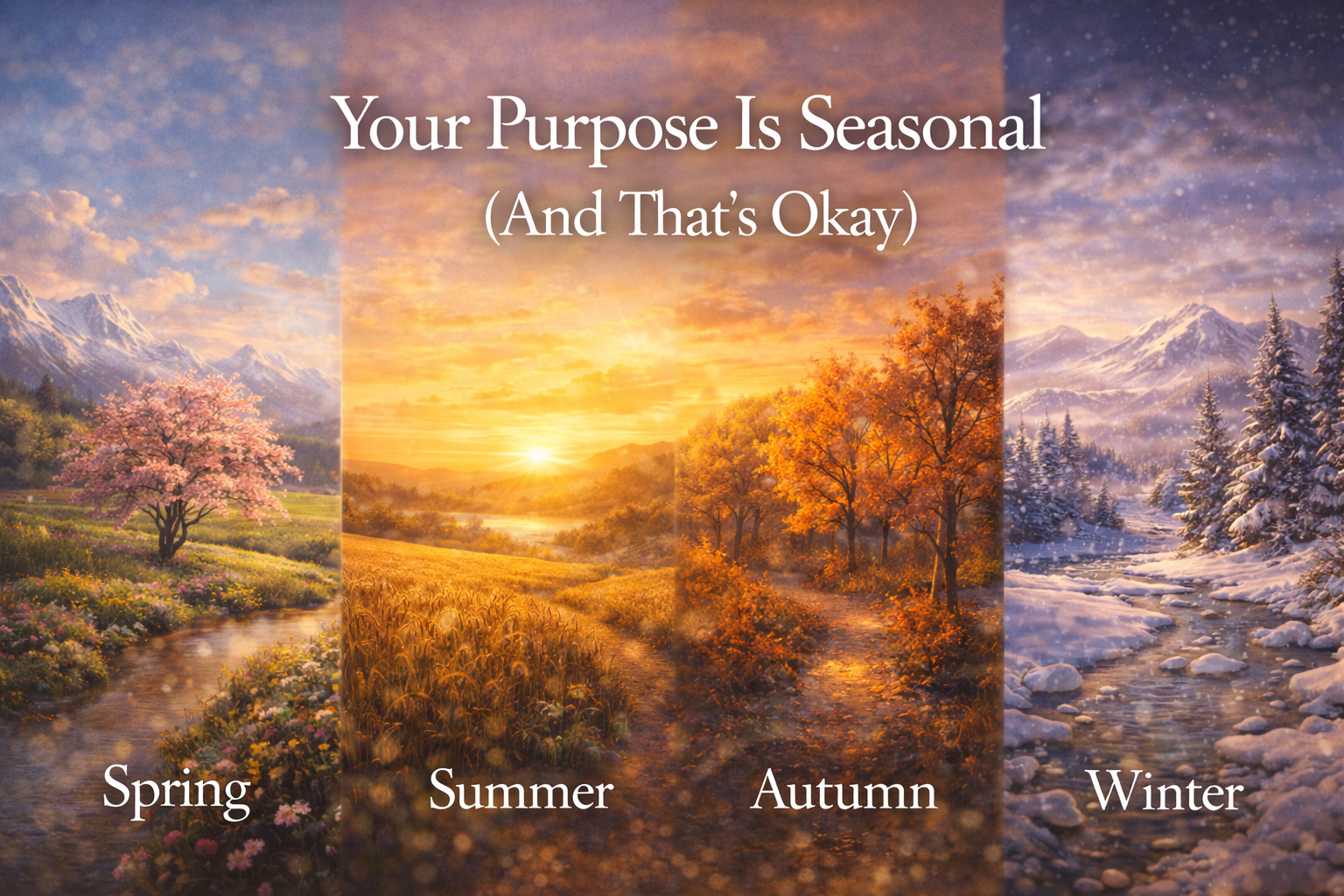
Your Purpose Is Seasonal (And That’s Okay)
Your purpose doesn’t have to stay the same forever. Learn how purpose shifts with seasons, capacity, and growth, without losing your core design.
There’s a quiet pressure many people carry: the belief that purpose must be one permanent, unchanging thing.
A single path. A single label. A single “final answer.”
And if your interests shift, or your priorities change, or your energy isn’t the same as it used to be, you might wonder if you’re unstable, scattered, or failing to “figure it out.”
But purpose often works like seasons.
It doesn’t mean you’re inconsistent. It means you’re alive.
Why purpose feels confusing when you expect it to be permanent
When you expect purpose to be one fixed destination, any change feels like losing your way.
But purpose isn’t only a destination. It’s also a relationship, something you live with. And relationships shift as you grow. What you’re meant to bring to the world can be expressed differently depending on what life is asking of you.
There are seasons for building. Seasons for healing. Seasons for caregiving. Seasons for creating. Seasons for simplifying. Seasons for starting over.
Your blueprint doesn’t change, but the expression of it can.
Your essence stays, your expression evolves
Think of your essence as the core thread: the qualities that remain true.
Maybe your essence is nurturing.
In one season, that shows up in parenting.
In another, it shows up in mentoring.
In another, it shows up in writing.
Same essence. Different expression.
Maybe your essence is clarity.
One season, you clarify systems at work.
Another season, you clarify emotions in your family.
Another season, you clarify ideas through teaching or content.
Your purpose isn’t a title you cling to. It’s a truth you live.
The four purpose seasons
Here are four common seasons your purpose may move through:
The foundation season
You’re learning skills, stabilizing, building routines, creating capacity. This season is quieter, often unglamorous, but essential.The healing season
Your purpose is restoration: nervous system repair, boundary building, rebuilding trust with yourself. You’re not “off track.” You’re becoming strong enough to carry what you’re called to.The expansion season
You feel energy return. You create, lead, serve, build, share. This is often when clarity feels louder.The refinement season
You simplify. You choose quality over quantity. You stop doing what drains you. You focus on what’s true, not what’s impressive.
None of these seasons are wrong. They’re rhythmic. Like breathing.
How to know what season you’re in
Ask yourself:
Do I need stability or expansion right now?
Is my body asking for rest, healing, or momentum?
Am I learning foundations, or building something outward?
What feels most urgent: growth, recovery, or clarity?
The answer isn’t a judgment. It’s guidance.
A practical way to stay aligned in any season
Instead of asking, “What’s my one purpose forever?” ask:
“What is my purpose in this season?”
Then answer with one sentence:
“My purpose right now is to stabilize.”
“My purpose right now is to heal.”
“My purpose right now is to create.”
“My purpose right now is to refine.”
“My purpose right now is to serve in a way that doesn’t drain me.”
This removes panic. It gives you a clean next step.
Closing breath
You are not inconsistent because your life is evolving.
Your purpose is allowed to move with your seasons, while your essence stays true underneath it all.
You’re not behind.
You’re in season.
Your Soulful Pathways ↑
Desktop: Hover over ‘Your Soulful Pathways’ in the top menu to explore another series.
Mobile: Tap the menu (☰), then choose ‘Your Soulful Pathways.’
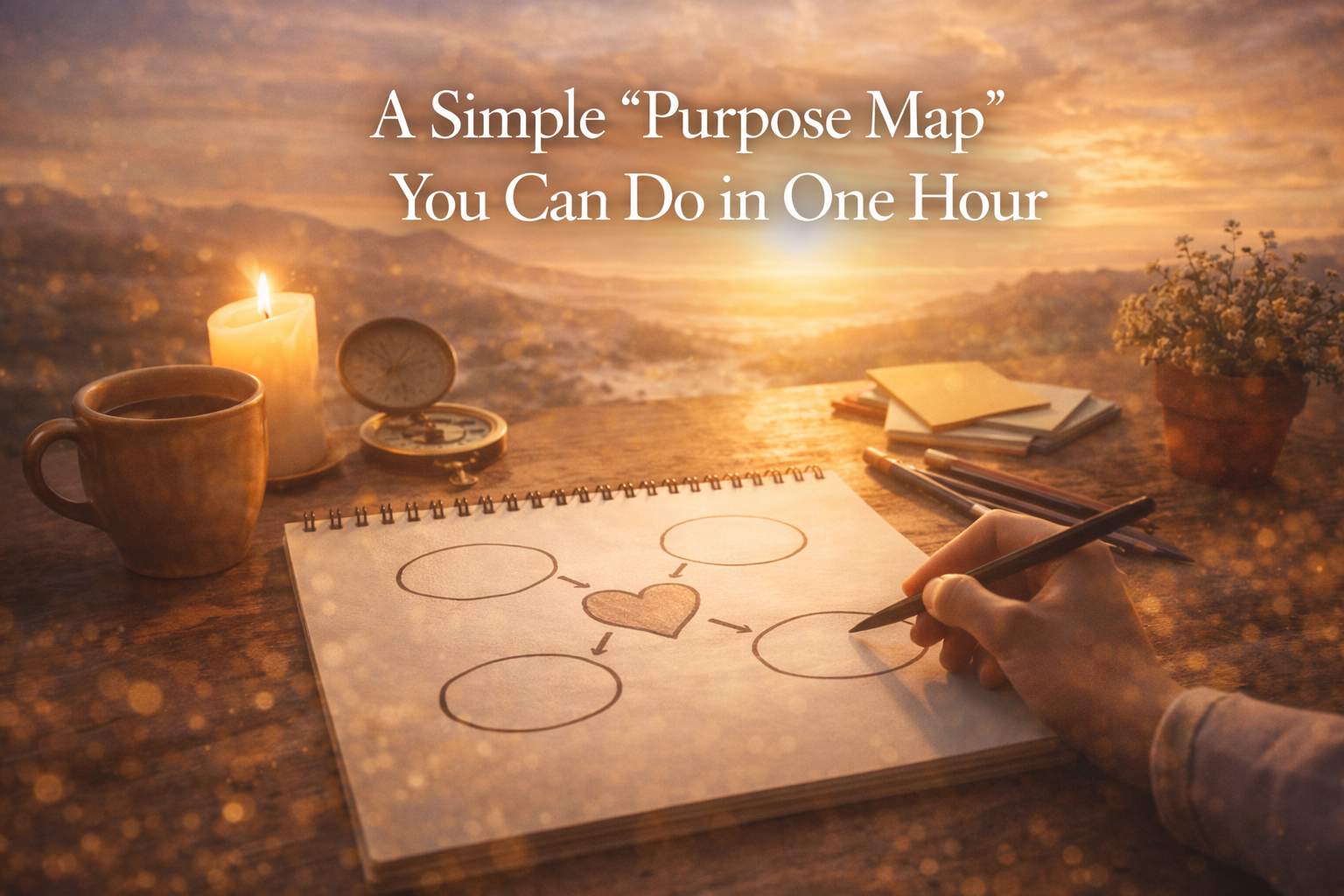
A Simple “Purpose Map” You Can Do in One Hour
Use this one-hour purpose map to identify your values, gifts, patterns, and next steps. Grounded direction you can act on immediately.
You don’t need a five-year plan to find direction.
You need a clear next step that matches your design.
This one-hour purpose map isn’t about solving your entire life. It’s about gathering your clues and turning them into a path you can actually walk.
Set the space (2 minutes)
Grab a notebook. Set a timer for one hour. Make it gentle. Tea counts as a sacred tool.
Your goal is clarity, not pressure.
Step 1: your core values (10 minutes)
Write your top five values. If you’re unsure, choose from: peace, truth, freedom, stability, growth, faith, family, creativity, service, excellence, compassion, simplicity, justice, learning, beauty.
Now define each in one sentence: “For me, peace means ______.”
Circle your top two. These are your compass points.
Step 2: your gift fingerprints (10 minutes)
Answer quickly:
People come to me for ______.
I naturally notice ______.
I make things better by ______.
When I’m at my best, I bring ______ to others.
Underline repeated words. Those are your fingerprints.
Step 3: your repeating pattern (10 minutes)
Write one repeating pattern you’re ready to understand:
This keeps happening: ______.
I always feel: ______.
I usually respond by: ______.
The lesson might be: ______.
The boundary I may need is: ______.
Sometimes the next step isn’t “do more.” Sometimes it’s “stop tolerating what drains you.”
Step 4: your calling mix (10 minutes)
Rate 1–10:
Service
Creation
Presence
Then write:
Service looks like ______ for me.
Creation looks like ______ for me.
Presence looks like ______ for me.
Circle the highest. That’s your lead calling right now.
Step 5: your purpose texture statement (10 minutes)
Finish this:
“When I feel most like me, I am bringing ______ into the world through ______, and it leaves people feeling ______.”
Read it twice. Notice your body. Relief is information.
Step 6: your tiny next step (8 minutes)
Choose one small action you can do in the next seven days.
Examples:
write one honest post
have one meaningful conversation
take one course step
volunteer once
create one small thing
set one boundary that protects your peace
apply to one opportunity that matches your values
Your blueprint doesn’t require a leap. It requires alignment.
Closing breath
You don’t need to force your purpose into existence.
Your life is already leaving clues.
Values. Gifts. Patterns. Callings.
Gather them, and direction starts to appear.
One hour is enough to begin.
Your Soulful Pathways ↑
Desktop: Hover over ‘Your Soulful Pathways’ in the top menu to explore another series.
Mobile: Tap the menu (☰), then choose ‘Your Soulful Pathways.’
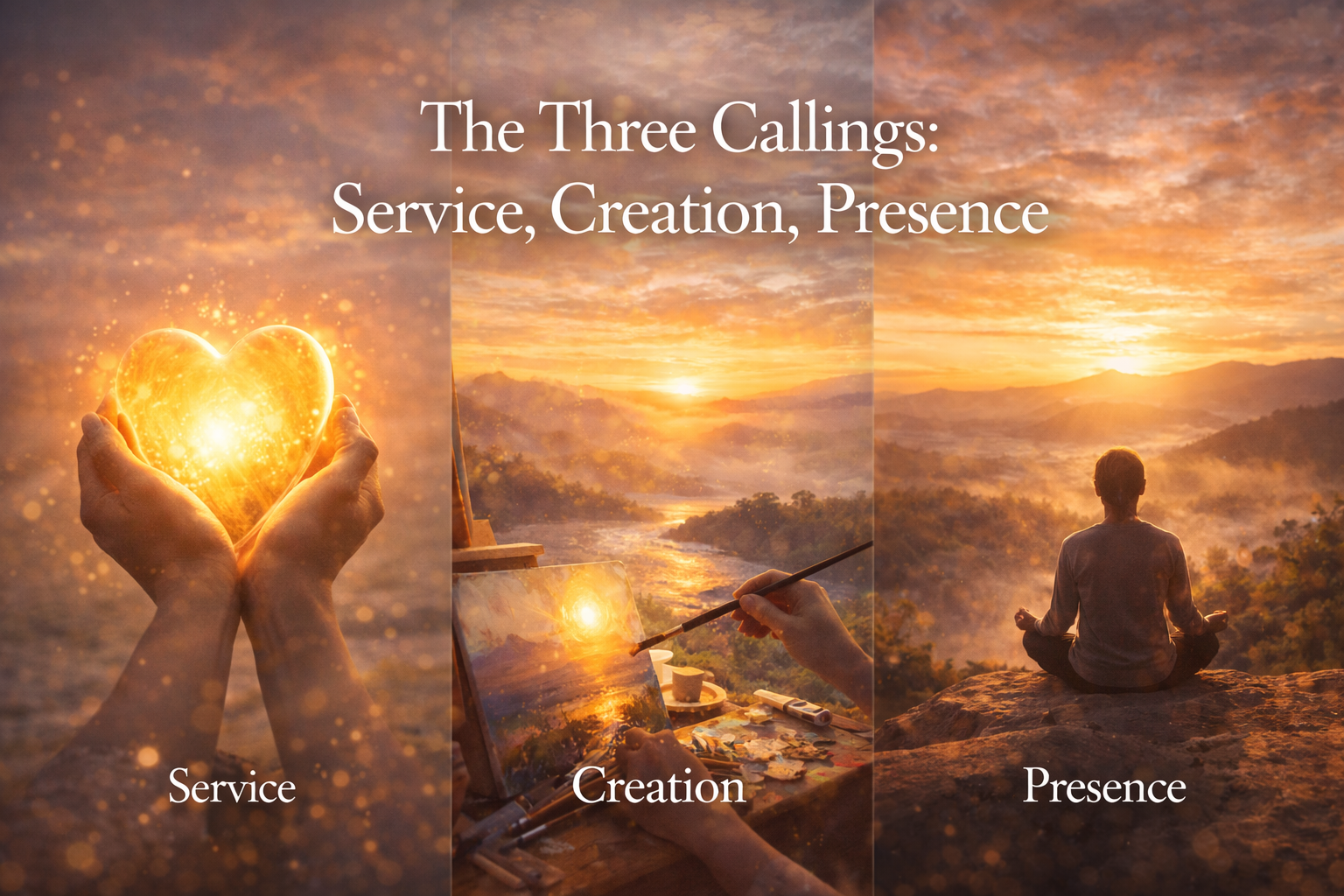
The Three Callings: Service, Creation, Presence
Discover three ways purpose shows up: service, creation, and presence. Identify your strongest calling and build a life that fits your design.
Purpose can feel overwhelming when you think it has to be one giant thing.
But purpose often expresses itself through three callings that are simple, human, and real: service, creation, and presence. Most people have all three, but one usually leads in a given season.
Calling one: service
Service is how you help, support, protect, or restore.
Service doesn’t always mean caregiving as a job. Service can be:
mentoring
organizing
advocating
coaching
problem-solving
bringing steadiness to chaos
helping people feel less alone
Service is your “I can’t not help” energy, but it needs boundaries so it doesn’t become self-erasure.
Calling two: creation
Creation is what you make.
Not only art. Creation includes:
writing
building systems
designing solutions
making beauty from ordinary life
turning ideas into something useful
creating content that helps people breathe again
Creation is your blueprint leaving a fingerprint on the world.
Calling three: presence
Presence is deeply underestimated.
Presence is the calling of being:
emotionally safe
grounded and steady
attentive without performance
honest without harshness
calming without controlling
Some people shift rooms simply by being in them. Not because they’re loud, but because they’re anchored.
Your purpose is often a mix
Ask:
Do I feel most alive helping, making, or being?
What do people consistently thank me for?
What do I return to naturally when life gets quiet?
Your lead calling becomes obvious when you stop trying to choose what looks impressive and start noticing what feels true.
Why balance matters
If you live only in service, you can burn out.
If you live only in creation, you can isolate.
If you live only in presence, you can avoid action.
Balance looks like:
serving with boundaries
creating with consistency
practicing presence so you don’t lose yourself in doing
A quick “calling mix” check-in
Rate 1–10:
Service
Creation
Presence
Then ask:
Which one is highest right now?
Which one is neglected?
What is one small weekly practice that would bring balance back?
Sometimes your exhaustion isn’t a mystery. It’s an imbalance.
Closing breath
Your purpose doesn’t have to be a heavy assignment.
It can be a simple alignment:
helping where you’re designed to help,
creating what you’re designed to create,
and bringing presence that makes life feel more human.
That’s not small.
That’s sacred.
Your Soulful Pathways ↑
Desktop: Hover over ‘Your Soulful Pathways’ in the top menu to explore another series.
Mobile: Tap the menu (☰), then choose ‘Your Soulful Pathways.’
How to Tell the Difference Between Fear and Intuition
Fear is loud and urgent. Intuition is calm and clear. Learn practical ways to discern your inner voice and make aligned decisions.
Fear and intuition can sound similar at first because both try to protect you.
But their energy is different.
Fear is loud. Intuition is clear.
Fear rushes. Intuition steadies.
Fear shames. Intuition guides.
How fear sounds
Fear often carries:
urgency (“Do it now or you’ll miss out.”)
catastrophizing (“This will ruin everything.”)
self-attack (“You always mess things up.”)
obsession (“I can’t stop thinking about it.”)
Fear pulls you into tightness. It makes you smaller. It tries to control life so you never feel vulnerable.
How intuition feels
Intuition tends to be quieter and cleaner:
a calm knowing
a simple yes or no
a gentle nudge that repeats
a steady discomfort that won’t leave
clarity without drama
Intuition doesn’t usually scream. It persists softly until you listen.
The body test
Ask your body what it knows.
Imagine choosing Option A. Notice your breath. Your shoulders. Your jaw.
Now imagine choosing Option B. Notice again.
Tightness, racing thoughts, and pressure often point to fear.
Grounded breath, steadiness, and clean clarity often point to intuition.
This isn’t about being emotionless. It’s about noticing the quality of the emotion.
The time test
Fear spikes and changes with mood. Intuition stays consistent.
If you can, sleep on it. See what remains true in the morning. Time often reveals what’s real.
The fruit test
Fear produces frantic action to relieve anxiety.
Intuition produces aligned action to honor truth.
Ask: “If I follow this voice, what fruit will it produce?”
If the fruit is exhaustion, self-betrayal, panic, or shrinking, pause.
If the fruit is peace, integrity, steadiness, and honest growth, listen.
What if trauma makes this hard
If you’ve lived through instability, your system may confuse intensity with guidance. Calm can feel unfamiliar. Healthy love can feel “boring.” Stability can feel suspicious.
Discernment becomes a practice:
one honest step instead of ten frantic ones
reflection with someone safe
writing decisions down and rereading them later
following values even when you feel nervous
Being nervous doesn’t always mean it’s wrong. Sometimes it means it’s new.
A simple discernment prayer (optional)
“Let what is true become clear.
Let what is fear loosen its grip.
Lead me toward peace, wisdom, and love.”
Closing breath
You don’t need perfect discernment to be guided.
You just need to keep choosing clarity over chaos, one decision at a time.
Fear is loud, but it isn’t wise.
Intuition is quieter, but it’s faithful.
Your Soulful Pathways ↑
Desktop: Hover over ‘Your Soulful Pathways’ in the top menu to explore another series.
Mobile: Tap the menu (☰), then choose ‘Your Soulful Pathways.’

When Life Redirects You - It’s Not Punishment
When plans fall apart, it can feel personal. Learn how to reframe redirection as guidance, protection, and deeper alignment.
When life redirects you, it can feel humiliating.
The door closes. The plan collapses. The timeline shifts. And if you’re someone who tries hard, you might interpret redirection as punishment.
But many redirections are not punishment.
They’re protection. They’re refinement. They’re guidance toward what fits.
Why redirection hurts so much
Because it touches tender places:
your need for stability
your fear that you’re falling behind
your fear that you “misread your life”
Redirection can make you replay decisions searching for where you went wrong. But sometimes you didn’t go wrong. Sometimes you’re being moved.
Not every closed door is rejection
Some doors close because:
the cost would have been your peace
the role would have required self-abandonment
the relationship would have kept you small
the timing would have depleted you
the path would have delayed your real alignment
A closed door can be mercy.
Even when it stings.
Two types of redirection
Redirection that refines you
This kind strengthens boundaries, clarifies values, and makes you more honest.Redirection that realigns you
This kind turns you toward something you wouldn’t have chosen, but later you realize it was built for you.
Both can be sacred. Both can be stabilizing in the long run, even if they feel disruptive in the moment.
What to do in the middle of it
The middle is the hardest part: the “not yet” space.
Try these grounding questions:
What is this season asking me to release?
What truth is becoming impossible to ignore?
What is being simplified?
Where is life asking me to become braver?
What still feels steady, even now?
Redirection often removes what isn’t essential so you can rebuild from what is.
The redirection reframe
Write the story your fear is telling, then rewrite it with compassion.
Old story: “I failed.”
New story: “I’m being refined and guided toward what fits.”
Old story: “This is punishment.”
New story: “This may be protection I don’t understand yet.”
Old story: “I’m behind.”
New story: “My life is unfolding at the pace my soul can hold.”
The detour can become a door
Sometimes the detour becomes:
the season you heal
the pause where you stop performing
the reset where you finally hear yourself
the bridge to the right people and the right rhythm
Detours can be divine, not dramatic.
Closing breath
If your life has rerouted, don’t rush to label it as failure.
Sometimes what you thought was the destination was only the bridge.
You are not cursed.
You are being guided.
Your Soulful Pathways ↑
Desktop: Hover over ‘Your Soulful Pathways’ in the top menu to explore another series.
Mobile: Tap the menu (☰), then choose ‘Your Soulful Pathways.’
The Work You’re Here To Do Is Often Quiet
Not all meaningful work is visible. Learn to honor quiet purpose, unseen growth, and the steady inner work that changes everything.
Some of the most important work you will ever do won’t be recognized publicly.
It won’t go viral. It won’t come with a certificate. It might not even look like progress from the outside. But it will change your life. And it will change the lives around you.
Quiet work is still real work
Quiet work looks like:
learning to regulate your emotions
unlearning self-abandonment
choosing peace over proving
breaking family cycles
becoming consistent after years of survival
telling the truth after years of swallowing it
learning to rest without guilt
Quiet work is foundation work. It’s the kind of work that makes future success sustainable.
Why we undervalue what’s quiet
Because the world rewards display.
If it’s not posted, it feels like it didn’t happen.
If it’s not measured, it feels like it doesn’t count.
But your soul is not a performance. Your healing is not content. Your growth is not a competition.
Quiet work doesn’t get applause, but it creates stability. It creates safety. It builds the kind of inner home you can actually live in.
Signs you’re doing your true work
Sometimes purpose doesn’t feel like excitement. Sometimes it feels like alignment.
You may be doing the work you’re here to do if:
your boundaries are cleaner
your nervous system is calmer
your choices are simpler
your relationships are truer
your inner voice is kinder
you feel less desperate to be understood
These are not small changes. These are life architecture.
The ripple effect you can’t see yet
When you heal, you change what you normalize.
When you choose peace, you change what you tolerate.
When you choose honesty, you change what you accept.
When you become safer for yourself, you become safer for others.
Sometimes your purpose is not what you do.
Sometimes your purpose is who you become.
A practice: the quiet wins list
Write ten quiet wins from the last month. Examples:
I paused before reacting.
I didn’t chase what was pulling away.
I rested without earning it.
I said no without explaining.
I asked for help.
I protected my peace.
I stayed consistent.
Proof helps your spirit relax. Proof helps your nervous system trust the process.
What if you feel “behind”
If your life looks smaller than you expected right now, breathe.
Some seasons are quiet because you’re becoming strong enough to hold what’s next. Roots don’t grow in applause. They grow in the slow, steady places.
Closing breath
Quiet seasons are not empty seasons.
Some roots grow in silence so the tree can stand later.
Your work counts. Even when it’s quiet.
Your Soulful Pathways ↑
Desktop: Hover over ‘Your Soulful Pathways’ in the top menu to explore another series.
Mobile: Tap the menu (☰), then choose ‘Your Soulful Pathways.’

Your Purpose Has A Texture (Not A Title)
Purpose isn’t always a job label. Learn how to sense the texture of your purpose through what restores you, moves you, and feels true.
Many people think purpose is a title they must discover.
Teacher. Coach. Healer. Entrepreneur. Artist. Leader.
But purpose is often a texture before it becomes a label. It’s the felt sense of what you’re here to bring, even if the “how” changes throughout your life.
Why titles can confuse you
A title is external. Purpose is internal.
You can have the “right” title and still feel empty.
You can have a humble role and feel deeply aligned.
Because purpose isn’t about what impresses people. It’s about what fits your design.
Purpose feels like something
Purpose has an emotional signature. It might feel like:
steady peace
devotion
quiet joy
courage
creative electricity
grounded responsibility
tenderness that wants to protect
Pay attention to what you feel when you’re doing something meaningful. Your body is giving you data. Purpose leaves a trail in your nervous system.
Three questions that reveal your purpose texture
If you want direction without pressure, ask:
What restores me
Not entertainment, but restoration. The thing that fills you back up.What moves me
What kind of needs, stories, or moments pull your heart forward? What makes you care deeply?What matters even when I’m tired
Fatigue strips away the performance and reveals what’s real.
Where these overlap, purpose begins to form.
Purpose works better as a verb
Instead of asking, “What am I?” ask:
What am I here to build?
What am I here to protect?
What am I here to heal?
What am I here to clarify?
What am I here to create?
What am I here to guide?
Verbs keep you free. They let your purpose evolve without losing its core.
Maybe your purpose is to comfort. That can happen in parenting, writing, mentoring, nursing, friendship, leadership.
Maybe your purpose is to clarify. That can happen in teaching, organizing, coaching, project work, content creation.
One essence. Many expressions.
A “purpose texture” paragraph
Write this and finish it without editing:
“When I feel most like me, I am bringing ______ into the world through ______, and it leaves people feeling ______.”
Read it twice. Notice your body. If something in you exhales, pay attention. Relief is information.
Why you don’t have to know the full plan
Purpose doesn’t demand a leap. It asks for alignment.
The next step might be:
one conversation
one boundary
one small project
one class
one honest decision
one brave yes
Clarity grows in motion.
Closing breath
You don’t need a perfect label before you begin.
Let your purpose be something you live, not something you prove.
The title can come later. Alignment can start now.
Your Soulful Pathways ↑
Desktop: Hover over ‘Your Soulful Pathways’ in the top menu to explore another series.
Mobile: Tap the menu (☰), then choose ‘Your Soulful Pathways.’

Your Gifts Leave Fingerprints
Your gifts are already visible in how you notice, help, and create. Learn how to recognize your “gift fingerprints” and trust what comes naturally.
Your gifts aren’t always loud.
They don’t always arrive with applause. Sometimes they show up as the thing you do so naturally you assume it doesn’t count. But your gifts leave fingerprints. And your life is full of evidence.
What counts as a gift
A gift is not only talent. A gift is impact. It’s what people consistently receive from you, even when you’re not trying.
Some gifts look like:
making people feel safe
seeing what others miss
explaining things clearly
bringing calm into chaos
organizing what feels overwhelming
listening in a way that heals
noticing the overlooked and honoring it
creating beauty from ordinary moments
Not everything powerful is flashy. Not everything meaningful is monetized. Some gifts are quiet and still change people.
The three “fingerprint signs” of a real gift
A gift usually has three qualities:
It’s repeatable
It shows up across seasons and settings. You do it at work, at home, in friendships, even with strangers.It’s energizing (even if it’s hard)
It may take effort, but it doesn’t only drain you. It lights something up in you, like your spirit recognizes itself.It produces fruit
People feel strengthened, steadier, clearer, more hopeful. Something improves when you’re present.
Fruit matters. Fruit is proof.
Why we dismiss our own gifts
We dismiss our gifts because:
they feel “too easy”
we weren’t praised for them early
we learned humility meant hiding
we were punished for shining
we only value what looks impressive
If you grew up in survival mode, you may not have had space to notice your gifts. You were busy getting through. But gifts don’t expire. They wait.
Gift fingerprint prompts
Answer quickly, without polishing:
People come to me for ______.
I naturally notice ______.
I make things better by ______.
I lose track of time when I’m ______.
The pain I feel compelled to ease is ______.
The compliment I keep receiving but shrug off is ______.
Underline repeated words. That overlap is a fingerprint.
Your story often points to your gift
Sometimes your gift is connected to what you had to learn the hard way.
If you’ve known anxiety, you may carry a gift of calm.
If you’ve known instability, you may carry a gift of steadiness.
If you’ve known being unseen, you may carry a gift of presence.
If you’ve known heartbreak, you may carry a gift of compassion.
This isn’t romanticizing pain. It’s honoring transformation.
How to use your gifts without burning out
A gift needs a boundary. Otherwise it becomes overgiving.
Ask: “What is one small way I can use my gift this week without abandoning myself?”
Small use is still use. Gifts grow when they’re practiced, not when they’re doubted.
Closing breath
You don’t have to force a calling into existence.
Your life has receipts. Follow the fingerprints, and you’ll stop chasing who you “should” be.
You’ll start recognizing who you already are.
Your Soulful Pathways ↑
Desktop: Hover over ‘Your Soulful Pathways’ in the top menu to explore another series.
Mobile: Tap the menu (☰), then choose ‘Your Soulful Pathways.’
The Patterns You Keep Repeating Are Clues
The patterns you keep repeating aren’t proof you’re broken. Learn how to decode cycles as clues and turn them into clarity, healing, and direction.
If you keep repeating the same kind of situation, it doesn’t mean you’re doomed.
It means something in you is still trying to be understood.
Patterns are not proof you’re “bad at life.” Patterns are often the soul’s way of highlighting an unmet need, an unfinished lesson, or a boundary you’re learning to hold. They are clues. And clues are hopeful because they can be read.
Why patterns feel like failure
A repeating cycle can feel personal, like life is pointing at you and saying, “Here you go again.”
But patterns repeat for a simpler reason: they’re familiar. Familiar doesn’t mean healthy, it just means known. Your nervous system is a historian. It remembers what you adapted to, what you tolerated, what you survived, and what you were taught was normal.
So sometimes you’re not repeating because you want to. You’re repeating because your system reaches for what it recognizes.
That’s not a curse. That’s conditioning. And conditioning can change.
The three most common types of patterns
Most repeating cycles fall into one of these categories:
Healing patterns
These repeat until you learn how to care for yourself differently.
Examples: over-giving, ignoring your needs, minimizing your pain, staying too long, tolerating emotional inconsistency.Boundary patterns
These repeat until you learn how to say no without guilt.
Examples: being taken for granted, being the reliable one with no support, being the peacemaker at your own expense.Calling patterns
These repeat because something in you keeps trying to come online.
Examples: feeling pulled to create, teach, guide, build, mentor, lead, organize, heal, but talking yourself out of it every time.
Same emotion, different setting? That’s a clue.
The clue is usually in the emotion
Ask: “What do I always feel in this pattern?”
Unseen. Responsible. Guilty for needing anything. Afraid to disappoint. Afraid to be rejected. Afraid to be alone.
That emotion is the thread. Follow the thread, and you’ll find the belief underneath it.
The pattern decoder exercise
Pick one repeating pattern and write:
The scene: What keeps happening?
The emotion: What do I feel during and after?
The role: Who do I become? Fixer? Pleaser? Over-functioner? Silent sufferer?
The payoff: What do I avoid by repeating it? Conflict? Rejection? Loneliness?
The cost: What does it cost me? Peace? Time? Confidence?
The lesson: What would change if I believed I deserve better?
Insight is not self-blame. Insight is a doorway.
Sometimes the pattern is your nervous system
If you grew up in chaos, calm can feel suspicious. If you learned love equals effort, ease can feel unsafe. If your system is used to intensity, stability can feel “wrong.”
That doesn’t mean your intuition is broken. It means your body is learning a new normal.
How patterns break in real life
Pattern-breaking usually looks small:
pausing before you explain yourself
leaving at the first red flag instead of the fifth
saying “no” without a paragraph
asking for help without apologizing
resting before burnout forces it
telling the truth sooner
Tiny changes. Massive relief.
Closing breath
Your patterns are not condemnation. They are instruction.
You’re not stuck. You’re learning the language of your life. And when you read the clue correctly, the pattern starts to loosen.
Your Soulful Pathways ↑
Desktop: Hover over ‘Your Soulful Pathways’ in the top menu to explore another series.
Mobile: Tap the menu (☰), then choose ‘Your Soulful Pathways.’

Your Core Values Are Your Compass
When life feels uncertain, your values provide direction. Learn how to identify your core values and make decisions that feel steady and true.
If you’ve been asking, “What should I do with my life?” there’s a quieter question that often answers it:
“What do I value most, even when no one is watching?”
Values are not preferences. They’re the inner laws your spirit keeps trying to live by. And when you ignore them, life starts feeling like a daily compromise.
Why values create instant clarity
Two people can live the same lifestyle and feel completely different inside it.
One person thrives in structure. Another feels trapped.
One person feels fulfilled in constant social activity. Another feels drained.
One person loves risk and adventure. Another needs stability and predictability.
The difference isn’t willpower. It’s values.
Values tell you what “right” feels like for you.
The hidden reason you keep second-guessing
Second-guessing isn’t always insecurity. Sometimes it’s misalignment.
If you keep forcing choices that clash with your values, your body and spirit will resist, even if the choice looks “good on paper.”
If you value peace but keep choosing urgency, your nervous system will protest.
If you value truth but keep performing, you’ll feel restless.
If you value freedom but keep choosing control to feel safe, you’ll feel trapped.
Your values aren’t trying to ruin your plans. They’re trying to protect your soul.
How to identify your top values (without overthinking)
Use your emotional history as data.
Think of a time you felt deeply respected, safe, or proud. What value was being honored?
Now think of a time you felt angry, hurt, or depleted. What value was violated?
Often your strongest values show up in your strongest reactions.
The “compass list” practice
Choose five values and define them in your own words. Not dictionary definitions. Personal definitions.
Examples:
Peace: I move at a pace that keeps my body steady.
Truth: I don’t abandon myself to be accepted.
Service: I help in ways that empower, not drain.
Creativity: I make space for what wants to be born through me.
Freedom: I choose paths with breath and flexibility.
Then ask: “Does my current life support these values or fight them?”
This isn’t meant to shame you. It’s meant to show you where small course corrections will create massive relief.
Using values to make decisions
When you’re unsure, ask:
Which option honors my top values?
Which option costs me my peace?
Which option makes me smaller?
Which option feels honest, even if it’s uncomfortable?
Values don’t remove hard choices. They remove confusion.
Closing breath
You don’t need perfect certainty to move forward. You need a compass you trust.
Your values are not random. They’re evidence of your design. And when you live from them, you stop drifting. You start aligning.
Your Soulful Pathways ↑
Desktop: Hover over ‘Your Soulful Pathways’ in the top menu to explore another series.
Mobile: Tap the menu (☰), then choose ‘Your Soulful Pathways.’