

Simple Budgeting Without Shame
A gentle budgeting approach that builds clarity and calm without guilt, harsh rules, or perfection pressure.
Budgeting gets a bad reputation because many people learned it as punishment. Like a financial scolding. Like proof you should have done better. But budgeting, at its best, is not a cage. It is a kindness. It says: “I want to feel safe. I want to know what I’m working with. I want to make choices on purpose.”
Release perfection first
A budget is a living plan, not a moral grade. If your numbers shift, life happened. The goal is clarity, not flawless execution. A shame-free budget is flexible enough for real life and steady enough to reduce anxiety.
The simple, calm method
Step 1: Start with three numbers
Monthly income (or a realistic average)
Fixed essentials (rent, utilities, insurance, minimum payments)
Flexible essentials (food, gas, household needs)
This creates a foundation fast without overwhelm.
Step 2: Choose one “peace category”
Pick one focus that reduces stress:
a small savings seed
extra toward one debt
a grocery limit
catching up on one bill
When you choose one, your brain stops freezing.
Step 3: Add a “real life” line item
Real life includes birthdays, pharmacy runs, little surprises, and small joys. If your budget doesn’t include real life, it will break and shame will move in like it owns the place.
Use weekly check-ins, not daily surveillance
Once a week, review spending with curiosity, not judgment:
What worked?
What surprised me?
What do I want to adjust?
Your budget should feel like a map, not a courtroom.
When you overshoot, respond with kindness
Don’t punish yourself. Investigate gently:
Was I tired? Lonely? Overwhelmed? Did I plan enough for real life? Then pick one small adjustment. One. Not a full life overhaul.
A tiny template you can repeat
Income: ________
Fixed essentials: ________
Flexible essentials target: ________
Peace category (choose one): ________
Real life cushion: ________
The real goal
Budgeting isn’t about being “good.” It’s about building trust with yourself. Every time you look at your numbers gently, you’re telling your nervous system: “I’m here. I’m paying attention. I’m taking care of us.”
Your Soulful Pathways ↑
Desktop: Hover over ‘Your Soulful Pathways’ in the top menu to explore another series.
Mobile: Tap the menu (☰), then choose ‘Your Soulful Pathways.’.

How to Stop Comparing Your Timeline
Release the pressure of comparing your finances and life progress, and return to your own pace with peace and clarity.
Comparison is sneaky because it wears the mask of motivation. It whispers, “Look at them, now hurry.” But what it often produces isn’t inspiration. It produces shame. And when it comes to money, comparison can sting like a fresh bruise.
Why timeline comparison hurts so much
Lives are not identical equations. Different starting points. Different responsibilities. Different support systems. Different hidden battles. You might be building stability while also healing, caregiving, or rebuilding after loss. That isn’t “behind.” That is real life.
Sometimes your timeline looks slower because you are doing more than people can see.
What comparison steals
Comparison doesn’t just steal joy. It steals:
Gratitude: your “enough” starts feeling like “not enough.”
Clarity: you chase what looks successful instead of what is aligned.
Peace: your nervous system treats life like a race.
And once life feels like a race, your decisions start coming from pressure instead of wisdom.
Five ways to stop comparing your timeline
1) Name the trigger
What did you see that made you feel behind? A post, a conversation, a family expectation, a milestone announcement. Naming it pulls you out of the fog and back into reality.
2) Translate envy into information
Envy often points to a desire, not a verdict. Instead of “I’m failing,” try:
“I want stability.”
“I want ease.”
“I want freedom.”
Now you can plan toward what you want without shaming yourself.
3) Compare only to your past self
List what has improved: your skills, your discipline, your calm, your boundaries, your resilience. Progress isn’t always a bigger paycheck. Sometimes it’s fewer panic spirals and more steady choices.
4) Reduce inputs that inflame you
If certain accounts, conversations, or media leave you raw, reduce exposure. This isn’t weakness. It’s self-protection.
5) Create your own milestones
Comparison grows when your path feels undefined. Define your path gently:
save a small amount each month
pay down one debt
track spending weekly
increase income by one small step
Quiet wins count.
A short practice for timeline peace
Hand on chest, one breath. Say: “Their path is theirs. My path is mine.”
Then ask: “What is one step that supports my life this week?”
Do that step. Let that be enough.
Your timeline is not late
Slow can be rooted. Slow can be wise. Slow can be sacred. You are not here to keep up. You are here to build a life that fits your soul and supports your future.
Your Soulful Pathways ↑
Desktop: Hover over ‘Your Soulful Pathways’ in the top menu to explore another series.
Mobile: Tap the menu (☰), then choose ‘Your Soulful Pathways.’.
Provision Without Panic
Explore a calm approach to money where you plan wisely, breathe deeply, and trust provision without living in constant urgency.
Panic has a very convincing voice. It says everything is urgent, everything is fragile, and you must solve it all right now. But panic is not the same thing as responsibility. Panic narrows your vision, drains creativity, and makes you miss open doors. Provision rarely arrives through frantic energy. Provision is often quieter than we expect.
The difference between urgency and wisdom
Urgency says: “If I don’t fix this immediately, everything collapses.”
Wisdom says: “This matters, and I can take it one step at a time.”
Urgency steals your breath. Wisdom gives it back. The goal isn’t to stop caring. The goal is to care without burning your peace as fuel.
Provision is often ordinary
Provision can look like a steady client, an unexpected discount, a friend offering a referral, a small opportunity that grows, or a resource you forgot you had. Peace helps you notice it. Panic makes you overlook it.
If you’ve been waiting for provision to arrive like thunder, consider that it may be arriving like a lamp: quietly, consistently, lighting one next step at a time.
A peaceful approach to provision
Try this steady sequence:
Start with reality, not dread. Write down the actual numbers and due dates. Dread is infinite. Reality is workable.
Choose today’s next step. One call. One application. One payment plan. One small action that reduces pressure.
Build a “provision list.” Skills you can offer, people you can contact, resources available, side income ideas, items you can sell, services you can provide.
Pray grounded. “Guide me to what supports me. Show me the next open door.”
Create a calm plan B. Three options if things tighten: a short-term income step, a bill negotiation, a temporary reduction in spending.
This is not panic-planning. This is wise stewardship with a calm nervous system.
When panic shows up anyway
Panic loves the future. So bring yourself back to the present with two questions:
“What am I afraid will happen?”
“What is the smallest action that reduces risk today?”
Then do the smallest action. Small actions are how panic loses its throne.
Trust and planning can coexist
You can trust and still track. You can pray and still negotiate. You can believe you will be supported and still take wise steps. Peaceful money holds both.
A steady reminder
Provision does not require you to destroy your peace as proof you care. Peace is not procrastination. Peace is power. It is the calm that allows you to make decisions that actually help.
Your Soulful Pathways ↑
Desktop: Hover over ‘Your Soulful Pathways’ in the top menu to explore another series.
Mobile: Tap the menu (☰), then choose ‘Your Soulful Pathways.’.

Money Anxiety and the Body
Learn how financial stress shows up in your body and how to calm your nervous system so you can make steady decisions again.
Money anxiety doesn’t just live in your thoughts. It lives in your body. That’s why you can “know” you are okay and still feel your chest tighten when you open a banking app. It’s why you can be sitting in a quiet room and still feel a stomach drop when you remember a bill. Your nervous system is not doing this to punish you. It is trying to protect you.
How financial stress shows up physically
Money stress often wears a physical costume, and it can look like:
Tight jaw, clenched shoulders, headaches, shallow breathing
Sleep disruption, especially waking in the middle of the night running numbers
Digestive tension, appetite changes, or a hollow feeling in the belly
Scattered focus: starting tasks and drifting into worry
Freeze and avoidance: unopened mail, ignored statements, delayed calls
When your body is in fight-or-flight, the brain prioritizes survival, not strategy. That’s why planning feels impossible when you’re panicking. You can’t make calm decisions from a body that believes it’s in danger.
A gentle reframe that changes everything
Instead of asking, “What is wrong with me?” try asking:
“What is my body trying to keep me safe from?”
Maybe you grew up around instability. Maybe you watched adults panic. Maybe you lived through a season where resources were truly scarce. Your nervous system remembers what your mind would rather forget. Sometimes the body isn’t reacting to today’s bill. Sometimes it’s reacting to the memory of the last time you didn’t know what would happen next.
Before you look at numbers: a calm ritual
Use this before you check balances, pay bills, or plan.
Breathe with a longer exhale. Inhale for 4, exhale for 6, three times.
Name it. “My body is anxious. I am safe enough to look.”
Choose a small look. Set a timer for 10 minutes.
Look for facts, not judgments. Due dates, amounts, minimums, options.
Close the loop. Shut the app, stand up, roll your shoulders, and tell your body: “We are done for now.”
This teaches your nervous system something powerful: money tasks are finite. They do not last forever. You can touch them and return to safety.
After a money task: soothe the body
Do one or two of these tiny resets:
Shake out your hands for ten seconds
Sip water slowly
Step into daylight for one minute
Soften your jaw and drop your shoulders
Take one long exhale like you’re fogging a mirror
Small signals create big shifts over time. You’re training your system to associate money with capacity, not catastrophe.
A steady truth to keep
You do not need to feel fearless to be wise. You only need enough calm to take the next right step. Peaceful money begins when your body stops treating money as danger and starts treating it as information you can handle.
Your Soulful Pathways ↑
Desktop: Hover over ‘Your Soulful Pathways’ in the top menu to explore another series.
Mobile: Tap the menu (☰), then choose ‘Your Soulful Pathways.’.

Peaceful Money and Spiritual Provision
A gentle series for money anxiety, practical planning, and spiritual steadiness, so you can breathe again and build with calm.
Money can feel like a loud roommate in the mind. Always tapping. Always reminding you about “later.” Even when you are doing your best, the what-ifs line up like unpaid thoughts at the door. What if work slows down? What if something breaks? What if I never catch up? And sometimes the ache is not even the math. It’s the deeper question underneath the numbers: Will I be supported?
This series is for that tender place where practical needs and spiritual trust meet, without pretending money doesn’t matter, and without panicking like everything depends on you alone. We’re building a new relationship with money: calmer, clearer, kinder. Peaceful money is not denial. It’s steadiness. It’s learning how to breathe, plan, ask, and move forward without shaming yourself along the way.
What peaceful money really means
Peaceful money doesn’t mean you never worry. It means you stop living in constant urgency. It means money becomes information, not a threat. You can look at numbers with steady hands. You can make choices without spiraling. You can build stability without punishing yourself.
Peaceful money can sound like:
“Let’s look at this for ten minutes, not ten hours.”
“We can take one step today, and that is enough.”
“I’m allowed to learn. I’m allowed to adjust.”
“I can plan and still trust.”
What you’ll find inside this series
Each page blends grounded tools with gentle soul-care:
Money Anxiety and the Body: how stress shows up physically and how to calm your system so you can think again.
Provision Without Panic: trusting provision while still taking wise, grounded steps.
How to Stop Comparing Your Timeline: releasing the pressure to keep up and returning to your own pace.
Simple Budgeting Without Shame: gentle structure that supports you instead of scolding you.
Receiving Help Without Feeling Weak: letting support be a bridge, not a verdict.
Worth Is Not a Number: separating your value from income, debt, or productivity.
Building Margin One Small Step: creating breathing room through small, consistent choices.
Faith and Practical Planning: blending trust and action so peace can live in your finances.
A gentle intention for your nervous system
If money has been stressful, it does not mean you are broken. It means you’ve been carrying real responsibility in a real world. The goal here isn’t perfection. The goal is a calmer nervous system, clearer choices, and a softer inner voice.
Peace isn’t something you earn after everything is solved. Peace can be the way you walk while you solve.
How to use this series
Read one page at a time, and take one small action after each. A ten-minute “money look.” A call you’ve been avoiding. A tiny savings seed. A conversation where you ask for support. Peace grows best when it is practiced, not just admired.
And if your path feels slow, remember: slow does not mean stuck. Slow can mean rooted. Slow can mean wise. Slow can mean you’re building something that lasts.
A small promise to yourself
If your body has learned to brace around money, we won’t force it to “get over it.” We will practice safety. We will take small looks instead of terrifying deep dives. We will celebrate clarity instead of demanding instant transformation.
Bring your whole self here. The practical part. The spiritual part. The tired part. The hopeful part. All of you gets to be supported.
Your Soulful Pathways ↑
Desktop: Hover over ‘Your Soulful Pathways’ in the top menu to explore another series.
Mobile: Tap the menu (☰), then choose ‘Your Soulful Pathways.’.

Becoming Safe for Yourself Again
Rebuilding begins with inner safety. This page guides you toward trust, self-compassion, and nervous-system-friendly ways to feel safe within your own life again.
For some of us, the deepest healing isn’t becoming “better.”
It’s becoming safe.
Safe to feel. Safe to rest. Safe to say no. Safe to be honest. Safe to be human without punishment.
Why Safety Is the Real Starting Line
When you’ve lived through stress, criticism, emotional chaos, or long seasons of survival, your body learns to brace.
You can look fine on the outside while your nervous system stays on alert.
So rebuilding isn’t only changing circumstances.
It’s teaching your body that life is not an emergency anymore.
How to Become Safe in Small Steps
Safety is built through consistency.
Keep tiny promises: water, rest, a short walk, five minutes of quiet.
Change your inner tone: your body listens. Try, “I’m learning.” “I’m okay in this moment.”
Practice soft returns: when you spiral, don’t shame yourself. Come back gently.
Use boundaries as safety: boundaries are doors you control, not walls.
Choose calmer environments: less noise, less drama, more steady.
You don’t have to do all of this at once. One small choice is enough to start changing the signal your body receives.
What Safety Feels Like
Safety feels like exhale.
Safety feels like steady.
Safety feels like you can make a mistake and still be loved, even by yourself.
It’s not constant happiness. It’s permission to be human without fear.
A Simple Practice to Repeat
Hand on your heart, one slow breath:
I am learning to be a safe place for me.
Say it on good days. Say it on messy days. Say it when you don’t know what comes next.
Closing Reminder
Safety isn’t a switch. It’s a relationship.
And every kind choice makes you a safer home for your own soul.
Your Soulful Pathways ↑
Desktop: Hover over ‘Your Soulful Pathways’ in the top menu to explore another series.
Mobile: Tap the menu (☰), then choose ‘Your Soulful Pathways.’.

When Progress Feels Invisible
Feeling like nothing is changing can be discouraging. This page helps you recognize hidden progress, stay grounded, and keep going during your rebuild.
Some progress doesn’t look like winning. It looks like not giving up.
It looks like getting through a hard day without turning on yourself. Like breathing through a wave of emotion instead of letting it pull you under.
Why Invisible Progress Feels So Discouraging
When progress is subtle, hope can wobble.
The mind wants a scoreboard. It wants dramatic proof. It wants a moment where you can say, “See? I’m different now.”
But healing often whispers before it speaks.
And if you’re looking for fireworks, you might miss the miracle of stability.
What Progress Can Look Like Instead
Progress might look like:
noticing your patterns sooner
pausing before reacting
choosing calmer choices
recovering faster after hard moments
protecting your peace more often
speaking to yourself more kindly
These are structural changes.
These are the beams holding up a new life.
Track Proof Differently
Ask yourself a few gentle questions:
What did I handle better this week?
Where did I choose kindness toward myself?
What did I walk away from that I used to chase?
What am I no longer willing to tolerate?
You may not have a dramatic “after” photo. But you have something better: a nervous system that is slowly becoming safer.
Your Foundation Is the Real Miracle
In a rebuild, progress often starts as stability:
better sleep
fewer spirals
more honesty
quieter choices
more self-respect
A seed doesn’t look like a forest.
But it is not pretending. It is becoming.
Closing Reminder
Invisible progress is still progress.
The foundation is forming. And one day, it holds everything.
Your Soulful Pathways ↑
Desktop: Hover over ‘Your Soulful Pathways’ in the top menu to explore another series.
Mobile: Tap the menu (☰), then choose ‘Your Soulful Pathways.’.

Building a New Life One Small Habit
Small habits create big change. This page offers gentle, realistic ways to rebuild your life through tiny daily choices that support healing and stability.
A new life rarely arrives with fireworks. It arrives with repetition.
One small habit. Then another. Then one quiet moment where you realize you’re not the same person anymore.
Why Small Habits Matter in a Rebuild
When you’re rebuilding, big goals can feel overwhelming.
Your nervous system may still be healing. Your energy may be limited. Your emotions may be tender.
That’s why small habits matter.
Small habits are gentle promises you can keep. And every time you keep one, your body learns: I can trust myself.
In a rebuild, self-trust is everything. It’s what makes you feel stable when the future still looks blurry.
The Real Goal: Self-Trust
Self-trust isn’t just a concept.
It’s the feeling that you have your own back.
It’s the knowledge that when life gets hard, you won’t abandon yourself. You won’t punish yourself. You won’t spiral into shame.
You’ll return. You’ll steady. You’ll choose the next kind step.
And that kind of trust is built through tiny, consistent actions.
Five Small Habits That Change Everything
Try these simple anchors. Keep them small enough to do on hard days:
One stabilizing action before your phone
Water. Breath. Prayer. Curtains open. Five minutes of quiet.A tiny morning routine
Something simple: wash your face slowly, make your bed, read one paragraph, breathe at the window.A tiny evening routine
One tidy surface. One sentence journal. One calming ritual.A boundary habit
Pause before yes. “Let me get back to you.” Create space for truth.A joy ritual
Tea, music, a candle, a walk, a soft blanket. Joy teaches your nervous system that life is safe enough to enjoy again.
When You Miss a Day, Don’t Turn It Into a Trial
Rebuilding is not about perfection. It’s about returning without shame.
The habit isn’t just the action. The habit is the return.
So if you miss a day, don’t punish yourself. Don’t restart your life like a broken machine.
Just come back.
One small habit. One small choice. One small moment of self-respect.
Closing Reminder
Your future is built with tiny choices, repeated with love.
Small habits don’t just change your schedule. They change your identity.
Your Soulful Pathways ↑
Desktop: Hover over ‘Your Soulful Pathways’ in the top menu to explore another series.
Mobile: Tap the menu (☰), then choose ‘Your Soulful Pathways.’.

How to Trust the Slow Season
Slow seasons can feel like nothing is happening. This page helps you trust the timing, recognize hidden progress, and stay steady while life rebuilds.
The slow season can feel like life hit the pause button and forgot the password.
You’re doing the inner work. You’re showing up. You’re trying to be patient. And still, the results feel quiet.
Slow Doesn’t Mean Stuck
Slow doesn’t mean stuck. Slow often means deep.
This is where roots form. Where your nervous system unlearns survival. Where your spirit reorganizes.
This is where you stop building a life that looks good and start building a life that feels safe.
Fast change can be exciting, but deep change is what lasts.
And deep change rarely moves at the speed of your anxiety.
Where Progress Hides During Slow Seasons
Look for subtle proof:
You’re reacting differently
You’re recovering faster after hard moments
You’re choosing calmer people
You’re resting without as much guilt
You’re noticing your patterns earlier
That is not nothing. That is foundation work.
Sometimes the biggest proof is not what you’ve gained, but what you’re no longer willing to live inside.
Tiny Commitments Become Handrails
When life feels uncertain, small habits become handrails.
A morning breath.
A glass of water.
A short walk.
A prayer.
One kind sentence to yourself.
These aren’t “small” to your nervous system. They are evidence of stability.
And stability is the thing that makes the next chapter possible.
Let Waiting Be Active, Not Helpless
You’re not waiting for life to rescue you.
You’re letting the foundation set.
Some things can’t be rushed without cracking. Some doors don’t open at the pace of your impatience. Some seasons require you to become steady before you become visible again.
That doesn’t mean life forgot you. It means life is preparing you.
A Mantra for the Days You Want to Panic
Try one of these:
I am not late. I am becoming steady.
Or:
What is meant for me will still be there when I arrive with my nervous system intact.
Let that be your anchor when you want to sprint.
Closing Reminder
The slow season is not a void.
It’s a workshop.
Trust the pace. You are not stuck. You are setting.
Your Soulful Pathways ↑
Desktop: Hover over ‘Your Soulful Pathways’ in the top menu to explore another series.
Mobile: Tap the menu (☰), then choose ‘Your Soulful Pathways.’.

The Loneliness of Growth
Growth can feel isolating when you’re changing faster than your environment. This page offers comfort, grounding, and gentle ways to stay connected.
Sometimes growth feels like walking through a hallway where the lights are on, but the rooms are empty.
Not because you did something wrong. Not because you’re unlovable. But because you’re changing.
Why Growth Can Feel So Isolating
When you begin healing, you stop laughing at things that numb you. You stop shrinking to be chosen. You stop calling chaos “normal.” You stop betraying yourself for approval.
And that shift can create distance.
The loneliness of growth often isn’t only about being alone. It’s about being different than you used to be, and not knowing where you belong yet.
Your nervous system may be craving peace, but your old environment may still run on noise. That difference can feel like separation, even if nobody is doing anything “wrong.”
The In-Between Can Be Quiet
You might feel it when conversations don’t land the same.
When the jokes feel hollow.
When certain friendships feel like old patterns.
When you can’t explain what’s happening inside you, but you know you can’t go back.
This is a real part of rebuilding.
It’s the gap between who you were and who you’re becoming.
And the gap can be lonely because it’s a place where you can’t pretend. You can’t unknow what you know now.
Loneliness Isn’t Always a Sign of Lack
Here’s the truth many people don’t say out loud:
Loneliness is not always a sign of lack. Sometimes it’s a sign of alignment.
When you stop participating in what drains you, there may be fewer people around for a while. Not as punishment.
As protection.
As space.
As a clearing.
Sometimes the quiet is making room for new connections that match your healed self.
How to Stay Connected Without Abandoning Yourself
You don’t have to choose between loneliness and self-betrayal.
Try smaller, safer connections:
One calm friend who feels steady to your nervous system
Places that help you exhale: bookstores, nature, quiet cafés
Gentle communities that feel nourishing
Time alone that feels like restoration, not exile
And when you’re alone, aim for presence, not punishment.
You can be alone and still feel held, if you treat yourself with care while you wait for the next chapter to open.
A Mantra for the Hallway Season
Place a hand on your chest and say:
I am not alone. I am in transition.
This is not your forever. This is your hallway.
Closing Reminder
The loneliness of growth is often temporary.
It’s the space between what no longer fits and what is on its way.
It’s a hallway, not a home.
Your Soulful Pathways ↑
Desktop: Hover over ‘Your Soulful Pathways’ in the top menu to explore another series.
Mobile: Tap the menu (☰), then choose ‘Your Soulful Pathways.’.

Grieving Who You Used to Be
Growth can include grief. This page gently honors the person you were, helps you release the past with love, and welcomes who you are becoming.
Growth doesn’t just add. Sometimes it subtracts.
It asks you to release familiar versions of yourself, even if those versions helped you survive.
Why This Grief Makes Sense
The old you tolerated too much. Stayed quiet to keep peace. Smiled while breaking inside because it felt safer than telling the truth.
And even when you know you’re changing for the better, there can be grief.
Because that older version of you was trying. They were doing their best with what they knew. They learned patterns that kept you safe. They adapted. They endured. They found ways to keep going when the weight was heavy.
Grief honors that.
It says: That season mattered.
That version mattered.
I’m not erasing my past. I’m integrating it.
What You Might Be Mourning
You might be grieving:
The dreams that didn’t happen the way you imagined
The years you spent in survival mode
The innocence you lost
The time you wish you could hand back to your own heart
The simplicity of not knowing what you know now
Awareness changes everything. Once you see your patterns, you can’t unsee them. Once you wake up, you can’t comfortably go back to sleep.
And that can feel tender, because the old ways were familiar, even if they weren’t kind.
You’re Not Regressing, You’re Integrating
If you feel sad, you’re not going backward.
You’re integrating.
You’re closing a chapter with honesty instead of pretending it didn’t matter. You’re letting the truth have space. And sometimes the truth comes with tears, not because you’re weak, but because your heart is finally safe enough to feel.
Integration is quiet bravery.
It’s the moment you stop judging your past self and start appreciating their effort.
Gentle Truths for This Season
Let these be soft anchors:
You can thank a version of yourself and still outgrow them.
Some versions were built for survival, not for joy.
It’s okay to miss what was familiar, even if it was unhealthy.
Grief makes room for truth.
You don’t have to hate who you were to become who you are.
A Simple Practice: Release with Love
Close your eyes and imagine the past version of you standing in front of you.
Notice what they carry. Notice the expression on their face. Notice how hard they tried.
Then say:
Thank you for getting me here. I’m taking it from here.
You’re not abandoning them. You’re relieving them.
Closing Reminder
You are allowed to mourn the old you.
And you are allowed to step forward anyway.
Grief is not a sign you’re stuck. It’s a sign you’re healing with your whole heart.
Your Soulful Pathways ↑
Desktop: Hover over ‘Your Soulful Pathways’ in the top menu to explore another series.
Mobile: Tap the menu (☰), then choose ‘Your Soulful Pathways.’.

Starting Over Without Shame
Starting over doesn’t mean you failed. This page helps you release shame, reclaim your worth, and begin again with kindness and steady courage.
Starting over can feel like standing at the edge of your own life, holding pieces you don’t know how to arrange yet.
And sometimes the hardest part isn’t the change. It’s the story you tell yourself about why you have to begin again.
What Shame Tries to Tell You
Shame loves to narrate a restart like it’s a failure.
“You should have known better.”
“You wasted time.”
“Everyone else is ahead.”
“You’re back where you started.”
But shame is not truth. Shame is fear wearing a loud costume.
It’s the part of you that believes you must be punished in order to become better. It’s the part that thinks you have to pay a penalty for being human.
And that isn’t how healing works.
Starting Over Is Often Proof You Listened
Starting over is not proof you are broken.
It’s often proof you finally listened.
You listened to the ache that said, “This isn’t working.”
You listened to exhaustion that said, “I can’t keep living like this.”
You listened to the part of you that still believes you deserve peace.
That’s not failure. That’s awakening.
A restart isn’t always dramatic. Sometimes it’s a private decision to stop lying to yourself. Sometimes it’s the moment you realize your life is too sacred to keep living on autopilot.
How to Begin Again Gently
Shame tries to rush you, because rushing is a way to avoid feeling.
But healing doesn’t respond to pressure. It responds to safety.
Starting over without shame means you stop using your past as a weapon. You speak to yourself like someone you love.
You tell the truth with compassion:
Okay. This is where I am. And I’m still worthy of a beautiful future.
Gentle beginnings are not weak beginnings. They are wise ones.
Because when you rebuild in kindness, your nervous system doesn’t have to fight you the whole way.
Reframes That Soften the Restart
Try these and see which one makes your chest loosen:
Instead of “I messed up,” try “I learned.”
Instead of “I’m back at square one,” try “I’m rebuilding with more truth.”
Instead of “I wasted time,” try “I was surviving with what I knew.”
Instead of “I look foolish,” try “I’m brave enough to change.”
These aren’t just phrases. They are nervous system medicine.
Because shame tightens the body.
And truth, spoken gently, helps the body soften.
A Closing Blessing for New Beginnings
Shame says you must punish yourself to become better.
Love says you become better by feeling safe enough to grow.
So begin again. Softly. Steadily. Honestly.
The goal isn’t to rebuild quickly.
The goal is to rebuild wisely.
Your Soulful Pathways ↑
Desktop: Hover over ‘Your Soulful Pathways’ in the top menu to explore another series.
Mobile: Tap the menu (☰), then choose ‘Your Soulful Pathways.’.

When You Are Rebuilding and No One Can See It
Quiet rebuilding can feel invisible, but it’s real. This gentle page helps you honor unseen growth, keep going, and trust what’s forming within.
Sometimes the most important work is the kind that doesn’t make a sound.
It doesn’t look impressive. It doesn’t come with applause. No one posts a before-and-after of the night you chose not to spiral. No one sees the moment you paused before reacting. No one claps when you get out of bed while your heart is still heavy.
But that is rebuilding. And it counts.
Why Invisible Work Still Counts
There is a kind of growth that happens under the surface, like roots choosing direction in the dark. It’s not dramatic. It’s not obvious. It’s quiet. It’s you becoming steadier from the inside out.
A lot of rebuilding looks like “nothing” from the outside. Same place, same responsibilities, same schedule. But inside, something is shifting. You’re learning how to breathe again without bracing for impact. You’re learning how to stop abandoning yourself to keep the peace.
And here’s the thing about invisible work: it’s often the most permanent.
Because it’s not performance-based.
It’s not powered by adrenaline.
It’s not fueled by proving anything.
It’s powered by a deeper choice: I’m going to keep showing up for myself.
The Loneliness of Unseen Progress
Invisible progress can feel lonely.
It can feel like you’re doing all this work for a life that hasn’t arrived yet. And the mind loves to whisper, “If it’s real, why can’t anyone tell?”
But many of the most real transformations are private. They happen where you don’t perform. They happen in your quiet decisions, your small pivots, your steady returns.
Sometimes the loneliest part is this: you’re changing, but your environment still expects the old version of you.
You might be healing, while others still interact with you as if you’re the same.
You might be setting boundaries, while others still assume access.
You might be choosing calm, while others still thrive on urgency.
That can make you feel misunderstood. But it doesn’t mean you’re wrong. It means you’re growing.
Signs You’re Rebuilding Right Now
Here are a few signs you are rebuilding even if nobody notices:
You recover faster than you used to. You still feel, but you don’t drown as long.
You catch patterns sooner. Awareness is a form of power.
You choose softness instead of self-attack. Gentleness is healing.
You’re honest about what drains you. You stop forcing yourself to fit where you shrink.
You’re learning a quieter life. Less proving. More truth.
You may not feel “new” yet, but you are becoming safer. And safety is the foundation of everything that lasts.
A Simple Mantra for the Quiet Days
Rebuilding is often a season of “almost.” Almost ready. Almost steady. Almost there.
That doesn’t mean you’re stuck. It means you’re in transition.
Try this when doubt rises:
What I’m building is real, even if it isn’t visible yet.
Say it slowly. Let your body hear it. Let your nervous system receive it.
Because sometimes the greatest proof isn’t what’s visible, it’s what’s no longer controlling you.
Closing Reminder
You don’t need receipts for your growth.
One day the changes will show, not as a performance, but as a presence. And you’ll know: this life was built in quiet.
Your Soulful Pathways ↑
Desktop: Hover over ‘Your Soulful Pathways’ in the top menu to explore another series.
Mobile: Tap the menu (☰), then choose ‘Your Soulful Pathways.’.

The Quiet Rebuild
A gentle series for starting over, healing, and rebuilding quietly. Find comfort, clarity, and steady steps when life is resetting from the inside out.
There are seasons when life doesn’t explode. It rearranges.
Not with noise. Not with a dramatic ending. But with a quieter kind of truth that starts tapping on the inside of your chest like, “We can’t keep living this way.”
This is The Quiet Rebuild. A series for the moments when you are starting over, not because you’re weak, but because you’re waking up. A place for the people rebuilding behind the scenes. The ones doing invisible work. The ones learning how to become steady again after the ground shifted.
Because sometimes the most courageous thing you can do is begin again without making it a performance.
What This Series Is Really About
This series is here for the kind of rebuilding that doesn’t come with announcements. The kind that happens while you’re still showing up for responsibilities. While you’re still doing laundry. While you’re still answering texts. While you’re still trying to be “normal” even though something inside you is rewriting the rules.
The quiet rebuild is often less about changing your outside world overnight, and more about renovating your inner one.
You start noticing what drains you.
You start craving peace more than approval.
You start valuing your nervous system as much as your productivity.
You start choosing truth, even if it makes things simpler and smaller at first.
It’s not dramatic. But it’s holy work.
When the Rebuild Begins
The quiet rebuild often comes after something hard. A loss. A burnout. A breakup. A betrayal. A long stretch of anxiety or sadness.
But sometimes nothing “big” happened at all.
Sometimes you simply reached a point where your soul started asking for more truth. More peace. More alignment. And once that request becomes loud enough, you can’t keep pretending the old way is fine.
That’s when rebuilding begins.
It may look simple from the outside. Same house. Same routine. Same responsibilities. But inside, you’re renovating.
You’re pulling out old wiring.
You’re replacing belief systems.
You’re learning which parts of you were coping and which parts were real.
You’re unlearning survival. And that takes time.
What Quiet Rebuilding Looks Like
The quiet rebuild is not glamorous. It’s not always linear. It doesn’t arrive in one brave decision and then stay tidy forever.
It comes in small choices that don’t get applause, like:
Getting up even when you don’t feel inspired
Saying no without over-explaining
Letting your body rest without calling it laziness
Unlearning the urge to prove your worth through struggle
Returning to yourself after you spiral, without shame
This is foundation work. Not flashy, but life-changing.
And the truth is, foundation work often feels boring to the mind and deeply relieving to the body. Because your nervous system doesn’t need fireworks. It needs safety. Repetition. Predictability. Kindness.
The In-Between Is a Real Place
This series exists for the days when you’re not who you used to be, but you’re not fully who you’re becoming yet.
The days when progress feels invisible.
The days when you’re rebuilding and no one can see it.
The days when you miss your old self, even though you know you can’t go back.
That is part of it.
A rebuild is often quiet because it is teaching your nervous system a new rhythm. A calmer pace. A steadier life that doesn’t require you to be on alert all the time.
And sometimes, the most healing thing you can do is stop rushing the becoming.
A Closing Reminder to Carry With You
Rebuilding doesn’t mean you failed. It means you listened.
You listened to your exhaustion.
You listened to your intuition.
You listened to the part of you that still believes you deserve a life that feels safe and whole.
Let this series be a soft light on the path while you rebuild in your own timing. Quiet isn’t nothing. Quiet is where the real work happens.
Your Soulful Pathways ↑
Desktop: Hover over ‘Your Soulful Pathways’ in the top menu to explore another series.
Mobile: Tap the menu (☰), then choose ‘Your Soulful Pathways.’.

A Sabbath from Noise
Create a weekly sabbath from noise: a gentle break from screens and nonstop input that restores your spirit and attention.
A sabbath from noise is a love letter to your nervous system.
It’s not about being strict or “spiritual enough.” It’s about creating a rhythm where your attention gets to rest. A place in your week where nothing is demanding your reaction.
Noise isn’t only sound. It’s the constant pull to check, respond, compare, react, stay informed, stay available. A sabbath says: Not today.
What a noise sabbath can look like
It can be one hour, one evening, or one full day. Choose what fits your life. The point is not perfection. The point is relief.
Possible boundaries:
no news
no social media
no doomscrolling
no constant texting
optional: airplane mode
You’re not disappearing. You’re recovering.
Plan it gently so it actually happens
Pick a window.
Example: Saturday morning or Sunday evening.
Tell one person (optional).
So you don’t feel tugged by guilt.
Prepare a replacement menu.
Because the brain dislikes empty space unless it’s held.
Ideas:
walking, cooking, reading, journaling
prayer, meditation, quiet music
naps and sunlight
art, puzzles, stretching
tidying one small area
sitting with tea and doing absolutely nothing
What you may notice at first
Restlessness. Urges. A twitchy need to check. That’s normal. Your attention has been trained to chase. Don’t judge it. Just notice it.
Try this phrase:
I am safe to not know everything right now.
Then exhale.
What happens when you stay with it
Your shoulders drop. Your mind slows. Your body remembers its natural pace. You start hearing your own thoughts again. Not the internet’s thoughts. Yours.
Your attention is one of your most precious resources. A sabbath from noise is how you stop spending it on what doesn’t deserve you. Let your mind rest. Let your spirit refill. 🤍
Your Soulful Pathways ↑
Desktop: Hover over ‘Your Soulful Pathways’ in the top menu to explore another series.
Mobile: Tap the menu (☰), then choose ‘Your Soulful Pathways.’

A Soft Reset for Your Brain
Feeling overstimulated or foggy? Try a soft reset that calms your brain and restores clarity without harsh rules.
Sometimes you don’t need a life overhaul. You need a reset.
Not a dramatic detox. Not deleting everything. Just a soft return to baseline.
A soft reset is for the days when your brain feels fried: foggy focus, short patience, restless body, too many thoughts, not enough space. It’s for when you’re tired, but you can’t rest because your nervous system is still running.
Signs you might need a reset
you reach for your phone without thinking
you can’t focus but feel wired
you forget what you walked into the room for
you feel emotionally full and mentally tired
rest doesn’t feel restful
This is saturation. And saturation needs decompression.
The 60-minute soft reset plan
Pick a time you can protect, even if it’s imperfect.
Remove input (10 minutes).
Phone on silent. Face down. Or in another room.
Move the body (10 minutes).
Walk, stretch, light cleaning. Motion helps stress complete its cycle.
Hydrate + nourishment (10 minutes).
Water, tea, a small snack. Brains are biological. 🫶
Quiet focus (20 minutes).
One simple task: tidy one area, fold laundry, read, organize one drawer, write a short list.
Close with calm (10 minutes).
Long exhales. Shower. Prayer. Sitting and looking at the sky. The goal is to signal: We are safe enough to downshift.
Make it repeatable
Give it a name: “My soft reset.” Put it on your calendar weekly if you want. Familiar rituals teach the brain it doesn’t have to sprint all the time.
When the mind tries to pull you back to the screen
Instead of fighting it, try this phrase:
I can check later. Right now I’m resetting.
Short. Firm. Gentle.
Your mind clears when it’s given fewer things to carry. You don’t need to push harder. You need to come home to your attention, like returning to a quiet room inside yourself. 🕯️
Your Soulful Pathways ↑
Desktop: Hover over ‘Your Soulful Pathways’ in the top menu to explore another series.
Mobile: Tap the menu (☰), then choose ‘Your Soulful Pathways.’
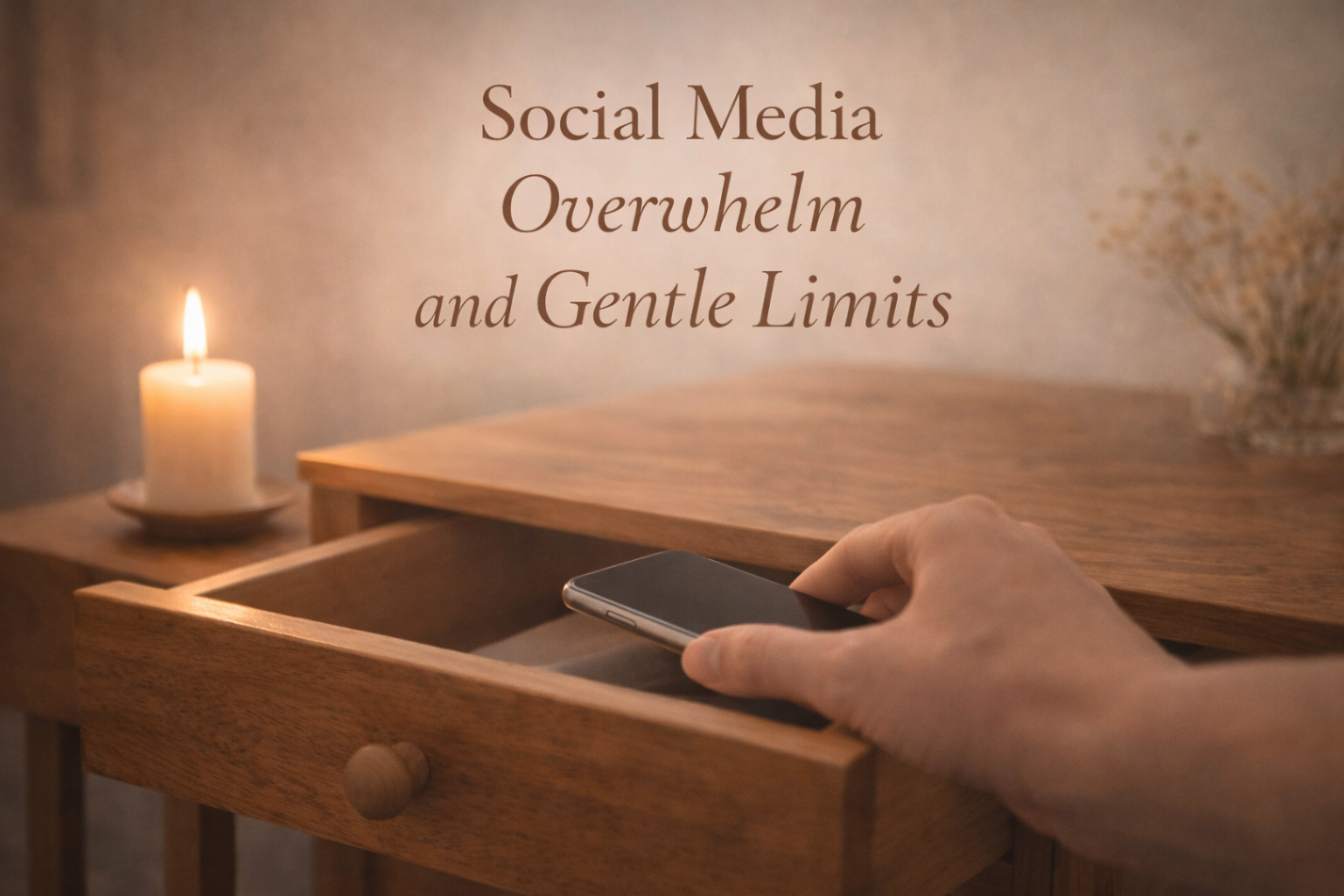
Social Media Overwhelm and Gentle Limits
Social media can overwhelm your nervous system. Try gentle boundaries that protect your peace without going extreme.
If social media leaves you tired, it’s not “in your head.” It’s in your body.
Scrolling can be a thousand micro-interactions: comparison, outrage, desire, grief, inspiration, judgment, laughter, envy. Even when you think you’re just “killing time,” your nervous system is processing emotional frequencies.
Overwhelm happens when your attention is asked to hold too much at once.
Why it feels so intense
Social media is fast. It rarely gives your system time to settle. You can move from tragedy to comedy to a sales pitch to a perfect-life montage in sixty seconds.
That kind of emotional whiplash makes the body braced, even if you don’t notice it.
Gentle limits are not punishments
They’re protection. Not rigid rules, but compassionate containers that say: My peace matters.
Try soft boundaries that still feel like freedom:
time windows (social media only after breakfast)
scroll caps (10–15 minutes, then stop)
no-bed scrolling (phone charges outside the bedroom)
app placement (move apps off your home screen)
one platform rule (choose one platform for a season)
You’re not removing joy. You’re removing overload.
Curate like your nervous system lives here (because it does)
Unfollow accounts that spike comparison. Mute what triggers. Reduce voices that keep you in outrage.
Your feed is not a public service. It’s an environment. And you are allowed to design your environment.
A grounding practice after scrolling
After you log off, do one “real-life contact” act:
look out a window for 30 seconds
touch something textured
drink water slowly
stretch your shoulders and jaw
step outside and breathe
Teach your body: We are back here now.
Replace scrolling with something that actually restores
Try a small “restore list”:
one chapter of a book
music that steadies you
a shower
journaling three sentences
a short walk
sitting in silence with one long exhale
Restoration doesn’t need to be complicated. It needs to be consistent.
You can enjoy social media without letting it siphon your spirit. Your attention is sacred. And gentle limits are one of the most loving things you can offer yourself. 🤍
Your Soulful Pathways ↑
Desktop: Hover over ‘Your Soulful Pathways’ in the top menu to explore another series.
Mobile: Tap the menu (☰), then choose ‘Your Soulful Pathways.’
Creating Quiet Without Escaping Your Life
Quiet doesn’t mean disappearing. Learn gentle ways to reduce overstimulation while staying engaged with your real life.
Quiet is not avoidance. Quiet is restoration.
You don’t need to abandon your responsibilities or move to a cabin in the woods to feel peace. You need pockets of quiet that fit inside your actual life, like soft landings for your nervous system.
Quiet isn’t always the absence of sound. It’s the absence of constant demand. It’s a moment where nothing is asking you to react.
The hidden noise you may not notice
background TV “for company”
constant podcasts to avoid silence
notifications that spike attention every few minutes
group chats that never stop
social media that keeps you in comparison
If your nervous system never gets a break, it starts treating normal life as too much.
Quiet that heals vs quiet that hides
Healing quiet says: I’m coming back to myself.
Hiding quiet says: I’m disappearing because I can’t cope.
This page is for healing quiet. The kind that makes you more able to live, not less.
Try these quiet anchors
Pick one or two. Keep it realistic.
Morning quiet (3 minutes).
No phone. No news. Just breath, water, light.
A quiet corner.
A chair or small space where your phone does not come with you.
The one-sound rule.
If music is on, no scrolling. If you’re scrolling, no music. One stream at a time.
Quiet transitions.
Before you enter your home, your car, your bed, pause for 10 seconds and exhale slowly.
These aren’t dramatic. They’re dependable. And dependence is what heals.
Quiet doesn’t have to be perfect
Quiet can be:
folding laundry without a screen
eating without scrolling
walking for five minutes
turning off notifications for one hour
sitting in your car before going inside
When you choose quiet, you’re not wasting time. You’re restoring capacity.
If quiet makes you anxious
That’s okay. Sometimes silence surfaces feelings.
If quiet feels intense, try “gentle quiet” instead:
soft instrumental music
nature sounds
a candle and one deep breath
a slow task with your hands
Quiet is a volume knob, not an on/off switch.
You don’t need to escape your life to find peace. You need to stop letting noise rent space inside your mind. Quiet is where your attention returns, and your spirit remembers its own rhythm. 🌿
Your Soulful Pathways ↑
Desktop: Hover over ‘Your Soulful Pathways’ in the top menu to explore another series.
Mobile: Tap the menu (☰), then choose ‘Your Soulful Pathways.’
The Sacred Power of Single Tasking
Multitasking fragments your attention. Single tasking restores calm, focus, and inner clarity. Learn how to practice it gently.
Single tasking is not laziness. It’s devotion.
It’s placing your attention like a blessing on one thing at a time.
In a world that rewards speed, single tasking can feel rebellious. Quietly. Kindly. Powerfully.
Multitasking looks productive, but it often feels like being pulled apart. You’re present everywhere and fully nowhere. Your mind becomes a room with eight conversations happening at once.
What multitasking does to your nervous system
Your brain pays a “transition tax” every time you switch tasks. It has to reorient, refocus, re-enter. That costs energy.
Over time, you may notice:
mental fatigue
irritation
scattered thoughts
difficulty finishing what you start
a constant feeling of being behind
Single tasking helps you stop leaking life through tiny cracks.
Single tasking as a sacred practice
This doesn’t require incense or perfection. Single tasking can be:
washing dishes and only washing dishes
writing one message, then stopping
listening to someone without checking your phone
eating without scrolling
folding laundry without a podcast in your ear
Attention is sacred because whatever you give your attention to, you feed.
The 10-minute sanctuary
Start small. Small wins build trust.
Choose one task.
Set a timer for 10 minutes.
Put your phone out of reach.
When your mind wanders, return gently.
After the timer, you can stop or continue. Either way, you’ve trained your nervous system to stay with one thing.
Common resistance and what it means
If single tasking feels uncomfortable, that’s normal. Sometimes distraction is how we avoid feelings. When you remove the distractions, your inner weather shows up: restlessness, sadness, fear, boredom.
Instead of judging it, try this phrase:
I can stay with this for one breath.
One breath is the door. The next breath is the room.
Make single tasking easier in real life
use music as a container (one playlist per task)
keep your phone in another room during focus blocks
close tabs when you finish
write a short list of “today’s one thing”
practice “finish before start” when you can
Single tasking restores your mind, not by force, but by reunion. It brings your life back into full color instead of scattered pixels. And slowly, your attention becomes a home you can return to. 🕯️
Your Soulful Pathways ↑
Desktop: Hover over ‘Your Soulful Pathways’ in the top menu to explore another series.
Mobile: Tap the menu (☰), then choose ‘Your Soulful Pathways.’

How to Stop Reaching for Your Phone When You Are Lonely
Loneliness makes the phone feel like comfort. Learn gentle ways to meet your need for connection without getting trapped in scrolling.
Loneliness doesn’t always knock. Sometimes it seeps.
And when it does, your phone becomes a doorway. Not always to real connection, but to company-like noise that keeps the quiet from feeling too quiet.
If you reach for your phone when you’re lonely, it doesn’t mean you’re addicted. It means your nervous system is seeking warmth, responsiveness, belonging. Screens mimic those signals, but often leave you emptier afterward.
Why the phone feels like comfort
Your phone offers:
movement and novelty
faces and voices
instant stimulation
the illusion of being “around people”
But loneliness isn’t solved by stimulation.
It’s soothed by presence. The kind that lands in the body.
The most important question
Before you grab your phone, ask:
What am I actually needing right now?
To be seen? To be reassured? To feel included? To avoid a heavy feeling? To be held?
Your answer becomes your next step.
A gentle replacement: The 90-second bridge
Instead of “don’t touch your phone,” try this:
Put one hand on your chest.
Exhale slowly.
Say: I feel lonely. I’m still here with me.
Then choose one connecting act:
text one person “thinking of you”
send a voice note
step outside for fresh air
play one song that feels like a friend
write three honest sentences in a journal
make tea and sit with it, no scrolling
This teaches your body: I can soothe myself without disappearing into the feed.
Create connection snacks
Big social plans aren’t always possible. So build small, steady threads:
one message to someone safe each day
one weekly call with a friend or family member
one gentle group space (book club, hobby group, spiritual group)
one “real-world anchor” activity (walk, class, volunteering)
Connection becomes easier when it’s a rhythm, not an emergency.
If the loneliness is deeper
Sometimes the phone is covering grief, transition, or burnout. If that’s true, go even softer. You don’t have to force yourself into crowds. You just need one true thread: one person, one practice, one place where your heart can exhale.
Your phone is not your enemy. It’s just the fastest comfort you’ve had available. Now you’re learning a braver comfort: connection that nourishes, and presence that holds you. 🤍
Your Soulful Pathways ↑
Desktop: Hover over ‘Your Soulful Pathways’ in the top menu to explore another series.
Mobile: Tap the menu (☰), then choose ‘Your Soulful Pathways.’